INSIDE: An Ounce of Prevention and Promotion of Mental Health The Power of Parenting LINKing Families to Success Are You a Mind Full or a Mindful Parent? mycanopy.org
800.388.6247
An Ounce of
Prevention and Promotion of Mental Health
Y
–John D. Damon, Ph.D., Chief Executive Officer, Canopy Children’s Solutions
our child’s mental health affects the way they think, feel and act. During the COVID-19 crisis, you may have noticed significant changes in your child’s behavior. While some change is to be expected, children experiencing mental health challenges such as depression or anxiety, will struggle with thoughts and behaviors where it impairs their ability to thrive. According to the World Health Organization, many mental health disorders are shaped by various social, economic and physical factors during different stages of life. Some of the situations that may trigger mental health challenges are unavoidable; however, parents can teach their children ways to be resilient in coping with adversity. There are many ways parents can help promote positive behaviors and prevent future mental health problems. Here are a few ways you can promote positive mental health: Create a safe, positive home environment • Make sure children get adequate sleep and proper nutrition • Schedule regular family meals • Limit your child’s use of social media (both content and amount of time) and be present in the moment by limiting your own electronic use in front of children • Keep adult conversations between the adults (including financial stress and marital problems) • Provide time for physical activity, family fun and group outings • Model sound mental health by talking about your feelings and engaging in activities that promote mental health and self-care Help children develop healthy views of themselves • Praise them when they do mycanopy.org
800.388.6247
well, focusing on their efforts not just the outcomes • Ask open-ended questions about their activities, friends, interests and experiences • Help them set realistic goals Listen and respect their feelings • Teach them how to relax when they are upset (deep breathing, going for a walk) • Teach them it’s OK to feel sad, angry, or frustrated. Model how to talk about those feelings in an open, non-judgmental or blaming way • Connect your child with someone to talk to if they don’t feel comfortable talking with you Parents must be intentional in their interactions with their children and in the type of environment they create at home. If there is a history of mental illness in the family or stressors impacting the family (moving, job change, divorce, traumatic experiences,) it is critical to recognize distress in children and know when to seek professional help—then do it! That ounce of investment will far outweigh the pound of cure as they grow.
P
THE
C
ower of ARENTING –Mark O. Rester, MD, Medical Director, Canopy Children’s Solutions
oping skills are learned behaviors that help us deal with stress and difficult situations. During the recent times of quarantine, many health leaders are concerned about the coping skills children and teens are inherently learning as many families struggle with financial crises and job loss, isolation, fear and health challenges and more. When children are not taught how to handle stress in ways that benefit their health such as self-care and positive calming techniques, disappointment and “big emotions” can lead to youth turning to risky behaviors such as substance abuse. Parents play an important role in the way children respond to difficult challenges. Children with poor parental monitoring, low levels of family interaction, overly harsh discipline, high levels of family conflict and poorly modeled coping skills can see increased rates of aggression, sexual behavior and substance use. Teens who struggle with depression, anxiety, or other untreated
emotional or behavioral conditions are also more likely to turn to drugs and alcohol to escape their feelings without the help of a positive support system (which can include parents, friends, coaches, teachers, neighbors or community members). If you notice that your child isn’t responding well to your parenting, help is available for parents to learn new skills and ways to manage problem behaviors. The goal of family-based prevention is to promote positive youth development through effective parenting and family relational skills. These skills reinforce positive parent/child relationships, appropriate monitoring and discipline, and effective communication. These three factors have been found to be the most critical functions toward improving youth outcomes against substance abuse, criminal activity, school dropout rates and teen pregnancy. Because brain development isn’t complete until your early to mid 20s, youth are more likely to act impulsively when faced with stress or peer pressure without fully calculating possible consequences. Through positive and active parenting, adults can provide children with an outlet of someone to talk to, someone to help guide decisions or someone to model positive skills and behaviors, ultimately lowering their risk of participating in risky behaviors. Playing an active role in your child’s life and recognizing those signs of potential danger is the best way to help your child avoid difficult consequences and the long road of recovery. mycanopy.org
800.388.6247
LINKing Families to
Success
C
anopy provides families with the resources and support they need to successfully maintain their family safely in the home while increasing the resiliency and stability within the family. Canopy’s LINK program connects families to Family Navigators to help identify potential stressors, connect families with resources and implement education on teen pregnancy prevention, substance abuse, parenting skills and family stability. Canopy’s LINK program is offered in Greenville, Gulfport, Hattiesburg, Jackson, Meridian and Olive Branch.
we navigate the process of qualifying for benefits such as the Temporary Assistance for Needy Families (TANF) Program, Women, Infants and Children (WIC), Supplement Nutrition Assistance Program (SNAP), Childcare Payment Program, Medicaid Eligibility and Children’s Health Insurance Program (CHIPS).
LINK connects families to community resources.
Yolanda Wooten, BSW, M.Ed, CHSP, Canopy’s Statewide LINK Coordinator, addresses questions many families might be facing: I have struggled to find new employment during the COVID-19 crisis. What are some local resources I can turn to? Canopy’s LINK program has established connections with the Mississippi Department of Employment Security and WIN Job Centers to help families to regain employment. We also link individuals to job training, career development centers and adult education programs. In the interim, mycanopy.org
800.388.6247
Since going back to work, my income has not been as steady as it was before. I need assistance with everyday essentials, who can help? LINK has connections with community groups and agencies across the state who can assist families with acquiring home essentials as well as address food instability and affordable housing. Our Family Navigators can assist you with finding the resources in your local community.
My child has struggled being isolated during shelter-in-place measures and has not been the same since. Are there places I can turn to get my child help if I don’t have insurance? Yes. Canopy’s LINK program provides referrals to behavioral services and educational resources through Canopy Children’s Solutions. Canopy offers Outpatient Behavioral Health Clinics for children and adolescents up to age 21. Canopy can provide assistance through LINK with applying for Medicaid and also connect the family to mental health clinics which offer sliding fees for uninsured children/adolescents in need of services. I am worried my increased alcohol consumption is negatively impacting my work and home life. Where can I find help? Canopy’s LINK Family Navigators can refer you to community partners such as the National Council on Alcoholism and other addiction/treatment programs. As you get help, we will support the family along the road to recovery. My child has challenges requiring an Individualized Education Plan (IEP) at school. I miss a lot of work for school meetings and am worried I may lose my job. What can I do to protect my family? Canopy’s LINK Family Navigators have connections with the Mississippi Society for Disabilities who can assist with advocacy services during IEP development. LINK can also assist with helping families file for intermittent Family Medical Leave Act (FMLA) benefits for parents to attend IEP meetings, therapy sessions and doctor’s appointments for medically fragile and special needs children. Canopy’s LINK program connects struggling families to community resources. It is provided by a grant through the Mississippi Department of Human Services. To learn more about LINK, visit mycanopy.org/link.
If your family or someone you know might benefit from Canopy’s LINK Program, contact 800.388.6247.
mycanopy.org mycanopy.org
800.388.6247 800.388.6247
Are You a Mind Full or a
Mindf
– James W. Mo
M
any times as a parent, you are faced with situations that are extremely stressful and overwhelming—that has likely been very true in 2020 as many changes have occurred the past few months. While society will learn to adapt to parenting with COVID-19, every phase of parenting lends its way to certain challenges and stressors, in addition to the
When your mind is overly busy and you feel overwhelmed with the stress of life, it’s easy to lose contact with your present moment, which can lead to our ineffectiveness in multiple areas of life. Have you ever been so preoccupied with something that you could not remember where you put your keys? Perhaps you’ve had to ask someone to repeat themselves because your focus was elsewhere while they were talking.
THE LOSS OF THE PRESENT M ALSO GIVE US A VERY SHORT stress you are managing from everyday life. The reality is that parenting can be one of the most challenging experiences a person can face. High levels of stress can often impact a parent’s ability to effectively manage their child’s behavior, and can deepen feelings of isolation, resentment and other negative outcomes. Think about when you were sheltered at home with your children—did you find yourself frustrated with a child at one moment, only to find yourself feeling overwhelming guilt for these feelings later? Have you ever felt as though you didn’t know how to handle a particular situation with your child? Have you ever felt as though your mind is so busy that you cannot tell if you are coming or going? mycanopy.org mycanopy.org
800.388.6247 800.388.6247
The loss of the present moment can also give us a very short temper. There are so many times as a parent you may feel frustrated and angered with your child, but can rarely recall what caused you to feel that way. When you’re “stuck in your head” and not connected with the present moment, it isn’t long before your reactions to your child’s behaviors are unsatisfactory. By practicing mindfulness in parenting, you will be able to prevent many difficult situations from escalating as you get back into your present moment. Mindfulness involves paying attention to what you are experiencing in that moment with curiosity and without defense or judgment. Simply put, mindfulness is learning how to recognize when your attention has wandered and being able to shift it back to where it needs to be.
ful Parent?
oore, Ph.D., BCBA-D, LBA, Director of Autism Solutions, Canopy Children’s Solutions Try this activity - pause for a moment. Carefully look around. Can you notice at least 5 things you see around you? Close your eyes. Can you notice 5 things you hear? Now see if you can notice 5 things you can feel or touch - your feet on the ground, your clothes on your body, or the air on your face. If you can’t notice 5 things, or if your mind wanders, take a deep breath. Notice and acknowledge
MOMENT CAN T TEMPER. that thought, then let it go. Now, try the exercise again. How’d you do? Keep in mind that some days and situations will be much easier than others, but remember mindfulness takes practice. Learning how to stay present in tough situations will help you handle difficult parenting challenges with your children in a way that is positive and proactive. Practice a little each day (start now!) and see how your parenting is transformed.
MINDFUL EXERCISE 1. Carefully look around. 2. Notice 5 things you see. 3. Close your eyes. 4. Notice 5 things you hear. 5. Notice 5 things you can feel. 6. If your mind wanders, take a deep breath. Acknowledge that thought, then let it go. 7. Try the exercise
again.
mycanopy.org mycanopy.org
800.388.6247 800.388.6247
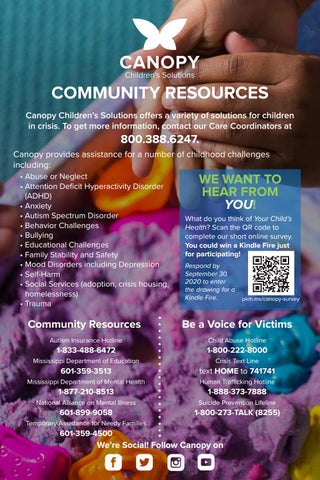
COMMUNITY RESOURCES Canopy Children’s Solutions offers a variety of solutions for children in crisis. To get more information, contact our Care Coordinators at
800.388.6247. Canopy provides assistance for a number of childhood challenges including: • Abuse or Neglect • Attention Deficit Hyperactivity Disorder (ADHD) • Anxiety • Autism Spectrum Disorder • Behavior Challenges • Bullying • Educational Challenges • Family Stability and Safety • Mood Disorders including Depression • Self-Harm • Social Services (adoption, crisis housing, homelessness) • Trauma
WE WANT TO HEAR FROM YOU!
What do you think of Your Child’s Health? Scan the QR code to complete our short online survey. You could win a Kindle Fire just for participating! Respond by September 30, 2020 to enter the drawing for a Kindle Fire.
pkm.ms/canopy-survey
Community Resources
Be a Voice for Victims
Autism Insurance Hotline
Child Abuse Hotline
1-833-488-6472
1-800-222-8000
Mississippi Department of Education
Crisis Text Line
601-359-3513
text HOME to 741741
Mississippi Department of Mental Health
Human Trafficking Hotline
1-877-210-8513
1-888-373-7888
National Alliance on Mental Illness
Suicide Prevention Lifeline
601-899-9058
1-800-273-TALK (8255)
Temporary Assistance for Needy Families
601-359-4500
We’re Social! Follow Canopy on mycanopy.org
800.388.6247