Queen Margaret’s School Reading, Writing & Riding
EDUCATION FOR HORSE
OPTIONS LOVERS
THE MARKETPLACE Canada’s Horse Industry At Your Fingertips
SPECIAL FEATURES
Pit Ponies Ghosts of the Coal Mines
Horses With Jobs
WORKING EQUINES OF THE 21ST CENTURY n n n n n
Logging Towing Outrider Packing Pulling
n n n n n
Therapy Rodeo Pickup Police Mount Carriage Horse Marine Harvest
How To...
Take a Great Conformation Photo n Shorten a Mane with Scissors n Train an Unruly Mane n Blanket Based on Need n Spot Signs of Sugar Sensitivity n Prevent a Mineral Imbalance n
PM #40009439
$8.95
A Special Issue of
DISPLAY UNTIL AUGUST 31, 2017
Return undeliverable Canadian addresses to: Suite 201, 2400 Bevan Ave., Sidney, BC V8L 1W1
HORSE INDUSTRY
A Triage of Canada’s Equine Insurance Horse Industry What Does the Future Hold?
Cold Comfort
Understand Your Policy’s Fine Print
Horse Care in Winter-Long Turnout
w fro m
ne
equine
h.A. 300 Extra strength hyaluronic acid Supports joint health and function each serving contains:
hyaluronic acid 300 mg
Natural lubricating compound for joint and skin health.
vitamin c 7000 mg
Necessary nutrient for the development, maintenance and healing of connective tissue throughout the whole body. Available in 30 or 90 day supplies.
Vegan
Gluten-free
Non-GMO
GEORGIA HUNT RIDING FOR FOXSTONE VENTURE
Vegan
Gluten-free
Non-GMO
A healthy horse is a happy horse
Nature. Science. Your Horse.
Dynamint Equine ALL NATURAL SOOTHING LOTION for SORE or STRAINED MUSCLES & JOINTS
Available in 1L spray bottle for easy and quick application to larger areas, or a 500ml rub bottle. A soothing combination of natural essential oils in a gentle cream base. Specially formulated with natural ingredients to assist in the relief of leg, mustle and joint strain.
Equiband-Aid
Antibacterial spray bandage for horses with Tea Tree Oil. Forms a flexible, breathable film which seals out water, dirt and bacteria, lasting up to 2 days. This spray bandage covers the affected area like a second skin and allows natural healing. Available in a 500ml handy-grip trigger spray bottle (non-aerosol).
National Distributor: Canadian Centurion • 1-800-361-3860 Local: Janian Imports • (604) 462-9238 Manufactured for: Integrated Bio Systems Inc. 34282 Manufacturers Way, Abbotsford, BC V2S 7M1 Phone: 1-877-501-5003 • Fax: 604-852-9016 • E-Mail: intbiosys@shaw.ca
www.integratedbiosys.com
Vettec protects, supports and promotes a thick healthy sole.
Sole Protection & Support for the Unshod Foot
Soft & Supportive Instant Pad Material for Thrush
Soft & Supportive Instant Pad Material
Extra Soft Instant Pad Material for Use Under Pads
Equi-Pak|CS
Equi-Pak
VA.0217.ECGPACK
Sole-Guard
Equi-Pak|Soft under pad
US Customer Care • 1.800.483.8832 • www.vettec.com EU Customer Care • +420 800 260 001 • www.vettec.net
CONNECT TO THE HORSE INDUSTRY
www.HORSEJournals.com
3
IF HORSES ARE YOUR
PASSION THEN THIS SHOULD BE YOUR
TRUCK
6.6L V-8 DURAMAX DIESEL 445 HP- 910 LB-FT OF TORQUE ALLISON 6 SPEED AUTO TRANS. CAN PULL UP TO 11,363 KG WHEN PROPERLY EQUIPPED TRAILERING MIRRORS - DIESEL EXHAUST BRAKE SYSTEM TRAILER SWAY CONTROL - TOW/HAUL MODE - TRAILER BRAKE CONTROL REAR VISION CAMERA - HILL START ASSIST TRANSMISSION TEMPERATURE GAUGE
875 WOODLAWN RD. W. GUELPH AUTOMALL 519.821.0520
4
Canada’s Equine Guide 2017
PHOTO: CANSTOCKPHOTOGRAPHY.COM/DRAGONIKO
2017 GMC SIERRA HD
CANADA’S HORSE INDUSTRY AT YOUR FINGERTIPS
Become a Certified Equine Assisted Learning Facilitator with the ONLY Certified EAL COURSE for Business! HORSES + PASSION + PEOPLE = YOUR CAREER!
www.equineconnection.ca
CANADA’S HORSE INDUSTRY AT YOUR FINGERTIPS A SPECIAL ISSUE OF
CONTENTS
12 PHOTO: SHUTTERSTOCK/CALLIPSO • 28 PHOTO: CANSTOCK/DANIELPFISTER • 84 PHOTO COURTESY OF APRIL RAY-PETERSON
28 INSIDE 10 Editor’s Desk 82 How To Horsekeeping
12
Step-by-step instructions and guidelines to help you improve your horse management skills.
94 The Marketplace
Your comprehensive source for products, services, breeds, stallions, and more.
99 Industry Hoofbeat • Odysseo by Cavalia: A unique theatrical experience • Horse3: Head-Heart-Hooves • Manitoba Horse Council Honours Exceptional Members
84
102 Index to Advertisers CONNECT TO THE HORSE INDUSTRY
FEATURES
HORSE HEALTH 28 Cold Comfort
Domestic horse care and the long, cold Canadian winter
88 How to Blanket Based on Need
Is going under cover the right choice for your horse?
90 How to Recognize Signs of Sugar Sensitivity
Learn to spot the symptoms of insulin resistance and equine metabolic disease.
92 How To Prevent an Iron-Copper-Zinc Imbalance
Why the balance of minerals is important, and the implications of iron overload. www.HORSEJournals.com
7
A SPECIAL ISSUE OF
36 FEATURES
HORSE INDUSTRY 12 A Triage of Canada’s Horse Industry
The present, the future, and how do we get there from here?
22 Equine Insurance: The Fine Print
Understanding your coverage, why insurers deny claims, and what to do if your claim is denied.
36 Horses With Jobs Horse Help Wanted!
Ten 21st century jobs showcasing our hardworking horse friends.
58 Pit Ponies: Ghosts of the Coal Mines Horses and ponies lived and died in one of the world’s most hostile and dangerous working environments. 8
Canada’s Equine Guide 2017
SPECIAL FEATURES
22
74 Queen Margaret’s School Where the bond between horse and rider forges a pathway to success.
78-81 An Education in Equines
Opportunities to broaden your knowledge or turn your passion into a career with horses.
82 How to Take a Great Conformation Photo The no-stress guide to taking that perfect conformation photo.
58
84 How to Shorten a Mane with Scissors A tidy, short, thin mane… without pulling? Yes you can!
86 How to Train a Mane
Step-by-step guide to training “the mane with a mind of its own.”
74
CANADA’S HORSE INDUSTRY AT YOUR FINGERTIPS
22 PHOTO: SHUTTERSTOCK/PETER TITMUSS • 36 PHOTO COURTESY OF KENNET HORSE BOAT COMPANY • 58 PHOTO COURTESY BIG PIT NATIONAL COAL MUSEUM, BLAENAFON, WALES • 74 PHOTO: HAYLEY PICARD
CONTENTS
CANADA’S HORSE INDUSTRY AT YOUR FINGERTIPS
Julie Moorcroft of Scion Farms High River, AB, Canada
Bef�e
Rebecca Wieben Photography
PUREFORM Supplements
PureFormEquineHealth.com
After 2 Mon�ts o PUREFORM Equine Heal�
.
Perf�emanc
Supplement
Welcome to
CANADA S b
We’ve spent the past several months developing this special annual edition, and we’re eager to tell you all about it. It was in Martin Cruz Smith’s 1996 novel, Rose, set in 1872 Wigan, Lancashire, England, that I first learned about pit ponies and their work in the coal mines. I was at once captivated and horrified to read about the white pony, trussed by cinches around folded front and hind legs, hanging over the mine shaft, biting and thrashing wildly until the front cinch broke. Then calmed by a hood over her head, trussed with a new cinch, and suspended below the cage that held the miners, the cable unreeled and she dropped from sight and descended into the deep black hole… Our Guide feature tells the story of the horses and ponies that toiled alongside the miners in one of the world’s most hostile and dangerous work environments. Some of the equines that worked the mines went underground and stayed there year in and year out. Coal mining was exhausting, dirty work that came with constant risk of injury or death. Read their stories in Ghosts of the Coal Mines: Pit Ponies and Horses. In Horses With Jobs, we celebrate the enduring working partnership of horse and man. Where would we be without our faithful equine coworkers who, down through the ages, shared our lives and gave
On The Cover A dog may be man’s best friend
but the horse wrote history.
Photo: iStock/Zuzule
– AUTHOR UNKNOWN
10
Canada’s Equine Guide 2017
us their amazing gifts of power, speed, service, and companionship? Since we first domesticated them some 6,000 years ago, horses have been our most important ally and workmate. Our feature Horse Help Wanted! Ten 21st Century Horse Jobs honours our hardworking horse friends and their loyal service. Another anchor feature in this Guide looks closely at Canada’s horse industry – where we are now, and where we’re headed in the future. The last national study that provided insight into the state of our industry was conducted in the post-recession hangover of 2010. What has changed in the past seven years? Who is identifying and measuring the changes in order to plan for future growth and industry sustainability? How can we make reasonable, evidencebased decisions to direct our future when we don’t have a clear picture of our present? We need an updated nation-wide study to define the current state of the industry, and provide solid direction for the future. In the absence of a new national study, we conducted our own survey of readers and horse industry businesses in late 2016. We also contacted horse people in several major industry sectors for their opinions and assistance. Our goal was to identify the topof-mind issues facing our industry today, and to gather additional perspectives and detail relating to major concerns. We triaged the issues as we sorted through hundreds of responses, and now share the results with you in our feature, The Changing Face of Canada’s Horse Industry: Where do we go from here…? Also in this Guide, read about the metabolic consequences of turning our domestic horses out to pasture (paw) in our harsh, northern climate in Cold Comfort: Domestic Horses and the Long, Cold Canadian Winter. Learn about equine insurance coverage, why insurers may deny claims, and what to do if your claim is denied, in Equine Insurance: Understanding the Fine Print of your Policy. Discover the history of Vancouver Island’s Queen Margaret’s School and read about their unique equestrian program. And learn about six more exciting opportunities to further your education with horses. Be sure to check out the guidelines and step-by-step instructions in our How To Horsekeeping articles, designed to improve your knowledge and horsemanship. As always, your comments are welcome and we’d love to hear from you. Kathy Smith, Editor
CANADA’S HORSE INDUSTRY AT YOUR FINGERTIPS
Equine Guide
NATIONAL ANNUAL
Volume 17 • Issue 3 • 2017 Canada’s Equine Guide is a Special Issue of EDITOR / PUBLISHER Kathy Smith ACCOUNTS Chantal Patterson ADVERTISING Ronnie Olsen • April Ray-Peterson • Terry Andrucko CIRCULATION Steve Smith, Nathan Reimer NEWS EDITOR, ADMIN Nathan Reimer MARKETING Janna Reimer PRODUCTION Elisa Crees CONTRIBUTORS Margaret Evans • Lynda M. Vanden Elzen April Ray-Peterson • Robin Duncan Photography • HCBC • OEF CanTRA • Western College of Veterinary Medicine Equine Guelph • Pam MacKenzie • Karen Weslowski ADVERTISING, SUBSCRIPTIONS & GENERAL INQUIRIES 1-800-299-3799 • 250-655-8883 or email: sales@horsejournals.com ADVERTISING DEADLINE 4 weeks prior to issue date (eg: Sept. 30 for Nov/Dec issue) INTERNET EDITION WEB SITE www.horsejournals.com MAIN OFFICE E-MAIL editor@horsejournals.com PRODUCTION DEPARTMENT E-MAIL design@horsejournals.com
Publishing 6 issues per year SUBSCRIPTIONS – REGULAR RATES 1 yr/6 issues: $24 + tax 2 yr/12 issues: $37 + tax US $59/2 yrs, 12 issues ORDERS FOR SUBSCRIPTIONS, CHANGE OF ADDRESS NOTICES, & UNDELIVERABLE COPIES ARE TO BE SENT TO: THE CANADIAN HORSE JOURNAL Suite 201, 2400 Bevan Ave., Sidney, BC V8L 1W1 (250) 655-8883 • fax: (250) 655-8913 • 1-800-299-3799 POSTAGE PAID AT WINNIPEG, MB PUBLICATIONS MAIL REG. NO. 40009439 GST REG. NO. 829298140 ISSN. NO. 1496-1733
We acknowledge the financial support of the Government of Canada through the Canada Periodical Fund of the Department of Canadian Heritage.
REPRODUCTION IN WHOLE OR IN PART OF ANY MATERIAL CONTAINED IN THIS PUBLICATION WITHOUT THE WRITTEN PERMISSION OF THE PUBLISHER IS STRICTLY PROHIBITED.
The information and services listed herein are intended to facilitate accessibility to the professionals, products and services that play a part in the horse industry. While readers are encouraged to use the products and services of the merchants listed in this Guide, Horse Community Journals Inc. does not recommend or guarantee the products and services of advertisers or associates listed. Manuscripts and photographs will be returned only if SASE is provided. The return of unsolicited material is not guaranteed. Contributors and advertisers warrant all materials supplied are free of copyright and they have the legal right to use the same. All material accepted for publication is subject to such revisions as are deemed appropriate by The Canadian Horse Journal (CHJ). The opinions expressed in CHJ are not necessarily those of the publisher. CHJ reserves the right to refuse any advertising or submission. Contributors consent to have their submissions published in CHJ and on www.HorseJournals.com and elsewhere as determined by the publisher. Printed in Canada. Please recycle.
The Power of Results
Congress Champion: Kruzin In Style | Owned by Wayne & Judy Davis Essential KÂŽ provides: Low sugar and starch levels Lower intake and cost Fixed formula for consistency and quality Essential organic trace minerals Essential fatty acids Essential amino acids Antioxidants for improved health
OFFICIAL FEED
ÂŽ
OFFICIAL FEED
TributeEquineNutrition.com | 800-472-9507 Made in the U.S.A.
HORSE INDUSTRY
The Changing Face of
Canada’s Horse Industry Where do we go from here…? By Margaret Evans
S
even years ago, the 2010 Canadian Horse Industry Profile Study was undertaken by Equestrian Canada (formerly Equine Canada). The mandate was to define the state of the industry in 2010, the issues that could direct its future, and to determine how prepared it was to meet the challenges that could influence its sustainability, growth, markets and management. A summary of the information gathered in the summer of 2010 and presented in the Study is listed below: • There were 963,500 horses in Canada owned by 226,500 households, resident on 145,000 properties.
• The horse industry contribution to Canada’s economy was pegged at more than $19.6 billion annually, supporting more than 154,000 jobs in Canada. • The industry investment in horses, tack, equipment and improvements was estimated at $29 billion.
12
Canada’s Equine Guide 2017
CANADA’S HORSE INDUSTRY AT YOUR FINGERTIPS
PHOTO: ISTOCK/LOSHADENOK
• Approximately 855,000 people were active in the horse industry, comprised of 59 percent adults and 41 percent children.
• Selling prices of horses was down significantly, attributed to increased imports from the US for processing and the economic recession. • Annual foal production had decreased 50 percent between 2003 and 2010, while costs of horse-keeping increased more than 70 percent. • The number of horse-owning households increased by 79,000 between 2003 and 2010. Expansion was attributed to increased participation from the babyboomer generation. • Horse owners were aging, with median age increasing to the 50 — 59 year-old range, and 24 percent of horse owners were 60 years of age or older. • Entry level participation was down by approximately 50 percent. A key priority identified for long-term industry sustainability and growth was attracting new participation and revitalizing the customer base. The results were aptly described by Akaash Maharaj, former CEO of EC: “Our report confirms the enormous — but too often underestimated — contribution made by Canadian equestrians to our country’s economy and quality of life.” The Study was published in 2011 and the statistics took some by surprise, while others nodded in affirmation that the results matched their instincts. In the 2012 edition of this Guide, we summarized and discussed the results of the 2010 Study.
horse abuse, and concerns about fewer people getting involved in riding. This article will share these results with our readers. “Although hay costs are cyclical in Alberta there has been a noticeable trend upward in feed costs over the past five years,” says Les Oakes, President, Alberta Equestrian Federation. “This along with boarding fee increases, [and] increased vet and farrier costs, have made an already expensive sport become costlier for the average person to participate in. Fuel prices are up in Canada, therefore, it is more expensive to travel to shows. And, although my comment is based on anecdotal evidence, I have noticed boarders making fewer trips out to the barns where their horse resides. Although the AEF’s membership numbers are up substantially over the past five years, I do believe that this is a result of the AEF focusing on membership growth, not a growth in the number of people who
participate in equestrian events or recreational use of equines. The average age of participants in the equine world has continued to increase with over 17 percent of the AEF’s membership over the age of 56 years old in 2016.” Perhaps, too, the approach to enjoying horses has changed. “It seems as time has passed that horses are now viewed as either a commodity or expense, and less of a partner in sport,” says Mark Halliwell with Richmond Stables, BC. “There will always be an aspect of buying and selling, breeding and trading, but now competitive horses are being loaned out on paid leases once their principal job is completed, and income is derived from this. In the past, horses that weren’t being used to their full potential just needed a job to do, and if there was a rider willing to take that horse on, then everyone was happy. Now it seems horses are being used to their full potential well beyond their years, expected to make an
When introducing children to the world of horses, parents should ensure that their child’s coach is certified and competent so riding experiences are safe and positive.
Now, seven years on, where does the industry stand and to what extent have the concerns of the 2010 survey’s participants materialized? In many ways, the aftermath of the economic recession of 2008-2009 accelerated the changes in Canada’s horse industry. In the absence of an updated nation-wide study to identify and measure the ensuing changes and their effects, this magazine conducted reader and business surveys in late 2016, and also contacted a number of key members of the horse industry across Canada. Our research was intended to identify the top issues facing the equine industry today, and gather additional perspectives and detail relating to major issues and concerns. The answers were understandably many and varied depending on each respondent’s specific focus and participation, but top-of-mind concerns included costs (from buying a horse to owning land, board, feed, vet, farrier, coaching, show fees, and travel), training, breeding, horse health, horse welfare,
PHOTO: CANSTOCK/RTBILDER
Looking Ahead
CONNECT TO THE HORSE INDUSTRY
www.HORSEJournals.com
13
income while doing so, and medicated and maintained to ensure they can. Once they have outlived their usefulness, they are sold as companion horses.” In Nova Scotia, changes in the industry have also been seen at various levels. “Lower level competitions are tending to move away from the EC Bronze level, rather finding affiliation with local or provincial organizations,” says Roz Moskovits, director of industry, Nova Scotia Equestrian Federation. “Others choose to operate as non-affiliated ‘stand alone’ competitions. The reasoning for this seems to be a justification of both cost and red tape. [There are] fewer riding schools offering structured lesson programs. Many new riders and horse owners are moving into the industry without the guidance of a professional coach or instructor. Education of these individuals is gained in a haphazard fashion from friends and social media.” Moskovits says that, in fact, Nova Scotia has seen a large growth in horse ownership. They are still seeing the results of the decline in the PMU (Pregnant Mare Urine) industry with many displaced horses ending up in the Maritimes. While more people are able to purchase these bargain-basement priced horses, often poorly bred or inadequately trained or both, the growth in ownership
At every level of horse care and performance, education is central. “I think the industry, as a whole, must look at trying to involve the youth even more than it has in the past,” says Lianne Knechtel, conference coordinator, Horse Industry Association of Alberta. “The different groups, e.g., 4-H, engage in trying to educate young people about the horse industry. However, 80 percent of the people now live in urban dwellings. That means the exposure to the equine industry can be quite limiting. Kids grow up with no knowledge of what a horse can do for them, recreationally or otherwise. So, to me, education is the number one thing that must be addressed when looking at the future of the horse industry.” Of high concern to many of our survey respondents was horse welfare, or more pointedly, the lack of it. “I would say the biggest concern is the welfare of horses — and it if isn’t it should be,” says horse owner April Ray-Peterson. “Unfortunately, when things get tough, horses seem to suffer. You don’t have to look any further than the many auctions all across Canada to know there is a huge problem. When a horse is no longer useful or the owner is no longer able to care for them, often their fate is the meat truck. A lot of people want to stop slaughter, but I think the solution needs to be less of band-aid and more of a systemic approach. If we didn’t have an overabundance of horses in the first place
PHOTO: ISTOCK/CGBALDAUF
As horse owners age, we are losing the most experienced horse people who are the real mentors of our industry.
is not paralleled by growth in knowledge or skills. On the plus side, she notes, the prices of quality horses have risen significantly. But it doesn’t help, she says, that interests and affiliations in the industry are seemingly more fleeting. This creates uncertainty for groups and organizations when planning events, competitions, or business investments. While PMU horses are being traded on the east coast, it is interesting that the PMU industry is having somewhat of a revival on the prairies. “PMU is increasing after an all-time low,” says Carolyn Lintott with the Manitoba Horse Council. “Apparently the synthetic hormone has more side effects than natural replacement. [But] it is nowhere near as much as in the past. The number of strictly breeding facilities in Manitoba remains stable.” In our readers’ survey, many responded with concerns over horse welfare, the lack of education or plain ignorance of owners leading to poor outcomes for horses. One candidly commented there are too many keyboard commandos and Facebook vets, while another cited too little education of the horse and rider using wrong training techniques. “The Internet is a problem,” says Dan Wilson, owner of Woodmont Canadians in Ladysmith, BC. “While Facebook can sometimes be helpful, it often has negative information that can be misleading, not factual.”
14
Canada’s Equine Guide 2017
CANADA’S HORSE INDUSTRY AT YOUR FINGERTIPS
Time to
slay some hay.
It’s your land. We’ll help you rule it with the KIOTI® RX series. Models from 66 HP to 73 HP. A variety of transmission options. One of the heaviest lift capacities in its class. Let one carry you into battle, and keep you in power for years to come. Visit Kioti.com to find a dealer near you.
Kioti.com © 2017 KIOTI Tractor Company a Division of Daedong-USA, Inc.
PHOTO: CANSTOCK/VANELL
s
they wouldn’t be clogging up the market and meeting an untimely and often inhumane end.” That position is echoed by Kevan Garecki, manager, Circle F Horse Rescue Society in Abbotsford, BC. “The breeding issue has become excessive to the point of insanity, which will of course cause slaughter to continue to increase as steadily as it has over the previous five years,” says Garecki. “I see no evidence of a downturn in this trend. The more responsible breeders are continuing to exercise their own trademark morals,
Many families can no longer afford to own a few acres to keep a horse or pony for their children.
PHOTO: SHUTTERSTOCK/BRAD SAUTER
Today, fewer children are riding and horses must compete with many other less expensive activities. Yet when people are exposed to horses at a young age, they are more likely to stay involved.
16
Canada’s Equine Guide 2017
CANADA’S HORSE INDUSTRY AT YOUR FINGERTIPS
and enjoying increasing popularity for doing so, as this behaviour is favourably in the spotlight at present. At the opposite end of the spectrum, the equine versions of puppy mills are producing higher lots, evidently in the hopes of playing the numbers bet; a proverbial shotgun approach as it were.” The breeding issue was a major concern among readers. One commented that breeders are very fractured with many out-of-country breed registries now doing business in Canada. There was support to build a stronger breed/industry relationship with more support from Agriculture and Agri-Food Canada. Some also recommended better marketing to the equestrian community. As one breeder says, “We are the best buy and not enough know it.” But the perception of breeding differs in different parts of the country. “I think backyard breeding is way down,” says Mark Nelson, president, Ontario Equestrian Federation and owner of Oakhurst Farm in Ashton. “So, I think the number of animals we are going to see over the next few years will decrease in that middle range. There is always going to be the high-end bred horses. They continue to breed while the backyard ones are not.” On the prairies, the trend toward breeding has diminished according to Knechtel. “It does not matter what breed, what they are being used for, or who owns them, the trend has still continued to grow smaller,” she says. “The cost of breeding, as well as the timeframe to maybe get a small return on investment, is so long. It deters a horse owner from investing. I do believe, however, people look for quality over quantity, if they make the decision to breed an animal. The horse industry needs a sound breeding program in order to ensure the horse population continues to grow and prosper.” Lack of access to coaching and training and a lack of knowledgeable trainers with a credible background were also concerns among respondents. Halliwell says that, indeed, the industry in many areas is saturated with self-proclaimed trainers. In the past, horse shows clearly set apart those who can and those who cannot. Now, he says, everyone gets a ribbon. The talent, skill and experience needed to get a horse or rider to place has been watered down. “While there are various certification programs in place to certify and verify coaches, any person can teach riding lessons and run a barn with or without the necessary experience and
qualifications,” says Ray-Peterson. “I see a lot of backyard barns and teachers who of course have their place, but hopefully not at the expense of the horses and their clients. I’m not sure if it’s possible to enforce some sort of required certification process to operate a barn, but when you think about other industries, you would never send your child to have swim lessons with an uncertified coach.” Ray-Peterson rightly points out that in equestrian sport a major part of the equation is the horse itself, an animal with a mind of its own. The need for safety is huge and it is the driver behind the commitment to developing quality riders who adhere to standards that should be encouraged industry-wide. “My own work with new professionals/ coaches in the industry, predominantly young people (20-plus), has illustrated to me an upcoming challenge,” says Moskovits. “This is the quick-fix generation used to results and answers being immediately available. Slow results are sometimes interpreted as failure. Work with horses requires time and patience. Success in business, especially the horse industry, takes time. While this seems to be an individual challenge, I see it as an industry challenge as good horses and good trainers/coaches are not reaching their potential. We need to address this issue and encourage all horse people to embrace the process rather than just the results. I would like to see a stronger spirit of internship and mentorship with experienced professionals educating the new professionals.” The issue of expert coaching has even greater concern when applied to working with children with disabilities. “As far as therapeutic riding is concerned, there are people offering the service with insufficient qualifications,” says Daphne Davey, past president of the Canadian Therapeutic Riding Association (CanTRA). “That is dangerous. There are safety standards. Our instructors are certified and our centres are accredited to ensure consistency and quality of instruction and operation across the country. Appropriate qualifications are especially important in the related field of Equine-Facilitated Wellness where clients are survivors of trauma (such as PTSD or abuse). Bringing them together with horses for emotional and mental healing requires a high degree of expertise. There are important things that have to be learned when serving people with disabilities.” Many respondents and those interviewed for this article commented that the demographics of the industry
Every Style and Size You Need for
SAFE WINTER RIDING Castle Plastics Sno Pad • Regular Snoball Pad • Large Snoball Pad • 2° Snoball Pad • 2° Large Snoball Pad • Draft Snoball Pad
Rim Sno Pad
• Front & Hind in Black • Front & Hind in Clear • Large Front in Clear • 2° Front & Hind in Black
Square Toed Rim Sno Small - 5 5/8” x 5 1/2” x 1/8” Large - 6 5/8” x 5 3/4” x 1/8”
USE IT SO YOU DON’T LOSE IT
“THE POUR PAD” FROM CASTLE PLASTICS, INC.
• Designed for use with pour-in materials • Easy application process, and pour will not fall out • Thin, flexible, and strong material that will not rip or tear • Not visible on hoof when applied • Economically priced • Available in two sizes: Small – 6 1/2” x 5 7/8” x 1/16” Large – 7 7/8” x 7 3/8” x 1/16”
Castle Plastics 1-800-9-CASTLE castle@net1plus.com Fax: 978-534-9915 11 Francis St., Leominster, MA, USA 01453
www.castleplastics.com CONNECT TO THE HORSE INDUSTRY
www.HORSEJournals.com
17
PHOTO: CANSTOCK/LINCOLNROGERS
Many in the industry are concerned about irresponsible breeding and lack of education, leading to welfare issues and more horses going for slaughter.
continue to get older with fewer new young people and fewer people as a whole entering the industry. And that fact is also reflected in the leasing sector. “My numbers are anecdotal, but as I travel around the province and talk to trainers, owners of boarding facilities, I see less and less people who are leasing horses and especially horses that are leased by multiple people,” says Oakes. “I believe if this trend continues we will see those owners of previously leased horses sell their horses because the lease market is not as strong as it was in the past.” Kelly Coglin, senior program director and manager of agriculture and industry with Horse Council BC, says that there has been a steady disengagement of people from the horse lifestyle. “The industry is very insular and it is hard for entrants to break in and find where and how they can make horses part of their lives,” she says. “The lack of a strong, knowledgeable, cohesive voice at the national level has hurt our industry and weakens its ability to respond to activist pressure and inaccurate public perception.” As for breeding, Coglin has seen a few who took a break from breeding over the past few years return to breeding their mares last year and will do so again this year. But she is concerned that, overall, people are not educated in proper broodmare and stallion selection. The information and the art of nicking [compatibility of stallions from one male line with mares from other sire lines] is being lost due to
18
Canada’s Equine Guide 2017
the demographic getting older and no one is interested in truly learning. “So, I would say in general the commitment to producing quality performance horses that have good temperaments and physical ability is not here. People may think that is what they are doing but they are not educated or experienced enough to make that judgment.” The racing community has issues that, while specific to their sector, reflect some of the worries of those in the broader equestrian community. Racing is very labour-intensive requiring experienced, skilled workers willing to work the demanding hours. “Most of our good young grooms have either moved to provinces where there is more racing such that they can ply their skills all year long, or have left the industry entirely to take other jobs,” says Heather Davies, Standardbred owner, breeder and trainer in the Lower Mainland, BC. “This makes it very difficult for owners to have their horses looked after with the best possible of care. Too much of the time, trainers are forced to job out parts of their stable. Someone just does stalls, someone only looks after horses during the actual race, someone only jogs (exercises) horses. All of this makes it more difficult to ensure that the horse is getting the best daily care and maintenance, which results in more health and injury issues and higher costs to owners. At the other end of the spectrum, the older grooms now in their 60s and beyond have health issues that often need
CANADA’S HORSE INDUSTRY AT YOUR FINGERTIPS
benevolent intervention. And when they pass on there is seldom a younger groom to take their place.” Davies says that, for harness racing in the BC Lower Mainland, the two critical changes in the last five years have been the cut in the number of race days per year and the reduction in the viewing area of the Fraser Downs grandstand in Surrey, BC by some 30 percent. Short term, this has resulted in an increase in slot revenue as the number of slot machines increased by close to 50 percent, generating more funds than horse racing. In addition, there has been tremendous pressure put on land use in the Lower Mainland. “As little as 10 years ago, there were close to a dozen training centres within driving distance of the racetrack, some able to house 50 plus horses,” says Davies. “Now we are down to three or four small places. It is even worse for broodmare farms — too many young horses are foaled and raised on too little land which again leads to health and lameness problems.” She says that Standardbred racing used to have many owner/trainer drivers and, while there are still significant numbers, many have to supplement their incomes with outside work. More and more, the industry is becoming polarized with a few big stables controlling two and even three horses in the top classes. Racing cannot survive without enough owners to make the races competitive. Similar concerns are felt in the Thoroughbred racing community. Cathy Reggelsen is a long-time breeder who sees all the challenges revolving around costs. Many racehorse owners cannot afford the day rates to keep a horse in training. “The issue that concerns me the most is the lack of new ownership, plain and simple,” says Reggelsen. “If we don’t have new owners, whether it is for pleasure, showing or racing, then we have no need for breeders.” Reggelsen is hopeful that there will be more education on the merits of breeding a saleable, quality horse that can be sold within BC. “I think there will be a lot more leased/ partnership [arrangements] so that it is affordable to enjoy a horse. Until our market stabilizes, I believe and hope that breeders think long and hard about if they can sell their babies and we stop the need
expensive or needs maintenance. Then there are fewer buyers willing to take on a young green horse. Riders in Yukon are experiencing similar issues to those elsewhere in Canada, particularly with demographics. One reader commented that the only people putting in significant volunteer hours for shows and clinics are over 50 years old with no one coming up behind them. Fewer children are riding and their lessons must compete with soccer, dance, baseball, basketball, and many popular sports. And, the reader commented, it is no help when we seem to be living in a time of instant gratification. People seem to think that a horse can be trained by a professional in three days. When the horse can’t handle it, the horse pays. “There has been a decrease in participation in horse activities especially in competitions,” says Les Burwash, retired horse specialist formerly with Alberta Agriculture. “There are exceptions of course, but in general a decline. I am hearing though that this may be starting to turn around. Overall, the [number of] people involved is decreasing. There are fewer people seeing the horse industry beyond their own special interests, so how do we try to appeal to new people coming in?” The issue of aging demographics is also seen at the retail level where tack suppliers are acutely aware of who is active in the industry and what they can afford to do. “I think a portion of the population is aging and not being replaced by the same amount of younger riders,” says Ann Bater
The expense of attending horse shows and competitions is taking its toll on participation. The core group of volunteers organizing horse shows and clinics is aging, with few younger people to replace them.
20
Canada’s Equine Guide 2017
CANADA’S HORSE INDUSTRY AT YOUR FINGERTIPS
PHOTO: CANSTOCK/LABRADOR
for rescues and unwanted horses.” Davies says that, in North America, there is a real shortage of profitable race horses. But because costs are so high and breeders expect a good return on their investment, the breeding industry is polarized. “Top broodmares, top stallions, command high prices, if they are even for sale, and the more ordinary mares and stallions tend not to get support from buyers,” says Davies. “Smaller breeders are being pushed out of the market, which means smaller trainers have no young stock to work with.” The changing face of breeding has issues reflected by many breeders across the country. “From a breeding perspective, [there are] more imported and frozen semen breedings with fewer owners keeping stallions,” says Marilyn Powell, owner of Mirrabook-Rafter 5 Warmbloods in Knutsford, BC. “This is partly because of the cost of purchase of a quality stallion, but also the ‘flavour of the month’ aspect of breeding meaning that domestic stallions often don’t see the number of mares to justify their importation or development. A general lack of respect for domestically bred stallions contributes. The large breeders are starting to downsize, breeding fewer mares each year, with few younger breeders filling the void.” Powell says the older generation that could not afford a horse when they were younger now find that they have some discretionary income for horse ownership. The downside is that they need or want a ‘schoolmaster’ that is either very
with Victoria Saddlery in Saanichton, BC. What issue does she feel is of most concern to horse people? “I would say cost overall, to be able to participate in the sport. People are attending less horse shows, at least in the dressage world. Cost is going to take its toll on the amount of people able to participate. Land is getting expensive and horse boarding is too.” Sabine Schleese with Schleese Saddlery Service in Holland Landing, Ontario, sees a number of changes happening, including the fact there are fewer suppliers of leather and that alternatives such as vegan leather (sourced from acrylic, vinyl, or nylon fibres) need to be found. The big issue of course is quality and the right fit. “There are more and more retailers and manufacturers ostensibly offering the same thing but perhaps without real consideration being given to quality,” says Schleese. “Marketing tactics need to be aimed at selling saddles to the younger audience by demonstrating how the right saddle early on can make a huge difference in a rider’s level of satisfaction and success, and creating products that appeal to younger audiences (ages 16 to 24).” She adds that products should be created for seniors, too. “Is there a saddle design that can help seniors be more comfortable as they age and still allow them the pleasure of riding?” Schleese says that there still remains a strong gender bias in the riding demographics with females representing 74 percent of the riding population. But, she cautions, as the population ages traditional riding markets may decline as people downsize their lifestyles for retirement. Among the truisms of advertising, she says, is that younger audiences see themselves as more mature and older audiences see themselves as younger. “One of the most noticeable changes is the effort our aging customers are putting into finding the reliable, safe equine partners,” says Howard Jackson, owner of BC Appaloosa Centre in Prince George, BC. “Since the demise of the equine processor industry in the USA, there has not been a viable market for unusable and unwanted horses in Canada, which has resulted in a lot of horse spaces being taken up by unusable costly-to-keep animals that folks are getting no enjoyment from. With the ever-increasing costs of everything, horse ownership could become the privilege of the rich and out of the reach of ordinary folks unless we do a better job of promoting and educating the real value of horse ownership. It seems a lot of the no-purpose breeders have gone by the
PHOTO: SHUTTERSTOCK/CALLIPSO
The topic of breeding is a major industry issue, and opinions about breeding vary across the country.
wayside and hopefully the backyard breeders will not come back to life as the price of good purpose-bred, usable horses increases.” Jackson points out that compulsory breeding licenses are worth consideration. Many in the industry worry about the growing urban mentality and the perception of horses and horse ownership. As Schleese sagely points out, “Unfortunately, most people don’t have a clue about horsemanship. We may have more horses, more horse owners, but fewer horse people.” Going forward, how does the industry position itself to face its challenges and generate a sustainable future? Clearly there is a need to appeal to youth and the young rider. Oakes says that, with all the competition from other less expensive sports with less intensive time commitments, it is imperative that we change how we do things. “At a younger level, we need to be more focused on fun rather than competitions,” says Oakes. “We need to find ways to appeal to the parents and grandparents of our youth and show them that there are less expensive ways of being involved with equines.”
He also believes the industry needs to be more professional with those providing services having credentials to back up their training. Associations need to raise the bar on having continuing education opportunities. A higher level of training and education will bring professionals together, a critical asset going forward. “I believe the number one issue that needs to be addressed in the horse industry is the idea of combining a united front from ALL horse groups,” says Knechtel. “The idea that power in numbers needs to be addressed because right now each horse group is trying to be heard as an individual.” Many would agree with the need for a national unity. Coglin feels that if we as an industry do not speak in a unified voice to government, horses will become more difficult for the average person to own. “We will lose the ability to do what we currently do with our horses, such as accessing public/crown lands, having regional and municipal governments supporting public riding facilities, owning horses on small lots, and the protections under various ministries of agriculture regulations and polices.”
The future must be a world of clear vision. Ray-Peterson says she is hopeful for an industry that puts horses first and looks after their wellbeing before profit, before prestige, and before performance. That need for unison is paramount in a world where many sports are struggling and competitively trying to bring in new members by appealing across the ethnic spectrum. “One of the things our ministry in Ontario is starting to do is push minorities to try out sports,” says Nelson. “It’s something new for us. But I have found that there are so many kids that have no experience with any livestock, so a strong horse scares them. At the Royal Winter Fair, they put on all kinds of booths and all we are trying to do is get kids to see the horses and not be afraid of them. That’s a huge problem right now. If you don’t ride a horse before the age of 18, the odds of you doing it later in life are astronomically smaller. You need kids to try it and maybe they will come back to it; but if they don’t try, they may never come.” b We extend a heartfelt thank you to everyone who responded to our questions and contributed to this feature.
CONNECT TO THE HORSE INDUSTRY
www.HORSEJournals.com
21
HORSE INDUSTRY
EQUINE INSURANCE Understanding the Fine Print of your Policy By Karen L. Weslowski Lawyer, Miller Thomson LLP, Vancouver, BC
A
ll horse owners and riders know that equine activities can be
dangerous. Despite best efforts to stay safe around horses, accidents happen. When an accident occurs, insurance coverage may be available to respond to the injury or property damage. However, determining whether there is insurance coverage in a particular situation is frequently unclear due to the technical nature of policy language. People are often confused or angry when an insurer denies coverage for claims which, on their face, seem to be clearly covered by insurance. This article aims to help you understand the insurance coverage most commonly available for personal injury and property damage arising from equine-related accidents, why insurers may deny claims, and what to do if your claim is denied.
22
Canada’s Equine Guide 2017
CANADA’S HORSE INDUSTRY AT YOUR FINGERTIPS
EQUINE ASSOCIATION COVERAGE
Many Canadian equine associations provide automatic insurance coverage to their members as a result of membership in the association. Some of these associations include Alberta Equestrian Federation, Canadian Pony Club, Equine Association of Yukon, Horse Council of British Columbia, Island Horse Council, New Brunswick Equestrian Association, and Saskatchewan Horse Federation. This is not an exhaustive list; there may be other associations providing automatic insurance coverage upon membership. When joining an equine association, you should ask what kind of insurance coverage is available. If there is no coverage through the association, you will likely need to obtain insurance from another source. If you have insurance prior to joining an equine association, it is generally a term of the equine association’s insurance policy that your other insurance will be “primary” and the equine association insurance policy will be “excess.” This means that if a claim is made, your other insurance will be called upon first to pay the
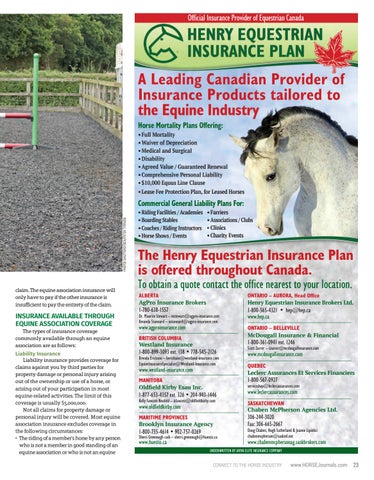
Official Insurance Provider of Equestrian Canada
A Leading Canadian Provider of Insurance Products tailored to the Equine Industry Horse Mortality Plans Offering: • Full Mortality • Waiver of Depreciation • Medical and Surgical • Disability • Agreed Value / Guaranteed Renewal • Comprehensive Personal Liability • $10,000 Equus Line Clause • Lease Fee Protection Plan, for Leased Horses
PHOTO: SHUTTERSTOCK/PETER TITMUSS
Commercial General Liability Plans For:
claim. The equine association insurance will only have to pay if the other insurance is insufficient to pay the entirety of the claim.
INSURANCE AVAILABLE THROUGH EQUINE ASSOCIATION COVERAGE
The types of insurance coverage commonly available through an equine association are as follows:
Liability Insurance Liability insurance provides coverage for claims against you by third parties for property damage or personal injury arising out of the ownership or use of a horse, or arising out of your participation in most equine-related activities. The limit of this coverage is usually $5,000,000. Not all claims for property damage or personal injury will be covered. Most equine association insurance excludes coverage in the following circumstances: • The riding of a member’s horse by any person who is not a member in good standing of an equine association or who is not an equine
• Riding Facilities / Academies • Boarding Stables • Coaches / Riding Instructors • Horse Shows / Events
• Farriers • Associations / Clubs • Clinics • Charity Events
The Henry Equestrian Insurance Plan is offered throughout Canada. To obtain a quote contact the office nearest to your location. ALBERTA AgPro Insurance Brokers
ONTARIO – AURORA, Head Office Henry Equestrian Insurance Brokers Ltd.
1-780-638-1557
1-800-565-4321 • hep@hep.ca www.hep.ca
www.agproinsurance.com
ONTARIO – BELLEVILLE McDougall Insurance & Financial
Dr. Maurice Stewart – mstewart@agpro-insurance.com Amanda Stannard – astannard@agpro-insurance.com
BRITISH COLUMBIA Westland Insurance
1-800-361-0941 ext. 1246
1-800-899-3093 ext. 138 • 778-545-2126
Brenda Erickson – berickson@westland-insurance.com EquineInsuranceSpecialist@Westland-Insurance.com
www.westland-insurance.com
Scott Zurrer – szurrer@mcdougallinsurance.com
www.mcdougallinsurance.com
QUEBEC Leclerc Assurances Et Services Financiers
MANITOBA Oldfield Kirby Esau Inc.
1-800-567-0927
Kelly Fawcett-Neufeld – kfawcett@oldfieldkirby.com
SASKATCHEWAN Chaben McPherson Agencies Ltd.
serviceshep@leclercassurances.com
1-877-653-4357 ext. 326 • 204-943-1446 www.oldfieldkirby.com
MARITIME PROVINCES Brooklyn Insurance Agency
1-800-735-4614 • 902-757-0269
Sherri Greenough caib – sherri.greenough@huestis.ca
www.huestis.ca
www.leclercassurances.com
306-244-3020 Fax: 306-665-2667
Doug Chaben, Hugh Sutherland & Joanne Lipinksi chabenmcpherson@sasktel.net
www.chabenmcphersonag.saskbrokers.com
UNDERWRITTEN BY AVIVA ELITE INSURANCE COMPANY
CONNECT TO THE HORSE INDUSTRY
www.HORSEJournals.com
23
PHOTO: SHUTTERSTOCK/MARIE CHAROUZOVA
Transportation insurance for non-owned horses protects against lawsuits for the death of another person’s horse while you are transporting that horse. This coverage does not apply to commercial horse transport.
professional, or not riding the horse on a prepurchase test ride. In other words, if you allow a person who is not an association member or not an equine professional to ride your horse, there is no coverage for property damage or personal injury. • Any lawsuit brought against you by your own spouse, or by any relative and/or dependant(s) residing in your household. This means that any claim made between immediate family members will not be
covered by the policy. • The “commercial use” of horses as well as participation in rough stock rodeo events, pari-mutuel racing, or unsanctioned racing activity and providing coaching, lessons, instruction to others, and participation in horse pulling competitions. “Commercial use” refers to any equine activity from which you generate an income. This includes activities such as coaching, lessons, trail rides, or even partial leases for which the
payment exceeds your actual expenses. • Coverage for Canadian residents is worldwide, but lawsuits must be brought against you in Canada. If you are a member but your principal residence is outside of Canada, then your coverage is restricted to equine activities that occur in Canada. Accidental Death & Dismemberment Accidental death and dismemberment (AD&D) coverage provides a lump sum payment (the “principal sum”) if you suffer from a scheduled (i.e., listed in the policy) catastrophic and permanent injury or death that arises from participation in equinerelated activities. The amount payable depends upon the injury sustained and is either a multiple of the principal sum or a portion of the principal sum. Not all injuries are covered under this section of the policy. AD&D coverage only applies to members under the age of 90 years and does not provide compensation for lost wages. It is not short or long term disability coverage. Transportation Insurance for Non-Owned Horses This coverage protects against lawsuits for the death of another person’s horse while you are transporting that horse. This coverage is limited to $10,000 per horse and $50,000 per accident. Commercial transportation of horses is not covered. This coverage does not apply to horses you own.
ADDITIONAL INSURANCE
WORLD CLASS FOOTING
ACCEPT NO IMITATIONS Call
Call
Chris Pack
John Anderson
for British Columbia and surrounding areas
1-888-818-2473
for Calgary and surrounding areas Call
403-256-8652
Frédéric Authier Pigeon
for Montreal, Ontario, Toronto and surrounding areas
514-815-6996
ARENA BY DISCOUNT DIRTWORKS
24
Canada’s Equine Guide 2017
CANADA’S HORSE INDUSTRY AT YOUR FINGERTIPS
Additional insurance coverage may be available through your membership in an equine association. This coverage is not automatically provided by virtue of your membership and must be purchased for an extra premium. The additional coverage available can include: Members Named Perils This coverage applies to the death of an “owned” horse resulting from specifically listed perils such as fire, lightning, collision during transport, windstorm/hail, earthquake, flood and attack by a dog or wild animal. The coverage is usually limited to $10,000 and losses are restricted to one claim per year. Weekly Accident Indemnity Coverage This type of coverage provides income replacement in the event you are unable to work due to an accident. This type of coverage includes, but is not limited to, injuries arising from an equine-related accident. The duration of income replacement benefits may be limited to 26 weeks.
Members’ Tack This insurance covers tack and equipment from loss or damage anywhere in North America. The limit is $10,000 and does not cover clothing or protective equipment worn by riders, wear and tear, mysterious disappearance, or horse drawn vehicles. If you require insurance beyond the basic and additional insurance provided through membership in an equine association, you should consult a knowledgeable insurance broker who can assist you in obtaining additional insurance coverage.
WHO MAKES DECISIONS ON COVERAGE?
A recent horse-related injury claim has made news in British Columbia as to how claims for insurance coverage are decided. In this case, the rider was a member of Horse Council of British Columbia and, by reason of that membership, entitled to $30,000 AD&D coverage. She suffered a fall from her horse and broke her neck. She was paralyzed from the armpits down. She subsequently made a claim for AD&D, which was apparently denied on the basis she did not suffer a “permanent disability” within the meaning of the policy. This case called significant attention to issues surrounding the interpretation of insurance policies and how coverage decisions are made. Many people were outraged by the insurer’s decision to deny coverage, believing it to be wrong and unfair. Understanding how and why coverage decisions are made in claims requires an understanding of how insurance is provided. The insurer (also sometimes called an “underwriter”) is generally an insurance company offering an insurance policy in exchange for payment of a premium paid by the insured. The policy is usually sold by an insurance broker. The policy pays for specific losses, which are uncertain or accidental. The premium is set by the insurer on the basis of, among other things, an assessment of how much risk the insured presents. The broker is not involved in making decisions on coverage. Whether a claim is covered by the policy is determined by the insurer. In the case above, the decision to deny the rider’s claim for AD&D coverage would have been determined by the insurer underwriting the AD&D policy, not the Horse Council of British Columbia or the broker who sold the policy. Presumably, the coverage decision (at least in the first instance) was determined on the basis of the meaning of
PHOTO: CANSTOCKPHOTO/IRWINIA88
Additional Accidental Death & Dismemberment Coverage This coverage provides an additional $50,000 principal sum that also includes benefits for fracture and dental coverage not included in the basic coverage. This coverage is available for people under the age of 75.
C at h er i n e E . W i l l s on E: willson@gsnh.com P: 416.597.6488
Providing quality legal work and excellent service in the following areas: • Equine Law • Employment Law • Tax & Liability Issues • Board, Sale & Lease Agreements • Syndicates & Owner Disputes
We’re social. Follow Us. 1600-480 University Ave. Toronto, ON M5G 1V2
w w w. g s n h . c o m
Working with our Equine Partners from Coast-to-Coast
Insurance for Horses and their People
IT’S WHAT WE DO!
Intercity
Capri
Insurance Services Inc.
Insurance Services Ltd.
®
15221 Yonge St., 2nd Floor, Aurora, ON L4G 1L8
Suite 100, 1500 Hardy St., Kelowna, BC V1Y 8H2
888-394-3330 • Fax: 905-841-0030
800-670-1877 • Fax: 250-860-1213
info@intercityinsurance.com
agriculture@capri.ca
www.intercityinsurance.com
www.capri.ca
• Horse Mortality/Medical • Farm Property • Commercial Equine Liability • Auto and more!
Our Customers DO Come First! CONNECT TO THE HORSE INDUSTRY
www.HORSEJournals.com
25
PHOTO: THINKSTOCK/STOCKBYTE
HOW IS COVERAGE DETERMINED?
The language used in insurance policies is technical and intended to have precise meaning. For example, although it seems to be common sense, there are many cases interpreting the meaning of “arising out of,” which is a term used in liability policies. Coverage is provided for personal injury or property damage “arising out of” certain equine activities. When a claim is made by an insured, the insurer will interpret the policy based on its understanding of the policy and previous claims. The insurer may seek legal advice from a lawyer as to the correct policy interpretation. The insurer will then provide its decision on coverage to the insured by either accepting or denying the claim. For coverage to exist under a liability policy, the claim must fall within the “insuring agreement.” This part of the policy states that the policy will cover all sums that the insured is obligated to pay by reason of liability imposed by law for compensatory damages for specified losses such as property damage due to an accident or occurrence. The particular grant of coverage will depend upon the precise words of the policy. The onus is on the insured to prove that a claim has occurred which falls within the grant of coverage. Generally speaking, the insured will have to show that the claim relates to an accident or uncertain event for loss or damage intended to be covered by the
26
Canada’s Equine Guide 2017
s Horse owners and riders are aware of the potential risks associated with horse-related activities, and are urged to have the appropriate insurance to cover any potential accident or loss.
s
PHOTO: SHUTTERSTOCK/DARIUSH M
“permanent disability” within the AD&D coverage. The definition of this term may vary depending upon the policy and the insurer. If coverage is denied by the insurer and the insured believes there should be coverage, the insured can sue the insurer in court. The court will then make a determination as to whether coverage exists.
s Most equine association insurance excludes coverage for property damage or personal injury if you allow a person who is not an equine professional or an association member to ride your horse, or if you allow your horse to be used in riding lessons from which you generate income.
policy, which falls within the policy period. Even if the claim falls within the insuring agreement, the policy must be reviewed to determine there are no applicable exclusion clauses which deny coverage. An exclusion clause eliminates coverage for specific events. The court has specific rules of interpretation to guide coverage disputes. The court focuses on interpreting the words of the policy so as to promote the parties’ “true intent” at the time of entering into the policy. The courts have said that effect should be given to the “clear language” of the policy. Where the language of the policy is ambiguous, the courts have created rules to assist in resolving the ambiguity. If the court rules that coverage exists, the insurer will be ordered to pay the loss pursuant to the terms of the policy, not to exceed the financial limits of the policy. Going back to the example above, the paralyzed rider would have to prove to the insurer that her injury fell within the definition of “permanent disability” in the AD&D coverage provided by the Horse Council of British Columbia policy. This question must be answered by reference to the particular language of that policy and express definition of “permanent disability” in that policy, rather than any general understanding or idea as to what this term means.
Although the onus is on the insured to prove their claim falls within coverage, the insurer must be fair and act in good faith when handling the claim. A failure to do so may result in punitive damages against the insurer. Given the potential risks associated with horse-related activities, you should ensure that you have appropriate insurance to cover any potential accident or loss. Many people feel that insurance is not worth the money because insurers “never pay” or always deny claims. It is true that insurers may take coverage positions which seem unfair on their face. That, in itself, is not a good reason to avoid obtaining insurance. Whether an insurer is justified in denying an insured’s claim must be determined by careful consideration of the particular insurance policy language in issue in each case. If an insured believes coverage is available under the policy, a claim can be pursued against the insurer. The courts have stated that an insurer is not permitted to interpret an insurance policy which would “nullify” the purpose for which the insurance was sold or to render coverage “practically illusory.” b
Karen Weslowski is called to the British Columbia bar and is a litigation lawyer at Miller Thomson LLP in Vancouver, British Columbia. Miller Thomson LLP is a national law firm with offices in Vancouver, Calgary, Edmonton, Regina, Saskatoon, Toronto, London, Kitchener-Waterloo, Markham, Guelph and Montreal. Prior to practicing law, Karen was a certified Equine Canada Level One coach and a regular competitor in horse shows, particularly in the jumper divisions. For further advice or information about the issues discussed in this article, Karen can be reached at 604.643.1290, or kweslowski@millerthomson.com.
CANADA’S HORSE INDUSTRY AT YOUR FINGERTIPS
This article is provided as an information service only and is not meant as legal advice. Readers are cautioned not to act on the information provided without seeking specific legal advice with respect to their unique circumstances and the applicable law in their province of residence.
Chris Cox 4X Road to the Horse World Champion
PROTECTION | DURABILITY | FUNCTION Pre-Engineered Building Kits • No Welding • No Concrete Foundations
ble a r u nce -Free a n D e t • ain •M
Easy Build Structures’ pre-engineered 2" x 3" galvanized steel framing system is designed for a simplified installation process with the durability to withstand our Canadian winters. All of our Highland Barn structures are maintenance-free and have the combined resistance to fire, termites, mold, and rot with the strength of steel. Our sales team will work with you to customize your Barn package to meet all your requirements. Easy Build supplies everything you need, ranging from overhead or sliding doors, windows, insulation options, sheeting and flashing colours, and hardware. Our barn widths range from 36' - 64' and the length can be as long as you need.
Do-it-yourself with our step-by-step installation manual, or take advantage of our full installation services throughout BC’s Lower Mainland.
Now Callfor a om Cust te Quo
Our engineer can supply stamped and sealed drawings, schedule B and C-B, and your site inspections to help assist you with any permitting processes in your municipality.
Surrey, BC • 604-589-4280 • Toll Free:+1 888-589-4280
www.EasyBuildStructures.ca CONNECT TO THE HORSE INDUSTRY
www.HORSEJournals.com
27
COLD COMFORT
Domestic Horses and the Long, Cold
28
Canada’s Equine Guide 2017
CANADA’S HORSE INDUSTRY AT YOUR FINGERTIPS
Canadian Winter
To better understand how our modern domestic horses cope with winter, let’s first take a look back across the ages at the way the horse has evolved.
By Lynda M. Vanden Elzen
PHOTO: SHUTTERSTOCK/KIRK GIESLER
Equine Evolution and Domestication by Humans Since the evolution of the modern equus three to four million years ago, wild horses have been present on almost all of Earth’s continents. The story of the modern horse’s evolution began in the grasslands of North America, and then spread over the Bering land bridge into modern day Siberia. At the end of the Pleistocene epoch, about 10,000 years ago, horses as well as other large mammalian species died out in North and South America for unknown reasons. Horses were reintroduced to the Americas in the sixteenth century with the arrival of Spanish explorers. Since horses were first domesticated around 6,000 years ago, they have been interbred with other domestic horses to create the more than 300 different breeds that exist worldwide today. It is believed that early domesticated horses were crossed with wild stock from many different regions, due to the genetic diversity that exists in modern horses. It must be pointed out, however, that with one known exception — the Przewalski’s horse — truly wild horses, or horses with no domestic ancestors, no longer exist. Instead, the “wild” horses that live today are the feral descendants of domesticated horses who either escaped or were turned loose from domestic herds. Thus, in general, natural selection was replaced for the most part by artificial selection once horses became domesticated by humans, and horses no longer evolved naturally to survive various climates without human assistance. Instead, they were bred by humans to serve specific purposes in differing climates. There are some notable exceptions to this, such as the Yakutian horse of Siberia that evolved from Mongolian stock over only 800 years to survive temperatures of minus 70 degrees C. While it is true that the horse breeds developed by humans in various geographical locations tend to be suited to thrive in the climates present in those locations, for the past 6,000 years most horse breeds have survived under the care of humans. We cannot expect a desert horse to survive in Siberia without human intervention any more than we can expect a horse adapted to the climate in Siberia to thrive in an African desert by himself. While it is true that feral horses do survive without human intervention, on average their lives are much shorter than those of domestic horses. CONNECT TO THE HORSE INDUSTRY
www.HORSEJournals.com
29
Allen’s Rule
Joel Asaph Allen was an American zoologist, mammalogist, and ornithologist who, in 1877, proposed that the body shapes and proportions of warm-blooded animal species vary according to climatic temperature. That is, in cold climates, body shapes minimize heat loss by limiting exposed surface area, where in hot climates, body shapes maximize heat loss by maximizing exposed surface area. Two animals can have the same body volume, but their surface area can vary widely. A high surface area-to-volume ratio will expel more heat, where a low surface area-to-volume ratio will conserve heat. All of that is a complicated way of saying that animals in cold climates tend to have shorter and thicker legs, larger bodies, and relatively shorter extremities such as ears and snouts, whereas animals in hot climates tend to have long and thin legs, smaller bodies, and longer extremities. If we compare the Icelandic Horse to the Akhal-Teke, for example, then these differences are quite obvious. It follows that it would hardly be fair to expect an Akhal-Teke horse to survive in northern Canada in the winter without a great deal of help from humans. Similarly, asking an Icelandic Horse to roam free in the heat of the African desert would not be responsible either. These two extremes, as well as most of the horse breeds in between, require some help from humans to thrive in various climates throughout the world. We cannot just decide that because horses were once wild, and because feral horses roam the American desert, or Yakutian horses survive winters in Siberia, that we can simply set our modern, domestic breeds such as Quarter Horses, Thoroughbreds, and Warmbloods loose in the northern Canadian winter and they’ll be okay. They may survive it, and many do, but there may be severe consequences, including impaction colic, significant loss of condition, metabolic problems, suffering, and death.
Turning Horses “Out to Paw” in Winter
It is a common practice in some areas of Canada for horse owners to pasture their horses during the winter on relatively large tracts of land with no hay and no water provided. These horses are expected to paw through snow in order to forage for dead grass and pasture plants underneath. Snow in northern climates can be very deep, and at times crusted over with ice. Fresh water may not be available, so these horses must eat snow instead. Some owners practice variations of this, such as providing hay but no water, or providing water but no hay. Horses may be left to forage without human assistance all winter, while many owners will check on their horses regularly and may provide hay and/ or water if their horses lose too much condition. On the surface, this may seem to be a reasonable practice. After all, feral horses don’t have any help from humans and they survive, don’t they? While it is true that there are some herds of feral horses who exist in northern climates, these horses are adapted over many generations to survive in extreme cold. It is also worth mentioning that in general, feral horses do not live into their twenties and thirties as our domestic horses do. Being killed by predators or starving to death are just realities of life for feral horses, and chances are one of these fates will befall them well before the life expectancy of a domestic horse. While 100 or even 1,000 acres may seem like a large pasture for a horse, feral horses roam vast territories in search of food and water
Some simple math reveals that a horse would have to consume 230 litres of snow every day in order to get enough water to remain adequately hydrated.
Jennifer Crooks Proudly sponsored since 2004
Basic Sports & Equine Nutrition Ltd. • 1.888.207.8909 info@basicequinenutrition.ca • www.basicequinenutrition.ca 30
Canada’s Equine Guide 2017
CANADA’S HORSE INDUSTRY AT YOUR FINGERTIPS
Using Snow as a Water Source If no water is provided, horses are forced to consume snow to try to remain hydrated. If you have ever melted a bucket of snow, you’ll know that the amount of snow that fills a bucket melts down to about one-tenth of its original volume. According to the National Farm Animal Care Council’s Code of Practice for the Care and Handling of Equines, horses require about five litres of water daily for every 100 kilograms/220 pounds of bodyweight. Thus, a 1,000 pound horse needs about 23 litres of water every day just for maintenance, without factoring in strenuous exercise. Some simple math reveals that a horse would have to consume 230 litres of snow every day in order to get enough water to remain adequately hydrated. Even if the horse could manage to eat that much snow in a day, he would not have enough time left to paw for and consume enough forage to fulfill his energy needs. Failing to provide fresh, clean, unfrozen water to horses is a violation of the Code of Practice for the Care and Handling of Equines and may result in the removal of affected animals from your care. Horses must also have access to salt to keep their bodies in proper water balance.
PHOTO: CANSTOCK/DANIELPFISTER
sources. When we confine domestic horses to a pasture of our choosing, it may not provide what the horses need, and they are unable to move on to a more suitable area as they would if allowed to roam naturally. While it is true that most horses do tend to be welladapted to maintain their body heat in relatively cold temperatures, they require a steady supply of forage to digest and create warmth. So, what happens when we put our domestic horses out to paw in a northern Canadian winter?
In some areas of Canada, it is a common practice for horse owners to turn their horses out during the winter with no hay or water provided. The horses are expected to paw through the snow to find forage, and to consume snow to satisfy their water needs.
Horses pawing for forage will take in water with the forage they are consuming — pasture is 60 to 80 percent water — however, it is quite a stretch to presume that the horse would receive adequate water from pasture grasses. Dehydrated horses are at significant risk of impaction colic, and there is evidence that they will also reduce their feed intake, likely due to a decrease in saliva production. Snow-covered winter pasture is of generally low quality, containing low levels of protein and energy. So in order to meet his energy needs, a horse pawing in a winter pasture just does not have enough time to consume enough forage and enough water daily to meet his needs.
Need a Trailer? We can help.
We Now Carry Travalum Horse & Stock Trailers
HORSE TRAILERS Bumper pull & gooseneck available GOOSENECK STOCK TRAILERS Available in 16’ to 32’ lengths
EDMONTON N., AB
LETHBRIDGE, AB
SASKATOON, SK
SOUTHEY, SK
MOOSOMIN, SK
NISKU, AB
MEDICINE HAT, AB
PRINCE ALBERT, SK
YORKTON, SK
SWAN RIVER, MB
888.799.6174 888.981.6856
www.flamantrailers.com
888.210.0789 888.847.7191
888.278.7344 888.966.8618
888.719.3861 888.628.5940
888.319.2703 888.891.4751
Call your nearest Flaman location for pricing and details CONNECT TO THE HORSE INDUSTRY
www.HORSEJournals.com
31
percent more feed per degree Celsius as the temperature drops. If an average adult horse of 1,000 pounds normally has to eat 20 pounds of quality forage to maintain weight and body temperature above the LCT of minus 15 degrees C without pawing, then at minus 20 degrees C, that horse needs the original 20 pounds plus a two percent increase for each degree the temperature drops below minus 15 degrees C. In this case:
2% increase x 5 degrees = a 10% increase on 20 pounds, or 2 additional pounds. However, the above calculation does not take into account the additional energy expenditure when horses are pawing through deep snow to access the forage underneath, which can amount to a 40 percent increase. This calculation is:
40% x 20 pounds = 8 pounds. Therefore, the total increase for energy spent pawing at five degrees below the LCT is:
50% x 20 pounds = 10 additional pounds. Horses tend to drink less as the weather gets colder, leading to dehydration and colic. A reliable source of fresh, clean water should be available at all times.
In addition to the problem of the impossible volume of snow required for a horse to remain hydrated, we must remember that colder temperatures increase the horse’s energy needs because energy is necessary to maintain body temperature. According to the Ontario Ministry of Agriculture, Food, and Rural Affairs, the lower critical temperature or LCT — the temperature below which a horse requires additional energy to maintain body heat — is about minus 15 degrees Celsius for healthy adult horses who have grown an adequate winter coat and have sufficient fat reserves. Below the LCT, a horse must consume two
And if the temperature drops another ten degrees to minus 30 degrees C or 15 degrees below the LCT, the pawing horse requires another forage increase of four pounds for a total of 34 pounds of forage per day to maintain body weight and temperature. These calculations are based on the average intake of quality dried forage. However, horses consuming low quality winter pasture that contains 60 to 80 percent water would require a significantly larger volume of forage to meet their energy needs. This does not take into account the significant amount of additional energy the horse has to expend to warm the frozen snow and forage to his body temperature. As you can see, as the temperature drops, the horse’s energy needs increase. If he is using snow as his sole water source, he is already unable to consume enough water to maintain his baseline feed intake. In addition, if he is pawing for forage and has no hay provided, he cannot consume enough energy either. A horse in this situation is on the wrong
New delivery location!
Associate Diploma in Equine Care and Management www.ridgetownc.uoguelph.ca/equine Learn from experts who share your passion for horses, and expand your knowledge of equine nutrition, reproduction, health, conditioning, management, business and finance.
32
Canada’s Equine Guide 2017
CANADA’S HORSE INDUSTRY AT YOUR FINGERTIPS
side of a very dangerous losing battle in which he will lose weight and become unable to stay warm. His fat reserves will maintain him as long as they last, but eventually he may reach a critical point at which he will be in crisis, and may not survive. As his fat reserves dwindle, his LCT will rise due to a decrease in insulation, and he may be unable to stay warm. He is also at significant risk of impaction colic due to the lack of moisture available to his digestive system. Some horse owners in northern climates will provide hay to horses who are using snow as their sole water source. This might seem to be a good solution to the problems noted above; however, it fails to take into account the lower moisture levels present in dried forage. Hay tends to contain less than 10 percent moisture, where pasture grasses contain more like 60 to 80 percent moisture, as noted above. While it may seem that providing hay to horses who are using snow as their sole water source would help them to cover their energy needs, it may actually make things worse. If a horse is already struggling to consume enough water while pawing for pasture grasses and eating snow, then their water needs will increase once they are eating hay. Thus, the risk of dehydration and impaction colic can be even higher for these horses.
Metabolic Consequences
When horses are put out to paw for food and eat snow during the winter in cold climates, they tend to lose weight due to inadequate energy intake for all of the reasons noted above. The horse’s body may attempt to compensate by making metabolic changes to allow him to survive in the short term. Over the longer term, however, these adaptations may cause damage to the horse’s metabolic rate and function. To put this in human terms: Have you ever gone on a series of yoyo diets? If you have, you may have noticed that although you lost weight initially while on the diet, the weight returned or even
PHOTO: SUSAN KERR
Feeding Hay Without Fresh Water
Horses are healthier living outside year-round and adapt well to cold weather if they are allowed to grow a winter hair coat and are provided with constant access to shelter as well as sufficient forage to meet their energy needs, fresh water at all times, and free access to salt.
increased beyond its original level when the diet was over. Each progressive diet may get the weight off in the short-term, but over time you may find that your body will become slower to lose fat, and quicker to regain it. The net result will be an increase in weight and a progressively more sluggish metabolic rate. Similarly, many horse owners in northern climates will put their horses out to paw in the winter as a method of weight control. These horses graze all summer on lush pastures and gain weight, and then
CONNECT TO THE HORSE INDUSTRY
www.HORSEJournals.com
33
PHOTO: WIKIMEDIA/MAARTEN TAKENS PHOTO: WIKIMEDIA/ANDREAS TILLE
The Yakutian horse, a rare native breed from the Siberian Sakha Republic, lives outside during the winter and must withstand temperatures that can drop as low as minus 70 degrees C. These horses have an incredible fur coat and forage for food under the snow.
The Icelandic horse with a thick winter hair coat, a relatively stout body, and short thick legs is adapted to live in a cold climate.
paw all winter and lose weight. The cycle may continue for years, and over time a horse subjected to this treatment will get fatter in the summer and slower to lose weight in the winter. The owner may then confine the fat horse to a “diet pen” in the summer, where there is very little forage, in an effort to starve the weight off the horse. The longer this goes on, the harder it becomes for the horse to lose weight. This is a feedback loop for the well-intentioned owner, who believes their horse needs to paw and/or remain confined without adequate forage to keep his weight under control. In reality, the periods of famine they have created for their horse in order to keep his weight in check are making the situation worse. This is a very stressful situation for a horse, both mentally and physically, and that stress has metabolic consequences. According to equine nutrition specialist Dr. Juliet Getty, Ph.D., when horses are stressed, it signals their bodies to hold onto fat and eat too much. Stress causes an increase in the hormone cortisol, and increased cortisol causes or exacerbates insulin resistance. Dr. Getty also points out that while insulin resistance is harmful to our domestic horses, it is a built-in survival mechanism meant to save the horse’s life when food is sparse. “Insulin resistance is the body’s way of avoiding starvation,” she explains. “During a harsh winter, when the food supply is sparse, horses will hold on to body fat to help them survive. They do this by having an elevated blood insulin level. When insulin is high, the cells cannot release fat. This is a survival mechanism.” Unfortunately, at the end of the winter, when feed is more plentiful, the horse may remain insulin resistant. In addition, it has been shown that when horses are subjected to starvation diets, their metabolic rates decrease. Dr. Getty offers an explanation for this phenomenon: “Your effort to control insulin by depriving your horse of forage actually works against you because glucose will eventually rise through the horse’s natural hormonal response. When a horse has nothing to eat, his blood glucose level starts to drop. He needs glucose to survive – it fuels his nervous system. In an effort to remedy the situation, the hormone glucagon is secreted to release glucose from glycogen stores in the liver. Glucose is also restored to normal levels by breaking down muscle. This lost muscle mass brings down the metabolic rate, and ruins his body condition.” The more damage that is done to the horse’s body by bouts of famine and insulin resistance, the more dysfunctional his metabolism becomes. This dangerous cycle and its resultant metabolic changes can be disastrous for the horse, as he may develop insulin resistance and laminitis as a result of the measures the owner has taken to prevent these problems.
PHOTO: WIKIMEDIA/DAGAT-GELI
Recommendations
The Akhal-Teke breed is from Turkmenistan, a country in Central Asia largely covered by the Karakum Desert. Note his lean body, long slender legs, and long, slim neck and head adapted for hot climates.
34
Canada’s Equine Guide 2017
As responsible horse owners, we cannot justify the practice of pasturing our domestic horses in cold, northern climates without providing quality forage and fresh water on the basis that this practice is natural for wild horses. Truly wild horses no longer exist in these climates, and our domestic horses have been bred selectively by humans for thousands of years. Given enough forage and fresh water to meet their energy needs, with free access to salt and shelter, many healthy domestic horses who have been allowed to grow winter hair coats can live quite happily outdoors in cold, northern climates. As long as hay of sufficient quality and fresh, clean, unfrozen water are always available, most horses can stay warm, comfortable, and hydrated throughout the winter months. Underweight or older horses may require higher energy forage and/or blanketing to maintain body condition. Regular veterinary care, including dental maintenance, can ensure that horses are able to chew and digest forage efficiently, which aids in meeting their energy requirements. Care must also be taken to consider the breeding and body characteristics of each individual animal when making decisions about what they need, not just to survive, but to thrive. b
CANADA’S HORSE INDUSTRY AT YOUR FINGERTIPS
Inspired by Nature • Powered by Science
PHOTO: DREAMSTIME/ZUZANA TILLEROVA
ADVERTISING FEATURE
VetCur Products Stone Hedge Farm Canada Exclusive Canadian Distributor
Allergies in horses can develop at any age. Allergies are simply an imbalance of the immune system where your horse’s immune system perceives a threat from something harmless that he has come into regular contact with. Instead of eliminating microorganisms, the body suddenly starts attacking its own tissues, resulting in an overreaction to normal, everyday things such as grass, tree pollens, shavings, dust, molds, hay and straw, environmental pollutants, drugs, fly spray, or a new grooming product or shampoo. Many reactions cause a release of histamines, which cause swelling and other signs of inflammation. These symptoms are usually seen on the skin, but can also come in the form of swelling around the eyes and muzzle or even internally. The allergens can come through the skin or the respiratory system. Allergens can penetrate the body by direct contact, through airborne pollens, or by ingestion of food or toxic plants. Allergic responses can be mild or can severely impair a horse’s performance, causing discomfort and symptoms ranging from itching body and ears, coughing and nasal discharge, to something that is life threatening. Allergies can present as:
corticosteroid such as dexamethasone to reduce swelling internally and open up the airways. This condition requires immediate veterinary intervention. In order to protect your horse, it is always helpful to determine what is causing the reaction and try to eliminate the use of it. For example, if there is an overreaction to annual shots, try splitting them up over a period of a couple of weeks. For heaves/COPD, eliminate all dust, water the hay, keep the horse outside as much as possible, and stable him in a well ventilated barn. VetCur’s DiVet™and ImVet™ provide the entire immune system with healthy, purposeful 100% natural herbal nutrients customized for your horse, which aid the body in boosting its own immune system, thus ensuring the very best prerequisites for avoiding abnormal immune reactions towards perfectly normal things such as dust, pollen, food, germs etc. VetCur’s Cur1™ spray is very beneficial externally for many of the allergies listed above.
Hives – Soft swellings are probably the most common, forming on the neck, chest, shoulders and sides.
Give us a call to discuss your horse’s allergy issues and…
Pruritus or itchy skin – Sweet itch or summer eczema is the most common form. This is an allergic reaction to saliva in the bites of Culicoides midges or “no-see-ums” and commonly appears on the neck, around the dock, or on the belly. The affected areas become covered with oozing, crusty lesions which are very itchy, causing the horse to scratch and rub, which can cause a secondary infection.
VetCur Products are 100% natural herbal feed products which have been developed to match the specific nutrition needs of your horse.
Respiratory/Heaves/COPD/reoccurring coughs/wheezing – These conditions result from internal swelling of the breathing passages, which can be caused by dust, pollens and molds. Anaphylaxis – This is a systemic, extreme allergic reaction, which usually appears quickly, e.g., after a bee or wasp sting or eating a toxic plant, causing shock and death if the situation isn’t immediately reversed by using epinephrine to raise the blood pressure and a
Let The Healing Begin… Our academic and highly trained staff are experienced in providing customers with solutions that support the body for a wide range of issues including allergies, colic, ulcers, arthritis, rebuilding tendons and ligaments, neurological and hormonal issues, Cushing’s disease, and metabolic issues, to name a few.
Providing the Body Specific Nutrition for Self-Healing
STONE HEDGE FARM CANADA 705-835-0620 • www.vetcur.ca
HORSES WITH JOBS
HORSE HELP WANTED! By Margaret Evans Down through the ages, horses have served as mankind’s most important ally. Initially, some 55,000 years ago, they were nothing more than a source of food — forced off cliffs or being chased into areas where they could be clubbed to death. But something amazing happened when the horse was domesticated around 3500 BC. When mankind harnessed the mobility, power, and speed of the horse, the world began to quickly change. With horses, people had a more efficient means to travel, explore, hunt, farm, pack, trade, and engage in warfare. They could journey by horse to barter, socialize with others, and share ideas, language, and knowledge. They used horses in competition, sport, recreation, and as status symbols. Horses became valued for the variety of different roles they played at every level of society, and as they helped shape civilization, their history became inextricably woven into the story of mankind. Horses remain integral to the lives and livelihoods of hundreds of millions of people around the world. Today, as they have always done, horses serve in a multitude of roles, using their unique abilities to perform their jobs faithfully as competitors, companions, and workmates. They pull barges, beer wagons, ploughs, and carriages. They harvest logs from the forest, crops from the fields, and plants from the sea. They carry tourists along the trails, and deliver adventurers to remote areas of the back country. No amount of automation can replace a good working ranch or rodeo horse. They race for our entertainment, and help keep their racing colleagues calm and focused. They perform, entertain and compete for us in shows, ceremonies and exhibitions. On city streets as ambassadors for police departments, they help serve, protect, and manage crowd control. And to children and adults with disabilities they provide therapy, achievement and empowerment. In Third World countries, over 100 million horses, donkeys, and mules work as the trucks, taxis and tractors to support the needs of 600 million people for whose existence they are essential. To illustrate the enduring relationship between horse and man, this feature highlights ten 21st century jobs that showcase our hardworking horse friends and their loyal service.
10 Twenty-First
Century
HORSE
JOBS
36
Canada’s Equine Guide 2017
These hard-working Belgian geldings are Axle and Bobby, both 10 years old. PHOTO COURTESY OF TRIPLE D DRAFT HORSES
CANADA’S HORSE INDUSTRY AT YOUR FINGERTIPS
Logging Horses JOB DESCRIPTION: Draft horses skid logs out of the forest, allowing for selective harvesting of timber and minimizing damage to the environment. Horses and oxen have been used to haul logs since preindustrial times. Much of it was small scale harvesting, but it was hard and hazardous work. Unstable and snagged trees, falling branches, and loose material were the “widow makers� of a rapidly growing but dangerous industry. But as settlers arrived in Canada, more land had to be cleared for homebuilding, farming, and travel. Ultimately, horses and oxen were replaced with machinery and logging trucks. continues on page 38 CONNECT TO THE HORSE INDUSTRY
www.HORSEJournals.com
37
PHOTOS COURTESY OF TRIPLE D DRAFT HORSES
continued from page 37
Select logging with horses causes less ground disturbance, and leaves small trees growing to regenerate the forest.
38
Canada’s Equine Guide 2017
Axleand andBobby. Bobby. Axle CANADA’S HORSE INDUSTRY AT YOUR FINGERTIPS
Today, some people have kept the heritage of horse logging alive. “We are using two teams to work with at present,” says Jennifer Dillman who, with her husband Delbert, runs Triple D Draft Horses in Prince George, British Columbia. “One is a team of Percheron/Canadian cross geldings. Rowdy and Tork are both eight years old and approximately 1,750 lbs. Both have fantastic personalities and temperaments. Our other team is Axle and Bobbie, both 10-year-old Belgian geldings. Axle is 2,100 lbs. and Bobbie 2,200 lbs., and both have wonderful personalities.” Delbert is well known for his expertise and passion in the draft horse industry. He has logged with horses most of his life. He started at the age of seven with a pony when his family lived in Nova Scotia, and he loved the sport of horse pulling. When he was 14, he logged with a team full-time throughout the Maritime provinces, and moved to BC when he was 19. “We do select logging for private land owners,” says Jennifer. “A typical day would be feeding the horses in the morning. Then we trailer out to the worksite. Delbert does falling and then skidding [pulling] the logs to a landing. He needs to cut trails for the horses to skid through. The horses get an hour’s lunch for feed and water. We work a few more hours in the afternoon then head home. You can do a better job by select logging because you leave more regeneration and there is less ground
PHOTO COURTESY OF TRIPLE D DRAFT HORSES
disturbance than when using machinery.” She says that a team can produce about 32 tons of timber. But it all varies with the ground conditions, length of the skid, and size of the wood. Weather conditions create common challenges such as deep snow, the ground being too wet, or the weather being too cold. The horses need well-fitted and well-maintained harness, and proper shoes for the conditions. Delbert shares his knowledge with others wanting to do horse logging, among them Lenard Sanders who owns Misty River Ranch near Prince George. “Delbert taught me to log with horses,” he says. “We got Tom and Toby, our Percherons, about four years ago. We bought a carriage first then got the horses for it. But they were actually too big for the carriage.” He has had saddle horses all his life but started logging with Tom and Toby after doing some logging with his cousin. “I wanted to get some salvage logs near my house. I put the collars on the horses and walked them down the road. They were pretty excited. But they are so gentle and fantastic in harness. I took some of the salvage logs out. I have a sawmill and I will mill them into 6x6s. I try to do value-added work if I can — selling tables, log cabins, and renovating log houses. As time goes on, I’ll get another set of horses. I don’t want to push the older horses.”
Axle and Bobby skidding a log.
For more information, visit >>> www.facebook.com/triplddrafthorses
CONNECT TO THE HORSE INDUSTRY
www.HORSEJournals.com
39
Barge g Horses
JOB DESCRIPTION: A draft horse walking beside a canal on a towpath pulls a flat-bottom tow-boat along the canal. In England, the Romans were the first to build canals as irrigation or land drainage waterways. They used mules to haul boats loaded with cargo along those canals and it became a highly effective and economical way to transport goods. A horse towing a boat with a rope from a towpath could pull 50 times as much cargo as it could pull in a wagon on the road. As the canal system grew, boats and barges were pulled with horses, mules, ponies, and sometimes a pair of donkeys. The transport system was heavily in use during the Industrial Revolution and continued well into the 1960s. Today, horses pull barges as pleasure vehicles for tourists and vacationers. “We have two horses, Monty and Drummer,” says Charlotte Butler who, with her husband Stephen, owns Kennet Horse Boat Company in Hungerford, England. “Monty is a nine-yearold Shire-Welsh Cob cross and the most experienced horse. Drummer is four years old and a
40
Canada’s Equine Guide 2017
Clydesdale-Cob cross. He’s new to the business. They are both geldings.” The company was established in 1970 and has been run by the Butler family since 1980. Stephen and Charlotte took it over from Stephen’s parents in 2004. Their horses are broken to harness on a working farm in North Devon before coming to their facility for on-the-job training. “Trips vary from day to day, but typically horses do a two- to three-hour trip in the morning and one in the afternoon. A typical trip would be three miles (five kilometres). We usually collect the horse from the field approximately two hours before the first trip. They are groomed and fed and the harness is put on. Customers arrive around half an hour before and meet the horse and take pictures. There is at least one lock in every trip, so this gives the horses a chance to rest and graze and customers can disembark from the boat whilst crew do the lock.”
PHOTOS COURTESY OF KENNET HORSE BOAT COMPANY
The Kennet Valley barge is a widebeam passenger trip boat, built in 1976 and painted with roses and castles in keeping with the mid-1800s tradition. It is powered solely by the 1 hp towing action of the horse.
Passengers enjoy a leisurely boat trip along the Kennet and Avon Canal as they soak up the beauty of the countryside.
A lock is a device used for raising and lowering boats and barges between stretches of water that are at different levels on canals. “Once the lock is done, passengers get back on and the trip continues,” she says. “There is an option to walk along with the horse and its handler. Another unique feature is lifting the tow rope over other moored craft which sometimes means the crew climbing on the boat to enable them to lift it high enough.” Butler says that their horsedrawn barge, Kennet Valley, was purpose-built in 1976. It is painted with roses and castles in keeping with the decorative pattern that was highly fashionable in the mid-1800s. It can carry 64 passengers, weighs 19 tons, and measures 67 feet long (20.5 metres) by 10.5 feet wide (3.2 metres). The glass windows drop
CANADA’S HORSE INDUSTRY AT YOUR FINGERTIPS
down to allow passengers to lean out during the ride. It has full weather protection so the show goes on, even when it rains. Customers are always surprised at how easily the horse can tow a barge. “Although the boat weighs 19 tons it can be pulled by a single person even when full due to the fact it is on water,” says Butler. “So, with the silent motion of the boat and with the sound of the hooves it is an enjoyable step back in time. Originally, tow paths were private rights-of-way owned by the canal company, but they are now used by walkers and cyclists as well as our horses. In addition, passengers can enjoy all kinds of wildlife seen along the canal.” For more information, visit >>> www.kennet-horse-boat.co.uk
s
Slicker is brave, calm, and has the energy needed to do the job.
An outrider helps Calvin Borel warm up Rachel Alexandra before her win in the 2009 Woodward Stakes.
JOB DESCRIPTION: Racetrack outriders and their horses provide the valuable service of helping to maintain a safe environment during workouts and live racing. “I have been outriding at Century Downs Racetrack [in Calgary] since it first opened in April 2015,” says Janice Lea of Rocky Mountain House, Alberta. “However, I started doing back-up outriding at Stampede Park in 1994.” Lea rides CB City Slicker, her 16-year-old registered Paint who, she says, has done just about anything a horse can do. He was in film production prior to Lea acquiring him and had been used on drill teams for rodeo performances as well as many other activities. “He has a brave heart, a willing disposition, and energy to get out and go. He is well suited to the job as he pays close attention to the activities on the track, even watching the horses race. He also likes the attention from the crowd and isn’t afraid to get up close to the action in the stands or on the track.” The day starts with mucking out Slicker’s stall while he enjoys his breakfast, followed by grooming and tacking up. “Once we are ready to go, we don our safety attire such as ‘flak jacket,’ shin boots, bell boots, and, of course, a helmet. Slicker likes to partake in a bit of stretching and we are off to the qualifiers. Qualifiers are when the racehorses must prove to the vet, judges, and racing officials that they are sound, fit, and ready in all ways to be entered into future races. After qualifiers, we take a small break before the races start. There are approximately 10 to 12 races scheduled in a day. A race runs in just under two minutes, but the day lasts around five hours. We parade marshal each race, meaning we lead the way for the horses in each race past the grandstand for the bettors to view. Once the racehorses and drivers are on the track, I am there to help horses that are nervous and need a buddy, or to pony a horse that is having difficulty turning and needs assistance before the race. I also carry a radio for communication with race officials to notify them if there is a delay in the race due to equipment failure or if a horse needs to return to the paddock for adjustments. Some horses need help being led to the gate, and if the need arises, I may have to catch a loose horse or a runaway. Slicker has a calm personality when a horse needs a hand calming down and just needs a buddy. But when a horse being ponied tries to bully or lean on him, he is not afraid to lean back.”
42
Canada’s Equine Guide 2017
PHOTO: SHUTTERSTOCK/SEAN DONOHUE
PHOTO: EVELYN SABRAW
PHOTO COURTESY OF JANICE LEA
s
Slicker and Janice Lea help the horses that are nervous or need assistance at Century Downs Racetrack in Calgary, Alberta.
s
Racetrack Outrider Horses
She says that racehorses naturally have a high-strung disposition, especially on race day when they sense the anticipation and excitement. “Two-year-old horses are greener than horses with experience on the track, but I can’t assume a seasoned horse won’t need help. If they do, Slicker can handle them. One of the biggest challenges of [outrider] riding is finding an equine partner who is brave enough and has the drive to do the job. The horses need to be willing to get up to a noisy race bike [sulky] at a 45-degree angle while running full out. Being too far ahead can cause the horse you’re trying to catch to swerve behind you, and too far behind can cause a bike wheel to hit the back of your horse’s legs, so they need to be able to take this in stride. Some of the headgear the race horses are outfitted with makes it challenging to grab them, such as head polls, overchecks, blinkers, blinders, and other equipment that is meant to keep that horse safe and steerable. Typical accidents don’t involve just one horse; there are usually multiple horses, but you can only help one at a time.” Lea is proud that Slicker is such an ambassador for the sport and that he has many fans. Being approachable and handsome, she says, is definitely the easiest part of his job and he gets to pack flags on stake races and for Canada Day celebrations on the track. “The best part about outriding is it gets you out on your horse and it develops a bond that is hard to describe. We find confidence in each other and are continually working on our skills. The energy of the industry constantly encourages me to want to improve. Being surrounded by other horse people reminds you of the true versatility of the equine world.”
CANADA’S HORSE INDUSTRY AT YOUR FINGERTIPS
Body Support
™
Known as Body Builder in USA ™
Natural Alternative to Steroids...
CONGRATULATIONS to our clients on their successes: Doug O’Neill
and his team on
winning the
Kentucky Derby
Steve Asmussen and his team on
winning the
Belmont Stakes
Registered and approved for sale in Canada!
THE FIRST, & STILL THE BEST, FOR OVER 28 YEARS! Works so well that others try to replicate it. Don’t Be Fooled !!! They do not use the same quality of ingredients. BODY SUPPORT is cheaper because of the dosage and obvious results! Bottom line, BODY SUPPORT was the first and is still the best. Our Secret? We use the highest quality ingredients and have a proprietary, unique way of mixing them. What’s the difference? The key is absorption.
One Bottle + One Horse + Two Months = Outstanding Results!! For the money, there is no better supplement with faster turn-around results than BODY SUPPORT! 28 years of repeat customers prove it! From yearling and 2-year-old prep to racehorses and competition horses, to broodmares and stallions. Yep, it works for all.
Available in various catalogs and at your local tack shops, Greenhawk outlets, and through WeCan Sales distributors. Equiade Products • www.equiade.com • 1-800-413-3702 • (201) 568-5551
TRY IT! YOU WILL LOVE IT!! GUARANTEED!
PHOTO: TANIA MILLEN
Pack Horses s Attributes on a good pack horse’s resume include
a combination of character, temperament, physical qualities, and skills. Beyond the basics, each pack horse comes with unique personality traits. A pack horse must be comfortable with whatever method is used for packing, and anything that needs to be carried.
PHOTO: DALE RUSSEL
PHOTO: ANDREW MCKEAN
s
Because they work and live together as a team in the back country, Tania Millen and her horses form trusting relationships, and rely on each other to keep them both safe.
JOB DESCRIPTION: These sturdy horses and mules carry gear and supplies, usually in panniers or sidebags, typically across rugged terrain. “I love wilderness travel and have spent a fair bit of time trundling around the backcountry,” says author and explorer Tania Millen of Terrace, BC. “Being able to do that on horses — meshing my love of both wilderness and horses — is very special for me. Trusting a horse with my life when travelling across deep rivers or bog, or simply due to the distance we’re located from amenities and assistance, is also very different from any other riding experience I’ve had. I feel that my horses and I form unique relationships that are very different from relationships formed with performance horses. We live together and work together as a team for days on end in wild country, and have to trust each other to make good decisions that have both of our interests and safety in mind.” She said that the qualities of an ideal pack horse include a combination of temperament, character, physical attributes, and skills. Ideally, their temperament is one that is stoic and unflappable, a horse that is willing, has a lot of “try” but with strong self-preservation as well. They need to be herd oriented (so they don’t want to wander off), but not so insecurely herdbound that they’re fixated on their buddies. They need to be happy to follow and not intimidate the riding horse. But all pack horses come with their own
44
Canada’s Equine Guide 2017
quirks and idiosyncrasies. “Molly was a shorter, skookum mare who would pack absolutely anything, anywhere,” says Millen. “She was really confident and was a lead horse as well. But I always packed her when we headed for home because she was in such a hurry — out-walking all the other horses. She walked 24 kilometres over a pass through a snow storm in four hours as a lead horse once when she figured out we were heading for home. The usual rate of travel is four km/hour, so she was really smoking and it was very tiring for the other horses. She was relegated to pack horse duties for the rest of that trip. She’s now owned by a beginner trail rider, and is semi-retired from longer trips.” She says that pack horses have to lead very well, through anything, without dragging or following too closely to the horse in front. As for all backcountry horses, they have to hobble, tie, and trailer well. “Pack horses may wear a muzzle during travel, so they don’t continually snatch grass (and pull the rider’s arms off), or stop altogether (if they’re travelling loose). As for packing, there are many different ways of using saddles, gear, and tying on loads. They need to be comfortable with whatever method is being used. That may include wearing a crupper (under their
CANADA’S HORSE INDUSTRY AT YOUR FINGERTIPS
tail), having a tight back girth behind the bulge in their stomach, and carrying hard-sided boxes that make a racket when they bang into trees and prevent the horse from seeing behind. Outfitter horses need additional skills so that they’re comfortable with guns going off and packing dead animals. Any horse can be a pack horse with suitable training, and it’s a great way to give less experienced horses miles in the backcountry.” Millen says that in the country where she travels, she needs her horses to have large solid hooves, heavier bone, short strong backs with withers (so the saddle doesn’t roll), and heavier muscles, but not so muscle-bound that they can’t travel all day. “I prefer 15 to 16 hand animals so they’re tall enough to cross deep rivers without losing their footing, but short enough that I can pack them easily and reach up to tie knots. As for skills, they need to be easy keepers with a high tolerance for changing feed, nasty flies, long tiring days, difficult footing (mud, bog, deep water crossings, steep up and down), and a fair bit of hanging around with nothing to do.” For more information, visit >>> www.taniamillen.com
CONNECT TO THE HORSE INDUSTRY
www.HORSEJournals.com
45
Physiotherapist Judy Todd describes therapy horse Bo as “completely bombproof,” able to tune out noise and unexpected movements.
JOB DESCRIPTION: Therapy horses are used in a range of programs to promote physical improvements and address mental health issues. Somewhere in the rolling high country plains of southeastern Montana in the early 2000s, a buckskin colt was born. But in the harsh reality of life in a wild herd, he lost his dam when he was just a few days old. Somehow he stayed attached to his band struggling to survive, but, without his mother’s milk, his growth was slow. As a yearling, he was captured and circumstances took him first to a ranch in Saskatchewan and then to Abbotsford, BC, where physiotherapist Judy Todd, who had training in hippotherapy and was working with special needs children, acquired him in 2004. The little orphan colt became Bo. “Because of his wild, orphan Mustang background, with very little human intervention, he came to me with a clean slate, so I was able to ease him into his job using natural horsemanship built around trust,” says Todd. “He’s smart enough to dumb down for the hippotherapy sessions and keep his strong personality under his belt.” Todd says that Bo was named Botox by a small boy who was undergoing Botox injections for his tight cerebral palsy muscles in the mistaken belief that riding
46
Canada’s Equine Guide 2017
such a wide horse would reduce his need for further injections. What made Bo special was that he was so quiet. He watched and learned, even when exposed to bubbles and balloons. “Psychologically, Bo is completely bombproof, tuning out all the noise, unexpected movement like a seizure or a child having an arm-and-leg flapping melt-down, or the feeling of a child’s body part in unusual places,” she says. “Physiologically, Bo’s movement provides a calming effect for an anxious child, and a more stable base for potentially risky positions such as four-point kneeling and side-sitting. His short stature (14.1 hands) and dorsal stripe as an alignment reference are an asset. Even his long mane [is ideal] for hiding toys, or attaching ribbons or clothes pins for fine motor skills.” Todd says that the horse’s barrel provides a dynamic treatment surface where the rider can be placed in different positions in order to stimulate specific muscles and cognitive/ sensory systems. “This multidimensional movement simulates normal human gait and trunk/pelvis
Therapy horses help challenged children improve their confidence, endurance, balance, and coordination.
function. Each horse provides different amounts of human rotation, lateral tilt, vertical and horizontal displacement. The horses in my program are assessed annually, and their movement graded out of 10. Bo scores higher on rotation and lateral displacement, which stimulates the vestibular system and unlocks a tight pelvis.” Bo works two afternoons a week for two hours. His warm-up may include a dressage session to improve the quality of his movement, or a run on the trails to let him express himself before the children arrive. “He’s currently working simultaneously with a mare that
CANADA’S HORSE INDUSTRY AT YOUR FINGERTIPS
PHOTOS COURTESY JUDY TODD, ABBOTSFORD PHYSIOTHERAPY
Therapy Horses
he’s not usually turned out with, so I get them comfortable standing beside each other. He’s tacked up with bareback pads or sheepskins, depending on the needs of each rider, and longlined for most of the session, as that improves his movement. He parks himself at the mounting block and stands perfectly still for however long it takes to get the rider organized on board. Hippotherapy is mostly done at a walk, although occasional trots are thrown in as a reward for the kids and to challenge their core stabilizers. At some point in each session, we leave the arena for a trip to the creek, field, or one of the sensory integration areas. As soon as their work is done, the horses are fed, even if it’s not exactly their mealtime, so I get to say thank you immediately. “Bo is also used to transition some of the higher functioning kids into independent riding, and all the horses pull their weight with the annual riding camp.” The hippotherapy experience helps challenged children improve their confidence from gaining better speech/ communication, endurance, balance, and coordination. Todd says they also learn structure; each session lasts an hour and their session is on a certain day or at a certain time. “One little non-verbal girl placed her boots and riding helmet at the back door every school day in the hope that it was her day to ride. She’s now learned to read the family calendar, and the family doesn’t trip over her boots every day.”
The innovative mesh panels on Ariat’s VentTEK boot promote maximum airflow, regulating the temperature inside your boot. Stay cool and perform your best with Ariat VentTEK technology. >>> Featuring the Men’s Quickdraw VentTEK in Gingersnap
P R O V I N C E / R E TA I L E R
P R O V I N C E / R E TA I L E R
A L B E R T A Bar T5 Agra Services / Calgary Cowboy Country Clothing / Nanton Frontier Western Shop / Claresholm Irvine’s Tack and Western Wear / Crossfield Keddie’s Tack & Western Wear / Grande Prairie The Jones Saddlery and Western Wear / Ponoka / Red Deer Wei’s Western Wear / Red Deer The Outback Western Wear & Tack / Westlock Welsh’s / Edmonton Lammle’s Western Wear & Tack / Calgary / Edmonton / Lethbridge / Red Deer / Medicine Hat / Fort Saskatchewan / Lloydminister / Strathmore / Camrose / Spruce Grove / Olds / Cochrane
BRITISH C O LU M B I A
8 Seconds Western Wear / Fort St. John Cariboo Spurs Apparel & Tack / Williams Lake Lammle’s Western Wear & Tack / West Kelowna / Kamloops
SASKATCHEWAN Cowtown Saskatoon / Saskatoon Cowtown Regina / Regina Cowtown Weyburn / Weyburn Cowtown Swift Current / Swift Current Lammle’s Western Wear & Tack / Regina
Rodeo Pick-Up Horses
PHOTO: DREAMSTIME/PETRORUTH
Pickup riders work in pairs, and because bucking horses are fast and powerful, the riders must be well-mounted to stay safe and effective.
Rodeo pick-up rider Gary Rempel was born in 1951 in Saskatchewan where his father managed the Matador Ranch near Kyle. His father rodeoed and did pick-up, and that exposure influenced young Gary on the thrill, challenge, and responsibility of picking up the competition cowboys after their saddle bronc or bareback rides had timed out or they had been bucked off. He learned much of it on his own, but greatly valued working with veteran Wayne Vold who helped him hone his skills on how to turn horses back when they buck, making them buck better, and earning more points. Now at the top of his game with 35 years of experience, Rempel has been selected to work the Canadian Rodeo Finals a recordsetting 19 times, was chosen as the Canadian Cowboy of the Year in 2009, and has been selected nine times to pick up at the National Finals Rodeo. But for Rempel, it all comes
48
Canada’s Equine Guide 2017
Gary Rempel, riding the palomino, says speed, quickness, attitude, and focus are essential qualities in a pickup horse. He enjoys riding a quality horse that really likes his job.
back to the quality and personality of the horse that makes his job so enjoyable. “I need a horse that’s got a little bit of size, around 15.3 to 16 hands,” he says. “And they need to have speed, which is very important. They have to have attitude, personality that they can take a little bump, and they need to be able to take the pressure and the noise of the crowd. It can be easier for some than others. They need to be focused. Most horses will get used to everything but some take a while. Every horse is different. I use Quarter Horses.” While he trains his own
PHOTO: MIKE COPEMAN PHOTOGRAPHY
JOB DESCRIPTION: Usually working in pairs, pickup horses and riders are responsible for assisting the rodeo competitor to get off the bucking animal safely.
horses, he says that a well-broken ranch horse is ideal as they have already been exposed to roping, noise, livestock, and the closeness of other horses. On a typical rodeo day, there’s not a lot for his trained horses to do until performance time. He keeps five horses on hand. Two are for the bareback competition when the need is for a horse a little faster, and for the saddle bronc competition he has two horses that are a little bigger. He says that speed and quickness are essential skills. He also has a young horse in training. “If you get out of position a little bit with a horse that’s
CANADA’S HORSE INDUSTRY AT YOUR FINGERTIPS
bucking and you’re not quite ready and the bucking horse has the jump on you, you need to have a horse that gets up there as quickly as possible. I have a younger horse with me all the time, a pick-up horse in training. When I get my horses ready, I also get the colt saddled up. We have to sort stock for the rodeo and we have to run stock through the chutes. That’s the work that my colt does. He gets introduced to all kinds of things.” Pick-up riders work in pairs and, of all Rempel’s partners, he values working with his brother, Wade. They read each other’s minds and know where each is going to be and what each is going to do so that the pick-up is safe and effective. Safety is everything and picking up with a good partner is a big deal to him. The actions of a bucking horse are lightning fast with a lot of power. “We wear protective pads underneath chaps. If you get kicked, it can go right through all that and cut skin. It doesn’t happen a lot but stuff happens. In Denver last year, I picked up a bareback rider. I turned away, my horse stumbled and down we all went.” He says that one of the things that really helps is understanding livestock, horses, and the way they react. The biggest thing is knowing what that horse is going to do before it does it so that you can give it the space it needs. These are split-second decisions. “Some horses really like their jobs and it’s so much nicer. Others don’t like it as much and it’s more challenging. But it’s better if the horse really wants to do it. I’ve got two or three horses that you can feel they really want to move. There are times when your horse has done his job so well that, at the end of the day, you can’t even remember being on that horse.”
CHJ20161216OL-Cda_Equine_Guide_Annual_2017.pdf
1
12/16/16
5:06:30 PM
A AD
MA
RESULTS SPEAK FOR THEMSELVES IN CAN DE
“Razer and Propad play a big part in my stable.” Jimmy Takter, 5X Harness Racing Hall of Fame Inductee
Over $120 million career earnings 4 Hambletonian winners 30 Breeders Crown winners
2015 Trainer of the Year Jimmy Takter uses RAZERHORSE products on ALL his horses in training and/or on the track. “Razerhorse products are a big help in keeping my horses sound.”
Trainer of world record holder Always B Miki 1,46.0
Conny Svensson
Farrier for Takter Stables and 2015 record holder Always B Miki
RAZERHORSE CONNECT TO THE HORSE INDUSTRY
www.HORSEJournals.com
49
PHOTOS COURTESY OF DRAYHORSE SHIRES
Dray Horses
Three times a month, Drayhorse Shires delivers beer for Harvey’s Brewery.
JOB DESCRIPTION: These large, powerful draft horses are used to pull heavy loads. Harvey’s Brewery was established in 1790 in Lewes, Sussex, England, when John Harvey began supplying wine and port to local customers. Around 1820, he began brewing as a seasonal activity. By 1859, his son, Henry, was brewing stouts and ales for 17 familyowned pubs in the local area. Throughout the years, barrels of beer were delivered to the pubs on carts pulled by dray (draft) horses, and today is no exception. Harvey’s Brewery is teamed with Drayhorse Shires, home to the largest selection of carriages in Kent. They provide services for weddings, special events, funerals, and proms. The facility is based in Harvel Meopham where they have an indoor school and 80 acres for turnout. “On Tuesdays, three times a month, I deliver beer for Harvey’s Brewery in Lewes,” says Steve Smith, head coachman with Drayhorse Shires. “There are only about half a dozen breweries using horses to deliver beer. It’s quite rare. But people love it. You see the same
50
Canada’s Equine Guide 2017
faces every Tuesday. We always get a good response. I also compete for Harvey’s in showing competitions. I did five shows last year with the drays.” Drayhorse Shires has three black Shires, four white Shires, four grey Gelderlanders (a versatile breed developed in the Netherlands), four black Friesen stallions used for funerals, and a pair of Percherons/Connemaras. Smith also has a young Shire in training. “He’s black with four white socks. I hope to get a team of black Shires going for the brewery. He’s just pulling a sled right now.” Smith says that, in the summer, he does five to six weddings a day. Five weddings means five pairs to get ready, or 10 horses. “Depending on what people order, say all white, then the Connemara horses Sugar and Spice do it. As for mileage, it can be anything from one mile to 10 miles (16 kilometres). With the Shires, I only do five miles maximum. But the Friesens and Gelderlanders can do 10 miles.
Drayhorse Shires carriages are used for weddings (below), funerals (left), and proms.
But I prefer to keep the mileage down to save their legs.” A typical day starts before 6 am, getting a pair of horses ready for what is on the agenda. Horses have to be bathed and the carriages and harness cleaned and checked. “Safety is a big thing,” says Smith. “We’re on public highways and surrounded by people all the time. My job is to decide which horses will do what job — what are they best at. Different drivers and grooms come in at the weekend and help.” Smith grew up with horses.
CANADA’S HORSE INDUSTRY AT YOUR FINGERTIPS
His mother used to breed ponies and he met his first draft horse when he was 10. He was smitten. Now 29, Smith is one of the youngest carriage men in the country. “Horses have taught me a lot,” he says. “You have to understand them individually. Some love to work and do their job, such as the Gelderlanders. They are not the sort that like a fuss. They will work all day long but they like quiet.” For more information, visit >>> www.drayhorseshires.co.uk
PHOTO COURTESY VANCOUVER POLICE MOUNTED UNIT
Police Horses
On patrol in the Downtown Eastside, Vancouver. Clyde (left) has been with the Vancouver Police Department since 2007. He is always eager to go to work, patient with crowds, and enjoys the fireworks at the annual Celebration of Light.
JOB DESCRIPTION: The police force mounted unit plays an essential role in crowd control at demonstrations and large events. Horses add height and visibility, and act as ambassadors with the public. On patrol for over a century, the Vancouver Police Mounted Unit was first formed in 1908 with 11 officers and 12 horses. A year later, the first patrolman on horseback was assigned to patrol Stanley Park. While the stables were originally based in the downtown area, a second stable was established close to the entrance to
52
Canada’s Equine Guide 2017
Stanley Park where the Mounted Unit continues to be centered today. “We have space for 10 horses but we currently have nine,” says Sgt. Mark Steinkampf who has been with the Mounted Unit since December 2013. “We currently use gelded draft or draft-crosses over five years old. Our perfect horse would
CANADA’S HORSE INDUSTRY AT YOUR FINGERTIPS
have a calm personality. We do have a mixture of personalities but all are curious, intelligent, and somewhat relaxed. I ride a Clydesdale/Percheron cross who came with the name Clyde. He stands 18 hands and is black with a white blaze and socks. Clyde is 13 years old and has been with the VPD since 2007. He was only 16.3 hands when we bought him from an Alberta ranch, but he had already been ridden, driven, and had
PHOTO COURTESY VANCOUVER POLICE MOUNTED UNIT
pulled logs. He is laid back (except around the SkyTrain) and is very easy to work with. I enjoy working with Clyde because he is always eager to go out in the park or into the city. He is very patient around crowds and puts up with my lack of riding skill.” Steinkampf says that Clyde went through a 60-day probationary/training and assessment period like every potential new horse prior to purchase and approval for regular deployment. “Once they understand the basic aids, we begin common ‘nuisance’ training. They are exposed to scary items like bags, cans, umbrellas, balls, and more. Upon acceptance of those challenges, they are presented with situations that are more specific to police horses, such as navigating city traffic, groups of people, bicycles, fireworks, public safety (riot) training, and even gunfire. This is all done in a controlled setting until they are either deemed appropriate for policing, or not. If they successfully make it through all the challenges, they are taken onto the strength of the unit. Training does not stop and is a regular part of their day as much as it is also for the riders. If they do not pass training, they are returned to the owner.” Daily patrols deploy from Stanley Park where they deal with typical police matters. Being mounted, they have an opportunity to interact with the public in a way that regular police officers can rarely do. When they are not in the park, they are riding in other focused areas of the city, whether English Bay, the West End, or the downtown core. “The Vancouver Police Mounted Unit deploys to the Celebration of Light every year. Clyde and [his companion] horse seem to enjoy the fireworks as much as everyone else. We sit a few hundred metres from the beach and watch the light show. Clyde has his head tilted up watching the show. I do not know many horses that would do that. “The Mounted Unit has several roles within the Vancouver Police Department. Public interaction is one of the most important. The horses are as popular with the locals as they are with tourists. I think that a lot of people do not have an opportunity to speak with a uniformed officer. That seems to change when we are on horseback. We are doing the same job as other police officers, but we have a chance to answer questions about what we do as much as answer questions about the horses.”
Horsing around at English Bay Beach, Vancouver, BC.
For more information, visit >>> www.vancouver.ca/police/ organization/operations/patrol-districts/ district-one/mounted-squad CONNECT TO THE HORSE INDUSTRY
www.HORSEJournals.com
53
Carriage Horses
PHOTOS COURTESY OF TALLY HO CARRIAGE TOURS
JOB DESCRIPTION: One or more horses, usually of the draft breeds, pull a wheeled vehicle designed for comfortable or elegant passenger transport.
54
Canada’s Equine Guide 2017
CANADA’S HORSE INDUSTRY AT YOUR FINGERTIPS
Tally Ho Carriage Tours’ legacy dates back to spring 1903 when Anton Henderson started the first horse-drawn transportation company in Victoria, BC. In the late 1940s, the company switched from a transportation to a tourism company. Over the decades, Tally Ho kept pace with the times as different styles of carriages met the changing social and economic needs. Today, the company is owned and operated by Donna Friedlander. The company has 15 horses, a mixture of Percherons, Belgians and Clydesdales, that are kept at Hidden Acres Farm about 25 minutes from downtown Victoria. They are trucked in for their workdays. In peak Tally Ho Carriage Tours is the oldest sightseeing tour company in Victoria. They are passionate about promoting the cultural and historic significance of the human-horse relationship.
For more information, visit >>> www.tallyhotours.com
Products With A Winning Tradition.
McTarnahans® medicated formulas, turf remedies and external medicines especially prepared for all breeds.
8,700 - SKU’s
-
© Andrei Kisliak
season, there could be two shifts of horses working each day and up to six carriages per shift. On retirement, the horses live out their lives at Hidden Acres. “In the summer, we run from 10 am to 10 pm so we run two shifts of horses, each approximately six hours,” says Kate Clark, Manager. “The shift begins with a feed and groom, then they are trailered from our farm into town where our staging area is. We do what we call a ‘pre-trip’ of both horse and carriage, which is a check-over to make sure both horse and carriage are in proper condition. From that point we drive the horse to our carriage stand and begin tours. At midday, we stagger the horses back to the staging area for a shift change where the evening shift waits for the carriage to hook, then begins the night shift. Tally Ho’s carriages are all Montreal-based Robert Carriages Inc. vis-a-vis (face-to-face) style carriages pulled by one horse. “We have seven carriages in total, but on a typical summer day we use four, and on Friday and Saturday nights five. This means we are using eight to ten horses in a day. Scheduling horses is the tricky part as you have to schedule-in their days off and be prepared for the unexpected like a shoe being thrown. We also pair horses and drivers together.” Clark says that, in Victoria, the animal rights groups are a noisy but very small minority and don’t interfere with business too much, even on the days they are out protesting. Tally Ho has an excellent safety record. “We have had cases of harassment but nothing compared to the larger cities like New York [where] activists are quite volatile,” she says. As for future plans, going forward they want to continue showcasing the old ways with modern styles. “We are very passionate about working with horses as well as draft breeds. Our mission is to promote the partnership, and the cultural and historical significance of the relationship between horse and human. Sadly, traditional uses are becoming obsolete and we hope to have a hand in the revival of bringing some of these useful traditions back.”
Same Day Shipping
Continuous Farm & Ranch Fence
-
No Minimums
• SAFE • DURABLE • AFFORDABLE
Economical • No Maintenance Weather & Livestock Resistent
• Premium farm and ranch fence solution • Practical, durable, user-friendly, reasonable prices • Can be used for Arena Fencing or Large Pastures and Smaller Pens • Fences can be 3, 4, 5, or 6 rails Very • Suitable for 7 rail stud pens SE HORdly • Several spacings available Frien • Completely customizable
INSTALLATION AVAILABLE
CF FENCE www.cffence.com phone
MSG: 250-498-0280
250-490-5662
• alc@cffence.com • 3200 Willowbrook Road, Oliver, BC V0H 1T5 CONNECT TO THE HORSE INDUSTRY
www.HORSEJournals.com
55
Horses Harvesting the Sea During harvest season, up to 150 horses over a 50-km stretch of beach can be found gathering four kinds of marine algae in their baskets.
Former dairy farmer Joe Dorgan, founder of North Atlantic Organics (NAO) on Prince Edward Island, was interested in sea plants (marine macro-algaes and seaweeds) for their nutritional benefits for animal health and as a valuable fertilizer. He converted his 160head commercial dairy herd to organic food, but he was really challenged to find the quality sources of organic material. Working with his nutritionist, Joe experimented with sea plants from the shores of PEI. They developed a supplement for the dairy ration and found that cattle loved the taste. Not only did the overall herd health improve, but milk production increased and the cattle showed improved conception rates. Dorgan retired from dairy farming in 2011 and devoted his time to pursuing his passion for sea plants, joining up with Garth Jenkins and Floyd Shea to form North Atlantic Organics. Over the next few years, they perfected the production process and received regulatory approval for commercial distribution of their mineral supplements under their Atlantic-Gro label. “We are committed to reducing our carbon footprint,” Dorgan writes on their website. “Sea plants are hand harvested
56
Canada’s Equine Guide 2017
PHOTOS COURTESY OF NORTH ATLANTIC ORGANICS
JOB DESCRIPTION: Draft horses guided by riders pull baskets through the surf to harvest sea plants from ocean beaches.
on the shores and the material floating in the intertidal water column is harvested by draft horses towing baskets.” He says that approximately 100 to 150 horses are used over a 50-kilometre stretch of beaches during the harvest season. The horses are owned by local people who are employed by NAO as the season gets going. When harvest is in full swing, as many as 125 people with their horses and baskets may be on the payroll. All the horses are draft horses and, after a couple of hours of training, they can be worked for as many years as they are comfortably able. “The horses enjoy the work,”
says Dorgan. “They like being in the water, they are clean and healthy and really well looked after. An average day is five to six hours and up to 20,000 kilograms can be harvested in one day. Harvest can run from April to December depending on weather.” The sea plants harvested by the horses have been naturally dislodged by tidal and wave action, but more effectively by storms. “The storms bring in the sea plants, so we really follow the storm paths,” says Dorgan. The horses gather four different kinds of marine algae in
the baskets, including Laminaria (kelps), Fucus vesiculosus (rockweed), Furcellaria lumbricalis (Foofoo) and Chondrus crispus (Irish Moss). When full, the baskets are pulled onto the beach and emptied before the horses go back into the waves to gather more. Meanwhile, the harvested sea plants are processed over a shaker table and a pneumatic screen to remove sand and debris. They are sun-dried and the material is then milled to a consistent dry flake texture for ease of feeding or application to the land as fertilizer. b
For more information, visit >>> www.naorganics.com
THE FUTURE
Despite the advancement of industry and technology, working horses still have a place in our lives. And perhaps one of the most enduring places for them going forward is where they started long, long ago — in a grassland meadow. In Europe and the UK, conservation grazing management programs use horses to restore damaged habitats such as wetlands and grasslands. Their unique feeding patterns open up meadows of micro habitats containing grasses of different heights and thicknesses. Their manure is fertilizer. Sunlight reaching the exposed soil encourages plant growth to set the baseline for a restored ecosystem that brings back insects, rodents, small predators, deer, migratory birds, and birds of prey. Whether grazing, pulling logs, barges, or carriages, or partnering at the track, rodeo, in law enforcement, or with a special needs child, horses have long been our most cherished, most valued, and most enduring working companions.
CANADA’S HORSE INDUSTRY AT YOUR FINGERTIPS
SHOW RING-QUALITY RESULTS FOR EVERYDAY GROOMING • Detangles manes and tails • Pro-vitamins and silk proteins nourish the coat • Helps promote stronger, longer hair • Repels dust and dirt
©2015 W. F. Young, Inc.
learn more at absorbine.ca
The Horse World’s Most Trusted Name®
Engineered for Canada ////////////////////////////////////
Built with Quality • SAFE • PRACTICAL • DEPENDABLE
McBride Horse Trailers 111 Coldwater Road, Waubaushene, Ontario L0K 2C0 (705) 510-1000 • sales@mcbridetrailers.com
www.McBrideTrailers.com CONNECT TO THE HORSE INDUSTRY
Dealer ies Inquir e m Welco
www.HORSEJournals.com
57
HORSES WITH JOBS
Ghosts of the Coal Mines
PHOTO COURTESY BIG PIT NATIONAL COAL MUSEUM, BLAENAFON, WALES
PIT PONIES AND HORSES
A Welsh miner and pit pony.
58
Canada’s Equine Guide 2017
By Margaret Evans
CANADA’S HORSE INDUSTRY AT YOUR FINGERTIPS
T
“The first records of ponies being worked in mines was in the north of England around 1750,” says Wendy Priest, Horse Keeper Supervisor at The National Coal Mining Museum for England. “Horses were used on a large scale after the 1842 Mines Act that abolished the underground employment of boys under 10 and all females. “People who visit the Museum are under the impression that Shetland ponies were mainly used as pit ponies. In fact, all sizes were used, from Shetlands to Shires. In different parts of the country, the width of coal seams varied considerably. Thick coal seams meant high [ceiling] roadways. Large ponies and horses could be found working in these mines. Small ponies such as Welsh ponies and Shetlands [in England] worked in small seams with low tops. Many scraped their heads as they worked as the roadways were so low. Welsh mines commonly used larger Welsh cobs, around 15 hands.” In ex-miner Ceri Thompson’s book Harnessed: Colliery Horses in Wales, he documents the widespread use of small Shire horses in the main roadways in the mines. Animals larger than ponies were used because the drams held up to a ton and a half of material compared to the smaller half-ton tubs in most English coalfields. Horses and ponies were integral workers in coal mines, not only in England and Wales, but in Canada and the United States. Nova Scotia was the dominant area of the coal industry in Canada,
and the earliest coal mines in the late 1700s were on Cape Breton Island and at Pictou in Nova Scotia. On Vancouver Island, coal was systematically mined from the mid1800s onward. After the arrival of the railroad toward the end of the 1800s, coal was mined in the interior of British Columbia, Alberta and Saskatchewan. Coal is not found in either Ontario or Quebec, the areas destined to become Canada’s industrial heartland. A paper titled Coal Mining in Canada: A Historical and Comparative Overview written by Delphin Muise of Carleton University and Robert McIntosh of the National Archives of Canada in 1996, describes how horses were introduced for coal haulage in Nova Scotia when increased productivity overtook existing haulage systems. “A first step in removing this bottleneck was the introduction of animals to haul coal underground. Horses had been used underground to pull tubs laden with coal in British collieries since the late 18th century. The GMA [General Mining Association], priding itself on adopting the most advanced mining practices, introduced horse haulage underground shortly after its arrival in Nova Scotia.” At first, they pulled skips, sled-like vehicles pulled over wooden roads made of logs. Gradually the skip was replaced with a wooden coal tub bolted to an iron frame and fitted with a wheeled undercarriage that ran on rails. By 1871, several miles of
Miners often took two packs of lunch or ‘snap,’ one for the pony and one for himself.
PHOTO COURTESY BIG PIT NATIONAL COAL MUSEUM, BLAENAFON, WALES
he human race has long had a love affair with coal. Coal is a fossil fuel that started forming in the Carboniferous Period 359 million to 299 million years ago during the Paleozoic Era. Stone and Bronze Age flint axes have been found embedded in coal, evidence that people were using it for fuel long before the Roman invasion. In the 13th century, coal seams were found along shorelines of northern England, and settlers dug them up then followed them inland under cliffs or hills, the earliest beginnings of drift mining. But with the Industrial Revolution in the 19th century, coal mining exploded, providing fuel for steam engines, transportation, and home heating. In the early years, men, women and children worked the mines until laws were enacted to protect females. As productivity improved and underground haulage needs increased, horses and ponies filled the need.
Robbie was the last horse working in the mines in Wales. He retired in 1999 from Pant-y-Gaseg Mine which, in translation, means ‘Horse’s Hollow.’
Taller horses would become injured by scraping their heads or backs on the low-ceilinged roadways. CONNECT TO THE HORSE INDUSTRY
www.HORSEJournals.com
59
PHOTO: WIKIPEDIA/PUBLIC DOMAIN
An 1879 illustration of the descent of a horse down a mine shaft.
underground railway were in place on the east coast of Canada. Underground haulage improvements were also made in British Columbia where, in 1856, underground passageways were enlarged to allow the use of horses and mules to haul coal along the levels to the pit-bottom. “Driving a horse through the intricate tunnels underground required both finesse and strength,” wrote Muise and McIntosh in their report. “It was often the second job adolescent boys had underground, considered a learning experience that exposed young miners-to-be to the different environments of the mine. Perched between the horse and the tub or tubs being pulled, often with ‘his foot against the horse’s rump to hold back the tub[s],’ a driver led the horse along dark underground travelling roads, collecting tubs loaded with freshly cut coal and transporting them to a point where they could be hoisted to the surface. He then had to return the empty tubs to the working places. The driver’s role was critical to efficient mining. Since a miner’s earnings depended on his productivity, the efficient movement of coal to the surface for processing was essential; empty boxes had to be ready when he was ready to load the coal, and coal had to be delivered to the pitbottom with a minimum delay and loss.” In Cape Breton, many ponies were actually small horses from Sable Island shipped to the mainland. They spent their lives underground and it was not until the early 1960s when the last of the Cape Breton pit ponies retired. In 1982, Ronald Caplan’s Cape Breton’s Magazine published an article Horses in the Coal Mines that featured interviews with miners who recalled the working conditions
Your One Stop Shop For Trailer & Vehicle Purchase, Lease or Rental
TITAN AVALANCHE II
SUNDOWNER SANTA FE
Transcanada Highway (770 Highland Ave.) • Brandon, MB phone: 204-729-8989
• toll free: 1-888-571-8899
www.aats.ca • Financing and Leasing Available. Call for Quotes. 60
Canada’s Equine Guide 2017
CANADA’S HORSE INDUSTRY AT YOUR FINGERTIPS
for the horses and the dire circumstances they sometimes faced. Miners spoke of horses scraping the tops of their heads on the ceiling so that flesh would be hanging and bone exposed. In really low tunnels they would get jammed by their withers. Injuries often got infected in the dirty air and required veterinary treatment, or more drastic treatments such as the use of syringed kerosene oil, which seemed to absorb pus and discharge. Occasionally a horse would pick up a bacterial infection leading to tetanus. Horses used in the mines were either cured of an illness or injury, or euthanized in the event of a catastrophic injury like a broken leg. Any horses that were unwanted or unsuitable would be offered to local residents, who were always a willing market. It was exhausting, filthy work. Several dozen horses were used in a mine and the underground roads had to be kept clear of pit water which, in Cape Breton’s submarine mines, was acidic and salty. Standing water not only interfered with the movement of coal tubs but aggravated cuts on the horses’ fetlocks, causing inflammation and infection. While treatment of the ponies varied from mine to mine, they were adequately cared for since operators understood that their working efficiency was directly related to their animals’ health. There was further incentive given the cost and time involved in purchasing and training a replacement for an injured or sick pony. Many miners lamented that management was more concerned with the ponies’ care and safety than with the men since “you could replace a man anytime them days.” Some mines had underground stables where the horses and ponies were housed for most of the year. They were brought to the surface and turned out to pasture when work slowed down. A stableman was in charge of the underground stalls and it was his responsibility to make sure there was a good supply of feed and water for the animals. Other mines would transport the ponies up and down in shifts much like the miners themselves. The Horses in the Coal Mines article reports that, in the early years, many horses in Nova Scotia mines went underground and stayed there year in and year out. But that changed in the 1940s when miners started getting vacations and horses were brought up for their own vacation and turned out in a large field. Understandably, they loved it and would gallop around the field kicking and bucking. Their eyesight needed to adjust to the brightness of daylight, and puddles they’d normally step through would be jumped as obstacles. In Pennsylvania, some of the oldest mines used oxen, then mules, to pull the coal cars in and out of the mines. Mules were preferred over electric mine motors and were used
I’m not coming out
until you get me a
what are you
CONNECT TO THE HORSE INDUSTRY
waiting for!
www.HORSEJournals.com
61
PHOTO: SHUTTERSTOCK/MARZOLINO
s
s A horse bound and ready to be lowered into the mine.
62
Canada’s Equine Guide 2017
CANADA’S HORSE INDUSTRY AT YOUR FINGERTIPS
An 1867 illustration of the apparatus used to lower a horse into a coal mine.
right up to the mid-1950s when many mines were shut down. Motors ran on an overhead electric trolley line and, in the presence of even a small gas problem, a spark could trigger an explosion — using mules avoided that hazard. The mules were smart, hard-working, and they could pull at least three full mine cars of coal. In Alberta in the late 1800s, ponies, mules, and horses were put to work in the coal mines. One mine might have as many as 80 ponies that were capable of pulling five fullyloaded coal cars. Like miners elsewhere, Alberta coal miners developed a fond relationship with their animals, often bragging about how smart they were, or how strong, or how heroic. Working with the same animal, a miner forged a bond with their pony and each got to know the other and how they worked together. Pit ponies worked in mines at different depths. In England, deep mine ponies lived underground from depths of 125 metres to over 150 metres. Retired miner Tony Banks, a pony driver, worked in The Manor coal mine at a depth of 247 metres. The deepest pits in Wales went down 700 metres. “I used to have a pony called Ted,” says Banks. “He was a great pony to drive. I used to give him a nice brush down before we left the stable before I fitted his collar and mobs. Then the next job was his nose bag for snap [lunch] time. He would get a mint or spangle [a boiled candy] just before we set off on our way. I used to whistle on my way up to his stall and he knew it was me. It was a sad time when I had to give him up when I went coal face training.”
Pit Pony Lamp and Bridle
It’s only NATURAL. You want your horse to look his best. But have you ever wondered what nasty ingredients are hiding in your grooming tote? With EcoLicious products you get show-stopping results while respecting the planet and your health. 100% free of nasty chemicals, silicones & parabens. Now GMO free.
Available at select fine retailers or online at
ecoliciousequestrian.com
we make horses beautiful. naturally.
This is a pit bridle from Welsh drift mine and old miner’s lamp. Often, the tack used at mines was made of whatever resources were at hand. Many of the deep mine pony bridles were made of leather with metal eye pieces for protection. There were different designs in different pits. The material used was often rubber conveyor belting held together with rivets. There was no bit. Eye injuries were common until effective protective headgear with eye guards was made compulsory in the early 20th century. Pit lamps were used throughout the entire era of coal mining. In some mines, lamps were fitted on the pit ponies’ bridles. Some mines had electric, sealed lights at the pit bottom and in the stables. The only light on the roadways came from the cap lamps the miners wore. The roadways to the workings were pitch black with no light at all yet the ponies could easily navigate their way back to the stables. The electric lights were sealed so that gas could not get in and cause an explosion. Miners relied on their cap lamps and gas lamps as they worked. Before safety lamps were invented, miners used candles with open flames, which caused frequent explosions. These were also used for detecting gas in the mines. Many harmful gases or “damps” were produced during mining operations. Firedamp, which occurs naturally in coal seams, is nearly always methane, and is highly flammable and explosive. Carbon monoxide (white damp) is particularly toxic, and as little as 0.1 percent can cause death. An excess of carbon dioxide and nitrogen in the air (black damp) is an atmosphere in which a flame lamp will not burn. Stinkdamp refers to hydrogen sulfide, characterized by a rotten egg smell. The gas mixture found in a mine after a fire or explosion is called afterdamp. Since 1911, canaries were used in mines to detect possible carbon monoxide. Signs of the bird’s distress were the first indicators of a problem. Their use was phased out in 1986.
PHOTO: KATHERINE SIMONSEN
CONNECT TO THE HORSE INDUSTRY
www.HORSEJournals.com
63
Ventilation and the provision of quality air was essential and was done with intake and outflow pipes from the surface. Air going in and air going out had to be kept separate, which was done with air doors to maintain air quality in each area of the mine. Air doors prevented leakage of intake and return air, and they had to be kept closed. Before ponies
were used in the mines, it was the job of children eight years of age and younger to sit in the dark and open and close the doors when the coal drams passed through. Pit ponies and horses developed unique skills. They learned how to turn around in small spaces, respond to verbal commands, and open the ventilation doors. They
PHOTO: WIKIPEDIA/PUBLIC DOMAIN
An 1879 artist’s depiction of a stable inside a mine.
worked in total darkness but knew their way around. A new boy could expect to start his career as a pony driver. He would be given a pony and told to harness it up in its stable and take it to the workings. Priest says that, at some point, the boy would need to let go of his pony and that would be the pony’s cue to bolt to his stable maybe three miles away along pitch black roadways, along the way pushing the air doors open with its head gear. They were savvy and mentally sharp, developing other instincts where their eyesight would be challenged in the darkness. Ponies rendered blind in one eye from injury would learn to rub their noses against hard stones to feel their way as to where to turn. In a typical working day of eight to twelve hours, a pit pony would regularly pull out 30 tonnes of coal. Priest says the ponies could count. “When working, ponies pulled drams or tubs of coal. These tubs were on rails a little like railway carriages. Ponies could actually count! I have been told this hundreds of times by ex-miners. They listened for the click as each tub was attached. Three was acceptable, four was not. The pony would not move until the fourth was taken off.” She recalls how the ponies saved lives. “Ponies often stopped in their tracks, refusing to move. The next minute, the roof [ahead of them] has fallen in. Ponies saved the lives of many miners this way.” And those ponies were smart. “There were some ponies that actually got on the conveyer belt with the miners and had a ‘ride’ back to the stables.” The mules in the Pennsylvania mines had the same instinct to count the number of cars being hooked with chains. Three was okay with them. But they wouldn’t pull a
Black Ointment / Onguent Noir
TM
EQUINE TOPICAL ANALGESIA
Horse enthusiasts trust Black Ointment/Onguent Noir TM — a leading liniment in the symptomatic relief of muscular pain in horses such as minor lameness, sprains/strains, muscle cramps and stiffness. • Unique proprietary formula including Iodine [2.55%] and Methyl Salicylate [6%], active ingredients known to exhibit analgesic, anti-inflammatory & antimicrobial activities • Soothing ointment with counter-irritant properties • Topical analgesic — excellent for various veterinary procedures such as intramuscular injections • Easy Application — quickly absorbed • Registered with Health Canada [DIN #02242451] — the only approved product of its kind! • No prescription needed — available at quality equestrian shops and veterinary clinics To find near you: CDMV Listing: 114494 Listed in the Compendium of Veterinary Products [USA/Canada] Canadian Distribution: Kane Veterinary Supplies Ltd. Eastern Canada & Quebec 1-800-361-3232 Western & Central Canada 1-800-252-7547 kanevet@kanevet.com
64
Canada’s Equine Guide 2017
Product of Canada 450g Jar
CANADA’S HORSE INDUSTRY AT YOUR FINGERTIPS
For further inquiries or complete product monograph:
www.MAXPharmainc.com or call 1-800-985-8233 MAX Pharma Canada Inc. Gatineau, Quebec CANADA info@maxpharmainc.com
© Copyright 2017, MAX Pharma Canada Inc.
fourth. Mule drivers figured the mules were counting so when they wanted to hitch a fourth they would do it quietly and discreetly and the mules would pull that extra car unknowingly. Horses also demonstrated that counting ability. Phil Budding worked in a small mine and he told Ceri Thompson of the savvy nature of horses. “Every day they would pull their drams out of the pit and, after they had been disconnected, they would turn and go back into the mine. After they had pulled eight drams out, they would head for the stables instead of going back underground. On the weekend, we’d only have to do six drams and, after they had disconnected them from the sixth dram, they’d turn and go to the stables. On the Monday, they would again wait for the eighth dram before heading for the stables. They could not only count, they also knew what day it was. They were clever horses, they were unbelievable.” In the 1870s, there were an estimated 200,000 pit ponies in Great Britain. Life for these animals was very hard, many working up to 16 hours a day, often without food or water. Some animals never saw the light of day. There were widespread reports of abuse, injuries, and sickness. In 1876, the Royal Society for the Prevention of Cruelty to Animals (RSPCA) campaigned for the protection of pit ponies and urged the government to consider the suffering of the animals hidden from view, deep underground in coal mines. In 1914, the RSPCA reported that of 70,396 horses and ponies working in British mines, 2,999 suffered injuries resulting in death, while 10,878 were injured but survived. Not included in these numbers were the ones that had to be put down due to old age. “Blind ponies were not allowed [by law] to work in the mines,” says Priest. “Working in the dark did not make them blind as such. Ponies’ eyes were damaged due to injury from falling rocks or sharp objects hitting them. Old age sometimes caused blindness. They had lung problems with the coal dust, as did the miners. The Coal Mines Regulations Act of 1887 offered the first proper protection for working horses and ponies in the form of mine inspectors to monitor how horses and ponies were treated underground to the extent that the roadways should be big enough to allow ponies to walk along without rubbing against the tunnel. The Coal Mines Act of 1911 was more effective and the section dealing with ponies became the ‘Pit Ponies’ Charter.’” The Charter overhauled the management of pit ponies with instructions on their use and care, working hours and shifts, a minimum age of four before working
PHOTO: HORIA VARLAN
1-877-849-9049
CONNECT TO THE HORSE INDUSTRY
www.HORSEJournals.com
65
A drift mine owned and operated by the City of Lethbridge in 1909.
s
Horses hauling loaded coal wagons to the surface at Drumheller’s Newcastle Mine in the 1920s.
s
underground, annual veterinary checks, and provision of adequately sized stalls with clean straw or other suitable bedding. All stalls had to be cleaned daily and kept sanitary. Further acts of 1949 and 1956 built on these mandatory conditions ensuring further protective care. Miners who looked after ponies underground were known as Horse Keepers. In south Wales, they were known as “Gaffer Hallier.” They were responsible for the care of horses, ponies, harness, and tack. Where possible, stables were constructed in an area where clean, fresh air could be fed to ventilate the stables and take the smell of urine and manure out by way of the return airway. Manure waste had to be transported out of the mine. Feed had to be brought in and all feeding requirements had to be met day and night. An ongoing problem was the number of rats and mice that were always getting into the animals’ feed supply. Because the horses and ponies worked hard in a warm, sweaty environment, their coats, manes and tail hairs were totally clipped off, a practice that began at least as early as 1890. This made cleaning them after a shift simple. They were hosed down or taken through a
66
Canada’s Equine Guide 2017
CANADA’S HORSE INDUSTRY AT YOUR FINGERTIPS
PHOTO: PROVINCIAL ARCHIVES OF ALBERTA, A6152
Taller ponies and horses worked thicker coal seams with higher ceilings, and smaller ponies worked the seams with low ceilings.
bath to wash away the coal dust. Clipping minimized sweating, which allowed them to cool down more efficiently. Priest says that, understandably, ponies going underground for the first time would have found their new life very alien. And it started with transporting them down the mine on a cage. Larger horses that could not fit on the cage had all four legs bound in straps and were lowered down on a cable under the cage. “This must have been terrifying for them,” says Priest. “Some would have had training, some would not. Fear and panic must have been commonplace. Injuries were many, such as falling, scraping their heads or backs on the low roadways, being slammed into air doors when braking systems in the wheels of their drams [carts] failed, and falling rocks and roof falls. There were miners who were good to their ponies and there were some who were not. The pressure was on the men to get coal out fast. Some ponies would have settled into their roles easier than others. Many died, many went on to work for years.” Priest says that a pit pony’s first set of shoes would have been fitted above ground before its descent into the mine. Templates were made
Morrisville State College
Harness your career at
Morrisville State College • Largest breeding program in the Northeast • State-of-the-art Equine Rehabilitation Center • The only half-mile standardbred racetrack on a college campus in the nation • Diverse programs with options in: Equine Science, Breeding, Rehabilitation, Racing, Draft /Driving, Hunt Seat, Western and Business Management Learn more about our leading and diverse
facebook.com/morrisvillestatecollege
equine programs at www.morrisville.edu.
twitter.com/MSCinMotion
CONNECT TO THE HORSE INDUSTRY
www.HORSEJournals.com
67
PHOTOS COURTESY OF THE NATIONAL COAL MINING MUSEUM FOR ENGLAND
A Welsh miner and horse. Note the miner’s lamp hanging from his belt.
68
Canada’s Equine Guide 2017
The underground stables showing ponies with manes clipped off, and the harness hanging including a protective bridle. Note the ribbons hanging in the white pony’s stall.
PHOTO COURTESY BIG PIT NATIONAL COAL MUSEUM, BLAENAFON, WALES
Wendy Priest of The National Coal Mining Museum for England, introduces the museum’s horses to Princess Anne when she came to open their new underground education classrooms and extended tour section.
and kept for each pony so that subsequent sets of shoes could be fitted cold underground. Sparks from hot shoeing could cause explosions. When ponies began their mining life, some mines invested in a short training course so that the animals could get used to wearing harness and pulling carts on rails. This also allowed them to identify any ponies that would not be suitable for the work. The overman Horse Keeper was responsible for dealing with injuries and would report sick or injured animals to the veterinary surgeon who had the authority to stop them from working. Accidents were numerous. Thompson, Curator of Coal Mining Collections at Big Pit National Coal Museum, Blaenavon, Wales, has gathered many anecdotal stories of horse incidents. “We had a horse that used to play up [be disobedient]” Reg Griffiths of Big Pit Colliery told Thompson. “On the third week, I was leading him when he bolted. I had hold of the harness and was trying to pull the stop wire to stop the haulage engine because it was pulling a journey [train] of drams up the heading towards us. Unfortunately, the horse broke free and I couldn’t stop the engine in time. He ran smack into the journey and was killed. The under-manager came in and said, ‘Pity about the horse’ — he wasn’t worried about me — ‘Make sure you save the tack.’ The dead horse was lifted up into an empty dram with his legs sticking up in the air and sent up the pit.” Ceri Thompson writes of an incident told to him by a retired miner in which one horse was severely injured and screaming in pain and fear. The retired miner says, “He was cut very badly and his ribs were probably smashed. He was squealing with pain, an awful noise I will never forget. It was heartbreaking. I was told to run and get a shot firing battery, a length of shot wire, and a detonator. The detonator was pushed into the horse’s ear and fired, killing the horse instantly. I don’t think that was at all legal but you couldn’t let a horse suffer like that. Everyone involved was in tears.” Budding also lost a horse to an accident. “That was Sam. He lost his footing on an incline and broke his back. We had to have the vet there and the Mines Inspectorate. There was an almighty row about it all. Horses in mines had more consideration paid to them than the colliers [miners].”
CANADA’S HORSE INDUSTRY AT YOUR FINGERTIPS
EquinE StudiES Degrees & Credentials: • Horse Science
• Farrier Science
• Horsemanship
• Teaching Riding
• Horse Management • Equine Training Technology
Quality Tested Horse Hay Indoor & Outdoor Arena • Equine Boarding Facilities
•By the Bale, the Ton or the Trailer Load •Serving the Lower Mainland & Vancouver Island •Low Sugar Hay Available
Ow H Ho ner ors rse s H e Ow elp ne ing rs!
Don’t forget to “like” us on Facebook
www.cwc.edu
admit@cwc.edu • 800-865-0193 2660 Peck Avenue • Riverton, WY 82501
Tel: 604-539-2304 Cell: 778-899-7707 wrayton@telus.net 118 224th St., Langley BC
CONNECT TO THE HORSE INDUSTRY
www.HORSEJournals.com
69
The era of the pit pony is not yet over. Today, in the Chakwal District of Pakistan, thousands of donkeys still toil in the coal mines where they work the coal seams inside the Salt Range Mountains. Rather than being hitched to coal cars, the donkeys carry heavy sacks of coal out through narrow tunnels. It is hard, hazardous work.
mines. Their veterinarians are treating the animals and working with mine owners and laborers to improve working and living conditions for the animals.
70
Canada’s Equine Guide 2017
CANADA’S HORSE INDUSTRY AT YOUR FINGERTIPS
PHOTOS: FREYA DOWSON/BROOKE
Brooke is the only animal welfare charity with a presence at any of these
PHOTO COURTESY OF THE NATIONAL COAL MINING MUSEUM FOR ENGLAND
Your Central Okanagan experts in farm, residential and estate properties.
ELLISON (6025 UPPER BOOTH) 101.38 acres in scenic Ellison (outskirts of Kelowna)! Outstanding views. Large open plan home with loads of windows. 60x36 barn/stable, riding ring with night lights. Fenced & cross fenced, year round creek. MLS® $2,090,000
John Carrington (right) was a horse keeper down the mines. He is pictured with guide Bob White and Finn, the museum’s Clydesdale.
Horses and ponies working drift mines had life a little easier. These mines had horizontal seams of coal at the surface so the animals hauling tubs, or drams, would move in and out of the mine. They would be turned out in a field at night or left with food to roam the yard until the next day. Priest says that many miners formed strong bonds with their ponies. “Miners often took two packs of ‘snap’ each day, one each for the miner and his pony. One of our guides at the Museum, who was a horse keeper in the mines, can remember one miner’s wife making carrot cake — a rather large one — to cut up for the pit ponies at Christmas.” But, she adds, there were men who were not nice to the ponies and this caused friction, even fighting, among the men. Miners had to see their beloved ponies sometimes work for other miners who had no respect for the animals and often had no working knowledge of them. This frequently meant that the good, willing ponies were worked both shifts as men coming on shift would go for the easy animals first. Then there were those who were downright cruel. To these hardened miners, ponies were just a machine for moving coal. Thompson wrote of one incident recounted to him by Raymond Goodwin, Bersham Colliery. “I’ve seen men wallop the horses with pieces of timber, but if you’re going to work with horses you might as well be nice to them,” Goodwin says. “Because they’ve got a mind of their own they’ll try and get their own back otherwise. We had a new fireman
[colliery official] who was a nasty bugger. This chap lost his temper with a horse and shouted, ‘Get out you devil!’ And the horse ran, didn’t it? He sent someone to look for the horse and he ran around like a fool trying to find him. I think that he nearly got to pit bottom. But there was a little side road just off the heading we were working in where there was a tub and some horse feed and the horse was in there hiding in the dark. I think that it was the horse’s way of paying the fireman back for being nasty to him. It’s marvellous to think that he had no light but the horse could sense his way around the labyrinths of roads underground.” In England and Wales some of the pit ponies came to the surface for an annual two-week pit holiday. They would be brought up on the cage with sacks over their eyes to shield them from the sudden light. “During the Pit holidays, I used to call in the pit field to see Ted,” says Banks. “I would call out his name and he would trot over to me for an apple or a carrot and a good stroke on his neck, and he knew I would have a mint or a spangle in my pocket for him.” “There are no horses or ponies working in British mines today,” says Priest. “The last deep mine ponies came out of Ellington Colliery in 1994. Two of them, Carl and Sparky, came to us at the Museum to live out their retirement. In Wales, there were a number of privately owned drift mines that continued to use horses and ponies as this was a cheaper means of getting coal out compared with the cost of mechanized haulage. The last two horses came out of Welsh drift mines in 1999.
ELLISON (2850 OLD VERNON ROAD) 20 acre equestrian property. Home to well known Brooklyn Stables. Exceptionally well-designed training facility. Turnkey ready for your equestrian business. 10 acres in Hay production and a circular driveway built to handle full size rigs. MLS® $2,695,000
SOUTHEAST KELOWNA (2800 DUNSTER RD) Acreage with quaint country home surrounded by peach orchard. Renovate or start fresh with beautiful building sites. Just minutes to downtown. MLS® $749,000
SOUTHEAST KELOWNA (4235 TODD RD) Central country estate with sprawling 3400 sf rancher & secondary home. Perched above 12.81 acres of prime land. Easy maintenance & low taxes! Continue to lease out or plant your private estate vineyard or orchard. MLS® $1,595,000
Jerry
Geen Personal Real Estate Corporation
Elya
Byrne Personal Real Estate Corporation
250-870-3888 250-317-1980 Jerry@GeenByrne.com Elya@GeenByrne.com
www.GeenByrne.com Kelowna
OFFICE PHONE: 250-717-5000
CONNECT TO THE HORSE INDUSTRY
www.HORSEJournals.com
71
A better life! Carl (grey) and Sparky, retired pit ponies from Ellington Colliery, lived out their retirement at the museum. Carl, one of the last pit ponies to come out of a British mine, came to the surface in 1994. Ellington Colliery was actually under the North Sea as well as underground.
., Make your plans now to attend the 2017 AZCHA competitions February 1-5. . .... Sun Circuit February 22-26... Wild West Show April 6-9. . ........... Spring Fling Novice Challenge October 4-8....... Futurity (tentative)
November 2-5.... End of Trail (tentative)
EVENTS TAKE PLACE AT
Horseshoe Park & Equestrian Center Queen Creek, Arizona arizonacuttinghorse@gmail.com
www.azcha.com 72
Canada’s Equine Guide 2017
CANADA’S HORSE INDUSTRY AT YOUR FINGERTIPS
They, too, came to the Museum to retire. Patch and Robbie were still relatively young so they were trained for riding and driving at the Museum as it was felt that they would benefit from the stimulation. They did well with us. Patch even went on to become a bit of a celebrity, appearing in the pageant commemorating Queen Elizabeth’s Golden Jubilee in 2002. He pulled a dray loaded with sacks of coal. There were around 1,000 horses in the production. Carl the pit pony also starred, all dressed up in his pit gear.” In one of the world’s most hostile and dangerous working environments, men and their horses and ponies were challenged every day to remove the coal. It was hard, dirty, hazardous work that came with the constant danger of injury or death from falling objects, equipment failures, and roof collapse, as well as occupational health hazards including black lung disease, chronic obstructive pulmonary disease (COPD), hypertension, and cancer. Yet many miners were very kind to their ponies and depended on them implicitly. They were, after all, their means to their only livelihood. Priest says that while many didn’t think the mines were the right place for horses and ponies, they were glad they were down there with them as the pit
PHOTO COURTESY OF THE NATIONAL COAL MINING MUSEUM FOR ENGLAND
Museum guide John Dransfield and Eric in an original pit harness worn underground at Ellington Colliery by Carl, a pit pony that spent his retirement with The National Coal Mining Museum for England.
Whether it’s snow, rain, wind, sleet or heat, a HORSEMAN’S CHOICE SHELTER SYSTEM offers protection with no maintenance, quick construction, and can expand and be customized for your needs.
Tuff Stuff Products
ponies were their workmates and they always remembered them with fondness. Their significance to the workers was profound and reflected in many poignant ways. Thompson recalled an incident told by a small mine owner in West Glamorgan that perhaps epitomizes the miner-equine relationship. A horse was killed in his colliery. As it was pulled out in a dram, all the shift workers stood in a line with their helmets off in respect, and sang a sad Welsh hymn as he passed by. b
We extend a very special thank-you to Wendy Priest, Horse Keeper Supervisor at The National Coal Mining Museum for England, for the information and photos she provided about pit ponies in coal mines in England. Thanks also to Imogen Holmes-Roe, Curator of Art and Photography, National Coal Mining for England, for sourcing historic photographs. We also extend grateful thanks to Ceri Thompson, Curator of Coal Mining Collections at Big Pit National Coal Museum, Blaenafon, Wales.
This photo of “Little Tick,” a favourite pit pony, was taken in England in 1913.
• Heavy Duty, Impact Resistant • Heat & Cold Resistant • Chemically Neutral • Holds Heavy Materials • U.V. Resistant • Low Cost • No Rust • High Quality • Smooth Edges • Paintable
FOR INFORMATION, CALL
FRASER VALLEY STEEL & WIRE
1-877-856-3391 • 604-856-3391 or CONTACT A DEALER NEAR YOU: • 100 Mile Feed and Ranch Supply
Exeter Rd.,100 Mile House, BC • 250-395-2408
• Beaver Valley Feeds (1990) Ltd.
1050 S. Mackenzie Ave., Williams Lake, BC 250-392-6282
• Otter Co-op Association
12343 Harris Rd., Pitt Meadows, BC • 604-465-5651
• Dare’s Country Feeds
25236 Fraser Hwy., Aldergrove, BC • 604-856-1611
• Integrity Sales & Dist.
2180 Keating X Rd., Saanichton, BC • 250-544-2072
• North Cariboo Growers Co-Op
1218 Cariboo Hwy 97N, Quesnel, BC 250-992-7274 • 1-888-992-2667
• Northern Acreage Supply
4870 Continental Way, Prince George, BC 250-596-2273
• Purity Feed Co.
471 Okanagan Way, Kamloops, BC 250-372-2233 • 1-877-372-0282
• Purity Feed Co.
1690 Voght St., Merritt, BC • 250-378-4420
• The Horse Barn
517 Mt. Paul Way, Kamloops, BC • 250-374-3511
• Thunderbird Livestock Eqpmt.
1077 Allard Cres., Ft. Langley, BC • 604-830-9812
• Westway Feed & Seed
10600 Ladner Trunk Rd., Delta, BC • 604-590-9355
s
• Whitehouse Stables
9774 West Saanich Rd., Saanich, BC • 250-656-8701
CONNECT TO THE HORSE INDUSTRY
www.HORSEJournals.com
73
E D U C AT I O N
Queen Margaret’s School READING, WRITING & RIDING! By Margaret Evans
Riders at Queen Margaret’s School earn credits towards graduation in an Equestrian Program unique to Canada.
74
Canada’s Equine Guide 2017
CANADA’S HORSE INDUSTRY AT YOUR FINGERTIPS
PHOTO BY CONCEPT PHOTOGRAPHY
PHOTO BY HAYLEY PICARD
Kyra Westman (Class of 2016) chose to delay her entrance to post-secondary to work at QMS as an Equestrian Intern. The position allows her to continue exploring her passion for the equestrian industry, share her skills with younger riders, and gain valuable industry work experience.
The City of Duncan in Cowichan Valley on Vancouver Island almost didn’t make it as a go-to destination at the turn of the 20th century. Back then it was called Alderlea, the same name as William Chalmers Duncan’s farm. People had their eyes on the busy port of Maple Bay as the urban centre where settlers, merchants, prospectors and businessmen arrived by steamer. But two things happened to put Alderlea on the map – the railway that crossed Duncan’s farmland, and the discovery of copper, as well as traces of gold and silver, on nearby Mt. Sicker. Miners, traders, merchants, loggers, immigrants, and fortune-seekers headed for burgeoning Alderlea where dirt-track roads saw an endless traffic of horses and buggies. Herb Keast ran a livery stable and blacksmith Robert Grassie cashed in on the rush to Mt. Sicker with a steady supply of horses to transport supplies to prospector camps. People were arriving from other parts of Canada, the United States, and Great Britain. In 1912, Alderlea was incorporated as the City of Duncan and very quickly buildings and services were expanded to include a hospital, power station, post office, and schools. Half a world away in Lincolnshire, England, Norah Creina Denny was making plans to visit her brothers in the newly minted city. Born in 1885, she had served during World War I at home and in France with Queen Alexandra’s Imperial Military Nursing Service (Reserve) as a Special Military Probationer. It was now 1919 and a holiday in Duncan would be a refreshing change. But Denny had no idea how life-changing that visit would be. She made Duncan her permanent home even though life was challenging and jobs were menial. According to the Cowichan Valley Citizen, she solved that problem by opening a private school in a converted garage and began with seven students — five boys and two girls. Through her passion for Girl Guides, Denny met Dorothy Rachel Geoghegan who was also running a private school for girls. It was destiny. The women became
life-long friends and combined their two schools into one, naming it Queen Margaret’s School after its namesake in Scarborough, England, which was named after Queen Margaret of Scotland. Denny had attended that school for a brief period and it eventually relocated to York in 1949. Queen Margaret’s School in Duncan opened in a rented house on April 4, 1921 with 14 boys and girls, seven of them boarders. Two years later it moved to its present location where, today, it is located on 27 acres within walking distance of the town. The boarding school not only excels in its academic program and international reputation but offers a unique equestrian program in which students earn credits through their riding toward their graduation. “Queen Margaret’s School currently welcomes over 340 students to school each day in Preschool through Grade 12,” says Hayley Picard, Communications Manager. “QMS offers a co-ed Early Childhood Education program, co-ed Junior School (Kindergarten-Grade 7), UniversityPreparatory High School for girls (Grades 8-12) and all girls Boarding School (Grades 6-12).
Our school has a vibrant co-ed Junior School community and following completion of Grade 7, our male students transition smoothly into a variety of schools both locally and abroad.” The QMS Shirley Burr Equestrian Centre has 24 school horses used by various riders throughout the year and, in addition, 13 horses are being boarded this school year by students at the facility. “[Last year] was an exciting year for the Queen Margaret’s School’s Equestrian Program,” says Jodine Buydens, Equestrian
Programs Director. “We were ready for growth and innovative changes that needed to take place, which would align with the new BC curriculum. We have a focus on developing high level athletes, but we have an even higher number of students who are passionate about horses and the industry as a whole. These girls and boys want to develop their riding skills, as well as their relationship with horses, yet may not wish to be involved in competitive horse shows. We have a vested interest in providing opportunities to riders of all skill
FO RWA R D TO G E T H ER
The Equestrian Program at QMS is open to riders in Grades 4 to 12.
At Miller Thomson we bring extensive experience and in depth familiarity with the legal requirements of the equine, sports and event management sector. Our range of services include: • Disputes arising from the purchase and sale of horses • Litigation arising from accidents • Risk management and insurance • Boarding agreements, breeding agreements and leases • Intellectual property licensing, management, and compliance • Venue & event management For more information, please contact:
PHOTO BY HAYLEY PICARD
Karen Weslowski 604.643.1290 kweslowski@millerthomson.com
M I LLE R T H OM S O N .COM
VANCOUVER CALGARY EDMONTON SASKATOON KITCHENER-WATERLOO GUELPH TORONTO VAUGHAN
EquineConsumersGuideAd_2016_5x7.35.indd 1
CONNECT TO THE HORSE INDUSTRY
REGINA LONDON M ARKHA M MONTRÉAL
11/1/2016 9:34:29 AM
www.HORSEJournals.com
75
PHOTO BY CEALY TETLEY
Kassidy Keith (Class of 2016) won the CET Medal Finals on Wallabee at the Toronto Royal Winter Fair in 2015. Following graduation, Keith went to work for Equimark under the guidance of Chef d’Equipe Mark Laskin and Brian Morton.
and commitment levels. So with just under 100 student riders who take one to five lessons a week, we expanded our horsemanship opportunities to include a variety of industry workshops and speaker series, and also opened them to the general public. We felt it would be a valuable way for our students to connect with other local riders in a casual and educational setting.” Coaching is focused on the values and importance of the Equestrian Canada Rider levels to develop knowledgeable and proficient riders and, for the 2016-2017 academic year, they have increased their equestrian courses to include Introduction
to Horse Training, Equine Athlete, Equine Science, and Equestrian Management. “Historically, QMS has been providing lessons and programming in the English disciplines since the 1930s,” says Buydens. “While the majority of our riders today are interested in the hunter/jumper discipline, we value a strong foundation in flatwork and currently have two coaches who teach up to second level dressage. Equestrian Canada (EC) rider levels are incorporated into every one of our riding packages. Each student completes three rider level theory and stable management workshops as well as one EC rider level testing each year. As well as being able to receive high school credits for many of their rider levels, this ensures our students receive knowledge of all aspects of horsemanship and are working towards tangible goals on an ongoing basis.” Picard says that service to others is a core value of the
Let’s Have a Barn Raising at Your Place!
Affordable Barns
Assembled on your property & ready to use in 2 - 3 days!
• Lots of upgrades available including insulation, tack rooms, skylight, windows, window grills, door upgrades and much more!
We are a Canadian Company!
• Barns built starting at as low as $17,995, including stalls and one sliding 6' door
www.affordablebarns.com • 1-866-500-2276 76
Canada’s Equine Guide 2017
CANADA’S HORSE INDUSTRY AT YOUR FINGERTIPS
petitions in Canada and the US, and Buydens says that some of the popular shows are the HITS Thermal Desert Circuit in California; Thunderbird in Langley, BC; the Royal West in Calgary, AB; and the Saanich Shows in the Sun, Victoria, BC. Students have competed in the short-stirrup hunter division to the national equitation division and the 1.35-metre jumper division. “I competed at a lot of equestrian competitions, clinics and workshops throughout Grades 8 to 12, many of which took me away from campus and my in-class studies at QMS,” says alumni Kassidy Keith, Class of 2016. “Teachers worked closely with me on creating strategies to finish projects and school work while on the road. The QMS equestrian program has been designed to help riders evolve, grow, learn, and take on new challenges. The progression of skill building helped develop me into the rider I am today.” Some QMS graduates go on to become veterinarians,
PHOTO BY HAYLEY PICARD
school, its motto being Servite Fortiter, or Serve Ye Bravely in Latin. All students must complete 20 hours of community work each year and that often includes getting involved in the Cowichan Therapeutic Riding Association, the Cowichan Food Basket Society, the Big Sister program, Cowichan Intercultural Association, and Free the Children. Every two years, in partnership with the social organization Me to We, Senior School students are invited to join a trip where young people are empowered to make a positive difference in the world. “Last year, our students journeyed to Chimborazo, Ecuador where they helped construct the foundation for a new school, build structural columns, and create bricks from scratch,” she says. “The experiences our students have interacting with the global community through these trips are usually life-enhancing.” Equestrian students travel to compete in hunter/jumper com-
Riders at QMS learn the important basics of horsemanship and are provided a wide range of learning opportunities, both on and off the horse.
trainers, coaches, and farriers. Others take advantage of the skills acquired in the equestrian program and apply them in a variety of careers. In the challenges facing young women embarking on a career, success means more than just academic credits. The school invests time coaching students
to develop resilience to bounce back from setbacks, resolve, determination, a voice of conviction, and confidence to never underestimate their abilwities. Those qualities are equally expressed in the equestrian program where the bond between horse and rider forges a unique pathway to success. b
No More Wasted Hay!
Sizes to fit both square & round bales 1", 1.25", 1.5” and 2" Netting Holes
2255 HWY 20, Unit 6 Welland, Ontario L3B 5N5
(877) 617-8787 www.slowfeednetting.com s
Also available now at Slow Feed Netting!
s
Hay Bolster
This net measures 28” W x 36” L with Velcro and a zipper. The mesh is interchangeable as it is put on using Velcro. Comes in mesh sizes of 1”, 1.25", and 2".
Only $99.95 each m Also available in a 3' X 4' model with a zipper and Velcro closure.
New! Only $169.00 each
CONNECT TO THE HORSE INDUSTRY
www.HORSEJournals.com
77
E D U C AT I O N
Central Wyoming College
PHOTOS: CENTRAL WYOMING COLLEGE
Students who want to earn a degree at Central Wyoming College in Riverton, WY, have the unique opportunity to study with their horse. The Equine Studies program not only allows students to house their horses on campus, but also provides several degree or certificate options. The Associate of Science in Equine Science prepares students to transfer to a four-year university where students learn scientific approaches to horse production, horsemanship, training, exhibition, and care. The Associate of Applied Science in Equine Management is designed to provide students with skills necessary for management
and operation of horse production, training, boarding, and sales facilities including equine and business aspects. Certificates are available in Equine Management, CHA Teaching Riding, Equine Training, and Farrier Science. Graduates can pursue careers as horse trainers, riding instructors, equine nutritionists, wild horse and burro managers, barn managers, facility managers, and farriers. Students enjoy a diverse base of riding experience for future careers. The indoor/outdoor arena provides all year hands-on learning at the Equine Center. For more information, visit >>> www.cwc.edu/equine
Olds College Since opening its doors over one hundred years ago, Olds College in Olds, AB, has developed a reputation for excellence in the field of Equine Sciences. The school offers nationally renowned programs including a Diploma in Equine Science and Certificates in Farrier Science, Race Horse Groom Training, and Exercise Rider & Jockey Training. Olds College boasts the Canadian Equine Centre of Innovation, a state-of-the-art multi-million dollar riding arena and stables complex. The combination of industry-focused programs and modern facilities makes Olds College the ideal location for students looking to prepare for a career working with horses. The two-year Equine Science Diploma program, taught by leading veterinarians, coaches, clinicians, and judges, prepares graduates for exciting careers in the equine industry. The program allows for specialization through a selection of elective courses that students can choose based on their interests. The one-year Farrier Science Certificate program is recognized as providing the finest farrier programming in North America. The program covers trimming, forging and fitting handmade shoes, combined with horse anatomy, physiology, welding, record keeping,
78
Canada’s Equine Guide 2017
PHOTOS: OLDS COLLEGE
and business management. The 15-week Exercise Rider & Jockey Training program has been developed with Horse Racing Alberta to provide the racing industry with qualified exercise riders. Students have access to a variety of race horse breeds and facilities. Students of the 15-week Race Horse Groom Training program will develop the skills needed to provide intensive professional care for both flat and harness racing. Each phase of the course teaches students to work with horses as they would in an industry barn using industry-loaned race horses as their main “textbooks.”
CANADA’S HORSE INDUSTRY AT YOUR FINGERTIPS
Learn more about our programs at >>> www.oldscollege.ca
E D U C AT I O N
University of Guelph – Ridgetown Campus THE GO-TO PLACE FOR EQUINE EDUCATION Did you know that Ontario’s University of Guelph has the most robust suite of equine programs in Canada? It offers certificates, diplomas and degrees, including online learning options. “Our suite of equine academic offerings including post-graduate, graduate, undergraduate, diploma, certificate, and extension is truly unique,” says Rene Van Acker, Dean of the Ontario Agricultural College, University of Guelph. “We’re the goto place for equine education.” The University of Guelph’s Ridgetown Campus offers a twoyear Associate Diploma in Equine Care and Management and a oneyear Performance Horse Handler Certificate. Both programs utilize the Regional Equine & Agricultural Centre of Huron (REACH Huron) in Clinton, ON. The diploma is a new addition to Ridgetown Campus’ options, with the first intake of equine diploma students planned for this fall. In addition to equine care, the diploma program will offer a wide range of courses covering all aspects of working in Ontario’s equine industry. Students will take courses in areas such as business, communications, reproduction, environmental stewardship, nutrition, human resources, and marketing. Students interested in a university degree can pursue the Bachelor of Bio-Resource Management — Equine Management major at the Guelph campus. This program is one-of-a-kind in Canada and develops students’ hands-on equine skills and business management knowledge. All programs offer small class sizes, practical theory, and
PHOTOS: UNIVERSITY OF GUELPH
instructors who share their students’ passion for horses. Graduates of U of G equine programs go on to various roles in stables, race tracks, and equine companies. Sample careers include: horse breeder or trainer, events manager, breeding and foaling manager, nutritionist, and sales representative. More information on the equine programs offered by the University of Guelph through the Ontario Agricultural College can be found at >>> www.uoguelph.ca/oac/equine and information on the online equine learning opportunities can be found at >>> www.opened.uoguelph.ca
Do Doyou youhave haveaamountain mountainofofmanure? manure? Visit VisitManureLink.com ManureLink.comtotofind findadvice adviceon: on: •• •• ••
Composting Composting Manuremanagement management Manure Pasturemanagement management Pasture
&&Connect Connectwith withlocal localgardeners gardenersand and landscapers landscaperstotouse useyour yourcomposted compostedmanure! manure! FUNDING FUNDING PROVIDED PROVIDED BY BY
PRESENTED PRESENTED BY BY
Investment InvestmentAgriculture AgricultureFoundation FoundationofofBC BC
Langley LangleyEnvironmental EnvironmentalPartners PartnersSociety Society
www.manurelink.com www.manurelink.com CONNECT TO THE HORSE INDUSTRY
www.HORSEJournals.com
79
E D U C AT I O N
Morrisville State College
STUDY ONLINE. STAY AT HOME WITH YOUR HORSES.
PHOTO: EQUINE GUELPH
University of Guelph – Equine Studies Online
Student Britta Voglaender.
Haylee LaBossiere from Manitoba started the Equine Studies program three years ago and found out she knew a lot less about horses than she thought she did, even though she’d been around horses for most of her life. “Looking back on my ignorance of horses has made me truly grateful that I discovered the Equine Studies program,” says LaBossiere. Like many students, LaBossiere found the information she obtained through participating in the program has made her a better horse owner. Whether you’re destined for a career in the horse industry or you’re a horse enthusiast wanting to learn everything you can about your horse, Equine Guelph’s award-winning online courses have one prerequisite – a love of horses. Students from around the world participate in our programs, forming a community of horse lovers who share their experiences and practice. Leading researchers and practitioners in the equine industry join you in your classes as instructors and guest speakers. They share research and evidence-based knowledge in a practical format, making it easy for you to apply what you learn to the health and performance of your horse. As LaBossiere says, “If you can’t bear to wash the horse smell off your hands – join Equine Guelph – it will change your entire perspective on horses.” Join us in this award-winning program from one of the top universities in Canada. Courses begin each January, May, and September. Visit our website >>> www.EquineStudiesOnline.ca or email us >>> info@OpenEd.uoguelph.ca
Founded in 1908 as a college of agriculture and technology, Morrisville State College joined the State University of New York in 1948. Located in scenic Central New York, Morrisville is a model of innovative, applied education — a place where students start building exciting careers through real-world experiences. Action-oriented learning labs, and true-tolife facilities — many of which are rare or one-of-akind in higher education —allow students to engage in ways that go PHOTO: MORRISVILLE STATE COLLEGE beyond the traditional classroom environment. Morrisville’s 3,000 students, who hail from diverse backgrounds across the state and around the globe, choose from more than 80 associate and bachelor degree programs that embrace agriculture, technology, business, social sciences, and the liberal arts. Morrisville State College offers a bachelor of technology degree in equine science and two associate degrees in equine racing management and equine science and management. The diverse equine science curriculum includes specializations in breeding, Western, hunt seat, draft/driving, Thoroughbred racing, Standardbred racing, business, and equine rehabilitation therapy. Lauded for its exemplary, innovative, and effective community service programs, the college was named to the President’s Higher Education Community Service Honor Roll. Additionally, the college was ranked among the Best Regional Colleges in the North by US News and World Report Best Colleges 2016 and was also recognized in the Top Public Schools, Regional Colleges North in the 2016 rankings. Also, an internship program that prepares students for success in the 21st century workplace was ranked among the top six in the nation, by US News and World Report. Learn more at >>> www.morrisville.edu.
80
Canada’s Equine Guide 2017
CANADA’S HORSE INDUSTRY AT YOUR FINGERTIPS
PHOTO: MORRISVILLE STATE COLLEGE
PHOTO: ANNE LESLIE PHOTOGRAPHY
Student Haylee LaBossiere.
E D U C AT I O N
Circle F Horse Rescue
INTRODUCING HORSES AS TEACHERS – ALL OVER THE WORLD! Equine Connection is a global Equine Assisted Learning (EAL) company that trains people to find business success while empowering their clients to change their lives. And it’s all accomplished through working with horses. Equine Connection trains people who have a passion for people and horses, and teaches them how to bring these EAL programs to their own community. Horses are the ultimate teachers. Participants study the way horses communicate with human beings, and develop life skills through positively reinforced interaction with horses. EAL has proven to be effective, powerful, positive, educational, and creative. It can be applied to any group of people, whether at-risk youth, honour roll kids, adults, corporations, families, couples, and more. Becoming a Certified EAL Facilitator is about inspiring and helping other human beings develop life skills in a fun and exciting atmosphere while working with horses.
What happens after you’re certified? So many people get certified in an equine assisted field, but then don’t know what to do with their certification after the course ends. Equine Connection is different. The training doesn’t end when the course is over; people trained at Equine Connection become part of a family. Not only does the team at Equine Connection provide support, but other facilitators all over the world provide help and encouragement in a positive and supportive online group. The compete course review is online, and there’s the option of coming back to Equine Connection anytime to continue or brush up on skills. For those having a hard time moving forward, Equine Connection also offers the 1,2,3 Action Group, which ensures accountability while moving your business ahead. All of this support has no cost attached because, says owner Kari Fulmek, “We aren’t successful until you are!” Certification locations for 2017 include Sydney, Australia; Calgary, Canada; London, Ontario; Wellington, Florida; and Southern New Hampshire. For more information go to >>> www.equineconnection.ca
IMAGERY BY MANE FRAME
Equine Connection
Caring for horses, old or young, that have been abused or neglected, and providing an alternative to auction or slaughter. We place horses in screened, loving adoptive homes and provide follow up.
Abbotsford, BC • www.circlef.ca • 778-858-7301
HOW CAN I HELP? Locally: bottle drives, work teams, foster a horse or other barn yard pet Shop: BVR Store, The Tack Collector, smartbetty.com, online auctions Other Ways to Help: donate a car, donate your Air Miles, donate cash, sponsor a horse or other barn yard pet
Bear Valley Rescue Box 19, Site 6, RR 2, Sundre, AB T0M 1X0
bearvalleyab.org LIKE US ON FACEBOOK!
THOROUGHBRED RETIREMENT
SOCIETY
PHOTOS COURTESY OF EQUINE CONNECTION
Finding Permanent, Loving Homes for Retired Racehorses. Do you have room in your heart and home for a new friend? See our web page for horses available for adoption.
Volunteers are always welcome! Donate Today – Help a Retired Racehorse! Follow us on Facebook:
Gunningforfranks, LongRun Graduate
LongRunTB
www.longrunretirement.com
CONNECT TO THE HORSE INDUSTRY
www.HORSEJournals.com
81
HOW TO HorseKeeping
HOW TO
Take a Great Conformation Photo
Have you ever wondered how to take that perfect conformation photo, train an unruly mane, or shorten a horse’s mane with scissors? Do you want to know how to recognize the signs of sugar sensitivity or a mineral imbalance, or how to tell if your horse needs a blanket? Then read on… the guidelines and step-by-step instructions in this collection of How To articles are designed to help improve your horsekeeping skills and confidence.
PHOTO: ALL EARS SELFIE
PHOTO COURTESY OF APRIL RAY-PETERSON
By April Ray-Peterson
s The All Ears Selfie
smartphone app gets ears forward with horse-friendly sound effects.
horse with ears forward, in good lighting, standing in front of an attractive, uncluttered background.
FIGURE 1: A cluttered background draws attention away from the horse.
PHOTO COURTESY OF APRIL RAY-PETERSON
s
s FIGURE 2: A well-groomed
82
Canada’s Equine Guide 2017
CANADA’S HORSE INDUSTRY AT YOUR FINGERTIPS
Whether it’s for a passport photo, sales photo, or just for your own records, getting a great conformation shot has never been an easy task. But there are tricks to help get the job done as painlessly and efficiently as possible. A little bit of planning goes a long way and will result in a much better quality photo. If taking photos for a passport, make sure to look up the requirements beforehand. For example, Equestrian Canada requires a side-view, 4x6-inch, colour photograph of the horse, untacked except for a halter or bridle. These requirements are pretty basic and fairly standard across the board. Be sure to take the photo against a good background.
The horse should really be the focus, so ensure there is no background clutter that would draw attention away from the horse. Also consider the colour of the horse; the background should contrast but not clash, and should not be so similar as to blend in with the horse’s colour, as would a sorrel against a red barn (see Figure 1). Groom the horse! I cannot stress this point enough. It sounds simple and obvious, but a little bit of elbow grease goes a long way. Make sure the mane looks tidy, and comb out the tail. You can even polish the hooves to give them that extra shine. Dress to impress with a good quality, well-fitted halter or bridle. Good lighting is really
HOW TO HorseKeeping important, and outdoor light is preferable. Having three people on hand is ideal – the photographer, someone to handle the horse, and someone to get the horse’s attention. The third person can be really helpful to achieve the desired ears-forward look. I have often resorted to using plastics bags, treats, or other creative tools to accomplish this.
FIGURE 3: The outtakes!
forward while our photographer was snapping away. You will want to have the horse perpendicular to the camera and get his entire body in the frame without being too far away. Try to walk the horse into position to set him up better, rather than backing him up. The horse shouldn’t be too camped-out behind or resting a leg. Once the horse is set up you can take a step back, as long as he doesn’t try to follow you. The handler should not be in the
photo, but can be cropped out later if needed. With the convenience of digital photography you can take as many shots as you need to get the perfect one (see Figure 2). And of course you’ll laugh or cringe at all of the outtakes (see Figure 3). Taking conformation shots can also be a great opportunity to work on training the horse to stand. This is something all horses should learn, and will prove useful for years to come.
PHOTO COURTESY OF APRIL RAY-PETERSON
s
Believe it or not, there is also an app for this now. All Ears Selfie is an app for your smartphone that can help get the horse’s attention with several sound effects to choose from, including horses whinnying, apples crunching, and grain being poured. While this app is designed to be used while taking the photo with your phone at the same time, I found the sound effects really useful for taking conformation shots and getting my horse’s attention with ears
RK ANIMAL SUPPLIES LTD. 7647 Wellington Rd#10 RR#1 Moorefield, Ontario NOG 2K0
SLOW BALE BUDDY
ANDIS & HEINIGER CLIPPERS AND BLADES!
RK PURE PRODUCTS to keep hair & hide looking healthy
BRUSHES & MORE!
Slow Feeder Mimics grazing, controls gluttony and eliminates waste.
LIVESTOCK
SUPPLEMENT & CONDITIONER
The Easy Supplement for Show-Stopping Results OP SHLINE ON
www.rkanimalsupplies.com rkanimalsupplies@xplornet.com
1-800-440-2694
PAYS FOR ITSELF IN SAVED HAY. AVAILABLE IN 4 SIZES • ONE YEAR WARRANTY
www.BigBaleBuddy.com 866-389-9952
CONNECT TO THE HORSE INDUSTRY
www.HORSEJournals.com
83
HOW TO HorseKeeping
HOW TO
Shorten a Mane with Scissors By April Ray-Peterson
FIGURE 2
FIGURE 1
PHOTOS COURTESY OF APRIL RAY-PETERSON
FIGURE 3
FIGURE 4
84
Canada’s Equine Guide 2017
CANADA’S HORSE INDUSTRY AT YOUR FINGERTIPS
I wanted the look of a tidy, short, thin mane, but didn’t want to continue pulling manes… so I got creative. It’s amazing what you can do with the right tools, some patience, and a little imagination. While some traditionalists will argue that the look achieved with scissors isn’t the same as a pulled mane, I was happy to find another way to shorten and thin manes without inflicting pain on the horses I work with. To get started, you’ll need a pair of sharp scissors, a long plastic mane comb, and some sort of thinning device if thinning is desired. Personally, I’m a fan of the Solo-Comb, but there are many other tools on the market that don’t involve pulling the hair from the root while still achieving a nicely thinned mane (see Figure 1). First, comb out the mane and ensure that it is lying flat on the neck and all on one side (see Figure 2). Start at the top and use the plastic mane comb as a guide to get the length you want and keep it even throughout. Once the comb is at the desired spot, take the scissors at a 90-degree angle and cut up into the mane. Doing it this way will avoid the blunt look that results from just cutting across the mane. Don’t be alarmed if it looks jagged at first as it takes some practice to get the hang of this. Making multiple small cuts will help achieve the look of a more natural mane, rather than one that resembles a bowl cut (see Figure 3). You can also make cuts at a 45-degree angle, both to the left and the right, to
further ensure a more natural look. Remember to start small — you can’t put mane back if you cut too short, but you can certainly cut more if it’s not short enough (see Figure 4). Once you are happy with the first section you can continue to work your way down the mane until you get to the end. Often this will be enough to achieve the look you want, but if your horse’s mane is quite thick you can choose from several tools to help thin the mane without actually pulling it. I use the Solo-Comb, which gives the same result as pulling the mane, but cuts the hair instead. There are also thinning shears and various tools on the market to achieve the desired thickness of mane. Remember that typically the top and bottom of the mane are naturally thinner (see Figure 5). Once you are done, critique your work and make any corrections needed, or tidy up rogue hairs. A nicely trimmed bridle path also helps complete that neat, well-groomed look. Should you make any dire errors, just remember that it’s only hair and will grow back. Much like everything else in horse management and riding, practice makes perfect!
PHOTO COURTESY OF APRIL RAY-PETERSON
HOW TO HorseKeeping
FIGURE 5
Sandra Verda Zanatta
We Sell Riding Apparel • HELMETS • PROTECTIVE VESTS • BREECHES • BOOTS • GLOVES • SHIRTS • RIDING JACKETS
The Horse Store
403-270-7700 • CALGARY, AB 2612 Kensington Rd NW
www.facebook.com/thehorsestore Knowledgeable, Friendly Employees. Quality Products. Reasonably Priced.
Certified High Performance Dressage Coach
Come to Desert Sales and...
SAVE!
Steel Trailers • All Aluminum Trailers Straight Load • Slant Load Gooseneck • Bumper Pull 7' & 7'6" High Trailers • Living Quarters
• Training through FEI • • Young Rider Development • Fit To Ride Pilates for Equestrians • Lessons • Clinics • Training • ALL LEVELS & DISCIPLINES WELCOME
Individual programs to help you reach your riding and fitness goals
604-377-4173 • Fit2ride@shaw.ca
www.fit2ride.ca
Bassano, Alberta • 888-641-4508
www.desertsales.ca
CONNECT TO THE HORSE INDUSTRY
www.HORSEJournals.com
85
HOW TO HorseKeeping
FIGURE 1
FIGURE 2
FIGURE 3 AFTER
PHOTOS COURTESY OF APRIL RAY-PETERSON AFTER PHOTO: HANNAH RIACH
BEFORE
86
Canada’s Equine Guide 2017
CANADA’S HORSE INDUSTRY AT YOUR FINGERTIPS
Vancouver Island’s NEWEST Tack Store
HOW TO
• High Quality Saddles & Tack • Equestrian Apparel up to Size 2XL • Unique Gifts, Jewelry & Art
Tuesda t y Sundoa y 11 to 5
Train a Mane By April Ray-Peterson
APRIL’S TACK BOUTIQUE
411 B 1st Ave., Ladysmith, BC FIND US ON 250-924-0066 FACEBOOK!
For most disciplines, the horse’s mane should fall on the right side of the neck. However, a mane might have a mind of its own and prefer to be on the left side, or maybe on both sides. I have always found that the best way to train a mane to lie flat on one side is to braid it and leave those braids in for a few days, or up to a week if possible. This is best done after the mane has been shortened and thinned (see page 84). Wet the mane with a damp sponge and comb all of the hair to the desired side. In addition to the sponge, the only other tools you will need are a mane comb to section and hold back the hair, and some good quality braiding elastics (see Figure 1). Start by taking two-inch sections of hair and making tight braids, ensuring to braid close to the neck to encourage the hair to stay in that position. I like to make the braids a little larger as it helps to weigh the mane down on the desired side (see Figure 2). Since you are planning to leave the braids in for a few days, use two elastics per band to give the braids a little more security. It’s usually not necessary to braid all the way to the withers unless the mane is particularly unruly, but go at least three quarters of the way down (see Figure 3). Monitor your braids over the next few days. If the horse is rubbing because the braids are itchy, remove them to prevent damaging the mane. You can usually tell when the mane has given up the fight and is starting to lie flatter. At that time, remove the braids and use a damp sponge to comb out the creases in the hair. This technique should be sufficient to train a mane, but with some horses the procedure will need to be repeated occasionally. My mare came to me with her mane on both sides of her neck and after just one “training session” of braids for a few days, her mane now falls on one side.
Okanagan Ribbons MANUFACTURERS OF
CANADIAN MADE
in Excelle&ncSe erv ice Qua lit y e 1987 Sinc
AWARD & EVENT RIBBONS Recognize and Reward the Achievements with Beautiful, Hand Crafted Ribbons at all your Events.
Product Catalogue, prices and references available upon request
1-888-545-7647 • okanaganribbons@gmail.com • www.ribbonsonline.net
engineering and design solutions for your farm business
1.519.625.8025 www.stonecrestengineering.com
THE NIBBLENET
®
The Original NibbleNet® NOT AVAILABLE IN CATALOGS Healthy & Safe Slow Feeding Helps to maintain and MADE FROM THE System NUTRIENT-RICH HIMALAYAN support: Horses are designed to eat • peak condition SEA BUCKTHORN BERRY • healthy digestive function constantly and are most content when they can nibble almost all • normal disposition and the time. alertness • healthy immune system • Durable • Easy to Use and long-term health • Available in a variety of sizes to suit your needs BACKED BY MORE THAN 240 PUBLISHED HEALTH STUDIES
Professional Edge EQUIN E
CONTACT PROFESSIONAL EDGE EQUINE TO ORDER: info@professionaledgeequine.com•519-652-2789•519-494-5789
www.ProfessionalEdgeEquine.com CONNECT TO THE HORSE INDUSTRY
www.HORSEJournals.com
87
HOW TO HorseKeeping
HOW TO Blanket Based on Need
PHOTO FAR LEFT: CANSTOCK/K NEWMAN
PHOTO NEAR LEFT: SHUTTERSTOCK/MARIE CHAROUZOVA
By Lynda M. Vanden Elzen
A wet horse is a cold horse. Provide constant access to shelter from the rain and wind.
In general, domestic horses are very well-adapted to keeping themselves warm in cold climates. If they are permitted to grow a natural winter hair coat, and provided with free access to shelter, forage, and fresh water, healthy adult horses are usually able to regulate their body temperature quite comfortably. As horse owners, we want to provide the very best for our horses, so once temperatures drop and we are cold ourselves, we assume our horses must be cold too. Though well-meaning, acting on this assumption by blanketing our horses may not be in their best interest. Horses are much better than humans at staying warm in cold weather, so we cannot assume that if we are cold the horse must be cold too. Once you blanket your horse, you take away much of his ability to control his own body
88
Canada’s Equine Guide 2017
temperature. Although there are situations where blanketing is required, we need to remember that if we are going to take over responsibility for a horse’s thermoregulation, we need to be confident that we can do a better job of it than he can. Over-blanketing can cause discomfort and symptoms of overheating and heat exhaustion, including muscle tremors and twitching, significant sweating, and an elevated pulse and respiratory rate. If horses are overheating under a blanket, they are forced to use energy to cool themselves, which can result in weight loss and fatigue. The horse may sweat under the blanket and become wet and cold, which is the opposite of what was intended. Specific management practices can help horses to stay comfortable in cold temperatures: CANADA’S HORSE INDUSTRY AT YOUR FINGERTIPS
Free access to salt and fresh water is essential for the horse to remain hydrated and consume as much forage as necessary for thermoregulation.
• Allow horses to grow a winter hair coat, which enables them to adjust to differing temperatures by changing the direction of hair to trap or release heat. Avoid brushing during winter to allow the coat’s natural water-repelling oils to keep the horse’s skin warm and dry during wet weather. • Digesting forage (hay) produces heat, so ensure that hay is available 24/7. This will allow horses to consume sufficient energy and generate enough heat to stay warm. • Provide free access to shelter that gives protection from wind and rain. • Ensure salt and fresh water are always available to keep the horse well-hydrated and able to consume as much forage as he needs to maintain body temperature. There are some scenarios
when blanketing may be required: • Underweight horses may need blanketing to replace the lack of insulating body fat. • Clipped horses, horses transplanted from warmer climates, or horses that have been blanketed and have not grown a suitable hair coat will require blanketing far more often than horses that have a natural winter hair coat. • A horse that is shivering or losing weight may need a blanket. • Older horses that are unable to eat hay may need blanketing. Hay replacers such as cubes and pellets are lower in fibre, and fibre digestion is a big part of what keeps horses warm when it’s cold. • Horses that are not given free access to shelter may require blanketing on excessively
supplements for horses
PHOTO: WIKIMEDIA COMMONS/ROLANDZH
Organic Selenium and Organic Trace Minerals
www.drreeds.com This clipped horse is wearing a blanket to replace his natural hair coat.
rainy and/or windy days. • Very young and growing horses have a higher LCT (lower critical temperature, or the temperature below which a horse requires additional energy to maintain body heat), than mature adult horses, and may require blanketing.
overheating. In cold climates, they need more help. Similarly, extra special care must be taken to avoid over-blanketing horses that are adapted to cold climates (e.g., Icelandic), and other breeds with thicker limbs, shorter extremities, and longer hair coats.
• Breeds that are not adapted to cold weather may need blanketing. Horses with long, lean limbs, bodies, and extremities (e.g., Akhal Teke) are better adapted to hot climates where they need to be protected against
When a horse needs a blanket, take care to ensure that the blanket meets the horse’s needs. Blanketing a horse with a winter hair coat flattens the coat under the blanket, causing it to lose its insulating ability. Thus, if a
blanket of insufficient weight is applied, it may make the horse colder than he was without a blanket. Blankets must be adjusted as the temperature and conditions change, which means checking and replacing them multiple times a day in some cases, depending on the weather. Proper blanketing is a huge responsibility and requires careful attention to the horse’s needs. Unless it is absolutely required, in most cases the horse will do better without a blanket.
PHOTO COURTESY OF LYNDA M. VANDEN ELZEN
The horse’s hair coat contains natural water-repelling oils designed to keep the skin warm and dry.
CONNECT TO THE HORSE INDUSTRY
www.HORSEJournals.com
89
HOW TO HorseKeeping
HOW TO Spot Signs of Sugar Sensitivity NECK
By Lynda M. Vanden Elzen
EYE SOCKETS
WITHERS TAILHEAD
LOINS
SHOULDER
Abnormal fatty deposits on the neck, loins, tail head, and other areas, as well as puffiness around the eyes, are symptoms of insulin resistance.
PHOTO: DREAMSTIME/NIGEL BAKER
RIBS
PHOTO: DREAMSTIME/NICOLE CISCATO
A long, curly, non-shedding hair coat is a symptom of Equine Cushing’s Disease.
90
Canada’s Equine Guide 2017
CANADA’S HORSE INDUSTRY AT YOUR FINGERTIPS
Equines evolved over millennia roaming vast territories in search of often sparse vegetation. Since becoming domesticated around 6,000 years ago, some types of horses have adapted differently, depending on their breeding and environments, and upon the work they were required to do. In our modern world, a lack of exercise combined with the availability of energy-dense, high carbohydrate feeds can present challenges for horses whose metabolisms are more suited to hard work on an energy-frugal budget. Breeds such as Paso Finos, Morgans, ponies, miniature horses, Andalusians, Tennessee Walkers, Saddlebreds, Mustangs, and Quarter Horses tend to be the most at risk of developing insulin resistance, but any horse can become insulin resistant and develop equine metabolic syndrome, or EMS. What is insulin resistance? In essence, it is the result of a fight within the horse’s body between cells and insulin when blood glucose is too high. Insulin is secreted in response to increased blood glucose during digestion. Insulin’s role is to push glucose into cells and to promote fat storage. Cells need glucose to function, but they can only store so much at once. If there is too much glucose in the blood, the horse’s pancreas will secrete more and more insulin to try to normalize blood sugar. Unfortunately, if the cells have no more room for glucose, they are forced to become less sensitive to insulin in response (insulin resistance). If the amount of glucose in the blood is not reduced through diet and/or exercise, then insulin will continue to rise, and symptoms will begin to occur, such as some or all of the following: • abnormal fatty deposits, especially on the neck, loins, tail head, and puffiness above the eyes. In some cases, lumps of fat may be visible in other locations on the horse’s body as well. • the “easy keeper” body type • abnormal weight loss/muscle wasting in advanced stages • laminitis
TM
• excessive drinking and urinating
HORSES
• voracious appetite • loss of stamina • abnormal bloating • increased blood triglyceride levels
Offering Optimum Nutrition at Minimal Cost Flack’s Bakerview Kelp Products Inc. (1985)
PRITCHARD, BC
www.Ultra-Kelp.com • Toll Free 1-888-357-0011
• colic
Your Best Summer Starts Here!
• fatty sheath
Ages 5-18 Choose week long summer camp programs from
Horse Camp
SINCE 1967
Another equine metabolic disease that can cause sugar sensitivity is pituitary pars intermedia dysfunction, or PPID, often referred to as Equine Cushing’s Disease. It can exist separately or together with equine metabolic syndrome. PPID is the result of excess cell growth on the pars intermedia region of the pituitary gland. PPID causes high levels of many pituitary hormones, including ACTH, which in turn causes the adrenal glands to secrete too much cortisol. Excess cortisol can cause or exacerbate insulin resistance as well. Symptoms of PPID can include:
English/Western/Rodeo • Beginner to Advanced Hockey • BMX • Adventure • Soccer WHAM • Figure Skating • Day Camp rating Celeb
50 ! Years
Year Round Non Profit Sports Camp & Retreat Facility Since 1967
519-941-4501 • Caledon, ON
www.teenranch.com
• a long and non-shedding hair coat that is often curly • chronic infections and hoof abscesses • excess or inappropriate sweating • excessive drinking and urinating • lethargy • muscle wasting, especially along the topline • pot belly • infertility • laminitis If your horse is showing signs of insulin resistance and/or PPID, it is important to consult with your veterinarian immediately, and to provide an appropriate, low carbohydrate diet and adequate exercise. Horses that develop PPID may require life-long medication and veterinary care to manage their symptoms. The sooner these diseases are diagnosed and management changes are implemented, the better the horse’s quality of life will be. CONNECT TO THE HORSE INDUSTRY
www.HORSEJournals.com
91
HOW TO HorseKeeping
HOW TO Prevent an Iron-Copper-Zinc Imbalance
By Lynda M. Vanden Elzen
While iron deficiency is relatively common in humans, it is virtually nonexistent in horses. According to Dr. Eleanor Kellon, VMD, “There has never been a case of dietary iron deficiency in a horse, anywhere in the world.” Consistently, forage analysis shows that most hay and pastures contain a great deal more iron than horses require, yet many feed companies continue to include higher levels of iron in their rations and supplements.
There has never been a case of dietary iron PHOTO: SHUTTERSTOCK/KONSTANTIN TRONIN
deficiency in a horse, anywhere in the world.
Unfortunately for our horses, while adequate iron is good, too much iron is harmful. High iron interferes with the uptake of two other minerals — zinc and copper. Thus, even if your horse’s dietary zinc and copper intakes are adequate, if he is overloaded with iron, he will still show signs of a relative zinc and copper deficiency. Some of these symptoms can be quite severe, including: • anemia due to relative copper deficiency (yes, high iron can cause anemia) • coppering/sun bleaching of coats, manes, and tails • uterine artery rupture in pregnant mares • developmental orthopedic disease in young horses • poor hoof quality • aortic aneurysm, contracted
92
Canada’s Equine Guide 2017
tendons, and improper cartilage formation in growing horses • laminitis • chronic abscessing • insulin resistance/altered glucose metabolism • skin problems, including flaking and itching • poor immunity, including high parasite loads, infections, thrush • arthritis • liver disease According to Dr. Kellon, the ideal overall ratio of iron to copper to zinc in the horse’s diet should be 4 :1: 3. CANADA’S HORSE INDUSTRY AT YOUR FINGERTIPS
Forage tests often reveal iron levels 20 or more times higher than this. It is advisable for horse owners to feed tested forage and to look at supplement labels carefully to determine the iron, zinc, and copper levels in their horses’ diets. Often, zinc and copper must be supplemented at very specific levels in order to bring the mineral ratio into balance. Feeding mineral supplements and concentrates with high levels of iron can actually be worse for our horses than feeding no supplements at all because these feeds imbalance iron, zinc, and copper ratios further than forage alone. To complicate matters, testing
the horse’s blood for serum levels of iron does not necessarily present an accurate picture of the horse’s situation. Serum levels reflect what is in the horse’s diet, but not what is stored in his body. According to Dr. Kellon, in order to diagnose iron overload, blood tests for transferrin (the protein that carries iron in the blood) and ferritin (storage iron) must be completed, and then further calculations must be carried out. These tests are not practical for many horse owners, so instead we can be vigilant of the levels of iron, zinc, and copper in our horses’ diets and add supplemental zinc and copper where required.
P.R.E. Andalusian Stallion
VA Jason
STUD FEE:
$800
+$300 shipping fee
born 2012 • 16hh
Coming from a long line of National Champions, VA Jason exhibits superb athleticism, power, and elegance. His calm, intelligent disposition is matched by his superb extension and animation to create the ideal modern Andalusian Stallion.
Quality Equipment for Horses & Their Humans Ariat • Arista • Asmar
THE
horse habit
Back on Track • Big D • Bucas
Visit our store in Owen Sound, or shop online for great prices and convenient delivery.
Mountain Horse • Nunn Finer
Can-Pro • Canada West Canadian Saddlery • Cavalier Charles Owen • Fits Horseware Ireland • Irideon Original Muck Boot Outback Trading • Weatherbeeta
323418 East Linton Rd., Kemble (Owen Sound) ON
Call or Text: 604-996-7385 • alliancetrainingandstud@outlook.com
www.alliancetrainingandstud.ca
Victoria Saddlery
english equestrian tack and apparel
519-371-4239 • 1-800-981-6681• ellen@horsehabit.ca
www.HorseHabit.ca • Search horsehabit.ca on Facebook
Lucasia Ranch Vacations All Inclusive Packages
Sharing our Western Heritage
quality makes a difference 2200 Keating Cross Road • Victoria, BC 1-866-475-6766 • victoriasaddlery.com
RATCHET RAKE
The Ratchet Rake is a patented multi-purpose implement that quickly attaches to loader buckets. The two rows of angular teeth projecting out and downward enables it to rip out brush and vegetation like no other. Remove: Rocks, Weeds, Brush, Saplings Prepare: Gardens, Lawns, Food Plots Maintain: Driveways, Walking Paths Clean Up: Storm and Logging Debris
CLAMP-ON FORKS
CHAIN HARROWS
Field proven by hundreds of Paynes compact tractor clamp-on forks fit on any compact tractor, have Canadian farmers. Made in England. • a 1400 lb capacity, 51" long, 25" 1/2" diameter high quality carbon steel tines in 4' or 6' wide sections working length, extend 13" under with drawbars up to 24' bucket and 5" inside with a 1 1/2" opening for cutting edge and weigh • 8' depth sections consist of a 4' 70 pounds. Stabilizer bar included front and a 4' rear section, both can be used separately on all models. Also available in light weight aluminum and other models • Ideal for pasture, paddocks, arenas, up to 7000 lb capacity. parks, aerating, dethatching & more.
NORTH SHORE EQUESTRIAN CENTRE
Claresholm, AB • Wayne & Judy Lucas • lucasia@platinum.ca
403-625-2295 • www.lucasiaranch.com
EQUINE LAUNDRY SERVICE Wash • Line Dried Repair • Waterproofing WE CARRY PRODUCTS FROM: Noble Outfitters • Cavalier • BR • Bucas SSG Gloves • Canadian Saddlery • Ger-Ryan
604-992-5676 equineessentials@outlook.com Located in Delta, BC at Greystone Stables, 6087 64th St.
• Large Public School • Full Board • Indoor & Outdoor Arenas • Trail Access • Dressage/ Hunter/Jumper Programs Letting Legends Lead the Way
1301 Lillooet Road, North Vancouver, BC V7J 2J1
www.WeCreateRiders.com • 604-988-5131
SASKATCHEWAN • ALBERTA • BRITISH COLUMBIA
www.northforkhorses.ca
CONNECT TO THE HORSE INDUSTRY
www.HORSEJournals.com
93
CANADA’S HORSE INDUSTRY AT YOUR FINGERTIPS
PAGES 94-98
Clubs—Associations ALBERTA EQUESTRIAN FEDERATION
Bed & Bale Guided Horseback Trail Riding Yellowhead Hwy #16 & Bighorn Hwy #40 North CONVENIENT STOP-OVER ALONG ATHABASCA RIVER
Box 6054, Hinton, AB T7R 1X4 780-865-4760 • oldentrance@yahoo.com www.oldentrance.ab.ca
Suite 100, 251 Midpark Blvd SE Calgary, AB, T2X 1S3 www.albertaequestrian.com info@albertaequestrian.com Fax: 403-252-5260 Phone: 403-253-4411 1-877-463-6233
EQUINE ASSOCIATION OF YUKON PO Box 30011 Whitehorse, YT, Y1A 5M2 www.equineyukon.weebly.com equineyukon@gmail.com
EQUESTRIAN CANADA
Reserve Your Seat! 10 minutes to 10 days • Lake Louise, AB Paul & Sue Peyto • 1-888-858-3388
TimberlineTours.ca
94
Canada’s Equine Guide 2017
308 Legget Drive, Suite 100 Ottawa, ON, K2K 1Y6 www.equinecanada.ca inquiries@equestrian.ca Fax: 613-248-3484 Phone: 613-287-1515 1-866-282-8395
Some of my best leading men have been dogs and horses. — ELIZABETH TAYLOR
FÉDÉRATION ÉQUESTRE DU QUÉBEC 4545, av. Pierre-De Coubertin Montréal, QC, H1V 0B2 www.feq.qc.ca infocheval@feq.qc.ca Phone: 514-252-3053 1-866-575-0515
HORSE COUNCIL OF BRITISH COLUMBIA 27336 Fraser Hwy. Aldergrove, BC, V4W 3N5 www.hcbc.ca reception@hcbc.ca Fax: 604-856-4302 Phone: 604-856-4304 1-800-345-8055
MANITOBA HORSE COUNCIL 145 Pacific Avenue Winnipeg, MB, R3B 2Z6
www.manitobahorsecouncil.ca mhc.exec@sportmanitoba.ca Fax: 204-925-5703 Phone: 204-925-5719
Visit the Marketplace at HORSEJournals.com/marketplace
PHOTO: ISTOCK/MARIA ITINA
MARKETPLACE
NEW BRUNSWICK EQUESTRIAN ASSOCIATION 900 Hanwell Road, Unit 13 Fredericton, NB, E3B 6A2 www.nbea.ca horses@nbnet.nb.ca Fax: 506-454-2363 Phone: 506-454-2353
NEWFOUNDLAND AND LABRADOR EQUESTRIAN ASSOCIATION PO Box 372, Station C St. John’s, NL, A1C 5J9 www.equestriannl.ca president@equestriannl.ca
NOVA SCOTIA EQUESTRIAN FEDERATION
5516 Spring Garden Road Halifax, NS, B3J 1G6 www.horsenovascotia.ca nsefmembership@sportnovascotia.ca Fax: 902-425-5606 Phone: 902-425-5450
ONTARIO EQUESTRIAN FEDERATION 1 West Pearce Street, Suite 201 Richmond Hill, ON, L4B 3K3 www.horse.on.ca horse@horse.on.ca Fax: 905-709-1867 Phone: 905-709-6545 1-877-441-7112
PEI HORSE COUNCIL
40 Enman Crescent, Charlottetown, PE, C1E 1E6 www.islandhorsecouncil.ca office@islandhorsecouncil.ca
SASKATCHEWAN HORSE FEDERATION
2205 Victoria Avenue Regina, SK, S4P 0S4 www.saskhorse.ca averilparsons@saskhorse.ca Fax: 306-525-4041 Phone: 306-780-9449
Coaches-Clinicians ELAINE BANFIELD EQUINE
FEI dressage rider, trainer, clinician and M Level dressage Judge. Teach all levels of English and Western riding and Western dressage. Phone or text: 204-771-9130
MARKETPLACE
Clubs—Associations cont.
Equestrian Centres & Boarding ASMARA STABLES
Armstrong, BC Boarding, indoor and outdoor arenas, grass jumping ring, Arabian horses for sale. asmarawg@telus.net 250-546-6004
MASON BLUFF FARM
Sechelt, BC Boarding-Training-Lessons. Quality horses for sale. Jeanine Ellingham — Equine Canada Coach III Eventing. Certified CanTRA I Coach for Therapeutic Riding. Jeanine Ellingham jbcbean@gmail.com 604-885-2489
FARM • FEED • TACK
Toll Free: 888-792-0678 Phone: 604-792-0678 Fax: 604-792-0169
46255 Chilliwack Central Rd.
TURNING POINT RANCH & APIARY
Horses ‘n Honey! Pritchard, BC Full care, customized feeding, individual attention, 40+ years of experience. Ideal for winter layups, rest, recuperation or retirement. Honey Sales. www.turningpointranch.ca horse@turningpointnranch.ca 250-577-3526
Feed OTTER CO-OP AT PITT MEADOWS
12343 Harris Road, Pitt Meadows, BC, V3Y 2J5 pitmeadows@otter-coop.com Phone: 604-465-5651 Fax: 604-465-0718
Holidays on Horseback OUTPOST AT WARDEN ROCK
Banff, Alberta Stagecoach and horseback holidays in Banff National Park’s Rocky Mountains. Alberta’s best riding vacation, bar none. www.outpostatwardenrock.com info@outpostatwrdenrock.com 877-762-2767 403-762-2767
Chilliwack, BC
Cowboy’s Logic PHOTO: CANSTOCK/ALPTRAUM
Be sure to taste your words before you spit them out.
FERRIS FENCING Bayco Complete Electric Systems HorseRail Products
30 Years Serving the Horse Industry info@ferrisfencing.com • 1-800-665-3307
www.ferrisfencing.com
Hoof Care HIGH COUNTRY HORSESHOES LTD. 102-20381 62nd Ave. Langley, BC Tack, hoof care, farrier supplies. Distributor of Farrier’s Formula. hchorseshoes@gmail.com Fax: 604-530-1775 Phone: 604-530-0761
See Display Ad Index on page 102
www.HORSEJournals.com
95
MARKETPLACE
Insurance CORNERSTONE INSURANCE BROKERS LTD.
Cornerstone offers a full range of comprehensive coverage for equine insurance. Contact us today to see how we can protect your dreams. www.csib.org info@csib.org 1-800-461-4286 1-705-722-8377
Law SEA TO SKY LAW
Authorized sales & repair centre for:
Serving Metro Vancouver and Beyond with DECADES OF SUCCESSFUL EXPERIENCE. With trusted legal solutions for both Business and Personal legal needs including FAMILY, ESTATE and MVA needs. www.seatoskylaw.com info@seatoskylaw.com 778-728-0208
Andis • Case • Dannyco/Forfex • Wahl/Lister Oster/Stewart • Zwilling/Henckels
Marketing & Promotion
Online Canada’s Leading Horse Industry Website. Put the Power of these numbers to work for your business: • 470,000 Website sessions, 715 page views annually • 395,000 Social Media fans & followers • 11,000 E-newsletter subscribers • 2,000+ articles, plus blogs, videos, reviews, contests. News posted daily www.HORSEJournals.com Your Connection to the Horse Industry
Publications
Publishers of:
202 Wallasey Street, Winnipeg 204-832-3999 • eddies@mts.net Publishers of:
2 Locations to Serve You! 7669 Evans Road
Chilliwack, BC
Toll Free: 877-847-3735 3155 Pleasant Valley Road
Armstrong, BC 250-546-9174
Panels • Gates • Feeders www.countrywestsupply.com
Full Service & Repair STEEL & ALUMINUM TRAILERS
ELECTRICAL • BRAKES SUSPENSION • STRUCTURAL BODYWORK • COLLISION REPAIR 21220 32nd Avenue,
Langley, BC
604-533-4209
www.PetersenTrailers.ca 96
Canada’s Equine Guide 2017
Serving the Horse Community since 1991. Partner with Canada’s #1 Horse Magazine and our trusted marketing brands. We are Canada’s Leader in Multi-Media marketing for the horse industry. Connect your business with a HUGE targeted audience through print, online and social media. • 90,000 Print readers Canada-wide. • 470,000 Website sessions, 715 page views annually • 395,000 Social Media fans & followers • 11,000 E-newsletter subscribers www.HORSEJournals.com sales@horsejournals.com 250-655-8883 1-800-299-3799
Serving All Breeds and Disciplines Our mandate is to support and promote Canada’s horse industry. Proud to offer preferred-rate subscriptions to members of Canada’s equine federations. www.HORSEJournals.com subscriptions@horsejournals.com 1-250-655-8883 1-800-299-3799
Saddle Fitting MUSTANG MUSTS CUSTOM TACK & REPAIRS
Lindsay Adams. RVT, MSFC Independent Master Saddle Fitter. Certified in saddle Re-Flocking. Flocking adjustments. All tack repairs. Servicing BC and Alberta. www.mustangmusts.com 778-688-3312
Oh! If people knew what a comfort to a horse a light hand is…
If the world was truly a rational place, men would ride sidesaddle.
— ANNA SEWELL, BLACK BEAUTY
— RITA MAE BROWN
Visit the Marketplace at HORSEJournals.com/marketplace
Therapy WAYNE SMITH WELLNESS CONSULTANT
TOTAL EQUINE VITAMIN & MINERAL SUPPLEMENT COMPLETE FEED.
Natural Therapy for Horse and Rider. 28 years in business. Therapies for humans and their friends. Clavitherapy, muscle testing, posture evaluation, poise, looks/turns. The Science of energy wellness for all living things. Distributor of NIKKEN products for humans and equines! www.nikken.com/mylight wayneksmith@shaw.ca Cell/text: 306-290-1512
Designed to meet the needs of today’s horses’ nutritional requirement for healthy growth without additional grain. Available through your Hi-Pro dealer or visit: www.geertsema.ca
ZenA-min
Manufactured in Ontario, Canada ZenA-min is a unique blend of quality minerals from several sources including chelated vitamins, biotin, methionine and anti-oxidants. Benefits include: better respiration, healthy foot growth, more energy, improved coat, skin and condition. GMO free. Safe and legal for showing and racing. www.zenamin.com zenamin@primus.ca 1-877-846-0087
Birgit Stutz — Chris Irwin Gold Certified Trainer and Coach. Training, lessons, clinics, camps, mentorship programs, demos, short courses, equine behaviour workshops. www.fallingstarranch.ca info@fallingstarranch.ca 250-968-6801
A wide selection of English and Western tack. 22745 Dewdney Trunk Road Maple Ridge, BC, V2X 3K4 Fax: 604-463-3177 Phone: 604-463-3855
www.WisdomOfTheHerd.com
Welcome Healing
Serving people Energy Healing Sessions bring out the Inner Higher and horses Potential in You & Your Horse since 2004
Jeffrey R. Kelly BETTER HORSEMANSHIP
• Horse Dentistry
20 yrs exp - IAED Member
• Equine Sheath Cleaning • Horses For Sale • Clinics • Problems: Trailer Loading, etc. • Horse & Livestock Hauling • Better Horsemanship DVDs
Veterinary Supplies
Box 137, 314 - 222 Baseline Road, Sherwood Park, Alberta
ISLAND PHARMACY
Shawnigan Lake, BC Offering a full line of custom sterile and nonsterile compounded medications for equine patients, prepared in our state-of-the-art compounding facility. 1769 Shawnigan Mill Bay Rd. www.islandpharmacy.ca shawnigan@islandpharmacy.ca Fax: 250-743-6976 Phone: 250-743-6977 1-877-743-9644
MCQH & DAILY HORSE SUPPLY
Grimshaw, AB Complete line of tack, whether you’re in the arena or on the trail; English/Western wear; Medical Supplies. Canada wide shipping. www.mcquarterhorses.net 780-625-7720
PHOTO: ISTOCK/KKGIVENS
THE TACK TRUNK LTD.
Rocky Mountain House, AB English and Western tack. Grooming and stable equipment. Minis to draft sizes. Blanket and tack repairs. Books and local handcrafts. Come visit! thetacktrunk@telus.net 403-845-4020
P. Ann Turner — Equine Facilitator annpturner@shaw.ca • 604-302-8229
WelcomeHealing.ca • 647-219-7307
FALLING STAR RANCH
BOSLEY’S PET FOOD AND TACK
Offering Empowerment and Personal Development using the Wisdom of the Herd
Contact Homeira Rabbani to book a session
Trainers
Tack—Retail
WISDOM OF THE HERD
The older I get the more I realize… That the things that cost nothing hold the most value.
587-938-5032 • jeffreyr.kelly55@yahoo.ca www.jeffreyrkelly.com
G.W. EQUINE SERVICES • APPENDIX QUARTER HORSES •
Training & Breeding Facility JH LEGACY IDOLIZED
STALLIONS AT STUD:
JH Legacy Idolized AND Docs Blonde Buckshot
DOCS BLONDE BUCKSHOT
Garry Westergaard • Sherwood Park, AB
780-662-3013 • info@gwequineservices.com
www.gwequineservices.com
PHOTO: CANSTOCK/JAMIEWILSON
At least once in your life you’ll need a doctor, a lawyer, a policeman and a preacher…
but three times a day you need a
FARMER.
– ANONYMOUS
See Display Ad Index on page 102
www.cummings.ca • Abbotsford, BC
1-877-856-1988 www.HORSEJournals.com
97
MARKETPLACE
Supplements & Remedies
All Tack Repairs Done English Saddle Fitting with Complete Back Tracings & Thermal Imaging English Saddle Re-Flocking Adjustments On Site Custom Personalized Halters & Shanks Pick Up / Drop Off Available in the Lower Mainland, BC
THE CANADIAN TRAKEHNER HORSE SOCIETY
Baptiste Lake Morgans
Box 6009, New Hamburg, Ontario N3A 2K6
1-780-675-5168 www.BaptisteLakeMorgans.com
• For General Information • Membership • Registration • Horses for Sale • Breeders • Approved Stallions • Inspections
Ph/Fax: (519) 662-3209 E-Mail: cantrakhsivh@golden.net
www.cantrak.on.ca
=
Registrar/Secretary: Ingrid von Hausen
OnceUponA Farm =
Canada’s Premiere Breeder of Classic Gypsy Vanner Horses Horses Horses of various ages & training levels for sale Julia O’Neill • 613-476-5107 info@gypsyvannerhorses.ca
Lindsay Adams RVT MSFC 604-984-3319 • tackrepairs@shaw.ca
www.mustangmusts.com
www.gypsyvannerhorses.ca
APEX FARM & APPRAISALS
Stand Stallions CWHBA app’d KWPN Oberon (Osama) and CSHA/CWHBA Trakehner Liebreiz. apexfarms@sasktel.net 306-764-7148
CANADIAN WARMBLOOD HORSE BREEDERS ASSOCIATION (CWHBA) Dedicated to the assessment, rehabilitation and placement of abused, neglected and mistreated horses. Placements available • Volunteers welcome
Donations always appreciated
Old World Bloodlines – New World Vitality. Member of the World Breeding Federation for Sport Horses and host to the 2017 International Young Breeders Championships. www.canadianwarmbloods.com
• Excellent Conformation • Excellent Minds • Cremello or Palomino
Welsh Pony & Cob
SOCIETY OF CANADA
The society protects accuracy of the Stud Book for every Welsh registered in Canada. www.welshponyandcob.org welshponyandcobsociety@bellnet.ca
KOZMENIUK ICELANDICS HORSE FARM
Danbury, Saskatchewan, Canada Sharing the wonder of the Icelandic Horse. www.melodykozmeniuk.com melodykozmeniuk@gmail.com 306-548-4693
TURNING POINT RANCH
Pritchard, BC Breeding, sales, boarding. Purebred Arabians, Proven performance lines, Polish & Black SE AK Stallions at stud. www.turningpointranch.ca horses@turningpointranch.ca 250-577-3526
Join us on facebook... Horse Community Journals Inc.
info@rescue100.ca
eeeeee
www.rescue100.ca
Your Horse b Your Passion
383,000 fans and growing!
b Your Magazine
It is my pleasure to gratefully acknowledge the 25 years of service that Kathy Smith has provided to the Canadian Equine Industry through Canadian Horse Journal. By her selection of competent and informed writers, technical staff and strategic management, Kathy has created and developed the “go to” equine publication for Canada. If the publication didn’t survive, among other excuses, we would say the problem could have been traced to the editor. In this instance the editor gets the credit for providing astute strategy presenting current and accurate information respecting product, politics, people, and most importantly informative and current information respecting horse health, safety, and welfare. Obviously it is an attribute of editors to listen. I believe the successful acceptance of Canadian Horse Journal by equine enthusiasts and business people may be attributed to the editorial selection of merging issues and the subtle and effective educational format of presentation by talented writers. — Bill desBarres, Horse Welfare Alliance of Canada
1-800-299-3799 b www.horsejournals.com 98
Canada’s Equine Guide 2017
Visit the Marketplace at HORSEJournals.com/marketplace
PHOTO: FILCKR/DONKEYRU
MARKETPLACE
Breeds & Stallions
PHOTO COURTESY OF CAVALIA
Tennessee Walking Horses
Odysseo by Cavalia
HERD REDUCTION SALE!
A UNIQUE THEATRICAL EXPERIENCE
SOURCE: CAVALIA
Odysseo — the single largest and most technologically advanced touring show in the world — is a veritable revolution in live performance that makes hearts race. Odysseo is touring Canada in 2017, with matinee and evening performances scheduled in Vancouver, BC and Mississauga, ON. Odysseo transports you on an epic journey to some of nature’s greatest wonders with a breathtaking theatrical production that features 65 magnificent horses from 11 breeds and 48 talented riders, acrobats, aerialists, dancers, and musicians hailing from all over the globe. Prepare to be blown away by the beauty and ingenuity of the show. It is filled with heart-stopping moments that surpass all expectations. Odysseo has truly set the bar for live entertainment to a new level through its high-tech special effects, startling staging, and the stunning equine and human performances that leave audiences in awe. The four-legged stars play and perform with freedom, in a magical relationship with their human counterparts, creating an entertainment phenomenon whose beauty is
unparalleled by any show in the world today. A liberty act, in which purebred Arabian horses are directed only by the soft murmurs of their trainer, and a fabulous caravan act that comprises people and horses too numerous to count, are amongst the breathtaking scenes of Odysseo that will leave every spectator captivated and deeply touched. Did we mention there’s also a lifesize merry-go-round coming down onto the gigantic stage for a spectacular act featuring gravity-defying acrobats? Deploying their extraordinary talents, the acrobats and aerialists present a mix of force and sensitivity, while the live musicians and vocalist immerse spectators of all ages in a beautiful sensory experience. Do yourself a favour: Gather your friends and your family and get ready for a once-in-alifetime theatrical experience that you will be talking about for years to come. Words can’t describe what Odysseo is really like. You have to experience it to believe it. For tickets and show times, visit www.cavalia.com today.
STALLIONS at STUD
El Ranchito
Kelwood, MB • 204-967-2630 www.facebook.com/elranchitowalkers
QUALITY LINIMENTS
Made with Natural Ingredients & Essential Oils “The best liniment by far of all the ones I have tried.” — Josy Rosen, Certified Equine Therapist
WhatWorksEquine.com
CONNECT TO THE HORSE INDUSTRY
www.HORSEJournals.com
99
PHOTO COURTESY OF THE KEYSTONE CENTRE
Pferde Traum Farm Sport New Forest Ponies
PHOTO COURTESY OF RENEE GAREAU
PHOTO COURTESY OF THE KEYSTONE CENTRE
CAIN QUAM
ROD OLSEN
Competitive Ponies for
Horse3: Head-Heart-Hooves
adults & kids!
April 14 -16, 2017
Manitoba’s Keystone Centre presents the
10th Anniversary of Horse3 in their Westoba
Dallas Grubenmann • 780-898-9706 Breton, AB • dallas@ptfponypower.com
www.ptfponypower.com
the horse-human relationship through its
high school achieved a diploma in Equine Sci-
weekend of equine-guided education and
ence Western Horsemanship at Olds College.
entertainment.
She has spent many years exercising horses,
A multitude of equine disciplines will be showcased, in addition to clinics, demonstra-
to the Trade Show and check out the wide selection of products and services under one roof. The NAERIC Trainer’s Challenge Colt Starting competition is the highlight of the event, and this year’s competitors will be Renee Gareau, Rod Olsen and Cain Quam.
ROD OLSEN of Leavitt, Alberta, has been training horses for 40 years. Following in the ways of Ray Hunt and Tom Dorrance, Olsen learned that when working with horses, respect, patience, and a gentle hand go a long way in developing a trusting, confident and willing partner. Olsen has developed a training PHOTO: CANSTOCK/ZABAVA
– ABRAHAM LINCOLN
first horse, a two-year-old green broke Quarter Horse, at age 10. She progressed through 4-H,
Ride-with-the-Experts. Bring your shopping list
I can make more generals, but horses cost money.
training horses at a young age and bought her
Ag Centre, Brandon, on April 14 to 16, 2017. Horse3 celebrates the power and wonder of
tions, entertainment, and the opportunity to
100 Canada’s Equine Guide 2017
RENEE GAREAU
program that is based on helping horses and riders reach their greatest potential. He enjoys sharing his knowledge and expertise through clinics and one-on-one training sessions.
RENEE GAREAU of Millet, Alberta, started
CANADA’S HORSE INDUSTRY AT YOUR FINGERTIPS
gained knowledge and experience, and after
starting colts, and building her experience and reputation. In the spring of 2012, Gareau was offered the opportunity to become the main trainer at a new facility in Camrose, AB.
CAIN QUAM of Kendal, Saskatchewan, has spent his life developing his skills as a clinician, horse trainer, and competitor. He has found success in all areas of the horse world, and his skills have been showcased in events across Canada. Quam consistently demonstrates his patience, understanding, and connection with the horse – and with people. He strongly believes in education and supporting people through their journey with horses. Quam runs a full-time training and boarding facility and offers clinics in horsemanship, colt starting, cutting, working cowhorse, ranch roping and mounted shooting. More information and tickets for Horse3: Head-Heart-Hooves are available at >>> www.tickets.keystonecentre.com
Manitoba Horse Council PHOTO: BRANDI MEYER
Serving Manitoba’s Equine Community BY CAROLYN LINTOTT
Any organization is only as strong as the people in it. We are pleased to honour some of our exceptional 2016 Manitoba Horse Council members. Good teaching is the core strength of our sport. Everyone, from recreation enthusiasts to high performance athletes, benefits from excellent coaching.
Champion or Champion status. At the Canadian nationals she was in the top 10. She shows strength of character in competition, using her experience to improve.
COACH OF THE YEAR: Danae Martin
VOLUNTEER OF THE YEAR: Deborah Shepherd
HORSE PROFESSIONAL OF THE YEAR: Kelly and Bonnie Campbell Campbell Horse Shows are highly professional, well organized, and genuinely committed to the horse community. Their special attention to beginning riders is having a very positive impact on the sport. Part of their registration fees have been contributed to Breast Cancer Research.
JUNIOR ATHLETE OF THE YEAR: Nicole Goritz Nicole is a young athlete involved in Show Hack, Hunter, and English competitions in the Arabian world. She has achieved top 6, Reserve
As District Commissioner, Regional Chair for Manitoba, and Regional representative for Canadian Pony Club, Deb Shepherd has shown an incredible enthusiasm and dedication towards providing equine opportunities for Pony Club youth. She runs an annual week-long Pony Club camp, and was a key person behind the Pony Club Nationals held in Manitoba. Deb is hard working, energetic, encouraging - and a tremendous voice for young equestrians.
Your Colostrum Connection Your support to this free service gives a foal hope for a bright future A Voluntary Service Supporting Orphan Foals Since 1997 CREATED BY PETER J. HURST, BRITISH COLUMBIA
Manitoba Horse Council (MHC) is the recognized governing body for equestrian sport in Manitoba, providing support, leadership and resources to develop athletes and protect the interests of Manitoba’s equestrian enthusiasts.
How to Reach Us:
Photo: Lisa M. Thompson
Danae has been a powerful influence on many levels. She works tirelessly in the development and implementation of high coaching standards for the sport. Her coaching ability shows clearly in her results. She consistently has students who achieve High Point Awards. “Danae is excellent at setting you up for success and has many tools in her coaching toolbox to get you to where you want to be in your competitive riding!” High praise indeed – and well deserved!
Cyberfoal.org
Manitoba Horse Council 145 Pacific Avenue Winnipeg, Manitoba, R3B 2Z6 204-925-5719 EMAIL: mhc.exec@sportmanitoba.ca www.ManitobaHorseCouncil.ca Facebook: Manitoba Horse Council; Manitoba Recreational Riders
ADOPT • VOLUNTEER • DONATE Dedicated to finding adoptive homes and new careers for former Thoroughbred racehorses. 778-985-5673 • www.newstride.com
Danae Martin, RENEE GAREAU
PHOTO COURTESY OF MHC.
Coach of the Year, with a student.
A Charitable Equine Organization How to Reach Us funding veterinary colleges and Manitobastudents, Horse Council and other 145 Pacific Avenue equine causes. worthwhile Winnipeg, Manitoba, R3B 2Z6
204-925-5719 www.equinefoundation.ca
Bob Watson, President www.ManitobaHorseCouncil.ca 403-378-4323 • bob@equinefoundation.ca CONNECT TO THE HORSE INDUSTRY
www.HORSEJournals.com 101
Index to Advertisers Dubarry..........................................................................................3
KIOTI..............................................................................................15
Razer Horse ............................................................................49 Rescue 100 Foundation ...........................See Marketplace page 94-98
Absorbine - Showsheen .................................................57
Easybuild Structures .........................................................27
Kiwi Feeder ..............................................................................61
Absorbine - Ultrashield .................................................45
EcoLicious Equestrian......................................................63
Langley Environmental Partners Society ............79
Advantage Auto & Trailer ..............................................60
EcoNets........................................................................................67
Life Data Labs ..........................................................................4
Affordable Barns ..................................................................76
Eddie’s Sharpening ............................See Marketplace page 94-98
LongRun Thoroughbred Retirement Society.....81
AgPro Insurance Brokers Inc. ......................................27 Alfa Tec........................................................................................65 Alliance Training & Stud ................................................93 Animal-Pro Products Inc. ..............................................45 April’s Tack Boutique ........................................................87 Ariat................................................................................................47 Arizona Cutting Horse Association ..........................72 B&W Trailer Hitches ...........................................................19 Baptiste Lake Morgans ............................See Marketplace page 94-98 Basic Sports and Equine Nutrition..........................30 BC Appaloosa ........................................................................89 Bear Valley Rescue .............................................................81 Big Bale Buddy......................................................................83 Canadian Horse Journal ...................................... 102 Canadian Trakehner Horse Society ...........................See Marketplace page 94-98 Cariboo Outback Saddles & Supplies ............................See Marketplace page 94-98 Castle Plastics ........................................................................17 Cavalia ..........................................................................................5 Central Wyoming College ..............................................69 Certified Horsemanship Association .....................91 CF Fence ................................................................................... 55 Circle F Horse Rescue .......................................................81 Cloverdale Pharmasave..................................................83 Country West Supply ............................See Marketplace page 94-98
El Ranchito ..............................................................................99 Elliot Equine Transport ............................See Marketplace page 94-98
Lucas Equine Equipment ...............................................41 Lucasia Ranch Vacations ..............................................93 Mane Event............................................................................103
Equiade Inc..............................................................................43
Maple Lane Equestrian Trailers.................................63
Equine Connection ...............................................................6
Max Pharma ...........................................................................64
Equine Essentials Tack & Laundry Services .....93
Mcbride Horse Trailers .....................................................57
Equine Foundation of Canada ................................ 101
Mercedes-Benz Langley ...............................................105
RK Animal Supplies Ltd. .................................................83 Robinson Buick .......................................................................4 Saddle Doctor, The..............................................................99 Saugeen .......................See Marketplace page 94-98 Schleese ...................................................................................49 SciencePure ..............................................................................9 Shocker Hitches ..................................................................63 Slow Feed Netting ...............................................................77 Southend Tail Extensions & Jewelry ............................See Marketplace page 94-98
Equine Rehab.........................................................................69
Miller Thomson LLP............................................................75
SSG Gloves .............................................Outisde B/Cover
Equiwinner ...............................................................................77
Modern Veterinary Therapeutics ..............................76
Stonecrest Engineering Inc. .........................................87
Ferris Fencing............See Marketplace page 94-98
Mohawk Equipment Ltd. ................................................93
Strathcona Ventures ...........................................................4
Fit To Ride ................................................................................85
Morrisville State College .................................................67
Super Scooper........................................................................91
Flaman Sales ..........................................................................31
Mustang Musts.........See Marketplace page 94-98
System Fencing .......................................Inside B/Cover
Fraser Valley Steel & Wire .............................................73 Frey Building Contractors ................................................ 1 Friesian Horse Association of North America ......51 Geen + Bryne Real Estate Team ................................71 GGT Footing ............................................................................24 GW Equine Services ...........................See Marketplace page 94-98 Hairy Back Ranch...............................................................107 Handy Haynets ............................See Marketplace page 94-98
N.A.G. Bags.................................................................................52 New Stride Thoroughbred Adoption Society ..... 101 Noble Outfitters Canada ..................................................2 Norse Log Homes ................................................................67 North Fork Gypsy Cobs....................................................93 North Shore Equestrian Centre.................................93 Northwest School of Animal Massage .................69 OEF..............................................................................................107 Okanagan Ribbons..............................................................87
HCBC...........................................................................................104
Old Entrance B ‘n B........See Marketplace page 94-98
Henry Equestrian Insurance Plan.............................23
Olds College ...........................................................................39
Hi-Hog Farm & Ranch Equipment........................... 70
OnceUponA Farm.........See Marketplace page 94-98
Hoofjack......................................................................................61 Horse Habit, The .................................................................93 Horse Store, The .................................................................85
Otter Co-op.............................................................................. 53 Petersen Trailers Ltd. ............................See Marketplace page 94-98
Tack Collector, The...............................................................89 Teen Ranch ..............................................................................91 Mill Store, The...........See Marketplace page 94-98 Timberline Tours ....See Marketplace page 94-98 Tribute Equine Nutrition .................................................11 Twin Valley Ranch..............................................................100 Ultra-Kelp .................................................................................91 University of Guelph ......................................................107 University of Guelph - Ridgetown Campus.........32 VetCur.......................................................................................... 35 Vettec..............................................................................................3 Victoria Saddlery..................................................................93 We Cover ...................................................................................65 Welcome Healing ..See Marketplace page 94-98 Welsh Pony & Cob Society of Canada ...........................See Marketplace page 94-98
Cummings Trailer Sales & Rentals Ltd. ............................See Marketplace page 94-98
Integrated Bio ..........................................................................3
Pferde Traum Farm...........................................................100
Cyberfoal.com ..................................................................... 101
Intercity Insurance Services Inc..................................25
Platinum Performance .................................................108
Delta Mustad Hoofcare Center ................................. 33
Jacks Manufacturing - McTarnahans...................... 55
Professional Edge Equine...............................................87
Desert Sales Inc....................................................................85
Jeffrey R. Kelly............See Marketplace page 94-98
Purica .............................................................Inside F/Cover
Wisdom of the Herd ............................See Marketplace page 94-98
Dr. Reed’s Supplements .................................................89
Keystone Centre.................................................................106
Ravine Ranch Sport Horses ........................................65
Wrayton Transport Ltd......................................................69
Your Horse b Your Passion Well laid out, topical articles with a focus on current issues. CHJ has always impressed me in how the publication presents itself: progressive, thorough and very professional at all times. – Kevan Garecki, BC
What Works Equine Solutions ...................................99 Willson, Catherine E. - GSNH........................................25
b Your Magazine
Over the years your publications have always been very educational and professionally written. I have always appreciated the fact that articles were written using factual and scientific information that is geared to helping the horse owner broaden their knowledge. The special interest stories are always well written and enlighten your readers. The quality of the publications has been excellent over the years and continues to improve. The growth you have experienced, I believe, is due to the fact the magazine covers a broad spectrum of the horse industry. There are very few horse publications survive the test of time as you have. Keep up the great work, the horse industry needs more people like you moving it forward. – Les Burwash, AB
1-800-299-3799 b www.horsejournals.com 102 Canada’s Equine Guide 2017
CANADA’S HORSE INDUSTRY AT YOUR FINGERTIPS
PHOTO: FLICKR/JOHN GOODE
5 Star Equine Products ....................................................27
Clinics, Demonstrations, Presentations, Shopping and More! April 21-23, 2017
May 12-14, 2017
Westerner Park Red Deer, AB
Western Fair District London, ON
• 12th Annual Show • 250+ Equine Vendors • 115,000 sq ft of shopping • Over 80 hours of Clinics • 10 - 15 World Class Clinicians to learn from • 3 Days of Equine Fun
• BRAND NEW THIS YEAR • 150+ Equine Vendors • 90,000 sq ft of shopping • Over 100 hours of Clinics and Demonstrations • 8 - 12 World Class Clinicians to learn from
(844) 578-7518
May 26-28, 2017
October 20-22, 2017
Westworld Scottsdale, AZ
Chilliwack Heritage Park Chilliwack, BC
• BRAND NEW THIS YEAR • 300+ Equine Vendors • 125,000 sq ft of shopping • 3.5 Acres of Trucks, Trailers and Tractors • 15 - 20 World Class Clinicians to learn from
• 14th Annual Show • 150+ Equine Vendors • 65,000 sq ft of shopping • 10-15 World Class Clinicians to learn from • Over 80 hours of Clinics and Demonstrations
www.maneeventexpo.com
info@maneeventexpo.com
Join Horse Council BC Today! Horse Council BC (HCBC) is the Provincial Organization for Equestrian Sport & Recreation in the province. HCBC also represents the interests of the equine industry in all sectors throughout British Columbia and connects and strengthens the BC horse community. By joining HCBC, you show your support for: • The Right To Ride • Horse Welfare in BC • The BC Horse Industry
• • • •
A Nationally Accredited Coaching Program Financial Support for the Industry The Preservation of BC Trail Systems Quality Science Based Education
FOR MORE INFORMATION PLEASE VISIT WWW.HCBC.CA Horse Council BC 27336 Fraser Hwy., Aldergrove, BC V4W 3N5 tf: 1.800.345.8055 p: 604.856.4304 f: 604.856.4302
104 Canada’s Equine Guide 2017
CANADA’S HORSE INDUSTRY AT YOUR FINGERTIPS
Imagine towing your trailer with ease, safety, and luxury. The GLE SUV: All the horsepower you need. Find yours today at Mercedes-Benz Langley. Mercedes-Benz Langley is proud to sponsor Ashley Moore, International Equestrian Athlete. Through our partnership, excellence has been celebrated between horsewoman and machine - built on trust, performance, and speed in a community that celebrates this relationship. For an exclusive offer, contact Ashley Moore 604.760.1639.
20801 Langley Bypass, Langley, BC Tel: 604.533.1205 | langley.mercedes-benz.ca CONNECT TO THE HORSE INDUSTRY
www.HORSEJournals.com 105
106 Canada’s Equine Guide 2017
CANADA’S HORSE INDUSTRY AT YOUR FINGERTIPS
CONNECT TO THE HORSE INDUSTRY
www.HORSEJournals.com 107
108 Canada’s Equine Guide 2017
CANADA’S HORSE INDUSTRY AT YOUR FINGERTIPS
SF
Your Complete SourCe for equine SolutionS
SystemFence.com
SystemFence.com FENCING
|
STALLS
|
EQUIPMENT
|
|
SystemTack.com
TACK STORE
14321 5th Line Nassagaweya Rockwood, ON
|
FARRIER
|
REHAB
|
RENTALS
519-856-9959 1-800-842-6075 sales@systemfence.com