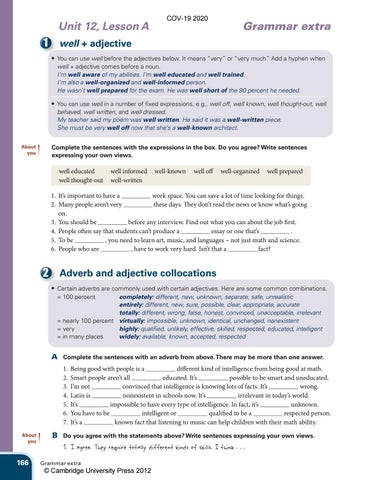
COV-19 2020
V Student’s Book
Michael McCarthy Jeanne McCarten Helen Sandiford
© Cambridge University Press 2012 9780521131865ttl.indd
1
12/1/11
1:51 PM
COV-19 2020
LICENSED PRODUCT TERMS OF USE By accessing or using this Licensed Product you confirm that you have read, understood and accepted these Terms of Use (Terms) and that you agree to comply with them. If you do not agree to these Terms, please do not use or access (or continue to use or access) the Licensed Product. TERMS AND CONDITIONS: Intellectual property rights Cambridge University Press (Cambridge) is the owner or licensee of the intellectual property rights in this Licensed Product. The Licensed Content is protected by copyright laws and treaties around the world. All such rights are reserved. Permitted uses You may read and view the contents of of this Licensed Product for private and personal non-commercial use only provided that all copyright, trade mark and other proprietary notices contained in the pages of this Licensed Product is retained. Prohibited uses You may not modify, adapt, alter, transmit, make available or distribute to any third-party any of the content in the Licensed Product without our prior written permission. Any use made of such content may be an infringement of rights in that content and we reserve all rights to enforce such rights. You may not make any copies electronically or otherwise of any of the content in this Licensed Product and you may not extract, copy or further distribute, sell, publish or transmit any part of the material contained in this Licensed Product by electronic or any other means. You agree not to sell, resell, supply or otherwise make the content contained in this Licensed Product or extracts or other information derived therefrom available in any manner or on any media to any third party without our prior written consent. You may not download or embed on to your machine, server or institutional system any third party content from the Licensed Product under any circumstances and, by agreeing to these Terms, you understand and acknowledge that you are prohibited from so extracting any third party content from the Licensed Product and that to do so would be a material breach of these Terms by you. Governing law These Terms, and any dispute or claim arising out of or in connection with it shall be governed by, and construed in accordance with the laws of England and Wales. We both agree that the English courts shall have exclusive jurisdiction to settle any such dispute or claim.
Š Cambridge University Press 2012
COV-19 2020
© Cambridge University Press 2012
COV-19 2020
University Printing House, Cambridge CB2 8BS, United Kingdom One Liberty Plaza, 20th Floor, New York, NY 10006, USA 477 Williamstown Road, Port Melbourne, VIC 3207, Australia 314–321, 3rd Floor, Plot 3, Splendor Forum, Jasola District Centre, New Delhi – 110025, India 79 Anson Road, #06–04/06, Singapore 079906 Cambridge University Press is part of the University of Cambridge. It furthers the University’s mission by disseminating knowledge in the pursuit of education, learning and research at the highest international levels of excellence. www.cambridge.org Information on this title: www.cambridge.org/9780521131865 © Cambridge University Press 2012 This publication is in copyright. Subject to statutory exception and to the provisions of relevant collective licensing agreements, no reproduction of any part may take place without the written permission of Cambridge University Press. First published 2012 40 39 38 37 36 35 34 33 32 31 30 29 Printed in Great Britain by CPI Group (UK) Ltd, Croydon CRO 4YY A catalog record for this publication is available from the British Library ISBN ISBN ISBN ISBN ISBN ISBN ISBN ISBN ISBN
978-0-521-13186-5 Student’s Book 1 978-1-107-60151-2 Student’s Book 1A 978-1-107-60152-9 Student’s Book 1B 978-1-107-60277-9 Workbook 1 978-1-107-60278-6 Workbook 1A 978-1-107-60279-3 Workbook 1B 978-1-107-60153-6 Teacher’s Edition 1 978-1-107-63988-1 Classroom Audio 1 978-1-107-62978-3 Classware 1
Cambridge University Press has no responsibility for the persistence or accuracy of URLs for external or third-party Internet Web sites referred to in this publication and does not guarantee that any content on such websites is, or will remain, accurate or appropriate. Information regarding prices, travel timetables and other factual information given in this work is correct at the time of first printing but Cambridge University Press does not guarantee the accuracy of such information thereafter. Cover and interior design: Page 2, LLC Layout/design services and photo research: Cenveo Publisher Services/Nesbitt Graphics, Inc. Audio production: New York Audio Productions
© Cambridge University Press 2012
COV-19 2020
Authors’ acknowledgements The authors would like to thank the entire team of professionals who have contributed their expertise to creating Viewpoint 1. We appreciate you all, including those we have not met. Here we would like to thank the people with whom we have had the most personal, day-to-day contact through the project. In particular, Bryan Fletcher for his incredible vision, publishing ability, and drive – we deeply appreciate his confidence in us and our work; Sarah Cole, for her extraordinary editorial flair, market knowledge, technical skills, and superb direction of the project; Mary Vaughn for her usual outstandingly perceptive comments on our drafts and her excellent contributions to the material; Desmond O’Sullivan for his skills in managing the project successfully with unfailing good humor; Karen Davy for her tireless attention to detail; Catherine Black for her invaluable and timely help in the proofing stages; Graham Skerritt and Sabina Sahni for their detailed editorial comments; Dawn Elwell for her flawless design and production skills and especially her never-ending patience; Ellen Shaw for sharing her expertise so generously and for her continued support, which we value; Lorraine Poulter for her assiduous and supportive role in the creation of the Workbook; Sue Aldcorn for her work on creating the Teacher’s Edition; Peter Satchell for his careful editorial support; Lisa Hutchins for making the audio program happen; Rachel Sinden for her role in setting up the online component. CarolJune Cassidy for her meticulous work with the wordlists; Tyler Heacock and Kathleen Corley, and their friends and family for the recordings they made, which fed into the materials; Ann Fiddes and Claire Dembry for their corpus support; Andrew Caines for corpus research support; Mike Boyle for contributing the articles in Units 4 and 7; Melissa Good for arranging access to the English Profile wordlists; Jenna Leonard, Sarah Quayle, and Helen Morris for making all kinds of things happen; Dr. Leo Cheng and Mercy Ships for the interview and photographs in Unit 5; Chris Waddell for the interview and photographs in Unit 12. We would also like to express our appreciation to Hanri Pieterse and Janet Aitchison for their continued support. Finally, we would like to thank each other for getting through another project together! In addition, Helen
Sandiford would like to thank her husband, Bryan, and her daughters, Teia and Eryn, for their unwavering support. In addition, a great number of people contributed to the research and development of Viewpoint. The authors and publishers would like to extend their particular thanks to the following for their valuable insights and suggestions. Reviewers and consultants: Elisa Borges and Samara Camilo Tomé Costa from Instituto Brasil-Estados Unidos, Rio de Janeiro, Brazil; Deborah Iddon from Harmon Hall Cuajimalpa, México; and Chris Sol Cruz from Suncross Media LLC. Special thanks to Sedat Cilingir, Didem Mutçalıoğlu, and Burcu Tezvan from İstanbul Bilgi Üniversitesi, İstanbul, Turkey for their invaluable input in reviewing both the Student’s Book and Workbook. The authors and publishers would also like to thank additional members of the editorial team: John Hicks, Lori Solbakken, and our design and production teams at Nesbitt Graphics, Inc., Page 2, LLC and New York Audio Productions. Thank you to the models as well as all those who allowed us to use their homes and businesses for our Lesson C photographs, especially Nina Hefez; Tokyo Eat, the restaurant at the Palais de Tokyo, Paris, France; Panam Café, Paris, France; Thanksgiving grocery store, Paris, France; and Majestic Bastille Cinéma, Paris, France. Special thanks to the photographer, Fabrice Malzieu, for his skill, direction and good humor. And these Cambridge University Press staff and advisors: Mary Lousie Baez, Jeff Chen, Seil Choi, Vincent Di Blasi, Julian Eynon, Maiza Fatureto, Keiko Hirano, Chris Hughes, Peter Holly, Tomomi Katsuki, Jeff Krum, Christine Lee, John Letcher, Vicky Lin, Hugo Loyola, Joao Madureira, Alejandro Martinez, Mary McKeon, Daniela A. Meyer, Devrim Ozdemir, Jinhee Park, Gabriela Perez, Panthipa Rojanasuworapong, Luiz Rose, Howard Siegelman, Satoko Shimoyama, Ian Sutherland, Alicione Soares Tavares, Frank Vargas, Julie Watson, Irene Yang, Jess Zhou, Frank Zhu.
© Cambridge University Press 2012 9780521131865ack.indd
1
12/1/11
1:37 PM
COV-19 2020
Viewpoint Level 1 Scope and sequence Functions / Topics Unit 1 Social networks pages 10–19
Unit 2 The media pages 20–29
Unit 3 Stories pages 30–39
Grammar
Vocabulary
Conversation strategies
Speaking naturally
• Ask questions to get to know someone • Talk about friends and social networking habits
• Use the present tense, tend, and will to talk about habits
• Personality traits (e.g. open-minded, pushy, talkative) • Formal verbs (obtain, withhold, accuse)
• Ask questions to find out or check information • Use And, But, and So to start questions which link back to what the previous speaker said
• Questions with answers page 138
• Talk about the influence of the media and celebrities • Share views on the impact of TV, online videos, and video games
• Use defining and non-defining relative clauses to give and add information • Use that clauses to link ideas
• Nouns and prepositions (increase in, impact on) • Formal expressions (complex issue)
• Use which clauses to comment on your own and others’ statements • Use You know what . . . ? to introduce a comment on what you’re going to say
• which clauses page 138
• Talk about life lessons and experiences • Tell stories about your childhood
• Use the past tense and present perfect forms • Use the simple past, past perfect, and past perfect continuous
• Expressions for schoolrelated experiences (count toward a grade) • Verbs (slip, tug, etc.)
• Interrupt a story you are telling to make a comment and then come back to it • Use (It’s) no wonder to say something is not surprising
• Auxiliary verbs page 139
Checkpoint 1 Units 1–3
Unit 4
• Discuss and give • Use countable and uncountable advice on finding Working lives nouns and changing pages 42–51 • Generalize and jobs specify using • Share opinions definite and about perks and indefinite benefits offered articles by employers • Discuss and prepare to answer interview questions
4
pages 40–41
• Show your attitude • Verb + noun toward what you say collocations with -ly adverbs on the topic • Use As a matter of of finding fact or In fact to give a job (achieve new information a goal) that you want to • Word families (solve – solution) emphasize, or to correct what someone assumes or expects
• Word stress page 139
Scope and sequence
© Cambridge University Press 2012 9780521131865ovr_p004-009.indd
4
12/1/11
1:41 PM
COV-19 2020
Vocabulary notebook
Grammar extra
• Write a script for a debate over whether or not employers should judge applicants by their online profile • Plan an argument • Contrast ideas and arguments • Avoid errors with whereas
The right choice! • Identify new vocabulary as formal or informal
• Questions • Frequency expressions • State verbs pages 144–145
Not just a game • An article about the impact of violent video games on young people
• Write a paragraph in an essay about whether songs with violent lyrics should be banned • Use topic sentences • List ideas • Avoid errors with listing expressions
What an effect! • When you learn a new noun, find out what prepositions are used with it
• Verbs in subject and object relative clauses • Using that clauses • what clauses pages 146–147
Saturday • A short story about a woman who suddenly feels invisible
• Write a narrative article Catch up! • Write a definition about a positive or to help you negative experience remember with people a new expression • Brainstorm and plan • Use verbs to structure an article • Avoid errors with the past perfect
Listening
Reading
Writing
Reasons for ending friendships • Four people talk about solutions to relationship problems
Future college students and employees, beware! • An article about the importance of posting only appropriate content online
But is it fair? • Two students debate whether it is fair for employers to check out job applicants online It’s really interesting that . . . • Five people discuss the effects of TV on young people They’re just games • A professor delivers a lecture on violence and the media It just goes to show . . . • Three conversations about life lessons How friendly are people? • Three students describe the people in their cities
Checkpoint 1 Units 1–3
The best perks • Five people discuss and give examples of perks and benefits offered to employees Interview rules • Five applicants are interviewed for a job
Career help: What questions should I ask at a job interview? • An article outlining questions a job applicant should and shouldn’t ask during an interview
• Time expressions with the simple past and present perfect • Time expressions with the past perfect pages 148–149
pages 40–41
• Write a personal statement for an application form • Use nouns in formal writing • Avoid errors with uncountable nouns
Meet that deadline! • When you learn a new word, write down its collocations
• Making uncountable nouns countable • More about uncountable nouns • More about the definite article pages 150–151
Scope and sequence
5
© Cambridge University Press 2012 9780521131865ovr_p004-009.indd 5
12/2/11 11:05 AM
COV-19 2020
Unit 5 Challenges pages 52–61
Unit 6 Into the future pages 62–71
Functions / Topics
Grammar
Vocabulary
Conversation strategies
Speaking naturally
• Talk about world issues and ways to help • Share wishes, hopes, and regrets about the world • Hypothesize on making the world a better place
• Use conditional sentences to talk about hypothetical events in the present or past • Use wish and hope to talk about wishes, hopes, and regrets
• World problems and solutions (eradicate poverty) • Word building (devastate, devastation, devastated)
• Suggest possible scenarios or ideas with What if . . . ?, suppose, and imagine • Use I suppose to show that you’re not 100 percent sure
• Shifting word stress page 140
• Talk about the future of money, technology, clothing, travel, entertainment, and everyday life • Give a presentation
• Describe future events with be going to, will, may, might, and the present • Use modal verbs for expectations, guesses, offers, necessity, requests, etc.
• Expressions used in giving presentations (As you’ll see on the slide.) • Nouns for people (climatologists)
• Use would or ’d to soften your opinions • Respond with expressions such as I think so, I don’t think so, and I guess not
• Silent consonants page 140
Checkpoint 2 Units 4–6
Unit 7 Getting along pages 74–83
Unit 8 Food science pages 84–93
6
pages 72–73
• Talk about getting along with friends and family • Compare experiences of growing up in different types of families • Share views on dealing with difficult friends
• Use phrasal verbs • Phrasal verbs on the topic • Use infinitives of house rules and -ing forms (have friends after adjectives, over) nouns, and • Idiomatic pronouns expressions (drive your friends away, tag along with someone)
• Talk about farming, food, and nutrition • Share ideas for eating a healthy diet • React to statistics
• Use the passive to focus on information when talking about the past, present, and future • Use complements of verbs that describe causes and effects
• Make your meaning clear with expressions like What I’m saying is and I mean • Use expressions such as I have to say to show that you want to make a strong point
• Use rhetorical • Human body questions to make parts and a point processes • Give examples with (heart, expressions such as metabolism) such as, like, take, • Noun and verb and for instance forms of the same root (discovery, discover)
• Conversational expressions page 141
• Strong and weak forms of prepositions page 141
Scope and sequence
© Cambridge University Press 2012 9780521131865ovr_p004-009.indd
6
12/1/11
1:41 PM
COV-19 2020 Vocabulary notebook
Grammar extra
• Write an email inquiry about volunteering • Use it as subject and object • Avoid errors with verb forms
Wealthy = rich • When you learn a new word, write down its synonyms or a paraphrase of it
• Continuous forms for conditions • even if and unless to talk about conditions • Use of wish with would • Strong wishes with If only pages 152–153
What does the future • Write a one-paragraph article about how our look like? everyday life will be • Four short news different in the future articles about • Use modal verbs with developments adverbs and changes • Structure a paragraph that could occur with topic, supporting, in the future and concluding sentences • Avoid errors with adverbs
Present yourself! • Create an “idea string” for a new expression by thinking of different ways you can use it
• Plans and intentions with be going to and will • Present forms in clauses that refer to the future • More on necessity modals • Possibility modals in the affirmative and negative pages 154–155
Listening
Reading
Writing
What would you give away? • Three people talk about ways to help others
On the Mercy Ships • An interview with Dr. Leo Cheng, whose volunteer work with Mercy Ships changes lives in developing countries
Inspiring people • An interview with a doctor about his work with the charitable organization Mercy Ships Going cashless – the pros and cons! • Two friends discuss the advantages and disadvantages of a cashless society Future entertainment • Four conversations about entertainment in the future
Checkpoint 2 Units 4–6
My worst roommate • Four people talk about their negative experiences with roommates “Boomerang” kids • Two parents talk about their “boomerang” children – grown children who move back home A food revolution! • Two radio show hosts and five listeners talk about the British chef Jamie Oliver Backyard beekeeping • A man talks to an interviewer about his unusual hobby – beekeeping
pages 72–73
Now That I’ve Driven • Write an introduction to an essay about All My Friends Away, whether family I Finally Have Time relationships are For Me! more important • A satirical article than friendships with suggestions • Use a thesis statement for ways to get • Use what clauses rid of friends to give the most and make time important information for yourself • Avoid errors with subjects Where did all the bees go? • An article about “colony-collapse disorder” and why the disappearance of bees is a serious threat to the world’s food supply
• Write a report about trends, using information in graphs and charts • Use prepositions after verbs and nouns • Use expressions for approximate numbers • Avoid errors with fall, rise and grow
Look forward to it! • Objects with separable phrasal • When you learn a new expression, verbs • Phrasal verbs use it in a true followed by the -ing sentence about form of the verb someone you • More patterns know with infinitives and it clauses pages 156–157
Picture this! • Create a picture dictionary on your computer
• Question forms in the passive • Verb + object + infinitive • More verb patterns pages 158–159
Scope and sequence
7
© Cambridge University Press 2012 9780521131865ovr_p004-009.indd
7
12/1/11
1:41 PM
COV-19 2020 Functions / Topics Unit 9
• Define and discuss success Success and and happiness happiness • Share stories pages 94–103 about happy moments and times when things went wrong
Grammar
Vocabulary
• Use the determiners all, both, each, every, neither, none of, no • Use -ing forms as reduced relative clauses, to describe simultaneous events, and as subjects and objects
• Expressions with get (get off the ground, get under way, get off to a good start) • Synonyms (study = analyze)
Checkpoint 3 Units 7–9
Speaking naturally
• Use expressions like As far as (success) is concerned to focus in on a topic • Use expressions like As far as I’m concerned / can tell to give and soften opinions
• Stress in expressions page 142
pages 104–105
Unit 10
• Describe travel and vacation Going places experiences pages 106–115 • Report conversations • Share views on what to take on trips • Discuss the effects of tourism
• Use reported speech to report statements • Use reported speech to report questions and instructions
• Adjectives ending -ed and -ing (amazed, amazing) • Synonyms (industries, businesses)
• Use expressions such as you mean, so what you’re saying is, and so I guess when drawing conclusions • Ask for more details about someone’s ideas or opinions, using In what way?
• Silent vowels page 142
Unit 11
• Talk about weddings, gifts, Culture and other pages 116–125 traditions • Discuss the positive and negative aspects of globalization
• Use relative clauses with when, where, and whose • Use verbs with direct and indirect objects
• Expressions to describe wedding customs (bride, walk down the aisle) • Opposites (loss ≠ preservation)
• Soften your comments with expressions like kind of, a little, and not really • Use Yeah, no to agree with someone and then make a comment of your own
• Consonant groups page 143
Unit 12
• Expressions to • Use adverbs describe types before adjectives of intelligence and adverbs and abilities • Use as . . . as and (linguistic, comparative articulate) and superlative • Collocations adjectives and (raise adverbs awareness)
• Use vague expressions like and that kind of thing when you don’t need to be precise • Show that you strongly agree with someone, using No doubt
• Stress and intonation page 143
• Talk about intelligence, Ability skills, and pages 126–135 abilities • Discuss views on parents’ and teachers’ roles in developing children’s talents
Checkpoint 4 Units 10–12
8
Conversation strategies
pages 136–137
Scope and sequence
© Cambridge University Press 2012 9780521131865ovr_p004-009.indd
8
12/1/11
1:41 PM
COV-19 2020 Listening
Reading
Writing
Vocabulary notebook
Grammar extra
Happy moments gone wrong! • Three people talk about happy occasions and the things that went wrong
Unhappy? Maybe you’re not in the right country! • An article describing ways that governments can take responsibility for their citizens’ happiness
• Write a paragraph for an essay about whether governments are responsible for citizens’ happiness • Use expressions to add ideas • Avoid errors with in addition to, etc.
Get started! • When you learn a new expression, imagine using it in an everyday situation. Write the situation and what you would say
• Singular or plural verbs with determiners • Determiners with and without of • Verbs followed by an -ing form or an infinitive • Verbs of perception + object + base form or -ing form pages 160–161
Happiness and the community • A sociology professor lectures on policies that can make communities happier
Checkpoint 3 Units 7–9
More adventures in Bolivia • A woman tells a friend about her plans for a trip to Bolivia
pages 104–105
• Write a survey article for a student magazine • Contrast ideas • Avoid errors with although
Are we losing our culture? • An article discussing the different aspects of culture and things that can threaten it
Wedding bells! • Write a concluding • Write new paragraph in an essay vocabulary about the effects of on word webs globalization on culture • Explain cause and effect • Avoid errors with due to
Seeing things in a completely different way . . . • An interview with Chris Waddell, whose disability didn’t stop him from becoming a world champion skier
• Write an essay about someone you admire • Brainstorm, then plan an essay • Explain purpose and intention • Avoid errors with so that
Responsible tourism • An eco-tour guide discusses things people can do to be responsible tourists Gift giving around the world • An interview about certain gifts in different cultures Reviving a dying language • Students and their professor discuss ideas for saving endangered languages Minds for the future • Two friends discuss an article about the five minds that Howard Gardner identified The genius in all of us • Two radio show hosts talk about natural talent and giftedness
So amazing! • When you learn a new word, make word forks with other words in the same family
The tourist threat • An article about the benefits and dangers of the tourist industry
Checkpoint 4 Units 10–12
• Reported speech: verbs and pronouns • Reported speech: time and place expressions • Other reporting verbs • Reporting verb forms pages 162–163 • More on relative clauses • Prepositions in relative clauses • More on verb + direct object + prepositional phrase • Passive sentences pages 164–165
It’s just the opposite! • When you learn a new adjective or descriptive expression, find out how to express the opposite meaning
• well + adjective • Adverb and adjective collocations • Patterns with comparatives pages 166–167
pages 136–137
Scope and sequence
9
© Cambridge University Press 2012 9780521131865ovr_p004-009.indd
9
12/1/11
1:42 PM
COV-19 2020
Unit
Social networks
1
In Unit 1, you . . . .talk about friends and social networking. .use the present tense, tend, and will to talk about habits.
.ask questions to find out or check information. .use And, But, and So in follow-up questions.
What RU doing? I’m goin cla to mss. W g to eet ant L8R ?
Lesson A Speed-friending 1 A
Getting to know each other Read the article. Why do people go to speed-friending events? What happens at this kind of event? CD 1.02
Make New Friends and Network Fast!
T
hese days we live life in the fast lane. We insist on fast food, quick service, high-speed downloads, instant messaging, and immediate responses. So why should we spend time making new friends? At a speed-friending event, you have just a few minutes to ask and answer questions before moving on to the next person. If you find people you’d like to get to know better, you can contact them after the event. Here are the kinds of questions that people ask. 1 How do you like to spend
5 When did you last stay
your free time?
out after midnight?
2 What music are you
listening to these days? 3 What was your most
Where were you? 6 Who’s your favorite celebrity? 7 Have you ever won a prize
valuable possession as a child? And now?
or a contest? 8 What word describes
4 Can you say no to chocolate?
About you
you best?
B Pair work Take turns asking and answering the questions in the article. C Write six interesting questions you’d like to ask at a speed-friending event. (For help with questions, see page 144.)
How often do you go out with your friends? D Class activity Hold a speed-friending event in class. You have two minutes to ask each person your questions.
10
Unit 1: 1 Social networks
© Cambridge University Press 2012
COV-19 2020
2 A
Vocabulary in context CD 1.03 Listen. Tanya is describing people she met at a speed-friending event. Who do you think she will get in touch with again? Who won’t she contact? Say why.
What can I say? Greg wasn’t very talkative, and when he did talk, he seemed kind of narrow-minded.
Lauren was very intelligent, but she seemed kind of eccentric – you know, a little weird, but fun.
I thought Kayla was kind of aggressive – you know, a little too pushy for me. I bet she can be a pain at times.
Rickie seemed really sweet and thoughtful – but a little too sensitive, maybe? He got a little touchy about some of the questions.
Victor sounded really, you know, self-confident but in a nice way – not at all arrogant. And he was interested in my answers.
Word sort
Emma was very open-minded and relaxed about things – pretty laid-back. And she had a good sense of humor. We laughed a lot.
B Complete the chart with personality traits from Tanya’s descriptions. Add more ideas. I like people who are . . .
I don’t like people who are . . .
I don’t mind people who are . . .
open-minded
Vocabulary notebook See page 19.
About you
C Pair work Do you know anyone with the personality traits in your chart? Take turns asking and answering questions.
A Do you know anyone who is open-minded? B Actually, my sister is very open-minded. She always listens to new ideas.
3
Viewpoint What makes a good friend? Group work Discuss the questions. Do you share the same views on friendship?
• • • • •
Think of three good friends. How would you describe them? Are there things about your friends or people you know that you don’t like? How do friendships differ? Is it possible to be equally close to everyone? Would all your friends get along if they met one another? What do you think about speed-friending as a way to make new friends?
“Well, . . . my friend Martha is really sweet. She . . . ” In conversation . . . You can use Well, . . . to take time to think. Unit 1: Social networks
© Cambridge University Press 2012
11
COV-19 2020
Lesson B Networking 1
Grammar in context
A Class survey Read the information. What percentage of your class uses these methods of communication every day? Vote on the methods you use, and complete the chart.
B
How do you keep in touch?
The percentage of young people who . . .
Most people use several different ways to keep in touch. Here are the percentages of young people who use these methods of communication every day.
talk on a cell phone send text messages use instant messaging use social networks talk on a landline send email
Your class
70% 60% 54% 47% 46% 22%
CD 1.04 Listen. Four people talk about how they communicate. What methods of communication do they use?
We asked four people how they like to communicate. Here’s what they said. Jeff Gordon, 25 “I go on my social networking site five or six times a day. I’ll log in when I’m taking a break. I like to check out my friends’ pages and see what they’re up to.”
Victoria Garza, 40 “Personally I use email, but my kids are constantly texting. Occasionally my son will email someone like my sister, but with friends he tends to text.”
David Smith, 31 “At work I’m on the phone all the time, but when I’m traveling, I normally use my laptop to make calls over the Internet. It doesn’t cost anything, so . . . ”
About you
12
Sarah Wang, 19 “Every once in a while, I’ll instant message with a friend. Some of my friends don’t use IM, so mostly I just call on my cell to catch up with them.”
C Pair work Find things in the interviews that you do and don’t do. Tell a partner. “I go on my social networking site a lot, like Jeff. And I . . .”
Unit 1: 1 Social networks
© Cambridge University Press 2012
COV-19 2020
2 Figure it out
Grammar Talking about habits
A Find sentences in the interviews with a similar meaning to the ones below. Rewrite the sentences, changing the words in bold. Then read the grammar chart.
1. With friends he usually texts. 2. Every once in a while, I instant message.
3. My kids text all the time. 4. When I travel, I normally use my laptop. Grammar extra
The present tense, tend, and will
See page 145.
To talk about habits, you can use the simple present, the verb tend, or the modal verb will. Here, will does not have future meaning. Mostly I call on my cell. I’m on the phone all the time. My friends don’t use IM. My son tends to text. He doesn’t use IM. Occasionally he’ll email someone. You can use the present continuous for a “longer” activity that happens at the same time as another habit. When I’m traveling, I normally use my laptop to make calls. You can use always and constantly with the present continuous for a habit that is noticeable or more frequent than is usual. In conversation . . . My kids are constantly texting.
People often use will / ’ll in statements to talk about their habits. Questions and the negative forms will not / won’t are rarely used in this meaning.
B Complete the conversations with a correct form of the verbs given. Then practice. 1. A How do you normally catch up with your friends? By phone? B Yeah. I (tend / call) them when I’m taking my lunch break. A Yeah? I (not call) my friends much. We always each other, so . . .
(email)
2. A How much time do you spend on your social networking site? B I probably (will / spend) a few hours a day on it. I (tend / use) it to make plans with friends. Mostly I (check out) my friends’ photos and stuff. A Yeah? I’m not on one. But occasionally I (will / get) invites from people. But I (not reply) to them. 3. A What do you mostly use your cell phone for? Texting? constantly (text) my kids to find out where they are. B Yeah. I A That’s funny. In my family, we (not text) a lot. We (tend / talk). Like, my sister regularly (call) me after dinner when she (watch) TV. About you
C Pair work Write your own answers to the questions in Exercise B. Then take turns asking the questions and giving your own answers.
D Group work Prepare a short presentation about your family’s communication habits to give to your group. Listen to your classmates’ presentations, and ask questions.
“Mostly I text my friends and family. My dad’ll text me when he’s working, and . . .”
3
Speaking naturally Questions with answers
See page 138.
Unit 1: Social networks
13
© Cambridge University Press 2012 9780521131865u01_p010-019.indd 13
12/13/11 11:40 AM
COV-19 2020
Lesson C And why’s that? 1
Conversation strategy Finding out or checking information
A How would you feel if someone “unfriended” you (removed you from their list of friends on a social networking site)? Would you take it personally and be offended?
B
Listen. What does Stan think about “unfriending” someone? How do you think Alexa feels about it? CD 1.07
Stan I ran into Tammy today. She’s really upset. Alexa Oh, yeah? And why’s that? Stan Because I “unfriended” her. Alexa Oh, that’s awkward. How did she find out? Stan I’m not sure, actually. Alexa Huh. So why did you “unfriend” her? Stan Well, it was nothing personal. It’s just that every once in a while, you know, when I’m updating my profile, I’ll remove people – if we haven’t been in touch for some time. Alexa But you emailed her, right? I mean, you let her know? Stan No. I didn’t think she’d be offended. Alexa So you just delete people that you’re not in touch with? Stan Yeah. It’s no big deal.
C
D
Notice how Alexa asks some questions to find out new information.
“And why’s that?”
She asks other questions in the form of statements to check information or her understanding of what was said or done. Find examples of both types of questions in the conversation.
“But you emailed her, right?”
CD 1.08 Complete the rest of Stan and Alexa’s conversation with the questions in the box. Then listen and check. Practice with a partner.
Alexa So has anyone ever “unfriended” you? a. So you think it’s bad, then? Stan You mean, taken me off their friends list? b. And it’s OK when you stop dating? I don’t think so. ✓ c. So has anyone ever “unfriended” you? Alexa It wouldn’t bother you? Stan No. I wouldn’t mind at all. d. But you’d be fine with it if they did? Alexa It’s not bad. It’s just Tammy didn’t do anything wrong. e. So when is it OK, do you think? Stan f. But what should I do about Tammy? Alexa Well, if they post obnoxious comments, for example. Stan Hmm. Alexa Well, yeah. That’s probably a good reason, too. Stan Right. Alexa I don’t know. Just make sure you never “unfriend” me! OK?
14
Unit 1: Social networks
© Cambridge University Press 2012 9780521131865u01_p010-019.indd
14
12/1/11
1:52 PM
COV-19 2020
2
Strategy plus Linking with And, But, and So
You can start questions with And, But, or So to link back to things the previous speaker said. It makes the conversation “flow.” She’s really CD 1.09
And why’s that?
upset.
A
CD 1.10 Underline the best question to continue each conversation. Then listen and check your answers. Practice with a partner.
1. A Have you ever removed someone from your list of friends online? B Actually, I don’t have one. I’m not on a social networking site. A And you just tend to add people? / So how do you keep in touch with people? 2. A Do you think it’s OK to “unfriend” people? B Oh, yeah. People do it all the time, I’m sure. A Yeah. But why do they do it? / So they never remove anyone? 3. A What would you do if someone deleted you from their friends list? B It depends. I probably wouldn’t say anything. A But you’d say something if it was a good friend? / And you’d call them, right? About you
B Pair work Ask and answer the questions. Can you continue each conversation?
3 A
Listening and strategies Reasons for ending friendships Listen to the first part of four conversations. What would each person say the problem is with his or her friendship? Number the issues 1–4. There are two extras. CD 1.11
We’ve lost touch. My friend is too serious. My friend posts annoying stuff on my wall.
B
C About you
CD 1.12
My friend is two-faced. We can’t agree on things. We don’t like each other’s friends.
Listen again. Circle the best question to continue each conversation.
1. a. So you don’t agree on anything? b. But do you agree on politics?
3. a. But why does she do that? b. So does she talk about you behind your back?
2. a. But she never posts photos, right? b. And does she post obnoxious comments, too?
4. a. So you mostly call each other? b. So she just dropped you?
CD 1.13 Listen to the complete conversations. Check your answers. What solutions do the speakers have for their friendship problems?
D Pair work Agree on six good reasons for ending a friendship and the best ways to do it. A Well, if you don’t agree on anything, it’s probably a good reason to end a friendship. B But do you only want friends who agree with you on everything?
Good reasons to end friendships 1. You don’t agree on important issues. The best ways to do it . . . Unit 1: Social networks
© Cambridge University Press 2012
15
COV-19 2020
Lesson D Online footprints 1
Reading
A Prepare Guess the meanings of online footprint and digital dirt. Then scan the article and find the explanations.
B
Read for main ideas Read the article. What examples of digital dirt can you find?
Future college students and employees, beware!
Clean up that digital dirt –
now!
When student-teacher Ms. S. posted a photo from a party on the wall of her social networking site, she had no idea of the consequences. Just weeks away from obtaining a teaching degree, Ms. S.’s diploma was withheld after school administrators viewed the photo and accused her of promoting underage drinking – a charge that she denied. Her case is not an isolated one. Increasingly, employees are being fired from their jobs and students are having their college applications rejected because of “digital dirt,” or inappropriate online content.
1. Check what’s online already. Type your name into several search engines to see your digital footprint. Then check all of your privacy settings, and remove anything you don’t want others to see. If you have “friends” who are always posting off-color jokes or rude comments about you on your wall, then block their comments.
These cases highlight the need to be careful about the type of content you post online. Each time you post a photo or comment, or write a profile online, you create an image, or “online footprint,” of yourself that is difficult to erase. If you think your friends are the only ones checking your profile, think again. It’s increasingly common for colleges and employers to look closely at the online pictures and profiles of actual and prospective students and employees. A survey conducted by ExecuNet reported that 83 percent of job recruiters regularly use Internet searches to find out more about candidates. Nearly half said they will reject candidates based on the “digital dirt” they find.
3. Create a positive online image. The Internet is the perfect place to showcase your talents and skills. Use a blog or website to promote your work, research, and interests.
How can you still have fun online without making a bad impression on future college admissions officers and employers? Here are five basic steps you can follow.
2. Avoid writing anything you might regret later. Don’t badmouth a current or previous employer online. The same applies to teachers, professors, classmates, or co-workers.
4. Use a professional email address. An employer or a college admissions officer is more likely to contact annsmith@cup.com than smoothiefan@cup.com. 5. Join online groups selectively. Instead of joining groups and campaigns with names like “Sleeping in class,” connect to a professional organization. When it comes time to apply for a job or place in college, you’ll be glad you did.
Reading tip Writers often begin an article with an example to illustrate their argument.
C Check your understanding Are the sentences true (T ) or false (F )? Write T or F. Correct the false sentences.
1. 2. 3. 4. 5. 6. About you
16
Ms. S. was unable to graduate from college. Her school said she was encouraging young people to drink. It’s becoming more common for employers to check people out online. Eighty-three percent of job recruiters reject candidates with “digital dirt.” The article recommends “unfriending” people who post rude comments. The article suggests that you shouldn’t join social network campaigns.
D React Pair work What do you think of Ms. S.’s story? Have you heard of similar cases? Which advice in the article do you intend to follow?
Unit 1: Social networks
© Cambridge University Press 2012 9780521131865u01_p010-019.indd
16
12/1/11
1:52 PM
COV-19 2020
2
Focus on vocabulary Formal verbs
A Find the verbs in bold below in the article. Match the two parts of the sentences to find the meanings. Write the letters a–g.
1. 2. 3. 4. 5. 6. 7.
If you obtain something, you If you withhold something (from someone), you If people accuse you of (doing) something, they If you promote something, you If you deny (doing) something, you If employers reject a job applicant, they If you regret (doing) something, you
a. b. c. d. e. f. g.
say it is a good thing. say you didn’t do it. don’t want that person. are sorry that you did it. keep it and don’t give it to that person. say you did something bad or wrong. get or achieve it.
B Pair work Take turns using the verbs above to ask questions about Ms. S.’s story. “What happened before Ms. S. obtained her teaching degree?”
3
Listening and speaking But is it fair?
A Pair work Read the question below. How many reasons can you think of to support a “yes” and a “no” answer? Make two lists.
Today’s online debate: Is it fair for employers to check out job applicants online?
B
CD 1.14 Listen to two people debate the question above. Who answers, “Yes, it’s fair” and “No, it’s not fair” to the question? Which of the reasons in your lists did they use?
Rosa says
C
CD 1.15
Daniel says
Listen again and write the two missing words in each sentence.
1. a. On the one hand, Rosa believes that what you do online shows your . b. On the other hand, Daniel argues that your online profile is . 2. a. Rosa says online profiles tell you what you won’t see in . b. Daniel thinks social networking sites don’t tell you what a person is like . 3. a. Rosa argues that it’s to recruit and train new staff. b. Daniel believes that everyone has a right to in his or her free time. 4. a. Rosa says companies want people who will fit in and with other people. b. Daniel argues that people behave in a different way . About you
D Class debate Prepare a response to the debate question with a partner, and then present your arguments to the class. How many people answer “yes”? How many answer “no”? Unit 1: Social networks
17
© Cambridge University Press 2012 9780521131865u01_p010-019.indd
17
12/1/11
1:53 PM
COV-19 2020
Writing Making judgments In this lesson, you . . .
.plan an argument. .contrast ideas. .avoid errors with whereas.
Task
Write a script for an online debate.
Should employers judge applicants by their online profiles?
A Brainstorm Read the question above. Write three reasons to answer “yes” and three reasons to answer “no.”
B Look at a model Read the debate script. Circle three more expressions that contrast ideas. Many employers check the Internet for information about job applicants. However, this is not a fair way to judge a person. On the one hand, employers need people who will fit into the company. An online profile gives information that employers will not see on a résumé – for example, if the person is aggressive or has extreme views. On the other hand, an online profile is for friends, whereas a résumé is for employers. A résumé provides the most relevant details about qualifications and work experience. An online profile may contain information that employers should not use to judge an applicant, such as age or religion. In conclusion, while there are good reasons to check an applicant’s online profile, it is not a professional document. For this reason, it is not fair, in my opinion, to judge candidates by their personal online profiles. C Focus on language Read the grammar chart. Then use your ideas from Exercise A to complete the sentences below.
Contrast ideas in writing On the one hand, employers need workers who will fit into the company. On the other hand, an online profile is for friends. A résumé is for employers. However, an online profile is for friends. A résumé is for employers, while/whereas/but an online profile is for friends. While there are reasons to check an online profile, it is not fair to do this.
Writing vs. Conversation
1. Introduction: Many employers . Some people think . However, . 2. Say why it is fair: On the one hand, an online profile , whereas a résumé . 3. Say why it is not fair: On the other hand, an online profile 4. Conclusion: In conclusion, while . In my opinion,
Conversation
whereas
Writing
however
. .
D Write and check Now write your own script for the debate. Then check for errors. Common errors Do not start a sentence with Whereas to contrast ideas with a previous sentence. An online profile is for friends. However, a résumé is for employers. (NOT Whereas . . .)
18
Unit 1: Social networks
© Cambridge University Press 2012 9780521131865u01_p010-019.indd
18
12/2/11
4:48 PM
COV-19 2020
Vocabulary notebook The right choice! Learning tip
Formal or informal?
weird (informal) = odd, strange, or eccentric touchy (informal) = sensitive, easily upset
When you learn informal vocabulary, write down a more formal equivalent. Don’t use informal words in formal writing.
Dictionary tip Dictionaries often label extremely informal words as inf(ormal), slang, colloqu(ial), rude, or taboo.
A Match the spoken sentences on the left with the more formal written sentences on the right. One of my classmates is . . .
a. He’s talkative.
1. a bit of a pain.
b. She’s sensitive.
2. very chatty.
c. She can be annoying.
3. pretty pushy.
d. He’s very eccentric.
4. kind of touchy.
e. She’s very relaxed about things.
5. really weird.
f. He’s very aggressive.
6. laid-back
B Think of three people you know. Describe each person informally and more formally. Person
Informal
More formal
1.
“
”
2.
“
”
3.
“
”
C Word builder Find the meanings of the verbs below. Match the informal and more formal verbs. Then use each verb to say and write something true about people you know. Informal
More formal
badmouth bug get a kick out of (doing)
chill out (with) hang out (with)
One guy in my class is always badmouthing other people.
annoy criticize enjoy (doing) relax (with) socialize (with)
One of my classmates is always criticizing other people.
On your own
brainy = intelligent
Make a dictionary of informal expressions. Write down an informal word or expression and a more formal synonym that you can use in writing or formal speech. Unit 1: Social networks
© Cambridge University Press 2012
119
COV-19 2020
Unit
The media
2
In Unit 2, you . . . .talk about the influence of the media and celebrities. .add information with relative clauses. .link ideas with that clauses. .make comments with which clauses. .use You know what . . . ? to introduce what you say.
Lesson A Celebrity culture 1
Grammar in context
A Who are the most popular celebrities in the news? Why are they famous? How do people follow the news about them?
B
CD 1.16 Listen to the podcast. Why is it normal to be interested in celebrities?
ONE-MINUTE PODCASTS
Celebrity obsession is normal!
Everywhere we look these days, we see images of celebrities. Celebrity magazines, which outnumber news magazines, are on every newsstand. We love to read about the people that celebrities date, the clothes they wear, and especially their problems, which the media will often invent. Then there’s reality TV. Millions of viewers avidly follow reality and talent shows, which make ordinary people into instant celebrities. There are even shows that pay for plastic surgery, so people can look like their favorite celebrity. So, why are we so obsessed?
About you
C Pair work Answer the questions about the podcast. Then give your own view and add more information on each answer.
1. 2. 3. 4.
20
Well, there’s a simple scientific reason for it, which might make you feel better about your own interest in celebrity gossip. Psychologists say it’s natural for us to talk about or imitate the people who are the most successful in our society. In ancient times, people gossiped about kings and leaders, who were the celebrities of their day. Nowadays, it’s actors, musicians, or athletes. And with TV and the Internet, they come right into our homes, which almost makes them part of the family. So our obsession with celebrity is perfectly normal, which is reassuring – don’t you think?
Which are more popular – celebrity magazines or news magazines? Why can’t we always believe celebrity gossip? What do some people do to look like their favorite celebrities? Why are celebrities so familiar to us?
Unit Unit2 2: The media
© Cambridge University Press 2012
COV-19 2020
2 Figure it out
Grammar Adding information
A Check (✔) the sentence that has a complete meaning if you remove the words in bold. Then read the grammar chart.
1. We love to read about celebrities’ problems, which the media will often invent. 2. There are even shows that pay for plastic surgery. Grammar extra
Defining and non-defining relative clauses
See page 146.
Defining relative clauses define, identify, or give essential information about a noun. There are shows that/which pay for plastic surgery. We love to read about the people (who/that) celebrities date and the clothes (that) they wear. Non-defining relative clauses give extra information about a noun. They do not begin with that. Notice the use of commas. Celebrity magazines, which outnumber news magazines, are everywhere. It’s natural to talk about celebrities, who we see as successful people. A which clause can add information or a comment to the clause before it. This obsession is normal, which is reassuring. Celebrities come into our homes, which almost makes them family.
In conversation . . . That is more common than which in defining relative clauses. Non-defining and which clauses often give opinions as well as information.
Common errors Do not use which for people, or what in relative clauses.
B Complete the interview extracts with who, that, or which. If you can leave them out, write parentheses ( ) around them. Sometimes there is more than one correct answer.
1. Miki
I like to read about the problems (that) celebrities are having, makes me feel better about my problems. I don’t want to know all the details of their marriages, should be private, but . . . just a few things.
2. Tariq
can do other things. For example, there’s Natalie I’m interested in celebrities Portman, ’s a scientist. She’s published in journals, is interesting.
is probably all untrue anyway. 3. Miguel Well, I’ll occasionally read the gossip in magazines, It’s a distraction from work, I think we all need. And it gives me something to talk about with my co-worker Jo, ’s really into celebrity gossip and stuff. 4. Salwa
3
I feel set a bad example. You know, they Actually, I’m not interested in celebrities, often think they can do anything just because they’re famous, is ridiculous, really.
Viewpoint Who’s into celebrity gossip? Class activity Ask your classmates the questions. Are you a celebrity-obsessed class?
• Are you interested in celebrities? If so, what interests you about them? • How closely do you follow celebrity gossip? Which celebrities are in the news at the moment? • What other celebrity gossip have you heard about in the last year? In conversation . . . “I’m interested in the clothes that celebrities wear. I mean, they wear some weird things, which is always fun.”
4
Use I mean, . . . to repeat your ideas or say more.
Speaking naturally which clauses See page 138. Unit 2: The media
21
© Cambridge University Press 2012 9780521131865u02_p020-029.indd 21
12/13/11 12:00 PM
COV-19 2020
Lesson B The impact of TV 1
Vocabulary in context
A
CD 1.19
Read the article. Which research did you already know?
The problem with TV Young people tune into TV for over four and a half hours every single day. That’s an increase in TV viewing of 40 minutes a day compared to a few years ago. But it’s not surprising that we’re watching more TV. With all the latest technology, TV is now viewed online, on mobile devices such as phones and tablets, or on digital video recorders (DVRs). What’s clear is that TV is central to our lives. But what kind of impact does it have on us?
of research 1 Language development There is a lotWhat is most
on TV and its effects on children. disturbing is that TV may have a negative effect on children’s language development. While the results of studies vary, the opinion of most experts is that children under two should not watch TV.
2
Obesity An average teenager sees 6,000 food commercials a year, and most are advertisements for fast foods, candy, and sugary cereals. It is also likely that increased TV-viewing time contributes to inactivity. Experts claim that these are two of the main reasons for the rise in obesity among young people.
3
Literacy One problem with TV is that it reduces the time that students spend reading. Research shows that there is a direct link between reading and good test scores, and it’s possible that TV viewing is one cause of poor test results.
4
Social skills There is also some concern about TV and its influence on behavior. In one survey, teachers complained that some shows encourage their students to behave badly. Other reports suggest that there is a relationship between watching too much TV and bullying.
B Complete the questions with prepositions. Use the article to help you. Then ask and answer the questions with a partner.
1. 2. 3. 4. 5. 6. Word sort
What’s one reason the increase TV viewing over the last few years? What does the article say about the effects of TV children under two? What foods are most food advertisements ? Is there a problem this? What’s another cause the rise obesity levels among young people? What’s the link watching TV and reading? Why is there concern this? What impact does TV have students’ behavior?
C Which nouns in the article are followed by these prepositions? Write them in the chart. Some nouns take more than one preposition. about
between
for
of
on
with
increase
in
Vocabulary notebook See page 29.
22
Unit 2: The media
© Cambridge University Press 2012 9780521131865u02_p020-029.indd 22
12/2/11 11:28 AM
COV-19 2020
2 Figure it out
Grammar Linking ideas
A Rewrite each pair of sentences as one sentence. Use the article on page 22 to help you. Then read the grammar chart.
1. 2. 3. 4.
Children under two should not watch TV. This is the opinion of most experts. We’re watching more TV. It’s not surprising. TV is central to our lives. It’s clear. There is a direct link between reading and good test scores. Research shows this link. Grammar extra
that clauses
See page 147.
You can use a that clause after these structures. In conversation people often leave out the word that. noun + be
One problem with TV is (that) it reduces students’ reading time.
be + adjective
It’s clear (that) TV viewing contributes to inactivity.
What’s + adjective + be
What’s disturbing is (that) TV may have an effect on language development.
verbs, e.g., know, think, say, show
Experts claim (that) watching TV is one cause of obesity.
In conversation . . . Common expressions with that clauses:
B Rewrite the sentences using a that clause. Start with the words given, and add a verb when necessary.
1. 2. 3. 4. 5. 6. 7. 8. About you
The thing / problem / point is that . . . What I’m saying is that . . . My feeling / opinion is that . . .
People who watch TV spend more on consumer goods. Experts . . . The majority of families have TV on during mealtimes. It’s disturbing . . . Most people multitask and do other things while watching TV. What’s interesting . . . Young people who watch a lot of TV are not very happy with their lives. One recent study . . . It’s not good for anyone to have a TV in the bedroom. My feeling . . . TV is a good thing because there are lots of good educational programs. My opinion . . . There are too many commercials and not enough good shows. The problem with TV . . . Children are watching so much TV these days. Teachers are concerned . . .
C Pair work Discuss your reactions to the sentences in Exercise B. “I’m not surprised that there’s a link between spending and watching TV. What I’m saying is that . . .”
3 A
Listening and speaking It’s really interesting that . . . CD 1.20 Listen. Five people are reacting to information from the article on page 22. Which topic does each person talk about? Write the letters a, b, c, or d.
1. 2. 3. 4. 5.
B
Maggie Howard Daniela Isabel Tony CD 1.21
a. b. c. d.
Language development Obesity Literacy Social skills
Listen again. Write the alternative opinion each person gives.
1. Maggie says one good thing about TV is that . . . About you
C Pair work Discuss your sentences in Exercise B. Do you agree with the points each person makes? “I think Maggie is right. What’s interesting is that people never talk about how good TV can be.” Unit 2: The media
23
© Cambridge University Press 2012 9780521131865u02_p020-029.indd
23
12/1/11
1:54 PM
COV-19 2020
Lesson C You know what gets me? 1
Conversation strategy Adding comments
A How often do you watch online video clips? What different kinds of clips are there? Do you watch movies online, too?
B
CD 1.22
Listen. What does Anna think about video clips? How about Pedro?
Anna Did you see that video clip I e mailed you? Pedro Um, no. I don’t generally tend to watch them, which is unusual, I guess. What was it? Anna Oh, it’s a couple of talking cats. It’s hilarious. Pedro Yeah? I don’t mind the funny ones. You know what I don’t like? People do really dangerous things and video it – like riding bikes off walls. Anna Which is stupid, I know. Pedro You know what gets me, too? Some of the home videos people post. They’re so boring. Anna That’s true. But you know what’s amazing? The number of hits they can get. I mean, they get millions. Pedro Which is incredible. I just don’t get it.
C
D
Notice how Anna and Pedro use relative clauses with which to comment on their own and each other’s statements. Find more examples in the conversation.
“People do really dangerous things and video it . . .” “Which is stupid, I know.”
Complete the conversations with the comments in the box. Then listen and check. Practice with a partner. CD 1.23
1. A What kinds of video clips do you tend to watch? B Mostly music. I subscribe to a few websites,
.
2. A Do you ever watch those video debates on news sites? B Yeah, they’re good. People have very different views on things. A . I like to hear different opinions – it makes you think. 3. A Do you ever upload your own videos online? B My brother does. He’ll video anything – even the wall – 4. A Do you email video clips to your friends all the time? B No. It’s a pain. I have a friend who’s always sending clips, I’ll only send one if it’s really interesting or funny. A . About you
24
. .
a. which is kind of weird b. which is a great way to find new bands c. Which is interesting d. Which is fine e. which is really annoying
E Pair work Ask the questions in Exercise D, and give your own answers. Add comments with which . . . where possible.
Unit 2: The media
© Cambridge University Press 2012 9780521131865u02_p020-029.indd
24
12/1/11
1:54 PM
COV-19 2020
2
Strategy plus You know what . . . ? You can use You know what . . . ? to introduce a comment on what you are going to say. CD 1.24
You know what’s amazing? You know what gets me? You know what I don’t like?
But you know what’s amazing? The number of hits they can get.
A Circle the best option to complete the You know what . . . ? expression. Compare with a partner. 1. 2. 3. 4. 5. 6. About you
You know what interests me / I hate? We like to watch people’s home videos – why is that? You know what’s amazing / so nice? People waste so much time watching this stuff. You know what’s bad / I like? Anyone can be creative and make a video to upload. You know what’s great / gets me? People upload videos of their friends without permission. You know what scares me / I love? I might be on an embarrassing video and not know. You know what’s fun / annoying? Some of the ads. They can be hilarious.
B Pair work Start conversations with six of the You know what . . . ? expressions in Exercise A. Do you agree with each other’s views?
A You know what I hate? All those advertisements that come on before the videos. B I know. They can be annoying. But they’re not before every video.
3
Strategies Watching movies
A Complete the You know what . . . ? expressions with your own ideas, and circle the best which . . . comments. Then practice the conversations with a partner.
1. A It’s good that you can watch movie trailers online before you see a movie. B But you know what ? The trailers always look exciting. But then, when you see the movie, it’s often not that good, which is fun / a pain. 2. A We usually watch movies on DVD. But you know what They often get stuck – like right at the best part . . . B Which is really annoying / nice. The problem is they get scratched.
?
3. A You know what ? Even though you can watch movies online and everything, the research shows that people still like to go to movie theaters. B Which is terrible / isn’t surprising, really. It’s more fun to watch on a big screen. 4. A I hate it when people tell you how a movie ends before you watch it. B Yeah. But you know what ? When people tell you every detail about a movie they’ve just seen, which is just so exciting / boring. About you
B Class activity Prepare answers to the questions. Give reasons. Then survey the class. What is the consensus?
• What do you think about online movies and videos? • Do you have any concerns about their content? • What are the good things about them? What are the problems? A Well, one problem with some of the music videos is that they can be offensive. B I agree. You know what gets me? All that bad language, which is just awful. Unit 2: The media
25
© Cambridge University Press 2012 9780521131865u02_p020-029.indd
25
12/1/11
1:54 PM
COV-19 2020
Lesson D A bad influence? 1
Reading
A Prepare Which of these statements about violence in the media do you agree with? 1. It can make people aggressive. 2. It’s just harmless entertainment.
B
3. It’s harmful to children. 4. It should be banned.
Understanding viewpoints Read the article. Which of the statements in Exercise A would the writer agree with? Find reasons for your answers in the article.
NOT JUST A GAME 1 Whether
we like it or not, violence is part of all mass media. It’s on TV and the Internet, in movies, music, and the video games people play. What is most disturbing perhaps is that it’s not just in adult entertainment. On a typical Saturday morning, children’s television shows up to 25 acts of violence per hour, which means that by the age of 18, the average person has witnessed around ] 200,000 violent acts. [1
[3 ] The research also suggests that video games have a greater influence than television because they are interactive and players identify with and take on the role of the killers in the games. 6
There are games that reward players for positive, pro-social behaviors such as cooperating or sharing. However, children tend to prefer games that require them to be aggressive, violent, or competitive in order to win. One point that critics of violent video games make is that these games are regularly used as part of military training, where the aim is to desensitize the players to killing. The same seems to be happening to young people, they say.
7
[4 ] In one study, 80 percent of junior high school students said they were familiar with a particular violent computer game, but fewer than 5 percent of parents had even heard of it, which proves how little parents are engaging with this complex issue.
8
Isn’t it time for us all to take more interest in the effect that media violence has on us, and do something about it?
2 What
kind of impact does this have on young people? Over 25 years ago, psychologists found that elementary-school children who watched many hours of violence on television had more aggressive behavior as teenagers. In recent years, however, researchers have turned their attention to the problem of violence in video games, which are now a more popular form of entertainment than movies.
3
One disturbing trend in video-game design is the number of games that include extreme violence and killing. Critics of video games are concerned about the impact that these types of video games can have, especially on young people. Violent games are often blamed for aggressive behavior on school playgrounds and, in extreme cases, for the rise in school shootings.
4
However, are violent video games the cause of violent ] behavior? [2
5
Psychologists claim that there is evidence to suggest that playing violent video games really does make people feel, think, and behave more aggressively.
Reading tip Writers often ask a question and then answer it to build their argument. (See paragraphs 2 and 4.)
C Read for detail Where do these sentences fit in the article? Write the correct letters in the spaces. There is one extra sentence.
a. Furthermore, children who enjoy aggressive video and computer games show less pro-social behavior, such as helping people. b. Parents need to be more aware of the violent games that their children are playing. c. Parents of teenagers are also concerned about violent music lyrics. d. By the age of 11, a U.S. child will typically have seen 8,000 murders on TV. e. The short answer seems to be “yes.”
26
Unit 2: The media
© Cambridge University Press 2012
COV-19 2020
2
Focus on vocabulary Formal expressions
A Find more formal ways in the article of expressing the underlined ideas. Write the number of words indicated.
turned their attention to 1. Researchers have started looking at video games. (4 words: para. 2) 2. Some games have really bad violence and killing. (1 word: para. 3) 3. People who don’t like video games say they are harmful. (2 words: para. 3) 4. Players think they are like the characters in the games. (2 words: para. 5) 5. Children knew about games that their parents hadn’t heard of. (3 words: para. 7) 6. Violence in video games is a very difficult subject. (2 words: para. 7) About you
B Pair work What new facts did you learn from the article? How did the information affect your views on violence in the media? Discuss with a partner.
“I think it’s interesting that the average person sees 200,000 violent acts by the age of 18. That has to have an effect on you . . .”
3 A
Listening and speaking They’re just games! CD 1.25 Listen to part of a lecture about violence and the media. Choose the best phrase to complete the summary of the speaker’s argument.
There
between violence in the media and crime.
a. is a clear link
B
CD 1.26
b. is no proof of a link
c. are a number of links
Listen again. Circle the correct option to complete the information about the
lecture.
1. 2. 3. 4. 5. About you
The speaker agrees / does not agree that violent entertainment makes people aggressive. Over the last 25 years, there has been a rise / drop in violent youth crime. Around 90 percent of boys and 14 / 40 percent of girls play video games. He says that people can / can’t tell the difference between fact and fiction. He claims that there is some / no evidence that games turn people into killers.
C Group work Discuss the questions. Give reasons for your answers. 1. Were you surprised by anything the speaker said? What did you find most interesting? 2. Do you think there is too much violence in the media? 3. Do you know people who enjoy violent entertainment? Do they tend to be more aggressive? 4. Should we have the right to choose what we watch and play? 5. Is it possible to stop children from seeing extreme violence? If so, how?
Unit 2: The media
27
© Cambridge University Press 2012 9780521131865u02_p020-029.indd
27
12/1/11
1:54 PM
COV-19 2020
Writing Should it be banned? In this lesson, you . . .
.use topic sentences. .list ideas. .avoid errors with listing expressions.
Task
Write a paragraph.
Songs with violent lyrics make people more violent and should be banned. Do you agree or disagree?
A Look at a model Read the paragraph from an essay. Check (✔) the two good topic sentences below, and choose one to write in the space.
While many people feel that music with violent lyrics should be banned, we need to look closely at this First, the main problem with banning this music is that it argument. becomes more attractive, especially to young people. People who did not listen to it before might become interested in it, which may make it even more popular. Second, there is no proof that this music makes people violent. A lot of people enjoy it, which does not mean that they are violent people. Finally, people can find all kinds of music on the Internet, which means that a ban will not work. Topic sentences A topic sentence gives the main idea or topic a. Music is something that everyone loves. of a paragraph. The other sentences should b. I like this type of music. support the main idea. c. It is unlikely that a ban will work for several reasons. d. This music does not make people more violent. e. There are at least three problems with banning this type of music.
B Focus on language Circle two more expressions in the paragraph in Exercise A that organize the ideas. Then read the grammar chart.
Listing ideas in writing There are at least three problems with banning this music. First, it may become more attractive to young people. Second, . . . Third, . . . Finally, / Lastly, people can find all kinds of music on the Internet.
Writing vs. Conversation • First, Second, Finally, and Lastly are much more common in writing. • First of all is more common in conversation.
C Brainstorm What’s your answer to the essay question? Think of three reasons to support your answer. Complete the sentences with your ideas. Then compare with a partner.
1. 2. 3. 4.
Say if you agree or disagree: I agree/disagree with the statement that Give reason 1: First, Give reason 2: Second, Give reason 3: Finally,
D Write and check Now write a paragraph that gives your answer to the essay question and the reasons for it. Include a clear topic sentence. Then check for errors.
Common errors Use First and Lastly when you list ideas. There are two reasons for this. First, this music is . . . (NOT At first, . . .) Lastly, the Internet has . . . (NOT At last, . . .)
28
Unit 2: The media
© Cambridge University Press 2012
COV-19 2020
Vocabulary notebook What an effect! Learning tip
Nouns and prepositions
When you write down a new noun, find out what prepositions (if any) are used with it. Write a short sentence and complete it with two or more ideas.
concern about There is concern about
obesity. advertising. television.
A Complete the notes and sentences with prepositions. Then add another idea that could replace the bold words in each sentence.
1. advertisement
for
There are a lot of advertisements
children’s toys
for
fast food on television.
low test scores may be TV viewing.
2. cause
One cause
3. concern
There is a lot of concern
4. effect
Advertising may have an effect
5. influence
TV has a big influence
6. impact
Television has an impact
7. link
There is a link
TV viewing and language development.
8. problem
One problem
television is the number of commercials.
9. relationship
There’s a relationship
reading and test scores.
10. reason
What are the reasons
obesity?
11. research
The research
12. rise
There has been a rise
childhood obesity. children’s diets. children’s behavior. young children.
TV viewing is very clear. bullying in schools.
B Word builder Find out which prepositions you can use with these nouns, and complete the sentences. Then use your own ideas to write one more sentence for each noun + preposition.
1. attitude
We should change our attitude
2. connection
There seems to be a connection watch and their ability to pay attention.
3. information
We need more information
4. need
There’s a need
link between . . . There’s a link between advertising and diet.
television and what it can offer. the amount of television kids the effects of bullying.
better programming on TV.
On your own Make a flip pad of nouns and prepositions. Write a different noun on every page.
Unit 2: The media
29
© Cambridge University Press 2012 9780521131865u02_p020-029.indd
29
12/1/11
1:54 PM
COV-19 2020
Unit
Stories
3
In Unit 3, you . . . .talk about life lessons and experiences. .use the past tense, the present perfect, and the past perfect. .make comments when telling a story. .use (It’s) no wonder . . . to say something is not surprising.
Lesson A Highlights 1
Grammar in context
A What are some typical highlights in people’s lives? Make a list. “Well, getting into college seems to be a real highlight for a lot of people.”
B
CD 1.27
Listen to the interviews. What special things has each person done?
We interviewed people and asked,
“What What are some of the highlights of your life so far?”
JANIE, 35
MARCOS, 25
Vancouver, Canada: high school teacher
“Oh, I’ve been pretty lucky up until now. For one thing, I’ve traveled a lot. I lived in Italy a couple of years ago. That was amazing. Then after Italy, I went to Central America and worked with a team of volunteers. We were rebuilding homes after a major earthquake for two months. It was hard work but so rewarding. Life has definitely been interesting so far.”
About you
Belo Horizonte, Brazil: college student “Um, I’ve done some interesting things in the last few years. I started a band the year before last, though it didn’t last – we broke up after six months. But it was fun. And I’ve been coaching a local soccer team for the last two years. That’s been good. We’ve won most of our matches. I still haven’t decided what I want to do after I graduate. I haven’t thought too much about it . . . yet. But that’s OK!”
JING-WEI, 25 and SHENG, 27 Beijing, China: designer and graduate student “Well, we haven’t really done anything except work over the last few years. We met when we were in college. Sheng was getting his master’s, and I was studying design.Then Sheng started his PhD. Since then, he’s just been concentrating on school.” “Jing-Wei got an internship at a fashion company last year. That was a big thing for her. You’ve been enjoying it so far, haven’t you?”
C Pair work Discuss the questions about the people. Give your own opinions. Who . . . 1. has the most initiative? 2. works very hard? 3. makes the most out of life?
4. is doing something you’d like to do? 5. has the most exciting life?
“I think Janie has the most initiative. It’s great that she did that volunteer work and . . .”
30
Unit 3: Stories
© Cambridge University Press 2012
COV-19 2020
2 Figure it out
Grammar Talking about the past
A Find the sentences below in the interviews. Do they refer to a completed past time (C) or a past time that continues up to now (N)? Write C or N. Then read the grammar chart.
1. After Italy I went to Central America. 2. Life has definitely been interesting so far.
3. I started a band the year before last. 4. Since then, he’s been concentrating on school. Grammar extra
The past tense vs. the present perfect Use the past tense for situations and events that are part of a completed past time, not connected to now. past time
See page 148.
Use the present perfect for situations and events that are part of a past time that continues up to now. past time
now
I lived in Italy a few years ago. (I’m not there now.) The band didn’t last. We broke up after six months.
now
Life has been interesting so far. (It still is.) Marcos hasn’t decided what he wants to do yet.
Use simple verbs for completed events or permanent situations. Marcos’s band broke up. I’ve been pretty lucky. Use continuous verbs for background, ongoing, or temporary events or situations. We were rebuilding homes. He’s been coaching a soccer team.
B Complete the conversations with an appropriate form of the verbs given. Sometimes more than one option may be possible. Then practice with a partner.
1. A Have you had any interesting opportunities in the last couple of years? B Um, last year I (join) a gymnastics team. Since then, we at several events, but so far we (not win) anything. 2. A Have you traveled much over the last few years? (not go) away last year, but the year before, when I B Well, I geography in college, we (take) a trip to Alaska. That I (not travel) much since then.
(compete)
(study) (be) fun.
3. A What’s been the highlight of your year so far? (not do) anything special because I (be) B Actually, up until now, I so busy with school. I (work) on my thesis all year, so I (not have) much time for anything else. I (take) a short break last weekend, though, and I (go) hiking, but that’s all. About you
C Pair work Take turns asking and answering the questions in Exercise B. Give your own answers.
3
Viewpoint So far . . . Group work Tell your group about three highlights in your life so far. Ask your classmates questions to find out more information.
A One highlight for me is that I met my favorite baseball player. He was giving out baseball jerseys at a game. B That’s so cool. Did he sign them?
In conversation . . . Use expressions like these to react to people’s stories. That’s so great/amazing/ cool/interesting.
Unit 3: Stories
© Cambridge University Press 2012
31
COV-19 2020
Lesson B Life lessons 1
Vocabulary in context
A Read the blog. What is the story about? Can you guess what the professor said? x – + http://www.cambridge.org/lorena
LIVING AND LEARNING HOME
|
LATEST POST
|
OTHER LIFE LESSONS
SEARCH THIS BLOG
|
TOP POSTS
An important life lesson . . .
ABOUT ME
May 10TH 11:13:48 PM by Lorena
I’ve learned many things in life, but this is one lesson I learned early on. I hope it makes you think . . . Toward the end of my last semester in college, our ethics professor gave us a test. He had told us to expect one and had warned us it would count toward our final grade. I had been struggling with the class all semester because I’d missed a number of classes and I’d fallen behind on my work. But by the day of the test, I had caught up on all the work and I felt pretty confident.
View my complete profile
Sure enough, 40 minutes into the test, I had finished all the questions except the very last one: What is the name of the woman who cleans the lecture hall?
I thought it was a joke. I’d seen the woman many times. She was short with dark hair, in her fifties, and she’d been working in the building for at least a year. We’d even smiled at each other once or twice. But I didn’t know her name because I’d never thought to ask her. I turned in my test and left the last question blank – hoping I wouldn’t get penalized too badly for it. But then one student raised his hand. He hadn’t finished the test, either. “I’m just wondering,” he said and paused. “Will it really affect my grade if I don’t complete that last question?” .”
Our professor smiled. “Absolutely,” he said. “In your careers,
I’ve never forgotten that lesson. I also learned that the janitor’s name was Sherry.
About you
B
Listen to the story. Did you have a similar ending? What do you think of the professor’s response? CD 1.28
C Pair work Prepare answers to the questions. Give reasons using expressions from the story. Then compare with a partner.
1. 2. 3. 4. 5. Word sort
Why was the ethics test an important one? What was Lorena’s experience with her ethics class? What problem did she have with the test? Why was she concerned that she would get penalized? How did the professor answer the student who raised his hand?
D How many expressions from the blog can you find that include these words? Add other ideas. Then take turns using each expression to ask your partner a question.
miss
a class
a grade
a test
your work
your hand
a question (
)
Vocabulary notebook See page 39.
“Have you ever missed a class?”
32
Unit 3: Stories
© Cambridge University Press 2012 9780521131865u03_p030-039.indd
32
12/1/11
1:55 PM
COV-19 2020
2 Figure it out
Grammar Sequencing events
A When did each event below happen: on the day of the test (D) or before the day of the test (B)? Write D or B. What do you notice about the verb forms? Then read the grammar chart.
1. The professor gave us a test. 2. He had told us to expect it.
3. I’d been struggling with the class. 4. I felt pretty confident. Grammar extra
The simple past, past perfect, and past perfect continuous
See page 149.
Use the simple past for two or more events that are part of the same past time period. past event + past event
past event 1
now
past event 2
He raised his hand and asked a question.
Use the past perfect for an event that is part of a time period before another event in the past. earlier past event past event
earlier past event
now
past event
He had told us to expect a test. We took it last week.
Use the past perfect continuous for background, ongoing, or temporary events or situations. ongoing earlier past event
ongoing earlier past event past event
now
past event
I’d been struggling . . ., but I felt confident on the day.
In conversation . . .
B Complete the anecdote with the verbs given. Use one simple past and one past perfect verb in each sentence.
People often use the past perfect to give reasons or explanations. I didn’t know her name because I’d never thought to ask her.
“Right before I (move) here, I (lose) my job. (not have) an interview for weeks, and I (be) I (think) about going back to school, but actually, concerned, you know. And I (not want) to. And then out of the blue, I (get) an email from an old I (not contact) in ages.” friend that I
C Complete the rest of the anecdote with the past perfect or past perfect continuous form of the verbs given. Sometimes both are possible. Then take turns retelling the story to a partner.
“And it turned out that he (start up) his own company. But he (struggle) (not found) anyone suitable. to find someone to work for him for some time, and he (hire) one woman, but she (quit) after the first month Well, actually, he (not be able) to travel so much. Anyway, I (look) for a job in sales, because she and he offered me the job. So, yeah, I learned it’s good to keep in touch with people!”
3
Listening and speaking It just goes to show . . .
A What do these sayings mean? Check (✔) the ones you agree with. a. You can’t judge a book by its cover. b. You’ve got to stop and smell the roses.
About you
c. Truth is stranger than fiction. d. Life’s too short.
B
CD 1.29
Listen to three stories. How will each story end? Number the sayings above 1–3.
C
CD 1.30
Listen and check your answers.
D Group work Take turns telling about an important life lesson you’ve learned. “I’ve learned to think positively. In high school, I’d been applying to lots of different colleges, but . . .”
4
Speaking naturally Auxiliary verbs See page 139. Unit 3: Stories
33
© Cambridge University Press 2012 9780521131865u03_p030-039.indd 33
12/13/11 12:23 PM
COV-19 2020
Lesson C Anyway, back to my story . . . 1
Conversation strategy Telling stories
A Look at these expressions from a conversation. What do they mean? Can you guess what the conversation is about?
picture day at school
B
CD 1.33
it was a big deal
scruffy-looking
my hair was sticking up
Listen. Why was picture day a big deal for Brad’s family?
Arnold Look at this old class photo. I mean, look at our hair! Brad
I know. You should see one of my school photos. We’d forgotten it was picture day, and looking back, picture day was a big deal in our house. My mom showed the photos to everybody and sent them out to my aunts. I hated it.
Arnold No wonder. Brad
Yeah. And she made me wear a shirt and tie. It’s no wonder I hated it. But anyway, back to my story . . . so this one day I went to school as usual, which means I hadn’t combed my hair and I was wearing an old T-shirt. I mean, when I think about it, I was always really scruffy-looking.
Arnold Yeah, me too. I didn’t care how I looked back then. Brad
No, me neither. So anyway, where was I?
Arnold You went to school on picture day all scruffy . . .
C
D
Notice how Brad interrupts his story to make a comment and comes back to it with expressions like these. Find examples in the conversation.
Coming back to the story:
Looking back, . . . When I look back, . . . When I think about it, . . .
(But/So) anyway, . . . Anyway, (getting) back to my story, . . .
Listen to more of their conversation and write the missing expressions. Then practice the conversation with a partner. Practice again, using different expressions. CD 1.34
Brad Arnold Brad
Arnold Brad
34
Interrupting a story:
. . . Oh, yeah. So there I was in the front row – with my hair sticking up and a hole in my shirt. Right next to our teacher, Mr. Gray. Yeah? That’s funny. Yeah. (interrupt), he was a funny guy – nice but eccentric. He wore a bow tie and these little glasses, which he was always losing. (back to the story), when we got the photos the following week, my mom took one look at them and cried. She did? She actually cried? Oh, yeah. I mean, (interrupt), picture day was the one day a year I looked good. It was a special day to her! (back to the story), she took me to a photographer and had my picture taken there.
Unit 3: Stories
© Cambridge University Press 2012 9780521131865u03_p030-039.indd
34
12/1/11
1:56 PM
COV-19 2020
2
I hated it.
Strategy plus No wonder.
CD 1.35 You can use No wonder as a response to a comment on an experience that is not surprising.
No wonder.
You can also use (It’s) no wonder (that) to introduce a comment. It’s no wonder I hated it.
In conversation . . . People mostly say No wonder . . . No wonder . . . . . ■ ■ ■ ■ ■ It’s no wonder . . . ■
A Match the sentences and the responses. Write the letters a – e. Then practice with a partner. 1. 2. 3. 4. 5. About you
French classes were my favorite. I walked two miles to school every day. Lunch was always hot dogs and fries. I couldn’t wait for the summer. I always fell behind in math. I hated it!
a. b. c. d. e.
It’s no wonder that kids are overweight. No wonder. It’s the best time of year. Me too. It’s no wonder we were fit. No wonder. It’s no fun if you’re struggling. It’s no wonder you’re so fluent.
B Pair work Make the sentences true for you, and add a comment with (It’s) no wonder . . . “French was my least favorite class. It’s no wonder I can’t speak a word of it.”
3
Strategies Childhood stories
A Complete each anecdote with the expressions in the box. Then take turns telling the stories. Listen to your partner and make comments.
anyway
But anyway
It’s no wonder
when I look back
1. “One day my teacher asked me for help. We ’d been painting pictures of flowers. We painted a lot in that class. So , I picked up this cup and said, ‘I can put it away.’ You know, , I was always trying to help the teacher. I was a good kid. I had this cup, which was full of dirty paint water, and I spilled it all over her skirt. she never asked for my help again!” But anyway, back to my story
looking back
No wonder
,
When I think about it
2. A I won first prize one time in a bicycle-safety contest. And , it was really special because I’d never come first in anything. I wrote this slogan: A five-minute check might save your neck. , I loved playing with words, even then. . I was so excited – I thought the prize was a bike. But I just got a pen. I was so disappointed. B . About you
B Group work Use a chart like this one to prepare a story about your childhood (e.g., a fun or scary time, or a time you got into trouble). Then take turns telling your stories.
The story 1. I heard some noises in the yard one night.
Comments I was a nervous kid - always scared at night. Unit 3: Stories
35
© Cambridge University Press 2012 9780521131865u03_p030-039.indd 35
12/7/11 10:12 AM
COV-19 2020
Lesson D Good fiction 1
Reading
A Prepare What good fiction have you read recently? Who are your favorite authors? B
Read for main ideas Read the winning entry in a short-story contest. What is Janet’s problem?
Saturday By Susan Ingram 1
Janet couldn’t remember when she’d first realized she was invisible. She supposed it had started, well, maybe it had started before, but she first noticed it when she would look into someone’s eyes, say a passerby on the street, or even someone in the hallway at work when she was pushing the mail cart from office to office.
2
She had always thought it was only human. What you did as a part of a community, a part of society. When someone passes by, you look them in the eyes, smile and say hi, or hello, or how’s it going?
3
Janet always did. To everyone. Of course, not everyone responded. Some people looked away. Some acted like they didn’t see her, or didn’t hear her. She always felt sorry for people like that. What was it like not to be able to smile and say hi? She couldn’t imagine.
4
But lately, she had noticed that not only was no one saying hi back, no one was even acknowledging her. As if she weren’t even there. Just as if they couldn’t see her at all.
9
10
With her coffee and bag in one hand and the newspaper tucked under her arm, she pushed through the door of the donut shop, where she hadn’t ventured in months, and made her way to a small table by the window. There were a few people at a high-top at the opposite window. A couple of workers in headsets and caps moved behind the counter. No one looked up as she crossed to her table and sat down.
11
Janet sipped at the coffee. It was hot and almost burned her tongue. She slipped the newspaper out of the plastic sleeve and spread it out on the table. A small, wrinkled man was making his way toward her, sliding a large rag mop across the already clean floor. Janet lifted her feet as he mopped under her table. He put the mop in the bucket and reached over for her newspaper, sliding it halfway off the table before Janet slapped her hand down, stopping it. The man looked puzzled and tugged again.
12
“Hello,” Janet said and smiled. The man looked up into her eyes.
13
“Oh, hello,” he said, smiling back. “I didn’t see you.”
14
“Now you do,” she said. “Now you do.”
5 Then stranger things happened. One day, when she was in line at
her local donut shop, the woman behind the counter waited on the guy in front of her, then looked through her and asked the girls behind her, “May I help you?”
6
She began ordering from the drive-through window. They could hear her voice, apparently, through the cheap speakers. Could see at least her truck when she pulled up to the window. They would slip her the medium half-decaf with vanilla cream and take her bills and give her change. All without making eye contact.
7
She would drive away, smiling, eyes wide, and shake her head and sip her coffee and wonder what was happening in the world.
8
This morning, a clear, hard winter morning, a Saturday, Janet pulled out of the drive-through, doubled back into the parking lot still piled high with mountains of snow, and parked. She’d been stuck in the house for three days, the office closed, her neighborhood like something from another planet.
36
Unit 3: Stories
© Cambridge University Press 2012
She grabbed the newspaper from the seat next to her. It was the first paper she’d gotten since the day before the storm. She found it sitting in the sun on top of a six-foot mound of snow at the end of her driveway like a yellow-plastic-bagged Valentine’s Day gift.
Reading tip Fiction writers often break up sentences into small parts to create interest and drama. To everyone. All without making eye contact. These sentences can be ungrammatical, so don’t use them in your writing for school.
COV-19 2020
C Pair work Understand and react Discuss the questions. • • • • •
2
What kind of woman do you think Janet is? Why did Janet feel invisible? How do you think Janet felt on the Saturday morning after the storm? What do you think the restaurant worker was thinking about while he was cleaning? Was he rude to Janet, do you think? Do you think Janet was rude to him?
Focus on vocabulary Verbs
A Find the verbs in the story. Match them with their meanings. Write the letters a–h. 1. 2. 3. 4. 5. 6. 7. 8.
say (para. 1) acknowledge (para. 4) slip (para. 6) make eye contact (para. 6) venture (para. 10) make (your) way (para. 11) slap down (para. 11) tug (para. 11)
a. b. c. d. e. f. g. h.
nod or smile to show you see someone move something quickly so people don’t notice hit with a flat hand walk toward for example, like go somewhere risky or unpleasant look at someone directly in the eye pull hard
B Pair work What can you remember about the story? Take turns retelling the story in your own words. Try to include as many details as you can.
“It’s about a woman who noticed people had been ignoring her. They didn’t . . .”
3
Listening and speaking How friendly are people?
A Which statement below best describes people in your town or city? Give examples. a. People are extremely friendly. b. People are friendly if you’re friendly to them.
About you
c. People are very unfriendly. d. People are polite but not that friendly.
B
CD 1.36 Listen to three students describe the people in their cities. Which statement in Exercise A summarizes what they say? Number the statements 1–3. There is one extra statement.
C
CD 1.37 Listen again. Each person tells an anecdote to illustrate a point. Where were the people and what happened? Make notes and compare with a partner.
D Group work Create a list of rules that would make your city a friendlier place to live. “Well, I think people should acknowledge other people when they come into contact with them. Like, if you get into an elevator with someone, you should at least smile.”
In conversation . . . You can use like to give examples.
Unit 3: Stories
37
© Cambridge University Press 2012 9780521131865u03_p030-039.indd 37
12/7/11 10:12 AM
COV-19 2020
Writing What do you expect? In this lesson, you . . .
. brainstorm and then plan an article. . use verbs to structure an article. . avoid errors with the past perfect.
Task
Write a narrative article.
Write an article for a college magazine about a time you experienced good or bad behavior.
A Look at a model Number the paragraphs in the correct order. Find an introduction (1), background events (2), main events (3, 4), and a conclusion (5). Which verb forms are used in each part?
Since then, I’ve often thought about that day. I know if I ever find someone’s bag, I’ll do the right thing. I ran across the platform, but the doors of the train started to close, and in a last effort to get on the train, I threw my bag onto it. The doors slammed shut, and I stood on the platform as the train pulled slowly away. I felt so stupid. I’d just thrown my bag with my computer and wallet onto a train! I remember one day, I was running to catch the subway to go to an interview. I was feeling stressed because I was late and I’d been running around all morning. I looked around for help, but of course, everyone ignored me. The next day, I called the lost and found department to ask if they had my bag. They didn’t. Someone had taken it. 1 I like to think, generally, that people are honest and that they will always do the right thing. Unfortunately, this is not always the case. B Focus on language Read the chart. Then complete the article below with appropriate forms of the verbs given. Sometimes more than one option may be possible.
Verbs in narrative writing You can use: ·the present tense to introduce your article: I like to think that people are honest. ·continuous forms for background events: I was feeling stressed. I’d been running around. ·simple past forms for main events: I threw my bag onto it. The doors slammed shut. ·the present perfect to link events to now: I’ve often thought about that day.
It (be) simply good manners to hold doors open for people, but not everyone (be) so (go) into an office building. I (carry) a big box of paper, which considerate. One day I (deliver) to a business. Suddenly, a woman who (walk) behind me (push) I (open) the heavy glass door and (not hold) it for me. The door right in front of me. She (slam) in my face, and I (fall) backwards on the sidewalk. Since then, I always (make) sure that I hold doors open for people.
C Brainstorm and plan Think of ideas for your article. Then use the headings to help you plan it. 1. 2. 3. 4.
Introduction: Background events: Main events: Conclusion / link to now:
D Write and check Write your article. Then check for errors. 38
Unit 3: Stories
© Cambridge University Press 2012
Common errors The past perfect is had + a past participle. Do not use had + a simple past form of the verb. I’d just thrown my bag onto a train. (NOT I’d just threw . . .)
COV-19 2020
Vocabulary notebook Catch up! Learning tip
Writing definitions
When you learn a new expression, write a definition to help you remember it.
If you struggle with a class, you have a difficult time with it (for example., because the work is hard or there’s too much to do).
A Complete the definitions with a correct form of the expressions in the box. affect your grade catch up on your work
count toward your final grade fall behind on your work
raise your hand 1. If you when you want to ask a question in class. 2. If you 3. If you 4. If tests or assignments 5. If assignments 6. If you that is late.
leave a question blank ✓ raise your hand
, you put it in the air to get someone’s attention – for example, , you can’t do all the things you are supposed to do on time. , you don’t write an answer to it. , they are part of your final score. , they can make a difference to your grade. , you do all the work on your desk that you had to do or
B Now write definitions for these expressions. 1. 2. 3. 4.
miss a class complete a question turn in a test finish a test
C Word builder Find the meanings of the expressions in the box, and write definitions for them. attend a class drop a class fail a class hand in an assignment repeat a class/grade 1. 2. 3. 4. 5. We catch up on . . .
This week’s challenges 1. Don’t fall behind on this week’s homework! Do it the same day that the teacher assigns it! 2. Don’t . . .
The things people talk about catching up on most are: sleep, reading, correspondence, paperwork.
On your own What can you do to improve your work for your classes? Make a list in English in the front of your notebook. Review the list in a week. Are you sticking to the challenges?
Unit 3: Stories
39
© Cambridge University Press 2012 9780521131865u03_p030-039.indd 39
12/8/11 10:23 AM
COV-19 2020
Checkpoint 1 Units 1–3 1
TV time
A Complete the conversations with a correct form of the verbs given. Then practice in pairs. 1. Kamal Lynn
Kamal
2. Diego Nagwa
Diego
3. Colin Minh
About you
Do you ever eat dinner in front of the TV? Not really. Though on Friday nights, we tend to watch (tend / watch) a movie and often we (will / order) a pizza or something. But we (tend / sit) at the table. And when we (have) dinner, you know, we (talk) about our day and things. Which (be) nice. My son always (text) – even at the table! He (play) around with his phone all through dinner, so I guess we (not talk) much as a family. What do you think about all the TV commercials for fast-food places? (get) me? Well, there are way too many. But you know what The fast-food places always (advertise) toys, too, which (be) annoying because the kids want to eat there then. I know. My kids constantly (complain) because I (not take) them to fast-food places. But my wife (not want) them to eat fast food, so . . . Do you watch a lot of TV? Um, not really. But my brother (live) in front of the TV. He even (do) his homework when he (watch) TV, which I’m sure (have) an effect on his grades.
B Pair work Discuss the questions in Exercise A. Comment on your partner’s answers using which clauses.
A We never have the TV on during dinner. We tend to listen to music. B Which is always nice. We listen to the radio when we’re having dinner.
2
What are they like?
A Complete the sentences with who, that, or which. If you can leave them out, write parentheses ( ) around them. Sometimes there is more than one correct answer.
1. My best friend has a great sense of humor, which is something I like a lot. 2. My sister, is really talkative, is very open-minded. 3. I like people are relaxed, but my boss, is very sweet, is just too laid-back. 4. The most interesting person I know is my Uncle Rick, is a bit eccentric. 5. My dad’s a sensitive guy, makes him a little touchy – especially with people are pushy. About you
B Pair work Take turns describing people you know. Ask your partner checking or information questions with So, And, or But.
A My sister’s a really thoughtful person. She always remembers everyone’s birthday. B So she sends a lot of cards? OR But how does she remember?
40
Unit 1 Checkpoint 1: Units 1–3
© Cambridge University Press 2012
COV-19 2020
3
It has an influence on you Pair work Write a preposition for each noun. Then use each phrase in a sentence.
1. advertisement 2. cause
for
3. effect 4. impact
5. increase / rise 6. link
7. problem 8. reason
9. relationship 10. research
“I saw an advertisement today for those new smart phones.”
4
At school Complete the sentences with the expressions in the box. Use the correct form of the verbs. Then use each expression in a true sentence.
About you
affect my grades count toward leave a lot of questions blank not raise my hand turn in my test paper catch up on fall behind on ✓ miss a class struggle with last week, which is too bad. The teacher reviewed stuff for the final exam. 1. I missed a class 2. I’m not doing very well in school. I’ve been my classes. Two assignments that my final grade are late. I really need to my work. 3. I hate asking questions in class. I mean, I once this semester! 4. I haven’t been studying enough recently, and I know it’s been . 5. Math was really hard for me last semester. I’d been the class all year, actually. But on the final exam, I . I couldn’t do them. So I just and left.
Actually, I’ve been going to all my classes this semester. I haven’t missed one class.
5
Problem solved!
A Complete the story with the verbs given. Use the simple past, past perfect, or past perfect continuous. Sometimes more than one form may be possible.
“When I was 17, I wanted (want) to go to college, but I (not finish) high school. I (need) one more credit, so I (decide) to take art history at night school. It was great. I always (like) art – even before I took that course. the teacher (be) pretty cool. She (play) classical music in class. I guess that’s when I (learn) to love Mozart. she (ask) us to write an essay on a famous artist, so I (choose) Vincent van Gogh. I (not start) my essay until the night before it was due because I (work) at my uncle’s store all semester. I sat down to write, but I (leave) all my art books at work. I only (have) a book of van Gogh’s letters to his brother, Theo. Also, I (forgot) to buy paper. So for my essay, I (write) letters from Theo to Vincent on my mother’s fancy writing paper! My teacher (love) it. I leave things till the last minute. It often works out!”
B Add these expressions to the story. Write the numbers 1–5 in the boxes. There may be more than one correct answer. Then take turns telling the story with a partner.
1. When I think about it, 2. It’s no wonder that About you
3. Looking back, 4. Anyway, getting back to my story,
5. So anyway,
C Pair work Was it fair that the writer got a good grade? Is it OK to leave things to the last minute? Is it good to work and study? Discuss your answers using the expressions below.
My feeling is that . . . It’s possible that . . .
What’s interesting is that . . . What I’m saying is that . . .
I think that . . . You know what I think? Checkpoint Social 1: Units networks 1–3
© Cambridge University Press 2012
41
COV-19 2020
Unit
Working lives
4
In Unit 4, you . . . .talk about work and finding a job. .use countable and uncountable nouns. .generalize and specify with articles. .use -ly adverbs to express your attitude. .use As a matter of fact and In fact to give or correct information.
Lesson A Stand out from the crowd! 1 A
Vocabulary in context What do you think employers look for in job applicants? Make a list. Then read the article. Which of your ideas are mentioned? CD 2.02
WHAT EMPLOYERS WANT . . . AND OUR ADVICE!
In today’s job market, candidates face stiff competition. The evidence suggests that applicants who do their homework on an employer before they submit an application stand out from the crowd. Recent research shows what employers look for in new hires. Information like this is often the key to landing your dream job.
EMPLOYERS OFTEN LOOK FOR . . . 1. PEOPLE WHO HAVE LONGTERM POTENTIAL In interviews, show interest
in moving ahead in your career. Ask about the career paths of other employees and possible promotions.
2. EVIDENCE YOU CAN WORK WELL WITH OTHERS Give an example of how you collaborated with others on a project to make progress, meet deadlines, or achieve a goal. 3. AN ABILITY TO MAKE MONEY FOR THE COMPANY Explain how your
work can make or save money for the company.
4. AN IMPRESSIVE RÉSUMÉ Highlight the experience and skills that are relevant for each employer, as well as details of your education. Show your résumé to a career counselor or someone with experience in management, and follow their advice. Their feedback is invaluable. 5. RELEVANT WORK EXPERIENCE Emphasize the skills and knowledge you
have acquired in other jobs, and include any relevant training you have had.
Word sort
B Which nouns in the article go with the words below? Write them in the chart. Then ask a partner which things he or she has done in the last 12 months. achieve a goal acquire or face in school or at work follow someone’s have some (job)
About you
42
make meet a save or make show submit a job
A Have you achieved any goals in the last 12 months? B Well, one thing I did was pass an accounting exam.
Unit 4: Working lives
© Cambridge University Press 2012
with a project
in a job
Vocabulary notebook See page 51.
COV-19 2020
2 Figure it out
Grammar Types of nouns
A Find these three nouns in the article: candidate, application, research. Answer the questions below for each noun. Then read the grammar chart.
Is it used with a/an?
Is it singular?
Is it plural? Grammar extra
Countable and uncountable nouns
See page 150.
Countable nouns can be singular. You can use them with a/an. Give an example of how you achieved a goal.
Uncountable nouns are only singular. Do not use them with a/an or add -s. Explain how your work can save money.
Singular countable nouns take a singular verb. Plural countable nouns take a plural verb. An impressive résumé is important. Candidates face stiff competition.
Uncountable nouns take a singular verb. Feedback from a counselor is invaluable. Research shows what employers look for.
Common errors Don’t make these uncountable nouns plural or use them with a/an or with plural verbs: information, equipment, advice, research, knowledge, software, work, homework, training, help, evidence, permission.
About you
B Complete the questions with a correct form of the nouns given. Sometimes there is more than one answer. Then ask a partner the questions.
1. 2. 3. 4. 5. 6.
Do you have a job (job)? How hard is it to find (work) that pays well? Has anyone given you (advice) on your résumé? Did you use the (information)? Do you need (permission) from your school before you take (job)? What do you need to know about (company) before you submit (application)? Where can (graduate) go to get (help) with career planning? What (skill) do you need to start your own business? Where can you get (training)?
C Circle the correct form of the nouns, and write in the correct form of the verb be. “The information / informations in the article interesting, especially now when work / hard to find. Any help / helps you can get useful. The point about getting works a good advice / good advice. My research / feedback / feedbacks on your résumé still at an early stage. I want to work in developing software / researches on employers good.” softwares, and I still need a training / training, though my knowledge / knowledges
3
Viewpoint The best advice Group work Discuss the questions. Draw up a five-point plan with the best advice for landing your dream job. Read your classmates’ plans. How are they different from yours?
• Which advice in the article on page 42 is most relevant to you right now? • What do you personally need to do to make sure you land your dream job? • What else do candidates need to do to stand out in today’s job market? “Actually, the best advice for me was about the relevant work experience.”
4
Speaking naturally Word stress
In conversation . . . You can use actually to give new information.
See page 139. Unit 4: Working lives
43
© Cambridge University Press 2012 9780521131865u04_p042-051.indd
43
12/1/11
1:58 PM
COV-19 2020
Lesson B Perks and benefits 1
Grammar in context
A What are some common perks and benefits that people have at work? Share ideas.
sit
n Tra
B
CD 2.05
s
Pas
Read the survey. Which perks or benefits are common? Which had you not heard of?
In a recent poll, 65% of companies believe perks help attract employees. Here are some desirable benefits and perks that are offered by a number of major employers. How do you rate them?
I’d like to work for a company that . . . ➧ ➧ ➧ ➧ ➧ ➧ ➧ ➧ ➧ ➧ ➧ ➧
R AT E T HE PERKS 1 = not at all desirable 5 = extremely desirable 1
2
3
4
offers free transportation to work. gives subsidized child care. has good health insurance. lets you make personal calls from work. has a quiet room for employees to take a nap after lunch. lets you take the kids to work if you need to. offers free exercise classes after work. provides an on-site doctor. has a salon that gives discounted haircuts. lets you listen to music while you work. offers regular training or reimburses tuition fees. lets you bring your pet to the office.
What other perks would you like to have? ➧ ➧ ➧
About you
C Pair work Add three more perks or benefits that you would like to have. Then rate all the perks on a scale of 1–5.
A I think free transportation is a great benefit. You could save a lot with that, so I gave that a 5. B I agree. Monthly subway passes are so expensive. I gave it a 4.
44
Unit 4: Working lives
© Cambridge University Press 2012
5
COV-19 2020
2 Figure it out
Grammar Generalizing and specifying
A Which sentences below contain errors? Use the survey to help you correct them. Then read the grammar chart.
1. Some employers offer the free exercise classes. 2. Others give you dental insurance.
3. Some let you take the kids to office. 4. Some companies have doctor. Grammar extra
Articles
See page 151.
Generalizing Use a/an with a singular countable noun to make a generalization, or when you don’t mean a specific person or thing. I want to work for a company that has a salon.
Specifying Use the when the idea is known to the reader or listener, or when it is clear which specific person or thing you mean. I’d like to take the kids to the office.
Do not use the to make generalizations with a plural countable noun or an uncountable noun. Classes after work are a great idea. I like to listen to music at work.
Use the when you are specific about which thing you mean. The classes that I take are very expensive. My colleagues don’t like the music I listen to.
B Circle a/an, the, or – (no article) in the conversations. Then practice with a partner. 1. A Would you like to work for a / the / – company that offers a / the / – benefits like a / the / – free food? B Well, a / the / – perks are nice, but I think things like a / the / – paid overtime are better. Actually, a / the / – company that I work for has a / the / – good cafeteria. But I just have a / the / – sandwich at lunch, so free food isn’t really worth much to me. 2. A If your company had an / the / – on-site gym, would you use it? B Maybe. But I’d prefer a / the / – pool. Then I could take a / the / – kids. 3. A Do you think perks like a / the / – free massages are worth having? B Oh, yeah. I’d love a / – job that has stuff like that. My friend’s company has an / the / – exercise class during a / the lunch break every day. She loves it. About you
C Pair work Take turns asking and answering the questions above. Give your own answers.
3 A
Listening and speaking The best perks CD 2.06 Listen to the perks or benefits that five people discuss. Number them 1–5. Then listen again. Complete the specific examples of each perk in the chart.
paid time off tuition fees flexible work time a pleasant atmosphere a health club About you
You can get paid leave to work or You can get or extra You can early or You work with people and get You get free , and there’s
. . . . .
B Pair work Which perks are worth giving up a higher salary for? Why? Agree on the top five ideas. Then present your ideas to another pair.
A I think free meals are worth giving up a higher salary for. Food is expensive. B Yeah, I agree. And anyway, I hate cooking when I get home in the evening. Unit 4: Working lives
45
© Cambridge University Press 2012 9780521131865u04_p042-051.indd
45
12/1/11
1:58 PM
COV-19 2020
Lesson C Obviously, . . . 1
Conversation strategy Showing your attitude
A Replace the words in bold with your own ideas. How many ideas can you think of? 1. One factor to consider before taking a job is the salary. 2. Being stuck in an office all day is definitely not “me.” 3. There’s a shortage of nurses, so that would be a good choice of career.
B
CD 2.07
Listen. What is Tori's job situation right now?
Jake How are the interviews going? Any luck yet? Tori Yeah, as a matter of fact, I just had an offer from a biotech company . . . but I’m having second thoughts about it. Jake And why’s that? Tori Well, it’s a fabulous opportunity with a great salary and everything, but you know, I don’t know if it’s really “me” – being stuck in a lab all day. I’m not sure it would be rewarding enough. Jake So you’re not tempted by the money, then? Tori Not really. I mean, money is a factor, obviously. But seriously, it’s not that important. As a matter of fact, I’ve been considering teaching. I just want to do something that involves people more. But I don’t know if they need teachers, really. Jake Well, interestingly enough, I just read an article that said there’s a real shortage of science teachers – so, in fact, teaching might be a good choice for you.
C
Notice how Jake and Tori show their attitude toward what they say by using -ly adverbs like these. Find examples in the conversation.
seriously (un)fortunately obviously / clearly interestingly enough luckily (not) surprisingly
In conversation . . . Interestingly, strangely, and oddly are often used with enough. Importantly is usually used in the expressions More importantly . . . or Most importantly . . . About you
D Add -ly adverbs to the sentences using the ideas given. Add enough where appropriate. Then discuss the sentences with a partner. Which are true in your situation?
1. 2. 3. 4. 5.
46
(fortunate), I made my own career choices. My parents never forced me into a career I didn’t want. (lucky), I’ve never had second thoughts, either. One of my friends is stuck in a job he really hates, (unfortunate). But (strange), he’s not making any effort to leave. (odd), I’ve never really been tempted by money. I mean, (obvious) a good salary is nice to have. But (more important), you want a job that’s really “you.” It takes years to train to be a doctor, (not surprising). I mean, doctors make a lot of money, but (serious), I don’t want to be in school that long. (interesting), one of my friends has just had a job offer. (unfortunate), they didn’t offer him any benefits.
Unit 4: Working lives
© Cambridge University Press 2012 9780521131865u04_p042-051.indd
46
12/1/11
1:59 PM
COV-19 2020
2
Strategy plus As a matter of fact You can also correct what someone assumes or expects.
You can use As a matter of fact or In fact to give new information that you want to emphasize. CD 2.08
As a matter of fact, I just had an offer . . .
A
CD 2.09
There's a real shortage of science teachers – so in fact, teaching might be a good choice.
Match each question with two answers. Write the letters a–f. Then listen and check.
1. Have you decided what your next career move will be? 2. Do you know anyone who has had second thoughts about their job or career? 3. Do you think some people still expect to stay in the same job all their lives? a. I don’t think so. In fact, most people’s careers change and develop over time. b. Not really. As a matter of fact, most of my friends love their work. c. Yeah, I have, as a matter of fact. I’m planning on going into engineering. d. No. As a matter of fact, nowadays most people are forced to change jobs every few years. e. Actually, yeah. One of my friends hates his job. In fact, he’s looking for something else, so . . . f. No, I haven’t. In fact, I probably should start thinking about that. About you
B Pair work Discuss the questions in Exercise A. Use In fact and As a matter of fact in your answers.
3 A
Strategies Changing careers CD 2.10 Circle the best expressions to complete the conversation. Then listen and check your answers. Practice in groups of three.
Branka Josh Pam Josh Pam Branka Josh Pam Josh About you
I wonder why people change careers. Well, obviously, / oddly enough, a higher salary is one reason. Yeah. Unfortunately, / Luckily, I have a pretty good salary, so . . . What if your job isn’t very rewarding? In fact, / Fortunately, that happened to a friend of mine, and he quit his job. Fortunately, / Seriously, it worked out for him. And luckily, / not surprisingly, people just get bored. That’s true. Clearly, / Amazingly, you don’t want to be stuck in a job that’s not challenging. And in fact, / oddly enough, it’s a good way to get other experience. Interestingly enough, / Clearly, I read an article that said there’ll be no more “jobs for life.” I saw that, too, as a matter of fact / seriously. We’ll all be changing jobs and more importantly, / strangely enough, going back to school!
B Pair work Agree on six good reasons to change careers. What are good reasons not to change careers? Make a list of your ideas.
“Well, one reason would be because you’re bored with the career you have. Obviously, if your job ’ s not rewarding enough, you’ll get tired of it and . . .”
Reasons to change careers . . . 1. It’s not rewarding enough . . . Reasons not to change careers . . . Unit 4: Working lives
47
© Cambridge University Press 2012 9780521131865u04_p042-051.indd 47
12/2/11 1:49 PM
COV-19 2020
Lesson D Ace that interview! 1
Reading
A Prepare Which of these are good questions for a candidate to ask at a job interview? Which are not? Why?
a. How does the position fit into the company’s structure? b. What opportunities are there to get training? c. What projects are you currently working on?
B
d. Can I work from home? e. How is performance reviewed? f. How much vacation will I get?
Read for main ideas Read the article. Where do the questions in Exercise A fit in the article? Write the questions.
CAREER
What questions should I ask at a job interview?
Help 5
6 1
Congratulations! After submitting dozens of applications, you’ve finally landed an interview. You’ve done your research on the company, printed out extra copies of your résumé, and even rehearsed answers to questions like, “What is your greatest weakness?” But have you prepared for the most difficult interview question of all: “Do you have any questions for us?” 2 “A candidate can’t afford to trip up on this question,” says Erica Lee, a career advisor in Los Angeles. “Employers need evidence that you’re interested in the position.” To avoid this fate, follow Lee’s advice and impress your future boss by asking questions like these: 3 [1.] “Listen carefully to the answer,” advises Lee. “Then show how you can help them achieve their goals.” Try to sell yourself as a solution to a manager’s problems. “Managers spend most of their time worrying,” says Lee. “Clearly, an employee who takes that stress away is like gold to them.” 4 [2.] Employers want people who care about the company as a whole, not just about their own paycheck. Lee
7 8
9
10
says this question also helps you see if the job has longterm potential. “If they make the job sound unimportant, do you really want to be working there five years from now?” [3.] This shows your desire to acquire skills and knowledge that will benefit the company. In addition, says Lee, “it shows you’re interested in working your way up the organization. You want a promotion – who doesn’t? – but you are willing to work for it.” [4.] This question demonstrates that you appreciate the importance of being accountable, meeting deadlines and targets. It also shows that you understand the value of constructive criticism and guidance. Lee also warns her clients not to ask questions like these. [5.] If you ask this, employers will worry that you’re not fully committed to the job. “Focus on getting offered the job first,” says Lee. “Then you can discuss annual leave, benefits, and, of course, compensation.” [6.] It’s never a good idea to show an interest in this at the interview. “The managers I know all prefer staff to work in the office first to make an assessment of their work and training needs,” says Lee. “Again, just try to get the job first.” Similarly, avoid questions like, “Do I have to work overtime?” or “Can I listen to music at work?” Remember an interview is a two-way process. You need to find out if the job is right for you, so don’t be afraid to ask questions. Just make sure they’re the right ones.
Reading tip Writers use this (instead of it or that) when they focus on something important. (See paragraphs 5 and 8.)
48
Unit 4: Working lives
© Cambridge University Press 2012
COV-19 2020
C Paraphrase Read the sentences below. Underline the sentences in the article that they paraphrase.
1. 2. 3. 4. 5. 6. About you
You need to prepare not just to answer questions but to ask questions, too. Interviewees shouldn’t make a mistake when answering this question. Workers who are able to deal with difficult problems are extremely valuable. It demonstrates you are willing to learn new skills to make the company more successful. Asking this question shows you see the benefit of getting useful feedback. Make sure you don’t give the impression that you won’t be dedicated to your work.
D React Which parts of the article did you find most useful? Which questions have you asked at an interview? What other questions should you ask?
2 About you
Focus on vocabulary Word families Complete the sentences with the noun form of the words given. Use the article to help you. Then work with a partner. Give examples from your own experience.
Give an example of . . . 1. 2. 3. 4. 5. 6. 7.
how you usually find a to a difficult problem. (solve) the of preparing for an interview. (important) a skill you have that employers put a high on. (value) a time someone gave you constructive . (criticize) a time you offered someone on something important. (guide) a good way to make an of a future employer. (assess) a skill that most employers have a for. (need)
“If I need to find a solution to a difficult problem, I usually think of all the possible options and . . .”
3
Listening and speaking Interview rules . . .
A Pair work Read the advice a–e about how to answer interview questions. Why are these good rules to follow? What other rules can you think of?
About you
Candidate
Advice: when you answer interview questions, . . .
1. 2. 3. 4. 5.
a. b. c. d. e.
Elizabeth Marcus Esma Carlos Hugo
give actual examples of relevant experience to support your answers. be clear and concise, but don’t just say yes or no. never criticize a professor or previous boss. don’t try to be funny. be prepared beforehand so you know what to expect.
B
CD 2.11 Listen to extracts from five interviews. Match each person in Exercise A with the rule he or she breaks. Draw lines.
C
Think of a job you might want to interview for. Listen to the interview questions again, and prepare your own answers. Then compare answers with a partner. CD 2.12
“For question 1 I wrote, I’ve applied for this position as a receptionist because I’d like to work in a job that gives me opportunities to use my English.”
Unit 4: Working lives
49
© Cambridge University Press 2012 9780521131865u04_p042-051.indd 49
12/2/11 1:14 PM
COV-19 2020
Writing My responsibilities included . . . In this lesson, you . . .
.use paragraphs for different topics. .use nouns in formal writing. .avoid errors with uncountable nouns.
Task
Write a personal statement.
Give personal information in support of an application.
A Look at a model Read the excerpts from a personal statement on an application for a graduate program. Which topic does each paragraph address? Write the letters a–e.
a. Introduction 1. 2. 3.
4. 5.
b. Leisure time
c. Studies
d. Summary
e. Work experience
My interest in business began in high school. I was team leader of the investment club. My responsibilities included organizing the meetings and writing reports. (. . .) In college my major was financial management, which is critical to the success of any company. (. . .) Last year I completed an internship in the management office of a hotel, which gave me some invaluable experience in meeting deadlines and achieving goals. The decision to do this internship was based on my wish to pursue a career in the hospitality industry. (. . .) In my free time, I volunteer at a senior center. This experience has taught me the importance of patience and understanding. (. . .) I am now ready to take on a further challenge by studying for a master’s degree in business administration. (. . .)
B Focus on language How does the writer express the ideas below? Underline the sentences in the personal statement in Exercise A. Then read the grammar chart.
I was interested in business.
I was responsible for writing reports.
I decided to do this internship.
Using nouns in formal writing Use nouns to make your writing more formal and varied. Don’t start every sentence with I + verb. I was interested in business in high school. ➔ My interest in business began in high school. I was responsible for writing reports. ➔ My responsibilities included writing reports. I decided to do this internship. ➔ The decision to do this internship was based on . . .
C Rewrite the sentences, using noun forms of the words in bold. 1. 2. 3. 4.
I was responsible for advertising student events and raising money. My responsibilities included I have grown more interested in the media over the last three years. I worked in a software company, and it helped me improve my time-management skills. I decided to go into nursing because I wish to pursue a career in caregiving.
D Brainstorm Write ideas for an application to college, to graduate school, or for a job. Use the model in Exercise A to help you.
E Write and check Write your personal statement. Then check for errors.
50
Unit 4: Working lives
© Cambridge University Press 2012
...
Common errors Check your use of uncountable nouns. This gave me some invaluable experience. (NOT an invaluable experience) My work experience includes an internship at a hotel. (NOT experiences include) I would like a job / a position in hotel management. (NOT a work)
COV-19 2020
Vocabulary notebook Meet that deadline! Learning tip
Collocations
When you learn a new word, write down its collocations – the words that are used with it. For example, write the verbs and adjectives that go with a noun.
have, meet, miss, set a deadline a tight deadline
A Complete the vocabulary notes with the verbs in the box. achieve 1.
acquire
face
✔ face
follow
competition
2.
or
money
3.
progress
make
make
save
show
submit
4.
interest
7.
a goal
5.
an application
8.
advice
6.
knowledge
B Look back at page 42. Write an adjective that can go before each noun. Can you add other adjectives? 1.
stiff
2.
competition
3.
résumé
5.
feedback
job
4.
skills
6.
training
C Word builder Add nouns from Exercises A and B to these sets of verbs and adjectives. Sometimes there is more than one answer.
Dictionary tip
Verbs
1. give, offer, take, ignore, seek
advice
2. fill out, complete 3. set, achieve, reach
interest
Adjectives
1. 2. 3. 4. 5.
Dictionaries often tell you if a noun is countable [C], uncountable [U], or both [C/U]. Read the example sentences to find a noun’s collocations. (INVOLVEMENT)
noun [C/U]
fierce, intense positive, negative formal, vocational social, technical good, practical, helpful
I lost interest halfway through the book.
get some formal training get a promotion get some advice from colleagues
On your own Make a poster for your own career goal. Write a career goal in the center of the poster, and then write all the things you have to do to achieve it. Put the poster on your wall.
Unit 4: Working lives
51
© Cambridge University Press 2012 9780521131865u04_p042-051.indd
51
12/14/11
10:20 AM
COV-19 2020
Unit
Challenges
5
In Unit 5, you . . . .talk about world issues and ways to help. .use conditional sentences to talk about wishes, hopes, and regrets. .use what if, suppose, and imagine to suggest possible scenarios or ideas. .use I suppose to show you’re not 100 percent sure.
Lesson A Giving away your things 1
Grammar in context
A Are there a lot of homeless people in your area? How do people generally react toward the homeless?
B
CD 2.13
Read the article. What did Hannah Salwen’s family do and why?
THE POWER OF half What would you do if you saw a homeless person begging in the street? Walk on by? Give a few spare coins? Not the Salwen family . . . they gave much more than that. Read their story and ask yourself, “What would I have done?” Kevin Salwen was driving his 14-year-old daughter, Hannah, back from a sleepover. Hannah had often seen homeless people begging for food at the stoplight near their home. But on this particular day, while they were waiting for the light, Hannah noticed an expensive car in front of them and a homeless man standing on the side of the road. “If that guy didn’t have such a nice car, the man over here could have a meal,” Hannah said. The scene clearly made a deep impression on Hannah, and she continued to discuss it with her parents and brother for some time. She wanted her family to make a difference in the world – even if it was a small difference. “How much are you willing to give up?” her mom asked. “This house?” Eventually, that’s exactly what the family did. They sold their $2 million dream home and donated half the proceeds to the Hunger Project’s work in Africa.
The Salwen family in front of the house they sold If Hannah hadn’t seen the homeless man alongside the car that day, maybe the Salwens would still be in their dream home. But would they be as happy? In their new, smaller house, they found they were spending more time together and became closer as a family. They admit they might not have become so close if they had stayed in their old home. If you want to learn more about the Salwens’ remarkable story, visit their website.
C Pair work Close your book. Then retell the story with a partner. How much detail can you remember?
52
Unit 5: Challenges
© Cambridge University Press 2012
COV-19 2020
2 Figure it out
Grammar Imagining situations
A Circle the correct verb forms to complete the sentences below. Use the article to help you. Then read the grammar chart.
1. What would you do if you see / saw a homeless person? 2. The family might not have become / become so close if they hadn’t moved to a smaller house. 3. If Hannah didn’t see / hadn’t seen the man and the car, the family might still live in the big house. Grammar extra
Conditional statements and questions
See page 152.
You can use if clauses to talk about hypothetical events in the present or past. Notice the commas.
About you
Present If + past form; modal + verb
What would you do if you saw a homeless person on the street? If he looked hungry, I’d probably give him some money.
Past If + past perfect form; modal + have + past participle
If you’d been in the car with Hannah, what would you have done? I might not have thought about it if she hadn’t mentioned it.
Mixed present and past
If they still lived in their big house, would they have raised any money? Maybe. But they might not be so close now if they had stayed there.
B Complete the conversations with a correct form of the verbs given. Sometimes there is more than one correct answer. Then ask the questions and give your own answers.
1. A B 2. A B 3. A B 4. A B
3 A
Would
the Salwens have had (have) the idea to sell their home, do you think, if Hannah (not see) the expensive car that day? Maybe not. If the car (not stop) in front of them, she (might not decide) to do something. But maybe she (do) something later. If you (be) in the car with Hannah that day, how you (react)? You mean, if I (see) the homeless man, too? I (not do) anything. If you (be) Hannah, how would you have (feel) when the house was sold? I (be) really upset if I (have to) move. But I guess I (agree) to it. What you (do) if someone (ask) you for money on the street? It depends. Maybe I’d give them a few coins – if I (have) change.
Listening and speaking What would you give away? CD 2.14 Listen to three people talk about ways to help others. Number the summaries of what they say 1–3. Then listen again and complete the sentences for each person.
If I wanted to help, I’d . . .
I’d be able to do it if I . . .
I’d give to . . .
use the car less. donate my time. watch my spending on groceries. About you
B Class activity Make a chart like the one above, and ask your classmates questions. Complete the chart with your classmates’ ideas.
“So, what would you do if you wanted to do something for charity?” Unit 5: Challenges
53
© Cambridge University Press 2012 9780521131865u05_p052-061.indd 53
12/19/11 8:02 AM
COV-19 2020
Lesson B A better future? 1 A
Vocabulary in context CD 2.15 What are some of the biggest problems that the world faces today? Make a list. Then listen to four people. Which of your ideas are mentioned?
WE ASKED PEOPLE,
“WHAT’S THE BIGGEST CHALLENGE FACING THE WORLD TODAY?”
Here are some of their views and hopes for the future.
Aya
HIROSHIMA
“Well, I wish we could eradicate poverty. The gap between the rich and the poor keeps getting bigger. There’s something like two billion people who live below the poverty line. I just wish we distributed wealth more fairly.” About you
SAN SALVADOR
“The biggest challenge? The eradication of hunger. I really wish someone would find a solution. You see all these poor, starving people – 16,000 kids die every day from starvation. No one should be hungry in this day and age. The problem is mostly one of food distribution. There are enough wealthy countries to solve it. I just wish I knew what to do about it.”
Tom
SAN DIEGO
sentences with a partner. Do any reflect your views?
Unemployed / Unemployment is not a big problem. There’s plenty of invest / investment in jobs. There’s no solution to the problem of poor / poverty. Its eradicate / eradication is impossible. There’s definitely a problem with the distribution of wealth / wealthy. I know people are starving / starvation, but hungry / hunger isn’t the biggest issue. My priority would be environmental protect / protection – sorting out polluted / pollution. There should be more job create / creation programs for young people.
C Write the words in bold in the article in a chart like this. Add any other words you know. Then, in pairs, use each noun in a sentence about world problems.
Noun
poverty 54
Luis
Pin
CHIANG MAI
“Um, there are so many unemployed people, especially with the economy the way it is right now. I wish the government would do something to reduce unemployment and create new jobs. I hope they put more investment in job creation.”
B Circle the correct form of the words to complete the sentences. Then discuss the 1. 2. 3. 4. 5. 6.
Word sort
“I guess I’d choose protecting the environment. And pollution is, I think, the biggest problem. I just wish everywhere hadn’t gotten so polluted. Environmental protection is critical if we’re going to survive. I also wish we invested more in “green” projects. I hope that makes sense.”
Verb
-
Adjective
poor
Vocabulary notebook See page 61.
Unit 5: Challenges
© Cambridge University Press 2012 9780521131865u05_p052-061.indd 54
12/19/11 8:02 AM
COV-19 2020
2 Figure it out
Grammar Talking about wishes, hopes, and regrets
A Are the sentences below true (T) or false (F)? Write T or F. Underline the sentences in the interviews that tell you. Then read the grammar chart.
1. 2. 3. 4.
Aya thinks that wealth is distributed fairly. Luis feels bad that the world has become polluted. Pin says someone has found a solution to hunger. Tom wants someone to invest in new jobs. Grammar extra
wish and hope
See page 153.
Use wish + past form to imagine a different situation in the present.
Aya wishes we could eradicate poverty. She wishes the gap between rich and poor was / were smaller.
Use wish + past perfect to imagine the past.
Luis wishes everywhere hadn’t gotten so polluted.
Use wish + would + verb for things you want other people to do or for things you can’t control.
Pin wishes someone would solve the hunger problem. Tom wishes the government would do something.
Use hope to talk about things that you want to be true about the future, present, or past.
Tom hopes they (will) create more new jobs. I hope that makes sense / I didn’t say anything silly.
In conversation . . . I wish I were . . . and I wish it were . . . are considered correct in writing. However, people often say I wish I was . . . and I wish it was . . .
About you
B Rewrite the sentences starting with the words given. Sometimes there is more than one answer. Then discuss the sentences with a partner. Do any of them represent your views?
1. Big industries shouldn’t pollute the rivers. I wish . . .
I wish big industries wouldn’t / didn’t pollute the rivers.
2. 3. 4. 5. 6. 7. 8.
3
Someone needs to do something to help the homeless. I hope . . . The government should have invested in public transportation years ago. I wish . . . It’s difficult to find a solution to problems like starvation and hunger. I wish . . . Governments need to do more to protect wildlife, but they probably won’t. I wish . . . I don’t know how to eradicate poverty in our cities. I wish . . . We shouldn’t have ignored all the environmental problems in our country. I wish . . . I didn’t want to upset you when we were discussing the distribution of wealth. I hope . . .
Viewpoint Good solutions
A Pair work How can we make the world a better place? Complete the sentences. I wish we hadn’t . . .
I hope our government will . . .
I wish we could . . .
I hope people won’t . . . I wish more people would . . .
B Group work Discuss your sentences. Decide on the three most pressing problems, and figure out some possible solutions. Present your ideas to the class.
A I wish we could do something like eradicate all the diseases in the world. B Oh, definitely. Maybe if wealthy countries made cheaper vaccines, it would help.
4
Speaking naturally Shifting word stress
In conversation . . . You can use Absolutely or Definitely to agree strongly with someone.
See page 140. Unit 5: Challenges
55
© Cambridge University Press 2012 9780521131865u05_p052-061.indd 55
12/19/11 8:03 AM
COV-19 2020
Lesson C What if . . . ? 1
Conversation strategy Imagining possible scenarios
A Would you consider doing any of these things for charity? Why? Why not?
plant a tree
B
C
About you
CD 2.18
sponsor a child
Listen. What does Lucia think about buying gifts? What does Jim think?
Lucia
I wish I knew what to get my nephew for his birthday. I should have thought about it earlier, and I wouldn’t be in this last-minute panic now.
Jim
I suppose there’s no point in getting him just another toy.
Lucia
Yeah. You know, the average kid here has 150 toys, which is unbelievable. It’s just ridiculous . . .
Jim
I suppose it is.
Lucia
. . . especially when there’s so much poverty in the world. I mean, suppose everybody gave to charity instead of buying useless gifts.
Jim
But just imagine you were five years old and you got this card from your aunt that said she planted a tree for you somewhere. I mean, how disappointed would you feel?
Lucia
I suppose. Well, what if I adopted a polar bear for him?
Notice how Lucia and Jim use what if . . . ? and the imperatives suppose and imagine to suggest possible scenarios or ideas. Find the examples in the conversation.
I mean, suppose everybody gave to charity . . .
In conversation . . . What if . . . ? is the most common of these expressions. It is mostly used in follow-up questions. It doesn’t usually start a conversation.
D Complete the conversations with suppose, what if, or imagine. There may be more than one answer. Then practice with a partner. Practice again, giving your own answers.
1. A B 2. A B 3. A B 4. A B
56
adopt a polar bear
you wanted to buy an unusual gift for a kid. What would you get? A microscope? Maybe, but you didn’t really know the kid? It would be hard to choose, huh? a friend planted a tree for your birthday. How would you feel? Good question. I’m not sure. Yeah, . . . or they adopted an animal or something? you had to buy a last-minute gift for a friend. What would you do? Oh, I’d probably just get a gift card. Something easy. a friend wanted to give to a charity in your name. Which one would you choose? Oh, um, . . . maybe a children’s hospital or something. But I really wanted a gift?
Unit 5: Challenges
© Cambridge University Press 2012 9780521131865u05_p052-061.indd 56
12/19/11 8:03 AM
COV-19 2020
2
Strategy plus I suppose
You can use I suppose when you’re not 100 percent sure or don’t want to sound 100 percent sure. CD 2.19
I suppose there’s no point in getting him just another toy.
I suppose can also be a response, to show the other person is right or has a good point. A It’s just ridiculous. B I suppose (it is).
In conversation . . . I suppose is more common in a full sentence than as a response. I suppose (that) . . . ■ ■ ■ ■ ■ ■ ■ ■
A
I suppose. ■
CD 2.20 Match each question with two answers. Write the letters a–f. Then listen and check. Practice with a partner.
1. Don’t you think it’s hard shopping for gifts? 2. Do you always buy birthday cards for people? 3. Do you ever “re-gift” unwanted presents? You know, pass them on to other people? a. I suppose I do. But I’ll often just send an e-mail if it’s last minute. b. No, never. I suppose I’d worry that someone would find out! c. Usually. I do it because I like to get lots on my own birthday, I suppose. d. Actually, I enjoy it. Though I suppose it’s not easy if you don’t know what people want. e. Sometimes. I suppose it’s better than keeping something you don’t want. f. I suppose. Usually, I buy gift cards so people can choose what they want. About you
B Pair work Take turns asking the questions above. Give your own answers using I suppose.
3 About you
Strategies Make the world a fairer place.
A Group work Discuss the ideas for making the world a fairer place. How many other ideas can you add? Which could you do easily?
• Buy fair trade products from companies that pay farmers or workers a fair price. • Join a campaign for clean drinking water for everyone. • Participate in a sponsored walk, run, or other event to raise money for a charity. • Sign a petition to support women’s rights. • Volunteer to help disadvantaged children learn to read. A Suppose we only bought fair trade coffee. Then farmers would get a fair price. B That’s true. I suppose we could do that for other foods, too.
B Pair work Agree on one idea that you would like the class to adopt. Prepare a presentation to “sell” your idea to the class. Vote on the best idea.
Unit 5: Challenges
57
© Cambridge University Press 2012 9780521131865u05_p052-061.indd 57
12/19/11 8:03 AM
COV-19 2020
Lesson D Mercy Ships 1
Reading
A Prepare Look at the photos and the title. Can you guess what the article is about? B Read for main ideas Read the exclusive interview. What does the Mercy Ships organization do? How is Dr. Cheng involved?
ON THE An interview with Dr. Leo Cheng Q: Can you tell us what the Mercy Ships are and what kind of work they do? Mercy Ships run a hospital ship that brings world-class surgical and medical services to people in countries where there is a need. The organization Mercy Ships was started by Don and Deyon Stephens. Don and Deyon were caught in the Caribbean during a huge tropical storm, which caused a lot of devastation. There was a girl sitting beside them, and she was shaking – very cold – and praying for a ship to come and help the injured and sick, and to bring supplies to rebuild the hospitals and schools and so on. That gave them their vision, and since 1978, Mercy Ships has been doing just that – bringing hope and healing and rebuilding lives. If Don and Deyon hadn’t been caught in that storm, they might not have had the idea for the Mercy Ships.
Q: So, what do you do on the Mercy Ships? Can you tell us about your work? I trained as a dentist, then a doctor, and then a general surgeon. I specialize in the head and neck areas, and I remove benign lumps or tumors. Here in the UK, it takes half an hour to treat a patient, but the problem in many developing countries is that a small lump doesn’t get treated, so it grows into something enormous. That’s something that we don’t see here.
Q: If you hadn’t worked on the Mercy Ships, do you think you’d be a different person today? Definitely. I would be a very different person. When I first went to work for Mercy Ships, my life changed. Everybody is there to offer service to others. We do not get a salary. We do not have a pension. We have to pay our own expenses to travel out there, which is not cheap.
Q: How does your work change people’s lives? Can you give me an example? Well, let me tell you about a grandmother who came to the ship, and then you’ll understand how the surgery changed her life. This woman had a large growth on her neck. She realized that her grandchildren were no longer sitting on her lap, and she was devastated and spent all her time alone. Her only wish was that her grandchildren would sit on her lap again. The night before surgery, she said, “I’m so looking forward to hugging my grandchildren and to putting them on my knee again.” And obviously, to her, that was her pride and joy. The surgery brought joy back into her life. There are a lot of stories like that.
Mercy Ships is an international charity that provides free medical care and humanitarian aid. Over the last 30 years, it has worked in more than 70 countries, performed over 56,000 surgeries, and completed more than 1,000 community-development projects focusing on water, sanitation, and agriculture and impacting about 2.9 million people.
58
Unit 5: Challenges
© Cambridge University Press 2012
COV-19 2020
C Read for detail Complete the sentences about the article. Then compare with a partner. 1. 2. 3. 4.
2
If Don and Deyon Stephens hadn’t been in the Caribbean, If Dr. Cheng hadn’t worked with Mercy Ships, he thinks If the grandmother hadn’t had surgery, . If Mercy Ships didn’t exist, millions of people
. . .
Focus on vocabulary Word building
A Look for these words in the article. Find . . . 1. 2. 3. 4. 5. 6.
two words with the root form devastate: , two words with the same meaning as tumor: , three words that mean the same as big: , a word that means the opposite of harmful or malignant: three different professions: , , three words that refer to people who need treatment:
,
,
,
B Pair work Take turns using the words in Exercise A to describe the work of Mercy Ships. “Don and Deyon Stephens got their vision for Mercy Ships when they saw all the devastation in the Caribbean and . . .”
3
Listening and speaking Inspiring people
A
CD 2.21
Listen to another interview with Dr. Cheng. Check (✔) the things he talks about.
How to help Mercy Ships The jobs that are available with Mercy Ships How he spends his free time on the ships
B
Listen again. Are the sentences true (T) or false (F)? Write T or F. Compare answers with a partner. Correct the false information. CD 2.22
1. 2. 3. 4. 5. About you
What he does during a typical surgery An ordinary woman who wanted to help What Dr. Cheng plans to do in retirement
The only people who work on the ships are skilled doctors and nurses. Dr. Cheng’s daughter has also worked on the ships as a surgeon. Dr. Cheng gives presentations and talks about his work with Mercy Ships. One woman who was inspired by Dr. Cheng donated all her income. Mercy Ships can only accept people who want to work long-term.
C Group work Discuss the questions. • If you had the opportunity to help Mercy Ships, what would you do? What skills could you offer? • How do you think people benefit from working with the organization? • What other programs do you know about that help people around the world? “Well, I wish I could do something to help. If I hadn’t just started a job, I’d volunteer to help in the kitchens or something.”
Unit 5: Challenges
59
© Cambridge University Press 2012 9780521131865u05_p052-061.indd 59
12/19/11 8:03 AM
COV-19 2020
Writing Volunteering In this lesson, you . . .
Task
.make a polite inquiry. .use it as a subject and an object. .avoid errors with verb subjects.
Write an inquiry.
Write an email inquiry to a volunteer program.
A Look at a model Read the email. Underline the sentences where Mary asks for information. Contact Form
volunteer
Get Involved
Your Message:
Dear Sir or Madam: I would like to volunteer with your program as an English-teaching assistant in July. I have read the information on your website and have a number of queries. Your website says that the programs run from Saturday to Saturday. I would find it difficult to arrive on Saturday. Would it be a problem if I joined the program on Sunday? Also, I would appreciate it if you could send me more details about the accommodations. In addition, it would be useful if I could talk to someone who has volunteered with you before. Is there anyone I can contact in my area? Thank you for your assistance. I look forward to hearing from you. Sincerely, Mary L. Griffin
B Focus on language Read the grammar chart. Then read sentences from the organization’s reply below. Add it to the sentences where necessary.
Dummy it in writing It can be a subject.
It would be useful if I could talk to someone in my area. Would it be a problem if I joined the program on Sunday?
Use it as an object after these verbs.
I would appreciate it if you could send details. I would find it difficult to arrive on Saturday.
1. 2. 3. 4. 5.
In conversation . . . People often use love in this way. I would love it if you could come over on Saturday.
We would prefer if you could arrive on Saturday, because we do the training that evening. We would appreciate if you could confirm your arrival time as soon as possible. We would be grateful if you could send your payment for the accommodations. You will find useful to talk to someone about volunteering. Common errors There are volunteers in your town, so is not a problem to put you in Avoid using a form of be to start touch with someone. a statement.
C Write and check Write an inquiry with questions to a program below. Then check for errors.
Help build a home for a family.
60
Work in a wildlife sanctuary.
Unit 5: Challenges
Š Cambridge University Press 2012
It would be useful to talk to someone. (NOT Would be useful . . ..)
Help serve meals to the needy.
COV-19 2020
Vocabulary notebook Wealthy = rich Learning tip
Synonyms and paraphrases
wealthy = rich to eradicate = to get rid of poverty = being poor
To help you remember a new word, write down its synonyms – words with a similar meaning. If there isn’t a synonym, write a paraphrase – an expression with a similar meaning.
A Match the words on the left with the synonyms and paraphrases on the right. Draw lines.
a. giving out
1. pollution
b. out of work
2. distribution 3. protection
c. being very hungry / having too little food d. to spend or put money into
4. hunger
e. caring for; keeping safe
5. unemployed
f. damage to the environment, e.g., to water or air
6. to invest
B Now write synonyms or paraphrases for these words. 1. to protect 2. starving 3. to pollute 4. to distribute 5. to create
C Word builder Find the meanings of these words. Write synonyms or paraphrases to help you learn them.
1. abolish 2. conservation 3. destruction 4. population 5. resource What do we want to eradicate? These are the things people write most about eradicating: poverty, disease (polio, malaria), drugs, racism, corruption, illiteracy, and homelessness.
On your own Make a list of the news stories you see or hear this week.
I saw / heard . . . a report on river pollution. a story about an unemployed father. Unit 5: Challenges
61
© Cambridge University Press 2012 9780521131865u05_p052-061.indd 61
12/19/11 8:03 AM
COV-19 2020
Unit
Into the future
6
In Unit 6, you . . . .talk about money, technology, and future developments. .describe future events. .use modal verbs to express different meanings. .soften your opinions with would. .use so in responses like I think so to avoid repeating words.
Lesson A The future of money 1
Grammar in context
A How many different ways are there to pay for things? Which ways do you prefer? “Well, you can use a credit or debit card. I tend to use my credit card because . . .”
B
CD 2.23 Listen to four students’ comments from a class discussion. What different ways of paying for things do the students mention?
Professor: So, imagine the headline 20 years from now: Only one day left to turn in your old coins and bills. Is this really going to happen? And if it does, what will it be like, do you think, to have a cashless society?
Amanda: Well, I mean, most people don’t carry much cash now – I mostly use my debit card, and for bigger things, I use a credit card. So I think people are going to be using a lot less cash in the future. And in 20 years, we’ll probably be doing all our shopping online, so there may not be a need for cash then.
Oliver: But if we only use credit cards, then what are kids going to do? Will they have to carry prepaid debit cards? It just seems unlikely to me. I mean, we might see less cash in the future, but it won’t be disappearing anytime soon. Though I have to say, it’ll be good to get rid of those small coins.
Sam: I agree that everyone’s going to use credit cards more. But the problem is, if we don’t have better security, then there’ll be more fraud and identity theft and everything. It’s just a thought, but if paper money becomes obsolete, then our grandchildren might be looking at it in museums!
Judith: I think in the future, every phone will have a c hip that carries all our personal information – you know, our bank details and everything. We may not even need credit or debit cards. So you’ll just use your cell phone when you buy things. It’s already happening in some parts of the world, which is interesting.
C Answer the questions about the comments in Exercise B. Check (✓) the names. Who thinks that in the future . . . 1. there could be problems with a cashless society? 2. a cashless society is inevitable? 3. credit cards are likely to become more popular? 4. credit cards are likely to disappear? 5. we’re less likely to shop in stores?
62
Unit 6: 1 Into the future
© Cambridge University Press 2012
Amanda
Oliver
Sam
Judith
COV-19 2020
2 Figure it out
Grammar Describing future events
A Complete the summaries of the discussion on page 62 using the same verb forms that the students use. Then read the grammar chart.
1. 2. 3. 4.
Amanda thinks it’s clear that people (use) a lot less cash in the future. Oliver says cash (not disappear) anytime soon. Sam thinks that his grandchildren (look) at paper money in museums one day. Judith says you just (use) a cell phone when you (buy) things. Grammar extra
Future events with be going to, will, may, might
See page 154.
Use a continuous form after be going to, will, may, and might for events you expect to be in progress at a future time. You can use be going to when there’s evidence now for a future event.
Everyone’s going to use cards more in the future. We’re (not) going to be using cash 20 years from now.
You can use will, may, or might in predictions. Will is more certain than may or might.
Every cell phone will (probably) have a chip. Cash (probably) won’t be disappearing soon. There may not be a need for cash. We might be using phones.
Use the present form in if or time clauses that refer to the future.
If we only use cards, what are kids going to do? You’ll use your cell phone when you buy things in the future.
In conversation . . .
B Circle the correct options to complete the sentences.
The continuous form is mostly used after will and be going to. Be going to be + -ing is not common in writing.
1. Coins and bills disappear / might disappear in the future. 2. One day we won’t be using / don’t use cash at all. But when cash will become / becomes obsolete, I think we miss / ’re going to miss it. 3. If there’s / ’ll be no cash in the future, we won’t need / don’t need wallets. 4. We may spend more if we pay / ’ll pay with credit cards. 5. There probably aren’t / won’t be any real stores because we shop / ’re going to be shopping online. You’re not / won’t be able to try on clothes before you’ll decide / decide to buy them. 6. I think everyone’s going to be using / uses online banking in the future. We don’t have to / won’t have to go into actual banks anymore. About you
C Pair work Do you share the opinions in Exercise B? Discuss your ideas. “Well, I don’t think coins and dollar bills are going to disappear, but they might become less common.”
3 A
Listening Going cashless – the pros and cons! CD 2.24 Listen. Rafael and Luana are talking about the pros and cons of a cashless society. Check (✓) the issues that they discuss.
1. convenience 2. prices
B
4
3. debt 4. crime
5. taxes 6. privacy
CD 2.25 Listen again. What do Rafael and Luana say about each checked issue above? Will it be: a) reduced, b) greater, c) the same? Write the letters a, b, or c above.
Speaking naturally Silent consonants
See page 140. Unit 6: Social Into the networks future
63
© Cambridge University Press 2012 9780521131865u06_p062-071.indd 63
12/2/11 1:23 PM
COV-19 2020
Lesson B Presenting the future 1 A
1
Vocabulary in context CD 2.28 Listen to these extracts from a presentation. What’s the general topic of the presentation?
“Hello, everybody. I’m just waiting for the projector – it won’t connect. Oh, it must be warming up. It shouldn’t take long. There. OK. Can you all see the screen? Let’s see. I could make it a little bigger. Would somebody turn the lights off, please? Thanks. Um, there should be a handout going around, too. All right, let’s get started . . .”
2
“So, today I want to look at the future of clothing. In particular, I’ll be talking about the impact that technology will have on the clothes we wear. I’ll allow time for questions and comments at the end. So, I’d like to begin by thinking about the question, ‘What will our clothes be able to do in the future?’ For example, we already have jackets that light up in the dark for road safety . . .”
3
“As you’ll see on the slide, there are lots of other possibilities, too, such as clothes that use body energy to recharge cell phones and computers, and clothes that will be able to detect health problems. So, let’s move on and look at ideas like these in more detail . . .”
4
“So as you can see, technology could have an impact on our lives in interesting ways – not least with self-cleaning fabrics. Anyway, that’s all I have time for. So, I’d better stop there. Um, we should have time for one or two questions. Does anyone have any questions or comments?”
5
“If you’re interested in reading more, you might want to check out some of the articles that are listed on the handout. I’ll just conclude by saying thank you for listening. And now I’ll turn it over to John, who’s going to talk about clothes that heat or cool on demand . . .”
B Pair work Cover the presentation and answer the questions. How much can you remember?
1. 2. 3. 4. Word sort
What does the speaker do before she starts her presentation? What topic does she specifically talk about? In what ways does she suggest clothing might be different in the future? Why does the speaker have to end her presentation?
C Find expressions that the speaker uses in her presentation to do these things. Complete the chart. Compare with a partner. Start the presentation Introduce the topic Check that everyone can see or hear Refer to a slide, a handout, or questions Go to a new topic or person End the presentation
64
Unit 6: Into the future
© Cambridge University Press 2012
Can you all see the screen? Vocabulary notebook See page 71.
COV-19 2020
2 Figure it out
Grammar Expectations, necessity, requests, etc.
A How does the speaker express the ideas below? Underline the sentences in the presentation. Then read the grammar chart.
1. I believe there’s a handout going around. 2. The projector is unable to connect.
3. Can somebody turn the lights off? Grammar extra
Modal verbs
See page 155.
Modal verbs can express a range of meanings. Here are some. Expectations
There should / ought to be a handout going around.
Guesses
The projector must be warming up. It might / could / may be broken.
Necessity
I should / ought to / have to / need to / ’d better stop. (’d = had)
Suggestions/advice
You might want to check out the articles on the handout.
Ability
Can you all see the screen?
Failure (to operate)
The projector won’t connect to my laptop.
Requests
Could / Would / Can somebody turn the lights off, please?
Offers
I’ll make the screen bigger. I can / could turn it up.
Permission
May* / Could / Can I ask a question? Yes, you may* / can. (*More formal)
B
CD 2.29 Circle the best modal verbs to complete the extracts from a presentation. Then listen and check.
1. “OK, can / would you hear me at the back? Good. So, let’s get started. You could / should all have a handout by now. Oh, wait – the projector might not / won’t come on. It might / ought to be turned off. May / Could someone help me with it, please? Oh, it’s not plugged in! Sorry. OK. So, would / can you see that clearly?” 2. “So, I’m sure you need to / must be wondering how clothes can have health benefits in the future. It might / had better be useful to play you something I heard on the radio. It’s about hats that will turn hard when something hits them so they act like a helmet. So, I need to / would turn on the sound. Um, that must / can be the volume here. Oh, I’d better / won’t turn it up. That’s better. You would / ought to be able to hear at the back.” 3. “So, let’s move on. There are lots of fun possibilities, too. Simon, may / would I ask you to stand up, please? Thank you. Oh, you might want to / would turn around and face everyone. And should / would you show everyone your T-shirt? So, in the future, imagine T-shirts like this but with words or images that change color or react to music. Well, that’s all I have time for. I won’t / have to stop now. Does anyone have any questions or comments?”
C Group work Prepare and give a short presentation on one of the topics below. Use six of the expressions you learned from page 64. Share the best ideas with the class.
The future of . . . clothing
shopping
money Unit 6: Into the future
65
© Cambridge University Press 2012 9780521131865u06_p062-071.indd
65
12/1/11
3:04 PM
COV-19 2020
Lesson C I would think . . . 1
Conversation strategy Softening opinions
A Which do you enjoy more: going to the movies or watching movies at home? B
C
CD 2.30
Listen. What does Harry think about the future of movie theaters?
Chris
Wow! There’s almost no one here tonight.
Tina
Yeah. You know, I wonder if we’ll still be going to the movies in ten years.
Harry
Oh, I think so.
Tina
I don’t know. I’d say we probably won’t. It’s easier to watch movies at home – cheaper, too.
Harry
Yeah, but going to the movies is different. It’s more social.
Chris
And it’s a great first date. That’s not going to change, is it?
Harry
I hope not. I would think that movie theaters will find ways to attract more people . . .
Tina
I guess so. But like what?
Harry
Well, things that make movies more realistic, like seats that move . . .
Tina
Ugh. I get motion sickness.
Chris
And gaming. And you’ll be able to choose how the movie ends.
Harry
Yeah. I would imagine people will always want to go to the movies, but it’ll be a different experience.
Notice how Tina and Harry use would or ’d to soften their opinions. Find examples in the conversation.
In conversation . . .
I would say . . . I’d say . . . I would think . . . I’d think . . . I would imagine . . .
People mostly say: I would say, I would think, and I’d say.
About you
D
CD 2.31 Listen to the opinions below. Complete each one with the softening expression you hear. Then discuss the opinions with a partner. Which do you agree with?
1. 2. 3. 4. 5. 6.
66
the whole experience is better at a theater. You get better sound, and the screen’s bigger. At home I sometimes fall asleep during a movie. there’ll be even more movies in 3D, because people like to feel part of the action. theaters will stay popular. People like to go out with their friends. theaters are not going to disappear anytime soon. But they’re going to have to come up with some exciting innovations to stay in business. people would enjoy choosing the ending to a movie. It’d be fun. that we won’t go to theaters in the future. We’ll have the technology at home.
Unit 6: Into the future
© Cambridge University Press 2012 9780521131865u06_p062-071.indd 66
12/9/11 2:14 PM
COV-19 2020
2
Strategy plus I think so.
You can use I think so or I don’t think so as a response. Don’t use I think or I don’t think as a response. CD 2.32
I wonder if we’ll still be going to the movies. . .
Oh, I think so.
You can also use these responses. I guess so or I guess not. I hope so or I hope not.
In conversation . . .
A Complete the conversations with appropriate responses from above. Then practice the conversations with a partner.
1. A Do you think going to the movies will be a very different experience in the future? B . I mean, you’ll still be watching a movie.
I think so and I don’t think so are the most common of these responses. I (don’t) think so. I guess so/not. I hope so/not.
2. A Do you think that one day there’ll be no actors at all, and they’ll all be computer generated? . We’ll always want to see real people in movies. B 3. A Do people enjoy going to movie theaters just because it’s something they can do with friends? . It’s always fun to talk about the movie afterwards. B 4. A Would you enjoy gaming in a movie theater? . It’d be fun to play with a theater full of people. B 5. A Do you think people will stay home more to play virtual-reality games and stuff? . You don’t always feel like going out to a theater in the evening. B About you
B Pair work Ask and answer the questions in Exercise A. Give your own answers.
3 A
Listening and strategies Future entertainment CD 2.33 Listen to four conversations about entertainment in the future. What four topics do the people talk about? Number the topics below 1–4. There is one extra topic.
Topic
Agree
Disagree
live music reading theater travel virtual-reality games
B
CD 2.34
Listen again. Do the speakers agree? Check (✓) the correct columns in the chart
above. About you
C Group work Discuss the five topics above. What do you think will happen in the future? A Well, I would think we’ll still have books – even in 20 years. Don’t you? B Actually, I don’t think so. I’d imagine we’ll all be reading books on our computers or . . . Unit 6: Into the future
67
© Cambridge University Press 2012 9780521131865u06_p062-071.indd
67
12/1/11
3:04 PM
COV-19 2020
Lesson D Future news 1
Reading
A Prepare Look at these headings from an article. What do you think the article is about? a. Miracle cures! b. High-tech checkouts on the way!
B
c. Warmer, wetter, and more extremes! d. More intelligent than a human!
Read for main ideas Read the article. Write the headings above the correct sections of the article.
What does the future look like? 1 Buying groceries is going to be much more efficient in the near future, experts say.“Thank goodness,” you might think, if you’re one of the millions of consumers who hate to set foot in a supermarket. Retailers predict that computerized shopping carts will be directing us to different areas of a store, based on our shopping lists. (That’s the shopping list you’ll be downloading from your smartphone as you enter the store.) Touch-screen terminals in each section of the store will give you access to any information you need. If you want a recipe, you’ll be able to print one out. If you want to find out where produce comes from or its nutritional value, you’ll be able to get that information, too. Then when you get to the self-checkout,“smart scales” will recognize all your produce by sight, weigh it, and price it. These developments should eventually make shopping a much quicker and easier process.
3 There’s a much brighter future for the victims of accidents, and particularly those who have lost arms or legs. Inventors are already perfecting artificial limbs that can perform in much the same way as human limbs. Transplants might eventually become much more common than now. Already surgeons are attempting risky arm transplants. But imagine the more distant future, when scientists may not need to perform such surgeries and might, instead, be able to treat a patient with medicines that enable arms and legs to grow back. Accident victims in the future will certainly have more treatment options.
2 If scientists are correct, our weather is going to change dramatically in the next century, which will affect us in a number of ways. Climatologists say our climate will get warmer and wetter, and that we’re going to experience flooding on a huge scale, as rising temperatures cause icecaps to melt and sea levels to rise. But what will the impact of climate change be? Islands and even whole countries might ultimately disappear under water, which could create millions of refugees and migrants, as people seek new homes. Economists say climate change will also affect coastal industries, such as tourism and fishing, while ecologists predict that thousands of plants and animals may well become extinct. The effects of climate change will likely be considerable.
Reading tip Writers use different ways to address the reader, including you, we, everyone, and people.
68
4 The future of artificial intelligence is exciting. According to computer engineers, you won’t need to type words into a search engine in the future. Instead, you’ll be able to talk to your computer, ask it questions, and get immediate answers. It will also remember all your conversations so that it can give more precise help the next time you ask. One day your computer will even give you advice, or act as a therapist! Imagine that – everyone will have their own personal therapist right on their laptop! Speaking to computers will certainly change the relationship we have with them.
Unit 6: Into the future
© Cambridge University Press 2012 9780521131865u06_p062-071.indd
68
12/1/11
3:04 PM
COV-19 2020
C React Look back at the article, and write notes about the items below. Then compare with a partner.
• two things you learned from the article • something you already knew or had heard • the development you think would be most useful
2
• the most interesting piece of news you read • the change you feel is the least likely • the best and the worst piece of news
Focus on vocabulary Nouns for people
A Find the words from the box in the article on page 68. Then use the words to complete the questions. ✓ climatologists
consumers ecologists economists
inventors migrants refugees
retailers therapists victims
1. What major changes do climatologists predict in the weather? 2. According to , how will a change in climate affect plants and animals? 3. Why will climate change create millions of and ? 4. What industries might be affected by climate change, according to ? 5. What kinds of changes might make in their stores in the future? 6. How will that improve the shopping experience for ? 7. What have created to help of accidents? 8. Do you think computers will make good ? Would you take advice from one?
B Pair work Ask and answer the questions in Exercise A. Use information from the article and any other information you know. Are there any areas where you do not agree?
“One thing climatologists predict is that we’re going to get more flooding. Actually, there have been some terrible floods this year.”
3
Viewpoint Is it for the better or worse?
A Group work Choose three topics from the list below. What changes might there be in these areas in the future? Will they be for the better or worse? Discuss your ideas.
• • • • •
education work technology in the home family life food
• • • •
the media medicine the climate computer software
In conversation . . . You can use these expressions to quote information you’ve heard. Apparently, / Evidently, . . . They say . . . I’ve heard / read . . .
A I would say that education will be very different. I mean, they say there might not even be school buildings in the future. B Yes. Apparently, there are already some schools that exist only online.
B Class activity Take turns telling your ideas to the class. Vote on whether you think each idea will happen and if the change will be for the better.
Unit 6: Into the future
69
© Cambridge University Press 2012 9780521131865u06_p062-071.indd
69
12/1/11
3:04 PM
COV-19 2020
Writing Future living In this lesson, you . . .
.structure a paragraph. .use modal verbs with adverbs. .avoid errors with adverbs.
Task
Write a short article.
How will everyday life be different in the future? Will it be better?
A Look at a model Read the paragraph. Do you agree with the writer? Underline the topic sentence, number the supporting sentences, and check (✓) the concluding sentence.
One aspect of life that will certainly be very different and better in the future is education. It will likely become more personalized, and students might well follow individual programs. Students will probably spend less time in class and more time studying online at their own pace. The traditional classroom will eventually disappear, and college buildings may well become obsolete because people will be able to study at home. As a result, education will undoubtedly be more motivating and effective. Studying will ultimately change and be a more rewarding experience for each individual student. Paragraphs Paragraphs sometimes have these parts: • a topic sentence, which gives the main idea. • supporting sentences, which give reasons, examples, or explanations to support the main idea. • a concluding sentence, which summarizes the paragraph.
B Focus on language Circle seven more modal verbs with adverbs in the paragraph. Check the meaning of the adverbs. Then read the grammar chart.
Modal verbs + adverbs in writing
Writing vs. Conversation
Writers use adverbs after will to show how certain they are. People use may well in formal Inevitably, certainly, and undoubtedly add certainty. writing and speaking. Education will certainly be different. Conversation Inevitably is often used for negative events. Formal speaking It will inevitably be difficult for some. Academic writing Ultimately and eventually mean “certain after some time.” Schools will eventually disappear. Likely and probably mean “fairly certain.” Students will probably not sit in class. Writers use well after may, might, and could to mean “more certain.” Schools may well become obsolete.
Common errors
C Rewrite the sentences using the adverbs given. 1. 2. 3. 4. 5. 6.
Be careful with these adverbs. Eventually does not mean “maybe.” Ultimately does not mean “recently.” Actually does not mean “now” – it means “in fact.” Currently means “now.”
Education will be more learner-oriented in the future. (certainly) Students will study a wider range of subjects. (undoubtedly) School buildings might become community centers. (well) The idea of a school day will become obsolete. (eventually) All college programs will be online. (likely) Some students will have problems studying on their own. (inevitably)
D Brainstorm and write Look back at the task at the top of the page. Brainstorm and organize ideas for your article. Then write a paragraph with a topic sentence, supporting sentences, and a concluding sentence. Use the adverbs in Exercise B.
70
Unit 6: Into the future
© Cambridge University Press 2012
COV-19 2020
Vocabulary notebook Present yourself! Learning tip
Idea strings
When you learn a new expression, think of different ways you can use it. Create an “idea string” for it.
I’ll be talking about . . . the influence of television on young people. / the use of technology in schools.
A Imagine you are giving a presentation. Use the expressions in the box
Let’s . . .
to complete the “idea strings.” Then add one more idea of your own.
As you’ll see . . . Can you see . . .
I’ll allow time for . . . I want to look at . . .
The most common expressions with Let’s in academic speaking are: Let’s see . . . Let’s say . . . Let’s look at . . .
Let’s . . . There should be . . .
1.
at the back? / the slide? /
?
2.
a handout / a questionnaire /
3.
my research, / the future of transportation, /
4.
on the slide, / on your handout, /
5.
questions / discussion /
at the end.
6.
get started, / move on, /
.
going around. . ,...
B Choose a topic for a presentation. Then complete these sentences with your own ideas. 1. In this presentation, I want to look at
.
2. I’d like to begin by
.
3. Let’s move on and look at
.
4. I’d better stop there and
.
5. I’ll just conclude by saying
.
6. I’ll turn it over to
.
C Word builder Can you guess the meanings of these presentation expressions? Match each expression with its meaning. Write the letters a–h.
1. 2. 3. 4. 5. 6. 7. 8.
I’ll also touch on . . . I’d like to draw your attention to . . . We’ll come back to that later. I’ll just skip over this next slide. I’d like to introduce (name) . . . To sum up, . . . The next issue I want to address is . . . Please feel free to interrupt and ask questions.
a. b. c. d. e. f. g. h.
The next thing I want to talk about is . . . I’ll also talk briefly about . . . I won’t talk about this next slide. Here is (name) . . . We’ll look at or talk about that later. You can stop me if you have a question. I want you to look at . . . To summarize, . . .
I’d like to begin by saying thank you for coming to my presentation today.
On your own Choose a topic and prepare a short presentation. Record yourself. Then listen and count how many expressions you used from page 64.
Unit 6: Into the future
© Cambridge University Press 2012
71
COV-19 2020
Checkpoint 2 Units 4–6 1 About you
Words for work
A Complete the sentences with verbs. Which are the five most important pieces of advice? Discuss with a partner, using would / ’d to soften your opinions.
How to get a promotion at work 1. Follow your boss’s advice. 2. some training to new skills. 3. interest in getting a promotion. 4. Say how you can the company money. 5. Always the goals your manager sets. 6. progress with projects and deadlines. 7. an application when there’s a new position. 8. Don’t be afraid to competition from colleagues. “I’d say it’s important to follow your boss’s advice – it might help you get a promotion.” About you
B Write sentences about your future career. Start your sentences with these expressions and a verb. Then compare ideas with a partner.
1. I think I’m going to be . . . 2. I’ll probably be . . . 3. When I . . .
4. I might . . . 5. Before this class . . . 6. I may be . . .
“I think I’m going to be studying for another four years if I get accepted at grad school.”
2
Wishes, hopes, and regrets
A Circle the correct verb forms to complete the conversations. Then practice with a partner. 1. A So, when you look back on last year, do you wish you ’d done / did anything differently? B Yeah. I suppose. Like, I wish I didn’t spend / hadn’t spent so much last semester. You know, if I hadn’t bought so many clothes and things, I wouldn’t be / wasn’t in debt now. 2. A What would / will you change about your city if you had the opportunity? B Well, I wish we can / could do something about the subway. I mean, I wish the trains weren’t / aren’t so crowded. And I wish people don’t / wouldn’t throw trash on them. 3. A If someone had offered / would offer you a job last year, would you have taken / take it? B As a matter of fact, I was offered a job. And I might take / might have taken it if it had been a really good job, but it wasn’t. But if I had taken it, I wouldn’t be / weren’t in this class now. I just wish / hope I’ll get a job next year. 4. A If you can / could raise money for a charity, which charity would you choose? B Well, if I had to / would have to choose a charity, I’d probably choose one for kids. In fact, I donated money to one last year. I hope it made / would make a difference. About you
B Pair work Take turns asking and answering the questions in Exercise A. Use as a matter of fact or in fact to give or correct information.
A So, do you wish you’d done anything differently last year? B I suppose. As a matter of fact, I wish I’d spent more time with my family.
72
Unit 1 Checkpoint 2: Units 4–6
© Cambridge University Press 2012 9780521131865ckp2_p072-073.indd
72
12/16/11
11:01 AM
COV-19 2020
3
The state of the world
A Fill in the blanks with the words in the box. Then circle the correct options to complete the sentences.
distribution environmental 1. 2. 3. 4. 5. 6. About you
eradicate ✓ investment
polluted poverty
protection starvation
unemployment wealth
Investment
in education is expensive, but it saves the money / money eventually. Education / The education is crucial because educated people are less likely to live below the level. Research show / shows that 10 percent of the population owns over 70 percent of the . People are more likely to be sick if there’s a pollution / pollution. air affects your health. In areas of high , over 25 percent of people don’t have a job / job. You often find that people suffer from the mental illnesses / mental illnesses in these areas. In the / a world today, 925 million people don’t have enough to eat. We really need to do more to hunger or . The of food should be more efficient. If you are interested in the of the environment, buy the cotton / cotton that is organic. There is an / some evidence that growing cotton causes serious damage.
B Pair work Discuss the information in Exercise A. What ideas do you have for solutions? Use I suppose when you’re not 100 percent sure and adverbs to show your attitude toward what you say.
“I suppose investment in education is important. Clearly, it changes lives.”
4
Prepare and present yourself
A Circle the best modal verbs. Then write in appropriate responses with think, guess, and hope to complete the conversation.
A Hey, Bob. Can / Will I ask you a question? Do you have a minute? B Um, I guess so . I’ve got a class at ten, but I should / need to have a few minutes. What is it? A Well, I have a second interview for a job tomorrow, and I really will / should get ready for it. I need to / may think about what to ask, you know, about salary or benefits and stuff. B Yeah. You can / ought to think about what you want. You might want to / ’ll make a list. A OK. Would / May you help me? I’ve got my laptop. Oh, it won’t / shouldn’t turn on. B You’d better / won’t plug it in. OK, so let’s see . . . Do they provide health insurance? A Oh, . They must / might want to have it. Don’t all companies offer some help with insurance? B . Not all of them do. And ask, “Can / Might I work from home?” Do they allow it? A . I know some people do. Oh, and they should / had better offer training.
B How many presentation expressions can you add to the word webs? Today I want to look at . . . Start or end a presentation
Introduce or change a topic
Refer to a slide, a handout, or questions
C Pair work Prepare a presentation on the ideal company. What benefits would it offer? Use what if . . . ?, suppose, and imagine to suggest possible ideas.
“Today I want to look at the ideal employer. Imagine a company that gives you 12 weeks vacation.”
Checkpoint Social 2: Units networks 4–6
73
© Cambridge University Press 2012 9780521131865ckp2_p072-073.indd 73
12/8/11 10:15 AM
COV-19 2020
Unit
Getting along
7
In Unit 7, you . . . .talk about getting along with people. .use phrasal verbs. .use infinitives and -ing forms. .learn how to make your point clear. .use I have to say to make a strong point.
Lesson A House rules 1 A
Vocabulary in context What are house rules? Why do people have them? Think of one rule. Then read the article. Is your rule mentioned? CD 3.02
You’re looking forward to living with a roommate, but will you get along? Before you move in together, come up with some house rules about what you both expect. For example: • If you have friends over for dinner, ask if it’s OK before they show up. • If you get back late, come in quietly – don’t wake anyone up. • If you’re the last one to go to bed, turn off the TV and lights. • If you borrow something, ask first and always give it back.
About you
Roommates often argue about chores. Instead of putting up with your roommate’s mess, figure out some rules that work for you, like these: • If you make a mess, clean it up. • If you drop it, pick it up. • If you take it out, put it back.
B Pair work Complete the expressions in the questions with words from the article. Then take turns asking and answering the questions. Do you . . . 1. often have friends ? 2. keep running of cash? 3. ever wake anyone ? 4. put doing chores? 5. go your bills? 6. always give things ?
Word sort
7. 8. 9. 10. 11. 12.
stay calm if a problem comes ? come with ideas for meals? have to put with noisy neighbors? ever try to give bad habits? look to family dinners? always clean your mess?
C Complete a chart like this with the ideas in Exercise B. Then compare charts with a new partner. I...
often have friends over. 74
If your roommate’s bad habits still drive you crazy and you run out of patience, don’t put off talking about it. When a problem comes up, go over things right away. Of course you might find out that you have to give up a few bad habits of your own! But with a little good humor, you’ll get over any problems and things should work out.
Unit 7: Getting along
© Cambridge University Press 2012
I don’t . . .
have to put up with noisy neighbors.
Vocabulary notebook See page 83.
COV-19 2020
2 Figure it out
Grammar Using phrasal verbs
A How does the article express the ideas in bold? Rewrite the sentences. Then read the grammar chart.
1. If you arrive home late, come in quietly. 2. If you’re the last to go to bed, don’t leave the lights on.
3. If you borrow a book, return it. 4. Don’t tolerate your roommate’s mess. Grammar extra
Phrasal verbs
About you
See page 156.
Intransitive phrasal verbs have no object. come in, come up, get back, show up, work out
If you get back late, come in quietly.
Some transitive phrasal verbs are separable. clean up, give back, give up, put off, turn on/off, wake up
Turn off the TV. OR Turn the TV off. Turn it off. (NOT Turn off it.)
Some transitive phrasal verbs have a fi xed word order. get through, get over, go over + sb / sthg; have sb over
You’ll get over the problem / it. I often have friends over.
Some phrasal verbs also take a preposition. come up with, look forward to, put up with, run out of
If you run out of patience, come up with some rules.
B Write the words in parentheses in the correct place in the sentences. If there is more than one possible answer, write both answers. Then ask and answer the questions with a partner.
1. 2. 3. 4. 5. 6.
Are you looking to having your own place? (forward) Do you plan to move with anyone? (in) Have you come any rules for your home? (up with) What are they? Do you always clean any mess right away? (up) What problems come in your home? (up) Do things usually work? (out) Has a friend ever shown early or late and woken your family? (up, up) If you had a problem with your neighbors, would you put it? (up with) Or would you have them and go things? (over, over) 7. Do you borrow things from neighbors if you run them? (out of) Do you give them right away? (back)
C Pair work Agree on the six best house rules to have. Use a phrasal verb in each rule. “How about – if you want to listen to music at 3:00 a.m., please turn it down so you don’t wake me up.”
3
Listening and speaking My worst roommate
A Pair work Imagine you had a roommate who did the things in the chart. Which problems would be the worst? The problem with my roommate was that he/she . . .
B About you
He/She didn’t . . .
1. Marc
a. got up late every day.
b. used my things without asking.
2. Hana
a. didn’t share the chores.
b. had friends over all the time.
3. Emilio
a. woke me up early.
b. didn’t put things away.
4. Cassie
a. never cleaned up.
b. always turned off my music.
CD 3.03 Listen to four people talk about roommates. What was each person’s problem? Check (✔) a or b. Then listen again and write one thing each roommate didn’t do.
C Group work Agree on a way to solve each problem. Share your ideas with the class. Unit 7: Getting along
75
© Cambridge University Press 2012 9780521131865u07_p074-083.indd 75
12/19/11 8:00 AM
COV-19 2020
Lesson B Does family size matter? 1 A
Grammar in context CD 3.04 Listen. Who is from a big family? Who is from a small family? Which two people were “only children”? Can you figure it out? Then read and check.
“Only children” and siblings compare experiences growing up.
1 OSMAN
3 LILLI
People often say, “It must be stressful to live like that.” But it wasn’t. There was always somebody to play with and share secrets with and everything. I think it’s important for kids to be around other kids. I guess the only thing was, I used to long for somewhere quiet to study.
2 SOPHIA
Looking back, I don’t know how my mom did it as a single parent. It was impossible for her to have time for herself. Still, we always had enough to eat, nice clothes to wear, books to read, etc. We were very close, maybe because it was just the three of us.
4 SEAN
I suppose I was a bit lonely being by myself all the time – I was always having to find ways to occupy myself. And like, there was no one else to blame if I got into trouble – I couldn’t get away with anything! It’s hard to tell how it affected me, but . . . it’s not worth worrying about now, though.
Personally, I had no real problems growing up. I got lots of attention, but I guess there was a lot of pressure on me to do well in school. I mean, I don’t feel I missed out on anything. I had lots of opportunities to socialize with other kids in school.
B Check (✔) the columns to give your personal answers to the questions. Then compare with a partner. Give reasons for your views. Which of the people above do you think . . .
Osman
Sophia
Lilli
Sean
None
had a very happy childhood? had an unhappy childhood? missed having siblings (= brothers and sisters)? sometimes found family life stressful? enjoyed being with their siblings?
76
Unit 7: Getting along
© Cambridge University Press 2012 9780521131865u07_p074-083.indd 76
12/19/11 8:00 AM
COV-19 2020
2 Figure it out
Grammar Describing experiences
A Circle the correct verb forms to complete the sentences. Use the article to help you. Then read the grammar chart.
1. 2. 3. 4.
About you
Osman thinks it’s important for children to grow up / growing up with other children. Sophia says that she was sometimes a little lonely to play / playing by herself. Lilli says she always had enough to eat / eating as a child. Sean feels that he had no real problems to be / being an only child. Grammar extra
Infinitives (to + verb)
-ing forms (verb + -ing)
After adjectives, you can use infinitives, especially in It clauses. This is common in generalizations.
You can also use -ing forms. This is common when people describe an actual experience.
It was impossible for her to have time for herself.
I was a bit lonely being by myself all the time.
After nouns or pronouns, use infinitives to add more details or say how you use them.
After these expressions, use -ing forms: have fun, have (no) trouble / problem(s); be worth.
We always had nice clothes to wear. There was always someone to play with.
I had fun / no problems growing up in my family. It’s not worth worrying about.
See page 157.
Common errors
In conversation . . .
Don’t add for or use for instead of to. We had books to read. (NOT for to read, for read)
After adjectives, infinitives are far more common.
B Complete the comments with a correct form of the verbs. Sometimes there is more than one answer. Then discuss the views with a partner. Do you agree with each other?
1. It’s hard of fun
(imagine) growing up as an only child. I had six sisters, and we had lots (make up) games together. The advantage of a big family is that it’s impossible (be) lonely. 2. One disadvantage of being an only child is that I never had anybody (share) problems with. I had no trouble (find) kids (play) with, though. I guess it makes you more independent. 3. I was the oldest, so it was my job (take care of) my brothers. There were a lot of things (do). Big families are OK, but parents don’t have much time (spend) with each kid. 4. My sister and I fought all the time. It was hard (sit) in the same room without arguing. After she left home, it was easier (be) together. Families don’t always get along.
3
Viewpoint A big or small family?
A Pair work Is it better to grow up in a small family or in a big family? Discuss the advantages and disadvantages of each situation, and agree on an answer.
“Basically, it’s better to be in a small family because you get more time with your parents, you know, one-on-one.”
B Class activity Present your argument for a big family or a small family to the class. Then take a class vote.
In conversation . . . You can use Basically, . . . to give your main opinion.
Unit 7: Getting along
77
© Cambridge University Press 2012 9780521131865u07_p074-083.indd 77
12/19/11 8:00 AM
COV-19 2020
Lesson C What I mean is . . . 1
Conversation strategy Making your meaning clear
A Which of these things should parents expect their children to do? At what point in their lives? In high school? In college? After college?
contribute to household bills cook their own meals
B
CD 3.05
do household chores do their own laundry
move out pay for food
pay rent observe the house rules
Listen. What is Franco’s problem? What is Sarah’s view?
Sarah
So how are things going, now that you’ve graduated?
Franco OK, but it was hard moving back in with my parents. I’m not saying we don’t get along, but frankly there’s a bit of friction. You know, they have all these rules. Sarah
Well, I have to say, it is their house. What I mean is, it’s probably not easy for them, either.
Franco I know. I’m just saying it’s hard to get used to. And they’ve even asked me to pay rent now. Sarah
Well, . . . you’d have to pay rent if you had your own place.
Franco I know. I don’t mean that they should support me completely, but I could use some help till I get on my feet. In other words, I just wish they’d give me a break. Sarah
C
About you
Well, you could always work more hours if you need to.
Notice how Sarah and Franco make their meaning clear by adding to or repeating their ideas. They use expressions like these. Find examples in the conversation.
D Match the comments. Write the letters a–f. Then discuss with a partner. Are any of the situations true for you?
1. I can’t wait to get my own place. d 2. You can save money when you live at home. 3. I guess you have to live by your parents’ rules. 4. My mom says I have to move out when I get a job. 5. I’ve always had to do my own laundry and stuff. 6. If you don’t pay rent at home, you should still contribute somehow.
78
What I’m saying is, . . . I’m (just) saying . . . What I mean is, . . . I’m not saying . . . I mean, . . . I don’t mean . . . In other words, . . .
a. I’m just saying I can take care of myself and do that kind of thing. b. What I mean is, you could help redecorate a room or something. c. I don’t mean that you shouldn’t contribute toward rent, though. ✔ d. I’m not saying living with my parents is bad. But it’ll be fun fixing up my own apartment. e. What I’m saying is, you’re really a guest in their home. f. In other words, she just wants me to be independent, which is fine.
Unit 7: Getting along
© Cambridge University Press 2012 9780521131865u07_p074-083.indd 78
12/19/11 8:00 AM
COV-19 2020
2
Strategy plus I have to say . . .
You can use I have to say to show that Well, I have to say, you want to make a strong statement, often it is their house. to say something controversial. CD 3.06
In conversation . . .
A
You can use these expressions to say what you really feel.
Listen. Write the expressions you hear. Then practice with a partner. CD 3.07
1. A Do you think it’s hard for adult children to live with their parents? B I don’t think it is. Some of my friends complain about their parents. But I think they’re lucky to have a free place to live.
Honestly
■■■■■■■■■
I have to say
■■■■■■
(Quite) frankly
■■■■■
To be honest (with you)
■■■■
To tell you the truth
■■■
2. A Is it reasonable for parents to ask their kids to pay rent to live at home? B I don’t really know, . I know some parents who pay all their kids’ expenses, and I think that’s a bad idea. 3. A When do you think is the best time for kids to move out and be independent? , I think it depends. I suppose after they get their first real job. Though my sister’s B working, and , she couldn’t afford to move out right now. About you
B Pair work Take turns asking the questions above and giving your own answers. Use expressions like Honestly to make strong statements and to say how you feel.
3
Listening and strategies “Boomerang” kids
A Read the advice for parents. Do you know any parents who have done these things? How to deal with your “boomerang” kids Set up a work-for-rent arrangement. Refuse to lend money. Don’t buy clothes or personal items. Remove the TV from his/her bedroom.
About you
Insist he/she has to apply for a job every day. Insist he/she has to be home by 11:00 p.m. Set a move-out date. Have a no friends / no parties rule.
B
CD 3.08 Listen to two parents talk about “boomerang” children. Check (✔)) the rules in Exercise A that Karen advises Steve to set.
C
Listen again. Does Steve think he can set each rule that Karen advises? Write Yes or No next to each rule in Exercise A. CD 3.09
D Group work Which advice in Exercise A do you think is reasonable? Which is not? Can you think of other rules parents should make?
“To be honest, I think it’s reasonable to set up a work-for-rent arrangement. What I mean is, . . .”
4
Speaking naturally Conversational expressions See page 141. Unit 7: Getting along
© Cambridge University Press 2012
79
COV-19 2020
Lesson D How not to get along! 1
Reading
A Prepare What do satirical articles do? Check (✔) the boxes below. Do you enjoy reading satire? Explain what you like or don’t like about it.
Satirical articles . . . make fun of people. give a balanced view of an issue. use humor to criticize people.
B
exaggerate or say the opposite of what’s true. show respect for people or organizations. joke about social or political trends.
Read for style Read this satirical article. Which of the things in Exercise A does it do? Give examples.
| THE CITY WEEKLY |
community voices
Now That I’ve Driven All My Friends Away, I Finally Have Time For Me! by Bradley Crouch 1 Who
needs friends? You work hard all day, and then they expect you to give up your evenings to hang out with them at movies and restaurants. That’s exhausting, as well as expensive. You can’t even take weekends off because there are parties, nightclubs, bike rides, beach trips, and more. Some friends will even try to tag along on your vacation! With friends like these, you won’t have a moment to yourself.
problem. Just make sure you don’t ask your friends any questions about themselves! 5 Step
3: Don’t show up on time. Let’s say you followed Steps 1 and 2, but your friends still managed to come up with plans for you. Maybe you agreed to see a movie together. What I would do in a case like this is arrive 30 minutes after the movie starts. That way you annoy your friends, but you still get to see most of the film. Or simply let them down and don’t show up at all.
2 Luckily, I’ve
found ways to get people like this off my back. Just follow the five steps below, and you, too, will finally have time to do lots of important things, like playing online games for hours on end, heating up microwave dinners, and watching late-night TV infomercials alone in the dark.
6 Step
4: Always be short of cash. Never bring money when you’re out with friends. Let them pay! That will make your time with them less painful. After all, it’s fun spending other people’s money, especially when you have no intention of paying them back.
3 Step
1: Don’t get around to calling them back. Don’t feel guilty about not returning friends’ calls. Just think of it this way. If a telemarketer left you a message, would you call back? Of course not! They just waste your time. Well, in the same way, your friends probably just want you to waste your time listening to their tedious stories. Just put off making those calls, or better still, ignore them completely!
7 Step
5: Sit back and do nothing. As a result of taking the steps above, you should notice a growing emptiness in your calendar, inbox, and life. Congratulations! Now you can sit back and enjoy your freedom. Just think. The next time everyone else is stuck at another backyard barbecue, on a ski trip, or on a night out, you’ll be at home alone, staring at your cell phone, which will never ring.
4 Step
2: If you must talk, make it painful. Despite your best efforts to shake them all off, you may still end up talking to a friend. If this happens, talk about yourself – constantly. Friends hate this! Focus on topics that are boring, gross, or both, such as what time you woke up or an embarrassing medical
80
Unit 7: Getting along
© Cambridge University Press 2012
8
So, I hope this all made sense and that you now have time for yourself – for a change.
Reading tip Writers often start with a question that sets the scene for the topic or problem they are going to address.
COV-19 2020
C Understanding reference Find the expressions in the article. What do the underlined words refer to? Do they refer to ideas that come before or after them in the article? Complete the chart.
About you
Expression
Paragraph
Refers to
Before?
1. hang out with them 2. That’s exhausting 3. people like this 4. the five steps below 5. important things 6. think of it this way 7. If this happens 8. Friends hate this 9. That way you
1 1 2 2 2 3 4 4 5
your friends
✔
After?
D React Pair work Discuss the questions. • • • •
2
Did you find the article humorous? Which parts did you find most amusing? Does the article make any serious points? What is the main message of the article? Which step would be most effective in getting rid of your friends? Have you ever done any of the things in the article? What happened?
Focus on vocabulary Idiomatic expressions
A Find the expressions in bold in the article. Figure out their meanings. Then match the two parts of the sentences to check your answers. Write the letters a–f.
1. 2. 3. 4. 5. 6.
If you drive your friends away, If you tag along with someone, If you get someone off your back, If you don’t get around to something, If you let people down, If you are short of or on something,
a. b. c. d. e. f.
you don’t find the time to do it. you stop that person from annoying you. you don’t have enough of it. you disappoint them. you do things so they won’t be your friends. you go along even if you’re not needed or invited.
B Pair work Take turns using the expressions in Exercise A to give advice on friendships. “If you don’t want to drive away your friends, it’s a good idea to listen to them and . . .”
3
Viewpoint Who needs friends like these? Group work Do you have problems like these with people you know? What other problems do people have with their friends? Discuss suggestions for solving the problems.
He never shows up on time. She always tags along with us – even if we don’t invite her.
He keeps letting me down at the last minute! She’s always short of money when it’s time to pay the bill.
He talks about himself all the time.
He never gets around to returning my calls.
In conversation . . . You can use these expressions to suggest solutions. You could always tell her . . . You might want to . . . It’s a good idea to . . .
“If people are always showing up late, it’s a good idea to meet them at a café. I started doing that with a friend of mine, and now I don’t feel so bad waiting for him anymore.”
Unit 7: Getting along
© Cambridge University Press 2012
81
COV-19 2020
Writing Friends or family? Task
In this lesson, you . . .
.use a thesis statement. .use What clauses for key points. .avoid errors with subjects.
Write an introduction to an essay.
The saying “Blood is thicker than water” suggests that family relationships are more important than friendships. Do you agree?
A Brainstorm Discuss the essay question above with a partner, and take notes. Do you agree with the saying? Give three reasons for your opinion.
B Look at a model Read the introduction to an essay below. Underline the thesis statement. Thesis statements A thesis statement in your introduction tells the reader the main point or argument you will make.
The expression “Blood is thicker than water” suggests that our relationships with family members are closer than the relationships we have with our friends. It implies that friendships are less important. On the one hand, it is fair to say that our family is an important part of our lives. Family members often put up with our annoying habits or support us when problems come up. On the other hand, our friends are the people that we choose to be in our lives and that choose us to be in theirs. Families do not have this choice. What is more important than being part of a family, in my view, is having a strong network of friends.
C Focus on language Read the grammar chart. Then rewrite the sentences below as What clauses. There is sometimes more than one way to rewrite them.
What clauses in writing You can use a What clause in a sentence to give the most important information in a paragraph. What clauses are often the subject of the verb be. Notice that the verb is singular. ADJECTIVE
NOUN
TO + VERB
THAT CLAUSE
What is important is a network of friends. / to have close friends. / that you have friends. VERB
NOUN
TO + VERB
What we all want is good friends. / to have good friends. VERB
THAT CLAUSE
In writing . . . You can write a thesis statement with other structures, but a What clause is a good choice.
What this implies is that you should respect your friends.
1. 2. 3. 4. 5.
It’s essential to have a good relationship with your family. Everyone needs the support of their family. It’s important to show respect to your family members. It’s clear – family relationships are stronger than friendships. This means that blood really is thicker than water.
D Write and check Look back at the Task at the top of the page. Write an introduction to an essay. Use a What clause in your thesis statement. Then check for errors.
82
Unit 7: Getting along
© Cambridge University Press 2012
Common errors Sentences need a subject. What is important is to have good friends. It is important to have good friends. (NOT Is important . . .)
COV-19 2020
Vocabulary notebook Look forward to it! Learning tip
Personalize
My sister is great. I always look forward to spending time with her.
When you learn a new expression, such as a phrasal verb, use it in a true sentence about someone you know. Describe the person or your relationship with him or her. Write notes next to a photograph.
A Write the names of people you know to make these sentences true. 1. has never run out of money. 2. puts off everything until the last minute. 3. I always look forward to seeing . 4. gave up a job one time. 5. I like to have over for dinner.
We’re running out of . . . The things people talk about running out of most are: time money space breath
B Now write the name of someone you know in a photo frame. Add a photo if you can. How many of the phrasal verbs in the box can you use about the person?
clean up come up
come up with give back
give up go over
look forward to put up with
Magdi
We always go over our homework together.
run out of wake up
C Word builder Find the meanings of the phrasal verbs below. Can you use them to write about the person in Exercise B?
1. 2. 3. 4. 5. 6.
get around to (doing) something come across (as) go along with go through look out for someone look up to someone
On your own Make an online photo album of your friends and family. Write a caption for each photo, using a phrasal verb. This is my mom, who puts up with me and my sister.
Unit 7: Getting along
Š Cambridge University Press 2012
83
COV-19 2020
Unit
Food science
8
In Unit 8, you . . . .talk about food, farming, and nutrition. .use the passive to talk about the past, present, and future. .use verb complements. .use rhetorical questions to make a point. .add examples as part of your argument.
Lesson A Vertical farming 1
Grammar in context
A What kinds of farms are there in your country? What do they grow or produce? Which foods does your country import and export?
B
CD 3.12 Listen to the radio interview. Which photo best illustrates the topic?
b.
a.
c.
LISTEN LIVE
HOME
Anchor By the year 2025, the world population is expected to rise to 8 billion. In order to grow enough food, it is estimated that 1 billion hectares (almost 2.5 billion acres) of new land will be needed – that is, if the farming methods that are practiced today continue. Environmentalists say something must be done if food shortages are going to be avoided. That’s why the idea of “vertical farming” is being discussed at an eco-conference this week. Celia Hernandez, our environmental correspondent, joins me. Celia, what is vertical farming? And where did the idea come from?
PROGRAMS
Celia The idea was developed by Dickson Despommier, a professor at Columbia University, back in 1999. Vertical farms are basically high-rise greenhouses that can be built in cities. So crops will be grown indoors – and in water, instead of in soil. Anchor
And what are the advantages of growing food in this way?
PODCASTS
Celia Well, supporters say it’s more reliable because crops won’t be affected by weather conditions like drought or cold. It’s also more environmentally friendly, because waste can be composted and water will be recycled. And because crops will be grown, harvested, and consumed in the same urban area, transportation costs will be greatly reduced. So in theory, food should be cheaper, too.
C Pair work Answer the questions about the interview. • • • •
84
d.
Why is vertical farming an important topic? What will vertical farms look like? Where will they be? In what ways are vertical farms different from conventional farms? Why will vertical farming probably make food cheaper?
Unit 8: Food science
© Cambridge University Press 2012
COV-19 2020
2 Figure it out
Grammar Information focus
A How might the journalists say the sentences below? Rewrite the sentences, starting with the words given. Use the interview to help you. Then read the grammar chart.
1. Some people expect the population to rise by 3 billion. The population . . . 2. Dickson Despommier invented the idea. The idea . . . 3. The weather won’t affect crops. Crops . . . Grammar extra
The passive
See page 158.
You can use the passive to make the “receiver” of an action the focus, when you don’t know the “doer,” or if you feel the “doer” is not important. You can introduce the “doer” with by. Active sentences Experts expect the population to rise. A professor developed the idea. They haven’t built vertical farms. They’re going to discuss the issue. They’ll grow crops in water. The weather won’t affect crops. Someone must do something.
B
Passive sentences The population is expected to rise. The idea was developed by a professor. Vertical farms haven’t been built. The issue is going to be discussed. Crops will be grown in water. Crops won’t be affected by the weather. Something must be done.
CD 3.13 Rewrite the underlined parts of the sentences from the rest of the interview. Use the passive and add by where it is needed. Then listen and check your answers.
crops will be grown
1. A So they will grow crops in water? I know they do this already, but how does it work? B Well, they add nutrients to the water. So the plants use less energy to get the nutrients. And plants that they grow in this way grow faster and bigger. 2. A People often say that they use too many pesticides in farming. Do vertical farms use them? B Um, no, they won’t need pesticides. This is because they’ll protect the crops inside the building. So they will reduce the use of pesticides. And groundwater, which pesticides have contaminated for years, will be cleaner. 3. A Now, reports say that we are going to see vertical farms in our cities soon. Is that true? B Well, they can’t build them without more research. They carried out some trials last year and they wrote a report, but they haven’t published it yet. I’d say they’re not going to build them anytime soon. But environmentalists say we must not ignore the situation and should take action soon because we’re going to need more food with the population increasing by 5,000 a day. They say that we need to find a solution soon.
C Group work Discuss the advantages and disadvantages of vertical farming. A One of the biggest advantages is that food will be grown and sold in the same area. B So transportation costs will be reduced and foods won’t need to be packaged. C Yes, but the only thing is that jobs will be lost and . . . Unit 8: Food science
85
© Cambridge University Press 2012 9780521131865u08_p084-093.indd
85
12/1/11
2:38 PM
COV-19 2020
Lesson B Food for health 1
Vocabulary in context
A
CD 3.14 How many foods can you think of that are good for your health? Make a list. Read the website article below. Which of your foods are mentioned?
Top foods for health . . . Don’t let your diet make you unhealthy. The right foods can help you stay fit, boost your energy levels, and make you feel great. 10. Both kiwis and mangoes are said to keep your eyesight from deteriorating.
9. You may know that milk helps strengthen bones and teeth, but did you know that soybeans and tofu do, too?
8. Snack on pineapple. It benefits the digestive system and might keep you from getting an upset stomach.
1. Blueberries are said to be good for your brain. They can help you concentrate and improve your memory. Have a headache? Try cherries to make the pain go away.
2. Use ginger in your cooking. It’s thought to reduce cholesterol, which may protect you from getting heart disease.
3. Eating too much salt may cause your blood pressure to rise. But did you know that hibiscus tea is believed to lower it?
4. Avocados are good for your skin. But don’t just eat them! Applying avocado to your skin may prevent it from aging. 7. Apples are thought to help to remove toxins from your liver. Raisins can help you build strong muscles.
Word sort
6. In studies in South Korea, chili peppers have been shown to increase your metabolism, which may contribute to weight loss.
5. Mushrooms are said to boost your immune system, which can protect you from getting colds or the flu.
B Make a chart like this with words from the website. Food
What it may be good for
The benefit
blueberries cherries
your brain headaches
can help you concentrate make pain go away
Vocabulary notebook See page 93.
86
Unit 8: Food science
© Cambridge University Press 2012 9780521131865u08_p084-093.indd
86
12/1/11
2:38 PM
COV-19 2020
2 Figure it out
Grammar Describing causes and results
A Circle the correct option in each question. Use the article to help you. Then read the grammar chart.
1. Which fruits are said to help you keep / keeping your eyesight in good condition? 2. What might cause your blood pressure rise / to rise if you have too much of it? 3. What might mushrooms prevent you from getting / to get? Grammar extra
Verb complements
See page 159.
Verb + object + verb help*, let, make *Can also be used with an infinitive.
Blueberries are said to help you concentrate. Make the pain go away with cherries.
Verb + object + infinitive allow, cause, enable, help
Eating too much salt may cause your blood pressure to rise. Researchers say chili peppers enable you to lose weight.
Verb + object + from + -ing form keep, prevent*, protect, stop* *Can also be used without from.
Avocado may prevent / stop your skin (from) aging. Kiwis are said to keep your eyesight from deteriorating.
In conversation . . . The pattern help + object + verb is more common than help + object + infinitive.
B Complete the sentences with a correct form of the verbs given. Add from if necessary. Sometimes there is more than one answer.
1. The sugar in soda can cause your blood pressure (rise). Fruits like watermelon and tomatoes are said to help you (lower) it. 2. Don’t let dinner with friends (make) you heavier. Research shows that eating with friends makes you (eat) up to 33 percent more food. 3. Asparagus may stop you (have) mood swings. It’s thought to help some people (cope) with depression. 4. Chocolate may enable you (concentrate) better. Some studies have also found that it protects your skin (age). 5. Some studies seem to show that green tea contains chemicals which may prevent you (get) certain types of cancer. 6. People who allow themselves (eat) treats occasionally generally stay thinner. 7. If kids don’t eat breakfast regularly, it may keep them (perform) well on tests. However, too many sugary breakfast foods may make kids (behave) badly. 8. One possible way to keep your skin (get) dry is to drink lots of water! About you
C Pair work Which of the ideas in Exercise B did you know about? Which ideas will make you change your eating habits? How?
“I didn’t know the sugar in soda makes your blood pressure rise. That might make me drink less.”
3
Viewpoint Top tips for eating well Pair work Decide on your top ten tips for eating well to put on a health website. Then share ideas with another pair.
A OK. How about, “Drink water. It stops your skin from getting dry.” B All right. And we could add, “It may prevent your skin from aging.”
In conversation . . . You can use All right and OK to start a new topic or to agree.
Unit 8: Food science
87
© Cambridge University Press 2012 9780521131865u08_p084-093.indd 87
12/7/11 11:12 AM
COV-19 2020
Lesson C Why do they do that? 1
Conversation strategy Using questions to make a point
A Read the three research findings. Are you like these average consumers? • Only 50 percent of young adult consumers read the ingredients on food labels. • U.S. consumers spend about 90 percent of their food budget on processed foods that contain additives like food coloring and artificial flavors. • Many people believe the marketing claims that manufacturers make, even though some of them may be misleading.
B
CD 3.15
Listen. What’s the problem with food, according to Edward and Debra?
Edward I think the main problem with our diet these days is that we eat too much processed food. Take cereal, for instance. If you look at the list of ingredients, you can’t even pronounce most of them. Debra
Oh, I know.
Edward I mean, can all those additives be good for you? Debra
Yeah, and look at food coloring and artificial flavors. I mean, why do they need to add that stuff?
Edward I know. I imagine most people don’t read the labels. Debra
And then the manufacturers make all those claims such as “Lowers your cholesterol.” I mean, do most people really believe that stuff? I think a lot of those claims are misleading.
Edward Yeah, I have to say, we’re not very well-informed about food, generally.
C
D
Notice how Edward and Debra use rhetorical questions to make their point. They don’t expect each other to answer these questions. Find two more examples in the conversation.
CD 3.16 Complete the rest of Edward and Debra’s conversation with the rhetorical questions in the box. Listen and check. Then practice the whole conversation.
Debra Edward Debra
Edward About you
88
. . . can all those additives be good for you?
Yeah, I guess. My parents taught me about food when I was growing up. It’s so important. It is. But part of the problem is that healthy food costs so much more. I mean, And the trouble is, most people have forgotten how to prepare food properly. Everyone just lives on fast food. I know. I think we’ve just forgotten what real food is.
a. why is it so expensive? b. Isn’t it a shame? c. Why don’t people cook anymore? d. Why don’t they educate kids about these issues?
E Pair work Discuss the points that Edward and Debra make. Which points do you agree or disagree with? Use rhetorical questions to make your point.
Unit 8: Food science
© Cambridge University Press 2012 9780521131865u08_p084-093.indd
88
12/1/11
2:38 PM
COV-19 2020
2
Strategy plus Giving examples CD 3.17
You can use these expressions to give examples.
They make claims such as / like “Lowers your cholesterol.” Some claims are misleading – for instance, / for example, “low fat.” Take cereal, for instance. Look at food coloring.
Take cereal, for instance.
Complete the sentences with your own ideas. Then compare with your group. How many different ideas did you think of?
About you
1. A lot of fast foods make you gain weight. Take , for instance. They’re full of fat. 2. Snack foods often have too much salt in them. Look at , for example. 3. Manufacturers make a lot of claims on food packages. I’ve seen claims like , for example. 4. They say the healthiest foods are fresh fruits and vegetables. Things such as and . 5. Lots of things are added to processed food, you know, things like .
3
Listening and strategies A food revolution!
A Look at the photos of Jamie Oliver, a famous British chef. What do you think he’s doing in each picture? Discuss with a partner.
a.
c.
b.
e. d.
B
CD 3.18 Listen to two radio show hosts talk about Jamie Oliver. Number the photos in Exercise A in the correct order 1–5.
C
CD 3.19
1. 2. 3. 4. About you
D
Listen again. Answer the questions. Then compare with a partner.
Why did Jamie Oliver start a TV series in the United States? Why did Jamie start a petition? What did the school chefs think about him at first? What kind of impact has Jamie had?
CD 3.20 Pair work Listen to five people talk about Jamie Oliver. Discuss each reaction. Give your views and use rhetorical questions to make your point.
A I agree. I mean, who has time to cook without using some processed foods? And some are probably fine. B Yeah, take frozen vegetables. They’re processed and they’re OK.
4
Speaking naturally Strong and weak prepositions
See page 141.
Unit 8: Food science
89
© Cambridge University Press 2012 9780521131865u08_p084-093.indd
89
12/1/11
2:38 PM
COV-19 2020
Lesson D Where did all the bees go? 1
Reading
A Prepare What do you know about bees? How many facts can you think of ?
Bees live in hives. B
Read for main ideas Read the article. What problem does the article describe? Why is it serious? What are the possible causes?
Where did all the
1
2
90
The majority of people probably don’t pay much attention to bees, except perhaps on the rare occasion that they’re stung by one. However, that all changed with the publication of numerous articles several years ago, which reported a strange phenomenon called “colony-collapse disorder” (CCD). Beekeepers had been opening their hives, only to discover that many of their bees had mysteriously disappeared – and suddenly beekeeping became a hot news topic. According to the reports, some beekeepers had lost more than 70 percent of their bee colonies, and commercial beekeepers even reported losses of up to 90 percent. It was an alarming discovery, considering that bees pollinate over 90 of America’s flowering crops – including avocados, cucumbers, and soybeans – as well as a range of fruit crops from apples to cranberries and kiwis.
3
“This is the biggest general threat to our food supply,” said agricultural scientist Kevin Hackett. He has a point. According to the U.S. Department of Agriculture, approximately one-third of our diet comes from plants that are pollinated by insects, and the honeybee is responsible for about 80 percent of that pollination. A Cornell University study estimated that bees pollinate more than $14 billion worth of U.S. seeds and crops annually.
4
One example is the lucrative billion-dollar U.S. almond crop, which accounts for over 70 percent of the world’s commercial production of almonds, and which is entirely dependent on honeybees. It is estimated that the almond Unit 8: Food science
© Cambridge University Press 2012
go?
crop alone would need about 1.5 million hives – roughly two-thirds of the colonies in the U.S. – to produce a successful harvest. 5
U.S. farmers were not the only ones facing this problem. A similar decline in the bee population was reported in Canada, Brazil, and parts of Europe. Researchers worldwide started looking for answers, and a range of theories for the losses soon emerged. One theory was that the bees were dying from a virus, a parasite, or a fungus infection. Other theories blamed poor bee nutrition, pesticides, and cell phone radiation. It was also suggested that bees are simply stressed, because they are now raised to survive a shorter off-season and work more intensively than ever before.
6
Since the total number of beehives has dropped by a quarter and the number of beekeepers has fallen by half, demand for beekeeping services has pushed up farmers’ costs. The cost of renting a hive rose from $55 to $135 in three years. Many more beekeepers now travel across the country with their colonies, trucking some tens of billions of bees with them to pollinate crops. Others have started importing bees to keep up with demand. None of these solutions, however, really addresses the underlying problem. A solution needs to be found because without bees our food supply is threatened and our very survival is at stake. So the critical question remains not only, “What caused the disappearance of the bees?” but “What can we do about this terrible loss?”
COV-19 2020
C Understanding statistics Are the statistics true (T) or false (F)? Write T or F. Correct the false statistics.
1. 2. 3. 4. 5. 6. 7. 8. About you
Some beekeepers lost more than 70 percent of their bee colonies. For others, only about 10 percent of their bees survived. Bees pollinate all the flowering crops in the United States. Two-thirds of what we eat comes from plants that are pollinated by insects. Bees pollinate up to $14 billion worth of U.S. seeds and crops each year. The United States grows less than half of the world’s almonds. It would take exactly two-thirds of the bees in the U.S. to pollinate the almond crop. There are 50 percent fewer beekeepers now.
D Pair work Discuss the information in Exercise C. Which facts did you find surprising?
2
Focus on vocabulary Nouns and verbs
A Complete the questions with the noun forms of the verbs given. Use the article to help you. The paragraph numbers are in parentheses.
1. 2. 3. 4. 5. 6. 7.
Who made the (discover) that bees were disappearing? How? (para. 2) Why is (pollinate) so important? (para. 3) What (threaten) does colony-collapse disorder pose? (para. 3) How important are honeybees in the (produce) of almonds? (para. 4) What theories are there to explain the (disappear) of so many bees? (para. 6) Do you think our (survive) is really at stake? (para. 6) How would the (lose) of the bee population affect your life, do you think? (para. 6)
B Pair work Ask and answer the questions in Exercise A. Refer back to the article on page 90 to support your answers.
3
Listening and speaking Backyard beekeeping
A
CD 3.23
Listen to a radio interview with a beekeeper. Check (✔) the topics he talks about.
How he became interested in bees How bees actually pollinate flowers
B
CD 3.24
1. 2. 3. 4. 5.
C About you
How to care for a hive The dangers of beekeeping
Listen to more of the interview, and complete the statistics.
A hive can produce about Bees visit something like The beekeeper has over There are roughly Bees travel up to
pounds of honey a week. flowers to produce a pound of honey. bees. bees in a hive. miles to pollinate crops.
Listen to the last part of the interview. Write two advantages and two disadvantages of backyard beekeeping. CD 3.25
D Pair work Discuss the advantages and disadvantages of beekeeping. Would you ever keep bees? Why? Why not?
“I think backyard beekeeping is a good idea for several reasons. Firstly, it can help . . .”
Unit 8: Food science
© Cambridge University Press 2012
91
COV-19 2020
Writing Ups and downs Task
In this lesson, you . . .
.write about graphs, charts, and trends. .use prepositions and approximate numbers. .avoid errors with fall, rise and grow.
Write a report for a science class.
What’s happening to bees?
A Look at a model Match each graph or chart with two sentences below. Write the letters a–d next to the sentences.
a.
b.
U.S. bee population (millions)
Almond production Turkey 3%
100 Italy 4% Greece 3%
80 60 40
Spain 13%
California, USA 77%
20
c.
d.
2000
1. 2. 3. 4. 5. 6. 7. 8.
Hive rental costs in dollars
140 120
100
Percentage change in number of hives
80
100 80
60
60
40
40
20
20 0
0 1990
120
160
Year 1 Year 2 Year 3
0 1960 1970 1980 1990 2000 2010
2010
The cost of renting a hive rose from $55 to $135 in three years. c There was a decline in the U.S. bee population of approximately 70 percent. The majority of almonds are grown in the United States. The number of bee colonies in the U.S. fell by more than 70 percent. There was an increase in the number of hives worldwide of about 45 percent. The U.S. accounted for over 70 percent of global almond production. Globally, the number of hives increased by roughly 45 percent. There was a rise of just over 145 percent in the cost of hives.
B Focus on language Read the grammar chart. Then circle the correct preposition, and add an appropriate expression to give an approximate number in the news report below.
Prepositions in writing
Approximate numbers
The bee population declined by more than 70%. Globally, the number of hives increased by about 45%. There was a decline in the bee population of over 70%. A rise of 145% in the cost of hives affected farmers.
+/– + – >|
about / approximately / roughly over / more than under / less than nearly / almost / up to
Researchers are concerned about the decline in / by bee colonies. Some blame hard winters. In a normal (+/–) 10 percent. However, in recent years, winter, the number of bees in a hive drops by / for (+/–) 30 percent in / of the number of bees in their beekeepers have seen an annual fall in / of (+/–) 50 percent, and some even lost (>|) 90 percent hives. Some had losses by / of (+) 70% in / by its total bee of their bees. Overall, the U.S. experienced a decline of / in population. However, this problem does not exist everywhere. In fact, globally, there has been an increase (+) 45 percent from / in the number of hives, and honey production has also by / of (+/–) 100 percent in the last 50 years. risen by / in Common errors
C Write and check Look at the Task at the top of the page. Write your report. Then check for errors.
92
Unit 8: Food science
© Cambridge University Press 2012
Don’t add down and up to the verbs fall, rise, and grow to describe trends. The bee population fell, then rose/grew. (NOT . . . fell down / rose up / grew up)
COV-19 2020
Vocabulary notebook Picture this! Learning tip
A picture dictionary
Create a picture dictionary on your computer. Find pictures that show words and expressions you want to learn. Copy and paste the pictures into a document, and write notes about each one. Respect the copyright of pictures that are on the Internet!
a heart
a heart
A Label the pictures below with the words in the box. Then write health tips for each picture. blood pressure
digestive system
1.
eyesight
✓ immune system
teeth
3.
2.
immune system Mushrooms boost your immune system. 4.
5.
On the other hand . . . Hand is the body part that is used the most in expressions in conversation. The most common are: on the one hand on the other hand (get) out of hand (do something) by hand
B
Now create a document on your computer for these words. Use an Internet search engine, and find pictures for each one. Write a health tip for each picture.
1. skin
2. bones
3. muscles
4. brain
5. liver
C Word builder Find the meanings of the words in the box. Then find and label pictures like the one above.
circulation
joints
kidneys
lungs
sinuses
On your own
Eat blueberries - they’re good for your brain.
Make a food chart for your kitchen wall. Use pictures from magazines and add health tips. See how many of the items you can eat or drink in one week!
Unit 8: Food science
© Cambridge University Press 2012
93
COV-19 2020
Unit
Success and happiness
9
In Unit 9, you . . . .talk about success and happiness. .use all, both, each, every, neither, none of, no. .learn more uses of -ing forms. .use expressions like in terms of to focus in on your ideas. .give opinions with expressions like As far as I’m concerned, . . .
Lesson A Successful people 1 A
Vocabulary in context Make a list of well-known successful people. What makes them successful? Then read the article. Do the people on your list have the qualities described in the article? CD 3.26
Three characteristics of successful people 1. Vision All successful people know they won’t get anywhere without a vision. Fred Smith’s vision was for an overnight package-delivery company. One of his college professors reportedly didn’t think the idea would get off the ground. Nevertheless, Fred pursued his vision, and today FedEx is one of the world’s largest delivery companies. Mark Zuckerberg had a vision for a social networking website and dropped out of college to get it under way. How Facebook got to be one of the most widely used networking sites is considered a marketing phenomenon. Mark Zuckerberg Both men became billionaires.
2. Persistence No success comes easily. Akio Morita, founder of Sony, sold fewer than 100 of his first rice cookers. Harland Sanders’s Kentucky Fried Chicken recipe was rejected About you
3. Passion Every successful person gets ahead in life because they simply love what they do. Celebrity chef Rachael Ray had no formal training in culinary arts, but loved creating recipes and built a career around it. In fact, history is full of people who got to the top by doing things they loved – Andre Agassi, Ralph Rachael Ray Lauren, Sir Richard Branson. Each one was successful, and none of them graduated from college.
B Pair work Find expressions in the article to replace the words in bold below. Do you agree with the sentences? Discuss with a partner.
1. 2. 3. 4. 5. Word sort
1,009 times before a restaurant accepted it. Neither product got off to a good start, but neither of the entrepreneurs let failure get them down or get in their way. In fact, it’s rare to find successful people who haven’t experienced any setbacks. However, they tend to learn from their failures and get on with the job of rebuilding their businesses.
You won’t succeed in life or go as far as you can in your career if you don’t like what you do. It’s not hard to start a business, but only businesses that start out well will be successful. You won’t make any progress in life if you don’t have a passion. Failure only becomes a problem if you let it make you unhappy. Successful people don’t let anything stop them. They continue building their businesses.
C Complete the chart with get expressions from the article. starting things
problems
making progress
(not) get anywhere 94
Unit 9: Success and happiness
© Cambridge University Press 2012
Vocabulary notebook See page 103.
COV-19 2020
2 Figure it out
Grammar Talking about all and none
A Rewrite the sentences below, replacing the underlined words with phrases from the article. Then read the grammar chart.
1. Every successful person knows you need a vision. 4. Not one of these people graduated from college. 2. The two men became billionaires. 5. Success doesn’t come easily. 3. The two products didn’t sell at first. Grammar extra
Determiners
About you
See page 160.
Singular nouns
Each entrepreneur was successful. Every restaurant rejected the recipe.
No entrepreneur wants to fail. No restaurant accepted the recipe.
Both (= two)
Both products got off to a good start. Neither product was a success at first. Both (of ) these men became billionaires. Neither of the men let failure get them down.
Plural nouns
All successful people have a vision. All (of ) these people were successful.
No successful people get ahead easily. None of these people graduated from college.
Uncountable nouns
All (of) their hard work paid off.
None of their hard work was wasted.
B Circle the correct determiners in the conversations. Then practice with a partner. Practice again, this time giving your own answers and ideas.
1. A Do you know any successful people? B Yes. Each / All my close friends are successful. They worked hard, and all of / every their efforts paid off. None / No success is easy. None of / No my friends had it easy, anyhow. 2. A In what way are the people you know successful? B Well, both / each person is successful in a different way. One’s happily married with kids. One’s a nurse. Another’s very wealthy. But all of / every friend I have is doing what they love. 3. A What do you think successful people have in common? B Well, they take risks. Two businesspeople I know got off to a bad start, but neither of / neither their companies failed in the end. They didn’t let fear of failure get in their way. 4. A What successes have you had in life so far? How did they make you feel? B Well, I graduated from college. I’m sure every / all student is happy to graduate, but for me college wasn’t easy. Each / Both of my roommates thought I would quit.
3 A
Viewpoint The five laws of success Listen. Take notes on what each person says is most important about success. CD 3.27
B Pair work Now discuss the ideas. Do you agree? Decide on your top five laws of success, and share them with another pair.
A It seems to me that every successful person has a positive outlook. B Absolutely. You can get anywhere in life with a positive outlook. In conversation . . . You can say It seems to me to give an opinion.
Unit 9: Success and happiness
95
© Cambridge University Press 2012 9780521131865u09_p094-103.indd
95
12/1/11
2:45 PM
COV-19 2020
Lesson B Happy moments 1
Grammar in context
A What are some of the happiest moments in life? Share your ideas as a class. “Well, one of the happiest moments in life is when you graduate from college.”
B
Listen. What were some of the happiest moments in Anna’s and Wesley’s lives? Practice the conversation. CD 3.28
Anna
I think some of the happiest moments in my life were playing on this beach as a kid.
Wesley
Yeah? My happiest moment was graduating from college, when all that hard work finally paid off.
Anna
You know, college really wasn’t my thing. I mean, I tried to make the most of it. But I got so stressed, taking exams all the time. I remember sitting outside on the last night, talking. My friends were out there with me, crying. And I was sitting there, thinking, “Gosh, I’m glad it’s all over!”
Wesley
And look at you now – with a successful career and everything.
Anna
I know. There are so many things going on in my life. And being successful feels good. But it’s not everything. Remember when we were kids and we’d run around, playing in the sand, not caring about anything?
Wesley
Yeah. Hey, look – there are some people digging for clams over there. Want to look for some?
Anna
Sure. Come on. I’ll race you!
C Pair work Discuss the questions. Do you share the same interpretation? 1. What do you think Anna and Wesley’s relationship is? 2. Who do you think is more successful? Why? 3. Who do you think sounds happier? Why? About you
D Pair work Find the expressions in bold in the conversation and check their meaning. Then ask and answer the questions.
1. 2. 3. 4. 5. 6.
Do you think hard work always pays off? Have you ever done anything that wasn’t your thing? Are you making the most of your classes? Will you be glad when your studies are all over? What good things are going on in your life? Do you believe that success isn’t everything?
“I think hard work always pays off. You won’t get anywhere if you’re lazy.”
96
Unit 9: Success and happiness
© Cambridge University Press 2012 9780521131865u09_p094-103.indd
96
12/16/11
10:59 AM
COV-19 2020
2 Figure it out
Grammar Adding information
A How do Anna and Wesley say these things? Find the sentences. Then read the grammar chart. 1. There are so many things that are going on. 2. I got so stressed when I took exams.
3. My happiest moment was when I graduated. 4. When you’re successful, it feels good. Grammar extra
-ing forms
See page 161.
An -ing form can be a reduced relative clause.
There are some people digging for clams. I’ve got so many things going on in my life.
An -ing form can describe one event that happens at the same time as another. Notice the commas.
We’d run around, playing in the sand, not caring . . . I was sitting there, thinking.
An -ing form can come before or after be. It can be the subject or object of a verb.
My happiest moments were playing on this beach. Being successful is/feels good. I remember sitting outside.
B
CD 3.29 Rewrite the anecdotes so that each sentence uses an -ing form from the grammar chart. You will need to cross out words, change verbs, or do both. Then listen and check.
having 1. One of the happiest moments in my life was when I had dinner in Italy with my husband. We were on a little island on a lake, and we were eating outside at a restaurant. And there were these musicians who were playing music. The moment when we watched the sunset was so romantic. I can’t remember when I felt happier. 2. I think the happiest day in my life was the day I celebrated my 18th birthday and played volleyball on the beach. There were some other guys there who were playing a game, too, and we played against them. They were really good, so the fact that we won felt really great. We’ve all stayed friends ever since, and when we get together, it always reminds me of that day. 3. My earliest happy memory was when I won the school spelling bee. I felt so proud as I stood there. Everyone in the audience stood up and clapped. And when I saw my parents’ faces, it was the best moment. I stood on the stage for ages and didn’t want it all to end. About you
C Pair work Talk about happy moments in your life. Use the words in bold in Exercise B to start.
3 A
Listening and speaking Happy moments gone wrong! CD 3.30 Listen to three people talk about moments that went wrong. Number the topics 1–3. There are three extra topics.
a graduation ceremony opening night at a play
B
CD 3.31
moving into a new home a dream vacation
Listen again. Answer the questions in the chart for each person. What went wrong?
About you
a birthday a marriage proposal
How did each person feel?
1. José
a. annoyed
b. worried
2. Cho Hee
a. angry
b. embarrassed
3. Katy
a. disappointed
b. confused
C Group work Discuss the situations in Exercises A and B. How would you have felt? Tell your group any stories you know about when things went wrong. Unit 9: Success and happiness
© Cambridge University Press 2012
97
COV-19 2020
Lesson C As far as happiness goes, . . . 1
Conversation strategy Focusing in on a topic
A Do you agree with this statement? Why or why not? “The best way to define happiness is in terms of success.”
B
CD 3.32
Listen to a group discussion in a psychology class. Which comments do you agree with?
Professor So, how do you define happiness and success? Are they the same thing?
C
Notice how the students use expressions like these to focus in on a topic. Find the examples in the conversation.
Marta
As far as I can tell, they’re not necessarily the same thing. I mean, according to a recent job-satisfaction survey, accountants are the most unhappy. But as far as careers go, accounting is considered one of the best.
Frank
Yeah. I mean, we’re brought up to believe that happiness means having lots of money – a big house and everything. But as far as I’m concerned, you can’t define happiness in terms of what you own. No possession in the world can make you truly happy.
Juliette
I agree. When it comes to being truly happy, it’s about doing things that have meaning. You can’t just sit around, waiting to be happy.
Marta
As far as happiness is concerned, it’s all about relationships, I think. You know, you need strong social networks. There’s a lot of research that shows people who are lonely aren’t just unhappy, but their health is affected, too.
As far as (success) is concerned, . . . As far as (careers) go, . . . When it comes to happiness / being happy, . . . . . . in terms of . . .
In conversation . . . These expressions are more common in formal speaking.
in terms of As far as . . . concerned When it comes to About you
Conversation
Formal speaking
■ ■ ■
■■■■■ ■■ ■
D Complete the sentences with your own ideas. Then compare with a partner. 1. When it comes to being truly happy, is/are more important than . 2. As far as true happiness is concerned, it has nothing to do with . 3. As far as having a successful career goes, you . 4. You can’t define success just in terms of . 5. As far as relationships are concerned, it’s important . “When it comes to being truly happy, good relationships are more important than anything.”
98
Unit 9: Success and happiness
© Cambridge University Press 2012
COV-19 2020
2
Strategy plus As far as I . . . You can use As far as I know or As far as I can tell to soften an opinion, or when you’re not 100 percent sure.
You can use As far as I’m concerned to introduce an opinion. CD 3.33
But as far as I’m concerned, you can’t define happiness in terms of what you own.
As far as I can tell, happiness and success are not the same thing.
In conversation . . . Complete the conversations with your own ideas. Then take turns asking and answering the questions with a partner.
About you
As far as I’m concerned ■ ■ ■ ■ As far as I know ■■ As far as I can tell ■
1. A Do you think people spend too much time worrying about being happy? B Well, as far as I’m concerned, . 2. A Do you think people believe having lots of money will make them happy? B Good question. As far as I know,
As far as I’m concerned is the most frequent expression.
.
3. A Do you think having a successful career is overrated? . B You know, as far as I can tell,
3 A
Strategies What makes people unhappy? CD 3.34
Listen to the conversations. Write the expressions you hear. Then practice with a partner.
1. A Would having a long commute make you unhappy, do you think? B Maybe. Sitting in traffic is the worst thing, . A Because I read that commuting, people who have to travel one hour to work each day need to earn 40 percent more to be as happy as people who walk to work. 2. A B A B
Is it true that people are less happy when there’s an economic recession? I’d say so. I mean, jobs, there’s less work going around, and people get laid off. Right. But there are fewer divorces during a recession, . Why is that? Well, , it’s because people can’t afford to get divorced!
, it’s stressful 3. A Do you think that people who live in big cities are happy? to live with like, 15 million other people. B Yeah. , living in a small town is better. I mean, stress. A Though culture , there are a lot more things going on in a big city, I guess. About you
B Pair work Take turns asking and answering the questions in Exercise A. Give your own answers. C Group work What other things make people unhappy, do you think? Discuss your ideas. Can you agree on the five most common things that make people unhappy?
“As far as I can tell, there are lots of things that make people unhappy, like having no friends.”
4
Speaking naturally Stress in expressions
See page 142.
Unit 9: Success and happiness
© Cambridge University Press 2012
99
COV-19 2020
Lesson D The politics of happiness 1
Reading
A Prepare What factors make a country “happy”? Brainstorm a list of ideas. “I would think that wealth is one factor. People in rich countries must be happy.”
B
Read for main ideas Read the article. How many of your ideas are mentioned?
Unhappy? Maybe you’re not in the right country! 1
If you’re not feeling as happy as you’d like, maybe you should consider moving to another country – like Denmark, for example. According to social psychologist Adrian White, who analyzed data and surveys of 80,000 people in 178 countries, Denmark is the happiest nation in the world, closely followed by its northern European neighbors Finland, Norway, and the Netherlands.
100
2
Not surprisingly, perhaps, the happiest countries are also the healthiest and wealthiest and those that provide their citizens with a good level of education. People may pay high taxes in these countries, but they are rewarded with other benefits such as shorter work weeks, as well as more vacation time. All of these contribute to a general sense of well-being. Size also matters. Smaller countries, which have a strong sense of national identity and social cohesion, rate better in terms of happiness than countries with larger populations.
3
While the governments of many countries seek to increase wealth and prosperity for their citizens, at least one government has made its citizens’ happiness a priority. In Bhutan, a tiny country between China and India, happiness is part of government policy. Instead of measuring GNP (Gross National Product), Bhutan measures GNH (Gross National Happiness). Their rationale is that by putting a high value on health,
education, and general well-being, citizens’ lives will be improved in ways that enrich their nation’s environment and culture. The program seems to be working: 19 percent of Bhutan’s inhabitants live below the poverty level, yet only 4 percent of the population claim to be unhappy. 4
There could well be lessons here for other governments hoping to improve both their GNP and GNH. Happier people tend to be more productive, leading to greater economic wealth. Moreover, they are often healthier, resulting in lower spending on health care. Ideas for producing happier citizens might include reducing unemployment – a major cause of unhappiness – improving parenting skills to create happier families, and finding ways to stimulate kindness toward others, which is known to make both the givers and receivers happier. In Japan, for example, “community credit” programs encourage couples who live too far from their aging parents to “adopt” an elderly person locally to care for. By doing this, they can earn credits that their own parents can use to “buy” similar volunteer care in their own neighborhoods. Governments adopting such programs might well see both the happiness and wealth of their nations improve.
5
Of course, neither relocating to a new country nor waiting for new government policies may be the best way to guarantee your future happiness. Fortunately, however, researchers are coming to the conclusion that the main ingredient for a happy life is love. And that’s something that no government can help you with.
Unit 9: Success and happiness
© Cambridge University Press 2012 9780521131865u09_p094-103.indd
100
12/1/11
2:45 PM
COV-19 2020
C Reading for detail Do the statements below agree with the information in the article? Write Y (Yes), N (No), or NG (Information not given).
1. 2. 3. 4. 5. 6. About you
All European countries are happy. Education contributes to a nation’s well-being. Most of Bhutan’s population lives above the poverty level. Wealth makes people happy, according to the research. There are good economic reasons for governments to make citizens happier. In Japan, there are programs to help people become better parents.
D Pair work React Discuss the questions. • What do you think of the idea that governments can be responsible for your happiness? Whose responsibility is it to make people happy, do you think? • Do you think you live in a happy country? Why? Why not? • What could be changed in your country to make people happier?
2
Focus on vocabulary Synonyms
A Find a word in the article with a similar meaning to replace each word or expression in bold. Change its form, if necessary. The paragraph numbers are given.
What do governments do?
Analyze 1. 2. 3. 4. 5. 6. About you
Study economic trends. (para. 1) Collect taxes from the country’s people. (3 possible answers) (para. 2, 3) Decide the most important things for the country. (para. 3, 1) Develop plans for how the country operates. (para. 3) Try to find ways to make the country richer. (para. 3, 2) Encourage economic growth. (para. 4)
B Pair work Use each word from Exercise A to describe other things that governments do. “One thing the government is doing at the moment is analyzing the banking industry.”
3 A
Listening and speaking Happiness and the community CD 3.37 Read the sentences from a handout for a sociology class. Guess the missing words. Then listen to part of a lecture, and complete each sentence with no more than three words.
1. 2. 3. 4.
B
There’s evidence that people in richer areas are people in poorer areas. Furthermore, research suggests that in people are less happy. Happiness is a good thing. Happy people , and they are also healthier. In addition, happy people tend to be good citizens and to their communities.
Listen to more of the lecture. Write the three proposals that the lecturer suggests can make communities happier. CD 3.38
1. 2. 3. About you
C Pair work What do you think of the ideas in Exercise B? Can you agree on three policies that would make your community a happier place? Unit 9: Success and happiness
101
© Cambridge University Press 2012 9780521131865u09_p094-103.indd
101
12/1/11
2:46 PM
COV-19 2020
Writing Policies for happiness In this lesson, you . . .
.answer an essay question. .add ideas with as well as, etc. .avoid errors with in addition to, etc.
Task
Write a paragraph in an essay.
Should a government try to make its citizens happy? How? Give specific reasons and examples.
A Look at a model Read this paragraph from an essay. What is the student’s answer to the first question above? What reasons does the student give? What other reasons can you think of?
As far as governments are concerned, there are several good economic reasons for having policies that make citizens happy. First, happiness is important to the economy because happy workers are more effective, as well as more productive. In addition, research shows that happy people contribute more to their community in terms of volunteering. Furthermore, happy people tend to be healthier, which means that they cost less in terms of health care. Every government should try to increase citizens’ happiness in addition to stimulating economic growth in other ways.
B Focus on language Look at the paragraph again. How does the student add ideas? Circle three more expressions (not including and ). Then read the grammar chart.
Adding ideas in writing You can use as well as and in addition to to add ideas within a sentence. As well as mostly connects noun phrases and adjectives. Happy workers are more effective, as well as more productive.
Writing vs. Conversation Moreover and furthermore are mostly used in formal writing and formal speaking.
In addition to mostly connects noun phrases. Use an -ing form to add a verb. Governments can increase happiness in addition to (stimulating) economic growth. In addition, furthermore, and moreover add ideas to a previous sentence. Happy people are productive. In addition, they contribute more to their community.
C Rewrite the sentences, replacing the words in bold with the expressions given. Make any necessary changes to punctuation or grammar. Then compare with a partner.
1. Governments can have an effect on people’s health. Also, they can affect their well-being. (In addition) 2. Some governments measure their nation’s happiness and their GNP. (as well as) 3. Happy people take fewer sick days. Also, they tend to be more productive at work. (Furthermore) 4. An economic recession is bad for a country. It makes people unhappy, too. (Moreover) 5. People in happier countries have a shorter work week and they get more vacation time. (in addition to) 6. People are responsible for their own health and for creating their own happiness. (in addition to)
D Write and check Now write your own paragraph for the essay question. Then check for errors. Common errors Remember to use an -ing form after a preposition. It makes us happier in addition to making us richer. (NOT . . . in addition to make . . .) Don’t use as well as to connect a clause with a new subject. This increases happiness as well as stimulating wealth. (NOT . . . it stimulates . . .)
102
Unit 9: Success and happiness
© Cambridge University Press 2012
COV-19 2020
Vocabulary notebook Get started! Learning tip
Formal or informal?
When you learn a new expression, imagine using it in an everyday situation. Write the situation and what you would say.
I have a lot of homework, and a friend calls and asks me to go out. “I’m sorry. I can’t go out with you tonight. I really need to get started on my homework.”
A Read the situations below. Complete the things you can say using the expressions in the box. Write the correct forms of get.
get (me) down
get anywhere
get in the way
get it off the ground
1. My friend and I just started a small business, but it’s not easy. “It’s not easy .” 2. I just finished practicing my violin, and I managed to play a more difficult piece. “It’s definitely easier.”
get on with
get to be
Dictionary tip Look up all the main words in an expression, not just the first word. For example, for get off the ground, look up ground.
3. I had a lot of problems with my ex-girlfriend last year. “It was really . I often felt very depressed.” 4. I have a lot of homework, and it’s affecting my free time. “All this work is of my social life!” 5. I’m trying to write a paper, and I’m not making any progress. “I’m not with this!” 6. My best friend just got divorced. “He just wants to
his life.”
B Now write your own situations and things you can say for these expressions. 1. get ahead “ 2. get off to a good start “ 3. get under way “ 4. get to the top “
.” .” .” .”
C Word builder What do these get expressions mean? Write a situation and something you can say for each one.
1. I like to get my own way. 4. I wanted to get involved in the project. 2. I didn’t get a lot out of it. 5. I just got carried away. 3. I couldn’t get through to him. 6. I can’t get it together.
It’s probably hard for her to get on with her life after her divorce.
On your own Find a celebrity magazine. What can you say about each celebrity? Annotate the photos using get expressions from the lesson.
Unit 9: Success and happiness
© Cambridge University Press 2012
103
COV-19 2020
Checkpoint 3 Units 7–9 1
Childhood memories
A Rewrite these memories in your notebook. Use an -ing form to rewrite the underlined sentences. Replace the words in parentheses with a correct form of a phrasal verb in the box.
clean up come up
come up with give back
give up go over
have over ✓ look forward to
put off put up with
run out of wake up
1. I was always the first person home after school. I used to sit by the window and wait for my mom to get home from work. I (couldn’t wait) seeing her car in the driveway.
I was always the first person home after school. I used to sit by the window, waiting for my mom to get home from work. I looked forward to seeing her car in the driveway. 2. During summer vacations, I’d (invite . . . over) my friends for play dates. There were always kids who played at our house. If we made a big mess, my mom always (tolerated) it. She (made it clean) afterward, too! 3. I always found homework difficult. I’d (postpone) doing it. Or I’d just (stop). My dad would always (check, read) it with me. He helped me with any problems that (appeared). I used to listen to him and think he was the smartest guy. 4. My grandma was always (thinking of) fun things to do. She never (stopped having) ideas! I remember that I played with her for hours. 5. My sister was always taking my things. She never (returned them), either! And she’ d (stop me sleeping) early. The fact that I had to get up early was the worst. About you
B Pair work Take turns telling stories from your childhood. Use expressions like honestly, frankly, to be honest, and to tell you the truth to make your statements stronger.
“When I came home after school, my mom was always there. I have to say, I loved that.”
2
Happiness and politics
A Complete the comments with all, both, each, every, neither, no, and none. Use of when necessary. Sometimes there is more than one correct answer.
1. In some countries, all college education is free. student should get that, so they don’t have huge college bills to pay off. 2. country should have a policy to make their citizens happy. Unfortunately, the countries in this region do that. 3. family should pay for their own health care. It’s your own responsibility. 4. Many people have formal job training. employee should get training. 5. government wants its economy to fail. When there are jobs, the priority should be to stimulate the economy and create new jobs. 6. Denmark and Finland are two of the happiest nations. countries spend a lot on education. country has good health care, too. However, these countries has low taxes! About you
104
B Pair work Discuss the views in Exercise A. Do you agree with each other? Use expressions like in other words, what I mean is, and I’m not saying to make your meaning clear.
Unit 1 Checkpoint 3: Units 7–9
© Cambridge University Press 2012 9780521131865ept3_p104-105.indd
104
12/1/11
1:40 PM
COV-19 2020
3
Healthy living
A Complete the sentences with a correct form of the verbs given. Use from when necessary. Then circle the correct words to complete the comments.
1. It’s probably good for you to drink (drink) milk. It may strengthen your teeth / metabolism. It might also prevent your bones / liver (break). 2. It can be bad for some people (eat) too much meat. But fish may stop you (get) heart disease / immune system. It may also be good for your brain / muscles because it helps your memory. 3. It’s probably not healthy (eat) too much salt. In some cases it might cause your blood pressure / digestive system (rise). 4. Make sure there’s always fruit (snack on) in the fridge. Fruit like blueberries can help you (concentrate). And some research shows kiwis can keep your skin / eyesight (deteriorate). 5. We always had vegetables (eat) at school. And I’ve always enjoyed (eat) them, actually, which is good. I mean, they can protect you (get) all kinds of diseases. And putting avocados on your skin / muscles can make it (feel) really soft. 6. It’s worth (teach) kids about food. My family always has fun (cook) together. 7. I’ve never had any trouble (watch) my weight. I eat chili peppers, and I read they enable some people (lose) weight. I think they increase your metabolism / liver. About you
B Pair work Discuss the comments in Exercise A. Use the expressions in the box. When it comes to . . . , in terms of . . . As far as . . . go / goes or is / are concerned,
As far as I know, As far as I can tell, As far as I’m concerned,
“As far as milk is concerned, I know it’s good for you, but it’s not a big part of my diet.”
4
Expectations
A Circle the correct get expressions in the conversation. Then rewrite the sentences, changing the verbs in italics to the passive form.
Young people are expected . . .
A We expect young people to achieve so much. They need a good degree to get ahead / down. B I know. They feel they have to get to be / to the top in their careers. Or they think people won’t see them as successful. They’ve done a lot of research on the pressure this causes. It gets people down / off to a bad start. It’s really getting off the ground / to be a national problem. A Yeah. Over 20 companies rejected one of my friends. She couldn’t get in the way / anywhere with her career. She just wanted to get a job and to get on with / under way her life. B Yeah. They should do something about unemployment. I mean, parents are going to support their adult children a lot more. Parents just want their kids to get under way / off to a good start. About you
B Pair work Discuss the topic in Exercise A. Use expressions like take, like, and for instance to give examples from your life. Use rhetorical questions to make a point.
“I think we are expected to achieve a lot. For instance, you have to get work experience and a degree. I mean, why do we have to have work experience before we get a job?”
Checkpoint Social 3: Units networks 7–9
105
© Cambridge University Press 2012 9780521131865ept3_p104-105.indd
105
12/1/11
1:40 PM
COV-19 2020
Unit
10
Going places In Unit 10, you . . . .talk about travel and vacations. .learn more about reported speech and reported thought. .draw conclusions from things people say. .use In what way? to ask for details.
Lesson A Travel blog 1 A
Vocabulary in context CD 4.02 Look at the pictures. What can you guess about Rob’s trip? Then read the blog and check your guesses.
Rob’s
travel blog
Days 21 and 22 : Bolivia – to Rurrenabaque via La Paz
The first views of La Paz were amazing – impressive downtown buildings surrounded by vast suburbs climbing up breathtaking mountains; the trip was fascinating but tiring. I slept well that night. The next morning, I asked about travel to Rurrenabaque, gateway to the Amazon Basin. The tour agent informed me that the last bus had left. She also said the trip would take an exhausting 18 hours or more by bus – a depressing thought – so I opted to fly despite the cost. I called the airport; they said all the flights that day were full. They told me there were seats on the 6:00 a.m. flight the next day, which meant getting up at 4:00 a.m.! So I went to the airport the following
morning. I was puzzled that only a handful of people were checking in, which was surprising, since Rurrenabaque is a popular destination. I soon discovered why. The check-in agent explained that the plane was just a 16-seater – a frightening prospect. Then she said there might be a delay because of bad weather, which wasn’t very encouraging. In the end, the flight was on time, though I have to say it was pretty challenging. The pilot warned us that the landing would be really bumpy – and it was! Actually, it was terrifying. I was just happy to get there safely, and I felt much more relaxed in the evening. It was the start of my Amazon adventure!
B Answer the questions. Underline the words in the blog that give you the answers. When did Rob feel . . . a. tired? b. depressed? c. surprised? d. terrified? Word sort
About you
C Make a chart like this of the adjectives in bold in the blog. Add the other adjective and verb forms.
You feel . . .
because something is . . .
The verb is . . .
amazed
amazing
amaze
See page 115.
D Pair work Talk about travel experiences you have had. Take turns using words from your charts. “I flew in bad weather once. It was pretty frightening. Actually, I was terrified.”
106
Vocabulary notebook
Unit 10: Going places
© Cambridge University Press 2012
COV-19 2020
2 Figure it out
Grammar Reporting what people say
A Read the things below that people said to Rob. Write how he reports them in his blog. How are the reports different from the words the people actually used? Then read the grammar chart.
1. “There are seats on the 6:00 a.m. flight tomorrow.”
2. “There may be a delay.” Grammar extra
Reported speech: statements
See page 162.
When you report things people said in the past, the verb tense often “shifts back.” “The plane’s just a 16-seater.” ➔ The agent explained (that) the plane was just a 16-seater. “The last bus has left.” ➔ She informed me (that) the last bus had left. These modal verbs change in reported speech: can ➔ could; will ➔ would; may ➔ might; must ➔ had to. “There may be a delay.” ➔ She said (that) there might be a delay. Time expressions often change, too. “The flights are full today and tomorrow.” ➔ He said the flights were full that day and the next day.
These modal verbs don’t change: could, should, would, might, used to.
Common errors Use an indirect object after tell, but not after explain or say. He told me the flight was full. (NOT He told the . . .) He explained/said the flight was full. (NOT He explained/said me . . .)
B In Rurrenabaque Rob met up with Conrad, who had been there before. Complete the reported speech from the rest of Rob’s blog. Add me where necessary.
1. 2. 3. 4. 5. 6. 7.
“We can take a boat trip on the Beni River tomorrow.” Conrad said . . . “We’ll see some amazing wildlife.” He told . . . “We must make a reservation today.” He explained . . . “I saw some monkeys, and we may even see pink dolphins.” He said . . . “People used to leave trash in the forests.” He explained . . . “Tour companies have become more aware of the environment.” He told . . . “We should go on a guided tour today so we can learn all about the rain forest.” He said . . .
C Pair work Close your books. Take turns remembering the things that Conrad said. “Conrad said they could take a boat trip on the Beni River the next day.”
3 A
Listening and speaking More adventures in Bolivia CD 4.03
Listen. Natalie talks about things you can do in Bolivia. Number the photos 1–5.
Eduardo Avaroa National Park
B About you
CD 4.04
Oruro
Lake Titicaca
La Paz
Huayna Potosí
Listen again. Describe what you can do in each place, using no more than four words.
C Group work What interesting travel destinations have you been told about? Tell your group. “My friend José told me Cairo was a great place to go. He said the museums were fascinating.” Unit 10: Going places
107
© Cambridge University Press 2012 9780521131865u10_p106-115.indd
107
12/1/11
2:48 PM
COV-19 2020
Lesson B I never travel without it! 1
Grammar in context
A Look at the pictures. Why do you think people might take these things on a trip? “Well, an eye mask and earplugs would be useful on a long flight. Otherwise, it’s hard to sleep.”
an eye mask and earplugs
a flashlight
a scented candle
B
CD 4.05
shampoo and conditioner
family photos
green tea
Read the article. Complete each comment with one of the items above.
We asked six experienced travelers what special items they take with them on a trip. “People I meet often ask me whether I’m married or have any kids, so I always have a few to show them.” Carl, Los Angeles
“I find traveling so exhausting. A friend told me to try It energizes you. I always take some with me now.” Hugo, Mexico City “My co-worker wanted to know if I had any tips for sleeping better in hotel rooms. I advised her to . I always carry take them with me.” Teri, New York
About you
108
.
“People often ask me why I always with me when I take travel. It makes a hotel room feel more like home.” Hae-won, Seoul
“My sister asked me to lend her for a road trip she was taking. Up until then, it had never occurred to me how useful it could be – especially if you go out at night and there are no streetlights. So now I always take one with me.” Erkan, Istanbul . “My own favorite A friend of mine who’s a hairstylist told me not to use the ones that you find in cheap hotels. They can damage your hair.” Raquel, San Juan
C Pair work What would you never travel without? Why? Tell a partner. A I’d never go away without music to listen to. Traveling can be so boring, even on a short bus trip. B Me neither. And I would never travel without my e-reader.
Unit 10: Going places
© Cambridge University Press 2012 9780521131865u10_p106-115.indd
108
12/1/11
2:48 PM
COV-19 2020
2 Figure it out
Grammar Reporting what people ask and instruct
A How do the speakers in the article report the things that people said to them? Underline the places in the article that give you the answers. Then read the grammar chart.
1. “Are you married?” 2. “Why do you always take a scented candle?” 3. “Try green tea.” Grammar extra
Reported speech: questions and instructions
See page 163.
Reported questions use the word order of statements. They do not have question marks. “Are you married?” ➔ People often ask me whether/if I’m married. “What do you take with you?” ➔ We asked people what they take/took with them. “Why shouldn’t I use hotel shampoo?” ➔ She asked me why she shouldn’t use hotel shampoo. You do not need to “shift back” the verb tense when you report information about the present or future that is still true or relevant. “Do you have any kids?” “I have two.” ➔ A woman asked me if I have kids. I told her I have two. “Where are you going on your next trip?” ➔ He wanted to know where I’m going on my next trip. Use an infinitive after ask, tell, order, advise to report a request, a suggestion, or an instruction. “Can you lend me a flashlight?” ➔ My sister asked me to lend her a flashlight. “Don’t use hotel shampoo.” ➔ A friend told/advised me not to use hotel shampoo.
In conversation . . . Ask . . . if is more common in conversation than ask . . . whether.
B Lucy and her friend Sally are packing for a trip. Look at what Sally says, and complete the reports. Which reports might be different after they get back?
1. 2. 3. 4. 5. 6.
3
“Are you taking your running shoes?” “Put the shoes in a plastic bag.” “Why do you always take a pillow?” “Does it have to be that pillow?” “Don’t pack too much stuff.” “How many bags are you taking?”
Sally asked Lucy She told her Sally wanted to know She asked Lucy Sally advised her Sally wanted to know
. . . . . .
Viewpoint Get ready for a trip.
A Pair work Imagine you are going on a bus tour. Ask about six things that your partner plans to take. Ask your partner to do three things for you.
A Are you taking something to read? B Yeah. I think I might download some new books. A Can you recommend a book in English that’s not too hard?
B Pair work Tell another classmate the questions your first partner asked, and what he or she asked you to do.
“Nela asked me if I was taking something to read. I said I might download some new books. She asked me to recommend a book for her.”
4
Speaking naturally Silent vowels
See page 142. Unit 10: Going places
109
© Cambridge University Press 2012 9780521131865u10_p106-115.indd
109
12/1/11
2:48 PM
COV-19 2020
Lesson C So what you’re saying is . . . 1
Conversation strategy Drawing conclusions
A Look at the advertisement from a website. Do you think space tourism will ever become popular? Would it appeal to you? Why? Why not?
Book your place in space, and go on the voyage of a lifetime . . . B
C
CD 4.08
Travel at three times the speed of sound (2,500 mph / 4,000 kph). • Experience the sensation of total silence 68 miles (110 km) above the earth. • Feel the freedom of being weightless as you float in the air. •
Listen. What does Wen think about going into space? How about Hai-Fang?
Wen
I read this article that said people would be taking vacations in space within a couple of decades. Can you imagine going into space? It would be such a weird sensation.
Hai-Fang
Weird in what way? Isn’t it just like being on a plane, only higher up?
Wen
Yeah, but imagine being weightless and floating around.
Hai-Fang
Oh, you mean eating your lunch upside down? Yeah, that would be weird.
Wen
But it’d be fascinating – like the trip of a lifetime. A voyage into the unknown.
Hai-Fang
So what you’re saying is you could live out your Star Trek fantasy. Hmm. I think I’d prefer to keep my feet on the ground.
Wen
So I guess you won’t be coming, then, when I blast off into outer space?
Hai-Fang
I doubt it. You know I don’t even like roller coasters!
Notice how Hai-Fang and Wen draw conclusions from what the other one says using expressions like these. Find examples in the conversation.
you mean . . . (so) you’re saying (that) . . . (so) what you’re saying is . . . (so) I guess . . . (then)
D Complete the rest of the conversation with the expressions above. Then practice. Do you agree with the views? Discuss with a partner.
Hai-Fang Wen Hai-Fang Wen Hai-Fang Wen Hai-Fang
110
. . . Yeah, I just don’t think going into space would be my thing. you’d find it too scary? Yeah. Imagine being in a tiny cabin with no chance of escaping in an emergency! it’s just not worth the risk, then. Exactly. you’d never go bungee jumping or skydiving? No way.
Unit 10: Going places
© Cambridge University Press 2012
COV-19 2020
2
Strategy plus In what way? It’d be such a weird experience.
A
CD 4.10
Weird in what way?
Listen to the start of five conversations. How does each one continue? Write the letters a–e.
1. Eating meals in space would be so weird. 2. Space travel must be bad for the environment. 3. Going into space would be terrifying. 4. Sitting in a tiny cabin would be frustrating. 5. A space vacation would be life-changing.
B
3
CD 4.09 You can use In what way? to ask for more details about someone’s ideas or opinions.
a. I’d want to be outside doing a space walk. b. You can’t escape if something goes wrong. c. You’d never look at things in the same way again. d. Well, for one thing, it pollutes the atmosphere. e. Well, imagine your pizza floating around!
Now listen to the complete conversations, and check your answers. Then practice with a partner. Can you continue the conversations? CD 4.11
Strategies A different travel experience
A Fill in the first two blanks in each conversation with expressions from the lesson. Then choose a comment in the box to complete each conversation. Practice.
You’d have to trust the pilot and hope you landed safely! It would be like spending your vacation in prison. An adventure is something that just happens. Nobody organizes it. 1. A B A B A
Some scuba divers did an underwater vacation for two weeks! Wouldn’t that be just terrifying? Terrifying ? Well, I think I would just panic all the time. I wouldn’t enjoy one minute of it. you’d be scared? Exactly.
2. A B A B A
You know, I think adventure travel must be a bit boring. I’m not sure what you mean. Boring ? Well, someone else organizing your vacation isn’t really an adventure, is it? an adventure is something you organize yourself? No.
3. A I think going up in a hot-air balloon would be quite challenging. B it would be an unpleasant experience? A No, I just mean it would be . . . well . . . challenging. B But challenging ? A About you
B Pair work Practice the conversations in Exercise A again, giving your opinions. Then take turns starting conversations about different kinds of unusual trips.
A My friend said she’d been on safari. She said it was a bit scary. B Scary in what way? Unit 10: Going places
111
© Cambridge University Press 2012 9780521131865u10_p106-115.indd
111
12/1/11
2:49 PM
COV-19 2020
Lesson D Global tourism 1
Reading
A Prepare Is tourism a big industry in your country? If so, in which areas? “We get a lot of tourists here. One of the most popular places is . . .”
B
Read for main ideas Read the article. How big is the tourist industry? What are the challenges for the agencies that manage tourism?
The tourist threat 1 Tourism
is one of the world’s largest industries. According to the World Travel and Tourism Council, it’s a $2 trillion business that directly accounts for almost 1 in 11 jobs globally. Worldwide, many countries have come to rely heavily on tourism as an important part of their economy, while other countries – such as some of the smaller Caribbean island nations – are almost completely dependent on tourism for their survival.
2
Despite its economic benefits, tourism has a downside, too. While countries eagerly spend millions attracting tourists to their shores, they are also struggling with the negative impacts that tourism brings with it.
3
One of the biggest threats is environmental. The building of roads, hotels, and resorts can quickly destroy those very beautiful landscapes on which tourism depends in the first place. Development on wetlands, for example, impacts wildlife; forests disappear as they are cleared to make way for buildings and to provide fuel.
4
5
6
112
In addition, the tourist industry also puts a huge pressure on scarce water supplies. In dry Mediterranean areas, tourists using leisure facilities like swimming pools and golf courses consume almost twice as much water as local residents. Tourism accounts for about 60 percent of air travel and creates noise and air pollution, which have negative effects on the environment. In Yosemite National Park, in the U.S., the number of roads and parking lots has increased so much to keep pace with the growing number of visitors that smog is now adversely affecting the wildlife and vegetation. Tourism is also responsible for producing huge amounts of waste. Cruise ships in the Caribbean generate a lot of trash – more than 70,000 tons each year. It even affects remote regions like the Himalayas, where Everest, the world’s highest mountain, has more than 100 tons of trash sitting on its slopes and peaks.
Unit 10: Going places
© Cambridge University Press 2012
7
In spite of these problems, responsibly managed tourism can bring many positive benefits to communities and the environment. Revenues from park-entrance fees pay for the protection of sensitive areas – or in Borneo for the care of young orangutans. Income from departure taxes in Belize covers some of the costs of conserving the reefs.
8
Furthermore, tourism brings people into close contact with natural areas like rain forests, and can give them a better understanding of the environment and the consequences of destroying it. This awareness can lead to pressure on local governments to preserve these beautiful areas, and can result in the protection of endangered plants and animals.
9
A further positive effect of tourism is that it can lead to alternate employment opportunities. In Guatemala, Spanishlanguage schools for tourists now hire local people who were previously employed in industries such as hunting and deforestation.
10 Although
tourism has many positive benefits, it clearly has a negative impact as well. The challenge for local and national agencies is to manage tourism so that communities can benefit economically, and yet at the same time, make sure that the tourist areas are preserved for all to enjoy.
Reading tip The final paragraph of a long article often gives a short summary of the whole article.
COV-19 2020
C Read for topic The writer of the article mentions a number of effects that tourism has. Which four of these effects are mentioned? Check (✔) the boxes.
Deforestation to provide fuel Stress on water resources Poor planning of buildings and facilities
Atmospheric pollution from transportation Damage to plants from hikers Littering of tourist areas
D Read for evidence Read the article again to find these things. Then discuss your own views on tourism with a partner, using the information to help you build your argument.
• • • •
three statistics that show the economic importance of tourism five specific examples of how tourism has affected places negatively two examples of how tourist dollars can help a country an example of how tourism stops people harming the environment
“Tourism is important in terms of employment, and it says here that about 10 percent of the global workforce works in tourism somehow.”
2
Focus on vocabulary Synonyms
A Find the words in bold in the article. Then find words with similar meanings in the same paragraph. Use them to rewrite the sentences below, making any changes necessary.
businesses
Tourism is one of the biggest industries here. Some areas are almost completely dependent on tourism. The building of tourist resorts has had a huge impact on the environment. Air pollution and noise have negative effects on the wildlife. Tourists generate a lot of trash. Income from tourism has helped protect endangered plants and animals. People have a greater awareness of environmental issues, which can result in better protection of the environment. 8. Hotels and other businesses hire local people, which benefits local communities. 1. 2. 3. 4. 5. 6. 7.
About you
B Pair work Which sentences are true for your country? Discuss and give examples. “Tourism is definitely one of the biggest businesses here. It’s an important industry in . . .”
3
Listening and speaking Responsible tourism
A Pair work Look at the tourist pamphlet on the right. Think of different ways to complete the sentences.
B C
CD 4.12 Listen to a short presentation by an eco-tour guide. Complete the sentences in the pamphlet. CD 4.13
Listen again. Answer the questions.
1. What two reasons does the guide give for shopping at local markets? 2. Why does the guide encourage people not to bargain? 3. What story does the guide tell about a tourist who bought coral? About you
D Pair work Agree on the five most important things that people can do to be responsible tourists. Prepare a short presentation for tourists. Take turns presenting to the class.
How to be a responsible tourist . . . 1. Choose a tour company that does not . 2. Stay in a place that . 3. Save . 4. Buy . 5. When you buy things, pay . 6. Ask before . Unit 10: Going places
113
© Cambridge University Press 2012 9780521131865u10_p106-115.indd
113
12/1/11
2:49 PM
COV-19 2020
Writing Are tourists welcome? In this lesson, you . . .
.write up your survey notes. .contrast ideas with although, etc. .avoid errors with although.
Task
Write a survey article.
Are tourists a good or bad thing?
A Brainstorm Ask your classmates the question above, and take notes on their views. Then compare with a partner.
“Maria thinks tourism is a bad thing. She said she’d left a museum once because of all the tourists.”
B Look at the models Read the extracts from two articles in a student magazine. Complete the last sentence in each extract with one of your own ideas.
Tourists are a nuisance!
Tourists are a good thing . . .
Tourism brings a number of benefits to our community. It creates employment and strengthens the local economy. However, my survey shows that residents have mixed feelings about its impact. Although tourism has its advantages, many people feel that large groups of tourists are a nuisance. In fact, most people said they would prefer the tourists to stay away despite the jobs that tourism creates. When I asked one person why he held this view, he said . . .
With the growth in tourism, I asked local students whether tourism brought problems or benefits. Interestingly enough, even though many people find tourists annoying, the view of most is that the advantages of tourism outweigh the disadvantages. It is true that tourists leave litter and crowd the streets. Nevertheless, most people welcome tourists to the region. We need them in spite of the problems they create. One person said . . .
C Focus on language Circle five more expressions in the extracts in Exercise B that contrast ideas. Then read the grammar chart.
Contrasting ideas in writing Use although and even though to connect clauses. Although / Even though tourism creates jobs, it has disadvantages. Tourism is a good thing, although / even though it brings problems. Use despite and in spite of before noun phrases or -ing forms. Despite / In spite of (causing) problems, tourists are welcome. Tourism can be good despite / in spite of the problems it causes. Nevertheless, like however, contrasts an idea in a previous sentence. Tourists may bring problems. Nevertheless, people welcome them.
Writing vs. Conversation nevertheless in spite of
Conversation Writing
despite even though although
D Circle the correct expressions to complete the sentences. 1. 2. 3. 4.
Although / Despite groups of tourists can be annoying, tourism is important to the local economy. You can still enjoy the sights in the city, in spite of / although the crowds of tourists. Tourism creates employment, even though / despite many of the jobs are low paid. Tourism can damage the environment. Despite / Nevertheless, resorts are still being developed.
E Write and check Write your article. Include your classmates’ views. Then check for errors. Common errors Use despite / in spite of before a noun phrase. Avoid although. Despite the problems, tourism has benefits. (NOT Although the problems, tourism . . .)
114
Unit 10: Going places
© Cambridge University Press 2012
COV-19 2020
Vocabulary notebook So amazing! Learning tip
Word forks
When you learn a new word, find other words in the same word family – for example, the noun(s), verb(s), adjective(s). Make word forks. You can add example sentences.
| verb to frighten Flying frightens me. | adj frightening The flight was frightening. | adj frightened I felt frightened during takeoff. | noun fright I had a terrible fright.
frighten
A Complete the word forks with verb and adjective forms. 1. amaze
| verb | | adj
Dictionary tip
When I arrived, the city amazed me. The architecture was . I was when I saw the buildings.
Read the example sentences in a dictionary to see how each form of a word is used.
2. fascinate
| verb Rome has always | adj Rome is a | I’m always
surprise
me. city. just to watch the people there.
3. impress
| | |
What me most was the beach. The beach was . The beach was clean, which me.
| | |
What me is sailing. I think the ocean is . I’m when I get on a boat.
noun [C/U] I want the party to be a surprise. To my great surprise, they gave us what we asked for.
4. terrify
B Think of trips you have made. Use your own ideas to create word forks for these verbs. 1. depress
3. | | |
| exhaust | |
2.
4.
| encourage | |
relax
| | |
C Word builder What are the noun forms of the verbs in Exercises A and B? Add them to the word forks. Use a dictionary to help you write example sentences. Travel Blog
On your own O
ng. fascinati ums are The muse
Write a travel blog for a place that you have visited or know well. Add photos.
Unit 10: Going places
© Cambridge University Press 2012
115
COV-19 2020
Unit
Culture
11
In Unit 11, you . . . .talk about weddings, gifts, and traditions. .use relative clauses with when, where, whose. .use verbs with two objects. .soften comments with expressions like a little. .say Yeah, no to agree and make a comment.
Lesson A Weddings 1 A
Vocabulary in context Think of ten words associated with weddings. Then read the postings on this web page. How many of your words are mentioned? CD 4.14
Write a new post
▶ When is a good time to get married? Björn The best time here in Sweden is the summer, when it stays light all night.
Jun Ho Here in South Korea, marriages were traditionally arranged by a matchmaker, whose responsibility was to find the right partner for you. I have lots of friends whose parents met that way, but arranged marriages aren’t as common nowadays.
Alex Any weekend when you can get off work. :-)
▶ What’s your favorite part of the wedding? Rodrigo There’s a very touching moment when the bride walks down the aisle with her bridesmaids, and the groom turns and sees her in her wedding dress for the first time. Gosia My favorite part is when they go to the reception, where the couple is met by their parents. The parents give the newlyweds a gift of bread and salt, which in Poland symbolize the prosperity and hardship of life. Manuel It’s when the bride and groom exchange vows.
Cassidy There aren’t as many religious ceremonies. Some people go to Hawaii, where they get married on the beach, or there are actually places in the States where a celebrity look-alike, like Elvis, performs a civil ceremony. Chris They go on longer. They have all these bachelor and bachelorette parties now, where you celebrate with your friends. Sometimes they go on all night, and some last the whole weekend. Then there’s the rehearsal dinner, where the parents of the groom host a dinner for everybody who’s involved – the bridesmaids, the best man, and groomsmen.
B Make a chart like the one below. Use the words in bold from the postings. Types of weddings
People involved
Western-style ceremony bride
About you
recent years?
Kumiko There was a time when weddings were very traditional in Japan, but that changed in the 1980s, when Western-style ceremonies became more popular.
Ming Wei It depends. Here it’s often decided by a fortune-teller, whose job is to choose the best day.
Word sort
▶ How have weddings changed in
Things people do
walk down the aisle
Vocabulary notebook See page 125.
C Pair work Take turns using the words in the chart to ask questions about the postings. How much do you remember? Are any of the postings true for your culture?
A Where were matchmakers used traditionally? B I think it says in South Korea. It’s interesting because my friend’s mother had a matchmaker . . .
116
Unit 11: 11 Culture
© Cambridge University Press 2012
COV-19 2020
2 Figure it out
Grammar Adding information: time, place, possession
A Rewrite each pair of sentences as one sentence. Replace the words in bold with one word. Use the web page on page 116 to help you. Then read the grammar chart.
1. Things changed in the 1980s. At that time, people started to choose Western-style weddings. 2. After a wedding ceremony, the guests go to a reception. There they have a meal. 3. We used to use matchmakers. Their responsibility was to find the right husband or wife for you. Grammar extra
Relative clauses with when, where, and whose
See page 164.
When, where, and whose can introduce defining and non-defining relative clauses. Time – when
There’s a touching moment when the bride walks down the aisle. The best time to get married is the summer, when it stays light all night.
Place – where
There are places in the U.S. where a celebrity look-alike performs the ceremony. Some people go to Hawaii, where they get married on the beach.
Possession – whose
I have lots of friends whose parents used a matchmaker. Some couples use a fortune-teller, whose job is to choose the best day.
Common errors About you
B Complete the postings with when, where, or whose.
Don’t confuse whose with who’s (= who is or who has ).
Often when and where are both correct. Then work with a partner. Compare traditions in your country with the ones below.
1. A week before the wedding, the bride and groom go to a photographer’s studio, the wedding photos are taken. The bride wears her wedding dress and everything. 2. Couples often marry at half past the hour, the hands of the clock are moving up instead of down. It’s believed that the marriage will get off to a good start. 3. After the bride and groom have exchanged rings, there’s a ceremony the bride and groom each light a candle. 4. At the reception, there’s a dance the guests pin money onto the bride’s dress. There are some weddings guests “pay” to dance with the bride or groom. 5. The best man, job is to take care of the rings, also makes a speech at the reception. 6. My favorite part is the event the bride is painted with henna. It’s called the Mehndi.
3
Viewpoint Views on weddings Group work Discuss the questions. Do you have similar experiences and views?
• • • •
Have you ever been to a wedding? If so, what kind of ceremony was it? Was it a traditional wedding, or was there something different about it? How important is it to keep wedding traditions? How much do people spend on average on weddings? In conversation . . . Is it a waste of money? You can repeat words or ask Did you say . . .? • What’s your idea of a perfect wedding? to show interest or surprise. • Which wedding traditions would you like to change? A I went to a wedding last year where the reception was at a theme park. B A theme park? OR Did you say a theme park? Unit 11: Culture
117
© Cambridge University Press 2012 9780521131865u11_p116-125.indd
117
12/1/11
2:50 PM
COV-19 2020
Lesson B Gift giving 1
Grammar in context
A What gifts have you bought or given on the occasions below? On what other occasions do people give presents?
an engagement party
B
CD 4.15
a retirement party
a housewarming party
a baby shower
Listen and take the quiz. Check (✔) a, b, or c. If you check c, write your own answer.
Gift giving is an important part of every culture, but customs and attitudes can vary even within one culture. Take this quiz and then compare answers with a friend. 1 When someone gives me a gift, I usually . . . a) open it immediately. b) open it later when I’m alone. c) other __________
2 When someone gives me a present to open, I tend to . . . a) tear off the wrapping paper and throw it away. b) unwrap it carefully and save the paper. c) other __________
3 I give money or gift cards to friends on their birthdays . . . a) all the time or often. b) occasionally or very rarely. c) other __________
4 If someone bought me a gift that I didn’t like, I would . . . a) “re-gift” it and give it to someone else. b) take it back to the store and exchange it. c) other __________
About you
118
5 If a friend bought a birthday gift for my mother, . . . a) I’d buy something similar for his or her mother. b) I wouldn’t buy his or her mother one in return. c) other __________
6 If a co-worker complimented me on something I was wearing (for example, jewelry), I’d . . . a) offer it to him or her as a gift. b) simply say “thank you.” c) other __________
7 If a friend bought me a gift for my home and I hated it, I would . . . a) put it in a closet. b) feel obliged to display it. c) other __________
8 If a friend made a gift for me, I would . . . a) appreciate it more than a gift from a store. b) feel disappointed that it wasn’t a real gift. c) other __________
C Pair work Compare your answers. Do you share the same views? A When someone gives me a gift, I open it immediately. It seems impolite to wait. B I suppose. But if I get a gift before my birthday, I’ll usually wait and open it on the day.
Unit 11: Culture
© Cambridge University Press 2012
COV-19 2020
2 Figure it out
Grammar Giving things to people
A Complete the second sentence so it means the same as the first. Use the quiz to help you. Then read the grammar chart.
1. When someone gives a present to me, I open it. When someone gives me 2. I give my friends money or gift cards all the time. I give money or gift cards 3. If someone made me a gift, I’d love it. If someone made a gift,
. . . Grammar extra
Verbs with two objects
See page 165.
Notice the patterns with verbs like bring, buy, give, lend, make, offer, send.
I never give She lent A friend sent I bought / made
indirect object
direct object
my friends / them someone my mother his mother
money. her book. a gift. something / one.
The pattern above is more common in general conversation, especially with give.
I never give She lent A friend sent I bought / made
direct object
prepositional phrase
money her book / it a gift something / one
to my friends / them. to someone. to my mother. for his mother.
Use the pattern above when the direct object is it or them. She lent it to a friend. (NOT She lent a friend it.)
Common errors
B Rewrite the questions using the alternate pattern
I bought a gift for my sister. (NOT . . . to my sister.)
in the chart. If it’s not possible, write X.
1. 2. 3. 4. 5. 6. About you
Would you ever buy a gift for your neighbor? Would you ever buy your neighbor a When would you give a gift card to somebody? When would you buy someone flowers? Would you give them to a teacher? What would you think if someone sent you red roses out of the blue? Imagine someone really liked a vase in your home. Would you offer it to that person? Have you ever made someone a gift or a card? Did you make it for a friend?
gift?
C Pair work Take turns asking and answering the questions. Give your own answers.
3
Listening and speaking Gift giving around the world
A What rules are there about these things in your culture? What do some gifts symbolize? 1. wrapping gifts
B
2. offering gifts
3. accepting gifts
4. inappropriate gifts
CD 4.16 Listen to a radio interview about gift giving. What gifts are inappropriate in each country, according to the guest on the show? Write them in the chart. Then listen again and write the reason.
Country
Inappropriate gifts
Reason
Other advice
1. Japan 2. Russia 3. Chile 4. Korea 5. Mexico
C About you
CD 4.17
Listen to the rest of the interview. Write one more piece of advice for each country.
D Pair work Prepare an interview on gift giving in your country. “So, Fernando, when would you give flowers to someone in Brazil?”
Unit 11: Culture
119
© Cambridge University Press 2012 9780521131865u11_p116-125.indd 119
12/12/11 3:05 PM
COV-19 2020
Lesson C It’s kind of bizarre! 1
Conversation strategy Softening comments
A What do people do at birthday parties in your culture? What interesting traditions are there? Do people ever do bizarre things?
B
CD 4.18
Listen. What do Guy and Ann think about birthday traditions in different cultures?
Guy So that was interesting at your birthday party – when everyone sang “Happy Birthday” out of tune. It was kind of unusual. Ann Yeah. It’s a tradition here. It’s weird, huh? Guy Well, yeah, it’s a little strange. Though I guess we have some odd traditions, too. Like where your friends pull your ear – once for every year of your age, which is also sort of silly. Ann Yeah, no. A lot of traditions are a bit odd like that. Here people punch you! I’m not quite sure why we do that. Guy Yeah? And I heard there are some countries where they throw flour all over you. Ann Which is definitely weird. Guy Yeah, no. I guess traditions can seem slightly bizarre if they’re not from your own culture. Ann Actually, they can seem kind of bizarre even if they are!
C
Notice how Guy and Ann soften their comments using expressions like these. Find examples in the conversation.
kind of sort of a little
a (little) bit slightly somewhat
not really not quite
In conversation . . . Kind of, a little, and sort of are the most common expressions. Somewhat and slightly are more common in formal speaking. People often use not quite with sure, right, true, clear, and certain.
D
CD 4.19 Listen. Complete the conversations with the expressions you hear. Then practice with a partner. Practice again, this time giving your own responses.
1. A We have a tradition here where we put butter on kids’ noses to avoid bad luck. B Which sounds bizarre. I mean, it’s strange, huh? 2. A Here we turn people upside down and bang them on their head, which is crazy. I mean, a good idea, is it? it’s B No. It seems dangerous to me. I mean, you could get hurt. 3. A On friends’ birthdays, we used to pull their hair, which was B Yeah. It sounds irritating. Well, 4. A I think I’d be really upset if people threw flour all over me. mean to me. It’s B Me, too. It sounds
weird, I guess. annoying, anyway. odd, anyway.
5. A At our kids’ birthday parties, we throw them up in the air. I wonder why. sure, but I guess it’s a fun thing to do! B I’m
120
Unit 11: Culture
© Cambridge University Press 2012 9780521131865u11_p116-125.indd
120
12/1/11
2:51 PM
COV-19 2020
2
Strategy plus Yeah, no. CD 4.20 You can use Yeah, no to agree with someone and then make a comment of your own.
They pull your ear . . . which is also sort of silly.
A
Yeah, no. A lot of traditions are a bit odd like that.
In conversation . . . People almost always say Yeah, no rather than Yes, no.
CD 4.21 Listen to the start of five conversations. How does each one continue? Number the responses 1–5.
Yeah, no. It’s good that people carry on traditions. Yeah, no. It’s nice to do fun stuff with your friends on your birthday. Yeah, no. Society needs to recognize birthdays like 80 or 100. Yeah, no. It’s good to celebrate special birthdays. Here it’s when you’re 18. Yeah, no. It’s nice to celebrate with your family and have family memories. About you
B
3
CD 4.22
Pair work Listen and check. Then discuss each of the views in Exercise A. Do you agree?
Strategies Funny family traditions
A Complete the conversations. Add expressions to soften A’s comments, and choose an appropriate response from the box. Then practice the conversations with a partner. Kids can be kind of mean. It’s bizarre how things like that get started.
It can be a little embarrassing. Kids love fun things like that.
1. A When my sister and I were little, my grandmother always gave us money on New Year’s Day. But she didn’t hand it to us. She put it in our shoes the night before, so we found it when we woke up the next morning. It was unusual, but it was fun. B Yeah, no. silly, where we see who can buy the 2. A We have a tradition on birthdays that’s worst gift. It’s stupid, really, I guess. I’m sure now why we do it. B Yeah, no. 3. A My family has a tradition of giving names to new babies by just picking places from a map, bizarre! My sister wants to call her new baby Orinoco if it’s a boy which is and Amazon if it’s a girl. It’s unfair to the kids if you ask me. B Yeah, no. 4. A So every year on Halloween, we’d make this homemade candy with chili peppers in it. And mean, really. we’d give it to friends like it was some nice gift. It was B Yeah, no. About you
B Group work Think of two family traditions you have. Take turns telling the group about them. What are the most unusual traditions?
“In my family, we have kind of a funny tradition on New Year’s Day where we all have a big pillow fight. It’s a little crazy, but it’s always fun.”
4
Speaking naturally Consonant groups
See page 143. Unit 11: Culture
121
© Cambridge University Press 2012 9780521131865u11_p116-125.indd
121
12/1/11
2:51 PM
COV-19 2020
Lesson D Threats to culture 1
Reading
A Prepare What things in your everyday life come from different cultures? Make a list. “We get a lot of Chinese movies, and let’s see, . . . there are lots of . . .”
B
Read for main ideas Read the article. What are some different aspects of culture? What can threaten culture?
Are we losing our culture? 1
The word culture refers not only to the beliefs and customs of our society, to its art, literature, and music, but also to basic everyday activities, such as our eating habits, how we greet people, and how we dress. Cultures give us a sense of identity and belonging in society. Therefore, the loss of one’s culture is, for many, alarming. In 46 out of 47 countries where opinion polls were taken, many people believe their traditional ways of life are under threat and that something should be done to ensure the preservation of their culture. Yet for some, the loss of culture is a natural result of globalization and progress, and an opportunity to embrace other cultures. So is the globalization of culture a threat or an opportunity?
watch the same movies, and adopt similar ideas – often neglecting or even rejecting the traditions their parents grew up with. 4
Others dismiss such concerns and instead focus on the benefits of globalization. They accept that Western culture is spreading, but they also point to how Western countries and many other parts of the world are being exposed to world cultures. Young Americans enjoy Japanese manga magazines and watch Korean movies. British youth are familiar with Brazilian martial arts. Thai teenagers download pop music from Hong Kong, while young French students take on internships in Shanghai. Many argue there are benefits to these cross-cultural exchanges and that they lead to better understanding between cultures. They say world traditions are celebrated more widely because of this. Chinese New Year, now celebrated in most big cities around the world, is just one of the many festivals that are recognized internationally.
5
Nevertheless, many grass-roots organizations and governments are making efforts to guarantee the protection of their cultures. One successful example is Wales. There was a time when social pressures were killing off the Welsh language, but after decades of effort, it is now a vibrant part of Welsh life again. Around the world, there are similar efforts to revive local languages, music, foods, crafts, and traditional sports. Ironically, it might well be that the threat of losing a culture will ultimately lead to its rejuvenation.
2
Those who see globalization as a threat argue that societies are losing unique aspects of their cultures. As an example, they cite the growing number of endangered languages, as English, Chinese, and Spanish, the main languages of business, spread globally. Omotik, a language spoken in East Africa, has only 50 surviving speakers. Consequently, it is in danger of extinction. There are also increasing fears in China, where the loss of musical and dance traditions, as well as traditional crafts, is causing concern to many. 3
122
Some who stress the downside of globalization complain that it is becoming increasingly difficult to distinguish Tokyo or Seoul from London or New York. The same chain restaurants and coffee shops exist worldwide, with identical logos and brands. Young people, whose ideas are often influenced by Western or other popular cultures, wear the same fashions, tend to Unit 11: Culture
Reading tip Those, many, some, and others often refer to groups of people. The loss of one’s culture is, for many, alarming. (= for many people)
© Cambridge University Press 2012 9780521131865u11_p116-125.indd
122
12/1/11
2:51 PM
COV-19 2020
C Understanding viewpoints Would the writer of the article agree (A) or disagree (D) with the statements below? Write A or D.
1. 2. 3. 4. 5. 6. About you
Many people say they are worried about threats to culture. ____ Most big cities are unique and have their own identity. ____ English is the only business language. ____ Increasingly, young people are continuing the traditions of their parents. ____ Young people are rarely exposed to cross-cultural exchanges. ____ Many festivals that were once local now take place around the world. ____
D React Pair work Are the sentences in Exercise C true for your society? Discuss. “I think people worry about losing our culture. You rarely hear traditional music anymore.”
2
Focus on vocabulary Opposites
A Find words in the article that are opposite in meaning to the words in bold. Paragraph numbers where you can find the words are in parentheses. Use the words to complete the questions below.
1. 2. 3. 4. 5. 6.
What do you think about the loss of culture? Is the preservation of culture important? (para. 1) In what ways is globalization a threat? In what ways is it an ? (para. 1) What is the downside of global brands and chain restaurants? What are the ? (para. 4) Why do some the view that loss of culture is bad, even though others accept it? (para. 4) Is modern life killing off any traditions in your culture? Which could you ? (para. 5) What are some of the traditions in your area? What global celebrations are observed? (para. 5)
B Pair work Discuss the questions in Exercise A. Do you have the same views? “I think the loss of culture matters. Countries where culture is under threat will lose their identity.”
3 About you
A
Listening and speaking Reviving a dying language Read the list of things that can be done to revive a dying language. Add other ideas. Then listen to a seminar discussion. Check (✔) the ideas the students discuss. CD 4.25
teach it in elementary school make it mandatory in college offer homestays in areas where it’s spoken About you
B C
CD 4.26
Listen again. Underline the two ideas that the students agree might work.
CD 4.27 The students repeat some of the ideas in the article on page 122, but use different forms of the words. Listen again and write the missing words.
1. 2. 3. 4. 5. 6. About you
translate public signs and notices pay higher salaries to people who speak it use it on TV and radio, and in other media
Is language revival possible? (revive) A language may become __________ . (extinction) We need to __________ our culture, too. (preservation) Can this __________ to a language help? (exposed) The __________ of English is inevitable. (growing) Globalization __________ languages. (threat)
D Group work Discuss the advantages and disadvantages of the various ways to revive a language. Agree on the best three ways. Can they help with learning English? Unit 11: Culture
© Cambridge University Press 2012
123
COV-19 2020
Writing Are we losing it? Task
In this lesson, you . . .
.structure a conclusion. .explain cause and effect with due to, etc. .avoid errors with due to.
Write a conclusion to an essay.
Are we in danger of losing our culture as a result of globalization?
A Look at the models Read the thesis statements and the two concluding paragraphs below. Which statement appeared in the introduction to each essay? Write a, b, or c above each paragraph. There is one extra option.
Concluding paragraphs in an essay . . .
a. It is not possible to tell if our culture is in danger, because • restate the thesis statement. • summarize the arguments. it is too early. Only history will tell us. • give a clear opinion. b. In this essay, I will argue that we are in danger of losing • can start with In summary or In conclusion. our culture as a result of globalization. c. In my view, it is because of globalization that we have opportunities to learn about other cultures. 2.
1. In conclusion, our culture is in danger due to globalization. We may not be able to preserve it because people are attracted by new ideas and ways of life. Consequently, we should take action now to show young people the value of our unique culture and encourage them to preserve it.
In summary, there are clearly positive and negative effects of globalization. However, it is difficult to know if it will damage our culture. Therefore, we need to wait for the judgment of future generations since they will be in a better position to see its impact.
B Focus on language The bold expressions in Exercise A link causes with effects or results. Circle the causes. Then read the grammar chart.
Expressing cause and effect in writing Use as a result of, because of, and due to + a noun. Use because or since + a clause. Therefore and Consequently often start sentences. Use so mid-sentence.
EFFECT
CAUSE
Our culture is in danger due to globalization. since we are attracted by new ideas. CAUSE
EFFECT/RESULT
Our culture is in danger. Consequently, we should take action. Our culture is in danger, so we should take action.
C Complete the concluding paragraphs below with expressions from the chart. 1. In conclusion, our culture has changed globalization has brought us many new ideas and customs. These ideas are attractive, they are replacing some of our traditions. , we are in danger of losing our traditional values.
2. In summary, cultures are constantly changing migration, trade, and tourism. We learn more about the world we are exposed to new people and ideas. , we should see globalization as positive.
D Write and check Write a concluding paragraph that gives your answer to the question in the Task above. Include two arguments to support your answer. Then check for errors.
Common errors Use due to to give causes. Avoid using due to to say why people do things. Use because (of).
124
Unit 11: Culture
© Cambridge University Press 2012
COV-19 2020
Vocabulary notebook Wedding bells! Learning tip
Word webs
You can write new vocabulary in word webs. Word webs are useful for writing down vocabulary about a topic. They can be as simple or as complex as you wish.
wedding
dress cake
ceremony
A Complete the word web with the words in the box. Then add other vocabulary from page 116. arranged marriage
best man
bride
civil ceremony
✓ groom
groom types of wedding people
B Now make your own word web for things people do at a wedding. Choose one more topic (for example, things people wear, eat, or say), and add other vocabulary you know.
things people do
C Word builder Find the meanings of these expressions. Then add them to a word web. a bouquet a maid of honor
a veil a wedding band
a wedding planner a wedding registry
to go on (a, your) honeymoon to propose (to someone)
to throw rice or confetti
On your own Write a blog about a wedding you have been to or know about. Highlight key words and expressions. Find photos to illustrate the blog.
What goes with weddings? Here are the top ten words people use with the word wedding in writing and conversation: wedding . . . present(s), anniversary, dress, ring(s), band(s), cake, gift(s), reception, vows, ceremony.
Deepak and Amrita got married on May 21. It was a traditional Indian ceremony.
Unit 11: Culture
Š Cambridge University Press 2012
125
COV-19 2020
Unit
Abilit y
12
In Unit 12, you . . . .talk about intelligence, skills, and abilities. .use adverbs and adjectives to describe and compare. .use vague expressions when you don’t need to be precise. .agree with someone using responses like No doubt.
Lesson A Intelligence 1
Vocabulary in context
A Think of someone you know who is intelligent. What kinds of things is he or she good at? “My friend Ahmed, who’s a civil engineer, is very intelligent. He’s good at designing things.”
B
1
2
3
Word sort
Read and listen to part of a lecture on intelligence. How many different types of intelligence are mentioned? What are they? CD 4.28
“Today I’ll be talking about Howard Gardner, the highly respected professor of psychology at Harvard University. His work has been particularly important in terms of its impact on education. Gardner argues that defining intelligence as one single thing is both imprecise and inadequate, and suggests instead that there are different types of intelligences. The first is linguistic intelligence. People who are linguistically intelligent are sensitive to language. They’re extremely articulate and literate and may become writers, actors, or lawyers. They’re often highly skilled at learning languages, too. The second is logical-mathematical intelligence. These people are scientifically minded and have a capacity for investigating things. They’re especially good at math and are efficient at solving problems – often incredibly quickly.
5
6
7
The third type is musical intelligence – those who have a talent for music. And the fourth is bodily intelligence. People with this are able to learn through movement; they use their bodies effectively – for example, they can balance relatively easily, like dancers or gymnasts. The fifth intelligence is spatial intelligence. People with this are capable of creating drawings and designs that are technically correct, and may be architects and designers. Other types of intelligence include interpersonal and intrapersonal intelligence. People with interpersonal intelligence are particularly adept at understanding others, while those with intrapersonal intelligence are remarkably good at understanding themselves. These seven types make up Gardner’s original theory. He later added . . .”
C Make a chart like the one below for each type of intelligence. Use the words and expressions in bold from the lecture. Then complete the chart with your own ideas.
Type of intelligence
linguistic About you
4
People with it . . .
are articulate
They would make good . . .
writers, actors, lawyers, teachers
Vocabulary notebook See page 135.
D Pair work Rate yourselves on a scale of 1–10 for each type of intelligence (1 = very bad at; 10 = very good at). Discuss your ideas.
“I’d say I’m good at languages and pretty articulate, so I’d give myself a 7 for linguistic intelligence.”
126
Unit 12: 12 Ability
© Cambridge University Press 2012
COV-19 2020
2 Figure it out
Grammar Describing people and things
A How does the lecturer express the ideas in bold? Use the lecture to help you rewrite the sentences. Then read the grammar chart.
1. 2. 3. 4.
Some people are very skilled at learning languages. These people have scientific minds. Some people solve problems quickly – I think it’s incredible. These people are adept at one thing that I want to focus on – they understand others. Grammar extra
Adverbs
See page 166.
You can use adverbs like these before adjectives and adverbs to introduce these ideas. Degree – e.g., extremely, highly, relatively
They’re extremely literate and highly skilled.
Type – e.g., scientifically, linguistically
Linguistically intelligent people are good at languages.
Opinion – e.g., incredibly, remarkably
They seem to solve problems incredibly easily.
Focus – e.g., especially, particularly
People with logical intelligence are especially good at math.
Common errors Don’t use an adjective to describe an adjective. I’m very physically active. (NOT . . . physical active) About you
B Unscramble the words to make questions. Then ask and answer the questions with a partner. Do you know anyone who . . . 1. 2. 3. 4. 5.
3
especially directions giving good at is? well communicates with extremely other people? is in interested himself or herself particularly? any sports incapable of playing is completely? clearly remarkably his or her ideas articulates?
6. 7. 8. 9. 10.
quickly incredibly does mental math? highly is maps drawing skilled at? talented is musically? well fairly chess plays? easily languages relatively learns?
Listening and speaking Minds for the future
A Match the two parts of each sentence below. What are the five “minds” good at? A synthesizing mind An ethical mind A disciplined mind A respectful mind A creative mind
B C About you
a. focuses particularly well on doing what is right. b. works extremely hard. c. takes other people’s views and feelings very seriously. d. is very adept at thinking in new and different ways. e. can sort through facts to decide what is relevant.
Listen. José is telling Olga about an article on the five minds by Howard Gardner. Number 1–5 the five minds in Exercise A in the order he talks about them. CD 4.29
CD 4.29
Professor Howard Gardner
Listen again. Circle the minds that Olga says she has.
D Group work Which of the five minds do you have? Which do you still need to work on? How could schools and universities help students to develop in these five areas?
“I think I have a disciplined mind. I mean, I tend to work extremely hard and . . .”
4
Speaking naturally Stress and intonation
See page 143. Unit 12: Ability
© Cambridge University Press 2012
127
COV-19 2020
Lesson B Improving skills 1
Grammar in context
A What unusual or interesting skills do you have? How good are you at each of them? Make a class list.
“Actually, I’m an extremely fast reader. I learned how to speed-read in high school.”
B
CD 4.32
Listen to the interviews. What skill has each person improved? How?
Have you improved any of your skills in the last year? Linda Ho
Bryan Jarvis
“Actually, one thing I’ve gotten better at is speaking in public. I used to hate doing presentations at work – it was the worst thing. And you know, the more I thought about it, the worse I’d feel. I’d just get so nervous. But then I took a public-speaking course – it seemed the best and most sensible thing to do. And that helped, so, yeah, I definitely feel happier now. I’m more confident and less nervous than I used to be, which is good.”
Nurdan Ozdag “I took up the flute a year or so ago, and I am improving, . . . more slowly than I’d hoped, but hey – it’s not an easy instrument. It’s like anything, the harder you practice, the better you get. I probably don’t play as often as I should. It’s hard to find time with my job – work just gets busier and busier.”
“I started mountain biking a few years back, and I just got really into it and decided to race competitively. It was actually much more difficult than I thought it would be. My biggest challenge will be a 50K* race next year. It’ll be the furthest I’ve ever cycled. I’ve been training harder than ever – most often on weekends – so I’m cycling faster. I’m not as fast as I’d like to be, but I’m doing better.” (*50 kilometers or approximately 31 miles)
C Pair work Answer the questions about the interviews. Check (✔) the names. Who . . . do you think has made the most progress? would benefit from more practice? had a fear of doing something? is most serious about improving his or her skills? got help to improve?
128
Unit 12: Ability
© Cambridge University Press 2012
Linda
Nurdan
Bryan
COV-19 2020
2 Figure it out
Grammar Comparing
A How do the people in the interviews express the ideas below? Write the sentences they used. Then read the grammar chart.
1. 2. 3. 4.
Linda: I definitely feel happy now – I didn’t before. Nurdan: I am improving, but it’s slower than I’d hoped. Nurdan: I don’t play very often. I should, though. Bryan: I’ve never cycled further than this. Grammar extra
Comparative and superlative adjectives and adverbs Comparatives and as . . . as Adjectives I feel happier, and I’ve gotten better at it. I’m more confident and less nervous. I’m not as fast as I’d like to be. Adverbs
See page 167.
Superlatives The race is my biggest and best challenge. Taking a course was the most sensible idea. I was the least experienced presenter.
I’m training harder than ever. We all train hard, but I train (the) hardest. I’m improving more slowly than I’d hoped. I train (the) most often on weekends. I practice less often than I should. I don’t play as often as I should. (Superlative adverbs with least are not common.)
Common errors Use in for places and organizations. I’m the fastest rider in the club. (NOT . . . of the club.) Don’t confuse worse and worst. The worst thing is speaking . . . (NOT The worse thing . . .) About you
B
CD 4.33 Circle the correct words to complete the conversations. Then listen and check. Practice the conversations with a partner, giving your own answers.
1. A What do you do better / well now than a couple of years ago? B Well, I feel more confidently / confident about math. I’m better that / than I was. I’m not the best in / of my class, but I can do the problems easy / more easily now. 2. A Of all your skills, what do you do better / the best? B I’m a pretty good photographer. Though I don’t take photos as much / frequent as I’d like. A Yeah? I’m the worse / worst photographer in the world. 3. A Are you good at sports? I mean, are you as good as / than you’d like to be? B I like baseball, but it’s getting harder / hardest to find time to play. 4. A What’s the harder / hardest thing you ever tried to learn to do? B Pottery. It looks easier / more easily than it is. But if you practice, you get the best / better.
3
Viewpoint I’m getting better and better . . . Pair work Discuss the questions below and ask questions of your own. Then prepare a one-minute presentation about your partner to give to the class.
• • • •
Think of a skill you have. When did you start learning it? How did you learn the skill? Was it harder than you imagined? How long did it take to improve? How much better did you get? What advice do you have for someone who’s improving a skill?
In conversation . . . You can respond with I bet to show you understand what someone is talking about.
A Well, one skill I’ve been working on is drawing cartoons. I’m getting better, but it’s hard. B I bet. How did you get interested in it? Unit 12: Ability
129
© Cambridge University Press 2012 9780521131865u12_p126-135.indd
129
12/1/11
3:00 PM
COV-19 2020
Lesson C . . . and all that. 1
Conversation strategy Using vague expressions
A Think of talented famous people. How are (or were) they gifted? “Lang Lang is extremely talented. He started playing the piano at the age of three.”
B
CD 4.34
Listen. What examples of talent do Jenna and Sam talk about?
Jenna Did you see that movie about that kid? She was three years old, and she did all these paintings and things and sold them for thousands of dollars. Sam
Yeah, I heard about that. Unbelievable, huh?
Jenna I mean, do you learn to paint and draw and stuff? Or are you just born with that kind of talent? Sam
Good question. It’s the nature versus nurture thing. Her parents were probably always pushing her and everything.
Jenna It’s like those six-year-old pianists that play classical concerts and that kind of thing. You have to be gifted. Sam
No doubt. But I’m sure they still have to do a lot of hard work and practice and all that.
Jenna True. But I still can't do paintings and that kind of thing. Sam
C
I know. Me neither. It’s too bad when a six-year-old is more talented than you!
Notice how Sam and Jenna use vague . . . and things (like that) / and stuff (like that) expressions like these. They don’t need . . . and all / and all that to be precise because the other person . . . and that kind of thing / and that sort of thing knows what they mean. Find . . . and everything the expressions they use In conversation . . . in the conversation. Many vague expressions are less common in formal speaking. A more formal vague expression is and so on.
About you
and so on and all that
Formal speaking Conversation
and things and stuff
D What do you think the expressions in bold mean? Write an idea for each one. Then compare with a partner. Do you agree with the statements?
1. 2. 3. 4. 5. 6.
- or born with talent
Anyone can play an instrument or learn a language. You don’t have to be gifted and all that. I think you can be good at most things – if you practice and everything. I don’t think artists just learn to draw and stuff. I think they’re born with a talent for it. I can’t stand it when parents make their kids perform on stage and that kind of thing. I think if parents push their kids and that sort of thing, the kids usually end up hating it. I think anyone can learn to do practical jobs, like fix their own cars and things like that.
“I’m not sure. I think you have to have a special talent for music and things like that.”
130
Unit 12: Ability
© Cambridge University Press 2012 9780521131865u12_p126-135.indd
130
12/1/11
3:00 PM
COV-19 2020
2
Strategy plus No doubt.
No doubt.
You have to be gifted.
A
CD 4.35 You can say No doubt to show that you strongly agree with someone.
CD 4.36 Listen to things five people say. Choose the correct responses and number them 1–5.
In conversation . . . (No) doubt is also used in these related expressions. There’s no doubt about it / that. ■ ■ ■ ■ ■ ■ ■ ■ ■ Without a doubt. ■■■ I don’t doubt it. ■
I don’t doubt it. I think it helps you learn languages, too. No doubt. They get all that pressure and everything. Oh, no doubt. Performing in public can be very scary. Oh, without a doubt. If you don’t like doing something, you can’t do it well. Oh, no doubt about it. My friend plays the piano remarkably well, and she never learned it formally.
B
3 A
CD 4.37
Now listen to the full conversations and check. Do you agree with the views?
Listening and strategies The genius in all of us CD 4.38 Listen to a radio show. According to the show, are the sentences true (T) or false (F)? Write T or F.
1. The writer David Shenk thinks people are born with certain talents. 2. London cab drivers’ brains are generally bigger than most people’s. 3. Your home and school are the most important influences for developing a skill. 4. The composer Mozart was successful because he was taught by his father. 5. The basketball player Michael Jordan trained with players who were better than him.
B
Listen to the conversations below about the radio show. Complete each one with the expressions you hear. Then practice with a partner. CD 4.39
1. A Do you believe we’re born with talent, or do we develop it through practice? B Hmm. Probably both. I mean, if you’re a natural athlete, you won’t become really good if your parents and teachers don’t encourage you . A . Yeah. It’s the same for music . 2. A Do you think children can succeed at anything if they’re encouraged more? . My teacher gave me extra books to read B helped me with my studies . 3. A Do you think some parents push their kids too hard? B Yeah. My mom made my sister take ballet A . I mean, swimming and About you
. I’m sure that
. She hated it. It was a waste of money. are useful, but . . .
C Class survey Ask your classmates the questions in Exercise B. Then prepare a short report to give to the class. What do your classmates say about talent? Unit 12: Ability
© Cambridge University Press 2012
131
COV-19 2020
Lesson D Ability, not disability 1
Reading
A Prepare Look at the photos and the title of the article. Can you guess what the article is about? B
Read for main ideas Read the exclusive interview with Chris Waddell. What are some of Chris’s achievements?
Seeing things in a completely different way . . . 1
After sitting and talking with Chris Waddell for 20 minutes, you feel like anything is possible. Not so remarkable, perhaps, since he is a world-champion skier, and he has also climbed Mount Kilimanjaro – if it were not for the fact that Chris is sitting in a wheelchair and is paralyzed from the waist down. The ski accident that caused his paralysis happened when Chris was a college student. Nevertheless, just two years after his accident, he won a place on the U.S. Adaptive Ski Team. During the next 11 years, he won a total of 12 ski medals and, as a result, became the most decorated male skier in Paralympic history. 2
But Chris is not one to rest on past achievements. His mission to climb Mount Kilimanjaro, the highest mountain in Africa, was just another of the ways Chris is proving that we should change the way in which we view people with special needs. This is why I visited him at his Utah base – so that I could learn more about this incredibly difficult challenge and what inspired it.
3
Q: So, Chris, what does being disabled actually mean to you? What is it that motivates you? A: I look at it this way. We all have certain shortcomings. It’s just that some are more visible than others. I think I’m extremely fortunate. Through my disability, I’ve done things and met people – presidents even – that I would never have met otherwise.
4
Q: What inspired the climb up Mount Kilimanjaro? A: Well, the date I chose to climb Mount Kilimanjaro was a halfway point in my life. I’d spent half of my life in a wheelchair. So it was a personal challenge – I am first and foremost an athlete – but I did it also in order to shine a light back on the disabled. To show that if you take the time to look, you might be surprised. People generally have a lot of preconceived ideas about disabled people. I wanted my climb to challenge those views, and so that people would start to see the 21-plus million disabled people in the world in a completely different light. It’s about raising awareness.
5
Q: How did you actually achieve it? A: I chose Mount Kilimanjaro because it’s more readily accessible. You don’t need ice picks and so on. But I used a specially adapted bicycle that I push with my arms. It was very physically challenging, and it took every last bit of my strength, but I had a team of friends, a doctor, and porters, who carried the supplies. Also a film crew, who made the documentary about the climb.
6
Chris Waddell has dedicated his life to defying the conventional wisdom of what a paraplegic can and cannot do. As a result, he has become a role model for all of us. Visit Chris’s website and be inspired!
C Read for detail Circle the correct option to complete the sentences about the article. 1. 2. 3. 4. 5.
132
Before his accident, Chris Waddell was a ski champion / a climber / a student. Compared to other male Paralympic skiers, he won more / fewer / as many medals. Climbing Mount Kilimanjaro was an attempt to change attitudes / his career / history. He chose Mount Kilimanjaro because it was the most difficult / the closest / possible to climb. Chris found the climb difficult / easy / not very challenging.
Unit 12: Ability
© Cambridge University Press 2012 9780521131865u12_p126-135.indd 132
12/2/11 3:24 PM
COV-19 2020
D Paraphrase Complete the paragraph with the expressions in the box. completely different extremely fortunate
physically challenging readily accessible
special needs specially adapted
One of the things Chris believes is that everyone should see people with and disabilities in a way. He feels he has been to have the chances he’s had. But in reality, Chris has created his own opportunities. In order to highlight his cause, he has taken on a series of projects. Although Mount Kilimanjaro is to many people, Chris used a bicycle so that he could complete the climb. Chris proved yet again that anything is possible!
2
Focus on vocabulary Collocations
A Find words in the article that are used with the words in bold. Use the words to complete the sentences below.
1. 2. 3. 4. 5. 6. 7. 8.
Chris is a skier. He’s at the top of his sport. (para. 1) He has half his life paralyzed. (para. 4) Chris hopes that his achievements will a light on people with special needs. (para. 4) People often have ideas about being disabled and don’t know what it means. (para. 4) Chris likes to people’s views and make them think. (para. 4) His mission in life is awareness about disabilities. (para. 4) He has his life to showing what people like him can do. (para. 6) wisdom says people like Chris can’t climb a mountain. How wrong is that? (para. 6)
B Pair work Take turns using the expressions in Exercise A to retell Chris’s story. Which of his achievements do you find the most impressive?
“Chris became a world-champion skier after his accident. It’s incredible that he did that.”
3
Viewpoint Disability and the community Group work Discuss the questions. Can you agree on one action point for the last two questions?
• Do you know of any people who have overcome a disability to achieve something? How did they manage to do this? • Do you personally know people who live with disabilities? What difficulties – if any – do they face? • What views do people generally have of disabled people? Do any of these views need to be challenged? • What facilities are there for people with special needs? What else could be provided? • What do you think could be done to provide more opportunities for disabled people? “One of our neighbors has Down Syndrome, and she’s the most amazing athlete. She’s incredibly motivated.”
In conversation . . . You can use a superlative adjective to make a description of someone or something stronger.
Unit 12: Ability
133
© Cambridge University Press 2012 9780521131865u12_p126-135.indd
133
12/1/11
3:01 PM
COV-19 2020
Writing Extraordinary achievements Task
In this lesson, you . . .
.brainstorm, then structure an essay. .explain purpose with so (that), etc. .avoid errors with so that.
Write an essay.
Choose a person that you admire and say why you admire the person. Use specific reasons and details to support your answer.
A Look at a model Read part of an essay. Why did Gladys: a) leave home? b) go back to college? c) retire early? Circle the expressions the writer uses to introduce Gladys’s purpose in doing things.
One person that I admire is my mother, Gladys, because of her passion for life and for helping people. She left home at the age of 16 so that she could train as a nurse and then a midwife. After starting a family, she went back to college in order to qualify as a midwifery teacher. She suffered a serious illness in her fifties so she retired early to regain her health. Then, at the age of 69, she decided to enter local politics in order to give something back to her community. She ran for election and won a seat on the city council, where she worked tirelessly to help local citizens. Seven years later, she became mayor of the city. Her passion for life was evident at a young age. Leaving home was a big adventure for a teenage girl from a small village. She . . .
B Focus on language Read the grammar chart. Then complete the sentences below, using alternate expressions from the model.
Explaining purpose in writing You can use so (that) + clause or (in order) to + verb to describe purpose. She left home at the age of 16 so (that) she could train as a nurse. She went back to college (in order) to qualify as a midwifery teacher.
Common errors Use so or so that to introduce a purpose. Use so but not so that to introduce a result or an effect. She suffered a serious illness, so she retired early. (NOT . . . so that she retired early.)
1. 2. 3. 4.
Gladys left school at the age of 16 She went back to college She retired early She decided to enter local politics
in order to train as a nurse
. . . .
C Brainstorm and plan Brainstorm ideas for your essay, using the points below. Then use the model to plan your essay.
• Choose a person you admire. • Say why you admire him or her. • Give examples of things he or she did and why.
D Write and check Now write your essay.
Introduction
➔
Include a thesis statement.
Supporting paragraphs
➔
Write a topic sentence and supporting sentences with examples, reasons, arguments.
Conclusion
➔
Restate the thesis statement.
Then check for errors.
134
Unit 12: Ability
© Cambridge University Press 2012
COV-19 2020
Vocabulary notebook It’s just the opposite! Learning tip
Opposite meanings
articulate ≠ inarticulate to be adept at ≠ to be bad at
When you learn a new adjective or descriptive expression, find out how to express the opposite meaning. Sometimes you can use a prefix. Sometimes you have to use a different word.
Dictionary tip hard: solid, firm ≠ soft hard: difficult, tough ≠ easy hard: cruel, severe ≠ kind
Dictionaries and thesauruses often tell you the opposite meanings, or antonyms. Some adjectives have more than one meaning, so be sure to choose the correct opposite.
A Write the opposites of the words below. Use the prefixes il, in, or un. 1. articulate ≠
inarticulate
6. able ≠
2. sensitive ≠
7. capable ≠
3. literate ≠
8. important ≠
4. skilled ≠
9. correct ≠
5. efficient ≠
10. complete ≠
B Now write opposites for these expressions. 1. 2. 3. 4.
be adept at ≠ be bad at ≠ have a capacity for ≠ have a talent for ≠
C Word builder Find and write the opposites of these adjectives. Use il-, im-, in-, ir-, or un-. 1. adequate
6. likely
2. effective
7. necessary
3. convenient
8. patient
4. legal
9. precise
≠
≠
≠
≠
≠ ≠
≠ ≠
5. logical
10. relevant
≠
≠
On your own
im
in
Make a word game. Write pairs of cards – one with a word and one with a prefix that can be used with that word. Then play a game with a friend. Shuffle the cards and place them face up. Take turns picking out matching cards.
un il
likely literate
precise correct
Unit 12: Ability
© Cambridge University Press 2012
135
COV-19 2020
Checkpoint 4 Units 10–12 1
It’s not as difficult as . . .
A How many words and expressions can you think of to describe weddings? 1.
2.
3.
1. Western-style wedding B Complete the TV interviews with the comparative or superlative form of the words given. Some use less or least, and some need than. Use as . . . as with the underlined words.
“In many countries, people are getting married (late) in life. Many young people are thinking about marriage (carefully), and some are not marrying at all. But why? Our reporter, Dan Browning, interviewed a bride at her wedding.” 1. Dan Why did you decide to get married in your forties? Do you feel (confident) you did when you were (young)? Lisa Well, getting married was (big) decision I’ve ever made – and obviously it’s (important). I waited because I was working (hard) I could on my career. I might not have been (successful) I am if I had gotten married (early). (difficult) it used to be? 2. Dan Tell me, is staying single Lisa I don’t think so. People generally don’t feel (pressured) they used to to get married. It’s (good) to take your time. When I was young, I was (sure) I am right now about life. My advice for young people is “Enjoy life and don’t rush into marriage.” 3. Dan Can you tell me: How much have you spent on your wedding? Lisa We’re not sure. But we chose everything ____________ (carefully) we could to keep the costs down. We even bought the _____ (expensive) dress we could find. But still, we’ll be paying for the wedding for years! I guess we’ll worry about that tomorrow.
C Report the interview in Exercise B, using the verbs ask, explain, tell, and say as in the sentence stems below. Sometimes there is more than one correct answer.
The interviewer asked . . .
She explained . . .
She told him . . .
She also said . . .
The interviewer asked Lisa why she had decided to get married in her forties. She explained . . . About you
D Pair work Discuss the interview in Exercise B. Use expressions with no doubt when you agree. Use expressions like so what you’re saying is to draw conclusions.
A I think a lot of people are waiting longer before they get married. B There’s no doubt. OR So, what you’re saying is people are older when they get married?
136
Unit 1 Checkpoint 4: Units 10–12
© Cambridge University Press 2012 9780521131865ept4_p136-137.indd
136
12/2/11
3:00 PM
COV-19 2020
2
That’s talent!
A Rewrite the sentences. Write complete expressions with the words in parentheses. Add words from the box. Rewrite the underlined sentences in a different way, if possible.
articulate
✓ interpersonal
literate
logical
musical
sensitive
has a capacity for
1. My sister (capacity) understanding others. You know, she has great interpersonal skills. She’s very to people’s feelings and everything. She always gives good advice to me.
She always gives me good advice. 2. My best friend is very . She (able) pick up any instrument and play it. A friend once lent her a guitar. She was playing it within three weeks! 3. I love to talk, and I’m pretty . I (pretty skilled) learning languages, too. My parents bought me some Italian-language CDs when I was a kid. I listened to them all the time. 4. I sent my niece some calligraphy pens for her birthday. She (talent) drawing and all that. 5. My sister (really good) singing and dancing. She made a recording of her last show for us. My mom sent it to everyone! 6. My brother has always read a lot since he was little. He’s very . You know he’s very smart and he (capable) doing anything, really. 7. My dad (so efficient) solving problems and things. I gave my math homework to him last week. He did it in 20 minutes. He’s just very , I guess.
B Pair work Use the ideas in Exercise A to talk about people you know. Use In what way? to ask for details. Use expressions like and all that when you don’t need to be precise.
A My English teacher has really good interpersonal skills and stuff. B Yeah? In what way?
3
Traveling
A Rewrite the conversations. Use the correct adverb and adjective forms of the words in parentheses. Rewrite the underlined sentences as one sentence using when, where, or whose.
1. A What’s the most (physical / challenge) thing you’ve ever done? B Well, the trek to Machu Picchu was kind of (exhaust). But it was worth it because it is an (incredible / impress) place. My friend did the climb (relative / easy), which was a little (depress) because he’s ten years older than me. He was fine, but I was (total / exhaust) by the time we got there. But I remember the first morning there. We got up early and watched the sunrise. That was just (amaze).
A What’s the most physically challenging thing you’ve ever done? 2. A What’s the most (frighten) thing you’ve ever done? B I’m not really sure. Maybe going on a roller coaster on my birthday. I was (absolutely / terrify). There’s a really great amusement park near here. Young people go to celebrate birthdays. Anyway, I started off (complete / relax). I was sort of OK, till we got to the top. I looked down and started screaming. It was windy that day, so it was (particular / terrify).
B Pair work Take turns asking and answering the questions in Exercise A. Use softening comments if necessary. Use Yeah, no to agree and then make a comment of your own.
A I helped my friend move here last week, and that was kind of exhausting. B Yeah, no. Moving is unbelievably tiring. Checkpoint Social 4: Units networks 10–12
137
© Cambridge University Press 2012 9780521131865ept4_p136-137.indd
137
12/1/11
1:40 PM
COV-19 2020
3 Unit 1, Lesson B
Speaking naturally
Questions with answers
Sometimes people ask an information question and then suggest one or more answers to it. Notice the intonation. How often do you tend to use email? Every day? When do you update your profile? At night? On the weekends?
A
CD 1.05
Read and listen to the information above. Repeat the example questions.
About you
B
CD 1.06
Listen and repeat these questions. Then ask and answer the questions with a partner.
About you
C Pair work Change partners and ask the questions in Exercise B again, suggesting a different
1. 2. 3. 4. 5.
Who do you generally text? Your family? What topics do you avoid discussing online? Politics? Religion? What personal information do you put online? Your phone number? How much of your social life do you organize online? Like, all of it? What do you think is the best way to end a relationship? Send a text?
answer. Continue each conversation.
A Who do you generally text? Your friends? B Um, yeah. I mostly text my friends. I guess I tend to call my family. How about you?
4 Unit 2, Lesson A
which clauses
Notice how a which clause has a slight pause before it. When a which clause ends what you say, it often has a falling intonation. I bet celebrities hate seeing bad photos of themselves, which probably happens a lot. People always want to know everything about their lives, which must be difficult.
A
CD 1.17
Read and listen to the information above. Repeat the example sentences.
B
CD 1.18
Listen and repeat these sentences about celebrities.
1. 2. 3. 4. 5. 6. About you
138
Photographers are always following celebrities around, which must be a pain. The magazines make up all these stories about them, which is probably annoying. People complain about them even when they do charity work, which is totally unfair. They can’t have a private life – even their breakups are in the news, which must be awkward. People expect them to live perfect lives, which is impossible. There are websites that tell you where celebrities are, which must be scary for them.
C Pair work Discuss the sentences in Exercise B. Which ones do you agree with? A I agree with the first sentence. It seems like photographers are always taking pictures of celebrities, which must be annoying for them. B I know. Some photographers will do anything to get good pictures, which really isn’t right.
Speaking naturally
© Cambridge University Press 2012 9780521131865p138.indd
138
12/2/11
3:26 PM
COV-19 2020
4 Unit 3, Lesson B
Auxiliary verbs
Speaking naturally
Notice how the speakers reduce Did you and Had you. Did you can be one or two syllables. Did dy you struggle with any classes last semester? What did you do about it? Had you is always two syllables. Had you heard the expression “Life’s too short” before this class? Where had you heard it?
A
CD 1.31
Read and listen to the information above. Repeat the example questions.
B
CD 1.32
Listen and repeat these questions.
1. Did you hear from anyone out of the blue last year? Who did you hear from? 2. Had you heard the expression “Truth is stranger than fiction” before this class? Where had you heard it? 3. Did you struggle with English when you first started learning it? Why did you find it difficult? 4. Had you been studying English for very long before you started this class? How long had you been studying? 5. Did you miss any classes last year? How many did you miss? 6. Did you learn anything from the life lessons you read about in this lesson? What did you learn? About you
C Class activity Ask your classmates the first question in each pair of questions in Exercise B. When you find someone who answers “yes,” ask information questions to find out more details.
A Did you hear from anyone out of the blue last year? B Actually, yeah I did. A So, who did you hear from?
4 Unit 4, Lesson A Some words are stressed on the first syllable.
Some are stressed on the second or third syllable.
deadline
advice
A About you
B
Word stress
CD 2.03
interview
employer
experience
information
Read and listen to the information above. Repeat the example words.
CD 2.04 Listen. Underline the stressed syllable in the words in bold. Then ask and answer the questions with a partner.
1. 2. 3. 4. 5. 6. 7. 8.
Would you like to work in management management? Do you have any experience in managing people? How’s your knowledge of English? Is there evidence you need English to get a job? Have you ever submitted an application for a new job or a promotion? Have you decided on a career yet? How much competition is there for jobs in that field? Are you making progress in your studies or work? Have you had any feedback? How much do you know about computers? Do you have to meet deadlines? Is your employer or professor very strict about them? What’s the best way to prepare for an interview? What information should you know about the job? Speaking naturally
© Cambridge University Press 2012
139
COV-19 2020
4 Unit 5, Lesson B
A B
Shifting word stress
Notice that some words in the same word family are stressed on a different syllable.
Some words are stressed on the same syllable.
environment
environmental
pollute
pollution
eradicate
eradication
invest
investment
CD 2.16
Read and listen to the information above. Repeat the example words.
CD 2.17 Listen to these pairs of words. Are the words stressed on the same (S) or a different (D) syllable? Write S or D. Practice saying these words.
1. starving – starvation 2. create – creation 3. unemployed – unemployment About you
Speaking naturally
4. education – educate 5. distribute – distribution 6. economy – economic
C Group work If you represented a global charity, which of these issues would be your priorities? Discuss the ideas, then number the issues 1–7 (1 = highest priority, 7 = lowest priority).
• • • • • •
End starvation. Approximately one-third of the world’s population is starving. Educate every child. Millions of kids don’t go to school because they must work. Stop polluting water, air, and soil. Pollution causes 40 percent of world deaths. Eradicate poverty. Its eradication would give half the world’s children better lives. Invest in new jobs. Investment in new jobs helps the economy and leads to economic growth. Protect animals and plants. Better environmental protection could save thousands of species.
4 Unit 6, Lesson A
Silent consonants
Notice how some consonants are “silent” and not pronounced. l ➔ could, walk, half th ➔ clothes* k ➔ gh ➔ ought, light h ➔ hour, exhausted p ➔ g ➔ design t ➔ listen n ➔ b ➔ debt * Some speakers pronounce the th in clothes.
A B
CD 2.26
know psychology column
Read and listen to the information above. Repeat the example words.
CD 2.27 Read these sentences. Draw a line ( / ) through the silent consonants in the words in bold. Then listen, check, and repeat.
1. A Could you turn off the lights, please, so we can see the screen? B Oh, right. Hey, listen. Maybe we should close the blinds, too. 2. A Do you think clothes will be different in the future? B Oh, there’s no doubt about that. We might even have clothes that heat up and everything. 3. A Are you interested in design? I mean, could you name any fashion designers? B I know a couple of foreign designers, but to be honest, I’m not really into fashion. 4. A Have you read anything about the psychology of shopping online? B Not much. Though half my friends spend hours shopping online. One even got into debt because of it. He talks about it a lot. About you
140
C Pair work Practice the conversations. Then practice again, giving your own answers. Speaking naturally
© Cambridge University Press 2012
COV-19 2020
4 Unit 7, Lesson C
Speaking naturally
Conversational expressions
Notice how the speakers say the bold expressions quickly, in one breath. What I’m saying is, most young people can’t afford to live on their own. To be honest, it’s almost impossible to buy your own place.
A
CD 3.10
Read and listen to the information above. Repeat the example sentences.
B
CD 3.11
Listen and repeat. Say the expressions in bold as quickly as you can.
1. I like living with my parents. I’m not saying I won’t move out one day. But for now it’s fine. 2. To be honest with you, I feel sorry for people who live alone. What I mean is, they must get lonely sometimes. I have to say, I’d hate it. 3. To tell you the truth, it’s hard to live far away from your relatives. What I’m saying is, it’s just good to be near family. I mean, it just feels better somehow. 4. You can’t do much about it if you don’t like your college roommate. In other words, you’re stuck. About you
C Pair work Discuss the views in Exercise B. Which ones do you agree with?
4 Unit 8, Lesson C
Strong and weak forms of prepositions
Notice how the speakers use strong forms of the prepositions as, at, for, from, of, and to at the end of a sentence. They use weak or reduced forms of these words in the middle of a sentence. However, to is strong before a word that starts with a vowel sound. Strong forms “Some foods make vague claims.” “Such as?” On a menu, what’s the first thing you look at? If you read food labels, what do you look for? Where do you get Vitamin D from? What’s chewing gum made of? What do they add sugar to? To all foods?
A B
CD 3.21
Weak forms “Claims such as ‘improves digestion.’” I look at the desserts first. I look for additives – for instance, food coloring. You can get it from the sun. It’s often made of gum, sugar, and flavors. It’s added to lots of foods, like cereals and . . .
Read and listen to the information above. Repeat the example sentences.
Listen. Circle the strong forms of the prepositions. Draw a line ( / ) through the weak forms. Then practice with a partner. CD 3.22
1. A B A B
What foods can you get Vitamin C from ? I mean, what foods should I look for? Well, you can get it from vegetables such as broccoli and bell peppers. So, do you think getting a lot of Vitamin C stops you from getting colds? I’m not sure, but it is added to lots of foods.
2. A B A B
Which foods contain fat? I’m not sure. I know some processed foods are full of it. Such as? Well, processed cheese, for example. Which is sad, because I eat a lot of cheese.
3. A What foods do manufacturers add sugar to? And what do they add it for? B Oh, they add it to almost everything – from soups to cereals. I mean, you need to look at the label to find out. That’s what I always look at. Look out for corn syrup, too. That’s a kind of sugar. People have gotten used to the taste, I guess. Speaking naturally
© Cambridge University Press 2012
141
COV-19 2020
4 Unit 9, Lesson C
Speaking naturally
Stress in expressions
Notice which words have the main stress in the bold expression in each sentence.
Expressions like this often have this stress.
As far as I’m concerned, money is everything.
As far as I know, my friends are happy.
As far as success is concerned, it’s important.
Stressing I means “it’s only my view.”
When it comes to money, I’m successful.
As far as I know, they’re happy.
In terms of money, I’m pretty successful.
A
CD 3.35
Read and listen to the information above. Repeat the example sentences.
B
CD 3.36
Listen. Circle the stressed words in the bold expressions. Then listen and repeat.
1. 2. 3. 4. 5. 6. About you
As far as I can tell , most of my friends are happy in terms of their social lives. As far as I’m concerned, anyone can be happy. You just have to choose to be happy. When it comes to happiness, it’s probably much more important than being successful. As far as I know, most successful people have worked very hard. They deserve their success. As far as I’m concerned, there’s no point being successful if you’re not happy. As far as my friends are concerned, they’re all very ambitious in terms of their careers.
C Pair work Discuss the sentences in Exercise B. Which views do you agree with? “Yeah. As far as I know, most of my friends are happy and enjoy what they’re doing.”
4 Unit 10, Lesson B
Silent vowels
Notice how one vowel in each of these words is “silent” or very reduced. traveling family business interesting
A B
CD 4.06
Listen. Draw a line ( / ) through the silent vowel in the words in bold. Then listen again and repeat the questions. CD 4.07
1. 2. 3. 4. 5. 6. 7. 8. 9. 10. About you
142
Read and listen to the information above. Repeat the example words.
What’s the most interesting place you’ve ever visited? What’s your favorite place to visit in your town or city? What would your preference be: to stay at a friend’s house or in a hotel? When you go away, what’s the most valuable thing you take with you? Do you generally go away with your family or with your friends? On average, how many trips a year do you take? Do you know anyone who goes away on business a lot? What’s the best thing about traveling? And the worst? What do you do in the evenings when you’re not at work or in class? Do you always go to the same place in your free time, or do you go to different places?
C Pair work Take turns asking and answering the questions in Exercise B. Then find a new partner. Tell him or her your first partner’s answers to the questions.
Speaking naturally
© Cambridge University Press 2012
COV-19 2020
4 Unit 11, Lesson C
Speaking naturally
Consonant groups
Notice that when two or more consonant sounds are together, one consonant sound (often t, th, d, or k) is sometimes not pronounced.* In the middle of words I asked my parents. It costs too much. It was a few months ago.
Across two words I don’t know. It’s a gift for you. It was a gold bracelet.
I just got it. It’s next Saturday. I always send them a card.
*Grammatical endings like the -s or -ed of verbs are usually pronounced.
A B
CD 4.23
Read and listen to the information above. Repeat the example sentences.
Read these conversations. Look at the words in bold. Draw a line ( / ) through the consonants that are not pronounced. Then listen, check, and repeat. CD 4.24
1. A What’s the best gift you’ve ever received? B My parents gave me a gold necklace. They gave it to me last May for my graduation. It was the most beautiful gift I’ve ever gotten. 2. A Do you always buy your best friends a birthday card? B No way! It costs too much. Sometimes I send them an email. 3. A When was the last time you got a gift? B I don’t know. Let’s see . . . well, a few months ago. I just got some chocolates. 4. A Your birthday’s next Saturday, isn’t it? Do you know what you’ll be getting? B Actually, it’s next Sunday, but I’ve asked my parents not to buy me anything this year.
C Pair work Practice the conversations in Exercise B. Practice again, giving your own answers.
About you
4 Unit 12, Lesson A
Stress and intonation
Notice how new information gets the main stress in a conversation. The voice goes up on the main stress and then falls or continues to rise.
A B
Words already in the conversation are often not stressed in the responses.
Contrasting ideas are often stressed.
A My sister wants to study math.
A I’m really bad at French.
B So is your sister good at math?
B Aren’t you good at languages?
A Yeah, she’s incredibly good at math.
A No! I’m terrible at languages.
CD 4.30
Read and listen to the information above. Repeat the example conversations.
CD 4.31 Listen. The stressed words in the first lines are in bold. Circle the words with the main stress in the responses. Then practice with a partner.
1. A I’m not very good at learning languages. B Really? Well, learning languages is difficult. A Yeah. It’s extremely difficult. 2. A B A B
One of my classmates has a real talent for music. I wish I had a talent for music! Yeah. I can’t even sing in tune. Well, I can’t sing in tune or play an instrument or anything. Speaking naturally
143
© Cambridge University Press 2012 9780521131865sna_p143.indd 143
12/7/11 11:32 AM
Unit 1, Lesson A
COV-19 2020
Grammar extra
Questions Information questions
Yes-No questions
present of be
How’s your English class this year?
Is it fun?
past of be
Where was your mother born?
Were both your parents born here?
simple present
How often do your parents call you?
Does everyone in your family have a cell phone?
simple past
What time did you get up today?
Did you get up early?
present continuous
Why are you studying English?
Are you studying English for your job?
past continuous
Where were you living in 2010?
Were you living here?
present perfect
Which cities have you been to?
Has your family ever lived abroad?
present perfect continuous
How long have you been studying English?
Have you been studying English for a long time?
modal verbs
What should you say no to more often? Can you say no to chocolate?
• Who and What can be the subject of an • The subject can also be a question word + noun. information question. They take a singular verb. The verb agrees with the noun. Who sits next to you in class? What word describes you best? What made you decide to study English? Which cities are the most beautiful?
A Complete the questions. Use the forms on the left with the verbs in parentheses. present of be
1. Where 2.
3. 4. simple present 5. 6. 7. 8. 9. simple past 10. present 11. continuous 12. past 13. continuous 14. present perfect 15. 16. present perfect 17. continuous 18. 19. modal verbs 20. past of be
About you
144
your family from originally? (be) your parents from another city? (be) What your favorite game when you were little? (be) you good at sports as a child? (be) How many people you in your neighborhood? (know) your best friend near you? (live) Which friend the most time at your house? (spend) What you and your friends on the weekend? (do) When you home last night? (get) you with your friends last night? (go out) What you for exercise now? (do) you enough exercise these days? (get) What you at this time yesterday? (do) you with your friends yesterday? (hang out) How long you your best friend? (know) your best friend ever you angry? (make) How your English class this year? (go) you a lot? (learn) you English better than your friends? (can / speak) In your opinion, how much time you practicing English every day? (should / spend)
B Write your own answers to the questions. Give as much information as you can.
My father is originally from Ecuador and my mother was born in Bolivia, but we live in Colombia now. My sisters and I were all born here. Grammar extra
© Cambridge University Press 2012 9780521131865p144-145.indd
144
12/1/11
1:46 PM
Unit 1, Lesson B
1
COV-19 2020
Grammar extra
Frequency expressions • In the simple present, frequency adverbs usually go after the subject in affirmative statements and after don’t and doesn’t in negative statements. In the present continuous, they go after am, is, are (not). My sister rarely uses email. She doesn’t often use a computer. My kids are constantly texting. They’re not always talking on the phone. • Frequency adverbs usually go after modal verbs, although other patterns are possible. I’ll usually log on to my social network site after dinner. • These adverbs can go before the subject: sometimes, usually, often, normally, generally, occasionally. Occasionally my son will email a family member. • Longer expressions often go at the end of a sentence: once / twice a day, all the time, every once in a while. We talk on the phone twice a week. Common errors Don’t put an adverb between a verb and its object. I often check my email late at night. (NOT I check often my email.)
Add the words and expressions to the sentences.Then rewrite the sentences so they are true for you.
About you
I never make phone calls after 10:00 p.m. Occasionally I make phone calls after 10:00 p.m.
1. I make phone calls. (never / after 10:00 p.m.) 2. 3. 4. 5. 6.
2
My dad will text me. (occasionally / during his lunch break) My sister checks her email. (normally / before breakfast) I send personal letters. (rarely / these days) I instant message my friends. (generally / late at night) My best friend is sending me text messages. (constantly / during the day)
State verbs
In conversation . . .
People often use love and • In general, use these verbs in the simple form – not the continuous like in the continuous to form – when they describe states: agree, believe, know, mean, like, talk about news. love, hate, look, seem, feel, sound, understand. “I’m loving my new job.” I know I don’t need a new phone, but I really want a red one. “He doesn’t seem happy.” “I agree. He looks a little upset today.” What kind of music do you like? (NOT What kind of music are you liking?)
• Some verbs have a different meaning in the simple and continuous forms: have, see, think. Do you have any children? BUT Are you having a nice time? (at a party) I see the problem. BUT I’m seeing someone right now. What do you think of this class? BUT You look happy. What are you thinking about?
A Complete the questions with the verbs given. Use the simple present or present continuous. 1. What 2. 3. What 4. 5. About you
the word eccentric ? (mean) that you can make new friends through a social network? (believe) you about right now? (think) everyone in your family how to send text messages? (know) your parents profiles on a social network? (have) you
B Write your own answers to the questions. Give as much information as you can. Grammar extra
145
© Cambridge University Press 2012 9780521131865gex_p144-145.indd 145
12/12/11 3:07 PM
COV-19 2020
Unit 2, Lesson A
Grammar extra
Verbs in subject and object relative clauses • In relative clauses, who, that, and which can be the subject or object of the verb. Use a singular verb with a singular subject and a plural verb with a plural subject. Subject relative clauses Defining
Non-defining
There’s a TV show TV shows
subject verb object that arranges plastic surgery. that arrange plastic surgery are often criticized by doctors.
Celebrity magazines, which need to attract readers, publish some incredible stories. My brother, who loves celebrity gossip, reads celebrity magazines all the time. Object relative clauses
Defining
Non-defining
object subject People read about the clothes (that) celebrities I’m interested in the people (who / that) my favorite actor
verb wear. dates.
Reality shows, which I never watch, by the way, have millions of viewers.
• Which clauses that comment on a previous clause can be subject or object relative clauses. As a subject, which takes a singular verb. Celebrity magazines sometimes invent stories, which is pretty shocking. Some people believe everything they read, which I find very scary.
Common errors Don’t repeat the subject or object in a relative clause. The actor who was on TV last week has . . . (NOT The actor who he was on TV last week has . . . ) The actor (that) I saw on TV last week has . . . (NOT The actor (that) I saw him on TV last week has . . . )
Complete the sentences with a singular or plural form of the verbs in parentheses.
1. In some cities, you can go on a “celebrity bus tour,” which (take) you through the neighborhoods of famous people and (show) you their houses. 2. A celebrity who (want) to avoid photographers (have to) keep his or her plans secret. 3. Someone who (be) obsessed with a celebrity often (try) to look like that person. 4. Famous people who (prefer) to protect their privacy (try) to keep photographers away from their homes. 5. A photographer who (chase) a celebrity in a car (be) just reckless. 6. Celebrities often appear on talk shows, which (not pay) them very much but (give) them valuable publicity. 7. Fashion designers, who (need) publicity, often (lend) actors clothes to wear on TV. 8. One popular fashion designer, who (work) a lot with celebrities, often (lend) people her clothes to wear on TV. 9. Actors who (get) arrested often (use) the publicity, which just (show) that “There’s no such thing as bad publicity.”
146
Grammar extra
© Cambridge University Press 2012 9780521131865p146-147.indd
146
12/2/11
10:08 PM
Unit 2, Lesson B
1
COV-19 2020
Grammar extra
Using that clauses • You can use different nouns with that clauses to present a point, such as a problem, or a fact, etc. You can omit that in speaking, but in general include that in your formal writing. The problem is The fact / reality is that children watch too much television. The point / thing is The biggest / main problem is that children who watch too much TV can become overweight. The odd / amazing thing is that kids who watch too much TV are often aggressive at school.
• You can add more information to problem or thing by using preposition + noun or + -ing form. The problem with watching too much television is that it keeps you from getting exercise. The worst thing about TV these days is that kids watch it while they’re eating.
Writing vs. Conversation Rewrite these sentences by introducing them with the information in parentheses.
Avoid using The thing is . . . in formal writing.
1. Kids can learn about current events by watching TV. (That’s one good thing.)
One good thing is that kids can learn about current events by watching TV.
2. Very young children learn a lot from watching educational programs. (That’s the reality.) 3. Some children learn more about history from television than at school. (That’s the interesting thing.) 4. They don’t care about the shows their children watch. (That’s the problem with parents today.)
2
what clauses • You can use what clauses to emphasize a point as an opinion. Children are spending more and more time in front of the TV. This is surprising / clear. ➔ What’s surprising / clear is that children are spending more and more time in front of the TV. Children see a lot of violence on TV. That bothers me. ➔ What bothers me is that children see a lot of violence on TV.
In conversation . . .
A Rewrite these sentences by starting them with a what clause that gives the information in parentheses.
1. Television keeps children from getting enough exercise. (That bothers me.)
These what clauses are common ways of making a point. What I’m saying is that . . . What I’m trying to say is that . . .
What bothers me is that . . .
2. Children need to play and be creative, too. (That’s what I’m saying.) 3. Kids watch a lot of violent TV shows, and that can make them aggressive. (That’s really scary.) 4. Even educational TV shows prevent kids from exercising. (That’s clear.) About you
B Write down five of your own ideas about the influence of television on children. Use the expressions in the box to introduce your ideas.
The biggest problem with watching television is . . . The good thing about television is . . . The point is . . . What bothers me is . . . What I’m trying to say is . . .
Grammar extra
147
© Cambridge University Press 2012 9780521131865gex_p146-147.indd 147
12/12/11 3:10 PM
Unit 3, Lesson A
COV-19 2020
Grammar extra
Time expressions with the simple past and present perfect • You can use time expressions like these with the simple past to indicate a completed time in the past. I worked on a farm . . . yesterday. last week. in the fall. earlier this year. right after college.
• You can use time expressions like these with the present perfect to indicate a “time up to now” which is not yet complete. I’ve had a lot of problems . . .
the year before last. a couple of years ago. at the end of July. when I was 20.
lately. so far. to date. in my life. up until now.
over the past few years. in the last few days. since last year. since we last spoke.
• You can use some time expressions with both the simple past and the present perfect: today, this week / month / year, for (quite) a while, for a long time, recently. We had some bad luck this year. (The speaker is referring to a point in the past.) We’ve had some bad luck this year. (The speaker sees this year as a period of time up to now.) We’ve been busy recently. (The speaker may not be busy now but considers this relevant now.)
• Time expressions usually go at the beginning or end of a statement. Yesterday I ran into an old friend. OR I ran into an old friend yesterday.
• Use for with a period of time. Use since with a phrase or a clause which gives a point in time. I’ve lived here for many years / since 1995 / since I was a child.
Common errors
· Don’t put a time expression between the verb and the object.
We bought a new television last week. (NOT We bought last week a new television.) · Avoid putting the time expressions above (except recently) between the subject and the verb. She got married right after college. (NOT She right after college got married.)
A Complete the sentences with the simple past or present perfect of the verbs in parentheses. 1. My sister moved (move) to Chicago earlier this year, and so far things have gone (go) pretty well for her. What’s great is that she (find) a job right after she got there. 2. My parents (travel) a lot over the past few years. To date they (visit) five different countries. The year before last, they (take) a trip to South Africa. 3. I (be) extremely busy in the last few days. I (not have) a minute to take a break up until now. 4. My best friend (have) some bad luck since he finished school. Last year, for example, he (lose) his job, and he (be) out of work for a long time. He has another job now, but the thing is that he (not be) happy with it recently. 5. I (be) pretty lucky since I got this job. The really amazing thing is that I (get) two raises so far. 6. A lot of things (happen) in my life since we last spoke. First of all, I (meet) someone wonderful in the spring, and in fact we (get) married just last month About you
148
B Write four sentences about yourself or people you know. Use the ideas from above.
A new couple has just moved into the apartment next to us.
Grammar extra
© Cambridge University Press 2012
COV-19 2020
Grammar extra
Unit 3, Lesson B Time expressions with the past perfect • You can use the following time expressions with the past perfect.
already / still / yet By the time I got to the restaurant, most people had already eaten. When I left for class, I still hadn’t completed my assignment, so I finished it on the bus. My best friend hadn’t arrived yet, but I couldn’t wait any longer, so I went home. (not) until after I didn’t find my watch until after I’d bought a new one. by the time I was exhausted by the time I’d finished cleaning the house. never . . . before She was a great teacher. I learned things that I’d never understood before. earlier / previously / years ago I got a stomachache from something I’d eaten earlier. It was a problem I’d had previously, so I knew what caused it. I knew exactly what to do because I’d seen a doctor about it years ago.
A Complete the sentences with appropriate time expressions in the box. by the time
earlier
never . . . before
until after
1. Last summer I took a vacation in Australia. I didn’t know much about the country because I’d been there , but I was really excited about the trip. 2. A month before I left, things started to go wrong. I lost my camera, and I didn’t find it I’d bought a new one. 3. I finally found my old camera in my suitcase! I’d put it there so I wouldn’t forget it. 4. The week before the trip, my boss gave me an urgent project to complete. I was exhausted I’d finished it. already
previously
still
yet
5. The day I left, I felt stressed because I hadn’t packed my suitcase. It took a long time to fit everything in. 6. A friend of mine drove me to the airport. He’d driven there a few times , so he thought he knew the way. But he got lost! 7. By the time I got to the gate, most of the passengers had boarded the plane. 8. Luckily, they hadn’t closed the gate , and I was able to get on the flight. In the end, everything worked out fine. I guess I learned that it almost always does! About you
B Write 5–10 sentences about an interesting experience you’ve had. Use the past perfect and time expressions.
Last week I went to a new club. All my friends had already been there, but I hadn’t . . .
Grammar extra
149
© Cambridge University Press 2012 9780521131865p148-149.indd
149
12/1/11
1:47 PM
Unit 4, Lesson A
1
COV-19 2020
Grammar extra
Making uncountable nouns countable • Uncountable nouns are often names of materials or of groups of things. You can use a piece of to refer to an example or a part of these uncountable nouns: a piece of paper / plastic / clothing / jewelry / furniture / music / equipment / information / software / advice / evidence. Can I give you a piece of advice? When you buy a new piece of equipment, check the warranty.
• With some uncountable nouns, you need to use a different countable noun to refer to an example or a part: travel – trip; cash – coin or bill; feedback – comment; luggage – bag; work – job or position. My job includes a lot of international travel. I go on nine or ten business trips a year. My boss’s feedback is very valuable. Her comments are always useful.
Common errors Use (How) much with uncountable nouns and (How) many with plural countable nouns. Don’t take too much luggage / too many bags. (NOT . . . too many luggages) How much travel / How many trips are you planning? (NOT How many travels . . . )
Complete the sentences with a countable noun like the uncountable noun in bold. Add a, a piece of, or piece of if necessary. Some have more than one answer.
1. Be sure to ask for advice before a job interview. Here’s one important piece of advice: Only ask the interviewer questions that show your interest in the job. 2. If you’re looking for rewarding work, think about applying for in health care. 3. It’s nice to have exercise equipment at home. One useful is an exercise bike. 4. Travel can be expensive. When you plan , compare prices on the Internet. 5. Don’t carry too much luggage when you travel. Just take one with you. 6. Some jewelry is expensive, so before you buy , make sure it’s something you like.
2
More about uncountable nouns • Academic subjects and sports that end in -s are usually singular: economics, genetics, mathematics, physics, politics; aerobics, gymnastics. News also takes a singular verb. Physics was my favorite subject in high school. The news isn’t good, I’m afraid.
• Some nouns are both countable and uncountable but they have different meanings, e.g. business, competition, experience, paper, time, work. My mother has always worked in business. She has owned several businesses. I have a lot of experience using dangerous equipment. I’ve had some scary experiences. About you
150
Circle the correct words. Then write your own answers to the questions.
1. 2. 3. 4. 5. 6. 7. 8.
Are job candidates facing stiff competition / competitions these days? Has it ever taken you a long time / long time to find a job? Do you have an experience / experience preparing a résumé? Is / Are mathematics a field that you’re interested in? Do / Does economics give people useful knowledge for a career in business? Have you ever thought of starting a business / business? Do you think that politics interest / interests young people as a career? Do / Does the news ever depress you?
Grammar extra
© Cambridge University Press 2012 9780521131865gex_p150-151.indd 150
12/12/11 3:11 PM
COV-19 2020
Unit 4, Lesson B
Grammar extra
More about the definite article • Use the with these common locations, especially after the prepositions at and to: the office, the factory, the store, the mall, the gym, the library, the park, the pool, the post office, the bank. I’d like to have exercise equipment at the office. I never have time to go to the gym. Some companies install ATMs so that employees don’t have to go to the bank.
• Don’t use the with these common locations, especially after the prepositions at, to, in, before, and after: home, bed, work, school, college, class, prison, jail. I arrive at work early so that I can leave early to pick up my children after school. Some companies offer special training programs for people who have been in prison. Many employees work during the day and go to college at night.
• Don’t use the before meals. You can use an article when you describe a particular meal. I had breakfast late, so I didn’t eat much for lunch. The lunch we had at that new café wasn’t very good. It was an expensive lunch, too.
Common errors It was late, so I went to bed. (NOT . . . so I went to the bed.) She couldn’t go to work because she was sick. (NOT She couldn’t go to the work . . .)
A Complete these conversations with the, a, an, or (-) if no word is necessary.
1. A Around what time do you go to bed at night? B Oh, I’m always in bed by 10:00, because I have to be at 2. A Did you have B Yes, but I’m having dinner.
factory at 8.
breakfast this morning? light lunch, because I’m going out for
expensive
big lunch? 3. A Have you ever wanted to take a nap after B Occasionally I’ll do that at home, but there’s no place to sleep at
work.
gym? 4. A Do you do anything regularly for exercise, like go to B Well, sometimes I go for a run in park, and every so often I go to for a swim. work or to school? 5. A Have you ever taken a pet with you to B Actually, when I was in college, a guy used to bring a pet rat to The teacher never knew.
pool
class.
work? 6. A Do you go straight home after B Well, it seems like I always have something to do, like stop at store to pick up something for dinner or go to bank for some cash. 7. A Do you ever do anything fun after B Um, sometimes I go out for
class, like go to a restaurant? dinner with some classmates.
8. A Would you like to have flexible hours at B Yeah, I’d like to be able to pick up my kids after About you
office? school.
B Write your own answers to the questions above.
I usually go to bed around 10:30.
Grammar extra
151
© Cambridge University Press 2012 9780521131865p150-151.indd
151
12/1/11
1:47 PM
Unit 5, Lesson A
1
COV-19 2020
Grammar extra
Continuous forms for conditions • You can use past continuous forms to introduce hypothetical situations in the present. If you were hoping to get a job with a charity, you might want to volunteer first. If you were planning to change the world, where would you start?
• You can use past perfect continuous forms to introduce hypothetical situations in the past. If the Salwens had been living in a small house, they wouldn’t have been able to raise so much. Hannah might not have seen the homeless man if she hadn’t been looking out the window. About you
Complete the questions with a continuous form of the verbs. Then answer the questions.
1. 2. 3. 4. 5.
2
If you and your classmates to raise money for a good cause, how would you do it? (try) If you so hard, what would you have done differently last year? (not work) If you about giving to a charity, what organization would you choose? Why? (think) What would you do if you down the street and you saw a homeless person? (walk) If you to help your community, what would you do? (plan)
even if and unless to talk about conditions • You can use even to add special emphasis to a condition introduced by if. I think I would give to charity even if I didn’t have much money. Even if I had saved some money last year, I wouldn’t have given it to a charity.
• You can use unless to introduce what needs to happen or be true for something else to happen. It means “except if.” I wouldn’t give money to charity unless I were a millionaire (except if I were a millionaire). = I would only give money to charity if I were a millionaire.
• You can use the same verb forms with even if and unless as with if clauses. I wouldn’t sell my house unless it were / was really necessary. The Salwens would have raised money for charity even if Hannah hadn’t seen the man that day.
Common errors Don’t use unless when the event in the if clause actually happened. If they hadn’t sold their house, they wouldn’t be as close now. (NOT Unless they had sold . . .) About you
Complete the answers with the clauses in the box. More than one answer may be possible.
I didn’t want them. I only had a few things.
I had a very good job. I wanted time off work.
I had to put the donation on my credit card. I couldn’t find a job when I got back.
1. A Would you give money to charity if you were out of work? B Absolutely. I would do it even if C I don’t think so. I would never do it unless 2. A Would you ever give up a good position if you had a chance to spend a year traveling? B Sure. I wouldn’t miss a chance like that unless C Never. I wouldn’t give up a good position even if 3. A Would you give away your belongings if you had the chance to help someone? B I don’t think so. I wouldn’t give my things away unless C Yes, I would. I’d give my things away even if
152
Grammar extra
© Cambridge University Press 2012 9780521131865gex_p152-153.indd 152
12/13/11 1:05 PM
Unit 5, Lesson B
1
COV-19 2020
Grammar extra
Use of wish with would • You can use wish followed by a clause with would in order to comment on a situation you would like to change. You’re always leaving the lights on! ➔ I wish you wouldn’t leave the lights on. Why can’t the kids spend less money on soda? ➔ I wish the kids would spend less money on soda.
• You can comment on general situations using people or they in the clause with would. I wish they’d stop tearing down the historic buildings in our neighborhood. I wish people would learn to recycle their bottles and cans.
Common errors Don’t confuse wish and hope. I hope this information will be helpful to you. (NOT I wish this information would be helpful to you.)
A Comment on the situations below. Write sentences with I wish + a clause with would. 1. 2. 3. 4. 5. 6. About you
You use so much water! I wish you wouldn’t use so You never recycle your newspapers. Why don’t people use public transportation more? Why can’t people be more polite on the bus? They need to do something about water pollution. People are always throwing their litter on the streets.
much water!
B Write five sentences about situations you would like to change. Begin each sentence with I wish and include would or wouldn’t.
2
Strong wishes with If only • You can use If only to introduce a strong wish, which is either difficult or impossible to achieve. The verb forms that follow If only are the same as those that follow I wish. I wish people were more generous. ➔ If only people were more generous. I wish people would care about the homeless. ➔ If only people would care about the homeless. I wish we could predict the future. ➔ If only we could predict the future.
• In writing, add a main clause to a sentence with if only. If only people cared more about the homeless, we might eradicate the problem. If only we could predict the future, we would all be a lot richer.
Common errors Don’t confuse if only and only if. I would miss work only if I were sick. OR I would only miss work if I were sick (NOT I would miss work if only I were sick.)
A Use If only to rewrite these thoughts as strong wishes. Some have more than one answer. 1. 2. 3. 4. 5. 6. About you
Why can’t we find a way to end all wars? If only we could I don’t know why people don’t recycle more! People are so narrow-minded about some things. I wish we could predict natural disasters better. I wish they would create more jobs for the unemployed. I wish I hadn’t quit my job.
find a way to end all wars!
B Write five strong wishes of your own. Use If only.
Grammar extra
153
© Cambridge University Press 2012 9780521131865gex_p152-153.indd 153
12/12/11 3:14 PM
Unit 6, Lesson A
1
COV-19 2020
Grammar extra
Plans and intentions with be going to and will • You can use the future with be going to to talk about your plans or intentions when you have already made decisions. Use will for decisions you make at the moment of speaking. I’m going to be working from home, so I’m going to get a laptop. I think I’ll look for one today.
• You can use will to state decisions in stores and restaurants, to offer help, or to make promises. I’ll take this dress.
I’ll have the fish.
I’ll open the door.
I won’t tell anyone.
• You can use the future continuous to tell people about plans that affect them or to go over plans you’ve agreed on. You can also use it to politely ask people about their own plans. I’ll be calling you later. (= We already agreed on this.) I’ll call you later. (= I just decided.) Will you be paying with a credit card or a debit card?
Common errors
Circle the most appropriate expressions. Say why you chose each expression.
Use I’ll + verb to make an offer. I’ll call you tonight. (NOT I call you tonight.)
It’s a plan they’ve agreed on.
A Sorry to disturb you. I just wanted to remind you that I’ll be leaving / I’ll leave early tonight, like we agreed. I’m going to take / I’ll take a friend out to dinner for her birthday. B OK . . . Actually, it’s Tuesday today, right? So I’ll leave / I’m going to be leaving the office late tonight as usual. So . . . yeah, I take care of / I’ll take care of anything that comes up. A Thanks. So I’m going to see / I’ll see you tomorrow morning, then. B Well, tomorrow’s busy. Will you be coming in / Are you going to come in at 8:00, as usual? A If there’s a lot to do, I’m going to get / I’ll get here by 7:00. I won’t be / I’m not going to be late, I promise.
2
Present forms in clauses that refer to the future • Use the present in clauses that begin with when, before, after, until, or as soon as to refer to the future. Before we get to the movie theater, I’m going to stop at an ATM. I’ll need some cash when we get there. I won’t be able to do anything until I eat. I’ll buy something as soon as we get to the theater.
• Use the present in clauses with unless, as long as, so long as, providing (that), and provided (that) that refer to the future. These expressions introduce something that needs to happen or be true so that something else can happen. I can pay as long as / so long as we go to a café that takes debit cards. OR I can’t pay unless we go . . . They won’t charge interest provided (that) / providing (that) you pay the bill in full.
• Use the present in clauses with in case, which introduces a possibility that you want to be ready for. I’m going to take all my credit cards in case they don’t accept one of them. About you
Combine the sentences using the words given. Then make three sentences true for you.
1. I’ll lend you some money. You’ll have to pay me back next week, though. (as long as)
I’ll lend you some money as long as you pay me back next week.
2. 3. 4. 5.
154
I’m not going to be taking a vacation next summer. I probably won’t get a raise. (unless) I won’t be able to apply for a credit card right away. First, I’ll need to get a full-time job. (until) I’m going to take a lot of cash. They might not accept credit cards. (in case) Our grocery store will give us a discount. We’ll have to pay in cash, however. (provided that)
Grammar extra
© Cambridge University Press 2012 9780521131865p154-155.indd
154
12/1/11
1:48 PM
Unit 6, Lesson B
1
COV-19 2020
Grammar extra
More on necessity modals • You can use should (not), ought (not) to, and had better (not) to say what is advisable. Use had better in specific situations. You should / ought to check the equipment before a presentation. You shouldn’t begin until you check it. You’d better get going – it’s almost 10:30. You’d better not be late for class again.
• Use must (not) to say what is necessary. Must is mainly used in formal notices and announcements. You must turn off your cell phone before the lecture. You must not use a cell phone during the lecture.
• You can use have to and need to to say what is necessary in the affirmative. In the negative, however, these expressions are used to say what is NOT necessary. You have to / need to carry a driver’s license when you drive. = It’s necessary. But you don’t have to / don’t need to carry your passport. = It’s not necessary. Complete the sentences with a modal form from the box. Often more than one answer is possible. Then write four sentences to describe rules or advice for your city.
About you
need to don’t need to
have to don’t have to
must must not
’d better ’d better not
should shouldn’t
ought to
1. Here, the law says you must / have to / need to wear a helmet when you ride a motorcycle. 2. Many countries have a law that says you wear a seat belt when you’re riding in a car. Here, it’s only necessary if you’re sitting in the front seat – you wear one in the back. 3. In many places, you use your cell phone when you drive. It’s against the law. 4. In most countries, you stop your car for a flashing red light, but you stop for a flashing yellow light. You slow down, however. 5. You look both ways before crossing a street. It’s not a law, though. 6. We go out tonight. There’s going to be a big storm. We stay home.
2
Possibility modals in the affirmative and negative • Use may (not), might (not), and must (not) to make guesses. Not is generally not contracted. We may / might have to end this meeting early. = It’s possible we’ll have to . . . We may not / might not have time for a lot of questions. = It’s possible we won’t have time . . . The principal isn’t here. She must be busy today. = It’s likely she’s . . . The meeting is almost over. The principal must not be coming. = It’s likely she’s not coming.
• You can also use could to talk about possibilities, but it often becomes can’t in the negative and means “it’s not possible.” The projector is brand new. It can’t be broken. = It’s not possible that it’s broken. But it could be unplugged. = It’s possible that it’s unplugged. Circle the appropriate modal verbs in the sentences.
1. The elevator’s not working. I’m afraid we might / must have to use the stairs. 2. My camera won’t turn on. I suppose the battery could / can need recharging. Wait a minute. It simply might not / can’t be the battery. I just recharged it last night! 3. My oven’s not working. I may not / can’t be able to get it fixed. I might / must need a new one. 4. My sister’s not answering her cell phone. I think she might not / could have her cell phone with her. Or maybe the battery could / must not be dead. Or her phone may not / must be on. Grammar extra
155
© Cambridge University Press 2012 9780521131865p154-155.indd
155
12/1/11
1:48 PM
Unit 7, Lesson A
1
COV-19 2020
Grammar extra
Objects with separable phrasal verbs • With separable phrasal verbs, you can put noun objects before or after the particle, but long noun objects generally go after the particle. Don’t forget to turn off the TV. / Don’t forget to turn the TV off. Don’t forget to turn off the TV, the computer, and all the lights in the living room and kitchen.
• Object pronouns (me, you, him, it, etc.) always go before the particle. However, indefinite pronouns (something, anybody, etc.) and possessive pronouns (mine, yours, etc.) can go after the particle. My roommate borrowed my belt, and she never gave it back. She’s always borrowing my stuff, and she never gives back anything / gives anything back. My room is dirty, but I won’t clean it up unless you clean up yours / you clean yours up. About you
Complete the sentences with the objects and verbs given. More than one answer may be possible. Then rewrite the sentences to make them true for you.
1. Before I go to bed, I always . (everything / put away) 2. If I’m late, I try hard not to . (my parents and my sister / wake up) 3. When I get up, I always fi rst. (the television / turn on) 4. If I borrow something, I try to as soon as possible. (it / give back) 5. I never leave things on the fl oor. I always . (everything / pick up) 6. I don’t . (bottles, cans, or any food packaging / throw away)
2
Phrasal verbs followed by the -ing form of the verb • You can use an -ing form after many phrasal verbs. The -ing form follows the particle. I’ve almost given up trying to get along with my roommates. I may end up moving out.
• Some verbs consist of a verb, a particle, and a preposition. The -ing form follows the preposition. My brother never gets around to doing the dishes. He gets away with leaving them.
Common errors Don’t use an infinitive or base form of the verb after a particle or preposition. We’re looking forward to seeing you. (NOT We’re looking forward to see you.)
A Rewrite the sentences. Replace the words in bold with a correct form of a phrasal verb in the box. Write the verb in parentheses in the correct form.
end up get around to get out of give up keep on look forward to put off take care of 1. My roommate never finds the time (do) any chores at the apartment. 2. He always delays (do) the dishes and says he’ll do them later. 3. So I finally (do) the dishes all by myself. 4. He manages to avoid (shop) for food by going out of town on the weekends. 5. I have to take responsibility for (buy) all the groceries. 6. People tell me I should continue (try) to work things out with him. 7. Anyhow I’ve stopped (try) to talk to him about it. 8. I’m excited about (move) out of the apartment at the end of the semester.
B Write about someone you know. Is he or she helpful around the house?
156
Grammar extra
© Cambridge University Press 2012 9780521131865gex_p156-157.indd 156
12/12/11 3:21 PM
Unit 7, Lesson B
COV-19 2020
Grammar extra
More patterns with infinitives and it clauses • You can use too before an adjective + infinitive, especially late, young, early, busy, small, old, long, good, tired, easy, hard, and difficult. It’s never too late to learn new things.
I was too young to remember my grandmother.
• You can add for + person after the adjective, especially after hard, difficult, and easy. It’s difficult / hard for me to make decisions.
It’s not easy for a lot of people to raise children.
• You can use to or for + person with interesting, fascinating, and important. It’s interesting to me / for me to watch parents with their children. It’s important to many people / for many people to live near their families.
• People frequently use not with these adjectives beginning with un-, in-, or im-, especially in academic writing: uncommon, impossible, and unusual. The adjective can be followed directly by an infinitive or by for + person. It’s not uncommon to feel sad when your children leave home to go to college. It’s not unusual for families to argue about money.
A Rewrite these statements adding the ideas in parentheses. 1. Parents often put a lot of pressure on their kids. (It’s not unusual.)
It’s not unusual for parents to put a lot of pressure on their kids.
2. Some parents let their kids have free time for themselves. (It’s very important.) 3. Children often think that their parents are narrow-minded. (It’s not uncommon.) 4. I couldn’t understand my parents’ views when I was younger. (It was difficult.) 5. Parents often can’t understand why their children are fighting with each other. (It’s not easy.) 6. I enjoy seeing how different families handle discipline. (It’s always interesting.) 7. Brothers and sisters sometimes go on fighting even after they leave home. (It’s not unusual.) 8. You should always apologize to a family member if you’ve had a fight. (It’s never too late.) 9. Kids shouldn’t move back in with their parents after they finish college. (It’s probably not good.) 10. College graduates frequently can’t find jobs, though. (It’s sometimes too hard.) About you
B Use these expressions to introduce five of your ideas about family life. It wasn’t easy for me . . . It’s not uncommon for children . . . It’s not unusual for families . . . It’s too difficult for me . . . It’s very important for parents . . .
Grammar extra
157
© Cambridge University Press 2012 9780521131865gex_p156-157.indd 157
12/12/11 3:21 PM
COV-19 2020
Unit 8, Lesson A
Grammar extra
Question forms in the passive • In most passive questions, the auxiliary verb (is, were, have, etc.) or modal verb (will, can, etc.) comes before the subject. Statement
Yes-No question
The population is expected to rise. The issue is being discussed. The idea was developed at Columbia. Crops have been grown in water.
Is the population expected to rise? When is it expected to rise? Is the issue being discussed? Where is it being discussed? Was the idea developed at Columbia? Where was it developed?
Water will be recycled.
Will water be recycled?
Have crops been grown in water?
Information question
How long have they been grown in water? How will it be recycled?
• When the question word is the subject, the auxiliary or modal verb does not change position. Vertical farming is going to be discussed next week. ➔ What’s going to be discussed next week? An expert in vertical farming will be invited to speak. ➔ Who will be invited to speak?
• Information questions about the “doer” can end in by. Vertical farming was developed by Despommier. ➔ Who was vertical farming developed by?
A Complete these yes-no questions in the passive for the responses given. 1. A Is the population expected to increase in the future? B Yes, the population is expected to increase by 3 to 4 billion people in the next 50 years. to feed this population? 2. A B Yes, more food can definitely be produced, but it won’t be easy. to increase the food supply? 3. A B Actually, several methods have been developed. One is called vertical farming. anywhere at the moment? 4. A B Yes, vertical farming is being used in a number of places. But the method is still experimental.
B Complete the information questions in the passive. 1. A How long have crops been grown in water ? B Crops have been grown in water since ancient times. ? 2. A What B This method of farming is called hydroponics. ? 3. A Who B Hydroponics was first used by the Egyptians, the Aztecs, and the Chinese in ancient times. ? 4. A Where B Most hydroponic crops are grown in greenhouses. ? 5. A How B Land can be conserved by building high-rise hydroponic greenhouses in urban areas. ? 6. A What kind of costs B Transportation costs would be reduced by urban vertical farming.
158
Grammar extra
© Cambridge University Press 2012 9780521131865gex_p158-159.indd 158
12/12/11 3:22 PM
Unit 8, Lesson B
1
COV-19 2020
Grammar extra
Verb + object + infinitive • Many verbs follow the pattern of verb + object + infinitive: advise, ask, encourage, expect, force, get (= persuade), invite, persuade, remind, tell, want, warn, would like. My doctor wants me to eat less meat and fat. The government is encouraging people to eat more fruits and vegetables. BUT The government is discouraging people from eating too much fat.
• Notice the position of not. The doctor warned me not to eat too much fat.
He advised me not to go on any extreme diets.
Common errors Do not use a that clause after the verb want. I want all my friends to have a healthy diet. (NOT I want that all my friends have . . .) About you
Unscramble these sentences. Then choose four sentences and rewrite them with your own ideas or information.
1. is encouraging / their eating habits / the government / to improve / people
The government is encouraging people to improve their eating habits.
2. to pay / us / a special tax / the government / may force / on sugar-fi lled drinks 3. students / my college / is discouraging / from / energy drinks / drinking 4. during the school day / schools / unhealthy snacks / don’t want / to eat / children 5. not / me / to eat / my doctor / too much junk food / advised 6. to eat / are always reminding / a good breakfast / my parents / me 7. me / to stop / has persuaded / my best friend / eating meat 8. is trying to get / my brother / some weight / to lose / me
2
More verb patterns • Some verbs can follow the pattern of verb + object + adjective. Examples are make and keep. Trying to stay healthy keeps me busy. Complicated instructions make some diets hard to follow.
• Verbs that express likes and dislikes can also follow this pattern. Examples are like, would like, hate, prefer, and find. I find some cheese too salty. He likes his fish baked or fried. About you
I don’t like my tea cold. He doesn’t like it raw.
I prefer it really hot.
Complete these sentences with the appropriate form of a verb from the box. Then rewrite the sentences to make them true for you.
fi nd
keep
like
make
✓ prefer
1. My father hates eating raw vegetables. He prefers his vegetables cooked. 2. I never drink coff ee aft er noon. It me awake at night. 3. I avoid eating pasta for lunch. It me sleepy all aft ernoon. 4. My brother eats a lot of junk food. He a healthy diet very boring. 5. A friend of mine puts chili peppers in all her cooking. She her food hot and spicy.
Grammar extra
159
© Cambridge University Press 2012 9780521131865gex_p158-159.indd 159
12/12/11 3:22 PM
COV-19 2020
Unit 9, Lesson A
1
Grammar extra
Singular or plural verbs with determiners • Use a singular verb with each, every, and neither + countable noun or the pronoun one. Each child / Every child is unique and special, and each one / every one needs individual attention. I have two children, and neither child has any interest in sports. Neither one plays sports.
• Use a singular verb with no + singular countable or uncountable noun. Use a plural verb with no + plural noun. No success comes easily.
No job is perfect.
Unfortunately, no good jobs are available right now.
• People mostly use a plural verb after neither of and none of. In formal writing, people use a singular verb. Informal: Neither of my parents have studied English. None of their friends have learned English, either. Formal: Neither of my parents has studied English. None of their friends has learned English, either. About you
Circle the correct verb in each sentence. Sometimes both forms can be correct. Then choose three sentences and rewrite them with your own ideas or information.
1. Both of my brothers has / have finished college, but neither one has / have found a job yet. No companies is / are hiring people right now. 2. All successful people knows / know that every failure presents / present an opportunity. 3. I’ve had two jobs. Neither of them was / were perfect, but each one was / were interesting. 4. All of my friends is / are focused on their work. None of them wants / want to get married. 5. Neither of my parents wants / want me to be an entrepreneur. Both of them has / have advised me to study for a profession. 6. No job is / are ever completely secure. Every employee needs / need to save money “for a rainy day.”
2
Determiners with and without of • You can use all, each, every, both, neither, some, a few, several, many, and most before a noun. Every job is different. A few jobs seem easy, but most jobs are challenging in some way.
• When most of these determiners are followed by another determiner + noun or by an object pronoun, add of. With all and both, of is optional before a noun. A lot of always includes of. After every, use one of. Each of my children is different. Each of them has a different job, but every one of them is happy. All (of) the people at work want to do well. All of us work hard. A lot of people / us work weekends. Both (of) my parents have interesting careers. Neither of them wants / want to retire.
• Use no before a noun. Use none of + determiner + noun or none of + object pronoun. No employees are unhappy. None of the employees / them is / are unhappy. About you
Complete the sentences with the words in the box. Add of if necessary. In some, more than one word is possible. Then rewrite the sentences with your own ideas or information.
all
both
each
every
every one
most
neither
no
none
1. I have five close friends, and all of them have jobs. them is unemployed. 2. jobs require training, but for my current job, formal training was necessary. 3. student in my English course is serious, and them ever miss a class. 4. my parents enjoy being retired. them wish they could keep on working. 5. the people in my family love sports, but us plays a different sport. 6. I’m not married, but my sisters are. sister has any children yet, though.
160
Grammar extra
© Cambridge University Press 2012 9780521131865p160-161.indd
160
12/1/11
1:49 PM
Unit 9, Lesson B
1
COV-19 2020
Grammar extra
Verbs followed by an -ing form or an infinitive • Use forget, remember, and regret + an -ing form to mean “remember / forget / regret that someone did something.” You can also use these verbs with an infinitive to mean “remember / forget / regret something that someone needs or needed to do.” I’ll never forget going up to get my college diploma. BUT I forgot to shake the president’s hand. I remember thanking my professor as I left. BUT I always remember to say thank you.
• You can use stop and try + an -ing form or an infinitive, but they have different meanings. I’ve stopped drinking soda. (= I don’t drink it now.) BUT I stopped to pick up some fruit juice at the store. (to = in order to) I tried giving up coffee for a whole year, but then I started drinking it again. (try = experiment with) BUT I tried to give up sweets, but I just couldn’t do it. (try = try without success) About you
Complete this anecdote with the correct form of the verbs given. Then write a short anecdote about something that happened to you.
I’ll never forget hiking (hike) through the Amazon rain forest. It had been my dream to (get) some pictures of tropical go there. I was on a tour and at one point, I stopped (take) birds. After a while, I couldn’t hear the voices of the other hikers, so I stopped (catch up with) the group. Unfortunately, I couldn’t find the pictures and tried (yell) for help several times, but no one heard me. I looked for my GPS path. I tried (put) it in my pack that day. I hadn’t remembered device but realized I had forgotten (bring) my map, either. I remember (think) that I’d never find my group (count) the hikers and noticed I was missing. again. Luckily, our guide stopped He led the whole group back to find me. He was very annoyed, and I have to say I regretted (take) those pictures. My happiest moment turned into my scariest.
2
Verbs of perception + object + base form or -ing form • After the verbs feel, see, watch, notice, and hear, you can use an object + the base form of a verb to describe a complete event. I watched my friends leave the restaurant. I heard someone say, “See you soon.” I saw my sister call a taxi and felt her take my arm and guide me to it.
• You can also use an object + an -ing form after these verbs to describe an event in progress or an event that takes place over a longer period of time. I heard people singing. I went in the room and saw all my friends standing around the piano.
A Rewrite these sentences using the verbs of perception given. 1. Some strange things were happening as I walked up to my house. (noticed)
I noticed some strange things happening as I walked up to my house.
2. 3. 4. 5. 6. About you
Someone turned off the lights in the living room. (saw) Someone was closing the curtains. (noticed) People were talking to each other softly. (could hear) Somebody yelled “Surprise!” when I walked into the living room. (heard) Several people were holding up a big birthday cake. (saw)
B Write an anecdote about a happy moment. Use verbs of perception.
Grammar extra
161
© Cambridge University Press 2012 9780521131865p160-161.indd
161
12/1/11
1:49 PM
Unit 10, Lesson A
1
COV-19 2020
Grammar extra
Reported speech: verbs and pronouns • When you report things people say, you may need to change the pronouns in the reported sentence. “I left my camera on the plane.” ➔ Karen said that she had left her camera on the plane. “We’re happy to carry your bags.” ➔ The guides said that they were happy to carry my/our bags.
• The verb in the reported sentence often “shifts back.” You do not always need to change the simple past or past continuous. The past perfect does not change. “I’m really enjoying the trip.” ➔ Rob said that he was really enjoying the trip. “I don’t like the hotel, though.” ➔ He told me that he didn’t like the hotel, though. “I wasn’t feeling well.” ➔ He explained that he hadn’t been feeling well. (OR wasn’t feeling) “I met up with an old friend.” ➔ He said that he had met up with / met an old friend. “I’ve seen some amazing things.” ➔ He told me that he’d seen some amazing things. “I hadn’t been there before.” ➔ He said that he hadn’t been there before.
A Report the things that people said after a trip. There may be more than one correct answer. 1. Karen: “I’m planning to go back to Florida. I’ve never enjoyed a vacation so much!” Karen said and . 2. Joe and Sue: “The airline made us check our luggage and lost it. We’ve never had that happen before.” Joe and Sue said . They said . 3. Sandra: “I met my boyfriend on vacation. He was sitting next to me on the plane.” Sandra told me . She said . 4. Ana: “I had a great time in India. I hadn’t been there before.” Ana said . She said . 5. Guy: “My mom didn’t like the food. That surprised me.” He said . He said .
B Write five sentences about trips you’ve taken in the past, and give them to a partner. Report
About you
your partner’s comments.
2
Reported speech: time and place expressions • Time and place expressions often change in the reported sentence. next week ➔ the following week or the week after tomorrow ➔ the following day or the day after yesterday ➔ the previous day or the day before last year ➔ the year before
this morning ➔ that morning today ➔ that day now ➔ then then ➔ then or after that
here ➔ there
“We’re going to the beach this morning.” ➔ He said they were going to the beach that morning. “Yesterday we went to a farm.” ➔ He said that they had gone to a farm the day before. Report this extract from Rona’s blog. Rewrite the sentences.
Another day in Tuscany . . . We’re eating breakfast outside this morning. We couldn’t do that yesterday because there was a huge thunderstorm. It’s beautiful here. This afternoon we’re going to a farm and we’re going to pick olives. Then we’re going to learn how they make olive oil. Tomorrow we’re visiting our friends. We saw them last year back home. It’ll be the first time we’ve been to their home in Italy. Then next week we’re going to drive to the coast. We’re having a fabulous time!
Rona said that they were eating breakfast outside that morning. 162
Grammar extra
© Cambridge University Press 2012 9780521131865gex_p162-163.indd 162
12/12/11 3:25 PM
Unit 10, Lesson B
1
COV-19 2020
Grammar extra
Reported speech: other reporting verbs • You can use different verbs to report the things people say, especially in writing. To report statements, you can use verbs such as add, answer, claim, complain, comment, confirm, explain, inform, mention, predict, promise, remark, remind, reply, say, state, and tell. With add, answer, claim, comment, confirm, predict, remark, reply, and state, use a that clause. “The flight’s at 8:00 a.m. You should check in by 7:00 a.m.” She confirmed (that) the flight was at 8:00 a.m. and added (that) we should check in by 7:00 a.m. With inform, remind, and tell, use an indirect object and a that clause. “The flight’s full.” The agent informed me (that) the flight was full. With comment, complain, explain, mention, say, and reply, you can use a that clause or to + person + a that clause. “My room is noisy.” I complained (to the receptionist) (that) my room was noisy.
• To report questions, you can use ask, inquire (more formal), want to know, and wonder. “Are you leaving?” He wanted to know if I was leaving. / He inquired whether I was leaving.
• To report instructions, you can use advise, instruct, order, persuade, remind, and warn. “Don’t forget your hat.” She advised me not to forget my hat. / She reminded me to take my hat. Complete the sentences so they have a similar meaning. Use the words given.
1. The tour agent said to us, “Don’t go off the trail.” He also said, “Take some food.” The tour agent (warned) the trail. He also (reminded) some food. 2. The check-in agent asked me, “Are you traveling alone?” and “Did you pack your bags yourself?” The check-in agent (wanted to know). She also (inquired). 3. The tour guide said, “Drink plenty of water.” He said, “It will be a tough walk.” The tour guide (advised). He (added). 4. One passenger said, “The flight’s been delayed for four hours. We should get a voucher for a free meal.” One passenger (complained). He also (mentioned).
2
Reported speech: reporting verb forms • When the reporting verb is in the present tense, the verb often does not need to “shift back” because the information may still be true or relevant to the present time. “I’m having a great time.” ➔ She says she’s having a great time.
• People often use the past continuous to report news. You can use the present tense or the present perfect in the reported speech if the information is still true. “The airlines have raised their prices.” ➔ He was saying the airlines have raised their prices.
A Imagine you have just heard these comments. Report each one. Start with the words given. 1. 2. 3. 4. About you
“I’m traveling on business right now. I’m sitting in the airport in Beijing.” He says . . . “The flights are delayed because of the snow. We’ll be arriving late.” She says . . . “I had a great trip. I saw dolphins and some amazing birds.” He was saying . . . “The government is promoting tourism. They don’t want to lose tourist dollars.” She was saying . . .
B Write five pieces of news. Then give them to a partner. Report your partner’s news.
Grammar extra
163
© Cambridge University Press 2012 9780521131865gex_p162-163.indd 163
12/13/11 1:08 PM
Unit 11, Lesson A
1
COV-19 2020
Grammar extra
More on relative clauses • A defining relative clause defines or gives essential information about a noun. The sentence needs the relative clause to complete its meaning.
• A non-defining relative clause gives extra information about a noun. The sentence has a complete meaning without the relative clause. Notice the commas.
Spring is the time when many people get married. The hotel where my parents had their reception closed. I have an uncle whose marriage was arranged. People like to get married in the spring, when it’s warmer. There was a garden, where the photos were taken. He had strict parents, whose aim was to find him a bride.
Common errors Do not use which for possession before a noun. We went to a hotel, whose name I’ve forgotten. (NOT which name . . .)
Rewrite each pair of sentences as one sentence. Start with the words given. Use relative clauses with when, where, or whose. Add commas where necessary.
1. I have several friends. Their wedding ceremonies were outside. I have several friends whose wedding ceremonies were outside. 2. The hotel has just appeared in a bridal magazine. We got married there. The hotel 3. The best season to get married is winter. The trees are covered in snow. The best season to get married is winter 4. I have conservative parents. Their main concern is to find a husband for me. I have conservative parents 5. After the ceremony, we went to a Japanese restaurant. We ate sushi. After the ceremony,
2
Prepositions in relative clauses • In spoken or informal English, relative clauses can end with a preposition.
• In formal English, prepositions can start a relative clause. Notice the use of whom for people and which (not that) for things.
I married a co-worker who I’d shared an office with. We met at a golf club, which we both belonged to. I married a co-worker with whom I’d shared an office. We met at a golf club, to which we both belonged.
• You can often rephrase a relative clause that ends That’s the place that we went to for our photos. with a preposition of location by using where.
• A preposition of location can also start the relative clause in more formal English.
OR That’s the place where we went for our photos. The Royal is the hotel in / at which we stayed. OR The Royal is the hotel we stayed in / at. (less formal)
Rewrite the sentences. Make the comments in 1–3 less formal. Sometimes there is more than one answer. Sentences 4–6 are extracts from a letter of complaint. Make them more formal.
1. 2. 3. 4. 5. 6.
164
The Ritz is the restaurant to which we are going for the rehearsal dinner. I want to marry a person with whom I share a lot of interests. My wife and I met at a homeless shelter at which we both volunteered. The dinner at the reception, which we had paid a lot of money for, was cold. We complained to the hotel manager, who we had an argument with. The question which we want an answer to is, “Why was the meal cold?”
Grammar extra
© Cambridge University Press 2012 9780521131865gex_p164-165.indd 164
12/12/11 3:28 PM
Unit 11, Lesson B
1
COV-19 2020
Grammar extra
More on verb + direct object + prepositional phrase • With these verbs, use for in the prepositional phrase: bake, buy, cook, draw, find, make, and paint.
• With most other verbs, use to: give, hand, lend, offer, owe, pay, read, send, show, and write.
• With bring and take, you can use for or to, but the meaning is different.
Will you bake a cake for me? I’m painting a picture for my father. I didn’t send a gift to him this year. We handed all our money to the clerk. I’ve brought some flowers for you. ( = They’re a gift.) Can I borrow your laptop? I’ll bring it back to you later.
Rewrite the sentences using a direct object + prepositional phrase. Then use the ideas to write true sentences of your own.
About you
1. 2. 3. 4. 5. 6. 7. 8. 9.
2
I always bake my sister a cake on her birthday. I never give my friends money. I prefer to hand them a nicely wrapped gift. When friends invite you for dinner, it’s nice to offer your host a small gift. On special occasions, I’ll often cook my family a nice meal. If you want to give a friend who has everything a gift, a magazine subscription is a good idea. When I get greeting cards, I always show my family the messages. When I have to send someone a gift in the mail, I always choose something small. I once made a friend an unusual gift. I drew him a picture of his cat. My parents once bought me an underwater camera for my birthday.
Passive sentences • In the passive, either the indirect object or the direct object can become the subject of the sentence. • Compare this active sentence with the two passive sentences below. subject My aunt
active verb gave
Indirect object as subject I was given this ring (by my aunt). This pattern is more common.
indirect object me
direct object this ring. Direct object as subject This ring was given to me (by my aunt). This pattern is less common and often more formal.
Rewrite these sentences in the passive form. Start with the words given.
1. The school gave us certificates when we completed the course. We . . .
We were given certificates (by the school) when we completed the course.
2. 3. 4. 5. 6.
My father’s company gave him a clock when he retired. A clock . . . Someone sent my sister a gift card for her birthday. My sister . . . One of my friends owes me a lot of money. I . . . Someone handed me a microphone so I could make a speech at my party. A microphone . . . My mother always gave us a piece of jewelry for our birthdays. We . . .
Grammar extra
165
© Cambridge University Press 2012 9780521131865gex_p164-165.indd 165
12/13/11 1:14 PM
Unit 12, Lesson A
1
COV-19 2020
Grammar extra
well + adjective • You can use well before the adjectives below. It means “very” or “very much.” Add a hyphen when well + adjective comes before a noun. I’m well aware of my abilities. I’m well educated and well trained. I’m also a well-organized and well-informed person. He wasn’t well prepared for the exam. He was well short of the 90 percent he needed.
• You can use well in a number of fixed expressions, e.g., well off, well known, well thought-out, well behaved, well written, and well dressed. My teacher said my poem was well written. He said it was a well-written piece. She must be very well off now that she’s a well-known architect. Complete the sentences with the expressions in the box. Do you agree? Write sentences expressing your own views.
About you
well educated well thought-out
well informed well-written
well-known
well off
well-organized
well prepared
1. It’s important to have a work space. You can save a lot of time looking for things. 2. Many people aren’t very these days. They don’t read the news or know what’s going on. 3. You should be before any interview. Find out what you can about the job first. 4. People often say that students can’t produce a essay or one that’s . 5. To be , you need to learn art, music, and languages – not just math and science. 6. People who are , have to work very hard. Isn’t that a fact?
2
Adverb and adjective collocations • Certain adverbs are commonly used with certain adjectives. Here are some common combinations. = 100 percent
completely: different, new, unknown, separate, safe, unrealistic entirely: different, new, sure, possible, clear, appropriate, accurate totally: different, wrong, false, honest, convinced, unacceptable, irrelevant = nearly 100 percent virtually: impossible, unknown, identical, unchanged, nonexistent = very highly: qualified, unlikely, effective, skilled, respected, educated, intelligent = in many places widely: available, known, accepted, respected
A Complete the sentences with an adverb from above. There may be more than one answer. 1. 2. 3. 4. 5. 6. 7. About you
166
Being good with people is a different kind of intelligence from being good at math. Smart people aren’t all educated. It’s possible to be smart and uneducated. I’m not convinced that intelligence is knowing lots of facts. It’s wrong. Latin is nonexistent in schools now. It’s irrelevant in today’s world. It’s impossible to have every type of intelligence. In fact, it’s unknown. You have to be intelligent or qualified to be a respected person. It’s a known fact that listening to music can help children with their math ability.
B Do you agree with the statements above? Write sentences expressing your own views.
1. I agree. They require totally different kinds of skills. I think . . . Grammar extra
© Cambridge University Press 2012
Unit 12, Lesson B
1
COV-19 2020
Grammar extra
Patterns with comparatives • You can use nouns, pronouns, or clauses after than and as. Notice the verb forms in the clauses. Bryan cycles faster than his teammates. He’s faster than them. He’s faster than they are. He cycles faster than they do. He trains harder than he did. He’s faster than he used to be. / he was. Nurdan practices less often than she should. She’s improved more slowly than she hoped.
They don’t cycle as fast as Bryan. They’re not as fast as him. They’re not as fast as he is. They don’t cycle as fast as he does. He didn’t use to train as hard as he does now. He’s cycling further than he used to. / he did. She plays as often as she can. She hasn’t improved as much as she’d like.
Common errors Use than, not that, in comparisons. He’s faster than his teammates. (NOT . . . faster that his teammates.) About you
Complete the second sentences. Sometimes more than one option is possible. Then use the topic of each sentence above to write your own true sentences.
1. 2. 3. 4. 5. 6. 7. 8.
2
I’m better than my classmates at mental math. They’re not as good My sister reads faster than anyone in the family. We can’t read as fast My English hasn’t improved as much as I’d like. I’m not as fluent I’m training much harder this year for the marathon. I now run much faster Both my parents are learning Italian. But my father doesn’t practice as often My friend Ana understands people really well. My other friends aren’t as understanding One guy in our class can play the guitar really well. No one can play it as well My brother’s swimming has improved. He’s more confident
. . . . . . . .
More patterns with comparatives • Comparatives are often repeated with and to talk about changing situations. Work just gets busier and busier. I’m finding it more and more difficult to catch up.
• Comparatives are often used in the pattern the + comparative, the + comparative to show the effect of one event on another. In this pattern, more is often an adverb. The harder you practice an instrument, the better you get. (= If you practice harder, you get better.) The more I thought about it, the more nervous / the less confident I’d feel.
A Rewrite the sentences starting with the words given. 1. 2. 3. 4. 5. 6. 7. 8. About you
If you read more, you learn more. The more . . . The more you read, the more If you do something, you like it better. The more . . . If you work hard, you feel happy. The harder . . . As you get older, life becomes more rewarding. The older . . . If you practice a skill more, it becomes easier. The more . . . Getting into college is increasingly difficult. It’s getting more and . . . Beating records in most sports is getting harder. It’s becoming harder and . . . When I find out more about politics, I like it less. The more . . .
you learn.
B Do you agree with the sentences above? Write your own view and give examples.
Grammar extra
© Cambridge University Press 2012
167
Illustration credits
COV-19 2020
11: (cartoon) Liza Donnelly; 20: (podcast icon) hleib/Shutterstock; 27: (cartoon) Liza Donnelly; 29: (flip pad) Jupiter Images/Getty Images; 36: (cartoon) Liza Donnelly; 39: (datebook) AXL/ Shutterstock; 48: (cartoon) Liza Donnelly; 60: (background) CGTextures; 69: (cartoon) Liza Donnelly; 80: (cartoon) Liza Donnelly; 91: (cartoon) Liza Donnelly; 93: (tablet) Tatiana Popova/ Shutterstock, (valentine heart) Kraska/Shutterstock, (heart) ancroft/Shutterstock; 95: (cartoon) Liza Donnelly; 106: (paper texture) Roman Sigaev/Shutterstock; 109: (cartoon) Liza Donnelly; 116: (papers) Robyn Mackenzie/iStockphoto; 122: (top border) Heidi Kalyani/iStockphoto, (dragon background) ponsulak kunsub/Shutterstock; 135: (bottom right) glo/Shutterstock
Photography credits 10: (top right from left to right) Sergej Razvodovskij/Shutterstock, SuriyaPhoto/Shutterstock, (middle left) Photosani/Shutterstock, (middle right) Booka/Shutterstock; 11: Jeff Thrower/Shutterstock; 12: (background) Alphaspirit/Shutterstock, (clockwise from top left) rubberball/Getty Images, Somos Photography/Veer, Payless Images/Shutterstock, Joshua Hodge Photography/iStockphoto; 14: Fabrice Malzieu; 15: Fabrice Malzieu; 16: (top right) Martin Carlsson/iStockphoto, (top right photo shoot) charity myers/iStockphoto, (bottom right) 4x6/iStockphoto; 17: (left) Ablestock.com/ Thinkstock, (right) iStockphoto/Thinkstock; 19: Jupiter Images/Thinkstock; 20: (Lady Gaga) Helga Esteb/Shutterstock.com, (magazine cover) Maria Deseo/PhotoEdit, (monitor) Fotonium/ Shutterstock, (paparazzi) Losevsky Pavel/Shutterstock, (middle) Jeff Schultes/Shutterstock, (middle background) echo3005/Shutterstock; 22: (middle left) Karina Kononenko/Shutterstock, (top right) Howard Kingsnorth/Getty Images; 24: (man and woman) Fabrice Malzieu, (café background) Shvaygert Ekaterina/Shutterstock; 25: Fabrice Malzieu; 26: (left wire) MalDix/Shutterstock, (right wire) donatas1205/Shutterstock, (background) ilolab/Shutterstock, (top right) Stockbyte/Thinkstock; 27: (bottom left) jcjgphotography/Shutterstock; 29: Jupiter Images/Thinkstock; 30: (top right, people talking) Gina Sanders/Shutterstock, (top right) Viktor Gmyria/Shutterstock, (blog image) Shutterstock, (bookshelf) Ferenc Szelepcsenyi/Shutterstock, (middle left) Creatas Images/ Thinkstock, (middle center) Gabe Palmer/Getty Images, (middle right) Huchen Lu/iStockphoto; 32: (browser window) Shutterstock, (girl studying) Jack Hollingsworth/Thinkstock; 34: Fabrice Malzieu; 35: Fabrice Malzieu; 36: (newspaper) Hemera/Thinkstock, (coffee beans) Gtranquillity/Shutterstock; 37: (bottom) Tupungato/Shutterstock.com; 42: (classifieds) Alex Slobodkin/ iStockphoto, (businessman, top right) Dmitriy Shironosov/Shutterstock, (mother and daughter) Kzenon/Shutterstock, (middle left) Shutterstock; 44: (top left to right) StockLite/Shutterstock, Collage Photography/Veer, c./Shutterstock, Jupiter Images/Getty Images, wavebreakmedia ltd./Shutterstock, (background) kakin/Shutterstock, (haircut) Jupiter Images/Thinkstock; 45: Deklofenak/ Shutterstock; 46: Fabrice Malzieu; 47: Fabrice Malzieu; 48: (background) re_bekka/Shutterstock; 49: (middle right) takayuki/Shutterstock, (bottom right) Sideways Design/Shutterstock; 51: (bottom) mtkang/Shutterstock, (poster) Benoit Chartron/iStockphoto; 52: (top, clockwise left to right) Aneal Vohra/Photolibrary, kak2s/Shutterstock, mangostock/Shutterstock, (fence) Johannes Kornelius/Shutterstock, (middle right) © Allison Shirreffs; 54: (top background) James Thew/Shutterstock, (middle from left to right) Ocean Photography/Veer, (clockwise from bottom left) Phase4Photography/Shutterstock, michellegibson/iStockphoto, Tyler Olson/Shutterstock; 56: (middle) Fabrice Malzieu, (top left) Pakhnyushcha/Shutterstock, (top middle) Jupiterimages/ Thinkstock, (top right) Distinctive Images/Shutterstock; 57: (middle) Fabrice Malzieu, (bottom right) © Steve Debenport/iStockphoto, (ribbon) Robyn Mackenzie/Shutte; 58: (background) Tanor/ Shutterstock, (top right) © Mercy Ships/Debra Bell, (bottom left) © Mercy Ships/John Rolland; 59: © Mercy Ships/John Rolland; 60: (top center) Blend Images/Shutterstock, (bottom left) Goodshoot/Thinkstock, (bottom middle) Karel Gallas/Shutterstock, (bottom right) Brand X Pictures/Thinkstock; 61: (bottom right) Jupiter Images/Thinkstock; 62: (girl in 3D glasses) Nejron Photo/ Shutterstock, (money in phone) Slavoljub Pantelic/Shutterstock, (robot) Julien Tromeur/Shutterstock, (African American professor) Hemera Technologies/Thinkstock, (Amanda) Andresr/ Shutterstock, (Oliver) iodrakon/Shutterstock, (Sam) Phil Date/Shutterstock, (Judith) holbox/Shutterstock; 63: Valentyn Volkov/Shutterstock; 64: IT Stock/Thinkstock; 65: razihusin/Shutterstock; 66: Fabrice Malzieu; 67: Fabrice Malzieu; 68: James Thew/Shutterstock; 71: Kuzma/shutterstock; 74: (top from left to right) Stockbyte/Thinkstock Images, PM Images/Getty Images, (cork board) tdixon 8875/Shutterstock, (push pins) Tshooter/Shutterstock; 76: (grass) Junker/Shutterstock, (top left) Linda Kloosterhof/iStockphoto, (top middle) Ryan McVay/Thinkstock, (top right) Andy Dean Photography/Shutterstock, (middle clockwise from left to right) Thinkstock Images, digitalskillet/iStockphoto, Bill Noll/iStockphoto, Comstock Images/Thinkstock; 77: Brandy Taylor/iStockphoto; 78: (top right) Fabrice Malzieu; 79: Fabrice Malzieu, (bottom right) Ariel Skelley/Getty Images; 81: Darren Hubley/Shutterstock; 83: (top right) konstantynov/Shutterstock, (top left) Cheryl Graham/iStockphoto, (left headshot) Zurijeta/Shutterstock, (tablet) ra2 studio/Shutterstock, (family, bottom left) wong yu liang/Shutterstock; 84: (chemist) Blaj Gabriel/Shutterstock, (food) Valentyn Volkov/Shutterstock, (middle left to right) Rick Bowmer/AP Images, David Oldfield/Thinkstock, Brenda Carson/Shutterstock, Blake Kurasek; 85: Blake Kurasek; 86: (peppers) Stephen Mcsweeny/ Shutterstock, (pineapple) Marek Mnich/iStockphoto, (apple and raisins) bogdan ionescu/Shutterstock, (kiwis and mangoes) Robyn Mackenzie/iStockphoto, (mushrooms) B.G. Smith/Shutterstock, (man doing yoga) Comstock Images/Thinkstock, (blueberries and cherries) alejandro dans neergaard/Shutterstock, (ginger) Stockbyte/Thinkstock, (tea) matka_Wariatka/Shutterstock, (avocado) Nattika/Shutterstock, (tofu) Cameramannz/Shutterstock; 88: Fabrice Malzieu; 89: (top) Fabrice Malzieu, (middle left to right) Michel Porro/Getty Images, “ShootingCompany/Alamy,” Pixsooz/ Shutterstock, Holly Farrell/ABC via Getty Images, ABC via Getty Images; 90: (honey) Geanina Bechea/Shutterstock, (honey stick) kontur-vid/Shutterstock, (top left to right) Rich Pedroncelli/AP Images, Hemera/Thinkstock, gmalandra/iStockphoto, Karen Moskowitz/Getty Images; 93: (top left) Alila Sao Mai/Shutterstock, (top middle) hkannn/Shutterstock, (top right) hkannn/Shutterstock, (middle left) Ionia/Shutterstock, (middle right) nld/Shutterstock, (poster) Picsfive/Shutterstock, (blueberries) odze/Shutterstock, (broccoli) Cogipix/Shutterstock, (tomatoes) monticello/Shutterstock; 94: (graduate) Stephen Coburn/Shutterstock, (sign) Pincasso/Shutterstock, (Rachael Ray) ABC via Getty Images, (Mark Zuckerberg) Bloomberg via Getty Images; 96: (middle right) Moodboard Premium/Glow Images, (sand) CGTextures, (clams) Jacinta/Shutterstock; 98-99: Sarah Cole; 100: (background) oksana.perkins/Shutterstock, (top left) AridOcean/Shutterstock; 101: (middle right) MELBA PHOTO AGENCY/Alamy, (map) Silvano audisio/Shutterstock; 103: (magazine) Dan Gerber/Shutterstock, (bottom right) wrangler/Shutterstock; 106: (top plane) Lars Christensen/ Shutterstock, (atlas) slobo/iStockphoto, (passport) Arvind Balaraman/Shutterstock, (top right) Roman Sigaev/Shutterstock, (Bolivia mountain) Robert Harding Images/Glow Images, (tourists) Ozimages/Alamy, (middle plane) Paul Kingsley/Alamy, (map) Olinchuk/Shutterstock; 107: (middle right) Ivan Sgualdini/Shutterstock, (bottom left to right) amie Marshall - Tribaleye Images/Getty Images, MARTIN ALIPAZ/epa/Corbis, Harald Toepfer/Shutterstock, Baloncici/Shutterstock, Kapu/Shutterstock; 108: (eye mask) Guangyu Cai/iStockphoto, (ear plugs) Anthony DiChello/ Shutterstock, (flashlight) karbunar/Shutterstock, (clockwise right) © battles/iStockphoto, (candles) Brooke Fuller/Shutterstock, (clockwise right to left) ClickPop/Shutterstock, (iPad frame) Opachevsky Irina/Shutterstock, (tea) Akinshin/Dreamstime.com, (background) AKaiser/Shutterstock, (bottom top left) Ken Hurst/Shutterstock, (bottom left middle) CREATISTA/Shutterstock, (bottom left) Supri Suharjoto/Shutterstock, (bottom top right) iStockphoto/Thinkstock, (bottom right middle) Thinkstock Images, (bottom right) Creatas Images/Thinkstock; 110: (middle left) Fabrice Malzieu, (background) argus/Shutterstock, (spacecraft) DM7/Shutterstock; 111: Fabrice Malzieu; 112: (leaf) hddigital/Shutterstock, (background) Terrance Emerson/Shutterstock, (orangutan) Uryadnikov Sergey/Shutterstock; 113: aida ricciardiello/Shutterstock; 115: (laptop) Chris Baynham/Shutterstock, (screenshot) Steve Broer/Shutterstock; 116: (top right) Sara Winter/ iStockphoto, (gifts) Hintau Aliaksei/Shutterstock, (bride) Chris Gramly/iStockphoto, (top right) Andresr/Shutterstock, (cupcake) Ruth Black/Shutterstock, (bottom left) Danny Zhan/AP Images; 118: (top left to right) Ariel Skelley/Getty Images, (top left to right) Monkey Business Images/Getty Images, (top right to left) Corbis RF/Glow Images, (top right) bikeriderlondon/Shutterstock, (top background) kaarsten/Shutterstock, (bottom background) kakin/Shutterstock, (bottom right) frender/iStockphoto; 119: Irina Nartova/Shutterstock; 120: Fabrice Malzieu; 121: Fabrice Malzieu; (cake) Graça Victoria/Shutterstock; 122: (middle left) Tito Wong/Shutterstock, (middle right) David Hunter/Photolibrary; 123: (top right) Lonely Planet Images/Alamy, (bottom right) Mike Thomas; 125: (laptop) andersphoto/Shutterstock, (married couple) Brand X Pictures/Thinkstock; 126: (Einstein) Library of Congress, (violin) Vanja Jimmy Ivosevic/Shutterstock, (art) fotoecho/ Shutterstock, (frame) Hannamariah/Shutterstock, (hand) DenisNata/Shutterstock, (bottom right) Kurhan/Shutterstock; 127: Kris Connor/Getty Images; 128: (top left) Superstock/Glow Images, (bottom left) Galina Barskaya/iStockphoto, (bottom right) Jeremy Woodhouse/Getty Images; 130: (middle) Fabrice Malzieu, (top right) james cheadle/Alamy; 131: (top) Fabrice Malzieu, (middle left) Jupiterimages/Thinkstock, (middle center) Photos.com/Thinkstock, (middle right) NBAE/Getty Images; 132: (background) Graeme Shannon/Shutterstock, (top left) Thos Robinson/Getty Images, (bottom right) photo courtesy of Chris Waddell; 133: (bottom right) photo courtesy of Charlotte Cox, (gold medal) Kuzmin Andrey/Shutterstock; 134: (top right) photo courtesy of Gladys Sandiford; 135: glo/Shutterstock; 136: (left to right) Zigy Kalveny-Charles Thatcher/Getty Images, Jeff Greenberg/PhotoEdit, Creatas/Thinkstock
Text credits Every effort has been made to trace the owners of copyrighted material in this book. We would be grateful to hear from anyone who recognizes his or her copyrighted material and who is unacknowledged. We will be pleased to make the necessary corrections in future editions of the book.
Corpus Development of this publication has made use of the Cambridge English Corpus (CEC). The CEC is a computer database of contemporary spoken and written English, which currently stands at over one billion words. It includes British English, American English and other varieties of English. It also includes the Cambridge Learner Corpus, developed in collaboration with the University of Cambridge ESOL Examinations. Cambridge University Press has built up the CEC to provide evidence about language use that helps to produce better language teaching materials.
© Cambridge University Press 2012 9780521131865cdt.indd 1
12/13/11 2:00 PM
COV-19 2020
Irregular verbs
9780521131865 MCCARTHY MCCARTEN SANDIFORD VIEWPOINT STUDENT BOOK 1 C M Y K
Base form
Audio Material All audio material can be downloaded from www.cambridge.org/viewpoint/audio This icon means the audio material is available on the Class Audio CDs. This icon means this audio material is not on the Class Audio CDs, but you can download it from the site above.
be beat become begin bend bet bind bite bleed blow break breed bring broadcast build burst burn buy cast catch choose cling come cost creep cut deal dig do draw dream drink drive eat fall feed feel fight find fit flee fling fly forbid forget forgive freeze get give go grow hang (an object) have hear hide hit hold hurt keep know lay lead leave lend let lie (down) light lose
Simple past was/were beat became began bent bet bound bit bled blew broke bred brought broadcast built burst burned/burnt bought cast caught chose clung came cost crept cut dealt dug did drew dreamed/dreamt drank drove ate fell fed felt fought found fitted/fit fled flung flew forbade forgot forgave froze got gave went grew hung had heard hid hit held hurt kept knew laid led left lent let lay lit lost
Past participle
Base form
Simple past
been beaten become begun bent bet bound bitten bled blown broken bred brought broadcast built burst burned/burnt bought cast caught chosen clung come cost crept cut dealt dug done drawn dreamed/dreamt drunk driven eaten fallen fed felt fought found fitted/fit fled flung flown forbidden forgotten forgiven frozen gotten given gone grown hung had heard hidden hit held hurt kept known laid led left lent let lain lit lost
make mean meet mislead overcome pay prove put quit read ride ring rise run say see seek sell send set sew shake shine shoot show shrink shut sing sink sit sleep slide sling slink sow speak spend spill spin spread speed spring stand steal stick sting stink strike string swear sweep swim swing take teach tear tell think throw understand wake wear weep win wind withhold write
made meant met misled overcame paid proved put quit read rode rang rose ran said saw sought sold sent set sewed shook shone shot showed shrank shut sang sank sat slept slid slung slunk sowed spoke spent spilled/spilt spun spread sped sprang stood stole stuck stung stank struck strung swore swept swam swung took taught tore told thought threw understood woke wore wept won wound withheld wrote
© Cambridge University Press 2012
Past participle made meant met misled overcome paid proven/proved put quit read ridden rung risen run said seen sought sold sent set sewn/sewed shaken shone shot shown/showed shrunk shut sung sunk sat slept slid slung slunk sown spoken spent spilled/spilt spun spread sped sprung stood stolen stuck stung stunk struck strung sworn swept swum swung taken taught torn told thought thrown understood woken worn wept won wound withheld written
COV-19 2020
Irregular verbs
9780521131865 MCCARTHY MCCARTEN SANDIFORD VIEWPOINT STUDENT BOOK 1 C M Y K
Base form
Audio Material All audio material can be downloaded from www.cambridge.org/viewpoint/audio This icon means the audio material is available on the Class Audio CDs. This icon means this audio material is not on the Class Audio CDs, but you can download it from the site above.
© Cambridge University Press 2012
be beat become begin bend bet bind bite bleed blow break breed bring broadcast build burst burn buy cast catch choose cling come cost creep cut deal dig do draw dream drink drive eat fall feed feel fight find fit flee fling fly forbid forget forgive freeze get give go grow hang (an object) have hear hide hit hold hurt keep know lay lead leave lend let lie (down) light lose
Simple past was/were beat became began bent bet bound bit bled blew broke bred brought broadcast built burst burned/burnt bought cast caught chose clung came cost crept cut dealt dug did drew dreamed/dreamt drank drove ate fell fed felt fought found fitted/fit fled flung flew forbade forgot forgave froze got gave went grew hung had heard hid hit held hurt kept knew laid led left lent let lay lit lost
Past participle
Base form
Simple past
been beaten become begun bent bet bound bitten bled blown broken bred brought broadcast built burst burned/burnt bought cast caught chosen clung come cost crept cut dealt dug done drawn dreamed/dreamt drunk driven eaten fallen fed felt fought found fitted/fit fled flung flown forbidden forgotten forgiven frozen gotten given gone grown hung had heard hidden hit held hurt kept known laid led left lent let lain lit lost
make mean meet mislead overcome pay prove put quit read ride ring rise run say see seek sell send set sew shake shine shoot show shrink shut sing sink sit sleep slide sling slink sow speak spend spill spin spread speed spring stand steal stick sting stink strike string swear sweep swim swing take teach tear tell think throw understand wake wear weep win wind withhold write
made meant met misled overcame paid proved put quit read rode rang rose ran said saw sought sold sent set sewed shook shone shot showed shrank shut sang sank sat slept slid slung slunk sowed spoke spent spilled/spilt spun spread sped sprang stood stole stuck stung stank struck strung swore swept swam swung took taught tore told thought threw understood woke wore wept won wound withheld wrote
Past participle made meant met misled overcome paid proven/proved put quit read ridden rung risen run said seen sought sold sent set sewn/sewed shaken shone shot shown/showed shrunk shut sung sunk sat slept slid slung slunk sown spoken spent spilled/spilt spun spread sped sprung stood stolen stuck stung stunk struck strung sworn swept swum swung taken taught torn told thought thrown understood woken worn wept won wound withheld written