COV 19 - 2020
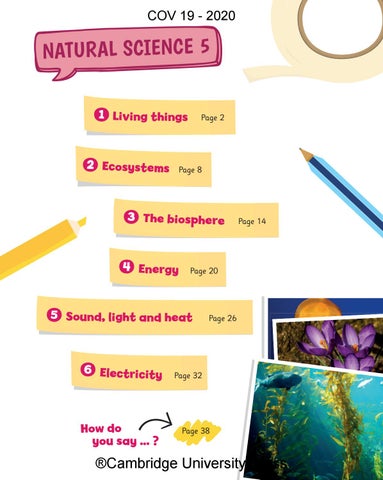
NATUR AL SCIENCE 5 1 Living things
2 Ecosystems
Page 2
Page 8
3 The biosphere 4 Energy
Page 20
5 Sound, light and heat
6 Electricity
How do you say … ?
Page 14
Page 26
Page 32
Page 38
®Cambridge University Press
LICENSED PRODUCT TERMS OF USE By accessing or using this Licensed Product you confirm that you have read, understood and accepted these Terms of Use (Terms) and that you agree to comply with them. If you do not agree to these Terms, please do not use or access (or continue to use or access) the Licensed Product. TERMS AND CONDITIONS: Intellectual property rights Cambridge University Press (Cambridge) is the owner or licensee of the intellectual property rights in this Licensed Product. The Licensed Content is protected by copyright laws and treaties around the world. All such rights are reserved. Permitted uses You may read and view the contents of of this Licensed Product for private and personal non-commercial use only provided that all copyright, trade mark and other proprietary notices contained in the pages of this Licensed Product is retained. Prohibited uses You may not modify, adapt, alter, transmit, make available or distribute to any third-party any of the content in the Licensed Product without our prior written permission. Any use made of such content may be an infringement of rights in that content and we reserve all rights to enforce such rights. You may not make any copies electronically or otherwise of any of the content in this Licensed Product and you may not extract, copy or further distribute, sell, publish or transmit any part of the material contained in this Licensed Product by electronic or any other means. You agree not to sell, resell, supply or otherwise make the content contained in this Licensed Product or extracts or other information derived therefrom available in any manner or on any media to any third party without our prior written consent. You may not download or embed on to your machine, server or institutional system any third party content from the Licensed Product under any circumstances and, by agreeing to these Terms, you understand and acknowledge that you are prohibited from so extracting any third party content from the Licensed Product and that to do so would be a material breach of these Terms by you. Governing law These Terms, and any dispute or claim arising out of or in connection with it shall be governed by, and construed in accordance with the laws of England and Wales. We both agree that the English courts shall have exclusive jurisdiction to settle any such dispute or claim.
COV 19 - 2020
1
LIVING THINGS
1 Are the sentences true or false? true
a Size is not important to life. Microscopic organisms are living things. b Everything that can move is living. c There are six characteristics of living things. d Not all living things can reproduce. e During their lives, living things grow larger. f Some living things make energy from the sun, but others need to take in energy from other organisms.
2 There has been a mix-up in the lab! Unscramble the letters and label the cell structures. Which diagram is the animal cell and which is the plant cell? cuuelsn
a
nucleus
tspoolhaclr
ualecvo
sypcoamlt ecll bnmearem
lecl alwl cell
b
f
g
e
c
d
j
h cell
2
i
®Cambridge University Press
COV 19 - 2020 3 Write the name of the cell structure next to the description of its job in the cell. vacuole
a It stores substances in a cell. b It contains all the cell structures and helps to give the cell shape. c It controls the substances that go in and out of the cell. d It controls the cell and contains all the genetic information. e It supports the cell and provides strength. f It helps the plant change light energy into food. 4 Read the text and choose the correct answer for each gap. How do plants move? All (a) ..... things can move. Although plants are not as obvious as animals, they move quite a bit. The flowers on a plant (b) ..... to light and can open during the day and close at (c) ..... . Leaves can also move and turn towards the sun, (d) ..... means that they get extra light to make food. Some flowers, like sunflowers, even seem to follow the sun.
Most plant movements are invisible to the naked eye; we need a (e) ..... to see them. The underside of a plant leaf is covered with tiny holes, called stomata. These open and close to (f) ..... substances in and out. Smaller still are the movements inside the plant. Plants, like humans, have a transport system that moves important substances around. The next time you see a plant, watch closely. It (g) ..... be moving before your very eyes!
a non-living / living / organism
e thermometer / microscope / calculator
b want / respond / bring
f allow / block / decide
c morning / evening / night
g must / shouldn’t / might
d which / when / who
®Cambridge University Press
3
COV 19 - 2020 5 Complete the table. Composition Cell
Single cell
Tissue
Layers of cells
Function
Example Muscle cell
They have a specific job to do in the body
Organ Different organs working together
System
Circulatory system
6 Write and draw to make a fact card about a living thing. Work with a partner and take turns to guess.
Who am I? Appearance:
Number of cells:
Source of energy:
4
ÂŽCambridge University Press
COV 19 - 2020 7 Find the words. Then, write definitions for the words (a–e) listed below. cell cytoplasm living thing multicellular nucleus organ organism system tissue unicellular m
u
l
t
i
c
e
l
l
u
l
a
r
q
b
c
u
h
l
i
v
i
n
g
t
h
i
n
g
z
e
y
n
p
h
v
b
o
i
d
u
d
v
c
q
y
o
t
i
b
o
b
r
b
n
o
j
f
m
l
v
r
u
o
c
a
e
q
f
r
s
g
h
k
x
b
g
t
m
p
e
y
z
b
g
w
d
l
w
s
v
a
t
h
u
l
l
n
n
c
z
b
t
u
y
x
n
r
i
d
x
a
l
h
e
j
r
e
y
s
c
i
o
t
s
x
f
s
u
l
z
l
q
w
t
u
s
t
o
i
s
g
t
m
l
c
e
y
k
e
o
m
j
j
u
t
u
v
o
u
a
l
b
s
m
o
r
g
a
n
f
c
e
n
a
x
r
a
f
j
a living thing:
b cell:
c multicellular:
d organism:
e cytoplasm:
®Cambridge University Press
5
COV 19 - 2020 8 Amanda is looking through the newspaper at the adverts. Choose the best organism for each advert.
1
a Mushroom
Roommate wanted
b Flower
Must make own food, have a cell wall and be multicellular.
c Bacteria
2
a Giant kelp
Small space available
b Bacteria
Must be microscopic and unicellular.
c Jellyfish
3
4
Help wanted
a Mushroom
Organism recycling. No plants allowed. Should be multicellular.
b Flower c Bacteria
Lost pet
a Jellyfish
Name: Squishy. No cell wall. No spinal column. Great swimmer!
b Lion c Flower
9 Circle the odd one out. Write an explanation. a cell / tissue / organ / kingdom
c spider / Venus flytrap / lizard / cow
A kingdom is different because it’s a form of classification. The others are all parts of an organism. b platypus / ostrich / lion / snake
6
d nucleus / cell wall / vacuole / cytoplasm
ÂŽCambridge University Press
COV 19 - 2020 10 Read the text about the weird and wonderful organism, the lichen. Write the correct word in each gap, then answer the questions.
Most people confuse lichens with moss (the bushy green stuff on trees), (a) but beware, these two organisms are very different! are made up of Lichens are a complex living thing. (b) two different organisms: a fungus and an alga. These organisms the other. live together in a symbiotic relationship, each benefitting (c) of its characteristics and The fungus is the central part, giving the lichen (d) provide the providing the organism’s structure. The algae can photosynthesise, so they one is food. There are two different types of algae that live in a lichen. (e) coloured: green algae and blue-green algae. important for our planet. Likes plants, Besides their beauty, lichens (f) convert carbon dioxide to oxygen. So, without the help of lichens, (g) little less airy! Earth would be (h) i Are lichens the same as moss? Why / Why not? j What is a symbiotic relationship? k Can lichens make their own food? How? l Which of the five kingdoms does lichen belong to? Explain your answer.
11 Write whether the sentences describe living things, non-living things or both. a Things that do not need nutrients.
non-living things
b Things that breathe. c Things that produce waste. d Things that do not breathe air. e Things that are made up of cells, tissues, organs and systems. f Things that can move. g Things that are classified into kingdoms.
®Cambridge University Press
7
COV 19 - 2020
2
ECOSYSTEMS
1 Identify the ecosystems and write an example of each.
a
b
c
d
e
f
2 Write the living and non-living components of a savannah ecosystem in the correct category. Can you add any more? rocks
trees
Biotic factors
8
grass zebra Abiotic factors
ÂŽCambridge University Press
COV 19 - 2020 3 Draw an example for each word.
a individual
b population
c community
d ecosystem
4 How important are abiotic factors in an ecosystem? Consider the effect of the following actions: a A family visits a river. It is hot and the children want to swim. They build a small wall in the river with rocks to make a pool.
b There is a terrible storm, causing a boat to sink to the bottom of the lake. It is full of oil that is slowly leaking.
c After a big rainstorm, there is a landslide on the side of a mountain. Everything is covered in mud.
®Cambridge University Press
9
COV 19 - 2020 5 Complete the sentences. climate fauna flora habitat interact a Living things from the five kingdoms b The
with each other in an ecosystem.
is the general weather conditions of a region.
c The living things in an ecosystem can be divided into
and
.
d The area or environment in which an organism normally lives is known . as the 6 Think of the similarities and differences between these two grassland ecosystems. Write them in the correct place.
SAVANNAH
TEMPERATE GRASSLAND
7 Write whether the sentences describe grasslands or forests. a These require a rainy climate. b These contain few trees. c These are home to some of the largest fauna on land. d These are where over half of the species on Earth can be found.
10
®Cambridge University Press
COV 19 - 2020 8 Identify the ecosystems. Write a paragraph comparing and contrasting them.
a
b
9 Where can you find living things with these adaptations? Write them in the correct ecosystem. Can you add any other adaptations? thick fur nocturnal spines Desert
thick layer of fat
brown fur white fur Tundra
®Cambridge University Press
11
COV 19 - 2020 10 Complete the crossword using words from the unit. 1 2 3 4 5
6 7
8
9
10
DOWN 1 A large animal with lots of teeth that lives in a freshwater ecosystem. 2 A large protist that lives in a marine ecosystem. 3 A body of freshwater that flows from one place to another. 6 Home to about a quarter of marine life. 8 Small body of water with a variety of aquatic life.
12
ACROSS 4 The largest ecosystem on Earth. 5 Amphibian that lives in a freshwater ecosystem. 7 Where land and water meet. 9 Invertebrate that can stick to the surface of rocks. 10 Coral reefs provide this for many marine animals.
®Cambridge University Press
COV 19 - 2020 11 Read the text about city animals and choose the correct answer. Left home for the city As cities grow larger and natural places get smaller, more animals are moving into urban areas. Mice, rats and ants are very successful urban animals, but bigger animals, such as bears and coyotes are starting to move too. In some places, bears look for food in rubbish bins rather than scavenging in forests. Coyotes have been spotted in every corner of the United States, including New York City. The ability of these animals to adapt is amazing. They have even learnt where to safely cross roads, so that they do not get run over by cars. Scientists have found that city birds demonstrate street smarts. This means they have more knowledge to deal with an urban environment. Some can even open containers better than their wild cousins. Who knows what urban ecosystems will look like in the future and which animals will become our neighbours!
1 Animals are moving into urban areas because: a cities are getting smaller. b natural habitats are reducing in size. c they prefer to be around people. 2 Bears look for food: a in rubbish bins. b in New York City. c in taxis. 3 How have coyotes learnt to survive in cities? a They have learnt to open containers. b They have learnt to drive cars. c They have learnt to safely cross roads.
4 Where have coyotes been seen? a Only in New York City. b On street corners. c All over the USA. 5 City birds with street smarts: a live longer than birds in natural habitats. b know how to deal with living in the city. c have difficulty finding containers.
®Cambridge University Press
13
COV 19 - 2020
3
THE BIOSPHERE
1 Are the following sentences examples of competition or cooperation? a Bees live in a hive and have an organised society where each insect has a special role. b On the jungle floor, some plants grow faster than others to reach the sunlight. c Male peacocks grow beautiful feathers to impress female peacocks. d Cleaner shrimps pick particles from the surface of other animals to eat. e In the Antarctic, Emperor penguins huddle together and move in a circle to keep warm. f Lions and hyenas in the Serengeti fight for better hunting areas. g Fish live in a group, called a school, for protection. 2 Now write another example of each. Competition:
Cooperation:
3 Complete the table. secondary
2nd
first
third
tertiary
1st primary
second 3rd
14
ÂŽCambridge University Press
COV 19 - 2020 4 Label the photos according to the roles in the food chain. Add arrows to complete the food chain.
5 Read the example then describe two relationships from the food chain above.
In a forest food chain, the grass is eaten by the rabbit, which is then eaten by the fox. The rabbit is a primary consumer and the fox is a secondary consumer. a
b
ÂŽCambridge University Press
15
COV 19 - 2020 6 Complete the crossword using words from the unit.
5
6
1 4 2 7
3
8
9
DOWN 1 A specific place where an organism lives. 2 A living thing that gets its energy from the sun. 3 A herbivores.
consumer eats
ACROSS 3 The producers. 7 A producers.
provides energy to consumer eats
8 When living things help each other.
4 When two living things fight for resources. shows us how energy 5 A passes from the sun to a consumer.
consumer is at the end 9 A of a food chain.
6 A living thing that breaks down dead things into organic matter.
16
ÂŽCambridge University Press
COV 19 - 2020 7 Look at the food web in the Pupil’s Book and write the living things in the correct column. Some may go in more than one column.
CAPYBARA
BAT
BAMBOO
ANTEATER
HOWLER MONKEY
FUNGI Producers
RED-EYED TREE FROG JAGUAR
GREEN ANACONDA
CAIMAN
TERMITE
TOUCAN
LEAFCUTTER ANT
BACTERIA
BANANA TREE
Primary consumers
Secondary consumers
Tertiary consumers
Decomposers
8 Create a food web using the living things in the box. Draw and label each living thing. Add arrows between them. grass snake mouse lizard hawk grasshopper rabbit Look at your food web. Give one example of: a a predator b prey c competition grass
®Cambridge University Press
17
COV 19 - 2020 9 Order the words to make sentences. a global / the / biosphere / is / ecosystem. / The
b host. / on / parasite / A / a / relies c and / dead / plants / Scavengers / animals. / eat d each / things / in / global / with / Living / other / ecosystem. / interact / the
10 Read about the Gulf oil spill. Choose the correct answer for each gap. A sticky mess! The Gulf oil spill started (a) ..... April 20, 2010 (b) ..... the Gulf of Mexico about 67 kilometres (c) ..... the coast of Louisiana. The leak lasted (d) ..... 87 days. About 3.19 million barrels (e) ..... oil leaked (f) ..... the ocean. Many species were affected (g) ..... the spill. Dolphins, seabirds and fish were covered (h) ..... oil, but it will be many more years (i) ..... we see all the effects of the oil spill on the environment. a on / in / at
f to / in / into
b on / in / at
g by / of / with
c at / from / on
h by / of / with
d for / of / from
i before / by / from
e for / of / from
18
ÂŽCambridge University Press
COV 19 - 2020 11 Are the sentences true or false? a Global warming is when the Earth’s temperature decreases because of human activity. b Farming is the main reason for deforestation. c Species can grow in their natural habitat when cities get larger. d Cars and large factories pollute the environment, which can kill living things. e When species become extinct, there is more biodiversity. 12 Read the descriptions of the national parks. Choose the correct answer for each question. Etosha National Park, in Namibia, covers an area of 22,270 square kilometres. It has a savannah climate with high temperatures and very little rain. It is home to many species, but the plants are mainly shrubs and grasses.
Shey Phoksundo National Park is set high up in the Himalayas. The area is rocky and is an important home to many endangered animals. The winters are difficult, preventing large human populations from settling.
Bwindi National Park has one of the most diverse forests in East Africa, including 163 species of trees. It has a tropical climate and a very rugged landscape with narrow valleys, rivers and steep hills.
Which national park: a is located at high altitude?
Etosha / Shey Phoksundo / Bwindi
b is a grassland ecosystem?
Etosha / Shey Phoksundo / Bwindi
c has high temperatures and lots of rain?
Etosha / Shey Phoksundo / Bwindi
d is not found in Africa?
Etosha / Shey Phoksundo / Bwindi
e is flatter than the others?
Etosha / Shey Phoksundo / Bwindi
®Cambridge University Press
19
COV 19 - 2020
4
ENERGY
1 Look at the pictures. Write the form of energy.
a
b
c
d
e
f
2 Label the diagram with the correct forms of energy and answer the questions. d How is kinetic energy different from potential energy?
a
e Give an example of potential energy.
f What is mechanical energy? b
20
c
ÂŽCambridge University Press
COV 19 - 2020 3 Look at the three photos. Describe what is happening and the energy transformations that are involved. Write 35 words or more.
4 Complete the sentences. a Energy cannot be
or
.
b Energy changes from one form to another. This is called energy
.
c When energy transformations are not useful, we say the energy is . or d An example of energy transformation is when a car energy so it can move. energy stored in fuel to
the chemical
ÂŽCambridge University Press
21
COV 19 - 2020 5 Write definitions for the words below. a Non-renewable energy:
b Renewable energy:
6 Match words from each of the three categories. Use a different colour for each. Renewable energy
Source
Type of energy
solar
wind
light
wind
heat from Earth’s core
thermal
geothermal
the sun
mechanical
hydropower
organic material
mechanical
biomass
moving water
thermal
7 Write whether the characteristics describe solar energy, wind energy or both. a Converts mechanical energy into electricity. b Produces no air pollution. c A form of renewable energy. d Changes light into electricity. e Is found in nature. f Is produced with a turbine.
22
®Cambridge University Press
COV 19 - 2020 8 Read the text about geothermal energy in Iceland. Choose the correct answer for each gap. Bubbling with energy Iceland is a world leader in geothermal energy and gets almost all its energy from (a) ..... sources. Iceland is located on a crack in the Earth´s crust so (b) ..... energy from the Earth’s core rises and (c) ..... enormous underground reservoirs of water to more than 300ºC. Wells are drilled into the reservoirs and steam rises to power stations. The steam is then used to turn (d) ..... and make (e) ..... . The thermal energy is used to provide hot water to the cities. There is no air pollution or radiation, so it is a safe and clean process. a renewable / radiation / fossil fuel
d solar panels / turbines / wheels
b electric / chemical / thermal
e light / heat / electricity
c heats / melts / moves 9 Fossil fuels or nuclear energy? Write F or N. Source Coal Uranium Natural gas Oil
Risks Acid rain Water pollution Radiation Toxic waste Global warming
®Cambridge University Press
23
COV 19 - 2020 10 Complete the crossword using words from the unit.
1
2
3
4
5
6
7
8
9 10
11
DOWN 1 Energy created using the movement of a river. 4 The device that converts wind into electricity. 6 A form of energy that transforms heat from the Earth’s core. 8 Energy that travels in waves through the air.
ACROSS 2 Precipitation that pollutes. 3 A form of energy that helps us to see. 5 A renewable energy whose source is organic material. 7 Oil, coal and natural gas. 9 The source of nuclear power. 10 The device used to transform sunlight into electricity. 11 Energy used by our bodies to live.
24
ÂŽCambridge University Press
COV 19 - 2020 11 Think about your class project to convince your family to save energy. Write an email to your friend James. Write 25 words or more. In the email: • tell James about your energy-saving project. • say some of ways you can save energy. • ask him if he knows any other ways to save energy.
12 Are you a waster or a saver? Answer the questions by circling a number for each one. a How often do you use public transport? Always = 4 Usually = 3 Sometimes = 2
Never = 1
b How often do you completely shut down tablets or computers? Always = 4 Usually = 3 Sometimes = 2 Never = 1 c How often do you turn the lights off when you leave a room? Always = 4 Usually = 3 Sometimes = 2 Never = 1 d How often do you recycle? Always = 4 Usually = 3
Sometimes = 2
Never = 1
e How often do you choose eco-friendly products? Always = 4 Usually = 3 Sometimes = 2
Never = 1
Add up your points to see your energy-saving status. 15–20 points: Super-saver! 10–15 points: Keep up the good work. You just need to make a few more changes. 5–10 points: Time for you to start saving more. The Earth needs you! 5 points:
You are using too much energy! Just a few changes and you can be super too!
®Cambridge University Press
25
COV 19 - 2020
5
SOUND, LIGHT AND HEAT
1 Look at the photos. Which forms of energy are shown: heat, light or sound? You can write more than one.
a
b
c
d
e
f
2 Are the sentences true or false? a Sound travels in waves. b Sound does not travel in space because there is no gravity there. c Sound can travel in all directions. d Sound can travel through different materials. e Sound travels slower through water than through air. f Large vibrations are perceived as soft sounds.
26
ÂŽCambridge University Press
COV 19 - 2020 3 Some sounds are pleasant and we enjoy hearing them. Other sounds are annoying and we cannot stand them! Write examples from each category from your own experiences. I cannot stand the sound of …
I enjoy the sound of …
4 Order the words to make sentences about light. a found / sources / nature. / in / light / are / Natural b man-made. / Artificial / sources / light / are c sun. / main / Our / the / light / source / of / is / natural d light / A / artificial / is / lightbulb / an / source.
5 Match the sentence halves about the properties of light. a Light energy travels in …
… 300,000 kilometres per second.
b Light from the sun takes …
… straight lines called rays.
c Light energy travels at …
… with an object, it is absorbed, reflected or refracted.
d When light comes into contact … … 8 minutes and 20 seconds to reach the Earth. e A ray of light contains …
… all colours.
®Cambridge University Press
27
COV 19 - 2020 6 Read the text and choose the correct answer for each gap. Properties of light As humans, the colours we perceive are called (a) ..... light. When light comes into contact with an object, the light can be absorbed, (b) ..... or refracted. For example, when a (c) ..... of light comes into contact with a particular object, the object appears green. This is because the green light is (d) ..... , while all the other colours are (e) ..... . When light passes through a medium with a different (f) ..... , it changes direction. This is called (g) ..... . a invisible / infrared / visible
e seen / absorbed / reflected
b transformed / reflected / seen
f density / size / colour
c shine / ray / arrow
g refract / refraction / refracted
d reflected / transformed / absorbed 7 Explain what is happening in each of the pictures.
a
b
28
ÂŽCambridge University Press
COV 19 - 2020 8 Write your own definition of refraction. Give examples of how refraction is used in daily life.
9 Write whether the sentences describe refraction or reflection. a You see yourself in a calm lake. b A coin looks bigger when placed in water. c A straw looks bent in water. d You see yourself in the bathroom mirror. 10 It is a cold day in winter and you leave your bedroom window open. Your grandmother says to you “Close the window! You’re letting the cold in! ” What is incorrect about her statement?
11 Circle the correct answer for each question. 1 You have two glasses with ice cubes in them. Both are in the shade, but you cover one with a sock. In which glass will the ice melt slower? a The ice in the covered glass will melt slower because the sock is a thermal insulator. b The ice in both glasses will melt at the same rate because the sock has no effect. c The ice in the uncovered glass will melt slower because there is no sock to heat it. 2 You have two bowls of water. One bowl is made of stone and the other is made of metal. If you set them both on a stove, which bowl will the water evaporate from first? a From the stone bowl because it is a better thermal insulator. b From the metal bowl because it is a better thermal conductor. c From the stone bowl because it is a better thermal conductor.
®Cambridge University Press
29
COV 19 - 2020 12 Write three ways that heat affects matter. Give an example and draw an illustration for each. Way heat affects matter
Example
Illustration
13 Write the letters (a – i) in the Venn diagram.
HEAT
SOUND
LIGHT
30
a Can move in waves.
f Comes from vibrating particles.
b Needs a medium to travel.
g Travels in all directions.
c Comes from the sun.
h Travels in a straight line.
d Has natural and artificial sources.
i Can change the state of matter of an object.
e Travels at 300,000 kilometres per second.
®Cambridge University Press
COV 19 - 2020 14 Solve the word problems using your knowledge of sound, light and heat. Party time You are going to a party! You are in charge of bringing hot soup and ice cream. It takes 30 minutes to walk there and it is a hot day. Think of a plan to keep the soup hot and the ice cream from melting. You must walk to the party and can only use things you would find around the house.
A terrible night and a big exam You have got a big exam tomorrow. You need to get some sleep, but your neighbours are having a loud party. Your bedroom window is broken and it is very cold outside. The light in your bedroom will not turn off! Without leaving your bedroom, what can you do to reduce the noise and light and stay warm all night?
The key Silly you! You left your keys in the freezer and they are now frozen in a block of ice. You need to open the door so that you can go to school. What can you do to melt the ice as quickly as possible without using artificial heat sources like an oven or microwave?
ÂŽCambridge University Press
31
COV 19 - 2020
6
ELECTRICITY
1 Label the atom using the words and symbols. neutron
proton
electron
+
0
–
d
a
e
b
f
c
2 Look at the pictures. Write whether the objects are positively charged, negatively charged or electrically neutral.
a
32
b
c
ÂŽCambridge University Press
COV 19 - 2020 3 Write sentences about the objects from Activity 2. a What happens when the balloon is placed near the first jumper (Jumper a)? b What happens when the balloon is placed next to another identically charged balloon? c Have all the items got a charge?
4 Read the text below and write the correct word in each gap.
Fast-moving ice and water particles bump into other in a storm cloud. This creates (a) static electrical charges. When the charge is strong enough, the energy is released. It goes to the , looking for an ground or to another (b) . This is seen as a lightning opposite (c) bolt. The lighting heats the air around it very . quickly, causing a loud boom, called (d) Three forms of energy are released during . a storm: light, sound and (e) Lightning and thunder occur at the same time, but because light travels faster than sound, we the thunder. see the lightning before we (f)
5 Are the sentences true or false? a Static electricity is the flow of electrons through a material. b Static electricity is caused by an imbalance of charges between two electrical insulators. c Most electric machines run on static electricity. d Rubbing non-metal objects together creates electric current. e A positively charged object is attracted to a negatively charged object. f You can feel a small shock when lots of electrons move at the same time.
®Cambridge University Press
33
COV 19 - 2020 6 Write the materials in the correct column. Add some of your own ideas. rubber plastic copper wood aluminium Insulators
Conductors
7 Label the diagram using these words. power source wire switch resistor c
a b
d 34
®Cambridge University Press
COV 19 - 2020 8 Write the vocabulary from Activity 7 next to the correct description. a It conducts electricity. b It provides the electricity. c It transforms electricity into other forms of energy. d It opens or closes the circuit. 9 You start building an electrical circuit, but you realise that you have not got enough wire! Write three things you could use to complete the circuit. Explain your choices and decide which one would work best.
10 Choose one of these inventions and answer the questions. lightbulb telephone movie camera a How does this invention help people? b How do you think it has changed the way people live? c What did the inventor need to know about to invent it?
®Cambridge University Press
35
COV 19 - 2020 11 Write the name of each invention under the photo. Match each photo to the inventor and function. Use a different colour for each one. Inventors
Nikola Tesla
36
Inventions
Function
It transforms chemical energy into electrical energy.
Alessandro Volta
It transmits sound over air instead of through wires.
Alan Turing
It allows electricity to travel longer distances through power lines.
Guglielmo Marconi
It processes information and shows it on a screen.
Michael Faraday
It transforms mechanical energy into electrical energy.
ÂŽCambridge University Press
COV 19 - 2020 12 Choose your favourite three inventions from the unit. Draw them and write why you chose each one.
1 st
2nd
3 rd
13 Read this email from your English-speaking friend, Bob, and the notes you have made. Write your email to Bob, using all the notes. From: Bob To: Are you going to the science fair this year? It’s on Friday 19th May.
Great idea! Make a suggestion for the project.
You can’t go. Explain why.
I want to present a project on light and electricity. If you like, we can do it together. What do you think? Would you like to meet up this week to plan? See you soon, Bob
®Cambridge University Press
Yes – suggest a day.
37
COV 19 - 2020
HOW DO YOU SAY ‌ ?
38
Unit 1: Living things
Unit 2: Ecosystems
English
English
Your language
bacteria (n)
abiotic (adj)
cell (n)
adapt (v)
cell membrane (n)
aquatic (adj)
cell wall (n)
biotic (adj)
chloroplast (n)
climate (n)
classify (v)
community (n)
cytoplasm (n)
coral reef (n)
fungus (n)
desert (n)
Monera (n)
fauna (n)
multicellular (adj)
flora (n)
nucleus (n)
forest (n)
organ (n)
grassland (n)
organism (n)
habitat (n)
plant (n)
individual (n)
protist (n)
nocturnal (adj)
species (n)
pond (n)
system (n)
population (n)
tissue (n)
shoreline (n)
unicellular (adj)
tundra (n)
vacuole (n)
urban (adj)
Your language
ÂŽCambridge University Press
COV 19 - 2020
Unit 3: The biosphere
Unit 4: Energy
English
English
Your language
Your language
biodiversity (n)
acid rain (n)
biosphere (n)
biomass (n)
competition (n)
chemical energy (n)
consumer (n)
electrical energy (n)
cooperation (n)
fossil fuel (n)
decomposer (n)
geothermal energy (n)
deforestation (n)
hydropower (n)
endangered (adj)
kinetic energy (n)
extinct (adj)
light energy (n)
food chain (n)
mechanical energy (n)
food web (n)
non-renewable (adj)
global warming (n)
nuclear power (n)
national park (n)
potential energy (n)
nature reserve (n)
radioactive waste (n)
oil spill (n)
renewable (adj)
parasite (n)
solar energy (n)
predator (n)
sound energy (n)
prey (n)
thermal energy (n)
producer (n)
turbine (n)
scavenger (n)
uranium (n)
ÂŽCambridge University Press
39
COV 19 - 2020 Unit 5: Sound, light and heat Your language
English
Unit 6: Electricity English
absorb (v)
atom (n)
bioluminescence (n)
attract (v)
density (n)
battery (n)
evaporate (v)
current electricity (n)
expand (v)
discover (v)
lens (n)
electron (n)
melt (v)
flow (n)
mirror (n)
imbalance (n)
molecule (n)
invent (v)
opaque (adj)
lightbulb (n)
ray (n)
lightning (n)
reflect (v) refract (v)
negatively charged (adj)
speed of light (n)
neutron (n)
thermal conductor (n)
nucleus (n)
thermal insulator (n)
positively charged (adj)
translucent (adj) transparent (adj) vacuum (n) vibrate (v) wave (n)
Your language
proton (n) repel (v) resistor (n) static electricity (n) switch (n) wire (n)
40
ÂŽCambridge University Press