Fall
Highlights 2022
New Season Highlights MICHAEL D. BESS
THE
PLANET IN PERIL
J YOF
ABSTRAC TION
Humanity’s Four Greatest Challenges and How We Can Overcome Them
An Exploration of Math, Category Theory, and Life
EUGENIA CHENG Author of How to Bake Pi
ZACHARY SHORE
What Makes a Person? Secrets of Our First 1,000 Days MARK HANSON LUCY GREEN
2
STEPHEN G. RABE
THE LOST
PARATROOPERS OF
NORMANDY A STORY OF RESISTANCE, COURAGE, AND SOLIDARITY IN A FRENCH VILLAGE
America’s Struggle Between VENGEANCE and VIRTUE
Contents Planet in Peril..........................................................................4
Customer Services....................................................................36
Does Scripture Speak for Itself?.............................................5
Cambridge University Press Around the World.....................36
The Joy of Abstraction............................................................6
Retail and wholesale representatives....................................37
Unaging...................................................................................7
Publicity...................................................................................37
On a Knife Edge......................................................................8 What Makes a Person?............................................................9 The Lost Paratroopers of Normandy......................................10 This Is Not Who We Are..........................................................11 American Song and Struggle from Columbus to World War II............................................................................12 Defeat and Division.................................................................13 Economic Prehistory................................................................14 Alligators in the Arctic and How to Avoid Them..................15 Money and Empire..................................................................16 Believing in Dante...................................................................17 Gruesome Looking Objects.....................................................18 Dante the Theologian.............................................................19 Break Free from Maternal Anxiety........................................20 Everything You Need to Know About OCD...........................21 Seeing Color in Classical Art...................................................22 Tunguska..................................................................................23 Readers in a Revolution..........................................................24 Caesar Rules.............................................................................25 The Electoral Imagination......................................................26 Tyranny and Revolution..........................................................27 Much Like Us...........................................................................28 The Cambridge Companion to the Essay...............................29 A Philosopher Looks at Science..............................................30 Understanding Human Evolution..........................................31 Understanding How Science Explains the World..................32 Understanding Fertility...........................................................33 Understanding Race................................................................34 Understanding Human Metabolism.......................................35
All information correct at the time of production.
www.cambridge.org
3
MICHAEL D. BESS
PLANET IN PERIL Humanity’s Four Greatest Challenges and How We Can Overcome Them
UK publication October 2022 US publication October 2022 350 pages 9781009160339
At a glance • Offers a single explanatory framework for understanding the seemingly disparate challenges facing humankind Describes a realistic pathway for modifying the United Nations to become a more effective instrument for coordinating planet-level solutions to humanity’s mega-problems
• Puts forward an integrated set of planet-level solutions that can be implemented incrementally over the coming century to head off potential catastrophes caused by these four mega-dangers • Written in vivid prose with illustrative examples drawn from history • Combines history, science, technology and politics in reflection and analysis
4
Humanity’s Four Greatest Challenges and How We Can Overcome Them Michael D. Bess
Written by an award-winning historian of science and technology, this book describes the top four mega-dangers facing humankind – climate change, nukes, pandemics, and AI. It outlines the solutions that have been tried, and analyses why they have thus far fallen short. These four exponential dangers present a special kind of challenge that urgently requires planet-level responses, yet today’s international institutions have so far failed to meet this need. The book lays out a realistic pathway for gradually modifying the United Nations over the coming century so that it can become more effective at coordinating global solutions to humanity’s problems. Neither optimistic nor pessimistic - but pragmatic and constructive - the book explores how to move past ideological polarization and global political fragmentation. Unafraid to take intellectual risks, Planet in Peril sketches a plausible roadmap toward a safer, more democratic future for us all.
Hardback
£20.00 / $24.95 USD / $28.95 CAD
•
Planet in Peril
Michael Bess, Chancellor’s Professor of History at Vanderbilt University, is a specialist in 20th- and 21st-century Europe, with a particular interest in the interactions between social and cultural processes and technological change. He is the author of four books: Our Grandchildren Redesigned: Life in the Bioengineered Society of the Near Future (Beacon Press, 2015); Choices Under Fire: Moral Dimensions of World War II (Knopf, 2006); The Light-Green Society: Ecology and Technological Modernity in France, 1960-2000 (2003), which won the George Perkins Marsh prize (2004) of the American Society for Environmental History and an Honorable Mention (2004) from the Pinkney Prize committee of the Society for French Historical Studies; and Realism, Utopia, and the Mushroom Cloud: Four Activist Intellectuals and Their Strategies for Peace, 1945-1989 (1993).
Advance praise ‘We are threatened by our own cleverness, and it is easy to get paranoid. This book, by one of our best historians of science and technology, offers a sane, balanced, and deeply informed look at the major threats and lays out a rational way forward.’ Donald Worster, author of Shrinking the Earth and A Passion for Nature
Does Scripture Speak for Itself?
The Museum of the Bible and the Politics of Interpretation Jill Hicks-Keeton and Cavan Concannon
Is the Bible the unembellished Word of God or the product of human agency? There are different answers to that question. And they lie at the heart of this book’s powerful exploration of the fraught ways in which money, race and power shape the story of Christianity in American public life.
UK publication October 2022 US publication October 2022 248 pages 10 B/W illustrations 9781108493314 Hardback £21.99 / $27.95 USD / $30.95 CAD
The authors’ subject is the Museum of the Bible in Washington, DC: arguably the latest example of a long line of white evangelical institutions aiming to amplify and promote a religious, political, and moral agenda of their own. In their careful and compelling investigation, Jill Hicks-Keeton and Cavan Concannon disclose the ways in which the Museum’s exhibits reinforce a particularized and partial interpretation of the Bible’s meaning. Bringing to light the Museum’s implicit messaging about scriptural provenance and audience, the authors reveal how the MOTB produces a version of the Bible that in essence authorizes a certain sort of white evangelical privilege; promotes a view of history aligned with that same evangelical aspiration; and above all protects a cohort of white evangelicals from critique. They show too how the Museum collapses vital conceptual distinctions between its own conservative vision of the Bible and ‘The Bible’ as a cultural icon. This revelatory volume above all confirms that scripture – for all the claims made for it that it speaks only divine truth – can in the end never be separated from human politics.
At a glance • Shows the intersections of race, religion, and money in contemporary US politics, celebrity, and institution building • Draws together methods and insights from the fields of biblical studies, American religious history, anthropology of religion, and museum studies • Interrogates how white evangelicals produce a bible that works with them and for them to protect their own moral authority”
Jill Hicks-Keeton is Associate Professor of Religious Studies at the University of Oklahoma. She is the author of Arguing with Aseneth: Gentile Access to Israel’s Living God in Jewish Antiquity (Oxford, 2018), for which she was awarded the Manfred Lautenschlaeger Award for Theological Promise. Cavan Concannon is Associate Professor of Religion at the University of Southern California. He is the author of Profaning Paul (Chicago, 2021), Assembling Early Christianity: Trade Networks and the Letters of Dionysios of Corinth (Cambridge, 2017), and ‘When you were Gentiles’: Specters of Ethnicity in Roman Corinth and Paul’s Corinthian Correspondence (Yale, 2014).
Advance praise ‘Does Scripture Speak for Itself? uses one book and one museum to unpack with incisive reflection the manifold ways that white evangelicalism has leveraged a particular rendering of biblical Christianity for political gain. Combining business history with exegesis, cultural analysis with media studies, ethnography with sharp scrutiny of power, Jill Hicks-Keeton and Cavan Concannon’s outstanding book is a must read for anyone trying to grasp the institutional juggernaut that is the modern religious right.’ Darren Dochuk, author of Anointed With Oil: How Christianity and Crude Made Modern America
www.cambridge.org
5
THE
J YOF
ABSTRAC TION An Exploration of Math, Category Theory, and Life
EUGENIA CHENG Author of How to Bake Pi
UK publication October 2022 US publication October 2022 440 pages 9781108477222
The Joy of Abstraction
An Exploration of Math, Category Theory, and Life Eugenia Cheng
Mathematician and popular science author Eugenia Cheng is on a mission to make you believe that mathematics can be flexible, creative, and visual. This joyful journey through the world of abstract mathematics into category theory will demystify mathematical thought processes and help you develop your own thinking, with no formal mathematical background needed. The book brings abstract mathematical ideas down to earth using examples of social justice, current events, and everyday life – from privilege to COVID-19 to driving routes. The journey begins with the ideas and workings of abstract mathematics, after which you will gently climb toward more technical material, learning everything needed to understand category theory, and then key concepts in category theory like natural transformations, duality, and even a glimpse of ongoing research in higher-dimensional category theory. For fans of How to Bake Pi, this will help you dig deeper into mathematical concepts and build your mathematical background.
Hardback
£20.00 / $25.95 USD / $28.95 CAD
At a glance • Demystifies mathematical thought processes, helping readers develop mathematical thinking even if they have no mathematical background • Provides further insight into the mathematical concepts and examples presented in Cheng’s How to Bake Pi, gently building on those simple ideas to develop more formal mathematics • Features examples from life, not just from other areas of mathematics, showing how math is relevant to social and political questions
Dr. Eugenia Cheng is world-renowned as both a researcher in category theory and an expositor of mathematics. She has written several popular mathematics books including How to Bake Pi (2015), The Art of Logic in an Illogical World (2017), and two children’s books. She also writes the ‘Everyday Math’ column for the Wall Street Journal. She is Scientist in Residence at the School of the Art Institute of Chicago, where she teaches abstract mathematics to art students. She holds a Ph.D. in category theory from the University of Cambridge, and won tenure in pure mathematics at the University of Sheffield. You can follow her @DrEugeniaCheng.
Praise for Eugenia Cheng ‘[Eugenia Cheng’s] tone is clear, clever and friendly . . . she is rigorous and insightful. . . . [She is] a lucid and nimble expositor.’ Alex Bellos, New York Times Book Review ‘Dr. Cheng . . . has a knack for brushing aside conventions and edicts, like so many pie crumbs from a cutting board.’ Natalie Angier, New York Times
Advance praise ‘At last: a book that makes category theory as simple as it really is. Cheng explains the subject in a clear and friendly way, in detail, not relying on material that only mathematics majors learn. Category theory – indeed, mathematics as a whole – has been waiting for a book like this.’ John Baez, University of California, Riverside
6
Unaging
The Four Factors that Impact How You Age Robert P. Friedland ROBERT P. FRIEDLAND
Unaging
The Four Factors that Impact How You Age
UK publication October 2022 US publication October 2022 352 pages 9781009087742
Paperback
£14.99 / $19.99 USD / $21.99 CAD
At a glance • Clearly presents what happens when we age, allowing readers to understand age-related changes and what is healthy and what can be avoided or treated • Reveals the role of evolution in human aging and why our modern life impacts how we age • Details what we can do to enhance optimal aging, giving us tools to adjust activities and behaviors to age well
Aging is a subject of concern to everyone, but is widely misunderstood. If we view it as inevitable, we miss the fact that not everyone is able to grow to an old age. Realization of this reality helps us to understand that aging presents a wonderful opportunity - an opportunity to make choices about how we live which can enhance the aging process and offer a chance to live to our potential. This book clearly presents the four, multiple reserve, factors (cognitive, physical, psychological and social) which impact our ability to have healthy responses to the stresses of aging. By giving the biological basis for the advice given, you will learn the steps to take in your activities, diet and mental outlook to grasp the opportunity that aging offers. Everyone must know that what we do makes a difference.
Robert Friedland MD is a neurologist and the Rudd endowed professor of Neurology and Neurobiology at the University of Louisville School of Medicine in Kentucky. He previously worked at the University of California, Berkeley, the US National Institute on Aging and Case Western Reserve University. Recently his research has uncovered a key role of intestinal bacteria in the initiation and progression of Alzheimer’s disease, Parkinson’s disease and amyotrophic lateral sclerosis. His studies of humans and animals in the US, Japan, the Middle East and Kenya have helped to advance the concept that the risk of aging-related brain diseases can be lowered through our personal actions.
Advance praise ‘In his book, Unaging, Dr. Friedland begins by setting the stage, describing the importance of physical, mental, psychological, and social health, and explaining that the goal is not normal aging, but exceptional aging. He then teaches you how to attack and subdue the harmful habits that accelerate aging by extrapolating the results of rigorous scientific studies. This book is a ‘must read’ for anyone who would like to use the latest scientific studies to help them live healthier lives as they age.’ Andrew E. Budson, author of Seven Steps to Managing Your Memory: What’s Normal, What’s Not, and What to Do About It
www.cambridge.org
7
On a Knife Edge
How Germany Lost the First World War Holger Afflerbach
UK publication October 2022 US publication October 2022 576 pages 11 maps and 40 black and white illustrations 9781108832885 Hardback £25.00 / $29.95 USD / $33.95 CAD
Was the outcome of the First World War on a knife edge? In this major new account of German wartime politics and strategy Holger Afflerbach argues that the outcome of the war was actually in the balance until relatively late in the war. Using new evidence from diaries, letters and memoirs, he fundamentally revises our understanding of German strategy from the decision to go to war and the failure of the western offensive to the radicalisation of Germany’s war effort under Hindenburg and Ludendorff and the ultimate collapse of the Central Powers. He uncovers the struggles in wartime Germany between supporters of peace and hardliners who wanted to fight to the finish. He suggests that Germany was not nearly as committed to all-out conquest as previous accounts argue. Numerous German peace advances could have offered the opportunity to end the war before it dragged Europe into the abyss.
Holger Afflerbach is Professor of Modern European History at the University of Leeds. His previous publications include a biography of Erich von Falkenhayn, and a study of the Triple Alliance.
Advance praise ‘Holger Afflerbach provides a comprehensive reassessment of Germany’s conduct of the 1914-18 war. Drawing on fresh archival sources and an impressive command of the immense secondary literature, he offers a thought-provoking reappraisal of the entire history of that terrible conflict.’
At a glance • A thorough reassessment of why Germany was defeated and of lost opportunities to make peace before 1918 • Reveals divisions in Germany and how these influenced the outcome of the war. • Offers a new framework for understanding of warfare and politics in Imperial Germany.
8
David Stevenson, author of With Our Backs to the Wall: Victory and Defeat in 1918
What Makes a Person? Secrets of Our First 1,000 Days MARK HANSON LUCY GREEN
UK publication November 2022 US publication November 2022 200 pages 9781009195256
Paperback
£9.99 / $12.95 USD / $14.95 CAD
At a glance • This book challenges ideas about our individual control of our bodies and lifelong health, by offering surprising explanations based on little-known new evidence that can enable us to give the gift of a good start to life and future health for the next generation • Concerning a subject we can all relate to – giving insight into how we became who we are as individuals in a surprising, thought-provoking way
What Makes a Person? Secrets of Our First 1,000 days Mark Hanson and Lucy Green
Ever wondered why your life and health can sometimes be so hard to control? Or why it seems so easy for other people? Mark Hanson and Lucy Green draw on their years of experience as scientists and educators to cut through the usual information on genetics and lifestyle to reveal the secrets of early development which start to make each of us unique, during our first 1,000 days from the moment of conception. Some surprising discoveries, based on little-known new research, show how events during our first 1,000 days make each of us who we are and explain how we control our bodies, processes that go way beyond just the genes which we inherited. Provoking new ways of thinking about being parents, this book empowers individuals and society to give the next generation the gift of a good start to life and future health.
Mark Hanson Directs the Institute of Developmental Sciences at University of Southampton, UK. He is a founder of the International Society for the Developmental Origins of Health and Disease and Honorary FRCOG and FRCPCH. He co-Chairs the FIGO Pregnancy and NCDs Committee and the Pregnancy Obesity and Nutrition Initiative. He researches early developmental environment effects on health across the life-course, mechanisms and interventions, in high and low-middle income countries. Mark pioneered LifeLab to promote health literacy in school students. Mark authored over 400 papers and 11 academic and popular books and advocates application of developmental science to health policy. Lucy Green researches and teaches at University of Southampton about early development effects on lifelong health. She advocates for physiological sciences with the International Society for the Developmental Origins of Health and Disease, the Physiological Society, as FRSB (2019, Senior Investigator Outreach and Engagement Award) and as Head of Engagement in the Faculty of Medicine. Her championing of public understanding of science included as British Science Association Media Fellow (at BBC), innovating engagement tools for science festivals, and devising health-science experiences for young people which enable them to question experts about big health issues. She lives with her family in Hampshire.
• Counters existing dogmas and deterministic gene-centric views of health and provides new perspectives on how health develops across our life and across generations
www.cambridge.org
9
STEPHEN G. RABE
THE LOST
PARATROOPERS OF
NORMANDY A STORY OF RESISTANCE, COURAGE, AND SOLIDARITY IN A FRENCH VILLAGE
UK publication November 2022 US publication November 2022 264 pages 9781009206372
Hardback
£20.00 / $24.95 USD / $27.95 CAD
At a glance • Sheds light on a compelling yet forgotten part of D-Day history • A story of how ordinary people did extraordinary things in defense of liberty • Highlights the integral role the village women played in harboring the paratroopers • Provides a unique discussion of the effect of war on civilian populations • Based on US, French, and German documents and interviews with French citizens and children of the Graignes veterans
10
The Lost Paratroopers of Normandy A Story of Resistance, Courage, and Solidarity in a French Village Stephen G. Rabe
The fateful days and weeks surrounding June 6, 1944 have been extensively documented in histories of the Second World War, but less attention has been paid to the tremendous impact of these events on the populations nearby. The Lost Paratroopers of Normandy tells the inspiring yet heartbreaking story of ordinary people who did extraordinary things in defense of liberty and freedom. On D-Day, when transport planes dropped paratroopers from the 82nd and 101st Airborne Divisions hopelessly off-target into marshy waters in northwestern France, the 900 villagers of Graignes welcomed them with open arms. These villagers – predominantly women – provided food, gathered intelligence, and navigated the floods to retrieve the paratroopers’ equipment at great risk to themselves. When the attack by German forces on June 11 forced the overwhelmed paratroopers to withdraw, many made it to safety thanks to the help and resistance of the villagers. In this moving book, historian Stephen G. Rabe, son of one of the paratroopers, meticulously documents the forgotten lives of those who participated in this integral part of D-Day history.
Stephen G. Rabe is the Ashbel Smith Professor in History (emeritus) at the University of Texas at Dallas. He is a veteran of the US Marine Corps. The Lost Paratroopers of Normandy is his thirteenth book.
Advance praise ‘Lost no longer, the American paratroopers who helped liberate Normandy find a sympathetic chronicler in Stephen G. Rabe. This is micro-history at its most intimate. In granular detail, Rabe recounts the story of how American troops and French villagers rescued Graignes from German occupation. Drawing on deep research and even deeper feeling, the author pays tribute to his veteran father, to a generation, and to enduring ties between two nations bound together by collective sacrifices and shared valour.’ Susan Carruthers, author of Dear John: Love and Loyalty in Wartime America
ZACHARY SHORE
This Is Not Who We Are America’s Struggle Between Vengeance and Virtue Zachary Shore
America’s Struggle Between VENGEANCE and VIRTUE UK publication November 2022 US publication November 2022 352 pages 9781009203449
Hardback
£22.00 / $27.95 USD / $30.95 CAD
What kind of country is America? Zachary Shore tackles this polarizing question by spotlighting some of the most morally muddled matters of WWII. Should Japanese Americans be moved from the west coast to prevent sabotage? Should the German people be made to starve as punishment for launching WWII? Should America drop atomic bombs to break Japan’s will to fight? Surprisingly, despite wartime anger, most Americans and key officials favored mercy over revenge, yet a minority managed to push their punitive policies through. After the war, by feeding the hungry, rebuilding Western Europe and Japan, and airlifting supplies to a blockaded Berlin, America strove to restore the country’s humanity, transforming its image in the eyes of the world. A compelling story of the struggle over racism and revenge, This Is Not Who We Are asks crucial questions about the nation’s most agonizing divides.
Zachary Shore is Professor of History at the Naval Postgraduate School and Senior Fellow at the Institute of European Studies, University of California, Berkeley. This Is Not Who We Are is his sixth book.
Advance praise At a glance • Asks why America treated its enemies so cruelly throughout WWII, despite public and government support for mercy
‘As America emerges from the traumas of recent years, it will be important to restore confidence in our common identity and strengthen our social fabric. Zachary Shore’s This Is Not Who We Are has arrived just in time to foster thoughtful introspection and meaningful discussion of how our past can help us understand the present and build a better future.’ H.R. McMaster, former US National Security Advisor and author of Battlegrounds and Dereliction of Duty
• Suggests that America’s wartime acts resulted less from racism than revenge • Offers a fresh perspective into well-known characters in US history • Presents the interconnections of each vengeful and virtuous act • Reveals how Americans came together to rebuild a shattered world
www.cambridge.org
11
American Song and Struggle from Columbus to World War II
kaufman
t a b l e of con t e n t s
Introduction: The Work of Recovery
1. Broken Spears and Songs of Sorrow 2. Good Newes from Virginia 3. A Capital Chop
American Song and Struggle from Columbus to World War II
4. If I Had but a Small Loaf of Bread 5. Where Today Are the Pequot?
6. There Is a Fountain Filled with Blood 7. A Tragedy That Beggared the Greek 8. Muscle, Blood, and Steel 9. Rule Anglo-Saxia
10. The Hand That Feeds You 11. We Are Many
12. 100% American
A Cultural History 13. We’re Up Against It Now 14. The Panic Is On
15. To Thee We Sing
Conclusion: Whose Land?
American Song and Struggle from Columbus to World War II
Will Kaufman
A Cultural History
will kaufman
UK publication June 2022 US publication August 2022 400 pages 9781316514337
Hardback
£29.99 / $39.99 USD / $45.95 CAD
At a glance • Provides a coherent, dynamic, chronological history across a range of song genres • Covers territory rarely, if ever, explored in histories of American music • Offers an informed, multidisciplinary study that takes in history, popular music, and literature
12
Long before anyone ever heard of ‘protest music’, people in America were singing about their struggles. They sang for justice and fairness, food and shelter, and equality and freedom; they sang to be acknowledged. Sometimes they also sang to oppress. This book uncovers the history of these people and their songs, from the moment Columbus made fateful landfall to the start of the Second World War, when ‘protest music’ emerged as an identifiable brand. Cutting across musical genres, Will Kaufman recovers the passionate voices of America itself. We encounter songs of the mainland and the conquered territories of Hawai’i, Cuba, Puerto Rico, and the Philippines; we hear Indigenous songs, immigrant songs and Klan songs, minstrel songs and symphonies, songs of the heard and the unheard, songs of the celebrated and the anonymous, of the righteous and the despicable. This magisterial book shows that all these songs are woven into the very fabric of American history.
Will Kaufman is Professor of American Literature and Culture at the University of Central Lancashire in Preston, England. He is the author of Woody Guthrie, American Radical (2011), Woody Guthrie’s Modern World Blues (2017), and Mapping Woody Guthrie (2019). His other books include The Comedian as Confidence Man (1997), The Civil War in American Culture (2006), American Culture in the 1970s (2009), and co-authored with Ronald D. Cohen, Singing for Peace: Antiwar Songs in American History (2015).
Advance praise ‘Will Kaufman has uncovered a massive hidden history, one that none of us can ignore. Get the book, be in the know.’ Chuck D
DEFEAT AND DIVISION
Defeat and Division France at War, 1939–1942 Douglas Porch
FRANCE AT WAR, 1939–1942 Douglas Porch
UK publication August 2022 US publication August 2022 744 pages 10 maps and 20 b&w illustrations 9781107047464 Hardback £27.99 / $32.95 USD $36.95 CAD
At a glance
Defeat and Division launches a definitive new account of France in the Second World War. In this first volume, Douglas Porch dissects France’s 1940 collapse, the dynamics of occupation, and the rise of Charles de Gaulle’s Free France crusade, culminating in the November 1942 Allied invasion of French North Africa. He captures the full sweep of France’s wartime experience in Europe, Africa, and beyond, from soldiers and POWs to civilians-in-arms, colonial subjects, and foreign refugees. He recounts France’s struggles to reconstruct military power within the context of a global conflict, with its armed forces shattered into warring factions and the country under Axis occupation. Disagreements over the causes of the 1940 debacle and the subsequent requirement for the armistice mirrored long-standing fractures in politics, society, and in the French military itself, as efforts to reconstitute French military power crumbled into Vichy collaboration, De Gaulle’s exile resistance, Alsace-Moselle occupation struggles, and a scuffle for imperial supremacy.
Douglas Porch is Distinguished Professor Emeritus and former Chair of the Department of National Security Affairs at the Naval Postgraduate School in Monterey, California. His previous books include Counterinsurgency: Exposing the Myths of the New Way of War (2013), The Path to Victory: The Mediterranean Theater in World War II (2004; published in Britain as Hitler’s Mediterranean Gamble), The French Secret Services: From the Dreyfus Affair to the Gulf War (1995), The French Foreign Legion: A Complete History of the Legendary Fighting Force (1991), The Conquest of the Sahara (1984), The Conquest of Morocco (1982), The March to the Marne: The French Army 1871–1914 (1981), The Portuguese Armed Forces and the Revolution (1977), and Army and Revolution: France 1815–1848 (1974).
• Places France’s experience of World War II within its social, political, and strategic context • Incorporates deep archival research with the latest French scholarship on the subject • Essential reading both for specialists and aficionados of World War II and of modern France
www.cambridge.org
13
ECONOMIC
Prehistory
Six Transitions That Shaped The World
GREGORY K. DOW AND CLYDE G. REED
UK publication September 2022 US publication November 2022 425 pages 9781108839907
Economic Prehistory Six Transitions That Shaped The World Gregory K. Dow and Clyde G. Reed
Around 15,000 years ago, most humans lived in small mobile foraging bands. The first city-states appeared about 5,000 years ago. This radical transformation in human society laid the foundations for the modern world. This book uses economic logic and archaeological evidence to explain six key elements of this revolution: sedentism, agriculture, inequality, warfare, cities, and states. The authors posit that the ultimate cause of these events was climate change. They show how shifts in climate interacted with geography to drive technological innovation and population growth. The accumulation of population at especially rich locations led to the creation of group property rights over land and warfare over land among rival elites. This set the stage for urbanization and for elitecontrolled states based on taxation. These developments eventually resulted in contemporary global civilization. This ambitious book is the first to provide a rigorous, yet accessible, analysis of economic change in prehistory.
Hardback
£29.99 / $39.95 USD / $45.95 CAD
Gregory K. Dow is Professor of Economics at Simon Fraser University. Clyde G. Reed is Professor Emeritus of Economics at Simon Fraser University.
Advance praise At a glance • Unifies explanations of key economic, political, and social developments that are typically addressed in separate scholarly literatures • Written to be accessible both to economists and other social scientists, especially archaeologists • Provides readers with up-todate theoretical and empirical background from both archaeology and anthropology, giving context for applications of economic analysis
14
‘In the last decade, it has become more and more obvious that it is impossible to understand the divergence in human societies without taking a deep historical perspective and embracing the wisdom in the social sciences outside of economics. This book pulls together the insights of two of the leaders of this dramatic intellectual transition. Remarkable and path-breaking.’ James Robinson, University of Chicago
Alligators in the Arctic and How to Avoid Them
Science, Economics and the Challenge of Catastrophic Climate Change Peter Dorman
UK publication July 2022 US publication July 2022 300 pages 9781316516270
Hardback
£29.99 / $39.99 USD / $45.95 CAD
At a glance
Climate change is a matter of extreme urgency. Integrating science and economics, this book demonstrates the need for measures to put a strict lid on cumulative carbon emissions and shows how to implement them. Using the carbon budget framework, it reveals the shortcomings of current policies and the debates around them, such as the popular enthusiasm for individual solutions and the fruitless search for ‘optimal’ regulation by economists and other specialists. On the political front, it explains why business opposition to the policies we need goes well beyond the fossil fuel industry, requiring a more radical rebalancing of power. This wide-ranging study goes against the most prevalent approaches in mainstream economics, which argue that we can tackle climate change while causing minimal disruption to the global economy. The author argues that this view is not only impossible, but also dangerously complacent.
Peter Dorman is Professor Emeritus of Political Economy at the Evergreen State College in Olympia, Washington.
• Critiques common misconceptions like individuallevel carbon footprints, the role of economic and population growth, and the assumption that increasing renewable energy is the same as decreasing the use of fossil fuels • Offers a deeper discussion of the theory and practice of restricting carbon emissions than any previous book • Places the issue of climate change in an international context, taking seriously the tension between global cooperation to achieve climate goals and the need to accelerate economic development
www.cambridge.org
15
Money and Empire PERRY MEHRLING
Money and Empire Charles P. Kindleberger and the Dollar System final cover coming soon
UK publication July 2022 US publication September 2022 306 pages 9781009158572
Perry Mehrling
Charles Kindleberger ranks as one of the twentieth century’s best known and most influential international economists. This book traces the evolution of his thinking in the context of a “key-currency” approach to the rise of the dollar system, here revealed as the indispensable framework for global economic development since World War II. Unlike most of his colleagues, Kindleberger was deeply interested in history, and his economics brimmed with real people and institutional details. His research at the New York Fed and BIS during the Great Depression, his wartime intelligence work, and his role in administering the Marshall Plan gave him deep insight into how the international financial system really operated. A biography of both the dollar and a man, this book is also the story of the development of ideas about how money works. It throws revealing light on the underlying economic forces and political obstacles shaping our globalized world.
Hardback
c. £30.99 / c. $39.99 USD / c. $45.99 CAD
At a glance • Provides a history of international finance as a set of evolving institutions and evolving theories about how the system works • Provides a practitioner’s eye view of central banking (1936-1942), war and reconstruction (19421948), contrasting with the more common top-down history • Provides a key-currency account of the rise of the dollar system, contrasting with the more common myth of multilateralism at Bretton Woods
16
Charles P. Kindleberger and the Dollar System
Perry Mehrling is Professor of International Political Economy at Boston University.
Alison Cornish
Believing in Dante Truth in Fiction Alison Cornish
Believing in
Dante
Truth in Fiction
UK publication September 2022 US publication December 2022 276 pages 9781316515068
Hardback
£29.99 / $39.99 USD / $45.99 CAD
Alison Cornish offers a compelling new take on the Commedia with modern sensibilities in mind. Believing in Dante re-examines the infernal dramas of Dante’s masterpiece that alienate and perplex modern readers, offering an invigorating view of the whole Divine Comedy, bringing it to meaningful life today. Addressing the characteristics that distance an author like Dante from the modern world, Alison Cornish shows the value of critically and constructively engaging with texts that do not coincide with current worldviews. She thereby reveals how we might discover constellations by which to navigate the process of reading. Written with incisiveness and sophistication, this landmark book elucidates Dante’s eminently readable universe: one where we can and must choose what we want to believe.
Alison Cornish is Professor and Chair of Italian Studies at New York University and current President of the Dante Society of America. She is the author of Reading Dante’s Stars (2000), Vernacular Translation in Dante’s Italy (Cambridge University Press, 2011), a commentary on Dante’s Paradiso (2017), and numerous essays on Dante, Petrarch, and Boccaccio. She is a former fellow at the University of Michigan Institute for the Humanities and the Harvard Center for Renaissance Studies at Villa I Tatti. She is also the curator of the YouTube series, ‘Canto per Canto: Conversations with Dante in Our Time’.
At a glance • Timely and relevant: shows how our own current crisis of belief is a central theme and concern of the Divine Comedy • Alison Cornish is President of the Dante Society of America and one of the foremost Dante scholars writing in English • Uses clear, precise and persuasive arguments to make even the ‘thought-to-be-impenetrable’ parts of the Divine Comedy readable and intellectually invigorating
www.cambridge.org
17
Gruesome Looking Objects ELIJAH GADDIS
Gruesome Looking Objects A New History of Lynching and Everyday Things final cover coming soon
UK publication November 2022 US publication November 2022 248 pages 9781316514023
Hardback
c. £24.99 / $34.99 USD / $39.99 CAD
A New History of Lynching and Everyday Things Elijah Gaddis
The 1898 lynching of Tom Johnson and Joe Kizer is retold in this groundbreaking book. Unlike other histories of lynching that rely on conventional historical records, this study focuses on the objects associated with the lynching, including newspaper articles, fragments of the victims’ clothing, photographs, and souvenirs such as sticks from the hanging tree. This material culture approach uncovers how people tried to integrate the meaning of the lynching into their everyday lives through objects. These seemingly ordinary items are repositories for the comprehension, interpretation, and commemoration of racial violence and white supremacy. Elijah Gaddis showcases an approach to objects as materials of history and memory, insisting that we live in a world suffused with the material traces of racial violence, past and present.
Elijah Gaddis is Assistant Professor of History at Auburn University, and the codirector of A Red Record, a comprehensive mapping of lynching victims in the American South.
Advance praise ‘Elijah Gaddis has written an incisive, probing history of the materiality of racial violence and its historical residue. In creatively reconstructing a double lynching in North Carolina, he has persuasively demonstrated how objects and things, if interrogated and contextualized thoroughly enough, can allow us to read more deeply into the freighted meanings of such tragedies.’
At a glance • Examines the history of racial violence through ordinary objects • Deepens our understanding of the embedded memory of lynching • Suggests ways this material culture approach could illuminate local and national histories
18
Claude A. Clegg III, author of Troubled Ground: A Tale of Murder, Lynching, and Reckoning in the New South
Dante the Theologian Denys Turner
Dante the
Theologian DENYS TURNER
UK publication November 2022 US publication January 2023 9781009168700
Hardback
£29.99 / $39.99 USD / $45.99 CAD
An understanding of Dante the theologian as distinct from Dante the poet has been neglected in an appreciation of Dante’s work as a whole. That is the starting-point of this vital new book. In giving theology fresh centrality, the author argues that theologians themselves should find, when they turn to Dante Alighieri, a compelling resource: whether they do so as historians of fourteenthcentury Christian thought, or as interpreters of the religious issues of our own times. Expertly guiding his readers through the structure and content of the Commedia, Denys Turner reveals – in pacy and muscular prose – how Dante’s aim for his masterpiece is to effect what it signifies. It is this quasi-sacramental character that renders it above all a theological treatise: whose meaning is intelligible only through poetry. Turner’s Dante “knows that both poetry and theology are necessary to the essential task and that each without the other is deficient.”
Denys Turner is Horace Tracy Pitkin Professor Emeritus of Historical Theology at Yale University. His widely-acclaimed books include The Darkness of God (Cambridge University Press, 1995, which famously separated medieval mystical thought from contemporary ideas of experiential spirituality), Julian of Norwich, Theologian (Yale University Press, 2013) and Thomas Aquinas (also Yale University Press, 2014). This new book is a loosely related companion to the latter titles, completing a trilogy.
At a glance • Brings a novel and groundbreaking perspective to our modern interpretation of Dante • Will be required reading for advanced scholars and students of European literature and poetry, medieval studies, and theology, and will in addition engage some general readers • Denys Turner is widely acknowledged to be one of the foremost thinkers of our times in the interrelated fields of medieval theology, scholastic thought and the history of mysticism
www.cambridge.org
19
BREAK FREE FROM
Maternal Anxiety
Break Free from Maternal Anxiety
A Self-Help Guide for Pregnancy, Birth and the First Postnatal Year Fiona Challacombe, Catherine Green and Victoria Bream
A Self-Help Guide for Pregnanc y, Bir th and the First Postnatal Year
Fiona L. Challacombe Catherine Green and Victoria Bream
UK publication October 2022 US publication December 2022 360 pages 9781108823135
Paperback
£12.99 / $16.95 USD / $18.95 CAD
At a glance • Provides a practical manual to help navigate mothers out of perinatal anxiety through which readers will not only feel understood but will also gain the knowledge to resolve their difficulties • Covers a wide range of presentations commonly found in the perinatal period and offers tools for all the commonly occurring forms of perinatal anxiety • Written in a clear and accessible format with examples and worksheets allowing the reader to chart their progress towards individualised goals
20
Severe anxiety affects a huge number of women in pregnancy and the postnatal period, making a challenging time even more difficult. You may be suffering from uncontrollable worries about pregnancy and birth, distressing intrusive thoughts of accidental or deliberate harm to the baby, or fears connected to traumatic experiences. This practical self-help guide provides an active route out of feeling anxious. Step-by-step, the book teaches you to apply cognitive behaviour therapy (CBT) techniques in the particular context of pregnancy and becoming a new parent in order to overcome maternal anxiety in all its forms. Working through the book you will gain understanding of your anxiety and how factors from the past and present may be playing a role in how you feel. Together with practical exercises and worksheets to move through at your own pace, you will gain the tools you need to help you move forward and enjoy parenthood.
Dr Fiona Challacombe is a Lecturer in Perinatal Psychology in the Section of Women’s Mental Health at the IOPPN, King’s College London and a Clinical Psychologist at the Centre for Anxiety Disorders & Trauma, Maudsley Hospital, South London & Maudsley NHS Trust. Dr Catherine Green is a Consultant Clinical Psychologist, Perinatal Mental Health Service, South West London and St Georges Mental Health NHS Trust. Dr Victoria Bream is a Consultant Clinical Psychologist at the Oxford Health Specialist Psychological Interventions Clinic & Oxford Cognitive Therapy Centre, Oxford Health NHS Foundation Trust.
‘A must read for anyone whose life has been impacted by this illness.’ Jo Brand
and nd it.’
hire
oughts atedly, eel ou may mon, nts. sight , and pters ological nish
Drummond and Edwards
de a ive
Everything You Need to Know About OCD
vast t and ulsive d to
Everything You Need to Know About
OCD Featuring self-help chapters Dr Lynne M. Drummond with Laura J. Edwards
UK publication June 2022 US publication August 2022 328 pages 9781009001946
Everything You Need to Know About OCD Lynne Drummond with Laura J. Edwards
Do you ever find yourself overwhelmed by troublesome and persistent thoughts that make you feel anxious? Do you feel an urge to wash your hands repeatedly, or check appliances over and over, to help ease your anxiety? Do you feel panicked about what might happen if you did not perform these rituals? You may be struggling with Obsessive Compulsive Disorder (OCD). OCD is a common, yet distressing condition, but one that is responsive to modern treatments. Everything You Need to Know About OCD gives you a comprehensive insight in to this condition, how to spot symptoms of it in yourself or a loved one, and outlines the treatment options available. The book features self-help chapters that guide you through Graded Exposure therapy, a highly effective psychological treatment for OCD. These chapters will equip you with strategies to banish unwanted thoughts and help you regain control of your life.
Paperback
£12.99 / $15.95 USD / $17.95 CAD
At a glance • Examines evidence for both psychological and pharmacological treatments for OCD. This book describes and encourages familiarity in all possible approaches to OCD treatment. Also offers a discussion of surgical treatment options • Evaluates pros and cons of various treatment options, to help you make the best choice for your recovery
Dr Lynne Drummond is an internationally renowned psychiatrist and researcher, who has been helping people with OCD for over 40 years. In addition to her roles as Honorary Consultant and Visiting Professor, Dr Drummond also works extensively with various charities who offer help to people with OCD and their families, such as Triumph Over OCD and Phobias UK (TOP UK), OCD Action and OCD UK. Everything You Need to Know About OCD is her fourth book. Laura Edwards is a freelance writer with an interest in making science accessible to a wider readership.
Advance praise ‘A timely intervention from a leading expert on OCD.’ David Adam, Sunday Times bestselling author of The Man Who Couldn’t Stop
• Features self-help chapters that guide you through Graded Exposure Therapy, with techniques that you can practice from your own home • Written using decades of clinical experience in treating OCD • Clinical examples and case histories make the points easier to read and understand
www.cambridge.org
21
JENNIFER M. S. STAGER
Seeing Color in Classical Art Theory, Practice, and Reception, from Antiquity to the Present final cover coming soon
UK publication November 2022 US publication January 2023 9781316516454
Hardback
£40.00 / $50.00 USD / $55.99 CAD
At a glance • Brings together history of art, archaeology, classics and textual criticism, philosophy, and conservation science to explore the phenomenon of color • Explores cultural connections across the ancient world that are realized through color • Shows step by step how one dominant narrative is constructed over time and offers a counter-narrative with an equally robust history, inviting the reader to think broadly about how paradigms are constructed
22
Seeing Color in Classical Art
Theory, Practice, and Reception, from Antiquity to the Present Jennifer M. S. Stager
The remains of ancient Mediterranean art and architecture that have survived over the centuries present the modern viewer with images of white, the color of the stone often used for sculpture. Antiquarian debates and recent scholarship, however, have challenged this aspect of ancient sculpture. There is now a consensus that sculpture produced in the ancient Mediterranean world, as well as art objects in other media, were, in fact, polychromatic. Color has consequently become one of the most important issues in the study of classical art. Jennifer Stager’s landmark book makes a vital contribution to this discussion. Analyzing the dyes, pigments, stones, earth, and metals found in ancient art works, along with the language that writers in antiquity used to describe color, she examines the traces of color in a variety of media. Stager also discusses the significance of a reception history that has emphasized whiteness, revealing how ancient artistic practice and ancient philosophies of color significantly influenced one another.
Jennifer M. S. Stager is Assistant Professor of Art History, with a courtesy appointment in the Department of Classics at Johns Hopkins University. Her research has been supported by the Center for Advanced Study in the Visual Arts, National Gallery of Art, Washington, D. C., the NEH-Getty Research Institute Postdoctoral Fellowship, and the Harvard Center for Hellenic Studies. She is co-author, with Leila Easa, of Public Feminism in Times of Crisis: From Sappho’s Fragments to Viral Hashtags.
Tunguska
A Siberian Mystery and Its Environmental Legacy Andy Bruno
UK publication July 2022 US publication September 2022 304 pages 9781108840910
In 1908, thunderous blasts and blazing fires from the sky descended upon the desolate Tunguska territory of Siberia. The explosion knocked down an area of forest larger than London and was powerful enough to obliterate Manhattan. The mysterious nature of the event has prompted a wide array of speculation and investigation, including from those who suspected that aliens from outer space had been involved. In this deeply researched account of the Tunguska explosion and its legacy in Russian society, culture, and the environment, Andy Bruno recounts the intriguing history of the disaster and researchers’ attempts to understand it. Taking readers inside the numerous expeditions and investigations that have long occupied scientists, he foregrounds the significance of mystery in environmental history. His engaging and accessible account shows how the explosion has shaped the treatment of the landscape, how uncertainty allowed unusual ideas to enter scientific conversations, and how cosmic disasters have influenced the past and might affect the future.
Hardback
£30.99 / $39.99 USD / $45.99 CAD
Andy Bruno is an environmental historian and associate professor at Northern Illinois University. He is the author of The Nature of Soviet Power: An Arctic Environmental History (2016).
At a glance • Draws on the author’s travel experiences to offer a fascinating look into deepest Siberia and its unique environment • For enthusiasts, students and scholars of popular science and astronomy, Soviet history, natural disasters, and environmental mysteries • Embeds the explosion in the larger histories of science and the global environment
www.cambridge.org
23
McKitterick
David McKitterick
Old Books, New Technologies
Readers in a Revolution Bibliographical Change in the Nineteenth Century
UK publication July 2022 US publication October 2022 270 pages 9781009200844
Bibliographical Change in the Nineteenth Century David McKitterick
The mid-nineteenth century brought a revolution in popular and scholarly understandings of old and second-hand books. Manuals introduced new ideas and practices to increasing numbers of collectors, exhibitions offered opportunities previously unheard of, and scholars worked together to transform how the history of printing was understood. These dramatic changes would have profound consequences for bibliographical study and collecting, accompanied as they were by a proliferation in means of access. Many ideas arising during this time would even continue to exert their influence in the digitised arena of today. This book traces this revolution to its roots in commercial and personal ties between key players in England, France and beyond, illuminating how exhibitions, libraries, booksellers, scholars and popular writers all contributed to the modern world of book studies. For students and researchers, it offers an invaluable means of orientation in a field now once again undergoing deep and wide-ranging transformations.
Hardback
£29.99 / $39.99 USD / $45.95 CAD
At a glance • Relates shifting nineteenthcentury attitudes around old and second-hand books to the way we access, collect and use primary sources in today’s digitised environment • Takes a refreshingly broad view that encompasses book trades and book collecting as a whole, rather than prioritising dominant historical figures and narratives • Examines fresh and unexplored sources, providing a model for research that is eminently compatible with today’s shift away from canonical scholars and historical figures
24
Readers in a Revolution
David McKitterick is Emeritus Honorary Professor of Historical Bibliography at the University of Cambridge. He is the general editor of The Cambridge History of the Book in Britain Volume VI: 1830-1914 (Cambridge University Press, 2009). His most recent monograph, based on the Panizzi lectures delivered at the British Library, is The Invention of Rare Books (Cambridge University Press, 2018).
Caesar Rules OLIVIER HEKSTER
Caesar Rules The Emperor in the Changing Roman World (c. 50 BC – AD 565) final cover coming soon
UK publication November 2022 US publication January 2023 384 pages 9781009226790
The Emperor in the Changing Roman World (c. 50 BC – AD 565) Olivier Hekster
For centuries, Roman emperors ruled a vast empire. Yet, at least officially, the emperor did not exist. No one knew exactly what titles he possessed, how he could be portrayed, what exactly he had to do, or how the succession was organised. Everyone knew, however, that the emperor held ultimate power over the empire. There were also expectations about what he should do and be, although these varied throughout the empire and also evolved over time. How did these expectations develop and change? To what degree could an emperor deviate from prevailing norms? And what role did major developments in Roman society – such as the rise of Christianity or the choice of Constantinople as the new capital – play in the ways in which emperors could exercise their rule? This ambitious and engaging book describes the surprising stability of the Roman Empire over more than six centuries of history.
Hardback
£29.99 / $39.99 USD / $45.99 CAD
Olivie Hekster is Professor of Ancient History at the Radboud Institute for Culture and History, Radboud University Nijmegen. He is chair of the international network ‘Impact of Empire’, and a member of the Royal Netherlands Academy of Arts and Sciences and the Academia Europaea. His publications include Emperors and Ancestors: Roman Power and the Constraints of Tradition (2015).
At a glance • Ambitious and bold: the first volume to trace the development of Roman emperorship over six centuries • Enjoyable and engaging: provides a clear overview of the workings of one of the paradigmatic systems of sole rule • Insightful and valuable: integrates archaeological, numismatic, epigraphic and literary evidence
www.cambridge.org
25
The Electoral Imagination KENT PUCKETT
The Electoral Imagination Literature, Legitimacy, and Other Rigged Systems
final cover coming soon
UK publication September 2022 US publication November 2022 372 pages 9781009206655
Hardback
c. £29.99 / c. $45.00 USD / c. $50.99 CAD
At a glance • Although there are many histories of elections, there are few histories of electoral theory. This book recovers a story that runs behind much of modern life • Provides readers with new readings of a number of important texts by George Eliot, Lewis Carroll, Ralph Ellison, Anthony Trollope • Introduces humanists readers to key concepts within political theory and the social sciences
26
Literature, Legitimacy, and Other Rigged Systems Kent Puckett
What happens when we vote? What are we counting when we count ballots? Who decides what an election should look like and what it should mean? And why do so many people believe that some or all elections are rigged? Moving between intellectual history, literary criticism, and political theory, The Electoral Imagination offers a critical account of the decisions before the decision, of the aesthetic and imaginative choices that inform and, in some cases, determine the nature and course of democratic elections. Drawing on original interpretations of George Eliot and Ralph Ellison, Lewis Carroll and Kenneth Arrow, Anthony Trollope and Arthur Koestler, Richard Nixon and Jean-Jacques Rousseau, the Palm Beach Butterfly Ballot and the Single Transferable Vote, The Electoral Imagination works both to understand the systems we use to move between the one and the many and to offer an alternative to the ‘myth of rigging.’
Kent Puckett is author of Bad Form: Social Mistakes and the Nineteenth-Century Novel (2008), War Pictures: Cinema, Violence, and Style in Britain, 1939–1945 (2017), and Narrative Theory: A Critical Introduction (2016), winner of the 2018 Barbara Perkins and George Perkins Prize of the International Society for the Study of Narrative. His essays have appeared in Critical Inquiry, Representations, MLQ, Novel, Victorian Literature and Culture, Public Books, and other journals.
Tyranny and Revolution Rousseau to Heidegger Waller R. Newell
UK publication June 2022 US publication August 2022 378 pages 9781108424301
The Philosophy of Freedom from Rousseau to Heidegger launched a great protest against modern liberal individualism, inspired by the virtuous political community of the ancient Greeks. Hegel argued that the progress of history was gradually bringing about greater freedom and restoring our lost sense of community. But his successors Marx, Nietzsche and Heidegger rejected Hegel’s version of the end of history with its legitimization of the bourgeois nation-state. They sought to replace it with ever more utopian, apocalyptic and illiberal visions of the future: Marx’s Socialism, Nietzsche’s Overman, and Heidegger’s commitment to Nazism. This book combines an exceptionally clear and rich study of these thinkers with a deep dive into the extent to which their views fed the political catastrophes of revolution, tyranny and genocide, including the Jacobins, Bolsheviks, Nazis, Khmer Rouge, ISIS and populist nationalism, but argues that the Philosophy of Freedom remains indispensable for understanding today’s world.
Hardback
c. £32.99 / c. $39.99 USD / c. $45.99 CAD
Waller R. Newell is Professor of Political Science, Philosophy and Humanities at Carleton University.
Advance praise At a glance • The first comprehensive study of five inter-connected and important modern thinkers, Rousseau, Hegel, Marx, Nietzsche and Heidegger
‘This is the best study we have of the problems and paradoxes of the German philosophy of freedom, from Rousseau to Heidegger. Newell is a master communicator of deep and complex ideas. His readings bring clarity and coherence to notoriously difficult works. Newell’s book stands as an admirable companion and update of Karl Lowith’s classic study From Hegel to Nietzsche.’ Steven B. Smith, Yale University
• A balanced assessment of what these thinkers intended to convey and how they may have leant themselves to political extremism • Help readers understand why liberal individualism and capitalism will never satisfy the human longing for a noble politics, as well as why this longing for nobility can go dangerously awry into terrorism and violent revolution”
www.cambridge.org
27
Much Like Us
What Science Reveals about the Thoughts, Feelings, and Behaviour of Animals Norbert Sachser, translated by Ruby Bilger
UK publication May 2022 US publication July 2022 200 pages 9781108838498
What really differentiates us from our relatives in the animal world? And what can they teach us about ourselves? Taking these questions as his starting point, Norbert Sachser presents fascinating insights into the inner lives of animals, revealing what we now know about their thoughts, feelings and behaviour. By turns surprising, humourous and thought-provoking, Much Like Us invites us on a journey around the animal kingdom, explaining along the way how dogs demonstrate empathy, why chimpanzees wage war and how crows and ravens craft tools to catch food. Sachser brings the science to life with examples and anecdotes drawn from his own research, illuminating the vast strides in understanding that have been made over the last 30 years. He ultimately invites us to challenge our own preconceptions – the closer we look, the more we see the humanity in our fellow creatures.
Hardback
£17.99 / $23.95 USD / $27.95 CAD
Norbert Sachser is Professor of Zoology and Head of the Department of Behavioural Biology at the University of Münster, Germany. Widely-considered to be one of Germany’s leading behavioural biologists, he is known particularly for his pioneering work on stress, social behaviour and welfare indicators in mammals.
At a glance • Based on Sachser’s bestselling German-language book, Der Mensch im Tier, making it available to an English audience for the first time • Illuminates what we now know about the thoughts, feelings and behaviour of animals, inviting the reader to challenge preconceptions about how different we really our from our fellow creatures, and what we can learn from them • Written specifically for the general reader, bringing the science of animal behaviour to life with examples and anecdotes drawn from the author’s own work
28
Advance praise ‘A must-read for anyone interested in the behaviour, cognition, and emotions of animals and the evolutionary roots of human behaviour. Sachser offers an authoritative and accessible account of the behavioural and physiological mechanisms and processes that humans share with other mammals, which is interspersed with numerous insightful anecdotes. Definitely an informative and entertaining read for professional and lay readers alike.’ Peter Kappeler, University of Göttingen and The Deutsches Primatenzentrum, Germany
EDITED BY
KARA WITTMAN EVAN KINDLEY
The Cambridge Companion to
THE ESSAY final cover coming soon
UK publication October 2022 US publication October 2022
The Cambridge Companion to the Essay Edited by Kara Wittman and Even Kindley
What is an essay? What can the essay do or think or reveal or know that other literary forms cannot? What makes a piece of writing essayistic? What kinds of work has the essay done in the world? This Cambridge Companion considers the history, theory, and aesthetics of the essay form from its inception in the late sixteenth century to the present. Over the course of seventeen chapters by a diverse and distinguished group of scholars, the essay is situated in the light of natural science, philosophy, critical theory, postcolonial and decolonial thinking, the history of the Black Atlantic, abolition, and racial blackness, queer theory, and the history of literary criticism, among other provocative contexts. The essay is studied alongside fiction and poetry and in its photographic, cinematic, and digital forms, with a special emphasis on how the essay is being reshaped and reimagined in the twenty-first century.
324 pages Paperback c. £18.99 / c. $29.99 USD / c. $34.99 CAD
Kara Wittman is Assistant Professor of English and Director of College Writing at Pomona College, where she also directs the Center for Speaking, Writing, and the Image. In addition to her work on the essay, she’s published on wonder, originality, clarity, and small forms of communication: phatic utterances, marginalia, talking birds.
At a glance
Evan Kindley is Visiting Assistant Professor of English at Pomona College. He is the author of Poet-Critics and the Administration of Culture (2017) and Questionnaire (2016) and a founding editor of the Los Angeles Review of Books.
• Introduces the theory and history of the essay in accessible terms and with wide-ranging examples from various global perspectives and in different aesthetic mediums: written, photographic, filmic, and digital
Contributors Jeff Dolven, Merve Emre, Frances Ferguson, Daegan Miller, Kara Wittman, Julianne Werlin, Anahid Nersessian, Jesse McCarthy, Ignacio M. Sánchez-Prado, David Russell, Saikat Majumdar, Grace Lavery, Jason Childs, Claire Grossman, Juliana Spahr, Stephanie Young, Kevin Adonis Browne, Nora M. Alter, Jane Hu
• Treats the essay as an international and multilingual cultural form with a significant impact on the history of aesthetics, literary theory, philosophy, political theory, anthropology, and cinema • Examines the historical, political, social, and philosophical contexts from which different forms and modes of the essay emerged and offers extensive and diverse examples
www.cambridge.org
29
A Philosopher Looks at Science A PHILOSOPHER LOOKS AT
S ience NANCY CARTWRIGHT
UK publication September 2022 US publication November 2022 150 pages 9781009201889
What is science and what can it do? Nancy Cartwright here takes issue with three common images of science: that it amounts to the combination of theory and experiment; that all science is basically reducible to physics; and that science and the natural world which it pictures are deterministic. The author’s innovative and thoughtful book draws on examples from the physical, life, and social sciences alike, and focuses on all the products of science – not just experiments or theories – and how they work together. She reveals just what it is that makes science ultimately reliable, and how this reliability is nevertheless still compatible with a view of nature as more responsive to human change than we might think. Her book is a call for greater intellectual humility by and within scientific institutions. It will have strong appeal to anyone who thinks about science and how it is practised in society.
Paperback
£9.99 / $12.95 USD / $14.95 CAD
At a glance • A refreshing, engaging and authoritative new take on science by one of our foremost contemporary philosophers • Shows what is wrong with common perceptions of science and argues for a more nuanced approach • Highlights why intellectual humility in scientific institutions matters and what can go wrong when this is absent
30
Nancy Cartwright
Nancy Cartwright is Professor of Philosophy at Durham University and Distinguished Professor of Philosophy at the University of California, San Diego. Her publications include The Dappled World: A Study of the Boundaries of Science (Cambridge, 1999), Hunting Causes and Using Them: Approaches in Philosophy and Economics (Cambridge, 2007), and Nature, the Artful Modeler (2019).
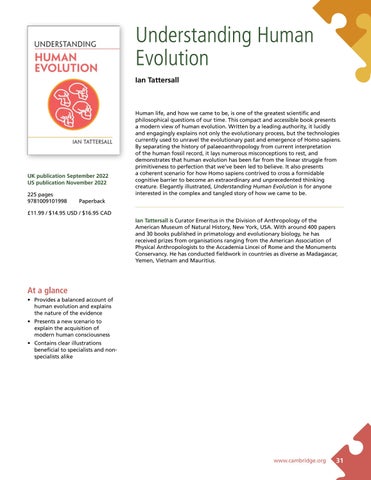
Understanding Human Evolution Ian Tattersall
UK publication September 2022 US publication November 2022 225 pages 9781009101998
Human life, and how we came to be, is one of the greatest scientific and philosophical questions of our time. This compact and accessible book presents a modern view of human evolution. Written by a leading authority, it lucidly and engagingly explains not only the evolutionary process, but the technologies currently used to unravel the evolutionary past and emergence of Homo sapiens. By separating the history of palaeoanthropology from current interpretation of the human fossil record, it lays numerous misconceptions to rest, and demonstrates that human evolution has been far from the linear struggle from primitiveness to perfection that we’ve been led to believe. It also presents a coherent scenario for how Homo sapiens contrived to cross a formidable cognitive barrier to become an extraordinary and unprecedented thinking creature. Elegantly illustrated, Understanding Human Evolution is for anyone interested in the complex and tangled story of how we came to be.
Paperback
£11.99 / $14.95 USD / $16.95 CAD Ian Tattersall is Curator Emeritus in the Division of Anthropology of the American Museum of Natural History, New York, USA. With around 400 papers and 30 books published in primatology and evolutionary biology, he has received prizes from organisations ranging from the American Association of Physical Anthropologists to the Accademia Lincei of Rome and the Monuments Conservancy. He has conducted fieldwork in countries as diverse as Madagascar, Yemen, Vietnam and Mauritius.
At a glance • Provides a balanced account of human evolution and explains the nature of the evidence • Presents a new scenario to explain the acquisition of modern human consciousness • Contains clear illustrations beneficial to specialists and nonspecialists alike
www.cambridge.org
31
UNDERSTANDING How Science Explains the World
Understanding How Science Explains the World Kevin McCain
KEVIN MCCAIN
UK publication July 2022 US publication September 2022 200 pages 9781108995504
Paperback
All people desire to know. We want to not only know what has happened, but also why it happened, how it happened, whether it will happen again, whether it can be made to happen or not happen, and so on. In short, what we want are explanations. Asking and answering explanatory questions lies at the very heart of scientific practice. The primary aim of this book is to help readers understand how science explains the world. This book explores the nature and contours of scientific explanation, how such explanations are evaluated, as well as how they lead to knowledge and understanding. As well as providing an introduction to scientific explanation, it also tackles misconceptions and misunderstandings, while remaining accessible to a general audience with little or no prior philosophical understanding.
£11.99 / $14.95 USD / $16.95 CAD
At a glance • Provides an accessible and relatively jargon-free discussion of science to facilitate improved public understanding • Discusses many features of the nature of scientific explanation and related concepts and addresses various misunderstandings • Illuminates many puzzling features of science and helps make clear how science works • Demonstrates the relevance of philosophy of science for grasping the nature of science
32
Kevin McCain is Professor of Philosophy at the University of Alabama at Birmingham. His academic research interests lie in epistemology and philosophy of science, focusing on the role of explanatory reasoning in the production of scientific knowledge. He is the author/editor of numerous articles and books, including Uncertainty: How It Makes Science Advance (OUP, 2019), What Is Scientific Knowledge (Routledge, 2019) and The Nature of Scientific Knowledge (Springer, 2016).
Understanding Fertility Gab Kovacs
UK publication August 2022 US publication October 2022 128 pages 9781009054164
Paperback
£11.99 / $14.95 USD / $16.95 CAD
Infertility can have devastating physical, emotional and financial effects on people affected. It is a common problem, but can be hard to talk about, and hard to understand. In this concise book, Dr Kovacs, a reproductive gynaecologist who has spent the past 40 years working with patients facing fertility problems, focuses on and unpicks key misconceptions. In his clear explanations, he covers the basic physiology of conceiving, and describes the areas that have to be explored for those who have not yet been able to conceive. Specific chapters cover the three major problem areas: lack of releasing eggs, sperm problems, and abnormalities of the female passages. Treatment options are discussed for each of these areas, including technical details and a brief readable overview of their history. The many ways of parenting which are now available are also detailed. This is a recommended read for couples wanting to conceive, their friends and families, and anyone who wants to understand fertility.
Gab Kovacs is a reproductive gynaecologist with over 40 years of clinical experience, and Professor of Obstetrics and Gynaecology at Monash University, Melbourne, Australia. He was a member of the Monash University IVF team that produced the world’s 4th-13th IVF babies. He is Honorary Life Member of the International Federation of Fertility Societies and The Fertility Society of Australia.
At a glance • Explains in simple terms how conception occurs and how to investigate if it does not • Gives a clear review of treatment options, enabling couples to undertake a risk-benefit analysis for each treatment • Covers some of the sociological aspects of reproductive options in the 21st century, giving readers a better understanding of the new methods of parenting • Covers some of the sociological aspects of reproductive options in the 21st century, giving readers a better understanding of the new methods of parenting
www.cambridge.org
33
UNDERSTANDING
race
Understanding Race Rob DeSalle and Ian Tattersall
ROB DESALLE AND IAN TATTERSALL
The human species is very young, but in a short time it has acquired some striking, if biologically superficial, variations across the planet. As this book shows, however, none of those biological variations can be understood in terms of discrete races, which do not actually exist as definable entities. Starting with a consideration of evolution and the mechanisms of diversification in nature, this book moves to an examination of attitudes to human variation throughout history, showing that it was only with the advent of slavery that considerations of human variation became politicized. It then embarks on a consideration of how racial classifications have been applied to genomic studies, demonstrating how individualized genomics is a much more effective approach to clinical treatments. It also shows how racial stratification does nothing to help us understand the phenomenon of human variation, at either the genomic or physical levels.
UK publication September 2022 US publication December 2022 192 pages 9781316511374
Paperback
£11.99 / $14.95 USD / $16.95 CAD
At a glance • Addresses common misunderstandings about race in an accessible and rational way for the general reader • Explains why races are purely cultural constructs and do not result from any acceptable form of taxonomic analysis of our species, helping readers to understand why race is not a useful or even justifiable way of understanding human variation • Clarifies why dividing our species into races is entirely unhelpful for demographic, medical, sociological or other analyses
34
Rob DeSalle is a Curator in the Sackler Institute for Comparative Biology and the Program for Microbial Research of the American Museum of Natural History, New York, USA. His research focuses on molecular systematics, microbial evolution, and genomics. He is the author of over 500 scientific papers and a wide range of books,from popular science titles to textbooks on genomics. Ian Tattersall is Curator Emeritus in the Division of Anthropology of the American Museum of Natural History, New York, USA. With around 400 papers and 30 books published in primatology and evolutionary biology, he has received prizes from organisations ranging from the American Association of Physical Anthropologists to the Accademia Lincei of Rome and the Monuments Conservancy. He has conducted fieldwork in countries as diverse as Madagascar, Yemen, Vietnam and Mauritius.
Understanding Human Metabolism Keith Frayn
UK publication September 2022 US publication December 2022 200 pages 9781009108522
Paperback
Does eating more carbohydrates, or fats, cause one to put on more weight? Are ketone bodies toxins or vital products that keep us alive during starvation? Does the concept of ‘fat-burning exercise’ hold true? In this game-changing book, Keith Frayn, an international expert in human metabolism and nutrition, dispels common misconceptions about human metabolism, explaining in everyday language the important metabolic processes that underlie all aspects of our daily lives. Illustrated throughout with clear diagrams of metabolic processes, Frayn describes the communication systems that enable our different organs and tissues to cooperate, for instance in providing fuel to our muscles when we exercise, and in preserving our tissues during fasting. He explores the impressive adaptability of human metabolism and discusses the metabolic disorders that can arise when metabolism ‘goes wrong’. For anyone sceptical of information about diet and lifestyle, this concise book guides the reader through what metabolism really involves.
£11.99 / $14.95 USD / $16.95 CAD
At a glance • Outlines just how wideranging the science of human metabolism is, correcting the view that ‘human metabolism’ just refers to why someone becomes overweight or lean
Keith Frayn is Emeritus Professor of Human Metabolism at the University of Oxford, UK. In a long and varied career studying human metabolism and nutrition, he has worked in various settings from diabetes clinics to Accident and Emergency departments and Intensive Care wards. His work has been widely recognised with awards including the first Blaxter Medal of the Nutrition Society, the David Cuthbertson Lecture at the European Society of Parenteral and Enteral Nutrition, and Honorary Fellowship of the Nutrition Society.
• Explains how our metabolism adapts to many different scenarios, such as fasting, feeding and exercise, providing readers with a basis for understanding the internal workings of their own bodies • Gives for the first time a clear explanation of how different nutrients interact within our tissues, dispelling any belief that individual nutrients can be considered in isolation and helping readers to approach critically the many writings about diet and lifestyle
www.cambridge.org
35
Customer Services Booksellers
Cambridge University Press Bookshop
For customer service, please contact: UK, Europe: internationaltrade2@cambridge.org Middle East, North Africa & Japan: internationaltrade1@cambridge.org North America: customer_service@cambridge.org Central & South America, Caribbean: internationalorders@cambridge.org Asia: asia@cambridge.org
Cambridge University Press Bookshop occupies the historic site of 1 Trinity Street, Cambridge CB2 1SZ, where the complete range of titles is on sale. Bookshop Manager: Cathy Ashbee Phone + 44 (0)1223 333333 Fax + 44 (0)1223 332954 Email bookshop@cambridge.org
Account-holding booksellers can order online at www.PubEasy.com
Cambridge University Press Around the World Cambridge University Press has offices, representatives and distributors in some 60 countries around the world; our publications are available through bookshops in virtually every country. United Kingdom and Ireland
Asia
Sub-Saharan Africa
Academic Sales Department Cambridge University Press, University Printing House, Cambridge CB2 8BS, UK email: information@cambridge.org www.cambridge.org
79 Anson Road Unit #06-04/06 Singapore 079906 Phone: + 65 6323 2701 Fax: + 65 6323 2370 email: singapore@cambridge.org www.cambridge.org
Cambridge University Press African Branch Lower Ground Floor, Nautica Building, The Water Club, Beach Road, Granger Bay – 8005, Cape Town, South Africa Phone: + 27 21 412 7800 Fax: + 27 21 419 8418 email: information@cambridge.org www.cambridge.org
Europe, Middle East and North Africa Academic Sales Department Cambridge University Press, University Printing House, Cambridge CB2 8BS, UK email: information@cambridge.org www.cambridge.org
The Americas North, Central, South America and Caribbean Cambridge University Press One Liberty Plaza Floor 20 New York, NY 10006 Phone: + 1 212 924 3900 Fax: + 1 212 691 3239 email: customer_service@cambridge.org www.cambridge.org
Institutional ebook access If you’re interested in institution-wide access to ebooks, or other Cambridge digital publications, please contact online@cambridge.org in the Americas or library.sales@cambridge.org in the rest of the world.
36
Australia and New Zealand Cambridge University Press Australian Branch 477 Williamstown Road, Port Melbourne, VIC 3207, Australia Phone: +61 3 8671 1411 Fax: +61 3 9676 9966 email: info@cambridge.edu.au www.cambridge.org
Retail and wholesale representatives North America
Tom Willshire (Sales Manager) Cambridge University Press One Liberty Plaza Floor 20 New York, NY 10006 Phone: (212) 337-5949 or Toll Free: (800) 221-4512 email: twillshire@cambridge.org
Mid-Atlantic Eastern NY, New Jersey, New York City, New York State
Michael Baron Phone: (415) 469-9131 or Toll Free: (8 77)4 06-5253 email: mbaron@cambridge.org
Alex Beguin Phone: (571) 970-1984 or Toll Free: (877) 406-5252 email: abeguin@cambridge.org
Southeast/Midwest: Alabama, Arizona, Arkansas, Delaware, Florida, Georgia, Indiana, Kansas, Kentucky, Louisiana, Maryland, Michigan, Mississippi, Missouri, New Mexico, North Carolina, Ohio, Pennsylvania, South Carolina, Tennessee, Texas, Virginia, Washington DC, West Virginia, Western New York New England: Connecticut, Maine, Massachusetts, New Hampshire, Rhode Island, Vermont
Pamela Robinson Phone: (905) 885-9315 or Toll Free: (877) 406-5248 email: probinson@cambridge.org Canada: All provinces
For Bulk Sales, please email Special_Sales@cambridge.org
West Coast/Plains: Alaska, California, Colorado, Hawaii, Idaho, Iowa, Illinois, Minnesota, Montana, Nebraska, North Dakota, Nevada, Oklahoma, Oregon, South Dakota, Utah, Washington, Wisconsin, Wyoming
India
Cambridge University Press India Pvt Ltd Splendor Forum, 3rd Floor Plot No.3, Jasola District Centre New Delhi 110025 Phone: +91 11 43543500 www.cambridgeindia.org
Australia
Cambridge University Press - Australia 477 Williamstown Road Port Melbourne VIC 3207 M: 0437 389 810 Phone: +61 (03) 8671 1411 email: info@cambridge.edu.au www.cambridge.edu.au
(Higher Education: SA & WA; Trade and Special Sales: ANZ)
Publicity UK and Europe
Chris Burrows Publicity Manager email: cburrows@cambridge.org
US & Canada
Josh Hamel Senior Publicist email: josh.hamel@cambridge.org
www.cambridge.org
37
Notes ................................................................................................................................................................................................................ ................................................................................................................................................................................................................ ................................................................................................................................................................................................................ ................................................................................................................................................................................................................ ................................................................................................................................................................................................................ ................................................................................................................................................................................................................ ................................................................................................................................................................................................................ ................................................................................................................................................................................................................ ................................................................................................................................................................................................................ ................................................................................................................................................................................................................ ................................................................................................................................................................................................................ ................................................................................................................................................................................................................ ................................................................................................................................................................................................................ ................................................................................................................................................................................................................ ................................................................................................................................................................................................................ ................................................................................................................................................................................................................ ................................................................................................................................................................................................................ ................................................................................................................................................................................................................ ................................................................................................................................................................................................................ ................................................................................................................................................................................................................ ................................................................................................................................................................................................................ ................................................................................................................................................................................................................ ................................................................................................................................................................................................................
38
www.cambridge.org
39