RIGHTS TITLES SPRING | 2022
www.cambridge.org/rights rights@cambridge.org
22
Running Head Left
Contents Archaeology and Classical Studies
3
Business and Economics
10
History
17
Law
26
Linguistics
27
Literature
29
Music
31
Philosophy
33
Politics
37
Psychology
40
Religion
48
Sociology
50
Earth Science
51
Computer Science
54
Life Science
62
Mathematics
70
Medicine
75
Physical Science
90
Archaeology and Classical Studies
3
Human Prehistory Exploring the Past to Understand the Future
Deborah Barsky
Catalan Institute of Human Paleoecology and Social Evolution
Description This book provides a concise overview of human prehistory. It shows how an understanding of the distant past offers new perspectives on present-day challenges facing our species – and how we can build a sustainable future for all life on planet Earth. Deborah Barsky tells a fascinating story of the long-term evolution of human culture and provides up-to-date examples from the archaeological record to illustrate the different phases of human history. Barsky also presents a refreshing and original analysis about issues plaguing modern globalized society, such as racism, institutionalized religion, the digital revolution, human migrations, terrorism, and war. Written in an accessible and engaging style, Human Prehistory is aimed at an introductory-level audience. Students will acquire a comprehensive understanding of the interdisciplinary, scientific study of human prehistory, as well as the theoretical interpretations of human evolutionary processes that are used in contemporary archaeological practice. Definitions, tables, and illustrations accompany the text.
Key Features • Provides an evolutionary point of view for understanding contemporary issues challenging the human species, which will help readers to better understand and deal with present-day problems facing human societies in a globalised world. • Provides concrete examples from the archaeological record to illustrate the different phases of human evolution, giving credence to theoretical interpretations of the human evolutionary trajectory. • Renders seemingly complex scientific data about prehistory accessible to a wide audience. • Different disciplines involved in studying prehistory are presented to students in a coherent, understandable and synthetic way.
Contents 1. An introduction to Prehistoric Archeology; 2. Prehistory as a multidisciplinary science; 3. Becoming human; 4. The emergence of Lower Paleolithic cultures; 5. The ascent of Paleolithic cultures; 6. Conquest: the final phases of the Stone Age; 7. The new world order following the Paleolithic; 8. Communication networking and the end of the Prehistoric Era; 9. Global warming: natural climatic trend or humanly induced phenomena? 10. Human distortions and alienation from nature; 11. Who are we? Ancient and modern human migrations; 12. On religion, war and terrorism in the globalized world; 13. The role of prehistory in understanding the modern human condition.
Additional Information Level: Undergraduate students, graduate students June 2022 253 x 177 mm c.288pp 978-1-316-51542-6 Hardback c. £85.00 / c. US$110.00
4
Archaeology and Classical Studies
Archaeology, Nation, and Race Confronting the Past, Decolonizing the Future in Greece and Israel
Raphael Greenberg Tel-Aviv University
Yannis Hamilakis
Brown University, Rhode Island
Description Archaeology, Nation, and Race is a must-read book for students of archaeology and adjacent fields. It demonstrates how archaeology and concepts of antiquity have shaped, and have been shaped by colonialism, race, and nationalism. Structured as a lucid and lively dialogue between two leading scholars, the volume compares modern Greece and modern Israel – two prototypical and influential cases – where archaeology sits at the very heart of the modern national imagination. Exchanging views on the foundational myths, moral economies, and racial prejudices in the field of archaeology and beyond, Hamilakis and Greenberg explore topics such as the colonial origins of national archaeologies, the crypto-colonization of the countries and their archaeologies, the role of archaeology as a process of purification, and the racialization and ‘whitening’ of Greece and Israel and their archaeological and material heritage. They conclude with a call for decolonization and the need to forge alliances with subjugated communities and new political movements.
Key Features • Compares two nation states and phenomena, Greece and Israel, showing how nation and race and their entanglement with archaeology and coloniality follow certain common patterns, demonstrating at the same time the historical differences • Based on sustained and systematic decades long research by two world-class researchers, the book shows readers why decolonization of archaeology and society is essential and urgent today • Structured as lively dialogue between two leading scholars, this book clarifies matters for readers in a way that is not possible in conventional monographs
Contents 1. Introduction; 2. The Colonial Origins of National Archaeologies; 3. Archaeology in the Crypto-colony; 4. Archaeology as Purification; 5. Whitening Greece and Israel: Nation, Race, and Archaeogenetics; 6. Decolonizing our Imagination; 7. Conclusion.
Additional Information Level: Graduate students, undergraduate students February 2022 216 x 140 mm c.200pp 978-1-00-916025-4 Paperback £19.99 / US$25.99
k and Gree nguage le ew la Hebr unavailab s right
Archaeology and Classical Studies
5
The Christian Invention of Time Temporality and the Literature of Late Antiquity
Simon Goldhill
University of Cambridge
Description Time is integral to human culture. Over the last two centuries people’s relationship with time has been transformed through industrialisation, trade and technology. But the first such life-changing transformation – under Christianity’s influence – happened in late antiquity. It was then that time began to be conceptualised in new ways, with discussion of eternity, life after death and the end of days. Individuals also began to experience time differently: from the seven-day week to the order of daily prayer and the festal calendar of Christmas and Easter. With trademark flair and versatility, world-renowned classicist Simon Goldhill uncovers this change in thinking. He explores how it took shape in the literary writing of late antiquity and how it resonates even today. His bold new cultural history will appeal to scholars and students of classics, cultural history, literary studies, and early Christianity alike.
Key Features • Offers the first complete account, through the concept of time, of a fundamental transformation of Western culture • Enjoyably and informatively traverses the literature of late antiquity • Brings new perspectives and original understandings to the idea of temporality
Contents Introduction; Part I: 1. God’s time; 2. The time of death; 3. Telling time; 4. Waiting; 5. Time and time again; 6. Making time visible; 7. At the same time; 8. Timelessness and the now; 9. Life times; 10. The rape of time; Part II: 11. Beginning, again: Nonnus’ paraphrase of the Gospel of John; 12. The eternal return: Nonnus’ Dionysiaca; 13. Regulation time: Gregory’s Christmas Day; 14. Day to day; 15. “We are the times”: Making history Christian; Coda: Writing in the time of sickness.
Additional Information Level: Academic researchers, graduate students Series: Greek Culture in the Roman World February 2022 229 x 152 mm 516pp 978-1-316-51290-6 Hardback £34.99 / US$44.99
6
Archaeology and Classical Studies
Untangling Blackness in Greek Antiquity Sarah F. Derbew
Stanford University, California
Description This important and timely book is the first to examine the articulations of blackness from the fifth century BCE to the twenty-first century. Sarah Derbew charts literary and artistic representations of black Egyptians, Aithiopians, Indians, and Greeks in the ancient Greek world and, in disentangling the ways that key constituents co-produce blackness, examines how authors and artists create characters, contemporary scholars analyze these personae, and readers and viewers bring their own interpretation to the fore. In addition, she probes deeply into race’s precarious grip on skin color and thereby uncovers the silences, suppression, and misappropriation of blackness within modern studies of the ancient Greek world. Shaped foundationally by performance studies and critical race theory, the book maps out an archaeology of blackness that reappraises its valence. This antiracist study promotes a contextualized, rigorous approach to representations of black people in Greek antiquity that rejects simplistic conflations.
Key Features • Provides an analysis of black people that is both grounded in antiquity and mindful of modernity • Enables the complex presentation of black people as Egyptians, Greeks, Indians, and Aithiopians to stand in defiant contrast to reductive generalizations • Initiates interdisciplinary conversations about blackness that renews Classics’ commitment to inclusive scholarship
Contents Introduction: The metatheater of blackness; 1. Masks of blackness: Reading the iconography of black people in ancient Greece; 2. Masks of difference in Aeschylus’s suppliants; 3. Beyond blackness: Reorienting Greek geography; 4. From Greek scythians to black Greeks: Spectrum of foreignness in Lucian’s satires; 5. Black disguises in an aithiopian novel; Conclusion: (re)placing blackness; Appendix 1; Appendix 2; Bibliography; Recommended translations of primary Greek texts; Index.
Additional Information Level: Academic researchers, graduate students, general readers April 2022 229 x 152 mm c.300pp 978-1-108-49528-8 Hardback £29.99 / US$39.99
Archaeology and Classical Studies
7
Slaves and Slavery in Ancient Greece Sara Forsdyke
University of Michigan, Ann Arbor
Description Slavery in ancient Greece was commonplace. In this book Sara Forsdyke uncovers the wide range of experiences of slaves and focuses on their own perspectives, rather than those of their owners, giving a voice to a group that is often rendered silent by the historical record. By reading ancient sources ‘against the grain,’ and through careful deployment of comparative evidence from more recent slave-owning societies, she demonstrates that slaves engaged in a variety of strategies to deal with their conditions of enslavement, ranging from calculated accommodation to full-scale rebellion. Along the way, she establishes that slaves made a vital contribution to almost all aspects of Greek society. Above all, despite their often brutal treatment, they sometimes displayed great ingenuity in exploiting the tensions and contradictions within the system of slavery.
Key Features • Highlights the contribution of slaves to ancient Greek society • Presents a method for investigating the lives of slaves that draws on both ancient and comparative evidence for slavery • Provides a comprehensive account of the experiences of slaves from the moment of enslavement to their death or achievement of freedom and examines the ideologies of and modes of control employed by slave-owners
Contents 1. Approaching slavery in Ancient Greece: motivations, methods and definitions; 2. Becoming a slave: ‘the day of slavery’; 3. Being a slave: experiences of slavery; 4. Slaves and status; 5. Resourceful slaves and controlling masters; 6. Why should we care?
Additional Information Level: Undergraduate students, graduate students, academic researchers Series: Key Themes in Ancient History June 2021 228 x 152 mm 200pp 978-1-107-65889-9 Paperback £18.99 / US$24.99
8
Archaeology and Classical Studies
Roman Egypt A History
Roger S. Bagnall New York University
Description Egypt played a crucial role in the Roman Empire for seven centuries. It was wealthy and occupied a strategic position between the Mediterranean and Indian Ocean worlds, while its uniquely fertile lands helped to feed the imperial capitals at Rome and then Constantinople. The cultural and religious landscape of Egypt today owes much to developments during the Roman period, including in particular the forms taken by Egyptian Christianity. Moreover, we have an abundance of sources for its history during this time, especially because of the recovery of vast numbers of written texts giving an almost uniquely detailed picture of its society, economy, government, and culture. This book, the work of six historians and archaeologists from Egypt, the US, and the UK, provides students and a general audience with a readable new history of the period and includes many illustrations of art, archaeological sites, and documents, and quotations from primary sources.
Key Features • Provides an accessible account of an important period in Egypt’s ancient history • Includes a wealth of visual illustration and excerpts from ancient texts • Draws on diverse expertise and viewpoints both from within and from outside Egypt
Contents 1. Laying the foundations for Roman Egypt; 2. The coming of Roman rule; 3. Development and crisis in a Roman province; 4. The making of Late Antique Egypt; 5. Divergence and division; 6. The Persians, the Arab conquest, and another transformation of Egypt.
Additional Information Level: Undergraduate students, graduate students, general readers September 2021 244 x 170 mm 412pp 4 b/w illus. 70 colour illus. 6 maps 978-1-108-94900-2 Paperback £19.99 / US$25.99
Archaeology and Classical Studies
9
Expanding Horizons in the History of Science The Comparative Approach
G. E. R. Lloyd
Needham Research Institute, Cambridge
Description This book challenges the common assumption that the predominant focus of the history of science should be the achievements of Western scientists since the so-called Scientific Revolution. The conceptual frameworks within which the members of earlier societies and of modern indigenous groups worked admittedly pose severe problems for our understanding. But rather than dismiss them on the grounds that they are incommensurable with our own and to that extent unintelligible, we should see them as offering opportunities for us to revise many of our own preconceptions. We should accept that the realities to be accounted for are multi-dimensional and that all such accounts are to some extent value-laden. In the process insights from current anthropology and the study of ancient Greece and China especially are brought to bear to suggest how the remit of the history of science can be expanded to achieve a cross-cultural perspective on the problems.
Key Features • Develops a new framework for the history of science • Adopts a multi-disciplinary approach using findings from anthropology, the philosophy of language and the philosophy and historiography of science • Investigates science in contemporary indigenous, as well as ancient, societies, thereby expanding the horizons of the history of science
Contents Introduction; 1. On aspects of the status quaestionis; 2. Translatability, intelligibility, revisability; 3. Demystifying the Greek miracle; 4. The question of causal factors; 5. The criteria of theories, simplicity for instance; 6. Definitions and the problems of foreclosure; 7. The challenge of ‘mythology’; 8. Elements, processes, substances, stuff; 9. Health and disease, illness and well-being; 10. Mind, body, heart, brain, soul, spirit; Conclusions.
Additional Information Level: Academic researchers, graduate students August 2021 229 x 152 mm c.200pp 20 b/w illus. 978-1-316-51624-9 Hardback £75.00 / US$99.99
10
Business and Economics
25 Million Sparks The Untold Story of Refugee Entrepreneurs
Andrew Leon Hanna
Stanford University, California
Description 25 Million Sparks takes readers inside the Za’atari refugee camp to follow the stories of three courageous Syrian women entrepreneurs: Yasmina, a wedding shop and salon owner creating moments of celebration; Malak, a young artist infusing color and beauty throughout the camp; and Asma, a social entrepreneur leading a storytelling initiative to enrich children’s lives. Anchored by these three inspiring stories, as well as accompanying artwork and poetry by Malak and Asma, the narrative expands beyond Za’atari to explore the broader refugee entrepreneurship phenomenon in more than twenty camps and cities across the globe. What emerges is a tale of power, determination, and dignity – of igniting the brightest sparks of joy, even when the rest of the world sees only the darkness. A significant portion of the author’s proceeds from this book is being contributed to support refugee entrepreneurs in Za’atari and around the world.
Key Features • Captivating human-centered narrative storytelling following three Syrian women entrepreneurs living in a refugee camp • An exploration of entrepreneurship and startups in the most extreme settings • A fresh discussion of global policy, social justice, human rights, and economic development related to refugees, amid the largest global refugee crisis in history • The first book of a young, award-winning author, entrepreneur, and attorney at Stanford and Harvard whose parents immigrated to the US from Egypt
Contents 1. Angels of Za’atari; Part I. Darkness: 2. Olive trees; 3. Gray walls; 4. Global crisis; Part II. Spark: 5. New beginnings; 6. Khatwa, Khatwa; 7. Balloons; 8. Extreme entrepreneurs; Part III. Revival: 9. Midnight blue; 10. Dignity; 11. Global catalyst; Part IV. Hope: 12. Dreams become one; Epilogue; Acknowledgments; Notes; Index.
Additional Information Level: General readers, professionals April 2022 198 x 129 mm c.175pp 978-1-00-918149-5 Hardback £14.99 / US$19.95
Business and Economics
11
Economics for a Fragile Planet Rethinking Markets, Institutions and Governance
Edward Barbier
Colorado State University
Description In a world of growing environmental risks and ecological scarcities, ensuring a safe Anthropocene for humankind is essential. Managing an increasingly “fragile” planet requires new thinking on markets, institutions and governance built on five principles: ending the underpricing of nature, fostering collective action, accepting absolute limits, attaining sustainability, and promoting inclusivity. Rethinking economics and policies in this way can help to overcome the global challenges posed by climate change, biodiversity loss, freshwater scarcity, and deteriorating marine and coastal habitats. It requires decoupling wealth creation from environmental degradation through business, policy and financial actions aimed at better stewardship of the biosphere. In this book, renowned environmental economist Edward Barbier offers a blueprint for a greener and more inclusive economy, and outlines the steps we must take now to build a post-COVID world that limits environmental threats while sustaining per capita welfare.
Key Features • Illustrates how rethinking economics and policy can overcome the global challenges posed by climate change, biodiversity loss, freshwater scarcity, and deteriorating marine and coastal habitats • Offers a blueprint for the path forward to a greener and more inclusive economy, and outlines the steps we must take now to build a post-COVID world that limits environmental threats while sustaining per capita welfare • Illustrates why we must urgently change the relationship between economy and nature, and what key policy and business actions are needed to make this happen
Contents Preface; 1. Introduction; 2. Humankind and the planet; 3. Economics for a fragile planet; 4. Climate change; 5. Land use change and biodiversity; 6. Freshwater; 7. Oceans and coasts; 8. Public policies; 9. Business; 10. Conclusion.
Additional Information Level: General readers, graduate students April 2022 229 x 152 mm c.250pp 978-1-108-83082-9 Hardback £54.99 / US$69.99
12
Business and Economics
Fragile Futures The Uncertain Economics of Disasters, Pandemics, and Climate Change
Vito Tanzi Description This book revisits a distinction introduced in 1921 by economists Frank Knight and John Maynard Keynes: that between statistically predictable future events (’risks’) and statistically unpredictable, uncertain events (’uncertainties’). Governments have generally ignored the latter, perceiving phenomena such as pandemics, natural disasters and climate change as uncontrollable Acts of God. As a result, there has been little if any preparation for future catastrophes. Our modern society is more interconnected and more globalized than ever. Dealing with uncertain future events requires a stronger and more globally coordinated government response. This book suggests a larger, more global government role in dealing with these disasters and keeping economic inequalities low. Major institutional changes, such as regulating the private sector for the common good and dealing with special harms, risks and crises, especially those concerning climate change and pandemics, are necessary in order to achieve any semblance of future progress for humankind.
Key Features • Discusses changes needed in prevailing economic theories about role of market and government operations in democratic countries • Discusses changes needed to adapt to an increasingly global world where most policies have remained national • Questions the past assumption of the inevitable continuation of ‘progress’ in the future
Contents Part I. Uncertain Future Events and Reactions to Them: 1. Introduction; 2. Risky versus uncertain events; 3. Taxonomy of disasters; 4. Democracy, capitalism and random events; Part II. A Survey of Past Pandemics and Other Disasters: 5. Uncertain future events and policies; 6. Pandemics, famines and climate change; 7. Major natural disasters; 8. Atomic disasters; 9. Industrial disasters; 10. Economic principles for disasters; Part III. Climate Change and Global Warming: 11. When the Earth became man’s private property; 12. Early concerns about the environment; 13. From environmental concerns to climate change; Part IV. Back to Some Theoretical Issues: 14. Human needs and economic theory; 15. Concluding thoughts.
Additional Information Level: General readers, professionals, graduate students April 2022 229 x 152 mm 246pp 978-1-00-910012-0 Hardback £20.00 / US$24.99
Business and Economics
13
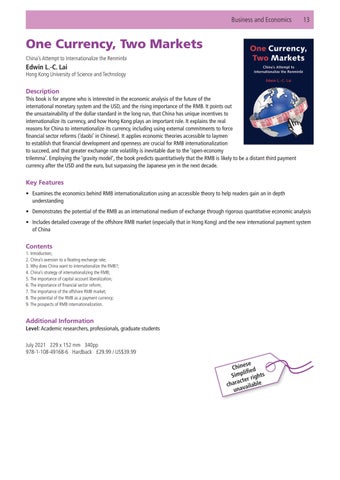
One Currency, Two Markets China’s Attempt to Internationalize the Renminbi
Edwin L.-C. Lai
Hong Kong University of Science and Technology
Description This book is for anyone who is interested in the economic analysis of the future of the international monetary system and the USD, and the rising importance of the RMB. It points out the unsustainability of the dollar standard in the long run, that China has unique incentives to internationalize its currency, and how Hong Kong plays an important role. It explains the real reasons for China to internationalize its currency, including using external commitments to force financial sector reforms (’daobi’ in Chinese). It applies economic theories accessible to laymen to establish that financial development and openness are crucial for RMB internationalization to succeed, and that greater exchange rate volatility is inevitable due to the ‘open-economy trilemma’. Employing the ‘gravity model’, the book predicts quantitatively that the RMB is likely to be a distant third payment currency after the USD and the euro, but surpassing the Japanese yen in the next decade.
Key Features • Examines the economics behind RMB internationalization using an accessible theory to help readers gain an in depth understanding • Demonstrates the potential of the RMB as an international medium of exchange through rigorous quantitative economic analysis • Includes detailed coverage of the offshore RMB market (especially that in Hong Kong) and the new international payment system of China
Contents 1. Introduction; 2. China’s aversion to a floating exchange rate; 3. Why does China want to internationalize the RMB?; 4. China’s strategy of internationalizing the RMB; 5. The importance of capital account liberalization; 6. The importance of financial sector reform; 7. The importance of the offshore RMB market; 8. The potential of the RMB as a payment currency; 9. The prospects of RMB internationalization.
Additional Information Level: Academic researchers, professionals, graduate students July 2021 229 x 152 mm 340pp 978-1-108-49168-6 Hardback £29.99 / US$39.99
ese Chin ed lifi Simp rights cter chara vailable una
14
Business and Economics
Regulating Public Services Bridging the Gap between Theory and Practice
Emmanuelle Auriol
Toulouse School of Economics
Claude Crampes
Toulouse School of Economics
Antonio Estache
Université Libre de Bruxelles
Description Regulation is one of the tools used by governments to control monopolistic behaviour in the provision of public services such as electricity, transport or water. Technological and financial innovations have changed these public services markets since the 1990s, bringing new regulatory challenges, including technological and financial ones. This book demonstrates that basic regulatory theory and tools can address these new challenges, in addition to more traditional regulatory issues, both in developed and developing economies. The theory covered in the book is robust enough to guide regulators in multiple contexts, including those resulting from the effects of financial or political constraints, evolving market structures or the need to adapt to institutional weaknesses, climate change and poverty concerns that demand regulatory intervention. A bridge between theory and an evolving global practice, this book mobilizes the lessons of the past to analyse the future of economic regulation.
Key Features • Highlights the extent to which regulatory solutions not only need to adapt to the specific information gaps but also to the specific institutional, social and political context in which regulation is designed and implemented • Highlights the relevance for regulatory designs of the evolution of market and ownership structures in regulated industries • Discusses explicitly how relatively easily social concerns can be internalized in the design of regulation
Contents 1. Introduction; 2. Defining a theoretical normative benchmark; 3. Thinking like a monopoly about price and output; 4. Regulating a monopoly with full information; 5. Regulating under informational constraints; 6. Regulatory rules to set the average price; 7. Linking regulatory theory to practice through finance; 8. Nonlinear pricing in regulation; 9. Social concerns in regulatory design; 10. Regulating quality; 11. On the regulation of investment; 12. Regulating multiproduct oligopolies; 13. Abuse of market power in (de)regulated industries; 14. On the relevance of institutional quality; 15. Emerging regulatory challenges.
Additional Information Level: Graduate students, academic researchers, professionals October 2021 244 x 170 mm c.500pp 978-1-108-83395-0 Hardback £89.99 / US$115.00
Business and Economics
15
The Rise of China, Inc. How the Chinese Communist Party Transformed China into a Giant Corporation
Shaomin Li
Old Dominion University, Virginia
Description Leveraging its absolute power, low human rights advantage, and tolerance by other countries, the Chinese Communist Party has transformed China into a giant corporation. Living and working is not a right, but a privilege granted by the party. State-owned firms are business units or subsidiaries, private firms are joint ventures, and foreign firms are franchisees of the party. ‘China, Inc.’ enjoys the agility of a firm and the vast resources of a state. Meanwhile, foreign firms competing with Chinese firms can find themselves matched against the mighty Chinese state. The Rise of China, Inc. will interest many readers: it will compel business scholars to rethink state-firm relationships; assist multinational business practitioners in formulating effective strategies; aid policy-makers in countering China’s expansion; and inform the public of the massive corporate organisation China has become, and how democracies can effectively deal with it.
Key Features • Reveals how the Chinese Communist Party runs China as a giant corporation • Explains why counterfeits and unsafe products persist in China • Helps democracies to correctly assess their strengths and weaknesses in dealing with China
Contents 1. Introduction: Who lost China?; Part I. The Advantage of Low Human Rights: 2. The political foundation of China’s competitiveness and its failure to democratize; 3. China’s legal system is not about the rule of law: The advantages and limits of the relation-based system; 4. Mao plus Deng: A highly aggressive and productive culture; Part II. The Rise of China, Inc.: 5. The emergence of China, inc.; 6. China’s industrial policy as a corporate strategy of China, Inc; Part III. China, inc.’s Achilles’ Heel and the World’s Response: 7. The Chinese communist party’s dilemmas and solutions; 8. Open societies versus closed regime: Who needs whom more?; 9. Policy and strategic options for the governments and firms in the democracies; References; Index.
Additional Information Level: Academic researchers, professionals January 2022 229 x 152 mm 346pp 17 b/w illus. 13 tables 978-1-316-51387-3 Hardback £74.99 / US$99.99
16
Business and Economics
Trade Links New Rules for a New World
James Bacchus
University of Central Florida
Description The World Trade Organization is undergoing an existential crisis. Trade links the world not only through the flow of international commerce in goods, services, and ideas; but also through its economic, environmental, and social impacts. Trade links are supported by a WTO trading system founded on rules established in the 20th century which do not account for all the modern changes in the global economy. James Bacchus, a founder of the WTO, posits that this global organization can survive and continue to succeed only if the trade links among WTO members are revitalized and reimagined. He explains how to bring the WTO into the twenty-first century, exploring the ways it can be utilized to combat future pandemics and climate change and advance sustainable development, all while continuing to foster free trade. This book is among the first to comprehensively explain the new trade rules needed for our new world.
Key Features · The first comprehensive account of the reforms needed to modernize the trade rules of the World Trade Organization · Offers the unique insights of an author who helped found and served as chief judge of the World Trade Organization · Details how the rules of the World Trade Organization can be transformed to work in the new pandemic world to free trade, fight climate change, and accomplish the other global goals for sustainable development
Contents Introduction: fraying links; 1. Links to the global economy; 2. Links to the pandemic; 3. Links to the pre-pandemic world; 4. Links to the trade inheritance; 5. Links to the new commercial economy; 6. Links to climate change; 7. Links to sustainable development; 8. Links to ecology and a circular economy; 9. Links to cooperation, equity, and inclusion.
Additional Information Level: Academic researchers, graduate students, undergraduate students February 2022 229 x 152 mm c.350pp 978-1-00-909810-6 Hardback £29.99 / US$39.99
History
17
Ukraine and Russia From Civilized Divorce to Uncivil War
Paul D’Anieri
University of California, Riverside
Description D’Anieri explores the dynamics within Ukraine, between Ukraine and Russia, and between Russia and the West, that emerged with the collapse of the Soviet Union and eventually led to war in 2014. Proceeding chronologically, this book shows how Ukraine’s separation from Russia in 1991, at the time called a ‘civilized divorce’, led to what many are now calling ‘a new Cold War’. He argues that the conflict has worsened because of three underlying factors – the security dilemma, the impact of democratization on geopolitics, and the incompatible goals of a post-Cold War Europe. Rather than a peaceful situation that was squandered, D’Anieri argues that these were deep-seated pre-existing disagreements that could not be bridged, with concerning implications for the resolution of the Ukraine conflict. The book also shows how this war fits into broader patterns of contemporary international conflict and should therefore appeal to researchers working on the Russia-Ukraine conflict, Russia’s relations with the West, and conflict and geopolitics more generally.
Key Features • Will appeal to readers looking at research on conflict that does not focus on assigning blame to one side or another • Provides a chronological history of Ukraine-Russia relations since 1991 • Reshapes our understanding of when and why Ukraine became such an object of contention, showing that the events of 2013–14 were the spark, but the fuel was put in place over many years
Contents 1. The sources of conflict over Ukraine; 2. New world order? 1989–1993; 3. Hope and hardship, 1994–1999; 4. Autocracy and revolution: 1999–2004; 5. Revolution and reversal, 2004–2010; 6. Viktor Yanukovych and the path to confrontation, 2010–2013; 7. From revolution to war: 2013–2015; 8. Conclusion: Ukraine, Russia, and the West: from Cold War to Cold War.
Additional Information Level: Graduate students, academic researchers October 2019 228 x 152 mm 292pp 3 maps 4 tables 978-1-108-48609-5 Hardback £64.99 / US$84.99
18
History
A Concise History of Albania Bernd J. Fischer
Purdue University, Fort Wayne
Oliver Jens Schmitt Universität Wien, Austria
Description A Concise History of Albania charts the history of Albania and its people, within their Balkan and European contexts. It shows the country’s journey from its ancient past, still shrouded in mystery and controversy, through its difficult transition from a particularly brutal form of communism to an evolving form of democracy and a market economy. Bernd Fischer and Oliver Schmitt challenge some of the traditional narratives concerning the origins of the Albanians, and the relations between Albanians and their Balkan neighbours. This authoritative and up-to-date single-volume history analyses the political, social, economic, and cultural developments which led to the creation of the Albanian state and the modern nation, as well as Albania’s more recent experience with authoritarianism, war, and communism. It greatly contributes to our understanding of the challenges facing contemporary Albanians, as well as the issues confronting the region as a whole as it attempts to grapple with one of the last remaining significant ethnic issues in the Balkans.
Key Features • The first single-volume history of Albania in English in the twenty-first century, through to an up-to-date examination of contemporary politics, society, and economics • Offers an objective evidence-based analysis of the origins of the Albanians in the Balkan context • Explains why Albanians were the last ethnic group in the Balkans to develop a nation and a state
Contents Part I. Between Regional Self-Will and Imperial Rule: 1. The Space and Time of Albanian History; 2. The Albanians in the Middle Ages, 500–1500; 3. The Albanians under Ottoman Rule: The Classic Period of Arnavutluk, 1500–1800; 4. Ottoman Arnavutluk in Crisis, 1800–1912; Part II. State and Nation Construction: 5. Arnavutluk to Albania: The Triumph of Albanianism, 1912–1924; 6. Interwar Albania, The Rise of Authoritarianism, 1925–1939; 7. The Second World War and the Establishment of the Communist Regime, 1939–1944; 8. Albania’s Stalinist Dictatorship, 1944–1989; 9. The Struggle to Establish a Democracy since 1989; Political Leaders and Political Systems since 1912; Select Bibliography; Index.
Additional Information Level: Undergraduate students, graduate students Series: Cambridge Concise Histories March 2022 216 x 138 mm 440pp 978-1-107-01773-3 Hardback c. £50.00 / c. US$85.00
History
19
A History of Modern Palestine Third edition
Ilan Pappe
University of Exeter
Description Tracing the history of Palestine from the Ottomans in the nineteenth century, through the British Mandate, the establishment of the state of Israel in 1948, and the subsequent wars and conflicts which have dominated this troubled region, Ilan Pappe’s widely acclaimed A History of Modern Palestine provides a balanced and forthright overview of Palestine’s complex history. Placing at its centre the voices of the men, women, children, peasants, workers, town-dwellers, Jews and Arabs of Palestine, who lived through these times, this tells a story of co-existence and co-operation, as well as oppression, occupation, and exile, exposing patterns of continuity as well as points of fracture. Now in an updated third edition, Pappe draws links between contemporary events, from war in Lebanon, violence in the Gaza Strip and the Arab Spring, with the long history of Palestine, taking into account the success of Israel without neglecting the on-going catastrophe suffered by Palestinians, leaving hope for a better future for all who live in, or were expelled, from Palestine.
Key Features • Appealing to both students and general readers, this is a rich and detailed history of Palestine from the Ottomans in the nineteenth century to present day • This updated third edition features new material on recent events and scholarship on Palestine in an accessible and engaging style to support readers understanding of contemporary events • The history of the region is brought to life by the unique emphasis on the experiences and voices of everyday residents of Palestine
Contents Chronology; Foreword; Introduction: a new look at modern Palestine and Israel; 1. Fin de Siècle (1856–1900): social tranquillity and political drama; 2. Beyond tyranny and war (1900-1918); 3. The mandatory state: colonialism, nationalization and cohabitation; 4. Between Nakbah and independence: the 1948 war; 5. The age of partition (1948-1967); 6. Greater Israel and occupied Palestine: the rise of fall of high politics (1967-1987); 7. The uprising and its political consequences (1987-1996); Epilogue.
Additional Information Level: Undergraduate Students, graduate students April 2022 228 x 152 mm c.408pp 978-1-108-41544-6 Hardback £69.99 / US$89.99
ons editi ish, s u o i Prev ed in Dan ish pan ish publ Korea, S n, sh Italia nd Turki a
20
History
Earthopolis A Biography of Our Urban Planet
Carl H. Nightingale
State University of New York, Buffalo
Description This is a biography of Earthopolis, the only Urban Planet we know of. It is a history of how cities gave humans immense power over Earth, for good and for ill. Carl Nightingale takes readers on a sweeping six-continent, six-millennia tour of the world’s cities, culminating in the last 250 years, when we vastly accelerated our planetary realms of action, habitat, and impact, courting dangerous new consequences and opening prospects for new hope. In Earthopolis we peek into our cities’ homes, neighborhoods, streets, shops, eating houses, squares, marketplaces, religious sites, schools, universities, offices, monuments, docklands, and airports to discover connections between small spaces and the largest things we have built. The book exposes the Urban Planet’s deep inequalities of power, wealth, access to knowledge, class, race, gender, sexuality, religion and nation. It asks us to draw on the most just and democratic moments of Earthopolis’s past to rescue its future.
Key Features • Appeals to a broad general readership interested in urban history, urban studies and world history • Provides a world history of cities that takes into account their role in world history, their interactions with the human habitat, and their relationship with the natural environment • Useful as a course book on global urban history and urban studies
Contents Introduction: Our Urban Planet in Space and Time; Part III. Cities of Hydrocarbon: Prologue: Before and Beyond: Big Things in Tiny Places; 10. Chimneys to Smokestacks; Part I. Cities of the Rivers: 11. Planet of the People I: The Atlantic Cauldron; 1. Making Politics from Sunshine, Earth, and Water; 12. Planet of the People II: Feminists, Abolitionists, and los Liberales; 2. Igniting Empire; 13. Weapons of World Conquest; 3. Wealth for a Few, Poverty for Many I; 14. Capitalist Explosions; 4. Wealth for a Few, Poverty for Many II; 15. The Pharoahs of Flow; 5. How Knowledge Became Power; 16. Planet of the People III: An Urban Majority Takes 6. The Realm of Consequence; its Space; Part II. Cities of the World Ocean: 17. Lamps Out; 7. Bastions, Battleships, and Gunpowder Cities; 18. The Labyrinths of Terror; 8. Wealth from the Winds and Waves; 19. Gathering Velocities I: Tailpipe Tracts and Tower 9. Consuming the Earth in Cities of Light … Blocks; and Delight;
Additional Information Level: General Readers August 2023 978-1-108-44053-0 Paperback TBA / TBA
20. Gathering Velocities II: Liberation and Development; 21. Greatest Accelerations I: New Empires, New Multitudes; 22. Greatest Accelerations II: Shacks and Citadels; 23. Greatest Accelerations III: Pleasure Palaces and Sweatshops; 24. Greatest Accelerations IV: Maximal Hydrocarbon, Maximal Waste; 25. 2020 Hindsight … and Foresight?; Acknowledgements; Notes; Index.
History
21
Island Fantasia Imagining Subjects on the Military Frontline between China and Taiwan
Wei-Ping Lin
National Taiwan University
Description The Matsu archipelago between China and Taiwan, for long an isolated outpost off southeast China, was suddenly transformed into a military frontline in 1949 by the Cold War and the Communist-Nationalist conflict. The army occupied the islands, commencing more than 40 long years of military rule. With the lifting of martial law in 1992, the people were confronted with the question of how to move forward. This in-depth ethnography and social history of the islands focuses on how individual citizens redefined themselves and reimagined their society. Drawing on long-term fieldwork, Wei-Ping Lin shows how islanders used both traditional and new media to cope with the conflicts and trauma of harsh military rule. She discusses the formation of new social imaginaries through the appearance of ‘imagining subjects’, interrogating their subjectification processes and varied uses of mediating technologies as they seek to answer existential questions. This title is Open Access.
Key Features • A vital source of information on the Matsu islands, which straddle a highly strategic position between China and Taiwan • An excellent case study for exploring crucial issues of theoretical importance in anthropology • Proposes a new framework of studying society from the perspective of the ‘imagining subject’ • This title is Open Access
Contents Introduction: Imagining subject; Part I. History of the Matsu Archipelago: 1. Forbidden outpost; 2. Becoming a military frontline; 3. To leave or to stay?; 4. Gambling with the military state; Part II. New Technologies of Imagination: 5. Digital Matsu; 6. Online war memory; Part III. Fantasia of the Future: 7. Women and families in transition; 8. Community materialized through temple building; 9. Novel religious practices as imaginative works; 10. A dream of an ‘Asian Mediterranean’; Conclusion: Becoming ourselves.
Additional Information Level: Academic researchers, graduate students, general readers Series: Taiwan Studies October 2021 229 x 152 mm c.250pp 978-1-316-51937-0 Hardback £79.99 / US$105.00
lex Comp ts e s e Chin cter righ chara ailable unav
22
History
Conspiracy on Cato Street A Tale of Liberty and Revolution in Regency London
Vic Gatrell
University of Cambridge
Description On the night of 23 February 1820, twenty-five impoverished craftsmen assembled in an obscure stable in Cato Street, London, with a plan to massacre the whole British cabinet at its monthly dinner. The Cato Street Conspiracy was the most sensational of all plots aimed at the British state since Guy Fawkes’ Gunpowder Plot of 1605. It ended in betrayal, arrest, and trial, and with five conspirators publicly hanged and decapitated for treason. Their failure proved the state’s physical strength, and ended hopes of revolution for a century. Vic Gatrell explores this dramatic yet neglected event in unprecedented detail through spy reports, trial interrogations, letters, speeches, songs, maps, and images. Attending to the ‘real lives’ and habitats of the men, women, and children involved, he throws fresh light on the troubled and tragic world of Regency Britain, and on one of the most compelling and poignant episodes in British history.
Key Features • Debunks our fantasies about Regency England and presents a compelling, gritty alternative • Uses exceptionally rich source material to present sympathetic portraits of the would-be terrorists • Gives a voice to the impoverished, disenfranchised, and cruelly exploited London underclass
Contents Part I. The simple tale: 1. The Cato Street conspiracy: what happened; 2. Arrests and reactions; Part II. Taking its measure: 3. Interpreting the conspiracy; 4. What they were up against; 5. What they believed; 6. Fantasy, myth, and song; 7. Rebellion’s habitats; Part III. Thistlewood: his story: 8. A terrorist in the making: 1774-1816; 9. The Spa Fields insurrection: 1816-17; 10. Thistlewood unhinged: 1818-19; 11. Peterloo in London: 1819-20; 12. Edwards the spy: 1819-20; Part IV. Ordinary Britons: 13. Conspirators and others; 14. Wives, marriages, children; 15. Men of colour: Wedderburn and Davidson; Part V. Executions: 16. Trials and verdicts; 17. May Day at Newgate; 18. Epilogue: Géricault goes to Cato Street; Historiographical note; The trial reports.
Additional Information Level: General readers, graduate students April 2022 229 x 152 mm c.320pp 978-1-108-83848-1 Hardback £25.00 / US$34.99
History
23
The Austro-Hungarian Army and the First World War Graydon A. Tunstall University of South Florida
Description This is a definitive account of the Austro-Hungarian Royal and Imperial Army during the First World War. Graydon A. Tunstall shows how Austria-Hungary entered the war woefully unprepared for the ordeal it would endure. When the war commenced, the Habsburg Army proved grossly under strengthen relative to trained officers and manpower, possessing obsolete weapons and equipment, and with the vast majority of its troops proved inadequately trained for modern warfare. Well over one million Habsburg troops mobilized creating an enormous logistical challenge of forging an army from the diverse cultures, languages, economic and educational backgrounds of the Empire’s peoples. Graydon A. Tunstall shows how the army suffered from poor strategic direction and outdated tactics and facing a two-front offensive against both Russia and Serbia. He charts the army’s performance on the battlefields of Galicia, Serbia, Romania, the Middle East and Italy through to its ultimate collapse in 1918.
Key Features • A revisionist account of the Habsburg Army during World War I which challenges established myths • Integrates military, diplomatic, ethnic, economic, political, and strategic factors to show why and how the Austro-Hungarian Monarchy collapsed • Draws on extensive new archival research
Contents Introduction; 1. The Austria-Hungarian Army; 2. July 1914 Crisis; 3. Galicia, August-September, 1914; 4. Serbian campaigns 1914; 5.Galicia, October-December, 1914; 6. 1915; 7. 1916; 8. 1917; 9. 1918; 10. November 1918 and results.
Additional Information Departments: Level: Graduate students, general readers Series: Armies of the Great War September 2021 229 x 152 mm 410pp 978-0-521-18124-2 Paperback £26.99 / US$34.99 January 2999 TBA / TBA
24
Running Head Left
History
24
Enemies of the People Hitler’s Critics and the Gestapo
J. Ryan Stackhouse Description How do terror and popularity merge under a dictatorship? How did the Gestapo deal with critics of Nazism? Based on hundreds of secret police case files, Enemies of the People explores the day-to-day reality of political policing under Hitler. Examining the Gestapo’s policy of ‘selective enforcement’, J. Ryan Stackhouse challenges the abiding perception of the Gestapo as policing exclusively through terror. Instead, he reveals the complex system of enforcement that defined the relationship between state and society in the Third Reich and helps to explain the Germans’ abiding support for Hitler and their complicity in the regime’s crimes. Stories of everyday life in Nazi Germany paint the clearest picture yet of just how differently the Gestapo handled certain groups and actions, and the routine investigation, interrogation, and enforcement practices behind this system. Enemies of the People offers penetrating insights into just how reasonable selective enforcement appeared to Germans, and draws unavoidable parallels with the contemporary threat of authoritarianism.
Key Features • Offers the first systematic account of the Gestapo’s routine investigation, interrogation, surveillance, and enforcement practices, and how these changed over time • Counters myths that persecution was random and average Germans obeyed Hitler out of fear • Explains how ‘selective enforcement’ by the Gestapo was able to create a degree of German support for Hitler and his regime
Contents 1. National and Regional Foundations, 1933-1945; 2. Criminalizing Conversation, 1933-1934; 3. Defining Opposition, 1935-1939; 4. Discovering Offences, 1935-1943; 5. Confirming Culpability, 1935-1943; 6. Cooperation and Ascendancy, 1935-1939; 7. Principles of Internal Security, 1939-1942; 8. Enforcing People’s Community, 1939-1942; 9. Total War Policing, 1943-1944; 10. Involving the Party, 1943-1944; 11. Death Throes.
Additional Information Level: Graduate students, undergraduate students October 2021 978-1-108-95967-4 Paperback TBA / TBA
25
History
Running Head Right
25
The Cambridge Companion to Antisemitism Steven Katz
Boston University
Description A History of Anti-Semitism examines the history, culture and literature of antisemitism from antiquity to the present. With contributions from an international team of scholars, whose essays were specially commissioned for this volume, it covers the long history of antisemitism starting with ancient Greece and Egypt, through the anti-Judaism of early Christianity, and the medieval era in both the Christian and Muslim worlds when Jews were defined as ‘outsiders,’ especially in Christian Europe. This portrayal often led to violence, notably pogroms that often accompanied Crusades, as well as to libels against Jews. The volume also explores the roles of Luther and the Reformation, the Enlightenment, the debate over Jewish emancipation, Marxism, and the social disruptions after World War 1 that led to the rise of Nazism and genocide. Finally, it considers current issues, including the dissemination of hate on social media and the internet and questions of definition and method.
Key Features • Provides a comprehensive one-volume study of antisemitism • Written for the non-expert in clear, straightforward language • Covers a range of interdisciplinary topics, including antisemitism in history, literature, art, and politics
Contents Part I. The Classical Period: 1. Antisemitism in the pagan world; 2. New Testament origins of Christian anti-Judaism; 3. Anti-Judaism in early Christian writings; 4. Church fathers and antisemitism from the second century through Augustine (end of 450 CE); 5. Christians, Jews, and Judaism in the Eastern Mediterranean and Near East, c. 150–400 CE; 6. Christianizing the Roman Empire: Jews and the law from Constantine to Justinian, 300–600 CE; 7. Antisemitism in Byzantium, fourth-seventh centuries; Part II. Medieval Times: 8. The medieval Islamic world and the Jews; 9. Medieval Western Christendom; 10. Christian theology and papal policy in the Middle Ages; 11. Crusades, blood libels, and popular violence; 12. Jews and money: medieval origins of a modern stereotype; 13. Jews and anti-Judaism in Christian religious literature;
Additional Information Level: Undergraduate students, graduate students Series: Cambridge Companions to Religion April 2022 228 x 152 mm c.350pp 978-1-108-49440-3 Hardback £85.00 / US$110.00
14. Antisemitism in medieval art; Part III. The Modern Era: 15. Martin Luther and the Reformation; 16. The Enlightenment and its negative consequences; 17. Modern antisemitism in Western Europe: romantic nationalism, racism, and racial fantasies; 18. Antisemitism in late Imperial Russia and Eastern Europe up to 1920; 19. Marxism, socialism, and antisemitism; 20. Antisemitism in modern literature and theatre: 20A. French literature; 20B. German literature; 20C. English literature; 21. Antisemitism in America, 1654–2020; 22. Antisemitism in the Weimar Republic and the Third Reich; 23. New Islamic antisemitism: mid-nineteenth to the twenty-first century; 24. Anti-Zionism as antisemitism; 25. New issues; 26. Antisemitism in social media and on the Web; 27. Theories on the causes of antisemitism.
26
Running Head Left
We, the Robots? Regulating Artificial Intelligence and the Limits of the Law
Simon Chesterman
National University of Singapore
Description Should we regulate artificial intelligence? Can we? From self-driving cars and high-speed trading to algorithmic decision-making, the way we live, work, and play is increasingly dependent on AI systems that operate with diminishing human intervention. These fast, autonomous, and opaque machines offer great benefits – and pose significant risks. This book examines how our laws are dealing with AI, as well as what additional rules and institutions are needed – including the role that AI might play in regulating itself. Drawing on diverse technologies and examples from around the world, the book offers lessons on how to manage risk, draw red lines, and preserve the legitimacy of public authority. Though the prospect of AI pushing beyond the limits of the law may seem remote, these measures are useful now – and will be essential if it ever does.
Key Features • An accessible and fresh look at the problems that AI poses for regulation due to its speed, autonomy, and opacity • Introduces three lenses to distinguish between discrete regulatory dilemmas • Widens the discourse beyond the United States and Europe to include China, Singapore, and other jurisdictions
Contents Part I. Challenges: 1. Speed; 2. Autonomy; 3. Opacity; Part II. Tools: 4. Responsibility; 5. Personality; 6. Transparency; Part III. Possibilities: 7. New rules; 8. New Institutions; 9. Regulation by AI?; Conclusion: we, the robots?
Additional Information Level: Academic researchers, legal practitioners, graduate students August 2021 229 x 152 mm 310pp 978-1-316-51768-0 Hardback £29.99 / US$39.99
Law
26
27
Linguistics
Running Head Right
27
The Cambridge Handbook of Translation Kirsten Malmkjær University of Leicester
Description Translation plays a vital role in society – it allows us to share knowledge and enrich our lives through access to other cultures. Translation studies is a rapidly evolving academic discipline, directly impacted by advances in technological aids, and with close connections between theory and practice. Bringing together contributions from internationally-renowned scholars, this Handbook offers an authoritative, up-to-date account of the many facets of this buoyant discipline. It covers different themes, areas of practice and developing trends, and provides an overview of the major sub-fields, and the connections between them. It is organised into six parts covering the nature of translation, its roles in society, its relationships with other disciplines, a selection of its factual genres, a selection of its art-related genres and, finally, its role in history. Comprehensive yet accessible, it is essential reading for students, teachers and scholars of translation studies, modern languages, linguistics, social studies and literary studies.
Key Features • Provides accessible, authoritative, up-to-date accounts of the many facets of the discipline of translation • Each chapter includes a section on further reading, to facilitate further study • Includes contributions from a global team of internationally renowned scholars
Contents Introduction; Part I. The Nature of Translation: 1. Theories of translation; 2. The translation process; 3. Translation and technology; 4. Self translation; 5. Translated text; Part II. Translation in Society: 6. Translation and translanguaging in (post) multilingual societies; 7. Less translated languages; 8. The translation professions; 9. Translation studies and public policy;
10. Translators’ associations and networks; Part III. Translation in Company: 11. Translation and comparative literature; 12. Translation and linguistics; 13. Translation and philosophy; 14. Translation, gender and sexuality; 15. Translation and education; Part IV. Translation in Practice: Factual Genres; 16. Translating technical texts; 17. Translating academic texts; 18. Translating medical texts; 19. Translating legal text;
Additional Information Level: Academic researchers, graduate students Series: Cambridge Handbooks in Language and Linguistics March 2022 244 x 170 mm c.750pp 978-1-108-48040-6 Hardback £125.00 / US$165.00
20. Translating news; Part V. Translation in Practice: Arts: 21. Translating for the theatre; 22. Audiovisual translation; 23. Translating literary prose; 24. Translating poetry; 25. Translating the texts of songs and other vocal music; Part VI. Translation in History: 26. Translation before the Christian Era; 27. Translation in the first millennium; 28. Translation in the second millennium; 29. Translation in the third millennium.
28
Running Head Left
Linguistics
The Invention of Multilingualism David Gramling
University of British Columbia, Vancouver
Description Multilingualism is a meaningful and capacious idea about human meaning-making practice, one with a promising, tumultuous, and flawed present – and a future worth caring for in research and public life. In this book, David Gramling presents original new insights into the topical subject of multilingualism, describing its powerful social, economic and political discourses. On one hand, it is under acute pressure to bear the demands of new global supply-chains, profit margins, and supranational unions, and on the other it is under pressure to make way for what some consider to be better descriptors of linguistic practice, such as translanguaging. The book shows how multilingualism is usefully able to encompass complex, divergent, and sometimes opposing experiences and ideas, in a wide array of planetary contexts – fictitious and real, political and social, North and South, colonial and decolonial, individual and collective, oppressive and liberatory, embodied and prosthetic, present and past.
Key Features • Provides new food for thought for making our concepts of multilingualism more vigorous, critical, and confident • Links discussions in applied linguistics with innovations in computational engineering • Expands the conversation on multilingualism to include race, translation, diversity, political subjectivity, and decoloniality
Contents Introduction; 1. Right-sizing multilingualism; 2. The problem of value (14k); 3. Justice and injustice; 4. Hospicing late mono/lingualism; Epilogue: the multilingual undercommons.
Additional Information Level: Graduate students, academic researchers Series: Key Topics in Applied Linguistics June 2021 216 x 140 mm c.280pp 978-1-108-49030-6 Hardback £74.99 / US$99.99
28
29
Literature
New Adult Fiction Jodi McAlister
Deakin University, Victoria
Description The term ‘new adult’ was coined in 2009 by St Martin’s Press, when they sought submissions for a contest for ‘fiction similar to YA that can be published and marketed as adult – a sort of ‘older YA’ or ‘new adult’.’ However, the literary category that later emerged bore less resemblance to young adult fiction and instead became a sub-genre of another major popular genre: romance. This Element uses new adult fiction as a case study to explore how genres develop in the twenty-first-century literary marketplace. It traces new adult’s evolution through three key stages in order to demonstrate the fluidity that characterises contemporary genres. It argues for greater consideration of paratextual factors in studies of genre. Using a genre worlds approach, it contends that in order to productively examine genre, we must consider industrial and social factors as well as texts.
Contents Introduction; 1. 2009 – New Adult at St Martin’s Press; 2. 2011-13 – The New Adult Boom; 3. 2020 – New Adult, A Decade On; Conclusion.
Additional Information Level: Academic researchers, graduate students Series: Elements in Publishing and Book Culture November 2021 178 x 127 mm c.75pp 978-1-108-82788-1 Paperback £9.99 / US$12.99
Running Head Right
29
30
Running Head Left
Literature
30
The Book You Need to Read to Write the Book You Want to Write A Handbook for Fiction Writers
Sarah Burton Jem Poster Description Have you ever wanted to write a novel or short story but didn’t know where to start? If so, this is the book for you. It’s the book for anyone, in fact, who wants to write to their full potential. Practical and jargon-free, rejecting prescriptive templates and formulae, it’s a storehouse of ideas and advice on a range of relevant subjects, from boosting self-motivation and confidence to approaching agents and publishers. Drawing on the authors’ extensive experience as successful writers and inspiring teachers, it will guide you through such essentials as the interplay of memory and imagination; plotting your story; the creation of convincing characters; the uses of description; the pleasures and pitfalls of research; and the editing process. The book’s primary aim is simple: to help its readers to become better writers.
Key Features • Authors are regular tutors for the Guardian’s Masterclasses, as well as running creative writing courses for the Oxford Literary Festival and the Institute for Continuing Education in the University of Cambridge: their teaching and writing credentials are second to none • Written throughout in attractive, non-prescriptive and focused prose: combines academic rigour with an informal, engaging style • Uses a wide range of classic and contemporary texts as practical examples to illustrate key points, enabling budding writers to set their own creative work in a wider literary context and thus enrich their fiction
Contents 1. Getting started; 2. Memory and imagination; 3. Character; 4. Plot and structure I; 5. Plot and structure II; 6. Form and length; 7. Dialogue; 8. Narrative viewpoint and narrative voice; 9. Beginnings and endings; tension and pace; 10. Description; 11. Research; 12. Drawing it all together; 13. Publication and the writing life.
Additional Information Level: General readers, undergraduate students February 2022 229 x 152 mm c.320pp 978-1-316-51344-6 Hardback £39.99 / US$49.99
31
Music
Running Head Right
31
Unseen City The Psychic Lives of the Urban Poor
Ankhi Mukherjee University of Oxford
Description In Unseen City: The Psychic Lives of the Urban Poor, Ankhi Mukherjee offers a magisterial work of literary and cultural criticism which examines the relationship between global cities, poverty, and psychoanalysis. Spanning three continents, this hugely ambitious book reads fictional representations of poverty with each city’s psychoanalytic and psychiatric culture, particularly as that culture is fostered by state policies toward the welfare needs of impoverished populations. It explores the causal relationship between precarity and mental health through clinical case studies, the product of extensive collaborations and knowledge-sharing with community psychotherapeutic initiatives in six global cities. These are layered with twentiethand twenty-first-century works of world literature that explore issues of identity, illness, and death at the intersections of class, race, globalisation, and migrancy. In Unseen City, Mukherjee argues that a humanistic and imaginative engagement with the psychic lives of the dispossessed is key to an adapted psychoanalysis for the poor, and that seeking equity of the unconscious is key to poverty alleviation.
Key Features • Combines literary criticism with psychoanalysis and psychotherapy, the history of medicine, anthropology, and urban studies • Uses literature and case studies alike to capture not only the maladies but the psychic life of the urban poor, with its unrecorded acts of survivalism, resilience, and capability • This study is built on knowledge-sharing and collaborations across critical and clinical fields
Contents Part I. London: 1. Eco-cosmopolitanism as Trauma Cure; 2. The Analyst as Muse of History in Disaster Zones: Free Clinics, London; Part II. Mumbai: 3. Slums and the Postcolonial Uncanny; 4. Psychoanalysis of the Oppressed, A Practice of Freedom: Free Clinics in Urban India; Part III. New York: 5. Open, Closed, Interrupted City; 6. Psychoanalysis of the Unhomed: Free Clinics, New York.
Additional Information Level: Graduate students, academic researchers Series: Cambridge Studies in Twenty-First-Century Literature and Culture December 2021 229 x 152 mm 278pp 978-1-316-51758-1 Hardback £29.99 / US$39.99
32
Running Head Left
Dylan, Lennon, Marx and God Jon Stewart
BIMM Institute, Brighton
Description Bob Dylan and John Lennon are two of the most iconic names in popular music. Dylan is arguably the twentieth century’s most important singer-songwriter. Lennon was founder and leader of the Beatles who remain, by some margin, the most covered songwriters in history. While Dylan erased the boundaries between pop and poetry, Lennon and his band transformed the genre’s creative potential. The parallels between the two men are striking but underexplored. This book addresses that lack. Jon Stewart discusses Dylan’s and Lennon’s relationship; their politics; their understanding of history; and their deeply held spiritual beliefs. In revealing how each artist challenged the restrictive social norms of their day, the author shows how his subjects asked profound moral questions about what it means to be human and how we should live. His book is a potent meditation and exploration of two emblematic figures whose brilliance changed Western music for a generation.
Key Features • Offers a new explanation for the differences in Lennon’s and Dylan’s approaches to protest music • Discusses a ‘lost’ co-written song that never existed but that can now be heard on Spotify • The first sustained comparative study of two of the most iconic figures in pop music history • Offers new insights into the creative and song-writing process of both musicians
Contents 1. Introduction; 2. Dylan, Lennon and dual biography; 3. Dylan, Lennon and anti-war protest music; 4. John Lennon and history; 5. Bob Dylan and history; 6. Dylan, Lennon and spirituality; 7. Conclusion; Appendices; List of references; Index.
Additional Information Level: Undergraduate students, general readers, graduate students December 2021 228 x 152 mm 252pp 978-1-108-48981-2 Hardback £20.00 / US$26.99
Music
32
33
Philosophy
Running Head Right
33
A Philosopher Looks at Digital Communication Onora O’Neill Description Communication is complicated, and so is the ethics of communication. We communicate about innumerable topics, to varied audiences, using a gamut of technologies. The ethics of communication, therefore, has to address a wide range of technical, ethical and epistemic requirements. In this book, Onora O’Neill shows how digital technologies have made communication more demanding: they can support communication with huge numbers of distant and dispersed recipients; they can amplify or suppress selected content; and they can target or ignore selected audiences. Often this is done anonymously, making it harder for readers and listeners, viewers and browsers, to assess which claims are true or false, reliable or misleading, flaky or fake. So how can we empower users to assess and evaluate digital communication, so that they can tell which standards it meets and which it flouts? That is the challenge which this book explores.
Key Features • Argues that the ethics of communication needs to focus on listeners, readers, browsers and audiences as well as originators • Explores how past changes in communication technologies can shed light on the challenges that digital technologies have created for communication • Locates the role of rights to communicate – especially freedom of expression and the right to privacy – in a wider context that sees communication as connecting originators to recipients
Contents Part I. Complex Communication: 1. Presuppositions of Communication; 2. Acts and Content, Norms and Harms; 3. Communication and New Technologies; 4. Digital Hopes; Part II. Norms and Standards in a Connected World: 5. Duties and Rights 1: Freedom of Expression; 6. Duties and Rights 2: Rights to Privacy; Part III. Politics and Connectivity: 7. Power and Anonymity.
Additional Information Level: General readers, graduate students Series: A Philosopher Looks At February 2022 198 x 129 mm c.150pp 978-1-108-98681-6 Paperback £9.99 / US$12.99
34
Running Head Left
Philosophy
34
A Philosopher Looks at Science Nancy Cartwright Durham University
Description What is science and what can it do? Nancy Cartwright here takes issue with three common images of science: that it amounts to the combination of theory and experiment; that all science is basically reducible to physics; and that science and the natural world which it pictures are deterministic. The author’s innovative and thoughtful book draws on examples from the physical, life, and social sciences alike, and focuses on all the products of science – not just experiments or theories – and how they work together. She reveals just what it is that makes science ultimately reliable, and how this reliability is nevertheless still compatible with a view of nature as more responsive to human change than we might think. Her book is a call for greater intellectual humility by and within scientific institutions. It will have strong appeal to anyone who thinks about science and how it is practised in society.
Key Features • A refreshing, engaging and authoritative new take on science by one of our foremost contemporary philosophers • Shows what is wrong with common perceptions of science and argues for a more nuanced approach • Highlights why intellectual humility in scientific institutions matters and what can go wrong when this is absent
Contents Introduction: What’s in this Book?; 1. Theory + Experiment do not a Science Make; 2. Dethroning the Queen; 3. A Nature more Negotiable.
Additional Information Level: General readers, graduate students September 2022 198 x 129 mm c.150pp 978-1-00-920188-9 Paperback c. £9.99 / c. US$12.99
35
Philosophy
Running Head Right
35
An Introduction to the Philosophy of Spinoza Henry E. Allison Boston University
Description Aimed at those new to studying Spinoza, this book provides a comprehensive introduction to his thought, placing it in its historical and philosophical contexts, and assessing its critical reception. In addition to providing an analysis of Spinoza’s metaphysical, epistemological, psychological, and ethical views in the Ethics, Henry Allison also explores his political theory and revolutionary views on the Bible, as well as his account of Judaism, which led to the excommunication of the young Spinoza from the Jewish community in Amsterdam. Although the book’s main focus is on the analysis of Spinoza’s views, including a close reading of the central arguments of the Ethics, it also considers many of the standard objections to these arguments as well as possible responses to them. This completely revised and updated new edition of Allison’s classic book, with two new chapters, will help a new generation of students to understand and value Spinoza’s work.
Key Features • An accessible overview of the thought of Spinoza in its historical and philosophical contexts • Explains the relevance of Spinoza to contemporary philosophical issues • A classic and important work, completely revised and updated, with two new chapters
Contents Preface; Acknowledgements; List of abbreviations; Note on the text; 1. The life of Spinoza; 2. Spinoza’s philosophy in Its historical context; 3. God; 4. The human mind; 5. The human emotions; 6. Spinoza`s virtue ethic; 7. Freedom and blessedness; 8. The individual and the state; 9. The theology of the theological-political treatise; Index.
Additional Information Level: Graduate students, undergraduate students March 2022 229 x 152 mm c.310pp 978-1-00-909819-9 Hardback £54.99 / US$71.99
36
Running Head Left
Philosophy
36
The Cambridge Companion to Plato Second edition
David Ebrey
Northwestern University, Illinois
Richard Kraut
Northwestern University, Illinois
Description The first edition of the Cambridge Companion to Plato (1992), edited by Richard Kraut, shaped scholarly research and guided new students for thirty years. This new edition introduces students to fresh approaches to Platonic dialogues while advancing the next generation of research. Of its seventeen chapters, nine are entirely new, written by a new generation of scholars. Six others have been thoroughly revised and updated by their original authors. The volume covers the full range of Plato’s interests, including ethics, political philosophy, epistemology, metaphysics, aesthetics, religion, mathematics, and psychology. Plato’s dialogues are approached as unified works and considered within their intellectual context, and the revised introduction suggests a way of reading the dialogues that attends to the differences between them while also tracing their interrelations. The result is a rich and wide-ranging volume which will be valuable for all students and scholars of Plato.
Key Features • Covers all aspects of Plato’s philosophy • Argues for interesting new interpretations of Plato’s work, while introducing students to the basic issues • Includes essays that explain the philosophical relevance of important background topics, including religion and mathematics, as well as chapters focused on individual dialogues
Contents 1. Introduction to the study of Plato; 2. Plato in his context; 3. Stylometry and chronology; 4. Plato’s Socrates and his conception of philosophy; 5. Being good at being bad: Plato’s Hippias Minor; 6. Inquiry in the Meno; 7. Why eros?; 8. Plato on philosophy and the mysteries; 9. The unfolding account of the forms in the Phaedo; 10. The defense of justice in Plato’s republic; 11. Plato on poetic creativity: A revision; 12. Betwixt and between: Plato on mathematical objects; 13. Another good-bye to the third man; 14. Plato’s Sophist on false statements; 15. Cosmology and human nature in the Timaeus; 16. The fourfold classification and Socrates’ craft analogy in the Philebus; 17. Law in Plato’s late politics.
Additional Information Level: Graduate students, academic researchers Series: Cambridge Companions to Philosophy April 2022 229 x 152 mm c.520pp 978-1-108-47119-0 Hardback c. £75.00 / c. US$99.00
tion s edi nese u o i v i Pre in Ch ters d e h s ac i publ fied char i l Simp
37
Politics
Running Head Right
37
Big Data and the Welfare State How the Information Revolution Threatens Social Solidarity
Torben Iversen
Harvard University, Massachusetts
Philipp Rehm
Ohio State University
Description A core principle of the welfare state is that everyone pays taxes or contributions in exchange for universal insurance against social risks such as sickness, old age, unemployment, and plain bad luck. This solidarity principle assumes that everyone is a member of a single national insurance pool, and it is commonly explained by poor and asymmetric information, which undermines markets and creates the perception that we are all in the same boat. Living in the midst of an information revolution, this is no longer a satisfactory approach. This book explores, theoretically and empirically, the consequences of ‘big data’ for the politics of social protection. Torben Iversen and Philipp Rehm argue that more and better data polarize preferences over public insurance and often segment social insurance into smaller, more homogenous, and less redistributive pools, using cases studies of health and unemployment insurance and statistical analyses of life insurance, credit markets, and public opinion.
Key Features • Offers an analytical framework to examine the consequences of ‘big data’ for social policy and inequality • Theorizes the role of increasing information, offering multiple empirical, novel approaches to measure and analyze it • Provides an important intervention in the field, helping predict future developments for the welfare state
Contents 1. Introduction; 2. A theoretical framework; 3. A brief analytical history of social protection; 4. Private markets for life and health insurance; 5. Credit markets; 6. Labor market risks; 7. Conclusion.
Additional Information Level: Academic researchers, undergraduate students, graduate students Series: Cambridge Studies in Comparative Politics April 2022 229 x 152 mm c.230pp 978-1-00-915136-8 Hardback £69.99 / US$89.99
hts se rig e n i h le C ailab unav
38
Running Head Left
Politics
38
City on the Edge Hong Kong under Chinese Rule
Ho-fung Hung
The Johns Hopkins University, Maryland
Description For decades, Hong Kong has maintained precarious freedom at the edge of competing world powers. In City on the Edge, Ho-fung Hung offers a timely and engaging account of Hong Kong’s development from precolonial times to the present, with particular focus on the post 1997 handover period. Through careful analysis of vast economic data, a myriad of political events, and intricate networks of actors and ideas, Hung offers readers insight into the fraught economic, political, and social forces that led to the 2019 uprising, while situating the protests in the context of global finance and the geopolitics of the US-China rivalry. A provocative contribution to the discussion on Hong Kong’s position in today’s world, City on the Edge demonstrates that the resistance and repression of 2019-2020 does not spell the end of Hong Kong but the beginning of a long conflict with global repercussions.
Key Features • Introduces readers to the institutional and cultural complexity of Hong Kong and the evolution of the city in the years since 1997 • Illustrates the larger global political and economic forces that shaped Beijing’s Hong Kong policy, US Hong Kong policy, and the socio-political conflicts in Hong Kong since the 1997 handover • Compares Hong Kong’s struggle for autonomy to similar struggles in Tibet, East Timor, Northern Ireland and Kosovo showing that Hong Kong is part of a wider global trend of local regions/cities trying to break free from dominant nation-states/empires
Contents 1. Introduction; 2. At Empires’ Edge, 1197–1997; Part I. Capital: 3. The Making of China’s Offshore Financial Center; 4. Mainlandization of Business Monopoly; Part II. Empire: 5. ‘One Country, Two Systems’ Before Hong Kong; 6. From Autonomy to Coercive Assimilation; Part III. Resistance: 7. The Class Politics of Democratic Movement; 8. Hong Kong as a Political Consciousness; 9. Conclusion: Endgame or New Beginning?
Additional Information Level: Graduate students, undergraduate students April 2022 216 x 138 mm 316pp 978-1-108-84033-0 Hardback £20.00 / US$24.95
39
Politics
Running Head Right
39
Power in Movement Social Movements and Contentious Politics Fourth edition
Description Social movements have an elusive power but one that is altogether real. From the French and American revolutions to the Arab Spring, and to ethnic and terrorist movements of today, contentious politics exercises a fleeting but powerful influence on politics, society and international relations. Covering key episodes up to the attack on the US Capitol in January 2021, leading scholar of politics and government Sidney Tarrow uses a number of recent, historical and comparative case studies to introduce his theory of social movements and political parties. The fourth edition of this classic study emphasizes the symbiotic relations between social movements and parties by focusing attention on the growing role of populism in Europe, Latin America, and the US; analyzes the role of social media as a mobilizing and aggregating force for social movements; highlights the relations between structural changes in the economy and new forms of contention; draws on new material on movements in the Global South and the relations between movements and democracy.
Key Features • Fourth and fully revised edition of this important study by a leading scholar of social movements • New chapters and a new conclusion taking into account recent scholarship • Updated to cover #MeToo, the Arab Spring, and the MAGA movement
Contents Part I. Origins, Theories and Contentious Action: 1. WHERE DID MOVEMENTS COME FROM?; 2. STATES, CAPITAL, AND CONTENTION; 3. ACTING CONTENTIOUSLY; Part II. The Powers in Movement: 4. ORGANIZATIONS, COALITIONS, AND HYBRIDS; 5. MAKING MEANINGS; 6. REGIMES, OPPORTUNITIES, AND THREATS; 7. STRUGGLING TO REFORM; Part III. Dynamics of Contention: 8. CYCLES OF CONTENTON; 9. MOVEMENTS IN REVOLUTIONARY CYCLES; 10. MOVEMENTS, DEMOCRACY, AND UNDEMOCRACY; 11. TRANSNATIONAL CONTENTION; Part IV. Conclusions: THE FUTURE OF CONTENTIOUS POLITICS.
Additional Information Level: Undergraduate students, graduate students Series: Cambridge Studies in Comparative Politics August 2022 229 x 152 mm c.350pp 978-1-00-921985-3 Hardback c. £65.00 / c. US$84.99
ons editi ese s u o i Prev d in Chin ers, he s act i l pub fied char anish p li Simp se, and S e n Japa
40
Running Head Left
All Too Human Understanding and Improving our Relationships with Technology
Anne McLaughlin
North Carolina State University
Description Why do people fear air travel, but text while driving? How were the travesties at the Abu Ghraib prison like a nuclear meltdown? What is the best way to throw a rocket at a robot? These are just a few questions addressed by the field of human factors psychology. These scientists use knowledge of how people think and why they act to improve the design of our world. In All Too Human, Dr. Anne McLaughlin introduces the field with vivid and topical stories that hinge on cognitive processes such as attention, memory, and decision-making. From the COVID-19 pandemic, to abandoned SCUBA divers, conspiracy theories, and the travails of online dating, McLaughlin draws on a century of research into the human mind to explain our past and predict our future.
Key Features • Introduces human factors psychology: a rarely covered, but important area of res • Uses real-world narratives and case studies to illustrate difficult concepts • Aimed at general readers and psychology students
Contents 1. ‘Brace for impact’; 2. Bad water; 3. Hybrid vigor; 4. A mind divided; 5. All the light we cannot see; 6. Mistakes: We’ve made a few; 7. History repeating?; 8. Needles in haystacks; 9. Apt pupils and alien invaders; 10. A relative to truth; 11. Old principles for new worlds; References; index.
Additional Information Level: Undergraduate students, graduate students, professionals February 2022 229 x 152 mm c.250pp 15 b/w illus. 978-1-316-51560-0 Hardback £64.99 / US$84.99
Psychology
40
41
Psychology
Running Head Right
41
From Traitor to Zealot Exploring the Phenomenon of Side-Switching in Extremism and Terrorism
Daniel Koehler
German Institute on Radicalization and De-Radicalization Studies (GIRDS)
Description What makes a neo-Nazi become a convinced anti-fascist or a radical left-winger become a devout Salafist? How do they manage to fit into their new environment and gain acceptance as a former enemy? The people featured in this book made highly puzzling journeys, first venturing into extremist milieus and then deciding to switch to the opposite side. By using their extraordinary life-stories and their own narratives, this book provides the first in-depth analysis of how and why people move between seemingly opposing extremist environments that can sometimes overlap and influence each other. It aims to understand how these extremists manage to convince their new group that they can be trusted, which also allows us to dive deep into the psychology of extremism and terrorism. This fascinating work will be of immense value to those studying radicalization and counter-radicalization in terrorism studies, social psychology and political science.
Key Features • Tells the stories of extremists who explain their defection to the enemy in their own words • Offers insights into a topic that has been ignored in the scholarly research until now • Applies the latest research on radicalization and social psychology
Contents Foreword; Preface; 1. Betraying the cause? Side-switching and violent extremism; 2. Nation, race and anti-semitism: switching to far-right extremism; 3. Joining the far-left; 4. Fighting on the path of Allah: joining Islamic extremism from the far-right and far-left; 5. Who are extremist side-switchers and what drives them? Towards a theory of motivations and defector lifecycles; 6, Breaking the cycle: learning how to improve counter-radicalization, counterterrorism and deradicalization programs; 7. Conclusions.
Additional Information Level: Academic researchers, graduate students, undergraduate students November 2021 229 x 152 mm c.350pp 978-1-108-84294-5 Hardback £85.00 / US$110.00
42
Running Head Left
Psychology
42
Handbook of Adolescent Digital Media Use and Mental Health Jacqueline Nesi
Brown University, Rhode Island
Eva H. Telzer
University of North Carolina, Chapel Hill
Mitchell J. Prinstein
University of North Carolina, Chapel Hill
Description Digital media, including social media, has fundamentally changed how the human species communicates, relates, and influences one another. Adolescents use digital media extensively. Researchers, scholars, teachers, parents, and teens themselves have many questions about the effects of digital media on young people’s psychological development. This handbook offers a comprehensive synthesis of scientific studies that explain what we know so far about digital media and its effects on youth mental health. With chapters from internationally renowned experts in the fields of psychology, psychiatry, media, and communications, the book offers a broad overview of the positive and negative implications of youths’ engagement with digital media for brain development, relationships, identity exploration, daily behaviors, and psychological symptoms. Chapters include a discussion of the current state of knowledge, directions for future research, and practical suggestions for parents, educators, and teens themselves. This title is also available as Open Access on Cambridge Core.
Key Features • A comprehensive summary of research on digital media, developmental processes and mental health outcomes • All-in-one resource for researchers, educators, parents, and teens • Diverse, international authorship speaks to worldwide phenomenon • This book is also available as Open Access
Contents 1. Methodological and conceptual issues in digital media research; 2. Theoretical foundations of social media uses and effects; 3. Digital media and the dual aspect of adolescent identity development: The effects of digital media use on introspection, storytelling, and dialogue; 4. Peer relations processes in the context of digital media; 5. Digital media and the developing brain; 6. Adolescents’ digital media interactions within the context of sexuality development; 7. Culture and digital media in adolescent development; 8. Marginalized and understudied populations using digital media; 9. Depression and anxiety in the context of digital media; 10. The role of digital media in adolescents’ body image and disordered eating; 11. Digital media in adolescent health-risk and externalizing behaviors; 12. Problematic digital media use and addiction; 13. The effects of digital media and media multitasking on attention problems and sleep; 14. Digital media, suicide, and self-injury; 15. School-based initiatives promoting digital citizenship and healthy digital media use; 16. Digital media interventions for adolescent mental health.
Additional Information Level: Graduate students, academic researchers, professionals July 2022 244 x 170 mm c.416pp 978-1-108-83872-6 Hardback c. £44.99 / c. US$59.99
43
Psychology
Running Head Right
43
Psychology of Democracy Of the People, By the People, For the People
Ashley Weinberg University of Salford
Description Democracy was forged in the furnaces of oppression, whether combatting tyranny or affirming the rights of the individual. As democracy is under threat in many parts of the world, there has never been a more urgent need to understand political thoughts and behaviours. This lucid and accessible book brings together a global group of scholars from psychology, political science, communication, sociology, education and psychiatry. The book’s structure, based on Abraham Lincoln’s well-known phrase ‘Of, by and for’ the people, scrutinises the psychological factors experienced by politicians as representatives ‘of’ the electorate, the political institutions and systems devised ‘by’ those we elect, and the societies that influence the context ‘for’ us as citizens. From trust to risk, from political values to moral and religious priorities, from the personality and language of leaders to fake news and anti-democratic forces, this book provides vital new insights for researchers, politicians and citizens alike.
Key Features • Draws on multidisciplinary empirical research in political psychology • Includes case studies and cutting-edge insights from around the world • Accessible for general readers and politicians as well as scholars and students of political psychology
Contents 1. Psychology of democracy; of the people; 2. Personality, politics and strong democracy: a review of research and future directions; 3. From Big Ben to the breakfast table: basic values and political attitudes among politicians and the public; 4. Under the microscope: Prime Minister’s questions in the UK Parliament; 5. Cognitive complexity: sometimes a boon and sometimes a danger to democracy; 6. In ‘a league of their own’? Judgement and decision-making by politicians and non-politicians; 7. The mental well-being of politicians; by the people: 8. Trust in political institutions and support for authoritarianism in Latin American students: does civic knowledge make a difference?; 9. New technology, language and gesture in contemporary Indian political discourse; 10. Fact or fiction: Influences on voter decision-making in a disinformation environment; 11. Dissecting the Psychology of a voter: a citizen-centric approach in studying electoral experience and behavior; 12. Building trust through a revolving door of leaders: the poisoned chalice; 13. After the party is over; 14. Democracy as a moral challenge; 15. ‘Can I trust my future?’ Youth civic engagement, civic identity and dystopias; 16. Religious identity politics and genuine support for democracy; 17. Psychology, democracy and the media: are citizens learning from the news? A self reflective learning perspective; 18. A social psychological approach to understanding China’s democratisation; 19. The psychology of radicalised conceptions of democracy – steps too far?.
Additional Information Level: Academic researchers, graduate students March 2022 229 x 152 mm c.350pp 978-1-108-47775-8 Hardback £110.00 / US$140.00
44
Running Head Left
Psychology
44
The Cambridge Handbook of Political Psychology Danny Osborne
University of Auckland
Chris G. Sibley
University of Auckland
Description The Cambridge Handbook of Political Psychology provides a comprehensive review of the psychology of political behaviour from an international perspective. Its coverage spans from foundational approaches to political psychology, including the evolutionary, personality and developmental roots of political attitudes, to contemporary challenges to governance, including populism, hate speech, conspiracy beliefs, inequality, climate change and cyberterrorism. Each chapter features cutting-edge research from internationally renowned scholars who offer their unique insights into how people think, feel and act in different political contexts. By taking a distinctively international approach, this handbook highlights the nuances of political behaviour across cultures and geographical regions, as well as the truisms of political psychology that transcend context. Academics, graduate students and practitioners alike, as well as those generally interested in politics and human behaviour, will benefit from this definitive overview of how people shape – and are shaped by – their political environment in a rapidly changing twenty-first century.
Key Features • Provides an overview of some of the most pressing issues facing democratic governance in contemporary society • Looks beyond the North American context to feature international perspectives, thus broadening our understanding of how political psychology operates in different contexts • Offers an up-to-date review of the literature, while also providing suggestions for future research
Contents Content; Part I. Foundations of Political Psychology: 1. Political psychology: advancing an international perspective on the psychology of political behaviour; 2. The evolutionary basis of political ideology; 3. Genetic contributions to political phenomena; 4. The psychology and neuroscience of partisanship; 5. The personality basis of political preferences; 6. The structure, prevalence, and nature of mass belief systems; 7. The psychology of public opinion; 8. Rational choice and information processing; 9. Emotions and politics; 10. The developmental science of politics: insights from the 2016 US Presidential Election; Part II. The Politics of Intergroup Attitudes:
Additional Information Level: Academic researchers, graduate students Series: Cambridge Handbooks in Psychology February 2022 244 x 170 mm c.800pp 978-1-108-48963-8 Hardback £145.00 / US$190.00
11. Authoritarianism: conceptualization, research, and new developments; 12. A political psychology of ethnocentrism; 13. Collective narcissism: how being narcissistic about your groups shapes politics, group processes and intergroup relations; 14. Demographic change, White decline, and the changing nature of racial politics in election campaigns; 15. Macro-diversity and intergroup attitudes; 16. The persistence of gender in campaigns and elections; 17. The politics of abortion, pregnancy, and motherhood; 18. Religiosity and openness to authoritarian governance; 19. The consequences of moral conviction in politics: more negative than positive? ; 20. The political psychology of national identity; 21. The political dynamics of immigration opinion worldwide; 22. International and individual differences in support for human rights;
45
Psychology
Running Head Right
45
The Science and Application of Positive Psychology Jennifer S. Cheavens Ohio State University
David B. Feldman
Santa Clara University, California
Description Positive psychology tackles the big questions: What does it mean to live a ‘good life’? What helps people to flourish and access their optimal potential? And how can we increase our capacities for joy, meaning, and hope? This engaging textbook emphasizes the science of positive psychology – students don’t simply learn about positive psychology in the abstract, but instead are exposed to the fascinating research that supports its conclusions.Bridging theory and practice, this textbook connects up-to-date research with real-world examples and guides students to apply evidence-based practices in their own lives. Its comprehensive coverage includes major new topics, such as spirituality, therapeutic interventions, mindfulness, and positive relationships. Featured pedagogy includes ‘Are You Sure about That?’ boxes presenting methodological and statistical principles in context, and ‘Practice Positive Psychology’ activities to extend student learning, while online resources include lecture slides, a test bank, and an instructor manual.
Key Features • Science based and including the most up-to-date and relevant research • Chapter opening vignettes provide case studies of the chapter topic, bringing psychological constructs to life for students • Comprehensive coverage, featuring major new topics such as spirituality, multicultural and societal perspectives, therapeutic interventions, mindfulness, and positive relationships • ‘Are You Sure About That’ boxes are included throughout to connect methodological and statistical principles to specific examples, ensuring that students learn these important yet difficult concepts in context • Intersectionality is a priority, with culture and diversity woven throughout and each chapter including a section that explores the topic at hand specifically through a cultural lens. In-text pedagogical features include: • Key terms and definitions • ‘So What?’ text boxes relating research findings to students’ lives • ‘Positive Psychology in Practice’ activities and exercises • ‘Looking Forward’ text boxes detailing the latest scientific research and practice Supplementary materials for instructors include: • PPT lecture slides • Test bank • Workbook of additional activities for each chapter/topic
Contents Preface; Part I. Introduction to the Field; 1. What Is Positive Psychology and Why Do We Need It?; 2. Myths and Misunderstandings about the Science of Positive Psychology; Part II. Positive Feelings and States; 3. Positive Emotional Experiences; 4. Transcendence: Meaning, Purpose, Spirituality, and Religion;
5. Present-Moment Focus: Mindfulness, Savoring, and Flow; Part III. Achievement and Personal Goals; 6. Talent and Giftedness; 7. Looking to the Future: Goals, Optimism, and Hope; Part IV. Personal Strengths and Psychological Assets; 8. Virtues, Values, and Character Strengths; 9. Successful Aging; Part V. Successful and Satisfying Relationships;
10. Love and Relationships; 11. Perspective-Taking: Gratitude and Forgiveness; 12. Prosocial Behavior; 13. Happiness and Success at Work: Positive Psychology in the Office and Beyond; 14. Positive Mental Health: Interventions and Initiatives; Glossary; References; Index.
Additional Resources: http://www.cambridge.org/9781108472975 Test bank • Lecture PPTs • Videos • Instructor manual
Additional Information Courses: Positive Psychology
Departments: Psychology
February 2022 246 x 189 mm c.400pp 978-1-108-47297-5 Hardback £120.00 / US$156.00
Level: Undergraduate students
46
Running Head Left
Psychology
46
Understanding Intelligence Ken Richardson
Formerly of the Open University, UK
Description Have you ever wondered why psychologists still can’t agree on what intelligence is? Or felt dismayed by debates around individual differences? Criticising the pitfalls of IQ testing, this book explains the true nature of intelligent systems, and their evolution from cells to brains to culture and human minds. Understanding Intelligence debunks many of the myths and misunderstandings surrounding intelligence. It takes a new look at the nature of the environment and the development of ‘talent’ and achievement. This brings fresh and radical implications for promoting intelligence and creativity, and prompts readers to reconsider their own possibilities and aspirations. Providing a broad context to the subject, the author also unmasks the ideological distortions of intelligence in racism and eugenics, and the suppressed expectations across social classes and genders. This book is a must-read for anyone curious about our own intelligence.
Key Features • Describes intelligence as a pervasive property of all living things, demystifying the evolutionary bridge from biology to human culture and socio-cognitive functions • Shows how phenomena that are usually dealt with in many different disciplines each with distinct concepts and language can be melded in the concept of intelligence, making intelligence more coherent and understandable to the general reader, and providing critical fodder for students and academics • Reveals the hidden assumptions underlying misunderstandings and disagreements, allowing readers a more critical stance
Contents 1. Testing, testing; 2. In the genes?; 3. Intelligent systems; 4. Intelligence evolving; 5. Intelligent development; 6. Intelligent machine?; 7. Becoming human; 8. Individual differences; 9. Promoting intelligence.
Additional Information Level: General readers, graduate students, academic researchers Series: Understanding Life February 2022 178 x 127 mm c.150pp 978-1-108-83713-2 Hardback £34.99 / US$44.99
47
Psychology
Running Head Right
47
Understanding Sexual Serial Killing Frederick Toates
The Open University, Milton Keynes
Olga Coschug-Toates Description Why do some people engage in serial killing for sexual pleasure? This book considers the phenomenon of sexual serial killing from the perspective of motivation theory, as advanced in psychology and neuroscience. By examining biological, psychological and social determinants, it develops a model of sexual killing that integrates widely dispersed existing literature. The first part of the book reviews scientific data and theories, while the second part presents biographical sketches of 80 sexual killers and links their early development and later killing to current theoretical understanding. The book examines cases of serial killers from the USA, Western Europe, Iran, Australia and South Africa, and it also includes an account of killers from the USSR, made available to non-Russian speakers for the first time. Deliberately written to avoid jargon, Understanding Sexual Serial Killing is accessible to students, scholars and professionals across psychology, sociology, forensic science and law.
Key Features • Identifies the principal developmental determinants of sexual serial killing using motivation theory and neuroscience • Offers an entirely new approach to analysing sexual serial killers by logically grouping the killers together according to some of the key features and connections they exhibit • Discusses serial killers not only from the USA but also from Western Europe, Iran, Australia, South Africa; and for the first time, an account of a range of killers from the USSR is made available to non-Russian speakers
Contents Part I. The Factors that Underlie Lust Killing: 1. How to gain understanding; 2. A focus on the individual; 3. States of brain and mind; 4. A focus on the context; 5. Ways of explaining; 6. The motivation underlying serial lust killing; 7. Inhibition; 8. The making of a sex-linked killer; 9. Linking normality to abnormality; 10. Looking for a thrill; 11. Beyond conventional desire: Paraphilias;
12. Can it become addictive?; Part II. Biographical Sketches: 13. Similarities and differences; 14. A focus on the males in the family; 15. A focus on the (ex) wife; 16. A focus on the mother: Being given up for adoption; 17. A focus on the mother: Uncertainty; 18. A focus on the mother: Her behavior; 19. A focus on revenge; 20. Just for being gay; 21. Fetishes and partialisms; 22. Imprinting on powerful events;
Additional Information Level: Academic researchers, graduate students, professionals March 2022 229 x 152 mm c.450pp 978-1-316-51759-8 Hardback £34.99 / US$44.99
23. Living in farmyard squalor; 24. Cross-dressing; 25. Attachment-linked killers; 26. A desire for child victims; 27. Stress and disorganization; 28. Problems with sexual potency; 29. Paired killers: Male; 30. Paired killers: Male and female; 31. Drugs and addiction in focus; 32. More questions than answers; Part III. Final Word: 33. Bringing things together.
48
Running Head Left
Religion
48
This Sacred Life Humanity’s Place in a Wounded World
Norman Wirzba
Duke University, North Carolina
Description In a time of climate change, environmental degradation, and social injustice, the question of the value and purpose of human life has become urgent. What are the grounds for hope in a wounded world? This Sacred Life gives a deep philosophical and religious articulation of humanity’s identity and vocation by rooting people in a symbiotic, meshwork world that is saturated with sacred gifts. The benefits of artificial intelligence and genetic enhancement notwithstanding, Norman Wirzba shows how an account of humans as interdependent and vulnerable creatures orients people to be a creative, healing presence in a world punctuated by wounds. He argues that the commodification of places and creatures needs to be resisted so that all life can be cherished and celebrated. Humanity’s fundamental vocation is to bear witness to God’s love for creaturely life, and to commit to the construction of a hospitable and beautiful world.
Key Features • Describes how the ideas of earth as creation, humans as creatures, and vocation as creativity inform each other and illuminate what we understand about the meaning of life • Provides a deep philosophical and theological treatment of the meanings of place and rootedness • Draws on a variety of disciplines (philosophy, theology, anthropology, natural sciences, and environmental humanities) to develop innovative insights
Contents Preface; Part I. Assessing Our Situation: 1. Facing the Anthropocene; 2. The Transhumanist Urge; Part II. Turning To Fundamentals: 3. Rooted Life; 4. A Meshwork World; Part III. This Sacred Life: 5. Why Sacred Anything?; 6. The Logic of Creation; 7. Creaturely Humanity; 8. Called to Creativity; Index.
Additional Information Level: Graduate students, undergraduate students October 2021 229 x 152 mm c.300pp 978-1-316-51564-8 Hardback £64.99 / US$84.99
49
Religion
Running Head Right
49
Soro Soke The Young Disruptors of an African Megacity
Trish Lorenz Description For the first time in human history, people aged over 65 now outnumber children under five. Yet one region in the world is bucking this trend: the world’s top 20 youngest countries by population are all located in sub-Saharan Africa, and Africa’s population under 35 now equals almost a billion people. Whilst there has been much research and reportage in the West around the lives of millennials and Gen Z, little has been written on the dreams and aspirations, the fears and hopes, the needs and desires of young Africans. The Yoruba expression Soro Soke, meaning “Speak Up”, has become a clarion call for young Nigerians seeking to make their voices heard, resonating across the African continent and around the world via social media. Trish Lorenz speaks to the bright new entrepreneurs, artists, and activists of Lagos and Abuja, Nigeria, to understand what it means to be young in an otherwise ageing world. This book is also available Open Access.
Key Features • Winner of the Nine Dots Prize 2021/22 • Based on field research and reportage in Lagos and Abuja, Nigeria • Authored by Trish Lorenz, a journalist based in Germany who has reported from a number of African countries, writing for a range of cultural and current affairs publications
Contents List of Figures; About the Nine Dots Prize; 1. The Soro Soke generation; 2. The New York of Nigeria; 2.1 Speaking out: Chekwube Okonkwo on expressing African identity; 3. Cultural capital; 3.1 Speaking out: Osinachi on art and Nigerian identity; Speaking out: Priscilla Eke on feminism; 4. Challenging norms; 4.1 Speaking out: Uyaiedu Ipke-Etim on facing homophobia; 4.2 Speaking out: Michael Elégbèdé on the diaspora; 5. Japá;
Additional Information Level: General readers May 2022 198 x 129 mm c.172pp 978-1-00-921185-7 Paperback £9.99 / US$14.99
5.1 Speaking out: Davies Okeowo on entrepreneurship; 6. Entrepreneurs with a mission; 7. The new oil; 7.1 Speaking out: S.I. Ohumu on the climate crisis; 7.2 Speaking out: Rinu Oduala on the #endSARS protests; 8. The hashtag generation; 8.1 Speaking out: Princess Obiajulu Ugwu on standing for election; 8.2 Speaking out: Fortunes Oronkwo on the monetisation of politics; 9. Contesting for Power; 10. We’re in this together; Acknowledgements; Notes.
50
Running Head Left
Sociology
50
Asian Scientists on the Move Changing Science in a Changing Asia
Anju Mary Paul
Yale-NUS College, Singapore
Description The growing scientific research output from Asia has been making headlines since the start of the twenty-first century. But behind this science story, there is a migration story. The elite scientists who are pursuing cutting-edge research in Asia are rarely ‘homegrown’ talent but were typically born in Asia, trained in the West, and then returned to work in Asia. Asian Scientists on the Move explores why more and more Asian scientists are choosing to return to Asia, and what happens after their return, when these scientists set up labs in Asia and start training the next generation of Asian scientists. Drawing on evocative firsthand accounts from 119 Westerntrained Asian scientists about their migration decisions and experiences, and in-depth analysis of the scientific field in four country case studies – China, India, Singapore and Taiwan – the book reveals the growing complexity of the Asian scientist migration system.
Key Features • In-depth analysis of the Asian scientist migration system and recent changes to the system • Asian scientists provide firsthand accounts about their migration decisions and experiences in various Asian and Western countries, and the state of the scientific field in each country • Compares the history and current state of scientific research systems across four key Asian countries: China, India, Singapore and Taiwan
Contents Part I. Contexts: 1. Introduction; 2. Four Case Studies of Science in Asia; Part II. Circulations: 3. Leaving Home, Heading West; 4. Learning Science in the West; 5. Return to the Future or the Past?; 6. Asian Women Scientists on the Move; Part III. Consequences: 7. New Scientific Research Systems in a Changing Asia; 8. Shifting Scientific Cultures in a Changing Asia; 9. Conclusion.
Additional Information Level: Academic researchers, professionals, graduate students December 2021 229 x 152 mm c.350pp 978-1-108-84561-8 Hardback £75.00 / US$99.99
51
Earth Science
Running Head Right
51
The Climate Demon Past, Present, and Future of Climate Prediction
R. Saravanan
Texas A & M University
Description Climate predictions – and the computer models behind them – play a key role in shaping public opinion and our response to the climate crisis. Some people interpret these predictions as ‘prophecies of doom’ and some others dismiss them as mere speculation, but the vast majority are only vaguely aware of the science behind them. This book gives a balanced view of the strengths and limitations of climate modeling. It covers historical developments, current challenges, and future trends in the field. The accessible discussion of climate modeling only requires a basic knowledge of science. Uncertainties in climate predictions and their implications for assessing climate risk are analyzed, as are the computational challenges faced by future models. The book concludes by highlighting the dangers of climate ‘doomism’, while also making clear the value of predictive models, and the severe and very real risks posed by anthropogenic climate change.
Key Features • Provides a plain-language, non-mathematical explanation of climate prediction aimed at a general audience, with only a basic understanding of science required • Enables readers to gain an understanding of the scientific basis of climate models, allowing them to better interpret climate predictions discussed in the popular media and scientific literature • Explains the historical context and philosophical foundations of climate prediction, furthering an understanding of how climate science stands in relation to other disciplines • Analyses the different types of uncertainties underlying climate prediction to assess the impacts and risks of climate change • Makes clear the value of predictive models, and the severe and very real risks posed by anthropogenic climate change
Contents List of figures; Preface; Acknowledgements; Introduction; Part I. The Past: 1. Deducing weather: The dawn of computing; 2. Predicting weather: The butterfly and the tornado; 3. The greenhouse effect: Goldilocks and the three planets; 4. Deducing climate: Smagorinsky’s laboratory;
5. Predicting climate: Butterflies in the greenhouse; 6. The ozone hole: Black swan at the polar dawn; 7. Global warming: From gown to town. Part II: The Present: 8. Occam’s razor: The reduction to simplicity; 9. Constraining climate: A conservative view of modeling; 10. Tuning climate: A comedy of compensating errors; 11. Occam’s beard: The emergence of complexity; 12. The Hansen paradox: The red Queen’s race of climate modeling;
Additional Resources: http://www.cambridge.org/9781316510766 Link to author’s website
Additional Information Level: Undergraduate students, graduate students, academic researchers October 2021 229 x 152 mm c.350pp 978-1-316-51076-6 Hardback £59.99 / US$79.99
13. The Rumsfeld matrix: Degrees of knowledge; 14. Lost in translation; 15. Taking climate models seriously, not literally. Part III. The Future: 16. Moore’s law: To exascale and beyond; 17. Machine learning: The climate imitation game; 18. Geoengineering: Reducing the fever; 19. Pascal’s wager: Hedging our climate bets; 20. Moonwalking into the future. Epilogue. Glossary. Selected Bibliography. References. Index. Endnotes..
52
Running Head Left
Earth Science
52
Ultrasocial The Evolution of Human Nature and the Quest for a Sustainable Future
John M. Gowdy
Rensselaer Polytechnic Institute, New York
Description Ultrasocial argues that rather than environmental destruction and extreme inequality being due to human nature, they are the result of the adoption of agriculture by our ancestors. Human economy has become an ultrasocial superorganism (similar to an ant or termite colony), with the requirements of superorganism taking precedence over the individuals within it. Human society is now an autonomous, highly integrated network of technologies, institutions, and belief systems dedicated to the expansion of economic production. Recognizing this allows a radically new interpretation of free market and neoliberal ideology which – far from advocating personal freedom – leads to sacrificing the well-being of individuals for the benefit of the global market. Ultrasocial is a fascinating exploration of what this means for the future direction of the humanity: can we forge a better, more egalitarian, and sustainable future by changing this socio-economic – and ultimately destructive – path? Gowdy explores how this might be achieved.
Key Features · The concept of human ultrasociality provides the reader with a new framework for evaluating human social evolution, history, and current politics · Recognizing that the human economy has evolved into a kind of superorganism whose ‘needs’ override those of individuals within the system provides a powerful argument for progressive, interventionist policies · Provides a long-term view of the future guided by projections of future climate change and the fate of past societies that failed to change the evolutionary paths they were on
Contents Part I. The Evolution of Human Ultrasociality: 1. The Ultrasocial Origin of our Existential Crisis; 2. The Evolution of Ultrasociality in Humans and Social Insects; 3. Our Hunter-Gatherer Heritage and the Evolution of Human Nature; 4. The Agricultural Transition and how it Changed our Species; Part II. The Rise and Consolidation of State/Market Societies: 5. The Rise of State Societies; 6. The Modern State/Market Superorganism; 7. Neoliberalism: The Ideology of the Superorganism; Part III. Back to the Future: 8. Taming the Market: A Minimal Bioeconomic Program; 9. Evolving a Sustainable and Equitable Future: What can we learn from Non-Market Cultures?; 10. Reclaiming Human Nature: The Future will be Better (Eventually); Index.
Additional Information Level: General readers, undergraduate students August 2021 229 x 152 mm 282pp 978-1-108-83826-9 Hardback £19.99 / US$24.95
53
Earth Science
Running Head Right
53
Integration of Geophysical Technologies in the Petroleum Industry Hamish Wilson BluEnergy Ltd
Keith Nunn
Nunngeo Consulting Ltd
Matt Luheshi Leptis E&P Ltd
Description The most utilized technique for exploring the Earth’s subsurface for petroleum is reflection seismology. However, a sole focus on reflection seismology often misses opportunities to integrate other geophysical techniques such as gravity, magnetic, resistivity, and other seismicity techniques, which have tended to be used in isolation and by specialist teams. There is now growing appreciation that these technologies used in combination with reflection seismology can produce more accurate images of the subsurface. This book describes how these different field techniques can be used individually and in combination with each other and with seismic reflection data. World leading experts present chapters covering different techniques and describe when, where, and how to apply them to improve petroleum exploration and production. It also explores the use of such techniques in monitoring CO2 storage reservoirs. Including case studies throughout, it will be an invaluable resource for petroleum industry professionals, advanced students, and researchers.
Key Features • Demonstrates the benefits of integration of the various geophysical technologies, which will aid in making critical business decisions and reduce uncertainty and risk in petroleum exploration and production • Indicates what optimal technology combinations are best to overcome these uncertainties • Provides a succinct introduction to the scientific basis and use of geophysical technologies that are usually confined to the realm of specialist practitioners, making these accessible to generalist petroleum industry professionals and managers
Contents 1. Introduction; 2. The Hydrocarbon Exploration Process; 3. Crustal Seismic Studies; 4. Gravity and magnetics; 5. Full Tensor Gradiometry (FTG); 6. Marine Electromagnetic Methods; 7. Ocean Bottom Marine Seismic Methods; 8. Microseismic Technology; 9. A Road Map For Subsurface De-risking; 10. Glossary; Index.
Additional Information Level: Professionals, academic researchers, graduate students December 2021 244 x 170 mm 356pp 978-1-108-84288-4 Hardback £74.99 / US$99.99
54
Running Head Left
Computer Science
54
6G: The Next Horizon From Connected People and Things to Connected Intelligence
Wen Tong
Huawei Communications Technologies Labs, Ottawa
Peiying Zhu
Huawei Communications Technologies Labs, Ottawa
Description The first book on 6G wireless presents an overall vision for 6G – an era of intelligence-ofeverything – with drivers, key capabilities, use cases, KPIs, and the technology innovations that will shape it. These innovations include immersive human-centric communication, sensing, localization, and imaging, connected machine learning and networked AI, Industry 4.0 and beyond with connected intelligence, smart cities and life, and the satellite mega-constellation for 3D full-Earth wireless coverage. Also covered are new air-interface and networking technologies, integrated sensing and communications, and integrated terrestrial and non-terrestrial networks. In addition, novel network architectures to enable network AI, user centric networks, native trustworthiness are discussed. Essential reading for researchers in academia and industry working on B5G wireless communications.
Key Features • Covers research directions and challenges for 6G air interface and network architecture enabling technologies • Provides industry leading researchers’ and experts’ vision for 6G • Includes a detailed analysis of use cases and technology KPIs
Contents Preface; Part I. Introduction: 1. Mobile communications towards 2030 and beyond; Part II. Use Cases and Target KPIs: 2. Extremely immersive human-centric experience; 3. Sensing, localization, and imaging; 4. Full-capability industry 4.0 and beyond; 5. Smart city and smart life; 6. Global coverage for mobile services; 7. Connected machine learning and networked AI; Part III. Theoretical Foundations: 8. Theoretical foundations for native AI and machine learning; 9. Theoretical foundations for massive capacity and connectivity; 10. Theoretical foundations for future machine type communications;
11. Theoretical foundations for energy-efficient systems; Part IV. New Elements: 12. New spectrum; 13. New channels; 14. New materials; 15. New antennas; 16. THz technology; 17. Post moore’s law computing; 18. New devices; Part V. Enabling Technologies for 6G Air Interface Design: 19. Intelligent air interface framework; 20. Integrated terrestrial and non-terrestrial communication; 21. Integrated sensing and communication; 22. New waveforms and modulation schemes;
Additional Information Level: Academic researchers, professionals, graduate students May 2021 978-1-108-83932-7 Hardback £74.99 / US$99.99
23. New coding; 24. New multiple access; 25. Ultra-massive MIMO; 26. Integrated super-sidelink and access link communication; Part VI. New Features for 6G Network Architecture Design: 27. Technologies for the network AI architecture; 28. User-centric architecture technologies; 29. Native trustworthiness; 30. Data governance architecture technologies; 31. Multi-player ecosystem architecture technologies; 32. Non-terrestrial network integrated architecture technologies; Part VII. Summary and Future Work: 33. 6G Ecosystem and roadmap.
55
Computer Science
Running Head Right
55
Data-Driven Science and Engineering Machine Learning, Dynamical Systems, and Control Second edition
Steven L. Brunton
University of Washington
J. Nathan Kutz
University of Washington
ition us ed d o i v e Pr an an Russi anguge nL Korea ts sold righ
Description Data-driven discovery is revolutionizing how we model, predict, and control complex systems. Now with Python and MATLAB®, this textbook trains mathematical scientists and engineers for the next generation of scientific discovery by offering a broad overview of the growing intersection of data-driven methods, machine learning, applied optimization, and classical fields of engineering mathematics and mathematical physics. With a focus on integrating dynamical systems modeling and control with modern methods in applied machine learning, this text includes methods that were chosen for their relevance, simplicity, and generality. Topics range from introductory to research-level material, making it accessible to advanced undergraduate and beginning graduate students from the engineering and physical sciences. The second edition features new chapters on reinforcement learning and physics-informed machine learning, significant new sections throughout, and chapter exercises. Online supplementary material – including lecture videos per section, homeworks, data, and code in MATLAB®, Python, Julia, and R – available on databookuw.com.
Key Features • Includes code snippets in both Python and MATLAB®, allowing readers to work out examples and re-use code in their work • Offers first text in data science where data methods for scientific discovery are highlighted, aimed at advanced undergraduates, graduate students and researchers more broadly • Features two exciting new chapters on reinforcement learning and physics-informed machine learning, and significant new sections throughout, with topics including condition number and error bounds for the SVD; autoencoders, recurrent neural networks, and generative adversarial networks; and neural networks for reduced-order models • Highlights many of the recent advances in scientific computing that enable data-driven methods to be applied to a diverse range of complex systems, such as turbulence, the brain, climate, epidemiology, finance, robotics, and autonomy • Reinforces the material with pages of new exercises for every chapter ranging from introductory topics to advanced projects, as well as beautiful color illustrations and diagrams and simple explanations • Supplementary material – including high-quality lecture videos for every section, homeworks for all chapters, data, extensive full codes in Python, MATLAB®, Julia, and R (and potentially more programming languages), and additional case studies – can be found on databookuw.com • Prerequisites include calculus, introductory linear algebra, and basic computational proficiency in either Python or MATLAB • Suitable for many applied data science courses, including: Applied Machine Learning; Beginning Scientific Computing; Computational Methods for Data Analysis; Applied Linear Algebra; Control Theory; Data-Driven Dynamical Systems; Machine Learning Control; Reduced Order Modeling • Supplementary Matlab and Python code and data sets, lecture videos, and problem sets
Contents Part I. Dimensionality Reduction and Transforms: 1. Singular Value Decomposition; 2. Fourier and Wavelet Transforms; 3. Sparsity and Compressed Sensing; Part II. Machine Learning and Data Analysis: 4. Regression and Model Selection; 14. Physics-Informed Machine Learning.
5. Clustering and Classification; 6. Neural Networks and Deep Learning; Part III. Dynamics and Control: 7. Data-Driven Dynamical Systems; 8. Linear Control Theory; 9. Balanced Models for Control;
Part IV. Advanced Data-Driven Modeling and Control: 10. Data-Driven Control; 11. Reinforcement Learning; 12. Reduced Order Models (ROMs); 13. Interpolation for Parametric ROMs;
Additional Resources: http://www.cambridge.org/9781009098489 Solutions manual, figures, link to authors’ website
Additional Information Courses: Data-Driven Engineering, Data-Driven Methods for Modeling and Control of Dynamic Systems, Systems and Control Departments: Mathematics, Electrical Engineering, Electrical Engineering and Computer Science, Mechanical Engineering, Physics Level: Graduate students, professionals, academic researchers April 2022 253 x 177 mm c.550pp 978-1-00-909848-9 Hardback c. £49.99 / c. US$64.99
56
Running Head Left
Computer Science
56
Machine Learning A First Course for Engineers and Scientists
Andreas Lindholm Annotell, Sweden
Niklas Wahlström
Uppsala Universitet, Sweden
Fredrik Lindsten
Linköpings Universitet, Sweden
Thomas B. Schön
Uppsala Universitet, Sweden
Description This book introduces machine learning for readers with some background in basic linear algebra, statistics, probability, and programming. In a coherent statistical framework it covers a selection of supervised machine learning methods, from the most fundamental (k-NN, decision trees, linear and logistic regression) to more advanced methods (deep neural networks, support vector machines, Gaussian processes, random forests and boosting), plus commonly-used unsupervised methods (generative modeling, k-means, PCA, autoencoders and generative adversarial networks). Careful explanations and pseudo-code are presented for all methods. The authors maintain a focus on the fundamentals by drawing connections between methods and discussing general concepts such as loss functions, maximum likelihood, the bias-variance decomposition, ensemble averaging, kernels and the Bayesian approach along with generally useful tools such as regularization, cross validation, evaluation metrics and optimization methods. The final chapters offer practical advice for solving real-world supervised machine learning problems and on ethical aspects of modern machine learning.
Key Features • The coherent statistical framework highlights the similarities and differences between the different methods • Introduces each new method in the simplest possible meaningful, setting before presenting the general idea • Revisits the same data set several times throughout the book
Contents 1. Introduction; 2. Supervised learning: a first approach; 3. Basic parametric models and a statistical perspective on learning; 4. Understanding, evaluating and improving the performance; 5. Learning parametric models; 6. Neural networks and deep learning; 7. Ensemble methods: Bagging and boosting; 8. Nonlinear input transformations and kernels; 9. The Bayesian approach and Gaussian processes; 10. Generative models and learning from unlabeled data; 11. User aspects of machine learning; 12. Ethics in machine learning.
Additional Information Level: Undergraduate students, graduate students March 2022 253 x 177 mm c.325pp 978-1-108-84360-7 Hardback £54.99 / US$69.99
57
Computer Science
Running Head Right
57
Mathematical Logic and Computation Jeremy Avigad
Carnegie Mellon University, Pennsylvania
Description This new book on mathematical logic by Jeremy Avigad gives a thorough introduction to the fundamental results and methods of the subject from the syntactic point of view, emphasizing logic as the study of formal languages and systems and their proper use. Topics include proof theory, model theory, the theory of computability, and axiomatic foundations, with special emphasis given to aspects of mathematical logic that are fundamental to computer science, including deductive systems, constructive logic, the simply typed lambda calculus, and type-theoretic foundations. Clear and engaging, with plentiful examples and exercises, it is an excellent introduction to the subject for graduate students and advanced undergraduates who are interested in logic in mathematics, computer science, and philosophy, and an invaluable reference for any practicing logician’s bookshelf.
Key Features • A single uniform presentation of mathematical logic from the syntactic point of view, covering all core areas of the subject • Highlights the aspects of mathematical logic that are fundamental to computer science • Examples and exercises make it a suitable introduction for graduate students and advanced undergraduates
Contents Preface; 1. Fundamentals; 2. Propositional; 3. Semantics of Propositional Logic; 4. First-Order Logic; 5. Semantics of First-Order Logic; 6. Cut Elimination; 7. Properties of First-Order Logic; 8. Primitive Recursion; 9. Primitive Recursive Arithmetic; 10. First-Order Arithmetic; 11. Computability 12. Undecidability and Incompleteness; 13. Finite Types; 14. Arithmetic and Computation; 15. Second-Order Logic and Arithmetic; 16. Subsystems of Second-Order Arithmetic; 17. Foundations; Appendix; References; Notation; Index.
Additional Information Departments: Mathematics, Computer Science, Philosophy Level: Graduate students, undergraduate students, academic researchers September 2022 253 x 177 mm c.450pp 978-1-108-47875-5 Hardback c. £57.99 / c. US$74.99
58
Running Head Left
Computer Science
58
Mathematical Pictures at a Data Science Exhibition Simon Foucart
Texas A & M University
Description This text provides deep and comprehensive coverage of the mathematical background for data science, including machine learning, optimal recovery, compressed sensing, optimization, and neural networks. In the past few decades, heuristic methods adopted by big tech companies have complemented existing scientific disciplines to form the new field of Data Science. This text embarks the readers on an engaging itinerary through the theory supporting the field. Altogether, twenty-seven lecture-length chapters with exercises provide all the details necessary for a solid understanding of key topics in data science. While the book covers standard material on machine learning and optimization, it also includes distinctive presentations of topics such as reproducing kernel Hilbert spaces, spectral clustering, optimal recovery, compressed sensing, group testing, and applications of semidefinite programming. Students and data scientists with less mathematical background will appreciate the appendices that provide more background on some of the more abstract concepts.
Key Features • Specially designed for mathematicians and graduate students in mathematics who want to learn more about data science • Presents a broad view of mathematical data science by including a wide variety of subjects, from the very popular subject of machine learning to the lesser-known subject of optimal recovery • Proves at least one theoretical result in each chapter, helping the reader develop a sound understanding of topics explained with detailed arguments • Includes original content that has never been published before in book form, such as the presentation of compressive sensing through a nonstandard restricted isometry property • Provides background for some of the more abstract concepts in the appendices • Author’s GitHub page includes computational illustrations made in MATLAB and Python to demonstrate how the theory is applied
Contents Part I. Machine Learning: 1. Rudiments of Statistical Learning; 2. Vapnik–Chervonenkis Dimension; 3. Learnability for Binary Classification; 4. Support Vector Machines; 5. Reproducing Kernel Hilbert; 6. Regression and Regularization; 7. Clustering; 8. Dimension Reduction; Part II Optimal Recovery: 9. Foundational Results of Optimal Recovery; 10. Approximability Models; 11. Ideal Selection of Observation Schemes;
12. Curse of Dimensionality; 13. Quasi-Monte Carlo Integration; Part III Compressive Sensing: 14. Sparse Recovery from Linear Observations; 15. The Complexity of Sparse Recovery; 16. Low-Rank Recovery from Linear Observations; 17. Sparse Recovery from One-Bit Observations; 18. Group Testing; Part IV Optimization: 19. Basic Convex Optimization; 20. Snippets of Linear Programming; 21. Duality Theory and Practice; 22. Semidefinite Programming in Action;
Additional Information Level: Graduate students, professionals, academic researchers February 2022 228 x 152 mm c.350pp 978-1-00-900185-4 Paperback £29.99 / US$39.99
23. Instances of Nonconvex Optimization; Part V Neural Networks: 24. First Encounter with ReLU Networks; 25. Expressiveness of Shallow Networks; 26. Various Advantages of Depth; 27. Tidbits on Neural Network Training; Appendix A; High-Dimensional Geometry; Appendix B. Probability Theory; Appendix C. Functional Analysis; Appendix D. Matrix Analysis; Appendix E. Approximation Theory.
59
Computer Science
Running Head Right
59
Optimization for Data Analysis Stephen J. Wright
University of Wisconsin, Madison
Benjamin Recht
University of California, Berkeley
Description Optimization techniques are at the core of data science, including data analysis and machine learning. An understanding of basic optimization techniques and their fundamental properties provides important grounding for students, researchers, and practitioners in these areas. This text covers the fundamentals of optimization algorithms in a compact, self-contained way, focusing on the techniques most relevant to data science. An introductory chapter demonstrates that many standard problems in data science can be formulated as optimization problems. Next, many fundamental methods in optimization are described and analyzed, including: gradient and accelerated gradient methods for unconstrained optimization of smooth (especially convex) functions; the stochastic gradient method, a workhorse algorithm in machine learning; the coordinate descent approach; several key algorithms for constrained optimization problems; algorithms for minimizing nonsmooth functions arising in data science; foundations of the analysis of nonsmooth functions and optimization duality; and the back-propagation approach, relevant to neural networks.
Key Features • Focuses on optimization methods that are most commonly used in data science, data analysis, and machine learning • Bridges the gap between texts on deterministic smooth optimization or convex optimization and the requirements for the fastgrowing data analysis industry • Aimed at advanced undergraduate and beginning graduate students studying data science and/or optimization, the text would be especially useful for an optimization course for students in statistics and machine learning
Contents 1. Introduction; 2. Foundations of smooth optimization; 3. Descent methods; 4. Gradient methods using momentum; 5. Stochastic gradient; 6. Coordinate descent; 7. First-order methods for constrained optimization; 8. Nonsmooth functions and subgradients; 9. Nonsmooth optimization methods; 10. Duality and algorithms; 11. Differentiation and adjoints.
Additional Information Level: Graduate students, undergraduate students, professionals March 2022 229 x 152 mm c.300pp 978-1-316-51898-4 Hardback £37.99 / US$49.99
60
Running Head Left
Computer Science
60
Personalized Machine Learning Julian McAuley
University of California, San Diego
Description Every day we interact with machine learning systems offering individualized predictions for our entertainment, social connections, purchases, or health. These involve several modalities of data, from sequences of clicks to text, images, and social interactions. This book introduces common principles and methods that underpin the design of personalized predictive models for a variety of settings and modalities. The book begins by revising ‘traditional’ machine learning models, focusing on adapting them to settings involving user data, then presents techniques based on advanced principles such as matrix factorization, deep learning, and generative modeling, and concludes with a detailed study of the consequences and risks of deploying personalized predictive systems. A series of case studies in domains ranging from e-commerce to health plus hands-on projects and code examples will give readers understanding and experience with large-scale real-world datasets and the ability to design models and systems for a wide range of applications.
Key Features • Code examples, practical exercises, and large projects give readers hands-on experience applying the techniques in large-scale implementations • All examples are backed by real-world, industrial user-interaction datasets, allowing readers to see how theory maps to practice • Extends beyond ‘black-box’ machine learning to consider practical consequences, hidden biases, and pitfalls of deploying personalized predictive systems
Contents 1. Introduction; Part I. Machine Learning Primer: 2. Regression and feature engineering; 3. Classification and the learning pipeline; Part II. Fundamentals of Personalized Machine Learning: 4. Introduction to recommender systems; 5. Model-based approaches to recommendation; 6. Content and structure in recommender systems; 7. Temporal and sequential models; Part III. Emerging Directions in Personalized Machine Learning: 8. Personalized models of text; 9. Personalized models of visual data; 10. The consequences of personalized machine learning; References; Index.
Additional Information Level: Graduate students, professionals, academic researchers February 2022 229 x 152 mm c.350pp 978-1-316-51890-8 Hardback £39.99 / US$49.99
61
Computer Science
Running Head Right
Should You Believe Wikipedia? Online Communities and the Construction of Knowledge
Amy S. Bruckman
Georgia Institute of Technology
Description As we interact online we are creating new kinds of knowledge and community. How are these communities formed? How do we know whether to trust them as sources of information? In other words, Should we believe Wikipedia? This book explores what community is, what knowledge is, how the internet facilitates new kinds of community, and how knowledge is shaped through online collaboration and conversation. Along the way the author tackles issues such as how we represent ourselves online and how this shapes how we interact, why there is so much bad behavior online and what we can do about it. And the most important question of all: What can we as internet users and designers do to help the internet to bring out the best in us all?
Key Features • Explains the nature of knowledge and how it is collaboratively created on the internet, giving readers a more nuanced understanding of the crisis of truth that we face as a culture • Applies ideas from sociology and philosophy to help readers understand how online communities are designed • Challenges both users and designers of social media and online communities to find ways to make the internet better
Contents Acknowledgments; Introduction; 1. Are online “communities” really communities?; 2. What can online collaboration accomplish?; 3. Should you believe Wikipedia?; 4. How does the internet change how we think?; 5. How do people express identity online, and why is this important for online interaction?; 6. What is bad online behavior, and what can we do about it?; 7. How do business models shape online communities?; 8. How can we help the internet to bring out the best in us all?
Additional Information Level: Graduate students, general readers February 2022 198 x 129 mm 272pp 978-1-108-49032-0 Hardback £44.99 / US$59.99
61
62
Running Head Left
Life Science
62
Only in Africa The Ecology of Human Evolution
Norman Owen-Smith
University of the Witwatersrand, Johannesburg
Description That humans originated from Africa is well-known. However, this is widely regarded as a chance outcome, dependant simply on where our common ancestor shared the land with where the great apes lived. This volume builds on from the ‘Out of Africa’ theory, and takes the view that it is only in Africa that the evolutionary transitions from a forest-inhabiting frugivore to savannadwelling meat-eater could have occurred. This book argues that the ecological circumstances that shaped these transitions are exclusive to Africa. It describes distinctive features of the ecology of Africa, with emphasis on savanna grasslands, and relates them to the evolutionary transitions linking early ape-men to modern humans. It shows how physical features of the continent, especially those derived from plate tectonics, set the foundations. This volume adequately conveys that we are here because of the distinctive features of the ecology of Africa.
Key Features • Explains how human evolution relates to features of African Ecology • Demonstrates how ecology is grounded in climate, geology and soils • A comprehensive, full-colour work with over 90 illustrations demonstrating linkages between physical Africa, savanna vegetation, grazing herbivores and early hominins
Contents Preface; Foreword; List of abbreviations; Part I. The physical cradle: Land forms, geology, climate, hydrology and soils: 1. High Africa: Eroding surfaces; 2. Climate: Rainfall seasonality; 3. Water in rivers, lakes and wetlands; 4. Bedrock geology: Volcanic influences; 5. Soils: Foundations of fertility; Part II. The savanna garden: Grassy vegetation and plant dynamics:
6. Forms of savannah; 7. How savanna trees and grasses grow and compete; 8. Plant demography and dynamics: Fire traps; 9. Paleo-savannas: Expanding grasslands; Part III. The big mammal menagerie: Herbivores, carnivores and their ecosystem impacts: 10. Niche distinctions: resources versus risks; 11. Big fierce carnivores: Hunting versus scavenging; 12. Herbivore abundance: Bottom-up and top-down; 13. How large herbivores transform savanna ecosystems; 14. Paleo-faunas: Rise and fall of the biggest grazers;
Additional Information Level: Undergraduate students, graduate students October 2021 244 x 170 mm c.350pp 978-1-108-83259-5 Hardback £69.99 / US$89.99
Part IV. Evolutionary transitions: From primate ancestors to modern humans: 15. Primate predecessors: From trees to ground; 16. Primate ecology: From forests into savannas; 17. How an ape became a hunter; 18. Cultural evolution: From tools to art and genes; 19. Reticulate evolution through turbulent times; 20. Prospects for a lonely planet; Index.
63
Life Science
Running Head Right
63
Our Genes A Philosophical Perspective on Human Evolutionary Genomics
Rasmus Grønfeldt Winther University of California, Santa Cruz
Description Situated at the intersection of natural science and philosophy, Our Genes explores historical practices, investigates current trends, and imagines future work in genetic research to answer persistent, political questions about human diversity. Readers are guided through fascinating thought experiments, complex measures and metrics, fundamental evolutionary patterns, and in-depth treatment of exciting case studies. The work culminates in a philosophical rationale, based on scientific evidence, for a moderate position about the explanatory power of genes that is often left unarticulated. Simply put, human evolutionary genomics – our genes – can tell us much about who we are as individuals and as collectives. However, while they convey scientific certainty in the popular imagination, genes cannot answer some of our most important questions. Alternating between an up-close and a zoomed-out focus on genes and genomes, individuals and collectives, species and populations, Our Genes argues that the answers we seek point to rich, necessary work ahead.
Key Features • Introduces a well-supported mediating position in ongoing debates about the genetic basis of individual identities and collective connections • Combines philosophical inquiry with scientific rigor to investigate claims about human similarities and differences • Argues that the field of human evolutionary genomics in general, and the study of genes in particular, permits researchers, critical thinkers, and the lay public to integrate and substantiate philosophical questions about identity and connectivity within the natural sciences
Contents Preface; 1. Introduction; 2. Origins and Histories; 3. The Mind, the Lab, and the Field: Three Kinds of Populations; 4. Metrics and Measures; 5. Models and Methodologies; 6. Six Patterns of Human Genomic Variation; 7. Natural Selection; 8. Intelligence, Female Orgasm, and Future Discovery; 9. Is Race Real?; 10. The Conscious Universe: Genes in Complex Systems; Bibliography; Index.
Additional Information Level: Undergraduate Students, graduate students July 2022 228 x 152 mm 250pp 978-1-107-17040-7 Hardback c. £64.99 / c. US$79.99
64
Running Head Left
Life Science
64
The Evolution of Everything The Patterns and Causes of Big History
Brian Villmoare
University of Nevada, Las Vegas
Description Big History seeks to retell the human story in light of scientific advances by such methods as radiocarbon dating and genetic analysis. This book provides a deep, causal view of the forces that have shaped the universe, the earth, and humanity. Starting with the Big Bang and the formation of the earth, it traces the evolutionary history of the world, focusing on humanity’s origins. It also explores the many natural forces shaping humanity, especially the evolution of the brain and behaviour. Moving through time, the causes of such important transformations as agriculture, complex societies, the industrial revolution, the enlightenment, and modernity are placed in the context of underlying changes in demography, learning, and social organization. Humans are biological creatures, operating with instincts evolved millions of years ago, but in the context of a rapidly changing world, and as we try to adapt to new circumstances, we must regularly reckon with our deep past.
Key Features • This book will be of interest to those teaching courses on Big History, particularly those that are teaching it from a scientific point of view rather than a historical one, as this will be the first book to take that approach • It gives students a context to understand historical patterns and teaches them to discriminate ultimate from proximate causes of past events • Describes the major causal factors of astronomy, geology, biology, human behavior, and world history
Contents Part I. Introduction to the Scientific Perspective on the Past: 1. Introduction; 2. The universe; 3. The earth; 4. Life; 5. Evolution; 6. Genetics; 7. Multicellular life;
8. The Cambrian explosion; 9. Fish and land animals; 10. Protohumans; 11. The genus homo; 12. Human variation; 13. Evolution and human behavior; 14. Brain evolution; 15. Chaos and complexity; Part II. Introduction: 16. The Neolithic;
Additional Information Level: Undergraduate students, graduate students, academic researchers April 2021 244 x 170 mm c.350pp 978-1-108-49565-3 Hardback c. £59.99 / c. US$79.99
17. States and nations; 18. Religion and philosophy; 19. The enlightenment; 20. The industrial revolution; 21. Economics; 22. Globalism: money and power; 23. Modernity; 24. Prospects for the future.
65
Life Science
Running Head Right
65
Understanding Coronavirus Raul Rabadan
Columbia University, New York
Description Since the identification of the first cases of the coronavirus in December 2019, there has been a significant amount of confusion regarding the origin and spread of the so-called ‘coronavirus’, SARS-CoV-2, and the cause of the disease COVID-19. Conflicting messages from the media and officials across different countries and organizations, the abundance of disparate sources of information, unfounded conspiracy theories on the origins of the virus, unproven therapies, and inconsistent public health measures, have all served to increase anxiety in the population. Where did the virus come from? How is it transmitted? How does it cause disease? Is it like flu? What is a pandemic? In this concise and accessible introduction, a leading expert provides answers to these commonly asked questions. This revised and updated edition now also covers how the virus mutates, how important these mutations are, how vaccines work, and what we can expect in the near and long-term future.
Key Features • Revised and updated edition of an essential guide to the coronavirus SARS-CoV-2 and the disease COVID-19 • New to this edition: virus mutations and variants; vaccinations and immunity; an update on treatment options • Discusses the first cases, the clinical characteristics, and the inconsistent public health measures adopted across different countries and regions and their impact • Includes coverage of testing, the immune response to the virus, and how we can treat the virus and prevent infections • Provides a comparison of the 2019 coronavirus pandemic with the 2003 SARS outbreak, as well as flu pandemics, including the 2018 Spanish flu and 2009 H1N1 • Discusses what data is available, what it means and what can be learnt from it
Contents Preface; 1. Introduction; 2. How Is the Coronavirus Spreading?; 3. What Is a Coronavirus?; 4. How Is the Coronavirus Changing?; 5. How Did the COVID-19 Outbreak Start and Evolve?; 6. How Does the COVID-19 Outbreak Compare to the SARS Outbreak in 2003?; 7. How Does the COVID-19 Outbreak Compare to Seasonal and Pandemic Influenza?; 8. How Can We Treat the Virus and Prevent Infections?; Conclusions; Summary of Common Misunderstandings; Suggested Further Reading.
Additional Information Level: General readers, undergraduate students, graduate students Series: Understanding Life October 2021 178 x 127 mm c.175pp 978-1-316-51486-3 Hardback £39.99 / US$49.99
66
Running Head Left
Life Science
66
Understanding How Science Explains the World Kevin McCain
University of Alabama, Birmingham
Description All people desire to know. We want to not only know what has happened, but also why it happened, how it happened, whether it will happen again, whether it can be made to happen or not happen, and so on. In short, what we want are explanations. Asking and answering explanatory questions lies at the very heart of scientific practice. The primary aim of this book is to help readers understand how science explains the world. This book explores the nature and contours of scientific explanation, how such explanations are evaluated, as well as how they lead to knowledge and understanding. As well as providing an introduction to scientific explanation, it also tackles misconceptions and misunderstandings, while remaining accessible to a general audience with little or no prior philosophical understanding.
Key Features • Provides an accessible and relatively jargon-free discussion of science to facilitate improved public understanding • Discusses many features of the nature of scientific explanation and related concepts and addresses various misunderstandings • Illuminates many puzzling features of science and helps make clear how science works • Demonstrates the relevance of philosophy of science for grasping the nature of science
Contents 1. Why Explanation Matters in Science; 2. The General Nature of Explanation; 3. Specific Kinds of Explanations; 4. Explanation and Prediction; 5. Evaluating Explanations; 6. Explanatory Quality and Felt Understanding; 7. False Theories, But Accurate Explanations?; 8. From Explanation to Knowledge.
Additional Information Level: General readers, undergraduate students, graduate students Series: Understanding Life September 2022 178 x 127 mm c.200pp 978-1-108-99550-4 Paperback c. £12.00 / c. US$14.95
67
Life Science
Running Head Right
67
Understanding Human Evolution Ian Tattersall
Division of Anthropology, American Museum of Natural History, New York
Description Human life, and how we came to be, is one of the greatest scientific and philosophical questions of our time. This compact and accessible book presents a modern view of human evolution. Written by a leading authority, it lucidly and engagingly explains not only the evolutionary process, but the technologies currently used to unravel the evolutionary past and emergence of Homo sapiens. By separating the history of palaeoanthropology from current interpretation of the human fossil record, it lays numerous misconceptions to rest, and demonstrates that human evolution has been far from the linear struggle from primitiveness to perfection that we’ve been led to believe. It also presents a coherent scenario for how Homo sapiens contrived to cross a formidable cognitive barrier to become an extraordinary and unprecedented thinking creature. Elegantly illustrated, Understanding Human Evolution is for anyone interested in the complex and tangled story of how we came to be.
Key Features • Provides a balanced account of human evolution and explains the nature of the evidence • Presents a new scenario to explain the acquisition of modern human consciousness • Contains clear illustrations beneficial to specialists and non-specialists alike
Contents 1. Evolution; 2. Technology: dating, diets, and development; 3. Discovery and interpretation of the human fossil record: the early days; 4. Discovery and interpretation of the human fossil record: more recent developments; 5. Early bipeds; 6. The muddle in the middle; 7. Homo heidelbergensis and the Neanderthals; 8. The emergence and spread of Homo sapiens.
Additional Information Level: General readers, undergraduate students, graduate students Series: Understanding Life August 2022 178 x 127 mm c.225pp 978-1-00-910199-8 Paperback c. £11.99 / c. US$14.95
68
Running Head Left
Life Science
68
Understanding Metaphors in the Life Sciences Andrew S. Reynolds Cape Breton University
Description Covering a range of metaphors from a diverse field of sciences, from cell and molecular biology to evolution, ecology, and biomedicine, Understanding Metaphors in the Life Sciences explores the positive and negative implications of the widespread use of metaphors in the biological and life sciences. From genetic codes, programs, and blueprints, to cell factories, survival of the fittest, the tree of life, selfish genes, and ecological niches, to genome editing with CRISPR’s molecular scissors, metaphors are ubiquitous and vital components of the modern life sciences. But how exactly do metaphors help scientists to understand the objects they study? How can they mislead both scientists and laypeople alike? And what should we all understand about the implications of science’s reliance on metaphorical speech and thought for objective knowledge and adequate public policy informed by science? This book will literally help you to better understand the metaphorical dimensions of science.
Key Features • Provides an accessible, interdisciplinary introduction to the diverse roles metaphors play in the life sciences • Highlights the significance of metaphors for scientific theory construction, explanation, science communication, and education • Addresses misinterpretations of common scientific metaphors
Contents 1. Metaphors and science; 2. Background metaphors: agents, machines, and information; 3. Genes and genomes: agents, codes, programs, blueprints, and books; 4. Proteins: machines, messengers, and team players; 5. Cells: factories, computers, and social organisms; 6. Evolution: natural selection, the tree of life, and selfish genes; 7. Ecology: the balance of nature, niches, ecosystem health, and gaia; 8. Biomedicine: genetic engineering, genome editing, and cell reprogramming.
Additional Information Level: General readers, graduate students, academic researchers Series: Understanding Life March 2022 178 x 127 mm c.150pp 15 b/w illus. 978-1-108-83728-6 Hardback £34.99 / US$44.99
69
Life Science
Running Head Right
69
World Archaeoprimatology Interconnections of Humans and Nonhuman Primates in the Past
Bernardo Urbani
Venezuelan Institute for Scientific Research
Dionisios Youlatos
Aristotle University, Thessaloniki
Andrzej T. Antczak Universiteit Leiden
Description Archaeoprimatology intertwines archaeology and primatology for understanding the ancient liminal relationships between humans and nonhuman primates. During the last decade novel studies have boosted this discipline. This edited volume is the first compendium of archaeoprimatological studies ever produced. Written by a culturally diverse group of scholars, with multiple theoretical views and methodological perspectives, it covers new zooarchaeological examinations and material culture evaluations, as well as innovative uses of oral and written sources. Themes covered comprise the survey of past primates as pets, symbolic mediators, prey, iconographic references, or living commodities. The book covers different regions of the world, from the Americas to Asia, along with studies from Africa and Europe. Temporally, the chapters explore the human-nonhuman primate interface from deep in time to more recent historical times, covering both extinct and extant primate taxa. This anthology of archaeoprimatological studies will be of interest to archaeologists, primatologists, anthropologists, art historians, paleontologists, conservationists, zoologists, historical ecologists, philologists, and ethnobiologists.
Key Features • Brings together archaeoprimatological research in a single volume for the first time, providing researchers and graduate students with a broad and up-to-date understanding of this growing discipline • Written by a culturally diverse group of scholars, many from the countries where studies have been conducted, ensuring readers recognise multiple theoretical views and methodological perspectives • Covers a time span of millions of years up to more recent historical times, allowing readers to gain a deep time perspective and consider current primate conservation issues within a wider temporal context
Contents Foreword; Acknowledgments; World Archaeoprimatology: An introduction; Part I. The Americas: 1. Monkeys in the city of gods: on the primate remains and representations in Teotihuacan, central Mexico; 2. Monkeys and the ancient maya: Using biological markers and behavior for primate species identification in maya iconography; 3. Monkeys on the islands and coasts of paradise: pre-hispanic nonhuman primates in the circum-Caribbean region (AD 300-1500); 4. Mirroring desert societies with monkeys: Primates in the late Prehispanic and early Colonial North Coast of Peru, Central Andes (circa AD 800-1600); 5. Alterity, authority and ancestors: Exploring monkey images in moche iconography of north coast Peru; 6. Representations of primates in petroglyphs of the Brazilian Amazonia; 7. Nonhuman primates in the archaeological record of Northeastern Brazil: A case study in Pernambuco state; 8. Lice in howler monkeys and the ancient americas: exploring the potential cost of being past pets or hunting games; Part II. Europe: 9. The place of nonhuman primates in ancient roman culture: narratives and practices;
10. Minoan monkeys: Re-Examining the archaeoprimatological evidence; Part III. Africa: 11. Primate behavior in ancient Egypt: The iconography of baboons and other monkeys in the old kingdom; 12. The nonhuman primate remains from the baboon catacomb at Saqqara in Egypt; 13. Primates in South African rock art: The interconnections between humans and baboons; 14. Citizens of the Savanna: An account of three million years of interaction between baboons and hominins in South Africa; 15. Lemur Hunting in Madagascar’s present and past: The case of Pachylemur; Part IV. Asia: 16. The monkey in Mesopotamia during the 3rd Millennium BCE; 17. The great monkey king: carvings of primates in Indian religious architecture; 18. The prehistoric nonhuman primate subfossil remains at Sigiriya potana cave, Sri Lanka; 19. Monkey hunting in early to mid-Holocene Eastern Java (Indonesia); 20. Dispersion, speciation, evolution, and coexistence of East Asian Catarrhine Primates and humans in Yunnan, China; 21. Fossil and archaeological remain records of Japanese Macaques (Macaca fuscata); Index.
Additional Information Level: Graduate students, academic researchers Series: Cambridge Studies in Biological and Evolutionary Anthropology July 2022 244 x 170 mm c.400pp 978-1-108-48733-7 Hardback c. £79.99 / c. US$99.99
70
Running Head Left
Mathematics
70
The Art of Mathematics – Take Two Tea Time in Cambridge
Béla Bollobás
University of Cambridge
Description Lovers of mathematics, young and old, professional and amateur, will enjoy this book. It is mathematics with fun: a collection of attractive problems that will delight and test readers. Many of the problems are drawn from the large number that have entertained and challenged students, guests and colleagues over the years during afternoon tea. The problems have their roots in many areas of mathematics. They vary greatly in difficulty: some are very easy, but most are far from trivial, and quite a few rather hard. Many provide substantial and surprising results that form the tip of an iceberg, providing an introduction to an important topic. To enjoy and appreciate the problems, readers should browse the book choosing one that looks particularly enticing, and think about it on and off for a while before resorting to the hint or the solution. Follow threads for an enjoyable and enriching journey through mathematics.
Key Features • Aimed at a broad audience ranging from professional mathematicians to interested amateurs • Introduces many important areas of mathematics via an entertaining mix of problems • Includes over 100 problems, with helpful hints and solutions
Contents Preface; 1. Problems; 2. Hints; 3. Solutions.
Additional Information Level: undergraduate students, graduate students, academic researchers June 2022 229 x 152 mm c.348pp 978-1-108-83327-1 Hardback c. £40.00 / c. US$49.99
71
Mathematics
Running Head Right
71
All the Math You Missed (But Need to Know for Graduate School) Second edition
Thomas A. Garrity
Williams College, Massachusetts
Description Beginning graduate students in mathematical sciences and related areas in physical and computer sciences and engineering are expected to be familiar with a daunting breadth of mathematics, but few have such a background. This bestselling book helps students fill in the gaps in their knowledge. Thomas A. Garrity explains the basic points and a few key results of all the most important undergraduate topics in mathematics, emphasizing the intuitions behind the subject. The explanations are accompanied by numerous examples, exercises and suggestions for further reading that allow the reader to test and develop their understanding of these core topics. Featuring four new chapters and many other improvements, this second edition of All the Math You Missed is an essential resource for advanced undergraduates and beginning graduate students who need to learn some serious mathematics quickly.
Key Features • New edition of a bestseller (over 20,000 copies worldwide), with four new chapters and numerous other improvements • Provides an overview of all the key topics in undergraduate mathematics, explaining the basic concepts with numerous examples and exercises • Each chapter includes an annotated bibliography offering a guide to further study and more rigorous foundations • Topics include: linear algebra, vector calculus, differential geometry, number theory, real and complex analysis, topology, differential equations, probability theory, abstract algebra, category theory and more
Contents On the structure of mathematics; Brief summaries of topics; 1. Linear Algebra; 2. ε and δ real analysis; 3. Calculus for vector-valued functions; 4. Point set topology; 5. Classical Stokes’ theorems; 6. Differential forms and Stokes’ theorem; 7. Curvature for curves and surfaces;
8. Geometry; 9. Countability and the Axiom of Choice; 10. Elementary number theory; 11. Algebra; 12. Algebraic number theory; 13. Complex analysis; 14. Analytic number theory; 15. Lebesgue integration; 16. Fourier analysis;
17. Differential equations; 18. Combinatorics and probability theory; 19. Algorithms; 20. Category theory; Appendix A. Equivalence relations; References; Index.
Additional Information Level: Graduate students, undergraduate students, amateurs/enthusiasts July 2021 254 x 178 mm 416pp 978-1-00-900919-5 Paperback £22.99 / US$29.99
n editio s u o i Prev ished in publ anguage sh L Engli China in
72
Mathematics
Running Head Right
72
Modern Mathematical Logic Joseph Mileti
Grinnell College, Iowa
Description This textbook gives a complete and modern introduction to mathematical logic. The author uses contemporary notation, conventions, and perspectives throughout, and emphasizes interactions with the rest of mathematics. In addition to covering the basic concepts of mathematical logic and the fundamental material on completeness, compactness, and incompleteness, it devotes significant space to thorough introductions to the pillars of the modern subject: model theory, set theory, and computability. Requiring only a modest background of undergraduate mathematics, the text can be readily adapted for a variety of one- or two-semester courses at the upper-undergraduate or beginning-graduate level. Numerous examples reinforce the key ideas and illustrate their applications, and a wealth of classroom-tested exercises serve to consolidate readers’ understanding. Comprehensive and engaging, this book offers a fresh approach to this enduringly fascinating and important subject.
Key Features • A complete introduction to the subject including chapters on model theory, set theory, and computability, in addition to the fundamental material on completeness, compactness, and incompleteness • Written by a celebrated instructor using modern notation, conventions, and perspectives • Includes instructor guide and can be readily adapted for a variety of courses at the upper-undergraduate and beginning graduate level • Numerous examples reinforce the key ideas and illustrate their applications in other areas of mathematics • Classroom-tested exercises serve to consolidate readers’ understanding • Comprehensive grounding and suggestions for further reading leave the reader well-prepared for further study
Contents Preface; Acknowledgements; 1. Introduction; 2. Induction and recursion; 3. Propositional logic; 4. First-order logic: languages and structures;
5. Relationships between structures; 6. Implication and compactness; 7. Model theory; 8. Axiomatic set theory; 9. Ordinals, cardinals, and choice; 10. Set-theoretic methods in model theory;
11. Computable sets and functions; 12. Logic, computation, and incompleteness; Appendix: mathematical background; References; Index.
Additional Information Courses: Mathematical Logic, Introduction to Mathematical Logic, Foundations of Mathematics Departments: Mathematics Level: Undergraduate students, graduate students Series: Cambridge Mathematical Textbooks August 2022 254 x 178 mm c.550pp 978-1-108-83314-1 Hardback c. £49.99 / c. US$64.99
Mathematics
73
Origametry Mathematical Methods in Paper Folding
Thomas C. Hull
Western New England University
Description Origami, the art of paper folding, has a rich mathematical theory. Early investigations go back to at least the 1930s, but the twenty-first century has seen a remarkable blossoming of the mathematics of folding. Besides its use in describing origami and designing new models, it is also finding real-world applications from building nano-scale robots to deploying large solar arrays in space. Written by a world expert on the subject, Origametry is the first complete reference on the mathematics of origami. It brings together historical results, modern developments, and future directions into a cohesive whole. Over 180 figures illustrate the constructions described while numerous ‘diversions’ provide jumping-off points for readers to deepen their understanding. This book is an essential reference for researchers of origami mathematics and its applications in physics, engineering, and design. Educators, students, and enthusiasts will also find much to enjoy in this fascinating account of the mathematics of folding.
Key Features • The first complete reference on the mathematics of origami • Of interest to professionals and students in mathematics, physics and engineering, as well as educators and origami enthusiasts • Contains more than 180 figures to illustrate the constructions described • Numerous ‘diversions’ provide jumping-off points for readers to deepen and broaden their understanding
Contents Introduction; Part I. Geometric Constructions: 1. Examples and basic folds; 2. Solving equations via folding; 3. Origami algebra; 4. Beyond classic origami; Part II. The Combinatorial Geometry of Flat Origami: 5. Flat vertex folds: local properties; 6. Multiple-vertex flat folds: global properties; 7. Counting flat folds; 8. Other flat folding problems; Part III. Algebra, Topology, and Analysis in Origami: 9. Origami homomorphisms; 10. Folding manifolds; 11. An analytic approach to isometric foldings; Part IV. Non-Flat Folding: 12. Rigid origami; 13. Rigid foldings; 14. Rigid origami theory; References; Index.
Additional Information Level: Academic researchers, graduate students, amateurs/enthusiasts October 2020 244 x 170 mm 342pp 22 b/w illus. 165 colour illus. 2 tables 978-1-108-74611-3 Paperback £29.99 / US$39.99
74
Mathematics
Pop-Up Geometry The Mathematics Behind Pop-Up Cards
Joseph O’Rourke
Smith College, Massachusetts
Description Anyone browsing at the stationery store will see an incredible array of pop-up cards available for any occasion. The workings of pop-up cards and pop-up books can be remarkably intricate. Behind such designs lies beautiful geometry involving the intersection of circles, cones, and spheres, the movements of linkages, and other constructions. The geometry can be modelled by algebraic equations, whose solutions explain the dynamics. For example, several pop-up motions rely on the intersection of three spheres, a computation made every second for GPS location. Connecting the motions of the card structures with the algebra and geometry reveals abstract mathematics performing tangible calculations. Beginning with the nephroid in the 19th-century, the mathematics of pop-up design is now at the frontiers of rigid origami and algorithmic computational complexity. All topics are accessible to those familiar with high-school mathematics; no calculus required. Explanations are supplemented by 140+ figures and 20 animations.
Key Features • Motivates what is usually abstract mathematics by showing its application to physical structures in pop-up constructions • Connects simple mathematics to both classical mathematics and to the frontier of research in geometry • Provides more than 40 exercises graded into three classes of difficulty – Practice, Understanding, and Challenge – so that readers can test themselves and explore beyond the text. All exercises are solved in the back of the book • Separates out explanations of mathematical topics into boxes throughout the book, making it easy for those needing a review of those topics to get up to speed, and those familiar with the mathematics to skip the section • Includes a table of mathematical symbols, making it easier to jump into a chapter out of sequence • 140+ color figures in the book and more than 20 animations on the author’s website illustrate the intricate pop-up card dynamics
Contents Preface; 1. Parallel Folds; 2. V-Folds and Rotary Motion; 3. The Knight’s Visor; 4. Pop-up Spinner; 5. Polyhedra: Rigid Origami and Flattening; 6. Algorithms for Pop-Up Design; 7. Pop-Up Design is Hard; 8. Solutions to Exercises.
Additional Information Level: Amateurs/enthusiasts, academic researchers, undergraduate students March 2022 229 x 152 mm c.175pp 978-1-00-909626-3 Paperback £19.99 / US$25.99
Medicine
75
50 Big Debates in Reproductive Medicine Roy Homburg
Homerton University Hospital, London
Adam H. Balen
Leeds Centre for Reproductive Medicine
Robert F. Casper
Mount Sinai Hospital, Toronto
Description One of modern healthcare’s most controversial areas, reproductive medicine is an emerging discipline that fosters hugely divergent opinions on topics such as laboratory techniques, clinical management and ethical considerations. Highlighting over 50 contentious topics in reproductive medicine, this book presents expertly argued opinions are presented for and against, often with diametrically opposing views about management. Debates such as these are being increasingly used as learning tools, helping participants develop their critical thinking skills and showing that context is vital when making decisions. Issues discussed include limits on IVF provision, ethical queries about sex selection, embryology, and ovarian stimulation. Authors are authorities in their field, combining years of experience with fresh and innovative ideas to structure their arguments. Readers will gain an insight into topical controversies, critically evaluating the different sides to enhance their own clinical practice.
Key Features • Tackles topical subjects in reproductive medicine, an emerging specialty, ensuring that the information and opinions presented are engaging and relevant for the readers • Debates are being increasingly used as teaching tools, helping readers to engage and critically evaluate the topic • Authors are authorities in the field, combining years of experience with fresh and innovative ideas and opinions to advance the specialty
Contents Section I. Limits for IVF; 1. Female age 42 years should be the upper limit for conventional IVF/ICSI treatment: For; 1. Female age 42 years should be the upper limit for conventional IVF/ICSI treatment: Against; 2. Women with a BMI over 40 should be refused fertility treatment: For; 2. Women with a BMI over 40 should be refused fertility treatment: Against; 3. Female age of menopause is a fair limit for ovum donation: For; 3. Female age of menopause is a fair limit for ovum donation: Against; 4. Social egg freezing should be available up to the age of 40 years: For; 4. Social egg freezing should be available up to the age of 40 years: Against; Section II. IVF Add-ons; 5. DHEA is an effective treatment for poor responders: For; 5. DHEA is an effective treatment for poor responders: Against; 6. The addition of LH/hCG to FSH improves IVF outcome: For; 6. The addition of LH/hCG to FSH improves IVF outcome: Against; 7. Acupuncture is a useful adjuvant for fertility treatment: For; 7. Acupuncture is a useful adjuvant for fertility treatment: Against; 8. There is a role for pre-conceptional treatment with CoQ10: For; 8. There is a role for pre-conceptional treatment with CoQ10: Against; 9. There is a role for pre-conceptional treatment with Vitamin D: For; 9. There is a role for pre-conceptional treatment with Vitamin D: Against; 10. Natural killer cell assay in the blood is a useless investigation: For; 10. Natural killer cell assay in the blood is a useless investigation: Against; 11. Intra-lipid therapy has a place in infertility treatment: For; 11. Intra-lipid therapy has a place in infertility treatment: Against;
12. The endometrial scratch has had its day: For; 12. The endometrial scratch has had its day: Against; 13. Corticosteroid therapy is useful in assisting implantation: For; 13. Corticosteroid therapy is useful in assisting implantation: Against; Section III. The Best Policy; 14. IVF should be first-line treatment for unexplained infertility of two years duration: For; 14. IVF should be first-line treatment for unexplained infertility of two years duration: Against; 15. Single-embryo transfer should be performed in all IVF cycles: For; 15. Single-embryo transfer should be performed in all IVF cycles: Against; 16. The freezing of all embryos should be used for all IVF cycles: For; 16. The freezing of all embryos should be used for all IVF cycles: Against; 17. Luteal-phase support should be stopped at the time of a positive pregnancy test: For; 17. Luteal-phase support should be stopped at the time of a positive pregnancy test: Against; 18. A natural cycle is the best protocol for frozen embryo replacement: For; 18. A natural cycle is the best protocol for frozen embryo replacement: Against; 19. Pregnancies conceived by IVF should be delivered by caesarean section: For; 19. Pregnancies conceived by IVF should be delivered by caesarean section: Against; 20. Endometriosis should be suppressed for 6-12 weeks before frozen embryo transfer: For; 20. Endometriosis should be suppressed for 6-12 weeks before frozen embryo transfer: Against;
76
Medicine
21. Infertile patients with endometriosis benefit from surgery: For; 21. Infertile patients with endometriosis benefit from surgery: Against; 22. Interstitial fibroids greater than 4cm in diameter should be removed to aid fertility: For; 22. Interstitial fibroids greater than 4cm in diameter should be removed to aid fertility: Against; 23. All infertile women with a uterine septum should have a surgical removal: For; 23. All infertile women with a uterine septum should have a surgical removal: Against; Section IV. Embryology; 24. ICSI should be used for all IVF cycles: For; 24. ICSI should be used for all IVF cycles: Against; 25. Embryo morphokinetic analysis (time-lapse imaging) is helpful in selecting euploid blastocysts: For; 25. Embryo morphokinetic analysis (time-lapse imaging) is helpful in selecting euploid blastocysts: Against; 26. Time-lapse imaging should be a routine procedure in clinical embryology: For; 26. Time-lapse imaging should be a routine procedure in clinical embryology: Against; 27. Artificial intelligence is useful for embryo selection in IVF: For; 27. Artificial intelligence is useful for embryo selection in IVF: Against; 28. There is no need to take embryos out of the incubator until the day of embryo transfer: For; 28. There is no need to take embryos out of the incubator until the day of embryo transfer: Against; 29. Blastocyst culture should be a routine in all IVF cycles: For; 29. Blastocyst culture should be a routine in all IVF cycles: Against; Section V. Ethics and Statistics; 30. Sex selection should be permitted for family balancing: For; 30. Sex selection should be permitted for family balancing: Against; 31. Reproductive medicine should be publicly funded: For; 31. Reproductive medicine should be publicly funded: Against; 32. Gamete donation should be anonymous: For; 32. Gamete donation should be anonymous: Against; 33. Uterine transplantation is a step too far: For; 33. Uterine transplantation is a step too far: Against; 34. Meta-analysis should not be considered Class A evidence: For; 34. Meta-analysis should not be considered Class A evidence: Against; Section VI. Male-factor infertility; 35. Sperm counts are falling worldwide: For; 35. Sperm counts are falling worldwide: Against; 36. There is value in examining sperm DNA fragmentation: For; 36. There is value in examining sperm DNA fragmentation: Against;
Additional Information Level: Medical specialists/consultants December 2021 234 x 156 mm 298pp 978-1-108-98660-1 Paperback £34.99 / US$44.99
37. Testicular sperm should be considered for repeated ICSI failed implantation cases in men with high sperm DNA damage: For; 37. Testicular sperm should be considered for repeated ICSI failed implantation cases in men with high sperm DNA damage: Against; Section VII. Genetics; 38. Genome editing should be allowed for the prevention of life-threatening genetic diseases: For; 38. Genome editing should be allowed for the prevention of life-threatening genetic diseases: Against; 39. PGT-A should be offered for recurrent implantation failure: For; 39. PGT-A should be offered for recurrent implantation failure: Against; 40. PGT-A should be offered for all women: For; 40. PGT-A should be offered for all women: Against; Section VIII. Ovarian Stimulation; 41. AMH is a better predictor of ovarian response than AFC: For; 41. AMH is a better predictor of ovarian response than AFC: Against; 42. Pituitary suppression using GnRH agonist for IVF is outdated: For; 42. Pituitary suppression using GnRH agonist for IVF is outdated: Against; 43. The maximum effective dose of FSH for ovarian stimulation in IVF is 300 IU: For; 43. The maximum effective dose of FSH for ovarian stimulation in IVF is 300 IU: Against; 44. There is no place for natural and mild stimulation IVF: For; 44. There is no place for natural and mild stimulation IVF: Against; Section IX. Hormones and the Environment; 45. Metformin is an effective treatment for infertility associated with anovulatory PCOS: For; 45. Metformin is an effective treatment for infertility associated with anovulatory PCOS: Against; 46. Laparoscopic ovarian drilling should be performed for CC-resistant PCOS: For; 46. Laparoscopic ovarian drilling should be performed for CC-resistant PCOS: Against; 47. Asymptomatic polycystic ultrasound appearance of the ovary is favorable for IVF outcome: For; 47. Asymptomatic polycystic ultrasound appearance of the ovary is favorable for IVF outcome: Against; 48. Ultrasound monitoring is not required for letrozole treatment: For; 48. Ultrasound monitoring is not required for letrozole treatment: Against; 49. Progesterone levels should be measured on the day of hCG administration: For; 49. Progesterone levels should be measured on the day of hCG administration: Against; 50. Progesterone treatment does not help recurrent miscarriage patients: For; 50. Progesterone treatment does not help recurrent miscarriage patients: Against; 51. The microbiome environment influences IVF results: For; 51. The microbiome environment influences IVF results: Against.
Medicine
77
Alzheimer’s Disease Drug Development Research and Development Ecosystem
Jeffrey Cummings
University of Nevada, Las Vegas
Jefferson Kinney
University of Nevada, Las Vegas
Howard Fillit
University of Nevada, Las Vegas
Description Alzheimer’s Disease (AD) is a growing global public health challenge. The development of new therapies is urgently needed, and a complex ecosystem of organizations has grown to facilitate AD drug discovery and development. Masterfully collating information on the drug development ecosystem, this book emphasizes the contributions of each aspect in the pipeline with a uniform approach to chapters, enabling readers to access relevant information quickly. Topics covered include the use of non-clinical laboratory studies, biomarker development, artificial intelligence, design and management of clinical trials, and funding and financing models. Also discussed is the critical role of advocacy fundraising for drug development. With the approval of aducanumab, the function of the ecosystem has become apparent. This is a definitive overview of how the ecosystem works in transferring an AD drug from its discovery in the laboratory through clinical trial testing to regulatory review and eventual marketing.
Key Features • Uniform outline and structure of chapters allows readers to select and digest the information most relevant to them quickly and efficiently. • Provides a definitive overview of the Alzheimer’s disease drug development pipeline, with chapters devoted to the major aspects of drug discovery in sequence. • Tackles a hugely topical subject matter, with almost 6 million Alzheimer’s patients in the US alone and new treatments needed urgently. • Aimed at the many individuals working in Alzheimer’s disease drug development, the book helps readers understand their role and others’ and how they intersect. This includes scientists involved in clinical trials, funding officials in private and public bodies, biotechnology and pharmaceutical companies, as well as students and clinicians working with Alzheimer’s patients. • Provides insight into how a drug such as the recently approved aducanumab is discovered, developed, approved, and marketed.
Contents Part I. Advancing Alzheimer therapies in a collaborative science ecosystem: 1. Alzheimer’s drug development: A research and development ecosystem; 2. Drug development for Alzheimer’s disease: An historical perspective; 3. Alzheimer’s disease drug discovery in academia: From High-Throughput screening to in vivo testing; 4. The Harrington discovery institute and Alzheimer’s disease drug development; 5. Repurposed agents in Alzheimer drug development; 6. Artificial intelligence in Alzheimer’s drug discovery; Part II. Non-Clinical assessment of Alzheimer candidate drugs: 7. Role of animal models in Alzheimer’s disease drug development; 8. Use of iPSC-derived neuronal disease models from EOFAD patients in the drug discovery and preclinical development of Alzheimer’s disease therapeutics; 9. Preclinical longitudinal in vivo biomarker platform for Alzheimer’s disease drug discovery; 10. Biobanking and biomarkers in the Alzheimer disease drug development ecosystem; Part III. Alzheimer clinical trials: 11. Phase I trials in Alzheimer drug development; 12. The importance of phase II in drug development of AD; 13. Alzheimer’s disease drug development in pharmaceutical companies; 14. Trial site infrastructure and management;
78
Medicine
15. ATRI and ACTC: Academic programs to accelerate Alzheimer’s disease drug development; 16. The European prevention of Alzheimer’s disease (EPAD) programme: A public-private partnership to facilitate the secondary prevention of Alzheimer’s dementia; 17. The global Alzheimer’s platform foundation®: Delivering new medicines faster by accelerating clinical trials; 18. Clinical trial development in frontotemporal lobar degeneration; 19. Statistical considerations in the design and analysis of Alzheimer’s disease clinical trials; 20. Alzheimer’s disease trial recruitment and diversifying trial populations; 21. The role of online registries in accelerating Alzheimer’s disease drug development; 22. Data safety monitoring boards (DSMB) in AD trials; 23. Globalization of AD clinical trials; 24. The use and development of clinical measures of Alzheimer’s trials; 25. Tele-Trials, remote monitoring, and trial technology for AD clinical trials; 26. Expanded access and compassionate use in Alzheimer’s drug development; 27. The role of the contract research organization in Alzheimer’s disease: The vital link in the clinical drug development program; 28. The role of regulatory agencies in AD drug development; 29. Alzheimer’s disease clinical trial study partners; 30. From trials to practice: Are we ready for a disease-modifying treatment?; 31. Best practices for clinical trials during COVID; Part IV. Imaging and biomarker development in Alzheimer drug discovery: 32. Development of fluid biomarkers for Alzheimer’s disease; 33. Brain imaging for AD clinical trials; 34. Sharing of Alzheimer’s disease research data in GAAIN; 35. Pharmacogenomics in Alzheimer drug discovery and personalized treatment; 36. The role of electroencephalography (EEG) in AD drug development; Part V. Academic drug development programs: 37. Institutional review boards and oversight of Alzheimer’s disease trials; 38. SPARKing drug development for Alzheimer’s disease in academia; 39. The role professional associations and patient advocacy in advancing Alzheimer’s drug development; Part VI. Public-Private partnerships in Alzheimer drug development: 40. Alzheimer disease neuroimaging initiative (ADNI); Part VII. Funding and financing Alzheimer drug development: 41. Financing Alzheimer’s disease drug development; 42. Valley of death and the role of venture philanthropy in Alzheimer’s drug development; 43. Alzheimer association policy and funding for AD drug development; 44. The role of philanthropy in Alzheimer’s therapeutic development; 45. National institute on aging Alzheimer’s disease translational research program: Diversifying the drug development pipeline for AD/ADRD treatment and prevention; 46. Alzheimer drug discovery and the evolution of start-up biotechnology companies: Cognition therapeutics, Inc. as a case study; 47. Introduction to venture capital in AD drug development; 48. SBIR/STTR and federal support for small businesses pursuing Alzheimer drug development.
Additional Information Level: Specialist medical trainees, academic researchers March 2022 254 x 178 mm c.387pp 978-1-108-83866-5 Hardback £94.99 / US$125.00
Medicine
79
Being You The Body Image Book for Boys
Charlotte Markey
Rutgers University, Camden
Daniel Hart
Rutgers University, Camden
Douglas Zacher
Rutgers University, Camden
Description From early childhood boys often feel pressured to be athletic and muscular. But what impact does this have on physical and mental well-being through their teens and beyond? Worryingly, a third of teen boys are trying to ‘bulk up’ due to body dissatisfaction, and boys and men account for 25% of eating disorder cases. What can we tell our boys to help them feel happy and confident simply being themselves? Being You has the answers! It’s an easy-to-read, evidence-based guide to developing a positive body image for boys aged 12+. It covers all the facts on puberty, diet, exercise, self-care, mental health, social media, and everything in-between. Boys will find answers to the questions most on their mind, the truth behind many diet and exercise myths, and real-life stories from other boys. Armed with this book, they will understand that muscles don’t make a man – it’s enough simply being you!
Key Features • Provides accurate, evidence-based information about body image, healthy eating habits, mental and physical health for pre-teen and teen-aged boys • Helps boys to understand and appreciate their bodies as they become young men, and navigate their way through inaccurate health/diet information and unrealistic body ideals portrayed in the media • Encourages ways to take care of mental and physical heath to improve body image and overall wellbeing, and establish positive habits they can take with them into adulthood
Contents 1. What is body image?; 2. Become body confident; 3. What the heck is going on?; 4. Your image; 5. Make your body work for you; 6. Fuel your body; 7. Forget food fads; 8. Love to eat; 9. Building the best you; 10. Make a difference.
Additional Information Level: General readers March 2022 276 x 178 mm c.200pp 978-1-108-94937-8 Paperback £9.99 / US$14.95
80
Medicine
Case Studies: Stahl’s Essential Psychopharmacology Volume 3
Takesha Cooper
University of California, Riverside
Gerald Maguire
University of California, Riverside
Stephen Stahl
University of California, San Diego
Description Following the success of the first two volumes in Stahl’s Case Studies series, a brand new collection of clinical stories have been collated in Volume 3, derived from cases seen by medical students, residents and faculty from the University of California at Riverside (UCR) Department of Psychiatry and Neuroscience. The highly popular and unique user-friendly presentation of previous volumes has been maintained, with extensive use of icons, questions/answers, and tips. The cases address multifaceted issues in an understandable way and with direct relevance to the everyday experience of clinicians. Covering a wide-ranging and representative selection of clinical scenarios, each case is followed through the complete clinical encounter, from start to resolution, acknowledging all the complications, issues, decisions, twists and turns along the way. The book is about living through the treatments that work, the treatments that fail, and the mistakes made along the journey. This is psychiatry in real life.
Key Features • Expands upon the successful Case Studies series by Dr. Stephen Stahl, offering up-to-date clinical cases • Provides an in-depth case review from start to finish acknowledging all the complications, issues, decisions, twists and turns along the journey helping readers to think through difficult case scenarios and understand the provider’s perspective, which treatments work, which ones fail, and the mistakes • Cases are derived from those treated by physicians in training in collaboration with medical students and supervising faculty members, allowing readers from medical students to residents to get a sense of common and not-so-common clinical cases presenting at psychiatric clinics and hospitals today
Contents 1. The case: Wearing down a diagnosis; 2. The case: The woman who couldn’t handle her lips smacking any longer; 3. The case: The depressed bipolar patient on multiple medications; 4. The case: The agitated patient who finally wasn’t; 5. The case: The George that was not psychotic but anxious and distracted; 6. The case: The man who saw enemies everywhere; 7. The case: The young woman with psychosis complicated by substance use and history of TBI; 8. The case: The woman with worsening psychosis and a mysterious rash; 9. The case: The man without a plan; 10. The case: The anxious depressed woman who couldn’t sit still; 11. The case: The man who thinks it’s the end of the world; 12. The case: Sunny with a chance of depression; 13. The case: A not-so-simple case of anxiety; 14. The case: I’m a woman in a man’s body; 15. The case: The spacey, fidgety son with overwhelming sadness; 16. The case: The man who spent thousands online; 17. The case: The traumatized mother who can’t stop bingeing;
18. The case: The man who could not stop hitting people; 19. The case: Brexpiprazole: ‘An awakening’; 20. The case: Treatment resistant depression and opioid dependence; 21. The case: Stiff patient; 22. The case: An adolescent awakening; 23. The case: The peace keeper with a left breast mass; 24. The case: The girl who slept with problems; 25. The case: Not all child’s play: a path to pediatric stability; 26. The case: The young woman who was ‘nothing but skin and bones’; 27. The case: Could it be both? Comorbid psychiatric diagnoses; 28. The case: Treatment-emergent mania/hypomania in a depressed patient; 29. The case: The border between mood and personality; 30. The case: The student that wanted to go to rehab; 31. The case: The boy who wouldn’t (couldn’t) listen; 32. The case: The patient that went streaking Louis May, Martin Sahakyan and Eduardo Javier; 33. The case: ‘Perseverance’; 34. The case: Clozapine candidate discombobulates compassionate clinicians.
Additional Information Level: Medical interns, specialist medical trainees, medical specialists/consultants November 2021 228 x 138 mm c.448pp 978-1-00-901289-8 Paperback £49.99 / US$64.99
n1 Editio d in s u o i she Prev publi e, and s e Volum Languag nted ra ish Span option g lified p ub Co-p inese Sim h e C g ua for Lang
Medicine
81
Creating a Geriatric Emergency Department A Practical Guide
John Schumacher
University of Maryland, Baltimore County
Don Melady
University of Toronto
Description Globally, EDs face new challenges as the world’s population ages. Visits from older people are predicted to rise for the next 20 years. This practical and accessible book provides essential guidance on assessing the ED care of older patients – and improving it. It assists ED teams to implement changes tailored to their unique environments, providing guidance across all settings regardless of size, location or resources. Experience- and evidence-based elements combine to guide best practices for older patient flow, staff and patient satisfaction, and improving patient health outcomes. The book features proven ideas for creating a geriatric ED such as specific staff training, modifying job roles, implementing new care processes, and adapting physical spaces. An invaluable resource for practising ED clinicians, leaders, administrators, educators, and system change leaders.
Key Features • Written in an accessible style and relevant internationally, applicable to all types of EDs and health systems • Highlights ‘personal accounts’ of Geriatric ED success stories and innovations • Features scripted templates of ‘Elevator Pitches’ and ‘Responses to Resistance’ – to use in organizing a geriatric emergency department in your own environment
Contents Introduction; 1. Making the case for a geriatric emergency department; 2. Starting a geriatric emergency department; 3. Overcoming resistance: What to do with ‘Yeah, But...’; 4. You: An approach to your older ED patients; 5. People: Adding staffing and training; 6. Processes: Implementing protocols and policies; 7. Place: Addressing the physical environment; 8. Quality improvement in the geriatric emergency department: Getting started; 9. Launching your geriatric emergency department: From first steps to accreditation; Appendix.
Additional Information Level: Specialist medical trainees, medical specialists/consultants, medical interns February 2022 234 x 156 mm c.256pp 978-1-00-901770-1 Paperback £21.99 / US$28.99
82
Medicine
Insular Epilepsies Dang Nguyen
Université de Montréal
Jean Isnard
Claude Bernard University Lyon
Philippe Kahane
Grenoble-Alpes University Hospital
Description The role of the insular cortex in epilepsy has been largely neglected until very recently. With growing interest in insular epilepsies, this book provides unique, in-depth coverage of the condition from childhood to adulthood. Detailed description of the anatomy, vascularization, connectivity, and functions of the insula along with complete description of the semiology, neurophysiology, and neuroimaging of insular epilepsy helps clinicians better recognize the condition. Up-to-date treatment avenues are explored, guiding the management of patients, including drug-resistant cases suitable for neurosurgery. Authors come from a range of backgrounds, providing a multidisciplinary perspective essential to all health professionals involved in epilepsy diagnosis and treatment. A scratch-off code in the inside cover allow users access to an online equivalent of the book, featuring videos illustrating the semiology of the various forms of insular seizures. This authoritative overview provides clinicians with the necessary information to treat this under-recognized condition.
Key Features • Entirely devoted to insular cortex epilepsy, this book provides unique, in-depth coverage of the condition lacking in many major epilepsy textbooks, raising awareness of this long-neglected type of epilepsy • Contains detailed descriptions of insular epilepsy semiology, neurophysiology and neuroimaging, allowing readers to better recognize the condition and how best to investigate it • Describes a range of treatment avenues, ensuring readers are aware of the best treatment options available and can tailor them to each patient • Multidisciplinary in nature, a range of health professionals provide key insights into both diagnosis and treatment, as well as explaining the role and functions of the insula from a neuroscience perspective • Gain full HTML access of the whole book, with supplementary videos to illustrate the semiology of the various forms of insular seizures, via a scratch-off code inside the cover
Contents Foreword; 9. Are painful seizures specific to insular epilepsy?; 1. A brief history of insular cortex epilepsy; 10. The role of the insula in temporal lobe epilepsy Part I. The human insula: Viewpoint from Epileptology: and temporal lobe ‘plus’ epilepsies; 11. Insular-origin seizures with frontal presentation; 2. Anatomy of the insula; 12. The role of the insula in SUDEP; 3. Vascularization of the insula: Key points for safe epilepsy surgery; Part III. Non-invasive investigation of insular epilepsy: 4. Structural connectivity of the insula; 13. Non-invasive electrophysiological investigations in insular epilepsy; 5. Functional connectivity of the insula; 14. Structural imaging of insular epilepsy; 6. Interoceptive integration in the primate insular cortex; 15. PET and SPECT in insular epilepsy; Part II. The spectrum of epilepsies involving the 16. Neuropsychology of insular epilepsy; insula: Part IV. Invasive investigation of insular epilepsy: 7. Clinical presentation of opercular-insular epilepsy 17. Invasive investigation of insular epilepsy: in adults; Indications and preplanning; 8. Clinical presentation of operculo-insular epilepsy in 18. Invasive investigation of insular epilepsy: Surgical children; techniques;
Additional Information Level: Medical specialists/consultants, specialist medical trainees May 2022 254 x 178 mm c.243pp 978-1-108-77240-2 Print/online bundle £125.00 / US$165.00
19. Qualitative interpretation of intracranial EEG in insular epilepsy; 20. Quantitative intracranial EEG signal analysis in insular epilepsy; 21. Electrical stimulation of the human insular cortex; Part V. Surgical management of insular epilepsy: 22. Insular epilepsy surgery: Surgical techniques and experience of various centers; 23. SEEG-guided radiofrequency thermocoagulation of insular epileptic foci; 24. Neurostimulation for the treatment of insular cortex epilepsy; 25. Laser interstitial thermal therapy (LITT) for insular epilepsy.
Medicine
83
Marijuana on My Mind The Science and Mystique of Cannabis
Timmen Cermak
Private Practice of Psychiatry and Addiction Psychiatry, California
Description Marijuana is on everyone’s mind. Why do so many people enjoy it? What is it doing in our brains? Is it safe for everyone to use? What should we be telling our children? What are the benefits of medical marijuana? How does CBD live up to its hype? Does marijuana have spiritual power? And with so much conflicting information out there, how do we begin to make up our own minds about cannabis? Marijuana on My Mind is for anyone who has ever experienced the mystique of cannabis or wondered exactly how cannabis works. With over 40 years of clinical experience, Dr Timmen Cermak uses science to make sense of the endless debate between advocates and opponents of cannabis and provides answers to some of the greatest mysteries surrounding marijuana.
Key Features • The science of cannabis is explained in an accessible and engaging way, to educate readers into making informed decisions about their own personal use, as well as highlighting the particular dangers when used by adolescents • Provides a holistic perspective to ‘Cannabis Culture’, capturing the cultural, societal, spiritual and political issues involved • Uses the latest scientific research to give an overview of the proven medical benefits of marijuana, as well as consideration of its side-effects in clinical use
Contents 1. The Science and Mystique of Cannabis; 2. The Plant, Its History, and Products; 3. The Brain and Its Natural Cannabinoid Chemistry; 4. The Plant’s Impact on the Brain and Experience; 5. Putting Cannabis in Perspective; 6. Cannabis Culture and Spirituality; 7. Medical Cannabis, Part I: Cannabinoids with Strong Scientific Evidence; 8. Medical Cannabis, Part II: Cannabinoids with Preliminary Scientific Evidence; 9. Medical Cannabis, Part III: CBD Facts, Fad, and Possibilities; 10. When Cannabinoid Receptors Disappear; 11. When Addiction Hijacks the Brain’s Reward System; 12. Adolescents and Cannabis; 13. Further Consequences of Using Cannabis Too Frequently; 14. Treatment and Recovery; 15. Public Health and Politics; Epilogue: The Future of Cannabis.
Additional Information Level: General readers, medical specialists/consultants March 2022 198 x 129 mm 340pp 978-1-00-901089-4 Paperback £11.99 / US$14.95
84
Medicine
Seminars in Addiction Psychiatry Second edition
Ed Day Description This extensively revised new edition provides a practical guide to understanding, assessing and managing physical, psychological and social complications related to drug and alcohol use. It presents a clear review of the aetiology, epidemiology, prevention and treatment of the problematic use of and dependence on alcohol, illicit and prescribed drugs. In doing so it strikes a balance between theory, recent research and practical clinical guidance. New chapters focus on novel psychiatric substances, smoking cessation interventions, mutual aid groups and family interventions. Written by leading specialists in the field and closely following the MRCPsych curriculum, this book is an ideal resource for trainees preparing for their RCPsych membership examinations, but is also relevant to psychiatrists at all career levels. It will also appeal to other healthcare professionals, all of whom should be able to screen for alcohol and drug use disorders, deliver brief interventions, and signpost those with more severe disorders to specialist care.
Key Features • A key resource for core and specialist trainees in psychiatry, supporting both their preparation for MRCPsych exams and their ongoing clinical training • Blends theory and practice, providing an introduction to the causes of addiction, as well as practical advice for day-to-day management of clinical problems • Comprehensively covers alcohol and ‘traditional’ illicit drugs, as well as prescribed medications and novel psychoactive substances
Contents 1. Historical and conceptual approaches to addiction; 2. Illicit drug use: epidemiology, aetiology and prevention; 3. Illicit drug use: clinical features and treatment; 4. Addiction to prescription medication: benzodiazepines, Z-drugs and gabapentinoids; 5. Alcohol use disorders: epidemiology and prevention; 6. Alcohol use disorders: aetiology and pathophysiology; 7. Alcohol use disorders: clinical features and treatment; 8. Psychological approaches to addiction; 9. Co-morbid substance use and mental illness; 10. Medical aspects of drug and alcohol use; 11. Organising treatment services for drug and alcohol misusers; 12. Tobacco use disorders; 13. Novel psychoactive substances (NPS) and club drugs; 14. Addiction problems in a family and social context; 15. Addiction recovery mutual-aid organizations.
Additional Information Level: Specialist medical trainees, medical specialists/consultants, primary care physicians/GPs Series: College Seminars Series November 2021 234 x 156 mm c.294pp 978-1-911623-18-2 Paperback £34.99 / US$44.99
Medicine
85
Textbook of Immunopsychiatry Golam Khandaker University of Cambridge
Neil Harrison
Cardiff University Brain Research Imaging Centre (CUBRIC)
Edward Bullmore
University of Cambridge
Robert Dantzer
MD Anderson Cancer Centre
Description The rapidly growing field of immunopsychiatry combines expertise and insights from immunology, psychiatry and neuroscience to understand the role of inflammation and other immune processes in causing and treating mental illness. This represents a major shift in mental health science, traditionally focused on psychological and neuronal mechanisms of depression, psychosis and dementia. This book provides the first comprehensive overview of recent, inter-disciplinary research linking disordered function of the immune system to the brain and mental illness. It offers a broad and deep perspective on the implications of immune system involvement in psychiatric disorders, including a balanced focus on basic science and clinical applications. Chapters cover the scientific evidence linking immune processes to major mental illnesses such as schizophrenia, depression, anxiety and dementia. An invaluable guide for graduate students, doctors in training, scientific researchers and others interested in the link between the immune system and mental health.
Key Features • Provides a comprehensive overview of recent research linking disordered function of the immune system to various mental illness, giving a well-informed and accessible perspective on this rapidly growing, inter-disciplinary field • Offers a balanced focus on basic science and clinical research, valuable to both researchers and clinicians across psychiatry, neuroscience and immunology • Includes recent developments regarding potential usefulness of immunotherapies for major psychiatric disorders, highlighting the clinical relevance and translational potential of new insights into how the brain and the immune system can interact to cause mental health disorders
Contents Preface; 1. Basic concepts in immunobiology; 2. From psychoneuroimmunology to immunopsychiatry: an historical perspective; 3. Stress, immune system and brain; 4. The role of prenatal and childhood infection and inflammation in Schizophrenia; 5. The role of autoimmune encephalitis in immunopsychiatry and lessons from neuropsychiatric systemic lupus erythematosus; 6. Effectiveness of immunotherapies for psychotic disorders; 7. Inflammation, sickness behaviour and depression; 8. Immunotherapies for depression; 9. The effect of systemic inflammation on cognitive function and neurodegenerative disease; 10. Role of inflammation in Lewy body dementia; 11. The role of adaptive and innate immunity in alzheimer’s disease; 12. The immune system and anxiety disorders; 13. Microbiome-gut-brain interactions in neurodevelopmental disorders: focus on autism and schizophrenia; 14. Depression and the adaptive immune system; 15. Transdiagnostic features of the immune system in major depressive disorder, bipolar disorder and schizophrenia.
Additional Information Level: Medical Specialists/Consultants, academic researchers, professionals September 2021 234 x 156 mm c.360pp 978-1-108-42404-2 Hardback £49.99 / US$64.99
86
Medicine
The Clinical Use of Antipsychotic Plasma Levels Stahl’s Handbooks
Jonathan M. Meyer
University of California, San Diego
Stephen M. Stahl
University of California, Riverside and San Diego
Description Clinicians recognize that monitoring psychotropic levels provides invaluable information to optimize therapy and track treatment adherence, but they lack formal training specifically focused on the use of plasma antipsychotic levels for these purposes. As new technologies emerge to rapidly provide these results, the opportunity to integrate this information into clinical care will grow. This practical handbook clarifies confusing concepts in the literature on use of antipsychotic levels, providing clear explanations for the logic underlying clinically relevant concepts such as the therapeutic threshold and the point of futility, and how these apply to individual antipsychotics. It offers accessible information on the expected correlation between dosages and trough levels, and also provides a clear explanation of how to use antipsychotic levels for monitoring oral antipsychotic adherence, and methods to help clinicians differentiate between poor adherence and variations in drug metabolism. An essential resource for psychiatrists, psychiatric nurse practitioners, and mental health professionals worldwide.
Key Features • Contains detailed coverage of the appropriate sampling times for oral and long-acting injectable antipsychotics based on the kinetics of each agent and discusses the current thinking surrounding what defines an adequate antipsychotic trial, and how to using plasma levels to optimize psychiatric response and tolerability • Provides a logical, evidence-based justification for the therapeutic threshold and the point of futility for 18 commonly used oral and long-acting injectable forms of first- and second-generation antipsychotics, allowing for a better understanding of the nuances and limitations of the data for each antipsychotic, instead of providing lists of therapeutic ranges with no explanation • Offers detailed information on dose and plasma levels correlations for antipsychotics, providing clinicians with the tools to interpret the plasma level information obtained, and on the next steps to take when levels are markedly above or below those expected for a given dose
Contents Preface; Introduction; 1. Sampling times for oral and long-acting injectable agents; 2. The therapeutic threshold and the point of futility; 3. Level interpretation including laboratory reporting issues, responding to high plasma levels, special situations (hepatic dysfunction, renal dysfunction and hemodialysis, bariatric surgery); 4. Tracking oral antipsychotic adherence; 5. What is an adequate antipsychotic trial – using plasma levels to optimize psychiatric response and tolerability; 6. Important concepts about first generation antipsychotics; 7. Haloperidol and haloperidol decanoate; 8. Fluphenazine and fluphenazine decanoate;
9. Perphenazine and perphenazine decanoate; 10. Zuclopenthixol and zuclopenthixol decanoate; flupenthixol and flupenthixol decanoate; 11. Chlorpromazine, loxapine, thiothixene, trifluoperazine; 12. Important concepts about second generation antipsychotics; 13. Clozapine; 14. Risperidone oral and long-acting injectable, paliperidone oral and long-acting injectable; 15. Olanzapine and olanzapine pamoate; 16. Aripiprazole, aripiprazole monohydrate and aripiprazole lauroxil; 17. Amisulpride, asenapine, lurasidone, brexpiprazole, cariprazine; Appendix Therapeutic threshold, point of futility, AGNP/ASCP laboratory alert level, and average oral concentration-dose relationships.
Additional Information Level: Medical specialists/consultants, specialist medical trainees, medical interns Series: Stahl’s Essential Psychopharmacology Handbooks September 2021 186 x 123 mm 400pp 978-1-00-900989-8 Paperback £39.99 / US$49.99
Medicine
87
The Infertility Trap Why life choices impact your fertility and why we must act now
R. John Aitken
University of Newcastle, Callaghan, NSW
Description A potential crisis in human fertility is brewing. As societies become more affluent, they experience changes that have a dramatic impact on reproduction. As average family sizes fall, the selection pressure for high-fertility genes decreases; exacerbated by the IVF industry which allows infertility-linked genes to pass into the next generation. Male fertility rates are low, for many reasons including genetics and exposure to environmental toxins. So, a perfect storm of factors is contriving to drive fertility rates down at unprecedented rates. If we do not recognize the reality of our situation and react accordingly, an uncontrollable decline in population numbers is likely, which we’ll be unable to reverse. This book will address, in a unique and multi-faceted way, how the consequences of modern life affects fertility, so that we can consider behavioural, social, medical and environmental changes which could reduce the severity of what is about to come.
Key Features • Presents a multi-faceted take on the decline of human fertility, incorporating social, environmental, political, medical and biological perspectives • Contains a set of unique analyses of data gleaned from public sector databases, which have never before been published, and provides insights into the breadth and depth of human fertility decline • Explains with clarity the biological features of human conception and infertility – offering an understanding of the complexities of conception and the major causes of human infertility
Contents Foreword; Chapter 1; 1.1. Prologue; 1.2. Summary; 1.3. References; Chapter 2; 2.1. A journey into the demographic heart of the matter; 2.2. The shape of world population growth; 2.3. The emergence of infertility; 2.4. Longevity, population momentum and migration; 2.4.1. Longevity; 2.4.2. Longevity, affluence and infant mortality; 2.4.3. GDP and Health: mixed blessings; 2.4.4. Population momentum; 2.4.5. The key role played by migration; 2.4.6. Can China and India save us?; 2.4.7. Can Africa save us?; 2.5. Forecasting an uncertain future; 2.6. Summary; 2.7. References; Chapter 3; 3.1. Female fertility: hostage to affluence, age and the search for self-fulfilment; 3.1.1. The ascent of affluence; 3.1.2. Affluence, infertility and the Malthusian paradox; 3.2. The demographic transition; 3.3. Socio-educational factors and fertility; 3.3.1. Educational drivers for female infertility;
3.3.2. Female education and marriage; 3.4. The intersection of education and reproductive biology; 3.4.1. The fundamental biology of female reproduction; 3.4.2. Age of Menarche; 3.4.3. The reproductive years – over before you know it; 3.5. How the immaturity of human infants shapes our reproduction; 3.6. Reproduction and the care of our offspring; 3.6.1. What is the point of granny and grandad?; 3.7. Marriage – virtue or vestige; 3.8. Importance of adequate sex education; 3.8.1. Why have my eggs forsaken me?’; 3.9. Chromosomal abnormalities and female infertility; 3.10. The IVF industry and maternal age; 3.11. Are there any solutions to age dependent female infertility?; 3.11.1. Oocyte donation; 3.11.2. Oocyte freezing; 3.12. Socio-political issues; 3.12.1. Why would women wed?; 3.12.2. A role for pro-natalist Government policies?; 3.13. Summary; 3.14. References; Chapter 4; 4.1. What is happening to the human male?; 4.2. Testicular cancer;
4.3. Cancer and Opulence; 4.4. Other defects of the male reproductive tract; 4.5. The vexed question of declining sperm counts; 4.6. Possible causes of declining sperm counts; 4.7. Environmental pollution and semen quality; 4.8. Falling testosterone levels and semen quality; 4.9. Summary; 4.10. References; Chapter 5; 5.1. The miracle of conception; 5.1.1. The human spermatozoon; 5.1.2. The timing of insemination; 5.1.3. The ripening of spermatozoa in the female tract; 5.1.4. The complexity of fertilisation; 5.2. Summary; 5.3. References; Chapter 6; 6.1. Why are men infertile?; 6.1.1. Hamsters and human sperm function; 6.2. Oxidative stress and the infertile male; 6.2.1. Reactive oxygen species; 6.2.2. Thaddeus Mann and oxidative stress; 6.2.3. Oxidative stress and DNA damage; 6.2.4. Oxidative DNA damage and mutations on the offspring; 6.3. Genetic causes of male infertility; 6.3.1. Y-chromosome deletion; 6.3.2. Other genetic causes; 6.4. Summary;
88
Medicine
6.5. References; Chapter 7; 7.1. The Janus faces of IVF; 7.1.1. Steptoe, Edwards and Purdy: the development of IVF; 7.1.2. ICSI and Male Infertility; 7.1.3. The rise of ICSI; 7.2. Consequences of ART when conducted at scale; 7.3. Negative impacts on IVF on the mutational load carried by children; 7.4. Impact of assisted conception on fertility; 7.5. Summary;
7.6. References; Chapter 8; 8.1. The gathering storm; 8.2. The infertility trap; 8.2.1. Demographic factors; 8.2.2. Social factors; 8.2.3. Economic factors; 8.2.4. Environmental factors; 8.2.5. Evolutionary factors; 8.3. Summary; 8.4. References; Chapter 9;
Additional Information Level: General readers, medical specialists/consultants, specialist medical trainees April 2022 216 x 138 mm 352pp 978-1-108-94081-8 Paperback £11.99 / US$14.95
9.1. How do we escape the trap?; 9.2. Sex Education; 9.3. Remove reproductive toxicants; 9.4. Counter oxidative stress; 9.5. Elevate the status of reproductive toxicology; 9.6. Find ways of working with the IVF industry; 9.7. Engineer social change; 9.8. Summary; 9.9. References; Acknowledgements; Index.
Medicine
Understanding Cancer Robin Hesketh
University of Cambridge
Description 1 in 2 of us will develop cancer at some point in our lives and yet many of us don’t understand how cancers arise. How many different kinds of cancer are there? What treatments are available? What does the future hold in terms of developing new therapies? This book demystifies cancer by explaining the underlying cell and molecular biology in a clear and accessible style. It answers the questions commonly asked about cancer such as what causes cancer and how cancer develops. It explains how DNA makes proteins and how mutations can corrupt those proteins. It also gives an overview of current therapies and how treatments may advance over the next decades, as well as explaining what actions we can take to help prevent cancer developing. Understanding Cancer is an accessible and engaging introduction to cancer biology for any interested reader.
Key Features • Written in a clear, simple, easy-to-understand and occasionally humorous style with illustrations • Explains in an accessible way how molecular changes deriving from mutations drive cancer • Describes screening methods and treatments for cancer that many patients and their families will find helpful
Contents 1. Painting a clear picture; 2. Ancient history; 3. Counting cancer; 4. From DNA to protein; 5. What is a cell?; 6. Mutations; 7. Causes of cancer that can be controlled; 8. Causes of cancer that are difficult to control, accidents … and other things; 9. Treating cancer by chemotherapy; 10. The road to utopia?
Additional Information Level: General readers, undergraduate students Series: Understanding Life April 2022 178 x 127 mm c.225pp 978-1-316-51717-8 Hardback c. £39.99 / c. US$49.99
89
90
Physical Science
A Student’s Guide to Laplace Transforms Daniel Fleisch
Wittenberg University, Ohio
Description The Laplace transform is a useful mathematical tool encountered by students of physics, engineering, and applied mathematics, within a wide variety of important applications in mechanics, electronics, thermodynamics and more. However, students often struggle with the rationale behind these transforms, and the physical meaning of the transform results. Using the same approach that has proven highly popular in his other Student’s Guides, Professor Fleisch addresses the topics that his students have found most troublesome; providing a detailed and accessible description of Laplace transforms and how they relate to Fourier and Z-transforms. Written in plain language and including numerous, fully worked examples. The book is accompanied by a website containing a rich set of freely available supporting materials, including interactive solutions for every problem in the text, and a series of podcasts in which the author explains the important concepts, equations, and graphs of every section of the book.
Key Features • Plain-language explanations and many fully worked examples • Interactive solutions for all problems available on the book’s website • Author-produced podcasts available on the book’s website
Contents 1. The Fourier and Laplace transforms; 2. Laplace transform examples; 3. Properties of the Laplace transform; 4. Applications of the Laplace transform; 5. The Z-transform; References; Index.
Additional Resources: http://www.cambridge.org/9781009098496 Interactive solutions and podcasts
Additional Information Level: Undergraduate students, graduate students, advanced adult learners Series: Student’s Guides January 2022 229 x 152 mm 220pp 978-1-00-909849-6 Hardback £44.99 / US$59.99
Physical Science
91
A Student’s Guide to Special Relativity Norman Gray
University of Glasgow
Description This compact yet informative Guide presents an accessible route through Special Relativity, taking a modern axiomatic and geometrical approach. It begins by explaining key concepts and introducing Einstein’s postulates. The consequences of the postulates – length contraction and time dilation – are unravelled qualitatively and then quantitatively. These strands are then tied together using the mathematical framework of the Lorentz transformation, before applying these ideas to kinematics and dynamics. This volume demonstrates the essential simplicity of the core ideas of Special Relativity, while acknowledging the challenges of developing new intuitions and dealing with the apparent paradoxes that arise. A valuable supplementary resource for intermediate undergraduates, as well as independent learners with some technical background, the Guide includes numerous exercises with hints and notes provided online. It lays the foundations for further study in General Relativity, which is introduced briefly in an appendix.
Key Features • Provides a ‘start to finish’ journey through Special Relativity, assisting students preparing for exams or helping strengthen the reader’s understanding of core ideas and varied approaches • A complementary prelude to the author’s A Student’s Guide to General Relativity (ISBN 9781316634790), as well as other mainstream course texts, informed by the author’s teaching • Offers a compact yet precise introduction to Special Relativity while pointing to the wide variety of routes into the subject and emphasising the multiplicity of resources available
Contents Preface. Table of Aims. 1. Introduction; 2. The axioms; 3. Length contraction and time dilation; 4. Spacetime and geometry; 5. The Lorentz transformation; 6. Vectors and kinematics; 7. Dynamics; A. An overview of general relativity; B. Relativity’s contact with experimental fact; C. Maths revision; D. How to do calculations – a recipe. Bibliography. Index.
Additional Resources: http://www.cambridge.org/9781108834094 Solutions manual
Additional Information Level: Undergraduate students, amateurs/enthusiasts Series: Student’s Guides February 2022 229 x 152 mm c.170pp 978-1-108-83409-4 Hardback £44.99 / US$59.99
92
Physical Science
Sidney Coleman’s Lectures on Relativity David J. Griffiths Reed College, Oregon
David Derbes
University of Chicago
Richard B. Sohn UKG
Description Sidney Coleman (1937–2007) earned his doctorate at Caltech under Murray Gell-Mann. Before completing his thesis, he was hired by Harvard and remained there his entire career. A celebrated particle theorist, he is perhaps best known for his brilliant lectures, given at Harvard and in a series of summer school courses at Erice, Sicily. Three times in the 1960s he taught a graduate course on Special and General Relativity; this book is based on lecture notes taken by three of his students and compiled by the Editors.
Key Features • Provides a unique perspective on relativity from Sidney Coleman, a celebrated particle theorist, well-known for his brilliant lectures • This book, based on notes taken by three of his students, makes these lectures on relativity available for the first time
Contents Preface. Part I. Special Relativity: 1. The geometry of special relativity; 2. Relativistic mechanics; 3. Relativistic electrodynamics. Part II. General Relativity: 4. The principle of equivalence; 5. Differential geometry; 6. Gravity; 7. The Schwarzschild solution; 8. Conservation and cosmology; Afterword; Appendix A – Compendium of formulas; Appendix B – Final exams. Index.
Additional Resources: http://www.cambridge.org/9781316511725 Erick Weinberg’s lecture slides
Additional Information Level: Graduate students, academic researchers, undergraduate students January 2022 244 x 170 mm c.223pp 978-1-316-51172-5 Hardback £24.99 / US$34.99
Physical Science
93
The Quantum Internet The Second Quantum Revolution
Peter P. Rohde
University of Technology, Sydney
Description Following the emergence of quantum computing, the subsequent quantum revolution will be that of interconnecting individual quantum computers at the global level. In the same way that classical computers only realised their full potential with the emergence of the internet, a fullyrealised quantum internet is the next stage of evolution for quantum computation. This cuttingedge book examines in detail how the quantum internet would evolve in practise, focusing not only on the technology itself, but also the implications it will have economically and politically, with numerous non-technical sections throughout the text providing broader context to the discussion. The book begins with a description of classical networks before introducing the key concepts behind quantum networks, such as quantum internet protocols, quantum cryptography, and cloud quantum computing. Written in an engaging style and accessible to graduate students in physics, engineering, computer science and mathematics.
Key Features • Focuses not only on quantum technology itself, but also the impact it will have upon the world, economically and politically • Written in an engaging style and accessible to a broad audience of graduate students and researchers in physics, engineering, computer science and mathematics • Numerous non-technical sections throughout the text provide broader context to the discussion
Contents Part I. Introduction: 1. Foreword; 2. Introduction; Part II. Classical Networks: 3. Mathematical representation of networks; 4. Network topologies; 5. Network algorithms; Part III. Quantum Networks: 6. Quantum channels; 7. Optical encoding of quantum information; 8. Errors in quantum networks; 9. Quantum cost vector analysis; 10. Routing strategies; 11. Interconnecting and interfacing quantum networks; 12. Optical routers; 13. Optical stability in quantum networks;
Part IV. Protocols for the Quantum Internet: 14. State preparation; 15. Measurement; 16. Evolution; 17. High-level protocols; Part V. Entanglement Distribution: 18. Entanglement – The ultimate quantum resource; 19. Quantum repeater networks; 20. The irrelevance of latency; 21. The quantum Sneakernet™;; Part VI. Quantum Cryptography: 22. What is security?; 23. Classical cryptography; 24. Attacks on classical cryptography; 25. Bitcoin and the blockchain; 26. Quantum cryptography; 27. Attacks on quantum cryptography; Part VII. Quantum Computing: 28. Models for quantum computation;
29. Quantum algorithms; Part VIII. Cloud Quantum Computing: 30. The Quantum Cloud™;; 31. Encrypted cloud quantum computation; Part IX. Economics and Politics: 32. Classical-equivalent computational power and computational scaling functions; 33. Per-qubit computational power; 34. Time-sharing; 35. Economic model assumptions; 36. Network power; 37. Network value; 38. Rate of return; 39. Market competitiveness; 40. Cost of computation; 41. Arbitrage-free time-sharing model; 42. Problem size scaling functions; 43. Quantum computational leverage; 44. Static computational return;
45. Forward contract pricing model; 46. Political leverage; 47. Economic properties of the qubit marketplace; 48. Economic implications; 49. Game theory of the qubit marketplace; Part X. Essays: 50. The era of quantum supremacy; 51. The global virtual quantum computer; 52. The economics of the quantum internet; 53. Security implications of the global quantum internet; 54. Geostrategic quantum politics; 55. The quantum ecosystem; Part XI. The End: 56. Conclusion; References; Index.
Additional Information Level: Graduate students, academic researchers, undergraduate students September 2021 244 x 170 mm c.300pp 978-1-108-49145-7 Hardback £49.99 / US$64.99
n
ld i ts so h g i R an Kore
94
INDEX
0-9
F
25 Million Sparks ������������������������������������������������������������������������������������������������� 10 50 Big Debates in Reproductive Medicine ������������������������������������������������������������� 75 6G: The Next Horizon ������������������������������������������������������������������������������������������� 54
Feldman, David B. ������������������������������������������������������������������������������������������������� 45 Fillit, Howard �������������������������������������������������������������������������������������������������������� 77 Fischer, Bernd J. ���������������������������������������������������������������������������������������������������� 18 Fleisch, Daniel ������������������������������������������������������������������������������������������������������ 90 Forsdyke, Sara �������������������������������������������������������������������������������������������������������� 7 Foucart, Simon ����������������������������������������������������������������������������������������������������� 58 Fragile Futures ������������������������������������������������������������������������������������������������������ 12 From Traitor to Zealot ������������������������������������������������������������������������������������������� 41
A Aitken, R. John ����������������������������������������������������������������������������������������������������� 87 All the Math You Missed ��������������������������������������������������������������������������������������� 71 All Too Human ����������������������������������������������������������������������������������������������������� 40 Allison, Henry E. ��������������������������������������������������������������������������������������������������� 35 Alzheimer’s Disease Drug Development ���������������������������������������������������������������� 77 Antczak, Andrzej T. ���������������������������������������������������������������������������������������������� 69 Archaeology, Nation, and Race ������������������������������������������������������������������������������� 4 Asian Scientists on the Move �������������������������������������������������������������������������������� 50 Auriol, Emmanuelle ���������������������������������������������������������������������������������������������� 14 Austro-Hungarian Army and the First World War, The �������������������������������������������� 23 Avigad, Jeremy ����������������������������������������������������������������������������������������������������� 57
B Bacchus, James ���������������������������������������������������������������������������������������������������� 16 Bagnall, Roger S. ���������������������������������������������������������������������������������������������������� 8 Balen, Adam H. ���������������������������������������������������������������������������������������������������� 75 Barbier, Edward ��������������������������������������������������������������������������������������������������� 11 Barsky, Deborah ����������������������������������������������������������������������������������������������������� 3 Being You ������������������������������������������������������������������������������������������������������������� 79 Big Data and the Welfare State ����������������������������������������������������������������������������� 37 Book You Need to Write the Book You Want to Write, The ������������������������������������� 30 Bruckman, Amy S. ������������������������������������������������������������������������������������������������� 61 Brunton, Steven L. ������������������������������������������������������������������������������������������������ 55 Bullmore, Edward ������������������������������������������������������������������������������������������������� 85 Burton, Sarah ������������������������������������������������������������������������������������������������������� 30
G Garrity, Thomas A. ������������������������������������������������������������������������������������������������ 71 Goldhill, Simon ������������������������������������������������������������������������������������������������������� 5 Gowdy, John M. ��������������������������������������������������������������������������������������������������� 52 Gramling, David ��������������������������������������������������������������������������������������������������� 28 Gray, Norman ������������������������������������������������������������������������������������������������������� 91 Greenberg, Rapheal ����������������������������������������������������������������������������������������������� 4 Griffiths, David J. �������������������������������������������������������������������������������������������������� 92
H Hamilakis, Yannis ���������������������������������������������������������������������������������������������������� 4 Handbook of Adolescent Digital Media Use and Mental Health ����������������������������� 42 Hanna, Andrew Leon �������������������������������������������������������������������������������������������� 10 Harrison, Neil ������������������������������������������������������������������������������������������������������� 85 Hart, Daniel ���������������������������������������������������������������������������������������������������������� 79 Hesketh, Robin ����������������������������������������������������������������������������������������������������� 89 History of Modern Palestine, A ������������������������������������������������������������������������������ 19 Homburg, Roy ������������������������������������������������������������������������������������������������������ 75 Hull, Thomas C. ���������������������������������������������������������������������������������������������������� 73 Human Prehistory ��������������������������������������������������������������������������������������������������� 3 Hung, Ho-fung ����������������������������������������������������������������������������������������������������� 38
C
I
Cambridge Companion to Anti-Semitism, The �������������������������������������������������������� 25 Cambridge Companion to Plato, The ��������������������������������������������������������������������� 36 Cambridge Companion to Plato, The ��������������������������������������������������������������������� 36 Cambridge Handbook of Political Psychology, The ������������������������������������������������� 44 Cambridge Handbook of Translation, The �������������������������������������������������������������� 27 Cartwright, Nancy ������������������������������������������������������������������������������������������������ 34 Case Studies: Stahl’s Essential Psychopharmacology vol 3 ������������������������������������� 80 Casper, Robert F. �������������������������������������������������������������������������������������������������� 75 Cermak, Timmen �������������������������������������������������������������������������������������������������� 83 Cheavens, Jennifer S. ������������������������������������������������������������������������������������������ 45 Chesterman, Simon ���������������������������������������������������������������������������������������������� 26 Christian Invention of Time, The ������������������������������������������������������������������������������ 5 City on the Edge ��������������������������������������������������������������������������������������������������� 38 Climate Demon, The ��������������������������������������������������������������������������������������������� 51 Clinical Use of Antipsychotic Plasma Levels, The ���������������������������������������������������� 86 Concise History of Albania, A �������������������������������������������������������������������������������� 18 Cooper, Takesha ��������������������������������������������������������������������������������������������������� 80 Coschug-Toates, Olga ������������������������������������������������������������������������������������������ 47 Crampes, Claude �������������������������������������������������������������������������������������������������� 14 Creating a Geriatric Emergency Department ���������������������������������������������������������� 81 Cummings, Jeffrey ������������������������������������������������������������������������������������������������ 77
Infertility Trap, The ������������������������������������������������������������������������������������������������ 87 Insular Epilepsies �������������������������������������������������������������������������������������������������� 82 Integration of Geophysical Technologies in the Petroleum Industry ������������������������� 53 Introduction to the Philosophy of Spinoza, An ������������������������������������������������������� 35 Invention of Multilingualism, The �������������������������������������������������������������������������� 28 Island Fantasia ����������������������������������������������������������������������������������������������������� 21 Isnard, Jean ���������������������������������������������������������������������������������������������������������� 82 Iversen, Torben ���������������������������������������������������������������������������������������������������� 37
D Dantzer, Robert ���������������������������������������������������������������������������������������������������� 85 Data-Driven Science and Engineering �������������������������������������������������������������������� 55 Day, Ed ���������������������������������������������������������������������������������������������������������������� 84 Derbes, David ������������������������������������������������������������������������������������������������������� 92 Derbew, Sarah F. ����������������������������������������������������������������������������������������������������� 6 Dylan, Lennon, Marx and God ������������������������������������������������������������������������������� 32
E Earthopolis ����������������������������������������������������������������������������������������������������������� 20 Ebrey, David ��������������������������������������������������������������������������������������������������������� 36 Economics for a Fragile Planet ������������������������������������������������������������������������������ 11 Estache, Antonio �������������������������������������������������������������������������������������������������� 14 Evolution of Everything, The ���������������������������������������������������������������������������������� 64 Expanding Horizons in the History of Science ���������������������������������������������������������� 9
K Kahane, Philippe �������������������������������������������������������������������������������������������������� 82 Katz, Steven ��������������������������������������������������������������������������������������������������������� 25 Khandaker, Golam ������������������������������������������������������������������������������������������������ 85 Kinney, Jefferson �������������������������������������������������������������������������������������������������� 77 Koehler, Daniel ����������������������������������������������������������������������������������������������������� 41 Kraut, Richard ������������������������������������������������������������������������������������������������������ 36 Kutz, J. Nathan ����������������������������������������������������������������������������������������������������� 55
L Lai, Edwin L.C. ������������������������������������������������������������������������������������������������������ 13 Li, Shaomin ���������������������������������������������������������������������������������������������������������� 15 Lin, Wei-Ping �������������������������������������������������������������������������������������������������������� 21 Lindholm, Andreas ������������������������������������������������������������������������������������������������ 56 Lindsten, Fredrik ��������������������������������������������������������������������������������������������������� 56 Lloyd, G. E. R. ��������������������������������������������������������������������������������������������������������� 9 Lorenz, Trish ��������������������������������������������������������������������������������������������������������� 49 Luheshi, Matt ������������������������������������������������������������������������������������������������������� 53
M Machine Learning ������������������������������������������������������������������������������������������������ 56 Maguire, Gerald ��������������������������������������������������������������������������������������������������� 80 Malmkjaer, Kirsten ������������������������������������������������������������������������������������������������ 27 Marijuana on My Mind ����������������������������������������������������������������������������������������� 83 Markey, Charlotte ������������������������������������������������������������������������������������������������� 79 Mathematical Logic and Computation ������������������������������������������������������������������ 57 Mathematical Pictures at a Data Science Exhibition ����������������������������������������������� 58 McAlister, Jodi ������������������������������������������������������������������������������������������������������ 29 McAuley, Julian ���������������������������������������������������������������������������������������������������� 60
95
INDEX
McCain, Kevin ������������������������������������������������������������������������������������������������������ 66 McLaughlin, Anne ������������������������������������������������������������������������������������������������ 40 Melady, Don ��������������������������������������������������������������������������������������������������������� 81 Meyer, Jonathan M. ���������������������������������������������������������������������������������������������� 86 Mileti, Joseph ������������������������������������������������������������������������������������������������������� 72 Modern Mathematical Logic ��������������������������������������������������������������������������������� 72 Mukherjee, Ankhi ������������������������������������������������������������������������������������������������� 31
N Nesi, Jacqueline ��������������������������������������������������������������������������������������������������� 42 New Adult Fiction ������������������������������������������������������������������������������������������������� 29 Nguyen, Dang ������������������������������������������������������������������������������������������������������ 82 Nightingale, Carl H. ���������������������������������������������������������������������������������������������� 20 Nunn, Keith ���������������������������������������������������������������������������������������������������������� 53
O One Currency, Two Markets ���������������������������������������������������������������������������������� 13 O’Neill, Onora ������������������������������������������������������������������������������������������������������ 33 Only in Africa ������������������������������������������������������������������������������������������������������� 62 Optimization for Data Analysis ������������������������������������������������������������������������������ 59 Origametry ����������������������������������������������������������������������������������������������������������� 73 O’Rouke, Joseph ��������������������������������������������������������������������������������������������������� 74 Osbourne, Danny �������������������������������������������������������������������������������������������������� 44 Our Genes ������������������������������������������������������������������������������������������������������������ 63 Owen-Smith, Norman ������������������������������������������������������������������������������������������� 62
P Pappe, Ilan ����������������������������������������������������������������������������������������������������������� 19 Paul, Anju Mary ���������������������������������������������������������������������������������������������������� 50 Personalized Machine Learning ����������������������������������������������������������������������������� 60 Philosopher Looks at Digital Communication, A ����������������������������������������������������� 33 Philosopher Looks at Science, A ���������������������������������������������������������������������������� 34 Pop-Up Geometry ������������������������������������������������������������������������������������������������� 74 Poster, Jem ����������������������������������������������������������������������������������������������������������� 30 Power in Movement ��������������������������������������������������������������������������������������������� 39 Prinstein, Mitchell J. ���������������������������������������������������������������������������������������������� 42 Psychology of Democracy ������������������������������������������������������������������������������������� 43
T Tanzi, Vito ������������������������������������������������������������������������������������������������������������ 12 Tarrow, Sidney G. �������������������������������������������������������������������������������������������������� 39 Tattersall, Ian ������������������������������������������������������������������������������������������������������� 67 Telzer, Eva H. �������������������������������������������������������������������������������������������������������� 42 Textbook of Immunopsychiatry ����������������������������������������������������������������������������� 85 This Sacred Life ���������������������������������������������������������������������������������������������������� 48 Toates, Frederick �������������������������������������������������������������������������������������������������� 47 Tong, Wen ����������������������������������������������������������������������������������������������������������� 54 Tong, Wen ����������������������������������������������������������������������������������������������������������� 54 Trade Links ����������������������������������������������������������������������������������������������������������� 16 Tunstall, Graydon A. ���������������������������������������������������������������������������������������������� 23
U Ultrasocial ������������������������������������������������������������������������������������������������������������ 52 Understanding Cancer ������������������������������������������������������������������������������������������ 89 Understanding Coronavirus ��������������������������������������������������������������������������������� 65 Understanding How Science Explains the World ���������������������������������������������������� 66 Understanding Human Evolution �������������������������������������������������������������������������� 67 Understanding Intelligence ����������������������������������������������������������������������������������� 46 Understanding Metaphors in Life Sciences ������������������������������������������������������������ 68 Understanding Sexual Serial Killing ����������������������������������������������������������������������� 47 Unseen City ���������������������������������������������������������������������������������������������������������� 31 Untangling Blackness in Greek Antiquity ����������������������������������������������������������������� 6 Urbani, Bernardo �������������������������������������������������������������������������������������������������� 69
V Villmoare, Brian ���������������������������������������������������������������������������������������������������� 64
W
Q
Wahlstrom, Niklas ������������������������������������������������������������������������������������������������ 56 We, the Robots? ��������������������������������������������������������������������������������������������������� 26 Weinberg, Ashley ������������������������������������������������������������������������������������������������� 43 Wilson, Hamish ���������������������������������������������������������������������������������������������������� 53 Winther, Rasmus Gronfeldt ����������������������������������������������������������������������������������� 63 Wirzba, Norman ��������������������������������������������������������������������������������������������������� 48 World Archaeoprimatology ����������������������������������������������������������������������������������� 69 Wright, Stephen J. ������������������������������������������������������������������������������������������������ 59
Quantum Internet, The ������������������������������������������������������������������������������������������ 93
Y
R
Youlatos, Dionisios ����������������������������������������������������������������������������������������������� 69
Rabadan, Raul ������������������������������������������������������������������������������������������������������ 65 Recht, Benjamin ����������������������������������������������������������������������������������������������������� 9 Regulating Public Services ������������������������������������������������������������������������������������ 14 Rehm, Philipp ������������������������������������������������������������������������������������������������������� 37 Reynolds, Andrew S. ��������������������������������������������������������������������������������������������� 68 Richardson, Ken ��������������������������������������������������������������������������������������������������� 46 Rise of China, Inc., The ����������������������������������������������������������������������������������������� 15 Rohde, Peter P. ����������������������������������������������������������������������������������������������������� 93 Roman Egypt ��������������������������������������������������������������������������������������������������������� 8
Z
S Saravanan, R. ������������������������������������������������������������������������������������������������������� 51 Schmitt, Oliver Jen ������������������������������������������������������������������������������������������������ 18 Schon, Thomas B. ������������������������������������������������������������������������������������������������� 56 Schumacher, John ������������������������������������������������������������������������������������������������� 81 Science and Application of Positive Psychology, The ����������������������������������������������� 45 Seminars in Addiction Psychiatry ��������������������������������������������������������������������������� 84 Should You Believe Wikipedia? ����������������������������������������������������������������������������� 61 Sibley, Chris G. ����������������������������������������������������������������������������������������������������� 44 Sidney Coleman’s Lectures on Relativity ���������������������������������������������������������������� 92 Slaves and Slavery in Ancient Greece ���������������������������������������������������������������������� 7 Sohn, Richard B. ��������������������������������������������������������������������������������������������������� 92 Soro Soke ������������������������������������������������������������������������������������������������������������� 49 Stahl, Stephen ������������������������������������������������������������������������������������������������������ 80 Stahl, Stephen ������������������������������������������������������������������������������������������������������ 86 Stewart, Jon ��������������������������������������������������������������������������������������������������������� 32 Student’s Guide to Laplace Transforms, A �������������������������������������������������������������� 90 Student’s Guide to Special Relativity, A ������������������������������������������������������������������ 91
Zacher, Douglas ���������������������������������������������������������������������������������������������������� 79 Zhu, Peiying ��������������������������������������������������������������������������������������������������������� 54 Zhu, Peiying ��������������������������������������������������������������������������������������������������������� 54