
2024


THE OFFICIAL PUBLICATION OF THE CALIFORNIA CATTLEMEN’S ASSOCIATION
MAY/JUNE
OP-ED: RURAL AMERICA UNDER ATTACK KEEPING TRADITION ALIVE IN MODOC COUNTY RODENT IMPACT ON RANGE HEALTH

CALIFORNIA REPRESENTATIVES
Jake Parnell ................................ 916-662-1298
George Gookin 209-482-1648
Rex Whittle.................................209-996-6994
Mark Fischer .............................. 209-768-6522
Kris Gudel 916-208-7258
Steve Bianchi ............................707-484-3903
Jason Dailey ............................... 916-439-7761
Brett Friend 510-685-4870
Tod Radelfinger 775-901-3332
Bowdy Griffin ............................ 530-906-5713
WEDNESDAY WEEKLY
Butcher Cows ..........................................8:30 a.m.
Cow-Calf Pairs/Bred Cows ........... 11:30 a.m.
Feeder Cattle .............................................. 12 p.m.
AUCTION MARKET
12495 E. STOCKTON BLVD., GALT, CA Office.............................................. 209-745-1515
Fax .................................................. 209-745-1582
Website/Market Report ......... www.clmgalt.com Web Broadcast ............ www.lmaauctions.com
SPRING & SUMMER SPECIAL FEEDER SALES Monday MAY 13** Wednesday MAY 22 Monday JUNE 3** Wednesday JUNE 12
Wednesday JUNE 26 Wednesday JULY 10 **AMADOR-EL DORADO-SACRAMENTO COUNTY CATTLEMEN’S SPECIAL SALE UPCOMING COW & PAIR SALES SPECIAL FALL BRED COW SALE Wednesday JUNE 5 CLM ANNUAL BRED COW & PAIR SALE Saturday JULY 27

Top consignments from throughout California and Nevada will be showcased during these upcoming special sales and bred cow sales ... UPCOMING WESTERN VIDEO MARKET SALES May 23 – WVM Headquarters, Cottonwood, CA June 6 – WVM Headquarters, Cottonwood, CA July 8, 9 and 10 – Silver Legacy Casino Resort, Reno, NV August 12-13 – Little America, Cheyenne, WY

2 California Cattleman May/June 2024
SCHEDULE
California’s livestock marketing leader
CLM


WVM Headquarters Cottonwood, CA May 23
Consignment Deadline: May 15
WVM Headquarters Cottonwood, CA June 6
Consignment Deadline: May 29
Consignment Deadline: June 20
Silver Legacy Casino Resort Reno, NV July 8 - 10


May/June 2024 California Cattleman 3 Name, Not a Number Follow us Contact Us www.wvmcattle.com wvm@wvmcattle.com (530) 347-3793 Market where you’re a Watch all of our sales on wvmcattle.com

CALIFORNIA CATTLEMEN’S ASSOCIATION
3841 North Freeway Blvd., Suite 130 Sacramento, CA 95834
PRESIDENT
Steve Arnold, Santa Margarita
FIRST VICE PRESIDENT
Rick Roberti, Loyalton
SECOND VICE PRESIDENTS
John Austel, Boulevard
Frank Imhof, Pleasanton
Mike McCluskey, Red Bluff
TREASURER
Beverly Bigger, Ventura
EXECUTIVE VICE PRESIDENT
Billy Gatlin
VICE PRESIDENT OF GOVERNMENT AFFAIRS
Kirk Wilbur
DIRECTOR OF FINANCE
Lisa Brendlen
DIRECTOR OF COMMUNICATIONS
Katie Roberti
ASSOCIATE DIRECTOR OF COMMUNICATIONS
Maureen LaGrande
MEMBERSHIP & EVENTS COORDINATOR
Gracie LeCheminant
OFFICE ADMINISTRATOR
Katherine Dickinson
PUBLICATION SERVICES
OFFICE & CIRCULATION
CCA Office: (916) 444-0845 Fax: (916) 444-2194
MANAGING MAGAZINE EDITOR
Stevie Ipsen | (208) 996-4922 stevie.ipsen@gmail.com
ADVERTISING SALES/FIELD SERVICES
Matt Macfarlane | (916) 803-3113 m3cattlemarketing@gmail.com
BILLING SERVICES
Lisa Brendlen lisa@calcattlemen.org
SERVING CALIFORNIA BEEF PRODUCERS SINCE 1917
Bolded names and businesses in editorial represent only current members of the California Cattlmen’s Association or California CattleWomen, Inc. For questions about membership status, contact the CCA office at (916) 444-0845. The California Cattleman (Publication #8-3600) is published monthly except May/June is combined by the California Cattlemen’s Association, for $20/year, or as part of the annual membership dues. All material and photos within may not be reproduced without consent of publisher.
Periodical postage paid at Lubbock, Texas, 79402. Publication # 8-3600
National Advertising Group: The Cattle Connection/The Powell Group, 4162-B Carmichael Ct, Montgomery, AL 36106 (334) 271-6100.
POSTMASTER: Send address changes to: California Cattleman, 3841 North Freeway Blvd., Suite 130 Sacramento, CA 95834
San Diego/Imperial Cattlemen’s Meeting
May 21
Feeder Meeting
San Diego Hilton Bayfront May 22-23
San Diego
CCA & CCW Midyear
Meeting
Nugget Casino Resort June 26-27
Sparks, Nev.

4 California Cattleman May/June 2024 MAY/JUNE 2024 VOL. 107, ISSUE 5 UPCOMING EVENTS WWW.CALCATTLEMEN.ORG

Restoring the range takes a long-range vision
You made an unspoken promise long ago. To defend your land against threats. To help your operation stand the test of time. To leave it better than you found it. Now, we’re doing our part to help you hold up your end of the bargain. The Long Haul Guarantee brings together the efficacy of Rejuvra® herbicide and the precision of RangeView™ to guarantee four years of cheatgrass and ventenata control. It’s a dynamic solution built for ranchers and land managers to reclaim the range and keep thriving for the long haul. Learn more at Rejuvra.com.
ALWAYS READ AND FOLLOW LABEL INSTRUCTIONS. Follow label and stewardship guidelines to limit impact to non-target native species. Environmental Science U.S. LLC, 5000 CentreGreen Way, Suite 400, Cary, NC 27513. For additional product information, call toll-free 1-800-331-2867. www.envu.com. Not all products are registered in all states. Envu, the Envu logo, RangeView™ and Rejuvra® are trademarks owned by Environmental Science U.S. LLC or one of its affiliates. ©2024 Environmental Science U.S. LLC. May/June 2024 California Cattleman 5


ASSOCIATION PERSPECTIVES
8 12 46 16 42 32
CATTLEMEN’S COLUMN
Feeder meeting educating regional cattle feeders in San Diego
BUNKHOUSE
Moving on to new pastures
DUES DOLLARS AT WORK
April has all hands on deck during busy legislative session
OFFERING OPINION
Time to unite
NATIONAL PERSPECTIVE
Leading by example
44
BEEF ABROAD
Pacific Rim demands U.S. beef
RANGELAND TRUST TALK
Conserving for the future on the Hanson Ranch

CONTENTS
16 8

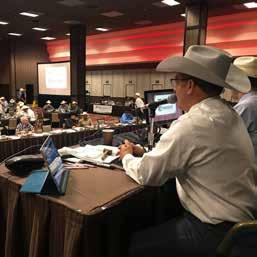
Modoc Auction Yard sees change in leadership
Parnell elected president of California-based video company
in on


May/June 2024 California Cattleman 7 SPECIAL FEATURES FRESH PERSPECTIVE SAME QUALITY SERVICE
WVM RESTRUCTURES FOR BENEFIT
BEEF PRODUCERS
OF
TRACEABILITY CHALLENGES Weighing
new rules RODENTS ON THE RANGE Havoc wreaking from rodents on your ranch 20 26 ON THE COVER This marketing issue comes as cattle are being sent off the grass to auction venues across the state with many being offered at a video sale near you. This issues cover was taken by R.B. Glover. AUCTION MARKET DIRECTORY BUYERS’ GUIDE RANCH FAMILY ROUNDUP Obituaries and new arrivals ADVERTISING INDEX 34 55 READER SERVICES 58 24 20 24 38 50
CATTLEMEN’S COLUMN
ANNUAL MEETING PRESENTS EDUCATIONAL OPPORTUNITIES FOR ROBUST CATTLE FEEDER COMMUNITY
by CCA Feeder Chair Joe Dan Cameron
Every May producers in all sectors of the beef supply chain from cow-calf, calf ranch, feeding and packing sectors from all over California come to San Diego to participate in our annual California Feeder Meeting. I have been attending this meeting now annually for 12 years and am the second generation in my family to be the chair of the Feeder Council following the footsteps of my dad Paul Cameron, Brawley. One of my favorite parts of the Feeder Meeting is the camaraderie experienced with fellow producers and allied industry from all over the state. Many of the attendees I might only run into once per year here at the meeting and it’s always good to be able to catch up with what is happening in their area of the state and what sector of the industry they are in. With the rich history of cattle production in California I believe it is important that all of us from our different sectors of the industry continue to work together towards a common goal of preserving the viability of our industry in this state.
While cattle production in California can feel like a daunting task when attacks are coming in from activists’ groups and ill-informed politicians it’s good to know we have the hardworking staff and board members of CCA fighting for us to help preserve our livelihoods and way of life. Producers in all sectors of the industry face daily challenges from high input costs, high interest rates, water issues, market volatility, weather risks and the overall cost of doing business in California it makes me feel good to know the California Cattlemen’s Association is behind us. Whether it’s fighting against state proposals to mandate feeding of methane reducing feed additives or defeating AB 2674, there are new county and statewide legislation being proposed all the time to keep CCA staff and officers busy.
I get asked all the time from people I do business with all over the country why we stay in California with all the hurdles we deal with that aren’t as prevalent in other cattle feeding states. My answer to those people is that it’s home, some of the best people in the cattle business are here, the
great feeding climate, large cattle supply and proximity to packers. The camaraderie I have with the people here in California who I do business with plays a huge part.
The Feeder Meeting this year will be held May 22 and May 23 at the San Diego Hilton Bayfront. We will start off Wednesday afternoon with our annual business meeting where we will discuss and develop policy needed on issues pertaining to the feeding sector in California. This is usually the one time per year when most of the feeders from the state can get together in person to discuss these important matters that affect us.

Thursday we will start with presentations from: Ethan Lane, from NCBA with a D.C. update of what NCBA is doing for producers. Patrick Linnell from CattleFax will give a cattle and beef market outlook. Katie Cook from Elanco Animal Health on ensuring environmental sustainability is grounded in farm profitability. Spencer Prosser with MP Agrilytics will be giving his outlook on the cattle and beef markets. Sarah Klopateck , Ph.D., on beef sustainability; reality, challenges, and systematic tradeoffs. Finally, we will conclude with a presentation from retired Navy Seal Commander Tom DeJarnette of the STEPS Foundation giving his take on team building and trust within our operations. You will not want to miss this great lineup of presenters.
While the Feeder Meeting is geared towards the feeding sector, I highly encourage producers from all facets of the industry to come down to San Diego to experience the meeting for themselves. With many different sectors of our industry, we all strive for the common goal of producing high quality, safe and nutritious beef. I hope to see many of you there.

8 California Cattleman May/June 2024

Monday, July 15
Monday, August 12

Monday, May 13
Monday, May 27
Monday, June 3
Monday, June 10
Monday, June 17
Monday, June 24

Spring Run is On Western stockman’s market YOUR nhtc approved marketing location THD © DWIGHT MEBANE ....... 661 979-9892 JUSTIN MEBANE ......... 661 979-9894 Western stockman’s market 31911 Highway 46, mcfarland, california 661-399-2981 • www.westernstockmansmarket.com Your Southwest Livestock Market Leader Frank Machado ..... 805 839-8166 Bennet mebane....... 661 201-8169 b famoso
spring AND summer stocker and feeder sales special off the grass feeder sales:
Annual SpeciaL bred cow sales at 12
noon
Young Angus
Bred to High-Powered Angus Bulls and More 59th famoso female & all-breed bull sale Top Bulls & Females: Saturday, October 19 Mark Your Calendar e TAKE ADVANTAGE OF OUR RECORD-HIGH MARKET PRICES ON MONDAYS WITH LARGE RUNS OF STOCKERS AND FEEDERS, PLUS SLAUGHTER COWS AND BULLS May/June 2024 California Cattleman 9
Featuring
Cows


REGISTER ONLINE OR CONTACT THE CCA OFFICE
TENTATIVE MEETING SCHEDULE
The schedule below is tentative and subject to change. For the most up-to-date schedule and event details visit www.calcattlemen.org/events.
TUESDAY, JUNE 25
8:30 am - 2 pm California Rangeland Trust (CRT) Board Meeting
WEDNESDAY, JUNE 26
8 am - 4 pm Registration Open
8 - 9 am A CA Cattlewomen Heritage Foundation, Inc.
8 - 10 am California Cattlemen’s Foundation Board Meeting
10 - 11 am CCA Officer Meeting
12 - 1 pm Allied Industry Council Meeting
12:00 - 1 pm Cattle-PAC
1:30 - 4 pm General Session #1
4 - 5 pm CCW Executive Meeting
4:15 - 5:15 pm Local Presidents’ Meeting
5:30 - 6:45 pm Pre-Rodeo Reception
7:00 pm Reno Rodeo
THURSDAY, JUNE 27
7 - 8 am Christian Fellowship
7 - 8 am CCA Nominating Committee
8 - 10 am General Session #2/Policy Meetings
10:15 - 11:15 am CCA Board Meeting
10:15am-12:15pm CCW Board Meeting
The last day to pre-register is Wednesday, June 19. All registration prices will be increased onsite. No registration refunds will be given after Friday, May 31. Visit ww.calcattlemen.org/events or


10 California Cattleman May/June 2024
the CCA office
(916) 444-0845 to register today.
call
at
CALL THE NUGGET CASINO RESORT AT (800) 648-1177
CCA’s group code GCCAM24 when booking your room.
Mention
REGISTRATION PACKAGES
Full Registration (CCA/CCW MEMBER)

$125
Registrations include access to all meetings and Wednesday evening reception prior to the rodeo. Rodeo tickets are not included with registration and must be purchased separately. In order to purchase a rodeo ticket full registration is required.
Young Cattlemen’s Committee
$75
Registrations include access to all meetings and Wednesday evening reception prior to the rodeo. Rodeo tickets are not included with registration and must be purchased separately. In order to purchase a rodeo ticket full registration is required.
Rodeo Ticket:
*Limited Tickets*
$25
Tickets are LIMITED and will be available on a first-come, firstserved basis. A full registration is required to purchase a rodeo ticket. One rodeo ticket per full registration.
PLEASE NOTE REGISTRATION REFUNDS WILL NOT BE GIVEN AFTER FRIDAY, MAY 31.
Name(s) Attending:
Local affiliation:
Payment Method:
Card #:
Cardholder’s Name:
Cardholder’s Phone:
Billing address:
City/State/Zip:
TOTAL


/
online at https://calcattlemen.org/events or mail form to the CCA office at 3841 N. Freeway Blvd., Suite 130, Sacramento, CA 95834.
May/June 2024 California Cattleman 11
Exp.
# Registrations $ Amount
Check made payable to the California Cattlemen’s Association
Register
BUNKHOUSE
BIDDING FAREWELL PODCAST MASTERMIND OFF ON NEW ADVENTURE
by Ryan Donahue for the California Cattlemen’s Foundation
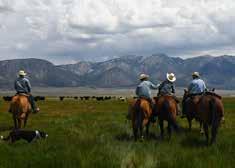
Stories from California Cattle Country was born from an impromptu meeting between CCA Executive Vice President Billy Gatlin and I in an outdoor dining area during the COVID-19 pandemic. I had recently helped a friend open a restaurant and once established, started to feel that I was spinning my wheels. If you were to see my resume you might be puzzled. The one throughline is that I have always worked in communications. I’ve known Billy for a long time, and he asked, “You think you could do a podcast?” I remember thinking, “How hard could it be?” Truth is, it is harder than I thought. This podcast has afforded me the opportunity to see many parts of this state and meet many wonderful people. Over 67 episodes we’ve garnered over 25,000 downloads extolling the people and practices of California cattle country.
If you’re a regular listener, you’ve likely


heard me harp on being a film school graduate. A few weeks ago, I was offered a position programming and managing the historic Crest Theatre in downtown Sacramento. Since graduating college, it has always been a dream of mine to operate an independent cinema. It was an opportunity I couldn’t turn down. I wish to extend thanks to Cattlemen’s membership and staff. I have countless memories of my travels, some recorded and some not.
I wish to thank you all for your hospitality and time.



12 California Cattleman May/June 2024


Poss
Poss


SATURDAY MAY 25 Cattlemen’s Livestock Market Galt, CA | 1:00 pm JOHN DICKINSON 916-806-1919 JAKE PARNELL 916-662-1298 LUKE PARNELL 805-431-1267 info@parnelldickinson.com FOR SALE BOOK TEXT ADDRESS TO: 916-806-1919 WATCH AND BID ONLINE AT: Featuring 65 lots of quality Angus genetics FALL BRED HEIFERS • FALL BRED COWS • SPRING PAIRS • HEIFER CALVES • ELITE PREGNANCIES David J. Holden 38 Montana Ave. • Oroville, CA 95966 (530) 736-0727 • wstwind@hotmail.com www.westwindangus.com WESTWIND RANCH ANGUS Linz Lady Dually B689-9754 [DL Dually x Rampage 0A36] Due 11/13/24 to Crouch Congress (+349 $C) CED BW WW YW Milk CW MA RE $M $B $C 6 0.2 89 153 24 75 .77 .92 71 177 301 Stepaside Blackcap 3094 [GB Fireball 672 x Vintage Blackcap 9186] CED BW WW YW Milk CW MA RE $M $B $C 2 4.1 89 166 19 80 1.49 1.09 30 237 337 Featuring the progeny and Service of: Basin Jameson 1076 Crouch Congress DVAR Huckleberry 871 Hoffman Thedford
Oaks Bold Ruler
Veracious
BA7
HPCA
Deadwood
A R Home Town
Rawhide
Salvation
Craftsman
Breakthrough Stepaside Rita 3088 [DVAR Huckleberry 871 x Vintage Rita 0184] CED BW WW YW Milk CW MA RE $M $B $C 0 3.5 82 145 26 63 1.36 1.01 81 200 340 Hertlein Cattle Co., Farmington, CA Stepaside Farm, Sanger, CA Eagle Grip Cattle Co., Denair, CA Popovits Family Ranch, Valley Springs, CA Grieb Ranch, Arroyo Grande CA Split Creek Ranch, Los Molinos CA Easterly Romanov Ranch, Sheridan, CA Mark & Ida Higgins, Adin CA Diamond B Angus, McDonough, GA SUMMIT BREEDERS
G
SG
Connealy
Beal
CENTRAL VALLEY MEAT ACQUIRES CARGILL’S BEEF PLANT IN FRESNO
Central Valley Meat Holding Co. announced on May 7 plans to acquire Cargill Meat Solutions’ beef processing plant in Fresno. The transaction will allow Central Valley to expand its processing capacity and allow it to meet market demand in the region by providing a processing option to beef and dairy cattle producers there.
The company plans to capitalize on Cargill’s expertise and resources to ensure it is able to adapt and serve customers as demands and expectations evolve. Central Valley said the deal allows it to increase operational efficiency and innovation up and down its supply chain.
Central Valley’s newest facility was purchased by Cargill in 2006, from Beef Packers Inc. According to Cargill’s website, the plant processes approximately 1,600 head per day and employs about 1,000 workers. Current workers at the plant will have the opportunity to continue working after Central Valley assumes ownership.
“Both companies are committed to retaining as many employees as possible and retaining
beef processing capacity,” Central Valley said.
Cargill also operates a ground beef and hamburger patty plant in Fresno, which was part of the deal. According to Central Valley, ‘The ground beef facility was included in the sale and is being leased back to Cargill where it will continue to operate.”
“Our decision to acquire the Cargill Meat Solutions beef processing facility in Fresno, Calif., aligns with our long-term vision of strengthening our offerings to better serve the needs of our customers,” said Brian Coelho, chief executive officer and owner of Central Valley Meat. “We’re excited to work alongside cattle producers in the state and region to continue delivering quality beef products for our customers and consumers.”
In 2019, Central Valley Meat Co. acquired Harris Ranch Beef Co. in Selma. It also operates Central Valley Meat in Hanford, CLW Foods in Los Angeles and Harris Ranch Feeding in Coalinga.


14 California Cattleman May/June 2024
JOIN US TUESDAY JULY 2 12 P.M. RED ANGUS HERD REDUCTION FROM THE HIGHLY REPUTABLE MANGANTE RANCH FEATURING250FANCYFALL-CALVINGREDANGUSFEMALES THESEOUTSTANDINGQUALITYFIRST-CALFHEIFERSANDSECOND-AND THIRD-CALFCOWSTO8-YEAR-OLDSAREEASTSIDEFOOTHILLSEXPOSED ANDAREBREDTOREDANGUSBULLS FORMOREINFORMATIONCONTACT MAXOLVERAAT(209)277-2063

42ndAnnual Showcase Feeder Sales
FEATURING A SPECIAL SECTION OF NHTC-CERTIFIED, ANGUS-SIRED CALVES AS WELL AS A RED ANGUS AND CHAROLAIS SECTION THESE EVENTS WILL INCLUDE SOME OF THE BEST CALVES CALIFORNIA HAS TO OFFER, SO WHETHER YOU ARE ENROLLED IN A SPECIAL PROGRAM OR NOT, THESE SALES ARE FOR YOU!
SPRING SPECIALS
TUESDAYS | MAY 21
DEDICATED TO SHOWCASING CALVES AND YEARLINGS FROM CONSIGNORSWITH 50 HEAD OR LESS AT 9 A.M.
TUESDAYS | JUNE 4 & JUNE 18
TLAY SPRING FEEDER SALES DEDICATED TO SHOWCASING CALVES AND YEARLINGS FROM CONSIGNORS OF 50 HEAD OR LESS SALE DAY IS PAY DAY!


TURLOCK LIVESTOCK AUCTION YARD OFFICE: 209 634-4326 • 209 667-0811 10430 Lander Ave., Turlock, CA P.O. Box 3030, Turlock, CA 95381 www.turlocklivestock.com TLAY REPRESENTATIVES MAX OLVERA 209 277-2063 STEVE FARIA 209 988-7180 JUSTIN RAMOS 209 844-6372 JOHN LUIZ 209 480-5101 JAKE BETTENCOURT 209 262-4019 TRAVIS JOHNSON .......... ......209 996-8645 TIM SISIL .................................. 209 631-6054 JOHN BOURDET ...................... 831 801-2343 CELESTE SETTRINI..................831 320-1527 MATT MILLER........................... 209 914-5116 BRANDON BABA 209 480-1267 BUD COZZI ................................ 209 652-4480 CALL TO CONSIGN CATTLE TO THESE UPCOMING WVM EVENTS! JOIN US IN COTTONWOOD MAY 23 AND JUNE 6 AND IN RENO JULY 8-10! When marketing calves at TLAY, don't forget how essential the 2nd round of shots is. Make sure to include a modified live vaccination! THE CENTRAL CALIFORNIA MARKETING CENTER FOLLOW US ONLINE FOR WEEKLY SALE REPORTS AND NEWS ABOUT UP-TO-THE-MINUTE SALE DATES AT WWW.TURLOCKLIVESTOCK.COM OR ON OUR FACEBOOK PAGE! WATCH LIVE AND BID ON LMAAUCTIONS.COM ALSO SELLING CATTLE FROM THESE CATTLEMEN’S ASSOCIATIONS: MERCED-MARIPOSA, SANTA CLARA, NAPA-SOLANO, MADERA, CALAVERAS TUOLUMNE, FRESNO-KINGS, SAN BENITO
MAY 18
22
& TAHOE SATURDAYS |
• JUNE 8 • JUNE
ALAMEDA
SAN
CONTRA COSTA-
&
JOAQUIN-STANISLAUS CATTLEMEN’S
May/June 2024 California Cattleman 15
YOUR DUES DOLLARS AT WORK
CHECKING IN ON THE CAPITOL MID-WAY THROUGH THE LEGISLATIVE YEAR
by CCA Vice President of Government Affairs Kirk Wilbur
April is among the busiest months in Sacramento’s legislative calendar. The end of the month is the deadline for any bill must advance out of policy committees in its chamber of origin to remain viable. That deadline represents the first full opportunity to fully consider legislative proposals, and with 2,136 bills introduced this year, legislators and advocates had their work cut out for them.
The end of April also happens to be roughly the half-way point in the 2024 legislative year, which kicked off on Jan. 3 and is scheduled to conclude at the end of August.
With the first-house policy deadline now in the rear-view mirror, CCA’s legislative priorities for 2024 have become clear. Whereas last year saw three major proposals to undermine California’s water rights priority system and a major threat against animal agriculture from radical animal rights groups, the second year of the 2023-24 Legislative Session has seen fewer red flags for California’s cattlemen. That is a sign that CCA’s ongoing advocacy in the Capitol (and the educational efforts of the California Cattlemen’s Foundation) is paying dividends.
The lack of major legislative threats has allowed CCA staff to focus greater attention this year on advocating for ranchers’ fiscal priorities in the Fiscal Year 2024-25 Budget, including seeking renewed funding for the Wolf-Livestock Compensation Program and safeguarding investments in wildfire resilience. Governor Newsom will release the “May Revise” of his proposed budget in mid-May, and Legislators must finalize the budget by June 15. CCA will provide a breakdown of the 2024-25 Budget in a future issue of California Cattleman.
In the meantime, this article overviews CCA’s legislative priorities for 2024 and where those bills stood at the half-way point of the year.
AB 1963 (Friedman) – Pesticides: paraquat dichloride prohibition
CCA-OPPOSED
Status: Referred to Assembly Appropriations Committee
Prior Action: Passed Assembly Environmental Safety & Toxic Materials Committee 5-2 (4/23)
Paraquat dichloride is a pesticide commonly used in California agriculture, including in the production of alfalfa. Alleging links to certain cancers and Parkinson’s Disease, AB 1963 would prohibit the use of paraquat dichloride in California until the Department of Pesticide Regulation (DPR) completes an evaluation of the pesticide and either cancels its registration or “places appropriate restrictions on the use of the active ingredient paraquat dichloride to mitigate any potential significant adverse effects.” Rather than a legislative ban on the pesticide, CCA believes that paraquat dichloride’s use should not be prohibited unless and until the science-based analyses by DPR and the U.S. Environmental Protection Agency determine that use of the product poses an unreasonable risk.
AB 2079 (Bennett) – Groundwater extraction: large-diameter, high-capacity wells: permits
CCA-OPPOSED
Status: Referred to Assembly Appropriations Committee

16 California Cattleman May/June 2024
Prior Action: Passed Assembly Water, Parks & Wildlife Committee 10-3 (4/23)
Within groundwater basins identified as critically overdrafted, this bill would require a local agency to provide 30 days’ notice to the public, local Groundwater Sustainability Agencies and nearby landowners prior to approving any new “large-diameter, high-capacity well,” defined as any well with a diameter greater than eight inches and which will produce more than two acre-feet of water annually. The bill would also require the local agency to deny a well permit for any “largediameter, high-capacity well” proposed within a quarter-mile of a domestic well or if it is within a quarter-mile of an area that has subsided half a foot or more since Jan. 1, 2015. AB 2079 is similar to Asm. Bennett’s failed AB 2201 (2022) and AB 1563 (2023), both of which CCA previously opposed.
AB 2149 (Connolly) – Gates: standards: inspection CCA-OPPOSED
Status: Referred to Assembly Appropriations Committee
Prior Action: Passed Assembly Judiciary Committee 10-1 (4/16)
AB 2149 is a response to a tragic 2019 incident in which a 7-year-old boy was killed by a 300-pound gate that came off its tracks at his private elementary school. The bill would require all “residential, commercial, or industrial” gates weighing more than 50 pounds and which are either wider than 48 inches or taller than 84 inches to be inspected by 2026 and every five years thereafter. This broad application would encompass most farm and ranch gates which are not accessible to the public, burdening ranchers with significant inspections and increasing their operating expenses. As most gate accidents have occurred at schools or residential buildings, CCA is seeking to narrow the bill’s scope to exclude agricultural operations.
AB 2200 (Kalra) – Guaranteed Health Care for All
CCA-OPPOSED
Status: Referred to Assembly Appropriations Committee
Prior Action: Passed Assembly Health Committee 9-4 (4/23)
AB 2200 would create the California Guaranteed Health Case for All Program, or “CalCare,” to provide comprehensive universal single-payer health care coverage and a healthcare cost-control system for the benefit of all residents of the state. It has been estimated that the program would cost the state in excess of $400 billion, nearly doubling the size of California’s budget and necessitating hefty tax increases on California employers and workers.
AB 2330 (Holden) – Endangered species: incidental take: wildfire preparedness activities
CCA-SUPPORTED
Status: Referred to Assembly Appropriations Committee
Prior Action: Passed Assembly Water, Parks & Wildlife Comm. 13-0 (4/23)
AB 2330 seeks to streamline wildfire resilience activities, particularly near urbanized areas, by facilitating communication and cooperation between local governments and the California Department of Fish and Wildlife. Specifically, the bill authorizes local governments to submit to CDFW a voluntary program for conducting wildfire preparedness activities in a fire hazard severity zone aimed at minimizing impacts to threatened and endangered wildlife. The bill would give CDFW 90 days to advise a local government whether an incidental take permit is needed for the activities or whether “there are other considerations, exemptions, or streamlined pathways that the wildfire preparedness activities qualify for.”
AB 2436 (Alanis) – Cattle inspection fees
CCA-SUPPORTED
Status: Referred to Assembly Appropriations Committee suspense file (4/24)
Prior Action: Passed Assembly Agriculture Committee 9-0 (4/10)
The Bureau of Livestock Identification is funded solely by brand registrations and inspection fees, and revenue from these fees must be sufficient for the Bureau to remain revenue neutral.
Unfortunately, cost pressures including wage increases for brand inspectors and a mandate to transition to zero-emissions vehicles have increased the Bureau’s expenses, requiring an adjustment to fees. To address this, AB 2436 would adjust statutory fees payable to the Bureau for brand inspections. Importantly, this bill does not increase actual inspection fees, but rather aligns the statutory fees with the fees implemented by Secretary Ross on Jan. 1 based on the unanimous recommendation of Bureau’s producer-driven Advisory Board.
AB 2552 (Friedman) – Pesticides: anticoagulant rodenticides.
CCA-OPPOSED
Status: Referred to Assembly Appropriations Committee
Prior Action: Passed Asm. Enviro. Safety & Toxic Mats. Comm. 4-2 (4/9); passed Asm. Water, Parks & Wildlife Comm. 8-4 (4/16); passed Asm. Judiciary Comm. 9-4 (4/23)
With limited exceptions, existing law prohibits the use of second-generation anticoagulants and ...CONTINUED ON PAGE 18
May/June 2024 California Cattleman 17
...CONTINUED FROM PAGE 17
the first-generation anticoagulant diphacinone in wildlife habitat areas. AB 2552 would add two other first-generation anticoagulants, warfarin and chlorophacinone, to this existing prohibition. Additionally, the bill would expand the prohibition on use of first- and second-generation anticoagulant rodenticides to any area within 2,500 feet – or just under half a mile – of a wildlife habitat area. Because the bill disregards the Department of Pesticide Regulation’s scientific process for approving or restricting rodenticides and unreasonably restricts the use of such rodenticides to the detriment of agricultural production and food safety, CCA opposes the measure.
AB 2722 (Friedman) – California Endangered Species Act: wolverines LETTER OF CONCERN
Status: Referred to Assembly Appropriations Committee suspense file (4/17)
History: Passed Assembly Water, Parks & Wildlife Committee 11-3 (4/9)
California law designates the wolverine as a fully protected species. Legislation passed last year (AB 147, Ashby) requires the California Department of Fish and Wildlife to assess the population status of all fully protected species. When CDFW assesses the population status of wolverines as required by that legislation, AB 2722 would additionally require the Department to “assess the feasibility of a population reintroduction or supplementation program with the goal of restoring a viable population of wolverines to the state.” CCA has expressed significant concerns about the state considering reintroduction of another predator species at a time when CDFW has insufficient resources to effectively manage the state’s existing predator populations.
AB 2761 (Hart) – Reducing Toxics in Packaging Act.
NEUTRAL
Status: Referred to Assembly Appropriations Committee
Prior Action: Passed Asm. Enviro. Safety & Toxic Mats. Comm. 5-2 (4/9); passed Asm. Judiciary Comm. 8-3 (4/16)
AB 2761 seeks to ban per- and polyfluoroalkyl substances (PFAS, also known as “forever chemicals”) and polyvinyl chloride (PVC) from plastics packaging used in California. These chemicals are sometimes used in meat packaging (for instance, thin PVC films are often used to cover meat trays) and are heavily regulated and authorized by the U.S. Food and Drug Administration. CCA secured amendments
to AB 2761 exempting from its ban plastic packaging regulated by FDA and USDA, allowing CCA to remain neutral on the bill.
AB 2827 (Reyes) – Invasive species: prevention. CCA-SUPPORTED
Status: Referred to Assembly Appropriations Committee
Prior Action: Passed Asm. Agriculture Comm. 10-0 (4/10); passed Asm. Enviro. Safety & Toxic Mats. Comm. 7-0 (4/23)
AB 2827 declares it “a primary goal of the state to prevent the introduction, and suppress the spread, of invasive species within its borders” and directs state agencies to implement strategies to detect and irradicate invasive species “to protect the state’s agriculture, environment, and natural resources.”
AB 2870 (Muratsuchi) – LCFS regulations: avoided methane emissions from livestock manure: prohibition
CCA-OPPOSED
Status: Held in Assembly Agriculture Committee
Prior Action: Passed the Assembly Natural Resources Committee 7-3 (4/22)
The California Air Resources Board’s LowCarbon Fuel Standard regulation attributes carbon intensity values to a variety of fuels based on direct and indirect greenhouse gas emissions. AB 2870 would have prohibited CARB from incorporating “avoided methane emissions” – methane emissions captured via livestock manure management such a dairy digesters – in its calculation of carbon intensity for fuels derived from livestock manure management. While the author argued that “California should not be incentivizing the production of methane,” the bill would have disincentivized manure management practices that CARB has recognized as vital to meeting the state’s near-term climate goals. AB 2870 was held in the Assembly Agriculture Committee without a hearing and will not advance this Legislative Session.
AB 2900 (Soria) – Small agricultural truck fleet assistance program
CCA-SUPPORTED
Status: Referred to Assembly Appropriations Committee
Prior Action: Passed the Assembly Transportation Committee 15-0 (4/15)
According to the author, “recent years have seen an increasing number of [California Air Resources Board] regulations applied to agricultural trucks that growers have struggled to comply with,” including the Truck and Bus Regulation and the Advanced Clean Fleets Regulation. This bill would establish within CARB the Small Agricultural Truck Fleet Assistance
18 California Cattleman May/June 2024
Program to provide technical assistance and financial aid to owner-operators of small agricultural truck fleets. Unfortunately, the program would not go into effect until such time as the Legislature appropriates funds for it. While that is unlikely in the FY 2024-25 Budget, establishing the Program in statute could result in needed assistance to agricultural producers in better budget years.
SB 945 (Alvarado-Gil) – The Wildfire Smoke and Health Outcomes Data Act
CCA-SUPPORTED
Status: Referred to Senate Appropriations Committee suspense file (4/29)
Prior Action: Passed Sen. Health Comm. 11-0 (3/20); passed Sen. Enviro. Qual. Comm. 7-0 (4/17)
This bill would direct various state agencies to establish a data platform which integrates wildfire smoke and health data to provide “adequate information to understand the negative health impacts on California’s population caused by wildfire smoke” and to evaluate “the effectiveness of investments in forest health and wildfire mitigation on health outcomes in California.” Such a platform could help assess the health benefits of
Cattlemans Assoc.qxp_Layout 1 6/9/23 12:36 PM Page 1
HDPE for Ranch Water Systems

· Durable, efficient alternative to PVC
· We have installed miles of HDPE and can visit with you about your projects
· We offer a full line of fusible HDPE pipe up to 6" in continuous reels and up to 48" in sticks plus all the fittings
wildfire-prevention strategies such as prescribed fire and livestock grazing that prevent or reduce noxious smoke from wildfire.
SB 1101 (Limón) – Fire prevention: prescribed fire: state contracts: maps
CCA-SUPPORTED
Status: Referred to the Senate Appropriations Committee
Prior Action: Passed Sen. Nat. Res. & Water Comm. 11-0 (4/9); passed Sen. Gov. Org. Comm. 16-0 (4/23)
When wildfires strike, CAL FIRE has emergency authority to expedite contracting and logistical response efforts. For prescribed fires, though, CAL FIRE is subject to bureaucratic red tape that can prevent the agency from taking advantage of favorable burn windows. SB 1101 would streamline contracting and procurement requirements for CAL FIRE’s prescribed fire efforts, akin to the authority the agency currently has to respond to wildfires. The bill would also improve wildfire response and prescribed fire planning by directing CAL FIRE to work with local, state, federal and tribal agencies to map networks of potential fire boundaries.


May/June 2024 California Cattleman 19 Specializing in Truck and Livestock Scales Established in 1959, Scales NW offers a wide range of equipment, from precision lab balances to high capacity rail scales, as well as certified scale service and installation. Contact Steve Orr for more information today! Email: steveorr@scalesnw.com Phone: (503) 510-3540 www.scalesnw.com • (800) 451-0187 Scales NW is proud to serve: California Idaho Montana Nevada Oregon Utah Washington AD_POWELL_LivestockTruckScale.indd 1 1/11/2018 1:35:26 PM
Fair
Service Rancher Owned
Prices Good
DELIVERY THROUGHOUT THE WEST CALL TODAY: 925-204-2424

CARRYING ON
NORTHERN CALIFORNIA AUCTION MARKET CONTINUES TIME-HONORED TRADITION OF OUTSTANDING SERVICE FOR BUYERS AND SELLERS
by CCA Associate Director of Communications Maureen LaGrande
Auction yards play a crucial role in the cycle of livestock production. When producers have animals that need to be sold or are in the market to expand their herd, they head to the sale. While there are various yards located throughout California, transporting animals can be costly depending on the distance traveled to get there and the toll it takes on the animals after traveling such a long distance. For producers who live in the more rural parts of California, having access to a nearby auction yard is critical to the success of their operation.
In the Northeastern part of the state, on the outskirts of Alturas in Modoc County, the Modoc Auction Yard has been in operation since the late 1940s bringing in livestock from Oregon, Nevada and California. The yard was built and run by Fritz Nosler up until the mid to late ‘70s. From the late ‘70s to the early ‘90s the timeline of who owned and operated the yard is a bit vague and during this span the yard was not always in operation. In 1996 Col. Jerry Kresge and Carmen Kresge, Alturas, purchased the Modoc Auction Yard and ran it up until 2023 when they sold it to the current owners, Reed and Amie Martinez
Growing up, Kresge remembers going to the sale as a five-year-old alongside his father and grandfather to purchase cattle. “Sitting there at the sale, made me want to become an auctioneer,” said Kresge. As a young adult,
Kresge would return to the yard to not only purchase cattle but auctioneer some of the sales. After spending two years auctioneering, the opportunity to purchase the yard came about. Following his dream, alongside his wife the Kresge’s became the new owners. As new auction yard operators, the Kresge’s received an abundance of knowledge and advice from Orland Livestock Auction Yard Owner Ed Lacque, Orland. “Ed was a big help when we were first getting started, he was a very kind mentor and helped us get on our feet,” said Kresge.
At the time of the Kresge’s purchase, the yard was about 50 years old and had been built completely of wood. Little by little the pair put in a new watering system, and replaced the pens, and gates with steel pipe and guard rail. After five years of renovations and the addition of a new set of scales, the yard was brand new again. Despite all the maintenance, changes and work that took place over those years, the yard never once closed and continually hosted its sales on Saturdays.
Operating the yard for 26 years both Jerry and Carmen met many people from different facets of the industry. “The friends and the people that we were able to make during this time was huge,” said Kresge. Doing all the jobs imaginable, Kresge would even hire auctioneers so that he could help sort and push cattle up and Carmen would do the same. “There is no position that my wife could not
20 California Cattleman May/June 2024
do besides auctioneer. She was in the office and the back in rubber boots the same as any man,” said Kresge. With Carmen in charge of running the office, she added in a computer system and knew the system inside and out.
Martinez is a Modoc County native who was born and raised in Alturas on his family’s cattle ranch. Growing up on a working cattle ranch exposed him to the ins and outs of the beef industry. Aside from working with his family, he also worked at the Modoc Auction Yard under Kresge. Martinez would pull gates coming up into the ring, bring cattle up on horseback and work in the back helping to sort the animals.
Being mainly homeschooled, Martinez had the opportunity to partake in additional education outside of the classroom, including helping to run a purebred Angus operation and starting colts at the young age of 14. As a young adult Martinez spent a few years away cowboying out on other ranches in Nevada and made his way back home in 2006, to work on the family ranch.
The auction yard fell under Reed and Amie’s ownership on Feb. 1, 2023 and they have been full steam ahead ever since. With a year under his belt Martinez shared, “My first year has been great, the support is humbling.” Leading up to the Martinezes’ initial purchase, Reed worked at the yard over the last few years and had talked with Kresge about their eventual purchase. Martinez’s wife, Amie plays an equal and large role in the operation’s success. She is hands-on in every capacity, whether that be with livestock in the back, running the operation in the front, or being constantly present to jump in wherever needed. “If I am not at the yard, she is,” said Martinez. The running of the auction yard is a family affair, with Martinez’s children, oldest son Lige, daughter Olivia and youngest Elliot all there helping to make sure things run smoothly.
An auction yard is like a welloiled machine, there are processes and steps that must be taken to ensure things run smoothly. To do this, Martinez and his family have a working system. Aside from jumping in wherever she is needed, Amie runs the office serving as the bookkeeper and managing any sale day transactions. Alongside her is their daughter Olivia helping out. “My oldest son is doing what I did as a child, he’s keeping things running,” added Martinez. For their youngest, he serves as a smiling face around the
stands as the sale goes on. “I couldn’t do it without them,” said Martinez.
While Kresge may no longer own the auction yard, he and his wife Carmen are still active in helping out. Kresge serves as an auctioneer from time to time and Carmen helps out in the office. On sale days there are about 15 people working. This includes the help in the back, office staff, and the auctioneer. Maintaining and running an auction yard is no easy task, but having a business that provides jobs to its residents in a rural area is a necessity. “We’re invested in the community, and we want the money to stay in the community, it keeps our local economy vibrant.” Said Martinez. Seeing the impact it has on the area, Martinez is eager to take on the business side of things,
...CONTINUED ON PAGE 22


May/June 2024 California Cattleman 21
Jerry and Carmen Kresge and Amie and Reed Martinez.
Col. Jerry Kresge and Reed Martinez at the auction block on sale day.
© Ashlea Lloyd
© Ashlea Lloyd
...CONTINUED FROM PAGE 21
continue pushing forward, and expand the yard’s resources.
Challenges of running an auction yard consist of meeting and following the state’s rules and regulations along with labor. Despite these challenges, “We are lucky to have a really great crew of people to rely on and help us run the yard,” said Martinez.
Sales offered are commonly beef cattle and bred stock. Special feeder, butcher cow and bred cow sales are also hosted at various times throughout the year or dependent upon what is consigned to the yard. While still adjusting to a sale schedule and continuous changes being made as the yard grows current sales from February to Aug. 1 will be on the first and third Saturdays of the month. From September to January sales will be every Saturday. Aside from the change of sale days, the yard runs like any other. Martinez shared that he continually pushes to get new business and keep the yard thriving, adding that the “cattle market is as good as anywhere.” One of the best ways to learn of upcoming sales and previous sale numbers is by visiting the Modoc Auction Yard’s social media channels on Instagram and Facebook or by calling the office.
Fellow rancher, Steve Lambert, Oroville, has taken livestock to Modoc Auction Yard for the last 10 years and has seen both Kresge and Martinez
run the yard and applauded Kresge for the time he spent operating the yard. Lambert shared that Martinez has continued to do a great job in his first year running Modoc Auction Yard and has worked with cattlemen during events such as the local bull sale. Lambert was able to put his bulls in the yard’s back pens so that buyers attending the sale could easily access the animals for a preview. “It’s nice to see people trying to go the extra mile and make it happen,” said Lambert.
Martinez enjoys being busy and shared that the day-to-day operations of running an auction yard keep him moving and that there is always something to be done. “Reed is always at the auction yard, greeting people and is around to make sure everyone is doing good,“ said Lambert. Even on the days when there are no sales, Martinez can be found at the yard working on projects, feeding, watering and shipping livestock. Aside from the yard maintenance, office work and care for the animals. “I enjoy the work that’s involved, it’s a blessing for the community,” said Martinez.
While the yard has a clientele that consigns and purchases livestock, Martinez is taking the extra step by making phone calls and visiting various ranches in the county and surrounding areas to chat with current and potential customers, adding that he prefers face-to-face conversations.
Both Martinez and Kresge shared how producers have recognized and thanked them for keeping the yard up and running for those who need a place to take their livestock to sell. Remarks such as this are humbling for Martinez and Kresge. Longtime Modoc County resident and rancher, Myles Flournoy, Likely, emphasized how important having an auction yard available to local ranchers is. Kresge recalled that during his time running the yard, local producers would share with him how they remembered the times in the ‘80s when the yard wasn’t in operation, but now that it was in business, that they would support it.

Even under new ownership, the auction yard is still run the same, just with a bit of a new regime. Martinez is working diligently with his family’s help and support from the community to provide the best services to new, past and future consignors and to keep the yard alive for future generations. To producers looking for a place to sell their animals or those in Modoc and the surrounding areas, Modoc Auction Yard’s gates are open and “We are here,” said Martinez.
22 California Cattleman May/June 2024
© Ashlea Lloyd


California Cattleman 23 Sonoma-Marin • Lake • Mendocino County Cattlemen SUMMER FEEDE R SALES Join Us in Petaluma, California PETALUMA LIVESTOCK AUCTION YARD, INC. Saturdays JUNE 15 • JUNE 29 • JULY 20 Inaugural FALL BRED COW & PAIR SALE ALSO SELLING 15 PUREBRED ANGUS BULLS Saturday AUGUST 24 Humboldt Livestock Auction Yard Turlock Livestock Auction Yard Cattlemen’s Livestock Market in partnership with THD © Leland Mora 707-845-7188 Max Olvera 209-277-2063 Jake Parnell 916-662-1298 PRE-REGISTRATION IS REQUIRED No Consignments Will Be Accepted on Sales Days Now Accepting Consignments Justin Mora 707-845-7388
WESTERN VIDEO MARKET REORGANIZES TO BETTER SERVE THE LIVESTOCK INDUSTRY
The shareholders of Western Video Market, Inc. (WVM) have recently made the decision to restructure the company to ensure its longevity and cement the company’s role as the marketing outlet of choice for livestock producers. This change has been a long time in the making, but both the previous and new shareholders felt the time was right to make this transition.
“Everyone involved in this change has been a key part of the company—some from the very beginning—and some in more recent years,” said Col. John Rodgers, Visalia, Co-founder of WVM. “All of the participants share the goal of providing the same personal customer service to our consignors and buyers that is the trademark of who Western Video Market always has been, and will continue to be.”
The new ownership group includes members who have been part of Western Video Market since its beginning in 1989, including founders Ellington Peek, Cottonwood, and Rodgers. As part of this restructure, Ellington Peek has been named Chairman Emeritus in recognition of his significant contributions to livestock marketing and the formation of Western Video Market.
Ellington, along with his son Andy, who passed away in 2008 after a battle with pancreatic cancer, and John Rodgers, formed Western Video Market to help their auction market consignors reach a national buyer base. The company grew with the support of an affiliation of auction markets and reps throughout the country to become the second largest livestock video marketing company in the nation.
The emphasis on providing the best service possible to customers helped drive the decision to reorganize Western Video Market. Part of the goal is to involve the next generation of livestock marketers who have contributed to the company.
“This is an exciting time for WVM as we create a succession plan for the next generation,” said Col. Rick Machado, lead auctioneer for WVM. “It means that our customers can be assured that the company and people they know and trust will be right there alongside them marketing their cattle with the same personal attention they have always received.”
Callie Peek Wood, also announced her retirement as Controller of Western Video Market, after serving the company in that role since its


founding. Michelle Birt, long-time accountant for WVM has been named as her successor, and Holly Foster, Oroville, will continue as WVM Operations Manager.
“We are indebted to the groundwork that has been laid by the founders and core participants of WVM,” said Col. Jake Parnell, Sacramento, President and Chairman of the Board. “2024 marks the 35th year that Western Video Market has been in business. The founders, staff and reps that created WVM were innovators in their time. We’re excited to have a group that is committed to bringing new ideas and seeing the company continue to grow. Our goal is to offer our consignors a marquee platform to sell their product and serve our buyers to the very best of our ability.”
Western Video Market Owners
Ellington Peek, Co-founder
John Rodgers,* Co-founder Rick Machado*
Brad Peek*
Donald Doverspike*
Holly Foster*
Justin Niesen*
Matt Norene
JC Niesen
Todd Muller
Laurie Peek Norene
Betty Peek
Cattlemen’s Livestock Market (Jake Parnell*)
Turlock Livestock Auction Yard (Max Olvera*)
Ogallala Livestock Auction Market (Jay Nordhausen and Lance Van Winkle)
Crawford Livestock Market (Alicia HunterRobertson and Rich Robertson*) *WVM Board Members.
24 California Cattleman May/June 2024
NCBA CONCLUDES SUCCESSFUL LEGISLATIVE CONFERENCE IN D.C.
On April 19, the National Cattlemen’s Beef Association (NCBA) concluded a successful Legislative Conference in Washington, D.C. The three-day event brought cattle producers from across the country to Washington to meet with federal agencies and elected members of Congress.
“This Legislative Conference was a great opportunity to meet with our representatives in Congress and discuss issues with agencies like USDA, EPA, and the Fish and Wildlife Service,” said NCBA President Mark Eisele. “I am thankful for the work that NCBA’s team does every day in Washington, and meetings like this are so valuable for showing policymakers how the decisions they make here in Washington impact our farms and ranches thousands of miles away.”
This year, more than 300 producers participated in 170 meetings on Capitol Hill. Attendees also met with officials from the Animal and Plant Health Inspection Service, Natural Resources Conservation Service, Environmental Protection Agency, Food Safety and Inspection Service, Fish and Wildlife Service, and Farm Service Agency. U.S. Customs and Border Protection also shared valuable updates on the inspections that occur at ports of entry to prevent diseases and pests from entering the United States.
“The Legislative Conference is a testament to NCBA’s grassroots leadership and role as a memberdriven organization,” said Idaho rancher and NCBA Policy Division Chair Kim Brackett. “Unlike activistled groups that are little more than a fundraising website and a lobbyist, NCBA represents real farming and ranching families across the country. We showed that to members of Congress and agency staff, and delivered the message that policymakers need to listen to real cattle producers when making decisions that impact our livelihood. I have seen firsthand how NCBA’s work in Washington benefits our industry.”
During the event, NCBA members discussed their priorities for the next Farm Bill, including the need for animal health, disaster relief, risk management and voluntary conservation programs. Producers also urged policymakers to reduce red tape on farms and ranches by reeling in overreaching regulations from federal agencies. Additionally, members discussed the need to protect the cattle industry from the threat of a foreign animal disease and defend the Beef Checkoff from animal rights activist attacks.
SHOULD YOU ORDER THE ANAPLASMOSIS VACCINE?
Anaplasmosis is an infectious parasitic disease in cattle, spread primarily by ticks and blood sucking insects like mosquitoes. The killed anaplasmosis vaccine protects cows and bulls of any age from infection and requires a booster given 4 to 6 weeks after the initial vaccination. Find out below if you should order the vaccine!
Do you own cattle?

You don’t need it, but should still support the California Cattlemen’s Association
Do they graze in areas where Anaplasmosis is a problem?
Do you want to prevent the effects of the disease including severe anemia, weakness, fever lack of appetite, depression, constipation, decreased milk production, jaundice, abortion and possibly death?

You don’t need to


May/June 2024 California Cattleman 25
YES NO
YES
ORDER TODAY BY CALLING (916) 444-0845! Available in 10 or 50 dose bottles 10 dose bottles: $8.50 per dose 50 dose bottles: $7.50 per dose *10 dose minimum and $10 flat rate shipping SOLD ONLY TO CALIFORNIA CATTLEMEN’S ASSOCIATION MEMBERS NO (Consult your local veterinarian to find out) NO YES

ALL EYES ON TRACEABILITY
by Callahan Grund, executive director, U.S. CattleTrace
In recent months, there has been a lot of discussion surrounding EIDs, traceability and identification. From cattle industry associations’ policy positions to amendments of current federal rules and federal funding discussions, there seems to be as much confusion as ever as to what the heck is going on with animal identification and traceability. I for one know that it is incredibly hard to keep up with all of the different topics that have occurred and it’s my full-time job! However, as a fellow cattle producer, I hope that this article will help boil all of the hoopla down into some real “cowboy talk” to help you understand where things currently stand.
To start in somewhat of a chronological order, we have to go way back to 2013 when the USDA implemented a traceability rule for cattle moving between states or as you’ve likely read it, interstate movement of cattle. The cattle covered under this traceability rule are sexually intact breeding beef cattle over the age of 18 months, dairy cattle and any cattle used for rodeo, shows, exhibitions or recreational events. All of these cattle must have an official form of ID and be accompanied with a certificate of veterinary inspection (CVI) or “vet papers” as some loosely use in slang cattle terms.
Since the rule went into effect in 2013, the official forms of ID have included- the orange, metal Bangs tags or the “840” EID tags. Cattle moving direct to slaughter across state lines (most of the time- cull cows or bulls) may have a USDA approved backtag in place of an official ID. This rule has never included feeder cattle or
sexually intact breeding cattle under 18 monthsof-age.
The reason I have started here is that this rule has been in place for over 11 years. The headlines you may have recently read about are regarding an AMENDMENT to this already existing rule. On April 26, USDA Animal and Plant Health Inspection Service (APHIS) made an announcement with their final amendment to the rule, with the most significant being a transition of official IDs to be visually and electronically readable for those classes of cattle that are already covered under the traceability rule.
With all of that backstory, I’ll boil it down to our “cowboy talk.” For sexually intact, breeding beef cattle over the age of 18 months, dairy cattle, and any cattle used for rodeo, shows, exhibitions or recreational events, they will need an official form of ID that is both visually and electronically readable and accompanied with a CVI to cross state lines. Today, the most prominent form of ID that fits this need are “840” EID tags. I have seen some discussion occurring amongst the industry that this is a “new” mandatory tagging requirement that the government is imposing upon us. However, the only “new” requirement happening here is a transition in the FORM of ID that is used for an already existing rule.
Now that we’ve gotten a clearer understanding of the new USDA amendment to their existing traceability rule, let’s look at the Consolidated Appropriations Act 2024 that was passed in March.
26 California Cattleman May/June 2024
Within the Consolidated Appropriations Act 2024, there is detailed funding for agriculture with $1.162 billion for USDA APHIS. As part of this funding, there was $15 million included for electronic identification and related infrastructure for cattle and bison to improve animal disease traceability. This funding is intended for producers to utilize as a part of the transition to visual and electronically readable tags in the amendment that APHIS recently announced. Plain and simple, these dollars are intended to help us producers financially as we have to transition the form of ID we use for interstate movement of cattle.
I know that there have been a lot of opinions and political beliefs over this topic in the past month. However, I wrote this article to provide facts and hopefully a clearer understanding of the situation as it relates to the new amendment to the existing animal disease traceability rule. If I were to summarize this entire article into one statement, it would be: if you have already been tagging any of the cattle covered under the rule with the orange metal clip tags, all you have to do is transition to an electronic and visual ear tag. With all of that said, I would be remise if I didn’t include a shameless plug for the producerled organization, U.S. CattleTrace. Animal disease

traceability has certainly been a hotly contested and debated topic over the last 20 years. This organization was formed by cattlemen to have the very conversations we are having today. Producers who want to help find real solutions to building a voluntary, speed of commerce animal disease traceability system for the U.S. cattle industry. The intent behind U.S. CattleTrace is to help build a system that works for all producers and operates in the background of the industry and can be utilized by animal health officials only in the case of a disease outbreak.
Do we have all of the answers yet? No. Do we have a perfect solution yet? No. However, it is my belief that the U.S. beef producers are the people best suited to build this system. Too many times, rather than being proactive in the beef cattle industry, we are reactive when situations arise. We need you. We need your voice to be heard in building this system. If you feel called to come to the table with solutions to this problem, please go to our website to see how you can join U.S. CattleTrace.
Let’s unite as U.S. beef cattle producers to be proactive this time and take these steps in protecting the industry that we all love.

May/June 2024 California Cattleman 27 feeder specials JASON GLENN • (805) 550-9893 DUSTIN BURKHART • (661) 378-3504 BEN RENTERIA • (805) 674-1505 JIM SILL • (661)340-6848 SAM AVILA • (559) 554-4499 10565 9TH AVE., HANFORD, CA 93230 • WWW.OVERLANDSTOCKYARD.COM • OFFICE (559) 582-0404 Monday 4 p.m. PACKER COWS AND BULLS Monday & Thursday 11:00 a.m. FEEDERS IN THE MORNING WITH PACKER COWS AND BULLS LATER video sale the last Thursday of the month MAY 20 • JUNE 3 • JUNE 17 JULY 1 • JULY 18 JOIN US WEEKLY! JOIN US FOR OUR SPECIAL BRED COW SALE JUNE 13 • 10 A.M.
LMA MEMBERSHIP SPEAKS OUT AT D.C. FLY-IN
Nearly two dozen Livestock Marketing Association members and staff met with members of both the House of Representatives and Senate, agriculture staff, and U.S. Department of Agriculture officials March 2022, during the association’s 18th D.C. Fly-In. The event offered an opportunity for livestock auction market owners to share their stories and connect with elected officials.
Throughout the visit, LMA members advocated for the passage of the Amplifying Processing of Livestock in the United States, or A-PLUS Act (H.R. 530), and its Senate companion the Expanding Local Meat Processing Act (S. 813), to end an outdated prohibition and allow an auction owner to own or invest in a small or medium packer. These bills would provide an avenue to increase packing competition and capacity. At the same time, the bills maintain necessary safeguards by prohibiting the largest packers from owning auctions.
The auction market owners also urged Congress to update Packers and Stockyards Act prompt payment requirements in light of slowing mail service and a desire to incentivize electronic payment as the more efficient and secure method. Finally, livestock auction market owners at the Fly-In pushed to ensure that any upcoming rule requiring electronic identification for cattle is not an unfunded mandate.
Their visit to D.C. coincided with a busy and historic week in Congress. There is an active effort by Congress to overturn an administrative rule that would allow fresh beef imports from Paraguay. The Senate voted on a Congressional Review Act resolution that if becomes law, would prevent the rule from taking effect.
Livestock Marketing Association and other cattle industry groups agree that given Paraguay’s history of food and mouth disease the rule poses a significant risk to our nation’s beef herd. The same day members asked Senators to support the resolution, the Senate voted 70-25 for the resolution to overturn the rule. The vote was the largest margin on a Congressional Review Act resolution ever recorded in the Senate.
Brody Peak, LMA board member and chairman of the government and industry affairs committee, said it was a productive trip and he’s grateful for all who took part.
“I know how difficult it is to take time away from your business and family to travel across the country, especially in the spring.”
he said. “But the impact a visit like this has on the industry is significant. Developing and maintaining relationships with those making federal policy decisions is key to ensuring the interests of livestock marketers are considered. Those who visited can take pride in protecting our beef industry and given the vote in the Senate, being a part of history.”
Members who participated in the fly-in were Joe Don, Brecklynn, Jett and Marly Eaves from Tulsa Stockyards Inc.; Lindsey and Julie Grant from McAlester Union Stockyards; Ben Hale from Western Livestock Commission Company & Order Buying, Inc. and Woodward Livestock Auction Inc; Jim Akers from Bluegrass Stockyards; Brody Peak from Emporia Livestock; Rich Robertson from Crawford Livestock Market; Todd Eberle from Broken Bow Livestock and Burwell Livestock Market; John Willis from Columbia Livestock Market of Lake City; Chad McNew from Greencastle Livestock Market Inc.; Kale McGuinness from Stockland Livestock Auction; Larry Schnell from Stockmen’s Livestock Exchange Inc.; Giles and Kelly Brown from Kinder Livestock.


12:30 p.m.
WEEKLY SALE SCHEDULE


28 California Cattleman May/June 2024
ESTABLISHED 1950 Visit us online at www.dpyauction.com 16575 S. HWY 33 • DOS PALOS, CA 93620 located 1/8 mile south of Hwy. 152 on Hwy 33
DAIRY, FEEDERS, SLAUGHTER BULLS & COWS THURSDAYS: SLAUGHTER BULLS & COWS SALE INFORMATION OFFICE 209 387-4113 JOEL E. COZZI .................209 769-4660 JOEL A. (JOEY) COZZI ...209 769-4662 JAROD COZZI 209 587-6082 JUSTIN COZZI ..................209 710-7906 FIELD REPRESENTATIVES GARRETT JONES 209 710-7904 DOUG GALLAWAY ..........209 617-5435 MIKE VIEIRA.....................209 761-6267 Saturday
Join us for this special Feeder Sale! Find and follow us on facebook!
MONDAYS:
June 7 starting at
Announcing the new vaccine from Hygieia Labs:
Costing the industry more than $10 million annually, Foothill Abortion — formally known as Epizootic Bovine Abortion, or EBA — has robbed profits from ranchers for almost 100 years as the leading cause of calf loss in affected areas of the Western United States.
Until now.
After years in development and testing, the new Foothill Abortion Vaccine is available from Hygieia Biological Laboratories. The Foothill Abortion Vaccine has been shown to protect more than 95% of animals from the disease when administered as directed. Administration is safe, simple and proven to give your heifers a strong start for greater productivity. Protect your investment and promote your profitability. Ask your local veterinarian if the Foothill Abortion Vaccine is right for your herd, or contact Hygieia Labs to learn more.
HYGIEIA BIOLOGICAL LABORATORIES
P.O. Box 8300, Woodland, California 95776 USA
Contact Jenna Chandler at Hygieia Labs for additional information.
Jenna Chandler, EBA Product Manager 916-769-2442 | jenna@hygieialabs.com
T: 530-661-1442 | | hygieialabs.com
F: 530-661-1661
May/June 2024 California Cattleman 29
Foothold Against Foothill Abortion.
Your


30 California Cattleman May/June 2024


12:30 PDT at EZ Angus’ Tejas Ranch, East of Farmington, CA


Fall -Calving Dispersal


• FORTY (40) BRED HEIFERS carrying the service of the $170,000 EZAR Gettysburg 1061, the $600,000 Basin Jameson 1076, the $132,500 EZAR Step up 9178, Virginia Tech Statesman, HPCA Veracious, and more! These females have an average $Combined Value over (+309).

• SIXTY (60)+ BRED COWS carrying the service of the $350,000 VAR Conclusion 0234, the $180,000 KA Kindred, Basin Jameson 1076, EZAR Gettysburg 1061, EZAR Step Up 9178, Virginia Tech Statesman, and more! All of these females except two head are between the ages of 3-6 years old and have an average $Combined Value of (+304).


• SIXTY-FIVE (65) SEXED BULL AND HEIFER PREGNANCIES from the heart of the ET program.
Dams of these matings include:
• Paf Rita 7096 – The $240,000 (half-interest) high-selling female from our 2022 Fall Production Sale and the dam of EZAR Gettysburg 1061
• HR Rita 9204 – The $175,000 flush sister to Deer Valley Optimum 9246 out of the $430,000 record-selling donor at Gardiner Angus.
• Beal Breakthrough
• Baldridge Heat Seeker H925
• Pine View Red State
• VAR Next Level 1534
• HPCA Veracious
• Basin Lucy 4261 – The $120,000 (half-interest) dam of EZAR Step Up 9178 now featured at Select Sires as well as the $300,000 EZAR Lucy 9156.
• Linz Greater Lady 453-1855 – The high-selling female from the 2022 Linz Heritage Sale out of the $300,000 RB Lady Denver 167-453.
• And many more!

ANGUS RANCH
SAT.,
ANGUS RANCH
JUNE 29, 2024
Tim
Marilyn Callison.....................................Owners Chad Davis, General Manager..............(559) 333-0362 Justin Schmidt, North Operations........(209) 585-6533 Austin Flynn, South Operations...........(559) 361-9701
&
Online Bidding: Text for a Sale Book (916) 806-1919
John Dickinson..................................................(916) 806-1919 Jake Parnell.......................................................(916) 662-1298 SALE MANAGEMENT 21984 Avenue 160 Porterville, CA 93257 SALE OFFERING: EZANGUSRANCH.COM Sires of
matings include: • RSA True Balance 1311 •
•
•
•
these
EZAR Gettysburg 1061
Basin Jameson 1076
KA Kindred
Virginia Tech Statesman
PAF Rita 7096 BASIN Lucy 4261 EZ ANGUS RANCH WILL BE DISPERSING THEIR FALL-CALVING REGISTERED HERD IN ITS ENTIRETY. THIS WILL BE A TREMENDOUS OFFERING THAT FEATURES: May/June 2024 California Cattleman 31
OPINION
RURAL AMERICA IS UNDER ATTACK
by Jake Parnell on behalf of the Livestock Marketing Association
As an auction yard owner, I have the extreme honor of working for ranchers in the western United States. Today, the cattle market is amazing. We have been blessed with abundant rain and a promising market outlook. That said, America ranching families are still fighting for their future. Undesirable death and inheritance tax codes, an inability to compete for desirable leases on productive ag ground and little to no incentive for children or grandchildren to return to the family operation.
For years, our industry has torn itself apart from within, fighting over a small number of ideals and issues we disagree on rather than rallying behind the majority of ideals and principals we can agree on. As trade associations, our first responsibility is to our membership. Without them we are nothing. But as auction yard owners and operators, we feel a responsibility to our customers and to protecting their livelihood.
Ranchers in the United States are being asked to produce a high-quality product with less, year after year. The cost of land and land leases is insurmountable, labor is hard to find and input costs continue to skyrocket. Yes, the cattle industry is good today. But it’s a commodity and we know there can be drastic and immediate change.
This fight for producer profitability and longevity is not about today it’s about the future. Our elected officials both nationally and in our states have failed us. They take our hard work and passion for our industry for granted and I am worried if change doesn’t happen it will be too late.
We must take action now to address the tax issues that keep family agricultural operations from passing on to the next generation. We must create incentives for keeping land in livestock production and more opportunities for our producers to compete for land.
The day Molly or I go to the grocery store and our only option is to buy imported protein and vegetables is closer than ever before. In my mind, it’s not just a food safety issue, it is a national security issue. One reason America became a world superpower is our ability to provide affordable and healthy food for our people and the world.
Year after year, day after day, and hour after hour, our ranchers work to produce high quality
affordable protein. It is time we unite behind them as an industry. Fight to protect their ranches, work to help them find access to more public and affordable grazing land and demand that ranches in production are given positive tax provisions to keep them where they belong.
As a dad supporting his family through the agriculture industry and raising young children in California, I feel it is my responsibility to my family to help lead this fight for future generations.
As a producer, I feel the weight of the responsibility from past generations to produce a high-quality wholesome product for my family, friends and fellow Americans.
As a member of the Livestock Marketing Association board of directors, I feel in a prime position to help influence a movement that will save rural America and the American Rancher. The time to unify is now!
###
Jake Parnell is the owner of Cattlemen’s Livestock Market in Galt, California, and President and Chairman of the Board of Western Video Market. He serves on the Livestock Marketing Association’s board of directors.

32 California Cattleman May/June 2024

OUR FUTURE STARTS HERE. May/June 2024 California Cattleman 33
Livestock producers face challenges with access to land, labor, over-regulation and input costs. Now is the time for our industry to unite in a common goal. Learn how to join the conversation at producerprofitability . com .
2024 CALIFORNIA CATTLEMAN


12495 East Stockton Blvd. Galt, CA 95632


OFFICE
(831) 726-3303
WEBSITE www.101livestock.com E-MAIL ................................ 101@101livestock.com
CONTACTS
Callie Whitney (831) 726-3303
Monty Avery (831) 720-3701
Bob Donati .....................................(805) 245-3105
Jeannie Coefield (831) 801-1428
Ty Warren (805) 801-7817
Lonnie Weaver (707) 477-3329
OFFICE
(209) 745-1515
E-MAIL info@clmgalt.com
WEBSITE www.clmgalt.com
CONTACTS
Jake and Molly Parnell, Owners . (916) 662-1298
CATTLE AUCTION........................... Wednesday
MEMBERSHIPS ....... NCBA, CCA, LMA, CLAMA
OFFICE
(209) 387-4113
WEBSITE ........................... www.dpyauction.com
CONTACTS
Joel E. Cozzi
Joel A. (Joey) Cozzi
Jarod Cozzi
Justin Cozzi
Garrett Jones
Doug Gallaway
Mike Vieira
OFFICE
209 769-4660
209 769-4662
209 587-6082
209 710-7906
209 710-7904
209 617-5435
209 761-6267
(209) 847-1033
FAX (209) 847-4425
CONTACT
Easton Haglund (209) 988-5031
CATTLE AUCTION..........Monday and Thursday
CATTLE AUCTION Monday
MEMBERSHIPS ......................... CCA, CLAMA
AUCTIONEERS Jim Warren
UPCOMING EVENTS
Join us for specials on May 20, June 3, June 17, July 8 and July 22. See ad on page 30.
AUCTIONEERS Jake Parnell, Brian Pachaco, Mark Fischer
UPCOMING EVENTS
CLM will feature large runs of calves and yearlings during special feeder sales and county cattlemen’s sales May 13, May 22, June 3 and June 12 Join us July 27 for our annual Fall Calving Cow Sale. Visit www.clmgalt.com for an up-to-date list of upcoming events and market reports.
CATTLE AUCTION Monday and Thursday
MEMBERSHIPS .............. NCBA, CCA, LMA, CLAMA
AUCTIONEERS Doug Gallaway and Garrett Jones
UPCOMING EVENTS
Holding a special feeder sale Saturday, June 7.
MEMBERSHIPS ...............NCBA, CCA, LMA, CLAMA
AUCTIONEERS Clint Haglund
UPCOMING EVENTS
Join us for auction sales every Monday and Thursday for dairy, beef and feeder cattle. See our ad on page 45.
34 California Cattleman May/June 2024 16575 S. Hwy 33, Dos Palos, CA 93620
6001 Albers Road, Oakdale CA 95361
4400 Hwy 101, Aromas, CA 95004
AUCTION MARKET DIRECTORY

FEATURING CALIFORNIA LIVESTOCK AUCTION YARDS WHO HAVE ADVERTISED THEIR SERVICES IN THIS ISSUE
HUMBOLDT AUCTION YARD, INC.
603 S. 3rd Street, Fortuna, CA 95540
MODOC AUCTION YARD
Hwy 299 W, Alturas, CA 96101


OFFICE
(707) 725-5188 FAX (707) 725-9822 E-MAIL humboldtauction@hotmail.com
CONTACTS
Lee Mora (707) 845-7188
Justin Mora (707) 845-7388
CATTLE AUCTION Wednesday
OFFICE
CONTACTS
(530) 233-3442
Reed Martinez (530) 640-0148
CATTLE AUCTION February to August: first and third Saturdays; September to February every Saturday.
MEMBERSHIPS ......................... CCA, CLAMA
AUCTIONEERS
UPCOMING EVENTS
Lee Mora
Justin Mora
The Mora family invites you to join them ringside every Wednesday in Fortuna. Celebrating 56 years in the auction business!
OFFICE (209) 862-4500 FAX (209) 862-4700
CONTACTS
John McGill (209) 631-0845
CATTLE AUCTIONS Tuesday and Thursday MEMBERSHIP CCA, LMA, CLAMA
(530) 865-4527 FAX (559) 582-6261
CONTACTS
Wade Lacque, Manager (530) 570-0547
Dan Freitas (530) 598-1233
Chris McKoen ................................(541) 801-8020
Eddie Ginochio ...............................(530) 040-5212
Todd Muller.....................................(541) 417-0192
Ed Bailey (530) 347-5051
MEMBERSHIPS ......................... CCA, CLAMA
UPCOMING EVENTS
Call us for dates on special feeder sales. See our ad on page 49.
AUCTIONEERS ..........................
John McGill
UPCOMING EVENTS
Currently accepting cattle for Tuesday and Thursday sales plus Western Video Market sales from Cottonwood on May 20 and June 8. For details see our ad on page 49
CATTLE AUCTION .....Thursday
MEMBERSHIP CCA, LMA, CLAMA
AUCTIONEERS
UPCOMING EVENTS
Wade Lacque
Call us for details. Also see our ad on page 37. Join us Thursdays at 9 a.m. for our regular beef sales. Also check us out on Facebook!
May/June 2024 California Cattleman 35
COMMISSION YARD
ORLAND LIVESTOCK
P.O. Box 756 • 2011 E, Stuhr Rd., Newman, CA 95360 P.O. Box 96 3877 Hwy. 99 West, Orland, CA 95963 OFFICE


OFFICE
(559) 582-0404
FAX (559) 582-6261
WEBSITE www.overlandstockyard.com
CONTACTS
Jason Glenn .................................. (805) 550-9893
Doug Belezzuoli .............................(559) 816-2806
Ben Renteria (805) 674-1505
Dustin Burkhart (661) 378-3504
Jim Sili (661) 340-6848
OFFICE (559) 591-0884
WEBSITE...............www.tularecountystockyard.com
CONTACTS
Jon Dolieslager (559) 358-1070
AUCTIONEER .............................. Jon Dolieslager
CATTLE AUCTION Monday and Thursday
MEMBERSHIPS NCBA, CCA, LMA, CLAMA
UPCOMING EVENTS
Watch for our feeder specials May 20, June 3, June 17, July 1, and July 18 with our special bred cow sale June 13.
BEEF SALES EVERY FRIDAY AT NOON WITH COWS AT 2 P.M.
Join us for Special Feeder Sales in May and June.
OFFICE (209) 634-4326
FAX (209) 634-4396
WEBSITE www.turlocklivestock.com
CONTACTS
Max Olvera (209) 277-2063
Steve Faria (209) 988-7180
BEEF SALE DAYS...Tuesday, Wednesday & Friday
OFFICE (661) 399-2981
FAX (661) 399-0177
WEBSITE......www.westernstockmansmarket.com
CONTACTS
Dwight Mebane ..............................(661) 979-9892
Justin Mebane (661) 979-9894
Frank Machado (805) 839-8166
Bennet Mebane (661) 201-8169
OFFICE
(530) 347-3793 WEBSITE www.wvmcattle.com
CONTACTS
Jake Parnell ...................................(916) 662-1298
Ellington Peek ................................(530) 347-3793
Col. John Rodgers ........................(559) 734+1301
MEMBERSHIPS... NCBA, CCA, LMA, CLAMA
AUCTIONEERS ..Max Olvera, Steve Faria, Eddie Nunes, Jake Bettencourt
UPCOMING EVENTS
Join us May 18, June 8 and June 22 for our Cattlemen’s Special Showcase Feeder events and May 21, June 4 and June 22 for our special feeder sales. See our ad on page 14 & 15 for details.
BEEF SALE DAY ................................... Monday Butcher Cows at 10:30 a.m./Feeders at 12:30 p.m.
MEMBERSHIPS NCBA, CCA, LMA

UPCOMING EVENTS
Watch for large runs of calves and yearlings in May and June with bred cow sales July 15 and August 12. Visit us online for the most up-to-date information. See our ad on page 9 for details.
MEMBERSHIPS ......... NCBA, CCA, LMA, CLAMA AUCTIONEERS ..................... ........Rick Machado, Max Olvera
CATTLE AUCTION
Join us or call to consign in upcoming sales May 23 and June 6 in Cottonwood and July 8-10 at the Silver Legacy in Reno, Nev.
10430 Lander Ave., Turlock, CA P.O. Box 3030, Turlock, CA 95381 31911 Hwy. 46, McFarland, CA 93250 tulare county stockyard 10565 9th Ave, Hanford
93230
CA
PO Box 558 Cottonwood, CA 96022


REPRESENTATIVES

BLM RULE THREATENS MULTIPLE USE MANAGEMENT OF PUBLIC LANDS
In late April, cattle industry groups expressed concerns about the Bureau of Land Management’s (BLM) final “Conservation and Landscape Health” rule that reimagines the agency’s requirements to manage lands for various uses, like livestock grazing.
“The BLM has a statutory responsibility to ensure multiple use on our public lands, which includes livestock grazing. It is extremely concerning that this rule makes additions to the leasing structure for federal lands without authorization or direction from Congress. Changes that aren’t based in law not only compromise the security of grazing on the landscape but make cohesive management much more challenging,” said NCBA President Mark Eisele.
The final rule runs counter to the agency’s multiple use mandate under the Federal Land Policy and Management Act of 1976 (FLPMA). According to FLPMA, the BLM is required to balance the multiple uses of public lands including recreation, energy, mining, timber and grazing. The “Conservation and Landscape Health” rule rearranges agency priorities by putting a new, single use on equal footing with established uses that Congress explicitly directed. The rule also places focus on the use of restrictive
Areas of Critical Environmental Concern (ACEC) designations that have compromised land and water health across the West. The result is a framework that gives the BLM restrictive land management, increased conflict on the landscape, and an increased difficulty in delivering on the agency mission and programs to stakeholders across the West.
NCBA, PLC and more than 60 state and national agricultural groups submitted comments to the BLM highlighting concerns that this rule would upend the relationship between federal agencies and grazing permittees, opening the door for public lands grazing to be removed entirely. Federal rangelands generate more than $3 billion/year in ecosystem services, which amounts to more than $20 per public acre of land grazed by cattle or sheep. When accounting for appropriated tax dollars and grazing fees paid by ranchers, that’s a return of more than $19 on each grazed acre. Ecosystem services like wildfire mitigation, cutting down on invasive species, sequestering carbon, improving wildlife habitat and preserving open space for recreation are essential contributions of the Western ranching industry – not to mention the $2.1 billion in economic output attributable to livestock grazing on BLM land.
May/June 2024 California Cattleman 37
SALES EVERY THURSDAY AT 9 A.M. Providing competitive bidding for your livestock sales for 70 years! Dan
(530)
Chris McKoen Klamath (541) 891-8920 Eddie Ginochio Modoc (530) 640-5272 Todd Mueller Lakeview (541) 417-0132 Ed Bailey Lassen (530) 347-5051 Find us on facebook for our market report and news about special sales and upcoming events! 3877 County Road 99W Orland, CA 95963 | (530) 865-4411 | Wade Lacque, Manager • (530) 570-0547 Our family business is continuously evolving with the times to help your family business succeed today and in the future!
Freitas Siskiyou
598-1233

KEEP RODENTS FROM EATING INTO YOUR PROFITS
CONTROLLING PESTS ON YOUR RANCH PROPERTY
from LiphatechAg
California ground squirrels are more than a nuisance. They can damage crops and native pasture, consume yield, facilitate the spread of invasive weeds and create safety hazards for livestock and humans. That’s not all: their burrowing and chewing can damage irrigation lines; their nesting and snacking habits can damage vehicles and farm equipment (they especially like soy-based wiring); their burrows can slow harvest, damage equipment and compromise hay quality. In case all of that isn’t enough, their feces can contaminate crops; the bacteria and flea/tick parasites they carry can transmit e-Coli, Salmonella, Lyme disease, Rocky Mountain spotted fever, relapsing fever and tularemia.
Though rodent pest pressure changes with the crop stage, time of the year and/or local environmental conditions, many ranchers are reporting more of an issue than ever of late.
According to Roger Baldwin, a University of California Cooperative Extension Specialist in the Department of Wildlife, Fish and Conservation Biology, California ground squirrels cause more economic damage to California rangelands than any other rodent. “Burrow systems can undermine stock pond dams, ranch roads and even hillslopes,” Baldwin cites. “However, forage loss is generally the primary concern of ranchers.”
Ground squirrels have become more of a problem in irrigated tree fruit, nut and vineyards The best time to control rodents is before adults have raised litters of young. Adult male ground squirrels emerge from hibernation about two weeks before females. Depending on weather and elevation, ground squirrel reproduction can begin as early as mid-March or as late as into May. One month after the females emerge, they deliver a litter of young underground.
Six to eight weeks after the peak of adult
emergence, juveniles start to appear above ground. Ground squirrels are inactive for two periods during the year: during the heat and dry of July through early September (sometime again during the cooler post harvest period late October to February.) Between these inactive periods, they forage very aggressively to store adequate energy.
Unlike ground squirrels, pocket gophers do not hibernate at all but instead are active throughout the year. If a population is left uncontrolled and food is abundant, pocket gopher density can increase to over 20 individuals per acre. Surface activity decreases in hot, dry or gravelly areas during summer and following heavy rains. Due to their frequent migration and inconsistent mound creation, effectively controlling pocket gophers usually requires multiple approaches.
Rodent control measures that offer only moderate success include trapping, shooting, repellants, owl boxes/raptor perches and burrow modification. Typically, these methods are not maintained consistently enough to reduce or frustrate newly migrating rodent populations.
“Managing pest populations is an ongoing journey, not a single event,” says Chuck Hathaway, senior marketing manager for Liphatech, a global leader in pest control products and the developer of three of the industry’s most important rodent control ingredients: chlorophacinone, bromadiolone and difethialone.
There are two major groups of rodenticides. Acute toxicants induce death very quickly, generally after just a single feeding, with death typically occurring at the site the bait was ingested. Acute toxicants (ex. strychnine and zinc phosphide) can work well when they are
...CONTINUED ON PAGE 40
38 California Cattleman May/June 2024


Rangeland and Forage (PRF) Lack of Rainfall
Risk Protection (LRP) for Market Volatility • Livestock Mortality
Fire Insurance • Life and Health Insurance
and Ranch Policies
Compensation
Farm Revenue Protection (WFRP) EndoRsEd by 877-920-8500 wsrins.com CA Lic #0b48084 WSR is an equal opportunity employer. over years THE RIGHT TOOL FOR THE RIGHT JOB build a Risk Management Toolbox That Can do It All At WsR Ranch Protection, we are your one-stop shop for all your insurance needs. Count on us to provide the right tools you will need to properly equip your Risk Management Toolbox ConTACT us TodAy! wsrins.com | 877-920-8500
• Pasture,
• Livestock
• Grassland
• Farm
• Workers
• Whole
first distributed, but studies show the kill-rate generally drops soon after. This is because any rodent that recovers from a less-than-lethal dose will often associate their illness with the bait, not only avoiding that bait but teaching their young to do the same. This is commonly referred to as “Bait Shyness” and occurs more often with the faster-acting acute toxicants. Since acute toxicants have no antidote, they also pose user safety and non-target concerns. Pests killed by toxicants found above-ground should be removed and buried promptly as non-targeted wildlife can be poisoned if they feed on the carcasses. First generation anticoagulants such as chlorophacinone (exs. Rozol Ground Squirrel Bait and Rozol Pocket Gopher Bait) can require two or more feedings and act more slowly than an acute poison. The slower action means rodents generally are less likely to develop bait avoidance
Baiting ground squirrels with anticoagulants in California can only be done using spot treatments or bait stations. In the state of California, spot bait placements must be covered with grass or a shingle to avoid exposing non target species. Bait stations protect bait from the elements and nontargets. Ground squirrels forage relatively close to their burrows: within about a 400yard radius. Bait stations along a crop field perimeter of less than one-quarter square mile have been effective at drawing ground squirrel populations out of the crop.
All pocket gopher bait is applied below ground. There are three primary methods for baiting: 1) hand baiting via the funnel and spoon method; 2) an all-in-one probe and bait dispenser; and 3) a mechanical burrow builder. Preventative perimeter treatments using burrow builders around hay or crop fields (up to three rows, 15-30 feet apart) made two to three times per year (fall, spring and mid-summer) can effectively reduce pocket gopher migration into pasture or crops before damage occurs. These applications via artificial burrows should be made at the same depth as natural burrows
and require placement of 6 to 8 pounds per acre. Since each pass with a mechanical burrow builder typically places from 1/2 to 1 pound of bait per 205 feet of run (The length of one side of a square acre), multiple passes are needed. Curative, targeted treatment of large infestations with established burrows often require making more passes (6-8 rows) across the infested area and mechanical burrow builders so the “bait stations quote” is a nonsequiter. Regardless of which product a farmer or rancher chooses, it is critical to follow all label instructions. Integrated pest management depends on more than just pesticides. Stone barriers using No. 1 stone of at least one cubic foot surrounding sensitive irrigation or cattle watering systems have successfully deterred California ground squirrels and pocket gophers. Ranchers and farmers are naturally vigilant in caring for their livestock and crops. It’s clear that a similarly watchful and attentive approach to rodents can help reduce negative impacts on rangeland and crops.

40 California Cattleman May/June 2024
PAGE 38
...CONTINUED FROM


May/June 2024 California Cattleman 41 HUMBOLDT AUCTION YARD, LLC Fortuna, California FOUNDED IN 1968 JUSTIN MORA (707) 845-7388 603 S 3RD ST, FORTUNA CA 95540 AUCTION EVERY WEDNESDAY SPECIAL SALES AS ANNOUNCED LEE MORA (707) 845-7188 PROUDLY FAMILY OWNED AND OPERATED! Due Diligence Assistance / Budgeting Site & Improvements Assessment Conservation Easement Opportunities Advising for USDA NRCS Federal Cost-Share Incentives Programs USDA NRCS Technical Service Provider # 04-4096 Design / Installation Oversight / Final Check-Out CONSERVATION PROJECT Planning / Management / Coordination Solar Water Pumping Systems Design & Installation Enhancement Projects / Equipment Evaluation / Range Management Assessments Rangeland Improvements LLC www.freitasrangelandimprovements.com P.O. Box 2479 Livermore, CA. 94551 Jed Freitas 925.580.6415 Licensed/Bonded/Insured NEW 25LB. SIZE! FIRST THING I’VE GOT TO DO IS SQUIRREL. AND THEN I’VE GOTTA SQUIRREL. AND AFTER SQUIRREL, I NEED TO SQUIRREL. WE HAVE YOUR BACKS, BARNS AND BOTTOM LINES. *Rozol ground squirrel bait is a restricted use pesticide Ground squirrels distracting you from your daily to-dos? Minimize the squirrel moments with Rozol Ground Squirrel Bait.* REGISTERED FOR USE IN: CA, ID, NV, UT & WA
NATIONAL STAGE
LEADERSHIP AND LEGACY GO HAND IN HAND
by Mark Eisele, NCBA President
The NCBA Spring Legislative Conference is always a highlight of the year and, despite turmoil in Congress, this year was extremely beneficial for the cattlemen and women who traveled to Capitol Hill. One of my priorities as president is to expand NCBA’s partnership opportunities. For more than a century, we have partnered with cattle producers across the country to protect and defend our common interests and this critical way of life we enjoy as stewards of cattle and the land. Those partnerships include state associations, and the strength of our bond was on full display in Washington, D.C., as more than 30 state associations worked together to advance the interests and needs of our members. It’s this effort and these relationships that should instill pride in each of us.
Cattle producers have always been independent, and we always will be, but there are too few of us to leave our future to chance, and that’s why opportunities to present our situation to members of Congress and federal agencies with jurisdiction over farmers and ranchers is critical to our past and future success. NCBA is the one national organization with the respect and ability to make progress on the challenges we face in producing beef. I am proud to report that the partnerships NCBA’s leadership have forged with members of Congress and key agency personnel are strong, and our priorities are moving forward in a way that will both advance the industry and protect us from government overreach.
The Farm Bill is a key priority for NCBA members this year, and both state and national leaders had countless discussions with our members of Congress during visits on the Hill. We also had the opportunity to hear directly from House Agriculture Committee Chairman, GT Thompson, who remains committed to advancing a Farm Bill this year. His leadership and partnership on the Farm Bill, combined with the work of the cattlemen and women who were present for Legislative Conference, will help complete this important task, despite the ongoing turmoil preventing many other groups from advancing their agendas. Without partnerships on both sides of the aisle, the strong bond between NCBA and state associations, and the commitment of grassroots cattle producer members of both state and national organizations,
we wouldn’t be nearly as successful as we have been in protecting our future.
Each of us has a different leadership path in life, but each path is critical, and if you’re not engaged with your state association, you should be. Fewer than 2% of Americans are engaged in agriculture, and our voices could easily be overwhelmed by the majority if we fail to work together on important issues. State cattle associations are the front line in protecting our way of life. If you haven’t been to your state association meeting, I would strongly encourage you to take that first step and attend. The opportunity to work with neighbors and likeminded cattlemen and women is invigorating and important to ensuring the future of your family business is protected. If you’re already a state leader, I want to thank you for the important work you’re doing and encourage you to take the next step and join NCBA’s leaders in working at the national level. We’re always in need of grassroots members who will share their stories, engage in committees, and serve as leaders of the association.

The work we do at the local, state and national level advances our interests and protects our future. Our industry’s ongoing survival and ability to thrive depends on women and men like you sharing your story with decisionmakers at every level of government. By working together to strengthen our partnerships and our voice, NCBA and your state associations can build on more than a century of advocacy work that has overcome turmoil, change and time to make sure cattle producers thrive despite all of those who have aligned against us throughout past years.
There is no doubt our industry is strong, but it can always be stronger. I hope you’ll take the first step and make sure your local, state and national membership dues are paid. Once that’s done, reach further and get involved. As we head into summer, NCBA leadership will be traveling across the country to state meetings and working with state leaders, so I hope I’ll see you there.

42 California Cattleman May/June 2024

Reach

Share
Reach

RESERVE YOUR AD SPACE TODAY! BULL BUYERS GUIDE CONTACT MATT MACFARLANE M3CATTLEMARKETING@GMAIL.COM • (916) 803-3113 RESERVATION DEADLINE: JULY 1, 2024
industry
your products & services in one of the most respected beef magazines in the business and the only publication that works exclusively for the California beef
and puts your ad dollars back to work for you!
year!
your direct target audience with our most anticipated issue of the
readers in California plus thousands more across the west, including Nevada, Oregon, Idaho, Arizona, Utah and Washington! COMING AUGUST 2024
BEEF AT HOME AND ABROAD
USDA TRADE DELEGATION SEES VIBRANT MARKET FOR U.S. RED MEAT IN KOREA
from the U.S. Meat Export Federation
Representatives from 48 agribusiness and farm organizations and five state departments of agriculture joined the U.S. Department of Agriculture (USDA) trade mission to Seoul, South Korea, led by USDA’s Under Secretary for Trade and Foreign Agricultural Affairs Alexis M. Taylor. The delegation included representatives from the National Pork Board and USMEF member Nature’s SunGrown Foods, as well as five state departments of agriculture – Arkansas, California, Kansas, Indiana and North Dakota.
The trade mission included bilateral meetings with Korean industry and government officials, visits to retail promotions featuring U.S. products and business meetings between trade mission delegates and Korean companies looking to import U.S. agriculture products.
The mission also celebrated the Korea-U.S. Free Trade Agreement, a key to South Korea’s ranking as the fifth-largest market for U.S. agricultural and related products with more than $8 billion in exports in 2023. The top two U.S. agricultural related export categories to Korea in 2023 were beef and beef variety meat

($2.1 billion) and pork and pork variety meat ($633 million).
Highlights from the trade mission included tours of an E-Mart Traders Wholesale Club and a Lotte Mart store – both major sales outlets for U.S. red meat. USMEF helped coordinate store visits where delegates observed in-store sampling promotions of U.S. beef and pork.
USMEF Vice President of Asia Pacific Jihae Yang and Korea Director Junil Park also attended a USDA-led roundtable discussion about the Korean market for trade mission delegates.
During the roundtable discussion, Yang reports that Mark Dries, agricultural ministercounselor at the U.S. Embassy in Seoul, shared his observations with the group about how well-received U.S. red meat products are in the Korean market and how the U.S. industry has successfully regained Korean consumers’ confidence in the safety of U.S. beef.
Funding for the promotions was provided by the Beef Checkoff Program and the National Pork Board.

44 California Cattleman May/June 2024
USDA Under Secretary Alexis Taylor participates in a sampling promotion for U.S. beef and pork at E-Mart Traders in Seoul.
USDA’s trade delegation visited E-Mart Traders where they observed promotions of U.S. beef and pork.
Pictured in front, left to right: Howon Nam, senior vice president of E-Mart Traders, USDA Under Secretary Alexis Taylor and Jihae Yang, USMEF. (USDA photo)


BULL SALE: OCT. 26, 2024 DINUBA HORSE SALE: LAST SATURDAY OF EACH MONTH.




Marvelous May
Tips for celebrating grilling during Beef Month
Not only is the month of May the month of graduations, mothers and memorials, but did you know it’s also National Beef Month, National Hamburger Month and National Barbecue Month? Depending on where you live, the term “barbecue” could refer exclusively to beef on a grill, so we would all be guilty of appalling negligence if we did not celebrate this trifecta of tastiness properly.
Whether grilling a quick, light and healthy, summer meal or hosting a savory cookout with friends and family, Beef. It’s What’s For Dinner. is kicking off grilling season by sharing tips for a flawless grilled meal!
Consider your cut
While classics, such as the Strip Steak and Ribeye, can be an easy go-to, there are endless options when it comes to cuts of beef. Why not try taking your grilling game up a notch with a cut you might not be as familiar with, like a juicy Flat Iron or a lean, flavorful Flank Steak.
Elevate those flavors
Marinades and rubs are a great way to take beef to the next level with minimal effort. To add extra flavor, tender cuts can be marinated for as little as 15 minutes or as long as two hours. For less tender
cuts, marinating for at least six hours, but not more than 24 hours, will do the trick.
Medium and steady wins the race
When it comes to cooking beef, there is no need to rush the process by using any higher heat than medium. Cooking at a medium heat allows beef to achieve caramelization while still developing rich flavors and avoiding charring.
Temperature is king
To have the best eating experience, it is important to cook beef to the correct internal temperature. The best way to ensure accurate results is to use a meat thermometer.
Time to savor!
Once you’ve finished grilling that delicious beef meal, it’s time to sit back and enjoy!
May/June 2024 California Cattleman 45
tulare county stockyard dinuba, ca SMALL ANIMALS EVERY FRIDAY 10 A.M. FEEDERS EVERY FRIDAY 12:30 P.M. BULLS & COWS EVERY FRIDAY 2:30 P.M. 9641 Avenue 384, Dinuba, CA 93618 (559) 591- 0884 • tularecountystockyard.com Jon
LEACHMAN
6001
Rd
PO Box
95361
847-1033 AUCTION SALES EVERY MONDAY AND THURSDAY DAIRY
FEEDER CATTLE
Dolieslager • Owner
Albers
|
2138 | Oakdale, CA
(209)
| BEEF |
EASTON HAGLUND (209) 988-5031
RANGELAND TRUST TALK
PLANNING AHEAD AT HANSON RANCH
KEEPING THE FAMILY RANCH FOR FUTURE GENERATIONS
by Madison Goss, California Rangeland Trust Communications Specialist
The question of succession weighs heavily on the mind of nearly every rancher: “Who will take over my ranch once I am gone?”
According to the USDA, within the next two decades, approximately 70 percent of U.S. farming and ranching operations will confront this issue. While the next generation often assumes responsibility, this isn’t always the case, necessitating careful planning and arrangements to safeguard the operation into the future.
For the late Louise Hanson, the original proprietor of the Hanson Ranch, a conservation easement emerged as a cornerstone of her estate planning.
Louise hailed from the Moulton family – a family deeply engrained in Orange County’s ranching heritage since the late 1800s. They owned Rancho Niguel which spanned over 22,000 acres of rangeland in El Toro. Growing up on the ranch, Louise spent time riding horses alongside her father and helping run the family’s cattle operation—she developed a deep passion for the lifestyle and business.
As the county’s population surged over the
years, space for ranching dwindled, and the family reluctantly sold Rancho Niguel in the late 1960s. The loss fueled Louise’s desire to find a place of her own to carry out her ranching dreams.
After visiting the Santa Barbara area several times, Louise felt that the region reflected much of what she remembered of her younger years ranching on Rancho Niguel. In 1972, Louise and her husband, Ivar, laid down roots in Santa Barbara County on property off Highway 1, nestled along the Gaviota Coast. Over time, they meticulously assembled eight separate ranches, creating 14,000 acres of contiguous open space for their ranching pursuits.
Ivar’s passing in 1979 marked a tragic loss. But, like any resilient rancher, Louise persevered. She single-handedly ran the ranch in his absence during an era when less than five percent of ranches in the United States were owned or managed by women. Despite the odds, she remained resolute in nurturing the land and livestock for as long as she could on her own—a true testament of her grit and determination.

46 California Cattleman May/June 2024
When the time came to plan for what was next, and with no children of her own, Louise decided to transfer the land to her sister’s family upon her passing. But first, she wanted an additional layer of protection to ensure the land’s continuance in ranching.
In 2013, Louise chose to partner with the Rangeland Trust to extinguish the development rights on the property by donating a conservation easement on the entire 14,000acre ranch. Her decision secured the land and her ranching legacy indefinitely.
“Financial gain was not the motivation behind the easement; she probably would have made more money selling it off,” Jeff Mathis, Lompoc, Louise’s great-nephew and current manager of the ranch, attested. “She wanted to make sure that the land would remain intact and be used for ranching in the years ahead.”
Louise passed away in 2014 at the age of 99, just after the conservation easement was completed. After her passing, Jeff and his wife, Stephanie, along with their sons, assumed responsibility of the operations and continue to this day to carry out Louise’s goals for the ranch. Over the past decade, they have worked to grow their operations without the threat of development or heavy tax burdens looming over them.
“Without the easement, I am not sure that we would have been able to hold on to the ranch on our own. It’s a great comfort knowing that we can direct our focus to caring for the land and know that it is protected into the future,” explained Jeff.
Through their cow/calf operation, the Mathis family reinvests in the land, prioritizing its health for future generations. Much like Louise’s childhood, Jeff and Stephanie’s sons are involved in the management of the ranch and have developed an appreciation for the land and the work that goes into stewarding it.
“The boys have been riding since they were in diapers,” Stephanie reminisced. “While on the ranch, they have been able to develop a lot of skills and work ethic, along with a genuine love of cattle, nature, and the work we do.”
Acknowledging that they have time before determining who will succeed them in running the ranch in the future, Jeff and Stephanie encourage their boys to explore interests beyond the fence line. Meanwhile, each day, Jeff and Stephanie rise and continue working to ensure their children and every generation that follows
have a place to forge shared life experiences and meaningful memories while also maintaining a connection to their family heritage, just as Louise intended.
“There are a lot of reasons that my family still ranches, some could say it is luck or location, but I like to think it is because each generation has taught the next how to work and love the land,” Jeff shared. “And that is the reason I get up every morning.”
In the next two decades, the Mathis family will face the task of determining who will be the next to take over the ranch. Fortunately, Louise’s foresight and decision to conserve the ranch guarantees that whoever steps into that role will have the assurance that the integrity of the land will endure forever.


May/June 2024 California Cattleman 47
Louise Hanson with her sister and Jeff Mathis’s grandmother, Charlotte.
Stephanie and Jeff Mathis along with their sons, Lewis and Zane.
BERTZ TO HEAD GELBVIEH ASSOCIATION JERRY CASSADY JOINS WAGYU ASSOCIATION
The American Gelbvieh Association (AGA) Board of Directors unanimously voted to hire Harold Bertz of Mayview, Mo., as AGA’s next executive director.
Bertz recently served as the chief operating officer of the American Royal in Kansas City. He previously worked for the Red Angus Association of America for nearly 10 years focusing on growing the acceptance of Red Angus cattle with commercial cow/calf producers and feedyards.
“Harold brings with him great leadership, marketing expertise and understanding of the cattle industry, along with a clear vision of where Gelbvieh and Balancer® cattle fit the industry,” said Lori Maude, President of the AGA Board. “We are excited to have Harold leading the association and setting a solid path forward for the breed in a quickly changing beef industry.”
“I am honored and excited to serve this great breed and its members,” said Bertz. “The Association has a rich history, innovative members strive to improve Gelbvieh and Balancer cattle, and a talent, vibrant staff. With these key elements, I have unlimited enthusiasm and optimism for our future.”
The Bertz family farm near Mayview has been in the family for seven generations. He and his wife, Melisa, are also involved with her family’s farm near Parker, Kan. They have two grown children who are active in the beef industry.

The American Wagyu Association (AWA) Board of Directors announced the unanimous appointment of Jerry Cassady as the new executive director of the AWA, effective May 1.
“This truly is a proud day for the Association and the Wagyu breed,” said Sheila Patinkin, AWA President.
Cassady brings 30 years of experience from the American Angus Association, presiding as the Director of Member Services, since 2016. Cassady has spent a lifetime in the cattle business and will he be an asset to the membership and staff, as well as helping drive demand for Wagyu genetics domestically and abroad. Having worked alongside the growth of the Certified Angus Beef program, he is well equipped to guide the launch of AWA’s Authentic Wagyu Process Verified Program promoting branded beef.
“I’m honored and truly humbled to serve the AWA. Coming from an organization serving over 22,000 members, this provides me with the opportunity to interact with a more manageable membership size. I look forward to the intimacy in member relationships this brings,” said Cassady.
Jerry and his wife Ellen grew up in central Illinois on seedstock operations. They have five grown children, three grandchildren and another on the way. Jerry and Ellen currently reside on a small ranch in Southwest Missouri.


REGULAR SALES
FEBRUARY TO AUGUST: THE FIRST AND THIRD SATURDAYS SEPTEMBER TO JANUARY: EVERY SATURDAY

48 California Cattleman May/June 2024 2011 e stuhr rd. • newman, ca Beef Sales 3:30 p.m. Tuesday & Thursday yearlings, calves, cull cows & bulls replacement females CALL FOR DETAILS ON UPCOMING SPECIAL SALES OR TO CONSIGN TO THE NEXT WESTERN VIDEO MARKET SALE JOHN MCGILL: (209) 631-0845 OFFICE: (209) 862-4500 FAX: (209) 862-4700 for market reports or special sale information, follow us on facebook and instagram! REED MARTINEZ (530) 640-0148• OFFICE (530) 233-3442 P.O. BOX 790 •HWY 299 W, ALTURAS, CA 96101
Auction Yard
NAME(S):
PRODUCER MEMBERSIIP
FOR CATTLE OWNERS AND THOSE SEEKING A VOTING MEMBERSHIP LEVEL
Numbers Dues
• Calves under 6 months of age are not counted.
• Stockers pay at ½ the total number of stockers owned each year or minimum dues, whichever is greater.
MEMBERSHIP APPLICATION
3841 N. Freeway Blvd., Suite 130 Sacramento, CA 95834 916-444-0845 (Office) · 916-444-2194 (Fax) www.calcattlemen.org
2001 + $2,027 + fair share* 1751-2000
ASSOCIATE MEMBERSIIP
FOR THOSE WHO SUPPORT CALIFORNIA CATTLE PRODUCTION BUT DO NOT OWN CATTLE NON -VOTING MEMBERSHIP LEVEL
Statewide Allied/Feeder Associate $220 (includes Feeder Council Associate, Allied Industry membership and second membership. Second membership does not include Allied Industry voting rights.)
Statewide Stewards of the Land $150 (Available to non-producers that own land on which cattle could or are run.)
CCA Supporting Member $100 (Available to non-producers who support the industry.)
Birth Date:
ORif over 25 years of age
Applicant’s expected date of Graduation:


MEMBERSHIP
1501-1750 $1,760 *Fair Share is 1251-1500 $1,493 base dues plus 1001-1250 $1,227 incremental dues over 2001 head at $$.4053 per cow/calf

ASSOCIATE INVESTMENT: $160 (Individual supporting members without cattle )

CBCIA is an affiliate of CCA and is a producer driven organization that fosters beef cattle improvement and economical production based on information and education. Regular Members: $35
Associate Members: $35 Young Cattlemen: $ 5
LOCAL ASSOCIATON MEMBERSHIP: (Circle up to four below)


May/June 2024 California Cattleman 49
Cattle
2500
Over $1,765 1600-2499 $1,275 1000-1599 $970 800-999 $725 500-799 $615 300-499 $460 100-299
&
$325 0-99 $240
Young Cattlemen’s Committee $ 25 Must own fewer than 100 head of cattle. Must be 25 years of age
younger
a full-time student Applicant’s
or
or
-
RANCH/BUSINESS
STATE: ZIP:
DO
WEEKLY LEGISLATIVE E-MAIL BULLETIN? Yes No Recruited By Step
Step 2: Other Optional Dues Step 3: Total Payment Payment Options: □ Check payable to CCA □ □ Card # Exp / CVV Name on Card Signature Amador-El Dorado-Sac $20.00 Humboldt-Del Norte $15.00 Modoc County $25.00 Santa Barbara $25.00 Tuolumne County $10.00 Butte $10.00 Inyo-Mono-Alpine $25.00 Monterey County $25.00 Santa Clara $25.00 Yolo County $25.00 Calaveras $10.00 Kern County NA Napa-Solano $20.00 Shasta County $30.00 Yuba –Sutter $25.00 Contra Costa -Alameda $25.00 Lassen County $20.00 Plumas-Sierra $10.00 Siskiyou County $10.00 Fall River-Big Valley $25.00 Los Angeles $40.00 San Benito $20.00 Sonoma-Marin $10.00 Fresno-Kings $20.00 Madera County $30.00 San Diego-Imperial $10.00 Tahoe $15.00 Glenn-Colusa $20.00 Mendocino County $30.00 San Joaquin-Stanislaus $5.00 Tehama County $20.00 High Desert $25.00 Merced-Mariposa $30.00 San Luis Obispo $30.00 Tulare County $5.00
Numbers Dues
0-100 $160
NAME: ADDRESS: CITY:
E-MAIL ADDRESS: PRIMARY PHONE:
YOU WANT TO RECEIVE OUR
1: CCA Membership
REGULAR MEMBERSHIP Cattle
$2,027
CCA $ NCBA $ CBCIA $ Local (All) $ TOTAL $
501-750
251-500 $480 101-250 $320
751-1000 $960
$693




50 California Cattleman May/June 2024 CALIFORNIA CATTLEMEN’S ASSOCIATION THANKS TO ALL OUR BULL AND FEMALE BUYERS. WE HOPE TO SEE YOU AGAIN SEPT. 6, 2024 CALL US FOR INFORMATION ABOUT OUR PRIVATE TREATY CATTLE OR OUR ANNUAL BULL SALE! Anselmo, Nebraska VISIT US AT WWW.DONATIRANCH.COM! September 19, 2024 Mark your calendars for the Heritage Bull Sale Sept. 8, 2024! 916.712.3696 • 916.803.2685 jj@barrangus.com Angus RAnch Annual Bull Sale: Sat., September 1, 2018 Inaugural Female Sale: Mon., October 15, 2018 Tim & Marilyn Callison Owners Chad Davis ..................................... 559 333 0362 Travis Coy 559 392 8772 Justin Schmidt 209 585 6533 Ranch Website www.ezangusranch.com Annual Bull Sale: Sept. 7 - Farmingtom Annual Production Sale: Oct. 12 - Porterville SERVICES FOR ALL YOUR ON-THE-RANCH NEEDS Ranch Buyer's Guide ANGUS Join u s at our annnual bull sale September 12! 925-250-5304 BUCHANANANGUS120@GMAIL.COM “Living an Angus Legacy”


LOOK FOR US AT LEADING SALES IN 2024. Scott & Shaleen Hogan H R (530) 200-1467 • (530) 227-8882 Gerber, CA Registered Angus Cattle Call to see what we have to offer you! RED RIVER FARMS 13750 West 10th Avenue Blythe, CA 92225 Office: 760-922-2617 Bob Mullion: 760-861-8366 Michael Mullion: 760-464-3906 Simmental – SimAngus™ – Angus Offering bulls at California’s top consignment sales! Call today about private treaty offerings! O’NEAL RANCH BULLS OFFER THE COMPLETE PACKAGE O’NEAL RANCH — Since 1878— Gary & Betsy Cardoza PO Box 40 • O’Neals, CA 93645 (559) 999-9510 Mark your calendars for our Performance Plus Bull Sale Tuesday, Sept. 10, 2024 GROWTH • PERFORMANCE ADAPTABILITY • CARCASS Hoffman Bomber 8743 SIRE: Casino Bomber N33 MGS: S A V Final Answer 0035 VDAR Mirror Image 6207 SIRE: W R A Mirror Image T10 MGS: BCC Bushwacker 41-93 CONTACT US ABOUT SEMEN FROM THESE IMPRESSIVE SIRES... • Calving Ease with Growth • O’Connell Aviator 7727 SIRE: Musgrave Aviator MGS: R B Tour Of Duty 177 VDAR PF Churchhill 2825 SIRE: VDAR Churchill 1063 MGS: VDAR Really Windy 4189 Joe Sammis • (530) 397-3456 122 Angus Rd., Dorris, CA 96023 h (775) 691-1838 • honeranch@frontier.com HONERANCH.COM PERFORMANCE-TESTED EFFICIENT, QUALITY ANGUS BULLS NOW AVAILABLE! You can take to the bank! O’Connell ranch Join us Sept. 12 in Oroville for our annual bull sale! DAN & BARBARA O’CONNELL 3590 Brown Rd, Colusa CA (530) 458-4491 Nathan, Melissa & Kate Noah (208) 257-3686 • (208) 550-0531 YOUR BUSINESS COULD BE HERE! CALL MATT MACFARLANE AT (916) 803-3113 TO LEARN MORE. May/June 2024 California Cattleman 51


and SimAngus Ca le
John Teixeira: (805) 448-3859
Allan Teixeira: (805) 310-3353
Tom Hill: (541) 990-5479
www.teixeiracattleco.com | cattle@thousandhillsranch.com


RED ANGUIS


52 California Cattleman May/June 2024 Dwight Joos Ranch Manager P.O. Box 1019 • Simi Valley, CA 93062 805-520-8731 x1115 • Mobile 805-428-9781 dwight.joos@pwgcoinc.com Simi Valley, CA pwgillibrandcattle.com P.W. GILLIBRAND Cattle Co. Horned and Polled Hereford Genetics Private treaty bulls available or watch for our consignments at Cal Poly! THANKS TO ALL OUR 2023 BUYERS! WE HOPE TO SEE YOU AGAIN IN 2024.
A FAMILY TRADITION
Call us today for information on private treaty bulls or females. MCPHEE
14298 N. Atkins Rd • Lodi, CA 95248 Nellie, Mike, Mary, Rita & Families Nellie (209) 727-3335 • Rita (209) 607-9719 website: www.mcpheeredangus.com 11500 N Ambassador Drive, Suite 410 | Kansas City, MO 64153 | (816) 842-3757 | aha@hereford.org Chris Beck, Manager • 618-367-5397 Bob Coker • 916-539-1987 visit us online at: www.genoalivestock.com Top performance Hereford genetics —Horned and Polled— Thanks for your support in 2023! To view bulls and females available at the ranch, contact us anytime! Registered Hereford Cattle & Quarter Horses Annual Sale First Monday in March 42500 Salmon Creek Rd Baker City, OR 97814 Ranch: (541) 523-4401 Bob Harrell, Jr.: (541) 523-4322 THANK YOU FOR SUPPORTING THE ANNUAL MODOC BULL SALE! JOIN US IN THE FALL FOR THE BUTTE BULL SALE! Oroville, CA LambertRanchHerefords.com CONTACT US FOR CATTLE AVAILABLE PRIVATE TREATY OFF THE RANCH “THE BRAND YOU CAN COUNT ON” REGISTERED HEREFORD CATTLE BARRY, CARRIE & BAILEY MORRELL Barry: (530) 6825808 • Carrie: (530) 218-5507 Bailey (530) 519-5189 morrellranches@yahoo.com 560 County Road 65, Willows CA 95988 Call us about our upcoming consignments or private treaty cattle available off the ranch. OFFICE@VINTAGEANGUSRANCH.COM WWW.VINTAGEANGUSRANCH.COM Bulls and females available private treaty! SEEDSTOCK PRODUCER SINCE 1978 Greeley Hill, CA • La Grange, CA Stephen Dunckel • (209) 591-0630 www.tumbleweedranch.net twd@tumbleweedranch.net TUMBLEWEED RANCHES Leading Angus & Ultrablack© Genetics HEREFORD RED
(530) 385-1570 E-mail...............................tehamaranch@gmail.com Join us Sept.13, 2024 for our 50th anniversary Bull Sale! To lean more about the association, contact western regional field representative colt cunningham at 918-978-8779
Angus
ANGUS


SPANISH RANCH


May/June 2024 California Cattleman 53 OFFERING HEREFORD BULLS BUILT FOR THE COMMERCIAL CATTLEMAN Jim Mickelson (707) 481-3440 THE DOIRON FAMILY Daniel & Pamela Doiron 805-245-0434 Cell doiron@spanishranch.net www.spanishranch.net THD ©
Your Source for Brangus and Ultrablack Genetics in the West! Vaccines Medicines Mineral Supplements Antonia Old • (209) 769-7663 antonia.old@animalhealthinternational.com ...and more! Reliable products you are looking for with the dependable service you need. 2015 AICA Seedstock Producer of the Year Feedlot • Rice • Charolais Jerry & Sherry Maltby www.brokenboxranch.com bbr@citlink.net PO Box 760 Williams, CA Mobile: (530) 681-5046 Office (530) 473-2830 Bobby Mickelson (707) 396-7364 California’s
BALD MOUNTAIN BRANGUS, SONORA (209) 768-1712 RUNNING STAR RANCH, LINCOLN (916) 257-5517 SUNSET RANCH, OROVILLE (530) 990-2580 DEER CREEK RANCH, LOS MOLINOS (541) 817-2335 THE SPANISH RANCH, NEW CUYAMA (805) 245-0434 GLASGOW BRANGUS, SANTA YSABEL (760) 789-2488 for Brangus, Ultrablack & Brangus Optimizers Call a breeder near you today for more information! TUMBLEWEED RANCHES, GREELEY HILL (209) 591-0630 CHAROLAIS MULTI BREED ANIMAL HEALTH BRANGUS YOUR BUSINESS COULD BE HERE! CALL MATT MACFARLANE AT (916) 803-3113 TO LEARN MORE. marcia@kunde.com | www.sonomamountainherefords.com
Leading Producers


54 California Cattleman May/June 2024 SALE MANAGEMENT & MARKETING PHOTOGRAPHY & VIDEOGRAPHY ORDER BUYING PRIVATE TREATY SALES PRODUCTION SALE RING SERVICE ADVERTISING M3CATTLEMARKETING@GMAIL.COM (916) 803-3113 M3 MARKETING Watkins Fence Company Over 25 years serving California, Utah and Southern Idaho specializing in oil pipe • chain link • barb wire (805) 649-1568 Lic # 773420 shane@watkinsfence.com WWW.BARALEINC.COM (888) 258-3333 • Williams, CA Matt Zappetini (530) 526-0106 mzappetini@baraleinc.com “PERFORMANCE THROUGH ADVANCED NUTRITION” Performance Through Advanced Nutrition Ranch Deliveries Available with our Truck and Forklift! We also offer custom formulations to meet your specific nutritional needs! We offer blends that contain: Molasses - Zinpro® Performance Minerals - Availa® 4 - Added Selenium Yeast - Rumensin® Available Proudly Featuring Conventional Non-GMO Certified Organic Sales Representatives: Matt Zappetini (530) 526-0106 Tracy Lewis (530) 304-7246 1011 Fifth Street Williams, CA. 95987 888-473-3333 info@baraleinc.com WWW.BARALEINC.COM Premium Livestock Feeds • Mineral Mixes with Ranch Delivery • • Hi Mag - Fly Control - Rumensin - Custom Mixes • • Complete Feeds and Finish Mixes • Williams, CA Matt Zappetini (530) 526-0106 mzappetini@baraleinc.com www.baraleinc.com • (888) 258-3333 WANT TO SEE YOUR BUSINESS ADVERTISED HERE? KEEP YOUR BUSINESS LISTING IN FRONT OF YOUR DIRECT AUDIENCE YEAR ROUND. ONE-TIME ANNUAL PAYMENT. CHANGE YOUR AD ANYTIME. RESERVE YOUR BUSINESS SPACE TODAY! CONTACT MATT MACFARLANE (916) 803-3113 OR E-MAIL: M3CATTLEMARKETING@GMAIL.COM REAL ESTATE NUTRITION MARKETING FENCING
IN MEMORY
JOHN SILVA. DVM

John Augustine Silva, DVM, esteemed large animal veterinarian, diehard cowboy, devoted friend, mentor and loving husband, father, grandfather, brother, and uncle, died on Saturday, April 20, in Santa Maria, less than two weeks after receiving an unexpected cancer diagnosis. He was 74.
John was born and raised in Santa Maria. He attended Saint Mary’s Catholic School and Santa Maria High School where he was excellent student and very active in 4-H and FFA. During senior year, he was an offensive lineman for the Saints until he was injured.
In fall of 1967, he drove his Ford Mustang to UC Davis to begin his freshman year as a Pre-Veterinary Medicine major. He was a walk-on for the Aggies JV football team as a defensive lineman. The highlight of that season was playing against the San Quentin Striped Eagles—obviously a home game for the Eagles! He rushed Phi Delta Theta fraternity, but ultimately decided that fraternity life was not for him. During that first year at Davis, John met Roberta (Bobbie) Kidd. They married in June 1968 and welcomed their daughter, Raquel Marie in 1969.
After graduation, John obtained his teaching credential and the family moved to Sonora, where he taught high school Agricultural and was the FFA Advisor at Sonora High School. In 1973, John finally realized his dream and was accepted to UC Davis School of Veterinary Medicine. The family returned to Davis, but the following year, John and Roberta ended their marriage.
During vet school, John met Jacquelyn York. They married and welcomed two daughters, Megan Ann and Kylie Erin. In 1977, after John finished vet school, the family moved back to Santa Maria where he opened Los Padres Veterinary Hospital with fellow classmate, Donald Martinucci. He remained a partner with Dr. Martinucci for a few years until he realized that he wanted to focus solely on large animal veterinary medicine. While
in Santa Maria, he and Jackie ended their marriage.
John met Martha Christner in Santa Maria and they eventually married and welcomed two daughters, Lindsay Raye and Kacie Lynn. Their family lived in Fresno and later Salinas/ Monterey where John continued to practice large animal veterinary medicine and where he also worked for the Monterey ASPCA spay and neuter program. Martha and John eventually ended their marriage.
John moved again to Hanford and practiced large animal veterinary medicine in the central valley. While in Handford, he and Lucinda (Cindy) Caudill built their relationship and combined their families. They both shared a great love of rodeo and horses and had a true cowgirl/cowboy partnership. They married and purchased their ranch In Paso Robles in the 90s. In 2002, John and Cindy welcomed their son, Antonio Augustine.
John never retired from veterinary medicine. Up until his passing, he was running a thriving business providing custom vaccines to cattle ranches in California, Texas and New Mexico. He also selflessly gave his time and expertise to mentor numerous ranchers, cattlemen/women, and vet students.
John loved all the best things in life— delicious food, beautiful wines and whiskies, fine meals eaten outside by the sea, top-notch service, traveling first class, and quality cowboy clothes, boots, and hats.
John was preceded in death by his parents, Antonio A. Silva and Maria P. Silva, both originally from Pico, Azores, Portugal. John is survived by his wife of 27 years, Lucinda, his children, Raquel, Megan, Kylie, Lindsay, Kacie and Antonio, and his step-children, Margie Rodriguez and Steven Rodriguez. He is also survived by his sisters, Maria Mead (Charles) and Louisa Cuthbert (Lorin), and his aunt, Maria Ema Pereira Menezes Machado (age 100) of Sintra, Portugal. John was blessed with many grandchildren, Kennedy, Eli, Rhett, Mia, Fox, Ruben, Penelope, Lyela and Sofia, as well as numerous nephews, a niece, and multiple cousins both in the United States and Portugal.
The family held services for John in Santa Maria on May 8.
May/June 2024 California Cattleman 55
IN MEMORY
HEIDI BELJEAN

Heidi Beljean went home to the loving embrace of our Heavenly Father on March 22. Heidi was the youngest of four daughters born to Walt and Miti Beljean. She grew up at their family home on the Paul Ecke Poinsettia Ranch in Encinita. Heidi’s life was centered on a strong foundation of faith and loving family and friends. Heidi happily joined the San Dieguito 4-H Club where she mostly showed cattle, but also showed hogs and a lamb at the fairs. Heidi won many showmanship contests and grand championships over the years because of her amazing work ethic and talent. Her most treasured awards, however, were the many friendships she built.
Heidi attended grade school at the St. Jonh’s Catholic School in Encinitas and graduated from high school in 1981. She attended California Polytechnic State University, San Luis Obispo, where she followed her dream of majoring in Animal Science. Heidi was very involved in the Cal Poly Beef Cattle show projects, and she was the beef unit student assistant to Mike Hall in 1986. During her college years in the tractors class, she met her future life companion, Bob Ross. That friendship would later develop into a life-long devotion to each other. Bob came to appreciate her contagious sense of humor and vibrant personality.
Following college, Heidi worked for the prestigious Granada Genetics in Texas, AB Limousin in Oregon and Costerisan Farms in California. During this time Heidi mentored and coached countless young people throughout the country on the current beef cattle feeding, fitting, and showing techniques. She always loved sharing her knowledge, and she loved the showing of cattle her entire life.
Heidi moved to Bob’s ranch in Morgan Hill in 1994 where they continued building their busy lives together. Over the years, she served as a Director for the Arizona National Livestock Show and was a member of the Junior Advisory Committees for the Cow Palace and the California State Fair.
Heidi created and began publishing the Pacific Showcase magazine with the “California State Fair” issue in 1994. The magazine was the first of its kind in the West. It covered livestock shows in the West, provided an advertising platform for livestock breeders, featured junior livestock youth accomplishments along with show and sale information and valuable educational articles.
Heidi founded the extremely popular
California Junior Livestock Association (CJLA) in 2000. Her show point system helped to grow the junior livestock show programs in the Western United States. She was known for hosting an amazing and award filled year-end banquet during the Western Bonanza Junior Livestock Show in Paso Robles, California, each year.
Heidi’s joyful, and outgoing personality attracted people to her. She could light up a room just by walking in and soon you could hear her unmistakable laughter fill the room. Those who were lucky enough to know her became life-long friends.
Her generosity of spirit was a gift in and of itself to all people. Kind, positive, supportive, joyful, funny and playful are all the qualities that made up Heidi’s magnetic personality.
Heidi treasured her family and friends. In addition to her deep love for Bob, she was a devoted daughter, sister, aunt, great-aunt, and godmother. She was an avid baker and cookbook and recipe collector. She was known for her delectable gourmet desserts. She loved Hallmark movies, all things Christmas, and her faithful dogs.
In recent years, Heidi had undergone a brave battle with Breast and Brain Cancer. Her courage, positive attitude and strength of character sustained her and those around her. The support she showed for other cancer patients was phenomenal. “You got this!” was her mantra.
Heidi is survived by her life- long companion, Bob Ross; parents, Walt and Miti Beljean; sisters, Joleen Beljean, Elisse Henning (Rich) and Kristin Beljean; four nephews, one niece, five greatnephews and three great-nieces.
Heidi’s passions have always been livestock and livestock youth. In lieu of flowers and if you would like to do so, please send a donation in her name to the Golden State Agriculture Foundation’s “Harvest of Merit” award program at www.goldenstateag.com or the charity of your choice.
The Celebration of Life will take place on May 18, at the Thousand Hills Ranch in Pismo Beach. The gathering will start at noon, with lunch served at 1pm and the program will begin at 2 p.m. Please RSVP to wendy@cowfoto.com.
A Catholic Funeral Mass will be held on Friday, May 17, at 11 a.m. at Nativity of Our Lady (221 Daly Ave, SLO) with a light reception immediately following.
To share obituaries, weddings and birth announcements, please contact the CCA office at (916) 444-0845 or e-mail: magazine@calcattlemen.org.
56 California Cattleman May/June 2024
IN MEMORY

Punch Haskell, Colusa, was born on Oct. 22, 1941, to Riley K. and Peggy Haskell Jr. in Arnold, Neb. He peacefully passed away at Woodland Memorial Hospital on March 18, with family by his side.
Punch grew up a cowboy and loved every minute of it. He graduated from Corona High School, Corona, and then attended one year of college at the University of Arizona, before transferring to California Polytechnic State University, San Luis Obispo, (Cal Poly) where he graduated with a degree in Animal Husbandry. ~His time at Cal Poly was interrupted by a two-year stint in the US Army, which he served at Walter Reed Hospital in Washington, DC.
After a time training horses on his own, he went to work for Duane Pettibone training horses and young riders winning major Open Shows including Cow Palace, California State Fair and many others.
He was a past president of the Pacific Coast Quarter Horse Association.
In 1984, at the invitation from his brother-in-law, Gordon Wylie, he transitioned to farming rice.
Through hard work, love, and dedication he was viewed as a respected figure in the agriculture community. He served on the Board of Directors for Farmers Rice Cooperative for 17 years, and also served on the California Rice Commission Board.
During this time he still had his horses and a small herd of cows to help satisfy the lifelong cowboy in him.
He was a member of Colusa Golf and Country Club, past member of Spyglass Country Club, Pebble Beach, CA, California Cattlemen’s Association, Glenn Colusa Cattlemen, National Cutting Horse Association and National Reined Cow Horse Association.
He is survived by his wife, of 45 years, Jeanne Haskell; his son, Bruce (Heather) Montgomery; grandsons, Matthew (Jade) Montgomery; Jordan Brod, and Colt Montgomery; and great-grandson, Riley Boss Montgomery; his brother-in-law, Gordon Wylie (Karen); and nieces, Christine (Kevin) Lewis and Liz Mount; and nephews, Steve Stangland Lyle Harvey and Scott Harvey.
Punch joins his late parents, Riley K. Haskell Jr. and Peggy Haskell; as well as his sisters, Mary Haskell and Judy Harvey; and brother-in-law, Hershel Harvey.
A Celebration of life was held April 2, in Maxwell.
In remembrance of Punch, the family suggests a charitable contribution in his name to MHS Blue and Gold Boosters PO Box 578 Maxwell, CA 95955, or the Rice Research Trust PO Box 306 Biggs, CA 95917 or the charity of your choice.
JIM MCNERNEY

A California native, Jim McNerney was born on Jan. 11, 1932 in Salinas and passed away in Reedley, on March 29.
Jim was lovingly raised by his single mother Margaret in Salinas. As an only child he embraced being a part of a larger family once he married. He was a graduate of Salinas High School Class of 1950. Upon graduation Jim continued his education at Cal Poly San Luis Obispo before beginning life as a cattleman and part-time rodeo cowboy.
He joined the Rodeo Cowboys Association in the mid-1950’s and became a Gold Card (life) Member in 1982. He also was a founding member of the Senior Gold Card Team Ropers Association established in 1989. As much as he enjoyed the competition, it was the friendship of his fellow ropers he valued the most.
Jim was a Korean War Veteran. He served in the U.S. Army from 1952 to 1954 in a reconunit near the 38th parallel during the last months of the war. As a veteran, he was a part of the Central Valley Honor Flight to Washington, D.C., in 2019 with his son Mike as his “companion.”
As far as Jim was concerned, the “greatest invention of all time” is The Cowboy Channel. He was a fan of rodeo and old-time western movies, and active in information sharing with long time buddies.
Memorial contributions can be made to the Justin Cowboy Crisis Fund by visiting their website: justincowboycrisisfund.org or sent via mail to: 101 ProRodeo Drive, Colorado Springs, CO 80919.
NEW ARRIVAL
Logan and Sara Naillon and big brother Rowly welcomed a baby girl, Patsy Jo, on April 19. She weighed in at 8 pounds, 3 ounces and was 18 and three-quarter inches long. Grandparents are Sam Avila, Hanford, and the late Katie White as well as the late Steve Naillon and Leslie Tonelli of Greenwood.

May/June 2024 California Cattleman 57
PATSY JO NAILLON
PUNCH HASKELL
Advertisers’ Index


58 California Cattleman May/June 2024
101 Livestock 30 Amador Angus Ranch .......................................................................... 50 American Hereford Association ..................................................... 52 Animal Health International ............................................................. 53 Bar Ale Premium Livestock Feeds 54 Bar KD Ranch 50 Bar R Angus 50 Broken Box Ranch 53 Buchanan Angus 50 Byrd Cattle Company 50 Cattlemen’s Livestock Market 2 Chico State College of Ag 53 Conlin Supply Company, Inc. 30 Dal Porto Livestock ................................................................................. 50 Dixie Valley Angus ........................................................................... 50, 59 Donati Ranch .............................................................................................. 50 Dos Palos Y Auction Yard .................................................................... 28 EZ Angus Ranch 31, 50 Farmers Livestock Market 45 Freitas Rangeland Improvements 41 Fresno State Ag Foundation 53 Genoa Livestock 52 Harrell Hereford Ranch 52 HAVE Angus 51 Hogan Ranch 51 Hone Ranch 51 Humboldt Auction Yard........................................................................ 41 Hygieia Labs................................................................................................. 29 Kessler Angus .............................................................................................. 51 Knipe Land Company 54 Lambert Ranch 52 LiphaTech 41 Livestock Marketing Association 33 M3 Marketing 54 McPhee Red Angus Mobile Cattle Marketing Modoc Auction Yard .............................................................................. Morrell Ranches ........................................................................................ Newman Stockyards, LLC Noahs Angus Ranch O’Connell Ranch O’Neal Ranch Orland Livestock Commission Yard, Inc.....................................37 Overland Stock Yard P.W. Gillibrand Cattle Co. Pacific Trace Minerals Red River Farms Rejuvra/ENVU ................................................................................................ Sammis Ranch ............................................................................................ Scales Northwest....................................................................................... Schohr Herefords ..................................................................................... Sierra Ranches Sonoma Mountain Herefords Spanish Ranch Stepaside Farm Tehama Angus Ranch Teixeira Cattle Co. Tulare County Stockyard Tumbleweed Ranch Turlock Livestock Auction Yard Vintage Angus Ranch ................................................................... Watkins Fence Company West Coast Brangus Breeders Western Poly Pipe Western Stockman’s Market Western Video Market Westwind Ranch Angus WSR Insurance


CED BW WW YW MARB $F $C +8 +1.8 +81 +146 +2.04 +144 +405 CE D BW WW YW MARB $F $C +7 +2.1 +76 +140 +1.27 +111 +304 CED BW WW YW MARB $F $C +7 +2 +86 +157 +1.43 +123 +371 Save the Date: September 20th Annual Bull Sale CLM Galt, CA www.dixievalley.com Dixie Valley Angus Performance, Growth, & Carcass Genetics Performance, Growth, & Carcass Genetics AAA *19597261 AAA *20638633 AAA *19444025 Exciting new genetics
VINTAGE ANGUS RANCH
To a fellow seedstock operation and dedicated customer
ARELLANO BRAVO ANGUS
A family owned and operated seedstock operation, Walnut Grove, CA


“Arellano Bravo Angus has purchased cattle from Vintage Angus Ranch for the past 7 years. The way they manage their program is a model to follow. The females and bulls we have been fortunate enough to purchase from Vintage are among the top in the country from both a phenotypic and genetic perspective. A son of VAR Conclusion 0234 topped our 2023 Sale and we look forward to seeing more offspring from Vintage genetics in the upcoming years.”
– Timoteo Arellano

DOUG WORTHINGTON, MANAGER MIKE HALL, BULL SERVICES • (805)748-4717 2702 SCENIC BEND, MODESTO, CA 95355 (209) 521-0537 • WWW.VINTAGEANGUSRANCH.COM OFFICE@VINTAGEANGUSRANCH.COM
A special “Thank You” from
“Carcass Maker” Bull Sale
LaGrange
31 st Annual
Thursday, Sept. 5, 2024
, CA
The Arellano Family: Timoteo, Sebastian, Aydee, Rafael, Maria, Adhemar, Maritza and Adhemar Jr.
