Matt Macfarlane | (916) 803-3113 m3cattlemarketing@gmail.com
BILLING SERVICES
Lisa Brendlen lisa@calcattlemen.org
SERVING CALIFORNIA BEEF PRODUCERS SINCE 1917
Bolded names and businesses in editorial represent only current members of the California Cattlmen’s Association or California CattleWomen, Inc. For questions about membership status, contact the CCA office at (916) 444-0845. The California Cattleman (Publication #8-3600) is published monthly except May/June is combined by the California Cattlemen’s Association, for $20/year, or as part of the annual membership dues. All material and photos within may not be reproduced without consent of publisher.
Periodical postage paid at Lubbock, Texas, 79402. Publication # 8-3600
National Advertising Group: The Cattle Connection/The Powell Group, 4162-B Carmichael Ct, Montgomery, AL 36106 (334) 271-6100.
POSTMASTER: Send address changes to: California Cattleman, 3841 North Freeway Blvd., Suite 130 Sacramento, CA 95834
UPCOMING EVENTS
Public Lands Council Annual Meeting
September 17-19
Grand Junction, Colo.
CCA Scholarship Deadline October 1
CCA Convention Internship Deadline October 11
CCA & CCW Convention December 4-6, 2024
Grand Sierra Resort, Reno, Nev.
Concentrate on one value index – $C
If you market steers and retain replacement females, $Combined is the simplest number to concentrate on if you’re wanting to make your operation more profitable. $C is the “everything index” as it combines 15 traits with a direct effect on your bottom line. By selecting for bulls with a higher $C value, you will see favorable improvements in calving ease, growth, docility, heifer pregnancy, carcass weight and foot structure. You’ll also improve quality and yield grades while moderating milk, mature weight & feed intake.
Keeping in mind that $C is expressed in dollars per head, it isn’t hard to see where buying bulls with a high $C can return substantially more $$ to your operation. Imagine being able to run more cows on the same amount of ground and weaning heavier, more feed efficient calves with the ability to grade high choice and prime.....that could be like putting an extra $10,000 in your pocket for every semi-load of cattle leaving your ranch!
The average BYRD bull selling this fall ranks in the top 10% of the Angus breed for $C at +322, while the top 40 bulls selling here rank in the ultra-elite upper 1% with a $C above +360. If you want to maximize your ROI, buy BYRD bulls and get help selling your calves for top dollar. At BCC, you don’t just buy a bull, you buy a part of our program and the added value and buyer confidence we have worked hard to establish for almost 40 years.
ASSOCIATION PERSPECTIVES
14
18 24 66 72 76 90 26
CATTLEMEN’S COLUMN
Insight from CCA President Steve Arnold
BUNKHOUSE
RTAP continuing to help CCA members with technical needs
DUES DOLLARS AT WORK
Climate bond to go on November ballot
WORKING RINGSIDE
Marketing reaches new heights as genetic quality also soars
PROGRESSIVE PRODUCER
Collecting genetic samples efficiently
HERD HEALTH CHECK
All you need to know to make sure bulls are ready to breed
COUNCIL COMMUNICATOR
CBC celebrates 70 years
BEEF ABROAD
Mexico demand soars with promising forecast
NATIONAL STAGE
NCBA making most of membership revenue to benefit you
ON THE COVER
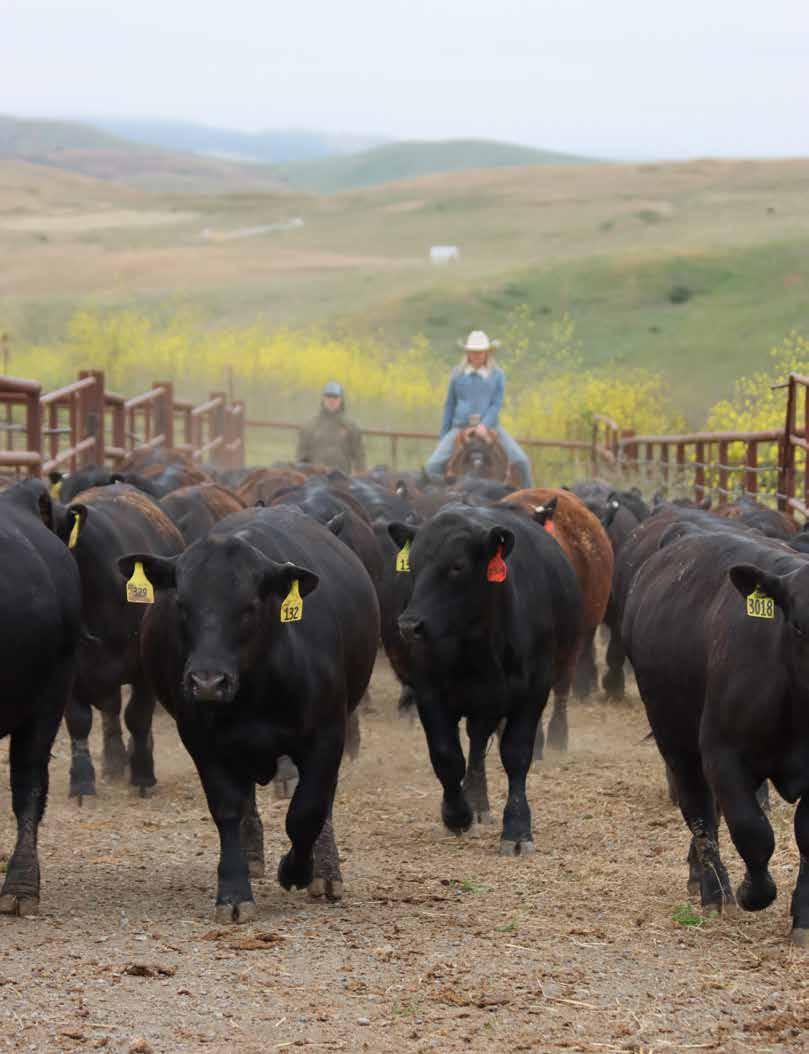
In this year’s bull buyers guide, CCA staff and contributors share insights on procuring the best beef genetics for your unique needs. Additionally, this special issue boasts a special section on ranching in the far Northern part of the state. This month’s cover, taken by Managing Editor Stevie, was shot at the Hanson Family’s Willow Creek Ranch, north of Susanville.
Rainbow Family impedes on forest cattle allotments
CCA’s LaGrande takes leadership tour to better advocate for industry
your resources when buying bulls MIDYEAR MEETING
Cattlemen & CattleWomen rally in Reno
Understanding fire recovery assistance programs
Beef Improvment Federation
ACROSS-ALL
Ranchers embracing new technology on operations
HETEROSIS
Why producers should consider crossbreeding to improve cowherd
UNINTENDED CONSEQUENCES Alternative
and the impacts on prices, society and agriculture
ANGUS RANCH
This year’s offering includes 160 long-yearlings and 50 fall yearlings. Bulls sell performance-tested with complete DNA evaluation, vaccinated for anaplas and tested PInegative for BVD. We offer FREE DELIVERY to California and surrounding states. Every bull selling is backed by the EZ Angus Breeding Guarantee!
Breed-leading performance with top 1% rankings for WW, top 2% for YW and CW, with top 10% Marbling and Ribeye EPDs. He scanned a 106 Ribeye Ratio that calculated to over 1.20 sq. in./cwt., and also posts top 10% ranking for $Maternal and 1% for $Combined Index. He is a full brother to the $100,000 EZAR EZ Street 2213 and a maternal brother to the $170,000 EZAR Gettysburg 1061.
EZAR JAMESON 3075 1/13/23
SIRE: Basin Jameson 1076 DAM: EPF Pride 9413 (Payweight 1682)
Calving-ease herdsire with top 10% WW and YW EPD rankings, and inside the top 25% for Heifer Pregnancy and Docility, with a top 3% Claw and top 1% Foot Angle EPD. He scanned a 113 IMF Ratio with a 110 Ribeye that give him an excellent suite of carcass EPDs with top 10% CW, top 15% Marbling, and top 20% REA. This genetic balance moves his indexes to the top 3% for $M, top 10% $B, and consequently top 2% $Combined Value.
• DB Iconic G95 • Connealy Clarity • SITZ Incentive 704H
SALE BULLS FEATURE BREED-LEADING GENETICS
These bulls feature
•
EPD
• 78% for Marbling EPD
• 78% for Yearling Weight EPD
• 54% for Ribeye EPD
• 62% for Residual Avg. Daily Gain
• 83% for Beef Value ($B)
• 88% for Combined Value ($C)
CATTLEMEN’S COLUMN
PROUD TO SERVE CCA GETTING WORK DONE ON CRUCIAL ISSUES
by CCA President Steve Arnold
The summer is flying by, and it’s hard to believe we are moving into bull sale season.
I would like to look back on my summer travels and reflect on the CCA Midyear Meeting and the NCBA Summer Meeting that was held in San Diego.
CCA held their meeting in Reno, Nev., this past June. We have moved away from policy committee specific meetings at midyear, and instead host a more open room general issues discussion.
One of the general sessions this summer highlighted an important issue happening in Sonoma County. It should be of interest to everyone involved in animal agriculture in California because it could easily spread to other counties if not addressed. I’m talking about Measure J, the “concentrated animal feeding operations ban” that is scheduled to appear on the ballot in Sonoma County in November. This is a citizens initiated petition to ban agricultural operations like conventional dairies and poultry farms. Measure J is another attempt to attack accepted animal husbandry practices, and CCA will be working to oppose this measure.
Another informative general session at midyear included discussion on the wolf and the studies Ken Tate, Ph.D., and his team are conducting in Northern California. Tate offered a fairly in depth report on the movements of a number of wolf packs in the northern counties. He described the wolves as very cunning and adaptable and feels this issue is here to stay. Last year the California State Legislature dedicated funding to pay ranchers for wolf damage. CCA worked very hard to get a fraction of that funding included in this years budget. The ability to get
any funding was a big win considering the deficits in the state budget.
Let me jump to the NCBA meeting for a minute. The NCBA staff is working hard on taxation issues at the national level. Success for revisions to the tax code probably hinges on the results of the November elections. The politics both nationally and internationally play such an important role in so many decisions made by NCBA. If you have not been to an NCBA meeting, you should try to attend one. There is so much information disseminated it is well worth the time, and their midyear meeting will be held in San Diego again next year.
Going back to bull sale season, one can’t help but recognize the genetic improvements in the California cattle herds over the past 40 years. It was noted in San Diego that some 70 percent plus of carcasses grade choice to prime now. The carcass export value in relation to the whole is $410.25/head in spite of a strong dollar and limited product. With such a strong market, it makes sense to participate in any available health and vaccine programs and buy the best genetics you can.
It has been an honor to represent the California Cattlemen as your president at the midyear meetings this summer, and I look forward to seeing you at the county meetings this fall.
John Dickinson .......................... 916-806-1919
Cattlemen’s Livestock Market, Galt, CA • 12:30 p.m.
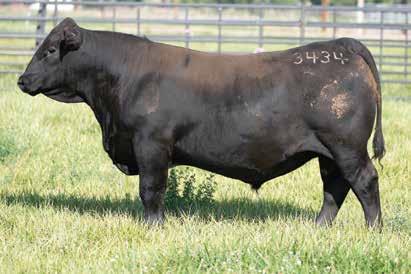
CONCLUSION 3434
5-6-23
Sire: VAR Conclusion 0234
Dam: 44 Ruby 576H (GB Fireball 672)
Offering the #1 son of VAR Conclusion for $Beef and $Combined Value in the entire Angus breed.
This calving-ease prospect has dominant gowth with top 2% YW, top 1% Carcass Weight, matched with a top 10% Marbling and top 1% Ribeye. His dam is a granddaughter of one of the most influential cows in the 44 Farms program, Ruby 2357.
Diablo Valley Angus bulls
BUNKHOUSE FROM OWLS TO BUTTERFLIES
WORKING WITH REGULATION RATHER THAN AGAINST
by Rancher Technical Assistance Program’s (RTAP) Jack Rice
It was 1990, the summer before my sophomore year of high school, that I first became aware of the Endangered Species Act (ESA). No, it wasn’t from summer school or summer reading (all I read that summer was Louis L’Amour), it was from “Redwood Summer,” an organized protest of logging practices that kicked off the timber wars. I still vividly remember watching protestors and loggers screaming and throwing things at each other in raw emotion as they fought for causes they believed in far more than they understood. That was 34 years ago. The ESA was 17 years old then, it’s 51 now. The spotted owl, which was the proxy at the heart of Redwood Summer and the timber wars, is still struggling to survive. But it isn’t threatened by logging, it’s threatened by a native cousin the barred owl which outcompetes it, kills it, and breeds with it. I don’t know how they will fix that one, but it seems like a sad legacy after three decades of conflict. Nearly everyone that actually cares agrees that there
must be a better way.
It is said that with age comes wisdom. As we start the fifth decade of implementing the ESA, it’s fair to ask, “Is there any more wisdom about endangered species?” It is probably easy to conclude there isn’t if you have in mind the latest news article on wolves. But I would argue that this is not correct. A lot of wisdom has been gained since 1990, it is just hard to see through the distorted lens of the media or in reference to an apex predator that distorts all reality. Where I believe this wisdom can be found is with the bees and the butterflies.
Bees and butterflies, or more generally pollinators, present an entirely different set of
...CONTINUED ON PAGE 16
circumstances than owls or wolves. One cannot call a monarch butterfly or collar a Franklin’s bumble bee. The reality is that landowners and land managers must be partners in efforts to recover these species if there is any hope for success. If the ESA turns butterflies and bumble bees into existential threats to landowners, like what occurred with the spotted owl, there is little hope the species will recover. The only winners in such an outcome are extreme environmental groups and lawyers…funny how that works.
What is different now than in 1990 is that the people we interact with at US Fish and Wildlife (FWS), the California Department of Fish and Game (CDFW), and mainstream conservation groups understand that butterflies and bumble bees cannot be made into the enemy of landowners. At the same time, landowners recognize the importance of butterflies and bumble bees and understand that landowners cannot allow themselves to be cast as the enemy of pollinators. Both sides have witnessed the high cost and low effectiveness of conflict and know
that this time we need a better way. This is the wisdom that has come with time.
Now, in the summer of 2024, CCA and several other like-minded agricultural commodity groups are working on that better way. Utilizing the same tools as those used for the sage grouse and California tiger salamander, agriculture is working with FWS, DFW and conservation partners to develop a Conservation Benefit Agreement that will encourage and protect landowners that decide to voluntarily install or enhance habitat to benefit certain pollinators. Fundamentally, this is an effort to implement the ESA through collaboration instead of conflict.
It will not be easy, and there may be detractors on both sides that will try to derail the effort. But I don’t think the ESA is going away and I do think we should help pollinators. What we can’t do, and no one should expect us to do, is help pollinators if it increases our risk of getting in trouble later. This is where the Conservation Benefit Agreement comes in. I don’t have the space to get into the details here, but if you are interested in learning more, have ideas on how ranchers can help pollinators, or may want to be part of this project, please send me an email at: jack@wrstrat.com.
Common Sense Cattle Breeding
Cattle breeding is really not that difficult if you just use some good, old common sense. It has been proven over time that the functional ability of livestock is tied very closely to how they are designed from a phenotypic standpoint. In our herds, the cattle must have an adequate amount of body depth or volume, an adequate degree of muscle, they must be structurally sound, and they must be fertile. If they don’t meet these basic criteria, they are culled regardless of how good they are in terms of their EPD or genomic profile.
We also place emphasis on the basic traits of eyes, udders,
Annual Bull Sale
feet and disposition. These traits are described by many as “convenience traits”. If our cattle are not problem free in these areas, we limit their genetic influence in our herds.
Our opinion is that the most profitable beef cattle in any production system are those that can function with very little need for additional labor or supplemental feeding inputs.
Our ultimate goal is to create a moderate framed, low maintenance cow that can wean a big stout calf and do it without any other inputs from us. That goal is the same in both our Angus and Charolais herds.
2024 Student Assistants
We would like to extend a special thank you to all of the buyers and bidders in our 2024 Internet-based Private Treaty Bull Sale as well as the other ranches and individuals who have supported our program during the past year! This year’s sale will be held August 16 - 30. Please contact us for more information or watch our website. You can scan the QR Code below with your phone’s Camera, and it will link you directly to our Bull Sale Website: https://jcast.fresnostate.edu/beef/bull-sale
Jon Buttrey Madison LaPere
Our bulls and developed and cared for with the help of Fresno S students who put into practice the applicable, real world produ methods that they learn in the classroom. Not only do we produce outstanding bulls, we also turn out top quality students who are ready to enter the agriculture industry, better for the experience they’ve gained in our program!
Colby Lack Logan Tucker David Leon
Megan Huster Kait Blevins
Why roll the dice?
Don’t gamble on unproven genetics. There are a lot of Angus bulls on the market, but not all are backed by the power of 80 million datapoints and a registration paper. Invest wisely in a registered Angus bull.
Landon Andrews Regional Manager 801-592-7279
Alex Tolbert Regional Manager 706.338.8733
landrews@angus.org
atolbert@angus.org
Look for the REGISTRATION NUMBER.. Bring the Power of Angus to your herd. Angus.org/PBA.
YOUR DUES DOLLARS AT WORK
CATTLEMEN’S PRIORITIES ELEVATED IN BUDGET AND PROPOSED CLIMATE BOND
by CCA Vice President of Government Affairs Kirk Wilbur
As the calendar flipped from June to July, lawmakers in Sacramento worked at a feverish pace to meet constitutional, statutory and practical deadlines to lay out the state’s financial future.
While legislators had passed a Budget Act by June 13, that bill was merely a placeholder intended to meet the June 15 Constitutional deadline by which legislators must pass a budget or forfeit their salaries; the bill did not reflect final negotiations between legislative leaders and Governor Gavin Newsom’s Administration.
A revised Budget Act needed to be in place ahead of July 1, the beginning of the state’s 2024-25 Fiscal Year.
In addition to the Budget, lawmakers were also rushing to finalize a Climate Bond to place before voters on the November General Election ballot. Under the State’s Election Code, bond measures must be adopted 131 days prior to an election to appear on the ballot, or June 27 for this year’s Nov. 5 election. Because that deadline is statutory in nature, however, legislators may waive it in subsequent legislation – including within the text of a bond measure. Nevertheless, the Legislature had a hard deadline of July 3 to pass a Climate Bond, as that was the final date by which the Secretary of State could guarantee that details of the measure would be included in the Voter Information Guide sent to registered voters (it also happened to be the final day before the Legislature was scheduled to take a month-long recess).
Revised Budget Reflects CCA Priorities
When the Legislature approved a placeholder Budget on June 13, CCA hailed it as a victory for many of the Association’s fiscal priorities. In the weeks that followed, discussions continued among Assembly Speaker Robert Rivas (D-Hollister), Senate President
pro Tempore Mike McGuire (D-Healdsburg) and Governor Newsom to craft a revised Budget Act reflecting a negotiated compromise between the Assembly, Senate and Administration. The final Budget Act signed into law on June 29 retained the CCA victories reflected in the June 13 bill, with one notable addition: $600,000 in renewed funding for the California Department of Fish and Wildlife’s (CDFW) Wolf-Livestock Compensation Program. Below is a discussion of how each of CCA’s greatest fiscal priorities fared in the 2024-25 Budget.
CDFW Wolf-Livestock Compensation Program Funding
In 2021, the Legislature allocated $3 million to CDFW to compensate ranchers “for the deterrence of wolf presence near livestock, the impacts of wolf presence on livestock, and for verified loss of livestock for participating ranchers.” The Department quickly operationalized its direct loss and non-lethal deterrence compensation programs, and in June of last year operationalized its “Pay for Presence” program, which aimed to compensate ranchers for impacts to their cattle herds caused by wolf presence.
Unfortunately, in January the Department announced that the Wolf-Livestock Compensation Program’s funding was nearly exhausted and “there may not be sufficient funds available for applications submitted from this point forward.” The Program’s funding was officially depleted as of March 8.
Fortunately, CCA members had anticipated the Compensation Program’s depletion, and at the 2023 Annual Convention directed CCA staff to aggressively lobby for renewed funding for the Program. CCA’s advocacy faced enormous headwinds amidst a budget deficit initially pegged at $37.9 billion in January (and which increased to $46.8 billion during the six-month budget process), but CCA staff and members steadfastly and aggressively lobbied for renewed compensation funding as the Association’s greatest priority of the 2024-25 budget cycle.
CCA joined with Defenders of Wildlife and the California Farm Bureau in fighting for compensation funding. Defenders promoted the value of non-lethal deterrence for wolf conservation and recognized the benefits of
TKC SR 9502 TRUST R BARON 3031
These bulls were turned out at our foothill ranch with native feed from December to May. These bulls will be featured in the Vintage Angus Carcass Maker Bull Sale.
TKC SIERRA 7228 LONG HAUL 3039
20 Bulls will be offered in the Vintage Angus Carcass Maker Sale
SEPTEMBER 5, 2024 | NOON at our foothill location in La Grange, CA
These bulls are sired by the same sires of these winning carcass steers @ HRC:
Overall Champion Steer
Champion Individual Commercial Steer
Reserve Champion Individual Commercial Steer
Highest Marbling Score Commercial Division
Highest Average Daily Gain Commercial Division
Featuring sons of: Churchill Red Baron 8300F ET (Reg. #P43938746)
NJW Long Haul 36E ET (Reg. #P43829326)
TKC Fortitude 9029 ET (Reg. #44074876)
TKC 6602 Belleman 9019 ET (Reg. #44171629)
Tim & Kara Coleman, Owners • Tyler & Kathryn Coleman
Tim 209-968-7232 • tim@sierraranches.net
Kara 209-613-6062 • kara@sierraranches.net
Tyler 209-613-5872
P.O. Box 577980, Modesto, CA 95357
www.sierraranches.net • Find us on
TKC SR 8006 RED BARON 3061
SIERRA
ranchers stewarding the landscapes that gray wolves inhabit; partnering with the wildlife-conservation group helped ensure support for the Wolf-Livestock Compensation Program among the Democratic supermajority in Sacramento.
CCA also pursued a strong roster of legislative champions pushing for renewed compensation funding. Sen. Alvarado-Gil (D-Jackson), Sen. Brian Dahle (R-Bieber), Asm. Esmeralda Soria (D-Fresno) and Asm. James Gallagher (R-Yuba City) each pressed the priority among their respective caucuses and pushed for funding in budget subcommittees.
Despite CCA’s tireless advocacy, wolf compensation funding was ultimately excluded from the Budget Act passed by the Legislature on June 13. In ongoing negotiations to finalize a revised budget, however, lawmakers and legislative staffers targeted by CCA’s advocacy efforts continued to aggressively support renewed funding for the Wolf-Livestock Compensation Program. On Saturday, June 22, CCA staff learned that legislators had earmarked $600,000 from the Department’s Biodiversity Conservation Program for the Wolf-Livestock Compensation Program.
While $600,000 is far less funding than CCA had sought, it will keep the Compensation Program operational for ranchers most impacted by gray wolves and it is a significant victory amidst the backdrop of a $46.8 billion budget deficit. CCA is working with the Department of Fish and Wildlife to ensure that the limited funds are spent prudently –with priority given to ranchers suffering confirmed livestock losses from wolf predation – and will aggressively seek continued funding of the Program in future budget cycles.
Keeping Down Costs of SWRCB Water Quality Permitting and Enforcement
In last year’s Sackett v. EPA, the U.S. Supreme Court limited the extent to which some wetlands can be considered “Waters of the United States” (WOTUS) depriving the EPA and Army Corps of Engineers of regulatory jurisdiction over wetlands no longer qualifying as WOTUS. In a budget change proposal issued earlier this year, the State Water Resources Control Board (SWRCB) argued that “the Sackett Ruling…limits the reach of the federal agencies, leaving many state waters unprotected at the federal level and reliant on state authorities.” To enable the SWRCB to conduct water quality permitting and enforcement work previously conducted by the EPA and Corps, the agency requested $7 million annually to fund 38 permanent permitting and enforcement positions.
That $7 million would have come from the state’s Waste Discharge Permit Fund (WDPF). Unfortunately, the increased allocation from the Fund would have necessitated increased fees from permittees paying into the WDPF. Perhaps most strikingly, the proposal would have increased permitting fees for discharges of dredge and fill material by nearly 40 percent. Other permitting fees would also have increased under the proposal, including fees paid into the Irrigated Lands Regulatory Program.
Given that water quality permitting fees at the SWRCB have already increased by as much as 45 percent over the past four years, additional fee hikes are likely to place a significant burden on ranchers and other permittees. To avoid that strain, CCA partnered with a dozen other organizations to oppose the Board’s budget change proposal, urging the Legislature to instead direct the SWRCB to streamline its permitting processes to lower costs.
Preventing “Alternative Protein” Funding
In February, a group of legislators led by Sen. Josh Newman (D-Fullerton) issued a letter to Governor Newsom and legislative leader requesting “$10-20 million [in] one-time funding as part of the FY 2024-25 budget to support existing research at UC Berkeley, UCLA, and UC Davis.”
CCA joined with Western United Dairies to oppose the request. As is often the case with alternative protein advocacy, the funding request willfully misstated the environmental impacts of beef production, overlooked environmental benefits of ranching (such as carbon sequestration and wildfire resilience) and relied on unsubstantiated claims to advance alleged climate benefits of meat and dairy alternatives.
Fortunately, CCA and WUD’s advocacy was effective, and the state’s limited fiscal resources will not be funding research and development of alternative protein products in FY 2024-25.
Work Continues on Budget Trailer Bills
While the Budget has been signed into law, work continues on so-called “budget trailer bills,” legislation which seeks to implement the budget via substantive policy changes. Legislators will consider trailer bills throughout the month of August, but some promising policy has already been teed up in draft trailer bill language.
Wolf Compensation Funding Sources
As discussed above, CCA delivered a significant budget victory this year by securing $600,000 in renewed funding for CDFW’s Wolf-Livestock Compensation Program. CCA continues to explore additional sources of compensation funding, however, including from the U.S. Department of Agriculture. To ensure that CDFW can use any external funding it receives to compensate ranchers impacted by gray wolves, this year’s public resources budget trailer bill, AB 156, includes a statutory amendment authorizing CDFW to “allocate federal funds and any moneys received as donations for purposes of the WolfLivestock Compensation Pilot Program.”
Corporate Climate Emissions Reporting
SB 253 (Wiener), last year’s Climate Corporate Data Accountability Act, requires companies with annual revenues over $1 billion doing business in California to annually report their greenhouse gas (GHG) emissions to the California Air Resources Board – including “scope 3” emissions related to the companies’ entire supply chains.
CCA strongly opposed the bill, concerned that it
would harm ranchers and beef producers in major corporations’ supply chains. Specifically, CCA was concerned that the bill could incentivize corporations to pass down costly and burdensome emissions reporting requirements to small ranchers; could incentivize those corporations to contract with larger operations more capable of accurate emissions reporting at the expense of small family operations; and could incorrectly inflate ranchers’ contributions to GHG emissions.
When Governor Newsom signed SB 253 (Wiener) into law last year, he expressed concerns that the Climate Corporate Data Accountability Act’s “implementation deadlines…are likely infeasible.” To address that concern, budget trailer bill language released last month by Newsom’s Department of Finance proposes to delay all implementation and enforcement deadlines under the bill by two years, meaning emission reporting would not begin until Jan. 1, 2028.
CCA will provide members with additional details of budget trailer bills at the conclusion of the Legislative Session.
$10 Billion Climate Bond to Appear on November Ballot
The 2022 and 2023 budget acts allocated $54 billion over multiple years for a wide array of climate resilience programs. But this year’s challenging fiscal climate not only meant that lawmakers could allocate fewer dollars to programs to protect the state against threats like wildfire, drought and flooding, it also forced the Legislature and Administration to claw back previously appropriated climate resilience funds which had not yet been spent by state agencies.
On July 3, four days after the Budget Act of 2024 was signed into law, Senate President pro Tempore Mike McGuire signed SB 867, the Safe Drinking Water, Wildfire Prevention, Drought Preparedness, and Clean Air Bond Act of 2024 (the task fell to McGuire as both the Governor and Lt. Governor were out-of-state at the time). The Act places a $10 billion climate bond before voters this November.
The most significant pot of money in the Climate Bond is $3.8 billion allocated to the state’s water infrastructure. Of that, $1.14 billion would be directed at reducing flood risk, including $550 million earmarked
for flood safety projects such as levee repair and replacement and $480 million for dam safety and reservoir operations. The bond would also earmark $386 for groundwater storage and recharge and $200 million for multibenefit land repurposing to alleviate strains on groundwater supplies.
The Climate Bond proposes significant funding for “Wildfire and Forest Resilience,” allocating $1.5 billion for those purposes. Included within that pot of money are earmarks that promote CCA’s dual priorities of prescribed fire and grazing for fire fuels reduction, with $175 million dedicated to “long-term forest health projects, including improved forest management, prescribed fire, prescribed grazing” and other projects.
The Climate Bond also highlights grazing elsewhere, in addressing how $1.2 billion allocated for nature-based climate programs and preservation of biodiversity may be spent. Specifically, the bond proposes $870 million in funding to the Wildlife Conservation Board to promote habitat enhancement and preservation through programs including “Rangeland, grazing land, and grassland protection.”
Lawmakers have set aside $300 million in the Bond Act to promote “Climate Smart, Sustainable, and Resilient Farms, Ranches, and Working lands.” This tranche of money includes $65 million for “grants to promote practices on farms and ranches that improve soil health, or accelerate atmospheric carbon removal or soil carbon sequestration,” $20 million to combat invasive species and $15 million to the Department of Conservation for projects that protect, restore, conserve or enhance rangelands.
One item that is conspicuously absent in the Climate Bond is funding for alternative proteins. In addition to the $10 million for alternative protein research and development proposed in this year’s budget (discussed above), Sen. Newman and others sought $50 million in the Climate Bond “to construct a shared, pilot-scale facility for alternative protein development which university students and emerging companies can utilize.” During the final week of bond negotiations – while CCA staff was in Reno for midyear meetings – there was an intense push to get this funding included in the ballot measure. As the deadline to get the bond in print neared, CCA was in constant contact with key negotiators to oppose funding for alternative proteins and worked with several agricultural and climate-focused nonprofits to expand our opposition coalition. Those efforts paid off, and funding for alternative protein research and development does not appear in the Climate Bond.
Amidst the state’s challenging fiscal picture, it was a bruising fight to ensure that CCA’s priorities were realized in this year’s Budget and in the Climate Bond that will go before voters in November. Thanks to CCA’s strong relationships in Sacramento and the support of our members, these vital legislative measures ultimately reflect CCA’s most significant funding priorities.
BEDROCK is the highly sought after Prolific son that commanded a top price of $360,000 and offers the complete package of phenotype, EPDs, and maternal traits! BEDROCK is easy to appreciate for his blend of structural integrity, foot quality, EPD package, and mating flexibility that he brings to the table.
Boyd Beef Cattle, KY; Stellpflug Cattle Co, WY; TX STgenetics®. BEDROCK orginially released as non-CSS bull only.
A rare combination of traits breeders are desperately searching for. He exhibits excellent foot quality with extra heel depth while still ranking in the top 3% of the breed for Marbling. STEP UP is a good structured, wide based, deep bodied sire with extra width of top and muscle expression. He provides that masculine herd sire look breeders admire.
EPDs as of 7/12/2024.
EZ Angus Ranch, CA and Edisto Pines, SC.
WORKING RINGSIDE
GENETIC INVESTMENT
VIDEO SALES POINT TO SIGNIFICANCE OF VALUE-ADDED PROGRAMS AND GENETICS
by Matt Macfarlane for the California Cattleman
Welcome to the 2024 California Cattleman Bull Buyer’s Guide! We are very excited to bring yo this issue that features a tremendous lineup of production sales in the western U.S. this fall.
Speaking of sales, I have just returned from the Western Video Market Sale in Reno, Nev., and to say cattle producers were excited to be in this business was an understatement. All classes were up $8 to $15 over last year, and last year was a record-breaker. Program cattle that were weaned were still top of the market and current vaccinations and mineral programs were given extra attention as well. Around 161,000 head were marketed and with live cattle contracts trading lower, futures markets declining post 4th of July and fed cattle cash market soften $2 to $4 dollars, it did not seem to soften trade and buyers were extremely aggressive even on current deliveries. Optimism is at an all time high!
As someone who markets registered livestock for a living it is also great to see the commercial producers - bull buyers - really seek out solid genetic backgrounds on their stocker and feeder purchases as well, not to mention the breeding cattle. As a commercial producer it is more relevant now than ever to not only manage your health and nutrition programs with the utmost care. It is essential to add genetics to your program that will be sought after and recognizable by the buying public. Simply put, cattle sired by bulls that are featured from programs like the ones throughout the advertisers in this special issue, are bringing substantially more money at video sales and auction markets around the country.
Seedstock breeders in this part of the world are as progressive and current as anywhere in the country and to see their product create value and demand on a national level excites me even
more going into the fall. We have as good of availability of bulls as anywhere in the country and I encourage you to take a strong look at what is available throughout this issue.
With the tremendous precipitation and feed year we have had, there is also had lots of dry feed hoping to be saved going into the fall in California. With that said the eminent fire danger is always there and they have started sprouting up all over the state. As of July 15, there were 3,630 wildfires reported in California burning 230,000 acres. These range from San Diego to the Oregon border. We are roughly 100,000 acres less than 2023, but it is still substantial and too much grazing land has been lost. Not to mention homes, communities, infrastructure and ability to recover and get insurance if you do have to rebuild.
We are getting more support for fire load supression and controlled burns but we have a huge gap from where we need to be to create landscapes that can help eliminate that potential for catastrophic fires that we have witnessed the past few years. Leaders like Dave Daley and organizations like CCA are doing what they can to bring more public awareness to this issue and make sure local and state governments take note of what needs to be done. Like many issues, let’s hope it does not take another massively destructive event to get their attention.
As always, I am a phone call away if you have any questions, concerns or suggestions for us to improve any part of this great publication. I look forward to seeing you on the road this fall.
PROGRESSIVE PRODUCER
SIMPLIFYING GENETIC TESTING FIVE STEPS FOR SMOOTH
SAMPLE COLLECTION AND SUBMISSION
from Zoetis Animal Health
As commercial cow/calf producers drive through their pastures evaluating their spring calf crop and contemplating which heifer calves will make the short list of future herd replacements, now is the time to think about genetic testing. Genetic testing is a practical, proven tool that provides dependable genetic predictions and actionable insights about individual animal performance.
In situations where resources are limited or herd inventories need to be tightly managed, information from genetic testing can be used to confidently confirm pasture observations and to inform and validate selection, breeding and marketing decisions.
As a genetics sales representative with Zoetis Beef Genetics, Kori Soutter guides customers in the step-by-step process of genetic testing their cattle and sends producers the sampling equipment they need.
“While working with customers, I’ve learned that collecting tissue samples to submit for genetic testing is half the battle, and a critical first step toward unlocking powerful insights,” Soutter said. Whether producers are ready to jump into genetic testing with two feet, or still exploring the possibilities, Soutter explained that it’s never too soon to collect tissue samples and offered five key considerations for simplifying genetic testing sample collection and submission.
1. Keep sampling supplies at the ready
Having the necessary supplies on hand to collect tissue samples enables producers to grab samples when they’re handling cattle. For cow/calf operations, the best times are at birth, weaning, while vaccinating or during branding season. Order tissue sampling units (TSUs) and applicators today so you have the supplies you need the next time you work cattle.
2. Know what a successful sample looks like
The best way to take a tissue sample is to collect the sample from inside the hairline, about an inch from the edge of the animal’s ear. Simply squeeze the applicator and take the sample. After collecting the sample, make sure there is tissue in the vial and the vial is closed. This will help visualize if a successful
sample was collected.
3. Match the TSU barcode with the animal ID for each sample
Each TSU comes with a unique barcode. For each sample collected, write down the ID of the animal sampled to match the sample barcode. This information must be included on the order submission form (in addition to gender, breed and an estimated birthdate) in order for the samples to go through the lab successfully.
4. Store samples in a cool, dry place
After samples are collected, you do not have to put them in the refrigerator or freezer. Simply store the samples in a cool, dry place after collecting them. Putting all the animal data in the order form could take a little bit of extra time and it may be a few days before you are able to ship them back to the lab. A critical point is to make sure none of the TSU vials are cracked or leaking.
5. Prepare samples for shipping
One of the most common questions customers ask is, “How do I send in my samples?” Soutter recommends putting the samples in a sealed plastic bag, placing them in a box and padding the samples with tissue paper or paper towels to protect them from extra movement during transport. Don’t forget to place the completed order form on top of the samples inside the shipping box and always ask for a tracking number.
Most Valuable Performance
EPDs, $Values, DNA Data and Individual Performance and Ratios.
Most Valuable Phenotype
Bulls backed by a functional, maintenance free cow herd adding the
Most Valuable Profit
Our customers’ calves continue to bring a premium – The only reason we do this is for our commercial customers to be profitable.
*Connealy Commerce x #+*MGR Treasure
AROUND THE BEEF WORLD IN 8 DAYS
by CCA Associate Director of Communications Maureen LaGrande
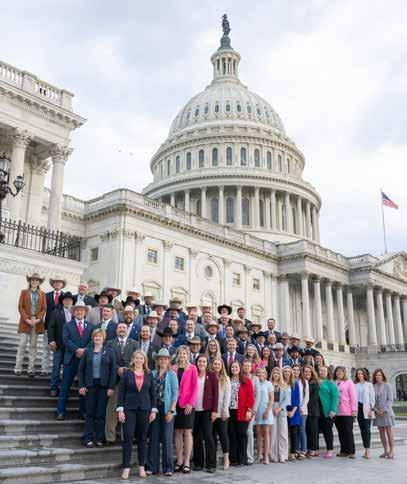
Each year, the National Cattlemen’s Beef Association (NCBA) hosts the Young Cattlemen’s Conference tour. Individuals from each state who are part of a breed or beef association, or an industry-related company are selected to attend the nine-day trip. Attendees have the opportunity to connect with other young and upcoming beef industry professionals while learning about NCBA, touring feedlots, beef operations and have the chance to visit the nation’s capital in Washington, D.C. to meet with legislators from their state districts and lobby on behalf of cattle ranchers across the United States.
This year the California Cattlemen’s Association sent Mesquite Cattle Feeder’s Yard Manager, Tanner Dill, and myself on the trip. On our week-long excursion, we were able to learn about the various sectors of the industry and how these sectors connect to one another. Read my journal below accounting for each of our day-today activities.
DAILY JOURNAL OF YOUNG CATTLEMEN’S CONFERENCE
THURSDAY, MAY 30 | CENTENNIAL, COLO.
Wide awake, bright-eyed, and bushy-tailed, I made my way to the Sacramento International Airport for my flight to Denver, Colo. After a small layover I touched down in Denver and was bussed over to our hotel for our three nights in the city. To kick off the week’s festivities, NCBA hosted a welcome mixer for all of the participants. The YCC tour leader, John Robinson, senior vice president of membership and communications for NCBA, welcomed all of us to Colorado and provided us a glimpse of what was to come in the following week.
Upon our arrival, we learned that throughout the duration of the trip at each new stop, we would have a new roommate. I know to some this may be nerve-racking but I truly love the idea that I get the chance to better know so many great women on this trip! My first roomate is Nikki Weston of Utah who is representing the American
National CattleWomen.
FRIDAY, MAY 31 | CENTENNIAL, COLO.
It’s our first full day in Denver! Today we headed over to the Denver NCBA Office where we formally introduced ourselves to one another and heard from a handful of the NCBA Staff members. There are 67 individuals representing various state associations, industry-related businesses and producers attending the conference. The best part is that everyone here is eager to learn and share about their individual experiences. Tanner Dill, Brawley, the feed yard Manager for Mesquite Cattle Feeders and myself are the CCA representatives. While they may no longer live in California, NCBA staff members Sarah Gregory originally from Santa Ysabel and Lynn Compton originally from the Central Coast are
Maureen and Tanner Dill represented California beef producers on the annual YCC tour
also participating in the tour.
We were welcomed to the office by NCBA’s Chief Executive Officer Colin Woodall and heard from Buck Wehrbein, NCBA’s President-Elect who is joining us on the trip. Throughout the day we learned from various NCBA staff about the Association’s early beginnings and about the Beef Check-off Program. In the later part of the afternoon, we received a CattleFax Market Outlook from CattleFax’s Randy Blach, listened to Chris Parker, Ph.D., of Cattle Australia and to round out the speakers for the day was John Mendel with Cargill.
While it’s only the first day of the tour we have been fed well by the NCBA culinary team! To end the night the culinary team prepared for us a spectacular spread, with the focal point being a perfectly grilled steak, generously donated by Cargill.
SATURDAY, JUNE 1 | NCBA HEADQUARTERS TO GREELEY, COLO.
To start off our morning we headed into NCBA headquarters to participate in a strength finders exercise led by NCBA’s Barb Wilkinson. At our tables, we discussed with our fellow mates what our strengths were based upon an assessment we all took before we arrived and shared how we could apply these strengths in different scenarios. Fun fact this was the third time I have taken the strength finders assessment and each time my strengths have been similar. My Strengths: Responsibility | Achiever | Input | Learner | Positivity.
As noon rolled around, we hopped on the bus and headed to Five Rivers Cattle Feeders. At the feedlot we were able to hear from employees about their daily operations and learn of the yard’s history. We loaded back on the bus and headed to Greeley, Colo., to visit the one and only Greeley Hatworks where we got the chance to observe the hat-making process! To top off the night the group was dropped off at the Grizzly Rose Dance Hall, a massive building with a large dance floor. I was so kindly asked to two-step with a regular, he quickly found out that I indeed have two left feet.
SUNDAY, JUNE 2 | COLORADO TO SIOUX CITY, IOWA
It’s our last day in Colorado! Being able to spend a nice chunk of time here has enabled me to understand the massive impact NCBA makes on the country’s cattle producers. This morning, we were led by NCBA’s Chandler Mulvaney and Paul Dybedahl in an advocacy training. The training helped us to prepare for our upcoming legislative meetings in Washington, D.C., by practicing answering questions and giving our elevator pitches. Mulvaney and Dybedahl’s enthusiasm made the experience a nice one and provided to me a set of tools that I can and will continue to use when
it comes to advocating for the industry.
With once again a delicious lunch served, we loaded our suitcases onto the bus and made our way to the airport. Now you may wonder, how in the world do 67 individuals make it through baggage check, security and the terminal in a timely manner? Let’s just say that was a thought that crossed my mind! When we arrived at the airport, we learned that to surpass the joys of getting through the airport, a private jet had been booked for the remainder of our travels. I have never in my life had such a luxurious travel experience, I felt like a celebrity! As our jet took off, in an hour and a half time we landed in Sioux City.
We are staying at the historic Warrior Hotel in Sioux City, a unique place for us to stay! With a busy day ahead of us tomorrow, we partook in an early evening bowling game and dinner reception before we headed off to bed.
My second roommate is Grace Link, Wisconsin, representing the Wisconsin Cattlemen’s Association.
MONDAY, JUNE 3 | SIOUX CITY, TO WOOSTER, OHIO
It was an early morning in Sioux City for the YCC group as we gathered to visit another beef operation. I will say this has probably been my favorite stop so far. In less that 24 hours we are headed back to the airport and are headed for our next stop Ohio!
My next roommate is Jaycee May from Alabama who is here representing Corteva Agriscience.
TUESDAY, JUNE 4, | WOOSTER TO WASHINGTON, D.C.
Coming from California, I have never seen so many cornfields in my life! The geography of each
...CONTINUED ON PAGE 30
state we have visited so far has been fun to see, but safe to say I do not think I have seen a more beautiful place compared to my California home.
Today’s stop consists of visiting Certified Angus Beef (CAB)! Starting off with a retail tour, we visited two grocery stores where we heard from employees who work with the store’s meat counter discussing what shoppers are looking for and buying trends of beef.
After our retail tours, we were bussed over to CAB’s headquarters where we toured their warehouse, executive office and test kitchen. Through a series of rotations, we were able to observe a hanging carcass and learn of the grading system, taste various steak samples, and learn about the versatility of beef and how it can be prepared. The beef dishes served here were just absolutely stunning in taste and presentation, my favorite food I tasted today was the beef sushi! After a dinner reception of southern-style beef BBQ, we are headed to the jet to take off for Washington, D.C.
WEDNESDAY, JUNE 5 | WASHINGTON, D.C.
My fourth roommate is Paige Schmidt who is representing the North Dakota’s Stockmen’s Association. I think she’d agree that one of the first things we noticed was that in June in Washington, D.C., it’s humid. Even more humid than walking around a northern California rice field in the summer!
To start our morning the YCC group walked from the hotel up to the Republican Capitol Hill Club. Throughout the day we heard from the Washington, D.C. NCBA staff learning of their roles and what their days look like advocating for cattle ranchers. Candace Schnoor, manager of federal affairs at John Deere also spoke to the group about the impact NCBA makes and their partnerships. We also had a multitude of legislative visitors, including a handful of congressmen from all over sharing about their connections with NCBA and what they have been working on at the Capitol. Once our afternoon at the Capitol Hill Club concluded, we were able to go see the sights. We took a stroll by the White House and other fun places throughout the night!
THURSDAY, JUNE 6 | WASHINGTON, D.C.
Of all the tours, stops and outings throughout our trip, the day at the U.S. Capitol was by far the most important. Everything we had learned up to this point served as a stepping stone to prepare us to educate and lobby on behalf of NCBA and cattle producers across the U.S.
Tanner Dill, Sarah Gregory and Kelsea Kemp both NCBA employees and past California residents and myself attended three meetings with legislative staffers from various California Congressmen. Being able to share the story of ranchers, along with the triumphs and challenges they face is exhilarating, I felt honored to serve as a representative to our producers.
FRIDAY, JUNE 7, | WASHINGTON, D.C. TO SACRAMENTO,
Early Friday morning I watched the sunrise from the Reagan International Airport. As I waited to board my plane, my mind was full of all the information I learned over the last week and the fun memories me and my fellow YCC classmates made on this adventure. I owe a big thanks to CCA for sending me on this trip, NCBA and the conference sponsors, John Deere, Five Rivers Cattle Feeding, Tyson, Corteva Agriscience and Farm Credit.
My key takeaway from this once-in-alifetime trip is the importance of educating and advocating for the continuation of the beef industry and the Western way of life. This amazing group of individuals that I was fortunate enough to spend the week with are all self-motivated and eager to continue to spread the word on the significance of beef.
12495 E. STOCKTON BLVD., GALT, CA Office 209-745-1515
Fax 209-745-1582
Website/Market Report www.clmgalt.com Web Broadcast www.lmaauctions.com
Top Consignments from throughout California and Nevada will be Showcased during These Upcoming Special Sales ... UPCOMING CLM SPECIAL WEDNESDAY FEEDER SALES
August 14
September 11 & 25
October 9 & 23
November 6 & 20
December 4 & 18
SPECIAL FALL-CALVING COW SALE
Wednesday August 21
FALL ANGUS BULL SALES AT CLM
Saturday SEPTEMBER 14
Arellano Bravo Angus Production Sale
Friday SEPTEMBER 20
Dixie Valley Angus Fall Bull Sale
Tuesday SEPTEMBER 24
Thomas Angus Ranch California Bull Sale
UPCOMING WESTERN VIDEO MARKET SALES
August 12 – Little America, Cheyenne, WY Catalog Online: www.wvmcattle.com
September 10 – Haythorn Ranch, Ogallala, NE
Consignment Deadline: August 22
October 18 – WVM Headquarters, Cottonwood, CA Consignment Deadline: October 9
by Managing Editor Stevie Ipsen
EXPERT ADVICE THE BENEFIT OF UTILIZING MARKETING STAFF BEFORE AND ON SALE DAY
When it comes time to buy bulls, the catalogs, the data, the individuals programs and incentives of each can be overwhelming. Recognizing the genetic influence the bulls you select will have on your next calf crop shows why bull-buying decisions should not be made lightly. Selecting and purchasing a bull for your beef herd is one of the most important decisions for your operation. Fortunately the tools to assist cattle producers are better than ever, giving you some reassurance to validate your decisions.
In a market like we are seeing today, the upfront cost of recharging your bull battery is also something to consider, but the aged-old phrase “you get what you pay for,” may ring true. Another layer of confidence that comes with your decision to bid on a bull and take him home is that virtually all sellers deliver bulls to you with a satisfaction guaranteed promise that you will be pleased with your purchase.
For longtime purebred cattle auctioneer Col. Rick Machado, representing seed stock and commercial producers across the country is one of his greatest privileges.
“I get to work for the kind of people you can trust every single day,” Machado said. “ Not just on purebred operations but also on commercial ones as well.”
For those who make a stop or two along the fall bull sale trail up and down the West Coast, it is commonly noticed that Machado is the first of the crew to arrive. As the person responsible for selling the cattle, he makes it a priority to scour sale catalogs and data before the sale and visually appraise each bull so he can translate to the buying audience what every lot has to offer.
“The difference betwen a good auctioneer and a great one is product knowledge. I need to know
what I am selling and I make a point of knowing the promising attributes as well as any downfalls that a particular individual might carry,” Machado said. “I probably do way more homework than necessary sometimes but I would rather be on the block and have too much information to share with buyers than not enough.”
Scientific data available to buyers is constantly evolving and seedstock producers and the marketing crew have to understand what those numbers mean and how they apply to a set of cattle or individual sale lots.
Machado said in the time he has been merchandising purebred cattle, the data available to buyers has increased exponentially.
“Maybe even more significant than that are the tools and tests breeders have at their disposal to bring the data to potential buyers,” Machado said. “The breeders that utilize their tools and constantly make improvements are the ones that get return buyers year after year.”
Of course, tools and tests come with a price tag but the reassurance to both buyer and seller can be priceless.
While auctioneers like Machado may be among the first of the sale crew to arrive, the publication and breed representatives are never far behind. Machado says those professionals are typically called field staff because they’re the ones out “in the field.” It’s their responsiblity to translate to both purebred and commercial ranchers the programs, data and trends in the current marketing and breeding climate that will assist in breeding and marketing decisions.
“I field a lot of calls from buyers about what might be available at upcoming production or
PEDRETTI
OSA Veracious 3193
BREAKING DOWN HERITABILITY
HOW IT INFLUENCES A BREEDING PROGRAM
by Lindsay Upperman, Ph.D., Red Angus Association of America Director of Breed Improvement
Lately, calls to our breed improvment department about which traits are the most worthwhile to utilize in a breeding program have increased in frequency. This seems to be coming from producers not seeing immediate increase in some Expected Progeny Differences (EPDs) values from generation to generation. However, there are several factors to consider when answering these questions, with heritability of the trait being a crucial component.
Heritability (h2)
One definition of heritablity is the measurement of the strength of the relationship between performance (phenotype) and breeding value (genotype) of an individual animal. Note that heritability applies to one specifc trait in one specific population at a specific point in time. Therefore, as heritability is estimated in various breeds, research projects and traits, the estimates are expected to be different. For example, we would expect estimates to differ in the heritability of birth weight in Red Angus cattle in 1992 versus 2004 due to the two time points the heritabiilties wer estimated.
Heritability can also tell a producer how much confidence to place in the phenotype (observable) characteristics of an animal when choosing parents for the next generation. For traits that are highly heritable, where the estimate exceeds 0.40, the animal’s phenotype is a good indicator of genetic merit. However, for lowly heritable traits, where the estimate is below 1.15, the animals performance is not a good indicator of their breeding value. As shown in
the table below, growth and carcass traits have higher heritability estimates than maternal traits. On the other hand, if heritability is defined as the percentage of differences between animals due to genetic effects, then (1-h2) is the percentage of differences between animals that are NOt due to genetic effects. Ultimately, if this percentage is high (1-h2), then improvements to the trait through enhanced management or environmental conditions are just as critical. For example, fertility in the table below has a heritability estimate of 0.10. Thus 1-0.10 = 0.90, or 90 percent of the differences in fertility between animals is NOT due to genetic effects. So, maybe
...CONTINUED ON PAGE 38
*These traits have various heritability estimates depending on the specifc time, population being utilized or the specific definiation of the trait.
HERITABILITY ESTIMATES OF SOME TRAITS IN BEEF CATTLE
...CONTINUED FROM PAGE 36
a new estrus synch program or an additional mineral supplement may prove just as beneficial for making progress in fertility than just through genetic selection.
How Heritability influences genetic progress
Heritability is one of the components used to predict progress from selection to improve a trait. A simple equation for selection on phenotypes measure on individuals in a population, the equation would be: ΔG=ih2 σp
Essentially, this equation is stating that the change of genetic progress is equal to the product of intensity of selection multipled by the heritability of the selected trait multiplied by the phenotypic standard deviation of that trait. To simplify further, if any of these components are low, then the resulting chnage in genetic progress through selection will be small. Thus the question develops, that if the resulting change in genetic progresds is small, is selection on this trait relevant to your breeding goals? Heritability is a value that can indicate if genetic merit has a strong relationship with
SPANISH RANCH BULLS
phenotypic performance, but it can’t tell a producer about the economic value of increased performance for a specific trait.
Traits such as fertility may have low heritabilities, but their economic value to an operation is high. For instance, although an increased pound or two at the feeder sale has additional dollar value, the dollar value of a female becoming pregnant and staying in the herd is greatly increased. Thus yes, even though the genetic progress for fertility may be slower, the economic value association with this trait is much larger, placing greater significance on selecting to improve traits such as fertility within your operation.
Ultimately, heritability is a great indicator of how much genetic merit is playing a role in an animals visual performance. Additionally, how much genetic progress can be made for a specific trait is dependent on the heritability of that trait as other factors. Finally, when considering which traits to make genetic progress on within your operation, contemplating the economic value associated with each trait is crucial to a successful breeding program.
WESTERN HOSPITALITY CCA MIDYEAR MEETING TAKES MEMBERS TO THE WESTERN SIERRAS
by CCA Associate Director of Communications Maureen LaGrande
The well-known Nugget Casino Resort once again served as host to the California Cattlemen’s Association and its members for the 2024 Midyear Meeting held June 26-27 in Sparks, Nev. The twoday event brought ranchers from all across the state together for CCA and industry updates.
As CCA members made their way up to Midyear on Tuesday evening, a pit stop was made at the Roberti Ranch in Sierra Valley for a welcome BBQ hosted at the family’s Prayer Cabin Pond. As vehicles rolled in, conversation and laughter rang through the air as members enjoyed cold beverages and grilled burgers, salads and apple strudel.
The Prayer Cabin was originally an old homestead house built by early residents of the valley. When he was a child, CCA First Vice President Rick Roberti, Loyalton, shared that the house was used for the creamery process at the dairy. When the dairy was no longer functioning, the house sat for years. The Roberti family’s friend Dennis, one of their pastors, recognized the significance of the home’s history and thought it was a shame to have the building sit with no use and deteriorate. This thought brought him to approach the Roberti’s about moving the house to a place on their ranch where it could be preserved and utilized. The family agreed to move the home to a new location on the ranch, and it was taken apart and put back together and placed by the pond, and now serves as a small piece of history for all to see. As the sun set, members made their way to Nugget.
Wednesday morning started out with a warm welcome from CCA President Steve Arnold, Santa Margarita, along with a preview of what was to come over the next two days. CCA Vice President of Government Affairs, Kirk Wilbur delivered an in-depth legislative
update covering the efforts CCA has made on the rancher’s behalf and what the Association will continue to work on for the remainder of the year. California Cattle Council Executive Director Justin Oldfield gave a Cattle Council update and shared the Council’s 2024 plans. John Suther, California Department of Food and Agriculture (CDFA), Branch Chief of Livestock Identification discussed livestock ID and the brand registration program and Amanda Murray, DVM, California Department of Food and Agriculture (CDFA), Branch Chief of the Animal Health Branch gave an Highly Pathogenic Avian Influenza (HPAI) update and talked about Avian Influenza biosecurity.
To round out the afternoon general session of speakers, a panel discussion took place with the Rancher Technical Assistance Program’s (RTAP) Jack Rice, rancher Dave Daley, Oroville, and CCA Executive Vice President, Billy Gatlin to discuss the Sustainable Groundwater Management Act (SGMA) and how it is affecting cattle producers in the northern part of the state.
The final meeting of the day was the local president’s meeting where all the presidents
from each local association come together and meet with the CCA officers and staff. Each local association is unique and no one group is run exactly like the other, the meeting time allows for the presidents to share what is going on in their association including triumphs and challenges, and share any upcoming events their group may be hosting. This meeting serves as an opportunity for local groups to bounce ideas off of one another and express issues groups may need assistance with.
Once the meeting wrapped up in the late afternoon, members headed up to the Chalet Terrace for an evening reception of beer, wine and cheese. Smiles and laughter rang as members made their way into the room. The pre-rodeo reception served as a glimpse of all the fun to come later in the evening. A new event for Midyear and the highlight of the evening was when members headed to the Reno-Sparks Livestock Events Center for the Wednesday performance of Reno Rodeo. The rodeo made for an entertaining evening of spectating from the grandstands, where those who attended were able to sit together and cheer on the athletes competing in the arena. A special announcement of CCA’s attendance was even made during the rodeo by the announcer!
Thursday morning, CCA First Vice President, Rick Roberti, kicked off the morning session
by introducing Sonoma County Farm Bureau’s Executive Director, Dayna Ghirardelli. Ghirardelli spoke about the Concentrated Animal Feeding Operations Ban (CAFO) Ballot Measure and educated the group on the subject.
The final meeting for Midyear was an important one to members, the wolf policy discussion, with a panel of speakers, including rancher and CCA Wolf Subcommittee Chair Paul Roen, Calpine, and Wilbur, who started the meeting by giving a brief overview of recent wolf predation challenges and the work CCA has done to help ranchers, particularly in securing renewed funding for the Wolf-Livestock Compensation Program. The mic was then handed over to UC Davis’ Ken Tate, Ph.D., to speak about research on the state’s wolfpacks and to facilitate a discussion among membership regarding the future of the Association’s gray wolf policy advocacy.
Before members could head home a board meeting was conducted and adjourned. As another Midyear Meeting comes and goes, Roberti shared, “I thought Midyear was very productive and we discussed some issues we needed to tackle.” CCA members will soon head back to Reno for the 108th California Cattlemen’s Association and California CattleWomen’s Annual Convention and California Cattle Industry Trade Show, Dec. 4 – Dec. 6 at the Grand Sierra Resort.
Peggy Corbett, Plumas County Brand Inspector and CCA’s Rick Roberti.
Some of the meeting speakers included CCA President Steve Arnold, RTAP’s Jack Rice and Sonoma County Farm Bureau’s Dayna Ghiradelli.
Rich Ross and Mark Nelson catch up at the Pre-Rodeo Reception.
Midyear Meeting attendees listen in policy sessions.
Dale Evenson and Debbie Torres at the Pre-Rodeo Reception.
PREPARING FOR FIRE
ASSISTANCE PROGRAMS OVERVIEW
by Noah Lopez for the Rancher Technical Assistance Program
One of the best parts of working on the Rancher Technical Assistance Program (RTAP) is getting to talk with ranchers in every corner of the state. From Modoc to San Diego, we get the chance to hear from cattle producers about all kinds of issues. While most of our time is spent sorting through regulatory, technical and business issues, we also get to chat about things like the weather, cattle markets, and how the feed is looking.
This year in particular we’ve heard over and over again how good the feed is in many parts of the state. Consistent winter rains with a few early warm periods really helped the grass come up. But this recipe for good feed can also mean heavy fuel loads for wildfires. In fact, we’ve seen several fires already this year. Although our hope is that this turns out to be a mild fire year, we thought it could be helpful to review the key assistance programs available to ranchers who experience losses from wildfire. There is value in the old saying that ‘it’s better to know something and not need it, than need something and not know it.’
The United States Department of Agriculture’s Farm Service Agency (FSA) and Natural Resource Conservation Service (NRCS) have several programs to provide assistance to livestock producers impacted by wildfires. These programs can be separated into three categories which cover losses of livestock, forage and infrastructure. An overview of the programs in each of these categories can be found here.
Livestock Losses
The first program to be aware of can help cover losses of livestock due to wildfire. This is the Livestock Indemnity Program (LIP). LIP provides direct payments to producers who have lost livestock due to adverse weather conditions such as wildfire. LIP is administered by the Farm Service Agency (FSA) and reimburses producers 75 percent of the average fair market value of the lost livestock. Payment rates are determined annually and relevant 2024 rates per head are summarized below.
LIP is only available to producers with a commercial livestock operation who have an average adjusted gross income below $900,000. Producers must also be able to provide acceptable proof of the livestocks injury or death. Among other things, this can include dated pictures, contemporaneous records, private insurance documents, and brand inspection reports. Although applications may be completed later, producers must file a notice of loss with FSA within 30 days of when the loss becomes apparent to remain eligible for the LIP.
Forage Losses
The next set of programs can help cover losses of forage due to wildfire. The two primary programs to be aware of are NRCS’s Emergency Assistance for Livestock, Honeybees and Farm-Raised Fish Program (ELAP) and Livestock Forage Program (LFP). These programs can help cover the loss of forage due to adverse weather conditions including wildfire. ELAP can provide assistance for grazing loss from wildfire on non-federal lands while LFP can provide assistance for grazing loss from wildfire on federal lands. LFP and ELAP payments can vary, but generally, the programs can provide 60 percent of the cost of lost feed. This is calculated by multiplying the normal carrying capacity of the lost area of feed by a payment rate per head per day ($1.75211 in 2024). It should be noted that these payments cannot exceed 150 days per producer per year.
ELAP applications are not due until January 30 of the year following the occurrence of the loss. However, as with the other programs, producers must submit a notice of loss to their FSA office within 30 days of the loss. Failure to submit this notice will make producers ineligible to apply for ELAP or LFP. In addition, acreage reports must be submitted prior to applying and should be filed no later than July 15 of the application year.
Another program that can help cover forage losses is the FSA’s Noninsured Crop Disaster Assistance Program (NAP). NAP helps producers to manage risk through coverage for both crop losses and crop planting that was prevented due to natural disasters. The eligible or “noninsured” crops include agricultural commodities not covered by federal crop insurance. Producers must be enrolled in the program and have purchased coverage for the eligible crop in the crop year in which the loss incurred to receive program benefits following a qualifying natural disaster. Producers with NAP coverage who experience losses must submit a notice of loss within 15 days of the loss to remain eligible for payment. Deadlines for obtaining coverage and providing information relevant to receiving NAP payments depend on the crop. It may be worth asking your local FSA office about NAP to learn about coverage on native pasture.
Infrastructure Losses
The final set of programs to be aware of can help address losses of infrastructure due to
wildfire. These programs are the FSA’s Emergency Conservation Program (ECP) and the NRCS’s Environmental Quality Incentive Program (EQIP). The Emergency Conservation Program can provide up to 75 percent cost-share funding to rehabilitate farmland damaged by natural disasters like wildfires. This includes the repair or replacement of existing fences, water facilities and other rangeland infrastructure damaged by wildfire. Ranchers can submit applications for a project and are eligible to receive up to 75 percent of the cost to implement that project. Payment rates vary by project type but are limited to $500,000 per entity.
Unlike other FSA disaster assistance programs, ECP does not have a requirement for submitting a notice of loss within a certain time period. However, generally speaking, local FSA County Committees determine ECP “sign-up periods” for certain disasters. As such, the best course of action is to reach out to your local FSA office as soon as possible regarding any project ideas.
Another program that can help with infrastructure losses is the NRCS’s Environmental Quality Incentive Program. While EQIP is not a disaster relief program, some available practices such as cross-fencing and watering facilities may help ranchers recover from the impacts of fire. NRCS takes EQIP applications throughout the year, though it should be noted the application period for fiscal year 2024 has already closed.
How to Apply
If you experience losses from wildfire and would like to apply for one or more of these programs you should begin by contacting your local FSA and/or NRCS office. If you ranch in multiple counties, it may be necessary to contact multiple offices. Phone numbers, email addresses and locations of offices can be found online using the “USDA Service Center Locator.” Remember, program eligibility relies on the timely filing of notices of loss.
Additionally, California producers can contact the RTAP team at rtap@wrstrat.com or (916) 409-6902 for help connecting with their FSA office or understanding what questions to ask. The Rancher Technical Assistance Program is available to all California cattle producers and is provided by the California Cattlemen’s Foundation and funded by the California Cattle Council. More information about RTAP can be found at: .calcattlemenfoundation.org/rtap.
Matching genetics to your environment WELL-SUITED
from the Beef Improvement Federation
“Is it worthwhile to try and match your genetics to the environment?” asked Jared Decker, Ph.D., Wurdack Chair of Animal Genomics, University of Missouri, to launch his presentation during the Beef Improvement Federation (BIF) Symposium in Knoxville, Tenn., on June 11.
According to Decker environmental stressors, like fescue toxicosis, cost the beef industry approximately $1 billion a year. Decker shared information regarding a study conducted in the 1960s that moved cows from the Brookfield Research Station in Florida to the research station in Miles City, Mon., and cows from Montana to the station in Florida. Pregnancy rates for the cows in Florida from Montana were 55 percent. In comparison, to the Hereford cows native to Florida, this was 28 percent lower making a strong case for genetics by environment (G x E) interactions. Reproduction is one of the most impacted traits by G x E interactions. Body condition and metabolism are the other two most impacted traits.
Decker went on to introduce BIF Symposium participants to three USDA-funded projects that are underway to study the impact of, and best ways to, address G x E interactions. In multiple studies from the first project, genes tagged by G x E interactions and local adaptation selection had functions affecting blood vessel constriction/ dilation. This is an important indicator of fescue toxicity, altitude stress, and thermotolerance. Additional genes associated with G x E effects were involved in immune response and metabolism. These functions affect the animal’s ability to adapt to their environment and deal with multiple stressors.
“Adaptability is defined as an animal’s ability to appropriately sense and respond to the environment,” Decker said. “If you are describing
your cattle as ‘adaptable’ without actually measuring their ability to sense and respond to environmental stressors you’re just telling us stories.”
The latter two projects that Decker described are designed to develop tools to help producers measure and match genetics to their environment more effectively than just buying animals from similar environments. EPDs and crossbreeding are both approaches that Decker recommends to address G x E interactions.
“We have the technology now to measure traits that are greatly impacted by environment and generate genetic evaluations for these traits,” he said.
Some examples that Decker talked about include genetic evaluations for fertility (defined more robustly than heifer pregnancy as a binary trait), pulmonary arterial pressure (PAP), which occurs in environments of high altitude, and hair shedding which can address thermoregulation and sensing changing seasons.
“Hair shedding is an economically relevant trait, and I challenge anyone who doesn’t think so to come mend fence with me while wearing their winter parka,” Decker explained.
He tied addressing G x E interactions with biological rules like Bergmann’s rule and Surface law. He suggested leveraging new technologies like 3D imaging to measure surface area for truer genetic evaluations of metabolism than body weight. To watch Decker’s full presentation, visit https://youtu.be/I5-6tR-XzJg.
For more information about this year’s Symposium and the Beef Improvement Federation, including additional presentations and award winners, visit BIFSymposium.com.
CCA BACKS SONOMA COUNTY FARMERS AND RANCHERS ON MEASURE J FIGHT
At the 2024 CCA Midyear Meeting in Reno in late June, Sonoma County Farm Bureau’s Dayna Ghiradelli addressed CCA members about the Concentrated Animal Feeding Operations Ban that will be on the Sonoma County ballot in November.
On Tuesday, May 14, the Sonoma County Board of Supervisors received a final report of the social and economic impact of the proposed measure from several departments including the Economic Development Board, UCCE Sonoma, Agriculture Weights and Measures, and Permit Sonoma. Following this report and public comment, the Board reluctantly voted to place the measure on the November ballot as Measure J. The Board also unanimously and enthusiastically voted to take a formal stance of opposition to this measure. Sonoma County Farm Bureau strongly opposes this measure, viewing it as a significant threat to the livelihoods of local farmers such as Clover Sonoma and Straus Family Creamery, the availability of local food sources, and the rural character of our community. In response to this threat, Sonoma County Farm Bureau has launched a comprehensive campaign against this measure, creating a dedicated website (SonomaCountyFamilyFarmersAlliance.com), and initiating a fundraising effort to support our cause.
Measure J, proposed by an animal
extremist group from Berkeley, claims to eliminate Sonoma County’s diverse animal agriculture production. If passed, Measure J could put multi-generational farming families out of business and as a result, the cost of dairy products, eggs and poultry will increase significantly. Furthermore, Measure J will increase our greenhouse gas emissions since these products will have to be imported from other parts of our state, country or even other countries. Measure J will cost taxpayers millions.
The goal of this effort is to limit animal agriculture production. Sonoma County family farms and ranches adhere to established standards for ensuring animal welfare. Many local farms also promote third-party certification programs for humane and ethical treatment of farm animals. The restrictions imposed by Measure J are simply excessive and unnecessary.
WHAT CAN WE DO?
CCA is closely monitoring this ballot measure and recognizes that whether or not this particular meaure passes, similar initiatives could likely be proposed by extremists groups in other in other areas of the state. CCA encourages members to become familiar with the initiative, its impacts on local agriculture and help spread the truth about this measure.
GENETIC COMPARISON
2024 across-breed EPD comparisons
by Larry Kuehn and Mark Thallman, U.S. Meat Animal Research Center
Across-Breed EPD (ABEPD) Adjustment Factors: National Cattle Evaluation (NCE), and the resulting Expected Progeny Differences (EPDs), have resulted in substantial genetic change since their inception in the 1970s. However, EPDs are generally only comparable within breed because of differences in the genetic base.
Since 1993, the U.S. Meat Animal Research Center (USMARC) has produced a table of factors to adjust the EPDs of cattle so that the merit of individuals can be compared across breeds. Adjustment factors for carcass traits have been calculated since 2009 and carcass weight was added in 2015; to be included, breeds must have carcass data in the U.S. Meat Animal Research Center (USMARC) database and report their carcass EPDs on an actual carcass basis using an age-adjusted endpoint.
Bulls of different breeds can be compared on the same EPD scale by adding the appropriate adjustment factor to the EPDs produced in the most recent genetic evaluations for each of the 18 breeds. Normally, the EPDs of animals from different breeds cannot be compared because many breed associations compute their EPDs in separate analyses and each breed has a different base point.
The across-breed adjustment factors allow producers to compare the EPDs for animals from different breeds for these traits; these factors reflect both the current breed difference (for animals born in 2021) and differences in the breed base point. The AB-EPDs are most useful to commercial producers purchasing bulls of more than one breed to use in cross-breeding programs. For example, in terminal crossbreeding systems, AB-EPDs can identify bulls in different breeds with high growth potential or favorable carcass characteristics.
The factors are derived by estimating breed differences from the USMARC germplasm evaluation program and adjusting these differences for the EPDs of the sires that were sampled in the system. Traits for which factors are estimated are birth weight, weaning weight, yearling weight, maternal weaning weight (milk), marbling score, ribeye area, backfat depth (fat), and carcass weight (Table 1). The factors adjust the EPDs to an Angus base (chosen arbitrarily).
As an example, suppose a Red Angus bull has a carcass weight EPD of + 20.0 lb and a Hereford bull has a carcass weight EPD of + 75.0 lb. The across-breed adjustment factors for yearling weight (see Table 1) are -5.4 lb for Red Angus and -66.4 lb for Hereford. The AB-EPD is 20.0 lb – 5.4 lb = 14.6 lb for the Red Angus bull and 75.0 lb –66.4 = 8.6 lb for the Hereford bull. The expected carcass weight difference of offspring when both are mated to cows of another breed (e.g., Braunvieh) would be 14.6 lb – 8.6 lb = 6 lb.
Brahman EPDs for marbling score are reported on a different scale than the other breeds with marbling score EPDs. For Brahman 400 = Sl00 and 500 = Sm00 whereas for the other breeds, 4.00 = Sl00 and 5.00 = Sm00 meaning the Brahman EPDs are reported on a scale that is 100 times higher. As a result, EPDs from other breeds need to be multiplied by 100 after being adjusted to Brahman, and Brahman EPDs need to be divided by 100 prior to applying the adjustment factors. For instance, to adjust a Simmental bull with a marbling score EPD of 0.15 to compare to Brahman bulls using the factors from Table 1, add the Simmental factor, subtract the Brahman factor, and then multiply by 100: ( 0.15 + ( -0.13 ) – ( -0.65 ) ) * 100 = 67. Similarly, to adjust a Brahman bull with a marbling score EPD of 40 in order to compare to Simmental
bulls using the same factors, first divide by 100, then add the Brahman factor, and subtract the Simmental factor: 40 / 100 + ( -0.65 ) – ( -0.13 ) = -0.12.
One major change was implemented with this update. In the past, yearling weight EPD adjustment factors were derived using a BIF adjusted yearling weight using USMARC weight data. With this update, we analyzed BIF adjusted postweaning gain rather than yearling weight and the factors were derived as a sum of weaning weight and postweaning gain factors. Postweaning gain, rather than yearling weight, is used in most genetic evaluations and is desirable because the postweaning portion of yearling weight should not include maternal effects. The resulting factors are somewhat different from previous updates as a result with the largest changes being for breeds with low maternal effects. However, we believe the new factors and breed differences should more accurately represent national cattle evaluations.
It is important to note that the table factors in Table 1 do not represent a direct comparison among the different breeds because of base differences between the breeds. They should only be used to compare the EPDs (AB-EPDs) of animals in different breeds.
To reduce confusion, breed of sire means (i.e., one half of full breed effect; breed of sire means predict differences when bulls from two different breeds are mated to cows of a third, unrelated breed) for animals born in 2022 under conditions similar to USMARC are presented in Table 2.
The adjustment factors in Table 1 were updated
using EPDs from the most recent national cattle evaluations conducted by each of the 18 breed associations (current as of January 2024). The breed differences used to calculate the factors are based on comparisons of progeny of sires from each of these breeds in the Germplasm Evaluation Program at USMARC in Clay Center, Neb. These analyses were conducted by USMARC geneticists Larry Kuehn and Mark Thallman
CCA ZONE 1
BY THE NUMBERS
NUMBER OF BEEF CATTLE & CALVES
NUMBER OF CCA MEMBERS
AVERAGE NUMBER OF CATTLE IN THE COUNTY PER MEMBER
NUMBER OF RESIDENTS
HEAD OF CATTLE PER RESIDENT
LASSEN COUNTY 23,000 47 489 29,904 .77 MODOC COUNTY 59,000 72 891 8,700 6.78 SISKIYOU COUNTY 50,000 68 735 44,076 1.13
CCA Executive Committee
Zone 1 Director: Myles Flournoy
Zone 2 Director: Jason Hunt
Zone 3 Director: Rich Ross
Zone 4 Director: Clayton Koopmann
Zone 5 Director: Bob Brennan
Zone 6 Director: Mike Souza
Zone 7 Director: Claude Loftus
Zone 8 Director: John Hammon
Zone 9 Director: Mike Williams
Appointees at Large
Myron Openshaw
Greg Kuck
Trevor Freitas
Kevin Kester
Steve Lambert
HANSON FAMILY LEADS THROUGH SERVICE AND LOVE FOR THE RANCHING WAY OF LIFE MORE THAN A LIVELIHOOD
by Managing Editor Stevie Ipsen
About 15 miles north of Susanville lies the picturesque Willow Creek Valley, a ranching haven with a plethora of landscapes. Lush green pastures with sagebrush-lined highways. There are timber covered mountain meadows to the west and rocky hills spotted with juniper trees to the east. The valley is home to some of California’s most historic ranches and ranch families.
Jack Hanson, of the historic Willow Creek Ranch may be surrounded by life-long ranchers but he isn’t shy about saying he is a first generation, city-raised rancher who at first didn’t know a heifer from a steer. Hanson was a University of California, Berkeley, economics graduate who started his career as a stock broker in the Bay Area.
Hanson arrived in Lassen County after a stint ranching in Tehama and Siskiyou counties. He had taken a liking to the rural culture and settled down on the Willow Creek Ranch that had been purchased by his parents in 1982.
Just down through the pasture and down the highway lived Frank and Bernice Hagata, another one of those reputable life-long ranching families. Jack says there isn’t a day that goes by that he isn’t grateful his path crossed with Frank Hagata. The legendary Lassen County rancher took a liking to Hanson and invited him to dinner.
Hanson arrived wearing not looking anything like a ranch cowboy and Frank’s daughter, Darcy. Jack says didn’t seem very impressed with his slacks and penny loafers, but the two eventually became an inseparable pair and have been
partners on the Willow Creek Ranch, where they raised their sons Wyatt and Brad. They purchased the remainder of the Willow Creek Ranch from Jack’s parents in 1996.
Darcy recalls their story differently and says she was impressed by Jack’s interest in their way of life despite his knowing so little about it.
“Jack was immediately enamored with our family operation,” Darcy said. “My dad was taken aback by Jack’s quiet professionalism and it didn’t take me long to see what my dad did.”
When Darcy and Jack met, she had returned from Cal Poly where she studied Ag Business and was currently working for the Lassen County Fair.
Jack and Darcy have spent the last four decades as proactive producers running a successful cow-calf and hay operation. As a rancher’s daughter Darcy came equipped with plenty of ranching knowledge but Jack isn’t ashamed to admit he had a steep learning curve and credits a lot of credits a lot of his education to some great veterinarians and to the University of California Cooperative Extension for providing materials, workshops and advisors to help ranchers like him expand their knowledge about cattle ranching.
“I took every opportunity I could to learn from anyone who could teach me about running cattle,” Jack said. “I was a devoted student of the extension service and gleaned a lot of knowledge from my father-in-law and our local ranchers, who are some of the best around.”
Today the Hanson Family run about 500
mother cows on owned and leased private lands along with BLM and California state lands. Willow Creek Ranch calves are marketed through Harris Ranch. Jack says they have occasionally considered other marketing avenues for their calves over the year but have always been treated well at Harris. He said their cattle have always brought prices as good or better than expected, likely due in part to their staunch bull selection strategies and strict culling philosophies.
Being the student of the industry that he is, Jack also tried to stay on the leading edge of value-added vaccination and mineral programs so the Hansons can be sure the calves that they are sending onto Harris will perform in the warm Central Valley climate. Additionally, the Hanson Family tried to procure the best California seedstock genetics they can afford. In recent years they have purchased Angus bulls from the Borror family at Tehama Angus Ranch and from Tim and Jill Curran at Circle Ranch in Ione.
“I’m the kind of guy who doesn’t want to fix what isn’t broken,” Jack said. “Our bull suppliers have treated us very well and stood behind their product 100 percent. I know they too are proud of their product and will help us continue to do our job well too.”
Similarly to the pride Jack and Darcy have taken in their beef cattle herd, the health of natural resources on and around the Willow Creek Ranch is very important
Equally impressive practices are being implemented, modeled and strongly advocated for by the Hansons. Along with flood irrigating and managing grazing for perennial grass growth, the Hansons are receiving support from NRCS, Bureau of Land Management (BLM), and
Point Blue to remove light-density juniper on about 4,000 acres of adjacent BLM land in priority Greater Sage-Grouse habitat.
“If our goal is to make this ranch sustainable for our kids and grandkids to carry on, we have to do all we can to care for it,” Jack said.
In the same way Jack and Darcy are passionate about the longevity of the ranch, they also recognize that there factors outside their control that could make ranching much harder in the future. For those reasons, Jack and Darcy are devoted to service within industry advocacy groups and efforts.
Together Jack and Darcy have served in 4-H leader capacitites to encourage future generations to stay involved. They are both active in local cattlemen’s and women’s groups and answer the call to help when every asked.
Darcy says Jack has always been serviceminded and willing to jump in and work where ever work needs to be done.
Jack served a five year term as treasurer for the California Cattlemen’s Association and three years as a CCA second vice president. He is past chair of National Livestock Producers Association. Jack has also served on the Lassen County Board of Supervisors and is currently on the Tri State Livestock Board of Directors.
When asked what intrigues him about serving in leadership capacities he says giving his time is the least he can do after all the ranching business has done for him.
“I’d say the first reason I am involved is actually a selfish reason. Darcy and I both really love meeting other people in the industry. I wouldn’t trade this lifestyle for anything,” Jack said. “I want to see it thrive for my kids and their kids and our grandkids grandkids.”
In addition to Jack’s industry service, Darcy too has always been committed to the future of agriculture and retired n July 1 after 23 years working for University of California Agriculture and Natural Resouces as a 4-H community educational specialist for Lassen County.
The Hansons raised their boys just a stone’s throw from cousins at the nearby Hagata
...CONTINUED ON PAGE 56
A sign on the highway between Hagata Ranch and Willow Creek Ranch shows the pride local families have in their way of life.
Ranch, the 120-year-old cattle ranch that has remained in the same family since it was homesteaded in 1904. The Hagata Ranch is now owned and operated by Darcy’s brother Daren and wife Patricia and some of their children have also returned home to Lassen County to work in the same industry they were raised in.
Just as the Hagata Family had a succession plan in place for their children to keep ranching, so too have the Hansons put plans in place should their boys decide to continue in the family business, which has come to fruition in recent years.
Wyatt and his wife Kelli and their son Townes live in the home that the Wyatt and Brad were raised in. After working for several years at Plumas Bank in Susanville, Brad too decided being on the ranch full time was a good choice for his growing family. Brad and his wife Robin live just across the driveway with their two daughters, Harper and Finley
Brad said he thinks Wyatt knew for a long time that he wanted to live and work on the ranch but the decision for Brad was one that came gradually.
“I have always loved ranching and being with my family at home. If it weren’t for enjoying the people I worked with in the banking field, I may have made the jump sooner,” Brad said. “But once you have a family, things just hit kind of different and you start thinking more about what is best for them and it made me reflect a lot on what my upbringing meant to me.”
The apple didn’t fall far from the tree when it comes to having a love for service, community and the cattle business. For Brad and Wyatt being immersed in their community and the cattle industry is all they have ever known. It would make sense that they would choose life partners with the same ambitions. Kelli works with the youth at nearby Lassen High School and Robin currently works for the California Rangeland Trust.
Brad says he and Wyatt grew up just through the fields from their cousins and always had grandparents close by. Giving their children the same sense of belonging was important to them.
“We might live a ways from town or neighbors but with cousins close by, kids canl never get too lonely,” Brad said.
As both sons prepared to settle down at home with their families, Jack and Darcy got lucky when a home came up for sale just down the road. After making some renovations to it, they were able to make space at the home ranch for their sons’ growing families.
Jack and Darcy say they are close enough to be helpful but far enough away to let their sons have the reins and find their own ways.
“Initially, we had to change a few things to so everyone knew their place and had their own tasks. There are challenges just like there are in any family or business,” Jack laughed. “But I kind of like taking it a little easier and being the guy that changes the water.”
For Jack and Darcy both their sons’ decisions to return to the ranch means a lot because it shows they want their kids to have the same kind of upbringing they had.
“It makes me feel like we did something right,” Jack said.
The Hansons are also working to protect their ranch in perpetuity through a conservation easement to ensure future generations can live and work on the ranch as long as they want to.
Finley, Brad, Robin and Harper Hanson
Kelli, Townes and Wyatt Hanson
Darcy and Jack Hanson relishing their life as grandparents.
FOR THE LOVE OF THE FOREST
Ranchers who manage forest want rules to be followed by all
by Managing Editor Stevie Ipsen
Over 10 years ago, lifelong Lassen County rancher Joe Egan purchased rights to utilize the U.S. Forest Service Antelope Allotment, a convenient 15 or so miles from his home base of Janesville. In exchange for the price he pays to graze the allotment, he is also responsible for the management or misuse of the property. He bears the cost of keeping fences maintained and loses access to the land if it’s not properly grazed or water sources are misappropriated or damaged. Recognizing the land is not his and is permanently owned by the federal government, Egan has taken his responsibility of caring for the allotment seriously.
On June 1 of this year, just as in years past, Egan and his brother Richard turned their cattle out on to the Antelope Allotment and other public land allotments on the Plumas National Forest and other nearby public lands to graze for the summer. These allotments are a vital part of the ranching operations but caring for the land and monitoring the health of the forest are not responsibilities that they have taken lightly.
With the recent Dixie Complex Fire and Walker Fires devastating parts of the Plumas National Forest and impacts parts of the Egan families allotments, the job of getting the forest once again ready to graze has not been easy or cheap. Joe Egan said just on the Antelope allotment alone, it has cost tens of thousands of dollars to have damaged fencing removed and forest service-approved fencing reinstalled. But it is a price they pay to keep their cattle grazing, keep their operation running and keep the forest healthy. Additionally, the forest has also still been occupied by contractors hired by the forest service to clean up down trees from old fire breaks, but the Egan’s have been able to co-exist symbiotically with these contractors because they are their with a common end goal– keeping the forest in pristine health.
Joe says if he had known what would be transpiring this summer, he would have delayed turning cattle out because the headache that would soon ensue would have been much simpler. Occasional campers and forest admirers have frequented the allotment over the years and the Egans have been happy to share the land but Joe
says never in his wildest dreams would checking his cattle require driving through a community of vehicles, forest hazards and garbage-littered ground.
On June 18, that nightmare actually occurred when a barrage of vehicles arrived on the forest allotment, planning to stay for at least the next month.
Each year since 1971, a loosely-knit “family” of gatherers who call themselves the “Rainbow Family” have congregated on a remote public forest location somewhere in the U.S. They claim with the stated intention of “living a shared ideology of peace, harmony, freedom and respect.” Because they utilize public lands, their theology is that they have the right to gather at locations of their choosing with no permissions required. The group claims to have no leader and therefore no one who can apply for a permit. Coincidentally, they do not announce their annual location until camp is already being set up, so land managers like Egan can’t react. At least that is the typical scenario.
When first getting news of the gathering, Egan said he was caught off guard like other public lands ranchers in his shoes have been in the past. But that didn’t mean he was going to just take it.
“I have worked hard to keep this land in pristine condition, to help it recover from devastation,” Egan said. “I couldn’t just stand by and allow them to do what they want and bring with them the potential for more damage to the land.”
By the time Egan got to the allotment to survey the situation, hand-dug latrines dotted the area and water hoses were diverting water from creeks to holding tanks for the Rainbow Family to utilize. Both the latrines and the water diversions are violations of USFS rules.
“If I had dug massive holes like that or created water diversions on this ground, I would be cited by the forest service and the Division of Fish and Wildlife and very likely would lose my right to graze the allotment,” Egan said.
Typically any gathering over 75 people on public lands requires approval and a permit but if the Rainbow Family refused getting a permit to camp, surely Egan assumed they didn’t bother to ask permission to do as they pleased with the
ground while they were there.
With the official gathering planned from July 1 through July 8, Egan knew he only had a short amount of time to get in front of this problem. He says his earliest calls were to his contact at the forest service and they made it known they didn’t plan to get involved, afterall, this isn’t the first time this has happened, just the first time for Joe and his family.
Joe said in addition to the current situation on the allotment, his communication with other ranchers who have experienced gatherings on their grazing ground told him that the gathering would go far beyond the official gathering. They had obviously arrived early, with up to 10,000 people possibly entering the forest. Contemplating the destruction left behind in the form of natural resources damage and garbage was overwhelming.
“I’ve been told by other people who have experience this that some of these people could stay until snowfall,” Joe said. “Even if they clean up after themselves – which I’m told they don’t – what happens when I’m checking cows on horseback next year and my horse falls into one of their hand-dug latrines? It’s not as easy as just covering it up and thinking the forest goes back to the way it was.”
Joe summoned the assistance of a friend and Lassen County Supervisor Jason Ingram. Ingram was already briefed on the issue and said his main concerns were for the people of Susanville, Janesville and neighboring communities.
“Having an unexpected influx of people in our county is always something to be aware of,” Ingram said. “But in this case we saw immediate disregard for local rules, grocery stores being wiped out, a parade of unregistered vehicles and more, so I was alarmed at what else might be coming.”
Joe took Ingram on an early tour of the allotment so he could see the disarray for himself.
“At that point, I was more concerned for our residents by my immediate thoughts turned to fire danger on the forest,” Ingram said. “We needed to do all we can to get these folks to move on.”
Without much assistance from the Forest Service, Egan solicited advice from friends at the California Cattlemen’s Association and others who had dealt with these groups before while Ingram reached out to other politicians and community leaders for assistance. In the end, the fact remained that the forest service had the only real authority over the land.
Within a week of the first campers’ arrival the Forest Service did place posted notices at the entrance to the allotment to notify gatherers that they could not stay without a permit. The vehicles and tents still kept coming.
Many California communities have been plagued by wildfire in recent years and nearby Janesville and Greenville residents were among some of the most concerned. Additionally, local tribes with ancestral
roots to the land were upset by the prospect of unlawful campers impeding their sacred spaces.
The Rainbow Family hosted a town gathering one evening at the Susanville town park to talk about their commonalities with residents and their excitement to be visiting their community. This event was supposedly intended as an olive branch of goodwill to show the Rainbow Family as peaceful people. At the park event, many residents attended and asked the Rainbow Family to move on. The tribal representatives comprised the majority of the event with Maidu Tribal representatives making emotional pleas with the group to leave their lands alone. The pleas fell on deaf ears as the supposedly peaceful gathering, which was attended by more than a dozen stand-by law enforcement officers, was simply a back-and-forth, contentious exchange of opinions.
The next morning Joe Egan and Ingram again visited the campsite on the allotment and were met with hostility from campers. Not only were the two vehicles occupied by the Egan family boxed in by pedestrian campers who would not let them pass, Egan’s daughter in the rear vehicle was essentially pushed past the campers by a water-tender vehicle occupied by a gatherer.
...CONTINUED ON PAGE 60
Joe Egan reads the rules posted by USFS to notify gatherers of the laws they were breaking.
Rylie Egan tries to drive through the Antelope Allotment but a pedestrian gatherer refuses to let her pass.
Numerous campers approaching the vehicles also carried machetes on their belts and claimed to be “packing.”
“These people claim to be peaceful,” Joe said. “But this is not how peaceful people behave.”
That incident further incited Joe and Ingram to persist the forest service to act. After many calls to the forest service from Joe Egan, Ingram and other local community leaders and tribal representatives to the begging to get some help with the situation, U.S. Forest Service officials made a seemingly unprecedented decision. On June 27 – three days before the official gathering was to begin – the USFS shut down the Rainbow Gathering. After the arrival of 561 people, over 200 cars, buses and RVs, access to the allotment was closed and campers were removed. Those campers already present were asked to clear out or face fines and jail time. The order to vacate was based on the lack of permit and the unsanctioned event threatening the environment and public safety.
“They didn’t leave immediately. Some stayed behind to clean up trash and I will probably spend a long time fixing other damage,” Joe said. “I am glad it’s over for us, at least for now.”
Those who know Joe Egan know he’s persistent. But he credits many other friends and community leaders for helping USFS come to the right decision for the Antelope Allotment, though the Rainbow Family is also persistent and didn’t migrate far.
RELOCATION
After the initial gathering on the Plumas National Forest was deemed illegal USFS, on June 29, the gatherers announced a new location about 70 miles south of Janesville to the even smaller community of Beckwourth.
The new location in the Clover Valley was previously used as a fire camp, but is also a cattle allotment in the summer months. The Mercer Allotment has long been managed by the Maddalena Family of Sierraville.
Cindy Maddalena said that she and her daughter Annie Tipton got the news of the relocation on July 29 and when they went to survey the situation they arrived to find nearly 300 people already setting up camp with a steady stream of traffic.
Because this property wasn’t seen as a severe fire threat and because natural and cultural resources weren’t being impacted to the same degree as the first location, Maddalena said they were told there was nothing that could be done about it.
“There is a known wolf dens and an abundance of bears in the area. I wish them luck,” ” Maddalena said sarcastically.
By the time camp had been established at the Mercer Allotment, Tipton said there was nothing
that could be done and they would just wait out the anticipated one-week event and then reassess the situation.
“They claim to be a peaceful group,” Tipton said, “But once they find you are not one of them, they are much more hostile. We found it in our best interest to just keep our distance and ride it out. If we had more notice, I don’t know that would be the course of action we would take but at this point in time there isn’t much more we can do.”
The Mercer Allotment was also heavily impacted by the Dixie Fire and future fires are always on the minds of ranchers in the high
Trash left behind by gatherers on the Mercer Allotment.
A restroom sign on the Mercer Allotment where a latrine had been dug at the base of a tree.
Piles of irrigation hose used to divert water on the Mercer Allotment.
timber area. For the Maddalenas and Tiptons crossing their fingers through the gathering seemed to be their only option.
Following and assessment on July 9, Annie Tipton said her husband Joe Tipton had surveyed the land and found it to be in better shape than feared they would but a lot of garbage and plentry of campers remained.
“This is a rather rocky environment so they didn’t do too much damage to the ground where they had their meal and common eating locations,” Annie Tipton said. “There are some springs that will likely need reparation work done to restore them and the meadows they camped in were significantly trampled.”
Local law enforcement estimated about 2,000 campers were on the site. So perhaps the dispersion of the initial gathering helped to keep the subsequent gathering smaller than anticipated.
Plumas National Forest Service Supervisor Chris Carlton recognized the frustration of rancher and communities over the gathering and said the following, “Our communities have been through a lot over the past several years and this incident is occurring during a time of year when annual festivals, events and traditions already draw thousands of people to the area…” Carlton said. “We are hearing and understand the concerns from residents and visitors about this increase in traffic, the risk of wildfire, the potential damage
to resources from this unauthorized use and unwanted impacts to communities in and around the Plumas National Forest.”
In a separate statement, Carlton said the forest service would work with local tribes, resource staff, affected stakeholders and the community to assess and restore damage that occurred as a result of the gatherings.
As of press time, July 22, there were still Rainbow Family members in Beckwourth or near the Mercer Allotment site despite the gathering officially ending on July 8.
EDITOR’S NOTE: Some areas of this article provide no source attribution because it is provided by my first-hand account. I accompanied Joe Egan and Jason Ingram on the Antelope Allotment while Joe was checking cattle and surveying the campsite. I also attended the Susanville City Park meeting the night prior for insight from the Rainbow Family.
For other public lands ranchers who may find themselves in a similar circumstance, direct engagement is likley to be unproductive. CCA recommends early action with public officials, your contacts at CCA and public lands offices as a better alternative. By following the Rainbow Family on various social media sites as summer approaches, you may have an indication of whether or not their group could end up in your “neck of the woods.”
MIDSTATE FAIR HONORS LOCAL ADVOCATES
San Luis Obispo County Cattlemen’s Association has selected Aaron Lazanoff as its 2024 Cattleman of the Year. Aaron is the Ranch Manager of California Polytechnic State University, San Luis Obispo, a position he has held since 2008.
Born and raised in the Carmel Valley of Monterey County, Aaron grew up around ranching and the cattle business, showing cattle in both 4-H and FFA. After graduating from Salinas High School, Aaron attended Cal Poly, graduating with a degree in animal science. While at Cal Poly, Aaron was a member of the Rodeo Team, competing in team roping. While attending Cal Poly, Aaron worked at Templeton Livestock Market, and cowboyed on ranches up and down the central coast. On summer breaks, he worked ranches in Eastern Oregon and Nevada.
After Cal Poly, Aaron moved to Oklahoma to work for Bill Jacobs on the historic Turner Ranch. He then returned to California, managing cattle ranches in Visalia and it the Carmel Valley. In 1999, Aaron was hired to manage the historic Santa Margarita Ranch by Dick Nock, John Lacey and Kate Loftus.
Aaron became Ranch Manager for Cal Poly in 2008. He oversees all cattle operations and manages 5,000 acres of the school’s property. Aaron also manages the famous Cal Poly Bull Test, a program started in 1956 where students are responsible for raising the bulls, measuring bull health and assessing bull performance. Cattlemen from around California and the United States bring registered bull calves in the spring. Throughout the summer, students measure weight gain, reproductive tests and potential genetic traits. Bulls that exceed the test indexes are then sold at the Cal Poly bull sale to cattlemen from around the country. In addition to these responsibilities, Aaron manages ag student housing, and assists in managing the feed mill, dairy unit and equine unit.
Aaron continues to be involved in San Luis Obispo County Cattlemen’s Association, serving on its board of directors. He has held all the committee chairs and served as President for two years. He has also served on many California Cattlemen’s Association committees and has been instrumental in getting the next generation of cattlemen involved in the local and state association.
He is current advisor to the Cal Poly Young Cattlemen’s group and was instrumental in getting forty-one students to attend the 2023 CCA Convention in Nevada. Aaron is a co-leader of the Edna 4-H beef group and has served as president of the West Coast Junior Rodeo Association. He is also an event director for the California High School Rodeo Association, District 7.
Aaron and his wife, Kristy, have three sons, Ethan, Caleb and Wyatt. The Lazanoffs’ recreational life revolves around the boys’ involvement in youth rodeo and sports. The boys are following in their dad’s footsteps, with a love of the cowboy way of life, all having begun to develop horsemanship skills at a young age. The Lazanoffs also run their own cattle, which teaches the boys the responsibility of owning and expanding a cattle operation.
Aaron said about receiving this honor, “I am proud to be a part of this great organization. Our Cattlemen’s Association does so much at the
from the San Luis Obispo County Farm Bureau
local and state level. So many in our organization, Dick Nock, John Lacey, Steve Arnold, just to name a few, have been mentors to me. I am very honored to be recognized by my peers.”
San Luis Obispo County Cattlemen’s Association congratulates Aaron and is grateful for his dedication to the beef industry, to Cal Poly, and to the community.
San Luis Obispo County CattleWomen have selected Vicki Janssen as the 2024 CattleWoman of the Year. Vicki was born in Santa Monica, to Jim and Mary Fisher and has one brother, Jim. While growing up, Vicki spent time manufacturing fishing rods and graphite tubing in the family business which was started by her greatgrandfather on the Santa Monica Pier in 1922. Her passion was horses and sports.
After graduating from Santa Monica High School, Vicki moved to San Luis Obispo to attend Cal Poly as an Animal Science major, later changed to Physical Education. She graduated from Cal Poly in 1979 with a Bachelor of Science degree in Physical Education and completed her Teaching Credential in 1980.
After graduating, she worked for the San Luis Obispo County YMCA until 1991. Vicki began working for Supervisor Brackett as the first County Legislative Assistant and in 1993 she worked for Supervisor Harry Ovitt as well. In November 1993 she became the first Manager of the newly formed Agricultural Task Force government watchdog organization.
In 1997, Vicki returned to work for Supervisor Brackett as she finished her term. In 1999, Katcho Achadjian was elected as the 4th District Supervisor and Vicki remained serving as his Legislative Assistant. Then in 2010, Katcho was elected to the State Assembly and Vicki served as the District Director for Assembly District 35, covering San Luis Obispo County and Northern Santa Barbara County until he was termed out in November 2016. In 2017 she found herself back at the County Board of Supervisors working as the Legislative Assistant for 1st District Supervisor John Peschong and once again assisting constituents with county issues.
Vicki’s passion for agriculture and law enforcement keeps her involved in many community organizations. She is a 22-year member of the San Luis Obispo County Sheriff’s Posse, serving as the first woman Captain in 2007, and again as Captain in 2023 and 2024. From 2010-2017, Vicki was a member of the Santa Maria Chapter of California Women For Agriculture and she serves on the Board of Directors for several non-profit organizations
including: the San Luis Obispo Law Enforcement Assistance Foundation (SLO LEAF), and the James W. Brabeck Youth Legacy Fund supporting youth in agriculture.
In 1993 she became an active member of the San Luis Obispo County Cattlewomen and served in multiple roles including: historian/scrapbook chair, highway clean up chair, casino dight fundraiser committee member, merchandise chair and currently serves as second vice president.
Vicki met her husband Matt while working at the Board of Supervisors and they have lived in Atascadero for 30 years with their horses, chickens and border collies. “I am very humbled to be selected as cattlewoman of the Year by the amazing women involved in this organization.”
San Luis Obispo County Cattlewomen are grateful to Vicki for her hard work in county government, the many community organizations she works with, and especially all she does for their organization.
San Luis Obispo County cattlewomen has given the Cattlewoman of the Year award annually since 1965, making Vicki Janssen the 59th person to receive this honor.
BaR KJ ANGUS
THESE BULLS SELL AT THE CATTLEMEN’S SELECT BULL SALE AT VISALIA LIVESTOCK MARKET ON SUNDAY, SEPTEMBER 15
Selling these sons and others, sired by some of the top Angus bulls in the industry today.
HERD HEALTH CHECK
BULL MANAGEMENT AND NUTRITION
Everything to consider for bull health before breeding season
by Julie Walker, George Perry, Russ Daly and Ken Olson, Departments of Animal and Range Sciences and Veterinary Science, South Dakota State University
Proper management and nutrition of bulls is essential to ensure cow/calf producers maximize reproductive efficiency and genetic improvement of the calf crop. In addition, the herd bull influences overall herd fertility more than any other single animal, and loss of fertility by a bull can cause substantial loss to a potential calf crop. Each cow produces one calf per year but bulls should contribute to the calf crop by siring 25 to 60 calves. Additionally, bulls influence their daughters’ production in the cow herd. Therefore, bull selection can be the most powerful method of genetic improvement in the herd.
The number of cows bred during the breeding season plays the largest role in percent calf crop weaned, and percent calf crop weaned is the single most important factor influencing profitability in beef operations. The weaning weight is influenced by the bull selection. Since greater than 90 percent of the beef cows in the United States are bred by natural service, it is important that bulls be managed to optimize breeding performance.
There are several factors that influence bull fertility. First, a bull must be developed properly and have reached puberty to be fertile. Second, physical characteristics, such as scrotal circumference, mating ability and semen quality play a role in a bull’s fertility. Third, libido and social dominance influence a bull’s ability and desire to service cows. This paper will start with nutrition.
PUBERTY AND BULL DEVELOPMENT
The most commonly used definition of puberty in bulls is when an ejaculate collected via electroejaculation contains a minimum of 50 x 106 total sperm with at least 10 percent progressive motility. The age and weight that puberty occurs is affected by feeding different energy levels of feed. High levels of energy can increase weight, height, and scrotal circumference without effecting age at puberty or first mating, showing nutritional effects on bull development without affecting sexual development. Highly fitted or excessive conditioned bulls may fatigue rapidly, contributing to fewer cows serviced. Ideally, bulls should be in a condition score of 6 (9 point system) since bulls normally lose about 100 to 200 pounds during the breeding season. This weight loss should come from energy stored as fat (condition) rather than muscle tissue. This is especially important for young bulls since they are still growing.
Furthermore, extremely low energy can delay
puberty and potentially impair sperm production. In addition, bulls that are undernourished at a young age may never develop appropriately when compared to bulls that are properly fed The age and weight at which puberty occurs also varies greatly among breeds and level of nutrition during development; however, research with various breeds suggests that a practical indication of eminent puberty is when scrotal circumference is between 27 and 29 cm. However, simply because a bull can produce semen does not translate directly to fertility. Sperm quality and quantity continues to increase for several months after the initiation of semen production. Only about 35 percent, 60 percent and 95 percent of 12, 1, and 16 month old bulls, respectively, are reproductively mature and produce good quality semen.
NUTRITION
Seedstock producers are the primary individuals managing the development program of bulls being sold. For commercial cow-calf producers, feeding programs usually include feeding purchased bull(s) from delivery until the breeding season and bulls retained from one breeding season to the next. Bulls are often managed as one group even though there may be large differences in age, size, and body condition.
The debate over the correct method for developing bulls is not settled: Should you develop bulls at a moderate rate of gain or develop bulls on a ration that is capable of supporting high rates of gain so genetic differences can be measured for selection and marketing purposes? Bulls put into many bull test stations are placed on rations to support high rates of gain. Many seedstock producers have established specific feeding programs to fit the desired animal performance where bulls show their genetic potential and are cost efficient.
The key to a well-developed feeding program is that nutrient requirements are meet and animals are not under-or over-fed. It does not matter if they are developed with a high-grain ration or forage-based program. Let’s focus on five time periods; 1) Postweaning nutrition, 2) Conditioning prior to breeding season,
POST-WEANING NUTRITION
During the time period from weaning to first breeding season is when producers are determining rations.
Since bull selection is based on genetic information such as EPDs, more producers are using a moderate plane of nutrition to develop breeding bulls during the post-weaning phase. There are many possible rations that could be used to develop bulls at the desired animal performance prior to the first breeding season. The best ration depends heavily on the availability and cost of feed ingredients. The key is developing the ration to meet the desired animal performance without over- or under-developing the bull.
During the post-weaning period under-nutrition and over-nutrition can have negative impacts. Under-nutrition results in delayed puberty and overnutrition can reduce semen production and quality. Diets should be balanced to meet the nutrient requirements for the desired animal performance and body condition score should be monitored to ensure that the bulls are not being under- or overnourished. Typically, many of the diets to develop beef bulls contain from 40 – 60 percent concentrate. For breeds that are known to reach puberty later, a common practice is to place the bulls on a slightly higher plane of nutrition (60 – 70 pecent concentrate). The theory is to hasten the onset of puberty; however, with breeds that reach puberty early; additional energy is not beneficial and may cause over-conditioned animals.
CONDITIONING PRIOR TO THE BREEDING SEASON
Yearling bulls should have a body condition score of 5.5 to 6.5 (9 point scale) at the start of the breeding season. Once body condition has been assessed, management is needed for over-conditioned bulls and thin bulls. If yearling bulls are over-conditioned they need to be “let down” to prepare them for the breeding season. Gradual changes are needed when changing diets to be more or less concentrated to reduce the possibilities of metabolic disorders and impaired breeding performance. Because mature sperm is produced over a 60-day period before ejaculation; nutritional effects of over- or under-feeding on sperm quantity and quality will have some carryover effect. The general method of stepping down bulls is to gradually replace a portion of the concentrate in the ration with forage over several weeks until the bulls are consuming forage or forage plus a supplement. Ideally, this should start at least 30 to 60 days prior to turn-out and yearling bulls should continue to gain 1.5 to 2.0 pounds per day.
Thin bulls should be put on a ration with a higher level of energy to increase rate of gain. If bulls purchased or previously in your ownership are in
good condition you will need to ensure that they are adapted to high-forage rations prior to turn out.
BREEDING SEASON NUTRITION
There is limited opportunity to manage bull nutrition during the breeding season. They are basically on the same plane of nutrition as the cows. However, you should assess the body condition score of bulls during the breeding season as well as observe bulls’ ability to service the cows. Bulls often lose from 100 to 200 pounds during the breeding season. If bull(s) get extremely thin during the breeding season you may want to replace him because his ability to service the cows will probably be reduced.
POST-BREEDING SEASON
The need for proper growth and development still exists and continues after the breeding season, especially for young bulls that are still growing. Nutritional management post-breeding is influenced by both age of bulls and amount of weight loss during the course of the breeding season. Once the breeding season is over, producers usually turn bulls out to a separate pasture to regain lost weight and prepare them for the next breeding season. Mature bulls in fairly good condition after the breeding season can be managed on pasture or an all-roughage diet without supplements during the winter. Hay quality should be 8 to 10 percent crude protein and fed at 2 percent of body weight. Rations should be modified based on available feed ingredients and to manage the bulls to maintain moderate body condition.
Young bulls are still growing so the ration should be formulated to gain 1½ to 2 pounds per day depending on the magnitude of weight loss during breeding. The need to supplement young bulls on summer/fall pasture will depend on the quality and quantity of forage available. The best method for developing a diet for bulls is to test potential feeds and formulate a ration based on age, size and desired performance.
MINERALS AND VITAMINS
Minerals and vitamins are important for successful animal growth and breeding performance. As you develop a ration for your bulls remember to include a quality mineral and vitamin program.
TWO BREEDING SEASONS PER YEAR
Some producers have both spring and fall calving herds, hence double-using bulls. This puts additional management onto these producers to ensure that bulls will be prepared to serve cows at each breeding season. With two breeding seasons per year, bulls have a shorter time to replenish their weight loss before the next breeding season. Young bulls may need to gain 2 to 2 ½ pounds per day to recover from weight loss.
Even with the best nutrition program some bulls have low fertility or other reproduction problems which will limit their servicing capacity.
FACILITIES
Facilities vary widely among operations. It may include pens/pastures, fences, water/waterer, forage supplies, corrals, working areas and natural barriers. The key is having facilities that can safely handle fighting bulls and ensures the safety of those working with the cattle. Pens and pastures should be large enough to ensure bulls adequate exercise to prepare them for the breeding season. To encourage bulls to get exercise, locate feeding areas away from water. Bunk space should be 24 to 30 inches per bull if all bulls are being fed at the same time, space can be reduced to 8 to 12 inches with a self feeder.
SOCIAL DOMINANCE
Typically social ranking (dominance) is controlled by size, age and seniority within the group. This ranking may affect the number of cows a given bull will service in a multiple-sire herd. Livestock managers must be aware of these relationships to ensure normal breeding rates. A dominant bull with poor semen quality or low libido could reduce pregnancy rates for an entire herd even when more fertile subordinate bulls are present.
A bull’s seniority is the major factor influencing his social ranking; the dominant bull in a breeding cadre is likely to be an older bull. Therefore, it is important not to introduce a young (yearling)
bull into a herd with an older, more mature bull. Introducing young bulls into a herd with an older bull can be avoided by separating cows into single-sire breeding groups. In multiple-sire breeding groups, multiple bulls tend to breed the same sexually active cows, this increases the risk of bull injury.
The number of breeding pastures is often limited within a beef operation. When running multiple-sire breeding groups with a variety of ages, it is important to group bulls together based on multiple-sire groups before the breeding season. This allows them to determine the social ranking prior to turning them into the cow herd.
BULL TO COW RATIO
Since variation exists between bulls in their desire to mate (libido), recommendations for bull to cow ratios range from 1:10 up to 1:60. Bull-to-cow ratios vary greatly depending on the capability of individual bulls and the situation they are placed in (e.g., synchronized or nonsynchronized herds). Bull age also affects bull to cow ratios. Yearlings have a lower serving capacity than older bulls. Therefore, it is important to remember that young bulls should be utilized at a lower bull to cow ratio than older bulls.
Individual 2- and 3- year-old bulls with high reproductive capacity have been used in nonsynchronized single-sire breeding groups with bull-to-cow ratios of 1:60 with no decrease in estrous detection or conception. However, when multiple sires are used on a single group of females, additional bulls will be required since several bulls will breed the same cow. In addition, when cows are synchronized and bred by natural service, greater pressure is placed on the herd bull. Therefore, additional bulls will be needed to breed the same number of cows when compared to the number of bulls needed to breed nonsynchronized cows.
Maximum bull-to-cow ratios will vary depending on mating ability, semen quality and libido of individual bulls. Bull to female ratios can usually be increased in single-sire breeding groups; however, bulls should be observed closely during the breeding season to ensure that they continue to mate successfully. Poor performance of a bull in a single-sire breeding group will affect the entire calf crop of that group.
HEALTH
A good health program is essential for the herd bulls. The best method for developing a health protocol is by working with your local veterinarian. You should determine the vaccinations to be given, parasite control, and other specific procedures most suited to your location. Health problems can be divided into 1) affecting the individual bull or 2) infectious diseases that may affect the herd as well as the bull’s fertility. Conditions that affect the individual bull are: 1) Johne’s disease,
2) Lameness due to injury or infection, 3) Pinkeye, 4) Vesiculitis and 5) Other conditions. Those conditions can influence the bull’s ability to service the female or depress the semen quality.
Some possible herd conditions are: 1) Bovine Viral Diarrhea (BVD), 2) Trichomoniasis, 3) Leptospirosis, 4) Vibriosis, 5) IBR-Infectious Bovine Rhinotracheitis (Red Nose). All of these conditions impact the profitability through reduced number of calves born.
BREEDING SOUNDNESS EVALUATION (BSE)
The American Society for Theriogenology developed minimum guidelines for a bull to pass a BSE. A BSE includes a physical examination, measurement of scrotal circumference, and evaluation of semen quality. To successfully complete a breeding soundness evaluation, a bull must have at least 30 percent sperm motility, 70 percent normal sperm morphology, and a minimum scrotal circumference based on age. Bulls should be tested approximately six weeks to one month prior to the breeding season by a veterinarian.
The purpose of the physical examination portion of a BSE is to determine a bull’s mating ability. Mating ability can be described as the physical capabilities needed to successfully breed a cow. A bull must be able to see, smell, eat and move normally to successfully breed cows. The physical examination closely scrutinizes a bull’s eyes, teeth, feet, legs, and nutritional level (evaluated by body condition score). Any disease or injury that affects joints, muscles, nerves, bones, or tendons may cause a bull to be structurally unsound. Diseases or injuries to the penis or prepuce can also result in an inability to breed via natural service.
SCROTAL CIRCUMFERENCE
As scrotal circumference increases, so does the daily production of high-quality sperm. There is a positive genetic correlation between a sire’s scrotal circumference, the scrotal circumference of his sons, and the pregnancy rate of his daughters. A negative genetic correlation also exists between a sire’s scrotal circumference and age of puberty in his daughters. Bulls with a larger scrotal circumference will likely sire sons with larger scrotal and daughters should reach puberty at younger ages.
There are two commonly used methods for measuring scrotal circumference, a scrotal measuring tape or the Coulter scrotal measuring tape. It is measured by placing a measuring tape around the scrotum at the widest point and measuring the circumference..
SEMEN QUALITY
Semen quality includes ejaculate volume, sperm cell motility and sperm cell morphology. It is important to remember that substandard nutrition, extreme environmental temperatures and disease can reduce semen quality, and that the quality of semen from a single bull may change over time.
Sperm motility is calculated by evaluating the
percentage of spermatozoa in a sample ejaculate that have progressive (headfirst) movement under a microscope.
Sperm morphology is calculated by evaluating the percentage normal spermatozoa in a sample ejaculate compared to sperm with primary and secondary abnormalities. Primary abnormalities originate in the testis during spermatogenesis. Secondary abnormalities originate in the epididymis, during transport or with handling of sperm. Abnormalities refer to the origin of the defect and not to the severity of the defect. Therefore, both primary and secondary are equally important when evaluating quality.
IS A SINGLE BSE VALID FOR THE LIFE OF A BULL?
Sperm production is a continuous process. However, a BSE is conducted at a specific point in time, and measures the sperm production at that specific point time. Therefore, the results of a BSE may change over time. Out of 34 young bulls (< 2 years) that failed their first BSE, 26 of these bulls successfully passed a second BSE and were classified as satisfactory breeders in a study conducted at the University of Missouri.
Conversely, a bull that successfully passes a BSE can fail a subsequent BSE. Injury, disease, fever and extreme environmental conditions are four of the main factors that can decrease sperm production. Injury to the penis or testis can also result in infertility in bulls.
LIBIDO
Libido refers to the desire to mate and is not part of the BSE. Libido is thought to be a highly inherited trait with heritability ranging as high as 0.59. This is because there is more variation in libido between sons of different sires than between sons of the same sire. It is important to remember that scrotal circumference, semen quality, and mating ability (evaluated in a BSE) are not related to libido. Therefore, a bull that passes a BSE may have poor libido or a bull with good libido may fail a BSE.
Libido has positive effects on pregnancy rate and, as such, can influence the success of an entire breeding season. For this reason, it is important to evaluate a bull’s desire to mate prior to the start of breeding season. This can be done by placing a bull in a pen with an estrous female and record the bull’s eagerness to mate over a five minute period.
CONCLUSION
Proper nutrition is needed to ensure that the bull’s reproductive development and performance is maximized. Since reproductive traits are not highly heritable, greater selection intensity is required to achieve genetic improvement. Selection intensity for female reproductive traits is usually low, since selection of replacement females in commercial herd is usually based on age, or weight and not reproductive performance. It is important to remember that semen quality of an individual bull changes over time and, for a bull to be fertile, libido and mating ability should be evaluated periodically.
CELEBRATING 70 YEARS OF THE CALIFORNIA BEEF COUNCIL
from the California Beef Council
There is something truly special about the bond that forms over a shared meal. It brings families together, sparks conversations and creates lasting memories. Americans’ love for beef is deeply rooted in those family meal traditions. For generations, beef on the table has been a symbol of good health and prosperity.
Since 1954, the California Beef Council (CBC) has been working to ensure that beef remains a California family favorite and that those traditions carry on.
Born in Tough Times
The California Beef Council was established at a time when the American beef industry lacked a unified voice. Years of drought in the West had forced cattlemen to reduce herd numbers and those additional marketings caused live cattle prices to plummet. Recognizing the need for an organization that could advocate for beef consumption, a group of visionary cattlemen came together to discuss a concept that would eventually become the California Beef Council. Their mission was clear: to build consumer demand for beef to support the livelihood of those who dedicate their lives to raising cattle.
It was during this tough economic time that the California Beef Industry Committee was formed in San Francisco. This committee, chaired
by well-known cattleman Carl Garrison, included representatives of several influential agricultural groups such as the California Cattlemen’s Association, California Farm Bureau Federation, and Western States Meat Packers Association. Their collective vision led to the passage of the California Beef Council Law, which was signed by Gov. Goodwin Knight in April of 1954. This legislation set a precedent for state-level beef promotion, establishing the California Beef Council as the first state beef council in the nation.
Pioneering Efforts and Growth
In its infancy, the CBC focused on grassroots efforts, engaging directly with consumers through educational campaigns and community events. There was no “blueprint” for success as the council forged ahead with bold ideas and a “Why not?” attitude. Imagine Santa Claus offering beef gift certificates on Market Street in downtown San Franscisco, protected by armed guards from the local bank or a chuckwagon serving beef samples and passing out recipes at county fairs. If there was a way to garner media attention, the council staff would make it happen. These early efforts laid a solid foundation for what would become a multifaceted promotional organization dedicated to building beef demand.
...CONTINUED ON PAGE 74
The Beef Checkoff: A Game Changer
A pivotal moment in the CBC’s history came with the establishment of the National Beef Checkoff Program as part of the 1985 Farm Bill. The Beef Act and Order established a national marketing and research program funded by cattlemen across the nation. This program created a unified effort among all states, enabling more extensive marketing campaigns, cuttingedge research, and comprehensive educational initiatives. The Beef Checkoff’s unified voice has been instrumental in driving demand for beef, thereby supporting producers and ensuring the industry’s sustainability.
Extending Program Efforts With Partners
Innovation has always been a hallmark of the CBC, and by finding like-minded partners, the CBC has been able to leverage their budget to extend consumer outreach efforts. In the mid-2000s, the CBC partnered with the Oklahoma Beef Council, as the beef producers of Oklahoma helped the CBC enhance their outreach into the Hispanic market in Southern California. This state-to-state directly funded promotion was the first large-scale effort of its kind in the nation.
A few years later, the beef councils of Kansas and Nebraska stepped up to fund the addition of a full-time registered dietitian for the CBC staff. This program was further enhanced with funding by the California Cattle Council, whose contribution has helped build a connection with the California School Nutrition Association. The CBC is now working with several school districts to source product for new beef menu items for school lunch programs around the state.
E & J Gallo, Mission Tortillas, The California Milk Advisory Board and the Dairy Council of California are just a few of the partners that have added financial support to CBC programs in the 2020s.
Beef Demand Remains Strong
The 1990s and early 2000s saw a reversal of the 20-year decline in beef demand, thanks inpart to the Beef Checkoff’s aggressive, targeted nationwide promotions with major retailers and foodservice distributors. In 2003, the Beef Checkoff’s effective public relations efforts helped maintain consumer confidence in U.S. beef during the BSE (mad cow disease) crisis. While U.S exports softened during this time, American consumers learned to trust the science and the downturn in domestic beef sales was short-lived.
Today, with the increasing cost of goods and services top-of-mind with consumers, the CBC and the Beef Checkoff have turned their attention to helping consumers find ways to extend their food dollar by looking to under-utilized beef cuts
and recipes that keep beef as a mealtime option. After seven decades, recipe distribution continues to be a cornerstone of driving beef demand, as consumers are always searching for the next family favorite.
Looking to the Future
No one knows what the next 70 years will look like for the beef industry and the California Beef Council. An idea born out of a difficult period in California agricultural history has been a steady voice for the industry, through good times and bad. The California Beef Council prides itself on building consumer confidence in beef as a protein and trust in people that produce it. The CBC has always been about one thing; keeping beef on the plates of California consumers. With a 70-year history of success behind it, the council’s path is filled with optimism about the future.
All it takes are bold ideas and a “Why not?” attitude.
For more information on the California Beef Council and our ongoing initiatives, visit CaliforniaBeefCouncil.org.
BEEF ABROAD
U.S. RED MEAT SYMPOSIUM PROVIDES DEEP DIVE INTO MEXICAN MARKET
from the U.S. Meat Export Federation
With U.S. red meat exports reaching record levels in Mexico, USMEF held the inaugural U.S. Red Meat Symposium in Mexico City June 13-14 to examine its economic and political climate, highlight the market’s continued growth potential and explore emerging opportunities for U.S. red meat. USMEF Chair Randy Spronk and Secretary/Treasurer Dave Bruntz participated, along with key USMEF staff from Mexico and the Denver headquarters, to emphasize the industry’s commitment to this critical market.
“Mexico is a very important customer for us, especially with its potential for undervalued cuts,” says Spronk. “The turnout for this symposium was outstanding, we even had to limit the number of importers who could attend. I expect it will become a recurring event for the industry.”
An important component of the symposium was the face-to-face networking opportunities for U.S. suppliers and Mexican importers, including product displays and samplings. Also featured were influential speakers who offered assessments on U.S.-Mexico trade relations, Mexico’s agricultural production and digital trends in the meat industry.
“There’s uncertainty on exporters’ minds related to the recent presidential election, while importers were asking about our cattle cycle,” says USMEF President and CEO Dan Halstrom. “But mostly, buyers and sellers were talking about demand. Some may see Mexico as a mature market, but it is still a growing market. As reflected by the market tours, presentations and trade discussions these past two days, there are new and emerging opportunities here for our products.”
Jonn Slette, the director of USDA’s Agricultural Trade Office in Mexico City, also sees Mexico as a growth market.
“I would say that Mexico is still a developing market. Over 60% of Mexicans are still at or below the poverty line and as they move into the middle class, that’s where our growth is going to be,” says Slette.
Funding support for the symposium was provided by the National Pork Board, the Beef Checkoff Program, Indiana Soybean Alliance, Wisconsin Soybean Marketing Board, Nebraska Beef Council and USDA’s Market Access Program.
Mexico’s demand for red meat continues to grow
APPLICATIONS FOR 2024 SCHOLARSHIPS & CONVENTION INTERNS NOW BEING ACCEPTED
The application period for the 2024 California Cattlemen’s Association Scholarships is now open, and CCA encourages you to apply! In 2023, over $49,000 was awarded to students studying agriculture. The scholarships assist students in their current studies and future endeavors helping them to stay involved in the industry.
“The Livestock Memorial Research Fund scholarship has provided invaluable financial support, allowing me to pursue my studies in the beef industry with greater focus and dedication. It has specifically alleviated the stress of tuition costs, allowing me to focus on gaining practical insights and valuable experiences that are shaping my future in the beef industry,” said Jason Dubowsky, a past scholarship recipient and current animal science graduate student at California Polytechnic State University, San Luis Obispo.
Recipients of the scholarships have pursued continued education opportunities and work in various facets of the industry ranging from veterinary practices, education, animal health and much more. Scholarship interviews will take place at the 108th CCA and CCW Annual Convention and California Cattle Industry Tradeshow on Tuesday, Dec. 3, at the Grand Sierra Resort in Reno, Nev.
“The California Cattlemen’s Association Scholarship has allowed me to attend an out-of-state university and experience a college education. Postsecondary education can be expensive, but with the support of scholarships and the California Cattlemen’s Association, I have been able to attend school, stressfree and enjoy my time at the University of Idaho,” said past recipient Logan Pomi. Pomi is currently an undergraduate student that hopes to continue to grad school and find a career within the livestock industry. Applications for the scholarship must be typed and returned in full to Maureen LaGrande at maureen@calcattlemen.org. Scholarship applications are due by Tuesday, Oct. 1, at 11:59 p.m. PST.
CCA’s annual convention serves as a chance for college students to partake in hands-on experiences, gain knowledge and connect with others from the industry by serving as a convention intern. Interns help CCA staff with convention duties such as running CCA’s tradeshow booth, onsite registration,
and other various tasks throughout the event. Interns also have the opportunity to attend select meetings, general sessions and access to the tradeshow with complimentary registration. Interns will be able to interact with beef industry leaders and connect with other young cattlemen members attending the meeting.
To apply to be a convention intern send a resume and cover letter explaining why you would like to serve as an intern to Maureen LaGrande at maureen@calcattlemen.org. Internship applications are due by Friday, Oct. 11, at 11:59 p.m. PST.
Any young, regular, or feeder member are eligible to apply for the scholarships and Internship. Past scholarship recipients and interns are eligible to reapply. If you are not currently a CCA member and would like to join visit https:// calcattlemen.org/join.
In 2023, CCA awarded over $49,000 in scholarships to students studying agriculture.
Learn more about the 2024 requirements for applying & download the CCA Scholarship application at calcattlemen.org/scholarship.
APPLICATIONS FOR THE 2024 CCA SCHOLARSHIPS ARE BEING ACCEPTED NOW THROUGH OCTOBER 1, 2024. APPLY TODAY! APPLY BY OCT. 1st
Livestock Memorial Research Fund Scholarship • CCA Allied Industry Scholarship • Tom Grimmius Memorial Scholarship • Hank Stone Memorial California Beef Cattle Improvement Association Scholarship
ELWOOD RANCH
and raised with the commercial cowman in mind!
• PERFORMANCE AND DNA EVALUATED
• ANAPLAZ VACCINATED
• COMPLETE BREEDING SOUNDNESS EXAM
• 110% SATISFACTION GUARANTEED!
• VOLUME DISCOUNTS
• ANAPLAZ VACCINATED
• FREE DELIVERY
These cow herds stem from some of the great Registered Angus programs in the country: 9 Peaks Angus of OR, Hoffman Ranches of NE, and Stucky Angus of KS.
Bulls on test and available for viewing at Clarot Farms, Joe Clarot, Modesto, CA. Call Joe, 209-678-5030, to stop by and see them!
Other sires include: Sterling Confidence Plus 804, Tehama Patriarch, Sitz Resilient 10208, BJ Surpass, G A R Sunbeam, Sitz Intuition, Connealy Cool 39L.
LAFRANCHI HONORED BY SONOMA COUNTY FARM BUREAU HALL OF FAME
Oak Ridge Angus Ranch’s Cheryl LaFranchi was honored by the Sonoma County Farm Bureau as she was inducted into their Hall of Farm on July 11 at the group’s annual Love of the Land event, which was hosted at the Pavilion at Richard’s Grove in Windsor.
LaFranchi continues her family’s 112year agriculture legacy in Knights Valley, a rural Sonoma community 20 minutes east of Healdsburg. Over a century ago, her grandfather Massimino LaFranchi was a pioneer in this region of the county—a Swiss immigrant who bought 500 acres in 1912 and named his ranch by looking across to the trees that dotted the hilltops nearby.
The longtime dairy operation has evolved into a reputable Angus ranch under Cheryl’s guidance. Now a pioneer in her own right, Cheryl too has made changes to her longtime seedstock operation, which now sells beef to Sonoma Meat company. Cheryl has also been is the one to steer the family farm through its most challenging stage—a ground-up rebuild after the devastating 2019 Kincade fire.
Cheryl runs Oak Ridge Angus with the help of family, including her husband Frank Mongini, DVM, and beloved family members.
In addition to being involved in her local ranching community, Cheryl has also donated time and beef product to the Redwood Empire Food Bank. She has also been a president of the state beef improvment group, the California Beef Cattle Improvment Association.
A NEW TOMORROW
Embracing technology, empowering producers
by Megan Silveira
for the Angus Journal, reprinted with permission
Small sheets of notebook paper with vital notes scribbled on their surface used to flutter through the truck cab, jerked from their clipboard home by the wind coming in through a rolleddown window.
That was reality for Ryan Bergh in 2018. At RBM Livestock in Florence, S.D., Bergh works alongside his parents, wife, and children to raise a seedstock herd of Angus, Charolais and Hereford cattle and manage a backgrounding lot. Between their livestock and the crops, Bergh says there’s a lot to keep track of.
“We knew there had to be a better way to make us a little more efficient, a little more accountable,” he explains. “I think technology is wonderful. I think we need to utilize more of it in agriculture.”
It was that forward-thinking mindset that’s allowed Bergh and his family to work smarter, not harder.
TRACKING THE INPUTS
Chats with neighbors and company representatives gave Bergh the courage to take the “technology leap” with Performance Livestock Analytics (PLA).
“Day-to-day, the [Performance Beef ] software helps to get rid of those feed sheets blowing around in a truck cab and guesswork to decipher what those scribbles on your hand mean ...” says Bailey Rist, head of customer success at PLA. “Wherever you may be, our system eliminates time spent organizing data after the fact.”
The cloud-based system helps producers with inventory recording, health tracking and daily feed inputs by synching scale heads with your iPad via Bluetooth®, she explains. Whether that’s 10 ccs of
medication or 2,000 pounds of corn, Performance Beef converts inputs to real-time data.
“As soon as the app tracks and saves your data, you have a plethora of reports at your fingertips,” Rist explains.
While Bergh admits the initial idea of adding an iPad® to feedtrucks, tractors and payloads made him pause, the investment has proved to be worth it. Today, Bergh says it’s easier than ever to update feed rations with their nutritionist, noting the platform is more than just an ingredient breakdown. He’s able to weigh entire costs to get break-even prices, ensuring he makes the best decision when it’s time to buy a new load of calves.
“We’re not very much on vacations or going anyplace,” Bergh admits with a laugh. “But if we’re on the road or we’re a ways from home, I have it on my phone. I can look and see that we were off on a time schedule. I can ask for an amount on feeding — how come we were over on this ingredient, or how come we were over on this pen or under?”
Rist says it’s a compliment many producers share: synched data means better communication.
“You’ve got multiple trucks running or a guy at the chute going to check pairs in the morning or an owner on vacation...he can adjust those feed calls from bed from a hotel room, from a plane about to take off,” Rist adds. “He can adjust what needs to be going on at the operation and then immediately see what that needs.”
The system helps track monetary data and performance, too, meaning every little charge can be input. Rist says Performance Beef allows producers to have a constant finger on the pulse of their business, rather than just blindly paying bills.
There’s also the option to use Cattle Krush, PLA’s original app that provides a look at the live
market, alongside Performance Beef.
“It pulls in all those inputs you have on those cattle, then before they go across the block, a producer has insight to stay a step ahead,” Rist says.
At PLA, Rist says that’s the ultimate mission — to take the guessing games out of cattle perfomance.
For Bergh, there’s peace of mind for his whole family, and that’s priceless.
“My father is in his 70s, and he can get on the feed wagon and load feed with this technology,” Bergh says. “You don’t have to be 21 and fresh out of a computer science class to work it. I do believe that it’s made us better feeders.”
MULTIPLYING THE GOOD
For Jason Osterstock, chief science officer at Vytelle, even the greatest cattle feeders are only as good as the cattle they’re raising. Vytelle has a comprehensive strategy to help build cattle that perform.
“It’s all about, ‘How do we find the right animals with superior genetics?” he says. “If we step back and think about beef cattle production...we recognize that feed efficiency is a really critical trait.”
It starts with their Vytelle SenseTM platform, a feed intake monitoring system formerly known as GrowSafe. When producers come on board with Vytelle, Osterstock says feed intake nodes replace traditional bunks in a drylot setting. Within each node, an antenna detects calves at the bunk, and weigh bars track how much they’re eating in real time.
Osterstock says the system can be used on-farm, at bull test stations to phenotype bull calves to be sold for breeding or wherever else a producers want to collect data. The biggest rule of thumb is cattle should be at about a year of age and no older than 18 months.
“We want to get growing cattle,” he explains, “so that we can see the change in body weight.”
Data is collected usually on a 50– to 70-day trial. Reports come back after the trial, summarizing observed feed intake and gain and ranking animals best to worst in terms of efficiency, marking the second step of Vytelle’s platform: Vytelle InsightTM. The relationship between intake and gain can be shown graphically, or producers can choose to view info in a spreadsheet or table.
But the numbers aren’t just for the producers. Osterstock says Angus breeders can either share that data back to their Association, or have Vytelle send it on their behalf.
“As we think about the Angus breed and Angus breeders, it’s a performance-based culture,” he says. “By having that data in the Angus evaluation, it allows a producer to not only see how this animal ranks from a drymatter intake or feed-efficiency perspective, but also select them across the full complement of economically relevant traits.”
Once the “real winners” have been identified, Osterstock says producers have the option to enter the final stage: Vytelle AdvanceTM.
“We recognize that the use of IVF (in vitro fertilization) technology is a really powerful way to amplify leading genetics,” he explains. “It helps us maximize selection intensity by choosing the very best donors and mating them with the very best sires.”
IVF isn’t new to the industry, but Osterstock says the Vytelle team is determined to make the reproductive tool more readily available to cattlemen, thanks to their outcomes-based model.
“Breeders pay based on the number of embryos that we produce,” he says. “It provides a really low risk opportunity for customers to come and try IVF.”
Creating “handcrafted embryos” without the use of follicle stimulating hormones also helps lower the cost, diminish the burden on the cow, increase frequency of collections and open the door to collecting oocytes from pregnant cows, Osterstock adds.
...CONTINUED ON PAGE 84
While Vytelle’s platform might be chasing down feed efficiency, Osterstock says it’s a bigger picture in the end.
“If you’re selecting for more feed-efficient cattle, they’re also going to be more sustainable as it relates to enteric methane emissions,” he explains, noting research the team has done.
In his mind, efficiency is a big umbrella in the beef industry — how cattle eat and grow, but also how producers run their business and help ensure future generations’ success.
MANAGING THE MOST IMPORTANT RESOURCE
Securing the future of the agriculture industry is a big part of why Andrew Coppin founded Ranchbot, a water management system.
“At the end of the day, my observation is it’s the Number 1 input, and it’s the most poorly managed asset,” he says.
On any given afternoon in America, Coppin says about 200,000 people are driving out to check water for livestock — time and resources producers can’t spare.
“We started off doing remote monitoring of water, water storage, water tanks, water
Specializing in Truck and Livestock Scales
troughs,” he describes of the company’s origins. “That led into monitoring rainfall ... then it led into water flow in pipes. We’re also doing pump control, so turning pumps on and off remotely without going there, and a camera being able to see what’s happening in the back of the field without going there.”
Set up and general management of each Ranchbot device occurs through a web app, reached either on a computer or cellphone. A satellite map pinpointing each water location is shown, with a color-coded system utilized to make viewing water sources simple.
“Green is good, orange is not quite right, red is bad,” Coppin explains.
The web view is also where customization of alerts takes place.
Any number of staff members can be added to the platform, and there are different levels of access available. Producers can choose who receives emails or texts, but they can also customize what those alerts consist of. Users can set an alert for high or low water levels, water levels falling at a fast pace, water pressure and more.
“We just worry so much about water that we cannot see ... wouldn’t it just be better to log in and look at that map?” Coppin explains. “I’m trying to set you free to be able to do all the more important things: spend time with the family, go to the doctor, negotiate a better price for your cattle, negotiating a better price for your feed, all the things you never get to do because you are driving around checking stuff that doesn’t need checked.”
Beyond the ease of mind working with Ranchbot provides, collecting data about water management is empowering.
“We’re going to have to get more efficient in our operations,” Coppin says, noting the growing global population. “That’s a pressure that not every rancher may feel every day, but the pressure is there and it’s real.”
The public is more focused on agriculture now than ever before. Coppin says he’s certain the future is going to require producers to have physical proof about their use of resources.
“Ranches that move early to start gathering data will be empowered to prove they’re good custodians,” he adds. “Good custodians of water, soil pasture and animals will get a premium for their product. So there is a competitive advantage of having data and technology that’s helping you prove you are not a bad actor in the scheme of animal husbandry and animal growth.”
PROGRESS THROUGH HETEROSIS
CROSSBREEDING A VALUABLE BUT UNDERUTILIZED TOOL
by Troy Rowan, Ph.D., assistant professor, University of Tennessee Center for Genomic Advancement
Our ability to maximize the efficiency of our cow herd relies on an ideal combination of genetic potential, nutrition, health and luck. I hate to be the bearer of bad news, but the beef industry has few “slam dunk” technologies. Each one comes with its own trade-offs or costs. That said, there is one that has been around for as long as we’ve been breeding cattle, and it is as close to a slam dunk as they come. It is easy to use, doesn’t add additional costs and can significantly boost performance for every economically relevant trait in a commercial cow herd: Crossbreeding!
Crossbreeding isn’t a new technology. We’ve known about it and have been doing it for ages. Still, according to the USDA’s National Animal Health Monitoring System, crossbreeding remains a severely underutilized tool industry-wide, with less than 50% of commercial operations using it meaningfully. It is hard to think of another action that would increase efficiency industry-wide more than implementing crossbreeding programs in straight-bred commercial herds.
The advantages of crossbreeding are twofold. First, breed complementarity allows us to match unique breed strengths with one another. This might look like using a terminal breed to add performance and carcass merit to a more maternal set of cows or introducing Bos indicus-influenced breeds to make a herd more tropically adapted.
The second advantage, heterosis, is the overperformance of a crossbreed offspring compared to the average of its two parental lines. Heterosis depends on the breeds’
divergence and varies trait by trait. Lowly heritable traits experience the most significant boosts from heterosis.
As we think about maximizing the effectiveness of heterosis in our herds in the immediate and long term, there are a few things that are worth remembering.
Heterosis is maximized in the first-generation cross
The “anti-inbreeding” effects of heterosis are maximized the first time two breeds are crossed. This first-generation (F1) cross expresses the full amount of possible heterosis between the two breeds. Subsequent matings of F1 animals, or F1 with one of the parent breeds, will still experience a boost from heterosis, though less than in the initial cross.
Extra pounds are great, but the crossbred female is where we see the largest benefits of heterosis
The relationship between the heritability of a trait and the amount of heterosis expressed means that some phenotypes respond more to heterosis than others. Heterosis will add pounds to moderately heritable growth phenotypes (i.e., weaning and yearling weights), but lowly heritable traits see the largest advantages. These traits include phenotypes such as heifer pregnancy, immune function and cow longevity, all of which are central to the profitability of commercial operations. Crossbred cows will produce, on average, an extra calf throughout their productive lives. This makes the crossbred cow a commercial herd’s most valuable asset.
...CONTINUED ON PAGE
Heterosis doesn’t go away after one generation
Heterosis isn’t a one-shot thing. In a well-designed crossbreeding system, it can be retained from generation to generation. This means that, if we appropriately rotate breeds, we can continue to generate heterosis, adding pounds to calf crops while producing replacement females with their own hybrid vigor.
Crossbreeding programs trade off complexity for retained heterosis
The amount of heterosis generated and retained varies based on the crossbreeding system. For example, a herd that buys F1 females and breeds them all to a third terminal breed maximizes heterosis at the level of the calf and the replacement female. Rotational crossbreeding systems can capture much of this heterosis, though some is lost as replacement females are eventually mated to breeds with which they share some ancestry. Generally, the more complex the system (i.e., more breeds, more breeding pastures), the more heterosis is generated and retained.
Heterosis isn’t just for large herds
This shouldn’t deter small herds, even those that only run one bull at a time, from implementing crossbreeding. The most straightforward approach is purchasing F1 females and using a terminal bull to take full advantage of direct and maternal heterosis. In small herds wishing to retain replacements, multibreed rotations can also be used where breeds are rotated every four years, switching bulls every two years. Compared with rotational systems in larger herds with multiple breeding pastures, this does give up some heterosis, but it is still far better than straight breeding.
Despite its clear results, crossbreeding remains one of the most underutilized tools in the beef industry. It touches all aspects of a commercial herd, particularly on traits that make replacement females more productive and profitable over their lifetimes. Herds large or small can and should take advantage of a crossbreeding program that fits their marketing endpoint, environment and management level. When done in an organized manner, it makes our industry more productive, efficient, profitable and sustainable.
LEGENDARY
SINCE 1971
Build your legacy with the legendary Rozol® Ground Squirrel Bait. Brought to you by Liphatech Ag, your Most Valuable Partner for effective rodent control.
ROZOL GROUND SQUIRREL BAIT
NATIONAL PERSPECTIVE
WHERE WAS NCBA?
by National Cattlemen’s Beef Association Chief Executive Officer Colin Woodall
NCBA’s ability to manage crisis situations is known far and wide. We spend an incredible amount of time identifying potential threats, researching those threats and putting a plan together on how we will respond if faced with that particular event. We then run internal staff drills to get everybody prepared for their role in the response. We have spent years preparing for the eventual return of foot and mouth disease (FMD). That preparation includes ongoing internal drills, sharing our information with other livestock groups, and participating in drills conducted by state and federal agencies to ensure our partners are equally as prepared. We are ready to spring into action and protect our industry.
We are prepared for FMD because we know the disease and understand what will happen when an outbreak occurs. However, what happens when we are faced with an unknown disease? Back in mid-March, I received a phone call from our Checkoff-funded Issues Management Team informing me of an emerging animal health issue.
Our issues response training and preparation kicked in, and we began by working with our partners in Texas, other livestock groups and state agencies to learn as much as we could, as fast as we could. Once we had the basics of the situation, we conducted a call with our officers, executive committee and the executive staff officers from state beef councils, policy affiliated organizations and breed affiliates. We knew we needed to inform the beef team before the story started to
garner press attention. The first rule of an issues response is to ask, “Who else needs to know?”
After informing our partners, we immediately began to monitor for media pickup. For those of you who have been to our headquarters office in Denver, you have seen the Checkofffunded Digital Command Center where we have tools to see what is being said in mainstream media and social media to determine how widely a story spreads. It was clear when the story began to gain traction that the focus was on milk. Now, we had to decide how to proceed. Since beef was not the focus, we decided it was best to provide support to our friends in the dairy industry rather than leading the response and drawing attention to ourselves. Internally, we call this the “not breaking into jail” approach which simply means we do not want to do anything that may make us the star of a story by drawing the media’s attention. We were going to help our partners respond without drawing undue attention on us since beef cattle had not been identified with the same health conditions.
It was several weeks before we discovered that H5N1, or Highly Pathogenic Avian Influenza,
...CONTINUED ON PAGE 92
Announcing the new vaccine from Hygieia Labs:
Your Foothold Against Foothill Abortion.
Costing the industry more than $10 million annually, Foothill Abortion — formally known as Epizootic Bovine Abortion, or EBA — has robbed profits from ranchers for almost 100 years as the leading cause of calf loss in affected areas of the Western United States.
Until now.
After years in development and testing, the new Foothill Abortion Vaccine is available from Hygieia Biological Laboratories. The Foothill Abortion Vaccine has been shown to protect more than 95% of animals from the disease when administered as directed. Administration is safe, simple and proven to give your heifers a strong start for greater productivity.
Protect your investment and promote your profitability. Ask your local veterinarian if the Foothill Abortion Vaccine is right for your herd, or contact Hygieia Labs to learn more.
HYGIEIA BIOLOGICAL LABORATORIES P.O. Box 8300, Woodland, California 95776 USA
Contact Jenna Chandler at Hygieia Labs for additional information.
was the cause of the sickness we were seeing. We had not seen that before, so while it was good to finally know the cause, our ability to respond remained a challenge. Once it was decided by the White House and USDA to test ground beef for H5N1, we knew we had to ramp up our engagement and communication since beef was now the focus. Fortunately, the tests revealed H5N1 was not a threat to the beef supply, but those tests were done in the early part of Beef Month in May. We had to adjust our beef promotion plan to make sure the consumer knew we were taking this seriously. As soon as the negative tests came in, we were back to promoting Beef Month and the kick-off to summer grilling season. Here we are, four months into this response, and we are still engaging and monitoring the situation.
Now, I have had a lot of questions about why we were not more vocal during the response. Hopefully, what I shared with you above gives you more insight into our strategy. There are issues where we will be the lead and will dominate the messaging. Responding to FMD will be an example of that. There will still be times when we are most effective at providing behind-the-scenes support on issues where we are not targeted. Regardless, we are always engaged and looking out for the best interests of our industry.
Let me leave you with this. About five weeks into this crisis, I received a phone call letting me know the White House was considering a stop-movement order for all cattle as a way to control this outbreak. Thanks to our relationships in D.C., we were able to provide all the data to illustrate what a
bad idea that would be. Our engagement and information got the White House to back off. Can you imagine the economic damage caused by stopping the movement of all cattle in this country? It probably would have been even worse than we could have imagined, but it was NCBA who stopped it. This illustrates that even a behindthe-scenes approach can lead to big wins. We are always ready to respond to a crisis, and our response to the H5N1 crisis proved it. That is NCBA looking out for you and our industry.
TLE HANDLING
Check back in the coming weeks for a tentative schedule, hotel accommodations and registration details. For the most up to date information visit CCA’s event page at
UNINTENDED CONSEQUENCES
The cost of clean fuel policies on emissions, land use and fuel prices
from the University of California College of Agriculture and Natural Resources
Over the last two decades, both the federal government and state governments have enacted policies to reduce greenhouse gas (GHG) emissions in the transportation sector. In a new special issue of ARE Update, University of California agricultural economists explore how these federal and state renewable fuel policies have affected biofuel production for motor and aviation fuels and consider how these policies have affected land use and food prices. Their research shows that as U.S. demand for renewable diesel began to outpace supply, consumer prices for vegetable oil— which is used as a feedstock for renewable diesel—surged.
The national Renewable Fuel Standard (RFS) and California’s Low Carbon Fuel Standard (LCFS), implemented in 2006 and 2011, respectively, have led to an increase in the amount of biofuels consumed and produced in the United States. While the RFS mandates that a minimum volume of renewable fuels be blended into U.S. transportation fuels, the LCFS sets an annually increasing targeted reduction
in transportation-related carbon emissions. The LCFS set a 2030 target date to reduce GHG emissions by 20 percent through the development of a carbon trading program that requires refiners who produce ‘dirtier’ fuels to buy credits from those who produce cleaner (e.g., renewable) fuels.
The authors show that after 2020, when LCFS credit prices (i.e., biofuel subsidies) were high, California saw an increasing volume of motor fuel coming from renewable diesel — which previously only made up around 5 percent of the state’s diesel blend. Currently, the retail diesel blend in California is 35 percent conventional diesel and 65 percent renewable diesel. By 2023, renewable diesel — which, unlike biodiesel, is a perfect substitute for conventional diesel — was the most consumed renewable fuel in California and also generated the most credits under the LCFS.
The agricultural inputs used to make renewable diesel can be used not only in the production of motor oil, but also in the development of sustainable aviation fuel (SAF).
Additional tax credits set forth in the 2021 Inflation Reduction Act aim to bring about a 100-fold increase in the production of these fuels by by the end of decade. However, the authors of the second article show that current incentives to produce SAFs are not large enough to overcome the opportunity cost of instead using these fuels for on-road use.
After the drastic increase in demand for renewable diesel (up 500 percent over the last five years), a higher percentage now comes from edible vegetable oils. This increased demand almost certainly plays a role in increasing inflationary pressure on foods such as cooking oils.
“From 2018 to 2024, food-at-home inflation was 24 percent, but over the same period, fats and oils inflation was 83 percent,” said UC Davis professor and co-author Jens Hilscher. The increased demand for these oils from the United States has also led to booms in production in countries such as Brazil and Indonesia, and some of the land conversion into these vegetable oil crops could result in deforestation. Greenhouse gas emissions are a global challenge. The authors show that local biofuel mandates often succeed in moving U.S. consumption of these fuels from one product or region to another without necessarily decreasing emissions at the national level. Their research emphasizes the importance of a coordinated effort to target emission reductions with a careful eye to the indirect consequences that inevitably result from ambitious policies.
To learn more about how federal and statewide renewable fuel policies have affected the demand for biofuels, read the full Special Issue of ARE Update 27(5), UC Giannini Foundation of Agricultural Economics, online at https://giannini.ucop.edu/filer/ file/1719507310/21010/.
35-45% of the U.S. corn crop & 50% of the U.S. soybean crop are used to produce biofuels
IN MEMORY
FRANK ESTRADA
On June 19, Frank Laurance Estrada passed away peacefully surrounded by his loving family. He was 88 years old. Frank was born on the family ranch in the mountains below Mt Madonna Park to Frank and Laura Estrada. He lived a life that only little boys dream of. He learned at an early age how to hunt, fish, tend to cattle, other farm animals and how to rope. Frank started school in a one room schoolhouse, Hazel Dell School, which was on the ranch and right next to his house. After three years, his parents realized that Frank needed to go elsewhere for school, where he could focus on what was being taught and not on what was going on outside, so he was enrolled at Moreland Notre Dame School. He would often talk about those days of having nuns as teachers and walking across Main St. to line up to go up the steps into St. Patrick’s Church to his youngest grandson, Zach, who too attended the school. Frank attended WHS and graduated in 1955.
Frank served his country for 10 years in the National Guard. He worked for Granite Construction for many years. He was a master plumber as he was able to establish water systems all over the ranch capturing water that was coming out of the hills. All of these water systems are still used today to supply water for cattle, wildlife and his home.
Frank and Loretta married in 1961 and had two sons Grant and Greg. Frank taught his boys how to be good stewards of the land and to be respectful hunters and fishermen. Both boys and their families now take care of the family ranch. He loved going with his boys and grandchildren hunting and fishing in California, Nevada and Oregon. His greatest joy was helping them to spot a big buck.
As a young man, you could often find him volunteering his time at cattle round ups and ropings at different ranches. He was involved with the Future Farmers of America. He served for many years on the Fish and Game Commission for Santa Cruz County. He helped form the District 4 California High School Rodeo Association serving as a director. He was a director for the Salsipuedes Foothill Firefighters Association and was later elected as fire commissioner for the district. He was president and board member for the Santa Cruz County California Cattlemen’s Association and a board member of the California Cattlemen’s Association. Frank has been involved with the
Agriculture History Project since the day it was formed, serving as director and volunteer. He was a member of the Santa Cruz County Fair Heritage Foundation. During fair time, Frank volunteered to be the weigh master for the cattle. He was a member of the Santa Cruz County Farm Bureau where he was director for over thirty years. In 1988, he and Loretta received the “Family Farmer” of the year award and in 1994 he was honored again by the Santa Cruz County Farm Bureau when he was chosen as “Farmer of the Year.” In 2017, he was selected by the Pajaro Valley Chamber of Commerce to receive the Lifetime Achievement Award. He was one of the original founders of the Humboldt Hunt Club in Kings River, Nev.
Frank took community involvement to another level. He used to hold the well-attended Firemen’s Ball at the family’s Deer Camp that helped to support the Salsipuedes Fire District. He would furnish barbecue wood for all special events held throughout the county. He would share his beautiful home, ranch and Deer Camp to help raise funds for many community organizations.
Frank, aka Pop, leaves behind his loving wife and partner of 63 years, Loretta; his two sons Grant (Kelly) and Greg (Janet). He also leaves behind a legacy through his grandchildren: Laura (Brian) Peixoto, Logan, Luke, and Zach; his great grandchildren: Paris, Cash and Grant Peixoto; his brother Richard; sisters-in-law Darlene and Pam (Jerry), brother-in-law Dewayne (Dawn), and many other family and friends. He was preceded in death by his parents Frank and Laura Estrada, brother Edward, parents-in-law Clayburn and Helen Roberts, brother-in-law Jim, sister-in-law Lisa and “chosen brother” Arnold Harvey.
The family would like to thank all of his wonderful caregivers Rosa, Ricardo and Daisy from Victorian Home Care and all of the other caregivers who helped him in his later years. We would like to also thank Hospice of Santa Cruz County for all of their care and support and a special thank you to Father Joseph Paradayil (Camp St. Francis) for his love, spiritual support and for his weekly visits..
The family asks to please not send flowers but to consider donating in his memory to the Santa Cruz County Fairgrounds Foundation (Heritage Hall Project) 2601 East Lake Avenue, Watsonville CA, 95076, or to Camp St Francis 2320 Sumner Avenue, Aptos CA.
His pride and joy was his family and his ranch. We will miss his sarcasm, infectious laugh, his love for a good, barbecued steak and the love that he shared with every single one of us in his own special way. He will forever be in our hearts.
DUANE FURMAN
“It started in 1952 when I had a dream or desire to raise cattle and be a cowboy; The Lord let that dream come true, because He loves His children and now I’m the old cowboy.” -D. Furman
Duane lived a full and diverse life. He grew up in Martinez. As a child he dreamed of being a cowboy, even though he lived in town and not on a ranch. He was a 1952 graduate of Alhambra High School where he was the captain of the football team, the Bulldogs. He attended the University of California, Davis, to study animal husbandry and played football for the Cal Aggies.
He then returned to Martinez to join his father in the steamfitter trade and was employed for close to 40 years before retiring. He was a lifetime member of the Steam Fitters Union #342, Concord.
Duane started raising cattle and ranching with his family in Contra Costa County from 1953-1962 on leased land. He married the girl “next door,” the lovely Dorothy Hastie, on June 24, 1956.
In 1962 they and their young family moved to Scotts Valley Road to a 381 acre ranch. Duane and his father had looked at many ranches to buy in Northern California before purchasing the Scotts Valley Ranch across from the Glen Eden Trailhead. So began a 38-year venture as the Running F Ranch.
He did have to continue in the union trade while ranching. The jobs might take him to the Bay Area or Central Valley and closer to home, at The Geysers.
Duane was always striving to improve the genetics of their Registered Black Angus. He mentored many local youth with 4-H beef projects including his own children.
Duane was deeply devoted to his Christian faith and loved to share God’s word of love and redemption through the Lord and Savior, Jesus Christ. He was along time member of the Lakeport Christian Center. He gave 45 years of service as a jail minister for the Lake County Jail and Konocti Conservation Camp.
Duane served on many boards and advisory committees. He worked for 2 years for the State of California as a branding inspector and was
the Junior Livestock superintendent for the Lake County Fair for many years.
In 2000 the large ranch was sold. Duane and Dorothy moved a few miles away to a log home that he built on 22 acres. He continued to run a smaller herd of Angus and raising quality steers. Their little ranch survived, unscathed, the devastating 2018 Complex Fire with a tanker and fire crew from San Jose at the back of their house. The fire burned within yards of their home. The fire crew wanted to take 84 year old Duane back to SJ to be on their crew!
In true cowboy form Duane was quite proud that at the age of 69 he had been able to still ride his own horse who was 100 percent wild when he purchased him in Sept. 2002 from a BLM wild horse auction. His mustang, who he named Granite, came from the Granite Range in NW Nevada.
On Duane’s passing he still had some of his Angus cows in the field. For 70 years he was the cowboy that he dreamed of as a child. Duane loved God, was devoted to Dorothy and was proud of his family. He will be greatly missed by many.
NEW ARRIVALS
Elliot Rode Hill, son of Jamie and Megan (Huber) Hill of Central Point, Ore, made his debut on July 18 weighing 7 lbs, 14 ounces and was 21 inches long.
AVERY MCFARLANE
Avery McFarlane, daughter of Zach and Missy McFarlane of San Luis Obispo, was born on July 16 weighing 7 lbs, 10 ounces and was 20 inches long. She joins proud big brother Wesley.
To share your family news, obituaries, weddings and birth announcements, please contact the CCA office at (916) 444-0845 or e-mail: magazine@calcattlemen.org.
ELLIOT HILL
MEMBERSHIP APPLICATION
NAME(S): RANCH/BUSINESS NAME:
ADDRESS:
Step 1: CCA Membership
Calves under 6 months of age are not counted.
Stockers pay at ½ the total number of stockers owned each year or minimum dues, whichever is greater.
Statewide Allied/Feeder Associate $220 (includes Feeder Council Associate, Allied Industry membership and second membership. Second membership does not include Allied Industry voting rights.)
Statewide Stewards of the Land $150 (Available to non-producers that own land on which cattle could or are run.)
CCA Supporting Member $100 (Available to non-producers who support the industry.)
Young Cattlemen’s Committee $ 25
Must own fewer than 100 head of cattle.
Must be 25 years of age or younger or a full-time student
Applicant’s Birth Date:_______________ -ORif over 25 years of age
Applicant’s expected date of Graduation:
Fall Production Sale
CALENDAR
8/17-30 Fresno State Ag Foundation Bull Sale, online
9/5
9/6
9/7
9/8
9/9
9/10
9/11
9/12
9/13
9/14
9/15
9/16
Vintage Angus Ranch Bull Sale, La Grange with Sierra Ranch Hereford bulls
Byrd Cattle Company, Los Molinos
EZ Angus Ranch Bull Sale, Farmington
Heritage Bull Sale with Bar R Angus and Toledo Ranches, Wilton
Genoa Livestock Production Sale, Minden, Nev.
O’Neals Ranch Angus Bull Sale, Madera
Teixeira Cattle Co. Production Sale, Pismo Beach
Donati Ranch & O’Connell Ranche Bull Sale, Oroville
Tehama Angus Ranch’s 50th Annual “Generations of Performance”
Angus Bull Sale, Gerber
Arellano Bravo & Diablo Valley Angus Bull Sale, Galt
Visalia Livestock Market Range Bull Sale, Visalia Featuring bulls from Bar KJ Angus, No. 7 Ranch Simmentals, Rhoades Angus, Sonoma Mountain Herefords and Stepaside Farm
Rhoades Ranch Angus Production Sale, Cambria
This list includes operations and production sale events that have advertised in this special issue.
9/16
9/17
9/18
9/19
9/20
9/21
9/22
9/26
9/26
9/16
10/5
Soaring Eagle of the Ozarks Production Sale, Springfield, Mo.
Old Stage Angus & Vendendaal Angus Bull Sale, Hanford
Bullseye Breeders Bull Sale, Modesto featuring Pedretti Ranch Hereford bulls
Rancho Casino & Dal Porto Livestock Angus Bull Sale, Denair
Dixie Valley Angus Bull Sale, Galt
McPhee Red Angus Production Sale, Lodi
Stegall Cattle Company Red Angus Production Sale, Colusa
Traynham Ranches Production Sale, Fort Klamath
Beef Solutions Bull Sale, Bruin Ranch and Circle Ranch, Ione
Soaring Eagle of the Ozarks Production Sale, Springfield, Mo.
Turlock Livestock’s California Breeders Bull Sale, Featuring Stepaside Farm Angus bulls and Brangus bulls form Spanish Ranch
10/6 Cal Poly Bull Test Sale, San Luis Obispo
10/8 9 Peaks Ranch Angus Bull Sale, Fort Rock, Ore.
10/12 Vintage Angus Ranch’s 38th Annual Genetic Gold Production Sale, Modesto
10/13-14 EZ Angus Ranch Female Dispersion Sale, Porterville
10/19 Western Stockman’s Market Bull Sale, McFarland With bulls from Stepaside Farm and Spanish Ranch
10/19 Lambert Ranches Butte Bull Sale, Oroville
11/2
56th annual Central California World of Bulls Bull Sale, Gal
SPLIT CREEK ANGUS
Teixeira: (805) 448-3859
Teixeira: (805) 310-3353
Hill: (541) 990-5479
Leading Producers
SPANISH RANCH
Advertisers’ Index
J a n u a r y 2 1 s t - 2 5 t h 2 0 2 5
4 0 0 B u l l s
1 0 0 G e l d i n g s
P l u s
W V M R e p l a c e m e n t
F e m a l e S a l e &
H u g e W e s t e r n
T r a d e S h o w ! M e
2 0 S t o c k D o g s l o g
F o r e n t r i e s : 5 3 0 - 5 2 7 - 2 0 4 5 w w w . r e d b l u f f b u l l s a l e . c o m