APRIL 2024

SPRING PROCESSING
CHAROLAIS: MORE POUNDS, MORE PROFIT
STEAK & EGGS BREAKFAST SCENES

THE OFFICIAL PUBLICATION OF THE CALIFORNIA CATTLEMEN’S ASSOCIATION

Jake
George
Rex
Mark
Kris
Steve
Jason
Brett
Wednesday


2 California Cattleman April 2024 CALIFORNIA REPRESENTATIVES
Parnell ................................ 916-662-1298
Gookin ......................... 209-482-1648
Whittle.................................209-996-6994
Fischer 209-768-6522
Gudel ................................... 916-208-7258
Bianchi ............................707-484-3903
Dailey ............................... 916-439-7761
Friend 510-685-4870
Radelfinger ........................ 775-901-3332 Bowdy Griffin ............................ 530-906-5713 WEDNESDAY WEEKLY SCHEDULE Butcher Cows 8:30 a.m. Cow-Calf Pairs/Bred Cows ........... 11:30 a.m. Feeder Cattle .............................................. 12 p.m. AUCTION MARKET 12495 E. STOCKTON BLVD., GALT, CA Office.............................................. 209-745-1515
.................................................. 209-745-1582 Website/Market Report www.clmgalt.com Web Broadcast ............ www.lmaauctions.com
livestock marketing leader
consigments
... UPCOMING WESTERN VIDEO MARKET SALES April 11 – WVM Headquarters, Cottonwood, CA May 2 – Harris Ranch, Coalinga, CA May 23 – WVM Headquarters, Cottonwood, CA June 6 – WVM Headquarters, Cottonwood, CA July 8, 9 and 10 – Silver Legacy Casino Resort, Reno, NV CLM SPRING & SUMMER SPECIAL FEEDER SALES
Tod
Fax
California’s
Top
from throughout California and Nevada will be showcased during these upcoming special sales and bred cow sales
APRIL 17
MAY 1
MAY 13**
MAY 22
JUNE 3**
JUNE 12 Wednesday JUNE 26 Wednesday JULY 10 **AMADOR-EL DORADO-SACRAMENTO COUNTY CATTLEMEN’S SPECIAL SALE UPCOMING COW & PAIR SALES SPECIAL FALL BRED COW SALE Wednesday JUNE 5 CLM ANNUAL BRED COW & PAIR SALE
Wednesday
Monday
Wednesday
Monday
Wednesday


Join us live or online at these spring events! WATCH, LISTEN AND BID ONLINE AT WWW.WVMCATTLE.COM TOP QUALITY CATTLE AND LAMBS FEATURED IN THESE SALES FROM THE WEST’S LEADING PRODUCERS! APRIL 11
MAY 23
HEADQUARTERS | COTTONWOOD,
US FOR OUR BIGGEST SALE OF THE SPRING! HARRIS RANCH RESORT | COALINGA, CA HOTEL GROUP CODE FOR RESERVATIONS: 2TP6AM
HEADQUARTERS | COTTONWOOD, CA CONSIGNMENT DEADLINE: MAY 15 CONSIGNMENT DEADLINE: APRIL 3 • BROADCAST AND CATALOG WILL BE ON WVMCATTLE.COM CONSIGNMENT DEADLINE: APRIL 16 • SIMULCAST ON DISH 998
MAY 2
WVM
CA JOIN
WVM

CALIFORNIA CATTLEMEN’S ASSOCIATION
3841 North Freeway Blvd., Suite 130
Sacramento, CA 95834
PRESIDENT
Steve Arnold, Santa Margarita
FIRST VICE PRESIDENT
Rick Roberti, Loyalton
SECOND VICE PRESIDENTS
John Austel, Boulevard
Frank Imhof, Pleasanton
Mike McCluskey, Red Bluff
TREASURER
Beverly Bigger, Ventura
EXECUTIVE VICE PRESIDENT
Billy Gatlin
VICE PRESIDENT OF GOVERNMENT AFFAIRS
Kirk Wilbur
DIRECTOR OF FINANCE
Lisa Brendlen
DIRECTOR OF COMMUNICATIONS
Katie Roberti
ASSOCIATE DIRECTOR OF COMMUNICATIONS
Maureen LaGrande
MEMBERSHIP & EVENTS COORDINATOR
Gracie LeCheminant
OFFICE ADMINISTRATOR
Katherine Dickinson
PUBLICATION SERVICES
OFFICE & CIRCULATION
CCA Office: (916) 444-0845
Fax: (916) 444-2194
MANAGING MAGAZINE EDITOR
Stevie Ipsen | (208) 996-4922 stevie.ipsen@gmail.com
ADVERTISING SALES/FIELD SERVICES
Matt Macfarlane | (916) 803-3113 m3cattlemarketing@gmail.com
BILLING SERVICES
Lisa Brendlen lisa@calcattlemen.org
SERVING CALIFORNIA BEEF PRODUCERS SINCE 1917
Bolded names and businesses in editorial represent only current members of the California Cattlmen’s Association or California CattleWomen, Inc. For questions about membership status, contact the CCA office at (916) 444-0845.
The California Cattleman (Publication #8-3600) is published monthly except May/June is combined by the California Cattlemen’s Association, for $20/year, or as part of the annual membership dues. All material and photos within may not be reproduced without consent of publisher.
Periodical postage paid at Lubbock, Texas, 79402. Publication # 8-3600 National Advertising Group: The Cattle Connection/The Powell Group, 4162-B Carmichael Ct, Montgomery, AL 36106 (334) 271-6100.
POSTMASTER: Send address changes to: California Cattleman, 3841 North Freeway Blvd., Suite 130 Sacramento, CA 95834
WWW.CALCATTLEMEN.ORG
UPCOMING EVENTS
Merced-Mariposa Cattlemen’s Dinner
April 6
Merced Fairgrounds
Inyo-Mono Cattlemen’s Meeting
April 7
Bishop Fairgrounds
Kern County Cattlemen’s Meeting
April 18
Woolgrowers, Bakersfield
Calaveras County Cattlemen’s Meeting
April 19
Angel’s Gun Club, Angels Camp
San Diego/Imperial Cattlemen’s Meeting
May 21
California & Arizona Feeder Meeting
May 22-23
San Diego

4 California Cattleman April 2024
VOL. 107, ISSUE 4
APRIL 2024


Registration Prices
Registrations include access to all meetings and Wednesday evening reception prior to the rodeo. Rodeo tickets are not included with registration and must be purchased separately. In order to purchase a rodeo ticket full registration is required.
Full Registration: $125
Young Cattlemen’s Committee: $75
Rodeo Ticket: $25
*Limited Tickets*
Tickets will be available on a first-come, first-served basis.
The last day to pre-register is Wed., June 19. All registration prices will be increased onsite. No registration refunds will be given after Fri., May 31
Room Reservations
The group room block for this event at the Nugget Casino Resort is now open! To make your reservations call (800) 648-1177 and mention group code GCCAM24


REGISTER ONLINE OR CONTACT THE CCA OFFICE
Visit www.calcattlemen.org/events or call the CCA office at (916) 444-0845 to register.


ASSOCIATION PERSPECTIVES
CATTLEMEN’S COLUMN
CCA officers see no slow down in the thick of spring season
DUES DOLLARS AT WORK
CCA formulates plan of action for legislative efforts in 2024
BUNKHOUSE
Six months in and no signs of slowing down
VET VIEWS
Branding study shows stress levels across different branding methods
NATIONAL PERSPECTIVE
NCBA President aims to win back the West
YOUNG PRODUCER
UC Davis young cattlemen plan year-end social celebration

CONTENTS
8
28 26 12
12 30 20 26

Adding value to Charolais-influenced cattle at marketing 16 34
46 22
Sales results from spring bull sales BUYER’S
Services from breeders and beef industry experts


As California cattlemen and women celebrate a green spring with ranch projects, cattle branding and a sign of relief at the end of a much-needed rain season, this month’s cover photo of Lucy, taken by Stephen Miller near Clements, depicts the love and camaraderie of ranch critters that all California ranchers enjoy.

April 2024 California Cattleman 7
FEATURES
& EGGS
BLAZED
VALUE
SPECIAL
STEAK
CCA members and legislative community unite over breakfast TRAIL
Fender reflects on year spent representing beef community CHAROLAIS
ON THE COVER
CATTLEMEN’S REPORT
GUIDE
FAMILY ROUNDUP
RANCH
beef industry
ADVERTISING INDEX
Obituaries of beloved California
advocates
READER SERVICES
38 39
34
45 16
CATTLEMEN’S COLUMN
WE HAVE TO SHOW UP TO GO UP
INDUSTRY EVENTS SERVE GOOD OF ALL PRODUCERS
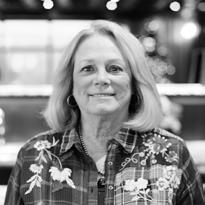
by CCA Treasurer Beverly Bigger
For officers of the California Cattlemen’s Association, spring time is a non-stop adventure. Each of us officers have our own cattle operations and ranch issues to handle. When we add in the spring tour visits to local cattlemen’s groups up and down the state, springtime seldom leaves a dull moment - especially in a year when we received an abundance of rain and extra projects as a result.
Having CCA represented by cattle producers in unique areas of the state serves CCA well as we are able to cover more ground and we are also better able to tackle challenges that arise in our respective areas of the state. For me, down here in Ventura County, many of the issues we see are directly related to the urban population. During my time as a cattle producer, I have spent a lot of time in education. I have had to educate myself on issues within the cattle business related to ranch management and I have also seen the efforts that come from cattlemen and women working to educate the public.
As a member of the California Cattle Council, I am thrilled to see cattle producers’ public education dollars being put to use reaching people across our very broad and diverse state. Being a member of the Cattle Council has also been an education for me to further realize how each of the sectors of the beef business – calf nurseries and dairy farms,
cow-calf ranches and feedlot operations
– each add to the robust nature of California’s cattle climate and the role of us all in impacting public perception for the better.
In addition to the CCA meetings I have attended this spring, the annual cattle council meetings were a great opportunity to bring minds together to help fund projects that benefit our way of life in the year ahead or that may influence consumers, law makers and regulators for years to come. Something that makes me exceptionally proud as a cattle producer and Cattle Council member is that the Cattle Council is able to help in so many facets that benefit our way of life. The council funds cattle industry research that helps cattlemen be more profitable and we fund things like television commercials and podcasts that help the public get a rare glimpse into our lifestyle. Plus the council helps fund so many projects in between.
Like the California beef industry, the CCA family is also diverse. As the treasurer of our
...CONTINUED ON PAGE 10

8 California Cattleman April 2024

CONTRA COSTA- ALAMEDA & SAN JOAQUIN-STANISLAUS CATTLEMEN’S
Sales

FEATURING A SPECIAL SECTION OF NHTC-CERTIFIED, ANGUS-SIRED CALVES AS WELL AS A RED ANGUS AND CHAROLAIS SECTION
THESE EVENTS WILL INCLUDE SOME OF THE BEST CALVES CALIFORNIA HAS TO OFFER, SO WHETHER YOU ARE ENROLLED IN A SPECIAL PROGRAM OR NOT, THESE SALES ARE FOR YOU!
SPRING SPECIALS
TUESDAYS | APRIL 9, APRIL 16 & APRIL 23
SPRING FEEDER SALE FEATURING CALVES AND YEARLINGS
TUESDAYS | MAY 7 & MAY 21
DEDICATED TO SHOWCASING CALVES AND YEARLINGS FROM CONSIGNORSWITH 50 HEAD OR LESS AT 9 A.M.
BURGERS AT THE BARN | SATURDAY, MAY 4
SPECIAL WEIGH-COW SALE & RECREATIONAL CATTLE SALE

TUESDAYS | JUNE 4 & JUNE 18
TLAY SPRING FEEDER SALES DEDICATED TO SHOWCASING CALVES AND YEARLINGS FROM CONSIGNORS OF 50 HEAD OR LESS SALE DAY IS PAY DAY!


TURLOCK LIVESTOCK AUCTION YARD OFFICE: 209 634-4326 • 209 667-0811 10430 Lander Ave., Turlock, CA P.O. Box 3030, Turlock, CA 95381 www.turlocklivestock.com TLAY REPRESENTATIVES MAX OLVERA 209 277-2063 STEVE FARIA 209 988-7180 JUSTIN RAMOS 209 844-6372 JOHN LUIZ 209 480-5101 JAKE BETTENCOURT 209 262-4019 TRAVIS JOHNSON ......209 996-8645 TIM SISIL .................................. 209 631-6054 JOHN BOURDET ...................... 831 801-2343 CELESTE SETTRINI..................831 320-1527 MATT MILLER........................... 209 914-5116 BRANDON BABA 209 480-1267 BUD COZZI ................................ 209 652-4480 CALL TO CONSIGN CATTLE TO THESE UPCOMING WVM EVENTS! JOIN US IN COTTONWOOD APRIL 11 IN COALINGA, MAY 2 AND COTTONWOOD MAY 23! When marketing calves at TLAY, don't forget how essential the 2nd round of shots is. Make sure to include a modified live vaccination! THE CENTRAL CALIFORNIA MARKETING CENTER FOLLOW US ONLINE FOR WEEKLY SALE REPORTS AND NEWS ABOUT UP-TO-THE-MINUTE SALE DATES AT WWW.TURLOCKLIVESTOCK.COM OR ON OUR FACEBOOK PAGE! WATCH LIVE AND BID ON LMAAUCTIONS.COM ALSO SELLING CATTLE FROM THESE CATTLEMEN’S ASSOCIATIONS: MERCED-MARIPOSA, SANTA CLARA, NAPA-SOLANO, MADERA, CALAVERAS TUOLUMNE, FRESNO-KINGS, SAN BENITO & TAHOE SATURDAYS | MAY 18 • JUNE 8 • JUNE 22 42ndAnnual Showcase Feeder
April 2024 California Cattleman 9
organization I have become familiar with just how much CCA depends on all of our “family” to make the association run smoothly. Producer members, Allied Industry Council members, Feeder Council members and supporting members pay dues to help keep the lights on at CCA and help keep our lobbyists in action at the capitol building. Plus, our other affiliates like the California Beef Cattle Improvement Association and California CattleWomen add educational opportunities and public and youth outreach programs that help our industry as a whole.
As I write this column, I have just returned home from the iconic CCA Steak and Eggs Breakfast. It was so fun to see such a timehonored tradition be appreciated by our own CCA members but knowing how much our lawmakers and their staff look forward to the event is also a great reminder how many allies we really do have in Sacramento. Following the breakfast, traveling to the capitol to meet with our elected officials is a great experience to meet with the very people you have voted for, as


well as folks you may not have voted for to help find common ground on important topics. This year I specifically enjoyed meeting face-to-face with Sen. Monique Limón (D-Santa Barbara) and her staff and helping promote her bill dealing with prescribed burning in our state.
CCA staff work tirelessly to be familiar with assemblymembers and senators and educate them on bills that will help or hinder beef production in California. But when you and I – actual boots-on-the-ground cattlemen and cattlewomen – take time to show up and advocate for our way of life, it definitely adds an element of authenticity that can’t be replaced.
As I returned home from these spring meetings ready to tackle the pile of projects that have been waiting for me on the ranch, I am energized by the opportunities that have been afforded to cattle producers in our state and I look forward to seeing the fruits of our efforts in Sacramento and in our home areas pay off. Thank you to all our members who share input and take time to help CCA in all of its various efforts. I look forward to seeing you at another event soon!

10 California Cattleman April 2024 HDPE for Ranch Water Systems Fair Prices . Good Service . Rancher Owned · Durable, efficient alternative to PVC · We have installed miles of HDPE and can visit with you about your projects · We offer a full line of fusible HDPE pipe up to 6" in continuous reels and up to 48" in sticks plus all the fittings DELIVERY THROUGHOUT THE WEST CALL TODAY: 925-204-2424 Cattlemans Assoc.qxp_Layout 1 6/9/23 12:36 PM Page 1 Due Diligence Assistance / Budgeting Site & Improvements Assessment Conservation Easement Opportunities Advising for USDA NRCS Federal Cost-Share Incentives Programs USDA NRCS Technical Service Provider # 04-4096 Design / Installation Oversight / Final Check-Out CONSERVATION PROJECT Planning / Management / Coordination Solar Water Pumping Systems Design & Installation Enhancement Projects / Equipment Evaluation / Range Management Assessments www.freitasrangelandimprovements.com P.O. Box 2479 Livermore, CA. 94551 Jed Freitas 925.580.6415 Licensed/Bonded/Insured Rangeland Improvements LLC ...CONTINUED FROM PAGE 8


Spring Run is On Western stockman’s market YOUR nhtc approved marketing location THD © DWIGHT MEBANE ....... 661 979-9892 JUSTIN MEBANE ......... 661 979-9894 Western stockman’s market 31911 Highway 46, mcfarland, california 661-399-2981 • www.westernstockmansmarket.com Your Southwest Livestock Market Leader Frank Machado ..... 805 839-8166 Bennet mebane....... 661 201-8169 b famoso spring AND summer stocker and feeder sales every monday in april, may and june Featuring Large Runs Calves and Yearlings from Local and West Coast Ranches Annual SpeciaL bred cow sales at 12 noon Monday, June 10 Monday, July 15 Monday, August 12 Featuring Young Angus Cows Bred to High-Powered Angus Bulls and More 59th famoso female & all-breed bull sale Top Bulls & Females: Saturday, October 19 Mark Your Calendar
TAKE ADVANTAGE OF OUR RECORD-HIGH MARKET PRICES ON MONDAYS WITH LARGE RUNS OF STOCKERS AND FEEDERS, PLUS SLAUGHTER COWS AND BULLS April 2024 California Cattleman 11
YOUR DUES DOLLARS AT WORK
SACRAMENTO HAPPENINGS
CCA LOBBYING FOR BEEF PRODUCER INTERESTS
by CCA Vice President of Government Affairs Kirk Wilbur
Cattlemen at the Capitol
At the conclusion of the 43rd annual CCA Steak & Eggs Breakfast on March 13, cattlemen made the three-block trek from the Sutter Club to the Capitol Annex Swing Space, the temporary home of legislative offices while the State Capitol building undergoes construction.
Ranchers came prepared to educate their representatives about the benefits of cattle ranching and to lobby in favor of two of CCA’s priorities: Budget funding for the California Department of Fish and Wildlife’s Wolf-Livestock Compensation Program and support for Senate Bill 1101 (Limón), which seeks to streamline CAL FIRE’s application of good fire on the landscape.
For readers who were unable to get away from the ranch to join the lobby day, below is an update on each of those priorities and a recap of ranchers’ recent lobbying efforts in Sacramento.
Wolf-Livestock Compensation Program Funding
To help offset the economic burden borne by ranchers since gray wolves began to settle within the state, the Budget Act of 2021 established a Wolf-Livestock Compensation Pilot Program administered by the Department of Fish and Wildlife. The legislation specifically directed the Department to develop a threepronged program that would compensate ranchers for direct loss of livestock to wolves, reimburse producers for their voluntary efforts to implement non-lethal deterrents and offset the economic impacts of wolf presence on livestock herds.
The first two prongs of the program were implemented shortly after the Budget Act was finalized in September of 2021. Under the Direct Loss prong of the program, ranchers can be compensated at fair market value for any livestock deaths that CDFW determines were confirmed or probable depredations by wolves. Through the Nonlethal Deterrents prong, ranchers can apply to be reimbursed for the costs of implementing deterrents intended to haze wolves away from livestock, including ‘turbofladry’ and range riders.
The third prong of the program, Pay for Presence, didn’t roll out until mid-2023 after an extensive public process. Through the Pay for Presence program, ranchers whose livestock operations are within an “Area of Known Wolf Activity” can apply to be compensated for the financial impacts of wolf presence using
a formula developed by the Department. Presence impacts include depredation losses which cannot be confirmed (and indeed may never be discovered) and stress impacts, such as increased abortion rates and decreased weight gains.

The Program was seeded with one-time funding of $3 million to be available until June 30, 2026, or until the funds appropriated for the pilot program were fully encumbered. Unfortunately, the department announced on Jan. 12 – two days after Governor Newsom released his Proposed Budget – that the fund had been fully encumbered.
CCA has made funding the program a top priority for 2024 – a particular challenge in a Budget year in which the state’s Legislative Analyst’s Office projects a deficit of $73 billion.
A key first step in advocating for additional funding was to demonstrate that the Compensation Program enjoys broad appeal and isn’t merely a cattlemen’s issue. To that end, CCA has partnered with Defenders of Wildlife, which favors the program because it seeks to reduce conflicts between wolves and livestock (thereby protecting wolves), and it helps to increase tolerance for wolves in impacted communities. When legislators see that the program is supported by ranchers and wolf conservationists alike, it lends credence to the notion that it’s a program worth sustaining.
CCA, Defenders and the California Farm Bureau initially targeted 17 legislators whose districts have been traveled by wolves in recent years (including OR-93, which traversed the Central Coast and made it as far south as Ventura County in 2021) or which were identified as potentially suitable wolf habitat in the Department’s 2015 Wolf Conservation Plan. While CCA had initially requested $15 million over five years in a February letter to the Newsom Administration, conversations with these lawmakers revealed that another onetime appropriation of $3 million would be more palatable in the Capitol.
Working with these legislators, CCA was able
12 California Cattleman April 2024
...CONTINUED ON PAGE 14

April 2024 California Cattleman 13
to secure letters to the Senate and Assembly Budget committees requesting that the WolfLivestock Compensation Program be funded in the 2024-25 State Budget. Those requests were championed by Senators Dahle (R-Bieber) and Alvardo-Gil (D-Jackson) and Assemblymembers Gallagher (R-Yuba City) and Soria (D-Fresno), with several other lawmakers signing on in support.
During the Lobby Day on March 13, CCA members in Dahle, Alvarado-Gil, Gallagher and Soria’s districts were able to personally thank those legislators for their leadership in seeking to keep this vital Compensation Program funded. Importantly, CCA members were also able to extend the reach of CCA’s lobbying efforts, communicating the importance of the wolf compensation program to dozens of additional legislators statewide. In the weeks that followed lobby day, CCA was able to secure many of those legislators’ support in a legislative letter to Governor Newsom requesting that he include funding for the program in his May Revise of the budget.
Senate Bill 1101
In addition to seeking additional funding for CDFW’s Wolf-Livestock Compensation Program, ranchers at CCA’s lobby day advocated in favor of SB 1101, a bill from Sen. Monique Limón (D-Santa Barbara) which seeks to streamline CAL FIRE’s ability to implement prescribed fire quickly and nimbly.
When wildfires strike, CAL FIRE has emergency authorities which allow the agency to expedite contracting and logistical efforts to respond rapidly to the threat. For prescribed fires, though, CAL FIRE is subject to bureaucratic red tape that sometimes requires months of lead time to satisfy legal requirements for contracting and procurement, often frustrating the agency’s efforts to quickly and effectively apply good fire to the landscape to improve wildfire resilience.
SB 1101 would streamline contracting and procurement requirements for CAL FIRE’s prescribed fire efforts, similar to the authority the agency currently has to respond to wildfires. This would allow CAL FIRE to better take advantage of favorable burn conditions on an expedited timeline, improving implementation of the single most effective wildfire resilience tool in the toolbox.
SB 1101 would also improve wildfire response and prescribed fire planning by directing CAL
FIRE to work with local, state, federal and tribal agencies to map networks of potential fire boundaries. Finally, the legislation would direct CAL FIRE to identify the severity of wildfires, providing greater insights into the effectiveness of wildfire resilience efforts and better informing post-fire management.
SB 1101 is sponsored by Pacific Forest Trust, an organization that has worked alongside CCA as members of a diverse Wildfire Resilience Working Group since 2020. The Working Group has made significant strides in the legal framework of “good fire” in California over the years, and passage of SB 1101 would further advance the group’s good fire priorities.
During CCA’s lobby day, Mike Williams, Acton, and Bev Bigger, Ventura, met with Senator Limón to advocate for the Association’s priorities. The duo extended their gratitude to the Senator for authoring this legislation, and Limón expressed her pleasure at having cattlemen’s support.
Beyond Lobby Day
During Lobby Day, CCA members meet with the Senator and Assemblymember representing them in Sacramento. As a result, lawmakers without ranching in their districts miss out on direct lobbying from cattle producers.
Fortunately, all legislators are invited to the Steak and Eggs Breakfast preceding Lobby Day, and this year lawmakers heard from Natural Resources Secretary Wade Crowfoot about the many ecological benefits of cattle grazing, chief among them wildfire fuels reduction. After the event, CCA and California Cattleman Foundation staff were approached by multiple legislators representing Los Angeles. While there’s no livestock grazing in their urban districts, these legislators requested that CCA staff drop in on their office to discuss cattlemen’s priorities and expressed interest in the Foundation organizing educational ranch tours near the district or just outside of Sacramento.
While not every legislator sees cowboy boots in their office during Lobby Day, the conversations with ranchers over steak and eggs are often engaging and enlightening, and open doors to new relationships in the Capitol. If you couldn’t join us for the Steak and Eggs Breakfast and lobby day this year, consider making the trip next year; the exercise in direct democracy pays significant dividends for CCA’s legislative priorities in Sacramento (and it’s great to see the state’s decisionmakers donning their cowboy hats, too!).
14 California Cattleman April 2024
...CONTINUED FROM PAGE 12

MAY 22-23, 2024
FEEDER MEETING
SAN DIEGO HILTON BAYFRONT
CALL 1-800-HILTONS AND MENTION CCAF TO BOOK YOUR HOTEL RESERVATIONS WITH CCA’S GROUP RATE.
New Thursday Night Dinner Location!
GREYSTONE PRIME STEAKHOUSE
658 5TH AVENUE
SAN DIEGO, CA 92101
Sponsored by:


REGISTER TODAY AT CALCATTLEMEN.ORG!
Feeder Council Producer Member
Includes access to all meetings, breakfast and lunch on Thursday and one ticket to Thursday night’s dinner event. PRICE: $350
Industry Partner
Includes access to all meetings, breakfast and lunch on Thursday and one ticket to Thursday night’s dinner event. PRICE: $450
Additional Thursday Night Dinner Tickets
Limited tickets. It is recommended to purchase additional tickets prior to the event.
PRICE: $150
PRICES WILL INCREASE ONSITE. NO REFUNDS FOR REGISTRATIONS WILL BE AVAILABLE AFTER 4/30.
2024 FEEDER MEETING SPEAKERS


April 2024 California Cattleman 15
THANK YOU TO OUR 2024 TITLE SPONSORS
ROLAND FUMASI, PH.D Rabobank
TOM DEJARNETTE
The STEPS Foundation
NCBA
ETHAN LANE
PATRICK LINNELL
TO READ SPEAKER BIOS AND LEARN MORE VISIT CALCATTLEMEN.ORG
KATIE COOK DR. SARAH KLOPATEK CattleFax Elanco Animal Health JBS
& SEAFOOD
BREAKFAST MEETING
COWBOY HATS AND SUITS ABOUND DOWNTOWN FOR 43RD STEAK & EGGS BREAKFAST
LaGrande

On March 13 cattlemen and women made their way to Sacramento for the 43rd California Cattlemen’s Association Steak and Eggs Legislative Breakfast and Lobby Day held at the Sutter Club in Sacramento. Attended by legislators, legislative staff and government officials, the event helps members share their unique ranching stories, discuss issues and the share the importance of ranching in California with those who may not be familiar with livestock production. Many CCA members and legislators have participated in the breakfast tradition over the years that comes with the option for the legislative staff to take home their very own cowboy hat.
As conversation and cowboy hats flooded the banquet room, CCA’s President Steve Arnold, Santa Margarita, welcomed everyone to the breakfast. Aside from ranchers mingling with legislative staff at the breakfast, another crucial component of the event is hearing from various speakers about the positive impacts livestock production makes in the state, issues the industry may be facing and what ranchers and legislators must work toward to ensure the future of rangelands and beef cattle production in California.
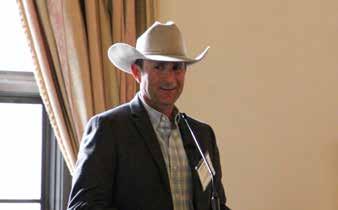
Arnold introduced Assemblyman Jim Wood for the morning’s opening remarks. Wood, who represents California’s Second Assembly District, started by recognizing ranchers from his district and thanking fellow legislators and staffers for making their way over to the Sutter Club. He shared that over his last 10 years in office, he has looked forward to attending the breakfast each year. He also reflected on memories from his childhood on his grandfather’s small Angus ranch.
Wood acknowledged the importance of cattle grazing and the impact it has on the environment, urging those at the breakfast to
reach out and learn more about ranches and livestock by taking a ranch tour.
CCA member and Santa Barbara County Deputy Fire Chief of Operations, Anthony Stornetta, Atascadero, discussed the importance of grazed rangelands and how these managed open spaces impact the way fires burn and are fought. “Wildfires make a big impact on us and what our kids will see in the future,” added Stornetta who also noted that California is a resilient state, facing droughts, wildfires and other natural disasters on a yearly basis, and applauded the legislators who have worked with agencies to implement plans for when disasters such as wildfires occur.
A firefighter for 29 years, Stornetta detailed how he has observed open space, public parks and rangeland and has seen firsthand how grazing and implementing fire mitigation practices, such as prescribed fire and fire breaks lead to less fire damage compared to lands that are unmanaged. While there is always work to be done, Stornetta highlighted recent collaborative successes including passing legislation for the Livestock Pass Program and getting more prescribed fires on the ground.
Stornetta recognized and thanked legislators for all the work they have and continue to do on behalf of the cattle industry. “It’s our time to communicate, collaborate and develop those partnerships with one another,” said Stornetta.
To round out the morning’s speakers, California Natural Resources Agency Secretary Wade Crowfoot took the podium. He has served as secretary since 2019, working to conserve the state’s natural resources and environment. Crowfoot thanked ranchers for the work they do to help maintain America’s food security and addressed how California’s farms and ranches contribute largely to the country’s food supply.
Aside from food security, Crowfoot spoke
16 California Cattleman April 2024
by CCA Associate Director of Communications Maureen
on the role ranchers play in building wildfire resistance within the state through grazing practices and land management. He added that there is still work to be done in managing landscapes, forests and the everchanging climate to lessen the risk of catastrophic wildfires.
Through collaborative efforts and help from the legislature over the last few years, Crowfoot shared that CAL FIRE’s budget has increased allowing for more feet on the ground, helicopters and technologies to fight these fires. With CAL FIRE, the Forest Service and other local partners working together, they can keep fires small. “Wildfires are part of the environment in California, success is allowing for that natural fire regime to happen but in manageable ways,” said Crowfoot.
Past devastation from wildfires has made wildfire resiliency become a large priority for the state. Over the last three years, the governor and legislature have invested nearly three billion dollars in projects to help safeguard communities and landscapes throughout California, shared Crowfoot. These investments have gone toward putting in fuel breaks around communities, implementing safe prescribed fire and forming partnerships with ranchers to increase targeted grazing across the state. Crowfoot acknowledged that grazing is an underutilized tool in the fight against fires, adding that targeted grazing is an “…important partnership to maintain, strengthen and expand the role of grazing on public and private lands to reduce wildfire risk.”
Addressing that stewards of the land have helped plants and animals to prosper, maintaining the biodiversity of California, Crowfoot shared, “We love these outdoors, and these working lands are a critical part of that.” To ensure that these lands continue to be open space, Governor Newsom and the legislature have a goal to conserve 30 percent of the state by 2030, also known as 30x30. The partnership is a voluntary group that works to expand conserved acres for the environment, open spaces and conservation easements. While talking about the partnership Crowfoot thanked CCA’s Vice President of Government Affairs Kirk Wilbur for sitting on the partnership committee and making sure the interests of cattlemen are represented in the partnership’s efforts.
Finally, Crowfoot spoke about the Governor and legislature’s focus on California’s economic future, sharing that they are always looking for ways for the state to grow and flourish. Recognizing that not “one size fits all,” the state’s leaders have invested funding into economic development that


April 2024 California Cattleman 17
...CONTINUED ON PAGE 18
Assemblymember Jim Wood, providing the breakfast’s opening remarks.
CCA President Steve Arnold welcoming everyone to the 43rd CCA Steak and Eggs Breakfast.
California Natural Resources Agency Secretary Wade Crowfoot, speaking on partnerships with ranchers and conservation efforts.
CCA Fire Subcommittee Chair Anthony Stornetta speaking on wildfire resistance and the importance of grazed open space.
will be determined on a regional basis. Crowfoot shared that regional leaders will be able to identify where they want to grow and how they want to invest in the growth of their area’s economy. This approach originally called the Community Economic Resistance Fund is now recognized as Jobs First. In Crowfoot’s closing comments, he encouraged those in the audience to continue to advocate for working lands, wildfire environmental conservation and economic growth and while in Sacramento, talk to legislators regarding these topics.


After the breakfast, CCA members walked to Capitol Annex Swing Space for scheduled meetings with legislative members from their respective districts. At these meetings members shared with legislators’ information about ranching in California, requested continued funding for the California Department of Fish and Wildlife’s Wolf-Livestock Compensation Program and shared about CCA’s support of Senate Bill 1101 (Limón). As meetings commenced, CCA members from all over the state, made their way home marking an end to the 43rd CCA Steak and Eggs Breakfast.


18 California Cattleman April 2024
PAGE 17
...CONTINUED FROM
CCA members Dave Daley, Robert Daley and Blake Early.
James Henderson and Cody Eastman
Cattle rancher Greg Grewal with legislative Staff.
Olivia Williams, Bronson Lasley, CCA’s Kirk Wilbur and Sam Dolcini headed into the Swing Space.
CCA members making their way to the Capitol Annex Swing Space for meetings with their representatives.
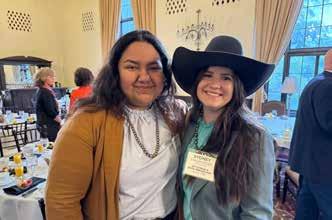
Chico State students Guadalupe Reyes Paz and Sydney Hagerman attend the breakfast.


April 2024 California Cattleman 19
Southern California ranchers CCA
Second Vice President John Austel and Debbie Torres
Daniel O’Connell sits with legislative staff at the breakfast.
Bronson Lasley, Sam Dolcini, Olivia Williams, Bob Puga and Aaron Colby attending meetings.
Ventura and Los Angeles County ranchers Mike Williams, Bev Bigger and Cody Eastman after the breakfast.
Bay Area cattle producers Clayton and Natalie Koopmann attending legislative visits.
Barney, Jeri, Erick and Paul Roen ready to speak with legislators at the breakfast.
Assemblymember Juan Alanis and staffers with their cowboy hats. California Rangeland Trust’s Alyssa Rolen and Madison Goss.
BUNKHOUSE ON THE RUN
SIX MONTHS IN AND MOMENTUM IS BUILDING
by Jared Mandrell, Director of Public Policy, California Cattlemen’s Foundation
It’s been six months since I first introduced myself to California Cattleman, time I have spent researching and advocating for informed policy. One of the first projects I worked on was ensuring that beneficial relationships between cattle ranching and threatened species continues to be recognized through the Endangered Species Act (ESA). Currently, when a species is being listed as threatened, the U.S. Fish & Wildlife Service (USFWS) issues a species-specific 4(d) rule. This rule derives its name from section four of the ESA and provides protections for actions that help populations recover in the long-term even when there is a potential of “take” in the short term. In several recently proposed ESA listings, routine cattle ranching has received this protection for its role in preserving critical habitat. In comments sent to USFWS on behalf on the Foundation, I have advocated to extend these protections even further to recognize the important role that cattle grazing plays as a fire management tool.
Grazing has a long history of being used as a tool to reduce fuel loads and reduce the risk of wildfire. This is why I recently took the opportunity to suggest the use of grazing be added to the USDA Forest Service Sequoia and Sierra National Forests Land Management Plan. This would be done through the use of grazing as a pre-treatment to prescribed fire in-place of manual removal alone and by implementing patch burn grazing as a continued management technique.
Sometimes, proposed policy is noncontroversial enough to negate the need for a formal letter of support. This was recently the case when the California Fish and Game Commission introduced amendments to reclassify wild pigs from “game mammals” to “exotic game mammals.” This change was made to comply with Senate Bill 856 from 2022 and recognized wild pigs as a nonnative mammal that is detrimental to native species and their habitat. The amended rules will allow permits to be issued for up to five years as opposed to the current oneyear limit and replace pig tags with a validation that allows for unlimited take. Additionally, hunters are now required to report take within
60 days of the end of the license year rather than following each instance of take. These new rules are expected to take effect by July of this year but will ultimately be determined by the California Fish and Game Commission.
A more recent project I have worked on has been the Wildlife Damage Management Analysis from the California Department of Food and Agriculture (CDFA) and the California State Office of USDA APHIS Wildlife Services. This proposal outlines the framework for the creation of a CDFA program focused on Wildlife Damage Management (WDM). Under existing conditions, WDM is administered on a countyby-county basis with some counties entering into a voluntary memorandum of understanding with Wildlife Services California. Through the creation of this program, CDFA hopes to establish a statewide database to allow for a more coordinated approach to WDM across the state and providing additional resources to ensure high-risk situations are addressed quickly. The proposal provides several alternatives to consider which include options that leave the current framework in-place or limit agencies ability to provide lethal assistance. In comments sent to CDFA and USDA APHIS, I have worked to fight against the implementation of these alternatives while supporting the proposed program.

While these are just a few examples of how diverse regulatory policy can be, I see these topics as opportunities to provide up-to-date information and relevant research to those who need it most. I will continue to monitor state and federal agencies to ensure that any proposed regulation with the ability to effect ranching in the state is properly informed before being finalized. I am honored to serve as a resource and represent such a vitally important industry.
20 California Cattleman April 2024

750 HEAD OF FANCY REPLACEMENT FEMALES SELL SATURDAY, APRIL 27
LUNCH AT 12 | SALE AT 12:30
WATCH AND BID LIVE AT LMAAUCTIONS.COM
400 FANCY FRONT END FEMALES FALL CALVING, FIRST-CALF, COMING 3-YEAR-OLDS. ANGUS/ANGUS-CROSS, RED ANGUS/RED ANGUS CROSS. ALL ARE ULTRASOUND CONFIRMED TO CALVE BETWEEN SEPT. 10 AND OCT. 10. ALL HAVE COMPLETE DNA INFO THROUGH ZOETIS INHERIT SELECT FERTILITY TEST FOR COMMERCIAL FEMALES. HAND SELECTED FROM THE TOP END OF 700 REPLACEMENTS. ORIGINATED FROM REPUTATION RANCHES. ALL FOOTHILL VACCINATED AND ON A COMPLETE YEARLY MODIFIED-LIVE VACCINATION AND MINERAL PROGRAM. THEY HAVE BEEN RUNNING IN THE SIERRA FOOTHILLS FOR TWO SEASONS!
FEATURING:
50 HEAD ANGUS/ANGUS CROSS
ORIGINATING FROM THE WAIBEL RANCH, POST, OR. BRED TO LOW-BIRTH 44 FARMS BULLS.
100 HEAD ANGUS/ANGUS CROSS FROM THE WILKINSON & STEP-TOE RANCH, NV. 75% BRED TO RHOADES ANGUS BULLS AND 25% TO LUDVIGSON/IRON-LORENSEN RED ANGUS BULLS.
100 HEAD ANGUS/ANGUS CROSS FROM BENTZ & OTIS CREEK RANCHES IN BURNS & DREWSEY, OR. BRED TO LUDVIGSON STOCK FARMS AND IRON-LORENZEN RED ANGUS BULLS.
100 HEAD RED ANGUS/RED ANGUS CROSS ORIGINATING FROM THE OTIS CREEK RANCH IN DREWSEY, OR. BRED TO IRON-LORENZEN AND LUDVIGSON STOCK FARMS RED ANGUS BULLS.
50 RED ANGUS/RED ANGUS CROSS FROM THE RIDLEY RANCH IN LAS ANIMAS, CO. BRED TO IRON-LORENZEN AND LUDVIGSON STOCK FARMS RED ANGUS BULLS
PLUS:
60 HEAD ANGUS/ANGUS CROSS
3 & 4 YEAR OLD CALIFORNIA NATIVE FALL-CALVERS. BRED TO TOP END ANGUS BULLS TO CALVE SEPT. 5 TO OCT. 5. COMPLETE VACCINATION PROGRAM, INCLUDING FOOTHILL VACCINATION.
40 HEAD RED ANGUS
3 & 4 YEAR OLD FALL-CALVING COWS FROM ONE RANCH IN VALE, OR. BRED TO HIGH-END ANGUS BULLS TO CALVE SEPT. 5 TO OCT. 5. COMPLETE VACCINATION PROGRAM AND FOOTHILL VACCINATION.

30 ANGUS FIRST-CALF HEIFER PAIRS ORIGINATING FROM ONE OKLAHOMA RANCH. MARCH-APRIL CALVES SIRED BY DISMUKES RANCH ANGUS BULLS.
40 ANGUS/RED ANGUS/CROSS 3 & 4 YEAR OLD PAIRS FEBRUARY-MARCH CALVES AT SIDE, RUNNING IN CALIFORNIA FOOTHILLS FOR 2-3 SEASONS. COMPLETE VACCINATION AND MINERAL PROGRAMS. LUDVIGSON STOCK FARMS SIRED CALVES.
SALE ALSO INCLUDES SEVERAL SMALLER BUNCHES OF YOUNG FALL CALVING COWS AND HEIFERS AS WELL AS SOME SMALL GROUPS OF SPRING PAIRS. TRULY A GREAT OFFERING OF FANCY, YOUNG REPLACEMENT FEMALES!

WHETHER YOU PREFER TO MARKET YOUR CATTLE THROUGH THE AUCTION MARKET, LIVE INTERNET AUCTION OR PRIVATE CATTLE LISTING, VISALIA LIVESTOCK MARKET HAS YOU COVERED! SALES EVERY WEDNESDAY! 733 North Ben Maddox Way Visalia, CA 93292 YOUR COMPLETE MARKETING SERVICE ANNUAL BRED COW & PAIR SALE CONSIGNMENT INFORMATION: RANDY BAXLEY, (559) 906-9760 www.VisaliaLivestock.com

Blazing a Trail FLYING F RANCH’S ALLISON FENDER’S YEAR AS AN NCBA TRAILBLAZER
by CCA Associate Director of Communications Maureen LaGrande
by CCA Associate Director of Communications Maureen LaGrande
A little over a year ago Allison Fender of Flying F Ranch, San Diego found out she was one of 10 people selected to participate in the National Cattlemen’s Beef Association (NCBA) Trailblazer Program. The program developed by NCBA and funded through the Beef Checkoff, is geared toward educating and training individuals on how to represent and converse with others about the beef industry.
Those selected to be a part of the program have previously completed the NCBA’s, Checkofffunded Master of Beef Advocacy (MBA) program. The program was formed in 2009 to teach industry advocates how to interact with consumers on how cattle are raised and the importance of beef. The Trailblazer program serves as an advanced level of training that builds off what participants of the MBA program have learned. To apply, applicants must complete an application, submit a video about themselves, and complete a phone interview with the selection committee.
Fender’s aspirations to become a Trailblazer came from her enjoyment of sharing her story with others, especially online, and being able to connect with a larger audience. Through social media, Fender shares the ins and outs of ranch life and the beef industry with her followers. Being from the Southern part of the state, Fender says most people think of the beach when they hear that she’s from San Diego and not of cattle ranches.
Fender has been around livestock all her life. As a youth she was actively involved in 4-H and the FFA feeling a strong connection to agriculture. “I had a passion for the cattle industry as a whole, especially being from an area that is not commonly thought of when livestock are involved,” shared Fender.
At the annual California Cattlemen’s Association and California CattleWomen’s Association Convention in 2022, Fender attended a media training taught by Chandler Mulvaney, NCBA’s
Director, Grassroots Advocacy and Spokesperson Development. During the training Mulvaney had participants stand up and partake in a mock interview as if they were talking to the media about the beef industry. At the end of the training and realization of her confidence of being able to stand in front of a crowd and speak made Fender think “I can do this.”
When she received the news that she’d been selected as one of the Trailblazers her initial thought was excitement for the year ahead and all the new opportunities this would provide to her as a producer and her advocation efforts. Upon her notification of being selected, Fender learned that a diverse group of individuals had been chosen from all over the U.S. representing from the West to the East Coast. Those selected for the 2023 class all came from different backgrounds and involvement in different sectors of the industry.
Commitment to the program requires Trailblazers to be present for at least 80 percent of all in-person and online trainings provided throughout the year. Two of the in-person trainings took place in Denver, Colo. While in Denver the Trailblazers were able to visit the NCBA office, meet the staff, learn about the ins and outs of the Beef Checkoff, Beef Quality Assurance (BQA) and learn about all that NCBA does for ranchers and producers.
The Trailblazer’s second trip to Colorado consisted of visiting a feedlot, Colorado State, a meat processing plant and a purebred operation where they were able to learn about genetics. Fender shared that the genetics part of the tour piqued her interest since it was an area she was not as familiar with and it allowed her to think of ways to incorporate what she learned into the cattle operation she runs with her husband.
The online trainings of the program took place once every two months and covered a wide range of topics. These topics included nutrition along
22 California Cattleman April 2024
with further communication training such as identifying talking points to hit when conversing with consumers. The trainings help to equip the Trailblazers with tools to conduct meaningful conversations as well as how to effectively respond to topics that may be impactful or negative regarding livestock. “It’s easy to get emotional on a topic during an interview and it’s important to know how to handle a situation and keep control of the conversation,” said Fender. Having established a solid foundation through social media, and her knowledge through the media training she has received, Fender is confident in her ability to speak with others.
Aside from her involvement in advocacy and running the ranch Fender also sells her ranch’s meat direct-to-consumer serving as another outlet to communicate firsthand with consumers about the benefits of beef in a diet. Fender recognizes that for some families it is not always logistically possible to purchase beef directly from the source due to access and affordability. “I don’t care where you get your beef from,” shared Fender, and supports those who find ways to reasonably budget beef into their shopping carts sharing.
“As a mom, it’s important to share with others the nutritional value of beef in the diet for a family, “said Fender.
One of Fender’s favorite experiences over the last year was attending the in-person training in Colorado. “Getting to know the NCBA staff on a first-name basis and know that they are always there to answer your questions is a great aspect of the program,” said Fender. The relationships also built with the other Trailblazers in the program helped to open doors for future collaboration and bounce ideas off of one another. “We’re like family,” said Fender.
Her dedication to the beef industry and advocation over the last year did not go unnoticed. In early December, Fender received a call from the California Beef Council’s (CBC) Director, Food and Nutrition Outreach Kori Dover and CBC Manager, Producer Education and Engagement Makenzie Neves notifying her that she had been selected as the top advocate of the year. Having collaborated with the CBC through ranch tours, Fender shared that it was special to receive the news of her award. When initially deciding whether or not she wanted to apply to be a Trailblazer, Fender shared that Dover was a driving force in convincing her to do it. As an advocate of ranching and the nutritional benefits of beef, Fender has collaborated with the CBC, participating in Beef It’s What’s for Dinner events in Los Angeles where an array of food bloggers and influencers attended. At the event, she was able to share her story and ranching background with them so that they could hear directly from a rancher.
Mulvaney, who helps with the Trailblazer program throughout the year shared, “Since

meeting Alli at the California Cattlemen’s Association Annual Conference in 2022, it has been an absolute pleasure watching her advocacy efforts, alongside those of her peers, make a lasting, positive, impact for the Beef Checkoff. Alli has continued to seek out ways she can improve her skillset, learn new information, and at the end of each day, provide the most authentic view of ranching and cattle production to consumers in her own “backyard” of San Diego. I am thankful for Alli’s efforts advocating for animal agriculture and my hope is that her story is an inspiration for others to rise to the occasion and do the same!”
Fender says other producers contemplating applying for the program would gain a great experience from and should consider applying for. “It’s a big commitment, but it’s worth the time. You meet a lot of great people and curate really good relationships with others involved in the industry,” said Fender.
With her hands-on approach, personal knowledge and the skills she has acquired over the last year Fender plans on continuing to share with others her day-to-day life on the ranch, writing on her blog, and continuing to advocate and educate others on the advantages of beef in a diet. “The Trailblazer program is still new but ever evolving and the program is always making improvements,” shared Fender. She added that NCBA has big ideas for its future.
Fender continues to stay in contact with those in her class as well as NCBA staff members. With her year as a Trailblazer complete, Fender will still have the opportunity to participate in Trailblazer trainings. In early March the 2024 class of Trailblazers was announced including another Californian, Cara Henri.
As her time as a Trailblazer has come to an end, Fender shared “Once a Trailblazer, you’re always a Trailblazer.”
April 2024 California Cattleman 23
Fender in the kitchen learning about the nutritional benefits of beef and ways to incorporate the meat into different dishes.
AGWEST FARM CREDIT SUPPORTS NEW PRODUCERS WITH $15,000 GRANT PROGRAM
AgWest Farm Credit, a cooperative lending association dedicated to supporting agriculture, has launched the application window for the New Producer Grant program, designed to help motivated producers get started in agriculture. The grant provides $15,000 in start-up funds to successful applicants to support their agricultural ventures.
Mark Littlefield, President and CEO of AgWest, said, “We’re continually inspired by the producers we get to know through the New Producer Grant program. Helping new producers start or grow their operations is allowing us to invest in the future of agriculture and build relationships with people we haven’t previously been able to serve. This program is an important component of our commitment to meet the credit needs of farmers and ranchers and the rural communities we serve.”
PROGRAM DETAILS
Benefits
• One-time grant of $15,000
• Educational support and mentoring
Eligibility criteria
• Be a full- or part-time agriculturalist with two years or less of operational experience or have plans to start an operation within two years of
the grant application date.
• Have an operation located within AgWest Farm Credit’s territory.
• Not be a current AgWest lending customer.
• Must be 18 years of age and either a U.S. citizen or a foreign national lawfully admitted for permanent residency or pursuant to certain visas.
Application requirement
• Prepare a business plan, cash flow budget, application and a one-page essay describing how the grant will help achieve operational goals.
• View three recorded webinars covering Financial Statement Basics at AgWestFC.com.
• English and Spanish resources are available to assist with completing the application components.
Application deadline: May 31, 2024
Application link: Submit applications online at AgWestFC.com/new-producer-grant
Find our media kit for download on our website For questions about the program, contact: AgVision@AgWestFC.com.


24 California Cattleman April 2024
HERD HEALTH
EVALUATING THE STRESS OF BRANDING PRACTICES ON CATTLE
by Chris Schachtschneider, Ph.D., assistant professor and extension specialist, Oregon State University
Every spring and sometimes in the fall, ranchers gather around the fire to mark their ownership on their calves.
This is the time when calves are vaccinated, disbudded — their horn growth plates cauterized to prevent further growth — and, if it’s going to be a non-breeding bull, castrated.
Until recent years, ranchers roped calves to capture and restrain them while they were branded. But the advent of the squeeze chute and calf table drastically changed how livestock are handled, igniting a debate: Which is better, the calf table or roping at branding time?
There hasn’t been evaluation of these practices to shine light on the debate. Until now.
A team of researchers — Sergio Arispe, Oregon State University assistant professor and Extension livestock specialist, Wade Black and Jared Higby from Treasure Valley Community College in Ontario, Ore., and me — decided to shed some light on the subject.
We evaluated cortisol levels in 48 calves across four of the most common restraint methods. We chose to test for cortisol because it’s known as the “stress hormone” — its levels in the body indicate the discomfort of an individual animal. We took blood samples a week before branding. We then sorted cow/calf pairs into four treatment groups.
In three of the groups, we separated the cows and calves with three capture-and-restraint methods: calf table, heel-only roping, and headand-heel roping. In the fourth group, we kept the calves and cows bunched together in the rodear. We roped the calves out of the rodear with headand-heel roping, as was traditionally done before corrals were prominent.
It’s important to note that the handling crew was the same throughout the study to minimize handler bias. They were all experts in the fields of stockmanship, horsemanship and ranch roping.
All of the calves in this project were captured and properly restrained before they were branded with a hot iron, vaccinated, castrated and disbudded before we collected a second round of blood samples. The samples were processed at Texas A&M University.
What we found was that the post-branding cortisol levels in calves almost doubled in the three groups in which they were separated from their mothers. The post-branding cortisol levels were lower in the calves in which they stayed
together with their mothers (baseline blood collection requires some handling and separation from cows).
This data suggests that the physical act of branding, vaccinations, castration or disbudding may not be as stressful to calves as the psychological stress from being separated from their mothers. We know that livestock have evolved to better tolerate pain than humans in order to escape predators, even after being bitten, cut or scratched. But the psychological stress of separation on calves of this size is not something that occurs in nature.
We want to emphasize that the crew members in this project were selected because they are able to work in the herd calmly and rope effectively. Handlers/ropers kept the animals calm and did not miss very often, so these factors need to be taken into consideration along with the nonpeer reviewed aspect of this project. This was also a project on one ranch with a small sample size. In order to fully understand the meaning of this information, more studies need to be conducted.
In conclusion, this project suggests two questions that need to be better understood. First, does roping inherently cause more stress for cattle? Second, if calves need to be separated, will minimizing that separation reduce stress overall for calves and herds?
The study was funded with a $12,500 grant from the Agricultural Research Foundation.

This graph shows changes in cortisol levels in the four treatment groups. Ng/ml, from blood sampling one week prior to branding (blue) and immediately after branding (orange). The groups are HOS: heel-only roping separated from cows; HHS: head and heel roping separated from cows; HHT: head and heel roping together with cows; and CTS: calf table separated from cows.

26 California Cattleman April 2024
Costing the industry more than $10 million annually, Foothill Abortion — formally known as Epizootic Bovine Abortion, or EBA — has robbed profits from ranchers for almost 100 years as the leading cause of calf loss in affected areas of the Western United States.
Until now.
After years in development and testing, the new Foothill Abortion Vaccine is available from Hygieia Biological Laboratories. The Foothill Abortion Vaccine has been shown to protect more than 95% of animals from the disease when administered as directed. Administration is safe, simple and proven to give your heifers a strong start for greater productivity.
Protect your investment and promote your profitability. Ask your local veterinarian if the Foothill Abortion Vaccine is right for your herd, or contact Hygieia Labs to learn more.
F: 530-661-1661
Contact Jenna Chandler at Hygieia Labs for additional information.
Jenna Chandler, EBA Product Manager 916-769-2442 | jenna@hygieialabs.com
April 2024 California Cattleman 27 Announcing the new vaccine from Hygieia Labs: Your Foothold
HYGIEIA BIOLOGICAL LABORATORIES P.O. Box 8300, Woodland, California 95776 USA
530-661-1442 | | hygieialabs.com
Against Foothill Abortion.
T:
NATIONAL PERSPECTIVE WINNING BACK THE WEST WESTERN POLICY IMPACTING THE CATTLE INDUSTRY
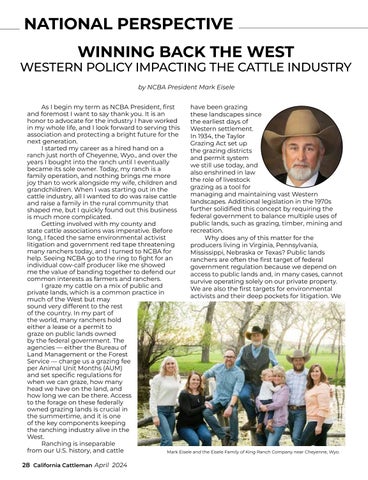
by NCBA President Mark Eisele
As I begin my term as NCBA President, first and foremost I want to say thank you. It is an honor to advocate for the industry I have worked in my whole life, and I look forward to serving this association and protecting a bright future for the next generation.
I started my career as a hired hand on a ranch just north of Cheyenne, Wyo., and over the years I bought into the ranch until I eventually became its sole owner. Today, my ranch is a family operation, and nothing brings me more joy than to work alongside my wife, children and grandchildren. When I was starting out in the cattle industry, all I wanted to do was raise cattle and raise a family in the rural community that shaped me, but I quickly found out this business is much more complicated.
Getting involved with my county and state cattle associations was imperative. Before long, I faced the same environmental activist litigation and government red tape threatening many ranchers today, and I turned to NCBA for help. Seeing NCBA go to the ring to fight for an individual cow-calf producer like me showed me the value of banding together to defend our common interests as farmers and ranchers.
I graze my cattle on a mix of public and private lands, which is a common practice in much of the West but may sound very different to the rest of the country. In my part of the world, many ranchers hold either a lease or a permit to graze on public lands owned by the federal government. The agencies — either the Bureau of Land Management or the Forest Service — charge us a grazing fee per Animal Unit Months (AUM) and set specific regulations for when we can graze, how many head we have on the land, and how long we can be there. Access to the forage on these federally owned grazing lands is crucial in the summertime, and it is one of the key components keeping the ranching industry alive in the West.
Ranching is inseparable from our U.S. history, and cattle
have been grazing these landscapes since the earliest days of Western settlement.
In 1934, the Taylor Grazing Act set up the grazing districts and permit system we still use today, and also enshrined in law the role of livestock grazing as a tool for managing and maintaining vast Western landscapes. Additional legislation in the 1970s further solidified this concept by requiring the federal government to balance multiple uses of public lands, such as grazing, timber, mining and recreation.

Why does any of this matter for the producers living in Virginia, Pennsylvania, Mississippi, Nebraska or Texas? Public lands ranchers are often the first target of federal government regulation because we depend on access to public lands and, in many cases, cannot survive operating solely on our private property. We are also the first targets for environmental activists and their deep pockets for litigation. We

28 California Cattleman April 2024
Mark Eisele and the Eisele Family of King Ranch Company near Cheyenne, Wyo.
are a testing ground to see if their strategies can succeed in harming folks on private lands as well. We are often the first to shoulder new government rules and regulations that make it harder to stay in business, with the government testing how far it can push its reach into your backyard.
The Endangered Species Act (ESA) is a perfect example of a federal law that has been weaponized, both inside the administration and outside, to restrict cattle producers. ESA listings and the habitat designations can tie a producer’s hands behind their back, barring them from grazing — or doing other management activities — on the land.
They can also block producers from taking action to protect their cattle from predators like the gray wolf. In the last three years alone, the Biden administration not only failed to delist the fully recovered gray wolf, they’ve actually proposed adding more predators to the equation in some areas. Their proposal to airdrop grizzly bears into Washington state is one example of a choice made far away in Washington, D.C., where bureaucrats don’t have to deal with an apex predator around their

Every Saved Drop Matters The Ritchie Ripple Effect
The benefits of adding a Ritchie to your operation extend far beyond saving you time, money, and water. By choosing Ritchie, you’ll conserve water, protect the land, and reduce energy to promote a healthier environment for generations to come. Learn how a more sustainable future starts with a drop of water at ritchiefount.com/sustainability.
children and their cattle herd.
If you need proof of the administration’s ability to squash the industry through the ESA, even on private lands, look no further than the designation of the northern long-eared bat. Even a species that is declining due entirely to natural causes can be weaponized to slow grazing, fence construction, and other human activities — whether they happen on public land or private. As NCBA president, this is one issue I am committed to working on so we can get back to our job of raising cattle without worrying about more red tape from Washington, D.C.
No matter where you raise cattle or what policy issue is most urgent to you, I encourage you to make your voice heard. A great opportunity to get involved is coming this spring when NCBA hosts the annual Legislative Conference. This event will occur from April 17-19, 2024, in Washington, D.C., where you will have a chance to meet with policymakers face-to-face to discuss the issues impacting our way of life. I hope to see you there!
Thank you for the opportunity to serve, and thank you for putting your trust in NCBA.

April 2024 California Cattleman 29
YOUNG PRODUCER
UC DAVIS YOUNG CATTLEMEN TO HOST END OF YEAR EVENT
by Mia Reyes, UC Davis Young Cattlemen’s Association
The Young Cattlemen’s Association at UC Davis has been instrumental in connecting members of the club with the cattle industry for decades. This year the club has expanded and now reaches members across many majors including Animal Science, Animal Biology, International Agriculture Development and Environmental Engineering. The overarching goal of the club is to cultivate new opportunities for its members and bridge the gap between academia and industry.
This year especially, the club has introduced new events such as Researcher’s Night and March Meat Madness, along with monthly socials that have covered a variety of topics surrounding the cattle industry. With a newfound rhythm and confidence, the club has been able to provide new learning opportunities for its members and pathways to successful careers. Our first-ever Career Fair and Job Expo, which hosted local and federal organizations such as TransOva, Superior Farms and PeaceCorps, presented internship and job opportunities specifically for our members.
The rise in member participation and activity has been noticed across campus, and with the support of the UC Davis CLEAR Center, the club has had the opportunity to take members on educational field trips across California including touring the Harris Ranch Feedlot, attending the Cal Poly Bull Test annual sale, and the annual California Cattlemen’s Convention.
The Young Cattlemen’s Association at UC Davis has also made significant strides towards connecting with the community. The club has been able to offer member support to the Yolo County Cattlemen & Wool Growers Association, Glenn-Colusa CattleWomen and Cattlemen’s Association, UC Davis Livestock Judging Team and UC Davis Meat Lab.
Currently, the club has over 50 registered YCA members ranking it as one of the largest agriculturally based clubs offered at UC Davis. With its growing membership, the club has introduced scholarships to recognize outstanding officers and involved members of the year. These members participate in monthly meetings and social events, volunteer at UC Davis YCA events, and embody the true spirit of a Young Cattlemen. This year we look forward to honoring them at the first annual UC Davis Young Cattlemen’s
Association End of the Year Banquet on June 1. The banquet will be hosted at the California Agriculture Museum in Woodland, CA connecting members of the community with members of the club in addition to highlighting all the engagement and opportunities that the club has been a part of this past year. The banquet will host a tri-tip dinner, music and dancing, and the chance to enter and win raffle prizes and silent auction items. The UC Davis Young Cattlemen’s Association End of the Year Banquet will be instrumental in the continued success of the club with all proceeds going towards supporting opportunities for the members of the UC Davis Young Cattlemen’s Association. This event is open to all, so please reach out via email to: davisyoungcattlemens@gmail.com to secure your tickets now. We hope to see you all June 1!
30 California Cattleman April 2024
UC D A VIS E N D O F T H E Y E A R 0 6 . 0 1 . 2 4 T I C K E T S D O O R S O P E N @ 5 P M C O C K T A I L H O U R 6 - 7 P M D I N N E R 7 - 1 1 P M DINNER FUNDRAISER Y O U N G C A T T L E M E N ’ S A S S O C I A T I O N $ 6 0 I N D I V I D U A L $ 4 5 Y C A M E M B E R S $ 5 5 0 F O R A T A B L E O F T E N F O R T I C K E T S C O N T A C T : D A V I S Y O U N G C A T T L E M E N S @ G M A I L C O M O R A R I A N A P . 7 6 0 - 5 8 7 - 3 4 2 7 1 9 5 8 H A Y S L N , W O O D L A N D , C A 9 5 7 7 6 C A L I F O R N I A A G R I C U L T U R E M U S U E M
KNIPE
LAND COMPANY®
Idaho, Oregon, Montana, & Wyoming
Est. 1944
(208) 345-3163 • www.knipeland.com
IDAHO

HOMEDALE ALFALFA FARM - NEW
Productive 342± acre farm offers a remodeled 5-bedroom home, and shop. 321± acres are mostly level, and irrigated by 10 pivots, some of which are gravity pressurized and controlled remotely by a cell phone. $5,329,495
MORES CREEK RANCH
In a secluded mountain setting 30± minutes from Boise. This 83± acres includes a large main home, second home, several cabins, a barn, corral, pond, and irrigation rights. $6,499,999
HOWERTON SPRING RANCH
422± acres of ranch and hunting land with 141± acres in pasture, and the balance in timbered hills and draws. Fenced with creeks, springs, and roads throughout. $2,500,000
JOSEPH PLAINS RANCH
Secluded property featuring timbered draws, a creek and pond, an older dry cabin, and spring. Borders BLM land with amazing views of the Salmon River, and yearround recreation. $1,500,000
GILBERT GRADE FARM
379± acres with farmland, timber, a pond, and scenic views in quiet area. Near Dworshak Reservoir and the Clearwater River. $1,372,500
CASCADE IDAHO
274± timbered acres that border State and National Forest land. Great hunting, and recreation! May work for grazing, as a hunting ranch, for development, or investment. $3,131,546
FOSSIL CANYON RANCH
Excellent cattle grazing and big game hunting. Many recreational opportunities. 947± acres plus 160± acre BLM permit. Fenced, corrals, and year-round springs. $2,249,000
HOMEDALE FARM - NEW
Exceptional 95± acres features two irrigation pivots, and a great configuration for livestock with 21± acres of dry land, 71± acres in pasture, and a creek. Also suitable for row crops. $1,073,820
PAYETTE COUNTY HAY FARM
This 57± acres has 47± irrigated acres producing alfalfa, the remaining lays on a hillside with a well and grazing land. $685,000
OREGON

ENTERPRISE EXECUTIVE RANCH
235± acre ranch with a 17,088± total sf luxury home with three primary suites, a second home, 200± acres irrigated, 3 pivots, a creek, and gorgeous mountain views. Near Joseph, OR. $13,777,000
LOST VALLEY CREEK RANCH - NEW
Over 1,800± acres of cattle grazing and hunting land with live year-round water, 100+ acre lush meadow, potential dry land farming, and native grasses. Great hunting for big game and game birds. $3,800,000
POWDER RIVER RANCH
Custom-built 2-story home with decks overlooking the Powder River. The home sits on 160± acres of grazing land with some timber, a creek, a horse set-up, and a tree farm. Great fishing and hunting. 10± miles to Baker City. $1,100,000
ADRIAN CATTLE RANCH - NEW
A 126± acre ranch with water rights for 64± acres, two gravity pressurized pivots, a year-round creek, 62± acres of grazing land, and corrals with feedbunks for 130± head. The ranch has two remodeled homes. $1,400,000
BONITA SPRINGS RANCH - NEW
2,939± acres of prime grazing land with a year-round creek and numerous springs that supply stock tanks for cattle and wildlife. Excellent big game hunting in the Beulah (65) Hunt Unit. $3,100,000
IRONSIDE RECREATION - NEW
In Malheur County along John Day Highway (State Highway 26). The land features native grasses for cattle grazing, stock water and hunting in the Beulah (65) Hunt Unit. West - 827± Acres - $1,300,000 East - 342± Acres - $625,000
HALFWAY RANCH
89± acre ranch offers pasture and hay ground with 60± acres irrigated. Unique solar envelope home with a daylight basement. Features a solarium, an endless swim pool, cold storage, an oversized garage, and barn. $925,000

WILLOW CREEK IRONSIDE RANCH - NEW
Over 900± acres of irrigated fields, pastures, and range land. Mainly growing alfalfa with several water sources and put on via pivots and wheel lines. Includes a historic barn, corrals and excellent hunting. $2,800,000
April 2024 California Cattleman 31





32 California Cattleman April 2024 NEW 25LB. SIZE! FIRST THING I’VE GOT TO DO IS SQUIRREL. AND THEN I’VE GOTTA SQUIRREL. AND AFTER SQUIRREL, I NEED TO SQUIRREL. WE HAVE YOUR BACKS, BARNS AND BOTTOM LINES. *Rozol ground squirrel bait is a restricted use pesticide Ground squirrels distracting you from your daily to-dos? Minimize the squirrel moments with Rozol Ground Squirrel Bait.* REGISTERED FOR USE IN: CA, ID, NV, UT & WA HAY • VET SUPPLIES • RX • GATES • PANELS • AND MORE! WITH A WIDE RANGE OF PRESCRIPTION AND ANIMAL HEALTH PRODUCTS. ...OUR PRICES, SERVICE & SELECTION CAN’T BE BEAT! Stop In or visit us online to see how we can help you! (530) 347-5077 • 3748 Main St. Cottonwood, CA 96022 • www.shastafarmequipment.com Check out our new line of ArrowQuip products! Financing Available! Shipping available statewide!




Sunday, May 5, 2024 NOT ALL ARE 1 PM CST • Hosted with Spring Female Sale ANNUAL Mark Butz - Cedar Rapids, Iowa • 319.350.1426 • butzmark2@gmail.com Michael Doran - Ames, Iowa • 515.230.8586 • doran.michael.p@gmail.com Marketing & Consulting powered by The Judge Source LLC Joel: 805.234.7191 • Kourtney: 480.322.1583 • www.judgesource.com Sale Managed by Cotton & Associates Location: Jeff and Deb Hansen Agriculture Student Learning Center 2508 Mortensen Rd, Ames IA 50014 Cattle will be available anytime for viewing at the farm prior to sale day. Please call in advance: Mark: 319-350-1426 | Mike: 515-230-8586 | Troy: 641-330-2807 | Butz Hill Angus, 25595 Sandhill Trail, Ames IA, 50010 Cattle will be on display at the Hansen Center on sale day from 9-1pm. Lunch provided at noon. ALL COWS CONFIRMED AI BRED TO BIG FLEETWOOD, 44 HEAVY CALVARY, EWA TEAMMATES, KA KINDRED OR CONNEALLY CRAFTSMAN. SELLING 75 HEAD OF AI BRED YOUNG COWS, SUMMER AND EARLY FALL CALVING DATES. HR Rita 1520 Ogeechee Home Town 10 G A R Set Apart x EXAR Rita 5947 G A R Home Town x Ogeechee Momentum 838 5947 AAA +*20010766 AAA +*19958462 TOP 5% FOR WW, YW, RADG, CW, RE, $F, $G, $B & $C! TOP 1% FOR MARB, RE, $G, $B & $C! CREATED EQUAL SHE SELLS! SHE SELLS! April 2024 California Cattleman 33
ADDING VALUE TO CHAR-INFLUENCED CATTLE
by Clint Rusk, Ph.D., for American-International Charolais Association

Char Advantage is an age, source and genetic certification program designed to add value to Charolais-influenced feeder cattle and calves. Charolais field staff work with commercial cattle producers and staff from the National Center for Beef Excellence (NCBE) to educate and help coordinate the gathering of information from commercial beef producers.
The Charolais field staff have the following responsibilities: 1) Promote the CharAdvantage program among seedstock producers with commercial bull customers, and with commercial Charolais producers directly. 2) Educate commercial producers on the benefits of enrolling their calves in the CharAdvantage program. 3) Work with commercial producers and the NCBE to coordinate the gathering of documents needed to qualify calves for the CharAdvantage program, including the registration numbers of Charolais sires or dams of the calf crop being enrolled in CharAdvantage. 4) Work with IMI Global for qualification, sale deadlines and general correspondence.
Requirements for the CharAdvantage program: 1) Seventy-five percent of either the sires or dams represented in the calf crop must be registered or recorded with the AmericanInternational Charolais Association (AICA). 2) Groups of calves must predominantly show Charolais color Characteristics. 3) All cattle enrolled in the CharAdvantage program must have known age, based on the date the first calf in the group was born and the last calf in the group was born, or by individual birth dates of each calf in the group.
Value is added to a calf crop through 1) Age and source verification. 2) Non-Hormone treated cattle (NHTC), Verified Natural Beef (VNB) and Beef Care Certification. 3) Genetic benchmarking through registered sires or dams. 4) Documentation of health protocols and Beef Quality Assurance (BQA) certification. 5) Exposure of Charolais-influenced genetics to a large list of potential buyers.
If you are interested in enrolling your calf crop in the CharAdvantage program, please contact your local AICA Field Staff member, or contact Becky Miller at (816) 401-6427 or becky@beefcenter.org.
Another method for adding value to Charolais-influenced feeder cattle is the Feeder Profit Calculator (FPC), a third-party evaluation tool developed by International Genetic Solutions (IGS) to help commercial cattle producers, cattle marketers and buyers know and share the profit potential of their feeder calves. When cattle producers utilize the IGS Feeder Profit Calculator, they can provide sire information for their calf crop, regardless of breed, as well as preconditioning information, weaning data, and health status in exchange for a Total Relative Value that compares the profit potential of their calves to the cattle industry at large. This value is listed on a formal certificate that is sent to the cattle producer for benchmarking, promotion and buyer information.
The FPC is a service provided at no cost. Depending on the size of your herd, the estimated time to complete the form is less
34 California Cattleman April 2024
than one hour. In return, the producer receives the certificate (mentioned above) that provides a third-party view of the terminal merit of their calves and relays that information in a manner we all understand, dollars and cents. The producer also receives a personalized assessment from the FPC staff. How a cattle producer uses the certificate they receive is up to them. If they would like help, FPC will list their calves and their certificate on the FPC App for potential buyers to see. The producer can also use the information on the certificate for personal farm/ranch use.
During development, the certificate was designed to be shared with marketeers and potential buyers. Thus, allowing cattle producers to highlight the profit potential of their calf crop. From a cattle buyer’s perspective, the FPC allows them to make more informed, lower risk buying decisions. Whether you’re buying or selling feeder calves, the Feeder Profit Calculator makes dollars and sense.
As we approach the beginning of the new year, I can’t help but think about the beginning of Bull Sale Season being right around the corner. As you are fully aware, purchasing new herd bulls is one of the most important things you do to improve the genetics of your herd. With that said, choosing the right bulls for
your herd is not easy. With 15 EPDs listed on a Charolais registration paper, it can be a daunting task to decide which EPDs are most important to emphasize in your new herd bulls. I say all this to simply say, if you would like help finding your next herd bull(s) please reach out to your AICA Field Rep. They are more than willing to help, and their services are provided at no cost to you as a commercial cattle producer.

April 2024 California Cattleman 35
USDA FINALIZES “PRODUCT OF USA” LABEL AND LOCAL MEAT CAPACITY GRANT PROGRAM
On March 11 at the National Farmers Union Annual Convention in Phoenix, Ariz., U.S. Department of Agriculture (USDA) Secretary Tom Vilsack announced the finalization of a rule to align the voluntary “Product of USA” label claim with consumer understanding of what the claim means. Secretary Vilsack also announced USDA is awarding $9.5 million to 42 projects through the Local Meat Capacity grant program to expand processing options for the meat and poultry industry and new actions to ensure transparency and a fair and competitive market in the U.S seed industry.
“Today’s announcement is a vital step toward consumer protection and builds on the Biden-Harris Administration’s work to bolster trust and fairness in the marketplace where smaller processors can compete,” said Agriculture Secretary Tom Vilsack. “This final rule will ensure that when consumers see ‘Product of USA’ they can trust the authenticity of that label and know that every step involved, from birth to processing, was done here in America.”
“In addition, the Local Meat Capacity grants are addressing critical processing infrastructure needs for local and regional livestock and poultry producers, ensuring their products get to market efficiently and cost effectively, which supports local economies, new jobs, and more choices for consumers,” Secretary Vilsack added. “USDA is also committed to boosting the farmer’s voice in our seed patent system and enforcing the disclosure laws on the books as we deliver more and better choices for farmers.”
These actions build on President Biden’s Executive Order on Promoting Competition in the American Economy and the BidenHarris Administration’s Action Plan for a Fairer, More Competitive, and More Resilient Meat and Poultry Supply Chain. They complement a series of other all-encompassing actions by USDA to increase competition in agricultural markets, create a fairer playing field for smalland mid-size farmers, lower grocery costs for consumers, and strengthen local and regional food systems.
“Product of USA” Final Rule
USDA’s final “Product of USA” rule allows the voluntary “Product of USA” or “Made in the USA” label claim to be used on meat, poultry and egg products only when they are derived from animals born, raised, slaughtered and processed in the United States. The rule will prohibit misleading U.S. origin labeling in the
market, and help ensure that the information that consumers receive about where their food comes from is truthful.
USDA’s final “Product of USA” rule is supported by petitions, thousands of comments from stakeholders, and data from a nationwide consumer survey.
Under the final rule, the “Product of USA” or “Made in the USA” label claim will continue to be voluntary. It will also remain eligible for generic label approval, meaning it would not need to be pre-approved by USDA’s Food Safety and Inspection Service (FSIS) before it can be used on regulated product, but would require the establishment to maintain documentation on file to support the claim. The final rule also allows the use of other voluntary U.S. origin claims on meat, poultry and egg products sold in the marketplace. These claims will need to include a description on the package of the preparation and processing steps that occurred in the United States upon which the claim is made.
USDA has also published an updated labeling guidance on the use of voluntary U.S.-origin label claims to provide examples of claims and the types of documentation that establishments may maintain to support use of the claims. The guidance will be open for public comment for 60 days after publishing in the Federal Register. Public comments can be submitted at www.regulations.gov.
Establishments voluntarily using a claim subject to the final rule will need to comply with the new regulatory requirements by January 1, 2026, and are encouraged to do so as soon as practicable after the publication of this final rule.
Local Meat Capacity Grant Program
USDA is also awarding $9.5 million to 42 projects through the Local Meat Capacity (Local MCap) grant program. This initial set of awards through Local MCap is for Simplified Equipment Only projects.
In April 2023, USDA announced up to $75 million available for Local MCap to fund innovative projects designed to build resilience in the meat and poultry supply chain by providing producers with more local processing options and strengthening their market potential. This is part of a larger, $1 billion commitment to expand independent meat and poultry processing capacity and give farmers additional, local options to obtain fairer prices for the animals they raise and give consumers more options in the marketplace.
36 California Cattleman April 2024
The Local MCap grant program is targeted to support meat and poultry processors with smaller-scale projects, with a goal to increase processing availability and variety for local and regional livestock producers. The program is administered by the Agricultural Marketing Service (AMS) with funding from President Biden’s American Rescue Plan.
AMS has entered into a cooperative agreement with the New Hampshire Community Loan Fund (NHCLF) to execute and administer Local MCap awards. NHCLF is responsible for making grant awards and administering grant funds.
USDA will announce additional awards for both Equipment and Processing Expansion Local MCap grants at a later date.
USDA is announcing this first set of awards for simplified equipment projects in 27 states and Puerto Rico. This set of awards fund projects from $10,000 to $250,000 to purchase processing equipment such as meat grinders, stuffers, and smokers. For example:
Yoder’s Butcher Barn, a Maryland-based livestock processing business, is owned and operated by thirdgeneration butchers and specializes in livestock slaughter services for its community. They will use Local MCap grant funds to purchase a new smokehouse, linker, mixergrinder, patty machine, and saws to double their weekly beef and pork capacity. In addition to improving processing efficiency, this project will create three to four new jobs and facilitate livestock sourcing from an additional 28 farmers.
Nordik Meats is a small, independently owned meat processing facility in Southwest Wisconsin. Through Local MCap, Nordik Meats will purchase a grinder, meatball maker, and packaging equipment. This
equipment will provide local producers with the ability to create new value-added products for local consumers, maximize the value of their animals, utilize byproducts, and increase animal harvest. Nordik Meats will increase the number of livestock processed annually by 100% over two years, implement new processing technologies, train 12 existing staff, hire four new employees, and benefit 350 local small family farms.
For more information, on Local MCap and to view a complete list of the awarded projects visit the AMS Local MCap webpage.
SHOULD YOU ORDER THE ANAPLASMOSIS VACCINE?
Anaplasmosis is an infectious parasitic disease in cattle, spread primarily by ticks and blood sucking insects like mosquitoes. The killed anaplasmosis vaccine protects cows and bulls of any age from infection and requires a booster given 4 to 6 weeks after the initial vaccination. Find out below if you should order the vaccine!
Do you own cattle?

You don’t need it, but should still support the California Cattlemen’s Association
Do they graze in areas where Anaplasmosis is a problem?
Do you want to prevent the effects of the disease including severe anemia, weakness, fever lack of appetite, depression, constipation, decreased milk production, jaundice, abortion and possibly death?

You don’t need to


April 2024 California Cattleman 37
YES NO
YES
ORDER TODAY BY CALLING (916) 444-0845! Available in 10 or 50 dose bottles 10 dose bottles: $8.50 per dose 50 dose bottles: $7.50 per dose *10 dose minimum and $10 flat rate shipping SOLD ONLY TO CALIFORNIA CATTLEMEN’S ASSOCIATION MEMBERS NO (Consult your local veterinarian to find out) NO YES
CATTLEMEN’S REPORT
Only 2024 California Cattleman advertisers are represented in this sale report.
Col. Rick Machado and Col. Trent Stewart
273
Col. Trent Machado and Col. Steve Dorran
670
Sale Managed by Matt Macfarlane Marketing

Country Inn Cattle and Santos Angus
Sale Managed by Matt Macfarlane Marketing Col. C.D. “Butch” Booker 73
COLYER HEREFORD & ANGUS PRODUCTION SALE Bruneau, Idaho • Feb . 26, 2024
Col. C.D. “Butch” Booker and Col. Kyle Colyer

THOMAS ANGUS RANCH SPRING PRODUCTION SALE Baker City, Ore. • Feb. 27, 2024
Col. Rick Machado and Col. Trent Stewart
165 Angus bulls
38

38 California Cattleman April 2024
ANNUAL SHAW CATTLE COMPANY Caldwell,
52ND
Idaho • Feb. 21, 2024
Angus bulls................................................................................... $7,415 175 Hereford bulls $6,056 25 Red Angus bulls $7,830
commercial pairs $3,483
open commercial Angus heifers $ 2,350 SMALL LIVESTOCK PERFORMANCE TESTED BULL SALE Winnemucca,
Feb. 22, 2024
Parnell
Charolais bulls............................................................................. $7,133 99 SimAngus bul $7,508
FARMS SPRING BULL SALE Cameron,
60
50
Nev. •
Col. Jake
107
44
Texas • Feb. 24, 2024
Angus bulls $11, 853
ANGUS RANCH ANGUS ADVANTAGE BULL SALE
BAKER
Vale, Ore. • Feb. 24, 2024
Angus bulls $7,090 7 SimAngus Bulls $5,464 17 commercial Angus heifers .................................................. $2,500
ANGUS RANCH BULL SALE with
Col. Rick Machado 120
BUCHANAN
Klamath Falls, Ore. • Feb. 25, 2024
Angus bulls $7,239 6 registered heifers $4,433
122 Hereford bulls $8,995 85 Angus bulls $7,998 26 Hereford heifers $3,171 19 Angus heifers $3,931
................................................................................... $7,132
$5,811
registered Angus females
Curtis Thomas and Brett Seward at the Small Livestock Bull Sale near Winnemucca on March 5.
The Renz and Violini Families attended the Buchanan Angus Ranch bull sale in Klamath Falls.
Matt Macfarlane and John Dickinson taking bids at the Shaw Cattle Company Bull Sale in Caldwell, Idaho.
Ore. • Feb. 28, 2024
Col. Rick Machado
51 SimAngus bulls
37 Angus bulls
Ellensburg, Wash. • March 2, 2024
Col. C.D. “Butch” Booker and Col. Kyle Colyer
164
Baker City, Ore. • March 4, 2024
Sale Managed by United Livestock Brokers
Col. C.D. “Butch” Booker and Col. Rick Machado
137 Hereford bulls
37 Angus bulls
29 registered Hereford heifers
North Powder, Ore. • March 5, 2024
Sale Managed by Matt Macfarlane Marketing
Col. Rick Machado
Pilot Rock, Ore. • March 8, 2024
Col. Joe Goggins
101
Col.
217
Ore. • March 16, 2024
Col. Trent Stewart
113 Red Angus and composite bulls $7,087
Gardnerville, Nev. • March 17, 2024
Sale Managed by Matt Macfarlane Marketing
Col. Eric Duarte
45 Angus bulls $5,118


Col.
114
April 2024 California Cattleman 39 PRICE CATTLE BULL SALE WITH MURDOCK CATTLE RED ANGUS Stanfield,
$6,451
$6,513
$5,867
FARMS PRODUCTION SALE
27 Red Angus bulls
TRINITY
$8,125
open females ........................................................................... $2,331 HARRELL HEREFORD RANCH 45TH ANNIVERSARY SALE
total bulls
60
....................................................................... $6,878
$7,953
$3,197
commercial heifers $2,283
geldings $5,250
mares $16,833
BROTHERS CATTLE
77
10
9
ALLEN
$7,854 20 SimAngus bulls $7,163
ROCK
PARTNERS
37 Angus bulls
ROLLIN
GENETIC
$7,005
bulls $7,550
Hereford bulls $5214 RIVERBEND RANCH ANGUS BULL SALE Idaho Falls, Idaho • March 9, 2024
Rick Machado and Col. Trent Stewart
Angus bulls $10,877 SPRING COVE RANCH BULL & FEMALE SALE Idaho Falls, Idaho • March 10, 2024
yearling Angus bulls
41 older Angus
14
Col.
505
Rick Machado
Angus bulls $9,553 high selling bull $3,474 ROMANS RANCHES CHAROLAIS BULL SALE Westfall, Ore. • March 14, 2024
Dennis Metzger
Charolais bulls $4,862 Specializing in Truck and Livestock Scales Established in 1959, Scales NW offers a wide range of equipment, from precision lab balances to high capacity rail scales, as well as certified scale service and installation. Contact Steve Orr for more information today! Email: steveorr@scalesnw.com Phone: (503) 510-3540 www.scalesnw.com • (800) 451-0187 Scales NW is proud to serve: California Idaho Montana Nevada Oregon Utah Washington AD_POWELL_LivestockTruckScale.indd 1 1/11/2018 1:35:26 PM IRON LORENZEN CATTLE CO. Madras,
WARD RANCHES BULL
SALE
It was a packed house at the Baker Angus Bull Sale in
on Feb. 24.
Vale, Ore.,


40 California Cattleman April 2024 CALIFORNIA CATTLEMEN’S ASSOCIATION THANKS TO ALL OUR BULL AND FEMALE BUYERS. WE HOPE TO SEE YOU AGAIN SEPT. 6, 2024 CALL US FOR INFORMATION ABOUT OUR PRIVATE TREATY CATTLE OR OUR ANNUAL BULL SALE! Anselmo, Nebraska KENNY & DIANNE READ 1485 SW King Lane • Culver, OR 97734 Ranch: (541) 546-2547 Cell: (541)480-9340 E-mail: barkdranch@msn.com visit us online at: www.barkdangusranch.com Look for our “Distinctly Different” Angus bulls annually at Red Bluff and Modoc Bull Sales! BAR KD RANCH BAR KD RANCH Elevating Angus to Greater Horizons VISIT US AT WWW.DONATIRANCH.COM! September 19, 2024 Mark your calendars for the Heritage Bull Sale Sept. 8, 2024! 916.712.3696 • 916.803.2685 jj@barrangus.com Angus RAnch Annual Bull Sale: Sat., September 1, 2018 Inaugural Female Sale: Mon., October 15, 2018 Tim & Marilyn Callison Owners Chad Davis 559 333 0362 Travis Coy 559 392 8772 Justin Schmidt 209 585 6533 Ranch Website www.ezangusranch.com Annual Bull Sale: Sept. 7 - Farmingtom Annual Production Sale: Oct. 12 - Porterville SERVICES FOR ALL YOUR ON-THE-RANCH NEEDS Ranch Buyer's Guide ANGUS Join u s at our annnual bull sale September 12! 925-250-5304


LOOK FOR US AT LEADING SALES IN 2024. Scott & Shaleen Hogan H R (530) 200-1467 • (530) 227-8882 Gerber, CA Registered Angus Cattle Call to see what we have to offer you! RED RIVER FARMS 13750 West 10th Avenue Blythe, CA 92225 Office: 760-922-2617 Bob Mullion: 760-861-8366 Michael Mullion: 760-464-3906 Simmental – SimAngus™ – Angus Offering bulls at California’s top consignment sales! Call today about private treaty offerings! O’NEAL RANCH BULLS OFFER THE COMPLETE PACKAGE O’NEAL RANCH — Since 1878— Gary & Betsy Cardoza PO Box 40 • O’Neals, CA 93645 (559) 999-9510 THANKS TO OUR 2023 “PERFORMANCE PLUS” BULL BUYERS! GROWTH • PERFORMANCE ADAPTABILITY • CARCASS Hoffman Bomber 8743 SIRE: Casino Bomber N33 MGS: S A V Final Answer 0035 VDAR Mirror Image 6207 SIRE: W R A Mirror Image T10 MGS: BCC Bushwacker 41-93 CONTACT US ABOUT SEMEN FROM THESE IMPRESSIVE SIRES... • Calving Ease with Growth • O’Connell Aviator 7727 SIRE: Musgrave Aviator MGS: R B Tour Of Duty 177 VDAR PF Churchhill 2825 SIRE: VDAR Churchill 1063 MGS: VDAR Really Windy 4189 Joe Sammis • (530) 397-3456 122 Angus Rd., Dorris, CA 96023 h (775) 691-1838 • honeranch@frontier.com HONERANCH.COM PERFORMANCE-TESTED EFFICIENT, QUALITY ANGUS BULLS NOW AVAILABLE! You can take to the bank! O’Connell ranch Thanks to all our 2023 bull buyers! Contact us year-round to see bulls and females available on the ranch! DAN & BARBARA O’CONNELL 3590 Brown Rd, Colusa CA (530) 458-4491 Nathan, Melissa & Kate Noah (208) 257-3686 • (208) 550-0531 YOUR BUSINESS COULD BE HERE! CALL MATT MACFARLANE AT (916) 803-3113 TO LEARN MORE. April 2024 California Cattleman 41


42 California Cattleman April 2024 Dwight Joos Ranch Manager P.O. Box 1019 • Simi Valley, CA 93062 805-520-8731 x1115 • Mobile 805-428-9781 dwight.joos@pwgcoinc.com Simi Valley, CA pwgillibrandcattle.com P.W. GILLIBRAND Cattle Co. Horned and Polled Hereford Genetics Private treaty bulls available or watch for our consignments at Cal Poly! THANKS TO ALL OUR 2023 BUYERS! WE HOPE TO SEE YOU AGAIN IN 2024. John Teixeira: (805) 448-3859 Allan Teixeira: (805) 310-3353 Tom Hill: (541) 990-5479 A FAMILY TRADITION www.teixeiracattleco.com | cattle@thousandhillsranch.com Angus and SimAngus Ca le Call us today for information on private treaty bulls or females. MCPHEE RED ANGUIS 14298 N. Atkins Rd • Lodi, CA 95248 Nellie, Mike, Mary, Rita & Families Nellie (209) 727-3335 • Rita (209) 607-9719 website: www.mcpheeredangus.com 11500 N Ambassador Drive, Suite 410 | Kansas City, MO 64153 | (816) 842-3757 | aha@hereford.org Chris Beck, Manager • 618-367-5397 Bob Coker • 916-539-1987 visit us online at: www.genoalivestock.com Top performance Hereford genetics —Horned and Polled— Thanks for your support in 2023! To view bulls and females available at the ranch, contact us anytime! Registered Hereford Cattle & Quarter Horses Annual Sale First Monday in March 42500 Salmon Creek Rd Baker City, OR 97814 Ranch: (541) 523-4401 Bob Harrell, Jr.: (541) 523-4322 THANK YOU FOR SUPPORTING THE ANNUAL MODOC BULL SALE! JOIN US IN THE FALL FOR THE BUTTE BULL SALE! Oroville, CA LambertRanchHerefords.com CONTACT US FOR CATTLE AVAILABLE PRIVATE TREATY OFF THE RANCH “THE BRAND YOU CAN COUNT ON” REGISTERED HEREFORD CATTLE BARRY, CARRIE & BAILEY MORRELL Barry: (530) 6825808 • Carrie: (530) 218-5507 Bailey (530) 519-5189 morrellranches@yahoo.com 560 County Road 65, Willows CA 95988 Call us about our upcoming consignments or private treaty cattle available off the ranch. OFFICE@VINTAGEANGUSRANCH.COM WWW.VINTAGEANGUSRANCH.COM Bulls and females available private treaty! SEEDSTOCK PRODUCER SINCE 1978 Greeley Hill, CA • La Grange, CA Stephen Dunckel • (209) 591-0630 www.tumbleweedranch.net twd@tumbleweedranch.net TUMBLEWEED RANCHES Leading Angus & Ultrablack© Genetics HEREFORD RED ANGUS (530) 385-1570 E-mail...............................tehamaranch@gmail.com Thanks to all this year's bull buyers! Contact us any time to see how we can help you with your bull and female needs. To lean more about the association, contact western regional field representative colt cunningham at 918-978-8779


April 2024 California Cattleman 43 OFFERING HEREFORD BULLS BUILT FOR THE COMMERCIAL CATTLEMAN Jim Mickelson (707) 481-3440 THE DOIRON FAMILY Daniel & Pamela Doiron 805-245-0434 Cell doiron@spanishranch.net www.spanishranch.net THD © SPANISH RANCH Your Source for Brangus and Ultrablack Genetics in the West! Vaccines Medicines Mineral Supplements Antonia Old • (209) 769-7663 antonia.old@animalhealthinternational.com ...and more! Reliable products you are looking for with the dependable service you need. 2015 AICA Seedstock Producer of the Year Feedlot • Rice • Charolais Jerry & Sherry Maltby www.brokenboxranch.com bbr@citlink.net PO Box 760 Williams, CA Mobile: (530) 681-5046 Office (530) 473-2830 Bobby Mickelson (707) 396-7364 California’s Leading Producers BALD MOUNTAIN BRANGUS, SONORA (209) 768-1712 RUNNING STAR RANCH, LINCOLN (916) 257-5517 SUNSET RANCH, OROVILLE (530) 990-2580 DEER CREEK RANCH, LOS MOLINOS (541) 817-2335 THE SPANISH RANCH, NEW CUYAMA (805) 245-0434 GLASGOW BRANGUS, SANTA YSABEL (760) 789-2488 for Brangus, Ultrablack & Brangus Optimizers Call a breeder near you today for more information! TUMBLEWEED RANCHES, GREELEY HILL (209) 591-0630 CHAROLAIS MULTI BREED ANIMAL HEALTH BRANGUS YOUR BUSINESS COULD BE HERE! CALL MATT MACFARLANE AT (916) 803-3113 TO LEARN MORE. marcia@kunde.com | www.sonomamountainherefords.com


3300 Longmire Drive• College Station, TX 77845 (800) 768-4066 • (979) 693-0388 fax: (979) 693-7994 e-mail:
info@bovine-elite.com
(208) 345-3163 knipeland.com
Ranch
total sf luxury
on
with
irrigated,
Grade Farm -
acres with cultivated
timber,
2 outbuildings, and
KNIPE LAND COMPANY EST 1944 SALE MANAGEMENT & MARKETING PHOTOGRAPHY & VIDEOGRAPHY ORDER BUYING PRIVATE TREATY SALES PRODUCTION SALE RING SERVICE ADVERTISING M3CATTLEMARKETING@GMAIL.COM (916) 803-3113 M3 MARKETING Watkins Fence Company Over 25 years serving California, Utah and Southern Idaho specializing in oil pipe • chain link • barb wire (805) 649-1568 Lic # 773420 shane@watkinsfence.com WWW.BARALEINC.COM (888) 258-3333 • Williams, CA Matt Zappetini (530) 526-0106 mzappetini@baraleinc.com “PERFORMANCE THROUGH ADVANCED NUTRITION” Performance Through Advanced Nutrition Ranch Deliveries Available with our Truck and Forklift! We also offer custom formulations to meet your specific nutritional needs! We offer blends that contain: Molasses - Zinpro® Performance Minerals - Availa® 4 - Added Selenium Yeast - Rumensin® Available Proudly Featuring Conventional Non-GMO Certified Organic Sales Representatives: Matt Zappetini (530) 526-0106 Tracy Lewis (530) 304-7246 1011 Fifth Street Williams, CA. 95987 888-473-3333 info@baraleinc.com WWW.BARALEINC.COM Premium Livestock Feeds • Mineral Mixes with Ranch Delivery • • Hi Mag - Fly Control - Rumensin - Custom Mixes • • Complete Feeds and Finish Mixes • Williams, CA Matt Zappetini (530) 526-0106 mzappetini@baraleinc.com www.baraleinc.com • (888) 258-3333 WANT TO SEE YOUR BUSINESS ADVERTISED HERE? KEEP YOUR BUSINESS LISTING IN FRONT OF YOUR DIRECT AUDIENCE YEAR ROUND. ONE-TIME ANNUAL PAYMENT. CHANGE YOUR AD ANYTIME. RESERVE YOUR BUSINESS SPACE TODAY! CONTACT MATT MACFARLANE (916) 803-3113 OR E-MAIL: M3CATTLEMARKETING@GMAIL.COM GENETICS REAL ESTATE NUTRITION MARKETING FENCING 44 California Cattleman April 2024
Enterprise Executive
Near Joseph Oregon 17,088±
home
235± acres
a creek, 200± acres
3 pivots, second home, and Wallowa mountain views. $13,777,000 Gilbert
Idaho 379±
land,
a pond, a spring,
power nearby. $1,372,500
IN MEMORY
ED BERRYESSA

Ed Berryessa was born in Niles, on July 12, 1935, and finished his earthly pilgrimage on March 6, 2024, on the family ranch in Eagleville, lovingly surrounded by his immediate family.
He attended grammar school in Cedarville and Santa Clara Valley, graduating high school from James Lick in San Jose. Lured to Cal Poly by the rodeo team, he was there for two years. He loved sports, playing football in high school, rodeoing and supporting his children’s sports activities. After college he joined the Navy and was honorably discharged in 1959 to return to work on the ranch.
In late 1959, he and Sharon Flournoy were married and settled on the family ranch in Eagleville. There, three children were born: Renelle Bengle (Rob), Alan (Nadene), and LeeAnn Widener (Dave).
Ed was the epitome of Paul Harvey’s “So God Made A Farmer.” Animals and farming were his passion. He loved family, people and the community. He mentored many young men who became a part of his family. He was active in the Surprise Valley Roping Club, the Surprise Valley/Vya Soil Conservation, the Modoc County Cattlemen’s Association, California Cattlemen’s Grazing Advisory Board and the Eagleville Fire Department.
In between his busy ranch life, Ed was an avid sportsman. He visited Alaska several times on fishing and hunting trips and enjoyed the wildlife surrounding him in Modoc County. He also took great pleasure in aviation, having been a private pilot for many years.
He was known for his hard work, integrity, appreciation of nature, and love for those around him.
He will be greatly missed by Sharon, his wife of 64 years, their three children, nine grandchildren, and five greatgrandchildren. He will forever be remembered for his infectious smile, laughter, and his gift of story telling.
Services will be announced at a later date. In lieu of flowers, memorial contributions may be made to the charity of one’s choice.

Col. Eddie Nunes passed away Feb. 13, 2024, in his home, with his wife, Terri, and his family, by his side.
Eddie was born Aug. 12, 1944, in Modesto and grew up on his family’s dairy farm, where he would cut out the ends of a tin can and auction off the cows as they came in, and out, of the barn for milking. He was a self-taught auctioneer who worked up and down the valley for 57 years, selling for Riverbank, Escalon, Oakdale, Galt, Modesto, Stockton, Atwater and Hanford sale yards, and even in Fallon, Nev.
Eddie entered competition for the World Livestock Auctioneer Championship contest four times, becoming world champion runnerup auctioneer in 1980, and finishing as a top 10 finalist at the other three. He finished second in 1988 at the international contest held in Calgary, Alberta, Canada. Eddie was a legend in the livestock market industry, and in the Livestock Market Association. He was inducted into the Oakdale Cowboy Museum, and acknowledged as a leader in the cattle industry. Eddie was also recognized and honored by the California Livestock Auction Markets Association as a “Friend of the Industry”.
Eddie was a partner in his own livestock sale yard, Oakdale Livestock Auction, for 28 years. When the owner of Turlock Livestock Auction
Yard passed away suddenly, Eddie took his day off from his own sale yard to sell Turlock’s Tuesday sale. He continued in this capacity for 35 years, helping TLAY to grow and prosper, even after selling his own sale yard, and after owners Karen Cozzi, Col. Steve Faria, and Col. Max Olivera became partners. Eddie loved the livestock industry, the sellers, the buyers, all who worked out back, and behind the scenes. He respected all equally throughout his career.
Eddie loved the Lord. He read his Bible daily without fail, completing it twice cover to cover. He enjoyed his street rods, football, PBR, dancing, and gathering with family and friends. He was a class act, a kind-hearted man with a warm, generous spirit, a true gentleman.
Eddie leaves behind his wife of 36 years, Terri; two stepchildren Dani Stavrianoudakis, and Scott DuBurg (Lisa); four grandchildren, Shaynie Toledo (Jon), Paige Janich (fiancé Matt Geis), Dustin DuBurg (Lesley), and Shila Summers (fiancé Chris Bell); six greatgrandchildren, Spencer, Sophie, Carter, Layla, Finlee and Renley; a nephew and many nieces. He also leaves a brother and two sisters.
A “Celebration of Life” is being planned and will be announced in the near future. Donations can be made to the “Eddie Nunes Scholarship Fund” Champion Chant Bid Calling Seminar, by contacting Max Olivera at Turlock Livestock Auction Yard. Also, to Community Hospice of Modesto, in Eddie’s memory.
TO SHARE YOUR FAMILY NEWS, OBITUARIES, BIRTH ANNOUNCEMENT OR WEDDINGS, SENT THEM TO MAGAZINE@CALCATTLEMEN.ORG OR CONTACT THE CCA OFFICE AT (916) 444-0845 FOR MORE INFORMATION.
April 2024 California Cattleman 45
EDDIE NUNES


46 California Cattleman April 2024 Amador Angus Ranch ..................................... 40 American Hereford Association ................. 42 Animal Health International ........................ 43 Bar Ale Premium Livestock Feeds 44 Bar KD Ranch 40 Bar R Angus 40 Bovine Elite LLC 44 Broken Box Ranch 43 Buchanan Angus Ranch 40 Butz-Hill Angus 33 Byrd Cattle Co. 40 Cattlemen's Livestock Market 2 Chico State College of Ag 43 Conlin Supply Co., Inc. ..................................... 24 Dal Porto Livestock ........................................... 40 Dixie Valley Angus ..................................... 40, 47 Donati Ranch ........................................................ 40 EZ Angus Ranch.................................................. 40 Freitas Rangeland Improvements............. 10 Fresno State Ag Foundation 43 Genoa Livestock 42 Harrel Hereford Ranch .................................... 42 HAVE Angus ........................................................... 41 Hogan Ranch ......................................................... 41 Hone Ranch 41 Hygieia Laboratories 27 Kern Cattle 25 Kessler Angus 41 Knipe Land Company 31, 44 Knipe Land Company 44 Lambert Ranch 42 Liphatech 32 M3 Marketing 44 McPhee Angus Ranch 42 Morrell Ranches .................................................. 43 Noahs Angus Ranch .......................................... 41 O'Connell Ranch .................................................. 41 O'Neal Ranch ......................................................... 41 P.W. Gillibrand Cattle Co. ............................... 42 Pacific Trace Minerals ............................... 37, 44 Red River Farms 41 Rejuvra 13 Ritchie ......................................................................29 Sammis Ranch ...................................................... 41 Scales Northwest .................................................39 Schohr Herefords................................................ 43 Shasta Farm & Equipment ............................. 32 Sierra Ranches ..................................................... 43 Sonoma Mountain Herefords ...................... 43 Spanish Ranch ..................................................... 43 Stepaside Farm..................................................... 41 Tehama Angus Ranch ..................................... 42 Teixeira Cattle Co. ............................................... 42 Tumbleweed Ranches ..................................... 42 Turlock Livestock Auction Yard ..................... 9 Vintage Angus Ranch .............................. 42, 48 Visalia Livestock Market ...................................21 Watkins Fence Company ............................... 44 West Coast Brangus Breeders .................... 43 Western Poly Pipe ............................................... 10 Western Stockman's Market ...........................11 Western Video Market ........................................ 3 ADVERTISING INDEX


44 CAVALRY CHARGE 0155 $30/straw
Sire:
OwnedwithSpruceMountainRanch&44Farms

PINE VIEW WARBUCKS


STERLING BOND 007
Sire:
Owned with Sexing Technologies

POSS PENDLETON
Owned with Poss Angus & Edgar Bros. $25/straw

LEE NOBMANN, OWNER (707) 206-4115 | LPN@DIXIEVALLEY.COM www.dixievalleyangus.com • follow us on facebook! Montague, CA private treaty cattle available on the ranch CED BW WW YW MILK MARB +8 +2.2 +76 +139 +11 +1.26 OwnedbyBrookhouserT-BoneAngus Sire: Hoover No Doubt • MGS: G A R Prophet S TERLING PACIFIC 904 “PERFORMANCE, GROWTH & CARCASS GENETICS” RE $M $W $F $G $B $C +0.58 +58 +49 +108 +81 +189 +303 $40/straw CED BW WW YW MILK MARB +7 +1.8 +80 +146 +27 +2.05
Sire: Poss Maverick • MGS: Poss Easy Impact 0119
DEADWOOD RE $M $W $F $G $B $C +0.87 +53 +68 +145 +128 +272 +406 $250/straw limit of 4 ADD TO YOUR HERD’S GENETIC FOUNDATION BY CONSIDERING THESE AND OTHER TOP SIRE PROSPECTS FROM DIXIE VALLEY ANGUS:
Sire: Haynes Papa 0100 • MGS:
OwnedwithPossAngus&ReverseRockingR
POSS
OwnedwithSpringCoveRanch
SS Sampson C4701
CED BW WW YW MILK MARB +8 +2.0 +84 +151 +31 +1.25 RE $M $W $F $G $B $C +1.05 +71 +80 +102 +91 +226 +364
L114
WAR Cavalry B063 Z044 MGS: B/R Future
Direction 4268
COMING
CED BW WW YW MILK MARB +7 +1.9 +86 +157 +21 +1.43 RE $M $W $F $G $B $C +1.33 +76 +73 +126 +105 +231 +376 CED BW WW YW MILK MARB +11 +0.4 +90 +147 +21 +1.19 RE $M $W $F $G $B $C +0.88 +99 +85 +116 +80 +195 +352
SOON!
• MGS: SydGen
Connealy Confidence Plus
CC & 7
CED BW WW YW MILK MARB -1 +3.0 +78 +143 +19 +0.91 RE $M $W $F $G $B $C +1.30 +72 +59 +126 +78 +204 +337 $30/straw Sire: Baldridge Pappy • MGS: Poss Maverick
(530)
| JESSICA@DIXIEVALLEY.COM
JESSICA VIGIL
262-5433
“The Bengards have been sourcing bulls from Vintage Angus for over 25 years. We strive to continually improve our herd with the best genetics available. Vintage has the kind of bulls that we are looking for. Bengard Ranch has a reputation for producing top quality and high performing feeder cattle as well as superior replacement females to put into the herd. The investment that we have made in Vintage bulls has paid off for us, and the owners and staff are a pleasure to work with.” A

Ranch manager Jared Kerr with Tracy Pezzini, Bardin Bengard & Tom A. Bengard
2,500 hd. commercial cow-calf operation in Monterey, San Benito, Merced, Tehama, Shasta & Plumas counties in California and Klamath County in Oregon –


JIM COLEMAN, OWNER DOUG WORTHINGTON, MANAGER BRAD WORTHINGTON, OPERATIONS MIKE HALL, BULL SERVICES (805)748-4717 2702 SCENIC BEND, MODESTO, CA 95355 | (209) 521-0537 WWW.VINTAGEANGUSRANCH.COM VINTAGEANGUS@EARTHLINK.NET VINTAGE ANGUS RANCH 31st Annual “Carcass Maker” Bull Sale Thursday, Sept. 5, 2024 LaGrange , CA
for their
at the Western
Market sales
To our long-time customer and congratulations
many sale toppers
Video
BENGARD RANCH
special “Thank You” from
The
Family
Bengard