THE TEAM COUNTS Before the doors open, before the customers arrive, and before the lights come on, there’s work to be done. Planning work. Design work. Foundation work. Installation work. Hard work. Rice Companies is proud to do the kind of work that helps local businesses grow, supports jobs, and creates spaces where people show up every day to do something meaningful.
BUILDING WHAT MATTERS
PARTNER WITH US | RICECOMPANIES.COM
CONSTRUCTION LOANS made simple
I
I
Building your American Dream is our American Heritage!
• Save thousands with one-time closing • Lock your rate prior to construction • Construction draws up to 18 months • Preferred pricing for jumbo loans • Local underwriting and loan servicing
I
I
• Also includes land and remodeling projects
Ask me about
TIM SMITH
NMLS# 533151 (320) 529-4230 TimS@LogBank.com
Our way to say Thank You to Firefighters, Police, Teachers, Military and Medical heroes! Reflects terms available as of 2/4/2025. Subject to credit approval.
ST CLOUD WEST
ST CLOUD EAST
CLEARWATER
WAYZATA
AVON
LONG PRAIRIE
BROWERVILLE
CONTENTS E X P LO R I N G C E N T R A L M I N N ES OTA’ S B US I N ESS ES
GROW | NETWORK |
PROFIT
PROFIT
S E P T E M B E R / O C T O B E R 2 0 2 6 : 18 To p H a t s / 2 0 N e t w o r k Ce n t ra l / 2 8 Ec o n o m y Ce n t ra l
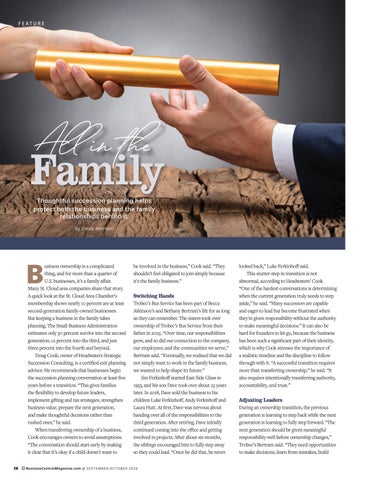
38 ALL IN THE FAMILY Thoughtful succession planning helps protect both the business and the family relationships behind it.
SPECIAL FOCUS 42 LEARNING CURVE Five area higher education institutions are evolving their programs, leadership and priorities to meet changing student and workforce needs. –––––– 46 SLOWER GROWTH, CONTINUED OPPORTUNITY Growth in Central Minnesota’s labor market varies by industry, but remains above average.
Cover Story 32 IN GOOD COMPANY Guy Magno, Ryan Schoepf and Taylor Feero have built an entrepreneurial partnership rooted in creativity, collaboration and community.
GROW
48 2026 CENTRAL MINN. GROWTH GUIDE
ONLYONLINE
NETWORK
BUSINESSCENTRAL MAGAZINE.COM
8 UPFRONT Valuable information designed to guide and educate
22 BUSINESS TOOLS Useful tips and intelligence on how to continue to grow your business
50 BUSINESS SPOTLIGHT Aslan Health founders Rebecca and Clay White
• Talk the Talk • It’s Lonely at the Top • Mentoring in the AI Era • Be a Villager
42 ON DECK
COMING IN NOVEMBER: Financial Services Are you interested in advertising?
Contact Melinda at melindav@businesscentralmagazine.com to find out more!
Main Phone: (320) 251-2940 / Automated Reservation Line: (320) 656-3826 info@StCloudAreaChamber.com / StCloudAreaChamber.com
President: Julie Lunning, (320) 656-3804 Director of Finance and Operations: Kristi O'Connor, (320) 656-3806 Director of Programs & Events: Laura Wagner, (320) 656-3831 Director of Marketing & Communications: Emily Bertram, (320) 656-3809 Director of Membership: Bradley Hoelscher, (320) 656-3824 Executive Assistant: Shelly Imdieke, (320) 656-3800
ST. CLOUD AREA CHAMBER OF COMMERCE 2026-27 BOARD MEMBERS ____________________________ Nick Bischoff, Design Electric Doug Cook, Headwaters Strategic Succession Consulting LLC, Board Chair Joe Hellie, CentraCare Hudda Ibrahim, OneCommunity Alliance Dave Kleis, Central Minnesota Driving Academy Matt Laubach, West Bank
CONVENTION & VISITORS BUREAU STAFF ____________________________
Laurie Putnam, St. Cloud School District 742
Executive Director: Rachel Thompson, (320) 202-6728 Director of Sales: Nikki Gustafson, (320) 202-6712
Paul Radeke, Creative Planning, Past Board Chair Alex Schoephoester, Spencer Fane Amy Sip, ASip Consulting
Sales Manager: Sabrina Koelsch, (320) 202-6713
Rachael Sogge, Eyecon Graphics
Sports Director: Craig Besco, (320) 202-6711 Marketing Manager: Rachel Foos, (320) 202-6729 Marketing & Services Coordinator: Carlie Mertens, (320) 202-6770 Information Specialist: Maddy Lindholm, (320) 251-4170
Melinda Tamm, Ms. Melinda’s Dance Studio, Vice Chair of the Board Dr. Gregory Tomso, St. Cloud State University Donella Westphal, Jules’ Bistro Rebecca White, Aslan Health
Growing to Care for
You
As our area grows, so do the healthcare needs in our region. That’s why we’ve expanded CentraCare Plaza — providing improved access, more convenience, and the latest technology. CentraCare Plaza Expansion — better care for you. CentraCare.com S E P T E M B E R / O C T O B E R 2 0 2 6 // BusinessCentralMagazine.com
5
EDITOR’S NOTE
Business Central Magazine Editor Emily Ber tram "taking photos" for the Switchboard cover shoot with owners, Guy Magno, Taylor Feero and Ryan Schoepf –––––––
Life happens. Coffee helps.
T
he first time I ever drank coffee (if you could call it that)
chain. On a sunny summer morning, you'll find me on a patio
was a Berry White Mocha from Caribou on the St. Cloud
with a cold brew. On a cozy winter day, few things beat a
State University campus. This drink is a sugary explosion of
steaming cup of coffee and a good book. Coffee dates with
white chocolate, raspberry flavoring, espresso and milk — a far
friends are special, coffee before work is essential, and don't
cry from black coffee. But let me tell you, it's delicious, and it
even get me started on the joy of seasonal drinks.
got me through more than a few evening classes. When I began my internship after college, all my coworkers were devoted black coffee drinkers. I remember thinking
The best part about coffee isn't just what's in the cup — it's how it brings people together. It's the laughs and tears shared around a table of mugs. It’s the gesture of goodwill or
they looked so cool and professional sitting in their cubicles with mugs in hand. I wanted to be like them. Around that time, I
appreciation for someone
The best part about coffee isn't just what's in the cup, it's how it brings people together. It's the laughs and tears shared around a table of mugs.
discovered coffee syrup — an easy way to add flavor without loading up on cream.
of peace, clarity or creativity that somehow feel more complete with a warm drink in hand.
Guy Magno, Taylor Feero and Ryan Schoepf understand
I still enjoy the occasional splash of sugar-free vanilla syrup,
that. Not only do they own a coffee roastery and shop,
but I've long since given up trying to look cool while sipping
they also own a creative agency dedicated to capturing
black coffee.
emotion and telling meaningful stories, along with two
In the early days of my next job, I distinctly remember taking
coworking spaces that help entrepreneurs write their own
a work trip to Duluth and stopping at a local coffee shop with a
stories. You can learn more about their entrepreneurial
group of new coworkers. I stared at the menu, trying to order
ecosystem on page 32.
something that would make it seem like I knew what I was
I should probably end with a disclaimer: I'm not totally
doing. I settled on a plain latte. One sip later, I knew ... I hated
addicted. I really only drink a cup or two of coffee a day.
coffee. Just kidding. What I quickly learned was that adding a
Sometimes I even switch things up with a chai latte
little flavoring to a latte makes all the difference.
or an iced matcha.
Since then, my coffee tastes have evolved. I've graduated
Black coffee, though? Still a hard no.
from flavored lattes (except pumpkin spice, I still have a soft spot for those) to cappuccinos, macchiatos, shaken espressos,
Until next time,
nitro cold brews and more. I have a coffee pot at home and a bean grinder for the good stuff, though I still prefer a splash of vanilla creamer in my morning cup. While I love coffee, I also love the experience — the ritual. When I travel, I always seek out a local coffee shop instead of a
6
you love. It's the moments
BusinessCentral Magazine.com // S E P T E M B E R / O C T O B E R 2 0 2 6
Emily Bertram, Editor
Publisher Julie Lunning // Editor Emily Bertram // Founding Editor Gail Ivers
1411 West St. Germain Street, Suite 101, St. Cloud, MN 56301
CONTRIBUTING WRITERS Emily Bertram, St. Cloud Area Chamber of Commerce
ADVERTISING
Phone: (320) 251-2940
Associate Publisher/Sales
Fax: (320) 251-0081
Katie Blue, Recovery Community Network
Melinda Vonderahe, Marketing Consultant
BusinessCentralMagazine.com
Hannah Fairman, University of Minnesota
Ad Traffic & Circulation
———————
Luke Greiner, MN Department of Employment and Economic Development
Yola Hartmann, Hazel Tree Media
For advertising information contact
Tatum Hoff, Stearns History Museum
ART
———————
Design & Production
Editorial suggestions
Vicki Johnson, St. Cloud Area Planning Organization A.J. Kaufman, freelance writer Jonathan Kreilein, Creative Planning Lynn MacDonald, St. Cloud State University Brodie Miller, Rinke Noonan Jami Trenam, Great River Regional Library
Melinda Vonderahe (320) 656-3808
Yola Hartmann, Hazel Tree Media
can be made in writing to:
Cover Story Photography
Editor, Business Central, 1411 West
Switchboard
St. Germain Street, Suite 101, St. Cloud, MN 56301 or emailed to ebertram@ stcloudareachamber.com. Submission of materials does not guarantee publication.
© Copyright 2026 Business Central LLC. Business Central is published six times a year by the St. Cloud Area Chamber of Commerce, 1411 West St. Germain Street, Suite 101, St. Cloud, MN 56301. Phone (320) 251-2940 / Subscription rate: $18 for 1 year.
S E P T E M B E R / O C T O B E R 2 0 2 6 // BusinessCentralMagazine.com
7
UPFRONT GROW | NETWORK | PROFIT
N E WS & P EO P L E T H AT M A K E U P T H E C H A M B E R N E T W O R K
I N S I D E T H I S I S S U E : New at the Top / Digging H is to ry / Yo u r Vo ice in Govern me n t / T h e Tro u b le w it h B us i ne ss BOOK REVIEW
NEWS REEL
Making Time for What Matters Structure and greater awareness of how we spend our time can create more space for our goals within the realities of everyday life. By Jami Trenam
Bus operator wins national Roadeo Metro Bus operator David Peacock placed first in the 35-Foot Division at
B
ack-to-school season feels like an opportunity to establish new patterns and routines — or adjust our schedules to accommodate the flurry of autumn activities. Best-selling author Laura Vanderkam’s Tranquility by Tuesday helps us make more room in our days for the things that matter most. A time management and productivity expert, Vanderkam offers nine practical strategies for making the most of the 168 hours in each week. Section 1: Calm the Chaos This section, which focuses on laying the foundation, starts with Give Yourself a Bedtime; Plan on Fridays; and Move by 3 p.m. As adults, we often stay up later than we should, even though we know everything is harder when we're running on too little sleep. Planning on Fridays allows us to anticipate busy days, rearrange commitments when needed, and head into the week with intention. Moving by 3 p.m. helps ensure exercise doesn't
become the first thing sacrificed when work, family, or simple exhaustion gets in the way. Section 2: Make Good Things Happen Here we are rethinking expectations and personal goals. Three Times a Week is a Habit reminds us that habits don’t have to happen every day to be meaningful. Create a Backup Slot builds resilience into our schedules by planning alternate times. One Big Adventure, One Little Adventure gives us permission to intentionally plan moments of joy and whimsy, noting that looking forward to an adventure can be almost as rewarding as the adventure itself. Take One Night for You encourages us to protect time for ourselves, whether that means pursuing a hobby, meeting a friend, or simply enjoying an evening without obligations — with a backup slot, of course.
recommends setting aside dedicated blocks of time for similar activities to accomplish them faster. Effortful Before Effortless encourages us to fill our leisure time first with activities that require a little effort — reading, crafting, exercising, or learning something new — before turning to effortless entertainment like social media. In Tranquility by Tuesday Vanderkam’s focus is on making room for the people, hobbies, and experiences that give our lives meaning. Her suggestions are practical, realistic, and easy to experiment with, making this a worthwhile read for anyone hoping to bring a little more calm and purpose to a busy season.
Community Transportation Association of America’s annual National Community Transportation Roadeo. The event brings bus operators from across the U.S. together to showcase safety and service skills.
Arvig promotes Weichman Arvig’s Ben Weichman was promoted to chief technology officer. He will provide leadership for Arvig’s technology strategy. Most recently he served as director of network strategy and engineering and has over 20 years of experience in telecom.
Jami Trenam is the associate director of collection development at Great River Regional Library.
CHECK IT OUT! Tranquility by Tuesday is available for free in print and
Stearns Electric employees give back As part of Stearns Electric’s “My Co-op Cares” employee volunteer program, twelve
Section 3: Waste Less Time
eAudiobook from the public library. Reserve your copy at
recently volunteered their time
It’s time to refine schedules. Batch the Little Things
griver.org.
at Camphill Village Minnesota
Stearns Electric employees
in Sauk Centre, repairing and staining some of Camphill Village’s community decks. Stearns Electric’s “My Co-
Tranquility by Tuesday: 9 Ways to Calm the Chaos and Make Time for What Matters; Lau ra Van der kam, 20 22, Portfolio, a n im p rint of Pe n gu in R an do m Ho u se, New Yo r k; ISBN: 9 78 0 59 3 419 0 0 7
op Cares” program is in its eighth year of volunteering with various organizations throughout its service territory.
8
BusinessCentral Magazine.com // S E P T E M B E R / O C T O B E R 2 0 2 6
POINT OF VIEW
Business Central asked:
What is something you’ve come to appreciate more over time?
Joe Ludwig
–––––– Time itself — being more aware of how fast life goes and learning to slow down and enjoy the little moments.
Kimberlee Buller, Scouting America
Taylor Sellnow, Moxie Creative
Brenda Sickler, Theisen Dental
––––––
––––––
––––––
Money — it’s different when it’s your own!
That “no” is a complete sentence — and it’s okay to say.
The St. Cloud area. I’m from Missouri and moved here from the Twin Cities 28 years ago. It’s such a beautiful area — a city that has everything you want with a hometown feel. St. Cloud has a lot to offer in arts, business, nature, proximity to up north and the Twin Cities, and lots of friendly people.
GET BACK IN THE GAME WITH PATIENTCENTERED CARE Get personalized treatment from experts who put you first. As an independent medical provider, St. Cloud Orthopedics offers surgical and non-operative care to help you feel your best.
PATIENT RATED 4.8/5 Schedule Now!
StCloudOrthopedics.com
S E P T E M B E R / O C T O B E R 2 0 2 6 // BusinessCentralMagazine.com
9
NETWORK
UPFRONT
NEWS REEL
N E W AT T H E TO P
F U N FACT:
CentraCare Foundation celebrates community
I am a dual national of Slovakia and the United States.
CentraCare Foundation welcomed donors and community leaders to its annual celebration of giving, La Gratitude. The event serves as a tribute to those whose generosity and dedication continue to shape the future of healthcare for patients and families across Minnesota. The 2026 ceremony included special tributes to Charles Ehlen, M.D.; Dorothy Gorecki and Don Weeres, along with the Foundation’s 2026 award winners: Caduceus Award: Phil Boyle, M.D. Corporate Partner of the Year Award: BCI Construction Inc. Service to the Foundation
Gregory Joseph Tomso, 55 President, St. Cloud State University When did you start at SCSU? January 5, 2026 What was your previous position/work history: Vice President for Academic Engagement and Student Affairs at the University of West Florida, 2021-2025; Director of University of West Florida Honors Program 2017-2021; Chair, UWF Department of English, 2014-2017
What is something that you really enjoyed in your previous positions? As a faculty member, I enjoyed working directly with students, teaching, and running study abroad programs. As a leader, I enjoyed leading change, improving student outcomes, growing enrollment, and building strong ties between the campus and the community.
What are you looking forward to the most in your new position? Working with faculty, staff, students, alumni and community members. The people are what make the job great! Where did you grow up? Chesapeake, Virginia What are your hobbies? Ceramics and cooking
Award: Chip Martin-Chaffee, M.D. Lifetime Achievement Award: Gary & Jane Marsden
Weightman receives recognition Quinlivan & Hughes attorney Erin Weightman was selected
PEOPLE TO KNOW
Connecting the Faces Meet the volunteers who welcome, connect, and support members through networking, mentorship, and Chamber engagement.
for the University of South Dakota Foundation & Alumni Association’s 30 Under 30 class. The annual program honors outstanding alumni under age 30 for their leadership, achievement,
Jenna Binsfeld CentraCare
The Top Hat Ambassadors welcome new members,
Phone: (320) 251-2700
congratulate members who have expanded or
Chair, Top Hat
relocated, and serve as greeters and hosts at
Ambassadors
Chamber events.
and community impact. Weightman was recognized
10
in the Civic Trailblazers
Tina Mrozek
category, which highlights
Blacklight Adventures
The Annual Chamber Celebration is the Chamber’s
alumni making a difference
Phone: (320) 774-1500
volunteer recognition event and annual meeting.
through service and civic
Chair, Annual Chamber
Committee members are responsible for planning
leadership.
Celebration
the celebration and soliciting sponsorships.
BusinessCentral Magazine.com // S E P T E M B E R / O C T O B E R 2 0 2 6
BUSINESS PROFILE: ST. CLOUD LIVE
SPONSORED PROFILE
A LEGACY OF HELPING LOCAL BUSINESSES GROW For more than 135 years, we’ve helped businesses connect with their communities. Today, we help them grow in new ways.
F
amily businesses help shape strong communities. They create jobs, build lasting relationships and invest in the places they call home. At Forum Communications, we understand that commitment because we’ve been family-owned since 1878. Now in our seventh generation of ownership, we’ve spent more than 135 years helping local businesses grow alongside the communities they serve. Our legacy began in local news and has always included helping businesses succeed, now with the most modern advertising
solutions. We combine digital technology, first-party data and audience insights to help businesses reach the right customers at every stage of the customer journey, from building awareness to driving action and creating lasting customer relationships. By pairing generations of local market knowledge with today’s marketing tools, we help businesses make smarter advertising decisions, strengthen their presence in the community and contribute to a stronger local economy.
St. Cloud Live, 113 5th Ave. S., St. Cloud, MN 56301 stcloudlive.news/advertise • 833-773-8591 _______ Part of Forum Communications, a family-owned media company helping businesses win since 1878.
Local expertise. Modern marketing.
Measurable results. Your business is unique. Your advertising should be too. We create customized advertising strategies that combine trusted local expertise, audience insights and digital solutions to help you reach the right customers.
Let’s make your marketing work harder. Ross Priest
Advertising Sales Director stcloudlive.news/advertise rpriest@stcloudlive.com 320-250-6076
S E P T E M B E R / O C T O B E R 2 0 2 6 // BusinessCentralMagazine.com
11
NETWORK
UPFRONT
NEWS REEL AIS Planning announces promotions, new staff
DIGGING HISTORY
Mystery in a Bottle Little is known, but much has been speculated about The Kaiserhof, St. Cloud’s buffet-café of 1912. By Tatum Hoff
Sydney Meyer was promoted to senior associate advisor. Nathan Goebel has taken on the chief compliance officer role in addition to his primary role as an advisor.
Lauryn Bannach was hired as the client experience and office administrator. Sara Draxler-Gainsforth joins the company as the new operations manager.
Waldorf joins Apex Nathan Waldorf joined Apex as a Surveyor II in the St. Cloud office. Currently a licensed surveyor-in-training, Waldorf has six years of experience providing a wide range of survey services including: land development; control; topographic; boundary; cadastral; plats; easement exhibit, and more.
Quiet Oaks thanks community partners Jessica Miller and Teri Kalthoff with North Risk Partners baked fresh chocolate chip cookies for the house. ––––––– In April, St. Cloud Toyota had a tire sale that benefited Quiet Oaks bringing in $1,600 of support. ––––––– Several Credit Union 1 volunteers tackled multiple projects around the Quiet Oaks campus.
12
A
n innocuous bottle encased in a leather sleeve, almost like a modern can koozie, advertises a business called “The Kaiserhof” with “Basa & Farmer St. Cloud” printed under it. These are all the clues given in what is now an almost seventy-five year mystery of the origins of this flask. On June 24, 1952, during the second annual St. Cloud Pioneer Days, the St. Cloud Daily Times published a small article describing an item on display at the Chamber of Commerce, stating “oldtimers cannot recall” the location or even the nature of this business. In the following days, the Times continued prompting readers to send in any information until June 27, when the Times wrote, “A few persons have said they
BusinessCentral Magazine.com // S E P T E M B E R / O C T O B E R 2 0 2 6
believed the old Kaiserhof was on Sixth Avenue North, in the southwest corner of what is now the Times building.” There is one file at the Stearns History Museum Research Center and Archives on the Kaiserhof, containing two photographs of this same flask, a civil war draft registration from 1863 and a census record from 1865, with the names of two different men from Stearns County who shared the last name Farmer. No conclusions about the identity of these Farmer men were made, and a note states that there are no records of Basa. An article published by the Times on January 24, 1912 describes the Kaiserhof as “A modern, up-to-date restaurant operated in connection with a first-class buffet.” The article
goes on to describe the city's need for growth and industries that meet the standards set by its people — and more specifically, a place for denizens to “eat, drink, and be merry.” It describes how there have already been attempts to make similar establishments in St. Cloud, “but for one reason or another — probably some of them well-founded, have not met with success.” Basa and Farmer, business partners who are not from St. Cloud, are described as a clean pair of boys with no need for introduction (or full names). They spared no expense in the renovation and decoration of the Kaiserhof, with furnishings along the old Dutch style, including a bright and cheery buffet and a moody café, with drapery, electric chandeliers and wall lamps. It catered to people seeking respite or a good meal after a theater show. The café was run by Peter Schumacher and “prince of chefs” A. R. Winchell who would bring a metropolitan menu to this modern venture. Indeed it did — for one year. The Kaiserhof employed multiple male waiters, hosting late dinners for people leaving the Davidson theater or hungry after the dances hosted at the Eagles Club. It served delicacies like turkey dinners and turtle soup. It was also a hotspot for bachelor parties, where men could enjoy a joyous final night of singledom
at the hippest new restaurant in the city. Trouble started to appear for the Kaiserhof in March of 1912, when Peter Schumacher went missing for more than three weeks after a shift at the restaurant. His family assumed they were looking for a body by the time it was reported in the Times, though he apparently went on to live until the 1920s. On September 18, 1912, the Times published an article titled “Kaiserhof Closed.” It stated that Basa & Farmer have moved to “the cities” after turning over their property and
stocks to the sheriff by agreement with their creditors. The combination café and buffets apparently failed to capture the patronage of St. Cloud, and with the theater burning down at the same time, it was not meant to be. The final fate of the Kaiserhof was its transfer of ownership to the mortgager/ stamp seller/failed politician Paul Beaudreau, who continued to operate the buffet, petitioning a transfer of a liquor license from the recently burned down Davidson Theater to his new property at 14 Sixth Avenue South.
The Kaiserhof was never listed in the city directory in 1912, perhaps because of its short lifespan. However, a saloon named Frank Harry was listed at the same address in both 1910 and 1912, which leaves more questions than answers. The biggest mystery that remains is the real names of the partners known only as Basa and Farmer, a pair that came into the city with big aspirations and good reviews and fled the moment it failed.
IN THE NEWS
SCSU earns top score The National Council on Teacher Quality awarded St. Cloud State University an A+ for preparing elementary education majors to teach reading. This grade signifies that SCSU exceeds standards in the five key components of research-based reading instruction: phonemic awareness, phonics, fluency, comprehension and vocabulary.
Tatum Hoff is a collections specialist at Stearns History Museum
AGC Agency Inc.
IGNITE 2026
Business Expo with Breakout Sessions and Trusted Partner Booths to visit Free Admission - Free Appetizers - Free Beverages - Free Entertainment
1pm through 5pm - Wednesday September 30, 2026 - Park Event Center in Waite Park, MN
REGISTER AT AGCAGENCY.COM S E P T E M B E R / O C T O B E R 2 0 2 6 // BusinessCentralMagazine.com
13
NETWORK
UPFRONT
NEWS REEL Halstad promoted at Deerwood Robynn Halstad was promoted
YOUR VOICE IN GOVERNMENT
Endorsing the Future Serving as a party delegate is a powerful way to contribute to the election process.
to vice president – retail banking at Deerwood Bank. Halstad brings 20 years of banking experience to her role, including the past 13 years in leadership positions with Deerwood Bank.
Buley named executive director Jaime Buley joined the St. Cloud Downtown Alliance as executive director in July. She spent the past 10 years leading retail teams and is excited to raise awareness about happenings downtown. The St. Cloud Downtown Alliance is a nonprofit organization dedicated to supporting and enhancing downtown St. Cloud.
Brenny earns top honors Brenny Specialized received a Platinum Motor Carrier Safety award by Great West Casualty Company as part of Great West’s annual Motor Carrier Safety Awards program. The Program recognizes motor carriers in similar operations (truckload and less than truckload), with awards based on their year-end preventable accident results.
InteleCONNECT changes ownership InteleCONNECT was acquired by Baxter-based Consolidated Telephone Company (CTC). It will operate as InteleCONNECT powered by CTC, combining InteleCONNECT’s expertise in phone, internet, cloud and wireless solutions with CTC’s infrastructure and network capabilities.
14
F
or anyone not directly involved in government or politics, the whole process of elections can be confusing, to say the least. We hear it every election — the party-endorsed candidate. Endorsed by whom? And how? The process involves a group called delegates, and in Minnesota, becoming a local delegate is surprisingly accessible. A delegate for a political party is someone chosen to represent other members of that party at a party convention. Delegates help make official party decisions, such as endorsing candidates, voting on the party platform, electing party leaders, and they sometimes advance to higher-level conventions.
BusinessCentral Magazine.com // S E P T E M B E R / O C T O B E R 2 0 2 6
There are various levels of delegates: Local/state party delegate: In Minnesota, people typically start by attending their political party’s precinct caucus. At the caucus, attendees elect delegates to represent the precinct at a local organizingunit or endorsing convention. From there, delegates may be elected to congressional district or state conventions.
National convention delegate: These delegates attend the party’s national convention, where the presidential and vicepresidential nominees are formally selected and other national party business takes place. The selection process is more competitive and varies by party. You generally don’t need to be a politician, donor, or longtime party activist to serve as a local delegate. In Minnesota, both the Democratic and Republican Parties use a caucus-andconvention system, although their specific rules differ. Typically, the process flows from a registered voter in a specific party to a precinct caucus attendee to a delegate. A precinct caucus is a locallevel party meeting where party business is conducted, and it’s here that people can volunteer or be nominated to become a delegate. At conventions, selected delegates represent their precincts by listening to candidate speeches, participating in endorsement
M A K E YO U R VO I C E M AT T E R Becoming a delegate gives you a direct voice in shaping your political party beyond voting and serves as an engaging and significant way to make a difference. While the St. Cloud delegate process won’t formally begin again until 2028, you can still express interest with the local GOP or DLF offices. To learn more about engaging in your local precinct caucus, visit BusinessCentralMagazine.com.
votes, voting on resolutions or party rules, and electing party officers. Delegates at the precinct level can sometimes be elected to serve at higher-level conventions up to the state level. National convention delegates, however, go through a separate, highly competitive process determined by each party’s national rules. —EB
Granite Partners is a private investment and long-term holding company founded in 2002 in St. Cloud, Minnesota, with a mission to grow companies and create value for all stakeholders. We advance a culture of trust, innovation, and excellence as essential to 100-year sustainability, and we aspire to world-class wellbeing for everyone in the Granite community.
IN THE NEWS
Four businesses relocate BCI Construction, Fluid Interiors, Headwaters Strategic Succession Consulting and Commercial Realty Solutions relocated to 706 W. Saint Germain Street, Suite 100. Most recently home to Paddy’s Game Shoppe, the building was renovated by BCI and added to the National Register of Historic Places. It is named after a 1930s tenant, the Red Owl Food Store.
growing companies, enhancing communities
–––––––––
Blattner earns top spot Blattner's parent company, Quanta Services, earned the top spot on Solar Power World's 2026 Top Solar Contractors list after installing more than 6,000 MW of solar capacity in 2025. The annual rankings recognize leading solar contractors across the U.S. Blattner appeared on the Top Solar Contractor list independently in 2020, 2021 and 2022, and as part of Quanta in 2023, 2024 and 2025.
S E P T E M B E R / O C T O B E R 2 0 2 6 // BusinessCentralMagazine.com
15
NETWORK
UPFRONT
NEWS REEL
THE TROUBLE WITH BUSINESS
Paying for Performance Commission-based sales have the power to motivate employees and achieve company goals. Olson receives state award
By A.J. Kaufman
recognition is so important, a commission plan can go a long way toward helping a team feel noticed for hard work and dedication. “A well-crafted commission plan can be a useful business tool,” Magelssen said. “Hiring can be challenging, but retaining good employees is a goal that every business owner I have worked with stresses as important.”
Sauk Rapids City Administrator Ross Olson received the 2026 James F. Miller Leadership Award from the League of Minnesota Cities. Olson, the city’s administrator since 2002, was chosen for the honor because of his “innovative community development and enduring commitment to public service.” Outside of his work in Sauk Rapids, Olson has been involved with several local government and community development organizations,
Picking the Perfect Plan
including the Minnesota
Individual commission plans are often part of the compensation package for sales positions. When the plan is tied to sales success, it may include additional components, like the number of sales calls completed, total new clients and other trackable metrics that reward sales talent for strong job performance. These plans can be tiered based on metrics, such as sales volume range or percentage of growth over an identified time period. “Such plans often motivate sales professionals who have the right tools and training and thrive on individual accomplishments,” Magelssen explained. As for team incentives, she says they are beneficial for achieving an overall company goal or improving a process. While certain team incentives might consist of companysponsored lunches for reaching new client service milestones, monetary awards for goal
City/County Management Association, the Economic Development Association of Minnesota and the League of Minnesota Cities Policy Advisory Committee.
Rahm earns CPA license Schlenner Wenner tax associate Liz Rahm completed all parts of the CPA exam and received her license. Rahm graduated from St. Cloud State University in 2025 with degrees in accounting and finance, joining Schlenner Wenner in January 2026. Rahm is also currently pursuing a master’s in business taxation at the University of Minnesota. ___________
Got News? Send news releases, announcements, or anything you think is newsworthy to Emily, ebertram@stcloudarea chamber.com and we will try to include it.
16
C
ommission structures are compensation systems used mostly for salespeople, linking earnings directly to results. Because the structure itself defines how much commission a sales rep earns when closing a total sale, choosing the correct sales commission structure is among the most powerful decisions a businessperson can make. The proper commission model can motivate sales reps, boost their performance, control expenses, and ensure a company’s commission plan is fair and profitable.
BusinessCentral Magazine.com // S E P T E M B E R / O C T O B E R 2 0 2 6
A well-designed commission plan aligns actions with business and revenue goals, but knowing when to implement one plan over another is important. Implementation tips and examples of success from across Central Minnesota can help address that question. Focusing on compensation, Jill Magelssen, owner of Brookline Consulting in St. Cloud, believes a wellstructured commission plan can help ensure success. In a world where employee
A well-designed commission plan aligns actions with business and revenue goals, but knowing when to implement one plan over another is important. attainment can also serve as effective incentives when implemented appropriately. Putting the Plan in Place
When crafting a commission plan, Magelssen advises considering the following: 1.Determine why an additional payout or reward might be worth considering. 2.Identify the parameters for commission payout or award.
3.Think about how to communicate the commission plan. Lara Deppisch, owner and CEO of Bursch Travel in Waite Park, uses a structure that includes hourly base pay, plus commission. “This model is specifically designed to handle the inherent seasonality of the travel industry,” she said. “Because our culture is built on a ‘before, during and after’ service mentality, the hourly pay component ensures our team
feels supported while spending the necessary time on complex itineraries. Meanwhile, the commission incentive encourages our advisors to lean into their expertise, ultimately driving higher service fees for the specialized, high-value offerings our clients expect.” The lesson Deppisch has learned, and a primary tip for any business owner, is to prioritize simplicity over precision. She noted her company once implemented a highly complex plan that required significant administrative effort to manage but failed to actually motivate the team because they
SMART BUSINESS: NORTH CENTRAL BUS, A SCIPI COMPANY
couldn’t easily track their own success. Bursch Travel recently switched to a streamlined, transparent structure, and staff response was immediately positive. “When a salesperson can calculate their win on a napkin, they are far more likely to push for that next sale than if they are bogged down by a complicated formula,” Deppisch said. A former school teacher and historian, A.J. Kaufman is currently managing editor for the Business Journal of Tri-Cities and also a correspondent for the St. Cloud Times.
SPONSORED PROFILE
NORTH CENTRAL ENTERS ITS NEXT CHAPTER
N
orth Central Group, part of Scipi Companies and headquartered in St. Cloud, is entering a new chapter with its evolution into North Central Bus and North Central Upfitting. Driven by continued growth, the organization has established dedicated leadership for each business, appointing Blake Saxon as president of North Central Bus and promoting Scott Schug to president of North Central Upfitting. Blake Saxon Together, Saxon and Schug bring complementary experience to North Central’s next chapter. Saxon contributes nearly 20 years of leadership in the automotive, dealership and fleet industries, while Schug’s deep knowledge earned through 20+ years in the upfitting space has helped
drive the growth of North Central Upfitting. Their combined leadership positions the organization to build on its strong foundation while pursuing new opportunities across the transportation and vehicle upfitting industries. “The opportunity to build on an already strong organization was incredibly appealing,” Saxon said. “North Central has a talented team, a strong reputation and a commitment to serving customers the right way.” Scott Schug The expanded leadership structure reflects North Central’s continued investment in its people, its customers and the future of transportation and upfitting — positioning both North Central Bus and North Central Upfitting for long-term growth across the Upper Midwest. •
North Central, a Scipi Company 25112 22nd Ave, St. Cloud, MN
northcentralinc.com
S E P T E M B E R / O C T O B E R 2 0 2 6 // BusinessCentralMagazine.com
17
TOPHATS GROW | NETWORK | PROFIT
B U S I N E S S E S A R O U N D T H E ST. C LO U D A R E A
S T. C L O U D A R E A H A P P E N I N G S : W e l c o m i n g n e w m e m b e r s , c e l e b ra t i n g n e w l o c a t i o n s , n e w o w n e r s h i p a n d m a j o r a n n i v e r s a r i e s
TO P H ATS : N E W M E M B E R S
18
Pediatric Partners, play-based therapy for children, 108 Doctors Park, St. Cloud. Pictured: Top-Hatters Rachel Layton and Debbie Clausen with Pediatric Partners team.
Farmers Insurance – Simi Agency Inc, Insurance agency, 4180 Thielman Lane, Ste. 108, St. Cloud. Pictured: Rachael Sogge, Jed Simi, Heidi Hall, Brooke Krystosek, Paula Capes.
Doss for Congress, Campaign team to elect Kelly Doss to U.S. House of Representatives for Congressional District 6, (no physical location). Pictured: Patrick Hollermann, Bruce Powlish, Kelly Doss, Dexter Hanson, Rachael Sogge.
American Family Insurance – Ehlinger & Associates Inc, insurance agency, 1123 2nd Street S, Waite Park. Pictured: Rachael Sogge, Eain Servais, Isaiah Ehlinger, Paula Capes.
MN Crypto Council, blockchain and digital asset education, 3800 8th Street N, Ste. 102, St. Cloud. Pictured: Chase Larson, Rachael Sogge, Alex Schoephoerster.
Samantha Nesse Photography/Nesse Collective, photography services, 22 Wilson Ave. NE, Ste. 16, St. Cloud. Pictured: Mike Brower, Samantha Nesse, Jenna Binsfeld.
PrimeSource Funding, financing help for homebuyers, 2137 Troop Drive, Sartell. Pictured: Paula Capes, Jeremy Girgen, Chris Jacques.
Box 7 Media, podcast production and more, 602 2nd Ave. NE, St. Joseph. Pictured: Rory Cruser, Jeremy Schreifels, Brady DeGagne.
MC’s Lawn & Landscaping, residential and commercial landscaping services, 3423 County Road 74, St. Cloud. Pictured: Jenna Binsfeld, Mike Silbernick.
D & P’s Rapid Repair, automotive shop, 229 Stearns Drive, Sauk Rapids. Pictured: Lance Barthel, Sydney Underwood, Marcus Heath, Brian Jarl.
AT&T Store – Saint Cloud Crossroads Mall, cellular services, 4101 W Division Street, St. Cloud. Pictured: Traci Doll, Rachel Layton, Zak Kayderross.
Breitbach Construction Co, contracting and construction, 802 1st Ave., Elrosa. Pictured: Rory Cruser, Adam Breitbach.
Kuyava Consulting, fractional safety training and planning, 1490 Waldorf Ct. NE, Sauk Rapids. Pictured: Jason Miller, Leah Kuyava, Rachel Layton.
Operation New Path, non-profit, (no physical location). Pictured: Mike Brower, Yassi Petersen, Sean Petersen, Rachael Sogge.
Bad Habit Brewing Company, brewery, 25 College Ave. N, St. Joseph. Pictured: Debbie Clausen, Laura Hartog, Eric Geier, Erin Ross, Jenna Binsfeld.
BusinessCentral Magazine.com // S E P T E M B E R / O C T O B E R 2 0 2 6
Your next step matters, Magnifi it.
TO P H ATS : N E W M E M B E R S
HMC Boudoir, photography, (no physical location). Pictured: Kris Nelson, Jodie Heinen, Mike Brower.
Kitchenette, restaurant, 417 E St. Germain Street, St. Cloud. Pictured: Patrick Hollermann, Maddie Waseka, Rachael Sogge.
Discovery Church, 700 18th Street NW, Sauk Rapids. Pictured: Guy Magno, Pastor John David, Rachael Sogge.
CHECKING ACCOUNTS. CASH MANAGEMENT TOOLS. PERSONALIZED SERVICE.
TO P H ATS : N E W LO C AT I O N S A N D O W N E R S H I P
NEW OWNERSHIP
NEW OWNERSHIP
NEW LOCATION
The Janel Morgan Team – Morgan & Co, real estate, 621 N Benton Drive, Ste. 101, Sauk Rapids. Pictured: Morgan Weisen, (Kenai, the dog), Cristy Lahr, Janel Morgan, Alex Reiter, Kris Nelson.
Criterion Counseling, therapy and counseling services, 600 25th Ave. S, Ste. 203, St. Cloud. Pictured: Kristin Hannon, Nate Van Heuveln, Brenda Eisenschenk.
Sunburst Memorials, memorial pieces, 7808 County Road 75, St. Cloud. Pictured: Rachel Layton, Matt Gaffy, Jill Kampa, Debbie Clausen, Paul Radeke.
TO OL S YOU CO U L D B E USI N G TODAY: Business Checking Accounts: Easy access, multiple options, and low to no monthly fees
TO P H ATS : CO R E M E M B E R
C H A M B E R CO R E (Champions of Regional Excellence) businesses make a significant financial investment and commitment to the region's business growth. For more information visit BusinessCentralMagazine.com. CHAMBER CORE MEMBER
Batteries Plus, retail and wholesale supplier of batteries, lightbulbs and more, 2710 2nd Street S, St. Cloud and 27 N Benton Drive, Sauk Rapids. Pictured: Kristin Hannon, Bernie Perryman, Paula Capes.
Digital Essentials: eStatements, ACH, wires, and eAlerts Advanced Digital Tools: Fraud protection, remote deposit, and card payment solutions Elite & Ultimate Packages: Tailored bundles that simplify operations and save money
magnifi.creditunion
Insured by NCUA
S E P T E M B E R / O C T O B E R 2 0 2 6 // BusinessCentralMagazine.com
19
NETWORKCENTRAL GROW | NETWORK | PROFIT
E V E N T S A R O U N D T H E ST. C LO U D A R E A
M O R E O N E V E N T S : Fo r i n f o r m a t i o n o n t h e s e o r o t h e r b u s i n e s s e v e n t s , c a l l 3 2 0 -2 51 -2 9 4 0 o r v i s i t S t C l o u d A r e a C h a m b e r. c o m a n d c l i c k o n “ C a l e n d a r.”
Grow! The St. Cloud Area Chamber of Commerce offers a wide variety of professional development opportunities for the workforce in Central Minn.
St. Cloud Area Leadership Program This nine-month program brings together current and emerging leaders to explore community issues, build meaningful connections, and develop the skills and knowledge to make a lasting impact on the St. Cloud area.
Leadership commencement in May is a day to celebrate and connect. Pictured: Brittney Goebel (L), North Creative Co.; Grayson Zimney, SCIPI; Julie Lunning. St. Cloud Area Chamber of Commerce
Above: Leadership classmates get to know each other personally and professionally while growing their skills and knowledge of greater St. Cloud. Left: The annual Leadership Program retreat is a highly anticipated event.
Supervisor Development Certificate Program This program equips new and emerging supervisors with practical skills in leadership, communication, conflict management, employee performance, hiring and employment law to help them become more effective leaders. Participants receive training on a variety of leadership topics and graduate with a certificate of completion. Pictured: Teresa Voight, Milestones.
The Supervisor Development Certificate Program consists of six sessions held over three months.
20
BusinessCentral Magazine.com // S E P T E M B E R / O C T O B E R 2 0 2 6
The 2025-2026 St. Cloud Area Leadership class meets each month, September through May, with a different theme each month.
Lunchtime Learning Held September through June on the first Wednesday of each month, Lunchtime Learning offers affordable, convenient professional development on a variety of timely business topics, all over the lunch hour.
Tim McLean, Tina Norlund and Heather Sabin, St. Cloud Area Family YMCA Tara Gronhovd presents about the Art of Feedback.
Bonnie Wenker, Black Diamond Auctions (L) and Lisa Vouk, InteleCONNECT Powered by CTC
Jessica Johnson, Evermore Co. (L) moderates a panel of Tammy Stark, Career Solutions; Lacey Solheid, Great River Children’s Museum; and Rachel Theise, St. Cloud ROX about hiring interns.
NEXT – Chamber’s Young Professionals NEXT brings young professionals together each month over the lunch hour to build connections, grow their careers, and engage with the community through networking, professional development, and access to local business and civic leaders.
Business tours, like this one at Bernick’s, are a great way to learn more about the community with NEXT.
NEXT members did a scavenger hunt in downtown St. Cloud. Pictured: Macki Deters, Moxie Creative (L); Sarah Anderson, Ancona Title; Lisa Stoffel, Nuts and Bolts Marketing; Dan Eickhoff, North Risk Partners; Andrew Klinefelter, Creative Planning
NEXT members celebrate the holidays at a monthly meeting. Back row: Emily Bertram, St. Cloud Area Chamber of Commerce; Maren Hoban, State Farm Insurance - Kyle Hedtke; Alicia Gunderson, Gate City Bank. Front row: Nolan Lind, Jacobs Financial and Casey Austin, Foley Mansion
S E P T E M B E R / O C T O B E R 2 0 2 6 // BusinessCentralMagazine.com
21
BUSINESSTOOLS GROW
| NETWORK
|
PROFIT
R ES O U RC ES T H AT H E L P YO U R B US I N ESS G RO W
I N S I D E T H I S I S S U E : Working Well / Management Toolkit / Entrepreneurism / Economy Central by Falcon Bank WORKING WELL
The Courage to Care A recovery-friendly workplace creates a culture of belonging where employees seeking support feel safe, stay engaged, and contribute to a healthier workplace. By Katie Blue
Create a culture of belonging.
Know your responsibilities.
Recovery is about more than overcoming substance use. It’s about rebuilding a life through purpose, connection, and opportunity. Employers have an incredible opportunity to help create that environment. A recovery-friendly workplace isn’t about lowering expectations or making excuses. It’s about creating a culture where employees feel safe asking for help, where leaders know how to respond with compassion, and where people are treated with dignity, while remaining accountable.
Being recovery-friendly also means understanding your responsibilities as an employer. Respect employee privacy. Understand legal protections such as the Americans with Disabilities Act (ADA) and the Family and Medical Leave Act (FMLA). Know the resources available in your community. Employees are far more likely to seek help when they know they will be treated fairly, respectfully, and without judgment.
Show that you care.
W
hen I retired from the Army after 20 years of service, I thought I understood what it meant to belong. In the military, your unit becomes your family. You rely on one another, solve problems together, and know someone always has your back. When I left the service, I discovered that kind of community isn’t guaranteed.
Like many veterans, I struggled to find my place. It wasn't until I moved to St. Cloud that I experienced what true community looked like. People welcomed me, believed in me, and gave me opportunities to serve again. That experience taught me something that applies just as much to the workplace as it does to recovery from substance abuse: people thrive when they know they belong.
Contributor ________ Katie Blue is the executive director of the Recovery Community Network.
22
BusinessCentral Magazine.com // S E P T E M B E R / O C T O B E R 2 0 2 6
The reality is that substance use disorder touches every industry. Many people in recovery are already employed, making the workplace one of the most important settings in which to recognize when someone may need support. A dependable employee begins arriving late. Performance slips. Someone who was once engaged becomes withdrawn. These changes don’t tell you what’s wrong, but they do tell you it’s time to check in. You don’t need to diagnose the problem. You simply need to care enough to start the conversation.
Rethink team activities.
Recovery-friendly workplaces are built through everyday decisions, not just written policies. Something as simple as offering a team outing that doesn't revolve around alcohol gives every employee the opportunity to participate comfortably. Whether someone is in recovery, doesn't drink for personal reasons, or simply prefers another activity, thoughtful choices like these strengthen teams and send a simple message: you’re a valued part of this organization. Understand the benefits.
Supporting recovery isn’t just good for employees. It’s good for business. Recovery-friendly workplaces help improve
retention, reduce absenteeism, strengthen workplace culture, and demonstrate that your organization values its people. Minnesota’s Employer Toolkit (a collection of official resources designed by state agencies to help business owners comply with employment laws) provides practical guidance for recognizing concerns early, reducing stigma, and connecting employees with support. For more information or additional resources on becoming a recovery-friendly workplace, visit BusinessCentralMagazine.com. Central Minnesotans show up for each other. Our workplaces can reflect those same values. When employees know they matter, they are more likely to stay engaged, ask for help before a crisis, and reach their full potential. That’s good for people, good for business, and good for our community.
FA R G O, N D | V I R T U A L Join Network Center, Inc. in person or online for our biggest event of the year - with zero cost! Visit netcenter.net/nvision to save your FREE seat.
COMMERCIAL TO THE CORE.
Commercial & Investment Real Estate Brokerage // Business Brokerage Seller & Buyer Representation // Multifamily | Retail | Office | Industrial | Land TECH NEWS
Safety First
I
f you are a Google user, your account likely stores a lot of personal information. Now, Google provides a free tool that helps users review and strengthen the security of their accounts in just a few minutes. It allows people to check connected devices, review third-party app permissions, update passwords, enable two-factor authentication, and monitor for suspicious activity. Taking these simple steps can greatly reduce the risk of hacking, phishing scams, and identity theft. Want to try it? Simply Google “Security Checkup” to get started.
cbcorion.com // (320) 251-1177 630 First Street South, Waite Park, MN 56387
Your Trusted Advisors in Commercial Real Estate | Since 1971
Source: Google
S E P T E M B E R / O C T O B E R 2 0 2 6 // BusinessCentralMagazine.com
23
GROW
BUSINESSTOOLS
MANAGEMENT TOOLKIT
What's it Worth? As a business owner, your company may seem priceless. But if you really want to know its worth, it may be time for a formal valuation. By Jonathan Kreilein
"W
hat is my business worth?” is a question almost all business owners have on their minds. The answer to this question often comes from a business valuation.
your business given by a qualified business valuation professional. The question of your business’s value is likely on your mind because it’s important for your long-term financial plans.
What is a business valuation, and why does it matter?
When should I get a business valuation?
A business valuation is an opinion on the value of
Rather than waiting until you’re ready to sell your business, you might consider
getting a business valuation several years before you’re ready to sell in order to help you improve your business and put it in the best position to sell later. Sometimes a valuation is necessary to appease the IRS, such as when shares of the company are gifted or when an owner passes away. Often a valuation is necessary for a legal proceeding, such as when an owner gets a divorce or feels they’re being treated unfairly by other owners. Other times a valuation serves as an independent opinion when one owner wants to leave the business and receive their share of the business’s value. It can also serve as support in case the IRS decides to audit the transaction, especially if the owners are family members.
affect its value. Key financial metrics and ratios, as compared to your industry, can help you determine the best ways to improve net cash flows. The risk/return rate is determined based on a wide variety of factors, including the stability of revenue and net profit; quality/stability of employees and customers; general and industry economic environment; competitive advantages; transferability of earnings, etc. The issue of earnings transferability is particularly important because businesses that make money from the skill or reputation of a particular owner may not have a significant amount of transferable value if that owner plans to leave or retire.
How does a valuator determine value?
Who should I work with?
A business valuator will likely examine your company’s recent financial statements and conduct research on your business and market conditions. A valuator will look at two main components: your company’s net cash flows (for example, net profit) and an appropriate risk/return rate to apply to those cash flows. What drives value up or down?
A change in either the net cash flows or the risk/return rate of your business can significantly
The IRS has rules that determine who is a “qualified appraiser” for their purposes, which includes education and experience requirements. In addition, there are several valuation designations to look for, including Certified Valuation Analyst (CVA), Accredited in Business Valuation (ABV) and Accredited Senior Appraiser (ASA). Also, working with a business valuer who has experience in valuing businesses in your industry is a plus, because they’ll likely be more familiar with industry trends.
Contributor ________ Jonathan Kreilein is a Certified Public Accountant (CPA) and a Certified Valuation Analyst (CVA). Jonathan works as a senior valuation specialist at Creative Planning, valuing privately held businesses across the United States.
24
BusinessCentral Magazine.com // S E P T E M B E R / O C T O B E R 2 0 2 6
TECH NEWS
Wanted: Human Influence
R
esearchers at Princeton University and the University of Chicago found that AI models such as Claude, ChatGPT and Gemini, can develop their own biases from experience, sometimes stereotyping job candidates more strongly than humans. In simulated hiring, models quickly generalized from limited outcomes and began steering certain groups toward specific jobs. More advanced reasoning models showed some of the strongest biases. Simply telling AI to be fair had little effect, while rewarding diversity and providing relevant personal information reduced bias. The findings raise concerns as AI plays a growing role in hiring and other high-stakes decisions.
You’rrrrre out!
S
outh Korea’s professional baseball league introduced an Automated Ball-Strike system in 2024 to make calls more accurate and reduce umpire bias. Researchers found that star hitters walked less, struck out more and reached base less often after the system was introduced, suggesting human umpires may previously have given prominent players more favorable calls. The findings show how automation can help reduce “status bias,” where high-profile individuals receive preferential treatment. Researchers from the University of Michigan say similar lessons could apply beyond sports, including workplaces and education. Human judgment, however, is still considered valuable for decisions that are more subjective.
Your Success is our Mission
We are dedicated to helping you achieve your business goals. Contact us today for a free digital assessment
Contact info Marilyn Birkland, Director of Sales mbirkland@localiq.com | 320-248-4332 CT-SPAD0430114140
S E P T E M B E R / O C T O B E R 2 0 2 6 // BusinessCentralMagazine.com
25
GROW
BUSINESSTOOLS
ENTREPRENEURISM
Valuable Assets Understanding and protecting your intellectual property can save time, money and legal headaches. By Brodie Miller
W
hen business owners think of intellectual property, they often envision large public companies, national brands or franchisors. However, all business owners should be familiar with intellectual property basics, and how they may affect operations, branding and risk exposure. Overlooking intellectual property could result in lost opportunities to protect or leverage valuable assets, or create legal liabilities that could have been avoided.
Asset Assignment
There are generally four types of intellectual property. Each type has a different function and protects different types of information. Trademarks Copyrights Patents Trade secrets A trademark is any word, name, logo, symbol or similar identifier used to identify and distinguish a person’s goods. A service mark accomplishes the same function for services.
Contributor ________
A common misconception is that a business must register a mark to have rights to it. In the United States, rights to a mark arise through use in commerce. Registration, however, expands and significantly strengthens those rights. A copyright protects an original work of authorship fixed in a tangible medium. This includes music, written materials, photographs, videos, artwork, designs and other creative works. Copyright protects the expression embodied in the work, not the underlying idea. Another common misconception is that registration
Brodie Miller serves as the current president and managing partner at Rinke Noonan. He practices in the areas of business law, construction law, real estate law, and intellectual property.
26
BusinessCentral Magazine.com // S E P T E M B E R / O C T O B E R 2 0 2 6
is required for copyright protection. In general, a creator obtains copyright protection when the original work is created and fixed in a tangible medium. Registration expands those rights and provides additional tools for protection. Patents protect new and useful inventions or improvements, such as processes, machines, or certain eligible technological improvements. Patent rights require issuance from the United States Patent and Trademark Office. Trade secrets are information that has independent economic value because they are not generally known or readily ascertainable by proper means and are subject to reasonable efforts to maintain secrecy. Examples include formulas, recipes, patterns, methods, techniques and processes. Trade secrets are protected by taking action to keep them secret, including confidentiality and non-disclosure agreements, secure facilities and limited disclosure. Asset Protection
With a basic understanding of intellectual property, businesses will be better equipped to identify valuable assets, protect them, align those assets with success for the future, and avoid common mistakes. For instance, because trademarks and service marks helps consumers identify who provides a product or service, choosing a generic or merely descriptive name for a product or service reduces the likelihood that the name can be protected as a
trademark. When selecting a name, businesses should consider unique or creative names. Businesses should also know the source of their advertising and marketing content and the authorization to use such content. If content is freely available online or lacks a copyright notice, this does not necessarily mean it is free to use. Using any photos, graphics or other materials without consent can create costly copyright infringement risks. Similarly, because trademark rights are created by being the first to use the mark in commerce, choosing a name without conducting a comprehensive search risks liability for trademark infringement, receipt
of a cease-and-desist letter, and an expensive rebrand. Even paying for a logo, photograph or other material does not always mean you own the copyright to such material, unless there is an agreement specifically transferring those rights. Intellectual property protection should not be an afterthought. A business’s name, brand, creative content, inventions, processes, and confidential information may all be valuable assets. Periodically identifying those assets, confirming ownership, and taking reasonable steps to protect them can preserve value, avoid disputes, and better position a business for future success.
TECH NEWS
No Slop Allowed
L
inkedIn is cracking down on low-quality, AI-generated “slop” posts that flood users’ feeds with generic thought leadership, engagement bait, and repetitive content. The platform plans to use detection systems and editorial oversight to reduce the visibility of posts that appear overly automated or lack an authentic perspective, while still allowing AI-assisted writing that includes original insights. LinkedIn says the goal is to make the platform feel more useful and human-centered as frustration grows over the rise of spammy AI content online. Source: Fast Company
Business is our Business ––––––––– Wh en y o u a d v e rt i s e i n Bu si n e ss Ce n t ral M ag az i n e y o u do n ’ t ju s t rea c h l o c a l p ro fessi o n als — y o u j o i n the co n v er sati o n . E a c h a d b u i l d s y o u r repu tati o n , co n n ects y o u wi th
d e c i s i o n - m a ker s , an d fu els C hamber pro gram m i n g that s t re n gt h e n s o u r bu si n ess co m m u n i ty.
Reserve your annual contract today. Vi s i t Bu s i n es s Cen tralM agaz i n e.co m o r co n tact
M e li nda at m e l i n d a v @ b u si n esscen tralm agaz i n e.co m to get sta rt e d!
BusinessCentralMagazine.com
Finish the year strong.
Plan ahead for 2027 growth. A clear marketing strategy set now means moving forward with clarity and purpose. As a consultative strategic growth agency, we align and streamline marketing, branding, visuals, messaging, web, and digital in a way that drives measurable results. Ready for a partner who listens while leading? Let’s connect!
WhiteBoxMarketing.com Hello@WhiteBoxMarketing.com 320.270.0722
S E P T E M B E R / O C T O B E R 2 0 2 6 // BusinessCentralMagazine.com
27
GROW
BUSINESSTOOLS
Economy Central presented by
ECONOMY CENTRAL
Quality over Quantity Artificial intelligence is changing both the quantity and quality of new book releases. By Hannah Fairman and Lynn MacDonald
A
rtificial Intelligence (AI) is rapidly reshaping industries — transforming productivity, business models, and the nature of work. As adoption accelerates, questions remain about who benefits, who might be displaced, and how labor markets will adapt. Economists are studying these issues as they play out in real-time. Publishing is one industry where AI’s effects are especially visible. As
AI reduces the time and cost required for authors to produce written content, new research is showing how its use is affecting both the quantity and quality of new book releases. AI uses large language models (LLMs) to scan, synthesize, and assess information from vast amounts of data. With recent advancements, AI is now able to create large amounts of written text, making the
Contributors ________ Hannah Fairman is associate director at Heller-Hurwicz Economics Institute at the University of Minnesota. Lynn MacDonald, Ph.D., is director of the SCSU Center for Economic Education and a professor of economics.
28
BusinessCentral Magazine.com // S E P T E M B E R / O C T O B E R 2 0 2 6
production of books less expensive while reducing entry costs. In fact, there are AI tools that assist first-time authors in creating a ready-to-go, formatted book in under 30 minutes. When entry costs fall, more producers tend to enter the market. The rise of AI provides a real-time opportunity to see whether greater market participation produces valuable new products or simply floods the market with low-quality offerings. Economists Imke Reimers and Joel Waldfogel (University of Minnesota) are researching this exact phenomenon. Their findings show AI changed both the quantity and quality of books entering the market. While an influx of lowercaliber AI books lowered overall quality, human-authored books held steady. They also found that less-skilled and less-experienced authors were more likely to adopt AI, helping explain the performance gap between AI-assisted and human-authored books. Using data from Amazon, the authors found that new e-book releases roughly tripled between 2022 and late 2025. Some categories showed increases approaching ten-fold. Particularly large growth occurred in categories such as travel, sports and outdoors, self-help, and computers and technology. The increase in titles coincided with the rapid spread of LLMs following ChatGPT's release in late 2022. The researchers examined 50,000 randomly selected books for evidence of AI-generated content. They found virtually no
detected AI use through 2022. Detected AI use rose to roughly 30 percent in 2023, 45 percent in 2024, and more than 60 percent in 2025. Another important finding is that books with detected AI content performed worse both in ratings and in sales. Most AI books received very little usage, although some achieved moderate success. At the same time, the researchers found that “the number and quality of human-authored books have remained stable,” and AI did not appear to reduce output from existing authors. Even though existing authors do not appear to have been displaced, many remain concerned about the long-term effects of AI on publishing. Some worry about declining quality while others fear publishers may replace the humans in the book industry with AI tools. Some well-known authors have encouraged publishers not to use or publish AI-generated content. Amazon currently requires authors to disclose AI-generated — but not AI-assisted — content, although that information is not disclosed to consumers. While AI appears to generate a great deal of mediocre content, more total publications could create value for consumers. Reimers and Waldfogel estimate that consumer surplus — the economic value consumers receive from having more choices — increased by roughly 7 percent in 2025, highlighting one potential benefit of more books being published with the assistance of AI.
October
6 COMMUNITIES — ST. CLOUD, SAUK RAPIDS, SARTELL, WAITE PARK, ST. AUGUSTA, ST. JOSEPH
ECO N O M I C I N D I C ATO R S & T R E N D S
Economy Central presented by September
December
November
Home Sales Closed in St. Cloud Area
6 COMMUNITIES - ST. CLOUD, SAUK RAPIDS, SARTELL, WAITE PARK, ST. AUGUSTA, ST. JOSEPH
29 $2,313,150
0
November
600
126 $6,973,154
2024
February
300
600
Food and Beverage ST. CLOUD - NET RECEIPTS
B U I L D I N G P E R M I T S BY C O M M U N I T Y - C O M M E R C I A L September 2024
2025 #/$
St. Cloud
August 615
371 2026 $168,746,922
102 $132,778,198
Sartell
July 465 December
504 $28,783,792
131 $697,491
#/$
TOTAL: $198,603,167
$96,038,255 $43,155,871
June
TOTAL: $302,572,803
Sauk Rapids November 39 $9,508,967
16 Food and Beverage $6,890,005
$61,780,414
204 $67,940,517
$8,516,053
10 $134,391
7 2024 $164,454
$2000000
$250M $300M $350M TOTAL: $302,572,803
Jan June
67 $20,787,565
TOTAL: 182*
Mar August
TOTAL: 1868
St. Joseph
Apr September
TOTAL: 1823
St. Augusta
2026 #/$
39 2025 $22,741,678
May Waite Park October178
Feb July
ST. CLOUD - NET RECEIPTS 59 2 $840,000
2026
62 $14,195,440
22
$0$48,881,420 $500k
2025
May and St. Joseph Sources: Building departments for the following cities: St. Cloud, Sauk Rapids, Sartell, Waite Park, St. Augusta, Apr
Unemployment Rates 2024
50
0$3,217,600 300
2025
October
TOTAL: $231,405,464 TOTAL: $198,603,167
$200M
October
50 $4,878,427
2000
$150M
September
80 $6,064,699
1500
TOTAL: $1,287,691
TOTAL: $1,604,677
$1500000
$100M
August
197 $12,993,405
1000
Data not released at time of print
$1000000
2025
$50M
23 $1,784,062
205
500
$500000
$0M
40 $1,058,345
April $1,868,911
January
6 COMMUNITIES — ST. CLOUD, SAUK RAPIDS, SARTELL, WAITE PARK, ST. AUGUSTA, ST. JOSEPH
2026
114 $6,397,294
December
6 COMMUNITIES — ST. CLOUD, SAUK RAPIDS, SARTELL, WAITE PARK, ST. AUGUSTA, ST. JOSEPH
2024
212 $10,800,019
March $39,723,287
$120M
Commercial Building Permits
2025
262 May $11,443,421
St. Augusta
Commercial Building Permits
2026
251 $12,669,656
2021
$100M
320
43
St. Joseph
$80M
July
TOTAL: $106,922,594
January$16,142,200 June
2020
$60M
June
Sauk Rapids
465 $16,462,804
2026
2019
$40M
May
Sartell
2026 #/$
1392 2024 $38,596,441
1279
$31,680,076 February July
0
$20M
April
St. Cloud
$100M $120M TOTAL: $80,996,292
Food and Beverage Tax Collection
ST. CLOUD
$0 $0M
Home Sales Closed ST. CLOUD
2025 #/$
August
Waite Park
2024
March
$80M
2025
2024 March #/$
2021
2020
2019
2025
$60M
May October
September
2026 $40M
June November
BUILDING P E R M I T S BY C O M M U N I T Y - R E S I D E N T I A L April
TOTAL: $37,148,064
$20M
February
January
December
November
October
September
August
July
June
May
Apr
Mar
Feb
Jan
TOTAL: $80,996,292
6 COMMUNITIES — ST. CLOUD, SAUK RAPIDS, SARTELL, WAITE PARK, ST. AUGUSTA, ST. JOSEPH TOTAL: $106,922,594
$0M
ST. CLOUD
July 2026 Jan Feb December Mar Apr May June July Aug Sept Oct Nov Dec
2026 Totals represent data reported as of 8/1/2026
2024
Home Sales Closed
COLOR KEY:August
TOTAL: $37,148,064
Compiled by Shelly Imdieke, St. Cloud Area Chamber of Commerce
Residential Building Permits
E PARK,
November
16,523*
$200M
Residential Building Permits
2025
621,465
885,721
$80M
E PARK,
1,424*
32,948
24,272
December
2025-2026
2025-2026 -% CHANGE
Source: positivelyminnesota.com
D
F
M
December
N
November
A
1.0%
5%
October
J
September
A
August
M
July
Jan
June
1.5%
May
$350M
April
$300M
March
December
$250M November
October
September
$200M
August
$150M
July
June
May
$100M
April
March
February
January
$50M
January
2.0%
$0M
Source: positivelyminnesota.com $0 $500k
Feb
February
6%
2024
Non-Farm Mar Jobs
TOTAL: $231,405,464
0.5% 0.0% -0.5%
4%
-1.0% -1.5% 3%
J
F
M
A
M
J
J
A
S
*No data was reported for October 2025 due to the government shutdown.
O
N
D
J
F
M
A
M
St. Cloud Minneapolis/St. Paul Minnesota United States
-2.0%
J
F
M
J
S
O
J
A
M
St. Cloud, MN (MSA) Minnesota United States
S E P T E M B E R / O C T O B E R 2 0 2 6 // BusinessCentralMagazine.com
29
GROW
600
E PARK,
300
16,523*
0
621,465
January
885,721
$200M
$80M
$120M
E PARK,
$100M
1,424*
$80M
32,948
24,272
$60M
900
1200
1500
BUSINESSTOOLS December
Jan Feb Mar Apr May June July Aug Sept Oct Nov Dec
E C O N O M I C I N D I C A T O R S & T R E N DDecember S
July
Cost of Living
$1.5M
$2M TOTAL: 37
TOTAL: 59
June
TOTAL: 182*
$2M
December
August
2026
$2M
COST OF May LIVING INDEX AVERAGES FOR FIRST QUARTER 2026 FOR MINNESOTA AND OTHER UPPER MIDWEST CITIES. April
CITY March
All Items
St. Cloud MN
Grocery Housing Utilities Transpor- Health Misc. Goods Items tation Care & Services
93.1
94.7
76.6
100.0
90.1
108.6
Minneapolis, MN 93.2
100.1
81.3
94.3
94.3
114.1
97.1
January St. Paul, MN
93.2
100.1
79.9
92.9
94.5
115.7
98.2
Mankato, MN
94.1
100.3
80.3
94.3
95.3
107.8
101.2
Appleton, WI
95.6
99.9
97.2
93.0
85.8
104.2
94.4
Rapid City, SD
97.2
97.8
93.3
88.7
99.3
103.7
101.2
February
103.7
December
November
October
September
August
July
June
May
April
March
February
January
December
November
October
September
August
July
June
May
April
March
February
January
The "all items" index for St. Cloud was 93.1, just below the national average (100.0) for year-end review of 2026. Among the 250 urban areas that participated in the 2026 Cost of Living Index, the after-tax cost for professional/managerial standard of living ranged from more than twice the national average in New York (Manhattan), NY to more than 20 percent below the national average in Tupelo, MS.
TOTAL: 57
ACCRA COST OF LIVING INDEX
2024
Least Expensive Cities to live in the United States
Most Expensive Cities to live in the United States 0
10
20
30
40
50
SHERIFFS' FORECLOSURE AUCTIONS
30
September
TOTAL: $1,569,840
Sheriffs’ Foreclosure Auctions
2025
October
TOTAL: $759,870
TOTAL: $1,788,876
STEARNS AND BENTON COUNTIES $500k $1M
December November
$1.5M
November
TOTAL: $716,105
TOTAL: $1,869,776
$0
$1.5M
BY THE NUMBERS
2000
$2000000
2024
$1M
Source: Tax Collections — City of St. Cloud
Jan
Source: Tax Collections — City of St. Cloud
$500k
TOTAL: 1868
$1M
January
TOTAL: 1823
$500k
$0
1500
2025$0
TOTAL: $1,287,691
$1500000
TOTAL: $1,604,677
2026
2024
February
Home Sales Closed in St. Cloud Area
2025
October
1500
TOTAL: $1,788,876
6 COMMUNITIES - ST. CLOUD, SAUK RAPIDS, SARTELL, WAITE PARK, ST. AUGUSTA, ST. JOSEPH
Feb 1200
Food and Beverage Tax Collection TOTAL: $1,679,119 ST. CLOUD - NET RECEIPTS
September
2024
Mar
1000
Data not released at time of print
$1000000
2026
August
March
2021
ST. CLOUD
July
April
TOTAL: 1341
500
$500000
Lodging Tax Dollars
June
2025
2020
Source: St. Cloud Area Association $200M $250M $300M $350Mof Realtors, http://stcloudrealtors.com/pages/statistics
TOTAL: $1,869,776
May
2019
900
May
June
0
600
Food and Beverage Tax Collection
$150M
300
July
2026
Apr
ST. CLOUD
0
TOTAL: $759,870
August
TOTAL: 1337
May
TOTAL: $231,405,464
April
September ST. CLOUD - NET RECEIPTS
June
2021
2020
2019
$0
2024
March
October
August
TOTAL: $302,572,803
February
Food and Beverage Tax Collection
July
2025
October
November
SeptemberTOTAL: 650
TOTAL: $198,603,167
2026
January
UD, SAUK RAPIDS, SARTELL, WAITE PARK,
December
November
October
September
August
July
June
May
Apr
Mar
Feb
Jan
Home Sales Closed ing Permits ST. CLOUD
November
Residential
2024
2025
2026
Stearns Co.
41
53
30
Benton Co.
16
6
7
BusinessCentral Magazine.com // S E P T E M B E R / O C T O B E R 2 0 2 6
60
New York (Manhattan), NY
227.6
Tupelo, MS
79.3
Honolulu, HI
184.8
Harlingen, TX
80.0
San Jose, CA
180.4
Richmond, IN
80.7
New York (Brooklyn), NY
166.8
Decatur, IL
81.0
165.6
Oklahoma City, OK
81.0
San Francisco, CA
A city with an index score of 100 has a cost of living equal to the national average. The ACCRA Cost of Living Index is compiled and published quarterly by C2ER - The Council for Community and Economic Research.
COVER STORY
2026 Entrepreneurial Success Award Winners
In Good
that “allWegoodbelieve creative work happens on a team.
COMPANY
”
— Guy Magno
Guy Magno, Ryan Schoepf and Taylor Feero have built an entrepreneurial partnership rooted in creativity, collaboration and community. BY EMILY BERTRAM • PHOTOS BY SWITCHBOARD
A
s the old adage goes, you should never start a business with your best friends. Except, according to Guy Magno, if your best friends are Ryan Schoepf and Taylor Feero. Together, they own and operate several St. Cloud area businesses, including creative marketing agency Switchboard, coffee shop Kinder Coffee, coffee roastery Kinder Coffee Lab, and coworking spaces Cooper Collective and The Apiary, as well as several that have since ceased operations.
The three friends have not been thwarted by the expected hurdles of working with each other. As Schoepf said, “We’ve had no shortage of opportunities to be at odds.” Instead, they continue to innovate, empower and reinvest in Central Minnesota, and they do it together.
Coming Into Focus
The son of a pastor, Guytano “Guy” Magno grew up in Central Minnesota. After graduation, he set his sights on becoming a choral conductor, moving to the metro area to
All about the Business(es) SWITCHBOARD
203 Cooper Ave. N, #350, St. Cloud, MN (612) 964-9886 switchboard.mn
32
BusinessCentral Magazine.com // S E P T E M B E R / O C T O B E R 2 0 2 6
Switchboard is a full-service creative agency that helps organizations grow through strategic branding, video production, photography, web design, and story-driven marketing. • Employees: 11 guy@switchboard.mn
Owners: Guy Magno, Creative Director • Ryan Schoepf, Artistic Director • Taylor Feero, Operations Director
KINDER COFFEE LAB 403 9th Ave. N, St. Cloud, MN (612) 283-9165 kindercoffee.co
Kinder Coffee Lab (formerly Fable Roasters) is a specialty coffee roaster based in Central Minnesota that sources and roasts coffees in small batches, supplying cafés, businesses, and coffee lovers. • Employees: 1
COOPER COLLECTIVE
203 Cooper Ave. N, #350, St. Cloud, MN (612) 812-9322 cooperco.io
Cooper Collective is a collaborative coworking community that provides flexible workspace, meeting rooms, business resources, and networking opportunities designed to help entrepreneurs, freelancers, and growing businesses connect and succeed. • Employees: 1 hello@cooperco.io
S E P T E M B E R / O C T O B E R 2 0 2 6 // BusinessCentralMagazine.com
33
GUY'S ADVICE TO OTHERS
Launch EOS (or another business management framework program) right away.
Guytano (Guy) Magno, 41 Hometown Sartell, Minn.
Education University of Northwestern St. Paul Family Wife Cassie, children James and Lucy Hobbies Mountain biking, grilling on my patio with friends
attend University of Northwestern -St. Paul. He soon discovered a passion for photography. “I had some roommates who let me take their pictures all the time,” Magno said. “I didn’t realize that I was doing anything beyond having fun, but I was learning a skill and a craft.” When one of those roommates asked Magno to photograph his wedding, it led to a decade in wedding photography as Guytano Magno Photography. In 2010, Magno married his wife Cassie and in 2011 he moved back to the St. Cloud area and continued to shoot weddings, primarily in the metro area, until someone encouraged him to consider shooting commercial photography. “It wasn’t really interesting to me because I was focused on being the best wedding photographer, and I didn’t understand how those two things would go together,” Magno said. However, after his children were born, the idea
of not working weekends became more attractive. “I fell in love with it,” Magno said. “So much of what I loved about weddings was hanging out with people and celebrating, and that is true for commercial photos, too.” As his commercial business grew, Magno realized how valuable it would be to have his own “cyc” wall. Short for cyclorama, or infinity wall, a cyc wall is a seamless, curved studio backdrop that eliminates the hard lines where the floor meets the wall, allowing the camera to see a continuous, smooth surface, creating the visual illusion of infinite space. “The cyc wall is a really valuable tool, but we couldn’t afford it,” Magno said. So Magno hatched a plan and pitched his wife on the idea of building a coworking space with a cyc wall inside it and charging rental fees for the various office spaces. He argued his plan could be profitable from office rentals and it would advance business capabilities. In 2012, the first phase of Cooper Collective opened, with an expansion in 2018. The space is currently home to 10 offices and four designated spaces that stay near 90 percent occupancy at all times — and includes one of the region’s largest cyc walls. In 2015, Magno was hired to shoot for a commercial client and realized she (the client) didn’t really have a plan for what to do with the photos. He recommended she find an agency that could help her with branding, website development and other marketing tools, and then to come back to him when she was ready for photos. “And she said, ‘Well, can’t you do that?’ and it got me thinking,” Magno said. Perhaps there were other businesses that were falling through the cracks when it came to their marketing needs. So, Magno called his high school friend, Ryan Schoepf.
All about the Business(es) APIARY COWORKING
703 W St. Germain St., St. Cloud, MN (320) 298-5751 apiarycoworking.com
34
Apiary Coworking provides modern, flexible office space designed to foster productivity, collaboration, and connection among businesses and professionals in a shared work environment.
BusinessCentral Magazine.com // S E P T E M B E R / O C T O B E R 2 0 2 6
KINDER COFFEE
214 2nd Ave. N, Sauk Rapids, MN (320) 443-1046 kindercoffee.co
Kinder Coffee is a locally owned specialty coffee shop in Sauk Rapids that serves thoughtfully crafted coffee, espresso drinks, and other beverages. • Employees: 15 hello@kindercoffeelab.com
TAYLOR'S ADVICE TO OTHERS
Hire a coach right away.
Schoepf, also the son of a pastor, grew up with an “unlimited supply of church bulletin paper,” that he would doodle on all the time. He was never allowed to have a Nintendo, so he instead drew games as his creative outlet. “In high school, I had some really great teachers who pushed me to get into design and pursue it,” Schoepf said. He attended St. Cloud State University for a degree in graphic design, moving to the Twin Cities metro area in 2008. “I got my first big-boy job designing emails for Pillsbury,” Schoepf said. He went on to do work for Fleet Farm, Red Wing Shoes, General Mills and Nickelodeon. After about eight years working for marketing agencies in the cities, he got a call from his childhood best friend. Magno didn’t initially call Schoepf to see if he’d be interested in helping launch an agency — the first call was to see if Schoepf knew of any designers looking for a job. Magno never dreamed that Schoepf would want to move back to St. Cloud. “We got off the phone and 10 minutes later I got a text that changed my world,” Magno said. “He said, ‘What about me?’ ” Schoepf moved back to St. Cloud in 2015, and the marketing agency Switchboard was launched shortly after — but not without some additional help. Growing up in Princeton, Minn., Taylor Feero’s parents were both entrepreneurial, but he never thought of that as a career. “It was more just go to college and figure out what you want to do,” Feero said. After graduating from St. Cloud State University in 2015, he began working for a local nonprofit located near Magno’s photography business. Feero quickly realized that office life wasn’t for him. As he talked with Magno about business ownership, Magno pitched the idea of a hot dog cart business. “Guy told me to go home for the weekend, and if you come back on Monday and you know more about running a hot dog cart than I do, you can intern with me,” Feero said. After going so far as to actually purchase a hot dog cart, Feero became an intern with Guytano Magno Photography. “It was an ember inside of me that got fanned towards running a business,” Feero said. He remained an intern for about nine months before joining Switchboard full time. While Switchboard was growing, Guytano Magno Photography was slowly winding down. “It had gotten to the point where Switchboard had five staff members, and Guy was doing fewer than six weddings a year,” Feero said. As soon as Switchboard could stand on its own, Magno decided he was just fine with not giving up any more of his weekends.
“It was a unique transition,” Magno said. “We lost a revenue stream and had to put somebody on the payroll at the same time.” He knew that if he was able to give all of his time to Switchboard, he could make up the difference.
Connected By Design
Switchboard is a marketing agency specializing in design, strategy, websites, photography and videography. To stand out in Central Minnesota, they look for ways to bring metro-quality work and systems to St. Cloud at non-metro prices by perfecting efficiencies and developing team members. Like their clients, Feero, Magno and Schoepf are also business owners. “We know that every two weeks you have to cut paychecks and you don’t have the luxury of spending $30,000 on a logo — you need work that actually creates revenue,” Feero said. One of the core values at Switchboard is ‘not entitled,’ which to them means jumping in to help and engage with coworkers in a selfless way. “We believe that all good creative work happens on a team,” Magno said. The key has been to empower their employees to make big decisions, which in turn keeps them more invested in Switchboard. “This business started with the three of us and it’s grown to be all of these people who have really taken ownership of their roles and their part of the business.” It is also this yearning for empowerment that led to the creation of an apprenticeship program at Switchboard.
Taylor Feero, 34
Hometown Princeton, Minn. Education St. Cloud State University Family Wife Liz, children Cayden, Addy and Finley Hobbies Hunting and camping
S E P T E M B E R / O C T O B E R 2 0 2 6 // BusinessCentralMagazine.com
35
RYAN'S ADVICE TO OTHERS
Good creative is infinitely better with good systems. Started in 2015, the luxury table brand sold to clients across the United States and was built around the idea of bringing people together. “The point was to build something really beautiful and meaningful that they could make memories around,” Magno said. He describes Gather’s aesthetic as clean and simple. Gather also played an important role in establishing Switchboard. Developing Gather’s branding and website, which went on to win local and regional awards, gave the agency an early opportunity to build credibility without an extensive client base. The trio ran Gather for six years before COVID shifted the industry, increasingly turning their attention toward Switchboard. Gather ceased operations in 2021.
Grounds for Growth
Ryan Schoepf, 40 Hometown St. Cloud, Minn. Education St. Cloud State University Family Wife Jenny, children Chloe, Fallon and Levi Hobbies Disc golf, playing music
The program, which varies from one to two years, allows young professionals to come into Switchboard and gain real-world experience in business and the marketing industry. What is involved and how the apprentice will work is entirely based on their skill set and their passions. So far, six people have gone through it with three remaining on staff afterwards. “It started out super organic,” Feero said, as the first person to go through it himself. “And now, we do the interviews and we build a structure around that person.” The goal is to foster entrepreneurship and equip young individuals with tools for their future careers. While Switchboard was in its infancy, so was another venture between the three called Gather.
As operations at Switchboard continued to grow, Magno, Schoepf and Feero found themselves looking for what was next. The conversation landed on their shared love of coffee and its ability to build community. In 2019 they began to talk about opening a coffee shop inside of a coworking space. A few months later, the pandemic hit. They pivoted. Instead of opening a coffee shop inside an office building, they researched and purchased an automated electric roaster that allowed them to become a roastery overnight. Kinder Coffee Lab launched its Founders program in June 2020, sending out subscription boxes of different coffee bean roasts. In October 2021, they broke ground on the original Kinder Coffee Lab location. Attached to the south side of Cooper Collective, it opened on Valentine’s Day 2022.
2026 Entrepreneurial Success Award Winners
Better Together
G
uy Magno, Ryan Schoepf and Taylor Feero have built an entrepreneurial partnership rooted in creativity, collaboration and community. What began in 2015 with the launch of the creative marketing agency Switchboard, has grown into a collection of businesses spanning marketing, coworking and coffee, employing nearly 30 people across Central Minnesota. Along the way, the trio has invested in downtown St. Cloud, created apprenticeship opportunities for young entrepreneurs, supported nonprofits and community initiatives, and launched Chit Chat, a podcast highlighting local leaders and organizations. In recognition of their innovative approach to business, sustained growth and commitment to strengthening the St. Cloud community, the St. Cloud Area Chamber of Commerce named Magno, Schoepf and Feero recipients of the 2026 Entrepreneurial Success Award.
36
BusinessCentral Magazine.com // S E P T E M B E R / O C T O B E R 2 0 2 6
We’re not trying to solve any of the “ world’s problems. We are just trying to have nice
Timeline
2008
conversations with people doing their best at their thing to make St. Cloud better.
Ryan Schoepf graduates from St. Cloud State University and moves to the Twin Cities; Guytano “Guy” Magno graduates from University of Northwestern - St. Paul
— Guy Magno
Later that year, Kinder Coffee hosted the first Cloud Coffee Fest to celebrate the coffee community locally and beyond, with vendors doing samplings, selling merchandise and more. “It was a fun way to try to grow coffee in Central Minnesota — if we all do well, we all do well,” Magno said. And the growth continued. In 2025, Kinder Coffee Lab acquired the former Rock Creek Coffeehouse space in Sauk Rapids, opening a second location. In 2026, they closed the Cooper Ave. location, centralizing operations and using the space as an expanded kitchen. As the company’s physical footprint evolved, another area of growth was taking place beyond its cafés. Kinder Coffee Lab products first appeared on the shelves of Lunds & Byerlys in St. Cloud in 2023, marking the brand’s entry into retail. “Coffee shops and coffee roasting businesses have different needs for their marketing,” Magno said. While coffee shops are more about location and community, roasting is more about elevation, the earth and the growers. That distinction led the company to explore separating the two sides of the business, launching Fable Coffee Roasters in January 2026. As the new brand took shape, the company realized there was significant value in the Kinder name and the recognition it had built. The roasting business returned to the Kinder Coffee Lab brand in fall 2026. Today, Kinder coffee is available through wholesale, retail and fundraising campaigns that allow nonprofits, schools and sports teams to sell the coffee and receive a portion of the profits. It’s just one way they give back to the community.
2011
Magno moves back to St. Cloud from the Twin Cities, operating Guytano Magno Photography
2012
First phase of Cooper Collective, with cyc wall, opens
2015
Taylor Feero graduates from St. Cloud State University; Gather table company launches; Schoepf moves to St. Cloud; Magno and Schoepf launch Switchboard and Feero joins the agency as an apprentice
2017
Guytano Magno Photography ceases operations
2018
An addition is made to Cooper Collective
2020
Kinder Coffee, a mailed coffee delivery service, launches
The Story Continues
2021
In the spring of 2024, the partners purchased a building that is home to The Apiary, a coworking space located in downtown St. Cloud. “We
Gather table company ceases operations
2022
”
believe a thriving community starts in a thriving downtown, so we wanted to push in and be a part of that growth in our community,” Magno said. Switchboard was located there for a short time, before relocating to the same building as Kinder Coffee Lab. Being involved in the community has played a major role in their growth, so the trio feels it’s right to continue to give back. Another way they do that is through telling the stories of Central Minnesota on the Chit Chat Podcast. “We’re not trying to solve any of the world’s problems,” Magno said. “We are just trying to have nice conversations with people doing their best at their thing to make St. Cloud better.” The podcast, which has released over 100 episodes since launching in 2024, features interviews between Magno and local business owners, community advocates and area leaders. The hope is that the episodes may one day serve as a time capsule of St. Cloud for future generations to enjoy. Outside of work, all three men have families with young children, enjoy spending time outdoors, and are heavily involved in their church. “When the three of us got together, none of us knew what we were really good at yet,” Magno said. He recognizes that the three of them share very little overlap in their individual skill sets, yet a massive overlap in their experiences, personalities and worldview. “The things that make us friends, we have lots of overlap there.” While it has been a winding road of growth with many lessons along the way, one thing has remained true: these three couldn’t imagine doing it with anyone else. Emily Bertram is director of marketing and communications at the St. Cloud Area Chamber of Commerce and editor of Business Central Magazine.
Kinder Coffee opens as a St. Cloud coffee shop
2023
Kinder Coffee beans are offered for sale in Lunds & Byerlys in St. Cloud
2024
Magno, Schoepf, and Feero acquire coworking space Apiary
2025
Kinder Coffee opens a second coffee shop in Sauk Rapids
2026
The St. Cloud Kinder Coffee shop location closes; Magno, Schoepf and Feero receive the Entrepreuneural Success Award from the Chamber
S E P T E M B E R / O C T O B E R 2 0 2 6 // BusinessCentralMagazine.com
37
F E AT U R E
Allinthe
Family Thoughtful succession planning helps protect both the business and the family relationships behind it. By Emily Bertram
B
usiness ownership is a complicated thing, and for more than a quarter of U.S. businesses, it’s a family affair. Many St. Cloud area companies share that story. A quick look at the St. Cloud Area Chamber's membership shows nearly 10 percent are at least second-generation family-owned businesses. But keeping a business in the family takes planning. The Small Business Administration estimates only 30 percent survive into the second generation, 12 percent into the third, and just three percent into the fourth and beyond. Doug Cook, owner of Headwaters Strategic Succession Consulting, is a certified exit planning advisor. He recommends that businesses begin the succession planning conversation at least five years before a transition. “This gives families the flexibility to develop future leaders, implement gifting and tax strategies, strengthen business value, prepare the next generation, and make thoughtful decisions rather than rushed ones,” he said. When transferring ownership of a business, Cook encourages owners to avoid assumptions. “The conversation should start early by making it clear that it’s okay if a child doesn't want to
38
be involved in the business,” Cook said. “They shouldn’t feel obligated to join simply because it’s the family business.”
Switching Hands Trobec’s Bus Service has been part of Becca Atkinson’s and Bethany Bertram’s life for as long as they can remember. The sisters took over ownership of Trobec’s Bus Service from their father in 2025. “Over time, our responsibilities grew, and so did our connection to the company, our employees, and the communities we serve,” Bertram said. “Eventually, we realized that we did not simply want to work in the family business, we wanted to help shape its future.” Jim Ferkinhoff started East Side Glass in 1953, and his son Dave took over about 25 years later. In 2018, Dave sold the business to his children Luke Ferkinhoff, Andy Ferkinhoff and Laura Hutt. At first, Dave was nervous about handing over all of the responsibilities to the third generation. After retiring, Dave initially continued coming into the office and getting involved in projects. After about six months, the siblings encouraged him to fully step away so they could lead. “Once he did that, he never
BusinessCentral Magazine.com // S E P T E M B E R / O C T O B E R 2 0 2 6
looked back,” Luke Ferkinhoff said. This stutter-step in transition is not abnormal, according to Headwaters’ Cook. “One of the hardest conversations is determining when the current generation truly needs to step aside,” he said. “Many successors are capable and eager to lead but become frustrated when they're given responsibility without the authority to make meaningful decisions.” It can also be hard for founders to let go, because the business has been such a significant part of their identity, which is why Cook stresses the importance of a realistic timeline and the discipline to follow through with it. “A successful transition requires more than transferring ownership,” he said. “It also requires intentionally transferring authority, accountability, and trust.”
Adjusting Leaders During an ownership transition, the previous generation is learning to step back while the next generation is learning to fully step forward. “The next generation should be given meaningful responsibility well before ownership changes,” Trobec’s Bertram said. “They need opportunities to make decisions, learn from mistakes, build
“It can be difficult to separate the emotions from the business decisions, especially when everyone involved cares so much about the company and its future.” —BETHANY BERTRAM, TROBEC'S BUS SERVICE
relationships with employees and customers, and establish credibility on their own.” At the same time, the current generation must share knowledge and gradually release control. Ownership transition is not only a business transaction, but also a deeply personal family experience. It requires navigating finances, legal agreements, leadership discussions, family relationships, and decades of history. “It can be difficult to separate the emotions from the business decisions, especially when everyone involved cares so much about the company and its future,” Bertram said. There is also the aspect of managing ownership with a sibling, something that many family-owned businesses face. According to Luke Ferkinhoff, it’s important to have clear roles within the company when navigating this
tranisition. “The three of us are fully involved owners who work day-to-day in the business,” he said. “We all have our separate defined roles, and we made sure to transition everything in a way that we hoped would set us up for success.” Bertram agrees. “We had to learn how to lead together, define our individual roles, respect the strengths each of us brings, and keep our relationship strong, while making significant decisions for the company,” she said. “One of the biggest mistakes is assuming the next generation either needs to be a replica of the current owner or can effectively fulfill all of the same responsibilities,” Cook said. “The key is surrounding the next generation with the right management team, processes, and support to complement their strengths.”
Recognizing Change As the next generation takes the lead, it can be a confusing time for the rest of the staff. “I think the hardest part was that all of a sudden we were in charge of people who had been working here since we were kids,” Luke Ferkinhoff said. “That caused some stress for us.” According to Family Enterprise USA, over 70 percent of employees in family-owned businesses stay when leadership changes generations. Communication is critical, according to Bertram. “When people don't have information, they fill in the blanks themselves.” It’s also vital to build trust through actions over announcements. “Employees need to see that the values of the company remain intact, that decisions are being made thoughtfully, and that their work and experience continue to matter,”
R E M A R K A B LY LO C A L . I N C R E D I B LY P R O U D .
In 1921, Chester A. Coborn opened a one-room produce store in Sauk Rapids. He prided himself on owning a local business and focused on providing his neighbors with the high-quality goods they needed. That legacy is still strong today and we’ve stayed true to our roots through our 105-year history in the grocery business. Today, Coborn’s is your full-service employee-owned supermarket located across Central Minnesota. We strive to serve families and neighbors through career opportunities, offering local products and supporting our communities through a long and strong tradition that started over a century ago.
E MI LY C O BO RN WR I GHT PRESIDENT
CHR I S COB OR N
CHIEF EXECUTIVE OFFICER
P E T E R CO B OR N
DIRECTOR OF PRIVATE BRANDS
073126_CobSCBsnssCntrl_7_25x4_75
S E P T E M B E R / O C T O B E R 2 0 2 6 // BusinessCentralMagazine.com
39
F E AT U R E
“The majority of third-generation owners don’t make it, and we constantly reminded ourselves of that so that nothing was taken for granted.” —LUKE FERKINHOFF, EAST SIDE GLASS
Bertram said. She believes this approach helped employees recognize that the new leadership respected the history of Trobec’s, while also having a clear vision for its future. When a business understands its values and vision — beyond last names — it can lead to a healthy workplace. “Leadership roles should be earned based on ability, performance, and leadership qualities, not by family relationships,” Cook said. “Families that create a culture where everyone is working toward the same goal are often the most successful, because no one person builds a great business alone.”
Planning Ahead The key to a successful transition, according to
Luke Ferkinhoff, lies in the planning. “By the time our dad actually retired, all the responsibilities and ownership had been shifted,” he said. “In the months before he retired, we made it official with all the legal paperwork and buy/sell agreements between us three new owners.” He is thankful, looking back, that they took the time to plan and avoid a messy transition, and grateful to continue East Side Glass as its third-generation owners. “The majority of third-generation owners don’t make it, and we constantly reminded ourselves of that so that nothing was taken for granted,” he said. Cook echoes the importance of a solid plan “The most successful transitions are intentional, not reactive,” he said. “They develop the next generation, gradually transfer responsibility,
YOUR CUSTOMERS ARE COUNTING ON YOU For more than 70 years, we've helped businesses keep their promises. As a family-owned company, we've built our legacy by helping others build theirs. Because when your customers are counting on you, you can count on us.
Everyday freight Specialized transportation End-to-end logistics solutions
ATSinc.com | 1 800 MEET ATS
40
BusinessCentral Magazine.com // S E P T E M B E R / O C T O B E R 2 0 2 6
establish contingency plans for the unexpected, and commit to a realistic timeline for leadership transition.” Bertram encourages families to start succession planning sooner than they think they’ll need to. Conversations about who wants to lead, ownership structure, valuation and the previous generation’s future role shouldn't wait until retirement is around the corner. “The goal is not simply to transfer ownership. It is to prepare the next generation to lead, while honoring the people and legacy that made the opportunity possible.” Emily Bertram is director of marketing and communications at St. Cloud Area Chamber of Commerce and editor of Business Central Magazine.
FAMILY LEGACY: D.J. BITZAN JEWELERS
ALegacy That Lasts For 60 years, D.J. Bitzan Jewelers has been part of life’s special moments across Central Minnesota. From engagement rings and wedding bands to anniversary gifts and heirloom redesigns, generations of families have trusted us to help celebrate the milestones that matter most.
What began in 1966 as a family-owned jewelry store has grown into something much bigger than fine jewelry. It has become a place where stories are shared, memories are created, and relationships are built to last for generations.
As we celebrate 60 years in business, we do so with immense gratitude — for our loyal clients, our dedicated team, and the Central Minnesota community that has allowed us to grow alongside them.
The Heart Behind What We Do At the heart of D.J. Bitzan Jewelers has always been one simple belief: community comes first. Over the decades, we’ve had the privilege of watching families grow. We’ve helped grandparents select gifts for milestone anniversaries, assisted parents in choosing graduation jewelry for their children, and years later welcomed those same children back to shop for engagement rings of their own. Those moments are what make this work so meaningful. Our team is passionate about giving back to the community that has supported us for six decades. Through local partnerships, charitable involvement, community events, and celebrating the accomplishments of local families and businesses, we are proud to continue investing in the place we call home.
“One thing that was really important to me was when we saw your dad at the VA. He was a volunteer on Tuesdays. The Bitzan family feels like family. ”
“I just knew that whatever Zach, my husband picked that I was going to love. Not only because the options were so beautiful, but because the help we received was so personal.”
“Because Dick knew Mary so well, he was able to create the perfect gift and ship it all the way to France. This is the personal touch that we’ve enjoyed these last 43 years.”
-Ken & Carol
-Mary
-Carl & Mary
203 Waite Ave N, Waite Park, MN 56387 | (320) 251-4812 | djbitzan.com D.J. Bitzan Jewelers is proud to serve as Central Minnesota’s leading jeweler.
SPECIAL FOCUS: GROWTH GUIDE
LEARNING CURVE Five area higher education institutions are evolving their programs, leadership and priorities to meet changing student and workforce needs. By Vicki Johnson
F
all semester has once again flooded the region with new and returning faces, each hoping to turn their academic ventures into career opportunities. Five of the area’s higher education institutions — St. Cloud State University (SCSU), St. Cloud Technical & Community College (SCTCC), College of St. Scholastica (CSS), College of St. Benedict/ St. John’s University (CSB/SJU), and University of Minnesota Medical School CentraCare Regional Campus — are ready to embrace that challenge as they work to prepare the next generation of professionals.
NEW FACES For the past nine months, SCSU
42
President Gregory Tomso has been diligently working with administration, faculty, and staff to provide much needed stability to the university. “It was tough at the beginning,” Tomso said. “But I was prepared for that. And I’ve been surprised at just how committed everyone is to the future successes of this university.” That commitment, Tomso said, is evident in the new community advisory board — uniting community leaders, business owners, and alumni on a quarterly basis with the goal to better integrate and align the university’s mission with the needs of today’s workforce. Internally, the largest change Tomso has rolled out has been
BusinessCentral Magazine.com // S E P T E M B E R / O C T O B E R 2 0 2 6
the reorganization of SCSU’s five colleges into three: the College of Business, Engineering, and Technology; the College of Education, Health, and Human Sciences; and the College of Arts and Sciences. “This was really driven by interrelated needs,” Tomso said. “One, to control costs, but more importantly, this was done to adapt to meet the needs of our students as well as the larger workforce.” It is his hope that with these changes, SCSU will position itself for the next chapter. “My strategy focuses on strategic cuts and strategic investments to help our students have great jobs and to position the university to emerge from this transition stable and ready for the future,” Tomso said.
While not much will physically change at CSS’s St. Cloud satellite location, the larger Duluth-based institution is preparing to welcome its new president, Brenda S. Kelly, this academic year. “Our new president has a background in chemistry and microbiology,” said Holly Mirau, director of media relations and communication. “That should really strengthen our institution’s healthcare programming — which would lift up the St. Cloud location.” Known for its accelerated pathways to nursing, CSS St. Cloud understands the critical need for nurses and works to educate those students who may have gone to school for something else, but are called to take care of others. The college also helps working nurses advance their education. “What makes us unique is the wide diversity of students we
have,” said Katie Halaas, director of graduate and non-traditional admissions. “We enroll students anywhere from 22 to 52 with backgrounds in everything from business to music. Nurses are in demand and we are filling our little niche role in Central Minnesota.”
NEW PROGRAMS AND OPPORTUNITIES Incoming Johnnies and Bennies are preparing for their own unique college experiences this fall. As John Andrick, CSB/SJU dean for student academic success, explained, freshmen will “calibrate their collegiate compass and embark on their True North Journey.” This new program consists of a three-pronged approach to student success. At the onset of the school year, freshmen will meet with
a traditional academic advisory team. However, in addition to academics, the True North Journey incorporates career coaching and mentorship — introduced at key milestones in a student’s academic journey. “While things were not broken for a majority of our students, there were still a number of our students who were not getting the full benefits of the college experience,” Andrick said. “Our intent is to close those experience gaps.” Andrick explained that the True North Journey program is designed to help students navigate their academic interests, guiding students to career possibilities, and ultimately connecting them with industry professionals and mentors to provide that transition from school to work. “A lot of
things offered at college are opt-in opportunities. You only get the benefits if you choose to,” Andrick said. “But some things are just vital components, not only while you are in school but in the workforce and the community as a whole.” SCTCC is welcoming incoming freshmen to two new programs this fall — aircraft maintenance technician and adult echocardiography. “We say we are the community’s college,” said SCTCC President Lori Kloos. “So we bring in our industry partners to make sure students have the skills that they need in order to get high-demand, sustaining-wage jobs locally.” Twenty-five students are currently set to begin the aircraft maintenance technician program this fall, a program made possible
For three decades, BCI Construction has proudly built spaces that strengthen our communities, support local growth, and bring people together, because
we’re better when we all do better.
S E P T E M B E R / O C T O B E R 2 0 2 6 // BusinessCentralMagazine.com
43
SPECIAL FOCUS: GROWTH GUIDE
“
When we look at starting programs, we often look to the core tenants of industry in St. Cloud, and that includes manufacturing and healthcare. Our focus is to continue building upon these opportunities.” — LORI KLOOS, SCTCC
through a collaboration with St. Cloud Sky Central Airport, St. Cloud Regional Airport Authority, and Delta Air Lines. Many of those students, Kloos said, are local and would probably not have relocated to go to school for this field. “We serve a lot of rural communities,” said Ken Matthews, SCTCC’s vice president of academic affairs and institutional effectiveness. “About 70 percent of our students come from the surrounding five county area. And many of our graduates tend to stay
44
local by either transferring directly to SCSU or heading right into the workforce.” SCTCC’s investment in the aircraft maintenance technician program is being further amplified through partnerships with the Minnesota National Guard and St. Cloud Aviation — the fixed-base operator. Additionally, SCTCC will be breaking ground on a new hangar, with an anticipated opening of fall 2027 to accommodate the future growth of the program. Complementing SCTCC’s cardiovascular technology and
BusinessCentral Magazine.com // S E P T E M B E R / O C T O B E R 2 0 2 6
sonography program, the adult echocardiography program (welcoming 14 students this year) was created as a direct response to industry demand. “When we look at starting programs, we often look to the core tenants of industry in St. Cloud,” Kloos said. “And that includes manufacturing and healthcare. Our focus is to continue building upon these opportunities.”
NEW PARTNERSHIPS Caring and providing opportunities for rural communities is one of
the main reasons the U of M Medical School CentraCare Campus exists. The school’s primary focus is on training medical students to work in rural communities — helping to address the ongoing and future shortage of rural medical physicians here in Minnesota and across the country. As the medical school welcomes its second class of aspiring doctors, school leaders have high hopes for the future. “We are thrilled with the success we had this first year,” Story continues on page 46
SMART BUSINESS: CITY OF ST. CLOUD ECONOMIC DEVELOPMENT
SPONSORED PROFILE
PRIVATE INVESTMENT CREATES ENERGY & MOMENTUM IN DOWNTOWN ST. CLOUD
D
owntown St. Cloud St. Germain project included is seeing visible major facility rehabilitation momentum from a and shell renovation, including series of Main Street Economic mechanical system upgrades, Revitalization Program interior finishes, concrete investments designed to repairs, roof repair, ADAstrengthen existing buildings, compliant bathrooms and support local businesses, and masonry restoration. The create more active commercial building is now home to spaces. The Greater St. Cloud offices and showroom for BCI Development Corporation and Construction, CRS Realty, and After St. Cloud EDA recommended Fluid Interiors. At 300 East St. Main Street Economic Germain, renovations include Revitalization Program grants roof replacement, HVAC updates, for downtown projects that align ADA-compliant bathrooms, with local revitalization goals and support entrance repair, and refreshed interior spaces development, repair, and renovation activity with new carpet, ceiling and windows. The funded by the Minnesota Department of renovated office space is available for lease. Employment and Economic Development Beyond the physical improvements, the (DEED). projects are expected to produce measurable The program provided economic impact. The four Before 30% matching grants to St. Cloud projects will result in help businesses and property collectively 22 to 24 full-time“We are hoping our project and approach owners invest in projects that equivalent jobs after renovations. stimulate economic growth and “The investment at 706 provides a blueprint to enhance more structures community vitality. In St. Cloud, West St. Germain is about more in our downtown area and bring more four projects were approved for than restoring a building. It business back downtown in addition to making funding: 300 East St. Germain is about helping preserve the great financial sense.” — Ryan Cross, BCI St., 706 West St. Germain St., character of downtown, support Fitzharris Ski Bike and Outdoor, positive energy, and create a and the Wirth Center for the and modern studio spaces to better serve space that can enhance future Performing Arts with leveraged private students and performance programs. business development. The Main Street grant investment worth $2,108,871.82, and grant Fitzharris Ski, Bike & Outdoor made program allowed us to accelerate critical awards totaling $539,796.42. structural and mechanical repairs, including a improvements, modernize the facility, and The investments are already changing new roof and flooring, renovated bathrooms, position the property as a long-term asset for the look and function of key downtown new shelving, HVAC replacement and other the community,” said Ryan Cross, BCI. properties. At the Wirth Center for the upgrades intended to extend the building’s ––––––––– Performing Arts, Phase 1 work includes lifespan, improve energy efficiency and demolition and buildout at 11 N. 7th enhance the customer experience. Follow additional growth activity via the City Ave., with improvements such as updated Two additional St. Cloud projects are of St. Cloud’s upgraded Development Activity mechanical, electrical and plumbing systems, helping reposition vacant downtown Dashboard available through developstcloud. an ADA-compliant vestibule and entrance, buildings for future use. The 706 West com/opportunities/developmentactivitydashboard.
Interested? To explore development & redevelopment opportunities in St. Cloud, contact Cathy Mehelich
_______
developstcloud.com • (320) 255-7200 • 1201 7th St. S., St.Cloud, MN 56301 Mayor Jake Anderson: (320) 255-7201 • Cathy Mehelich: (320) 650-3111
S E P T E M B E R / O C T O B E R 2 0 2 6 // BusinessCentralMagazine.com
45
SPECIAL FOCUS: GROWTH GUIDE Learning Curve continued from page 44
46
JOB FORECAST
Slower Growth, Continued Opportunity Growth in Central Minnesota’s labor market varies by industry, but remains above average By Luke Greiner
C
entral Minnesota entered 2026 with a labor market that remains resilient, but is showing signs of change. More residents are participating in the workforce, unemployment has increased, and job growth has slowed from the strong pace seen during the post-pandemic recovery. The region’s labor force reached over 413,600 people in 2025, growing 1.2 percent from the previous year. That was twice
Central Minnesota’s average annual labor force growth over the past 15 years and slightly faster than the statewide increase. A larger labor force gives employers a broader pool of potential workers, but the simultaneous rise in unemployment suggests that available workers and available jobs are not always connecting quickly or easily. Central Minnesota’s unemployment rate increased from 3.5 percent in 2024
Central Minnesota Employment Change by Industry, 2024–2025 Annual percent change in employment by industry Minnesota
Central Minnesota +4.4%
1
Management of Companies and Enterprises
-2.6%
2
Arts, Entertainment, and Recreation
+2.9%
+4.4%
3
Healthcare and Social Assistance
+4.4%
+2.3%
4
Real Estate and Rental and Leasing
-0.3%
+1.6%
5
Agriculture, Forestry, Fishing and Hunting
+0.7%
+1.5%
6
Mining
-3.2%
+1.3%
7
Finance and Insurance
-1.3%
+1.1%
8
Construction
+2.3%
+0.9%
9
Utilities
+1.1%
+0.9%
J
Wholesale Trade
-0.8%
+0.3%
K
Accommodation and Food Services
-0.6%
0.0%
L
Retail Trade
-1.6%
-0.1%
M
Other Services (except Public Administration)
-1.0%
-0.3%
N
Public Administration
+1.4%
-0.3%
Vicki Johnson is the senior
O
Educational Services
+0.8%
-0.5%
transportation planner with
P
Manufacturing
-1.6%
-1.5%
the Saint Cloud Area Planning
Q
Admin Support and Waste Management
-1.5%
-1.8%
Organization.
R
Information
-4.6%
-2.2%
BusinessCentral Magazine.com // S E P T E M B E R / O C T O B E R 2 0 2 6
Source: DEED labor market data
said Dr. Jill Amsberry, assistant dean of undergraduate medical education. While the current students are spending most of their time in the classrooms learning the basics, Dr. Jessie Roske, medical director of graduate medical education, is diligently working to find partnerships for these future medical school graduates, who will eventually transition to their residency program. Roske’s goal is to ensure that the education students are receiving matches the future patient care model suited for rural practice. “We want our future residents to feel proficient and confident in their practice,” she said. “For example, the practice of pediatric care in an urban hospital setting is fundamentally different than in a rural setting. Our goal is to find residency programs that align with our educational model.” Roske said a residency with CentraCare will likely not be the answer for every medical student attending the CentraCare campus. But she and Amsberry are excited about the role the hospital system will play in the lives of these physicians. “It’s hard to raise a family without access to medical care,” Roske said. “A physician, especially in a rural setting, is the lifeblood of a community. The U of M, the State, and CentraCare have made an enormous investment to make this happen and we are really privileged to do this.”
THE IDEAL CHOICE
COMMERCIAL GENERAL CONTRACTOR
to 4.4 percent in 2025. While that remains slightly below the region’s long-term average of 4.7 percent, it exceeded the state’s 3.9 percent rate. Employment continued to grow, but only modestly: the region added approximately 300 jobs, an increase of just 0.1 percent and one of its slowest annual growth rates outside a recession. The longer-term picture is stronger, however. Central Minnesota added more than 20,000 jobs between 2020 and 2025, a gain of 7.6 percent. Beneath the nearly flat regional total, industries moved in very different directions. Healthcare and social assistance added 1,200 jobs in 2025 and reached more than 52,000 jobs, making it the region’s largest industry. Healthcare will remain an important source of opportunity as communities respond to an aging population and continuing demand for medical, support and humanservice workers. Meanwhile, manufacturing lost 640 jobs — the largest numeric decline among regional industries. Even after that decrease, it remained one of Central Minnesota’s economic anchors, employing nearly 41,000 people. Transportation and warehousing, professional and technical services, and administrative support also recorded employment losses. These differences show why a small overall change does not necessarily mean that individual employers or job seekers experienced a quiet year. The region’s workforce needs are also broader than any single degree or career path. In 2025, the estimated annual cost of living for a single person in Central Minnesota was $37,300. Among jobs paying above that threshold, 54 percent typically required a high school diploma or equivalent.
TO BUILD EVERY DAY WITH INTEGRIT Y, DEPENDABILIT Y, AND DRIVE REFLECTED IN EVERY PROJECT WE CONSTRUCT.
THE VILLAS OPENING JULY 2027 AT SAND LAKE RESORT
3709 Quail Road NE, Sauk Rapids, MN 56379 (320) 253-3524
Let us build your needs. www.alliancebuildingcorporation.com
YOUR TRUSTED PARTNER IN ARCHITECTURAL EXTERIORS As masters of commercial HVAC, roofing and architectural exteriors, we’ve been building trusted partnerships for five generations. From quality installation to exceptional service and support, we’ll help you protect and prolong the life of your investments.
COMMERCIAL HVAC | COMMERCIAL ROOFING | ARCHITECTURAL EXTERIORS | SERVICE & SUPPORT
24-HOUR SERVICE
MCDOWALLCO.COM
320-251-8640
Story continues on page 48
S E P T E M B E R / O C T O B E R 2 0 2 6 // BusinessCentralMagazine.com
47
SPECIAL FOCUS: GROWTH GUIDE
Central Minnesota's Largest Occupations Employment and annual median wage, with typical education required for entry Employment
Annual Median Wage
8,410
$34,960
No.
Occupation
1
Cashiers
2
Retail Salespersons
8,080
$36,024
3
General and Operations Managers
6,680
$91,667
4
Fast Food and Counter Workers
6,530
$31,741
5
Registered Nurses
6,080
$105,351
6
Office Clerks, General
5,670
$47,897
7
Heavy and Tractor-Trailer Truck Drivers
5,630
$63,369
8
Laborers and Freight, Stock, and Material Movers
5,560
$47,206
9
Stockers and Order Fillers
5,230
$38,304
J
Teaching Assistants, Except Postsecondary
4,880
$41,228
High school diploma or equivalent Associate's degree Bachelor's degree Postsecondary non-degree Source: DEED labor market data
Another 15 percent required a postsecondary certificate or other non-degree credential, while 6 percent required an associate degree. About onequarter typically required a bachelor’s degree or higher. Those figures reinforce the importance of four-year colleges while also highlighting technical education, apprenticeships, certificates, two-year programs and employer-provided training. Central Minnesota needs nurses, technicians, skilled tradespeople, production workers, managers and many other professionals. Across these occupations, employers also value dependable workers
Building stronger communities across Central Minnesota and beyond.
who can communicate, solve problems, adapt to technology and continue learning. The region’s central workforce challenge is no longer simply creating jobs. It is improving the alignment among workers, employers, wages, skills and training. Stronger connections among businesses, schools, colleges and workforce organizations will help Central Minnesota turn a growing labor force into sustained regional growth. Luke Greiner is a regional analyst for Central & Southwest Minnesota at the Department of Employment and Economic Development.
2026
C E N T R A L M I N N E S OTA
GROWTH GUIDE
St. Cloud Area School District 742 Apex Athletic Center | St. Cloud, MN
Construction Management Excellence Specializing in Educational, Municipal & Private Projects bradburystamm.com 320.253.2411
48
BusinessCentral Magazine.com // S E P T E M B E R / O C T O B E R 2 0 2 6
Growth isn't measured by a single project or groundbreaking. It's reflected in new jobs, expanding businesses, housing developments, infrastructure investments and the people driving our region forward. The 2026 Growth Guide looks at the momentum shaping central Minnesota and highlights the companies making bold investments in our communities' futures.
––––––––
Explore these snapshots of some of the area businesses and see what new projects are coming to the region.
2026 C E N T R A L M I N N E S O TA GROWTH GUIDE
Alliance Building Corp.
BCI Construction, Inc.
Sunburst Memorials St. Cloud, MN –––––––––––––––––
The Willows of Annandale - 2026 –––––––––––– alliancebuildingcorporation.com –––––––––––– New construction, additions, or remodels. Let us build your needs!
Designed for future expansion, BCI Construction guided Sunburst Memorials through a comprehensive programming process to identify spatial requirements and assemble a collaborative team of professional service providers, including a Lean consultant, to develop a long-term vision. The project demonstrates BCI’s ability to deliver efficiently through a fast-track approach, allowing the preengineered metal building to be procured early while design and preconstruction progressed in parallel. By bringing together the owner, design professionals, trade partners, and specialized consultants, BCI transformed an initial concept into a completed facility in less than 18 months.
Bradbury Stamm Construction
Waite Park Public Safety Renovation & Expansion Waite Park, MN ––––––––––––––––––––––
Project consists of renovation work to the existing building and an addition to expand the City Hall and Police Department. Site work includes new parking lot configurations with underground storm water retention system. Scheduled to be completed this fall of 2026!
bradburystamm.com
bciconstruction.us
City of St. Cloud
Rice Companies
Economic Development City Hall (320) 255-7200
Expansion Construction Project Louis Industries
––––––––––––––
The City of St. Cloud Economic Development Invites YOU to Be Part of Something GREATER in St. Cloud!
–––––––––––––– As your first stop for business development and redevelopment, we provide: • Site Selection for Business Expansion & Attraction • Leveraged Resources for Redevelopment Projects • City Development & Permit Support
––––––––––––––––––––––
Rice Companies recently completed this 40,000 SF manufacturing facility and office addition in Paynesville, MN. Rice Companies is a commercial construction partner helping businesses plan, design, build, and maintain spaces built for what’s next.
Building What Matters RiceCompanies.com
A TRUSTED PARTNER FOR FIVE GENERATIONS • COMMERCIAL HVAC • COMMERCIAL ROOFING • ARCHITECTURAL EXTERIORS • SERVICE AND SUPPORT
MCDOWALLCO.COM developstcloud.com
320-251-8640
S E P T E M B E R / O C T O B E R 2 0 2 6 // BusinessCentralMagazine.com
49
PROFIT
BUSINESSSPOTLIGHT
A Practice with Purpose Aslan Health founders Rebecca and Clay White combine affordable care, community partnerships and a ministry mindset to serve patients who often fall through the cracks. By Emily Bertram
Where did the idea for Aslan Health come from? Rebecca White: After over 13 years in family practice, I wanted to bring low-resource medicine to the far corners of the world. Clay White: The more we prayed about it and talked to friends and people in the community, the more we realized that the need was right here. Rebecca: Aslan went from an idea to open in about a year and a half. Since opening in 2024, we’ve seen over 2,500 patients. Who do you primarily serve? Clay: We primarily serve Central Minnesota's ALICE (Asset Limited, Income Constrained, Employed) population — people who work hard, pay their bills, but still struggle to afford healthcare. Rebecca: Many earn too much to qualify for public assistance, but not enough to afford adequate insurance. We serve both the uninsured and underinsured, with the goal of keeping them healthy and preventing more serious medical issues. How do you keep healthcare affordable and accessible? Clay: With a small staff and by minimizing overhead, we're able to offer comprehensive visits for a flat $75 fee, whether a patient
has one concern or 10. We also partner with RoundtableRx, Minnesota's medication repository program, which provides free unused medications from facilities like nursing homes, that would otherwise go to waste. Rebecca: We remove barriers to care. We operate our own pharmacy, so patients can leave with their medication in hand, and we're open until 7 p.m. most evenings and on Saturdays to better fit people's schedules. Healthcare can be confusing, so we help patients navigate the system and connect with community resources when needed. Thanks to our donors, we're able to keep care affordable while being good stewards of every dollar. Clay: At Aslan Health, every decision is guided by one question, "Is it best for the patient, or is it best for me?" As an independent nonprofit clinic, we're free to prioritize what's best for each patient, from finding affordable medications and faster specialty care to connecting them with community resources. What is your vision for the future? Clay: Long term, we hope to add more neighborhood clinics. We want to keep care personal with high customer service. Rebecca: Trust is everything to our patients, and strong relationships are how we earn it. We hope Aslan continues serving this community long after we're gone.
Rebecca White, 49 –––––– Education: Bachelor of Arts in Biology from the University of Minn., Morris; Associate of Science in Nursing from Excelsior College; Master of Nursing in Family Medicine from Minnesota State University, Mankato Past Workplaces: CentraCare; Pregnancy Resource Center, St. Cloud; CHI St. Joseph's Health in Park Rapids, Minn.
Clay White, 56 –––––– Education: Bachelor of Arts in Accounting from Bemidji State University Past Workplaces: Sherburne County Sheriff’s Department; Army National Guard
–––––– Children: Daughters Renee and Mallory Hobbies: Running, CrossFit, camping, hiking
Aslan Health ––––––
TIMELINE
FUN FACT: Aslan Health is named after the C.S. Lewis character in The Chronicles of Narnia for his ability to love, be kind and help people feel safe.
2002: Clay and Rebecca White move to St. Cloud from Morris, Minnesota
2024: Aslan Health opens at 1400 W St. Germain Street, St. Cloud
2022: The Whites develop the concept for Aslan Health
2024: Aslan becomes a Minnesota SAGE Plus location for free women’s cancer screenings
2023: The Whites incorporate Aslan Health and file for not-for-profit status 50
BusinessCentral Magazine.com // S E P T E M B E R / O C T O B E R 2 0 2 6
2026: Aslan launches Employer Healthcare Solutions for businesses, a low-cost healthcare option for employers to offer employees
1400 W St. Germain Street, St. Cloud, MN 56301 (320) 297-6800 info@aslanclinic.com aslanclinic.com Opened in 2024 Joined the Chamber in 2024 Description: Aslan Health is a non-profit healthcare clinic, offering affordable primary care services to uninsured and underinsured populations.
Business Banking Built for You.
Scan to learn more!
Commercial Lending • Treasury Management • Payment Solutions If you want a bank that cares about you, your business and your community, look no further. Since 1923, we’ve been creating a better way of life across ND and MN.
Local decisions. Trusted experts. Come see why banking is better at Gate City Bank. 701-293-2400 • 800-423-3344 • GateCity.Bank/Business