Credit: Mainland Holdings
Agribusiness & trade
A season of healthy growth Farming expertise, rich soil and high rainfall are behind PNG’s organic strength.
Food security, land security Development of the sector is also important for domestic consumption. PNG’s largest superannuation fund, NASFUND, bought into the diversified agribusiness Mainland Holdings partly in anticipation of this demand in late 2010. Outgoing Joint Managing Director Rod Mitchell noted in May 2011 that with PNG’s population growing at 3% and agricultural production at just 1%, food security would be an issue in the future. There are other challenges. At the time of writing, a Commission of Inquiry into the issuing of Special Agricultural Business Leases (SABLs) was finalising its work. With the majority of land in PNG customarily owned, SABLs are the major mechanism by which land is made available for commercial use. Customary owners lease land to the PNG Government, which then issues SABLs to commercial operators. Around five million hectares of land have been leased out under SABLs over the past eight years. However, no new customary land has been made available for commercial use during the inquiry. Ramu Agri Industries General Manager Jamie Graham notes this is limiting the expansion plans of agribusinesses such as Ramu’s parent company, New Britain Palm Oil Limited (PNG’s most successful agribusiness). The Commission of Inquiry’s report was due to be presented to parliament in mid-2012.
Oil palm Palm oil is PNG’s most significant export crop, generating around 39% of agricultural export earnings over the past decade. The largest operator, New Britain Palm Oil Limited, announced a 69% increase in its revenue to US$780.1 million for 2011. NBPOL’s oil production was 23.5% higher than the preceding year. Jamie Graham says the company is able to charge premium prices for quality sustainable products: ‘NBPOL’s commitment to sustainable and traceable palm oil is giving us the edge in European markets.’ NBPOL’s expansion plans include building a new bakery fats 40
‘PNG’s most valuable cash crops, oil palm, coffee and cocoa, generate almost 80% of the total agricultural export income.’ factory adjacent to its existing refinery in Liverpool, England. The Liverpool site will also double its refining capacity. NBPOL does face some challenges, says Graham, including the rising costs of inputs such as fertiliser and fuel and a shortage of skilled workers.
Coffee Across PNG, 2–2.5 million people depend on coffee for their cash needs, and it is the foundation of the Highlands’ rural economy. About 85% of PNG’s coffee is produced by smallholders. The major export markets are Europe and the United States. Challenges include the need to replant—as most of the trees are more than 40 years old—and constraints to market access. The World Bank’s Productive Partnerships in Agriculture project seeks to help small coffee (and cocoa) farmers by increasing the amount of certified coffee produced and exported. The International Finance Corporation (IFC), a member of the World Bank Group, will invest in the Chimbu-based producer Kongo Coffee, which has exported more than 24,000 tons to many international destinations including Germany, UK, USA, Hong Kong, Australia, New Zealand, Korea and Japan since late 1999.
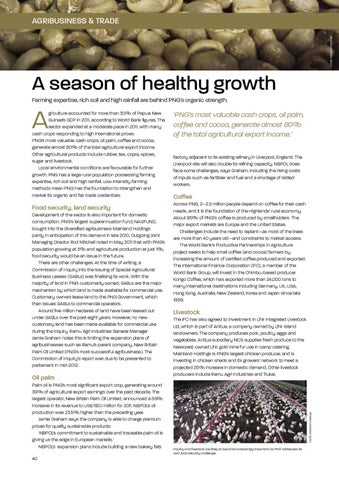
Livestock The IFC has also agreed to investment in Lihir Integrated Livestock Ltd, which is part of Anitua, a company owned by Lihir Island landowners. The company produces pork, poultry, eggs and vegetables. Anitua subsdiary NCS supplies fresh produce to the Newcrest-owned Lihir gold mine for use in camp catering. Mainland Holdings is PNG’s largest chicken producer, and is investing in chicken sheds and its growers’ network to meet a projected 25% increase in domestic demand. Other livestock producers include Ramu Agri Industries and Trukai.
Credit: Mainland Holdings
A
griculture accounted for more than 30% of Papua New Guinea’s GDP in 2011, according to World Bank figures. The sector expanded at a moderate pace in 2011, with many cash crops responding to high international prices. PNG’s most valuable cash crops, oil palm, coffee and cocoa, generate almost 80% of the total agricultural export income. Other agricultural products include rubber, tea, copra, spices, sugar and livestock. Local environmental conditions are favourable for further growth. PNG has a large rural population possessing farming expertise, rich soil and high rainfall. Low-intensity farming methods mean PNG has the foundation to strengthen and market its organic and fair trade credentials.
Poultry and livestock are likely to become increasingly important as PNG addresses its own food security challenge.