Pete Phillips pphillips922@gmail.com PO Box 1247 Leonard, Texas 75452 903-436-2851 No texting Office Hours: M-F 9-5 (Central)
ART DIRECTOR Shannon Olson olsonrsa@gmail.com
BCAOFFICE MANAGERS
For membership, or to replace a lost or damaged Bugle please contact: Cornerstone Registration, Ltd. bca@cornerstonereg.com Tel: 763-420-7829 Fax: 763-420-7849 PO Box 1715 Maple Grove, MN 55311 Office Hours: M-F 9-5 (Central)
ARTICLES: Typed copy should be sent to editor in MS Word format. If in doubt of facts, check with technical advisors listed in the Bugle
PHOTOS: Set digital cameras on the highest setting. Good quality prints are also accepted, but will not be returned unless requested and return postage is provided. Vertical views are necessary for our cover with a resolution of 240-300 dpi. A brief story and at least five images must be sent to support a cover photo. DEADLINES: Unless otherwise stated, Bugle deadlines are the 24th of each month, six weeks prior to issue date (example: June 24 for August issue), in order to accommodate editorial, design, publishing and postal demands. Please send all ads, articles, photos and artwork to Editor Pete Phillips.
HOST A FUTURE BCA NATIONAL MEET
THE BUICK CLUB OF AMERICA IS SOLICITING ALL CHAPTERS AND REGIONS TO CONSIDER HOSTING A BCA NATIONAL MEET IN 2029 OR A LATER YEAR.
These meets are a great way to attract new members and make some income for your Region or Chapter. Multiple chapters can get together to provide additional manpower. Remember, registration and judging are taken care of by others, so you do not have responsibility for that.
If you are even remotely interested in pursuing this opportunity, please contact the BCA National Meet Committee Chairman (NMC), Sid Meyer at 727-415-7679 or at email address: smeyer2@tampabay.rr.com for additional information.
Assistance is always available from the NMC at no charge.
Please consider this request.
Thank you, Sid Meyer, Chairman, BCA National Meet Committee (NMC)
coming events
HOW TO PLACE YOUR CHAPTER EVENT
All listings are FREE to BCA chapters hosting an event. Chapters may list more than one event at a time. Send one copy of your event listing and it will be published through the month of the event. Keep your listings brief. Maximum length is 100 words. Send all coming event notices to the Buick Bugle, PO Box 1247, Leonard, TX 75452 or email to pphillips922@gmail.com. Organizations other than BCA chapters wishing to have an event listed may do so, on a space available basis.
MAY 2026
May 9, 2026 - Centralia, Washington. The Pacific Northwest Region’s annual potluck picnic will be held 10:00 AM to 3:00 PM, rain or shine, in Kitchen #1 at Fort Borst Park in Centralia, WA. One block west of Interstate 5 at Exit 82. The warm, dry facility has tables, chairs, and large kitchen with a sink, refrigerator, stove and oven. Bring a dish to share. Prepare your dish in our kitchen, reheat it in our oven, or buy it from the Safeway supermarket next door. Daily drivers are welcome! For more information, contact Jack Gerstkemper: 360606-2870 or bgerst7@aol.com
May 24, 2026 - Wantagh, New York. The 46th Annual Long Island Chapter . AllBuick and Opel Show is being held in the Wantagh, NY train station parking lot For GPS use: 3470 Park Ave, Wantagh, NY 11793. Gates open at 8am; trophies at 1pm. Dash plaques to the first 100 cars. Driver choice judging, New trophy design. All show cars will be parked in order as they enter, NO CLASSES. Trophies for top 10 cars, Best of Show, and Spirit of Buick. Rain date May 31, 2026. For info and day of show, Contact: Marty at 516-606-4620 or Marc at 516-205-1064. For more info, entrance fees, registration form and photos of prior shows, visit us at libuickclub.org.
Chapters in need of a certificate of insurance for their event can request a form from the Buick Club of America, c/o Cornerstone Registration, Ltd., PO Box 1715, Maple Grove, MN 55311-6715, Tel: 763-420-7829, Fax: 763-420-7849, Email: bca@cornerstonereg.com. The completed forms must be returned to the Cornerstone office. DO NOT SEND THEM TO, OR CONTACT THE INSURANCE COMPANY DIRECTLY, OR YOUR REQUEST WILL BE DELAYED. Allow six weeks for processing. Last minute requests cannot be guaranteed a certificate.
JUNE 2026
June 6, 2026 – Lebanon, Indiana. Buick, Oldsmobile, Pontiac and Cadillac (BOPC) Car Show hosted by Indy Circle City Rockets Olds Club benefiting Indy Honor Flight, 9:00 AM – 2:30 PM. Memorial Park, 130 E. Ulen Dr., Lebanon, IN. 46052. $20 Pre-register until 5/15/26, $25 day of show. Awards/door prizes. Info at Indy Circle City Rockets Oldsmobile Club Facebook Group page under Events and Files tabs. Questions and forms: email IndyCircleCityRockets@ gmail.com.
June 7, 2026 - Gurnee, Illinois. 10th Annual All Buick & GM Charity Car Show Event, Sunday June 7th, 2026. Hosted by the Chiwaukee Border Chapter, BCA and Woody Buick-GMC of Gurnee, IL., 5589 Northridge Dr. Open to All Buick and GM Antique and Classic Car owners. $10 Registration, 9am-2pm, DJ Rudy K, food vendors, peer judging with awards in 12 classes, 50/50 & door prize raffles. For show information contact Kevin Kauppi, 224-623-1297, kevinkauppi13@aol.com
June 11-13, 2026 – Cleveland, Ohio. Great Lakes Regional Buick Meet, hosted by the North East Ohio Chapter. Host hotel is the Independence Holiday Inn, 6001 Rockside Rd., Independence, OH. 44131. Room rate $125 + tax, (216) 524-8050, mention Buick Club for room rate. Meet registration for
Jack Welch, BCA #5387 781-662-4423 (MA) antiquecaddy@gmail.com
JUNE 2026
BCA members + one car is $30, additional cars $15 ea.; member with no car being judged: $25. Cuyahoga Scenic Railway tour $35; Friday p.m. bbq dinner $30; Saturday awards banquet dinner $45; T-shirts $25. Registration deadline: May 22, 2026. Make checks payable to: “North East Ohio Chapter, BCA”; Mail registration and payment to: 2026 Great Lakes Regional c/o Heather Banhidy, 27226 Cook Rd., Olmsted Township, OH 44138. Questions? Email: straight8news@gmail.com or call 440-5253243.
June 13, 2026 - Puyallup, Washington. The Puget Sound Chapter, in conjunction with Puyallup Meeker Days, is hosting the 4th Annual B-O-P show at our new location – Puyallup downtown Library parking lot, corner of 2nd St. SW and 4th Ave. SW. 10:00am to 4:00pm, parking begins at 8:00am. Any club member Buick, Oldsmobile or Pontiac can pre-register for $15.00, non-member $20.00, day of show $25.00. Contact Lee Davis, Chairman at 206 - 755-4877 or leemarthadavis@ gmail.com. Meeker Days Celebration is a fun event for the whole family. Street vendors, food court, music and farmers' market plus much more.
June 21, 2026 - Wallingford, Connecticut. The Yankee Chapter will host a show at Wallingford GMC, 1122 Old North Colony Road, Wallingford, CT 06492. Hours are 9:00 AM to 3:00 PM. This will be a peerjudged show along with a Dealer’s Choice Award. Cut-off year is 2011 and first 40 entries receive a goodie bag with dash plaque. Registration is day of the show only at $15 per vehicle and all paid show entrants are eligible for door prize drawings. Spectators are admitted free. Contact Rich Dayton at 203-509-6136 or Jim Comeau at 203-537-2408.
June 25-27, 2026 - Ames, Iowa. Join us for the Heartland Regional Buick Show. Centrally located and easy to get to. We will have 400-point judging available, driving tours, a cruise-in and more special activities. Celebrating the “6 in 2026!” Buicks from 1906-2026 and every Buick in between welcome! Download the event flyer and registration from, including hotel
Publisher: The Buick Bugle (USPS #480-130) is published monthly by the Buick Club of America, Inc., c/o Cornerstone Registration, Ltd., PO Box 1715, Maple Grove, MN 55311-6715. Tel: 763-420-7829, Fax: 763-420-7849, bca@cornerstonereg.com. Periodical postage paid at Columbus,
c/o
Registration, Ltd., PO Box 1715, Maple Grove, MN 55311-6715. Tel: 763-420-7829 Fax: 763-420-7849 bca@cornerstonereg.com.
JUNE 2026
information from the BCA website. Find show listing under the Calendar of Events tab. Click link to download.
June 28, 2026 - Flint, Michigan. Buicktown Chapter (BCA) will host the 2026 Michigan Buick Bash (MBB) in collaboration with the Sloan Museum Auto Fair Car Show. The Auto Fair Car Show is two days (Sat./Sun.) at Crossroads Village. The MBB is on Sunday only. Register at sloanautofair.com and then contact the host to RSVP for the MBB. Buicks must park in the designated Buick parking to participate in the MBB. For MBB participants there is a Best Buick award, door prizes, and lunch provided. RSVP to host James Drury 989780-2167.
JULY 2026
July 11, 2026 - Buffalo, New York. The Niagara Frontier Chapter will host the Annual Buick Show at the Lt .Col. Matt Urban VFW Post 7275 located at 3741 Walden Ave, Lancaster, N.Y. on July 11, 2026. Registration 9:00 AM to 12:00 PM. Peer judged, Top 10 awards plus Best Buick. Food, music, basket raffle, 50/50. No outside alcoholic beverages. Contact Tom Walzak, 716-433-1024. $20.00 at gate. Paved lot and grass areas. Full use of facilities. Proceeds to support Golisano Children’s Hospital.
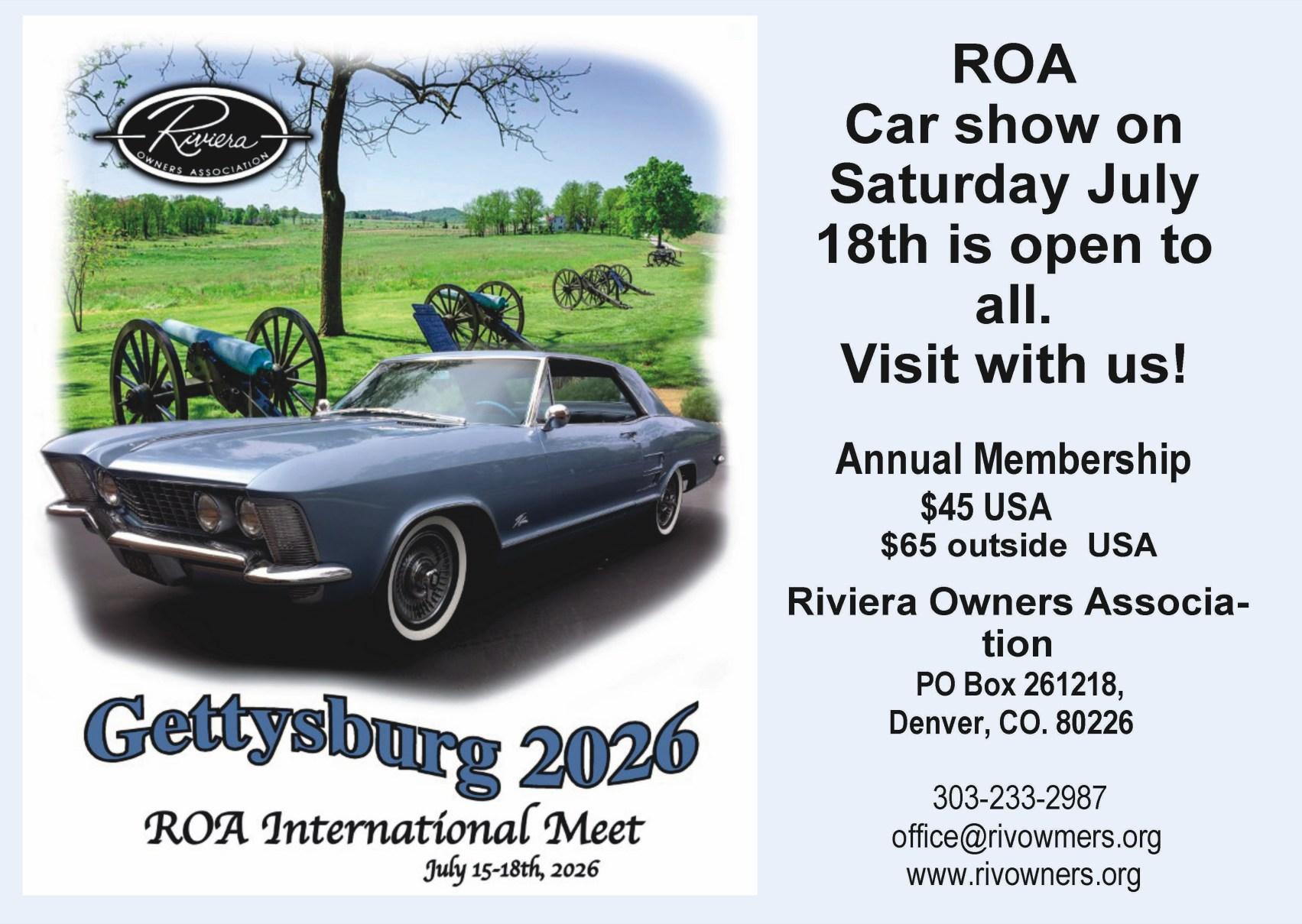
July 15-18, 2026 - Gettysburg, Pennsylvania. The Annual ROA Meet will be held at the Wyndham Hotel on Presidential Circle. Registered members will be active each day from 9am – 10 pm with tours, social events, vendors and refreshments. The car show on Saturday from 9am – 2pm is open to all. Visit rivowners.org, or ray@rivowners.org.
July 17-18, 2026 - Dublin, Ohio. 43rd Annual Arthritis Foundation Chairty Auto Show, Metro Place North, Dublin, Ohio. Friday, July 17: Cruise-In; Saturday, July 18: Classic auto show. Buick show within a show, 7 classes, 15 awards, Buick Best of Show. Arthritis.org/afcas for registration. For additional information: Jeffrey Brashares usa.jbrashares@cma-cgm.com 614-361-7299.
July 18, 2026 - Paris, Maine. The car collection of BCA member Sandra Bahre will be open for a 1-day public viewing as a charity benefit for Hamlin Memorial Library & Museum at the Founders' Day celebration on the green in Paris, Maine. You are invited to see the 1940 BrewsterBuick 90 Limited town car as part of an outstanding collection featuring Packards, Duesenbergs, Stutz Bearcats, a Tucker,
JULY 2026
Brass-Era cars, vintage race cars, antique dolls, horse-drawn carriages, antique toys, and much more. Cost to view the collection is $15/adults, $2/children under 12. This is a rain or shine event, from 9AM – 5PM. 207743-2980, hamlinstaff@gmail.com or hamlin.lib.me.us/founders_day.html.
July 26, 2026 - Reisterstown, Maryland. 22nd Annual All-Vehicle Show hosted by the Free State Region, VCCA. 401 Mitchell Dr. All years, makes, models, modified and original are welcome. Theme: Friendly and Fun. Presenting 33 awards: Top 30, Reisterstown Park Choice, Longest Distance Driven, Best of Show. Day of show registration $20. Portion of the proceeds benefit assisting homeless veterans. 9am –1:30pm, awards at 1pm. Arrive by noon to be judged. Gates open at 8:30am. Food available at concessions: hot dogs, bratwurst, snacks, cold drinks. Families are welcome. Bring the kids! Park has covered pavilion, indoor restrooms and playground area. Rain or shine event. Contact Mike Natale at 443-465-7492, mrnatale@verizon.net or visit freestateregionvcca.org
AUGUST 2026
August 15, 2026 - Flint, Michigan. Buicktown Chapter (BCA) will again host Buicks on the Bricks; in collaboration with Back to the Bricks. Original Buick Indianapolis 500 Pace Cars featured this year, along with discussion forum of engineers who developed them. Buick festival, parade and replica pace cars will have featured car parking on site. All collectible Buicks welcome. 6:00am entry. Information at backtothebricks.org.
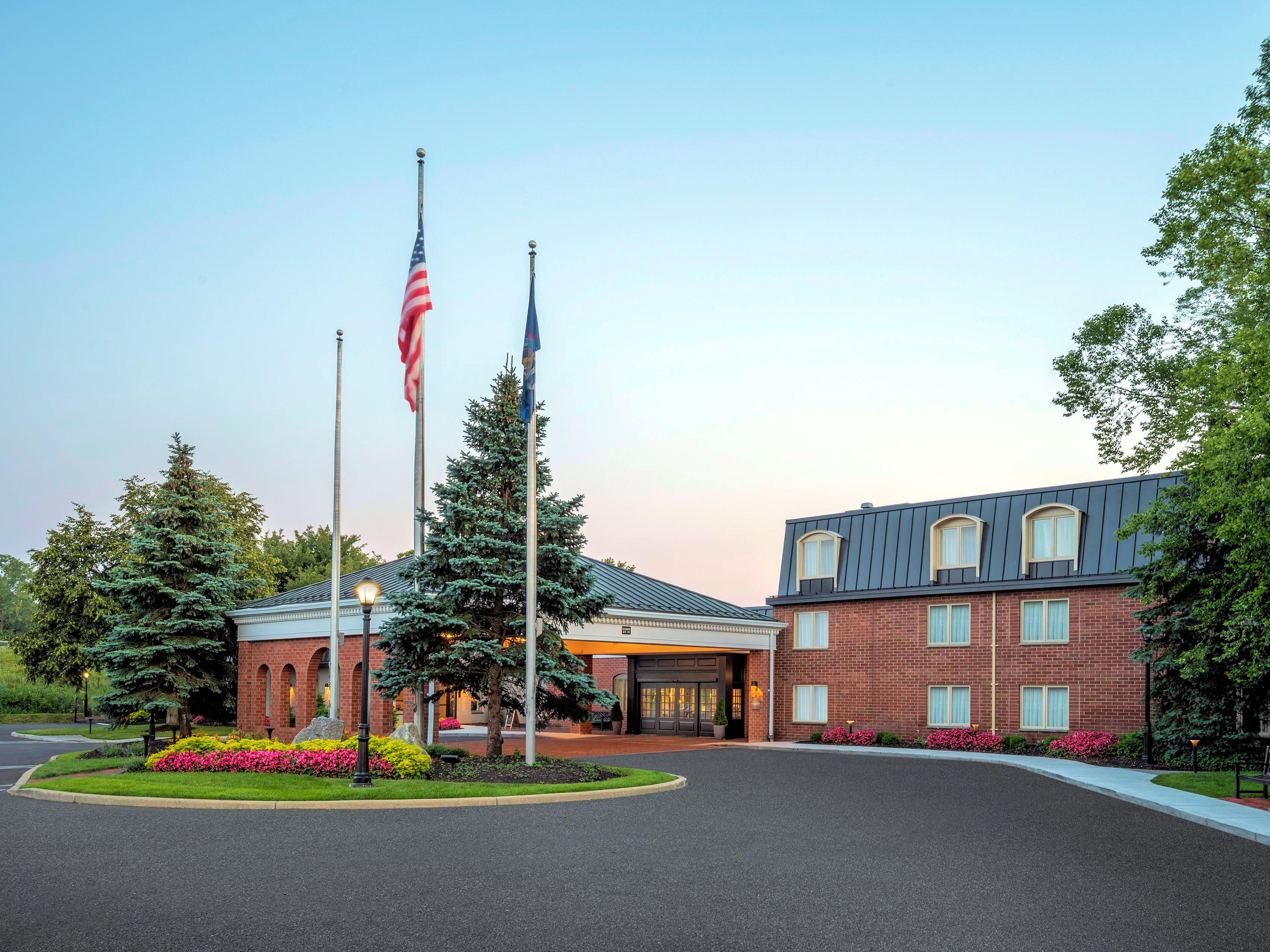
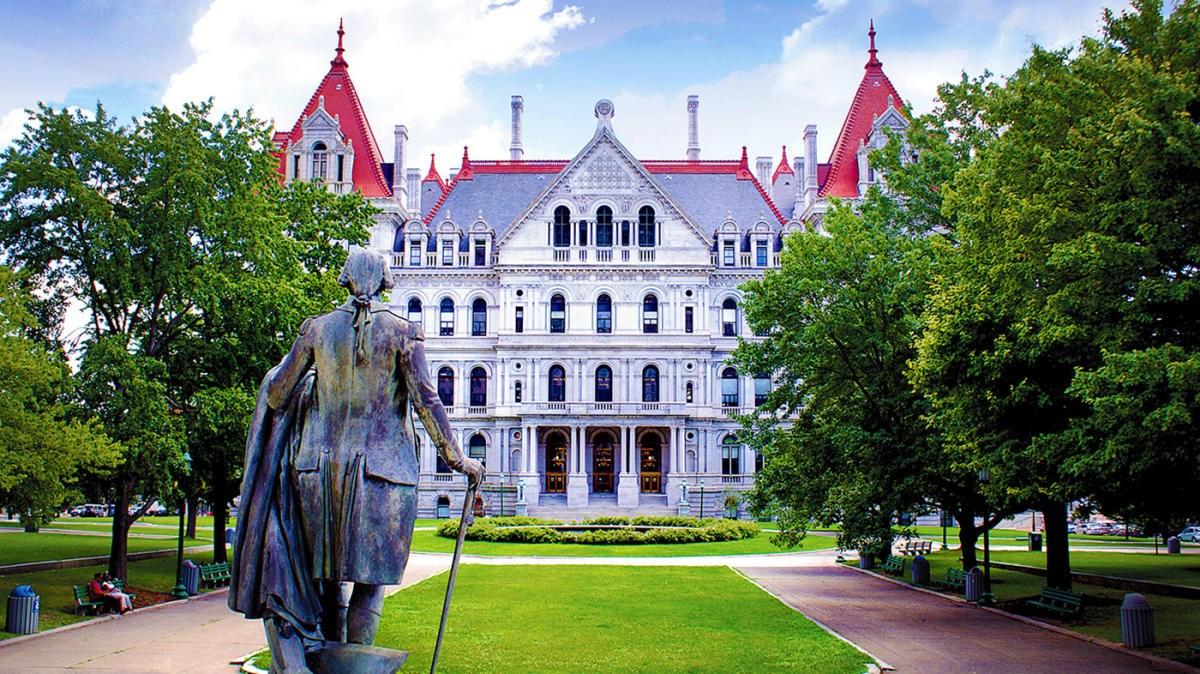
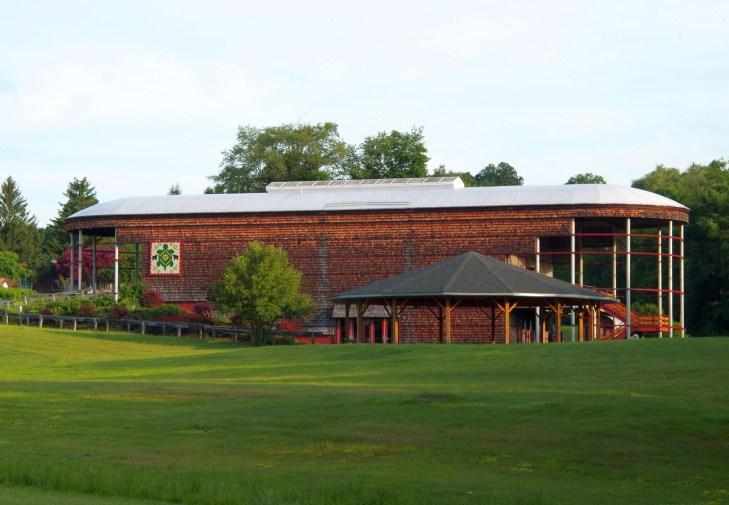
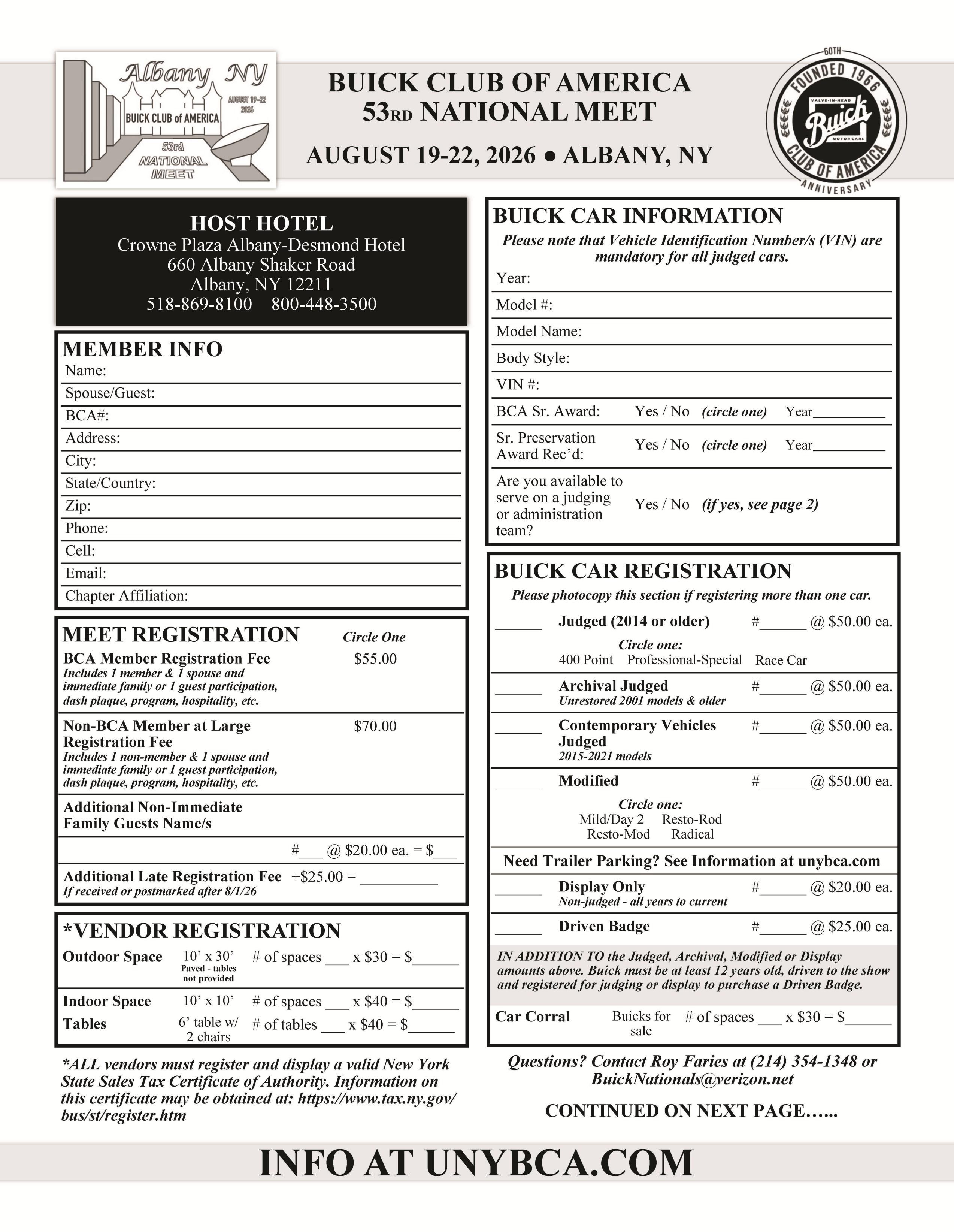
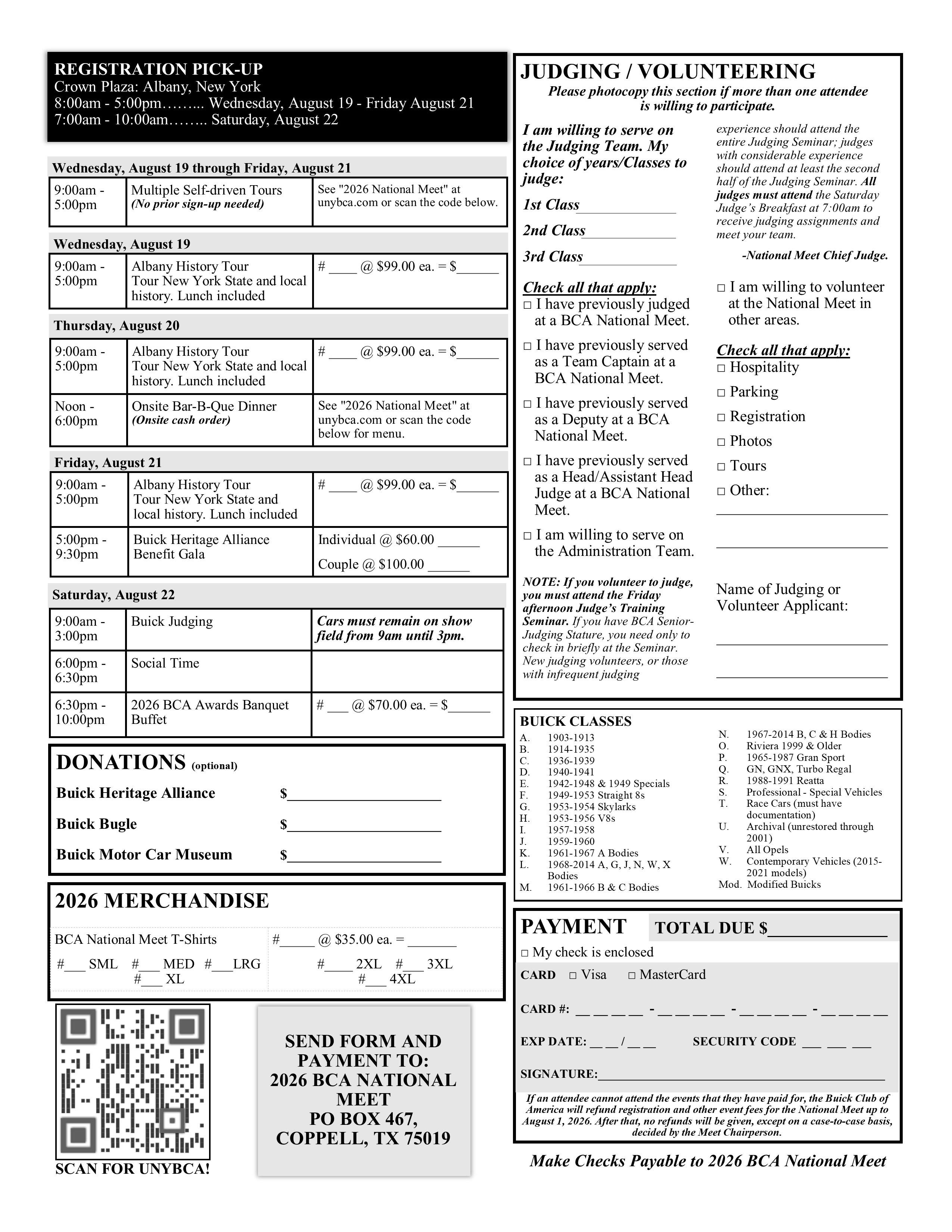
August 19-22, 2026 - Albany, New York. The 53rd BCA National Meet. Albany History Tour, Wednesday Cruise-In, Thursday BBQ onsite, Friday Ice cream run, several self-driving tours to local attractions, plus an organized Pre-war tour. Friday night BHA benefit, Saturday car show w/class judging and evening awards banquet. Hotel booking link and all activity descriptions at: UNYBCA.com. Come and discover the great Northeast!
August 30, 2026 - Gurnee, Illinois. Two car shows at one event! 5th Annual Buick Riviera ROA & GM Car Show, Sunday, August 30, 2026, hosted by the Riviera Owners Association and Woody Buick, 5589 Northridge Dr., Gurnee, IL. Open to all '63-'99 Buick Riviera owners and all GM models. $10 registration, 10am-2pm, DJ Rudy K car cruising music, great food vendors. For show information contact Kevin Kauppi, 224-623-1297,
coming events
AUGUST 2026
kevinkauppi13@aol.com or Len Woelfel, 630-675-3640, len.woelfel@gmail.com.
SEPTEMBER 2026
September 12, 2026 - Spokane, Washington. The Inland Northwest Chapter will hold its second annual Buick Open Car Show at the Mirabeau Meadows Park, 13500 Mirabeau Parkway, Spokane Valley, WA. 10:00am to 2:00pm. Show open to all makes, models and years. All cars will be judged. Awards at 1:30pm. Food available. Music to set the atmosphere. Registration fee $25.00. Inlandnorthwestbuick.com, or Jim Barry 509-220-7911 or jim@hilbyheights.biz.
OCTOBER 2026
October 10, 2026 - Delaware, Ohio. 32nd
Annual Delaware Charity Car Show, 1 South Sandusky St., Delaware, OH. 7:00am. Registration 11:00am to 2:00pm. 100 Best of awards.15 Best of Show. Contact Jeffrey Brashares usa.jbrashares@ cma-cgm.com, 614-361-7299.
October 17, 2026 - Collinsville, Illinois. All Buick Rendezvous at Laura Buick/ GMC, Collinsville, IL. Joint event with the St. Louis Gateway Chapter, BCA Gateway Buick Performance Enthusiasts.11:00 am to 3:00 pm (Saturday). Bring your lawn chairs. Laura Buick/GMC, 903 North Bluff Rd., Collinsville, IL 62234. Lunch provided. Club members bring dessert for all. No entry fee. RSVP required. Chetpalumbo 1947@gmail.com, with names of guests; make, model and year of your car.
October 31, 2026 - Lehighton, Pennsylvania. 50th Annual Old Car Show & Outdoor Flea Market. Phifer's Ice Dam, 880 Main Rd., Lehighton. Hosted by the Free Spirit Chapter. Registration 9 amNoon, Car/market space, $20.00. Dash plaques to first 50 car registrants. Park as you enter, no classes! Top 10 awards and Honorary David Brady Award. Open to all make/model/year vehicles. No rain date. Sally 484-464-3418, or buickfreespirit.org.
FEBRUARY 2027
February 17-23, 2027 - Napier, New Zealand. Join us for five days in the Art Deco Capital of the World. Buick is the featured marque and will lead the parade. Buick vehicles between 1903 and 1949 are eligible. Event will commemorate 100 years since Buick vehicles were assembled in New Zealand. For those travelling from overseas limited spaces will be available in cars so you can be part of this unique experience. Accommodation suggestions and program details email buickrally27@gmail.com.
The Buick Club of America
The Buick Club of America (BCA) is a non-profit organization dedicated to the preservation and restoration of the automobiles built by Buick Motor Division of General Motors Corporation in Detroit, Michigan,
PRESIDENT
Jerry Courson (2026), BCA #37598 210-601-1780 (TX) jerryLcourson@gmail.com
VICE PRESIDENT
Tim Turvey (2027), BCA #52410 954-253-0994 (MI) Tim.Turvey@hotmail.com
SECRETARY
Jack Welch (2027), BCA #5387 617-838-3525 (MA) antiquecaddy@gmail.com
TREASURER
Michael Meyer (2027) BCA #51685 386-527-9975 (FL) mjmeyer@synergybilling.com
Bob Starzyk (2026), BCA #39653 708-334-4848 (IL) 56buick@att.net
s message
2027 National Meet
break, and it is refreshing to fill my mind with board meetings, national meets, museum activities, the modified division, and BCA members.
BCA Financial Condition
Previously, I notified you that the club had operated at a loss in 2025. This loss of approximately $4,200 did not make a dent in the club’s equity of $674,903. However, it’s time to carefully review these small dents in the retained earnings before they become craters. The club could continue to operate until the equity is near zero. But this is not responsible financial management. Our club has gone from 10,000 members to 5,000. In recent years inflation has impacted on the BCA with higher expenses. There has been no reduction in the services provided except reducing the Bugle from 12 annual issues to 11 issues. There has been no change in the dues structure since before I joined the BCA. The board has scheduled a special meeting to discuss this issue.
In summary, the BCA is in great financial condition, and the board will be taking actions to keep it that way. I will keep you informed.
As you may have heard, it was necessary to change the location of the 2027 national meet. Marck Barker worked his usual magic, and brought a proposal to the National Meet Committee to hold the meet in Spearfish, South Dakota. This proposal was approved by the BCA Board at its March 17th meeting. You may ask, “Why Spearfish?” Spearfish is Mother Nature at its finest. We will have opportunities to tour attractions such as Badlands National Park, Mount Rushmore, Bridal Veil Falls, and many others. The cost is reasonable. The hotel rate is lower than we have seen in years. “Where is Spearfish?” Spearfish is in the Northern Black Hills region of South Dakota, approximately 45 miles northeast of Rapid City on I-90. It is known for its natural beauty and outdoor recreation. The June national meet will provide weather at its finest. I will see you in Spearfish in ’27.
Changes in National Meet Functions
It is becoming more difficult to find a BCA chapter willing to undertake the management of a national meet. The costs of hotel rooms, food and beverage, security, and related services are skyrocketing. The BCA Board is considering a proposal to update the management of national meets. The proposal calls for a new contract position to manage all national meets. Local chapters will still be involved. Chapter volunteers will earn money for their chapters for their efforts. At the board meeting on March 31st, this matter will be discussed further.
Board Nominations
We only have three candidates for the three board positions to be filled. By the
NATIONAL BCA OFFICE MANAGERS
For membership, or to replace a lost or damaged Bugle: Cornerstone Registration, Ltd. bca@cornerstonereg.com
Tel: 763-420-7829
Fax: 763-420-7849 PO Box 1715 Maple Grove, MN 55311
Office Hours: M-F 9:00am to 5:00pm (Central)
BCA DEPARTMENTS
Judges Training Chairman
Bill Gorman, BCA #44900 515-290-6565 ● bbgorman35@gmail.com
National Chief Judge Adam Martin, BCA #39765 314-713-1262 adam@antiqueautomotiveservice.com
National Tour Advisor
Bruce Kile, BCA # 3013 678-662-6072 ● sbkile58@aol.com
Chapter/Region/Division Coordinator
Anne Gibson, BCA #11511 336-599-9589 ● agibson36@gmail.com
president s message, continued
time this is published, the election should be completed, and the three candidates will likely be elected. The likely new board members are Tom Parker, Adam Martin, and Jerry Courson.
Please Update Your Information
In preparation for the publication of the 2025/2026 Membership Directory, the members were asked to update the membership database. The emphasis of this update was information on cars owned. Recently, we have learned that some personal
DEADLINE REMINDER
Our next deadline is May 24th for the July issue of the Buick Bugle.
Pete Phillips pphillips922@gmail.com PO Box 1247 Leonard, Texas 75452
903-436-2851 Office Hours: M-F 9-5 (Central)
information could be out of date. The BCA Bylaws define members as the member, the spouse (or partner) and any minor children. Please notify Cornerstone by email of any changes needed in your personal information.
Jerry Courson
Obituaries
John Scheib BCA #31093
Rodney ”Rod” Seastream BCA #11528 Humble, Texas
January 9, 1945 - March 19, 2026
By Pete Phillips
I am sad to report that Rod Seastream, BCA #11528 of Humble, Texas, passed away on March 18, 2026.
Mark Shaw Vancouver, Washington
February 21, 1952 - March 29, 2026
June 17, 1937 - March 5, 2026
By Pete Phillips
John Scheib died at the age of 88 on March 5, 2026. He was the BCA's Director for the Northeast Region and an active member of the Yankee Chapter.
John owned a 1932 Buick model 57-S, a 1968 Riviera, and a 1990 Reatta convertible.
He was a graduate of Oklahoma State University and the University of Hartford, and worked for Industrial Risk Insurers.
He is survived by his wife Bea, two children, and several grandchildren.
For those who wish to do so, memorial donations may be made to the Klingberg Automotive Restoration Program at klingbergmotor carseries.org/auto-restoration-program/.
He was the long-time (at least 25 years) Director of the Lone Star Chapter, BCA, which encompasses the Houston area.
He had been in ill health for some time. He is survived by his wife, Helen, but she is in a nursing home with Alzheimer's disease.
Rod organized the “Buicks and Bluebonnets” Regional Meet in April for the three Texas BCA chapters, for many years.
Prior to his retirement, he was employed by the City of Houston's Airport Department. He will be greatly missed by those who knew him.
By Pete Phillips
We have been informed, as this issue was being put together, that former BCA member Mark Shaw passed away on March 29, 2026, following a long battle with lung disease.
He was a very active member of the BCA in the 1990s and early 2000s, serving for several years as Director of the Pre-War Division and organizer of Pre-War driving tours in conjunction with BCA national meets. He owned a 1913 Buick, a 1929 Buick, and several other early Buicks.
He was also an active participant in the Pre-War Buick discussion forum on the internet.
letters to the editor
MORE ON JOHN SCHEIB
We are all sorry to hear of John Scheib's passing. Please pass our condolences to Bea and family. He will be greatly missed. A prince of the BCA, especially the northeast area.
Also for me, John and Bea were personal friends. Without
GOLDEN QUILL
Hi Pete,
I hope you will publish this short note in the Bugle
Upon receiving my most recent issue of Cars & Parts
John s efforts as Northeast co-ordinator of the BCA our (Lower Hudson Valley) chapter would not be. I first met John when I answered an ad in the Bugle that a meeting was to be held about a new BCA chapter about 2011. There were six or eight of us, that was the beginning of our chapter.
Paul Cialone, BCA #16683, Danbury, Connecticut
I see you have once again earned the Golden Quill Award for
On Sale Now!
The BCABoard of Directors are pleased to announce that the new Directory & Handbook, Volume No. 45 is now on sale through Cornerstone Registration.
-All States
-All Countries
includes shipping
To Order send payment to:
and about 14.0 volts for a 12-volt battery.
Most car batteries in use today, and for many decades in the past, are of the lead-acid type. In this type of battery, the battery provides energy or current by chemical action between the plates in the cells and the electrolyte. The negative plate is composed of lead and the positive plate is lead peroxide and both may have some minor constituents to enhance structural integrity and improve performance. These are constructed in a grid-like arrangement to maximize surface area where the actual electrochemical reactions occur. Insulating spacers are placed between the interleaved positive and negative plates to prevent contact between the plates. The electrolyte is a dilute solution of sulfuric acid. The reaction that occurs when the battery is delivering current or discharging is represented by Figure 1.
Figure 1 - Chemical reaction during discharging.
Neg POS Electrolyte
Both Water Plate Plate Water
HOW TO PROLONG THE LIFE OF YOUR BATTERY
Joseph Indusi, BCA #33493, Miller Place, New York
Car batteries, as well as other auto maintenance items are increasing in cost so it makes good sense to prolong the life of your battery. In addition, the batteries in our antique cars are subjected to somewhat different usage patterns then those in daily drivers and need special attention.
The battery has three main functions: provide a source of energy to start the engine, act as a voltage stabilizer for the electrical system, and provide, for limited time periods, energy to operate the car ignition system and accessories when the generator cannot provide the required energy.
In order to reliably accomplish these three functions, the battery and the charging system must be in good condition and properly adjusted.
Experts in old car restoration frequently advise car owners to be sure that battery cables are the correct size and that all connections are clean and tight. For 6-volt systems this is particularly important. The ground strap and cable to the starter switch in a 6-volt car should be no less than 1 gauge and for larger engines 0 or 1(0) or 2(0) gauge cables are required. A 4 gauge cable for a 12-volt car will not deliver enough current while under the load of the starter motor in a 6-volt car. Battery terminal connections and ground and starter solenoid connections all need to have clean, metal to metal, tight attachments. Any paint, corrosion, rust or similar imperfections must be cleaned off to assure good electrical bonding. This will assure that the battery can deliver the required current to start the car and, when running, the battery can receive the appropriate charging current to restore the battery charge. Typically, the charging system (generator and regulator) should deliver about 7.0 volts for a nearly fully charged 6-volt battery
Pb + PbO2 + 2H2SO4 goes to 2PbSO4 + 2H2O
Where Pb is the symbol for lead, H= Hydrogen, S= Sulfur, O=Oxygen.
As the cell discharges, lead sulfate forms on the negative plate and through a more complicated process, lead sulfate (2PbSO4) also forms on the positive plate as well. Hence, both plates have a coating of lead sulfate and the electrolyte (2H2SO4) is further diluted by the formation of water. When the battery or cell is being charged, the chemical reaction is described by Figure 2.
Figure 2 - Chemical reaction during charging
Both Water Neg Pos Electrolyte Plates Plate Plate
2PbSO4 + 2H2O goes to Pb + PbO2 + 2H2SO4
You will note that each equation is the reverse of the other. However, the discharge/charge cycle cannot be repeated forever; eventually the battery cannot be fully re-charged to its original state. At that point, the battery has reached the end of its useful life. At this point the plates have sulfated and deteriorated and no longer retain their original shape, composition and dimensions. A battery in a well-maintained daily driver can give five or more years of service with some lasting up to seven years.
There are a few conditions that can shorten battery life significantly and the most important is the crystallization of the lead sulfate on the plates.
1. Sulfation
If a battery is allowed to remain in a state of discharge for any length of time, the lead sulfate on the plates will begin to crystallize and form a hard white crystal-like coating. At this point, there is little that can be done to bring the battery back to a useful service. THE BEST PROTECTION AGAINST SULFATION IS TO KEEP A BATTERY FULLY CHARGED.
The state of charge of a battery can be checked by frequent testing with a hydrometer to determine the state of charge. In a fully charged battery the electrolyte is denser than the electrolyte in a discharged battery as you can see from examining equations (1) and (2). The hydrometer float is
calibrated to float at a certain height in a column of electrolyte brought into the glass tube by the hydrometer bulb. Markings along the side of the float allow one to read the specific gravity of the electrolyte under test. A specific gravity of 1.260 to 1.290 indicates a fully charged battery, whereas a specific gravity below 1.13 indicates a completely discharged battery.
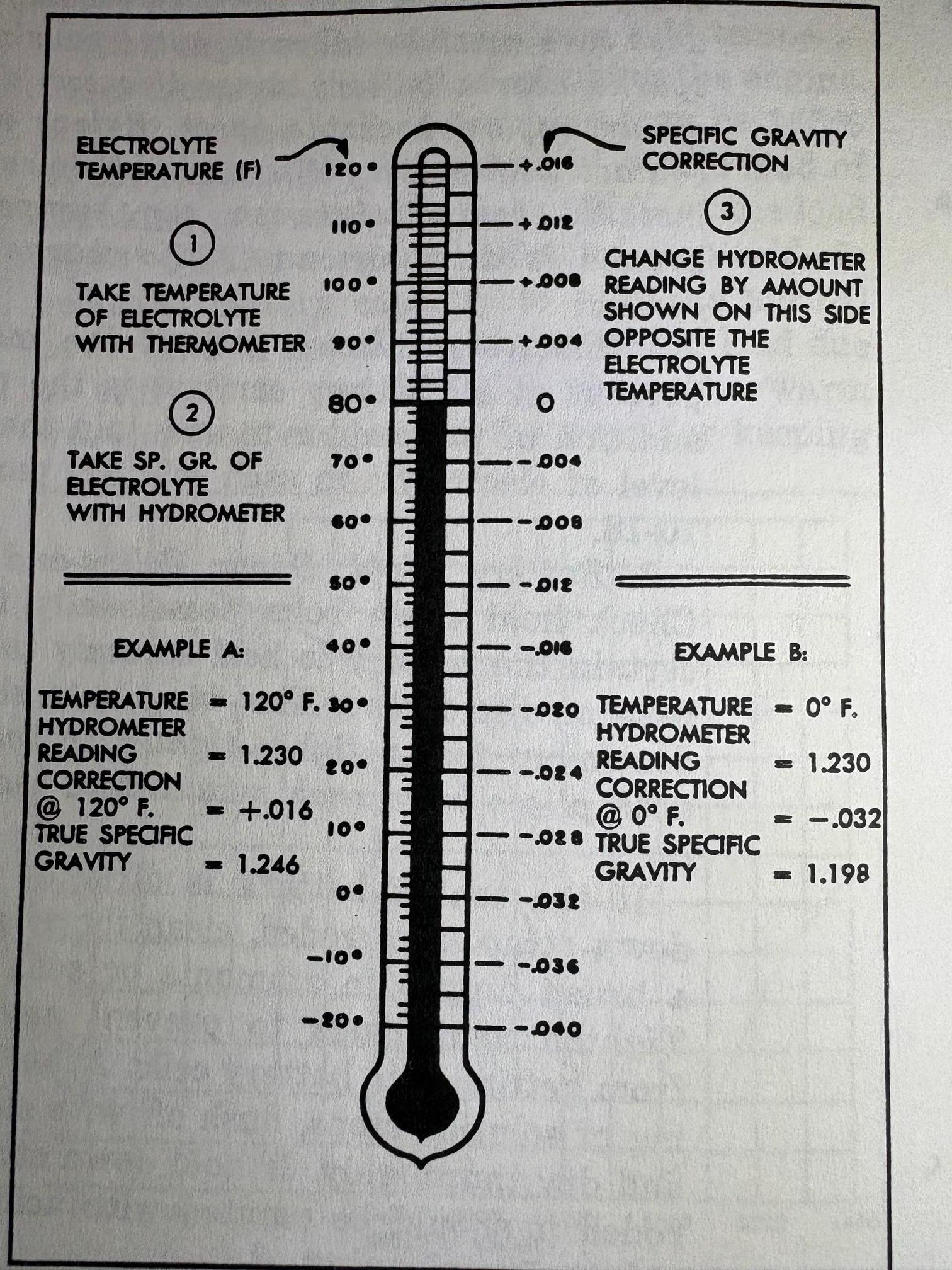
Figure 4 shows how to correct the specific gravity reading for variations in the battery electrolyte temperature, although this is generally not necessary for most of the antique car driving season.
2. Contamination of or low electrolyte level
The only thing that should be added to a battery is pure DISTILLED water to bring the level of electrolyte about a ½” above the plates. If the electrolyte level is low, the battery must supply current with only a part of the plates contributing to the chemical reaction. This can contribute to deterioration of the plates. Filling a low battery with other than distilled water can introduce minerals or other impurities that reduce the efficiency of the electrochemical reactions. Both of these may lead to shorter battery life. A charging system that overcharges the battery will tend to “cook-off” the electrolyte.
3. Self-discharging
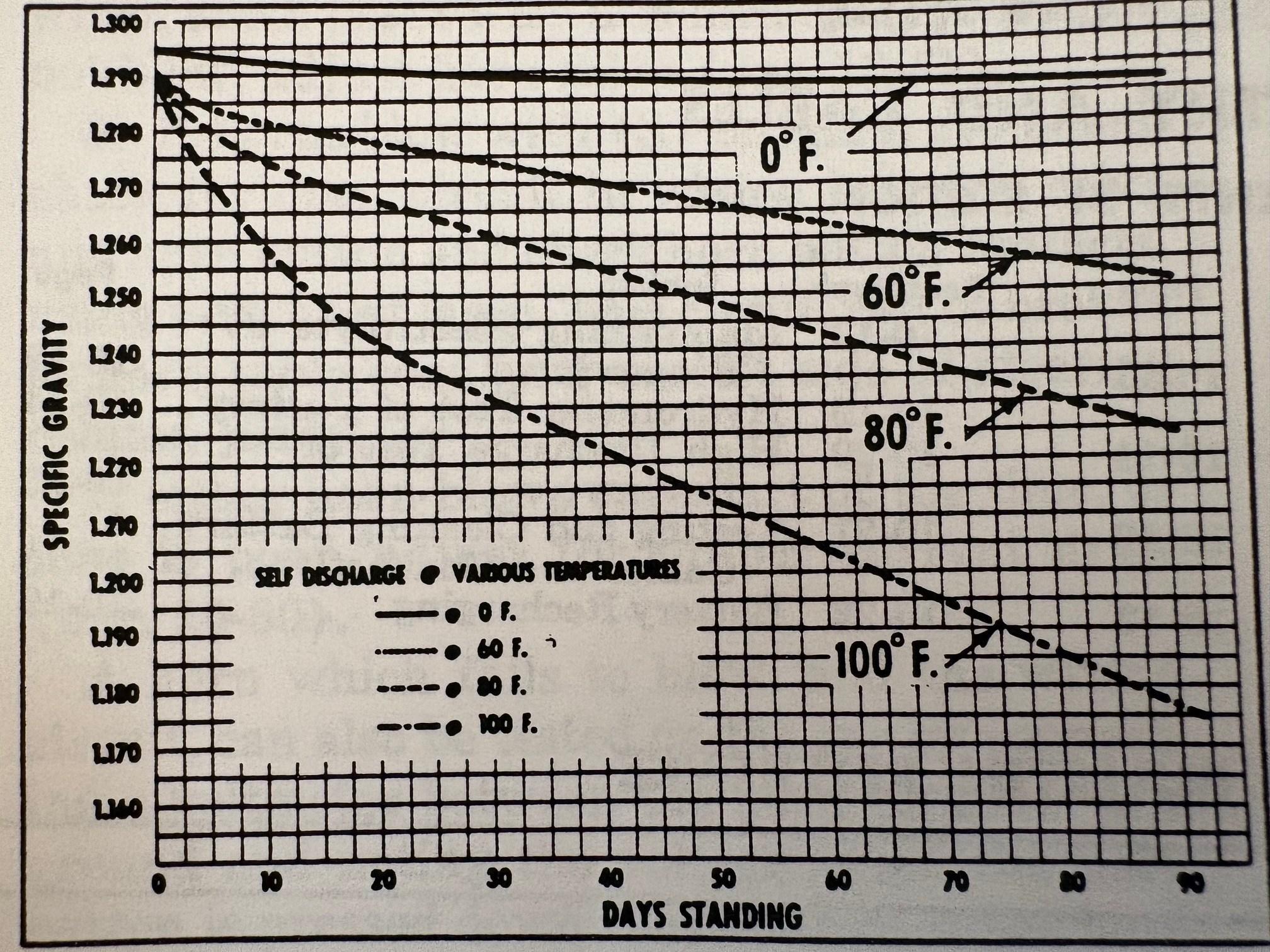
All batteries will self-discharge over time while in storage or even when disconnected in a car. Figure 5 shows how the specific gravity (on the left axis), or the state of charge, decreases over a 90-day period for various storage temperatures. Since nearly all chemical reactions are enhanced as temperature increases, it is no surprise that at higher temperatures, self-discharge occurs at a higher rate. Figure 5 also shows that at warmer temperatures a fully charged battery left to stand will wind up only half charged after 60 or seventy days. The lesson here is to store a battery in a cool dry place instead of a warm location. If storage in a cool location is not possible, then the battery electrolyte should be checked frequently and the battery should be charged at a slow rate at least every month.
4. Freezing
battery with tools, cables or other metal objects can lead to the generation of high temperatures and cause burns. In addition, accidentally shorting battery terminals may cause the case to rupture and spray acid in all directions. Finally, be aware that batteries may liberate gaseous hydrogen from the cell vents and create the chance of an explosion if there is a flame or spark in the vicinity. Follow safe procedures for jump starting a car with a dead battery.
The electrolyte in a fully charged battery will not freeze, even at temperatures as low as -50o F. However, a discharged battery will freeze at 32o F and partially charged batteries will freeze at temperatures that are likely to be encountered in cold weather. The freezing of the electrolyte will damage the plates or insulators and possibly the battery case so it must be avoided.
5. Safety
Most maintenance operations on a battery can be done safely but a few precautions are in order. Dilute sulfuric acid can damage human skin and eyes and cause burns and scarring. Wear eye protection and appropriate clothing to avoid contact with battery acid. Also be aware that a car battery can store and deliver a large amount of current. Accidentally shorting the terminals of a
In summary, the following actions can prolong the life of your car battery.
1. Always maintain clean connections at the battery terminals and ground and starter switch terminals.
2. Remove any corrosion from the battery terminals, keep the top of the battery clean and maintain the charging system components such as the generator and regulator in good working order and adjusted properly.
3. Do not allow the battery to remain for any length of time in a discharged or partially charged state. The use of a battery maintainer that charges at a low rate and then maintains a fully charged battery is highly recommended. Connect the
Figure 4
battery maintainer or charger after returning from a parade, car show or cruise to bring the battery back up to full charge. Consider using an inexpensive plug timer that may be used to cycle the battery maintainer or charger to go on once a day for about an hour to maintain charge but not overcharge the battery. The objective is to keep the battery fully charged to avoid sulfation, the main cause of shortened battery life.
4. Add only distilled water, as needed, to bring the level of the electrolyte above the level of the plates.
5. Store batteries in a cool and dry location if possible when not in use. Place the battery on a piece of wood and not directly on a concrete floor as some rubber case batteries can self-discharge more rapidly on concrete.
6. Use a quality disconnect switch for the grounded battery terminal to prevent drain on the battery from an electric clock or other accessory and to provide some protection from a fire starting from defective wiring in the car.
Figure 5
Want extra copies of the Buick Bugle? (current and back issues)
MAGAZINES ON YOUR YEAR OF BUICK
Order from the North Texas Chapter, BCA, PO Box 1247, Leonard, TX 75452. 903-436-2851. No texting
$8.00 per copy, includes US postage. $12.00 per copy for foreign addresses.
$14.00 for the November 2016 issue to US address.
January 2018 - 1968 Buicks
February 2018 - 1924 Buicks
July 2016 - 1956 Buicks
August 2015 - 1940 Buicks
July 2014 - 1922 Buicks
GM Motorama Cars at the Gilmore Museum
By Joe Bortz, Highland Park, Illinois
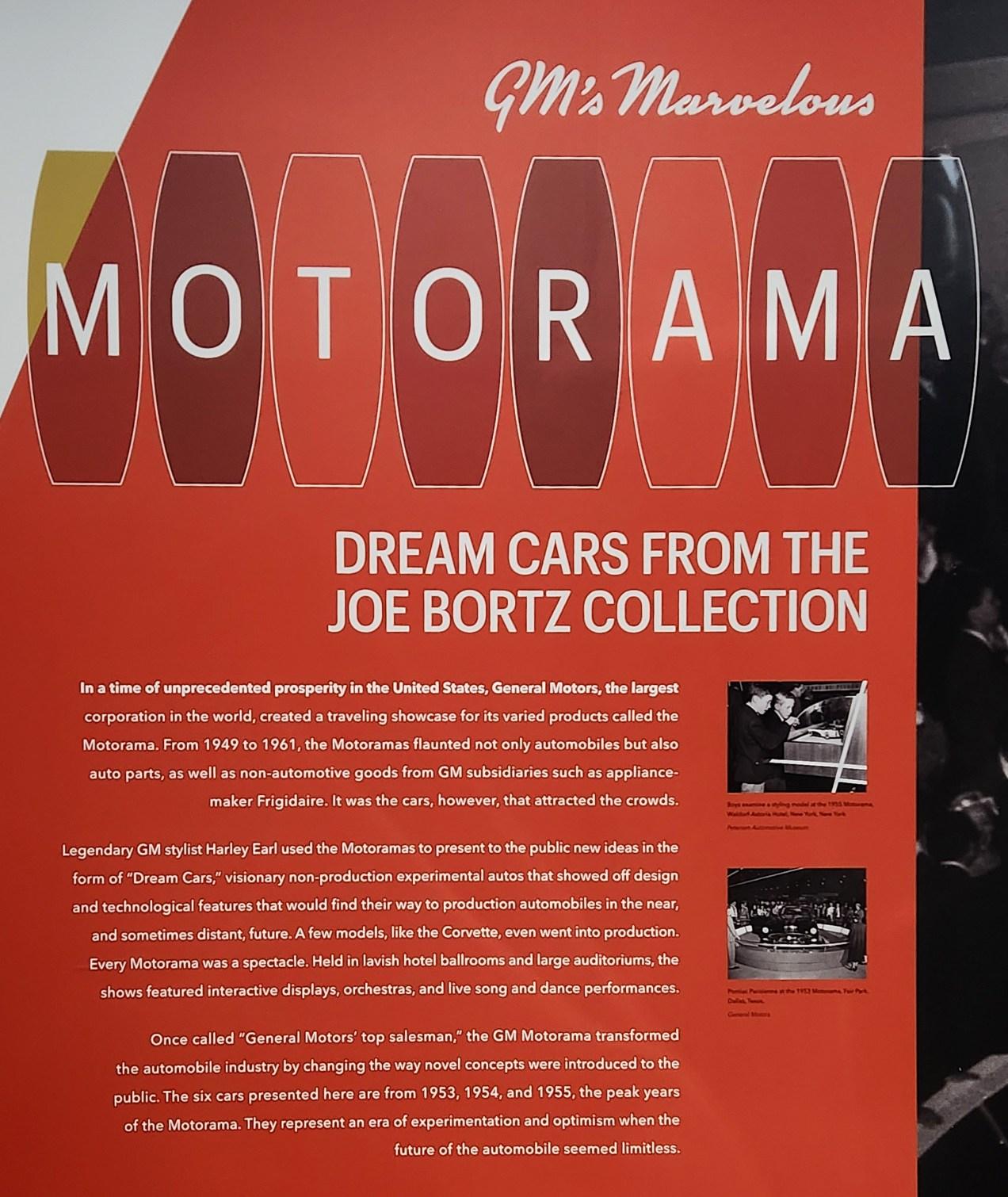
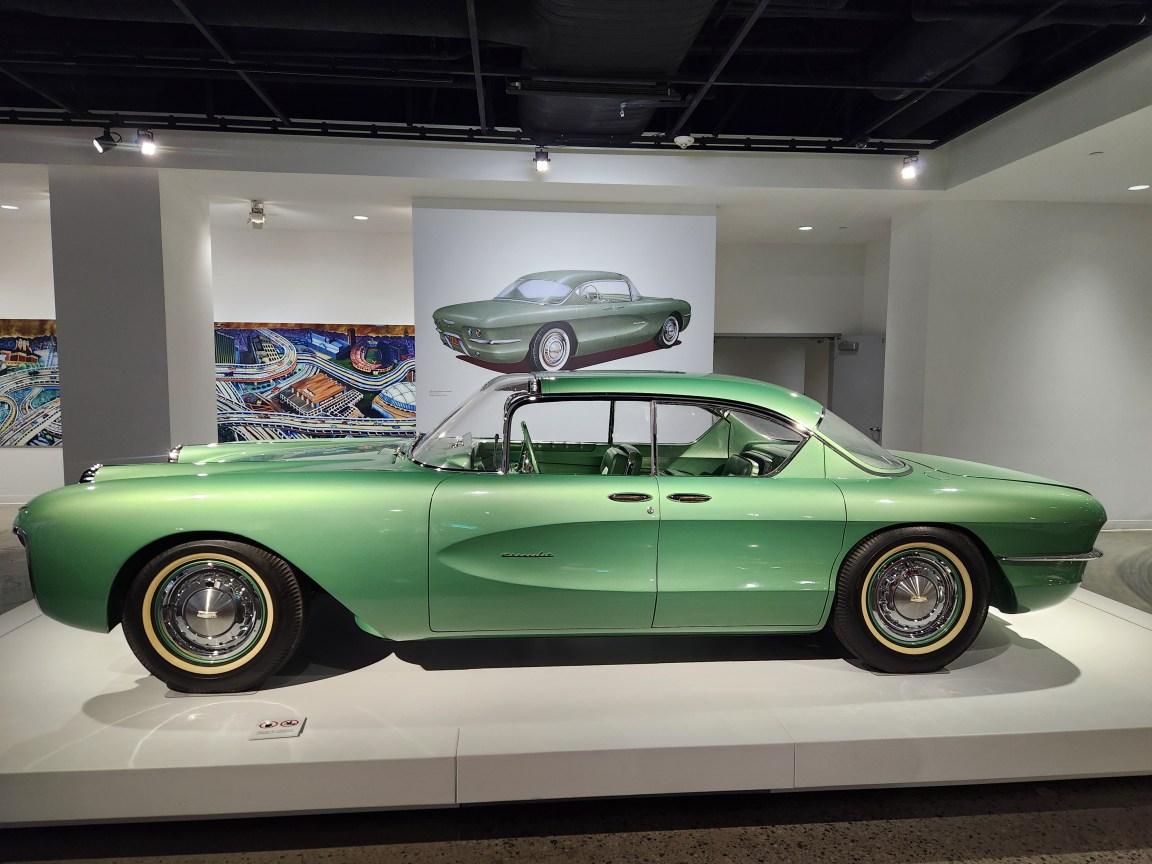
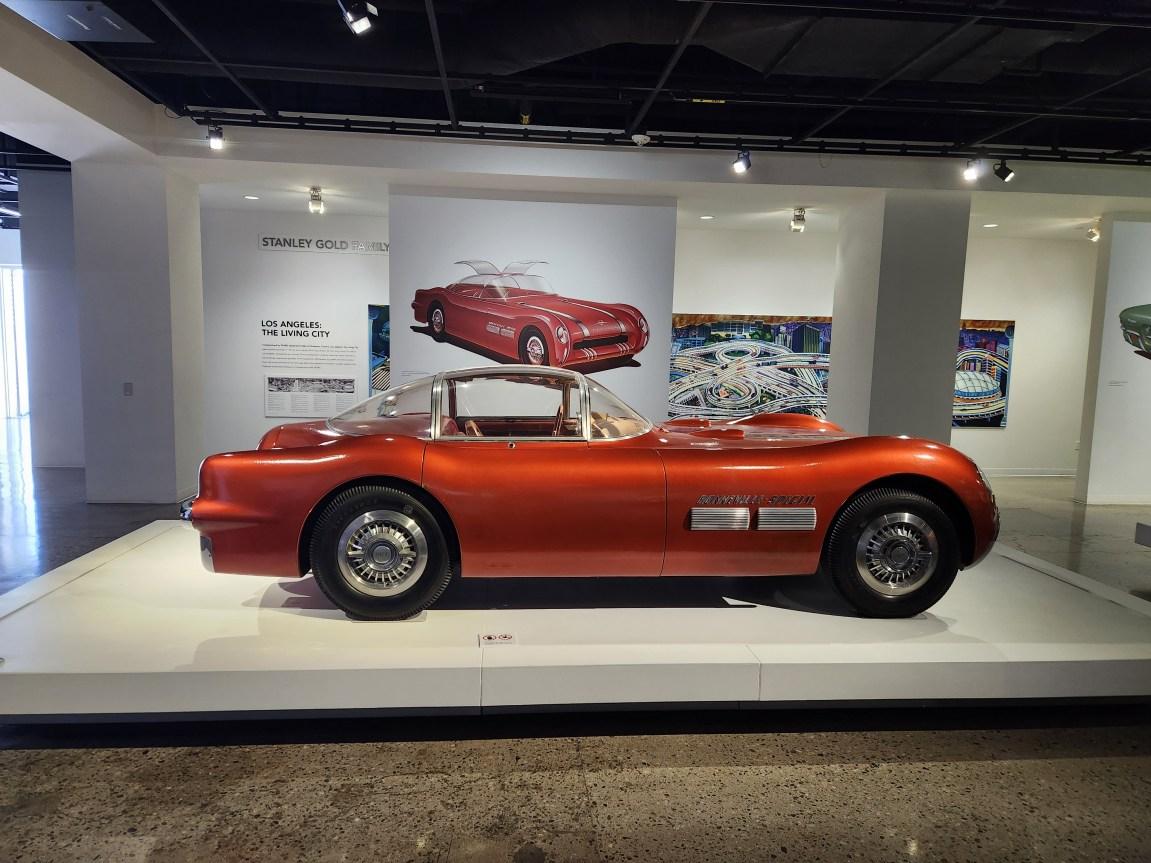
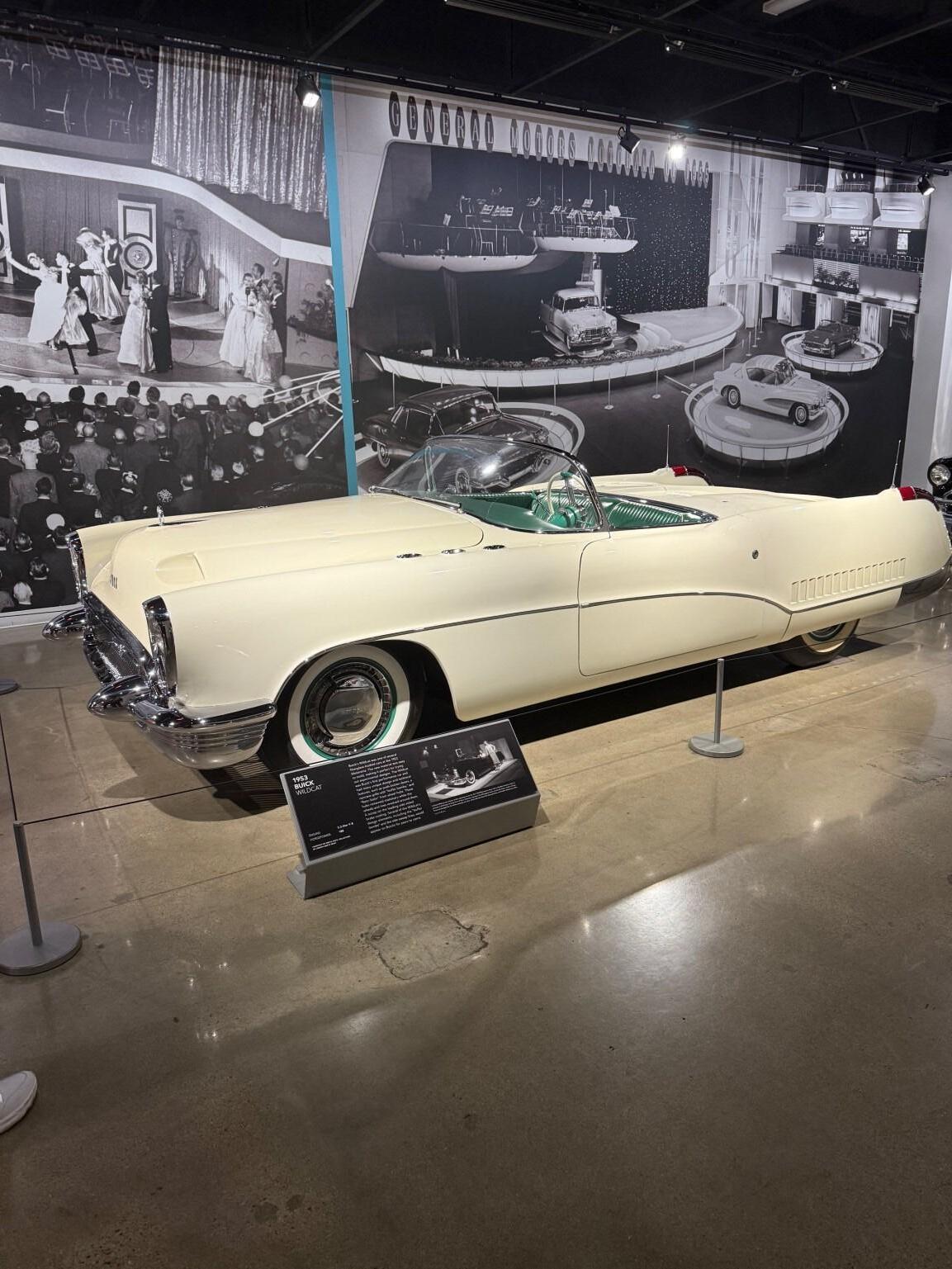
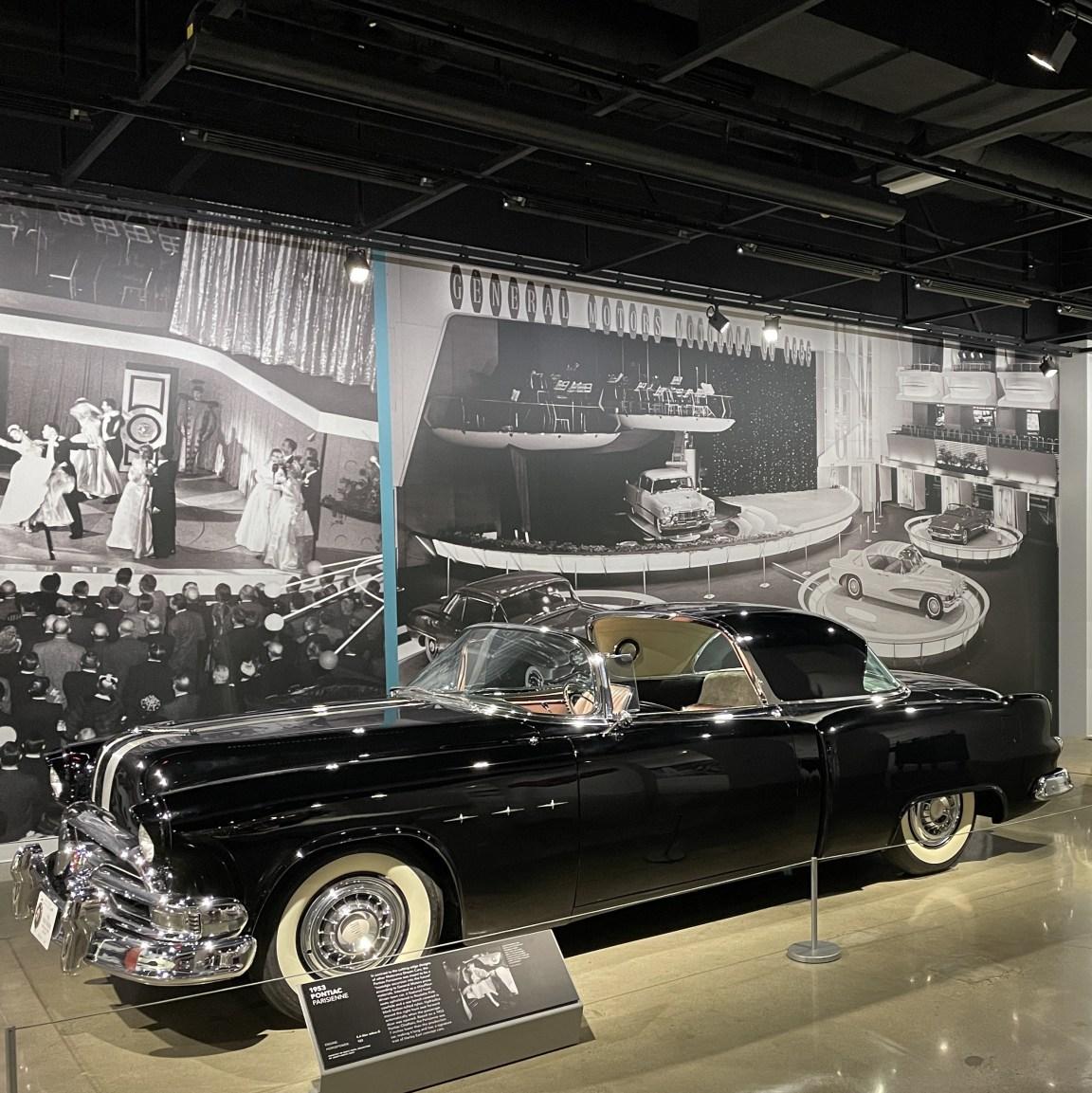
From 1949 to 1961, General Motors’traveling Motorama shows turned new-car introductions into Broadway‑style spectacles. Held in grand hotels and auditoriums across the country, Motorama combined concept cars, orchestras, singers, dancers, and dramatic lighting to immerse visitors in a vision of the future. Promotional films such as ‘Design for Dreaming’carried this experience even further, using song, dance, and fantasy sequences to sell not just automobiles, but a complete modern lifestyle. In an era before television, the internet, and social media, Motorama was how millions ofAmericans first encountered cutting‑edge automotive design and technology. The eight Motorama cars in the exhibit from the Joe Bortz auto collection survivors of a show that was meant to be temporary offer a rare chance to feel that excitement again.As you move through the exhibit, imagine the crowds, the music, and the spotlights, and experience these ‘dream cars’as audiences did then as rolling promises of the world to come.
Information flyer for the exhibit.
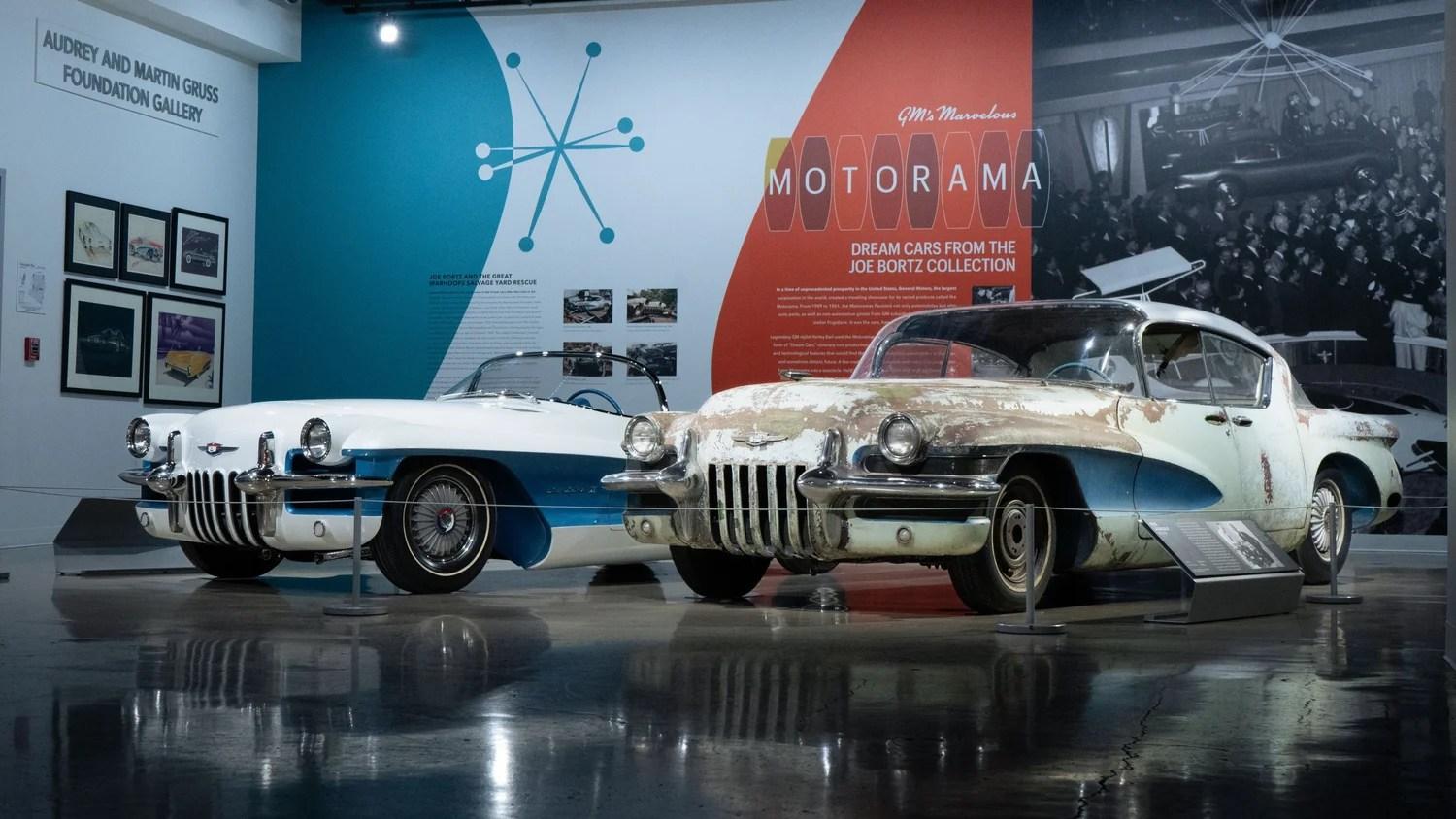
Above; The restored 1955 LaSalle roadster (left) and the unrestored 1955 LaSalle hardtop sedan on display last year at the Petersen Automotive Museum in Los Angeles.
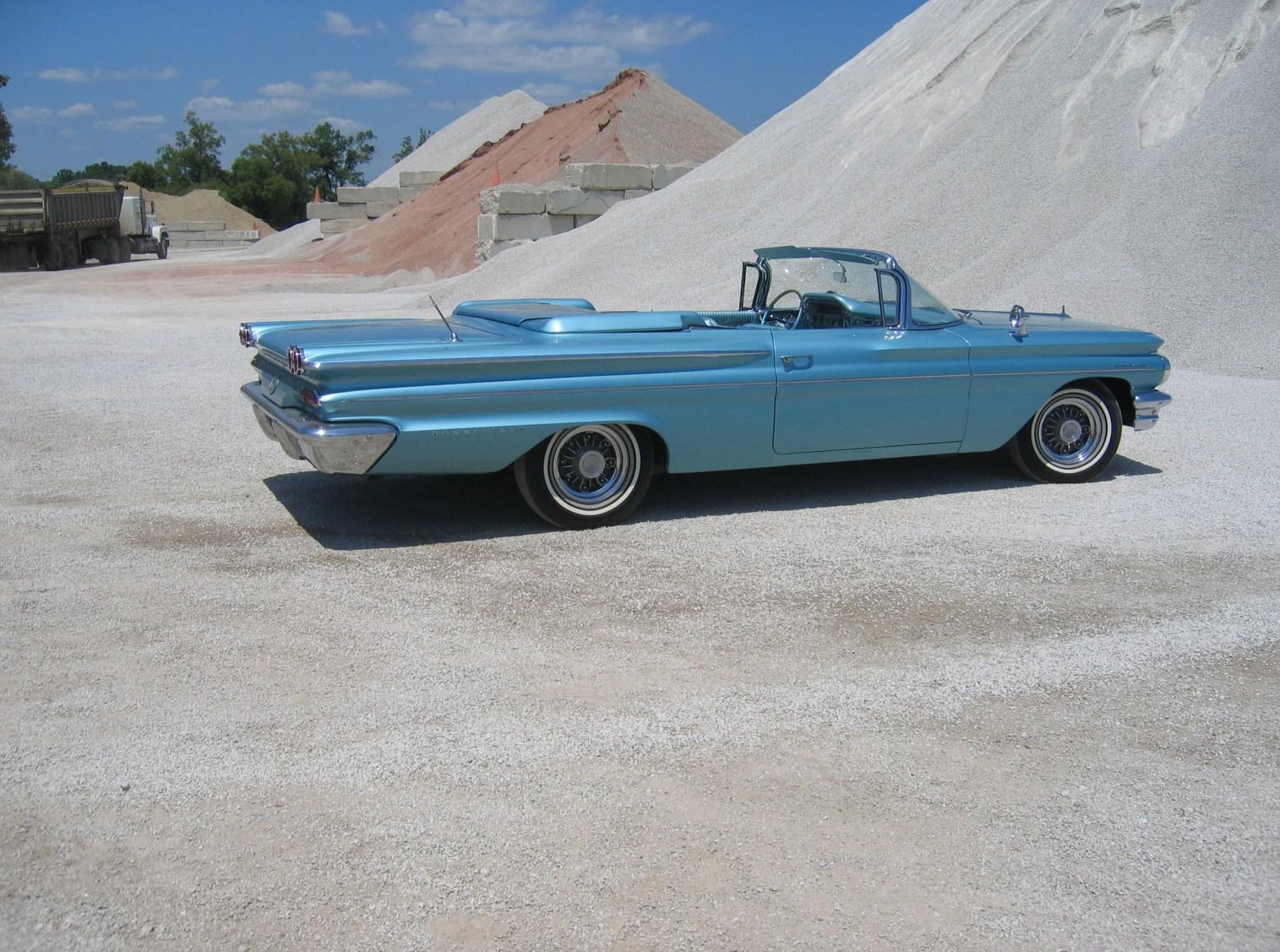
1955 Chevrolet Biscayne.
1954 Pontiac Bonneville Special.
1953 Buick Wildcat 1.
1953 Pontiac Parisienne.
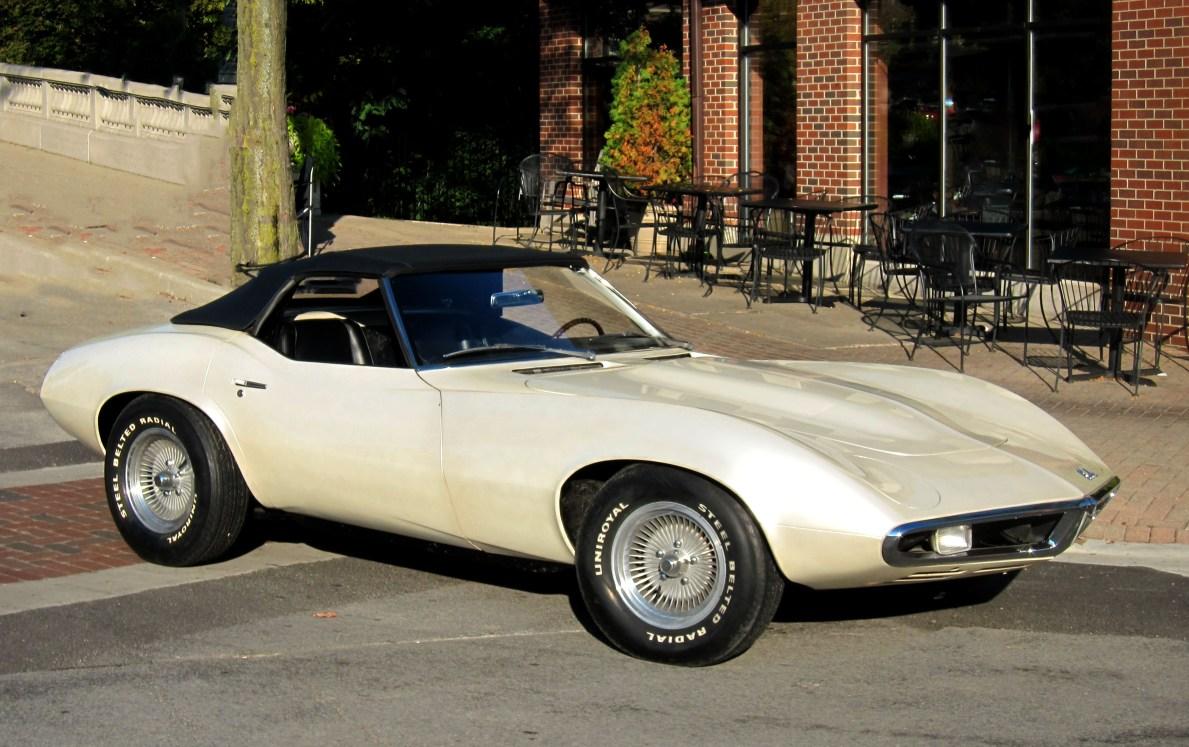
1964 Pontiac Banshee will be at the Gilmore exhibit.
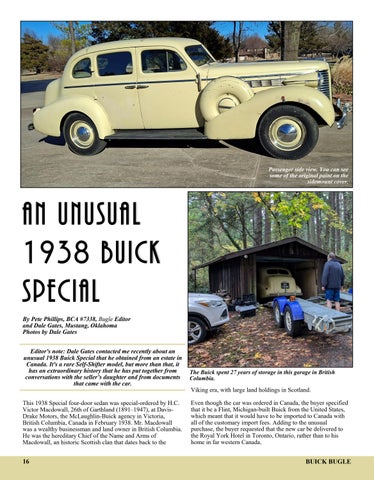
An Unusual 1938 Buick Special
By Pete Phillips, BCA #7338, Bugle Editor and Dale Gates, Mustang, Oklahoma
Photos by Dale Gates
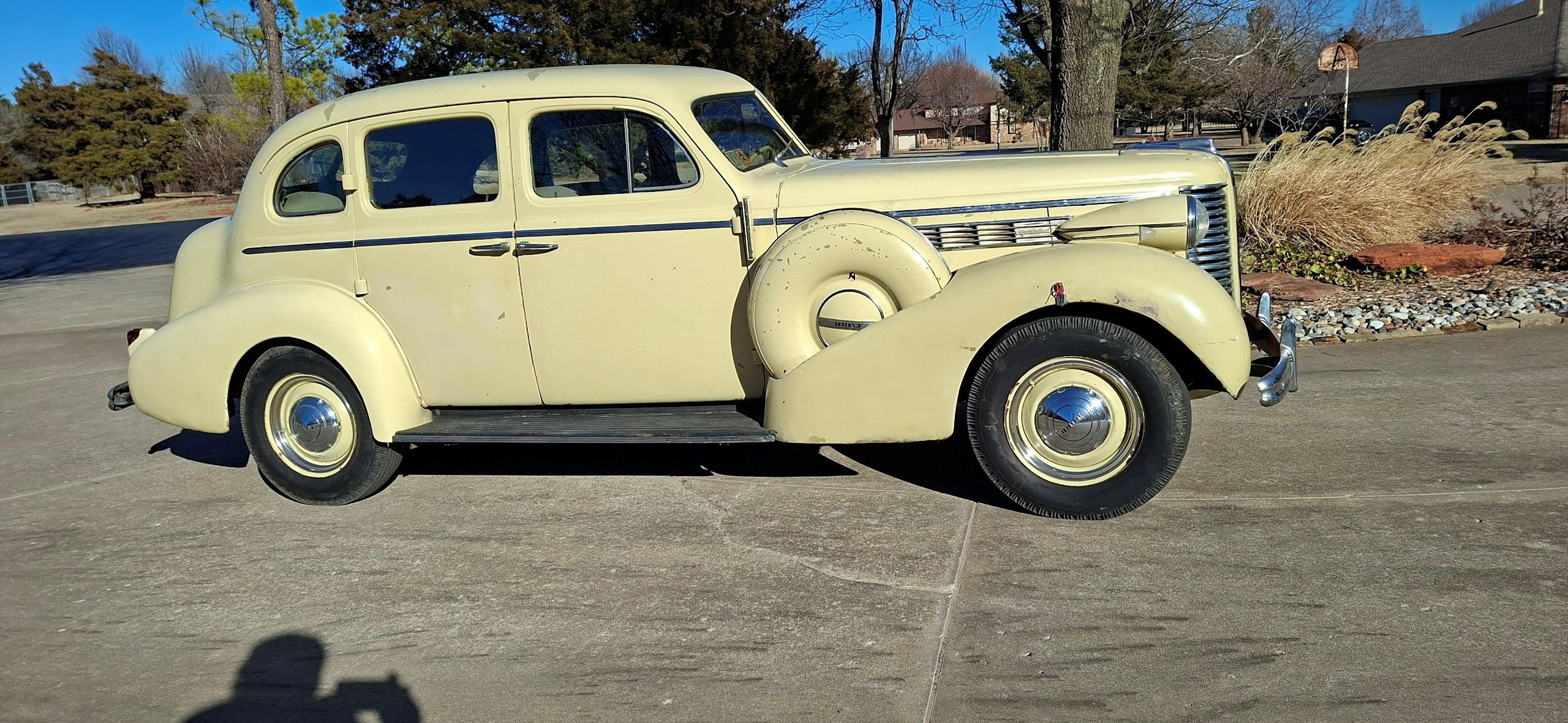
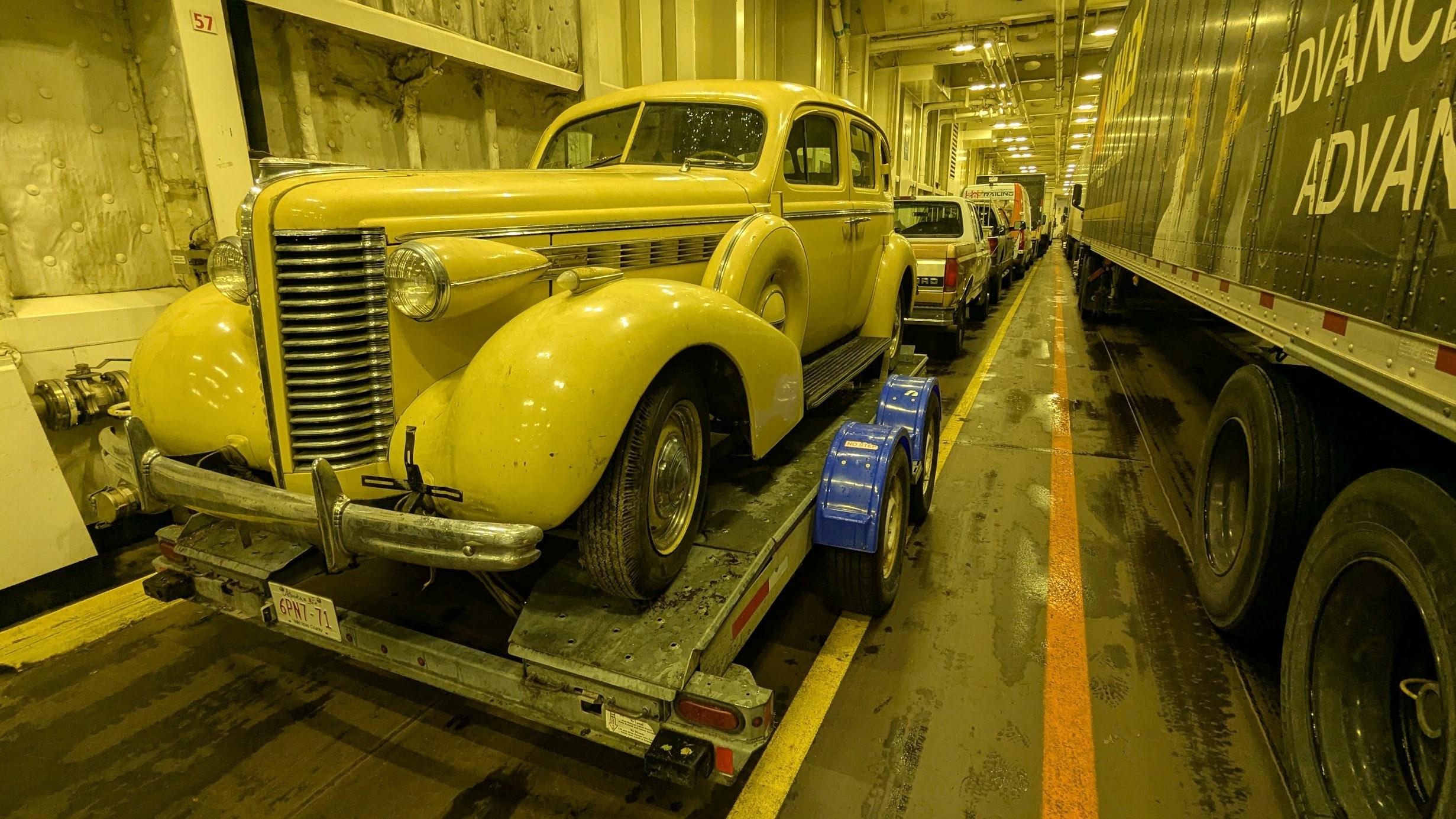
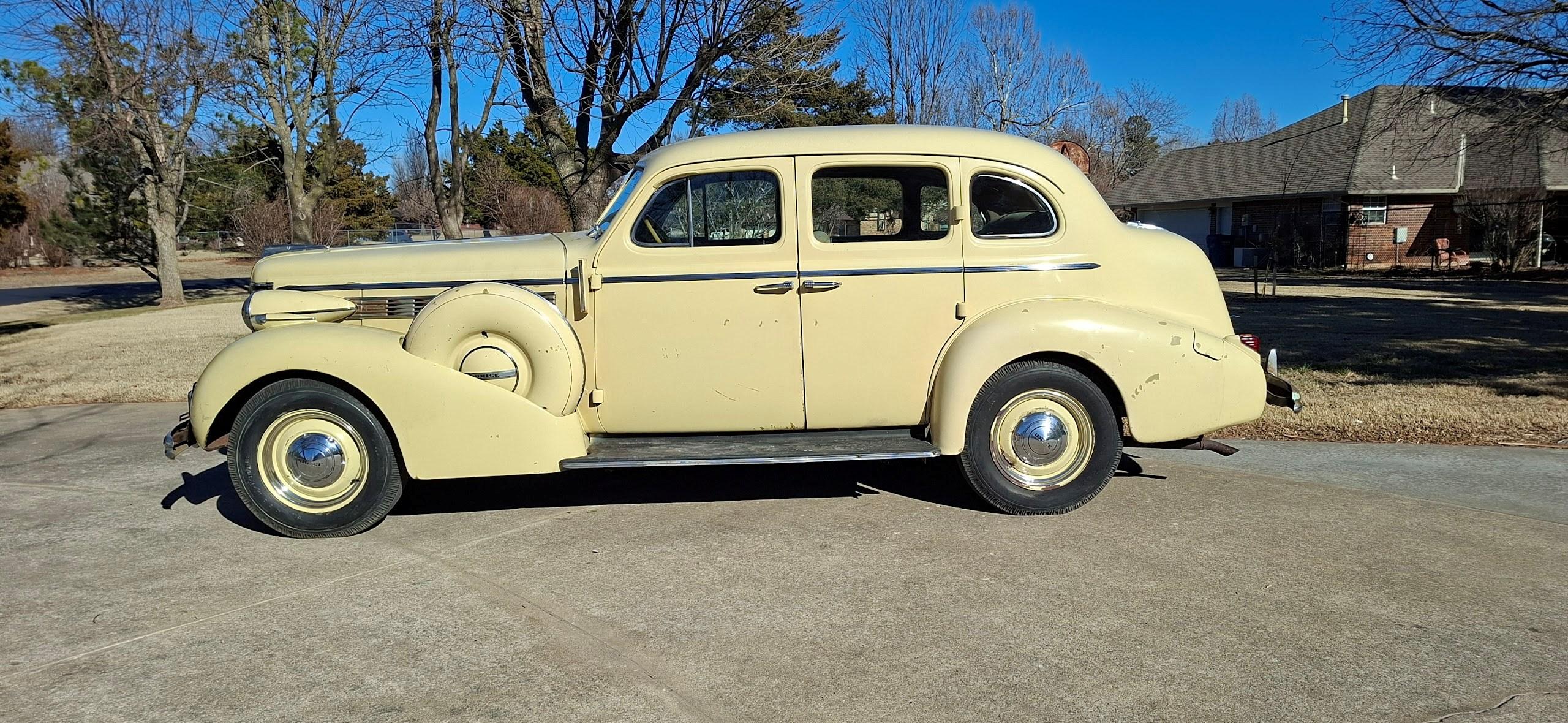
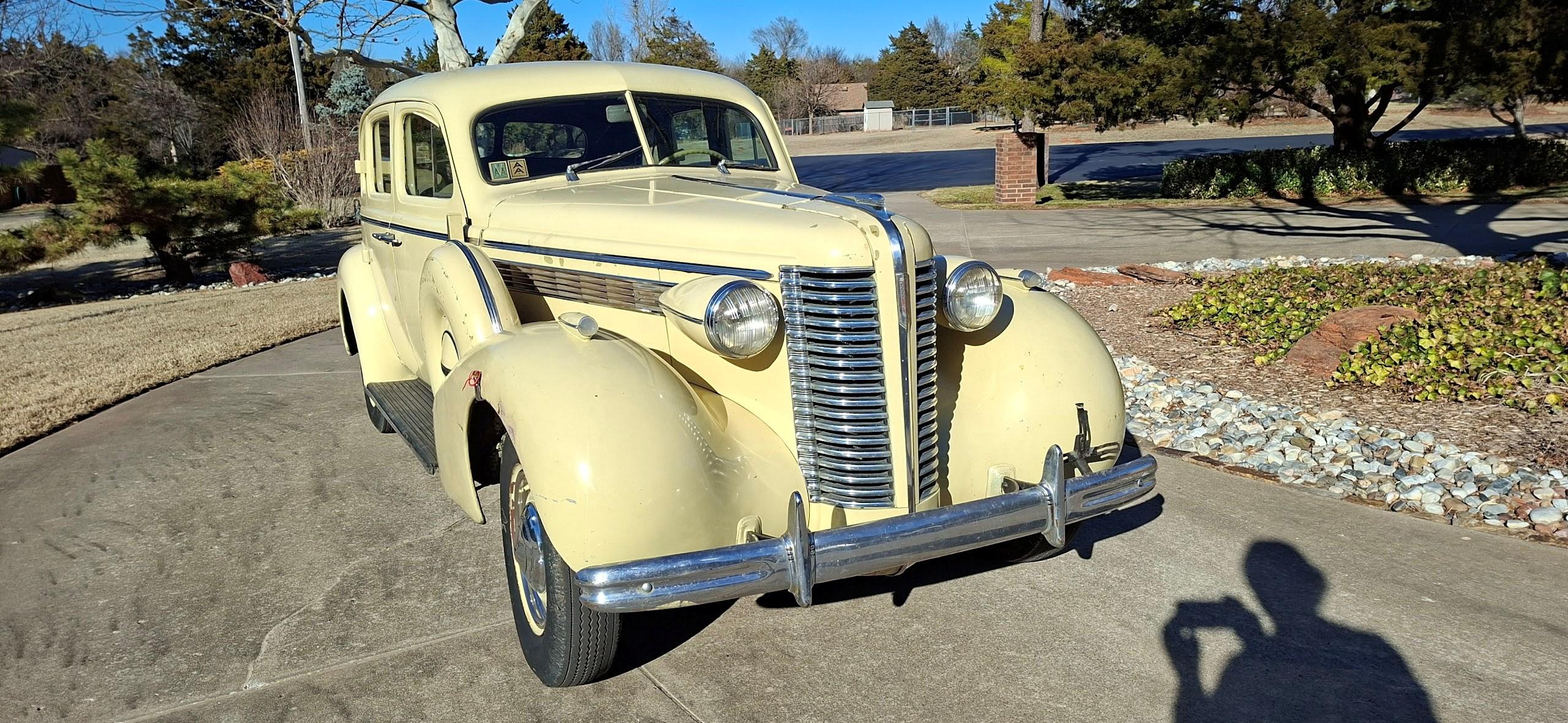
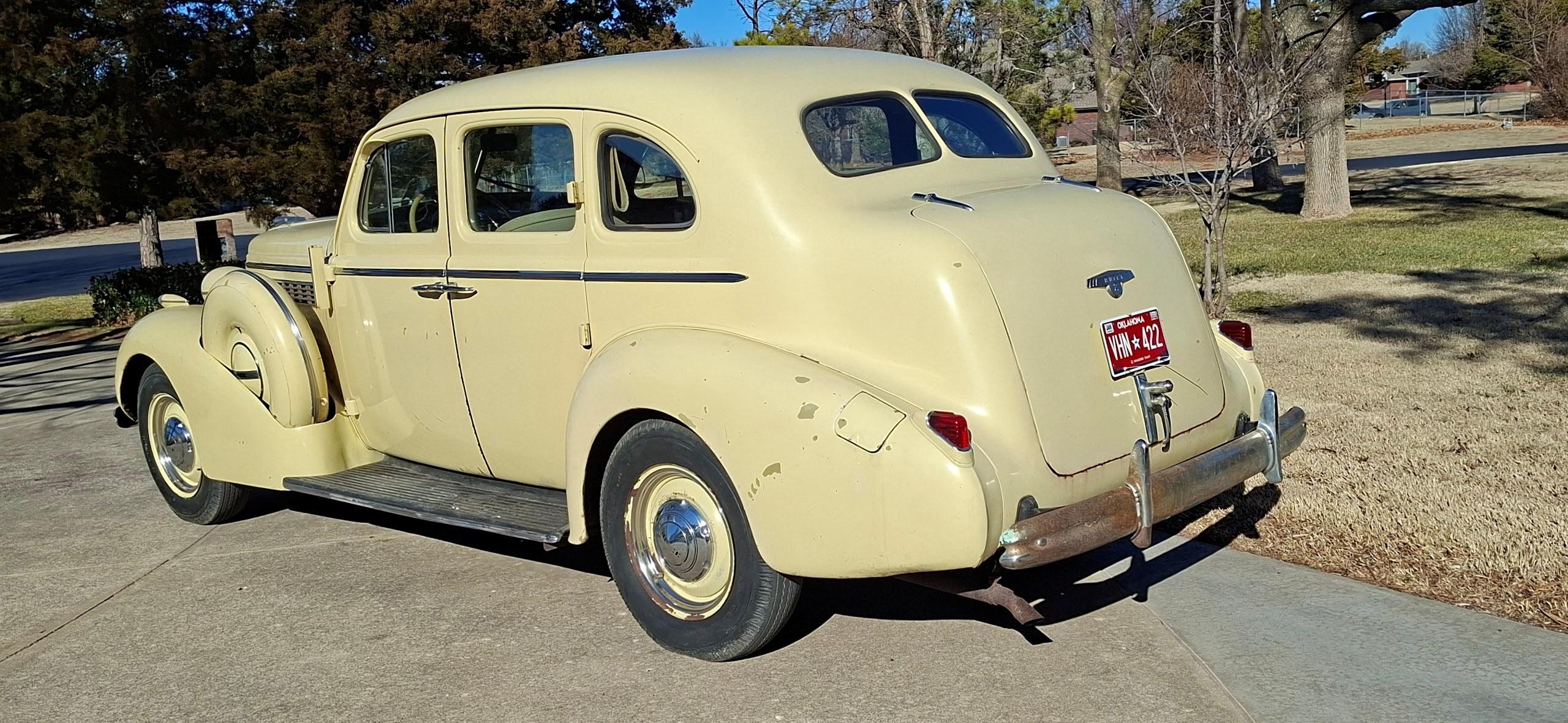
Editor's note: Dale Gates contacted me recently about an unusual 1938 Buick Special that he obtained from an estate in Canada. It's a rare Self-Shifter model, but more than that, it has an extraordinary history that he has put together from conversations with the seller’s daughter and from documents that came with the car.
This 1938 Special four-door sedan was special-ordered by H.C. Victor Macdowall, 26th of Garthland (1891–1947), at DavisDrake Motors, the McLaughlin-Buick agency in Victoria, British Columbia, Canada in February 1938. Mr. Macdowall was a wealthy businessman and land owner in British Columbia. He was the hereditary Chief of the Name and Arms of Macdowall, an historic Scottish clan that dates back to the
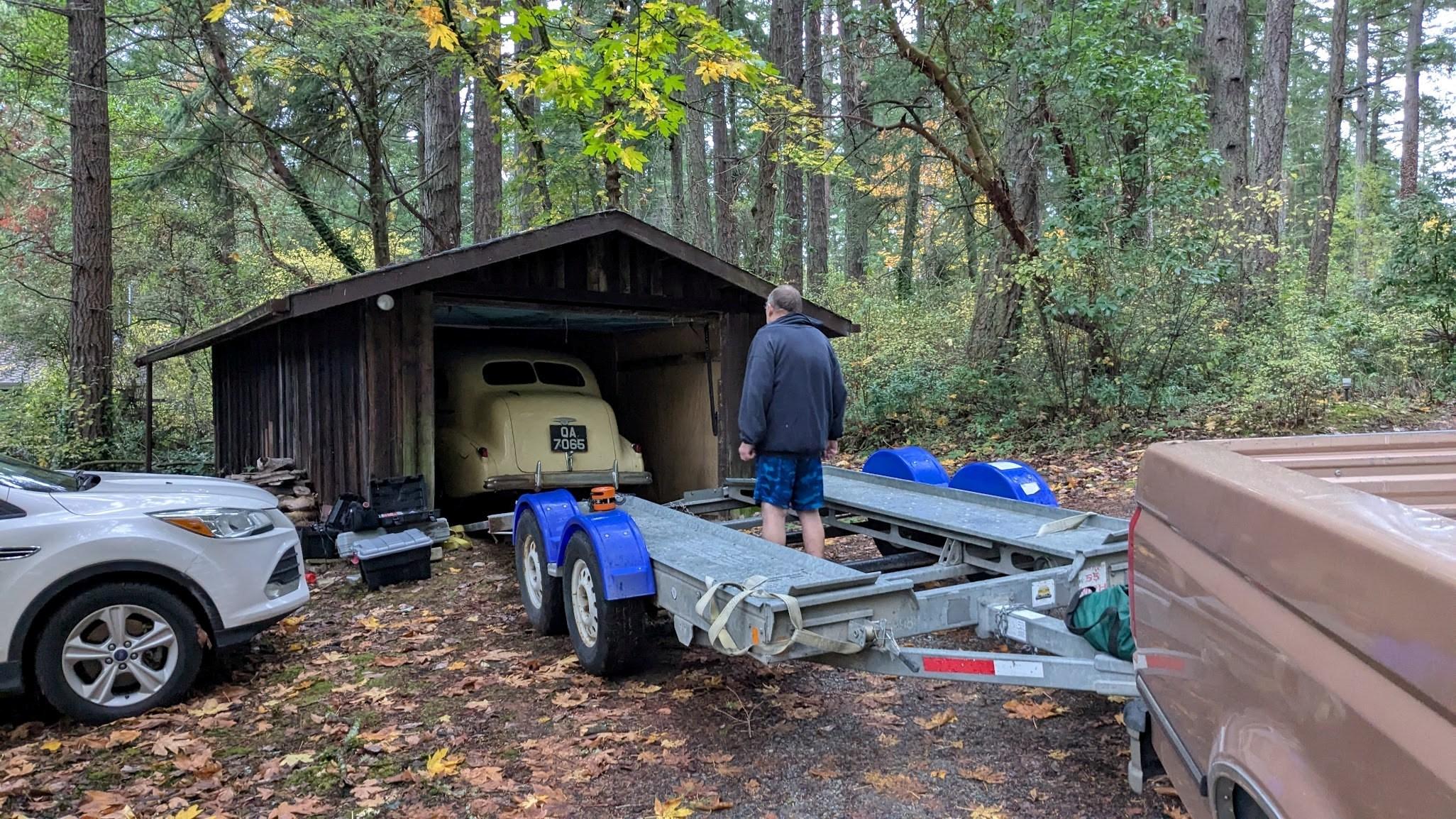
The Buick spent 27 years of storage in this garage in British Columbia.
Viking era, with large land holdings in Scotland.
Even though the car was ordered in Canada, the buyer specified that it be a Flint, Michigan-built Buick from the United States, which meant that it would have to be imported to Canada with all of the customary import fees. Adding to the unusual purchase, the buyer requested that the new car be delivered to the Royal York Hotel in Toronto, Ontario, rather than to his home in far western Canada.
Passenger side view. You can see some of the original paint on the sidemount cover.
The buyer specified that the car be equipped with the very new and rare Self-Shifter semi-automatic transmission, which was only offered in 1938 and only on the Buick Special series. Approximately 3,000 Buick Specials were made with the Self Shifter transmission that year. Many of these cars were later converted back to standard transmission units. Buick had such a bad experience with this transmission that they did not offer another automatic until 1948 with the introduction of the Dynaflow as an option on the Roadmaster series. More about the Self-Shifter transmission later in this article.
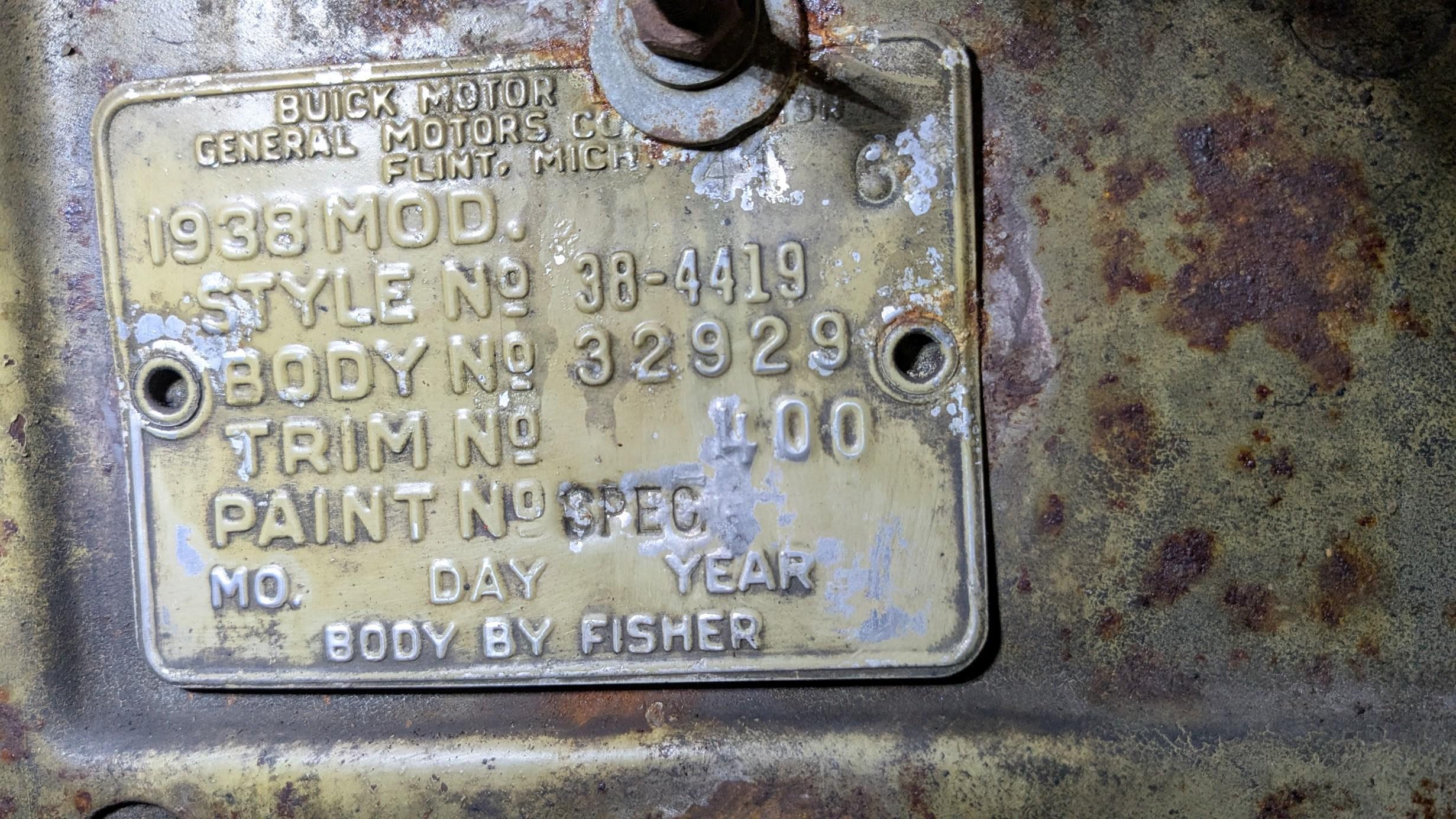
Mr. Macdowall's Buick Special was given a specially-ordered paint color. This is evidenced by the vehicle’s Buick Fisher Body Plate (Paint No. “SPEC”) denoting a factory special-order paint rather than a standard Buick production color. It was an olive green color, which was painted over many years ago with a more typical Sequoia Cream color that the car has now.
The Special was well equipped with the following items:
• Dual side-mounted spare tires
• Wheel trim rings with deluxe chrome Buick hubcaps
• White sidewall tires
• Front and rear bumper guards with overriders
• Dual Horns
• Deluxe/Upgraded Interior Package – Trim code 100
• Rear passenger foot rest – dealer installed
• Vacuum-tube AM radio
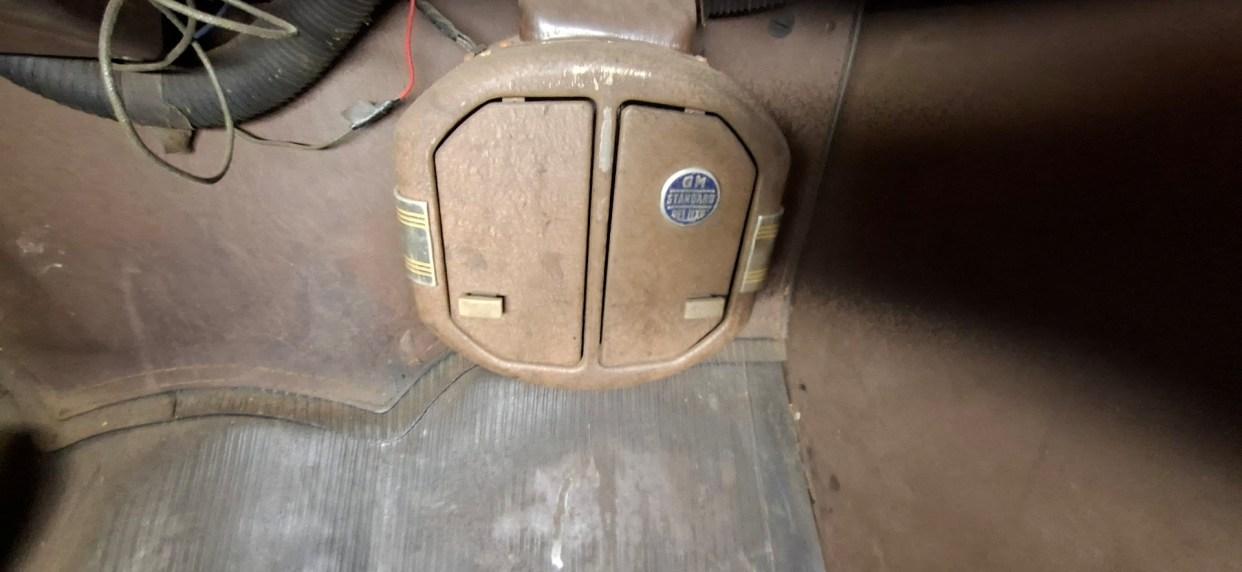
• Buick “Master” heater with dual windshield defrosters
• Instrument panel clock
• Cigar lighter with matching ash receivers
• Tool kit & jack equipment
• Fender-mounted Guide lights – dealer installed
• Tire chains for winter touring – dealer supplied
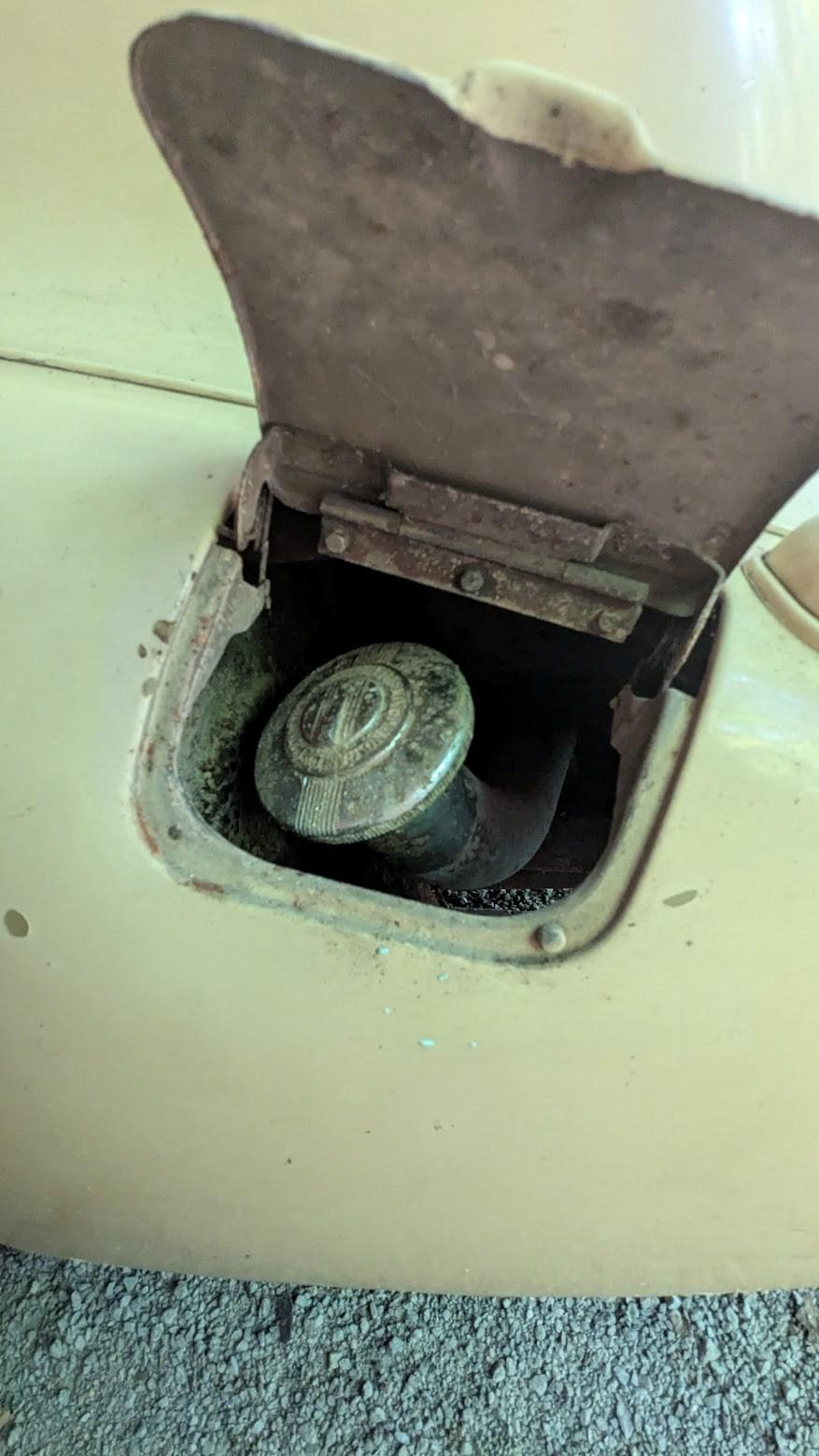
• Locking chrome gas cap - dealer supplied
In early summer 1938, Mr. Macdowall, his wife, and their two children traveled across Canada by ferry, rail, and automobile to the Royal York Hotel in Toronto, where his new Buick was delivered to him. The family then drove some 250 miles to New York City, where they boarded the Cunard steamship liner RMS Corinthia bound for London. The Buick was cargo shipped with them to England.
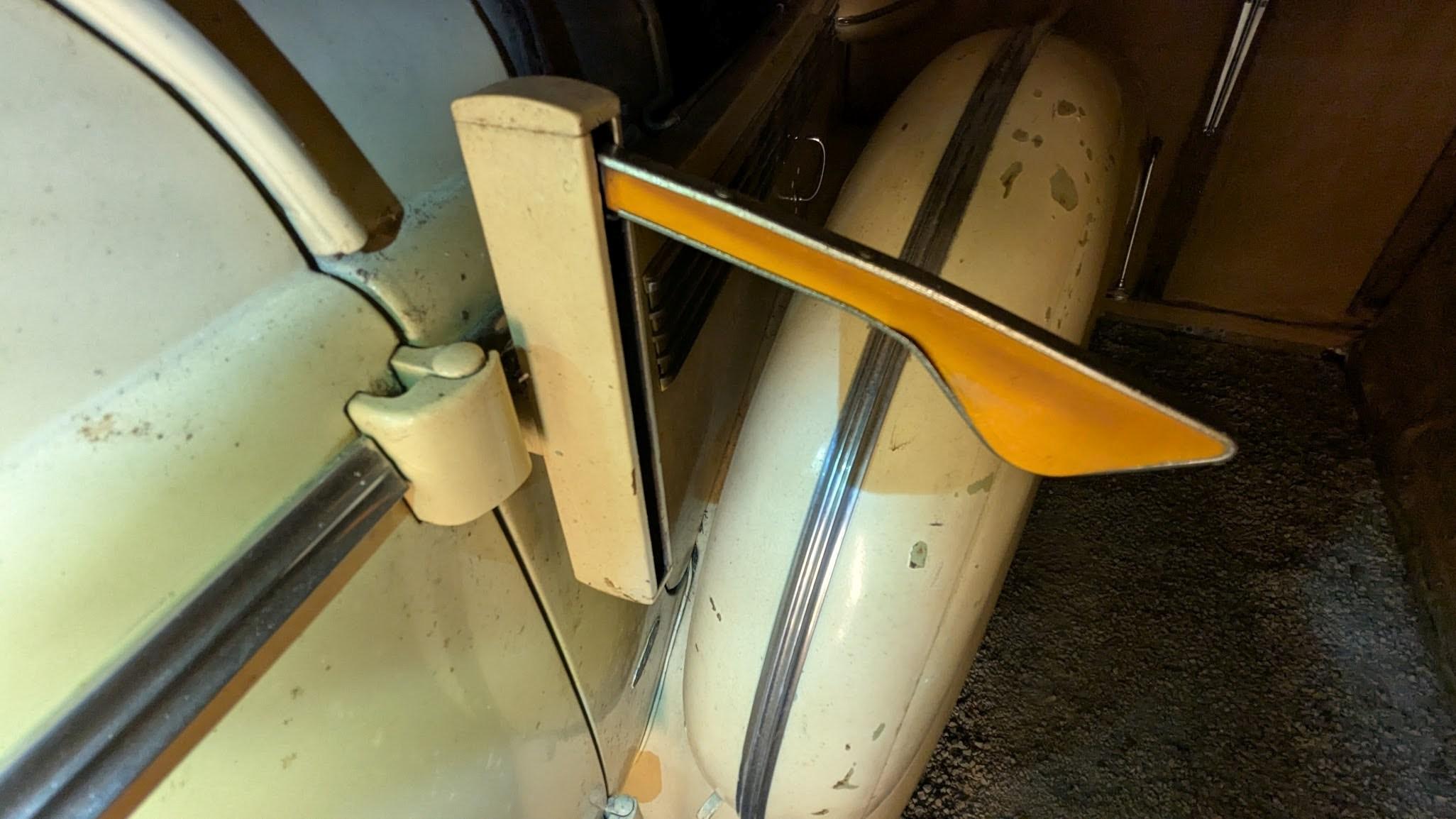
Upon arrival in London, the car was inspected and registered for road use in the United Kingdom, receiving British registration license plates in the period format. To comply with traffic regulations, the Buick was modified for British and continental European road use with the installation of “Trafficator” turn signal lamps illuminated semaphore arms that extended from
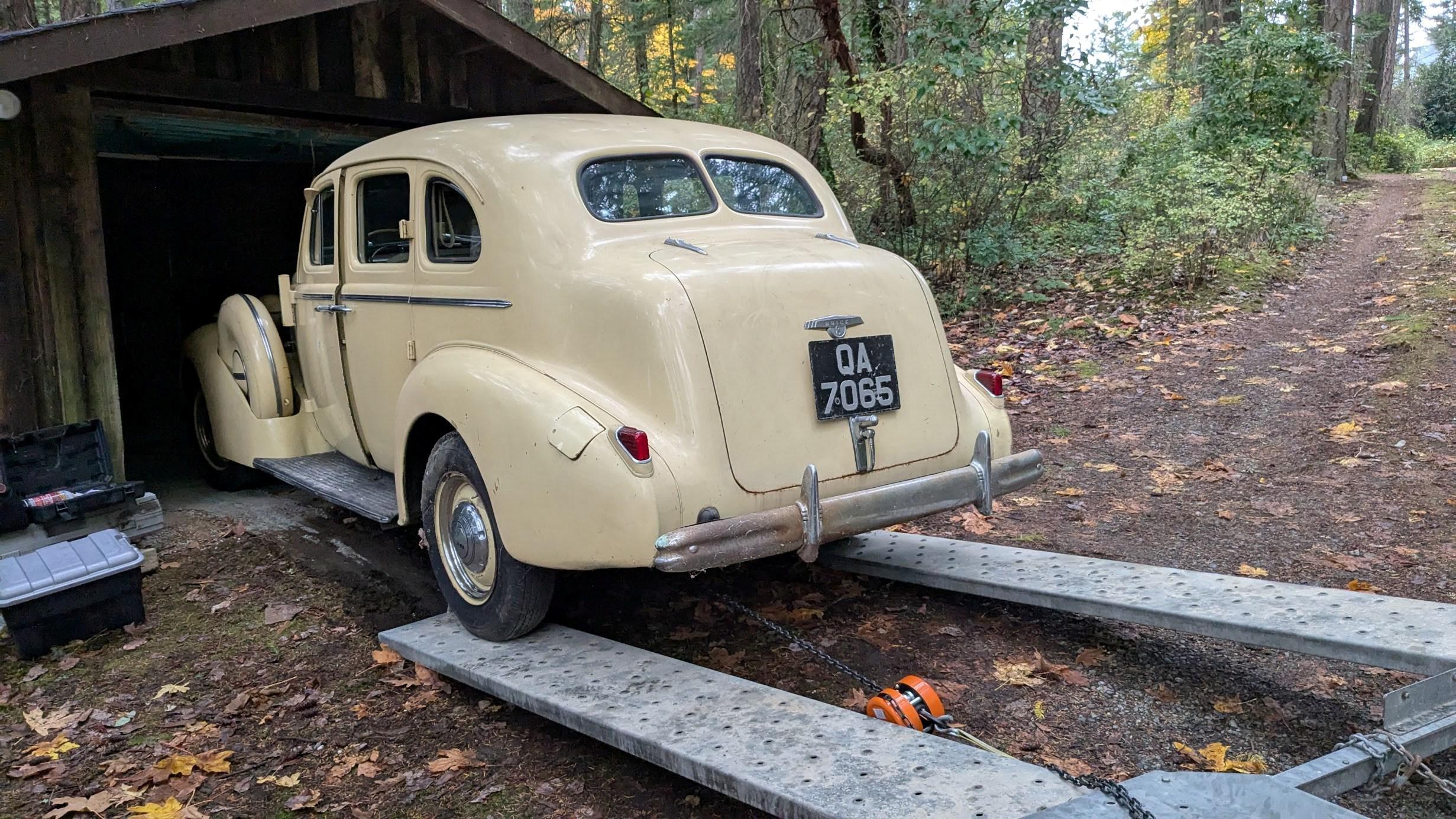
Being carefully extracted from the garage.
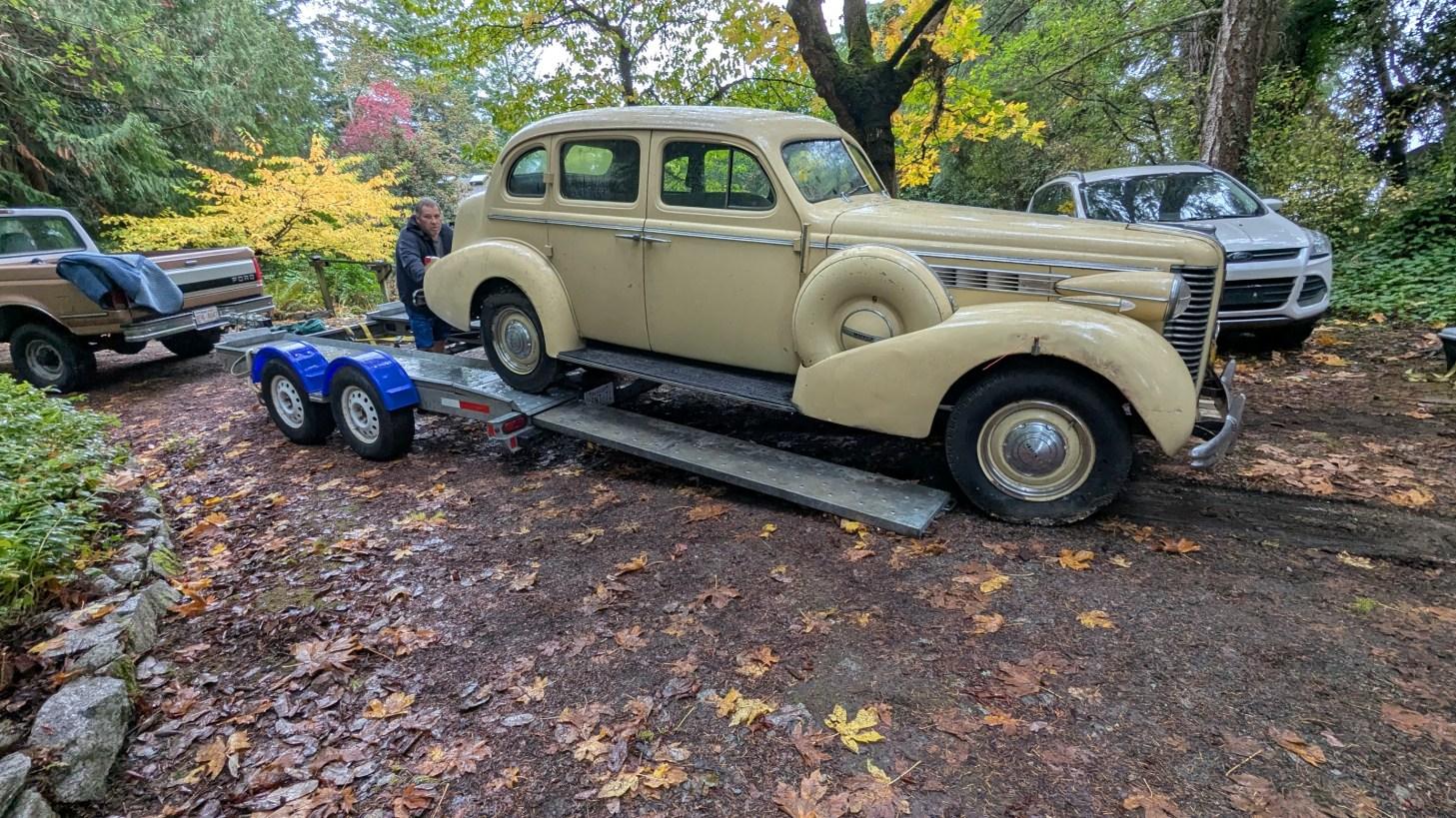
Being loaded onto the trailer.
the body to indicate the driver’s intention to turn. These are still on the car today.
At that time, the children Fergus Day Hoyt Macdowall, age 14 (later to become the 27th of Garthland and inherit the car), and his 15-yearold sister Diana were placed in boarding school. Mr. and Mrs. Macdowall then spent the next three months touring Britain and continental Europe in their new Buick Special.
In the fall of 1938, the couple and their Buick once again crossed the Atlantic, returning to New York City aboard the Cunard liner RMS Corinthia. From there, they undertook an extraordinary 3,400-mile transcontinental journey, driving the Buick Special across the United States and northward to their home in Victoria, British Columbia.
In early 1939, amid the growing likelihood of Germany’s invasion of Poland and the resulting entry of Britain and France into war, a close family member escorted the Macdowall children back to New York aboard the RMS Corinthia where they were met by their parents. Shortly thereafter, the ship was converted to an armed British merchant cruiser and in June 1940, was torpedoed and sunk by a German U-boat.
Following the death of H.C. Victor Macdowall in 1947, the Buick was inherited by his son, Fergus Day Hort Macdowall (1924– ), 27th Chief of the Name and Arms of Macdowall. The family continued to drive the car regularly into the late 1950s, and thereafter only on occasion until the mid-1960s, when it was placed into storage, where it remained for nearly four decades.
In 1998, at the age of 74, Mr. Fergus Macdowall had a local specialty automotive service shop perform basic mechanical servicing to return the Buick to running condition. After enjoying several drives, the car was again placed into storage, where it remained for an additional 27 years.
The car is put up for sale
In September 2025, the Buick was listed for sale on Vancouver Island by the son-in-law of the seller, Mr. Fergus Macdowall, who was then 101 years old. This is the same 14-yearold boy who traveled to England with his family and the Buick 87 years earlier! The ad said “TIME CAPSULE - ONE OWNER - IN STORAGE 55 YEARS.” Of course, the car was not running after long storage in a tiny, single-car garage with a seven-foot ceiling and a dirt floor.
Dale Gates, the car's current owner, was visiting family members in British Columbia,
“Trafficator” signal, righthand. These were installed to comply with European regulations.
Firewall data plate. Notice the paint code: SPEC.
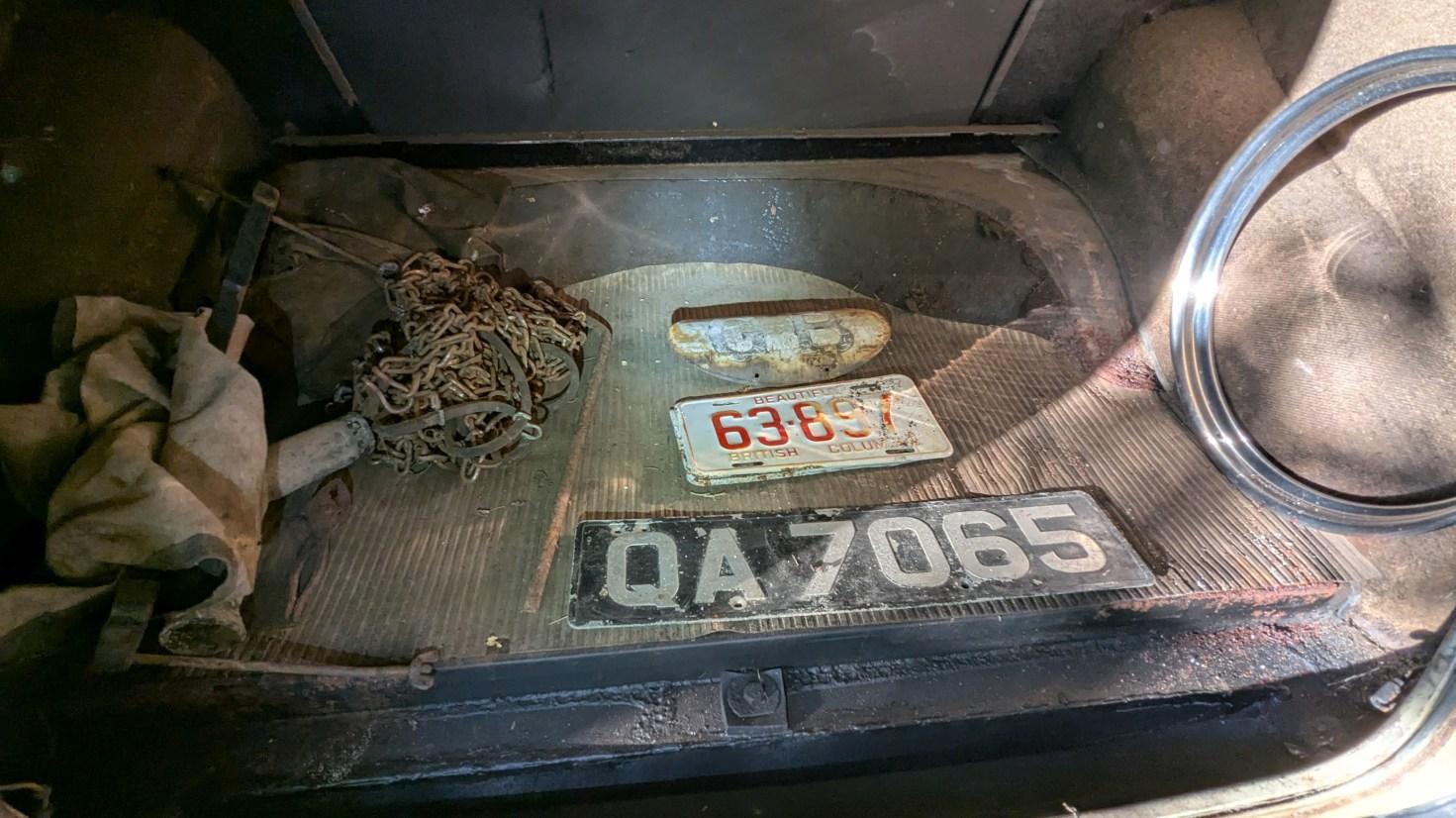
Trunk contents included the dealer-supplied tire chains, the British license plate QA -7065, the British Columbia, Canada license plate, and the oval “GB” identifier for Great Britain.
saw the ad, went to look at the car, and purchased the Buick. He time storage location in late October, imported it into the United States, and trailered it 2,300 miles to his home in Oklahoma. He has since gotten it up and running, making this one of only 15 to 20 known, existing, Self
About the Self-Shifter Transmission
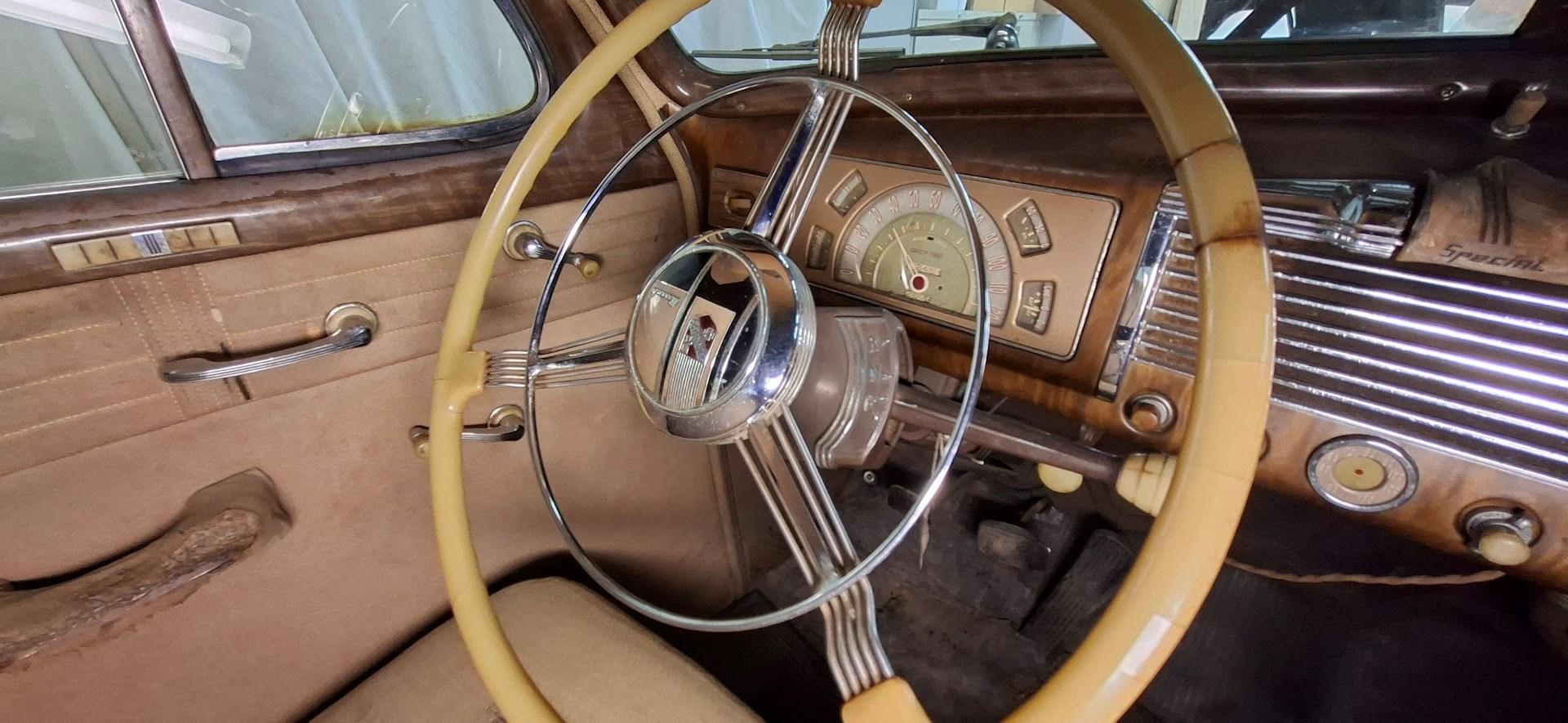
The Self-Shifter transmission is unique in that its gear selection lever is on the steering column, not on the floor like all other 1938 Buicks. The car still has a clutch pedal, and the clutch has to be disengaged when the transmission is shifted into Reverse or into “F” for Forward. It also has to be disengaged whenever the car comes to a stop, and engaged when starting out from a
stop like a normal manual transmission. There are two lever positions in the Forward range: The upper one being low, and the lower one being high. Once underway, the transmission starts out in first gear and shifts automatically into second gear around 8-12 miles per hour. When the car reaches approximately 20 miles per hour, the driver moves the selector lever to high, without touching the clutch. This puts the car into third gear, whereupon it automatically shifts to fourth gear around 25-30 miles per hour. Simply put, the Self-Shifter is a four-speed Hydra-Matic but with a clutch instead of a torque converter in front of it.
A big advantage of these Self-Shifter Buicks is that they have a 3.65 to 1 rear axle ratio, instead of the Special's normal 4.4 to 1 ratio. This gives the car a higher top speed than a manual
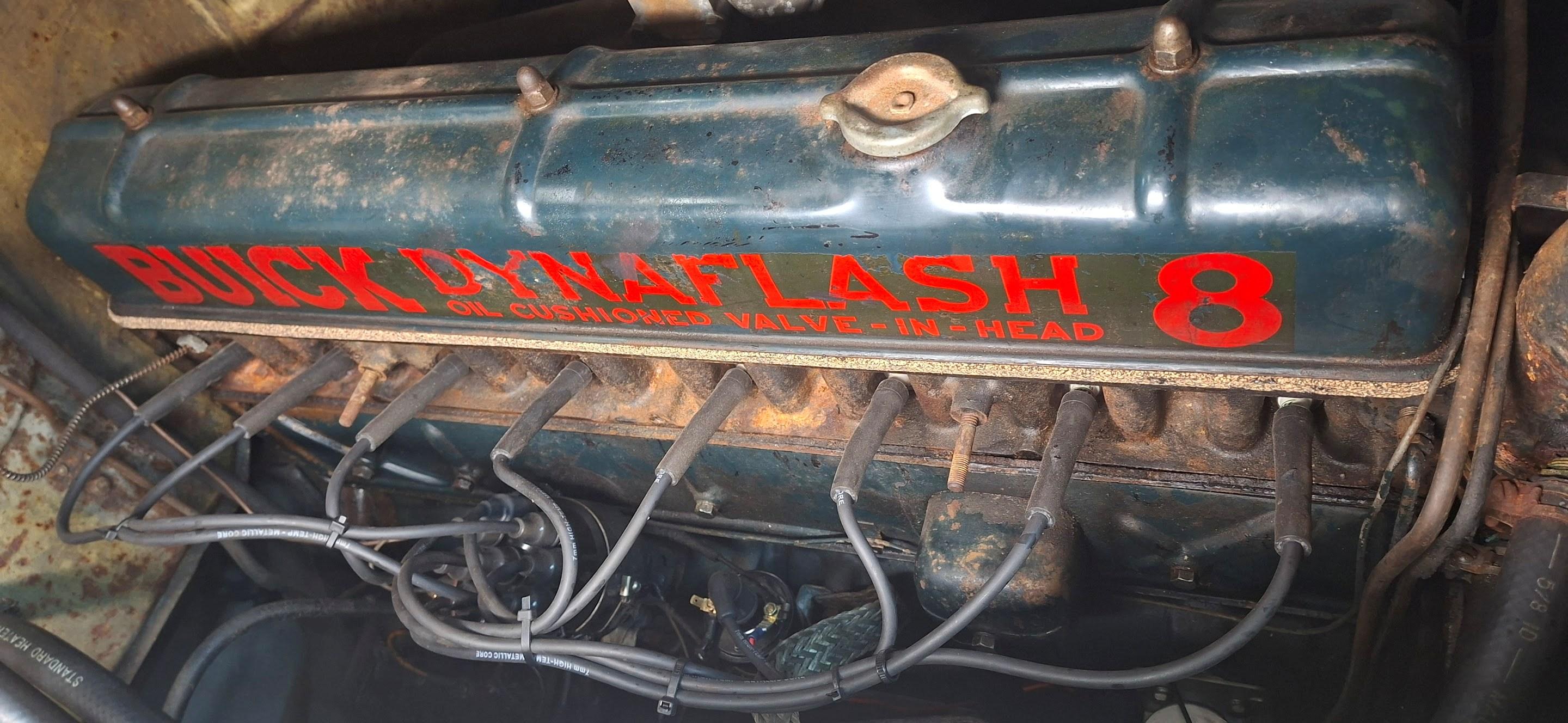
The 248 cubic inch engine still retains its valve cover decal and most of its paint.
The locking gas cap was an option in 1938. Loaded up and on the ferry from Vancouver Island to the mainland, on the journey to Oklahoma.
transmission car, along with lower engine r.p.m.s, which means a savings on gasoline and less engine wear.
Oldsmobile also helped with the design and development of this transmission, and was the first GM division to offer it on its late 1937 eight-cylinder models. Oldsmobile called it the “Automatic
Safety Transmission”. In 1938, Olds offered it on its sixcylinder models as well, and continued to offer it as an option on the 1939 Oldsmobiles. By 1940, of course, Oldsmobile offered the fully automatic Hydra-Matic transmission, so there was no need for the “Automatic Safety Transmission”. Buick only offered it on the 1938 Specials, and then never again.
At its new home in Oklahoma. The yellow paint is not the car's original color.
Front view of the 1938 Buick Special.
Rear quarter view with its new Oklahoma license plate.
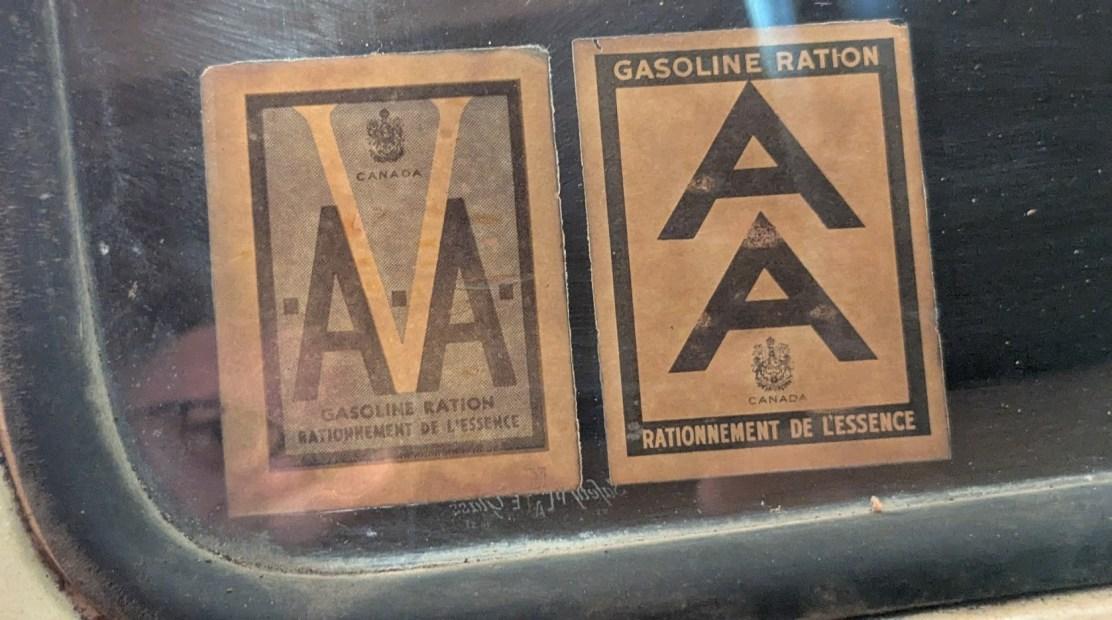
World War Two gas ration stamps on the windshield. Steering wheel and shift lever for the Self-Shifter transmission.
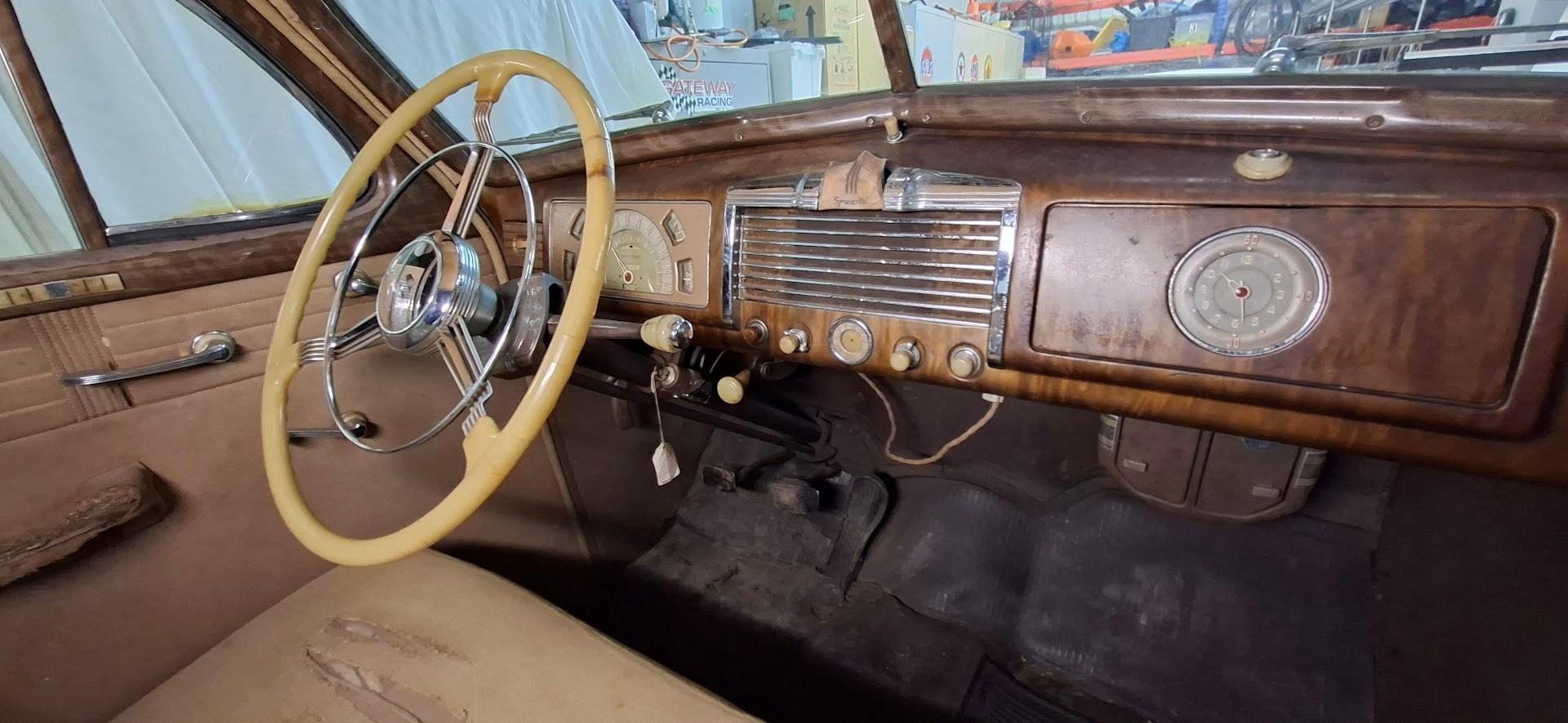
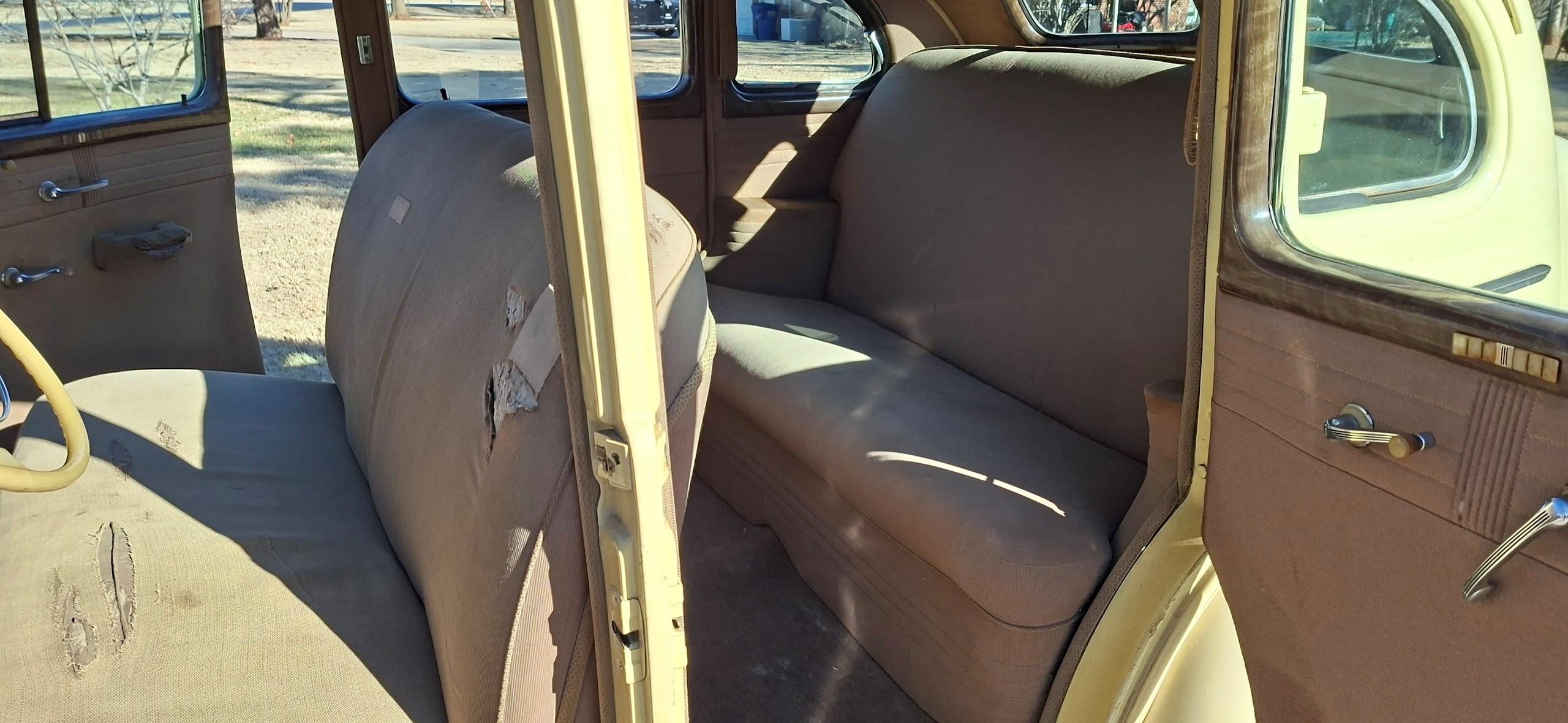
Interior view.
View of the shift lever, plus the optional clock, radio, and heater.
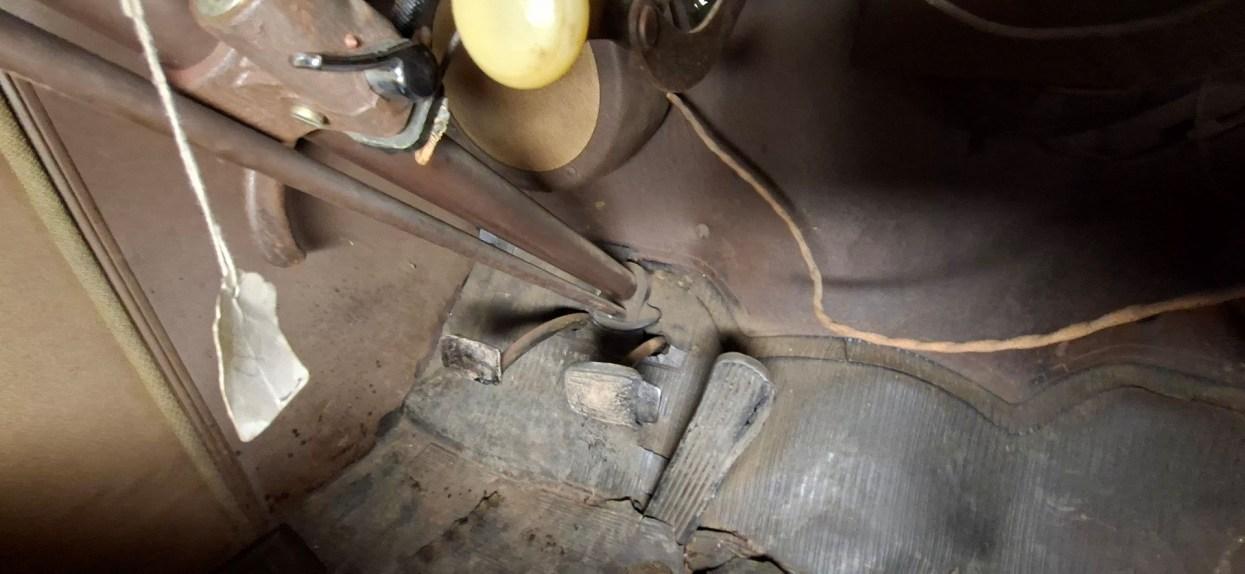
The semi-automatic transmission still requires a clutch pedal. Optional heater installed on the passenger side.
A ROADMASTER'S SECOND LIFE
By Gruja & Desa Apostolovic, BCA #45115, Santa Ana, California
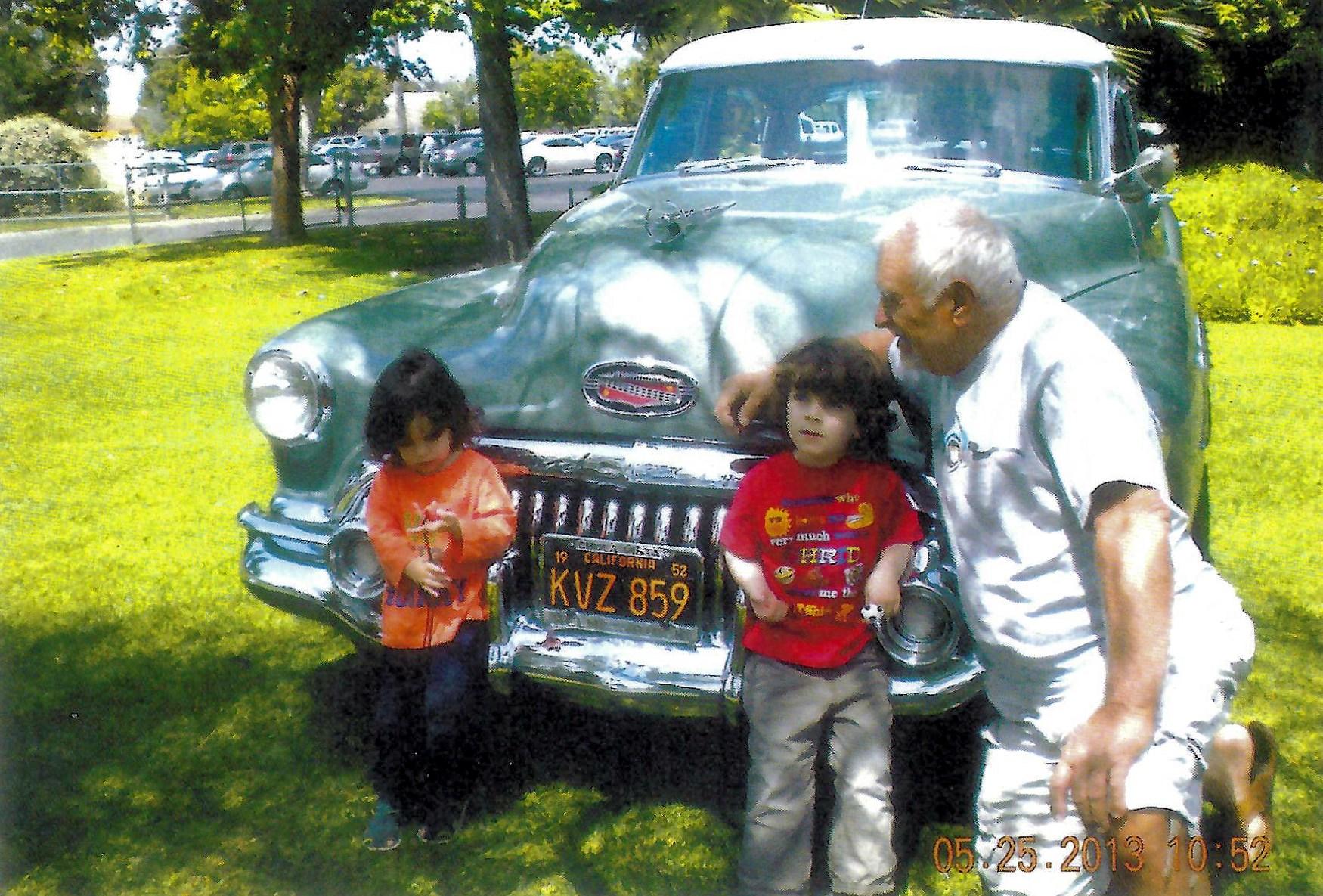
This tells the story of my 1952 Buick Roadmaster and its complete restoration following my retirement. More importantly, it reflects a lifelong appreciation for American automotive craftsmanship and the meaningful role this car has played in my family especially with my grandsons, Achilleas and Odysseus, who grew up alongside the restoration and continue to share my enthusiasm for the car today.
Some people collect things. Others chase dreams for a lifetime. For me, that dream always had chrome, steel, and the unmistakable presence of a classic American automobile.
I grew up admiring the great American cars of the Postwar era machines that were not only transportation, but statements of optimism, craftsmanship, and confidence. Long before I ever owned one, I knew that someday, somehow I would. It wasn't about speed or luxury alone; it was about character. These cars had it in abundance.
After retiring from my career as an expert tile setter, I finally had the one thing I had always been short on: Time. I had spent decades working with precision, patience, and an eye for detail qualities that, as it turned out, translated perfectly into automotive restoration. Retirement wasn't an ending for me; it was the beginning of something I had waited my whole life to do.
Finding the right car
The search for my car was careful and deliberate. I wasn't interested in just any antique I wanted one that matched my personality: Strong; elegant; understated; and built to last. In 2005 I found it a 1952 Roadmaster.
The Roadmaster immediately spoke to me. Its sweeping lines, bold grille, and unmistakable presence embodied everything I admired about early 1950s American design. Buick, at the time, stood for refinement with out pretension engineering excellence wrapped in confident style. This was not a car meant to shout, but one that commanded respect simply by existing.
When I brought the car home, I knew exactly what laid ahead. It wasn't a restoration project it was a commitment.
Screw by screw
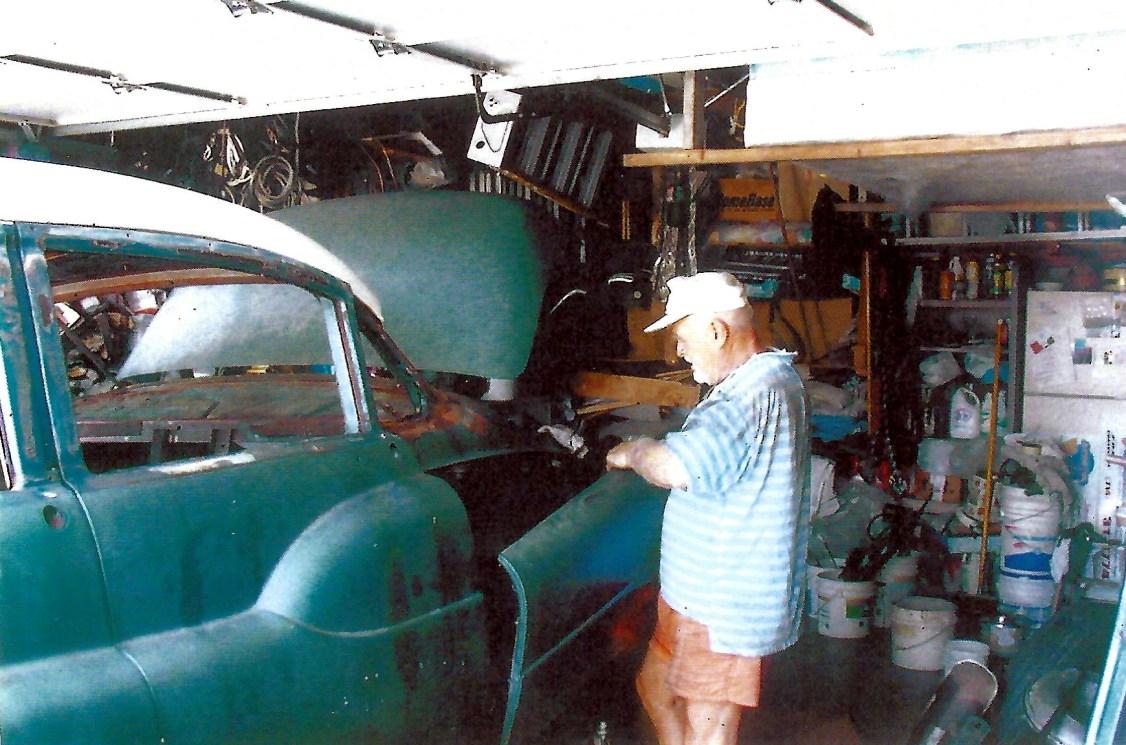
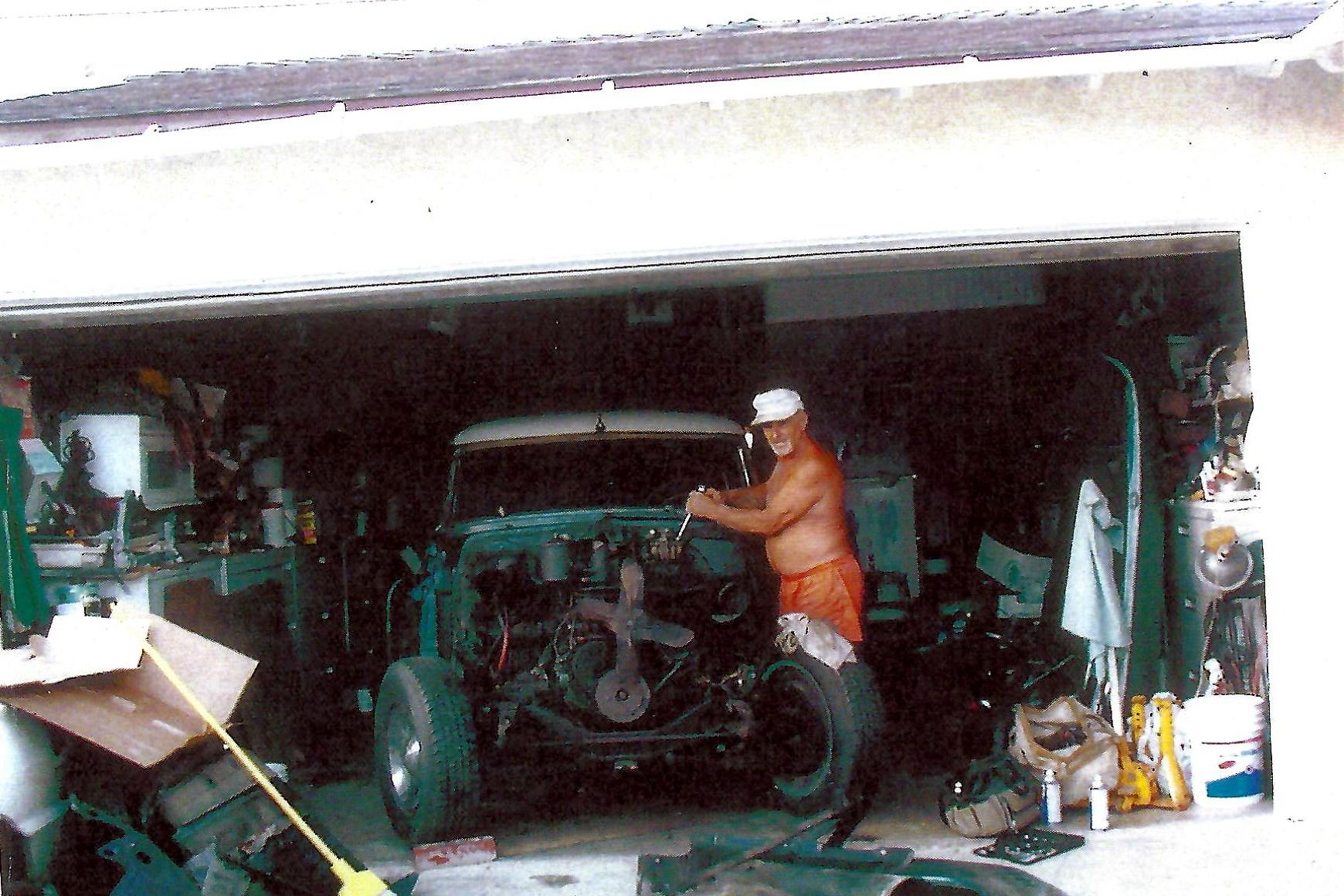
I transformed my garage into a workshop and began the process the only way I knew how thoroughly, slowly, correctly. I disassembled the Roadmaster myself, screw by screw, bolt by bolt, until nothing remained but the bare bones. Every part told a story. Every fastener mattered. Years of working with tile had taught me that shortcuts always reveal themselves in the end, so there were none.
During those years, the garage was rarely quiet. My grandsons, Achilleas and Odysseus, were still very young at the time. They would wander in, curious and eager, handing me tools, watching closely, and asking endless questions. What began as simple help with maintenance and upkeep became something more meaningful a shared experience. Today, Achilleas is 16 and Odysseus is 14, and they still love the Roadmaster. The especially love riding in it, proud to be part of its story from the beginning of the restoration.
Research became my second full-time job. I spent countless hours studying original Buick parts catalogs, service manuals, and period documentation to ensure absolute accuracy right down to details specific to the 1952 model year. This wasn't about building a “nice” car; it was about restoring this car to exactly what Buick intended it to be.
Choosing the right hands
While much of the work was done by my own hands, I also knew when to involve true specialists. Finding the right mechanics, coach-builders, paint shops, and upholstery experts required as much care as sourcing the correct parts. I chose craftsmen who respected originality as much as I did people who understood that restoration is preservation, not reinvention.
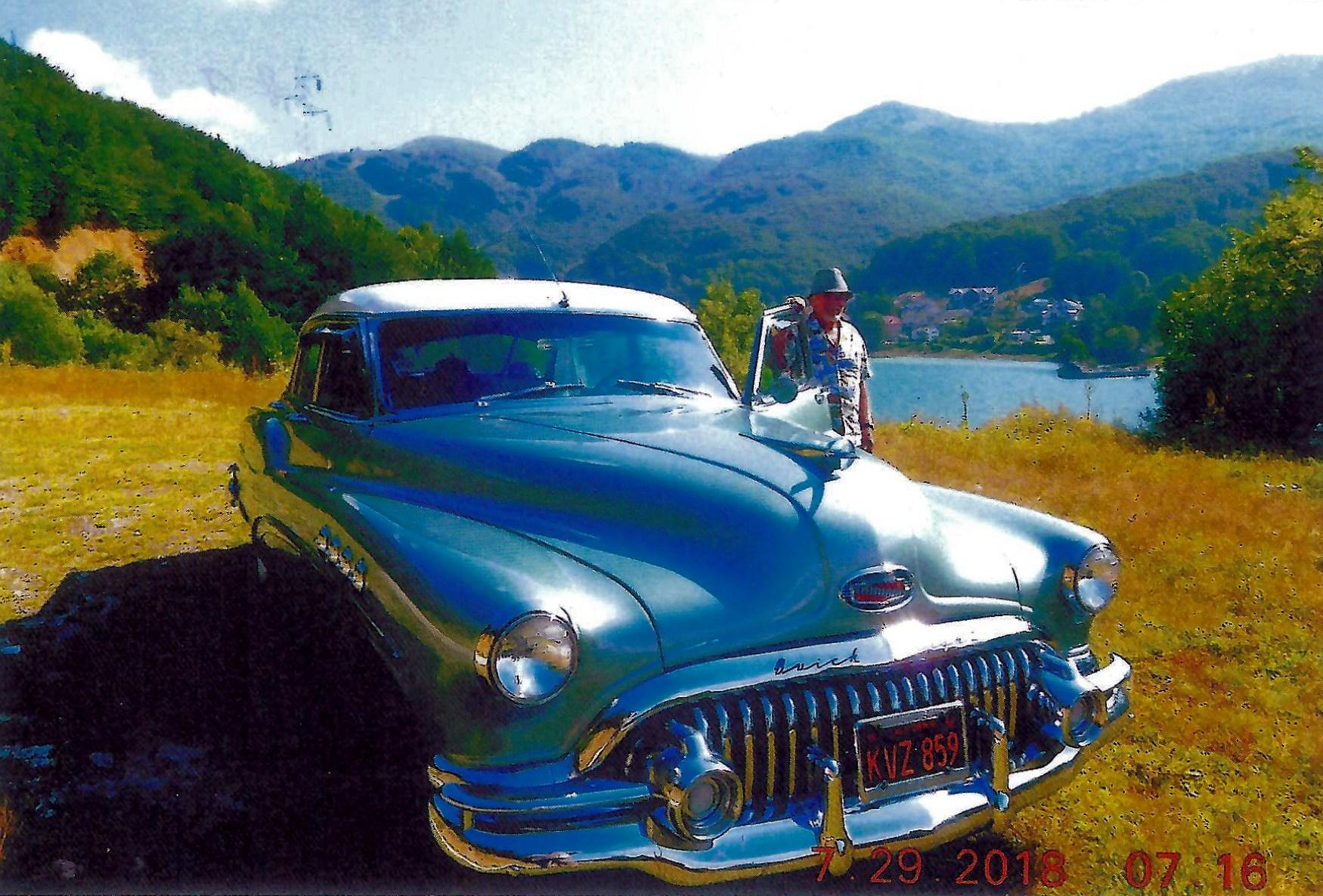
The Buick in Europe.
Every decision was weighed carefully: Finishes; materials; tolerances; and techniques. The goal was never excess, only authenticity.
Three years of dedication
The restoration took just over three years. There were moments of frustration, moments of doubt, and moments when progress felt painfully slow. But there was also deep satisfaction in seeing the Roadmaster slowly return to life its shape, its presence, its soul reemerging piece by piece.
When the work was finally complete, the car was no longer just restored it was reborn.
Recognition on the show field
Today, the Roadmaster stands in councours condition. It has been awarded Best in Class and Best in Show at antique car gatherings and competitions, honors I accept with pride but also with humility. Awards are gratifying, but they were never the true goal.
What matters most is knowing that the car is right. That it reflects the era it came from, the craftsmanship that built it, and the respect that it deserves.
A journey home
After the awards and recognition, I realized there was one more dream the Roadmaster needed to fulfill. I didn't want it to live only on show fields and behind velvet ropes. I wanted to use it to experience the world the way cars of its era were meant to be experienced on the open road, carrying people, stories, and memories.
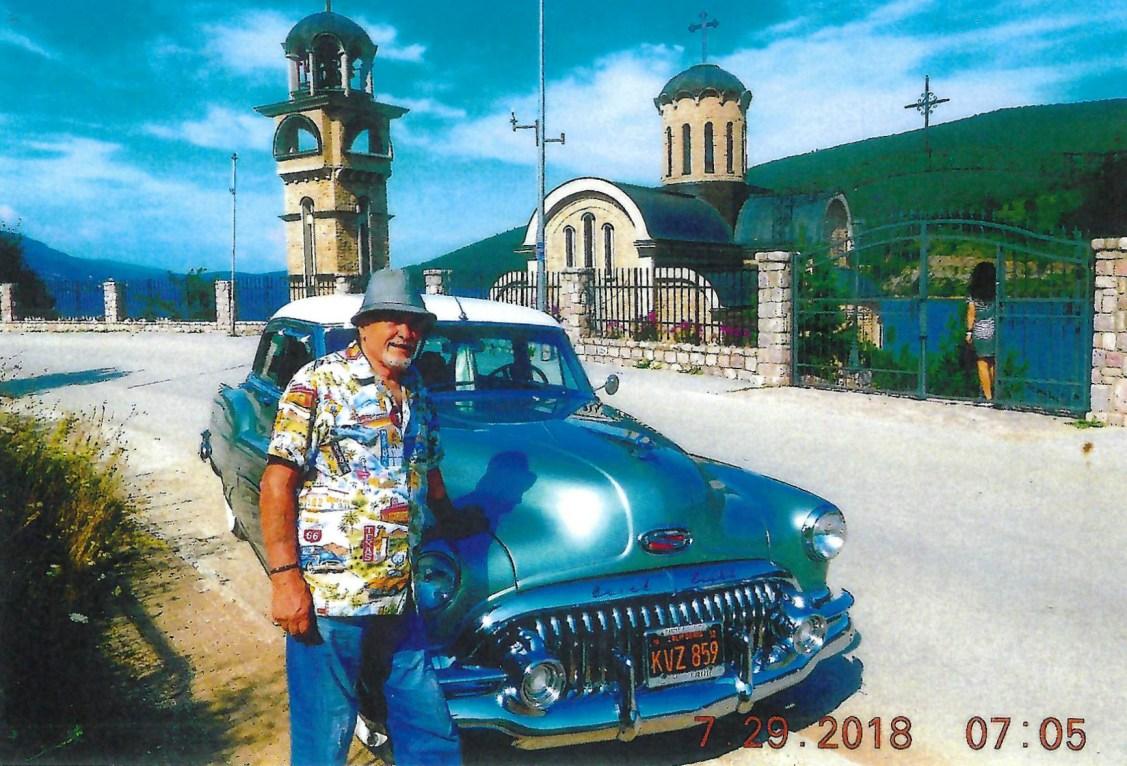
That dream brought together everything I love most my wife Desa, our shared sense of adventure, our homeland of Serbia, and the Buick itself. I began researching how to make such a journey possible and eventually found a shipping company capable of transporting the Roadmaster by sea. From Long Beach, California the car was carefully loaded and sent across the Atlantic to Genoa,
Italy a voyage of nearly a month. Knowing the Buick was crossing an ocean under its own name felt symbolic, as if its second life was expanding beyond anything I had imagined during the restoration.
When Desa and I arrived in Genoa and cleared the car through customs, the adventure truly began. Seeing the Roadmaster waiting for us on European soil was unforgettable. An American classic, reborn in my garage, now ready to cross continents.
Arrival in Belgrade
The final drive into Belgrade felt deeply personal. Approaching the city, with Avala Mountain rising gently in the distance, I felt a sense of completion that is difficult to describe. We had not taken the shortest route we had taken the right one.
Bringing the Roadmaster to Serbia, with Desa beside me, felt like closing a circle. A car built in America, restored with patience and respect, had carried us across Europe to the place where my own story began. It was proof that restoration does not end when the work is finished. Sometimes it truly beings when the wheels start turning.
More than a car
This Buick is more than steel and paint to me. It represents patience, dedication, and the belief that doing something properly still matters. It is the result of a lifetime of appreciation for craftsmanship whether in tile or in automobiles.
Every time I open the garage door and see the Roadmaster waiting there, I'm reminded that derams don't have expiration dates. Sometimes they just wait for the right moment and the right amount of dedication to finally take shape.
And when I turn the key and hear that engine come to life often
Front clip removed.
Beginning the disassembly.
With the grandsons when they were very young.
On the trip to Serbia.
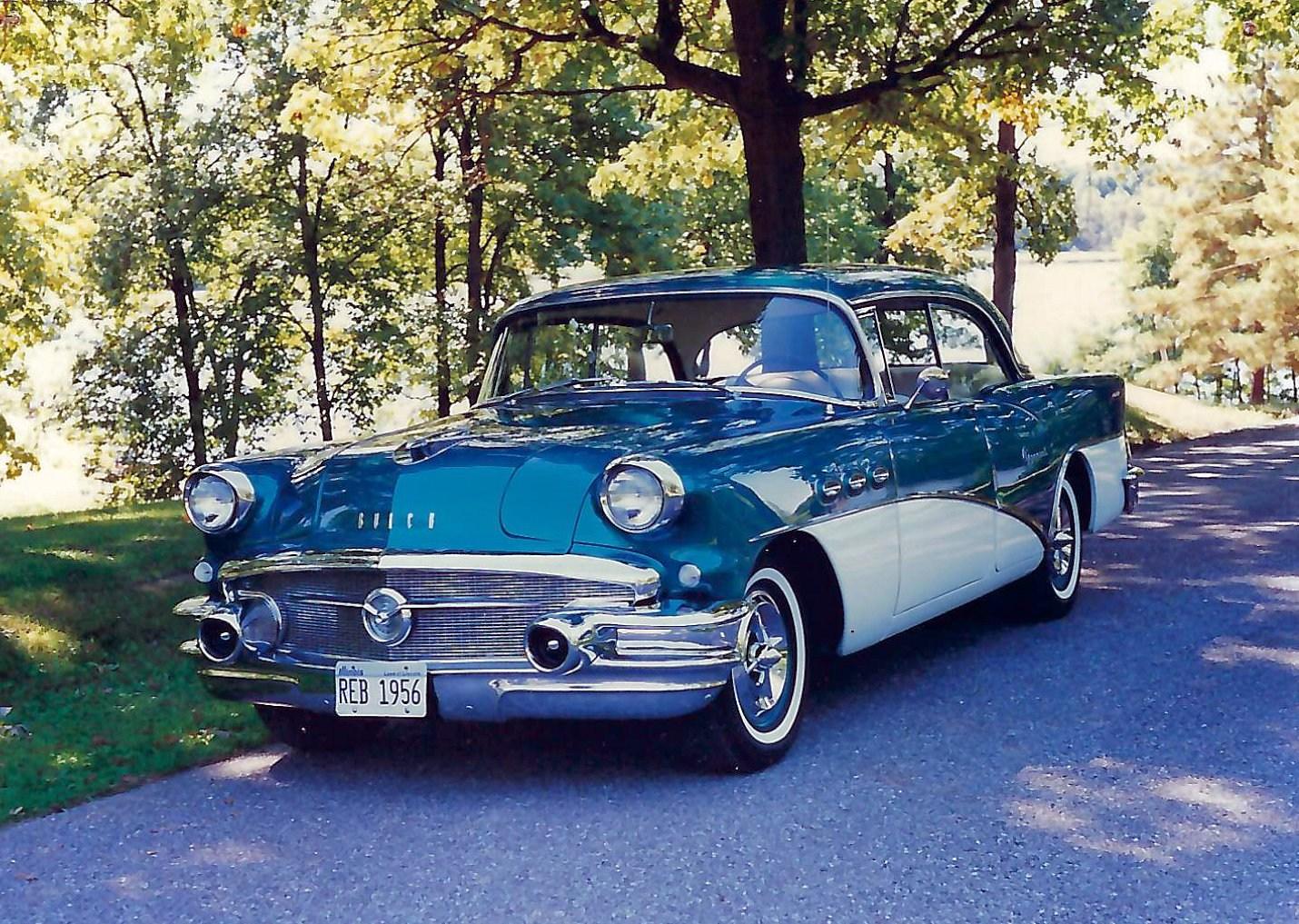
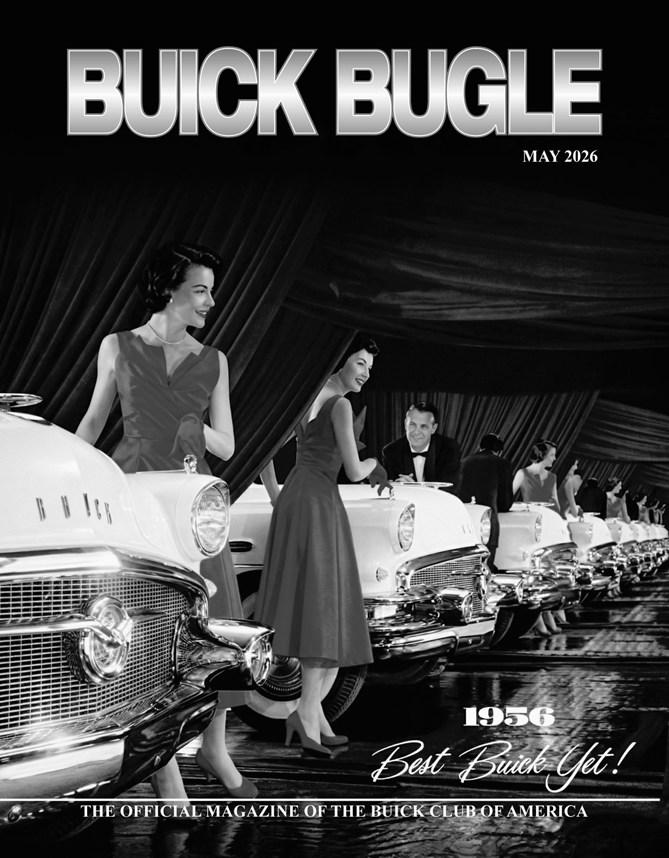
Buicks of 1956
By Pete Phillips, BCA #7338, Bugle Editor
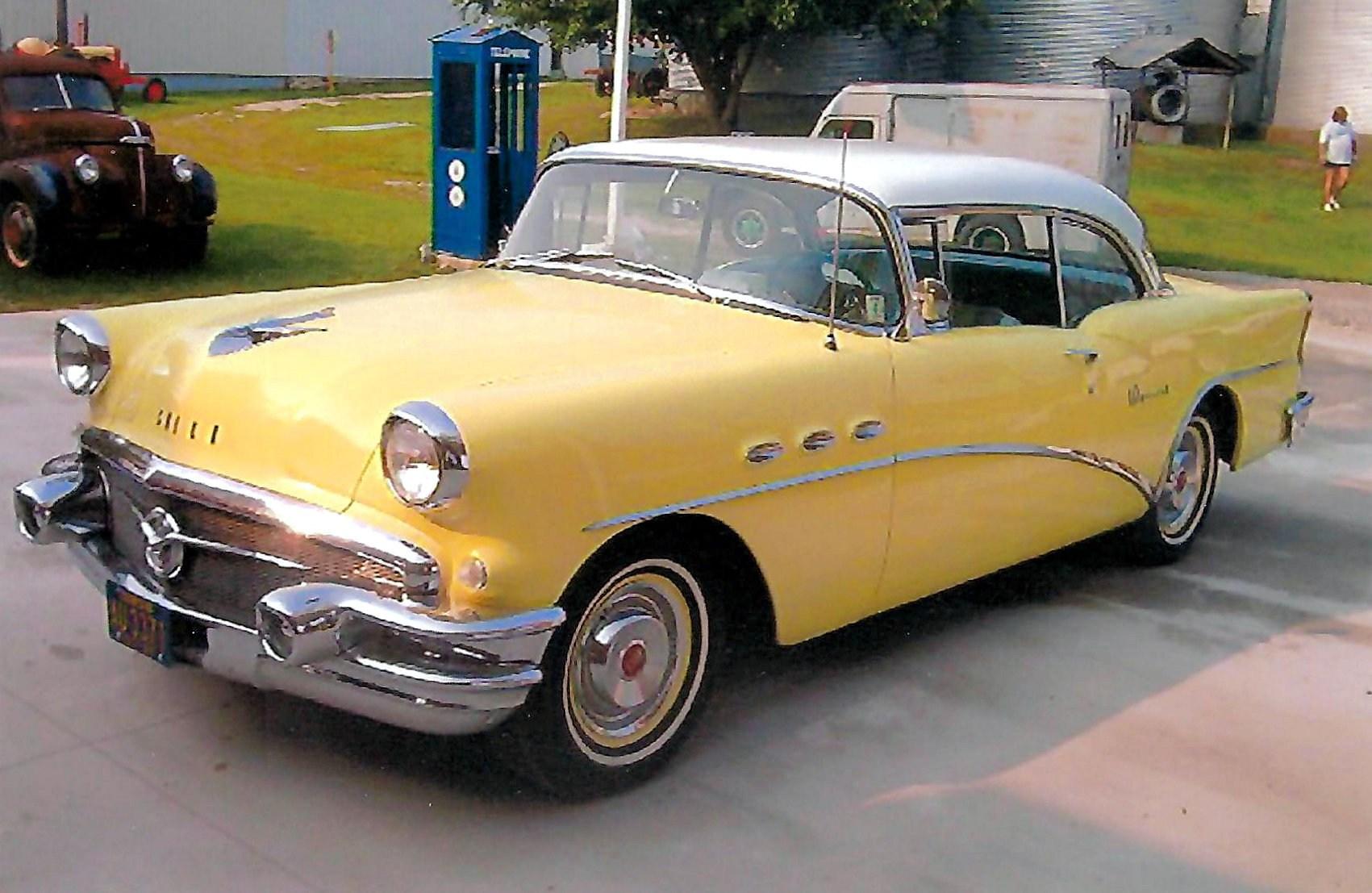
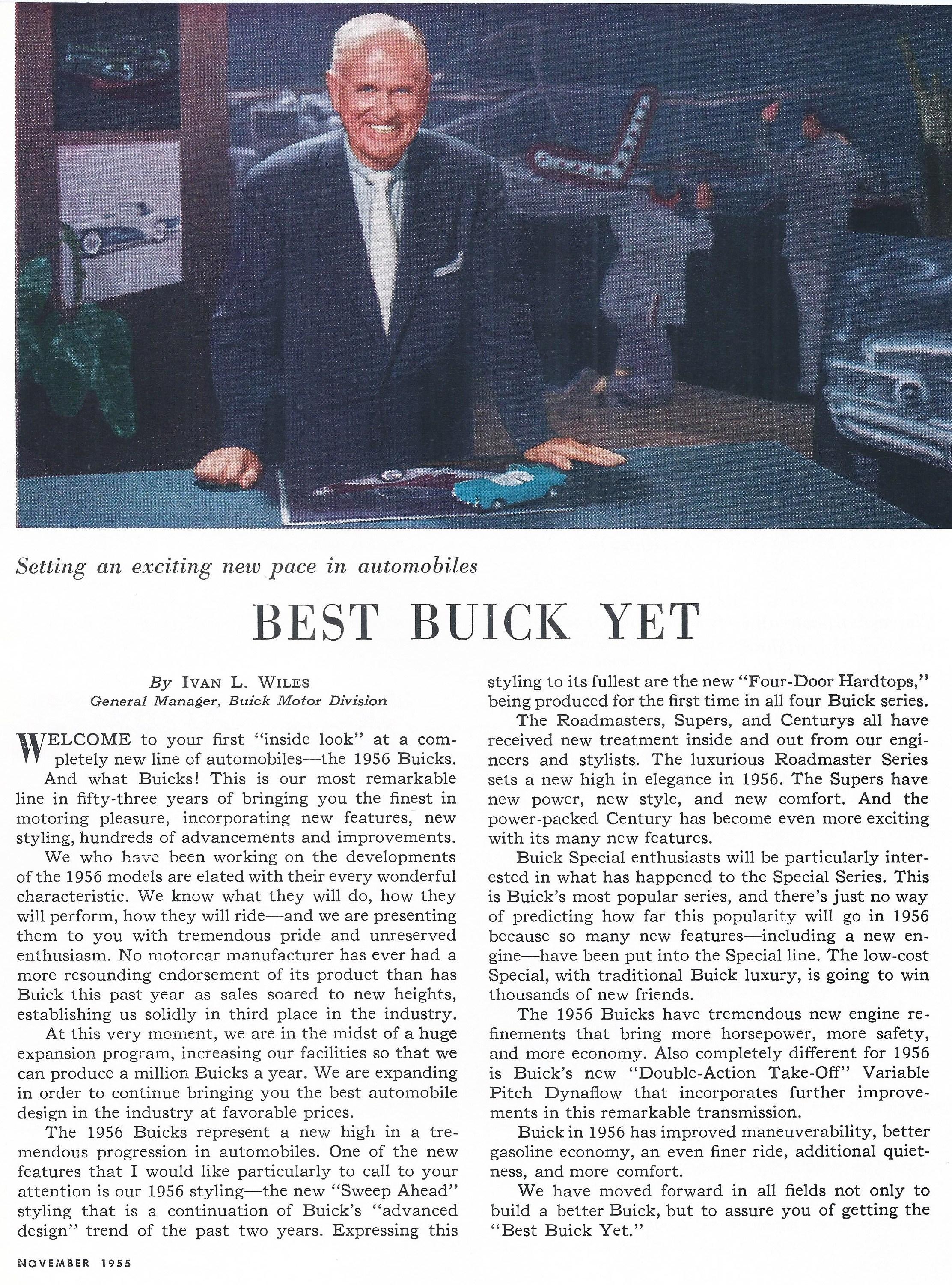
The Buicks of 1956 are 70 years old. 1956 was one of the very few years when all Buick engines were the same size: 322 cubic inches. So, why did Buick drop the 264 V-8 from the Specials, after only two years (1954 and 1955)? Chevrolet introduced its new V-8 in 1955, and it was 265 cubic inches. Most likely, the Buick dealers complained to GM that an entry-level Chevrolet should not have a bigger engine than an entry-level Buick!
There were four different series for 1956: Special; Century; Super; and Roadmaster. Before we cover each one, let’s go over some things that apply to all 1956 Buicks. Compared to 1955, the grille and tail lights became cleaner and simpler. But the bodies, doors, glass, and roof are virtually the same as the ‘55s.
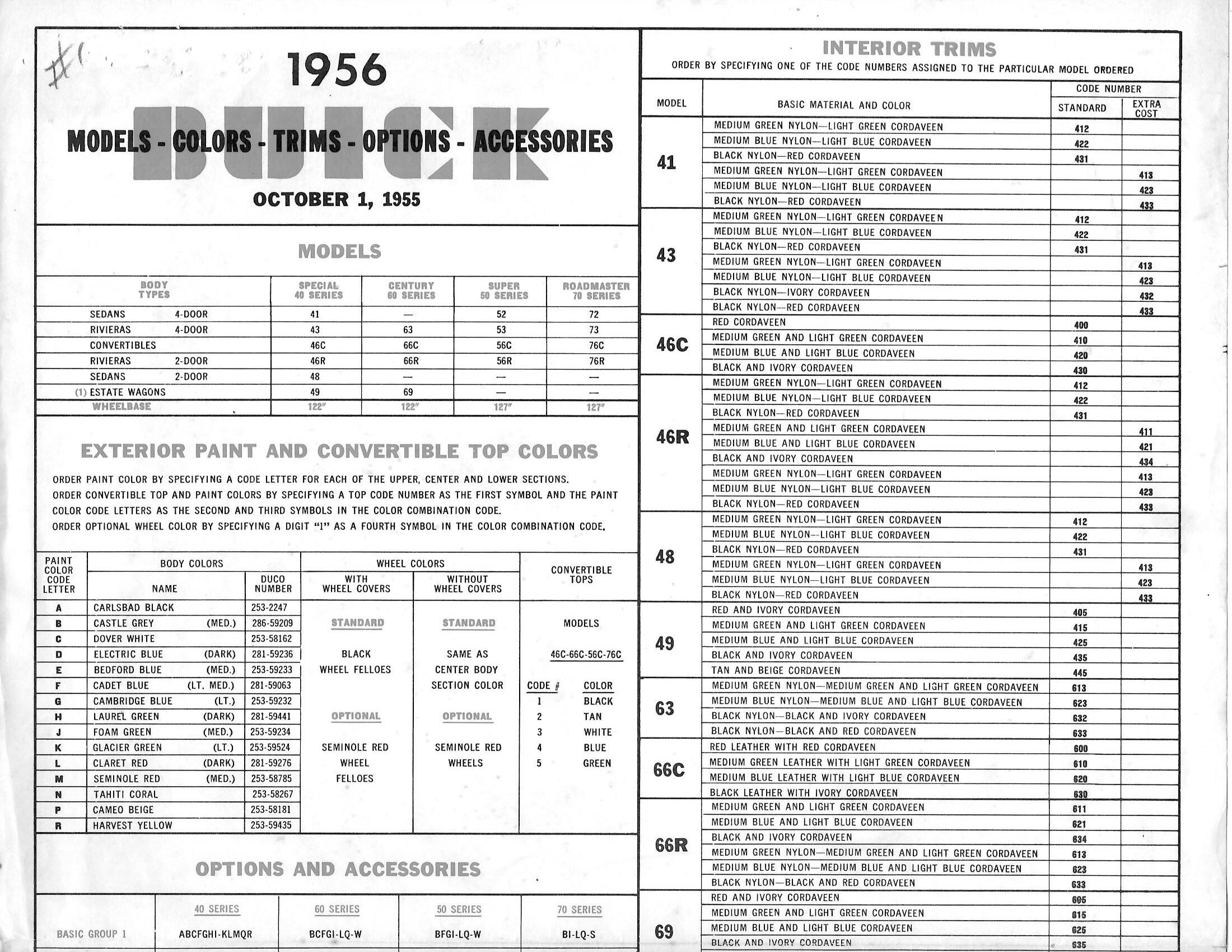
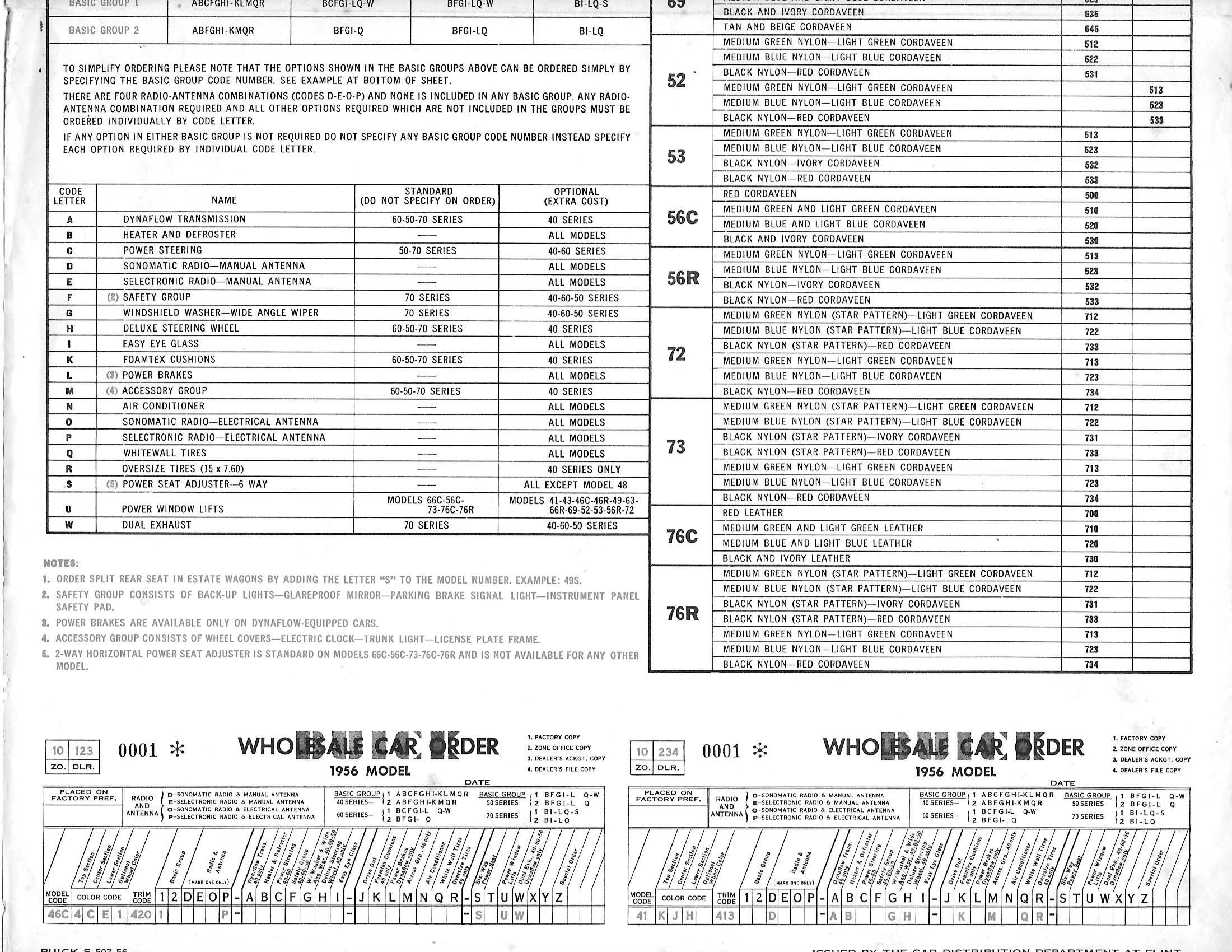
The serial number is located on the driver’s door hinge post. The first digit gives the series: 4 for Special, series 40; 5 for Super, series 50; 6 for Century, series 60; or 7 for Roadmaster, series 70. The second digit should be a “C” which Buick designated for all of its 1956 models (1955 models were a “B”). The third digit tells where the car was assembled, as follows:
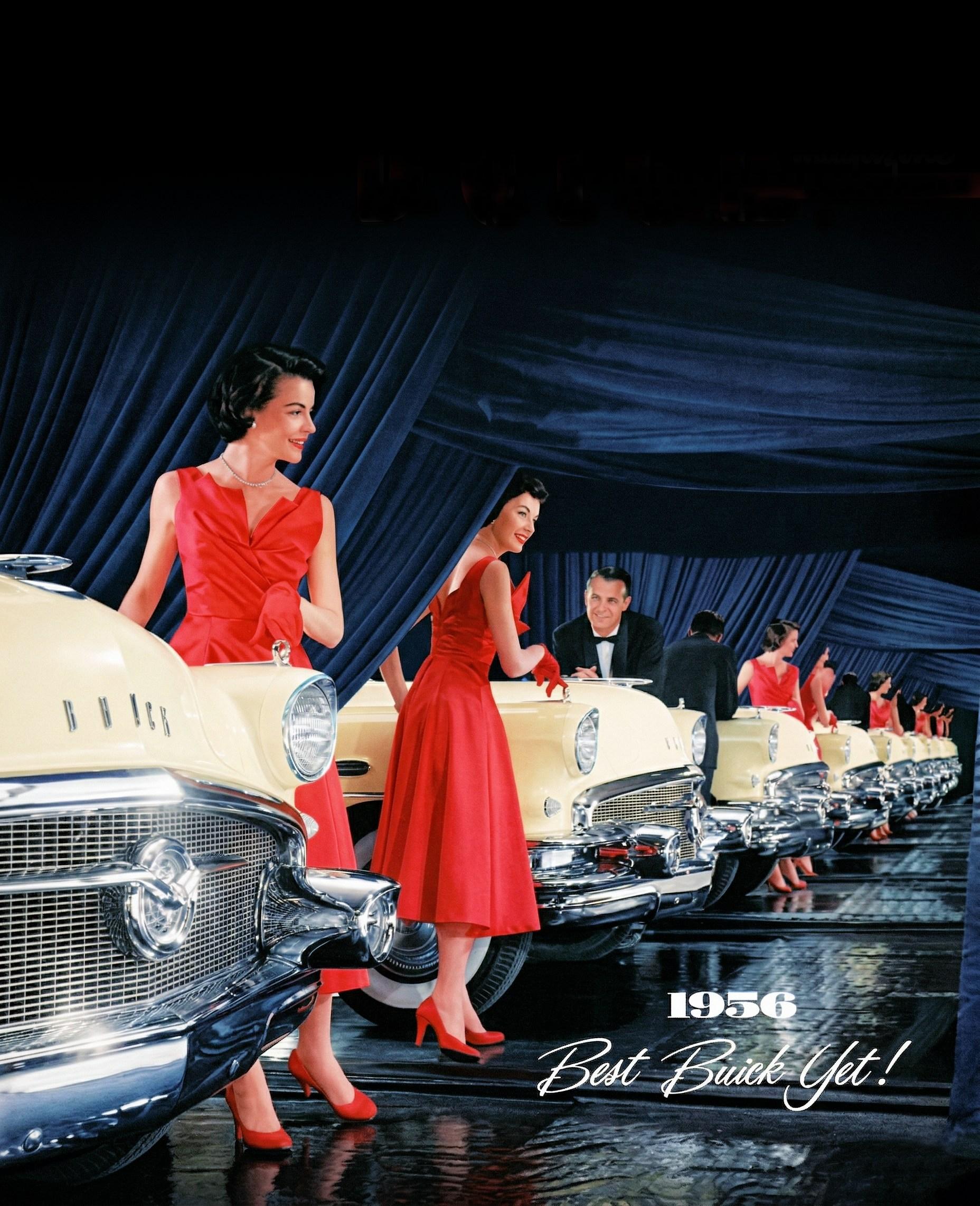
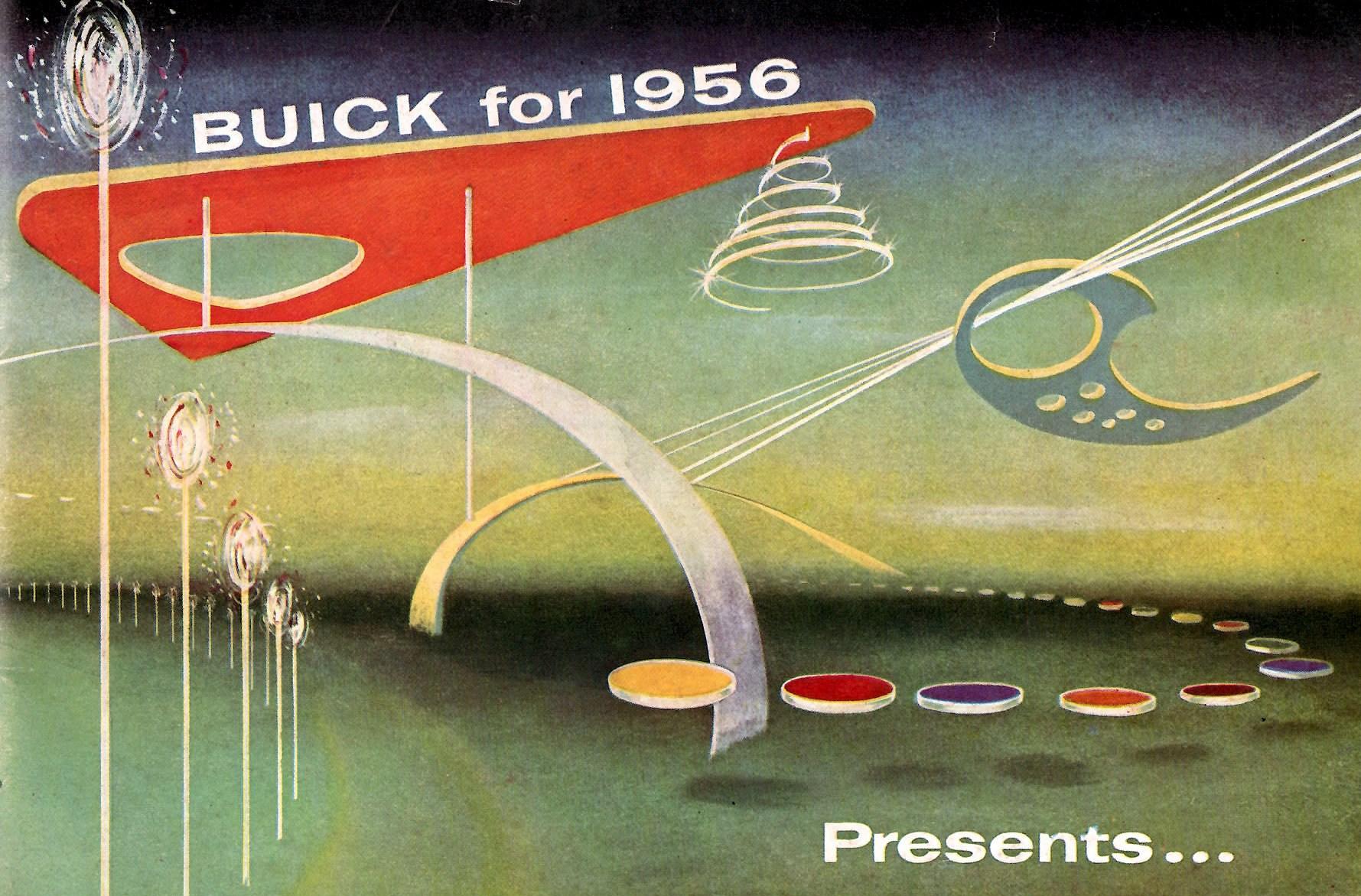
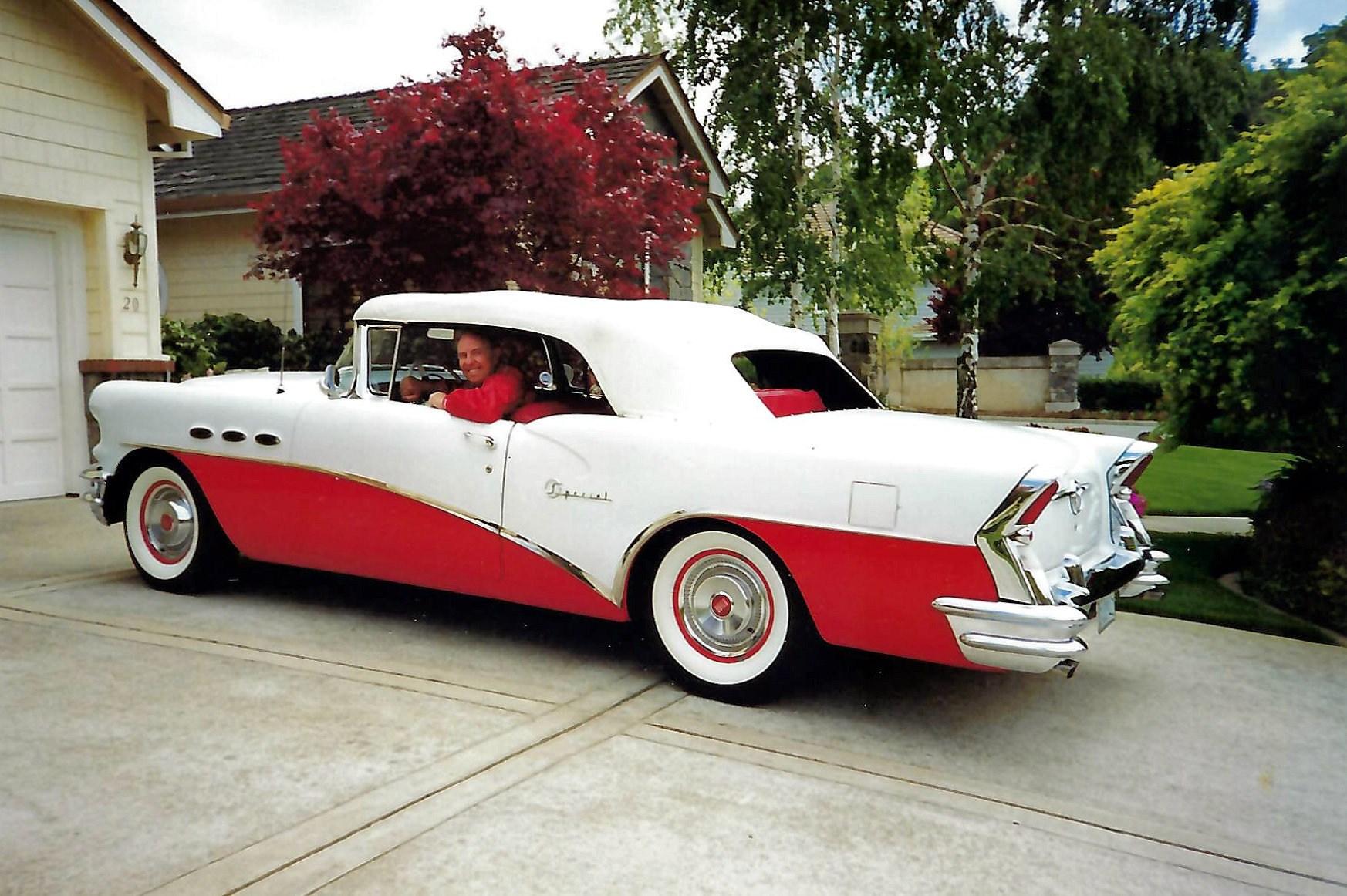
Above; Front cover, 1956 sales brochure.
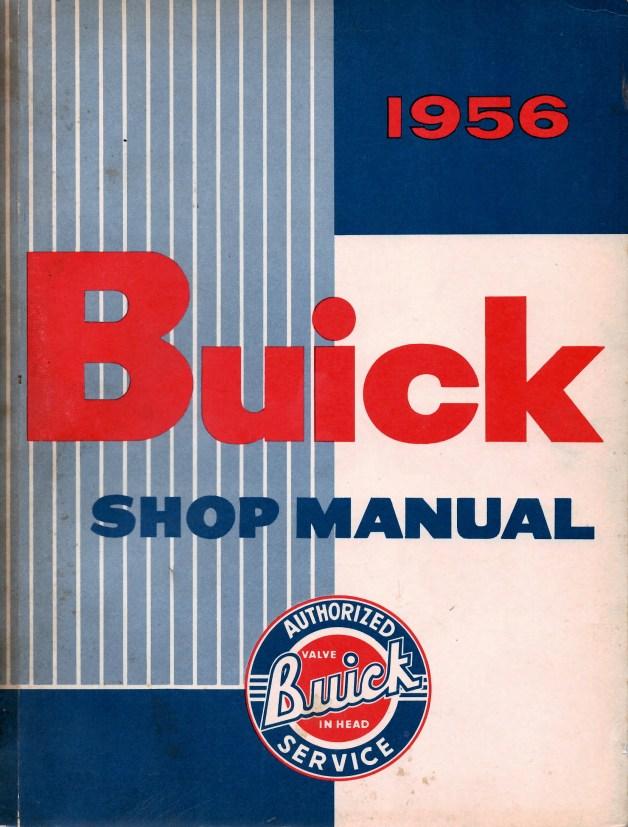
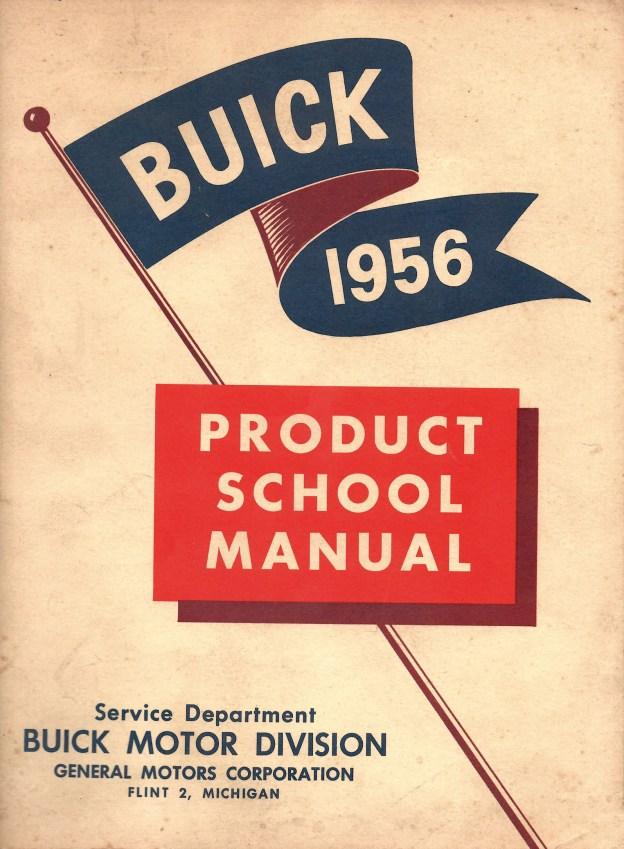
Left; 1956 shop manual front cover. Right; 1956 Buick Product School Manual front cover.
1. Flint, Michigan
2. South Gate, California
3. Linden, New Jersey
1956 was the first year that the optional air conditioning system was housed entirely under the hood and dashboard. Prior to this, the blower and evaporator were housed in the trunk and the cold air came out of the rear package shelf.
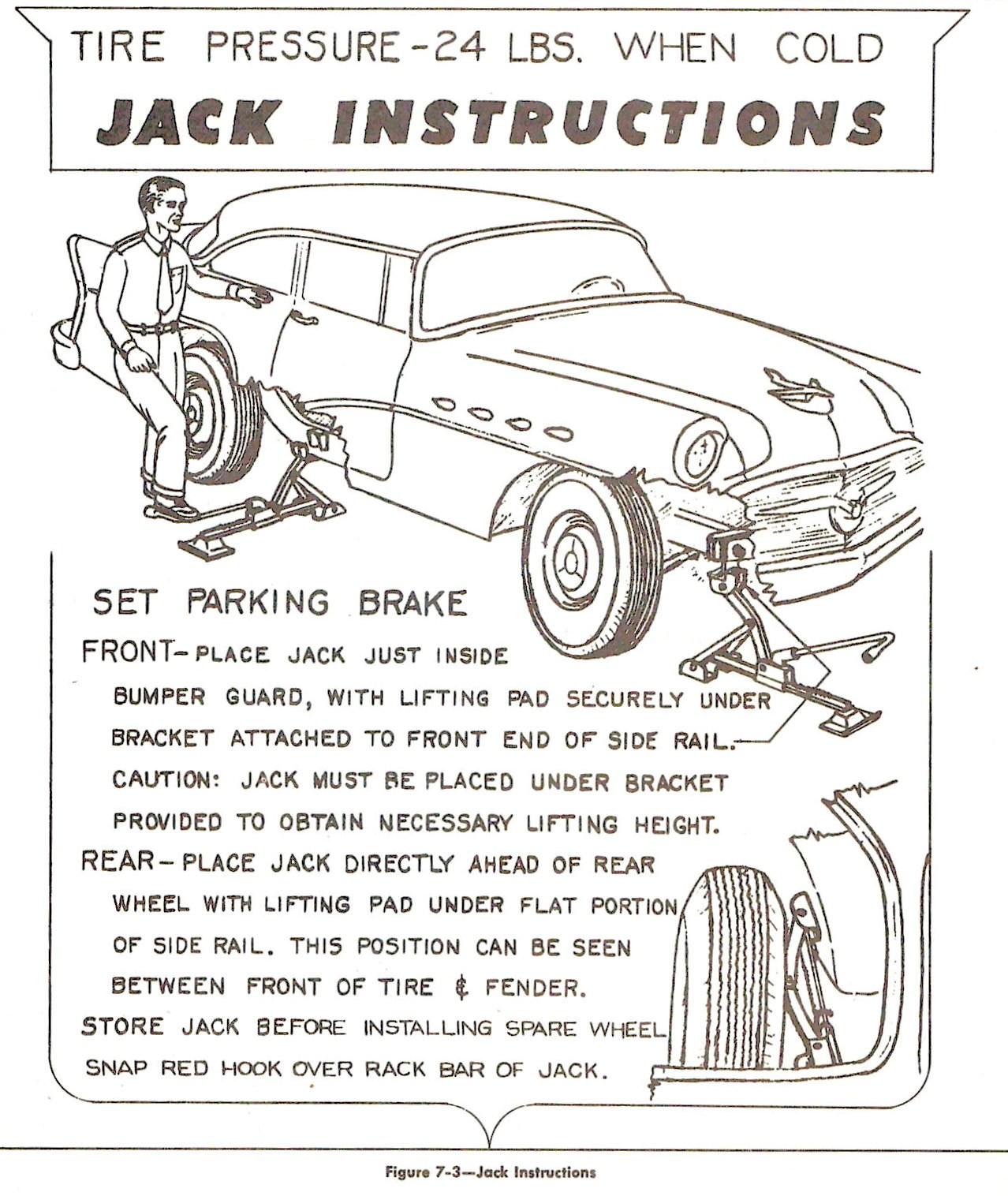
Unlike the previous year, all 1956 Buicks used the same “red ribbon” revolving drum-type speedometer. 1956 was the first year that you could get a dual exhaust system on a Buick. 1956 was the first year that all shock absorbers are the “airplane-type” telescoping shocks no more lever-type shocks that had to be refilled with hydraulic fluid. The bumper jack for 1956 is a oneyear-only, foot-operated contraption with two separate points of contact on the ground very safe and easy to use.
Now let’s start with the Specials
SPECIAL, SERIES 40
The Buick Special for 1956 sits on a 122-inch wheelbase, so it’s a big car, compared to a Chevrolet or a Ford. Overall length is 205 inches. Original tire size was 7.10 x 15 inches. The 322 V-8 in the Specials came with a two-barrel carburetor. If the car has Dynaflow transmission (optional), the compression ratio is 8.9 to 1 and it is rated at 220 horsepower. If the car has three-speed standard transmission, the compression ratio is 7.6 to 1, but none of my sources indicate the horsepower of this engine. The standard shift cars really didn’t need any extra horsepower. If you’ve ever driven one with the stick shift, they are quick, snappy performers.
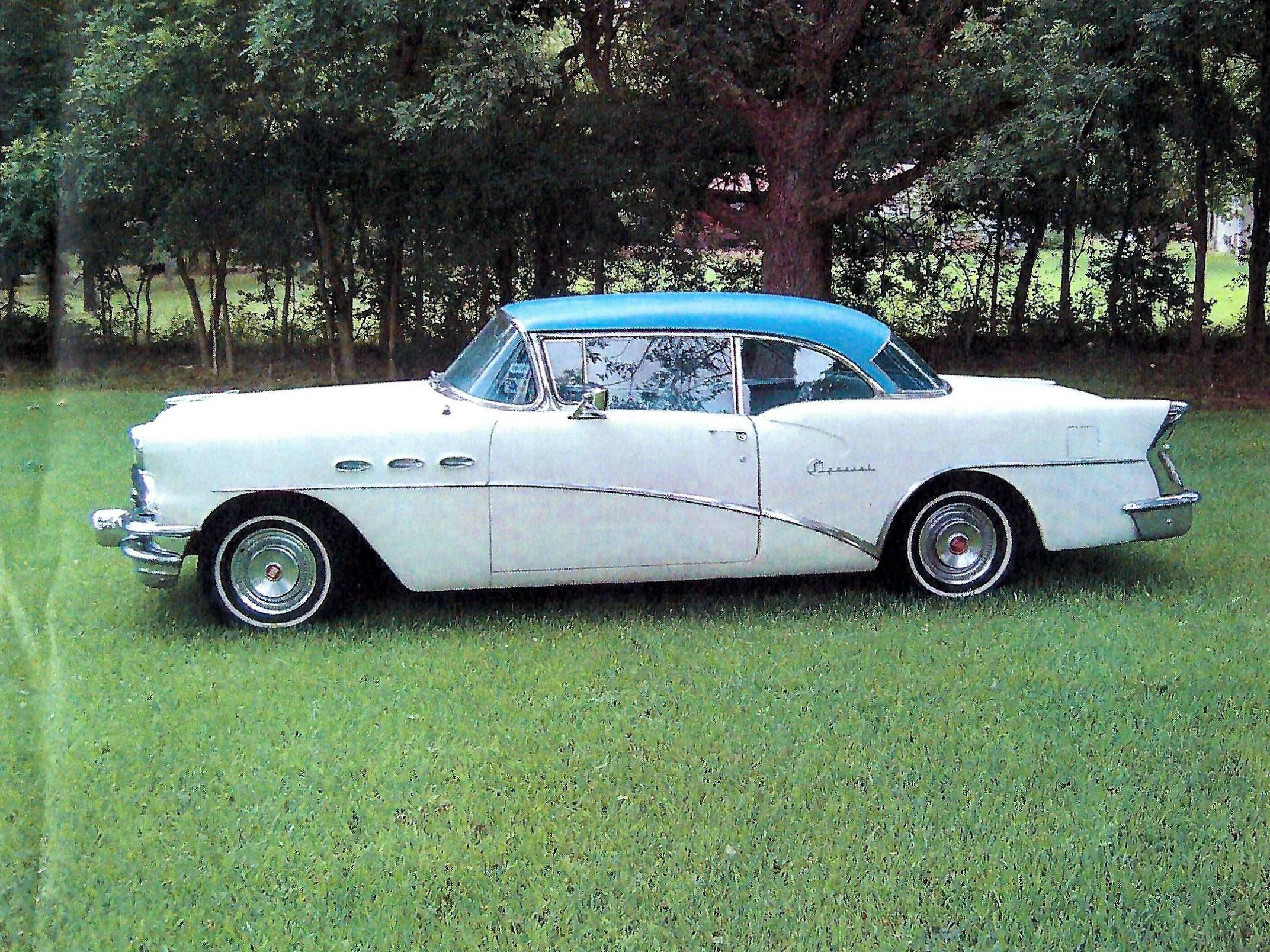
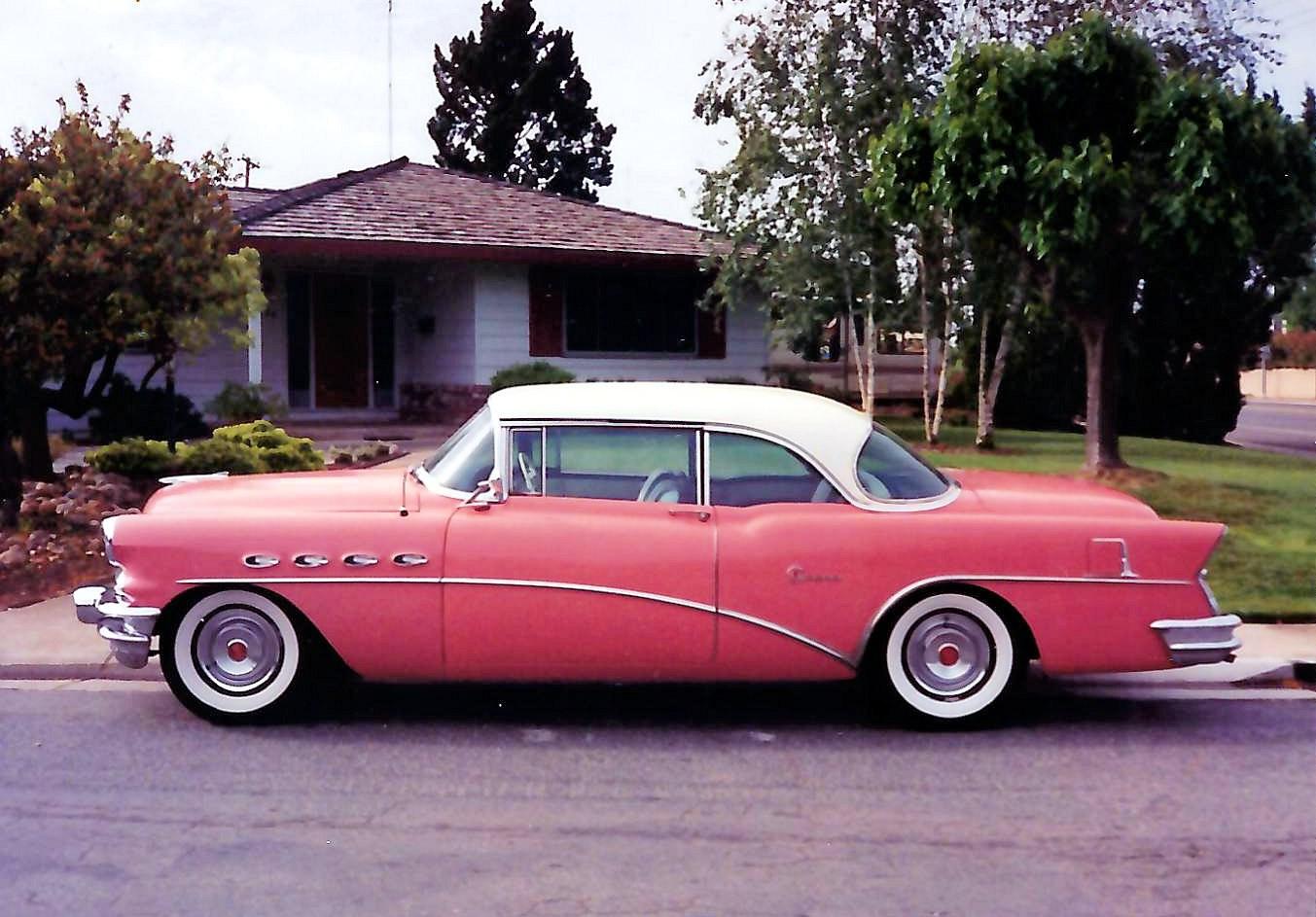
1956 jack instructions, showing the unique, 1956 Buick jack. 1956 Special two-door hardtop, model 46-R. Bugle archives photo.
You could get a 1956 Special in a four-door sedan, a four-door hardtop, a two-door sedan, a two-door hardtop, a four-door station wagon, or a convertible. The two-door hardtop, model 46-R, was the biggest selling model of all 1956 Buicks, with 113,861 built, just in that body style.
CENTURY, SERIES 60
The Century uses the same body and 122-inch wheelbase chassis as the Special in 1956 the only exterior difference is the fourth porthole in the front fender, and the century script on
the rear quarters. And yes, in 1956, the grille emblem says “1956 Century”, as well as the trunk emblem. The Century series uses the 322 V-8 with a four-barrel carburetor and a compression ratio of 9.5 to 1. This gives the engine a rating of 255 horsepower same as the larger and heavier Roadmaster. This is why the Century was known as the high-performance Buick or “the banker’s hotrod”.
For the first time ever, you could only get a Dynaflow automatic transmission in your new Buick Century. The standard shift cars ended with the 1955 Century and precious few were equipped that way.
The 1956 Buick Century could be had as a four-door hardtop, a door hardtop, a convertible, or a four-door station wagon. There were no four-door sedan nor two-door sedan Century models in 1956. Buick would bring back the four-door sedan Century models in 1957 probably because of dealer demand (they sold more than 8,000 Century four-door sedans, model 61, in 1957).
The original tire size for the 1956 Century was 7.60 x 15 inches.
SUPER, SERIES 50
The Super was a big car: 127” wheelbase and 213 inches long. Not only that, but it is wider than the Special and the Century, so fenders, bumpers, hoods, grilles, doors and trunk lids will not interchange with the smaller series. They will, of course, interchange with the Roadmaster, although the Roadmaster’s
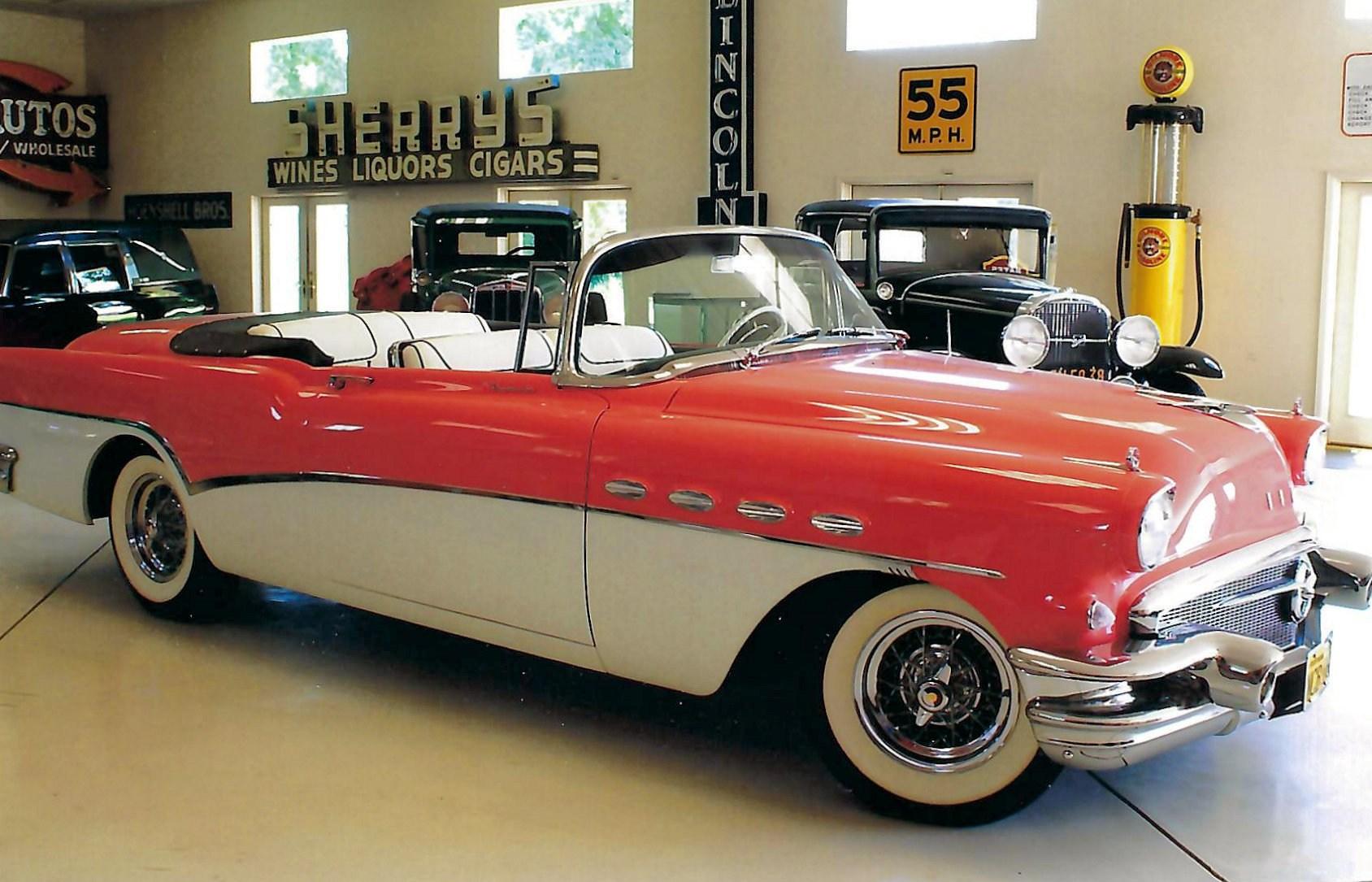
1956 Special convertible, model 46-C. Bugle archives photo.
1956 Special four-door hardtop, model 43. Bugle archives photo.
1956 Super two-door hardtop, model 56-R. trim is different.
The Super uses the 322 V-8 with four-barrel carburetor and the 9.5 to 1 compression ratio, for a rating of 255 horsepower. The car could be equipped with single or dual exhausts. If it has dual exhausts, there are rear bumper cut-outs and rectangular chrome tips for the exhaust outlets but these like to rust out and/or get damaged, as do the little horseshoe-shaped end pieces for the bumper, which are attached to the bumper just above the exhaust outlets.
Body styles for the 1956 Super are a four-door sedan, a four-door hardtop (first year for that body style in a Super), a two-door hardtop, and a convertible. There were no station wagons in the Super series. The convertible is the rare one, with only 2,489 made. A power seat adjustment and power windows were standard equipment in the convertible. Power steering is standard equipment on all 1956 Supers.
ROADMASTER, SERIES 70
The Roadmaster uses the same engine as the Super and the
Century series 322 V-8 with four-barrel carburetor and 255 horsepower and the same 127” wheelbase. The most popular Roadmaster body style for 1956 was the new four-door hardtop. It outsold the two-door hardtop and the four-door sedan Roadmasters. Also available was the convertible, model 76-C,
1956 Roadmaster convertible, model 76-C, with incorrect wire wheels. Bugle archives photo.
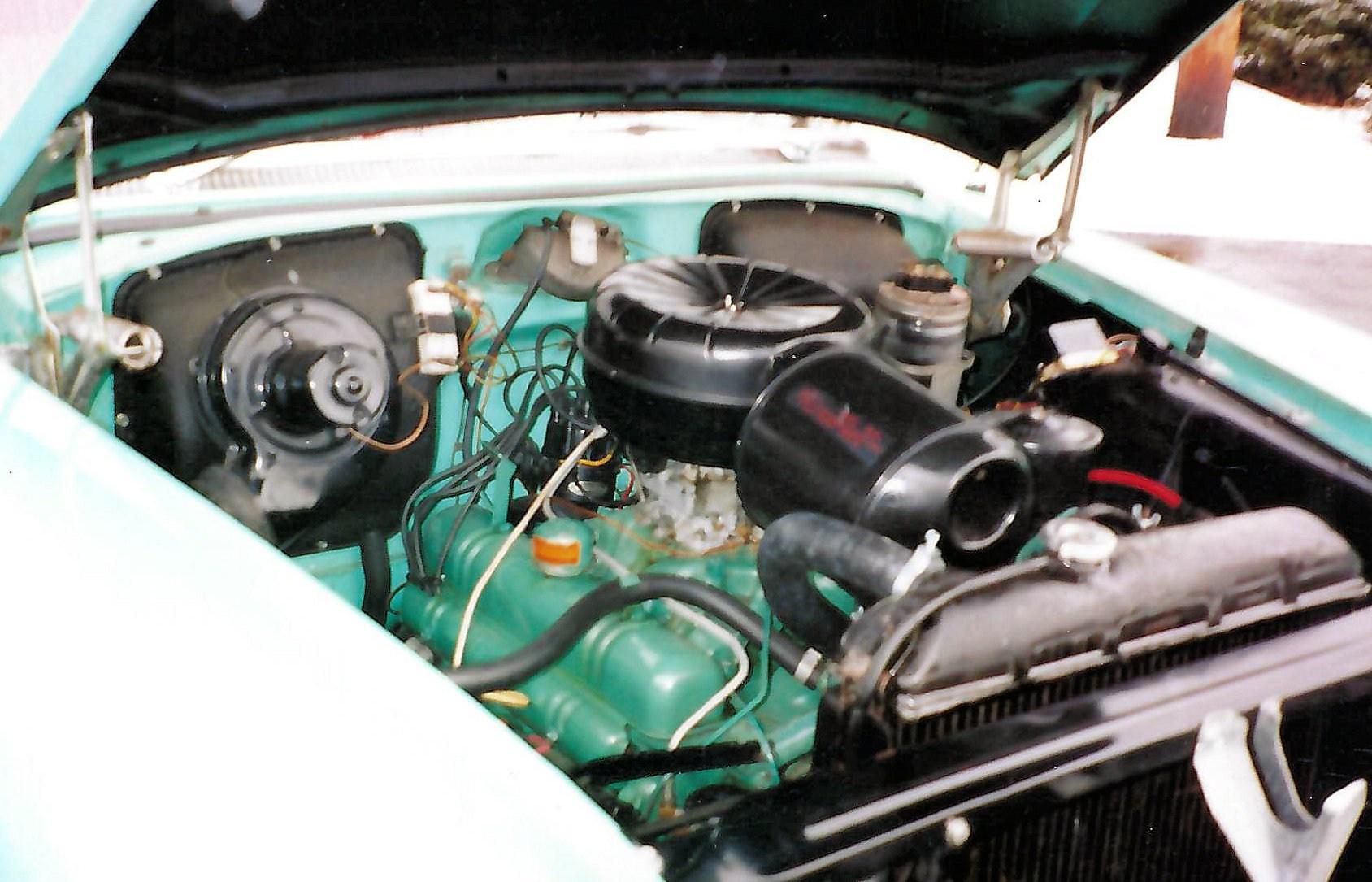
painted and detailed engine compartment.
with 4,354 made, making it the scarcest body style for the Roadmaster. Only the convertible uses leather upholstery. All other Roadmaster models used nylon and vinyl upholstery. Buick called it “Cordaveen” rather than vinyl.
Power steering was standard equipment on all Roadmasters in 1956, but power brakes were optional. Dual exhaust was standard on all Roadmasters. Power windows were standard equipment on the convertible, the two-door hardtop, and the four-door hardtop optional on the fourdoor sedan. The following items were standard equipment on all Roadmasters: Full wheel covers; electric clock; trunk light; license plate frame; back-up lights; parking brake warning light; padded dashboard; and a glare-proof rearview mirror.
The Roadmaster has unique trunk lid trim, with two stainless steel moldings that follow the curve of the trunk lid and end with little chrome handles for lifting the lid. Speaking of the trunk lid, on the Supers and Roadmasters the key to open it turns to the left, while on Supers and Centurys the key turns to the right. How many of you knew that? When I first encountered this on a 1956 Roadmaster, after owning a 1956 Special, I assumed someone had installed the Roadmaster's trunk lock backwards!
Here is an item that is unique to all of the 1956 Roadmasters: Flat sweepspear trim. The sweepspear stainless on all other 1956 Buicks has a ridge on each molding about 2/3rds of the way down, running the entire length of the moldings. In addition, the
Correctly
Bugle archives photo.
1956 Roadmaster four door hardtop, model 73. Bugle archives photo.
Roadmaster's sweepspear sits higher on the side of the car than on the other series. Instead of touching the rear wheel opening, it is several inches above that opening on the Roadmasters only. Another unique Roadmaster item is the headlight bezels. On all other series, the headlight bezels are all chrome-plated, but on the Roadmasters only the front half-inch is chromed and the rest of it is painted body color try finding one of those when you need it.
WHAT TO LOOK FOR WHEN BUYING ONE
We have already mentioned the possibility of rusted and dented chrome pieces above the rear bumper's exhaust outlets on dual exhaust cars. Reproductions are available, but they are not cheap. Check the condition of the die -cast grille, which is easily cracked and broken in parking lot or parallel parking mishaps. Remember there is one grille for the Supers and Roadmasters, and a different one for the Specials and Centurys. Check the fit of the hood against the upper grille bar. There is very little clearance between the two, so if the alignment of them is off by just a fraction of an inch, the front lip of the hood will be scratched and damaged by the upper grille bar.
Common areas of body rust are the lower rear quarters just ahead of the rear wheel opening, and on two-door hardtops, the bottom of the “C” pillar where the roof meets the top of the rear quarter panel. On Buick Specials with rubber floor mats instead of carpeting, the floors are likely to rust out due to water trapped
1956 Special four-door sedan, model 41. Bugle archives photo.
1956 Century two-door hardtop, model 66-R. Bugle archives photo.
underneath the rubber mat.
Sheet metal parts are usually interchangeable with the 1955 and 1954 models, as long as the series and body style are the same. Individual sweepspear pieces while fairly plentiful and easy to find 20 years ago, have just about disappeared today, and can be quite expensive if you can find them.
Check the condition of the die-cast portholes and the tail light housings. Ones without pits in the chrome are nearly impossible to find, and they are difficult to re-plate due to the difficulty in grinding out and getting access to the crevasses where the pits are.
Raise all of the windows and look for cracked side glass typically found when the doors have been carelessly slammed. On 1956 Buicks, the doors should close easily with just the pressure of two or three fingers.
WHAT TO LOOK FOR WHEN JUDGING ONE
Check to see that the brakes are operating correctly. Both the manual brake master cylinder and the power brake master cylinder are unique, one-year-only designs. Finding rebuild kits for these can be difficult.
All wheels and tires should be 15” in diameter. If the tires are whitewalls, they should be the wide whitewalls. Red wheels are an option, regardless of body color. Wire wheels were not available in 1956. Steel-belted radials are not correct for 1956. Engines (including the fuel pump) should be painted Buick green, with semi-gloss black air cleaners and generators. The air cleaner should have an orange decal.
1956 Special two-door sedan, model 48. Bugle archives photo.
1956 Special two-door hardtop, model 46-R. Bugle archives photo.
Outside the car, two-tone and even three-tone paint was available for 1956. If the car has full wheel covers, check the condition of the red “BUICK” center emblem. They are usually faded or cracked. Reproductions are easily available from CARS, Inc. or Bob's Automobilia. If the car has dual exhausts, it should have the correct rear bumper with the rectangular exhaust cut-outs and the U-shaped bumperettes above the exhaust cut-outs.
Inside the car, if it has carpeting, it should be the Daytona Weave style. This is identifiable by its tightly-packed, short weave without any loops. It is available, but more expensive than the loop style carpet. In Roadmasters, look for the contrasting color of the welting or piping on the seat upholstery. Roadmaster convertibles should have leather upholstery. Convertible tops may be white, black, tan, ivory, green, or blue. They should have a plastic rear window, not glass.
OPTION CODEA9
WE1 s Fairy Godmother
By Mitch Carr, BCA #47405
I would love it if back in 1969 someone at Buick had taken a test mule of the upcoming 1970 GS 455 Stage 1 down to the legendary Woodward Ave. between Pontiac and Detroit, Michigan for some real world “Vehicle Evaluation”. A couple of nights winning some “exuberant acceleration tests” would have proved that if you add all the optional “go” parts, the upcoming 1970 GS455 Stage 1 was going to be near the top of the muscle car heap. With 360 underrated horsepower, 510 foot pounds of torque, 0-60 numbers in 5.5 seconds and a quarter mile in 13.38 seconds, it may not hurt to have a unique package to promote all of this. Make it easy to order by putting all the needed “go” parts into one option code. Then, at least for Buick, wrap it with “In Your Face” loud graphics, plus front and rear spoilers. Something to go toe to toe with its GTO Judge and 4-4-2 W-30 corporate cousins and hopefully help increase Gran Sport sales. It’ll be the Gran Sport of all Gran Sports. Great idea! Somehow a conservative Buick management
approved it. Both the press and public needed to get fired up about this proposed top-level GS. It was decided that a color and trim show car was needed. These are production cars that the car divisions modify and repaint for a special evaluation/ prototype vehicle. Run it through a couple of major car shows, and maybe rotate it through a few selected Buick dealers to increase public awareness.
It’s 1970, the peak of the muscle car era. Government emission regulations will require the 1971 models to be detuned. Monthly insurance premiums on muscle cars seem to almost equal the loan payment. The good news is that gas is always going to be cheap. Sure, it will. Just throw this little beast into production at the beginning of the model year. The problem is
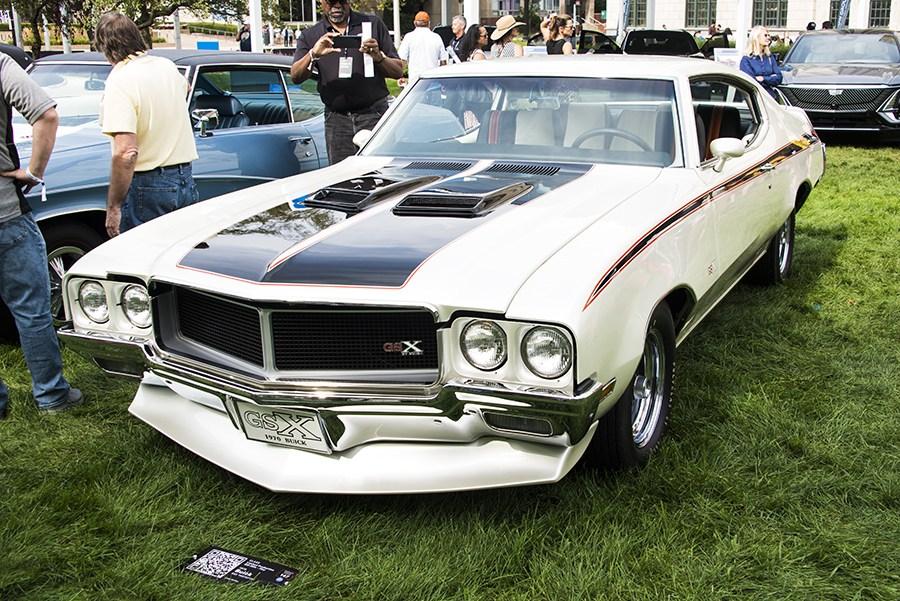
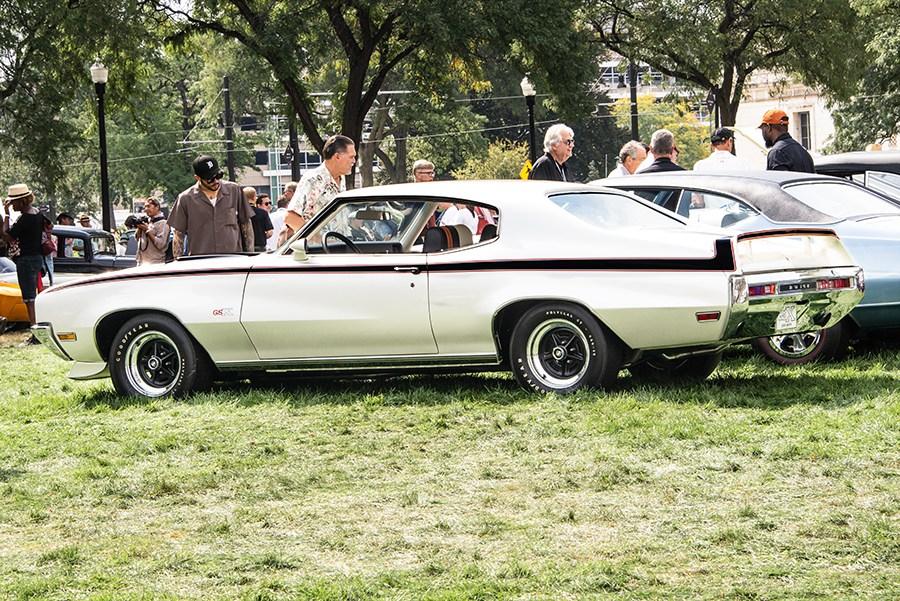
Front view. Notice the unusual spoiler below the bumper and the hood scoops.
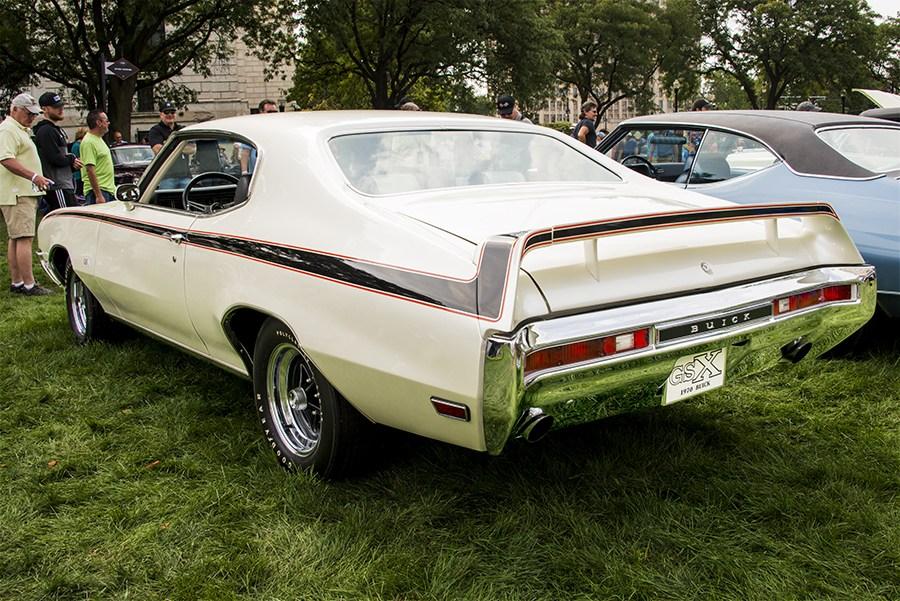
Rear view of the prototype with its unique spoiler and through-the-bumper exhausts.
that you are a little late to the party. If everything goes the way you want it, you are looking at a limited year-end run. Enter the 1970 Buick GSX prototype seen here. It originally came off the production line in the first week of September 1969 (build code 09A). It was ordered with all the items that would be included in what would become the GSX option code A9. Many of which were already part of the Stage 1 package.
GSX option code A9 would include: B3 - 4-speed manual, BC –Console (bucket seat interior), C1 - Disk brakes (powered), F7 –Super Wide Billboard Tires w/ chrome wheels, G1- Positraction 3.42 ratio Rear end, H6 - Rallye Ride suspension, U9 –Gauges w/ clock and X2 - Rallye Steering Wheel. Some of the extra options added to this prototype were: B2 – Turbo 400 Automatic (replaced B3-4spd), C6 – Power Steering, D1 – AM radio, L1 – Tinted Glass, R1 – Power windows and S1 – Tilt Steering Wheel. You may have noticed that items like air conditioning, cruise control and door locks were not selected. The purpose of this GSX was to be seen, and not for a comfortable cross country highway drive.
This car went from the assembly line over to the Buick Engineering group next door, where under the direction of engineer Joe Blood, it was transformed into the GSX prototype. Both the body and headlight bezels were repainted with a dazzling combination of white pearl, gold pearl and mother of pearl. A fiberglass hood with different ram air scoops got created. The whole center section of the stock chrome wheels got painted black. A large, pronounced, lower front chin spoiler got installed. A rear spoiler got added to the trunk lid, with separate side caps molded to match the rear fenders. Oldsmobile exhaust tips were routed through the rear bumper. Interior engine-turned applique replaced the production surface.
Of course, the big stripes and GSX badges were added.
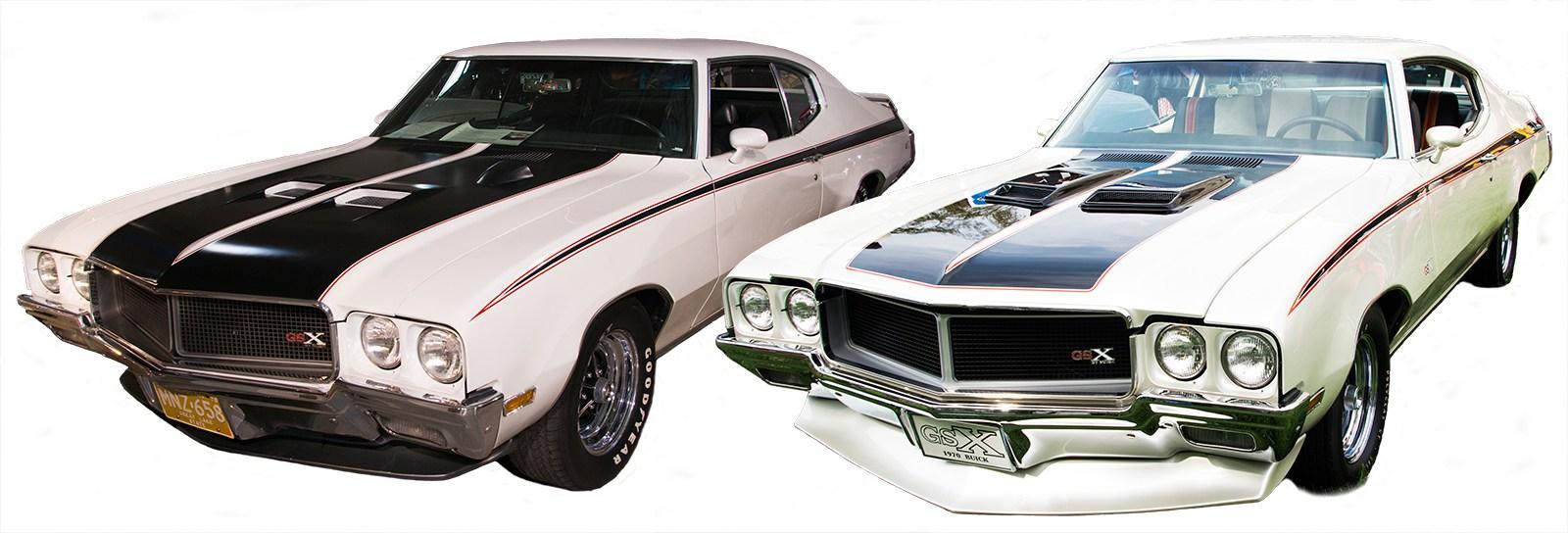
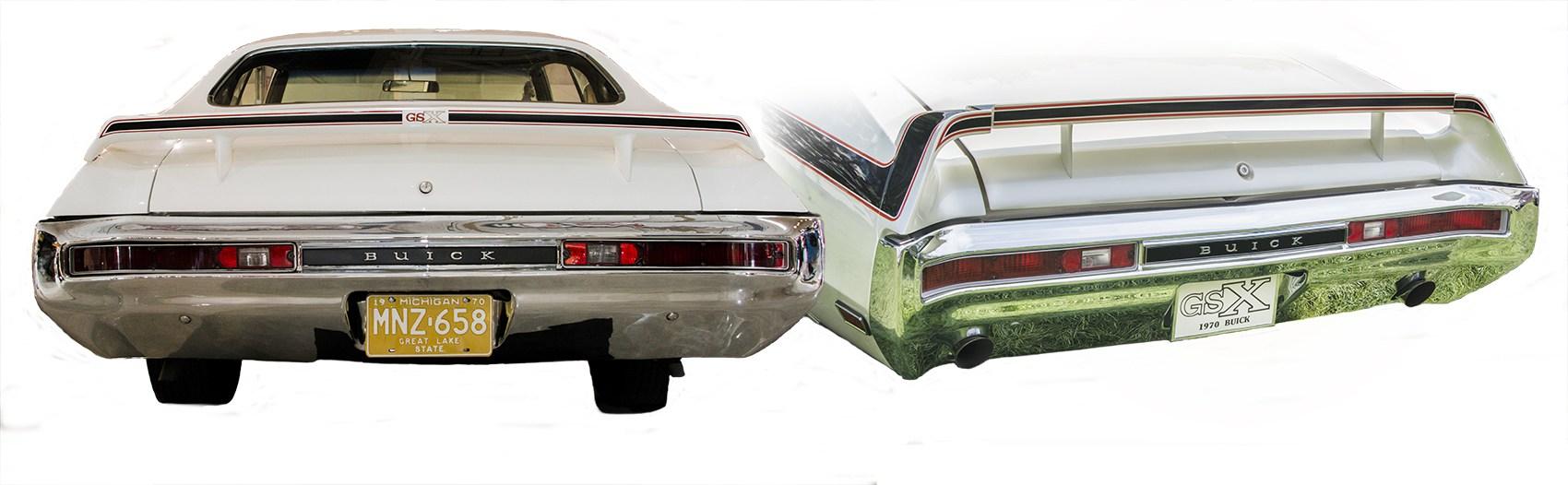
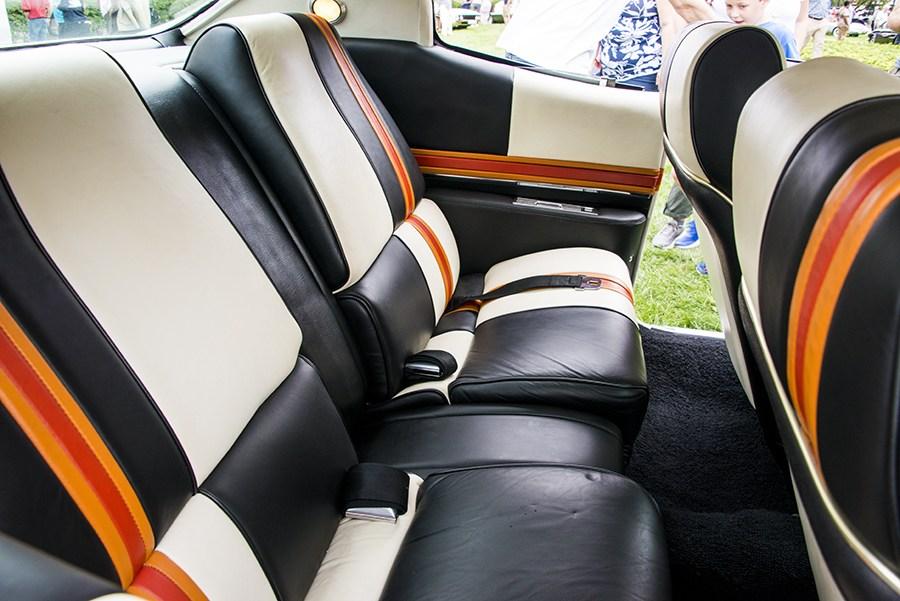
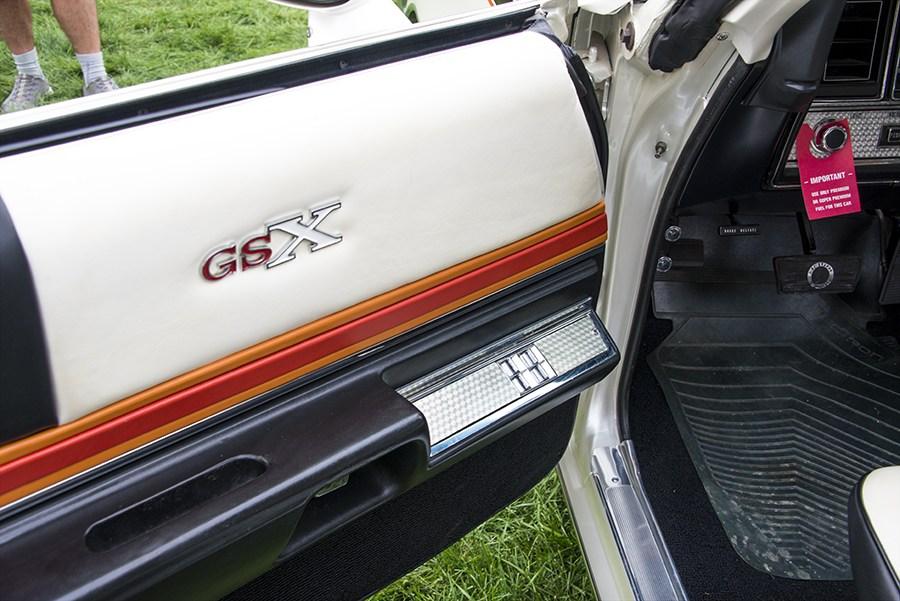
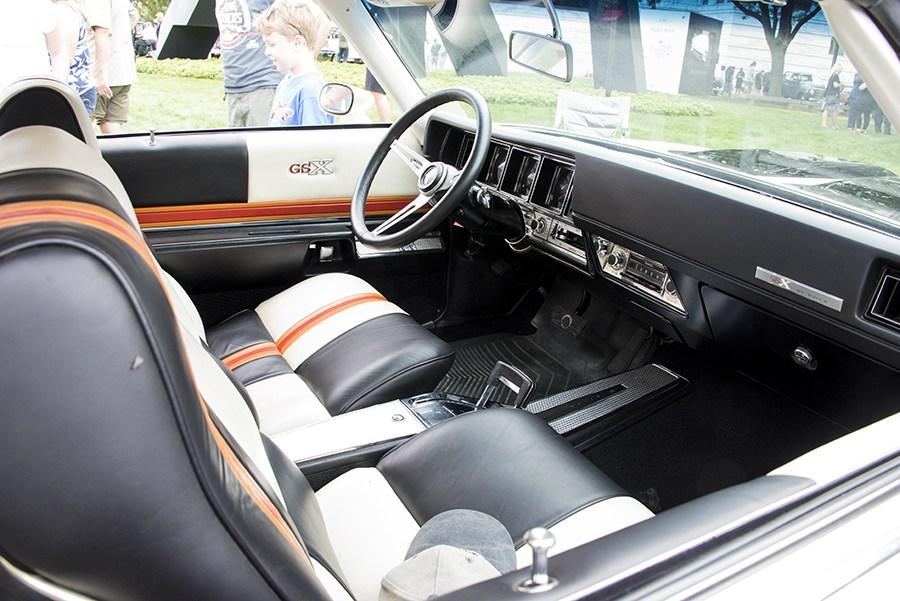
It was the interior that saw the biggest change. The very modlooking leather interior was designed by Buick Styling Studio interior designer Catherine Denek. Those individual seat panels and stripes were originally just painted black and orange on the white leather. This was a prototype/show car and not a durability car. Catherine raised the front seat backs, doing away with the separate headrests. She also raised the rear seat cushion forming mini headrests. Along with the expressive seat design, Catherine also incorporated Riveria-ish door panels with pullout door handles and integrated power window switchgear. By November 11, 1969, this GSX had been completed and photographed down in the GM Styling courtyard. According to a February 9, 1970, Buick press release, this GSX show car had already been shown in the Detroit, Los Angeles, and Dallas shows, while a production ready GSX was yet to be shown in Chicago. The public loved it, and formal production took place from March 2, 1970 to May 15, 1970. A total of 678 units in either Saturn Yellow or Apollo White were produced. There were some differences between this prototype and the production version. A stock GS bucket seat interior, GS hood and rear bumper were used in production. The spoilers got replaced with a simpler front spoiler and a one-piece rear spoiler with downward curved tips. A “GSX” decal adorned the back of the rear spoiler. Production saw the addition of a Pontiac hood tach. The GSX’s sport mirrors were unique within Buick for 1970.
Since this was only a color and trim car it wasn’t sent to the legendary Warhoops Auto Salvage in Sterling Heights, Michigan to be scrapped like many of the GM Motorama cars. Nor were stencils held to its doors and “YARD CAR” sprayed
Standard GSX on the left; prototype on the right.
Standard GSX on the left; prototype on the right.
on, thus also sealing its doom at the Flint plant. Being based on a production car, it could be legally sold. Like many Buick color and trim cars, this GSX went to Len Immke Buick in Columbus, Ohio. Len didn’t sell the GSX right away. No, he gave it to his high school son Jimmy to drive. A high schooler and one of the top ten fastest production 1970 muscle cars don’t mix. Jimmy accidentally customized the front end by running into a parking block at the Upper Arlington High School which ripped off that huge custom spoiler.
By May of 1978 BCA member Brad Conley of Marysville, Ohio is a twenty-something looking for a Gran Sport. Between Len Immke Buick and the current owner, Brad knew some of the interim owners of this car. He sees this GSX prototype with a for sale sign parked outside of a Columbus, Ohio realtor’s office. The asking price was only $1,850. SOLD!!! This would be the first of many Gran Sports in Brad’s collection.
Forward to around 1994. Brad had added some 45,000 miles on this GSX, as a year-round daily driver. It was now a tired, old, banged up car. Instead of waxing the pearl paint, someone just repainted the car. Ohio winter road salt had taken a toll on the front fenders, floor pan and the rear quarter panels. Both the engine and transmission needed rebuilds. It was time to restore this prototype back to its former glory.
The GSX went off to GS Enterprises in Potosi, Wisconsin for a
two-year restoration. Dave Kleiner of GS Enterprises painted the car. First, he had to spray it white. Then came white pearl, followed by gold pearl and finally mother of pearl. Working from pictures, a fiberglass mold was created and two new front spoilers got produced. It’s always good to have a spare, just in case you pull another “Jimmy” with a parking block.
Duane Heckman spent two years redoing the interior. The original hides were good enough to be used as patterns. Instead of simply painting each panel, Duane cut, and vat dyed each separate leather panel. That was a minimum of 3 hides @ 60 sq ft. Can you hear “CHA-CHING$$”? Both Duane and his wife got raw fingers trying to stretch and sew on the leather steering wheel wrap.
By May of 1996 the GSX is back to its show car level. That was just in time for the 1996 GS National. Advance to 2022.
The GSX got invited to the 2022 Detroit Concours d’Elegance on the grounds of the Detroit Institute of Art (DIA) in midtown Detroit. At daybreak of the show, the GSX had only acquired four (4) miles since 1996. Brad only drives the GSX off and on of the trailer at shows. The billboard tires are old, so Brad doesn’t like having to drive on them anymore than necessary. He periodically starts the GSX and lets it idle, to get all the fluids moving around.
By the time I met Brad Conley and his son Alex at the concours,
Colorful rear seats. Notice the machined chrome applique on the front of the console.
Colorful door panel with long armrest.
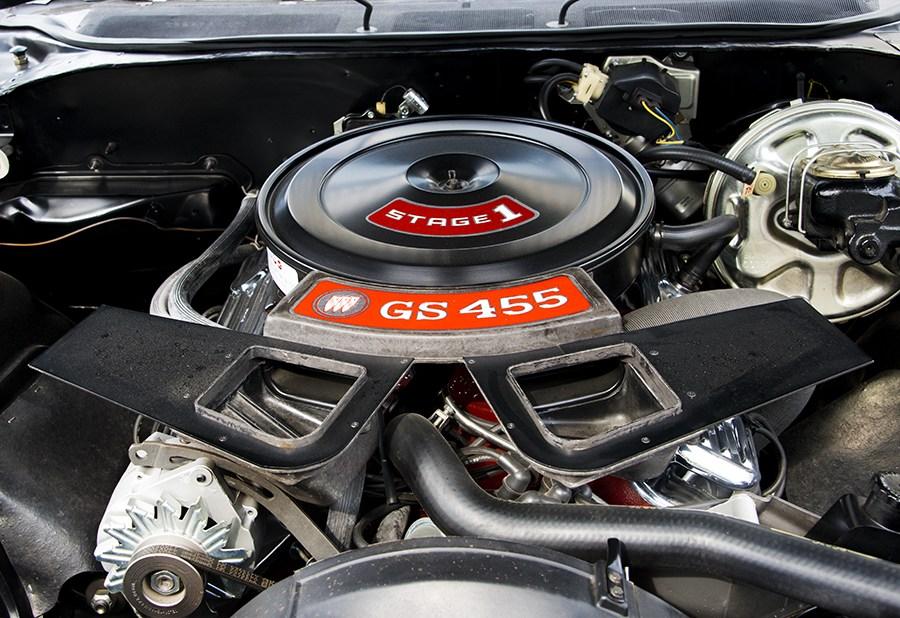
455 engine with hood scoop air receivers
“They made us park a mile or so out that way!” I’m not sure if by the end of the concours Brad doubled the post-restoration mileage on the GSX just in Detroit.
While the tires may not see much use, the front seats do. Brad does allow some people to sit on them during shows. When I first walked up to this GSX a happy smiling little kid was sitting behind the wheel. It goes back to a simple premise. How are you going to get people interested in this hobby, if your car is plastered with “Don’t Touch” signs? The exception to that is if say that kid had been encapsulated in cotton candy.
This GSX prototype did the job it was designed to do. That car plus a four-page sales brochure got people into a Buick showroom. Maybe someone drove out of a dealership in just a GS 350 with a bench seat. That was okay, as it was at least a sale. Unfortunately, those 678 1970 GSXs produced in that short run didn’t affect its corporate cousins. Pontiac turned out 3,797 GTO Judges, and Oldsmobile cranked out 3,100 442 W30s. What might have happened if the GSX had a full 1970 production year, while muscle cars were really hot?
If you had a little north of $4,478 (base GS: $3,283+GSX option: $1,195) in 1970, your kids were out of college, and you were having a mid-life crisis, Buick had the car for you. Selecting the A9-GSX option code, plus just the C5-power steering and a D1-AM radio got you a comfortable beast of a car. At a light, no matter what that 20-something kid next to you had in his Road Runner, you knew you could clean his clock.
1971 saw the start of the muscle car decline, and that of the GSX. Only 124 got produced for the whole 1971 model year. The long UAW strike at the beginning of the year didn’t help. You could now get a GSX with a 350 engine with all drum
It gets worse. How about the 1974 Apollo GSX, which came standard with the all-powerful Chevy straight 6? The 1974 GSX was basically a trim package which included a white/red bucket seat interior, exterior stripes, and a unique grille. For 1974 high performance now meant standard fake wire wheel covers!! Oh come on! This was a sad ending for what Brad’s GSX prototype had promised. At least the 1974 Pontiac Ventura-based GTO had a shaker hood, with a reversed air scoop poking through the hood.
Something tells me that Brad Conley may recoup his $1,850 plus restoration costs. At a 2023 Mecum Auction, a production 1970 GSX Stage 1 sold for $209,000. I don’t think you can treat this GSX being the prototype as if it was just a desirable option, adding 5-10% to the value.
References:
“Buick the V-8 and V-6 Performance Years” by Martlyn L. Schorr classic.com/m/buick/gran-sport/gsx-stage-1 www.hotcars.com/buick-gsx-facts/ www.hemmings.com/stories/article/ just-for-show-1970-buick-gsx-stage-1-show-car www.teknolojiaraci.com/10-quickest-1970smuscle-cars-what-they-cost-then-now-276? fbclid=IwAR0tqG91pkXj1CvyZK NLJsCdF0BRa385ufm-LULAlJe WmOC29QDWV_qzsPQ www.musclecarsillustrated.com/ buick-gsx-1970-1971-1972/ xr793.com/wp-content/uploads/ 2017/02/1974-Buick-Apollo-GSX.pdf
Side view.
Barris Brings Kustom Flair to Muscle
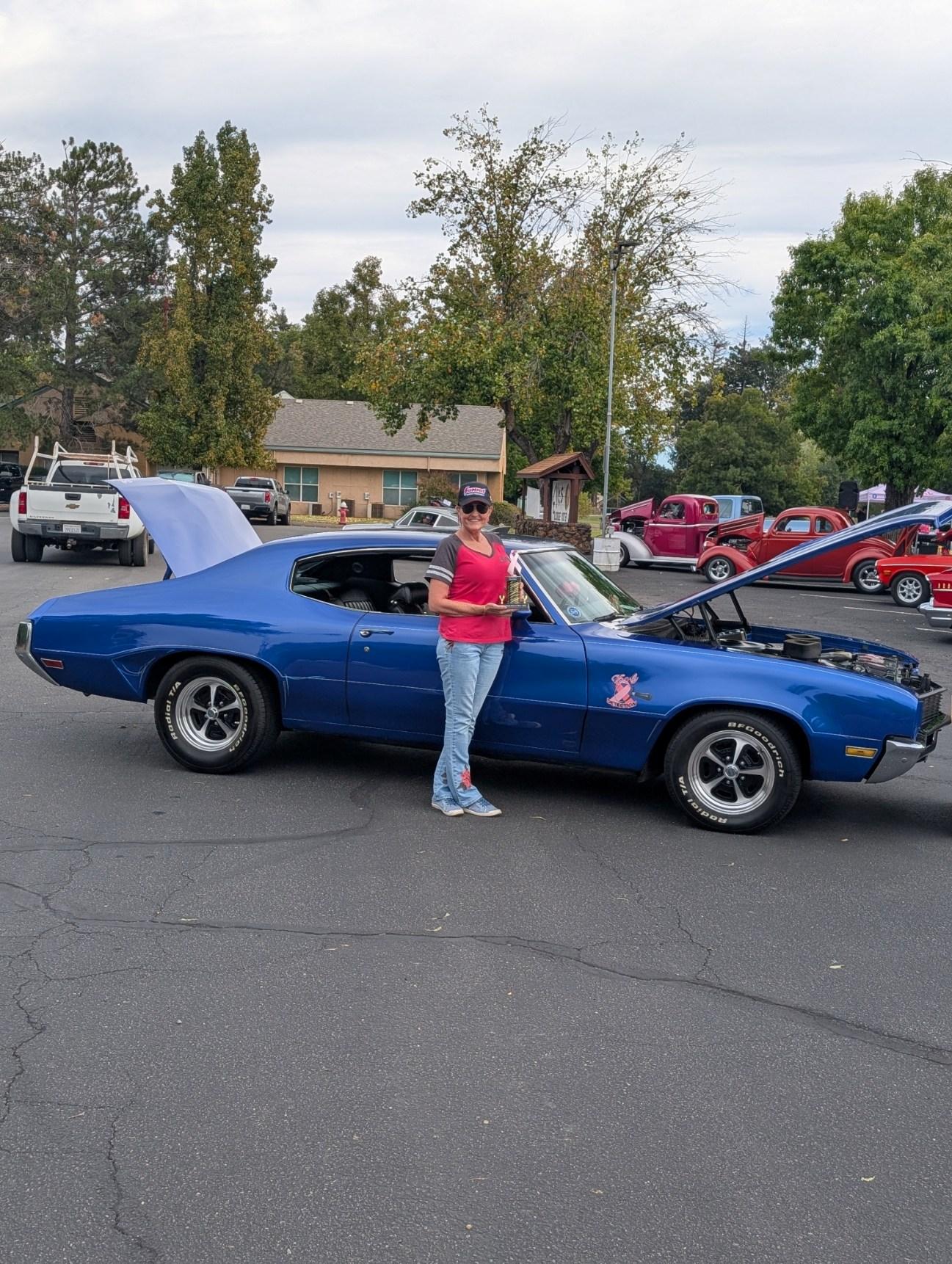
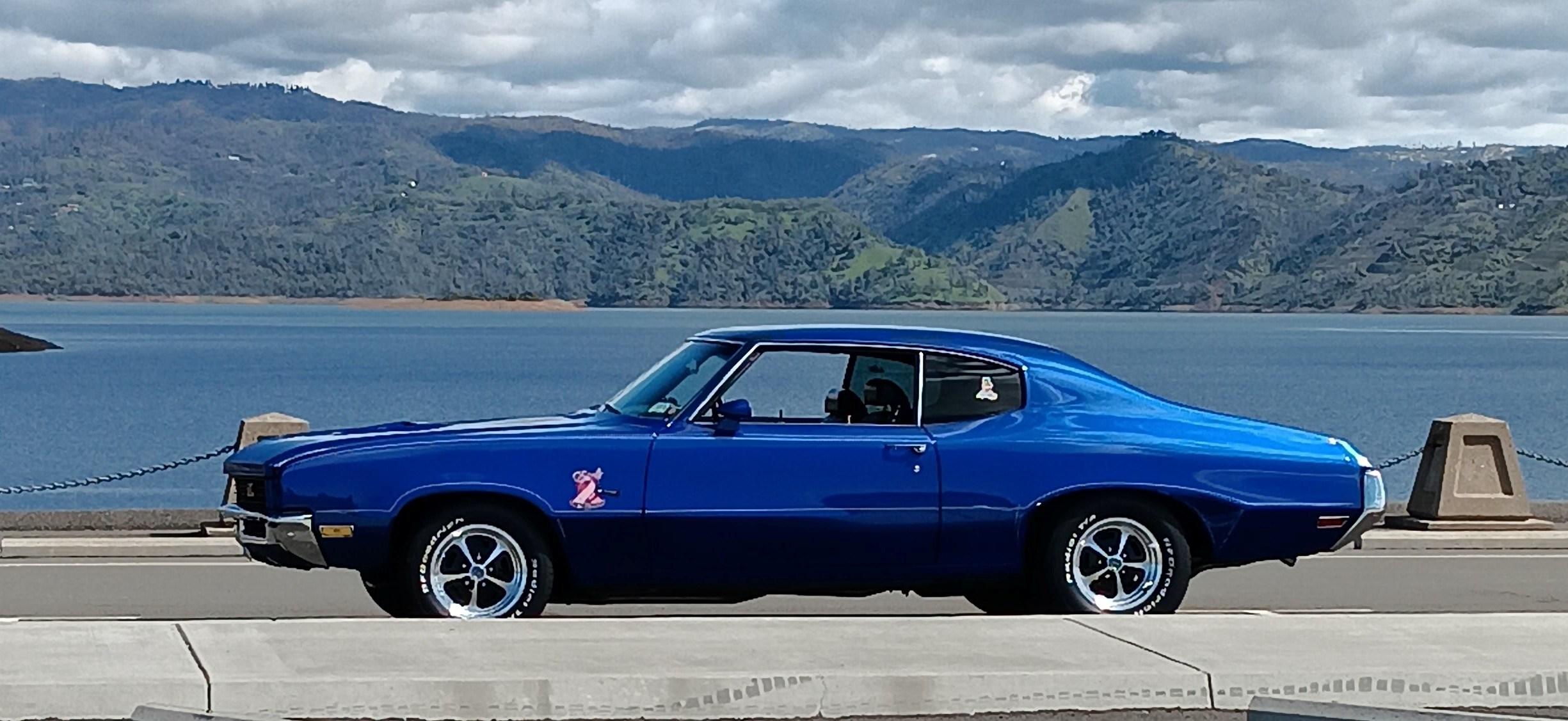
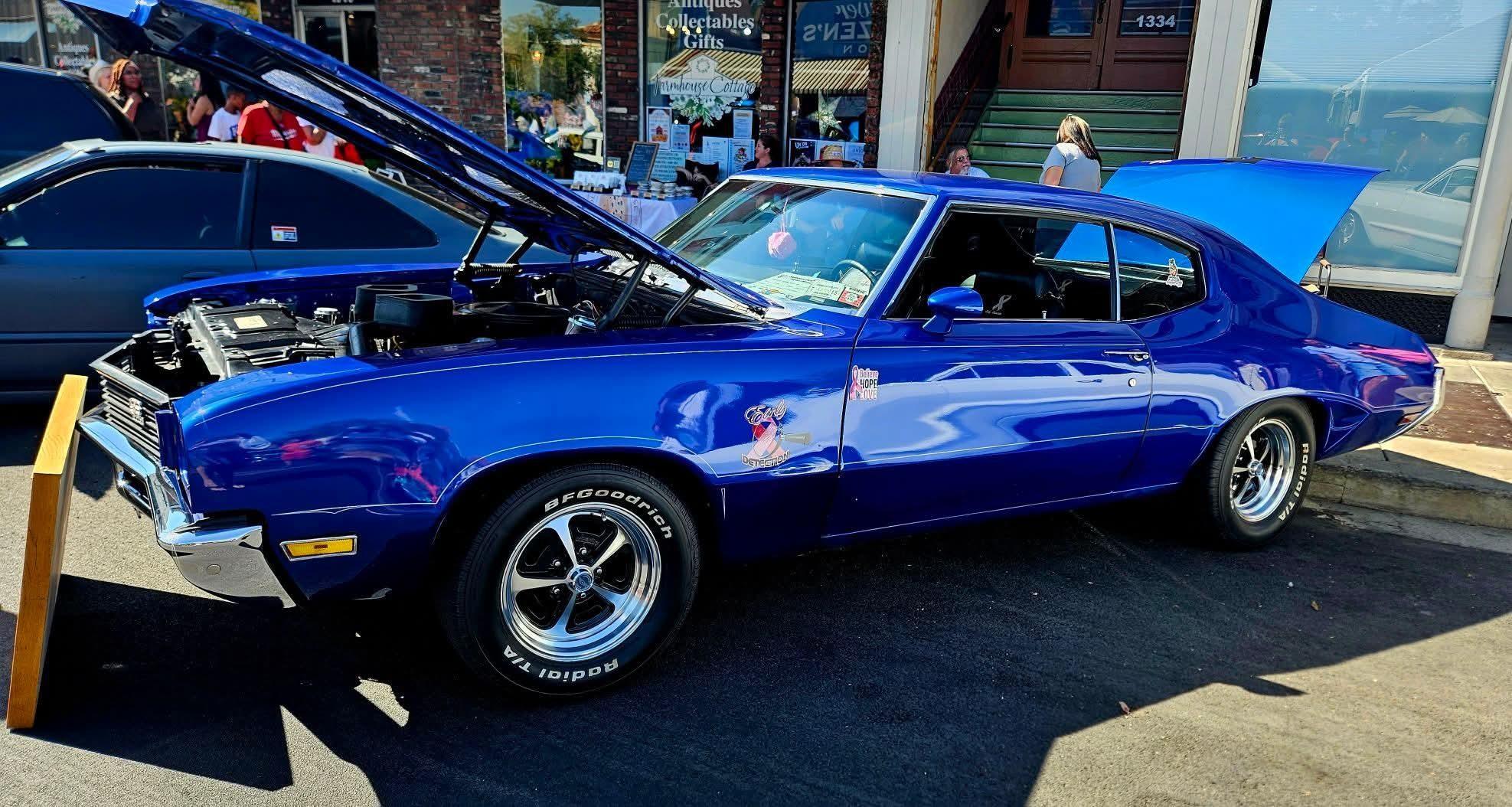
Barris collaborated with Barris Kustom Cars’ East Coast team at New York Custom Coach to elevate the GS into something far more than a performance car. The makeover included customfabricated coves behind the rear wheels, a fresh blue repaint with multi-color pin-striping, and pink ribbon logos stamped not just across the fenders but embroidered on seat backs inside unmistakable symbols of its awareness mission.
Design Meets Function
The vehicle retained its 350 c.i. V8 engine mated to a threespeed automatic transmission reliable and classic. Performance enhancements included front disc brakes, hood scoops for added aggression, and a dual exhaust system. A
Behind the Badge: Meaning and Story
The "Early Detection" branding wasn't just decorative it signified a deeper message. This GS 350 became a mobile canvas encouraging breast cancer vigilance, its bold aesthetic cutting through automotive norms to strike a chord of compassion alongside horsepower.
Auction Spotlight: A Car with a Cause
In October (Breast Cancer Awareness Month) 2023, the vehicle made its way to the Bring-a-Trailer auction block from Virginia. In typical Bring-a-Trailer fashion, the listing was rich with images and details, capturing both the car’s vibrant transformation and its current condition realities such as a missing molding piece, a dent on the roof, pitted wheels, aged tires, and a repaired body-line seam.
The 1972 GS 350 at a “Think Pink” event.
Despite the unique build and meaningful messaging, it fetched a high bid of only $8,600, so the reserve wasn’t met. A postauction negotiation landed an agreement and virtual handshake, which sent Early Detection on a trailer ride across the country to northern California, where the new owners, Mike and Ra’chell Wilson, spent the next several months refreshing the beauty of this iconic GS.
The Legacy of the 1972 Buick GS
The 1972 Buick GS line stood at the tail end of Buick’s golden era of "luxury muscle." As motorsport and environmental regulations began reining in freewheeling power, models like the GS retained a blend of comfort and performance. While the GS Stage 1 (and rarer GSX variants) are celebrated for their torque-rich big-block motors, this GS 350 opted for a gentler, yet still spirited, approach.
Why This Article Matters
Cultural resonance: The car illustrates how automotive culture can intersect with social causes melding style and substance.
Design heritage: George Barris’ involvement ties this project to a legendary lineage of custom car artistry.
The GS 350, typically overshadowed by high-power variants, assumed a new life as both a beauty and a beacon.
Final Thoughts: More Than Metal and Paint
This 1972 Buick GS 350 transformed into "Early Detection" commands attention not solely for its curves or performance, but for the story it tells. It's a reminder that cars carry more than engines they can carry messages, spark conversations, and honor causes.
Today “Early Detection” can be seen in various northern California show and shines, local drive ins or just cruising local rural roadways where thumbs up, a horn from a passing car or someone yelling out reminds us of the important message and mission this Barris creation offered the enthusiast who lives inside all of us.
At a downtown Oroville, California car show.
Northern California scenic background.
MEDIAKIT
Delivering news, technical tips and information 11 months a year to over 8,000 members of the Buick Club ofAmerica, worldwide.
ADVERTISING RATES
MECHANICAL REQUIREMENTS
A 10% discount will be applied when submitting and prepaying a display ad for 11 consecutive issues.
HOW TO SUBMIT A DISPLAY AD
• All display ads must be camera ready to correct size. No typewritten or photo copies accepted.
• Print resolution must be 300 dpi. High-resolution PDF and JPEG files accepted.
• No tear sheets are provided. You may purchase single copies of the Bugle by sending $5 per copy to the BCA National office (address below).
• The Buick Club of America is not responsible for any transactions made through our advertising sections. We reserved the right to refuse advertising to any individual or business whose advertising we feel is detrimental to the Buick Club
of America and it’s chapters or its members.
• Questions about artwork? Contact Shannon Olson, Bugle Art Director at olsonrsa@gmail.com.
• Payment must accompany all display ads. Make check payable to Buick Club of America.
For display advertising information contact: Jerry Wilson jfwilson66@earthlink.net 314-878-5651
DEADLINES
Reservation deadline is the 10th of the month, approximately six weeks before issue date (i.e. April 10 is the deadline for the June issue). Artwork is due on the 24th of each month (two weeks after deadline reservation).
the marketplace
HOW TO PLACE A CLASSIFIED AD
● BCA Member rates: One free ad per issue. Ads must be 30 words or less, not counting name, BCA #, address, phone number and email address. Each word over the allotment is $0.15 per word over 30. If a photo is placed in a free ad, the photo costs $35.00 per photo. All photos will be published in color. All display ads and classified ads must be pre-paid.
● Commercial/Non-member rates: These rates also apply to BCA members who are “in the business” of selling cars, parts or related items and services. The minimum charge per ad is $15.00 for 30 words or less. Additional words are $0.15 per word. Do not count your name, address, phone number or email address.
● Photos: $35.00 per issue for photos. All photos will be published in color. Rate applies to members and non-members, alike. Photos will not be returned.
● Deadlines: Ads must be received by the 24th of each month, two months prior to issue month. For example, the deadline is August 24, for the October issue. Late ads will appear the following month.
● Payment: Payment in full must accompany all ads (or sent in the mail, immediately after sending an email ad). We do not have a billing service. Make checks payable to BCA.
Note to all advertisers: When you receive your magazine each month, PLEASE CHECK YOUR AD. Any correction or change must be immediately reported to the editor. Delay may cause the mistake to be repeated in future issues.
Ads run for one issue only, unless requested otherwise (and paid for, if it is a paid ad). We will run the same ad for up to 12 months, if requested. After 12 months, the ad needs to change, to avoid getting stale.
Send ads, photos and report of corrections to:
Phillips, Bugle Editor PO Box 1247 ● Leonard, TX 75452
Tel: 903-436-2851 No texting ● Fax: 903-587-0907 pphillips922@gmail.com
1917 D-45 Touring CarUnrestored California car. In running condition. Differential gears, brakes, tires, cone clutch, and engine tuneup done. Top is in poor condition. Seats have been reupholstered. There are drivetrain parts from another car available. Asking $17,000. Bob Engle, 540-2478634, bengle1917@gmail.com (5)
1922 4-Door Enclosed CarOlder restoration, runs fine. Call for information 9-5 EST. Ron Rasmussen, BCA #14073, Narrowsburg, NY, 845-252-3903 (5)
1927 Model 27-20 - Coach Sedan Standard Six. Extremely solid, completely intact and rust free, excellent condition top. Simplex motor gauge hood ornament, trunk, and many other unique features. More pictures upon request. $8,500. Rob Kowalski, BCA #52450, Alden, MI, 231-620-7362, rk7362@aol.com (5)
Can classified ads and photos be submitted by email? Absolutely! pphillips922@gmail.com
1931 Model 54 RoadsterExtremely rare Marquette body with torque tube. Comes with many valuable parts needed for restoration, including extra engine. $7,500. Bill Billado, 802-9852405, fwbinvt@gmail.com (5)
1937 Century CoupeLustrous black. Resprayed years ago. Runs strong. Rewired three years ago. Wood grain redone, mohair interior. Chrome is good. No rot or rust. Well maintained. $32,500. Chris Deacon, BCA #47655, 00 S Seranado St, Orange, CA 92869, 818-404-9417 (5)
1950 Roadmaster 2-Door Hardtop - 75,000 actual miles, no rust, excellent chrome, one repaint in original colors, recent tires, detailed engine, cloth & leather upholstery. $18,500. Pete Phillips, BCA #7338, Leonard, TX, 903-436-2851, pphillips922@gmail.com (5)
1950 2-Door SedanetOriginal straight eight, Dynaflow, runs and drives perfectly. Mechanically sound, drive anywhere. Clean interior. Everything works. Many new parts. Contact for photos. Asking $22,000 OBO. RH Cox, BCA #49742, rhc8011@gmail.com, 330388-2597 (5)
CARS FOR SALE
1951 and 1952 Super Convertibles - 1952 original and complete. 1951 is a restomod with 1995 Firebird drive train, 6-speed trans, missing windows. Both require full restoration including metal repair. Extra parts go with. Bruce Hawkins, BCA #49372, Vero Beach, FL, 772-559-4595, hawkinsbr@yahoo.com (5)
1958 Super - VIN #5E4011 780. Selling whole car for
parts. No title, just Bill of Sale. Good trim, glass, seats. Like new grille in trunk. 364 CI. nail head V-8 with A/C. Extra parts. Local pickup. $2,500.00 as is. James Sanchez, 07 Sanchez Ln, Jarales, NM 87034, 505-7122225 (5)
1961 Electra Coupe - Factory 2-tone paint, Cordovan Brown and Sun Valley Cream. CA car, super clean, mostly original paint, original Electra Coupe interior. Some checking on hood. Original engine and drive line. Runs, mint, drive it home! $34,500.
Jimmy Shiels, BCA #32192, jimmyshiels66@gmail.com, 508-509-5471 (5)
1964 Electra 225 4-Door Six Window Pillarless Hardtop35,700+/- miles. All original, unrestored. Three-time BCA Archival winner, 1 AACA HPOF winner. Marlin Blue Metallic, 401 cu. in, PS, PB, A/C, PW. All original sale and owner documents, literature, including parts, repair, sales, more. Some additional parts. $16,500. Chuck Kiser, BCA #37256, Chelsea, AL, 205-585 -7735, cfkiser@aol.com (07/26)
1965 Gran Sport - Rare. All original, frame up restoration. Numbers matching. Power brakes, steering, driver’s seat, windows. Tilt steering wheel, A/C, 401 Engine, HP 325. Awarded Senior Gold at 2023 BCA convention. Photos
available. Gary Weems, BCA #49321, Post Falls, Idaho, 760-638-6574, twindade@ gmail.com (5,6)
1965 Skylark 2-Door Hardtop - Excellent car, only 46K miles. 310 engine, auto, bucket seats, console, front disc brakes, dual exhaust. New wheels and tires, carb, alternator, starter. $25,000 firm. Ed, Orlando, FL, 407399-5498 (5,6,7)
1968 Skylark Custom Coupe - Turnkey classic cruiser. 350 V-8. Smooth super turbine automatic. P/S. Dual exhaust. Wingvents! White over blue with clearcoat. Super clean throughout. No rust. Not a scratch. Pics. $22,500. Jace Watson, BCA #35816, Mifflinburg, PA, 570-9669363, jdwatson@dejazzd.com (06/26)
bca@cornerstonereg.com 763-420-7829 PO Box 1715 Maple Grove, MN 55311 Office Hours: M-F 9-5 (Central) Or log on to buickclub.org
CARS FOR SALE
1970 GS 455 Convertible57,600 miles Owned for 52 years. Original top, interior, engine, auto transmission, older repaint. New 14” Cobra GT Radials. Driven to Cleveland National in 2024. $74,500. Tom Walzak, BCA #41702, Lockport, NY, 716346-5633, k.walzak@att.net (5)
1986 LeSabre Funeral Coach - S&S body work. 50,200 miles. Excellent condition, pictures available, history and factory build documents. $9,800. Vehicle at Heartland Regional, Ames, IA June 25-27. Harold Werley, BCA #35780, Moville, IA, 712-873-3555, leave message. (5,6)
1989 Reatta - Red/Tan, good condition, 103,000 miles. Some scratches on wind shield; tires outdated. Lowered price $6500. Mike Jones. BCA #38005, 4453 S 200 E, Anderson, IN 46017, 765-274-2144, miketiltent@ comcast.net (5,6)
1990 Reatta Convertible67K miles, 3rd owner, all documentation. 1990 only color Light Driftwood Metallic; only 64 units. Very good condition. 30 year Buick collector.
$11,990. Jeff Cornish, BCA #28408. Seattle, 425-4229527, cornishallanjeffrey@ gmail.com (5)
1991 Reatta - White, red interior, 116k, brakes rebuilt, fuel sending repaired, headlight kit, new window motor, no damage body and paint, California car. $5,000. George Rhodaback, Medford, OR, ddustyroads@yahoo.com, 541-618-3453 (5)
CARS WANTED
1965 Riviera or Gran Sport - After years of my wife telling me to sell all those old cars and buy the ONE you really WANT, I have done just that! Neil Colella, BCA #19739, Albuquerque, NM, 505 249-3441, tlcneil@ me.com (5,6,7)
1967 GS Convertible - Must be matching numbers 4-speed. Would prefer Verde Green, black top and interior. Would consider all colors. 400 point Gold Senior a plus. Dave Briddick, BCA #48059, Spring Valley, IL 61362, briddickd@hotmail.com, 815 664-2002 leave message. (5,6)
Skyhawk - Searching for a Skyhawk. Need not be pristine, but good condition to very good and driveable with minor to no work required. Prefer first generation and manual, but open minded. Kurt, BCA #54037, 315 0811, kurtwrbessel@ gmail.com (09/26)
1996 Regal - Looking for a clean, rust-free, low to moderate rate mileage, 1996 Buick Regal GS Gran Sport 2door Coupe or Sedan. Retiree wants to go out in style. James Barajas, BCA #8185, 708745-8335 (5,6,7)
PARTS FOR SALE
Carburetors for 1904-1956 Buicks - 100’s in stock. New, used, and rebuilt. Vintage Carburetor, Ltd., 440-7868141, email: broadstreetltd@ msn.com, vintagecarb.com (02/27)
PARTS FOR SALE
Runningboard Mats - In the correct 1-piece molded patterns for 1930-1935 Series 50, 60, 80, 90. Northfield Ltd., 440-786-8141, email: broadstreetltd@msn.com, Web: www.northfieldltd.com (02/27)
1932 Model 56S Body PartsHood, front and rear fenders, gas tank, running board trim and mounting brackets. Many of these parts will fit other 50 series cars. Bob Engle, BCA #34918, 5001 Brill Road Str, Tannery, Virginia 22664, 540247-8634, bengle1917@ gmail.com (5)
1933 - Running board side chrome trim. Very nice replacement. 72” long and 9/16” wide. That is about 1/8” wider than stock. $200 pair. Shipping and mounting clips are extra. Jack Huffman, BCA #45749, Victoria, IL, 309368-4283 (5)
Buick NOS - 1938 Century wiper motor, $50. 1938-1939 (60-80-90) Vacuum starter switch only, for Stromberg carb, $60. 1938-1948 (60-7080-90) clutch disc, 10 1/2”, $75. 1939 left or right headlight lenses, specify, $50 each. 1940 headlight switch with plastic handle, used, $40. 1940-1941 (All), 1942 (40-6090), 1946-1947 (40) electric clock, used, $40. 1941 (40-5060-70) steering gear pitman arm, $25. 1946-1948 (50-70) left used, right NOS wiper
transmissions, $150 pair, 1948-1956 transmission mounts, specify standard or Dynaflow, $40. 1950-1952 (All), 1953 (40) master cylinder with fresh kit, $90. 1953-1955 (50-60), 19561963 (with 322-364 engine) clutch disc, 11”, $80. 19571958 gearshift control lever, for standard transmission, $25. All NOS, except as noted. Add for shipping & handling. Have parts 1928 – 1979. Send SASE, year, model, for list. Bob Graves, BCA #942, 21 Ferry Rd., Salisbury, Mass. 01952, 978-463-0715 evenings. (5)
1939-1964 Buick Rocker Panels, NORS - 2-door and 4door priced from $60 - $120 each. NORS dog legs, door skins, quarter and fender sections from 1941-1959. Gary Bauer, BCA #28325, 804 Chicago Ave, Waukesha, WI 53188-3511, 262-4245286, rockerking57@ yahoo.com (5)
Dashboards 1940-41 - Buick engine turned dashboards and door panels. Finished like new. Some stock for faster
delivery. Our specialty for 25 years. Call or write for details. Doug Seybold, BCA #3983, 2761 Clark Parkway, Westlake, OH 44145. 440835-1193 (12)
1940-1941 Buick Parts & Restoration ServicesSpecials. Supers, Centurys, Limiteds, Roadmastersparting out, and new steering wheels, gauges, plastics, dashboards, rocker moldings, engines transmissions, sheet metal, more. We do it all. Call or write for details. Doug Seybold BCA #3983, 2761 Clark Parkway, Westlake, OH 44145, 440-835-1193 (12)
1942, 1946, and 1947-1948Buick grilles, highly polished. Absolutely show quality on frames, ready to install. $450 for 1942, 1947, 1948. $475 for 1946. Lewis Cohen, BCA #3185, 58 North Racebrook Rd, Woodridge, CT 06525 (09/26)
1947 Roadmaster 76C Convertible Parting OutRebuilt 320 engine, dash, lifter & valve covers, belt molding, regulators, gas tank,
air cleaner, rocker assembly, glovebox door, fender and skirt (1942), hood emblem (1948). Extensive list & photos available. Ed Lorence, BCA #50554, Cleveland, Ohio, 440-655-9824, lorenced1@icloud.com (02/27)
1948 thru 1950 all & 1951 (40-50) - backup light switch for manual trans, NOS, $35. 1939 (60-80-90), 1940 thru 1952 all & 1953 (40) clutch release yoke with boot, NOS, $40. 1936 Special rebuilt master cylinder, $75. 1950 rear door moldings (41D-5159-71-79), & rear fender moldings (41D-51-52-59-7172-79). All moldings NOS, $15 each. John Johnson, BCA #3923, IL, jericjohnson@ att.net, 847-345-4122 (5)
1953 Skylark & Roadmaster - Dash Dy-Noc replacement. Silver, gray, and white. $160 plus $10 shipping. Denny Robish, BCA #43156, 1015 Janet Avenue NW, North Canton, Ohio 44720, 330-697-6202 (12)
PARTS FOR SALE PARTS WANTED
1953 Buick - Complete steering wheel in excellent original condition. Includes black rim, chrome horn assembly/hub, and red-whiteblue center emblem. Asking $225/offer. Jody, BCA #49467, Dodgeville, WI, kelimo@mhtc.net (10/26)
1953-1955 Super/ Roadmaster - NORS muffler. Original, full size, heavy muffler. New old replacement stock, still in original tired box. Correct sound for a 1950’s Buick. Pickup at BCA National in Albany. $110. Ken Laytin, BCA #30473, roadmaster@behaviordoc.com 508-747-1966 evenings EST. (8)
1954-1955-1956 Century & Special Station Wagon - All four doors, in primer, no rust, $400 for all or $150 each. Pete Phillips, BCA #7338, Leonard, TX 75452, 903-4362851 or pphillips922@ gmail.com (5,6)
1958 Century/Special - NOS and used parts and accessories. Stainless steel trim, lens. List and pics available. BCA #41143, Email bconklin49@gmail.com, text 901-283-1949 (12)
1965 Riviera NOS - wheel opening moldings, $800. Passenger door skin, $300. USED: black wood door panels, more. Four ads: Craigslist>LosAngeles>Auto Parts. Trent, BCA #19794, 310-378-6826, sportwagon@juno.com (5)
Wheel Center CapsReproductions for Buick and Skylark. Mitch Romanowski, BCA #33886, 847-705-5761, illustrator.mitch@gmail.com (5)
1926 Master - My distributor is seized. I need a 1928 or 1929 Buick distributor that is in usable shape. I would also appreciate information about any other swaps that would work. Joel Parliament, BCA #51478, 2111 Linden Lake Rd, Fort Collins, Co 80524, 970-217-1325, jparliment@ hotmail.com (5,6,7)
1928 Country CoupeSeeking radiator ornament (head of Indian lady), left front shock absorber (right one is installed, left one is missing), engine top side cover (spark plug cover). Eugen, 327553@gmail.com (5)
1946-1950 Buicks - Need 2 Door stainless door molding, either side, 48”. 1950 driver side parking light – turn signal pod. 1950 chrome bar over rear license plate. Mike Donlan, BCA #52987, 505670-8783, mikedonlan@ hotmail.com (07/26)
1965 LeSabre Custom Coupe - Need driver's side rear armrest with ashtray and air cleaner housing for 300 V8. Brian Girasoli, BCA #53153, Old Lyme, CT 06371, 860-608-2405, gsoli76@gmailcom (12)
1966 Model 45269 (LeSabre 4-Door Sedan) - Front turn signal assemblies #910949, #910950, antenna mast #1376830, steering wheel #9744181, heater cable "RED" #1376856, RF door exterior molding. NOS or Excellent
1962 Skylark - Need four 13" OE rims. Must be in good condition, no or minimal rust. Lug holes must not be "eroded". Prefer within 200 miles of Atlanta for pickup. Gene Roth, BCA #54058, geno43roth@gmail.com, 678524-9097 (12)
Wheels - Seeking five original mid-sixties factory black 15” Buick wheels. Dave Briddick, BCA #48059, Spring Valley, IL 61362, briddickd@hot mail.com, 815-664-2002 leave message. (5,6,7)
PARTS WANTED
Used. Matt Planning, BCA #46253, 262-313-8149, Matt@RediRad.com (5)
1968 Buick Skylark Convertible - 2-Door Hardtop should be the same part. Needing the armrest backing plate, passenger side door that is behind the armrest and it then mounts to the Door Panel. Plastic with a ribbed front portion) It's a 1968 only year part! Michael Polito, BCA #43785, 5615 Blue Roan Terrace, Parrish, FL 34219, 203-733-6926 cell, mpolito64@gmail.com (5)
1968 LeSabre 4-DoorNeeding left rear fendermounted power radio antenna assembly, actuated by my original factory dash-mounted roller switch, with chrome base and mounting hardware. OEM/NOS. Jim Runsvold, BCA #54332, 4219 Washington Ave., Caldwell, ID 83607, 208-459-2610 (voice only), catmchan@ gmail.com (5,6,7)
1987 LeSabre - I need a windshield for my 1987 Buick LeSabre. David Pifer, BCA #52958, 521 Ivy St., Pittsburgh, PA 15232, davidmp_424@msn.com, 412-361-1788 (5,6)
MEMORABILIA FOR SALE
1985 LeSabre - Collector's Edition leatherette folder. Includes key pouch, 4 keys, hardbound book "A Commemorative History of GM and Buick", color 4 page brochure of 1985 Collector's edition model, frameable 8x12 color pics of LeSabre from 1959 -1985. $25.95 postage paid. Pat Riley, BCA #01385, 817-219-1266, buickpat@ gmail.com (04/27)
Buick “Curbside Chats”Sent monthly to dealers on activities, strategies, and products. 57 VHA tapes from July 1987 to September 1991. Few missing. 25-40 minutes. Pictures on request. $15 each OBO postpaid. Pat Rley, BCA #01385, 817-219-1266, buickpat@gmail.com (03/27)
1959 Buick - Two 33 1/3 promo records. 1959 Buick Introduction Spots for Radio. 1959 Buick Dealer
Introduction preview with Bob Hope. All excellent. $150, free shipping USA only. Jack Scott, BCA #12879, Florida, 407-830-4954 (5)
PRINT MEDIA FOR SALE
“Carburetors and Engine Controls” 1910s - 1970sThis book (“Fundamental Carburetion”) takes a unique approach (the How and Why) to help you understand carburetors and the supporting systems (ignition timing, fuels, and intake manifolds), plus troubleshooting tips. See FundamentalCarburetion.com for more details and ordering options. Dean Tryon, BCA #22400, dgtryon2516@ gmail.com, 919-441-1271 (NC) (12)
Buick Memorabilia and Literature - Various items from 1953 and up. Lots of 1964 items. E-Mail for complete list. Louis Ironside, BCA #11882, louisironside@ aol.com, 810-798-8803 (5)
1966 Buick Service ManualAll Series. Near pristine condition. 2.5 inches thick. Also, 1966 Fisher Body Service Manual, same condition, 1 inch thick. $100 plus shipping buys both. 1953, 1955, 1956, 1981 Buick Shop manuals. Covers are rough but all are complete, $30 each plus shipping. I have over 30 Motors Auto Repair Manuals
from 1930s to 1990s. Ask me what year you want, $25 each plus shipping. Paul Girard, BCA #41392, 4 Bridge View
Lane, Buzzards Bay, MA 02532, 508-615-0000, pirate3200@aol.com (12)
BCAOFFICEMANAGERS
To replace a lost or damaged Bugle: Cornerstone Registration, Ltd. Tel: 763-420-7829
Do You have a Buick or GM Business?
For display advertising information contact: Jerry Wilson, jfwilson66@earthlink.net, 314-878-5651
STATIC CLING DECALS
Applies to inside of window (re-usuable) 3” diameter Red, white & blue $5.00 each
PRINT MEDIAFOR WANTED
To US addresses, postpaid
Central New England Chapter c/o Jim Ramsey, BCA #39895 3 Campbell Drive, Easthampton, MA 01027
ALABAMA
BAMA BUICK (SE)
John Cover (Birmingham, AL) 205-991-7106; jecengr@yahoo.com
CALIFORNIA
BUICK CLUB OF THE REDWOODS (GW)
Bobby Olivieri (Santa Rosa, CA) 707-819-6449; highlytrained@gmail.com buickcluboftheredwoods.com
CALIFORNIA CAPITOL (GW)
Michael Frerichs (Elk Grove, CA) 916-842-7396;
LOS ANGELES (GW)
Steve Rostam (Woodland Hills, CA) 818-999-6626
NORTHERN CALIFORNIA (GW)
Rick Deutsch (San Jose, CA) 408-8 88-4752; ricky.deutsch@gmail.com BuicksNorCal.com
ORANGE COUNTY (GW)
Jeff Shugarman (Tustin, CA) 714-323-4097; shugar410@gmail.com orangecounty.buickclub.org