“In a time of drastic change, it is the learners who inherit the future.The learned usually find themselves equipped to live in a world that no longer exists.”
Eric Hoffer
It is a very exciting and important time for you as Year 9 pupils! For much of your school life so far, you have had relatively little choice about the composition of your education. You now have much more say in what you will be learning as you structure your learning journey to align even more with your passions and aptitudes. This is the real start of the personalisation of your educational journey as you move closer to becoming an adult and it is therefore important that you take the time to carefully consider your options and the future implications of your choices.
We have structured the Key Stage 4 curriculum to be as flexible as possible so that you can pursue your academic interests in the subjects that you believe are most suitable for you as a learner and for your future. We also aim to help you to develop excellent academic skills on which to build at A Level and beyond. To this end, the Learning Pathways course and the Higher Project Qualification are exciting and valuable options about which you can read more in this booklet.
Finally, I would encourage you to read widely, to listen to podcasts and to be fascinated not just by what you are taught at school, but also by want you can learn independently and interdependently.
As Malala Yousafzai said,
“The content of a book holds the power of education and it is with this power that we can shape our future and change lives.”
With our support and the choices you make, you will be shaping your future – good luck and bring your passion to your studies!
Martin Walker Vice Principal - (Principal from Aprill 2026)
AT A GLANCE - KEY INFORMATION GCSE OPTIONS
What GCSEs must I study to continue with certain subjects at A level?
The best way to find out what GCSEs are needed at A Level is to speak with a teacher of that subject to find out. The table below shows some subject’s requirements:
A-level
Required GCSEs
Recommended GCSEs
Art A portfolio if you have not studied GCSE Art Biology Biology Chemistry
Chemistry Chemistry Biology
Maths/Further Maths Maths Physics
Physical Education Biology, PE
Physics Physics
Photography A portfolio if you have not studied GCSE Art Art
Psychology Biology
The 2025 A level curriculum guide will give you a detailed breakdown of what is involved in each A level subject at Berkhamsted, together with entry requirements and subject requirements (if applicable).
How many (I)GCSEs can I study at Berkhamsted?
Pupils have the flexibility to study between 11.5 and 8 GCSEs at Berkhamsted.
11 GCSEs 10 GCSEs
10 GCSEs
9 GCSEs
8 GCSEs Maths Maths Maths Maths Maths
English Literature
English Literature English Literature English Literature
English Literature
English Language English Language English Language English Language English Language
Ad
1
3 Option 1
1
4 Option 2
Option 3
3
Option 4 Option 4 Additional Maths
Additional Maths
+0.5 of a GCSE if pupils complete an HPQ
Should I study a Language?
6 Option 6
Learning Support
Yes. Unless you have a good reason for not doing so, you should choose a Language. These subjects are French, Spanish, Latin or Chinese.
Should I study a Creative/practical subject?
Yes. Unless you have a good reason for not doing so, you should choose a Creative subject. These subjects are Art, Design Technology, Drama, Food and Nutrition, Music and Physical Education.
Should I study an optional Humanities subject?
Yes. Unless you have a good reason for not doing so, you should choose a Humanities Subject. These subjects are Classical Civilisation, Geography, History and Religious Studies, in addition to English Language and Literature.
Should I study the Sciences?
You must study at least one Science as part of your option subjects. Biology, Chemistry and Physics are important subjects in their own right and you must decide whether you study one, two or three Sciences. In addition to this, we also offer Computer Science.
Are subjects set by ability at Berkhamsted?
Subjects in the “core” – English and Maths – are set by ability.
Who should I ask for advice from?
You should seek advice from a range of teachers at School, as well as friends and family who know you well. Your tutor or Head of House is a great place to start in School as they know lots about you from your reports and grades. If you have questions about individual subjects, you can ask your teacher or email the Head of Department.
What is “Additional Science”?
Additional Science (Ad Science) is an opportunity for some pupils to complete three sciences in two options blocks (and the time dedicated to Learning Pathways lessons). This is most suitable for pupils who show the highest aptitude in all sciences alongside well-developed study skills and a mature approach to learning.
If you are part of the Ad Science classes you will not be able to formally take part in the Learning Pathways lessons (but will be able to access the resources, should you wish to).
Ad Science classes cover content at a marginally higher pace to that in other classes. Ad Science pupils will also get some study time each week (40 minutes).
What is “Additional Maths”?
The Additional Maths course provides our more able pupils with an opportunity to study some of the core topics of their IGCSE course at a level more in line with that of A Level. It consolidates and deepens their understanding and helps to prepare those who are keen to take either Mathematics or Mathematics and Further Mathematics at A Level. It is not a pre-requisite course for pupils to take A Level Mathematics and many pupils take the A Level course successfully without having studied it. The course is delivered in parallel with the iGCSE content and different sets cover different proportions of the content. Where appropriate students will be entered for the examination alongside their GCSEs at the end of Year 11. The course covers Algebra, Coordinate Geometry, Trigonometry, Calculus, Kinematics, Exponentials and Logs, Numerical Methods, Permutations and Combinations. Please note that Additional Maths takes place in normal Maths lesson so is not an option subject to pick at this stage.
LEARNING PATHWAY PROGRAMME
We have changed the format for options at Key Stage 4, GCSE, to allow our pupils a greater flexibility to their learning choices and the opportunity to gain leadership skills. These are designed to prepare them for studying in Sixth Form and beyond learning skills to not just gain their first job but their first promotion too.
THE PURPOSE OF THE ‘LEARNING PATHWAY PROGRAMME’ IS:
To foster intellectual curiosity, autonomy and self-regulation
To give the KS4 curriculum more breadth and to inspire pupils with new areas of study
To intentionally prepare pupils for methods of learning that are prevalent in the work place
To allow some pupils to develop an understanding of “sixth-form only” subjects
To prepare pupils for independent and inquisitive work in the Sixth
To prepare pupils for an EPQ in the Sixth
To intentionally coach pupils how to study, plan, review and self-evaluate
To give space in the curriculum for learning support intervention within School time
SKILLS GAINED FROM LEARNING PATHWAYS
The new KS4 programme is designed to develop key skills in preparation for A Levels study and beyond. It is designed to encourage skills required for further study and in the working world:
• Independent work
• Research
• Planning, review and self-evaluation
• Receiving coaching, mentoring and tutoring
• Continuous learning online
• Psychology
• Sociology
• Business
• Economics
• Finance
• Politics
• Law
• Media Studies
• Photography
• Film
• Animation
• Adobe Applications
• Medicine
• Bio-Medicine
• Bio-Chemistry
• Engineering
• Cyber Security
• Sport Science
1
Each pathway is designed to comprise of 2 elements
• Eg. Ab Initio Languages
• Oriental Studies
• American Studies
• Theology
• Archaeology
2
LEARNING PATHWAY COACHED STUDY
guided learning using a range of resources to develop an understanding of curriculum areas not covered by KS4
time to study with support from a teacher who actively intervenes to help pupils study in the best way possible, coaching them along the way. For some pupils this will also involve Learning Development lessons with a member of specialist staff
21st Century Learning Skills For Life
In a 21st century world that is rapidly changing, our students need to develop important skills that will enable them to thrive. Our Learning Pathways programme across Years 10 and 11 seeks to address this need. Research and feedback from a range of sources such as universities, think tanks and employers all suggest that students increasingly need a diverse set of skills, in addition to strong academic results, in order to thrive in the modern workplace. These 21st century skills include: communication skills; metacognition (understanding how we think); critical thinking; organisation and time management.
Learning Pathways in Year 10
There are two distinct elements that make up the Learning Pathways Programme in Year 10:
• The Level 2 Higher Project Qualification (HPQ)
• Cognitive Science
For the first two terms, all pupils complete the essay version of Pearson Higher Project Qualification. This project enables pupils to expand their intellectual curiosity giving pupils the freedom to explore a topic of their own choosing. Pupils are guided by a teacher through each step of the HPQ process, giving them the opportunity to develop more advanced research and literacy skills. This will give our pupils strong foundations for GCSEs in Year 11 and beyond. Two x 40-minute lessons a week are allocated to the HPQ in the Michaelmas and Lent terms with the vast majority of the project completed within lessons. The final work is submitted for the HPQ qualification graded A*-C which is worth half a GCSE. In 23/24, 90% of entries achieved A*-B in the Higher Project Level 2. Through this project students can gain a taste of subjects they may wish to take in Sixth Form, and many then choose to complete a Level 3 Extended Project Qualification (EPQ) in Year 12, with the HPQ playing an important role in shaping their university choices and next steps. In the past, students have completed HPQs on topics such as: cryptocurrency, AI in healthcare, sports nutrition and the legal system.
In the Lent term, pupils start Cognitive Science lessons and learn topics such as metacognition, memory, growth mindset and habit formation. This unit is inspired by literature such as ‘Atomic Habits’ and pupils are encouraged to reflect on how to build better habits and the small steps they can take to achieve this.
Learning Pathways in Year 10
In Year 11, there are two distinct elements that make up the Learning Pathways Programme:
• The ‘Future You’ Lecture Programme
• Coached Study
Each week students have one 40-minute ‘Future You’ lecture, as well as one 60-minute and one 40-minute lesson a week for Coached Study.
In ‘The Future You’ Lecture programme, pupils are supported in exploring and planning for the next steps beyond the Senior School. This includes exploring taster lessons for different A-Level options; an introduction to subject advice platforms such as Unifrog, as well as talks from our careers team. All of this will help empower our pupils to make well-informed choices for their next steps. We also invite in external speakers from organisations as Elevate and Laughology who offer bespoke programmes on topics such as optimising revision and success in the GCSE examinations.
In Coached Study lessons, a teacher actively coaches pupils in revision techniques; a suite of effective metacognitive study strategies that are supported by scientific research. This includes techniques such as interleaving, retrieval and spaced practice. Pupils are then encouraged to put into practice what they have learnt by completing actual GCSE revision in class time. In Year 11, around 35 hours of revision is completed in school within the Learning Pathways lessons. These Coached Study lessons ensure that our Year 11 pupils are exposed to a wide range of proven, tested and research driven revision skills as they prepare for their final GCSE examinations.
Please note that students that take Ad Science do not receive the Learning Pathways lessons, but these students are still able to complete a HPQ more independently, and have access to the recorded lectures and One Note in Year 11.
If you have questions about the Learning Pathways programme, please contact Sophie Brand (Head of 21st Century Learning) who will be happy to answer them sbrand@berkhamsted.com.
HIGHER PROJECT QUALIFICATION PROGRAMME
Higher Project Qualification from EDEXEL
In addition to a chosen pathway, pupils will take up to 11 GCSE’s, but this number will vary according to the individual’s needs and interests.
During the Michaelmas term of Year 10, pupils will explore and develop their understanding of topics beyond the GCSE curriculum. Pupils will choose a topic to research in more detail, completing a project to submit to Pearson (Edexcel). Students will have the opportunity to complete a second HPQ in Year 11 (two HPQs are currently the equivalent of a GCSE qualification).
What is a HPQ?
The Higher Project qualification requires pupils to study a topic area which extends or expands their learning in an appropriate area of study.
The qualification helps pupils to:
• undertake an autonomous piece of work
• take responsibility for their own learning
• develop transferable, core life and study skills
Students who have engaged well with the course will be invited to present their research at the Celebration of Learning evening in the Trinity Term.
How do pupils apply for this additional qualification?
Pupils must submit their Project Proposal after the Michaelmas half-term in Year 10 to be eligible for the HPQ project. They must demonstrated excellent engagement with the Learning Pathways Programme and have clearly thought-out objectives for their proposed project.
ALL PUPILS TAKE THESE THREE IGCSE/GCSE OPTIONS
ENGLISH LANGUAGE ENGLISH LITERATURE MATHS
CHOOSE 6 OPTIONS FROM THE LIST OF SUBJECTS BELOWAT LEAST 1 OF WHICH MUST BE A SCIENCE
GCSEs
BIOLOGY
CHEMISTRY
CHINESE
CLASSICAL CIVILISATION
COMPUTER SCIENCE
DESIGN AND TECHNOLOGY
DRAMA
FINE ART
FOOD PREPARATION & NUTRITION
FRENCH
GEOGRAPHY
HISTORY
LATIN
LEARNING SUPPORT
MUSIC
PHYSICAL EDUCATION
PHYSICS
RELIGIOUS STUDIES
SPANISH
l Pupils that take 3 Sciences in the space of 2 option subjects, will not receive Learning Pathways lessons. However, these pupils will still have access to all the Learning Pathways materials and will have the opportunity to complete a HPQ in their own time, with guidance from a teacher mentor.
l The most able mathematicians are accelerated through the IGCSE Maths course during Year 10 so that they can also study for the OCR Free Standing Maths Qualification at the Additional Maths level. Both the IGCSE and Additional Maths examinations are taken in the summer of Year 11.
l For pupils undertaking Learning Support this should be chosen as one of the 6 options (non-examined subject).
Whilst we will try to accommodate all choices, it will not always be possible.
Assessment
There are three main types of assessment:
• Regular internal assessments during the course
• Coursework or controlled assessment (where applicable)
• Formal examinations
Some assessments are summative, i.e. at the end of a topic or section of the syllabus or course; others are formative, i.e. during the course of teaching in order to monitor the on-going progress of learning.
Coursework (or non-exam assessment where applicable) is an important component of some GCSE assessments. Pupils are encouraged to take more responsibility for their learning and their research skills are enhanced. It offers them an opportunity to demonstrate their capabilities in more extended pieces of work. However, it can create considerable problems for pupils who are not very good at time management. Tasks may take several weeks to complete and two particular types of problem can arise.
The first is caused by the pupil who leaves the work to the last minute. In a panic to meet a deadline, other work is neglected which in turn causes more problems and the downward spiral begins. The second problem is caused by the pupil who spends far too long on aspects of the task which
have no assessment implications. These pupils end up taking much more time than is required, which again results in work for other subjects being adversely affected. A carefully thought out plan of work over the required time span, which is then adhered to, is the most efficient way forward. If the unexpected arises, pupils should talk to their teachers immediately to enable alternative strategies to be discussed.
Reporting
Heads of House and Tutors are pleased to discuss individually particular concerns which may arise at any time during the GCSE programme. Grade Reports and Learning Reports are written during the course of the year, so that each pupil’s overall progress can be monitored and appropriate targets set. Learning Consultations between pupils, teachers and parents normally take place in the Michaelmas Term for Year 10 and in the Lent Term for Year 11, following mock examinations. Members of the Senior Management Team, subject staff, Heads of House and House tutors are available to discuss each pupil’s progress. A Sixth Form Preview Evening is held in the Michaelmas Term of Year 11, in preparation for A Level subject choices.
Careers advice is available through information in the Careers Libraries, discussions during the house tutorial programme and consultations with Careers staff.
English is a compulsory subject for all pupils in Key Stage 4. Pupils are prepared for IGCSEs in English Language and English Literature. However, if some pupils find the course particularly challenging, they will be advised just to sit the English Language IGCSE.
IGCSE in English Language
This is the core course in English for all Key Stage 4 pupils. The IGCSE will develop pupils’ ability to engage with unseen texts and evaluate how writers use linguistic and structural devices to achieve different effects in both fiction and non-fiction texts, as well as poetry. Pupils will develop the ability to communicate clearly, accurately, and effectively when writing and speaking. They will be aided to develop a personal written style and an awareness of form, audience, and purpose. They will learn how to use a wide range of vocabulary, as well as the correct grammar, spelling and punctuation.
The course is currently divided into two components: ‘Non-Fiction Texts and Transactional Writing’ and ‘Poetry and Prose Texts and Imaginative Writing’. The first of these papers is 2 hours and 15 minutes long and worth 60% of the total International GCSE; the second is 1 hour and 30 minutes long and worth 40%. mark.
IGCSE in English Literature
This course is offered alongside the GCSE in English Language. IGCSE English Literature offers learners the opportunity to read, interpret, evaluate, and respond to a range of literature in English. The range includes drama, prose and poetry from the works of Shakespeare to contemporary literature. This course enables learners to deepen their understanding and appreciation of the ways in which writers use English to express meaning and achieve effects. It will stimulate learners to read for pleasure, to explore wider and universal issues, promoting a better understanding of themselves and the world.
The current specification requires the study of a variety of texts. The three main literary genres (drama, poetry and prose) are included in the course. Poetry and prose are assessed by a written examination where there is a choice of two questions (one passage-based and one essay response); this accounts for 50% of the total qualification. Drama is assessed by an ‘open text’ written examination with one question on one text (worth 25%). Coursework (also worth 25%) accounts for the last component : for it, pupils are expected to submit a portfolio of two assignments, each on a different text.
All pupils take the Pearson Edexcel IGCSE examination in Mathematics. We start the course in Year 9, continuing into Years 10 and 11. The most able mathematicians are accelerated through the IGCSE course during Year 10 so that they can also study for the OCR Free Standing Maths Qualification at the Additional Maths level. Both the IGCSE and Additional Maths examinations are taken in the summer of Year 11.
Pupils are set so that they can work at a pace best suited to their learning. It is important to remember that all sets cover the same full course content and it is each pupils’ attitude to learning that has the greatest impact on their final grade outcome, and not their set number. Pupils in ALL sets achieve the higher grades. The higher sets are also able to explore topics beyond the scope of the IGCSE syllabus, enriching their experience and encouraging them to consider further study at A Level and beyond.
Edexcel IGCSE
Two tiers, Foundation and Higher, are available and it is our intention to enter all our pupils for the Higher tier examination which will allow them to achieve the full range of higher grades.
The assessment consists of two 2-hour calculator papers each worth 50% of the total mark and there is no coursework.
The course consists of topics that relate to Number, Algebra, Shape and Space, Sets, Sequences, Graphs and Data Handling.
OCR FSMQ Additional Maths
This 1-year course provides our more able pupils with an opportunity to study some of the core topics of their IGCSE course at a Level more in line with that of A Level. It consolidates and deepens their understanding and helps to prepare those who are keen to take either Mathematics or Mathematics and Further Mathematics at A Level. It is not a pre-requisite course for pupils to take A Level Mathematics and many pupils take the A Level course successfully without having studied it.
The course covers Algebra, Coordinate Geometry, Trigonometry, Calculus, Kinematics, Exponentials and Logs, Numerical Methods, Permutations and Combinations.
SCIENCES (Biology, Chemistry, Physics)
The Science curriculum at Berkhamsted is designed to give all students a broad scientific grounding in all three traditional sciences and then to offer choice. During Year 9, Biology, Chemistry and Physics are all studied equally, selecting fundamental parts of the Edexcel IGCSE specification.
Looking to Year 10 and beyond, pupils either opt to continue with all three sciences, or choose to study only their favourite one or two.
In Year 10 and 11, all science studies continue to follow the Edexcel IGCSE specifications. There is no coursework involved but there are core ‘required practicals’ that are examined as part of the written assessments.
Two papers are taken to complete each science IGCSE,
Paper 1 (2 hours)
Paper 2 (1 hour 15mins).
These typically include a mixture of different question styles, including multiple-choice questions, short-answer questions, calculations and extended open-response questions.
A small number of students will be able to study all three traditional sciences using only two of their option blocks plus Learning Pathway. This Additional Science course is an accelerated course and covers the content at a greater pace. In order to flourish on this course, students will need to have displayed high aptitude across the Sciences during the Year 9 course. Information on the application process for Additional Science will follow in a separate email from Mr Falder.
SCIENCES (Biology,
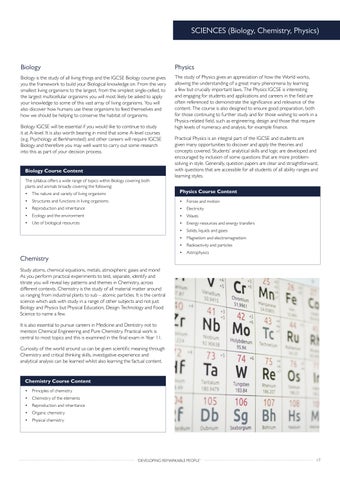
Biology
Biology is the study of all living things and the IGCSE Biology course gives you the framework to build your Biological knowledge on. From the very smallest living organisms to the largest, from the simplest single-celled, to the largest multicellular organisms you will most likely be asked to apply your knowledge to some of this vast array of living organisms. You will also discover how humans use these organisms to feed themselves and how we should be helping to conserve the habitat of organisms.
Biology IGCSE will be essential if you would like to continue to study it at A-level. It is also worth bearing in mind that some A-level courses (e.g. Psychology at Berkhamsted) and other careers will require IGCSE Biology and therefore you may well want to carry out some research into this as part of your decision process.
Biology Course Content
The syllabus offers a wide range of topics within Biology covering both plants and animals broadly covering the following:
• The nature and variety of living organisms
• Structures and functions in living organisms
• Reproduction and inheritance
• Ecology and the environment
• Use of biological resources
Chemistry
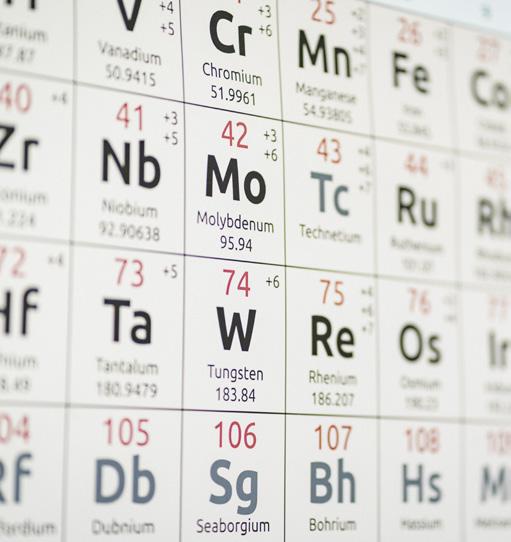
Study atoms, chemical equations, metals, atmospheric gases and more! As you perform practical experiments to test, separate, identify and titrate you will reveal key patterns and themes in Chemistry, across different contexts. Chemistry is the study of all material matter around us ranging from industrial plants to sub – atomic particles. It is the central science which aids with study in a range of other subjects and not just Biology and Physics but Physical Education, Design Technology and Food Science to name a few.
It is also essential to pursue careers in Medicine and Dentistry not to mention Chemical Engineering and Pure Chemistry. Practical work is central to most topics and this is examined in the final exam in Year 11.
Curiosity of the world around us can be given scientific meaning through Chemistry and critical thinking skills, investigative experience and analytical analysis can be learned whilst also learning the factual content.
Chemistry
Course Content
• Principles of chemistry
• Chemistry of the elements
• Reproduction and inheritance
• Organic chemistry
• Physical chemistry
Physics
The study of Physics gives an appreciation of how the World works, allowing the understanding of a great many phenomena by learning a few but crucially important laws. The Physics IGCSE is interesting and engaging for students and applications and careers in the field are often referenced to demonstrate the significance and relevance of the content. The course is also designed to ensure good preparation, both for those continuing to further study and for those wishing to work in a Physics-related field, such as engineering, design and those that require high levels of numeracy and analysis, for example finance.
Practical Physics is an integral part of the IGCSE and students are given many opportunities to discover and apply the theories and concepts covered. Students’ analytical skills and logic are developed and encouraged by inclusion of some questions that are more problemsolving in style. Generally, question papers are clear and straightforward, with questions that are accessible for all students of all ability ranges and learning styles.
Physics Course Content
• Forces and motion
• Electricity
• Waves
• Energy resources and energy transfers
• Solids, liquids and gases
• Magnetism and electromagnetism
• Radioactivity and particles
• Astrophysics
CLASSICAL CIVILISATION
GCSE Classical Civilisation is open to all pupils regardless of whether or not they have studied it before. Certainly those who have enjoyed Classical Civilisation lower down the school, will probably find that GCSE Classical Civilisation is a good choice. If they have studied Latin in Year 9 and are looking for a course which does not require knowledge of classical languages but builds on their work on the background material, then this course should suit them.
Classical Civilisation is a popular choice of GCSE subject because of its great variety of content and the fascinating areas we investigate. It lends itself well to links with other GCSE subjects; this glimpse of the
Course Content
ancient world will be useful in pupils’ wider studies, as well as providing a stimulating option choice.
The subject has real value today. We offer opportunities to study the ancient civilisations of Greece and Rome, to read some of the best literature ever produced and to make comparisons with our lives today. Classical Civilisation helps pupils of the 21st century to understand our world and to become sensitive to the lifestyles and emotions of real people, who are similar to ourselves but separated from us by two thousand years.
The syllabus offers a range of topics on the classical world, from which two are chosen.
Thematic Study
The Thematic Study provides the opportunity to study both literature and visual/material culture in Greece and Rome. These components are wide ranging and encompass a variety of interesting, engaging material. Learners will either focus on Myth and religion or Women in the ancient world, themes which are popular and rewarding to study. Learners will be required to make informed comparisons between Greek and Roman ideas, including the characteristics of the different societies. They will also be expected to use literature and visual/ material culture in conjunction with one another in order to inform their judgements, including discussion of why or how the sources may present things differently from each other.
Further details: Mr Belfield
Literature and Culture
In Literature and Culture learners will be able to undertake an element of cultural study, and then couple this with the study of literature in translation. This approach enables a diverse course of study and preserves the variety of material which has always been such a popular feature of Classical Civilisation. Learners will study one component from The Homeric world, Roman city life or War and warfare
In this part of the course there is an emphasis on enabling learners to respond to and engage with a wealth of sources and ideas, equipping them with readily transferable, analytical skills.
Ever wondered how your data is kept secure when using social media? Or what it takes to create a computer game? The Computer Science GCSE is an exciting course which will help you to develop your curiosity while relating real-world technology to the theories that underpin them. Computer Science is both practical and creative and will suit pupils who enjoy applying their knowledge to different situations.
The course will appeal to those pupils who enjoy problem solving as well as those who are looking to improve their programming skills. The programming part of the course will develop your computational thinking and give you the skills necessary to solve computer-based problems using the Python programming language. While the theory side of the course will look at how a computer operates, giving you an insight into the hardware of computer, how they communicate over the internet and what is really going on when you press a button!
Course Content
Computational Thinking & Programming Skills
• Fundamentals of algorithms
• Programming Computer Systems
• Fundamentals of data representation
• Computer systems
• Fundamentals of computer networks
• Cyber security
• Relational databases & SQL
• Ethical, legal and environmental impacts of digital technologies
Studying Design and Technology allows students to develop designing and making skills that open a world of possibility. It will excite and engage students with contemporary topics covering the breadth of this dynamic and evolving subject. This GCSE challenges students to be more empathetic, able to understand the needs and wants of others and therefore critique the man-made world.
Design and Technology is a subject that brings learning to life, requiring students to apply their problem-solving skills and develop a real-world awareness of the iterative design practices and strategies used by the creative, engineering and manufacturing industries. Students will be required to use critical thinking leading them towards invention and innovation, to design and make prototypes that solve real and relevant problems.
Students will build and develop their broad knowledge and understanding of the following:
• Designing and making principles including ergonomics, the work of designers and design companies, and design communication
• New and emerging technologies including CAD and CAM
• Developments in new materials including smart materials
• Energy generation and storage
• Ecological and social footprint including sustainability
• Systems, mechanisms, forces and stresses
• Materials and their working properties covering papers and boards, timbers, metals, polymers, and textiles
Course Content
Non-Examined Assessment (NEA) “Design Challenge”
The exam board release design contexts in June of Year 10. Students select one of these and take ownership of the process; they set their own brief based on the problems they identify for a client that they select. They then design, develop ideas through sketching and modelling, and make a final prototype. The NEA accounts for 50% of the total GCSE mark.
Whilst also having the freedom to focus on areas they are interested in, this even extends to the written exam where students can choose which material area they want to specialise in (as mentioned in the last bullet point)
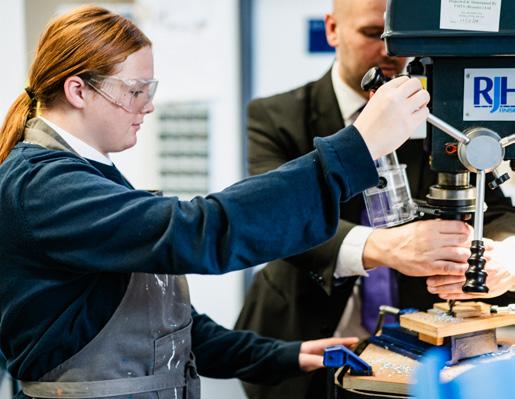
During the course, pupils extend their knowledge and develop skills in materials and processes by working through a range of tasks where they will design and/or make products. Pupils evaluate ideas, materials, production techniques and their own design procedures throughout the course. The development of skills in the use of information technology, particularly 3D CAD, 3D Printing, laser cutting, and the general use of workshop equipment and machine tools are a vital and integral part of the course.
Examination requirements:
Section A – Core Technical Principles. 20 marks.
Section B – Specialist Technical Principles. 30 marks
Section C – Designing and Making Principles. 50 marks.
The subject provides a good foundation for those pupils who wish to progress to A-level with a view to a career in design (from cars through to household appliances), all fields of engineering (from civil to aerospace) and into new and emerging fields such as robotics, 3D printing and design for sustainability. It also encourages all pupils to develop an awareness of the effect of technology on our lives and on the environment.
Students are entered for the written paper at the end of Year 11. This accounts for 50% of the GCSE mark and is not tiered. This is a 2 hour paper which consists of 3 Sections:
In an increasingly competitive world, speech and communication skills are becoming more important. Through studying Drama pupils gain a greater sense of confidence about themselves and a greater capacity to express their opinions and beliefs to others. They develop their imagination, sensitivity and self-confidence through the exciting world of drama. Whether pupils wish to become professional actors or simply wish to develop their speech and communication skills, the GCSE course in Drama will be both stimulating and of great value in the world beyond education.
This course will appeal to those who are interested in performing and/ or the technical side of theatre. It promotes pupils’ involvement in and enjoyment of drama as performers, devisers, directors and designers and provides opportunities for pupils to watch live theatre and to develop their skills as informed and thoughtful audience members. The course is primarily practical and pupils will be involved in a wide range of drama activities during their lessons. This work will be supported by written coursework. The drama course is examined in the following way:
Course Content
The questions on this paper relate to pre-release material which is sent to Centres in advance of the examination. This material consists of two extended extracts from two plays. Candidates study the extract from these two plays. The questions on the paper will require candidates to have engaged with the pre-release material from the perspective of actor, director and designer. The question paper is structured as follows:
• Section A (30 marks)
Candidates answer 6 short-answer questions on the extract from one of the set plays. (30 marks).
• Section B (25 marks)
Candidates answer two longer-answer questions on the extract of the other set play. One question is worth 10 marks. The other is worth 15.
• Section C (25 marks)
Candidates answer two longer-answer questions based on the devised drama performance the students have performed in Year 11. One question is worth 10 marks. The other is worth 15.
Additional Information:
We arrange a number of theatre trips during the GCSE Drama course to inspire and broaden the pupils understanding of Drama and theatre. It is expected that pupils will make every effort to attend these, as preparation and follow-up work will take place in the classroom. We would also encourage pupils to involve themselves in extra-curricular school productions, where possible. Pupils who study Speech and Drama are also encouraged to keep this going as this will complement and enhance their GCSE Drama work.
The study of Drama can help to develop invaluable transferable skills that can lead into many careers or jobs. Whether career path a student takes the GCSE course in Drama will be both stimulating and of great value in the world beyond education.
Candidates submit three pieces of practical work.
• One individual performance (2–3 minutes) of an extract from a play.
• One group performance of an extract from a play.
• One original Devised group performance. Internally assessed and externally moderated.
FINE ART
Art is a visually expressive form of communication and language. At Berkhamsted we work with all pupils to help them explore and develop their own ‘voice’ with which to express themselves. At the centre of our teaching is drawing, always the artist’s first point of inquiry. The GCSE course is designed to develop those skills and practices learnt in Years 7-9. Technical skills are taught and improved upon, whilst pupils are also encouraged to work in a variety of media, resolving their ideas in two and three dimensions.
Candidates who take Fine Art GCSE must be motivated and willing to take the initiative. Homework is set every week and, due to the practical nature of the subject, enough time needs to be set aside to complete it. The department does offer Open Studio access on two nights during the week at both sites until 17:30, thus providing pupils access to the spaces and equipment. Weekly attendance at one of these sessions is sufficient to complete homework and is an expectation of the course. Gallery visits are also an important aspect of the course: some visits will be organised as school trips whilst others will be set as homework.
Course Content
Assessment
Coursework Portfolio (60%)
Pupils are required to do two projects for their coursework portfolio. Each project will include preparatory work that shows a logical progression towards a final piece or pieces. This preparatory work will be mounted and presented in an A2 portfolio. Pupils will be encouraged to produce both studio outcomes in a range of processes.
Externally Set Assignment (40%)
In the final stage of the course, pupils are provided with a broad starting point theme set by Edexcel. Over three months they will explore and develop their responses to this theme. This project will comprise 40% of their final grade.
All work completed during the two-year course is marked according to how well pupils have shown evidence of:
• developing ideas through investigations, demonstrating critical understanding of sources;
• refining work by exploring ideas, selecting and experimenting with appropriate media, materials, techniques and processes;
• recording ideas, observations and insights relevant to their intentions as work progresses;
• presenting a personal and meaningful response that realises intentions and demonstrates understanding of visual language.
Why study Food Preparation and Nutrition?
By studying food preparation and nutrition pupils will:
• be able to demonstrate effective and safe cooking skills by planning, preparing and cooking a variety of food commodities whilst using different cooking techniques and equipment
• develop knowledge and understanding of the functional properties and chemical characteristics of food as well as a sound knowledge of the nutritional content of food and drinks
• understand the relationship between diet, nutrition and health, including the physiological and psychological effects of poor diet and health
Theoretical knowledge of food preparation and nutrition as well as the student’s practical skills are assessed.
Component 1: Principles of Food Preparation and Nutrition
Written examination: 50% of qualification
Written examination: 1 hour 45 minutes.
This component consists of two sections both containing compulsory questions and will assess the six areas of content as listed in the specified GCSE content above.
Section A: questions based on stimulus material (20 marks).
Section B: structured, short and extended response questions to assess content related to food preparation and nutrition (80 marks).
• understand the economic, environmental, ethical and socio-cultural influences on food availability, production processes, diet and health choices
• demonstrate knowledge and understanding of functional and nutritional properties, sensory qualities and microbiological food safety considerations when preparing, processing, storing, cooking and serving food
• understand and explore a range of ingredients and processes from different culinary traditions (traditional British and international) to inspire new ideas or modify existing recipes.
This course enables learners to make connections between theory and practice so that they are able to apply their understanding of food science and nutrition to practical cooking. Pupils will have one practical cooking lesson of one hour and 20 minutes during most weeks of their course. All ingredients will be provided.
Pupils study the following topics :
• Food commodities
• Principles of nutrition
• Diet and good health
• The science of food
• Where food comes from
• Cooking and food preparation
Component 2: Food Preparation and Nutrition in Action
Non-examination assessment: internally assessed, externally moderated: 50% of qualification.
Assessment 1: The Food Investigation Assessment. This scientific food investigation assesses student’s knowledge, skills and understanding in relation to scientific principles underlying the preparation and cooking of food (30 marks).
Assessment 2: The Food Preparation Assessment. Pupils prepare, cook and present a menu which assesses their skills and understanding in relation to the planning, preparation, cooking and presentation of food (70 marks).
Both assessments are completed in year 11 and are based on a choice of tasks released by the exam board annually.
Having a sound knowledge of nutrition and an ability to cook are important life skills for everyone. Pupils who wish to further their knowledge will be able to study the Level 3 Diploma in Food Science & Nutrition in the sixth form. A Food qualification provides a foundation for a number of exciting careers in Nutrition, Dietetics, Food Science, Food product development and Public Health.
Course assessment
If Geography itself has any significance, it is that we are made to lift our eyes from our small provincial selves to the whole complex and magnificent world.
Richard Burton (1821 – 1890) to the Royal Geographical Society.
Geography enables us the see the world through different eyes.
Not only is it dynamic and relevant, it is one of the most exciting and rewarding subjects that you could study. Geography teaches us about the awe-inspiring natural and the man-made world and why they are inextricably linked and mutually dependent. Geography takes us from the microscopic to the colossal, the past to the future, and helps us to make
Course Content
sense of the present. As such, the study of Geography is fundamental for everyone and is increasingly valued by universities and employers explaining why increasing numbers of pupils are choosing it.
The study of Geography at KS4 aims to actively engage pupils, developing them as effective independent learners as well as critical and reflective thinkers with enquiring minds. The IGCSE course fosters an appreciation of the differences and similarities between peoples’ environments, societies and cultures. Pupils will develop an understanding of their responsibilities as global citizens and of the ways in which they can contribute to a future that is sustainable and inclusive. All pupils will apply their learning through fieldwork opportunities which include day trips to local field studies centres and an optional overseas trip.
The key components of the course are:
Hazardous Environments
• Hazards vary from place to place
• Hazards have an impact on people and the environment
• Levels of development affect how people cope
River Environments
• The world’s water supply
• The development of landforms
• The management of water
River Environments Fieldwork
IGCSE Assessment
Duration 70 minutes
40% of GCSE
Fieldwork Learning Opportunities
In preparation for the Physical and Human Geography examinations the following field trips have been organised.
Year 10 Compulsory Day Field Trips
The IGCSE pupils are required to attend local day field trips where fieldwork opportunities relevant to curriculum topics studied will be taught. Trips will takes place throughout the 2 year course which costs approximately £50.
Year 10 & Y11 Optional Overseas Trip October 2027
We are in the process of planning the biennial Y10 & Y11 overseas trip that will next run in October 2027. This promises to be an exciting opportunity to visit a location that is rich with Geographical processes linked to the iGCSE specification. Previous destinations have included Morrocco, The Azores and Sicily.
Economic Activity and Energy
• Economic sectors importance varies
• Impacts and resource issues
• Energy security
Urban Environments
• The growth of urban populations
• Urban social and environmental change
• Sustainable strategies to manage cities Globalisation and Migration
• Globalisation ‘a more connected world?’
• Impacts of globalisation
• Responses to increasing migration
Urban Environments Fieldwork
IGCSE Assessment
Duration 105 minutes
60% of GCSE
Pupils study Edexcel IGCSE specification.
Why study History?
The best reason for studying History is an enjoyment of the subject and a fascination with the past. The History department offers a modern world syllabus and this enhances our understanding of contemporary national and international situations and problems. History as a subject is well suited to the development of the skills of investigation, analysis and interpretation. The study of historical issues can teach pupils to distinguish fact from opinion, to detect bias and to understand the concept of change over time.
History is one of the cornerstones of the Humanities and its study is acclaimed as excellent preparation for a wide range of careers. Pupils are afforded the exciting opportunity to take part in a trip to Berlin during the October half term in Year 11.
Course Content
Content
The IGCSE syllabus chosen is Modern World Pearson IGCSE.
There are two depth studies in Year 10 on German history 1919 - 1945 and Superpower Relations 1945 - 1990.
There are two depth studies in Year 11 on China; Conflict, crisis and change 1900 - 1989 and The Usa 1918 - 1941
Examination
There are two examinations in Year 11 both lasting one hour 30 minutes.
LANGUAGES (French, Spanish)
Why learn a Language?
Whether you want to study abroad, work internationally or simply explore other countries for fun, language study is the key to a better understanding and appreciation of people, cultures and places. Languages unlock doors that would otherwise remain shut.
How will languages help me and what can I do after I have completed the course?
People with language skills and knowledge are highly respected across the modern world. They stand out as talented and successful people, with broad and exciting horizons. Taking an IGCSE Language means you will add an international dimension to your choice of GCSE subjects, which will impress future employers and higher education providers.
It will add an extra dimension to your personal skills profile which in a global economy will stand out for anyone who reads your CV. Learning a language will allow you to learn many skills which are useful in a wide range of future careers, such as the ability to communicate clearly, and use problem-solving strategies.
French and/or Spanish
If you enjoy communicating with other people, finding out how language works and learning about different countries and cultures, studying IGCSE French and/or Spanish is an excellent choice.
What will I learn about?
• hobbies and interests
• holidays and tourist information
• education and employment
• house, home and daily routines
• the modern world and the environment
• social activities, fitness and health
• The world of work
We like to widen the cultural focus to include other parts of the world where the language is spoken, and to include cross-curricular themes such as ecological issues and news headlines. Access to online language materials also helps bring the subjects to life with creative projects, digital storytelling, podcasts and videos.
Employers are always asking for candidates with language skills and a GCSE/IGCSE in a modern language will place you in a strong position for interesting employment with plenty of career opportunities. You will be in a better position to get a job in companies with international links or based abroad.
Examples of employment where language skills are particularly valued include journalism and media, law, engineering, business and marketing, fashion, sport and leisure, travel and tourism, customer service, civil service (Diplomatic Service), hospitality and teaching (UK and abroad).
Learning French or Spanish will also allow you to learn about the countries where the language is spoken and to communicate directly with native speakers in their own language. It will also leave you the option of studying your chosen language at A Level and later at University.
Can I study more than one language?
Absolutely! We certainly encourage you to study two languages at GCSE/IGCSE, which really helps keep all your options open for an exciting future.
Assessment
Paper 1: Listening (25%)
Paper 2: Reading and Writing (50%)
Paper 3: Speaking (25%) Edexcel is our examination board.
All pupils studying Latin in Year 9 will have already made a start on the early stages of the GCSE course. The vocabulary, grammar and background material in the Cambridge Latin Course form an important basis for the subject at GCSE. If pupils have found interesting our study of the Roman way of life and have been translating the Latin passages with enjoyment, then they will be good candidates for the GCSE course. There is no coursework or controlled assessment for GCSE Latin.
Course Content
There are two main areas of study:
Language
Pupils continue to make progress with Latin, expanding their knowledge of the language and developing their grasp of important vocabulary. The class learns strategies to handle Latin passages both in unseen translations and in comprehension questions.
Set texts
Pupils read two set texts, much of which is studied in the original Latin. In class we compare our translations and agree among ourselves a final version. We put emphasis on achieving a translation which is both accurate and in clear English. We also look at linguistic and literary points in the Latin and learn about the historical and social context in which each text was written. Each set text is around 115 lines in length.
By the end of the course, we hope that pupils will have been able to:
• enjoy a subject which is both a rewarding experience in itself and a sound basis for further study at A Level;
• develop a good understanding of the rudiments of the Latin language;
• develop a sensitive approach to languages generally, including an awareness of the relationship between Latin and the languages of today;
• respond effectively to texts in original Latin and appreciate the culture in which they were written.
Pupils who study GCSE Latin are coached through all aspects of the syllabus, gaining an understanding of the world of the Romans through a close study of a relatively small amount of Latin literature and through a detailed examination of relevant archaeological evidence. The final outcome will be a brief but fascinating glimpse into the legacy of the Roman World.
LANGUAGES (Chinese)
Chinese
The AQA Chinese GCSE course offers an engaging and inspirational course of study that will enable pupils to manipulate and use the target language effectively, independently and creatively, so that they have a solid basis from which to progress to further studies of the language or employment.
The curriculum enables our students of all abilities to develop their Chinese language skills to their full potential, equipping them with the knowledge to communicate in a variety of contexts with confidence. Students will learn and develop a greater awareness of the culture of Chinese-speaking communities through a selection of authentic texts and situations.
Questions across all four language skills are set in common contexts, addressing a range of relevant contemporary and cultural themes. They are organised into 3 themes and 12 subtopics.
Topics
1.Identity and culture
• Topic 1: Me, my family and friends
• Topic 2: Technology in everyday life
• Topic 3: Free-time activities
• Topic 4: Customs and festivals in Chinese-speaking countries/ communities
2. Local, national, international and global areas of interest
• Topic 1: Home, town, neighbourhood and region
• Topic 2: Social Issues
• Topic 3: Global Issues
• Topic 4: Travel and tourism
3. Current and future study and employment
• Topic 1: My studies
• Topic 2: Life at school/college
• Topic 3: Education post-16
• Topic 4: Job, career choices and ambitions
Assessment
Papers will be tiered, with 25% assessment weightings per skill (listening, speaking, reading, writing).
Why study Music?
This is an incredibly diverse course, encompassing a variety of practical, creative and academic approaches to the study of music. The qualification is highly valued by universities irrespective of the course applied for and so should not be seen simply as a useful stepping stone towards a musical career. Indeed, a musical qualification opens doors to many pathways, as it enables pupils to develop highly-desirable skills in areas such as self- management, teamwork, problem-solving, and communication; all of which makes them an attractive prospective for potential employers. Typically, those pupils who tend to access the top grades at GCSE are currently having instrumental or vocal and are at least Grade 4 standard when they start the course. If pupils are unsure about their approximate standard or would like guidance about their suitability, do not hesitate to speak to us..
Course Content
The course is divided into three separate components:
Component 1: Understanding Music (40%)
The formal examined aspect of the Music GCSE, which is sat in the summer of Year 11 and is externally marked. Pupils explore music from four Areas of Study which encompass a wide variety of musical styles - from Western Classical Music to film and gaming music to pop music. Students will develop their aural skills and knowledge of musical styles through a range of listening and appraisal activities. Also, students will be studying two specific pieces of music, called “Set Works”, in detail - the set works will be related to the Areas of Study. The exam paper is split into two parts: Section A focuses on listening skills and understanding of the musical elements, whereas Section B asks questions specific to the set works pupils will have studied.
Component 2: Performing Music (30%)
Pupils perform a short recital of at least four minutes in length, which can be recorded anytime during Year 11. This component is divided into two equal areas, each of which may be recorded separately. Pupils may choose to make multiple recordings and choose their best for submission.
• Solo piece(s) (which may be accompanied by a piano or guitar)
• Ensemble piece(s) comprising a minimum of two performers.
The additional musicians need not be pupils. The component is internally marked and externally moderated.
Component 3: Composing Music (30%)
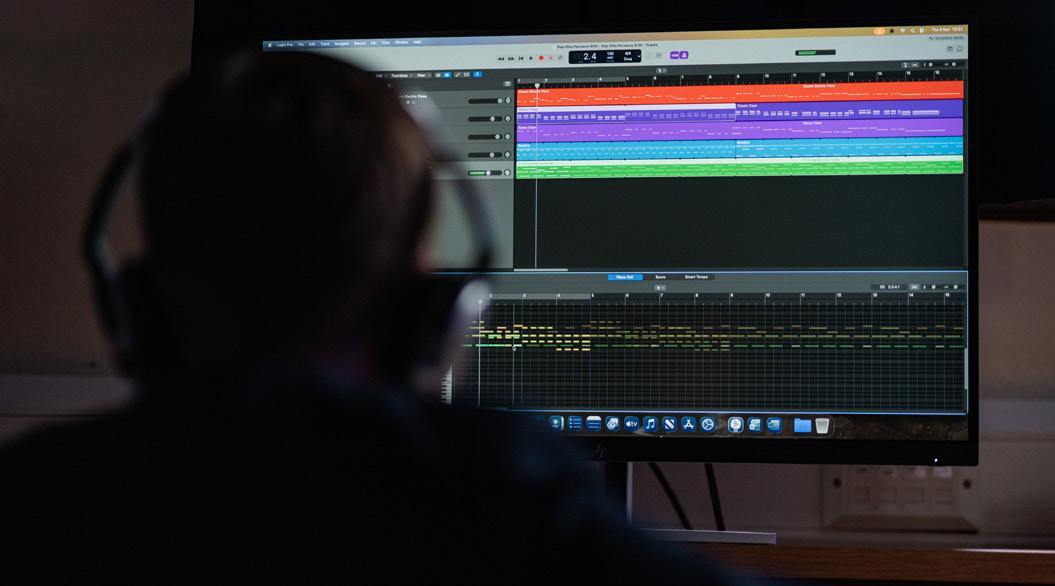
Pupils produce two compositions lasting a combined duration of three minutes. This creative and enjoyable element allows pupils to develop musical ideas, learn and apply compositional techniques. They can compose in the style of their choice and are encouraged to use music technology to help them.
• One composition to a set brief (connected to the 4 Areas of Study)
• One free composition
The component is internally marked and externally moderated.
Enrichment Opportunities
Pupils are encouraged to join, or continue to belong to, at least one of the many musical ensembles run by the Music Department as this will enrich their learning across the course. Additional opportunities to widen and deepen their understanding and experience will be offered such as trips to the theatre, to concerts as well as participation in workshops and recital evenings. For pupils who have not yet achieved Grade 5 Music Theory, the department offers free weekly classes, which we would also recommend.
PHYSICAL EDUCATION
Due to the growth of the sports and health industries, GCSE Physical Education has become a well-recognised qualification. This dynamic and challenging course aims to develop the pupils’ understanding of following a healthy and active lifestyle. It offers an excellent insight into the theoretical and physiological concepts associated with sporting performance and provides a solid foundation for those pupils considering studying BTEC Sport or A Level Physical Education or pursuing a sports related career. The GCSE course has a blend of practical and theory, allowing pupils to show off their sporting prowess as well as developing their knowledge of anatomy and physiology. GCSE PE lessons are theory classes; and although 30% is assessed practically, the learning process occurs in the classroom; it is not a practical subject. On the rare occasion there are practical lessons, it is to consolidate the theory, not practice their chosen 3 sports to develop their skills and level of play.
Studying Physical Education complements a broad and well-balanced combination of subjects.
Candidate requirements
Pupils must have a passion for sport and an appetite to develop their knowledge and understanding of developing their own performance. It is important that pupils are involved in a range of sports throughout the year to support their practical assessment. Prospective students must have two strong sports, meaning for both, they are:
• Competing in the A or B team in school.
• and/or playing competitively outside of school to a good level.
• Ideally, students are playing across 2 competitive terms of school sport.
Pupils will be studying the OCR (9-1) GCSE Physical Education Course Content
Written examination – 1 hour 60 marks, 30% of the qualification.
Pupils develop their theoretical knowledge and understanding of applied anatomy and physiology, movement analysis and physical training so that they can use this knowledge to analyse and evaluate performance and devise informed strategies for improving/optimising their own practical performance.
Component 2: Socio Cultural Issues and Sports Psychology
Written examination – 1 hour 60 marks, 30% of the qualification.
Pupils develop their theoretical knowledge and understanding of the contribution that physical activity and sport make to health, fitness, and well-being and how these can impact their own performance. Sport psychology is introduced, with a focus on skill development, through relevant practice, guidance and feedback, that learners can then apply to their own learning in practical situations to improve their performance. Key socio-cultural influences that can affect people’s involvement in physical activity and sport will also be considered.
Component 3: Practical Performance
Non-examined assessment: internally marked and externally moderated – (60 marks, 30% of the qualification)
Pupils must complete three physical activities (20 marks per activity) from a set list.
• One must be a team activity
• One must be an individual activity.
• The final activity can be a free choice.
*some combinations of the same type of activity are not allowed i.e. Rowing, Kayaking & Canoeing.
Permitted Team Activities*
Acrobatic gymnastics
Association Football
Badminton
Basketball
Blind Cricket
Camogie
Cricket
Dance
Figure skating
Futsal
Gaelic Football
Goalball
Handball
Hockey
Hurling
Ice Hockey
Inline/Roller Hockey
Lacrosse
Netball
Powerchair Football
Rowing
Rugby (Union & League)
Sailing
Sculling
Squash
Table Cricket
Table Tennis
Tennis
Volleyball
Water Polo
Wheelchair Basketball
Wheelchair Rugby
Component 4: Analysis and Evaluation of Performance
Non-examined assessment: internally marked and externally moderated – (20 marks, 10% of the qualification)
Permitted Individual Activities*
Amateur Boxing
Athletics
Badminton
Boccia
Canoeing
Cross Country Running
Cycling
Dance
Diving
Equestrian
Figure Skating
Golf
Gymnastics
Kayaking
Polybat
Rock Climbing
Sailing
Sculling
Skiing
Snowboarding
Squash
Swimming
Table Tennis
Tennis
Trampolining
Windsurfing
Why take Religious Studies at GCSE?
Religious Studies (Philosophy and Theology) will equip you with highly relevant knowledge and skills to succeed in the 21st century. A small selection of the kind of questions we explore in GCSE Religious Studies (Philosophy and Theology) include, ‘Should Abortion be legal?’, ‘Is there a meaning to life?’, ‘Do human beings really have free will?’, ‘What ethical issues are there to consider in warfare?’, ‘Should animals have the same moral status as humans?’, ‘Should women of any age be able to access fertility treatment?’, ‘What should we do about inequality?’, ‘Does the existence of evil and suffering mean that God cannot exist?’ and ‘Do rich countries have any obligation to help poorer countries?’ If you are interested in these kinds of questions, you should consider taking Religious Studies (Philosophy and Theology) at GCSE level.
Religious Studies (Philosophy and Theology) is also useful. It is one of the best training programmes around for developing your critical thinking skills and helping you to develop consistent and persuasive arguments. Religious Studies (Philosophy and Theology) is well-respected subject at GCSE, A Level and University, and ultimately Religious Studies (Philosophy and Theology) as a subject is usually listed in the same place as History for graduate employment prospects.
Course Content
Full Course IGCSE (Edexcel)
This is offered as an option and you should choose it because
• You enjoy RS – you enjoy thinking, analysing, discussing
• It is a fascinating and stimulating course in its own right
• Critical thinking skills: these much-prized higher-level skills are learnt here
• There is no coursework or controlled testing, so you are under less pressure
• IGCSE is globally recognised as a challenging qualification that prepares you very well for A Level and university
Paper 1 ‘Beliefs and Values’
• Section 1: The Universe, Creation and the place of human beings
• Section 2: Life and Death
• Section 3: Peace and Conflict
• Section 4: Rights, Equality and Social Justice
Within this section we cover a range of issues, such as medical ethics, women and equality, wealth and poverty and free will and determinism. This examination is worth 60% of the overall qualification.
And finally...
If you are interested in a career in law, medicine, politics, journalism or science, Religious Studies (Philosophy and Theology) is particularly strong option for you to consider. Law courses particularly value the skills that Religious Studies (Philosophy and Theology) students develop. Religious Studies (Philosophy and Theology) is a key component for Politics, Philosophy and Economics degrees at university, and many of the topics we study at GCSE directly explore topical areas in medical ethics. Studying Religious Studies at GCSE gives a good foundation also for studying the subject at A Level and beyond. Finally, whether you personally have a religious belief or not, the subject explores questions that are at the heart of human experience and will give you the opportunity to debate and discuss your own stance on these issues as well as developing your empathy, understanding and tolerance of other people and their positions in these debates.
Paper 2 ‘The Religious Community’
• Section 1: Origins and their Impact on the community
• Section 2: Celebration and Pilgrimage
• Section 3: Worship and Practice
Here we specialise in Christianity. This section is worth 40% of the overall qualification.
A copy of the specification can be found on Firefly under sites/Religious Studies/Year 10 IGCSE.
Learning Support is offered in a variety of ways during Years 10 and 11; however, where pupils need to be supported, they will be allocated a Specialist Teacher at some point during Key Stage 4. In addition, they can attend a drop-in session on a weekly or ad hoc basis.
In Years 10 and 11, emphasis is placed on Study Skills and preparation for public examinations and pupils will learn to develop their skills in revision and examination technique. All pupils receiving Access Arrangements for public examinations will be offered some individual or small group support during Year 11.These sessions normally take place before school during House or assembly time, or for those pupils who are part of the Learning Pathway programme, where possible, support can then be offered during a coached study period.
In some cases, pupils with a diagnosed SEN may choose to do Learning Support instead of a GCSE subject. This option is normally confined to those pupils who have received Study Skills group tuition as part of the curriculum during Key Stage 3 but this is not always the case. Learning Support is a timetabled ‘subject’ and we arrange the lessons to include English, Maths, Science and Study Skills support. A team of teachers support the pupils in this option choice.
We do have some flexibility in what we cover each week, and it is possible that the pupils themselves will help us to decide our programme when we know who we have and can look at their individual needs.
The Learning Support option choice usually attracts a small group of pupils so that the sessions can include individual support where necessary. By taking away an examined GCSE option, pupils can devote more time to improving the grades of their remaining subject areas.
Learning Support does not have a homework slot on the homework timetable and there is no end of course exam.
If you are interested in the Learning Support GCSE option, we would recommend that you discuss this with the Learning Support team.
Berkhamsted Girls, part of the Berkhamsted Schools Group Kings Campus, Kings Road, Berkhamsted HP4 2BB 01442 358166 girls@berkhamsted.com berkhamsted.com
Berkhamsted Boys, part of the Berkhamsted Schools Group Castle Campus, Castle Street, Berkhamsted HP4 2BB 01442 358000 boys@berkhamsted.com berkhamsted.com