PHILIPPINE RESOURCES

PENARROYO: A CAUTIOUS 2023 FOR MINING
BUNYE: SUPPORTING CRITICAL MINERAL SUPPLY CHAINS

WHERE DOES THE PHILIPPINES LIE ON THE NICKLE MINING VALUE CHAIN?
TAGANITO MINING WINS PRESIDENTIAL ENVIRONMENT AWARD
THE MAGAZINE FOR MINING, CONSTRUCTION & INDUSTRY MAGAZINE | ONLINE AND INTERACTIVE | WEBSITE | MOBILE | VIDEO | NEWSLETTER www.philippine-resources.com ISSUE 01 2023

Corporate Headquarters 540 Magsaysay Road, Barangay San Antonio, San Pedro, Laguna, Philippines 4023 T: +63 2 886 3170 | +63 2 833 6304 F: +63 2 886 3244 Papua New Guinea HBS Compound 11 Mile-Okuk Highway. PO Box 1538, Lae, Morobe Province, 411 Papua New Guinea Tel: +675 7373 4013 | +675 7373 4015


Copyright ©, WEIR and the WEIR Logo are trademarks and/or registered trademarks of Weir Engineering Services Ltd. www.esco.weir Get the job done with the full line of mining buckets from ESCO® equipped with Nemisys® , the industry’s best high-performance tooth system

for Over 2.4k Infra Projects in Central Luzon
Acciona Secures €480m


Rail Contract In PH
Business Growth Prompts
PCML Relocation to Accommodate More Projects Up North
In-Service Oil Analysis for Condition Based Maintenance
The Definitive Resource for Slurry Pumps
Chief Industrial Material Handling Equipment – Made to Fit Your Needs

BCDA Eyes Tapping New Clark City’s Potentials For C. Luzon Development

Olympus Portable X-Ray Diffraction For Metallurgy

PHILIPPINE RESOURCES 4 ISSUE 1, 2023 – www.philippine-resources.com CONTENTS MINING CONSTRUCTION 26 28 30 51 32 51 34 52 40 54 36 56 42 58 44 60 46 Industry Updates From PMEA PMSEA Returns: 68 Years of Responsible Mining Resilience, Reset, Recovery Gen. Deveraturda’s Update on the Tampakan Project The Significance Of Copper In Green Technologies Perfect Match Equipment For Sustainable And Efficient Nickel Mining Didipio Mine’s Community Development Fund (CDF): Breaking Ground Mining Operational Excellence Via Digital Transformation Customer’s First Choice: Sandvik Philippines Delivers 11th and 12th Pantera DP1500i Drills to Filminera Resources Corporation Motion Metrics® ShovelMetrics™ Gen 3 – the Next Generation in G.E.T. and Shovel Monitoring
A Cautious 2023 for Mining By Fernando Penarroyo A Breakthrough for MMD Sizers in Hard Rock Applications
Value Chain?
Where Does the Philippines Lie on the Nickel Mining
COMMENTARY 22
SANDVIK DD212
BEST FIT IN NARROW VEIN DRILLING
Sandvik DD212 is a compact and versatile single-boom drill for tunneling and mining development in narrow vein operations. It offers operational safety and versatility for tackling different applications, precise electronic positioning, ergonomic operator interface and data monitoring, all leading to superior pull-out ratio and reduced tool consumption.

EXPLORE SANDVIK DD212
ROCKTECHNOLOGY.SANDVIK

5 PHILIPPINE RESOURCES ISSUE 1, 2023 – www.philippine-resources.com
A CAUTIOUS 2023 FOR MINING
Mining
Marof his myriad inflation and against economic from the hard put consumer public a tight result declincosts further dollar fuel for materials more for debt the proand the Government facilienergy utiliAmong recovery are conflict weaker about by intercountry. businessmoney and and serespecially economic globally.
groups, the mining sustainable refrom the pandemic and slowdown. investments for underscored Secreassured the commitment to environment Diokno also expects adhere to practices. He strike environand supsocioeconomic Marcos ecomedium-term fissucceed mining
 written by: FERNANDO PENARROYO
By Fernando Penarroyo
written by: FERNANDO PENARROYO
By Fernando Penarroyo
Fernando “Ronnie” S. Penarroyo specializes in Energy and Resources Law, Project Finance and Business Development. He is also currently the Chair of the Professional Regulatory Board of Geology. He may be contacted at fspenarroyo@penpalaw.com for any matters or inquiries in relation to the Philippine resources industry and suggested topics for commentaries. Atty. Penarroyo’s commentaries are also archived at his professional blogsite at www.penarroyo.com
Philippine Resources is published independently for executives in Philippine mining, construction, resources, and associated business sectors.
Publisher Elizabeth Galura
Consulting Publisher Greg Brimble
Editor Jimbo Owen Gulle
Sales and Marketing Manager
industry would have to perform well. During the Philippine Economic Briefing in New York where President Marcos delivered a keynote message to American investors, Diokno emphasized the administration’s commitment to help maximize the mining sector’s potential in attracting more foreign investments.
omies of its trading partners. However, tensions in the South China Sea and Taiwan Strait will hound US-China relations. A brewing conflict in the region can cause instability, which will spook investors in the mining and energy industry.
Playing Catch Up
The year 2022 saw a myriad of challenges as the Russian war on Ukraine, inflation, market volatility, food shortages, rising energy prices, and lingering pandemic impacts continue to shape global markets. The early part of last year was a robust period for the metals and mining sector. The industry was buoyed by record high prices for some commodities, supply chain constraints, and energy transition-related demand for some minerals.
The mining industry considered the Duterte administration as another wasted era for realizing the full economic potential of the sector. The Marcos government inherited a mining industry reeling from the anti-mining stance of the previous administration with the appointment of the late Regina Paz Lopez, a staunch anti-mining advocate, to head the Department of Environment and Natural Resources (DENR). The appointment was bitterly opposed by the industry resulting in Lopez’s rejection by the powerful bicameral Commission on Appointments.
However, macroeconomic conditions deteriorated going into midyear and expected to persist into early 2023. This led to weakening near-term demand expectations and a downside risk to the metals and mining sector as many commodity prices slide and equity market support weakens.
During her term, Lopez ordered the closure of mining operations and initiated a national mine audit conducted on behalf of the Mining Industry Coordinating Council. Mining stakeholders described the three years of closure of these companies as “arbitrary” and claim that at that time, the industry practically “gasped for breath.”
While many experts are projecting inflation to ease off this year as the pandemic weakens, S&P Global Ratings downgraded its GDP growth forecasts for its global growth expectations. Global inflation is expected to fall in 2023 and 2024 but will still be above pre-pandemic levels. The U.S. Federal Reserve implemented aggressive interest-rate hikes to tame inflation. The support lent to the U.S. dollar weakened other currencies causing high dollar-denominated commodity prices.
as 2023 progresses, central banks will be able to rein in on inflation.
GLOBAL MINING SECTOR OUTLOOK
The outlook for the global mining sector has turned negative due to slowing economic growth, says Moody’s Investors Service. The rating agency said it revised its global outlook for the mining sector from stable to negative, citing expectations that cash flows and profits will decline in 2023 due to weak demand for metals and mining commodities arising from slowing economic growth.

Matt Brimble +63 927 721 6622 Matthew@philippine-resources.com
Account Manager
Merian Jay Fallan +63 955 738 0266 merian@philippine-resources.com

Administration Cecilia Pamular +63 917 308 1971 cecille@philippine-resources.com
Graphic Designer Bogtong Wangga
Journalists
Marcelle P. Villegas
Abe Almirol Engr. Edison Mating
Contributors
Patricia A.O. Bunye Fernando Penarroyo
Manila Publishing Office Suite 6, 2nd Floor Corinthian Plaza Building 121 Paseo de Roxas Legaspi Village Makati City, Philippines 1226 Phone +632 8251 5599
With COVID-19 bringing down the economy on its knees and a worsening economic fallout becoming inevitable, Duterte issued Executive Order No. 130 in April 2021, lifting the nine-year moratorium on the granting of new mining permits. Finally in December 2021, the Duterte administration succumbing to economic pressure, lifted the ban on open-pit mining.
It is well to note that at the height of the pandemic in 2021, the mining sector’s contribution to the gross domestic product
The Russia-Ukraine conflict and the souring relationship between the U.S. and China headline geopolitical and trade tensions which will have effects on the global markets throughout the coming year. The Russia-Ukraine war resulted in higher energy prices driving inflation and subdued demand for industrial metals particularly in Europe.
China, the world’s second largest economy and a steady force in global trade, reopened its economy with Xi Jinping’s reversal of zero-COVID restrictions. China’s reopening will unleash a flood of household spending and consumption, which will also impact the econ-
The threat of a global recession driven by supply chain issues arising from the COVID-19 pandemic will be the challenge in 2023. The world economy saw record-high inflation as the top concern last year. The broad sentiment among financial experts is that recession in 2023 is inevitable as higher prices due to inflation will give way to an economic downturn. However, a few analysts now feel that the U.S.—and possibly Europe—could narrowly avoid recession as inflation pressures started to abate. The rise in central bank rates to fight inflation and Russia’s war in Ukraine will continue to affect economic activity. Hopefully,
Inflation is also expected to pressure the metals markets and industrial commodities. S&P Global said that with inflation creeping up, metals prices have corrected from their recent highs and expected to fall further into 2023. Softening demand, stronger supply and weaker sentiment will further contribute to the downward pressure.
Digital Online Edition www.Philippine-Resources.com
LEOPARD™ DI650 i TIME FOR A NEW LEADER
On the Cover: Photo courtesy of Taganito Mining
New Leopard DI650i down-the-hole surface drill rig offers long-term productivity and superior stability with robust and reliable main components – seamlessly integrated with state-of-the-art technical solutions. Scalable automation, easy maintenance and outstanding movability are the features that make Leopard DI650i a premium product, which is an honor to own.
Leave your paw print and enjoy the smooth, efficient ride.
Explore
The construction sector and disrupted property markets will be a drag on global demand for copper, iron ore, steel and base metals. U.S. real estate data show a downward trend in new construction and a general downturn in the housing market while the Chinese real estate market remain sluggish despite various government infrastructure initiatives.
Meanwhile, supplies of
PHILIPPINE RESOURCES 6 ISSUE 1, 2023 – www.philippine-resources.com
ISSUE 4 2022 • WWW.PHILIPPINE-RESOURCES.COM Page
8 >
Marcos Bets
the new Leopard DI650i: ROCKTECHNOLOGY.SANDVIK/DI650 i
Page 8 > RESOURCES COMMENTARY


7 PHILIPPINE RESOURCES ISSUE 1, 2023 – www.philippine-resources.com
copper, aluminium, lead, zinc, iron ore and steel, among others will post higher growth rates than in 2022. For precious metals, Moody’s noted that gold and silver prices are both declining “as higher interest rates and a stronger U.S. dollar” have curbed their appeal as safe haven investments. However, inflationary pressures and supply-chain constraints are showing signs of easing which could mean that global economic slowdown is less severe than expected.
DECARBONIZATION, CLEAN ENERGY TRANSITION, AND NET ZERO GOALS

Concerned on climate-related risks have slowed down as the world grapples from the outcome of the Russia-Ukraine war which resulted in high energy prices and inflation. However, last year saw a number of mining companies announcing investments and joint ventures into large scale renewable projects involving the installation of solar and wind facilities, upgrade of transmission networks, and installation of large-scale battery storage.

Global mining leaders are also calling for the acceleration of the production of minerals needed to help reduce carbon footprint and meet net zero targets for carbon emissions. According to the latest global report from KPMG, “Sustainability on the horizon – the prospects of a net-zero future for metals and mining companies”, metals and mining companies are vital if the world is to reduce its
reliance on fossil fuels.
Nevertheless, miners face a number of obstacles to reach their net zero goals, the largest of which are the difficulty in measuring progress and lack of resources to bring them about. Also, achieving these net-zero ambitions will require a more realistic and balanced strategy.
The KPMG report also states that the current transition away from fossil fuels will require a rapid increase in the number of electric vehicles (EV), thus considerable critical minerals will be needed. The production of battery materials – nickel, cobalt and lithium – will continue to forge ahead, following double digit-growth in 2022. KPMG estimates that more than 2 billion EVs will be needed to be manufactured to accommodate world demand and fully transition away from internal combustion engine vehicles by 2050. Energy transition efforts will also drive up demand for iron ore, zinc and copper. A recovery in the automotive sector and in low-carbon energy could help offset some of the demand weakness in other consumer-led segments. However, battery component supply pipelines will struggle to keep up with such a demand.
Green technologies require critical minerals which are often challenged by geopolitical constraints. Given that the price of critical minerals has surged in 2022, the incentive to invest further in their production and circularity remains very high. Mining companies are investing in and developing new technolo-
gies to support decarbonization plans and increase productivity.
Two technologies are expected to be of wide use in 2023 - drones and blockchain. Drones will be increasingly used to support exploration, surveying, mapping, monitoring site safety, stockpile management, blast analysis and reviewing tailing dams. At the same time, blockchain technologies will continue to support the traceability and accountability of supply chains.
ESG
Ernst and Young reported that environmental, social and governance (ESG) remains the top risk and opportunity for mining and metals companies in 2023. While ESG is expected to have broaden-
ing scope and complexity, it is now firmly integrated within corporate strategies due to its impact on almost every aspect of mining operations. Some of the areas for ESG improvement — improving diversity, equity and inclusion, are not new and remain to be major challenges. On the other hand, the issues of mine closures and rehabilitation will require a longer-term and more strategic view. ESG’s scope is broadening and pressure is growing to im-

PHILIPPINE RESOURCES 8 ISSUE 1, 2023 – www.philippine-resources.com
RESOURCES COMMENTARY
Page 6 Page 10 > THE MAGAZINE FOR MINING, CONSTRUCTION & INDUSTRY
<
01. A combined wind and solar farm generating electricity
02. A copper mine in Calgary, Canada
01 02 03
03. Soldiers riding a tank in the Russia-Ukraine war


9 PHILIPPINE RESOURCES ISSUE 1, 2023 – www.philippine-resources.com +63 (0) 49 559 8840 to 44 +63 (0) 2 8249-9480 to 84 2nd & 4th Floor LIIP Business Center Building B10 L4 LIIP Avenue LIIP Mamplasan Binan Laguna https://www epiroc com/en-ph contact philippines@epiroc com Epiroc's Christensen surface core drilling rigs have a wellearned reputation for their reliability, safety and high performance. Contact Epiroc Philippines to know more. Meeting the highest standards Christensen 140
prove reporting and transparency. Even governments are increasing their energy transition efforts and addressing ESG concerns.
EXPLORATION
The exploration industry is greatly influenced by metals prices and financing conditions. As capital costs and energy prices are expected to rise, miners are left with lower excess cash reserves to spend on exploration. Difficult financing conditions amid recession fears will also impact exploration according to a report of S&P Global. Global inflation, geopolitical instability, and fears of recession are taking their toll on commodities. Metal prices have fallen off their highs and markets have trended downward resulting in investors turning away from the mining sector.
Interest in energy transition metals, however, will support exploration budgets for copper, nickel and lithium, although decreases for copper and nickel are expected. With the increasing uncertainty in the global marketplace, exploration budget will continue to focus more at mine sites and advanced projects than in grassroots projects, which may result in a notable decline in new major discoveries.
ENERGY
Energy was the S&P 500’s top performing sector two years in a row and many experts feel that
more growth is on the horizon. Wood Mackenzie is forecasting a brisk return to oil demand growth next year, driven by the easing of COVID-19 restrictions in China and the rising use of petrochemical feedstocks. Meanwhile, there will be a slowdown in LNG contract signings despite a busy 2022 for LNG contracting. In 2023, LNG contracting activity will slow down even as Chinese companies continue to buy and US independent upstream and midstream players secure deals to access global LNG markets. Europe will also continue to diversify its energy imports away from Russia and source liquefied natural gas from the U.S. to help fill in the demand.
MEANWHILE ON THE HOMEFRONT
In their numerous roadshows abroad, the economic managers of the current government have affirmed support for mining as part of the country’s growth agenda. At the same ttime, Department of Environment and Natural Resources (DENR) Secretary Ma. Antonia Yulo-Loyzaga said her agency will undertake a comprehensive review of mining laws, its existing legal framework and current policies and practices that to her are “somewhat dated”. Sec. Yulo-Loyzaga further said that the DENR is eyeing to “build the technical capacities to support that direction and make sure that the social and physical advances in science and tech, as well as our current context devel-
opmentally are now adequately perfected in an updated policy and legal system.” Sec. Yulo-Loyzaga has also been quoted as suggesting “a range of actions including a progressive look at taxing exports” of raw nickel. Policy statements indicating another review of mining laws and imposition of more taxes will certainly be sending the wrong signals to investors.
CONCLUSION
The metals and mining sector will be facing the global economy in 2023 cautiously, fully aware of the risks if the pressures of inflation, global conflicts, and high energy prices of last year will continue to persist. The positive news is that clean energy transition - rising electric vehicles sales, the shift towards renewable energy technologies, and related transmission and distribution requirements will expand market demand. This growing demand will however be tempered if mineral-endowed countries like the Philippines fall prey to resource nationalism. On the other hand, the industry must strictly adhere to responsible mining and strike a balance in their ESG responsibilities of environment protection, uplifting local communities, and dealing transparently with the government and other stakeholders. The industry is precariously looking forward to a 2023 that brings more stability, and less economic and political upheavals.
References
Aluminum International Today, Metals and Mining industry pessimistic about global growth, with over half more pessimistic than CRU forecasts, https://aluminiumtoday.com/news/ metals-and-mining-industry-pessimistic-about-global-growth-with-over-halfmore-pessimistic-than-cru-forecasts
Bird and Bird, Energy Outlook 2023: Mining & Minerals, https:// www.twobirds.com/en/insights/2023/ global/energy-outlook-2023-mining-and-minerals
Crooks, Ed, Ten Predictions for 2023, 16 December 2022, https:// www.woodmac.com/news/opinion/ ten-predictions-for-2023/
Freele, Elizabeth and Dekker, Rachel, Mining’s top ten ‘S’ trends in ESG for 2023, 17 January 2023, https://www.mining.com/minings-topten-s-trends-in-esg-for-2023/
KPMG Mining Outlook 2023: Prospects of a net-zero future for metals and mining companies, 30 November 2022 https://kpmg.com/ au/en/home/media/press-releases/2022/11/brighter-prospects-mining-sector-transforms-towards-net-zero-30-november-2022.html
Langton, James, Global mining sector outlook turns negative: Moody’s, 22 September 2022, https://www. investmentexecutive.com/news/research-and-markets/global-mining-sector-outlook-turns-negative-moodys/ Mitchell, Paul, Top 10 business risks and opportunities for mining and metals in 2023, 26 September 2022, https://www.ey.com/en_gl/ mining-metals/risks-opportunities
Rivera, Danessa, DENR to Visit Mining Laws, Philippine Star, 08 December 2022, https://www.philstar. com/business/2022/12/08/2229235/ denr-revisit-mining-laws

Routley, Nick, Prediction Consensus: What the Experts See Coming in 2023, 11 January 2023, https:// www.visualcapitalist.com/predictions-2023/
S&P Global Market Intelligence, The Big Picture - 2023 Metals and Mining Industry Outlook, 10 November 2022, https://www.spglobal.com/ marketintelligence/en/news-insights/ research/the-big-picture-2023-outlookfor-metals-and-mining
PHILIPPINE RESOURCES 10 ISSUE 1, 2023 – www.philippine-resources.com
RESOURCES COMMENTARY < Page 8 THE MAGAZINE
FOR MINING, CONSTRUCTION & INDUSTRY
01
01. DENR Secretary Maria Antonia Yulo-Loyzaga

Supporting Critical Mineral Supply Chains
written by: PATRICIA A. O. BUNYE photo by: PAUL PUTONG/THE UNITED STATES EMBASSY
The Philippines is acknowledged to be the fifth most mineralized country in the world, with an estimated USD1 trillion in untapped reserves of copper, gold, nickel, zinc and silver. Recent statistics from the Mines and Geosciences Bureau (MGB) indicate that there are only 49 operating metallic mines, employing around 196,000 workers. In the first semester of 2022, total exports of minerals amounted to almost USD3.851 billion, with the Department of Environment and Natural Resources (DENR) placing the gross production value for large-scale metallic mining at PHP101.1 billion.
The mining industry has been characterized by a number of starts and stops,
recognized as a growth driver, but also stymied by policy shifts that frustrate investors, particularly in the last decades. The pervading negative perception against mining among the general public, exacerbated by disinformation or outright “false news” has not helped.
The current administration has sent positive signals, particularly with strong statements in support of the mining industry, including from Finance Secretary Benjamin Diokno who has said that Finance Secretary Benjamin Diokno said that the “mining industry holds the greatest potential to be a key driver in our economic recovery and long-term growth, especially now that world metal prices are high. The Philippines, after all, is one of the world’s most
richly endowed countries in terms of mineral resources.”
battery storage, manufacturers and investors are seeking to diversify their supply chains in the face of rising demand. Countries like the Philippines, with significant but largely untapped mineral reserves of copper and nickel, therefore have the potential to become key markets supporting diversified, reliable supply chains.

01
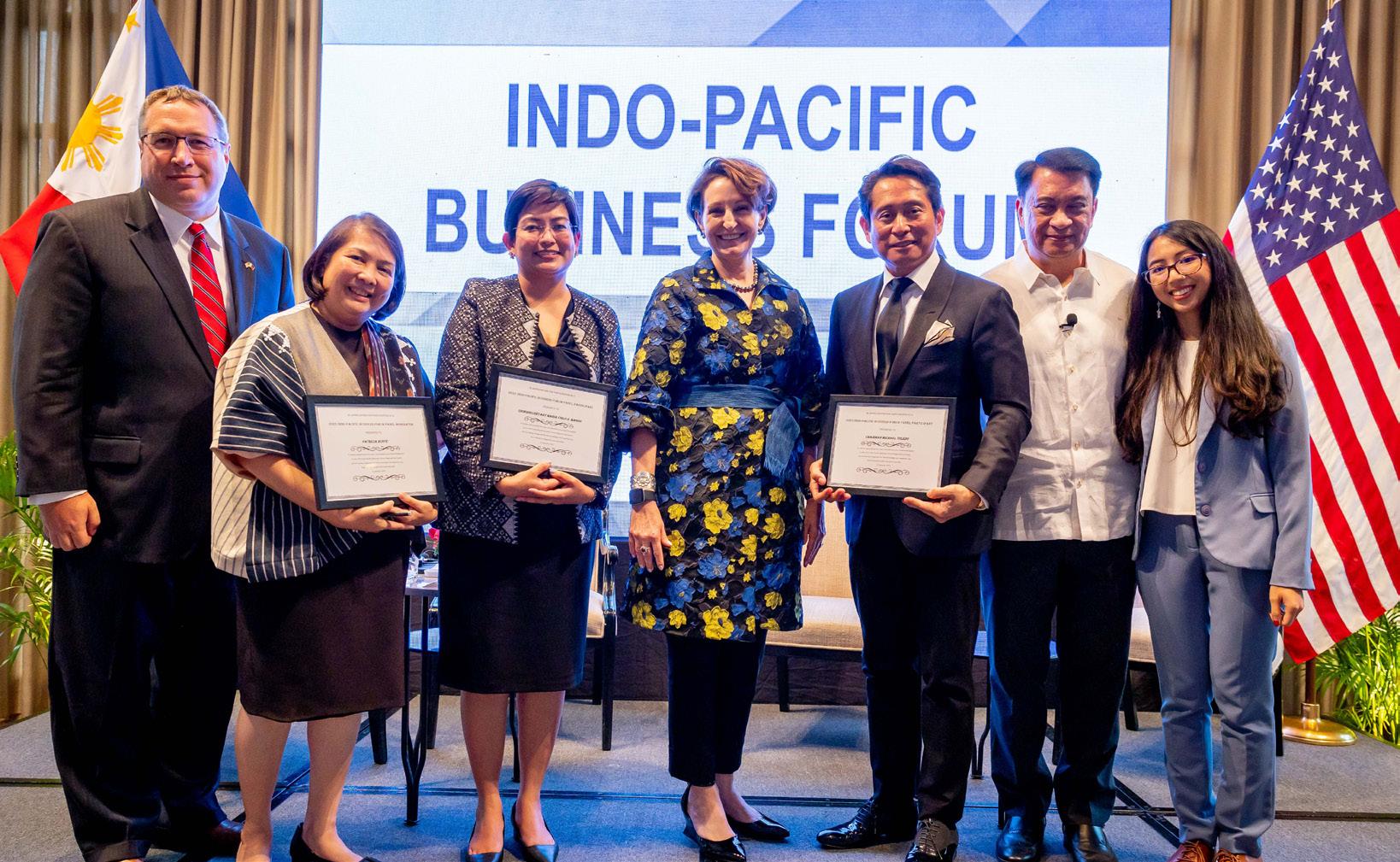
At the recent Indo-Pacific Business Forum on January 12 sponsored by the United States Embassy, I had the privilege of moderating a panel on “Supporting Critical Mineral Supply Chains for a Just Transition”. Indeed, coming on the heels on COP 27 [2022 United Nations Climate Change Conference or Conference of the Parties of the 27th United Nations Climate Change Conference], there is a renewed commitment across the globe to cutting greenhouse gas emissions and adapting to the impacts of climate change.
Patricia A. O. Bunye is a Senior Partner at Cruz Marcelo & Tenefrancia where she heads its Mining & Natural Resources Department and Energy practice group. She is also the Founding President of Diwata-Women in Resource Development, Inc., a non-government organization advocating the responsible development of the Philippines’ wealth in resources, principally through industries such as mining, oil and gas, quarrying, and other mineral resources from the earth for processing. Page 14 >
With critical minerals [such as lithium, nickel, cobalt, manganese, graphite, copper and aluminium] being essential inputs for clean energy technology and
Joining me as panelists were Cielo Magno, Undersecretary of the Department of Finance and former Philippines-Extractive Industry Transparency Initiative Civil Society Representative; Michael Toledo, Chairman of the Chamber of Mines Philippines; and JB Baylon, Chief Risk Officer and Chief Sustainability Officer at Nickel Asia Corporation (NAC).
Our panel explored, among others, the Philippines’ plans for developing our downstream industries and encouraging the processing of minerals locally rather than exporting raw mineral ore. Certainly, there are lessons to be learned from our neighbor Indonesia, whose approach to banning mineral exports may not necessarily work in the Philippines as well as properly incentivizing domestic processing.
From the private sector, we looked at the Chamber of Mines’ adoption of Canada’s Towards Sustainable Mining (TSM) Initiative, which requires mining companies
PHILIPPINE RESOURCES 12 ISSUE 1, 2023 – www.philippine-resources.com
COMMENTARY
RESOURCES
Onsite Energy Solutions portfolio

MOBILE 9–1250*

ultiple configurations available to produce power for any size application



help you choose the best solution for your power and light needs
Intelligent telematics system that helps optimize fleet usage and reduce maintenance and operating costs.


13 PHILIPPINE RESOURCES ISSUE 1, 2023 – www.philippine-resources.com Atlas
North Main Avenue, Lot 12 Block 2, Laguna Technopark, Biñan, Laguna 4024 Philippines www.atlascopco.com/en-ph | powertechnique.sea@atlascopco.com +63 2 8396-6560 to 69 (Manila Line) | +63 49 554-9630 to 39 (Laguna Line)
Copco (Philippines), Inc.
kVA
LIGHT
ccess Power Connect Portal with a QR code to find all the information about your machine.
DIESEL
TOWERS
250
E-commerce
solutionwe handle your orders 24 hours a day.
to assess their performance certain key areas such as tailings management, community outreach, safety and health, biodiversity conservation, crisis management, and energy use and greenhouse gas emissions management.
NAC’s multi-awarded programs were also of interest as the company has always set itself apart in dealing with its stakeholders, particularly indigenous peoples and women.
Over at the Department of Energy, notwithstanding that the Philippines remains dependent on fossil fuels for electricity generation, there is a clear call to shift to renewable energy sources, which would not only alleviate future electricity shortages but also address the soaring cost of electricity in the Philippines.
Any shift to renewable energy sources by the Philippines is expected to result in an increase in the requirements for minerals. Solar photovoltaic (PV) plants, wind farms and electric vehicles (EVs) generally require more minerals to build than their fossil fuel-based counterparts. According to the
International Energy Agency, an onshore wind plant requires nine times more mineral resources than a gas-fired plant. Since 2010, the average amount of minerals needed for a new unit of power generation capacity has increased by 50% as the development of renewable facilities has accelerated.
The types of mineral resources used vary by technol -
ogy. Lithium, nickel, cobalt, manganese and graphite are crucial to battery performance, longevity and energy density. Rare earth elements are essential for permanent magnets that are vital for wind turbines and EV motors. Electricity networks need a large amount of copper and aluminium, with copper being a cornerstone for all electrici -
ty-related technologies.
If the Philippines is serious about this shift to renewable energy, the Philippine energy sector will need to delve deep into the mineral markets. With the Philippines’ significant but largely untapped mineral reserves, the country has the potential to become a key market, both for the local demand and for foreign requirements.


PHILIPPINE RESOURCES 14 ISSUE 1, 2023 – www.philippine-resources.com
RESOURCES COMMENTARY
Page 12 01 02
<
01. The panel at the Indo-Pacific Business Forum.
02. The author with US Ambassador MaryKay Carlson


15 PHILIPPINE RESOURCES ISSUE 1, 2023 – www.philippine-resources.com RELIABILITY DURABILITY SAFETY Designed for a rugged and demanding environment. Manufactured to precise standards from heavy structural members to provide easy installation and strength. We provide comprehensive services and solutions to increase safety and raise efficiency. Handle Bulk with Efficiency and Reliability INDUSTRIAL SERIES MATERIAL HANDLING Trusted.Tested.True.® Contact Us: +63 917 529 8802 | craig.stall@chiefind.ph asia.chiefind.ph
Offshore Wind Energy: the Payoff for the Philippines’ Science & Technology and Supply Chain Sectors
written by: F.G. DELFIN JR.- BRIEF BIOGRAPHICAL SKETCH

Mr. Francisco “Jun” Delfin is Vice President & COO of PetroGreen Energy Corp. (PGEC) and President of Maibarara Geothermal Inc. (MGI), subsidiaries of publicly-listed and Yuchengco Group of Companies (YGC) affiliate PetroEnergy Resources Corp. He is a geologist with a PhD in public administration from the University of Southern California (USC). His work experience spans private industry as YGC executive since 2008, professional geological practice with PNOC-EDC, government service as DOE Asst. Secretary and Undersecretary during the Arroyo administration, academia as Asst. Professor at UP National College of Public Administration & Governance and non-profit as past President of the Geological Society of the Philippines in 2009.
to lead and harmonize the permitting process to expedite development and utilization of offshore wind (Figure
INTRODUCTION
Over the past 2-3 years, we have seen dramatic disruptions in global energy markets brought among others by the Covid-19 pandemic, Russia’s invasion of Ukraine, and deepening concerns about fossil fuels’ impact on the earth’s climate. Such challenges have caused escalating energy costs, power supply shortfalls, rejection of fossil fuels especially coal, sustained shift to renewables and even a renewed focus on nuclear energy in many countries. The collective transition to a more sustainable, low-carbon energy future has led countries and organizations to adopt net zero policies, committing by different target years to reduce their greenhouse gas emissions to as close to zero as possible.1
Offshore wind development benefits from these sweeping changes in the global energy landscape. In 2021, a record 21.1 GW of offshore wind capacity was installed, bringing cumulative global offshore wind capacity to 56 GW according to the Global Wind Energy Council (GWEC). Europe and Asia are the leading regional market with 50.4% and 49.5% of the world’s total installations, respectively. Moreover, annual offshore wind energy growth is
forecast to rise significantly to 8.4% in 2025-2030 from a modest 1.7% growth in 2020-2024. 2
In Asia, high growth are expected in the following countries: China with 60-70 GW of capacity by 2030, Japan with 10GW by 2030 and 30-45 GW by 2040, Taiwan with 5.5 GW by 2025 and 20 GW by 2035, South Korea with 12 GW by 2030, and Vietnam with 9 GW by 2035 and 15 GW by 2040. Given its geographic setting, the Philippines should harness this fastgrowing clean energy resource not only for much needed power supply but also for the benefits it will confer on the country’s S&T and industrial sectors.
OFFSHORE WIND DEVELOPMENT IN PHILIPPINES
The offshore wind (OSW) industry is in a nascent stage and can be said to officially begun in the country in April 2022 when the World Bank and the DOE completed and launched the Offshore Wind Road Map for the Philippines. This study is groundbreaking because it documented the country’s 178 GW OSW technical potential, identified six (6) high priority zones for development (Fig. 1), outlined two growth scenarios for the OSW industry, and specified recommendations

implementing rules and regulations (IRR)
Law, allowing 100% foreign ownership in wind, solar, and tidal energy resources.
to overcome challenges to such growth.3This fledgling industry got a tremendous policy boost in the new Marcos, Jr.’s administration with the country’s top two energy officials – President Ferdinand Marcos, Jr. and DOE Secretary Raphael P.M. Lotilla – being staunch advocates of indigenous renewable energy development in general and wind power in particular. Several major policy
decisions in quick succession demonstrated the government’s commitment to renewable energy and offshore wind and thus laid the groundwork for necessary private investments
But even before the World Bank study and the onset of the new government a few local companies and their foreign partners have quietly moved into offshore wind. Two such early venturers were Triconti ECC Renewables and
PHILIPPINE RESOURCES 16 ISSUE 1, 2023 – www.philippine-resources.com
RESOURCES COMMENTARY
3
Draft manuscript for Philippine Resources Journal; Not for distribution without author’s permission –fgd/Feb2023
2). In December 2022, the DOE amended the
Figure 1. Wind Resource Potential Map of the Philippines (WB, 2022)
of the 2008 RE
Page 18 > 01
01. Wind Resource Potential Map of the Philippines (WB, 2022)

<
in the industry.4 In September 2022, the Department of Justice (DOJ) issued an opinion that the foreign equity cap on certain natural resources does not apply to wind, solar, and tidal energy resources. In November 2022, the President approved the DOE’s proposed offshore wind program and directed the agency, among others, to lead and harmonize the permitting process to expedite development and utilization of offshore wind (Figure 2). In December 2022, the DOE amended the implementing rules and regulations (IRR) of the 2008 RE Law, allowing 100% foreign ownership in wind, solar, and tidal energy resources.But even before the World Bank study and the onset of the new government a few local companies and their foreign partners have quietly moved into offshore wind. Two such early venturers were Triconti ECC Renewables and PetroGreen Energy Corp. (PGEC). The latter, a member of the Yuchengco Group of Companies (YGC), partnered with Danish firm Copenhagen Energy to acquire three service contract blocs in Northern Luzon, Northern Mindoro, and East Panay. Admittedly, decisive policy actions by the new administration spurred
more private sector interest in OSW. Thus, by end 2022, the DOE had awarded forty-three (43) OSW service contracts to twenty (20) individual companies with an aggregate target capacity of 33 GW. Even if only a fraction of these blocs iseventually developed, the mediumand long-term benefits for the country would be enormous.
OSW Benefits: Payoff for Science & Technology (S&T)
OSW BENEFITS: PAYOFF FOR SCIENCE & TECHNOLOGY (S&T)
Clearly, the country’s power sector will be the primary beneficiary of OSW development. It can help achieve the DOE’s goal of increasing RE’s share in the generation mix from the current ~20% to 35% by 2030 and 50% by 2040. Such aspiration requires additional RE capacities of 22 GW by 2030 and by another 52 GW by 2040 under the clean energy scenario in the DOE’s 2020-2040 Philippine Energy Plan.5 OSW can help provide these additions even if only a modest fraction of OSW’s 178 GW technical potential is harnessed. Also, with its ideally large capacity of >300-500 MW for a single wind farm combined with its high capacity factors (35-45%), OSW is arguably the best among RE options to replace coal generation in the country.

But while advantages of
4
OSW are obvious for the country’s power supply, less recognized is the significant positive spill-over benefits that OSW can contribute to the country’s science and technology (S&T) sector. The first immediate S&T beneficiaries of large-scale OSW development are our applied geological and environmental sciences and professions. There are three interrelated facets of OSW development where geological and environmental sciences will be employed and knowledge enhanced.6 First, a multi-agency marine spatial planning is necessary to minimize conflicts among competing uses of the marine environment. Whether government- or academe-led, marine spatial planning involves the collection not only of primary geoscientific and environmental data but also of social and cultural data over prospective or identified zones of OSW development. These data and their objective and professional analyses would be the foundation from which prospective OSW and pre-existing activities could be coordinated, integrated, and regulated and thus help avoid or reduce disputesamong legitimate uses.
During the feasibility study and development of the OSW projects, geological, atmospheric, and environmental sciences
will be critical tools by which private developers can validate their block’s energy yield, establish the area’s average and extreme wind and ocean current conditions, characterize the bathymetry and bedrock geology of the prospective site, and evaluate the most appropriate foundations and mooring for their offshore wind turbines. Considerable primary scientific data will be gathered by such survey methodologies as floating LIDAR (Fig. 3), multi-beam echo sounding, side-scan sonar, magnetomery, shallow seismic survey, seabed coring, and many others.
Environmental impact and geo-hazards risk assessments are the third facet of OSW development where environmental and geological knowledge will be enhanced and employed. Characterization of the baseline marine environment, including aquatic life and cultural artifacts, is necessary in assessing potential transient- and longterm environmental effects of OSW development. Among these possible consequences are seabed disturbance and noise, under-sea electromagnetic fields, marine habitat and livelihood loss. Similarly, geo-hazards investigation and monitoring would play critical role in ensuring the safe operations of the wind farms from extreme
PHILIPPINE RESOURCES 18 ISSUE 1, 2023 – www.philippine-resources.com
Figure 2. Pres. Marcos, Jr meeting with DOE Secretary Lotilla in Malacanang in November 2022 when the President approved DOE’s offshore wind development program.
Clearly, the country’s power sector will be the primary beneficiary of OSW development. It can help achieve the DOE’s goal of increasing RE’s share in the
Page 16 01 RESOURCES COMMENTARY
02.
employment generated, CO2 emissions avoided, gross value added to the economy, and of course power generated if the target OSW capacity is relatively large. If the goal is only 3GW of OSW capacity by 2040, as in the World Bank’s low-growth scenario, the costs of building a national supply chain system to service a small OSW industry may not make economic sense.
CLOSING REMARKS: CHALLENGES TO OSW DEVELOPMENT AND UTILIZATION
events such as super-typhoons, earthquake-induced tsunamis and landslides, ground shaking, and liquefaction.
PAYOFF FOR THE SUPPLY CHAIN SECTOR
Environmental impact and geo-hazards risk assessments are the third facet OSW development where environmental and geo logical knowledge will be enhanced and employed. Characterization of the baseline marine environment, including aquatic life and cultural artifacts, is necessary in assessing potential

Apart from the positive externalities to applied geological and environmental sciences, OSW utilization can also bring about large-scale commercial green hydrogen production in the Philippines. This technological payoff will have many industrial and commercial applications a few decades from now, including energy medium for hard-to-abate sectors such as land transportation, aviation, and shipping, fuel for industrial heating, and chemical feedstock for refining, ammonia, and fertilizers.7
How is OSW going to birth a green hydrogen industry in the Philippines? Globally, hydrogen is already in use especially in chemical and petroleum refining. But the hydrogen used is one derived from hydrocarbons and the process emits significant CO2. Large capacity OSW power plants in the future can provide the potentially cheaper power source by which “green” hydrogen can be produced through electrolysis of water more economically and without any carbon involvement either in the raw material or in the process by-product.
OSW BENEFITS:
Building the country’s capacity to deliver the components and services to build, operate, and maintain offshore wind farms is a major challenge but can also be a boon for our supply chain industries. To be sure, foreign suppliers and service providers will play an important role in the process but a sustainable and competitive OSW industry will inevitably require national capacities nurtured by public investments and private resources. 8
Setting aside those related to our power transmission infrastructures, among the key services, sectors, and professions in the country that can benefit immensely from an OSW industry are vessels, ports and harbors, storage and warehousing facilities, logistics companies, manufacturing, construction including crane services, survey companies, environmental and geological professionals, civil, mechanical, and electrical engineering, and educational institutions.
In the Philippines, perhaps the supply chain sector in most in need of early and focused government action are ports and harbors. During development of OSW farms, ports near the site with sufficient depths and
large lateral areas are needed for delivery, laydown and storage of large components imported from overseas suppliers. Assembly of wind turbines will be done quayside and with hardstand suitable for heavy lift cranes as the turbines will be towed fully assembled from the port to their final installation site at sea.9 And during the operations and maintenance phases of OSW farms, the port will serve as warehouse, office, and housing facilities for staff and contractors transiting out tothe wind power site.
Hence, existing Philippine ports have to be expanded or new ones close to the sites constructed. Key parameters for OSW ports are given in Figure 4. In should be stressed that though port improvements for OSW can be costly, such large facilities can generate not only employment during construction but can serve non-OSW related economic activities such as fisheries, inter-island shipping, cruise ships and tourism, and even educational facilities.It is not hard to imagine that creating a national OSW supply chain can generate thousands of skilled and non-skilled jobs in the Philippines. Such commitment, efforts, and funds for building a viable delivery system, however, would only payoff in terms of
Even as the energy, environmental, scientific, technological, and commercial imperatives of large-scale OSW development are clear and compelling, we must be realistic that significant obstacles exist that can prevent the country from achieving those benefits. At the most optimistic scenario, the earliest the country can see OSW power generation would be around 2030. If the Marcos Jr administration hopes to compress this timeline to around 2028, then much work and hard decisions must be done now.
Challenges come in two broad arenas: policy alignment and infrastructure development. Building on the welcome lifting of foreign equity restrictions on renewables, realignment of differing or conflicting policies among executive agencies involved in maritime resources and grid connection is absolutely crucial. Perennial but so far wishful recommendation on a “one-stop shop facility” for energy permitting must be replaced by the hard but inescapable need for the DOE to be in charge of all permits on behalf of other government units, if the permitting process will not become the quicksand in which OSW development will sink and vanish. In other words, private developers should only face the DOE in securing national government approvals; in turn, the DOE should be vested with procedural rights, through an Executive Order, to issue all permits on
19 PHILIPPINE RESOURCES ISSUE 1, 2023 – www.philippine-resources.com 6 sonar, magnetomery,
shallow seismic survey, seabed coring, and many others.
Figure 3. Site wind and ocean conditions measurements using meteorological mast and Floating LIDAR (photo from AXYS LIDAR).
01. Pres. Marcos, Jr meeting with DOE Secretary Lotilla in Malacanang in November 2022 when the President approved DOE’s offshore wind development program
Page
Site wind and ocean conditions measurements using meteorological mast and Floating LIDAR (photo from AXYS LIDAR).
20 > 02
behalf of other agencies so long as the latters’ substantive rules on offshore wind are respected by the DOE. Obviously, this is easier said than done but piloting such a simplified permitting process for one advanced OSW project maybe the way to go initially. Implementation of such system to all OSW projects can then done subsequently once kinks have been ironed out
References
1 UN. 2023. For a livable planet: Net-zero commitments must be backed by credible action. Available at https://www.un.org/en/ climatechange/net-zero-coalition?gclid=EAIaIQobChMIh6-Ptq3-_ AIVEjUrCh2e3wdYEAAYBCAAEgKLpfD_BwE.
2 GWEC. 2022. Global Offshore Wind Report 2022. Available at https://gwec.net/wpcontent/ uploads/2022/06/GWEC-GlobalOffshore-Wind-Report-2022.pdf.

and lenders, offtake security via auction enhances commitment to mobilize risk money and motivates efficiency and innovation. Admittedly, it will take a while for such an auction mechanism to be fashioned but even a general early statement from the government that such mechanism is under consideration will send a strong positive signal to investors.
3 World Bank Group. 2022. Offshore Wind Road Map for the Philippines. Washington, DC: International Bank for Reconstruction and Development/The World Bank Group.4See for example: CNN Philippines Staff. 2022. DOJ: Renewable energy sector excluded from foreign investment cap. https://www.cnnphilippines.com/ business/2022/10/2/DOJ-renewable-energy-sector-excluded-from-foreigninvestment-cap.html.; DOE. 2022. Media Releases dated Nov. 11, Nov. 17, and Nov. 22. Available at https://www.facebook.com/ DOEgovph/. and https://www. doe.gov.ph/content/press%20releases?withshield=1.
not hard to imagine that creating a national OSW supply chain can generate thousands of skilled and non-skilled jobs in the Philippines. Such commitment, efforts, and funds for building a viable delivery system, however, would only payoff in terms of employment generated, CO2 emissions avoided, gross value added to the economy, and of course power generated if the target OSW capacity relatively large. If the goal is only 3GW of OSW capacity by 2040, as in the World Bank’s low-growth scenario, the costs of building a national supply chain system to service a small OSW industry may not make economic sense.
not hard to imagine that creating a national OSW supply chain can generate thousands of skilled and non-skilled jobs in the Philippines. Such commitment, efforts, and funds for building a viable delivery system, however, would only payoff in terms of employment generated, CO2 emissions avoided, gross value added to the economy, and of course power generated if the target OSW capacity relatively large. If the goal is only 3GW of OSW capacity by 2040, as in the World Bank’s low-growth scenario, the costs of building a national supply chain system to service a small OSW industry may not make economic sense.
Though there are many supporting infrastructures, broadly defined, that will be crucial in birthing a viable OSW industry, three fields are especially critical. These are high-voltage transmission connection, ports and harbors, and an offtake mechanism for power generated. Discussions about grid enhancements are too detailed and beyond the scope of this brief paper. Suffice it to say, however, that NGCP and TRANSCO have the resourc-
es and access to internal and external expertise needed to build and enhance our existing grid facilities and protocol to allow utilization of large-scale OSW if given clear mandate from the political leadership. But for ports and harbors, much more planning, investments, and hard infrastructures are needed now for maritime agencies of the Department of Transportation, namely the Philippine Ports Authority (PPA), the Philippine Coast Guard (PCG) and the Maritime Industry Administration (MARINA). The third “supportive infrastructure” relates to an offtake mechanism and the DOE and the Energy Regulatory Commissions (ERC) must by this time study an offtake auction mechanism exclusive to OSW. For the government, this is a way to kick-start development by structuring auction to realize early capacity at the lowest possible cost. For private developers
In closing, it should be stressed that while many sectors will benefit from largescale OSW development, the ultimate goal of such investments and efforts should be to lower retail electricity costs to consumers. An abundant, indigenous, and clean power source less immune to global fuel prices and foreign exchange disruptions can help eventually bring down power rates while transitioning to a low-carbon society. Offshore wind energy provides that opportunity.
5 DOE. 2022. Philippine Energy Plan 2020-2040. Taguig City: Department of Energy.
6 Delfin, Jr. F.G., Vasquez, A.A., Olivar, M.V.M. and Ventura, Y.V. 2022. Offshore Wind Energy: The Next Frontier in Renewable Energy Development and Applied Geosciences in the Philippines. Plenary Presentation at the 2022 Geocon. Geological Society of the Philippines.7 DNV. 2022. Hydrogen Forecast to 2050. Energy Transition Outlook 2022. Available at https:// www.dnv.com/focus-areas/hydrogen/forecast-to-2050.html.
8 Carbon Trust. 2021. ASEAN Low Carbon Energy Programme: Offshore Wind Delivery Framework (Part 2). Webinar Presentation, 18 June 2021.
9 BuhaWind Energy. 2022. Initial View on Infrastructure. Internal BuhaWind Report, Nov. 8, 2022.
PHILIPPINE RESOURCES 20 ISSUE 1, 2023 – www.philippine-resources.com
manuscript for Philippine Resources Journal; distribution without author’s permission –fgd/Feb2023 9
Figure 4. Port facility needed for OSW activities (photo courtesy of Stiesdal, BuhaWind, 2022))
01. Port facility needed for OSW activities (photo courtesy of Stiesdal, BuhaWind, 2022)
RESOURCES COMMENTARY distribution without author’s permission –fgd/Feb2023 9
< Page 19
Figure 4. Port facility needed for OSW activities (photo courtesy of Stiesdal, BuhaWind, 2022))
01


facebook.com/UptimeEarthmovingPH Unit D, 10th Floor, CyberOne Building, 11 Eastwood Avenue, Bagumbayan, Quezon City +632 8 687 1000 loc 397 Globe: +639150692676 Smart: +639491374108
Where Does the Philippines Lie on the Nickel Mining Value Chain?
 written by: ENGR. EDISON MATING
To paraphrase a popular mining saying, “They are making a ton of money and the Philippines is not getting a nickel.” The Philippines needs to maximize revenue from its nickel mining operations. Further up, the mining value chain presents more opportunities for the country to realize the contribution of mining. The US Geological Survey (USGS) lists nickel, cobalt, lithium, and rare earth metals as critical minerals. Stainless steel production, super alloys, and rechargeable batteries all use nickel. It is one of the world’s most important metal markets at $20 billion in size. The World Economic Forum reports that the world’s battery capacity must grow 40 times larger than it is today, and electric vehicles will require 80% of that future capacity. A Tesla car battery would require up to 50 kilograms of nickel.
In addition, many major countries vowing to stop gas and diesel vehicles are driving further the global boom in electric vehicles (EVs). As the world’s second top nickel ore producer, it is time for the Philippines to advance further up the nickel mining value chain. But is the country ready or is it too late?
THE MINING VALUE CHAIN

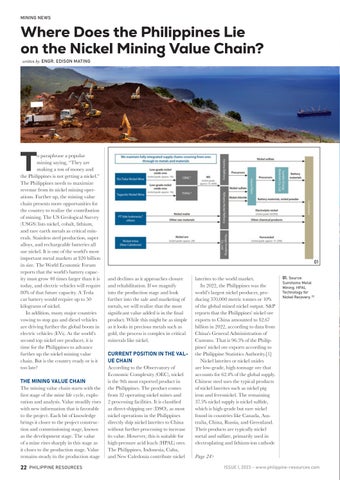
The mining value chain starts with the first stage of the mine life cycle, exploration and analysis. Value steadily rises with new information that is favorable to the project. Each bit of knowledge brings it closer to the project construction and commissioning stage, known as the development stage. The value of a mine rises sharply in this stage as it closes to the production stage. Value remains steady in the production stage
and declines as it approaches closure and rehabilitation. If we magnify into the production stage and look further into the sale and marketing of metals, we will realize that the most significant value added is in the final product. While this might be as simple as it looks in precious metals such as gold, the process is complex in critical minerals like nickel.
CURRENT POSITION IN THE VALUE CHAIN
According to the Observatory of Economic Complexity (OEC), nickel is the 9th most exported product in the Philippines. The product comes from 32 operating nickel mines and 2 processing facilities. It is classified as direct-shipping ore (DSO), as most nickel operations in the Philippines directly ship nickel laterites to China without further processing to increase its value. However, this is suitable for high-pressure acid leach (HPAL) ores. The Philippines, Indonesia, Cuba, and New Caledonia contribute nickel
laterites to the world market.
In 2022, the Philippines was the world’s largest nickel producer, producing 370,000 metric tonnes or 10% of the global mined nickel output. S&P reports that the Philippines' nickel ore exports to China amounted to $2.67 billion in 2022, according to data from China's General Administration of Customs. That is 96.5% of the Philippines' nickel ore exports according to the Philippine Statistics Authority.[1]
Nickel laterites or nickel oxides are low-grade, high-tonnage ore that accounts for 62.4% of the global supply. Chinese steel uses the typical products of nickel laterites such as nickel pig iron and ferronickel. The remaining 37.5% nickel supply is nickel sulfide, which is high-grade but rare nickel found in countries like Canada, Australia, China, Russia, and Greenland. Their products are typically nickel metal and sulfate, primarily used in electroplating and lithium-ion cathode
PHILIPPINE RESOURCES 22 ISSUE 1, 2023 – www.philippine-resources.com MINING NEWS
Page 24>
01
01. Source: Sumitomo Metal Mining. HPAL Technology for Nickel Recovery. [3]

material. Less than 10% of that supply is in sulfate form; not all are battery grade. [2]
Of the nickel mines operating in the country, only Nickel Asia Corporation (NAC), the country’s top producer of nickel, processes its nickel laterite ores. Coral Bay Nickel Corporation and Taganito HPAL operate a hydrometallurgical processing plant that uses the High-Pressure Acid Leach (HPAL) process. HPAL can effectively and efficiently convert low-grade nickel lateritic ores from 1.14%-1.44% nickel to 55 to 60% nickel, also known as mixed sulfides (MS).
Mixed sulfides, a mixture of cobalt and nickel sulfides and an intermediate product, are refined further in Japan at the Niihama Nickel Refinery and Harima Refinery. They produce electrolytic nickel and cobalt, nickel chloride, and nickel sulfate. These are further processed at the Isoura Plant to produce either battery-grade nickel or ferronickel. Battery grade nickel or Class 1 nickel is typically >99.8% Ni. Nickel pig iron (NPI) or ferronickel used for stainless steel and alloy is class 2 nickel or <99.7% Ni.
Value increases as the products are refined up to their final form in the supply chain. More value is added to battery production, and eventually electric vehicle production. Thus, the Philippines needs to get added value and opportunities along the production line, at least for the primary products. Countries like China, Indonesia, and Japan get this added value in the processed product stream.

The Philippines, from its current standing, needs to move further up the value stream at least to the primary products. Additionally, it might be best if it can go to battery cathode or stainless-steel production, as most nickel ore is suitable for this.
RECHARGING THE PHILIPPINE NICKEL MINING INDUSTRY
The Philippines, through the Department of Trade and Industry (DTI) participated in the Indo-Pacific Economic Framework for Prosperity (IPEF) Ministerial Meeting in Los Angeles, U.S.A last September 2022. The meeting highlighted that the U.S. Government will extend a grant for the Philippines’ nickel ore processing for the manufacture of batteries through a partnership with an American firm. [5]
In December 2022, a study grant was awarded to Eramen Minerals Inc. (EMI) to evaluate the technical and economic viability of developing a nickel processing facility at the site of EMI’s mine in Zambales province. The plant is expected to use EMI’s nickel ore to produce refined nickel and cobalt products for sale as battery precursor materials. The study will help define the technical specifications for the facility and promote alignment with high environmental, social, and governance standards. [6]
Last January, Chinese investors pledged to invest US$7.32 billion in the electric vehicle and mineral processing sectors in the Philippines during President Ferdinand Marcos Jr.'s first state visit to China on January 05, 2023. [7] Last February, Global Ferronickel Holdings Inc. coordinated with a potential technology partner for its plan to build a $100-million steel plant in Bataan. The plant aims to capture around 10% of the market for imported steel. [8]
These are exciting opportunities for the nickel mining space, but policy changes especially on taxes must be balanced as the country needs to maintain a healthy business environment favorable to foreign investors, the government, and its citizens.
BALANCING INTERESTS
The government is planning to impose up to 10% tax on nickel ore exports in what the Department of Environment and Natural Resources (DENR) Secretary Antonia Yulo Loyzaga describes as moving out of the supply chain to the value chain. Inspired by the success of nickel’s high-value production in Indonesia, DTI is initiating the
government’s industrial policy study to determine whether it will impose an export tax or nickel ban. Another statement from Trade Secretary Alfredo E. Pascual encourages investment in local processing to produce higher-value export products and not resource-based exports. However, following the footsteps of Indonesia is not as easy as it seems for several reasons.
• Depleting Reserves. The Philippines' class A nickel reserves dropped by 4.8% to 474.49 million tonnes in 2021, according to The Philippine Statistics Authority. [9] While the Philippines remains among the top countries with nickel ore reserves, there is a huge difference compared to the ore reserves of Australia, Brazil, and Indonesia. Favorable circumstances could quickly shift investors into moving into these countries in the long term. By the time nickel peaks, the Philippines might no longer have that impact on global production. In addition, a future tax on nickel would be meaningless and only discourage smaller mining projects. Dante Bravo, president of the Philippine Nickel Industry Association (PNIA), said the comparison to Indonesia is flawed because it has more reserves to support investments in local mineral processing.
• Capital Requirement. A processing facility is a capital-intensive infrastructure, and many small nickel mining operations need to satisfy processing capacities to operate. A more attractive investment solution would be a centralized nickel processing facility for mining operations near each other.
• Energy Requirement and Environmental Concerns. Lateritic
PHILIPPINE RESOURCES 24 ISSUE 1, 2023 – www.philippine-resources.com < Page 22
01 MINING NEWS
01. Source: International Energy Agency (IEA). The Role of Critical Minerals in Clean Energy Transitions. [4]
nickel ores of the Philippines are amendable to high-pressure acid leach (HPAL) requiring substantial energy input. Processing low-grade nickel ores require high volumes of water, resulting in expensive water treatment and disposal. Lateritic ore mining also warrants high tonnage, thus, a larger environmental footprint.
• Policy Shifts. The Philippines has an unstable political climate where policies, especially in mining, change every time a new administration takes over. The industry is always at risk. The deposit is not the only focus of mining investment. It also means investment in the national and local government, the community, and the environment. Thus, changing policies is a significant concern for foreign investors.
Overall, the environmental and social costs are the most significant reason for the Philippines to maximize value from mining. Processing facilities abroad do not assume that cost because they just buy into the product after mining, while we struggle to defend the industry and what is left
after mining. The Philippines’ nickel mines will not be here forever and not for a very long time. Decisions need to be guided by facts and science for the interest of the common good.
Reference:
[1] Chen. A. (2023, February 02). Philippines seeks to follow in Indonesia’s footsteps with Nickel Export Ban. S&P Global Market Intelligence. https://www.spglobal. com/marketintelligence/en/news-insights/ latest-news-headlines/philippines-seeks-tofollow-in-indonesia-s-footsteps-with-nickelexport-ban-74109353
[2] Desjardins, J. (2017, October 30). Nickel: The Secret Driver of the Battery Revolution. Visual Capitalist. https:// www.visualcapitalist.com/nickel-secret-driver-battery-revolution/
[3] Sumitomo Metal Mining. (n.d). HPAL Technology for Nickel Recovery. https:// www.smm.co.jp/en/sustainability/activity_highlights/article_12/
[4] International Energy Association. (2022, March). The Role of Critical Minerals in Clean Energy Transitions. https://iea.blob.core.windows.net/assets/ ffd2a83b-8c30-4e9d-980a-52b6d9a86fdc/ TheRoleofCriticalMineralsinCleanEnergy -
Transitions.pdf
[5] Magkilat, B. (2022, September 15). US vows grant for PH nickel ore processing — DTI. Manila Bulletin. https://mb.com. ph/2022/09/15/us-vows-grant-for-ph-nickel-ore-processing-dti/
[6] Eramen Minerals gets US trade grant. (2022, December 14). Philstar Global
[7] Magkilat, B. (2023, February 06). Chinese firms to invest $7.32 B in nickel, EV, steel, electronics ventures in PH. Manila Bulletin. https://mb.com.ph/2023/01/06/ chinese-firms-to-invest-7-32-b-in-nickel-evsteel-electronics-ventures-in-ph/
[8] Philippine Nickel Industry Associations (PNIA). (2023, February 09). Global Ferronickel in Talks With Potential Partner For $100m Steel Plant. https://www. philippinenickel.org/news-and-updates/ mining-news/philippines-proposed-tax-onnickel-ore-exports-could-kill-industry-grouphead/
[9] Philippine Statistics Authority. (2022, June 02). Philippines’ Class A Nickel, Gold, Copper, and Chromite Resources Valued at Php378.04 Billion in 2021 (Press Release). https://psa.gov.ph/content/ philippines%E2%80%99-class-nickel-goldcopper-and-chromite-resources-valued-php37804-billion-2021
FOR SALE OR JOINT VENTURE
SEMCO EXPLORATION AND MINING CORPORATION

Four (4) Exploration Permits ("EPs") located in Tubay, Santiago and Cabadbaran City in Agusan del Norte covering a total area of approximately 4,180 hectares.
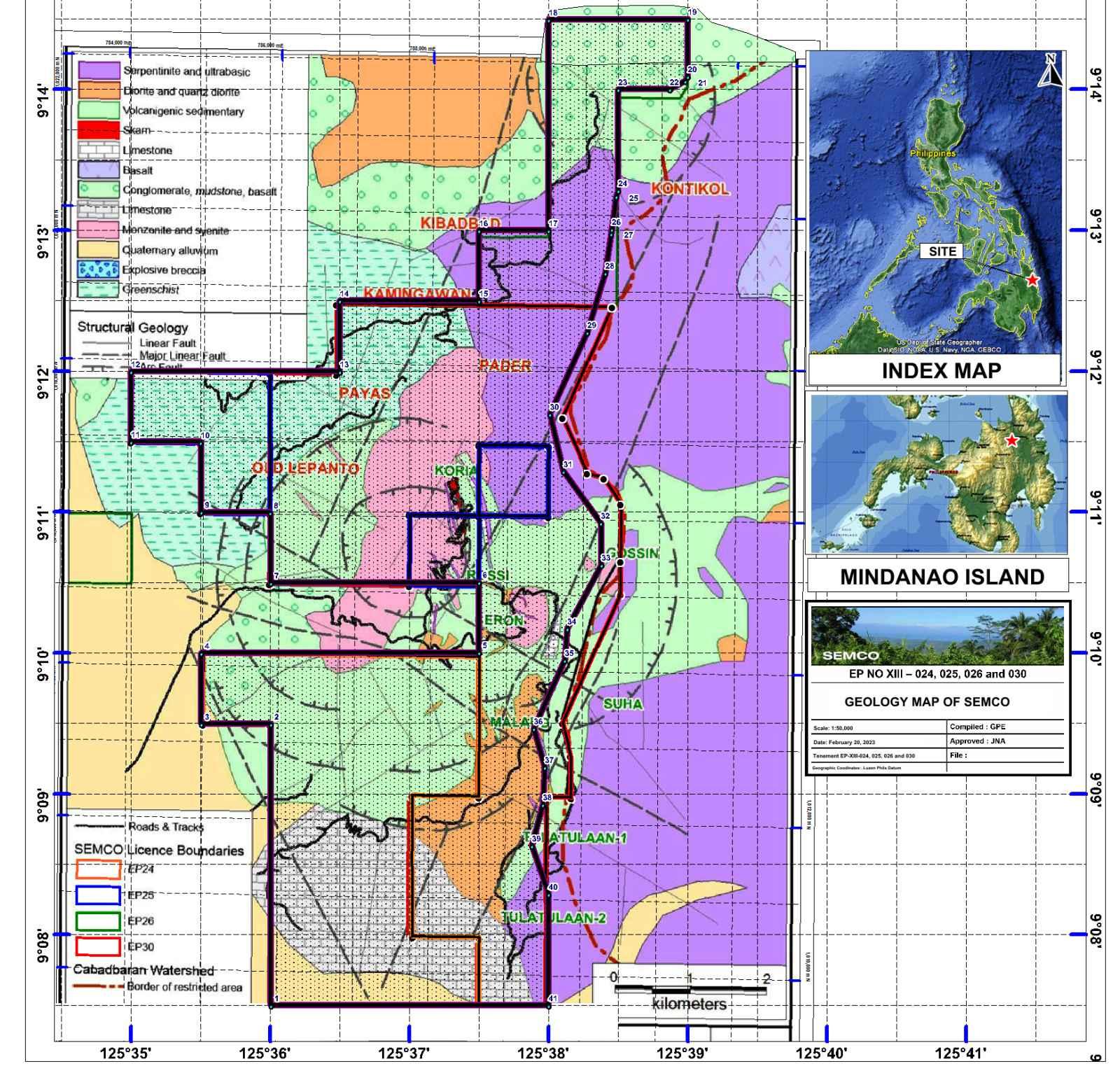
Numerous identified Cu-Au mineralization
Soil sampling, ground geophysics and scout drilling have been conducted.
Indigenous peoples consent up to development
Significant drill intercepts:
RLDH 01 – 19.7m @ 2.4% Cu
RLDH 03 – 8.20m @ 3.31% Cu
RLDH 06 – 24m @ 1.15% Cu
ISSUE 1, 2023 – www.philippine-resources.com
Contact:
(63)
E-mail: jnrayson@yahoo.com
Joey Nelson R. Ayson Mobile
9189081329
Industry Updates from PMEA
written by: MARCELLE P. VILLEGAS
Last 6th of February 2023, the Philippine Mining and Exploration Association had their first Monthly Membership Meeting for the year.
PMEA President, Mr Joey Nelson Ayson’s report “PMEA Matters and Industry Updates” was about significant mining events and news from 2022. One of the noteworthy events last year was the 5th PMEA Baguio Forum (New Innovations in the Mineral Resource Industry) that took place last 15th of November 2023. The event was well attended with over 120 attendees.
Mr Ayson’s presentation also included some updates from DENR and MGB. This is in relation to the series of special orders in that were issued by DENR Secretary, Maria Antonia Yulo-Loyzaga, last January 23 – 25, 2023. As an effect of the special orders, positions in the Department were shuffled and this created new positions.

Here is a summary of the following staff movements:
• Dec. 31, 2022 – Asst. Dir. Johnny Calvez retired after 39 years with the MGB and Ted Sandoval has been appointed as OIC Asst. Director.
• Jan. 16, 2023 – RD 3 Jun Ensomo filed an Optional Retirement and Chief Geologist Noel Lacadin was designated as OIC MGB 3 Regional Director.
• Jan. 24, 2023 – MGB Director Wilfredo Moncano was reassigned to the Office of Usec Ernesto Adobo, Jr.
• Jan. 25, 2023 – ASec Gilbert Gonzales appointed as EMB Direc tor (Interim & Concurrent)
• ASec Marcial Amaro appointed as BMB Director (Interim & Concurrent)
• ASec Arleigh Adorable appointed as FMB Director (Interim & Con current)
• Jan. 27, 2023 – Edgardo Castillo designated OIC RD MGB 4A vice Dondi Sarmiento who has filed an Optional Retirement
• Carlos Primo C. David – USec for Integrated Environmental Science
• Atty Ignatius Loyola A. Rodriguez
• USec for Special Concerns and
Legislative Affair
• Agusto Dela Pena – USec for Organizational Transformation & Human Resources
• Marilou Erni – Chief of Staff and Supervising USec for Strategic Communications
• Jose Joaquin Y. Loyzaga – Head Executive Assistant
Of note, Carlos Primo C. David’s newly assigned position as Undersecretary for Integrated Environmental Science is one of the newly created positions . His role includes supervising the Geospatial Database Office, leading the discussions in policy formulation, and required changes in the regulatory functions of DENR bureaus and connected agencies. [1]
David is also assigned to promoted the use of science in the performance of all DENR bureaus and attached agencies, in policy formulation in the regulatory roles of DENR, and to liaise with the various National Government Agencies on science and technology matters.
DENR currently has a principal research and development unit called the “Ecosystems Research and Development Bureau (ERDB).
Sec. Loyzaga assigned USec Marilou G. Erni as the USec for Strategic Communications where she is tasked to supervise the Strategic Communication and Initiative Service (SCIS) in addition to her current post as chief of
staff of DENR.
Sec. Loyzaga named Karmela Beatriz L. Galura as the Director for Strategic Communications.
Usec. Augusto D. dela Peña was assigned as the Supervising Undersecretary of the Human Resource Development Service. This position was formerly assigned to Usec. Ernesto D. Adobo, Jr.
The newly appointed director for the Environmental Management Bureau (EMB) is Gilbert Gonzales, while the Assistant Director of EMB is Esperanza A. Sajul. [1]
With regards to new DENR Administrative Orders, there are only two recent issuances, namely:
• DAO 2023-01 (Jan. 04, 2023) –Establishment of a National Envi ronment and Natural Resources Database under the Office of the Secretary
• DMO 2023-01 Jan. 13, 2023) –Additional Guidelines for Projects Applying for ECC which are with in or with Close Proximity to Pro tected Areas and/or RAMSAR
Sites On MGB Statistics, the Phil ippine metallic mineral production for 2022 are as follows:
• Jan – Mar 2022 : PhP 48.6B
• Jan – Jun 2022 : PhP 112.67B
• Jan – Sep 2022 : PhP 176 B
OPERATING METALLIC MINES
• Copper (w/ gold and silver) – 3
PHILIPPINE RESOURCES 26 ISSUE 1, 2023 – www.philippine-resources.com
01. 6 Feb. 2023
PMEA Monthly Membership Meeting at Manila Elks Club, Makati City with their President, Mr Joey Nelson Ayson (Photo by M.Villegas for Phil. Resources Journal)
MINING NEWS
01
• Gold (w/ silver) – 12
• Chromite – 4
• Nickel – 34
• Iron – 4
PROCESSING PLANTS
• Copper Smelter – 1
• Gold – 4
• Nickel HPAL - 2
For Industry Updates, we have the following company news in summary:
1) OCEANA GOLD / OGPI
• Peter Sharpe: COO for Asia-Pacific (NZ and Philippines)
• David Bickerton: GMOperations Didipio
• 3Q 2022 Production –25.4 koz Au and 3.6kT Cu (EO 3Q 84.1 koz Au and 10.9kTCu)
• Over-all Safest Mining Operation for 2022


2) B2GOLD / MGP
• 4Q 2022 Production –48,687 oz (Full 2022: 212,728 oz)
3) SAGITTARIUS MINES INC.
• PhP 397M levied by Tampakan LGU is being contested in the Court of Tax Appeals
• Ongoing tree-cutting for access and land acquisition / resettlement
4) MT. LABO EXPLORATION AND DEVELOPMENT CORPORATION

• Currently resolving all issues, including re structuring brought about by the entry of TVIRD in the project
5) CELSIUS RESOURCES LIMITED
• Accepted in AIM
• SP Angel acted as Broker and Beaumont Cornish acted as the Nominated Adviser.
6) GREENSTONE RESOURCES (SIANA MINE)

• Mill started operations in December, processing old stockpile
• Mine development towards pit bottom is ongoing.
7) TVIRD AGATA
• Final shipment in April 2023
• FMR/DP w/ AgriFarm/ Tourism as Final Land Use
8) MEDUSA MINING / 1064 LIMITED
• 4Q 2022 Production –19,965 oz (Full 2022: 86,187 oz)
• Construction of the Tigerway Decline is 32.4% complete.

Additional reference: [1] Mayuga, Jonathan L. (26 Jan. 2023). “Loyzaga shuffles key DENR officials, creates new posts”. Business Mirror.
For DENR Updates: https:// www.denr.gov.ph/index.php/aboutus/denr-directory
27 PHILIPPINE RESOURCES ISSUE 1, 2023 – www.philippine-resources.com
fahrenheit, inc. machinery * sales & service engineering www.fahrenheit-inc.net Gubat Road Buenavista, Sta Maria, Bulacan 3022, Philippines 85-A Mapang-akit St., Pinyahan (044) 492-0075; (044) 893-0511 (02) 8736-4569 Quezon City 1100, Philippines engineering@fahrenheit-inc.net fahrenheit@pldtdsl.net (02) 8352-4213 (02) 8332-9108 Mea C. Albon (+63) 905-4165841 Sales Manager www.monitortech.com Level Measurement for Powder and Bulk Solids Application www.greenheck.com Leading Manufacturer of Air Movement, Control and Conditioning Equipment www.eriez.com World Authority in Magnetic Separation, Metal Detection & Vibratory Applications Lic. No. 44330 fahrenheit, inc. machinery * sales & service engineering www.fahrenheit-inc.net Gubat Road Buenavista, Sta Maria, Bulacan 3022, Philippines 85-A Mapang-akit St., Pinyahan (044) 492-0075; (044) 893-0511 (02) 8736-4569 Quezon City 1100, Philippines engineering@fahrenheit-inc.net fahrenheit@pldtdsl.net (02) 8352-4213 (02) 8332-9108 Mea C. Albon (+63) 905-4165841 Sales Manager www.monitortech.com Level Measurement for Powder and Bulk Solids Application www.greenheck.com Leading Manufacturer of Air Movement, Control and Conditioning Equipment www.eriez.com World Authority in Magnetic Separation, Metal Detection & Vibratory Applications Lic. No. 44330 fahrenheit, inc. machinery * sales & service engineering www.fahrenheit-inc.net facebook.com/fahrenheit.inc Gubat Road Buenavista, Sta Maria, Bulacan 3022, Philippines 85-A Mapang-akit St., Pinyahan (044) 492-0075; (044) 893-0511 (02) 8736-4569 Quezon City 1100, Philippines engineering@fahrenheit-inc.net fahrenheit@pldtdsl.net (02) 8352-4213 (02) 8332-9108 Mea C. Albon (+63) 905-4165841 Sales Manager www.monitortech.com Level Measurement for Powder and Bulk Solids Application www.greenheck.com Leading Manufacturer of Air Movement, Control and Conditioning Equipment www.eriez.com World Authority in Magnetic Separation, Metal Detection & Vibratory Applications Lic. No. 44330 fahrenheit, inc. machinery * sales & service engineering www.fahrenheit-inc.net facebook.com/fahrenheit.inc Gubat Road Buenavista, Sta Maria, Bulacan 3022, Philippines 85-A Mapang-akit St., Pinyahan (044) 492-0075; (044) 893-0511 (02) 8736-4569 Quezon City 1100, Philippines engineering@fahrenheit-inc.net fahrenheit@pldtdsl.net (02) 8352-4213 (02) 8332-9108 Mea C. Albon (+63) 905-4165841 Sales Manager www.monitortech.com Level Measurement for Powder and Bulk Solids Application www.greenheck.com Leading Manufacturer of Air Movement, Control and Conditioning Equipment www.eriez.com World Authority in Magnetic Separation, Metal Detection & Vibratory Applications Lic. No. 44330 fahrenheit, inc. machinery * sales & service engineering www.fahrenheit-inc.net Gubat Road Buenavista, Sta Maria, Bulacan 3022, Philippines 85-A Mapang-akit St., Pinyahan (044) 492-0075; (044) 893-0511 (02) 8736-4569 Quezon City 1100, Philippines engineering@fahrenheit-inc.net fahrenheit@pldtdsl.net (02) 8352-4213 (02) 8332-9108 Mea C. Albon (+63) 905-4165841 Sales Manager www.monitortech.com Level Measurement for Powder and Bulk Solids Application www.greenheck.com Leading Manufacturer of Air Movement, Control and Conditioning Equipment www.eriez.com World Authority in Magnetic Separation, Metal Detection & Vibratory Applications Lic. No. 44330 fahrenheit, inc. machinery * sales & service engineering www.fahrenheit-inc.net Gubat Road Buenavista, Sta Maria, Bulacan 3022, Philippines 85-A Mapang-akit St., Pinyahan (044) 492-0075; (044) 893-0511 (02) 8736-4569 Quezon City 1100, Philippines engineering@fahrenheit-inc.net fahrenheit@pldtdsl.net (02) 8352-4213 (02) 8332-9108 Mea C. Albon (+63) 905-4165841 Sales Manager www.monitortech.com Level Measurement for Powder and Bulk Solids Application www.greenheck.com Leading Manufacturer of Air Movement, Control and Conditioning Equipment www.eriez.com World Authority in Magnetic Separation, Metal Detection & Vibratory Applications Lic. No. 44330 fahrenheit, inc. machinery * sales & service engineeringfacebook.com/fahrenheit.inc Gubat Road Buenavista, Sta Maria, Bulacan 3022, Philippines 85-A Mapang-akit St., Pinyahan (044) 492-0075; (044) 893-0511 (02) 8736-4569 Quezon City 1100, Philippines engineering@fahrenheit-inc.net fahrenheit@pldtdsl.net (02) 8352-4213 (02) 8332-9108 Mea C. Albon (+63) 905-4165841 Sales Manager www.monitortech.com Level Measurement for Powder and Bulk Solids Application www.greenheck.com Leading Manufacturer of Air Movement, Control and Conditioning Equipment www.eriez.com World Authority in Magnetic Separation, Metal Detection & Vibratory Applications Lic. No. 44330 fahrenheit, inc. machinery * sales & service engineeringfacebook.com/fahrenheit.inc Gubat Road Buenavista, Sta Maria, Bulacan 3022, Philippines 85-A Mapang-akit St., Pinyahan (044) 492-0075; (044) 893-0511 (02) 8736-4569 Quezon City 1100, Philippines engineering@fahrenheit-inc.net fahrenheit@pldtdsl.net (02) 8352-4213 (02) 8332-9108 Mea C. Albon (+63) 905-4165841 Sales Manager www.monitortech.com Level Measurement for Powder and Bulk Solids Application www.greenheck.com Leading Manufacturer of Air Movement, Control and Conditioning Equipment www.eriez.com World Authority in Magnetic Separation, Metal Detection & Vibratory Applications Lic. No. 44330 fahrenheit, inc. machinery * sales & service engineering www.fahrenheit-inc.net Gubat Road Buenavista, Sta Maria, Bulacan 3022, Philippines 85-A Mapang-akit St., Pinyahan (044) 492-0075; (044) 893-0511 (02) 8736-4569 Quezon City 1100, Philippines engineering@fahrenheit-inc.net fahrenheit@pldtdsl.net (02) 8352-4213 (02) 8332-9108 Mea C. Albon (+63) 905-4165841 Sales Manager www.monitortech.com Level Measurement for Powder and Bulk Solids Application www.greenheck.com Leading Manufacturer of Air Movement, Control and Conditioning Equipment www.eriez.com World Authority in Magnetic Separation, Metal Detection & Vibratory Applications Lic. No. 44330 fahrenheit, inc. machinery * sales & service engineering www.fahrenheit-inc.net Gubat Road Buenavista, Sta Maria, Bulacan 3022, Philippines 85-A Mapang-akit St., Pinyahan (044) 492-0075; (044) 893-0511 (02) 8736-4569 Quezon City 1100, Philippines engineering@fahrenheit-inc.net fahrenheit@pldtdsl.net (02) 8352-4213 (02) 8332-9108 Mea C. Albon (+63) 905-4165841 Sales Manager www.monitortech.com Level Measurement for Powder and Bulk Solids Application www.greenheck.com Leading Manufacturer of Air Movement, Control and Conditioning Equipment www.eriez.com World Authority in Magnetic Separation, Metal Detection & Vibratory Applications Lic. No. 44330
PMSEA Returns: 68 Years of Responsible Mining Resilience, Reset, Recovery
written by: MARCELLE P. VILLEGAS
Baguio City] After two years of postponement due to the COVID-19 pandemic, The Philippine Mine Safety and Environment Association (PMSEA) finally returned last year to launch once again the Annual National Mine Safety and Environment Conference in Baguio City (ANMSEC) on its 68th year. It has been a tradition for decades that stakeholders and other participants from the mining industry gather yearly in the City of Pines for this event. ANMSEC remains one of the major events in the industry. This year’s conference was held last November 15 to 18, 2022. This year’s theme is “68 Years of Responsible Mining Resilience. Reset. Recovery.”
[1]
The ANMSEC began in the 1950s. Back then, the organising group was called Baguio City Mine Safety Operators Association, and was later called PMSEA. The objective was to promote the advocacy on the practice of occupational health and safety, sound environmental management, and social development among mining companies operating in the country. PMSEA is a volunteer organization that promotes responsible mining in order to counter the misinformation like anti-mining and anti-science beliefs that hinders progress of the industry. [2]
An early morning holy mass was held on the first day of the conference to open the 4-day exploration and mining exhibit and mining workshop at the CAP John Hay Convention Center.
Later in the afternoon, PMSEA officials, headed by President Louie Sarmiento and other stakeholders in the mining industry had a press conference at the Baguio Country Club. Welcome cocktails were sponsored by the Civic Merchandising.
On the second day of the conference, PMSEA hosted the 7th YAMAN PH or the Philippine Youth Association for Responsible Mining and Natural Resources Students Congress. The Community Relations Conference (COMREL) at the CAP John Hay Convention Center also took place that day.
There was also a sportsfest featuring
tournaments in badminton, bowling, golf, and lawn tennis. The winners were awarded during the Mining Night.
On the third day of the conference, the Mineral Industry Symposium was held at the CAP John Hay Convention Center in coordination with the Philippine Society of Mining Engineers. This symposium is a platform for discussion and sharing of ideas and studies that promote responsible mining, prospects of mining, technical studies, and geological discoveries.


Later in the event, Nickel Asia Corporation sponsored the Fellowship Night at the BCC Convention Center.
Finally, on the last day of the conference, the PMSEA with the Mines and Geosciences Bureau led the Mineral Industry Parade from Session Road to the Melvin Jones grounds. Later in the day, they had the Mine Safety Field Demonstration and Field Competition.
To conclude this major event, they had a Testimonial and Awards Night and the recognition of the Presidential Mineral Industry Environmental Award (PMIEA) for the best mining practices in the Philippines. [1]

One of the winners for the 2022 Presidential Mineral Industry Environmental Awards (PMIEA) include Coral Bay Nickel Corporation who won the PMIEA for Mineral Processing Category, the Best Mining Forest Contest (Mineral Processing Plant Category), and the Safest Mines Awards (Mineral Processing – Extraction Category).
The PMIEA Selection Committee (SC)
Platinum Achievement Award (Surface Mining Operation Category) was awarded to Rio Tuba Nickel Mining Corporation (RTNMC) – Nickel Project, while the PMIEA SC Titanium Achievement Award (Quarry Operation Category)
given
RTNMC – Gotok Limestone Project.
PHILIPPINE RESOURCES 28 ISSUE 1, 2023 – www.philippine-resources.com
was
to
MINING NEWS
01. [Baguio City] Mr Louie Sarmiento, PMSEA president (Right) visits the booth of Philippine Resources Journal during PMSEA’s Annual National Mine Safety and Environment Conference exhibit and mining workshop at the CAP John Hay Convention Center. (Left to right) Ma. Cecilia Pamular, Matthew Brimble, and Greg Brimble of Philippine Resources Journal.
01
02. DENR Sec. Antonia “Toni” Yulo-Loyzaga
02
Graymont (Philippines), Inc. was awarded the PMIEA SC Titanium Achievement Award (Mineral Processing Plant Category), and the Safest Mines Awards (Mineral Processing –Calcining Plant).
For the awarding, the PMIEA SC and its Technical Working Group conducted a strict assessment and validation of 29 qualified mining contractors, permittees, and permit holders involved in active exploration, surface or underground mining operation, quarry operation, and/or mineral processing. The assessment covers the topic on safety and health, environmental management, social/community development and management, and reforestation performance and accomplishments for the period of July 2021 to June 2022. [4]
The PMIEA is pursuant to Executive Order 399, series of 1997, with the objective to recognizes outstanding display of dedication, initiative and innovation in various aspects of operations in the country’s minerals sector.
DENR’s National Mapping and Resource Information Authority (NAMRIA) won the 2022 Bowling Tournament that was held at the Puyat Sports Baguio, at Baguio Center Mall last 16 November 2022. In the past, NAMIRIA’s bowling team won the championship in the bowling tournaments in 2016, 2018, and 2019. They also won in the 2019 and 2022 DENR Inter-Agency Sportsfest. [5]
Mr Louie Sarmiento, PMSEA president, said that the mining industry stakeholders and partners really looked forward to resume to the traditional face-to-face gatherings and activities for this event that was able to contribute around P75 million to the local economy.
According to the report by Mr Dexter See of Herald Express in Baguio, “The PMSEA official disclosed that even the number of companies that participated in the annual Minerals Industry Parade and the skills
competition reached record-breaking levels which is an indication of the desire of the mining sector to adhere to the practice of responsible mining leading towards proper occupational health and safety in the work place, sound environmental management and social progress.” [2]
Mr Sarmiento stated that aside from the 1,000+ attendees to the Mineral Industry Symposium and other conferences during the 4 days, there were also 600+ individuals who virtually attended the activities.
Mr Sarmiento also emphasised that the PMSEA will continue to work together to bring innovations and new ideas that will encourage more participants to take part in this annual event in Baguio City.
One of the topics mentioned by Mr Sarmiento during the conference was the significant contribution of both large-scale and small-scale mining in the Philippines’ economic progress. He also mentioned the importance of supporting the small-scale miners in order to revive their industry after it was adversely affected by the COVID-19 pandemic. Moreover, he stressed that mining is not only about earning revenues and profits. It is also about social, political, and environmental concerns that must be addressed by the Government and the private sector. [3]
In relation to this, Mr Sarmiento pointed out the case of Apex Mining Company, Inc. (AMCI) in Maco, Davao de Oro and in its subsidiary Itogon Suyoc Resources, Inc. (ISRI) in Itogon, Benguet where he serves as the president. He mentioned a partnership between the large-scale miner and some small-scale mining groups had been established through the big brother-small brother project where the company serves as the big brother mentoring and assisting their small brother small-scale mining associations. [3]
He called the large-scale mining companies as the big brother that will give their small
brother the necessary trainings on safety and provide them with personal protective equipment (PPE) so they may achieve their mining goals without putting their lives at risk.
Additionally, Mr Sarmiento said that the big brother will be regularly buying the ore that the small brother mined at the prevailing metal prices. Generally, the operational and business set up between the big brother and small brother should be a win-win situation, because he said, both large-scale and small-scale mining can co-exist. With that said, efforts are being initiated by the concerned government agencies, LGU, and the private sectors to make this possible. [3]
Reference:
[1] Cawis, Redjie Melvic (11 Nov. 2022). “Baguio City hosts anew annual mine safety conference on Nov. 15-18”. Philippine Information Agency. Retrieved from - https://pia.gov.ph/news/2022/11/11/ baguio-city-hosts-anew-annual-mine-safety-conference-on-nov-15-18


[2] See, Dexter A. (28 Nov. 2022). “4,000 join PMSEA events in Baguio”. Herald Express. Retrieved from - https://baguioheraldexpressonline. com/4000-join-pmsea-events-in-baguio/
[3] See, Dexter A. (19 Nov. 2022). “PMSEA recognizes role of mining in economic growth”. Herald Express. Retrieved from - https://baguioheraldexpressonline.com/pmsea-recognizes-role-of-mining-in-economic-growth/
[4] MGB Mimamorpa (28 Nov. 2022) “MIMAROPA mines win 2022 PMIEA, Best Mining Forest Contest, Safest Mines Awards”. Philippine Information Agency.
[5] Quodala, Jeffrey (14 Dec. 2022). “NAMRIA dominates 2022 PMSEA Bowling Tournament”. DENR News website. https://www.namria.gov.ph/
Acknowledgement:
Thank you to Ms Felisandelle de Vera of MGB Region 1, and Ms Joan Falcutela and Mr Job Paul Bulos of Philippine Mining Club for the photos.
29 PHILIPPINE RESOURCES ISSUE 1, 2023 – www.philippine-resources.com
Gen. Deveraturda’s Update on the Tampakan Project
written by: MARCELLE P. VILLEGAS
Before the year ended, the Philippine Mining and Exploration Association (PMEA) invited Retired Lieutenant General Roy O. Deveraturda as the keynote speaker for the November PMEA Monthly Membership Meeting. As the newly appointed president of Sagittarius Mines, Inc. he reported some updates on the Tampakan Project”.
Mr Roy Deveraturda is a former lieutenant general of the Armed Forces of the Philippines (AFP). He started as an aviation cadet in 1978. Then, he was commissioned in the Philippine Air Force in 1980. With his Military Pilot Badge after graduating from the Aviation Cadet Program of the Philippine Air Force Flying School, he later became an attack pilot of the 15th Strike Wing. He had more than 50 combat missions. General Deveraturda held the highest aircrew qualifications as Test Pilot, Flight Commander, Instructor Pilot, and Flight Examiner for AT-28D Trojan “Tora Tora” and the OV-10A Bronco. [1]
He retired as a Lieutenant General in Philippine Air Force on August 17, 2014, after having commanded the AFP’s entire Visayas area and then the Western Philippine Area, including the West Philippine Sea. He was one of AFP’s most decorated officers.
More notably, he was in charge of the humanitarian assistance and disaster relief for the Bohol earthquake and Typhoon Yolanda in 2013. Gen. Deveraturda became the Department of National Defense Assistant Secretary for the Plans and Programs in 2015. He joined the mining industry in 2018 when he was recruited to be the President of Carmen Copper Corp.
From there he now moved and have been appointed in May 2022 as President of Sagittarius Mines Inc. to bring the Tampakan Copper-Gold Project towards construction and development at the soonest possible time.
SCHOOL OF HARD KNOCKS
Gen. Deveraturda started his speech with words of gratitude to the officers and members of PMEA, and all attendees for the evening. He gave recognition to the role of PMEA in the revival of the mining industry in the country despite all odds.

He said, “I couldn’t help but feel the overwhelming sense of gratitude and I am honoured and humbled.”
“I started in mining in 2016 when my employer talked to me and asked me, ‘Can you help? We have a problem in Cebu.’ We are referring here to Carmen Copper Corp. under Atlas Mining Corporation. I went there
to Cebu with the decision right way, that whatever happens, I will say, ‘I will help.’ My job was to ensure that the company will pass the extracting audit procedures being undertaken by the then Secretary of DENR, the late Gina Lopez.”
Gen. Deveraturda is now on his 7th year in the mining industry. Many people would often ask him with his military background, what is he doing here in a mining company?
He would give a humble reply, “I always tell them, ‘Actually, I am the most unlikely choice for the job, and you are smarter than me.’ I will always admit that.”
“I learned about mining in Carmen Copper to the school of hard knocks. With that, I’d like to take this opportunity of course to always give thanks and express my gratitude to all the people who helped me learn the rudiments of mining.”
The key points of his speech contained an update on the Tampakan Project. Secondly, he gave his insights on the importance of mining in the country.
UPDATE ON THE TAMPAKAN PROJECT
“The project, as you all know, is the one of the world’s largest undeveloped
PHILIPPINE RESOURCES 30 ISSUE 1, 2023 – www.philippine-resources.com
MINING NEWS
01
01. 7 Nov. 2022 at Manila Elks Club, Retired Lieutenant General Roy O. Deveraturda of the Armed Forces of the Philippines was the keynote speaker for the PMEA Monthly Membership Meeting. He is now the President of Sagittarius Mines Inc. (Photo by Marcelle P. Villegas, Philippine Resources Journal)
copper and gold mining project. It is located in the southernmost portion of Mindanao and held under an FTAA agreement by Sagittarius Mines Inc.”
“The company is committed to responsible and sustainable development with ESG (environmental, social, and governance) at the core of managing the project. The project is a national priority considering that the mining industry is acknowledged by the government’s economic team as an indispensable contributor to Philippine economic growth -- the greatest potential to be the key driver in economic recovery and long-term goals. At the moment, all regulatory approvals have been completed.”
He mentioned that the project obtained an FTAA that expires in 2038, and renewable for another 25 years.
“The community development initiatives have resulted to strong acceptance and support from the municipalities of South Cotabato and tribal councils in the area. The project is the endorsement of four municipalities, all of them, of course, and 10 barangays as host communities. Consent from 11 indigenous control communities was formalised to memorandum of agreement.
“More importantly, the regional development council for region 12 declared the project as the flagship project on mineral development. The project has a mine life of 40+ years using the PACE development approach starting with 15 million tonnes per annum for the first 10 years in the initial phase and it is expected the start of production in the 4th quarter of 2025.”
Then General Deveraturda later talked about the global demand for copper in relation to the worldwide need for the development of green technologies.
“I shared with you that demand for mineral-based products will intensify. Recent research showed that for a greener earth, more
mining is needed rather than less. In short, if you are to achieve green emissions, you will be needing a lot of copper. I am confident that the demand will always be there. I am worried where the supply will come from.”
On the possible shortage of copper in the future, “This situation has potential to stall global growth and increase inflation, and the country will be affected. Trafigura, one of the largest commodity traders had recently warned that the world is running low on copper. They said, ‘The copper market is today running with inventories that cover 4.9 days of global consumption, and this is expected to finish this year at 2.7 days.’”
He clarified that inventory used to be measured in weeks, but now it is quantified in days, which means the supply is being consumed fast.
“Bloomberg News reported last November 1, 2022 that Saudi Arabia is seeking investments from Australian miners to support its 170-billion dollar plan to build a mining industry and diversify its oil-dependent economy this decade.”
“What are these revelations, among others, mean to all of us? It means that other governments are initiating actions to achieve a robust national mining industry.”
“For us, I would argue that the time has come for the national government or the Philippine government as well, to aggressively encourage and care for investment in mining sector and provide certainty and stability that the industry needs to operate and ensure its long-term success. We have to act now.”
“My prayer is that we finally see the change on how the industry sees itself, that this business is seen as solution to social problems rather than seen as a problem.”
“There is a need also to veer away from the simplistic views on mining and focus on the strict and mandatory conformance to our mining law based on its real intent and spirit.
We are all aware that the law calls for a harmonious coordination of all actions and socio-cultural, economic and political realm. It is coordination of all these factors that could provide for the real meaning of what sustainable and responsible mining is all about… Mainly the government under the rule that they the enabler of shared value creation, the private sector providing investments that create this wealth for everyone, the market forces that act on incentives, the politics that exist for good governance, and the state with all its concentration of power renders justice for all regardless of social status and wealth.”
General Deveraturda mentioned that the mining industry has the potential to provide our national prosperity and could also propel our country high up to its rightful place in the world economic standing.

“As I am speaking to you now we are 38th among the 200 nations in terms of real GDP ranking. And mind you, I will always take the view that we could easily barge in the top 30.”
To conclude, the General mentioned that SMI reiterates their solemn commitment to contribute in the attainment of the company’s economic objectives.
“How do we do this? By creating shared social, environmental, and economic values.”
“So in closing, let me site Salvador Lopez in his book ‘Isles of Gold: A History of Mining in the Philippines’. This book was published in 1992. He said, ‘There is of course the need to utilize and conserve the country’s minerals as wisely and judiciously possible for the good of the greater number, including and especially generations yet unborn.’”
“We know that we have 1 to 1.4 pessimistic estimate of a trillion-dollars-worth of untapped resource laying underground of this archipelago, not to mention the minerals that can be found in our seabed. So Sagittarius Mines Inc. therefore echoes Lopez’s assertion. Tampakan project and all our actions are directed to achieve the summoned goal for the ultimate good.”
Additional reference:
[1] The Manila Times (25 Nov. 2018). “Piloting Carmen Copper to Greater Heights”.https://www. manilatimes.net/2018/11/25/the-sunday-times/ cover-story/piloting-carmen-copper-to-greater-heights/472819 04
31 PHILIPPINE RESOURCES ISSUE 1, 2023 – www.philippine-resources.com
02
02. Looking back: A photo from 17 Nov. 2013 in Tacloban, with Former Australian Ambassador to the Philippines, H.E. Bill Tweddell with General Deveraturda of the Armed Forces of the Philippines. (Photo credit and caption: Dept. of Foreign Affairs, Anne Orquiza)
The Significance of Copper in Green Technologies
written by: MARCELLE P. VILLEGAS
During the February 2023 PMEA Monthly Membership Meeting, the keynote speaker for the evening was Geologist, Mr Douglas Kirwin. His topic was about “The Future for Copper: What it means to the Philippines”.

Mr Kirwin’s presentation discussed the significance of copper in the development and creation of green technologies. He also mentioned the challenges that may arise with the increasing demand for copper globally, and how the Philippines can benefit from this.
THE FUTURE FOR COPPER IN THE 21ST CENTURY
“As the industrialized world rapidly transitions to green energy and zero carbon initiatives, there are major challenges ahead with supply and demand of critical metals to achieve these goals,” he explained.
“Renewable energy is derived from natural processes that are replenished constantly. In its various forms, it derives directly from the sun, or from heat generated deep within the earth. Included in the definition is electricity and heat generated from solar, wind, ocean, hydropower, biomass, geothermal resources, and biofuels and hydrogen derived from renewable resources.” [1]
“Renewable energy systems are rapidly becoming more efficient and cheaper and their share of total energy
consumption is increasing, with a large majority of worldwide newly installed electricity capacity being renewable.”
Mr Kirwin mentioned that a major paradigm shift in the electrification of the world is the rapidly increasing demand and production of electric vehicles (EVs). EVs are considered the key to achieve a sustainable transport sector in the future because they have low to zero carbon emissions, low noise, high efficiency, and flexibility in grid operation and integration.
“The most critical metal required to drive the global electrification and demand for carbon-neutral economies is copper, simply because of its ability to conduct electricity.”
Copper requirements in a decarbonized world: This illustration shows how much copper and other elements are needed to create various forms of clean energy technologies, like electric cars, natural gas, nuclear energy, solar panels / photovoltaic, onshore wind turbine, offshore wind turbines, etc.

However, Mr Kirwin stated, “Despite increased exploration spend for copper deposits, there has been a lack of recent world-scale discoveries to keep up with growing commodity demand. Exploration and mining companies worldwide face the challenge of finding mineral deposits to support an ever-growing global population.” [1]
“The most critical metal required to drive the global electrification and demand for carbon-neutral economies is copper, simply because of its ability to conduct electricity.”
~ Douglas Kirwin
“The world’s leading copper producers are unanimous in stating that copper supply growth is expected to peak around 2024, the result of very few projects in the works, and as existing mines are depleted, this is setting up a supply deficit of 10 million tons in 2035.”
PHILIPPINE RESOURCES 32 ISSUE 1, 2023 – www.philippine-resources.com
MINING NEWS
“To put this in perspective, this is equivalent of putting a new Escondida (the world’s largest copper mine), into production every year. Obviously, this is very unlikely to happen, and so where are the world’s future copper supplies going to come from?” [1]
WHAT IT MEANS FOR THE PHILIPPINES
With the supply problem that may happen in the future, this is where the Philippines comes in.
“The Philippines is recognized as having the third largest copper endowment in the world due to its favorable geological location on the Pacific Rim of Fire and the presence of numerous porphyry-related copper-gold districts,” he said.
“There are at least 60 known porphyry copper deposits throughout the Philippines and some examples are shown in Table 1. It is relevant to note that eight of these were past producers and that today there are only three in production, with Didipio being the only deposit developed in the past two decades. Despite this, a number of deposits could be developed within the next five years, including Tampakan, Boyongan, Bayugo, King King and Taysan, as they have drilled out resources.” [1]

“As the inevitable copper demand-supply gap widens exponentially in the coming decades, the Philippines is perfectly positioned to become a major world copper producer. Some key criteria are; there are the number of large deposits that can be brought on line within five years with a very long pipeline for new mines within the next 20 years, many deposits have high gold credits and potential exists for low capex selective underground mining methods. There is also a scenario to greatly increase the capacity of the PASAR smelter to take advantage of greatly increased local concentrate production.” [1]
Aside from copper, Mr Kirwin also mentioned the abundance of nickel in the Philippines. Being the world’s second largest suppler of nickel in the world, the Philippines may tax nickel exports to follow Indonesia’s success. Indonesia is the world’s No. 1 nickel producer in the world. Based on the trends on the global demand for nickel for the past few years, here are some key points:
• Primary nickel demand in stainless steel is projected to increase over 5% this year, reflecting growth in China and North America, along with improved conditions in Europe and Japan.
• Longer term we estimate global nickel demand in stainless will continue
to increase at a rate above 4% p.a., predominantly driven by China.
• Activity levels in non-stainless applications are also robust with nickel usage projected to increase over 6% this year.
• Going forward, non-stainless demand growth is forecasted at ca. 4% p.a., with strong contributions from China, India, and the USA.
• Overall, we project solid nickel demand growth at a rate of above 4% p.a. between 2014 and 2019.
CONCLUSION:
• To make this a reality, there needs to be new Government initiatives to attract major investment capital for the mining sector and implementation of industry standard environmental and social policies for responsible development.
• If there is the political vision and direction to revitalize the copper mining sector, the impact on the Philippine economy will be very substantial for decades to come. The time to act is now.
Reference: [1] Kirwin, Douglas (6 Feb. 2023). “The Future for Copper: What it means to the Philippines”. Presentation during the PMEA Monthly Membership Meeting. Manila Elks Club, Makati City Graphs, tables, and photos – courtesy of Mr Douglas Kirwinv

33 PHILIPPINE RESOURCES ISSUE 1, 2023 – www.philippine-resources.com
01
01. Examples of Porphyry Copper-Gold Deposits in the Philippines
Perfect Match Equipment For Sustainable And Efficient Nickel Mining
The mining industry comes with various challenges; from scarce resources to uncertainty around commodity prices, miners are always looking at ways to overcome barriers to stay competitive. Nickel mining, for example, is mined from various depths and beneath the surface using large earth-moving equipment, the robustness and toughness of the used pieces of equipment played an important role in effective mining operations.
One of the various types of equipment used in mining is the pump. While there are substantial pumps available in the market, not every pump is suitable for a mine setting. Dewatering pumps for example.
These mining pumps help to ensure dry working conditions for a mining operation, it also prevents flooding alongside other environmental complications. Another pump required is the slurry pump that is used to transport slurry. The demanding condition in mining makes it important to have robust and high tolerances pumps that ensure minimal chance of failure.
Mining also uses large equipment to extract, process, and transport materials. Another substantial piece of equipment for mining is generators, where the right use of suitable generators helps the industry to operate efficiently.
Carrascal Nickel Corporation is a large-scale nickel mine located in Carrascal, Surigao del Sur, Philippines.
The company operates under Mineral Production Sharing Agreement (MPSA) granted in 2007 and began its commercial operations in 2009. Primarily engaged in the exploration, mining, and exporting of nickel laterite ore, Carrascal Nickel Corporation also believe in Sustainable Development Goal and environmental impact. These beliefs are practiced through various environmental and social development programs, also through their mining operation.
The concrete examples are Carrascal Nickel Corporation is using two of Atlas Copco’s WEDA L110N 79.9kW electric submersible slurry pump powered by a QAS210PD 200kVQ Prime Power generator on their Cayawyawan bridge site, together with PAS150MF vacuum pump centrifugal pumps on their Pit 2B.


“Atlas Copco’s sustainable performance pumps and the less footprint generator helps Carrascal Nickel Corporation in running a more sustainable mining operations. It is also the perfect fit for our requirements.” said Engr Lester Marqueres, the Resident Manager of Carrascal Nickel Corporation. “The innovative products that Atlas Copco offered and the proactive after-sales sup-
port, ensures the continuous operation of its partner, making it convenient and efficient for our mining operations.”
Engr Lester Marqueres continued.
Atlas Copco just recently celebrated its 150 years of innovations. For a century and a half, Atlas Copco has been driving development and delivering breakthrough innovations to customers in many different industries. The Power Technique business area provides air, power and flow solutions through products such as mobile compressors, pumps, light towers, and generators, along with several complementary products. The business area innovates for sustainable productivity across multiple industries, including construction, manufacturing, oil and gas and exploration drilling. To know more about Atlas Copco’s range of products and services, visit https:// www.atlascopco.com/en-ph/construction-equipment or email powertechnique.SEA@atlascopco.com

PHILIPPINE RESOURCES 34 ISSUE 1, 2023 – www.philippine-resources.com THE MAGAZINE FOR MINING, CONSTRUCTION & INDUSTRY
MINING NEWS 01
01. Engr Lester Marqueres
GREEN MINING SOLUTIONS
Since the inception of our patented MMD Sizer over 40 years ago, we have been committed to providing machinery that leads the way on productivity, reliability, safety and efficiency.
The MMD Sizer has been installed into a wealth of applications globally. Initially developed for underground coal mines, the reduced construction costs involved with a compact, low-profile machine were soon realised. In surface applications, the accurate product size and reduced fines creation compared to other size reduction technologies made for a cleaner, safer working environment with fewer fines to discard.

Innovation and continuous development is at the core of everything we do. Our teams of technical specialists work together with industrial partners, to incorporate new technologies into the MMD portfolio. These technologies deliver new heights of performance, efficiency and safety to keep our customers operating costs low and contribute towards wider net carbon zero targets.
Reduce waste processing and increase operational efficiency with our Bulk Ore Sorting Solutions

35 PHILIPPINE RESOURCES ISSUE 1, 2023 – www.philippine-resources.com
+230 260 0982 sales@mmdmauritius.com www.mmdsizers.com
A Breakthrough for MMD Sizers in Hard Rock Applications
MMD have been manufacturing Sizers for over 40 years, processing over 80 different materials in more than 70 countries worldwide. Sizers offer a compact and efficient way of comminution in primary, secondary and tertiary stage crushing, in both underground and open pit operations.
Sizers have gained notoriety in wet and sticky applications where traditional crushers have struggled. However, MMD Sizers have been developed to thrive in applications not usually deemed appropriate for their deployment.

As Sizers originated in the coal industry, some believe that Sizers are only suitable for soft material processing. This is simply not the case for MMD Sizers. MMD are specialists in Sizer technology, and we have evolved Sizers to be successful in a wide range of operations, in particular hard rock applications. The additional benefits a Sizer brings, such as producing a good shaped product with minimal fines whilst also being compact, energy efficient, and maintenance friendly, make it an appealing option when it comes to selecting a machine for hard material handling. Our dedicated in-house technical development team has provided consistent research and development since the Sizer’s inception in 1980, and enabled MMD’s machines to operate successfully in a variety of industries, processing some materials rated at over 250MPa.
Hard rock inclusions could be mixed with wet and sticky material without any major alteration to Sizer design or detriment to performance. Where some conventional crushers struggle to
cope with sticky material, the space between Sizer teeth and the constant agitation of material within the machine prevents material build-up, this can be further enhanced where necessary by adding side cleaning combs. Ultimately, MMD Sizers can handle any combination of wet, sticky, hard or abrasive material. This is particularly useful in climates where extremes of rainfall occur throughout the seasons, effecting the characteristics of the material being processed or where material types vary across the mine site.
SPECIALIST HARD ROCK DESIGNS
From the Sizer teeth design through to the drive train, the progress of these specialist heavy duty Sizers has taken many years of careful development and feature a range of adaptations to allow them to handle harder rock.
Sizer teeth designed for hard rock and highly abrasive applications are engineered from upgraded material to resist wear, with additional hard facing in high impact areas. The tooth designs themselves are bulkier to ensure maximum longevity between wear component change-outs. MMD are constantly developing new tooth designs, using a combination of theoretical and physical stress testing to find ways to improve wear components. The extra forces required to break harder material also requires larger shaft diameters and heavy duty bearings.
Another key feature throughout MMD’s range of Sizers is the use of in-house designed gearboxes. Using only the highest quality manufacturing processes, materials and components guarantees they are capable of dealing with the unique stresses inherent with sizing hard rock.
Each machine goes through stringent design procedures to ensure the highest quality. In some instances, physical trials are performed to test sample material.
ROBUST ANCILLARY STRUCTURES
MMD offer turnkey solutions in the form of semi-mobile and fully mobile sizer stations. Due to the lightweight nature and balanced breaking action of the Sizer, MMD Semi-Mobile Sizer Stations for hard rock applications generally only require simple pontoon bases rather than costly heavy duty foundations and civils. However, ancillary structures still require some adaptation to matchup with the impact forces generated in hard rock applications. For example, a fully fabricated one-piece hopper hood, with a wear resistant skin rather than wear liners reduces the risk of liners falling off due to high impacts. This skin is replicated on the hopper itself, along with a T-shaped lattice design in the impact area to combat high impacts from the truck dump. Adaptations such as these ensure MMD machines are designed to endure the harsh mining environment and are built to last.
MMD Sizer stations undergo rigorous FEA, DEM and Explicit Dynamics analysis at the design stage. This examination provides data on impact forces, load conditions, fatigue cycles, as well as material flow characteristics, which assist in optimising the design. This is particularly useful for wet and sticky applications where material hang-up and blockages could be problematic in features such as hoppers and
PHILIPPINE RESOURCES 36 ISSUE 1, 2023 – www.philippine-resources.com
MINING NEWS 01
chutework. At MMD, analysis and design work is undertaken by experienced, fully qualified engineers who combine their technical know-how with industry leading software to design the best solution for customer specific challenges.
CASE STUDY
In 2014, MMD delivered two compact semi-mobile Sizer stations to an island in the Philippines. These bespoke designs were installed to handle lateritic nickel ore. The material within the mine is generally very sticky with hard rock inclusions, however during the wet season the material characteristics change to


become extremely wet. The turnkey Sizer stations featured 625 series Sizers with side cleaning combs and D4 Apron Plate Feeders along with supporting steelwork and electrical package. Run of Mine material is directly fed by dump trucks in to the apron feeder which in turn draws material into the sizer controlled rate of up to 500TPH. Lumps of up to 800mm can enter the Sizer chamber, which is then efficiently reduced down to 150mm product. Both these machines remain active, providing trouble-free operation and minimal maintenance. Watch
GSP Induction of 2023 Officers
written by: MARCELLE P. VILLEGAS
Last 9th of February 2023, The Geological Society of the Philippines (GSP) hosted the “GSP Annual Dinner and Induction Ceremony” at the Celebrity Sports Plaza in Quezon City. This was a hybrid event which highlighted the induction of the 2023 GSP Officers, Board of Trustees, and Committee Chairs. The induction of officers was led by Dr. Carlos Primo C. David, Undersecretary of the Department of Environment and Natural Resources.
The new GSP officers are Mr Joey Nelson R. Ayson for President, Mr Rogel A. Santos for Vice President, Mr Kevin Garas for Secretary, Mr Christian Paul F. Escarian for Assistant Secretary, and Mr Leo Virtucio as Tresurer. The Trustees are Ms Gizella Greta D. Gonzales, Ms Charlotte (Cha) Vinarao, Ms Decibel (Dei) Faustino-Eslava, and Ms Josephine Aleta.
The Master of Ceremonies was Mr Kevin L. Garas.
To
Acknowledgement:
Thank you, Mr Joey Nelson Ayson for the photos and information.
01
01. [Quezon City]
9 Feb. 2023, GSP induction of officers with Dr. Carlos Primo C. David, Undersecretary of the Department of Environment and Natural Resources. (Photo by Joey Nelson Ayson)
02. [Quezon City]
9 Feb. 2023, GSP induction of officers was a hybrid event that was held at Celebrity Sports Plaza in Quezon City. Dr. Carlos Primo C. David, DENR Undersecretary led the induction ceremony.


37 PHILIPPINE RESOURCES ISSUE 1, 2023 – www.philippine-resources.com
01. One of the Semi-Mobile Sizer Stations processing Lateritic Nickel Ore
02. The Sizer’s 3 stages of breaking
03. MMD Sizer featuring side cleaning combs
the
in action: https://www. youtube.com/watch?v=DSLdwNoAY80 02 03
unit
02
(Photo by Joey Nelson Ayson)
the new officers of the Geological Society of the Philippines, congratulations and mabuhay!


Didipio Mine’s Community Development Fund (CDF): Breaking Ground
The Didipio Mine’s Community Development Fund (CDF) entered a new phase this year as different projects under the Fund are now in various stages of development and implementation.
“We are pleased to share that the Didipio Mine’s Community Development Fund (CDF) is now into full implementation phase as different projects have been breaking ground since December 2022,” Atty. Joan D. Adaci-Cattiling, President of OceanaGold (Philippines), Inc., said.

“From the drawing board to its launching last year, we are on our way to expanding the reach of the benefits brought by the Didipio Mine to more beneficiary communities in our host provinces of Nueva Vizcaya and Quirino,” she added.
The CDF aims to build community capacity and resilience as part of the additional terms and conditions of the Didipio Mine’s Financial or Technical Assistance Agreement (FTAA) renewal. The funding is from the additional 1.0 per cent of the gross mining revenue to meet the identified needs of the communities.
Launched in July 2022, the CDF operates under seven pillars of benefit-sharing:
• Infrastructure
• Enterprise Development
• Socio-cultural or IP Program
• Capacity Building
• Disaster Response/Management and Environment
• Health
• Education
The CDF emphasizes collaboration and partnership with relevant local government units (LGUs), community groups, organizations, Indigenous peoples, or Indigenous cultural communities to determine the plan and implementation.
The Fund is underpinned by the widespread participation among multiple community stakeholders to deliver programs that have broad benefits and purpose, and to build effective partnerships to foster learning and continuous improvement.
“These projects are identified through consultations with different groups and involve government agencies and organizations in the technical working group and steering committee for the implementation of the CDF,
so it is participatory and inclusive,” Marjorie Idio, External Affairs and Communications Manager, said.
01. The Community Development Fund’s (CDF) Steering Committee and Technical Working Group members that includes DENR Region II Regional Executive Director Dr. Gwendolyn Bambalan CESO III, MGB Region II
Regional Director Mario Ancheta, OceanaGold (Philippines) Inc. President Atty. Joan Adaci-Cattiling, DILG Region II
Regional Director Jonathan Paul Leusen, Jr. CESO III, CHR Region II
02
Regional Director Jimmy Baliga, and other key stakeholders pose during the launching of the Fund last July 2022 in Tuguegarao City, Cagayan.

02. Mines and Geosciences Bureau (MGB) Region II
“And as we expand the CDF’s reach beyond the host and neighboring barangays, more and more communities in the greater Nueva Vizcaya and Quirino provinces stand to benefit from it.
“We look forward to the completion, inauguration, and turnover of these projects,” she added.
The other additional program for community development under the FTAA renewal is the Provincial Development Fund (PDF), which is 0.5 percent of the gross mining revenue. The PDF will benefit the provincial local government units of Nueva Vizcaya and Quirino.
Regional Director Mario Ancheta joined barangay and municipal government officials and Didipio Mine employees in the groundbreaking of a farm-to-market road project in Ifugao Village, Diffun, Quirino last February 2023. The road project is part of the Mine’s Community Development Fund (CDF), which aims to share the benefits of the Didipio Mine outside its immediate communities.
PHILIPPINE RESOURCES 40 ISSUE 1, 2023 – www.philippine-resources.com
01
MINING NEWS

41 PHILIPPINE RESOURCES ISSUE 1, 2023 – www.philippine-resources.com
Mining Operational Excellence Via Digital Transformation
 written by: BY MAE ANN CABASAG, EM
Mining companies encounter numerous challenges throughout their operations. However, initiatives to mitigate these challenges and improve efficiency are often limited. Most of these limitations emanated from a common factor: the challenge of “poor visibility” in mining operations. A viable solution is to adopt digital transformation in mining operations by incorporating available real-time data into an integrated system— capable of ensuring automatic updates and reliable source of information. Through this, mining companies not only understand simulations and plans developed but also anticipate potential outcomes.
Various mining industry analysts have found that using non-digital methods in the mining operations can lead to a 27% reduction in production time and 25% increase in data inaccuracy. For a mining company to remain competitive in an industry susceptible to operation challenges, i.e. production processes, workers’ and equipment performances, ore quality and quantity, compliance to regulations, and inter-departmental collaboration, it needs to embrace digital transformation. Dassault Systèmes Mine Operations Management provides transformative digital solution for mining companies to achieve excellence in their operations. Mine Operations Management (MOM) equips mining companies with an integrated system for their mining operations, enabling them to achieve efficient plan and schedule. This system integrates entire operation data into a single repository source of information, known as the “single source of truth”, ensuring complete transparency of the company’s processes from mine to port. By leveraging MOM, we can address the following
global mining industry challenges:
• Maintaining competitiveness amidst market volatility.
• Eliminating waste materials, poor communication, and error duplication.
• Improving site productivity and efficiency.
• Utilizing assets and sharing best practices across the value chain.
• Ensuring an utmost level of safety.
• Reducing environmental impacts and achieving sustainable operations.
The transformative digital solution, Mine Operations Management, is composed of eight work packages, split across four domains, namely: Data Management, Material Reconciliation, Operational Control, and Assets Performance. These domains help generate valuable insights from integrated operational data for rapid and informed strategic decision-making. The Data Management consists of Master Data Model and Integration Framework packages essential for material tracking, stockpile management, task and workforce management, machine performance, and asset maintenance. It enables users to manage master data objects such as Site, Material, Location, Equipment, and Operator through manual data entry or third-party source systems. With this, mining companies can ensure efficient and integrated management of critical data required for seamless operations.
Material Reconciliation, on the other hand, consists of Material Tracking and Stockpile Management packages. Material Tracking enables us to track material movements across different stages, i.e. from the least accurate grade estimated in geological
model to the most precise information on shipped material quantity and quality, to account for any inaccuracies. While in the Stockpile Management, users not only can calculate daily stockpile balance, add Survey or Sampling data, analyze inventory levels and trends, create graphical representation of the stockpile balances and movements, calibrate stockpile using volumetric survey and sampling, enables comparison of different models, track movement genealogy and review stockpile slices for stockpiles with LIFO and FIFO calculation type but can create a different type of analysis such as actual vs plan vs model.
In the upcoming article, we will explore the two remaining domains of Mine Operations Management to where assigning operational tasks, tracking compliance to plan, monitoring equipment down to workers’ performance are feasible in the mining operations. To know more about MOM, mining innovations and solutions, contact Dassault Systèmes Value Solutions Partner: Paramina Earth Technologies Inc. through paramina_solutions@paramina.com
References:
Make it happen for mine execution excellence: Dassault Systèmes®. MEGATrends. (n.d.). https://events.3ds.com/make-it-happen-for-mine-execution-excellence
Dassault Systèmes. (2021, August 12). Digging deeper: The virtual solution for Mining Operational Excellence. Dassault Systèmes. https:// discover.3ds.com/virtual-mining-operational-excellence
dassault3ds. (2022, June 16). The mining industry needs to adapt, but how? Dassault Systèmes blog. https://blog.3ds.com/brands/delmia/ the-mining-industry-needs-to-adapt-but-how/
PHILIPPINE RESOURCES 42 ISSUE 1, 2023 – www.philippine-resources.com
MINING NEWS
PART 1: MINING OPERATION CHALLENGES AND MINE OPERATIONS MANAGEMENT DOMAINS 1 & 2
Power transmission and distribution
Project feasibility, concept, and system modelling
– Detailed engineering design
– Procurement assistance
– Power system studies
– Site/construction management services
Geotechnical and Geology
– Site investigations
– Slope stability study - soil and rock slopes
Foundation investigation and design
– Specialist analysis
– Pavements and tunnels
– Construction and earthworks technical support
– Instrumentation and monitoring
– Aerial photograph interpretation (API) and remote sensing methods
– Geological mapping and geophysics
– Comprehensive intrusive investigations
– Difficult access investigations
– Engineering Geological and Geohazard Assessments (EGGA)
Groundwater investigations
Renewable energy power generation
– Feasibility study
– Concept and detailed engineering design
– Regulatory approvals support
– Substation planning and design
– Instrumentation and control design
– Owner’s engineer/Lender’s engineer role
– Engineering, procurement, and construction management
Digital
– Geographic Information Systems (GIS)
– Building Information Modelling (BIM)
– Machine learning & artificial intelligence (AI)
– Digital twin
– Augmented reality (AR)/Virtual reality (VR) & mixed reality
– Digital risk & cybersecurity
– Intelligent automation & robotics process automation (RPA)
– Digital & web solutions
ghd.com
Environment
Site assessment
Baseline study
Impact assessment
Approvals & permitting
Audit & monitoring
Hazardous material audit
Contamination & remediation study
Advisory
Transactions, due diligence, and lender’s technical advisor
– Business case, financial, and economic analysis
–
Asset management
–
Environmental, social, and governance (ESG) and strategic sustainability

– People and crowd movement simulation and studies
– Logistics and supply chain studies
– Risk management
– Origination
– Regulation
– Strategic insights
– Assurance, audit, and compliance
43 PHILIPPINE RESOURCES ISSUE 1, 2023 – www.philippine-resources.com
Delivering solutions that drive sustainability, improve competitiveness, and maintain effective operations across the project life cycle
→
–
–
–
–
–
–
–
–
–
–
–
Ronald Acio Business Development and Marketing Manager D 63 2 7909 8102 M 63 920 981 4823 E ronald.acio@ghd.com Makati City 11th Floor Southgate Tower, 2258 Chino Roces Avenue corner EDSA, Makati City, 1232, Philippines Quezon City 17th Floor, Panorama TechnoCenter, 1029 EDSA, Quezon City, 1105, Philippines Cebu City Unit 2, 3, and 4 Level 8 Cebu IT Tower 2, Bohol Avenue, Cebu Business Park, Cebu City, 6000, Philippines
Customer’s First Choice: Sandvik Philippines Delivers 11th and 12th Pantera DP1500i Drills to Filminera Resources Corporation

Sandvik Philippines has successfully commissioned and delivered to loyal customer Filminera Resources Corporation (“Filminera”) their 11th and 12th Pantera DP1500i Top-hammer Surface Drills last 25 January 2023 at the Masbate Gold Project (MGP) located in Masbate Island, Philippines. Photo shows Sandvik Technician Larry Lugnas (second from left) and Service Operations Manager Jorge Cabello (third from left) handing over the drills to MGP representatives.
Located 360 km southeast of Manila, the Masbate Mine is operated by Filminera, the Philippine subsidiary of TSX- and NYSE-listed B2Gold with headquarters in Vancouver. In 2022, the mine produced a record-setting 212,728 oz of gold out of 7.93M tonnes of ore milled at an average grade of 1.11 g/t. B2Gold also operates the Fekola Mine in Mali and the Otjikoto Mine in Namibia. Their projects under development include the Anacon-
da Area in Mali and the Gramalote JV Project in Colombia.
The Masbate Mine started operating in 2008 initially using 4 x Atlas Copco ECM660 Drills owned and operated by the erstwhile mining contractor, Leighton. When the opportunity for re-fleeting came about in 2012, Sandvik succeeded in winning the tender which came packaged with a full maintenance contract for 24,000 service meter hours of five years. Ironically, the said maintenance contract almost led to the cancellation of the order for the first 4 x DP1500i due to a dispute with the rates. Eventually, both Leighton and Sandvik were able to arrive at a mutually acceptable arrangement, and Sandvik ran the service contract for five years without incurring penalties in the availability guarantees. The contract was so profitable, Sandvik even had to share some of the residual profit at the end with Filminera under the pain-and-gain proviso of the contract.
The next re-fleeting opportunity came in 2017, with the Masbate Mine. This time, there was no service contract attached to the equipment and Leighton was no longer the mining contractor; the mine has shifted to owner-miner operation. Sandvik managed to secure the repeat order for another batch of 4x DP1500i, banking on the proven performance and reliability of the first four. That brings the total to 8 units. Drill numbers 9 and 10 were ordered in July 2020 and delivered in 2021. Numbers 11 and 12 in the photo above were ordered in January 2022 and are now handed over to the customer.
Filminera ordered two more DP1500i’s in November 2022; these machines are now awaiting completion in Tampere, for delivery later this year. That should bring the total to 14 x DP1500i units spread over 11 years for our most loyal Pantera DP1500i customer in the Philippines – Filminera Resources Corporation!
PHILIPPINE RESOURCES 44 ISSUE 1, 2023 – www.philippine-resources.com
01

Motion Metrics® ShovelMetrics™ Gen 3 – the Next Generation in G.E.T. and Shovel Monitoring
ESCO® mining buckets and tooth systems together with ShovelMetrics can increase mine site productivity. ShovelMetrics Gen 3, the most advanced shovel monitoring service on the market, uses artificial intelligence (AI) and computer vision to provide industry-leading bucket G.E.T., rock and shovel monitoring. Providing 3D imaging technology and support for all excavators, backhoes and shovels. Our flagship shovel monitoring solution is a fully managed service that includes accurate and reliable missing tooth and lip shroud detection. These features mitigate the risk of crusher obstructions in order to safeguard your employees and prevent hundreds of thousands of dollars in lost production. ShovelMetrics pays for itself by increasing productivity and reducing operational downtime.

In order to detect missing teeth, the ShovelMetrics™ Gen 3 bucket camera needs a clear view of the shovel or excavator bucket. This can be difficult at mines in extreme latitudes where mines receive very little sunlight during the winter, or at mines where sticky material can obscure the bucket teeth. To overcome these challenges, our engineers have developed a rugged stereoscopic 3D camera system with powerful LED lighting, capable of capturing high-resolution image data in all operating conditions.

Mining shovel teeth wear down unevenly over time, causing reduced digging efficiency, increased cutting forces and fill times as well as potential bucket damage and tooth breakage. Conventional tooth wear monitoring requires personnel to manually measure each bucket tooth, which is time-consuming and requires shovel downtime. Sensor-based systems are prone to failure as the sensors are damaged, lost, or improperly installed. ShovelMetrics continuous monitoring using a rugged shovel-mounted camera and AI based image processing optimizes the change-out procedure and reduces crusher jam incidents while achieving or exceeding conventional levels of accuracy.
Through bucket camera video frame processing and AI algorithms, clear images of the bucket are sent to secure cloud servers where tooth length, wear rate, wear patterns, and change-out predictions are computed – eliminating the need for periodic visits or visual inspection of the shovel teeth. The status of each tooth is logged regularly, and change-outs can be predicted and planned ahead of time. When downtime is scheduled, maintenance tasks can be performed simultaneously to reduce overall downtime.
To monitor the wear rate of each tooth, we use an image-based technique to calculate tooth length at regular intervals; these measurements are expressed in pixels and must be converted via reference to a known measurable object, (such as bucket width), in the image to find the physical length of the tooth. We define the length of a tooth from the tooth tip to a landmark on the tooth or bucket that does not wear
out; this landmark can be a tooth lip (lip shroud), lifting eyes, cast lip, or bucket line.
Like all Motion Metrics products, ShovelMetrics interfaces with our centralized data analysis platform, MetricsManager Pro. Users with authorized credentials can receive automated SMS and email event notifications, in-depth performance reports, equipment activity logs, and particle size data from anywhere.
PHILIPPINE RESOURCES 46 ISSUE 1, 2023 – www.philippine-resources.com
01 02 MINING NEWS

BCDA Eyes Tapping New Clark City’s Potentials For C. Luzon Development

The Bases Conversion and Development Authority (BCDA) is seeking to harness the potential of the New Clark City into a smart, sustainable and inclusive one that could help in accelerating growth in Central Luzon.
This is anchored on the economic agenda and the Build Better More program of the Marcos administration.
BCDA president and chief executive officer Aileen R. Zosa said on Tuesday the new BCDA leadership fully supports the administration’s eight-point socio-economic agenda as reflected in the Philippine Development Plan 2023-2028 and its mission to propel economic and social transformation in the country in order to provide more jobs and lift more Filipinos from poverty
“New Clark City is BCDA’s answer to reach this goal. Through the development of New Clark City, we not only strive to decongest Metro Manila, but we will also provide a catalyst to spread growth in Central
Luzon and other provinces,” Zosa said in a statement.
To realize this goal, the BCDA has lined up several high-impact projects and programs in New Clark City, particularly in the fields of sustainable development, renewable energy, information and communication technology (ICT), estate management, transportation, tourism and smart city technologies, among others.
Once fully developed, New Clark City is projected to become the home of about one million residents, and provide job opportunities to around 600,000 Filipinos.
Zosa cited the importance of building strong partnerships with other government agencies, the private sector, and foreign allies to accelerate the development of New Clark City.
“New Clark City is a massive undertaking that the BCDA cannot do alone. We need the support of our partners in the public and private sectors to implement our programs
and projects and ensure that Filipinos will really get the world-class metropolis they deserve,” she said.
Meanwhile, BCDA Chairman Delfin Lorenzana underscored the importance of synergy to attain sustainable development goals.
“Synergy means to unite all the areas here such as Bulacan, Tarlac, Pampanga, Subic and Bataan. Hindi tayo magkakakompetensya (We are not competitors). Let us join forces together to develop these areas. This is the natural expansion of Metro Manila. So, expect more developers to come here not only here in Clark but also in other nearby areas,” Lorenza said in his message during the BCDA Fellowship for Central Luzon Media at Hilton Clark Sun Valley Resort on Tuesday.
As of end-2022, investments committed by private and government locators in New Clark City have reached PHP95.51 billion while actual investments infused have already hit PHP14.59 billion.
PHILIPPINE RESOURCES 48 ISSUE 1, 2023 – www.philippine-resources.com CONSTRUCTION NEWS
Release Of P495m for NLEX-SLEX Connector Right-Of-Way to DPWH Okayed by DBM
The Department of Public Works and Highways (DPWH) will receive over PHP495 million for the acquisition of right-of-way for the NLEX-SLEX Connector Road Project (NSCRP), the Department of Budget and Management (DBM) announced Tuesday.

This, after DBM Secretary Amenah Pangandaman approved the Special Allotment Release Order (SARO) amounting to PHP495,129,744 to the DPWH.
“This (SARO) is to cover the payment of right-of-way for properties affected by the NLEX-SLEX Connector Road Project,” the DBM said in a statement.
Pangandaman acknowledged that acquiring ROW is crucial in implementing the NSCRP.
“That’s why securing the payment for all affected properties is very important. And we also thank our kababayan (countrymen) for their solidarity and cooperation. Importante po ‘yun para umusad ang proyekto (That’s important for the project to push through),” she said.
The DBM said the fund would be charged against the program, ac -
tivity, or project under the DPWH’s 2023 budget approved for release by Pangandaman on Feb. 22.
Pangandaman said the fund release would further boost the Marcos administration’s “Build, Better, More” infrastructure development program.
“As we continue the timely release of funds under the 2023 General Appropriations Act, the DBM also ensures that priority projects and programs of the Marcos Jr. administration will be provided with the needed budget at the soonest possible time,” she said.
“The budget for the right-of-way payments for the NSCRP will definitely boost our Build, Better, More program,” Pangandaman added.
In January, DPWH Secretary Manuel Bonoan said civil works for the NSCRP is 69 percent complete, while the ROW acquisition is 94 percent complete.
The construction of the PHP12.20-billion NSCRP began in May 2019.
Targeted to be completed in December 2023, the NSCRP is approximately an eight-kilometer, four-lane
As we continue the timely release of funds under the 2023 General Appropriations Act, the DBM also ensures that priority projects and programs of the Marcos Jr. administration will be provided with the needed budget at the soonest possible time.
elevated toll expressway extending the NLEX southward from the end of Segment 10 in C3 Road, Caloocan City to PUP Sta. Mesa, Manila and connecting to the Skyway Stage 3, and mostly traversing along the PNR rail track.
Upon completion, the travel time from SLEX to NLEX will be reduced from two hours to just 20 minutes. It is projected to benefit 35,000 motorists per day.
The project seeks to help decongest traffic in Metro Manila, as well as stimulate development in Manila, Caloocan, Malabon, Navotas and other surrounding areas.
49 PHILIPPINE RESOURCES ISSUE 1, 2023 – www.philippine-resources.com
Philippines Construction Industry Report 2022: Growth Revised Down from
16.5% to 13.4%
The “Philippines Construction Market Size, Trends and Forecasts by Sector - Commercial, Industrial, Infrastructure, Energy and Utilities, Institutional and Residential Market Analysis, 2022-2026” report has been added to ResearchAndMarkets.com’s offering.
Industry growth has revised down the estimated growth of the Philippine construction industry in 2022 - with the industry now expected to expand by 13.4% in real terms this year, down from the previous prior projection of a 16.5% growth.

This downward revision is primarily due to rising inflationary pressures and the tightening of monetary policy by the Bangko Sentral ng Pilipinas (BSP). Into 2023, the construction industry’s output will be supported by works on ongoing transport infrastructure and housing projects.
According to the Philippine Statistics Authority (PSA), the construction
industry’s value added grew by 12.2% year on year (YoY) in Q3 2022, preceded by Y-o-Y growth of 19.5% in Q2 and 14.7% in Q1 2022.
The construction industry is expected to register an annual average growth of 7.3% from 2023 to 2026, supported by government investment in the transport, energy and residential sectors.
The construction of the NorthSouth Commuter Railway (NSCR) project, with a total investment of PHP744.6 billion ($14 billion) by 2028, is expected to substantially improve railway network access across the Philippines.
Further support will be provided by the PHP4 trillion ($75.3 billion) of infrastructure projects which are expected to complete by 2028, according to the National Economic and Development Authority (NEDA).
These projects include the PHP740 billion ($13.9 billion) New Manila International Airport, the PHP23.2
billion ($436.9 million) North Luzon Expressway and South Luzon Expressway connector road, the PHP8.8 billion ($165.7 million) Epifanio de Los Santos Avenue (EDSA) Greenways Project and the PHP1.9 billion ($35.8 million) Boracay Circumferential Road, among others.
Scope of the industry review includes historical (2017-2021) and forecast (2022-2026) valuations of the construction industry in the Philippine, featuring details of key growth drivers;
Segmentation by sector (commercial, industrial, infrastructure, energy and utilities, institutional and residential) and by sub-sector;
Analysis of the mega-project pipeline, including breakdowns by development stage across all sectors, and projected spending on projects in the existing pipeline; and Listings of major projects, in addition to details of leading contractors and consultants.
PHILIPPINE RESOURCES 50 ISSUE 1, 2023 – www.philippine-resources.com
CONSTRUCTION NEWS
DPWH Allots P98.5b for Over 2.4k Infra Projects in Central Luzon
lometer Dingalan-Doña Remedios Trinidad Road which already started construction.
“We are bent on improving connectivity within the industrial areas of the region so, we have proposed to the Regional Development Council the construction of a four-lane road that will link via an east-west lateral alignment the towns of Lubao and Arayat in Pampanga,” Tolentino said.
Likewise, he said the proposed Sto. Tomas-Arayat Bypass Road will start from the planned Sto. Tomas Interchange of the North Luzon Expressway (NLEX) which is part of the LGMST Road.
The Department of Public Works and Highways in Central Luzon (DPWH3) said on Monday it will implement a total of 2,452 infrastructure projects this year.
DPWH-3 Regional Director Roseller A. Tolentino said some PHP98.47 billion was allocated for the implementation of various projects in the region.
Tolentino said Central Luzon received a 35.24 percent increase in this year’s budget compared to the PHP72.3 billion released last year.
“Our big-ticket connectivity projects have been given appropriate funding to ensure that these access and bypass roads are fully operational at the earliest,” he said in a statement.

He particularly cited the construction of the Lubao-Guagua-Minalin-Sto. Tomas (LGMST) Road and the Palihan-Mabiga-SBMA Access Road which is now in full swing.
Other big-ticket connectivity projects, he said are the San Ildefonso-San Rafael-San Miguel Bypass Road and Capas-Botolan Road which are set for completion by 2025 and the 68.04-ki-
Meanwhile, Tolentino also said that of their total budget, some PHP1.3 billion will be spent for the development of important public structures under their jurisdiction.
“Aside from the implementation of projects under our mandate such as the replacement of weak bridges along national roads, and the construction of bypass roads, multipurpose facilities and flood mitigation structures, we are also set to begin the rehabilitation of existing traffic signals at major intersections along Manila North Road (MNR) and Jose Abad Santos Avenue (JASA),” he added.
Acciona Secures €480m Rail Contract In PH
Spain-based Acciona has received a €480m contract from the Philippine government’s Department of Transportation (DOTr) for package Nº2 of the South Commuter Railway Project.
Under the contract, Acciona will be responsible for building 7.9km of rail tracks on a viaduct in Manila.
Scope of the work also includes the construction of three stations – España, Santa Mesa and Paco.

This project is part of a 54.6km railway with 18 stations designed to link Manila with Calambá in the province of Laguna.
The Japan International Cooperation Agency and the Asian Development Bank (ADB) are jointly funding this project.
In 2019, the company opened its new Philippine headquarters in Manila. It marked the company’s second Southeast Asia base following Singapore.
Earlier, the company won a €965m contract in the country for the construction of two sections of the track connecting the town of Malolos with the Clark International Airport, located 80km north of Manila.
In October 2020, the Philippines awarded three civil works contracts, together worth $1.7bn, for the Malolos–Clark Railway Project.
Spain’s Acciona Construction Philippines and Daelim Industrial won the second contract package for civil engineering work as well as construction of about 16km of viaducts and one rail station.
51 PHILIPPINE RESOURCES ISSUE 1, 2023 – www.philippine-resources.com
WILL BE RESPONSIBLE FOR BUILDING 7.9KM OF RAIL TRACKS ON A VIADUCT IN MANILA.
COMPANY
Business Growth Prompts PCML Relocation to Accommodate More Projects Up North
Baguio City – February 28, 2023 – Peregrine Construction and Management L.L.C., Inc. (PCML) has moved its corporate office from Pampanga to Baguio City, Benguet.

The move brought about PCML’s business growth up north with its continuous projects leading to civil works, tunneling, and roadworks catering to hydroelectric power and mining companies. The relocation will enable PCML to maintain closer contact with its customers in the northern region. While it still maintains a newly


administrative office.
PCML is a growing stable company that has been in the business since 2006. It specializes in civil works, tunneling, slope protection., roadworks, and construction management. The company has been investing in heavy equipment in the last four years to support its increasing civil works projects. One of its recent big-ticket ongoing project is the 30 km. pilot access road of Cor -
dillera Hydroelectric Power Corp. (COHECO) a 60MW run-of-river hydroelectric power project situated in the province of Benguet.

Over the years PCML’s capabilities have been evolving and continued to offer diverse services to its clients both public and private entities. PCML aims to penetrate and grow markets in the hydropower and mining industry.
To learn more about PCML’s projects and services, visit www.pcml.ph or email info pcml.ph or call +63 45 649 3989.
52 ISSUE 1, 2023 – www.philippine-resources.com
PHILIPPINE RESOURCES
constructed satellite office at BDDAN Corporate Center located in Angeles City, Pampanga which serves as its
01
01. Joint site inspection together with project owner COHECO team, and PCML technical team at COHECO hydropower project in Benguet.
CONSTRUCTION NEWS

In-Service Oil Analysis for Condition Based Maintenance
The practice of in-service oil analysis or used oil analysis started over a century ago on locomotive engines. Now it is one of the most important components of condition based maintenance (CBM), a practice of assessing a machine’s condition by periodically gathering data on key machine health indicators to determine maintenance schedules. Billions of dollars are spent every year replacing machinery components that have worn out due to insufficient lubricant performance. Knowing how to interpret changing lubricant properties can increase both the uptime and the life of mission critical assets. The existence or amount of debris and particles from wearing parts, erosion and contamination provide insights about the issues affecting performance and reliability.
Lubricants, fuels and other key fluids analyses provide critical early warning information indicative of machine failure. By analyzing and trending data, one can schedule maintenance before a critical failure occurs. The results are higher equipment availability and productivity, lower maintenance costs, lower total cost of ownership (TCO), fewer outages, optimal equipment performance and a greener operation.
WHAT IS IN -SERVICE OIL ANALYSIS?
Lubricating oil is the life blood of oil wetted machinery. In-service oil analysis can provide information about machine wear condition, lubricant contamination as well as lubricant condition (Figure 1). Reliability engineers and maintenance professionals can make maintenance decisions based on diagnoses of oil analysis results.
Machine wear analysis is essentially the analysis of particles in the oil. Machine wear can be classified into adhesive (sliding) wear, abrasive (cutting) wear, fatigue wear, and corrosive wear. A full suite of wear particle analyses includes measure of particle count and distribution, particle shape and morphology, wear metal and alloy elements and the presence of large ferrous particles. Over the years different techniques and instruments have been deployed in the field or in commercial laboratories but essentially they all provide the information mentioned above. Even though all wear particle analysis techniques can be applied to different types of assets, specific issues are different for industrial rotating machines than from rotating engines. Reciprocal engines tend to generate fine wear particles and engine oils
can be dark due to soot (nano-sized carbon particles as combustion byproduct). Elemental analysis is primary or sometimes the only analysis performed in a commercial oil lab that assesses engine wear conditions because concentrations of different wear metal elements indicate wear severity of moving parts in an engine. Slower moving rotating machines, such as gearboxes, tend to generate larger wear particles. As most of them are made of steel, large ferrous particle analysis is fairly common and easy to perform on oils from these assets.
Contaminants in oil can be in solid or liquid form. Solid contaminants such as sand and dirt are commonly monitored by particle counting and sizing techniques. Liquid contaminant for industrial rotating machines is mostly water. For diesel or gas engines, however, it can be water, coolant or fuel. A fairly common fluid contaminant across all asset types is the accidental or purposeful use of an incorrect lubricant when topping off old oil. All contaminants can significantly reduce the useful life of the oil and increase machine wear. They need to be prevented proactively with proper seals and filtration systems and they need to be monitored regularly.
Monitoring lubricant degradation helps one decide if the oil is no long fit for use and if it needs to be changed. One key oil property is viscosity. The viscosity is typically measured at 40C for rotating machines and at 100C for engines. For oil in rotating machines, oxidation and acidity of the oil (Total Acid Number or TAN) are monitored to determine if the oil is still fit for use and to prevent corrosion. For engine oils, oxidation, nitration, sulfation and total alkaline additive reserve in oil (Total Base Number or TBN) are monitored. For natural gas engine oils, TAN is monitored along with other engine oil parameters.
BENEFITS OF IN -SERVICE OIL ANALYSIS
The key benefits of in-service oil analysis are maintenance cost savings and productivity increases from increasing the uptime of running machines. Machines run longer if the right oils are used and if the oils are dry, clean and fit for use.
Oil mix up is one of the most common lubrication problems contributing to machine failure. Putting the right lubricating oil in a machine is a simple task that can improve machine reliability. Checking the viscosity, brand and grade of incom -
ing oil and checking for contamination of alien fluids help to reduce the chances of oil mix up and keep the machines running at optimal efficiency.
In order to keep the oil dry, clean and free of contaminants, seals and filtration systems need to work properly and oils should be checked regularly. Sand and dirt in oil cause the generation of abrasive wear. Moisture in oil causes corrosion. Fuel or coolant in engine oil changes viscosity and causes the generation of adhesive wear. It is necessary to keep the lubricating oil clean and dry at all times.
To keep oil fit for use, oil conditions are to be monitored regularly to make sure the oil is used within its performance specification. A well balanced oil analysis program shall monitor machine wear condition, oil contamination and oil degradation. Key parameters are measured regularly and their trends are closely monitored. If one or more parameters exceed the alarm limits or a change in the trending rate is detected, reliability engineers are alerted and maintenance actions may be needed to resolve potential problems.
The cost savings from a well-executed oil analysis program come from reducing production loss from unplanned down time due to catastrophic failure as well as decreasing repair costs and eliminating unnecessary oil changes. In a power plant or paper mill, the cost savings mainly come from reduced machine down time and repairs. In a mining site with hundreds of hauling trucks, the cost savings mainly come from eliminating potential engine failures. For a municipal transportation fleet, however, the cost savings from oil analysis are due to reduced material, labor and recycling by extending the oil drain intervals.
The Spectro Scientific Minilab series meets your requirement for comprehensive in-service oil analysis needs, simple test protocol, fast and easy to operate.
For inquiries, please contact : (1) Joey Guyo email: joey@qesnet.com, hp: 09175855395 (2) Odra Ocampo email: odrazen@qesnet.com, hp: 09177053842
QES will have its 2nd technical seminar on “Eliminating Downtime Through Machine Condition Analysis”, this Q2’23, it is FREE of charge, kindly contact us for details.
Spectro Scientific is distributed by QES Technology Philippines, Inc., email: qtpmarketing@ qesnet.com
PHILIPPINE RESOURCES 54 ISSUE 1, 2023 – www.philippine-resources.com INDUSTRY NEWS

Olympus Portable X-Ray Diffraction For Metallurgy
Mining operations use a combination of metallurgical processes for mineral extraction. This often involves flotation to produce a mineral concentrate followed by smelting or leaching to recover the final product(s). Knowing the quantitative mineralogy at each of these stages is important to optimizing the effective and efficient recovery of a valuable mineral deposit. Quantitative mineralogy enables more productive process strategies (e.g. blending) and ongoing process optimization. Metallurgists and geologists typically use chemical assay data to estimate quantitative mineralogy, but due to inherent mineralogical complexity, these estimates can be misleading. Olympus portable X-ray diffraction (pXRD) analyzers can provide the metallurgist with reliable quantitative mineralogy onsite, in near real-time, which would otherwise take days or weeks to obtain.
FLOTATION
Flotation is a common process used to concentrate a variety of base and precious metal ores. During flotation, the ore is treated with reagents

(chemicals) to encourage the valuable sulfide minerals to float and suppress the non- valuable minerals.
LEACHING
Metals cannot be leached from all ore-bearing minerals, and ore minerals that can be leached have different leaching potential/leaching rates.
• Estimate recoverable metal

• Select the most approximate leaching method to optimize value.
• Understand acid consumption, a key cost
PYROMETALLURGY (SMELTING AND ROASTING)
The mineralogicalcomposition of concentrates has a large impact on subsequent pyrometallurgical processes that can involve smelting and or roasting the mineral concentrate product.
RAPID QUANTITATIVE MINERALOGY — A VALUABLE METALLURGICAL TOOL
Quantifying minerals that are problematic for metallurgical processes can be far more important than recognizing problematic minerals. These problematic gangue minerals often
have minimal or manageable adverse effects at or below certain thresholds (or tipping points, Figure 3). For this reason, it is important for the metallurgist to have ready access to accurate quantitative mineralogical data (Figures 4 and 5) so they can optimize their process accordingly or develop more appropriate blending strategies.
BENEFITS OF OLYMPUS PXRD
The benefits of Olympus’ innovative pXRD analyzers include:
• Small sample: requires only 15 mg of material.
• Easy sample preparation: instrument operation and data acquisition do not require a skilled technician.
• Fast acquisition time: obtain results in few minutes.
• Portability: rugged design with no moving parts.

• No ongoing servicingrequirements: XRD can be performed regularly with minimal downtime and in remote locations.
Learn more: https://www.olympus- ims. com/en/applications/mineral ogy-for-metallurgy/
For more inquiries, you may contact:
TRADERS INDUSTRIAL SUPPLY CO., INC. 24th Floor Trident Tower 312 Sen. Gil Puyat Ave., Makati City 1209 Philippines
E: trisco@pldtdsl. net | 1980trisco@ gmail.com
T: +632 8817-9004 | +632 8844-0749
M: +63 9175818704
PHILIPPINE RESOURCES 56 ISSUE 1, 2023 – www.philippine-resources.com
INDUSTRY NEWS
PCML is a growing stable company that has been in the business since 2006. Over the years PCML’s capabilities have been evolving and continued to offer diverse services to its clients both public and private entities. PCML aims to penetrate and grow markets in the hydropower and mining industry.


57 PHILIPPINE RESOURCES ISSUE 1, 2023 – www.philippine-resources.com i n f o @ p c m l . p h P E R E G R I N E C O N S T R U C T I O N A N D M A N A G E M E N T L . L . C . , I N C . U n i t E - 1 2 , F T o r r e s S t , M i n e s V i e w P a r k , B a g u i o C i t y 2 6 0 0
C I V I L W O R K S S I T E D E V E L O P M E N T G E N E R A L T U N N E L I N G S L O P E P R O T E C T I O N R O A D W O R K S C O N S T R U C T I O N M A N A G E M E N T O U R S E R V I C E S : PCML + 6 3 4 5 6 4 9 3 9 8 9 A wholly-owned subsidiary of BDDAN CONSTRUCTION CORP. + 6 3 9 1 8 8 0 3 8 2 9 9
w w w . p c m l . p h
Hydropower
project access roads and civil works
THE DEFINITIVE RESOURCE FOR SLURRY PUMPS
Melbourne, Australia –Weir Minerals, manufacturer of the industry-leading Warman® slurry pump, has released the latest edition of their coveted Warman® Slurry Pumping Handbook. The 6th edition, compiled by the most trusted name in slurry pumps, features detailed engineering data required for most slurry pumping applications.
Drawing on decades of Weir Minerals’ inhouse expertise in innovative engineering and slurry pumping technology, the new handbook has updated reference material based on new learnings, improved understanding and technological developments within the mining industry.
With customers always in mind, the handbook aims to empower engineers to achieve optimal performance from their Warman® slurry pumps. An increased global focus on the environment, energy consumption and water conservation will influence slurry pump design and considerations – making this latest handbook an essential tool for all current and future pump engineers.

“Pumping slurry has many challenges and I’m excited to publish our latest handbook, packed with fundamental theory, application advice, standard practices and latest Warman learnings from the field; all aimed to help our customers, present and future, deliver with excellence.” Marcus Lane, Director, Slurry Pumping Technology Group
Weir Minerals are continually striving to shape the next generation of smart, efficient and sustainable solutions with cutting-edge science and innovation. The comprehensive handbook includes over 140 pages of detailed information, including performance charts, impeller design, part configuration, assembly and slurry considerations – fully supported by accurate technical renders and specifications.
“The high quality of the reference material in this essential resource reflects the leading status of the Warman slurry pumps. As the industry leader, we have a responsibility
to develop our future engineers; we will make the latest version of the Warman Slurry Pumping Handbook available not only to our customers, but also to the leading schools worldwide, so they can learn from the best in the industry.” John McNulty, Vice President Global Engineering & Technology.
As part of Weir Minerals’ commitment to investing in STEM education and developing the next generation of engineers, copies of this essential resource will be gifted to the leading mining and engineering educational facilities around the world, including the winner of the 2022 Warman Design & Build competition, Deakin University in Australia.
Learn more about Warman® slurry pumps at: https://www.global. weir/brands/warman/
FURTHER INFORMATION: ABOUT THE WEIR GROUP PLC
Founded in 1871, The Weir Group PLC is a premium mining technology business whose purpose
is to make customers’ operations more sustainable and efficient. The Group is ideally positioned to benefit from structural trends that support long-term demand for its technology including the need for more essential metals to support economic development and carbon transition. Weir’s highly engineered technology enables these critical resources to be produced using less energy, water and waste - reducing customers’ total cost of ownership. The Group has c.13,000 employees in over 60 countries. For more information, visit www.global.weir
ABOUT WARMAN®
The trusted name in slurry pumps since 1938, the industry-leading Warman® centrifugal slurry pump is found on mine sites all over the world. Revolutionising the mining industry, its innovative design offers high performance, reliability and low total cost of ownership, while setting the gold standard for wear life capability and technological advancement.
PHILIPPINE RESOURCES 58 ISSUE 1, 2023 – www.philippine-resources.com
Contact: Jessica Allendes Head of Strategic Marketing Ph. +1 559 392 2720 jessica.allendes@ mail.weir INDUSTRY NEWS

Chief Industrial Material Handling Equipment – Made to Fit Your Needs
Industrial conveyor systems are extremely versatile; they can be modified and customized to fit your application. Chief industrial conveyors are utilized for long, overland applications and move many types of commodities. We have designs available for installation in port facilities, coal, mining, biomass, and any industrial operation.
At Chief, we offer a complete range of manufacturing, engineering, and assembly of a variety of bulk material handling equipment. For optimum longevity, Chief offers highquality material handling systems to withstand the most corrosive conditions.
Our expertise in the design and manufacturing of bulk material handling systems will help you manage your bulk material safely, efficiently, and reliably.
SAFETY
Chief industrial conveyors are reliable to use, environmentally friendly, and suitable for demanding applications.
EFFICIENCY
Chief industrial conveyors are customized for a wide range of commodities and capacities, including standards from 18-96”, and can load up to 10,000 metric tons per hour.

RELIABILITY
All Chief products are put through rigorous testing to ensure they live up to our high standards and our customer’s expectations. Our products utilize state-of-the-art designs to simplify construction and save you valuable time and money. Partner with Chief and get the conveyor system your business demands.
DMT Presents New, Modern Brand Logo
the future, all companies will be recognizable at a glance as members of a strong brand family. This will create exciting synergies and new potential in terms of awareness and communication - both externally and internally.
(ground-breaking, proactive, innovative, sustainable)
• “We tackle.” (strong, deter mined, operational, courageous)
• “We walk together.” (respon sible, supportive, collaborative, sharing).
Beginning November 2022, DMT started presenting itself in a new and modern brand design. With the “Quality Label” in a fresh and modern blue, the new design reflects the purpose of our company and TÜV NORD GROUP: “We create trust in technology - below ground, on ground, in space”.
And we are in good company, as the entire brand architecture of the TÜV NORD GROUP will be renewed and merged into a uniform brand image in 2022 and 2023. In
Through the interplay of a “Quality Label” in Electric Blue, several logo variations in white and various shades of blue, and vibrant, flexible accent colours, the new design reflects TÜV NORD GROUP’s core brand values:
• “We are human.” (empathetic, open, approachable, diverse, inclusive).
• “We speak facts.” (trustworthy, independent, honest)
• “We want to know.” (truth-seek ing, curious, wise).
• “We think ahead.
Nothing will change for you as a customer/business partner. We would like to thank you for the trust you have placed in us and look forward to continuing our successful cooperation.
DMT brand will be seen in its modern look. From here on, everyone will recognize at first glance that DMT, TÜV NORD, Alter, and TÜVIT are all members of one strong brand family.
PHILIPPINE RESOURCES 60 ISSUE 1, 2023 – www.philippine-resources.com
COMPANY NEWS

Over 300 Surigaonons, Dinagatnons Benefit from NAC and THPAL Medical-Surgical Mission
Atotal of 332 patients benefitted from the Nickel Asia Corp. (NAC) and Taganito HPAL Nickel Corp. (THPAL) Medical-Surgical Mission from February 12-17 at the Surigao del Norte Provincial Hospital (SDNPH) in Placer, Surigao del Norte. Of the 332 patients, 174 had undergone minor operation, and 158 patients for major operation.

Before the start of the Medical-Surgical Mission, NAC subsidiaries in Surigao del Norte, Hinatuan Mining Corp. (HMC), and Taganito Mining Corp. (TMC); and Cagdianao Mining Corp. (CMC) in the Province of Dinagat Islands, along with THPAL had respective areas in Surigao del Norte and Province of Dinagat Islands assigned to accommodate patients for the activity.
Minor and major operations catered to during the activity were goiter, cleft lip/ palate, hernia, hemorrhoids, gall bladder stone, ureter and bladder stone, orthopedic cases, myoma, uterine prolapse, cervical mass, breast mass, and soft tissue mass.

From 2010 to 2022, NAC
and THPAL Medical-Surgical Mission had accomplished 958 major surgeries, 1,193 minor surgeries, 54 opthalmic cases, and 7,485 consultations.
HMC’S PART IN THE NAC AND THPAL MEDICAL -SURGICAL MISSION
For HMC, a total of 30 patients benefitted from the Medical-Surgical Mission activity conducted in partnership with Hope for the World Foundation, Inc., Manila Adventist Hospital, and the Provincial Government of Surigao del Norte. There were 17 patients who have undergone minor operation and 13 for major operation.

Before the start of the Medical-Surgical Mission, HMC has coordinated with the Municipal Local Government Unit (MLGU) and Rural Health Unit (RHU) of Tagana-an and the Barangay Local Government Unit (BLGU) of Talavera to conduct pre-screening in the 14 barangays of Tagana-an.
“The participation of HMC in the Medical-Surgical activity is part of the commitment of the company of taking care of the communities where we operate
by providing support to heath programs, particularly providing medical and surgical operation access to less fortunate individuals and families in our community”, said Mrs. Myline B. Ragas, HMC Community Development Coordinator.
“HMC believes that health is wealth; a healthy community is a productive community. Families and individuals in good health and physical condition will always be able to provide contribution not only to their families but also to the community”, added Mrs. Ragas.
THANKFUL BENEFICIARIES
Mrs. Retchel Destajo, a resident of Barangay Talavera in the Municipality of Tagana-an, is grateful to NAC and HMC for the Medical-Surgical Mission. “I am thankful to NAC and HMC for the Medical-Surgical Mission. With their help, I was able to get a sub mandibular mass removal for the cystic mass of my 9 year old daughter. It would be hard for us to avail of the operation on our own since we’re not that well-off. If only we had
the financial capability to do so, we would have availed of the surgical operation for our daughter. Once again, I am very thankful to NAC and HMC for the opportunity.”
Mrs. Josephine Cabajes, a resident of Barangay Himamaug in the Municipality of Tagana-an, also shared the same grateful sentiment of Mrs. Destajo to NAC and HMC. Like Mrs. Destajo, it was also her 3 year old daughter that had undergone cleft repair for her condition during the Medical-Surgical mission. “My daughter’s condition is inborn; I remember during birth that I was a little sad when my daughter was born. I know at that time that her life will not be easy; she will be teased due to her condition. Thank you very much NAC and HMC for this wonderful opportunity. Without your help, my daughter would not have been operated on.”
She was also thankful to the Medical-Surgical Mission team and the doctors that operated on her daughter. “Thank you also to the doctors, especially those who operated my daughter. With your help, she will no longer be teased.”
PHILIPPINE RESOURCES 62 ISSUE 1, 2023 – www.philippine-resources.com
COMPANY NEWS

20 Years of Integral: Celebrating Growth and Transformation
written by: MARK ADRIAN D. LENON
Integral, a purveyor of market-leading process control solutions in the Philippines, celebrates its 20th anniversary this 2023. The event, held in EDSA Shangri-La, was attended by the company’s employees, clients, and supply chain partners.


The celebration was a showcase of Integral’s history. But more importantly, it highlighted lessons the company learned as keys to success over the past two decades. As told from the perspective of the founders and employees, the event delivered a playful yet heart-warming glimpse into Integral’s journey.
1. CREDIBILITY GRANTS OPPORTUNITIES
Stakeholder trust is one of the most valuable qualities businesses must develop, which is true for Integral. “A business without a product is not a business,” Finance Vice President Gavino P. Junio said during his opening speech. He insists on the significance of this quote, especially when Integral was starting to make a name for itself. Principals such as Rotork,
Crosby, and Yarway trusted and stood by Integral since its early days. These partnerships boosted Integral’s credibility as it grew its client base. On a journey already spanning two decades, Integral continues to expand its network of local opportunities for the benefit of its stakeholders.
2. CONTINUOUS IMPROVEMENT IS ESSENTIAL FOR GROWTH
The path to success is long and uncomfortable, as expressed by Integral’s Operations Vice President Elmar V. Lenon when he recounted the company’s early struggles: from owning a single landline to lacking company vehicles. Still, its founders persevered to build the company into a professional organisation. Such that continuous improvement of company resources and processes stood vital. These efforts have been instrumental in providing a solid foundation for the company. While Integral currently holds Supplier Accreditations, ISO 9001 and 45001 Certifications, and a PCAB Specialty License
for Electrical Works (Category B), the pursuit for progress is never-ending.
3. INVESTING IN PEOPLE IS CRUCIAL TO SUCCESS
Company anniversaries would only be complete with a tribute to its employees. During the “Success Stories” segment, guests witnessed the vulnerable side of Integral’s employees as they shared their success stories with the company. Altogether, the messages captured Integral’s role in ensuring its employees’ career growth and well-being. In support, President Henry B. Serraon added that Integral would share its gains with all employees. Indeed, a triumphant business shares success with its people, whom it identifies as its most valuable resource.
PREPARING FOR THE FUTURE
As Integral welcomes another decade, it strives to inspire confidence in its stakeholders through game-changing products and services. President Henry B. Serraon’s closing
01. Integral’s founders were awarded trophies sculpted by artist Nixxio Castrillo. From L-R: Admin & Finance Manager Cherry A. Lastimosa, Finance Vice President Gavino P. Junio, Sales Manager Rhea B. Dayao, President Henry B. Serraon, Operations Vice President Elmar V. Lenon, and Projects & Services Manager Joseph Arnel S. Bintad.
02. Artist Nixxio Castrillo, son of the renowned sculptor Eduardo Castrillo, explains the trophies before awarding them to the founders.
speech revealed Digital Transformation as the latest offering to start in 2024. This branch covers software solutions for critical industries such as power generation, mining, and domestic water utilities. The announcement further strengthens the company’s service capabilities which already cover Valves and Actuators, Instrumentation, Systems and Software Solutions, and Project Management.
Integral is a local business partner of Emerson (Pressure Management, Flow Controls, and Isolation Valves), Rotork Actuators, Erhard Valves, Bayard Valves, and LAD Contracts (Pipes, Fittings, and Coatings).
For more information about Integral and available products and services, customers may contact the following: PLDT Landline (+632) 8696-3634, (+632) 7576-3716, and (+632) 7373-8453; GLOBE Mobile (+63) 917-851-7716; and SMART Mobile (+63) 939-9070967 and (+63) 943-708-5400. Website access is available at https://www.integralindustrial. com.ph/.
PHILIPPINE RESOURCES 64 ISSUE 1, 2023 – www.philippine-resources.com
01 02 COMPANY NEWS

Step by Step, Major Drilling Philippines Achieves 3 Million Hours LTI Free
When you arrive at a Major Drilling platform, the first thing you see is a two-meter gold and white safety sign with prominent blue icons. Each image depicts the specific Personal Protective Equipment drillers or visitors must wear to access the site.
Along with safety and operations managers, each member of the drilling team is in charge of knowing about critical risks and understanding that safety comes first. In 2022, Major Drilling Philippines celebrated three million hours of work lost time injury (LTI) free over a period of seven-plus years.
“Our Philippines branch continues their outstanding performance and contributes to our recent global milestone of 8 million hours LTI free spread over the past 10 months. It makes me proud to be part of the hard
work and dedication our people commit to every day at the job site,” JR Davies, Major Drilling VP Operations – Australasia & Africa, said.
The branch includes staff in Carmona, Cavite, and crews in Masbate, Surigao del Norte and Benguet. It has a diverse fleet of reliable surface and underground rigs including Sandvik’s DE-710 and DE-740, Boart Longyear’s LF90D, versatile Mancore Portables and the Geoprobe 8140 Sonic Drill. The safe operation of these rigs is continually “drilled” into the workers through extensive training programs, safety toolbox meetings and rigorous pre-operation inspections.
BEGINNINGS IN SAFETY
The branch started as Bradley Drilling Inc. in 2006. Major Drilling, operating as MGDII, acquired it in 2011, and
introduced world-class safety programs. Today, drilling crews know how to “Take 5” to assess risk. They completely understand Major Drilling’s “10 Lifesaving Rules.” The company’s Critical Risks Management program, which went global in 2020, is like a capstone course on advanced risk management, helping the more than 3,800-employee global workforce operate safely.
Does it work? It does, step by step. In October 2021, Major Drilling Philippines marked more than 1.4 million hours LTI free with Filminera Resources Corporation yielding 15,819.40 meters that year. It was part of a four-year LTI free recognition, a great honor from this valued, longstanding client.
Major Drilling through the years has shown exemplary performance in meeting both drill meter targets and safety per
01. In September
2022, Major Drilling Philippines teams reached 1,494,810.24 lost time injury-free hours at the Masbate Gold Project
02. At the Philippines Mining Convention 2019, posing at the Major Drilling booth are (l-r): Daniel Paradis, General Manager; Hernan Caballes, former General Manager and consultant; Bhing Maglantay, Asia Region Controller, and JR Davies, VP Operations – Australasia & Africa.

PHILIPPINE RESOURCES 66 ISSUE 1, 2023 – www.philippine-resources.com
-
01 COMPANY NEWS
formance targets on site,” said Jane Kristine Teves, Exploration Manager of Filminera Resources Corporation. “Regular joint safety walkthroughs are done on a weekly basis with conscientious effort to prevent incident that post risk to our operations, our equipment and most importantly, our people.”
Past partnerships with Manila Mining Corporation, Lepanto Consolidated Mining Company, Silangan Mindanao Mining Company, Inc., Philex Mining Corporation, Paraiso Consolidated Mining Corporation, Crescent Mining and Development Corporation, among many others, also contributed to the total LTI-free hours tally.
At the main office in Carmona, Daniel Paradis, Branch General Manager since 2021, commends his teams for their hard work. “Our everyday efforts to train, remind, repeat is how we rack up the injury-free hours and help our clients achieve results,” he said.
INTERNATIONAL STANDARDS FOR SUCCESS
Successful certification in integrated management systems
is another contributing factor to the success of the branch. Since August 2017, the team has undergone rigorous audits to prove their compliance with three ISO standards, namely Quality Management System (9001:2015), Environmental Management System (18001:2015), and OSH Management System (45001:2017). Leomila (Bhing) Maglantay, who heads the team as the company’s ISO management representative, said, “I am proud of the Major Philippines team and its top management for supporting this endeavor. ISO certification offers a sound framework for the branch’s ESG performance. Passing these standards not only demonstrates the ability of the branch to showcase its sustainability practices, but also its ability to embrace risk management in every aspect of its operations. That is why our ISO team commits to a continuous effort in maintaining our ISO management system.”
STAYING THE COURSE
With a substantial track record of safety, solid client relationships and top-notch team, Major Drilling has a strong foothold
in the Philippines mining and exploration industry.
“We look forward to continuing our quality specialized drilling work in the Philippines for years to come,” said General Manager Paradis.

Established in 1980, and publicly traded as Toronto Stock Exchange ticker symbol TSX: MDI, Major Drilling is the leader in specialized drilling, mainly servicing the mining industry. The company operates on five continents guided by ESG principles to advance sustainability efforts.

67 PHILIPPINE RESOURCES ISSUE 1, 2023 – www.philippine-resources.com
Learn more about Major Drilling at www.majordrilling.com. Contact the Philippines Branch at +63-2-8-889-2312 or philippines@ majordrilling.com. 02
Taganito Mining Wins Best Mining Forest, Presidential Environment Award

CLAVER, Surigao del Norte -- Taganito Mining Corporation (TMC), a subsidiary of natural resources development firm Nickel Asia Corp. (NAC), once again demonstrated its adherence to ESG (Environment, Social, and Governance) compliance by winning the major awards during the 68th Annual National Mine, Safety, and Environment Conference on Nov. 18, 2022.
TMC bagged the Presidential Mineral Industry Environmental Award (PMIEA) – considered as the highest industry accolade for social, environment, health, and safety excellence –for the second year in a row.
Further demonstrating its commitment to establishing land use values equal to or better than those existing before mining activities, TMC also won this year’s Best Mining Forest Award under the Metallic Category.

In addition, TMC proved its deeply entrenched culture of
safety in its operations after being declared as having the “Most Improved Safety Performance” under the Safest Mines Award.
The subsidiary is engaged in mining and exporting nickel ore in barangays Hayanggabon, Urbiztondo, Taganito and Cagdianao in the municipality of Claver, Surigao del Norte.
“These awards are a testament of the continuing commitment of NAC to uphold the highest standards of Responsible Mining,” said NAC Chairman Gerard H. Brimo during the award’s acceptance speech, in which three other NAC affiliates also won major awards.
Brimo also recognized the community stakeholders who “keep us on our toes, and who inspire us to constantly strive beyond compliance.”
He also lauded the work of “managers, supervisors, and rank-and-file [employees]” who ensured that NAC’s operating firms uphold the tenets of Responsible Mining.
These awards come at a cru-
cial time as TMC, together with the other subsidiaries of NAC, is formalizing its ESG processes.
This is in line with the Company’s twin goals of becoming the premier ESG investment in the country and becoming among the top 25 companies listed in the Philippine Stock Exchange in terms of market capitalization by 2025.
“This year’s Presidential Award is the fifth for TMC, and the fourth for Best Mining Forest, since PMIEA was launched in 1997. With this milestone, we are humbled and more excited to move further with our thrust on ESG and responsible mining operations,” said Engr. Artemio Valeroso, the Resident Mine Manager of TMC.

Established through Executive Order No. 399, the PMIEA is conferred annually by the Department of Environment and Natural Resources (DENR) and the Mines and Geosciences Bureau (MGB) to promote the responsible and sustainable use of the country’s minerals in all
stages of mining operation.
For the current fiscal year, TMC spent Php 90.81 million for health, education, livelihood, public utilities and services, sociocultural preservation, information campaign, and mining technology, and another Php 154.2 million for environmental programs involving land, water, and air quality management; rehabilitation and reforestation; and various ecotourism projects.
Another Php 18.9 million was spent for the relief and recovery operations following the onslaught of Super typhoon Odette.
Some 753,781 seedlings were also planted in 111.87 hectares of mining and non-mining areas within the period.
Moreover, TMC also spent Php 51.38 million for holistic programs aimed at ensuring the safety, health, and well-being of employees from 2021 to the third quarter of 2022.
A total of 7.8 million safe man-hours without lost time accident was also achieved by TMC during the period.
PHILIPPINE RESOURCES 68 ISSUE 1, 2023 – www.philippine-resources.com
COMPANY NEWS

Solutions You Can Count On
DEVELOPMENT.
These are just some of the things that give Valley Blades Limited—and our customers—the leading edge.
The Grader-Link ProTM mining grader blade by Valley Blades delivers longer wear life compared to standard OEM blades. Uniquely designed in locking segments of 46lbs each for the regular straight blade or 41lbs each for the serrated blade, these forged and heat-treated blades are safe and easy for one operator or maintenance person to handle, right on site, reducing both downtime and maintenance required. The bottom line is increased safety and performance and decreased costs.
One case study showed the Grader-Link ProTM to be the best cutting edge ever used by an American gold mine. After nearly 2,000 hours of use over 184 days, wear was minimal,
consistently averaging ½” across the mouldboard and 1” at either end. Carbide inserts were still intact, and while the blade showed some minor chips, overall product performance was not impacted.
Home of the exclusive VALLITE heat-treating process, Valley Blades is your go-to for blades, cutting edges, ground-engaging tools (G.E.T.), wear parts and accessories for construction and mining equipment.
VBL’s through-hardened blades are also available with replaceable carbide tips to offer the best performance for scarifying hard surfaces. A variety of rotating and fixed (non-rotating) tips are available to tailor the blade to your application. The CARBITTM system is available in different sizes to suit all sizes of OEM machines.
Keeping up with global
EXPERIENCE.
competition means providing customers with trusted solutions that work and last. The team at Valley Blades cares about what they do, and it shows up in the quality of the product.
VBL is exclusively distributed by Uptime Earthmoving Solutions, Inc. in the Philippines. For product inquiries, you may reach us through the following:
Landline:
Mobile:
Smart: 0949 137 4108
Facebook: www.facebook.com/ UptimeEarthmovingPH
Office: Unit D 10th Flr., CyberOne Bldg., 11 Eastwood Ave., Bagumbayan QC
For VBL product and company videos, you may visit https://www. youtube.com/watch?v=pt0DNXwvgNo&t=21
DMT is a leading mining consultancy and engineering group. Through its network of local offices, it serves clients all over the world. DMT is a major subsidiary of the German based TÜV NORD GROUP which employs more than 10 ,000 people. DMT’s mining consultancy offices are located in Bahrain, Canada, Germany, India, Indonesia, Kazakhstan, Peru, Russia, South Africa, Turkey and the UK.

Services
DMT provides assistance for all stages of mine development and operation Our services include exploration, resource and reserve estimation, project assessment and detailed engineering design, provision of assistance during construction, commissioning and at all stages of mine operation, including optimization, rehabilitation and finally mine closure We also provide independent technical support and advice to lenders and investors, and to governments, law firms and insurance companies
Our expertise spans the entire spectrum of mined commodities and all mine types, both surface and underground
PHILIPPINE RESOURCES 70 ISSUE 1, 2023 – www.philippine-resources.com facebook com/UptimeEarthmovingPH Unit D, 10th Floor, CyberOne Building, 11 Eastwood Avenue, Bagumbayan, Quezon City +632 8 687 1000 loc 397 Globe: +639150692676 Smart: +639491374108
+632 8 687 1000 loc 397
Globe: 0915 069 2676
COMMITMENT
COMPANY NEWS dmt-group.com
TO INNOVATION. PRODUCT
MARKET INSIGHTS. UNMATCHED
Contact: Dr. Vassilis Roubos: +44 1623 726 223, Pankaj Sinha: +44 7815 312 053 Arlene A. Morales: +63, 2 825 12 108 consulting@dmt-group.com DMT Consulting Ltd First Floor Geneva-1 (Building D) Unit 8, Lake View Drive Annesley Nottingham NG15 0ED United Kingdom Telephone: +44 1623 397100

Engr. Edison Mating Joins Philippine Resources Journal Team
Philippine Resources Journal welcomes a new contributor to our editorial team, Engr. Edison Mating.
Based in Baguio City, Edison is a mining engineer specializing in mine planning and mining studies. He also promotes global mining education as a volunteer in various academic institutions.

He has worked with some of the biggest mining companies in the country, mostly with Lepanto Consolidated Mining in Benguet and with TVI Resource Development in Zamboanga del Sur.
Edison has 5 years of practical experience in underground cut-and-fill mining, open cut/open pit mining focused on mine planning, design and scheduling, backfill engineering, and mine studies.
He has also worked with international mining consultants involving backfill systems, mine-to-mill reconciliation, and drilling and blasting studies.
Edison holds a Bachelor of Science Degree in Mining Engineering from Saint Louis University (SLU), an Executive Micro-diploma in Economic Leadership for
Mining from The University of British Columbia, and a Professional Certificate in Foundations of Modern Mining from Curtin University and The University of Queensland.
A past president of the SLU Mining Engineering Society, Edison is also a member of the Philippine Society of Mining Engineers and the Young Mining Professionals based in Brisbane, Australia.
Edison also writes for NewsMiner and his own Minding Mining blog. He may be contacted at edison. mating@yahoo.com.
PHILIPPINE RESOURCES 72 ISSUE 1, 2023 – www.philippine-resources.com THE MAGAZINE FOR MINING, CONSTRUCTION & INDUSTRY Advertisers’ Index COMPANY NEWS
Antrak Atlas Copco
Geophysical Chief Industries
Mining Daswell DMT Epiroc Fahrenheit GHD Hinatuan Mining Integral Industrial Management JRC MAEM Major Drilling Masbate Gold MMD Oceana Gold Paperless Trail Paramina Peregrine Philippine Mining Lunch QED QES RDCL Sandvik SEMCO Taganito HPAL Taganito Mining Trisco Uptime Weir ESCO Weir Minerals 45 13 1 15 65 23 70 9 27 43 59 17 CF 71 BC 61 35 55 63 11 76 69 IFC 41 7 5 25 3 47 53 21 2 IBC
Austhai
CTP
The proven, trusted industry leader for unrivalled performance and innovation – always. When it comes to specifying your next pump or pump upgrade, it’s not a question of whether you can afford Warman®, it’s whether you can afford not to. alwayswarman.weir

73 PHILIPPINE RESOURCES ISSUE 1, 2023 – www.philippine-resources.com
WARMAN®
Copyright© 2022, Weir Minerals Australia. All rights reserved.