Regulars
LEADERS page 5
FINCH page 7
¡PILLO! page 25
PLANNING PERFORMANCE 26
ROGERS page 49
BRIEFING page 21
WHERE IGNORANCE IS BELIEVED TO BE BLISS: 15-minute cities – or back to the ghetto, Paul Cheshire page 13; 15-minute principles help neighbourhoods, but don’t make cities LEADER page 5; Farrells’ Alankrita Amarnath: Looking through the lens of data on page 67; Build greener and build less, Johannes Novy page 8; Proposed changes to the NPPF, Matthew Robinson p 17
Issue 125 APRIL-JUNE 2023
www.planninginlondon.com
THE ESSENTIAL GUIDE TO DEVELOPMENT IN THE CAPITAL Please subscribe: page 66
The Journal of the London Planning & Development Forum
3'#%1./,4*0-%.5%60#*�%7.,4.,%$*(%#(&*1+"('#4%",%89:;<%=*(%"&%>.,#%$*-%./&%.5%4*&#? @'./+4%"&%1#%#,+*0>#4%&.%&*A#%&'#%=.)#%B./,&"#(C%$'"D'%*0#%*+0#*4-%5/++%.5%7.,4.,%$.0A#0(? E./+4%*%!"#$%#"%60#*�%7.,4.,C%$"&'%"&%).0#%F.$#0(%5.0%&'#%G*-.0%.H#0%).0#%�"&.0-C (&0#,>&'#,%&'#%#D.,.)-%.5%@./&'%I*(&%I,>+*,4%*(%*%$'.+#%*,4%)*A#%"&%#*("#0%&.%(.+H#%1"> F0.1+#)(%$"&'%&0*,(F.0&C%#D.,.)-C%'./(",>%*,4%F.H#0&-?
J/0%H*0"#4%F*,#+%&.%4"(D/((%&'"(%0*4"D*+%"4#*%$"++%",D+/4#K2A*'B%CD'9*"E#C2+#D&/0#0%",%7.,4., @&/4"#(C%L",>M(%B.++#>#C%*,4%*/&'.0%.5%3'#%7.,4.,%N0.1+#)O2F+G'H8%C8'69>C%5.0)#0%B'"#5 IP#D/&"H#%.5%&'#%Q0"&"('%N0.F#0&-%R#4#0*&".,%*,4%D/00#,&%D'*"0%.5%&'#%J+4%J*A%*,4%N*0A%S.-*+ T#H#+.F)#,&%B.0F.0*&".,O2(#$*8E'9"I%UGC%5.0)#0%+#*4#0%.5%="++",>4.,%B./,D"+C%*(F"0",> B.,(#0H*&"H#%D*,4"4*&#%5.0%G*-.0%.5%7.,4.,O%*,42JK::8,,'6K*=+:C%R./,4",>%T"0#D&.0%SBL*
*,4%*%G*-.0M(%T#(">,%U4H.D*&#<
3'#%#H#,&%$"++%1#%D'*"0#4%1-2A%78'L+,,C27.,4.,%@.D"#&-%&0/(&##%*,4%F/1+"('#0%*,4%#4"&.0%.5 &'#%$#1("J,7.,4.,<D.</A

Subject: 24APR | Should London Be Bigger? Date: 8 April 2023 at 18:00 To: Brian Watersbrianwaters1@mac.com
!"#$%&'"(%#)*"+%",%-./0%10.$(#0
!"#$%&'()*+,'-./012345 6"#78#8/'--'9+:;"):<%=8'>6-?'.9@
We can’t just afford to build greener, we must build less, argues Johannes Novy on page 8
CONTENTS
LONDON
NPPF reform & development management reform; the City of London’s ‘Destination City’ programme (above); Biodiversity Net Gain; Building new homes page 30

5 LEADERS
15-minute principles help neighbourhoods, but don’t make cities; London is now an ‘inheritocracy’ where only rich young people can buy a home
7 PAUL FINCH
Gove on housing: a broken record
8 OPINIONS
Build greener and build less | Johannes Novy;

10 Viability Testing | Andrew Golland;
11 Tate Modern: What Is There For Planners To See? | Simon Ricketts;
13 15-minute cities | Paul Cheshire:
15 Planning for Community Led Housing | Levent Kerimol;

16 Biodiversity Net Gain Regulations | Alice Davidson
17 proposed changes to the NPPF | Matthew Robinson;
18 He who plants a tree, plants a hope | Grant Leggett;
19 Using the term ‘sustainable’ | Anna Beckett
20 LETTERS
The growing Community-Led Housing movement FROM Dr Nicholas Falk and others; Fiddling the stats FROM Patrick Inglis
21 BRIEFING
The Mayor mandates second staircases in blocks above 30m ‘with immediate effect’; Richard Rogers’ Channel 4 Headquarters in Westminster has been granted grade IIlisted status; New air quality rules for new developments; EU Green Claims Directive proposal raises bar for environmental claims;
24 CLIPBOARD
Consultation on jump in planning fees; The Future of planning in London; Revised CIL aims at ‘fairer shares’
25 ¡PILLO!
Planning is becoming a tax system; Britain must address its toxic inability to build; Beauty is not a need but an ecstasy; An East London Tube station which looks more like Moscow; Luton rising
26 PLANNING PERFORMANCE
Numbers of applications and decisions continue to fall sharply
Continues next page >>>
3 www.planninginlondon.com Issue 125 April-June 2023 CONTENTS
Page
&)*&)%!&+,&+-#"&)%.%/''"0"-1 !!!!"#$%&'(%&)'!*&%+! (,-./-01!23..!!"456/7!*8-019-:!! ;,-::0:<!-:=!%1-:.531/-/03:!*3990//44
PLANNING & DEVELOPMENT FORUM ANNUAL PLANNING UPDATE
PLANNING PERFORMANCE page 26
30 LONDON PLANNING & DEVELOPMENT FORUM
Annual planning update
NPPF reform & development management reform; the City of London’s ‘Destination City’ programme; Biodiversity Net Gain; building new homes
49 ANDREW ROGERS
To be valid or not to be valid, that is the question
50 PARKYN’S PIECES
Neil Parkyn reflects on things various
FEATURE
55 The evolution of build to rent | Andy Jones
BOOKS
59 Home Truths | Benjamin Derbyshire introduces his new book

60 Nicholas Falk reviews Nigel Moor’s look at how politics shapes England’s environment
63 PLANNING AND ENVIRONMENT REFERENCE GUIDE
66 SUBSCRIPTION ORDER FORM
67 SHAPING LONDON
Farrells’ Alankrita Amarnath | Looking through the lens of data
71 ADVICE
ISSN 1366-9672 (PRINT)
ISSN 2053-4124 (DIGITAL)
Issue 125 APRIL-JUNE 2023 www.planninginlondon.com
The London Planning and Development Forum (LP&DF)
The LP&DF was formed in 1980 following an all-party inquiry into the development control system.
It selects topics to debate at its quarterly meetings and these views are reported to constituent bodies and published in Planning in London.
It is a sounding board for the development of planning policy in the capital, used by both the public and private sectors.
Agendas and minutes are at www.planninginlondon.com

To attend please email the Hon. Secretary
BENJAMIN
Publishing Editors: Brian Waters, Paul Finch and Lee Mallett editor@planninginlondon.com, planninginlondon@mac.com
Editorial, subscriptions and advertising: Tel: 07957871477
Email: planninginlondon@mac.com
Contents ©Land Research Unit Ltd or as stated
The LPDF is administered by: Honorary Secretaries: James Mitchell RIBA jm@axiomarchitects.co.uk & Riette Oosthuizen riette.oosthuizen@hta.co.uk
Chairman: Brian Waters MA DipArch (Cantab)
DipTP RIBA MRTPI ACArch ppACA FRSA
Principal: The Boisot Waters Cohen Partnership brianwaters1@mac.com
Vice-Chairman: Jonathan Manns: JLL jon.manns@gmail.com
Member bodies Association of Consultant Architects Planning Officers’ Society/Association of London Borough Planning Officers


Available only on subscription: £99 pa
Provides a licence for five copies by email
See subscription form or buy online at www.planninginlondon.com.
Planning in London is published quarterly in association with The London Planning & Development Forum by Land Research Unit Ltd Studio Petersham, Gorshott, 181 Petersham Road TW10 7AW
London Councils
British Property Federation
Design Council CABE
City of London Law Society
Confederation for British Industry
DLUHC
Design for London/
Urban Design London
Historic England
Environment Agency
Greater London Authority
Home Builders Federation
Landscape Architecture SE
London Chambers of Commerce & Industry
London Forum of Amenity Societies
London Housing Federation
National Planning Forum
ICE, RIBA, RICS, RTPI, UDAL, TCPA
Contributors write in a personal capacity. Their views are not necessarily those of The London Development & Planning Forum or of their organisations.
Correspondence and contributions are invited for consideration. The editors reserve the right to edit material and letters supplied.
Made on a Mac
Transport for London
London University (The Bartlett, UCL)
University of Westminster
Affiliated members:
Planning Aid for London
London Metropolitan University
THE LP&DF IS ASSOCIATED WITH THE LONDON SOCIETY
4 Planning in London CONTENTS CONTINUED
>>>
DERBYSHIRE INTRODUCES HIS NEW BOOK HOME TRUTHS page 59
THE EVOLUTION OF BUILD TO RENT | ANDY JONES page 55
LEADERS
15-minute principles help neighbourhoods, but don’t make cities
"Sometimes urban ideologues come up with the craziest ideas, but somehow gain traction… The 15-minute city is one such" writes Paul Cheshire on page 13.
The idea that London has evolved from a bunch of contiguous villages is well established and was famously illustrated in the 1943 County of London Plan 'eggs' map by Arthur Ling. Cities work because of the agglomeration effect and, as Paul Cheshire says, they are the greatest invention humanity has ever come up with in terms of enhancing welfare and living standards. But he also points out that all the benefits bigger cities generate are absolutely reliant on access. Farrells’ Alankrita Amarnath on page 67 says that cities are ecosystems that are made up of interconnected networks and entities, and that there are various layers within each ecosystem: "People constantly interact with these layers, and this gives each city, town, and place its own unique identity". Farrells, using GIS, have simulated their own model of a 15minute city to understand how various layers of the city, like the access to public transport, to food and open spaces, impact and improve the livability of a region.

The key thing here is the idea of a layered ecosystem. But even at the lowest level the 15minute Neighbourhood will only work as part of a thriving city if access is not too restricted. Low traffic neighbourhoods were introduced during lockdown when there was no traffic and very little consultation. Not only have many of them remained in place, but more are being created and enforced. To work such areas depend on accessibility and not just for the locals. For example, the shops and small businesses on the surrounding main roads need more than local custom to function and can't survive if parking in adjacent sidestreets is penalised and congestion overwhelming.
An indication that some of these schemes are not really about traffic management but are seen by authorities as cash-cows is that rather than charge, say £2, to enter such an area from outside if you are not a resident, you are fined outrageous amounts like £120!
Extreme examples may not be typical, but one such is that traffic driving east along the New Kings Road is unable to turn right anywhere or to get onto Wandsworth Bridge but is instructed to turn around and go back to Putney Bridge. Putney Bridge of course, is already overloaded because of the outrageous negligence of the maintenance of Hammersmith Bridge by Hammersmith and Fulham Council and the Mayor which extraordinarily is still closed.
This and the Third World condition of London’s roads are a sad indication of the decay of our urban infrastructure but creating fictional 15-minute cities is as likely to endure as the banning of new vehicles with hybrid and internal combustion engines. n
>>>

5 www.planninginlondon.com Issue 125 April-June 2023
Arthur Ling’s eggs map
LEADERS
Planning in London has been published and edited by
since 1992
Brian Waters, Lee Mallett and Paul Finch
It’s not the market that’s broken, it’s the rules and the political shibboleths on both sides
Proposals to replace S106 agreements with an Infrastructure Levy and eliminate the negotiations that accompany every planning application are unlikely to become reality any time soon even if Mr Gove’s amended Bill gets through Parliament.
And although any attempt to remove uncertainty is welcome, while S106s stay they will continue to be an up-front development tax levied locally, bedevilled by controversy and wasteful expense that diminishes resource for ‘beauty’, whatever that is. No matter how justified they are, and Mannah only for lawyers, planning consultants and viability advisers.
Forgive the cynicism but in the Government’s few remaining moments there is insufficient time to do much about the lack of affordable housing, in London or elsewhere. Ample time for a few more housing ministers, probably.
London is now an ‘inheritocracy’ where only rich young people can buy a home, having taken advantage of Bank of Mum and Dad, and Help to Buy - the equivalent of subsidising a bonfire with gasoline. Shoreditch, Hackney, Bethnal Green, Walthamstow, Peckham – these are the new Low Traffic Neighbourhoods of bourgeois inheritors. Local people who cannot afford to buy have to be content with reservations of ageing public or poorly managed private rented homes, or move much further out.
The gulf widens. Renting too is increasingly unaffordable. The opposite of what what the planning system was designed to ameliorate – social inequality – is being precisely and rapidly achieved to the detriment of London’s economy. And where inequality increases, there will be dissatisfaction with democracy for failing to deliver, opening doors for demagogues and populists.
The Centre for Cities has made some disadvantageous comparisons. We’ve built ‘far fewer homes’ per person that most other European countries since 1947, according to its latest research paper. The research is based on new UN statistics and authored by Samuel Watling and Anthony Breach (see page 15 on). Furthermore, it was the advent of The 1947 Town & Country Planning Act, not 1980 and the arrival of Mrs Thatcher, when our diminishing performance began. We have built up, or rather not built up, ‘a backlog of 4.3m homes missing from the national housing market’, measured on a ratio of new homes to population.
It will require 442,000 new homes a year, the Centre for Cities’ analysis suggests, rather more than the recent target of 300,000, to close our backlog with that of the average European country over the next 25 years. Stick that in your Bill Mr Gove.
With the possible exception of making ameliorating climate change a core planning consideration, nothing is more important than figuring out how to get the affordable homes we need. It will not be achieved by policies that ignore causes of the failures of past decades. It’s not the market that’s broken. It’s the rules and the political shibboleths on both sides. Those that tax development too heavily, too uncertainly, too restrictively, and those that obstruct the public and private sector from working together to deliver homes. n
6 Planning in London
LEADERS
London is now an ‘inheritocracy’ where only rich young people can buy a home
IMAGE: from The Spectator
FINCH
Gove on housing: a broken record
When Russian harvests failed to meet production targets in the 1930s, Stalin would simply increase the target for the next year. He was doing his bit, why couldn’t the farmers do theirs?
By contrast, the abject failure of successive UK governments to provide enough decent housing for the UK population has resulted in capitulation. Instead of increasing targets, the Secretary of State for ‘Levelling Up’, Michael Gove, has thrown them in the bin. Another election manifesto promise ditched.

Now, he claims, the entire system of housing provision is ‘broken’. There is indeed a breakdown, which is the faith that the housing sector or anybody else might have in this government’s interest in building homes. Five housing junior ministers in the past year tells its own story: that the political class no longer regards housing as important. In particular it suggests that a Conservative government, in denial about its own achievements in earlier generations, no longer thinks that home-owning is an election winner.
The number of articles and speeches Mr Gove makes on this subject is in inverse proportion to systematic activity intended to increase numbers. Take the recent announcement, as though it were some sort of triumph, that councils would be allowed to spend more of their receipts from council house sales on housebuilding, predicted to generate an additional 4,000 council homes. What a magnificent achievement! How relieved people on council waiting lists will be! Imagine: a pledge to produce 300,000 homes a year is binned, but on the other hand councils will be munificent new providers, one hopes not on the Croydon model.
In a foreword to a publication of think-pieces by people who have never built anything, Mr Gove has the cheek to observe that: ‘We desperately need more homes to bring ownership within reach of many more people’. He doesn’t say what he is doing about it, because the answer is more or less nothing.
The publication, by a think tank called Bright Blue (Red Faces would be more appropriate), contains mainly half-baked nostrums which do little to

address the key issue: how do you get more homes delivered? Gove claims that the entire system is ‘broken’, but mortgages are still being granted and housebuilders still go about their business of building for the market. What is missing is a sufficiency of supply, which is not a ‘crisis’ as Gove claims, but a condition which has been with us for decades, since Conservatives decided they didn’t want to build homes for the poor, and Labour gave the policy tacit support.
This is a failure of the political class as a whole, and as ever it seeks scapegoats on which to project its own failings. In recent years this has included the planning system; housebuilders failing to pursue the national interest; land hoarding; building regulations (they dropped that one after Grenfell); and the lending policies of banks and building societies.

Planning policies, it is true, have becoming increasingly complex and nit-picking, premiating development control over the necessary delivery of new homes. But it is the same basic planning system. Housebuilders quite properly build for the market; their reward has been a punishment beating from governments and London mayors who force them to deliver an entirely inadequate social housing programme. Land hoarding is largely a fantasy, as successive independent inquiries have confirmed.
The reasons we have an ongoing shortage are not that difficult to comprehend: virtually no local
authority or new-town housebuilding since, for want of a better date, 1979. Margaret Thatcher’s redistribution of wealth to council tenants, hated of course by a Labour party with no interest in seeing the poor jump up the social ladder, was unaccompanied by a building programme, shamefully. Michael Heseltine claims that it was supposed to happen. All one can say is that it didn’t.
Given the population increase over the last 40 years, particularly in London, it is scarcely surprising that we have a shortage. Prices and rents have risen inexorably, which explains why housing benefit payments, often to double-income families, are out of control but result in zero additional homes being built. Nice for landlords of course, and buy-to-let purchasers who become competition for the strugglers trying to get their first step on the housing ladder.
When will we introduce a Housing Development Board on the Singapore model, which actually builds homes instead of making speeches about how they are going to fix a ‘crisis’? Not while cynics like Mr Gove are in charge – along with whichever poor sap is destined to become the next replacement ‘housing minister’, a job which would be more accurately described as another ‘minister without portfolio’.
First published in Property Week, with kind consent
7 www.planninginlondon.com Issue 125 April-June 2023
n
OPINION: GOVE ON HOUSING | PAUL FINCH
When will we introduce a Housing Development Board which actually builds homes instead of making speeches about how they are going to fix a ‘crisis’? asks Paul Finch
Paul Finch is programme director of the World Festival of Architecture and joint publishing editor of Planning in London
This is a failure of the political class as a whole, and as ever it seeks scapegoats on which to project its own failings
Founded in 2014, Bright Blue aims to "defend and champion liberal, open, democratic and meritocratic values, institutions and policies." Bright Blue is a membership-based think tank open to anyone who identifies as a liberal conservative.
The industry’s inconvenient truth
In an article for The Conversation, Johannes Novy, Senior Lecturer in Urban Planning at the University of Westminster, discusses why building greener may not be an effective solution for cutting global emissions.

When the built environment took centre stage at the 2021 United Nations Climate Change Conference in Glasgow, the scale and urgency of the climate crisis and of the industry’s responsibility to address it came into focus. A recent report from the UN’s Global Alliance for Buildings and Construction shows that the buildings and construction sector is responsible for 38 per cent of global CO2 emissions.
Increasing attention has been paid, in recent years, to emissions resulting from how our buildings are operated: how they are heated, cooled and lit. Those due to the production and supply of building materials and the construction itself have received less attention. And yet, they alone account for approximately 10 per cent of global emissions.
Much of the sector thrives on a wasteful cycle of demolition and new builds. In the UK alone, an estimated 50,000 buildings are torn down each year. Which begs the question: is building greener really the solution?
Whole-life carbon approach
Despite efforts by the likes of sustainable architecture pioneer William McDonough and organisations including World Green Building Council, breaking this demolition and new-build cycle has proven difficult.
Reusing existing building stock is a complex issue. If not done sustainably, it can also cause a hike in emissions. But there are several other reasons why reuse has not become more of a default option. Many architects have found that it was easier to make a name for themselves with glitzy new buildings than with sustainable design methods and retrofits, and, frequently, more - and quicker –money could be made by tearing down existing buildings and replacing them. Perverse financial incentives play a role alongside other factors: in the UK, for example, VAT rates still encourage new builds and penalise renovations.
Further there are economic incentives for those
who profit from the current system – who sell construction materials, carry out demolitions or whose business model exclusively focuses on new builds, instead of reckoning with existing buildings, refurbishing them and integrating them into new schemes – to not do things differently.
Lastly, in architecture education and professional accreditation, as elsewhere, there has been a lack of climate literacy. This has left architects ill-prepared to effectively tackle the climate crisis.
Recent initiatives show that things are changing. Architects Climate Action Network and Architects Declare launched in 2019, are just two of several alliances that aim to raise awareness within the built environment professions of the climate crisis, decarbonise the sector and drive the shift towards renewable and green building. In addition, Architects’ Journal, for example, started the RetroFirst campaign in 2019, which advocates for prioritising retrofitting over demolition and new construction. As the latter campaign puts it, the greenest buildings are those that already exist.
In September 2021, a report published by the Royal Academy of Engineering drew further attention to the environmental costs that the industry incurs and possible ways to address them. Central to this new way of thinking about construction is what architects and developers call a whole-life carbon approach.
Building greener
The whole-life approach considers a building’s entire life cycle, from construction, occupation and renovation to repair, demolition and disposal. In a typical UK housing block, emissions attributable to construction and maintenance account for 51 of the building’s total carbon emissions.
Making buildings energy efficient to operate has long been a priority. But in most places, government policies for low or zero-carbon buildings still do not fully – if at all – consider the so-called hidden or embodied emissions. These result from the extraction and production of building materials, such as cement, and the construction process itself. Green-building certification schemes too have long
overlooked them.
Buildings today are usually built to last notably shorter periods of time than they used to be. If the typical lifespan of a traditional building of stone, brick and timber saw first repairs needed after 60 years, modern buildings have deteriorated twice as fast. Significant carbon savings could be achieved by returning to more robust and adaptable construction.
When the built-to-last principle proves impractical, however, buildings designed for a shorter lifespan can still be made more sustainable, provided a whole-life carbon approach is adopted and the components and materials used are easy to dismantle and reuse.
A surge in innovation in recent years has seen a rise in the use of wood and other bio-based materials and sustainable design principles, from the circular economy to the idea of “cradle-to-cradle” production and manufacturing, which defines waste as a resource and aims to perpetuate recycling. L'Innesto in Milan, for example, has been promoted as a showcase for the city’s sustainability strategies, and is set to be Italy’s first zero-emissions social housing. This project ticks all kinds of boxes: construction will involve minimal soil excavation and bio-sourced building materials with lots of greenery and very little space for cars. Internal heating systems will be powered by renewable energy sources – and more.
The problem, though, is that even L'Innesto will only be fully carbon-neutral 30 years after its construction. The project, like many others, relies on carbon offsetting to achieve its zero-carbon credentials. When the French architects Anne Lacaton and Jean-Philippe Vassal won the Pritzker Prize this year, their victory was hailed as a turning point. They have earned a reputation for turning down
8 Planning in London
OPINION: BUILD GREENER AND BUILD LESS | JOHANNES NOVY
We can’t just afford to build greener, we must build less, argues Johannes Novy
Johannes Novy, School of Architecture and Cities. University of Westminster
L'Innesto, Italy's first carbon-neutral social housing project
Keeping a zero-carbon footprint while living in a city can sometimes feel like a distant, lofty ambition. With its plans for a large-scale sustainable housing masterplan, Milan is embracing a bold regeneration strategy for its first carbon-neutral social housing development.

Working on the six-hectare, former rail depot of Scalo di Greco Breda, Arup together with Fondo Immobilare Lombardia (FIL) and architects Barreca & La Varra have developed a proposal for what will the country’s first zero-carbon affordable housing development.
The vision, predicated on the delivery of an innovative, decentralised low-carbon district heating network, has won the C40’s Reinventing Cities competition, a global contest that invites innovative carbon-free and resilient design solutions for the regeneration of underused urban space.
The design embeds circular economy principles from the strategic planning stage, and unlocks value for all the stakeholders: private sector investors, public sector actors such as the Milan municipality, the rail administration FS Sistemi Urbani, the university and above all, the local residents.
Arup is coordinating the project on behalf of FIL. As well as leading the masterplan design, our consultants and specialists are the Circular Economy advisors and are also providing sustainable and environmental design as well as the decarbonization strategy.
Project Summary
First zero carbon social housing in Italy
21,000 m² affordable housing
72 per cent green areas
commissions or proving to city councils why refurbishment would be better – and cheaper – than building something new.
They remain outliers though. For the most part, building greener still involves actual construction. Make no mistake. Green projects such as
Located next to the Greco Pirelli train station in the north east of the city, the sixhectare Scalo Greco Breda site is a former freight depot. The botanical roots of the aptly named L’Innesto translate into real life: the project will be a ‘green’ implant grafted onto this industrial rail area. The masterplan will connect the mixed-use historical neighbourhood of Precotto and the former industrial area of Biccoca, which currently provides housing and services to the nearby university campus.
As a sort of urban sustainability sandbox, the partnership between the public and private sectors is expected to be a replicable and scalable intervention to test carbon-neutral initiatives and inform future policy making.
Italy’s first zero carbon social housing project
The winning proposal is based on the development of an innovative decentralized 4th Generation District Heating (4GDH) powered by renewable sources, including an urban wastewater heat-recovery system. To achieve a zero C02 emissions balance within 30 years, the buildings are designed to be near-zero energy and will be built with a preassembled construction technology, enabling the modular structures to be disassembled and recycled.
Soil excavation will be minimized and treated with bio-remediation techniques on site to be re-used for landscaping. Vegetable gardens, a garden nursery, green seeded roofs and ‘edible’ landscapes will create an agricultural heart.
L'Innesto becoming the norm would be a big step forward. But there is no getting around the fact that three decades to carbon neutrality is a long time in the fight against climate change.
This is the industry’s inconvenient truth. The climate crisis is, in no small part, a product of our vora-
cious appetite to build. It is not something, as climate activist Greta Thunberg has pointed out, that we can simply build our way out of. We cannot afford to only build greener. We need to build less. n
This article first appeared in The Conversation in November 2021
9 www.planninginlondon.com Issue 125 April-June 2023
NPPF calls for forward planning using viability testing
Local authorities will need to identify sites that are not only viable but also likely to find the line of least resistance through the planning system, says Andrew Golland

Viability – the big picture
Viability depends largely on the size of the gap between development value and development costs. As long as there is a positive gap then it is only the existing use value that prevents a site coming forward.
Whether the gap widens or narrows is important to viability and to developers’ and investors’ attitude towards risk. And there is no doubt, against the current swathe of pessimistic economic forecasts that there is a lot of risk. According to the House Builders Federation (HBF) house building is due to fall to its lowest level since the Second World War.
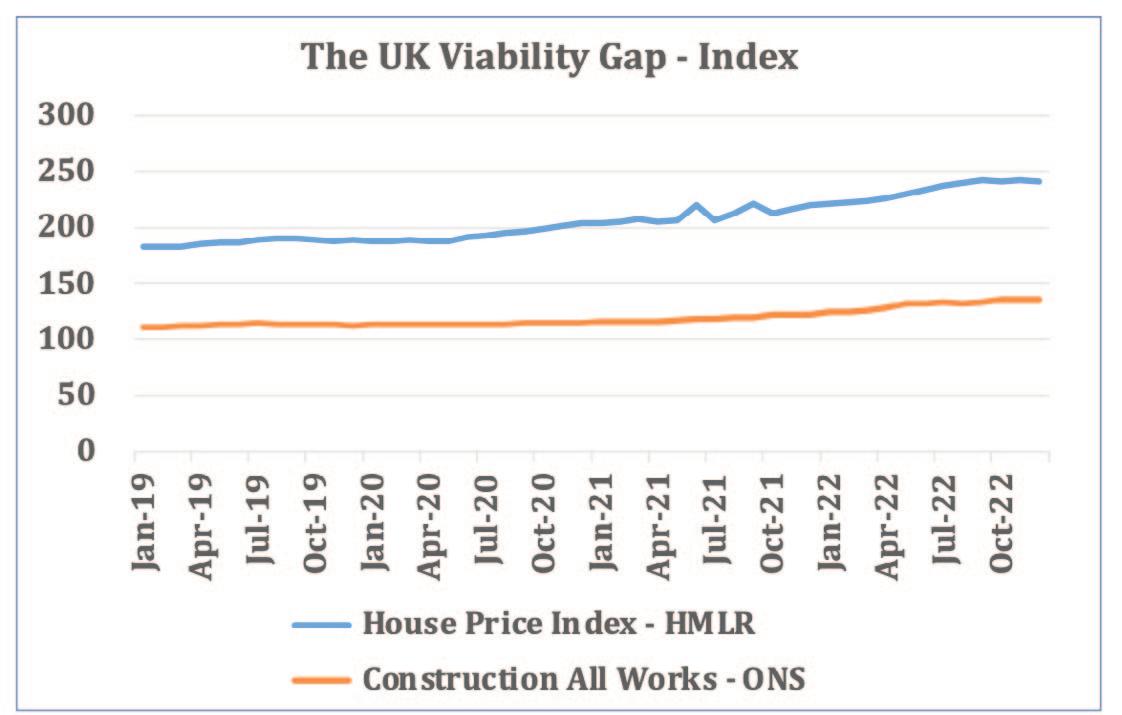
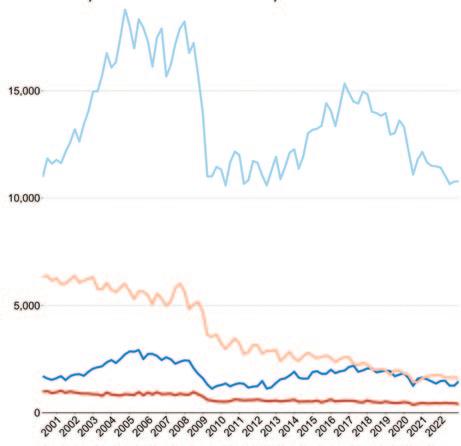
In terms of numbers, the gap has widened over the past four years; and interestingly, during a period of Covid and the initial impacts of Brexit. And Rightmove recently report that prices in fact rose by £3,000 in the last month. The widening gap is shown below:
Following a classical argument of economics, we should be seeing record levels of house building – as
the gap between prices and costs widens. That this isn’t happening is worthy of further comment from the perspective of planning and the market alike.
What needs to be done
To deliver significant community benefits will require much higher levels of house building. This point needs to be made more strongly by the industry itself as it faces a government which appears to have taken fright in the face of NIMBY interests.
Developers will need to make their case to local planning authorities that their sites are viable and deliverable, and can bring forward the necessary infrastructure. This means detailed submissions at for example, the Call for Sites stage of planning.
The pressure on housing delivery is going to be acute in the next few months. This is because as land supply tightens in line with overarching government policy, land owner expectations will shift prices to levels which are not discounted for com-
munity benefits. This will happen especially on large sites which are in relatively scarce supply.
In turn this means that local authorities, ideally in conjunction with developers, will need to identify sites that are not only viable, but also likely to find the line of least resistance through the planning system.
The emerging national planning policy framework envisages, I understand, greater forward planning using viability testing. But this is complex, resource intensive and as such, will be very challenging for LPAs to deliver. In this key respect, not a lot changes! n
10 Planning in London
OPINION: VIABILITY TESTING | ANDREW GOLLAND
Dr Andrew Golland is principal of Andrew Golland Associates
Tate Modern viewing platform – the Supreme Court ruling

What is there for planners to see? asks Simon Ricketts

By contrast with the timeline of this case to date, the planning system zips along.
A few weeks ago the Supreme Court delivered its judgment in Fearn & Others v Board of Trustees of the Tate Gallery (Supreme Court, 1 February 2023), the most important private nuisance case in many years. I’m not hoping to analyse the reasoning of the court in relation to the law of private nuisance, but if you are interested I suggest that you start with the Supreme Court’s own press summary and then enter the blizzard of property litigation lawyers’ updates and thought pieces on LinkedIn etc. I’m only interested in what it means for the town and country planning process – if anything.
I wrote about the first instance ruling of the High Court in my 2 March 2019 blog post, Trial By Instagram: Privacy & Planning. I used to be quite lyrical: “Photo-sharing social media apps, weaponised by the smartphone camera, are changing our experience and expectations of place. Is the planning system, and the law of private nuisance, keeping up?
At a personal level we have all become artists, influencers, curators, with our instant pics, filtered, composed, annotated. Fomo for you = dopamine for me. But zoom out and through endlessly snapping, sharing, liking and commenting, we are of course the product, the hive mind, the crowd source, working for the data mine, adding to the geo-cache, mapping ceaselessly where the sugar is in the city.
In this context, what sells a place? From outside in: a glimpse of the life style, the life, that could be yours. From inside out: unique views out onto a city. The two ugly i words: iconic, instagrammable.
Which all makes the parable of Fearn & others v The Board of Trustees of the Tate Gallery (Mann J, 11 February 2019) so perfect.
On one side, the residents of Neo Bankside, housed from floor to ceiling in glass so as to achieve spectacular views out and having paid no doubt precisely to be able to enjoy that experience.
On the other side, at its closest point 34 metres to the north of Block C of Neo Bankside, the viewing gallery on the tenth floor of the Blavatnik Building extension to Tate Modern, from which visitors also have spectacular views, including, to the south, of those residents in their transparent homes.”
And so I went on, analysing Mann J’s judgment in
detail, but that analysis is now completely redundant.
The Supreme Court has overturned the ruling both of Mann J and the subsequent ruling of the Court of Appeal and held, by a majority of three to two that the Tate was liable in nuisance for inviting the public to look out from a viewing platform from which they can, and many do, peer into the claimants’ flats - and (the saga is far from over yet) another court will now need to grapple with the issue of what remedies (injunction/damages) may be appropriate.
However, for planners, it is still worth reading paragraphs 29 to 53 of Mann J’s first instance judgment, where he sets out in detail the planning history of the properties.
Because, for all of us engaged in the town and country planning process, the big question is whether it should be the role of the planning system to seek to prevent juxtapositions of uses like this – or is that a matter for private law (and this case is now a demonstration of the remedies available for individuals who have their private law rights infringed)?
I agree with a post by Dentons’ Michele Vas: It’s official – it’s not the role of the planning system to police private rights – or is it? (2 February 2023):
“Whilst this case did concern a very particular set of circumstances as to the level of invasion of privacy the Claimants were subjected to (i.e. I suspect “overlooking” alone is unlikely to be sufficient to base a private nuisance claim on) it does stress how fundamental good design in new development is to avoid future private nuisance claims.
Placemaking, understanding and respecting the integrity of neighbourhoods should be a building block to good design. A further thought is that there is no useful “planning tool” to avoid or minimise future private nuisance claims; unlike property rights, it is not a right which can be lawfully interfered with
11 www.planninginlondon.com Issue 125 April-June 2023 >>
OPINION: TATE MODERN: WHAT IS THERE FOR PLANNERS TO SEE? | SIMON RICKETTS
Simon Ricketts is a partner with Town Legal LLP
>> >>>
From Simon’s blog at simonicity.com/author/simonicity/ Personal views, et cetera
or compulsorily acquired by relying on a local planning authority’s statutory powers.
Whilst the judgment is an incredibly welcome confirmation that the planning system is not there to police private rights, it is a reminder that design of development is at the heart of preventing these issues arising in the first place.”
I had noted down pretty much the same passages in the judgment as she identifies, namely paragraphs 109 and 110 from Lord Leggatt’s majority judgment: “Reliance on planning law
109. The second matter of policy raised by the Court of Appeal was a suggestion that planning laws and regulations would be a better medium for controlling “inappropriate overlooking” than the common law of nuisance (para 83). This seems to me to overlook (if I may use the term) the fact that, while both may sometimes be relevant, planning laws and the common law of nuisance have different functions. Unlike the common law of nuisance, the planning system does not have as its object preventing or compensating violations of private rights in the use of land. Its purpose is to control the development of land in the public interest. The objectives which a planning authority may take into account in formulating policy and in deciding whether to grant permission for building on land or for a material change of use are open-ended and include a broad range of environmental, social and economic considerations. While a planning authority is likely to consider the potential effect of a new building or use of land on the amenity value of neighbouring properties, there is no obligation to give this factor any particular weight in the assessment. Quite apart from this, as Lord Neuberger observed in Lawrence v Fen Tigers Ltd [2014] UKSC 13; [2014] AC 822, para 95:
“when granting planning permission for a change of use, a planning authority would be entitled to assume that a neighbour whose private rights might be infringed by that use could enforce those rights in a nuisance action; it could not be expected to take on itself the role of deciding a neighbour’s common law rights.”
110. For such reasons, the Supreme Court made it clear in Lawrence that planning laws are not a substitute or alternative for the protection provided by the common law of nuisance. As Carnwath LJ said in
Biffa Waste, para 46(ii), in a passage quoted with approval by Lord Neuberger in Lawrence, at para 92: “Short of express or implied statutory authority to commit a nuisance … there is no basis, in principle or authority, for using such a statutory scheme to cut down private law rights.”
The practical as well as legal irrelevance of planning permission in this case is apparent from the judge’s finding that no consideration was given to overlooking in the planning process for the Tate extension: [2019] Ch 369, paras 58-63.”
It is also worth noting that Lord Sales’ minority judgment does not dissent in terms of the role of the planning system:
“148. The designs for the Blavatnik Building always included a viewing gallery in some form, although its precise extent varied through successive iterations of the design. Planning policy for the South Bank encourages the construction of viewing galleries in buildings of significant height. However, there is no planning document which indicates that overlooking by the viewing gallery in the direction of Block C was considered by the local planning authority at any stage. It is not likely that the planning authority considered the extent of overlooking.
Further, while the Neo Bankside developer was aware of the plans for a viewing gallery, it did not foresee the level of intrusion which resulted. In broad terms, the design and construction of the Blavatnik Building with the viewing gallery in its final form took place in parallel with the design and construction of Neo Bankside, without the effects of the one on the other so far as visual intrusion was concerned being fully appreciated or addressed.”
201. At para 81 the Court of Appeal also pointed out that overlooking is frequently a ground of objection to planning applications and noted that “any recognition that the cause of action in nuisance includes overlooking raises the prospect of claims in nuisance when such a planning objection has been rejected”. However, other forms of activity which can give rise to claims in nuisance, such as the generation of noise, smoke or smells, are also matters which may be addressed in objections to planning applications, so this does not give rise to any point of distinction. More fundamentally, as this court pointed out in Lawrence, at paras 77-95 per Lord
Neuberger, the planning regime is concerned with issues of the public interest, not with resolving questions of individual rights. So it is not surprising, and is not a matter of particular concern, that a cause of action in nuisance may be found to exist in a case where an objection to the grant of planning permission founded on similar matters has been rejected. A grant of planning permission pursuant to the administrative processes under the planning regime cannot remove private rights which neighbouring landowners may have. See also Hunter, p 710D, per Lord Hoffmann and Lawrence, paras 156 (Lord Sumption), 165 (Lord Mance) and 193 (Lord Carnwath).”
This must all surely be right. The right approach to the determination of any application for planning permission is whether the proposal is in accordance with the provisions of the local plan unless material considerations indicate otherwise. There may often be policies which seek to protect existing residential amenity (although when I look for instance at the current Southwark local plan, postdating these proposals, I see no specific references to protection of existing residents’ privacy or to avoiding overlooking). Even without local policy support, aspects of a development proposal which may adversely affect neighbours are certainly capable of being a material consideration in the determination of an application for planning permission, but as always it is for the decision-maker to decide how much weight to apply to those considerations.
I don’t believe that the judgment increases the onus on local planning authorities to consider privacy/overlooking considerations: planning decisions can only go so far and private law remedies are the ultimate safety net. And of course the circumstances of the Tate Modern case, by virtue of the unusual nature of the viewing platform and the extent of its use, should not be applied too widely. However, one would hope that the Government’s increased emphasis on design in the planning process may reduce the risks of these sorts of unanticipated juxtapositions in the future. It will be interesting to see the Government’s proposed National Development Management Policies in due course. n
12 Planning in London
OPINION: TATE MODERN: WHAT IS THERE FOR PLANNERS TO SEE? | SIMON RICKETTS >>>
Photo by Jay Mullings on Unsplash
15-minute cities
Probably the most serious problem facing humanity is global warming. Humans need to reduce their carbon footprints. Polluted air, especially small particulate pollution, is also a serious problem in cities. Considered policies to combat these life threatening dangers are vital for survival let alone the liveability of cities. Gesture policies or displacement activity, however, is not a solution, especially when it comes at high cost. Low Traffic
Neighbourhoods the 15-minute city made manifest, are just such a displacement activity. They displace traffic to pollute elsewhere, but in the medium term, will also displace people who need, or just want to use cars; and they take their carbon emissions with them.

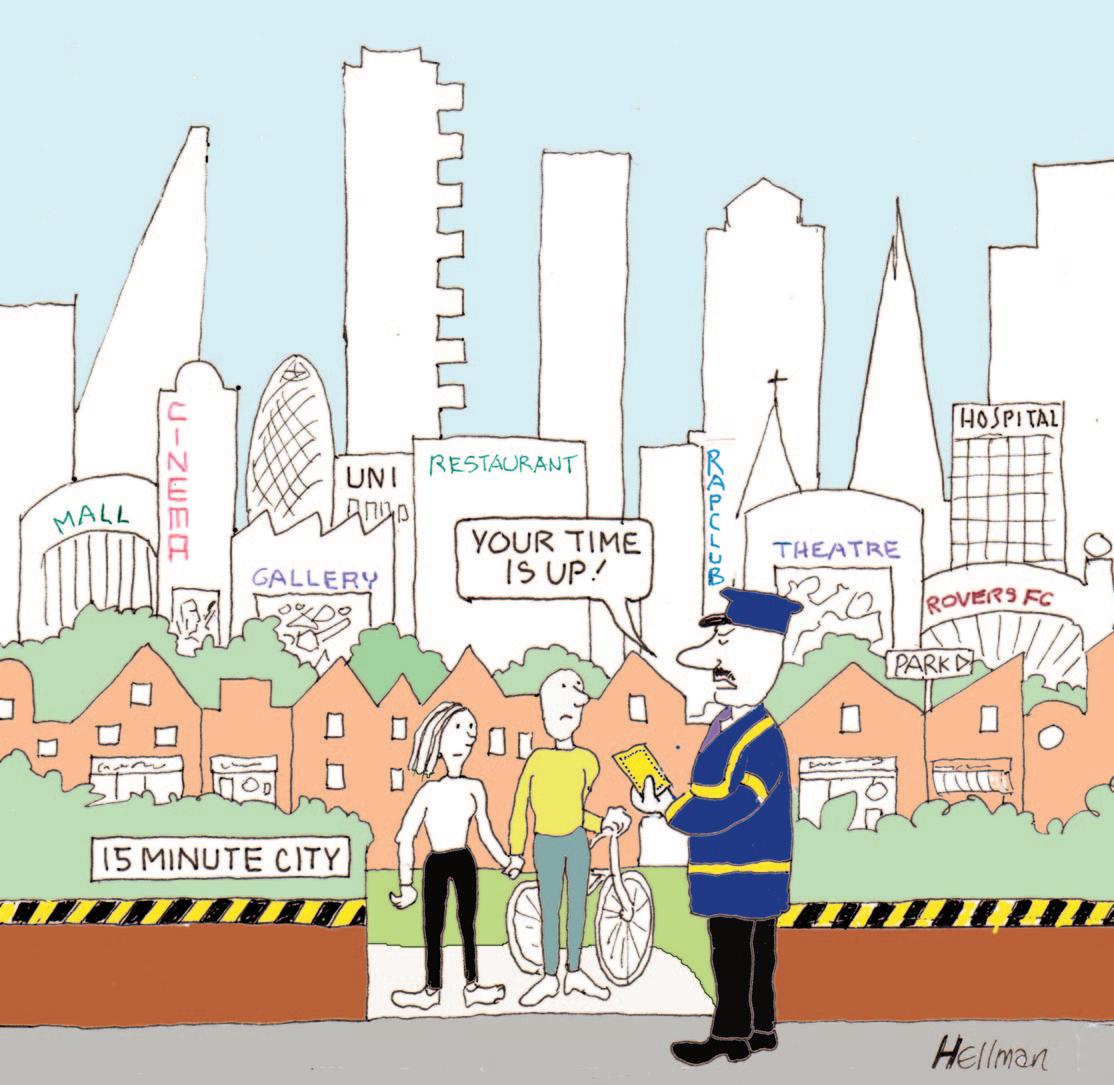
Sometimes urban ideologues come up with the craziest ideas that somehow gain traction. They seem appealing until one thinks them through and assembles evidence with which to challenge them. The 15-minute city is one such. If implemented it would seriously damage all the pleasures and the economic advantages of big cities; and the bigger the city, the greater the damage to welfare and productivity.

The city-size distribution is a statistical regularity that has been established for more than a hundred years. Not only do cities come in all sizes, there is a structure to the distribution of city sizes. The distribution of city-sizes approximates the Pareto distribution, or the rank-size rule. The largest city in any country tends to be twice the size of the next largest and the second largest tends to be twice the size of the third largest, and so on. There is a reason why cities come in all sizes.
Urban growth or decline is a slow business. Cities have been about for 12,500 years and have continuously evolved. ‘Evolved’ in an almost Darwinian sense for some 99% of that time. What worked and improved the quality of life for their citizens, lasted and spread: what did not, disappeared. Markets were one of the earliest and most successful innovations and, although not as vital now as 2,000 years ago, have stayed. Defensive walls were one of the earliest city innovations. First the security provided by the emerging nation-state, however, and then modern warfare, rendered them irrelevant; so they have disappeared as functional elements of the modern city.
Some of the most recent innovations have been sewage, clean water and mass transit. The Victorian era transformed cities and allowed them to grow. London increased more than 7-fold during the 19th Century, exceeding 7.2 million people by 1901: perhaps the first modern mega-city.
Reactionary anti-urbanists like Cobden (the ‘great wen’ of London) were repelled; romantic worshippers of some non-existent historic rural idyll, like
13 www.planninginlondon.com Issue 124 January-March 2023 >>>
OPINION: 15-MINUTE CITIES | PAUL CHESHIRE
Paul Cheshire is emeritus professor of economic geography at the London School of Economics
Where ignorance is believed to be bliss: 15-minute cities –or back to the ghetto, asks Paul Cheshire
BELOW: Image from www.15minutecity.com
the Arts & Crafts movement, tried rhetorically and visually to resist. In both cases it is instructive to see that their base remained firmly metropolitan, however. The metropolis – London – was where the culture and money was. We may think of Morris as living in a rural manor house in Kelmscott but in fact his main residence stayed in London. His patrons and cultural life depended on the affluent city.
The cities, with London at the pinnacle, were affluent because of agglomeration economies. Much research in urban economics over the past 25 years has focused on estimating how significant these are. There are agglomeration economies in both production – workers are more productive in bigger cities, all else equal, and the bigger the city the more productive they are. Research shows that doubling citysize increases total factor productivity by some 3 to 9 percent. However, opportunities for all types of consumption, material, cultural or spiritual, also increase with city size. In a city as large as London, a couple, one of whom likes opera and the other football, are in easy reach of some of the world’s best
examples of both. Not true in a 15-minute city. There has been a study of ‘power couples’ – couples each with more specialised skills – showing how they benefit from living in bigger cities: and pay for the advantages. My own life is an example: my partner is, like me, a very specialised academic. It took 30 years of trying for us to both find jobs in the same city: that city was naturally London. A high proportion of my coupled colleagues have partners in highly specialised fields such as contract law or high end architecture. But this also generates an advantage for productivity: it is easier and cheaper for firms in cities like London to recruit very specialised labour because of the skill-matching such a large labour market generates. But again, not in a 15-minute city.

Cities have always had costs and those costs grow as cities get bigger. Historically they included risk of disease, from inadequate sanitation, igno rance about the source of disease or a terrible envi ronment, causing rickets or respiratory diseases. They always included rising congestion and rising costs of space and usually crime. But people and firms pay these extra costs because the benefits from higher productivity, higher wages and a more interesting life, offset the costs.
Cities are the greatest invention humanity has ever come up with in terms of enhancing welfare and living standards. And – if policies are sensible –the bigger they are, the better they are. By sensible policies one means policies that mitigate their costs of scale so we can just enjoy their benefits. Policies like high quality, non-polluting transport; policies to ensure the provision of adequate space to grow into (so not rigid ‘containment’); policies to ensure an efficient and adequate supply of urban public goods and amenities – public open space, law and order or
an attractive public realm.

All the benefits bigger cities generate are absolutely reliant on access. Having neighbourhoods with a good range of sustaining services is positive but city-life is only worthwhile and cities can only produce more prosperity as they get bigger, if access is maximised.
15-minute cities cannot support world class theatre, restaurants, sport, research, universities, hospitals, financial institutions, designers or planning consultancies. London does all that but accessibility, so transport, is the foundation of it all. Higher taxes on petrol, targeted congestion charges and better public transport or cycling facilities are solutions: barriers to interaction are not. n
14 Planning in London OPINION: 15-MINUTE CITIES | PAUL CHESHIRE
>>>
Cities are the greatest invention humanity has ever come up with in terms of enhancing welfare and living standards
BELOW: Paul Cheshire’s opus
Can the NPPF boost community led housing?
Some years ago, we would have had to look to Germany, Scandinavia, or the States to find examples of community led housing such as Baugruppen, Cohousing, or Community Land Trusts (CLTs). Today London has several examples with different approaches to community led housing, adding to a legacy of established co-operative housing projects.
Communities can help achieve higher densities and unlock sites that may otherwise be difficult to develop, increasing and bringing greater diversity to housing supply, as well as more stable, supportive, and happier neighbourhoods through the empowerment of current and future residents.
As the sector grows, we will undoubtedly see more innovative ideas and projects emerge from communities motivated to take control of their housing situation and contribute to housing delivery in London. We’ve already supported over 100 groups and projects in London with a real diversity in ideas, motivations and people, and are now focused on helping deliver the 20 or so most progressed projects across London. Residents have just moved into the latest scheme, a direct development by London CLT in Sydenham which links future resale prices to average incomes. Meanwhile the environmental selfbuild CLT, RUSS, in Ladywell, is close to completing 36 homes this summer.
Yet the movement is still struggling to make the contribution it could. Councils have an important role to play in enabling community led housing to become a more mainstream part of housing delivery. All too often support has been ad-hoc, through hardwon special cases. Considerable effort is required from both councils and communities to make Community Led Housing (CLH) happen. The only way to scale is to move from bespoke projects to repeated, standardised opportunities facilitated by planning policy.
So, it’s been great to see the recent consultation on the NPPF include direct reference to community led housing. The proposed definition is a streamlined

version of that in the London Plan and other funding strategies. We expect these documents can be aligned with the following tweaked definition: “Community-led developments are those that are driven by not-for-profit organisations that are democratically controlled by and accountable to their specified community, where such organisations own, manage, or steward homes and other assets in a manner of their choosing. The benefits to the same specified community are clearly defined and legally protected in the long term.”
The NPPF already expects planning authorities to assess the number of people wishing to build their own homes, with legislation requiring sufficient permissions are given for self and custom build. This has seemed impractical in London, where individual houses on plots often won’t make the most efficient use of land. However, community led development can be a group or association of individuals for the purposes of self and custom build housing. Surveys have found that most self-builders would be interested in being part of a group scheme, with interest skewed towards younger and lower-middle income households, which reinforces the relevance of CLH to London.
Community led housing provides a way of meeting self-build demand and is often linked to policies on small sites. However, simply stating this link has minimal effectiveness in creating opportunities for CLH. Most sites remain inaccessible to CLH organisations as they are generally uncompetitive when bidding for land in the open market. Policies could identify certain sites specifically for community-led development or include additional affordable housing requirements on them. I was struck by this approach in Zurich, where a third of Site Allocations are exclusively for co-operative housing.
On larger sites, we’ve seen Local Plans outside London set requirements for a percentage of self and custom build housing. Policy could extend this to community-led development. There are already precedents of partnerships, such as London CLT
Levent Kerimol is Director of Community Led housing London lev@communityledhousing.london

acquiring the intermediate affordable homes in Redbridge Council developments, or the GLA placing an obligation on the developer of their 900 home St Ann’s site in Tottenham to transfer at least 50 homes to a nominated CLH organisation. Including CLH within larger developments doesn’t have to change the affordability mix but means residents and communities can take control of the long-term management and stewardship of their homes, without the development risks.
The NPPF consultation also asked about Rural Exception sites, which have been particularly important for the development of Community Land Trusts. Community Led Exception Sites could be useful as some CLH developments in London have struggled with a single planning policy, despite wide-spread community support for their proposals, or additional density on sites, that may be difficult to support otherwise.
Finally, greater flexibility in planning decisions around allocations and affordable tenures would unlock the innovations that communities are trying to achieve for themselves.
The NPPF should give local authorities the leeway to exercise judgement on whether all affordable rented homes need Registered Providers. The process of becoming a Registered Provider is very onerous, yet where a specified community, democratically controls the organisation with genuine accountability, poor landlord practices seem less likely. n
OPINION: PLANNING FOR COMMUNITY LED HOUSING | LEVENT KERIMOL 15 www.planninginlondon.com Issue 125 April-June 2023
The work of CLH London is vital in providing practical assistance to officers. CLH London was established by the GLA and is hosted by CDS Co-operatives (a small RP with a history of promoting cooperative housing). We work closely with CLH groups, boroughs, and other partners in supporting the practical delivery of community led housing in London. We hope to help councils move from ad-hoc reactive responses to facilitating more opportunities on privately owned sites, through planning policy.
Greater flexibility in planning decisions around allocations and affordable tenures would unlock the innovations that communities are trying to achieve for themselves, says Levent Kerimol
Biodiversity Net Gain regulations coming this year
The Government’s consultation outcome on Biodiversity Net Gain (BNG) regulations and implementation has been published.
The Government has announced it will be providing up to £16.71 million of funding for local planning authorities (LPAs) to prepare for mandatory net gain between now and November 2023. However, what about the costs of delivering the BNG itself?
A recent survey of developers and land promoters undertaken by the Land Trust found that 50 per cent of respondents said the BNG requirements would be “very challenging”. Only 13 per cent considered the requirements to be achievable.
It is absolutely essential that the Government ensures that the national BNG credit system is in place prior to the requirements coming into force. The Government is seeking to make the cost of these credits unattractive to encourage on-site BNG. However, for sites where it is simply not possible to achieve BNG on-site, it is important that the costs of national credits aren’t so high as to stifle development.
Developers already face huge challenges to delivering housing. Recently this has included increased material costs, a challenging market due to the economic situation and a resourcing crisis in local authorities which leads to delays and impending
changes to Building Regulations.
In my experience it is very challenging to deliver 10 per cent BNG on-site whilst also ensuring all the other policy requirements are met and making best and most effective use of land in accordance with the NPPF. The added layer of complication brought about by the BNG requirements will be likely to reduce and slow down the delivery of homes. At a time when the economy is struggling and there is an ever growing need for homes including affordable homes and homes for first time buyers this presents a threat.
However, this situation may also provide opportunities. In relation to the supply of BNG units, landowners or managers will be able to create or enhance habitat for the purpose of selling biodiversity units, provided that they are able to meet the requirements of the policy. This includes local authorities. Suppliers of biodiversity units will be able to sell them to developers anywhere in England, provided that the use of those units is appropriate for the development and the distance between the development and the off-site habitat is properly accounted for in the biodiversity metric.
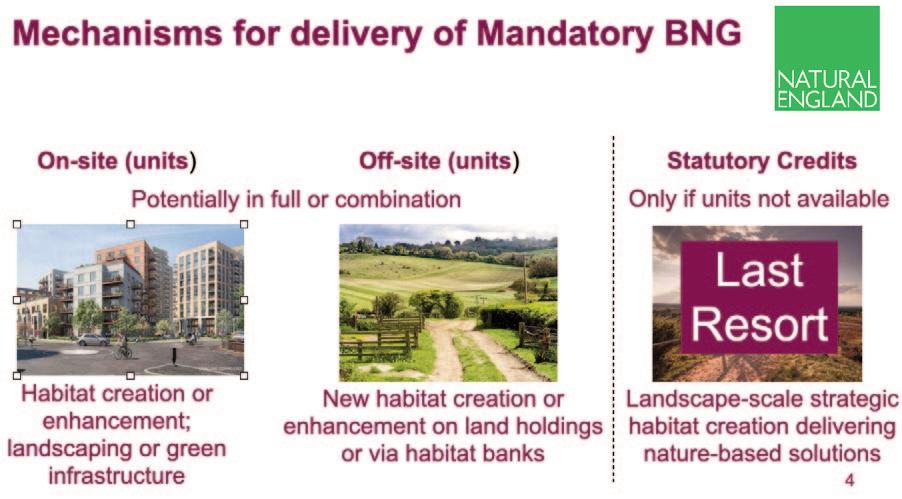
Developers will also be able to sell excess BNG units where their BNG off-set land provides additionality above the 10 per cent requirement.
Alice Davidson is Associate Director Boyer (Wokingham)

In terms of the impact on planning applications, there will be a requirement to submit a BNG Statement alongside a planning application before a BNG plan is submitted and approved prior to commencement of development. Legal agreements will be required to secure the biodiversity gains for a minimum of 30 years. The Government will publish guidance on this in due course.
Natural England will sell statutory biodiversity credits on behalf of the Secretary of State. Credit sales will be facilitated by a digital sales platform which is currently being developed and tested. An indicative credit price will be provided by June 2023.
The introduction of BNG will certainly provide some challenges, but those challenges are not unsurmountable and ultimately will help us create better and more environmentally responsible places for future generations. n
16 Planning in London
OPINION: BIODIVERSITY NET GAIN REGULATIONS | ALICE DAVIDSON
The headline is that mandatory 10 per cent BNG will come into force from November 2023, says Alice Davidson
Sidestepping the Issue –proposed changes to the NPPF
Maybe I’m being too cynical, but I can’t help but think that if you give people the option not to build new homes, then they probably won’t. Of course there are some incredibly proactive communities out there that encourage new homes and the benefits these bring. But in my experience, these are rare to come by. In my view, the Government’s proposed changes to the NPPF are a surrender to those communities who want the planning system to simply protect the status quo.
So here’s my melancholic summary of the proposed changes:
1) Meeting housing needs “in a sustainable manner” seems to be the Government’s way of saying, “or provide less if you want”;

2) There are two massive ‘get out of jail free cards’ for authorities that don’t want to meet objectively assessed needs: a) Green Belts are expressly not required to be amended, and b) densities significantly out of character with existing areas can be avoided;
3) Design codes will need to push for higher
densities (but probably won’t);
4) Equally, neighbourhood plans continue to garner more prominence, particularly around the application (or not) of the presumption;
5) Plans submitted for examination are assumed to be justified, unless proved otherwise. This isn’t going to speed things up;
6) The standard method is now only an “advisory starting-point” – aka another ‘get out of jail free card’ – and it’s the urban local authorities in the top 20 most populated cities and urban centres that are required to pick up the slack. That’s not enough;
7) A greater focus has been given to meeting the needs of older people, which is a good thing with our ageing population;
8) “Oversupply” in previous years can now be taken into account, despite housing targets being minimum requirements. This does, however, allow for a more strategic and longer term view to be taken on delivery over the plan period – which isn’t a bad thing in a plan-led system;
9) The presumption applies where delivery falls
below 75 per cent , except where permissions have been granted for homes in excess of 115 per cent of the authority’s requirement. This will help those authorities who permit a lot of homes but struggle to show delivery (which is often out of their control);
10) “Beauty” and “beautiful” are inserted numerous times, but not explained;
11) The section on mansard roofs is frankly absurd for a strategic planning document such as this;
12) The text around demonstrating “exceptional circumstances” remains, but is all but defunct now that there’s no longer a need for local authorities to amend Green Belt boundaries if they don’t want to. The “very special circumstances” test remains untouched, so perhaps we’ll see more applications for development in the Green Belt under that method moving forward. This is not good planning!
13) A greater emphasis has been given to supporting energy efficiency improvements in existing buildings (which is very important), but not much is said about improving the standards for new buildings (unless that is to be ‘built in’ to building regulations over time which would make sense);

14) Greater protections are given to agricultural land that is used for food production;
Ambitious Plans?
A national planning framework – particularly in difficult times such as these – should be a bold and visionary document that sets ambitious plans for the country’s future. These revisions suggest the opposite and sidestep the real issues and priorities of today. n
17 www.planninginlondon.com Issue 125 April-June 2023 >>> >>>
OPINION: PROPOSED CHANGES TO THE NPPF | MATTHEW ROBINSON
Matthew Robinson shares his view on the proposed revised National Planning Policy Framework
Matthew Robinson is Associate Director with hgh
The benefits that a wide range of natural elements can bring
Over a hundred years before the climate emergency became a global concern, it was recognised that, ‘He who plants a tree, plants a hope’.
Today that mantra carries particular resonance. In light of rising temperatures, increased toxic emissions and decreasing biodiversity, it is scientifically proven that trees are fundamental to our survival, and their potential extends into all areas of life: the practical, social and environmental.
Approximately 4.5 per cent of London is woodland, and for England as a whole, woodlands cover just 10 per cent of the country – poor comparison to the EU average of 38 per cent. This figure is set to increase to 12 per cent by 2050 under current regenerative plans but this is not enough according to Rewilding Britain, which is pushing for a doubling of the country’s woodland cover over the next decade to help absorb 10 percent of current UK greenhouse emissions annually and protect declining wildlife.
Facing up to the fact that the built environment has had a role to play in the reduction of woodlands, the development industry is doing its bit. My own organisation, Leaders Romans Group, is literally planting a tree for every house that it sells and will be launching a raft of new environmental initiatives imminently. Others in the property industry are implementing similar projects.
Local authorities, too, are prioritising woodlands as the ‘green’ component in new developments, moving away from well-manicured ‘hard’ landscaping and towards a more natural landscapes. This is partly influenced by the Environment Act’s requirement for a minimum 10 per cent biodiversity net gain which becomes a legal requirement from November this year. It also stems (no pun intended) from the desire for more ‘usable’ public open spaces that came into existence during the pandemic. Consequently developers throughout the country, including London where I am based, are replacing architecturally-designed or ornamental high maintenance lawns and topiary with more useable spaces, or even with woods and wildflower meadows. Local authorities are also allowing several of their green spaces to be left to re-wild, although the cynic in me suggests that may be more to do with maintenance budgets than a
planned biodiversity effort.
design
Initial fears that untended spaces would impact on property values have been proven ill-founded. Last summer LRG carried out some research the impact on property values across all local authority areas in England and Wales. It concluded that homeowners are prepared to pay a premium for a home close to woodlands and that this figure has increased in the last two years: homes located within 50 metres of woodland attract a 6 per cent price premium, a rise of 2.4 per cent since the start of the pandemic.
This is unsurprising taking into account a considerable increase of appreciation for woodlands post Covid: woodlands visits rose from 170m in 2016-17, to 296m in 2020-21; and the annual number of visits to the forests managed by Forestry England rose by 74 per cent between 2016 and 2021.
Understanding the importance that homeowners attach to woodland is vital in the planning of new communities. This has been demonstrated in the recent increase in counter-urbanisation and an above average rise in rural house prices. Whereas in 2019 the square footage of a home was deemed the single most important factor in buying a property, post-Covid, in 2022 this was replaced by access to outdoor spaces.

Informal public open spaces vary considerably and yet woodlands remain the most popular. Perhaps this is the versatility of woodlands, offering opportunities for natural play, quiet walks and in London in particular, the opportunity retreat from the sight of buildings and infrastructure and to remove oneself from the hustle and bustle of city life.
Of course the potential for London developers to provide large expanses of woodland within a scheme, the viability of which depends on a certain density, is limited. Accordingly, many developers in London are both delivering access to woodlands and practical assistance for the management of nearby woodlands. In Buckinghamshire, for example, developments within proximity to woodland are required to pay a maintenance cost and in some cases may be a physical contribution. In some cases this is provides through a SANG
(Suitable Alternative Natural Green Space).
Policies which formalise developers’ contributions to woodlands include the London Plan’s Urban Greening Factor (UGF). This guidance requires every local authority to create its own greening strategy and all major developments to include urban greening as a fundamental element of site and building design. It introduces the UGF calculator a means of evaluating the quantity and quality of urban greening in a development proposal. Like so many policies, it is a very good idea in principle in practice is a blunt instrument which needs to be applied effectively. Some sites can never achieve the levels required and become unviable as a result.
Just as with the Environment Act’s requirement for a minimum 10 per cent biodiversity net gain (BNG), it is important the policies, which acknowledge that greening is important, enable developers to implement measures without compromising the scheme itself.That’s not to say the principles of UGF nor BNG are wrong, but they are both new policies which need refinement over time lest they be the culprit in irrationally preventing development of otherwise suitable sites.For example where a brownfield site has become overgrown, even when littered with trash or abandoned structures, or is contaminated, it can be extremely difficult to achieve 10 per cent BNG while also delivering a development of the appropriate density.
Trees matter, a lot. But they are not the only means of increasing biodiversity, enjoyment of a scheme, or its aesthetics. While metrics and calculators have a role to play in the implementation of worthwhile policies, it is import to view each scheme in its own context and not to overlook the benefits that a wide range of natural elements can bring. n
18 Planning in London
OPINION: HE WHO PLANTS A TREE, PLANTS A HOPE | GRANT LEGGETT
Grant Leggett sees an increasing preference for natural over landscaped public spaces in today’s urban
Grant Leggett is Executive Director, Boyer (part of LRG)
What’s stopping us from describing everything as sustainable?
On a rainy evening last month, I found myself watching Interior Design Masters - the interior design equivalent of the Great British Bake Off. As I settled down with a cup of tea, the brief for the task was set out as “sustainability”. Fantastic. But as I perhaps should have expected, very little sustainable design took place.
Some contestants used timber, including some re-used panels, but that was pretty much it. One contestant actually made a concrete table. Another cut an oval shaped tabletop from the centre of a sheet of ply, effectively scrapping the rest.
Whilst it’s maybe a little ambitious to expect amateur designers to produce highly sustainable designs, it was disappointing that this aspect of their brief seemed to be largely ignored. I had expected at least one to produce a spectacular table from a discarded pallet given the number of those on Instagram.
But what was even more disappointing was that the lack of sustainable design, despite it being part of the brief, wasn’t addressed by the presenter and there was no description for the viewer of what a sustainable design might have looked like. Whilst clearly not an educational programme, it was an opportunity to promote sustainable design that was completely lost. And worse than that, the viewer may have come away thinking that what they had seen was sustainable.
Sustainability has become something that we can sell

The idea of “sustainable design” is slowly creeping into every aspect of our lives, and while this increased visibility is great it’s important that we use the description responsibly. As professionals our comments and opinions carry a certain amount of weight but just because you’re describing something as sustainable, it doesn’t mean that it is. Sustainability has become something that we can sell, but we need to be careful not to manipulate the data to tell the story that we need.
Its also important to remember that sustainable and low carbon are not the same thing. Just because
something is low carbon you can’t continue to use it forever and expect what you are doing to be sus- tainable. I recently read about a company that had produced net-zero carbon trainers, or so they claimed, and unlike many other brands, they made quite a lot of effort to show their working. Unfortunately, they had relied on the sequestered carbon in the materials to offset the carbon involved during production.
Theoretically this makes sense, but sequestering is really just a way of storing carbon for a period of time. So, at the end of its life, that carbon is released back into the atmosphere and in a product with a relatively short lifespan, such as a trainer, that period isn’t very long. Wouldn’t it be better to find ways to ensure that the trainers we make now can be repaired and can at least be recycled at the end of their life?
In the construction industry steel production is a great example of this. Across the steel industry huge efforts have been made to reduce the embodied carbon of steel, which is obviously great, but the energy involved in steel production is still massive. Lower embodied carbon steel is still not sustainable
The definition of sustainability that I was taught
was,“meeting the needs of the present without compromising the ability of future generations to meet their own needs,” a definition produced by the UN in 1987 but other advances in the steel industry such as steel reuse might be.
What we really need is a little more sustainable use of the word sustainability
When it comes to concrete this is perhaps even more evident. Cement replacement products can reduce the embodied carbon of your concrete but most of these are waste products from other industries, making them a finite resource. Plus, even if you use them, concrete is still a high embodied carbon material. Its better than it could have been, but it’s definitely not sustainable.
The definition of sustainability that I was taught was,“meeting the needs of the present without compromising the ability of future generations to meet their own needs,” a definition produced by the UN in 1987. More recent definitions describe sustainability as “the long-term maintenance and enhancement of human well-being within finite planetary resources.”
Whether the net-zero carbon trainers and the Interior Design Masters count as enhancing human well-being is open for debate, but I’m not sure either of them is the best use of finite resources. And perhaps that’s the way we need to approach our projects from the outset.
I’m sure we can all find a way to tell a sustainability story about the decisions that we’ve made, but are we making the best use of finite resources? Did we really need everything to be new? Could we have made the building work a bit harder? What we really need is a little more sustainable use of the word sustainability. n
OPINION: USING THE TERM ‘SUSTAINABLE’ | ANNA BECKETT 19 www.planninginlondon.com Issue 125 April-June 2023
published in BDonline with kind consent
First
Anna Beckett is an associate with engineers Buro Happold
We need to start using the term ‘sustainable’ in a more sustainable way, writes Anna Beckett
The definition of sustainability that I was taught was,“meeting the needs of the present without compromising the ability of future generations to meet their own needs,” a definition produced by the UN in 1987
LETTERS LETTERS
The growing Community-Led Housing (CLH) movement
FROM Dr Nicholas Falk and others Sir, John Harris rightly calls for a middle road between owning and renting a home to provide ‘lifelong secure tenancies’. (Guardian Journal March 7). He points out that Lisa Nandy wants Labour to build many more council houses, and Keir Starmer calls for more home ownership. But neither will provide enough on their own to rebalance hard-pressed towns and cities, or give old and young the lifestyle choices they want. Affordable homes for key workers and healthier living options for the elderly are key to achieving higher economic growth and need to be resourced accordingly.
The growing Community-Led Housing (CLH) movement, which includes community land trusts, cooperatives and cohousing, offers practical solutions. CLH had already added value to developments as diverse as Marmalade Lane in Cambridge, Homes for Change in Hulme, Manchester, Springhill in Stroud, Coin Street and
St Clements Hospital in London’s Mile End, and now the new Crofts Court in Oxford. Many of the projects are modest in scale, like Sydenham, south London, an 11-home 100 per cent affordable CLT scheme which will open in April.
But the UK is years behind European cities. In Zurich, a referendum commits the council to raising the proportion living in cooperatives from a quarter to a third. In Denmark 10 per cent of new homes are collectively owned and managed properties, accounting for a third of the housing stock in Copenhagen where cohousing is commonplace.
Experience shows that the development process in the UK needs streamlining. It takes far too long to get a group in a community together, find a site, and commission a viable scheme. Land values have been inflated by volume housebuilders who pay more. So both councils and developers need to allocate sites, which could be supported by pension funds. Communities and local people are the missing catalyst for building a better Britain.
Who will give them a proper chance?
Bob Colenutt, 1 Harpes Road, Oxford OX2 7QJ Nicholas Falk, 76 Middle Street, Stroud GL5 1EA Stephen Hill, 44 Fairmead Road, London N19 4DF Kath Scanlon, LSE Houghton Street, WC2A 2AE

Planning Law Books Spring Sale
20% off any of our planning law books before 30th April
Your discount will be calculated automatically when you checkout on bathpublishing.com

The definitive guide to permitted changes - updated in 2022
Sale price £60: save £15
Practical guidance on biodiversity and much more as the Act comes into operation
Sale price £32: save £8
Incisive guidance from Martin Goodall on all aspects of the use of land
Sale price £40: save £10
Fiddling the stats
FROM Patrick Inglis Sir,
I am coming across increasing numbers of architects who just appeal for non-determination as policy and often don’t bother with pre apps either.
Sadly that is the way things are heading.
I wish we had done that on a current Lambeth scheme where the Pre App took nine months alone so we are 18 months down the line and nothing to show for it.
What does everybody think about the impact on the stats, which is of course why they are demanding the extensions of time?
I am wondering how many councils for instance would fall into special measures if the true extent of their failure was revealed?
Patrick Inglis, Director, Inglis Badrashi Loddo
Lambeth has a fun name for their planning department:
Sustainable Growth and Opportunity Directorate, London Borough of Lambeth – Ed. n

The only guide to bring all the law together in one volume
Sale price £40: save £10
Essential reading for all involved in neighbourhood planning projects
Sale price £24: save £6
How has the NPPF been interpreted by the courts?
Sale price £32: save £8
20 Planning in London LETTERS
BRIEFING BRIEFING
The Mayor mandates second staircases in blocks above 30m ‘with immediate effect’
London mayor Sadiq Khan has said all planning applications for new buildings above 30m must now have second staircases before going to the Greater London Authority (GLA) for final sign off. The fire safety measure has been brought in with immediate effect, the GLA’s planning department has said.
It follows the government’s launch of a consultation in December last year on requiring developers to include second staircases in blocks above 30m, which is around 10 storeys.
The move has long been called for by RIBA, despite not being a recommendation in Judith Hackitt’s review of building safety regulations conducted in the aftermath of the 2017 Grenfell fire.
The Department for Levelling Up, Housing and Communities said it wants to bring in the measure with a “very short” transition period and was encouraging “all developments to prepare for this change now”.
It expects the requirement to cost the construction industry £1.6bn over the next 10 years.
The GLA planning department said: “The mayor has consistently expressed concerns that the fire safety requirements in the national Building Regulations are not fit for purpose, so the proposed strengthened requirements and clear direction at the national level are strongly supported.”
The statement said in light of the short transition period envisaged by the government and the requirements of the London Plan for all developments to achieve the highest standards of fire safety, the department is “clear that, with immediate effect, all planning applications which involve residential buildings over 30m in height will need to be designed to provide two staircases before they are referred to us at Stage 2 for the mayor’s decision.”
The department added: “The GLA’s planning team is working with the boroughs to progress
Richard Rogers’ Channel 4 Headquarters in Westminster has been granted grade II-listed status

Earlier this month campaign group the 20th Century Society included the building, designed in conjunction with structural engineer Ove Arup & Partners, on its list of the UK’s 10 modern buildings most “at risk”.
The society said the Horseferry Road building was “undoubtedly” one of Rogers’ most significant public commissions in the UK, reported BDonline. But it said Channel 4’s decision to move its national headquarters to Leeds and uncertainty over the broadcaster’s future ownership left the structure “vulnerable to alteration or redevelopment”.
Richard Rogers Partnership director John Young led the design team for the £38.5m building, which was completed in 1994. It won a RIBA National Award the following year.
The new status, conferred by the Department for Culture Media and Sport and effective from 23 March, goes some way to protect the building’s fabric. Government heritage adviser Historic England described the Channel 4 Headquarters’ “degree of survival” and the low level of internal or external alteration among its reasons for designation.
It said the high-tech building was “an important British work” by Richard Rogers Partnership – which became Rogers, Stirk Harbour & Partners in 2007 – and an “elegant work” of the high-tech movement “displaying many of its key principles”.
IMAGE: Channel 4 Headquarters in Westminster, by the Richard Rogers Partnership. Source: RSHP
schemes which are currently in the pipeline to ensure they include two staircases where necessary before any Stage 2 referral.
“We are all working hard to look at feasible options to secure this and try to meet key timescales, particularly given the impact planning delays may have on affordable housing grant funding.”
New air quality rules for new developments
In February new Air Quality Neutral (AQN) guidelines set out two key benchmarks for developers to meet air quality standards set out in the London Plan to not contribute to air
pollution.
The benchmarks cover both emissions from heat and energy sources. The Building Emissions Benchmark (BEB) aims to reduce the use of wood and solid fuel burners in new schemes, while the Transport Emissions Benchmark (TEB) covers emissions from private and public vehicles serving the proposed development.
Both the BEB and TEB must be met separately for a scheme to be considered ‘air quality neutral’, the guidelines state, with a self-assessment forming part of the planning application.
Schemes that do not meet one or both benchmarks must mitigate or offset emissions associated with the proposals, in accordance with
21 www.planninginlondon.com Issue 125 April-June 2023 >>>
BRIEFING
the relevant local authority, the mayor says. The AQN guidelines add that schemes unable to meet mitigation measures can provide an offsetting payment instead, although this is at a local authority’s discretion.
Minor dwellings and schemes with an overall size of less than 0.5ha or with floorspace of under 1,000m² do not need to meet the guidelines. Developments without additional car parking or new gas boilers are also exempt.
Arup associate director of air quality Sarah Legge is reported to have said: '[This] new guidance will improve air quality across the capital through encouraging better design of the built environment. The Air Quality Positive guidance encourages developers to consider air pollution levels and exposure at an early stage, in order to improve air quality through design.’
Speaking to the AJ, HTA Design sustainability partner Rory Bergin said the AQN guidelines were vital for ensuring an end to using gas in London’s residential buildings.
‘There are already many good reasons to avoid installing gas combustion systems and this adds to them,’ he said. ‘However, there remain questions around how the industry deals with schemes already consented that have gas systems in place.’
In a statement the Mayor said: ‘Toxic air is a matter of life and death, causing around 4,000 premature deaths every year in London, and leading to asthma in the young and dementia in the elderly.
‘Now, thanks to my London Plan, developers will have to put air quality and carbon emissions at the heart of their projects from the very beginning and build their developments more sustainably. This will help us to continue building a better, greener London for everyone.’
EU Green Claims Directive proposal raises bar for environmental claims
This envisages the establishment of new minimum standards on how businesses making environmental, or ‘green’, claims substantiate and communicate them.
Under the draft EU Green Claims Directive,
before companies communicate certain types of green claims to consumers, the claims would need to be independently verified and based on “widely recognised scientific evidence”. Negative trade-offs on other environmental aspects would also need to be disclosed, and environmental labelling would be regulated. Apart from microenterprises, the rules would have to be observed by practically all companies doing business in the EU, unless they fall under more specific regulations.
Dr. Fabian Klein, expert on advertising and unfair competition at Pinsent Masons, says that on the one hand, the harmonisation of requirements around green claims should be welcomed by businesses, but he warned there would be increased burdens of compliance that could impact on business’ appetite and ability to seek market differentiation by espousing green credentials. “The Commission wants consumers to make green choices when buying products. The Green Claims Directive – together with separate proposals – wants to ensure that consumers are provided with reliable information, and also create a level playing field throughout the internal market. From this, particularly companies active in more than one member state should profit.
“There is, though, a very relevant risk that the Commission is asking too much from traders. Specifically, the proposal foresees that every environmental claim a company wants to use has to be verified and certified by an independent third party before it is used towards consumers. Considering especially that a very broad range of statements would constitute ‘environmental claims’ under the proposal, this does not seem to bode well for how advertising claims are created and implemented in practice, especially in fast-moving sectors or fast-moving advertising formats like online.”
Franziska Mauritz adds that environmental labelling practices will be affected: “There are currently more than 200 eco-labels on the market, all based on different measurement principles and methods. With the Green Claims Directive, a harmonised certification scheme is to be established with which eco-labels may only be used under certain conditions.”
Johanna Weißbach, litigation expert at Pinsent Masons with special expertise in the
field of environment-related litigation, says the draft Green Claims Directive has been proposed in the broader context of increased climaterelated litigation risk for businesses: “Litigation in relation to alleged greenwashing has become a major trend in climate litigation during recent years. Companies continuously run the risk that their green claims are challenged in front of courts, not only in one but in different jurisdictions. The outcome can differ significantly in each case as it depends on national legislation, jurisprudence and case law. This legal uncertainty poses a significant risk. The proposed new Green Claims Directive aims at providing more legal certainty and making cross-border trading easier – a welcomed development. But the strict requirements foreseen might turn out to hold various pitfalls.”
Angelique Bret, competition and consumer law expert of Pinsent Masons, says tackling greenwashing has also been a growing focus of regulators across Europe: “The draft Green Claims Directive adds to similar initiatives pursued by national competition and consumer authorities in the UK, Netherlands and other European jurisdictions.”
For example, the UK’s Competition and Markets Authority (CMA) published its green claims code in September 2021 and since then launched two consumer law enforcement cases. Bret said that some regulators across Europe can turn to either competition law or consumer protection law powers to address concerns relating to environmental sustainability. She says the CMA is set to obtain strengthened consumer law enforcement powers to match its existing powers of enforcement under the competition law regime and that European competition authorities are increasingly focused on environmental sustainability in the context of competition law.
Tadeusz Gielas, competition and consumer law expert says: “There has been particular interest in collaboration agreements between actual or potential competitors that pursue sustainability objectives. The European Commission, as well as UK, Dutch, Greek, and Austrian authorities are particularly focused in this area. The CMA is currently consulting on far-reaching competition guidance in the UK, while final updated EU guidance and rules on horizontal
22 Planning in London BRIEFING
National Holocaust Memorial may go ahead
The prime minister has announced new legislation to remove the key planning obstacle that meant consent for a new National Holocaust Memorial in a park next to Parliament was overturned following a legal challenge.
Rishi Sunak announced in the House of Commons on Wednesday that the government will introduce a bill to kickstart the construction of the memorial, which was first announced in 2015 by then PM David Cameron.

The housing department said that the Holocaust Memorial Bill will remove the statutory obstacle, which has previously prevented the building of the new memorial and learning centre in Victoria Tower Gardens in Westminster. It will do this by updating the historic legislation, the London County Council (Improvements) Act 1900.
The High Court ruled in April last year that the act imposed an “enduring obligation” to maintain Victoria Tower Gardens as a public garden following a legal challenge to a ministerial consent for the project
The challenge was launched by the London Historic Parks and Gardens Trust, which argued that the proposed memorial set a “dangerous precedent for preserving open space and protecting heritage landscapes within the planning pro-
cooperation agreements will come into force at the end of June 2023.”
The proposed Green Claims Directive will therefore affect companies in many ways. Klein says traders should therefore not see this as something for only their marketing department to have in mind, but to see this as one puzzle
cess”. In her ruling, High Court judge Mrs Justice Thornton said the act was a “material consideration” in the planning process. The court quashed ex-planning minister Christopher Pincher’s decision in in July 2021 to accept a planning inspector’s recommendation that the memorial should be granted planning consent. The government was refused permission in July to challenge the High Court’s decision.
Levelling up secretary Michael Gove said in the DLUHC statement: “We are committed to building the memorial next to Parliament, a site which reflects its national significance and is close to other important memorials including the Cenotaph. “We owe it to Holocaust survivors, to the British people and future generations to remember where hatred can lead.”
Sunak announced the legislation on Holocaust Memorial Day during PM’s Question Time. “This Government will legislate to build a holocaust memorial and learning centre next to Parliament so that the testimonies of survivors … will be heard at the heart of our democracy by every generation to come,” he said.
The design of the memorial and learning centre, was drawn up by a team comprising Adjaye Associates, Ron Arad Associates and landscape architects Gustafson Porter + Bowman.
piece in the holistic approach of the EU to tackling climate change that will impact various parts of the business.
Businesses should also expect more detailed regulation in relation to green claims to emerge in future as the draft Green Claims Directive provides the European Commission with powers to
adopt additional delegated acts. The draft legislation is part of a wider package of sustainabilityrelated initiatives pursued by the Commission and was published alongside further proposals that seek to reduce waste by enhancing existing consumer rights to, and improving consumers’ further options around, the repair of goods. n
23 www.planninginlondon.com Issue 125 April-June 2023 BRIEFING
CLIPBOARD
Consultation on jump in planning fees
Government has announced a consultation on proposals to increase planning fees by 35 per cent for major applications and 25 per cent for all other applications. The Royal Town Planning Institute (RTPI) recognises increases to planning fees as a chance to alleviate the pressure placed on England’s planning services.
In September 2022, the RTPI reported that Local Authority spending on planning has fallen by 43 per cent since 2009/10, now representing just 0.45 per cent of local government budgets. With a strippedback planning system, less than half of applications were decided within statutory time limits in 2021.
The RTPI will begin consultation with members across England, scrutinising the details of the planning fees and Permitted Development Rights proposals before issuing a response.
Victoria Hills, Chief Executive of the RTPI said: “The RTPI has been calling for increased resourcing to planning services consistently because planners cannot do more for less in perpetuity. We believe it is necessary to raise fees in line with inflation and ring-fence their use.
“Former Housing Minister Lucy Frazer MP wrote to me in January, highlighting the shortfall between the income from planning fees and the cost of processing planning applications. We have worked hard to maintain this dialogue with Rachel Maclean MP, and believe that proposals set out by Government to raise fees while giving urgent attention to inflation are reflective of this.
“We've heard time and again that developers see the lack of planning resources as the biggest barrier to building new homes, and are willing to pay more for the services they receive.
“However, while increased fees is an important first step, we do not see them as a silver bullet to meeting the capacity requirements. We’re pleased to see the government's recognition that money alone is not enough and support its focus on issues of capacity, resourcing, and specialist skills alongside planning fees.
“It is promising to see that government understands that measuring good planning performance
by speed is unsuitable and unstable. We must not lose sight of outcomes. We will work hard to help define positive performance that benefits the economy, environment, and communities.” – RTPI
The Future of Planning in London
An investigation has been carried out by the London Assembly Planning and Regeneration Committee, planning focussing on the proposed national reforms and how they would work for London.
Ahead of a debate on the Levelling Up bill in the Lords, the Committee published a report highlighting that some of the reforms could prevent the London Plan and local plans from meeting local needs.
The Committee has set out 11 recommendations. These include:
The Committee has serious concerns regarding the Government’s proposal for National Development Management Policies (NDMPs). The Committee does not support the measure in the Bill stating that any conflict arising between a local plan and a NDMP must be resolved in favour of the NDMP. The Committee believes that this measure should be either removed from the Bill, or amended to exclude London and other areas which have a joint spatial development strategy.
The Government should confirm that the NDMPs will set minimum standards rather than absolute standards. The Government’s approach stating that local plans are not allowed to contain policies on the same areas as the NDMPs should also be changed, to ensure that local plans can meet local needs whilst avoiding unnecessary duplication.
The Committee welcomes the ambition of Neighbourhood Priority Statements to simplify and widen access to neighbourhood planning; including the protection of small business and localities to aid resilience and recovery. More details are needed from the Government on how it will address the most significant challenges facing neighbourhood planning. Therefore, the Government should set out how it will improve accessibility of funding and contribute to capacity building and technical support for neighbourhood planning groups.
The Government should provide further detail on how the street votes proposal would work. This should have a detailed projection of how the street votes approach would deliver more homes, including the need for affordable homes as set out in local plans, and what the role for local authorities would be. It should also include details on how the street votes approach would work on estates and on streets with mixed building typologies.
The GLA should develop detailed analysis on how the Infrastructure Levy could be delivered in a way that responds to the specific conditions in London of high variation in land values and need for affordable housing.
This analysis should be incorporated into the Government’s future consultation on the details of the Infrastructure Levy. – GLA
Revised CIL aims at ‘fairer shares’
The government has launched a consultation on a proposed new infrastructure levy that will see developers pay a “fairer share” for affordable housing and local infrastructure such as roads, schools and GP surgeries.
The infrastructure levy, which will replace section 106 contributions for most developments, will prevent developers from negotiating down the amount they contribute to the community when they bring forward new projects. Under the proposals, the amount developers will have to pay will be calculated once a project is complete, instead of at the stage the site is given planning permission. This will make sure that councils benefit from increases in land value, which can be significant for large developments that take years to complete.
Councils will also be given powers to set rates themselves, putting power in the hands of local leaders to deliver what their communities need.
Ministers say the levy will also give communities more control over how this money is spent. A portion of the money will be passed directly to communities as a ‘neighbourhood share’ to fund their infrastructure priorities, while councils will be required to engage with communities and create an infrastructure delivery strategy. n
24 Planning in London CLIPBOARD
¡
PILLO!
PILLO! Planning is becoming a tax system
Our planning system is increasingly an indirect tax collection system – and I fear that the impending Infrastructure Levy regime will only make matters even worse.

Discuss…
– Simon Ricketts in Simonicity
must address its toxic inability to build ...
...its strained housing supply limits the movement of people across the country. Onerous planning regulations need to be reformed and local authorities need more incentives and responsibility to develop land.
Tax reform could play a part. Stamp duty, a tax on property transactions, limits mobility. A tax based on property value makes more sense. Better yet, a land value tax would incentivise development. Improving infrastructure is a priority too. – FT editorial
Beauty is not a need but an ecstasy
Where shall you seek beauty, and how shall you find her unless she herself be your way and your guide?
And how shall you speak of her except she be the weaver of your speech?
The aggrieved and the injured say, 'Beauty is kind and gentle.
Like a young mother half-shy of her own glory she walks among us.'
And the passionate say, 'Nay, beauty is a thing of might and dread.
Like the tempest she shakes the earth beneath us and the sky above us.'
The tired and the weary say, 'Beauty is of soft whisperings. She speaks in our spirit. Her voice vields to our silences like a faint light that quivers in fear of the shadow.'
But the restless say, We have heard her shouting among the mountains,
And with her cries came the sound of hoofs, and the beating of wings and the roaring of lions. At night the watchmen of the city say, 'Beauty shall rise with the dawn from the east.'
And at noontide the toilers and the wayfarers say: ‘We have seen her leaning over the earth from the windows of the sunset.'
In winter say the snow-bound, 'She shall come with the spring leaping upon the hills.'
And in the summer heat the reapers say, 'We have seen her dancing with the autumn leaves, and we saw a drift of snow in her hair.' All these things have you said of beauty, Yet in truth you spoke not of her but of needs unsatisfied, And beauty is not a need but an ecstasy. It is not a mouth thirsting nor an empty hand stretched forth, But rather a heart inflamed and a soul enchanted. It is not the image you would see nor the song you would hear, But rather an image you see though you close your eyes and a song you hear though you shut your ears.
It is not the sap within the furrowed bark, nor a wing attached to a claw, But rather a garden for ever in bloom and a flock of angels for ever in flight. People of Orphalese, beauty is life when life unveils her holy face.
But you are life and you are the veil. Beauty is eternity gazing at itself in a mirror. But you are eternity and you are the mirror.
– Kahil Gibran on beauty
Luton rising
Luton Airport has lodged an application for a major expansion of its terminal and airfield which would nearly double its passenger capacity.
Luton Rising, the council-owned company which operates the airport, has submitted the development consent order (DCO) application to the Planning Inspectorate.
The plans include boosting maximum passenger numbers from 18 million a year to 32 million a year with the construction of new terminal space, earthworks to extend the airfield and infrastructure upgrades to improve access.
The airport also wants to extend the Luton DART (direct air-rail transit), a rail link which replaced the shuttle bus service from Luton Airport Parkway station. The current link, which started construction in 2018 opened to its first passengers last month.
The airport said it would also invest £1 into programmes tackling decarbonisation and social deprivation in Luton and neighbouring communities for every passenger above the airport’s current capacity, which would amount to around £14m per annum.
A full public examination is not expected before late summer, the airport said.
– BDonline n
25 ¡PILLO!
“Britain
www.planninginlondon.com Issue 125 April-June 2023
An East London Tube station which looks more like Moscow Gants Hill is located in the heart of East London and the station sits on the city's Central line with an unsuspecting exterior. The underground station has an open-plan platform with features including a huge arched ceiling, grand tiled pillars, and stately benches looking out in each direction from the centre. – The Mirror
Numbers of applications and decisions continue to fall sharply
Latest planning performance by English districts and London boroughs: planning applications in England between October to December 2022
OVERVIEW
Between October to December 2022, district level planning authorities in England: received 93,100 applications for plan- • ning permission, down 13% from the same quarter a year earlier; decided 91,700 applications for planning • permission, down 12% from the same quarter a year earlier; granted 79,500 decisions, down 12% • from the same quarter a year earlier; this is equivalent to 87% of decisions, unchanged from the same quarter a year earlier; decided 87% of major applications with- • in 13 weeks or the agreed time, up one percentage point from the same quarter a year earlier;
granted 8,800 residential applications, • down 7% from the same quarter a year earlier;
granted 1,800 applications for commer- • cial developments, down 7% from the same quarter a year earlier; and decided 49,600 householder develop- • ment applications, down 17% from the same quarter a year earlier. This accounted for 54% of all decisions, down from 58% a year earlier.
In the year ending December 2022, dis- • trict level planning authorities: granted 336,500 decisions, down 11% • from the year ending December 2021; and granted 35,600 residential applications, • down 8% from the year ending December 2021.
Planning applications
During October to December 2022, authorities undertaking district level planning in England received 93,100 applications for planning permission, down 13% from the same quarter a year earlier. In the year ending December 2022, authorities received 409,500 planning applications, down 14% from the year ending December 2021.
Planning decisions
Authorities reported 91,700 decisions on planning applications in October to December 2022, down 12% from the same quarter a year earlier. In the year ending December 2022, authorities decided 385,800 planning applications, down 10% from the year ending December 2021.
Applications granted
During October to December 2022, authorities granted 79,500 decisions, down 12% from the same quarter a year earlier. Authorities granted 87% of all decisions, unchanged from the same quarter a year earlier. In the year ending December 2022, authorities granted 336,500 decisions, down 11% from the year ending December 2021. Authorities granted 87% of all decisions, down one percentage point from the year ending December 2021.
Applications on hand
Authorities reported that they had 146,200 applications on hand as at 1 October 2022. This is 59% above the number of decisions made during the quarter. The corresponding figure for the same quarter a year earlier was 50%.

Historical context
Figure 1 shows that, since about 200910, the numbers of applications received, decisions made and applications granted have each followed a similar pattern. As well as the usual within-year pattern of peaks in the
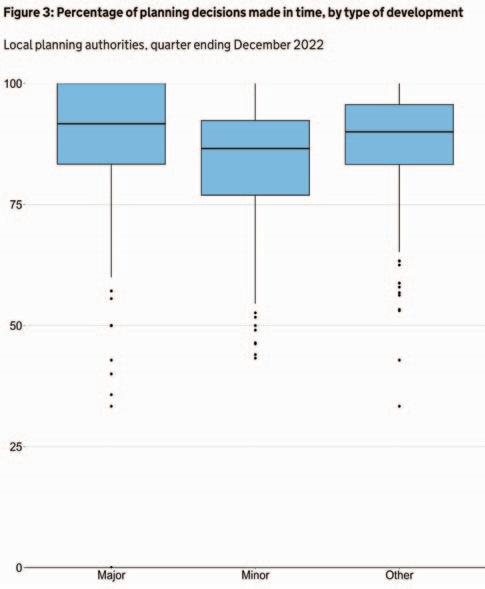
Summer (July to September quarter) and troughs in the Autumn and Winter (October to December and January to March quarters), there was a clear downward trend during the 2008 economic downturn, followed by a period of stability leading to a large dip in 2020 following the start of the pandemic and a subsequent recovery in early 2021, including a particular peak in applications received.
Regional breakdowns
Table 1 shows how numbers of applications received, decisions made and decisions granted varied by region. It also shows how the percentage of decisions granted varies widely by region, from 81% in London to 91% in National Parks, and the North East.
Table 2 shows how numbers of applications received, and planning decisions made, varied by region. It also shows the percentage change in number of applications received and decided compared to the same quarter a year earlier. The percentage change in the number of applications received varies widely by region, from -16% in South West to -7% in North East.
26 Planning in London
BRIEFING | PLANNING PERFORMANCE
Planning decisions by development type, speed of decision and local planning authority. All tables and figures can be found here: https://tinyurl.com/4b9bsajb
Source: DLUHC/ONS
For the performance of individual planning authorities go to https://tinyurl.com/7hmdk28u
Decisions granted
Figure 2 summarises the distribution of the percentage of decisions granted across authorities for major, minor and other developments using box and whisker plots. The ends of the box are the upper and lower quartiles, meaning that 50% of local authorities fall within this range, with the horizontal line in the centre of the box representing the median. The whiskers are the two lines above and below the box that are 1.5 times the size of the box (the interquartile range) with the dots representing outliers. Figure 2 shows that the range between the whiskers for the percentage of applications granted is widest between authorities for major developments (42% to 100%), followed by minor developments (53% to 100%) and other developments (72% to 100%).
Speed of decisions
In October to December 2022, 87% of major applications were decided within 13 weeks or within the agreed time, up one percentage point from the same quarter a year earlier.
In the same quarter, 83% of minor applications were decided within 8 weeks or within the agreed time, up three percentage points from the same quarter a year earlier.
Also in the same quarter, 87% of other applications were decided within 8 weeks or within the agreed time, up three percentage points from the same quarter a year earlier.
For more information on major, minor and other developments please see the PS1 and PS2 district planning matter guidance notes.
Figure 3 shows that range between the whiskers for the percentage of decisions made in time this quarter for major developments was (60% to 100%), for minor developments it was (55% to 100%) and for other developments it was (65% to 100%)
Use of performance agreements
‘Performance agreement’ is an umbrella term used here to refer to Planning Performance Agreements, Extensions of Time and Environmental Impact Assessments. Between October to December 2022, 44% of all planning application decisions
involved a performance agreement. Major developments were more likely to involve a performance agreement compared to minor and other developments with 75% of major decisions involving a planning agreement, compared with 53% of minor decisions and 39% of other decisions (Reference Table 2, PS2 Dashboard).
Figure 4 shows, from April 2010, the numbers of decisions on major, minor and other developments made involving a performance agreement, compared with numbers without a performance agreement. Notwithstanding definition changes, there has been a marked increase in the use of agreements since early 2013 (see Technical Notes for more information). This longer upward trend has been driven by both the additional scope for recording them and their additional use .
Performance of individual district level local planning authorities
The existing approach to measuring the performance of authorities was introduced by the Growth and Infrastructure Act 2013 and is based on assessing local planning authorities’ performance on the speed and quality of their decisions
on applications for major and non-major development. Where an authority is formally designated by the Secretary of State as underperforming, applicants have had the option of submitting their applications for major and non-major development (and connected applications) directly to the Planning Inspectorate (who act on behalf of the Secretary of State) for determination. See Improving planning performance: criteria for designation for more information.
Residential decisions
In October to December 2022, 12,200 decisions were made on applications for residential developments[footnote 3], of which 8,800 (72%) were granted. The number of residential decisions made was down 5% from the same quarter a year earlier, with the number granted down 7% from the same quarter a year earlier. 1,200 major residential decisions were granted, down 2% from the same quarter a year earlier and 7,700 major residential decisions were granted, down 7% from the same quarter a year earlier (Live Table P120A, PS2 Dashboard).
In the year ending December 2022, 48,700
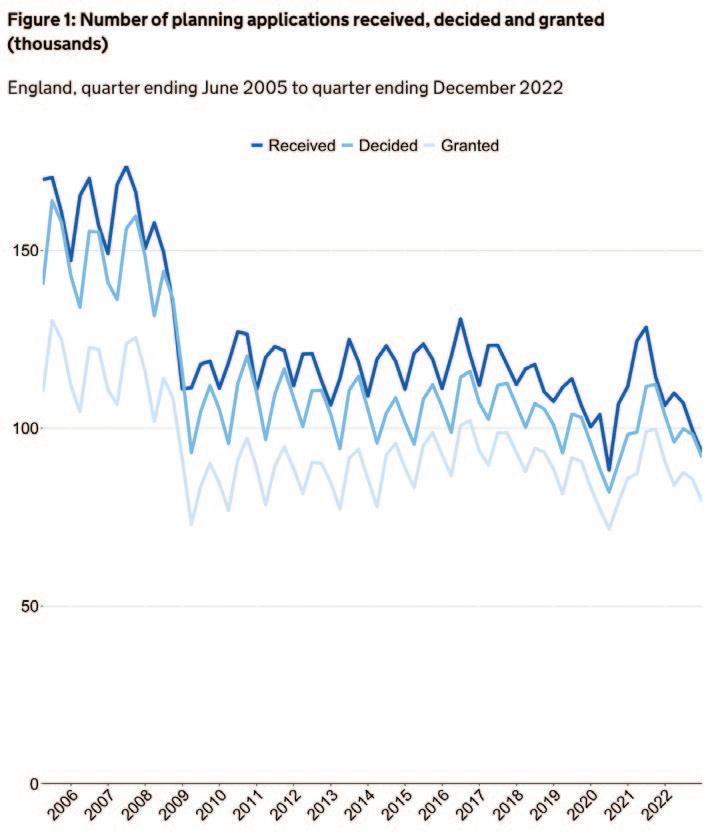
27 www.planninginlondon.com Issue 125 April-June 2023
>>>
decisions were made on applications for residential developments, of which 35,600 (73%) were granted. The number of residential decisions made was down 6% from the previous year, with the number granted down 6% from the previous year. 4,400 major residential decisions were granted, down 8% from the previous year and 31,200 minor residential decisions were granted, down 8% from the previous year.
Residential units
The figures collected by the Department are the numbers of decisions on planning applications submitted to local planning authorities, rather than the number of units included in each application, such as the number of homes in the case of housing developments. The Department supplements this information by obtaining statistics on housing permissions from a contractor, Glenigan[footnote 4].
The latest provisional figures show that permission for 287,000 homes was given in the year to December 2022, down 9% from the 315,000 homes granted permission in the year to December 2021. On an ongoing basis, figures are revised to ensure that any duplicates are removed as far as possible, and also to include any projects that local planning authorities may not have processed: they are therefore subject to change, and the latest quarter’s provisional figures tend to be revised upwards.
For the previous 8 quarters, the year to figures have been revised upwards by 2% on average. These figures are provided here to give contextual information to users and have not been designated as National Statistics.
Commercial decisions
In October to December 2022, 2,000 decisions were made on applications for commercial developments[footnote 5], of which 1,800 (90%) were granted. The number of commercial decisions made down 8% from the same quarter a year earlier, with the number granted down 7% from the same quarter a year earlier. 400 major commercial decisions were granted, down 6% from the same quarter a year earlier and 1,400 minor commercial decisions were granted, down 8% from the same quarter a year earlier (Live Table P120B, PS2 Dashboard).
In the year ending December 2022, 8,200 decisions were made on applications for commercial developments, of which 7,400 (90%) were granted. The number of commercial decisions made were down 5% from the previous year, with the number granted down 5% from the year ending December 2021. 1,600 major commercial decisions were granted, unchanged from the previous year and 5,800 minor commercial decisions were granted, down 6%
from the previous year..
Trends in numbers of residential and commercial decisions
Historically, numbers of residential decisions dropped sharply during 2008 (particularly for minor decisions) then increased from 2012, before decreasing since about 2018 (major decisions) and 2019 (minor decisions).
Numbers of commercial decisions also decreased sharply during 2008 and then stabilised at around 2,100 per year for major and 10,000 per year for minor commercial decisions, but have undergone some further decreases recently, to around 1,700 and 7,000 decisions per year respectively.
Trends in the percentage of residential and commercial decisions granted SEE Fig7 next page.
Householder developments
Householder developments are those developments to a residence which require planning permission such as extensions, loft conversions and conservatories (see Definitions section of the
Technical Notes).
The number of decisions made on householder developments was 49,600 in the quarter ending December 2022, accounting for 54% of all decisions, down from 58% of all decisions made in the quarter ending December 2021. Authorities granted 89% of these applications and decided 88% within 8 weeks or the agreed time (Reference Table 2, PS2 Dashboard).
In the year ending December 2022, 217,800 decisions were made on applications for householder developments, accounting for 56% of all decisions, down from 60% of all decisions made in the year ending December 2021. Authorities granted 90% of these applications and decided 88% within 8 weeks or the agreed time.
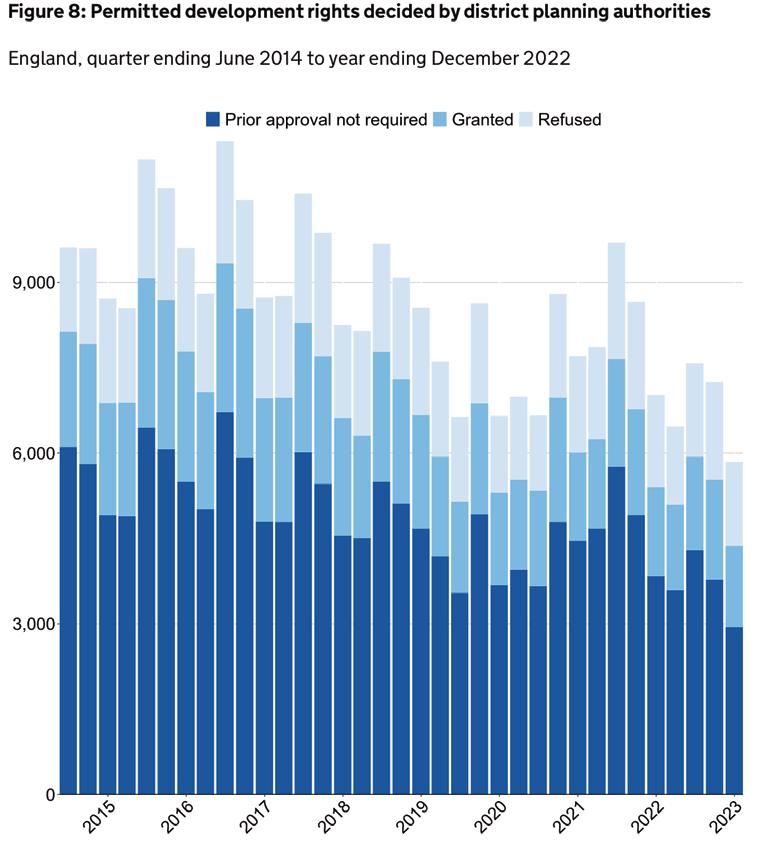
Major public service infrastructure development decisions
Since August 2021, major public service infrastructure developments broadly defined as major developments for schools, hospitals and criminal justice accommodation have been subject to an accelerated decision-making timetable.
Separate figures on major public service infrastructure development decisions have been collected
28 Planning in London
BRIEFING | PLANNING PERFORMANCE >>>
on the quarterly PS2 return with effect from October 2021. During October to December 2022 there were 13 decisions, of which all 13 were granted and 13 were decided in time
Permission in Principle/Technical Details consent decisions
Since April 2017, local planning authorities have had the ability to grant permission in principle (PiP) to sites which have been entered on their brownfield land registers. Where sites have a grant of permission in principle, applicants have been able to submit an application for Technical Details Consent (TDC) for development on these sites. In addition, since June 2018, it has also been possible to make an application for PiP for minor housingled development as a separate application, independently of the brownfield register. Where a site has been granted PiP following an application, it is possible to apply for a TDC.
Figures on PiP/TDC decisions have been collected on the quarterly PS2 return from January 2020. During October to December 2022, local planning authorities reported 86 PiP (minor housing-led developments) decisions, 14 TDC (minor housingled developments) decisions and zero TDC (major developments) decisions. The totals for the previous quarters have been similar.
Major public service infrastructure development decisions
Since 1 August 2021, major public service infrastructure developments – broadly defined as major developments (excluding Environmental Impact Assessments) for schools, hospitals and criminal justice accommodation - have been subject to an accelerated decision-making timetable under which they are to be determined within 10 weeks instead of falling within the normal 13-week determination period.
Separate figures on major public service infrastructure development decisions have been collected on the quarterly PS2 return with effect from 1 October 2021. They are provided at local planning authority level in Live Table MJPSI. During July to September 2022 there were 10 decisions, of which all 10 were granted and seven were decided in time.
Permitted development rights
April 2014 reflects a combination of both: i) the Planning permission for some types of development has been granted nationally through legislation, and the resulting rights are known as ‘permitted development rights’ (PDRs). In some cases, if the legislation is complied with, developments can go ahead without the requirement to notify the local planning authority and hence no way of capturing data exists. In other cases, the legislation
requires an application to the local planning authority to determine whether prior approval is required (see the Definitions section of the Technical Notes).
Between October to December 2022, 5,800 applications were reported, of which prior approval was not required for 2,900, permission was granted for 1,400, and 1,500 were refused. This resulted in an overall acceptance rate[footnote 6] of 75%. Large householder extension accounted for 58% of all PDR applications reported, with 26% relating to All others, 26% relating to All others, and 4% relating to
Commercial Business and service to residential.
In the quarter to December 2022, 800 permitted development right applications were made for changes to residential use, of which 500 (61%) were given the go-ahead without having to go through the full planning process.
Overall during the 35 quarters ending December 2022, district planning authorities reported 300,400 applications for prior approvals for permitted developments. For 169,800 of them prior approval was not required, 69,300 were granted and 61,300 were refused. n
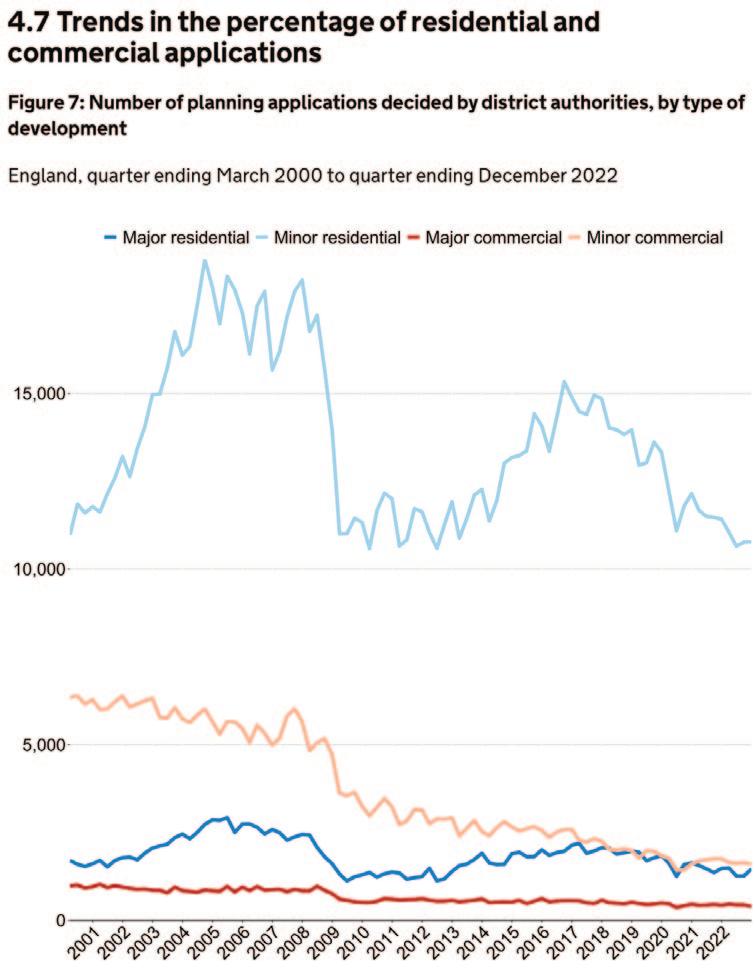
29 www.planninginlondon.com Issue 125 April-June 2023
Annual planning update
NPPF reform & development management reform; the City of London’s ‘Destination City’ programme; Biodiversity Net Gain; building new homes
Account of Forum meeting on Tuesday 21 March 2023
Minute by Riette Oosthuizen of HTA Design also at planninginlondon.com > LP&DF
Cambridge University Land Society (CULS) joint event with LP&DF &ACA Annual Planning Update
21 March 2023, 2pm
New NPPF, New Development Management Guidance, more homes and BNG
Opening
Brian Waters
• Chaired the London Planning & Development Forum since 1990 when it was called the London Development Control Forum

• The London Development Control Forum was a consequence of the Dobry Report (late 1980s) which was an all-party investigation into the failures of development control.
• It set up the National Planning Forum and Regional Development Control fora and the one for London continues today and aims to bring public and private sector thinking closer.
• The team includes:
- Jonathan Manns (co-chair), Riette Oosthuizen from HTA (Planning Partner) and James Mitchell (Axiom Architects)
CULS is the oldest and largest alumni organization at Cambridge University. CULS supports current students. New president Dan Nicholson runs Great Portland Estate.
This event is associated with the Association of Consultant Architects - President Patrick Inglis - Planning in London magazine (Brian Waters publishes this with Lee Mallett and Paul Finch)
• Joanna Averley sent apologies due to illness but highlighted the two consultations on Infrastructure Levy and Environmental Outcomes, launching Friday 24th March in her message.
• ‘Watch this space’ was Joanna Averley’s message last year but what has been happening since then?
• In December 2022, the Department of LevellingUp (DLUHC) announced a consultation on the new NPPF, and a consultation on reform of development management. The deadline for the consultation was early March 2023 with implementation in April 2023.
• There is scepticism among many in the sector/industry about how much will change as a result of the consultation, but the DLUHC is promising the process of reviewing comments will continue.
Meeting held on Tuesday 21 March 2023 hosted by Dentons
Moderator
Brian Waters (BW)
Attendees
Mike Adams
Director, Adams Infrastructure Planning Ltd
James Artingstall
Graduate Planner, Tetra Tech
Michael Brodtman
Director, Grainger Pic
Nicole Cameron
Senior Associate, Cripps LLP
Andrew Catto
Andrew Catto Architects
Rebecca Crosdil
Senior Associate, Cripps LLP
Joshua Dickenson
Associate Director, Deloitte LLP
Michael Edwards
Honorary Professor, Bartlett School, UCL
Jessica Ferm
Associate Professor
Planning and Urban Economies, UCL
Chris Francis
Director, West & Partners
Bairun Huang
• Paul Finch said if Gov’t forced bakers to give away half a loaf of bread for free for every loaf sold you would have bread queues and that is what we have in housing at the moment.
• Affordable housing does not tax profit, it is a tax on housing.
• At the moment there is a need for viability consultants and more viability consultants to check them. The idea of taxing the end output makes sense if it is recognized it is a tax on profit but is tricky in terms of ‘right to require’ in terms of number of properties to become affordable. How do you reconcile this?
Michele Vas, Partner, Dentons
Overview
• It has been quite a year for planning with Government announcements on proposed reforms to planning coming in at a phenomenal rate. The narrative to support the proposed reforms are: - help kick-start the economy in a post-Covid world - boost and speed-up housing delivery;
Student, University of Cambridge
Patrick Inglis
President, ACA
Edward Jones
Graduate Planner
Barton Willmore now Stantec
Fiona Jones
Director, Cameron Jones Planning Ltd
Fiona Jones
Group Secretary, CULS Whitehall Group
Kevin Jones
Director, Cameron Jones Planning Ltd
Yasmin Khan-Osborne
30 Planning in London
BRIEFING | LONDON PLANNING & DEVELOPMENT FORUM
- to address regional disparities; - to empower local authorities and communitiesregenerate their local areas; and - to provide a stronger framework for protecting and enhancing the environment.
• Other key themes in the Levelling-up and Regeneration Bill and the NPPF reforms include:
- Building housing in the right places more quickly;
- Greater say at a local level on what new development should look like, and where it will go with an emphasis on the role neighbourhood planning and local community engagement in planning for development;

- Emphasis on building beautiful and better designed developments, particularly in relation to long term sustainability of development and with the aim that local communities will be more accepting of new development where designs are high quality and respectful of their surroundings;
- Stronger emphasis on protecting and enhancing the environment, natural landscapes, heritage assets, and tackling climate change;
- As a result of the Ukraine invasion, more policies around promoting energy security are introduced;
- Introduction of national development management policies with the aim to simplify the preparation of local plans.
• Further announcements have been made in the past few days and months; these include:
- A consultation on Infrastructure Levy;
- Environment improvement plan, which is the Government's 25 year plan for setting out how it is going to work with landowners, businesses and local communities to deliver on its 10 goals for improving the environment;
- The consultation paper on the Environmental Outcomes Report, which is to replace the existing EIA and SEA assessment schemes;
- Reforms to the NSIP process;
- Law Commission will review the CPO legislation and assessment of compensation (report expect-
Brydell Partners
Dickson Lam
Investment Associate, Mirae Asset
Talia Levene
Ariel Levy
Co-Founder, Gen Two Real Estate
Claire Linfoot McLean
Managing Director
Linfoot Country Homes Ltd
Jacobus Lombard
Principal, Deon Lombard Architects
Cameron McFadyen
Graduate Planner, Tetra Tech
Daniel Mendelson
Student, University of Cambridge
Arita Morris
Annual Planning Up-Date
2pm Tuesday 21st March 2023
At Dentons, One Fleet Place EC4M 7RA
New NPPF, new development management guidance; more homes and BNG
2.05 WELCOME: Brian Waters
2.10 KEYNOTE
The government chief planning officer Joanna Averley & Q&A
2.40 OVERVIEW Michele Vas, Partner, Dentons
2.50 NPPF REFORM & DEVELOPMENT MANAGEMENT REFORM
Jennie Baker, Associate Director with Lichfields Dr Daniel Slade Policy Manager at the RTPI Félicie Krikler, Director at Assael Architecture, Adam Fothergill, Associate director at Assael Q&A
3.40 THE CITY OF LONDON’S ‘DESTINATION CITY’ PROGRAMME Alastair Moss Chair, Corporate Services Committee, Deputy Chair, Planning & Transportation Committee
4.00 BIODIVERSITY NET GAIN - an update from Dr Nick White, head of BNG at Natural England

Director, Child Graddon Lewis
Richard Morton
Director, Richard Morton Architects Ltd
Tony Mulhall
Senior Specialist, Land, RICS
Erik Ruane
Director, Real Estate Business Consulting Services Ltd
Roger Schofeld
Partner
Freshfields Bruckhaus Deringer LLP
Leo Shapland
Executive Director, Workspace
Mark Sivolap
Dan Slavinsky
Associate Director, AStudio
4.10 Q&A
4.25 ••••••••••••••TEA•••••••••••••
4.40 BUILDING NEW HOMES
Sam Stafford, Planning Director at the HBF Anthony Breach, Senior Analyst Centre for Cities, Peter Bill co-author Public Rental Homes Dr Nicholas Falk Community-Led Housing: why not? Rachel Ferguson, senior development manager at Pocket Living
5.30 PANEL DISCUSSION with Q&A
Sanmi Adegoke CEO Rehoboth Property International, Dr Riette Oosthuizen head of planning at HTA Design, Michele Vas Dentons, James Mitchell Partner Axiom Architects and speakers – Moderator: Lee Mallett
5.50 THE WIND-UP Lee Mallett
6.00 NETWORKING & DRINKS courtesy of Dentons
Peter Stewart
Board Director
The Townscape Consultancy
Richard Tufnell
Partner, Commercial Management Ilchester Estates
Tatiana von Pressen
Director, VPPR Architects
Brian Waters
Principal
The Boisot Waters Cohen Partnership
Myriam Waters
Mark Willingale
Principal, Willingale Associates
>>> 31 www.planninginlondon.com Issue 125 April-June 2023
>>>
TIMINGS v.2
ed in three years’ time).
• Reforms at this rate and scale put pressure on resources at local authority level; 44 local authorities have put their local plans on hold pending the outcomes of the NPPF review which will have a considerable impact on 5-year land housing supply and the 10 per cent Biodiversity Net Gain target coming into force in November.
• Other reforms around environmental protection, community engagement and design codes require technical expertise which are not currently resourced and hence will cause delays.
Infrastructure Levy
• A workable development land tax has evaded successive governments for ages. In the midnoughties, the Barker Review recommended the introduction of Planning-gain Supplement (PGS), which was a treasury-based levy collected centrally but on the basis that revenues would be recycled back by retaining the link between developer contributions and local planning permissions.
• Then CIL was introduced. Despite the number of amendments to tweak it to work alongside S106, it is now largely understood by the development industry and does work.
• Despite PGS and CIL being promoted as the death of S106, S106 remains a mainstay to negotiate contributions.
• New proposed Infrastructure Levy will get rid of the need for S106 agreements, and therefore accelerate the consenting process. However, it is not likely to be implemented for another 10 years as the consultation process is long and technical. There is currently a lack of clarity on how it will work and it is unclear what exemptions there will be.
• What are the key elements of the levy?
- It will be mandatory and non-negotiable.
- Developers must take account of levy payments that are going to be made at the point of agreement of values for purchase.
- Rates will be set by local authorities and based on the gross development value (GDV) or if developments are not sold then there will be a valuation of GDV at the point of completion.
- There will be a minimum threshold below which rates will not apply and payments are based on internal area in sqm.
- S106 is here to stay albeit now termed delivery agreements and it is expected that planning conditions would deal with much of the site-specific infrastructure.
- Local authorities will be expected to set out strategic plans for infrastructure delivery and affordable housing need which will include health care, infrastructure and schools or childcare.
- Affordable housing will be secured on a site through a right to require and is to be treated as an in-kind provision.
- three stage payments: The calculation of an indicative levy is to be submitted at the point of submission of a planning application. Then post commencement but prior to occupation, scheme, or a phase, a provisional levy payment will be made with a final adjustment payment post-completion.
- Large elements of CIL will probably be replicated.
• Not clear whether Levy will increase or decrease funding gap.
• Not clear how affordable housing contributions will be protected and could be a potential area for dispute and consequently delaying provision.
• There is no negotiation to alter the timings for payments. This will have the ability to stall development as infrastructure provides certainty on the contribution payable so that it can be considered when assessing land values at the point of purchase.
• It is unclear how the infrastructure levy promotes levelling up as value varies in regions.
• The levy is subject to pilot schemes.
Environmental Outcomes Paper
• It is proposed that the current Environmental Impact Assessment (EIA) is replaced with an outcomes-based approach.
• Principle should be welcomed in terms of reducing the number of documents as part of producing an Environmental Statement (ES).
• Primary objective is to ensure that the environmental protection provided by existing environmental law is not to be reduced.
• Categorisation of development to be subject to an environmental outcomes report is going to be made clearer. The intention is to minimise the need for screening opinions.
• Assessment of reports will be against environmental outcomes which will be set in regulations.
• In conclusion - lots to digest.
Development Management and Reform
Jenny Baker, Lichfields
• Levelling Up and Regeneration Bill (LURB) is making its way through the House of Lords Committee Stage.
• The Government consultation on reformsnational planning policy has now closed.
• LURB and NPPF consultation - include design NDMPs.
• Key Elements - December consultation:
- Quick amends to the NPPF;
- Scope of potential future changes to NPPF;
- Other policies and legislation that would be enabled by Royal Assent of LURB;
- Includes reference to other topics, policy and related legislation such as Net Zero. Role of development plan
• Determinations would be made in accordance
with the development plan unless material considerations strongly suggest otherwise.
• The national development management policies (NDMPS) will be designated by SoS and can be modified or revoked by the SoS. Consultation on these policies will be required.
• Greater weight will be given to the development plan than is currently the case placing new national development management policies above other national policy.
• The following three guiding principles for drafting NDMPS are proposed:
- Matters with direct bearing on determination of planning applications;
- Limited to key, nationally important issues;
- Solely addressing planning issues - not subjects regulated through other legislation.
• Government minded to retain scope for optional technical standards to be set by local authorities through plans so that LPAs can go above minimum set standards.
• Consultation on the first draft National Development Management Policies - follow LURB’s Royal Assent.
Design code status
• Design Codes will form part of the development plan, either within local plans or supplementary plans and will have the same weight as NDMPs unless they conflict with them.
• They will build on the existing frameworks in the National Design Guide, National Model Design Code, emphasis on design in the NPPF.
• Changes to NPPF are housing focused and address housing requirements, housing supply and build out, design and local design codes, and older people’s housing. They also relate to the ‘green belt’, more beautiful homes and providing ‘gentle density’, and changes relating to food security and onshore wind.
• Reform - national planning policy objectives:
- Building beautiful and refusing ugliness;
- Securing the infrastructure needed - support development;
- More democratic engagement with communities on local plans;
- Better environmental outcomes;
- Empowering communities - shape their neighbourhoods;
- Deliver more homes in the right places with a focus on sustainability and integrated infrastructure.
• The primary means for LPAs - assess the design of developments should be through design codes.
• LPAs - include clear text in conditions - refer directly - plans “which provide visual clarity about the design of development, and are clear about the approved use of materials where appropriate”.
• Draft NPPF makes further reference - beauty
32 Planning in London BRIEFING | LONDON PLANNING & DEVELOPMENT FORUM
>>>
Proposed Changes to National Planning Policy for Design Proposed National Development Management Policies
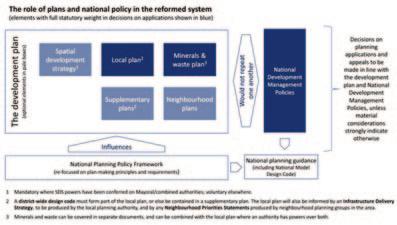
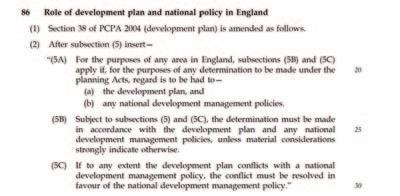
Introduction
Levelling Up and Regeneration Bill (LURB) is at House of Lords Committee Stage The Government consultation on reforms to national planning policy has now closed LURB and NPPF consultation include design and NDMPs

Key elements to December consultation:
1.Quick amends to the NPPF
2.Scope of potential future changes to NPPF
3.Other Policies and Legislation that would be enabled by Royal Assent of LURB
4.Includes reference to other topics, policy and related legislation
LURB: Role of the development plan

• Determinations would be made in accordance with the development plan and unless material considerations strongly indicate otherwise
Greater weight being given to the development plan than is currently the case
• Placing new national development management policies above other national policy
• As with other changes proposed in the Bill, this amendment will not come into force in Wales
LURB: Clause 86
LURB: design code status


• Design Codes will form part of the development plan, either within the local plan or as supplementary plans

They will have the same weight as NDMPs, unless in conflict with them
Anticipated that a future consultation, perhaps on NDMPs, will include discussion on the new weight to be given to design codes
Will build on the existing frameworks in the National Design Guide, National Model Design Code, emphasis on design in 2021 NPPF amends and documents published by the Office for Place this year
LURB: National Development Management Policies
• Policy designated as an NMDP by Secretary of State by direction Can be modified or revoke by SoS SoS must ensure “such consultation with, and participation by, the public or any bodies or persons (if any) as SoS thinks appropriate
LURB: NDMPS – proposed principles
Three guiding principles for drafting NDMPs are proposed: matters with direct bearing on determination of planning applications limited to key, nationally important issues commonly encountered solely addressing planning issues - not subjects regulated through other legislation Government minded to retain scope for optional technical standards to be set locally through plans, where appropriate, so that LPAs can go above certain minima set through building standards
Consultation on the first draft National Development Management Policies to follow LURB’s Royal Assent
LURB: National Development Management Policies
“58. The Government also agrees that design issues are very localised, and that is why locally set design codes, based on effective community engagement and reflecting local character and design preferences, will become integral to the new planning system. The Bill requires all local councils to produce local authority area-wide design codes, which will act as a framework for subsequent detailed design codes, prepared for specific areas or sites and led either by the local planning authority, neighbourhood planning groups or by developers as part of planning applications. This will help ensure good design is considered at all spatial scales, down to development sites and individual plots”.
Government response to the Levelling Up, Housing and Communities Select Committee report on The Future of the Planning System in England, June 2022
including in section 12 “Achieving well designed and beautiful places”.
• The draft NPPF prioritises brownfield land and other underutilised urban sites in LPAs with an uplift, and on these sites densities should be optimized to promote the most efficient use of land.
• Brownfield sites in England only have the capaci-




ty to provide 31 per cent of housing need over the next 15 years.
• Plan for housing need (minus any over-delivery) and other uses, unless protected areas/assets restrict this. Impacts outweigh benefits, including “situations where meeting need in full would mean building at densities significantly out of
character with the existing area”.
• Concern about what ‘significantly out of character’ means.
• Green Belt boundaries are not required to be reviewed if this would be the only means of meeting the objective for housing over the plan period. >>>
33 www.planninginlondon.com Issue 125 April-June 2023
Cambridge University Land Society Annual Planning Update 21 March 2023
Daniel
NPPF proposed amends overview
• Speedy changes to the NPPF - expected to be published fairly soon
• The majority of the proposed amends to the NPPF relate to housing, including:
• Housing requirements
• Housing supply and build out
• Design and Local Design Codes
• older peoples’ housing
• Green Belt
Promoting more beautiful homes, including through gentle density
• Changes relating to food security and onshore wind too
Draft NPPF - Design
• The primary means for LPAs to assess and improve the design of development should be through the preparation and use of local design codes
• LPAs to include clear text in conditions to refer directly to plans “which provide visual clarity about the design of the development, and are clear about the approved use of materials where appropriate” to make enforcement easier Further references to beauty including in the title of section 12: “Achieving well-designed and beautiful places”
Slade RTPI Policy Manager
The RTPI’s analysis of DLUHC’s consultation on changes to the NPPF
• Daniel started his second stint at RTPI in January.
• There seems to be a shift from a system focused on disincentives for under supply of housing in local areas to an incentive focused one but it is not clear what the incentives are.
• The proposals weaken a series of technocratic requirements for local plan makers which were widely seen as unfair by local decision makers. These relate to: 5YHLS, green belt, densification, the Housing Deliver test and the wider application of the Presumption.
• The proposals also aim to reduce the evidence burden on plan makers by removing justifications.
• Emphasis from technical legitimacy of local plans
- political legitimacy.
• Strategic planning, leadership and lack of resourcing are ‘elephants in the room’ which have not been considered by the Government in the proposals.
• Other concerns are that only housing is mentioned as a tool for densification but what about employment? Also, public interest will come down to ambitious local leaders and will depend on leadership itself.
• What were considered to be the positives by the RTPI in the consultation:
- The strength of neighbourhood planning
- Clarity over design requirements in planning conditions
- Addressing regional inequality
Reforms to national planning policy: objectives
• Building beautiful and refusing ugliness
Securing the infrastructure needed to support development
More democratic engagement with communities on local plans
Better environmental outcomes
• Empowering communities to shape their neighbourhoods
• Deliver more homes in the right places, supported by sustainable and integrated infrastructure for our communities and our economy
https://unboxed.co/blog/the-back-office-planningsystem-bops-has-launched/

Brownfield & Density – Draft NPPF

Brownfield and other under-utilised urban sites should be prioritised in the authorities with an uplift, and on these sites density should be optimised to promote the most efficient use of land.
• Concerns about the quantum and distribution of previously developed land
Brownfield sites in England have the capacity to develop 1.4m homes = 31% of total housing need over next 15 years.
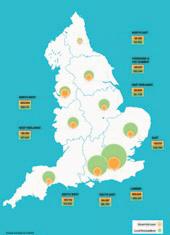
• Plan for housing need (minus any over-delivery) and other uses unless protected areas/assets restrict this, impacts outweigh benefits, including ‘situations where meeting need in full would mean building at densities significantly out of character with the existing area’
Green Belt review and local plans
Green Belt Boundary Reviews
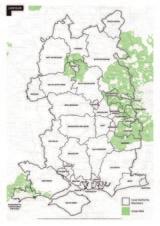
140 (142) – ‘Green Belt boundaries are not required to be reviewed and altered if this would be the only means of meeting the objectively assessed need for housing over the plan period.’
- Housing for older people, women and girls, and vulnerable groups
- Affordable housing for rent
- Community-led housing
- Carbon impact assessment.
• Chapter 12 proposed some important changes but didn’t ask for input. The RTPI provided additional responses - Chapter 12 in the form of a letter to the minister. The main concern is that climate change, net zero and the environment are an afterthought when they should have more priority.
• Changes to the system made through LURB could be significant, these include:
- NDMPs despite being potentially positive could have significant democratic implications;
- The removal of SPDs is concerning;
- Devolution could be good for planning with potentially positive announcements in the budget.
Felicie Krikler and Adam Fothergill, Assael Better living through design
• Direct experience from an architecture practice.
• Assael are a mid-sized architectural practice of around 90 people and 75 per cent of their projects are in London.
• Quite complex large mixed use residential developments on brownfield sites.
• Good understanding of planning framework but work with planning consultants who are integral to the process.
• Positives of the reforms - national planning policy:
- Older people’s housing;
- Urban uplift principle;
- Accountability for developers’ engagement and data in the production of neighbourhood plans;
- Public participation;
- Affordable housing for rent;
34 Planning in London
BRIEFING | LONDON PLANNING & DEVELOPMENT FORUM >>>
- Nature-based solutions;

- Mandatory whole life carbon assessments;

- National Retrofit Strategy.

• Challenges of the reforms:
- Housing supply definition; would welcome the inclusion of types, tenure and location in the reforms;
- NDMPs: introduction at a national level could slow down some of the more innovative work undertaken by LPAs and they could be revoked or modified without further public consultation;
- Infrastructure commitment;
- More emphasis on safety of public spaces is good but should consider everyone.
Character and Density
Beauty
• Subjectivity of terms beauty and character could be problematic.
• RIBA stated that emphasizing the role of beauty alone does not create a suitable prerequisite for good design. Beauty must be incorporated in a broader definition focused on security and achieving positive outcomes for people. This could be done through established design and quality review processes.
Case studies:
• Vulcan Wharf, Stratford, London Legacy Development Corporation (LLDC) authority:
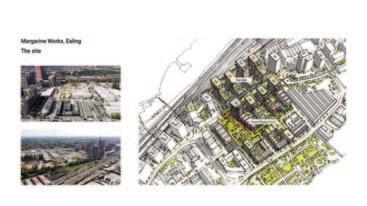

- Very design focused planning process.
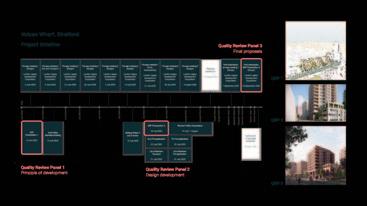
- Located in the Pudding Mill opportunity area and the SPD sets out broad requirements of the site although the actual development challenged those.

- Tall buildings policy sets a series of requirements
- ensure the proposed design is ‘outstanding’ compliance with this set of criteria.
- Met design and quality review panel of LLDC 3 times which became an important part of the process.
- In light of the emphasis on subjective terms like beauty in policy, the importance of independently appointed panels is going to grow.
Character and Density



• Character is a subjective term as well.
• More emphasis is put on character as opposed to density to relate to housing need.


• RIBA’s feedback on character: “It is a temporarily and culturally situated asset, which should be fluid and flexible to the changing circumstance; and this should be acknowledged with any definition of character”. Evolution of London over 60 years shows a complete change in character.
Case Study:
• Margarine Works, Ealing:
- Development of detailed design code enabled bringing forward reserved matters in efficient way.

• Lots of points in the reform - NPPF are positive but more pointers - enable objective assessment are needed. The right stakeholders need to be involved in the plan making process to make sure local plans are deliverable.
Q&A
• Q (Nick Fal)- Michelle mentioned test and learn. How much do we learn if we do no evaluation of schemes in terms of reaction of occupants?
35 www.planninginlondon.com Issue 125 April-June 2023 >>>
Project locations Over the last 5 years An architects’ take on the proposals for reform of development management Félicie Krikler and Adam Fothergill Assael Architecture !"#$%$" NPPF Design codes Development briefs Statutory guidance Local Plan And site allocations Policies map London plan (or regional plans) Neighbourhood plans SPDs National Development Management Policies (Not yet adopted) The Gaps family Development plan Thank you
Shouldn’t we do more of that?
• A (Felicie Krikler) – Post occupancy evaluation is the only way to learn about what we are designing.
• Q (Dan) – NPPF and concept of leadership. It seems that the NPPF is tightening up the rules for councils to guide them and there is also a concept of lack of leadership, and we know that visionary leaders in councils can promote buildings that break the mold. What’s your opinion on leadership in the council and their authority?
• A (Daniel RTPI)- Focus on point around green belt review. Local authorities not needing to review green belt even when they do not meet the hous-
ing need. Need for Councils to do more proactive work on growth and making sure the system provides space for more innovative leadership.
• Q- We are entering a period of greater risk with interest rates and climate change; who is going to take the responsibility for this risk?
• A (Daniel RTPI)- Further devolution could lead to councils or combined city regions to take on more responsibility.

Alastair Moss – Chair of Corporate Services, City of London Destination City
• Was Chair of Planning at Westminster for many
years, held two local authority positions with the Corporation and the City of Westminster, and chaired the Planning and Transport Committee for three years and is now Deputy Chairman. Has seen both environments of the two cities.
• Now involved in the City Business Improvement District and day job as property lawyer.
• Chris Hayward, who is the leader of the Corporation, is leading the major corporate strategy which aims to make the City a leading destination for workers, visitors and residents to ensure the City continues to be competitive globally in placemaking terms.
• Its built upon existing strategies in local govern-
We delivered an evidence-led review
Our approach:
The review was independent and led by Danny Lopez and Kate Keating. It pulled together and built upon existing strategies:
Cultural Strategy 2018-22
• Visitor Strategy 2019-2023 Square Mile: Future City
cityoflondon.gov.uk X
Destination City will enhance the Square Mile’s leisure offer to increase its appeal to existing and new audiences
A £2.5 million annual investment to create a leading destination for workers, residents and UK and international visitors to enjoy.
• Leveraging the Square Mile’s identity, culture and heritage to curate a distinctly ‘City’ seasonal animation programme.
It is more than just events. It is about an enduring transformation of the Square Mile.


One that enhances our unrivalled heritage and history, celebrates our worldrenowned arts and culture, and elevates our offer.
• A new spirit of welcome with strategies to make the public realm more enticing, built around brand partnerships and sustainability.
Building innovative & inclusive wayfinding technology and signage, to improve discovery and drive dwell time.
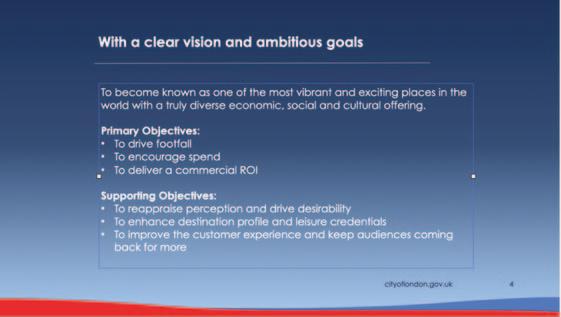
Working with City BIDs, landlords and key partners to reinvigorate the Always On offer to activate spaces and diversify our everyday offer
And a powerful new voice for the City’s destination marketing, with an authoritative consumer facing brand and lasting partnerships that drive global profile and consideration.
!"#$%&'%(&)*&)%!&+,&+-#"&)%.%/''"0"-1
36 Planning in London
BRIEFING | LONDON PLANNING & DEVELOPMENT FORUM >>> !"#$%&'%(&)*&)%!&+,&+-#"&)%.%/''"0"-1 !"#$%&'%(&)*&)%!&+,&+-#"&)%.%/''"0"-12%34"5%")'&+6-#"&)%+76-")5%#47%,+&,7+#$%&'%#47%!"#$%&'%(&)*&)%!&+,&+-#"&)2%8)$%+79:75#5%#& !!!!"#$%&'(%&)'!*&%+! (,-./-01!23..!!"456/7!*8-019-:!! ;,-::0:<!-:=!%1-:.531/-/03:!*3990//44 cityoflondon.gov.uk X Destination City sets out a renewed vision in response to a
context In 2021, the City Corporation commissioned a strategic review to set out a renewed vision for the City to be a leading destination for workers, visitors and residents. Context: The impact of Covid is a threat to the overall vibrancy of the Square Mile We wanted to ensure the City and London continues to compete with other global cities in terms of placemaking
challenging
And was led by competitor analysis and stakeholder feedback Looking at the spend, focus, and ambition of other cities Interviews with over 70 stakeholders from businesses and partners to internal departments and residents cityoflondon.gov.uk X


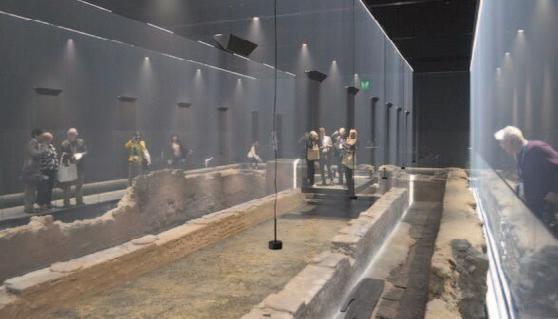


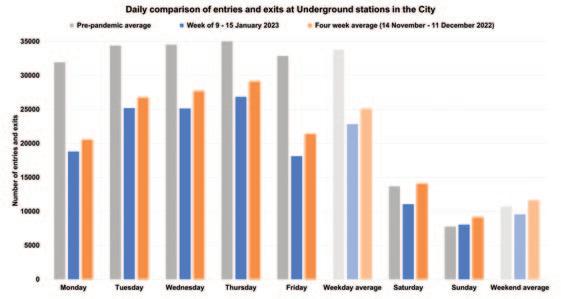



37 www.planninginlondon.com Issue 125 April-June 2023 >>> !"#$%&'%(&)*&)%!&+,&+-#"&)%.%/''"0"-1 !"#$%&'%(&)*&)%!&+,&+-#"&)%.%/''"0"-12%34"5%")'&+6-#"&)%+76-")5%#47%,+&,7+#$%&'%#47%!"#$%&'%(&)*&)%!&+,&+-#"&)2%8)$%+79:75#5%#& !"#$%&'()*+,"-"./0123"42&52$6"6*11&'7"*$%"8/(&/9":+";:$%:$"(3)::1"'::9("<=:$(&$,&%> !"#$%&'%(&)*&)%!&+,&+-#"&)%.%/''"0"-1 !"#$%&'%(&)*&)%!&+,&+-#"&)%.%/''"0"-12%34"5%")'&+6-#"&)%+76-")5%#47%,+&,7+#$%&'%#47%!"#$%&'%(&)*&)%!&+,&+-#"&)2%8)$%+79:75#5%#& !"#$%&#'()!$*+#&,+-.'/&*0)'-'('"% !"#$%&'($$'%()*+#%,+--%$./"0"'")#%1%)234546%+2758% !"#$%&'%(&)*&)%!&+,&+-#"&)%.%/''"0"-1 !"#$%&'$()*)+$&$%,&-"!.#&/01)')2)"%&3&45&6789:9;<79;&(=7::= !"#$%&'%(&)*&)%!&+,&+-#"&)%.%/''"0"-1 !"#$%&'%(&)*&)%!&+,&+-#"&)%.%/''"0"-12%34"5%")'&+6-#"&)%+76-")5%#47%,+&,7+#$%&'%#47%!"#$%&'%(&)*&)%!&+,&+-#"&)2%8)$%+79:75#5%#& !"#$%&'%(&)*&)%!&+,&+-#"&)%.%/''"0"-1 !"#$%&'%(&)*&)%!&+,&+-#"&)%.%/''"0"-12%34"5%")'&+6-#"&)%+76-")5%#47%,+&,7+#$%&'%#47%!"#$%&'%(&)*&)%!&+,&+-#"&)2%8)$%+79:75#5%#& !"#$%&'()*+#,$-$#./00101$23$4566578$ 95:5;7<: !"#$%&'%(&)*&)%!&+,&+-#"&)%.%/''"0"-1 !"#$%&'%(&)*&)%!&+,&+-#"&)%.%/''"0"-12%34"5%")'&+6-#"&)%+76-")5%#47%,+&,7+#$%&'%#47%!"#$%&'%(&)*&)%!&+,&+-#"&)2%8)$%+79:75#5%#& !"#$%&'%(&)*&)%!&+,&+-#"&)%.%/''"0"-1 !"#$%&'%(&)*&)%!&+,&+-#"&)%.%/''"0"-12%34"5%")'&+6-#"&)%+76-")5%#47%,+&,7+#$%&'%#47%!"#$%&'%(&)*&)%!&+,&+-#"&)2%8)$%+79:75#5%#& !"#$%&'(%)*+,"(-#.$/"0$,1$2)")*..,34"5"'(,2$2)"6*4
!"#$%&'%(&)*&)%!&+,&+-#"&)%.%/''"0"-12%34"5%")'&+6-#"&)%+76-")5%#47%,+&,7+#$%&'%#47%!"#$%&'%(&)*&)%!&+,&+-#"&)2%8)$%+79:75#5%#&%54-+7%#4"5%")'&+6-#"&)%")%-%,:;1"0%'&+:6%54&:1*%;7%6-*7%#4+&:<4%#47%!"#$%&'%(&)*&)=5%!&66:)"0-#"&)%
ment; a cultural strategy, a visitor strategy, and building the resilience and sustainability of the future the City (the square mile), and to make the City vibrant and diverse.




• Not complacent about London’s position as a world class city and learning from other cities in the world.
• During Covid no one was in the City; it was a place to be evacuated. But it should be resilient as thousands of people contacted the City of London to say how they would like the City to be.


• Now people are back and the City is thriving again.
• What are the primary objectives:
- drive footfall into the city, getting visitors to

38 Planning in London BRIEFING | LONDON PLANNING & DEVELOPMENT FORUM
>>> !"#$%&'%(&)*&)%!&+,&+-#"&)%.%/''"0"-1 !!"#$%&'(%)*+,"-./0$1"2$,3$4)"5*00,67"8"9(,4$4)"%.::,6"!;!<
!"#$%&'%(&)*&)%!&+,&+-#"&)%.%/''"0"-1
!"#$%&'(!"%)%*+,-./%0112%340567%8+7560%/179:0+/:.17; !"#$%&'%(&)*&)%!&+,&+-#"&)%.%/''"0"-1 !"#$%&'%(&)*&)%!&+,&+-#"&)%.%/''"0"-12%34"5%")'&+6-#"&)%+76-")5%#47%,+&,7+#$%&'%#47%!"#$%&'%(&)*&)%!&+,&+-#"&)2%8)$%+79:75#5%#& ! #$%&$'(%##")*+,-"."/01234"5677846"90:;67"4<:=570453<:> !"#$%&'%(&)*&)%!&+,&+-#"&)%.%/''"0"-1 !"# %&'()!&*+$%,-#,%.$/(&)(0$1*,(!$ !"#$%&'%(&)*&)%!&+,&+-#"&)%.%/''"0"-1 55()"/6.7/,84$(0(977#":84".%(:.%/"+$*$+(;2(3.''"44$$("%(/&''$* !"#$%&'%(&)*&)%!&+,&+-#"&)%.%/''"0"-1 !"#$%&'%(&)*&)%!&+,&+-#"&)%.%/''"0"-12%34"5%")'&+6-#"&)%+76-")5%#47%,+&,7+#$%&'%#47%!"#$%&'%(&)*&)%!&+,&+-#"&)2%8)$%+79:75#5%#& !"#$%&'()*+,-.#+')/,0*#'+'&'$1,2,33,4'15(%1/*&$ !"#$%&'%(&)*&)%!&+,&+-#"&)%.%/''"0"-1 !"#$%&'%(&)*&)%!&+,&+-#"&)%.%/''"0"-12%34"5%")'&+6-#"&)%+76-")5%#47%,+&,7+#$%&'%#47%!"#$%&'%(&)*&)%!&+,&+-#"&)2%8)$%+79:75#5%#& 53"&"46)"%%&!/$78$,-&0&%9:;<=>? @;AB=:&C::9DD
spend money and to deliver a return on investment.
- Perception and driving the desirability of visiting the City by increasing the leisure offer and understanding the audience’s use of social media (‘Instagram moments’).
• The City is spending £2.5 million to create this destination (an officer team and events). The aim is to make it habitual for people to come into the City and for that to happen the City must always be on to events help to create this impression.
• The City needs to be on brand and it needs to be positive and inclusive.
• The City owns around 25 per cent of the City’s real estate and are deliberately hedging occupiersmake them more diverse.
• Identify different zones for different events and improve the public realm.
• Planners and policy makers play a big part.
• 95 per cent of visitors use public transport to travel to the City and walk when they get there - it is sustainable.
• Resurgence increased from 15 per cent during Covid lockdowns to 85 per centand Fridays are higher than pre-Covid.
• Planning provides the canvas for this it to happen. The Local Plan, which was paused, is back and being reviewed to create the evidence base.
• In terms of visitor numbers in 2022 there were 4.9 million visitors and in 2019 there were 7.4 million and the trajectories suggest that numbers will come back to that level.
• Cultural resurgence is building on the cultural attractions. The City is spending money on the Barbican to make the City more accessible and a cultural destination.
• Museum of London (London Museum) is moving to Smithfield Market, the existing buildings will be repurposed.
• The Museum will be near Farringdon where 200 trains are arriving per hour.
• The building to house the Migration Museum has recently been approved, its first home in City.

• The Jewish Museum is coming to the courtyard of Bevis Mark Synagogue.
• The London Centre will be relocated to Guildhall.
• Various historical assets and exhibitions have been approved recently or are on the horizon.
• Art Deco interior of the Express Building will be opened to the public.
• The Sky Garden has hosted 10 million visitors over time and roof gardens in general show a great diversity in visitors now and are less exclusive.
• New pedestrian routes will be made and there is a focus on retail resurgence, which is a difficult sector for the City.

• Long tradition of City pubs.
• Lots of streets have been repurposed for sitting and congregating.
• A lot of effort has been made to make the City a seven day a week and evening/weekend destination. Planning and economic development is playing a part in making the City more resilient in the years ahead.
Q&A Alastair Moss
• Q (Lee Mallet)- How much does the lack of affordable housing in London affect the companies in the City?
• A (Alastair Moss)- It is fair to say that a few years back there was a lot of press attention on the City; repurposing for housing is not primary policy but there are areas of housing in the City to implement some of the plans talked about earlier, a flexible canvas is needed. The City has housing estates and has contributed in a major way towards housing but its primary function is not to be using space for housing. Bluntly, economically, the value of the real estate would be sterilized by housing development.
• There is an impact on corporations and businesses as not many people live in London which results in a lack of diversity. The City is looking at co-living and shorter term living which could be affordable in their own way.
• In terms of the economic prospects, the number of people wanting to invest in city is at all-time high.
• Q (Mike)- Livery companies in the City are a great asset but are run like secret societies. Is there anything on the agenda to encourage companies to open up a bit?
• A (Alastair Moss): There is close relationship between Livery companies and City of London and it would be in their interest to open up also to be in line with their own policies on diversity, sustainability, and inclusion.
• Question: I work in the city. Working practices have changed a lot, how is that impacting your forecasting for lease lets and flexible management of offices?
• A (Alistair Moss)- From a sustainability perspective, it is unacceptable not to use buildings and there is a no-demolition policy. Generally, there is not much change, people still want space but use it in a slightly different way which has had a positive impact on the building industry.
Dr Nick White, Principal Adviser, Net Gain, Natural England BNG Planning Update

• Experience with Covid showed that people really value the green spaces in cities.

• Nature and natural environment important for wildlife but also important for making communities more resilient in the face of Climate Change.
• A standardised approach to biodiversity is needed which allows for an objective measure for devel-
Biodiversity Metric
•National register for off-site net gain sites
•Does not change existing legal protections
•Reinforces the mitigation hierarchy
•Uses habitats as a ‘proxy’ measure and translates into biodiversity units
•All intertidal and terrestrial habitats plus linear habitat types
•Establishes a baseline and forecasts outcome
•Provides confidence and consistency of approach
•Aids communication to non technical audiences
•Evidence- based, simple and practical to use
BNG Consultation Response – 21/02/2023
•Additional £16.7m for LPA readiness


•Commencement starting November 2023
BUT ‘small sites’ commence April 2024
•Exemptions – self & custom builds added. Brownfield NOT exempt


39 www.planninginlondon.com Issue 125 April-June 2023 >>>
www.gov.uk/natural-england X BNG Annual Planning Update
Nick White: Principal Advisor, Net Gain – Natural England X Nature and Development ….. to this From this….. X BNG & Environment Act 2021
only •Amends Town & Country Planning Act (TCPA) and 2008 Planning Act (NSIP’s) •Commences from November 2023
10% gain & approval of net gain plan (LPAs can locally vary upwards)
habitat secured for at least 30 years
on-site, off-site or via Statutory Biodiversity Credits •Statutory
Dr
•England
•Minimum
•Off-site
•Delivered
X
for
of
On-site (units) Off-site (units) Statutory Credits Potentially in full or combination Only if units not available Habitat creation or enhancement; landscaping or green infrastructure New habitat creation or enhancement on land holdings or via habitat banks Landscape-scale strategic habitat creation delivering nature-based solutions Last Resort X The Importance
Mechanisms
delivery
Mandatory BNG
of the Metric
X Mandatory BNG – Further Information
>>> opers/applicants to set out what a project is doing to help the natural environment.

• The BNG & Environmental Act 2021, which has been passed but will not come into force until November 2023, is a big change in terms of what will be delivered through the development process for the natural environment.
• The Act amends the TCPA and the NSIPs.
• A minimum of 10 per cent BNG is required but LPAs can vary upwards and can be delivered onsite, off-site or via statutory credits (last resort).
• Off-site habitats to be secured for at least 30 years.

• A metric will underpin all of this by:
- Reinforcing the mitigation hierarchy;
- Using habitats as a proxy measure and translating them into biodiversity units;
- Establishing a baseline and forecasting outcome;
- Providing confidence and consistency of approach;
- Aiding communications to a non-technical audience;
- Evidence based, simple and practical.
• Easiest way to achieve net gain is to think about it during site selection tto find the best way to incorporate nature in a proposed scheme.
• For small sites (a site less than 0.5 ha), the BNG does not commence until April 2024.

• If a development provides more BNG than required it could potentially be sold - another development.

• Additional guidance on stacking and bundling, selling different outcomes - credits for carbon or carbon neutrality, landowner advice and central BNG guidance.

• In 2025, BNG comes int force for NSIPs.
Q&A
• Q (Dan)- Which species and plants do you want to see more of and what do you say to landowners who want achieve the highest yielding investments for their cost?
• A (Nick White)- The species or habitat to be provided depends on the baseline but a trade up must be demonstrated. To get the best value out of an investment, the local area has to be taken into account and which biodiversity interventions are specifically needed in that area.
• Q (Daniel RPTI)- Could you talk more about resourcing in LPAs?
• A (Nick White) – £16.7 million have been provided to Local Government to invest in resourcing including training, local capacity, and further ongoing resourcing. There are also mechanisms for local authorities to recover costs.
• Brian Waters - ICN consultants realise that BNG could enhance value of marginal land which could then be sold to developers as credits.
Mandatory BNG - Timelines
Town & Country Planning Act Developments
November 2023 – commencement for all bar exempted plus small sites
• April 2024 – commencement for small sites – defined as:
(i) For residential: where the number of dwellings to be provided is between one and nine inclusive on a site having an area of less than one hectare, or where the number of dwellings to be provided is not known, a site area of less than 0.5 hectares.
(ii) For non-residential: where the floor space to be created is less than 1,000 square metres OR where the site area is less than one hectare.
Mandatory BNG – Timelines cont’d
2008 Planning Act Developments (NSIPs)
• Late 2025 – commencement for all that have not already commenced via updated national policy statements
•Standard BNG policy statement produced
•Essentially same approach as for TCPA BNG envisaged e.g. standardised metric, use of register for offsite etc
BUILDING NEW HOMES
Samuel Stafford, Planning Director, HBF Eight ways to build more
1 The single most impactful thing for building more homes is to set out an ambitious national housing target and explain to local authorities that it is their role to deliver those homes.
52 Local Plans have been pulled and this can be directly linked to ongoing gossip and discussions about the standard method changes and the consultation on new amendments to policy.
2 We need planners. Planners are most in demand as far as local authorities are concerned. In the Netherlands planning is part of the solution, not the problem.
3 Planning teams need more money RTPI analysis has found. LA spending on planning fell by 43 per centfrom 2009 to 2021, in the northeast it fell by 62 per cent.
4 Rethinking service:s the application fee is only a proportion of the services. In the last 10 years, 400-500,000 applications have been received per year on average. 96 per centof applications were determined in time in 2009, by 2021 this figure fell - 49 per cent, signing extensions of time masks this figure. Services need reimagining and including meaningful pre-application, getting on site by way or conditions or S278.
5 Obsessed with reform, bills, legislation, and ministerial announcements. Consider the impact of standard validation requirements, including page limits, significantly extended deemed discharge provisions, greater use of Part ii brownfield sites to give a clear steer to SME builders on sites to come forward. None of these suggestions require changes to policy or legislation and can have a meaningful impact.
6 Huge fan of National Development Management Policies. Policies in NPPF logical and reasonable starting point but should not be the end point. Issues of national concern to harmonise with Building Control Standards. Local authorities with more ambitious sustainability targets (net zero) than Building Regs could cause problems for small house builders. Other areas that should be national policy include EV charging.
7 Devo Deals – strategic plans are missing. Devo deals need to be based on housing market areas in full. Housing market areas need to be thought about in full.
8 Green Belt policy needs to be amended so local authorities can amend the green belt once they look at their urban capacity, brownfield sites in the greenbelt, and exceptional circumstances are demonstrated. Instead, the Government went the other way. Developments around stations around half an hour from cities should be considered. Add new test on top of to consider sustainability alongside leisure, landscape and beauty when assessing greenbelt sites. Make the case for a Royal Commission on the future of Green Belt fit for the 21st century.
Anthony Breach, Centre for Cities
The Housebuilding Crisis
• Recently published report ‘the Housebuilding Crisis’ looking at the history of housebuilding since the TCPA 1947.
• Discourse suggests that up until 1980 everything was fine. Only after selling Council houses problems started to emerge, but this narrative is only partially true.
• 1980s decline was preceded by two more significant decreases in housebuilding; one after 1947 and then during the 1970s, in the decade before Right to Buy, there was a decline in private and council housebuilding.
• Housebuilding after 1947 was about a third
40 Planning in London BRIEFING | LONDON PLANNING & DEVELOPMENT FORUM
X Mandatory BNG – Further Information cont’d BNG Consultation Response – 21/02/2023 cont’d •Sale of ‘excess’ onsite biodiversity units –allowed •Net gain register details •Statutory credits •Protected sites and BNG delivery – coastal vs non-coastal •Additionality & relationship with compensation X Mandatory BNG – Further Information cont’d Additional BNG Guidance •Stacking and bundling •Landowner advice •Central BNG ‘collections’ page on Gov.uk https://www.gov.uk/government/ collections/biodiversity-net-gain
X
X
lower than in the period before.
• Performance of housebuilding by European Countries between 1955 - 1979 shows UK in bottom three but public housebuilding was quite considerable compared to other European Countries. UK has the lowest rate of private housebuilding of any country in Europe post 1955 - 1979.
• Rationing of land and lack of land being made


available for development leads to relative decline in housing outcomes over time.
• UK is missing about 4.3 million homes, given the increases in homes per person compared to other European countries. UK has not built at the same rate as other western European Countries. Strategy of tenure mix makes no difference.

• 300k/annum housebuilding target is too low to clear the backlog quickly. 442k/annum needed to


clear it in 25 years, 654k/annum to clear it in 10 years.



• Town and Country Planning Act 1947 is the root cause of housing shortage. Planning system reduces both private and social housing.
• Planning reform to introduce a new rules-based, flexible zoning system is the solution. Crucial for improving affordability and economic growth.

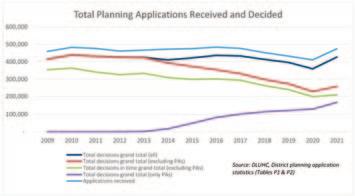

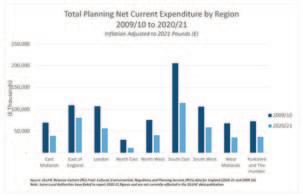
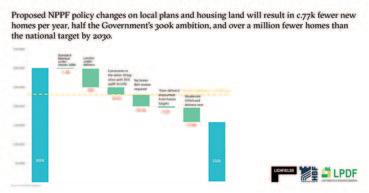
41 www.planninginlondon.com Issue 124 January-March 2023
1. An unequivocal commitment
2. We need planners
3. Planning teams need resources
5. Paperwork
7. Devo Deals
8. Green Belt
4. Rethinking services
>>>
6. National Development Management Policies
Samuel Stafford, Planning Director, HBF: Eight ways to build more homes
The Housebuilding Crisis
Postwar Britain fell behind other European countries in homes per person
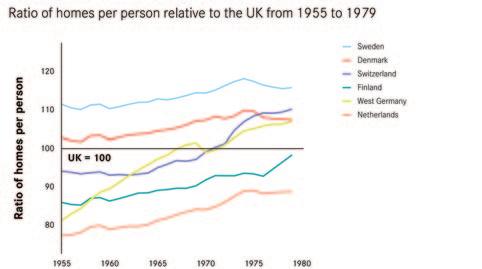
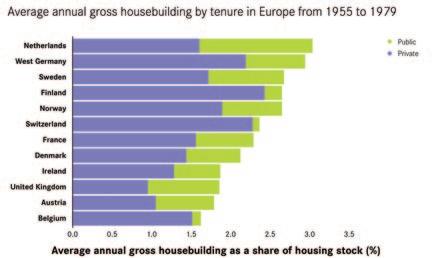
Conclusions
• 300k housebuilding target is too low to clear the backlog quickly
• 442k to clear it in 25 years, 654k to clear it in 10 years
• Town and Country Planning Act 1947 is the root cause of the housing shortage
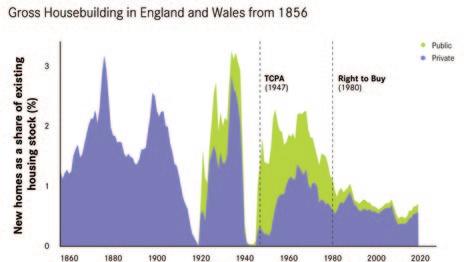
Planning system reduces both private and social housing
V +':8 :-I !!!!!!!!!!*#*%-#'''!!!!!!!!!!!(#+/"#'''!)/#%&/#''',!+%!.!"$%&$
W*&G+$':KQP I !!!!!!!!!!*#+*(#'''!!!!!!!!!!!$#*$&#'''!)/#(**#''',!+(!.!"(%+%
X&+$)*:PQ;-I !!!!!!!!!!(#*-*#'''!!!!!!!!!!!$#/&'#'''!)+&&#&'',!&+!.!//('& ?#,%&4+8;QK I !!!!!!!!!!&#''&#'''!!!!!!!!!!!%#+('#'''!/#"(&#'''!$$!.!*%(*/ (&*<+$= 8;QO I !!!!!!!!!!&#'&$#'''!!!!!!!!!!!+#+++#'''!)"#+"/#''',!+%!.!"$(**
X4$<+$= 8PQP I !!!!!!!!!!+#/&$#'''!!!!!!!!!"/#*''#'''!)%#'"-#''',!-%!.!$((/
Peter Bill, Co-Author Public Rental Home
• The concept of public rental homes accepts we are where we are and does not require changes to the planning system.
• Labour will not plunge back into the pit of planning reforms again.
• Public Rental Home is a new term for council homes. Not many public rental homes are being built at the moment and the purpose is to reduce numbers on the council house waiting lists.

• The book Broken Homes highlights that one fifth of population is on waiting lists and is completely left out of the discussions.
• The idea that 300,000 homes/annum will magically appear if the planning system is changed is nonsense.
• It is in the interest of housebuilders to blame the planning system. Housebuilders have got very close to government in the last 30-40 years and think the Government should bend the planning
system at their will.
• Planning reform to introduce a new rules-based, flexible zoning system is the solution
• Crucial for improving affordability and economic growth


• Correlation between functioning planning system and output much weaker than developers would make you believe. Correlation between houses built and economic activity is much stronger.
• 50,000 fewer homes by Savills for LDPF. Average sales rate is the crucial value for housebuilders to what is being built.
• Housebuilders have reduced number of outlets; the number of new houses built will continue to drop. The number of new homes will drop 145,000 - 90,000 and this has little to do with the Planning System.
• The number of affordable homes is going to plummet.
Ghosts in the machine – over 13 million people in 6.5 million households would never be able to afford to buy a house.
• 1.2 million households on Council homes waiting lists.
• 40 years ago, 45 per cent of Council homes were rented out at affordable levels; today it is only 15 per cent.
• Since 2015 only 700,000 affordable homes have been built – the number of households on waiting list has barely shifted as they are not being catered for under the new affordable houses. What - do about it all?
• Jackie Sadek and Peter Bill wrote a report for the Housing Finance Institute and Think Tank Localis called ‘Public Rental Homes: fresh perspective’. Report came out a month ago and is free and online.
• Councils are hollowed out. The private sector needs to play a role in tackling this crisis and they should be able to make a proper return. But it needs to go through the planning system and councils can take initiative.
• It should be done through an Appraisal Approach. How many private rental homes can a developer
42 Planning in London BRIEFING | LONDON PLANNING & DEVELOPMENT FORUM
Anthony Breach, Centre for Cities @antbreach
Britain builds less housing than most of the rest of Europe The UK is missing roughly 4.3m homes !"#$%&' ($)&*+,*-#."$%/*-012,3"#,4$5-6%")74$-89:; !+<)#<+%*=->"%+<?==4%4"$, !+<)#<+%*= @&4A+%*?==4%4"$, !+<)#<+%*= @#B<4)?==4%4"$, @&4A+%*-C-@#B<4)D4E-"F ?==4%4"$, 3"G*,-@*&>/"#,+$= @*".<*- 89:; 0$4%*=-14$5= 9I --------:8 8K9 999-----------LJML; 999- NJK;MJ999- ON KON8; ($)&*+,*-%"-%/*-012,-+==*=-/"G*,-F&"G-:P;;-%"-89:;-4F-%/*-01-/+=-B#4<%-+%-%/*-&+%*-"FQQQ 6R4%S*&<+$=OQ9-I !!!!!!!!!!"#$%&#'''!!!!!!!!!!!$#''(#'''!)%#*(+#''', !-%!.!$%(' 6R*=*$ LQL I !!!!!!!!!!/#"*&#'''!!!!!!!!!!!/#'(%#'''!+/#*''!$+!.!*/%(& T*$G+&7 MQM I
U*<54#G :9 :-I
V*%/*&<+$=,:9
Housing growth falls after the TCPA 1947, and before Right to Buy
Postwar
!!!!!!!!!!/#%%(#'''!!!!!!!!!!!*#-"'#'''!!)"#%$(#''',!&&!.!/*%$/
!!!!!!!!!!/#&-(#'''!!!!!!!!!!!&#"(*#'''!!)%#*(+#''', !-$!.!%%$+
QK I !!!!!!!!!!/#+*$#'''!!!!!!!!!!!!!+**#+''!/#''/#'''!(-!.!%"%$+
Y*,%*&$Z#&".*+$?A*&+5* :;QN I NJ8;NJ999-------;JM;PJ8;;- [:JO9NJM;;\ M9-C-89 NP9
>>>
PRH: A PPR A IS A L A PPRO A CH
afford to build? No rules on the provision. If the viability study shows a positive value, they development can go ahead because the 20 per cent profit is already built in and if it is below 0 that’s where the grants etc come in.
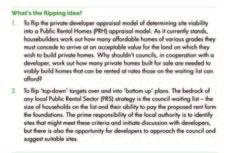
• Councils should not be allowed to take any risk. Councils should set up the frameworks and Builders take all the risk and get compensated for it.
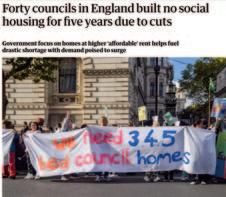
• Very few family houses are being built.
Dr Nicholas Falk, Executive Director, Urbed trust Community led housing (CLH): Why Not?
• It is an important niche that is missing. We do not have the right type of products.
• CLH numbers are increasing but trivial compared to other European countries.
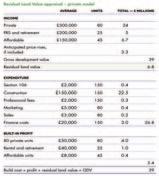

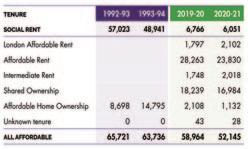
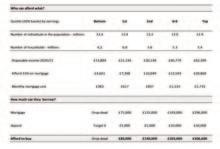
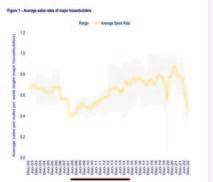

• Cooperatives: residents are in control and they self-manage their homes in a democratic way, they have security and pay fairer costs.

- Hulme – Urbed were involved getting area
PRS: SOME A NSWERS
developed with design guides. Building the 21st Century Homes but very little has happened since then.
• CoHousing intentional communities run by their members.

- Marmalade Lane, Cambridge where co-housing came at the end of development.
• Community Land Trusts give people the means to steward the land for local wellbeing; development and assets important to the community.
43 www.planninginlondon.com Issue 124 January-March 2023 PUBLIC RENTA L HOMES BROKEN HOMES
50,000 FEWER HOMES
PUBLIC RENTA L HOMES
GHOSTS IN THE M A CHINE
>>>
CLH is taking off at last
Community Led Housing: Why Not?
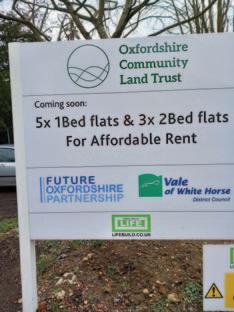 Dr Nicholas Falk Executive Director www.urbedtrust.org
How does CLH add value?
Cooperative movement's values are deep-rooted. They are: self-help, self-responsibility, democracy, equality, equity and solidarity. When these values are related to housing it means:
• Residents are in control
• Residents self-manage the homes in a democratic way
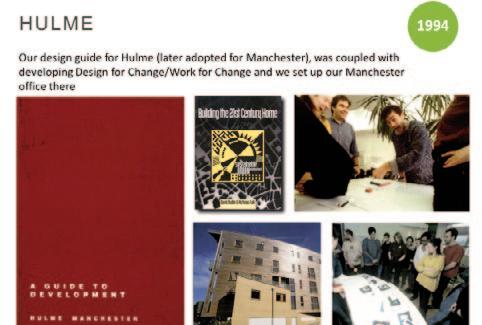

Residents have security
Residents pay fairer costs
How does CLH add value?
CoHousing: Intentional communities run by their members

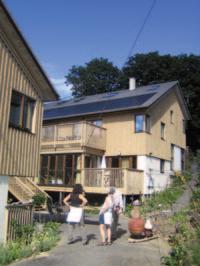

Cohousing creates wellbeing for all e.g. Marmalade Lane, Cambridge

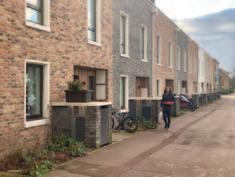
Great for both older singles and young families e.g. Springhill, Stroud
How does CLH add value?


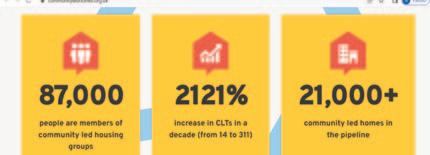
Community Land Trusts – or CLTs –give ordinary people the means to steward land for local wellbeing; developing and managing homes and other assets important to their local community

Partnerships make CLH viable
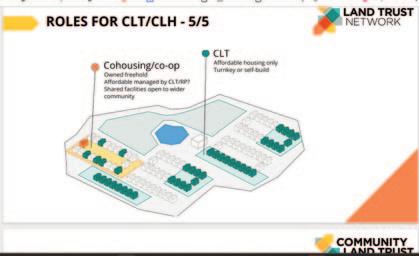
CLT’s engage communities in designing the neighbourhoods they want e.g. Citizens House, Lewisham
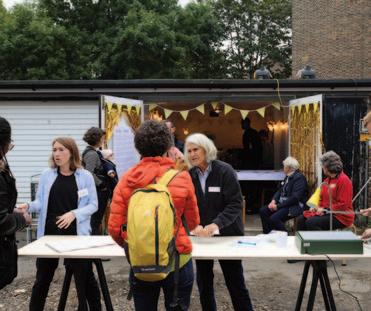
44 Planning in London BRIEFING | LONDON PLANNING & DEVELOPMENT FORUM >>>
Benefit to cost returns of 1.8 to 3.1 (Capital Economics)

Homes for Change works : So why not more?
- Citizen’s House in Lewisham.
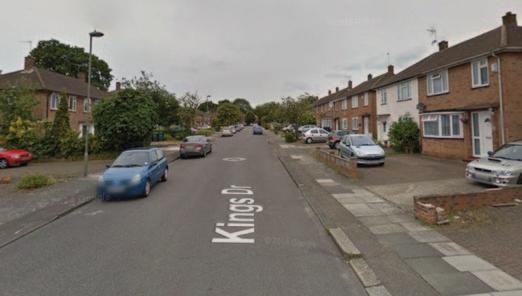
• What makes CLT viable – people collaborating rather than arguing.
• Capital economics – value of this type of approach has returns of 1.8 - 3.1. Why do we not see more?
• 2014 Wolfson Economic Prize Winner Uxcester Garden City in Oxford was turned down for ‘not being popular’ to people.


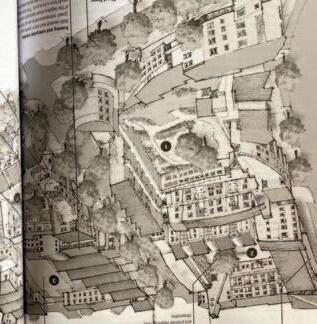


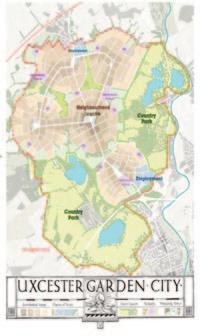

• 130 Baugruppen in Freiburg get together 5 fami-


built their homes together in Freiburg
130



Cooperation is normal in Denmark -7% of residents
lies at a time and appoint an architect to design the homes.
• In Zurich 25 per centof homes are being run by Cooperatives and recent referendum will increase this to a third. Mehr Auf Wohnen.
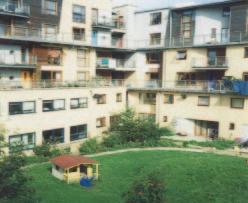
• In Denmark co-operation is normal as seven per cent of residents live in one.



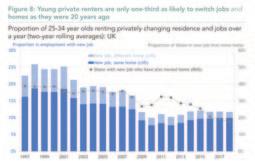
How do we get to smaller urbanisation?
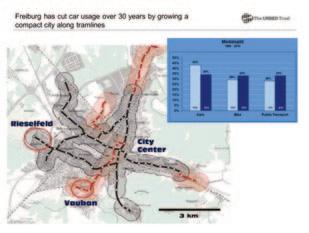


- Ambition
- Brokerage


Ambition + Brokerage + Continuity
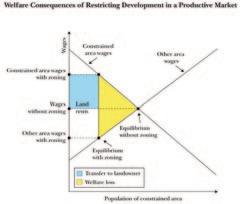
- Continuity
Rachel Ferguson, Senior Development Manager, Pocket Living
Another Sensible Policy
• Pocket Living is a small innovative developer. Partly backed by the Mayor of London providing discount market homes for first time buyers.date they have delivered 1000 homes across 25 sites - 0.1 to 1 hectare.


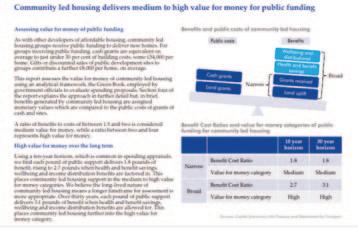

• Lobby Government for presumption in favour of

45 www.planninginlondon.com Issue 124 January-March 2023 yimbyalliance..org 12 yimbyalliance..org Nor this 13 yimbyalliance..org 16 just abo f weal ed rule ment osses e (Glaeser and Gyourko 2018) yimbyalliance..org Most of London looks like yimbyalliance..org Comparable restrictions on labour mobility: ● English Statute of Labourers 1351 ● Hukou system, China ● Peasants in pre-revolutionary France ● Soviet Russia ● Salic laws 18 (Resolution Foundation, Moving Matters, June 2019) >>>
The quality of what we build is at heart an economic not a design issue
2014 Wolfson Economics Prize winner
Cooperatives run 25% of homes in Zurich
e.g. Mehr Auf Wohnen
Let’s make space for community
New England Quarter, Brighton
Baugruppen
Smarter Urbanisation should be common sense
development for small schemes which are affordable housing led.
• Only 10 per cent of homes are built by smaller developers, 35 years ago it was 40 per cent. Why do SMEs and small sites no longer deliver?
• In 2020 Pocket worked with Lichfields to commission a survey about why small sites no longer play a meaningful role in housing delivery.


• The headline was that a one size fits all planning system is disproportionately cumbersome for small sites. On average, it takes small sites 60 weeks to get through planning which is five times the statutory target. 25 per cent of these small sites required significant revisions.
• For SMEs building out small sites time is the enemy as delays have detrimental impact on finances.
• At the end of last year, Government said they would consider a presumption in favour of development for affordable, small sites as part of the
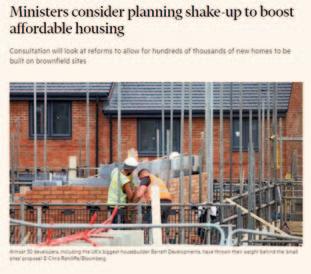

next stage of the NPPF review.
• There is an existing small sites policy in the NPPF: 10 per cent of housing requirement on small sites of less than one hectare.
• Small sites are constrained and will not be able to meet every policy in a local development plan.
• Our revisions propose that there should be a presumption in favour of development on small sites where high levels of affordable housing can be demonstrated, and unless the adverse impacts of allowing development would significantly and demonstrably outweigh the benefits. This is not new and is seen elsewhere in the NPPF where LPAs fails to meet their five year housing targets, but Pocket and others are lobbying for it to also apply for eligible small sites.
• They also suggest that viability assessment should not be required for sites that delivery over 50 per cent affordable homes.
PANEL DISCUSSION
Panelists:
Sanmi Adegoke CEO Rehoboth Property International, focussed on regenerating town centres and unlocking sites that don’t have good planning gains.
Dr Riette Oosthuizen Head of Planning at HTA Design, a lot of experience with local authority housing delivery, small sites and complex sites, and SMEs.
Michele Vas, Dentons, Partner, Particular interest in new towns and garden communities.
Lee Mallett Moderator
Discussion:
• LM asked MV how she would respond to the presentations. MV noted that she would not disagree with what was said. Green Belt is a big issue and in MV’s experience LAs seem open to allowing very special circumstances for housing in the Green
SME Sector -A Sorry State
! In 1988, SME housebuilders built 39% of new homes; now they build just 10% In 1988 there were over 250 registered ‘medium-sized’ companies, today there are just over 100 ! SME insolvency rates have increased by 75% in 2022.
3,672 construction firms went insolvent, the highest level since the financial crisis over ten years ago.
Small Sites –Unlocking Housing Delivery

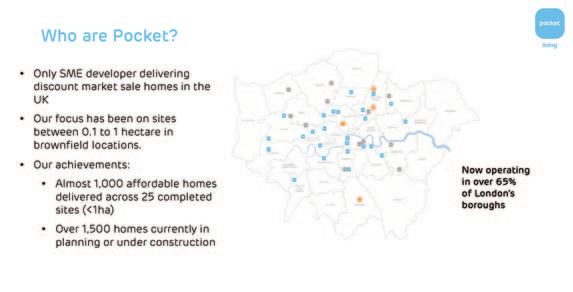
The ‘one size fits all’ planning system blocking SMEs bringing forward small sites:
! Planning determinations for small sites took on average almost 5x the statutory requirement –60 60 we e ks
! Almost ¼ of small developments require two or three successive applications to secure permission
! 75 7 5 % of the cases viability negotiations with councils represented a key blocker for schemes
There are many barriers which prevent small sites coming forward but prescriptive rules around tenure and mix on small sites are unnecessary impediments which if lifted could boost the SME sector.
A revised small sites planning policy in the NPPF
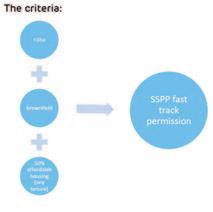
The issue:
The current wording of Paragraph 69 in the NPPF does not have the teeth to bring forward small sites.
The aim:
Provide a more streamlined planning route for small sites to minimise risk and delays.
The solution:
A new Small Sites Planning Policy through minor tweaks to Paragraph 69.
46 Planning in London BRIEFING | LONDON PLANNING & DEVELOPMENT FORUM
!"#$%&'(()*+%,+*((-(.%"/0*12% $3*++%$-124%,+*((-(.%,5+-67
Rachel Ferguson, Pocket Living
>>>
Belt. The amendments to the urban regeneration Bill have been brought about to appease backbenchers and that is politically cynical.
• RO- some of the changes are very short-sighted. For example, BNG contributions can be made to locations that are not connected to newly designed places. Taking the pressure off housing delivery figures is another reason for concern, as it could bring house building to a standstill in some areas. Street votes, which are being introduced, have not been talked about much but could be an effective tool for gaining local support for housing delivery, particularly on small sites and for affordable housing. There is also an absence of learning lessons and revisiting successful ideas.
• RO- we did not get a clear understanding of what the National Development Management Policies will be.
• SA is one of Brian’s clients and it has taking them over 2 and a half years to get planning for
Revised Paragraph 69
three sites in South London. The planning system is slow and regressive due to resource and technical issues. An overhaul of the system is needed but there is no guidance for LPAs through the reforms. There is also a disconnect between local and central government.
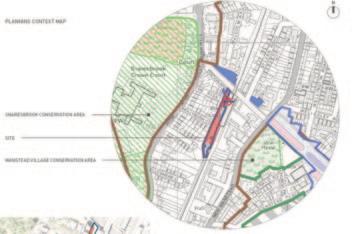
• BW- SA’s example highlights that planning increasingly insists on building control calculations and asks for details which could be dealt with by conditions. The current consultation is clear that planning must not involve itself in any areas covered by other legislation. This needs enforcing.
• Audience Input: It would be great to see architects and planners working together to create a better environment but there seems to be increasing separation between the two disciplines. Planning is becoming more prescriptive, and it is illogical to prescribe design. The planning system should set parameters instead. Design codes could
Small and medium sized sites can make an important contribution to meeting the housing requirement of an area, and are often builtout relatively quickly. To promote the development of a good mix of sites local planning authorities should:

a) identify, through the development plan and brownfield registers, land to accommodate at least 10% of their housing requirement on sites no larger than one hectare; unless it can be shown, through the preparation of relevant plan policies, that there are strong reasons why this 10% target cannot be achieved;
b) use tools such as area-wide design assessments and Local Development Orders to help bring small and medium sized sites forward;
c) support the development of windfall sites through their policies and decisions –giving great weight to the benefits of using suitable sites within existing settlements for homes; and
d) work with developers to encourage the sub-division of large sites where this could help to speed up the delivery of homes; and
e) Where more than 50% affordable housing is proposed, planning permission should be granted unless:
(i)the application of policies in this Framework that protect areas or assets of particular importance provides a clear reason for refusing the development proposed or;
(ii)adverse impacts of doing so would significant and demonstrably outweigh the benefits and;
(iii)to provide a faster and more effective application process, there should be no requirement for a viability assessment
Snaresbrook -an example of the titled balance in practice
take this role but they are often prescriptive too.
• RO- that is the zoning system which is met with fear normally but it can work with plot passports and LAs that understand design codes.
• LM- can a metric be established for design?
• Audience- Digitalisation has not been mentioned. Council websites seem incredibly archaic and it is almost impossible to download data. There is prop tech software such as LandInsight which simplifies a lot of research and there should be an open source version for Councils.
ML- Are Council’s equipped for this change or would they need funding? Audience- it would be a long-term investment and they can’t afford not to do it.
• PB- Planners working from home is a real problem especially as not all information is digitised. ME- Working from home is not an excuse, other companies and institutions can do it too. More generally, the discussion around a specific
What Does This Mean In Practice?
A t i t l e d b al an ce ce: A scheme that meets the criteria should be granted planning permission if the benefits outweigh the adverse impacts
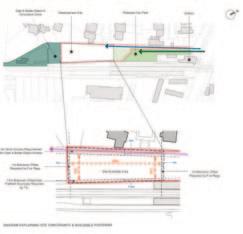
How this could benefit:
! Fl F l e x i b i l i t y o n p l a n n i n g re q u i re m e n t sprovides a wrapper that would enable some innovation back into the sector
! No l e n gt h y vi ab i l i t y tes t i n g -determination periods (to committee) were halved where no viability testing was required
Snaresbrook -an example of the titled balance in practice
Snaresbrook -an example of the titled balance in practice
an any ad adverse impactacts from the scheme are ou outweighedby by the pubublic benefits arising fr from the scheme This would include the significant benefit from delivering 74 affordable new dwellings, which officers afford significant weight in reaching a balanced planning recommendation to grant permission”

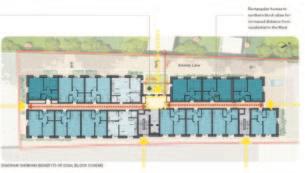

The Opportunities
! Unlocking the potential of small sites
SME Renaissance
! Delivery all forms of affordable housing
47 www.planninginlondon.com Issue 124 January-March 2023
Noncompliant tenure & mix 50% affordable housing
>>>
number of homes needed is a red herring. If we are concerned about affordability of housing we need to bear in mind we have an incredible income/wealth inequality in this country. 20-30 per cent will never be adequately housed. Affordability in housing needs to be tackled and we need to be careful about what gets built.
• LM thought the Centre for Cities presentation pretty compelling. Britain is a country with a very unsatisfactory housing situation though not all can be attributed to the 1947 Town and Country Planning Act.
Lee Mallet Closing Remarks
• Statistics by the Centre for Cities comparison with European housebuilding rates very compelling.
• Press coverage given to rising inequality bears out how concerned people are about the lack of affordability and inequality. Affordability levels have dropped to those of 1880.
• Planning introduced in 1947 was about achieving fairness and equality and was a fundamental foundation for democracy.

• At a recent developer lunch, the developers defended planning and acknowledged that politics around planning is the problem. Specifically, a lack of political will - resolve the problem.
• It is impossible for private sector to deliver what society needs.
Tories want homeowners; labour wants council housing, and both are engaged in legal ‘jerrymandering’ around housing policy.
• Rising inequality forces people to move out of London and this has impacts on businesses in London.
• In 2021 Lee worked on a major capacity study in Barking and Dagenham with HTA. There was an extra capacity for 7,000 homes on 11 of those estates. Viability was low but gave 50 per cent affordable plus big refurbishment costs.
• This is a plea for more dynamic partnerships to get the homes we want.
Get local authorities to make more of their property portfolios available for the private sector (not privatisation of Council Housing), which will require a shift in the fiscal thinking of the last 40 years and tackle directly the social inequality. n
2PM 5th JUNE at HTA Design, 75-89 Wallis Road E9 5LN
Invited speakers:
Sarah Allan, Government Head of Design (confirmed)
Jorn Peters of the GLA & Hollie Howe of St Modwen
Properties PLC on industry and logistics uses in London and the recent NLA report
email jm@axiomarchitects.co.uk if you wish to join us
48 Planning in London BRIEFING | LONDON PLANNING & DEVELOPMENT FORUM
>>>
E T I N
N E X T M E
G
To be valid or not to be valid, that is the question
Regular readers who make planning applications will be aware of the rise over recent years of the “validation police”. Many local planning authorities now employ junior validation clerks whose job is to vet all applications for compliance with the rules that specify what they must include. These rules were originally set out as a basic national list (including illustrative drawings, ownership certificate(s), design and access statement, usually a fire statement) plus a completed application form, the correct fee, and any other items that may be set out in a local list.
It is this last requirement that has often caused problems and allows the validation clerk to refuse the acceptance of an application (thus in theory relieving the overworked planning department by delaying submission), often speciously or for very pedantic and disproportionate reasons. In addition, the local lists that authorities rely on are frequently wrongly applied: they must be fully adopted and reviewed every two years to remain legitimate.
Here are the top ten reasons for non-validation that I have come across over the years. All are real and I can provide evidence for this if required.*
1 Every adjoining owner must be notified: required when applying for internal alterations to a penthouse flat above a mansion block which had 72 apartments - certificates were demanded for all owners of the other flats in the block.
2 Provide detailed drawings showing internal walls, etc: required when the buildings shown on the plans were to be demolished as part of the application.
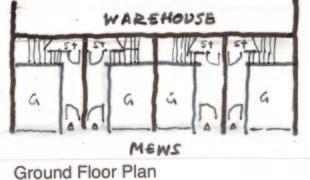
3 Provide a Flood Risk Assessment: required when the application was for a dormer roof extension in Ealing.
4 Provide detailed elevations: required for a simple Change of Use application.
5 Submit four paper copies of the drawings: required following a planning portal online application. The legislation states that authorities cannot insist on drawings being provided on paper when the application is made online (or, if the application is made with drawings on paper, that they are also submitted online).
6 Show the nearest public road: required when the application included alterations to a house on a private road beside a golf course.
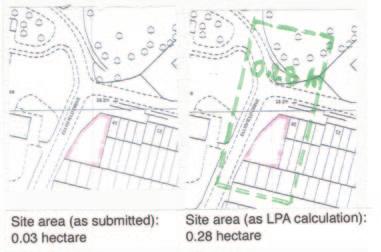
7 Provide a rear elevation: required for a small development where the proposed mews houses (with flat roofs) backed onto an existing warehouse.

8 Site must be outlined in red: required when the planning portal online application included a site plan with the site edged in red - but the local planning authority stated that they did not have access to a colour printer! (Similar to the demand that Other land in the applicant’s ownership must be edged in blue: nowhere does the legislation require this: it simply has to be shown clearly, usually using a different colour - but not necessarily blue).
9 Remove the words “Do not scale” from all drawings and/or Add a scale bar (sometimes both can be cited) or Show written dimensions: required
even when the drawings were submitted as paper copies and clearly to scale. (Similar to Add a north point - which has been required even when the only drawings submitted were elevations).

10 Provide the correct application fee: required when a (senior) planning officer miscalculated the

site area and demanded a fee three times what was required.
Faced with what you believe are spurious or unjustified reasons for refusing to validate an application, there are several ways to proceed. You can of course agree to provide the information / make the changes required even though you do not agree (provided that this can be done - it’s not unknown for validation demands to be made that are impossible to satisfy). Or you can negotiate with the validation clerk (or case officer) to have the validation demand removed/amended.
Or, if your client has the time, you can wait for the determination period to expire (usually 8 weeks) and then go to appeal based on the “nondetermination” refusal: if the appeal inspector does agree that the application was valid, they can go ahead and determine it. This has the advantage that it by-passes a difficult planning authority and achieves a decision that may not include unreasonable LPA conditions. n
* All except one - which is the made up one? [Answer below]
Answer: Number six - there is no specific -require ment for a planning application to be related to a public road. In planning terms a highway has -sim ply to accommodate the passing and re-passing of vehicles, so can be a private or unadopted road.
49 www.planninginlondon.com Issue 125 April-June 2023
ANDY ROGERS ON VALIDATION ROAD BLOCKS
ROGERS
Andy Rogers is a planning consultant and former director in architects The Manser Practice
The reasonable man adapts himself to the world: the unreasonable one persists in trying to adapt the world to himself. Therefore all progress depends on the unreasonable man.
– George Bernard Shaw, 1903
PARKYN’S PIECES

Places of Invention
In the annals of invention and discovery there have always been places from which Wonders have emerged. Remmember Sir Alexander Flemming’s plaque on the lab wall of St Mary’s Hospital in Paddington, or the banal huts of the codebreakers.

Crossing the Atlantic, California can boast hotbeds of invention that began life as modest garages or car ports – anything as long as it’s a banal bargain with power connections. Starting small scale and simple the innovator and his pals are placing themselves in the wake of Local Heroes Charles and Ray Eames, that Yankee couple who became design celebrities – including the obligatory butler and Jaguar – with a cluster of top drawer clients.


They made little but powerful films – The Power of Ten, perhaps thei most famous, in which their camera pans progressively upwards from a metre square of grass by multiples of X10 until, conceptually at least, they reach the edge of ot the Universe.
Security Blankets?
Boxwood scales, stubby pencil holders, perspex protractors and others of that ilk. It’s no surprise that many an architect, engineer or surveyor hangs onto much loved items such as these, not so much for their immediate importance in getting the job done, but because they have by now risen to cult status. Trade samples, mysterious window sections or bolts one can hold in one hand. Turning a non-electric pencil sharpener requires just enough care and thought to allow creative thoughts to creep in; falling shavings and satisfying spirals of colour give tactile pleasure to accompany free thinking. You just have to sweep up at some point.
Rise and Shine
It doesn’t take more than a clutch of recent features from the RIBA Journal to appreciate that there are some really excellent community buildings up and running. It’s not the simple
50 Planning in London PARKYN’S PIECES
Neil Parkyn is a retired architect and urban planner living in central France
Neil Parkyn reflects on things various
ABONVE & RIGHT:
Chairs by Charles and Ray Eames
fact that the pix are full of Real People not sculptural niceties ; the story of their evolution reassures us that a talented and hard working design/construction team can deliver buildings that do their job with style, panache and even humour. Perhaps it was ever thus, but the best of the current crop positively sing with quality. They deserve all the plaudits that such publicity as the RIBA’s McEwan Awards scheme can offer.
Fill ‘em up!
At first glance, you might think that all those wide open windy public housing estates are full of juicy spots for housing infill, yet when these sites are examined critically you most likely conclude that many are anything but. In fact the original layouts are often rather crafty, real puzzlers if you are seeking enhanced numbers, but given ingenuity and annimal cunning the results can cheer. n
LEFT: Engineers ‘Doing Extraordinary Things’: Pont du Garabit, France

BELOW: High quality new London school – see ‘Rise and Shine’

51 www.planninginlondon.com Issue 125 April-June 2023
ABOVE:

HM Treasury. Courtyards have been landscaped with planting and pools to form recreation spaces for staff, while the central circular courtyard, hitherto used for parking, has been emptied of cars and landscaped to form a new public space for London.


Commerzbank. Although each one is unique, the gardens share similar layouts and are planted on the principle of ‘themes and variations’. Typically, there is a deep planter for trees in the middle of the garden and a shallow planter for foreground planting and shrubs on the atrium side
ACCIONA in Madrid
One of the converted courtyards is used as a canteen restaurant for employees. Per Arnoldi artwork hangs from above
52 Planning in London FLEXIBLE DESIGN FOR A SUSTAINABLE FUTURE | SPENCER DE GREY
RIGHT:
>>>
RIGHT:
ABOVE: The Commerzbank joins the cluster of towers in the centre of Frankfurt. At fifty-three storeys, the Commerzbank is the world’s first ecological office tower and the tallest building in Europe First published in the annual magazine of the Cambridge University Land Society with kind consent


53 www.planninginlondon.com Issue 125 April-June 2023
!"#$%&'"(%#)*"+%",%-./0%10.$(#0
!"#$%&'()*+,'-./012345
6"#78#8/'--'9+:;"):<%=8'>6-?'.9@
3'#%1./,4*0-%.5%60#*�%7.,4.,%$*(%#(&*1+"('#4%",%89:;<%=*(%"&%>.,#%$*-%./&%.5%4*&#?
@'./+4%"&%1#%#,+*0>#4%&.%&*A#%&'#%=.)#%B./,&"#(C%$'"D'%*0#%*+0#*4-%5/++%.5%7.,4.,%$.0A#0(?
E./+4%*%!"#$%#"%60#*�%7.,4.,C%$"&'%"&%).0#%F.$#0(%5.0%&'#%G*-.0%.H#0%).0#%�"&.0-C (&0#,>&'#,%&'#%#D.,.)-%.5%@./&'%I*(&%I,>+*,4%*(%*%$'.+#%*,4%)*A#%"&%#*("#0%&.%(.+H#%1"> F0.1+#)(%$"&'%&0*,(F.0&C%#D.,.)-C%'./(",>%*,4%F.H#0&-?
J/0%H*0"#4%F*,#+%&.%4"(D/((%&'"(%0*4"D*+%"4#*%$"++%",D+/4#K2A*'B%CD'9*"E#C2+#D&/0#0%",%7.,4., @&/4"#(C%L",>M(%B.++#>#C%*,4%*/&'.0%.5%3'#%7.,4.,%N0.1+#)O2F+G'H8%C8'69>C%5.0)#0%B'"#5 IP#D/&"H#%.5%&'#%Q0"&"('%N0.F#0&-%R#4#0*&".,%*,4%D/00#,&%D'*"0%.5%&'#%J+4%J*A%*,4%N*0A%S.-*+ T#H#+.F)#,&%B.0F.0*&".,O2(#$*8E'9"I%UGC%5.0)#0%+#*4#0%.5%="++",>4.,%B./,D"+C%*(F"0",> B.,(#0H*&"H#%D*,4"4*&#%5.0%G*-.0%.5%7.,4.,O%*,42JK::8,,'6K*=+:C%R./,4",>%T"0#D&.0%SBL* *,4%*%G*-.0M(%T#(">,%U4H.D*&#< 3'#%#H#,&%$"++%1#%D'*"0#4%1-2A%78'L+,,C27.,4.,%@.D"#&-%&0/(&##%*,4%F/1+"('#0%*,4%#4"&.0%.5 &'#%$#1("J,7.,4.,<D.</A
Date: 8 April 2023 at 18:00 To: Brian Watersbrianwaters1@mac.com
54
The evolution of Build to Rent
Andy Jones is Group Director, Corporate Lettings & Build to Rent at Leaders Romans Group.

Build to Rent is the UK’s fastest-growing sector and this trend looks set to continue through 2023 and beyond.
The British Property Federation (BPF)'s Build to Rent Q3 2022 report shows the sector growing 15 per cent year-on-year, with over 240,000 homes either in planning, under construction, or completed.
Earlier iterations of the BTR model were designed to appeal primarily to Gen Z and Millennial cohorts. According to the BPF’s 2021 analysis of BTR occupancy in London, BTR tenants were mostly professionals, of which 25 per cent worked in the financial services sector.
But while BTR began in urban areas, regional growth has now surpassed that of the Capital, regional growth is now surpassing that of London: the BPF's Build to Rent Q3 2022 statistics show regional BTR growing at almost triple the pace of that in London: 20 per cent , compared to 7 per cent .
This considerable growth responds to a changing demographic in the private rented sector. According to the English Housing Survey 2022, the number of households renting privately has increased by 93 per cent in the last 15 years, while the number of owner-occupied households has grown by just 3 per cent . The increased number of people renting is not solely linked to mortgage rates or the economy, but is part of a longer term trend which also responds to the preference among younger generations fora more flexibility. The same survey shows an emergent of a new tenant demographic: renting households with dependent children has doubled since 2003/4, making up 30 per cent of the sector and the number of ‘comfortable renters’ (defined as those
in managerial professions, who hold degrees and are in good health) is expanding too, representing 44 per cent of the rental sector.
The fast-emerging form of regional Build to Rent (BTR) has, to date, been known interchangeably as ‘suburban BTR’ or ‘Single Family Housing’ (SFH).
But having thoroughly researched the topic and consulted with experts from various disciplines from across Leaders Romans Group, LRG, its recent white paper, BTR suburban communities: the next stage in the evolution of Build to Rent has coined the term ‘BTR suburban communities’.
We believe that this description best depicts this new offer: family homes, located outside urban areas, which despite being individual units, maintain the strong sense of community which made BTR such a success. Other intrinsic values of traditional BTR are continued in BTR suburban communities – including high levels of service, flexible tenancies and a focus on sustainability. At the same time, these communities provide something very different, accommodating Millennials (BTR’s original target market) as they move into their next stage in life.
So what is the future BTR suburban community and how does it differ from a standard housing development?
A BTR suburban community offers much more than just a new house. It’s a community in which an individual or family occupies a house, one which can be made their own - but could be swapped for another as the family’s needs change: rather than building an extension, the family could simply move to a larger house; if they developed an interest in gardening, they could move
BUILD TO RENT | ANDY JONES 55 www.planninginlondon.com Issue 125 April-June 2023
From city blocks to suburban communities considerable new opportunities for BTR will present themselves
>>>
to a house with more outside space; as empty-nesters, they could move again – with each move being free from the complications of buying and selling.
In some cases, homes within BTR suburban communities will be finished and furnished, leaving the new occupier nothing to do but to switch on the broadband and make themselves at home.
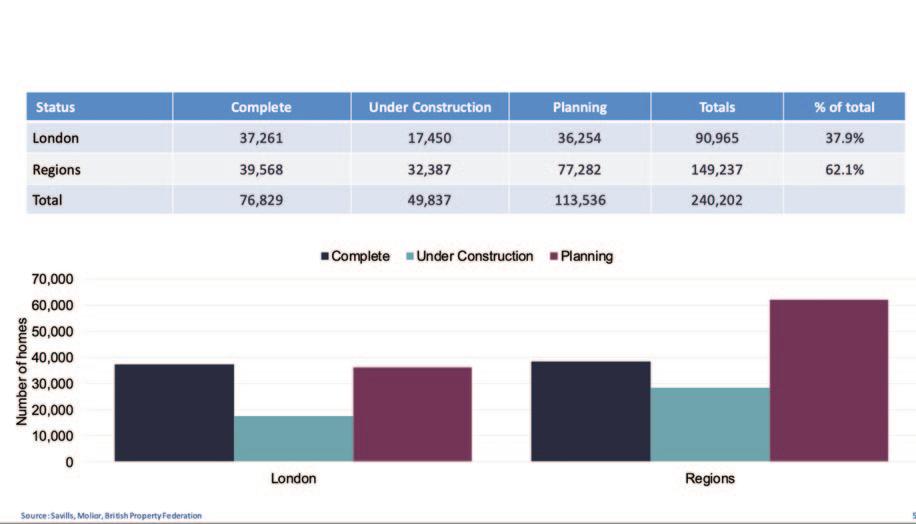
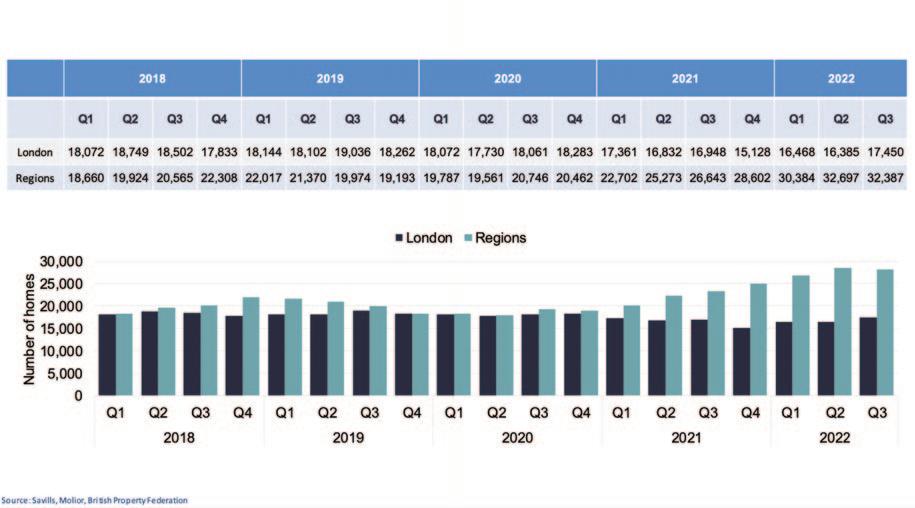
Typically a BTR suburban community offers 24/7 security, all-
inclusive bills and a range of additional services such as cleaning, gardening and even dog-walking. Some are powered by a district heating system, using clean, renewable energy and removing the need for a boiler – or even an energy bill. Future proofed, each home will provide an EV charging point.
The range of services typically available on such developments might include a cinema, a BBQ area, a residents’ lounge, or perhaps a dining or party suite. With a concierge to oversee and
56 Planning in London
BUILD TO RENT | ANDY JONES >>>
arrange repairs, maintenance and deliveries, also dry cleaning, childcare arrangements and even a ‘library of things’ to save the inconvenience and expense of one-off purchases, BTR suburban communities are centred around convenience.
Like traditional BTR, BTR suburban communities prioritise health and wellbeing, supporting active travel in the form of bike hire/storage, access to good public transport links and car clubs. They might also provide outdoor spaces for exercise and recreation, a gym, exercise studio or pool. And they typically support remote working though co-working spaces with meeting rooms, and of course, superfast broadband.
Administration is simple and accountable, with flexible leases, predictable rents, secure tenancies and moves free of fees and other costs. The entire experience is managed with simplicity, with technology for those who wish to use it and a friendly concierge for those who do not.
Furthermore, BTR suburban communities tick all the boxes in relation to the Government’s aspirations, including sustainability (on multiple levels), ‘building beautiful’ and the concept of the 15minute neighbourhood. BTR suburban communities are also ideally placed to meet housing need and deliver on the levelling up agenda.
BTR has only just celebrated its tenth birthday. But spanning property and service sectors, urban and rural locations and appealing to every demographic group, BTR has already come of age. So is the rapid reinvention complete, or will BTR continue to
advance in its second decade? The research that informed our white paper indicates that BTR has significant unresolved potential, especially as it moves beyond its traditional city base, attracting substantial interest from investors, presenting opportunities for developers to diversify, and appealing to an almost unlimited market.
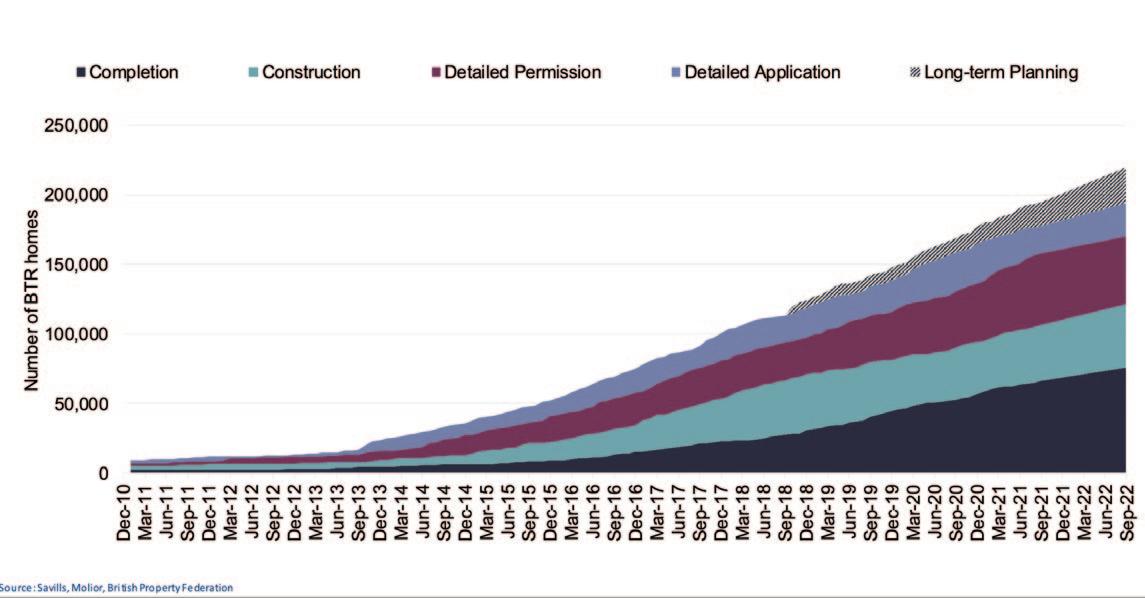
Add to this the trends towards both renting and counterurbanisation, and a political will to ‘professionalise’ the private rented sector, and considerable new opportunities present them-
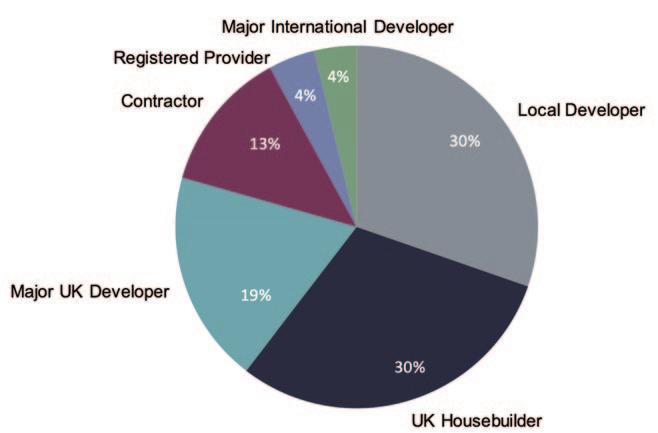
57 www.planninginlondon.com Issue 125 April-June 2023
PiL READER OFFER:
20% off when you buy two books or more

The definitive, comprehensive practical guide to permitted changes of use under the much changed General Permitted Development Order (‘GPDO’). This an essential resource giving you a completely up-to-date guide to this increasingly complicated and much-amended legislation.
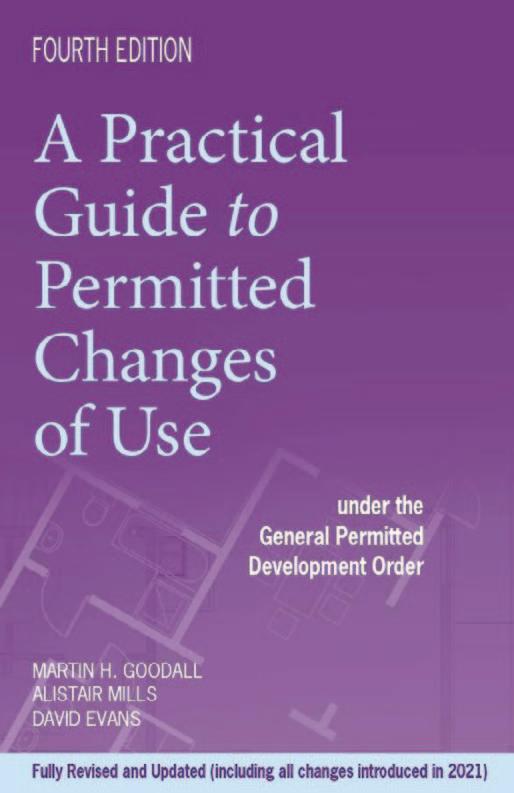
£40 + p&p
The first book to provide a comprehensive overview of the Act specifically for the planning sector. As well as practical commentary, the book includes the relevant sections of the Act, annotated by the author, so you will have the sources you need in one, handy volume.

Both books available in digital formats. Discount automatically applied at checkout.
£75 + p&p
Order from bathpublishing.com/planning
Benjamin Derbyshire introduces his new book Home Truths

Publisher: Hatch
Editions/HTA Design LLP

ISBN: 9781399942256
£45 from ribabooks.com
Home Truths
Design for housing is not much taught in schools of architecture. Yet homes make places what they are – three quarters of all buildings are made to house people. Human wellbeing is dependent on the planning and design of places where we live being of a quality capable of meeting our wider needs and satisfying our desires in harmony with the natural world.
So after half a century as a housing architect, I’ve written a book with some Home Truths!
I have not written a design guide, rather more a manifesto for professional practice in an era of multiple crises – in social, economic and racial disparity, in housing supply and affordability, in climate change, in our high streets and homelessness in our town centres. The book has been described by one peer reviewer as an act of tough love for the professions.
What’s the point? Well it has to be said that the design and planning professions have been tilting at windmills much of the time. Our Quixotic behaviour is not just misplaced, it has left us open to attack. Planners are wrongly perceived as being the cause of housing shortages and architects are not recognised for adding value – and reap little value in return for our professional contribution. The median earning for a mid career salaried architect is just £45k.

I therefore set out to acknowledge the problems and share an understanding as a sort of primer, including the history of, and contemporary context for practice, likely future developments and essential concepts that I think aspiring planners and designers of homes and places need to know about and bear in mind for their work. I draw on insights from across my career, which began as an architect at Hunt Thompson Associates as a year out student in 1973. There were five of us back then in a shopfront studio in Parkway Camden Town. Now the practice has evolved into HTA Design LLP, a 250 strong multidisciplinary design consultancy in four studios across Britain
Who am I aiming at? The professions do not work in isolation. We serve our clients and society, and although our service may claim to be apolitical, our work is the outcome of the political process. From working at HTA to my time at RIBA, Princes Trust, the London Forum of Civic and Amenity Societies and Historic England, I’ve seen the development process and its impact on people inside and out. I hope my book has a message for the entire means of planning and production of the built environment about what really matters; how to think and behave, what to understand and do to make a positive difference.
What is my message? I want to encourage a better understanding of the past and how we got to where we are now. That includes some terrible mistakes in the way we have conspired to damage the environment and allow unfair distribution of resources. But there are lessons for what works well and I set out where and how we should apply ourselves to make good the
promise of wellbeing.
Is this motherhood and apple pie? So long as we continue to speculate in the value of land, exploit human and natural resources, make places which favour cars over people, fail to listen to and understand what people want and need for good lives and pander instead to the hero complex rife in the world of development, we continue to risk human well-being. So no, I’ve set out to establish the principles allowing us to plan, design and manufacture a built environment to better serve humankind as part of an evolving ecosystem. n
Home Truths: definition - https://www.ribabooks.com/HomeTruths_9781399942256
59 www.planninginlondon.com Issue 125 April-June 2023
Benjamin Derbyshire is chairman of HTA Design and a past president of the RIBA
BOOKS: HOME TRUTHS | BENJAMIN DERBYSHIRE
With half a century in practice as a housing architect, Ben Derbyshire has written an essential primer for anyone with aspirations to follow in his footsteps. An expression of tough love, according to one reviewer, the book draws on the past to set course for a sustainable future for the professions, their clients and society.
Nicholas Falk reviews Nigel Moor’s look at how politics shapes England’s environment

£16.39 paperback at Amazon
How politics shapes England’s environment
In a very readable, well referenced and affordable book, Dr Nigel Moor draws on his rich personal experience as both a leading professional planner and senior local politician, most recently as cabinet member for climate change and the environment at Gloucestershire County Council. The book is useful not only in exposing the inadequacies of the British planning system, but also in documenting the many attempts at reform. In the first part he chronicles a miserable saga of one attempt after another to reconcile individual liberty with the wider public interest in an over-centralised country. Twenty one chapters and ten fascinating case studies bring out the role politicians have played in resolving major disputes.
There has been no shortage of ambition or academic research, but with government ministers rarely lasting more than a year before being reshuffled it is not surprising there is little continuity, as each tries to make their mark. Endless legal battles and Commissions produce little more than reports. Both the quality and the quantity of housing in the UK has lagged far behind demand for decades. Inequalities have widened, and climate change is disrupting all our futures. The first part of the book is therefore an excellent guide to the sad story of British planning in the 20th century, part of which appeared in an earlier book in 2010. As the author writes:
The challenge for politicians is to demonstrate that they can take decisions looking to the longer term rather than for shortterm electoral advantage, to dispel the scepticism of the professional planning elite who have argued for almost a hundred years that only they are capable of this attribute
In the second and new part, Nigel Moor addresses what England needs to do to address the climate crisis. While all the delays may have conserved the character of the English landscape and boosted property values, new housing is often in the wrong places and rarely affordable to those on average incomes.

Yet as Nigel Moor stresses, spatial planning is fundamental to dealing with global heating and flooding, especially as we need to achieve the kinds of results that were achieved by the New Towns. Regrettably we seem to have stopped learning from the rest of Europe, and I was interested to read that:
From the 1870s, cities in many German states had legal powers to plan and control town extensions, and Britain was perceived as lagging behind its continental rival.
Could the UK’s lamentable economic performance and low productivity be bound up with our failure to make planning work as intended? Much depends on Westminster, and I was heartened to learn that one Conservative Minister :
Gummer was much influenced by a report commissioned from the research group URBED, which reported in 1994 on the future of town centres. Its findings convinced him of the need not only to encourage new shopping development to locations where it could reinforce the town centre, but to discourage

development on greenfield sites on the edge of centres, where it would result in an unacceptable impact on a town.
Yet a successor dismissed our report on garden cities without even reading it, even though ‘Between 1950 and 2012, 74 per cent of the increase in Britain’s housing costs was accounted for by increases in the cost of land’
Nigel Moor’s latest book should be read by anyone seeking to understand the curious tale of Britain’s decline, but also who wants evidence of the need for fundamental change. He ends with some practical proposals for reform in the light of the climate crisis, which include rationalising the structure of local government, and using infrastructure plans to join up transport, housing and employment. Let us hope that strategic planning gets back on to the agenda for the next government. n

60 Planning in London
Dr Nicholas Falk is chairman of the URBED Trust
BOOKS: ENGLAND’S FUTURE REVIEWED BY NICHOLAS FALK
RIGHT: Image from the book. Its caption reads: Margaret Thatcher'sfreemarket convictions laid the foundations for investment in the London Docklands Enterprise Zone. The architect of One Canada Square was Cesar Pelli. Photograph by the author.











62 Planning in London T: +44 (0)20 3176 6878 E: info@serviceprint.net FULL COLOUR PRINTING Fast, high quality printing service on your doorstep! SERVICEPRINT OUR PRODUCTS Visit our website for the full list of products SERVICEPRINT Visit: www.serviceprint.net SCANNING SERVICES Digitise your old and new records, whether its for archiving purposes or photocopying. We collect, scan and return your originals back. Standard Business Cards A4 Perfect Bound Brochure Notepads A4 Stapled Bound Brochure A4 Wire Brochure Foam Boards
Planning and Environment Reference Guide
Please notify any changes immediately by e-mail to planninginlondon@mac.com with the subject ‘planning in london directory’.
LONDON BOROUGHS DIRECTORY


Mr Paul Moore Acting Chief Executive paul.moore@bexley.gov.uk 0203 045 4901
London Borough of Barking and Dagenham Barking Town Hall Barking IG11 7LU 020 8215 3000
https://www.lbbd.gov.uk/residents/planning -and-building-control/
Chris Naylor
Chief Executive London Borough of Barking and Dagenham chris.naylor@lbbd.gov.uk 020 8227 2137
Simon Green
Predsident of Barking and Dagenham Chamber of Commerce info@bdchamber.co.uk 020 8591 6966


Jeremy Grint
Divisional Director of Regeneration and Economic Development jeremy.grint@lbbd.gov.uk 020 8227 2443
David Bryce-Smith Director Public Protection, Housing and Public Realm david.bryce-smith@bexley.gov.uk 0203 045 5779
Seb Salom Head of Strategic Planning and Transportation seb.salom@bexley.gov.uk 0203 045 5779
Kevin Murphy
Head of Housing and Regeneration kevin.murphy@bexley.gov.uk
0203 045 5837
Robert Lancaster Head of Developmental Control robert.lancaster@bexley.gov.uk 0203 045 5837
London Borough of Bromley Civic Centre Stockwell Close Bromley BR1 3UH 020 8464 3333


Ade Adetosoye OBE Chief Executive ade.adetosoye@bromley.gov.uk 020 8313 4060
Jim Kehoe Chief Planner jim.kehoe@bromley.gov.uk 020 8313 4441
Lisa Thornley Development Control Support Officer lisa.thornley@bromley.gov.uk
Gwyn Richards
Chief Planning Officer and Development Director gwynrichards@cityoflondon.gov.uk
020 7332 1700
London Borough of Croydon Development and Environment Bernard Weatherill House 8 Mint Walk, Croydon CR0 1EA 020 8726 6000 www.croydon.gov.uk/ planningandregeneration
Chief Executive Ms Jo Negrini jo.negrini@croydon.gov.uk

Director of Planning and Strategic Transport Ms Heather Cheeseborough heather.cheeseborough@croydon.gov.uk
Director of Development Colm Lacey colm.lacey@croydon.gov.uk
020 8604 7367
London Borough of Barnet Planning and Building Control 2 Bristol Avenue Colindale
London NW9 4EW
020 8359 3000
Fabien Gaudin Head of the Planning Service 020 8359 2000
There are 3 area teams Lesley Feldman is head of the Finchley and Golders Green area team lesley.feldman@barnet.gov.uk
London Borough of Brent Brent Civic Centre Engineers Way Wembley HA9 0FJ 020 8937 1200 www.brent.gov.uk
Carolyn Downs Chief Executive chief.executive@brent.gov.uk 020 8937 1007
Amar Dave Strategic Director Regeneration and Environment amar.dave@brent.gov.uk 020 8937 1516
Alice Lester Head of Planning, Transport and Licensing alice.lester@brent.gov.uk
020 8937 6441
Aktar Choudhury Operational Director of Regeneration aktar.choudhury@brent.gov.uk 020 8937 1764
London Borough of Camden Town Hall Extension Argyle Street WC1H 8EQ 020 7974 4444 www.camden.gov.uk
Jenny Rowlands Chief Executive jenny.rowlands@camden.gov.uk 020 7974 5621
Frances Wheat Acting Assistant Director for Regeneration and Planning frances.wheat@camden.gov.uk 020 7974 5630

Head of Building Control Ric Patterson richard.patterson@croydon.gov.uk
London Borough of Bexley Civic Offices
Broadway Bexleyheath DA6 7LB
020 8303 7777
www.bexley.gov.uk/planning
Rob Krzysznowski Spatial Planning Manager rob.krzysznowski@brent.gov.uk
020 8937 2704
David Glover Development Management Manager david.glover@brent.gov.uk
020 8937 5344
City of London Department for the Built Environment PO Box 270 Guildhall London EC2P 2EJ 020 7332 1710 www.cityoflondon.gov.uk/planning
Town Clerk and Chief Executive John Barradell OBE john.barradell@cityoflondon.gov.uk 020 7332 1400
Director of the Built Environment Ms Carolyn Dwyer carolyn.dwyer@cityoflondon.gov.uk
020 7332 1600
London Borough of Ealing Perceval House
14-16 Uxbridge Road Ealing London W5 2HL
020 8825 6600 www.ealing.gov.uk/planning
Chief Executive Paul Najsarek najsarekp@ealing.gov.uk

020 8825 5000
Director of Regeneration and Planning David Moore moored@ealing.gov.uk
Executive Director of Environment Keith Townsend townsendk@ealing.gov.uk
020 8825 5000
Director of Safer Communities and Housing Mark Whitmore whitmorem@ealing.gov.uk
020 8825 5000
63 www.planninginlondon.com Issue 124 January-March 2023
DIRECTORY >>>
London Borough of Enfield
PO Box Civic Centre
Silver Street
Enfield EN1 3XE
020 8379 4419
www.enfield.gov.uk/planning
Chief Executive
Ian Davis
chief.executive@enfield.gov.uk

020 8379 3901
Head of Planning Policy
Joanne Woodward
joanne.woodward@enfield.gov.uk
020 8379 3881
Assistant Director Planning, Highways & Transportation
Bob Griffiths bob.griffiths@enfield.gov.uk
020 8379 3676
Head of Development Management
Andy Higham andy.higham@enfield.gov.uk
020 8379 3848
Planning Decisions Manager
Sharon Davidson sharon.davidson@enfield.gov.uk
020 8379 3841
Transportation Planning
David B Taylor david.b.taylor@enfield.gov.uk
020 8379 3576
Chief Executive
Tim Shields tim.shields@hackney.gov.uk
020 8356 3201
Assistant Director of Planning and Regulatory Services
John Allen john.allen@hackney.gov.uk
020 8356 8134
Head of Spatial Planning
Randall Macdonald
020 8356 8051
Director of Regeneration
John Lumley john.lumley@hackney.gov.uk
020 8356 2138
London Borough of Harrow PO Box 37 Civic Centre Station Road Harrow HA1 2UY 020 8863 5611 www.harrow.gov.uk/planning
Chief Executive
Tom Whiting tom.whiting@harrow.gov.uk 020 8420 9495
Divisional Director of Planning
Paul Nichols paul.nichols@harrow.gov.uk 020 8736 6149
Head of Planning & Enforcement
James Rodger james.rodger@hillingdon.gov.uk
01895 250230
Head of Major Initiatives, Strategic Planning & Transportation
Jales Tippell jales.tippell@hillingdon.gov.uk
01895 250230
London Borough of Hammersmith & Fulham Hammersmith Town Hall
Extension King Street London W6 9JU
020 8748 3020 www.lbhf.gov.uk
Chief Executive Ms Kim Dero kim.dero@lbhf.gov.uk
020 8753 3000
Head of Planning Regeneration
John Finlayson john.finlayson@lbhf.gov.uk
020 8753 6740
Head of Policy & Spatial Planning
Pat Cox pat.cox@lbhf.gov.uk
020 8753 5773
Head of Development Management
Ellen Whitchurch ellen.whitchurch@lbhf.gov.uk
020 8753 3484
The London Borough of Havering Town Hall Main Road Romford RM1 3BD 01708 433100 www.havering.gov.uk
Chief Executive
Andrew Blake-Herbert andrew.blakeherbert@havering.gov.uk 01708 432201
Planning Control Manager
Helen Oakerbee helen.oakerbee@havering.gov.uk 01708 432800
Planning and Building Control
London Borough Of Hounslow Civic Centre Lampton Road Hounslow TW3 4DN
020 8583 5555 www.hounslow.gov.uk/planning
Chief Executive Niall Bolger niall.bolger@hounslow.gov.uk
020 8770 5203
Strategic Director of Housing , Planning & Communities
Peter Matthew peter.matthew@hounslow.gov.uk
Head of Development Management
Marilyn Smith marilyn.smith@hounslow.gov.uk
020 8583 4994
Head of Regeneration & Spatial Planning
Ian Rae ian.rae@hounslow.gov.uk
020 8583 2561
Royal Borough of Greenwich

The Woolwich Centre 35 Wellington Street
London SE18 6HQ
020 8921 6426 www.royalgreenwich.gov.uk/planning
Acting Chief Executive Ms Debbie Warren debbie.warren@royalgreenwich.gov.uk
020 8921 5000
Director of Regeneration, Enterprise and Skills
Pippa Hack pippa.hack@greenwich.gov.uk
020 8921 5519
Assistant Director of Planning
Victoria Geoghegan victoria.geoghegan@greewich.gov.uk
020 8921 5363
Assistant Director of Transportation
Graham Nash graham.nash@greenwich.gov.uk
London Borough of Hackney
London Borough Of Haringey Level 6 River Park House 225 High Road Wood Green London N22 8HQ


020 8489 1400 www.haringey.gov.uk
Director for Housing, Regeneration & Planning


Dan Hawthorn dan.hawthorn@haringey.gov.uk
Assistant Director for Planning, Building Standards and Sustainability
Emma Williamson emma.williamson@haringey.gov.uk
Head of Planning Policy, Transport & Infrastructure

Rob Krzyszowski rob.krzyszowski@haringey.gov.uk
Head of Development Management
Simon Thelwell simon.thelwell@havering.gov.uk 01708 432685
Development & Transport Planning
Martyn Thomas martyn.thomas@havering.gov.uk 01708 432845
London Borough of Islington 222 Upper Street London N1 1XR
020 7527 6743 www.islington.gov.uk/planning
Chief Executive Ms Lesley Seary lesley.seary@islington.gov.uk
020 7527 3136
Service Director of Planning & Development

Karen Sullivan karen.sullivan@islington.gov.uk 020 7527 2949
Team Leader for Planning & Projects
Eshwyn Prabhu eshwin.prabhu@islington.gov.uk 020 7527 2450
Environment and Planning
Hackney Service Centre
1 Hillman Street E8 1DY
020 8356 8062
Dean Hermitage dean.hermitage@haringey.gov.uk
London Borough of Hillingdon Civic Centre High Street Uxbridge UB8 1UW
01895 250111
www.hillingdon.gov.uk/planning

Chief Executive & Corporate Director of Administration
Ms Fran Beasley fbeasley@hillingdon.gov.uk
01895 250111
Deputy Director of Residents Services
Nigel Dicker ndicker@hillingdon.gov.uk
01895 250566
Deputy Head of Development Management & Building Control
Andrew Marx andrew.marx@islington.gov.uk 020 7527 2045
Head of Spatial Planning
Sakiba Gurda sakiba.gurda@islington.gov.uk 020 7527 2731

64 Planning in London
Royal Borough of Kensington and Chelsea

The Town Hall
Hornton Street London W8 7NX
020 7361 3000 planning@rbck.gov.uk
Chief Executive
Barry Quirk barry.quirk@rbck.gov.uk
020 7361 2991
Executive Director of Planning & Borough Development
Graham Stallwood graham.stallwood@rbck.gov.uk
020 7361 2612
Chief Executive Ms Janet Senior janet.senior@lewisham.gov.uk 020 8314 8013
Development Manager Geoff Whittington geoff.whittington@lewisham.gov.uk
London Borough of Richmond Upon Thames Civic Centre
44 York Street Twickenham TW1 3BZ
020 8891 1411 www.richmond.gov.uk/planning
Chief Executive
Paul Martin paul.martin@richmondandwandsworth.gov.uk 020 8871 6001

Director of Housing and Regeneration
London Borough of Merton Merton Civic Centre London Road Morden Surrey SM4 5DX
020 8545 3837 www.merton.gov.uk/planning
Chief Executive Ged Curran chief.executive@merton.gov.uk 020 8545 3332

Brian Reilly brian.reilly@richmondandwandsworth.gov.uk
Assistant Director Traffic & Engineering
Nick O’Donnell nick.o’donnell@richmondandwandsworth.gov. uk
Deputy Director Highway Operations & Street Scene
Kevin Power kevin.power@richmondandwandsworth.gov.uk
Executive Head of Economic Development, Planning & Sustainability
Eleanor Purser eleanor.purser@sutton.gov.uk
The London Borough of Tower Hamlets Mulberry Place 5 Clove Crecsent London E14 2BE 020 8364 5009
Chief Executive Will Tuckley will.tuckley@towerhamlets.gov.uk
Divisional Director Planning & Building Control owen.whalley@towerhamlets.gov.uk 020 7364 5314

Strategic Planning Manager Adele Maher adele.maher@towerhamlets.gov.uk
Royal Borough of Kingston Upon Thames Guildhall 2 High Street
Kingston Upon Thames
KT1 1EU
020 8547 5002 www.kingston.gov.uk/planning
Interim Chief Executive
Roy Thompson roy.thompson@kingston.gov.uk
020 8547 5343
Head of Planning
Lisa Fairmaner lisa.fairmaner@kingston.gov.uk
020 8470 4706
Director of Environment and Regeneration
Chris Lee chris.lee@merton.gov.uk
020 8545 3051
Director of Community and Housing
Hannah Doody hannah.doody@merton.gov.uk
020 8545 3680
The London Borough of Southwark 160 Tooley Street London SE1 2QH

020 7525 3559
020 7364 5375
London Borough of Lambeth Phoenix House 10 Wandsworth Road London SW8 2LL
Chief Executive Andrew Travers atravers@lambeth.gov.uk

020 7926 9677
Divisional Director for Planning, Regeneration & Enterprise
Alison Young ayoung5@lambeth.gov.uk
020 7926 9225
Divisional Director Housing Strategy & Partnership

Rachel Sharpe rsharpe@lambeth.gov.uk
London Borough of Newham Newham Dockside 1000 Dockside Road London E16 2QU 020 8430 2000 www.newham.gov.uk/planning
Chief Executive Kim Bromley-Derry kim.bromley-derry@newham.gov.uk
Director of Commissioning (Communities, Environment & Housing)
Simon Litchford QPM simon.litchford@newham.gov.uk
Chief Executive Eleanor Kelly eleanor.kelly@southwark.gov.uk 020 7525 7171

Strategic Director of Environment & Social Regeneration
Deborah Collins deborah.collins@southwark.gov.uk
020 7525 7171
The London Borough Of Waltham Forest Town Hall London E17 4JF
020 8496 3000 www.walthamforest.gov.uk
Chief Executive Martin Esom martin.esom@walthamforest.gov.uk

020 8496 3000
Strategic Director, Corporate Development Rhona Cadenhead rhona.cadenhead@walthamforest.gov.uk
020 8496 8096
Director Regeneration & Growth Lucy Shomali lucy.shomali@walthamforest.gov.uk
London Borough of Redbridge 128-142 High Road Ilford London IG1 1DD

020 8554 5000 www.redbridge.gov.uk/planning
Chief Executive & Head of Paid Service
Andy Donald andy.donald@redbridge.gov.uk
Interim Head of Planning & Building
Control Ciara Whelehan ciara.whelehan@redbridge.gov.uk
The London Borough of Sutton 24 Denmark Road Carshalton SurreySM5 2JG

020 8770 5000 www.sutton.gov.uk/planning
Chief Executive
Helen Bailey helen.bailey@sutton.gov.uk
Assistant Director, Resources Directorate (Asset Planning, Management & Capital Delivery)
Ade Adebayo ade.adebayo@sutton.gov.uk
020 8770 6349
London Borough of Lewisham


Town Hall
Catford London SE6 4RU
020 8314 6000 www.lewisham.gov.uk/planning
Head of Inward Investment & Enterprise
Mark Lucas mark.lucas@redbridge.gov.uk
020 8708 2143
Strategic Director of Environment, Housing & Regeneration Mary Morrisey mary.morrissey@sutton.gov.uk
020 8770 6101
The London Borough of Wandsworth Town Hall Wandsworth High Street London SW18 2PU
020 8871 6000 www.wandsworth.gov.uk

Chief Executive Paul Martin paul.martin@wandsworth.gov.uk
020 8871 6001
Head of Development Permissions Nick Calder ncalder@wandsworth.gov.uk
020 8871 8417
Environment and Community Services Directorate
65 www.planninginlondon.com Issue 125 April-June 2023 PLANNING AND ENVIRONMENT REFERENCE GUIDE
>>>
Mark Hunter
mhunter@wandsworth.gov.uk
020 8871 8418
Head of Forward Planning and Transportation
John Stone
jstone@wandsworth.gov.uk
020 8871 6628
OTHER ORGANISATIONS
Greater London Authority City Hall
Kamal Chunchie Way
London E16 1ZE
020 7983 4000 www.london.gov.uk
Sadiq Khan Mayor of London mayor@london.gov.uk
020 7983 4000
Greater London Authority
Executive Director, Good Growth
Philip Graham
City Of Westminster Westminster City Hall
64 Victoria Street London SW1E 6QP
020 7641 6500 www.westminster.gov.uk
Assistant Director, Planning (GLA) and City Planning (TfL)



Lucinda Turner
Head of Development Management
John Finlayson
Head of the London Plan and Growth Strategies
Lisa Fairmaner lisa.fairmaner@london.gov.uk
Planning Change Manager
Peter Kemp
Chief Executive
Stuart Love slove@westminster.gov.uk
020 7641 3091
Director of Planning
020 7641 2519
Head of City Policy and Strategy
Barry Smith bsmith@westminster.gov.uk 020 7641 3052
Please notify any changes immediately by e-mail to planninginlondon@mac.com with the subject ‘planning in london directory’.
WOULD YOU LIKE TO SPONSOR THIS DIRECTORY?
Previous sponsors were Colliers and Knight Frank. If maybe then please email editor@planninginlondon.com
Urban Design London
Palestra
197 Blackfriars Road
London SE1 8AA
020 7593 9000 www.urbandesignlondon.com
Planning Officers Society
The Croft, 81 Walton Road, Aylesbury HP21 7SN tel: 01296 422161
Design For London City Hall
The Queen’s Walk
More London
London SE1 2AA
Keep taking your PiL
Please complete and mail the form below with cheque for £99.00 or click SUBSCRIBE at www.planninginlondon.com and pay with PayPal or credit card
Avalon Planning, L B Barnet, Gilmartinley, Harvard College Library, London Wharf PLC, L B Islington, L B Greenwich, Sport England, Entec UK, Berkeley Group, Workspace Group, LB Bexley, RBK&C, RTPI, LB Bromley, PRP Architects, Durrants, British Land Company, L B Islington, CBE, GL Hearn, Holistic Group, White Young Green, Dentons, i-Document Solutions, Trowers & Hamlins, British Land, Montagu Evans, Hayes Davidson, Precise Media, NLP, L B Merton, Cluttons Planning, Speechly Bircham, TP Bennett, The London Society, Ebsco, Brockton Capital, Turley Associates, Munkenbeck & Partners, Terence O'Rourke, Assael Architecture, Metropolitan Workshop, PRP, Urban Research, AMEC, GLA, LCR Stations and Property, Terence O'Rourke, Rolfe Judd Planning, Southbank University, Lurot Brand, Slaughter and May, Alliance Planning, Cluttons, DPP, Savills, Henley Business School, Grosvenor, Sainsbury's, Hamptons International, Barratt Homes, National Grid, Network Rail, Foster + Partners, Gorkana Group, London & Continental Railways, London Communications Agency, Cardiff University, Womble Bond Dickinson, L B Ealing, MHCLG, Transport for London, LSE Library, Deloitte Real Estate, London Councils, Circle 33 Housing Trust, P&O Estates Ltd, Greenwich University, Steer Davies Gleave, City of Westminster, British Architectural Library, CBRE, Delancy, PDP London, Bellway Homes, Jestico & Whiles, London & Quadrant, Ecology Consultancy Ltd, Tesco Plc, Ramboll, Dominion Properties, WSP Indigo, Slaughter and May, LSE library, Assael Architecture, British Land Company ...
... Just some of the firms and organisations who have taken their Planning in London subscription. ONE YEAR FOR JUST £99
To subscribe: click on www.planninginlondon.com or please return this form. A subscription is a licence for 5 copies emailed in PDF format. Please supply up to 5 email addresses to planninginlondon@mac.com
I would like to subscribe from: last issue 124 January 2023 this issue 125 April 2023 next issue 126 July 2023
info@designforlondon.gov.uk Ministry of Housing, Communities and Local Government
020 7944 4400 enquiries.br@communities.gsi.gov.uk planning.policies@communities.gsi.gov.uk
Joanna Averley, director, chief planner Simon Gallagher, director, planning
Go to planninginlondon.com > Subscribe and pay online with
I enclose a cheque for £99.00 (no VAT, payable to Planning in London) I am interested in advertising in the Advice directory (£300 for one year)
Please debit my card £106 (£99+£6.00 for credit card administration, no VAT payable)

Card type: VISA MASTERCARD

Card number:
Expiry date: security no:
Signature:
Name on card:
Firm:
Card billing address:
Delivery address if different:
Tel:
Up to 5
Email addresses:
Post cheque to: Planning in London, Studio Petersham, Gorshott, 181 Petersham Road TW10 7AW for the attention of Melanie Hern
66 Planning in London
Magazine of the Year (non-weekly) WINNER 2007 & finalist 2006 – 2012 & 2016 & 2018 International Building Press
RIGHT:
Looking through the lens of data

We live in a world that has come to be characterised by data and its constant exchange across a complex web of networks. These networks make the world a smaller place and connect people from far and wide. The growth of cities and urban living over the past decades has catapulted the potential of technology and data, giving citizens access to an abundance of information at an exponential rate. With a host of new opportunities through AI machine learning models and the ChatGPTs’ of the world, there has never been a better time for architects to embrace the potential of technology and design a socially just future for this data driven world.
As a team at Farrells we are constantly investigating methods of integrating data science and analysis into our design pipeline. We are passionate about finding new ways the profession can adapt and improve with the changing times. One such initiative we have tested and developed is a Geographic Information Systems (GIS) framework to aid initial site analysis and allow for a nuanced understanding of the context and demographics of a place. Using open-sourced data has allowed this process to be immensely flexible and versatile.
Bringing and evidence base and depth to design
Cities are ecosystems that are made up of interconnected networks and entities (SEE fig 1 above). There are various layers within this ecosystem - be it a places’ physical infrastructure, access to open space or the distribution of various uses. People constantly interact with these layers, and this gives each city, town and place its own unique identity.

Data and technology allow us to look at these layers through a magnifying glass. We are able to analyse the complexities of cites
and furthermore draw on inter-relationships between the various layers to better understand how one entity impacts the other. (SEE fig 2 overpage).
Using open-sourced and census data - right from the location of trees or the impact of flood zones on a site, to the understanding of income distribution and demographics of a region our team has been able to use GIS to approach a design problem with a keen understanding of the context. One such aspect we have been using data to better understand and test is the ‘15-minute city’ concept that has been heavily debated over the past few months. Using GIS, we simulated our own model of the 15-minute city to understand how various layers of the city, like the access to public transport, access to food and open spaces impact and improve the livability of a region. Now each time we approach a new site we have the flexibility to add as many layers as we would like, to deepen our understanding of the region, because of the customizable nature of this model to suit specific contexts and demographics. (SEE fig 3 overpage).
Data-driven design
Using data as a tool for geo-spatial analysis has been well documented. However, the ability to ask the right questions and put data to the test is where the future of design lies. Our process involves gathering data and processing it to be able to visualise the spatial qualities of any region. Once we have all the information in place, we iterate through a nonlinear process of tweaking data and adapting our proposals to understand our impact on the surroundings.
We developed this process further through our 15-minute city model where we have created a real-time test engine that not
>>>
SHAPING LONDON | FARRELLS / ALANKRITA AMARNATH 67 www.planninginlondon.com Issue 125 April-June 2023
Alankrita Amarnath is an Urban Design Assistant with FARRELLS
People need to have an equal part in the city making process says Alankrita Amarnath
Fig1 Data and Technology connecting the different layers of the city (All images ©FARRELLS)
ABOVE
Fig2
RIGHT:
Fig3 A successful 15 minute neighbourhood
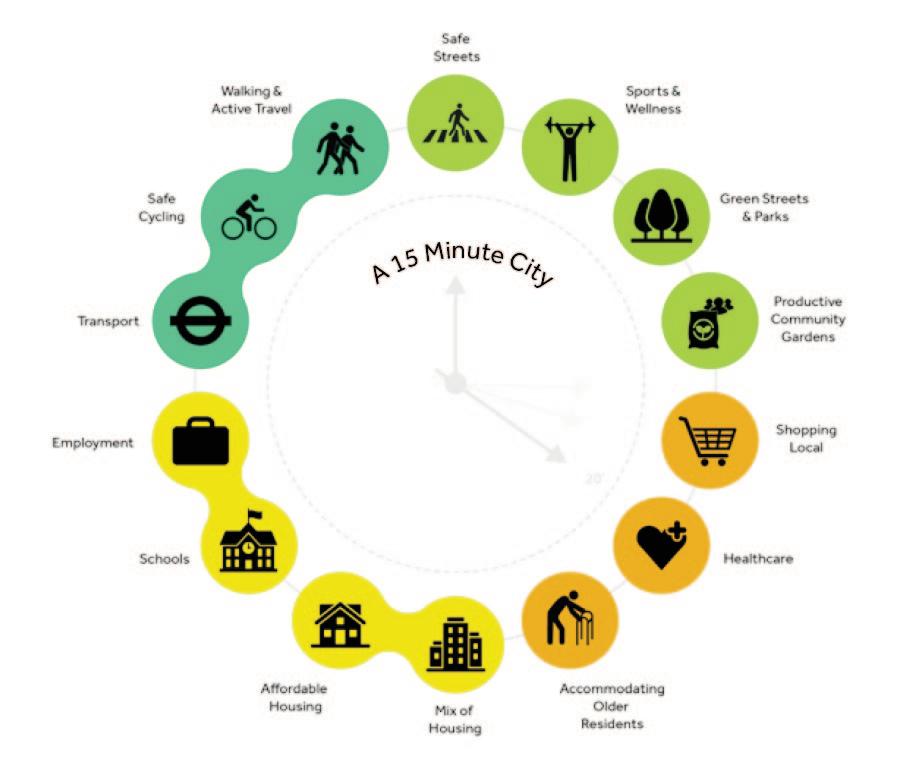
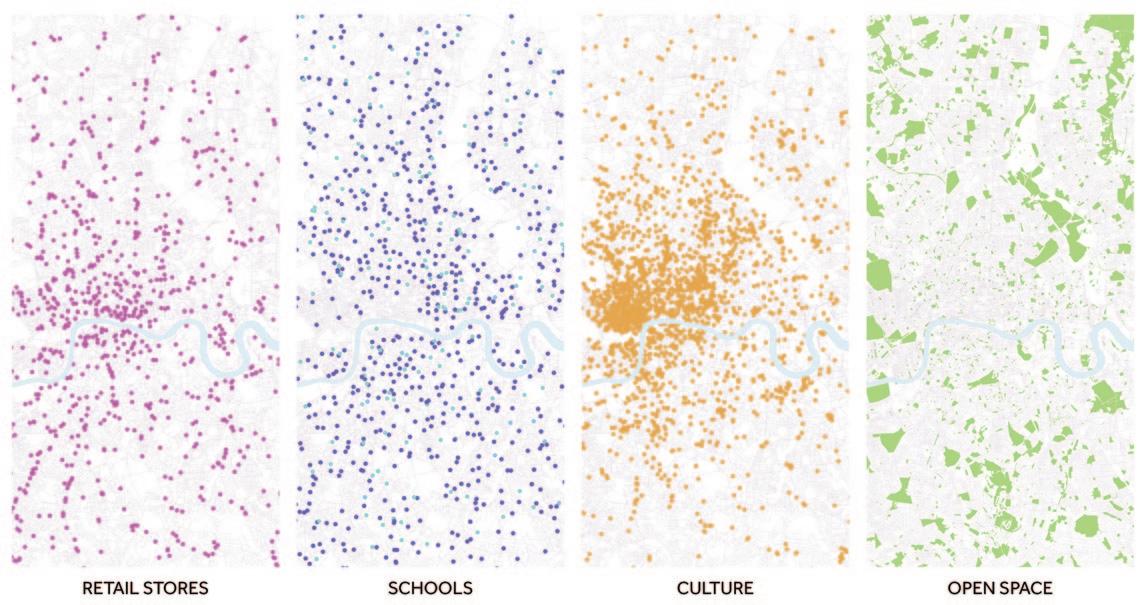
68 Planning in London SHAPING LONDON | FARRELLS / ALANKRITA AMARNATH
Visualising data and spatial analysis with GIS
only simulates how the access to public transport, retail offer, schools, open spaces and cultural venues contribute to a place’s '15-minute score’, it also allows us to input our masterplans, evaluate our impact and adapt our designs to better respond to the context and deliver what is missing in a region. Through rigourous testing of our proposals we can improve the 15-minute score of a region and ensure that the cities and neighbourhoods we design are accessible for all. (SEE fig 4 opposite).
We explored the notion of integrating technology into our design methodology further in our shortlisted entry to deliver a 21st century garden community for the Tendring and Colchester Borders Community with a vision to create a place where people aspire to live work and visit. Our concept ‘Invisible City & Visible Community’ – proposed placing people and community at the forefront of design, supported by the seamless integrated fabric of innovative building technologies, self-sustained homes and a network of digital social infrastructure that make up the invisible city. Using the power of modern technology to its full potential we created a space where community and nature can thrive, building sustainable systems for tomorrow. (SEE fig 5).
Making data accessible to all
With the vast network of the internet and artificial intelligence models generating new datasets everyday there is an abundance of information available out there. Above all, we as humans and our daily patterns – whether it’s our tracked
smartphone usage, observations / posts on social media or even a check-in at a local café, we are constantly contributing to a large source of data. Thus, it has become vital to create data repositories that organize and collate all this information. Along with this, making the data collection process consensual and access to data equitable has never been more important.
We are moving fast towards a future where data is updated and exchanged by the second, having huge impacts on the built environment industry as well – with smart cities using technology to improve sustainability, economic development and enhance the quality of people’s lives. It is now possible to design with detailed knowledge of the end user group, allowing spaces to be truly democratic and cater to every kind of user.
At Farrells, we use GIS, open-source data and VuCity to test how our designs respond to real-life data and cityscapes. Using digital design tools from conception allows us to streamline the process, test different outcomes, coordinate with the rest of the team, and provide real-time data and output to inform design and client decisions. We pride ourselves in constantly pushing the boundaries of digital design. We have recently worked in pioneering digital design codes for the area around Hatcham and Ilderton Road, in collaboration with Southwark Council and VuCity. This paved the way for outward access to design codes and allows designers to iterate through the process and assess their impact on the surroundings. All while providing citizens insight, and the opportunity to shape the future of their community. (SEE fig 6 ).
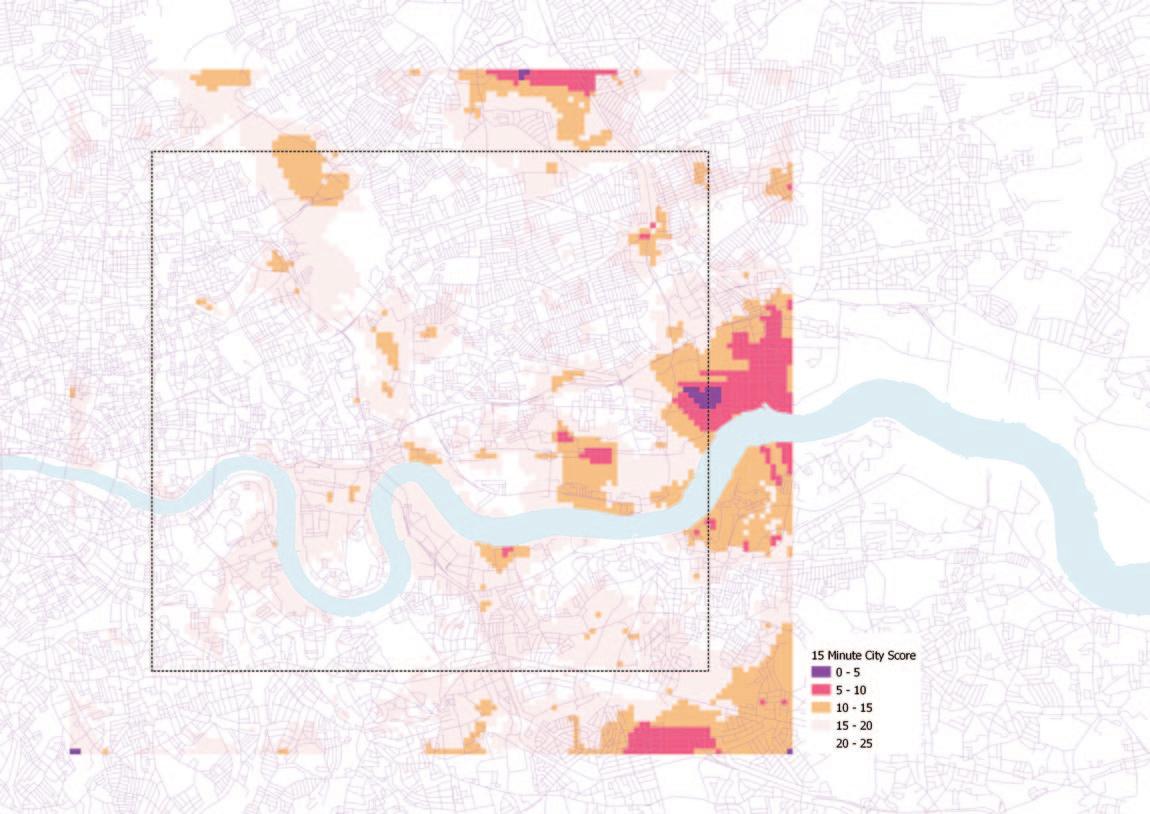
69 www.planninginlondon.com Issue 125 April-June 2023
LEFT:
>>> >>>
Fig4 Farrells 15-minute city Model on GIS
ABOVE:
To deliver successful cities and communities, people need to have an equal part in the city making process. It is indeed an inspiring time, aided by ever evolving technologies and abundant access to information that a variety of stakeholders can collabo-


rate and contribute towards the future identity of place. People and their stories shape the cities we live in, and with data and technology bringing the world closer, more people are being seen and more stories are being heard. n
RIGHT:
70 Planning in London
SHAPING LONDON | FARRELLS / ALANKRITA AMARNATH
Fig5 Farrells shortlisted entry for Tendring and Colchester Borders Garden Community competition
>>>
Fig6 Hatcham & Ilderton Road Digital Codes and Parameter Plans included in VU.CITY
Advice

>>> ADVICE 71 www.planninginlondon.com Issue 125 April-June 2023






Planning in London
0(6&/00"5$4/"0)&$4&7-(#8(06(--&9()/%0&:((8&;<;=& "#!–!"$!%&'!"("#! )*+,-!./0+1!2-/345!%+0&6!%'-078+96:;!<&1-2-+=!&8+973>8!?+@!/0+1!)7A>&;!B&22-0!C+02@!+/!D2&=37!/0+1!EF%! )7!&!62+*&2!@-7>6=!@-73>=&3>+=G 7-(#8(06(--&9()/%0&:((8&>79:? >7!7-3!3+!0-390=!3:>7!%&'!."#!–!"$4! H>3:!>37!*>66-73!?0+60&11-!'-3G!/-&390>=6!+,-0!I((!>=@9730'!-,-=37!+,-0!3:0--!@&'7 K:-!L" 3:!-@>3>+=! &27+!7--7!&!3+3&2!+/!L "!(@,/A/4/"0&5(0+() ?0-7-=3>=6!1+0-!3:&=!#((!@-7>6=!*0&= @7!&=@!1&A-07!–79??+03-@!*'!&!=-3H+0A!+/!+,-0! L#(!-"*$-&),"6#""B) – &80+77!3:-!H:+2-!+/!M2-0A-=H-22J!)08:>3-837! &=@!7?-8>/>-07G >=3-0> +0!@-7>6=-07!&=@!3:-!6-=-0&2!?9*2>8!&2>A-!H>22!:&,-!3:-!+??+039=>3'!3+!-N?-0>-=8-! -,-0'3:>=6!/0+1!=-H!/90=>390-!&= @!2>6:3>=6!3+!A>38:-=7!&=@!*&3:0++17G!1&3-0 >&27!&=@!790/&8-7G @-8+0&3>,-!&88-77+0>-7G!&=@!1+0)1+=6!7+1-!+/!3:-!:-&@2>=-!=&1-7!>7!O+=@+= *+0= &=@P*0-@!&03>73!&=@ @-7>6=-0&!"#$%& !'(#)*"+%,&– H:+!will open the festival’s talks ?0+60&11-G M+=,-07&3>+=7!&3!M2-0A-=H-22G >=!F?&! Q>-2@7!+=!K9-7@&'!"#!%&'!.LL5((4J F:-!H>22!7 ?-&A H>3:!R-3:&=!S'@-0G T@>3+0>&2!U>0-83+0!+/!CVFWG &*+93!:-0!9=>X9-!&?? 0+&8:!3+!30&=7/+01>=6!?2&8-7!&=@!8:&1?>+=>=6!8+119=>3'!3:0+96:!Y+'/92! >=73&22&3>+=7!&=@!&03 H+0A7 J %-&=H:>2-G!+=!St John’s Square, %'-078+96:!>7!&27+!0-7? +=7>*2-!/+0!80-&3>=6!3:-!-N3-0>+0!H&22!+/!&! /0--73&=@>=6!>=73&22&3>+=!/0+1!2-& @>=6!&8+973>87!7?-8>&2>73G CDEF U-7>6=-@!*'!>37!>= :+97-!3-&1! &2+=6!H>3:!G"#B&E)&:/4,&H"5(G!3:>7!7?-8>&2!-N:>*>3>+=!:>6:2>6:37!3:-!H+0A!+/!->6:3!739@-=37!/0+1! Scandinavia’s finest &08:>3-8390&2!>=73>393-7J K:-!*0>-/! H&7!3+!-N?2+0-!:+H!*9>2@>=67!+/!3+1+00+H!8&=! =90390-!?0+@ 983>,>3'G H-22=-77!&=@!80-&3>,>3', and the students’ @-7>6=!8+=8-?37!H>22!*-!?0-7-=3-@ 3:0+96:!78&2-!1+@-27!&=@!0-=@-07!&3!MUCJ 72
!"#$%&!'(#)*"+%,&-($.)&$&-/0(1+2&"3&*#($4/5/4'&$0.&