D R I V E N B Y O U R P R O M I S E DELIVERING ON PATIENT-FOCUSED LEADERSHIP
Powering his way with a butterfly stroke, Michael Joshua is one of countless CSL patients now able to lead an active life, thanks to the company’s breakthrough hemophilia B therapeutics that were brought to market under Paul Perreault’s helmsmanship.
b
D R I V E N B Y O U R P R O M I S E DELIVERING ON PATIENT-FOCUSED LEADERSHIP c
D R I V E N B Y O U R P R O M I S E DELIVERING ON PATIENT-FOCUSED LEADERSHIP
Copyright © 2023 by CSL Limited All rights reserved. No part of this book may be reproduced or transmitted in any form or by any means, electronic or mechanical, including photocopying, recording, or by any information storage and retrieval system, without permission in writing from:
CSL Limited 45 Poplar Road Parkville, Victoria 3052 Australia
Paul Perreault Chief Executive Officer 2013–2023 Editor Anthony Farina Chief Corporate Affairs & Communications Officer Associate Editor Patrick Mairs Senior Communications Manager Author Michele C. Marill Bookhouse Development Bookhouse Group, Inc. Covington, Georgia www.bookhouse.net President and Editor Rob Levin Book and Cover Design Rick Korab Production and Archival Management Renée Peyton
d
Manufactured in the USA
e
“His heart is in the right place. He does his job to help the kids who have a bleeding disorder . . . so they understand that they can lead a normal life.”
“Paul’s always been a real champion for his people. He really believes in the strength of the team around him, and he has a pretty keen eye for picking great people.”
— Golf Pro and Patient-
— Group General Counsel Greg Boss
Advocate Perry Parker
“We have an enviable position in the market, and a lot of that is due to Paul and his vision. We live, breathe, feel, think about and make decisions around what our patients need.” — Chief Human Resources Officer Elizabeth Walker
“[When considering an acquisition], he doesn’t necessarily take the shiny objects. He takes the ones that need to be shined.” — CEO Paul McKenzie
“What I love about the organization is that people come to work and they want to make it better. That is following a tone from the top.” —John Levy Deputy Chief
— Mark Hill, Chief Digital Information Officer
f
— Vicki Modell, co-founder of the Jeffrey Modell Foundation
and he feels it.” — Andrew Cuthbertson, CSL Director, Former Director of R&D
Financial Officer
“He wants us to make decisions in a way [that] we bring people along the journey and we win the hearts and minds of people along the way. That’s a really important leadership trait that he brings to the table.”
“He couldn’t phone it in and he couldn’t write it in. He couldn’t send the check and say, ‘Take care of it.’ He said, ‘I’ll be there.’ He gave us the courage to keep going.”
“Most companies in health care will say they have patient focus. With Paul, it’s really genuine. He shows up at patient events for kids with rare diseases and their families because he really cares
“He gave the Seqirus team the space and the air to make the decisions that we had to make. He gave us that autonomy, but he held us accountable.” — Steve Marlow, General Manager of CSL Seqirus
“The way he talks to you, it makes you feel like you’re not talking to the CEO. It’s like you’re just having a chat with someone down at the pub, almost. He’s very kind and thoughtful, really engaging.” — Executive Assistant Raewynn McIntyre
“One time somebody said, ‘Paul, we really ought to have a chief patient officer in this organization.’ At that time, we were at about 25,000
“Paul is not someone just following the money. Paul is someone who follows the patients. He wants to make a difference wherever possible.”
“He really appreciates the employees and the donors because he’s so emotionally attached to the patients. The patients are everything to Paul.” — Michelle Meyer, Vice President of CSL Plasma Global Operations
— Markus Staempfli, General Manager of Global Commercial Operations
[employees], and he said, ‘No, we have 25,000 chief patient officers in this organization. And that’s the way I like it.’” — Bill Mezzanotte, Head of R&D and
“I’m pleased to say that the qualities I saw in him back in Wyeth [about 30 years ago] were the same qualities he exhibited as CEO here at this company. He didn’t lose who he was.” — Bob Lojewski, General Manager of North America Commercial Operations
Chief Medical Officer
“Paul is really just one of the true gentlemen. He has the funniest sense of humor, and he is very compassionate towards patients. Everything he does is focused on ‘How do we continue to improve the quality of people’s lives?’” — Executive Assistant Amy McCullen
“He understands the value of listening to people at all levels of the organization, not just a small circle of advisors around him.” — Mike Deem, Global Head of Supply Chain
“CSL is more than just the company. What they do matters in saving lives. That’s what drives Paul, and it is contagious to the 32,000-plus employees ‘getting in the game.’”
“He will finish every meeting with, ‘This is what we’ve agreed, this is the way forward.’ That just brings amazing clarity to an organization. So, people go out and deliver that.” — Joy Linton, Chief Financial Officer
— Beverly Perreault
“Paul possesses an instinctive ability to ‘look around corners’ on what’s coming next. Very few leaders can do this. A great deal comes from his incredible listening skills. In the end, Paul’s forward-looking capabilities have very well positioned CSL for its next phase of sustainable growth.”
—Anthony Farinia Chief Corporate Affairs & Communications Officer
“When he says no, he’s very comfortable with that decision, and he has said no to a couple of big ones.” — Group General Counsel Greg Boss g
CSL’s global headquarters in Melbourne, Australia.
h
i
CHAPTER ONE
A FOCUS ON PATIENTS
1
CHAPTER TWO
A CULTURE OF VALUES
13 CHAPTER THREE
INNOVATION LEADER
j
27
CHAPTER FOUR
SUSTAINABLE GROWTH
41
CHAPTER FIVE
A GLOBAL FOOTPRINT
55
k
If you take care of the patients, the business should
Paul Perreault defies the widespread stereotype of a biotech CEO. He is humble, not brash; understated, not self-promoting. Within a values-based culture, he trusts his leaders and their people to do the right things and he keeps patients at the forefront not as customers, but as people in need. n Perhaps that low-key style is why, as Paul liked to joke ten years ago, CSL was “the biggest company no one’s ever heard of” even as it became the world’s third-largest biotech company and one of the largest companies in Australia, by market capitalization. But Paul’s ten-year success story couldn’t stay under the radar. In 2019, Harvard Business Review included him on its list of the top 100 best-performing CEOs in the world—alongside Tim Cook
INTRODUCTION
of Apple and Robert Iger of Disney. CSL has been named among the Best
Places to Work in the world by Forbes and highlighted as a leader in Diversity and Inclusion by Thomson Reuters. n Paul’s innate relationship skills, so central to his success, weren’t crafted; they come naturally. As one of eight children, he grew up relying on a knack for negotiation. He honed that awareness of interpersonal dynamics in his study of psychology at the University of Central Florida, advanced business management training, and his years in commercial operations at Wyeth-Ayerst Laboratories (now part of Pfizer) and in leadership at Aventis Behring (which became part of CSL) and at CSL Behring. n People marvel at his ability to remember names and details of someone he met only briefly. He has a great and unmatched memory, a method for making mental notes, and the desire to connect with people in an authentic way. He has the sort of old-fashioned values that everyone wishes were still the norm: His word is bond. A promise made is a promise kept. n In the early 1990s, Vicki and Fred Modell went to a hematology conference, looking for help launching the Jeffrey Modell Foundation in memory of their son Jeffrey, who died of complications of primary immunodeficiency, which left him vulnerable to infection. Jeffrey took an early version of immunoglobulin, and at an exhibit booth for Centeon, a precursor of Aventis Behring, the Modells understood for the first time that the life-saving therapy came from donations of
l
take care of itself.
—Paul Perreault
plasma. n When Paul began working for Centeon in 1997, he visited Vicki and Fred at their diamond jewelry business in New York City. They explained that while treatments for primary immunodeficiency were improving, many children never got them because they weren’t diagnosed. They just were kids who got terribly sick all the time. “We’re going to work on this,” Paul told them. “We’re going find the patients.” n Today, the foundation funds 150 Jeffrey Modell Diagnostic and Research Centers and supports a network of physicians and teaching hospitals in 86 countries. Paul has been with the Modells and other patient advocacy organizations all along their journey, encouraging them and joining them at ribbon-cuttings and other events over the years. Under Paul’s astute leadership, CSL has provided financial support to establish twenty of the centers around the world. n When someone once suggested that CSL should have a chief patient officer, as is common at pharmaceutical companies, Paul retorted, “There’s no chief patient officer because I’m the chief patient officer.” He also often reminded employees that they were all chief patient officers. n So, beyond the strong and sustained growth that led to an almost six-fold rise in share price, global expansions, and innovative products, this is his legacy: CSL has more than 32,000 employees who are dedicated to bringing life-saving therapies—and hope—to patients around the world.
m
XIV
CHAPTER ONE
We will always work every day like someone’s life depends on it, because it does. —Paul Perreault
B
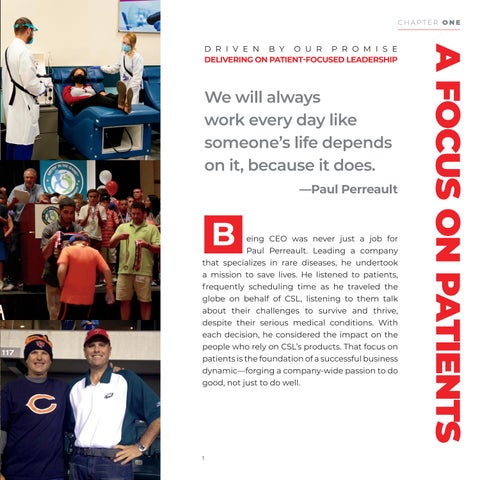
eing CEO was never just a job for Paul Perreault. Leading a company that specializes in rare diseases, he undertook a mission to save lives. He listened to patients, frequently scheduling time as he traveled the globe on behalf of CSL, listening to them talk about their challenges to survive and thrive, despite their serious medical conditions. With each decision, he considered the impact on the people who rely on CSL’s products. That focus on patients is the foundation of a successful business dynamic—forging a company-wide passion to do good, not just to do well.
1
A FOCUS ON PATIENTS
D R I V E N B Y O U R P R O M I S E DELIVERING ON PATIENT-FOCUSED LEADERSHIP
DRIVEN BY OUR PROMISE DELIVERING ON PATIENT-FOCUSED LEADERSHIP
When Paul Perreault became CSL’s second-ever CEO, he took ownership of a promise—to shareholders, to employees, and most importantly, to patients. That CSL promise is both old and young, delivered through more than a century of public health commitments and just three decades as an innovative biotech. It harkens back to the “serum therapy” that German scientist Emil von Behring (the namesake of CSL Behring) discovered in 1890 to
A H ISTO RY OF CAR IN G
protect against diphtheria and the mission to protect Australians from disease during World War I. In 1916, government-run Commonwealth Serum Laboratories began
making life-saving serums, anti-toxins, and vaccines for a nation beset with medical shortages. Brian McNamee, a medical doctor-turned-executive, knew he would need to take bold moves in privatizing CSL in 1994. Naysayers thought it wouldn’t be possible to grow a global biotech company from Australia. Brian began by revamping research and development. With esteemed virologist Ian Gust as R&D head, CSL supported the work of Ian Frazer at the University of Queensland, who was developing a vaccine against human papilloma virus (HPV). CSL licensed Frazer’s technology and co-developed Gardasil, the world’s first vaccine against cervical cancer. (Pharma giant Merck produces Gardasil through a license with CSL.) John Shine, world-renowned molecular biologist and former CSL Chair, calls Paul “a consummate CEO.”
That high-impact work, along with key acquisitions, set the trajectory for CSL. When Brian stepped down in 2013, he saw that Paul had the right mix of personal and professional qualities for CSL’s next chapter. “We knew successfully launching differentiated products in the US market, and then globally, was a critical capability. And Paul was our strongest commercial person in the company,” Brian recalls. Frankly, it wasn’t clear whether anyone could replicate Brian’s success. He steered the company from an initial share price of AUD76c (the readjusted base after a three-to-one split in 2007) to $53.24—acquiring ZLB (the blood plasma division of the Swiss Red Cross) and Aventis Behring, making CSL a world leader in plasma-derived products. He moved into recombinant therapies, positioning CSL for development of new technologies. “Paul was just right in that point in time,” with the vision and attention to detail to take CSL to new heights, says renowned Australian molecular biologist John Shine, who served as chair of the CSL board from 2011 to 2018. “He was really the perfect CEO to take a well-established but rapidly growing company to the next level.” In ten years, Paul grew the share price above AUD$300, annual R&D spending from US$370 million to US$1.15 billion, and grew the market capitalization nearly 5-fold to about AUD$145 billion, as CSL developed and commercialized breakthrough vaccines and therapies for patients with bleeding disorders, immune deficiencies, hereditary angioedema, and other disabling conditions.
2
CHAPTER ONE A FOCUS ON PATIENTS
Brian McNamee, CSL’s current Chair and its first CEO, is a medical doctor who transformed the government-run Commonwealth Serum Laboratories into a global biotech and set it on a growth trajectory.
3
DRIVEN BY OUR PROMISE DELIVERING ON PATIENT-FOCUSED LEADERSHIP
Doctors told Perry Parker and his brother Corey that they could never play sports. They both lack a vital blood-clotting factor due to hemophilia, a rare genetic disorder, so even a minor injury could cause them to bleed uncontrollably. Despite the admonishment, they played a variety of sports throughout their school years. Perry became a professional golfer and Corey became a professional baseball player. To prevent or treat
L I ST EN IN G TO PATIE NTS
bleeding episodes, they took infusions of plasma-derived clotting factor—and, since 2016, CSL’s longer-lasting recombinant product Afstyla®.
When Paul invited Perry to share his remarkable story of perseverance at the CSL headquarters in Melbourne (Australia), the auditorium was packed. Perry talked about the many times his parents raced him to a hospital emergency room for infusions. How even when his elbow joint was rigid because of a painful bleed and an emergency room doctor warned him against being physically active, his parents supported his choice to continue. And how even today, he travels to golf tournaments around the world with his needles, syringe, and the infusion product that makes his active lifestyle possible. After the talk, employees swarmed around to tell him how his words affected them. “It made them feel like their job is more important, it has more meaning,” Perry says. “They [typically] never meet anybody that actually uses the product, so it was very impactful for everybody that was there that day.” Golf pro Perry Parker became an inspiring patient-advocate—and a good friend of Paul’s.
Those always
personal
mattered
stories
have
Paul,
who
to
first met Perry at a charity golf tournament
for
the
National
Hemophilia Foundation. And that’s why he built patient story-telling into CSL’s activities internally and its messaging to the public. CSL Plasma collection centers in the US have “Plasma P.A.L.S.” (Patients and Lifesavers), a program that connects patients and plasma donors. (The program was previously called “Adopt a Patient.”) “If you talk to a donor after they have met a patient, they’ll always say to you, even donation after donation, ‘I’m here to help someone else,’” says Michelle Meyer, Vice President of CSL Plasma Global Operations.
4
CHAPTER ONE A FOCUS ON PATIENTS
Plasma donors give the gift of life to patients with rare diseases.
5
DRIVEN BY OUR PROMISE DELIVERING ON PATIENT-FOCUSED LEADERSHIP
Every year, one event was set in advance on Paul’s calendar. Being a global CEO put so many demands on his time, but he wasn’t going to miss the annual Gettin’ in the Game Junior National Championship (JNC). He’s been to every one since it began in 2002. The JNC, sponsored by CSL and held in Arizona, is the only national sports competition in America specifically for children and teens with bleeding disorders such as hemophilia and von Willebrand Disease
G E T T IN ’ IN TH E GAME
(another inherited clotting disorder). The athletes who volunteer to coach at JNC also have bleeding disorders; co-founders golf pro Perry Parker and his brother, Corey, who played
professional baseball, have hemophilia A, a deficit of clotting factor VIII. Children from around the country compete in golf, swimming, and baseball—but most importantly, they spend time with other kids who share their life experiences. At the JNC, Paul participates as just another volunteer, wearing a red CSL Behring cap and caddying for kids. “He’s out helping these young people get through their round of golf,” says Bill Campbell, Executive Gettin’ in the Game Junior National Championship, sponsored by CSL, is the only national sports competition in America specifically for children and teens with bleeding disorders.
Vice President and Chief Commercial Officer at CSL Behring. “He’s raking the bunker for them. He’s helping read their putts. He’s doing this when his schedule is massively busy. He would never miss this weekend. And that’s just who he is.” At the first JNC, Paul was helping Perry’s daughter with her stance but then didn’t move away. She took the swing—and bonked him in the back of the head. “We thought that might be the end of the JNC program,” Perry says with a laugh. “But luckily, he is a good sport and he just laughed it off. And the rest is history.” In a LinkedIn post, Paul explained how he feels about the JNC: “It’s a privilege to participate in these programs that truly touch the lives of children living (and playing!) with hemophilia. It’s also a bit humbling . . . But most important, it’s a strong reminder of why we do what we do at CSL Behring.”
6
CHAPTER ONE A FOCUS ON PATIENTS
Children practice their drives, with instruction from athletes who also have bleeding disorders.
7
DRIVEN BY OUR PROMISE DELIVERING ON PATIENT-FOCUSED LEADERSHIP
Jeffrey Modell did his best to live like a regular kid—splashing in the pool, playing squash, sailing with his parents, hamming it up for his friends and family. But along with those moments of joy he had setbacks, when his body was aflame with fever and he needed extended hospital care to overcome an infection. His condition was called primary immunodeficiency. That is a catch-all term for rare, inherited disorders of the immune system. When Jeffrey was born in 1970, treatment options were limited. Fractionation of blood plasma began in the 1940s, and doctors started using intramuscular injections of gamma globulin in the 1950s
‘ D O SO ME T HING’ FO R J E FFR EY
to treat people who weren’t making enough antibodies to fight disease. Jeffrey’s disorder was initially called hypogammaglobulinemia—low
antibody levels—and he was part of an early trial of infusions of intravenous immune globulin (IVIG). The treatments gave Jeffrey periods in which he seemed robust and healthy, but infections always came back. Jeffrey would say, “Mom, Dad, please do something,” his mother Vicki recalls. “Little did he know, we were doing everything we could.” Paul shaped CSL’s support of the Jeffrey Modell Foundation and the establishment of new diagnostic and research centers for primary immunodeficiency.
After Jeffrey died at the age of fifteen of pneumocystis pneumonia, Vicki and Fred Modell started a foundation to spur research, diagnosis, and treatment of immune deficiencies—to help other kids like Jeffrey. Touched and inspired by Jeffrey’s story, Paul became part of that mission. From his time as general manager of plasma operations at Aventis Behring and through his tenure as CEO at CSL, Paul sought to increase plasma capacity. CSL is now one of the world’s largest collectors of plasma. In 2010, CSL received approval from the US Food and Drug Administration for an immunoglobulin called Hizentra that is injected under the skin, enabling it to be administered with an infusion device at home. Paul also shaped CSL’s support of the Jeffrey Modell Foundation, helping establish new diagnostic and research centers around the world. For example, in 2017 CSL sponsored the Jeffrey Modell North African Network, the first entity to help primary immunodeficiency patients in Africa. “In every city we went to with him for these dedications [of new facilities], there were patients and their families, and he made a point to speak to every single one of them,” says Vicki. “He cares so deeply about the patient.”
8
CHAPTER ONE A FOCUS ON PATIENTS
Vicki and Fred Modell launched a foundation to “do something” to help children like their son Jeffrey, who died at age fifteen from pneumonia related to his primary immunodeficiency.
9
DRIVEN BY OUR PROMISE DELIVERING ON PATIENT-FOCUSED LEADERSHIP
By the end of January 2020, the entire city of Wuhan, China, was in lockdown, the first cases of a novel coronavirus had been detected in the US, and the world was on high alert. At CSL, Paul and his leadership team were thinking about how they might be of help. Bill Mezzanotte, Chief Medical Officer and Head of Research and Development, tried to reach out
R I S IN G TO TH E COVID C HAL L ENGE
to Chinese authorities about potential use of hyperimmune therapy derived from the plasma of recovered patients—from CSL Plasma’s
fractionation facility in China. When the Chinese government didn’t respond, Bill suggested collaborating with global competBill Mezzanotte, Chief Medical Officer and Head of Research and Development, suggested collaborating with global competitors to test a convalescent plasma product against COVID-19.
itors to test a convalescent plasma product. This project wouldn’t fit the normal business model. “We probably can’t charge for this, and it will cost us a fair amount to do this, but it’s the right thing,” Bill recalls telling Paul. “And his only question to me was, ‘What are you waiting for?’” In June 2020, Paul presented the concept at a White House roundtable and made a plea for more plasma donations. Donations had plummeted amid the worldwide shutdowns and fears of spread of the coronavirus, but plasma collection remained essential to a multitude of patients. “I’m here representing all the manufacturers of hyperimmunes, including the COVID-19 Plasma Alliance, which is really an unprecedented partnership of world-leading plasma companies, which have joined together to help develop a plasma therapy to treat COVID-19,” he said at the roundtable, announcing a joint clinical trial. “But we need plasma and we need plasma donors.” Although that clinical trial did not show significant benefit in COVID patients hospitalized
with
severe
disease,
the
alliance
illustrates CSL’s commitment to work on behalf of patients. Plasma donations slowly recovered, which was critical for patients dependent on plasma-derived products. Meanwhile, attention turned to emerging COVID vaccines, which had impressive evidence of effectiveness. In keeping with its longstanding public health mission in Australia, CSL produced fifty million doses of the AstraZeneca vaccine for the Australian government.
10
CHAPTER ONE A FOCUS ON PATIENTS
CSL provided support for public health during the COVID-19 pandemic, as it produced fifty million doses of the AstraZeneca vaccine for the Australian government.
11
12