BONEFISH TARPON

A publication of JOURNAL
CONSERVATION THROUGH SCIENCE • FALL 2023 BONEFISH BREAKTHROUGH FLORIDA’S WATER QUALITY JACK NICKLAUS
&

JOURNAL
Editorial Board
Dr. Aaron Adams, Monte Burke, Bill Horn, Jim McDuffie, Carl Navarre, T. Edward Nickens, Kellie Ralston
Publication Team
Publishers: Carl Navarre, Jim McDuffie
Editor: Nick Roberts
Layout and Design: Scott Morrison, Morrison Creative Company
Contributors
Michael Adno
Monte Burke
Dr. Duane De Freese
Chris Hunt
Alexandra Marvar
T. Edward Nickens
Ashleigh Sean Rolle
Chris Santella
Photography
Cover: Ian Wilson
Dr. Aaron Adams
Jenni Bennett
Dr. Ben Binder
Tyler Bowman
Gina Clementi
Parker Denton
Dan Diez
Greg Dini
Bill Foley
Pat Ford
Dom Furore
Dr. Kirk Gastrich
Justin Lewis
Cameron Luck
David Mangum
Micah Ness
Kellie Ralston
Nick Roberts
Paul Schlegel
Nick Shirghio
Natasha Viadero Cover
The recently discovered bonefish pre-spawning aggregation in the Florida Keys. Photo: Ian Wilson
Bonefish & Tarpon Journal
2937 SW 27th Avenue Suite 203 Miami, FL 33133
(786) 618-9479
Board of Directors Officers
Carl Navarre, Chairman of the Board, Islamorada, Florida
Dan Berger, Vice Chairman of the Board, Alexandria, Virginia
Jim McDuffie, President and CEO, Miami, Florida
Evan Carruthers, Treasurer, Maple Plain, Minnesota
John D. Johns, Secretary, Birmingham, Alabama
Tom Davidson, Founding Chairman Emeritus, Key Largo, Florida
Harold Brewer, Chairman Emeritus, Key Largo, Florida
Russ Fisher, Founding Vice Chairman Emeritus, Key Largo, Florida
Bill Horn, Vice Chairman Emeritus, Marathon, Florida
Jeff Harkavy, Founding Member and Circle of Honor Chair, Coral Springs, Florida
John Abplanalp
Stamford, Connecticut
Rich Andrews
Denver, Colorado
Stu Apte
Tavernier, Florida
Rodney Barreto
Coral Gables, Florida
Adolphus A. Busch IV
Ofallon, Missouri
John Davidson
Atlanta, Georgia
Ali Gentry Flota
Richmond, Virginia
Dr. Tom Frazer
Tampa, Florida
Doug Kilpatrick
Summerland, Florida
Jerry Klauer
New York, New York
Dr. Michael Larkin
St. Petersburg, Florida
Thorpe McKenzie
Chattanooga, Tennessee
Wayne Meland
Naples, Florida
Ambrose Monell
New York, New York
Sandy Moret
Islamorada, Florida
John Newman
Covington, Louisiana
Al Perkinson
New Smyrna Beach, Florida
Dr. Jennifer Rehage
Miami, Florida
Vaughn Roberts
Nassau, Bahamas
Jay Robertson
Islamorada, Florida
Diana Rudolph
Livingston, Montana
Rick Ruoff
Willow Creek, Montana
Adelaide Skoglund
Key Largo, Florida
Noah Valenstein
Tallahassee, Florida
BTT’s Mission
To conserve and restore bonefish, tarpon and permit fisheries and habitats through research, stewardship, education and advocacy.
Advisory Council
Randolph Bias, Austin, Texas
Charles Causey, Islamorada, Florida
Don Causey, Miami, Florida
Paul Dixon, East Hampton, New York
Chris Dorsey, Littleton, Colorado
Chico Fernandez, Miami, Florida
Mike Fitzgerald, Wexford, Pennsylvania
Pat Ford, Miami, Florida
Upcoming Events
12th Annual NYC Dinner & Awards Ceremony October 10, 2023
The University Club New York, NY
Christopher Jordan, McLean, Virginia
Bill Klyn, Jackson, Wyoming
Tim O’Brien, Harlingen, Texas
Clint Packo, Littleton, Colorado
Jack Payne, Gainesville, Florida
Chris Peterson, Titusville, Florida
Steve Reynolds, Memphis, Tennessee
Ken Wright, Winter Park, Florida
11th Annual Keys Dinner & Circle of Honor Inductions
May 2, 2024
Cheeca Lodge & Spa
Islamorada, FL
B O N E F I S H & T A R P O N J O U R N A L FALL 2023 1
A publication of
BONEFISH& TARPON
Bonefish & Tarpon Journal is printed on a sappi paper that is SFI® ≥20% Certified Forest Content and 10% recycled fiber.
Features
12 Bonefish Breakthrough
The discovery of a bonefish pre-spawning aggregation site in the Florida Keys is another hopeful sign of recovery. T. Edward Nickens
18 Sea Change
Four experts weigh in on water quality in Florida Bay and the Keys. Alexandra Marvar
of
30 The Sea Bear
Legendary golfer Jack Nicklaus is also a well-traveled and accomplished angler. Monte Burke
40 Unraveling the Mystery of the Florida Keys Permit Decline
Bonefish & Tarpon Trust is collaborating with the guide community to conserve the iconic permit fishery. Michael Adno
 Anglers explore the flats
southern Belize. Photo: Under Armour
Anglers explore the flats
southern Belize. Photo: Under Armour

Updates & Reports Setting the Hook ......................................................................... 4 Welcome Aboard ......................................................................... 6 Tippets ........................................................................................ 8 Conservation Captain Q & A ...................................................... 24 Bahamas Mangrove Restoration Project ................................... 26 Tarpon Isotope Study ................................................................ 36 Modeling Bonefish Larval Drift in Abaco ................................... 46 2024 Artist of the Year: Roger Fowler ........................................ 52 10th Annual Keys Dinner & Circle of Honor Inductions .............. 56 Last Cast ................................................................................... 64
Setting the Hook
From the Chairman and the President
The process of change never happens in a straight line. That’s also true in the work of conservation and the applied science that guides it.
Every win we’ve recorded in the flats fishery has resulted from hard work, some of it spanning years and salted with frustration and challenge. Rarely does anything truly consequential ever come about without being first tempered through a process of trial and error.
This issue of Bonefish & Tarpon Journal features several projects moving along just such a trajectory of iteration, from the years-long search for bonefish pre-spawning aggregations (PSAs) in the Florida Keys to the continuing efforts under Project Permit to understand new aspects of a slow decline in the permit population.

Last April, BTT scientists succeeded in locating, tracking, and documenting a bonefish PSA in the Florida Keys—a first in the region and further evidence that the local population has recovered to the point that it can support large spawning events. News of the discovery, which was carried far and wide, stoked new hope for the fishery. But what these news accounts didn’t share was the backstory of iteration and perseverance. In the end, this story of discovery reads like a Hollywood script.
After searching for years, BTT’s team was drawing ever closer to their goal in the 2022-23 season. Yet, at times, the project felt a lot like a day on the flats with shots but no eats. Promising activity in December fizzled. The fish didn’t spawn in January or February. A promising series of events in March led scientists to an inshore aggregation that was tracked for three days along an offshore reef. Just when there were signs around midnight that these fish could be moving off to spawn, a large center console boat sheared telemetry equipment from BTT’s Pathfinder—and nearly sheared the researchers with it. That ended the month’s search and left the team with one last shot in April.
You can read the rest of this terrific story—and why this discovery is so important—in the excellent article penned in these pages by T. Edward Nickens.
In a similar way, our ongoing research under Project Permit illustrates the iteration of research from one question and one data point to another. Collectively, Project Permit has produced more conservation outcomes over the past decade than any other study in BTT history, from refinements to Florida’s Special Permit Zone to the seasonal no-fishing closure at Western Dry Rocks, a vital spawning site for Keys permit.
New questions arose last spring when the world’s best permit anglers and guides landed only one fish after three days in the annual March Merkin Permit Tournament. While there are many factors that can affect fishing over a three-day period, all agreed this was concerning and called for new research into possible changes in the Lower Keys permit population.

Michael Adno tells the story of how BTT scientists rolled up their sleeves along with Keys guides and framed a series of specific studies that would be conducted collaboratively and expeditiously. Sampling is underway now with the aim to process and analyze data by year’s end. The results should help us understand any changes between flats and reef populations and possibly detect
Carl Navarre, Chairman

 Jim McDuffie, President
changes in the food web sustaining them.
The closely related and all-encompassing topic of water quality is the focus of Alexandra Marvar’s insightful article, “Sea Change,” which sheds light on the present-day conditions in the Keys and Florida Bay. Four experts weigh in on the region’s water quality and how updated wastewater infrastructure and ongoing restoration efforts have and will continue to benefit South Florida’s natural resources, including its fisheries. BTT is also taking a leading role in habitat restoration in The Bahamas, where we have planted 55,000 mangroves with our partners and local volunteers, including bonefish guides, students, and government officials. In his article, “Taking Root,” Chris Hunt recaps the project’s recent progress as well as the launch of the Bahamas Mangrove Alliance, through which BTT and partners will scale up mangrove restoration to the national level.
In these stories of iteration, which are occasionally punctuated with episodes of frustration and challenge, one thing remains constant—your support for our mission! This issue is a testament to our remarkable progress over the year, which would not have been possible without your commitment to the cause. Together, we’re ensuring that the flats fishery is healthy and sustainable for generations to come.
BTT scientists Natasha Viadero, Parker Denton, and Dr. Ross Boucek use an underwater hydrophone to listen for tagged bonefish at the pre-spawning aggregation site. Photo: Ian Wilson

Dan Berger Elected Vice Chairman

Dan Berger has been elected Vice Chairman of the Bonefish & Tarpon Trust Board of Directors. Berger has served on the BTT board since 2017 and chairs the Policy and Government Affairs Committee.

“Dan has contributed significantly to BTT’s exponential growth and development over recent years,” said BTT President and CEO Jim McDuffie. “His impact has been felt across our organization, from successful conservation policy initiatives to matters of organizational governance. We are grateful for his leadership at the board table and across the flats fishing community.”
Berger has more than 30 years of executive management and government affairs experience. He currently serves as the President and CEO of the National Association of Federally-Insured Credit Unions (NAFCU). Berger also served as Chief of Staff in the U.S. House of Representatives and has been an effective
Make their future your Legacy.
advocate and political strategist for trade groups and corporations.

“Bonefish & Tarpon Trust is a leading conservation organization that puts a much-needed focus not only on environmental protection, but also on research and advocacy,” said Berger. “It has been a pleasure to serve as a board member for the past six years, and I’m looking forward to elevating the meaningful efforts of BTT in my new capacity and continuing our efforts in ‘Bringing Science to the Fight’.”
A well-known figure with political and financial press, Berger has been listed as one of the most influential lobbyists in Washington by The Hill newspaper every year since 2002. He is a contributor on CNBC, Fox Business, Bloomberg TV and CNN. He is also regularly quoted in national and financial news outlets such as Forbes, The Wall Street Journal, and The Washington Post
Berger earned a master’s degree in public
administration from Harvard University and a B.S. in economics from Florida State University. He is a member of The Economic Club of Washington, D.C., the U.S. Chamber of Commerce Committee of 100, and was an adjunct professor at The George Washington University in the communications department. Berger enjoys traveling the world to fish with his daughter Shelby, a BTT Youth Ambassador.
To learn more, go to BTTLegacy.org or contact BTT Planned Giving Specialist Gordon Nelson at 435-213-9986 or legacy@bonefishtarpontrust.org
Welcome Aboard
Dan Berger
Planned giving techniques can help you save taxes, benefit your family, and help ensure a healthy future for bonefish, tarpon, permit, and their habitat.
BTT Welcomes Three New Board Members
Ali Gentry Flota, Vaughn Roberts, and Diana Rudolph have joined Bonefish & Tarpon Trust’s Board of Directors.
“We are honored to welcome Ali, Vaughn, and Diana to the board,” said Jim McDuffie, BTT President and CEO. “Their knowledge, experience and commitment to the cause will advance our mission to conserve species and habitats that support the flats fishery.”
Flota is President and CEO of El Pescador Lodge on Ambergris Caye in Belize, which she has owned for more than 25 years. She has been active in local conservation efforts, including working closely with Green Reef, an NGO on Ambergris Caye, and with BTT on bonefish and tarpon tagging, educational programs, and policy outreach to improve fisheries management. Flota was an integral part of the team that worked with the government of Belize to enact the catch-and-release legislation that made Belize the first country in the world to protect bonefish, tarpon and permit. Under her leadership, El Pescador was also the first hotel in Belize to institute a carbon emissions program to offset guests’ flight footprint.
“I am honored to work alongside BTT as we pursue our mission to conserve and restore flats fisheries,” said Flota.
As Senior Vice President for Government Affairs & Special Projects at Atlantis
Paradise Island, Roberts joins the BTT board with more than 25 years of corporate leadership experience in the areas of government affairs, finance, and management of multi-faceted projects.

“Atlantis and flats fishing are two cornerstones of the Bahamian tourism product and we are excited to be allies in efforts to preserve and protect our natural wonders,” said Roberts. “I am honored to join the Bonefish & Tarpon Trust board and to support the organization’s important mission to conserve marine habitats here in The Bahamas and throughout the Caribbean. The importance of BTT’s work to identify, research and conserve shallow water habitats essential to our fisheries and economy cannot be overstated. Atlantis is proud to support the current mangrove restoration project as well as the remarkable past research that focused on bonefish spawning.”
Prior to Atlantis, Roberts served as Senior Vice President of Finance, Administration and Capital Projects at the Ocean Reef Club in North Key Largo, Florida. Earlier in his career, he held financial management, investment banking, consulting, and accounting positions with More Development Company, Baha Mar Resort, KPMG, Lehman Brothers, Bank One and Dresdner Kleinwort.
Roberts serves as chairman of the board of Friends of the Arts in The Bahamas, Inc. and on the boards of the National Art Gallery of The Bahamas, the Bahamas Hotel Industry Management Pension Fund, the Charitable Arts Foundation, and the Downtown Nassau Partnership.
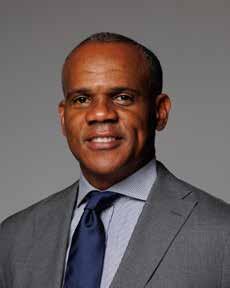
Rudolph is an accomplished angler who dominated the women’s fly-fishing tournaments in the Florida Keys for many years, winning four Women’s World Invitational Tarpon Fly Tournaments between 2003 and 2009 and becoming the first woman to win the annual Don Hawley Invitational Tarpon Tournament, notching her victory against an all-male field in 2004. During this time, she virtually rewrote the Women’s IGFA world record book on bonefish, permit and tarpon.
“Having a marine biology background and a passion for fly-fishing, I am thrilled to be working with such a conservationfocused organization,” said Rudolph.
In 2007, Rudolph was featured in the American Museum of Fly Fishing’s awardwinning short film, “Why Fly Fishing,” and was selected in 2009 to co-host the Sportsman Channel’s series, Breaking the Surface. She is on the advisory staff for Sage rods and Rio Products and previously served on the Board of Directors for the Federation of Fly Fishers.

B O N E F I S H & T A R P O N J O U R N A L FALL 2023 7
Ali Gentry Flota Vaughn Roberts
Diana Rudolph
Tippets Short Takes on Important Topics


BTT SUCCESSFULLY ADVOCATES FOR INNOVATIVE WASTEWATER TECHNOLOGY GRANT PROGRAM


Recent BTT studies of bonefish in the Florida Keys and of redfish across Florida estuaries found high numbers and concentrations of pharmaceutical contaminants in these species to the point that they can impact fish behavior. Pharmaceutical contaminants are a world-wide problem, with the majority of these chemicals believed to enter the natural system through septic leaching and wastewater effluent. While there are currently no regulatory water quality standards for these types of chemicals, treatment options are available to remove them from wastewater systems. Earlier this year, BTT advocated for the creation of an innovative wastewater technology grant program within the Florida Department of Environmental Protection to begin addressing this issue. The Florida Legislature and Governor DeSantis responded with $2.5 million in the state’s budget to establish the program and put Florida on the cutting edge of water quality advancement.
BTT PARTNERS WITH COPAL TREE LODGE ON EDUCATIONAL OUTREACH IN BELIZE

With the support of Copal Tree Lodge in Punta Gorda, Belize, BTT has created education materials to highlight the conservation needs for a sustainable flats fishery in Belize. The materials focus on the importance of habitats, the cultural and economic value of the flats fishery to Belize and its coastal communities, the need for public and government support for habitat conservation, and best handling practices for guides and anglers. The materials are currently being distributed in Southern Belize schools, with other regions of Belize to follow. The educational outreach will also be featured on Belizean radio and TV programs. This is the first step of many to increase knowledge of the importance of the flats fishery and habitat conservation to the future of Belize. To download the education materials, visit: BTT.org/belize-education.
PROGRESS MADE IN EVERGLADES RESTORATION

Everglades restoration continues to move forward with unprecedented momentum and funding of projects to increase the southerly flow of clean, fresh water. Bonefish & Tarpon Trust is actively engaged in that process, from advocating for specific projects and state and federal funding to vocalizing the importance of Everglades restoration to our flats fisheries. BTT has made many visits to Washington, D.C., participated in project groundbreakings and ribbon cuttings, and attended South Florida Ecosystem Restoration Task Force meetings to ensure restoration continues to move forward. With Florida committing almost $600 million in the state’s 2023-2024 budget and the current Federal commitment at over $450 million, the future currently looks bright for achieving the fisheries and other ecological benefits we need from Everglades restoration.
TTBRide in style with the BTT Florida license plate.
NEW BTT LICENSE PLATE NOW AVAILABLE

Show your support for Bonefish & Tarpon Trust on the road with the new BTT Florida license plate, featuring the art of Derek DeYoung. If you hold a valid Florida Driver’s License or Official Florida Identification Card, you are now eligible to purchase BTT plates for your car, truck, trailer and RV! $25 from every plate sold will benefit BTT’s mission to conserve bonefish, tarpon, and permit, and the habitats that support the flats fishery. Visit your local tag agency to order yours today.

8 B O N E F I S H & T A R P O N J O U R N A L FALL 2023
FWC Executive Director Roger Young, BTT Vice President Kellie Ralston, DEP Secretary Shawn Hamilton, and Biscayne Bay Chief Irela Bague at the Taylor Slough ribbon cutting.
BTT Belize-Mexico Program Manager Dr. Addiel Perez, Florence Ramclam, Principal of Punta Gorda Methodist School, fishing guide Dennis Garbutt, and Lysandra Chan, BTT Belize-Mexico Program Technical Assistant.
BAHAMAS MANGROVE ALLIANCE EXPANDS

BTT, Perry Institute for Marine Science (PIMS) and Waterkeepers Bahamas (WKB), known collectively as the Bahamas Mangrove Alliance (BMA), signed an MOU with other organizations on World Mangrove Day (July 26) to facilitate the scaling up of efforts to restore a mangrove ecosystem hard-hit by Hurricane Dorian. The agreement was memorialized in a signing ceremony hosted by the University of The Bahamas and included BTT, PIMS, WKB, Bahamas Agriculture and Marine Science Institute, Bahamas National Trust, Blue Action Lab, Friends of the Environment, and The Nature Conservancy, among others. Read more about the work of the Bahamas Mangrove Alliance on page 26.
Respondents shared that they perceived water quality and habitat availability as the greatest threat to tarpon, and that restoration efforts should be a top conservation priority. Respondents also supported regulations that prohibit harvest (such as catch-andrelease only), increased science efforts to understand Atlantic tarpon ecology for conservation solutions, and spatial management, such as pole-troll zones (where high-speed motorboat travel is prohibited).
Another concerning trend revealed by the survey is the increasing number of shark encounters that result in lost tarpon. On average, guides lost two to seven tarpon per year to sharks over the last five years. Specifically, encounter rates with sharks that resulted in lost tarpon were most likely in passes, where tarpon aggregate seasonally. This highlights the need for engagement with anglers regarding fishing ethics, as well as additional data collection needs surrounding angler-predator interactions and research on solutions to reduce the loss of tarpon to sharks. The information provided by this survey is vital in helping us better understand the threats facing tarpon and prioritize conservation efforts to safeguard the future of the tarpon fishery.
Tarpon are classified as a “Vulnerable” species by the International Union for Conservation of Nature. Photo: Pat Ford
TARPON SURVEY REVEALS TRENDS AND THREATS

A recent survey of nearly 1,000 tarpon anglers and guides conducted by BTT collaborating scientists at the University of Massachusetts Amherst revealed that the quality of the fishery has declined considerably since the 1970s. Given that Atlantic tarpon are not part of any formal stock assessment, such information is invaluable to leverage support for the development of more effective conservation and management plans for this valuable and beloved species.
BTT ADVOCATES FOR PASSAGE OF SHARKED ACT

Conservation measures taken over the past 20 years have resulted in some of the healthiest shark populations seen in several decades. A consequence of this recovery has been the rapidly increasing loss of flats fish and other species from shark depredation. Over the past decade, BTT has been at the forefront of this issue. BTT research at Boca Grande Pass helped lead to state prohibitions on break away jigs, and depredation studies at Western Dry Rocks led to a seasonal no-fishing closure that is critical to the protection of spawning permit. A new project now underway in the Florida Keys will study shark interactions by location, season and fishing method. The results will help inform future management decisions, including ways to reduce shark and angler interactions, and limit impacts to our valuable fishery.
BTT is simultaneously advocating for passage of the SHARKED Act, which was introduced in the US House of Representatives in June to establish a task force of fisheries managers and shark experts responsible for addressing increased shark depredation. The SHARKED Act would be the first step in building our knowledge to improve management and mitigate depredation nationally. To learn more about the SHARKED Act and read BTT’s letter of support, visit: BTT.org/sharked-act.
B O N E F I S H & T A R P O N J O U R N A L FALL 2023 9
The Bahamas Mangrove Alliance Founding Partners signed an MOU on World Mangrove Day. L-R: Dr. Craig Dahlgren, Perry Institute for Marine Science, Jim McDuffie, Bonefish & Tarpon Trust; Geoffrey Andrews, Bahamas National Trust; Rashema Ingraham, Waterkeepers Bahamas; Marcia Musgrove, The Nature Conservancy.
A hammerhead shark predates on a tarpon. Photo: Jenni Bennett


BONEFISH BREAKTHROUGH
BY T. EDWARD NICKENS
For hours, the researchers refused to take a drink of water or a bathroom break. On Bonefish & Tarpon Trust’s 23-foot Pathfinder, idling in the weak light of dawn above the offshore reef tract that parallels the Upper Florida Keys, BTT’s Florida Keys Initiative Manager Dr. Ross Boucek, BTT Research Biologist Natasha Viadero, and intern Parker Denton were glued to a sonar screen. The scan showed a glowing red blob under the boat—a school of bonefish that measured 20 feet from top to bottom. “We barely allowed ourselves to breathe,” says Boucek, recalling the intensity of the moment. The team had been following the massive school of pre-spawning bonefish for nearly 12 hours— from sunset the previous day to the yawning dawn of April 15, 2023—and exhaustion was gaining a stranglehold on the excitement of the moment. And summer was coming. This was very likely the last chance the scientists would have for at least
six months to try to solve one of the most bewitching mysteries in marine fisheries: Where do the famed bonefish of the Florida Keys spawn?
In an era in which scientists have plumbed nearly every corner of the globe, it seems oddly curious that the reproductive ecology of a fish worth millions of dollars to the economy of South Florida can seem as little-known as the dark side of the moon. Scientists do know that bonefish gather in giant pre-spawning aggregations (PSAs) as they migrate to spawning grounds. BTT researchers have recently identified seven such critical sites in the Bahamas, and one in Belize. But where the Florida Keys fish spawned was an unknown—and a critical piece of data for the conservation of the species.
Now the giant aggregation of bonefish, a species far better known for its habit of feeding in inches-deep water than

12 B O N E F I S H & T A R P O N J O U R N A L FALL 2023
meandering the ocean depths, headed for deep water yet again. Boucek winced. He’d been on this hunt for nearly two years, and now he was as close as he’d ever been to witnessing Florida bonefish spawning in the wild. He leaned on the boat throttle, and once again, followed the fish.
ON THE HUNT
In September of 2021, BTT kicked off a search that had long been a Holy Grail for flats fisheries advocates: The discovery and documentation of a spawning location of Florida Keys bonefish. In the Bahamas, three of seven PSA sites identified by BTT scientists have been protected as Bahamian national parks. But in the Florida Keys, the specific locations used by PSAs—if they exist at all—has remained a mystery.
The three-year research project—which is still ongoing—
involved extensive interviews with fishing guides, and intensive monitoring of tagged bonefish over the last two years. The work had honed in on a short list of possible PSA sites in the Keys, and the subsequent plan to intercept them looked like something that had been war-gamed at the Pentagon.
If acoustic monitoring arrays could alert researchers to the formation of an inshore bonefish aggregation, and if the scientists could catch a bonefish out of the school, and if they could surgically implant it with a continuous pinging tag, and then get to the offshore reef in time, and intercept the school with its tagged fish, and follow the bones day and night using drones and telemetry, they just might be able to identify for the first time one of the spawning locations of Florida Keys bonefish. The “ifs” piled up like seashells on a high-tide line.
Approaching December of 2022, all the assets were in place.

B O N E F I S H & T A R P O N J O U R N A L FALL 2023 13
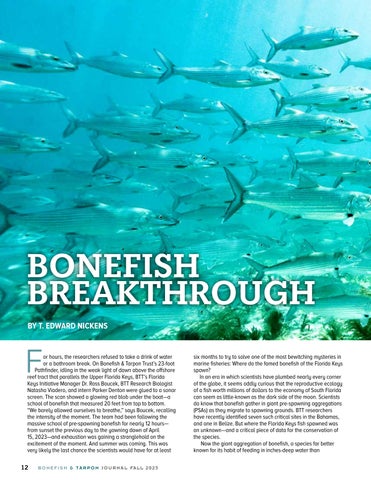
The newly discovered bonefish pre-spawning aggregation in the Florida Keys. Photo: Ian Wilson
Based on earlier findings, the team had shifted acoustic tracking receivers from as far away as Tavernier and Key Biscayne to a 25-square-mile sweet spot off the Upper Keys. BTT’s Pathfinder was outfitted with tracking equipment, fishing rods, and an array of surveillance tags: In addition to standard 13mm bonefish tags, BTT had procured larger 16mm tags powered by a 5-year battery, Acoustic Data Storage Tags capable of recording and transmitting depth-of-dive data, and continuous pinger tags that would allow researchers to follow tagged fish offshore. Under the advice of BTT chair Carl Navarre, BTT invested in a specialized sea buoy outfitted with instrumentation that would text BTT scientists whenever a tagged bonefish passed the buoy. If the Bonefish Buoy pinged, Boucek and his team might have as little as 24 hours to be on site.

Calendars were cleared from January through April of 2023, as the researchers monitored bonefish movements, watching for bonefish to move towards suspected spawning sites. There was activity in late December, but it fizzled out. During January and February, the fish simply didn’t spawn. On March 1, the Bonefish Buoy pinged, and the team launched to intercept an inshore aggregation. Viadero and Denton caught six fish, and deployed a pinger tag in one of the bones. The team followed the fish for three days as it meandered along an offshore reef. Unfortunately, an after-midnight near-miss with a large center console boat sheared the telemetry equipment’s mount off the Pathfinder, which promptly ended that search.
The next potential spawning period in mid-March was weathered out. April loomed, typically considered the end of the bonefish spawning season.
“Thinking back about all of this, it might sound like we were running around like chickens with our heads cut off,” says Boucek. “But every time we went out, we got a little closer, and a little closer.”
In early April, the last month of the spawn, a forecast suggested slick seas and clear skies for a few days. Boucek had a good feeling. He called photographer Ian Wilson and invited him to join the chase as soon as the Bonefish Buoy sounded off. “I knew that could be a mistake,” Boucek laughs, thinking about that decision. “As soon as you line up a photographer, you can bet nothing will happen.”
But overnight on April 2nd, the Bonefish Buoy sent out a text alert. Fish were on the move. Boucek, Viadero, Parker, and Wilson shoved off at sunrise, and raced to intercept the aggregation. Within 45 minutes they had found a massive group of fish. On the

bow, Wilson remarked that they just ran over some bonefish, but when Boucek glanced overboard, the fish he saw were too large to be bones. “They must be barracuda,” he replied. He looked again. Fifty feet from the boat was a swirling wall of bonefish.
Wilson slipped over the side of the boat, and was enveloped in the school of bonefish. What had been a “pipe dream,” says Boucek, at the beginning of the year now swirled under the boat.
The team followed the PSA for most of the day. When four bonefish porpoised on the surface, Boucek grabbed a fishing rod. He instantly hooked a bonefish five miles from shore. Where there weren’t supposed to be bonefish.
But still, the actual bonefish spawn eluded the team. In midApril, a minor tropical storm parked over Miami for several days. As soon as the weather broke, the Bonefish Buoy transmitter pinged: Fish were again on the move. It was very likely the season’s last chance.
STALKING THE GHOST
In the wake of Florida’s bonefish population crash in the 1990s, many scientists believed that so many fish were lost that there was no base population left to effectively spawn. Species that synchronously reproduce in large numbers do so in part because of an evolutionary strategy called “predator swamping.” When so many individuals gather at the same place and time, it dampens the effects predators can have on an overall population. It’s a theory tied closely to why sharp-tailed grouse in the West, for example, gather in massive roosting leks. It’s why passenger pigeons nested in communal flocks that numbered in the millions.
And it’s why passenger pigeons are extinct. The flip side of
14 B O N E F I S H & T A R P O N J O U R N A L FALL 2023
Parker Denton listens for tagged bonefish with an underwater hydrophone.
Photo: Ian Wilson
Scientists sample eggs from bonefish in PSAs to determine their spawning readiness. Photo: Natasha Viadero
synchronous reproduction is that a population simply won’t attempt to breed if a population falls below a certain threshold. The last wild passenger pigeon was likely not shot. It’s just that the last passenger pigeons likely would never have bred. Twenty bonefish likely don’t go offshore to spawn. Without a large aggregation and its visual impact and swirling, raucous energy, these species simply sit out the dating game.
Which is why Boucek was so stunned by his in-your-face look at the bonefish aggregation uncovered with Wilson. When he and Wilson were overboard, free-diving with the bonefish PSA, Boucek was surrounded by more bonefish that he ever imagined was possible to see at one time. Wilson looked like a rock in a river of bonefish, rushing by a foot from his camera lens. “And the number of 8-pounders and even larger was incredible,” Boucek says. “I’m certain I’ll never see larger bonefish in my life.”
And the size of the aggregation was larger than he expected. It’s difficult to estimate how many fish a sonogram might capture. Comparing the sonagram captures of the Keys PSA to those in the Bahamas, “this one was twice as long and twice as high,” Boucek says. He estimates the school had between 2,000 to 5,000 fish. “To be honest,” he says, “just seeing that massive PSA was mission accomplished for me.”
But there was more to do, more to ask, more to learn. As midApril approached and the weather cleared, he was back on the hunt for bonefish.


When Boucek woke up on the morning of April 13, he had a text message waiting on him from the Bonefish Buoy. He rallied the team, and Boucek, Viadero, and Denton were on the water at noon. By now they had the process dialed in: Find the nearshore fish. Catch and tag. Intercept the school as it moved offshore. They followed fish for the entire afternoon and evening as the school meandered along the offshore reef tract. Boucek was stunned by its size—likely twice the size of the aggregation of a few days earlier. They were so close, but the window for the spawning season was closing quickly. The hours ticked by. “We
ran out of energy drinks at 9 p.m.,” Boucek laughs, “so then things really got terrible.”
At 1 a.m., the school rose from 100 feet down back to the surface, and bonefish porpoised in the green and red glow of the boat’s navigation lights. Then the fish dove again, and swam at full speed another two miles and stopped in 200 feet of water. They slowly drifted along the bottom as sonar signatures from large predators circled the school.
By 5:30 a.m., the team had been on high alert for nearly 18 hours, and stars on the eastern horizon began to wink out with the brightening sky. Suddenly the bonefish hit the gas pedal again. At such a depth, tracking with acoustic telemetry becomes difficult. The signals faded and rebounded, time and again. “We all just prayed that we don’t lose them,” Boucek recalls.
The fish stopped again, this time at the 400-foot drop off. On the small manual tracking screen linked to the pinging tags, the school sank deeper and deeper. Two-hundred fifty feet. Three
B O N E F I S H & T A R P O N J O U R N A L FALL 2023 15
BTT’s Dr. Ross Boucek releases a Florida Keys bonefish after surgically implanting an acoustic transmitter.
Photo: Ian Wllson
Dr. Boucek measures a tagged bonefish before releasing it. Photo: Ian Wilson
hundred. Fish known for feeding in mere inches of water were now as deep as a football field is long. The school stopped and hovered at about 350 feet deep, rose 100 feet, then went down yet again. Denton hadn’t had as much as a sip of water in hours, and was feeling the shakes. Boucek had “almost peed in my pants four times because I didn’t want to get off the boat’s steering wheel. It came down to this one moment.”
Under the boat, a school of bonefish thousands strong hovered between 350 and 400 feet deep. On the sonar, the glowing orb rose 100 feet, then dove. It rose another 100 feet. And then came an acoustic anomaly. The continuous pinging tags are inserted into the body of a female fish, next to the ovary. On the ocean surface, with the sun hugging the horizon, Boucek and his colleagues watched as a pinging tag sank below the school, and kept on sinking. It settled to the bottom of the sea at 700 feet deep. The bonefish had spawned the tag out—literally ejecting it from its body with its eggs.
Boucek and company had discovered the first spawning aggregation of bonefish ever documented in the Florida Keys. They were exultant and exhausted, high-fiving on the boat, when a mahi-mahi free jumped, clearing deep dark blue water 30 feet from the boat. “And that’s when it really set in,” Boucek says. “These Florida Keys bonefish spawn in the open ocean.”
NEXT STEPS
The discovery of an Upper Keys bonefish PSA has conservationists and future-minded anglers buzzing. “The fact that these fish went to 400 feet was astonishing to me,” says Captain Rick Ruoff, a BTT board member and guide who has fished the Florida Keys for more than 50 years. “That was a miraculous discovery. It was a spectacular effort by Ross Boucek.”
Jim McDuffie, BTT President and CEO, agrees. “This is a major discovery for the Florida Keys fishery—and one made possible by our incredible staff who spent countless hours, day and night, on the water chasing it,” he says. “It’s further evidence that the local bonefish population has recovered to a place where it can support large spawning aggregations again. And beyond the discovery and its location on a map, our research at the site will help us understand more about where and how Keys bonefish spawn.”
Now, everyone involved knows that the hard work lies ahead: Protecting the area that is so vital to future of bonefish in Florida.
The precise location of the spawning area remains a secret, and may for some time. While it is surprising that the site has remained hidden in plain sight this long, it is located in a region that’s a bit too far for most snorkeling trips, and not in an area frequently
targeted by anglers. There is traffic, but even when numbered by the hundreds, bonefish can be tough to spot. While following one school, Boucek watched a skiff run right over part of a PSA in the area. The boat’s occupants never saw the well-camouflaged fish.


Yet the danger remains. It wouldn’t take much to wipe out a significant chunk of the region’s spawning population of bonefish. A gillnetter could sweep up a thousand bonefish by accident. Unscrupulous anglers could flock to the area to target susceptible fish. It’s likely a matter of when, not if, a charter boat figures out the location. The temptation will be strong to turn such a critical aggregation into a targeted fishery.
Thankfully, there are possible templates for conservation action. The discovery and subsequent seasonal closure of the Western Dry Rocks spawning grounds fishery for permit could serve as an example of how to protect critical habitat in a way that actually enhances a fishery. But there is not yet enough known about how tied bonefish may or may not be to this particular region of the Upper Keys offshore reef tract. More study is critical. “Nothing is going to get better on its own,” Ruoff warns. “The more we know about this behavior, the better we can manage and adjust our efforts towards making a better fishery out of what we have left.”
At a time when there seems to be a flood tide of ill news for bonefish—the presence of pharmaceuticals in bonefish populations, increasing habitat loss, the ever-present question of the effects of climate change—the discovery of a primary spawning grounds is a jolt of positivity and possibility. It underscores the resilience of bonefish, and the impacts of conservation work in the past. And it bolsters an argument for continued conservation action.
“The future looks bright for Florida Keys bonefish,” says Boucek. “We have a population of bonefish that is recovering from a drastic decline that began in the 1990s. The number of 18- and 19-inch young bonefish we are seeing in places is incredible. But we have just a few years to make some big moves to keep good things happening. And first up is the need to keep this reservoir of bonefish safe and happy for a very long time.”
An award-winning author and journalist, T. Edward Nickens is editor-at-large of Field & Stream and a contributing editor for Garden & Gun and Audubon magazine.
16 B O N E F I S H & T A R P O N J O U R N A L FALL 2023
Bonefish porpoising to gulp air in preparation for spawning.
Photo: Parker Denton
Natasha Viadero prepares an acoustic receiver before deploying it to track bonefish. Photo: Ian Wilson

Expert Handling for Fish (and Travel) Call us today. 1-800-245-1950 | www.frontierstravel.com Ready to have your next trip designed by the experts? As the leader in destination fishing for over 50 years, and the only full-service agency in the industry, no one is better equipped to handle your trip from start to finish. Careful handling is about now and the future. Travel Enhanced

B O N E F I S H & T A R P O N J O U R N A L FALL 2023
Anglers fish for bonefish in the Florida Keys. Photo: Ian Wilson
SEA CHANGE: UNDERSTANDING WATER QUALITY IN FLORIDA BAY AND THE KEYS
 BY ALEXANDRA MARVAR
Hundreds of years ago, the low-lying porous limestone peninsula in the southeastern-most corner of what is now the United States of America was a tropical wilderness of wetlands, rivers and lakes. Fresh water flowed from the headwaters of the Kissimmee River to the coral reefs of the Florida Keys, hydrating biodiverse marshes and mangrove forests along the way. Even before Florida became a state in 1845, visitors had already begun speculating as to how to make this region less swampy, and thus more habitable for European colonists. These conversations became plans, and these plans formed the foundation of a more-than-century-long effort to drain the Everglades.
By the 1950s, Florida’s population was growing fast, the Everglades were being developed, and flood control was imperative to progress. The state launched its Central and Southern Florida project: canals, levees, water storage infrastructure, and pumps designed to replumb the southern portion of the state. What Floridians didn’t realize then was that this reworking of water patterns was throwing a delicately balanced system into chaos, creating massive ecological and water quality problems that have taken decades, and billions
of dollars, to address. The rescue operation is still a work in progress—one stakeholders say is the single largest ecosystem restoration project on the planet.
Restoration won’t just affect Everglades National Park, according to the National Park Service’s Dr. Erik Stabenau, the Chief of Restoration Sciences at the South Florida Natural Resources Center. Restoring some of the natural balance to this system will also influence the marine environments on which some of the state’s most profitable and unique fisheries rely: Florida Bay and the Atlantic waters east of the Keys.
The project is designed to boost water quality in the Everglades and Florida Bay, Stabenau said, largely by controlling salinity. The right balance of salt and fresh water sets up the ecological conditions that allow good things—like seagrass, and mangroves, and from there, all the species that depend upon them—to grow.
“Fresh water in the dry seasons is what protects the low salinity and the mangrove fringe inside Florida Bay,” he said. “Anything we can do in the restoration program that eventually delivers water consistently through the dry season as it did historically—that will have benefits to the bay. We’re certain of
We asked four experts for an update on the region’s water quality.
B O N E F I S H & T A R P O N J O U R N A L FALL 2023
this, because when nature does its part and helps us, we see the response in the bay already.”
Two examples of this, he said, were the large freshwater pulses in the past six years brought about by hurricanes Irma and Ida—both of these events, he said, led to jumps in South Florida’s fish populations. “When you push more fresh water into the system, Florida Bay behaves better,” he said. “The number of fish goes up. You put in more fresh water, the fish grow larger, faster, earlier in their [lifecycle].”
But when it comes to water quality in Florida Bay, salinity is just the tip of the iceberg.

WHAT IS WATER QUALITY?

When we think of water quality, we might think more about pollution, rather than salt water versus fresh water, but it isn’t so cut and dry. To understand water quality, scientists need data on a few separate aspects of the water’s physical, biological, and chemical conditions.
Physical water quality encompasses factors like salinity, temperature, dissolved oxygen, turbidity and pH. In Florida, these factors are measured across a wide-ranging network of hydrologic monitoring stations run by entities including the United States Geological Survey, the National Park Service, the Audubon Society, and Florida International University, among others. Biological quality is measured by the presence, condition, and numbers of species of plants, fish, algae, viruses, and other organisms living in the water.
Then, there is the chemical side of water quality, which concerns nutrients, such as nitrogen, phosphorus, and carbon
sulfides. These are harder to measure, according to Dr. Henry Briceño, who heads the Water Quality Monitoring Network research group at Florida International University.
Briceño has been monitoring nutrient levels in Florida’s waters over the past 30 years. Looking at the data, Briceño said that generally: the nutrient concentrations in Florida Bay and off the Keys are rising (which means that the water quality is declining).
“There are some fluctuations, but we see a general increase” in nutrient concentrations, he said, “likely because of anthropogenic inputs.” In other words: Where there are more people, there is more pollution.
Human-made chemicals, like fertilizers and pesticides, affect the chemical quality of the water by altering its nutrient levels, which might make it more or less hospitable for certain species. A March 2022 state-by-state water quality report published by the Environmental Integrity Project noted that Florida’s toxic algae blooms, exacerbated by residential lawn care and agricultural chemicals, have become “an almost annual event.” Meanwhile, Florida ranks in the country’s top states for factors like “acres of lakes deemed too polluted for swimming and aquatic life” and “most square miles of polluted estuaries,” according to the report.
That said, some water quality projects in South Florida have had a positive impact. “We generally saw some slight improvements—declines in those fecal contamination markers— that we could possibly attribute to the transfer from septic tanks to a central sewer system in the Florida Keys,” Briceño said. “That’s a good sign that the removal of our septic tanks—that was a positive thing. So, we’re continuing that work. But the inputs of nutrients from other sources are still occurring.”
The well-known fishing area of Snake Bight within Florida Bay. Photo: Pat Ford
IS WATER QUALITY IN FLORIDA BAY AND THE KEYS GOOD OR BAD?


So, is South Florida’s coastal and marine water quality “good” or “bad”? Karen Bohnsack at the Florida Keys National Marine Sanctuary, says that while data can show us long-term and short-term trends, there’s no black-and-white answer to the water quality question.
“Unfortunately, there is not a consistent pattern of water quality throughout South Florida,” she said. “It varies based on how the water is flowing, where the rain’s falling, how far along we are with some of the restoration projects that have been put into place.”
Bohnsack is the Associate Director of Water Quality and Ecosystem Restoration at the Sanctuary. Her specific focus is on water quality within the Sanctuary’s boundaries, but her team knows the Florida Keys are influenced by waters from the Gulf
of Mexico, the Caribbean, the Southwest Florida shelf, even the water in the Mississippi River, which drains 40 percent of the United States, not to mention the many inputs within Florida. All of this, Bohnsack says, eventually makes its way to the Keys. That means a lot of factors are well out of her control.
This is where the South Florida Ecosystem Restoration Task Force comes in. An umbrella group of 14 local, state and federal agencies and tribal groups, the Task Force has since 1996 helped coordinate Everglades restoration. With every passing year, Bohnsack says, there is greater interconnectivity, partnership, and awareness that water management, infrastructure, and restoration decisions made upstream affect the system all the way to its farthest southern reaches.
“We are 20-plus years into Everglades restoration at this time, and it’s a really exciting time, because we are finally reaching the point where some of these projects are being put online, and enough of them are in place that we can actually start to anticipate and see benefits associated with them,” Bohnsack said. “Just understanding that we need to make sure that we’re thinking all the way downstream when these decisions are being made at a project level is a sea change in how people are thinking about these natural resources across the state—and collaborating to protect them.”
HOW INFLUENTIAL IS WATER QUALITY ON SOUTH FLORIDA’S FISHERIES?
According to biologist Peter Frezza, who previously ran a hydrologic monitoring network in a coastal mangrove zone of Florida Bay, water quality is an important factor in the health of Florida’s fisheries, but he isn’t so sure that a degradation of water quality is the reason some of Florida’s most prized fish populations are in decline.
“That’s just one of the issues,” he said of water quality. Other human factors, from habitat loss, fishing pressure, and other management issues, he says, are worth a hard look. “Direct
 Juvenile tarpon depend upon healthy mangrove habitats and clean water.
Photo: Pat Ford
Permit follow a ray in the Florida Keys. Without clean water, scenarios like this won’t happen. Photo: Tyler Bowman
Juvenile tarpon depend upon healthy mangrove habitats and clean water.
Photo: Pat Ford
Permit follow a ray in the Florida Keys. Without clean water, scenarios like this won’t happen. Photo: Tyler Bowman
pressure has way more of an effect [on Florida’s fish populations] than people realize,” he said, “even in a catch-and-release fishery.”
Today, Frezza is the Environmental Resources Manager in the village of Islamorada in the Keys.

“In the very early ‘90s, if you read some of those accounts, they really did think that that was the end of the fishing in Florida Bay. And if you talk to a lot of long-time anglers in Florida Bay, we’ve had two episodes where people just thought, ‘Oh, it’s the end, this is it, it’s over’” with regard to water quality, he said, referencing major algal blooms and seagrass die-offs in recent years. “But you know what? The grass came back, and it came back really quick, and it’s never looked prettier than it does right now. It’s beautiful. There are a few areas out in western Florida Bay where the grass hasn’t fully come back to the extent it was prior to the last die-off, but it’s getting there,” he said.
This ability to rebound is called resilience, and he is “fully confident” Florida’s fisheries are resilient enough to adapt and survive under current conditions. It’s especially helpful, though, he says, when these ecosystems get an occasional break from human pressures—like a “dry January” of abstinence from human interference.

“We’ve had a couple of really good examples of a release of pressure in our environment, with the last one being during the pandemic,” he noted. Two hurricane events, in 2005 and 2017, led to restricted access and even closures of parts of Everglades National Park. Following those closures, the rebound of game fish populations was “nothing short of remarkable,” Frezza recalled. “What happens during those events, when there’s a release of pressure—it’s amazing,” he said. “You’ll hear that over and over from people.”
As of now, however, those releases only result from acts of God. “We’ve just got to give it a chance [to recuperate once in a while]. And there are ways to give it a chance,” he said. “We could certainly manage better.”
Mangroves help to hold our coasts intact and filter the water.
Photo: Ian Wilson Everglades restoration will benefit fish and other wildlife. Photo: Pat Ford
MANAGING FOR RESILIENCE
Stabenau at Everglades National Park says these vividly positive environmental responses to releases in human pressures are “an important indicator of how resilient the system actually is.”


“It’s not unusual to talk to somebody out in the park and have them say, ‘Hey, you know, I was so excited to come down here. I used to fish for this with my grandfather as a child, at this location, with this bait, at this time of year,’ and they want exactly that experience that their grandfather gave them as a child,” he said. “They’re thinking back to five years old, and they’re standing there at 70, and they’re expecting that it’s all exactly the same. Not being the same is being interpreted as a failure of management [on the part of] the Parks.”
That’s isn’t quite right, Stabenau said: Waterways shift; water levels change; ecosystems evolve. Stabenau says his mission is to get people thinking in a more dynamic sense about the park, helping visitors, and colleagues, both see not what they remember, but what’s new, in the dynamic, resilient system that is the Everglades.
It’s a relatively new perspective on parks management, he says, even a cultural shift, and it will take time for people to adopt it. But with the inevitability of increasing human habitation and human pressures in South Florida’s coastal ecosystems, combined with climate change, and with Everglades restoration projects coming online to restore the freshwater balance to the extent humanly—and naturally—possible, there is no denying: This is a system in constant flux.
Some areas struggle with pollution, runoff and wastewater issues. Some areas are seeing positive trends in response to new water quality initiatives, or upgraded water treatment infrastructure. Sometimes water quality is “good,” sometimes it’s “bad.” But the experts paying the closest attention to the largest collections of data aren’t willing to be so black and white about it.
“Come here every year. See what’s new,” Stabenau said. “Experience your park, your way, with your family—but teach
your children that they should be coming back again and again, to see how the place is changing, to see what it becomes, to see the system dynamically over decades, and share in that changing system.”
Alexandra Marvar is a freelance journalist based in Savannah, Georgia. Her writing can be found in The New York Times, National Geographic, Smithsonian Magazine and elsewhere.
Clean water means healthy seagrass, which is home to abundant tarpon prey. Photo: Pat Ford
An angler fights a fish in Florida Bay. Photo: Pat Ford
Through the Guides Conservation Captain Q&A

Captain Scott Collins
Marathon, Florida
How long have you guided in the Florida Keys?

I got my Captain’s License 33 years ago, but only fished part-time for many years. I’ve been making my living as a full-time guide now for almost 19 years.
Who taught you how to flats fish?
I started out flats fishing as a kid with my father, who had also moved into guiding when I was young. As his knowledge base grew, so did mine. I had loved it from the start, and to say I bugged him constantly with questions would be an understatement! So, that gave me a huge foundation. As I got older and went out on my own, I feel like I continued to learned from so many great resources. I am a believer that there’s no greater teacher than time spent on the water. That’s where you really learn it.
Tell us about what it was like to be a part of the worm fly “discovery”?
I won’t lie, it was pretty incredible. I’m so fortunate to have been a small part of it. “Worm flies” had already been around for decades, but really, more than anything, the techniques of how it was being fished is what really changed the game. Although, one particular worm pattern early on made the notoriously stubborn oceanside tarpon react in a way we had never seen or expected.
Seeing how tarpon respond to the worm fly now compared to when you first discovered it, what does it tell you about the fish, and how they adapt to us fishing for them?

That’s a great question, as I often think about the changes in fish behavior over the years. There’s no question they don’t eat the worm fly as well as they did 17 years ago. Most assume that the fish “learn” not to eat a certain pattern as time goes on, especially after it stings them multiple times. But a great worm imitation is just that, an imitation of a real worm they eat over and over, year after year. They aren’t shy when it comes to eating the real thing, and our flies are pretty darn good imitations, thus they still fall for it.
It’s interesting that the original worm fly, that was so incredibly deadly in the beginning of the worm revolution, is a fly I rarely fish anymore. Most times they just aren’t interested in it. It is very realistic looking, but a darker shade than what we use today, and they just don’t jump on it like they used to. Yet what we use today we’ve been using for many years now, and they continue to fall for it. Not as well as in the early days I mentioned, but it works plenty well enough. So, I always wonder if it was just some environmental factors, unknown
to us, that allowed that original fly to work during that period. Kinda like we got lucky and found out “what they were biting on” for a number of years. Something changed, thus we had to change our flies. Did they actually learn not to eat it? Or does it just not match what they want now? I feel that way about all flies, I guess. So, I always question what they’ve “learned” versus what factors change and thus change their willingness to bite. Take their migration habits for example. There’s no question that the oceanside tarpon get run over, spooked, cast at, hooked, etc. over and over, year after year.
You’d think they’d “learn” to swim out offshore a little further and avoid a lot of headaches! Thankfully, I don’t believe they can change their habits ingrained in them from thousands of years ago. I really think we don’t know as much as we think we do.
Do you think someone will crack the code on a new hypereffective tarpon fly again?
Yes, I do. Like I was saying before, I believe there’s so many variables in the marine environment and they are always changing. Someone will try some seemingly bizarre fly, and the fish will come out of their scales to eat it because it triggers them to eat it based on some factors that are present. My question will be, how long will the fish stay dialed into it? Often some fly works great for a little bit then it quickly goes ice-cold. You’re always looking/hoping for that fly that works most of the time, but also for years on end. I also don’t believe there is a single silver bullet for all the places we fish for tarpon. Even the “great worm fly” has never worked in all months and in all areas.
What changes have you seen in the fishery since you started guiding?
Things are so different than when I started guiding full time, almost 20 years ago. Really almost everything has changed, but a couple major differences stand out. Hard to believe it’s been 15 years since
Capt. Collins lands a tarpon in the Florida Keys.
24
Captain Scott Collins
the Keys bonefishery fell off a cliff. That was the first major change I ever witnessed. It was a very frustrating time, and honestly, because I got to live what the fishery once was, it’s still very frustrating and depressing to me. It’s horrific we lost such a world-class fishery, seemingly overnight. Other major change I’ve seen is the increase in the general traffic on the water. There are more skiffs today fishing fewer fish than ever before, but also the general boat traffic, jet skis, rental boats, sandbar-soakers, kiteboards, etc. that blanket the Keys inshore waters are terrifying to watch on many days.
What do you see as the biggest threat to the fishery, and what can be done about it?
I think the two largest threats are water quality and pressure/traffic as I mentioned above. There are a lot of great organizations, like BTT, making huge strides to help our waters, but the overuse of our resources is becoming a runaway train. The Keys are already jammed much of the year, on and off the water, yet the build-out and the world-wide advertising plows forward. Where does it end?
If you had the power to immediately change one thing about the Keys that you think would improve the fishery, what would it be? It would be to somehow eliminate the general overuse and abuse that goes on across all of the shallows throughout the Keys. The inshore fish need breaks from fishing pressure, boat motors, jet skis, swimmers, etc. Too many users over using too many sensitive areas, even some areas that are already designated “protected,” but just not enforced.
Why is it important for anglers to support research and conservation?

If it weren’t for the hunters and fisherman across this country, we wouldn’t have a fraction of the habitat and animals/fish to enjoy that we do. Just like how BTT was started by the fishermen out of need, so much other research and conservation has been developed because of the movements to save and improve what we have. There are so
many factors working against the outdoor world that we all love and enjoy that no one should take it for granted. Get involved!
Tell us about one of your most memorable days on the water. Wow, so many memorable days on the water with so many special people, it’s hard to pick just one. From incredible catches, to exciting tournament wins, to being a kid and experiencing parts of this fishery for the first time, to even the days things went bad out on the water where still today I feel blessed to have made it home. I’ve been blessed to have lived out my fishing/guiding dreams on so many levels that I have the peace of mind to know that my most memorable day on the water is one that I try to repeat as often as I can. That day is having my wife and two daughters out on the water whenever possible, and having them learn and experience even a fraction of what I’ve been lucky enough to. So, any day that they have a great day on the water with me, is a special day for me.
Can you share three tips for catching tarpon on fly in the Keys? When it comes to Tarpon, presentation is everything, even way more important than the fly!
1) Wait Wait Wait...don’t get anxious and cast too early or try and go too far. Let the fish get in your most effective range, and make your shot count. Better to go short rather than too long as you often have time to cast again and dial it in even better.
2) No Slack! Always stay tight to your fly. Once you cast it out there, you’re not fishin’ yet until you get the slack out of your line and you are in control of your fly.
3) Always point your rod directly at the fly. Out of all the amazing things tarpon do, the bite is my favorite part. Seeing the bite can be quite overwhelming, but try to maintain composure, quickly strip tight, and tighten up on the fish. You don’t want any part of the rod in the hook-setting equation, so having it pointed right at the fly when you strip tight will give you a firm strip set. Game on!
TAKING ROOT
BTT joins forces with Bahamian partners and local communities to restore and conserve the mangroves of The Bahamas.
 BY CHRIS HUNT AND STAFF REPORTS
26 B O N E F I S H & T A R P O N J O U R N A L FALL 2023
A volunteers plants a mangrove in East Grand Bahama. Photo: Nick Roberts
An alliance of conservation groups in The Bahamas is working to restore a mangrove ecosystem that was wiped out by Hurricane Dorian, a massive Category 5 storm and the largest to ever make landfall in the Atlantic.

The human toll from Dorian was heartbreaking—74 Bahamians were confirmed dead and almost 250 people remain missing and are presumed dead—and the long-term ecological damage to the region and its surrounding islands and cays is striking. The storm boasted sustained winds of 185 miles per hour and its slow path across the region denuded and killed mangroves across nearly 70 square miles. Today, islands that were once lush and green thanks to mangrove forests are still mostly barren. Skeletal trunks and limbs poke up from the sand, the reminders of what once was.
Scientists agree that, in time, mangroves will eventually find their way back to these sandy islands, though the timeline for regeneration will be longer than in the aftermath of any previous storm. The important difference is the scale at which mature, propagule-producing trees and their seed banks were lost. And the consensus is that the best response is a science-based effort to give nature a helping hand to not only accelerate recovery but also reduce threats to the system in the intervening years arising from coastal erosion and other degradation to the environment.
BTT was among the first organizations on the seascape to provide that help when it launched the Bahamas Mangrove Restoration Project soon after Dorian’s winds had subsided. Thus far, with the help of Bahamas National Trust (BNT), Friends of the Environment, corporate partner MANG, local fishing guides and lodges, students, community volunteers and other stakeholders, the project has planted 55,000 seedlings.
Early planting efforts have focused on areas where mangroves are most likely to provide the intended “kick-start.” These areas, which once supported tall forests of “fringing” red mangroves prior to Dorian, have the soil nutrients to support
larger trees, and these larger mangroves produce more propagules (seeds) that will help repopulate surrounding areas that lost their mangroves to the storm four years ago.
“Mangroves are so critical to the health of marine ecosystems across The Bahamas,” said BTT President and CEO Jim McDuffie. “They are an essential part of the shallow water environment that makes The Bahamas a premiere destination globally for flats fishing, while also serving as nursery and spawning habitats for a majority of the country’s valuable commercial fisheries. They also provide many other benefits to The Bahamas, not least of which is the promise of protecting coastal communities during a time when our climate is changing so dramatically.”
Ultimately, success in the project will depend on achieving restoration at the right scale. One way to get there is through strategic plantings of seedlings in the right locations and with the right densities to accelerate recovery in specific locations. Another way is to plant even larger numbers of mangrove propagules through large-scale distribution down creek systems and by aerial drops. BTT and its partners are embracing both methods as necessary prescriptions in The Bahamas. Success will also require organizational collaboration at scale.
On Earth Day 2023, BTT, Waterkeepers Bahamas (WKB), and the Perry Institute for Marine Science (PIMS) announced the formation of the Bahamas Mangrove Alliance (BMA), with generous seed funding from the Moore Bahamas Foundation and Louis Bacon Foundation. The announcement followed several months of planning and underscored a commitment that each had made to protect and restore mangroves on Grand Bahama, Abaco, and across The Bahamas.
National media carried the news of how “three influential conservation organizations” had established a new multi-sector coalition to focus on mangrove protection and restoration, research, community outreach, advocacy, and raising awareness
B O N E F I S H & T A R P O N J O U R N A L FALL 2023 27
Representatives from Waterkeepers Bahamas and the Perry Institute for Marine Science joined BTT President and CEO Jim McDuffie (third from right) at the 2023 Earth Day planting event to announce the formation of the Bahamas Mangrove Alliance (BMA). Photo: Micah Ness / Silverline Films
through education.
“After Dorian, our three organizations were first on the ground to assess damage, the first to strike restoration plans, and the first to begin planting,” said BTT President and CEO Jim McDuffie. “It was obvious to all of us how immense this job was going to be, and that we could be more successful and deliver greater conservation outcomes by working together. The emerging BMA gives us the best means of coordination and the best platform to do just that.”
McDuffie said the BMA would help coordinate this effort—the largest mangrove restoration project in Bahamas history—and other mangrove advocacy and conservation efforts under a single umbrella, including nonprofits organizations, national park and fisheries managers, island communities, higher education institutions, and sustainable businesses. And where possible, the BMA will also engage with The Bahamas Government on national and international priorities tied to mangrove health.
Waterkeepers Bahamas, a member of the global Waterkeeper Alliance, has been on the front lines of advocacy and action benefitting the environment of the Clifton and Western Bays, Grand Bahama and Bimini. WKB Executive Director Rashema Ingraham, a native of Freeport who has an impressive pedigree to legendary fishing guides in the region, played an important role in framing the BMA’s charter and mission.
“The BMA recognizes the importance of mangroves to the ‘Blue Economy’ of The Bahamas,” said Ingraham. “Mangroves contribute to the sustainability of fisheries, which are vital for the local fishing economy. Additionally, mangrove habitats attract tourists interested in activities like flats fishing. By protecting and restoring mangroves, the BMA supports economic opportunities tied to the coastal and marine environment.”
Ingraham explained that WKB was excited to be partnering with regionally recognized organizations like PIMS and BTT, saying that together the groups would be able to broaden the
reach and scope of their individual efforts, thereby ensuring the conservation of mangrove forests.
WKB has conducted several mangrove workshops and activities targeting schools and students over recent years. An important aspect of amplifying reach and scope will be to expand engagement by community members in restoration activities and, later, in outreach to protect and conserve mangroves all over the country. The successful joint planting event on Earth Day demonstrated the power of the approach as more than 100 volunteers participated, including fishing guides and lodge staff, school students, representatives from the University of The Bahamas, community volunteers, corporate partners, and government officials. Together the volunteers planted 3,200 mangroves along Rocky Creek in East Grand Bahama.
The BMA and its member organizations are using the best science available to direct restoration work, with scientists from BTT and the Perry Institute for Marine Science joining forces.
PIMS Director Dr. Craig Dahlgren said his organization has worked on mangrove restoration efforts since the mid-1990s, and it will serve in a leadership role in conducting research and monitoring necessary to both measure success in the current project and frame new protocols for mangrove restoration.
Using PIMS’ science and mapping capability, Dahlgren said the alliance can monitor the progress of the restoration efforts to see if the mangroves are returning and if the new plantings can function as fish nurseries.

“We’re using drones and remote sensing to create some very detailed maps that show where the restoration is most needed,” Dahlgren said. And, predictably, the immediate need is most pronounced on Grand Bahama and Abaco, where Dorian wiped out the vast majority of the region’s mangroves.
There are many other places in The Bahamas where mangrove restoration is needed, and not just in the paths of devastating hurricanes. Once the work on Grand Bahama and Abaco is at a point where it can move forward without constant monitoring, the BMA plans to start tackling some of these other areas. They include sites where mangroves have been impacted by everything from half-a-century-old logging roads to abandoned salt-pen operations to more pronounced coastal development issues that are a constant challenge. At the same time, the BMA intends to also engage deeply with Government on new policy measures to prevent loss and conserve mangroves at a country-wide scale.
“Mangroves on Grand Bahama and Abaco need to be restored,” McDuffie said. “And wetlands and mangrove systems throughout The Bahamas need to be protected. BTT and our BMA partners share a commitment and fierce determination to get it done.”
Chris Hunt is an award-winning freelance journalist and author and an avid fly fisher based in Idaho and Florida. He writes frequently about conservation, fly fishing and travel. His most recent book, The Little Black Book of Fly Fishing, is available online and at finer bookstores.
28 B O N E F I S H & T A R P O N J O U R N A L FALL 2023
Volunteers prepare to transport mangroves seedlings to nearby planting sites in East Grand Bahama.
Photo: Micah Ness / Silverline Films


B O N E F I S H & T A R P O N J O U R N A L FALL 2023 29
Students, volunteers, government officials, and fishing guides plant mangroves with BTT staff and partners along Rocky Creek in East Grand Bahama.
Photo: Micah Ness / Silverline Films
Participants in BTT’s Earth Day event planted 3,200 mangroves in East Grand Bahama. Photo: Micah Ness / Silverline Films
THE SEA BEAR
BY MONTE BURKE
On the morning of April 13, 1986, Jack Nicklaus woke up four shots off the lead going into the final round of the Masters Tournament. Yes, the patrons, the sponsors and the tournament broadcaster (CBS) were extremely pleased that the Golden Bear was hanging around in the top ten. But no one really gave him much of a chance of actually winning the tournament. Greg Norman—at this point, not yet saddled with the numerous final round heartbreaks that would come to define his career—held the lead. Seve Ballesteros, Bernhard Langer, Nick Price, Tom Kite and Tom Watson were just some of the players ahead of Nicklaus on the leaderboard. And Nicklaus hadn’t exactly been on fire as a player going into the tournament. It had been six years since his last major championship victory, and he had won only two regular PGA Tour events during that timespan. He was 46 years old. Before the Masters, a local newspaper had described him as “washed up” and “the Olden Bear.”
But that morning, contrary to nearly all indicators, Nicklaus believed he had a chance. Steve—one of his sons—called him before he left his rental house in Augusta for the course and asked him what he thought he had to shoot that day. “I think 66 will tie and 65 will win,” Nicklaus said. Scott replied: “Exact number I had in mind. Go shoot it.”
After an indifferent front nine that left him one under on the round, Nicklaus began what would become his most legendary
charge with an eagle on number 15. He birdied number 16. And then on 17, his curling putt found the bottom of the hole for another birdie just as he lifted his putter in triumph.
He ended up shooting a 30 on the back nine (-6), and finished with that desired 65. And, well, you know how the story turned out.
Speaking later, Nicklaus said it was on the back nine of that championship day when he “remembered the feeling of being in contention…the feeling of how you control your emotions and how you enjoy the moment, too.” He talked about pressure and how important it was to acknowledge it and feel it in the moment, but how it was just as important to keep it all in perspective—that, after all, it was supposed to be fun.
There was one other place in Nicklaus’ life where the competition and pressure and fun were also all rolled into one. The stakes weren’t the same, to be sure, but the emotions felt similar. And that was when he had a fly rod in his hand while stalking the flats, in pursuit of bonefish, permit and tarpon.
Jack Nicklaus, as you might suspect, showed much promise as a young golfer. He shot a 51 the first time he ever played nine holes at the age of 10. At 12, he won his first of five straight Ohio

30 B O N E F I S H & T A R P O N J O U R N A L FALL 2023
**
Legendary golfer Jack Nicklaus pursues bonefish as well as birdies.
Junior Amateurs. He topped the field (which included some professionals) at the Ohio Open at age 16. He was recruited by Ohio State University to play golf even though, at the time, he believed he would likely follow in his father’s footsteps and become a pharmacist. But then, during college, he won two U.S. Amateur Opens and finished second in the U.S. Open, two shots behind Arnold Palmer. And, suddenly, there was no doubt about what exactly he would do with his life…
He would sell insurance, of course.
He changed his major from pre-pharmacy and married the former Barbara Bash. Soon enough, they had their first child on the way. Nicklaus’ plan, at that point, was to play golf as an amateur and sell insurance on the side. In late 1961, though, he changed his mind and went pro. The next year, he won his first tournament, the 1962 U.S. Open, beating Palmer in an 18hole playoff. That tournament cemented the celebrated rivalry between the two men, and propelled the game of professional golf into its modern mass television era. It also officially announced the era of the Golden Bear.
It is very hard to sum up the rest of Nicklaus’ golfing career and not sound somewhat glib. It was so great—according to many, the greatest ever—that numbers and superlatives don’t even begin to fully capture it. But it’s worth pointing out a few achievements, just for fun. His 18 career major wins, capped by the 1986 Masters, are the most ever. His three career grand slams are tied with Tiger Woods for the most ever. He’s won more Masters Tournaments (six) than any other player. His total of 73 PGA Tour victories puts him at third all time. And that competition and pressure and fun? He thrived on it. He was the sport’s ultimate closer when it mattered—in eight different majors he had the lead after 54 holes. He won them all. Oh yeah, and he also became one of the
sporting world’s great businessmen on the side, selling apparel, equipment and wines, designing courses all over the world and managing his own golf tournament in Ohio. And he and Barbara, to this day, remain a philanthropic power-duo.
But let’s back up for just a second to college. At Ohio State, Nicklaus had a coach, a legendary fellow named Bob Kepler. Nicklaus, at the time, had fished a bit here and there, but never with any seriousness and never with a fly rod. Kepler—perhaps sensing that the star player on his team might take to the kinetics involved in casting a fly, or perhaps sensing that he could use a break every once in a while from the golf course, or perhaps sensing that he was so good that he didn’t need to practice as much as his teammates did—began to take Nicklaus fly fishing at his trout club in Zanesville. “He’d come up to me and say, ‘man, it is a beautiful day, too nice to play golf. We’ll get these other guys started off, and then you and I will go fishing,’” says Nicklaus. The fly fishing at the club wasn’t the most challenging in the world, Nicklaus says—stocked trout that loved wooly worms—but it was a start. “And I learned from there.”
His learning curve was shortened by a fortuitous meeting. Right after he turned pro, Nicklaus ran into his rival and friend, Gary Player, who happened to be working for the Shakespeare Company at the time, which made both golf clubs and fishing rods. Player introduced Nicklaus to a man named Ben Hardesty, who was in charge of the new shaft division. Though Hardesty was then making and selling golf club shafts, his real passion was fishing rods and fishing the flats. He and Nicklaus became instant friends.
It was Hardesty who took the young Nicklaus—then still in his early twenties—on his first flats fishing trip, to Turneffe Atoll in Belize. “I got my first bonefish there,” says Nicklaus.

B O N E F I S H & T A R P O N J O U R N A L FALL 2023 31
Jack Nicklaus casts in the Seychelles. Photo: Paul Schlegel
“It was maybe a pound. I had a mount made, which I still have somewhere.”
Hardesty then took Nicklaus to the Keys and one of his favorite spots in the backcountry off of Big Pine Key. “One day I was with him and some permit were crossing the flat and the wind was blowing 25 and Ben just cast his fly line 100 feet, and I was like, ‘really?’’ says Nicklaus. Hardesty would teach Nicklaus how to double haul and, soon enough, Nicklaus could also cast the entire fly line. (“I have a bad shoulder now and can only cast two-thirds of it,” says the 83-year-old.) And, with some haste, Nicklaus became smitten with another sport.
In those early years, he still occasionally did some fishing with conventional tackle. One year on the Deschutes River in Oregon, he hooked a giant steelhead on a lure. It took him down through some rapids before coming undone. While still licking his wounds, Nicklaus saw that someone downriver had landed a big fish. He wandered down for a look. “The fish had a fresh cut on its gill plate, where I’d had him hooked,” he says. The Nicklaus-hookedbut-lost fish ended up weighing 24-pounds, 6-ounces, at the time the biggest steelhead ever caught on the river.
Whenever Nicklaus traveled to Australia for the country’s Open tournament, the Aussie media tycoon, Kerry Packer, would set up a fishing trip for him and a few of his fellow players. One year, Packer sent the group—which included Ben Crenshaw, Bruce Lietzke and Jerry Pate—to the Great Barrier Reef to fish before the tournament began. While on the boat with Pate, Nicklaus hooked a massive black marlin at five in the afternoon and fought it to what appeared to be a standstill. Pate would later tell Golf Digest that at 9 PM—while Nicklaus was still fighting the fish—he ate a sandwich and then went back to the boat’s sleeping quarters for a nap. When he woke up one-and-a-half hours later, Nicklaus was still trying to get the upper hand on the fish. After a nearly sixand-a-half hour battle, Nicklaus finally landed the 1,358-pounder,
which, he says, is still the biggest black marlin, by measurement, ever caught. (He mounted this one, too. Needless to say, it takes up a bit more space than the bonefish.)
Nicklaus was so sore after the fight with the marlin that he nearly withdrew from the Australian Open. In the end, he decided to stay in it, struggled through a rough first round, and then won it by six strokes.
As Nicklaus got older, he gravitated almost solely to fly fishing. The sport took him around the world. He fished for silver salmon in Alaska. (“Chuck-and-duck,” he says. “Not my favorite, but you catch a lot of fish.”) He targeted Atlantic salmon in Russia and on the Restigouche River in Quebec (he was a member of the Ristigouche Salmon Club for a dozen years). He caught tiger fish in South Africa. He traveled to Tierra del Fuego with his sons to try for the region’s famous sea-run browns, (“Not real productive, but fun,” he says), and fished north of there, near Bariloche, for trout.
One of his favorite spots was the South Island of New Zealand. He first fished there one year before the Australian Open when Kerry Packer sent Crenshaw, Lietzke, Pate and him to Cedar Lodge. There, Nicklaus was paired with the famous Kiwi guide, Dick Fraser. The duo helicoptered to a river deep in the wilderness, and then hiked up it to a crystal-clear pool. “Fraser said, ‘Jack, there are four fish in there, each behind a rock,’” says Nicklaus. “After I caught three of them, Fraser turned to me and said, ‘not bad sighting for a guy with one eye, eh?’”
Nine years later, Nicklaus made it back to Cedar Lodge and was once again paired with Fraser. “We took a helicopter and started up the same river and arrived at the same pool and spotted three fish,” says Nicklaus. “After I caught them, I turned to Dick and said, ‘For God’s sake, how have you guided all of these years with just one eye?’ And he turned to me and smiled and said, ‘Oh, you bought that joke, eh?’”
Nicklaus fished with other golfers. Andy Bean was a frequent


32 B O N E F I S H & T A R P O N J O U R N A L FALL 2023
Gary Player and Jack Nicklaus fishing in 1965. Photo: Bill Foley / Jack Nicklaus Museum
Jack Nicklaus with fish caught on fly circa 1963. Photo: Bill Foley / Jack Nicklaus Museum
fishing partner, as was Johnny Miller, with whom he fished mostly on western trout rivers. He took Tom Watson on his first-ever fly fishing trop, to the Restigouche. “Tom didn’t catch anything but that was all right,” says Nicklaus. “He enjoyed it.” He once spent a day fishing beside Ted Williams, the baseball and fishing legend who could never be described as a shrinking violet, especially when it came to dispensing advice. “I wasn’t with Ted for more than ten minutes before he was giving me a golf lesson,” says Nicklaus.
His favorite people to fish with, though, are members of his family. Barbara has caught many bonefish, permit and tarpon. “A devout and talented hunter with the fly rod,” is how the guide, Alex Boehm, describes her. Says Nicklaus: “All five of my kids fish well, and we’ve started to teach the grandkids, and they fish well, too. It’s really fun to have something that you all enjoy doing with your family.” Family, Nicklaus says, is the reason he’s so invested in conservation—especially when it comes to the flats—as a board member of the Everglades Foundation and a longtime supporter of Bonefish & Tarpon Trust, where he is an Honorary Trustee. “Why in the world would I not want to protect these resources, these fish?” he says. “I want to save it for my kids, my grandkids and their kids.”
Those flats and the fish that inhabit them have long had a tight grip on Nicklaus. After his introduction to flats fishing from Hardesty, Nicklaus started to fly his plane down from Ohio to the Keys or the Bahamas whenever he had the free time. He did this throughout his playing career, even as he was in the midst of winning majors and regular Tour events and playing on Ryder Cup teams. He fished with George Hommell and Jeffrey Cardenas and Percy Darville, or fished on his own skiff (more on this in a moment). When his playing career began to wind down, he bought a mothership, named Sea Bear. “I loved fishing for bonefish and tarpon in particular,” says Nicklaus.
There was the competitive part: “He always had some sort of contest set up in the morning before we went out, some sort of teams,” says Don Ewer, the captain of the Sea Bear who guided him many days on the water. Says Nicklaus’ son, Gary: “He was always a gentleman champion as a golfer. But in fishing, well, he would push back the departure time to make sure he caught the most fish. It was his plane, so he could do it.”
There were also the nerves: “I have a friend who, every time he sees a big bonefish, he ends up wearing the line,” says Nicklaus. “I screw up, too, though not too often. But I do get nervous when I see a permit or a ten-pound bonefish.”


And there was the fun: “I enjoy having to figure out the moon phase and the tides and how the fish will react to them and where they will be,” he says. “I enjoy seeing the fish coming and learning how to stalk them and present the fly properly. It’s all a combination of hunting and fishing, and the flats have that more than any other place.”
Nicklaus certainly had all of the requisite skills for fishing the flats, and then some. Unsurprisingly, according to Ewer, his handeye coordination was otherworldly. He also had power when he needed it, another trait he carried over from the golf course. “A lot of people can fly fish,” says Ewer. “But when the wind cranks up to 20 to 25 miles per hour, a lot of people can’t. Jack could, though.”
Nicklaus places—and then works—the fly on the water like he did the golf ball on the course, says Boehm, who was a guide on the Sea Bear for nearly 20 years. “We’d go to the Green Room at the Marquesas, a little slot that was full of baby tarpon that held tight into the mangroves,” he says. “Jack would throw that fly in there with such skill, side-arming it sometimes, and then twitch it and tease those tarpon out of the mangroves and they’d hammer the fly. And you have to remember that for many years, he was using equipment that wasn’t up to today’s caliber, huge heavy
Top left: Nicklaus trolling offshore. Photo: Sports Illustrated. Bottom left: The Golden Bear on the flats. Bottom right: Nicklaus with a bonefish caught on fly.

B O N E F I S H & T A R P O N J O U R N A L FALL 2023 33
reels and sometimes a fiberglass rod.”

Nicklaus says he finds many similarities between casting a fly rod and swinging a golf club. “It’s all about timing and rhythm and swinging within yourself with the club and casting within yourself with the rod. Loading a fly rod is much like loading the golf club at the top of your backswing,” he says. “And you have to make up your mind about how to approach a cast to a fish, just as you do before you make a golf shot, and then follow through with that plan with confidence.”
Maybe more impressive than his casting ability, though, is his ability to read the fish and manipulate the fly once it is in the water. “Just because you make a good cast doesn’t necessarily mean you can get the fish to eat,” says Ewer. “Time after time, Jack amazed me by how he read the fish and its body language. He’d try a retrieve, fast or slow. The fish would refuse the fly, and then he’d try something else until he got the bite.”
And perhaps the trait that rounds him out as a complete angler is his sheer determination. “First on the boat and last off, always,” says son, Gary (who is a commissioner for the Florida Fish and Wildlife Conservation Commission). Says Boehm: “He just never gave up.”

Boehm remembers a day in the Marquesas when a “fantastic squall” blew in and drenched both of them. Neither had remembered their raingear. “We were both soaked and shivering,” he says. “I think most people would have gone in and called it a day. But Jack insisted we stay out and not give up. And the weather cleared and the fish started swimming. And I warmed up from poling and he warmed up from fighting tarpon.”
Nicklaus says that when he was a few years younger, he would routinely fish until after sunset, especially when he was at Bullock’s Harbor in the Berry Islands. “The outermost flat there is protected by a high ridge so the wind doesn’t get to it. It’s a grassy flat, and I used to love to fish it just after the tide had
34 B O N E F I S H & T A R P O N J O U R N A L FALL 2023
Jack and Jack Nicklaus II fished the Seychelles together in 2008. Photo: Paul Schlegel
Nicklaus spey casting in Russia. Photo courtesy of Golf Digest/Dom Furore.
started to come in the evening with a good moon. There was just enough water and light from the moon to see the bonefish tails.”
His skill and determination led to many epic days. There were times on the west side of Andros when he’d have 25 releases in a day. One afternoon there, he hooked into a few permit, but lost them all. “We were so distraught,” says Ewer, who was guiding him that day. “We’d put in so much work.” On a whim, they decided to move around the backside of an island. And there, they ran into the same school of permit they’d been working before. “So we tried them again, and he caught one,” says Ewer. “That was such a great day.”
Nicklaus and Barbara had a two-day trip in the Marquesas with Jeffrey Cardenas when they boated 11 tarpon, and lost many more. “Barbara caught three and I got eight, and six of them were over 140 pounds,” Nicklaus says. He no longer fishes for big tarpon (“Too much work”), but loves the baby tarpon he sometimes finds off of the northern Abacos.
Nicklaus says he likes permit, and has caught five on a fly, but “if you’re going to be targeting only them, you’ll likely be pretty bored.” He’s a big fan of mutton snapper, though, and has caught seven of them on the fly. But bonefish remain his standby. “I love the bigger ones,” he says. “I’m not that fond of catching one-to-two pounders, but even those give a pretty good fight.” His biggest ever on a fly weighed just more than ten pounds, and was caught off of Ambergris Cay in the Berries.
For 20 years—beginning in his early sixties—he chased bonefish on the Sea Bear with Ewer and Boehm. The mothership (there were actually three different ones at different times) had room for three skiffs onboard. Nicklaus would usually fly into Chub Key or Great Harbour Cay in the Berry Islands to meet the boat. Both locations had runways and a comfortable place for him to work on Nicklaus Design, which happens to have built many golf courses near great water. (The Roaring Fork Club in Colorado has the river it’s named after running right through it; he designed the Par 3 course at Cheeca Lodge; and his company has a course in Eleuthera currently under construction.) Great Harbour even had a golf course so he could keep his game sharp for what was then known as the Senior PGA Tour. “Jack would walk onto the boat, change into his fishing clothes and be ready to go,” says Ewer. And they’d set sail, headed to the islands of the Berries, or
to the Abacos, or to Andros or to Long Island. “We experimented and explored everywhere,” says Nicklaus. “We had a blast.” He reluctantly sold the boat a few years ago, and now does his fishing primarily out of lodges.
If Nicklaus does have one weakness on the flats, it is the little known fact that he is colorblind. Though the condition does not affect his fishing (and didn’t affect him on the golf course), it does come into play when he’s handling boats. Not being able to recognize the different shades of blue on the flats of the Bahamas or the Keys means he has a hard time recognizing changes in water depth. Thus the name of his first skiff, Prop A Day
Nicklaus initially learned the backcountry in the Keys from the legendary guide, Jim Brewer. When he believed he had a handle on it, he started to go by himself or take friends out. “I’d run to the Rabbit Keys or to Pelican Key and fish and then get stuck and grind the boat off the flat. The guys with me thought we’d never get back to the dock. I’d need a new prop every three-tofour trips,” he says. “There was a guy named Ward who ran a boatyard north of Matecumbe, and he’d always say, ‘I’ve got people working around the clock and I still can’t keep Nicklaus afloat.’ I was a mess for years down there.”
Prop A Day lasted for a long time, though, but eventually did meet her demise one day some 40 years ago when Nicklaus, headed back to the marina at Great Harbour after fishing, ran it up onto the beach, deep. The boat remains at the entrance to the harbor to this day, a monument of sorts. “It still greets people as they go to the marina,” he laughs.
But it’s all part of the fun of what amounts to six decades of fishing the flats. “Jack used to always tell me, ‘you know, I’ve worked my whole life playing golf so I could fish. Most people work their whole life to play golf,’” says Ewer. For Nicklaus, everything he’s ever done—raising a family, playing golf, running a business, fishing the flats—has always revolved around his simple mantra: “Enjoy the game of life.”
Monte Burke is The New York Times bestselling author of Saban, 4th And Goal and Sowbelly. His latest book, Lords of the Fly: Madness, Obsession, and the Hunt for the World-Record Tarpon, is available now. He is a contributing editor at Forbes and Garden & Gun
 Nicklaus (right) lands an Atlantic salmon in Russia. Photo courtesy of Golf Digest/Dom Furore.
You Are What You Eat
A new study will determine tarpon feeding habits and prey sources during the seasonal migration.
 BY CHRIS SANTELLA
We are what we eat, as the old saw goes. And we travel to places that serve up our favorite foods. Or in the case of tarpon, the forage that’s necessary to survive.
The Tarpon Isotope Study, initiated by scientists at University of Massachusetts Amherst and underwritten by Bonefish & Tarpon Trust, aims to gather data about tarpon feeding behavior at different points in their migration cycles. Determining the connections between prey species and habitats can help inform improved management of forage fish and highlight alterations in water conditions, both factors that impact the long-term health of tarpon populations.
“The conventional wisdom has been that tarpon spawn somewhere in Southwest Florida and then migrate north to feed,” said Dr. Aaron Adams, BTT Director of Science and Conservation.
“Acoustic tracking studies have given us a better sense of the fish’s regional movements. The Tarpon Isotope Study will allow us to overlay spatial data points with data points about feeding behavior to give us a better sense of what they are eating as they migrate.”
Isotope analysis can show us what chemical elements are contained in a plant or animal. It’s often used to investigate the flow of energy through a food web; in other words, to determine a person or animal’s diet. “The analysis shows isotopic ratios of carbon, nitrogen and sulfur,” explained Dr. Luke Griffin, a BTT collaborating scientist and Post-Doctoral Fellow at the University of Massachusetts Amherst. “From these data points, we can get a good idea of not only what the fish rely upon for food but also what habitats and ecosystems are important for foraging.”
36 B O N E F I S H & T A R P O N J O U R N A L FALL 2023
Stomach pumping could yield similar results, but tarpon are sensitive to the procedure, and isotope analysis provides a more comprehensive approach.

To obtain samples, researchers have relied on fishing guides and anglers to obtain fin clips from fish they’ve caught. “We’ve been able to get people to participate through postings on BTT’s social media channels, and through our newsletters and our longterm relationships with guides and anglers,” Adams continued. “UMass also has a good network within the sport fishing community, and they’ve been able to recruit participants.”
Once they sign up, participants receive a fin clip kit that includes ethanol-filled vials, small scissors, a tape measure, and a note card. Anglers and guides are instructed to clip a centimeter of tissue from the trailing edge of the dorsal fin, place it in a uniquely numbered vial, and record/estimate the tarpon’s size,
as well as the date and location where it was caught. A postagepaid envelope is provided to facilitate the tissue’s return. “Once we receive a fin clip, we dry it out for 48 hours,” Griffin continued. “Then it’s sent to one of our collaborators, Dr. Michael Powers, at the University of Waterloo, Ontario. There, the fin is pulverized and sent through the machine for analysis. We receive results a few months later.”
During the first year of the Tarpon Isotope Study, approximately 250 fin clip kits were distributed to nearly 100 guides and anglers, resulting in over 300 tarpon fin clip samples from both juvenile and adult fish. From the reports for this year, the project hopes to double the number of fin clips collected during Year 1 across five regions: Northern Gulf of Mexico, West Florida, South Florida, Eastern Florida/Georgia and the MidAtlantic states.
B O N E F I S H & T A R P O N J O U R N A L FALL 2023 37
BTT is working with resource managers in Belize to conserve essential habitat for bonefish, tarpon, and permit. Photo: Jess McGlothlin
Migrating tarpon in the Florida Keys. Photo: Silver Kings
Kellie Ralston, BTT’s Vice President for Conservation and Public Policy, articulated the management implications stemming from the study. “Environmental changes can cause shifts in prey locations, and prey regime. If these shifts can be tied to certain causal effects—say a change in freshwater flows into estuarial habitat—we will advocate for policy to better manage those flows.”
The study may also illuminate the importance of menhaden as tarpon forage, especially for fish migrating north and west. “The management of menhaden on the east coast is fairly structured, though harvest is concentrated, mostly around Chesapeake Bay,” Ralston continued. “The Gulf commercial fisheries are much less regulated.”


Menhaden, also known as bunker or pogy, have been called the most important fish in the sea, as so many larger fish and birds rely on them for food. Gulf menhaden are found from the Yucatán to Tampa Bay, and Atlantic menhaden from central Florida to Nova Scotia. Humans harvest menhaden for use as bait and in fertilizer, paint and cosmetics.
“We’ve seen declines in redfish the last dozen years,” opined Captain Ty Hibbs, who guides out of Delacroix, Louisiana. “Some of that is a result of bad spawns, some a result of bycatch from shrimp boats. But many of us feel that the commercial menhaden boats are the main problem. Not just bycatch, but overharvest. The menhaden industry is currently self-regulated.” Captain Hibbs believes that when the tarpon arrive in Louisiana in July and August, they are looking for menhaden. But this is speculation. The Tarpon Isotope Study may provide the ammunition needed to advocate for more responsible menhaden management in the Gulf.
While results are not definitive as data collection is ongoing, Griffin shared a few observations. “Our data suggest that tarpon are generalists, meaning they rely on prey from both marine and freshwater environments,” he said. “Specifically, these prey items fell into two categories—benthic (prey from the bottom like crabs and pinfish); and pelagic (prey in the water column, like menhaden, mullet, and threadfin). That being said, we
found that some individuals were highly dependent on specific environments. For example, several West Florida fish were feeding and residing primarily in freshwater environments. We suspect that additional data will show a similar pattern where some fish are more “specialist” and focus on specific environments and prey. In contrast, others are more “generalist” and feed opportunistically.”
Early results have also shown variations in feeding behavior from tarpon in western Florida and fish in the south and east. Western Florida fish seem to have fed across many different species and environments, while tarpon in eastern and southern Florida seem to rely on a few key prey species. “Results also suggest that juvenile tarpon depend on freshwater ecosystems,” Griffin added, “which are often threatened by development and improper water management.”
Chris Santella is the author of 21 books, including the popular “Fifty Places” series from Abrams. He’s a regular contributor to The New York Times, The Washington Post, and TROUT
38 B O N E F I S H & T A R P O N J O U R N A L FALL 2023
An angler collects a tarpon fin clip. Photo: David Mangum
The Silver King. Photo: David Mangum


B O N E F I S H & T A R P O N J O U R N A L FALL 2023 39
Unraveling The Mystery of the PermitKeysDecline
Bonefish & Tarpon Trust is collaborating with the guide community to conserve the Keys’ iconic permit fishery.
BY MICHAEL ADNO
During the last decade, the number and size of permit throughout the Florida Keys has winnowed, but nobody could say why.
The rumors began as a slow drip. A few dead permit floating outside the reef, some on Smathers Beach, a pile of carcasses on the ocean floor near a spawning site. The calls weren’t unusual. Dr. Ross Boucek, BTT’s Florida Keys Initiative Manager, got them all the time. But when an eternal optimist in the Lower Keys called, a guide who rarely if ever raised doubts, Boucek dropped everything to see if the rumors on the coconut telegraph were true.
His first call was to Capt. Pat Bracher, a guide who has kept a log of every fish he’s caught since 1998, forming a thorough account of the Lower Keys permit fishery spanning a quarter century. “If he’s not catching fish, there’s a damn problem,” is what sources told Boucek. “We dropped everything given the status of the permit fishery, entered his logbook data into our
database, analyzed it, and presented it to the Florida Fish and Wildlife Conservation Commission,” Boucek said.
Downward was an understatement. The fishery climbed through peaks and valleys in the early aughts, following storms that reorganized the fishery, and in short stretches over the course of 25 years, but the number of shots that guides reported, the presence of larger schooling fish pre-spawn, and the areas they found permit had changed completely. Capt. Doug Kilpatrick, a guide from the Lower Keys and BTT board member, remembered when 20 shots a day in the fall was common. “That’s just been declining,” he said, “And now if you get eight shots, that’s considered a good day.”
Certain class sizes seem completely absent. Fish seem to take off to spawn earlier. Once permit-rich zones that were guarantees have become ghost towns. Capt. Aaron Snell, another wellrespected permit guide from the Lower Keys, ran through the same story of winnowing opportunities. “There used to be big

40 B O N E F I S H & T A R P O N J O U R N A L FALL 2023
floater schools around,” he said, “And you just don’t see those anymore.” Every channel in the backcountry from the Marquesas up to Sideboard Bank would hold those fish before they took off to spawn. Now, Snell said, “You can find them in one out of every five channels, maybe.”
In the early 2010s, the lion’s share of fish Bracher brought to hand were in the ten-pound range, and the data from his logs showed that after 2013, that class size seemingly disappeared. The detail haunted Boucek.
Unfortunately, it was an all too familiar story in South Florida—a confluence of a ballooning human population, ailing infrastructure, and an exponential increase in fishing pressure. BTT increased its efforts to figure out the permit fishery issues when they placed 150 acoustic tags in permit throughout the Keys beginning in 2016 following a dart-tagging program that began in 2010. Those fish revealed a pattern each spring as they congregated around Western Dry Rocks, a patch of reef southwest
of Key West. It became increasingly clear this wasn’t just an important spawning site for the fishery but also a critical place for recruitment throughout the entire Keys, as currents carried larvae back through the island chain post spawn and formed the heart of the fishery.
The broad strokes of that early study showed that more and more fish returned to Western Dry Rocks each year, so BTT followed up with a threat assessment study, in large part due to concerns raised by the guide community. What they found was that charters often used Western Dry Rocks as a go-to spot to provide clients with the opportunity to catch a bucket-list fish. As fish aggregated there during the spring, guides could catch permit after permit, a far cry from the approach on the flats. Pressure on the fish during a spawn was one concern, but more importantly, the community knew that many of those fish were being lost to sharks.
“In essence, although the fishery is officially catch-and-release during spawning season, the depredation rate by sharks of 30

B O N E F I S H & T A R P O N J O U R N A L FALL 2023 41
A permit spawning aggregation at Western Dry Rocks. Photo: Dr. Ben Binder
decline
percent or more resulted in too many spawning permit being lost,” Boucek said. “And if multiple boats are doing that every time the fish spawn, that adds up and creates a big problem for the fishery.” The theory was straightforward. For every sexually mature fish that was lost to shark predation, that left a bruise on the fishery. And if 10 boats set up on them every day, hooked 10, and lost three to sharks, the bruise soon turned into a deep gash.


In fast forward, BTT alongside the Lower Keys Guides Association (LKGA) and a handful of NGOs built out an advocacy campaign urging the FWC to implement a seasonal closure of fishing the Western Dry Rocks between April and July. The process turned grim as workshops and public hearings grew tense. Some guides in the Lower Keys received explicit threats. Others woke up with dead permit hanging outside their house.
But in February 2021, the FWC listened to the data, and the closure took effect with the caveat that if the closure was shown to be ineffective after seven years that it would be opened back up. Now in the second year of its seasonal closure, BTT is trying to discern whether more permit are showing up at Western Dry Rocks with less fishing pressure, exactly how many, and tracking the metrics that might point to a recovery.
“What our collaborating scientists found is that the spawning aggregation really holds about twice as many permit as other aggregations in the Keys,” Boucek said of the first two years monitoring the site. “If it does work as expected,” he added, “this could be pivotal work to make that approach more comprehensive across the state, not only for permit but for snook, tarpon, and other species that aggregate to spawn and have the shark depredation issue.” But the acoustic tags, monitoring Western Dry Rocks, and advocacy were just parts in a much
42 B O N E F I S H & T A R P O N J O U R N A L FALL 2023
Above: Guides have reported a
in the number of permit on Florida Keys flats. Photo: Pat Ford. Below: Researchers surgically implant an acoustic tag into a permit.
Photo: Dr. Ben Binder
larger monitoring program being assembled by BTT.
In the 1970s, curiosity about permit took root slowly among just a small group of guides. The lion’s share of guides in the Keys felt the fish was uncatchable, impossible to feed. And maybe it was that sense of mystery that drew a few guides to target them, namely Steve Huff and Harry Spear, who had outsized influence on the younger guides tied up next to them in Garrison Bight. In the five decades since, the community of people devoted to this single fish has grown exponentially. The mysteries tied to them seemed to have animated the entire pursuit, cultivating a deeply intelligent and eccentric cadre of devotees.
What you’ll hear most often is that permit are the most difficult saltwater species to catch, and this is true, but it’s only a part of the allure. The guides who spend their year poling for these fish are among the most sophisticated, attuned to the ancient and increasingly subtle details that make the Florida Keys such a strange and brilliant place. Permit seem central to that sort of curiosity, the thing that stakes out the edges of this place and its sway.
Today, interest in the species, especially on the flats, has grown tenfold since its outset in the 1970s, but in the past 10 years there’s been a steady decline in the number of permit reported by
guides. Snell, who’s been guiding since 2001, noted that there’s been less and less fish as well as the size of fish. “There was definitely, years ago, consistently bigger fish on the flats,” he said. “I don’t know if they’re just staying offshore, or they’re just not around anymore.”

In some areas near Key West, pressure has become non-stop as guides rotate on and off flats as if on cue. “They’re just trying to feed, and we scare them away,” Snell said. “Not only do they get scared once but they’re scared off five, ten times a day.” And alongside incessant pressure, boat traffic exploded in the wake of the pandemic. “There’s prop scars in areas boats never used to go,” he added. As always, it’s guides who form the compass for organizations like BTT, who rely in part on anecdotal evidence and observations to shape their own research.
In the last decade, Kilpatrick noted a similar downward trend. “If whatever is happening continues,” he said, “Then we’re going to have long-term bad permit fishing. We have to figure it out.” He pointed to less crabs, earlier spawns, as well as isolated pockets of poor water quality becoming more frequent. “There’s so much unknown,” he said. “We’re just going to have to keep working on it.”
After LKGA called a meeting, their members settled on four main concerns for the permit fishery. The first was increased and
B O N E F I S H & T A R P O N J O U R N A L FALL 2023 43
Spawning permit at Western Dry Rocks. Photo: Dr. Kirk Gastrich/Gina Clementi
reckless boat traffic. Increased pressure followed. Recruitment failure from spawning sites next. And finally, they deemed forage a top concern, meaning that the prey base for the fish was either diminishing or moving elsewhere. Dr. Boucek among others at BTT took note, organizing just how they would try to study those four factors and how they affected the fishery.
Simply put, they broke it into two categories. “Either it’s a population problem, where the fish are dead,” Boucek said, “Or it’s a behavioral problem, and the fish are alive and just don’t want to be in the Lower Keys.” Guides and others are concerned that permit may be experiencing a large-scale population decline similar to what occurred with the Keys bonefish population beginning in the 1990s.
For BTT, they took all of the comments, all the rumors, the shouting and measured arguments made to LKGA and plugged it into a decision tree, inevitably settling on the same four main concerns as the guides. BTT was already tracking water quality monitoring data for the Lower Keys to better understand longterm trends, including the effect of hurricanes in 2017 and last year as well as the aging water treatment facilities strewn up and down the island chain.
And with more than 15 years of satellite imagery, BTT is also trying to map just how boat traffic and specifically how prop-scarring has altered the way fish feed from Boca Grande Channel all the way through the backcountry, and whether that coincides with reports of where fishing has gotten worse. The backend of their monitoring efforts focuses on whether the Keys are losing recruitment and what exactly is happening to what permit eat.

With over 300 measurements collected through their dart tagging program, another 150 from acoustic tags, and then the
deep well of data bound up in Bracher’s logs, they’re assembling a sense of what’s a healthy size structure over the last 27 years. “That’s the first prong of this,” Boucek explained. “The second prong is looking at the food web structure to figure out if something is happening to the prey base.”
For that, BTT is using what’s called a stable isotope study, essentially clipping a small portion of a fish’s fin, sending it to a lab where a biochemical analysis reveals just what is in that fish’s diet as well as the prey’s diet. And in addition to fin clips, they’ll collect 30 fecal swabs to look more closely and DNA among fish from the Dry Tortugas to Biscayne Bay. The big question here is whether these fish are eating the same things as they do in a healthy permit fishery or are there some things missing?
“This can guide future work or help us get down to the mechanism of why they’ve left the flat and how we can fix it,” Boucek said. The target is 150 clips and 30 swabs by December 1st. “We’re going to continue collecting until we run out of money, but the short answer is we’ll be cover to cover on this by this time next year.”
Right now in Snell and Kilpatrick’s fridges are sets of vials containing fin clips that are indicators of just what’s happening in the Florida Keys. They’re a strand that ties back to those early days, and will help BTT and the guide community better understand this place and ensure the health of its iconic permit fishery. As Kilpatrick said, “We’re going to need all hands on deck.”
44 B O N E F I S H & T A R P O N J O U R N A L FALL 2023
Michael Adno works for The New York Times, National Geographic, and The Bitter Southerner, where he won a James Beard Award in 2019. He lives in Sarasota, Florida.
Nick Tucker (FIU) angles the multibeam imaging sonar to capture the permit aggregation so researchers can assess school size and distribution.
Photo: Gina Clementi


B O N E F I S H & T A R P O N J O U R N A L FALL 2023 45 Fine & Decorative Art Museum Masters Contemporary Artists @baterbysartgallery info@baterbys.com 888-682-9995 baterbys.com $10 million + raised Conservation and Children’s charities. High value Collections Art Appraisals & Valuation Lifetime Money-back Guarantee to Authenticity Consignment
Tracking The Next Generation
A novel BTT study unveils the mysteries of bonefish larval dispersal throughout The Bahamas.
BY ASHLEIGH SEAN ROLLE
In the vast waters of The Bahamas lies a hidden world bursting with life, where bonefish larvae embark on a journey that seems to defy every known odd. Below the moonlit surface of the Northwest Providence Channel, a plume of bonefish eggs begins to hatch a mere 24 hours after their parents made the perilous migration offshore to spawn in water hundreds of feet deep. These millions of unassuming planktonic particles are giving rise to larvae that will embark on a remarkable oceanic journey. Some will drift and navigate the ocean currents for 41 to 71 days, undergoing one of the longest developmental processes documented across fish species, all in preparation for settling in an environment dramatically different from the abyss in which they were conceived—the coastal sand and mud-bottom shallows of the nursery grounds.
In a pioneering effort to better understand a species that acts as the lifeblood for an entire industry in the chain of islands, Bonefish & Tarpon Trust set out on a series of groundbreaking projects to study the movements of these small, yet mighty larvae. To understand how larvae are dispersed upon hatching is to understand how bonefish populations are interconnected, island to island, and thus provides a roadmap for how best to protect the landing spots of these larvae and secure the future of these fisheries. Ultimately, this project aims to link important bonefish habitats—spawning sites, juvenile habitats, adult home ranges—to guide protection of important bonefish habitats, such as the designation of several national parks in 2015 and 2021, including those supporting popular fishing destinations on Grand Bahama and Abaco.

46 B O N E F I S H & T A R P O N J O U R N A L FALL 2023
Bonefish gather by the thousands in pre-spawning aggregations before spawning offshore at night. Photo: Cameron Luck
Until this study, the dispersal of bonefish larvae within The Bahamas was not well understood—the beginning, middle, and end of their journey was unclear. Uncovering the journey’s starting point was a labor of significant time and effort. “It took many attempts for us to figure out how deep spawning bonefish went,” said BTT’s Director of Science and Conservation, Dr. Aaron Adams. “They dive to about 400 feet offshore, which is pretty amazing for a fish that lives its whole life in less than three feet of water.”
The first step in this more than a decade-long process was BTT’s support of Dr. Andy Danylchuk, a BTT Research Fellow, to figure out where bonefish spawn. Adams, Danylchuk, and others built on those early results, and after many years of challenging work, now have a better understanding of spawning and bonefish larvae. All of these efforts were rooted in conservation, keeping in mind the capacity for connectivity through the ultimate product of these spawning events—the larvae. “What we’re trying to do is give the management agencies, whether it’s Bahamas National Trust or fisheries managers, a kind of a spatial outlook of how different habitats are connected,” Adams says, “We’re very interested in identifying habitats and showing the extent to which the habitats and bonefish populations are connected.”

Doing so allows researchers to suggest priority locations to be designated for protection. But how exactly do you track a creature the size of a quarter, as transparent as glass, and as delicate as a petal?
That’s where BTT Postdoctoral Research Scientist Dr. Steven Lombardo comes in. “We were successful in documenting the full bonefish spawning process on Abaco in 2019, which was preceded by some partial successes in 2013 and 2018,” says Lombardo. “Once we checked that box, the next step was figuring out where those larvae would disperse to—connecting Abaco
with the rest of The Bahamas. We could charter a ship and use nets to try and capture larvae as they drift in the currents, or travel all over The Bahamas pulling seine nets to capture newly settled juveniles…neither is a sustainable option. So, we turned to computer simulations.”
Lombardo created a virtual ocean using a combination of technology developed by the U.S. Navy in response to the Deepwater Horizon oil spill in the Gulf of Mexico, and French oceanographers interested in fish egg and larvae dispersal. The U.S. Navy produces high-resolution data for ocean currents, temperature, and salinity measured by satellite observations. These data can be stitched together to create the virtual ocean over time, from when the bonefish were observed spawning through to the end of the bonefish larval settlement period up to 71 days later. With some clever programing, the virtual ocean can be used by the software program—developed by the French oceanographers—to model how and where the bonefish larvae were sent.
Not all specks of life in the ocean are created equal. Some fish larvae are excellent swimmers, others are not. The same goes for buoyancy—more oil-rich (fatty) eggs and larvae are lighter than seawater and can float to the surface. These kinds of traits can also be programmed into these larval dispersal models. However, little is known about bonefish larvae development and behavior. Much of what we know has been discovered over the last six years during a joint study by scientists at Florida Atlantic University’s Harbor Branch Oceanographic Institute and BTT. Many of the relevant biological and behavioral characteristics remain unknown, but what has been discovered is that larval bonefish are quite similar to a surprising distant relative—the Japanese eel. Both species are known as “elopomorphs,”
B O N E F I S H & T A R P O N J O U R N A L FALL 2023 47
BTT uses tagging to identify important bonefish habitats. Photo: Dr. Aaron Adams
which are evolutionarily grouped together by having the same leptocephalus larval form. Combining what is known about the development and behavior of both species, buoyancy changes over larval development, and behavior of larva coming into nursery habitats riding the surface waters of a flood tide could be programmed into the computer model.
As the virtual larvae are moved through the virtual ocean by currents and their biology is incorporated, each of the one-million simulated larvae move in unique ways. Their dispersal paths and the ocean conditions they experienced are saved as the history of their development journey to be analyzed after the simulations are completed for each of the spawns observed in Abaco in 2019, 2018, and 2013.


From these data, we catch a glimpse of how fickle the balance of life and death is for these larvae. There is the ever-present threat of being brought into shore too soon, before the fragile larvae can handle the jostling of waves or consume what prey can be found among the sand and mud. “The larvae ride the currents,” explains Lombardo. “Bonefish spawn in a way that maximizes the chances that their larvae come back to the areas where their parents live. To succeed at this 71 days later, at the mercy of the ocean, larvae need to be picked up by gyres—large, stable ocean circulation features—where larvae can exist and grow until they are ready to come to shore.”
Lombardo stresses that these gyres, and the currents themselves, are the foundation of connectivity of bonefish
48 B O N E F I S H & T A R P O N J O U R N A L FALL 2023
The bonefish lifecyle from eggs to larvae to juvenile bonefish.
Photo: Dr. Steven Lombardo
Using results of tagging and larval transport models, BTT proposes expanded or new areas for habitat protections in The Bahamas.
populations on different islands. If spawning occurs when conditions are not aligned with the gyres, the result is a recruitment “bust,” as was the result of the 2013 spawn in Abaco. Greater than 99 percent of the larvae were brought to the shore of Abaco too soon, driven by eastward currents, resulting in probable death for nearly all larvae. This high level of larval death is common in marine fish, who produce millions of eggs in hopes that just a few survive.
In contrast, spawning success supports the future of the fishery. Larvae are spread throughout The Bahamas, and enough arrive at the proper habitats to repeat the process that has been carried out for 150 million years. In 2019 and 2018, west-flowing currents moved the larvae into the Northwest Providence Channel gyre—a counter-clockwise flowing mass of water that forms every winter during the bonefish spawning season south of Grand Bahama and west of Abaco. This is key to the successful recruitment of larvae in the northern Bahamas. Plus, there are many other smaller gyres and currents that shape the connectivity of bonefish populations throughout The Bahamas. The variation in these currents during-winter and across years changes the connections in both strength (number of larvae) and where the larvae end up.
The ultimate goal of this work is to identify connections between the Abaco spawn and the other islands of The Bahamas. Repeated connections are signs of stability in the linkage between populations, and thus conservation actions more likely to preserve the products of those linkages—the larvae and subsequent juvenile bonefish. The foundation of a healthy fishery is healthy nurseries. Designating national park status to bonefish nurseries is an important action that can be taken to secure the future of the fishery.
The 2019 and 2018 Abaco spawns showed consistent and strong linkages to parts of Abaco (self-recruitment), Grand Bahama, the Berry Islands, Eleuthera, and Andros. Locations on these islands where high densities of larvae settled were then
compared to the footprints of the existing National Park system to assess whether current park boundaries are sufficient to protect young bonefish. Many of the areas where the model showed that bonefish larvae arrive were already protected by established parks. However, six areas with substantial bonefish larvae influx were not within a designated park. This is the basis for BTT’s suggestion for expanding the existing protected area network. BTT has shared the results of this study with long-time partner Bahamas National Trust, detailing suggestions for new park designations and expansions. Locations of interest include Moore’s Island near Abaco, the central most eastern islands of the Berry Islands, and the northern end of Eleuthera. Existing parks that can be expanded to better protect bonefish habitats include conjoining the Marls of Abaco National Park to Cross Harbor National Park, conjoining Northshore/The Gap National Park to the West End MPA on Grand Bahama, and extending Joulter Cays National Park to include the north shore and creeks of Andros.
Now that the Abaco study is complete, what does the future look like in the way of research that supports conservation?
Adams’ answer is clear: “As we discover more locations, we will conduct further modeling, similar to the work done by Steve, to understand how ocean currents transport larvae. Each spawning location will vary in its ability to provide new bonefish for different islands, so it’s crucial to determine the most significant spawning locations. Over time, we will improve our map of the most important habitats for protection to ensure a sustainable bonefish fishery.”
Ashleigh Sean Rolle is a Bahamian writer who calls Freeport, Grand Bahama, her home. She writes for the site 10th Year Seniors, where she regularly shares her opinion on everyday Bahamian affairs. She is a contributor for Huff Post. Her work has also appeared at CNN.com.

B O N E F I S H & T A R P O N J O U R N A L FALL 2023 49
This chart depicts the currents that carry larvae from spawning sites throughout The Bahamas. Source: Dr. Steven Lombardo


50 B O N E F I S H & T A R P O N J O U R N A L FALL 2023 Chet Reneson (b. 1934), Surging Silver (detail), acrylic on board, 21 by 35 in. COPLEY FINE ART AUCTIONS, LLC | info@copleyart.com | 617.536.0030 PREVIEW THE SALE


B O N E F I S H & T A R P O N J O U R N A L FALL 2023 51
Roger Fowler has been named Bonefish & Tarpon Trust’s 2024 Artist of the Year. His bronze sculpture Redfish .24 will be available in Copley’s Winter Sale 2024, held in February, with a portion of the proceeds benefitting BTT. Each year since 2011, Copley Fine Art Auctions has sold a new work by BTT’s Artist of the Year in support of the organization.


“I got to know Roger about five years ago when he called out of the blue, commenting on what a wonderful job BTT was doing for the fishery and, more importantly, for the environment,” said Bill Legg, who chairs the Artist of the Year Selection Committee. “I looked him up online and was really impressed with the lifelike quality of this work. I bought one of his tarpon heads and was even more impressed by the workmanship. Roger came back to me and asked what he could do to help the cause and has since donated several pieces to our auctions. His donation as our 2024 Artist of the Year is a terrific redfish.”
Born in Texas, Fowler grew up fly-fishing on the Taylor River in Colorado during his summers. After graduating from college and joining the workforce, Fowler, dissatisfied with the sculptures he saw in galleries, decided in the early 1990s to try his hand at creating lifelike fish that capture and reflect light. “I think there is something magical about the appearance of a fish seen up close,” said Fowler. “No creature on earth has such an interesting combination of complex colors, and many look like they are illuminated from within when they are seen in direct sunlight.”
Fowler works primarily with polished stainless steel or polished bronze. He uses a transparent patina that allows the polished metal to reflect light back through the color to give the sculpture
Roger Fowler
its lifelike appearance. He seals each piece with a clear coating designed specifically for outdoor sculptures. The molds of his original carvings are made by his wife and partner, Cathy, who also creates angels in bronze.
“Being chosen as the Artist of the Year by BTT is the greatest single honor of my career,” said Fowler. “I’m very grateful.”
52 B O N E F I S H & T A R P O N J O U R N A L FALL 2023
Artist of the Year
Redfish .24 by Roger Fowler. Bronze, 16” by 22” by 12”. Edition 8 of 12.
GET LOST


A Tournament to protect, improve & Preserve the Tampa Bay Watershed FEBRUARY 16-17, 2024 FOR More Info Visit TBWK.ORG
10th Annual Florida Keys Dinner and Circle of Honor Inductions
Photos: Dan Diez
Legends Flip Pallot, Dr. Lloyd Wruble and the late Captain Billy Knowles were inducted into BTT’s Circle of Honor at the 10th Annual Florida Keys Dinner and Awards Ceremony, held last April at Cheeca Lodge & Spa.

A pioneering saltwater fly-fishing guide, boat designer, and television personality, Pallot received the 2023 Curt Gowdy Memorial Media Award, which is presented annually to those who advance saltwater conservation through writing, entertainment, and media outreach. As host of the critically acclaimed Walker’s Cay Chronicles for 15 seasons, Pallot became a leading ambassador for the sport of fly-fishing, and in 1998 he co-founded Hell’s Bay Boatworks, helping to redefine the possibilities for technical poling skiffs. A tireless proponent for conserving Florida’s natural resources, Pallot has used his platform to advocate for Everglades restoration and improved water quality throughout the state. In his acceptance speech, Pallot remarked, “In the fight to save and protect what’s dear to us all, BTT is always there.”
Wruble received the 2023 Flats Stewardship Award, which recognizes commitment to the effective management, sustainable use, and conservation of the flats fishery. Wruble became enamored with tarpon fishing during his medical residency in Miami in the late 1960s. He soon began fishing out of Flamingo Key, where he was befriended by legendary Everglades angler Herman Lucerne, who exposed him to the wonders of the backcountry. After Lucerne’s death, Wruble helped establish the
Herman Lucerne Memorial Foundation, which serves to build awareness about the Everglades and raise funds for conservation efforts.
BTT honored Knowles, a legendary Florida Keys fishing guide, with the posthumous Outstanding Guide/Angler Award. Born in 1940, Knowles grew up in Islamorada, part of a fishing family. He went on to guide for nearly 60 years, discovering a number of celebrated tarpon angling spots and guiding the likes of Ernest Hemingway, Grace Kelly, President Herbert Hoover, and Ted Williams. Knowles earned dozens of tournament victories, including the Gold Cup Invitational Tarpon Tournament, the Don Hawley Tarpon Tournament, the Spring Fly Bonefish Tournament, and the Poor Boys Tarpon Tournament. He passed away on January 4, 2022.
“The legacy of Flip, Lloyd and Billy is evident in the great progress we’ve made toward conserving the flats fishery,” said BTT President and CEO Jim McDuffie. “Their commitment has not only made an impact in improving water quality, conserving habitats, and safeguarding species, it’s also inspired legions of anglers and other stakeholders to join our cause.”
The evening’s program was emceed by T. Edward Nickens, author and Garden & Gun contributing editor, and featured remarks by McDuffie, Everglades Foundation CEO Eric Eikenberg, and Lakeshia Anderson-Rolle, the newly appointed Executive Director of Bahamas National Trust.
56 B O N E F I S H & T A R P O N J O U R N A L FALL 2023
BTT Events
Honorees Dr. Lloyd Wruble and Flip Pallot.


57
BTT President and CEO Jim McDuffie, Dr. Lloyd Wruble, Capt. Billy Knowles’ daughter, Randi Rowland, and Flip Pallot.
BTT board member Dr. Jennifer Rehage enjoys the evening with Krissy Hewes Wilborg.
Master of Ceremonies T. Edward Nickens toasts Flip Pallot.
Florida Keys fishing guides gathered to commemorate the legacy of fellow guide, Capt. Billy Knowles.
Flip Pallot accepts the Curt Gowdy Memorial Media Award. Everglades Foundation CEO Eric Eikenberg thanks BTT for its continued role in Everglades restoration.
Lakeshia Anderson-Rolle, Executive Director of Bahamas National Trust, and Pedro Ramos, Superintendent, Everglades National Park.


58 B O N E F I S H & T A R P O N J O U R N A L FALL 2023 To view details on over $1 Billion worth of exclusive listings and for a complimentary subscription to Land Investor magazine, visit us at: www.FAYRANCHES.com | info@fayranches.com | 800.238.8616 “FayRanchesproudlysupportsBonefish&Tarpon Trust’seffortstoconserveandrestoreflatsfisheries, andthehabitatsthatsupportthem.” - Greg Fay, Founder/Broker, Fay Ranches Board of Directors, Bonefish & Tarpon Trust GOBLE CREEK RANCH Rico, Colorado | $6,900,000 | 64± acres SCAN TO VIEW ALL FLY FISHING PROPERTIES ALASKA’S GOLD CREEK LODGE King Salmon, AK | $9,950,000 | 21± acres LITTLE EIGHT MILE RANCH ON THE LEMHI RIVER Leadore, ID | $20,995,000 | 8,163± acres ASHBY CREEK RANCH Potomac, MT | $9,950,000 | 1,739± acres


B O N E F I S H & T A R P O N J O U R N A L FALL 2023 59 When you travel, anything can happen. When it does, Global Rescue gets you home. info.globalrescue.com/btt The most trusted travel services provider for anglers and adventurers worldwide. The Islands of Islamorada is a well-appointed oceanfront enclave of four-bedroom waterfront villas, and one-bedroom suites. Open, airy, and light, The Islands resonates with the splendor of its awe-inspired beachside setting. Located in the upper Keys, guests can drive, boat, or land by seaplane right outside our unique island sanctuary. THEISLANDSOFISLAMORAD.COM | (305) 440-3255 | INFO@THEISLANDSOFISLAMORADA.COM 82779 OLD HWY, ISLAMORADA FL 33036


60 B O N E F I S H & T A R P O N J O U R N A L FALL 2023 AMBERGRIS CAYE • info@elpescador.com • www.elpescador.com The very best of Belize


B O N E F I S H & T A R P O N J O U R N A L FALL 2023 61 F L Y F I S H H O N D U R A S C o n n e c t i o n , C o n s e r v a t i o n , E x p l o r a t i o n w w w . f l y f i s h g u a n a j a . c o m

THEFLYFISHJOURNAL.COM Subscribe to flyfishing’s premiere coffee table quarterly and get a free bucket hat with the promo code “Tarpon.” Visit the Exclusives page for original films and creative happenings.
Pocket Water

B O N E F I S H & T A R P O N J O U R N A L FALL 2023 63
Restoring The Indian River Lagoon
BY DR. DUANE DE FREESE, INDIAN RIVER LAGOON NATIONAL ESTUARY PROGRAM
The Indian River Lagoon (IRL) has been impacted by recurring harmful algal blooms (HABS) that reduced water clarity and caused an 89 percent loss of seagrass coverage. The loss of seagrasses, an important fish habitat and forage area, impacts every species in the IRL food web. These HABs are fueled by nutrient pollution from land-based human sources. The timing and types of algae species that bloom are influenced by water temperature, salinity, water residence time and complex biological factors. HABs, fish kills, and seagrass loss were the genesis for heightened public awareness and a public demand for action. They were also the catalyst for restructuring the 25-yearold Indian River Lagoon National Estuary Program (IRLNEP) within a new host agency, the IRL Council, an independent special district of Florida. The goal was to expand lagoon-wide leadership with a new focus on IRL restoration and long-term stewardship.
NEPs are authorized by Section 320 of the Clean Water Act and are administered through the U.S. Environmental Protection Agency (EPA) to convene a Management Conference of stakeholders who work together to develop a science-based, consensus-driven, ten-year Comprehensive Conservation and Management Plan (CCMP); track restoration progress; expand local, state and federal leadership; and engage in estuary restoration and stewardship.
Forty-eight resource managers serve on the IRLNEP Management Board (MB). Thirty scientists serve on the Science, Technology, Engineering and Modeling Advisory Committee (STEMAC). Dr. Aaron Adams, Bonefish & Tarpon Trust’s Director of Science and Conservation, is one of those dedicated scientists. Fifteen citizens representing each of the five IRL counties serve on a Citizen Advisory Committee (CAC). The MB, STEMAC, and CAC members meet quarterly and serve in an advisory role to the IRL Council Board of Directors. The eight-member Board is comprised of elected officials from each of the five IRL Counties, Florida Department of Environmental Protection, South Florida Water Management District and St. Johns River Water Management District. Each Board agency allocates annual matching funds as part of an Interlocal Agreement to match the annual EPA NEP grant. The EPA serves an ex officio advisory role to the Board of Directors.
Program highlights include completion of important planning documents including the IRL CCMP – Looking Ahead to 2030, Climate Ready Estuary Plan, One Lagoon Monitoring Plan, and a Strategy for Financing the CCMP. All are available on the IRLNEP website, www.onelagoon.org. A One Lagoon Habitat Restoration Plan is in development. Other examples of progress include funding for water quality, habitat restoration, community
engagement in restoration, monitoring, scientific research, and innovation. Every project is progress.
In 2023, the IRLNEP funded and administered 28 projects with an investment of $2,771,970. During the same fiscal year, the IRLNEP documented an additional 301 IRL projects that were implemented and funded by our partners using other funds. In total, from 2016-2023 the IRLNEP has invested a total of $14.8 million in 208 IRL projects.
The passage of the Infrastructure Investment and Jobs Act (IIJA) has expanded the capacity of the IRLNEP. During FY 20222026, the IRLNEP will receive an additional $909,800 annually. Half of these funds are being used to establish a network of seagrass nurseries to support seagrass restoration, research, and education. Nursery sites include Florida Oceanographic Society, FAU-Harbor Brach Oceanographic Institute, Brevard Zoo, Marine Discovery Center, and Sea and Shoreline LLC. The remainder of the IIJA funds will be available through the IRLNEP annual competitive grants cycle.
In addition to expanded federal funding, Governor Ron DeSantis and the Florida Legislature have increased funding for Everglades restoration, community Legislative Budget Requests (LBRs), and state agency funding for competitive local cost-share projects. The FY 2023-2024 state budget included $694 million for Everglades projects, over $33 million in LBRs, and $100 million for a new Indian River Lagoon Protection Program. These are truly historic investments.
Restoration and maintenance of good water quality in the IRL is the foundation for sustained estuary recovery and stewardship. Bringing the IRL back to health will require recurring annual investments in wastewater infrastructure and stormwater improvements. Clean water is the foundation for successful habitat restoration and species recovery. As we move forward, expanded funding for water quality monitoring, targeted scientific research, habitat restoration, and new technology development will be essential to success. A challenging next step will be to move beyond project-focused implementation to a more holistic, ecosystem-wide approach. The IRLNEP will be helping to advance those initiatives.
Success will also require a paradigm shift in how we value clean water and ecosystem services. We need to rethink how we regulate, enforce, and incentivize responsible growth management. We also need to look beyond one-time costs to the long-term benefits of clean water, a vibrant coastal economy, enhanced coastal resilience, the value of ecosystem services and improved quality of life for Florida residents and visitors alike.
64 B O N E F I S H & T A R P O N J O U R N A L FALL 2023
Last Cast


Yonder™ 750 mL Water Bottle
PROUD PARTNER

Bass Pro Shops® and Cabela’s® are proud to partner with Bonefish & Tarpon Trust®. Whether through supporting spawning research or funding conservation education, together we are making a difference.


Learn more at basspro.com/conservation BP231116950