January 2026 • Vol.17 • No.1
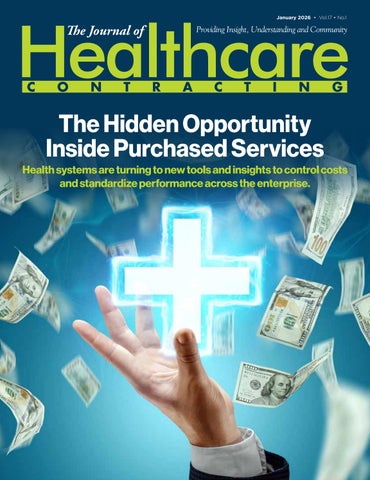
The Hidden Opportunity Inside Purchased Services Health systems are turning to new tools and insights to control costs and standardize performance across the enterprise.
WHAT A DIFFERENCE OUR DIFFERENCE MAKES. HealthTrust Performance Group solves the toughest challenges by leveraging our decades of senior level healthcare experience to optimize clinical and operational performance while providing unmatched savings. Its a difference only HealthTrust can make.
DISCOVER THE HEALTHTRUST DIFFERENCE TODAY. Scan code to learn more.
C O N T E N TS | J A N UA RY 2 0 2 6
2 The Next Era of Healthcare Supply Chains From robotic process automation to consolidated service centers, supply chain leaders are adopting innovative strategies to cut costs and maximize impact amid mounting pressures.
4 Connected Care
Wearable devices for diabetes have revolutionized patient care delivery and clinical workflows in post-acute care settings.
10 Can Robots ‘Stick the Landing’ in Healthcare Supply Chain? From science fiction to supply chain, robots not only have captured hearts and minds about what’s possible but also hopes and dreams for efficiency and progress as well as concerns and fears about human headcount reduction and job loss.
The Journal of Healthcare Contracting is published bi-monthly by Share Moving Media 350 Town Center Ave, Ste. 201 Suwanee, GA 30024 Phone: 770/263-5262 FAX: 770/236-8023 e-mail: info@jhconline.com www.jhconline.com
20 The Hidden Opportunity Inside Purchased Services With billions flowing through fragmented and inconsistently managed contracts, health systems are turning to new tools and insights to control costs and standardize performance across the enterprise.
28 Why Precision Matters
Rethinking how we define and measure “savings” in healthcare contracting.
32 Why Humans Still Matter in a Robotic World Automation can optimize the routine, but creativity, judgment, and stewardship remain uniquely human responsibilities.
PUBLISHER John Pritchard
EDITOR Graham Garrison
DIRECTOR OF BUSINESS DEVELOPMENT Anna McCormick
ART DIRECTOR Brent Cashman
jpritchard@sharemovingmedia.com
amccormick@sharemovingmedia.com
ggarrison@sharemovingmedia.com
CIRCULATION Laura Gantert
lgantert@sharemovingmedia.com
bcashman@sharemovingmedia.com
The Journal of Healthcare Contracting (ISSN 1548-4165) is published bi-monthly by Share Moving Media, 350 Town Center Ave, Ste 201, Suwanee, GA 30024. Copyright 2026 by Share Moving Media All rights reserved. Please note: The acceptance of advertising or products mentioned by contributing authors does not constitute endorsement by the publisher. Publisher cannot accept responsibility for the correctness of an opinion expressed by contributing authors.
The Journal of Healthcare Contracting | January 2026
1
TRENDS
The Next Era of Healthcare Supply Chains
Best practices taking hold Despite these headwinds, Hisscock sees promising innovations gaining traction. “RPA and other forms of automation have emerged as valuable time-saving technologies,” he said. Bots are taking on non-value-added tasks so staff can shift to higher-value work.
From robotic process automation to consolidated service centers, supply chain leaders are adopting innovative strategies to cut costs and maximize impact amid mounting pressures.
AI and machine learning are also growing areas of exploration, though he cautioned that “opportunistic marketing and fledgling start-up wherewithal makes the determination between hype and value difficult.” Leading organizations are responding by developing thoughtful AI strategies and governance policies.
As health systems continue navigating financial pressure, workforce shortages, and rapid technological change, the relationship between providers and
CSCs are another emerging bright spot.
suppliers is evolving. According to Ed Hisscock, AHRMM Board Liaison and retired
While the “path to value is unclear,” Hisscock
CSCO, both sides are increasingly focused on tackling entrenched inefficiencies.
observed that their rapid expansion suggests they may become “a likely win-win value
“Many providers and suppliers
driver” for reducing trade-relationship costs.
are signaling that conversations about decreasing existing waste in the trade relationship are on the rise,” he said. Some
Momentum and new initiatives
discussions are driven by tariff pressures;
Mike Schiller, AHRMM’s executive director,
others are tied to the opening of new
said the spirit among supply chain leaders
Consolidated Service Centers (CSCs).
at the 2025 conference was unmistakable.
Either way, they are expanding beyond
“ENERGY!” he said. “This year’s
traditional sales channels to involve sup-
event showcased several new and exciting
plier Sales & Operations Planning and
initiatives.” Among them: curated panel
supply chain leaders. It’s a needed shift,
discussions from the Advisory Board, the
Hisscock noted, because “the health care
inaugural meeting of the Independent Link
trade relationship is 10% to 20% higher
Coalition to support supply chain profes-
than other industries” when measured
sionals in rural and safety-net settings, and
by Selling, General, and Administrative
the Affiliated Chapters Luncheon, which
(SG&A) expense.
highlighted strong chapter growth. The momentum is continuing post-conference,
` A worsening shortage of supply chain
with dormant chapters reactivating and
Hisscock pointed to several challenges
staff, making the need to “do more
work underway to launch new ones.
supply chain teams are navigating:
with less” even more acute.
Key pressures ahead
Planning for 2026 is already moving
` Greater pressure to reduce costs,
` Difficulty “discerning the hype vs value
especially for hospitals facing
in the proliferation of new emerging
more innovative elements expected to
Medicaid reductions and increases in
technologies like AI and RPA ... with
“deliver an impactful and distinctive
uncompensated care.
fewer resources.”
conference experience.”
2
forward, Schiller added, with even
January 2026 | The Journal of Healthcare Contracting
The reason our IV bags aren’t made with DEHP is clear. Over 40 years ago, B. Braun recognized the environmental and patient risks of toxic chemicals like DEHP and PVC and was the first medical device manufacturer to remove them from many products. DEHP, which is used to soften PVC, can leach into IV fluids, potentially putting patients at risk. Protect your patients and the planet with a full line of IV bags not made with DEHP or PVC.
Learn more at bbraunusa.com/clearlysafe Rx only. © 2025 B. Braun Medical Inc., Bethlehem, PA. All rights reserved. 25-0287_07/25
POST-ACUTE
Connected Care Wearable devices for diabetes have revolutionized patient care delivery and clinical workflows in post-acute care settings.
Optimizing workflows in post-acute and long-term care facilities is a crucial part of clinicians’ ability to provide quality patient care. With the growing adoption of technology in healthcare, wearable devices have been increasingly recognized as a valuable way to enhance clinical efficiency in a variety of post-acute settings including skilled nursing, long-term acute care hospitals (LTACHs), inpatient rehabilitation and home health care. Wearable devices, which perform functions such as tracking a patient’s heart rate, respiratory rate, blood pressure, glucose levels, movement and more – allow for the continuous remote monitoring of critical patient health data, according to a National Library of Medicine study.
Repertoire Magazine recently spoke to Dr. Naushira Pandya, Professor and the
Chair of the Department of Geriatrics at Nova Southeastern University’s Kiran C. Patel College of Osteopathic Medicine and Director of the Geriatrics Workforce Enhancement Program, south Florida, to discuss wearable devices within post-acute care settings.
Integrating wearables
with geriatric syndromes such as fall-
Dr. Pandya, who has served on the
Post-acute care facilities often have a
ing, weight loss and incontinence,” said
Board of Directors with the Post-Acute
higher rate of patients with multiple
Dr. Pandya.
and Long-Term Care Medical Associa-
comorbidities as well as cognitive and
In addition to teaching geriatrics to
tion (PALTmed) and was its President in
psychosocial problems compared to other
medical students, fellows in Geriatrics,
2015, contributed a clinical perspective to
types of medical facilities, requiring prac-
and residents; Dr. Pandya has an active
the organization as Chair of the Diabetes
titioners to treat many patients with more
nursing home and ambulatory care prac-
Clinical Practice Guideline (CPG) for
than one health concern.
tice in Geriatrics and Endocrinology.
Long-Term Care. This is a popular guide-
“After residency, I was very interested
“My area of specialty and the area that
line and has undergone three revisions in
in endocrinology and had the opportunity
I have been most interested in for many
addition to a pocket guide and is support-
to work in a long-term care setting with
years is diabetes in older adults, and my
ed by other diabetes publications.
medically complex and challenging patients
research publications have largely been
that had chronic medical conditions along
surrounding this topic,” said Dr. Pandya.
4
“There are a broad range of definitions describing the long-term care
January 2026 | The Journal of Healthcare Contracting
setting,” says Dr. Pandya. “Focusing in on
workflows, providers can instead remotely
pump to automatically deliver insulin)
skilled nursing facility settings, patients in
monitor patient health and access real-
and even technologies that only require
these facilities are often more medically
time data instantaneously.
the patient to input meal announcements
complex with longer-stay patients needing ongoing care.” Diabetes is common among older
Specifically, continuous glucose moni-
to allow tailoring of the mealtime insulin
toring (CGM), a wearable technology
dose, with automated control of between
worn by the patient 24 hours a day, tracks
meal glucose levels.
adults, and according to the National
a patient’s glucose (blood sugar) levels
Council on Aging, can exacerbate patients’
over time.
already existing geriatric conditions.
“Patients with diabetes are living longer and aging and are now coming into
CGM devices have the potential
skilled nursing facilities and long-term
to help practitioners in long-term care
care with their own automatic insulin
long-term care settings have diabetes,”
settings spot trends in glucose data
pumps,” said Dr. Pandya. “The question
said Dr. Pandya.
and react to changes in patients’ blood
that remains is how practitioners are go-
glucose on demand.
ing to prepare for these types of patients.
“Nearly 25% to 34% of patients in
In most facilities, staff conduct pointof-care blood glucose testing to monitor
“Studies have shown that for patients
patients’ diabetes, which involves a blood
wearing CGMs, practitioners were able to
glucose meter to check blood sugar levels
detect episodes of severe hypoglycemia
with a fingerstick blood sample. Check-
(less than 54 milligrams per deciliter) and
using these types of wearable devices
ing blood glucose levels may be required
severe hyperglycemia (over 250 milligrams
outside of health care settings – with
multiple times per day and can be time-
per deciliter), which can be very danger-
support from family members and
consuming for long-term care staff.
ous in older people – without the use
at-home care teams – and desire to con-
of CGM technology, clinicians couldn’t
tinue using them when they are admitted
detect these episodes before,” said
to a long-term care facility.
Complex patients may need their finger pricked up to three to four times a day
This is an area we must continue to be thinking about and planning for.” Many patients may have already been
with traditional glucose monitoring and may also require multiple insulin injections, according to Dr. Pandya. “Blood glucose testing only provides health information in the moment – we don’t know what happens to blood glucose levels between blood sugar tests.
“ The increased adoption of wearables in long-term care promotes cost-savings in terms of less equipment used, less nursing time spent at the bedside and an overall improved quality of life for patients.”
The levels may drop, or they may be quite elevated between those traditional tests,” said Dr. Pandya. “The other way to moni-
Dr. Pandya. “Tracking these highs and
For long-term care staff, the challenge
tor diabetes is through A1C testing, which
lows is important because hypoglycemia
is to learn about how these new types of
gives you a look back at blood glucose
specifically can lead to adverse clinical
devices work and how to interpret their
levels from the last three months. For
events such as falls, cognitive impair-
data for patient care decisions.
older people, this method is not always
ment, cardiac events and in extreme cases
reliable because a patient may be anemic,
seizure and death.”
has had a previous blood transfusion, or
“Different facilities have varying levels of expertise, so education and support are important for the integration of wearable
they may have other medical issues which
devices,” said Dr. Pandya. “Use of these
can affect the reliability of A1C levels.”
Prepping for wearable integration
devices requires knowledge and expertise
Most wearable devices for diabetes,
Wearables for monitoring diabetes also in-
from physicians but also nurses and nurse
however, can monitor a patient’s blood
clude more advanced technologies such as
aides and rely on staff and caregivers to
glucose levels continuously. By integrat-
insulin pumps, automated insulin delivery
actually interpret their data and make
ing wearable medical devices into clinical
(glucose sensor that communicates with
changes in the patient care regimen.”
The Journal of Healthcare Contracting | January 2026
5
POST-ACUTE
Going forward, educating long-term
“If we integrate more widespread
to note that they aren’t always covered in
care staff on the use and integration of
use of CGM in long-term care, we must
personal and clinical wearable technol-
have centralized monitoring of all the
ogy ensures that they are prepared to in-
data from all the patients using CGM,”
terpret data and incorporate it into daily
said Dr. Pandya. “I introduce CGM in the
Policy and action for wearables
care. This is consistent with recommen-
courses I teach, including the interpreta-
To support and advocate for the use of
dations made by the American Diabetes
tion of trends, what the reports mean,
wearable devices across post-acute and
Association in their 2025 Standards of
etc. This needs to be reinforced and re-
long-term care facilities, physicians and
Care guidance.
trained in residency and then throughout
advocacy organizations must come together
a physician’s career.”
to spread information on its benefits.
“The next push for clinicians in the
a subacute setting,” said Dr. Pandya.
post-acute and long-term care space is to
Additionally, insurance coverage for
“The medical community now has a
expand beyond small studies on the benefit
obtaining continuous monitoring devices
consensus that we must come together
of these types of devices into larger clini-
isn’t always consistent for each patient and
nationally to research, conduct more
cal outcome studies,” said Dr. Pandya.
facility. According to Dr. Pandya, the wide-
studies, provide clinical training to prac-
spread use of CGM and other wearable
titioners and persuade CMS to increase
technology across healthcare facilities can
coverage for these wearable devices so
Cost-savings of wearables
be patchy and dependent on each individual
that older adults can access them,” said
If physicians receive the proper educa-
facility’s resources and coverage of devices.
Dr. Pandya.
tion and training on the clinical use of wearable devices, they have the potential to be integrated at a larger scale within post-acute care workflows and lead to cost-savings. “It saves a lot of time for a facility if nurses don’t have to perform routine
More widespread integration of wearable devices has the potential to transform patient monitoring and improve workflows, especially for the care of patients with diabetes.
finger sticks, document a patient’s blood glucose each time, and then de-
“An issue for integration of these de-
cide on the insulin dose based on what
vices is payment and something we really
able devices has the potential to trans-
orders are present,” said Dr. Pandya.
must push in the medical industry,” said
form patient monitoring and improve
“The increased adoption of wearables
Dr. Pandya. “Patients with Medicare Part B
workflows, especially for the care of
in long-term care promotes cost-sav-
or outpatients are covered and can receive
patients with diabetes.
ings in terms of less equipment used,
CGM, but in the subacute setting under
“The face of diabetes has changed,
less nursing time spent at the bedside
Part A Medicare, the cost of care varies
and the American Diabetes Association is
and an overall improved quality of life
and is covered by what Medicare pays the
making an effort to recommend wearable
for patients.”
nursing home per day, per patient.”
devices, which been shown in many stud-
Automatic insulin pumps, in addition
Insurance coverage for wearable devices
More widespread integration of wear-
ies to improve outcomes. They also have
to glucose sensors, can also help to reduce
can be inconsistent and depend on the
a strong older adult’s interest group, and
the amount of times insulin has to be
complexity of a patient’s health issues,
their focus this year is how to promote
administered to patients by nurses.
what therapies they need, and how medi-
the use of CGM in long-term care,” said
The widespread integration of wear-
cally intensive the care is that is required.
Dr. Pandya. “At PALTmed, and within the
able technology does, however, come with
“For patients who happen to already
long-term care industry, we are also trying
logistical challenges including payment
have CGM, they can bring in their sensors
to strengthen our recommendations on
and coverage issues and incorporation
and equipment into post-acute care settings
wearable devices and support them going
into existing workflows.
from the outpatient side, but it is important
forward with training and efficacy.”
6
January 2026 | The Journal of Healthcare Contracting
Products You Need...
Quality You Trust Medegen is the U.S. manufacturer of Bedside Products and core EVS Products delivering: RELIABLE SUPPLY CHAIN: Stronger, shorter supply lines for critical essentials. REGULATORY CONFIDENCE: Compliance with FDA and U.S. safety standards. FAST DELIVERY: Quick domestic turnaround gets orders to you sooner. PROVEN QUALITY: Made to rigorous U.S. manufacturing standards. BUILT FOR AGILITY: Rapid response to urgent needs and custom requests. ECO-SMARTER: Shorter transport means lower environmental impact. MADE IN AMERICA: Supporting U.S. jobs and communities.
medegenmed.com
Get more value from your distributor Your facility requires a nuanced distribution approach that ensures the quality and specificity of your diagnostic supplies and services. Here’s how to assess the total value of your distributor.
Specialized handling that protects your investment
Where basic distributors fall short:
How Cardinal Health delivers:
• Limited expertise and capabilities
ຉ An extensive network of refrigerators, freezers, cool rooms, chem vaults and full temperature control across the distribution network, close to customer facilities
• Additional shipping and handling fees • Greater risk of product damage or loss • Lack of transparency in compliance and use of non-local distribution centers
ຉ Dedicated teams to help minimize product issues and ensure compliance ຉ No surprise fees
Transparent pricing
• Hidden fees that inflate true costs • Freight costs • Low unit of measure upcharges • Drop ship service costs
ຉ Transparent pricing, with shipping costs and direct ship fees disclosed upfront ຉ Cardinal Health™ ValueLink™ Distribution Service Program provides real savings on low unit-of-measure orders ຉ Sequestered lots and Reserved Inventory Program
Supply reliability to meet seasonal demand fluctuations • Stockouts during critical testing seasons • No backup plans for peak demand • Self-management of supply crises
ຉ Reserved Inventory Program for respiratory products with supply assurance, including: • No backorders • Local inventory • Continuous monitoring to help keep you running without interruptions ຉ Authorized distributor for HealthTrust®, Premier® and Vizient®
GPO access and rep expertise • May not be available on all GPOs • Limited lab-specific expertise
ຉ Supply chain consultants with the ability to support field, regional, national, diagnostic and specimen management needs
Strategic supplier access and private brand savings
Where basic distributors fall short:
How Cardinal Health delivers:
• Limited or no exclusivity to leading suppliers
ຉ Exclusive supplier product offerings
• Gaps in products, supplies and services needed by clinical and research labs
ຉ A wide breadth of national brand products
• May offer a large number of private brand SKUs but lack depth and breadth
ຉ Nearly 2,300 Cardinal Health™ Brand SKUs available
• Minimal or inconsistent private brand savings
ຉ 10% aggregate savings compared to national brands*
ຉ Strategic supplier relationships
ຉ Comprehensive capital equipment solutions from leading manufacturers
Capital equipment solutions • Limited leasing and consultation expertise • Numerous touchpoints
ຉ Dedicated diagnostic specialist for one point of consultative support ຉ Flexible leasing options ຉ GPO rebate opportunities ຉ Availability to purchase multiple instruments on a single purchasing order ຉ Involves lab in discussions
Facilitates collaboration between lab and supply chain
• Minimal consultative services • May cause potential supply chain management issues for the customer when distribution decisions are made without lab input
ຉ Distribution solutions that drive supply chain resiliency and transparency ຉ Customer engagement team ຉ Standard assessments ຉ Optimization ຉ Insights and analytics
Work with distribution experts who care Labs need seamless operations to deliver accurate results while supply chain managers need transparency and measurable value to justify every decision. Cardinal Health enables both through proven expertise, transparency and a lab-first approach to distribution. We don’t just move products, we optimize your entire supply chain and help protect your investments while delivering value at every step. the difference shows up in product integrity, cost transparency, reliability and expert support when you need it most.
For more information or to connect with a distribution expert, visit cardinalhealth.com/labdistribution * Contract savings recognized through GPO contracts based on historical data to date. Savings are not guaranteed. © 2026 Cardinal Health. All Rights Reserved. CARDINAL HEALTH, the Cardinal Health LOGO and VALUELINK are trademarks of Cardinal Health and may be registered in the US and/or in other countries. All other trademarks are the property of their respective owners. Patent cardinalhealth.com/patents. Lit. No. 2LAB25-3959760 (01/2026)
SUPPLY CHAIN
Can Robots ‘Stick the Landing’ in Healthcare Supply Chain? From science fiction to supply chain, robots not only have captured hearts and minds about what’s possible but also hopes and dreams for efficiency and progress as well as concerns and fears about human headcount reduction and job loss. BY R. DANA BARLOW
Editor’s note: The following is first story in a multipart series.
While Jeff Stephens, senior vice president, Supply Chain Management, Memorial Hermann Health System, certainly understood the allure and attraction of robotics in supply chain, he embraced one critical aspect before taking the plunge. Stephens wanted his Houston-based team to control the process and their own destiny as they incorporated more than three dozen automated mobile robots (AMRs) within supply chain operations at Memorial Hermann’s consolidated service center that represents more than $1 billion in annual purchasing volume to replenish the system’s 17 hospitals. They embarked on their robotic journey nearly three years ago as the nation emerged a bit bruised from the global pandemic. Their aims? To control costs, fortify staff and improve productivity and workflow. “We wanted to make sure that we kept our expenses as low as we could, and when we discovered that we didn’t have to buy a robotics system, that we could lease a robotic system. That was very attractive to us,” Stephens told The Journal of Healthcare Contracting. “The cost per month, the replacement, the maintenance, battery life, all those things contributed to us wanting to seriously take a look.”
10
January 2026 | The Journal of Healthcare Contracting
After looking at several vendors and going on a number of site visits to see the AMRs in action, Stephens and his team “got a really good feel about how the technology worked and have been very pleased with how it’s worked for [Memorial Hermann],” he indicated. “We saw the AMRs scooting around this little warehouse – it was a bait and tackle company that had like 50,000 SKUs – and they were using the robots,” Stephens recalled. “We talked to some of the folks that were doing the work, and they were also happy. We looked at the productivity reports that they had, the screens they had that showed the lines per hour by person and how they worked them. But then when they told us of the retention characteristics, and from a recruiting standpoint how attractive that was, how that gave them an advantage when they were looking for folks to come and work there and hold on to them, that sold us.” Timing happened to be critical, too, as Memorial Hermann embarks on some massive information technology (IT) projects in 2026, including updating its
is the number of FTEs we have with the
hesitations, pitfalls and traps that temper
warehouse management system (WMS)
automation and the cost of automation.
the trendiness, and then formulate an
and enterprise-resource planning (ERP)
And here’s the total cost.’ The difference
effective business plan that can be used to
system, ensuring everything integrates or
was substantial. And so that was a pretty
persuade the C-suite to invest in the tech-
interfaces effectively.
easy conversation to have.”
nology for the benefit of the organization
To make their investment case before
Memorial Hermann’s experience
the C-suite, Stephens relied on the persua-
follows a logical pattern of how to make
siveness of simple economics.
a decision about adopting and imple-
and the patients it serves.
“We calculated how many [full-time
menting technology within a burgeoning
Why robotics?
equivalents] we would need in lieu of the
landscape of options. Start by identifying
Mike Martin, vice president, Sup-
robots, did the math showing the benefits
and determining a specific need, then
ply Chain Operations, Trinity Health,
and compared the two numbers,” he
identify and determine the appropriate
Livonia, Michigan, certainly recognizes
noted. “We found there was no compari-
technology to fulfill that need based on
the technology’s allure, which amps up
son. I shared that with my boss [system
the applications and functions provided.
the gravity of the decision, but acknowl-
CFO] and said, ‘this is how many FTEs
Charge through the hype and hyperbole
edges that you have to keep a cool head
we have to have if we don’t have the
of the technology’s promoted attributes
when marketing, media and sales heats
automation, and this is the cost, and this
and functions to understand the fears,
up the heart. How does he determine
The Journal of Healthcare Contracting | January 2026
11
SUPPLY CHAIN
whether to invest in robotic systems for
Support Services Officer. “It’s important
use in storerooms or warehouses?
that any robotics investment ties directly to
“I would say with a skeptical eye,”
a clear use case and supports our broader
Martin deadpanned. “First, you have
operational goals. We focus on areas
to understand your costs clearly for
where automation can really move the
your manual processes. You have to ask
needle — typically high-volume, repetitive
yourself, have I optimized and eliminated
or labor-intensive processes. Transporta-
as much waste as possible in my current
tion and material movement are probably
process? That becomes your baseline bud-
our biggest opportunities given the size
get to beat. That said, there are probably
and scope of our operations. Some of the
functions and tasks that will remain even if
indicators that robotics might make sense
you shift to an automated solution. What
include throughput constraints, high error
are the trade-offs, such as capital expense,
or rework rates or staffing challenges in
infrastructure required, footprint changes,
hard-to-fill or physically demanding roles.
depreciation, useful life, network require-
Ultimately, we’re looking for technology
ments, maintenance costs, software costs,
that drives efficiency and consistency,
downtime procedures, ease of implemen-
while freeing up our teams to focus on
tation, and most importantly, do you have
higher-value work.”
the throughput to warrant the ‘shiny new
“Ultimately, what are you trying to
thing?’ What are some prevalent supply
do?” he asked. “Are you doing it because
organization’s interest in automation for
chain characteristics that may indicate to
you can’t find labor in the marketplace?
their supply chain operations involves
you that your overall operation or selected
Then there has to be a payback – in this
labor costs and scarcity, according to Jim
processes within that operation may
case, it’s because we don’t have enough
Richardson, consulting director, Vizient.
need some form of robotic assistance to
people to do the work. But if labor is not
He further cites robotics becoming less
generate improvements and why? When it
the issue, then you really have to think
expensive when compared to the cost of
is repetitive or when you have workforce
about how automation is going to solve
labor as another motivating factor.
challenges that could be solved by auto-
a problem without any labor savings.
mation/the right fit?”
A lot of times you need to supplement
The driving force behind a healthcare
Richardson shared four key indicators
Supply chain executives need to
your automation with labor to make it
that may fuel investment in robotics.
understand all of the interdependen-
work. Automation can supplement labor,
` High throughput and order
cies that automation requires in any kind
especially when moving the operation
complexity: “If daily lines/orders are
of system, according to Martin. “I’m a
somewhere else where there is labor may
very high (e.g., more than 1,000 lines/
finance guy at heart, so you have to solve
not be practical or an option. If you can
day), robotics can help speed up the
for something. If you’re doing something
apply a technology that saves time and
fulfillment process, as well as
manually and then you automate it, that
travel – like walking around in the ware-
increase accuracy.”
process should be better and less expen-
house and physically searching for items,
sive. What you’ll find is that a lot of these
that technology can beneficial.”
big solutions may require more throughput than your operation has to make it
` Labor challenges: “If warehouse labor is scarce or turnover is high,
Cleveland Clinic recognizes the poten-
robotics can add more stability. Not only will less labor be required, but
tial risks and rewards, too.
worthwhile for you. But certainly, having
“We always start by looking at the
also training new labor to work with
a good handle on your manual processes
overall ROI — not just financial return,
robotics is much easier and faster. In
is a critical first step,” he continued.
but also the impact on safety, accuracy,
addition, warehouse jobs become less
and reliability,” noted Steve Downey, vice
laborious and more interesting when
president and Chief Supply Chain and
working with robots.”
The labor argument may not be as onedimensional as people think, Martin added.
12
January 2026 | The Journal of Healthcare Contracting
The Trauma Experience Presented by: Alliance Trauma Value Program
March 13th or 14th | Nashville, TN Discover new ways to elevate your orthopaedic trauma service line with insights, perspectives, and approaches designed to spark meaningful progress. Join the Alliance team in Nashville for: + A look at the trauma landscape and the opportunities ahead
+ Turning data and insights into practical next steps + Building alignment across key voices and teams + Approaching value and agreements with confidence + Putting new strategies and tools into motion for lasting impact
Scan the QR to submit your application
Visit us at alliancecanhelp.com
SUPPLY CHAIN
` Space considerations: “Consolidated
“To me, mobile robotic technology
“You need to be handling major vol-
service centers and warehouses with
can be an advantage because it’s scalable,
ume like a very large distributor or a CSC
certain robotic systems (e.g., Autostore)
and from what I’ve seen, it’s a little easier
that covers multiple large hospital system
require much less square footage
to implement,” Martin continued. “With
operations. It can make sense, but as an
because storage is denser and takes
Bluetooth technology, for example, you
operator I worry that this automation may
greater advantage of vertical space.”
don’t have to track systems on the floor.
allow your picks per hour to be well north
` Demand variability: “Peaks (e.g.,
Geo-mapping uses sensors to move
of a hundred or maybe even two hundred
flu season, pandemics) can be more
the robot where it needs to go without
lines an hour. If [the system] goes down,
easily handled by adding more
running into or over people who may
what are the workarounds in a manual
robots (or cobots, a collaborative
be picking in an aisle and loading other
process to continue operating when
robot), than hiring and training
robots. There are also other goods-to-
you’re just not staffed to do the work?”
additional personnel.”
person options that involve high-density
Martin expresses concern about two ma-
storage, but they require significant infra-
jor issues – the downtime and maintenance.
structure in place and throughput to make
The influence of three
the investment worthwhile.”
You have to determine whether you have a tech person on staff who keep
Once supply chain establishes the need
Payback received is key, he insists.
the automation running or your need
for implementing some type of automa-
“It can be 18 months; it can be 7 to 10
to hire it out, which can get pricey,”
tion, how does the team determine the
years. You may be achieving that payback
he indicated. “That can be a challenge
specific type or system or technology that
from labor savings and other things, but
for a typical CSC that may not support
works for the organization?
you’re married to it once you commit to
enough large hospitals. It can be a tre-
it,” he added.
mendous investment. Now maybe it will
Trinity’s Martin concentrates on
Martin recognizes the attraction of
pay off if you extend beyond med/surg
three strategies:
high-density vertical automated storage
and incorporate pharmacy replenishment
` What is the easiest to implement with
and retrieval systems, such as Autostore,
or high-volume product that requires
but indicates that an organization must
short order cycle turnaround.”
the lowest complexity?
` What offers the lowest maintenance costs and downtime?
have the height and the volume to justify the technology.
Trinity operates a warehouse management system connected to a single-tier
` What requires the lowest investment,
pick module, according to Martin, who
generates the earliest payback and
describes their technology as “simple
provides the greatest impact to FTEs?
because their strategy at the time was a plug-and-play model with less integration
He then narrows the plethora of
to minimize maintenance costs.
products to one option that can satisfy all
“We have a one-tier module with a
three strategies and maximizes mobility.
power takeaway with sortation,” he ex-
“I’m somewhat familiar with [auto-
plained. “It knows what to do by scanning
mated guided vehicles] AGVs and AMRs
the label to determine which lane to send
that follow a pre-programmed track or
a product along. It handles significant lines
are given directions from ceiling sensors
per hour. We also have two vertical lift
that send signals to the unit,” he said.
modules that are like a very large carousel.
“Those are movable options. But there
We use them more for security and space
are stationary options like flow racks,
saving than for productivity enhance-
power takeaway conveyors and diverts
ment. We’re able to monitor the picks with
that allow you to release your orders to
cameras and can be very meticulous about
be processed optimally.
tracing an order that someone claims they
14
January 2026 | The Journal of Healthcare Contracting
Healthcareʼs Most Comprehensive Pharmacy Portfolio Driving measurable savings. Building resiliency. Advancing innovation. Premierʼs pharmacy programs go beyond contracts. With 25 - 30% greater contract coverage than competitors and a rapidly expanding technology and automation portfolio, we deliver unmatched opportunities to reduce spend, optimize margin and strengthen your pharmacy supply chain.
Premier Pharmacy Portfolio Highlights Market-Leading Portfolio • 3,800+ contracted brand products and 110 suppliers. • 60 value-add programs. • 80% of Acute COT portfolio has Retail COT pricing. � Premier-exclusive DSH Class of Trade: 8,116 NDCs, 95 suppliers, up to 20% savings. Technology and Automation Expansion Seven new categories and 25 new suppliers in 2025-2026, including those that offer drug diversion monitoring, central fill and mail order automation, revenue cycle management, IV automation, and PBM services.
Specialty and Oncology Focus Intersectta™ GPO with 110 drugs, 17 contracted suppliers and five exclusive contracts delivering average 10.7% savings. Resiliency Leadership Growing ProvideGx® committed drug shortage program and expanding PremierProRx® private label portfolio. Compounding and 503B Optimization 11 contracted suppliers, 1,000+ products, ~22% savings, 503B site evaluations, product crosswalks and member collaboratives.
See how Premier delivers more ways to protect your supply chain — and your bottom line.
SUPPLY CHAIN
didn’t get. The cameras will show the tote being loaded on the trailer before that trailer goes out to facilities. The track-and-trace helps manage security and workflow more than it serves as a productivity enhancement device.” Martin notes that they have not integrated their WMS with the VLM [vertical lift module]. “But if we choose to integrate the two then the WMS releases the orders to the VLM and the VLM’s operating system would use logic to stack the shelves,” he said. “This reduces the travel required between shelves, which
investigate the options. “Find out what’s
reduces the time per pick.”
out there and ask about a thorough main-
2. “Will it integrate? Does it fit seamlessly with our existing systems and workflows?
The VLM is 32 feet high and services 88
tenance agreement and ongoing support
3. “Will it deliver measurable value? Are
shelves. “We have two of them in operation
for the software,” he recommended. “You
the benefits – efficiency, reliability,
for redundancy. In case one goes down, we
want to make sure you’ve got somebody
safety – clear and sustainable over time?
can use the other to minimize downtime
willing to assist beyond the sale. We’ve
effectively,” he said. “We use this for our
had great success with [our vendor] and
“By focusing on these questions, we
most critical high-value products.”
now it’s to the point where our team is
ensure we’re investing in solutions that
The pick module operation and the
helping them co-develop products and so-
create long-term value and align with our
VLM have been in place for about seven
lutions as we’re presenting ideas to them
operational strategy,” he added.
years. Meanwhile, the integrated WMS and
that they hadn’t thought of themselves.
delivery tracking module allows supply
We’re trying to push the technology and
Vizient’s Richardson offered his own trio
chain to track products from their storage
the capability so much that we challenge
of queries.
locations on the shelves or pallets, then
them to develop these things for us, and
1. “The organization must ask itself, what
scan to a trailer and then scan again when
they’re doing it, and then they’re able to
problem am I solving? For example,
it arrives at its ministry destination, accord-
go and market that to others.”
are you addressing future system
ing to Martin. “We do the same thing for small parcel shipments,” he added.
Cleveland Clinic’s Downey stressed
growth but lack the space to expand or
flexibility as an important element.
lack the labor resources to implement?
Memorial Hermann’s Stephens shared
“We start by looking at both our cur-
that his team primarily operates a logical
rent operational needs and where we’re
2. “How well does the solution integrate
unit of measure [LUM] warehouse, but
headed,” he said. “We want technology
with warehouse management system/
they do ship a lot of bulk, too. Most of
that can evolve with us, not just fit our
enterprise resource planning (ERP)/
their robotic automation concentrates on
current state. We also assess scalability
clinical systems? Integration with your
the LUM operation, but they’re work-
and integration – how well the system will
warehouse management system and
ing with their vendor to accommodate
connect with existing platforms and adapt
ERP are critical for an effective solution.
moving bulk, cases and pallets, which
as our processes mature.”
3. “What level of scalability and
expands their relationship beyond buyer or customer and seller. If supply chain leaders show interest in automation and robotic technology, Stephens suggested that they simply
16
If so, robotics may be one answer.
flexibility do I need? Your selected When evaluating options, Downey advo-
technology solution should be flexible
cated asking three key questions:
and scalable to provide for future
1. “Will it scale? Can the technology
growth and change, as healthcare in
support future growth or expansion?
America is growing.
January 2026 | The Journal of Healthcare Contracting
See what’s possible Distributors and self-distributing health systems now have complete transparency of their Dukal products’ from purchase order to delivery. Product Assigned at the Factory Level Product Tracking at the Item Level Compatible Excel Reporting Automated Communication Worldwide Tracking
Scan here to learn more or visit dukal.info/insight
Dukal is working with healthcare professionals around the world in manufacturing and supply chain solutions, to mitigate disruptions that impact business and patient health. Helping you manage everything from product to patient.
> Learn more at dukal.info/insight
SUPPLY CHAIN
The ABCs of Distinguishing Robotic Options If only choosing the right robotic systems for your healthcare supply operation resembled how you choose which car to buy for your business or family use. But it’s a bit more complicated than differentiating between electric- or gas-powered; automatic versus manual transmission; all-wheel, four-wheel, front-wheel or rear-wheel drive. While you may opt for a car based on variety of features that may best conform to or fit your business needs or family lifestyle, you’ll likely notice a bevy of additional variables that will influence your choice of robotic systems to adopt and implement based on the function and workflow you wish the robots to augment or carry out.
Some robots can be used for transporting, storing, sorting, picking, packing, loading/unloading, inventory counting, data management or cleaning and disinfecting areas. Much depends on the height, width and depth of your storeroom or warehouse as well as the volume of stock you need to manage to narrow the options of products you can deploy. This includes throughput density and scaling (how much stock can you load and move and how quickly you can move it) and storage density and scaling (how much stock can you load on the shelves and precisely track). Last spring, executives from Gebhardt Intralogistics NA walked attendees at the ProMat show in Chicago through a historical and categorical journey through robotic development and useful applications. You also have to determine whether your healthcare organization’s information system can accommodate the robotic system’s software. Some robots require ceiling, floor or wall sensors to navigate their pre-programmed routes on their own either in an X-Y spread or in an omnidirectional X-Y-Z spread. This might involve radiofrequency identification (RFID), LIDAR, infrared or Bluetooth. Many robots can be pre-programmed to carry out repetitive and routine tasks automatically. Others – typically the more “human-looking” robots with arm and leg appendages or crawler belts or wheels for legs – require direct human interaction nearby to control and manage movement. Here’s a sample of robotic options available. AGVs (automated guided vehicles) – These are beltrunning (crawler) or wheel-based robots that use a pre-programmed fixed route to move products, based on locational sensor input. They can be flat platforms for stacking boxes and crates or a more vertical shelving style with specific cubby holes and drawers. They also can be programmed as “parent-child” shuttles whereby one of the robots will handle routes on the “X-Y” axes and the other on the “Z” axis with a human transferring loads between the two. AMRs (autonomous mobile robots) – These are beltrunning (crawler) or wheel-based robots that use real-time mapping from locational sensors to maneuver independently through aisles and hallways, avoiding obstacles along the way – including people. These, too, can be flat platforms for stacking boxes and crates or a more vertical shelving
18
January 2026 | The Journal of Healthcare Contracting
style with specific cubby holes and drawers. They also can be programmed as “parent-child” shuttles whereby one of the robots will handle routes on the “X-Y” axes and the other on the “Z” axis with a human transferring loads between the two. Biped/quadruped robots – These are two-legged/ armed and four-legged models that turn heads at the exhibit halls of logistics and supply chain trade shows as well as in demo videos online. The human-looking robots can be programmed to do certain repetitive tasks like picking and restocking but require humans nearby to manage their movements. The four-legged models can be used for security measures (replacing guard dogs, for example) but require humans to load compartments to carry and transport stock.
used to load and unload bulkier and heavier stock, such as cargo containers on ships and trains. Drones – These are aerial vehicles used to move and ship products internally within a facility or externally between buildings on a campus or locally/remotely across town. Generally, they require direct human interaction to maneuver but some can be programmed to fly autonomously. Drones also are used to perform visual inventory counts via camera recording (photos and videos) either through direct human interaction or autonomous programming.
Carousels – These are conveyor belt-driven systems that move product from place to place, requiring humans or robots to load or retrieve product at various location points.
High-density horizontal and vertical storage systems – These are massive shelving products that started as movable racks/shelves on rails for people to operate by turning a wheel to stationary shelves where pre-programmed robots move on horizontal or vertical rails to pick or replenish inventory. Typically, the aisles between these high-altitude shelves are very thin.
Cooperative robots (cobots) and crane/gantry systems – These are articulating robotic arms with pre-programmed swivel capabilities used for moving products (e.g., loading, sorting, pick-and-pack tasks) to boxes, crates, pallets, semitrailers, other robots or conveyor belts. Crane systems are overhead gantries that maneuver on a fixed course and are
Robotic process automation (RPA) – This is a software package that uses pre-programmed “bots” to carry out repetitive tasks, including data collection, management and retrieval; purchase order, invoice and receipt processing; and even front-end customer interaction. RPA will be featured in a future story within this multipart series.
The Journal of Healthcare Contracting | January 2026
19
The Hidden Opportunity Inside Purchased Services With billions flowing through fragmented and inconsistently managed contracts, health systems are turning to new tools and insights to control costs and standardize performance across the enterprise.
Purchased services may not grab headlines like breakthrough medical devices or blockbuster drugs – but for many health systems, they represent a hidden goldmine of untapped savings. During a recent webinar hosted by The Journal of Healthcare Contracting and Premier, a panel of supply chain executives dug into why this spend category has become so difficult to manage – and how data and technology are finally shedding light on it. JHC publisher John Pritchard was joined by Sofya Mikhelson, VP of supply chain at Fairview Health Services; Chris Salada, senior director of supply chain at Kaleida Health; Anthony Montagnolo, the vice president of supply chain technology at Premier; and Fernando Rinald, the vice president of supply chain collaborative with OSF HealthCare and Pointcore.
20
THE HIDDEN OPPORTUNITY INSIDE PURCHASED SERVICES
The following are four takeaways from the webinar.
Montagnolo said, “With the at-
And given the staffing constraints all
tention on cost savings, we are seeing
hospitals face, they need the people,
some important emerging trends. Many
processes, and technology of an orga-
organizations realize there is a large
nization like Premier to support that
Purchased services is the ‘Wild West’ of purchasing
opportunity for better efficiency and
extra attention.
Because purchased services is in its
all the way up and down the leadership
own category of purchasing separated
chain. There’s also much more interest
Identify the decision makers
from life-saving medical equipment, it’s
in creating a strategic and programmatic
One of the biggest obstacles reps
become a no man’s land of sorts. Mont-
approach to building out in supply chain
encounter when approaching health
agnolo likened it to the Wild West, where
a purchased services capability that is
systems to sell is getting their foot in the
different departments are making dif-
not only focused on cost savings but
door and finding the right decision mak-
ferent purchasing decisions for different
also partnering with the stakeholders
ers for what they’re offering. Sometimes,
reasons. There’s no consistency across
to make sure that the quality stays high,
it’s hard for the health system to identify
the board, leading to high costs and
while the costs come down.”
who exactly the decision makers are as
uneven quality. That lack of consistency,
saving money in purchased services,
Montagnolo argued that purchased
well. For Chris Salada at Kaleida Health,
coupled with a lower level of oversight,
services is now on the radar of the
the biggest challenge that his team faces
makes it hard for administrators to main-
entire organization at the hospital level
is identifying who is in possession of the
tain a standard of compliance.
much more than it was a few years ago.
decision-making gavel. “When we look at our other value analysis processes, we usually have a chief physician who’s able to make those final decisions to drive the next step,” Salada said. “I think when you look at service agreements, it’s really a group of people that need to be the decision makers – identifying gavels in different situations.” Even after you have identified the right person to make the decisions about purchased services, they have a bit of an uphill battle when it comes to establishing agreements, especially for hospital sites in different areas. The agreements for a hospital in the city are going to be vastly different from rural hospitals. “There are a lot of things that in every given situation, depending on the service that we’re looking at, is that we really need to just drive with multiple people around the table to be able to make the decision, from a system approach to be able to drive those savings.”
22
January 2026 | The Journal of Healthcare Contracting
It’s Time To Get
Connected.
Welch Allyn Connex 360 Vital Signs Monitor Featuring: •
Vitals sent directly to the EMR to help reduce errors in transcription
•
Customizable Early Warning Score protocols to help detect patient deterioration and help guide clinical decisions
•
Optimized clinical workflows for connected monitoring
To learn more, contact your Baxter representative or visit hillrom.com/connex360. Rx Only. For safe and proper use of the products mentioned herein, please refer to the appropriate Operator’s Manual or Instructions for Use. Baxter, Connex 360 and Welch Allyn are trademarks of Baxter International Inc. or its subsidiaries. US-FLC215-250068 (v1.0) 11/2025
THE HIDDEN OPPORTUNITY INSIDE PURCHASED SERVICES
Data visibility is the key Fernando Rinald of OSF HealthCare and Pointcore believes in the power of data visibility. “Most of the spend or payments
Data visibility works to unlock the “secrets” of purchased services in healthcare supply chain by revealing what’s working and what isn’t.
in purchased services flow outside of the PO line level detail. It’s dark data, which
supply chain by revealing what’s working
really don’t have benchmarking or the
means that you have to go and find it
and what isn’t.
specific tools and analytics that can help.”
in different ways. Beyond data, you also
At Fairview Health Services, Mikhel-
have to identify scope. How broadly is
son and her team implement some of
the service going to be deployed across
Leverage tools and analytics
Premier’s tools to track accounts payable
the system or across our collaborative?”
Finding the right tools and using the right
spend, sort through competitive sourcing,
Rinald said.
benchmark and analytics for purchased
and get a better understanding of what the
services spend at a health system is critical
market looks like by analyzing and compar-
systems would have better leverage to
to developing a better understanding of
ing contracts with AI. These tools cover a
standardize some of their purchased ser-
the big picture. Sofya Mikhelson of Fair-
wide net for Fairview, but Mikhelson sees
vices. By introducing a basic standardiza-
view Health Services notes that the avail-
areas where health systems could use a
tion process, health systems would have
able benchmarks and analytical tools are
specific tool for capturing data and provid-
access to lower costs through purchasing
not be as comprehensive as they could be.
ing information for decision making.
power, streamline workflows across the
“What is a unit service for consul-
system, and reduce administrative and
tants?” Mikhelson said. “That’s a service.
that really get down to the line items,
financial waste across the board. Data
What about physician agreements? That’s
where we can benchmark it, when we can
visibility works to unlock the “secrets”
a service as well. There is a wide variety
understand what it is, and where we can
of purchased services in healthcare
of things we need to look at, and we
be more successful in negotiations.”
With the right data in hand, health
24
“I do think that there is a lack of tools
January 2026 | The Journal of Healthcare Contracting
Equip your medical practice, all in one order. Healthcare-grade chairs. Commercial disinfectants. Breakroom snacks. Keep your practice running smoothly through flu season and beyond with corner-to-corner solutions from the waiting room to the back office so you can focus on your patients.
GPO member savings for the best pricing available.
NEW REPORT:
Digital account tools to control rogue spending.
Next-day desktop delivery to over 98% of the U.S.
6 Steps to Reduce Infections and Staff Burnout.
Digital account tools to control rogue spending.
Get the report:
Cardinal Health™ Lab Distribution: Products and Services
Cardinal Health™ Brand products at a savings Anatomic pathology products including:
• AP storage • Biopsy bags • Cassettes • Clearing agents • Cover glass • Cytology supplies • Dehydrants
• Embedding materials
• Foam biopsy pads • Formalin • Formalin neutralizing pads
• Freeze spray • Microtome blades
• Paraffin • Paraffin dispensers • Prefilled formalin containers
• Slide mailers • Slides • Tissue baths • Tissue marking dye
Blood bank and hematology products including:
• Blood bank saline • Hematology consumables
• Hematology
• Single-release drop
• Plasma thawing bath
• Wright stain (bulk
reagents
and accessories
blood dispenser and stain packs)
Clinical chemistry products including:
• Beta-hydroxybutyrate assays
• Sample cups
• Blue plug caps
Lab equipment products including:
• Centrifuges • Freezers • General lab equipment
• Incubators • Lab furniture • Lab weighing
• Refrigerators • Ultra-low freezers
With a broad and deep portfolio like ours, you don’t have to worry about finding the right lab products for your organization. And, Cardinal Health™ Brand laboratory products are clinically equivalent to leading national brands, so you get savings without sacrificing quality.
Lab essentials including:
• Glucose tolerance beverages
• Lab chemicals • Lab labels • Lab liquid handling
• Lab racks • Lab supplies • Lab tape • Lab temperature monitoring
• Lab timers • Labware • Test tube closures • Test tubes
Microbiology products including:
• Collection swabs • Gram stainer supplies
• Loops • Microbiology supplies
• Needles • Stool collection • Transport swabs
Point of care products including:
• Crypto giardia testing
• H.pylori testing
• HCG testing • Influenza testing • Mono testing
• Strep A testing • Urinalysis testing
Specimen collection products including:
• Blood tubes • Lancets • Specimen bags
• Specimen
containers
• Specimen cups
• Tourniquets • Tube holders
Labs rely on a distributor that’s more than just a box mover. Count on Cardinal Health to provide financial savings, operational efficiencies and supply continuity through our rich history of distribution excellence and decades of lab expertise.
We are your lab advisor. Expertise. Choice. Efficiency. Savings.
True transparency means no hidden costs or fees. One point of contact. Deep supplier relationships. Always-on service. That’s the Cardinal Health way.
© 2025 Cardinal Health. All Rights Reserved. CARDINAL HEALTH and the Cardinal Health LOGO are trademarks of Cardinal Health and may be registered in the US and/or in other countries. All other trademarks are the property of their respective owners. Patent cardinalhealth.com/patents. Lit. No. 2LAB25-3567758 (08/2025)
For more information, scan the QR Code to connect with a lab expert or visit cardinalhealth.com/labdistribution
CONTRACTING
Why Precision Matters Rethinking how we define and measure “savings” in healthcare contracting.
In healthcare supply chain, few words carry more weight, or cause more confusion, than “savings.” Supply chain teams report them, finance teams review them, and executives depend on them to demonstrate progress against tightening margins. Yet too often, the number shown in a sourcing report doesn’t match what appears in financial statements. The problem isn’t always that the math is wrong;
Traditional categories like cost reduction and cost
it’s that we’re speaking different languages. Sourcing
avoidance are solid and principled, but in practice they’re
calls something a savings project, finance calls it a bud-
applied inconsistently. Many projects include both ele-
get offset, and operations simply sees spend increasing.
ments, yet we tend to label each initiative as one or the
The disconnect comes not from a lack of effort or
other for simplicity’s sake. This oversimplification makes
intent, but from how we classify and communicate the
internal reporting easier, but it leaves finance without
value created.
a clear path to trace value from contract to P&L.
28
BY BRETT WEBSTER
January 2026 | The Journal of Healthcare Contracting
In a shrinking margin environment,
(price effect vs. volume effect), the story
the prior year’s total spend, which makes
where every department must defend its
becomes coherent. The math might
perfect sense analytically but no sense
impact, precision in classification is cred-
reconcile either way, but the narrative
conceptually to say that we ‘saved’ more
ibility. Without it, sourcing and finance
doesn’t. Precision, in this sense, isn’t
than we spent the prior year. Without
will continue to talk past each other,
about arriving at a different total; it’s
proper classification, sourcing looks like
undermining trust in exactly the functions
about building a bridge between the
it’s overstating results, when in reality it’s
designed to protect the organization’s
sourcing team’s activity and finance’s
simply combining different value sources
financial health.
interpretation of its impact.
into one label.
To show with simple numbers (these
In this (admittedly extreme) ex-
are illustrative only), if a facility previ-
ample, say the negotiated price went
Precision in classification: Understanding what we’re really measuring
ously bought 10,000 boxes of gloves at
from $20,000 to $10,000, and volume
$10 each ($100,000 total), and the new
increased from 100 to 500. It sounds
contract reduces price by 5% to $9.50
absurd to tell finance that our negotia-
Cost reduction and cost avoidance aren’t
per box, the projected value from the
tions ‘saved’ $500,000. Not only is that
new ideas, but the way we apply them
sourcing event is $5,000. Now suppose
more than we spent in the prior year
often muddies the conversation between
usage grows by 10% to 11,000 boxes.
($200,000), the total spend still increased
supply chain and finance. Most contract-
Spend rises to $104,500. The sourcing
to $500,000. It would be more accu-
ing projects, once implemented, contain
math still holds: we delivered $5,500 of
rate to state that we reduced costs by
elements of both – yet we typically label
total value, yet total spend went up.
$100,000 (100 * $10,000) and avoided an
each initiative as one or the other for simplicity’s sake. That simplicity might
additional $400,000 on new volume. Here’s where precision matters. The $5,500
That’s why precision in classifica-
make internal tracking easier, but it makes
isn’t pure cost reduction but a combination:
tion is the first step toward credibility.
reconciliation harder because it obscures
` $5,000 from price reduction on the
It ensures that value is understood, not
what’s really happening. Take a common example: sourcing
original volume (true cost reduction)
` $500 from avoided cost on the
just calculated. It’s what allows a sourcing leader to sit across from finance and say,
renegotiates an existing contract for
additional volume that would have been
“Here’s how much we reduced our price
sterile gloves achieving a 5% reduction in
more expensive under the old rate
exposure and here’s how much volume
unit price. On paper, that’s a straightfor-
(cost avoidance)
change offset it.”
This example happens to be trivial to
the conversation shifts from defending
usage rises by 10%. The total spend goes
defend. Any finance team will be able to
numbers to simply explaining impact.
up, even though the price per unit fell.
see that although the line item went up
Finance retains visibility into the opera-
Did we “save” money? Yes, and no.
this was due to volume and there was still
tional realities behind spend, and sourc-
There’s a reduction component tied
ward cost reduction. But clinical activity
When we can tell that story clearly,
increases the following year, and glove
real value in the amount of $5,500. So by
ing gets credit for the full scope of value
to the lower unit price, and an avoid-
labeling $5,500 as ‘cost reduction’ or sim-
created, not just the portion that lowers
ance component tied to what didn’t
ply ‘savings’, typically we will not receive
the ledger.
escalate further because of that lower
any pushback.
rate. The total spend tells one story, but
However, at scale sometimes the
the classification of value tells another.
logic breaks down, and this is where
When both effects are lumped together
understanding the precision can help.
Why projects don’t reconcile cleanly to the P&L
as “savings,” finance sees an expense
Imagine a high-cost implant with large
If the concept seems straightforward,
line that increases due to volume and
volume growth. Negotiated prices go
the practice rarely is. The glove example
questions how much of the reported
down 50% while volume surges up 400%.
shows how a project can be classified
savings is ‘real’. When they’re separated
The arithmetic “savings” might exceed
incorrectly even when the math itself
The Journal of Healthcare Contracting | January 2026
29
CONTRACTING
is accurate. In that case, the totals may
behavior falls short, reported savings
inadvertently assume more benefit than
theoretically reconcile but the interpreta-
exceed what finance can validate.
remains to be captured.
tion doesn’t. Precision didn’t change the arithmetic; it changed the story. But that
4 T iming Mismatch
can’t always be said.
Procurement often books savings when
didn’t alter the total value, but merely
In many sourcing projects, the
the contract is signed; finance recognizes
clarified where it came from. But in the
lack of precision can not only blur
them only when the spend actually occurs.
real world, many of the above factors do
understanding but also may change
Even accurate projections can appear
alter both perception and the underlying
the result entirely. The moment we
“missing” on the ledger because the
math. In future articles, we’ll examine
apply the wrong baseline, assume
realization window spans fiscal periods.
how some of these choices can change
In this article’s examples, precision
full compliance, or ignore timing and utilization shifts, the numbers themselves diverge. What begins as a small
the outcome, and what the best practice is 5 C onversion Volume
to determine full value as well as maintain the ability to reconcile.
and Utilization Effects
modeling shortcut compounds into
Changes in clinical activity, procedure
major discrepancies between sourcing
counts, or SKU-level utilization can over-
projections and financial reality.
whelm the contract’s pricing effect during
The path forward
conversions. Without isolating those
True alignment begins with shared
Several common pitfalls drive this gap:
drivers, the underlying sourcing impact
language. Instead of collapsing complex
1 S ingle-Label Reporting
remains obscured.
initiatives into “savings” versus “cost
Assigning every initiative to one category (either “savings” or “avoidance”) hides the blended nature of most projects. As
avoidance,” classify each component 6 M argin Impact and
according to what it actually represents:
Expense Shifting
price effect, volume effect, utilization
seen earlier, this may not alter the math
Even perfectly calculated sourcing savings
change, or avoided escalation. Even
but can distort how results are interpreted
can shift expenses elsewhere in the system
a modest increase in precision can
and communicated.
or change gross margin mix creating
dramatically improve the quality of
confusion about whether we reduced cost
financial dialogue.
2 B aseline Ambiguity
or simply moved it.
Precision doesn’t slow us down but
Whether a team uses last price paid,
instead it should speed up trust. When
weighted average, or another bench-
7 M id-Year Impacts
contracting and finance speak in compat-
mark, inconsistent baselines can
Sourcing calendars do not align neatly
ible terms, the organization gains a clearer
produce materially different outcomes.
with fiscal calendars. Contracts are
picture of where value is being created,
Two analysts can work from the same
negotiated and implemented through-
where it’s shifting, and how future strate-
data and end up with different savings
out the year, which can complicate how
gies should evolve. In an industry defined
totals simply because they started from
savings are reflected in future budgets.
by both cost pressure and accountability,
different reference points.
When a new agreement is signed mid-
precision offers credibility.
year, part of its benefit is realized in 3 A ssumption Overreach
the current period, even though the full
Next in this series: a closer look at why
Modeling savings with 100% contract
annualized impact is often projected
differing baselining methods such as
compliance or immediate adoption
into the next. Without recognizing this
Weighted Average vs. Last Price Paid can
inflates projections. When real-world
timing overlap, budget adjustments may
also hide true value and reconcilability.
Brett J. Webster is a healthcare supply chain analytics leader at MemorialCare with a background in finance and quantitative analysis. His work involves translating complex sourcing activity into clear, defensible financial outcomes that strengthen alignment between supply chain and finance teams.
30
January 2026 | The Journal of Healthcare Contracting
SUBSCRIBE TO JHC FOR YEAR-ROUND COVERAGE JHC PUBLISHES YEAR-ROUND 6 PRINTED • 6 DIGITAL To ensure you are receiving every issue please email Anna McCormick at amccormick@sharemovingmedia.com or visit our website at www.jhconline.com
SHELF CONFIDENCE
Why Humans Still Matter in a Robotic World Automation can optimize the routine, but creativity, judgment, and stewardship remain uniquely human responsibilities. BY R. DANA BARLOW
Driving past the local YMCA frequently during the last few decades unearthed a curious trend if you watched closely enough. The facility showcased through a curved wall of floor-to-ceiling windows its fitness center and four-lane track to pedestrian and vehicular traffic outside.
32
January 2026 | The Journal of Healthcare Contracting
During the year-end post-holiday
employee layoffs in the double-digit per-
“We’re not going to see an exclusively robotic
cool-down and through the first month
centage range. They give a variety of rea-
factory, but we will see the optimum use of robots
of the year the fitness center bustled
sons that sound logical but feel nebulous:
and people. … Robots allow our employees to
with patrons using the exercise equip-
Reducing costs (to pay for the new tech
work safely, faster and at less cost.”
ment and hustling along the indoor track
perhaps?), recognizing process efficiencies,
– Dennis Muilenburg, former CEO, Boeing
– at least as much as you could through
that when fused together retain revenues,
the fogged windows.
if not profits. They need to justify and
1. Humans conceive, design, produce and
pinpoint value from this new investment.
distribute the technology. For example,
In a world of technological advance-
AI may be “smart,” but it just curates
By mid-February, however, a smidge past Valentine’s Day, the hustle and bustle disappeared. You saw unoccupied
ments via computers and robots that
content using logic-based algorithms
exercise machines and a vacant track
promise effectiveness, efficiency and pros-
that it repurposes to satisfy a human
through clear windows. This happened
perity, humans surprisingly and essentially
(or even machine) query. AI cannot
every year. Like clockwork.
still maintain value.
conceive anything from scratch because
Patrons either achieved their fitness
The popular phrase, “Which came
it lacks creative generation. AI can mimic
goals (e.g., building or toning muscles,
first, the chicken or the egg?” causality
an artistic, musical, speaking or writing
losing weight, etc.), found another way to
conundrum has never appeared so quaint
style based on programming, prompting
occupy their time or simply grew bored
when sidled up to its technocentric suc-
or significant research, but it cannot
with the tedium and indifferent to their
cessor, “Which came first, the human
originate a new style based on organic
anticipated outcomes. This seems like a human’s relationship with technology in general, automation in particular, computer or robotic systems. “Ultimately, our ideas about robots are not about robots. The robot is a canvas onto which we project our hopes and our dreams and our fears … they become embodiments of those hopes and
Automation technology like computers and robots are designed to handle the routine stuff that can slow us down so that we can speed up in many other areas. Sometimes, however, the repetitive tedium encourages our minds to wander, which can spark organic intellectual creativity.
dreams and fears.” – Hank Green, author/ novelist, An Absolutely Remarkable Thing or the robot?” Divorcing all religious
ingenuity. For example, AI or even a
and science fiction undertones, it seems
robot can beat you at chess but not at
Pairing humans with technology
logical, if not plausible, to think that a
Mad Libs, which would make absolutely
Ask anyone in supply chain about the
chicken must lay an egg (and that egg
no sense to the logical algorithm because
feasibility of bringing in an advanced
either produces another chicken or a
it doesn’t understand the humor …
computer system or the latest robotic
considerable portion of a Denny’s Grand
unless it’s the Robin Williams character
technology and the first question he or
Slam breakfast or McDonald’s McMuffin)
in the 1999 film “Bicentennial Man.”
she likely will level is, “How does this
first. Similarly, a human must conceive,
affect my job?” What they really mean is,
design, manufacture and program (and
“Will this cost me my job?”
then market, sell and deliver) a robot.
We’ve witnessed plenty of examples
2. Humans maintain and repair the technology. At least until humans craft a program or robot to repair itself or others.
from some of the world’s largest and
“Robots are good at things that are structured.”
wealthiest corporations implementing
– Vijay Kumar, Dean, University of
some new technology in their front office,
Pennsylvania School of Engineering and
the technology. This includes the
back office or warehouse, followed by
Applied Science
computer and the robot.
The Journal of Healthcare Contracting | January 2026
3. Humans determine how to program
33
SHELF CONFIDENCE
4. Humans conjure up how to improve
and professor and chair of the industrial
won’t get annoyed when their power (e.g.,
the technology to carry out tasks and
engineering and operations research
battery, electricity, fuel, etc.) runs out or
meet desired needs. They also create
department at the University of Califor-
short circuits.
how to replace that technology with
nia, Berkeley, and leader of UC Berkeley
something brand new.
Automation Sciences Lab
But humans must retain control as effective stewards of this technology, which represents a useful tool to free up
“Hollywood likes to imagine robots as mechani-
the creative ideation and vision that only
standards for using the technology –
cal copies of ourselves – which is a terrible idea.”
humans can accomplish and replicate.
including (hopefully) when to shut it
– Colin Angle, CEO, iRobot
5. Humans also establish rules and
down or turn it off.
“Robots are going to look and be designed Automation technology like
to meet the function they’re supposed to
Whether computers or robots, this
computers and robots are designed to
perform. People will still name them and
technology is designed to augment hu-
handle the routine stuff that can slow
connect with them. … In the end, robots do
mans, not necessarily replace them. (Yes,
us down so that we can speed up in
things that people can do. So there is a cost
you read that “necessarily” legal loophole
many other areas. Sometimes, how-
above which you can hire somebody to do it,
right.) If anything, they are – and should
ever, the repetitive tedium encourages
and that bounds the opportunity.”
be – extensions of our selves at work and
our minds to wander, which can spark
– Colin Angle, CEO, iRobot
potentially in life.
organic intellectual creativity.
“We’re fascinated with robots because they are
bored, mentally burnt out or physically
so many human problems. Except for all
reflections of ourselves.” – Ken Goldberg,
fatigued from doing endlessly mind-
the ones that they cause.” – Hank Green,
artist, writer, inventor and researcher,
numbing repetitive tasks. And they likely
author/novelist, An Absolutely
“Robots have solved and will continue to solve
Computers and robots can’t grow
Remarkable Thing All in all, let the technology collect data and develop logical conclusions; let the robots sort, pick, pack, move and manufacture products. Let the humans determine how to analyze, manipulate and transform the data into workable concepts; let the humans determine how to use, toss out, inspect and innovate products … with technological assistance, of course. What’s the underlying threat of any product or technology? Obsolescence. Case in point, late last year that local YMCA was shuttered (after “merging” with another location several suburbs over), torn down and replaced by a townhouse complex. R. Dana Barlow serves as a senior writer and columnist for The Journal of Healthcare Contracting. Barlow has nearly four decades of journalistic experience and has covered healthcare supply chain issues for more than 30 years. He can be reached at rickdanabarlow@wingfootmedia.biz.
34
January 2026 | The Journal of Healthcare Contracting
Midmark® Digital ECG Now With DICOM Compatibility Empower your team to work more efficiently and collaborate seamlessly at the point of care with the Midmark Digital ECG. With optional DICOM compatibility, you can securely share ECG data with cardiology specialists via their preferred CVIS—right from your EMR. This supports fewer manual steps, faster turnaround and more accurate test results without disrupting your workflow. It’s an opportunity to strengthen the connection between your team and your patients— transforming every data point into a clearer picture of health and every interaction into better care. View product info at: midmark.com/add-dicom
Scan to see the Midmark Digital ECG.
© 2026 Midmark Corporation, Versailles, Ohio USA
The only publication dedicated solely to the healthcare supply chain.
REACHING 4,400 IDN EXECUTIVES, 2,500 HOSPITAL EXECUTIVES, 600 GPO DECISION MAKERS AND 3,500 SUPPLIERS/MANUFACTURERS
CALL US FOR MORE INFORMATION: ANNA McCORMICK 770-263-5280
e-mail: amccormick@sharemovingmedia.com
I read The Journal of Healthcare Contracting because the articles are short and condensed, saving time but still giving me all the relative insight. The print vs online issue is preferred since most of the content I keep up with is online. It is nice not having to stare at monitor to get information. Reading what peers are doing is insightful and on most occasions the insight confirms what I believe is critical now and what longer term strategies may need developed. — Mark Welch, Senior Vice President, Novant Health
JHC PUBLISHES YEAR-ROUND • 6 PRINT EDITIONS • 6 DIGITAL EDITIONS VISIT US ONLINE AT JHCONLINE.COM TO READ MORE EDITIONS OR FOR MORE INFORMATION