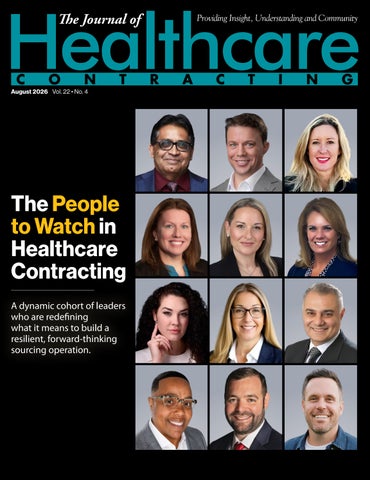
August 2026 Vol. 22 • No. 4
The People to Watch in Healthcare Contracting A dynamic cohort of leaders who are redefining what it means to build a resilient, forward-thinking sourcing operation.
Connect Every Beat Empower Every Decision By delivering trusted, high-quality cardiac data through advanced ECG devices and data management solutions, Baxter’s Cardiac Care Solutions help clinicians drive clarity, build confidence, and make informed decisions on every step of a patient’s cardiac journey.
INPATIENT CARE
OUTPATIENT CARE
RESTING ECG
RESTING ECGS
ELI 380 Resting ECG ELI 280 Resting ECG
EXERCISE STRESS TESTING Q-Stress Cardiac Stress Testing System
Diagnostic Cardiology Suite Resting ECG
Cardio Server ECG Management System
DATA MANAGEMENT CONNECTION
AMBULATORY CARDIAC MONITORING CAM Patch
Connect Every Beat with Baxter Cardiac Care Solutions. Scan to learn more.
Rx Only. For safe and proper use of the products mentioned herein, please refer to the Operators Manual or Instructions for Use. Baxter, CAM, ELI and Q-Stress are trademarks of Baxter International Inc. US-FLC198-260003 (v1.0) 04/2026
CONTENTS AU G U ST 2 0 2 6
The Journal of Healthcare Contracting is published bi-monthly by Share Moving Media 350 Town Center Ave, Ste 201 Suwanee, GA 30024 -6914 Phone: 770/263-5262 FAX: 770/236-8023 e-mail: info@jhconline.com www.jhconline.com
Editorial Staff Editor Graham Garrison ggarrison@sharemovingmedia.com
Senior Writer and Columnist R. Dana Barlow rickdanabarlow@wingfootmedia.biz
Editor-in-Chief, Dail-eNews Jenna Hughes jhughes@sharemovingmedia.com
Content Creator Pete Mercer pmercer@sharemovingmedia.com
Art Director Brent Cashman bcashman@sharemovingmedia.com
Publisher John Pritchard jpritchard@sharemovingmedia.com
Circulation Laura Gantert lgantert@sharemovingmedia.com
The Journal of Healthcare Contracting (ISSN 1548-4165) is published monthly by Share Moving Media, 350 Town Center Ave, Ste 201, Suwanee, GA 30024-6914. Copyright 2026 by Share Moving Media. All rights reserved. If you would like to subscribe or notify us of address changes, please contact us at the above numbers or address. POSTMASTER: Send address changes to Share Moving Media, 350 Town Center Ave, Ste 201, Suwanee, GA 30024-6914. Please note: The acceptance of advertising or products mentioned by contributing authors does not constitute endorsement by the publisher. Publisher cannot accept responsibility for the correctness of an opinion expressed by contributing authors.
The Journal of Healthcare Contracting | August 2026
Feature
The People to Watch in Healthcare Contracting pg 16
2 Publisher’s Letter: Six years post COVID so much has changed … or has it? 4 Connecting the Dots
After nearly three decades across suppliers, distributors and providers, Angelique Beslic is helping healthcare supply chain professionals think beyond transactions and lead strategically.
10 Health Systems Face “Squeeze Play”
Rising costs, tightening reimbursement and workforce shortages are forcing health systems to rethink operations, supply chain strategy and the role of AI.
48 Best of Both Worlds
What processes can ASCs, hospitals learn from each other?
60 What Our Stuff Says About Us Our appetite for convenience has transformed the supply chain – and reshaped communities, infrastructure and the hidden costs of getting what we want, when we want it.
63 HIDA’s 2026 Washington Summit
From tariffs to preparedness, HIDA members brought supply chain priorities to Congress.
64 Industry News
Subscribe/renew @ www.jhconline.com : click subscribe
1
PUBLISHER’S LETTER
Six years post COVID so much has changed … or has it?
John Pritchard
As I write this, my social media feeds are
increased from roughly 815 million in 2019
filled with anticipation of Dr. Anthony Fauci’s
to an estimated 900 million in 2025. Major
scheduled hearing before the Senate Homeland
health system mergers, including Sutter/Allina,
Security and Governmental Affairs Committee.
Advocate/Aurora/Atrium and Intermountain/
The angst and debate brought back a flood of
SCL, have also reshaped the landscape.
emotions I hadn’t felt in a long time, prompting
My impression is that health systems have
me to reflect on how much has changed over
settled into a new sense of stability. Leaders are
the past six years.
increasingly focused on how AI can improve
I thought about the lost summer of 2020
operations and workflows. Labor remains
and the changes in my personal life, the
a persistent challenge, both in recruiting
economy and our corner of the U.S. health-
enough workers and affording the ones they
care supply chain.
have. Financial pressures continue to weigh
Personally, it has been the busiest and most dynamic six years of my life. My wife and
heavily on hospitals and health systems, as they always have.
I celebrated 30 years of marriage, watched
Overall, I find most supply chain leaders
three of our four children graduate from col-
are still under pressure, but once again feel in
lege and begin their careers, and recently saw
control of their organizations. Six years ago,
our youngest graduate from high school and
many wondered if they would ever regain
leave for college. As new empty nesters, we
that confidence.
sold the home where we raised our family and
Yes, things are different – dramatically so in
moved into the one where we hope to enjoy
some ways. In others, they feel a little more like
our golden years.
the good old days.
In the same span of time, the economy has expanded significantly. GDP has grown by roughly a third, while inflation and interest rates have also climbed. About 5 million more
As for me, I wonder what the next six years will bring. Thanks for reading this issue of The Journal of Healthcare Contracting.
Americans are employed today than in 2019. Healthcare has evolved as well. Hospital admissions have remained relatively flat at about 36 million annually, while outpatient visits have
2
August 2026 | The Journal of Healthcare Contracting
See what’s possible Distributors and self-distributing health systems now have complete transparency of their Dukal products’ from purchase order to delivery. Product Assigned at the Factory Level Product Tracking at the Item Level Compatible Excel Reporting Automated Communication Worldwide Tracking
Scan here to learn more or visit dukal.info/insight
Dukal is working with healthcare professionals around the world in manufacturing and supply chain solutions, to mitigate disruptions that impact business and patient health. Helping you manage everything from product to patient.
> Learn more at dukal.info/insight
SUPPLY CHAIN EDUCATION
Connecting the Dots After nearly three decades across suppliers, distributors and providers, Angelique Beslic is helping healthcare supply chain professionals think beyond transactions and lead strategically.
For nearly three decades, Angelique Beslic has viewed healthcare supply chain from almost every angle imaginable. She has worked for suppliers, distribution and multiple healthcare providers, giving her a rare perspective on an industry that has become increasingly critical to healthcare’s success. Today, as Senior Director of Supply Chain at Legacy Health in Portland, Oregon, and Executive Consultant and Principal of The Bridge Venturers, LLC since 2013, Beslic is helping shape the
4
Angelique Beslic
future of the profession through education, leadership development and advocacy. Her recent recognition as the No. 1 Supply Chain and Procurement Professional globally by OnConferences underscores both her personal accomplishments and the growing prominence of healthcare supply chain within the healthcare industry. Looking back, Beslic credits her diverse career path for shaping her leadership philosophy. “One of the greatest advantages that I’ve had through my career is the opportunity to experience healthcare supply chain from multiple perspectives,” she said. “Each role taught me something different about how healthcare supply chain and healthcare in general functions.” Like many professionals entering the field, Beslic initially viewed supply chain primarily through the lens of products, contracts, pricing and logistics. Over time, however, she discovered that healthcare supply chain is far more complex than traditional supply chain models found in retail or manufacturing. “The real challenge in healthcare supply chain is aligning people with different priorities toward a common goal,” she explained. Clinicians focus on delivering the best patient outcomes. Finance leaders concentrate on organizational sustainability. Suppliers pursue innovation and growth. Operations teams work to keep hospitals running efficiently. Successful supply chain leaders, she believes, are those who can bring all those stakeholders together.
August 2026 | The Journal of Healthcare Contracting
Trusted Products to Provide Peace of Mind The Purell® brand is built on creating innovative well-being solutions. As people everywhere continue to focus on hand hygiene and surface disinfection, it’s more important than ever to provide proven, trusted products.
FORMULATION MATTERS
RIGHT PRODUCT IN RIGHT PLACE
POWERFUL AGAINST GERMS
Backed by decades of scientific innovation, Purell® formulations use high-quality ingredients to deliver broad-spectrum efficacy across hand and surface hygiene.
Making hand hygiene and surface products readily available in your facility helps drive use and promotes hygiene best practices.
With the lowest EPA toxicity rating,* Purell® Surface Disinfectants and Sanitizers kill 99.9% of germs and are compatible with most hard
Discover the PURELL® Difference at GOJO.com *EPA Category IV ©2026 Clorox Purell. | 55613 (7/2026).
and soft surfaces.
SUPPLY CHAIN EDUCATION
That realization led to a leadership philosophy centered on relationships. “Relationships drive results,” Beslic said. “Data is important. Contracts are important. Technology is important. But trust, collaboration and communication are what ultimately create sustainable outcomes.” The philosophy reflects the increasingly strategic role supply chain plays within healthcare organizations. Once viewed primarily as a back-office function, supply chain now sits at the center of critical conversations around patient care, financial performance and operational efficiency. That evolution was one reason Beslic found her recent global recognition particularly meaningful. “When I found out I had been selected, I couldn’t even believe somebody nominated me,” she said. “My first reaction was pure gratitude.”
“One of the biggest mistakes professionals make is becoming highly skilled in one area while never developing an understanding of the broader healthcare ecosystem.”
The Bridge Venturers, LLC Certification in Healthcare Supply Chain Management Bundle A comprehensive, ISCEA-accredited seven-module program designed to help healthcare supply chain professionals build expertise across strategic sourcing & contracting, procurement, analytics & decision support, operations & logistics, clinical integration, and leadership while earning the CHSCM (Certification in Healthcare Supply Chain Management) designation. To learn more scan the QR code.
6
The award, she says, represents more than an individual accomplishment. It reflects the growing recognition of healthcare supply chain professionals as essential contributors to organizational success. “Healthcare supply chain has traditionally operated behind the scenes,” she said. “Today organizations are realizing how critical supply chain is to patient care, financial performance, workforce efficiency and overall organizational success. We’ve moved from the basement to the boardroom.” As healthcare organizations face mounting financial pressures, workforce shortages, supply disruptions and increasing regulatory requirements, the role of supply chain continues to expand.
Beyond purchasing and logistics According to Beslic, today’s leaders must possess a much broader skill set than their predecessors. “Supply chain leaders are expected to understand analytics, clinical integration, physician engagement, sustainability, contracting, technology, change management and project management,” she said. “It’s not just purchasing and logistics anymore.” At the same time, she sees tremendous opportunity. “Supply chain has never been more relevant,” she said. “Organizations that really succeed are the ones that move beyond transactional thinking and fully integrate supply chain into strategic decision-making.” That belief in professional growth and strategic thinking ultimately inspired Beslic to create the Healthcare Supply Chain Hub, an educational platform designed to
August 2026 | The Journal of Healthcare Contracting
help professionals better understand the broader healthcare ecosystem. The idea emerged from a gap she observed throughout her career. While many educational programs focused on individual functions such as procurement or logistics, few helped professionals understand how all the pieces fit together. “I would meet talented professionals on both the provider and supplier sides who wanted to grow their careers, but they struggled to find practical education that reflected the realities of modern healthcare supply chain,” she said. The Hub’s certification program includes seven modules covering topics such as clinical integration, change management, strategic sourcing, analytics, procure-to-pay processes, operations and leadership. The curriculum emphasizes real-world application rather than theory. “My goal was to create the kind of education I wish I had access to earlier in my own career,” Beslic said. Since launching in August 2025, the program has attracted more than 150 students. Recently, it also received accreditation from the International Supply Chain Education Alliance (ISCEA), opening opportunities for expansion beyond the United States. Beslic’s vision is ambitious. She hopes the program can help establish a common strategic framework for healthcare supply chain professionals worldwide. “My ambition is that every supplier and every healthcare supply chain professional on the provider side would take it and get trained,” she said. “It’s not about making money. It’s about helping elevate the profession.”
The Journal of Healthcare Contracting | August 2026
For those entering the field – or looking to advance within it – Beslic offers straightforward advice: Never stop learning. Healthcare supply chain continues to evolve rapidly, and professionals who limit themselves to a single area of expertise risk falling behind. “One of the biggest mistakes professionals make is becoming highly skilled in one area while never developing an understanding of the broader healthcare ecosystem,” she said. She encourages procurement professionals to learn analytics, analysts to understand sourcing and contracting, sales professionals to study hospital decision-making processes and operations leaders to deepen their knowledge of clinical value analysis. “The more you understand how healthcare works as a system, the more valuable you are as a leader,” Beslic said. For Beslic, that commitment to lifelong learning remains one of the defining characteristics of effective leadership. As healthcare grows more complex and interconnected, the future will belong to professionals willing to expand their knowledge, embrace change and think beyond their immediate responsibilities. “Healthcare is changing rapidly,” she said. “The professionals who are going to thrive are the ones willing to continuously learn, adapt and think beyond their immediate responsibilities. That’s really where leadership begins.”
7
We see it.
Strained Reaching
Incorrect Positioning
Inaccessible Equipment
Manual Entry
The job is already hard. The environment shouldn’t make it harder.
© 2026 Midmark Corporation, Versailles, Ohio USA
At Midmark, we start from that truth. And our mission is simple and serious: design every detail to remove friction where it shouldn’t exist. To give time, focus and energy back to the people doing the work.
Better care begins with every detail. Scan to Learn More.
TRENDS
Health Systems Face “Squeeze Play” Rising costs, tightening reimbursement and workforce shortages are forcing health systems to rethink operations, supply chain strategy and the role of AI.
Healthcare leaders gathered at the recent HealthTrust Executive Advisory Summit with a familiar challenge at the top of the agenda: how to sustain operations while navigating mounting financial pressures. According to Dr. Aashish Shah, Senior Vice President and Chief Medical Officer at HealthTrust, health systems today are caught in what he describes as a “squeeze play.” “On one side, you have inflation and tariffs driving costs upward. On the other, reimbursement pressures continue to intensify,” Dr. Shah said. “Healthcare systems are being squeezed between rising expenses and declining reimbursement, making it increasingly difficult to maintain services at current levels.” While those concerns are not new, summit participants agreed that the convergence of economic, political and operational pressures is creating unprecedented challenges for hospitals, ambulatory surgery centers and clinics alike. Discussions centered on
10
how organizations can leverage artificial intelligence and other technologies to improve efficiency, optimize revenue cycle operations and better manage the costs associated with emerging technologies. Despite the uncertainty, Dr. Shah noted that many organizations are viewing the current environment as an opportunity to rethink long-standing practices and pursue innovation. “The organizations that appear best positioned to navigate these challenges share several characteristics,” he said. Among them is a commitment to improving the patient experience. Health systems are increasingly focused on modernizing the “front door” of healthcare to improve patient acquisition, retention and satisfaction. Leaders are also embracing technology as a tool for both transformation and workforce efficiency, helping reduce dependence on difficult-to-fill positions. Another key differentiator is the evolution of supply chain strategy. Dr. Shah said leading organizations are moving beyond traditional supply chain management toward a more clinically engaged model that integrates physician perspectives into contracting and technology decisions. “Those that effectively align patient engagement, physician engagement and contracting decisions appear best equipped to weather the current environment,” Dr. Shah said. As financial pressures continue to mount, healthcare leaders increasingly see collaboration, technology and clinical alignment as critical drivers of future success.
August 2026 | The Journal of Healthcare Contracting
New ClearPetra 2.0 – Now 25% Thinner* – Enhanced Steering – Intuitive Suction Control
Scan the QR code to learn more
Copyright © 2026 KARL STORZ. All Rights Reserved. All trademarks are the property of KARL STORZ SE & Co. KG unless otherwise noted. For US use only. It is recommended to check the suitability of the product for the intended procedure prior to use. Caution: Federal (USA) law restricts this device to sale by or on the order of physician. The ClearPetra trademark is owned by Well Lead Medical Co., Ltd.
97137055 URO 1 1.0 us 07/2026/A-E-US
*Compared to ClearPetra 1.0
TRENDS
Workforce challenges reach the C-suite While nursing shortages remain a top concern for healthcare organizations, leaders at the HealthTrust Executive Advisory Summit emphasized that workforce challenges now extend far beyond frontline clinical roles. According to Dr. Shah, experienced physicians and nurses continue to leave healthcare at a time when fewer younger workers are entering the profession. But summit participants also highlighted a growing concern: leadership turnover. “The same turnover, succession planning and talent pipeline issues affecting clinical roles are also affecting leadership positions,” Dr. Shah said. Healthcare executives noted that organizations must focus not only on recruiting and retaining clinicians, but also on developing the next generation of leaders capable of navigating today’s increasingly complex healthcare environment. Attendees also discussed the need for stronger talent pipelines for technical positions, including sterile processing technicians, patient care technicians and pharmacy technicians – roles that are critical to day-to-day operations but often receive less attention than nursing shortages. The takeaway from the summit was clear: workforce planning can no longer focus on a single role or department. Healthcare organizations need comprehensive strategies that address staffing needs across the enterprise – from the operating room to the boardroom.
12
Dr. Aashish Shah
Healthcare organizations can no longer afford to operate in silos, with quality, finance and operations pursuing separate objectives.
Augmentation, not replacement Artificial intelligence was one of the most discussed topics at the recent HealthTrust Executive Advisory Summit, but healthcare leaders focused less on futuristic possibilities and more on practical applications that can help organizations navigate today’s operational and financial challenges. “AI isn’t going to eliminate clinicians or human expertise,” Dr. Shah said. “Its greatest value lies in reducing administrative burdens and helping people focus on higher-value work that requires judgment and expertise.” Rather than creating a more impersonal healthcare environment, leaders see AI as a tool to remove routine tasks that can consume as much as 20% to 50% of an employee’s time. By automating repetitive work, organizations can allow clinicians and staff to focus on activities that directly impact patient care and organizational performance. Among the most promising applications discussed at the summit were data analysis, financial analysis, revenue cycle management and administrative automation. These areas are particularly attractive because they face ongoing staffing challenges while offering opportunities for measurable efficiency gains. Still, Dr. Shah emphasized that successful AI adoption requires more than simply purchasing new technology. “You can’t just jump on the AI bandwagon and expect success,” he said. Healthcare organizations must first establish a strong foundation, including a clear data strategy, change management plan and
August 2026 | The Journal of Healthcare Contracting
organizational readiness framework. Leaders compared AI implementation to major electronic health record deployments, noting that success depends as much on employee buy-in as it does on technology itself. Another key takeaway centered on data analytics. While healthcare organizations possess vast amounts of data, many still struggle to turn that information into actionable insights. “What organizations really want isn’t more data – they want actionable guidance,” Dr. Shah said. “The most effective tools provide not just information, but a roadmap for action.”
Collaboration is the new currency Beyond technology, summit participants also discussed how healthcare organizations are redefining value in an increasingly constrained environment. According to Dr. Shah, the core definition of value has not changed. It still rests on three pillars: patient experience, cost and clinical outcomes. What has changed is the need for greater alignment among the leaders responsible for each of those areas.
The Journal of Healthcare Contracting | August 2026
Healthcare organizations can no longer afford to operate in silos, with quality, finance and operations pursuing separate objectives. Instead, organizations are finding that true value emerges when operational, financial and clinical leaders work together to evaluate decisions through a shared lens. “Ultimately, patients need to receive the care they need and leave healthier than when they arrived,” Dr. Shah said. “The challenge is determining how to achieve that outcome efficiently and sustainably.” That emphasis on alignment also extends to supply chain and contracting decisions. One of the more notable themes to emerge from the summit was a growing willingness among healthcare leaders to reassess longstanding assumptions around product choice. Faced with ongoing financial pressures, many organizations acknowledge they can no longer offer unlimited options simply because they always have. Instead, leaders are increasingly looking to clinical evidence and physician input to guide decisions about which products and technologies deliver the greatest value. The key, Dr. Shah noted, is physician engagement. By involving clinicians in evaluating evidence and narrowing choices to those that provide the best outcomes, organizations can balance cost and quality without compromising care.
On access and affordability As healthcare organizations face reimbursement pressures and a continued shift to outpatient care, improving patient access has become a growing priority. At the HealthTrust Executive Advisory Summit, leaders focused on how to make it easier for patients to access care, improve their experience throughout the care journey and maintain engagement after treatment. Technology is helping organizations streamline administrative processes, reduce redundancies and create a more seamless patient experience. Health equity was also part of the discussion, particularly its impact on access, outcomes and affordability. Across all conversations, one issue remained front and center: ensuring care remains affordable while maintaining quality and accessibility for patients.
13
Sponsored
Henry Schein
Supply Chain As A Mission Strategy How pharmaceutical distribution decisions can help Community Health Centers do more for their communities August 2–8 marks National Health
completed, it is a moment where the
operational resilience, clinical alignment,
Center Week, a moment to recognize the
clinical plan is sustained.
and 340B integrity, is essential to sustaining
1,500-plus Community Health Centers
But what the patient doesn’t see is the
their mission. Shifting the focus total-value
serving 52 million patients across more
complex distribution infrastructure that
partnership can help ensure the supply
than 17,000 sites, often regardless of a
made that success possible. That moment
chain remains a stable foundation for the
patient’s ability to pay*. Behind every one
at the counter was not just a transaction;
care the community relies on every day
of those patients is a supply chain deci-
it was the result of a system intentionally
With patient needs that change by
sion most of them will never see.
built to keep mission-driven care reliable,
the hour and clinical teams that cannot
compliant, and affordable.
afford to be distracted by administrative
Think about it: A patient walks into a CHC on a Tuesday. Maybe they are
For CHCs, pharmaceutical distribution
backorders, CHCs require a model that
underinsured, managing a complex
isn’t a back-office function. It’s a direct
anticipates their reality.
profile of diabetes and hypertension,
determinant of whether patients get the
and arrive at the pharmacy counter in
care they came for. Historically, distribu-
success by whether a patient leaves
need of three specific medications that
tion partnerships have been evaluated
with the medication they need, not by
are cost-prohibitive elsewhere. When
through the lens of transactional cost.
what happened behind the scenes,”
the pharmacist hands them those medi-
However, finding that a more compre-
says John Kropf, Director, Pharmaceu-
cations, it isn’t a moment where care is
hensive approach, one that prioritizes
tical Sales at Henry Schein Medical.
“Community Health Centers measure
“Our role is to help make sure the supply chain is never the reason care is delayed. Every distribution decision ultimately
Key Takeaways 1. Treat supply chain as a care strategy. Reliable pharmaceutical distribution directly impacts medication access, adherence, and patient outcomes. 2. Evaluate distribution partners based on reliability, service, operational resilience, and long-term value. 3. Prioritize 340B expertise. Choose a partner with proven experience supporting 340B compliance and the unique operational needs of CHCs. 4. Find a partner who understands CHCs. Community Health Centers require a distributor that understands their mission, patient population, and integrated care environment. 5. Build relationships, not transactions. Strong distribution partnerships help reduce disruptions, strengthen operations, and allow care teams to focus on patients instead of supply chain challenges. * Source: National Association of Community Health Centers
supports a patient encounter.” That reliability is inseparable from 340B compliance. Maintaining that compliance, especially for CHCs running integrated medical and dental programs, requires a distributor built for it, not one retrofitting a general model to fit. “Community Health Centers need a partner who understands their mission, the complexity of 340B, and the realities of serving underserved communities. When your supply chain partner understands your business, you are able to focus on what matters most: caring for patients,”
Looking to build a pharmaceutical strategy that supports your patients across the entire non-acute continuum of care? Scan the QR code and connect with your Henry Schein Medical Sales Representative today to learn more.
14
says Kathleen Titus, Director, Community Health Centers & Corporate Relations at Henry Schein Medical.
August 2026 | The Journal of Healthcare Contracting
The communities that count on you deserve a supply chain that counts on them.
Why Ready 360? End-to-end pharmaceutical distribution tailored to your needs Strategic partnership that enhances efficiency and outcomes Most orders shipped in one box with one invoice
Community Health Centers serve 32.5 million Americans across 16,000 communities, delivering high-quality, affordable, comprehensive care regardless of ability to pay. The supply chain behind that mission has to perform. Henry Schein Medical Ready 360™ delivers the pharmaceutical distribution infrastructure CHCs need: 340B and DEA-compliant, 99% historical fulfillment rate, and a single consolidated partner built for the way community health centers operate.
Let’s build a pharmaceutical strategy that supports your patients across the entire non-acute continuum of care. Ready to optimize your pharmaceutical strategy? Connect with your Henry Schein Medical Sales Representative today or go to https://landing.henryschein.com/ready-360_1.html to learn more.
The People to Watch in Healthcare Contracting
I
n an era defined by persistent global disruptions, narrowing margins and evolving patient needs, the role of healthcare contracting leaders has never been more vital. The modern supply chain executive is no longer tasked simply with securing the lowest price per unit; instead, they are asked to spearhead cross-functional governance, champion clinical integration, and bridge the gap between financial stewardship and frontline caregiver support. This year’s “People to Watch in Healthcare Contracting” interviews highlight a dynamic cohort of leaders who are redefining what it means to build a resilient, forward-thinking sourcing operation. From embedding experienced clinical nurses directly into value analysis workflows to navigating complex international aggregation networks and leveraging data-driven service line analytics, these professionals demonstrate that the modern supply chain is an active engine for organizational maturity.
16
August 2026 | The Journal of Healthcare Contracting
Get your ticket now!
International Trade Fair
Progress happens when everything connects.
Where healthcare evolves. Meet Health. Future. People.
MEDICA 2026 16 — 19 Nov. Düsseldorf, Germany
Your contact in the U.S.: Messe Düsseldorf North America info@mdna.com Tel. (312) 781-5180
THE PEOPLE TO WATCH IN HEALTHCARE CONTRACTING
Nancy Palmer, RN, MHA, CNOR, CVAHP Executive Director of Clinical Resource Management and Value Analysis at AdventHealth Supply Chain
Nancy Palmer, RN, MHA, CNOR, CVAHP, Executive Director of Clinical Resource Management and Value Analysis at AdventHealth Supply Chain, describes herself as a “grassroots leader” who believes the best decisions come from those closest to the work. “I lead from the ground up,” Palmer said. “I stay connected to the people closest to the work, listening to what’s really happening and using those insights to drive practical and meaningful change.”
From your vantage point, what are some of the biggest opportunities for growth or potential in the supply chain right now? Nancy Palmer: One of the biggest untapped opportunities is shifting healthcare supply chain from a transactional function to a clinically integrated decision-making model. Today, there is still significant variation in products, processes, utilization, and physician preference, and those decisions aren’t always tied to measurable outcomes. The opportunity isn’t simply about buying cheaper – it’s about understanding what truly drives value: the right product for the right patient, in the right setting, with the right utilization pattern. A key part of that shift is investing in strong clinical expertise within supply chain, especially nurses working in
18
value analysis roles. Nurses bring direct insight into quality, safety, workflows, caregiver burden and the patient experience. They understand how products are actually used at the bedside and can identify risks or unintended consequences that may not show up in cost analyses or contracting reviews. When nurses are empowered as clinical supply chain leaders, decisions become more financially responsible, clinically sound, operationally practical and aligned with safe patient care. At AdventHealth, leadership has been very forward-thinking in this area, investing in a highly skilled team of experienced value analysis nurses. That clinical depth is a meaningful differentiator for our organization – not every system has it.
There’s a lot of new technology and innovation entering healthcare. How do you approach innovation without disrupting day-to-day operations? Palmer: We try to be very intentional and disciplined. Innovation must be grounded in the realities of daily operations. In healthcare supply chain, innovation can’t create unnecessary disruption for caregivers who are already managing complex work. The goal isn’t change for the sake of change; it’s continuous improvement that makes work safer, easier, more reliable and more valuable. We start by understanding the problem we’re trying to solve. Before introducing a new product, technology or process, we evaluate clinical need, workflow impact, training requirements, supply reliability
August 2026 | The Journal of Healthcare Contracting
open or closed open or closed open or closed patients are covered. patients are covered. patients patients are are covered. covered.
patients are covered. Whichever they choose, our masks go with their flow. patients are covered. Whichever they choose, Whichever they choose, our our masks masks go go with with their their fl flow. ow. Whichever they choose, our masks go with their flow. Whichever they choose, our masks go with their flow. Whichever they choose, our masks go with their flow.
Monitoring patient’s EtCO2 can help physicians reduce adverse events from sedation. Monitoring patient’sit EtCO can help adverse events from Now we’re making even easier withphysicians open and reduce closed mask options that gosedation. with the flow — Monitoring patient’s EtCO22 can help physicians reduce adverse events from sedation. Now we’re making it even easier with open and closed mask options that go with the flowow. — helping physicians measure patient’s airflreduce ow andadverse better manage their sedation. team’s workfl Monitoring patient’sbetter can help events from Now we’re making it EtCO even 2easier withphysicians open and closed mask options that go with the flow — helping physicians patient’s airflreduce ow andmask betteroptions manage their team’s workfl Monitoring patient’sbetter can help physicians events from Now we’re making it EtCO evenmeasure with open and closed that gosedation. with the flowow. — 2easier helping physicians better measure patient’s airflow andadverse better manage their team’s workfl ow. Monitoring patient’s EtCO can help physicians reduce adverse events from sedation. 2easier with Now we’re making better it evenmeasure open and closed that goteam’s with the flowow. — helping physicians patient’s airflow andmask betteroptions manage their workfl Now we’re making better it evenmeasure easier2with open ™* and closed that goteam’s with the flowow. —2 helping physicians patient’s airflow andmask betteroptions manage their workfl ™* helping physicians better measure airflow and better manage their team’s workflow. 2 patient’s™* 2 ™* 22 2 22 2 ™* ™ 22 2 ™* ™ ™ 22 2 ™ 2 2 ™ ™
Oxy Mask Oxy Mask Oxy Mask EtCO with Oxy Mask EtCO with EtCO with Oxy Mask Microstream EtCOMask with Oxy Microstream Microstream EtCO with connector Microstream EtCO with connector connector Microstream connector Microstream connector connector
An all-new open design with an improved An all-new openmonitor design and withbetter an improved diffuser to help manage An all-new open design with an improved diffuser to help monitor and better manage oxygenation and ventilation for patients before, An all-new open design with an improved diffuser to help monitor and better manage oxygenation and ventilation for patients before, during, and after sedation procedures. An all-new open design withfor anpatients improved diffuser to help monitor and better manage oxygenation and ventilation before, and after sedation procedures. An all-new open design with an improved •during, Ideal for medical-surgical suites, the ER, and diffuser to help monitor and better manage oxygenation and ventilation for patients before, during, and after sedation procedures. •diffuser Ideal for medical-surgical suites, the ER, and to help monitor and better manage other patient care areas where procedural oxygenation and ventilation for patients during, and after sedation procedures. • Ideal for medical-surgical suites, the ER,before, and other for patient care areas where procedural oxygenation and ventilation for patients sedation isafter performed and sedation procedures. •during, Ideal medical-surgical suites, the ER,before, and other patient care areas where procedural sedation is performed during, and after sedation procedures. • Flexible oxygen titration from 1 LPM to 15+ Ideal for medical-surgical suites, the ER, and LPM other patient care areas where procedural sedation is performed Flexible oxygen titration from 1 LPM to 15+ • Ideal for medical-surgical suites, the ER, and LPM delivery from 24% to 83% FiO FiO 2 patient other care areas where sedation is performed • Flexible oxygen titration from 1procedural LPM2 to 15+ LPM •• FiO delivery from 24% to 83% FiO other care areas where 2 patient sedation is performed oxygen titration from 1procedural LPM2 to 15+ LPM • Flexible FiO 2 delivery from 24% to 83% FiO2 sedation is performed Flexible oxygen titration from 1 LPM delivery from 24% to 83% FiO2 to 15+ LPM • FiO 2 • Flexible oxygen titration from 1 LPM FiO2 delivery from 24% to 83% FiO2 to 15+ LPM • FiO2 delivery from 24% to 83% FiO2
Oxy Pro™* ™* Oxy Pro ™* Oxy Pro with Oxy Pro™* with ™ with Oxy Pro™* Microstream ™* ™ with Oxy Pro Microstream ™ Microstream with connector ™ Microstream with connector connector Microstream™ connector Microstream™ connector connector
An all-new closed design with an improved An all-new closed design with an improved diffuser to help better manage oxygenation An all-new closed design with an improved diffuser to help better manage oxygenation and ventilation during sedation procedures An all-new closed design with an improved diffuser to help better manage oxygenation and ventilation during sedation procedures needs. with higher O 2 better An closed design with an improved diffuser to help manage oxygenation andall-new ventilation during sedation procedures with higher O2 needs. An all-new closed design an improved • Ideal for patients withmanage in with upper endoscopy, diffuser to help better oxygenation and ventilation during sedation procedures with higher O2 needs. • Ideal for patients with in upper endoscopy, diffuser to help better manage oxygenation bronchoscopy, and other sedation procedures and ventilation during with higher O2 needs. • Ideal for patients withsedation in upperprocedures endoscopy, bronchoscopy, and other sedation procedures and ventilation during sedation procedures • Flexible oxygen titration from a closed mask needs. with higher O Ideal for patients with in upper endoscopy, 2 bronchoscopy, and other sedation procedures †,1 •• minimum Flexible oxygen titration from a closed mask needs. with higher O of 5 LPM to 15+ LPM 2 Ideal for oxygen patients with in upper and other sedation procedures • bronchoscopy, Flexible titration from a endoscopy, closed mask †,1 minimum of 5 LPM to 15+ LPM Ideal for patients with in upper endoscopy, • Best-in-class FiO delivery from 48% to 95% FiO22 2titration bronchoscopy, and other sedation Flexible from a closed mask †,1 procedures minimumoxygen of 5 LPM to 15+ LPM †,1 procedures •• Best-in-class delivery from to mask 95% FiO222 bronchoscopy, and other sedation 2titration Flexible oxygen from a48% closed minimum of FiO 5 LPM to 15+ LPM • Best-in-class FiO delivery from 48% to 95% FiO22 2 †,1 Flexible titration from a48% closed minimumoxygen of FiO 5 LPM to 15+ LPM • Best-in-class from to mask 95% FiO2 2 delivery †,1 minimum of 5 LPM to 15+ LPM • Best-in-class FiO2 delivery from 48% to 95% FiO22 • Best-in-class FiO2 delivery from 48% to 95% FiO22
Helping physicians better measure their patient’s airflow. Helping physicians better measure their patient’s airfl ow. Helping physicians better measure their patient’s airfl Helping physicians better measure their patient’s airflow. ow. Helping physicians better measure their patient’s airflow. Helping physicians better measure their patient’s airflow. References: † Closed masks require minimum 5 LPM O2 flow. References: 1. Kallstrom TJ; American Association for Respiratory Care (AARC). AARC Clinical Practice Guideline: oxygen therapy for adults in the acute References: † Closed masks require minimum 5 LPM O2 flow. care facility--2002 revision & update. Respirflow. Care. 2002;47(6):717-720. † Closed masks require minimum 5 LPM References: 1. Kallstrom TJ; American Association for O2 Respiratory Care (AARC). AARC Clinical Practice Guideline: oxygen therapy for adults in the acute 2. Burke R,masks Puddicombe C. SMI First infor Human analysis of Oxy2Pro™* FiO2 performance 2324-01; 2022. 1. Kallstrom TJ; American Association Respiratory Care (AARC). AARC Clinical Practicereport. Guideline: oxygen therapy for adults in the acute † Closed require minimum 5 LPM O2 flow. care facility--2002 revision & update. Respir Care. 2002;47(6):717-720. References: care facility--2002 revision & update. Respir Care. 2002;47(6):717-720. 1. Burke Kallstrom TJ; American Association Respiratory Care (AARC). AARC Clinical Practicereport. Guideline: oxygen therapy for adults in the acute 2. R, Puddicombe C. SMI First infor Human analysis of Oxy2Pro™* FiO2 performance 2324-01; 2022. † Closed masks require minimum 5 LPM O2 fl ow. ©2026 Medtronic. Medtronic, logo,Care. and Engineering the extraordinary References: 2. Burke R, Puddicombe C. SMI First in Human analysis of Oxy2Pro™* FiO2 performance report. 2324-01; 2022. care facility--2002 revision &Medtronic update. Respir 2002;47(6):717-720. 1.Closed Kallstrom TJ; of American Association for O2 Respiratory Care (AARC). AARC Clinical Practice Guideline: oxygen therapy for adults in the acute are trademarks Medtronic. All First other are trademarks of a Medtronic † require minimum 5 LPM flow. 2. Burke R,masks Puddicombe C. SMI inbrands Human analysis of Oxy2Pro™* FiO2company. performance report. 2324-01; 2022. ©2026 Medtronic. Medtronic, Medtronic logo, and Engineering the extraordinary care facility--2002 revision & update.for Respir Care.Engineering 2002;47(6):717-720. 1. TJ; of American Association Respiratory Care (AARC). Clinical Practice Guideline: oxygen therapy for adults in the acute ©2026 Medtronic. Medtronic, logo, theAARC extraordinary areKallstrom trademarks Medtronic. AllMedtronic other brands areand trademarks of a Medtronic company. 2. care Burke R, Puddicombe C. SMI First Human analysis of Oxy2Pro™* FiO2company. performance report. 2324-01; 2022. facility--2002 revision &Medtronic update. Respir Care. 2002;47(6):717-720. are trademarks of Medtronic. All otherinbrands are trademarks of a Medtronic ©2026 Medtronic. Medtronic, logo, and Engineering the extraordinary 2. R, Puddicombe C. SMI Human analysis of Oxy2Pro™* FiO2company. performance report. 2324-01; 2022. areBurke trademarks of Medtronic. All First otherinbrands are trademarks of a Medtronic ©2026 Medtronic. Medtronic, Medtronic logo, and Engineering the extraordinary
medtronic.com/oxymask medtronic.com/oxymask medtronic.com/oxymask medtronic.com/oxymask
THE PEOPLE TO WATCH IN HEALTHCARE CONTRACTING
and financial implications. That helps us separate meaningful innovation from simply adding complexity. I also believe innovation works best as part of a continuous improvement mindset. Small, thoughtful changes over time can create a major impact without overwhelming operations. We engage stakeholders early, pilot changes in a controlled way, listen to feedback from frontline team members and make adjustments before broader implementation. Ultimately, innovation should support caregivers, not burden them. If it improves quality, safety, efficiency and the patient experience without creating unnecessary operational strain, then it’s the right kind of innovation.
Looking back over your career, is there a particular experience that shaped how you approach your work today? Palmer: Absolutely. The experience that shaped me most was the impact of COVID-19 on our frontline caregivers, especially nurses. I had just transitioned from a perioperative leadership role into supply chain value analysis in 2019. During the pandemic, the world watched clinical teams care for patients while navigating significant supply and equipment challenges. It was an emotional experience and one that fundamentally changed the way I view this work. It reinforced that supply chain is more than just products, contracts and costs. We work to ensure that the people at the
20
bedside have what they need to care for patients safely and protect themselves. When products aren’t available, when variation creates confusion or when decisions are made without sufficient clinical input, the impact is immediate and personal. COVID also reinforced for me that value analysis is not a back-office function – it’s a patient care and caregiver safety function.
Our patients and communities trust us to care for them and their families with uncommon compassion, and I never want to lose sight of that responsibility.
What motivates you to keep pushing forward on tough days? Palmer: What motivates me is our why – AdventHealth’s mission of extending the Healing Ministry of Christ. That’s my North Star. Our patients and communities trust us to care for them and their families with uncommon compassion, and I never want to lose sight of that responsibility. I’m also deeply motivated by the people doing the work every day – nurses, physicians, support staff, supply chain professionals and operational leaders. They’re solving real problems under real constraints, and I see my role as supporting them so they can continue delivering exceptional care. Having spent many years in direct patient care, I also try to keep things in perspective. A tough day for me looks very different from a tough day for our frontline caregivers. They are the true heroes of our organization and supporting them is one of my greatest motivations. When challenges arise, I come back to our mission and remind myself that I want to serve our team members the same way they serve our patients.
August 2026 | The Journal of Healthcare Contracting
Navigating the Unknown with Known Reliability The global landscape is shifting. From geopolitical changes to tightening raw material supplies, the path to procuring essential PPE has become increasingly complex. While others react to these pressures by scaling back or pausing operations, Tronex is leaning into the flux with a singular intention: to be the steady hand in the storm. We understand the stakes. Patient care and operational continuity depend on a supply chain that bends but does not break. Comprehensive Range of Head-to-Toe Protective Solutions
Uncompromising Sourcing and Strategic Global Manufacturing Diversification
Recognized Multiple Award-Winning Partner
37-Years of Proven Exceptional Supply Performance
Partnered for Decades with Each of the Major GPOs and National Med-Surg Distributors Learn more at tronexcompany.com
THE PEOPLE TO WATCH IN HEALTHCARE CONTRACTING
Janet Gomez
Assistant Vice President of Contracts and Sourcing at Baptist Health
In healthcare supply chain, success is often measured in dollars saved. But for Janet Gomez, Assistant Vice President of Contracts and Sourcing at Baptist Health, the more meaningful metric is what clinicians don’t have to worry about. “For us, success means ensuring clinicians have exactly what they need when they need it. If we’re doing our jobs well, clinicians aren’t worrying about whether the right implant or product is available. They’re focused entirely on patient care.” Gomez said. That perspective has shaped her approach to supply chain leadership. At Baptist Health, Gomez and her team focus not only on contracts and sourcing, but also on enabling innovation across the organization. Working closely with clinicians, the team evaluates emerging technologies and helps put the necessary agreements in place to support adoption. The goal is to ensure that supply chain decisions strengthen clinical care rather than simply reduce expenses. “Ultimately, the impact comes from seeing how our behindthe-scenes work translates into better patient care at the bedside,” Gomez said.
How would you describe your leadership style? Janet Gomez: My leadership style has evolved from being reactive to becoming much more proactive.
22
When I first joined Baptist Health, many of our processes were manual and paper-based. It was difficult to maintain a forward-looking perspective under those conditions. Today, data and analytics allow us to anticipate demand and supply risks rather than simply react to them. We’re focused on standardization across the health system, but we’ve also learned the importance of supplier diversification and dual sourcing. While solesource contracts may offer attractive pricing, having alternative suppliers provides critical flexibility during disruptions. Another key part of our success is our partnership with clinical teams. We employ clinical liaisons who have transitioned from clinical roles into supply chain positions. They help bridge communication gaps and strengthen collaboration with clinicians. Our centralized distribution center is another advantage. It allows us to position inventory strategically, respond quickly to shortages and support both acute care hospitals and outpatient facilities.
What are the hallmarks of a great supply chain team? Gomez: A great supply chain empowers its people with the right tools, insights and information to consistently deliver the right products at the right time and the right price. That starts with integrated systems, business intelligence tools and analytics that provide visibility into spend, utilization, inventory and contract performance. Just as important is the ability to turn that information into action.
August 2026 | The Journal of Healthcare Contracting
I also appreciate that no two days are the same. Between supply disruptions, recalls and other unexpected challenges, there is always a new problem to solve. Those issues often have ripple effects throughout the organization, so our work truly matters. It’s rewarding to connect the dots, drive solutions and see the positive impact those efforts have. I also enjoy watching our team grow and adapt as we implement new tools and processes. Seeing them embrace change and continue learning is incredibly fulfilling.
Great supply chains are also highly collaborative. Supply chain leaders need a seat at the table alongside clinical and operational leaders. At Baptist Health, supply chain leaders participate in nearly every clinical committee across the organization. That involvement has strengthened trust, improved collaboration and led to better sourcing decisions.
Is there an experience that has shaped the way you approach your work? Gomez: Like many healthcare supply chain leaders, COVID-19 was a defining experience. The supply disruptions during the pandemic were unprecedented. We had to make critical decisions quickly, often with incomplete information, while ensuring clinicians had the products they needed to care for patients and protect themselves. That experience reinforced the importance of accurate data, visibility and agility. It also highlighted the value of strong supplier relationships. During times of crisis, success depends on partnerships, not just transactions. COVID also underscored the importance of collaboration across supply chain, clinical, finance and operations teams. Since then, I’ve been focused on building resilience into everything we do and ensuring we’re prepared for future challenges. What motivates you on the tough days? Gomez: Knowing that supply chain directly impacts patient care. We may not be at the bedside, but our work supports the clinicians who are.
The Journal of Healthcare Contracting | August 2026
It’s rewarding to connect the dots, drive solutions and see the positive impact those efforts have.
What’s one assumption about healthcare supply chain that leaders should challenge right now? Gomez: The idea that organizations must rely exclusively on GPOs for contracting. Healthcare organizations should take a more strategic approach by understanding their contract portfolios, knowing their regional market dynamics and becoming more comfortable pursuing direct negotiations when appropriate. Direct contracting requires more effort, and not every negotiation will deliver the desired outcome. However, organizations shouldn’t let that discourage them. We’ve achieved significant wins through direct negotiations and strategic purchasing initiatives, including bulk-buying opportunities that create additional value. The key is to understand your options, leverage the resources available to you and be willing to pursue the strategy that delivers the greatest overall value for your organization.
23
THE PEOPLE TO WATCH IN HEALTHCARE CONTRACTING
Eric Swaim
Senior Vice President of Strategic Sourcing at HealthTrust
Eric Swaim has spent his career helping healthcare organizations navigate complexity, but the past few years have reshaped his perspective on leadership. As disruptions tested supply chains across the industry, Swaim learned that success depends on far more than contracts, categories and transactions. “Supply chain leadership is no longer just about managing contracts, categories or transactions,” he said. “In times of disruption, you have to align people quickly, make decisions with imperfect information and maintain focus while conditions continue changing.” Today, as Senior Vice President of Strategic Sourcing at HealthTrust, Swaim leads a broad portfolio that supports hospitals nationwide with a leadership approach rooted in clarity, resilience and cross-functional trust. Overseeing sourcing strategies that impact roughly a quarter of U.S. hospitals, he believes strong relationships are essential to navigating uncertainty. “When disruption happens, execution depends on people who can operate together under pressure,” he said. “That trust becomes critical in difficult moments.”
What experience most shaped the way you approach your work today? Eric Swaim: My hospital supply chain experience has probably shaped me more than anything else because it gave me a very real
24
appreciation for how supply chain decisions affect care delivery in real time. Two experiences stand out. The first was spending five days at the hospital during Hurricane Harvey, working alongside teams to keep supplies, food, water and the operational support moving so care could continue uninterrupted. Moments like that make the purpose of supply chain very clear. It is not theoretical; it is essential infrastructure for patient care. The second was leading an ERP implementation that became extremely disruptive after go-live. That experience taught me a lot about transformation, change management, communication and operational readiness. Technology can be powerful, but if the operational impact is not fully understood, it can create real challenges for the organization. Both experiences shaped how I lead today. They taught me to communicate clearly during complexity, move with urgency, think beyond standard playbooks and always consider the operational reality for the teams who execute.
Where do you think the biggest untapped opportunity exists in healthcare supply chain today? Swaim: The biggest untapped opportunity is the modernization of the healthcare supply chain. Healthcare supply chain has historically been very good at reacting, solving problems and managing costs. The next chapter must be more predictive, connected and intelligent.
August 2026 | The Journal of Healthcare Contracting
We still have too many fragmented systems, disconnected data streams and manual processes across the industry. By improving Enterprise Resource Planning (ERP) capabilities, building more actionable data architecture and thoughtfully applying AI, we can help providers make faster and better operational decisions.
When you step back, how do you measure the real impact of your work beyond cost savings? Swaim: Cost savings are important, but they are not the full measure of impact. I look at whether we are improving reliability, reducing unnecessary variation, strengthening clinical alignment, improving contract performance and helping members operate more effectively. Real impact shows up in several ways: fewer disruptions, better portfolio coverage, stronger customer confidence, better data-driven decisions and the ability to support clinicians with the right products at the right time. What’s one assumption about the healthcare supply chain that you think leaders need to challenge right now? Swaim: One assumption we need to challenge is, “This is how we have always done it.” Healthcare supply chain still relies on too many processes that were built for a very different operating environment. One example is how pricing is
The Journal of Healthcare Contracting | August 2026
loaded, maintained, communicated and reconciled across the industry. There is still too much friction, too much manual intervention and not enough cohesive alignment around how that process should work. That may sound tactical, but it has strategic implications that can directly impact performance and patient outcomes. When pricing data is not clean, timely or aligned, it creates downstream issues for providers, suppliers, distributors, GPOs and ultimately the teams trying to operate efficiently.
What about a recent “big win” for your team? Swaim: HealthTrust continues to invest in and expand the technologydriven insights that strengthen our supply chain resiliency strategies and better support our members. By further enhancing these capabilities across our sourcing and contract management processes, we can identify potential disruptions earlier and respond with both short- and long-term strategies to strengthen the industry’s supply chain. Combined with our scale and the perspective that comes from being the only GPO that also consumes our own contracts, this approach helps members improve visibility, reduce risk and plan with greater confidence. Our focus remains on building smarter sourcing strategies, improving visibility and helping healthcare organizations operate with greater confidence in an increasingly dynamic environment.
Healthcare supply chain still relies on too many processes that were built for a very different operating environment.
25
THE PEOPLE TO WATCH IN HEALTHCARE CONTRACTING
Barket Ali
Principal Director of Sourcing and Business Development at Mayo Clinic
Barket Ali has spent a career navigating the complexities of healthcare supply chains on a global scale. As Principal Director of Sourcing and Business Development at Mayo Clinic, he oversees medical device and laboratory sourcing, leads one of the nation’s largest aggregation and contracting networks, and helps expand Mayo’s supply chain expertise to health systems across the United States and around the world. His path to Mayo began in Karachi, Pakistan, where he managed supply chain operations and contracting for healthcare organizations spanning multiple countries across Asia and Africa. Since joining Mayo Clinic more than a decade ago, Ali has helped grow Captis – from a 22-member network representing $10 billion in spend to nearly 100 health systems with more than $33 billion in purchasing volume. Today, his responsibilities extend well beyond traditional sourcing and contracting. In addition to leading Mayo’s clinical sourcing teams, he works with health systems through Inspirity Health Partners, Mayo Clinic’s supply chain services organization, and plays a key role in international business development efforts across the Asia-Pacific region. From advising hospital systems in Japan and Hong Kong to helping independent U.S. health systems optimize operations, Ali brings a unique perspective on the evolving role of supply chain leadership in healthcare.
26
Where do you think the biggest untapped opportunity exists in healthcare supply chain today? Barket Ali: While we have made great strides in digitizing our processes and improving visibility, there’s still plenty of work to be done before we achieve true end-to-end dashboard transparency. Realtime data has become a powerful tool, enabling professionals to spot potential issues early and tackle them before they escalate into crises. However, it’s important to remember that technology alone can’t address every challenge. We also need robust processes, disciplined execution and strong alignment with all stakeholders to ensure lasting success. One area I believe still holds tremendous, untapped potential is within the medical device categories. These are often seen as highly sensitive, but with the right approach, we can unlock valuable opportunities. By relying on objective data and fostering collaboration with clinical leadership, we can offer service line analytics that empower clinicians to better understand the variations in device usage. This builds trust, strengthens relationships and encourages transparency. When physicians have access to comparative data within their service lines, the conversation shifts from broad cost containment to more practical questions: Why is a particular device chosen? What outcomes does it enhance? Are there aspects of patient care where it truly adds value? The goal should be to align more closely with clinical needs and cost constraints. This approach can generate
August 2026 | The Journal of Healthcare Contracting
FULLY ADACOMPLIANT PRECISION SCALES MX910
MX908
MX310
Designed and built in the USA, every model reflects our commitment to simplicity, durability, and long-term value. ADA-COMPLIANT SOUTIONS ACCURATE MEASUREMENTS CONSISTENT OPERATION DURABLE CONSTRUCTION STANDARDIZED DISPLAYS COMPETITIVE TOTAL COST Every Befour scale is engineered to perform with consistent reliability in demanding healthcare environments while making training, operation, and long-term ownership simple and straightforward. Meet ADA compliance deadlines with a proven and cost-effective option.
MX480D-ADA ADA-COMPLIANT
MEASUREMENT STATIONS FEATURING:
To learn more about the Befour Advantage, scan the QR code below, visit befour.com/products/adacompliant-scales, or give us a call. MAKE YOUR NEXT SCALE A BETTER MEDICAL SCALE
Befour, Inc. | 102 Progress Drive, Saukville, WI 53080 | +1 800.367.7109 | befour.com | sales@befour.com
THE PEOPLE TO WATCH IN HEALTHCARE CONTRACTING
discipline, cross-functional governance and a culture that supports change. Robust supply chain systems are no longer optional in healthcare. In an environment defined by disruption and cost pressure, financial sustainability, clinical excellence, and operational resilience must be managed together because they intersect every day where people, products and processes meet.
meaningful savings, promote the best patient outcomes, and preserve professional autonomy for healthcare teams across departments.
When you step back, how do you measure the real impact of your work beyond cost savings? Ali: Over my 35-year career in contracting, I’ve had the privilege of leading many talented professionals. While I’ve been proud to help them build knowledge and experience, the greatest reward is seeing them now mentor and develop the next generation of sourcing leaders. That legacy is both humbling and deeply meaningful to me. What’s one assumption about the healthcare supply chain that you think leaders need to challenge right now? Ali: One assumption leader should challenge is that automation is valuable on its own. Advanced analytics and AI can create major advantages, but only when applied to practical, measurable problems. AI can already reduce work that once took hours, such as spend analysis and compliance responses to a matter of seconds. Over time, predictive tools may also help organizations anticipate shortage, track inventory health in real time, and adjust purchasing and distribution strategies before disruptions occur. These tools have the potential to make supply chain teams faster, more efficient, and more proactive. Still, technology by itself is not enough. Organizations gain the most value when they already have strong data
28
Organizations gain the most value when they already have strong data discipline, crossfunctional governance and a culture that supports change.
What separates a good supply chain team from a great one in today’s environment? Ali: What really separates a great supply chain team from a good supply chain team is leadership, clarity and a shared sense of purpose. The strongest teams know what matters the most, stay focused on the right goals, and consistently find ways to make a meaningful impact. One of the most encouraging shifts I have seen in healthcare is stronger enterprisewide governance, which helps organizations align priorities and move important initiatives forward more effectively. Supply chain also plays a much bigger role today than many people realize. The best teams work closely with the clinicians, help guide product decisions, improve workflows, and bring greater transparency and reliability to operations. I think Mayo Clinic Supply Chain is a great example of theat. Its ability to adapt in such a complex and fast changing environment really shows how supply chain can support financial stewardship, clinical excellence, and day-to-day resilience all at the same time.
August 2026 | The Journal of Healthcare Contracting
June 2025 Vol. 21 • No. 3
HonorHealth’s Local Roots How the Arizona IDN has grown its local spend, onboarded three hospitals and focused on utilization. Mark Dozier, Associate Vice President Strategic Sourcing & Engagement, HonorHealth
The only publication dedicated solely to the healthcare supply chain.
REACHING 4,400 IDN EXECUTIVES, 2,500 HOSPITAL EXECUTIVES, 600 GPO DECISION MAKERS AND 3,500 SUPPLIERS/MANUFACTURERS
CALL US FOR MORE INFORMATION: ANNA MILLER 770-263-5280
e-mail: amiller@sharemovingmedia.com
I read The Journal of Healthcare Contracting because the articles are short and condensed, saving time but still giving me all the relative insight. The print vs online issue is preferred since most of the content I keep up with is online. It is nice not having to stare at monitor to get information. Reading what peers are doing is insightful and on most occasions the insight confirms what I believe is critical now and what longer term strategies may need developed. — Mark Welch, Senior Vice President, Novant Health
JHC PUBLISHES YEAR-ROUND • 6 PRINT EDITIONS • 6 DIGITAL EDITIONS VISIT US ONLINE AT JHCONLINE.COM TO READ MORE EDITIONS OR FOR MORE INFORMATION
THE PEOPLE TO WATCH IN HEALTHCARE CONTRACTING
Julie Barrios Executive Director of Clinical Strategic Sourcing and Supply Chain at Mass General Brigham
As Executive Director of Clinical Strategic Sourcing and Supply Chain at Mass General Brigham, Julie Barrios is motivated by the connection between operational decisions and the patient experience. While healthcare continues to evolve through new technologies, site-of-care strategies and growing demands for stewardship, she sees an opportunity in helping people understand how their individual work contributes to a larger mission. “Healthcare is all for the human experience and the patients,” Barrios said. “If you can continue to connect yourself to the mission of your institution, that’s what keeps you going.” That sense of purpose has helped sustain Barrios through challenging seasons and continues to fuel her passion for the work.
Where do you see the biggest potential or untapped opportunity in the healthcare supply chain? Julie Barrios: One of the biggest opportunities is developing a deeper understanding of the forces shaping healthcare markets. For decades, supply chain has been balancing tensions between innovation and efficiency, affordability and resilience, and standardization and choice. Those tensions remain unresolved today. As a result, healthcare organizations are taking a more active role in areas that were historically left to manufacturers,
30
distributors and suppliers. Issues such as distribution models, supply assurance, manufacturing strategy and market concentration have become strategic priorities, not just operational concerns. The disruptions we’ve experienced in recent years have pushed healthcare organizations to become more involved in understanding the economics and dynamics of manufacturing. That includes examining supplier ownership structures, understanding where suppliers are investing, evaluating their technology roadmaps and assessing how those investments align with our long-term goals. It’s also important to ensure we have trusted data and a clear understanding of what technology investments mean for the future. We need to evaluate not only the cost of consumables, implants and software, but also whether those investments will ultimately improve patient outcomes. At the end of the day, it’s about understanding market conditions, knowing where suppliers are focused on innovating, and determining what those innovations mean for costs, outcomes and patient care.
The last few years have brought a wide range of disruptions – from inflation and tariffs to supply shortages and natural disasters. Has that affected your leadership approach? Barrios: My background is actually in aerospace and retail supply chain before I came to healthcare 20 years ago, and that experience has influenced my leadership style. I’ve always focused on understanding and mitigating risk over the long term.
August 2026 | The Journal of Healthcare Contracting
There will always be shocks to the supply chain, so leaders need the ability to move between tactical and strategic thinking. I often describe it as understanding both the trees and the forest. Another key lesson has been the importance of relationships. Early in my career, there was often a focus on expertise within a single stakeholder environment. Today, I see leadership as understanding the system as a whole and how clinicians, suppliers and supply chain teams interact with one another. Maintaining strong collaboration and focusing on the best possible patient outcomes requires building the right relationships and grounding decisions in data.
How do you balance innovation without disrupting day-to-day operations? Barrios: AI has to be built on fundamental truths. The goal isn’t technology for technology’s sake. Instead, we need to focus on how AI can improve the patient experience and support better outcomes. AI can help accelerate technology evaluations and provide data that leads to better decision-making. For me, that reinforces the concept of a clinically integrated supply chain – one where supply chain and clinical teams work together to manage the full spectrum of care, including outcomes. Given the significant costs associated with technology, it’s essential that every investment remains focused on delivering meaningful benefits for clinicians, patients and the organization as a whole.
The Journal of Healthcare Contracting | August 2026
What are the hallmarks of a great supply chain team? Barrios: Flexibility is critical. Healthcare is changing rapidly, and great teams are able to adapt and continue building expertise despite that pace of change. AI is a good example. Everywhere we look to apply AI, it requires new skills and creates new opportunities to generate information. Great teams embrace those changes while staying focused on the ultimate goal: supporting the institution’s mission and delivering the best possible patient care. Creating an environment where people can be creative is also important. Evaluating a product based on what it does today is relatively easy. The challenge is understanding what that technology will do tomorrow and identifying any risks associated with it. Great supply chain teams are strong financial stewards while ensuring clinicians have access to the best technologies. That requires data, close collaboration with suppliers and a clear understanding of the long-term value proposition. It’s not just investing in a single technology. We need to understand the broader implications of that investment and avoid unintended costs or risks over time. Clinical outcome data is essential, but healthcare data remains highly fragmented, which makes the work more challenging. I’m incredibly proud of our team and how they’ve expanded their expertise. A big part of that success comes from building strong supplier relationships and understanding broader market conditions, including suppliers’ innovation pathways and what those developments will mean for the future.
Everywhere we look to apply AI, it requires new skills and creates new opportunities to generate information.
31
THE PEOPLE TO WATCH IN HEALTHCARE CONTRACTING
Jacqueline Owens, MHA, PMP
AVP of Strategic Sourcing, Ochsner Health
At Ochsner Health, supply chain leadership is about far more than contracts and procurement – it is about ensuring clinicians have what they need to deliver the best possible patient care. For Jacqueline Owens, MHA, PMP, AVP of Strategic Sourcing, that mission is what fuels her passion for the work. “There’s a patient at the end of every workflow,” Owens said, a philosophy that shapes her approach to sourcing, procurement and resiliency efforts across the health system. While she may not work directly at the bedside, Owens sees her role as an essential part of the patient experience, supporting both clinicians and the operational backbone of the organization. Owens oversees sourcing contract directors and procurement operations, managing everything from end-to-end sourcing to procure-to-pay functions. Her responsibilities include strengthening supply chain resiliency, governing supplier agreements and overseeing vendor management processes for new suppliers entering the organization.
In the supply chain world, what’s the difference between a good supply chain team and a great one? Jacqueline Owens: I really like this question. A good supply chain team manages operations effectively. At Ochsner,
32
we often say, “We fill the hands that heal.” That means getting clinicians the supplies they need, when they need them. But I think a great supply chain team has influence across the organization. Take consolidation strategies, for example. In sourcing, consolidation is a tried-and-true strategy because it increases market share and strengthens negotiating leverage. But then you encounter situations where stakeholders are resistant to change – even when there are substantial savings opportunities. In those moments, supply chain has to balance speed-to-value with governance and compliance while also influencing organizational decision-making. Healthcare may appear to move slowly, but in reality it moves very quickly. Every day brings something different. I think the difference between good and great is whether supply chain is viewed simply as an execution arm or as a strategic partner that helps guide disciplined decision-making. Recently, we went through an RFP where a dominant supplier in one category chose not to participate. That forced executive leadership to seriously evaluate whether they were willing to divest from that supplier relationship. Those are the kinds of moments where supply chain maturity matters. A truly great supply chain team provides strategic insight that shapes organizational decisions – not just executes pre-negotiated agreements.
August 2026 | The Journal of Healthcare Contracting
So for me, the answer was really twofold: process connectivity and AI-enabled decision support.
When you step back and look at your role and its impact on the organization, how do you measure success beyond cost savings? Owens: That’s a hard question because while I’d like to tie our work directly to patient outcomes, it’s difficult to definitively say a patient was discharged earlier because of a particular product or instrument. But beyond cost optimization, we focus on improved visibility, standardization, alignment with clinicians and reducing disruptions. Ultimately, we’re looking at the broader operational and experience outcomes – not just financial savings. Where do you see the biggest opportunities to improve healthcare supply chain? Owens: When I thought through this question, I had two immediate reactions. First, I think one of the biggest opportunities in healthcare supply chain is addressing how fragmented our processes and data can be across workflows. Speaking specifically from my experience at Ochsner, there’s tremendous opportunity in connecting clinical, operational and financial outcomes in real time based on the information already flowing through our systems. That naturally led me to AI and automation – because AI can help pull all those data points together and present them in a way that’s digestible, not just for supply chain professionals, but also for leaders at the facility level who need that information to make informed decisions.
The Journal of Healthcare Contracting | August 2026
A truly great supply chain team provides strategic insight that shapes organizational decisions – not just executes prenegotiated agreements.
How has your approach to leadership evolved over the past few years, especially through all the disruptions we’ve seen in supply chain? Owens: There definitely hasn’t been a shortage of disruptions. I’d say my leadership style has evolved from being very reactive and executionfocused to becoming much more methodical. Early on, I was driven by urgency and responsiveness, but you can only put out so many fires yourself. Over time, I realized the importance of educating, coaching and empowering the people who are on the front lines receiving information from suppliers. Teaching them how to prioritize disruptions, follow processes and communicate effectively has become a much bigger focus for me. I don’t know that I’d call it servant leadership exactly, but it’s definitely more coaching-oriented. It’s about saying, “Here’s what worked for us in this situation – now apply those principles in your own workspace.” A good example is product discontinuations. In procurement, we often see those issues first through ERP or EDI rejections. Once someone receives that notification, understanding the downstream ripple effect and knowing the next step is critical. So overall, my style has evolved from being highly independent and reactive to being much more focused on coaching, development and managing proactively.
33
THE PEOPLE TO WATCH IN HEALTHCARE CONTRACTING
Emad Rizk, M.D.
CEO of Premier Inc.
Dr. Rizk, looking at your background and your extensive, varied career success to date, it looks like group purchasing is perhaps one of the few things you haven’t tried in your experience. So let me ask the overarching question. What was it that allured you to group purchasing, the group purchasing industry and a group purchasing organization (GPO)? Dr. Emad Rizk: Everybody in the industry makes group purchases, particularly large organizations. Any type of supply chain management requires very sophisticated data. And I have a lot of experience with data. Perhaps the more important question, is, “Why Premier?” Well, Premier is preeminent and significantly known in the market. It has a great reputation. As with many companies, when you’re growing, you must innovate but also
34
We must begin to find efficiency, bend the cost curve, and improve quality, and there are a lot of recent technologies coming to help.
Editor’s note: In May, Premier, Inc. appointed Emad Rizk, M.D., as Chief Executive Officer, President and Chairman of the Board. JHC senior writer R. Dana Barlow conducted an interview covering a wide range of topics with Dr. Rizk. Look for more of the interview in the September 2026 digital issue of JHC.
integrate. It is not enough to innovate in silos. And one thing about purchasing and procurement and any type of supply chain management is this: You cannot make your decisions in a silo. These areas require a great deal of integration, especially in healthcare. I’ve been on the payer side, the provider side and the research side, and in all cases, when you do a lot of supply chain activities, those activities are tied to critical drivers. That’s the demand side of the equation. Then, you have the outcome side of the equation. I’m very familiar with that. And to answer your original question, the reason I came to Premier is because I believe that with all three of those critical drivers, we can help our members from end to end. They don’t have to buy everything through the GPO, but we can give them a 360-degree view of how they make decisions around supply chain.
August 2026 | The Journal of Healthcare Contracting
You’ve joined a significant legacy of leaders at Premier during the last quarter century, from the late former hospital association and system leader Robert O’Leary to consultant Susan DeVore to operations and technology leader Mike Alkire. With your medical background, what do you hope to contribute to this august group? Dr. Rizk: I do follow a legacy of great leaders. We need to understand that right now, healthcare is moving toward a much more integrated approach, especially regarding data. And physicians are the main drivers of the clinical process and patient care and outcomes. They’re the ones who are ordering the supplies, such as catheters and gloves – and which gloves. They drive the ordering of medications as well as the need for nurses, other labor, surgical supplies and overall supplies at the hospital. At Premier, we will analyze the demand-side analysis, that demand variability drives up supply cost. By combining clinical, supply chain and reimbursement analytics, we will have a comprehensive look at supply and total cost. That intersection analysis is where I believe we can take the healthcare industry and providers to the next level, by bringing three silos together. Traditionally, supply chain leaders have been focused on getting good contracts, good supply pricing, leveraging size, etc. But now, is increased focus on the clinical side? It creates a lot of variations and demand, all of which need to be integrated. Leveraging analytics
The Journal of Healthcare Contracting | August 2026
presented to clinicians can help partner to a desired outcome. I bring that clinical perspective in terms of what true leaders will need. In the provider world right now, our members and integrated delivery systems recognize they’re facing a significant challenge. Their costs are a decade high. Pharmacy is going up over 13%. Supply chain is going up 9.9% to 10%. Labor is going up by 7%. Meanwhile, reimbursement is coming down, and not just where the commercial payers are concerned but also the government, whether it’s managed care, Medicare or Medicaid. Medicare went up about 2.4% this year, but that’s not going to continue. At some point, it’s going to dial down. And we have a population that’s becoming increasingly more chronic with higher acuity. We’ve seen significant healthcare utilization from about two years after COVID-19 to now, increasing every year. The cost structure is high for the United States – with about 20 percent of every dollar going to healthcare – totaling over $4.5 trillion, which is roughly equivalent to the GDP of some countries. And that’s just healthcare. We must begin to find efficiency, bend the cost curve, and improve quality, and there are a lot of recent technologies coming to help. Successful health systems will be the systems that integrate their decision-making process, data analytics and the interdependencies of clinical demand, quality, and cost efficiency. It is all tied together. You cannot do one without the other two.
By combining clinical, supply chain and reimbursement analytics, we will have a comprehensive look at supply and total cost.
35
THE PEOPLE TO WATCH IN HEALTHCARE CONTRACTING
Stacy Jones
disruption management that’s proactive instead of reactive. That shift doesn’t just lower cost, it improves the clinician’s experience and, ultimately, improves patient care.
Senior Director of Supply Chain Operations at Sutter Health
As healthcare systems continue to rethink the role of supply chain, the function has fundamentally changed. “Healthcare supply chain has evolved from a transactional function to a strategic capability,” says Stacy Jones, Senior Director of Supply Chain Operations at Sutter Health. Jones oversees supply chain operations for one of California’s largest and most geographically diverse not-for-profit health systems, leading efforts across purchasing, inventory management, stock control, distribution strategy, and disruption and recall management. Her team’s focus is ensuring clinicians have the right product, in the right place, at the right time – work that ultimately helps remove barriers to care delivery.
Where do you think the biggest untapped opportunity exists in healthcare supply chain today? Stacy Jones: The biggest opportunity lies in combining data, automation and standardization. Most health systems sit on enormous volumes of supply chain data, but decision-making is still largely manual and optimized locally, site by site. When you pair standardized processes with a trusted data foundation, you unlock predictive analytics, AI-driven insights, smarter inventory positioning, and
36
Has your leadership style evolved over the past few years, especially through disruption? If yes, how? Jones: Significantly. The disruptions of recent years sharpened my focus on agility, transparency and crossfunctional collaboration. Early in my career, leadership meant being the best problem-solver in the room. Today, it means building teams resilient enough to solve problems on their own, empowering the leaders closest to the work and aligning functions around shared priorities. What hasn’t changed is my commitment to people. Trust, accountability and serving the people who serve our patients have always been the center of gravity for how I lead. For me, strong supply chain leadership means creating the reliability clinicians count on to deliver safe, timely care. The tools and the challenges evolve, but that commitment doesn’t. What separates a good supply chain team from a great one in today’s environment? Jones: A good team reacts well. A great team sees it coming. The best team’s pair operational discipline with strategic thinking. They treat supply chain as a core part of care
August 2026 | The Journal of Healthcare Contracting
delivery, not a support function sitting behind it. They use data to drive decisions instead of instinct, collaborate across departments proactively, and constantly look for the next way to simplify or standardize all while putting patient care first.
How are you approaching innovation without disrupting day-to-day operations? Jones: We pilot and validate before we scale full stop. Whether it is a new distribution model, an AI use case, improving inventory visibility or our Workday transition, we bring operational teams in early rather than handing them a finished solution. Innovation sticks when it solves a real problem, has a clear owner and makes frontline work easier instead of adding a new layer of complexity. The goal is not innovation for its own sake; it’s creating smarter, more reliable systems that help care teams spend less time navigating supply issues and more time caring for patients. What motivates you to keep pushing forward on the toughest days? Jones: Remembering that supply chain works in the background so patient care can happen in the foreground. Whether we are managing a disruption, responding to a recall or driving a large-scale transformation, the work translates directly into whether a clinician has what they need, when they need it. That line to patient outcomes is what makes the hard days’ worth it.
The Journal of Healthcare Contracting | August 2026
When you step back, how do you measure the real impact of your work beyond cost savings? Jones: Cost savings is one data point, not the scoreboard. I look at service levels, supply availability, workforce effectiveness, standardization and resiliency, and just as importantly, whether we’re making the job easier for frontline caregivers and building processes our teams can sustain, not just survive. The real measure of success is simple: Did we help patients get the care they needed when they needed it? The answer should always be yes.
The real measure of success is simple: Did we help patients get the care they needed when they needed it? The answer should always be yes.
What is a project you are currently excited to be working on? Jones: The Workday implementation represents more than a system deployment – it is an opportunity to reimagine how we work. We have the chance to design a future-state model that enables scale, agility and enterprisewide standardization. By building seamless end-to-end processes, we are creating the foundation for sustainable growth and equipping Sutter with the infrastructure needed to support our evolving workforce, expanding services and long-term strategic objectives. Ultimately, better connected systems help us make faster, more consistent decisions that support the people delivering care across Sutter. This is a once-in-a-generation opportunity to shape the future of how we operate.
37
THE PEOPLE TO WATCH IN HEALTHCARE CONTRACTING
Chris Bailey
engine, we’re going to have information at our fingertips that we never did before, and we’re going to make decisions better than we ever have before,” Bailey said. “That’s what gets me going, I think gets the team going, and keeps them excited and engaged.”
VP of Strategic Sourcing, Texas Health Resources
Chris Bailey and Texas Health Resources have a lot of exciting things happening in supply chain. As VP of Strategic Sourcing, Bailey is overseeing a period of significant transformation and investment across the organization’s supply chain operations. From expanding the OnHand contracting portfolio and implementing Oracle Cloud as a new ERP, to deploying the full GHX product suite and exploring OR ambient intelligence technology, the initiatives underway are wide-ranging. Texas Health is also working to build what Bailey describes as a real-time supply chain decision engine, a tool that would connect ERP data, clinical data, revenue cycle, and quality outcomes under an AI layer to drive smarter, faster sourcing decisions across the system. “When we do stand up this supply chain analytics and decision-making
38
I have worked in a range of cultures, some strong and some not, and I have learned the importance of a team-first mindset, supporting people, listening and being willing to get into the details with them.
With all these new ideas around innovation, how do you balance that with the day-to-day responsibilities and necessities of supply chain? Chris Bailey: It’s hard. We are AI-first and automation-first in our mindset, and this is a relatively new approach we’ve introduced to the team over the past few months. It’s a balancing act because it doesn’t mean automating everything. It means identifying where technology can reduce manual effort, improve process accuracy or enhance visibility. It can also create capacity for people to take on higher-value work. Beyond automation, we are looking at how to connect systems and data to better understand end-to-end processes across the care continuum in ways we have not before. At the same time, we have to be intentional about not doing too much at once. That means sequencing and prioritizing work, protecting team capacity, and focusing on what will truly move the needle and push us forward. I will admit that over the past few months, I have taken on too much at times. There are many projects and programs underway, and based on
August 2026 | The Journal of Healthcare Contracting
feedback, we have had to step back and reassess. In some cases, we have slowed initiatives down or paused them, recognizing they still matter but are not the highest priority right now. The focus has to be on where we can deliver the most value or address the greatest risk or need. I come from a fast-paced background. I started in healthcare supply chain at Owens & Minor and spent 12 to 13 years in consulting, where the pace is constant, one deliverable after another. In industry, you have to slow down. Things do not move at the same speed, and you have to adjust accordingly. Listening to my team has been critical. I have heard feedback, and I am adjusting where needed. That requires communication, honesty and trust across the organization, and a culture where people feel comfortable speaking up when workloads are too heavy. I am very team-focused. I care about my people. I have worked in a range of cultures, some strong and some not, and I have learned the importance of a team-first mindset, supporting people, listening and being willing to get into the details with them. I do not ask anyone to do something I would not be willing to step into myself. That approach has helped build trust within the team. If they say we are taking on too much, whether it is impacting day-to-day operations, quality, sourcing timelines, or support for hospital partners, we listen and adjust. And we have done that many times recently.
The Journal of Healthcare Contracting | August 2026
How do you measure your impact on the organization beyond just cost savings? Bailey: Beyond cost savings, I would say this is another reason why a realtime supply chain decision engine is so critical. The impact of this type of capability goes far beyond cost savings initiatives. What I mean is, are we improving care and patient outcomes? Are we supporting Texas Health’s goals? Are we reducing friction within the organization? Are we expanding team capacity so people can focus on higher-value work? Are we improving stakeholder satisfaction across physicians, hospitals and vendors? Are we strengthening governance and long-term supply chain resiliency? A key part of this, especially when pulling together multiple datasets, is the ability to see whether we are increasing revenue and improving operating margins through the sourcing decisions we make. Most importantly, are we leaving the organization in a stronger place than we found it? Most of what I mentioned, aside from the margin component, has nothing to do with cost. That is how I define impact beyond cost savings. If you are focused only on negotiating with vendors to reach a price point, you are 10 to 15 years behind where you need to be.
Beyond automation, we are looking at how to connect systems and data to better understand end-to-end processes across the care continuum in ways we have not before.
39
THE PEOPLE TO WATCH IN HEALTHCARE CONTRACTING
Andria Davis
Director of Strategic Sourcing, Contracting and Value Analysis at VCU Health
Andria Davis believes the best supply chain leaders are facilitators first. As Director of Strategic Sourcing, Contracting and Value Analysis at VCU Health, Davis traces much of her leadership approach to early experiences managing end-to-end supply chain operations at a small community hospital and later overseeing operations at a large academic health system. Those roles taught her that success isn’t defined by a single contract, sourcing event or product decision, but through connecting people, aligning priorities and ensuring every part of the process works together. “Everything we do in supply chain is facilitation,” Davis said. Today, that philosophy shapes how she leads her team. By encouraging sourcing, contracting, value analysis and operations professionals to understand one another’s challenges and work collaboratively, Davis believes healthcare organizations can create more efficient processes, stronger partnerships and ultimately better outcomes for patients.
During your time in this role, what are some of the biggest wins you and your team have celebrated? Andria Davis: One of our proudest accomplishments isn’t particularly glamorous, but it’s been transformational.
40
When I took over in January of last year, about 86% of the strategic sourcing department consisted of contract labor. Outside of our four value analysis nurses, nearly everyone else was a contractor. Over the past year and a half, we’ve completely redesigned the department. By June 30, we’ll be 100% in-house. We’ve also reduced non-contract spend by millions of dollars while improving data integrity and contract visibility. Previously, it wasn’t always clear what was truly under contract and what wasn’t. Today, we can clearly identify our local contracts, GPO contracts and strategically non-contracted categories. Another major achievement has been improving distributor contract compliance. We reduced monthly noncompliant spend from roughly $400,000 to about $100,000, representing nearly $3 million annually moved onto contract. Most importantly, we’ve built infrastructure, developed internal expertise and created visibility into where our opportunities exist. Those foundational elements weren’t in place before, and they’ve positioned us for future success.
How do you pursue innovation and new ideas without disrupting day-to-day operations? Davis: One advantage at VCU Health is that sourcing, contracting and value analysis all report through the same leadership structure. That creates continuity and allows us to divide responsibilities effectively.
August 2026 | The Journal of Healthcare Contracting
Contracting teams focus on contract execution and documentation. Strategic sourcing teams focus on negotiations, market analysis and future opportunities. Value analysis teams focus on clinical review and innovation. By putting the right work in the right hands, we’ve freed up resources without adding staff. Our sourcing team can focus on emerging opportunities and supplier partnerships. Our value analysis nurses can spend time evaluating innovative products and services rather than getting bogged down in sourcing or operational work. It’s been a challenging redesign, but it has significantly improved our ability to focus on innovation while maintaining operational performance.
Where do you see the greatest untapped opportunity in healthcare supply chain today? Davis: I believe it’s true strategic partnerships with suppliers. Traditional sourcing activities like RFPs and market evaluations are essential, but they’re table stakes. The bigger opportunity is finding ways to collaborate with suppliers beyond transactional purchasing. How can suppliers help support infection prevention initiatives? How can they contribute to staff education? How can they share project management expertise or operational best practices? We’re currently working with a supplier on both skin integrity
The Journal of Healthcare Contracting | August 2026
initiatives and safe patient handling education. The collaboration extends well beyond the contract itself and directly impacts patient care. Those types of partnerships require trust and a strong operational foundation. If basic contracting processes aren’t working, it’s difficult to have meaningful strategic conversations. But when the fundamentals are in place, supplier relationships can become powerful drivers of improvement.
How do you measure success beyond cost savings? Davis: We track about 12 KPIs, and only one is related to savings. We measure turnaround times for new product requests, whether approvals and denials are processed efficiently, and whether projected outcomes actually materialize. For example, if a product is approved based on projected utilization and savings assumptions, we revisit those assumptions later to confirm they were accurate. We also measure professional development. Every member of my team has a learning goal. Whether it’s LinkedIn Learning, internal education programs or industry webinars, continuous learning is a requirement. Staying connected to industry trends and expanding knowledge is critical, so we actively measure and encourage that growth. What makes it all worthwhile on the tough days? Davis: A few months after I moved into this role, one of our associate chief nursing officers told me, “You left a year and a half ago and nothing has fallen apart.” That was one of the greatest compliments I’ve ever received. For me, success is building teams, processes and infrastructure that don’t depend on any one individual. It’s creating consistency and reliability so clinicians can focus on caring for patients without worrying about supplies or equipment. When nurses and caregivers can trust that the system will work, and when our team continues to perform successfully long after changes occur, that’s what makes the work meaningful.
41
THE PEOPLE TO WATCH IN HEALTHCARE CONTRACTING
Tom Swapp
SVP of Indirect Spend and Purchased Services at Vizient
In healthcare supply chain, some of the biggest opportunities for improvement don’t sit in the obvious places. They’re often found in indirect spend, purchased services and the fragmented “long tail” of supplier relationships that are harder to see, measure and manage. Tom Swapp, SVP of Indirect Spend and Purchased Services at Vizient, shares with JHC how health systems can bring greater discipline and visibility to these categories, why enterprise-wide governance matters, and how technology and expertise must work together to turn data into real operational change.
Where do you think the biggest untapped opportunity exists in healthcare supply chain today? Tom Swapp: Indirect spend and purchased services accounts for 20% or more of a health system’s operating expense, yet many of these categories still are not managed with the same visibility or discipline as traditional supply chain spend like med/surg and pharmacy. These are essential services – IT, facilities, food, environmental services, linen, HR and marketing – but they often sit outside the traditional scope of the supply chain leader.
42
The challenge with indirect spend and purchased services is that the workflow looks different. In traditional supply categories, spend is usually tied to an item, a purchase order and a contract. In purchased services, the work may be requested directly by a department, invoiced after the service is performed and difficult to match back to the agreement. That makes it harder to know what was purchased, what should have been paid and where value is being lost. The same is true in the long tail of spend, where lower-volume suppliers and unmanaged categories are often too fragmented for lean procurement teams to manage manually. Vizient data shows a single health system transacts with more than 10,000 supplier entities each year on average, which creates a scale problem for even strong procurement teams. Collectively, that spend represents a meaningful opportunity to improve visibility, expand contract coverage and bring more spend under management. That’s where the opportunity lies: helping health systems bring more discipline to spend that has historically been difficult to see, compare and control.
What experience most shaped the way you approach your work today? Swapp: One of the most formative experiences was my first management role in supply chain. I came in expecting to focus on sourcing and contract negotiations, but quickly
August 2026 | The Journal of Healthcare Contracting
inherited a procurement team and found myself learning quickly how purchasing actually worked. That experience taught me that a contract only creates value if it connects to how an organization buys, pays and works with its suppliers. The role also gave me a lasting appreciation for the people and processes behind the work: procurement, finance, operations, suppliers and the end users who rely on the service every day. That perspective still shapes how I approach my work. You cannot solve these challenges from the contract alone. You have to understand how the work actually happens inside a health system.
How are you approaching innovation without disrupting day-to-day operations? Swapp: Innovation has to make it easier for teams to act, not just give them more information to sort through. Static analytics are no longer enough. The industry is moving toward datadriven insights that are connected to the workflows where decisions actually happen. For example, it’s one thing to show a supply chain leader the best price they paid. But it’s more valuable to help them act on that insight, whether that means engaging the supplier, starting an RFP or identifying where the contract isn’t being leveraged. As technology improves, more of those opportunities can be surfaced
The Journal of Healthcare Contracting | August 2026
automatically, freeing teams to spend more time on the harder part: change management and implementation.
When you step back, how do you measure the real impact of your work beyond cost savings? Swapp: I measure impact by whether we help supply chain leaders expand their span of control and become stronger financial and operational leaders within their organizations. There are meaningful savings opportunities in indirect spend and purchased services, but the real impact goes beyond dollars. Supply chain leaders need the data, credibility and execution support to influence areas they may not traditionally own. It’s a win when we can help them gain influence to drive operational performance and deliver savings for their organization.
Static analytics are no longer enough. The industry is moving toward What motivates you to keep pushing forward data-driven on the toughest days? insights that are connected Swapp: My team motivates me. I’ve had the opportunity to help build a to the workteam of highly capable people who flows where understand healthcare and want to decisions solve hard problems. actually happen. I’m also motivated by the scale
of the work ahead of us. At Vizient, we have the opportunity to help providers across the country reduce the cost of care, improve operations and create more capacity for the work that supports patients and communities. That’s incredibly energizing.
43
THE PEOPLE TO WATCH IN HEALTHCARE CONTRACTING
Tiffany Weaver Executive Director of Procurement and Procureto-Pay Center of Excellence Operations at Wellstar Health System
As Executive Director of Procurement and Procure-to-Pay Center of Excellence Operations at Wellstar Health System, Tiffany Weaver oversees the teams responsible for procuring everything from medical supplies and services utilized by facilities and capital purchases across the organization. Her responsibilities also include supplier education, supplier performance management, credentialing and the system’s procure-to-pay operations – functions that help ensure clinicians have the resources they need to care for patients. While cost savings remain an important outcome, Weaver views them as secondary to the larger mission. “Cost savings are important, but they’re really a byproduct of our work,” she said. “At the end of the day, our role is to ensure clinicians and physicians have what they need to care for patients.” That patient-first mindset shapes both her leadership philosophy and her approach to procurement. Weaver frequently reminds her team that any one of them – or someone they love – could one day be a patient in a Wellstar facility. Keeping that perspective front and center, she said, reinforces the critical role supply chain professionals play in supporting care delivery and improving outcomes across the communities they serve.
44
What are some of the projects or initiatives you’re most excited about right now? Tiffany Weaver: There’s a lot happening across Wellstar and within supply chain. As an organization, we continue to expand our footprint. We’re opening Columbia County Medical Center in late August and expanding Kennestone Hospital with new tower construction. From a supply chain perspective, we’re preparing for a group purchasing organization (GPO) transition later this summer. Within procurement, we’re focused on driving greater efficiency through Workday, leveraging AI-driven insights and implementing batch purchase order processing to reduce the number of individual POs we issue. The goal is to streamline work for buyers, receivers and invoicing teams. We’re also building out a dedicated sourcing team and enhancing our Procure-to-Pay Center of Excellence. One initiative I’m particularly excited about is launching supplier orientation programs to ensure new suppliers understand our processes and expectations. We’re also strengthening oversight by comparing supplier visits with purchase order data to identify compliance gaps and opportunities for improvement. Overall, we’re focused on becoming more efficient and effective across the board. From your perspective, where do you see the biggest growth opportunities in healthcare supply chain? Weaver: Healthcare is operating in a
August 2026 | The Journal of Healthcare Contracting
The mouth is the window to the body. Are you looking?
6 in 10 adults have a chronic disease The Problem Health systems are under growing pressure to close gaps in preventive care, but oral health screening still sits outside most primary care workflows, even though periodontal disease is linked to cardiovascular disease & other chronic conditions.
What It Means for Your Network For IDNs building integrated, preventive care models, Prevention Is Power offers a ready framework: patient education materials, clinician training resources, & screening tools designed to bring oral health into the conversation.
Prevention Is Power, Henry Schein's public health campaign, is built to help close the gap between dental and medical care. Click here or scan QR code to learn more
THE PEOPLE TO WATCH IN HEALTHCARE CONTRACTING
very different environment today. Tariffs, additional fees, reimbursement pressures and other market dynamics are all influencing supply costs. One of the biggest opportunities is strengthening relationships between supply chain teams and clinicians. We need to continually evaluate what products we’re using, why we’re using them and whether there are alternatives that support both patient care and supply chain optimization goals. When healthcare organizations manage costs effectively, patients ultimately benefit. Building transparent, collaborative relationships with clinicians is essential to navigating today’s complexity and identifying opportunities for improvement.
How would you describe your leadership approach? Has it evolved over time? Weaver: What’s unique about my journey is that I started in healthcare supply chain as a volunteer candy striper at a children’s hospital when I was 13 years old. I’ve now spent more than three decades around healthcare supply chain and have held nearly every role imaginable – from inventory management and receiving to capital purchasing, operations, procurement and value analysis. Because I’ve worked in so many areas, I can relate to people at every level of the organization. That experience has shaped a leadership philosophy I’ve carried since my early 20s: I’m
46
strong enough to lead and humble enough to learn. I’ve seen enough to provide direction, but I never stop learning from the people closest to the work. My leadership style is collaborative, transparent and strategic. I work to ensure that team goals align with broader supply chain and health system objectives, and I make sure people understand the “why” behind those goals. I believe leadership is about partnership. When people feel heard, valued and connected to the mission, they’re more engaged and successful.
I believe leadership is about partnership. When people feel heard, valued and connected to the mission, they’re more engaged and successful.
Why are you passionate about healthcare supply chain? Weaver: Supply chain fundamentals are largely the same across industries. What makes healthcare different is the purpose behind the work. Every day, my team helps ensure clinicians have the products and services they need to care for patients. When I go to bed at night, I know our work contributed to improving someone’s health or quality of life. As I’ve gotten older and watched my parents age, I’ve developed an even deeper appreciation for the importance of what we do. Healthcare providers can’t deliver care without the products and services we help provide. We help keep the doors open, support patient care and strengthen the communities we serve. There’s tremendous purpose and gratification in that.
August 2026 | The Journal of Healthcare Contracting
Women in Sourcing for Health Systems
Connects, develops, and elevates women leaders shaping the future of healthcare procurement and supply chains. To register for our next webinar, visit our website
WISHCouncil.org
Scan to connect
ASCs
Through much of the 1990s during President Bill Clinton’s healthcare reform initiative, ambulatory surgery centers (ASCs), physician practices and other nonacute care facilities served a number of roles – from hospital service line extensions to hospital competitors to investment opportunities and consolidation leverage. One role, however, largely has simmered under the radar: Process incubator for clinical, financial and operational activities, most notably supply chain practices.
Best of Both Worlds What processes can ASCs, hospitals learn from each other? BY R. DANA BARLOW
Before hospitals emerged in the United States, physician practice and “ambulatory surgery” purchasing was simple and straightforward – doctors either asked aides to order/purchase what they needed from the local mercantile or mail-order retail outlets, or they did it themselves. Back then, however, Pony Express, stagecoaches or trains didn’t deliver as quickly as Amazon and other companies with more vehicles today. Roughly a half-dozen hospitals debuted in the U.S. in the mid18th century, concentrated along the East Coast with one in New Orleans, before blossoming in the 19th century and peaking in the 20th, redefining and redirecting the delivery of patient care, particularly in urban and suburban areas.
48
Crossing the bridge Perhaps the most vital supply chain connection between ASCs and hospitals doesn’t involve process or technology initially, but people, as in relationships. Just ask Stacey Ball, Senior Manager, Supply Chain Management, Specialists’ One-day Surgery (SOS), Syracuse, New York. For the last several decades she has mastered the human connections between clinicians, which historically has served as the foundation for mutual dependability, reliability, support and trust. “We are a high-volume orthopedic ASC, and I have a great relationship with the orthopedic coordinators at the area hospitals,” Ball told The Journal of Healthcare Contracting. “Sharing surgeon preferences cards, supply chain info including possible backorder situations, new surgeons’ requests and anything related to supply chain has been extremely beneficial. It has not only helped streamline requests but also prevented duplication of work when trying to meet needs.
August 2026 | The Journal of Healthcare Contracting
Communication is our number one defense. Having strong partnerships and alliances will benefit all.” Ball emphasizes that SOS operates as an independent ASC with no financial, affiliation or ownership ties to either of the hospitals in the metropolitan area. “Just a common goal,” she added. Through that common goal and shared bond, Ball remains a respected part of the clinical and operational teams. “I have a great relationship with the surgeons,” she indicated. “I have worked here for 23 years so I have ‘grown’ up with many of them as well as seen many retire and move on. I have very open discussions with them, and they all respect any advice or decision I make. They trust that I will always put the patients, surgeons and the company first. They also always have my back, especially when negotiating with vendors. One of the biggest advantages I have when negotiating is knowing that if a vendor does not ‘play ball’ with me that my surgeons will back me and shift towards one that does. I have a group of extremely talented surgeons that can use any brand implants.” Still, ASCs can learn from, adopt and adapt several strategies and tactics from their acute care partners and counterparts that have been “refined over time to improve efficiency and value,” according to Kate Cerra, Contract Portfolio Manager – Procedural, Supply Chain, Froedtert ThedaCare, a Milwaukee-based integrated delivery network (IDN). “One key area is the request-forproposal (RFP) process,” Cerra noted.
The Journal of Healthcare Contracting | August 2026
Stacey Ball
Kate Cerra
“Hospital supply chain teams have built disciplined, data-driven approaches that ensure all suppliers in a category are evaluated for overall value, not just price, but quality, outcomes and service reliability. “Another advantage hospitals bring is negotiation expertise,” she continued. “Supply chain teams have access to benchmarking tools that validate pricing, assess market competitiveness and identify supplier risks such as recalls, backorders or supply continuity issues. ASCs can leverage this expertise to strengthen their sourcing decisions.” Cerra credits ASCs with speed to move. “At the same time, ASCs bring something equally valuable to the table,” she said. “Their ability to execute decisions and implement changes quickly is something hospital systems often struggle with due to scale and complexity. By working together, ASCs can adopt proven sourcing and contracting rigor from hospitals, while hospitals can learn from ASCs how to operationalize decisions more efficiently.”
Key Takeaways Strong ASC-Hospital Partnerships Improve Supply Chain Performance Successful collaboration starts with relationships, not technology. ASC and hospital supply chain teams that share surgeon preference cards, product availability updates, and sourcing information can reduce duplicate work, respond faster to shortages and improve patient care. Experts say communication and clinician trust are the foundation of these partnerships.
49
ASCs
Joe Loya, Director, Purchasing & Distribution, St. Joseph’s/Candler Health System, Savannah, Georgia, recognizes the potential organizational barrier between acute and nonacute care facilities, but argues that supply chain should be able to work within centralized and decentralized environments for the good of the facilities caring for patients and for the patients being served. “In a centralized environment, they would be included in value analysis (VA) system decisions,” Loya said. “Their volumes and cost impacts would be included in the original analysis. In a decentralized system, they should ask to be a member of the VA committee in order to participate in projects and data analysis.” ASCs are well-positioned to adopt core hospital supply chain disciplines in a streamlined fashion, according to Bruce Radcliff, President, Supply Chain Services, Premier Inc. “Because ASCs tend to have fewer layers and more focused service lines compared to hospitals, they can often implement these processes and realize results more quickly,” he acknowledged, echoing Froedtert ThedaCare’s Cerra.
Allen Passerallo
“ASCs typically operate with more streamlined workflows, simpler scheduling and fewer administrative hurdles.”
Key Takeaways ASCs Are Ideal Testing Grounds for Innovation Because ambulatory surgery centers are smaller and more agile than hospitals, they can pilot new products, workflows, and inventory strategies with less risk and faster results. From evaluating surgical products to refining patient care pathways, successful ASC trials can provide hospitals with proven models before broader implementation.
50
“At Premier, we see high-performing ASCs focusing on fundamentals such as product standardization, contract alignment and inventory visibility, all of which are highly effective at optimizing healthcare supply chains even on a small scale,” Radcliff continued. “No matter the type or size of facility, creating a feedback loop is critical for success. When ASCs identify efficiencies, whether through better product utilization, streamlined workflows or cost savings, they can share these learnings with affiliated hospitals. In many cases, ASCs surface practical, real-world improvements that hospitals can then scale more broadly across the entire health system.” Allen Passerallo, Senior Vice President, Physician Preference, Vizient Inc., contends that freestanding ASCs modeling operations after a hospital can be difficult as hospitals and hospital outpatient departments (HOPDs) often have larger staffs and more sophisticated enterprise resource planning systems (ERP) and materials management systems. But there are opportunities. “ASCs can adopt select inventory management practices, many of which are process-driven,” Passerallo said. “While portions of hospital workflows may be adaptable depending on the technologies in place, the core principles of inventory management still apply. However, ASCs are often constrained by limited specialized staff and less competitive contracted pricing, as their volumes are typically lower than those of hospitals with HOPDs.” To address this, Passerallo suggests that ASCs can outsource contracting to
August 2026 | The Journal of Healthcare Contracting
a GPO and participate in any of their specialized programs to better manage high-cost devices and supplies. “At the same time, ASCs can offer value to hospitals by demonstrating lean supply chain processes, helping identify best practices that improve outcomes while reducing operating costs,” he added.
Testing the waters Experts acknowledge that ASCs potentially can serve as incubators or testing labs for hospitals to experiment with more efficient and innovative supply chain procedures because they can do it on a smaller scale and pivot more quickly with lower administrative, financial and operational consequences. SOS remains an active example. “Even though we do the same case load and type of surgeries as the hospitals we are able to function with a much smaller operational cost,” SOS’ Ball said. “The entire management team tends to wear many hats. While this keeps costs low from a personnel front, it also makes us a stronger team. We have knowledge in other areas of the facility and can help others out if the need arises. If we want to trial a new product, workflow or patient pathway, we can do it much more quickly and efficiently because we have a smaller lead team to push it out.” Ball cites trialing a specific disposable product as one example. “We were looking at smoke evacuation electrocautery pencils,” she recalled. “It is much easier to bring the different brands into the ASC rather than at the hospital. I handle the pricing negotiations, surgeons’
The Journal of Healthcare Contracting | August 2026
education and have a hand in scheduling so we were prepared in all aspects. We were able to plan what surgeries and surgeons would have the trial equipment. I also secure the trial evaluation forms and compiled the final opinions so that we could make the best choice. Ultimately, I shared the trial results with one of the main hospitals where our surgeons work. They were offered competitive pricing, and they were able to bring in the product vs. having to go through their own product trial.” Another example involves SOS’ total joint patients. “We have a joint council that considers any possible pathway changes fully before rolling it out,” Ball indicated. “It may be a new medication we want to add to the patient’s orders or even a change in when the patient gets a medication. It is discussed with all surgeons and [physician assistants] and then communicated to the staff. Again, we are able to streamline the change to avoid major delays in rolling it out. This is a similar process to other changes that may be trialed or made like dressing changes, PT care, discharge instruction changes, etc.” At best, Ball agrees that SOS is smaller and nimbler so decision-making can be more efficient, and they have earned the cooperation and trust of their surgeons so that they mutually support and reinforce one another, a coveted trait by those facilities that have yet to generate it. “I have worked side by side with these surgeons for years – many years with them in the OR,” Ball noted. “Historically, being
51
ASCs
a physician-owned ASC brings specific goals that possibly aren’t relevant for a large hospital or hospital system. Costs are important so we strive to balance cost management and quality patient care. Patients see it as soon as they walk in the door. They are always impressed by the progress we have made in doing these surgeries in an outpatient setting. They are getting amazing care and the majority of the time going home that afternoon/evening. No more two-to-three-day stays away from the comfort of your home.” Froedtert ThedaCare’s Cerra posits that ASCs are well-positioned to serve as testing environments for hospitals. “In many hospital settings, workflows are complex, scheduling is constrained and evaluating a new product or process can take months simply due to limited access to operating rooms or procedural areas,” she noted. “ASCs typically operate with more streamlined workflows, simpler scheduling and fewer administrative hurdles. This makes it easier to educate clinicians and staff and to evaluate new products, technologies or workflows in a controlled, real-world environment.” This can lead to quicker results, too. “We’ve seen that pilots conducted in ASCs often generate faster, more actionable feedback than similar initiatives attempted in large hospital operating rooms (ORs). Those insights can then be scaled back into the hospital environment with greater confidence and reduced risk,” she added. St. Joseph’s/Candler’s Loya advocates the migration to outpatient orthopedics from inpatient procedures as a salient example.
Key Takeaways Hospitals and ASCs Have Valuable Lessons to Share Hospitals bring sophisticated sourcing expertise, datadriven contracting, benchmarking, and value analysis processes that ASCs can adopt. In return, hospitals can learn from ASCs’ lean operations, rapid decision-making, product standardization, and disciplined cost management. Together, the two care settings can accelerate innovation while improving efficiency across the continuum of care.
52
“Reimbursement is less in the outpatient environment, so this change lends itself to lower capitation prices, more movement to procedure pack pricing and delivery, and standardization across orthopedic categories (e.g., cement, mixers …).” Premier’s Radcliff appreciates that ASCs can serve as a proving ground for supply chain innovation because “their smaller size enables them to operate with greater agility and less complexity than hospitals. “At Premier, we’ve seen ASCs test new approaches to inventory management, product standardization workflow design and other operational improvements in ways that would be more difficult to implement at a large health system level,” he said. “Because their operational footprint is smaller, ASCs can pilot changes, measure impact and refine processes quickly without significant disruption. Health systems can expand these successful, tried-and-true models into hospital settings with more confidence. In this sense, ASCs act as a low-risk environment to validate ideas before scaling them. This helps accelerate innovation while minimizing operational and financial risk.” Vizient’s Passerallo agrees that ASCs are well-positioned to act as practical testing environments for hospitals because they operate with less complexity, fewer layers of approval and tighter teams. “That combination allows them to trial new supply chain approaches – such as product standardization, vendor consolidation, just-in-time inventory or digital tracking tools – without the
August 2026 | The Journal of Healthcare Contracting
scale-related risk a hospital would face,” he said. “Because case volumes are more predictable and physician alignment is often tighter, ASCs can implement changes quickly and measure impact in a controlled setting. This makes it easier to evaluate outcomes like cost per case, inventory turns, waste reduction and procedural efficiency in near real time. If a process doesn’t work, adjustments can be made quickly with minimal disruption.” Hospitals can benefit from these operational outcomes, too, in terms of efficient resource consumption. “Hospitals can then use these insights as a proof of concept,” Passerallo insisted. “Successful models can be scaled with more confidence, supported by real data and operational learnings from the ASC environment. In this way, ASCs reduce the risk of large-scale implementation failures while accelerating innovation and adoption of best practices across the broader health system.”
The Journal of Healthcare Contracting | August 2026
Learning from the little guy While ASC supply chain operations can learn from hospitals, the flipside remains true as well. “I think within supply chain we can learn from ASCs,” observed Marisa Farabaugh, Senior Vice President and Chief Supply Chain Officer, AdventHealth. “Their models are typically lean, efficient, organized with quick turnaround and aligned strategies. There are valid reasons why hospital systems operate as they do, but there is opportunity for improvement.” Cerra concurs that ASCs possess teachable moments. “ASCs excel at efficiency, streamlined workflows and rapid decision-making,” she said. “These characteristics are often harder to maintain in large hospital systems, where competing priorities and complex governance structures can slow progress. “Hospital supply chains can learn from the ASC model by embracing more nimble approaches to decision-making and implementation,” Cerra continued. “The most effective supply chain organizations balance speed with rigor, ensuring that patient care and outcomes are never compromised. Ultimately, there is an ideal partnership between hospital supply chain operations and ASCs. Each brings unique strengths and experience, and by learning from one another, both can adopt the best of both worlds to drive better outcomes across the continuum of care.” Passerallo points to ASCs’ modeling as incubators for process improvement. “ASCs are built around lean operations – doing more with less – while keeping quality as the top priority,” he noted. “Because of that, they tend to be much more disciplined in how they manage cost and variation. Cost pressures are different in an ASC environment, so there’s a stronger focus on standardization, tighter inventory control, and clear visibility into cost per case. “Hospitals can learn from that approach,” he continued. “ASCs operate with fewer resources, streamlined workflows and faster decision-making, which forces accountability across the board. That includes aligning physicians, limiting unnecessary product variation, and working more strategically with suppliers. At the end of the day, ASCs show that you can maintain high-quality outcomes while running a more efficient, cost-conscious operation – and that’s where hospitals can benefit by adopting more of that lean mindset.”
53
Sponsored
Oakworks
Keeping Manufacturing Close, Keeping Quality High By maintaining design, engineering, and production in the United States, Oakworks delivers responsive solutions while supporting employees, partners, and communities.
As the United States marked its 250th anniversary this summer, American manufacturing was once again in the spotlight as a driver of innovation, workforce development, and community investment. In healthcare, where quality and reliability are critical, domestic manufacturing continues to play an essential role in supporting providers and patients alike. For Oakworks, a family-owned manufacturer with more than four decades of experience producing healthcare and wellness equipment in the United States,
resilient by keeping design, engineer-
the milestone serves as both a reflection
ing, and production under one roof in
best innovations are the ones clinicians
on the nation’s manufacturing legacy and
Pennsylvania. This integrated approach
feel immediately, trust instinctively, and
a look toward its future.
allows the company to respond quickly
rely on for years to come.”
“The Oakworks team believes that the
“Oakworks believes the future of
to changing market conditions, maintain
American manufacturing will be defined
quality standards, and provide depend-
beyond the products we make. It is a
by companies that combine innovation
able lead times for healthcare customers.
commitment to delivering lasting value
with craftsmanship, move quickly with-
The same philosophy guides
At Oakworks, manufacturing extends
for healthcare providers, creating mean-
out sacrificing quality, and stay deeply
Oakworks’ approach to product develop-
ingful opportunities for employees and
connected to the communities where
ment. Rather than pursuing innovation
partners, and strengthening the communi-
they operate.”
for its own sake, the company focuses
ties that make American manufacturing
That philosophy has guided the com-
on solving real-world challenges faced
possible. The focus remains the same
pany for more than 40 years and contin-
by healthcare providers. Feedback from
today as it was nearly five decades ago:
ues to shape its investments in people,
physicians, sonographers, therapists, and
building innovative, reliable solutions that
technology, and product development.
imaging specialists helps shape new
improve the way care is delivered.
That commitment has also helped
products and enhancements.
For Oakworks, manufacturing is
Oakworks navigate significant industry
From C-arm imaging, ultrasound and
about more than producing equipment.
challenges. While supply chain disrup-
PT/AT tables, Oakworks is built around
It is about creating lasting value — for
tions, inflationary pressures, and labor
ergonomic design, efficient clinical work-
healthcare providers, employees, business
shortages have tested manufacturers
flows, patient-centered accessibility, and
partners, and the communities that help
nationwide, Oakworks has remained
dependable long-term performance.
make that work possible.
54
August 2026 | The Journal of Healthcare Contracting
ASCs
Supplier connections bridge supply chain gaps between ASCs, hospitals BY R. DANA BARLOW
Learning valuable operational tips from one another can generate mutual and site-specific supply chain benefits for ambulatory surgery centers (ASCs) and hospitals. But supplier operations can cement or derail even the best efforts. So how can ASCs work more closely, effectively and efficiently with suppliers to build reliability and trust as well as streamline outcomes beyond merely linking to the supplier’s information technology system? One step at a time as building blocks to fruitful relationships between providers and suppliers. “Being a high-volume orthopedic ASC, reducing total joint implant costs was a major initiative,” said Stacey Ball, senior manager, Supply Chain Management, Specialists’ One-day Surgery (SOS), Syracuse, New York. “We developed a very competitive [request-for-proposal] process. Our objective was to standardize products to the extent possible to decrease costs and improve efficiency. Consistency, quality, efficiency, volume and decreased costs are imperative for surgery center success. This process was very successful in driving down those high-cost implants,
56
and we were actually able to help the area hospitals take advantage of our efforts. We now do this every 24 to 36 months depending on the term of that specific RFP. This process helped to build strong relationships with the vendors offering higher volume to ensure deeper discounts. The collaboration between surgeons, management and vendors was key to making sure these surgeries were financially profitable to our center.” SOS’ RFP process stemmed from its total joint implant procedure specifically, according to Ball. “We developed it internally and invited all major total joint vendors to participate,” she said. “The main advantage to this was they had strict criteria they had to follow: Time frame, pricing structure, contract term, request for innovative solutions, to name a few. There was no opportunity to submit a second response so the best proposal [had to] be submitted initially. This alone saved a lot of time and energy. There is a confidentiality aspect to the RFP, so we couldn’t share actual pricing but gave direction and advice to the hospitals. We also worked with the reps to request that they offer similar competitive pricing to the hospitals as well, especially since it was for our surgeons there as well.” Providers and suppliers both want to win, according to Kate Cerra, contract portfolio manager – Procedural, Supply Chain, Froedtert ThedaCare, a Milwaukeebased integrated delivery network (IDN). “Suppliers ultimately want healthcare organizations, both hospitals and ASCs, to succeed,” Cerra insisted. “They are not inherently adversarial, despite how the relationship has sometimes been framed historically. The best outcomes come from true partnerships built on trust and alignment. “Once a supplier partner is selected, it makes sense to lean into that relationship,” she continued. “Whether the investment is an IT system, connected equipment,
August 2026 | The Journal of Healthcare Contracting
or a new product, suppliers have deep experience with what works and what doesn’t, across many facilities. They can be invaluable resources in helping ASCs and hospitals maximize return on investment and avoid common pitfalls. These collaborative efforts go well beyond system integrations. They include workflow optimization, training, performance monitoring and continuous improvement, which contribute to better outcomes for the facility and, most importantly, the patient.” Common goals can spark supportive partnerships between providers in using relevant suppliers, according to Joe Loya, Director, Purchasing & Distribution, St. Joseph’s/Candler Health System, Savannah, Georgia. “Most traditional and non-traditional distributors can provide distribution services under the hospitals contract,” he acknowledged. “In some cases, if more hands-on services are required, then the hospital purchasing staff can contract for the ASC with alternate-care distributers like Henry Schein, McKesson and Medline, to provide stocking and ordering. In that case, it may make sense that ASCs use a distributor’s privatelabel products in order to save money.” Bruce Radcliff, President, Supply Chain Services, Premier Inc., cautions against the transactional nature of typical supply chain partnerships. “Strong supplier relationships are built on transparency, consistency and collaboration,” he said. “In our experience, ASCs that share more predictable demand signals, align on contract expectations and maintain open communication tend to see better supply chain performance and
The Journal of Healthcare Contracting | August 2026
“In our experience, ASCs that share more predictable demand signals, align on contract expectations and maintain open communication tend to see better supply chain performance and fewer disruptions.
fewer disruptions. This goes well beyond technology integration. While connecting systems and improving data exchange is important, real trust springs from ongoing collaboration, whether that’s aligning on product utilization, participating in performance discussions or working together to address supply challenges. When suppliers understand the ASC’s operational needs and priorities, both sides enjoy a more reliable and efficient partnership.” Economics can play a considerable role, according to Allen Passerallo, senior vice president, physician preference, Vizient Inc. “Margins at ASCs are tight,” he noted. “The operational costs associated with more complex procedures, along with anesthesiology expenses, can significantly impact per-case profitability. Managing the cost of high-cost implants and medical devices is critical to addressing these financial pressures. “Building strong supplier relationships requires honesty and transparency,” he continued, echoing Radcliff. “Both the ASC and its suppliers should be aligned on their respective goals. Creating bi-directional value leads to the best outcomes, which is most effectively achieved by reducing unnecessary variation through thoughtful supplier standardization. Standardizing suppliers – and, where appropriate, the technologies used – can help ASCs achieve lower costs and greater operational efficiency. These decisions should remain clinically led and grounded in objective, evidence-based evaluation and established value analysis processes to ensure supplier selection is based on quality, outcomes and total value.”
57
ASCs
Streamlining multi-venue supply chain through technology While supply chain operations at both ambulatory surgery centers (ASCs) and hospitals can adopt and adapt useful success stories and tips from each other as well as benefit from supplier relationships, technology can play a significant role as well. What technologies might be useful from ASCs to explore? Artificial intelligence (AI)? Robotic process automation (RPA)? Electronic health or medical records (EHRs and EMRs)? Automated supply cabinets – either independent or linked to parent/partner hospital supply chain operations? Specialized “telehealth” kiosks – particularly in rural and underserved areas – that may offer diagnostic tools, orthopedic soft goods, PPE, pharmaceuticals, real-time scans, vital signs monitoring, etc., to handle routine primary care, urgent care and chronic condition monitoring as extensions to hospitals and physician offices? Experts weigh in with their options. “Both AI and RPA are extremely relevant to modern supply chain initiatives. Forecasting, automated operations, visibility and intelligent supply chains all work hand-in-hand. “The problem we face, and I assume most ASCs, is that EMR availability is more limited. Trying to find one that does everything we need as well as tie into an inventory management system is difficult. We are in the beginning phases of a revamp in how we manage our supplies and costs. So more to come on that front.” Stacey Ball, Senior Manager, Supply Chain Management, Specialists’ One-day Surgery, Syracuse, NY “Automation technologies represent the future of healthcare supply chain. While healthcare may trail manufacturing in adoption, momentum is rapidly building. Robotic process automation (RPA),
58
inventory management tools and medical kiosks are already in use across many hospital supply chains. “ASCs should partner closely with their parent or affiliated hospitals when exploring these technologies to avoid duplicative or conflicting systems. Many hospitals already have RPA and automated inventory infrastructure in place, and ASCs can often extend or ‘tack on’ to these platforms rather than reinventing them. “Artificial intelligence is also emerging across healthcare, including supply chain, though its most effective applications are still being evaluated. ASCs should work directly with supply chain teams when exploring AI-driven solutions to ensure thoughtful adoption. “Telehealth is another area of rapid expansion. Hospital systems continue to grow these programs to improve access to care, particularly in rural and underserved areas. ASCs can support this effort by providing smallerfootprint locations that deliver services patients would otherwise travel far or incur significant cost to access.” Kate Cerra, Contract Portfolio Manager – Procedural, Supply Chain, Froedtert ThedaCare, Milwaukee
August 2026 | The Journal of Healthcare Contracting
or ‘supply ATMs’ can improve point-of-use access and reduce waste. “More broadly, ASCs can also play a role in expanding access to care through technology-enabled models, particularly in rural or underserved areas where patients may face longer travel times, provider shortages or limited access to routine services. Whether through connected care environments or digitally supported care delivery, the key is adopting solutions that are scalable, integrated and aligned with both operational efficiency and patient needs.” Bruce Radcliff, President, Supply Chain Services, Premier Inc.
“Economies of scale drive relationships toward the health systems. This can be achieved through direct management of the health system or through an affiliation program/process. As costs continue to increase, aggregation is key.” Joe Loya, Director, Purchasing & Distribution, St. Joseph’s/Candler Health System, Savannah, GA “ASCs have an opportunity to adopt technologies that improve efficiency without adding unnecessary complexity. Among our members, we’re seeing growing interest in tools that provide real-time visibility, automate manual processes and support better decision-making. “Like hospitals and health systems, ASCs can benefit from AI and advanced analytics to better forecast demand, identify savings opportunities and reduce variability. Robotic process automation can streamline administrative tasks such as ordering and invoice reconciliation, allowing staff to focus on higher-value work. Solutions such as automated inventory systems
The Journal of Healthcare Contracting | August 2026
“Technologies can enhance operations, when used appropriately. ` AI (Artificial Intelligence): Could be used for demand forecasting, case costing, physician preference analysis or identifying waste and variation. ` RPA (Robotic Process Automation): Automates repetitive administrative tasks like order processing, invoice matching and data entry. ` Supply ATMs: Automated dispensing systems for supplies or implants that improve inventory control, tracking, and point-of-use accountability – either standalone or integrated with a hospital system. “However, it should be noted that most of the time, the data informing the technology is determined by the behavior of an individual or staff member. If the staff member is not properly performing tasks that ensure accurate data, then the technology will be limited in its ability to accurately perform the task. Technology most often does not overcome improper behavior related to data.” Allen Passerallo, Senior Vice President, Physician Preference, Vizient Inc.
59
SHELF CONFIDENCE
What Our Stuff Says About Us Our appetite for convenience has transformed the supply chain – and reshaped communities, infrastructure and the hidden costs of getting what we want, when we want it. BY R. DANA BARLOW
Americans like stuff. Here in the United States, they crave to see stuff, smell stuff, touch stuff. Mostly, they yearn to order stuff and get it delivered … next day, same day, even yesterday, if possible. Well, not quite yet for the last one, but give artificial intelligence time to read our minds. Just remove the titanium helmet and let Siri do her thing. These days, thanks to the pandemic, getting stuff is so much easier and gratifying. You can shop from the privacy of your own home, on your smart phone while lounging on the couch munching on snacks and watching television. There’s one more typical place, but let’s move on, shall we? Could it get any more convenient?
60
These days, daily deliveries to our doorstep come from those blue electric Prime vans, brown UPS vans, white FedEx vans and during the pandemic, the dented gray hatchback driven by a woman clad in a bathrobe and fuzzy slippers. The last one is true and actually happened. The bottom line? Wanting stuff is fun. Getting stuff can be costly. Don’t think of this as a condemnation of avarice, envy, greed or gluttony. Think of it as a way to offset and balance out the pleasure of growing or replenishing your personal inventory. There’s little-to-nothing wrong with wanting stuff so long as you recognize and acknowledge the costs to get and have the stuff, not to mention disposing of it when you no longer want it. Getting stuff requires distribution and logistics; having the stuff requires storage and warehousing. Woven throughout those functions are people and technology to enable either as effectively and efficiently as possible – well, for clinical purposes anyway.
Give and take Ensuring the supply chain keeps pace with, if not outpaces, the increasingly ravenous demand chain requires a burgeoning number of resources that unfortunately can infringe on other areas of our lives. Think of it as give-and-take, similar to the debate around privacy and security. If we want to maintain our privacy, we unfortunately relax security, and vice versa. Let’s start with the proverbial last mile and work our way backward. The
August 2026 | The Journal of Healthcare Contracting
New York Times recently published an insightful, well-written feature that highlighted the suburbs of the Chicagoland metropolitan area as indicative of a trend, noting that “three decades ago, this area was mostly prairie sprinkled with quiet subdivisions.” Yet 25 years ago, electronic commerce and online shopping emerged, quickly outgrowing novelty status to becoming a ubiquitous lifestyle choice. Retailers needed warehouses to store the stuff people ordered. The NYT reporters published this curious observation: “Since 2000, retail giants and developers have erected more than 146 million square feet of warehouse space in the Chicago metropolitan area, equivalent in size to roughly 1,400 Home Depot stores.” A native Chicagoan <smile> can attest that ginormous warehouses buttress both sides of the I-55 expressway, for example, a logistics-laden corridor that reaches from McCormick Place downtown to the east past Joliet to the far south. I-55 represents a nearly 300-mile concrete and asphalt-frosted ribbon stretching to the metro St. Louis area and even farther south to New Orleans. It also includes a portion of the “Mother Road,” Route 66, which is celebrating its centennial this year. The NYT further reports that these warehouses now occupy plenty of previously open landscapes used largely as farmland that could have been earmarked for housing to accommodate future population migration. But warehousing represents a booming business, initially creating thousands of
The Journal of Healthcare Contracting | August 2026
“Property tax revenue from data centers can be significant, but many say the massive centers aren’t worth the millions of gallons of water they consume or the stress they put on an already struggling electric grid.
short-term construction jobs before simmering under steady supply chain work. Next, what do warehouses need to receive stock? The lifeblood of our continental supply chain system: Semitrailer trucks. The NYT reports, “on average, roughly 20,000 trucks pass through Joliet every day. Most keep to Interstate 80, but as many as 6,400 – more than five times as many as before the warehouse boom – use local roads and state highways.” Why does that matter? The NYT continues, “They pummel roads, belch fumes and batter the pavement, contributing to road damage that requires millions of dollars of repairs paid for by local and state governments, according to budget and grant documents.” Native Chicagoans don’t blink at this because “roadway construction” represents one of the area’s five seasons – it’s the annoying one that spans the other four and naturally enables the locals to weather high blood pressure as an organic benchmark. Road repair fosters scores of jobs, too, along with folks who work for the state’s Environmental Protection Agency to regulate vehicle emission standards and air pollution controls. Of course, ZIP-code-worthy warehouse townships also affect local housing and property values, due partly to traffic flow and to safety issues from increased accidents and crashes. Finally, what drives the need for all these warehouses and trucks? Devices like desktop, laptop and notebook computers
61
SHELF CONFIDENCE
and smartphones to enable ultra-convenient online shopping. And what do those devices rely on to facilitate transactions? Lots and lots of data capacity and computing fed through an infrastructure of servers that need to be housed in oversized data centers that rival the warehouse townships in size and spread. The explosion of cloud storage and artificial intelligence (AI) moved the needle for these sprawling procurement palaces to “need to have” from “nice to have” status. While proponents in Illinois alone “tout property tax revenue, economic development and job creation as reasons for local governments to approve [data center construction] project,” according to Capitol News Illinois, many communities are pushing back in a “Not-In-My-Backyard” (NIMBY) movement not seen since the 1980s and 1990s regarding device sterilization facilities. Opponents express serious concerns about data center resource consumption that can negatively impact neighboring communities. “Property tax revenue from data centers can be significant, but many say the massive centers aren’t worth the millions of gallons of water they consume or the stress they put on an already struggling electric grid. The ComEd territory in northern Illinois, for example, has enough large-load energy projects in its queue to more than double the amount of energy demand in the territory by 2040,” reported Capitol News Illinois. Based on AI investment and usage growth, data center capability is estimated to double by 2030, according to the state publication.
62
All in all, the proliferation of warehouses, semitrailer trucks and data centers represent supply chain’s progress in satisfying surging public demand for stuff – and more of it more quickly, more frequently and more conveniently. Hospitals and other healthcare facilities simply are active participants in this technology-oriented operational migration process. Trying to control, manage and rein in this progress may be Sisyphean at best. Perhaps the more realistic option is to use your imagination to vault ahead to the future to maneuver where progress is anticipated to arrive and work back from the expected endgame. Think of it as reflective and reflexive resilience.
R. Dana Barlow serves as a senior writer and columnist for The Journal of Healthcare Contracting. Barlow has nearly four decades of journalistic experience and has covered healthcare supply chain issues for more than 30 years. He can be reached at rickdanabarlow@ wingfootmedia.biz.
August 2026 | The Journal of Healthcare Contracting
HIDA
HIDA’s 2026 Washington Summit From tariffs to preparedness, HIDA members brought supply chain priorities to Congress. KATHRYN DIBITETTO, VICE PRESIDENT OF GOVERNMENT AFFAIRS
Healthcare distributors and manufacturers went to Washington with a clear message: a resilient healthcare supply chain does not happen by accident. It requires sustained partnership between industry and government and a shared commitment to ensuring medical products reach providers and patients when they are needed. That message was front and center at HIDA’s 2026 Washington Summit, where leaders gathered in the nation’s capital for direct engagement with policymakers.
Two congressional voices, one supply chain message Members of Congress took the stage bringing Capitol Hill directly to HIDA members. Rep. Mariannette Miller-Meeks (R-IA), a physician, veteran, and member of the House Energy and Commerce Committee, delivered keynote remarks focused on public health and readiness for future emergencies. Miller-Meeks voiced support for improving coordination with state stockpiles, helping ensure emergency supplies are better aligned with real-time needs on the ground. Rep. Nicole Malliotakis (R-NY) spoke about her legislation, the Medical Supply Chain Resilience Act. The bill would create a strategic trade framework for critical medical products, allowing the U.S. to work more closely with trusted trade
The Journal of Healthcare Contracting | August 2026
partners. It would ensure healthcare providers can access essential supplies even when tariffs, geopolitical disruptions, or public health emergencies strain the system.
Connecting tariff policy to patient access Tariffs were a major focus of conversations on Capitol Hill. HIDA members warned that medical products are already subject to multiple tariffs, including Section 301 duties on products from China, Section 232 tariffs on key materials such as steel and aluminum and a 10% baseline 122 tariff. New tariffs, such as 232s on medical products, would threaten the affordability and availability of healthcare supplies. Members urged policymakers to ensure that trade policy supports, rather than hinders, America’s healthcare system. Advancing practical resilience solutions HIDA members urged lawmakers to advance policies that strengthen the nation’s ability to respond to the next public health emergency, including the Medical Supply Chain Resilience Act and reauthorization of the Pandemic and All-Hazards Preparedness Act. These measures are critical to improving coordination before, during, and after disruptions. Both pieces of legislation remain bipartisan; however, Congress is not expected to enact much legislation before the midterm elections. Advocacy powered by real-world expertise In a city where the old saying still holds true, “If you are not at the table, you are on the menu,” HIDA members showed why healthcare distribution must be part of the policy conversation.
63
NEWS
Industry News Providence names Amanda Chawla Chief Supply Chain Officer Providence has appointed Amanda Chawla as its new chief supply chain officer, effective Aug. 24, following a national search. Chawla joins the not-for-profit health system from Stanford Medicine, where she serves as senior vice president, chief supply chain and post-acute care officer, overseeing enterprise supply chain operations, digital transformation initiatives and non-labor expense management. In her new role, Chawla will lead Providence’s systemwide supply chain strategy and operations, with a focus on strengthening resiliency, improving operational performance and supporting caregivers across the organization’s hospitals and communities. AdventHealth, Intermountain Health plan partnership to expand access across Denver metro Two of Colorado’s largest health systems are joining forces in a new partnership designed to improve access to care for patients across the Denver metropolitan area. AdventHealth and Intermountain Health announced plans to collaborate on initiatives that will expand clinical services, strengthen care coordination and make it easier for patients to receive specialized care close to home. The partnership reflects a growing trend among health systems to work together to meet rising demand, improve outcomes and address workforce and operational challenges.
64
AdventHealth and Intermountain Health’s partnership reflects a growing trend among health systems to work together to meet rising demand.
CommonSpirit Health names Allison Corry Interim SVP, Chief Supply Chain Officer Allison Corry has begun a new role with CommonSpirit Health as Interim Senior Vice President and Chief Supply Chain Officer, where she will lead the health system’s Supply & Service Resource Management (SSRM) organization. In her new role, Corry said she will focus on building upon CommonSpirit’s existing foundation, bringing teams together around a shared vision, and helping position supply chain and SSRM as strategic differentiators for the enterprise. Ochsner Health announces physician leadership news Ochsner Health has named Dr. Brian Moore as its next chief physician executive and president of Ochsner Clinic, effective Jan. 1, 2027. Moore succeeds Dr. Robert Hart, who is retiring after 32 years with the organization, including the past decade in executive leadership. A head and neck surgical oncologist at Ochsner MD Anderson Cancer Center, Moore has held several leadership positions across the health system, including director of the Ochsner Cancer Institute, system chairman of otorhinolaryngology and communication sciences, and most recently chief medical officer for Ochsner’s South Shore and Bayou regions. He has helped lead initiatives focused on expanding access to care, physician engagement and clinical excellence.
August 2026 | The Journal of Healthcare Contracting
Countdown to Compliance: The Requirements Are Now in Effect. The deadline to meet 2017 federally enforced accessible medical diagnostic equipment requirements has arrived. See how the Midmark 626 Barrier-Free® Examination Chair and Midmark® 631 Procedure Chair support 2017 and 2024 compliance standards—and what your facility should be planning for now and in the future. Getting to know the standards 01 Seat Height: 17"-19" or lower and 25" or higher The 2024 update, requiring a 17-inch low transfer height, is not yet enforced—but the HHS and DOJ have signaled intent to adopt it.
02 Transfer Surface: 21" wide and 17" deep 03 Base Clearance: 26" wide or less 04 Transfer Supports: Compliant to the US Access Board Standards 05 Leg Supports: Support the patient’s thigh, knee and calf
Learn more at: midmark.com/accessible-care
17"
15.5"
Midmark® 631 Procedure Chair
Midmark 626 Barrier-Free® Examination Chair
Scan to view patient transfer.
Sources: U.S. Access Board. (2017, January 9). Standards for accessible medical diagnostic equipment. Federal Register, 82(5), 2810–2848. US Access Board. (2024, July 25). Standards for accessible medical diagnostic equipment. Federal Register, 89(143), 47823-47839. https://www.federalregister.gov/documents/2024/07/25/2024-16266/standards-for-accessible-medical-diagnostic-equipment © 2026 Midmark Corporation, Versailles, Ohio USA