FOUR THINGS CONSTR UCTION MANAGERS GET WRONG
Issue 7, 2026 • www.ccr-mag.com
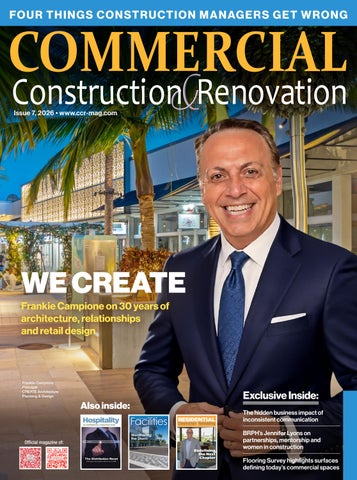
WE CREATE
Frankie Campione on 30 years of architecture, relationships and retail design
Frankie Campione Principal CREATE Architecture Planning & Design
Also inside:
Official magazine of:
Exclusive Inside: The hidden business impact of inconsistent communication BRPH’s Jennifer Lyons on partnerships, mentorship and women in construction Flooring Survey highlights surfaces defining today’s commercial spaces
CIRCLE NO. 1
Vol. 25, Issue 7, 2026 FEATURES
44
WE CREATE
Frankie Campione on 30 years of architecture, relationships and retail design.
74
Summer Surge
Rethinking Workforce Development
How contractors stay ahead of peak infrastructure demand.
Four things construction managers get wrong about staff training needs.
86
96
Lessons in Resilience
Why commercial construction offers a blueprint for building more wildfire-resistant homes.
2
80
COMMERCIAL CONSTRUCTION & RENOVATION — ISSUE 7, 2026
Reviving the Revival
Heavy-duty commercial drain pump makes bar renovations bolsters Rhode Island brewery.
CIRCLE NO. 2
Vol. 25, Issue 7, 2026
21
107
119
129
INDUSTRY SEGMENTS 60 Flooring
DEPARTMENTS 6 Editor’s Note 12 Industry News 40 ConstructEDU Student Insider 152 Women in Construction 156 CCR Data 158 Ad Index 160 Publisher’s Note
4
SPECIAL SECTIONS IT Corner 21 From Static Spaces to Living Systems How Generative Art, AI and Experiential Design are redefining real estate value. Commercial Facilities 107 Weathering the Storm Designing with hardscapes for resilience.
COMMERCIAL CONSTRUCTION & RENOVATION — ISSUE 7, 2026
Hospitality in Commercial Construction 119 The Distribution Reset What happens when regulation rewrites the rules of visibility. Residental Construction & Remodeling 129 Redefining the Next Chapter Shea Homes’ Jeff McQueen on the future of 55-plus living. 144 Dignity and Safety at Home The power of accessible bathroom design.
CIRCLE NO. 3
EDITOR’S NOTE
by Michael J. Pallerino
Covering All the Bases
T
here was a time when a sponsorship meant putting your logo on a sign. Shaking a few hands. Creating a moment where your brand grabs the sound in today’s noisy promotional landscape. Every move is about connection.
It might be time to say those days are long gone. Today’s consumers expect more. They want experiences. They want authenticity. They want to engage with brands that feel like a natural part of their lives. That’s why partnerships continue to be one of the most powerful tools in retail today.
Take the newly announced collaboration between Uniqlo and the Los Angeles Dodgers. The apparel retailer’s significant presence throughout Dodger Stadium transcends signage. From fan giveaways and dedicated retail displays to community initiatives designed to benefit Los Angeles, the partnership
creates multiple touchpoints that keep consumers connected long after the final out. That’s where the magic happens. The best partnerships don’t think inside the box—or completely outside of it. They do both. They leverage traditional opportunities while creating new ones that surprise people, spark conversations and build lasting relationships. Every interaction becomes another chance to reinforce your brand’s story. For retailers, developers and brands alike, the lesson is that the consumer journey no longer begins when someone walks through the front door. It’s wherever people spend their time. A ballpark. A neighborhood event. A social media feed or community initiative. Successful brands understand that partnerships are no longer simply marketing vehicles, but extensions of the customer experience. As competition for attention grows more intense, the brands that stand out won’t be the ones the biggest advertising budgets. They’ll be the ones willing to collaborate, think creatively and meet consumers where they already are. More often, that means building a bigger one together.
Michael J. Pallerino is the editor of Commercial Construction & Renovation. You can reach him at 678.513.2397 or via email at mikep@ccr-mag.com.
We want to hear from you At Commercial Construction & Renovation, we’re always looking to showcase the best of what our industry is doing. If you have a project profile or a fresh perspective on how to keep our industry positively moving forward, shoot me an email at mikep@ccr-mag.com. We’d love to take a look.
6
COMMERCIAL CONSTRUCTION & RENOVATION — ISSUE 7, 2026
POLISHED CONCRETE FLOORING GRIND & POLISH . COATINGS . COLORIZATION . CEMENTITIOUS OVERLAYS
SOUTH:
WEST COAST:
HEADQUARTERS:
CONTACT:
Rockerz, Inc. 8314 SE 58th Ave. Ocala, FLA 34480
Rockerz, Inc. 12662 N 47th Ave. Glendale, AZ 85304
Rockerz, Inc. 100 Commonwealth Drive Warrendale, PA 15086
Dominika Smith Phone: 724.553.4023 dsmith@rockerzinc.com
ALL INQUIRIES PLEASE CALL:
1-888-935-4950
|
Director of Business Development
Rockerzinc.com CIRCLE NO. 4
F&J PUBLICATIONS, LLC 4505 Palmetto Lane Cumming, GA 30041 678.940.6433
EDITORIAL EDITOR: Michael J. Pallerino 678.513.2397 • mikep@ccr-mag.com CONTRIBUTING WRITER: Jon Armour 832.584.5924 • jarmour@att.net SENIOR ART DIRECTOR/AD PRODUCTION MANAGER: Brent Cashman 404.402.0125 • bocdesign@me.com
ADVERTISING CIRCLE NO. 5
PUBLISHER/EDITOR: David Corson davidc@ccr-mag.com • 678.940.6433 EVENTS DIRECTOR: David Corson davidc@ccr-mag.com • 678.940.6433 MEMBERSHIP DIRECTOR: David Corson marketing@ccr-mag.com • 678.940.6433 LIST RENTAL: Brian Clotworthy bclotworthy@inforefinery.com • 800.529.9020
A Step-By-Step Roadmap To Success
SUBSCRIPTION SERVICES 678.940.6433 corpcirc@ccr-mag.com
One-Stop Digital Agency Our comprehensive digital agency offers a full suite of services to elevate your online presence, from strategy and design to marketing and analytics. Let us be your go-to partner for all your digital needs, ensuring seamless and effective results.
Call us 678.940.6433
Or visit ccr-mag.com/ccr-digital-advantage CIRCLE NO. 6
8
COMMERCIAL CONSTRUCTION & RENOVATION — ISSUE 7, 2026
F&J PUBLICATIONS, LLC Commercial Construction & Renovation is published monthly by F&J Publications, LLC. The opinions expressed by authors and contributors to Commercial Construction & Renovation are not necessarily those of the editors or publisher. Commercial Construction & Renovation is not responsible for unsolicited manuscripts, photographs or artwork. Articles/content appearing in Commercial Construction & Renovation cannot be reproduced in any way without the specific permission of the publisher or editor.
We have always said, if we do a good job the phones will ring.
The phones have changed and after 33 years they are still ringing… Established in 1993, Lakeview Construction, LLC is a national commercial project solution provider specializing in all phases of construction. From concept to completion, our professional teams deliver quality construction and outstanding service, ensuring on-time schedules and cost-effective project management. Headquartered in Pleasant Prairie, Wisconsin, we operate across all 50 states
Specializing in: Retail Tenant Improvements Nationwide New Construction Retrofit Re-image Programs Roll Outs Open Store Remodels Landlord Turn Key Landlord Vanilla Box
For more information contact: John Stallman • 262.857.3336 john@lvconstruction.com
lvconstruction.com CIRCLE NO. 7
CCR EDITORIAL BOARD ACADEMIA DR. MARK LEE LEVINE Professor Burns School/ Daniels College University of Denver
ADA BRAD GASKINS Principal The McIntosh Group
ARCHITECTS/ENGINEERS MICHAEL MAGEE Studio Leader Retail, Store Design Senior Associate Little FRED MARGULIES Director of Retail Architecture Onyx Creative STEVEN MCKAY Managing Principal, Global Design Leader DLR Group STEVEN R. OLSON, AIA President CESO, Inc.
JIM SHEUCHENKO President Property Management Advisors LLC CHRIS VARNEY Managing Partner, BuildRite Consulting & Project Management STEPHEN HEKMAN Executive VP Kingsmen Retail Services US KEN DEMSKE Vice President Jones Lang LaSalle SARA SMITH Senior Consultant The Sigma Group, LLC VAUN PODLOGAR Partner, Vaun.com
EXPERIENTIAL AGENCY MICHELLE M COLLINS President & CXO A\N/A A Non-Agency
GENERAL CONTRACTOR CONSULTANT GINA MARIE ROMEO Chief Heart Officer & Principal Consultant, Allied RDI
DEVELOPMENT/PROJECT MANAGEMENT KAY BARRETT NCIDQ, CDP Senior Vice President Cushman & Wakefield PAM GOODWIN Goodwin Advisors, LLC Goodwin Commercial The Pam Goodwin Show
10
DAVID THOMPSON Vice President TCB Construction Group LLC. MATT SCHIMENTI President Schimenti Construction JOHN STALLMAN Marketing Manager Lakeview Construction JEFFREY D. MAHLER RCA Advisory Board Member JENNIFER SUSSMAN Director National Accounts & Business Development Powerhouse
COMMERCIAL CONSTRUCTION & RENOVATION — ISSUE 7, 2026
HEALTHCARE CLINTON “BROOKS” HERMAN Principal Facilities Project Manager, MD Anderson Cancer Center
HOSPITALITY SAMUEL D. BUCKINGHAM, RS AMS CMCA President of Construction Devco Development GARY RALL Vice President of Design and Development Holiday Inn Club Vacations ROBERT RAUCH Chairman Brick Hospitality
JOE THOMAS Joseph K Thomas Sr. Consulting Senior Consultant Hospitality Engineering LU SACHARSKI Vice President of Operations and Project Management Interserv Hospitality ANDY BRIGGS, CHA Managing Principal A14 Capital Management
INFORMATION TECHNOLOGY CRAIG WEBER Director of Business Prime Retail Services, US Prime 3 Retail Canada, Inc.
REAL ESTATE ROB ADKINS, LEED AP CDP Senior Project Manager Cushman & Wakefield MEGAN HAGGERTY Founder Legacy Capital Investment MARIE ANTONETTE G. WAITE Founder and CEO Finest Women in Real Estate
RESTAURANTS DAVID SHOTWELL Director of Construction & Facilities, BOJ of WNC, LLC DAVID D. DILLON Principal Design Lead, Templates & Standards Chick-fil-A Corporate Support Center
RETAILERS AARON ANCELLO Facilities Asset Management Public Storage DEDRICK KIRKEM Facility Director Fragrance.com
LAURA GROSS Retail Facilities Manager American Signature Furniture KELLY RADFORD Vice President Facility Services CubeSmart
DESIGN EXISTING GLASS TO RESIST FORCED ENTRY DefenseLite®Pro retrofit security glazing
Harden the building envelope without compromising budget or timelines.
With heavy-duty anchoring, passive protection, and clear sightlines, it allows architects to specify security that performs while preserving transparency and daylight.
DefenseLite® Pro delivers a high-performance retrofit solution for glass security in commercial environments. This polycarbonate security glazing system mounts directly over existing glass to help delay forced entry and resist smash-and-grab, riot, and impact events. Designed for real-world threats, DefenseLite® Pro strengthens the building envelope without demolition, downtime, or disruption to occupants.
• DefenseLite® Pro mounts over existing glass • Delays forced entry and impact events • Heavy-duty anchoring for real-world conditions • Maintains transparency and natural daylight • Installs without demolition or operational downtime • Passive protection with no power required • ASTM 3561 Level 8 performance • Ideal for retail, offices, schools, and government
Visit www.defenselite.com or call 888-689-5502. CIRCLE NO. 8
INDUSTRY NEWS
NEWS, NOTES & TRENDS...
AroundtheIndustry HOSPITALITY
Hilton Hilton has surpassed 300 hotels across Latin America and the Caribbean, with more than 150 additional properties in development. Growth spans multiple market segments, including Tru by Hilton in Chile, Hampton by Hilton St. Thomas in the U.S. Virgin Islands, and the Waldorf Astoria Costa Rica Punta Cacique, reinforcing the company’s multibrand expansion strategy across the region.S. Virgin Islands and the Waldorf Astoria Costa Rica Punta Cacique, reinforcing the company’s multibrand expansion strategy across the region. IHG Hotels & Resorts IHG Hotels & Resorts expanded its Americas development pipeline by 65 hotels and nearly 6,000 rooms during the first quarter, reflecting continued owner demand across its Essentials & Suites, Premium and Luxury & Lifestyle brands. The company also opened 24 hotels during the quarter, with growth driven by strong business, group and leisure travel and new projects spanning brands such as Holiday Inn, voco, Kimpton, Garner and Six Senses. Wyndham Hotels & Resorts Wyndham Hotels & Resorts partnered with Applebee’s to offer in-room food delivery through the Wyndham app, giving Wyndham Rewards members complimentary delivery on qualifying Applebee’s To Go orders. Available at more than 1,100 Applebee’s locations near Wyndham hotels, the collaboration enhances the guest experience while expanding loyalty rewards and convenience for travelers. Minor Hotels Minor Hotels is expanding its North American footprint with plans to introduce its luxury and wellness brands across the U.S. and Canada. The company expects to open a Wolseley Hotel in New York City in 2027 and an Anantara property in Miami in 2030 while targeting future growth in markets including Boston, Chicago, Los Angeles, Montreal, Toronto and Vancouver. Hilton Garden Inn Hilton is expanding its Hilton Garden Inn brand in Asia-Pacific with new hotels planned for Busan, South Korea and Hyderabad, India, both scheduled to open in 2028. The projects include a 111-room property in a mixed-use development in Busan and a 96-room hotel that will introduce the brand to Hyderabad, supporting Hilton’s continued growth in key international markets. Dolce by Wyndham Dolce by Wyndham is expanding its United States footprint with three new hotels in Miami Beach, Florida; Palm Springs, California; and Tarrytown, New York. Each property is designed to reflect its local destination through distinctive design and curated guest experiences. The openings reinforce the brand’s strategy of growing in high-demand leisure and business markets with experience-driven hospitality.
12
COMMERCIAL CONSTRUCTION & RENOVATION — ISSUE 7, 2026
Hyatt Hotels Hyatt Hotels is expanding its all-inclusive resort portfolio across the Caribbean and Latin America with new properties in Aruba, Saint Lucia and Cancun, Mexico and additional growth planned in Costa Rica and El Salvador. The company is emphasizing upscale, experience-driven stays aimed at younger travelers, with its Inclusive Collection now totaling about 155 resorts and 58,000 rooms across the region. Hard Rock Casino Rockford Hard Rock Casino Rockford is planning a $90 million hotel and convention center expansion designed to strengthen its position in the regional gaming and hospitality market. The project includes a 200-room hotel, spa, fitness center and a 15,000-square-foot convention center, creating a more comprehensive destination for leisure and business travelers. The investment reflects growing competition among Midwest gaming resorts to attract overnight guests and meetings business. Ras Al Khaimah Ras Al Khaimah plans to double its hotel room inventory to 20,000 by 2030 as it accelerates luxury hospitality development. Major projects from Wynn Resorts, Four Seasons and Nobu are driving the expansion, with the Wynn Al Marjan Island resort—home to the United Arab Emirates’ first licensed gaming venue—serving as a centerpiece of the emirate’s long-term tourism strategy. Loews Hotels & Co. A new 500-room Loews hotel is planned adjacent to the David L. Lawrence Convention Center in downtown Pittsburgh, adding a second connected hotel to support the city’s meetings and convention business. The project includes a $135 million investment from Loews Hotels & Co. and is expected to generate 1,200 union construction jobs, 400 permanent jobs and more than $418 million in total economic investment. Viceroy Hotels & Resorts Viceroy Hotels & Resorts unveiled a refreshed brand identity under Highgate ownership, emphasizing destination-driven design and locally inspired guest experiences. The company also expanded its portfolio with three safari lodges in Botswana and Zambia and plans to open The Observatory Sun Valley in Idaho later this year, followed by additional properties in Mexico and New York.
RESTAURANTS
Dunkin’ Dunkin’ is returning to Canada through a master franchise agreement with Montreal-based Foodtastic, with plans to rapidly expand across the country. The rollout will begin in Quebec and Ontario before extending to the Maritimes and the West Coast, with a goal of opening about 50 cafés annually while introducing a modernized menu aimed at younger consumers.
Ford’s Garage Ford’s Garage is expanding into Delaware through a new development agreement that will bring three restaurants to the state. The automotive-themed restaurant brand, inspired by The Ford Motor Co., currently operates 34 locations across eight states and continues to grow its footprint with its signature burgers, desserts and vintage garage-inspired design. Penn Station Sandwiches Penn Station East Coast Subs has rebranded as Penn Station Sandwiches to reflect a broader menu and changing customer preferences. The Cincinnati-based chain added multigrain sandwiches, wraps, bowls and kids’ meals while expanding digital ordering and delivery as off-premises dining now accounts for 80% of sales. El Pollo Loco El Pollo Loco is accelerating its expansion with plans to open up to 20 new restaurants this year as it gains momentum in emerging markets including New Mexico and Washington. Strong performance from new locations and continued menu innovation are fueling the brand’s growth beyond its traditional California footprint. The strategy reflects El Pollo Loco’s focus on geographic expansion while driving sales through product development. Olive Garden Olive Garden is entering the Indian market through Gourmet Investments Hospitality Group, which plans to open at least 10 restaurants by 2029. The expansion is part of a broader strategy to launch about 100 new restaurant locations over the next three years, with menus tailored to local tastes and a greater emphasis on vegetarian offerings. Cava Cava is accelerating its national expansion with plans to open up to 77 new restaurants this year, focusing on growth across the Midwest. The fast-casual chain’s value-oriented pricing strategy and customizable Mediterranean menu continue to drive customer traffic and sales as it works toward a goal of more than 1,000 locations by 2032. Gen Korean BBQ Gen Korean BBQ is expanding beyond its restaurants with an aggressive retail growth strategy, targeting placement in more than 2,000 stores this year and up to 8,000 locations nationwide by the end of 2027. The company is partnering with retailers including Costco, BevMo and Albertsons as it grows its lineup of shelf-stable products alongside its 59 U.S. restaurant locations. Pizza Hut Pizza Hut is embracing nostalgia by preserving nearly 155 of its classic Red Roof restaurants, complete with red cups, checkered
tablecloths and arcade games. The retro-inspired locations are designed to appeal to both longtime customers and younger diners seeking nostalgic, experience-driven destinations while generating renewed interest across social media. Whataburger Whataburger unveiled two new restaurant prototypes, including a modern take on its iconic A-frame design and a smaller format for sites with limited real estate. Both concepts feature flexible seating, dedicated pickup areas for mobile and delivery orders and construction efficiencies that support faster, more cost-effective expansion into new and existing markets. Yemeni Coffeehouses Yemeni coffeehouse chains are rapidly expanding across the U.S., with major brands increasing their footprint by 50% in 2025 to 136 locations nationwide. Once concentrated in communities with large Arab American populations, the cafés are now growing into suburban and new regional markets, introducing traditional Yemeni beverages alongside contemporary coffee offerings to a broader customer base.
RETAIL
Best Buy Best Buy expanded its renewable energy strategy with new solar installations at a New York retail store and a California distribution center. The projects are expected to generate enough electricity to power more than 600 homes annually and support the retailer’s broader goal of achieving carbon neutrality while reducing energy costs across its operations. Colbo Colbo is expanding its experiential retail model by combining fashion, hospitality and community programming as it grows beyond its New York flagship. Following the launch of its first womenswear collection and a shop-in-shop in Japan, the brand plans to bring its retail, café, event and hospitality concept to additional domestic and international markets tailored to local communities. Ulta Beauty Ulta Beauty will open its first flagship store in New York City’s Times Square in late 2027, introducing a 27,000-square-foot, four-level retail destination designed to elevate brand storytelling and immersive shopping. The flagship reflects the retailer’s strategy to strengthen its position in the competitive beauty market through experiential retail, premium product showcases and high-profile marketing. Moorer Moorer is expanding its U.S. retail footprint with a new flagship in New York City’s Meatpacking District and a second flagship planned for Miami’s Bal Harbour this September. The luxury apparel brand expects the (Continued on next page)
ISSUE 7, 2026 — COMMERCIAL CONSTRUCTION & RENOVATION
13
INDUSTRY NEWS
NEWS, NOTES & TRENDS...
AroundtheIndustry United States to become one of its largest markets as it builds on strong wholesale growth and increases direct engagement with customers.
cational resources that reinforce the grocer’s focus on fresh and organic products.
Midas Midas has introduced two new store design concepts as part of a modernization strategy across its more than 1,200 locations in the U.S. and Canada. The updated formats feature contemporary interiors, expanded customer waiting areas and flexible layouts tailored for suburban and urban markets while creating a more consistent brand experience for future new builds and renovations.
The Market The Market of Point Pleasant Beach officially restored a full-service grocery store to the New Jersey shore community after years without one. The independently owned, 18,000-square-foot supermarket occupies a former Stop & Shop location and offers fresh foods, prepared meals and everyday essentials, marking the fifth store operated by Shap Markets.
Bath & Body Works Bath & Body Works has entered the Brazilian market with its first store in São Paulo and the launch of a localized e-commerce platform. The retailer plans additional stores as it expands through its franchise model, building on a portfolio of more than 550 international locations across 45 countries while tailoring products to regional fragrance preferences.
Albertsons Albertsons is restructuring its operations with a new regional model that consolidates its 11 divisions into four regions while centralizing center store merchandising. The move is designed to simplify operations, improve consistency across banners and create a more efficient merchandising strategy as the grocer positions itself for long-term growth.
Costco Costco has opened its first standalone gas station in Mission Viejo, California, marking the retailer’s entry into fuel-only locations. The members-only facility features 40 fueling positions. A second standalone station is already in development as Costco expands its fuel network.
GROCERS
Kroger Kroger has launched a new wine shop concept in 14 stores across its Cincinnati/Dayton division, featuring more than 130 curated wines and in-store tasting bars staffed by trained wine stewards. The concept is designed to meet growing demand for premium wines at accessible price points and could expand to additional markets based on customer response. Aldi Aldi has expanded into New York City’s Midtown neighborhood with a new 25,000-square-foot store near Times Square, marking another milestone in its aggressive U.S. growth strategy. The location features the grocer’s signature private-label assortment, fresh groceries and Aldi Finds while bringing its smaller-footprint, value-driven shopping experience to one of the world’s busiest retail districts as the company works toward opening more than 180 new stores this year. Fresh Thyme Market Fresh Thyme Market is testing a reimagined store format designed to make healthy shopping easier and more engaging. Based on customer feedback, the updated concept features enhanced signage, a more prominent natural living department and expanded edu-
14
COMMERCIAL CONSTRUCTION & RENOVATION — ISSUE 7, 2026
Vallarta Supermarkets Vallarta Supermarkets will open its first Phoenix location in early 2027, converting a vacant building into a full-service grocery store featuring specialty Latino products, fresh produce and prepared foods. The opening marks the company’s entry into the Phoenix market and is part of a broader plan to add 10 to 15 stores across Arizona over the next decade. Trader Joe’s Trader Joe’s plans to open five new stores in the coming months, including three in California and new locations in Illinois and Maryland. The expansion builds on recent openings in Florida, Louisiana and Georgia and further strengthens the grocer’s footprint, which now exceeds 650 stores across 43 states and Washington, D.C. Wegmans Food Markets Wegmans Food Markets continues to strengthen customer loyalty by combining immersive in-store merchandising with communityfocused initiatives. From curated product presentations and meal solutions to year-round local outreach and heritage celebrations, the grocer is reinforcing its reputation as a destination that emphasizes both the shopping experience and community engagement. The Giant Co. The Giant Co. is enhancing its store network with three major renovations, four new store openings and one grand reopening. The upgrades focus on fresh departments, center store aisles and wine and beer sections as the grocer continues investing in a more engaging shopping experience. Renovations are expected to be completed by the end of the year.
NEW STORES REBRANDS REMODELS Clean execution. Clear accountability. Consistent brand presence across every market.
Permitting and Planning
Quality Fabrication
Nationwide Installation
We handle the details so you can focus on the growth
National Sign Programs designed and tailored to your brand info@nationalsignteam.com
www.nationalsignteam.com
CIRCLE NO. 9
INDUSTRY NEWS
NEWS, NOTES & TRENDS...
First Choice M
McDonald's maps out its next phase of global growth
Striking a Chord Guitar Center turns stores into destinations for musicians
G
uitar Center is proving that its comeback isn't just about improving sales—it's about reconnecting with the customers who built the brand. After emerging from bankruptcy, the retailer has posted nine consecutive quarters of growth by returning its focus to serious musicians and transforming stores into places where customers can play, learn and connect rather than simply shop. That transformation starts inside the stores. Instruments are no longer tucked away behind locked displays, and new experiences such as Beat Lab demonstrations, artist masterclasses, workshops and talent competitions encourage customers to spend more time exploring the space. Guitar Center has also embraced artificial intelligence to personalize product recommendations, improve associate training and streamline lesson scheduling while keeping knowledgeable employees at the center of the experience. The results are beginning to show. Store traffic is climbing for the first time in more than a decade, customer engagement continues to rise and the retailer is expanding its experiential approach with new products and community-driven programming.
16
cDonald’s isn't waiting for the competition to catch up. Instead, the fastfood giant is looking ahead with McDonald’s > NEXT, a new global strategy designed to strengthen its position through restaurant redesigns, better food and beverages, customer-led innovation and enhanced service. The initiative comes as the brand faces growing pressure from both established rivals and a new generation of fast-growing restaurant concepts. Beyond refreshed dining rooms, McDonald's is investing heavily behind the scenes. The company is improving kitch-
en operations, expanding popular menu platforms like McCrispy chicken and testing automated order-taking technology that allows employees to spend more time serving customers. The strategy also places greater emphasis on listening to consumers and using their preferences to guide future menu development and brand experiences. The message is clear: convenience alone is no longer enough. By combining operational efficiency with stronger hospitality and product innovation, McDonald's is positioning itself for long-term growth in an increasingly competitive marketplace.
They said it... “I believe in putting real ownership in the hands of operators who live the business every day. That’s how you build loyalty, stability, and long-term generational success.” — Tom Kazbour, Hungry Howie’s franchisee on how to successfully build a franchise business for success.
“Our new-deal growth reflects the strength across our entire brand portfolio and the confidence owners have in IHG. Pipeline additions were up more than 30% year-over-year in the first quarter, driven by continued demand for conversion opportunities and growth across key segments including Suites and the Holiday Inn brand family.” — Mark Sergot, Chief Development Officer, Americas, IHG Hotels & Resorts, on the hoteliers continued momentum in the Americas region
“Our continued commitment to opening new stores is really about showing up for our guests and our communities... These new stores give our teams the tools and environments to bring our merchandising strengths to life, create easier and more inspiring shopping experiences, and use technology to move smarter and faster every day.” — Adrienne Costanzo, Chief Stores Officer, Target on the driving force behind its $5 billion capital investment plan for 2026
COMMERCIAL CONSTRUCTION & RENOVATION — ISSUE 7, 2026
CIRCLE NO. 10
INDUSTRY NEWS
NEWS, NOTES & TRENDS...
The Numbers Game
Room to Grow Applebee's and Wyndham bring restaurant delivery to hotel guests
T
ravelers no longer have to leave the hotel—or settle for limited dining options—to enjoy a familiar meal. Applebee's Neighborhood Grill + Bar and Wyndham Hotels & Resorts have teamed up to deliver Applebee's To Go orders directly to hotel rooms through the Wyndham mobile app, combining convenience with loyalty rewards in a single digital experience. The partnership allows Wyndham Rewards members to earn points on qualifying Applebee's orders while giving travelers seamless access to food delivered straight to their room. With more than 1,100 Applebee's restaurants located within five miles of a Wyndham property, the collaboration significantly expands dining choices for guests traveling for business or leisure. The agreement also reflects a broader shift across hospitality as hotels look to enhance the guest experience through strategic partnerships and digital convenience. As expectations for flexibility and on-demand service continue to rise, collaborations like this are helping redefine what hotel dining can look like while creating added value for both brands.
2026 Annual General Contracting
100
The percent who say cash flow influences whether they pursue a job, making it a universal factor in go/no-go decisions across the industry, according to Mobilization Funding’s “2026 Construction Growth and Cash Flow Report.”
94
The percent who say those delays stem from process inefficiencies—waiting on approvals, test results and repeat clearances—rather than safety regulations themselves, reinforcing where the real friction exists, according to TEAM’s “2026 Contractor Compliance Bottleneck Report.”
BrandPoint Services Josh Fickert, Senior Director Business Development 820 Adams Ave., Suite 130 Trooper, PA 19403 (774) 510-2652 jfickert@brandpointservices.com www.brandpointservices.com Year established: 2003, Number of employees: 200 Total Billings from Jan 1st - Dec 31st, 2025: $100,000,000 Retail: $65,000,000, Hospitality: $25,000,000, Retsaurants: N/A, Healthcare: N/A, Multi-Family: N/A, Federal: N/A, Other: N/A, Number of completed commercial projects from Jan 1st -Dec 31st, 2025: N/A Specialize In: Healthcare, Restaurant, Retail, Shopping Malls, Other: Storage
18
COMMERCIAL CONSTRUCTION & RENOVATION — ISSUE 7, 2026
44
The percent of construction injuries involving first-year employees, highlighting the heightened risk among new workers and the need for stronger onboarding and training practices, according to Travelers’ “2025 Injury Impact Report.”
WE ARE JONES. Full‐service signage. Custom architectural features. 116 years of experience behind every build.
JONES1910.COM
CIRCLE NO. 11
CIRCLE NO. 12
CORNER From Static Spaces to Living Systems How Generative Art, AI and Experiential Design are redefining real estate value
IT CORNER
From Static Spaces to Living Systems How Generative Art, AI and Experiential Design are redefining real estate value By Michelle M. Collins
F
or decades, the built environment has been defined by permanence—steel, glass, and concrete shaped into fixed expressions of design intent. Value has traditionally been driven by location, architecture and tenant mix. Today, a new layer is emerging—one that is less tangible, but increasingly influential: adaptive, intelligent experience. Across cultural institutions, technology platforms, and early-stage real estate applications, a shift is underway. Buildings are no longer conceived solely as static assets. They are beginning to function as responsive systems—capable of sensing, adapting and evolving over time.
From Installation to Infrastructure The roots of this shift can be traced to the art world. Artists such as Refik Anadol have transformed how audiences understand the role of digital media in physical space. His large-scale data-driven works—presented at institutions like the Museum of Modern Art and the Los Angeles County Museum of Art—use machine learning to create continuously evolving visual environments. These works do not “repeat.” They behave more like systems than objects. A similar philosophy is emerging among a new generation of generative
22
artists working at the intersection of data, environment and human interaction. Rather than producing singular outputs, they design frameworks that continuously generate variation—systems that respond to presence, input and context. “I design systems rather than fixed images.” — Ronen Tanchum As Ronen Tanchum describes his own practice: “I design systems rather than fixed images. The artwork evolves through algorithms that continuously generate new visual states. AI enables us to turn human presence into a dynamic system. The algorithm continuously responds to movement and behavior, generating environments that evolve in real time. Over time, this creates a recognizable imprint. The space begins to reflect the people within it, shifting the experience from passive viewing to a sense of ownership, value and belonging.” This distinction is subtle, but profound. Art, in this context, is no longer something placed within a space. It is something that behaves within it.
COMMERCIAL CONSTRUCTION & RENOVATION — ISSUE 7, 2026
The Emergence of Experiential Systems
As these practices move beyond museums and into the built environment, a new interdisciplinary field is taking shape— one that blends: > Generative art > Artificial intelligence > Spatial design > Experiential strategy Creative technologists and experiential designers are translating these artistic systems into functional applications within real estate—where environments can respond dynamically to data, occupancy and human interaction. This evolution marks a shift from designed space to designed behavior. In recent large-scale installations, generative systems have demonstrated how environments can respond to realtime inputs—transforming data such as weather, movement or sound into immersive spatial experiences. In one such example, human movement directly influences a digital atmosphere, where “each gesture” alters the surrounding environment, effectively turning space into a responsive ecosystem.
Why This Matters for Owners and Developers
While the cultural implications are compelling, the commercial implications are becoming increasingly relevant. Differentiation That Evolves Over Time Adaptive environments introduce variability—spaces that change continuously rather than remaining fixed. This creates a sustained sense of novelty that traditional design alone cannot achieve.
1
Measurable Impact on Engagement Immersive and responsive environments across retail and hospitality sectors increase dwell time and interaction—key drivers of commercial performance. Generative systems extend this by ensuring that environments remain continuously engaging, rather than becoming familiar.
2
ISSUE 7, 2026 — COMMERCIAL CONSTRUCTION & RENOVATION
23
IT CORNER
BUILDING SMARTER
Emerging Revenue Opportunities
Programmability and Lifecycle Efficiency Unlike physical renovations, generative systems can evolve through software. Visual environments, interaction models and experiential layers can be updated without reconstruction. This introduces a new form of longterm adaptability. Spaces that remain current without being rebuilt. This has significant impact and relevancy for commercial tenants and brand storytelling, personalization and engagement.
3
Dynamic environments create opportunities for: > Branded experiences > Programmable activations > New forms of digital-physical engagement Over time, this suggests a shift where experience becomes not only an amenity— but a potential value driver. Imagine a space which is programmed to the art, color, lighting and nature elements which align with the resident, tenant. Digital wallpapers, generative artscapes and uniquely branded, responsive environments.
Applications Across Asset Classes
The integration of generative systems is beginning to emerge across sectors: > Cultural Institutions. Museums continue to lead, using generative environments to create immersive exhibitions that encourage repeat visitation and deeper engagement. > Hospitality. Hotels are experimenting with adaptive environments that shift in tone throughout the day—aligning with guest behavior and circadian rhythms. > Retail and Mixed-Use. Developments are exploring responsive environments that adapt to audience patterns, enhancing both engagement and commercial activity. > Residential. In high-end residential settings, digital environments are introducing new forms of personalization—allowing occupants to influence the atmosphere of their surroundings in real time.
A Convergence of Disciplines
Delivering these systems requires collaboration across fields that have historically operated independently: > Artists and creative technologists > Architects and designers > Software engineers and data specialists > Developers and asset managers This convergence reflects a broader shift in how environments are conceived— not simply as physical structures, but as integrated systems of design, technology and human experience.
A New Definition of Value
The integration of generative art, AI and experiential design does not replace traditional real estate fundamentals—it expands them.
Immersive and responsive environments across retail and hospitality sectors increase dwell time and interaction—key drivers of commercial performance. Implementation: From Concept to Asset Strategy
For developers and investors, the path forward is becoming clearer: > Integration with Data Systems. The most effective generative environments are connected to real-time inputs— occupancy, environmental conditions and behavioral data. > Content as an Ongoing Layer. These systems require continuous evolution rather than one-time installation, introducing a new operational model centered on iteration and refinement.
Evolving Cost Structures
While initial implementation may require specialized investment, long-term efficiencies emerge through reduced need for physical redesign and extended asset relevance.
Buildings will always be defined by their physical form. But increasingly, they will also be defined by their capacity to evolve. Generative systems create a single system which can personalize, customize and deliver unique multiplicity redefined by the people and experiences they desire and, ultimately redefine how value is perceived within the built environment. What began in museums and experimental installations is now informing how we think about space at scale. As generative technologies mature, the distinction between digital and physical environments will continue to blur. The most compelling spaces will not be those that are fixed in time, but those that remain responsive, adaptive and alive. In this emerging model, buildings are no longer static assets. They are living systems—capable of evolving alongside the people who inhabit them.
Michelle Collins is founder and CEO of A Non-Agency®, a consumer experience marketing design consultancy based in New York.
24
COMMERCIAL CONSTRUCTION & RENOVATION — ISSUE 7, 2026
CONNECT, INNOVATE & ILLUMINATE
Are You Looking To Expand Your Reach In The Canadian Markets ?
18 - 19
NOVEMBER, 2026 International Centre Toronto, Canada
KEY EXHIBIT PROFILES Architectural Lighting Landscape Lighting Smart Lighting Energy Efficient | Sustainable Lighting Human Centric Lighting High End Decorative Lighting Horticulture Lighting Healthcare Lighting Connection Section Sponsor
Silver Sponsors
Official Agency Partners
Official Media Partner
Knowledge Partner
Workshop Sponsor
Association Partners
www.canadalightexpo.com
Organiser CIRCLE NO. 13
INDUSTRY NEWS
IN MEMORY OF...
A Remarkable Life Salli “Sal” van Gelder, 1938 – 2026
A
s a Jewish child in the Netherlands, he survived the Holocaust. He later crossed the Atlantic with only a trunk and built a family and a business from the ground up. Much of his later life was devoted to serving others. Those who knew him best will
remember more than his accomplishments. They will remember the unmistakable way he lived. Sal was direct and demanding, yet generous and mischievous. He was always convinced that people and circumstances could become better. Sal passed away peacefully at home at 7:10 a.m. on July 10, 2026. He was 87 years old. His devoted wife, Mariette, and his caregivers were by his side. Sal was born on October 8, 1938, in Hengelo, the Netherlands. His parents were David and Mietje "Miep" van Gelder. His family's Jewish roots in the eastern Netherlands extended across generations. During World War II, Sal survived the Holocaust by hiding with a Christian farming family in Enter. The Holocaust took his grandparents and two aunts. It also took a young cousin and many other members of his extended family. After the war, Sal was reunited with his parents and returned to Hengelo. He had survived, but the world he returned to had changed forever.
A childhood remembered
What Sal endured did not weaken his Jewish faith. It deepened it. He had survived a time when his religion and identity placed his life in danger. For the rest of his life, he remained proud of his Jewish heritage and steadfast in his faith. His support for Israel was intensely personal. He was equally committed to Holocaust remembrance and Jewish organizations. He also worked to preserve Jewish life. Sal’s childhood experience later inspired “When the Soldiers Were Gone” by Vera W. Propp. The book offers a fictionalized account of a Jewish child who emerges
26
COMMERCIAL CONSTRUCTION & RENOVATION — ISSUE 7, 2026
from hiding after the war and returns to parents he can barely remember. Sal believed the story should be shared with young people. He personally approached schools about making Vera’s work available to students. He wanted children to understand what happened and why it must never be forgotten. In 2026, Sal’s name and story were formally entered into the Benjamin and Vladka Meed Registry of Holocaust Survivors at the United States Holocaust Memorial Museum. This ensured that his experience would remain part of the historical record. After textile school, Sal served in the Dutch Army. He left Europe in the 1960s and crossed the Atlantic by ship. He carried only a trunk and the determination to build a new life. He settled in Montreal, Canada, and began his career at Simpsons Department Store. Sal had a natural ability to connect with people and understand what they needed. He also knew how to earn their trust. Those abilities marked the beginning of his lifelong passion for sales. Montreal gave him something even more important. It was where he met Mariette. She became the love of his life and remained beside him through everything that followed.
van Gelder Family Home + Deli, Hengelo, The Netherlands
Sal lived a life that would have been remarkable by any measure.
Building a family legacy
Sal and Mariette moved to Scotia, New York, in the early 1970s. Sal worked as a salesman for a flooring company based in New York City. There he gained the knowledge and relationships that gave him the confidence to go into business for himself. In April 1978, Sal opened his own flooring distributorship with Mariette’s help. The business became Charles van Gelder Distributors & Importers. It ultimately became van Gelder, Inc. Sal and Mariette were pioneers in bringing European specialty flooring products and concepts to the American market. They began with limited resources and enormous determination. They worked hard and persisted through every challenge. One conversation and one relationship at a time, they grew the distributorship into a successful family legacy. Sal loved building the company, but the business was never only about flooring or sales. For him, it was about people. He
Sal at his desk during the early years of Charles van Gelder Distributors & Importers.
ISSUE 7, 2026 — COMMERCIAL CONSTRUCTION & RENOVATION
27
INDUSTRY NEWS
IN MEMORY OF...
never met a stranger. He could begin a conversation with a customer or supplier just as easily as with an employee or neighbor. Even someone standing beside him in line at a store might soon find Sal taking a genuine interest in his life. Sal would not have wanted an obituary that made him sound perfect. Those who knew him best would not pretend that he was. How people experienced Sal often depended on how well they knew him. He was direct and opinionated. He was demanding and not always easy. He could also be stubborn or impatient. At times, his delivery was misunderstood. Sal asked questions constantly and was rarely satisfied with an answer that did not make sense to him. But those who knew him well understood something deeper: Sal had a heart of gold. He pushed people because he believed they were capable of more. His questions and corrections were not always easy to receive. Neither was his insistence on constant improvement. Yet he did not intend to be hurtful. Sal wanted people to learn and think for themselves. He wanted them to become more capable than they had been before.
Direct. Generous. Mischievous.
His love did not always come through soft words. More often, it came through advice and high expectations. He refused to let the people he cared about settle for less than their best. Sal might be the first person to challenge you. He was also often the first to help when you truly needed him. Sal also had a sharp and mischievous sense of humor. His jokes were often dry and subtle. He could deliver them so straight that people who did not know him might miss them entirely. Those closest to him usually understood from the look in his eye. On one occasion, he quietly placed a Southwest Airlines luggage tag on a Delta flight attendant’s bag. Then he waited for the confusion. It was pure Sal. The joke was understated and mischievous. It became even funnier once everyone realized what he had done. Even after stepping away from the company’s day-to-day operations in 2013, Sal never stopped paying attention. As Chairman of the Board, he continued to ask
28
Sal in the company showroom, surrounded by the flooring products he helped bring to market.
“The business was never only about flooring or sales. For him, it was about people.” questions and offer guidance. During the final weeks of his life, he was still asking when the company’s new tile manufacturing line would be ready. He took great pride in watching the next generation lead the company forward. He also continued to remind them when he believed something could be done better.
in his home patrol unit. He also worked with a rover unit and in parking enforcement. Sal attended meetings and helped organize volunteers. He maintained membership information and patrolled his community. He took every responsibility seriously. To Sal, it was another way to remain useful and help protect the community around him.
Success created an obligation to give back.
While living in the Albany, New York area, Sal was active in the Knights of Pythias. The organization promotes friendship and charity. It also emphasizes benevolence. Sal delivered meals through Meals on Wheels. Throughout his life, he supported Jewish and community organizations along with many other charitable causes. When Sal and Mariette retired to Boynton Beach, Florida, he did not become inactive. Retirement simply gave him more time to serve others. For more than 15 years, Sal volunteered with the Palm Beach County Sheriff’s Office Citizens on Patrol program. He served
COMMERCIAL CONSTRUCTION & RENOVATION — ISSUE 7, 2026
A life of service
Sal was also deeply involved with Jewish War Veterans Post 819 and served as its Vice Commander. For more than 15 years, he visited sick veterans in hospitals. He raised money through annual remembrance poppy drives and Veterans Day campaigns. He often sold poppies outside his local Publix and throughout his neighborhood. Sal also served on the board of his community’s men’s club. Service was not simply something Sal did. It was part of how he understood a worthwhile life. Outside of business and community service, Sal enjoyed many things. He played racquetball and loved to fish. He traveled the world and appreciated beautiful cars. From time to time, he also tried his luck at a casino. Sal enjoyed sailing as well, but he was the first to admit that he was not especially good at it. Sal had a well-known sweet tooth. His favorite was 70 percent dark chocolate. He also loved eating apples. Sal also loved to read and did so at all hours. He slept very little, which gave him plenty of time with a book. He was always interested in learning something new. Soccer held a particularly important place in his life. Sal taught Natacha and David how to play the game. He later volunteered as a youth soccer coach and coached both of their teams. Sal shared his knowledge and enthusiasm with many young players. He also created family memories that have lasted a lifetime. He was proud of his children and took enormous pleasure in watching his granddaughters grow. As an Opa, he brought curiosity and humor into their lives. He also brought strong opinions and a genuine interest in everything they did. When the family chose Sal’s final outfit, they found several treasures in the pockets of his suit. Each one seemed to capture him perfectly. Sal was notorious for keeping loose change and small bills in his pockets. Sure enough, they found approximately $36. They also found a handwritten birthday card from one of his granddaughters. He had kept it. Fittingly, there was also a pen in his pocket. Sal was a salesman through and through. He was always ready to write down the next order.
Sal and Mariette van Gelder, 2013.
The small discoveries were unmistakably Sal. There was a little cash and a card from someone he loved - and there was also a pen ready for business. Near the end of his life, the family would joke with Sal about whether he was finally satisfied. The question was not a small one for him. In the end, he said that he was. For those who loved him, those words meant everything. He had survived what no child should have endured. He had crossed an ocean carrying only a trunk. He had built a marriage and a family. He had built a business and a life of service. Along the way, he taught and challenged. He encouraged and argued. He laughed and traveled. He coached, worked, and gave. Sal is survived by his wife Mariette van Gelder. He is also survived by his daughter Natacha van Gelder and his son David van Gelder. David’s wife Laurie van Gelder also survives him. Sal leaves his cherished granddaughters MacKenzie and Kiersten van Gelder, as well as his brother Arthur Keijzer and Arthur’s wife, Rosi Ruiz Bautista. His extended family lives throughout Canada and France. Other relatives live in the Netherlands and Spain, as well as across the United States. He was predeceased by his brother Alex van Gelder and his parents David
and Mietje “Miep” van Gelder. He was also predeceased by the many members of his family who were lost during the Holocaust. The family extends its deepest gratitude to Sal’s caregivers. They gave him exceptional love and friendship. They also provided devoted care. Their compassion brought comfort and dignity to the final chapter of his life. It also brought him joy. They became an extension of the van Gelder family. Their kindness and unwavering support will never be forgotten. The family also thanks the friends and neighbors who enriched Sal’s life over the years. The same gratitude extends to his employees and business partners. We also thank the many other loved ones who shared their lives with him. Your friendship and loyalty meant more to Sal than you may ever have known. Sal was not always the easiest man. He was an unforgettable one. He lived with determination and loved in his own unmistakable way. He left the people and places around him stronger than he found them. Though he is no longer with us, much of Sal remains. His laughter and practical jokes remain. So do his questions and opinions. His generosity and faith will continue to live through all who knew him. So will his wisdom and love.
ISSUE 7, 2026 — COMMERCIAL CONSTRUCTION & RENOVATION
29
INDUSTRY NEWS
EVENTS
The Streets in Chicago RCA’s Chicago Retail Walk explores trends shaping the Loop and River North
R
CA members took to the streets of Chicago for a firsthand look at the opportunities and challenges shaping retail and commercial development across the Loop and River North. Hosted by Gallant and Kirsch Agency, the July 30 Retail Walk brought attendees together to explore the Michigan Avenue and State Street corridors to discuss the real estate, leasing and construction trends influencing one of the country’s most dynamic urban markets. The afternoon wrapped up at O’Briens Riverwalk Café, where attendees continued the conversation, exchanged ideas and connected with fellow industry professionals along the Chicago River. For more information, visit www.retailcontractors.org.
Hosted by: Sponsored by:
30
COMMERCIAL CONSTRUCTION & RENOVATION — ISSUE 7, 2026
1
2
3
4
5
6
1. 2. 3.
Jeff Sabaj, Trileaf Corporation; Eric Handley, W.A. Randolph; Julia Jules, Window Film Depot Tristan Lesheim, Rectenwald Brothers Construction; Carole Sanderson, Onyx Creative; Ryan Saeger, Alex Cornell; Matthew Foulks, Downstream Janine Buettner, ArcVision; Kim Miller, Gallant; Sara McCallion, Boston Retail Solutions
4. 5. 6.
Jeff Mahler, Onyx Creative; Liliana Silva and Jen Hurst, DW1; Bard Fulton, Fortney & Weygandt Greg Healy, GPRS; Jeff Hardwood, Gallant Drew Martin and Reed Evans, DW1; Matteo Chiti, Kirsch Agency; Cameron Carport with DW1
ISSUE 7, 2026 — COMMERCIAL CONSTRUCTION & RENOVATION
31
INDUSTRY NEWS
BUILDING BETTER COMPANIES
Adapting Before You Have To What McKinsey’s cuts should tell every commercial construction leader
By Jane Gentry
T
he news came out quietly, the way these things usually do. McKinsey is cutting 3,000 to 4,000 positions in 2026—roughly 10% of its global workforce, the largest reduction since 2008. Bain, BCG and Deloitte are doing variations of the same thing. Slower hiring. Headcount reductions. A pulling back that the firms themselves describe, carefully, as a response to AI productivity gains. Read that again. The world’s most prestigious advisory firms are cutting people because AI is doing the work those people used to do. That is not a technology story. That is an operating model story. And if you lead a commercial construction firm, it is your story too — whether you see it yet or not.
The Work That Was Cut
McKinsey didn’t eliminate partners. They eliminated the analytical layer underneath them—the associates and analysts who spent weeks synthesizing research, building models, producing deliverables that clients paid for at premium rates. That work turned out to be compressible. Not because the people weren’t capable. Because the work itself—pattern recognition, document synthesis, comparative analysis, structured reporting—is exactly what artificial intelligence (AI) does well and fast. Now look at your own organization. Who tracks RFIs and summarizes status for the project executive? Who pulls together the weekly schedule report? Who runs the first pass on subcontractor bids? Who writes the owner update? Who coordinates the submittal log across three trades? That work is not the same as McKinsey analyst work. But the underlying structure is identical. Information processing. Pattern recognition. Synthesis and reporting. Work that requires training and intelligence— and that AI is now compressing on a timeline most construction leaders haven’t fully absorbed. This is not a prediction. It is already happening. Firms using AI-assisted estimating
32
are running comparables in hours that used to take days. Document review that required a coordinator’s full afternoon now takes minutes. RFI response drafts that sat in someone’s queue are being generated in real time. The compression is real. The question is whether your operating model is designed for what comes after—or still built for what worked before.
What the Compression Exposes
Here is where most firms get stuck. They see the compression coming, buy a platform, run a pilot, and call it an AI strategy. The tools do what they were built to do. And then not much changes—because the tools were layered on top of an operating model that was never redesigned to use them. The technology is not the problem. The sequence is. An AI strategy matters. You need one. But an AI strategy built on top of a fragmented operating model does not create leverage. It accelerates the existing dysfunction. Faster reporting on a project
COMMERCIAL CONSTRUCTION & RENOVATION — ISSUE 7, 2026
with unclear decision rights is still a project with unclear decision rights. Better data flowing to people without authority to act on it is still a bottleneck—just a better-informed one. McKinsey learned this at scale. They built a business model on billable analytical hours, and then the thing that made those hours billable got automated. What survived was senior judgment—the partners who could walk into a boardroom and tell a CEO something they didn’t already know. The analytical scaffolding underneath that judgment turned out to be the exposure, not the asset. Your firm has the same anatomy. The question is whether you know where your exposure sits.
AI Needs People. Specifically, It Needs Judgment.
There is a version of this conversation that treats AI as a headcount reduction strategy. That framing will cost you. AI does not manage owner relationships. It does not make the call on a subcontractor
Where Your Vision Meets Our Expertise Terrazzo is a handcra ed building material; its primary components are assembled on the construction site. For 100-years, the contractor members of the National Terrazzo and Mosaic Association have brought integrity and skill to countless installations. The NTMA has the expertise your project needs. Find specifications, information, color samples, contractor and supplier members at www.ntma.com or call 800-323-9736.
1271 Avenue of the Americas Architect Pei Cobb Freed & Partners Architects New York, NY
CIRCLE NO. 14
Designer/Artist Rockefeller Group New York, NY
General Contractor Turner Construction New York, NY
Photographer David Laudadio
INDUSTRY NEWS
BUILDING BETTER COMPANIES
who is three days behind and won’t say so. It does not read the room when the GC and the owner’s rep are heading toward a dispute that will cost six weeks if it isn’t defused today. It does not carry the pattern recognition that comes from having delivered 40 projects and knowing what a schedule looks like two weeks before it slips. What AI does is give the people who carry that judgment more room to use it. That distinction — between work AI compresses and judgment AI amplifies — is also the most important lens you can apply to your next hire. The coordinator who executes a checklist is being replaced by technology faster than most firms have planned for. The person worth hiring in 2026 thinks clearly on incomplete information, makes good decisions under pressure and works alongside AI tools without needing someone to manage the process around them.
Consider what the day actually looks like in most firms right now. A project executive is running three jobs simultaneously. The owner on Job A wants a schedule update. The answer requires calls to the super, the MEP sub, and the PM who is on-site at Job B. By the time the information is assembled, two hours are gone and the update is already 24 hours stale. Meanwhile, a submittal on Job C has been sitting for four days waiting for an approval that requires the VP of operations—who didn’t know it was waiting because it was buried in an email chain he wasn’t copied on. That is not a technology problem. That is a decision architecture problem. Who owns the schedule update? What is the trigger for escalation? Where does approval authority actually sit versus where the org chart says it sits? Until those questions have clear answers, AI produces better-formatted versions of the same confusion.
An AI strategy matters. You need one. But an AI strategy built on top of a fragmented operating model does not create leverage. It accelerates the existing dysfunction. Firms still writing 2019 job descriptions are going to find themselves with a 2019 workforce in a market that has already moved.
The Order Matters— And So Does the Design
The AI conversation in commercial construction is happening almost entirely at the tool level. Which platform. Which integration. Which demo looked most impressive at the last industry conference. That conversation is not irrelevant. But it is starting in the middle.
Now redesign that scenario with the operating model fixed first. Decision rights are clear. Escalation triggers are defined. The project executive knows exactly which decisions are hers and which ones require the VP. Information flows to the right person automatically because the system was designed to move it there. In that environment, AI does something genuinely powerful—it compresses the time between information and decision. The owner update that took two hours now takes 20 minutes. The buried submittal surfaces before it becomes a delay. The schedule
variance that used to show up in week three shows up in week one, when there is still time to act. That is what AI-enabled decision architecture looks like in practice. Not faster chaos. Faster clarity. But clarity has to be designed first. AI accelerates whatever operating model you have. Build the right one, and the acceleration compounds. Leave the fragmented one in place, and AI gives you more data on a problem you still can’t resolve quickly enough to matter. The firms that will look back at this period as a structural advantage asked a different question than their competitors. Not which tool to buy. But how work is actually designed inside the business—and what has to change so that AI makes decisions better and faster, not just more documented.
Three Questions Worth Asking This Week
You do not need another platform evaluation before you answer these. Where are your best people spending time on work that AI could compress in the next 18 months—and what would they do with that capacity if it were freed? Where do decisions stall on your projects because the right information isn’t reaching the right person with the authority to act? And where is senior judgment—yours, your VPs’, your project executives’—being spent on problems that should have been resolved two levels below? Those answers will tell you more about your AI readiness than any technology audit. They will also tell you exactly where the operating model work has to happen before the AI investment pays off. McKinsey didn’t see the exposure in their own model until the cuts were already decided. You have the advantage of watching it happen first—and enough time to design around it rather than react to it. That window is not staying open indefinitely. CCR
Jane Gentry is founder of Jane Gentry & Company, a strategic operating model advisory firm working with mid-market CEOs and senior leadership teams in construction, manufacturing, logistics and professional services. She helps leadership teams clarify how work gets designed, how decisions get made and how AI creates leverage instead of accelerating drag. If these questions are live inside your business, a 60-minute diagnostic conversation is a good place to start. Reach her directly at jane@janegentry.com.
34
COMMERCIAL CONSTRUCTION & RENOVATION — ISSUE 7, 2026
HANDLING THE DETAILS
We Offer a Range of Services to Meet All Types of Needs
➜ GLOBAL 3PL LOGISTICS ➜ WAREHOUSING & KITTING ➜ INVENTORY MANAGEMENT & TRACKING ➜ FINAL MILE & WHITE GLOVE
From warehousing and inventory to last-mile installation, logistics are managed with precision and transparency. With decades of cross-industry experience, TTG supports projects of any scale, providing real-time tracking, reporting, and proof of delivery so you stay informed at every step.
MOVE YOUR BUSINESS FORWARD GET A QUOTE
travelsteadgroup.com SUPPORT: CIRCLE NO. 15
INDUSTRY NEWS
VOICES
The Cost of Silence The hidden business impact of inconsistent communication
O
By Kevin Turpin
n a new 500,000-square-foot hospital expansion under construction adjacent to an active campus, crews work on a tight schedule. Any delays feed directly into an opening date tied to patient care commitments and potential late penalties.
On the third floor, at least three languages are spoken across the crews, and a mechanical team has ruptured a water line, sending water draining into the second floor below, where drywall installation is already underway. The foreman, the nearest person with a radio, is on the other side of the project. By the time someone physically tracks him down, and the water is shut off, 15 minutes have passed and two sections of newly installed drywall are saturated, pulling that portion of the second floor off schedule. Radios on the project went to supervisors and key personnel, the same allocation decision general contractors have carried from project to project for the better part of three decades. Most large construction projects run on that same communication architecture today.
The executives managing those projects inherited that decision, and most have never had a practical reason to question it, because the model has persisted the way most jobsite practices do, carried forward by cost, inertia, and the assumption that no visible catastrophe means the current architecture is working.
The Cost of a Communications Gap The absence of a visible catastrophe is not the same as an absence of cost. Workers who cannot self-coordinate are forced to wait, and a crew that cannot reach a supervisor to confirm next steps stops work until someone tracks down an answer. On a single-site project, that can get absorbed into the schedule. Across a portfolio of concurrent projects, it surfaces as a pattern in labor
costs, phase completion timelines, and the margins that ownership groups and lenders track most closely. When site conditions change, workers without direct communication access depend on supervisors to relay hazard information, and that relay introduces exactly the delay and error the situation cannot afford. Workers without radios miss critical updates until someone finds them in person, and on a project where the owner's risk tolerance is compressed by a hard opening date, that gap compounds across every shift. When an incident occurs and the investigation reviews whether workers had timely access to hazard information, the answer on many commercial construction sites is that they did not. Incident response breaks down most visibly when hazard information travels person to person across a site with 300 to 400 workers. Delay and error enter the chain at exactly the moment neither is acceptable and the 15-minute delay in that hospital construction scenario is closer to the norm than the exception on projects running under a traditional radio allocation model.
The Case for Site-Wide Communications Distribution
Purpose-built smart radios, a recent invention, are designed for large, complex jobsite work. They have emerged as a distinct equipment category, differing from consumer devices adapted for construction. These devices are weatherproof, drop-rated, and built without internet access and consumer apps that prompt smartphone bans on construction sites, making them policy-compatible for general contractors
36
COMMERCIAL CONSTRUCTION & RENOVATION — ISSUE 7, 2026
Are you a retailer who has a need to reduce your overall store fixture & installation cost. Genesis Global can assist you with choosing the right manufacturer & the right installer.
Choosing the right partner is key to corp. owned or franchise growth. Take the time to invest in your stores growth and allow us to use our 55 direct years in the Industry to help you.
Contact us today to find out how we can start building growth together!
Terry Lee Eggert • (770) 355-6498 • teggert@genesisglobalinc.us 86 Gaston Westbrook Avenue, Suite #747 • Emerson, GA 30137 CIRCLE NO. 16
INDUSTRY NEWS
VOICES
who have already restricted personal devices for security or productivity reasons. The cost model has also evolved, changing the financial calculation for universal distribution. Subscription-based per-device pricing converts a prohibitive capital purchase into a predictable operating expense that scales with project headcount, enabling every worker to be equipped without a large upfront procurement decision. For executives managing multilingual crews, artificial intelligent (AI)-enabled translation capabilities built into some smart radios change project operations and culture from day one. A Spanish-speaking laborer and an English-speaking foreman exchange information in real time, each in their own language, even in high-noise environments, without requiring a bilingual supervisor to translate, removing a friction point that has traditionally slowed coordination on many sites.
What Changes When Every Worker Has a Radio
Site-wide distribution changes the operational reality of a job site in ways that show up immediately in response times, trade coordination, and the idle time that quietly inflates labor costs across every phase. Hazard alerts reach all workers simultaneously rather than moving through a supervisor relay chain that introduces delay and error at each handoff. Trades coordinate sequencing without waiting on a supervisor to pass the message, compressing phase completion timelines, and multilingual crews share the same situational awareness across the entire site, reducing the miscommunication-driven rework that rarely appears as a line item but consistently affects margins. On large-scale commercial construction projects where every worker is provided a smart radio, the first thing to change is response time, because a supervisor who can be reached directly by any worker responds faster than one who waits for information to travel up a relay chain. Phase handoffs between trades speed up significantly when crews can coordinate
General contractors who have moved to universal distribution consistently describe a version of their projects they did not have access to before.
The Financial Case
Revisiting the earlier hospital construction project, the water was eventually shut off, the drywall was replaced and the project moved on. What didn't change was the radio policy that made the delay inevitable. Ownership groups respond to the total project cost impact across schedule performance, labor efficiency, and incident rates, and safety metrics presented in isolation rarely move the conversation the way a consolidated operational picture does. Fewer incidents reduce workers' compensation costs and cut project delays tied to investigation and regulatory response. Reduced wait time and rework translate directly into labor efficiency gains visible in
For executives managing multilingual crews, AI-enabled translation capabilities built into some smart radios change project operations and culture from day one. without waiting on a supervisor, and the time that accumulates across shifts begins to show up in project data in ways it never did before, creating a baseline that owners and project executives can manage against.
The Conversations Owners Didn't Know They Were Missing
Universal distribution generates operational data that most commercial construction executives have never had access to, because the infrastructure to capture it did not exist when radios covered only supervisors. Crew coordination patterns, which teams went dark and when, and where communication broke down across a project, are now visible in ways they were not under the standard allocation model.
phase completion timelines and total project cost. For executives presenting in competitive bid environments, demonstrated safety and coordination infrastructure differentiates a general contractor in the proposal process. General contractors managing complex, multi-trade, multilingual projects who have moved to a site-wide communication infrastructure track results in their margins, schedule performance and operational data from their projects. The 15 minutes it took to find that foreman on the hospital expansion are not recoverable, but the next 15 minutes are. Radio silence is a management choice, and the executives who are changing it are now learning what they were missing all these years. CCR
Kevin Turpin is CEO of Weavix, an IoW frontline radio communication that provides facility owners, manufacturers and general contractors a single platform to manage all field communication and workforce management of all contractors and employees.
38
COMMERCIAL CONSTRUCTION & RENOVATION — ISSUE 7, 2026
Building Exceptional Retail Spaces Nationwide
Your Vision. Our Expertise. Since 1989, StoreCrafters has specialized in retail construction, delivering build-outs, remodels, and property development solutions nationwide. Projects are managed end-to-end to ensure precision, quality, and on-time completion. We collaborate with retailers, landlords, developers, and vendors to create high-impact retail environments that enhance customer experience and support business goals.
Retail Build-Outs
Retail Landlord & Developer Solutions
Open Store Remodels
Let’s Bring Your Retail Vision to Life StoreCrafters, Inc. 100 Boxart St., Suite 25 Rochester, NY 14612 585-865-5350 www.storecrafters.com CIRCLE NO. 17
End-to-End Project Management
INDUSTRY NEWS
EDUCATION
Student Insider A division of Commercial Construction & Renovation
Presented by
Student Insider
A division of Commercial Construction & Renovation Dear Skills Trade Student While construction and technical skills are your primary focus, ConstructEDU Student Insider (CEDU) is designed to supplement your education by providing content that dives into the business of the commercial construction and renovation industry. The bi-monthly newsletter covers areas such as emerging technologies, regulatory issues and other factors shaping the diverse industry’s future. CEDU also features insights and profiles from industry thought leaders on the trends and challenges affecting the marketplace.
Delivered at no charge, we not only encourage you to make CEDU a part of your educational consumption, but also to share it with your peers. To Subscribe CLICK HERE!
Refrigeration School Inc. Rebrands as Tulsa Welding School in Arizona Refrigeration School Inc. (RSI), one of Arizona’s longest-standing skilled trades training institutions, will officially become Tulsa Welding School (TWS) in Arizona on July 20, unifying the campus under a single national brand while continuing its more than 60-year legacy of workforce education. Read More HERE
40
COMMERCIAL CONSTRUCTION & RENOVATION — ISSUE 7, 2026
Lincoln Children’s Museum Campers Get Hands-On Look at Construction The Lincoln Children’s Museum is giving campers a behind-the-scenes look at construction through hands-on jobsite experiences designed to spark interest in engineering and the skilled trades. At Project “O” Street, campers donned hard hats, mixed concrete, climbed into an excavator and met the crews helping build their community. Read More HERE
International Sign Association Announces Elite Class of 2026-2027 The International Sign Association (ISA) unveiled its 2026-2027 ISA Elite class, recognizing 35 emerging leaders whose careers span every corner of the sign, graphics, print and wrap industry. Now in its 10th cohort, the ISA Elite program provides leadership development, networking opportunities and industry engagement designed to prepare the next generation of business leaders. Read More HERE
Arizona Builders Alliance Graduates 35 New Electrical Apprentices The Arizona Builders Alliance (ABA) celebrated the graduation of 35 electrical apprentices, marking the completion of the organization’s four-year Electrical Apprenticeship Program and adding a new class of journey-level professionals to Arizona’s commercial and industrial construction workforce. Read More HERE
ISSUE 7, 2026 — COMMERCIAL CONSTRUCTION & RENOVATION
41
EST
2010
CIRCLE NO. 18
WE CREATE Frankie Campione on 30 years of architecture, relationships and retail design
F
rankie Campione has never been especially interested in doing things the way they have always been done.
That mindset has helped shape CREATE since he founded the New York City architectural firm in 1996. Built around a boutique model that keeps its principals closely involved in every project, CREATE has grown by pairing design expertise with something Campione believes matters just as much: understanding what clients are actually trying to accomplish. For nearly 30 years, the firm has worked across architecture, interior design, master planning and urban design while also bringing capabilities in graphics, identity design, furniture, casework, renderings and other creative disciplines to the table. The broader toolkit reflects CREATE’s approach. Design is not something layered onto a project at the end. It is part of solving the business problem from the beginning. At the center of that philosophy is a simple mantra: “Service, Quality and Attention.” For Campione, those words extend well beyond drawings and renderings. They mean listening, asking questions, understanding context and building relationships designed to last beyond a single assignment. It is an approach that has allowed CREATE to remain intentionally small while working with developers and retailers on projects throughout the country and beyond. We talked with Campione about his path to architecture, retail design’s evolution and the lessons in leadership, technology and relationships that continue to shape CREATE.
44
COMMERCIAL CONSTRUCTION & RENOVATION — ISSUE 7, 2026
ISSUE 7, 2026 — COMMERCIAL CONSTRUCTION & RENOVATION
45
DESIGNED TO CREATE
ARCHITECTURE, RELATIONSHIPS AND RETAIL DESIGN
What first inspired you to pursue a career in architecture and retail design?
I was eight years old when I decided I was going to be an architect and never wavered. I had a wonderful art teacher in elementary school, Mr. Gary Gaccione, who taught us how to draw floor plans and both one- and two-point perspectives. He saw something in me and kept pushing me further. We added textures and color and he had me bring in wallpaper samples from home and collage them into the perspective. He explained what architects did and from that point forward, whenever anyone asked what I wanted to be when I grew up, the answer was always the same—architect. I keep in touch with Mr. Gaccione and in fact just spoke to him recently. A few “Brady Bunch” reruns probably didn’t hurt the cause either. My mother tried to dissuade me. She offered me a Corvette for my 16th birthday if I would consider becoming just about anything else. Doctor. Lawyer. Dentist. Accountant. All sounded much safer to her. She felt architecture was a “who you know, not what you know” business and we didn’t know anyone. Fortunately, I’ve always been a Ford guy. Later, she even recruited an architect working on an expansion of her company’s facility to let me spend time in his office, presumably so he could talk some sense into me. On my first day there, I caught a dimensional error on a drawing by others. That afternoon, he walked me back to my mother’s office and said, “I have bad news for you. He’s going to be an architect.” That man was my mentor, Robert Levin. And he was right.
Give us a snapshot of your firm’s story and the mission that drives your work.
Which story? There’s the one where I was out on a Friday night with my wife and friends, had a few drinks and decided I’m quitting Monday and starting a firm. We named the firm right then and there—CREATE. There’s another where I always knew I would have a firm. It was just a matter of when.
46
So, it began in 1996 with a pretty simple idea. Find work, get work, do work, find more work. Not a Georgetown business school model, but it’s worked so far. The philosophy was pretty simple and one I had already noticed was being neglected by others. Provide clients with the level of service I thought they deserved and make good design part of solving their business problem, not something applied afterward. Thirty years later, we’re still a relatively small firm by choice, working on projects throughout the country and occasionally beyond. We’ve been fortunate to work with some of the most respected developers and retailers in the industry, but I’ve never
COMMERCIAL CONSTRUCTION & RENOVATION — ISSUE 7, 2026
wanted CREATE to become so large that our clients stop knowing who is actually holding the pencil. Two phrases probably describe us better than any mission statement and interestingly, both came from clients. One called us “The Developer’s Architect.” He recognized that while we’re architects and designers, we approach the project from the developer’s point of view. Design matters enormously, but so do schedule, budget, leasing, constructability, operations and return on investment. Another client once told me our work was easy to sell internally because what we presented wasn’t architectural fluff or an
D U S T BA R R I E R SYS TE M
Stay Open for Business During a Renovation!
Set up a ZipWall dust barrier up to 20' high in minutes.
®
Magnetic Door
Magnetic Strips
Commercial Door Kit
Create hands-free, self-closing access to your worksite.
Keep your barrier tight against a drop-ceiling.
Seal a doorway in a minute. Built-in zippers for easy entry/exit.
No ladders, no tape, no damage! zipwall.com
info@zipwall.com CIRCLE NO. 19
800-718-2255
DESIGNED TO CREATE
ARCHITECTURE, RELATIONSHIPS AND RETAIL DESIGN
artist’s concept accompanied by disclaimers. What we drew actually got built. His words were, “It’s just like the rendering.” We borrowed both. Our mission really hasn’t changed. Listen, remain curious, respond, solve the problem and deliver what we promised.
How has the role of retail architecture changed over the past few years?
Retail architecture used to be largely about the building. Today, it is about everything that happens around, between and because of the buildings. The most successful retail environments have become social environments. We’re thinking about food, gathering, shade, landscape, events, public art, outdoor rooms, pedestrian movement and how someone feels walking through a place just as much as we’re thinking about storefronts and facades. E-commerce didn’t eliminate physical retail. In many ways, it forced physical retail to become better. If someone can buy almost anything from their sofa, we have to give them a reason to come.
48
Architecture has become part of CREATE-ing that reason once again.
What do today’s retailers expect from an architect beyond designing an attractive space?
They expect us to understand their business. An attractive building that doesn’t lease well, operate efficiently, meet budget, accommodate signage, navigate approvals or get built on schedule isn’t a successful retail project. We need to understand what the retailer needs, what the developer needs, what the contractor needs and ultimately and perhaps most importantly, what the customer needs. Those aren’t necessarily the same thing. When I tell our clients we’re their pencil, it’s because we are. Bring us the problem, the program, the crazy idea or the site no one else can figure out. Our job isn’t simply to draw what we are told. It is to listen carefully enough to understand what they are actually trying to accomplish and then help them get there.
When you begin a new retail project, what are the first factors you consider?
Since we do mostly developer-driven retail,
COMMERCIAL CONSTRUCTION & RENOVATION — ISSUE 7, 2026
the first factor we consider is context. Before we start designing, I want to understand the place, the customer, the climate, the architecture around it, what already works and a lot of times, what doesn’t. We ask a lot of questions. Why does someone enter here? Do they have to? Where do they park? Where will they naturally gather? Is this being forced? What will they remember? What is authentic to this particular place? I’ve never been interested in taking a successful design from Florida and dropping it in Connecticut because someone liked the rendering or saw that it looked good elsewhere. If we do our job correctly, the project should feel like it belongs exactly where it is.
How do you balance brand identity, customer experience and operational efficiency in your designs?
I don’t think of them as three separate things that need to be balanced. The best solutions make them reinforce one another. Brand gives a project personality. Customer experience determines how people engage with it. Operations determine whether it actually works every day.
CIRCLE NO. 20
DESIGNED TO CREATE
ARCHITECTURE, RELATIONSHIPS AND RETAIL DESIGN
If one dominates the other two, you usually feel it. The architecture becomes theatrical, the experience becomes inconvenient or operations begin dictating an environment nobody particularly wants to visit. The goal is for none of them to feel forced. When it’s right, most shoppers will never know why it works. They’ll simply feel comfortable being there.
What retail design trends are having the biggest impact on the industry today?
Young professionals should walk construction sites and understand that while you inherently know a building because you worked on it for six months, the person in the field with an iPad or paper drawing knows only what you drew.
I hope the biggest trend is that we actually move away from trends. The best retail environments put a greater emphasis on authenticity and local context and should not feel manufactured. Outdoor gathering continues to be important, but there has to be a “why here?” and it must be well thought out. How many times have you seen a project with all the right pieces—a water element, a sculpture, amenities, etc.—all in the wrong place and not being used? They followed a trend but didn’t understand how to make it work. Food and beverage has become an increasingly powerful anchor. It needs to be in the right place. Landscape has become integral to architecture rather than decoration. I’m excited by the return of color, texture and personality. Trust me, black, white and gray is almost over and we can finally turn off HGTV after the countless episodes of farmhouse modern. Clean architecture can be wonderful and again, there is a place where it is appropriate. We’ve done our fair share, but not all retail should look the same. People remember places with personality.
Sustainability continues to shape commercial construction. How are you incorporating sustainable strategies into your retail projects? Tough subject for retail. I recall a developer pulling out a wad of bills and telling me, “Frankie, this is the only green we care about.” But retail also presents an enormous opportunity through repositioning existing buildings. We continue to convert former
50
COMMERCIAL CONSTRUCTION & RENOVATION — ISSUE 7, 2026
CIRCLE NO. 21
DESIGNED TO CREATE
ARCHITECTURE, RELATIONSHIPS AND RETAIL DESIGN
department and big-box stores into smaller junior boxes and inline tenants, where we find entirely new lives for buildings that might have otherwise been demolished. Codes have made most core decisions mandatory versus optional, so some of the most effective sustainable decisions aren’t necessarily the glamorous ones.
What technologies or innovations are changing the way retail spaces are designed and built?
We are living through one of the most interesting technological shifts in my career. BIM changed coordination and documentation. Visualization changed how clients understand projects before they are built. Reality capture, scanning and increasingly sophisticated modeling are helping us understand buildings with extraordinary accuracy. But now AI is beginning to change how quickly we can explore ideas, visualize alternatives and communicate design intent. I’m excited about it, not threatened. Technology can make us faster and give us more ways to explore, but it still needs judgment. AI can generate hundreds of images. The architect still has to know which one solves the problem or whether the right answer is image 101 that hasn’t been created yet.
If used properly, I see AI giving us more time to think, not less reason to do so.
What’s the key to creating a retail destination that keeps customers coming back?
Give them reasons to stay. Necessity may get them there, but experience keeps them there and memory brings them back. Sometimes it’s a restaurant patio. Sometimes it’s shade under a tree, a fountain, a comfortable place to sit or simply a pedestrian environment that makes wandering enjoyable. Placemaking is now the most overused word in the industry and while we’ve used it our fair share as well, we like to think of developments from the hospitality side of things. We strive to create environments that work subconsciously. You’ve never heard someone say, “The proportions of that outdoor space were excellent.” OK, maybe some architecture students studying in Florence. But most just say, “I really like that place.” That’s the win.
Can you share a project that challenged your team and what you learned from the experience?
One of the most challenging projects of my career ultimately taught me less
about architecture than it did about what kind of architectural practice I wanted CREATE to become. Coming out of the recession of 2009, we competed against much larger firms for the development of an extraordinarily successful retail destination. We approached the interview almost like a thesis project. Rather than immediately showing pretty pictures, we studied why the center was difficult to navigate, mapped pedestrian behavior, identified dead ends and missing connections, questioned the existing districting and even challenged parts of the program. We ultimately won the assignment and spent several years developing a comprehensive vision for the asset. Then circumstances changed. We were asked to make a business decision that would have required us to limit who else we could work for within that sector. It represented an enormous amount of work and money for a firm of our size, particularly coming out of the recession. I remember gathering much of our young staff and explaining what was happening. This wasn’t only my livelihood. This decision affected theirs too. I told them what I believed, but I also wanted them to understand the consequences. Ultimately, we chose our independence. We lost a tremendous amount of work in the pipeline, including eventually that project. At the time, it was painful. Looking back, it was one of the most important decisions we ever made. One of the client relationships we chose to honor instead grew into decades of opportunities together, including some of the most significant projects in our portfolio. The lesson wasn’t about choosing the right client. It was about choosing what kind of firm we wanted to be. Sometimes the hardest project teaches you something that has nothing to do with architecture.
What leadership principles have helped you build successful teams and strong client relationships?
Treat people well. Answer the phone, although I never hear the mobile. Tell the truth.
52
COMMERCIAL CONSTRUCTION & RENOVATION — ISSUE 7, 2026
BUILDING YOUR BRAND
Our master builders travel wherever our customers want to grow. Decades of cross-country construction allow us to build a Wesco in the northern Michigan snow and ensure that a Real Seafood in Florida adheres to hurricane building codes. CIRCLE NO. 22
DESIGNED TO CREATE
ARCHITECTURE, RELATIONSHIPS AND RETAIL DESIGN
Admit when you are wrong. Share the credit. That’s why my name is not over the door. We’re a team. We, CREATE. And never forget this is a remarkably small industry. People change companies. Competitors become clients. Clients become friends. Someone sitting across from you during a difficult negotiation may be sitting beside you on another project. During COVID, when everything stopped, I made it a point of reaching out to almost everyone I had crossed paths with throughout my entire career, including some where things hadn’t always ended perfectly, simply to ask if they were okay. LinkedIn actually stopped my ability to message for a while. My point is relationships shouldn’t only matter when there is a project attached to them. Internally, I also believe our team deserves to understand the “why.” If we’re making a difficult decision, I want our team to understand the reason behind it. They don’t work for CREATE. They are CREATE.
Where do you see the biggest opportunities for innovation in retail architecture?
Again, speaking from the developer’s side of retail, the opportunities are the spaces between the buildings. We’ve become very good at designing individual pieces of architecture, but we do not need buildings that are visually appealing but not functional. The bigger opportunity is connecting them into places people actually want to inhabit. The future isn’t another shopping center prototype. It’s creating places that can evolve as people’s lives evolve. And I think curiosity is essential. The most dangerous phrase in design may be, “That’s how we’ve always done it.”
What advice would you give to young architects who want to specialize in retail design?
Listen to “CREATE Worldwide”—the podcast. It’s from young design professionals for young design professionals. I have nothing to do with it other than paying for the platform. It’s where we let the youngest team members, recent grads, college interns and
54
high school interns discuss everything and anything they are learning. The idea behind it was to expose anyone thinking they want to be an architect to what they are getting into or if you are already in school, what you are about to embark upon when you graduate. It’s a glimpse inside the business, not just architecture. Architecture schools are notorious for teaching absolutely nothing about business. One class in professional practice where they make false claims about fees being 20% of construction costs and flash a couple of AIA documents on screen. I’d love to teach that class somewhere one day. Young architects need to learn the business behind what we do so they understand why a tenant wants 4,000 square feet instead of 5,000 square feet. They need to understand that even the smallest delay on our part completing drawings dominoes down to the delivery date, turnover date, fixturing and stocking the store along with five others in the region—not to mention the number of new stores promised to Wall Street in a certain quarter. Young professionals should walk construction sites and understand that while you inherently know a building because you worked on it for six months, the person in the field with an iPad or paper drawing knows only what you drew.
COMMERCIAL CONSTRUCTION & RENOVATION — ISSUE 7, 2026
Talk to contractors. Listen to leasing people. Watch where customers walk instead of where you think they should. Allow software to be a tool but not the end-all. It’s no different from when we went from plastic lead on Mylar to AutoCAD and now Revit, SketchUp, countless rendering programs and AI. ChatGPT is the Scotch tape right now, but we use so many different platforms to facilitate a set of drawings and artificial intelligence (AI) should be thought about the same way. Use many platforms to solve the problem, but the end result should be all you. Sketch and sketch some more. Don’t be afraid of the pencil. I can’t say that enough. Perhaps most importantly, stay curious, remain eager and take nothing for granted. Thirty years later, I am thrilled when someone calls to award us a new project. We have a drum set in the design studio and when we get that call, we go hit the cymbal. I hope I never lose that excitement.
How do you define success when you complete a retail project and what makes you most proud of the finished result? A few years back, a fellow architect nominated me for Fellowship with the AIA. I didn’t get it. One of the obstacles was measuring
WashBar® All-in-One Handwashing WashBar
CLEAN
RINSE
DRY
Next Generation WashBar WashBar Duo
Design That Works Harder Bradley’s touchless WashBar® platform unifies soap, water, and hand drying in one streamlined fixture, reducing visual clutter and elevating the commercial washroom space. The innovative bar-shape design creates an inviting and enhanced handwashing experience. A thoughtful solution for your next washroom design. Commercial Washrooms. Brought to Life.
bradleycorp.com/washbar
Available in 5 popular colors and Polished Chrome. CIRCLE NO. 23
DESIGNED TO CREATE
ARCHITECTURE, RELATIONSHIPS AND RETAIL DESIGN
success as a retail architect. I explained retail success isn’t about winning awards. It’s measured in sales per square foot. That’s not a tangible element for the architectural industry, which fancies itself with pretty pictures. The measure is actually deeper than that. Sales per square foot means traffic. Lots and lots of it.
Our success is when the client succeeds. It’s when the place leases, people use it, the contractor can actually build what we draw and is still willing to have lunch with us and when the client calls us for the next project. Of course I’m proud when a project wins an award and when we actually have time to submit for them. Who wouldn’t be?
But my favorite moments are much quieter. I was at a mall we renovated, just looking at the completed effort in the common area, when I overheard a mother and daughter saying how much they loved the transformation. That right there is why I do what we do. CCR
One on One with
CREATE’s Frankie Campione Describe a typical day. Good or bad? Luckily, most are good, which is why I love what I do. I’m all over the place and don’t need a lot of sleep. Dad said, “Rest when you’re dead.” He’s turning 95. I can start the day reviewing a storefront in Florida, jump on a call about a renovation in New Jersey, sort through a master plan in Pennsylvania, type a proposal, problem-solve a call from the field that no one was expecting and somehow end the day looking at something nobody knew we were working on when the day began. I tried giving up coffee. I’m down to a cup and a half a day. That’s not too bad. I put family first, clients and office second and my physical health and appearance last. It’s starting to show. Might be time to think about a gym. I don’t miss my son’s baseball games nor his podcast and apparently, I’m going to some Sorority Dad thing.
What’s the biggest item on your to-do list right now? For a paperless world, I’ve still got a lot of paper. The pressing item is usually another proposal. Everyone asks, “Why don’t you pawn them off or delegate?” But by the time I mark one up and handwrite what needs to be included, I just type it myself. I’m five years behind finishing our 25th anniversary book because apparently the shoemaker really has no shoes. Servicing our clients takes priority over producing a coffee-table book about ourselves, but we’re close. Right now, I have a huge mall redevelopment master plan on my desk that needs character sketches and design direction, a former Kmart we are converting to a Whole Foods, an outlet center renovation we just got released on this morning and we’re renewing the office lease for another 10 years. Should I keep going through the list? The reality is the biggest item on my list is making sure the next chapter of CREATE
56
COMMERCIAL CONSTRUCTION & RENOVATION — ISSUE 7, 2026
is at least as much fun as the first 30 and that all our clients, colleagues and team feel appreciated along the way.
What was the best advice you ever received? I don’t know that there was ever one great line of advice. My parents taught mostly by example: honesty, integrity, humility. Work hard, treat people well and believe you can do something before you’ve completely figured out how you are going to do it. There were plenty of expressions around the house, though one I still love is, “There is an eraser at the end of a pencil for a reason.” We were encouraged to try and if we stumbled, they were there to catch us. I didn’t fully appreciate how much that shaped me until I became a father, a business owner and someone responsible for other people’s careers.
What’s the best thing a customer ever said to you? Years ago, I was talking with the CEO of one of our longtime clients about the industry’s star architects and firms that had truly arrived. So naturally, I asked, “Well, have I arrived?” “Not yet,” was the response. Years later, I reminded him of that conversation and asked again. He looked at me and said, “Frankie, you had already arrived back then. I just didn’t want you to know it.” I think he may have added something about keeping our fees down. I’m still not entirely sure I’ve arrived and maybe that’s a good thing. I still want us to approach every project with the feeling that we have something to prove. I seriously still think of us as that Little Firm That Could, which got its start in a bar with a few friends coming up with the name CREATE.
Strengthening Relationships | Exhibiting Character | Investing in the Future | Surpassing Expections commercial-floors.net CIRCLE NO. 24
IT’S THAT SIMPLE We’re a company with a fresh approach. We are highly skilled and passionate design and construction experts brought together and bonded by mutual trust and respect. Every member of the PMC team stands ready to deliver, regardless of location, complexity or challenge. We will bring your projects to market with a focus on quality, performance and speed. Professional Design and Project Management Services for the Retail, Restaurant, Hospitality, Entertainment and the Commercial Markets.
Better.
Faster. WWW.PMCONSORTIUM.COM
Smarter
WE’RE HERE FOR YOU Like any good winning team, a successful effort takes strong teamwork, coordination and clear responsibilities. A combination of artistic, technical, management skills all come into play. We have taken great care to assemble a team of experts who are perfectly suited to deliver these projects for you. We’re thrilled to go on this journey with you and promise to give your brand undivided attention and focus. What Can PMC build for you? CHRIS.LOVE@PMCONSORTIUM.COM 347.392.1188
TOM.DOUGHERTY@PMCONSORTIUM.COM 914.646.1437
WWW.PMCONSORTIUM.COM CIRCLE NO. 25
SPECIAL REPORT
FLOORING
Flooring Survey Highlights Surfaces Defining Today’s Commercial Spaces
F
rom high-performance healthcare flooring and durable retail finishes to sustainable workplace solutions and hospitality-inspired designs, our Flooring Survey spotlights the manufacturers and suppliers helping shape today’s commercial environments. These companies are delivering products that balance aesthetics, durability and performance while meeting the evolving demands of architects, designers and building owners. If you want to be listed in a future issue, contact Publisher David Corson at davidc@ccr-mag.com.
American Biltrite
Bostik, Inc.
Nathalie Lecou, Marketing Lead 200 Bank Street Sherbrooke, Quebec J1H4K3 (819) 829-3300 nlecou@american-biltrite.com www.american-biltrite.com/flooring_us Wood Product Type: N/A, Tile Product Type: N/A Metal Product Type: N/A, Floating Floors Product Type: N/A Resilient Tile Product Type: Luxury Vinyl Tile and Planks Mirra (30 mil) and Sonata (20 mil) Collections Resilient Sheet Product Type: Rubber Sheet and Tile - ABPURE ABMARATHON ABDEFENDER ABPURE Infinity Collections Resilient Other Product Type: Solid Vinyl Tile - Texas Granite Carpet Product Type: N/A, Concrete Product Type: N/A Markets Served: Commercial, Other: Healthcare, Educational, Retail
11320 W Watertown Plank Rd. Wauwatosa, WI 53226 (414) 607-1373 Fax: (414) 607-1551 www.bostik.com/us Product Type: Setting Materials, Grouts, Adhesive, Membranes
Bjelin
mvilla@chilewich.com
Kelly Owens, Director of Marketing 12640 Crabapple Rd, Suite 210 Milton, GA 30004 valinge@upspringpr.com www.us.bjelin.com/en Wood Product Type: Woodura Herringbone 3.0, Tile Product Type: N/A, Metal Product Type: N/A Floating Floors Product Type: N/A, Resilient Tile Product Type: N/A Resilient Sheet Product Type: N/A, Resilient Other Product Type: N/A Carpet Product Type: N/A, Concrete Product Type: N/A Markets Served: Commercial, Residential
www.chilewich.com
60
COMMERCIAL CONSTRUCTION & RENOVATION — ISSUE 7, 2026
Markets Served: Commercial, Residential
Chilewich Melissa Villa, Senior Vice President, A+D 39 West 19th Street, 11th Floor New York, NY 10011
Wood Product Type: N/A, Tile Product Type: N/A Metal Product Type: N/A, Floating Floors Product Type: N/A Resilient Tile Product Type: N/A, Resilient Sheet Product Type: N/A Resilient Other Product Type: N/A, Carpet Product Type: High-Performance Woven Flooring (broadloom and modular), Concrete Product Type: N/A Markets Served: Commercial, Residential
CIRCLE NO. 26
SPECIAL REPORT
FLOORING
Daich Coatings Kathy Ziprik, PR Representativve 248 River Birch Drive Fletcher, NC 28732 (678) 521-1426 Ziprikpr@gmail.com www.daichcoatings.com Wood Product Type: N/A, Tile Product Type: N/A Metal Product Type: N/A, Floating Floors Product Type: N/A Resilient Tile Product Type: N/A, Resilient Sheet Product Type: N/A Resilient Other Product Type: N/A, Carpet Product Type: N/A Concrete Product Type: DaiHardMax Epoxy Floor Kit, RollerRock OPTIMA Rollable Stone Coating, RollerRock, SpreadRock Granite Stone Coating, SpreadStone Original, SpreadStone OPTIMA Decorative Resurfacing Kit, Terrazzo, TracSafe Anti-Slip Sealer, TracSafe Anti-Slip Color Coat, Garage and Driveway Sealer Markets Served: Commercial, Residential
East To West Architectural Products Dean Nichol, President 514 Larkfield Rd, Suite 3a East Northport, NY 11731 (631) 368-2269 (631) 433-9690 Fax: (631) 368-2267 dean@easttowestsales.com www.easttowestsales.com Wood Product Type: Wood-look porcelain Tile Product Type: Floor & slab, Metal Product Type: N/A Floating Floors Product Type: Porcelain stoneware Resilient Tile Product Type: Porcelain stoneware Resilient Sheet Product Type: N/A, Resilient Other Product Type: N/A Carpet Product Type: N/A, Concrete Product Type: N/A Markets Served: Commercial
ECOsurfaces Rich Willett, President, Flooring and Industrial 715 Fountain Ave Lancaster, PA 17601 (717) 295-3400 aarce@lcwa.com www.ecosurfaces.com Wood Product Type: N/A, Tile Product Type: N/A Metal Product Type: N/A, Floating Floors Product Type: N/A Resilient Tile Product Type: N/A, Resilient Sheet Product Type: N/A Resilient Other Product Type: Valera RXT Carpet Product Type: N/A, Concrete Product Type: N/A Markets Served: Commercial
62
COMMERCIAL CONSTRUCTION & RENOVATION — ISSUE 7, 2026
Elite Crete Systems
Katie Swistek, Marketing Team 1151 Transport Drive Valparaiso, IN 46383 (219) 465-7671 info@elitecrete.com www.elitecrete.com Wood Product Type: N/A, Tile Product Type: N/A Metal Product Type: N/A, Floating Floors Product Type: N/A Resilient Tile Product Type: N/A Resilient Sheet Product Type: N/A Resilient Other Product Type: N/A Carpet Product Type: N/A Concrete Product Type: Protective Coatings Markets Served: Commercial, Industrial
Floor & Decor Outlets of America
Theresa Lawrence, Commercial Strategic Account Manager 2500 windy ridge pkwy Atlanta, GA 30339 (877) 659-2478 (404) 433-1326 theresa.lawrence@flooranddecor.com www.flooranddecor.com/commercial.html Wood Product Type: Solid Hardwood, Engineered Hardwood and Bamboo, Tile Product Type: 2000 skus of porcelain, ceramic and mosaics Metal Product Type: N/A, Floating Floors Product Type: 5mm/12mil, 5mm/20mil, 6.5/22 mil, 8mm/Techtanium Plus floating Resilient Tile Product Type: N/A, Resilient Sheet Product Type: N/A Resilient Other Product Type: Glue down LVP: 2.5mm/20mil, 2mm/12mil, 5mm/20mil, Carpet Product Type: N/A Concrete Product Type: N/A, Markets Served: Commercial, Residential
Florim USA
Patricia Acosta, Corporate Communications Manager 300 International Blvd Clarksville, TN 37040 (931) 245-7711 pacosta@florimusa.com www.florimusa.com Wood Product Type: N/A, Tile Product Type: ceramic, porcelain, mosaic, pavers, Metal Product Type: N/A Floating Floors Product Type: N/A, Resilient Tile Product Type: N/A Resilient Sheet Product Type: N/A Resilient Other Product Type: N/A, Carpet Product Type: N/A Concrete Product Type: N/A Markets Served: Commercial, Residential
This is a PORCELAIN collection
We invite you to visit our website or contact us to experience our newest catalogs and latest design offerings.
BE SAFE ALWAYS, GODSPEED DEAN NICHOL - PRESIDENT (631)368-2269 DEAN@EASTTOWESTSALES.COM
EASTTOWESTSALES.COM
CIRCLE NO. 27
Your Global Luxury Brand Flooring Resource
SPECIAL REPORT
FLOORING
Glacier Robotics Stuart McWhirter, Owner 400 S. Orange Ave, Suite 1400 Orlando, FL 32801 (407) 342-7691 stuart@glacierrobots.com www.glacierrobots.com Wood Product Type: N/A, Tile Product Type: N/A Metal Product Type: N/A, Floating Floors Product Type: N/A Resilient Tile Product Type: N/A, Resilient Sheet Product Type: N/A Resilient Other Product Type: N/A Carpet Product Type: Autonomous Floor Cleaning Robots Concrete Product Type: Autonomous Floor Cleaning Robots Markets Served: Commercial
Inside Edge Commercial Interior Services Joe Dovenmuehle, VP Business Development 2700 Blue Water Rd, #400 Eagan, MN 55121 (651) 389-3900 (651) 329-8197 info@iecis.com www.iecis.com Wood Product Type: N/A, Tile Product Type: N/A Metal Product Type: N/A, Floating Floors Product Type: N/A Resilient Tile Product Type: N/A, Resilient Sheet Product Type: N/A Resilient Other Product Type: N/A, Carpet Product Type: N/A Concrete Product Type: N/A, Markets Served: Commercial
Interface Katie Alexander, Senior PR Account Executive 1280 W Peachtree St NW Atlanta, GA 30309 (404) 214-0722 (404) 214-0722 kalexander@trevelinokeller.com www.interface.com/US/en-US.html Wood Product Type: N/A, Tile Product Type: N/A Metal Product Type: N/A, Floating Floors Product Type: N/A Resilient Tile Product Type: Cut & Form Resilient Sheet Product Type: noravant Resilient Other Product Type: N/A Carpet Product Type: Forest Within Concrete Product Type: N/A, Markets Served: Commercial
64
COMMERCIAL CONSTRUCTION & RENOVATION — ISSUE 7, 2026
Laminin Industries
John Rhodes, Director of Sales 623 Chatsworth Hwy Calhoun, GA 30701 (888) 871-8877 jrhodes@lamininindustries.com www.lamininindustries.com Wood product type: Concrete restoration, Floor prep, Moisture Control, Adhesive Tile product type: Concrete restoration, Floor prep, Moisture Control, Adhesive, Metal product type: Concrete restoration, Floor prep, Moisture Control, Adhesive Floating Floor type: Concrete restoration, Floor prep, Moisture Control, Adhesive, Resilient Tile type: Concrete restoration, Floor prep, Moisture Control, Adhesive, Resilient Sheet type: Concrete restoration, Floor prep, Moisture Control, Adhesive Resilient Sheet type: Concrete restoration, Floor prep, Moisture Control, Adhesive, Carpet type: Concrete restoration, Floor prep, Moisture Control, Adhesive, Concrete type: Concrete restoration, Floor prep, Moisture Control, Adhesive Markets Served: Commercial, Residential
Louisville Tile
Dub Newell, CEO 2700 Stanley Gault Parkway, Suite 130 Louisville, KY 40223 (502) 452-2037 wnewell@loutile.com www.loutile.com Wood Product Type: N/A, Tile Product Type: Ceramic, Porcelain, glass, quartz, terrazzo tile, natural stone tile Metal Product Type: N/A, Floating Floors Product Type: N/A Resilient Tile Product Type: N/A, Resilient Sheet Product Type: N/A Resilient Other Product Type: N/A Carpet Product Type: N/A, Concrete Product Type: N/A Markets Served: Commercial, Residential
LSI Flooring
Larry Lane, President 442 East 20th St., MA New York, NY 10009 (800) 731-3483 (516) 449-3083 llane@lsiflooring.com www.lsiflooring.com Wood Product Type: N/A, Tile Product Type: N/A Metal Product Type: N/A, Floating Floors Product Type: N/A Resilient Tile Product Type: N/A, Resilient Sheet Product Type: N/A Resilient Other Product Type: N/A, Carpet Product Type: Machine Tufted, Woven, Hand Loomed, Hand Tufted or Hand Knotted, Concrete Product Type: N/A Markets Served: Commercial, Residential, Other: Hospitality
Commercial/Hospitality Grade UnSquashable Carpet Padding TM
Crush Resistant Padding for a Lifetime of Performance
Uncompromising Performance, Comfort and Durability
LSI 101 - Extreme Heavy Commercial/Hospitality and Extreme Heavy Roller and Foot Traffic. Ideal for casinos, banks and healthcare settings.
LSI 300 - Extra Heavy Commercial/Hospitality Applications. Ideal for guest rooms, public spaces, restaurants and corridors.
Outperforms Industry-Leading Carpet Cushions — 3× Better Resiliency Longer lasting protection — 2.4× Tensile Strength Withstands multiple installations — 4.5× Lower Smoke Density Far exceeds industry standards
— Better 6’ Width Coverage Fewer seams, quicker installation — Nontoxic & Hypoallergenic Improved indoor air quality — 40+ Years of Product History Time tested quality and performance
Warranted for the Life of the Carpet if Double-Glued • Warranted for Two Carpet Installs if Stretched-In High Density Cushion • Odor Control Technology Formulated into the Padding
UnSquashable Padding
TM
an LSI FLOORING BRAND
Request Your FREE Samples!
UnSquashablePadding.com
CIRCLE NO. 28
SPECIAL REPORT
FLOORING
Mannington Commercial
Kathy Long Marketing 1844 US Hwy. 41, Suite 750 Calhoun, GA 30701 (800) 241-2262 kathy.long@mannington.com www.manningtoncommercial.com Resilient Tile type: Solid Vinyl, Rubber, Misc (Polymer, Bio Based, Polyolefin, PVC Free) Resilient Sheet type: Vinyl, Rubber, Misc (Polymer, Bio Based, Polyolefin, PVC Free) Resilient Other type: Stair Treads, Wall Base, Accessories Carpet type: Broadloom, Carpet Tile, Rugs Markets Served: Commercial, Residential
Matter Surfaces Tim Theroux, VP National Programs 179 Campanelli Parkway Stoughton, MA 02072 781-573-0228 781-408-9500 www.mattersurfaces.com ttheroux@mattersurfaces.com Wood Product Type: Engineered, Finished Tile Product Type: Other: Various vinyl/Non Vinyl Tile Metal Product Type: Stainless Steel, Aluminum Floating Floor Type: Laminate, Wood, Other: LVT Resilient Tile Type: Solid Vinyl, Rubber, Recycled Rubber, Misc (Polymer, Bio Based, Polyolefin, PVC Free) Resilient Sheet Type: Vinyl, Rubber, Recycled Rubber, Misc (Polymer, Bio Based, Polyolefin, PVC Free) Resilient Other Type: Stair Treads, Wall Base, Accessories Carpet Type: Broadloom, Carpet Tile, Rugs, Sisal, Wool or Other (Natural Fiber), Concrete Type: Polished Markets Served: Commercial, Residential
NAC Products a division of MFM Building Products Brian Petit, Flooring Sales Manager 525 Orange Street Coshocton, OH 43812 (800) 633-4622 Fax: (740) 622-6161 bpetit@nacproducts.com www.nacproducts.com Wood Product Type: N/A, Tile Product Type: N/A Metal Product Type: N/A, Floating Floors Product Type: N/A Resilient Tile Product Type: N/A Resilient Sheet Product Type: Waterproofing, crack isolation and sound abatement membranes, primers and accessories. Resilient Other Product Type: N/A, Carpet Product Type: N/A Concrete Product Type: N/A, Markets Served: Commercial, Residential
66
COMMERCIAL CONSTRUCTION & RENOVATION — ISSUE 7, 2026
National Terrazzo & Mosaic Association Chad Rakow, Executive Director PO Box 2605, Suite 2 Fredericksburg, TX 78624 (800) 323-9736 chad@ntma.com www.ntma.com Wood Product Type: N/A, Tile Product Type: TERRAZZO Metal Product Type: N/A, Floating Floors Product Type: N/A Resilient Tile Product Type: N/A, Resilient Sheet Product Type: N/A Resilient Other Product Type: N/A, Carpet Product Type: N/A Concrete Product Type: TERRAZZO Markets Served: Commercial, Residential
Nemo Tile + Stone 8 East 21st Street New York, NY 10010 info@nemotile.com Wood Product Type: N/A, Tile Product type: Ceramic/Clay, Glass, Porcelain, Quartz, Metal Product Type: N/A, Floating Floors Product Type: N/A Resilient Tile Product Type: N/A, Resilient Sheet Product Type: N/A Resilient Other Product Type: N/A, Carpet Product Type: N/A Concrete Product Type: N/A Markets Served: Commercial, Residential
PORCELANOSA Andrew Pennington, National Sales Director, 600 Rt. 17N Ramsey, NJ 07446 (201) 995-1310 X 2051 (201) 245-5424 apennington@porcelanosa-usa.com www.porcelanosa.com Wood Product Type: Engineered, Tile Product Type: Porcelain / Ceramic Metal Product Type: N/A, Floating Floors Product Type: LVT / SPC Resilient Tile Product Type: LVT / SPC Resilient Sheet Product Type: N/A, Resilient Other Product Type: N/A, Carpet Product Type: N/A Concrete Product Type: N/A Markets Served: Commercial, Residential
BDEFENDER
®
ur first line of ABDEFENDER fense.
®
Your first line of defense.
safety is at stake, every detail counts.
he requirements of the When safety is at by stake, every detail counts. ULC-S102.2 standard choosing Meet requirements of the FENDER, a the flooring and stair tread CAN/ULC-S102.2 standard by flames choosing m designed to limit the spread of ABDEFENDER, a flooring and stair tread duce smoke emission in escape routes.
system designed to limit the spread of flames and reduce emission escape routes. se choosing safersmoke materials alsoinmeans
ting theBecause peoplechoosing who use them every also means safer materials
er:
protecting the people who use them every day. Discover:
Made in Canada Made in Canada
since 1913 since 1913 CIRCLE NO. 29
SPECIAL REPORT
FLOORING
Portobello America
Sika Corporation
Veronica Gripp, Brand Manager 8701 Ditty Road Baxter, TN 38544 (931) 650-5225 veronica.gripp@portobelloamerica.com www.portobelloamerica.com Wood Product Type: N/A, Tile Product Type: Porcelain, Ceramic, Mosaic Metal Product Type: N/A, Floating Floors Product Type: N/A Resilient Tile Product Type: N/A, Resilient Sheet Product Type: N/A Resilient Other Product Type: N/A, Carpet Product Type: N/A Concrete Product Type: N/A Markets Served: Commercial, Residential
John Lio, Director of Marketing 201 Polito Ave Lyndhurst, NJ 07071 (201) 933-8800 lio.john@us.sika.com www.usa.sika.com Wood Product Type: Wood Flooring Adhesives and Subfloor Preparation Solutions Tile Product Type: Tile-Setting Materials and Subfloor Preparation Solutions, Metal Product Type: N/A Floating Floors Product Type: N/A, Resilient Tile Product Type: N/A Resilient Sheet Product Type: N/A Resilient Other Product Type: N/A, Carpet Product Type: N/A Concrete Product Type: N/A Markets Served: Commercial, Residential
Really Cheap Floors Patrick Dinehart, Public Relations Contact 3955 E U.S. Highway 64 Alt, Suite B Murphy, NC 28906 (800) 253-2728 (484) 788-9412 patrick@reallycheapfloors.com www.reallycheapfloors.com Wood Product Type: Solid and Engineered Hardwood Flooring Tile Product Type: Luxury Vinyl Tile, Metal Product Type: N/A Floating Floors Product Type: Engineered Hardwood and Vinyl Plank Resilient Tile Product Type: Rigid Core Vinyl Plank and SPC Vinyl Plank Resilient Sheet Product Type: Peel and Stick Vinyl Resilient Other Product Type: N/A, Carpet Product Type: N/A Concrete Product Type: N/A Markets Served: Commercial, Residential
Rockerz Inc Dominika Smith, Director of Business Development 100 Commonwealth Dr. Warrendale, PA 15086 (724) 553-4023 dsmith@rockerzinc.com www.rockerzinc.com marty@marcocontractors.com Wood Product Type: N/A, Tile Product Type: N/A Metal Product Type: N/A, Floating Floors Product Type: N/A Resilient Tile Product Type: N/A, Resilient Sheet Product Type: N/A Resilient Other Product Type: N/A, Carpet Product Type: N/A Concrete Product Type: Polished, Stained, Topping, Poured Floors Markets Served: Commercial
68
COMMERCIAL CONSTRUCTION & RENOVATION — ISSUE 7, 2026
SIMPLY OAK Victoria Player, President & Owner PO BOX 132 Oakland, FL 34760 (386) 334-8764 (386) 334-8764 victoria@simplyoakusa.com www.simplyoakusa.com Wood Product Type: Flooring, Wall and Ceiling Panels and complementary millwork, Tile Product Type: N/A Metal Product Type: N/A, Floating Floors Product Type: N/A Resilient Tile Product Type: N/A, Resilient Sheet Product Type: N/A Resilient Other Product Type: N/A Carpet Product Type: N/A, Concrete Product Type: N/A Markets Served: Commercial, Residential TM
Tarkett Antonio Bucca, Senior Director Product - Soft Surface 30000 Aurora Road Solon, OH 44139 antonio.bucca@tarkett.com www.tarkett.com Wood Product Type: N/A, Tile Product Type: N/A Metal Product Type: N/A, Floating Floors Product Type: N/A Resilient Tile Product Type: Solid Vinyl, VCT, Rubber, Recycled Rubber, LVT, Non-PVC Planks and Tiles Resilient Sheet Product Type: Homogeneous Vinyl Sheet, Heterogeneous Vinyl Sheet, Linoleum Resilient Other Product Type: Stair Treads, Wall Base, Accessories Carpet Product Type: Broadloom, Carpet Tile, Rugs, Hybrid Carpet Concrete Product Type: N/A Markets Served: Commercial
s-trax grid system surrounded by portico nop carpet tiles
natures view 40 mil lvt planks & tiles
portico nop 54oz. custom logo matting
You rely on your flooring systems to work all year. That’s exactly what you can expect from Portico Systems. Tried and true products for any season, designed specifically for safety in high traffic and demanding environments. CONSULTATION | DESIGN | FABRICATION IN THE USA | PROCUREMENT | INSTALLATION | MAINTENANCE SCAN QR CODE TO SCHEDULE A CALL | 1+ 877 285 8899 • PORTICOSYSTEMS.COM CIRCLE NO. 30
SPECIAL REPORT
FLOORING
TOLI North America
van Gelder Inc.
Jeff Katz, Chief Operating Officer 2552 Westinghouse Blvd, 100 Charlotte, NC 28273 (910) 999-8654 (TOLI) jkatz@toli-na.com www.toli-na.com Business Type: Flooring Manufacturer Resilient Tile Product Type: Solid Vinyl, VCT Resilient Sheet Product Type: Vinyl Resilient Other Product Type: Accessories, Stair Treads Carpet Product Type: Carpet Tile Markets Served: Commercial
UCX Jillian Stworzydlak, Director of Branding & Communications 111 Plymouth Street Mansfield, MA 02048 (800) 283-7500 jstworzydlak@ucx.com www.ucx.com Wood Product Type: Hardwood, Engineered Tile Product Type: Porcelain, Ceramic, Mosaic, Glass, Metal Metal Product Type: N/A Floating Floors Product Type: N/A Resilient Tile Product Type: Luxury Vinyl, Plank, Vinyl Composition Tile Resilient Sheet Product Type: Luxury Vinyl, Cork, linoleum, rubber Resilient Other Product Type: N/A Carpet Product Type: Carpet Concrete Product Type: N/A Markets Served: Commercial, Residential
UnSquashable Padding a LSI Flooring Company
UnSquashable Padding
TM
an LSI FLOORING BRAND
Larry Lane, President 2700 W. Cypress Creek Road, D134 Fort Lauderdale, FL 33309 (800) 731-3483 ext. 715 (516) 449-3083 lsipadding@lsiflooring.com www.UnSquashablePadding.com Wood Product Type: N/A, Tile Product Type: N/A Metal Product Type: N/A, Floating Floors Product Type: N/A Resilient Tile Product Type: N/A, Resilient Sheet Product Type: N/A Resilient Other Product Type: N/A Carpet Product Type: Carpet & Rug Padding Concrete Product Type: N/A Markets Served: Commercial, Residential|Other: Hositality
70
COMMERCIAL CONSTRUCTION & RENOVATION — ISSUE 7, 2026
Natacha van Gelder, SVP Creative & Marketing 300 Union Grove Road, SE Calhoun, GA 30701 (706) 602-4186 natacha@vangelder-inc.com www.vangelder-inc.com Wood Product Type: N/A Tile Product Type: N/A Metal Product Type: Ancillaries Floating Floors Product Type: N/A Resilient Tile Product Type: Natures ViewTM Rustique Collections LVT Resilient Sheet Product Type: N/A Resilient Other Product Type: Natures ViewTM Rustique Collections LVP Carpet Product Type: Needlepunch Walk off carpets Concrete Product Type: N/A, Markets Served: Commercial
Wonder Porcelain Dave Godlewski, VP of Sales & Marketing 5 Wonder Lane Lebanon, TN 37090 (615) 994-3266 (972) 746-2883 d.godlewski@wonderporcelain.com www.wonderporcelain.com Wood Product Type: N/A Tile Product Type: ceramic porcelain mosaic Metal Product Type: N/A, Floating Floors Product Type: N/A Resilient Tile Product Type: N/A, Resilient Sheet Product Type: N/A Resilient Other Product Type: N/A Carpet Product Type: N/A, Concrete Product Type: N/A Markets Served: Commercial, Residential
WarmlyYours Radiant Heating Cameron Witbeck, Marketing Communications Manager 590 Telser Rd, Suite B Lake Zurich, IL 60047 (800) 875-5285 Fax: (800) 408-1100 www.warmlyyours.com/en-US cwitbeck@warmlyyours.com Wood Product Type: N/A, Tile Product Type: N/A Metal Product Type: N/A, Floating Floors Product Type: N/A Resilient Tile Product Type: N/A, Resilient Sheet Product Type: N/A Resilient Other Product Type: N/A Carpet Product Type: N/A, Concrete Product Type: N/A Markets Served: Commercial, Residential
CIRCLE NO. 31
Advertorial
The Evolution of Performance in Commercial Plumbing
B
ehind every successful commercial facility is a network of systems working quietly behind the scenes. While rarely noticed when operating as intended, plumbing has become one of the most important contributors to operational efficiency, user experience, and long-term building performance. This shift is particularly evident in high-traffic environments such as healthcare facilities, airports, educational institutions, and commercial workspaces. In these spaces, even minor performance issues can create operational challenges, increase maintenance requirements, and negatively impact users. As a result, building owners, facility managers, and specifiers are placing greater emphasis on solutions that deliver reliable performance throughout the lifecycle of a building. Manufacturers are responding by rethinking how plumbing products are designed, installed, and maintained. The focus is no longer simply on whether a fixture functions as intended, but how effectively it contributes to the overall performance of a facility. Companies like Delta® Commercial are helping lead this evolution by developing technologies designed to improve reliability, simplify maintenance, and support water conservation. One area seeing continued advancement is touchless technology. While sensor-operated fixtures have become commonplace, newer generations of products are focused on improving activation accuracy and consistency in real-world environments. Innovations such as Delta® Commercial’s Proximity® Sensing Technology and H2Optics® Technology reflect this evolution, helping deliver dependable activation while supporting hygiene initiatives and water conservation goals.
By improving activation accuracy in demanding spaces, Proximity® Sensing Technology ensures dependable performance for busy commercial restrooms.
72
COMMERCIAL CONSTRUCTION & RENOVATION — ISSUE 7, 2026
H2Optics® Sensing Technology reflects Delta® Commercial’s commitment to reliable innovation.
At the same time, greater attention is being paid to maintainability. Features such as simplified calibration, adjustable performance settings, and service-friendly designs help facility teams reduce downtime and streamline maintenance. These considerations are becoming increasingly important as organizations seek to maximize resources while maintaining high standards of operation. Sustainability is also influencing product development. From improved water management to alternative power solutions that reduce maintenance requirements, manufacturers are exploring ways to help facilities operate more efficiently over the long term. Solar-assisted products, such as Delta® Commercial’s 81T201SP-MMO Solar Electronic Flush Valve, can extend battery life and reduce service demands in high-use environments. Underlying all of these advancements is a growing systems-based approach to plumbing design. Rather than viewing fixtures as standalone products, the industry is increasingly focused on how products perform throughout their entire lifecycle - from specification and installation to daily use and long-term maintenance. “Today’s commercial plumbing solutions need to do more than perform,” says Todd McCurdy, Director of Business Development, Delta® Commercial. “They need to support the broader operational goals of a facility, whether that’s improving efficiency, reducing maintenance demands, supporting sustainability initiatives, or enhancing the user experience.” As the demands placed on commercial buildings continue to evolve, plumbing will play an increasingly strategic role in helping facilities operate more efficiently and effectively. Technologies such as advanced sensing systems, service-friendly design, and alternative power solutions may often go unnoticed by users, but their impact is being felt every day behind the scenes. Discover the products, technologies, and expertise helping shape the future of commercial plumbing at www.deltafaucet.com/commercial.
BACKED BY 120 YEARS OF EXPERIENCE, DELTA COMMERCIAL DESIGNS PLUMBING SOLUTIONS BUILT TO LAST ®
CIRCLE NO. 32
Summer Surge How contractors stay ahead of peak infrastructure demand By Beau Slavens
L
ate spring and summer don’t create infrastructure demand. They compress it, forcing months of planning into a
narrow execution window with very little room for drift. By the time lane closures appear and crews are working extended hours, the planning has already taken place. Resources are secured, contingencies are established and timelines are locked in.
74
COMMERCIAL CONSTRUCTION & RENOVATION — ISSUE 7, 2026
ISSUE 7, 2026 — COMMERCIAL CONSTRUCTION & RENOVATION
75
SUMMER SURGE
PEAK INFRASTRUCTURE DEMAND
That compression is where schedules slip and costs climb. The challenge isn’t simply more work. It’s that so much of it must happen simultaneously, competing for the same equipment, operators, hauling capacity and approved work windows. The contractors who stay ahead don’t react to that pressure. They plan backward from it. There are several reasons public-sector projects tend to bunch up in late spring and summer. The first is budget clarity. Public owners enter the season knowing which projects are funded and ready to move. The second factor is weather. From paving and grading to concrete work and trenching, utility access becomes easier to manage when temperatures are stable and the risk of weather-related interruption is reduced. Longer daylight hours also improve productivity and make it easier to coordinate crews, trucking, traffic control and inspections, while also maintaining safe work conditions. Public tolerance for disruption also shifts with the season. Municipal leaders know closures, detours, noise and visible disruption are unavoidable in almost every infrastructure project, but warmer months tend to offer a more workable window for many communities. The result is a narrow execution window with little flexibility. That’s where project pressure starts to build. Summer demand tests more than labor capacity. It tests coordination. A project may have funding in place and a contractor may have a capable crew, but that does not guarantee momentum. Once the season tightens, equipment availability, hauling logistics, maintenance support, subcontractor coordination and traffic-control timing begin to influence the schedule just as much as labor does. This is often where jobs start slipping. It might not be just one major problem, but rather several smaller constraints happening at once. Equipment gets held up, a service issue runs long and by the time the closure window is approved, the assets needed for that phase are still committed elsewhere. In peak season, a single delay is rarely an isolated incident. It tends to multiply. Idle labor, rescheduled trucking, extended traffic-control setups and missed production targets can all follow. Costs rise quickly
76
COMMERCIAL CONSTRUCTION & RENOVATION — ISSUE 7, 2026
Specializing in management consulting services & outsourced business development
Reach the next level in your business Connections
Networking
Opportunities
Energy
Negotiations
Teamwork
Collaboration
Your Trusted Partner in Business For more information contact: Gina Marie Romeo • Gina@connectscg.com • 609-661-9636
www.connectscg.com Let’s CONNECT Today!!! CIRCLE NO. 33
SUMMER SURGE
PEAK INFRASTRUCTURE DEMAND
when that happens, and so does pressure from owners, residents and elected officials who expect visible progress. That’s why contractors who manage summer best usually approach it with the same discipline. Instead of asking what will be needed when a project starts, they determine what must be secured weeks or months earlier to protect the schedule. This foresight allows them to navigate procurement hurdles and equipment shortages before the height of the season. They identify the non-negotiables first. This includes ensuring access to versatile assets like multi-functional loaders that can transition between tasks such as site clearing, pallet handling and trenching. Utilizing these machines reduces the logistical burden of managing multiple specialized units on a crowded jobsite. Contractors also prioritize compact articulated loaders for work in narrow residential corridors or busy intersections. These machines allow municipal traffic flow to be maintained while offering high lift capacity within a small footprint, which is essential for managing material handling in the tight staging areas typical of summer urban renewal projects. Separate from equipment selection, these organizations build in formal contingency plans as a distinct management protocol. They identify secondary material suppliers and alternative hauling routes long before they are needed. They also establish clear “if-then” protocols for common disruptions, like equipment service intervals, unexpected soil conditions or sudden weather shifts. By treating both resource allocation and strategic planning as independent requirements, contractors give their crews the flexibility to adjust their tactics. This approach ensures that the team has the necessary tools and mental framework to keep plans moving forward even when the unexpected occurs. That kind of planning is especially important in public works. Summer is rarely about one project moving through a clean, uninterrupted timeline. More often, it is
about multiple projects competing for the same operators, trucks, support staff, service capacity and approved work hours. However, a contractor’s internal preparation is only one part of the equation. Because infrastructure projects operate in a shared public space, the decisions made by public owners are just as pivotal to the outcome. Collaboration between these two entities often determines whether peak-season work succeeds. Some of the most avoidable delays in infrastructure are not caused by field conditions, but by administrative factors. These include compressed bid schedules, unrealistic mobilization assumptions, overlapping project starts or specifications that don’t leave room for practical adjustments once work begins. Municipalities that release projects with enough lead time, phase them thoughtfully and communicate realistic expectations give contractors a better chance of performing well. Communication matters just as much. Summer infrastructure work is highly visible, which means even minor delays can draw Beau Slavens is President at Avant Tecno USA.
78
COMMERCIAL CONSTRUCTION & RENOVATION — ISSUE 7, 2026
outsized attention. Residents see cones, steel plates, noise and backed-up traffic long before they understand the sequence of work behind them. Clear communication from public agencies on timeline, purpose and expected disruption does more than improve perception. It gives contractors more room to execute without constantly reacting to confusion or frustration from the surrounding community. Summer will always be a demanding period for infrastructure. Public needs will grow and expectations for speed on projects will increase as work windows are unlikely to get any wider. The contractors and municipalities that perform best aren’t always the ones with the largest budgets or the most ambitious plans. They are the ones that enter the season with the fewest surprises. To the public, summer may look like the construction season. In reality, it is execution season. And the organizations that stay ahead of peak demand are the ones that understand a simple truth: spring and summer progress is usually built on winter planning, not summer improvisation. CCR
You need data not just to do your work, but to FIND more work. How to Investigate the Architect Industrial Market
A New Playbook for Penetrating the Industrial Construction Market
Data Center Construction: An Insatiable Market Update
This leading B2B research company has data you need to FIND work. Call us now for a no-obligation consultation. The Right Data… at the Right Time.
www.a-i-m.com • 847-358-8558 • info@a-i-m.com
CIRCLE NO. 34
Rethinking Workforce Development Four things construction managers get wrong about staff training needs By Kristin Bigda
W
orkforce capability has become a defining constraint in the skilled trades industry. The work is getting more technical, and the stakes are getting higher, yet the investment in the
people doing that work isn’t always keeping pace.
80
COMMERCIAL CONSTRUCTION & RENOVATION — ISSUE 7, 2026
+
GENERAL CONTRACTING
Project Budgeting | Constructability | Scheduling | Tenant Improvement Rollout | Subcontractor Evaluation & Selection | On-Site Supervision | Project & Safety Meetings
DESIGN-BUILD Collaboration | Value-Engineering | Contracts | Innovation
PROGRAM MANAGEMENT Site Surveys | Fixture & Graphic Installation | Acquisition Conversions | Refresh & Remodels
CIRCLE NO. 35
fortneyweygandt.com
RETHINKING WORKFORCE DEVELOPMENT
Consequently, there remains a persistent disconnect between what employees want and how organizations are actually prioritizing training and development investments. Recent survey data from the National Fire Protection Association (NFPA) puts the scale of the disconnect into perspective. While 54% of skilled trade workers reported plans to upskill in 2026 by participating in more training than in the prior year, only 17% indicated that expanding training for a more skilled workforce would be their organization’s top priority. With such a dramatic separation, it’s clear that field-level workers are seeing something that managers might not. On the surface, misaligned training priorities may seem harmless, but the resulting skills gap can directly impact productivity, retention, readiness, and safety at today’s increasingly complex construction sites. That’s not a gap we can be comfortable with; it’s a gap we must fill. The push from skilled trade workers for more training isn’t surprising. Modern job sites are changing on a day-to-day basis, meaning even the most experienced workers are frequently encountering new technologies and complexities that their initial training could never have covered. When trade workers ask for more training, it’s a response to the immediate demands for safety, competency and site efficiency—yet many organizations treat this essential upskilling as an elective rather than a requirement. So, what are executives missing? Below are four of the most critical misunderstandings shaping current construction training strategies. T raining is Being Treated as a Support Function, Not Core Infrastructure Many organizations continue to position training as a discretionary or secondary investment, prioritized after hiring, scheduling efficiency or technology rollouts. While those investments are certainly important, they can distract organizations from what employees actually want. According to data from BlackRock, workers are clearly signaling that training is
1
82
STAFF TRAINING
Organizations that fail to align training strategies with workforce demand will face compounding constraints across retention, productivity and execution capability. foundational to performance, not an optional add-on. When it is deprioritized, downstream outcomes in productivity, safety performance and jobsite coordination are constrained. Over time, this creates a compounding capability gap that becomes more expensive to close. T echnology Investment is Outpacing Workforce Enablement A growing share of organizational focus is directed toward digital tools, AI-powered automation, and modernization initiatives. While these investments are reshaping the built environment, they often assume
2
COMMERCIAL CONSTRUCTION & RENOVATION — ISSUE 7, 2026
workforce readiness as a given. After all, technology can only be as good as the person using it. NFPA findings indicate workers are actively seeking more structured training to keep pace with jobsite complexity. Without matching enablement, technology adoption risks underperformance, inefficiency, and underutilization of deployed systems. This gap is especially relevant in emerging segments such as electrification projects, smart infrastructure, and largescale data center construction, where technical requirements are evolving faster than traditional training pipelines.
CIRCLE NO. 36
RETHINKING WORKFORCE DEVELOPMENT
T raining is Being Undervalued as a Retention Driver In a labor market defined by retirements and constrained talent pipelines, retention has become a central operational pressure point. Yet training is still frequently undervalued as a mechanism for keeping skilled workers engaged. NFPA data showing strong intent among workers to increase upskilling reflects an expectation of employer-supported development pathways. When that expectation is not met, workers are more likely to seek opportunities elsewhere, increasing turnover and disrupting continuity across projects. Training also plays a direct role in engagement. When workers are given opportunities to build new skills, they are more likely to remain invested in long-term roles rather than short-cycle employment.
3
4 T raining Demand is Being Misclassified as Optional Rather Than Time-Sensitive The scale of worker intent to upskill
STAFF TRAINING
The gap between worker intent and organizational prioritization indicates a lag in how urgency is being defined at the leadership level. signals a shift in baseline expectations for employment in the trades. Training is increasingly viewed as continuous and essential for job performance, not episodic or supplemental. The gap between worker intent and organizational prioritization indicates a lag in how urgency is being defined at the leadership level. This lag creates friction between workforce expectations and organizational delivery models.
A Path Forward
As roles become more technical and project timelines more compressed, training is no longer a downstream HR consideration. It is directly tied to execution speed, quality control, and workforce stability.
The implication is clear: Organizations that fail to align training strategies with workforce demand will face compounding constraints across retention, productivity and execution capability. Those that recalibrate will be better positioned to stabilize labor pipelines and scale into higher-complexity, higher-value work. Closing this gap is a necessity and requires repositioning training from an auxiliary program to an embedded operating priority. In a market where workers are already signaling elevated demand for upskilling, the organizations that respond with sustained investment in capability-building will be better positioned to operate with consistency, adaptability, and resilience as industry demands continue to evolve. CCR
Kristin Bigda is the Technical Lead, Building and Life Safety at the The National Fire Protection Association (NFPA).
84
COMMERCIAL CONSTRUCTION & RENOVATION — ISSUE 7, 2026
CIRCLE NO. 37
Lessons in Resilience Why commercial construction offers a blueprint for building more wildfire-resistant homes By Erla Dögg Ingjaldsdóttir & Tryggvi Thorsteinsson
86
COMMERCIAL CONSTRUCTION & RENOVATION — ISSUE 7, 2026
I
n California, we’ve seen firsthand the devastation of recent wildfire events. Residents are still working to rebuild after the January 2025 wildfires, which destroyed thousands of homes and displaced entire communities.
ISSUE 7, 2026 — COMMERCIAL CONSTRUCTION & RENOVATION
87
LESSONS IN RESILIENCE
WILDFIRE-RESISTANT HOMES
These occurrences, which are now becoming more and more common on the West Coast and across the U.S.—including Georgia and Florida—have sparked conversations about resilience largely centered on defensible space, vegetation management, emergency response planning and evacuation routes. While these measures are undoubtedly important, they often overlook a more fundamental question: are we building homes to withstand the conditions they are increasingly likely to face? Historically, commercial construction has approached fire safety much differently than residential construction. Schools, office buildings, warehouses, and multifamily developments frequently rely on non-combustible materials and more stringent fire-resistance standards designed to protect occupants and reduce the spread of fire. Yet in many wildfire-prone regions, the vast majority of single-family homes continue to be built using combustible
88
COMMERCIAL CONSTRUCTION & RENOVATION — ISSUE 7, 2026
WE ARE JONES Make your brand instantly recognizable. Signage Solutions | Custom Fabrication | Project Management
CIRCLE NO. 38
jones1910.com 800-536-7446
LESSONS IN RESILIENCE
WILDFIRE-RESISTANT HOMES
materials and construction methods that remain vulnerable to the very risks communities are trying to address. As wildfires become larger, more frequent, and more destructive, residential construction has an opportunity to learn from strategies that commercial builders have been using for years.
As wildfires become larger, more frequent, and more destructive, residential construction has an opportunity to learn from strategies that commercial builders have been using for years.
Why Residential Remains Different
as steel and concrete. These factors have reinforced its position as the standard approach to residential construction for generations. At the same time, alternative construction systems are frequently perceived as more expensive, more complicated, or less practical than they actually are. Advances in prefabrication, panelized construction systems, and manufacturing precision have significantly changed the equation. Many non-combustible building systems can now be fabricated off-site,
The continued reliance on traditional residential construction methods is not the result of a lack of awareness. Rather, it reflects decades of industry norms, established supply chains, labor familiarity, and economic considerations that have shaped how homes are built across the U.S. Wood framing remains the dominant choice because it is widely available, familiar to contractors, and often less expensive upfront than alternatives such
90
COMMERCIAL CONSTRUCTION & RENOVATION — ISSUE 7, 2026
delivered ready for installation, and assembled with a level of efficiency and consistency that was difficult to achieve even a decade ago. As these technologies continue to mature, long-held assumptions about cost, complexity and constructability deserve renewed examination. Ultimately, the conversation is no longer simply about materials. It is about whether the industry is willing to reassess longstanding assumptions in response to changing environmental realities. As wildfire risks continue to increase,
CIRCLE NO. 39
LESSONS IN RESILIENCE
WILDFIRE-RESISTANT HOMES
builders, designers, and policymakers have an opportunity to reconsider whether construction practices developed for a different era remain the most appropriate path forward.
The Framework Already Exists
One of the most overlooked aspects of wildfire resilience is that many of the solutions already exist within the construction industry. Commercial buildings, multifamily developments, schools, and other largescale projects have long relied on Type II construction, which utilizes primarily
non-combustible materials such as steel, concrete, and masonry. These systems are valued for their durability, fire resistance, and long-term performance. Meanwhile, most single-family homes continue to be built under Type V construction standards, which typically rely on combustible materials such as wood framing. While these approaches emerged for valid economic and practical reasons, the growing frequency and severity of wildfires raise an important question: Why are the principles routinely applied
Ultimately, the conversation is no longer simply about materials. It is about whether the industry is willing to reassess longstanding assumptions in response to changing environmental realities.
92
COMMERCIAL CONSTRUCTION & RENOVATION — ISSUE 7, 2026
to commercial projects not being adapted more broadly to residential construction in high-risk areas? The path forward does not necessarily require creating entirely new building codes or reinventing construction practices. Instead, the industry should consider how proven commercial building strategies can be thoughtfully applied to residential projects in regions where wildfire risk has become an increasingly defining factor.
The Economics of Resilience Are Changing
Much of the resistance to non-combustible construction centers on cost. While upfront expenses often remain higher than those associated with conventional wood framing, focusing solely on initial construction budgets overlooks a much broader economic picture. Insurance costs continue to rise across wildfire-prone regions, and in some cases,
We don’t strive to be bigger. We strive to deliver the best quality and service in the industry. Retail Construction • Restaurants • Hospitality • Office Spaces • Medical Our specialized project management teams are highly effective in maintaining affordable budgets, meeting tight deadlines, and delivering quality construction turnovers on time, every time. From coast to coast, Alaska to Puerto Rico, Hunter Building Corporation has you completely covered on your next construction project!
We offer a multitude of services nationwide ranging from tenant improvements, build-outs, remodels, ground-up construction, and project management. Hunter Building Corporation takes pride in the fact that many of our clients have been repeat customers for many years.
14609 Kimberley Lane • Houston, TX, 77079 281-377-6550 • Fax: 281-752-8600 info@hunterbuilding.com • hunterbuilding.com
CIRCLE NO. 40
LESSONS IN RESILIENCE
WILDFIRE-RESISTANT HOMES
coverage is becoming increasingly difficult to obtain.. At the same time, communities face the recurring financial burden of rebuilding after major disasters, often using the same construction methods that contributed to their vulnerability in the first place. These realities are reshaping how builders, developers, and homeowners evaluate construction decisions. As a result, resilience is increasingly being viewed as a long-term investment rather than an optional upgrade. Factors such as durability, maintenance
requirements, lifecycle costs, and insurability are becoming just as important as upfront construction expenses. This perspective has long been standard within commercial construction, where owners routinely assess projects based on long-term performance rather than initial costs alone. As climate-related risks continue to intensify, residential construction may need to adopt a similar mindset. The goal is not to eliminate wood from residential construction altogether, nor is it to
suggest that any building can ever be completely fireproof. Rather, it is to recognize that many of the tools needed to improve resilience already exist and are already being used successfully elsewhere within the construction industry. In our current Palisades rebuilds, we are working with families to restore their homes, using steel construction and designing residences that can better withstand the conditions that caused these losses in the first place. CCR
Erla Dögg Ingjaldsdóttir, Assoc. AIA and IIDA, and Tryggvi Thorsteinsson, Assoc. AIA, are Icelandic-born, Los Angeles-based design visionaries and co-founders of the award-winning design firm Minarc, established in 1999. Specializing in a broad range of projects, from residential and commercial to public spaces, the duo is known for their innovative approach to blending interior and exterior environments through the creative use of natural light, outdoor features, and framed views of the surrounding landscape.
94
COMMERCIAL CONSTRUCTION & RENOVATION — ISSUE 7, 2026
CIRCLE NO. 41
Reviving the Revival Heavy-duty commercial drain pump makes bar renovations bolsters Rhode Island brewery
R
evival Brewery Company provides a distinctive craft beer experience that appeals to everyone. It is a renewal of brewmaster Sean Larkin’s passion for unique and innovative craft beers, cultivated over 20 years of creating signature brews for the preeminent
breweries in Rhode Island.
96
COMMERCIAL CONSTRUCTION & RENOVATION — ISSUE 7, 2026
CIRCLE NO. 42
REVIVING THE REVIVAL
COMMERCIAL DRAIN PUMP
Though he’d been thinking about striking out on his own for a few years, it was an introduction to avid home brewer Owen Johnson in late 2009 that set in motion what would become Revival. After many nights of brainstorming, Revival Brewery Company decided to reinvent itself in a post-pandemic world with the timeless combination of beer and pizza. The owners created Revival Brewing & Lost Valley Pizza, a brewpub and pizzeria located in the Valley neighborhood of Providence, RI. After reopening the brewpub in a new building, the owners had various projects lined up to improve the space, including additional bathrooms and a new bar area. However, the brewery’s new location posed a difficult plumbing situation. Geoff O’Leary, owner of O’Leary Plumbing & Heating, says they had originally planned to install traditional underground drain lines, but during the initial construction of the brewery, they utilized a space without any plumbing plans available, so we had no idea what the plumbing setup looked like. “We knew there were drain lines in the floor, but we didn’t know where we wanted to install the restrooms or the bar area,” O’Leary says. “We later realized the concrete was three feet thick, making any new plumbing installation particularly difficult and expensive.” Thankfully, O’Leary knew of a product he had been using over the entire span of his 20-year plumbing career: Saniflo’s above-floor plumbing pumps: a solution that would allow them to install plumbing without needing to break through that 3-inch thick concrete to install new drain lines. “I’ve been using Saniflo’s residential line of macerator pumps since it was first introduced in the U.S.,” says O’Leary, who serves the Eastern, North, and South Shores in Massachusetts providing residential and commercial plumbing services. After presenting the challenges they were facing at the brewery to manufacturers representative Walter F. Morris, they introduced him to Saniflo’s commercial line of drain pumps and lift stations. A Morris representative recommended Saniflo’s Sanicom 2 to handle the drainage for a new bar area. Walter F. Morris also recommended Saniflo’s Sanicubic 2 to handle two unisex
98
COMMERCIAL CONSTRUCTION & RENOVATION — ISSUE 7, 2026
ColorGard 2.0 ®
BUILT FOR commercial roofs ∙ ENGINEERED TO last Commercial roofs demand more than snow retention. They demand speed, reliability, aesthetics and long-term confidence. ColorGard 2.0 delivers all four.
NO PREASSEMBLY NO FIELD CUTTING
IAPMO-CERTIFIED
18,000+ LINEAR
LIMITED LIFETIME PERFORMANCE WARRANTY AVAILABLE
MILES IN SERVICE
s-5.com 888.825.3432
ColorGard 2.0
Smarter snow retention from design to install CIRCLE NO. 43
REVIVING THE REVIVAL
COMMERCIAL DRAIN PUMP
After reopening the brewpub in a new building, the owners had various projects lined up to improve the space, including additional bathrooms and a new bar area. restrooms. Down the line, the brewery faced additional issues when they had to add a sink close to the pizza oven per the Health Board’s request and, again, when they finally started the construction of the new bar area.
Solution
After learning more about Saniflo’s Sanicom 2 Commercial Drain Pump and the Sanicubic 2 Lift Station, O’Leary knew it would solve the brewery’s original concrete trenching issues. “The Sanicubic set the standard for the brewery and helped out tremendously, because we could go from one staff bathroom to providing two bathrooms for the public,” O’Leary explains. After successfully opening and providing the necessary amenities to customers, the brewery had to add a hand sink near the pizza oven. O’Leary explains there were no drain pipes available close enough to the oven, so they had to find another Saniflo solution. O’Leary decided to install the Saniswift drain pump, which enabled them to tie into the existing drain line, located above the doorway almost 30 feet away from the new hand sink. Soon after, Revival Brewing & Lost Valley Pizza was ready to start the construction of the new bar area. The bar would include two washing machines, a three-base sink and ice bins. The new Sanicom 2 served as the plumbing solution for the bar area. The Sanicom 2 is a heavy-duty duplex drain pump designed for applications requiring gray water removal for commercial needs. Recently introduced into the market, the Sanicom 2 comes equipped with a pair of 2-horsepower, 220-volt motors for handling multiple commercial fixtures that must process large volumes of high-temperature water, grease or chemicals. The duplex drain pump can move up to 140 gallons of fluid per minute, with both pumps automatically activating simultaneously when the incoming flow rate exceeds that of a single pump.
100
COMMERCIAL CONSTRUCTION & RENOVATION — ISSUE 7, 2026
Call Now!
CIRCLE NO. 44
REVIVING THE REVIVAL
COMMERCIAL DRAIN PUMP
Other key features of the Sanicom 2 include: > Easy access for servicing: The Sanicom 2 has been designed to keep maintenance to a minimum. If servicing is needed, the two motors, electrical components, pressure-level switches and dip tubes are all readily accessible and easily removed. > Fail-safe activation: A fail-proof sensing mechanism system for detecting the water level inside the Sanicom 2 consists of three pressure switches, each installed in its own internal dip tube. With three different switches, it is nearly impossible for the unit to fail to activate with incoming fluids. > Control Panel: The unit comes equipped with an external wired control panel with override buttons and LED power and alarm indicators. An external alarm box is optional. > Nationwide Compliance: IAPMO-listed and carrying the UPC (Uniform Plumbing Code) logo, the Sanicom 2’s duplex
102
technology is an excellent fit for many U.S. locales and jurisdictions Like the Sanicom 1 drain pump, the new duplex model can handle fluids up to 194°F, making it ideal for industrial-scale dishwashers, commercial washing machines, hydroponic crop growing, and any other commercial and industrial applications requiring wastewater evacuation. With horsepower ratings higher than other Saniflo systems, the Sanicom 2 discharges effluent through a 1.5-inch pipe vertically 32 feet and/or horizontally 390 feet. The pump comes equipped with built-in check valves on the discharge of each motor. Accommodating the brewery’s new bar, the Sanicom 2 pumps the wastewater from three fixtures 15-feet vertically and then 30-plus-feet horizontally via a 1.5-inch discharge pipe. At a quarter-inch slope per foot, the discharge then runs into the main drain on the other side of the wall.
COMMERCIAL CONSTRUCTION & RENOVATION — ISSUE 7, 2026
Results
“Depending upon the length of your run into a drain line, it could take as little as an hour to install the Sanicom 2,” O’Leary says. “But it was a 12-hour job for us at the brewery, because we had a lot of piping to run and had to install venting.” O’Leary says the installation was very easy and went smoothly for him and his team. “We effortlessly connected the drain lines to the pump and installed a shut-off for the ejection side for maintenance down the line. I was amazed how high and far the Sanicom 2 is able to pump the drain water to the sewer line, yet the unit itself tucks right under the bar.” Besides not obstructing the bartenders or the staff, the Sanicom 2 offers easily accessible electrical hookups. “The electrician raved about how simple and easy it was to make connections,” O’Leary says. Today, the bar is now up and running, and the owner’s feedback has been unbelievably positive, thanks in no small part to Saniflo’s heavy-duty commercial drain pumps and lifting station. CCR
END-TO-END SIGN SERVICES • Code Check • Sign Design • Site Survey • Permitting
• Manufacturing • Sign Installation • Sign Maintenance • Project Management
Start Your Next Sign Project Today!
(248) 344-9590 CIRCLE NO. 45
TA R I F F R E F U N D S
/
SPECIAL REPORT
$166 Billion Is Going Back to American Businesses. Including Commercial Construction. The Supreme Court struck down the IEEPA tariffs. Customs is paying refunds right now. Most of the companies owed money still have not filed a thing. BY DEBBIE MERRICK
C A S E S T U DY
$600M AMAZON, Q2 2026
|
BUSINESS ADVOCATE, DM BUSINESS ADVISORS
Amazon collected $600 million in IEEPA refunds in the second quarter and told investors that was the significant majority of what it expects. Modest, for Amazon, and its CFO explained why: Amazon is not the Importer of Record on most goods sold in its store. Suppliers handled those imports, paid the tariffs, and collect those refunds. SOURCE: AMAZON Q2 2026 EARNINGS CALL, JULY 30, 2026
Between February 2025 and February 2026, U.S. businesses paid roughly $166 billion in tariffs under the International Emergency Economic Powers Act. In February 2026 the Supreme Court ruled in Learning Resources, Inc. v. Trump that those tariffs were unlawful. Customs stopped collecting on February 24, 2026, and the money started going back. NOTHING HAPPENS AUTOMATICALLY There is no check in the mail. Getting paid takes an active ACE account with Customs, direct deposit, and a filed declaration for your entries. More than 90% of eligible importers have not set up ACE. That is step one. WHY THIS HITS CONSTRUCTION HARDER A lot goes into a build: including lighting packages, rooftop units, plumbing fixtures, millwork, appliances, flooring. Much of it came from overseas during the tariff window, with the duty inside the price.
Two kinds of companies are owed money. The first is if your company is the Importer of Record on the customs paperwork. You paid the duty directly, and the refund is yours to claim. About 330,000 businesses sit there. The second is bigger, and almost nobody is talking about it. If you bought from a U.S. distributor who imported the goods and passed the tariff through as a surcharge or a price increase, you absorbed that cost. The refund flows back to them, not to you. Close to a million businesses are in this position. HOW YOU CAN QUICKLY CHECK ELIGIBILITY Pull your purchase records from the tariff window and flag tariff line items and surcharges. If you were the Importer of Record, check whether your ACE account is active. If not, find out who was. The law firm can assist with this, after you give some initial information. Start your review at tariffrefundfile.com/refund. Refunds run from thousands to millions, the work is on contingency, and interest is accruing. The money is moving. The question is whether you are in line.
DEBBIE MERRICK · BUSINESS ADVOCATE, DM BUSINESS ADVISORS DM Business Advisors is a business growth consultancy that connects small and mid-size businesses with funding, tax reduction, wellness benefits, and tariff refunds. Specializing in found money: credits and programs most business owners never hear about. Contact Debbie at DMBusinessAdvisors.com.
TA R I F F R E F U N D F I L E . C O M
T H E S U P R E M E C O U R T R U L E D T H E I E E PA TA R I F F S I L L E G A L
$166B
IS BEING REFUNDED TO U.S. BUSINESSES. RIGHT NOW. If your company imported goods, or bought from a distributor who did, between February 2025 and February 2026, some of that money is yours. It is not automatic, and Customs is not going to call you.
FEB 2025 - FEB 2026
F E B RUA RY 2 0 2 6
T O D AY
Collected
Struck Down
Being Paid
$166B in IEEPA duties paid by 330,000+ importers of record.
Supreme Court rules the tariffs unlawful. Collection stops Feb 24.
CBP has paid out about $100 billion so far, with interest.
330K+
~1M
90%
180
Businesses paid IEEPA duties directly
More absorbed the cost through their suppliers
Of eligible importers have not set up ACE yet
Days to act once an entry liquidates
TIER 1
TIER 2
You imported it.
You paid it anyway.
You are the Importer of Record on the customs paperwork and used a licensed broker. Roughly $1.5M+ a year from China, or $3M+ from elsewhere. The refund is yours to claim.
You bought from a U.S. distributor or supplier who imported, and they passed the tariff through. You never filed an entry. The refund is going to them, not you.
W H O T H I S H I T S : Hospitality · Restaurant Chains & Casino Operators · HVAC & Plumbing · Roofing Contractors · Electrical Distribution · Multifamily MRO · Theme Parks, Water Parks & FECs · Janitorial & Sanitation · Pool & Spa · Irrigation & Landscape Supply
FREE ELIGIBILITY REVIEW
tariffrefundfile.com/refund
Presented by DM Business Advisors
TariffRefundFile.com connects your business with the law firm that specializes in tariff refunds. Results may vary. Nothing here is a guarantee of outcome.
CIRCLE NO. 46
Being a retail superintendent requires a
IS YOUR SUPERINTENDENT CERTIFIED? Ask your GC if
market segments. While all construction superintendents have responsibilities for schedule, productivity, safety, and quality on the project site, the challenges and constraints of the retail environment mean that a special training focus is needed. Superintendents must learn how to think like a retailer and a contractor throughout these projects. RCA’s Retail Superintendent Training Program addresses this need.
• At least three years of experience in retail construction
they have a
• Completed OSHA 30-hour
Superintendent
• Completed RCA's two-day workshop, which includes in-depth training on retail-focused customer service
on your project.
Superintendent exam
Learn more about the program & view a list of participating companies: retailcontractors.org/superintendent-training-program Toll Free: 800-847-5085 | Phone: 703-683-5637 | retailcontractors.org CIRCLE NO. 47
Weathering the Storm Designing with hardscapes for resilience
Weathering the Storm Designing with hardscapes for resilience
A
venir Town Center is nestled within the idyllic Avenir Palm Beach Gardens community, a 4,000+-acre development
in Palm Beach Gardens, Florida. The bustling town center is the community’s business hub, featuring a combined 2,400,000 square foot of retail and office space, including boutiques, coffee shops, grocery stores, and more.
108
COMMERCIAL CONSTRUCTION & RENOVATION — ISSUE 7, 2026
ISSUE 7, 2026 — COMMERCIAL CONSTRUCTION & RENOVATION
109
WEATHERING THE STORM
HARDSCAPES
An anchor of the town center is the Publix grocery store, surrounded by highly aesthetic 80mm Catalina Grana pavers from Belgard, designed and installed by Urban Design Studio and Precise Paving Inc., respectively. Like any construction in a coastal area, there is always the threat of extreme weather. Hurricanes, heavy rains and tornadoes can impact structures from the foundation up. In October 2024, Hurricane Milton’s landfall brought EF-3 tornadoes, in addition to heavy rainfall, that impacted the Avenir Palm Beach Gardens community and Avenir Town Center. The concrete pavers used around the town center’s Publix store, however, withstood much of this impact thanks to the resilient construction and design.
Like any construction in a coastal area, there is always the threat of extreme weather. Hurricanes, heavy rains and tornadoes can impact structures from the foundation up. Style, Durability and Pedestrian Connectivity
The original design for Avenir Town Center aimed to blend a unique aesthetic with durable construction that promoted pedestrian walkability and would handle heavy vehicle traffic. Working alongside the developer and architects, installer Precise Paving selected Belgard’s Catalina Grana paver in a 50/50 mix of Charcoal and Slate. The Catalina Grana paver is rated for vehicular traffic and is ADA compliant, making it an ideal choice for an area connecting more than 30 retailers. The smooth, flat finish of Catalina Grana provided the modern look the designers hoped to achieve, with the dark color blends aiding in any visible impact from vehicle traffic over time. Precise Paving installed 160,000 square feet of pavers, with 90,000 square feet in vehicular areas and 70,000 square feet in pedestrian walkways. The overall design required a great deal of precision to handle the patterns, custom cuts and tight joint alignment needed for the project. The field of the crosswalks included paver and pattern changes to
110
COMMERCIAL CONSTRUCTION & RENOVATION — ISSUE 7, 2026
CIRCLE NO. 48
WEATHERING THE STORM
HARDSCAPES
delineate these areas, with a Pewter tone added to the mix. Along with 12-inch white striping on each side of the crosswalk, these design choices made the space safer and more walkable for pedestrians. Edge restraints were installed in high-traffic areas to maintain structural integrity, while polymeric joint stabilizing sand and a high-performance sealer were applied to enhance the overall appearance. The pavers were installed over a period of five months, with Phase 1 of the construction completed in late 2024.
An Expected Storm Brings Unexpected Effects
While Florida-based developers, contractors and residents anticipate storms
112
The damaging force of any severe storm tests the resilience of commercial developments. Utilizing interlocking concrete pavers as part of a flexible pavement system allowed the parking lots and walkways to maintain structural integrity. during hurricane season, 2024 proved to be an especially harsh year, bringing storms like Hurricane Milton in October. The conditions from Hurricane Milton caused EF-3 tornadoes, which the National Weather Service categorizes with wind speeds between 136 mph and 165 mph.
COMMERCIAL CONSTRUCTION & RENOVATION — ISSUE 7, 2026
These tornadoes touched down in the Palm Beach Gardens area, causing damage within the community and town center areas. The resilience of the pavers used in the town center’s anchor area, however, provided a solid foundation and reduced some of the rebuilding efforts needed.
CIRCLE NO. 49
WEATHERING THE STORM
HARDSCAPES
A Foundation for Rebuilding
The damaging force of any severe storm tests the resilience of commercial developments. Utilizing interlocking concrete pavers as part of a flexible pavement system allowed the parking lots and walkways to maintain structural integrity. In comparison, the asphalt used in other sections of the town center showed scarring and damage from the heavy winds and force of the tornadoes. The durability of the Belgard pavers resulted in little to no maintenance needed in the parking areas and walkways around the Publix store. Using Belgard pavers as part of a commercial pavement system has been proven to be a sustainable solution for long-term performance.
114
COMMERCIAL CONSTRUCTION & RENOVATION — ISSUE 7, 2026
Goodwin Commercial has proven itself to be a five-star, full-service commercial real estate company specializing in land, retail and restaurants throughout Texas. OUR EXPERTISE SERVICES INCLUDE:
> Investment Property Sales > Tenant Representation > Acquisitions > Leasing > Land Acquisition for Development > 1031 Exchanges > Speaker/Coach/Mentor What a recent client has said: “Pam was one of the most efficient and professional brokers I’ve ever worked with. If you want facts, honesty and integrity then Pam is your person.” – Captain Sandy Yawn (Below Deck Mediterranean TV Show)
Contact Us Today! info@pamgoodwin.com www.pamgoodwin.com • 214-929-9013 CIRCLE NO. 50
NOVATION RE
MERCIA M L CO
&
TRUCTIO S N N O C
2026
HISTORY IN THE MAKING
The Hall of Fame recognizes individuals whose careers have meaningfully shaped the commercial construction and renovation industry through sustained excellence, leadership and lasting impact. This honor is not awarded for a single project or moment, but for decades of building trust, developing talent, delivering consistent results and advancing the industry as a whole. Beyond recognition, the Hall of Fame serves a broader purpose: preserving the industry’s legacy while inspiring its future. To that end, CCR has announced plans to develop a permanent, brick-and-mortar Hall of Fame and industry experience center in Cartersville, Georgia’s Museum City. This facility will function as a living archive, bringing the story of commercial construction and renovation to life through curated photography, artifacts and storytelling that connect the past, present and future. In addition, CCR plans to launch an annual Hall of Fame Reception honoring each new class of inductees, creating a dedicated opportunity for industry leaders, partners and peers to gather, celebrate achievements and recognize the individuals who continue to shape the built environment. Additional details regarding the inaugural reception will be announced in the coming months.
Inductees represent the highest standard of professional achievement in the commercial construction and renovation industry. With a minimum of 20 years of experience, they have demonstrated sustained performance and influence across multiple brands, project types and commercial sectors. Selection is grounded in proven leadership, accountability, and consistent execution, supported by a verifiable record of successfully delivered commercial projects. Beyond results, honorees are distinguished by their innovation, adaptability and unwavering commitment to doing the work the right way—setting a standard that strengthens the industry and inspires the next generation of leaders.
The Commercial Construction & Renovation Hall of Fame represents more than recognition—it represents legacy. CCR Hall of Fame Founder’s Board in Planning Stages. For more information: ccr-mag.com/ccr-2026-hall-of-fame
CIRCLE NO. 51
FULL SERVICE ENGINEERING AND CONSULTING For architects, developers, and contactors
Mechanical Engineering Plumbing Engineering Electrical Engineering Structural Engineering bluestreak-consulting.com
CIRCLE NO. 52
The Distribution Reset What happens when regulation rewrites the rules of visibility
Hospitality in Commercial Construction
The Distribution Reset What happens when regulation rewrites the rules of visibility By Brad Brewer
T
he latest shifts in Google’s travel search experience aren’t just another UI test; they’re a signal flare for where distri-
bution power is heading next. If you’re a hotel owner, operator or marketer, it’s time to pay very close attention.
120
COMMERCIAL CONSTRUCTION & RENOVATION — ISSUE 7, 2026
ISSUE 7, 2026 — COMMERCIAL CONSTRUCTION & RENOVATION
121
Hospitality in Commercial Construction
Over the past several months, Google has been testing changes to hotel search results in Europe under pressure from the Digital Markets Act (DMA). On the surface, these adjustments are about ensuring fair competition and giving third-party intermediaries (OTAs, metasearch, DMCs) more visibility. But in practice, what we’re seeing is something much more consequential: a reshuffling of who controls demand at the point of discovery.
The Distribution Reset
The familiar Google Hotel Ads ecosystem (where suppliers could compete in a relatively structured marketplace) is being diluted and replaced by more prominent listings of intermediaries and less direct pathways to hotel-owned channels. As I’ve said before, this isn’t about fairness. It’s about unintended consequences. When regulation forces a platform to change how it displays results, it doesn’t magically create a level playing field. It often just shifts advantage from one set of
When regulation forces a platform to change how it displays results, it doesn’t magically create a level playing field. It often just shifts advantage from one set of intermediaries to another.
122
COMMERCIAL CONSTRUCTION & RENOVATION — ISSUE 7, 2026
intermediaries to another. And in this case, hotels risk losing ground again. What’s particularly concerning is the erosion of direct booking visibility. For years, the industry has invested heavily in closing the gap with OTAs. Google Hotel Ads became one of the few scalable levers for driving direct demand at the top of the funnel. Now, with these DMA-driven changes, that lever is becoming less predictable. Early signals suggest that intermediary listings (often with less transparency around pricing and sourcing) are gaining prominence, while hotel direct rates are being pushed further down or fragmented across interfaces. This creates a dangerous dynamic. Hotels may find themselves competing not just with OTAs, but with an expanding universe of demand management
ARCHITECTURE | ENGINEERING | INTERIOR DESIGN
onyxcreative.com CIRCLE NO. 53
Hospitality in Commercial Construction
companies and aggregators who repackage inventory and arbitrage visibility. The guest journey becomes more opaque. Rate integrity becomes harder to control. And attribution gets even murkier. Let’s be clear: Google isn’t doing this out of strategic generosity. They’re responding to regulatory pressure, trying to avoid significant fines while maintaining as much control over their ecosystem as possible. The stakes are high, with potential penalties looming if compliance isn’t achieved. At the same time, industry groups are openly calling out what they see as continued non-compliance, urging the European Commission to act. This tension means we should expect ongoing volatility.
The Distribution Reset
So, what does this mean for hotels? First, distribution strategy can no longer be reactive. If your plan still is “optimize Google and monitor OTAs,” you’re already behind. The rules of engagement are shifting, and they may continue to shift regionally based on regulatory environments. You need a diversified approach that doesn’t over-index on any single channel, even one as dominant as Google. Second, visibility is fragmenting. The idea that there is a single “top of funnel” is fading. Instead, we’re moving into a world of multiple parallel discovery paths, each with its own economics and gatekeepers. Hotels need to think more like portfolio
managers, balancing investments across channels while maintaining a clear view of true acquisition cost. Third, the importance of owned channels just went up. Ironically, as it becomes harder to secure prime placement in third-party environments, the value of a strong direct ecosystem increases. That means better websites, stronger CRM, smarter retargeting and a relentless focus on conversion. You can’t control Google’s interface, but you can control what happens when a guest lands on your site. Finally, and perhaps most importantly, hotels need to engage, not just adapt. The DMA is reshaping digital markets in real time, and hospitality cannot afford to be a passive observer. The unintended consequences we’re seeing now are a direct result of decisions made without fully understanding the complexity of hotel distribution. If hotels, brands and technology partners don’t have a seat at the table, those consequences will continue to compound. This isn’t the first time distribution has shifted and it won’t be the last. But the current moment feels different. It’s not just a platform changing its algorithm or launching a new product. It’s the collision of regulation, technology and commercial interests at a scale we haven’t seen before. In that kind of environment, the winners won’t be the ones who wait for clarity. They’ll be the ones who move early, think holistically and stay relentlessly focused on owning the guest relationship no matter how the search results change.
Brad Brewer is founder and CEO of Agentic Hospitality, an AI Deployment-as-a-Service platform purpose-built for global Agentic hotel distribution. Developed in collaboration with Brewer Digital and deployed across Google Cloud and Vertex AI, Agentic Hospitality transforms guest interactions into revenue-generating, loyalty-enhancing journeys in real time. The company is powered by a best-in-class ecosystem of technology partners, each chosen for their leadership in AI, automation, data orchestration and hospitality infrastructure. Players include Google Cloud (Infrastructure layer, Vertex AI, and native OpenAI API compatibility); Brewer Digital Marketing (Full-stack platform integration, including Schema Adapter and Booking Engine Adapter); Amadeus (ARI, PMS Connect, and Shop & Book APIs); and Little Buddy Agency (Automation meets creativity through human-AI hybrid tools).Visit www.agentichospitality.com.
124
COMMERCIAL CONSTRUCTION & RENOVATION — ISSUE 7, 2026
CIRCLE NO. 54
Size
Material
Type of Material
Layer 1
0.5
Wear layer
Use layer with PU protection
Layer 2
0.1
Vinyl
decorative film
Layer 3
0.7
Elastic PVC
Intermediate comfort layer
Layer 4
3.2
SPC
SPC composite body
Layer 5
1
IXPE
IXPE motherboard
CIRCLE NO. 55
Mike Levin Photo – Drone photo and video services. Verticals, FPV, Prores video color, Progress Construction, Interiors, content for TV commercials.
Phone: 215-740-1747 Email: mklphoto@sprynet.com
CIRCLE NO. 56
Redefining the Next Chapter
Shea Homes’ Jeff McQueen on the future of 55-plus living
Jeff McQueen, president Shea Homes Active Lifestyle Communities
Redefining the Next Chapter Shea Homes’ Jeff McQueen on the future of 55-plus living
F
or decades, the conversation around 55-plus housing centered on downsizing, retirement and amenities.
Today, that conversation has changed. Buyers are less interested in slowing down than they are in finding communities that support healthier lifestyles, meaningful relationships and new opportunities to grow.
Few people have watched that evolution more closely than Jeff McQueen, President of Trilogy by Shea Homes Active Lifestyle Communities. Under the Trilogy by Shea Homes brand, the company has spent more than 25 years helping redefine what active adult living can look like, creating resort-style communities that place wellness, hospitality and social connection at the center of everyday life.
130
COMMERCIAL CONSTRUCTION & RENOVATION — ISSUE 7, 2026
ISSUE 7, 2026 — COMMERCIAL CONSTRUCTION & RENOVATION
131
Redefining the Next Chapter
Trilogy by Shea Homes
The approach has helped Trilogy earn recognition as America’s “Most Trusted® Active Adult Resort Builder” for 14 consecutive years. But McQueen believes the industry’s biggest transformation is still ahead. As Generation X begins entering the market, buyer expectations continue to evolve, with greater emphasis on flexibility, lifelong learning, personalized wellness and experiences that foster a genuine sense of belonging. We sat down with McQueen to discuss how Trilogy has grown beyond building homes to creating lifestyle-focused communities.
What is the story behind the brand and its growth in the 55-plus market? Trilogy was founded on a simple but powerful observation: As people transition beyond the child-raising and career-building years, they are not looking to slow down. They are looking for a new chapter with greater freedom, purpose and connection.
132
COMMERCIAL CONSTRUCTION & RENOVATION — ISSUE 7, 2026
CIRCLE NO. 57
Redefining the Next Chapter
Trilogy by Shea Homes
When Trilogy launched more than 25 years ago, much of the industry focused primarily on housing. We took a different view. We believed the real opportunity was creating communities that help people live better lives. The homes are important, but they are ultimately enablers of something bigger: wellness, connection, personal growth and belonging. That philosophy has allowed Trilogy to evolve from a single community into one of the most recognized brands in the active adult sector. Our growth has never been driven by simply building more homes. It has been driven by consistently investing in the member experience— thoughtfully designed communities, hospitality-driven operations, wellness programming and social environments that help people create meaningful relationships and stay actively engaged in life.
134
COMMERCIAL CONSTRUCTION & RENOVATION — ISSUE 7, 2026
Desert Blush V817
Capture the world in quartz Vadara captures the magic of nature’s most captivating corners, and sets it in one of the world’s most hard-wearing minerals to create a surface from which visions can be realized, and memories made.
Visit us at vadara.com or call 866.4.VADARA CIRCLE NO. 58
SCAN & DISCOVER
Redefining the Next Chapter
Trilogy by Shea Homes
In many ways, Trilogy is better understood as a lifestyle platform than a homebuilder. We design and build exceptional homes, but what truly differentiates us is the operating system around them—the hospitality, programming, wellness and social infrastructure that transforms a neighborhood into a community. The result is a brand that has remained relevant through multiple generations of buyers because it is rooted in a timeless human need: the desire to live a happier, healthier and more connected life.
What’s behind the success of being named “America’s Most Trusted Active Adult Resort Builder” recognition for 14 straight years? Trust is earned over time through consistency. In our business, people are making one of
Our trust has been strengthened because we continue to challenge ourselves. We have never assumed that what worked 10 years ago will be sufficient 10 years from now. the most important financial and lifestyle decisions of their lives. They are not simply buying a home. They are deciding how they want to spend the next 20 or 30 years. That comes with a tremendous responsibility. What has sustained our success is a long-term commitment to delivering on the promises we make. We design and build quality homes, but equally important, we continue investing in the experience after the sale. Our hospitality platform, wellness initiatives, member programming and community operations are all designed to ensure that the lifestyle people imagine during the buying process becomes the lifestyle they actually experience. Our trust has been strengthened because we continue to challenge ourselves. We have never assumed that what worked 10 years ago will be sufficient 10 years from now. Whether it is wellness,
136
COMMERCIAL CONSTRUCTION & RENOVATION — ISSUE 7, 2026
CIRCLE NO. 59
Redefining the Next Chapter
Trilogy by Shea Homes
technology, hospitality or community design, we are constantly asking how we can better serve our members and adapt to changing expectations. The recognition is gratifying, but we view it as a responsibility more than an achievement. It reminds us every day that trust must be earned again and again.
How have the expectations of today’s 55-plus homebuyers changed over the last decade? The biggest shift is that today’s buyers are increasingly focused on quality of life rather than simply retirement. Ten years ago, many conversations centered around home size, maintenance reduction and traditional amenities. Those things still matter, but today’s buyers are asking deeper questions. They want to know how a community will support their physical health, mental well-being, social connections and overall sense of purpose.
138
COMMERCIAL CONSTRUCTION & RENOVATION — ISSUE 7, 2026
MEET THE FAMILY Superior Performance
LIBERTY®
Easy Installation
Wide Range of Flush Volumes
3 Flush Technologies
SABRE®
SHADOW®
WITH STEALTH TECHNOLOGY®
WITH STEALTH TECHNOLOGY®
Industry-Leading 15-Year Warranty
BARRON®
Niagara, manufacturer of the original 0.8 GPF toilet, has a full lineup of water-efficient products with features design with the Professional in mind.
PRO.NIAGARACORP.COM | 888.733.0197 CIRCLE NO. 60
Redefining the Next Chapter
Trilogy by Shea Homes
They are also arriving with higher expectations. Many are continuing careers, launching new ventures, traveling extensively, pursuing lifelong learning or caring for family members. They do not view this chapter as an ending. They see it as a period of reinvention. As a result, buyers are evaluating communities through a much broader lens. They are interested in wellness ecosystems rather than fitness centers. They are interested in authentic social opportunities rather than scheduled activities. They are looking for hospitality, flexibility and experiences that enhance everyday life. The emerging Gen X buyer is accelerating many of these trends, but frankly, we are seeing them across generations. The common denominator is not age. It is a desire to live with intention.
140
COMMERCIAL CONSTRUCTION & RENOVATION — ISSUE 7, 2026
CIRCLE NO. 61
Redefining the Next Chapter
Trilogy by Shea Homes
What does the term “wellness is the new luxury” mean in practice at Trilogy communities? Historically, luxury was often defined by things—larger homes, premium finishes and exclusive amenities. Today, we are seeing a different definition emerge. Increasingly, people view time, health, energy, meaningful relationships and longevity as their most valuable assets. That is what we mean when we say wellness is the new luxury.
At Trilogy, wellness is not confined to a fitness center or a list of classes. It is integrated into how communities are planned, how clubs operate, how programming is developed and how members engage with one another. Our philosophy extends across physical, emotional, social, intellectual and spiritual well-being. That can mean recovery spaces, advanced fitness technology, walking networks, educational programming, healthy culinary offerings, volunteer opportunities,
Our trust has been strengthened because we continue to challenge ourselves. We have never assumed that what worked 10 years ago will be sufficient 10 years from now.
142
COMMERCIAL CONSTRUCTION & RENOVATION — ISSUE 7, 2026
inspirational speakers, meditation experiences, resident clubs or simply creating environments where friendships form naturally. Our goal is not to tell people what wellness should be. Our goal is to create a platform that helps each person pursue their own version of living well.
What separates Trilogy’s wellness approach from the traditional active adult community model? Many communities offer wellness amenities. We focus on building a wellness culture. That is an important distinction. Traditional active adult communities often emphasize facilities—fitness centers, pools, courts and activity schedules. Those are important components, but they are only one piece of the equation. Our philosophy begins with the understanding that lasting well-being is
multidimensional. Research increasingly shows that physical health, social connection, cognitive engagement, purpose and emotional resilience are all deeply interconnected. We design communities with that reality in mind. Equally important, we operate our communities through a hospitality-driven model. Professional teams actively curate experiences, introduce new ideas, create engagement opportunities and help members discover new interests and relationships. The lifestyle is not left to chance. In many ways, we are less interested in what we build than in what those spaces help people become. A wellness center matters. A community culture that helps people feel energized, connected and optimistic matters even more. That is where we believe the future of the category is headed. The industry has historically focused on delivering homes and amenities. We believe the next generation of leadership in this space will come from creating operating systems for better living—purposefully designed environments where wellness, connection and personal growth are continuously supported.
One-on-One with... Shea Homes’ Jeff McQueen Describe a typical day
My 5:05 a.m. alarm goes off, and I hit the gym for a workout, getting home by 6:35 a.m. I have some coffee and a protein shake, check my email and head to the office around 8 a.m., where the day is filled with in-office and virtual staff meetings. I’m home around 6:30 p.m. to have dinner with my wife. Then we watch an hour of a streaming series together, catch up on the news and are in bed around 9:30 p.m.
What’s the biggest item on your to-do list?
Trying to stay in front of potentially changing customer expectations as we transition from Boomers to Gen X and how we can delight the next generation.
What’s the most rewarding part of your job?
Watching our team design and execute beautiful communities that nurture active wellness and social connectivity among our members and hearing stories about members thriving in our communities.
What was the best advice you ever received?
Begin with the end in mind. Follow the process. Stay focused. Be patient. Great outcomes aren’t easy.
What’s the best thing a client ever said to you? “Your team has exceeded our expectations.”
ISSUE 7, 2026 — COMMERCIAL CONSTRUCTION & RENOVATION
143
Dignity and Safety at Home The power of accessible bathroom design
T
he most dangerous room in the house doesn’t look like it. It’s quiet. Familiar. Used every day without a
second thought. But for older adults—and for anyone navigating injury, recovery or limited mobility—the bathroom can quickly become a place where independence slips, quite literally, out from under them.
144
COMMERCIAL CONSTRUCTION & RENOVATION — ISSUE 7, 2026
ISSUE 7, 2026 — COMMERCIAL CONSTRUCTION & RENOVATION
145
Dignity and Safety at Home
Bathroom Design
That’s where design begins to matter differently. Aging in place is about more than staying home. It’s about staying yourself—maintaining routines, dignity and control over daily life. But as the National Institutes of Health notes, when the demands of a space exceed a person’s physical capabilities, quality of life begins to decline. The gap between environment and ability becomes the risk. Closing that gap is where thoughtful design steps in. The focus isn’t just on what a bathroom looks like—it’s how it performs. Its accessibility-driven approach centers on reducing hazards, simplifying maintenance, and creating spaces that quietly support the people who use them every day.
At its core, accessible design isn’t about adding features—it’s about removing friction. It’s fewer barriers. Less strain. More confidence in the everyday.
146
COMMERCIAL CONSTRUCTION & RENOVATION — ISSUE 7, 2026
NGI is built on integrity, trust, and quality workmanship. We treat every project, no matter how big or how small as if it were our own home. We pride ourself in quality work at a fair price.
You can trust North Georgia Insulation with ALL of your insulation needs.
Call us today 770–547–2887 CIRCLE NO. 62
Dignity and Safety at Home
Bathroom Design
Rethinking the Wettest Space in the Home Water is essential to the bathroom experience—but it’s also the source of its biggest risks. Slippery floors, lingering moisture and hard-to-clean surfaces can turn routine tasks into physical strain or potential injury. The AirJet Shower Drying System addresses that challenge at its source, introducing forced air directly into the shower space to dry floors and walls quickly after use. The impact is both immediate and long-term: less standing water, reduced
mold and mildew growth and surfaces that remain safer between uses. “It is a lot to clean a big shower, especially if you’re dealing with inflammation in your wrists or hands,” says Certified Aging in Place Specialist Jackie Haddon. “Anything you can do to minimize the amount of time you’re on your hands and knees scrubbing is important.” By shortening drying time, the system does more than improve maintenance—it removes a layer of physical demand from everyday life.
Designing Out the Risk Even something as simple as a shower door can introduce risk. Traditional swinging doors often drip water onto the floor, creating hazards that are easy to overlook until they’re not. The AirPocket Door reimagines that experience with a slide-in glass system that eliminates outward swing and contains moisture within the shower space. When closed, the system forms a tight seal—ideal for steam showers, which offer therapeutic benefits but also increase moisture levels. “Steam showers are great for healing from injuries. They’re good for age. They’re good for any kind of disorder or condition where you have inflammation,” Haddon says. “Often with steam showers, it can become very wet. Any time there is moisture, we increase the potential for falling and damage.” Integrated AirJet nozzles within the door system actively dry the glass once it’s returned to its pocket, further reducing residual moisture. Paired with curbless entry options, the design supports both accessibility and ease of movement, adapting to a wide range of mobility needs.
Where Design Meets Peace of Mind At its core, accessible design isn’t about adding features—it’s about removing friction. It’s fewer barriers. Less strain. More confidence in the everyday. “Aging in place is deeply personal to us, and it’s a core principle of the AIRMADA brand,” says Rebecca Jones, National Sales Manager for AIRMADA Drying Solutions. “Our team prioritizes more than just aesthetics or design trends; we focus on the safety and accessibility features that truly make a house feel like home. Everyone deserves to feel comfortable in their space, and we all have loved ones—parents, children, guests, pets and ourselves—we want to keep safe.” In the end, the goal isn’t just a better bathroom. It’s a home that continues to work—for whoever walks through it, today and years from now.
148
COMMERCIAL CONSTRUCTION & RENOVATION — ISSUE 7, 2026
CIRCLE NO. 63
Would you like to be a guest or sponsor? Brought to you by:
Latest Episodes to stream now
Smarter Work Truck Upfits with WEATHER GUARD’s Director of Sales, David Cherry
Larry Lane with Unsquashable Padding by LSI Flooring
On this episode of Commercial Construction Coffee Talk, host David Corson sits down with Dave Cherry, Director of Sales for WEATHER GUARD, a division of ProDriven Brands, and a longtime leader in the commercial vehicle, fleet and work-truck industry. Drawing on more than a decade of experience, Dave shares his perspective on fleet trends, equipment security, mobile workforce productivity and the importance of properly designed truck and van storage systems. He explains how smarter upfitting can help contractors, service professionals and fleet managers organize equipment, protect valuable tools, improve vehicle access and reduce lost time.
Commercial Construction Coffee Talk, host David Corson sits down with Larry Lane, President of LSI Flooring, to explore the technology and performance behind Unsquashable™ high-density urethane carpet and rug cushion. First developed in 1984, Unsquashable Padding uses proprietary chemistry and advanced manufacturing technology for residential, commercial and hospitality flooring applications. Larry explains how density and Compression Force Deflection affect resistance to bottoming out, shock absorption, acoustical performance and long-term resiliency. He also discusses Ultra Plus II Residential Hi-Density Urethane Pad and the LSI 101 and LSI 300 Commercial Hospitality Pads, including their installation flexibility, tear resistance and removable adhesive capabilities.
An interview podcast that talks to guests that will have business titles in design, construction, facilities, real estate, procurement, development, etc. in retail, restaurants, hospitality, healthcare, federal, multi-family, shopping center owners, developers, cannabis, mixed-use along with the A/E/C sectors plus vendor service suppliers & mfcs who’s products and services are specified, recommend and purchased by enduser brands to build and maintain their facilities in the Commercial Construction Building industry.
To be a guest or sponsor, reach out to David Corson your host at davidc@ccr-mag.com. Subscribe here to listen to all episodes: www.youtube.com/@commercialconstructionreno1615
Why Terrazzo Is Built to Last | Chad Rakow, NTMA Executive Director
Werner Ladders: Innovation, Safety & Manufacturing Excellence | CCCT
On this episode of Commercial Construction Coffee Talk, host David Corson sits down with Chad Rakow, Executive Director of The National Terrazzo & Mosaic Association, to explore the art, craftsmanship and enduring performance of terrazzo. Drawing on 20 years of contracting experience, Chad discusses epoxy thin-set and cement-based systems, interior and exterior applications, precast components, custom artwork, installation quality and long-term maintenance. He also explains how NTMA supports architects, designers, specifiers, general contractors, construction managers and building owners through technical guidance, specifications, samples and access to qualified industry professionals.
Commercial Construction Coffee Talk, host David Corson sits down with Chad Lingerfelt, Director of Safety and Training for North America at Werner Ladders, a ProDriven Brands Division and global leader in ladders and professional climbing equipment. Chad explains how controlling the entire manufacturing process—from design and engineering to testing and production— helps ensure the durability, performance and reliability professionals demand. The conversation explores Werner’s comprehensive portfolio of ladders, scaffolding, pump jacks, planks, stages, accessories and fall-protection systems, including harnesses, lanyards, anchors and compliance kits.
CIRCLE NO. 64
INDUSTRY
WOMEN IN CONSTRUCTION
Building With Purpose Jennifer Lyons on partnerships, mentorship and women in construction
F
or BRPH Senior Project Manager Jennifer Lyons, construction has never been just about buildings. It’s about bringing people, ideas and disciplines together to solve problems and deliver projects that make a lasting impact.
Since entering the industry more than two decades ago, Lyons has built a career leading projects ranging from residential and multi-family housing to historic renovations, higher education campuses and complex aerospace and advanced manufacturing facilities. Her portfolio includes work at the University of Florida in Gainesville, along with large-scale industrial projects where collaboration is just as critical as technical expertise. Looking back on her career, Lyons discusses the mentors, partnerships and experiences that shaped her approach to leadership and why investing in the next generation is every bit as important as delivering successful projects. Raised in a family of engineers, Lyons initially thought she would pursue architecture. After exploring interiors, she ultimately found her passion in construction. “I realized I could marry the design passion I have with constructability.” That intersection has defined her leadership style. Lyons describes it simply: “Trust but verify.” She often repeats a phrase shared by a superintendent early in her career—you get what you inspect, not what you expect. For Lyons, accountability and communication are the backbone of every successful partnership. “Whatever the problem is, communication is always the answer. Using your connections, asking for help, asking a question, finding a mentor—communication can solve almost anything.” Those principles were tested on one of the largest projects of her career: serving as senior project manager on a satellite processing facility supporting Amazon’s Project Kuiper initiative. The more than $150 million facility prepares satellites to be integrated into launch vehicles, a technically demanding environment requiring close coordination among multiple stakeholders and launch providers.
152
Jennifer Lyons, BRPH Senior Project Manager
COMMERCIAL CONSTRUCTION & RENOVATION — ISSUE 7, 2026
TWO KEYNOTES NO SUBSTITUTES SAVE YOUR SEAT COMPLIMENTARY CEU ACCESS – USE VIP CODE: DMCM26
SEPTEMBER 15-16, 2026
ANDREA HARTRANFT SEPTEMBER 16
LENI SCHWENDINGER SEPTEMBER 15
T HAN K YO U TO OUR PARTN E RS
CIRCLE NO. 65
INDUSTRY
WOMEN IN CONSTRUCTION
High-security, high-stakes projects like that underscore what Lyons believes is the art of building partnerships. She says it is amazing how much a leader can impact you, crediting mentors who pushed her to pursue certifications, licensing and career development opportunities. One encouraged curiosity and preparation not for the current role, but the next one. That philosophy now shapes how she leads her own teams. “When a team member doesn’t know something yet, it’s our role and responsibility to teach,” Lyons says. “Mistakes will be made. But we’ll get past them together.” Mentorship, particularly for women entering construction, is a priority for Lyons. When she was studying building construction in the early 2000s, women made up about 10% of her program, six out of 60 students. Today, she sees more women entering the field every day and thriving. “Women usually champion other women in their roles—and I try to make sure I’m doing the same.”
154
“Everything is always such a rush these days. I want us to care about buildings the way builders did in past eras, and to be proud of the craftsmanship we put into our builds.” Lyons notes that her own experience in a male-dominated industry has largely been positive, built on mutual respect. Watching her mother navigate a career in a power plant environment reinforced the importance of earning respect, by giving it first. As the industry continues to evolve, Lyons hopes the future of construction embraces both greater inclusion and a return to craftsmanship. She often references the concept of the “master builder”—professionals who took pride in every detail and built with longevity in mind. “Everything is always such a rush these days. I want us to care about buildings
COMMERCIAL CONSTRUCTION & RENOVATION — ISSUE 7, 2026
the way builders did in past eras, and to be proud of the craftsmanship we put into our builds.” Her advice to women considering construction is direct: “Be bold. Break the rules. Know your stuff.” For Lyons, success is not defined solely by project size or budget, though she has led some of the most complex builds of her career in recent years. It is defined by the strength of the partnerships behind them: teams aligned by trust, strengthened by mentorship and driven by a shared commitment to building something meaningful that lasts. CCR
Ready to take your customer loyalty game to the next level? Look no further than MarketNet – the industry leader in running effective spiff programs! What exactly is a spiff program? It’s an incentive program designed to reward and motivate your sales team and/or customers. Whether you’re looking to boost sales, increase customer engagement, or drive brand loyalty, MarketNet’s spiff programs have got you covered. Here’s why ours stand out from the rest: 1. Tailored Solutions. You’re unique. So our spiff programs are fully customizable to meet your specific goals and objectives, whether you’re a small startup or a large enterprise. 2. Cash. It’s the Irresistible Incentive: With MarketNet, we’ve found cash talks, and everything else walks. 3. Cutting-Edge Technology. MarketNet leverages the latest technology and automation tools to streamline the entire process. Our “plug and play” website interface works WITH your brand, not against it. 4. Proven Results. Our clients have seen proven year-over-year improvements in sales, customer satisfaction, and brand loyalty thanks to MarketNet’s spiff programs.
Let MarketNet Help Pull You to the Top of Customer Loyalty Contact us today for a no-obligation consultation to learn more about how our spiff programs can help you achieve your business goals. 847-358-6884 info@marketnetdiv.com www.marketnetdiv.com CIRCLE NO. 66
PROJECTS
CCD
Commercial Construction Data The following is a brief report on new commercial construction projects. The information is presented as a service of ConstructConnect. For more information, visit projects.constructconnect.com. PROJECT NAME
CITY
PROJECT VALUE
SQ. FT.
CONSTRUCTION TYPE
START DATE
Dunkin - Sansbury Crossing
Largo, MD
$500,000
1,282
New Construction
Q4 2026
Route 10 Tavern & Brewery
Hanover, NJ
$3,400,000
5,600
New Construction
Q3 2026
QuickChek Mini Mart
Latham, NY
$1,800,000
6,730
New Construction
Q4 2026
RaceTrac #1805
Roanoke, VA
$3,000,000
6,100
New Construction
Q4 2026
Sprouts Farmers Market
Upper Marlboro, MD
$7,500,000
24,000
New Construction
Q4 2026
Patriot Depot Commercial Building
Monroe, NJ
$2,400,000
15,000
New Construction
Q4 2026
The Shops at Arcola Center
Dulles, VA
$24,000,000
82,397
New Construction
Q4 2026
AutoZone #11083
Harrington, DE
$1,500,000
6,500
New Construction
Q1 2027
Wheaton Gateway
Silver Spring, MD
$460,000,000
952,222
New Construction
Q1 2027
Marin Boulevard Mixed Use
Jersey City, NJ
$200,000,000
371,991
New Construction
Q4 2026
1600 Roseneath Mixed-Use Building
Richmond, VA
$250,000,000
511,013
New Construction
Q4 2026
1420 Pine Street Redevelopment
Philadelphia, PA
$30,000,000
94,151
Renovation
Q4 2026
Hotel on H Street
Washington, DC
$20,000,000
75,000
New Construction
Q1 2027
Hotel Plaza Athénée Alteration
New York, NY
$5,000,000
16,865
Renovation
Q4 2026
Compass Creek Hotel / Residence Inn by Marriott
Leesburg, VA
$25,000,000
83,470
New Construction
Q3 2026
Cottage St Hotel Conversion
Jersey City, NJ
$8,000,000
41,101
Renovation
Q1 2027
Maryland International School Addition
Elkridge, MD
$15,000,000
68,304
Addition
Q4 2026
Frank Applegate Road Yeshiva Dormitory & Gymnasium
Jackson Township, NJ
$18,000,000
50,205
New Construction
Q4 2026
VisArts Center of Richmond
Richmond, VA
$5,000,000
13,500
Renovation
Q4 2026
Hillside Avenue School Building
New York, NY
$71,884,000
222,596
New Construction
Q4 2026
The John Carlyle Center for Health & Wellness
Alexandria, VA
$103,595,000.00
320,038
New Construction
Q2 2027
Medstar Shah Medical Building
Waldorf, MD
$10,000,000.00
10,500
New Construction
Q1 2027
RWJBarnabas Health- Hospital Expansion
Toms River, NJ
$600,000,000
444000
Renovation/Addition
Q4 2026
East 59th Street Medical Facility
New York, NY
$9,000,000
14,961
New Construction
Q4 2026
RETAIL/RESTAURANTS/QUICK SERVE:
RETAIL/STORES/MALLS:
RESIDENTIAL/MIXED USE:
HOSPITALITY:
EDUCATION:
MEDICAL:
156
COMMERCIAL CONSTRUCTION & RENOVATION — ISSUE 7, 2026
Sector
Project Status
Won
Private Public $2,000,000
Goderich, ON
GC Bidding
Find and Win More Profitable Projects Nationwide Whether you’re a general contractor in New York, doing concrete work in Los Angeles, or anywhere in between, ConstructConnect can help you find and win the right projects to make you more profitable and productive.
825,000+
382
Active Projects
Metro Areas
$3.5M
575,000+
Annual Document Spend
Construction Companies, Complete With Contact Info and Project Activity
Start searching now at projects.constructconnect.com.
877-422-8665 ccsales@constructconnect.com
CIRCLE NO. 67
ADVERTISER INDEX
SERVICE TO OUR READERS
Advertiser Page Reader Service No.
Advertiser Page Reader Service No.
Ad Art
3
2
Identicom Sign Solutions
103
45
aim
79
34
Impact Security
11
8
Alis Design+
85
37
irrigreen.com
149
63
Allseating
97
42
Jones
19, 89
11, 38
Amazing Pest Control!
83
36
Lakeview Construction, LLC
9
7
AmericanBiltrite
67
29
Laminin Industries
61
26
American Cancer Society
95
41
LSI Flooring / UnSquashable Padding
65
28
Archlight Summit
153
65
MarketNet
155
66
AVP Coating
51
21
Mike Levin
8, 128
5, 56
BlueStreak Consulting
118
52
National Terrazzo & Mosaic Assocation
33
14
Bradley
55
23
Nationwide Cleaners
101
44
Canada Light Expo 2026
25
13
National Sign Team
15
9
Capacity Builders
20
12
Niagara
139
60
CDO Group
49
20
North Georgia Insulation, Co.
147
62
Onyx Creative
123
53
150-151
64
Paint Folks
91
39
8
6
Poma Retail Development, Inc
42-43
18
Porcelanosa
126-127
55
Commercial Construction Coffee Talk Podcast Commercial Construction & Renovation Digital Advantage Commercial Construction & Renovation Hall of Fame 2026
116-117
51
Portico Systems
69
30
Commercial Floor Resources
57
24
Project Management Consortium (PMC)
58-59
25
Connect Source Consulting Group
77
33
Quita Doors
137
59
Construct Connect
157
67
Retail Contractors Association
106
47
Construction One
17
10
Rockerz, Inc.
7
4
Delta Commercial
72-73
32
S-5
99
43
DM Business Advisors
104-105
46
SignWave Elite
CVR 2-1
1
East to West
63
27
StoreCrafters Inc.
39
17
Facility RX Services
111
48
Travelstead Group
35
15
Fortney Weygandt
81
36
TYPAR
125
54
Genesis Global Inc.
37
16
Vadara
135
58
Goodwin Commercial
115
50
Veterans Worldwide Maintenance
141
61
Global Security Exchange
113
49
Warmly Yours
71
31
Haas Door
133
57
Window Film Depot
CV3
68
Heritage Fire Security
5
3
Wolverine Building Group
53
22
Hunter Building Corp
93
40
ZipWall
47
19
158
COMMERCIAL CONSTRUCTION & RENOVATION — ISSUE 7, 2026
SUBSCRIPTION SERVICES A subscription to Commercial Construction & Renovation is your subscription to better-design, better-built and better-maintained facilities. New Subscription Application Please indicate your organization’s primary business:* _______________________________________________ Please indicate your primary job function:* _______________________________________________ In the performance of my job, I buy, specify and/or influence renovation or construction projects:* YES NO
I wish to receive a FREE subscription to Commercial Construction & Renovation* YES NO First Name* ______________________________________ Last Name* ______________________________________ Job Title _________________________________________ Company Name* ___________________________________ Address* ________________________________________ Suite/Number/Dept/Floor _____________________________ City* ____________________________________________ State/Province* ____________________________________ Zip/Postal Code* ___________________________________ Country _________________________________________ Country (Outside US and Canada) ______________________ Phone (enter #’s only ex. 0123456789 - No Characters) _______________________________________________ Email Address* ____________________________________ Company Web Address ______________________________
Please indicate the number of new site construction related projects that your company will be involved in over the next 24 months:* _______________________________________________ Please indicate the number of remodeled/renovated site construction related projects that your company will be involved in over the next 24 months:* _______________________________________________ Signature: ________________________________________ Check here if you do not want to receive industry related information from carefully screened third party vendors.
Issue 7, 2026 • ccr-mag.com YES I wish to receive a FREE subscription to
4505 Palmetto Lane, Cumming, GA 30041 678.940.6433 corpcirc@ccr-mag.com
NO
Commercial Construction & Renovation.
(A) Retailer (U) Craft Brewery/Distributor (N) Hospitality (Hotel, Motel, Resort,
Signature_____________________________________________________ Date______________ Name (please print)________________________________________________________________ Title___________________________________________________________________________ Company_______________________________________________________________________ Address________________________________________________________________________ City_____________________________________________ State_________ Zip______________ )_______________________________ Fax (
)_______________________________
Web site____________________________________ E-mail______________________________
To receive FREE product information from the individual companies featured in this issue, circle the number below that corresponds to the product number. Valid through September 30, 2026.
2
3
4
5
6
7
8
9
10 11 12 13 14 15 16 17 18 19 20 21 22 23 24 25
26 27 28 29 30 31 32 33 34 35 36 37 38 39 40 41 42 43 44 45 46 47 48 49 50 51 52 53 54 55 56 57 58 59 60 61 62 63 64 65 66 67 68 69 70 71 72 73 74 75 76 77 78 79 80 81
Cruise Line etc., and Hospitality Management Company)
(I) Developer (Q) Management Company (K) Financial/Purchasing Firm (R) Shopping Center Owner
(C) Restaurant
(S) Healthcare Facility
(O) Architecture Firm
(T) Government
(G) Design Firm
(L) Manufacturer/Supplier
(P) Engineering Firm (H) Contractor/Builder/ Construction
(Z) Other (please specify) ______________________________
2. Please indicate your primary job function: (choose one only)
( 01) Corporate Management (Owners, Partners, President, Chairman, Principal, CEO, CFO, COO, etc.)
( 02) Senior Management
Please check here if you do not wish to receive third party information on the latest products and services.
1
Please check here if you would like to receive the Commercial Construction & Renovation email newsletter. Yes No 1. Please indicate your organization’s primary business: (choose one only)
INQUIRY and SUBSCRIPTION CARD Scan & email to davidc@ccr-mag.com
Phone (
Would you like information on Commercial Construction & Renovation People? Yes No
(Executive, Vice President, Director, etc.)
(03) Management (04) Facilities (05) Maintenance (06) Construction (07) Architect (08) Engineer
(09) Design (10) Project Management (11) Estimator (12) Operations (13) Security (14) Purchasing (15) Environmental (16) Real Estate ( 99) Other (please specify): –––––––––––––––––––––––––––––––
All information must be provided. The publisher reserves the right to determine qualification for a free subscription.
ISSUE 7, 2026 — COMMERCIAL CONSTRUCTION & RENOVATION
159
PUBLISHER’S PAGE
by David Corson
Passion Builds More Than Projects
P
assion is one of those words people use often, but you recognize the real thing when you see it. In construction, passion is visible in the superintendent who walks the jobsite before everyone arrives. It is present in the craftsperson who refuses to accept “good enough.”
You see it in the project manager reviewing the schedule again, the architect defending an important detail and the owner who continues believing when obstacles start piling up. Construction is not an easy profession. Projects encounter weather delays, labor shortages, rising material costs, design changes, permitting challenges, and unexpected site conditions. Customers change their minds. Deliveries arrive late. Budgets tighten and schedules become less forgiving. Passion keeps people moving forward when the original plan no longer works. But passion alone is not enough. It must be supported by knowledge, preparation, discipline, and accountability. Passion without a plan creates confusion. A plan without passion becomes paperwork. When the two work together, people accomplish things others once considered impossible.
Every completed building represents more than concrete, steel, glass, wood and labor. It represents hundreds-sometimes thousands-of decisions made by people who cared enough to get those decisions right. Long after the ribbon is cut, their work remains. Families gather in the restaurants they constructed. Children learn in the schools they renovated. Doctors care for patients in the hospitals they completed. Employees build careers inside the offices, stores, hotels and facilities they helped bring to life. Construction leaves evidence behind. It says, “We were here. We created something. We made a difference.” That passion is also one of the driving forces behind our vision for the Commercial Construction & Renovation Hall of Fame. For generations, extraordinary men and women have devoted their careers to building businesses, advancing their professions,
mentoring others and creating the places where people live, work, learn, heal, shop and gather. Their accomplishments deserve more than a plaque on a wall or a brief announcement that eventually disappears. The CCR Hall of Fame would recognize industry professionals with more than 20-plus years of service whose leadership, perseverance, craftsmanship and innovation made meaningful differences within their markets. More importantly, it would preserve their stories. We want their families, colleagues and future generations to understand what they achieved, the challenges they overcame and the passion that carried them forward. Their stories can inspire young people to pursue careers in construction, architecture, engineering, real estate, manufacturing and the skilled trades. The Hall of Fame also will remind us that no major project is built by one person. Great accomplishments require owners, designers, contractors, craftspeople, manufacturers, suppliers and countless professionals working toward a shared purpose. Technology will continue changing how we design, estimate, communicate and build. New materials will improve performance and artificial intelligence will become another tool in the toolbox. But technology cannot replace people who care deeply about doing the job correctly. > Plans guide the project. > Skills make it possible. > Teamwork brings it together. > Passion gives it life. The CCR Hall of Fame will make sure that passion and the people behind it are never forgotten. Here’s to success, prosperity, safe travels and good health for the remainder of the year. And, as always, “Keep the Faith.” – DC
160
COMMERCIAL CONSTRUCTION & RENOVATION — ISSUE 7, 2026
FROM BLANK TO BRILLIANT Custom Murals Designed to Inspire, Impress, and Engage Your walls are more than boundaries—they’re possibilities. Transform blank walls into powerful brand statements with Window Film Depot’s custom vinyl murals. We specialize in designing, producing, and installing stunning large-scale graphics that elevate commercial spaces. Whether you want to showcase your brand, inspire employees, or create a memorable customer experience, our high-impact solutions deliver. • Custom Designs – Tailored to your brand, vision, and space • Seamless Installation – Expertly applied for a flawless finish • Durable & Versatile – High-quality materials built to last Don’t settle for blank walls—make a statement. Turn your space into a work of art.
windowfilmdepot.com • 866-933-3456 • info@windowfilmdepot.com
CIRCLE NO. 68