INDUSTRY NEWS
VOICES
strife or legal pressures, that dependency becomes a liability. Without robust leadership, documented systems and transparent financial reporting, organizations often falter. Where customers and employees sense uncertainty, buyers see risk. Pressure mounts to find a solution quickly—even if the market conditions are unfavorable. These pressures will often compress timelines in ways that are rarely visible from the inside. What seemed manageable months earlier becomes urgent in a matter of days.
How Pressure Changes the Sale Dynamic
Planning the Exit Why most business exits happen under pressure By Tim Vorhoff
M
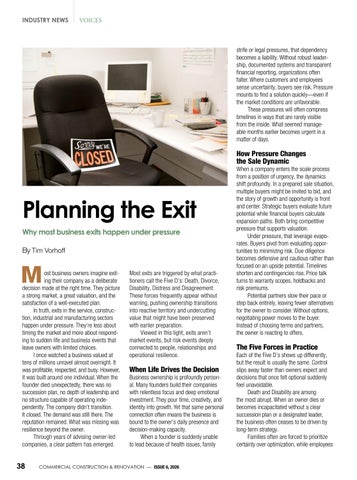
ost business owners imagine exiting their company as a deliberate decision made at the right time. They picture a strong market, a great valuation, and the satisfaction of a well-executed plan. In truth, exits in the service, construction, industrial and manufacturing sectors happen under pressure. They’re less about timing the market and more about responding to sudden life and business events that leave owners with limited choices. I once watched a business valued at tens of millions unravel almost overnight. It was profitable, respected, and busy. However, it was built around one individual. When the founder died unexpectedly, there was no succession plan, no depth of leadership and no structure capable of operating independently. The company didn’t transition. It closed. The demand was still there. The reputation remained. What was missing was resilience beyond the owner. Through years of advising owner-led companies, a clear pattern has emerged.
38
Most exits are triggered by what practitioners call the Five D’s: Death, Divorce, Disability, Distress and Disagreement. These forces frequently appear without warning, pushing ownership transitions into reactive territory and undercutting value that might have been preserved with earlier preparation. Viewed in this light, exits aren’t market events, but risk events deeply connected to people, relationships and operational resilience.
When Life Drives the Decision
Business ownership is profoundly personal. Many founders build their companies with relentless focus and deep emotional investment. They pour time, creativity, and identity into growth. Yet that same personal connection often means the business is bound to the owner’s daily presence and decision-making capacity. When a founder is suddenly unable to lead because of health issues, family
COMMERCIAL CONSTRUCTION & RENOVATION — ISSUE 6, 2026
When a company enters the scale process from a position of urgency, the dynamics shift profoundly. In a prepared sale situation, multiple buyers might be invited to bid, and the story of growth and opportunity is front and center. Strategic buyers evaluate future potential while financial buyers calculate expansion paths. Both bring competitive pressure that supports valuation. Under pressure, that leverage evaporates. Buyers pivot from evaluating opportunities to minimizing risk. Due diligence becomes defensive and cautious rather than focused on an upside potential. Timelines shorten and contingencies rise. Price talk turns to warranty scopes, holdbacks and risk premiums. Potential partners slow their pace or step back entirely, leaving fewer alternatives for the owner to consider. Without options, negotiating power moves to the buyer. Instead of choosing terms and partners, the owner is reacting to offers.
The Five Forces in Practice
Each of the Five D’s shows up differently, but the result is usually the same. Control slips away faster than owners expect and decisions that once felt optional suddenly feel unavoidable. Death and Disability are among the most abrupt. When an owner dies or becomes incapacitated without a clear succession plan or a designated leader, the business often ceases to be driven by long-term strategy. Families often are forced to prioritize certainty over optimization, while employees