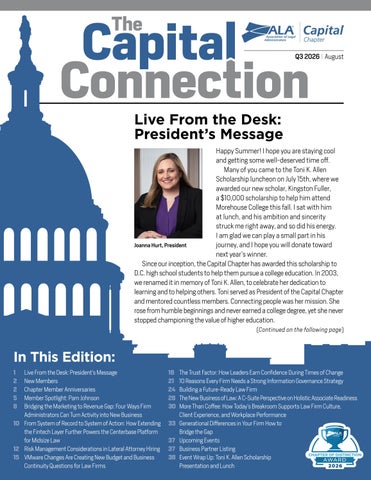
Capital The
Q3 2026 August
Live From the Desk: President’s Message Happy Summer! I hope you are staying cool and getting some well-deserved time off. Many of you came to the Toni K. Allen Scholarship luncheon on July 15th, where we awarded our new scholar, Kingston Fuller, a $10,000 scholarship to help him attend Morehouse College this fall. I sat with him at lunch, and his ambition and sincerity struck me right away, and so did his energy. I am glad we can play a small part in his Joanna Hurt, President journey, and I hope you will donate toward next year’s winner. Since our inception, the Capital Chapter has awarded this scholarship to D.C. high school students to help them pursue a college education. In 2003, we renamed it in memory of Toni K. Allen, to celebrate her dedication to learning and to helping others. Toni served as President of the Capital Chapter and mentored countless members. Connecting people was her mission. She rose from humble beginnings and never earned a college degree, yet she never stopped championing the value of higher education. (Continued on the following page)
In This Edition: 1 Live From the Desk: President’s Message 2 New Members 2 Chapter Member Anniversaries 5 Member Spotlight: Pam Johnson 8 Bridging the Marketing to Revenue Gap: Four Ways Firm Administrators Can Turn Activity into New Business 10 From System of Record to System of Action: How Extending the Fintech Layer Further Powers the Centerbase Platform for Midsize Law 12 Risk Management Considerations in Lateral Attorney Hiring 15 VMware Changes Are Creating New Budget and Business Continuity Questions for Law Firms
18 The Trust Factor: How Leaders Earn Confidence During Times of Change 21 10 Reasons Every Firm Needs a Strong Information Governance Strategy 24 Building a Future-Ready Law Firm 28 The New Business of Law: A C-Suite Perspective on Holistic Associate Readiness 30 More Than Coffee: How Today’s Breakroom Supports Law Firm Culture, Client Experience, and Workplace Performance 33 Generational Differences in Your Firm How to Bridge the Gap 37 Upcoming Events 37 Business Partner Listing 38 Event Wrap Up: Toni K. Allen Scholarship Presentation and Lunch
President’s Message (continued) Toni came to every event, and she would work the room, introducing members to each other and introducing business partners to her colleagues. That is really what ALA is about. The best part of being a member has always been the relationships we build with our peers. A new idea, a fix for a problem you have been stuck on, someone who simply gets the demands of this work. Those relationships often turn out to matter most. So here is a simple challenge for the months ahead: invite someone. Maybe it is a colleague who has never been to an ALA event. Maybe it is someone who used to come and stopped. Maybe it is someone
on your team who would grow from the chance to learn and meet new people. Bring them to a program. Introduce them to a member or business partner. And when you are at an event, take a minute to introduce yourself to someone new. Toni would have made it her mission to connect every person in the room, and we can honor that by doing the same. Most of us got involved in ALA because someone invited us. One conversation, or one event, can lead to a new idea, a friendship, or the push you need to grow. When we share that with others, we help our colleagues and we keep our chapter welcoming and strong for the next generation.
Emmanuel Adedigba, our President Elect, has put together a full calendar of educational events on all kinds of topics, so please take a minute to sign up for a few or suggest topics of interest. On October 7, 2026, the Human Resources Half-Day Retreat returns. There is something in it for everyone. Whether or not you work in HR, you will come away with something you can use. Thank you, as always, for supporting the Capital Chapter. I look forward to seeing many of you soon and maybe meeting someone you brought along.
WELCOME NEW MEMBERS ` Eryka Gosselin-Preston, King & Spalding LLP
` Angela Dunn, Bass, Berry & Sims
Joined between May 1 – July 31, 2026
Chapter Member Anniversaries We enjoy recognizing our member anniversaries. We thank them for their time and the commitment they have shown to the Chapter. We are grateful to have dedicated and loyal members like them!
10 YEARS ` Rachel Ball, Office Administrator, Hunton Andrew Kurth LLP ` Lorri Holland, Administrator, Walsh Colucci Lubeley & Walsh PC ` Joanna Hurt, Office Business Director, Ashurst Perkins Coie
2
Q3 2026
August
The Capital Connection
` Aaron Majette, Services Support Supervisor, Hyman, Phelps & McNamara, P.C. ` Robin Schmal, Senior HR Specialist, Simpson Thacher & Bartlett LLP
Back to Front Page
Chapter Member Anniversaries (continued) 15 YEARS ` Wilmara Guido, Director of Firm Operations, Bookoff McAndrews PLLC ` Sushama Pathak, COO, Lerman Senter ` Halle Sabo, Recruiting & Human Resources Manager, Rothwell, Figg, Ernst & Manbeck, P.C.
` Kimberly Santaiti-Potter, Human Resources Manager, Alston & Bird LLP ` June Todd, Human Resources & Benefits Manager, Nixon & Vanderhye PC
20 YEARS ` Karen Blitz, Office Administrator, Polsinelli PC ` Nancy Dugan, Firm Administrator, Bredhoff & Kaiser, PLLC ` Deidre Hill, Director of Administration, Franklin Karibjanian Law & DePersis PLLC ` Jennifer Ireland, Human Resources and Recruitment Manager, Keller & Heckman LLP ` Karen Laumoli, Firm Administrator, Wilkes Artis, Chartered
` Jason Morrow, Office Administrator, Thompson Coburn LLP Karen Murley ` ` John Riggleman, Administrator, Caplin & Drysdale, Chartered ` Peter Sackleh, Director, Deloitte University, Deloitte LLP ` Cheryl A. Wisbrock
25 YEARS ` Sharon Alston, Office Manager, Quinn Emanuel Urquhart & Sullivan, LLP ` Susan Geiger, Chief Operating Officer, Kaiser PLLC
` Lisa Maust, Human Resources Manager, Gilbert LLP ` Anjanette Milladge, Regional Director of Administration, Sullivan & Worcester LLP
30 YEARS ` Adrienne Corrothers, Associate Director of Facilities & Administrative Operations, King & Spalding, LLP
` Geneva Hunter, Senior Operations Manager/ Secretarial Services, Skadden Arps ` Mary Sackleh
40 YEARS
50 YEARS
` Judy Deason ` Marcia Gardy ` Elaine Gregg ` Pennie McKinney, Stein Mitchell Beato & Missner LLP
` Barbara L. Slaybaugh
55 YEARS ` Jack L. Palmer
Back to Front Page
The Capital Connection
August
Q3 2026
3
Chapter Leadership President Joanna Hurt Ashurst Perkins Coie
Vice President, Business Partner Advisory Karen Laumoli Wilkes Artis, Chartered
Vice President, Diversity, Equity, & Inclusion Fawn Elzie Kobre & Kim LLP
President-Elect Emmanuel Adedigba Elias Law Group LLP
Vice President-Elect, Business Partner Advisory Christie Albert Van Ness Feldman LLP
Vice President-Elect, Diversity, Equity, & Inclusion Nicole Rutherford Van Ness Feldman LLP
Immediate Past President Marie Woods Retired
Vice President, Community Services Tania Jose BakerHostetler
Vice President, Communications Christina Weber Munger, Tolles & Olson
Secretary/Treasurer Robert Bieber Wilkinson Barker Knauer LLP
Vice President-Elect, Community Services Kimberly Santaiti-Potter Alston & Bird LLP
Vice President-Elect, Communications Pam Johnson Davis Wright Tremaine LLP
Secretary/Treasurer - Elect Deorsay Pratt Gilbert LLP
CHAPTER STAFF Staff Director Carol Montoya
Executive Director Paul Haaland, CAE
The Capital Connection is published on a quarterly basis for members of the Capital Chapter of the Association of Legal Administrators to provide information for the education and benefit of legal administrators, law office managers, managing partners of law firms, and other law related associations. Capital Connection is not engaged in rendering legal, financial, tax counseling or advice through this publication. The contents of all articles, letters, videos, and advertisements published in Capital Connection should not be considered endorsements by the Capital Chapter of ALA nor the opinion expressed therein of any products advertised. Contributing authors are requested and expected to disclose financial and/or professional interests and affiliations that may influence their writing position. Articles and materials accepted for publication are subject to editing by the editorial team and become property of the Capital Chapter of the Association of Legal Administrators. Links to Capital Connection may not be shared without permission from the Chapter.
4
Q3 2026
August
The Capital Connection
Back to Front Page
Member Spotlight
Join us as we learn more about Pam Johnson, Office Administrator at Davis Wright Tremaine LLP. Pam is the chapter’s Vice-President-Elect, Communications. level. I remember attending an event where I met Joanna Hurt, who encouraged me to get involved with the ALA Capital Chapter. Thanks to her guidance, I became active in the chapter, and it has been a great way to build meaningful connections, share knowledge, and strengthen my professional network within the legal community.
Pam Johnson Office Administrator Capital Chapter Vice President-Elect, Communications
HOW WERE YOU INTRODUCED TO ALA? Legal Colleague
WHAT MOTIVATED YOU TO JOIN THE ASSOCIATION/CHAPTER? With more than 25 years of experience in the legal industry, I have always valued opportunities to connect with others who understand the unique challenges and rewards of our profession. As I progressed through different roles in the legal field, I wanted to expand my network, learn from my peers, and become more engaged with professionals who do similar work. Interestingly, I initially thought I was a member of my local chapter, only to discover that I was participating solely at the national
WHAT DO YOU ENJOY MOST ABOUT BEING A MEMBER OF THIS CHAPTER? The people. Being part of the ALA Capital Chapter has connected me with an amazing group of professionals who face many of the same challenges and opportunities that I do. I enjoy learning from my peers, sharing ideas, and building relationships that extend beyond the workplace. The chapter has made me feel part of a supportive community, and I’ve developed friendships and professional connections that I truly value. Every event provides an opportunity to learn something new, expand my network, and grow both personally and professionally.
WHAT ADVICE WOULD YOU GIVE A NEW MEMBER TRYING TO MAKE THE MOST OF THEIR MEMBERSHIP? My advice would be to get involved
Back to Front Page
early and take advantage of every opportunity to connect with other members. Attend chapter events, participate in committees, and don’t be afraid to introduce yourself to people. The relationships you build through the association can become some of your most valuable professional resources. Also, be open to learning from others and sharing your own experiences. One of the greatest benefits of ALA is having access to a network of professionals who are willing to exchange ideas, offer advice, and support one another. The more you engage, the more value you’ll gain from your membership. I’ve found that some of the best insights and connections come from simply having conversations with fellow members and being an active participant in the chapter community.
PLEASE SHARE A MEMORABLE EXPERIENCE YOU’VE HAD AS PART OF OUR COMMUNITY. One of my most memorable experiences was attending the ALA National Conference at National Harbor. It was inspiring to be surrounded by legal management professionals (Continued on the following page)
The Capital Connection
August
Q3 2026
5
Member Spotlight (continued) from across the country, all sharing ideas, experiences, and best practices. What made the experience even more special was the opportunity to meet so many members of my local ALA Capital Chapter in person. Building those connections strengthened my sense of community and reminded me of the value of being part of such a supportive and collaborative organization. I left the conference with new professional relationships, fresh perspectives, and a renewed appreciation for the ALA network and the many opportunities it provides for learning and growth.
WHAT TRENDS OR CHANGES HAVE YOU NOTICED IN OUR INDUSTRY LATELY? One of the biggest trends I’ve noticed in the legal industry is the increased use of technology and artificial intelligence to improve efficiency, streamline operations, and enhance client service. Law firms are continually looking for innovative ways to work smarter while maintaining the high standards our clients expect. I’ve also seen a greater focus on workplace flexibility, employee engagement, and professional development. Firms are investing more in creating environments that support collaboration, culture, and employee wellbeing while adapting to evolving workplace expectations.
6
Q3 2026
August
From my own experience as a strategic business partner to the Partner-in-Charge of our Washington, D.C. office, I’ve seen the role of legal management professionals become increasingly important. We are no longer focused solely on office operations; we are helping to drive business decisions, manage change, support talent development, and contribute to the overall success of the firm. This evolution has elevated the impact that office administrators and legal operations professionals can have within their organizations. Overall, it’s an exciting time to be in the legal industry. The combination of innovation, collaboration, and strategic leadership is creating new opportunities for professionals to make meaningful contributions and help their firms thrive.
HOW DO YOU SEE YOUR INVOLVEMENT WITH THE ASSOCIATION/CHAPTER EVOLVING IN THE FUTURE? I’m excited to continue growing my involvement with the ALA Capital Chapter and giving back to a community that has provided me with so much professional value. As time permits, I look forward to volunteering, supporting chapter events and initiatives, mentoring newer members, and sharing insights from my 25+ years in the legal industry.
The Capital Connection
Back to Front Page
The relationships, knowledge, and opportunities I’ve gained through ALA have been invaluable, and I would love to play a bigger role in helping others experience those same benefits. I’m always happy to lend a hand where I can and contribute to the continued success and growth of our chapter. Being part of such an engaged and supportive community is something I truly enjoy, and I look forward to staying involved for years to come.
WHAT ARE YOUR FUTURE GOALS? Professionally, I want to continue growing as a strategic business partner and leader within the legal industry. With more than 25 years of experience, I hope to continue developing my skills, mentoring others, and contributing to the success of my firm while embracing new technologies and innovative ways of working. Personally, I want to focus on maintaining a healthy work-life balance, spending quality time with my family, and continuing to learn and grow. I also look forward to staying active in organizations like ALA, where I can build relationships, share knowledge, and give back to the legal management community that has given me so much throughout my career.
Member Spotlight (continued) SHARE A FUN FACT OR HOBBY THAT PEOPLE MIGHT NOT KNOW ABOUT YOU. Fun fact about me is that I’m a Pilates enthusiast and enjoy staying active whenever I can. I also love traveling the world with my family and creating new memories through different cultures and experiences. Outside of work, I serve as the Hospitality President at my church, which allows me to combine my passion for serving others with building a welcoming community. And if you really want to know me, just remember one thing—I absolutely love French fries!
WHAT BOOK, PODCAST, OR RESOURCE WOULD YOU RECOMMEND TO OTHER MEMBERS? Two books I highly recommend are: ` The 7 Habits of Highly Effective People, by Stephen Covey. Providing timeless principles for personal and professional growth, leadership, and effectiveness. ` Crucial Conversations, by Kerry Patterson, Joseph Grenny, Ron McMillan, and Al Switzler. Offering practical tools for navigating difficult discussions, building stronger relationships, and communicating with confidence and respect. Both books have had a positive impact on my professional
development and leadership style, and I believe they offer valuable lessons for anyone looking to grow in their career and strengthen their ability to lead and collaborate with others.
WHAT ARE YOU LOOKING FORWARD TO AS A NEW BOARD MEMBER? I’m excited about the opportunity to learn, grow, and gain a deeper understanding of the organization through my role as VP-Elect. I look forward to working alongside such an experienced and dedicated group of leaders, learning from their perspectives, and contributing to the continued success of the chapter. I’m also excited to build stronger connections with our members, better understand their needs, and help support initiatives that provide value to our chapter. Most importantly, I’m eager to learn as much as I can, expand my leadership skills, and prepare myself to serve the organization effectively in the years ahead.
PLEASE SHARE A SIGNIFICANT MILESTONE OR ACHIEVEMENT IN YOUR PROFESSIONAL JOURNEY. One of the most significant milestones in my professional journey has been growing from operational support roles into
Back to Front Page
a strategic leadership position within the legal industry. Over the past 25 years, I have had the opportunity to take on increasing levels of responsibility, culminating in my current role as Office Administrator and strategic business partner to the Partner-in-Charge of our Washington, D.C. office. This progression reflects not only my professional growth but also my commitment to leadership, collaboration, and continuous learning. I am proud of the impact I have been able to make by supporting firm operations, developing talented team members, driving office initiatives, and contributing to the overall success of the organization. Being elected as the ALA Capital Chapter’s VP-Elect is another meaningful milestone, as it provides an opportunity to give back to a profession and community that has played an important role in my career development.
Want to be featured in the ALACC Member Spotlight? Click here to complete the brief questionnaire. Submissions are accepted on a rolling basis. We look forward to celebrating you!
The Capital Connection
August
Q3 2026
7
Business Partner Spotlight
Bridging the Marketing to Revenue Gap: Four Ways Firm Administrators Can Turn Activity into New Business By Jocelyn Brumbaugh, Founder, Builden Partners Law firms invest heavily in marketing, yet too often, that activity does not translate into new clients or expanded work. While marketing is the funnel that guides many prospective clients and referrals to the firm, business development is the act of creating one-on-one relationships that turn those prospects into new business. When marketing teams and attorneys struggle to align their efforts, marketing dollars are spent in the wrong places and attorneys scramble to make up the difference. Administrators are uniquely positioned to close that gap by creating the processes, accountability structures and operational support to build a reliable new business pipeline. 1
I DENTIFY KEY CONCERNS
Firms cannot bridge gaps they have not mapped. Before implementing new processes, administrators should diagnose where opportunities are stalling. Where to Start: ` Talk to the lead partners. Ask where opportunities typically
8
Q3 2026
August
go cold. This might be after a pitch, after an event or after an introduction. A 20-minute conversation often reveals the pattern. ` Audit the CRM system. If attorneys are not logging contacts and follow-ups, there is no pipeline visibility. The absence of data is itself a data point. ` Track pitch outcomes. A great place to start measuring return is to begin tracking the outcomes from each pitch and proposal. Even a simple spreadsheet is a meaningful first step. 2 B UILD FOLLOW-THROUGH
INTO THE SYSTEM
The most common missing link is attorney inaction after a promising connection. Often, the problem comes down to a lack of structure. Administrators can create the scaffolding that makes follow-through the path of least resistance. How to Keep Momentum Going: ` Debrief after every event. Schedule a 15-minute debrief before attorneys leave for a conference. Have them name
The Capital Connection
Back to Front Page
their top three contacts and one next step each. Put it on the calendar before the event, not after. ` Establish a 30-day touchpoint norm. Add a reminder to attorneys’ calendars to reach out to meaningful contacts 30 days after an event. This can be anything from an article share or a check-in email to a coffee or lunch invitation. ` Break up big goals with regular checkpoints. “Bring in $10,000 of business by the end of the year” may be a big goal to bite off, but it starts with a first step. Set check-ins at the beginning to celebrate smaller milestones and help attorneys stay on track with ambitious goals. 3 REMOVE OPERATIONAL
FRICTION
Operational friction can make the difference between a closed deal and a stalled engagement. When it takes two weeks to turn around a proposal or when attorneys struggle to find firm materials, opportunities are missed.
Business Partner Spotlight (continued) Operational Fixes That Pay Off: ` Audit the proposal process. Identify exactly where bottlenecks live. Is it attorney availability? Design? Approvals? Finding the precise pain points makes it easier to improve the process. ` Build a reusable content library. Maintain an accessible repository of approved bios, matter descriptions, firm overviews and case studies. This removes the time stress of last-minute requests. ` Create a matter-closing ritual. When a matter closes successfully, trigger a process: update the matter description, flag it for a potential case study and prompt the relationship partner to check in with the client. This can often surface opportunities to continue the engagement. 4 MAKE ACCOUNTABILITY
VISIBLE WITHOUT MAKING IT PERSONAL
Administrators may hesitate to push attorneys on business development for fear of nagging. Building accountability into the process makes it effortless to keep attorneys on track with their goals without constant follow-up. Ways to Normalize Business Development Accountability: ` Add a business development metric to regular reporting.
Include a simple business development activity snapshot in leadership reports. Visibility creates accountability without confrontation. ` Celebrate wins and connect the dots. When a business development effort pays off, make it explicit in a firm communication. Naming the behavior reinforces it across the firm. ` Equip practice group leaders. Provide group leaders with monthly pipeline snapshots for their teams. Peer accountability is often more effective than top-down pressure.
marketing and operations work in lockstep. Law firm administrators are the connective tissue between them. Firms that treat administrators as strategic partners in business development, not just operational support, will consistently outperform those that do not. Start by picking one section above, identifying one thing and implementing it this quarter. Progress beats perfection.
CLOSING THE GAP STARTS WITH ONE STEP The marketing-to-revenue gap closes when attorneys,
Simplifying the complexities of IT
• Boxtop Private Cloud • Overture Centralized Cloud Management • Managed IT Services • Edge Co-Managed IT Services • 360 IT Assessment
tabush.com
Back to Front Page
The Capital Connection
August
Q3 2026
9
Business Partner Spotlight
From System of Record to System of Action: How Extending the Fintech Layer Further Powers the Centerbase Platform for Midsize Law
Running a law firm is running a business, but the financial side of that business still looks surprisingly analog. Checks get printed and signed by hand, invoice details get keyed in twice, and payments get tracked in spreadsheets. These are the kind of manual tasks that lower efficiency: hours lost to data entry, errors that take days to catch, cash that moves slower than it should. But a strategic shift is underway. Centerbase CEO Michael Dunn describes the legal ERP standard as moving “from a system of record, to a system of action.” A system of record captures what happened. A system
10
Q3 2026
August
of action makes things happen. Centerbase recognized the need to pull AR and AP into the platform firms use to run their business. Law firms need robust fintech tools, the same caliber of payment and financial infrastructure any growing business relies on.
WHY AP, AND WHY NOW For years, law firm finance teams have run vendor payments outside their core system. Printing checks. Keying in account details by hand. Chasing payment status across disconnected tools. At the volume a midsize firm operates, that manual workflow burns
The Capital Connection
Back to Front Page
hours and invites errors. It was an operational gap. The Centerbase and AvidXchange partnership, announced in May 2026, closes that gap by embedding full payment automation directly into the platform through AvidXchange’s Accounts Payable as a Service solution. Firms can now view unpaid invoices, initiate and approve payments, and watch status in real time without leaving Centerbase. AvidXchange executes the payment on the firm’s behalf across a supplier network of more than 1.5 million vendors, and the company reports its AP automation cuts
Business Partner Spotlight (continued) the time finance teams spend on administration by up to 80 percent. Beyond the time savings, embedding AP alongside AR improves a firm’s insight into its working capital. Centerbase Payments already captures the inflow; Centerbase AP captures the outflow. Together they put both sides of the firm’s cash movement on one platform, in real time. For finance leaders, that provides a single source of truth, sharpening the command over liquidity, timing, and capital deployment that the firm depends on.
COMPREHENSIVE FIRM INTELLIGENCE Dunn notes the importance of strategic partnerships that extend Centerbase for its clients. “Money movement is hard. AvidXchange has spent 25 years and serious capital building rails that move money at scale across industries, and it operates as a licensed money transmitter. Partnering for this ability delivers value immediately to our Centerbase customers,” says Dunn. With AvidXchange, Centerbase now provides a unification of operations and financial data, giving a total firm health view. Every payment flows through the platform tied to a client and a matter. That linkage produces something firms have historically struggled to see: matter-level profitability. A firm can usually tell you it was profitable last year. Far fewer can tell you which matters
made money and which quietly bled it. When every disbursement, trust return, settlement payout, and filing fee is captured against the matter it belongs to, that question finally has an answer. Centerbase is compounding a financial dataset that gets richer with every transaction the platform executes, and that no other solution delivers for midsize law.
EMBEDDED FINANCE, WITH LEGAL’S EDGES INTACT General purpose AP and AR automation isn’t robust enough for law firm use. Legal payments carry obligations most other business types never face. Trust accounting rules. Disbursements that must be tracked to the dollar. The bright line between billable and non-billable expense, where a missed tag is lost profitability. Overdraw a trust account or make an improper disbursement, and the consequence isn’t an accounting headache, it’s a bar complaint. Centerbase’s contribution to the partnership is deep expertise, the legal-specific governance and audit structure wrapped around the money movement AvidXchange powers underneath. The Centerbase solution provides compliance, context, and the customer experience.
CENTERING THE BUSINESS OF LAW, THAT INCLUDES FINTECH Centerbase is building a financial
Back to Front Page
operating system for midsize law, with embedded payments, billing, and collections as one pillar and AI-driven financial intelligence, through its Centerbase IQ layer, as the next. The platform’s value increasingly sits in being the place where the firm’s financial and operational data come together. For the full conversation with Centerbase CEO Michael Dunn and AvidXchange Co-Founder and CEO Michael Praeger, listen to The Power of Change, presented by AvidXchange: Embedded Payments are Transforming Law Firms | AvidXchange. About Centerbase Centerbase is the operating platform purpose-built for midsize law firms. It unifies matter management, billing, financial operations, and the AI tools firms are adopting into a single governed system, eliminating the operational drag that costs firms time, revenue, and client confidence. The result is a practice that runs tighter, bills what it earns, and turns its operations into a competitive advantage. To learn more, visit www.centerbase.com. Centerbase Media Contact: Trish Stromberg Chief Marketing Officer Centerbase trish.stromberg@centerbase.com
The Capital Connection
August
Q3 2026
11
Business Partner Spotlight
Risk Management Considerations in Lateral Attorney Hiring
UNDERSTANDING THE NATURE OF THE RISK
conduct that occurred before the lateral attorney joined the firm. Such claims may arise when a client alleges that an error was made during earlier representation and attempts to attribute responsibility to successor counsel, particularly where the new firm becomes involved before the consequences of the alleged error fully materialize. Successor liability issues may also surface if a new firm is perceived as having had an opportunity to correct, mitigate, or disclose a prior mistake but failed to do so. Accordingly, the manner in which a firm evaluates, integrates, and supervises lateral attorneys can be as important as the decision to hire them in the first instance.
The primary concern for a hiring firm is whether it can be drawn into a malpractice claim based on
DUE DILIGENCE AS A THRESHOLD OBLIGATION
By Eileen Garczynski, Esq. Principal EPIC Law Firm Group
Lateral attorney hiring has become an increasingly common feature of law firm growth strategies. Firms seek experienced lawyers who can expand practice capabilities, deepen industry expertise, and bring established client relationships. When successful, lateral hiring can accelerate growth and enhance a firm’s competitive position without the delay inherent in developing practices organically. At the same time, hiring a lawyer laterally presents distinct professional liability risks. Matters handled before the attorney joins the firm, as well
as client relationships formed elsewhere, may expose the new firm to claims arising from alleged errors, omissions, or unmet client expectations. Although no firm can fully insulate itself from risk associated with a lateral hire’s prior practice, careful planning and adherence to ethical and risk-management principles can substantially reduce exposure.
Thorough due diligence is the most effective means of identifying and managing the risks associated with lateral hiring. This process should include direct questioning of the candidate regarding prior malpractice claims, threatened claims, disciplinary proceedings, or ethics investigations. Firms should independently verify these disclosures through docket searches, bar records, and other publicly available sources. Equally important is an assessment of the clients and matters expected to transition with the lateral attorney. Firms
12
Q3 2026
August
The Capital Connection
Back to Front Page
Business Partner Spotlight (continued) should understand whether those clients have historically disputed fees, expressed dissatisfaction with legal strategies, or exhibited patterns of contentious behavior. Clients with unrealistic expectations or a history of conflict may present heightened risk regardless of the merits of their matters. Beyond the client relationships themselves, firms should review the substance and procedural posture of the matters expected to transfer. This review should seek to identify potential errors or missed deadlines and assess whether any remedial action remains available. Where issues are identified, firms must consider whether corrective steps are feasible and what ethical obligations may arise in connection with error disclosure.
THE ROLE OF INSURANCE
the former firm (as long as it is still in operation) usually provides an extended reporting period (ERP) a/k/a tail coverage, as part of their claims made malpractice insurance policy. This coverage ensures the departing attorney is protected against lawsuits filed after they leave for work done while they were at the old firm. If the former firm has closed or does not include former employees, the lateral hire may need to purchase an Extended Reporting Endorsement (tail) to cover the work it did for its former firm. The lateral hire might also look to their new firm for their prior acts coverage. The new firm may want to see if it can purchase a lateral hire endorsement. A lateral hire endorsement modifies the
When a lateral hire leaves a firm,
(Continued on the following page)
Because these ethical issues are fact-specific and jurisdictiondependent, firms should approach information sharing conservatively and consult ethics counsel where appropriate.
THE ROLE OF EXTERNAL SCREENING Where a lateral attorney brings a substantial book of business or practices in an area with elevated malpractice risk, firms may determine that internal vetting alone is insufficient. In such circumstances, engaging an experienced lateral-hire screening service may provide a more efficient and systematic review of both attorney history and client matters.
ETHICAL CONSTRAINTS ON INFORMATION SHARING The due diligence process must be conducted in compliance with applicable ethics rules governing confidentiality and conflicts of interest. While the Rules of Professional Conduct permit limited disclosure of confidential information to detect or resolve conflicts arising from a change in employment, that exception is narrow. Firms should carefully evaluate whether client consent is required before reviewing substantive client files or discussing sensitive matter details during the vetting process.
Back to Front Page
The Capital Connection
August
Q3 2026
13
Business Partner Spotlight (continued) Lawyers’ Professional Liability policy to extend coverage to a newly hired attorney for legal services they performed before joining the new firm. It ensures that the firm’s insurance policy, rather than the firm’s own assets, responds to claims related to the hire’s previous work. Coverage is generally conditioned upon the lateral hire: (a) Having maintained continuous “claimsmade” coverage in their previous positions. (b) Being approved by the new firm’s insurance carrier through underwriting.
STRUCTURING THE TRANSITION AND NEW ENGAGEMENTS Once a firm decides to proceed with a lateral hire, careful attention should be given to client
Providing unparalleled learning programs and strategies for law firms.
Training that Transforms.
14
Q3 2026
August
communications and engagement documentation. Notifications regarding the attorney’s move must comply with jurisdictional ethics requirements, and firms should ensure that these communications accurately describe the new firm’s role. Incoming matters should be treated as new engagements. Engagement agreements should clearly state when the attorneyclient relationship with the new firm begins and delineate the scope of representation in light of the matter’s procedural history. Language characterizing the firm as successor or replacement counsel may be significant if disputes arise concerning responsibility for prior events. Although some firms may consider provisions aimed at limiting liability, such clauses are subject to strict ethical limitations. In many jurisdictions, prospective limitations on malpractice liability are prohibited or permitted only under narrow conditions, such as when the client is independently represented. Firms should review their jurisdiction’s version of Model Rule 1.8(h) before including any such provisions.
POST-HIRE REVIEW AND ONGOING OVERSIGHT Risk management does not end once the lateral attorney joins the firm. Firms should
The Capital Connection
Back to Front Page
promptly assign responsibility for reviewing incoming matters to determine whether immediate action is required to protect client interests. If a prior error is correctable, the firm’s failure to act may complicate or defeat defenses otherwise available in a malpractice action. Where correction is not possible, firms must address their ethical obligations regarding client notification and evaluate whether continued representation is appropriate. These decisions should be made deliberately, with attention to both professional responsibility requirements and the firm’s long-term risk profile.
CONCLUSION Lateral hiring offers meaningful benefits, but it also carries inherent professional responsibility challenges. No combination of due diligence, documentation, or insurance can completely eliminate the possibility of inherited liability. However, firms that approach lateral hiring as a structured riskmanagement process—rather than a purely business decision—can significantly reduce their exposure. By consistently applying careful vetting, ethical discipline, thoughtful engagement structuring, and prompt post-hire review, firms can better position themselves to enjoy the advantages of lateral growth while managing the risks that may accompany it.
Business Partner Spotlight
VMware Changes Are Creating New Budget and Business Continuity Questions for Law Firms A practical guide for law firm administrators who need to understand the business impact, not the technical architecture, of the changing VMware landscape. By Jeff Silverman, Dominick Ciacciarelli, and Beth Anne Stuebe , Kraft Kennedy For many law firms, VMware has long been one of those invisible technology foundations that “just works.” It helps run servers behind everyday systems such as document management, billing and timekeeping, email, remote access, authentication, and other applications lawyers and staff depend on throughout the day. Recent changes following Broadcom’s acquisition of VMware have made that once-background issue a leadership and operations concern. Licensing has shifted toward subscriptions and bundled offerings, and firms may see renewal terms, pricing, support access, and planning timelines change in ways that affect budgets, risk management, and business continuity. Today, let’s take a look at how your internal IT teams may be raising VMware as a budget, risk, or planning issue, and what practical questions administrators should ask before approving a renewal, migration, or modernization plan.
perpetual licensing toward subscription-based bundles can change both cost and negotiating leverage. ` Smaller environments may feel a disproportionate budget impact. Some firms may be asked to pay for more licensed capacity than they actually use, which can turn a modest infrastructure footprint into a much larger renewal discussion. ` There are usually three broad paths. A firm can renew and stay the course for now, move some systems to a different
platform, or use this moment to modernize systems and reduce dependence on servers over time. ` Any move requires operational planning. Changing the technology foundation can affect backups, disaster recovery, security monitoring, vendor support, staff training, and downtime planning. ` Administrators should ask business questions, not technical ones. Focus on renewal deadlines, budget (Continued on the following page)
Key Takeaways for Law Firm Administrators ` Do not treat the VMware renewal as a routine IT expense. The move away from
Back to Front Page
The Capital Connection
August
Q3 2026
15
Business Partner Spotlight (continued) exposure, affected systems, cyber insurance or client questionnaire implications, and the firm’s tolerance for downtime or disruption.
WHAT ACTUALLY CHANGED (AND WHY IT MATTERS) Broadcom’s acquisition of VMware accelerated several changes that are straightforward on paper but disruptive in practice: perpetual licensing shifted toward subscription, the product catalog was simplified into fewer bundles, and pricing moved toward percore metrics with minimum purchase thresholds. In combination, these changes alter both cost and leverage. Subscription ties support to ongoing renewals, bundling may include features firms do not
use, and core minimums can disproportionately affect rightsized environments common in midsize firms and satellite offices. Legal organizations should also consider compliance and enforcement risk. In the past, running an unsupported platform might have meant fewer vendor options but continued day-today operation. In the current subscription model, falling out of compliance may create more practical constraints and turn a licensing issue into a business continuity concern.
THE PRICING MATH: WHY SMALL CLUSTERS GET HIT Core minimums can overwhelm right-sized environments. A common two-host cluster may have only 32 real cores:
24/7 IT Support Security Driven SOC2 Compliant User Focused
Q3 2026
August
The Capital Connection
Under some minimums, that same environment can be forced into a 72-core purchase—40 cores more than needed. Terms vary by program, reseller, and offer, so the practical takeaway is simple: validate the rule set on your quote before assuming your renewal is a straightforward increase. The result can be a step-function cost increase. Exact outcomes vary, but the new model can magnify cost well beyond incremental budget planning, especially where minimums force firms to buy more capacity than they actually use.
WHY LAW FIRMS AND LEGAL DEPARTMENTS FEEL THIS ACUTELY Legal organizations do not evaluate infrastructure in a vacuum. The virtualization layer sits beneath mission-critical systems such as document management, matter file services, identity and access controls, eDiscovery tools, and remote access for attorneys and staff. In other words, “just migrate to something else” is not a simple operational decision. Firms need a path that reduces licensing risk without creating unnecessary downtime, compliance gaps, or attorney productivity issues.
Managed Services for 135+ ALA firms
16
` Host A: 16 cores ` Host B: 16 cores ` Total real cores: 32
Back to Front Page
Business Partner Spotlight (continued) THE THREE EXIT PATHS (AND WHAT YOU TRADE OFF) 1 S tay on prem and migrate to Hyper V For many firms, Hyper-V is the most direct VMware replacement path because it keeps data and compute on-premises and may align with existing Microsoft investment. Reality check: even a direct migration requires planning for backup, disaster recovery, monitoring, and staff training.
managing servers, patches, licensing, and the hypervisor beneath an application. Modernization is rarely all or nothing. Many firms end up with fewer virtual machines, more managed services, and a smaller on-premises footprint reserved for systems that truly must stay local.
Important: lifting and shifting VMs to Azure can be a practical first move, but the long-term value usually comes from re-platforming, replacing, or modernizing systems over time.
Questions Every Law Firm Administrators Should Ask Their IT Department: ` When does our current VMware agreement renew or expire? ` Which systems depend on VMware, and which are mission-critical? ` What is the expected budget impact of renewing? ` Are there client questionnaire, cyber insurance, or compliance implications if support lapses? ` If we migrate, what downtime, productivity impact, or vendor coordination should leadership expect? ` What decision does firm leadership need to make now?
3 Modernize: reduce dependence on servers Modernization reduces the number of systems that depend on a virtualization platform. The firm may move selected workloads to managed cloud services or SaaS platforms instead of
Jeff Silverman is the Practice Architect for Infrastructure and Enterprise Systems at Kraft Kennedy. A former attorney turned technologist, he provides leadership on infrastructure, virtualization, cloud, and remote access engagements. He is a Citrix Certified Expert and
2 M igrate to Azure (IaaS first, then iterate) Azure removes the hypervisor and hardware layer from dayto-day firm responsibility, which can help when the pain points are hardware lifecycle, capacity planning, or maintaining a private virtualization stack.
Back to Front Page
holds multiple Microsoft Azurerelated certifications, bringing both legal and technical insight to client environments. Dominick Ciacciarelli is a Practice Group Leader at Kraft Kennedy, where he leads the Infrastructure and Enterprise Systems practice and serves as a Practice Architect. With more than 15 years of experience, he specializes in designing, migrating, and supporting global Microsoft-based environments, including Windows Active Directory and Microsoft Exchange. He also works extensively with automation using Windows PowerShell and with cloud platforms such as Microsoft 365/Office 365 and Microsoft Azure. Beth Anne Stuebe is the Director of Sales Operations and a leader in marketing, sales, and content strategy. She is known for building highimpact messaging, driving audience engagement, and managing content across webinars, podcasts, events, and strategic communications. Her background includes leadership roles with the International Legal Technology Association (ILTA), FileTrail (Litera), and iManage.
The Capital Connection
August
Q3 2026
17
Business Partner Spotlight
The Trust Factor: How Leaders Earn Confidence During Times of Change By Taris G. Mullins, Vice President of Growth Strategy, Loeb Leadership We have all heard that mantra, “the only constant is change,” and while this is indeed true, what is missing is how individuals and firms effectively navigate those changes and the impact it can have on their people. To build an effective change foundation, support resiliency, and safeguard against eroding engagement, leaders must leverage the power of trust. Trust is a business imperative which leaders must consciously and consistently cultivate. Our discussion today, will explore just that, how leaders can strengthen trust and leverage it as an asset to build change readiness and resiliency in themselves and the teams they lead. One of the recurring themes we often hear from leaders across firms is navigating the pace and complexity of change. This is no easy feat as leaders are challenged to keep their teams engaged, remain agile to shifting and often competing priorities, and deliver results for internal stakeholders and clients. I recently interviewed Natalie Loeb, founder and Co-CEO of Loeb Leadership, to discuss the complexity of change and trust.
18
Q3 2026
August
From our conversation, we offer tactical strategies to enhance the impact leadership can have on people and firm performance.
ON THE PACE OF CHANGE “I think we have to recheck ourselves today. We may have been comfortable with change five or ten years ago, but the human response to change has shifted so quickly that we need to ask ourselves again: Am I really embracing change, or am I resisting it more than I realize?” Today’s leaders aren’t navigating change and its complexity similar to even a few years ago. Artificial intelligence, increasingly complex client expectations, and constant organizational transformation have created an environment where change is no longer timebound, it’s on-going. While many leaders strive to be adaptable, the reality is that the accelerating pace of change can challenge even the most resilient among us and cause change fatigue. Leadership Action: Engage in a personal and continuous change audit. Ask yourself, what is coming up for me (as a person and leader) when I think about
The Capital Connection
Back to Front Page
this change? What uncertainties or anxieties might it provoke? How do I need to manage my reactions to best guide my team? By exploring these questions, it can provide leaders with a starting inventory to foster increased self-awareness. Beyond this, consider taking a change assessment which can give you complementary insights to your change readiness. Reviewing these results with a trusted advisor or coach will help with meaning-making and application to your leadership.
ON INVESTING IN PEOPLE DURING CHANGE Periods of transformation can provoke uncertainty and employees will naturally look to their leaders to set the tone. As a leader, you don’t have to know it all. In fact, the leaders who earn trust and sustain it, aren’t necessarily the ones with all the answers. They are the ones who create space for honest conversations, listen with curiosity, and remain accessible. Rather than viewing one-on-one meetings as another task on the calendar, effective leaders recognize them as one of their most important leadership
Business Partner Spotlight (continued) tools. These conversations become opportunities to explore where your people are currently and remind people they won’t navigate change alone. In moments of change, it’s important to remember that the process can’t outweigh the people, your people are integral to the process. “A great leader always has time scheduled to meet with their people one-on-one. During change, don’t add more meetings—use those conversations to ask, ‘How is the change going? What’s challenging you? Here’s what you can expect.’” Leadership Action: Embed conversations for alignment into your regular one-on-one conversations. Dedicate 5-10 minutes of each check-in to ensure you and your team have shared understanding of what is clear, what may remain uncertain, and where they need support. When they have questions, answer those you can and then endeavor to find clarity for those which are outstanding. The more consistent these practices, the stronger the trust will become with your people.
ON EMOTIONAL INTELLIGENCE AND TRUST
and stress about the change, those emotions are contagious. They start to eat away at the trust we’re trying to build.” In times of uncertainty, it’s not just about what a leader says, but how they show up in their behaviors and actions. The age-old-adage, of actions over words is certainly truest in times of change. This doesn’t mean leaders should hide their emotions or pretend to have everything under control, you are human after all and authenticity matters. Yet when anxiety, frustration, or fear influence leadereship, those feelings can permeate throughout the team, creating uncertainty and weakening trust. Conversely, leaders who
demonstrate composure, empathy, and emotional selfawareness foster a sense of stability—even when the future remains unclear. In our world of constant communication, considering the power of emotional intelligence is crucial. Leaders must be thoughtful about how they use communication as an asset during times of change to reinforce trust among their teams. Leadership Action: Consider not just the message but how you communicate this to others. Whether it is an email, instant communication, or verbal statement, the manner in which you share an update can have just as profound an effect on others as the (Continued on the following page)
CPAs CONSULTANTS WEALTH ADVISORS
CLAconnect.com ©2026 CliftonLarsonAllen LLP. Investment advisory services are offered through CliftonLarsonAllen Wealth Advisors, LLC, an SEC-registered investment advisor.
“If we’re showing a lot of anxiety
Back to Front Page
The Capital Connection
August
Q3 2026
19
Business Partner Spotlight (continued) message itself. Compelling leaders are able to deliver challenging news to others in a fashion that reinforces stability and care. Keep your audience in mind and ask yourself, “if I was in their shoes, what would I want to hear and how would I want to hear that?” Create space for feedback loops to gather insights on what is resonate for the workforce and where greater clarity is needed. Doing so will help to ground your leadership in human-centered empathy rather than outcome-driven updates.
STRENGTHENING TRUST THROUGH UNCERTAINTY Put your mindset into action. If you want employees to feel valued then celebrate their wins. If you want employees to feel the psychological safety
to share their feedback, then you have to take their insights and use them to enhance your leadership. If you want your team to weather the stormy seas with you, then you need to be the leader you would want to follow. Leading when everything is going according to plan or as anticipated does not require as much from you as when you are faced with challenges. Trust becomes integral to this and has to be thoughtfully sustained. Accountability also matters and demonstrates that “we say what we mean, and we mean what we say.” Employee engagement and commitment to the change state is connected to collective accountability and leaders must demonstrate this to strengthen trust.
“Model the behaviors you expect of others. Model calmness. Model curiosity. Model a growth mindset. Model living with uncertainty. When leaders do that, they continue to build trust even when they don’t have all the answers.” Leadership Action: Ask yourself how consistency shows up in your leadership and how will you hold yourself accountable? It can be helpful to share your leadership goals with a peer or trusted advisor who can help to hold you to this standard during the change period. It will strengthen your mindset and the behaviors you ultimately enact in your leadership. This form of self-regulation and selfawareness is the most important factor during the change journey.
As Natalie shared at the conclusion of our conversation, “focus on what you can control, not what you can’t control. That’s what helps people move through uncertainty—and that’s how trust is built during change.”
20
Q3 2026
August
The Capital Connection
Back to Front Page
Business Partner Spotlight
10 Reasons Every Firm Needs a Strong Information Governance Strategy By The MCS Group If the person responsible for managing your records left tomorrow, what would happen? Would someone else know your retention schedules? Could they quickly locate archived files? Would they understand your destruction policies, legal hold procedures, scanning workflows, or where years of off-site records are stored? For many firms, the answer depends on one or two people. When that knowledge walks out the door, even temporarily, everyday processes can become far more difficult than they should be. That’s one of the reasons information governance matters. Information governance is more than a set of policies. It’s the framework that helps firms manage information throughout its lifecycle, from creation and storage to access, retention, and disposition. It applies just as much to paper records sitting in off-site storage as it does to emails, cloud data, contracts, HR files, and electronic case records. As firms continue managing growing volumes of both physical and digital information, governance becomes less about checking a compliance box and more about keeping everyday operations running smoothly. A
well-managed program reduces risk, supports compliance, helps employees find what they need, and removes the burden of relying on institutional knowledge. Whether records are managed internally or through
a trusted partner, consistency is what keeps a governance program working. Here are ten reasons why information governance continues to matter. (Continued on the following page)
EXTRAORDINARY LEADERS. INCLUSIVE CULTURES. EN A ED E
LOYEES.
Scan to turn leadership into a competitive advantage.
www.loebleadership.com
Back to Front Page
The Capital Connection
August
Q3 2026
21
Business Partner Spotlight (continued) 1 S upports Compliance Across the Firm Firms face a growing number of regulatory and industry requirements governing how records are stored, accessed, retained, and destroyed. A well-defined information governance program helps create consistent processes that support compliance across both physical and electronic information. When policies are documented and followed consistently, firms are better prepared for audits, legal holds, and regulatory requests. Instead of reacting to compliance challenges, they have established processes that help them respond with confidence. 2 R educes Legal and Business Risk Poor information management creates unnecessary risk. Missing documents, inconsistent retention practices, or unauthorized access can all create avoidable problems. Risk isn’t limited to compliance issues. It also comes from relying too heavily on institutional knowledge. When one employee becomes the only person who understands a process, the firm becomes more vulnerable every time responsibilities change. A clear governance strategy creates documented procedures that help information remain organized and accessible regardless of staffing changes.
22
Q3 2026
August
3 Keeps Business Moving When People Change Employees retire. People change jobs. Responsibilities shift. When important processes live with one person, transitions can slow work, create unnecessary confusion, and leave teams searching for answers. Information governance helps capture that knowledge in documented processes instead of relying on individual memory. The result is greater continuity across the firm. Work continues, employees can step into new roles more easily, and established processes remain in place even as teams change. 4 Makes eDiscovery Easier to Manage When litigation, investigations, or regulatory requests arise, firms need to know what information exists and where it’s located. An effective information governance program helps fiems identify records more quickly, preserve relevant information, and respond without unnecessary searching or duplicated effort. When information is organized before a legal matter begins, legal teams spend less time trying to locate records and more time evaluating them. 5 Supports Today’s Hybrid Workplace Information no longer lives in one office.
The Capital Connection
Back to Front Page
Employees work across multiple locations using shared drives, cloud platforms, business applications, and physical records. Without a consistent governance strategy, those different environments can quickly become difficult to manage. Information governance helps establish the same expectations for storing, accessing, and managing information regardless of where employees are working, making collaboration easier while helping protect sensitive information. 6 Protects Sensitive Information Contracts, personnel files, financial documents, client records, and intellectual property all require different levels of protection. Information governance helps firms establish clear permissions, define who should have access to specific information, and reduce the likelihood of accidental exposure. Whether information is stored electronically or in physical files, consistent governance practices help keep it protected throughout its lifecycle. 7 R educes Off-Site Storage Costs Few firms enjoy paying for boxes that have been sitting in storage for years. Without clear retention schedules and regular file reviews, off-site storage costs continue
Business Partner Spotlight (continued) growing while many records no longer serve a business or legal purpose. Boxes remain in storage simply because no one has the time or resources to determine what should be kept and what can be securely destroyed. A thoughtful information governance strategy helps firms understand what belongs in storage, what should be digitized, and what has reached the end of its retention period. That not only reduces storage costs over time but also makes information easier to find when it’s needed. 8 Makes Backfile Conversion More Valuable Many firms still maintain years, sometimes decades, of paper records. Backfile conversion projects do more than scan documents. They make historical information searchable, easier to access, and easier to manage as part of a broader governance strategy. When older records are digitized thoughtfully, firms can improve access to information while reducing their dependence on physical storage and manual retrieval. 9 Helps People Find Information Faster Employees shouldn’t spend valuable time searching for information. When documents are organized consistently and managed throughout their lifecycle, finding the right information becomes
much easier. That saves time across departments, reduces duplicate work, and helps employees stay focused on serving customers, supporting clients, and completing their day-to-day responsibilities. 10 Prepares Your Firm for What’s Next Artificial intelligence, automation, analytics, and other emerging technologies all depend on wellmanaged information. Firms investing in new technology often discover that the biggest challenge isn’t the software itself. It’s whether their information is organized well enough to support it. A strong information governance program creates that foundation, helping firms take advantage of new technology while maintaining control over the information that drives their business.
WHY FIRMS PARTNER WITH MCS Information governance doesn’t stop once policies are written. It takes experienced people, consistent processes, and day-today oversight to keep a program running successfully. For more than 40 years, The MCS Group has helped firms manage information and document operations. Today, we apply that experience to information governance, helping clients build programs supported
Back to Front Page
by experienced personnel, consistent processes, and day-today operational oversight. Whether you’re looking to improve day-to-day document operations, reduce off-site storage costs, digitize years of paper files, or strengthen your overall governance strategy, MCS provides practical solutions backed by decades of experience. Why firms choose MCS: ` More than 40 years of experience supporting firms nationwide ` Subject matter experts dedicated to records and information governance ` Consistent staffing, training, and operational oversight ` Reduced dependence on internal institutional knowledge ` Lower off-site storage costs through practical records strategies ` Nationwide support backed by records retrieval and eDiscovery services ` A proud WBENC-certified women-owned business Whether you’re modernizing existing processes, planning a backfile conversion project, reducing storage costs, or looking for a trusted partner to support your information governance program, MCS can help build a solution that fits your firm today and as your needs continue to grow. Reach out to our team to find out more.
The Capital Connection
August
Q3 2026
23
Business Partner Spotlight
Building a Future-Ready Law Firm 7 Technology Investments Every Legal Administrator Should Evaluate Before 2027 By Tommy Rothert, VP of Business Development & Marketing, Nauticon Office Solutions
For midsize law firms, the strongest technology strategy is not about chasing every new tool. It is about building a secure, efficient, and practical roadmap that supports attorneys, protects client information, and improves the way the firm operates every day. For midsize law firms, technology planning has become more complicated than ever. Firms with 20 to 100 employees are often large enough to face serious cybersecurity, compliance, document workflow, and productivity demands, but not always large enough to have a deep internal IT department, dedicated security staff, or a fulltime technology strategist. That puts legal administrators in a critical position. Today’s administrator is not only managing operations, facilities, vendor relationships, billing support, HR, and day-to-day service delivery. They are also being asked to help guide decisions around cybersecurity, Microsoft 365, artificial intelligence, print infrastructure, document workflows, hybrid work, and business continuity. As firms begin planning for 2027, the better question is not
24
Q3 2026
August
Figure 1. A future-ready law firm connects IT, cybersecurity, Microsoft 365, print, and document workflows into one strategic roadmap.
simply, “What technology do we need to buy?” A more useful question is, “What technology investments will help our firm operate more securely, efficiently, and intentionally over the next several years?” 1 C ybersecurity That Matches the Risk Profile of a Law Firm Law firms hold information that is highly valuable and highly sensitive: client communications, financial records, employment matters, litigation strategy, contracts, intellectual property, and personally identifiable
The Capital Connection
Back to Front Page
information. For a midsize firm, one security incident can create operational disruption, reputational damage, client concerns, insurance complications, and potential ethical issues. Cybersecurity is no longer just an IT issue. It is a leadership and risk management issue. At a minimum, firms should evaluate multi-factor authentication, endpoint protection, email security, security monitoring, patch management, backup, and incident response procedures. They should also ask whether
Business Partner Spotlight (continued) their current IT support model is proactive or mostly reactive. The most effective firms are moving toward a managed security approach: layered protection, ongoing monitoring, regular reporting, user awareness training, and leadership-level conversations about technology risk. Legal administrators do not need to become cybersecurity experts, but they do need the right partner, process, and visibility in place. 2 A Practical AI Governance Strategy Artificial intelligence is quickly becoming part of the legal workplace. Attorneys and staff are experimenting with AI for drafting, summarization, research support, document review, internal productivity, and administrative tasks. The opportunity is significant, but so is the need for guardrails. For law firms, the central AI question is not whether the technology is useful. It is whether the firm has clear expectations around confidentiality, privilege, accuracy, data retention, and approved use. Before 2027, every midsize law firm should consider a simple AI governance policy that addresses which tools are approved, what data may not be entered, who reviews AI-assisted work, and how users will be trained.
AI should not be treated as a standalone tool. It should be part of the firm’s broader technology roadmap, connected to Microsoft 365, document management, security, and workflow planning. The firms that benefit most from AI will be the ones that combine innovation with discipline. 3 Microsoft 365 Optimization and Collaboration Controls Many law firms already use Microsoft 365, but far fewer use it strategically. Email, Teams, OneDrive, SharePoint, Outlook, and security features often grow organically without a clear structure. The result can be duplicate files, inconsistent permissions, unmanaged sharing, mailbox clutter, and confusion over where information should live. Before buying more software, firms should evaluate whether they are fully using the tools they already own. That includes licensing, user permissions, shared mailboxes, conditional access, device management, email retention, data loss prevention, and collaboration settings. A well-managed Microsoft 365 environment can improve communication, simplify file access, reduce unnecessary applications, and strengthen security. The key is governance. With the right structure, Microsoft 365 can become the foundation for a more secure and efficient law firm.
Back to Front Page
4 Business Continuity and Backup Planning If your firm could not access email, files, billing systems, case documents, or phones tomorrow, how long could you operate? That question should be part of every law firm’s planning discussion. Business continuity is about more than backing up data. It is about understanding which systems are critical, how quickly they need to be restored, who is responsible during an outage, and how the firm will communicate with attorneys, staff, courts, clients, and vendors. For midsize firms, continuity planning should include cloud backup, Microsoft 365 backup, server backup where applicable, recovery testing, cybersecurity (Continued on the following page)
The Capital Connection
August
Q3 2026
25
Business Partner Spotlight (continued) incident planning, internet redundancy, and documented communication procedures. A backup that has never been tested is only a theory. A future-ready firm needs a recovery plan that is reviewed and validated. 5 Strategic IT Planning and Budgeting Technology decisions should not happen only when something breaks or when a contract is about to renew. Midsize law firms need a forward-looking IT roadmap that connects technology investments to business goals. A strategic plan should evaluate workstation lifecycle, cloud infrastructure, cybersecurity maturity, Microsoft 365 licensing, phone systems, copier and print fleet needs, document workflows, remote work requirements, backup, disaster recovery, vendor consolidation, and budget planning. For many firms, the most valuable technology conversations are operational and financial, not technical. What systems are slowing people down? Where is the firm overspending? Which tools are underutilized? What risks should be addressed before they become expensive problems? This is where a virtual CIO or strategic technology advisor can help the firm move from short-term fixes to long-term planning.
26
Q3 2026
August
6 Modern Print Management and the Impact of Windows Protected Print Despite years of discussion about paperless offices, law firms still rely heavily on printing, scanning, copying, mailing, records management, signed documents, court filings, exhibits, and client materials. The issue is not whether print still matters. It does. The real issue is whether the firm’s print environment is secure, efficient, and ready for where Windows and Microsoft are heading. One important development legal administrators should understand is Windows Protected Print Mode. Microsoft describes Windows Protected Print Mode as using Windows Ready Print to provide additional print security benefits on PCs and states that enabling the mode is highly recommended. Microsoft also explains that Windows Ready Print is its preferred way for Windows to communicate with printers, including Internet Printing Protocol, eSCL scanning, and Universal Print, and that it does not require third-party drivers. This matters because many law firm print environments have depended on manufacturerspecific drivers, print servers, and device-specific configurations. That model can create complexity for IT teams, especially when
The Capital Connection
Back to Front Page
firms have multiple devices, remote users, specialized finishing needs, or scan workflows tied to email and document storage. However, firms should not adopt Windows Protected Print without planning. Microsoft notes that printers using thirdparty drivers are uninstalled when Windows Protected Print Mode is enabled, and that some compatible devices’ scanners may be unavailable in that mode unless scanner compatibility is confirmed. For a law firm, this could affect advanced features such as secure release, stapling, hole punching, scan-to-email, scan-to-folder, matter-based workflows, or cost recovery. The practical takeaway is simple: modern print management is now part of the same conversation as cybersecurity, Microsoft 365, and document workflow. Legal administrators should review device compatibility, scanning requirements, print management software, remote printing needs, confidential document controls, and whether cloud-based print options make sense. Print security is client confidentiality. A document sitting unattended on a device, a poorly managed scan workflow, or an outdated print driver strategy can create unnecessary risk.
Business Partner Spotlight (continued)
Figure 2. Modern print management checklist for law firms evaluating Windows Protected Print readiness and secure document workflows.
7 V endor Consolidation and One Accountable Technology Partner Many midsize firms have accumulated separate vendors for IT support, cybersecurity, copiers, phones, print management, Microsoft licensing, backup, and document workflows. In some cases, each vendor performs well individually. The problem is that no one owns the full picture. When something goes wrong, the firm can get caught between providers. Is it the network, the copier, Microsoft 365, the firewall, the scan-to-email setting, the print driver, or the document management platform? This creates frustration for attorneys and staff and adds pressure for administrators who are trying to keep the firm running smoothly.
Vendor consolidation does not mean using one company for everything at all costs. It means reducing friction, improving accountability, and making sure the firm’s core technology partners are aligned. Because IT, print, security, Microsoft 365, and document workflows are connected, firms should evaluate them as part of one roadmap rather than separate silos.
CONCLUSION: THE FUTURE-READY FIRM IS SECURE, EFFICIENT, AND INTENTIONAL Technology will continue to change quickly, but the goal for law firms remains the same: serve clients well, protect confidential information, support attorneys
Back to Front Page
and staff, and operate profitably. For midsize firms, the best technology strategy is not always the most complicated one. It is the one that is intentional. Before 2027, legal administrators should evaluate cybersecurity, AI governance, Microsoft 365, backup and business continuity, strategic IT planning, modern print management, and vendor alignment. These are not just technical decisions. They are operational decisions that affect risk, productivity, client service, and firm growth. A future-ready law firm is not defined by having the newest tools. It is defined by having the right technology, the right controls, the right partners, and the right plan.
The Capital Connection
August
Q3 2026
27
Business Partner Spotlight
The New Business of Law: A C-Suite Perspective on Holistic Associate Readiness By Traveling Coaches For decades, law firms followed a familiar model. Hire strong graduates, put them into the work, and expect that over time they would become trusted advisors. Readiness was expected to come with experience. That model no longer works. Today’s legal market is more demanding and far less forgiving. Clients are scrutinizing cost, speed, and value. They are not buying time anymore, they are buying outcomes and insight. And they expect those things sooner, including from associates. This creates a clear challenge for law firm leadership: associate readiness is both a talent issue and a business issue.
FROM PRACTICE OF LAW TO BUSINESS OF LAW The “new business of law” is often framed around pricing models, AI, or legal operations. These matter, but they are not the full story. The bigger shift is that law firms are being judged as businesses. That changes how every role should be viewed, especially associates’ roles. From a C-suite perspective, the questions are simple: Are associates contributing to the business or just participating in
28
Q3 2026
August
it? Do they understand how their work affects realization? Can they meet client expectations without excessive rework? Do they build trust with clients? Put differently, are they prepared for both the business and practice of law?
REDEFINING ASSOCIATE READINESS Legal knowledge is still essential, but it is no longer enough. Readiness today is broader and more practical. It shows up in how associates operate day-to-day in addition to what they know. In this context, holistic associate readiness includes: ` Business acumen: Understanding how the firm makes money and how clients define value ` Client awareness: Communicating clearly and anticipating what clients actually need ` Operational effectiveness: Managing time, priorities, and workflow without unnecessary friction ` Emotional intelligence: Handling feedback, collaboration, and pressure professionally
The Capital Connection
Back to Front Page
` Judgment: Knowing what matters most in a given situation and acting accordingly Clients experience the firm through these behaviors. Every interaction either builds confidence or erodes it.
THE TALENT ROI CHALLENGE Firms invest heavily in hiring and developing associates. What is often missing is a clear view of the return on that investment. The symptoms are familiar: ` Associates take too long to become fully productive ` Client readiness is inconsistent ` Early attrition remains high ` Training is fragmented and reactive These are not just talent issues—they affect efficiency, margins, and the client experience. Leading firms are starting to look at talent ROI differently. They are asking how quickly associates can contribute real value and how consistently they can deliver it.
TECHNOLOGY ALONE IS NOT THE ANSWER
Business Partner Spotlight (continued) Technology is important, but it is not a shortcut to readiness. If anything, it raises expectations. As routine work becomes automated, what remains requires stronger judgment, better communication, and clearer thinking. Associates must interpret results, provide context, and engage with clients in meaningful ways. Technology can support development, but it cannot replace the fundamentals.
development slows and frustration builds. A performance culture is more than just engagement. It affects productivity, retention, and ultimately client outcomes.
THE BREAKDOWN OF THE TRADITIONAL APPRENTICESHIP MODEL
If associate readiness is a business priority, leadership should be asking: ` Do we have a clear definition of what “ready” looks like? ` How long does it take for an associate to contribute meaningful value? ` Where are the gaps in clientfacing capability? ` Is our development approach structured, or are we relying on chance? ` Are we building both legal skill and business awareness?
The old model relied on apprenticeship. Associates learned by doing the work and picking things up along the way. Today, that approach is harder to sustain. Partners and senior associates are stretched. Hybrid work limits exposure. Informal feedback happens less often. As a result, development is less consistent and often slower. Now, readiness must be built intentionally, not left to chance.
CULTURE AS A PERFORMANCE DRIVER Culture has a direct impact on how quickly associates develop. When expectations are clear and feedback is consistent, associates improve faster. When guidance is inconsistent,
Holistic readiness does not come from one program; it comes from consistency of experiences such as: ` Building business and client awareness early
WHEN EXPECTATIONS ARE CLEAR AND FEEDBACK IS CONSISTENT, ASSOCIATES IMPROVE FASTER.
WHAT THE C-SUITE SHOULD BE ASKING
These questions go directly to performance.
THE TRAVELING COACHES PERSPECTIVE: DESIGNING HOLISTIC READINESS At Traveling Coaches, we see that firms get better results when they take a deliberate approach to development.
Back to Front Page
` Creating regular, practical feedback loops ` Reinforcing skills in real work situations ` Aligning development with firm priorities When this is done well, associates ramp faster, perform more consistently, and stay longer.
CONCLUSION: A STRATEGIC IMPERATIVE The legal industry is changing. Firms that adapt will treat development as part of their business strategy. Holistic associate readiness is one of the clearest ways to improve performance and meet client expectations. The question is not whether to invest in development; it is whether that investment is focused and effective. In the current market, readiness is a strategic advantage, not just a milestone.
The Capital Connection
August
Q3 2026
29
Business Partner Spotlight
More Than Coffee: How Today’s Breakroom Supports Law Firm Culture, Client Experience, and Workplace Performance By Royal Cup Coffee & Tea The modern law office has changed dramatically over the last several years. Flexible work arrangements, shifting employee expectations, evolving client hospitality standards, and a renewed focus on workplace culture have transformed what professionals expect from the office environment. While conference rooms, technology, and office design often receive significant attention, one space continues to have an outsized impact on the daily employee and client experience: the breakroom. A workplace beverage program is no longer simply about providing coffee. It has become an extension of a firm’s culture, a recruiting advantage, a hospitality tool, and a source of small but memorable moments throughout the workday. For law firm administrators, investing in a well-designed beverage program can support employee satisfaction while reinforcing the professional experience clients expect from a leading legal practice.
THE OFFICE IS BECOMING A DESTINATION AGAIN As more organizations encourage employees to spend time in the
30
Q3 2026
August
office, firms are looking for ways to make the workplace inviting and engaging. Employees expect more than a standard pot of coffee sitting on a warmer; they are accustomed to coffeehouse-quality beverages, customizable drink options, healthier alternatives, and premium experiences in their everyday lives. Creating those experiences in the office helps employees feel valued while giving them another reason to
The Capital Connection
Back to Front Page
gather, collaborate, and connect throughout the day. The breakroom often serves as one of the few informal gathering places within a law office. Conversations that begin over coffee frequently become opportunities for collaboration, mentorship, and relationship building between departments. While technology keeps teams connected digitally, shared spaces continue to foster the personal interactions that strengthen workplace culture.
Business Partner Spotlight (continued) FIRST IMPRESSIONS MATTER Client hospitality has always been central to the legal profession. Whether a firm is welcoming prospective clients, board members, expert witnesses, opposing counsel, or community partners, every interaction contributes to the overall perception of the practice. Offering a quality beverage upon arrival immediately communicates professionalism and attention to detail, and it is often one of the first experiences a visitor has inside the office. Hospitality now extends well beyond a cup of drip coffee. Guests appreciate being offered an espresso-based drink, a selection of teas, a cold brew, or a sparkling water, and a team that can present those choices confidently turns a routine arrival into a moment of genuine welcome. The beverage itself may seem like a small detail, but small details are precisely what discerning clients notice.
EVERYDAY MOMENTS SHAPE THE EMPLOYEE EXPERIENCE Retention continues to be a priority across nearly every industry, including legal services. Competitive compensation and benefits remain essential, but employees also evaluate how
organizations support their day-to-day experience, and small conveniences can carry real weight. A well-designed beverage station gives employees a place to briefly step away from their desks, recharge between meetings, or connect with coworkers during demanding days. Many firms are refreshing their breakrooms with bean-tocup systems that grind and brew fresh beverages on demand, expanded roast and flavor selections, filtered water, and organized, welcoming stations that feel intentional rather than purely functional. When employees feel cared for in everyday ways, it contributes to a culture of engagement and satisfaction. There is a performance dimension as well. Brief breaks away from the desk help professionals return to complex work with sharper focus, and in a profession built on sustained concentration, a two-minute walk to a quality cup of coffee is one of the simplest resets available. A breakroom people actually want to visit encourages those resets to happen.
BEVERAGE VARIETY REFLECTS CHANGING PREFERENCES Consumer beverage habits continue to evolve, and workplace
Back to Front Page
programs are evolving alongside them. While traditional coffee remains a staple, employees and guests alike often look for greater variety throughout the day. Well-rounded programs now commonly include: ` Premium roasted coffees and espresso-based beverages ` Cold brew and iced coffee ` Hot, herbal, and wellness teas ` Decaffeinated selections ` Sparkling and flavored waters ` Hot chocolate and seasonal offerings ` Plant-based creamers and sugar-free flavor options Providing multiple options allows firms to serve people with different tastes and dietary preferences while creating an inclusive experience for employees and guests alike. The goal is not simply offering more choices; it is offering the right choices, ones that reflect how people actually enjoy beverages today.
SUSTAINABILITY CONTINUES TO INFLUENCE PURCHASING DECISIONS Environmental responsibility remains an important consideration for many organizations, and as firms evaluate workplace initiatives, sustainability often extends into beverage service. Practical improvements, such as recyclable or compostable
The Capital Connection
August
Q3 2026
31
Business Partner Spotlight (continued) cups, energy-efficient brewing equipment, responsibly sourced coffee, reduced packaging waste, and inventory management that minimizes product loss, can align with operational efficiency while supporting broader corporate responsibility goals.
TECHNOLOGY IS SIMPLIFYING OFFICE BEVERAGE PROGRAMS Modern coffee equipment has evolved significantly. Current systems deliver consistent, cafe quality beverages while reducing maintenance and simplifying day-to-day management. Touchscreen selection, fresh bean grinding, automated cleaning cycles, and customizable settings allow a single machine to offer a full menu of drinks without requiring additional staff time or complicated preparation. For busy law offices, that reliability is every bit as important as beverage quality.
REFRESHING THE BREAKROOM DOESN’T HAVE TO MEAN STARTING OVER Many firms assume upgrading a beverage program requires a complete renovation. In reality, meaningful improvements often come from small, deliberate changes. Consider evaluating:
32
Q3 2026
August
` Are current beverage offerings meeting employee expectations? ` Is equipment reliable and easy to use? ` Does the space feel clean, organized, and inviting? ` Are there options for a variety of preferences and dietary needs? ` Does the breakroom reflect the firm’s professionalism? ` Would clients feel welcomed if they visited the space? Sometimes replacing outdated equipment, reorganizing the beverage station, introducing additional drink options, or simply improving presentation can dramatically enhance the overall experience.
CREATING A WORKPLACE THAT SUPPORTS PEOPLE The legal profession is built on relationships. Strong client relationships, effective collaboration, and engaged employees all contribute to a firm’s long-term success. No single amenity determines organizational culture, but purposeful investments in the employee and client experience send a clear message about how people are valued. The breakroom has become much more than a place to grab a cup of coffee. It is a space where conversations happen,
The Capital Connection
Back to Front Page
ideas are exchanged, clients are welcomed, and employees pause to recharge before returning to important work. As firms continue to adapt to changing workplace expectations, creating genuine hospitality experiences for employees and visitors alike is a practical way to support productivity, strengthen culture, and reinforce a firm’s commitment to excellence. About Royal Cup Coffee & Tea Celebrating its 130th anniversary in 2026, Royal Cup Coffee & Tea partners with businesses across the country to create customized workplace beverage solutions. From premium coffee and tea programs to equipment, service, and ongoing support, Royal Cup helps organizations deliver exceptional beverage experiences that enhance both employee satisfaction and client hospitality. Contact Anthony DeCrispino Royal Cup Coffee & Tea Phone: (443) 936-7440 Email: anthony.decrispino@ royalcupcoffee.com
Timothy Altenburg Royal Cup Coffee & Tea Phone: (240) 584-5883 Email: taltenburg@ royalcupcoffee.com
Business Partner Spotlight
Generational Differences in Your Firm: How to Bridge the Gap By Wendy Merrill, Founder & CEO of StrategyHorse Generational differences continue to be a major source of frustration in law firms across the country. Senior partners complain that younger lawyers lack resilience, loyalty, initiative, and work ethic. Younger lawyers describe partners as poor communicators who resist technology, provide little feedback, and expect the next generation to tolerate the same dysfunction they endured. Staff experience their own version of the divide. Longtenured employees may feel their experience is being discounted. Newer employees question outdated processes and rules that remain unexplained and sometimes unsubstantiated. Legal assistants, paralegals, administrators, and billing teams are often caught in the middle, having to adapt to multiple attorneys (and their diverse personalities and work styles) without the authority or information necessary to do their jobs well. Finger-pointing, eye-rolling, and reducing these tensions to the stereotypes that Baby Boomers resist change, Gen X is cynical, Millennials are entitled, and Gen Z is fragile do nothing to make a law firm run better. The problem
is that most firms have never built the management structure necessary to help people with different experiences, roles, and working styles succeed together. Generational conflict is actually a management problem in disguise, and it directly impacts efficiency, job satisfaction, culture, retention, and profitability.
THE DEAL HAS CHANGED Traditional law firms operate according to the following unspoken agreement: Young lawyers are expected to work hard, remain available, learn through observation, and wait for arbitrary paths to advancement. Staff are expected to be loyal, responsive, and accommodating to individual attorneys rather than to a firmwide process. In return, the firm presumably offers stability, development, and increasing responsibility. The terms of success are never clearly explained, yet everyone is expected to understand and embrace them. The days of blind acceptance are over. Younger professionals are less willing to accept that visibility equals productivity, exhaustion proves commitment, or paying dues should involve years of
Back to Front Page
unnecessary anxiety, stress, and infinite patience. At the same time, the rewards have become less clear. Paths to promotion are often longer or inexplicably random. Training is inconsistent, if not missing completely. Staff members may see no meaningful path for advancement or plan for retirement, regardless of their contributions. Firms continue to expect loyalty without systematically offering employees a reason to believe that loyalty will be rewarded and reciprocated. The leadership challenge is not deciding which generation’s perspective holds the most merit. It is finding a way for people to develop a better understanding of each generation’s respective needs and viewpoints and replacing old, unspoken agreements with clear expectations and a system of mutual accountability.
DIFFERENT DOES NOT MEAN DEFICIENT Law firm leaders often interpret unfamiliar behavior as evidence of insubordination or apathy. An associate who asks why an assignment matters is labeled disrespectful. A legal assistant who questions a process is
The Capital Connection
August
Q3 2026
33
Business Partner Spotlight (continued) called resistant or not a “team player.” A team member who asks about promotion criteria may be viewed as entitled. Someone who protects personal time is perceived as unwilling to work hard or unwilling to take responsibility. A long-tenured staff member who is cautious about a new platform is dismissed as incapable of change. Sometimes poor performance or a lackluster attitude is the problem, but often these conclusions are based on dangerous assumptions. Asking “why” may reflect a desire to exercise better judgment, and questioning a process may expose an inefficiency that goes unnoticed because staff have quietly absorbed the extra work. Caution about technology may reflect legitimate concerns about confidentiality, accuracy, or workflow disruption, not to mention a lack of clarity around shared objectives. This does not mean that everyone’s needs should be expressly accommodated. They should, however, be carefully considered and analyzed through the lens of the fact that law firms are service businesses. Deadlines, responsiveness, quality, confidentiality, and profitability matter. There will certainly be difficult clients, tedious assignments, and times when everyone must stretch beyond
34
Q3 2026
August
their anticipated bandwidth. It falls to leaders to distinguish between legitimate business requirements and traditions that continue only because “this is how we have always done it.” The goal should never be to lower standards. Instead, firms must become far more intentional about which standards matter, why they matter, and how they apply to every role. It is also essential to obtain alignment around the commitment to doing what it takes to run a healthy firm.
CLARITY RESOLVES FRICTION Firms try to solve generational problems with ineffective speeches about professionalism, resilience, attitude, or “acting like an owner.” These concepts may sound good, but they amount to platitudes rather than guidance for impactful and measurable behavior. To bridge gaps, we must start with specificity. What does responsiveness mean: an immediate answer, an acknowledgment within two hours, or a substantive response by the end of the day? What does ownership mean for an associate, paralegal, intake coordinator, or office manager? Who anticipates the next step, monitors the deadline, and escalates the problem? What are everyone’s respective roles in growing the firm and
The Capital Connection
Back to Front Page
ensuring its sustainability for decades to come? What does advancement look like for someone who is not on a partnership track? Can a legal assistant become a senior legal assistant, workflow coordinator, paralegal, or operations manager? What must that person demonstrate to get there, and what is the plan for providing the support they need to succeed? When expectations remain vague, people settle into their own uninformed and prejudiced beliefs. Senior employees assume younger employees should know what professional commitment looks like. Younger employees assume the firm has no plan for them. Attorneys assume staff understand priorities, while staff attempt to reconcile lawyers’ competing “urgent” demands. The healthiest and most successful firms create clear job descriptions, promotion criteria, communication protocols, and matter-management responsibilities. They establish how work is assigned, how competing priorities are resolved, and what employees must demonstrate before receiving greater autonomy. They also take the time to help those in management “meet their people where they are.” Empathy and understanding are the unspoken and universal grease for the wheels of a profitable law firm.
Business Partner Spotlight (continued) STAFF CANNOT BE AN AFTERTHOUGHT Too many law firms discuss talent development with a heavily weighted focus on lawyers. This shortsightedness is risky and directly contributes to the shortage of new staff in the hiring pipeline. Staff frequently have less control over their schedules, fewer visible advancement opportunities, and limited influence over decisions affecting their work. They also bear the consequences of last-minute requests, incomplete information, resistance to standardized systems, and conflicting instructions—not to mention the burden of managing stressed-out attorneys and clients. In fact, long-tenured staff members usually hold enormous institutional knowledge about clients, court procedures, billing requirements, and the informal systems that keep the firm operating. Unless firms effectively document processes, invest in cross-training, and take the time to design and implement succession plans, that wealth of information may be lost instead of becoming a durable institutional asset. Newer staff, on the other hand, may identify inefficiencies, use technology more natively, or question why work is organized around each attorney’s
preferences. These are relevant concerns, and leaders should pay attention. The people closest to a process often have the clearest view of what is and is not working, and their input should be welcomed and valued. Accountability is an enormous challenge for firms across the country. The best-intentioned processes and systems will not work if employees ignore them because they prefer another method, and attorneys should not be allowed to opt out while staff are expected to comply. Leadership must commit to training people and enforcing standards across roles and seniority levels, even when doing so is challenging.
STOP CONFUSING A “THICK SKIN” WITH PROFESSIONAL DEVELOPMENT
FEEDBACK IS KEY
Historically, many senior partners and experienced staff learned by being thrown headfirst into difficult situations. While that may have made them highly capable, it does not mean it is the best way to develop the next generation. Surviving a flawed system does not make the system effective, nor does it account for the vast differences in how multiple generations process information. Younger professionals need opportunities to exercise judgment and recover from
Back to Front Page
mistakes. In fact, this is what supports the critical-thinking ability that partners want in their teams. But there is a meaningful difference between productive discomfort and preventable confusion. “Take a first pass and bring me your recommendation” develops judgment. “Handle this” without context, authority, priority, or a deadline creates risk. Transparency and intentionality support growth in project management, client communication, technology, and leadership. Both lawyers and staff need training in delegation, supervision, financial literacy, and people management, with a focus on individualized performance drivers.
Younger employees’ desire for frequent feedback is sometimes dismissed as a need for reassurance. While it may serve to quell insecurities, this overarching belief misses the point. If your firm provides feedback only when something goes wrong or saves it for an annual review based on incomplete memories and vague impressions, it will be ineffective. Staff often receive even less structured feedback than attorneys, meaning good performance goes unnoticed until there is a mistake.
The Capital Connection
August
Q3 2026
35
Feedback is not praise. It is operational information. People need to know what is working, what must improve, and what success looks like the next time. Managers must deliver thoughtful guidance directly, specifically, and respectfully, and their direct reports must be prepared to incorporate that feedback into their performance. Good management turns abstract expectations into repeatable behaviors.
TECHNOLOGY IS A TOOL, NOT A STRATEGY Younger employees become frustrated when firms invest in expensive technology but continue to operate through scattered emails and individual workarounds. Long-tenured employees become frustrated when systems are poorly selected or introduced without sufficient explanation or training. Technology alone does not create modernization. Consistent behavior does. Staff should help evaluate workflows and contribute to the purchasing process because they often understand the operational details better than the attorneys charged with selecting the technology. Leaders must then define, communicate, and follow the new process themselves. If partners opt out, the firm quickly learns that adoption is optional, which is a pervasive challenge for firms everywhere.
36
Q3 2026
August
MANAGING GENERATIONS IS NOT A ONE-SIZE-FITSALL ENDEAVOR Law firms cannot effectively get their various generations to coalesce around shared goals by expecting one group to become more like another. Nor should they redesign the business around every preference of their youngest employees. Instead, they should build a firm in which expectations are clear, leaders actually manage, performance is measured consistently and equitably, and every contribution matters. Every generation brings strengths, blind spots, habits, and assumptions. Senior lawyers and long-tenured staff offer experience, seasoned perspective, relationships, and hard-earned judgment. Younger lawyers and business professionals bring new expectations, technological fluency, fresh perspectives, and a willingness to question practices that may no longer serve the firm. Taking a thoughtful, intentional, and pragmatic approach to blending generations is a key component of future-proofing your law firm. Wendy Merrill is the founder of StrategyHorse, a management consulting and executive coaching firm dedicated to helping law firms become better businesses. She works with managing partners and leadership teams across the country to improve profitability,
The Capital Connection
Back to Front Page
strengthen leadership, develop talent, and build firms that are intentional rather than reactive. Drawing on decades of experience advising lawyers and law firms, Wendy helps firms solve the challenges that legal education never prepared them for: leadership, management, accountability, strategic growth, partner alignment, workflow, recruiting, retention, and culture. Her work combines practical business strategy with deep insight into the unique dynamics of law firms, enabling leaders to make better decisions, develop stronger teams, and create organizations that thrive. Known for asking the questions others avoid, Wendy challenges conventional thinking and helps law firm leaders uncover the assumptions holding their firms back. Whether facilitating strategic planning sessions, coaching managing partners and firm administrators, or developing the next generation of attorneys and staff, she is focused on one objective: helping to build firms that are healthier, more profitable, and more sustainable. Wendy is the author of the book Path to Impact: The Rising Leaders’ Guide to Growing Smart, and her next book, to be released in early 2027, will challenge the myths surrounding law firm success, offering a practical roadmap for running a law firm like a business. In addition to
her books, Wendy is a celebrated thought leader on LinkedIn, with almost 20,000 followers that enjoy her daily observations and musings about making law better.
To learn more about Wendy’s work, please visit strategyhorse.com, email her at: wendy@ strategyhorse.com, or call her directly at 410.746.8212.
*To learn more about how to effectively manage generational differences in your firm, be sure to attend Wendy’s educational event in October (info to follow).
WELCOME TO OUR NEW BUSINESS PARTNERS!
Associate Level
Jawnt jawntpass.com
Maptician maptician.com
UPCOMING EVENTS For more information and to register for these events, please visit the Event Calendar on our website. We hope you can join us!
SEPTEMBER 9/1 DEI Community Meeting 9/2 Education Session: Critical Connections 9/3 Legal Operations Meeting
9/8 HR Community Meeting 9/22 Education Session: Workplace Violence 9/24 Business Partner Appreciation Event
OCTOBER 10/1 Education Session: Generational Gap 10/1 Legal Operations Community Meeting 10/6 DEI Community Meeting 10/7 HR Summit 10/13 HR Community Meeting
10/14 Sake Tasting Event and New Member Orientation 10/21 Education Session: How to Get Business From Events 10/28 Education Session: Agent Boss: Creating Your AI Boardroom
NOVEMBER 11/3 11/5 11/10
DEI Community Meeting Legal Operations Community Meeting HR Community Meeting
Back to Front Page
The Capital Connection
August
Q3 2026
37
Event Wrap Up
2026 Toni K. Allen Scholarship Presentation and Lunch The Toni K. Allen Scholarship Presentation and Lunch took place this year at Bobby Van’s Grill; the chapter celebrated its 2026 scholarship recipient, Kingston Fuller, who graduated from Benjamin Banneker Academic High School, and plan to study Sociology and Chinese at Morehouse College. Click here to see all of the photos from the 2026 Toni K. Allen Presentation and Lunch.
38
Q3 2026
August
The Capital Connection
Back to Front Page
Event Wrap Up (continued)
(Continued on the following page)
Back to Front Page
The Capital Connection
August
Q3 2026
39
Event Wrap Up (continued)
40
Q3 2026
August
The Capital Connection
Back to Front Page
Business Partner Listing
Thank You to Our Business Partners Gold
Silver
Associate
Back to Front Page
The Capital Connection
August
Q3 2026
41