NEWSDESK/ GENERAL ENQUIRES: INFO@BN1MAGAZINE.CO.UK
BN1 MAGAZINE
UNIT 28. FLOOR 6
NEW ENGLAND HOUSE
BRIGHTON
BN1 4GH
01273 022991
LOCAL NEWS & EVENTS
A NIGHT AT THE WHITE HART
NINA KOHOUT
BOBBY WARD - LONDON SNOW
THE HEAVY HEAVY
LESS TRADITIONAL CHRISTMAS FILMS
AFRIQUE EN CIRQUE
EMMA FULLWOOD - BODY AWARENESS
THE COCONUT ISLAND RECIPE
THE COAL SHED
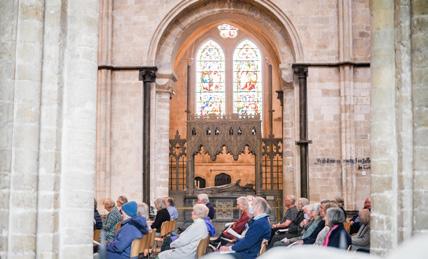
CHICHESTER CATHEDRAL
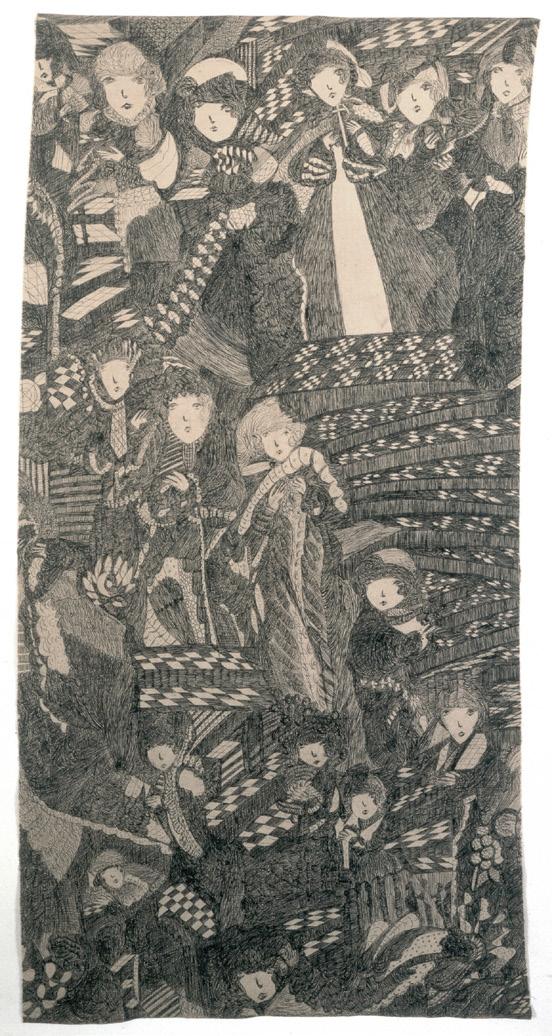
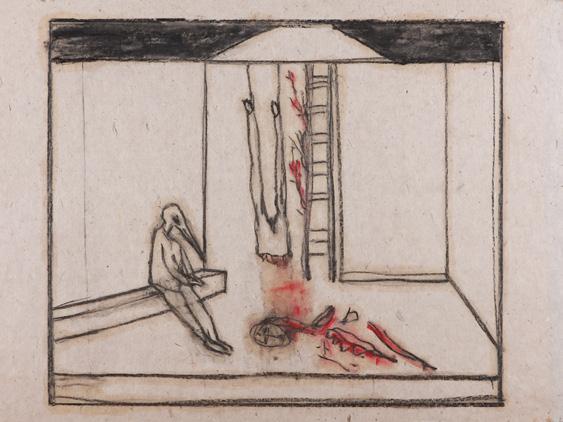
DRAWING THE UNSPEAKABLE - TOWNER
BN1’S GIFT GUIDE
INTHEFLOW
MILTON JONES
2024 ROUND-UP
QUIZ FACE
BN1 is a multifaceted cultural, communal, and lifestyle publication that enjoys wide distribution throughout the vibrant regions of Brighton, Sussex, and extends into the bustling metropolis of London on a monthly basis. Our publication can be found in various esteemed shops and venues. If you are seeking to effectively reach a substantial target audience, we invite you to get in touch with us to explore the possibilities of our collaborative partnership and the valuable assistance we can provide.
CAREER OPPORTUNITIES:
Are you interested in joining the esteemed team at BN1 Magazine, where you can cultivate valuable media skills and contribute by submitting compelling articles, content, and images?
We are pleased to offer a range of diverse internships suitable for individuals passionate about writing, photography, marketing, sales, creative pursuits, and other enthusiasts eager to make their mark in the dynamic realm of culture and lifestyle. As Brighton’s premier publication we invite you to send us your CV along with a brief introduction about yourself to: info@bn1magazine.co.uk.
All rights reserved including rights of reproduction and use in any form by any means, including the making of copies by any photo process or by any electronic or mechanical device (printed, written or oral), unless permission in writing is obtained from the copyright proprietor. All textual content, design graphics, images and specific photographs used in the magazine are copyright BN1 Media Ltd 2024
BN1 Magazine has taken every reasonable care to ensure the information contained within this periodical is accurate on the date of publication. It is advisable that you verify any information before relying upon it. BN1 Magazine accepts no responsibility for the consequences of error or for any damage or loss suffered by users of the information, materials or third parties featured within this magazine.
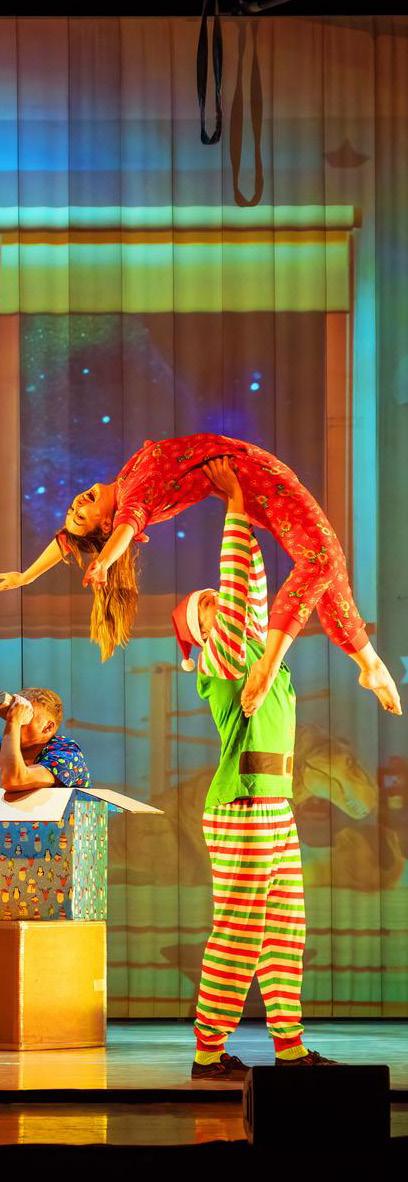
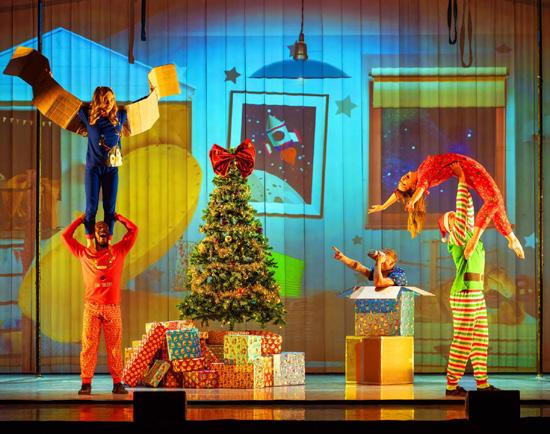
Starchitects Save Santa! Credit Dan Tucker
Photo Credit JIKSAW
HERE AND NOW, THERE AND THEN COMES TO TOWNER
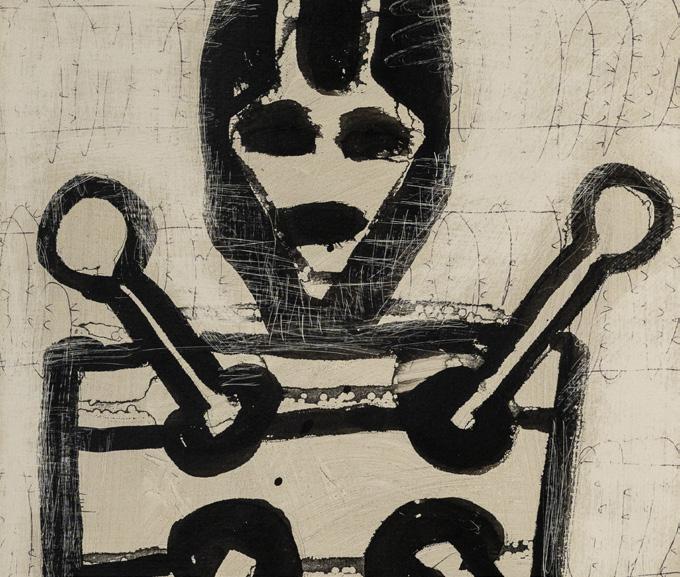
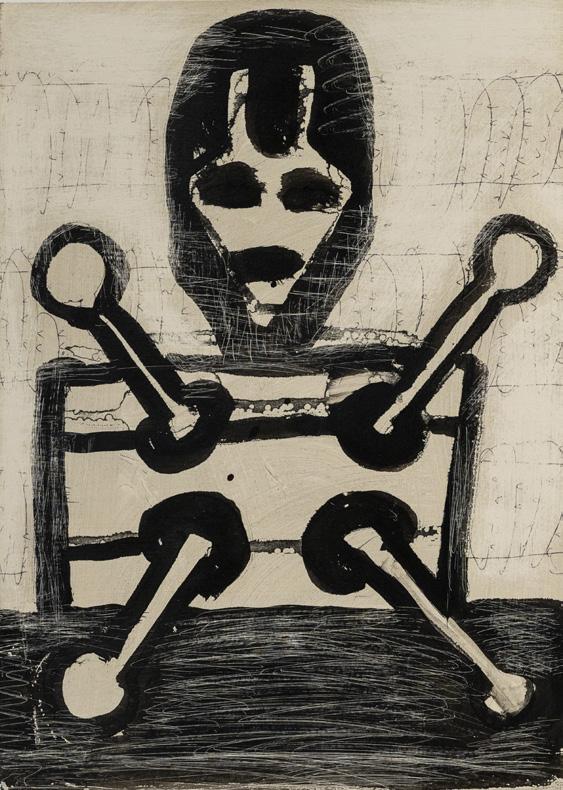
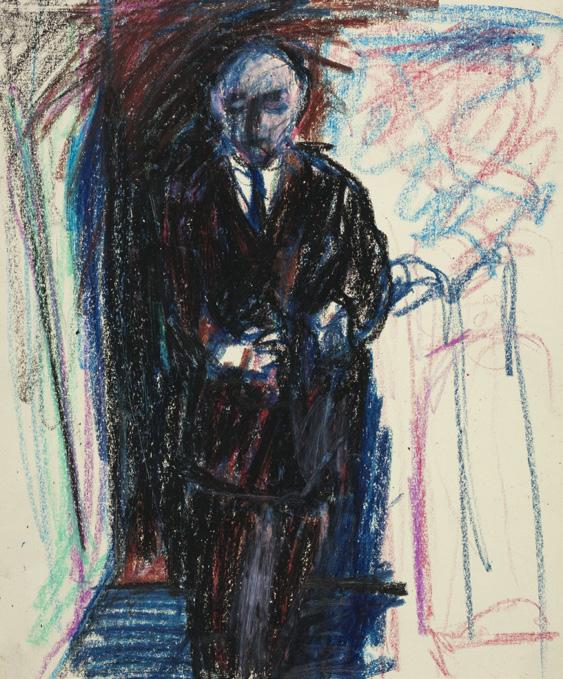
Presenting a selection of sculptures and drawings by internationally renowned artist Nigel Hall RA (b.1943), Here and Now, There and Then is running at Towner Eastbourne until Mon 3 March. A Royal Academician since 2003, Hall is one of the most respected sculptors in contemporary British Art.
Whilst best known for his 3D work, drawing has always been an essential part of his practice whether as an idea for a sculpture or in its own right, he continually uses it as a medium to explore space, light, shadow and structure. For Hall, landscape has remained a continual source of inspiration. Receiving a Harkness Fellowship in 1967 enabled him to spend two years exploring and recording the landscape of California, including the Mojave Desert and Soda Lake.
The exhibition includes a selection of these early American landscape
sketches, alongside a number of large-scale drawings, sculptural maquettes, and the newest sculptural works, through which he has been exploring an interest in computer-modelling. This exhibition demonstrates the breadth of his work across media as well as across his 50-year career.
Sara Cooper, Head of Collections & Exhibitions, said, “We are delighted to present this focused survey of Nigel Hall’s work which demonstrates the path of his career since the 1960s, from the early landscape drawings through to his most recent charcoal drawings. In addition, showing Hall’s innovative new sculptures made using computer modelling, so fitting in the architectural spaces at Towner, demonstrates his exploration of contemporary practice.”
One of Britain’s most distinguished sculptors, Hall’s outside works
The Treason Show celebrates 24 years!
Now celebrating its record-breaking 24th year, this award-winning, fast-paced, punchline driven show is crafted by a team of over 30 writers and performed by some of the UK’s finest comedic talent. Don’t worry if you can’t make the Brighton shows, you can see them in Worthing on the 21 of Dec at the Ropetackle, Shoreham on New Year’s Eve and Saltdean Lido on 28th Dec as well as Ironworks Studios from 27 to 30 Dec. With its unique blend of satirical comedy, local references, and toe-tapping tunes, The Treason Show review of the year has become a festive tradition not to be missed.
are principally made of corten steel, painted steel or bronze, and concerned with three-dimensional space, mass and line. His abstract and geometric sculptures give as much prominence to voids and shadows as to the solidity of material and each work changes with light and viewpoint reflecting the landscapes that inspired them.
Alongside the exhibition, Towner are working closely with Hall and London’s Kensington and Chelsea Council to bring the iconic sculpture Gravity/Levity, 2015, to be temporarily sited outside the Gallery on Towner’s plaza for the duration of the exhibition. The 5m high, magenta steel sculpture was commissioned by Kensington and Chelsea Council in 2015 for the public space linking the Aldridge Academy and Leisure Centre in Kensington. The title of the sculpture describes the lightness of being, in contrast to the continual gravitational pull of the body back
With a year’s worth of Treason Show’s behind them, this compilation edition is a mix of ‘Best-of’ material from 2024 mixed with bang up- to-date topical material. Featuring gags, sketches and parodies led by the show’s award winning creator Mark Brailsford. The four-hand team nail the great and good with toe tapping tunes and hilarious comedy routines that land with a well-aimed punchline in the final show of the year.
Imagine a blend of The Fast Show with musical flair, crossing paths with Spitting Image and Have I Got News For You – all wrapped up in Mark Brailsford’s Christmas package.
to the ground. The ellipses that form the sculpture, tightly grouped at the base, appear to be let loose as two of their number thrust upwards in a release of energetic drive.
A much-loved landmark to the local community for whom it is known affectionately as the ‘Giant Pink Paperclip’, the sculpture particularly connected to pupils at the new academy who responded to the vibrant colour and its inviting curves. In the aftermath of the Grenfell Tower fire tragedy in 2017 and the protection of the site, the sculpture was moved into temporary storage whilst the local community will lead on finding it a new home. The loan of the sculpture to Towner Eastbourne is supported by the community.
You can find more details at: www.townereastbourne.org.uk
SUSTAINABLE LIGHTING BUSINESS ENJOYS B CORP CERTIFICATION
GLOW UP
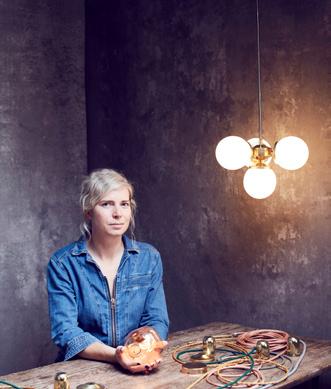
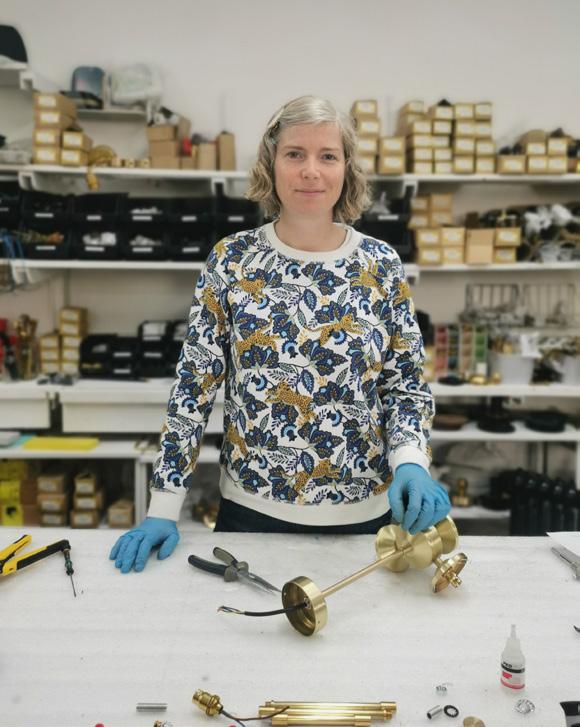
Bespoke Brighton-based lighting business, Spark & Bell, has grown from a kitchen table side hustle to a thriving B Corp accredited company with 10 employees and customers in over 20 countries, thanks to support from the Small Business Charter’s Help to Grow: Management Course.
Spark & Bell’s journey began when founder Emer Gillespie started designing lights for her daughter’s bedroom, which soon grew into a full-time business. Interest in Emer’s sustainable and ethically crafted lighting products grew significantly during the Covid-19 pandemic when many people chose to invest in their homes.
Propelled by this sudden growth, and after recognising the need to strengthen the company’s foundations for long-term success, Emer enrolled in the Help to Grow: Management Course at the University of Brighton School of Business and Law in early 2023. Through the course, Emer honed her approach to strategic leadership, identified gaps in the team structure, and developed new systems to improve operational efficiency and stock management. The course also spurred Emer to make the transformative decision to hire a stock manager to address the operational gaps she identified.
The most significant achievement following the course was Emer’s decision to pursue Spark & Bell’s B Corp certification, a process requiring businesses to meet high social and environmental performance standards. Spark & Bell achieved this in April 2024, making it one of just 2,300 B Corp businesses in the UK.
Emer Gillespie, owner and founder of Spark & Bell, said: “The course really opened my eyes to areas I hadn’t thought about before, especially around the need for me to step back from day-today operations and take a more
leadership-focused role. There was a light bulb moment when I realised how gaps in our team structure were holding us back. After that, I felt much more confident in our strategy. The mentorship and business school support helped me see where we needed to improve, and within months, those changes had a real impact.”
“The course also gave me the push I needed to finally go for B Corp certification. Achieving the certification was a huge moment for us and felt like a direct result of everything I learned during the course.”
On this strong foundation, Spark & Bell has reached new markets. While most revenue is generated in the UK, the company ships to over 20 markets, using platforms like Etsy to reach a growing international customer base. Emer’s work has also been featured in top design publications such as House & Garden, Ideal Home, and Livingetc.
Flora Hamilton, executive director, Small Business Charter, added: “Emer’s journey exemplifies the transformative force of expert support and mentoring in empowering small businesses to reach their potential. Her ability to identify operational gaps, pursue B Corp certification, and expand Spark & Bell’s reach internationally illustrates the real-world impact of our program and showcases how small businesses can integrate sustainability into their core practices.”
Business leaders can find out more about the Help to Grow: Management Course and sign up for the course in their area by visiting:
LP Creatives are back by popular demand for a thirteenth pantomime ‘Beauty and the Beast’ in Shoreham this Christmas!
This adaptation is set in the French village of ‘Marsh de Mello’, where a young Beauty dreams of finding love – and where a young Prince seeks redemption.
Standing in the way of true love though is the villainous ‘Baron Biscuit’ – with more grease than an old baking tray – can he win the crown, the Kingdom, and the attention of every girl in town?!
This pantomime boasts not only Beauties and Beasts, but also first class production, an hilarious script and a story with all the elements you expect from
a traditional pantomime – plus all your favourite songs, some modern twists and downright daftness thrown in too!
Our story is filled with song and laughter, most notably from The Fairy, Idle Jacque and Dame Do’nut – the finest (and only) cook in the village!
This will truly be a magnificent Christmas family pantomime, full of magic, adventure and lots and lots of fun!
Duration approx. 2hrs, including interval.
This spectacular show has all the elements you’d expect from a professional pantomime and oodles of silliness to boot!
An amazing six strong cast are raring to go – most notably seeing the return of local favourites James Austin-Harvey (not in a frock this year!) playing the villainous Baron.
“If you think James as a Dame has been outrageous over the last few years, you haven’t seen anything yet! We are looking forward to the Panto being even better this year with comedy, romance, magic and catchy songs and dance numbers!”!” says LP Creatives Producer and Writer Tom Beard.
“The Ropetackle is a unique and lovely venue to perform in and LP Creatives are so excited to be able to light up another Christmas there again with a fabulous production team and cast.”
‘Beauty and the Beast’ has 39 performances running from Fri the 20 of Dec 2024 to Sun 5 of Jan 2025.
Family of Four £74.00 (+ £4.00 fees)
Two adults and two children, or one adult and three children.
Adult £19.50 (+ £1.00 fees)
Child £18.50 (+ £1.00 fees)
Box Office: 01273 464440
Website:
www. ropetacklecentre.co.uk
www.facebook.com/ ShorehamPanto
Experience the Timeless Allure of Classic Land
Rovers at Goodwood Motor Circuit
To truly understand the enduring global love affair with the Land Rover, you need to experience the thrill of driving one—ideally, a classic model. These vehicles are not just cars; they are storytellers. Every scratch, every dent, every faded patch of paint holds a memory, adding to the unique character and charm that only time and adventure can bestow. As quintessentially British as a plate of fish and chips, the boxy, utilitarian Land Rover stands as an icon of British culture and engineering.
At Goodwood Motor Circuit, this legacy comes to life in a way few places can match. Behind the wheel of our meticulously sourced fleet of 1960s classic Land Rovers, you’ll tackle rugged, rutted off-road tracks that showcase the vehicle’s true capabilities. Feel every bump and drop as you navigate narrow trenches, steep descents, challenging inclines, and muddy traps. This is not just a drive; it’s a journey back in time, where the lack of modern technology turns every obstacle into an exhilarating test of skill and connection with the machine.
Their fleet, sourced from across the British Isles, represents a proud lineage of British engineering. Each vehicle is
lovingly named after the flora of the South Downs, where they now carve their paths. Much like a family, each Land Rover in their collection offers something distinct, from unique quirks to undeniable strengths—all worthy of appreciation and admiration.
What to Expect:
Tackle tricky trenches, steep descents, and muddy obstacles with up to three friends or family members.
Test your skills with driving challenges like the timber slalom, axle twist, and log bridge. Begin your adventure with a comprehensive driver briefing and introduction to your vintage vehicle.
Goodwood’s classic Land Rovers aren’t just vehicles— they’re pieces of living history, waiting to share their stories with you. Come and discover what makes these rugged icons truly legendary.
The Off-Road Experience starts from £149 and can be booked at Goodwood.com
All gift vouchers are valid for 12 months
www.goodwood.com/ motorsport/drivingexperiences
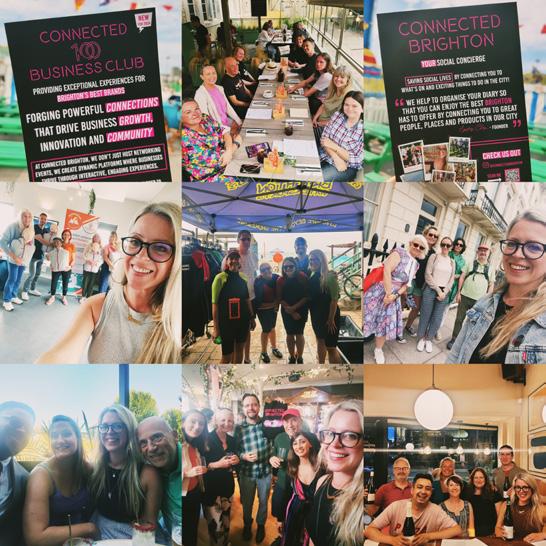
December with Connected Brighton: Sparkle, Celebrate, and Stay Connected!
Ho ho ho, Brighton! The festive season is upon us, and we couldn’t be more excited to share December’s magical lineup of events with you. Whether you’re decking the halls or dashing through the Lanes, Connected Brighton has all the sparkle you need to make this season merry and bright!
Let’s talk parties! Our annual Connected Brighton Christmas Party is the highlight of the season. Join us at Harbour Hotel for a night of music and dancing! Be serenaded by the fabulous trio Hit The Silk, then dance the night away to DJ Roy Gill spinning tunes till midnight. Grab your tickets now on our website or app—don’t miss the chance to celebrate with us on the dancefloor!
December is also the perfect time to support local, and we’re here to help you do it in style. Check out our Connected100, a carefully curated list of Brighton’s best brands, from top-notch property experts like Mansell McTaggart to delicious dining spots like Red Roaster and Fatto a Mano. Need a festive gift or some help getting ready for the new year? Our
Connected100 partners have got you covered, check out the Good Guide Gift from our charity partner Together Co helping to make shopping and giving easier this festive season.
Looking for festive fun? We’ve got events to suit every tasteSunday Roasts, Christmas Parties and Merry Fitmas with Lifefit to squeeze that last workout in before we head to the pub! Christmas jumpers mandatory!
New here? We love bringing people together, whether it’s for food, fun, or making lifelong friendships. If you’re ready to meet like-minded locals and soak up the festive cheer, Connected Brighton is your go-to community.
This December, let’s support local, spread joy, and make memories to last a lifetime. See you at an event soon!
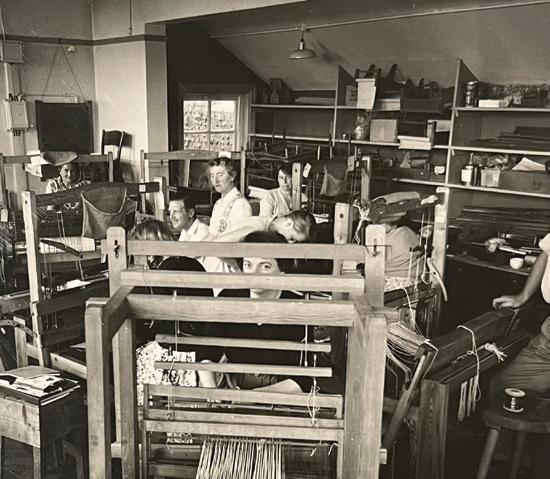
Continuing to showcase the work of the innovative artists and craftspeople who have lived and worked in the village, Ditchling Museum of Art + Craft has announced another landmark show. Running on Sat 18 Jan –Sun 22 June, On And Off The Loom focuses on Tadek Beutlich MBE (1922 – 2011), in the first institutional exhibition dedicated to his work in the UK for over 25 years.
A visionary textile artist, printmaker and teacher, he became renowned for his extraordinary tapestries, textile constructions and large vivid relief prints from the 1960s and 1970s. Strikingly large works created in his Ditchling studio in the late 1960s will take centre stage in this retrospective, including Dream Revealed (1968), an eight-foot-tall weaving created using unspun jute, mohair and horsehair, which has not been seen since it was shown in Switzerland at the Lausanne Textile Biennale in 1969.
Intricate freestanding off-loom pieces and vibrant relief prints made using tree sections, Lycra and foam rubber will also be exhibited, showcasing the breadth and variety of this extensive career. The Polish-born Beutlich, who lived in Ditchling, Sussex, in the late 60s and early 70s, had a distinctive style and approach which challenges the usual definitions of craft categorisation. As an artist, weaver and tapestry maker he would sometimes make prints and textiles using the same imagery, yet he believed that to plan out a tapestry or weaving by sketching it with pencil on paper was to do a disservice to the material that he worked with.
This complex relationship between fine arts and craft has much to do with his early years as a student – Beutlich was profoundly influenced by one of his teachers at art school in Poland who taught him “not to think just do it”, an ethos which resonated throughout his career. He used natural materials for his weaving such as sisal and jute and, whilst living in Spain, he began working with
esparto grass. His earlier work often contained pieces of organic material such as charred wood, and in some cases celluloid film or x-ray film. Their size was largely limited by the space he worked in.
He approached printmaking with the same innovation and freedom as he did textiles, experimenting with techniques and using wood, metal and found objects in his prints. He would walk on his prints as a substitute for a press, stamping by foot to imprint the design. This approach came out of both necessity and choice, as he could not afford a press, but he also liked the freedom that this method gave him.
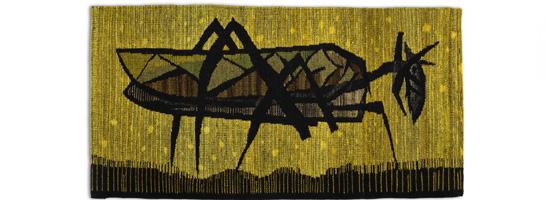
While in Ditchling, as he worked in Gospels, Beutlich made several large monochrome works that are said to reflect his subconscious grappling with wartime experiences. Among these is Winged Insect (1973). Characterised by heavy, twisted sisal, the works convey a sense of tension and unease, with their extraordinary scale lending them an imposing presence.
He found it difficult running a large studio and employing assistants at Gospels, and felt the process of making this work had become too commercial for him. Then, in 1974 in Spain - inspiration returned. He began working with the material around him, like esparto grass which grew by his house, and brightly coloured wool from local markets and making ‘free warp tapestry’. He returned to the UK in 1980 and settled in Folkestone. He continued to make smaller works for the rest of his life, enjoying recognition into his later years. Beutlich’s bold, innovative approach to materials, coupled with his fearless experimentation, gave him countless artistic liveseach of which will be showcased in this exhibition.
Ditchling Museum of Art + Craft is collaborating with basket maker Tim Johnson who will make a new commission in response to Beutlich’s work. Johnson has undertaken detailed practice based research (supported by Emma Mason Gallery and
West Dean College) using an incomplete manuscript by Beutlich describing his techniques for ‘Free Warp Tapestry’. The manuscript features illustrations by Beutlich, intended to instruct the reader on his off-loom weaving techniques. Tim will also lead two workshops about Beutlich’s techniques during the exhibition.
Linked to the exhibition, the museum has also taken part in The Sensational Museum, a £1M project funded by the Arts and Humanities Research Council (AHRC), this interdisciplinary project will design and create sensory interventions that are accessible to all – using disabled
people’s perspectives and insight to change how museums work for everyone. Devised with a team of external co-curators, a new multisensory display about weaver and dyer Ethel Mairet will be exhibited as part of Tadek Beutlich: On and Off the Loom.
For more information, head to: www.ditchlingmuseumartcraft. org.uk
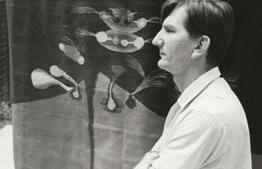
Tadek Beutlich teaching at Glamorgan Summer School, Barry, South Wales c 1958 (collection of Ann Sutton)
Tadek Beutlich
Ditchling Tadek Beutlich GRASSHOPPER
Moon Worshippers by Tadek Beutlich 1972
Pollination I Tadek Beutlich c1973
BRIGHTON DOME UNVEILS WINTER WONDERS FOR DECEMBER
Brighton Dome’s three historic venues are welcoming a huge variety of events this winter. Packed with spectacles for audiences of all ages, the programme includes high-energy circus full of African music and dance, a Christmas theatre show with an intergalactic twist, a modern take on a festive folk tale, plus a drag pageant spectacular to rival TV’s Drag Race.
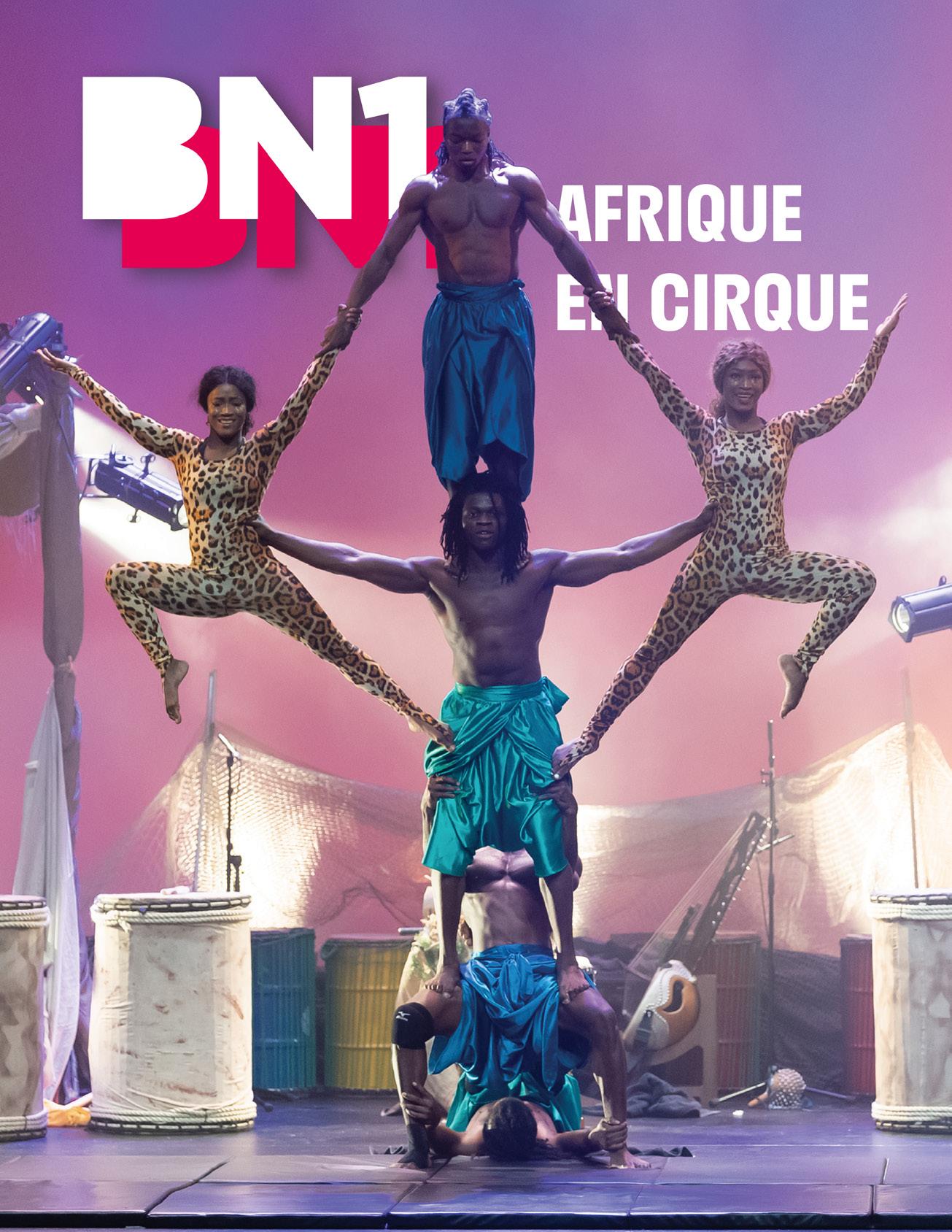
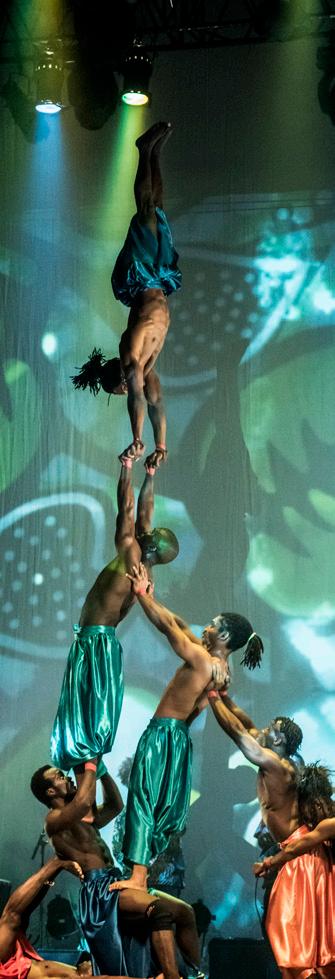
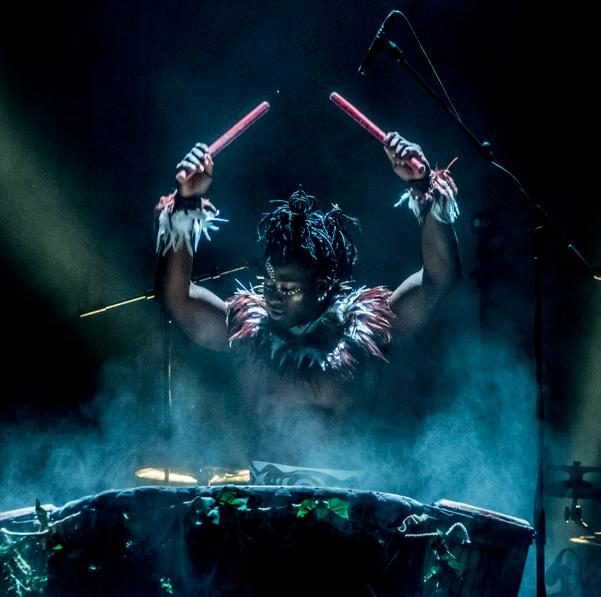
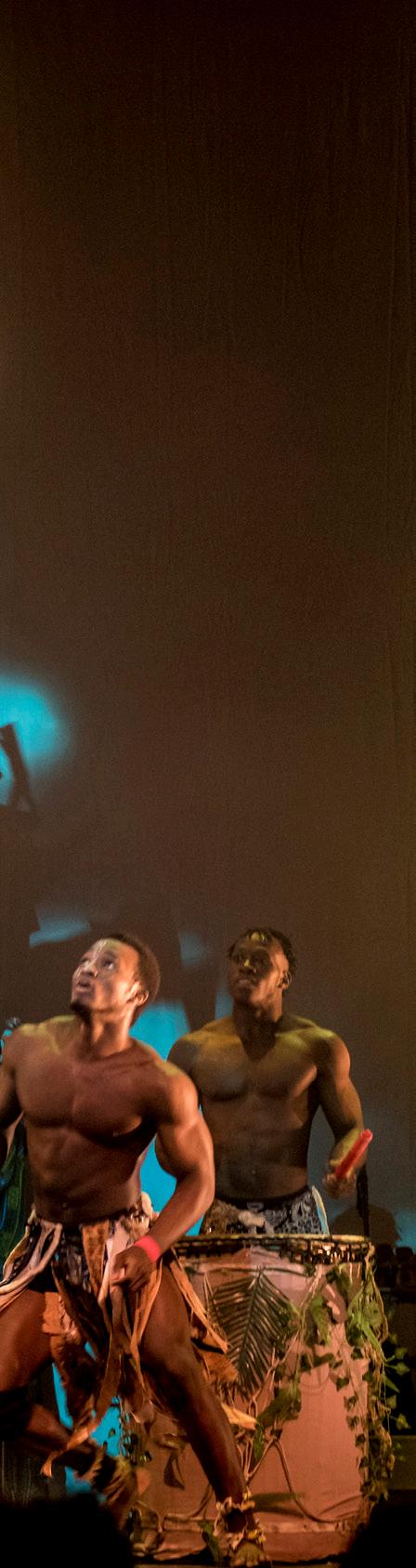
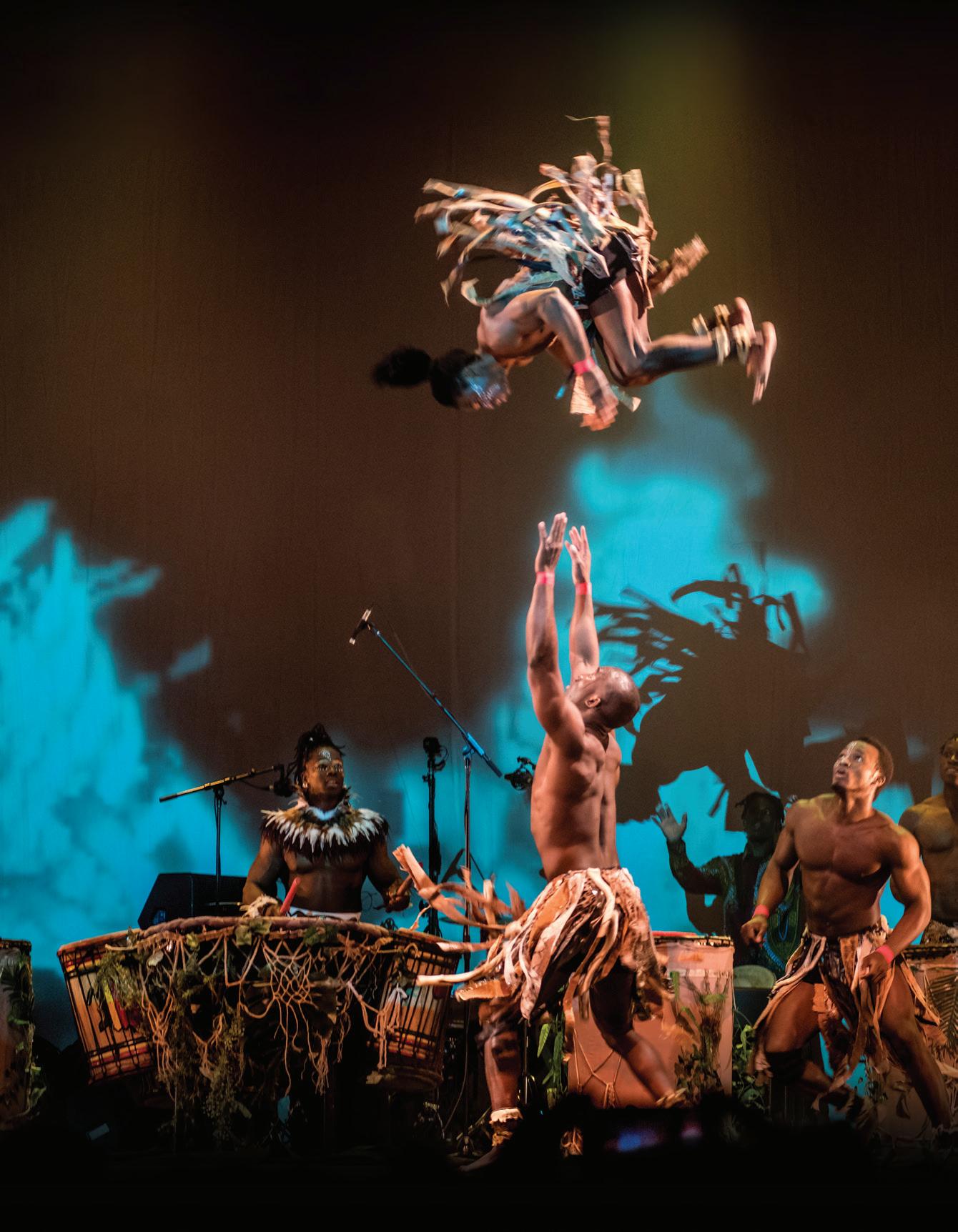
Fresh from sellout shows in Edinburgh and London, Canadian circus company Kalabanté Productions will burst onto the Concert Hall stage from Sat 28 – Tues 31 Dec, for seven performances of a circus show like no other. Their dynamic celebration of Guinean culture, Afrique en Cirque, features gravity defying acrobatics, African dance, live Afrojazz music, vibrant costumes and plenty of humour, for a journey through Guinea that is suitable for all ages.
Families can celebrate the season together at magical theatre show Starchitects Save Santa! in the Corn Exchange from Fri 20 – Sun 22 Dec. Full of fun and surprises, this intergalactic Christmas story mixes clever choreography, stunning digital projections and cosmic characters, as a group of adventurous friends attempt to save Santa on a daring rescue
mission into outer space.
Much-loved Brighton youth theatre ThirdSpace presents a festive show with a difference in Let It Be a Tale in the Studio Theatre, from Fri 20 – Sun 22 Dec. Exploring the stories we all carry with us and pass down through the generations, this colourful and vibrant winter’s tale will weave together folk stories from Ukraine, North and West Africa, the Middle East and beyond, with live music from Brighton-based arts organisation Best Foot Music.
A winter edition of Brighton’s biggest drag pageant makes its Brighton Dome debut, transforming the iconic Concert Hall stage into a camp and glamorous wonderland for one night only. Brighton’s Big Drag Pageant: On Ice! (Weds 4 Dec) will see ten fabulous drag acts compete live to win the crown… as if on ice! Hosted by Brighton’s award-winning drag icon Alfie Ordinary, expect ice queens, snow kings and stunning winter fashion. On Fri 20 Dec, another Brighton legend, the inimitable Ida Barr leads Organoke, a rousing Christmas singalong in the Concert Hall accompanied by Brighton Dome’s historic organ and a live band.
Classic festive animation The Snowman (Sun 15 Dec) returns to the big screen in the Concert
Hall, with composer Howard Blake’s unforgettable score performed live by an orchestra. There is also a special Crafty Christmas Family Workshop held in in-house creative space Anita’s Room on Sun 8 Dec, where children aged 3 and up and their parents or carer can create a snowy scene to take home.
Brighton Festival Chorus returns for their annual concert, Christmas with the Royal Philharmonic Orchestra, on Sun 8 Dec and The Choir with No Name Brighton are also back at Brighton Dome on Mon 16 Dec, with feel-good festive favourite The Big Christmas Singalong!.
West End smash-hit Only Fools & Horses The Musical visits Brighton for the first time from Weds 11 – Sun 14
Dec, with actor and comedian Paul Whitehouse in the role of Grandad. Following their hugely popular celebration of ABBA’s Eurovision win in spring, Brighton Gay Men’s Chorus present a mash-up of the magic of Christmas and outrageous, adored musical The Rocky Horror Show in The Rocky Holly Tinsel Show (Sun 7 Dec).
Brighton Dome is the south coast’s premier multi arts venue. Following the refurbishment of the Corn Exchange and Studio Theatre, the venue offers a wider and more accessible programme of events for audiences and community participants than ever.
For more information and to book tickets, visit www.brightondome.org
CHRISTMAS SPARKLES AT THE ROYAL PAVILION
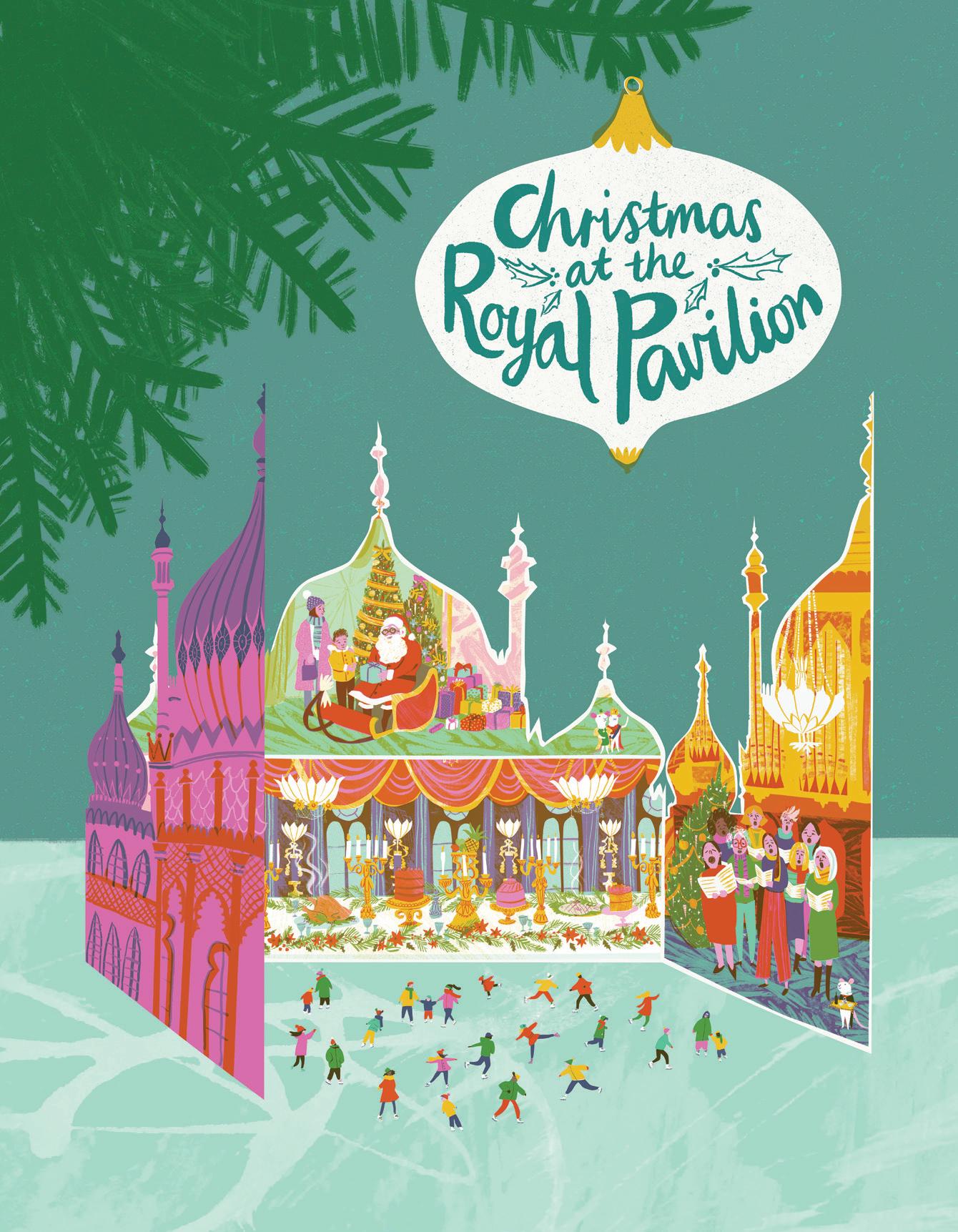
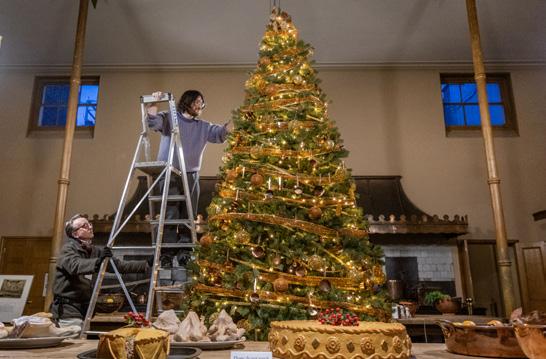
The final touches have been added to some spectacular Christmas displays at Brighton’s Royal Pavillion, which includes 17 uniquely decorated trees transforming the former palace into a magical experience.
Each tree tells its own story, from the Bridgerton-inspired frothy pastel tones to the opulent Louis XIV sunflower tree in the Saloon. There’s even a party tree festooned with invitations to gatherings once hosted by George IV himself.
Hedley Swain, CEO of Brighton & Hove Museums, said: “There’s something for everyone, with festive decorations, craft
workshops, ice skating, carol singers, trails for families, and magical experiences that will make this Christmas truly special.”
Upstairs, the spotlight shifts to Queen Victoria and Prince Albert, whose influence shaped many of our modern festive traditions. Three trees, including a recreation of their actual Christmas tree featured on a Victorian magazine cover, are displayed alongside original Victorian toys from the museum’s collection, capturing the timeless joy of a family Christmas.
For the first time ever, a magnificent 22 ft real Christmas
Starchitects Save Santa! Credit Dan Tucker
Credit Brighton Pictures
tree has been installed in the Pavilion’s listed garden, illuminating the grounds and creating a stunning festive backdrop for visitors.
Sponsored by Gap Solutions, a family-owned bespoke furniture business based in Brighton who carry out installations across the South East and London, the tree is a Nordman Fir located outside the main entrance to the Pavilion.
Gap Solutions Director, Greg Bradley, said: “This Christmas, we’re proudly supporting Brighton & Hove Museums as we ourselves are born and bred Brightonians, so we hold many memories of visiting the Royal Pavilion and museums and hope that they are here for many, many years to come.”
These Christmas displays are part of an exciting seasonal programme, including the return of a Regency Father Christmas, choir performances, a beloved mouse trail, festive banquets, and Christmas craft workshops.
Brighton & Hove Museums are also calling for further support to fund vital repairs to the domes of the iconic Royal Pavilion. Recent restoration revealed extensive water damage and rot in the smaller dome’s timber structure, prompting an urgent public appeal.
Thanks to generous donations, over £30,000 was raised within three days, enabling work to begin. However, the damage is worse than initially feared, and the museum now needs an additional £50,000 to complete the repairs.
Next year, exploratory work will assess the condition of other domes and pinnacles, ensuring the Royal Pavilion remains a treasured part of Brighton’s skyline for generations to come.
For more information on the Christmas tree displays, or to donate, visit : www.brightonmuseums.org.uk
BURNING THE CLOCKS
Sat 21 Dec
Following the success of last year’s biggest ever Burning the Clocks event, organisers at Same Sky are growing the parade’s artistic community by welcoming the local deaf community to celebrate the winter solstice on Sat 21 Dec.
Burning the Clocks will welcome over 2,000 parade participants with a dozen local bands, dancers and artists who will entertain more than 30,000 expected onlookers to celebrate the shortest day of the year. The event provides an important community focused antidote to the excesses of Christmas with a different theme every year. This
are we reminded that we are passengers on a spaceship earth, voyagers in time and space, and maybe not much else.”
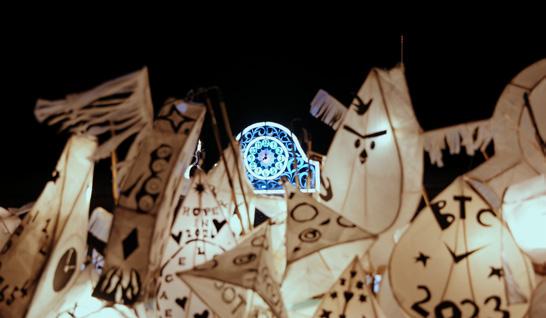
Starting in 1993, Burning the Clocks is an uplifting antidote to the excesses of a commercial Christmas. People bring the paper and willow lanterns that they’ve made to parade through the city before passing them into a huge bonfire on Brighton beach. Each lantern maker becomes a part of the show as they invest the lanterns with their wishes, hopes, and fears and then pass them into the fire.
Over 2,000 Brighton and Hove residents with their handmade lanterns are due to take part in the parade and over 30,000 people are expected to line the streets on 21 December to watch the parade and fireworks on the beach. The Parade begins on New Road and finishes on Brighton seafront near the end of the ZipWire.
This year, the parade welcomes new members from the city’s deaf community for the first time, including Omeima-Arts. Omeima Mudawi-Rowlings MBE, a Brighton based deaf BritishSudanese combined textile artist.
Other artists and groups in the lantern parade include Manor Road Gym in East Brighton, Brighton Table Tennis Club, mASCot, Unified Rhythm, Rap ‘n’ Rhyme, BARCO, Woodcraft Folk and local Guides and Scouts groups.
Community-led arts organisation
Same Sky Executive Producer, Rob Batson, added: “We’re so excited to bring another spectacular lantern parade to the streets of Brighton this year - it will be the 30th Burning the Clocks for this great city! We’re hoping for good weather, as always, for all participants and onlookers, but also to ensure we can put on an incredible firework display and traditional beach bonfire at the end of the event.”
Onlookers watching the parade are also asked to contribute money into donation buckets and card readers along the route to help fund the event. There is also a crowdfunder campaign that offers different prizes including personalised lanterns for the parade, limited-edition prints and a chance to lead the procession. People can also receive VIP passes to watch the bonfire and fireworks part of the event from a prime location on the beach. There are also limited edition original prints from regular artist Graham Carter, who has created another great poster for 2024.
Burning the Clocks is supported by Arts Council England, whose contributions have supported the high rising costs of materials, labour, and transport. Brighton Fringe, Brighton and Hove City Council, Brighton Winter Fayre Brighton Dome and Festival, and Sea Lanes have also made in-kind contributions to support the event.
year’s theme is Voyager, with organisers highlighting Brighton & Hove’s important welcome to so many displaced people on their individual voyages.
Artistic Director John Varah said: “This year’s theme was inspired by the 1977 Voyager probe launch and Carl Sagan’s eloquent passage from the Pale Blue Dot*, whose relevance continues to grow each year. We forget our core humanity when caught up in the hurly-burly of needless conflict and want, when we’re weary with disasters of the past year. It is only when we reflect on the indifference of the universe and our smallness
Same Sky are the producers of Burning the Clocks, the Brighton Festival Children’s Parade and many other events in Brighton and Hove. Same Sky was set up in 1987 and creates imaginative events and workshops to strengthen communities, inspire individuals and brighten people’s lives.
Their work engages directly with the community to produce a wide range of events, combining the visual and performing arts. They act as a resource for schools and other community groups supplying information and specialist advice and a programme of masterclasses, training courses and residencies. They have a proven track record in producing site specific events and installations, permanent and temporary public art.
People can now purchase lantern kits to take part in the parade from many stores across the city including Infinity Foods, the Book Nook in Hove, as well as from Same Sky’s website which can be collected from their central Brighton studio. They will also be sold at the Open Market on Friday 13 December. Lantern kits cost £40 (including VAT) and contain materials to make two lanterns, instructions for construction, and wristbands which allow four people to join the parade.
Same Sky is also looking for volunteers to join the parade and support the bucket donations team and the lantern collection on the beachfront.
More information can be found at: www.samesky.co.uk
BRIGHTON WINTER FAYRE - 5th
This December, a winter extravaganza is coming to Brighton & Hove, as three of the city’s most respected events professionals join forces to present some festive fun with a twist.
Whether you’re looking to catchup with friends, entertain the family, enjoy a festive night out or dive into an exciting workshop, the Brighton Winter Fayre has got you covered!
From a team that have been producing and managing events in Brighton for over thirty years, local business owners Anne Marie Chebib from Select Security, Becky Stevens from Hybred Events and Lisa Norman from Lout Promotions are promising something magical and creative for the whole community on the three long weekends up to Christmas.
Running Thursday to Sunday until Sun 22 Dec, a packed programme of entertainment is coming to the heart of the city. St Peter’s Church Square will host a range of workshops, a covered food and drink area, ‘Winter Nights’ for the grown-ups and an immersive grotto like no other, created by Artpod.
Councillor Mitchie Alexander, acting Cabinet member for Culture, Heritage and Tourism at Brighton & Hove City Council, said: “We can confirm there will be a full programme of festive events taking place in the city this December. We’re really excited at the organiser’s plans for the winter fayre and love that it will focus on local producers, local entertainers and have the
to 22nd Dec
local community at its heart. This will be a real celebration of our city’s reputation for welcoming hospitality and creative flair.”
There’ll also be a Sunday Makers Market & Craft Fair, with stalls selling festive goodies and a whole range of perfect prezzies for your loved ones, Orange Beach Bars will be on hand every day serving hot and cold soft drinks as well as local craft beers, gins and cocktails, with the food village open from midday for lunch with an array of savoury and sweet options.
Brighton Winter Nights highlights include Happy Mondays legend Bez playing Madchester anthems and Indie favourites at A Very Merry Bezmas, a fantastic edition of Black Deer Live presents Blue Rose Code – the headliner from this year’s Cambridge Folk festival - and Barrioke with Shaun Williamson of Eastenders and Extras fame.
The organisers are committed to giving Brighton a great Christmas pop-up in the centre of town that celebrates everything this eclectic and fabulous city is about. Championing local food traders, local businesses and local entertainment talent, all tickets have accessible price points with loads of free entertainment for everyone to enjoy reflecting our truly diverse community
Find more information and tickets at: www.brightonwinter.org.
BPO CENTENARY WINTER SEASON
As Brighton Philharmonic Orchestra’s celebratory centenary season continues, they bring welcome musical inspiration, warmth and sparkle to the city across the coming months.
“Winter lights are dancing to some fabulous music in our orchestral feast,” said BPO Music Director, Joanna MacGregor. “From Evelyn Glennie’s percussive brilliance and Alistair McGowan’s Dickens to classic Duke Ellington, Brighton Philharmonic Orchestra brings rich elegance and warmth to the festive season.”
Percussionist legend Evelyn Glennie celebrates Advent with the BPO in a performance of one of her signature pieces, James MacMillan’s Veni, Veni, Emmanuel written for her as a tribute to her virtuosic flair and charismatic personality. The celebrated young conductor Geoffrey Paterson returns to conduct the BPO in a programme that also includes Peter Maxwell Davies’ An Orkney Wedding, with Sunrise and Rimsky-Korsakov’s beautiful Scheherazade on Sun 1 Dec).
Fewer concerts in the BPO season have a warmer atmosphere than Charles Dickens’s A Christmas Carol which takes place in the atmospheric St George’s, Kemptown. Enjoy mulled wine and a mince pie as acclaimed actor Alistair McGowan narrates this most Christmassy of tales with the BPO Brass Quintet and
Dec).
Hailed as a ‘creative genius’ by jazz legend Chick Corea, jazz pianist/composer Gwilym Simcock and his trio lead an evening of classic cool performing works by Wayne Shorter and Duke Ellington alongside Simcock’s own. BPO welcomes back American conductor and leading figure in contemporary and jazz music Clark Rundell for this concert, whose conducting has taken him from Boston Symphony to the Tokyo Philharmonic, Leonard Bernstein to Brad Mehldau (Sat 25 Jan).
For full information on these events, BPO’s range of discount ticket schemes and latest news, visit:
www.brightonphil.org.uk
Joanna MacGregor on piano, directed by Richard Williams (Sat 14
Evelyn Glennie Scheherazade
Alistair McGowan
WINTER ARTISTS OPEN HOUSES LISTINGS NOW ONLINE AND BROCHURE COVER REVEALED
The Winter Artists Open Houses returns for 2024 with over 50 houses to explore across Brighton & Hove this festive season. With listings of participating open houses now online at www.aoh.org.uk/winter2024, visit the website to explore and plan your route through this popular festive event.
From Hove and Portslade to Fiveways, Seven Dials to Kemptown, stunning seaside neighbourhoods will come alive with arts and crafts displayed in the homes of a vast range of artists and makers. This year’s festival takes place on the weekends 30 Nov - 15 Dec 2024.
revealed this Winter’s brochure
by
Celebrating over 40 years, the focus of the winter festival is Christmas, with venues selling a range of artworks and handmade crafts as unique gifts. Many houses also offer a glass of something mulled, and a chance to meet the maker - perfect for a winter weekend. Houses are also listed online, so you can choose an area of town to explore, or simply look for your favourites on aoh.org.uk and follow along on social media @
artistsopenhouses to see what’s happening where. Neighbourhoods will come alive with festive colour and craft from Seven Dials to Kemptown to Hove and Hurstpierpoint.
You can now discover the over 50 venues taking part via the Artists Open Houses website, the 2024 festival will feature artists’ homes and studios across Brighton & Hove, that audiences can explore to discover art and unique gift buying opportunities.
• Popular returning open house 11 Wellbeck, featuring an array of local artists and makers including Matt Hall’s turned wooden bowls, James Price’s forged metalwork, carved wooden spoons from Annie Slack and much more.
• Colourful creations in paint and print can be found at Amber Elise Studio, featuring works by Amber Elise and Amy Isles Freeman.
• Unique gifts can be found everywhere at Winter Artists Open Houses, but why not try the wonderful Milton House or Starling Studio for an array of giftable products from homewares to artists prints.
• Near the South Downs, visit Helen Twigge-Molecey’s glass blowing studio for fungi inspired unique mouth-blown and hand-sculpted objects.
• BELTA Community Hub and Studios will open the doors to their studio for the first time this Winter, housing seven artists studios, artists will present selected personal works alongside resident work produced as part of the new BELTA Creative programme.
• Painters and printmakers across the city will be opening their homes including; Jessica Ford, Dion Salvador Lloyd, Clara Wilkinson and many more.
When buying from AOH for Christmas you are safe in the knowledge that your money is going straight to the maker, and that you are supporting artists’ careers in the process. There is a fantastic choice of work to buy this Christmas, including ceramics, textiles, paintings, jewellery, original prints and many other artworks by both emerging and established artists.
Judy Stevens, AOH Director, said, “December is a magical time in Brighton & Hove, with houses across the city opening their doors to welcome the public inside. Visiting Open Houses is a great way to discover new arts and crafts from Sussex makers and meet members of the local creative community. Everyone is welcome to visit open houses in their local neighbourhood, as well as those further afield, and to support our fantastic range of artists and makers across the city and beyond.”
Artists Open Houses have now
cover image, featuring illustration
Brighton-based Artist and festival Director Judy Stevens. The image takes inspiration from Orkney Writer George Mackay Brown’s poem titled Maeshowe: Midwinter.
Helen Twigge-Molecey, Winter Artists Open Houses, 2023. Photo by Syl Ojalla.
A night at The White Hart, Lewes
The perfect place to stay for a weekend away this winter
By Rosie Paldi-Edwards
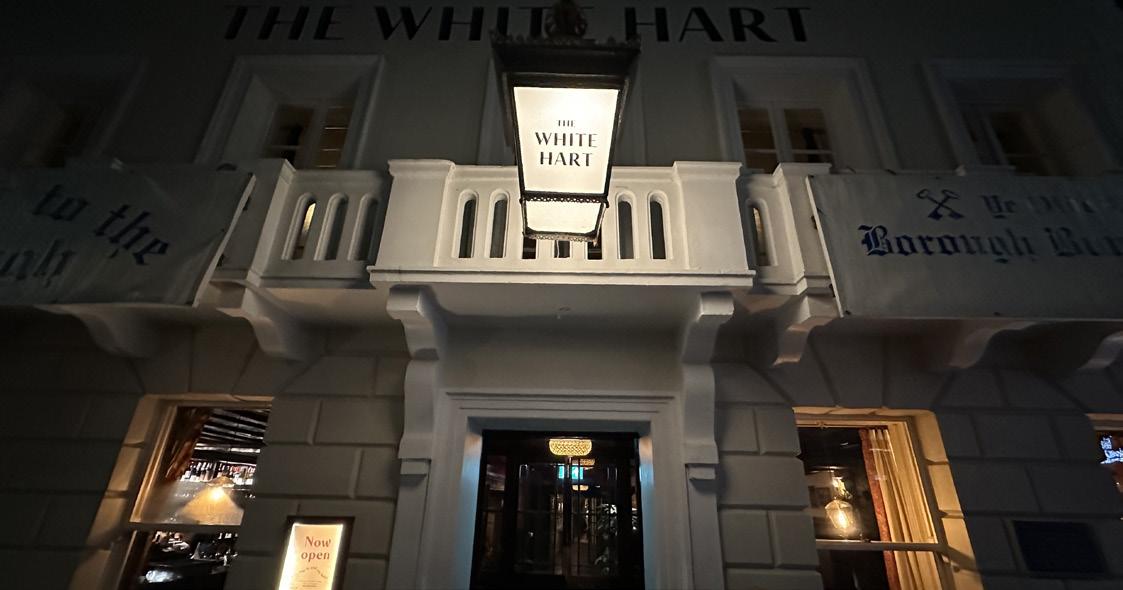
Lewes has always been famous for its riotous bonfire night celebrations, being a historical hotspot and having chocolate box streets. The town is also a hub of creativity with galleries, a lively music scene and their fair share of tasty eateries too. The South Downs is on your door step, with many parks, nature reserves and the river Ouse winding through it all. It’s safe to say, Lewes has a lot to offer and explore, however there have never been many options for accommodation. Until now. This is where The White Hart, a once 16th-century coaching Inn, comes into play.
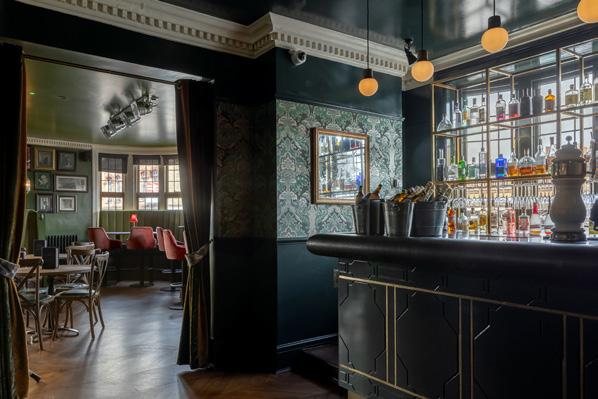
The grand building, left slightly dilapidated over the years, now sits proudly on top of the high street opposite the Town Hall. It has been refurbished head-to-toe by the Heartwood Collection, a 41-strong chain. This grade two listed building has been beautifully transformed into a stylish pub, with four sumptuous suite bedrooms and 19 other charming bedrooms, a large oak panelling dining room and excellent atmospheric lighting throughout the impressive establishment. The pub also has its own interesting history. The plaque outside the pub announces that Thomas Paine, one of America’s founding fathers supposedly debated and drank right here, which definitely fired my imagination! As I strolled around exploring the nooks and crannies of this incredible 500 year old building,I wondered what shenanigans and philosophical debates happened in between these walls.
First impressions were of an olde worlde atmosphere like stepping into a character filled pub in Harry Potter, but also rather grand with their use of lighting and lavish seating. I was
kindly greeted by the welcoming staff and given instructions for my room. Wandering up the large staircase, I found my room tucked up on the third floor. Opening the door I was welcomed into a spacious bedroom with warm soft pink walls, big windows, large beams, brass bedside lighting and Classic FM soothingly playing out on the radio. Instantly, I felt relaxed as I unpacked. The rooms are all different, but you can expect; a comfortable bed, antique looking furniture with plenty of storage as well as a stylish fabric headboard, Bramley bed sprays and a bold tiled bathroom.
The bed was centre stage and inviting me in, but before I got tucked into the luxurious bed sheets, I knew dinner awaited. Heading down to the dining room, huge Tudor fireplaces cover half the walls. The magical surroundings once again reminded me of the likes of Harry Potter. I then passed cosy snugs and concaves where people were sitting down for an intimate drink. It then opened up into a grand wood panelled bar and restaurant. Following the waiter to our table, I entered into the newly added extension. This modern open plan dining room had intimate areas with cleverly designed plants and seating to break up the open plan.
Their seasonal menu was very enjoyable and stands out from the rest of the menu. If you’ve been to other Heartwood pubs before, you’ll be familiar with the chilled atmosphere and the menu. It is definitely above the average pub grub. Starting off, I had the crab and sweet corn bites that were crispy and delicious. The cheese souffle was the fluffiest, creamiest and tastiest thing I have put into my mouth. The starters
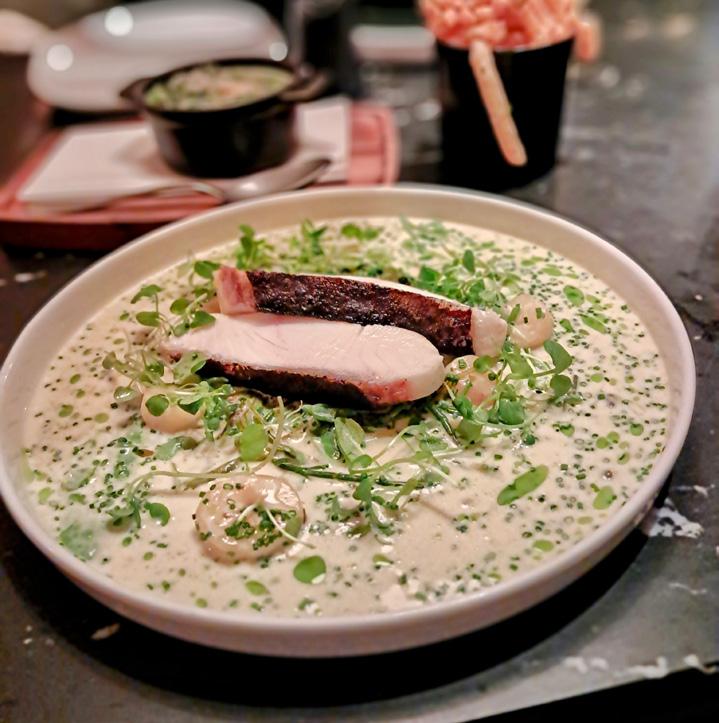
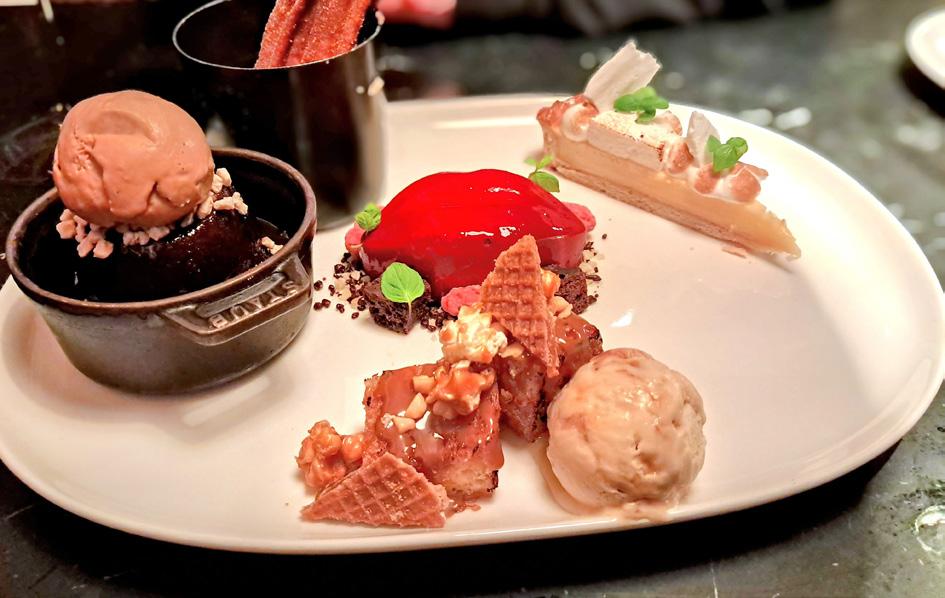
definitely excelled expectations. Similarly, I had a great experience with my seasonal main dish, which was cooked perfectly - consisting of succulent oak-smoked outdoor bred pork ribeye, creamy dauphinoise, hispi cabbage and the apple & prune chutney really married all the flavours together. Their seasonal desert that resembles, in their words, ‘a frozen autumn floor’ was creative and flavoursome. l thoroughly enjoyed my meal and with prices starting from £13.95 for a main, I would recommend it for a hearty meal and a stunning setting.
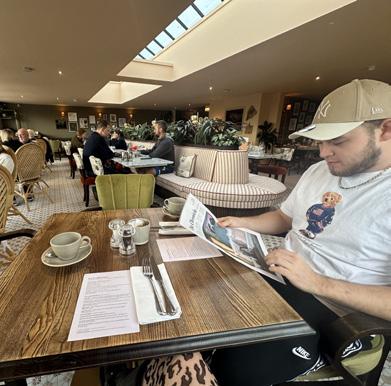
I couldn’t have gotten a better night’s sleep, honestly I’ve never slept on a mattress so thick before! After waking up and having a refreshing shower, I headed downstairs back to the dining area for breakfast. There was a phenomenal panoramic vista of the glorious rolling Downs and the expansive windows stretched across most of the dining area, making for great views to take in and enjoy all morning. As for the breakfast, it was a hearty English breakfast for me, other various combinations were available, my boyfriend got the veggie breakfast which was thoroughly enjoyed. It was delicious and everything you want from a breakfast. We sat for a while taking in the gorgeous setting, chatting, reading newspapers and drinking coffee and fresh orange juice. Overall a fabulous stay, with comfy rooms, tasty food, great atmosphere and lovely staff. I am already looking forward to coming back. This hotel is giving Brighton establishments a good run for their money.
Check out their rooms and restaurant at www.whitehartlewes.com
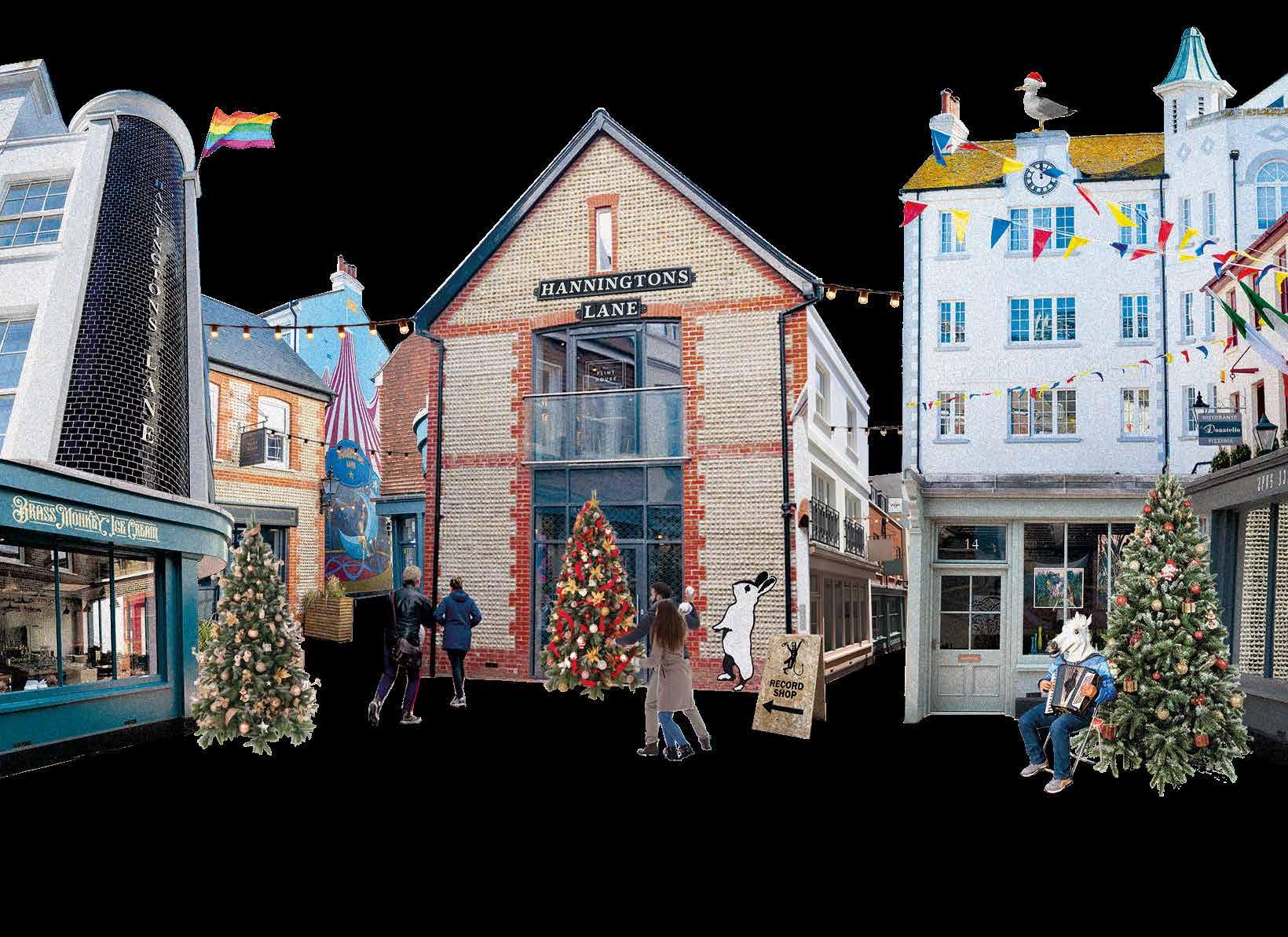
Sometimes the best things come in the smallest of packages Hanningtons is Brighton’s hidden gem and home to your locally sourced, unique, and perfect gifts this Christmas. Peruse a range of gifts from independent and artisan retailers and step into a world of Christmas wonder at Hanningtons. We have a range of merry events for you to enjoy too, including live music and festive food and drink.
Why go anywhere else?
NINA KOHOUT
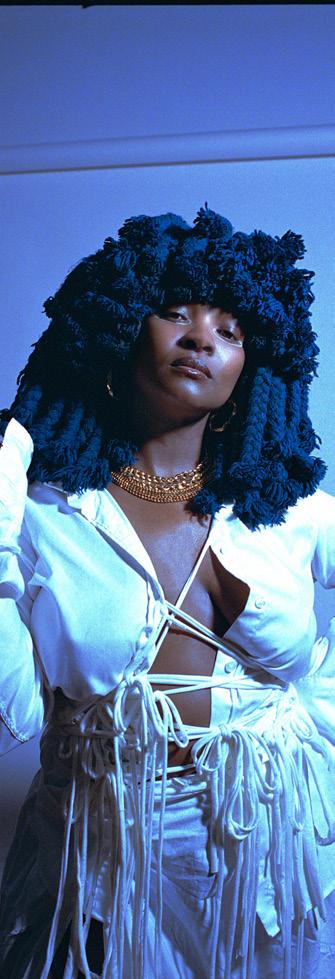
Slovak-born singer, composer, and multi-instrumentalist Nina Kohout has made waves with her hauntingly beautiful blend of folklore, classical music, and dark electronica. A graduate of the prestigious BRIT School and a rising star on the European music scene, Nina’s artistry transcends boundaries, delivering a unique sound that is both timeless and modern. With the release of her highly anticipated debut album, Nina invites listeners into a world of raw emotion and cinematic soundscapes. From exploring the delicate threads of motherhood to delving into the interplay between purity and darkness, her music is a bold, unfiltered reflection of the human experience. In this exclusive interview, Nina shares the creative process behind her album, the influences that shaped her sound, and her vision for the future of her music.
Congratulations on your debut album release! Can you share the inspiration and themes that shaped this project?
Thank you! I feel that each song stands completely on its own, so the themes are quite varied. For example, in ‘Little Butterfly’, there’s an underlying focus on the importance of understanding rejection; ‘Rhythm of Sirens’ captures the fear of losing a loved one — arguably the greatest fear of all. On the other hand, songs like ‘Pebble Dance’ and ‘A Child’ reflect and analyse different aspects of my life that have had a profound impact on me, and which I’ve finally managed to face. Overall, I’d say that the sense of inner peace and safety I feel in my life right now enabled me to undertake such an honest, raw self-examination — looking both inwards and outwards with total openness.
Your music blends elements of ancient Slovak folklore, classical music, and dark electronica. How do these diverse influences come together in your compositions?
Honestly, I’m not entirely sure! None of those influences are something I consciously embed in my music, and I often don’t even realise they’re there until someone else points them out. That said, it does make sense when you consider my background — I spent years in a Slovak folklore group, in a choir, and was also a vocalist in the electronic band Autumnist. All of these experiences have naturally filtered into my music in ways I didn’t necessarily plan for.
'Little Butterfly' debuted on BBC Radio 6 Music. How has the reception of this single influenced your approach to the album?
I wouldn’t say it influenced the process of making the album, but it was certainly a special moment. Hearing ‘Little Butterfly’ — a song that contains so much of raw me — on a radio station that I used to listen to during lonely days in London, shortly after moving to the UK, was truly big for me. It’s one of the heavier tracks on the album, born out of pure anger, and if anyone heard it and felt understood in any way, then I’ve done my job.
Photo Credit Jamie-Lee Culver
You've described your music as a conversation between invasive horror and fragile purity. Could you elaborate on how this duality manifests in your album?
I’ve always been drawn to contrasts. I’m not particularly attracted to the middle ground. Interestingly, I’m starting to realise that as I grow older, peace and simplicity are beginning to sound just fine. That said, I still love bold sonic statements, colourful tracks that surprise and even shock me. I think this is something I try to explore in my music — the dynamic tension between these extremes.
Having studied at The BRIT School and performed across Europe, how have these experiences influenced your artistic development and the creation of this album?
Those experiences really helped me understand how deep I can go with my musical expression. I was introduced to a wide range of music, both inspiring and less so, which helped me shape my sense of what I want to say. You also meet incredible people along the way, both on stage and behind the scenes, which adds another dimension to the whole experience of being an artist. For me, people are such an integral part of music.
Your debut EP, 'Pandemonium,' received critical acclaim. How does your new album build upon or diverge from the themes and sounds explored in that EP?
When I finished Pandemonium, I thought it was the most colourful musically and the rawest lyrically that I was capable of. I see that was not the case, since with Gentle Autopsy, every element of the songs has been even more amplified and deepened. I believe that’s exactly how it should be — and I hope to experience another kind of awakening with my next album.
Tracks like 'Song of an Unborn Mother' explore profound themes such as motherhood. What personal experiences or reflections inspired this song?
‘Song of an Unborn Mother’ came at a time when I was grappling with the possibility of not having my own child, which was a big thing for me. I’ve thought about having a baby for as long as I can remember. The song explores the idea that if a woman chooses not to become a mother, it doesn’t mean her gentleness, love, and care are lost. In a sense, all women are mothers, whether they have children or not — some just remain "unborn".
The album features intricate arrangements and vocal techniques. Can you discuss your creative process in developing these complex soundscapes?
Throughout the process, my main goal was to listen as attentively as possible to each song — to understand what it needed to feel complete and true. That is how all of those arrangements and vocal delivery found its way into the album. When something felt right in the moment, I trusted it. I felt incredibly free in my self-expression on this album, which I think is reflected also in the vocal delivery that is far broader than in my previous music. I gave myself a completely free hand to do whatever I wanted.
As a Slovak-born artist now based in the UK, how do your cultural roots and current environment influence your music?
Whether we realise it or not, the music, culture, and people around us inevitably shape our art — and I think that’s a beautiful thing. Personally, I don’t consciously feel the Slovak influence in my music, but I’ve been told,
by British audiences mainly, that there’s a certain exoticism to my sound, which I believe comes from my cultural background. I love that. I think just these specific influences can function as a special ingredient in one’s art.
Looking ahead, what are your aspirations for your music career, and how do you envision your sound evolving in future projects?
I’ve never been one to focus on long-term aspirations or goals in terms of my career. I’ve always taken a step-by-step approach, and that’s how I plan to continue. At the moment, I’m working on a few new projects, including music for film, which is a new and exciting direction for me. We’ve just finished a big autumn tour with 18 stops, and we’ve got three more shows in Prague and Brighton to go. After that, I plan to take some time to get inspired and figure out what it is that I want to say next.
For event dates and to listen to her latest tracks and videos visit www.ninakohout.com
Photo Credit Tereza Cervenova
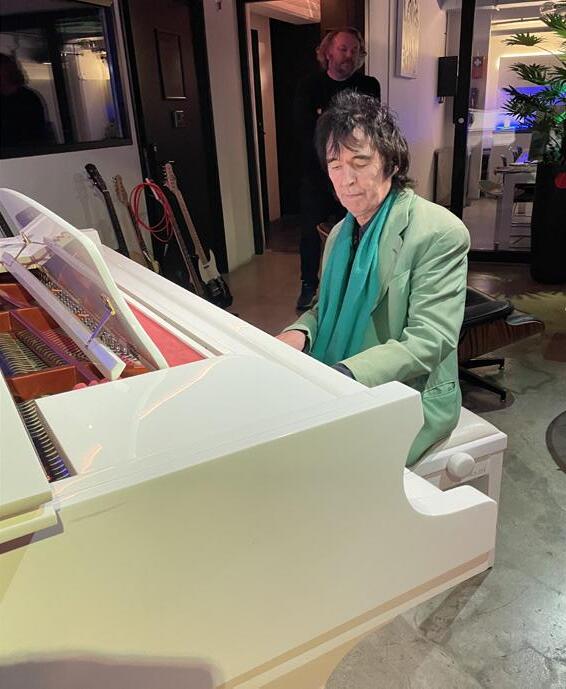
BOBBY WARD
A Sit-Down with Bobby Ward – From ‘I’m a Musician’ to the Magic of ‘London Snow’
It’s a chilly November afternoon, and the festive spirit is already alive as we meet Bobby Ward, a rock legend with a career spanning over five decades, for a chat about his latest projects. Sitting in a cosy Brighton café, Bobby greets us with a warm smile and an unmistakable aura of creativity. Known for his distinctive blend of rock, soul, blues, and spiritual songwriting, Bobby’s work continues to captivate audiences. From his humorous anthem, I’m a Musician, Not a Technician, to his newly released Christmas track London Snow, his artistry is as timeless as ever.
BN1: Bobby, let’s start with your humour-laden track, I’m a Musician, Not a Technician. How did this song come about?
Bobby: (Chuckles) “It was one of those lightbulb moments. My peers were encouraging me to embrace the digital age, telling me to get my songs on platforms like TikTok and Instagram. So, I bought an iPad—a big step for me! The salesperson rattled off all these apps it could do, and I stopped him mid-sentence and said, ‘Hold on, I’m a musician, not a technician!’ That phrase stuck, and I thought, why not make it a song? I jotted it down, took it to the studio, and explained the concept to my producer and session musicians. The humor resonated with everyone, and it turned into this tongue-in-cheek commentary on today’s tech-obsessed culture.”
BN1: It’s incredible how relevant and entertaining it is. But there were some hiccups with TikTok, weren’t there?
Bobby: “Oh, yes. We had a delay because TikTok flagged the song for a copyright issue. Eventually, they allowed only 30 seconds of it to be used! It’s ironic, really—writing about the tech world and then getting caught up in it. But people loved the humor, and some even said it could go viral!”
BN1: Speaking of viral potential, let’s dive into your Christmas track, London Snow. The production and vocals are stunning. What inspired it?
Bobby: “Thank you! The idea came to me during a recent trip back to London. I thought about how magical the city must look when it snows at Christmas. That sparked the concept, and I started weaving in memories of cities I’ve visited—Venice, Rome, Rio, Barbados, Monaco. Each place left a mark on my soul, and I wanted to channel that into a song that brings it all back to London during the festive season.”
BN1: How did the recording process unfold?
Bobby: “Ah, the recording day was unforgettable—it was sweltering hot! It reminded me of when Slade recorded Merry Xmas Everybody during a New York heatwave. The irony of singing about winter snow while melting in the studio wasn’t lost on me. But once we started recording, the vibe was electric. The musicians and my producer (Phil Saatchi) brought their A-game. I did the vocals in one take, and my producer was blown away. He even said, ‘I’ve never heard you sing like that, Bobby.’ The musicians joked it had an Elvis vibe, but it’s all me!”
BN1: What does London Snow mean to you personally?
Bobby: “It’s a love letter to the cities and experiences that have shaped me as an artist. But more than that, it’s about the nostalgia and beauty of London during the holidays. I wanted to capture that warmth and wonder in the song.”
BN1: And now, it’s out on all platforms, right?
Bobby: “Yes, thanks to my social media team. They’ve ensured it’s everywhere—TikTok, Instagram, YouTube, you name it. Even though I still joke about not being a technician, I’ve learned to appreciate the reach these platforms give to my music.”
As the conversation turns to what’s next, Bobby hints at more heartfelt tracks on the horizon.
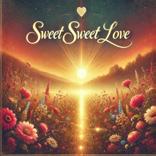
BN1: You’ve also been working on two new tracks, Sweet Sweet Love and You’re In My Heart Sweet Jesus. Can you tell us more about those?
Bobby: “Absolutely. These songs are deeply personal and reflect my journey as a songwriter. Sweet Sweet Love is all about that pure, unfiltered joy that love brings—it’s soulful, uplifting, and something I hope resonates with everyone. You’re In My Heart Sweet Jesus (feat. Kate Thomas) is more spiritual; it’s a reflection of my faith and gratitude. Both tracks have that heartfelt essence I strive for in all my music, and I can’t wait to share them with the world.”
BN1: Your songwriting spans such a wide range of styles, from rock to soul, blues, and even spiritual themes. Where do you draw your inspiration from, and are you currently looking for a publishing deal to bring your music to even wider audiences?
Bobby: “Inspiration comes from everywhere—life experiences, places I’ve traveled, emotions I’ve felt. Each song has its own story, and I always aim to write from the soul. As for a publishing deal, I’ve been considering it more recently. It’s something I’ve avoided in the past because I’ve always preferred keeping creative control, but with so many platforms available now, a good publishing deal could help my songs reach new audiences. So yes, I’m open to it if the right opportunity comes along—one that respects my artistic vision.”
As we wrap up, Bobby shares a final thought: “Music comes from the soul. Whether it’s a laugh-out-loud song, a Christmas ballad, or something deeply spiritual, my aim is to connect with people.”
London Snow and Bobby’s upcoming tracks promise to be a soundtrack for every mood this holiday season and beyond. Stay tuned—this rock star’s journey is far from over.
Listen to them on Spotify or visit www.bobbyward.co.uk Single covers below:
THE HEAVY HEAVY
Credit Nicholas O'Donnell
BY ROSIE PALDI EDWARDS
The Heavy Heavy band straight away hit a cord with me. Anyone who has listened to them I'm sure can understand, as I didn't expect a new band to sound so old. They immediately filled a longtime void in the musical landscape, delivering a fun and soulful mix of rock and roll. Their style as soon as you hear them instantly oozes of Fleetwood Mac or the Rolling Stones and people realise how long there hasn't been anything like this. As audiences across the globe grew enchanted with their era-bending sound, the Brighton-based band began selling out headline shows in major cities from New York to Chicago, opening for the likes of Black Pumas and Band of Horses, and earning critical comparisons to Jefferson Airplane and The Mamas & The Papas.
The band now with their long-awaited debut album One Of A Kind, draws listeners even deeper into their dreamworld. The debut album leans away from past inspirations such as folk-rock and gains momentum with The Heavy Heavy’s live band lending their explosive energy to the album. Written entirely by co-founders Georgie Fuller and William Turner and mostly recorded at Turner’s studio in Brighton, One Of A Kind maintains the same self-contained approach like their EP Life and Life Only—a seven-song project. Turner produced, engineered, and mixed every track and handled most of the LP’s lavish instrumentation (including guitar, bass, piano, organ, Mellotron, and more). The band gets to play around with more space on their first album and fully embraces their British roots, finding a particularly crucial inspiration in the gritty and groove-heavy hedonism of the Rolling Stones’ Goats Head Soup. BN1 chatted with co-founder and singer Georgie Fuller on the history of the band and to find out how she feels about the band’s new found stardome.
How did the band form?
Will and I met ten years ago on a different musical project. Will had a surf rock band and at some point asked me to lay down some backing vocals - the way my voice hit the tube mic with Will's production made us think there was something there to be seriously explored. It took a few years but at some point in 2019 Will brought some of his demos to me (one being Go Down River) and I laid down some harmonies. Before we knew it, we were stacking harmonies on top of each other and a couple of songs were finished with a very definite identity. It was autumn of 2019 that we took these demos and played them to some crowds - we played two acoustic gigs and then we all know what happened to the world…we found the guys, Thomas Holder and Frank Fogden in 2021, they both lived in the south of England and we’d been admiring their skills on social media for a while. We were lucky enough to have them both agree to join the band and we played six shows before being picked up. It was a convoluted journey for about two years and then suddenly we were on a plane to America!
What was the process like making your new album and what has the public's response to it been so far?
This was an interesting journey….we’d listened to a whole load of Rolling Stones - namely Goats Head Soup - during lockdown and written a bunch of songs with that slightly darker, groovier edge. Some of the tracks were written years ago, some were written over the winter of 23/24 as we were on the album deadline. It was tough to find the time to work on the album between tours. We also had great success with the ep and so there was almost a “sophomore album” expectation we felt. But really we just stuck to our guns - our aim was the infuse the sound with a bit more British rock roots and some britrock 90s stuff in there too as that’s another era of rock music we love. We wanted to kick the door down… present something a bit more bombastic. The public’s response to it has been overwhelming. Coming off the back of our debut album tour as I write this I’m reminiscing over all the amazing fans we have and their different reactions to their favourite songs. People have been grooving hard and we’re here for it.
Who has influenced you on this album?
The Rolling Stones, Small Faces, Led Zeppelin, the Madchester era - blur/oasis and also Beck in the 90s category. The Beatles and CSNY, a bit of Tame Impala and some Kings of Leon for good measure
Is there anything looking back at it now that surprisingly you took inspiration from? Anything random or mundane?
There’s a particular track that initially started as some sort of Bill Withers inspired groove which is random to us as we don’t make soul music, somehow it morphed into the track ‘Feel’. The intention was never to make it a part of the album - now it’s our second radio single!
I've read about your band being compared to the Mamas and Papas, Rolling Stones and others, how do you feel about it?
Being a harmony band inspired by the 60s it would be hard not to be inspired by the mamas and the papas. We believe this was the greatest era of sound and the positivity of change in the air meant the music had big dreams and sounded golden. We take huge inspiration from the aforementioned bands. We also love 90s britrock and the noughties era indie that gave us bands like Kings of Leon and Kasabian.
How was your recent tour? What is it like touring America and how does it compare to UK crowds?
The tour has been incredible. Many sold out shows in some historic venues, namely the Troubadour in LA. It’s been overwhelming to connect with so many fans and we’re already excited to return next year. American crowds can be more effusive and they’re not scared of yelling and expressing themselves. I used to think it was chalk and cheese but actually I wouldn’t say U.K. crowds are too far behind… especially after a drink!
Have you collaborated with anyone, if so who was your fave?
If not, who would be your dream to collaborate with?
No collaborations yet but some dream collaborations would be The Rolling Stones. Also love Cut Worms - feel like he’s one of the greatest contemporary songwriters out there.
How does it feel to receive such a positive response to your music?
We are very grateful. It’s a scary thing putting your music out - for it to connect with so many people can be overwhelming…in the best way possible, but it’s hard to put into words.
Has any of your new music particularly stood out to your fans?
We’ve had a lot of people tell us Wild Emotion is there favourite track on One of a Kind - it’s the most emotional song on the album so I can see how that would connect deeply with people. Go down river from our EP is definitely a clear favourite with fans. You’ll see couples pairing off at almost every show - sometimes it chokes you up it’s so sweet to watch.
What song has been stuck in your head recently ?
A fan sent me The Hollies - Long Cool Woman in a Black Dress recently and I’d forgotten about that track - I’ve had that on repeat closing out this tour. That and Lose You - Bully & Soccer Mommy.
How has life been recently? Calm? A whirlwind? How are you finding this exciting time in your careers?
An absolute whirlwind. It’s an incredible time that I’ll never forget and I feel grateful everyday.
Lastly, when can we expect to see you performing back in Brighton?
Our Debut Album One of a Kind release party was just under two months ago and that was so fun - I hope we return to Brighton in 2025 but you just never know! Sooner rather than later though, we hope. For more information on their music and tours go
THE HEAVY HEAVY
LESS TRADITIONAL CHRISTMAS FILMS
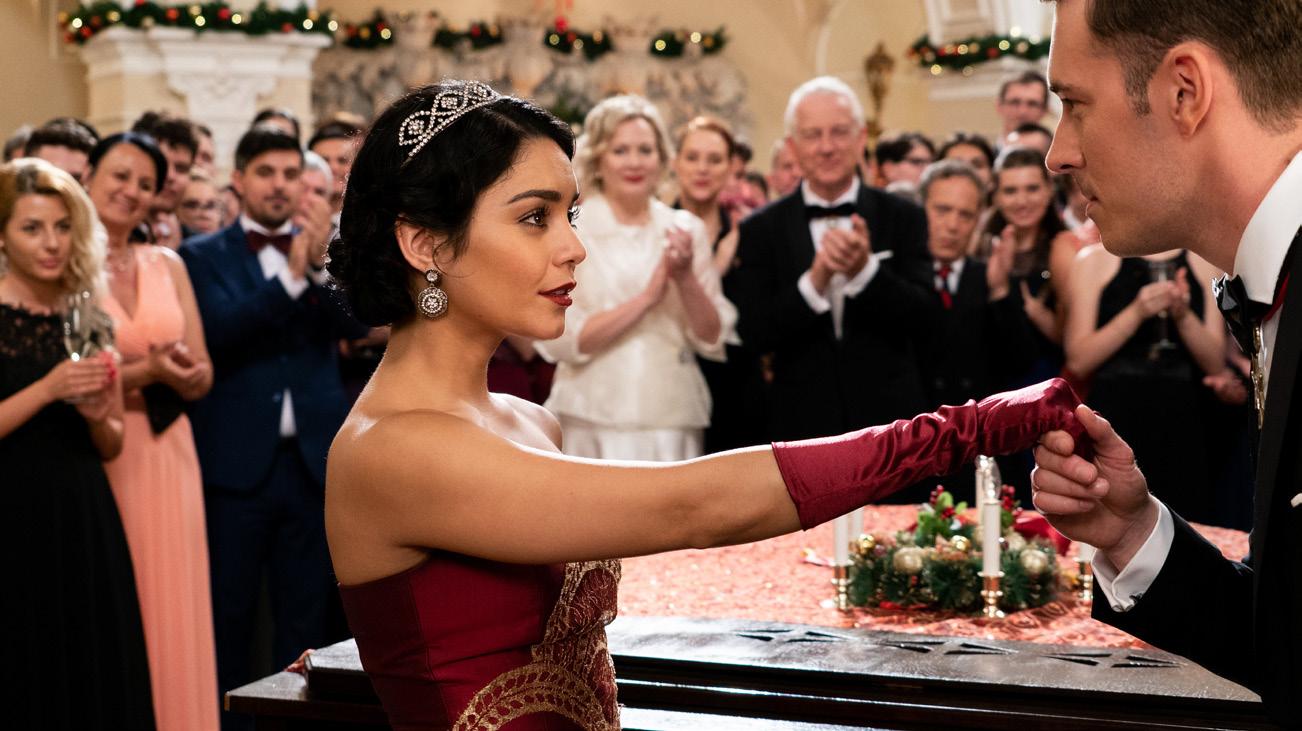
The Princess Switch trilogy
There’s something about Christmas which resonates with cinema. Those picturesque scenes, mistyeyed idealism and tales of quiet redemption are the fantasies which flow throughout Hollywood, feeding our dreams and reassuring us of a world where magic can happen. But what about those festive films which exist just outside the norm?
There’s a whole slew of works which subvert what should constitute a festive favourite. From the whacky, nonsensical and plain bad, we’re here to celebrate the other side of Christmas portrayals on-screen. There’s nothing better than a surprise, and some of these productions offer exactly that.
VIOLENT NIGHT
There’s been plenty of attempts to subvert Santa. We’ve seen him as a drunk, a thief and generally befuddled. But what if he had a particular set of skills, and found himself in the wrong place at the right time? Released in 2022, Violent Night portrays Father Christmas as a world-weary misanthrope who wanders into a hostage situation.
Blending elements of Home Alone, Die Hard and Straw Dogs, without apology, this slickly constructed action film soon sees our hero adding the bad guys to his naughty list. Much of the appeal hangs with his reluctance to get involved. It is his busiest night of the year, after all. Eventually the super-rich besieged family allows holiday magic into their hearts, but only after some tidy plot twists and brisk carnage.
A KARATE CHRISTMAS MIRACLE
Martial arts, a mass shooting and a professor with special abilities. It can’t get more festive. The young (and admittedly unsympathetic) Jesse Genesis creates a list of tasks, believing that if he can complete them all his father will return on Christmas Day. For example, becoming a self-taught karate black belt…
Exploring how young minds process trauma in different ways, this shares thematic links with Megan Park’s sublime The Fallout – if that film starred a precocious 10-year-old and had more roundhouse kicks. It’s the mother I feel most sorry for, as she remains sceptical in the face of her youngster’s profound faith. Full of crazy camera angles, excessive hand acting and slow-motion action, this film is certainly miraculous. But behind its wonky, amateurish charm there is an earnest heart.
THE FAMILY STONE
Regrettably, this isn’t a biopic about the multiethnic 60s funk band. But that superb gag isn’t the only reason this gets included. OK, maybe a bit. At the height of her powers, Sarah Jessica Parker plays a future bride attempting to win over some hostile in-laws. Although her new family isn’t quite as perfect as they’d like to make out. A saccharine-laden tale of acceptance during the season of goodwill, there’s some kind of witchcraft stopping you from picking up the remote control and channel surfing to see if there’s any repeats of Naked Attraction.
Part of the appeal lies with Luke Wilson, who is in full-on freak mode here, cannily recognising the ability of outsiders to create a new dynamic. Rachel McAdams also puts in a good shift, revealing the full depth of her talent as she snaps from hubristic spoilt princess to being perceptive and warm - keeping this wonky ship of cheerful nonsense just about afloat. All the schmaltz might be overbearing, but like any good horror film, you can’t help watching from behind your fingers.
STAR WARS HOLIDAY SPECIAL
Let’s start with the godfather of them all. This ill-advised festive favourite isn’t strictly a Christmas film, as it’s based around the rather secular sounding Wookie Life Day. This hastily fabricated festive cash-in filled the gap between the unexpected success of Star Wars and an eagerlyawaited The Empire Strikes Back. As a result, there’s a few interesting creative choices.
American kids excitedly gathered around their TVs on Thanksgiving in 1978, only to be treated to actors in furry suits communicating with growls and gestures. This was punctuated by an over-refreshed Carrie Fisher mumbling through some dialogue, a song performed by a tiny Jefferson Starship and an unsettlingly sexy VR machine. George Lucas has since disowned it; and attempted to remove it from the Star Wars canon. But it’s too late. We’ve all seen what he did. And it makes Jar Jar Binks seem reasonable.
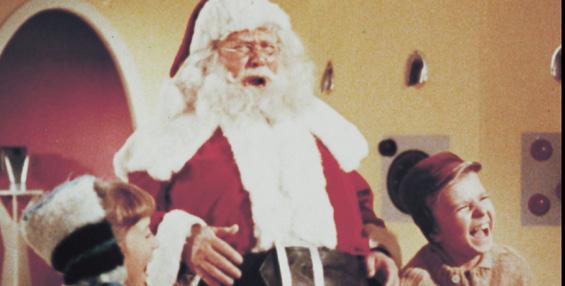
SANTA CLAUS CONQUERS THE MARTIANS.
Take a second to drink in that title. Back in the mid-60s, the world was obsessed by science fiction and the endless possibilities it suggested. One of these seemingly being a plot by the Martins to stop their children watching so much Earth TV. It’s got all the proud hallmarks of the genre’s infancy: wobbly sets, huge panels with flashing lights, costumes which look suspiciously like they were purchased from sporting goods stores and stilted dialogue.
It’s been named as one of the worst films of all time, but it’s not actually too bad. Obviously, the comedy is goofy, and the plot ludicrous, but this ill-advised project is absolutely a festive guilty pleasure. The Martian plan to kidnap Santa and force him to reinforce the cultural heritage back on their home planet is wonderfully bonkers. As is the thwarting of these machinations by a lot of fat old men dressing up as St Nick at Christmas. The solution? Kidnap two children and force them to divulge where the real version lives... You don’t get that from Disney.
I’M DREAMING OF A WHITE DOOMSDAY
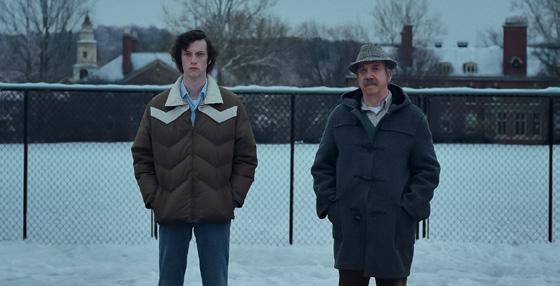
THE HOLDOVERS
People at a remote private school in New England with nowhere else to go, hunker down for the holidays. The ever-reliable Alexander Payne takes a concept which could be over-wrought or annoying, and turns it into a tender, and darkly humorous, story of not conforming to other people’s expectations.
Paul Giamatti plays a mercurial teacher, whose disdain for his pupils is only surpassed by the hatred for a system he’s become trapped within. Devoid of festive spirit, he’s the perfect choice to look after a bunch of kids who’ve been let down by circumstance. Occupying the space between The Breakfast Club and Dead Poets Society, this remarkable work is fast becoming a cult classic. Set against a background of rapidly shifting social and cultural change, The Holdovers asks all the right questions and gives the answers space to inexorably connect with us.
There’s been plenty of attempts to subvert Santa. We’ve seen him as a drunk, a thief and generally befuddled. But what if he had a particular set of skills, and found himself in the wrong place at the right time? Released in 2022, Violent Night portrays Father Christmas as a world-weary misanthrope who wanders into a hostage situation.
Blending elements of Home Alone, Die Hard and Straw Dogs, without apology, this slickly constructed action film soon sees our hero adding the bad guys to his naughty list. Much of the appeal hangs with his reluctance to get involved. It is his busiest night of the year, after all. Eventually the super-rich besieged family allows holiday magic into their hearts, but only after some tidy plot twists and brisk carnage.
CHRISTMAS PRINCE MOVIES
There’s a growing phenomenon on streaming services of films based around seasonal royal romance. The concept is always quite simple. A young woman encounters a prince from a tiny European country. She’s often wide-eyed and idealistic. He’s always charming, but slightly emotionally distant. The countries are invariably tiny, with no visible economy, apart from eccentric locals running tiny shops, acres of gold braid and enough snow to close every nearby school for months.
The actual circumstances for the unlikely pairings chance meeting can vary. Often, she’s been engaged by the monarchy for seemingly innocuous task; like teaching a child to ice-skate or repairing a much-loved merry-go-round. Similarly, the Prince might be travelling around the United States and find himself in desperate need of a party planner. In a few cases, the prince might even be living incognito, reluctant to display his fabulous wealth. Two things are clear. It’s nearly always Christmas. And there’s no class gap which can stand in the way of true love. Obviously, these things are made by Americans. Can you imagine if a British prince married someone of lower social standing?
The two biggest players in this niche are Hallmark and Netflix. The latter’s Christmas Prince offerings are even rumoured to be set in the same intertwined reality. I’m not sure if
there’s enough space in continental Europe to accommodate all the principalities in the Netflix Christmas Prince Cinematic Universe, but none of them seem to be signed up to UEFA, so we’ll assume they are all truly tiny. One thing is certain. The more you watch these films, the more surreal and bizarre the lore becomes.
Obviously, the most celebrated entry of the NCPCU (as nobody is calling it) is A Christmas Prince. A young journalist is sent to Aldovia to cover the coronation of their new king. Posing as a tutor to a young princess as a cover story, she’s introduced to the prospective king – who turns out to be properly fit. One snowball fight later, and love is in the air.
Vanessa Hudgens takes on two roles in The Princess Switch trilogy. A young woman travels Belgravia for a baking competition, only to find she’s the spitting image of the prince’s fiancée. There’s swapping places and much hilarity to follow. And just to show that Deadpool isn’t the only franchise to do meta gags, two of the Switch characters watch A Christmas Prince on TV – with that prince and his wife appearing later on in the series.
While Hallmark’s offerings might not be linked, they’re still gloriously implausible and rammed full of chirpy Christmas spirit. Roger Moore’s last, non-cameo, film role was in A Princess For Christmas, where Jules, a down on her luck young woman, is raising her nephew and niece. Moore plays the kids’ grandfather, who invites the whole family over to Castlebury – where it
turns out he’s a Duke, and his well-hot son is a Prince. Even more fortunately, he and Jules aren’t related. So, they obviously get cracking. Shifting gears a bit is Once Upon A Holiday, which takes the almost outrageous step of having a runaway princess fall in love with a rough and ready (but extremely hot) young man.
Elsewhere, there’s also My Christmas Prince, where an ordinary New York girl finds out that her long-term partner is actually a prince, and Christmas With A Prince, where a busy paediatrician has a prince inexplicably (and inappropriately) being treated on her children’s ward. These aren’t to be confused with A Prince For Christmas, which follows a young lady from a small town falling in love with a prince who is trying to escape a loveless engagement, or Prince Of Darkness, which isn’t even a Christmas film, but a John Carpenter horror classic which is more plausible than most of this.
These films are probably the closest we’ll ever get to understanding how a royal wooing works, short of fantastical musings from Nicholas Witchell. Why they’re all set at Christmas is anybody’s guess. I suppose Christmas is a lot more romantic if you’ve got staff to get the shopping, buy lavish presents, plan parties and hang decorations from every protuberance in the entire kingdom. And it’s this kind of escapism that we all need a bit of during these cold winter nights.
AFRIQUE EN CIRQUE
Kalabanté
Productions bring new worlds to Brighton Dome
By Stuart Rolt
All Photo Credits - Kalabante Productions
“I wanted to create something unique,” Yamoussa Bangoura tells me. “I decided something was missing and wanted to show my African side – like acrobats mixed with modern and traditional music, singing, dancing and exuberance. And that's what happened, and we’re now showing this to the world.” The Artistic Director of the Montreal-based Kalabanté Productions is talking about his new show, Afrique En Cirque, which combines modern theatrical techniques with spellbinding physical performance and a powerful story of everyday existence.
He and his company are out on tour for ten months now, taking their remarkable show all over the planet – which includes Brighton Dome on Sat 28 - Tue 31 Dec. “It's based on daily life in Guinea. We show you the beauty of our country and Africa, the way we live, how we do our music and the way we see the circus.” Everything is set in a local fish market - a community space which should feel familiar wherever you live.
“There are people fixing broken nets, trying to sell things, selling the fish… there’s people doing construction. Everyone is living their life.” Bangoura has taken this simple and universal setting and added in a riot of sound and movement. With traders’ pitches becoming impromptu stages for the musicians, iconic West African instruments like the Kora, Shekere, Djembe and talking drum provide an evocative soundtrack, effortlessly shifting between Afro-beat, jazz and heritage practice. “With the music, you have the traditional combined with the new and modern music. There are all those big drums, which make the heartbeat. We want people to travel from here to Africa without taking a plane. The market is the place where you see people living. It’s the place where people join people. Everything is there.”
It gets me wondering if there’s a circus culture in Guinea and the wider region, in the manner of the travelling performances we’re used to in Europe. It turns out that these skills are less of a travelling spectacle and more part of everyday life. “Circus was all around in our life - without actually calling it circus. You will see people doing magic in
Africa, which has been around for a long time. You’ll also see people doing floor acrobatics, without even knowing they're breakdancing. We know what it is now… but back in the day, it was just people having fun. There’d be mothers who would juggle with oranges, to make their baby stop crying, or do funny faces. Those things can be like a circus. It has always been in Africa, and that’s what we wanted the show to express.”
Bangoura has established himself as a curator of Guinean circus arts, receiving the Circus Arts Recognition Award from the Conseil des Arts de Montréal for his work. Trained in dance, kora, juggling, strap, acrobatics and singing, this versatile performer is intent on spreading his message as far and wide as possible. “There are all these multi-disciplinary things I can do. I never get bored. There is always something different – like drumming, dancing, singing, juggling, doing pyramids… It's always changing.”
Adding a splash of vibrancy into an otherwise drab British winter, Afrique En Cirque is an ideal choice for the Dome’s celebrated holiday season. “This will be our first time in Brighton. We've been to London, we've been to Manchester, and we went to Edinburgh. So, I can't wait to discover the city. I have heard a lot of good things about it. I want all my performers to have the opportunity to meet people over there.”
“Back in our hometown is that fish market. We just wanted to show how we lived. I was one of those going fishing. There is lot of things I did, and I wanted people to feel. When you get to be an adult, you say: ‘Wow, I was lucky that I did all that’. And I was lucky. That’s the beauty of things.”
In some ways, this is a reaction to westernisation, as traditions and heritages around the world are slowly being erased by a proliferation of huge supermarkets and fast-food chains. “It's a kind of fight. You see the internet and how easy it is for people to not look at their own things, but what’s coming from outside. The big names, like McDonalds, want you to spend money and money and
money… I’m trying to have those opportunities to see the world, but also know we can live simply.”
“Like, if you have like an iPhone 16 here, they won't have that over there. Those brands are still everywhere. Lives are changing, and people are judging each other. You have this. You have that. We should celebrate where we come from and what is around us, really, rather than looking over the horizon all the time.” By celebrating Guinean culture, youth, hope and the African diaspora, this critically acclaimed show has been treating global audiences to a multi-sensory extravaganza loaded with simmering energy. There’s tumbling, juggling and balancing, as the action comes right to the heart of the community.
Obviously shows like Afrique En Cirque are a potent example of the unwritten language which performing arts can offer. Participants cooperate and interact in ways which transcend borders or politics. By watching and listening, we instinctively know that this show’s overarching message is one of joy. “It's really helpful, because it's open and without limits. Somebody from Russia can juggle with someone from China or Johannesburg. When you play a note, everyone can tune to it and play together. That's the beauty of art, and what we’re creating onstage. It’s not just a show. You leave having learned and felt something. There’s a lot of emotion in the show. The music goes through your body. And that's what we want.”
Yamoussa Bangoura and Kalabanté Productions’ Afrique en Cirque comes to Brighton Dome on Sat 28 - Tue 31 Dec.
www.kalabanteproductions. com
www.brightondome.org
Go from your mind feeling full & feeling disconnected from your feminine to feeling more peaceful in your mind & more awakened in your body.
By Emma Fullwood
If you find yourself living in your head most of the time then it’s no wonder you never feel totally fulfilled in life despite your successes, living in your mind is like living in your mansion's grey dark attic space. You will always feel like there is something missing and because of this you will always search outside of yourself for more. Despite all the material things and your success you will always feel an emptiness. I liken this to living in the attic and never exploring the colourful luxurious mansion within.
I’ve never met a woman that went to a female pleasure school growing up so it’s no wonder that you feel disconnected from your body. It’s not your fault it’s how Women are raised. Not only are we taught nothing about the biggest, brightest and most beautiful area of our body you will also have been subjected to both medical and sexual experiences that left you feeling violated, scared, confused and unsafe within. These experiences are the very reason that we move out of the biggest luxurious room in our mansion and head up to the attic space as it feels safer upstairs than to feel in our body.
Sadly this is the exact reason you are struggling with pleasure within whether you feel disconnected from your body and always living in your mind or you notice that you can’t ever fully switch off in pleasure when your mind is busy. Or maybe you struggle to fully let go and because of this you have only managed to experience clitorial orgasms and you want to experience more vagina sensations.
What you may not realise is that pleasure is linked to how present and safe you feel in your body. This is different to body awareness as body awareness is more like being aware of how your body is moving in a Yoga class, for example, you are aware of tight hamstrings
and you are aware your shoulders are tense. Embodiment is different. It's a reconnection back home to your body after you have lost the keys to the other rooms in your beautiful mansion and it’s the first place we need to explore in order to feel more sensation within, grounded, safe and present in the body.
It’s time to venture out & explore the sensational body that God gave you to enjoy. Because there is a room downstairs that's the most colourful space ever. That is a space of pure beauty and will connect you to your life force energy. For a Woman to feel complete, to feel grounded and to experience deeper sensations of pleasure she needs to live fully embodied - IN THE BODY.
Embodiment mini course takes you from having body awareness to exploring the rooms within especially the room at the bottom of your mansion the room that holds the most pleasure that's full of luxurious and beauty
Let me take you on a journey to explore the areas of the female body that you are disconnected from the most from so that you can learn how to truly feel safe with a deep trust in yourself like never before and at the same time we can awaken the muscles of your vagina so that you feel more sensation and pleasure all whilst calming the nervous system & activating the Pelvic Floor muscles - What woman doesn’t want to try these beautiful Embodiment rituals?!
Often Women have body awareness - I liken this to knowing you have tight shoulders or hamstrings, body awareness is what you have when you are in a Yoga class but, that's not experience. Embodiment being fully present IN THE BODY is a total different experience. Only when we can experience this can we heal past trauma (medical & sexual) can we heal from
Can you imagine owning a 10 bedroom mansion yet only ever living in the dark dusty attic space?
past relationships that have left us hurt within & can we fully understand & re connect with our incredible & mysterious female pleasure portal
When a woman lives in her mind (AKA the attic) she is missing out on exploring all the other rooms in her body. Sure she’s aware that there is more to feel and more to explore but due to conditioning & past experiences she remains held in the attic & disconnects from her pleasure sensations.
Whose this for?
� If you feel disconnected from your Vulva
� If you are going through changes such as Peri-Menopause this will help relax & centre yourself whilst also supporting your Libido
� If you have recently given birth & feel disconnected from your body
� If you have experienced birth trauma or any medical trauma or procedures that have left you feeling disembodied
� For you if you carry any sexual shame or feel that your parents/societies or religious background has meant that you don't feel sexually liberated & would like to start to connect to your body more
� For anyone that has experienced sexual trauma
� For any Woman that is struggling with their Libido
� If you struggle to Vagina orgasm & want to explore ways to help you feel more sensation
� For you if you have come out of a relationship & want to nurture your body on a deeper level
� For you if you want to reconnect to your Pelvic Floor muscles whilst increasing blood flow & sensation!
� Each private one-to-one session is catered for your needs.
� Trauma informed Hypnotherapist
� Pelvic Floor trainer & feminine specific breathwork Coach
� Female Sexuality Practitioner
Having a relationship with your most POWERFUL body will feel like coming back home after years of losing your keys. Expect to move from living disconnected to your most precious beautiful & powerful body part to feeling more connection, pleasure & sensation.
Many Women have shared that not only has their desire for pleasure increased they also feel a safe grounding and deep appreciation to their body that they have never ever felt before.
Join over a thousand women who are striving to become better versions of themselves.
Visit www. superchargedclub.co.uk for more info
LOOKING FOR THE PERFECT EVENT SPACE?
Our stunning Nightingale Room comes complete with an exclusive bar, ready to host your celebration in style!
HIDDEN GEM ALERT: Relax in our Secret Roof Terrace – a peaceful escape from the hustle and bustle.
The Grand Central, 29-30 Surrey Street, Brighton, Sussex, BN1 3PA grandcentral.brighton@fullers.co.uk GrandCentralBN1 grandcentralbn1
THE COCONUT ISLAND Brings Sri Lankan Flavours to Brighton
Brighton’s culinary scene just got a tropical upgrade with the arrival of The Coconut Island, a new Sri Lankan restaurant that promises to transport diners straight to the sunlit shores of the island. Founded by Keith, a passionate food and music enthusiast from northern Sri Lanka, this vibrant eatery is more than just a dining spot—it’s a celebration of culture, flavours, and community.
Every dish, from fragrant curries to the iconic kottu roti, is crafted with authenticity and innovation, blending traditional techniques with a modern twist. Paired with tropical cocktails and set to the rhythm of Sri Lankan beats, The Coconut Island is an immersive escape into the heart of Sri Lanka.
Located at 103 Western Road, The Coconut Island is now open and ready to welcome Brighton’s food lovers to experience a slice of paradise.
(Gluten Free/Vegan)
Prep time: 10 mins
Cooking time: 20 min
Cuisine: Sri Lankan
Serve: Warm
Beet Root Fry Recipe
By Dan Fernando (Coconut Island)
INGREDIENTS:
• 2 Cups of beetroot (2 Medium beetroots)
• 1/2 Medium size sliced onion
• 2 Green chillies cut lengthwise
• 1 Garlic clove finely chopped
• 4-5 Curry leaves
• 1 tsp Ground black pepper
• 1 tsp Crushed chilli (Optional)
• Salt to taste
• 2 tbsp Coconut oil
• 1/4 Cup of water
• 1/2 tsp Sugar (Optional)
• 1 tbsp Grated coconut
DIRECTIONS:
1. Wash the beetroots, peel and cut into equal round slices. Stack a few slices together then cut into thin strips.
2. Add coconut oil to the pan, sauté the onions/ Garlic/ Curry Leaves/ Green chillies/ Black pepper and Crushed chillies over medium heat until lightly golden and translucent.
3. Add sliced beetroot, mix well and pour water. Cover to cook in medium heat for 9-10 mins till turning the beets soft. Stir in between.
4. Open the lid. Reduce the heat to low, sauté the beets 4-5 mins until semi fried.
5. Taste and add salt if needed.
6. Add 1/2 tsp of sugar (Mum’s secret ingredient to cut the heat and enhance the beetroot’s sweetness) (Optional)
7. Sprinkle the grated coconut to finish the dish and serve.
COAL SHED THE MOVES TO NEW SITE
ON NORTH STREET
BY KATE DARACH
Don’t judge a book by its cover, they say. Or, to put it another way – don’t judge a restaurant by its surrounds. The Coal Shed’s new quarters on North Street, in the heart of Brighton’s cheerfully scuzzy commercial centre, see it looking - from the outside at least - just a little awkward, a little uncomfortable, like Queen Margaret in a Bingo hall. Her Highness was previously to be found wowing discerning diners in the quaint, off-the-tourist track of Boyce’s street, but the new, larger Brighton branch opened this Autumn. Perhaps Black Rock Restaurants, of which Coal Shed is one (the Salt Shed is another) wanted more visibility, to match the bravado of Executive Chef Lee Murdoch’s new menu and the promise by founder Raz Helelat to “do things a bit differently round here”.
think Mandarin Whiskey Sour, Hibiscus Mai-Tai, and a Spiced Pear Daiquiri which perfectly balanced sublime Crème de Poire with lime, rum and demerara. The staff were numerous and attentive but also upbeat and jovial - in itself a tricky mix.
That started with a buzzy vibe which belied its surrounds. A mix of couples, old and young, celebration groups, even a couple of families – always a good sign in an upmarket venue. We chose to start from a bravely unusual cocktail menu, with interesting twists on classics –
Despite its fame for meat – the restaurant boasts its own salting shed, and offers steak by the (kilo) gram – I fancied fish, and had the audacity to bring a vegetarian. Looking at the menu of Porterhouse steak, Wagyu and Beef fat chips, we were a little apprehensive. We need not have been. The Watermelon Cerviche with sesame milk was one of the most delightful starters I have tasted anywhere; we followed this with the Acquerello Baked Rice, made with ‘mushroom master stock’ (no clue, but umami-ly delicious) and North Atlantic haddock with sea greens and capers. The rock aesthetic of the place is heavy and butch (Masters of Fire T-shirts for the staff, a dubious Ghetto Blaster print on the wall) but the dishes were in fact subtle and delicate, deeply satisfying without being cloying.
To finish, our excellent server Jay solved our dessert dilemma by suggesting the Selection; of which all were very fine; the Medjool Date Cake and Burnt Lemon Pie were delightful even; the plate only lacked something a little tart, such as a physalis or two, or a fruit coulis, to balance the dark chocolate ‘Kiss at the Opera’ and churros.
So, it turns out – not all gems are hidden – some of them, such as the Coal Shed, are right here on your high street.
CHICHESTER CATHEDRAL
Sussex landmark celebrates 950th anniversary
By Stuart Rolt
Some things are ever-present to a point when we no longer regard them as remarkable. I’ve always ignored Chichester Cathedral, its elegant spire looming over West Sussex’s only city. This ancient church not only provides the seat of the Anglican Bishop of Chichester but remains a reminder of the area’s immense status during a long period of English history. Now the iconic landmark is about to celebrate its 950th anniversary next year.
“In 1075, the decision was made to move the seat of the Bishop from Selsey up to Chichester, which was an old Roman city that was a little bit more influential,” says Cathedral’s Visitor Experience Manager, Rebecca LewryGray. “William the Conqueror had come along and wanted to strengthen his position.”
She tells me she’s been working on the estate for five years, but still feels dwarfed by this immense building. “Especially when I go into the roof structure, which is mediaeval woodwork and ancient stone. But my five years are a drop in the ocean. The cathedral is an incredible microcosm of Sussex history. There’s a Roman mosaic from the second century and upon that there’s layers and layers of history.”
Measuring 124 m by 48 m, with a spire height of 84 m, the cathedral has survived fires, and remodelling, continuing to provide an important part of religious, cultural and civic life across the county. “The cathedral is like looking back through history. She started off as a Norman building, with parts being added, some burning down and others being enhanced. It's like a living tapestry of different architectural styles. Extending that metaphor, it’s almost like cake. You've got layers and decoration, and various bishops and Deans have left their mark.”
Frustratingly, past keepers of the building didn’t document their endeavours quite as much as historians might have liked. That’s not to say Chichester Cathedral doesn’t house a fascinating archive of materials. There are ancient items, but the city has seen several periods of strife, including the Cathedral being sacked during the English Civil War. “Precious pieces were taken away and melted down. There's a lot we are missing, but we do have some incredible academics, architects and archaeologists around us, who are passionate about researching all these things.”
As the Chichester Cathedral readies to enter its 950th year, details are emerging of some special celebrations, which offer a neat encapsulation of the church’s various cultural and social activities. “We really wanted to focus on our four pillars,” Lewry-Gray tells me. “We've got a new vision which ensures our activities reflect our community and diocese. We are a working place of worship, but also a heritage destination as well. Many people come through the door to experience music, history, art and the rich tapestry of the building. We went to our various departments and spoke about the things which we’re really proud of, and the things we can all celebrate about the cathedral.” Now branded Chichester950, this year-long celebration brings together exhibitions, concerts and community events, all culminating with a spectacular light show next October. It will reinforce the Cathedral’s presence as a beacon of faith, spirituality and community, while platforming some of the building’s incredible history.
At the heart of the celebrations is Religion, Rebellion & Reformation, a landmark show featuring nine objects from across East and West Sussex -
each representing a century in history. Running on Fri 14 Feb – Sat 15 Nov, it will show how Christian faith shaped, not just the Cathedral’s history, but the lives of people across the two counties.
Recognizing the Cathedral’s renowned musical heritage, as well as its global status, there’s a special concert marking the 60th anniversary of Leonard Bernstein’s Chichester Psalms which will take place on Sat 17 May. “There’s been a bit of ‘Bernstein mania’ over the last couple of years, especially after the film with Bradley Cooper. The Chichester Psalms are so important for us, so obviously we wanted to celebrate them.”
Other events take to the Cathedral’s picturesque grounds, including TrinityFest Sat 15 June. This vibrant celebration marks the Feast of the Holy Trinity, to which the Cathedral is dedicated, offering music, food and culture. “Essentially, it’s a big summer festival, bringing in the whole of the city, closing roads, and welcoming everyone.”
The Chichester950 calendar concludes with a spectacular light and sound show on Fri 24 - Fri 31 Oct, where immersive installations will transform the Cathedral with awe-inspiring displays. “It’s something we haven't done for a fair few years, but we’ll be bringing our nine-century span to life. We're working with the artist Peter Walker, who is part of Luxmuralis. He’s developing something which is specific to our site. It's kind of a walk-through experience.”
Lewry-Gray tells me her role involves programming ‘disruptive offerings’. “This is the line we always use… Offering things which people might not expect from a cathedral.” She says Chichester is the original Modern Art church – holding works by John Piper, Patrick Procktor, Graham Sutherland and Mark Chagall. “I think we have a legacy that we want to continue. We've had some quite revolutionary Bishops and Deans, who have been personally interested in the arts.”
The Cathedral’s regular public program is expansive, offering things which celebrate the fabric of this remarkable building, like talks or spire visits –from where you can see the Downs or the Isle of Wight. There’s obviously a question around what this millennium might hold for Chichester Cathedral. Dr Edward Elder is the new dean, taking the building into the middle of the centrum. “I'm imagining he has a strong vision of what the next 950 years might hold. This is a place of community, for people of all types of faith. It’s a building for all. We want to be as accessible as we possibly can. But for now, we're excited. A big anniversary like this doesn't come along every year.”
To find out more about Chichester950 and the programme of events visit: www.chichester950.org.uk
27 /29/30 December - Ironworks, Brighton Sat 21 December - The Rooms, Worthing Sat 28 December - Saltdean Lido New Year’s Eve - Ropetackle, Shoreham
DRAWING THE UNSPEAKABLE
David and Liza Dimbleby bring new exhibition to Towner
Running until Sun 27 April at Towner Eastbourne, a landmark exhibition is continuing to celebrate the magic which can happen just by putting pen to paper. Jointly curated by Liza Dimbleby and her father, veteran broadcaster and outgoing Towner Chair, David, Drawing The Unspeakable provides a fascinating look at what can be achieved with an accessible medium. It brings together a wide range of styles and artists – including David Bomberg, Tracy Emin, Barbara Hepworth, Madge Gill and James Gillray, Carole Gibbins, Emma Talbot, Louise Bourgeois and Kara Walker.
Joe Hill, Towner Eastbourne’s Director and CEO, says Mr Dimbleby’s tenure as Chair has been transformative for the gallery.
“He brought a vision and a gravitas which elevated us from a well-loved regional gallery to a nationally recognised institution,” he tells me.
“During his time, we more than tripled our annual visitor numbers, won Art Fund Museum of the Year in 2020, and hosted the Turner Prize in 2023, which delivered a £16 million economic boost to Eastbourne. He championed major initiatives like the Levelling Up project at Black Robin Farm and deepened our commitment to community and education programmes. His legacy is one of growth, ambition, and a clear understanding of the vital role cultural organisations like Towner play in their communities.”
The exhibition marks a decade since Towner became an independent charity and David Dimbleby was appointed as its Chair. This year, he stepped down from that role, so as a celebration, he and Liza were invited to create an ambitious and thought-provoking exhibition.
“Towner directed us to galleries that might be open to lending, like Jerwood, Pallant House and Ingram collections,” Liza tells us. “Tate and larger museums demand an advance time frame that would
have been beyond us. Ben Uri and Bethlem Museum of the Mind were very helpful and generous with lends.”
She says the works selected are powerful and fit within the themes of crisis - either personal or political. So, represent things like war, death, mental illness, loss, suffering, displacement and dreams. “We kept all these themes in mind, and they also directed us in our selection of living artists and the approaches which we made to artists’ estates. It wasn’t just professional artists either. I also remembered the refugee drawing books I had seen being made in Paris, so asked my friend who was responsible for getting them catalogued in a public library if we might borrow them.”
Many of the themes key directly into her father’s illustrious broadcasting career. David Dimbleby chaired Question Time for 25 years and was a reporter for, and presenter of, flagship shows like Panorama. He’s also been the commentator for a variety of State events and presented ten general election programmes, alongside making numerous documentaries for BBC television about art, architecture and the history of Britain.
Almost 300 works from around 93 artists are planned to go on show. The Towner pieces including Dennis Creffield’s Study for The Resource of Loneliness (1978), Elisabeth Frink Drawing for Harbinger Bird (1960) and Eric Ravilious, Three Brothers.
To David and Liza, drawing is a medium which has the power to convey complex meaning and intense emotion. The exhibition features art which communicates experiences that are beyond words. They navigate the impasse of speech to illustrate what can be shown when words fail. Numbering over 100 works, this exhibition draws on the intensity of human experience, a translation of an event or moment specific to each artist.
Ansel Krut, From Unspeakable Drawings, 2020–24
Jackowski, Study for Portrait of Dr Groddeck of Baden-Baden, 1978
“Art is its own language, in the way that music is, or dance. The premise of this exhibition is that sometimes visual images can be more effective in shifting thoughts and feelings, more responsive to their complexity, than the ready phrases of language that might push us towards a formula that we don’t necessarily believe, or that fail to connect feeling with words.”
Accompanying the drawings will be a written dialogue between David and Liza, from their respective viewpoints as journalist and artist, and as father and daughter. “The translations between the language of art and the language of words is also important. The conversations that Dad and I had in relation to the images we selected also helped to deepen our own communication, and articulation of things - from images to words and back again.”
Liza has written on painting and drawing for a variety of publications and is the author of 2008’s I Live Here Now. She has given talks on drawing across the UK, in Paris, Moscow and Novosibirsk. She teaches at the Royal Drawing School, London and lives and works in Glasgow. She says David’s love of art has impacted her own practice, as well as offering something which they can find common ground and communicate. “Dad was initially sceptical about me pursuing art as a career, as I was academically good at school and university. I think he thought I’d do something more ‘cerebral’ but he’s reconciled now and actually enthusiastic and supportive. It is a bit of an English thing, that division. It is less marked in other cultures.”
Towner Eastbourne has been collecting and showing contemporary art for more than 100 years, presenting exhibitions of national and international importance for audiences in Sussex, the UK and beyond. The institution develops and supports artistic practice and collaborates with individuals, communities and organisations to deliver an inclusive, connected and accessible public programme of live events, film and learning.
Now Towner Eastbourne is welcoming Stephen Welton and Caroline Lucas to its Board of Trustees, both bringing fresh skills and insight to the role. “Stephen Welton brings incredible experience in finance and leadership, as well as a deep appreciation for the arts,” says Hill. “His strategic insight will be invaluable as we navigate challenging financial times and seek to ensure Towner’s long-term sustainability.
“Caroline Lucas, with her unwavering commitment to environmental and social justice, aligns beautifully with Towner’s values and ambitions” he continues” She’ll be a powerful advocate for our work, helping us to deepen our connections with the local community and beyond. Caroline will also be a key person in the development of Black Robin Farm, ensuring it becomes a model for arts-led environmental and cultural regeneration. Together, they bring a wealth of expertise and fresh perspectives that will undoubtedly strengthen our board.”
Hill highlights that the works in Drawing The Unspeakable range from the deeply personal to the globally significant, all sharing a profound engagement with human experience. “The artists featured use drawing as a way to process, communicate, and sometimes reconcile the unspeakable, making visible what might otherwise remain hidden. It’s a powerful and moving exhibition, and having David and Liza work together as curators adds an extra layer of personal connection.”
The conversations Liza and her father wanted Drawing The Unspeakable to prompt have already started. “The power of the show has been stronger than we hoped for, which I think is part thanks to the brilliant installation team… I have had so many messages from people who are ‘bowled over, struck, staggered, deeply moved…’ And everyone wants to go back again and look more. It feels that these difficult subjects are something people actually want and need to be broached through art, and I believe that the art itself, the visual language, helps people to be with the themes and to find a sort of comfort beyond the pain or difficulty.”
“I hope in part in the realisation that they are not alone, that their concerns — mourning or loss or confusion or family conflict or perplexity — are concerns that are shared. There is something about the physicality of a drawing that makes it immediately close to a bodily experience, and I think this is what people are feeling, the immediacy of the embodied emotions contained within these drawings.”
Towner Eastbourne hosts Drawing The Unspeakable until Sun 27 April.
www.townereastbourne.org.uk
S Andrzej Jackowski, The Voyage Drawings (no.25), 2011
Madge Gill, Women and Chequered Staircase,1946
BN1’s Christmas Gift Guide 2024
Sponsor a Raystede animalthe perfect Christmas gift for any animal lover
Raystede is your local animal welfare charity that rescues, rehomes, and provides sanctuary for many animals including horses, ponies, donkeys, dogs, cats, rabbits, goats, alpacas, hens and exotic birds.
Become a sponsor today and be there for many of the unwanted and abandoned animals that desperately need Raystede’s help.
Dot is a miniature donkey who came to Raystede when her owner passed away.
All sponsors receive: � Updates on their sponsored animal � Personalised certificate � Invites to exclusive sponsor tours and a chance to meet the animals � Raystede magazine
Find out more about sponsoring Dot, Ollie or one of the other Raystede animals from just £5 per month.
2.
Treat yourself or a loved one to a gift of our award-winning Plumpton Estate wines
Give the gift of laughter! 1.
Ollie is an Umbrella Cockatoo who loves visitors, and you may hear him say ‘hello darling’.
www.raystede.org/sponsor Last date for Christmas gift sponsorship - Monday 16 December 2024.
For this festive season, why not treat yourselves to award-winning wines from Plumpton Wine Estate right produced right in the heart of Sussex countryside. Celebrate with our English-quality sparkling wines produced by our expert winemaking and vine-growing experts.
Plumpton Estate sparkling wines are made by a traditional method using a classic blend of Pinot Noir, Pinot Meunier and Chardonnay. The grapes are hand-picked and fermented before our talented winemaker carefully crafts our signature blend with support from our wine students.
Plumpton Estate Brut Classic – This wine displays crisp apple and citrus fruit notes perfectly balanced with creamy brioche roundness and a long refreshing finish. Quality English sparkling wine at its finest!
Plumpton Estate Brut Rose - Dry, with crisp acidity and a delicate, persistent mousse. A superb marriage between freshness and finesse. This wine displays white peach and strawberry notes with a long, elegant finish.
Stock up this festive season and make your season truly special. Scan the QR to buy or visit store.plumpton.ac.uk today.
3.
Did you know Komedia has been around since 1994? A pioneer in live entertainment since the early 90s, Komedia remains Brighton’s go-to venue for live shows across comedy, music, drag, cabaret, and children’s theatre to this day.
This festive season, treat your family, friends, or colleagues to a fantastic live comedy experience. The Komedia Comedy Club voucher offers entry for two people to Komedia’s flagship comedy club on a Friday or Saturday evening plus a meal freshly prepared on the night.
Or if you’re feeling adventurous, get a general Komedia Gift Voucher for tickets to any of our 700+ shows throughout the year. You never know what gems you might discover…!
Albion Christmas Shop
With festive treats clothing to keep you wrapped up warm and our popular 2025 calendars and annual, there is something for all the family For any Albion fan that’s too hard to buy for you can always treat them to a gift card!
Shop for all your Brighton & Hove Albion gifts online or in our shops at the Amex Stadium and Churchill Square shop brightonandhovealbion com
Albion Christmas Shop
With festive treats, clothing to keep you wrapped up warm, and our popular 2025 calendars and annual, there is something for all the family. For any Albion fan that’s too hard to buy for you can always treat them to a gift card!
Shop for all your Brighton & Hove Albion gifts online or in our shops at the Amex Stadium and Churchill Square. shop.brightonandhovealbion.com BN1 Christmas
The Gift of Chocolat
We are independent. We are recyclable. We are vegan friendly. We are gluten free. We are palm oil free. We are handmade. We are family.
We can personalise any box to suit your preference. We hand make all our recipes, from our pralines to our caramels to our ganaches. We are a workshop as well as a shop, so you can see how we make all our products in store, by our two chocolatiers.
We sell by weight as well as set priced boxes so there’s no minimum, or maximum, as to how much chocolate you can get. We have a variety of different sized boxes in store at different prices, so we can cater to your needs. This is our 1kg Christmas box, filled with exclusive Christmas chocolates, along with a selection of all our chocolates in store; caramels, pralines, fruits dipped in chocolate and fresh ganaches.
We have an online store where you can buy all our set-priced boxes and slabs: www.bechocolatbrighton.com We offer next-day delivery, so you won’t have to wait too long!
Are tampons and pads toxic? intheflow is a new social enterprise and an alternative to toxic period products.
Em Anastasi a Period Poverty and Environmental Activist with a background in business consulting, recruitment & retention expert, mentoring with The Girls Network and the inspiring founder of intheflow. BN1 chatted with Em to find out how this social enterprise came to fruition and find out more about the crucial work she is doing on a local and international level for women's health.
After Anastasi researched and found shocking statistics, sharing with me that 2.8 million people in the UK struggled for period care, 46% of respondents in a 2022 Brighton Report struggled to afford period care and that roughly 150 million working days are lost each year due to women's health. Another horrid eye opener was the Lead, arsenic and many other toxic metals have been found in tampons. According to a new study from researchers at the University of California, stated in a recent Sky News article in July 2024. Em then decided to take it upon herself to make a difference and start up intheflow. Which offers high-quality menstrual cups made from medical-grade silicone. These cups provide an eco-friendly, non-toxic and affordable alternative to traditional period products, aiming to reduce waste and promote comfort and confidence.
But beyond just providing products, Anastasi is very committed to raising awareness about period poverty and women's health. The brand actively engages in initiatives that tackle the financial barriers many face in accessing menstrual care. Through a buy-one-give-one model, every purchase helps support those in need, directly impacting the lives of low income communities, charities and shelters, right here in the UK. Anastasi also raises awareness of the challenges women face during menopause. By
creating an open dialogue around this oftentaboo subject, advocating for better support and understanding in both personal and workplace environments by focusing on education. That’s where the Period Positive Employer Campaign comes in. Led by founder Em who stated that, “our campaign work is helping organisations, companies and employers receive their accreditation to become peer-intrusted employers. That also includes a major health policy and the menopause policy. Really, we're helping them identify these gender-based barriers.”
What initially inspired you to start intheflow?
This project has been a decade in the making. My journey began ten years ago when I first discovered menstrual cups. I was genuinely surprised at how few people knew about them and why they weren’t more widely available. As I reflected on my own experiences with pads and tampons, I realised how uncomfortable and wasteful they can be. I found out it takes a thousand years for a tampon or pad to break down. Then a pivotal moment came in 2022 when a report from Brighton highlighted that 46% of respondents struggled to afford period care. This was shocking and eye-opening for me, especially since I had initially thought of period poverty as an issue affecting other parts of the world. Understanding that this is a pressing problem in my own community was a wake-up call, motivating me to create a brand that would not only provide a sustainable alternative but also engage in meaningful conversations about period poverty and access to menstrual health. We mainly tackle period poverty through donations, but this comes hand in hand with raising awareness and reducing the amount of plastic waste that ends up in our ocean, landfill and on our shores from period products and their packaging.
How can we change the stigma around periods in the workplace and schools?
Periods should be treated as a natural part of health, similar to how we address other health conditions like colds. Our campaigns are designed to help organisations understand the importance of supportive policies that recognise and accommodate menstrual health. We aim to create environments where employees feel comfortable discussing their needs without fear of judgement or repercussions. By normalising these conversations, we can break down the barriers that often lead to silence and shame, ultimately fostering a culture of support and understanding.
We’ve begun working with various organisations eager to implement our supportive policies for menstrual health. The process involves reviewing existing workplace policies and contracts, conducting surveys, and designing
tailored pledges to address specific needs. We aim to shift the perception of menstrual health from a fringe topic to an essential part of workplace wellness, recognising it as a fundamental aspect of employee care and from September we've delivered an empowering Future Change Makers program at schools. The program explored the importance of innovation and education in addressing social, economic and environmental issues. Participants will gain confidence and skills to develop their ideas, culminating in presentations where they can showcase their work and they'll be given a certificate of participation.
You mentioned your Period Positive Employer Campaign earlier and how this supports women’s health and menopause, can you tell me more about it?
The impact of menopause on women’s lives is often overlooked, yet it can significantly affect their work and overall well-being. Many women face challenges such as hot flashes, sleep disturbances, and emotional changes that can be debilitating. Unfortunately, many workplaces lack the infrastructure to support these women adequately. Then these women of a certain age leave or take early retirement, because of not being able to manage their symptoms and then they leave because they've had their confidence completely squashed and they don't want to keep calling in sick. They feel like they're letting their team down and they feel like they're pushed out because they're underperforming. So if we can help employers build more support structures of flexibility, maybe say if they're able to work from home or work on different tasks or even just work different hours. That would offer so much support and actually will have a massive impact on the economy as well, because the stats are something crazy like 150 million working days are lost each year due to women's health.
After discussing this I asked Em what she thinks about gender inequality in health care and how this links with the stigmas surrounding periods and menopause?
There’s a substantial gap in how health conditions that affect women are studied and addressed compared to those for men. This disparity highlights a broader issue of gender inequality in healthcare, which often leads to inadequate understanding and support for women's health needs. It's crucial to bring these issues to light because when we ignore them, we risk perpetuating cycles of misinformation and stigma. Conversations around these topics need to be more frequent and normalised to foster a more equitable healthcare environment.
Going back to your products, can you tell me a bit more about your menstrual cups?
The menstrual cups are designed to offer a different experience than traditional products, and many users are pleasantly surprised by their comfort. Made from medical-grade silicone, they don’t absorb but rather collect menstrual fluid. Once you get the hang of inserting them, often easier in the shower, they can be worn for up to 12 hours without worry. Many people initially fear leaks or spills, but with practice, they discover that the cups provide a reliable, leak-free experience.
I’ve seen other alternatives to tampons and menstrual cups, like reusable underwear and pads. Have you thought about expanding the range?
Very good question. We are going to expand our product range and the reason behind that is because our brand is for everyone, but right now the current product isn't. I think our next product launch is going to be reusable pads. The reason why we haven't gone into that just yet, is because being a social enterprise and very community focused, we want to teach people the skills to make them and create job opportunities that way instead of going to suppliers. As what we have found with some suppliers is they are using anti-odor properties and those anti-odor properties are carcinogenic and we don't want those materials or toxins in any of our products. So it's quite the process but reusable pads will be coming.
intheflow is not just a brand; it's a movement aimed at dismantling stigma and promoting holistic well-being for all women. Menstrual cups and reusable underwear could definitely be the future. Check out Em Anastasi’s website below for more information on her campaigns and products or to purchase a menstrual cup.
www.intheflow.online
Counselling and Psychotherapy Courses in Sussex and Online
Are you interested in learning about psychology, relationships, communication and mental health, while boosting your self-awareness? The best place to start is:
THE OFFICIAL INTRODUCTION TO TRANSACTIONAL ANALYSIS (TA101)
l 1st/2nd February 2025 (Online)
l 15th/16th February 2025 (Plumpton)
l 29th/30th March 2025 (Online)
l 14th/15th June 2025 - (Online)
The TA101 is a great introductory course for anyone interested in communication, relationships, psychology, mental health and self-awareness. It’s our most popular course and former students describe it as “life-changing”.
The Link Centre is based at Plumpton College, East Sussex l www.thelinkcentre.co.uk email us on info@thelinkcentre.co.uk or call us on 01892 652487
CERTIFICATE IN COUNSELLING SKILLS - 30 HOUR
l 15th/16th Feb 25 and 26th/ 27th July 2025, 9am-5pm
This course will be held over two weekends. It is open to those at all stages of their training and clinical practice. We will utilise a reflective inquiry method that will enable participants to identify their growing edges.
HOW TO BECOME A COUNSELLOR OR PSYCHOTHERAPIST
l 13th January 2025, 6-7pm
When you first start investigating courses it can be confusing, so we are offering a FREE one-hour workshop on the different routes you can take to become a Counsellor or Psychotherapist.
LINK CENTRE OPEN EVENING – LIVE ONLINE
l 9th December 2024, 6-7pm
Join us for a relaxed and informal online open evening with The Link Centre team. We will discuss the range of courses we offer and there will be plenty of opportunities to ask questions.
By Stuart Rolt
“It’s going to be escapism for a couple of hours. You’ll have to find some kind of joy in silliness. But if that’s you, then you’ll definitely enjoy this. It’s a bit of an escape from the darkness.”
MILTON JONES Comedy star brings Ha!Milton to all corners of the nation
“This isn't going to change anyone's political opinion,” Milton Jones tells me; talking about his current tour, Ha!Milton. “It's going to be escapism for a couple of hours. You’ll have to find some kind of joy in silliness. But if that's you, then you'll definitely enjoy this. It’s a bit of an escape from the darkness.” Now plotting a haphazard course across every region in the country, audiences may (or may not) be surprised to learn he isn’t picking through the exploits of the prominent American revolutionary figures. It owes almost nothing to the Lin-Manuel Miranda production, although the show does promise a little bit of singing.
“It says on the poster: ‘This is not a musical. Milton Jones is tone deaf and has no sense of rhythm, but at least he doesn't make a song and dance about it.’ It should be fairly clear to everyone that it is not a hip-hop show about one of the Founding Fathers. However, it is loosely about my musical journey, which is short and dangerous, and starts with me being in a nativity play aged five years old, as Angel A. Or, as the other children called me, Angela…”
There’s a bit about tomatoes, which we’re assured is fabulous, in a show packed with his trademark quirkiness and stunning wordplay. “It basically follows my family life, my career, the good things and bad things, the odd topical joke… Like the Russians have infiltrated everything, even the instructions to my cottage pie last night. It said: ‘Putin microwave’. It’s the standard Jones fare. There are probably 200-250 gags in the whole thing.”
A Perrier Best Newcomer winner and Best Show Nominee, as well as having won two Sony Awards, Jones new tour takes him into spring next year – a mammoth string of dates which includes visits to Bexhill’s De La Warr Pavilion on Thurs 9 Jan, Theatre Royal Brighton on Sun 26 Jan and Worthing Assembly Hall on Weds 26 Feb. But don’t think this is an unrelenting barrage of one-line gags. “After 15 minutes of jokes, people need some kind of other angle. So, there’s big props. There are animations. There are pictures. I use artificial intelligence… or what some people call an overhead projector.”
Regularly appearing on Live At The Apollo, Michael Mcintyre’s Roadshow and House Of Games, Jones is probably best known to television audiences for his work on Mock The Week While he has no complaints about
Photo Credit JIKSAW
The Jungle Book Christmas at Bateman’s
On display until 5 Jan 2025, 11am–3.30pm (Closed 24 & 25 Dec)
This winter, experience the house transformed with Christmas trees, golden lights, and enchanting decorations inspired by The Jungle Book. Plus, enjoy new festive artwork by local artist Claire Fletcher, featuring beloved characters celebrating Christmas at Bateman's. nationaltrust.org.uk/batemans
the platform offered by the show, it arguably didn’t showcase the full breadth of his creativity. “It brought me to a whole new audience,” he muses. “But it was quite a ‘narrow’ place to be seen. Although I got on with everyone else, there was always lots of interruptions. It was like seven people trying to get through the same door. It's better than not being allowed to go through the door, but it's quite stressful.” His approach ended up with contributing a lot of short gags to the shows. Which worked well, but he always wanted to break out his usual, longer material.
Appearances on that now-defunct comedy institution went some way to create a misunderstanding about his craft. While the throwaway gags and surreal one-liners are still present, his own live performances are beautifully structured. “You need something to hold it together, because otherwise it's just random and people can't quite get a grip on it. I mean… in a way, it's a veneer of structure.” He admits to doing a lot of reverse engineering; both in terms of the individual jokes and slipping them into an order which might suggest an overarching theme.
“The gags need to be structured in such a way as the similar ones aren't together. You want the audience on the back foot, rather than knowing what's going to be coming. That takes a while to work out, and inevitably, you write far more than you actually put in the show… because some of them work well, but others are quite similar to stuff which is already in there.”
After doing six big tours in the last 15 years, each playing to over 100,000 people, he reveals that his secret to writing a critically acclaimed show is to first book some live dates. “Get people buying tickets for a show that I haven't written yet,” he says with a chuckle. “I need that. It's like doing your homework at the last minute. You need that deadline to push yourself. There’s an art to writing a great gag. It involves rhythm, a bit of wit and playing with people’s expectations. It can all be about emphasis on one syllable, and you've got to try that out several times. There’s plenty of ideas I’ve had for over 10 years that I haven't been able to work, and then suddenly I just turn the wording round or say it in a slightly different way. The motto is, never throw anything away. I try out a lot before doing a tour. I think I've done about 30 shows in different small places around the UK, just trying out new stuff.”
He's a big fan of doing these ‘work in progress’ shows, having recently run a slightly shorter performance for two weeks at Edinburgh Fringe - just to get round the idea of new props, and doing the same thing in the
same place at the same time every night. “It was a very good rehearsal for the tour. So that's, that's the process, really. I get a director in as well. Stand-ups don't get directed very often, to be honest. We tend to do what works and take the line of least resistance. It's interesting for me to have someone outside to go: ‘Why don't you try doing this? Would it be better if this other thing was before that thing?’ I like the challenge of that, I don't even always agree, but it gives me a reason to justify what I'm doing.”
The extra input has enabled him to keep up the tempo in his performances. He says a decent joke should be like putting a small film in people's minds - which has an unexpected ending. “If the image isn't clear enough, then they won't, you know… laugh. They'll be confused. Sometimes, you know what you mean, but someone else can help you communicate what you're trying to get to, and that's valuable. I ended up with a team, in terms of director, promoter, who does the publicity, a tour manager, who drives me and does the technical side of the video and the support act. Although it's my name on the poster, there's quite a few people behind it.”
The absence of profanity in Jones’s work almost seems subversive in this age. He doesn’t have a big issue with swearing, but it doesn’t really contribute to his creative ambitions. “I don’t need to do it to get a laugh. But then, there are other people like Billy Connolly... That's just how they talk. You're not even trying to shock anyone. You're just describing stuff. And there are jokes in there as well. I always wanted to have an accessibility for my own children and families. In a way, it was like a further edit on the one liner just to take away anything that would be confusing or distracting.”
Photo Credit JIKSAW
No matter how surreal the jokes might be turning, there must be
some kind of internal logic. Or at least a framework to stop everything decaying into chaos. You can't shout aubergine several times and expect people to find it funny. “You say that, but I quite like the idea of shouting: ‘AUBERGINE!’
A lot of reverse engineering goes on… in the sense that you hear a word, or you see something, an image, or you're talking, and someone mentions a concept, and you think: ‘What would the ultimate exaggeration of that be?’ or ‘What's the worst possible misinterpretation of this word?’” From here, he builds a tiny story around the concept, while using the minimum number of words. Which hopefully becomes a one-liner, with the reveal as near the end as possible. “I mean, that's a rather unfunny explanation of how a lot of my jokes are made. It's quite scientific in a way, but once it all comes together, it's far more organic.”
As a child, he says he wasn’t really into playing with words or nonsense verse, he just thought it all was a bit strange. “My mum was from Belfast, and my dad was from Swansea. We thought they were doing funny voices for 10 years of our lives, and then realised they were accents. And accents make some words sound different. I think me and my brother were always messing about with tape recorders and doing jokes and stuff. So, I began to play with all that kind of stuff early on and enjoyed doing it. Then a proper job seemed too much like hard work.”
Away from TV, other broadcasting duties have seen Jones as a regular guest on Sorry, I Haven’t A Clue, appearing on their last UK Tour. He’s also created a series of successful comedies for BBC Radio 4, and this has seen a new dimension to his work. With shows like Thanks A Lot, Milton Jones! he’s found himself with the space and means to create whole new worlds of dizzying silliness. “There’s other actors as well,” he says. “You get characters
you can bounce off. Also… the joy of radio being that if you want to go to Africa, all you have to do is play the sound of elephants.”
“I’ve been lucky enough to do it since 1998 and we've done 15 series of different iterations. The good thing about radio, of course, is you can read stuff out. You don't even have to learn it, because no one can see you. I like the idea of that. We certainly made our own little radio programmes and very poor sound effects as kids. So, it always felt like playing rather than working.”
There seems to be a slight shift with Ha!Milton, as Jones starts to explore where he’s come from and where he’s going. It might be a sign of a contemplative stage in his career, as his work starts to become even more intricate and unique. “I am getting… no, we're all getting older. It's that fine line between people wanting to see the sort of thing they've seen you do before… but not the same thing. As an artist, if I can call myself that, you want to do something which is a bit different, but you can't become a different act, obviously. It's pushing those disciplines together and trying to come up with something which stretches you and takes you slightly outside your comfort zone. I do actually sing a song at the end. Deafness and lack of rhythm means that doesn't necessarily go well!”
Milton Jones brings Ha!Milton to Bexhill’s De La Warr Pavilion on Thurs 9 Jan, Theatre Royal Brighton on Sun 26 Jan and Worthing Assembly Hall on Weds 26 Feb, as part of his nationwide tour.
www.miltonjones.co.uk / www.dlwp. com / www.atgtickets.com/brighton / www.wtm.uk
THE YEAR THAT WAS 2024
THE YEAR THAT WAS 2024
The last 12 months have been chaotic, beautiful, and unique. There’s been wonderful times and terrible times. But how does 2024 rate on the scale of human history? In this nowhere near comprehensive and mostly arbitrary rundown, we’ll attempt to comprehend what has just happened. Take a breath. Here we go.
Person of the year was inarguably Taylor Swift. The release of introspective Midnights album thrilled audiences and swept up the awards. Her Eras Tour rumbled on, in no way slowed by its release on Disney+. The singer became the world’s first person to make over a billion dollars solely from recording and performing music. Now she’s become so entrenched in our culture that she’s played a part in some of the world’s biggest events, whether she wanted to or not.
There were loads of great cinema releases this year, but none as compelling or nausea inducing as The Substance – an allegory filled body horror, which addressed our concepts of beauty and how society encourages us to hold on to it at any cost.
The biggest TV event of the year wasn’t some new quiz show, or a baby-daddy reveal on a soap opera long past its glory year days. It was a fight between a YouTube star famous for lighting his own farts and a convicted rapist. Broadcast around the world by Netflix, Jake Paul faced Mike Tyson in AT&T Stadium in Texas, in a boxing match which was resoundingly labelled as ‘underwhelming’.
After months of speculation, UK Prime Minister Rishi Sunak called an election. In an ill-fated announcement speech, he appeared in front of the world’s media in the pouring rain, in what would become a handy visual metaphor for how the Conservative party’s campaign would run. There followed photoops in Belfast's Titanic quarter, aides caught out betting on the date of the election and their leader leaving D-Day commemoration ceremonies early so he could fly home for an interview with ITV. Their main opposition broadly sat in a bunker and hoped nobody would ask any difficult questions.
Clearly begging for a government which could offer Britain some basic competence, the nation put the Labour party in power. Keir Starmer quickly got to work by taking your nan’s winter fuel payment, backtracking on a few of their Net Zero policies and using a keynote conference speech to demand Hamas release all their remaining sausages. I wish I was making this up.
By Stuart Rolt
The internet did its thing, after discovering Gary Barlow’s son was rather tall. Photos of the handsome, yet dimensionally disparate, couple were being spread around Facebook like the ill-informed opinions of your great aunt. Soon, it transpired veteran broadcaster Chris Tarrant and comedy legend Tommy Cannon also had offspring who could double as power forwards for the LA Lakers. The squeals of delight and pleas to have them meet up were almost deafening.
In astronomical terms, planet Earth was smashing it. We acquired another moon for the autumn months as the tiny asteroid 2024 PT5 got trapped in orbit around us. During all of October, the entire solar system was looking on jealously at our new swag.
Speaking of second, useless interactions of things, Donald Trump obligingly took some time out from boring everyone in the golf clubhouse to run for the US Presidency
Taylor Swift - by TAS
Rishi Sunak - by Simon Walker
Keir Starmer - by Simon Dawson
Taylor Swift - Courtesy of Disney
Tyson - by Al Bello
again. It was unclear if he’d suddenly, in a rare moment of clarity, worked out where he went so wrong last time, or was hoping being leader of the free world might provide a legal shield from the 34 felonies he’d been found guilty of.
After a disastrous TV debate, where he appeared to not know where he was at times, President Joe Biden withdrew from his reelection campaign, endorsing Kamala Harris and retreating to The White House where he was hopefully getting a walk-in bath installed.
Harris tried to appeal to America, naively believing support for normal people and plans to boost the economy were vote winners. Trump's rallies were characterised by talk of immigrants eating cats, promises to jail political opponents, swaying to his personal Spotify playlist and assassination attempts.
Why Harris lost will be a contested subject for decades, but it was a big day for the patriarchy and people who resent being made to feel awkward about hating their neighbours. A second Trump term promises an administration packed with the kind of war profiteers and ultra-nationalists who’d be turned away by a Victorian freak show because they might scare the children too much (or, in some cases, pose a direct threat).
Charli XCX declared a ‘Brat summer’ this year, in a remarkable piece of marketing. Supposedly young women would leverage systematic change. Disappointingly, America didn’t get the memo (or simply couldn’t read it) and thunders towards making The Handmaid’s Tale a bleak reality. Rumours that President Biden will be boxing with a YouTube star next year are, as yet, unfounded.
Elon Musk had a totally normal one. The world’s most embarrassing man tried to build himself a robot friend, but eagle-eyed tech specialists pointed out that the demonstration for his AI babysitter was controlled remotely. Most of his summer was spent spreading conspiracy theories on X, a platform he’d purchased with the assertion he’d ‘preserve free speech’, but instead controlled global narratives. Like any decent Bond supervillain, the rest of his time was spent saying horrific things about minorities and abandoning the rest of his dignity at political rallies.
Now, Musk is Trump’s prospective Government Efficiency Tsar (a job he’s bizarrely sharing with another tech billionaire) and faces some serious questions from
European governments about the threat he poses to free elections. People are now leaving his social site in their millions, alarmed by its monetisation of hate and platforming of fake news. The company’s value has collapsed, and Musk still hasn’t got a real friend who can take him to one side and talk through whatever the trouble is. We said goodbye to a lot of people in 2024. Music lost Grammy-winning super-producer Quincy Jones, the Godfather of easy-listening Jack Jones, One Direction mega star Liam Payne, country singer and acclaimed actor Kris Kristofferson and Jackson 5 founding member Tito Jackson. We also lost 2 Live Crew’s Brother Marquis, both Dennis Thompson and Wayne Kramer from protopunks MC5, World Party frontman Karl Wallinger and punk rock producer Steve Albini.
The world of drama saw a final curtain for British theatre icon Dame Maggie Smith, the Academy Award-nominated Teri Garr, Doctor Who and Peppa Pig star David Graham, prolific character actor Louis Gossett Jr, the voice of Darth Vader and Mufasa, James Earl Jones and Roots and The West Wing mainstay John Amos. Also taking one last bow was the wonderful Shelley Duvall, Oscar-winning producer Jon Landau, the genius of Donald Sutherland, B-movie legend Roger Corman, Beverly Hills 90210’s Shannen Doherty, film and TV director Roy Battersby, Game Of Thrones’ Ian Gelder, Yosser Hughes actor Bernard Hill and French leading lady Anouk Aimée.
On top of this, we lost groundbreaking sex therapist Dr Ruth Westheimer, Labour party grandee John Prescott, football star turned murder suspect, OJ Simpson, and ‘World’s Strongest Man’ Geoff Capes.
In July, a mass stabbing took place at a dance studio in Southport. Three children were brutally murdered and ten injured. Speculation about the identity of the attacker on social media snowballed, to the point where gangs roamed streets around the country, fighting with police and attacking places of worship or hotels suspected of housing immigrants. A week of violence finally saw normal people turn out to defend certain buildings in their community. According to UK counter-terrorism officials, there was an online network spreading 'hateful' misinformation. The shameful episode would see 1,590 arrests made, including 270 children, mostly relating to hate-speech, violence and vandalism.
In a crowded field, Vladimir Putin was pushing hard to consolidate his reputation as the biggest weapon on the planet. This year’s Russian presidential election saw him win with 88% of the vote. Disappointing considering most of his political opponents were either imprisoned or had inexplicably fallen out of a window. The war in Eastern Europe raged on, with Ukraine making the surprising decision to invade Russian territory. With no end in sight and escalating tactics, the real cost is in human suffering.
In better news, Greece became the first Orthodox Christian country to legalise same-sex marriage and adoption, Odysseus
became the first private spacecraft to land (sort of) on the Moon, over 1.6 million people saw Madonna play a free concert on Rio de Janeiro’s Copacabana beach, and the world’s largest election took place in India - involving 642 million voters.
We also saw electric cars outnumber petrol cars in Norway (the first place this has happened in the world), WikiLeaks founder Julian Assange walking free after a 14-year legal battle and Switzerland winning the 68th Eurovision with Nemo’s song The Code - the contest’s first non-binary winner. There was some sort of European football tournament. England didn’t win.
Paris hosted the Summer Olympic Games, holding its opening ceremony fully outdoors for the first time ever. This spectacular event saw 6,800 athletes paraded in 85 boats along the Seine River in the pouring rain. Social media almost collapsed under the weight of British audiences searching for answers, unable to comprehend a display of Gallic pride which included lavish tableaux’s involving drag artists and naked blue men. At the business end, Team Great Britain finished with 65 medals, beating their total from Tokyo by 1. But the real star was Simone Biles, who came out of retirement to demonstrate why she is considered the greatest gymnast of our era.
If you’ve got a young person in your house, then you probably know about Skibidi Toilet. But that doesn’t mean it’s any less unfathomable and alienating. This animated video series by Alexey Gerasimov features a dystopian world populated by mobile toilets with human heads in the bowls – whose mortal enemy are a humanoid race with speakers, cameras and TVs for heads. There’s no context or sense to any of it, but with 16 billion views, this bizarre smash hit might be the first sign of Generation Alpha preparing to dominate our culture.
It should be no surprise that 2024 was characterised by old men who didn’t know when to sit down and be quiet. Although, despite some terrible things happening, there were numerous brilliant examples of creativity and compassion. The human experiment is far from over, and there’s plenty of stuff we can be proud of.
Harris - by Christopher Dilts
TV GUIDE
STAR WARS: SKELETON CREW
TUES 3 DEC
DISNEY+
The Star Wars universe expands with some fare aimed at a younger audience, starring Jude Law, Ravi Cabot-Conyers, Ryan Kiera Armstrong, Kyriana Kratter, Robert Timothy Smith, Tunde Adebimpe, Kerry Condon and Nick Frost. That’s not to say it will be any less exciting or inspiring.
Skeleton Crew follows the journey of four kids, who make a mysterious discovery on their seemingly safe home planet. This leads to them being cast into a strange and dangerous galaxy, and u wittingly crossing paths with the mysterious Jod Na Nawood. Finding their way home, while meeting unlikely allies and enemies along the way, will be a greater adventure than they could ever imagined.
BLACK DOVES
THURS 5 DEC NETFLIX
Set against the backdrop of London at Christmas, this sharp, action-filled and heartfelt story of friendship and sacrifice follows Helen Webb (Keira Knightley) - a quick-witted, down to earth, dedicated wife and mother and professional spy.
For 10 years, she’s been passing on her politician husband’s secrets to the shadowy Black Doves. When her secret lover Jason (Andrew Koji) is assassinated, her spymaster, the enigmatic Reed (Sarah Lancashire), calls in Helen’s old friend Sam (Ben Whishaw) to keep her safe. Together, Helen and Sam set off on a mission to investigate who killed Jason and why, leading them to uncover a vast, interconnected conspiracy linking the murky London underworld to a looming geopolitical crisis.
WIN OR LOSE
FRI 6 DEC
DISNEY+
Written and directed by Carrie Hobson (Elemental, Luca) and Michael Yates (Soul, Toy Story 4), Pixar unveil their first long-form original series. We follow a co-ed middle school softball team, the Pickles, in the week leading up to their championship game.
Each episode features the eight different characters own perspectives. There are the insecure kids, their distracted helicopter parents and even a lovesick umpire. What’s revealed is a funny, emotional and always relatable set of stories, offering a the chance to spend some time in another person’s shoes. It’s the prefect mix of bold storytelling, big laughs and a poignant message to prompt a little bit of empathy in us all.
ZORRO
FRI 6 DEC
PARAMOUNT+
We return once again to the original superhero - a man dedicated to rebalancing an unfair world. Dressed in his trademark black mask, cape and hat, the Wild West vigilante is back to defend California’s poor from the corrupt and unscrupulous.
Miguel Bernardeau stars as Diego de la Vega, a young landowner with a personal vendetta, alongside Renata Notni, Rodolfo Sancho and Dalia Xiuhcoatl. It’s 1834, and the young Diego can stand the injustice around him no longer. With his dazzling swordplay and tight trousers, could he make a difference? Determined to find out who killed his father, he soon discovers some overwhelming family secrets which will change his destiny forever.
SQUID GAME THURS 26 DEC NETFLIX
Director Hwang Dong-hyuk brings us another terrifying season of everyone’s favourite gameshow (and Halloween costumes, it seems). Lee Jung-jae, Lee Byung-hun, Wi Ha-jun, and Gong Yoo reprise their roles from the last season, and are joined by Yim Si-wan, Kang Ha-neul, Park Gyu-young, Lee Jin-uk, Park Sung-hoon, Yang Dong-geun, Kang Aesim, Lee David and Choi Seung-hyun.
Three years after winning Squid Game, Player 456 gave up ongoing to the States and comes back with a new resolution in his mind. Gi-hun once again dives into the mysterious survival game. There’s another series of life-or-death scenarios, as new participants gather to compete for an astonishing prize of 45.6 billion Won.
STAR WARS: SKELETON CREW
Visit us at our undergraduate Open Afternoon! The Open Afternoon is a great way to get a feel for what it's like to live and study at Chichester. You’ll have the chance to speak to current stduents and academics, view some accommodation and learn more about your course!
► Wednesday 11 December 12 - 4pm
AF TERNOON! TERNOON! AF TERNOON! TERNOON! AFTERNOON! AFTERNOON! AFTERNOON! It all starts with an
OP OP OPEN OPEN OPEN
FILM
NIGHTBITCH
FRI 6 DEC
After wowing with Can You Ever Forgive Me? and A Beautiful Day In The Neighbourhood, Marielle Heller returns with a leftfield and darkly comic examination of parenting. Adapted from the 2019 novel by Rachel Yoder, we meet a woman who has paused her career as a promising artist to become a stay-at-home mother.
This new life of domesticity abruptly turns surreal, as she starts identifying with canine behaviour – increasingly driven by feral instincts and fiercely protecting her child. Starring Amy Adams, Scoot McNairy, Arleigh Patrick Snowden, Emmett James Snowden, Zoë Chao and Mary Holland, this fil starts to blur the boundaries between reality and fantasy, to the point where they may become one.
QUEER
FRI 13 DEC
Unfortunately, there’s already a bit of controversy around this work – it’s banning at a recent festival prompting organisers to shut down their entire event only hours before it was due to start. Daniel Craig stars as an expat trying to numb an existential pain with drink, drugs and casual sex. After meeting a younger man, played by Drew Starkey (The Hate U Give, Outer Banks), he finds himself becoming increasingly obsessed.
It’s directed by Luca Guadagnino, who broke through in 2017 with Call Me By Your Name, and released the hugely acclaimed Challengers earlier this year. Here we find him adapting William S. Burroughs’s gleefully robust (and arguably autobiographical)1985 novella of the same name.
THE LORD OF THE RINGS: THE WAR OF THE ROHIRRIM
FRI 13 DEC
Kenji Kamiyama (Ultraman, Star Wars: Visions) brings this ambitious anime fantasy onto the big screen. Based on the universe created by J. R. R. Tolkien, it stars Brian Cox, Gaia Wise, Luke Pasqualino and Miranda Otto, it sees the best of mankind standing firm against unimaginable dark forces.
Set 183 years before the events of Peter Jackson’s epic The Lord Of The Rings trilogy, The War Of The Rohirrim tells the story of Helm Hammerhand, a legendary king of Rohan, and his family as they defend their kingdom against an army of Dunlendings. He’ll go on to become the namesake for the stronghold of Helm’s Deep, but what price will victory demand?
GUIDE
MUFASA: THE LION KING
FRI 20 DEC
With an all-star roster of talent, which includes Aaron Pierre, Kelvin Harrison Jr, John Kani, Tiffany Boone, Kagiso Lediga, Preston Nyman, Mads Mikkelsen, Thandiwe Newton, Lennie James, Anika Noni Rose and Beyoncé Knowles-Carter, this new instalment in the Lion King franchise blends live-action filmmaking techniques with photoreal computer generated imagery.
Now we see the unlikely rise of the beloved king of the Pride Lands. Orphaned and alone, the young cub meets a sympathetic lion named Taka. A chance encounter sets in motion an expansive journey of an extraordinary group of misfits searching for their destiny - their bonds will be tested as they work together to evade a threatening and deadly foe.
SONIC THE HEDGEHOG 3
FRI 20 DEC
Ding, ding, ding. After the Knuckles spinoff TV show this year, everyone’s favourite ring-grabbing, spiny mammal is back for his own adventure. And just must just be his most thrilling yet. Based on the cosmically successful console game, this animated feature stars the voices of Jim Carrey, Ben Schwartz, James Marsden, Tika Sumpter, Idris Elba, Keanu Reeves, Krysten Ritter, Lee Majdoub and Natasha Rothwell.
Sonic, Knuckles and Tails must reunite to thwart a powerful new adversary, Shadow. This mysterious villain possesses powers unlike anything the tenacious trio have faced before. With their own abilities outmatched in every way, Team Sonic must seek out an unlikely alliance in hopes of stopping the terror and protecting their planet.
A COMPLETE UNKNOWN WEDS 25 DEC
Against the backdrop of a vibrant music scene and tumultuous cultural upheaval, an enigmatic 19-year-old from Minnesota arrives in New York’s West Village with his guitar and revolutionary talent, destined to change the course of American music.
Timothée Chalamet stars and sings as Bob Dylan, alongside Edward Norton, Elle Fanning, Monica Barbaro and Boyd Holbrook, as director James Mangold dissects the electric and fascinating true story behind one of the most iconic singer-songwriters in history. As the young star forms his most intimate relationships during his rise to fame, he grows restless with the folk movement and, refusing to be defined, makes a controversial choice that culturally reverberates worldwide.
NOSFERATU WEDS 25 DEC
Just over 100 years after it kickstarted the horror genre, Nosferatu gets a 21st century makeover. Directed by Robert Eggers (The Lighthouse, The Northman), and starring Bill Skarsgard, Lily Rose Depp, Willem Dafoe and Emma Corin, this is a gothic tale of obsession between a haunted young woman and the terrifying vampire infatuated with her.
Already being praised as the best horror film of the year, and tipped for major awards, packed with stunning directorial choices and masterful performances, Eggers uses the classic Dracula story as a framework to explore the pervasive nature of true evil. Along the way he pushes at the boundaries of what is acceptable in modern cinema to create something truly terrifying and thought-provoking.
Afrique en Cirque
The circus comes to town this festive season!
Kalabanté Productions roll into Brighton with their dynamic, high-energy celebration of Guinean culture, featuring daring acrobats, colourful costumes and live Afrojazz