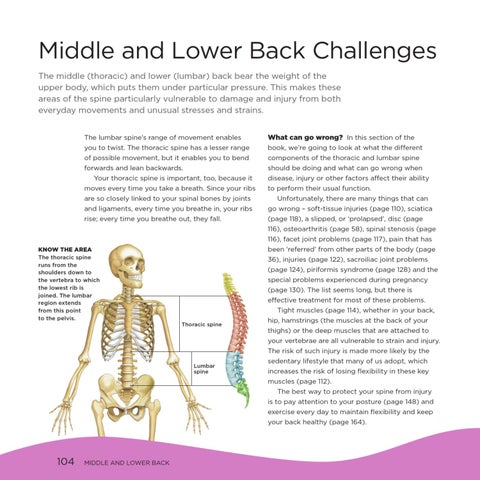
Middle and Lower Back Challenges The middle (thoracic) and lower (lumbar) back bear the weight of the upper body, which puts them under particular pressure. This makes these areas of the spine particularly vulnerable to damage and injury from both everyday movements and unusual stresses and strains. The lumbar spine’s range of movement enables you to twist. The thoracic spine has a lesser range of possible movement, but it enables you to bend forwards and lean backwards. Your thoracic spine is important, too, because it moves every time you take a breath. Since your ribs are so closely linked to your spinal bones by joints and ligaments, every time you breathe in, your ribs rise; every time you breathe out, they fall.
Know the area The thoracic spine runs from the shoulders down to the vertebra to which the lowest rib is joined. The lumbar region extends from this point to the pelvis.
Thoracic spine
Lumbar spine
104
Middle and Lower Back
What can go wrong? In this section of the book, we’re going to look at what the different components of the thoracic and lumbar spine should be doing and what can go wrong when disease, injury or other factors affect their ability to perform their usual function. Unfortunately, there are many things that can go wrong – soft-tissue injuries (page 110), sciatica (page 118), a slipped, or ‘prolapsed’, disc (page 116), osteoarthritis (page 58), spinal stenosis (page 116), facet joint problems (page 117), pain that has been ‘referred’ from other parts of the body (page 36), injuries (page 122), sacroiliac joint problems (page 124), piriformis syndrome (page 128) and the special problems experienced during pregnancy (page 130). The list seems long, but there is effective treatment for most of these problems. Tight muscles (page 114), whether in your back, hip, hamstrings (the muscles at the back of your thighs) or the deep muscles that are attached to your vertebrae are all vulnerable to strain and injury. The risk of such injury is made more likely by the sedentary lifestyle that many of us adopt, which increases the risk of losing flexibility in these key muscles (page 112). The best way to protect your spine from injury is to pay attention to your posture (page 148) and exercise every day to maintain flexibility and keep your back healthy (page 164).
Move back to health Regular exercise of the right kind is the key to maintaining and restoring the health of your mid and lower back.