1 Coberta Understanding Steel Design ENG.
CONTENTS
8
CHAPTER 1
12
14
CHAPTER 4
PR EFACE
THE TR ANSFOR MATI VE NATUR E OF STEEL CONSTRUCTION THE INTRINSIC CONNECTION BETWEEN HISTORIC DEVELOPMENTS IN STEEL AND MODERN ARCHITECTURE
42
FA BR IC AT ION, ERECTION AND THE IMPLICATIONS ON DESIGN
44
TR ANSFOR MING ARCHITECTUR AL DESIGN INTO FA BR IC ATED EL EMENTS
45
PROCESS PROFILE: A DDITION TO T HE ROYA L ONTA R IO MUSEUM
14
STEEL IS ABOUT TENSION
15
STEEL IS ABOUT INDUSTRIALIZATION AND MASS FABRICATION
46
THE ROLE OF PHYSICAL AND DIGITAL MODELS
15
STANDARD STRUCTURAL STEEL VERSUS AESS
49
APPRECIATING SCALE
49 15
FROM TECHNIQUE TO TECHNOLOGY
TRANSPORTATION AND SITE ISSUES AND THE IMPACT ON DESIGN
51
ERECTING THE STEEL
52
THE EFFECTS OF WEATHER AND CLIMATE ON ERECTION
53
PROVIDING PERMANENT STABILITY FOR THE FRAME
54
COORDINATION WITH OTHER SYSTEMS
55
PROCESS PROFILE: L ESL IE DA N FACULT Y OF PHA R MACY
56
SHOP FABRICATION
57
ASSEMBLING THE PODS
58
ERECTING A BEAM
58
ERECTING THE COLUMNS
59
LIFTING THE 50-TONNE TRUSS
60
LIFTING THE PODS
CHAPTER 2
18
THE MATER IALIT Y OF STEEL
20
STRUCTUR AL PROPERTIES OF STEEL
21
H O T- R O L L E D ST E E L S H A PE S
22
HOLLOW STRUCTUR AL SECTIONS (HSS)
24
ECONOMIES IN DETA IL ING AND SPECIFYING STEEL
25
DESIGN AND MODELING S OF T WA R E
CHAPTER 5
CHAPTER 3
26
CONNECTIONS AND FR AMING TECHNIQUES
28
THE IDEA BEHIND FR AMING
28
BASIC CONNECTION STR ATEGIES
31
FR AMED CONNECTIONS
31
BEAM-TO-GIRDER CONNECTIONS
32
GIRDER OR BEAM-TO-COLUMN CONNECTIONS
33
COLUMN CONNECTIONS
34
PIN CONNECTIONS
35
FLOOR SYSTEMS
37
BR ACED SYSTEMS
38
TRUSS SYSTEMS
38
PLANAR TRUSSES
39
THREE-DIMENSIONAL TRUSSES
62
AESS: ITS HISTORY AND DEVELOPMENT
64
THE INVENTION OF HOLLOW STRUCTUR AL SECTIONS
64
THE EVOLUTION OF AESS THROUGH THE HIGH TECH MOVEMENT
65
THE T YPOLOGY OF EAR LY HIGH TECH ARCHITECTURE
66
THE “EXTRUDED” TYPOLOGY
70
THE “GRID/BAY” TYPOLOGY
74
THE “TOWER-AND-TENSILE” TYPOLOGY
78
HIGH TECH BECOMES AESS
79
R ESULTA NT BUIL DING SCIENCE PROBLEMS
CHAPTER 6
80
82
AESS: DESIGN A ND DETA IL ING STA NDA R D ST RUCT UR A L STEEL VERSUS AESS
CHAPTER 7
102
COATING S , FINISHES AND FIRE PROTECTION
126
TA L L BUIL DING S
127
DIAGONALIZED CORE BUILDINGS
128
TRUSS BAND SYSTEMS
129
BUNDLED TUBE BUILDINGS
129
COMPOSITE CONSTRUCTION
130
WIND TESTING
131
DIAGR ID SYSTEMS
131
THE ADVANTAGES OF A DIAGRID OVER A MOMENT FRAME
132
DIAGRID TOWERS
136
PROCESS PROFILE: BOW ENCANA TOWER
83
PR IM A RY FACTOR S THAT DEFINE AESS
105
THE NEED FOR FIRE PROTECTION
85
CATEGOR IES OF AESS
105
PR EPA R ING THE STEEL FOR COATINGS
85
AESS 1 – BASIC ELEMENTS
86
AESS 2 – FEATURE ELEMENTS
88
AESS 3 – FEATURE ELEMENTS
89
AESS 4 – SHOWCASE ELEMENTS
91
CUSTOM ELEMENTS
92
STAINLESS STRUCTURAL STEEL
92
MIXED CATEGORIES
106
FINISH AND COATING SYSTEM SELECTION
106
PRIMERS
106
PA INT SYSTEMS FOR A ESS
107
SHORTCOMINGS OF PAINTED FINISHES
107
SHOP VERSUS SITE PAINTING
139
108
CORROSION PROTECTION SYSTEMS
CURVED DIAGRID-SUPPORTED SHAPES ON LOW TO MID-RISE BUILDINGS
140
CRYSTALLINE DIAGRID FORMS
141
HYBRID SHAPES
93
DETA IL ING R EQUIR EMENTS
93
CONNECTION MOCK-UPS
108
GALVANIZATION
94
CUTTING STEEL
109
METALLIZATION
95
CHOOSING CONNECTION TYPES
110
WEATHERING STEEL
111
STAINLESS STEEL
112
FIRE PROTECTION SYSTEMS
112
FIRE SUPPRESSION SYSTEMS
113
SPRAY-APPLIED FIRE PROTECTION
113
CONCRETE
113
INTUMESCENT COATINGS
96
WELDED CONNECTIONS
97
CAST CONNECTIONS
98
CHOOSING MEMBER TYPES
98
TUBULAR SECTIONS
99
STANDARD STRUCTURAL SHAPES
99
CONSTRUCTION BEST PR ACTICES
A DVA NC E D F R A M I NG SYSTEMS: DIAGR IDS
THE NEED FOR COR ROSION PROTECTION
WHAT IS AESS?
BOLTED CONNECTIONS
124
104
83
95
CHAPTER 9
CH A PTER 10
144
CHAPTER 8
CASTINGS
146
HISTORIC AND CONTEMPOR ARY CASTING
147
BASIC T YPES OF CAST CONNECTORS
148
TENSILE CONNECTORS
150
BASE CONNECTIONS
151
BR A NCH-T Y PE CONNECTIONS
153
PROCESS PROFILE: UNIVERSIT Y OF GUELPH SCIENCE BUILDING
CURVED STEEL
99
CARE IN HANDLING
116
99
TRANSPORTATION ISSUES
118
100
SEQUENCING OF LIFTS
CR EATING CURVES IN STEEL BUILDINGS
100
SITE CONSTRAINTS
118
101
ERECTION ISSUES
L IMITATIONS ON CURV ING STEEL
119
THE CURVING PROCESS
120
CURVED STEEL APPLICATIONS
158
122
FACETING A S A N A LTER NATE METHOD TO BENDING
160
TENSION SYSTEMS
161
TENSION CONNECTORS
161
CROSS BRACING
164
INNOVATIVE FORCE EXPRESSION IN TRUSSES
123
CR EATING CURVES WITH PL ATE MATER IAL
C H A P T E R 11
TENSION SYSTEMS A ND SPACEFR A MES
167
SIMPLE CANOPIES
168
CABLE-STAYED SYSTEMS
170
TENSEGRITY STRUCTURES
172
SPACEFR A ME SYSTEMS
173
NON-PLANAR SPACEFRAMES
176
IRREGULAR MODULES
CHAPTER 12
178
180
181
STEEL AND GL AZING SYSTEMS
C H A P T E R 14
216
184
T H E L E E D TM G R E E N BUILDING R ATING SYSTEM
241
INDEX OF BUILDINGS
242
INDEX OF ARCHITECTS AND STEEL FIRMS
R ECYCL E V ER SUS R EUSE
243
INDEX OF LOCATIONS
220
RECYCLED CONTENT
244
ON THE AUTHOR AND THE TECHNICAL ILLUSTRATOR
220
COMPONENT REUSE 245
SPONSORS
221
ADAPTIVE REUSE
STEEL A S A SUSTA INA BL E MATER IAL
186
S I M PL E C U R TA I N WA L L SUPPORT SYSTEMS
223
SUSTA INA BL E BENEFITS OF AESS
186
SIMPL E WIND -BR ACED SYSTEMS
223
L OW- CA R BON DESIGN STR ATEGIES
187
CABLE-SUPPORTED STRUCTUR AL GL ASS ENVELOPES
225
REDUCE MATERIAL
225
REDUCE FINISHES
225
REDUCE LABOR
226
REDUCE TRANSPORTATION
227
DURABILITY
CABLE NET WALLS
189
STAINLESS STEEL SPIDER CONNECTORS
190
CABLE TRUSS SYSTEMS
192
COMPLEX CABLE SYSTEMS
195
OPERABLE STEEL AND GLASS SYSTEMS
196
HANDLING CURVES
197
L ATTICE SHELL CONSTRUCTION
C H A P T E R 15
CH A P T ER 13
202
A DVA NC E D F R A M I NG SYSTEMS: STEEL AND TIMBER
204
CHA R ACTER ISTICS
205
DETA IL ING IS SUES
206
FA BR IC ATION A ND ERECTION ISSUES
206
FINISH ISSUES
207
HIDDEN STEEL
208
PROCESS PROFILE: ADDITION TO THE ART G A L L ERY OF ONTA R IO
212
PROCESS PROFILE: RICHMOND SPEED S K AT I NG OVA L
ILLUSTRATION CREDITS INDEX OF TECHNICAL SUBJECTS
219
188
237
INDEX OF APPLICATIONS
TECHNICAL ASPECTS OF COMBINING STEEL WITH GLASS
SELECTING THE APPROPR IATE SYSTEM
BIBLIOGRAPHY
240
218
SUPPORT SYSTEMS FOR GL AZING
236
238
EARLY STEEL AND GL ASS BUILDINGS
220 183
STEEL AND SUSTA INA BIL I T Y
Appendix
228
STEEL IN TEMPOR ARY EXHIBITION BUILDINGS
Preface Building construction is an increasingly complex subject of study and field of practice. There are numerous materials and systems from which an architect or engineer can select when designing the structure of a building. The basis of the idea behind this book lies in a firm belief in the benefits of recognizing the intrinsic connection between characteristics of materials and the design of buildings. Good building design responds to, incorporates and builds upon the potential of its materials. The selection of the primary structural material must occur at the beginning of the development of the parti to be integrated into the design and fine-tuned by the design intentions. Although steel is inherently a very technical material, from its engineering to its detailing, it is a material whose characteristics have enormous potential for the creation of dynamic architecture. I maintain that it is more important for architects to have a good grasp of the nature and detailing of steel systems than it is for them to perform calculations. Much is to be gained by careful study of exemplary projects as a means to leverage a better understanding of the potential of steel. Architects must also appreciate the critical role that is played by the steel fabricator and erector in facilitating the design of more complex structural systems and articulated details. I have been teaching building construction at the School of Architecture at the University of Waterloo, ON, Canada since 1983. My approach to teaching has been strongly based on the review of projects with a mind to understanding and learning from their ambitions, successes and failures. I have worked with the Canadian Institute of Steel Construction and the Steel Structures Education Foundation of Canada to document exemplary steel projects, including their construction, where possible. The construction process is a temporary phase. Once a building is complete and aspects of the construction process removed from view, the study of the building structure becomes difficult. The majority of architectural publications focus on the occupied building and seldom include exhaustive information about the construction process. Most architectural photography is commissioned of completed buildings. Construction documentation is a long process that can require a commitment of several years. Most construction images are taken by site personnel and are not intended for publication. It became my personal passion to undertake such documentation in order to both personally understand the process as well as share it with my students. It was my privilege over the last decade to have the opportunity to document several projects, largely covering the entire span from groundbreaking to opening, designed by high-profile architects such as Foster + Partners, Frank Gehry, Studio Libeskind, Antoine Predock and Will Alsop. These local projects lend a Canadian flavor to several chapters, as they form a core reference for some of the more detailed fabrication and erection descriptions. Thanks to the steel fabricators, Walters Inc., Benson Steel and Mariani Metal for providing tours of their fabrication plants and to the contractors, PCL Constructors, EllisDon Corporation, Vanbots and Ledcor for facilitating my access to the sites. Thanks to Kubes Steel for allowing me to tour their bending facility.
– 8
The large custom-fabricated connections at Heathrow Terminal 5 in London, England by Richard Rogers are the result of high-level collaboration between the architect, engineer, fabricator and constructor.
– 9
CHAPTER 3 ---
STEEL CONNECTIONS AND FR AMING TECHNIQUES --THE IDEA BEHIND FR AMING BASIC CONNECTION STR ATEGIES FR AMED CONNECTIONS BEAM-TO-GIRDER CONNECTIONS GIRDER OR BEAM-TO-COLUMN CONNECTIONS COLUMN CONNECTIONS PIN CONNECTIONS
FLOOR SYSTEMS BR ACED SYSTEMS TRUSS SYSTEMS PLANAR TRUSSES THREE-DIMENSIONAL TRUSSES
The tubular steel structure at the Friedrichstadtpassagen Quartier 206 Shopping Mall in Berlin, designed by Pei Cobb Freed and Partners, makes predominant use of welded connections to achieve a clean appearance in resolving the intersection of the large round members. The smaller members that support the skylight use a combination of welded and bolted connections, as these are visually less dominant. The framing is highlighted against the dark night sky, making its joinery more visible at night than during the day.
THE IDEA BEHIND FR AMING Steel evolved as an elemental system of construction derived from early industrialized practices that were developed for cast- and wrought-iron buildings. Discrete members are either bolted or welded together. Buildings are typically created from a series of prefabricated pieces that are sub-assembled in the fabrication shop, with final assembly and erection taking place on site. Maximized shop fabrication is preferred, as it is more expedient to cut, shape, weld and finish elements in controlled conditions. Lifting is simply done by an overhead crane. Quality is improved. Economies are possible through modularity and the production of larger quantities of identical elements. Transportation from the shop to the site limits the sizes of members that can be shipped. Elements must be designed to fit on the flatbed of a truck. Larger pieces may require a police escort or pose difficulties navigating narrow streets. Sub-assembly of smaller elements into larger ones on site will be limited by the lifting capacity of the crane as well as the size of the staging area. Framing simplifies fabrication, erection and structural analysis. Basic steel framing is based upon a rectilinear arrangement of straight members that are connected at framed joints. Regular geometry and even grid-based arrangements of columns work to minimize eccentric loading on the structure. Orthogonal geometry, although good for spatial planning, is inherently unstable. A language of reinforcement and bracing provides lateral stability either by using solid panels, moment-resisting connections or triangulation. Framing also allows for a simpler method of structural analysis, as most steel systems can be broken down into two-dimensional segments and determinate structures – unlike concrete systems, which use continuous members and monolithic construction methods.
BASIC CONNECTION STR ATEGIES All steel framing, no matter how complicated, is based upon standard methods of connections and means of satisfying load path requirements. The majority of connections are designed to function as “hinges”, transferring vertical and horizontal shear forces. They are not intended to resist moment, bending or torsional forces. This permits simple bolted or welded methods of fastening for the connections. In cases where moment or bending forces are high, connections can be reinforced to become stiff. This may be achieved by adding material in the form of plates or angles to the connection by additional welding or bolting in order to resist moment forces. Lateral loads can be resisted through the addition of bracing systems that introduce triangles into the frame, triangular forms being inherently rigid. The additional requirement of seismic stability builds upon the same connection strategies and methods of jointing of the frame. Connections between steel pieces are either bolted or welded. Bolts can vary in terms of their strength and head type. If the steel is concealed then the choice of bolt type is purely a structural consideration, ensuring that the bolts are adequate in number to resist the shear forces and that there is sufficient plate area to accommodate the bolting pattern. The design of the framing systems and connections feeds directly into practical considerations of construction methods. It is faster to erect using bolted connections, but this does not preclude welding if this is a design requirement, be it for aesthetic or structural reasons. The two types of bolts typically used are Hex Head and Tension Control (TC) bolts. Both types of bolts are fabricated from high-strength steel and both serve the same purpose. The Hex Head bolts need access from both sides for tightening, but no special equipment. The TC bolts need a special type of equipment to install and snap off the end, but only one side needs access for tightening.
– STEEL CONNECTIONS AND FRAMING TECHNIQUES
The Fair Store in Chicago, IL, USA, designed by William Le Baron Jenney in 1890, was one of the multi-story buildings which began to generate a language of standardized framing. At the time, structural member types were limited to I-beams, angles and plates. These were connected for the most part using hot rivets. The framing language of today is derived from these early structures.
The "turn of nut" method is visible in this bolted connection on the Canadian Museum for Human Rights in Winnipeg, MB, Canada by Antoine Predock.
Most bolts can be simply installed to a snug-tight condition, i.e. to the maximum of a worker’s strength. They do not have to be pre-tensioned. Bolts only need pretensioning under special conditions: when slippage cannot be tolerated, for seismically stable connections, when subjected to impact or cyclic loading, when they are in pure tension or when oversized holes are used. Otherwise, the snug-tight condition is adequate for the normal end connections of beams. Deciding to pretension a bolt is a question of the application rather than how large a load it needs to transfer. If bolts do have to be pretensioned, “turn-of-nut” is the preferred method. After the bolts are snug-tightened, an additional fraction of a turn is applied to the nut to achieve the desired tension in the bolt. Usually, a worker will draw a chalk mark across the diameter of the bolt before applying the extra turn. Hence, an inspector can check if the fraction of turn was observed. In many conditions, only an additional third of a turn is needed to achieve the desirable pretension in the bolt. TC bolts are another way of achieving the desired tension in the bolt, but many feel that the conventional “turn-of-nut” method is the most reliable. It is actually very difficult to determine the tension in a bolt based on a torque value because friction plays an important role. For calculating the tension in the bolt it has to be derived from the torque value. Once converted, the value is often not representative of the real tension in the bolt. This is especially true for galvanized bolts. Left: The head of the Tension Control bolt is quite distinct from the regular Hex Head bolt. The washer and nut for tightening are on the backside of the connection, so connection design must provide access to the rear for tightening. TC bolts are used where slip prevention is important. On the Bow Encana erection they are being used to secure the temporary column to column connections prior to finish welding. Right: This beam is ready to ship, its splice plates attached with high-strength Hex Head bolts. Structural bolts like these will normally place the nut side where access is easiest.
In Architecturally Exposed Structural Steel design (see Chapter 6: AESS: Design and Detailing) the choice of bolt head, pattern of attachment and preference for the side of the connection on which the bolt heads are located will be important to the visual architectural appearance. Much of the required construction tolerance for erection will be a function of the degree of precision in the alignment and drilling of the holes for the bolts. It is a common misconception that bolt holes are routinely oversized to make it easier to align members during erection. Imprecision will result in accumulated errors that actually make erection more difficult. Bolt holes within a steel framing system have tight tolerances – tighter even in AESS design where “fit” is important. Slotted holes are only used where secondary systems, such as curtain wall, are attached to the steel framing, in order to adjust for deviations between the alignments of the systems used.
Hex Head versus Tension Control Bolts Left: Assembly of a Hex Head bolt. A standard washer, sitting on either side of the connection between the steel and the head/nut, assists in distributing the load. These types of bolts are usually installed to a snug-tight condition and they normally do not need to be pretensioned. Right: Assembly of a Tension Control bolt. The special compressible washer is placed only at the rear side of the connection. There are some proprietary types of washers that contain small pockets of brightly colored material that will squeeze out when the desired tension is achieved.
– 29
The steel pieces that are being joined may be attached either by lapping the primaryload-carrying portion of the member or by placing the elements “in line”. Lap joints: A lap joint is typically used as a tension splice. It is suited to connections that do not need to be symmetrical. In the left hand diagrams, the two plate elements change their alignment on either side of the connection. When force is applied to the connection, it can fail either by the stretching the hole to the point of pull through (middle) or by shearing through the bolt (bottom). The higher the load on the connection, the larger or more numerous are the bolts required. Plate thickness is also important to resist the tension loads. There must be adequate space between the bolt holes and the edge of the plate to distribute the load. In the right hand diagrams the steel on either side of the connection is unequal. The area shown in red is the plate that will be pulled out if the connection fails (middle). The bolt will be sheared in two planes in this instance (bottom). Left: The bracing connections at the Bow Encana Tower all use simple lapped connections. The array of bolts in the connection keeps the members in a precise geometrical arrangement and provides adequate cross section in the bolts to transfer the load. Right: Where extra resistance is required, the number of lapping plates at the Guelph Science Building is increased. Also visible in this connection are two different bolt types. The connection of the X-shaped plate to the underside of the flange is being done with TC bolts, while there is a Hex Head high-strength steel bolt through the pin connection. The single bolt in this pin connection is designed to allow rotation so as to make erection alignment simpler. Butt joints: This connection is used where it is important that the primary line of geometry of the steel plate and the forces are “in line”. The connection is completed by the addition of steel plates on one or both sides of the splice. The number of bolts in the connection will be determined by the area required to resist the shear forces. In the left hand diagrams there is only a splice plate on one side of the connection. This results in a single shear plane through the bolts (bottom). The right hand diagrams illustrate a connection that doubles the shear area in the bolts by using plates on either side of the primary member (bottom). If the splice is in tension, there also needs to be enough steel between the bolt hole and the end of the plate to resist pull-through (middle).
Left: The splices between the wide-flange members of the diagrid structure for the Seattle Public Library, WA, USA by Rem Koolhaas use butt joints, as it is necessary for the web members to stay aligned. Plates are set on either side of the splice. Additional reinforcing plates can be seen on the top and bottom of the connection flanges. These have been welded to appear more discrete as well as to eliminate interference between the structure and the curtain wall cladding. Right: A butt joint is used to splice the beams. A pointed slug wrench is inserted to align it during erection. Partial bolting allows for the detachment of the crane.
– STEEL CONNECTIONS AND FRAMING TECHNIQUES
Welded connections will normally be used when fabricating large primary elements like a large plate girder or composite sections in the shop. Quality welding is best done under controlled conditions. Welded connections are also preferred when fabricating complex trusses from HSS members, as common methods of attachment such as plates and angles are more suited to connecting members with webs and flanges. Welded connections present different issues for concealed versus exposed structures. Chapter 6 on Architecturally Exposed Structural Steel will address issues of aesthetics and cost implications for welded joints. Welded connections: Plates can be spliced together using two basic types of welded connections. Groove welds (left) are used where the two plates must be maintained in line. Thicker plates will use a double Vee weld, (top left), whereas thinner plates will use a single Vee weld. If it is not important to align the plates, then lap welds can be used (right). If the load on the lap joint is small, a single fillet or edge weld can be used (top right). For higher loads it will be necessary to use a double fillet weld (bottom right). For plate elements that are to be joined in line, groove welding can produce a clean-looking connection if side plates are not desired. Depending on the finish requirements the welds can be left “as is” or ground smooth. Grinding should be reserved for special high-profile applications as it is expensive and time consuming. Grinding also weakens the weld by removing weld material.
al
.
x
FR AMED CONNECTIONS Steel structures are assembled using a basic suite of connection types. All other connections are variations of these to one extent or another. The basic framed connections were developed with an assumption of the use of flange type sections. Flange-type sections allow for access for bolting from both sides of the member. If hollow sections are used the connections must be adapted, as the simple use of through bolting is not possible.
.
BEAM-TO-GIRDER CONNECTIONS There are three basic ways to frame a beam into a girder. The choice will depend upon the bearing requirements of the flooring system, floor-to-floor height limitations and providing space for service runs. Services can be run below the assembly although in some cases holes may be cut in the beam or girder web to provide passage.
s
r
e
Left: Coped connection: In this connection the top flange of the beam is cut away so that the top edges can remain level in order to provide a flat surface for the flooring system. The web is normally attached to the girder web with a pair of angles that are bolted to each member. Middle: Bearing connection: The beam bears on the girder. The flanges are simply bolted together. This method is used where floor height is not an issue or where it is desired to create passage for services above the girder. Right: Simple framed connection: The beam connects into the web of the girder without coping, where there is no floor element to be supported.
– 31
Left: At the Leslie Dan Faculty of Pharmacy in Toronto, ON, Canada, a coped connection provides a level surface for the installation of the floor deck in spite of the difference in size of the beams that are framing into the girder. The variation in the number of bolts in the connections is a clear indication of the differences in shear forces to be transferred. Right: Framing infers a clear hierarchy for the transfer of loads through the building. The addition to the Art Gallery of Ontario in Toronto, ON, Canada by Frank Gehry, uses steel framing for the extension to the gallery. The very deep beam is a transfer beam that is permitting a large clear-span exhibit and gathering space. Holes are cut into the beam to permit the passage of services. Additional steel is welded around the cutouts for reinforcement of the web of the beam. Major steel floor beams frame into the transfer beam using coped connections. Smaller beams carry the future floor loads into these. This type of framing makes it possible to apply simple structural analysis in spite of its complexity.
Framed connections using standard wide-flange sections are commonly used in structural steel that is not intended to be architecturally exposed. Architecturally exposing the steel will add extra detailing requirements for alignment as well as precision. Aesthetics might require that both the top and bottom chords align or that the range of steel sections be standardized, to create a more uniform appearance – even if this means that the sections might be larger or heavier than required for loading purposes.
Left: The large brise soleil at the Las Vegas Courthouse, NV, USA, designed by Cannon Design uses deep wide-flange sections to create the structure for the grid. Smaller steel sections are used as infill to provide shading. Exposing the steel places the priority on a uniform appearance. Right: The grid requires that the deep beams be given coped connections for both the top and bottom chord to achieve the appearance of a uniform, non-directional grid.
GIRDER- OR BEAM-TO-COLUMN CONNECTIONS Girders and beams transfer the loads that they have received from the floor to the columns. The connection can be made either to the flange of the column or to the web, depending on the orientation of the column, which is a function of the structural layout. Columns are generally oriented so that the dominant wind load strikes perpendicular to the flange of the column. Connecting to the flange provides easier access for the ironworkers to tighten bolts. Beams and girders will be lifted into position by a crane, the matching holes in the angle connectors are aligned with a slug wrench, and the bolts inserted. For some projects temporary angle “seats” will be attached to the column to provide a ledge upon which to sit the beam, allowing the crane to detach earlier and to speed up erection. These seats can be removed after the connection is complete, or remain in place to stiffen the connection.
– STEEL CONNECTIONS AND FRAMING TECHNIQUES
If the beam is connected to the web of the column, adequate space must be provided for access by the ironworkers. Left: Seated connection. Angles are bolted to the column to provide a ledge for the beam during erection. The angles may remain to provide additional support if required, or they can be removed if structurally unnecessary. Middle: In this standard framed connection the angles are bolted to the web of the beam at the shop and then bolted to the column flange on site. The connection acts as a hinge in that it is only designed to resist shear. Right: This connection has been reinforced to resist moment. Plates have been welded to the column prior to erection. They are also welded to the flanges of the beam so as to provide resistance to bending at the connection.
The roof of this transit station in Vancouver, BC, Canada uses a variety of standard framing methods to transfer the loads to the column. The direction of span is always perpendicular to the support member. In this instance the girder frames into the side of the wide-flange column, attaching with bolted angles to the web. Note the transfer of loads from the profiled decking through the beams and back to the column.
COLUMN CONNECTIONS Steel columns are generally welded to a base plate that is used to attach the column to the foundation pier or supporting system. The plate is normally larger than the column, drilled with holes, and lowered over threaded rods that have been set into the foundation. Left: This simple base connection uses four threaded bolts to anchor the plate. The plate sits slightly above the concrete foundation in order to allow for leveling nuts to sit beneath the plate, thereby permitting alignment. The void below the plate is packed with grout both to assist with load transfer and to fix the position of the nuts. The aesthetic could have been improved if all of the threaded bolts had been trimmed to the same height. The column member is pin-connected to the base. Middle: A round plate is welded to the base of the round HSS column. Right: Larger columns that must transfer more load as well as resist potential lateral forces will require a more substantial base design. Here the threaded rods penetrate a double-plate system that is reinforced with the addition of steel fins welded around the perimeter. The geometry is carefully designed for access to tighten the bolts. Leveling bolts sit below the bottom plate – hence the gap prior to finishing.
As vertical loads are carried down the structure the loads accumulate and increase on the columns on lower floor levels. Columns for higher floors are smaller in their strength requirements than for lower floors. The columns in multi-story buildings must be spliced, as the longest lengths possible are a function of shipping. There needs to be a full transfer of load from one column to the next. In simple connections, without eccentric loads, and where columns do not change in size at the splice, the meeting surfaces are machined smooth in order to maintain the load path and side plates can be bolted to the flanges and web in order to maintain the connection. Where the lower column is only slightly larger, so that the flanges essentially align, fill plates will be used on either side of the flanges of the upper column. Where the upper column is substantially smaller, so that the flanges do not align at all, base plates are attached to both columns to complete the load path and prevent pressure points in the connection. Column splices can either be welded or bolted.
– 33
CHAPTER 9 ---
A DVA N C E D F R A M I N G SYSTEMS: DI AG R IDS --TA L L BUIL DING S DIAGONALIZ ED CORE BUILDINGS TRUSS BAND SY STEMS BUNDLED TUBE BUILDINGS COMP OSITE CONSTRUCTION WIND TESTING
DIAGR ID SYSTEMS THE ADVANTAGE OF A DIAGRID OVER A MOMENT FRAME DIAGRID TOWERS
PROCESS PROFILE: BOW ENCANA TOWER / FOSTER + PA RTNER S CURVED DIAGRID-SUP P ORTED SHAP ES ON LOW TO MID-RISE BUILDINGS CRY STALLINE DIAGRID FORMS HY BRID SHAP ES
The Bow Encana Building in Calgary, AB, Canada, designed by Foster + Partners with Zeidler Partnership and engineered by ARUP, uses an expressed diagrid structural system for this doublefaรงade building.
TA L L BUIL DING S The Council for Tall Buildings and Urban Habitat (CTBUH) defines a steel tall building as one whose main vertical and lateral structural elements and floor systems are made from steel. A composite system is defined as one where steel and concrete act together in the main structural elements. A mixed-structure building is one that uses different structural materials or systems above or below each other. The use of steel as the primary structural system in tall buildings has declined significantly over the years. From the birth of the skyscraper to 1980, the predominant system of framing for buildings was a moment-frame tube in steel. Some later structures used either a bundled-tubes structure or the "diagonalized core system". A diagonalized core system relies on the addition of systems of diagonal members to the frame to achieve more resistance to lateral forces. After 1980 many buildings were constructed using the tube-in-tube system or core-and-outrigger system, which were normally constructed using cast-in-place concrete or a composite concrete and steel system. This followed marked improvements in the ability to pump concrete to great heights. There is a variety of factors that contribute to the selection of a structural method in the construction of a tall building. Different methods simply work better with certain materials. Framed tubes, bundled tubes and the diagonalized tube are all more readily constructed in steel than concrete. There are also arguments that support increased structural efficiency in the strength-to-weight ratio through the use of a diagonal framing system. This type of system is normally only constructed in steel. Geographic preference also plays an important role in the selection of a structural system. New York City and the American Northeast are home to a significant number of tall buildings, the majority of which continue to be constructed in steel — even down to the material choice for foundations — in spite of more global trends toward concrete, composite and hybrid structures. The availability of material as well as the influence of the trade unions affect material choices in this location. In the Middle East and in China there is predominant use of reinforced-concrete tall building systems, or composite systems. The availability of both material and skilled labor has influenced the material choice in these locations. Tall buildings require specialized construction due to their increased vulnerability as a function of both wind and seismic loading. A major issue is the development of steel systems that assist with the resistance of wind loads. These systems can be extrapolated to structure a wide range of regular and irregular geometries, including highly eccentric loading situations. The diagonal grid, as discussed below, emerged from an effort to make the tall building resist lateral (primarily wind) forces in innovative ways. The basic construction systems for tall buildings have been a key factor for the development of “diagrids” (the contracted form of “diagonal grid”). Portal frames were found to be insufficient in resisting the lateral forces for tall buildings. Rather than simply creating stronger wind-resistant framed connections, added diagonal members were found to be a more effective way to make the frame more rigid. Diagonal members were also found able to redirect loads and provide alternate load paths in instances of structural failure. The modern diagrid building evolved as standard framed buildings with supplementary diagonal bracing were extensively replaced by those employing an exclusive grid of regular diagonal members. In many cases there are no vertical columns. In some others, the vertical elements are there to supplement the load-carrying function of the diagonal members.
– ADVANCED FRAMING SYSTEMS: DIAGRIDS
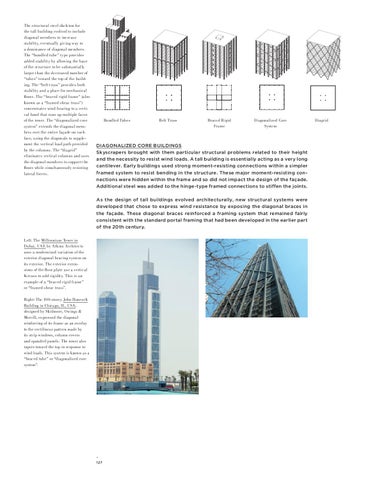
The structural steel skeleton for the tall building evolved to include diagonal members to increase stability, eventually giving way to a dominance of diagonal members. The “bundled tube” type provides added stability by allowing the base of the structure to be substantially larger than the decreased number of “tubes” toward the top of the building. The “belt truss” provides both stability and a place for mechanical floors. The “braced rigid frame” (also known as a “framed shear truss”) concentrates wind bracing to a vertical band that runs up multiple faces of the tower. The “diagonalized core system” extends the diagonal members over the entire façade on each face, using the diagonals to supplement the vertical load path provided by the columns. The “diagrid” eliminates vertical columns and uses the diagonal members to support the floors while simultaneously resisting lateral forces.
Bundled Tubes
Belt Truss
Braced Rigid Frame
Diagonalized Core System
DIAGONALIZED CORE BUILDINGS Skyscrapers brought with them particular structural problems related to their height and the necessity to resist wind loads. A tall building is essentially acting as a very long cantilever. Early buildings used strong moment-resisting connections within a simpler framed system to resist bending in the structure. These major moment-resisting connections were hidden within the frame and so did not impact the design of the façade. Additional steel was added to the hinge-type framed connections to stiffen the joints. As the design of tall buildings evolved architecturally, new structural systems were developed that chose to express wind resistance by exposing the diagonal braces in the façade. These diagonal braces reinforced a framing system that remained fairly consistent with the standard portal framing that had been developed in the earlier part of the 20th century.
Left: The Millennium Tower in Dubai, UAE by Atkins Architects uses a modernized variation of the exterior diagonal bracing system on its exterior. The exterior extensions of the floor plate use a vertical K-truss to add rigidity. This is an example of a “braced rigid frame” or “framed shear truss”. Right: The 100-storey John Hancock Building in Chicago, IL, USA, designed by Skidmore, Owings & Merrill, expressed the diagonal reinforcing of its frame as an overlay to the rectilinear pattern made by its strip windows, column covers and spandrel panels. The tower also tapers toward the top in response to wind loads. This system is known as a “braced tube” or “diagonalized core system”.
– 127
Diagrid
The Indigo Icon Office Tower in Dubai, UAE by Atkins Architects creates a variation of the X bracing system. The bracing frame is set outside the exterior cladding of the tower to exaggerate its expression. There are issues related to climate and temperature swing associated with the choice to set such a structural element outside the environmental/thermal envelope, as the exterior steel will experience thermal expansion differently than the interior structure. This sort of solution is only applicable in climates where thermal bridging is also not a significant issue.
The idea of exterior bracing as a means of both structural and architectural expression is widely used. This differs from genuine diagrid construction as here the diagonal bracing is simply used as an addition to fairly standard framing and as a means to give additional rigidity to the building and is not used as the primary structural system. Left: The Quantam Nano Engineering Building at the University of Waterloo, ON, Canada, designed by KPMB Architects, uses multiple means of diagonal bracing on both the exterior and interior of the laboratory building. The extra resistance on this 5-story structure was required due to the nature of the labs and the processes contained. Right: The AESS steel bracing of the Quantam Nano Building sits outside the curtain wall system. Different finishing is required for this steel in contrast to the painted steel structure on the interior.
Left: This residential tower structure in Dubai uses truss band bracing. Here two floors of truss structure are used with standard vertical columns supporting the four floors between. In this instance, the diagonals of the trusses will be incorporated into the cladding design and the spaces will be used as occupied floors. The trusses here are less obtrusive, as the design allows for a clear, column-free span from the core to the outside wall. Right: The mechanical floor of the Bloomberg Tower in New York, NY, USA, designed by Cesar Pelli. This bracing floor is constructed of trusses, with the structural steel spray-fireproofed.
TRUSS BAND SYSTEMS The truss band system is a variation of other tubular systems. Bracing can also be provided to a framed structure by conceiving a number of floors of the tower as large truss structures. On the exterior of the building this is typically seen as a truss band. These floors are often planned for use as mechanical service floors, as the space is substandard for use as office space due to the interference of the many diagonal web members of the trusses that can exist within the plate area of the usable floor space. The frequency of the occurrence of these floors, and the depth of the trusses, are a function of the height-to-width ratio of the building, combined with local wind and seismic issues. Mechanical service needs will also impact the requirements.
– ADVANCED FRAMING SYSTEMS: DIAGRIDS
BUNDLED TUBE BUILDINGS An alternate method of creating bracing for tall buildings was developed through the bundled tube. With this method, the plan of the tower is divided into a large grid. The volume is stepped back toward the top to reduce wind resistance while providing a larger and hence firmer connection at the base. This type of structure has allowed for some of the tallest free-standing buildings to be constructed. Tower buildings are essentially cantilevers, requiring a substantial moment resisting connections at their base. Today variations of the initial construction as used in the Willis (former Sears) Tower extend the notion to include buildings that have an enlarged base and also step back toward the top. The Burj Khalifa in Dubai has a Y-shaped plan that provides substantial reinforcement at the base of the tower, stepping back significantly over its height to achieve a reduction of floor area for the top floors. Left: The Willis (former Sears) Tower in Chicago, IL, USA, designed by SOM, maintains the appearance of rectangular framing but instead steps back the building in blocks to address increased wind-loading sway at the top and provide more stability at the base of the tower. This is known as bundled tube construction. It is presently, after the destruction of the World Trade Towers in New York City in 2001, the tallest steel skyscraper in the world. Right: The Burj Khalifa in Dubai, UAE, designed by SOM (Adrian Smith Design Architect), is the world’s tallest building as of 2010. It uses mixed construction, with the lower 80% of the building constructed of specialized reinforced concrete and the upper portion from steel framing. Wind testing for the tower, including the design of the steel top of the building, was conducted by RWDI in Guelph, ON, Canada.
COMPOSITE CONSTRUCTION Many tall buildings now use composite construction to assist in achieving height as well as in the creation of unique forms. Combining steel and concrete systems gives architects and engineers greater latitude. It has been considered routine for most tall buildings to use concrete for the construction of the central service core. In composite construction, floor, column and bracing elements may be made of either steel or concrete or a combination of the two materials to achieve strength.
The Burj Al-Arab in Dubai, UAE, designed by Atkins Architects, uses composite construction. Parts of the structure use a combination of steel and concrete systems. In this instance, a composite system supports the unusual shape of the building. – 129
A diagrid tower is modeled as a vertical cantilever. The size of the diagonal grid is determined by dividing the height of the tower into a series of modules. Ideally the height of the base module of the diamond grid will extend over several stories. In this way the beams that define the edge of the floors can frame into the diagonal members, providing both connection to the core, support for the floor edge beams, and stiffness to the unsupported length of the diagonal member. This aspect of the diagrid is often expressed in the cladding of the building. The modularity of the curtain wall normally will scale down the dimensions of the diamonds or triangulated shapes to suit the height of the floors and requirements for both fixed and operable windows. As with any deviation from standard framing techniques, constructability is an important issue. Both the engineering and fabrication of the joints are more complex than for an orthogonal structure and this incurs additional costs. The precision of the geometry of the connection nodes is critical, making it advantageous to maximize shop fabrication to reduce difficulties associated with job site work. There are two schools of thought as to the rigidity of the construction of the nodes themselves. Technically, if designing a purely triangulated “truss-like” structure, the center of the node need not be rigid and can be constructed as a hinge connection. Where this may work well for symmetrical structures having well-balanced loads, eccentrically loaded structures will need some rigidity in the node to assist in selfsupport during the construction process. In many of the diagrid projects constructed to date the nodes have been prefabricated as rigid elements in the shop, allowing for incoming straight members to be either bolted or welded on site more easily. As this type of structure is more expensive to fabricate, cost savings are only to be realized if there is a high degree of repetition in the design and fabrication of the nodes. The triangulation of the diagrid “tube” itself is not sufficient to achieve full rigidity in the structure. Ring beams at the floor edges are normally tied into the diagrid to integrate the structural action into a coherent tube. As there are normally multiple floors intersecting with each long diagonal of the grid, this intersection will occur at the node as well as at several instances along the diagonal. The angle of the diagonals allows for a natural flow of loads through the structure and down to the foundation of the building. Steel has been the predominant material of choice for all diagrid buildings constructed to date. Diagrid buildin g a nd the design a nd detailin g associated with the steel str uctu ral systems ca n be divided into distinct groupin gs: → Towers a nd tall buildin gs, → Cu r vilinear for ms, → Crystalline geometry, a nd → Hybrid buildin gs with combined geometries.
DIAGRID TOWERS The most natural extrapolation of the diagonalized core tower is the diagrid tower. In this instance the regular portal frame is eliminated and replaced by a tube of diagrid steel that serves to carry all of the loads down the exterior face of the tower. The displacement of vertical columns by the diagonal members necessitates an increase in the density of these members, over earlier examples where the diagonal bracing was supplementary and therefore less frequent. Where the diagrid sits external to the envelope or curtain wall the cladding system is connected to the floor structure. Where the diagrid is internal, the cladding is connected to the diagrid. This tends to influence the design of the cladding system. Floor-connected curtain wall is typically rectilinear and diagrid connected-curtain wall is triangulated.
– ADVANCED FRAMING SYSTEMS: DIAGRIDS
Left: Bush Lane House in London, England, designed by ARUP in 1976, was one of the first buildings to use an expressed exterior diagrid to eliminate the use of interior columns to achieve clear-span office space. It is constructed from stainless steel with cast nodes. Right: The cast stainless steel nodes are connected back at each floor level. The curtain wall behind maintains a regular rectilinear pattern in contrast to the square diamonds of the exterior tubular structure, indicating that it is attached to the floors for support.
Left: Swiss Re in London, England by Foster + Partners and ARUP uses the diagrid to create a curved tower. The geometry facilitated a special ventilation system that spirals up the darker glass in the façade. Right: The diagrid at the base of the building is framed out to create an arcade element.
One of the more challenging issues with oddly shaped diagrid buildings is devising a system for washing the building. For Swiss Re a mechanism was attached at the top of the building that would cantilever the cables for the equipment away from the surface of the building.
The cables are pinned to the grid and padded to prevent any sway in the equipment from damaging the façade. The darker coloring in the glazing denotes the location of the double façade portions of the envelope that are used for ventilation.
– 133
Eden Project uses a hybrid between a geodesic dome and spaceframe, interlocking three domes of varying size to create a series of climate-controlled greenhouses. The base structure is created from hexagonal units, rather than the smaller equilateral triangles as more typically used by Buckminster Fuller. The poles and nodes were fabricated off site and arrived in flats to be fully site-erected. A substantial scaffold was required to erect the domes, which are 125m/410ft across and 60m/197ft high. ETFE cladding was chosen for its durability and very high level of solar transparency as this would help to ensure good light for the plant specimens to be housed within.
The exterior of Eden Project in St. Austell, UK by Nicholas Grimshaw shows the pillow nature of the ETFE cladding as it pinches together at the sides and presses out at the center of each panel.
Larger steel truss arches were required at the intersection points of the domes in order to resolve the geometry and stabilize the structures.
The steel structure closely resembles the system used to create spaceframe structures. The opened sections show the level of visual transparency of the ETFE material. The relative sizes of the steel tubes and rods that comprise the outer structure of the dome can be seen against the smaller members that create the three-dimensional bracing layer on the interior. Services such as wiring, fire protection and air to maintain the pressure in the skin run tightly along the hexagonal steel grid to conceal the systems.
IRREGULAR MODULES The National Aquatics Center for the 2008 Beijing Olympics was the first structure in China to use an ETFE membrane. The idea for the structure was based upon the geometry of soap bubbles. This transformation of the combination of a spaceframe and geodesic structure into one that included large variations in the relative sizes of the units added significant complexity to the design, fabrication and erection of the structure. The polyhedral spaceframe is comprised of 22,000 individual elements and 12,000 joints. Its form is highly earthquake-resistant. Whereas earlier uses of this sort of structure worked with spherical geometry for the shape of the building, the Watercube creates an orthogonal building with an irregularlooking, three-dimensional polygonal steel framework of uniform thickness. The framework is clad on the exterior and interior with ETFE membrane bubbles. The 197x197x35m/ 646x646x115ft building was digitally “carved” out of a theoretical 3D model of a solid block of Weaire-Phelan Foam. The geometry of foam, seen as a perfect array of soap bubbles, served as a model to subdivide the three-dimensional space of the frame into a continuous bubble-like structure that could be transformed into a steel-framed system. Because of this means of form generation, the roof and wall structures are continuous. This also led to a decision to site-weld the steel components. Rectangular HSS steel members are used on the interior and exterior faces of the wall to provide the proper geometry for the attachment of the ETFE membrane. Round HSS are used between the faces to work more easily with ball-joint-type connectors.
– TENSION SYSTEMS AND SPACEFRAMES
The National Aquatics Center (Watercube) in Beijing, China was designed by CSCEC, CCDI, PTW and ARUP for the 2008 Olympics. The polyhedral spaceframe geometry is fitted into a very precise rectangular building type. This marriage of geometries, combined with the ETFE cladding, creates a highly innovative enclosure system for the building. For solar control the ETFE is coated with an aluminum frit that varies to block the transmission of 5 to 95% of visible light, as a function of the solar orientation.
Top right: The member sizes of the polyhedral spaceframe vary as a function of their span and loading characteristics. A corridor penetrates the system to allow for an organic connection between spaces. Top left: Viewing from the interior through into the enclosed structure reveals the density of the steel framework as well as some of the attachments and service systems. The translucency creates a ghost-like aesthetic for the space. Bottom Left: Unlike other spaceframe buildings, which make predominant use of threading and bolted connections, many of the connections for the Watercube were site-welded. A view to the interior shows the combined use of rectangular and round HSS members and ball joints.
– 177
C H A P T E R 13 ---
A DVA N C E D F R A M I N G SYSTEMS: STEEL AND TIMBER --CH A R ACTER ISTICS DETA IL ING IS SUE S FA BR IC AT ION A ND ER ECT ION IS SUE S FINISH ISSUES HIDDEN STEEL PROCESS PROFILE: ADDITION TO A R T G A L L E R Y OF O N TA R I O (AG O) / FR ANK GEHRY PROCESS PROFILE: R ICHMOND SPEED S K AT I NG OVA L / C A N N ON D E S I G N
The glass-and-timber faรงade of the Addition to the Art Gallery of Ontario, Toronto, ON, Canada, designed by Frank Gehry, relies on exposed steel framing to support and tie the sculptural element back to the building. The design and erection of such an articulated piece requires an integrated approach to coordinating the structural benefits and limitations of the two materials.
Heavy timber framing systems have long relied on structural steel in the creation of connections. From a purely structural perspective, in terms of load-transfer mechanisms and paths, heavy timber framing acts in a similar fashion to steel framing. Both systems are created from a series of discrete elements (beams, joists, columns) that are hinge or pin-connected. Steel is efficient in transferring loads as well as able to create a unique aesthetic in combination with the wood. In hybrid structures, the added strength of steel can allow for a more economical structure or one that would physically not be possible in all wood.
CH A R ACTER ISTICS When iron and steel systems were first invented, they borrowed much of their structural language from pre-existing timber design, as both materials were constructed as frames and shared a tensile language that was quite apart from the compressive language of stone buildings. However, their structural properties and characteristics are quite different, and combining the materials in a structure can present challenges. → The tensile stren gth of reg ular carbon steel is 400 Mpa, which is 10 ti mes greater tha n for ti mber, so h ybrid str uctu res nor mally use ti mber elements for their compressive stren gth. → Steel is a ma nu factu red product with highly predictable stren gth a nd q ualities, whereas wood is a natu ral material with in herent a nd someti mes hidden natu ral defects that affect its detailin g a nd load capacity. → Steel ex pa nds with heat a nd contracts with cold, while wood varies almost i mperceptibly. In heav y ti mber systems the steel elements themselves are q uite small, so the differential properties of the materials are not of great issue. In more complex systems, however, differential movement due to heat ca n be a large problem. → Both materials need to be protected from moistu re, as wood is prone to rot a nd steel to r ust. However, hu midity itself, u nless accompa nied by conden sation, is not a problem for steel, while wood is described as a heterogeneous, hygroscopic and anisotropic material that attracts water molecules from the air. As dry wood reaches its eq uilibriu m moistu re bala nce with its su rrou ndin gs, it may sh rin k or swell. This results in tightenin g or loosenin g of con nections. → Wood is a cellular material. The len gth of the cell alig ns with the lon g a xis of the tree. As wood’s moistu re content is reduced a nd free water eli minated from the middle of the cell, the tissues sh rin k differentially. There is little sh rin kin g in the len gth (ty pically 1%); however, radial sh rin kage ca n be as much as 2% a nd ta n gential 3%. Drier wood will sh rin k even more. It becomes critical, when combinin g steel a nd ti mber, to ensu re that the wood has reached its eq uilibriu m with the conditioned space prior to the settin g of the con nections. It is also i mporta nt that the temperatu re is stable to prevent movement in the steel. → Steel is in finitely recyclable; therefore, con nection desig n ca n allow for eventual disassembly of a h ybrid str uctu re, which will also per mit the reuse of the ti mbers.
– ADVANCED FRAMING SYSTEMS: STEEL AND TIMBER
The Brentwood Skytrain Station in Vancouver, BC, Canada by Peter Busby and Associates used a combination of steel and wood to respond to the material requirements in the competition design brief. The composite ribs were fabricated and erected by George Third and Son, a steel fabricator. The steel fabricators were required to change their fabrication and handling techniques to prevent damage to the wood.
DETA IL ING IS SUE S The detailing of hybrid structures must reconcile the differentiated movement of steel and wood due to temperature and moisture. There are analytical programs available now to help set up the structure needed when combining the materials. A fabricator that accepts a hybrid timber and steel project should be familiar with this software, as it assists greatly in detailing. This view of the fit between the steel and wood sections on the Brentwood Skytrain Station in Vancouver, BC, Canada shows how much of the interface between materials is hidden inside the wood member. The timber has to be carefully cut to fit the steel insert.
Some detailing will require that movement is accommodated in the connection itself. In some cases, slotted holes in the steel can allow for some movement of the wood. This runs counter to most AESS work, where the tolerances are half standard and a high level of precision is required in the sizing of the holes. The expansion and contraction of the wood must still allow the connection itself to remain aligned. As the steel connections themselves will not move, it is critical that the connectors do not span the full depth of the timber members, as the timber will change shape over time and a restrictive connection could result in the splitting of the wood at the connection. It is paramount in creating a hybrid structural system to work with the strengths of each material and to appreciate the context in which each functions optimally. For example, if designing a simple truss where the individual web members, as well as top and bottom chords, are to take either compressive or tensile axial loading, steel would be a more appropriate choice for the tensile members and wood for the compressive members. This will allow the tensile members to be very thin — able to be fabricated as slender as rod elements. The timber can be heavier in cross section, thereby expressing its resistance of compressive loading. Left: The Gene H. Kruger Pavilion at Laval University in QC, Canada, designed by the consortium Les Architectes Gauthier Gallienne Moisan, uses light steel rods as the bottom chords of the wood trusses. The compression members have been constructed from timber. Right: The detail of the connection shows how the steel connection plates have been inserted to slots in the wood and bolted. The tension members connect to a rectangular steel ring that is simply bolted to the bottom of the truss post. This provided a means to neatly resolve the connection of the six rods to a single point. The wood members are free to expand independently of the steel. The hybrid trusses that clear-span across the wine production area at the Jackson Triggs Estate Winery in Niagara-on-the-Lake, ON, Canada, designed by KPMB Architects, illustrate a balanced combination of steel and wood. The steel members, more slender in nature, provide the tensile forces in the truss. This contrasts with the relative roughness and bulk of the sawn timbers.
As wood tends to expel and acquire moisture over its life, unprotected steel cannot come into direct contact with the timber or oxidation is likely to occur. The steel can be protected by being galvanized or through the application of moisture-resistant paint systems. It will help to use dry wood in the first place, which also assists in limiting differential movement. From the perspective of aesthetic balance in a hybrid AESS design, there should be enough of each material to result in a complementary use where the tectonics of each contributes to the overall design appearance.
– 205
FA BR IC AT ION A ND ERECTION ISSUES From a fabrication perspective, a hybrid project can be carried out in the steel fabricator’s shop. There are concerns about damaging the wood in the shop either through handling or by welding or heating steel too close to the wood in the structure. The use of a heat shield can protect the wood from scorching during adjacent welding. The wood needs to maintain its protective covering until it arrives on site, and then the covering should be peeled away only from the areas requiring work. The wood should not be walked upon, as is customary in working large steel, as damage can result. Covering sawhorses with wood and carpeting and using nylon slings to move the wood beams, rather than the chains and hooks usually used with steel, will minimize problems. In selecting a fabricator it is important to make sure that everyone in the shop is aware of the differences in the materials. The staging and erection of a hybrid system is similar to regular AESS construction, with the exception that the wood must be handled more gently. Depending on the size and complexity of the members, the physical connections between the materials can either be done in the fabrication shop, then shipped, or combined on site in the staging area. Precision in fit is even more important, as wood members cannot be fit forcibly or cracking will occur. Padded slings need to be used to lift the members so as not to damage the wood. Protective wrappings need to provide weather protection until well after the erection is complete. Most important, someone has to take charge of the project from start to finish. This is the only way to ensure a proper fit between the materials and to ensure coordination. It is possible to have the steel fabricator coordinate shop drawings, delivery schedule and erection.
FINISH ISSUES Finishing concerns are different for interior and exterior structures. For interior members, fire protection of the hybrid system will be the primary concern. Heavy timber, glue-laminated timber or engineered wood members are normally used in situations where a fire-resistance rating of 45 minutes or less is required. Unprotected steel conforms to this requirement. This means that neither material requires additional fire protection in the form of a special coating. Some jurisdictions may additionally require the use of suppression systems. The steel that is used on interior hybrid applications is normally pre-finished, in order to protect it from moisture transfer from the wood within the joint. It is also easier to finish the steel before it is combined with the wood, to prevent overspray or drips onto the wood. Where touch-ups or refinishing occurs over the life of the building, care needs to be taken to prevent marring of the wood finish. Many types of wood that would be used in hybrid projects arrive at the fabrication shop pre-finished. Wood members are not normally stained or sealed in situ, as it is often difficult to access the material to apply finishes. It is necessary to protect the finish during fabrication to reduce the need for repair. This extends to shielding the wood from heat from adjacent welding or steel fabrication operations.
– ADVANCED FRAMING SYSTEMS: STEEL AND TIMBER
The National Works Yard in Vancouver, BC, Canada, designed by Omicron Engineering and Architecture, manages the combination of wood and steel by effectively separating the two systems. Engineered wood is used for the beams and purlins, steel for the primary structure and some specialized connections. Steel is also used to cap the ends of the wood beams to protect them from moisture.
Exterior applications will require the use of finishes that are weather- and UV-resistant. UV-resistant steel finishes will reduce the need for fade remediation. UV-resistant finishes for timber will prevent differentiated fading due to varying exposure conditions. Galvanizing is often chosen for the steel due to its durability. Paint finish must be highly weather-resistant and applied in sufficient coats to ensure that the finish is not compromised during erection. Unlike coatings on steel that are waterproof, finishes on the wood must still allow the material to breathe. If non-breathable coatings are used on the wood, this can trap moisture behind the coating and result in cracking and peeling of the finish.
HIDDEN STEEL The steel used in hybrid structures may not always be apparent. Interior steel connectors and even a steel structural support element might be concealed from view for varying reasons, including giving the impression that the wood is doing the work. The 2008 Serpentine Pavilion in London, England, designed by Frank Gehry, used an innovative hybrid of steel and exposed timbers. As the pavilion was designed to be a temporary structure, long-term durability was not a requirement. Although the initial impression is that the wood is providing most of the support, a closer look reveals that concealed steel is actually doing the work.
Left: The large wood columns and beams have steel at their center, providing both the support for the wood and the means of attachment between members. Right: A view of the top of the glazed canopy shows how the wood is actually used as cladding over the white-painted steel structure.
Larger and more complex projects that use steel and timber, either as parallel systems with their individuality expressed, or as hybrid construction, require additional engineering and specialized fabrication and erection methods. Such is the case in projects where the size and weight of the members approaches or exceeds the ability of traditional carpentry trades and lifting and erection procedures are better handled by ironworkers.
– 207
C H A P T E R 14 ---
STEEL AND SUSTA INA BIL I T Y --ST EEL A S A SUSTA INA BL E M AT ER I A L THE LEADERSHIP IN ENERGY AND E N V I R O N M E N T A L D E S I G N ( L E E D TM) GR EEN BUILDING R ATING SYSTEM R EC YCL E V ER SUS R EUSE RECY CLED CONTENT COMP ONENT REUSE ADAP TIVE REUSE
SUSTA INA BL E BENEFI TS OF ARCHITECTUR ALLY EXPOSED ST RUCT UR A L ST EEL (A E S S) L OW- C A R BON DESIG N ST R ATEG IES REDUCE MATERIAL REDUCE FINISHES REDUCE LABOR REDUCE TRANSP ORTATION DURABILITY
The galvanized finishes on the Calgary Water Center, AB, Canada by Manasc Issac Architects, provide the exterior exposed steel with a durable and rugged appearance that speaks to the sustainable nature of the facility design. Steel is perhaps not the first structural material that springs to mind when thinking of sustainability. H owever, the material here is sourced from high recycled content rather than virgin ore. The galvanized finish means less waste by avoiding repainting the structure on an ongoing basis. The exposed steel precludes the need for other cladding materials, saving embodied energy.
Construction in steel impacts sustainable and low-carbon design. At present, all material choice and even the choice to build at all, tend to negatively impact the environment. The intention here is to look at the design of steel in building to assist in reducing the negative impact on the environment through better understanding of how to use the material to its best advantage. The key to this is impact reduction. There are several aspects of steel that must be considered when looking to design more sustainably or to achieve lower carbon impacts on the environment. First, there is the impact of the mining and production of the material itself, known as embodied energy. Second, we need to consider aspects of recycling, material reuse and adaptive building reuse. And last, we need to look at the unique inherent benefits of the material that cannot be mimicked or replaced by another material choice and see how these can best be exploited to reduce environmental impact.
STEEL AS A SUSTA INA BL E M AT ER I A L A significant percentage of steel sold today comes from recycled, post-consumer content, rather than from newly mined ore. There is less energy required to manufacture steel with recycled content than to use 100% virgin ore, as virgin ore must undergo energy-intensive processing to remove the impurities present in raw ore. Although iron ore continues to be mined around the world, the material steel, once manufactured and put into use in buildings and as other artifacts, is capable of infinite recycling without suffering any degradation or down-cycling of its characteristics or capabilities. fiDowncycling refers to the remanufacture of a material such as recycled plastic, a process in which the material s chemical properties or structural capabilities are degraded. Eventually, after repeated recycling, materials like plastic have no further value and become waste. The previous use of the steel is also of no importance for creating structural steel with recycled content. The steel may come from cans, automobiles or washing machines. This does not affect the final product, as the chemical composition can be refined at the mill to produce steel with specific properties. The manufacturing process for steel is able to include significant portions of scrap steel in the creation of new structural steel shapes without drastic modifications to the production process. As the processes for manufacturing steel have changed little since 1950, meaning that the chemical composition of the steel is relatively consistent, the steel that was manufactured in the earlier part of the 20 th century is still effectively being recycled. Since the invention of cast iron, the carbon content has been the significant focus of modification in order to alter the properties and performance of steel. Steel pre-1950 may have a higher carbon content that will make welding more difficult. If using this steel as recycled content, the final composition of the steel will be modified at the mill to reduce the percentage of carbon. If reusing the steel elements fias is , it is important to ascertain the age and age-related carbon content, as this will affect its ability to be welded. In some cases, therefore, the design detailing may require bolting. The amount of energy required to manufacture steel varies as a function of the production process as well as by the share of recycled material. There are two mill types that manufacture structural steel shapes. Each has environmental concerns and benefits. An integrated mill produces steel with the Basic Oxygen Furnace (BOF) method. The BOF uses 25% to 35% recycled steel in a process where oxygen is forced through the molten material to remove carbon. This creates low-carbon steel. The vessel in which the process takes place can only hold 25% to 35% scrap, the balance poured in as molten pig iron. Integrated mills are normally located near a harbor for shipping and are therefore often at increased distances from the project site, which creates increased transportation costs.
– STEEL AND SUSTAINABILITY
The mini-mill uses the Electric Arc Furnace (EAF) method. The EAF is fed between 90 and 100% recycled steel. Mini-mills are able to be built with less dependence on major shipping routes so can be dispersed and therefore closer to project sites, reducing transportation costs. Slag or yash is one of the byproducts of this process. It is useful as a substitute for cement in creating a more environmentally friendly concrete. Mini-mills must have a reliable source of environmentally friendly electricity in order to minimize their negative environmental impact. If choosing steel as a recycled material in response to green rating systems such as LEEDTM , it is important to note that the recycled content is created using post-consumer as well as post-industrial materials. The precise proportion should be determined by contacting the mill or supplier.
The Union Bank Tower in Winnipeg, MB, Canada is the oldest steel framed skyscraper in Canada, having been constructed in 1906. It is being renovated through an adaptive reuse for student housing and classrooms for Red River College. This involves an assessment of the load capacity of the frame as well as alternate approaches to fire protection. Working with the existing structure and fire proofing, in this case either clay tile or no protection, is part of the challenge of reusing the building. This style of column created by separating a pair of back to back channel sections by a steel lattice is quite typical of structural design of the time. Structures of this period used riveted connections. As this column will be clad in drywall there is no need to spend energy to remediate its finishes.
Even though the EAF has lower energy costs, both BOF and EAF processes are needed for a global sustainable environment. Most North American structural steel (W shapes in particular), with the exception of some plates and coils, is produced using the Electric Arc Furnace. In many cases, however, due to shifting or increasing global demands for steel and steel scrap, particularly in Asia, there is a shortfall of recycled material, so exclusive dependence on the more sustainable EAF method is not possible.
THE LEADERSHIP IN ENERGY AND E N V I R O N M E N T A L D E S I G N ( L E E D TM) GR EEN BUILDING R ATING SYSTEM The Leadership in Energy and Environmental Design (LEEDTM) Green Building Rating System is an assessment tool that has been created to address the question of what constitutes sustainable design. It is currently being promoted throughout North America and other parts of the world for the evaluation and promotion of green buildings. The goal of LEEDTM is to initiate and promote practices that limit the negative impact of buildings on the environment and occupants. The design guideline is also intended to prevent exaggerated or false claims of sustainability and to provide a standard of measurement. LEEDTM is constantly being improved and new variants of the system added that are more scale- and program-specific. The following description refers to LEEDTM 2009 for New Construction. The structure of the LEEDTM Rating System is segmented into sections, credits and points. The five key sections are identified as sustainable sites, water efficiency, energy and atmosphere, materials and resources, and indoor environmental quality. In addition to these, a sixth section is reserved for design process and innovation and a seventh for Regional P riority credits. This framework definition of sustainable design extends former ideas of energy-efficient design to include aspects encompassing the whole building, all of its systems, and all questions related to site development. Most sections include one or more basic prerequisite items. These must be fulfilled or the balance of the points in the category will not be counted. The use of steel is mostly dealt with in the Materials and Resources section of LEEDTM . There will be benefits (credits) earned if it is possible to reuse the steel structure of the building with little modification. The durability of steel fits in well with this section. There are also credits available for the specification of a high percentage of recycled content in the steel. As steel is routinely manufactured with high recycled content, this is a natural attribute of the material. It will be possible to provide certificates from the mill to verify the required percentages. There are potential credits if reusing steel elements from another demolished project. Bills of sale will be required as proof of such reuse. As a function of the number of credits earned, buildings are rated P latinum, Gold, Silver and Certified. The rating system has different criteria for New Construction, Commercial Interiors and various Residential applications. For the most up-to-date information on the rating systems visit the website of the U.S. Green Building Council (www.usgbc.org).
– 219
R EC YCL E V ER SUS R EUSE There is virtually no waste in a steel fabrication shop. Any material that is cut off or defective, as well as all grindings and byproducts of the fabrication process, are gathered and returned to the steel mills for recycling. The magnetic nature of steel makes it easy to salvage and even collect during building demolition processes. Steel reinforcing used in concrete construction is now routinely collected for recycling. The general reuse of steel ca n be accomplished in fou r basic ways: → Scrap steel ca n be salvaged a nd rema nu factu red into new steel components. → Components ca n be salvaged du rin g the demolition of a buildin g, for use in a nother.
All of the steel scrap from the fabrication process, from the smallest shavings to the larger cut-off sections, is gathered and sent for recycling.
→ New steel buildin gs ca n be designed for disassembly, so that the buildin g ca n be ta ken apart into elements at the end of its life for reuse. → Adaptive reuse ca n be applied to entire buildin gs so that they are repu r posed with mini mal modifications to the str uctu ral system.
RECYCLED CONTENT High recycled content is an environmental benefit of steel. This is valued in most Green Rating Systems. Although almost all steel uses a significant percentage of recycled content, recycling through either BOF or EAF methods still produces significant amounts of CO2 and requires that additional energy be used in remanufacturing. It is therefore preferable to reuse the material, as the primary means to reduce CO2 emissions. COMPONENT REUSE The reuse of components is a highly sustainable way to incorporate steel into a building. The chemical and structural properties of structural steel have not changed significantly since the early 20 th century (the precise dates vary by country and as a function of local steel mills). If the structural engineer knows the date of construction of the original building, and the measured size of the section, even with slight overdesign for additional safety, this steel is easily incorporated into a new structure. Still, even with reuse there is additional energy required to erect the steel and modify connections. There are also differing strategies that can be effectively integrated into the design process to incorporate reused steel into the structural design. Issues with reuse lie less in the structural capabilities of the product and more in the finding or sourcing of salvaged materials. At present there is no substantial and reliable source through which to purchase used materials. Often projects will be able to source steel as a function of the involvement of one of the team members with another project that is undergoing demolition or renovation. For concealed structural reuse it is often not necessary to remove existing paint finishes. This saves labor and related energy. If using the steel in an AESS-type application it may be necessary to remove the existing paint. However, many current projects are choosing to reuse exposed steel and expressly maintain the original finish as a means to highlight the sustainable reuse of the material. Tohu, the permanent circus bigtop in Montreal, QC, Canada, designed by the consortium of Schème Consultants inc., Jodoin Lamarre Pratte et associés architectes and L’Architecte Jacques Plante, made a point to use large salvaged beams from some demolition work at the Montreal docks. As the project was looking to achieve LEED TM Gold certification, the architects left the existing finish in order to showcase the reuse of the steel.
– STEEL AND SUSTAINABILITY
Reuse can support Cradle-to-Cradle practices, as described by environmentalist William McDonough and chemist Michael Braungart, through the Design-for-Disassembly approach. This design method previsions a closed loop for steel that avoids contributing to the waste stream. In basic terms, Cradle-to-Cradle combined with Design-forDisassembly works on the premise of the simple reuse of the material without additional energy added to remanufacture the product. In DfD, member sizes, lengths and connection methods should be selected that will be easily disassembled without excess force or the twisting or deformation of the members. This will work best with more modular designs, as the reuse of the components will fit with a greater number of future solutions. Although it might be natural to assume all-bolted connections for this type of construction, as was done with Joseph Paxton’s Crystal Palace of 1851, opinions are still mixed as to the ease of disassembling bolted connections. Difficulty in unbolting steel structures may arise from ceasing of the bolts due to layers of paint or as the result of corrosion. As a crane will be required for the process, regardless of the type of connection, to support the piece as it is being detached, both bolted and welded connections can be quickly cut, resulting in slightly shorter but structurally uncompromised lengths that will be easy to reuse. The leftover sections can be recycled. Labor costs are significant as qualified ironworkers are required for the demounting process, so speed is an economic issue. DfD is already in practice for many temporary structures, such as those used for international exhibitions. Extrapolating this for regular structural steel construction should not be a difficult task. ADAPTIVE REUSE In adaptive reuse the entire building, including its durable steel structure, forms the basis for the generation of a new program and use, without significant alteration to the structure, or with simple reinforcing of an existing structure. In these instances, the age of the original structure is important in informing the design of any steel structure that might need to be added or altered. The historic age of the steel may have implications on the carbon content of the steel and its ability to be welded. Where the steel is unable to be welded, and may also have originally used rivets, bolted connections using Tension Control (TC) bolts can aesthetically combine new and reused steel structures; the round head of the TC bolt resembles a rivet head and makes a more seamless transition possible.
Even the remaining brick wall and partial steel frame of the Angus shops were able to be retained as an innovative enclosure for the parking and loading areas for the retail portion of the project. The tectonic nature of the enclosure adds greatly to the architecture of the project.
Angus Technopole in Montreal, QC, Canada, designed by Ædifica Architecture + Engineering + Design, reused historic locomotive shops to create a new office complex. They made a point of leaving the original historic finish at the lower level to create an interesting contrast with the new infill materials and program, and to showcase the historic origins of the building.
– 221
Another portion of the historic Angus locomotive shops was used for a grocery store. In this case, the entire building was adapted for reuse. The existing finish on the steel structure was cleaned up and repainted to give a fresh appearance, suited to the cleanliness expected at a grocery store. This is in marked contrast to the adaptive reuse in the office portion of the complex, where the existing finish was left “as is”.
The AESS spaces added to the Institut de la Mode et du Design in Paris, France by Jakob + MacFarlane create a dynamic contrast to the heaviness of the reused concrete building.
Historic steel may need a structural assessment for new increased loading conditions and also may require reinforcement. New steel can also be discreetly incorporated if the member shape, finish and connection type are chosen properly. A steel solution can also be used to give new life to existing concrete structures. For instance, aging concrete structures at the P aris Docks were given a rejuvenated, contemporary appearance through the addition of some innovative AESS walkways and exterior spaces.
The adaptive reuse of the Gare d Orsay into the MusØ e d Orsay in Paris, France, designed by Gae Aulenti, provided an elegant solution to the creation of a new museum. The natural lighting down the center of the former platform area functions well to light the sculptures on display. The original building used riveted connections. Where additional steel reinforcing was required, bolted connections made for an almost seamless incorporation of up-to-date construction methods.
– STEEL AND SUSTAINABILITY
Top: Bolted angle and plate sections are used in the MusØ e d Orsay to reinforce this corner connection. Bottom: The new visitor access to the gallery cuts through the original trusswork of the train station, allowing for an enlightening view of the original structure.
The main access staircase in the MusØ e d Orsay also cuts through the original wrought-iron beams and vaulted brick ceilings, again exposing the original structure in an interesting way, rather than seeking to cover it up, thus highlighting the building as a part of the exhibit.
SUSTA INA BL E BENEFI TS OF ARCHITECTUR AL LY EXPOSED ST RUCT UR A L ST EEL (A E S S) As one of the basic precepts of sustainable design is to use less material, AESS feeds quite naturally into this goal. By choosing to expose the steel, there are significant savings in the reduction of additional finishes, reducing the embodied energy in the project. These can include the elimination of suspended ceilings as well as wall board or other more expensive finishes that might otherwise conceal the structure. The AESS aesthetic can also complement the use of more minimal and highly durable oor finishes. An AESS design that is looking to be sustainable will also need to focus on restraint in the use of material for detailing and choose member sections that result in a net savings in the weight of material. It will be important to be selective about finishes and fire-protection strategies when targeting an environmentally sustainable AESS solution. As addressed in Chapter 7 on Coatings, Finishes and Fire P rotection, the VOC level of the finish will need to be controlled, as a low-VOC paint is desired to reduce off-gassing. AESS will require a durable finish, particularly if located in high-traffic areas, so to prevent frequent repainting the durability of the paint or finish may have to be balanced with the issue of off-gassing. Some water-based materials may not provide the best level of service. If high VOC paints must be used then adequate time must elapse before occupancy starts. Intumescent coatings vary in terms of their VOC level as well, again whether they are water- or epoxy-based. There may be a need to examine the balance between the environmentally unfriendly nature of some intumescent coatings in light of the level of savings of finish materials and alternate methods of fire protection. Not all intumescent coatings allow for easy recycling or reuse of the steel, if looking for Cradle-to-Cradle or Design-for-Disassembly features. As the chemical make-up and performance of coatings is a quickly changing area, it is best to consult with the manufacturer regarding current specifications.
L OW- C A R BON DESIG N ST R ATEG IES Basic carbon emissions associated with buildings result from embodied and operating energy. Embodied energy is the result of the manufacture, transportation and erection/ construction processes. The broader definition will include carbon emissions from the use/program of the building, as well as transportation of the occupants as they commute to the building site or through business-related travel. Operating energy is responsible for approximately 80% of the carbon emissions associated with a building and as of the writing of this book, forms the primary target for impact reductions. Net Z ero Energy Design looks closely at significant reductions in the operating energy of buildings and asks that a building produce as much energy on site, via the use of renewable non-fossil fuel, as it consumes. Carbon Neutral Design looks to use no fossil fuel or carbon-emitting energy sources in the operation of a building. It also allows for community-generated renewable energy sources or offsetting to balance the equation.
– 223
The fou r basic steps that are req uired to begin to desig n a buildin g to meet a zero carbon or low-energy target are:
#1 - Reduce loads/dema nd (passive solar desig n, daylightin g, shadin g, orientation, use of natu ral ventilation, site desig n a nd materiality) #2 - Meet loads efficiently a nd effectively (energ y efficient/effective lighti n g, high-efficiency/effective mechanical, electrical and plu mbing equipment and controls) #3 - Use on-site generation/renewables to meet energy needs (ta kin g the above steps first will result in the need for much smaller renewable-energy systems, ma king carbon neutrality achievable.) Com mu nity-pooled resou rces are also acceptable. #4 - Use pu rchased offsets as a last resort when all other mea ns have been looked at on site.
At the present time, the embodied energy associated with material choice is excluded from the more typical carbon balance equations, as it requires significantly more complicated calculations that are difficult to assess, as they vary by location and manufacturer. This does not mean that material choice is not a significant factor and should not be included when making material and systems decisions for a building. But until such time as major reductions in operating energy are possible, embodied energy will seem less important. Once operating energy has been successfully reduced to balance with renewable energy, embodied energy will grow to represent almost 100% of the remaining problem.
Embodied Energy, MJ/kg
Life cycle analysis is the most reliable means to factor in material impacts. Studies have shown that in a 50-year life cycle analysis the material choice for the structure of a building accounts for approximately 1% of the entire amount of energy consumed. Therefore, when considering steel as a structural system for a building its durability, exibility and infinite recyclability are positive attributes. Most industry calculations for embodied energy are based on the manufacture of virgin steel. Very little virgin steel is actually manufactured, as the majority of steel includes significant recycled content.
200
Chart showing the embodied energy of various building materials. The values for recycled steel vary as a function of the proportion of virgin to recycled content.
191.0
180 160 140
Source: University of Wellington, NZ, Center for Building Performance Research (2004)
120 100
88.5
80
72.4
60 40
32.0
25.0
30.3 15.9
20
7.8
0 Aluminum (virgin)
Water Based P aint
Carpet
Steel (general, virgin)
Steel (recycled content)
Fibreglass Insulation
Float Glass
Cement
2.5
10.4 0.3
Timber Timber (softwood, (air dried) kiln dried)
P lywood
1.3 Concrete (ready mix, 30MP a)
One of the primary means to reduce CO2 emissions due to embodied energy is to reduce the amount of material and, with it, the construction energy used in the creation of a building. Life cycle analysis is used to compare and rate different structural systems and their relative carbon footprints in great detail. In considering using a structural steel framing system over reinforced concrete or heavy timber, there are additional issues that must be addressed to reach a more holistic choice. Factors in the decision-making process will focus on how the structural systems compare in terms of their relationship to the passive heating and cooling systems, durability, ability to be fire-protected, recycled content as well as local availability.
– STEEL AND SUSTAINABILITY
Total energy breakdown of a typical hot-rolled steel retail building (approximate area less than 600m²/6,460sqft) after 50 years. The beams and columns account for less than 1% of the energy and Global Warming Potential of the structure. This will vary as a function of the building use, but the study shows that the choice of structural material is of less significance than other factors (operating energy as well as durability of enclosures, windows and doors). The calculations were created using Athena Life Cycle Software. Source: Life Cycle Assessment of a Single Storey Retail Building in Canada by Kevin Van Ooteghem
The Lillis Business School at the University of Oregon in Eugene, OR, USA by SRG Partnership, LEED TM Silver, uses exposed steel as a means to reduce finishes. The white finish of the steel is also useful in increasing levels of reflectivity in the space to assist daylighting.
Windows & Doors 1,52% Foundations 0,80%
Total Operational Energy 93,07%
Beams and Columns 0,62%
Tot. Embodied Energy 6,93%
Enclosure (Walls & Roof) 3,99%
REDUCE MATERIAL Even between steel systems it is possible to achieve material reduction. The ability in the production of structural steel shapes to create sections that take advantage of distancing the material from the neutral axis, as in the case of W and HSS sections and OWSJ systems, allows for a streamlined use of the material that is not possible in structural members or systems that must use solid cross sections. This lightness of structure translates into less general use/weight of the material as well as reduced costs in transportation and foundation construction. HSS sections can additionally reduce the amount of coating material required, comparing the surface area of a W vs. a hollow section of equal carrying capacity (assuming that no interior finishing of the HSS member is required). This holds true for most painted finishes. Galvanized steel, however, must be coated on all surfaces, including the interior of hollow sections, to ensure corrosion protection, increasing material use. The galvanizing process is more energy-intensive, adding environmental cost. REDUCE FINISHES AESS buildings allow for the reduction of finish materials. Because the AESS as such is the architectural expression and requires no further covering or cladding finishes, the reduction in the use of other materials saves resources, the labor to install coverings and associated energy. Fireresistant intumescent coating systems allow for exposed steel expression in a multitude of building types and uses. When assessing the impact of the structure on indoor air quality, architects must select steel finishes that have low or no VOC emissions. This will be significant in choosing an intumescent fire protection, as the water-based coatings are presently applicable only to interior surface protection and tend to dry more slowly than the more volatile epoxy-based systems. REDUCE LABOR The industrialized nature of the shop fabrication and construction process of steel structural systems can reduce site work and can simplify erection procedures, which translates to reduced labor and travel-associated CO2 costs. If looking more holistically at steel fabrication, it will be easier in the future to source the energy supply for fabrication facilities from renewable energy sources than it will be to supply renewable energy to a construction site. Even if the end use of the project will include significant renewable energy such as photovoltaics and wind, these are not likely to be in place until closer to the completion of the project.
– 225
1 Coberta Understanding Steel Design ENG.