of chess figures, the hedgerow of beech and the supported box trees are an outstanding example of the art of topiary. The American landscape architect Martha Schwartz (*1950) quotes the cut forms in the rooftop garden of the Whitehead Institute for Biomedical Research, Cambridge, Massachusetts – these topiary however, are made of plastic. 1980: INSTANT GAR DEN
1715: AMPHITHEATRE III Work begins on the Claremont Landscape Garden around the Palladian Claremont House near Esher in the county of Surrey in England. The property of the National Trust 1895: L ARGEST GAR DEN OW NER since 1949, the magnificent park represents the intellectual and conceptual methods of seminal park designers, such as Charles Bridgeman, Lancelot “Capability” Brown (1716–1783) and William Kent (1685–1748). An amphitheatre with a view over the lake forms the centre of the park. People in fancy dress gather at the Claremont Fête Champêtre annual garden festival to listen to concerts and experience theatre shows and fireworks.
1728: ANTIQUITY REDISCOVERED II Robert Castell’s (?– 1729) book The Villas of the Ancients Illustrated is published in England, containing reconstructive illustrations of the villas and gardens of Pliny the Younger. 97–107: V ISTA The book reflects the renewed interest in Antiquity and the importance of classic Roman culture for English garden design. 1729: MONASTERY GARDEN II, LANDSCAPE PARK II After a fire, the buildings and gardens of the Benedictine monastery of Engelberg are rebuilt and expanded in the process. The monks create a fish pond outside the monastery boundaries, complete with a pavilion and terrace, bowling lane and walking paths: their awareness of the beauty of the environment transforms the landscape into a landscape park, probably unique in Switzerland at that time. As in many monasteries, the monastery nursery grows vegetables, herbs and flowers for their own use as well as seedlings and potted plants for sale.
90
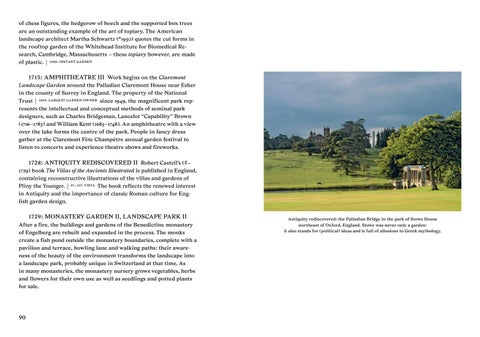
Antiquity rediscovered: the Palladian Bridge in the park of Stowe House northeast of Oxford, England. Stowe was never only a garden: it also stands for (political) ideas and is full of allusions to Greek mythology.