Oligonucleotide synthesis reagents catalogue Second edition
Introduction
Integrated tools. Accelerated science.
2
Contents Introduction
5
LGC, Biosearch Technologies
5
Nucleic acid chemistry (NAC)
5
Quality at Biosearch Technologies
6
Enhanced specification
7
Custom synthesis and bulk packaging
7
Corporate social responsibility
8
Chemistry of oligonucleotide synthesis 11 Oligonucleotide synthesis cycle
11
Choosing a solid support
15
Protection group strategies
19
Oligoribonucleotide synthesis
21
Alternative activators
23
Bespoke 3’-incorporation: employing unfunctionalised Amino-CPG
24
Applications of modified oligonucleotides 27 Introduction
27
Diagnostics
27
Therapeutics
27
Using photocleavable (PC) modifiers
67
Modifications for nuclease resistance
71
Chemical phosphorylation
76
Fluorescence detection
78
Colourimetric detection and capture
90
Electrochemical detection
92
Branching modification
93
Cell delivery and uptake
97
Structural studies
100
Nucleosides 107 Miscellaneous products 109 Ordering information
113
Legal statements
117
Glossary 121 Catalogue index
124
Modifiers and their use in oligonucleotide synthesis 37 Introduction
37
Spacers
38
Conjugation reagents
39
Backbone modification
55
3
Introduction
4
Introduction
Your partner of choice for all your oligonucleotide synthesis reagent and instrument needs. LGC, Biosearch Technologies™
Nucleic acid chemistry (NAC)
A global leader in the life sciences sector, serving customers in healthcare, applied markets (including food, agricultural biotechnology and the environment), research and government institutions.
You will find our NAC portfolio offers you a complete and convenient point for all your oligonucleotide needs; everything from an extensive range of solid supports and common phosphoramidite modifications such as 2’-O-methyl and 2’-fluoro, through more specialist modifications and peptide nucleic acid monomers, to nucleosides, carbohydrates and fluorescent markers.
Offering a comprehensive range of products for genomics reagents and instrumentation, research and measurement services, our scientific tools and services form an essential part of your experience of quality and compliance, allowing you to provide safer products, develop new solutions and advance research - we are with you, every step of the way.
This extensive range of over 1000 specialist products, combined with our range of synthesizers, offers you the complete comprehensive portfolio for all your oligonucleotide synthesis needs.
In recent years, Biosearch Technologies has paved the way forward with its complete end-to-end nucleic acid chemistry solution and now offers you a truly unrivaled product portfolio of specialised phosphoramidites, solid supports and synthesizers to build your oligonucleotides.
5
Introduction
Quality at Biosearch Technologies We understand product quality is important to you and so have been manufacturing reagents for oligonucleotide synthesis to an unrivalled level of quality. We control and check the whole manufacturing process, repeatedly, at every stage. We put more than 35 years’ experience in chemistry - in particular with respect to oligo synthesis reagents - at your disposal, and whether you want 1 g or 1 kg, Biosearch Technologies is your partner of choice. We combine a comprehensive catalogue of off-the-shelf materials together with a full bespoke custom service so you can order precisely what you need, every time. As the biggest specialist company in this field, we ensure great value for money. Our team is made up of passionate, committed professionals who deliver the most efficient, helpful service you could imagine.
Biosearch Technologies is the brand you can trust At Biosearch Technologies, we are very customer focused and strive to not only meet but exceed the requirements and expectations of our customers. As a measure of this, our Quality Management System (QMS) ISO 9001 certified. While continuing to provide robust and reliable services and products, we are committed to continual improvement and as such once an improvement project has been determined, we put together Continual Improvement Groups consisting of key people to work on the project. Many of these project ideas come from the customer. In conjunction with our QMS, our Customer Relationship Management (CRM) System allows all customer contact (sales, enquiries, technical support) to be monitored as a means of identifying trends which enables us to act faster in terms of any changes that may be required as a result of a trend, e.g. scale up of a particular product. This then becomes a continual improvement project. Biosearch Technologies is committed to providing high quality products, therefore, our QC processes allow for testing of all key raw materials and all intermediates in addition to our final products. After QC, all batches undergo QA review prior to release. Our QC operation, and associated QA quarantine areas, are housed in defined areas and separate from process development and routine manufacturing. Not only do we have a wide variety of in-house analytical techniques such as HPLC, LCMS-TOF and UV/vis, we also provide NMR and fluorescence measurement, enabling us to fully characterise and analyse all our products, intermediates and raw materials. All our oligonucleotide synthesizer reagents products are functionally tested on one of our in-house oligo synthesizers and the resulting oligo subsequently analysed.
6
Introduction
Enhanced specification Although at Biosearch Technologies our QMS is ISO 9001:2015 certified, we understand that many of our customers are certified to other quality standards (e.g. ISO 13485) and therefore have different requirements. For these customers, we have implemented processes which will allow us to meet these specific needs for our NAC customers. For instance, all our products undergo QC testing and QA review to ensure they meet a defined specification and a Certificate of Analysis (CoA) is issued and shipped to the customer along with the product. For many customers this is sufficient. However, for others there is a benefit for Biosearch Technologies’ NAC services to align our QC analysis for a product (or set of products) to that of the client’s own testing and copies of the analytical data along with the CoA are sent along with the product. This is in place for many of our customers. For other clients, we go one step further and carry out impurity profiling based on LCMS, NMR and HPLC data. Where applicable, we can provide the analytical data and analysis report prior to shipping the material for preapproval by the customer.
Custom synthesis and bulk packaging We take care to provide our off-the-shelf products in popular pack sizes and packing formats. As your needs grow, so do the options available to you. We can supply most manufactured products in bulk quantities. Biosearch Technologies’ NAC portfolio can either ship in single containers or aliquot material; the unit size and type of packaging is entirely at your discretion – tell us what you need. For any bulk order, the packaging will be agreed at the outset of manufacturing. At Biosearch Technologies, our catalogue range of oligo reagents is exceptional but it may not be enough for our more specialist clients. You know who you are – CMOs, GMP manufacturers, diagnostic oligo manufacturers and others. You may work to ISO 13485, but you’re certainly a customer with highly specialised, possibly unique, requirements. You need a partner you can trust to deliver the highest quality products, to your exacting standard, via a managed and resilient supply chain, with multiple manufacturing sites in UK and US. Have a look through our catalogue and find what you are looking for. But if you don’t see it, it does not mean that we do not supply this reagent or support. Our product offering is consistently evolving to meet all your needs. So give our Customer Service a call on +44 (0) 1698 849911 and we may be able to help you find what you are looking for.
7
Introduction
Corporate social responsibility At Biosearch Technologies, we are very much aware of our responsibility to the environment and consider the impact of our operations on society very seriously. We strive to minimise our waste production and maximise recycling at all times - whether in our laboratories, canteen, or paper for our marketing materials. Of course, chemical production will always produce waste but we always ensure that the hazardous material element of what waste we do produce is properly contained and dealt with responsibly. Every year, we support a charity chosen by our employees. We raise funds for charities that demonstrate links to our business activities and have an international reach to reflect our global footprint. Donations to our chosen corporate charity are being boosted by Biosearch Technologies matching any funds raised through teambuilding events. For more information on this, see www.lgcgroup.com for further details.
8
Introduction
9
Chemistry of oligonucleotide synthesis
10
Chemistry of oligonucleotide synthesis
Chemistry of oligonucleotide synthesis Over 30 years since its introduction, the use of phosphoramidite chemistry remains the method of choice for the automated synthesis of oligonucleotides.
Oligonucleotide synthesis cycle Most techniques used in molecular biology today rely on synthetic oligonucleotides, including PCR, DNA sequencing, and Single-Nucleotide Polymorphism (SNP) assays. The vast majority of oligonucleotides are synthesised on automated synthesizers using phosphoramidite methodology.
Oligonucleotide phosphoramidite chemistry was first introduced 35 years ago.1 The method is based on the use of DNA phosphoramidite nucleosides which are modified with a 4,4’-dimethoxytrityl (DMTr or DMT) protecting group on the 5’-OH, a ß-cyanoethylprotected 3’-phosphite, and appropriate conventional protecting groups on the reactive primary amines in the heterocyclic nucleobase. The four classic protected DNA nucleoside phosphoramidites are benzoyl-dA, benzoyl-dC, iso-butyryl-dG and dT (which requires no base protection), products LK2003, LK2004, LK2002 and LK2001 respectively. As discussed in the following pages, both acetyl-dC (LK2034) and dimethylformamidine-dG (LK2030) are now also routinely used.
1 An investigation of several deoxynucleoside phosphoramidites useful for synthesising deoxyoligonucleotides, L.J. McBride and M.H. Caruthers, Tetrahedron Lett., 24, 245-248, 1983.
LK2001
LK2002
LK2003
LK2004
11
Chemistry of oligonucleotide synthesis The phosphoramidite approach is today carried out almost exclusively on automated synthesizers using controlled-pore glass (CPG) or polystyrene solid supports.2 These supports are held in small synthesis ‘columns’ or wells within plate (e.g. 96 well plates) that act as the reaction vessel. These columns or plates are loaded onto the synthesizer and phosphoramidite and ancillary reagents are passed through the column in cycles of 4 distinct reactions thus extending the oligonucleotide chain. The synthesis cycle consists of four steps: deblocking (detritylation); activation/coupling; capping; and oxidation (or sulphurisation). These steps are shown in Figure 1. Synthesis occurs in the 3’ to 5’ direction; which is opposite to enzymatic synthesis by DNA polymerases.
Conventionally, the 3’ base in the sequence is incorporated by use of a base-functionalised CPG or polystyrene support (1), although ‘universal’ supports are available (see below). Synthesis initiates with removal (‘deblocking’ or ‘detritylation’) of the 5’-dimethoxytrityl group by treatment with acid (classically 3% trichloroacetic acid in DCM (LK4140)3 to afford the reactive 5’-OH group (2). The phosphoramidite corresponding to the second base in the sequence (3) is activated4 (using a tetrazole-like product such as ETT (LK0237 or LK3140/LK3142/LK3145/LK3146) or BTT (LK0234 or LK3160/LK3162), then coupled to the first nucleoside via the 5’-OH to form a phosphite linkage (4). Solid phase phosphoramidite coupling usually proceeds to around 99% efficiency. If the 1% of molecules remaining with reactive 5’-OH groups are left untreated,
2 For a recent review see: A brief review of DNA and RNA chemical synthesis, M.H. Caruthers, Biochem. Soc. Trans., 39, 575-580, 2011. 3 In larger production environments 2-5% dichloroacetic acid in toluene is commonly used; we can provide this by request - for 5% quote item LK4500. 3% DCA in DCM (LK4040) is also available. 4 A description of the mechanism of activation via the phosphorotetrazolide intermediate can be found in Studies on the role of tetrazole in the activation of phosphoramidites, S. Berner, K. Mühlegger and H. Seliger, Nucleic Acids Research, 17, 853-864, 1989.
LK0234
12
LK2030
LK2034
LK0237
Chemistry of oligonucleotide synthesis unwanted side-products will result. To prevent this, a ‘capping’ step is introduced typically prior to the oxidation to acetylate the unreacted 5’-OH (5). Where sulphurisation is performed, capping must come after this step. This is typically achieved using a solution containing acetic anhydride (Cap Mix A -LK4010/LK4110/LK4012) and the catalyst N-methylimidazole (Cap Mix B – LK4120/ LK4122). Unless blocked these truncated oligonucleotides can continue to react in subsequent cycles giving near full- length oligonucleotide with internal deletions (species referred to as (N-1)mers). The unstable trivalent phosphite triester linkage is oxidised, via an iodine-phosphorous adduct, to the stable pentavalent phosphotriester (6) using iodine in a THF/ (pyridine or lutidine)/water solution (LK4230/LK4330/ LK4132). After oxidation, the cycle is repeated, starting with detritylation of the second molecule and so on.
The synthesis cycle is repeated until the desired length of oligonucleotide is achieved. At this point the synthesis is complete. At this point, there are two choices: either the final 5’DMTr group can be left in place as a purification ‘handle’ (DMT ON option on the synthesizer; see below) or it can be removed by a final acid treatment (DMT OFF). The oligonucleotide can then be cleaved from the solid support using a suitable deprotection solution, e.g. ammonium hydroxide solution at room temperature. If desired, cleavage and deprotection can be carried out simultaneously. In addition to cleaving the support, the cyanoethyl groups are removed from the sugar-phosphate backbone. Nucleobase protection is also removed at this time. The specific cleavage and deprotection conditions will vary from oligo to oligo depending on the nucleobase protection employed and any modifiers present. This is typically done by heating the resin in the deprotection solution or in gaseous ammonia.
Figure 1. The oligonucleotide synthesis cycle using phosphoramidite chemistry.
13
Chemistry of oligonucleotide synthesis After deprotection, oligos are typically de-salted (also removes small-molecule side products) or purified by methods such as Polyacrylamide Gel Electrophoresis (PAGE), reverse-phase (RP) HPLC, cartridge methods or ion-exchange (IE) HPLC. Leaving the DMTr protecting group in place aids the purification of full-length sequences, since the hydrophobic DMTr group is retained by reverse phase chromatographic media. In contrast, non-DMTr containing failure sequences are much less retained on chromatography. This is the basis on which oligonucleotides are purified by reversephase (RP) HPLC. Note that if the capping or detritylation steps are inefficient, N-1, N-2, ... species can occur but the 5’-end of the failures is still protected with DMTr. Classically, after preparative chromatography the 5’-DMTr group would be removed by acetic acid treatment to give the biologically active oligonucleotide. Whilst this is still a valid method, it is not now commonly carried out in this manner. There are many available preparative columns (e.g. Hamilton PRP-3, ABI POROS, Waters X-Bridge) that will allow DMT ON purification and the detritylation to be carried out on the column, thus allowing the product to be collected already detritylated. This is fast and less likely to lead to depurination than solution- phase acetic acid treatment.
Ordering unmodified DNA phosphoramidites
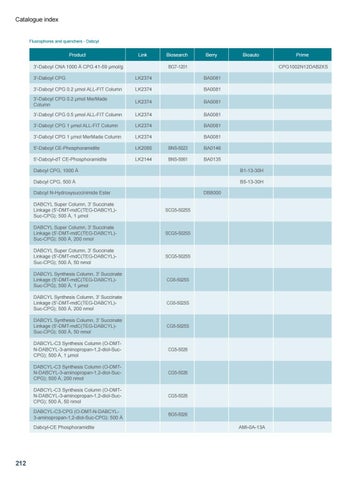
As well as the above, Biosearch Technologies is able to offer the following DNA phosphoramidites from its legacy product portfolios. For further information on these products, see pages from 124 of the catalogue index or contact Customer Service. Many cartridge purification systems based on this principle are available. In this case, the crude oligonucleotide is adsorbed on to the cartridge and failure sequences are washed out by elution with water, leaving the pure fulllength product on the solid medium. The cartridge is then treated with acid to remove the DMTr group and the pure oligonucleotide is eluted with acetonitrile/water. The synthesis of RNA (where the chemistry is complicated by the presence of an additional 2’-OH functional group) is discussed on page 21. Ordering ancillary reagents
Biosearch Technologies now offer a range of ancillary reagents, from activators, oxidisers to deblok, as well as Cap Mix A and B., to complement our MerMade™ DNA/ RNA synthesizers. To view our full product for this range, have a look at the our catalogue index from page 124 onwards.
LK2002
LK2004
14
LK2035
LK2003
LK0234
Chemistry of oligonucleotide synthesis
Choosing a solid support Controlled Pore Glass (CPG) has been widely used as a solid support for oligo synthesis for several decades. Biosearch Technologies’ has perfected CPG manufacture for maximum oligo purity and yield. Our advanced CPG production techniques were developed to improve control of particle size and shape, pore size, pore volume, and specific surface area. These physical parameters influence solution exchange behaviour, ligand loading and distribution, and reaction kinetics to increase the efficiency, purity, and reproducibility of syntheses. Proprietary chemical attachment procedures were developed to further optimise ligand distributions, providing increased accessibility to synthesis reagents and washing solutions and facilitating even better oligo yields and purities. Furthermore, process refinements and proprietary assays were developed to minimise the troublesome “N-1” impurity levels in an oligo synthesis. Biosearch Technologies’ CPG is considered to be the gold-standard solid support used in all sectors of the market. Our collaborative process has have resulted in solid supports which are optimised for the synthesis of the latest therapeutic oligo classes including LNA, delivery enhancing lipid ligands, SiRNA and Spiegelmers. Biosearch Technologies’ CPG solid supports are available
in a variety of pore sizes and functionalised nucleoside loadings. Seven pore sizes are offered from 500 Å to 3000 Å to enable the synthesis of oligonucleotides for all applications. Which pore size required is dependent on the length, complexity and application of the oligo. Some guidelines are below for the most widely used pore sizes. • 500 Å CPG; • ≤30mers medium to large scale oligo synthesis • High yields of product are required such as therapeutic oligos • High loaded support is required. 500 Å can load up to ~100 μmol/g • 1000 Å CPG; • >20mers or highly modified oligonucleotides. • The loading is typically 25-40 µmolg/1 and most of our modifiers are functionalised onto this pore size as standard. • 3000 Å CPG; • >80mers • The loading is typically 10-25 µmolg/1. • With a few exceptions, it is possible to have any of our 1000 Å products with a 3000 Å pore size. In general large scale oligo synthesis for therapeutic applications requires high loaded 500-600 Å and small to medium scale synthesis for diagnostic or research use require higher pores sizes.
15
Chemistry of oligonucleotide synthesis CPG products Many research use CPG products are available which originated from the legacy LINK, Biosearch and Berry portfolios. These include a number of unmodified and modified products, noted throughout the catalogue. Many more bulk and column-packed products are available from our Prime business; a summary of which can be seen in Table 1.
Table 1. Summary of typical CPGs available. See Index for further details.
16
Type
Modification
CPG 500A, 600A, 1000A
Native, AMP, CNA/LCAA
CPG 2000A, 3000A
Native, AMP, CNA/LCAA
DNA CPG 500A, 600A, 1000A
dA, dC (Ac), dC (Bz), dG (iBu), dG (dmf), dT
DNA CPG 2000A, 3000A
dA, dC (Ac), dC (Bz), dG (iBu), dG (dmf), dT
RNA CPG 1000A
rA (Bz), rC (Ac), rC (Bz), rG (iBu), rG (dmf), rU, rA (Bz), 2’-OAc, rA, (Ac), 2’-OAc, rC (Ac), 2’-OAc, rG (iBu), 2’-OAc, rU, 2’-OAc
RNA CPG 2000A, 3000A
rA (Bz), rC (Ac), rC (Bz), rG (iBu), rG (dmf), rU, rA (Bz), 2’-OAc, rA (Ac), 2’-OAc, rC (Ac), 2’-OAc, rG (iBu), 2’-OAc, rU, 2’-OAc
RNA CPG (Pac); all pore sizes
rA (Pac), rG (iPr-Pac), rG (iPr-Pac), 2’-OAc
2’-OME CPG 1000A
2’ OMe rA (Bz), 2’ OMe rC (Ac), 2’ OMe rC (Bz), 2’ OMe rG (iBu) 2’ OMe rG (dmf), 2’ OMe rU
2’-OME CPG 2000A, 3000A
2’ OMe rA (Bz), 2’ OMe rC (Ac), 2’ OMe rC (Bz), 2’ OMe rG (iBu), 2’ OMe rG (dmf), 2’ OMe rU
Reverse CPG
3’ DMT dT, 3’ DMT dA (Bz), 3’ DMT dC (Bz)
LNA CPG
LNA A (Bz), LNA C (Bz), LNA G (dmf), LNA T
2’-F CPG
2’ Fluoro A (Bz), 2’ Fluoro C (Ac), 2’ Fluoro G (iBu), 2’ Fluoro U
Chemistry of oligonucleotide synthesis CPG product selection Throughout the Index you will see the legacy Prime catalogue numbers, which give an indication of the variety available. You will also find the corresponding Biosearch Technologies catalogue numbers (starting “BG”) where applicable, as we transition to these numbers as standard.
To assist in selection, please refer to Table 2 and the example below of the key elements to the coding system used. As always, though, please do contact us to discuss your bulk or column CPG requirements.
Example: CPG1002M7RC2YS - consists of
CPG
All CPG products have this prefix
100
Code A - Pore size
2
Code B - Bulk density
M
Code C - Linker type
7
Proprietary process information
RC
Functional code
2
Proprietary process information
Y
Code D - Functional loading
S
Synthetic - most CPGS have this suffix.
Table 2. Legacy Prime product catalogue composition
CODE B
Bulk density
0
0.20-0.50 g/cc
1
0.20-0.24 g/cc
2
0.25-0.33 g/cc
3
>0.33 g/cc
Code C
Linker type
M
AMP (Aminopropyl)
N
CNA/LCAA
Code A
Pore size (angstrom)
35
350
40
400
50
500
60
600
70
700
75
750
Code D
Functional loading (µmol/g)
80
800
Z
<25 µmol
85
850
Y
25 - 40 µmol
100
1000
X
41 - 59 µmol
120
1200
W
60 - 70 µmol
130
1300
V
71 - 79 µmol
140
1450
S
80 - 90 µmol
150
1500
B
70 - 80 µmol
160
1600
R
80 - 100 µmol
170
1700
V/S
71 - 90 µmol
200
2000
W/V
60 - 79 µmol
250
2500
X/W
41 - 70 µmol
300
3000
Y/X
25 - 59 µmol
17
Chemistry of oligonucleotide synthesis
Employing universal supports As outlined above, in oligo synthesis the 3’-end is generally determined by the base or modifier functionalisation of the solid support. Whilst the synthesis of any oligo is efficient, given the choice of functionalised supports available, there are advantages in using a ‘universal’ support where there is no nucleobase or modification already present (e.g. when using plate synthesizer). In this case, the first base at the 3’-end is determined by the first phosphoramidite addition in the synthesis cycle.
For these purposes we offer Universal CPG 1000/110 (LK2304)5 and Universal-Q CPG (LK2300/LK2410/ LK2411- see the catalogue index from page 124 for more details). Where the support is functionalised with a nucleoside or modifier, this is usually attached via a succinate linkage (as in our unmodified base products).6 Cleavage with ammonium hydroxide at room temperature can take about an hour. The alternative oxalate group has been shown to be very labile during cleavage, but its stability to the synthesis cycle is unsatisfactory.
When preparing wells in plate synthesizers this eliminates the possibility of the incorrect resin being placed in a well. It also allows automated preparation of the plates to stock ready for synthesis. There is an added benefit in large scale syntheses, where supply chain is simplified as only the one support is required.
The Q-supports were developed7 with fast, mild cleavage in mind, however we have observed mixed results. The linker is stable to capping mixtures, but is slightly labile in oxidiser solution (8% cleavage overnight which is the equivalent of approximately 2000 synthesis cycles on an average program).
A universal support can also be applied in situations where a 3’-modification support is not available, using a phosphoramidite modifier as the first addition in the cycle (this will only work with phosphoramidites capable of extending the oligo chain, i.e. not 5’-modifiers and are compatible with the universal support cleavage and deprotection conditions).
For both these universal supports a high temperature or extended time is required to completely remove the universal linker. For LK2300 one of the following needs to be used: ammonium hydroxide solution, 17 h at 80 °C; AMA, 5h at 80 °C; or AMA, overnight at 55 °C.
5 A universal support for oligonucleotide synthesis, S. Scott, P. Hardy, R.C. Sheppard, and M.J. McLean, in Innovation and Perspectives in Solid-Phase Synthesis. Peptides, Proteins, and Nucleic Acids, Biological and Biomedical Applications (R. Epton, ed.), 115-124, 1994. Mayflower Worldwide, Ltd., Birmingham, UK. 6 Linkers and cleavage strategies in solid-phase organic synthesis and combinatorial chemistry, F. Guillier, D. Orain and M. Bradley, Chemical Reviews, 100, 2091-2158, 2000. 7 Hydroquinone-O,O’-diacetic acid as a more labile replacement for succinate acid linkers in solid-phase oligonucleotide synthesis, R.T. Pon and S.Y. Yu, Tetrahedron Lett., 38, 3327-3330, 1997.
LK2300
18
LK2304
LK2410/2411
Chemistry of oligonucleotide synthesis Contrary to previously published mild methods, the best conditions we have found to completely remove the Q linker during deprotection are AMA at 70 °C for 2.5h or AMA at 80 °C for 2h. For this reason it is inadvisable to use this support with modifications that require mild, ultra mild or room temperature deprotection. Compatibility with RNA is therefore mixed. We would not recommend the use of the support with TBDMS chemistry. In summary, despite some innovations, there remains the need for a truly universal support that has wide application. Most recently, a candidate has emerged based on a molecule which is “conformationally preorganised” to accelerate the dephosphorylation reaction.8 The rigid bicyclic molecule is designed to facilitate the formation of the cyclic phosphate transition state, thereby stimulating the rate of dephosphorylation. The use of this support has been demonstrated in antisense phosphorothioate synthesis9 and in drug development.10 The methyl version of the support (preferable over the phenyl version since methylamine rather than aniline is formed on deprotection) is available. Contact our Customer Service group for more information. Ordering universal supports
A full product offering can be seen from page 124 of the catalogue index.
Protection group strategies UltraMILD deprotection In oligonucleotide synthesis, the classic heterocyclic base protection groups (Bz-dA, Bz- dC and iBu-dG) are routinely removed using ammonium hydroxide solution with heating. Unfortunately, many modifiers and labels used in oligonucleotide synthesis will not withstand prolonged exposure to such strongly alkaline conditions. The UltraMILD monomers - phenoxyacetyl (Pac)-dA (LK2059), acetyl (Ac)-dC (LK2034), and iso-propylphenoxyacetyl (iPr-Pac)-dG (LK2060) - were developed to alleviate this. This alternative protection allows milder deprotection conditions to be used where sensitive labels and tags have been incorporated into the oligonucleotide. This strategy allows the use of very mild deprotection conditions such as 0.05 M potassium carbonate in methanol at room temperature. The UltraMILD monomers can also be deprotected using ammonium hydroxide solution, and, in fact, acetyl- is currently the protectinggroup of choice for dC since this is compatible with all deprotection conditions. The corresponding Pac-dA, Ac-dC, and iPr-Pac-dG functionalised supports are also available for UltraMILD compatibility of the first 3’ base, as are UltraMILD capping reagents. It should be noted that using the alternative capping solution containing Pac-anhydride (LK4210) avoids the possibility of formation of acetyl-dG by exchange in regular capping solutions. N2-acetyl-dG would not be deprotected under UltraMILD conditions.
8 A conformationally preorganized universal solid support for efficient oligonucleotide synthesis, A.P. Guzaev and M. Manoharan, J. Am. Chem. Soc., 125, 2380-2381, 2003. 9 Efficient synthesis of antisense phosphorothioate oligonucleotides using a universal solid support, R. Krishna Kumar, A.P. Guzaev, C. Rentel and V.T. Ravikumar, Tetrahedron, 62, 4528–4534, 2006. 10 Efficient synthesis of antisense phosphorothioate oligonucleotides using a universal solid support, R. Krishna Kumar, A.P. Guzaev, C. Rentel and V.T. Ravikumar, Tetrahedron, 62, 4528–4534, 2006.
LK2034
LK2059
LK2060
19
Chemistry of oligonucleotide synthesis
FAST deprotection
Other methods
The use of dimethylformamidine-(dmf)-dG (LK2030) has over the years gained favour over iBu-dG (LK2003), originally due to its ability to deprotect with ammonium hydroxide in 1h at 65 °C (or 2h at 55 °C). This, together with the availability of the Ac-dC phosphoramidite developed for UltraMILD protocols, led to the creation of a new monomer set allowing rapid deprotection by the FAST method. By using Ac-dC, Bz-dA and dmf-dG monomers, FAST cleavage and deprotection can be effected by a 1:1 mixture of aqueous ammonium hydroxide and aqueous methylamine (known as AMA) in 10 minutes. Cleavage takes place over 5 minutes at room temperature, then deprotection follows by heating to 65 °C for a further 5 minutes.11 Deprotection also takes place at room temperature if left for 120 minutes. AMA deprotection is not recommended for use in the presence of sensitive labels such as cyanine or rhodamine (TAMRA) dyes, or where there are Bz-protected C nucleosides as this will result in transamidation with methylamine.
While all common deprotection methods require purification to remove the residual protective groups (e.g. benzamide) and insoluble silicates, an ammoniafree reagent mixture that allows avoidance of additional purification has been reported.12 The method, which uses a mixture of lithium hydroxide and triethylamine, can be applied to deprotect oligos synthesised using the classical or Pac-protected phosphoramidites.
dmf-dG works particularly well with tbutylamine/methanol/ water (1:1:2) as used for rhodamine containing modifiers (e.g. TAMRA). The Ac-dC and dmf-dG protected supports are also available.
A modified “ultra-mild” protocol has also been reported that is compatible with the known UltraMILD monomers.13 This method, utilising 10% diisopropylamine in methanol with 0.25 M of ß-mercaptoethanol, was developed for studies incorporating the base-sensitive dG-AAF into DNA; it could well be of more general use for the incorporation of base-labile functionalities into DNA. Ordering unmodified UltraMILD phosphoramidites and supports
Please see page 124 onwards for Biosearch Technologies’s full offering of unmodified UltraMILD phosphoramidites and supports. For details of the UltraMILD Cap A solution see the catalogue index from page 124.
11 Using AMA, the order of hydrolysis of the base protecting groups is the acetyl group on dC, followed by the benzoyl group on dA, and then the dmf groups from dG. The hydrolysis of Ac-dC is almost instantaneous, thereby precluding the unwanted transamidation reaction to the side-product N-Me-dC possible with alkylamine deprotection. 12 Advanced method for oligonucleotide deprotection, S.A. Surzhikov, E.N. Timofeev, B.K. Chernov, J.B. Golova and A.D. Mirzabekov, Nucleic Acids Research, 28, e29, 2000. 13 Site-specific incorporation of N-(deoxyguanosin-8-yl)-2-acetylaminofluorene (dG-AAF) into oligonucleotides using modified ‘ultra-mild’ DNA synthesis, L.C.J. Gillet, J. Alzeer and O.D. Schärer, Nucleic Acids Research, 33, 1961-1969, 2005.
LK2003
20
LK2030
Chemistry of oligonucleotide synthesis
Oligoribonucleotide synthesis There are many uses of RNA oligonucleotides such as understanding the role of ribozymes (catalytic RNA) and cellular RNA as a target for antisense therapeutics. However, the need for chemically synthesised RNA oligonucleotides has become increasingly important since the advent of synthetic siRNA for use in antisense technologies such as gene silencing, and the therapeutic application of RNAi.14
Chemistry and protection strategies DNA and RNA have very similar structures and differ only in the presence of the 2’-OH moiety in the latter, and that in RNA thymidine (T) is replaced with uridine (U). As such, the chemistries in terms of synthesis and deprotection of the oligonucleotides differ.15 There are many 2’-OH protection chemistries available: tbutyldimethylsilyl (TBDMS)16, Xeragon’s 2’-O-triisopropylsilyoxymethyl, (TOM™)17, Dharmacon’s 2’-O-bis(2-acetoxyethoxy) methyl (ACE™)18 and very recently Agilent’s 2’-O-thiomorpholine-4-carbothioate (TC).19 However, to date, TBDMS chemistry remains the most widely accepted and utilised in RNA synthesis, particularly where the RNA is used in therapeutic applications. The coupling reaction for RNA synthesis is much longer in comparison with DNA synthesis. Using TBDMS chemistry coupling times of up to 12 minutes are required depending on the choice of activator, although with 0.25 M BTT, 3-5 minute couplings are possible.
14 RNA interference in the clinic: challenges and future directions, C.V. Pecot, G.A. Calin, R.L. Coleman, G. Lopez- Berestein and A.K. Sood, Nat. Rev. Cancer, 11, 59-67, 2011. 15 For a recent overview of this area see: Current Strategies for the Synthesis of RNA, S. Muller, J. Wolf and S.A. Ivanov, Current Organic Synthesis, 1, 293-307, 2004. 16 Chemical synthesis of biologically active oligoribonucleotides using beta-cyanoethyl protected ribonucleoside phosphoramidites, S.A. Scaringe, C. Francklyn and N. Usman, Nucleic Acids Research, 18, 5433- 5441, 1990. 17 Synthesis and pairing properties of oligoribonucleotide analogues containing a metal-binding site attached to beta-D-allofuranosyl cytosine, X. Wu and S. Pitsch, Nucleic Acids Research, 26, 4315-4323, 1998. 18 Novel RNA synthesis method using 5’-O-silyl-2’-O-orthoester protecting groups, S.A. Scaringe, F.E. Wincott and M.H. Caruthers, J. Amer. Chem. Soc., 120, 11820-11821, 1998. The ACE™ method also requires that the 5’-OH is protected with a silyl ether rather than the common DMTr group. Moreover, at present the phosphoramidites are not commercially available. 19 The Development of a Cost-Effective Large Scale Synthesis Process for RNA Therapeutics, D. Dellinger, Presentation at TIDEs®, May 18, 2009.
LK2033
LK2036
LK2037
LK2038
LK2039
LK2040
21
Chemistry of oligonucleotide synthesis Until recently, the synthesis of longer RNA oligos (~80mers) in reasonable yields was met with some difficulty due to the premature partial deprotection of the TBDMS group during the step to remove the nucleobase protection with ammonium hydroxide solution with heating. Reaction between the now free 2’-OH group and the 3’-phosphate resulted in either cleavage of the oligo at this point or rearrangement to 2’-phosphate and 3’-OH. The desilylation can be suppressed by the use of anhydrous ethanolic ammonia or ethanolic ammonium hydroxide.20 However, the most significant improvement is with the use of AMA21 (aqueous ammonium hydroxide/methylamine 1:1) or ethanolic AMA22 in conjunction with the use of fast deprotection amidites which allows the nucleobases to be deprotected in 10 minutes at 65˚C. The use of DMSO/ ethanolic methylamine (1:1) has also been reported.23 It must be noted that the use of Bz-dC or Bz-C with AMA leads to transamidation with methylamine and these monomers are therefore not suited to this deprotection method. The most critical step in obtaining high quality RNA is removing the 2’-TBDMS group. Before starting on this part of the deprotection process, it is important that the sample is completely dry and all the nucleobase deprotection solutions have been removed. Removal of the TBDMS groups is most commonly achieved
using N-methylpyrrolidone/triethylamine/ triethylamine trihydrofluoride (NMP/Et3N/Et3N.3HF) or with either DMSO or DMF to replace the NMP. While to date this has been the most widely used RNA chemistry, the two step deprotection is time consuming and detrimental to more sensitive modifications (e.g. cyanine dyes). A one-pot deprotection method for TBDMS chemistry which uses anhydrous methylamine and neat Et3N/Et3N.3HF has been described.24 The deprotection time is still 2-3 hours and is still incompatible with sensitive modifications. Recently, TC-RNA chemistry has been introduced. This has a one-step deprotection method that removes both the nucleobase and 2’-OH protection simultaneously; this technology however is not widely available for commercial use. Ordering 2’-OTBDMS RNA phosphoramidites and unmodified RNA CPG supports
See the catalogue index from page 124 for our full product offering.
20 Prevention of chain cleavage in the chemical synthesis of 2’-silylated oligoribonucleotides, T. Wu, K.K. Ogilvie and R.T. Pon, Nucleic Acids Research, 17, 3501-3517, 1989. 21 Methylamine deprotection provides increased yield of oligoribonucleotides, M.P. Reddy, F. Farooqui and N.B. Hanna, Tetrahedron Lett., 36, 8929-8932, 1995. For an account of the use of this protection approach in DNA synthesis see: Fast cleavage and deprotection of oligonucleotides, M.P. Reddy, N.B. Hanna and F. Farooqui, Tetrahedron Lett., 35, 4311-4314, 1994. 22 Synthesis, deprotection, analysis and purification of RNA and ribozymes, F. Wincott, A. DiRenzo, S. Scaringe and N. Usman, Nucleic Acids Research, 23, 2677-2684, 1995. 23 Comparison of coupling and deprotection protocols for RNA synthesis, R.T. Pon and S. Yu, Poster Presentation at ABRF 2004, Integrating Technologies in Proteomics & Genomics, Portland, Oregon, Feb. 28 – Mar. 2, 2004. 24 “One-pot” oligoribonucleotide deprotection with anhydrous methylamine and neat triethylamine trihydrofluoride, L. Bellon, in Current Protocols in Nucleic Acid Chemistry, Unit 3.6, Eds. S.L. Beaucage, D.E. Bergstrom, G.D. Glick and R.A. Jones, John Wiley & Sons, 2000.
22
Chemistry of oligonucleotide synthesis
Alternative activators Activators containing tetrazole (traditionally as a 0.45 M solution in anhydrous acetonitrile) have classically been the reagents of choice in routine automated DNA and RNA synthesis. There are, however, two main disadvantages to using this product. Firstly, at lower laboratory temperatures (typically 18 °C), solid tetrazole can crystallise from the near-saturated solution causing blockage of delivery lines. Secondly, the product has become more difficult to obtain because of shipping restrictions due to its classification as an explosive (current UK law permits shipping of tetrazole only as a solution; even this cannot be shipped by air). As a consequence, we now no longer offer this product. An alternative activator, 5-Ethylthio-1H-tetrazole (ETT, LK3140/LK3142/LK3145/LK3146), can offer more effective activation than tetrazole without crystallisation problems. In particular it has been shown to decrease the coupling times in both RNA synthesis25 and DNA synthesis. However, it is believed that shipping restrictions will also be imposed on this product in the future. It has also been demonstrated that the acidity of tetrazole based activators
is sufficient to deprotect the trityl group in monomer solution - to a small extent - leading to some dimer (n+1) formation.26 The less acidic 4,5-dicyanoimidazole (DCI) has been used as an alternative activator to avoid this side-reaction.27 The increased nucleophilicity of this molecule also increases the rate of activation. We offer 0.25 M dicyanoimidazole in anhydrous acetonitrile (LK3150). This is available in a 450 mL (16 oz), 28-405 screw neck, amber bottle, suitable for Expedite 8909, upgraded ABI 392/394, ABI 3400 and 3900, and all MerMade synthesizers. Despite these advances, a need remains for additional activators, particularly in RNA synthesis in which the longer coupling times, due to the steric effects of protecting the 2’-OH, ideally could still be reduced. We provide 5-Benzylthio-1H-tetrazole (BTT) activator (LK3160/ LK3162) to specifically meet this need. BTT has been classed as a non-explosive material, and therefore, availability of the product is not restricted. Furthermore, this product is available at a cost equivalent to other tetrazole activators. In DNA synthesis, coupling efficiency is routinely at least as good as with tetrazole, and often better. In RNA synthesis, the coupling of TBDMS or TOM monomers with 1H-tetrazole activation conditions can require 12-15 min. Using BTT 3 min coupling times are recommended, although 90s has been used effectively using 6.5eq of 0.25 M BTT and 6eq of 0.1 M
25 (a) Synthesis, deprotection, analysis and purification of RNA and ribozymes, F. Wincott, A. DiRenzo, C. Shaffer, S. Grimm, D. Tracz, C. Workman, D. Sweedler, C. Gonzalez, S. Scaringe and N. Usman, Nucleic Acids Research, 23, 2677-2684, 1995; (b) An efficient method for the isolation and purification of oligoribonucleotides, B. Sproat, F. Colonna, B. Mullah, D. Tsou, A. Andrus, A. Hampel and R. Vinayak, Nucleosides & Nucleotides, 14, 255-273, 1995; (c) Large-scale synthesis of oligoribonucleotides on high-loaded polystyrene (HLP) support, D. Tsou, A. Hampel, A. Andrus and R. Vinayak, Nucleosides & Nucleotides, 14, 1481-1492, 1995. 26 On the formation of longmers in phosphorothioate oligodeoxyribonucleotide synthesis, A.H. Krotz, P.G. Klopchin, K.L. Walker, G.S. Srivatsa, D.L. Cole and V.T. Ravikumar, Tetrahedron Lett., 38, 3875-3878, 1997. 27 Efficient activation of nucleoside phosphoramidites with 4,5-dicyanoimidazole during oligonucleotide synthesis, C. Vargeese, J. Carter, J. Yegge, S. Krivjansky, A. Settle, E. Kropp, K. Petersen and W. Pieken, Nucleic Acids Research, 26, 1046-1050, 1998.
23
Chemistry of oligonucleotide synthesis phosphoramidite.28 BTT is, in fact, very slightly more acidic than ETT, however, it has been shown that N+1 peaks are no more significant using BTT with shorter coupling times than ETT with a 6 min coupling time or 1H-tetrazole for 12 min. Note that we now also provide crystalline BTT (LK0234) and ETT (LK0237) - these can ship as non-hazardous products thereby reducing costs. Although we still find BTT to be the most widely effective activator, some customers still prefer to use DCI or ETT in certain situations, therefore, we are happy to support this.
Bespoke 3’-incorporation: employing unfunctionalised Amino-CPG The use of our Amino-CPG products (LK1308/1383/ 1385/1397) allows the user to directly incorporate a bespoke nucleobase or modifying unit of their own choosing at the 3’-end.
Synthetically, this is done by reacting the Amino-CPG with the succinate (or other suitable derivative) of the nucleoside (or modifier) in the presence of e.g. a carbodiimide and base in a suitable solvent. The modifying unit of course requires a protected alcohol available for further chain extension in the synthesis cycle (i.e. in nucleosides the 5’-OH is protected by a DMTr group). This 3’-modified CPG can then be used to synthesise an oligonucleotide. Our Amino-CPG products are fully activated and are used without further treatment. See pages 124 onwards of catalogue index for a complete view of Ordering unfunctionalised CPG supports from Biosearch Technologies.
28 The synthesis of 2’-O-[(triisopropylsilyl)oxy]methyl (TOM) phosphoramidites of methylated ribonucleosides for the use in automated RNA solid-phase synthesis, C. Höbartner, C. Kreutz, E. Flecker, E. Ottenschläger, W. Pils, K. Grubmayr and R. Micura, Monatchefte für Chemie, 134, 851-873, 2003.
LK1308/1383/1385/1397
24
LK0234
LK0237
Chemistry of oligonucleotide synthesis
25
Applications of modified oligonucleotides
26
Applications of modified oligonucleotides
Applications of modified oligonucleotides Modified oligonucleotides are now being used in many applications, most notably, diagnostics and therapeutics.
Introduction As we will see in the following sections, modifying an oligonucleotide enables the development of diagnostic tests, therapeutics, detection methods and genetic analysis tools. Whilst there is a multitude of applications such as gene synthesis, genetic profiling, biosensors, cosmetics and agriculture, the two main sectors utilising modified oligonucleotides are diagnostics and therapeutics.
Diagnostics
Therapeutics
The diagnostics sector is the fastest growing sector in the oligonucleotide market. This is primarily driven by the advances in terms of detection methods, particularly with respect to qPCR and sequencing techniques. These improvements in turn demand the need for new and improved detection labels such as fluorophores or electrochemical labels to fine tune these techniques to give higher sensitivity and selectivity.
Oligonucleotide therapeutics29 is a broad term which actually covers a number of modes of action of similarly structured molecules. Therefore, whilst the design and construction of the oligos is often similar, there are several ways in which therapeutic effects can be induced. These include antisense, anti-miRs, aptamers,30 DNAzymes and ribozymes, exon skipping, siRNA, transcription factor decoys (TFD) and immunostimulatory effects. Currently, the main focus in terms of oligonucleotide therapeutics is on antisense and siRNA technologies.
There is a vast array of oligonucleotide related diagnostic tests but, with the exception of one or two techniques, they fall into one of three categories: fluorescence (e.g. probe based qPCR); electrochemical (e.g. CombiMatrix microarrays); or colourimetric detection (e.g. ELISA assay), see pages 78, 92 and 90, respectively, for further information on each topic..
29 Therapeutic Oligonucleotides, RSC Biomolecular Sciences, Ed. J. Kurreck, 2008, ISBN 978-0-85404-116-9. 30 Aptamers as therapeutics, A.D. Keefe, S. Pai and A. Ellington, Nature Reviews Drug Discovery, 9, 537-550, 2010.
27
Applications of modified oligonucleotides
Antisense therapy The concept underlying antisense technology is relatively straightforward: the use of a sequence, complementary by virtue of base pair hybridisation, to a specific mRNA can inhibit its expression and then induce a blockade in the transfer of genetic information from DNA to protein.31 The development of antisense oligonucleotide technologies as therapeutics agents in recent years led to the first FDA approval for the commercialisation of an antisense oligonucleotide, Vitravene (for cytomegalovirus retinitis32), and to numerous clinical trials of therapeutic oligonucleotides.33 Phosphorothioate oligonucleotides (see page 62) were the first modified oligos to be used in antisense applications (e.g. Vitravene). Their endonuclease resistance and their RNase H activity make them suitable candidates for this purpose, for both RNase H directed and steric block antisense applications. However, where the oligonucleotide has a high degree of phosphorothiolation, non-specific binding is known to occur.34 There is also the issue where binding efficiency to RNA is much lower than that of DNA. In spite of this, full phosphorothioate and part-phosphorothioate oligos are still used in the development of antisense oligonucleotide therapeutics. In order to resolve these issues base, sugar and other phosphate modifications have been developed. These “second-generation” oligonucleotides are resistant
to degradation by cellular nucleases (see page 71) and hybridise specifically to their target mRNA with higher affinity than the isosequential phosphodiester or phosphorothioate. However, such antisense effects result from RNase H-independent mechanisms. In this respect, the most common oligonucleotide modification involves use of 2-O-methyl groups (see page 72). These oligonucleotides form high melting heteroduplexes with targeted mRNA35 and induce an antisense effect by a non-RNase H-dependent mechanism36, i.e. via a steric blocking mechanism. Stable oligos have also been produced that do not possess the natural phosphate-ribose backbone. PNAs (see page 55) have an uncharged, flexible, polyamide backbone comprised of repeating N-(2-aminoethyl) glycine units to which the bases are attached. These oligomers can form very stable duplexes or triplexes with nucleic acids: single or double-strand DNA or RNA.37 The property of high-affinity nucleic acid binding can be explained by the lack of electrostatic repulsion because of the absence of negative charges on the PNA oligomers. Because PNAs are not substrates for the RNase H or other RNases, the antisense mechanism of PNAs depends on steric hindrance. PNAs can also bind to DNA and inhibit RNA polymerase initiation and elongation,38 as well as the binding and action of transcription factors.39 PNAs can also bind mRNA and inhibit splicing40 or translation initiation and elongation.41
31 Antisense Oligonucleotides: Basic Concepts and Mechanisms, N. Dias and C. A. Stein, Mol. Cancer Ther., 1, 347, 2002. 32 (a) Technology evaluation: fomivirsen. Isis Pharmaceuticals Inc/CIBA vision, R.M. Orr, Curr. Opin. Mol. Ther., 3, 288 –294, 2001; (b) Fomivirsen approved for CMV retinitis, B. Roehr, J. Int. Assoc. Physicians AIDS Care, 4, 14 –16, 1998. 33 Antisense therapeutics: is it as simple as complementary base recognition?, S. Agrawal and E.R. Kandimalla, Mol. Med. Today, 6, 72 –81, 2000. 34 (a) Mac-1 (CD11b/CD18) is an oligodeoxynucleotide-binding protein, L. Benimetskaya, J.D. Loike, Z. Khaled,G. Loike, S.C. Silverstein, L. Cao, J. el Khoury, T.Q. Cai and C.A. Stein, Nat. Med., 3, 414 –420,1997; (b) Controversies in the cellular pharmacology of oligodeoxynucleotides, C.A. Stein, Ciba Found. Symp., 209, 79 –89, 1997; (c) Phosphorothioate oligodeoxynucleotides bind to basic fibroblast growth factor, inhibit its binding to cell surface receptors, and remove it from low affinity binding sites on extracellular matrix, M.A. Guvakova, L.A. Yakubov, I. Vlodavsky, J.L. Tonkinson and C.A. Stein, J. Biol. Chem., 270, 2620 –2627, 1995; (d) Inhibition of high affinity basic fibroblast growth factor binding by oligonucleotides, S.M. Fennewald and R.F. Rando. J. Biol. Chem., 270, 21718 –21721, 1995. 35 Evaluation of 2’-modified oligonucleotides containing 2’-deoxy gaps as antisense inhibitors of gene expression, B.P. Monia, E.A. Lesnik, C. Gonzalez, W.F. Lima, D. McGee, C.J. Guinosso, A.M. Kawasaki, P.D. Cook and S.M. Freier, J. Biol. Chem., 268, 14514 –14522, 1993. 36 2’-O-(2-Methoxy)ethyl-modified anti-intercellular adhesion molecule 1 (ICAM-1) oligonucleotides selectively increase the ICAM-1 mRNA level and inhibit formation of the ICAM-1 translation initiation complex in human umbilical vein endothelial cells, B.F. Baker, S.S. Lot, T.P. Condon, S. Cheng-Flournoy, E.A. Lesnik, H.M. Sasmor and C.F. Bennett, J. Biol. Chem., 272, 11994 –12000, 1997. 37 (a) Sequence-selective recognition of DNA by strand displacement with a thymine-substituted polyamide, P.E. Nielsen, M. Egholm, R.H. Berg and O. Buchardt, Science, 254, 1497 –1500, 1991; (b) Kinetics for hybridization of peptide nucleic acids (PNA) with DNA and RNA studied with the BIAcore technique, K.K. Jensen, H. Orum, P.E. Nielsen and B. Norden. Biochemistry, 36, 5072 –5077, 1997. 38 Effects in live cells of a c-myc anti-gene PNA linked to a nuclear localization signal, G. Cutrona, E.M. Carpaneto, M. Ulivi, S. Roncella, O. Landt, M. Ferrarini and L.C. Boffa, Nat. Biotechnol., 18, 300 –303, 2000; (b) Invasion of the CAG triplet repeats by a complementary peptide nucleic acid inhibits transcription of the androgen receptor and TATA-binding protein genes and correlates with refolding of an active nucleosome containing a unique AR gene sequence, L.C. Boffa, P.L. Morris, E.M. Carpaneto, M. Louissaint and V.G. Allfrey, J. Biol. Chem., 271, 13228 –13233, 1996; (c) Antisense and antigene properties of peptide nucleic acids, J.C. Hanvey, N.J. Peffer, J.E. Bisi, S.A. Thomson, R. Cadilla, J.A. Josey, D.J. Ricca, C.F. Hassman, M.A. Bonham, K.G. Au et al, Science, 258, 1481 –1485, 1992. 39 Inhibition of NF-K B specific transcriptional activation by PNA strand invasion, T.A. Vickers, M.C. Griffith, K. Ramasamy, L.M. Risen and S.M. Freier, Nucleic Acids Research, 23, 3003 –3008, 1995. 40 Peptide nucleic acids are potent modulators of endogenous pre-mRNA splicing of the murine interleukin-5 receptor-α chain, J.G. Karras, M.A. Maier, T. Lu, A. Watt and M. Manoharan, Biochemistry, 40, 7853 –7859, 2001. 41 (a) Inhibition of promyelocytic leukemia (PML)/retinoic acid receptor-α and PML expression in acute promyelocytic leukemia cells by anti-PML peptide nucleic acid, L. Mologni, E. Marchesi, P.E. Nielsen and C. Gambacorti-Passerini, Cancer Res., 61, 5468 –5473, 2001; (b) In vitro transcriptional and translational block of the bcl-2 gene operated by peptide nucleic acid, L. Mologni, P.E. Nielsen and C. Gambacorti-Passerini, Biochem. Biophys. Res. Commun., 264, 537 –543,1999; (c) Antisense PNA tridecamers targeted to the coding region of Ha-ras mRNA arrest polypeptide chain elongation, N. Dias, S. Dheur, P.E. Nielsen, S. Gryaznov, A. Van Aerschot, P. Herdewijn, C. Helene and T.E. Saison-Behmoaras, J. Mol. Biol., 294, 403 –416, 1999; (d) Antisense inhibition of gene expression in bacteria by PNA targeted to mRNA, L. Good and P.E. Nielsen, Nat. Biotechnol., 16, 355 –358, 1998; (e) In vitro transcription and translation inhibition by anti-promyelocytic leukemia (PML)/retinoic acid receptor α and anti-PML peptide nucleic acid, C. Gambacorti-Passerini, L. Mologni, C. Bertazzoli, P. le Coutre, E. Marchesi, F. Grignani and P.E. Nielsen, Blood, 88, 1411 –1417, 1996.
28
Applications of modified oligonucleotides Although such modifications in their own right have proved efficient in terms of antisense applications, it is the combination of these modifiers, including the use of phosphorothioate linkages, which have given the most dramatic improvements. Specificity, as well as efficacy, can be increased by using a chimeric oligonucleotide, in which the RNase H-competent segment, usually a phosphorothioate moiety, is flanked on one or both termini by a higher- affinity region of modified RNA,42 frequently 2’-O-alkyloligoribonucleotides. This substitution not only increases the affinity of the oligonucleotide for its target but reduces the cleavage of nontargeted mRNAs by RNase H.43 Other examples of “second-generation” antisense oligonucleotides include phosphorodiamidate morpholino oligomers,44 and N3’-P5’ PN, which result from the replacement of the oxygen at the 3’ position on ribose by an amine group.45
siRNA Unlike antisense oligonucleotides, siRNA is a duplex made up of a sense (passenger) and antisense (guide) strands. In this case, the mechanism of gene silencing is more complex. First the duplex loads onto the RNAInduced Silencing Complex (RISC) where the strands separate. The antisense strand then guides sequence specific cleavage of the target mRNA with the protein Agronaute, the latter being the catalytic component of RISC. Just like antisense oligonucleotides, it is important to build in nuclease resistance to the therapeutic. Similarly, high binding efficiency between the antisense strand and the target mRNA is highly desirable. As a consequence, the aforementioned modifiers developed to improve antisense technology are equally applicable to siRNA. Typical modifications are combinations of 2’- or sugar modified nucleosides such as 2’-OMe, 2’-F, LNA and phosphorothioate. The most recent FDA approved drug; Patisiran for the treatment of hATTR is an siRNA oligo developed by Alnylam.
42 (a) Characterization of a potent and specific class of antisense oligonucleotide inhibitor of human protein kinase C-α expression, R.A McKay, L.J. Miraglia, L.L. Cummins, S.R. Owens, H. Sasmor and N.M. Dean, J. Biol. Chem., 274, 1715 –1722, 1999; (b) Selecting optimal oligonucleotide composition for maximal antisense effect following streptolysin O-mediated delivery into human leukaemia cells, R.V. Giles, D.G. Spiller, J. Grzybowski, R.E. Clark, P. Nicklin and D.M. Tidd, Nucleic Acids Research, 26, 1567 –1575, 1998. 43 (a) Mixed-backbone oligonucleotides as second generation antisense oligonucleotides: in vitro and in vivo studies, S. Agrawal, Z. Jiang, Q. Zhao, D. Shaw, Q. Cai, A. Roskey, L. Channavajjala, C. Saxinger and R. Zhang, Proc. Natl. Acad. Sci. USA, 94, 2620 –2625, 1997; (b) Impact of mixed-backbone oligonucleotides on target binding affinity and target cleaving specificity and selectivity by Escherichia coli RNase H, L.X. Shen, E.R. Kandimalla and S. Agrawal, Bioorg. Med. Chem., 6, 1695 –1705, 1998. 44 Morpholino antisense oligomers: design, preparation, and properties, J. Summerton and D. Weller,Antisense Nucleic Acid Drug Dev., 7, 187 –195, 1997. 45 (a) Oligonucleotide N3’–>P5’ phosphoramidates, S.M. Gryaznov, D.H. Lloyd, J.K. Chen, R.G. Schultz, L.A. DeDionisio, L. Ratmeyer and W.D. Wilson, Proc. Natl. Acad. Sci. USA, 92, 5798 –5802, 1995; (b) Synthesis of oligodeoxyribonucleotide N3’–>P5’ phosphoramidates, J.K. Chen, R.G. Schultz, D.H. Lloyd and S.M. Gryaznov, Nucleic Acids Research, 23, 2661 –2668, 1995; (c) Oligonucleotide N3’–>P5 phosphoramidates as antisense agents, S. Gryaznov, T. Skorski, C. Cucco, M. Nieborowska-Skorska, C.Y. Chiu, D. Lloyd, J.K. Chen, M. Koziolkiewicz and B. Calabretta, Nucleic Acids Research, 24, 1508 –1514, 1996; (d) Antileukemia effect of c-myc N3’–>P5’phosphoramidate antisense oligonucleotides in vivo, T. Skorski, D. Perrotti, M. Nieborowska-Skorska, S. Gryaznov and B. Calabretta, Proc. Natl. Acad. Sci. USA, 94, 3966 –3971, 1997.
29
Applications of modified oligonucleotides
Aptamers Nucleic acid ‘aptamers’ are single stranded (ss) oligonucleotides (DNA or RNA), which fold into welldefined three-dimensional structures, forming shapes with complementary interactions with a desired target (e.g. small molecules, proteins, cells and even whole organisms).46,47 As a consequence of this ‘lock and key’ binding mechanism, they generally have very high affinity (nano- and pico-molar dissociation constants) and specificity (>1000-fold) equivalent to that of antibodies (Figure 2). Importantly they offer several advantages over antibodies. Firstly, from a synthetic perspective, apatmers can be cost-effectively produced on a large scale and sitespecifically modified by chemical methods.48,49 50 In addition, they are intrinsically stable to heat and, unlike antibodies, can undergo multiple heat denaturation steps and still refold. Secondly, for therapeutic applications, they penetrate tissue faster due to their smaller size (8–25 kDa aptamers versus ~150 kDa of antibodies)47 and generate
lower toxicity and immunogenicity as they are not normally recognised by the host immune system. Aptamers are generally derived from a random library of 1058 – 1061 ssDNA or ssRNA molecules through an in vitro selection technique called SELEX (Systematic Evolution of Ligands by EXponential enrichment), developed in the 1990s.51,52 The process is depicted in Figure 3. ssDNA libraries are often prepared by the strand separation of double-stranded PCR products.53 In contrast, ssRNA aptamer libraries are prepared by in vitro transcription of double stranded (ds) DNA using recombinant T7 RNA polymerase51 SELEX involves the incubation of random oligonucleotide libraries with the target molecule, separation of bound from unbound nucleic acids, elution of the bound nucleic acids from the target and amplification of enriched population to use as the ‘new’ starting libraries in the next round of selection. Subsequently, cloning and sequence analysis are carried out. Conventional SELEX carried out manually can take up to several weeks to be completed. Several types of in vitro selection methods have been studied including nitrocellulose membrane
46 Aptamers: an emerging class of therapeutics, Nimjee, S. M., Rusconi, C. P. & Sullenger, B. A, Annual Review of Medicine 56, 555-583, doi:10.1146/annurev. med.56.062904.144915 (2005). 47 Oligonucleotide aptamers: new tools for targeted cancer therapy, Sun, H. et al.,Molecular Therapy. Nucleic Acids 3, e182, doi:10.1038/mtna.2014.32 (2014). 48 Preclinical and phase 1A clinical evaluation of an anti-VEGF pegylated aptamer (EYE001) for the treatment of exudative age-related macular degeneration. Retina (Philadelphia, Pa.) 22, 143-152 (2002). 49 Anti-vascular endothelial growth factor therapy for subfoveal choroidal neovascularization secondary to age-related macular degeneration: phase II study results. Ophthalmology 110, 979-986, doi:10.1016/s0161- 6420(03)00085-x (2003). 50 A Highlight of Recent Advances in Aptamer Technology and Its Application, Sun, H. & Zu, Y, Molecules 20, 11959-11980, doi:10.3390/molecules200711959 (2015). 51 In vitro selection of RNA molecules that bind specific ligands, Ellington, A. D. & Szostak, J. W, Nature 346, 818-822, doi:10.1038/346818a0 (1990). 52 Systematic evolution of ligands by exponential enrichment: RNA ligands to bacteriophage T4 DNA polymerase, Tuerk, C. & Gold, L. Science 249, 505-510 (1990). 53 Selection of single-stranded DNA molecules that bind and inhibit human thrombin, Bock, L. C., Griffin, L. C., Latham, J. A., Vermaas, E. H. & Toole, J. J,Nature 355, 564- 566, doi:10.1038/355564a0 (1992).
Three-dimensional structure formation
Conformational recognition Biomarker
Aptamer sequence
Functional aptamer
Figure 2. Schematic presentation of aptamer conformational interaction with its target to form an aptamer-target complex.22
30
Target binding
Applications of modified oligonucleotides filtration-based SELEX,7,54,55 affinity chromatography56,57,58 and magnetic bead-based SELEX,59,60,61 capillary electrophoresis-based SELEX,62,63,64 microfluidic-based SELEX,65,66 cell-SELEX67,68,69 and other less common techniques.70,71 Recently developed technologies have shown a significant improvement in SELEXbased discovery of aptamers.72
From a clinical point of view there have been a small number of important advances. An anti- VEGF aptamer, (Pegaptanib or Macugen) has been approved for the treatment of neovascular (wet) age-related degeneration disease (AMD).73,74 In addition, numerous aptamers are now at preclinical or clinical trial stages for gene
54 Methods developed for SELEX, Gopinath, S. C., Analytical and Bioanalytical Chemistry 387, 171-182, doi:10.1007/s00216-006-0826-2 (2007). 55 Analytical applications of aptamers, Tombelli, S., Minunni, M. & Mascini, M., Biosensors & Bioelectronics 20, 2424-2434, doi:10.1016/j.bios.2004.11.006 (2005). 56 In vitro selection and characterization of RNA aptamers binding thyroxine hormone, Levesque, D., Beaudoin, J. D., Roy, S. & Perreault, J. P.,The Biochemical Journal 403, 129-138, doi:10.1042/BJ20061216 (2007). 57 Gold nanoparticle-based colorimetric detection of kanamycin using a DNA aptamer, Song, K. M. et al., Analytical Biochemistry 415, 175-181, doi:10.1016/j.ab.2011.04.007 (2011). 58 In vitro selection of DNA aptamers that bind L-tyrosinamide, Vianini, E., Palumbo, M. & Gatto, B., Bioorganic & Medicinal Chemistry 9, 2543-2548 (2001). 59 ssDNA aptamers that recognize diclofenac and 2-anilinophenylacetic acid, Joeng, C. B., Niazi, J. H., Lee, S. J. & Gu, M. B., Bioorganic & Medicinal Chemistry 17, 53805387, doi:10.1016/j.bmc.2009.06.044 (2009). 60 Single-stranded DNA aptamers specific for antibiotics tetracyclines, Niazi, J. H., Lee, S. J. & Gu, M. B.,Bioorganic & Medicinal Chemistry 16, 7245-7253, doi:10.1016/j. bmc.2008.06.033 (2008). 61 In vitro selection of high-affinity DNA aptamers for streptavidin, Wang, C., Yang, G., Luo, Z. & Ding, H., Acta biochimica et biophysica Sinica 41, 335-340 (2009). 62 In vitro selection of high-affinity DNA ligands for human IgE using capillary electrophoresis, Mendonsa, S. D. & Bowser, M. T.,Analytical Chemistry 76, 5387-5392, doi:10.1021/ac049857v (2004). 63 In vitro selection of aptamers with affinity for neuropeptide Y using capillary electrophoresis, Mendonsa, S. D. & Bowser, M. T., Journal of the American Chemical Society 127, 9382-9383, doi:10.1021/ja052406n (2005). 64 Capillary electrophoresis-SELEX selection of aptamers with affinity for HIV-1 reverse transcriptase, Mosing, R. K., Mendonsa, S. D. & Bowser, M. T., Analytical Chemistry 77, 6107-6112, doi:10.1021/ac050836q (2005). 65 A microfluidic SELEX prototype, Hybarger, G., Bynum, J., Williams, R. F., Valdes, J. J. & Chambers, J. P., Analytical and Bioanalytical Chemistry 384, 191-198, doi:10.1007/ s00216-005-0089-3 (2006). 66 Micromagnetic selection of aptamers in microfluidic channels, Lou, X. et al., Proceedings of the National Academy of Sciences of the United States of America 106, 2989-2994, doi:10.1073/pnas.0813135106 (2009). 67 A tenascin-C aptamer identified by tumor cell SELEX: systematic evolution of ligands by exponential enrichment, Daniels, D. A., Chen, H., Hicke, B. J., Swiderek, K. M. & Gold, L., Proceedings of the National Academy of Sciences of the United States of America 100, 15416-15421, doi:10.1073/pnas.2136683100 (2003). 68 Selection of DNA aptamers recognizing small cell lung cancer using living cell-SELEX, Kunii, T., Ogura, S., Mie, M. & Kobatake, E., The Analyst 136, 1310-1312, doi:10.1039/ c0an00962h (2011). 69 Study of the molecular recognition of aptamers selected through ovarian cancer cell-SELEX, Van Simaeys, D. et al., PloS one 5, e13770, doi:10.1371/ journal.pone.0013770 (2010). 70 SELEX with modified nucleotides, Keefe, A. D. & Cload, S. T., Current Opinion in Chemical Biology 12, 448- 456, doi:10.1016/j.cbpa.2008.06.028 (2008). 71 Selection of RNA aptamers against human influenza virus hemagglutinin using surface plasmon resonance, Misono, T. S. & Kumar, P. K., Analytical Biochemistry 342, 312-317, doi:10.1016/j.ab.2005.04.013 (2005). 72 Aptamer Selection Technology and Recent Advances, Blind, M. & Blank, M., Molecular Therapy. Nucleic Acids 4, e223, doi:10.1038/mtna.2014.74 (2015). 73 Anti-VEGF aptamer (pegaptanib) therapy for ocular vascular diseases, Ng, E. W. & Adamis, A. P., Annals of the New York Academy of Sciences 1082, 151-171, doi:10.1196/annals.1348.062 (2006). 74 Pegaptanib, a targeted anti-VEGF aptamer for ocular vascular disease, Ng, E. W. et al., Nature Reviews. Drug Discovery 5, 123-132, doi:10.1038/nrd1955 (2006).
Initial library
The SELEX System
Pool generation
...ACTGGTACC GCTACCCGTA TAAGGTCAA...
Target
Evaluation Regeneration Binding Washing
Amplification
Elution Figure 3. Overview of a typical SELEX procedure
31
Applications of modified oligonucleotides therapy,75,76,77,78 immunotherapy,79,80 cancer therapy81,82,83 and as molecular imaging agents.84,85,86 For therapeutic applications, a major limitation of natural nucleic acid-based aptamers is their poor stability in biological media. They are susceptible to nuclease degradation and are sensitive to the composition of the local environment (e.g. acidic or basic media, metal ions).70,87 To address the former point, the 2’-position of the ribose sugar is often functionalised with fluoro (-F), amino (-NH2), O-alkyl (e.g. -OMe) or thiol (-SH) groups (Figure 4).70,88,89,90,91
Recently, Tolle et al. reported a ‘click-SELEX’ procedure that greatly enhances the structural diversity of aptamers by introducing bulky modifications during post-PCR step by click chemistry (CuAAC reaction).92 This eliminates problems caused by the limitations of DNA polymerases in incorporating modified dNTPs that must otherwise be overcome during the PCR amplification steps in SELEX.93 Furthermore, Kimoto et al. discovered DNA aptamers that contain two hydrophobic artificial (unnatural) nucleotides in addition to four natural bases, enhance aptamer affinity and target specificity.94
75 Synergistic inhibition of lung cancer cell invasion, tumor growth and angiogenesis using aptamer-siRNA chimeras, Lai, W. Y. et al., Biomaterials 35, 2905-2914, doi:10.1016/j. biomaterials.2013.12.054 (2014). 76 Nucleolin-targeting liposomes guided by aptamer AS1411 for the delivery of siRNA for the treatment of malignant melanomas, Li, L. et al., Biomaterials 35, 3840-3850, doi:10.1016/j.biomaterials.2014.01.019 (2014). 77 Cell type-specific delivery of siRNAs with aptamer-siRNA chimeras, McNamara, J. O., 2nd et al., Nature Biotechnology 24, 1005-1015, doi:10.1038/nbt1223 (2006). 78 Aptamer mediated siRNA delivery, Chu, T. C., Twu, K. Y., Ellington, A. D. & Levy, M., Nucleic Acids Research 34, e73, doi:10.1093/nar/gkl388 (2006). 79 CTLA4 aptamer delivers STAT3 siRNA to tumor-associated and malignant T cells, Herrmann, A. et al., The Journal of Clinical Investigation 124, 2977-2987, doi:10.1172/ JCI73174 (2014). 80 Multivalent RNA aptamers that inhibit CTLA-4 and enhance tumor immunity, Santulli-Marotto, S., Nair, S. K., Rusconi, C., Sullenger, B. & Gilboa, E., Cancer Research 63, 7483-7489 (2003). 81 Cancer immunotherapy via nucleic acid aptamers, Khedri, M., Rafatpanah, H., Abnous, K., Ramezani, P. & Ramezani, M., International Immunopharmacology 29, 926- 936, doi:10.1016/j.intimp.2015.10.013 (2015). 82 Nucleic acid aptamers in cancer research, diagnosis and therapy, Ma, H. et al., Chemical Society Reviews 44, 1240-1256, doi:10.1039/c4cs00357h (2015). 83 Aptamers: A promising chemical antibody for cancer therapy, Zhou, G. et al., Oncotarget 7, 13446-13463, doi:10.18632/oncotarget.7178 (2016). 84 Diagnostic applications of gastric carcinoma cell aptamers in vitro and in vivo, Ding, F. et al., Talanta 134, 30-36, doi:10.1016/j.talanta.2014.09.036 (2015). 85 In vivo fluorescence imaging of tumors using molecular aptamers generated by cell-SELEX, Shi, H. et al., Chemistry, an Asian Journal 5, 2209-2213, doi:10.1002/ asia.201000242 (2010). 86 Applications of aptamers as sensors, Cho, E. J., Lee, J. W. & Ellington, A. D., Annual Review of Analytical Chemistry 2, 241-264, doi:10.1146/annurev. anchem.1.031207.112851 (2009). 87 Instability and decay of the primary structure of DNA, Lindahl, T., Nature 362, 709-715, doi:10.1038/362709a0 (1993). 88 Enzymatic recognition of 2’-modified ribonucleoside 5’-triphosphates: towards the evolution of versatile aptamers, Lauridsen, L. H., Rothnagel, J. A. & Veedu, R. N., Chembiochem : a European Journal of Chemical Biology 13, 19-25, doi:10.1002/cbic.201100648 (2012). 89 Post-SELEX chemical optimization of a trypanosomespecific RNA aptamer, Adler, A., Forster, N., Homann, M. & Goringer, H. U., Combinatorial Chemistry & High Throughput Screening 11, 16-23 (2008). 90 Building oligonucleotide therapeutics using non-natural chemistries, Wilson, C. & Keefe, A. D., Current Opinion in Chemical Biology 10, 607-614, doi:10.1016/j. cbpa.2006.10.001 (2006). 91 Generation of Aptamers with an Expanded Chemical Repertoire, Diafa, S. & Hollenstein, M., Molecules 20, 16643-16671, doi:10.3390/molecules200916643 (2015). 92 Click chemistry with DNA, El-Sagheer, A. H. & Brown, T., Chemical Society Reviews 39, 1388-1405, doi:10.1039/b901971p (2010). 93 A Versatile Approach Towards Nucleobase-Modified Aptamers, Tolle, F., Brandle, G. M., Matzner, D. & Mayer, G., Angewandte Chemie 54, 10971-10974, doi:10.1002/ anie.201503652 (2015). 94 Generation of high-affinity DNA aptamers using an expanded genetic alphabet, Kimoto, M., Yamashige, R., Matsunaga, K., Yokoyama, S. & Hirao, I., Nature Biotechnology 31, 453-457, doi:10.1038/nbt.2556 (2013).
Figure 4 Chemical structures of sugar modified nucleotides used in the aptamer generation resulting in increased nuclease resistance : 2’-fluorouridine-5’-triphosphate, 2’-aminouridine-5’-triphosphate, 2’-methoxyuridine-5’-triphosphate and 4’-thiouridine-5’-triphosphate, These are currently not available from Biosearch Technologies as stock items. However, contact our Customer Service for a custom order (terms apply).
32
Applications of modified oligonucleotides
CRISPR/Cas gene editing The ability to make targeted changes to genes within living organisms has undergone a revolution in recent years, largely due to the rapid development of CRISPR/Cas technology. This technology has its origins in a bacterial immune defence mechanism that is defined by its use of Clustered Regularly Interspaced Short Palindromic Repeats (CRISPR) and CRISPR-associated (Cas) nucleases to recognise and destroy foreign DNA from invading viruses.95 Several types of CRISPR/Cas nucleases have been identified, of which Cas9 and Cas12a (also known as Cpf1) are the most commonly used. Both nucleases require an RNA molecule, referred to as guide RNA, to specifically target a genetic locus. Together, the guide RNA (gRNA) and nuclease target and cut both strands of double-stranded DNA. When this is performed in vivo, the DNA is repaired by an error-prone mechanism that can result in a genetic change. As an RNA molecule, gRNAs are susceptible to hydrolysis and this liability can hinder utilisation of CRISPR/Cas systems in environments where cellular nucleases are present.
Fluorescently labelled gRNAs have been used in various applications. Fluorescent guides enable monitoring of Cas-gRNA delivery into cells following transfection. Additionally, cells that have received a fluorescent gRNA can be sorted by fluorescent-activated cell sorting (FACS), which allows for enrichment of cells containing CasgRNA complexes and therefore improves the likelihood of obtaining edited cells. Inactive Cas nucleases complexed with gRNA can be used to tag loci without cleaving them. In an example of this approach, a gRNA was engineered to include an annealing site for a molecular beacon, which is a structured oligonucleotide appended with a fluorophore and quencher.100 CRISPR/Cas has also been used in synthetic biology applications. One such approach uses fluorescent guides to study CRISPR/Cas synthetic DNA circuits.101
Chemical modifications that protect gRNAs from degradation have been shown to improve gene editing by CRISPR/CAS systems.96,97,98,99 These modifications include the addition of phosphorothioate bonds in the backbone between the first and last three nucleotides of gRNA, as well as modifications to the 2’-hydroxyl, such as replacement with 2’-O-methyl or 2’-fluoro groups. While these modifications protect gRNAs from cellular RNA exonuclease activity, they can only be placed in certain locations within the gRNA sequence without affecting Cas activity.
95 Biology and Applications of CRISPR Systems: Harnessing Nature’s Toolbox for Genome Engineering, Wright AV, Nuñez JK, Doudna JA. (2016). Cell 164(1-2): 29-44. 96 Heavily and fully modified RNAs guide efficient SpyCas9-mediated genome editing, Mir A, Alterman JF, Hassler MR, Debacker AJ, Hudgens E, Echeverria D, Brodsky MH, Khvorova A, Watts JK, Sontheimer EJ. (2018). Nat Commun 9(1): 2641. 97 Extensive CRISPR RNA modification reveals chemical compatibility and structure-activity relationships for Cas9 biochemical activity, O’Reilly D, Kartje ZJ, Ageely EA, MalekAdamian E, Habibian M, Schofield A, Barkau CL, Rohilla KJ, DeRossett LB, Weigle AT, Damha MJ, Gagnon KT. (2019). Nucleic Acids Res 47(2): 546-558. 98 Synthetic CRISPR RNA-Cas9-guided genome editing in human cells, Rahdar M, McMahon MA, Prakasha TP, Swayze EE, Bennett CF, and Cleveland DW. (2015). PNAS 112(51): E7110-7. 99 Chemically Modified Cpf1-CRISPR RNAs Mediate Efficient Genome Editing in Mammalian Cells, McMahon MA, Prakash TP, Cleveland DW, Bennett CF, Rahdar M. (2018). Mol Ther 26(5): 1228-1240. 100 A CRISPR/molecular beacon hybrid system for live-cell genomic imaging, Wu X, Mao S, Yang Y, Rushdi MN, Krueger CJ, and Chen AK. (2018). Nucleic Acids Res 46(13): e80. 101 Fluorescent Guide RNAs Facilitate Development of Layered Pol II-Driven CRISPR Circuits, Menn DJ, Pradhan S, Kiani S, and Wang X. (2018). ACS Synth Biol 7(8): 1929–1936.
33
Applications of modified oligonucleotides
Modifications for epigenetics The study of DNA damage resulting from metabolic processes and environmental factors, along with their associated repair mechanisms has led to a better understanding of the occurrence of genetic mutations, neurodegenerative diseases, cancers and the aging process. Ordering epigenetic reagents
At Biosearch Technologies, we offer a range of modifiers for this purpose. In particular we have amidites of 5-hydroxy-dC (LK2543), 5-hydroxy-dU (LK2541), 5-hydroxymethyl-dU (LK2542), 5-hydroxymethyl-dC (LK2544), 5-carboxy-dC (LK2545), 5-formyl-dC (LK2546/ BA0367), 5-hydroxymethyl-dC II (LK2547/ BA0371) and 5-formyl-dC III (LK2548) for use in the study of oxidative damage and repair, methylation and epigenetics.
Oxidised pyrimidines such as 5-hydroxy dU and 5-hydroxy dC are derived from dC via oxidative metabolic processes, UV or ionising radiation to form 5-HO-dC which spontaneously undergoes deamination to form 5-HO-dU (see Figure 5). Although there are repair mechanisms to convert 5-HOpyrimidines back to dC,102 the fact that they are observed in cellular DNA at consistent levels suggests that these repair mechanisms are inefficient,103 at least in certain cell types. Oligonucleotides modified with LK2541 or LK2543 are useful in understanding such processes. The presence of either 5-HO-dU or 5-HO-dC can both lead to mutations resulting from their ability to mismatch with A and A/C respectively hence where the repair mechanism fails, such mutations can be permanently incorporated into the resulting gene.
102 Base excision repair in a network of defence and tolerance, H. Nilsen and H.E. Krokan, Carcinogenesis, 22, 987-998, 2001. 103 Endogenous oxidative damage of deoxycytidine in DNA, J.R. Wagner, H. Chia-Chieh and B.N. Ames, Proc. Nat. Acad. Sci., 89, 3380-3384, 1992.
LK2541
LK2542
LK2543
LK2544
LK2545
LK2546
LK2547
LK2548
Figure 5 Formation of 5-HO-dC and 5-HO-dU from dC.
34
Applications of modified oligonucleotides 5-Hydroxymethyl-dU (5-hmdU, LK2542) is also a result of oxidative process or ionizing radiation but in this case dT is modified.104 It is also possible that 5-hmdU is formed by deamination of 5-hmdC but M체ller and Carell recently showed that this does not contribute to the steady state levels of hmdU in mouse embryonic stem cells, but that dT is a substrate for ten eleven translocation enzymes (Tet) leading to the formation of 5-hmdU.105 Hence, LK2542 is an important reagent for the study of both oxidative processes and epigenetics. Epigenetics is the study of heritable silencing of genes where there is no change to the coding sequence. Interest in this area has grown significantly over the past few years particularly looking at changes induced and sustained by non-coding RNA gene silencing, histone modification and DNA methylation of cytidine in CpG islands.106 Phosphoramidites LK2544 - LK2548 are applicable to the latter.
Once incorporated into an oligonucleotide, these modifiers represent the various products in the biochemical pathway of the modification of dC (see Figure 6). In DNA, cytidine is methylated by a DNA methyl transferase catalysed reaction with S-adenosylmethionine to form 5-mdC. This is oxidised by Tet enzymes to 5-hydroxymethyl-dC which is further oxidised to 5-formyldC, which in turn is further oxidised to 5-carboxy-dC. Both 5-carboxy-dC and 5-formyl-dC can be converted back to dC via thymidine DNA glycosylase mediated base excision repair.107 Until now our range of products in this area of research has been limited to 5-methyl-dC (LK2017 [N-Bz] and LK2529 [N-Ac]) therefore the addition of these modifiers to our catalogue provides our customers working in this area the tools required to progress our understanding of these important pathways.
104 Oxidative damage to DNA: formation, measurement, and biological significance, J. Cadet, M. Berger, T. Douki and J.-L. Ravanat, Rev. Physiol. Biochem. Pharmacol., 131, 1-87, 1997. 105 Tet oxidizes thymine to 5-hydroxymethyluracil in mouse embryonic stem cell DNA, T. Pfaffeneder, F. Spada, M. Wagner, C. Brandmayr, S.K. Laube, D. Eisen, M. Truss, J. Steinbacher, B. Hackner, O. Kotljarova, D. Schuermann, S. Michalakis, O. Kosmatchev, S. Schiesser, B. Steigenberger, N. Raddaoui, G. Kashiwazaki, U. M체ller, C.G. Spruijt, M. Vermeulen, H. Leonhardt, P. Sch채r, M. M체ller and T. Carell, Nat. Chem. Biol., 10 (7), 574-81, 2014. 106 Epigenetics in human disease and prospects for epigenetic therapy, G. Egger, G. Liang, A. Aparicio and P.A. Jones. Nature, 429, 457-463, 2004. 107 Tet enzymes, TDG and the dynamics of DNA methylation, R.M. Kholi and Y. Zhang, Nature, 502, 472-479, 2013.
LK2529
LK2017
Figure 6. A complete pathway for dynamic modifications of C (adapted from reference 100).
35
Modifiers and their use in oligonucleotide synthesis
36
Modifiers and their use in oligonucleotide synthesis
Modifiers and their use in oligonucleotide synthesis Modifying oligonucleotide structure is becoming an increasingly important tool in a vast range of applications, as the breadth of modifications continues to grow.
Introduction Although only ~10% of oligonucleotides manufactured are modified, this is an extremely important sector of the oligonucleotide market. Modifying an oligonucleotide enables the development of diagnostic tests, therapeutics, detection methods and genetic analysis tools. As these develop, the need for new improved modifiers grows. For instance, the first examples of phosphorylated oligonucleotides introduced 5’-phosphate enzymatically. Today there are many examples of phosphorylating reagents (e.g. LK2101/BNS-5010, LK2127) available for direct incorporation during oligonucleotide synthesis. When used in combination with a sulphurisation reagent, the resulting thiophosphate was once a common means of conjugating biomolecules (e.g. HRP) to oligonucleotides. This was often inefficient due to the proximity of the biomolecule to the oligonucleotide. Since then, a range of amino and thiol linkers have been developed to allow more efficient coupling and, when used in conjunction with a spacer, can not only improve the conjugation efficiency further, depending on the nature and length of the spacer, can improve the efficiency of the oligonucleotide in its intended application.
a linker and an active form of the dye and the additional downstream processing associated with post labelling. The need to improve hybridisation properties to obtain higher specificity in terms of detection or a more stable duplex for therapeutic use has driven the development of modified bases and modified backbones. PNA for instance forms a very strong duplex as a result of the lack of charge on the backbone. It is now possible to fine tune the Tm of a duplex with the use of modifiers. For instance 2’-OMe nucleosides will increase the Tm of a duplex by 1-4 ºC per addition whereas the incorporation of UNA nucleosides will decrease the Tm of a duplex by 5-10 ºC. Therefore it is possible that a precise Tm can be dictated by the use of such modifications. Where the sugar is modified, this provides a means of protecting the oligonucleotide against nucleases. In short, although the majority of oligonucleotides manufactured are unmodified there is an important and continually evolving need for modifiers.
While post-synthetic labelling is still important, many phosphoramidites have been developed to eliminate the need for this. 5’-FAM (LK2134/BA0054) phosphoramidite for instance now allows the incorporation of fluorescein to the 5’-end of an oligonucleotide without the need for
37
Modifiers and their use in oligonucleotide synthesis
Spacers In general terms, a spacer is introduced into an oligonucleotide to add distance between the oligonucleotide and a modifier. This reduces the possibility of any adverse interaction between the modifier and the sequence. For instance, G-rich sequences are known to quench fluorescein therefore the use of a suitable spacer will remove the dye label from the proximity of the oligonucleotide minimising the quenching effect. In a similar fashion, spacers are often used to distance between multiple additions of self-quenching dyes e.g. fluorescein.108 The application of the modified oligonucleotide will dictate whether a hydrophilic (Spacer 18; LK2129/BNS-5036, Spacer 9; LK2128/BNS-5035) or hydrophobic spacer (Spacer C3; LK2113/BNS-5041, Spacer C12; LK2147) is required. Multiple incorporations of varying lengths of these spacers allow the precise length of the spacer arm to be controlled. This can be important in hairpin loop109 and duplex studies110 of DNA. Several spacers have specific uses. Spacer C3 phosphoramidite (LK2113/BNS-5041), when incorporated into an oligonucleotide, mimics the three carbon spacing between the 3’ and 5’ hydroxyls of sugar unit.111 Although
useful where the base at a specific site is unknown, the flexibility of the alkyl chain distorts the sugar-phosphate backbone. This can be alleviated with the use of dSpacer (LK2146) since incorporation of this modifier sits directly into the natural sugar-phosphate backbone with no adverse effect. This modifier mimics abasic sites112 and is useful in the study of mutations resulting from depurination. In some cases it is advantageous to remove the modifier from the oligonucleotide e.g. if using biotin as a means of capture, the target is bound to the biotin labelled probe. This is then captured using a streptavidin affinity column and the target-probe duplex can be eluted if a cleavable spacer is used (e.g. our photocleavable spacer LK2131; see page 67 for more information). Although less common than terminal spacing, but equally important, spacers have been incorporated within an oligonucleotide. This adds distance between sections of the sequence. For instance, Cytocell’s SMART detection assay113 uses spacer 18 or HEG (LK2129/BNS-5036) in the template probe where one section acts as an anchor in binding to the target leaving the other section free for hybridisation to the extension probe to allow amplification during PCR. In this case, the spacer gives flexibility to the template probe to enable hybridisation to both the target and the extension probe.
108 See for example: Design of multidye systems for FRET-based applications, M.S. Shchepinov and V.A. Korshun, Nucleosides, Nucleotides & Nucleic Acids, 20, 369-374, 2001. 109 Circular dichroism studies of an oligodeoxyribonucleotide containing a hairpin loop made of a hexaethylene glycol chain: conformation and stability, M. Durand, K. Chevrie, M. Chassignol, N.T. Thuong and J.C. Maurizot, Nucleic Acids Research, 18, 6353-6359, 1990. 110 A nicked duplex decamer DNA with a PEG6 tether, L. Kozerski, A.P. Mazurek, R. Kawecki, W. Bocian, P. Krajewski, E. Bednarek, J. Sitkowski, M. P. Williamson, A.J.G. Moir and P.E. Hansen, Nucleic Acids Research, 29, 1132-1143, 2001. 111 Enhancing sequence-specific cleavage of RNA within a duplex region: Incorporation of 1,3-propanediol linkers into oligonucleotide conjugates of serinol-terpyridine, B.N. Trawick, T.A. Osiek and J.K. Bashkin, Bioconjugate Chem., 12, 900-905, 2001. 112 (a) Oligodeoxynucleotides containing synthetic abasic sites model substrates for DNA-polymerases and apurinic apyrimidinic endonucleases, M. Takeshita, C.N. Chang, F. Johnson, S. Will and A.P. Grollman, J. Biol. Chem., 262, 10171-10179, 1987; (b) NMR-studies of abasic sites in DNA duplexes deoxyadenosine stacks into the helix opposite the cyclic analog of 2-deoxyribose, M.W. Kalnik, C.N. Chang, A.P. Grollman and D.J. Patel, Biochemistry, 27, 924-931, 1988. 113 Detection of virus mRNA within infected host cells using an isothermal nucleic acid amplification assay: marine cyanophage gene expression within Synechococcus sp, S.D. Wharam, M.J. Hall and W.H. Wilson, Virology Journal, 4, 52-59, 2007.
38
LK2113
LK2128
LK2129
LK2134
LK2146
LK2147
Modifiers and their use in oligonucleotide synthesis In similar way, HEG is used in ScorpionsTM Primers to separate the probe and primer section. However in this case, this not only provides the flexibility to allow the probe to flip back to hybridise to the amplicon but also acts as a PCR blocker to prevent read through to the probe.114 3’-Spacers such as LK2245/BG1-5011 and LK2395 are often used as an alternative to 3’-phosphate as blockers since, when incorporated at the 3’-end, the resulting oligonucleotide shows nuclease and polymerase resistance. In fact spacer C3 is often incorporated at the 3’-end of an oligonucleotide for use with restriction enzymes rather than phosphate since the latter is thought to partially cleave during the assay. Ordering spacer modifiers
Biosearch Technologies offers a wide range of spacer phosphoramidites and solid supports as part of our NAC product offering. See the catalogue index for full details on products offered.
Conjugation reagents Incorporation of reactive functional groups, particularly primary amine, thiol, or carboxylate, at specific sites within an oligonucleotide allows for subsequent post-synthesis conjugation of the oligo with a number of different affinity, reporter or protein labels, depending on the application. Such labels need to be reactive towards the incorporated functional group, for example, NHS esters or isothiocyanates will react with primary amines, and iodoacetamides or maleimides will conjugate with primary thiols. This approach is often necessary where the desired label or tag is either not available as a phosphoramidite, or is sensitive or unstable to the conditions of oligonucleotide synthesis or deprotection. A common example is the attachment of a rhodamine dye using the TAMRA NHS ester. Functionally-derivitised oligos can also be covalently attached to surfaces such as glass slides or gold microspheres for use in various microarray or nanoelectronic applications.
114 Duplex Scorpion primers in SNP analysis and FRET applications, A. Solinas, L.J. Brown, C. McKeen, J.M. Mellor, J.T.G. Nicol, N. Thelwell and T. Brown, Nucleic Acids Research, 29 (20), e96, 2001.
LK2131
LK2245
LK2395
LK2124
39
Modifiers and their use in oligonucleotide synthesis
Amino modification
to remember that the conjugate must be stable to the subsequent cleavage and deprotection conditions.
5’-Amino Linkers One of the most common modifications is the incorporation of a primary amine at the 5’-terminus of the oligonucleotide using an ‘amino-linker’ phosphoramidite, protected with either the base labile trifluoroacetate115 (TFA) (e.g. 5’-TFA-Amino-Modifier C6CE Phosphoramidite, LK2124/BNS-5017) or the acid-labile monomethoxytrityl116 (MMT) (e.g. 5’-MMT-Amino- Modifier C6-CE Phosphoramidite, LK2123/BNS-5015, or 5’-MMTAmino-Modifier C12-CE Phosphoramidite, LK2133/BNS5039) groups.
The shorter C5 or C6 carbon chain linkers may be used to attach compounds where proximity to the oligonucleotide causes no problem. The longer C12 analogue has specific applications in e.g. affinity chromatography, where the oligo must be sufficiently distanced from the surface, and in some cases labelling with fluorescent tags, where close interaction may lead to partially quenched fluorescence.
The choice between the MMT and TFA-protected C6 amino modifiers is dependent on the purification strategy used on the oligo, or whether on-column or solutionphase conjugation is required. If this is purified, the MMT protection is preferable since the trityl group, stable to the basic cleavage and deprotection conditions, can be used as a ‘handle’ in e.g. cartridge purification where the MMT group is removed during the purification process. Otherwise, the TFA protection is perfectly suitable. A variety of molecules can be attached to the liberated 5’-amine such as fluorescent dyes or haptens such as biotin. The MMT group can also be removed by extended deblocking on the synthesizer, allowing a solid-phase conjugation of a label containing e.g. an activated carboxylic acid. However, in this case it is important
Our hydrophilic Amino-Modifier 11 product is particularly useful for solution-phase couplings of labels to oligos. It is often found that when using hydrophobic amino-linkers, e.g. LK2123/BNS-5015, an additional hydrophilic spacer is required. This extends the distance of the label from the oligo. Our product has this hydrophilicity “built-in” and can therefore be used where a hydrophilic linker is required. Once incorporated into an oligo this linker is equivalent to ~2 base units. It is available in both TFA (LK2182) and MMT (LK2193) protected forms, the latter allowing oligo purification based on exploiting the trityl group, or oncolumn conjugations as described above. Internal amino linkers Internal amino-functions, ready for further post-synthetic modification, can be introduced to oligonucleotides by a number of products. Amino-Modifier C6-dC-CE Phosphoramidite (LK2141/BA0163) and both the AminoModifier C2-dT (LK2149) and C6-dT (LK2135/BNS-5040) products can be added in place of a 2’-deoxycytidine and
115 This is a standard amino-protecting group in organic synthesis. See for example: Greene’s Protective Groups in Organic Synthesis, 5th Edition, P.G.M. Wuts (Ed.), Wiley-Blackwell, 2013. 116 The synthesis of oligonucleotides containing a primary amino group at the 5’-terminus, B.A. Connolly, Nucleic Acids Research, 15, 3131-3139, 1987.
40
LK2123
LK2124
LK2182
LK2193
LK2133
Modifiers and their use in oligonucleotide synthesis a thymidine residue, respectively, during oligonucleotide synthesis. In the case of the C6 analogues, after deprotection, the primary amine is distanced from the oligonucleotide by a total of 10 atoms and can be labelled or attached to a biomolecule such as an enzyme. The C2 analogue is more appropriate for applications where the attached label is designed to interact with the oligonucleotide. It has been shown that duplexes containing a modified T base have no adverse effect on melting behaviour.117 However, there are times when it is advantageous to have an interaction between the duplex and the label. For instance, incorporating dansyl directly onto the 5-position of dU allows the study of the interaction of antibiotics with the minor groove by measuring the change in fluorescence signal.118 The related Amino-Modifier C6-dA-CE Phosphoramidite (LK2071) is useful for introducing an amino function at a dA site, although the linker on the 8-position does cause some destabilisation of the duplex pairing to T (approximately 2 ºC per insertion). Applications of the internal modification technique are varied. For example, an internally amino-modified oligo is ideal for incorporating dyes not normally available as phosphoramidites, such as ROX, via an NHS ester. For example, when synthesising wavelength shifting FRET
probes using FAM/ROX, combine the ROX-modified amino-dT with a FAM modification at the 5’-end. 3’-Amino-linkers The most commonly used product for introducing a 3’-amino functionality is Fmoc-protected 3’-Amino-Modifier C7 CPG 1000 (LK2350). Use of an Fmoc-protected amine has both advantages and disadvantages. This is quite stable to oligo synthesis conditions however, if not handled correctly, some loss of Fmoc may occur. This leads to capping of the free amine with acetic anhydride and hence loss of functionality. The main advantage of Fmoc is that it can be removed selectively without cleavage from the support allowing solid-phase conjugation of the desired label. This can be done prior to or subsequent to oligonucleotide synthesis. It should be noted that, due to the 1,3-diol configuration, LK2350 contains a chiral centre and will generate a pair of diastereomers in oligo synthesis, although this is rarely observed in HPLC. Alternatives to Fmoc protection have been investigated. Phthalimide (PT) chemistry has been used in the development of 3’-PT-Amino-Modifier C6 CPG119 (LK2365), where the nitrogen which will ultimately provide the 3’-amino function is part of the PT group attached to the support through an imide group attached to the aromatic ring. This linkage is stable to all conditions of oligo synthesis and the resulting amino functionality does not add any additional chiral centres/diastereomers to the
117 Synthesis and characterization of DNA oligomers and duplexes containing covalently attached molecular labels: comparison of biotin, fluorescein, and pyrene labels by thermodynamic and optical spectroscopic measurements, J. Telser, K.A. Cruickshank, L.E. Morrison and T.L. Netzel, J. Amer. Chem. Soc., 111, 6966-6976, 1989. 118 Fluorescent d(CGCGAATTCGCG): characterization of major groove polarity and study of minor groove interactions through a major groove semantophore conjugate, D.A. Barawkar and K.N. Ganesh, Nucleic Acids Research, 23, 159-164, 1995. 119 An improved CPG support for the synthesis of 3’-amine-tailed oligonucleotides, C.R. Petrie, M.W. Reed, A.D. Adams and R.B. Meyer, Jr., Bioconjugate Chem., 3, 85-87, 1992.
LK2071
LK2135
LK2141
LK2149
LK2350
LK2371
41
Modifiers and their use in oligonucleotide synthesis oligo. Cleavage and deprotection is achieved using an extended ammonium hydroxide treatment. A completely analogous C3 product (LK2371) is also available. Two additional products are available for introducing 3’-amino functionality without blocking the terminus from any desired enzymatic activity. These are 3’-AminoModifier C6-dC CPG (LK2369) and the equivalent dT analogue (LK2367). Ordering amino-linkers
View our full listing of amino linkers in the catalogue index.
Thiol modification 5’-thiol-linkers 5’-thiol-modifiers, phosphoramidites used to introduce a 5’-thio functionality120 to an oligo, have very similar applications to amino-modifiers. The thiol group is used to attach labels such as fluorescent tags121 and biotin.122 Conjugation to fluorescent markers is possible, for example, via reactions of the thiol with iodoacetate and maleimide derivatives to form thioether linkages. Since conjugation to a thiol is orthogonal to that of an amino functionality, it is not uncommon to have both an amino (e.g. 3’) and a thiol (e.g. 5’) in the same oligo. In general, thiol modification at the 5’-end of the oligonucleotide is achieved with 5’-thiol-modifier C6-CE Phosphoramidite (LK2125/BNS-5019) or, more commonly, the thiol-modifier C6 S-S CE Phosphoramidite (LK2126/ BNS-5042). As with the MMT protected amino-modifiers, the trityl group on LK2125/BNS-5019 is usually retained after cleavage of the oligonucleotide to assist purification. However, because the S-trityl group is not acid labile, it must be removed by treatment with silver nitrate. Although, this procedure is commonly used it must be very carefully carried out. Use of LK2126/BNS-5042 offers an alternative and more robust protocol, whereby the thiol is liberated by use of tris(2-carboxyethyl)phosphine (TCEP). This disulphide product can also be used to modify the 3’-position by using the phosphoramidite as the first adduct in the oligo sequence. Incorporation of LK2126/BNS-5042 at the 5’-end allows the possibility of DMT-ON purification prior to reduction of the disulphide bridge.
120 Chemical synthesis of oligonucleotides containing a free sulphydryl group and subsequent attachment of thiol specific probes, B.A. Connolly and P. Rider, Nucleic Acids Research, 13, 4485-4502, 1985. 121 Efficient methods for attachment of thiol specific probes to the 3’- ends of synthetic oligodeoxyribonucleotides, R. Zuckermann, D. Corey and P. Schultz, Nucleic Acids Research, 15, 5305-5321, 1987. 122 The synthesis of protected 5’-mercapto-2’,5’-dideoxyribonucleoside-3’-O-phosphoramidites; uses of 5’-mercapto-oligodeoxyribonucleotides, B.S. Sproat, B. Beijer, P. Rider and P. Neuner, Nucleic Acids Research, 15, 4837-4848, 1987.
42
LK2125
LK2126
LK2367
LK2369
LK2365
Modifiers and their use in oligonucleotide synthesis Following on from the hydrophilic amino modifiers described above, we have prepared a hydrophilic thiol product, S-Bz TEG-CE Phosphoramidite (LK2187), which offers all the same advantages of the analogous amino products, but for use in applications where conjugation to a thiol is preferred, or necessary. We have shown that the post-labelling efficiency of the hydrophilic products is comparable with the current most commonly used amino and thiol linkers, used on their own or in combination with a HEG spacer.123 LK2187 is not compatible with thiotetrazoles as activators therefore DCI is recommended for this modification. An alternative route to thiol modification can be used with our thioctic acid product (LK2166, see below). Modification of oligonucleotides with thioctic acid for gold and silver bioconjugation Immobilisation of DNA and other biopolymers on solid surfaces has wide application in microarrays, biosensors and related technologies. Recently, the detection of specific DNA sequences—a central theme of molecular diagnostics—has been achieved using oligonucleotide probes conjugated to metallic nanoparticle substrates.124
Attachment of molecules to gold surfaces (planar or nanoparticle) can be achieved via thiol-based linkers that have a natural affinity for the metal.125 Recognised 5’-thiol-modifiers such as the aforementioned 5’-thiol-modifier C6 CE Phosphoramidite (LK2125/BNS5019) have been used in such applications.126 Alternatively, Yoo et al127 have demonstrated the modification of a planar gold surface using the dithiol-containing thioctic acid, which was then activated as an NHS ester to allow attachment of an anti-DNA antibody. Taira and Yokoyama have also reported DNA- conjugated polyallylamines employing thioctic acid-based amides as side-chains.128 Researchers at the University of Strathclyde have further investigated the use of Thioctic Acid NHS Ester (LK2166) in oligonucleotide immobilisation129 and, in particular, demonstrate the superior conjugate stability afforded by the dithiol modification when compared to mono- thiols. Furthermore, they extend the use of this modification to silver conjugation, until now difficult to achieve successfully.130 Sharma et al have also recently used this molecule in gold nanoparticle patterning on selfassembled DNA.131
123 A comparison of hydrophilic and hydrophobic amino and thiol linkers for use in post-synthetic labelling of oligonucleotides, S. Aitken, U. Ixkes, C. McKeen and D. Picken, poster presented at IS3NA XIX IRT, Lyon, 2010. Available online: https://linktechsupport.zendesk.com/hc/en-us/articles/200143418-A-Comparison-of-Hydrophilic- and-HydrophobicAmino-and-Thiol-Linkers-for-use-in-Post-Synthetic-Labelling-of-Oligonucleotides. 124 For reviews of this area see: (a) Nanostructures in biodiagnostics, N.L. Rosi and C.A. Mirkin, Chem. Rev., 105, 1547-1562, 2005; (b) Surface recognition of bio-macromolecules using nanoparticle receptors, A. Verma and V. Rotello, Chem. Comm., 303-312, 2005; and (c) Nanoparticles, proteins and nucleic acids: Biotechnology meets materials science, C.M. Niemeyer, Angew. Chem. , Int. Ed., 40, 4128-4156, 2001. 125 Some recent advances in nanostructure preparation from gold and silver particles: a short topical review, M. Brust and C.J. Kiely, Colloids Surf., A: Physicochemical and Engineering Aspects, 202, 175-186, 2002. For a recent RNA application see: Enzyme-free interrogation of RNA sites via primers and oligonucleotides 3’-linked to gold surfaces, U. Plutowski, S.R. Vogel, M. Bauer, C. Deck, M.J. Pankratz and C. Richert, Org. Lett., 9, 2187-2190, 2007 and references therein. 126 See for example: (a) A multi-step chemical modification procedure to create DNA arrays on gold surfaces for the study of protein-DNA interactions with surface plasmon resonance imaging, J.M. Brockman, A.G. Frutos and R.M. Corn, J. Amer. Chem. Soc., 121, 8044-8051, 1999; (b) Formation, spectroscopic characterization and application of sulfhydryl-terminated alkanethiol monolayers for the chemical attachment of DNA onto gold surfaces, E.A. Smith, M.J. Wanat, Y. Cheng, S.V.P. Barreira, A.G. Frutos and R.M. Corn, Langmuir, 17, 2502-2507, 2001; and (c) The effect of surface probe density on DNA hybridisation, A.W. Peterson, R.J. Heaton and R.M. Georgiadis, Nucleic Acids Research, 29, 5163-5168, 2001. 127 A radioimmunoassay method for detection of DNA based on chemical immobilization of anti-DNA antibody, S.-K. Yoo, M. Yoon, U.J. Park, H.S. Han, J.H. Kim, and H.J. Hwang, Exp. Mol. Medicine, 31, 122-125, 1999. 128 DNA-conjugated polymers for self-assembled DNA chip fabrication, S. Taira and K. Yokoyama, Analytical Sciences, 20, 267-271, 2004. 129 (a) Enhanced oligonucleotide-nanoparticle conjugate stability using thioctic acid modified oligonucleotides, J.A. Dougan, C. Karlsson, W.E. Smith and D. Graham, Nucleic Acids Research, 35, 3668-3675, 2007; (b) Highly sensitive detection of dye-labelled DNA using nanostructured gold surfaces, R.J. Stokes, A. Macaskill, J.A. Dougan, P.G. Hargreaves, H.M. Stanford, W.E. Smith, K. Faulds and D. Graham, Chem. Commun., 2811-2813, 2007. 130 Ultrasensitive DNA detection using oligonucleotide-silver nanoparticle conjugates, D.G. Thompson, A. Enright, K. Faulds, W.E. Smith and D. Graham, Anal. Chem., 80, 28052810, 2008. 131 Ultrasensitive DNA detection using oligonucleotide-silver nanoparticle conjugates, D.G. Thompson, A. Enright, K. Faulds, W.E. Smith and D. Graham, Anal. Chem., 80, 28052810, 2008.
LK2166
LK2187
43
Modifiers and their use in oligonucleotide synthesis LK2166 can be attached after cleavage to the 3’-end
of an oligonucleotide using a 3’-amino- modified solid support, or to the 5’-end post-synthetically to an aminomodified oligo in the same way as, e.g., TAMRA NHS ester. Availability of this product therefore allows the simple synthesis of dithiol-modified oligos for attachment to gold and silver surfaces. Internal thiol-linkers Although thiol-modified oligonucleotides are routinely used to introduce labels such as dyes, haptens and enzymes via reaction with maleimides or haloacetamides, this method has been traditionally limited to the 5’ or 3’ end of the oligonucleotide. The use of thiol reactive labels for internal modification until now required the conversion of an amino functionality, e.g. amino-dT (LK2135/BNS-5040 or LK2149) with thioctic acid (LK2166). To overcome this we have developed a thiol-dT modification (LK2191) that can be incorporated within an oligonucleotide and reacts directly with maleimides and haloacetamides.
functionality can be exploited in much the same way as 5’-thiol modification. In addition, 3’-conjugation of phosphorothioates to peptides via a disulphide linkage has been reported.132 The 3’-phosphorothioate (thiophosphate) is generated by the addition of the first base to the 3’-phosphate resin (e.g. LK2279/BG1-5000), but one linkage is sulphurised with e.g. EDITH (LK2171). Cleavage and deprotection releases the 3’-thiophosphate modified oligo. In a similar way, thiol-modified oligos are conjugated to maleimidemodified enzymes or peptides. Ordering thiol-linkers
A full range of thiol-linkers offered by Biosearch Technologies are available to view in the catalogue index from page 124. If you do not find what you are looking for, contact Customer Service.
3’-thiol-linkers Using different strategies, both the thiol-modifier C6 S-S CE-Phosphoramidite (LK2126/BNS-5042, see above) and the 3’-thiol-modifier C3 S-S CPG (LK2361) can be used to introduce a 3’-thio functionality. The latter is simply used as any other support, with subsequent cleavage of the disulphide linkage affording the free thiol. This 132 (a) Synthesis of peptide-oligonucleotide phosphorothioate conjugates by convergent or step-wise solid- phase strategies, M. Antopolsky and A. Azhayev, Nucleosides, Nucleotides & Nucleic Acids, 20, 539-550, 2001; (b) Efficient synthesis of oligonucleotide-peptide conjugates on large scale, S.O. Doronina, A.P. Guzaev and M. Manoharan, Nucleosides, Nucleotides & Nucleic Acids, 20, 1007-1010, 2001.
LK2155
LK2149
44
LK2126
LK2166
LK2135
LK2171
LK2279
Modifiers and their use in oligonucleotide synthesis
Carboxylate modification
Subsequent conjugation of the 5’-carboxylic acid function to a range of primary and secondary aliphatic amines can be achieved through amide bond formation on the solid support. We have demonstrated the flexibility of this modifier through reactions with the diene furfurylamine, an aminocaproic ester spacer and ß-casomorphin-5-amide, the latter providing a simple and expedient synthesis of an oligonucleotide-peptide conjugate. Coupling yields up to 93% have been attained after cleavage from the solid support.
The use of the 5’-carboxylate modifier (LK2057), first described by Kachalova et al,133 allows the introduction of a carboxylic acid function at the 5’-end of an oligonucleotide that is available for conjugation to amines whilst still on the solid support. This strategy avoids the problems of low yields, long reaction times and the need for excess reactants often encountered by other postcleavage solution methods. This non-nucleosidic building block is incorporated into the final step of automated DNA synthesis using phosphoramidite chemistry. The 2’-chlorotrityl protecting group is stable during coupling, capping and oxidation or sulphurisation but is easily removed during the deblock step; typically 3% TCA in DCM. At this stage the 5’-carboxylate oligonucleotide can be cleaved and deprotected or further modified by on-column conjugation. Alternatively the 2-chlorotrityl protection can be retained until after cleavage and deprotection.
Internal carboxylate functions can be achieved using Carboxy-dT-CE Phosphoramidite (LK2142). The methyl ester is hydrolysed during deprotection and can be coupled directly to a molecule containing a primary amino group by via a peptide coupling reaction. Ordering carboxylate modifiers
Biosearch Technologies offer one of the widest range of carboxylate modifiers for your oligonucleotide needs; see the catalogue index for our full selection on offer.
If the conjugation step has already been completed, provided the label is stable, most deprotection conditions are applicable. Otherwise it is best to use 0.4 M NaOH in methanol/water (4:1) overnight at room temperature. This will avoid the formation of an amide as would be the case using ammonium hydroxide or AMA deprotection conditions.
133 A new and efficient method for the synthesis of 5’-conjugates of oligonucleotides through amide-bond formation on solid phase, A.V. Kachalova, D.A. Stetsenko, E.A. Romanova, V.N. Tashlitsky, M.J. Gait and T.S. Oretskaya, Helvetica Chimica Acta, 85, 2409-2416, 2002.
LK2057
LK2361
LK2142
LK2191
LK2531
45
Modifiers and their use in oligonucleotide synthesis
Aldehyde modification The aldehyde function is often used to conjugate biopolymers to other molecules by processes such as reductive amination or adduct formation with hydroxylamines, hydrazines and semicarbazides. Aldehydes have also been used as a means of immobilising oligonucleotides onto solid surfaces.134 The use of this functionality has been hampered by the complexity of existing routes such as post synthetic periodate oxidation of a diol to produce the aldehyde, and the lack of conveniently available ready-made phosphoramidites or supports to incorporate an aldehyde functionality into an oligonucleotide. Researchers at Kyoto University in Japan described the first facile incorporation of an aldehyde function into DNA without any protection/deprotection of the aldehyde by using 3-formylindole 2’-deoxynucleoside (LK2056).135 This formylindole modifier can be placed either in the centre of or at the 5’-end of an oligonucleotide, but an extended coupling time of 15min for this modifier is recommended to provide a coupling efficiency of >95%. Since the sugar unit of the pseudo nucleoside is unmodified, multiple incorporations of dR- formylindole are possible. This not only provides multiple conjugation sites but formylindole is known to act as a universal base resulting in destabilisation of the duplex by 7-10 ºC per addition when compared with the natural duplex. This modification is stable to most cleavage and deprotection conditions.
Post-synthetic modification of oligonucleotides bearing this moiety, and still bound to the solid support, has also been achieved. In essence, the options for post-synthetic modification of the aldehyde functionalised oligonucleotide are limited only by the reactive nature of aldehydes and the conditions to which the conjugate is stable. We have used the aldehyde function to conveniently attach molecules such as O-benzylhydroxylamine and diphenylhydrazine. The use of DMT ON oligonucleotides produced extremely hydrophobic material with these substituents, however, DMT OFF oligonucleotides reacted in a mixture of acetate buffer (pH 4.7) and DMSO (1:1) at 37 °C overnight to give conjugation yields in excess of 70% when modified in the centre and in excess of 80% when modified at the 5’-end of the oligonucleotide. Alternative examples of aldehyde conjugations are available in the literature.136 Aldehyde functionalised oligos have also successfully been coupled with 6-hydrazine nicotinamide (HyNic) modified labels.137 Ordering aldehyde modifiers
For more details on aldehyde modifiers offered by Biosearch Technologies, see the catalogue index from page 124.
134 For a review of this area see: Use of carbonyl group addition-elimination reactions for synthesis of nucleic acid conjugates, T.S. Zatsepin, D.A. Stetsenko, M.J. Gait and T.S. Oretskaya, Bioconjugate Chemistry, 16, 471-489, 2005. 135 A facile incorporation of the aldehyde function into DNA: 3-formylindole nucleoside as an aldehyde containing universal nucleoside, A. Okamoto, K.Tainaka and I. Saito, Tetrahedron Lett., 43, 4581-4583, 2002. 136 (a) Synthesis of peptide-oligonucleotide conjugates with single and multiple peptides attached to 2’-aldehydes through thiazolidine, oxime, and hydrazine linkages, T.S. Zatsepin, D.A. Stetsenko, A.A. Arzumanov, E.A. Romanova, M.J. Gait and T.S. Oretskaya, Bioconjugate Chemistry, 13, 822-830, 2002; (b) Hydrazine oligonucleotides: new chemical modification for chip array attachment and conjugation, S. Raddatz, J. Mueller- Ibeler, J. Kluge, L. Wäß, G. Burdinski, J.R. Havens, T.J. Onofrey, D. Wang and M. Schweitzer, Nucleic Acids Research, 30, 4793-4802, 2002. 137 Biomolecule/polymer conjugates, D.A. Schwartz, US Patent No. 6,911,535 B2, 2005.
LK2056
46
Modifiers and their use in oligonucleotide synthesis
On-column oligonucleotide conjugations
e.g. alkynes/azides (click chemistry) and furan/maleimides (Diels-Alder chemistry).
Modified oligonucleotides where labels (e.g. reporter, carrier, biomolecule) have been conjugated to the oligonucleotide have a vast array of applications such as diagnostics, capture and therapeutics.138 While the preferred method of conjugation is via solid phase synthesis using phosphoramidite chemistry, there remain many examples where this method is not feasible, either because the label does not exist as a phosphoramidite or solid support, or that the label is not compatible with oligonucleotide synthesis and/or deprotection. In these cases there are two choices: 1. The label is conjugated on solid phase after oligonucleotide synthesis but prior to cleavage and deprotection. In this case, the active functional group in the oligonucleotide must be easily deprotected without cleaving the oligonucleotide from the resin and the label must be compatible with the required deprotection conditions. or 2. The label is conjugated in solution phase after cleavage and deprotection. In this case, the label must have some degree of solubility and must be stable in aqueous solution even if mixed with a co-solvent such as DMSO or DMF. In either scenario, the oligonucleotide is most commonly functionalised with one reactive group and the label functionalised with a complementary reactive group. The most commonly used pairings are amines/NHS esters and thiols/maleimides, although many others are available
Of these scenarios, solution phase conjugation is the most common but on-column conjugations are particularly useful where the label and the conjugation product are difficult to separate or where the label is not soluble in aqueous phase - hence solution phase coupling is not feasible. On completion of the coupling reaction, excess label is washed from the column prior to cleavage and deprotection leaving only separation of the conjugate, unlabelled oligonucleotide and failure sequences from the reaction mixture. Typical labels include dyes such as ROX and TMR, lipophilic compounds that are not available as synthesis reagents, and amino acids or small peptides. A number of Biosearch Technologies’ phosphoramidites and solid supports allow on-column conjugations with many of the amino, thiol, carboxy and aldehyde modified oligonucleotides discussed previously in this section. Amino modified oligonucleotides The Fmoc group of 3’-Amino-C7 CPG (LK2350) is easily removed with 20% piperidine in MeCN with no cleavage of the oligonucleotide from the support.139 The MMT group of 5’-MMT-Amino- Modifier C6-CE Phosphoramidite (LK2123/BNS-5015), 5’-MMT-Amino-Modifier C12-CE Phosphoramidite (LK2133/BNS-5039) and 5’-MMTAmino-Modifier-11-CE Phosphoramidite (LK2193) is removed using an elongated detritylation step. In this case it is recommended that the resin is washed with 20% diethylamine in acetonitrile to ensure the free amine is not in the protonated form. Additionally, this removes the cyanoethyl groups preventing acrylamide formation during cleavage and deprotection. A label, typically an active ester such as an NHS ester, can then be conjugated to the free amine. For small molecules such as fluorescent dyes, this is often carried out in DMF with up to six equivalents of the NHS ester.
138 Bioconjugate Techniques, 3rd Edition, G.T. Hermanson, 2013. 139 US Patent no. 5736626, 1998; Solid Support Reagents for the Direct Synthesis of 3’-Labelled Polynucleotides.
LK2123
LK2133
LK2193
LK2350
47
Modifiers and their use in oligonucleotide synthesis Short peptides and amino acid residues are generally added via a typical peptide coupling using a coupling agent (e.g. HATU or DCC) or a crosslinker (such as DSS) where the C-terminus of the peptide is coupled to the amino functionality of the oligonucleotide. Figure 7 depicts on-column labelling of an oligonucleotide modified with LK2350. Thiol modified oligonucleotides Thioctic Acid NHS Ester (LK2166) must be used in conjunction with one of the amino-modifiers mentioned previously, but thereafter has the ability to be used as a thiol reactive site. However, this is generally used as a means of conjugating oligonucleotides to silver or gold nanoparticles.140 Thiol-modifier C6 S-S CE Phosphoramidite (LK2126/ BNS-5042), once incorporated into an oligonucleotide, introduces the possibility of reducing the disulphide bridge with e.g. TCEP in water or mercaptoethanol followed by
conjugation to a maleimide or acetamide active label. See Figure 8. Carboxylate modified oligonucleotides In the case of 5’-Carboxylate Modifier-CE Phosphoramidite (LK2057), the oligonucleotide is synthesised ‘DMT OFF’ to remove the chlorotrityl group and conjugation of the label carried out prior to cleavage and deprotection. Typically the coupling reaction is carried out using a peptide coupling reagent such as HATU to an amino functionalised label to form a stable amide linkage. This is indicated in Figure 9. Labels in this case are generally amino functionalised dyes such as the near infrared dye Cyanine 7 amine, or amino acids and small peptides where coupling occurs between the N-terminus of the peptide and the 5’-end of the oligonucleotide.
140 (a) Enhanced oligonucleotide-nanoparticle conjugate stability using thioctic acid modified oligonucleotides, J.A. Dougan, C. Karlsson, W.E. Smith and D. Graham, Nucleic Acids Research, 35, 3668-3675, 2007;(b) Highly sensitive detection of dye-labelled DNA using nanostructured gold surfaces, R.J. Stokes, A. Macaskill,J.A. Dougan, P.G. Hargreaves, H.M. Stanford, W.E. Smith, K. Faulds and D. Graham, Chem. Commun., 2811-2813, 2007.
LK2057
48
LK2126
LK2166
LK2350
Modifiers and their use in oligonucleotide synthesis
Figure 7. On-column conjugation to an amino-modified oligonucleotide.
Figure 8. On-column conjugation to a thiol-modified oligonucleotide.
Figure 9. On-column conjugation to a carboxylate-modified oligonucleotide.
49
Modifiers and their use in oligonucleotide synthesis Aldehyde modified oligonucleotides Among other functional groups, aldehydes, such as that in Formylindole Modifier-CE Phosphoramidite (LK2056), will react with amines to form an imine (Schiff’s base) which is generally followed by a borohydride reduction due to the instability of the imine bond.141 These will also react with a hydrazine to form a hydrazone.142 Solulink HyNic™ conjugation technology143 is derived from this type of coupling. Although semi-carbizide couplings are commonly used to attach oligonucleotides to glass slides, it is feasible the reaction of an aldehyde with a semi-carbizide to form a semi-carbizone144 can be applied to on-column coupling. These couplings are shown in Figure 10. By combining both options, i.e. on-column and solution phase conjugations, it is possible to incorporate the same functional group with orthogonal protection into an
oligonucleotide where each position can be labelled in turn. This is illustrated in Figure 11; an oligonucleotide modified at the 3’-end with LK2350, the 5’-end with LK2193, and internally with Amino-Modifier C6-dT-CE Phosphoramidite (LK2135/BNS-5040), allows stepwise conjugation in three positions. The oligonucleotide is synthesised ‘DMT-ON’ and the Fmoc group at the 3’-end is removed and labelled at this position followed by a capping step as per solid phase oligonucleotide synthesis. Detritylation to remove the MMT group from the 5’-end is then carried out which is in turn labelled followed by a capping step. The resin is then treated with 20% DEA in MeCN then cleaved, deprotected and - if necessary purified. The final conjugation step can now be carried out resulting in an oligonucleotide modified in three positions.
141 Use of carbonyl group addition-elimination reactions for the synthesis of nucleic acid conjugates, T.S. Zatsepin, D.A. Stetsenko, M.J. Gait and T.S. Oretskaya, Bioconjugate Chemistry, 16, 471-489, 2005. 142 Rapid oxime and hydrazone ligations with aromatic aldehydes for biomolecular labelling, A. Dirksen and P.E. Dawson, Bioconjugate Chemistry, 19, 2543-2548, 2008. 143 Technetium 99m human polyclonal IgG radiolabeled via the hydrazino nicotinamide, M.J. Abrams, M. Juweid, C.I. TenKate, D.A. Schwartz, M.M. Hauser, F.E. Gaul, J. Fuccello, R.H. Rubin, H.W. Strauss and A.J. Fischman, J. Nuclear Med., 31, 2022-2028, 1990. 144 Attachment of benzaldehyde-modified oligonucleotide probes to semi-carbazide coated glass, M.A. Podyminogin, E.A. Lukhtanov and M.W. Reed, Nucleic Acids Research, 29, 5090-5098, 2001.
LK2056
LK2135
Figure 10. On-column conjugation to an aldehyde-modified oligonucleotide.
50
LK2193
Modifiers and their use in oligonucleotide synthesis
Figure 11. Conjugation at three amino-functionalised positions within an oligonucleotide.
51
Modifiers and their use in oligonucleotide synthesis Alternatively, more than one functional group can be incorporated into the oligonucleotide, e.g. LK2135/ BNS-5040 can be replaced with Bz-S-C6-dT-CE Phosphoramidite (LK2191) or LK2193 replaced with LK2126/BNS-5042. Here one of the conjugation reactions would become thiol/maleimide or thiol/acetamide. While on-column post synthetic conjugations are not the most widely used method of labelling an oligonucleotide, this method opens up the ability to improve on solution phase couplings where the label is either unstable or has poor solubility in aqueous buffers. This also opens up the possibility of carrying out multiple post synthetic coupling reactions on the same oligonucleotide.
Click chemistry within oligonucleotide synthesis Since its introduction in 2002, the click reaction has become a valuable tool spanning many fields of research from surface science to biomolecules. Originally introduced as a copper(I)-catalyzed cycloaddition an alkyne and azide, the click reaction is clean, efficient, and compatible with a wide range of solvents and functional groups. However, the required copper can degrade oligonucleotides145 and can compromise cell function,146 thereby limiting the utility of the Cu-catalyzed click reaction for these purposes. Since Bertozzi’s report in 2004,147 a large number of cyclooctynes have been developed to capitalise upon the unique nature of a ring-bound alkyne for strain-promoted alkyne-azide cycloaddition (SPAAC). Biosearch Technologies provides bicyclo[6.1.0]nonyne (BCN) alkyne scaffold for catalyst free clicking (Figure 12).148 This substituted cyclooctyne balances between reactivity and lipophilicity of all the substituted cyclooctynes reported to date.149 Since a Cu(I) catalyst is not required for click reactions with azides, BCN modification provides a quick and easy solution to many oligo conjugation reactions.
145 Click chemistry as a reliable method for the high-density postsynthetic functionalization of alkyne-modified DNA,Gierlich, J.; Burley, G. A.; Gramlich, P. M. E.; Hammond, D. M.; Carell, T. Org. Lett. 2006, 8, 3639-3642. 146 Presentation and detection of azide functionality in bacterial cell surface proteins, Link, A.J.; Vink, M.K.S.; Tirrell, D.A. J. Am. Chem. Soc. 2004, 126, 10598-10602. 147 A strain-promoted [3 + 2] azide-alkyne cycloaddition for covalent modification of biomolecules in living systems, Agard, N.J.; Prescher, J.A.; Bertozzi, C.R. J. Am. Chem. Soc. 2004, 126, 15046-15047. 148 For more information regarding SynAffix, see www.synaffix.com. 149 Bioconjugation with strained alkenes and alkynes, Debets, M.F.; van Berkel, S.S.; Dommerholt, J.; Dirks, A.J.; Rutjes, F.P.J.T.; van Delft, F.L. Accounts of Chem. Res. 2011, 44, 805-815.
LK2126
LK4300
BA0373
52
LK2135
LK4320
LK2191
LK4330
BA0368
Modifiers and their use in oligonucleotide synthesis The Click-easy™ BCNs (BA0373, LK4320, and LK4330) can be used to efficiently prepare oligonucleotides and other biomolecules labelled with the BCN motif. 5’-BCNoligonucleotides react cleanly with a variety of azide reagents. Even PQQ-TEG azide (FC8170), which contains a highly reactive quinone functionality is smoothly ligated to a BCN-oligo. In one illustrative example, 5’-Click-easy BCN CEP II (BA0373)150 is added at the 5’-terminus of an oligonucleotide with >99% efficiency. Following a diethylamine wash, standard cleavage, and salt switch, a triethylamine salt of the T6 oligo was taken up in a buffer/ acetonitrile solution and treated with PQQ-TEG azide (Figure 13). The reactivity of the quinone functionality in PQQ presents a challenging barrier to successful oligonucleotide conjugation via Cu-catalyzed click and Staudinger ligation strategies. The clean SPAAC conjugation of PQQ-TEG azide to the BCN-oligo is attainable using approximately a three-fold molar excess of the azide. Although the SPAAC ligation reaction shown in Figure 13 requires >26 hours, it is possible to increase the reaction rate by increasing the concentration of azide, i.e, when the same BCN-oligo was treated with Biotin-TEG azide
(BT1085) in approximately 100-fold molar excess in the same reaction volume, the reaction was nearly complete in just 30 minutes (Figure 14). Biosearch Technologies’ Click-easy lineup for catalystfree ligation are the MFCO or monofluorocyclooctynes reported.151 We offer 5’-Click-easy MFCO CEP (BA0368) for introduction of the cyclooctyne during oligo synthesis, and the analogous Click-easy MFCON-hydroxysuccinimide ester (LK4300) for post synthetic incorporation. Ordering BCN Alkynes for Copper-Free Clicking
Biosearch Technologies’ current offering of Click Reagents is available for view in the catalogue index, starting from page 124. Double and triple clicking protected alkynes Although the click reaction with standard alkynes and cyclooctynes is straightforward and efficient, is does not lend itself well to the sequential labelled of oligonucleotides. Fortunately, the baseclick platform provides tools for introduction of up to three different labels using variably protected diynes.152 To affect the triple click, the three orthogonally protected diyne substituted bases could be incorporated into an oligonucleotide, followed by
150 Patent pending. 151 a) Synthesis of a DOTA−Biotin Conjugate for Radionuclide Chelation via Cu-Free Click Chemistry, Schultz, M.K.; Parameswarappa, S.G.; Pigge, F. C. Organic Lett. 2010, 12, 2398- 2401. b) A DOTA-peptide conjugate by copper-free click chemistry, Martin, M.E.; Parameswarappa, S.M.; O’Dorisio, M.S.; Pigge, F.C.; Schultz, M.K. Bioorg. & Med. Chem. Lett. 2010, 20, 4805-4807. 152 Click-click-click: single to triple modification of DNA, Gramlich, P.M.E.; Warncke, S.; Gierlich, J.; Carell. T. Angew. Chem. Int. Ed. 2008, 47, 3442 –3444.
Figure 12. BCNs for copper-free clicking
Figure 13. BCN-Oligo with PQQ-TEG azide (FC 8170)
Figure 14. BCN-Oligo with excess Desthiobiotin-TEG azide (BT 1075).
53
Modifiers and their use in oligonucleotide synthesis on column click reaction of the free alkyne, deprotection of the TMS alkyne during cleavage of the oligonucleotide from the solid support with ammonia, a second click, TBAF deprotection of the TIPS and then the final click. Biosearch Technologies offers the three alkynes in the dU family: 5-Octadiynyl-dU CEP (BA0308), 5-OctadiynylTMS-dU CEP (BA0364), and 5-Octadiynyl-TIPS-dU CEP (BA 0369). For oligonucleotides requiring dC, the unprotected (BA0366, 5-Octadiynyl-dC CEP) and the TMS protected (BA0365, 5-Octadiynyl-TMS-dC CEP) alkynes also available. Ordering protected Alkynes
See the catalogue index for all Click Chemistry reagents from Biosearch Technologies’ NAC product portfolio. Click-Mate™ azides Due to the efficiency and simplicity of the click reaction, biologically significant azides are in high demand. For those who prefer the reliability of cholesterol for its
lipophilicity and ability to improve efficiency of delivery of oligonucleotides to targeted cells, we now offer Cholesteryl-TEG azide (FC8180). Since cholesteryl labelling does have some limitations, folate TEG azide (FC8150), a vitamin E analogue Tocopherol-TEG azide (FC8160) and the cofactor PQQ-TEG azide (FC8170) for use as a colourimetric probe for biomolecules,153are available from Biosearch Technologies. For the convenient ligation of 6-tetrachloro fluorescein either via click chemistry or Staudinger ligation, 6-TET-TEG azide (FF6130) is used. Tetrachloro fluorescein, Psoralen TEG azide (PS5030), has been widely used for labelling a variety of biomolecules and has the advantage of being fluorescent at physiological pH. Ordering Click-Mates Azides
Biosearch Technologies offers a wide range of Click Chemistry reagents. Please see the catalogue index from page 124 for full product offering.
153 Pyrroloquinoline Quinone-Doped Polymeric Nanospheres as Sensitive Tracer for Binding Assays, Shen, D.; Meyerhoff, M. E. Anal. Chem. 2009, 81, 1564-1569.
54
PS5030
FF6130
FC8160
FC8180
FC8170
Modifiers and their use in oligonucleotide synthesis
Backbone modification
PNA Introduction Peptide Nucleic Acid (PNA) was originally conceived as a ligand for the recognition of double- stranded DNA.154 The concept was to mimic an oligonucleotide binding to double stranded DNA via Hoogsteen base pairing. However it is the favourable properties of PNA when mimicing and/ or binding to single strands of DNA that have seen PNA gather interest in many areas of modern chemical biology. Structure and properties of PNA The structure of PNA is quite simple (see Figure 15), consisting of repeating N-(2-aminoethyl)- glycine units linked by amide bonds. The purine (A, G) and pyrimidine (C, T) bases are attached to the backbone by methylene carbonyl linkages. Unlike DNA or its analogues, PNAs do not contain any sugar moieties or phosphate groups. Again, unlike DNA, the backbone is acyclic, achiral and neutral. It is tempting to regard PNA as a DNA analogue, however its chemical structure shows that it is in fact more similar to a protein or peptide molecule. Nevertheless, for applications using PNA the basis of analysis is using sequence information just like with DNA etc. By convention, PNAs are represented like peptides, with the
154 (a) Sequence selective recognition of DNA by strand displacement with a thymine-substituted polyamide, P.E. Nielsen, M. Egholm, R.H. Berg and O. Buchardt, Science, 254, 1497-1500, 1991; (b) Peptide nucleic acids (PNA). Oligonucleotide analogues with an achiral peptide backbone, M. Egholm, O. Buchardt, P.E. Nielsen and R.H. Berg, J. Amer. Chem. Soc., 114, 1895-1897, 1992; (c) Peptide nucleic acids (PNA). DNA analogues with a polyamide backbone, P.E. Nielsen, M. Egholm, R.H. Berg and O. Buchardt, In “Antisense Research and Application�, S. Crook and B. Lebleu (eds.), CRC Press, Boca Raton, pp. 363-373.
Figure 15. General structure of PNA, where A, C, G and T are the standard purine and pyrimidine nucleobases.
55
Modifiers and their use in oligonucleotide synthesis N-terminus (or pseudo 5’) at the left hand side position and the C-terminus (pseudo 3’) at the right. PNA oligomers are less soluble in water than DNA, and in some aqueous buffers (especially phosphate) poor solubility can be an issue. This is particularly true with increasing length (>12 units) and purine content (especially G above 60%). Often the inclusion of one or two lysine residues can alleviate this problem, as can use of the AEEA spacer (LK5005). The neutrality of the PNA backbone is a significant feature that has several consequences. One of the most important is the stronger binding between complementary PNA/DNA strands than between DNA/DNA strands at low to medium ionic strength. This can be attributed to the lack of charge repulsion between PNA and DNA. This is also thought to be the reason that the sequence specificity of PNA to DNA is also higher than in native DNA/DNA strands.155 In general, homopyrimidine PNAs form extremely stable triplexes that have sufficient stability to invade intact double stranded DNA. Studies have also shown that 2PNA/DNA triplex formation follows the rules of homopyrimidine DNA triplex formation, i.e. with an antiparallel Watson-Crick duplex and a parallel bound Hoogsteen strand. Even more stable triplexes can be formed when the Watson-Crick PNA strand is connected by continuous synthesis via ethylene glycol type linkers (e.g. AEAA, LK5005) to the Hoogsteen strand. Such constructs are called bis- PNAs.156
Applications of PNA PNA may be used in many of the same applications as synthetic DNA, but with the additional benefits gained from tighter binding and greater specificity. It has therefore become a versatile tool in genetic diagnostics and a variety of molecular biology techniques; particularly in situ hybridisation and PCR clamping, but also nucleic acid capture, plasmid vector tagging, duplex DNA targeting, and solution-phase hybridisation detection.157 bis-PNAs, particularly, provide a tool for selectively targeting any short homopurine sequence in intact double stranded DNA with very high specificity and efficacy. The ability to bind to both DNA and RNA is a key feature of PNA, as compared to other analogues that favour RNA. In a typical in situ hybridisation probing application of mRNA, PNA probes offer faster hybridisation, higher signal, and better specificity. In this application, a set of longer DNA probes with multiple labels can be substituted by a single PNA 15mer with one label.158 Using one shorter probe improves sequence discrimination, and the PNA has added advantages of increasing overall specificity of the assay, lower background signal and long term stability of the probes. The lack of a sugar-phosphate backbone makes PNA resistant to nucleases and polymerases. As a result, unmodified PNAs cannot be used as primers in PCR (or other amplification techniques). However, the improved hybridisation properties of PNA are utilised in PCR clamping assays. This technique involves PNA blocking extension of a DNA primer by competing for binding at, or around, the primer site. It has been shown that the
155 PNA hybridizes to complementary oligonucleotides obeying the Watson-Crick hydrogen bonding rules, M. Egholm, O. Buchardt, L. Christensen, C. Behrens, S.M. Freier, D.A. Driver, R.H. Berg, S.K. Kim, B. NordJn and P.E. Nielsen, Nature, 365, 556-568, 1993. 156 Single and bis peptide nucleic acids as triplexing agents: binding and stoichiometry, M.C. Griffith, L.M. Risen, M.J. Greig, E.A. Lesnik, K.G. Sprangle, R.H. Griffey, J.S. Kiely and S.M. Freier, J. Amer. Chem. Soc., 117, 831-832, 1995. 157 For a review see: Peptide nucleic acid: a versatile tool in genetic diagnostics and molecular biology, P.E. Nielsen, Curr. Opin. Biotechnol., 12, 16-20, 2001 and references therein. 158 Cellular uptake and intracellular fate of antisense oligonucleotides, A.R. Thierry, E. Vives, J.P. Richard, P. Prevot, C. Martinand-Mari, I. Robbins and B. Lebleu, Curr. Opin. Mol. Ther., 1, 226-243, 1999.
LK5001
56
LK5002
LK5003
LK5004
LK5005
Modifiers and their use in oligonucleotide synthesis superior specificity of the competing PNA results in an assay that allows for discrimination of single base pair differences.159 This technique has recently been extended to using PNA as both a PCR clamp and probe.160 In a similar way PNA-DNA chimeras have been used to enhance DNA amplification.161 The PNA part binds to the target with greater specificity and the DNA part is amplified. More recently attention has also turned to the chemical modification of PNA to improve cellular uptake and binding to double-stranded DNA and RNA.162 PNA vs LNA Locked Nucleic Acid (LNA)163, like PNA, is a DNA analogue of much interest. Structurally these analogues are very different, however their application is in many respects very similar. Each technology has its own advantages and choice between them principally depends upon the experimental conditions and specifics of the application.164 In diagnostics, LNA has found particular use in single nucleotide polymorphism (SNP) assay analysis, owing to its excellent thermal stability and mismatch discrimination.165 LNA-DNA chimera also exhibit RNase H activity (PNA does not) and this can be exploited in therapeutic applications.166 A significant advantage of PNA is its neutral backbone. This greatly assists in cell delivery when combined with cell-penetrating peptides in antisense therapeutics.167 The synthesis of LNA homo-oligomers is less common than with PNAs. DNA (or RNA) is usually “modified” with LNA by incorporation of LNA units into a DNA oligomer to form a chimera. This is easily done as LNAs
are synthesised using conventional phosphoramidite chemistry. PNA synthesis, on the other hand, more closely resembles peptide chemistry but it is possible to synthesise PNA-DNA chimera using modified PNA monomers.131,168 PNA synthesis by Fmoc-chemistry Although PNA was first synthesised using tBoc/Z chemistry169, the milder chemistry of the Fmoc/Bhoc protection allows the synthesis of PNA with e.g. sensitive reporter groups. The simplified final cleavage and deprotection can also be achieved in minutes, provided a suitable resin is used. After extensive screening, the benzhydryloxycarbonyl (Bhoc) group was selected as the best choice for protecting the exocyclic amino groups of the nucleobases. This group provides sufficient protection during synthesis, is readily removed under the cleavage conditions, and renders solubility to the monomers. For PNA synthesis, therefore, we provide the four Fmoc/ Bhoc monomers (items LK5001 - LK5004) and a hydrophilic spacer molecule, AEEA (LK5005). The latter is used in bis PNA and can be added to PNA to aid solubility. It is also useful to add to the N-terminus (pseudo 5’) when labelling PNA with e.g. biotin, ROX, TAMRA etc. Ordering Peptide Nucleic Acids (PNA) and PNA linkers
A full range of Biosearch Technologies’ PNA and associated linkers can be found in the catalogue index. Contact Customer Service if you have any enquiries.
159 (a) Single base pair mutation analysis by PNA directed PCR clamping, H. Ørum, P.E. Nielsen, M. Egholm, R.H. Berg, O. Buchardt and C. Stanley, Nucleic Acid Research, 21, 5332-5336, 1993; (b) Simple and sensitive detection of mutations in ras proto-oncogenes using PNA-mediated PCR clamping, C. Thiede, E. Bayerdörffer, R. Blasczyk, B. Wittig and A. Neubauer, Nucleic Acids Research, 24, 983-984, 1996; (c) Facilitated detection of oncogene mutations from exfoliated tissue material by a PNA-mediated ‘enriched PCR’ protocol, M. Behn, C. Thiede, A. Neubauer, W. Pankow and M. Schuermann, J. Pathol., 190, 69-75, 2000; (d) Peptide nucleic acid-mediated PCR clamping as a useful supplement in the determination of microbial diversity, F. Von Wintzingerode, O. Landt, A. Ehrlich and U.B. Göbel, Appl. Environ. Microbiol., 66, 549-557, 2000; (e) The agerelated accumulation of a mitochondrial DNA control region mutation in muscle, but not brain, detected by a sensitive PNA-directed PCR clamping based method, D.G. Murdock, N.C. Christacos and D.C. Wallace, Nucleic Acids Research, 28, 4350- 4355, 2000. 160 Single-tube reaction using peptide nucleic acid as both PCR clamp and sensor probe for the detection of rare mutations, C.-C. Chiou, J.-D. Luo and T.-L. Chen, Nature Protocols, 1, 2604-2612, 2006. 161 PNA-DNA oligomers and methods of use thereof, L.T. Bortolin, C.M. Rudzinski and A.L. Stephens, US Patent No. 2008/0131880 A1. 162 Recent advances in chemical modification of peptide nucleic acids, E. Rozners, J. Nucleic Acids, 2012, Article ID 518162, 8pp, 2012. 163 LNA is locked by means of a methylene bridge that connects the 2’-oxygen atom to the 4’ carbon atom. This bridge ‘locks’ the structure conferring a RNA-like C3’-endo conformation to the sugar part of the molecule. LNA products are available exclusively from Exiqon A/S. Also see: LNA (Locked Nucleic Acids): Synthesis of the adenine, cytosine, guanine, 5-methylcytosine, thymine and uracil bicyclonucleoside monomers, oligomerisation, and unprecedented nucleic acid recognition, A.A. Koshkin, S.K. Singh, P. Nielsen, V.K. Rajwanshi, R. Kumar, M. Meldgaard, C.E. Olsen, and J. Wengel, Tetrahedron, 54, 3607-3630, 1998. 164 For a comparative review of the two technologies see: Promising nucleic acid analogs and mimics: characteristic features and applications of PNA, LNA, and morpholino, S. Karkare and D. Bhatnagar, Appl. Microbiol. Biotechnol., 71, 575-586, 2006. 165 Detection of the Factor V Leiden mutation by direct allele-specific hybridization of PCR amplicons to photo immobilized locked nucleic acids, H. Ørum, M.H. Jakobsev, T. Koch, J. Vuust and M.B. Borre, Clin. Chem., 45, 1898-1905, 1999. 166 Design of antisense oligonucleotides stabilized by locked nucleic acids, J. Kurreck, E. Wyszko, C. Gillenand and V.A. Erdmann, Nucleic Acids Research, 30, 1911-1918, 2002. 167 Effects in live cells of a c-myc anti-gene PNA linked to a nuclear localization signal, G. Cutrona, E.M. Carpaneto, M. Ulivi, S. Roncella, O. Landt, M. Ferrarini and L.C. Boffa, Nature Biotechnol., 18, 300-303, 2000. 168 (a) Novel synthetic routes to PNA monomers and PNA-DNA linker molecules, G. Breipohl, D.W. Will, A. Peyman and E. Uhlmann, Tetrahedron, 53, 14671-14686, 1997; (b) New synthesis of PNA–3’ DNA linker monomers, useful building blocks to obtain PNA/DNA chimeras, D. Musumeci, G.N. Roviello, M. Valente, R. Sapio, C. Pedone and E.M. Bucci, Peptide Science, 76, 535–542, 2004. 169 Synthesis of peptide nucleic acid monomers containing the four natural nucleobases: thymine, cytosine, adenine and guanine, and their oligomerization, K.L. Dueholm, M. Egholm, C. Behrens, L. Christensen, H.F. Hansen, T. Vulpius, K. Petersen, R.H. Berg, P.E. Nielsen and O. Buchardt, J. Org. Chem., 59, 5767-5773, 1994.
57
Modifiers and their use in oligonucleotide synthesis
Locked nucleic acid (LNA™) oligonucleotides In the cell, double-stranded DNA exists as a B-form helix, while double-stranded RNA adopts an A-form helical structure. This arises from the differences in the preferred conformations of the sugar ring of deoxyribose and ribose. In DNA, the furanose ring of deoxyribose predominately exists in the C2’-endo conformation resulting in the B-form helix. In RNA, the furanose ring exists in C3’-endo confirmation due to the presence of the 2’-OH resulting in the A-form helix. In 1998, laboratories in Japan and Denmark first described the synthesis and properties of a novel series of nucleic acid analogues called Locked Nucleic Acids (LNA)170, which have subsequently been developed by Exiqon A/S, Denmark. These are locked in the C3’-endo conformation by means of a methylene bridge that connects the 2’ oxygen atom to the 4’ carbon atom (see Figure 16). This bridging restricts the conformational flexibility and results in the pre-organisation of the sugar in an RNA-like form. Physical studies of LNA-containing oligonucleotides hybridised to DNA or RNA revealed some remarkable properties. The melting temperatures (Tm) were dramatically increased and, most importantly, not at the expense of mismatch discrimination. The specificity of LNA for its perfectly matched complement is significantly higher. An increase in Tm of as much as 41 °C for a fullLNA:DNA duplex relative to the corresponding DNA:DNA duplex has been reported. In general, an increase in Tm of about 3-8 °C per LNA modification is observed. The structures of LNA containing oligonucleotides hybridised to both DNA and RNA have been determined in solution by NMR. These show that the LNA residues induce a conformational change in the surrounding DNA causing it to adopt a similar C3’-endo conformation. This leads to an increased local organisation of the phosphate backbone, enhancing the strength of base stacking interactions,
170 (a) Stability and structural features of the duplexes containing nucleoside analogues with a fixed N-type conformation, 2 ‘-O,4 ‘-C-methyleneribonucleosides, S. Obika, D. Nanbu, Y. Hari, J. Andoh, K. Morio, T. Doi, and T. Imanishi, Tetrahedron Lett., 39, 5401-5404, 1998. (b) LNA (Locked Nucleic Acids): Synthesis of the adenine, cytosine, guanine, 5-methylcytosine, thymine and uracil bicyclonucleoside monomers, oligomerisation, and unprecedented nucleic acid recognition, A.A. Koshkin, S.K. Singh, P. Nielsen, V.K. Rajwanshi, R. Kumar, M. Meldgaard, C.E. Olsen, and J. Wengel, Tetrahedron, 54, 3607-3630, 1998.
Figure 16. General Structure of ß-D-LNA.
58
Modifiers and their use in oligonucleotide synthesis leading to increased duplex stability observed as increased Tm values.
makes LNA an extremely attractive choice in DNA modification (see Table 3).
The binding of LNA to double-stranded DNA under physiological conditions has also been observed. This can occur by triplex formation or by strand invasion mechanisms and raises the prospect of being able to use LNA to recognise double-stranded DNA within living cells.
In addition to offering the LNA phosphoramidites, Biosearch Technologies also manufacturers a vast range of LNA CPGs in different pore sizes, in bulk and in columns. See the index for the full range, or contact us for custom options.
Full-LNA is nuclease resistant, this can also be achieved in chimeras by the incorporation of phosphorothioate linkages in the DNA sections of the molecule. The commercial availability of LNA monomers (products LK2061-63 and LK2065, plus a variety of 3'-LNA CPGs) now enables individual researchers to synthesise LNA containing oligonucleotides. Unlike some other modifications, such as morpholino oligonucleotides or PNA, oligonucleotides can be made routinely by automated synthesis by phosphoramidite chemistry with no additional reagents with only minor modifications to synthesis cycles. Longer coupling time compared to DNA additions are required in addition to a prolong the oxidation step. The use of standard nucleobase protection and the stability of LNA to base results in compatibility to the most common cleavage and deprotection strategies. Although there is an increased hydrophobicity, LNA has similar solubility and handling properties established purification methods can be utilised. This simplicity of preparation combined with its outstanding hybridisation properties
Applications of LNA The favorable ΔTm of LNA:DNA or LNA/DNA:DNA duplexes of a perfect match versus a mismatched makes LNA a very powerful tool in diagnostic applications.171 In a later study,172 LNA probes were compared in a 5’-nuclease PCR assay with minor groove binder (MGB) probes. In this real-time PCR assay, a fluorogenic probe hybridises with single-stranded DNA target within the region bound by the PCR primers. The fluorophore is quenched because of the close proximity to quencher. During PCR, the 5’-nuclease activity of the polymerase removes any bound nucleic acid on the target strand one base at a time cleaning the target for amplification. This includes the probe releasing the fluorophore resulting in a fluorescent signal which is directly related to the quantity of specific PCR product. In the study, the MGB probes hybridise to single-stranded target with increased specificity compared to unmodified probes enabling the use of shorter oligonucleotides. The authors showed the same effect is achieved by LNA containing probes and observed specificity and sensitivity of both approaches were equivalent.
171 Design of LNA probes that improve mismatch discrimination, Y. You, B.G. Moreira, M.A. Behlke and R. Owczarzy, Nucleic Acids Res., 34, e60, 2006. 172 Evaluation of the performance of LNA and MGB probes in 5 ‘-nuclease PCR assays, C. Letertre, S. Perelle, F. Dilasser, K. Arar, and P. Fach, Molecular Cellular Probes, 17, 307-311, 2003.
Table 3. Properties of Modified Oligonucleotides.
Chemistry
Increased affinity
RNase H activity
Nuclease resistance
LNA
Yes
Yes (as chimera)
Yes
DNA
No
Yes
No
RNA
No
No
No
Phosphorothioate DNA
No
Yes
Yes
PNA
Yes
No
Yes
Morpholino
Yes
No
Yes
59
Modifiers and their use in oligonucleotide synthesis Several groups have reported on the use of LNA probes for SNP genotyping. Methods have been developed using microtitre plates with covalently attached LNA probes to capture PCR products and detect hybridisation events using an ELISA format. In homogeneous assays, it has been shown that a 3’ LNA residue improves allelic discrimination in allele-specific PCR.173 This assay proved to be robust and to function under a wide variety of PCR conditions. Due to the high Tm values, and excellent mismatch discrimination of even short LNA probes, it has been proposed that a complete set of genotyping probes could be generated.174 The use of oligonucleotides as therapeutic drugs has proved successful in the last few years with 5 drugs being approved since 2016. One such class of therapeutic are antisense oligonucleotides, (see page 28 for more details). The proposed mechanism of action of these molecules generally involve RNase H, an enzyme that cleaves the RNA strand of an RNA:DNA heteroduplex. The DNA oligonucleotides bind to mRNA and cause it to degrade, after which the oligonucleotide is free to bind to further mRNA resulting in a catalytic inhibition of gene expression. Oligonucleotides that contain only LNA have been shown to activate RNase H less well than unmodified DNA. This disadvantage is overcome by using a gapmer strategy, constructing oligonucleotides with LNA residues at each end and a stretch of DNA residues in the middle. Such constructs efficiently support RNase H cleavage, have increased Tm and increased resistance to nuclease degradation. Their properties are reported175 to be superior in many respects to those of many other DNA analogue
constructs. Since full-LNA oligonucleotides bind so tightly with RNA, these are feasible antisense agents by a nonRNase mechanism, either by targeting the 5’-untranslated region to prevent translation or at other sites where they may cause premature termination. A similar hybrid LNA-DNA-LNA approach has been taken in antigene studies 176 for the construction of decoy oligonucleotides. These are double-stranded oligonucleotides that contain the consensus binding sequence for a specific transcription factor. Once in the cell these constructs bind the target factor resulting in the reduction or even blockade of transcriptional activation. As indicated above, LNA can also be useful to form stabilised triple helical structures.177 Along with other advances in this area, such as the development of new bases that recognise pyrimidine: purine inversion sites, LNA raises the possibility of being able to modify and control the cellular function of genomic DNA. LNA oligonucleotides have been bound to supercoiled double- stranded plasmid DNA and shown to remain associated with plasmid after transfection.178 In this case it was demonstrated that the main mechanism was strand displacement. Specific cleavage of RNA may be catalysed by short oligonucleotides termed DNAzymes. Taking advantage of the improved affinity of LNA for its complementary sequence, LNAzymes have been developed that have significantly improved cleavage kinetics.179 Recently, the study and application of LNA has widened considerably. For example, LNA-Molecular Beacons180 have been developed with improved properties. RNA
173 Enhanced allele-specific PCR discrimination in SNP genotyping using 3 ‘ locked nucleic acid (LNA) primers, D. Latorra, K. Campbell, A. Wolter, and J.M. Hurley, Human Mutation, 22, 79-85, 2003. 174 Single nucleotide polymorphism genotyping using short, fluorescently labeled locked nucleic acid (LNA) probes and fluorescence polarization detection, A. Simeonov, T.T. Nikiforov, Nucleic Acids Research, 30, art. no. e91, 2002. 175 Design of antisense oligonucleotides stabilized by locked nucleic acids, J. Kurreck, E. Wyszko, C. Gillen, and V.A. Erdmann, Nucleic Acids Research, 30, 1911-1918, 2002. 176 Design and characterization of decoy oligonucleotides containing locked nucleic acids, R. Crinelli, M. Bianchi, L. Gentilini, and M. Magnani, Nucleic Acids Research, 30, 24352443, 2002. 177 (a) The potential for gene repair via triple helix formation, M.M. Seidman and P.M. Glazer, J. Clinical Investigation, 112, 487-494, 2003. (b) Triplex formation with α-L-LNA (α-L-ribo-configured locked nucleic acid), N. Kumar, K.E. Nielsen, S. Maiti and M. Petersen, J. Am. Chem. Soc., 128, 14-15, 2006. 178 Use of locked nucleic acid oligonucleotides to add functionality to plasmid DNA, K.M.L. Hertoghs, J.H. Ellis, and I.R. Catchpole, Nucleic Acids Research, 31, 5817-5830, 2003. 179 Improved RNA cleavage by LNAzyme derivatives of DNAzymes, B. Vester, L.B. Lundberg, M.D. Sorensen, B.R. Babu, S. Douthwaite, and J. Wengel, Bicochem. Soc. Trans., 32, 37-40 Part 1, 2004. 180 Locked nucleic acid molecular beacons, L. Wang, C.J. Yang, C.D. Medley, S.A. Benner and W. Tan, J. Amer. Chem. Soc., 127, 15664-15665, 2005.
60
Modifiers and their use in oligonucleotide synthesis experiments, in particular, have become more common; LNA has been utilised in the thermodynamic study of 2’-OMe RNA/RNA heteroduplexes, 181 in situ detection of miRNAs in animal embryos,182 and quantification of miRNA gene expression.183 The therapeutic potential of LNA has also been reviewed.184 Alpha-L-LNA Initial LNA research focused on the ß-D form of LNA (shown in Figure 2.4.1), however positive results, particularly in antisense studies, have prompted the study of various stereoisomers – most notably α-L-LNA (see Figure 17. Compared to ß-D- LNA, α-L-LNA shows superior stability against 3’-exonuclease activity and has thus proved to be a useful tool in enabling the construction of different gapmers and chimeras that present potent antisense activity. As a result, the incorporation of αL-LNA into modified oligos for potential use in antisense drug development has come under investigation.185 Ordering locked nucliec acid
All four LNA base phosphoramidites and a wide range of LNA modified solid support CPGs are now available from Biosearch Technologies. Have a look in the catalogue index from page 124 for product details.
181 The influence of locked nucleic acid residues on the thermodynamic properties of 2’-O-methyl RNA/RNA heteroduplexes, E. Kierzek, A. Ciesielska, K. Pasternak, D.H. Mathews, D.H. Turner and R. Kierzek, Nucleic Acids Res., 33, 5082-5093, 2005. 182 In situ detection of miRNAs in animal embryos using LNA-modified oligonucleotide probes, W.P. Kloosterman, E. Wienholds, E. de Bruijn, S. Kauppinen and R.H.A. Plasterk, Nature Methods, 3, 27-29, 2006. 183 A single-molecule method for the quantitation of microRNA gene expression, L.A. Neeley, S. Patel, J. Garver, M. Gallo, M. Hackett, S. McLaughlin, M. Nadel, J. Harris, S. Gullans and J. Rooke, Nature Methods, 3, 41-46, 2006. 184 (a) LNA: a versatile tool for therapeutics and genomics, M. Petersen and J. Wengel, Trends in Biotechnology, 21, 74-81, 2003; (b) Novel antisense and peptide nucleic acid strategies for controlling gene expression, D.A. Braasch, D.R. Corey, Biochemistry, 41, 4503-4510, 2002. 185 (a) NMR Structure of an α-L-LNA:RNA hybrid: structural implications for RNase H recognition, J.T. Nielsen, P.C. Stein, and M. Petersen, Nucleic Acids Res., 31, 5858-5867, 2003; (b) Expanding the design horizon of antisense oligonucleotides with alpha-L-LNA, M. Frieden, S.M. Christensen, N.D. Mikkelsen, C. Rosenbohm, C.A. Thrue, M. Westergaard, H.F. Hansen, H. Ørum, and T. Koch, Nucleic Acids Res., 31, 6365-6372, 2003.
Figure 17. General Structure of α-L-LNA.
61
Modifiers and their use in oligonucleotide synthesis
H-Phosphonates
Phosphorothioates
H-phosphonate monomers (LK2005-7) and (LK2035) are useful for the preparation of internucleotide linkages that are not attainable by phosphoramidite chemistry.186 The advantage of this chemistry over phosphoramidite chemistry is that in one reaction the backbone of the entire oligonucleotide is converted to the required form, (see Figure 18). This is typically oxidation to give a sugar-phosphate backbone or sulphurised to give a thiophosphate-sugar backbone, or conversion to the silyl phosphite triester which provides a useful means of generating a variety of phosphorus analogues.187 The H-phosphonate moiety renders phosphate protection unnecessary and the nucleobases are deprotected using ammonium hydroxide conditions applicable to any unmodified or phosphorothioate oligonucleotide. A popular application of H-phosphonate method is the synthesis of radiolabelled phosphorothioates.188 Ordering H-Phosphonates
Several H-Phosphonates linkers are available from Biosearch Technologies. Select the product you need from our catalogue index.
Introduction Phosphorothioate-containing oligonucleotides (PS-Oligos), containing one sulphur atom in place of an oxygen atom (see Figure 19), have found widespread use in molecular biology. The increased resistance to nuclease digestion that is exhibited by sulphur-containing backbone analogues has prompted consideration of these molecules for medical applications. Phosphorothioate-containing antisense oligos have been used in vitro and in vivo as inhibitors of gene expression.189 Site-specific attachment of reporter groups onto the DNA or RNA backbone is facilitated by the introduction of single phosphorothioate sites.190 Phosphorothioates have also been incorporated into oligos for mechanistic studies on DNA-protein191 and RNA-protein192 interactions. Backbone modifications, including phosphorothioate substitutions, are also being explored as an approach for increasing the nuclease resistance, and therefore enhancing the therapeutic potential, of ribozymes.193
186 Nucleoside H-phosphonates. Chemical synthesis of oligodeoxyribonucleotides by the hydrogenphosphonate approach, P.J. Garegg, I. Lidh, T. Regberg, J. Stawinski and R. Strรถmberg, Tetrahedron Lett., 27, 4051-4054, 1986. 187 Synthesis of DNA/RNA and their analogs via phosphoramidite and H-phosphonate chemistries, S. Roy and M. Caruthers, Molecules, 18, 14268-14284, 2013. 188 Preparation of 35S-labelled polyphosphorothioate oligodeoxyribonucleotides by the use of H-phosphonate chemistry, C.A.Stein, C.A. Iversen, C. Subashinge, J.S. Cohen, W.J. Stec and G. Zon, Analytical Biochem., 188, 11-16, 1990. 189 See for example: Improved biological activity of antisense oligonucleotides conjugated to a fusogenic peptide, J.-P. Bongartz, A.-M. Aubertin, P.G. Milhaud and B. Lebleu, Nucleic Acids Research, 22, 4681-4688, 1994. 190 Acceptor helix interactions in a Class II tRNA synthetase: Photoaffinity crosslinking of an RNA miniduplex substrate, K. Musier-Forsyth and P. Schimmel, Biochemistry, 33, 773-779, 1994. 191 Application of phosphate-backbone-modified oligonucleotides in the studies on EcoRI endonuclease mechanism of action, M. Koziolkiewicz and W.J. Stec, Biochemistry, 31, 9460-9466, 1992. 192 Determination of RNA-protein contacts using thiophosphate substitutions, J.F. Milligan and O.C. Uhlenbeck, Biochemistry, 28, 2849-2855, 1989. 193 Ribozymes as human therapeutic agents, R.E. Christoffersen and J.J. Marr, J. Med. Chem., 38, 2023-2037, 1995.
LK2005
62
LK2006
LK2007
LK2035
Modifiers and their use in oligonucleotide synthesis
Figure 18. H-phosphonate synthesis cycle.
Figure 19. General structure of phosphorothioates.
63
Modifiers and their use in oligonucleotide synthesis Using solid-phase oligonucleotide assembly, phosphorothioates can be prepared in two ways: by use of H-phosphonates (see above) or by using a sulphurising reagent in conjunction with phosphoramidite chemistry, discussed below. Sulphurisation During synthesis using the phosphoramidite approach, the backbone of either DNA or RNA can be modified by sulphurisation (or sulphur-transfer) reagents to replace one non-bridging oxygen atom in the phosphodiester, thus creating a phosphorothioate (PS) linkage. This makes this method more suitable than H-phosphonate chemistry for controlling the state of each linkage [P=O versus P=S] in a site-specific manner. Compatibility with automated protocols is what gives this technique widest appeal.
Classically, elemental sulphur has been used as a sulphurising reagent,194 however it is not an efficient process due to poor solubility and slow kinetics. It is imperative that an efficient sulphurisation reagent is used in phosphorothioate synthesis, particularly as synthesis scale and cost increase during commercial oligo production. A number of sulphurising reagents have been described. These include phenylacetyl disulphide (PADS),195 tetraethylthiuram disulphide (TETD),196 3H-1,2benzodithiol-3-one 1,1-dioxide (Beaucage Reagent),197 3-ethoxy-1,2,4-dithiazolidine-5-one (EDITH),198 1,2,4-dithiazolidine-3,5-dione (DtsNH),199 3-methyl-1,2,4dithiazolin-5-one (MEDITH),200 dibenzoyl tetrasulphide,201 bis(O,O-diisopropoxyphosphinothioyl) disulphide (S-Tetra),202 benzyltriethylammonium tetrathiomolybdate (BTTM),203 bis(p-toluenesulphonyl) disulphide204 and 3-amino-1,2,4-dithiazole-5-thione (ADTT).205
194 Synthesis of dinucleoside monophosphorothioates via addition of sulphur to phosphite triesters, P.M. Burgers and F. Eckstein, Tetrahedron Lett., 40, 3835-3838, 1978. 195 (a) An efficient approach toward the synthesis of phosphorothioate diesters via the Schönberg reaction, P.C.J. Kamer, H.C.P.F. Roelen, H. van den Elst, G.A. van der Marel and J.H. van Boom, Tetrahedron Lett., 30, 6757-6760, 1989; (b) A study on the use of phenylacetyl disulfide in the solid-phase synthesis of oligodeoxynucleoside phosphorothioates, H.C.P.F. Roelen, P.C.J. Kamer, H. van den Elst, G.A. van der Marel and J.H. van Boom, Recl. Trav. Chim. Pays-Bas., 110, 325-331, 1991. 196 Internucleotide phosphite sulfurization with tetraethylthiuram disulfide. Phosphorothioate oligonucleotide synthesis via phosphoramidite chemistry, H. Vu and B.L. Hirschbein, Terahedron Lett., 32, 3005- 3008, 1991. 197 (a) 3H-1,2-benzodithiole-3-one 1,1-dioxide as an improved sulfurizing reagent in the solid- phase synthesis of oligodeoxyribonucleoside phosphorothioates, R.P. Iyer, W. Egan, J.B. Regan and S.L. Beaucage, J. Amer. Chem. Soc., 112, 1253-1254, 1990; (b) The automated synthesis of sulfur-containing oligodeoxyribonucleotides using 3H-1,2benzodithiole-3-one 1,1-dioxide, R.P. Iyer, L.R. Phillips, W. Egan, J.B. Regan and S.L. Beaucage, J. Org. Chem., 55, 4693-4699, 1990. 198 (a) Use of 1,2,4-dithiazoline-3,5-dione (DtsNH) and 3-ethoxy-1,2,4-dithiazoline-5-one (EDITH) for synthesis of phosphorothioate-containing oligodeoxyribonucleotides, Q. Xu, K. Musier-Forsyth, R.P. Hammer and G. Barany, Nucleic Acids Research, 24, 1602-1607, 1996; (b) Efficient introduction of phosphorothioates into RNA oligonucleotides by 3-ethoxy-1,2,4-dithiazoline-5-one (EDITH), Q. Xu, G. Barany, R.P. Hammer and K. Musier- Forsyth, Nucleic Acids Research, 24, 3643-3644, 1996; (c) Synthetic, mechanistic, and structural studies related to 1,2,4-dithiazolidine-3,5-dione, L. Chen, T.R. Thompson, R.P. Hammer and G. Barany, J. Org. Chem., 61, 6639-6645, 1996; (d) Evaluation of 3-ethoxy-1,2,4-dithiazoline-5-one (EDITH) as a new sulfurizing reagent in combination with labile exocyclic amino protecting groups for solid-phase oligonucleotide synthesis, M.Y.-X. Ma, J.C. Dignam, G.W. Fong, L. Li, S.H. Gray, B. Jacob-Samuel and S.T. George, Nucleic Acids Research, 25, 3590-3593, 1997. 199 Stepping towards highly flexible aptamers: enzymatic recognition studies of unlocked nucleic acid nucleotides, C. Dubois, M.A. Campbell, S.L. Edwards, J. Wengel and R.N. Veedu, Chem. Commun., 48, 5503-5505, 2012. 200 Solid phase synthesis of oligonucleotide phosphorothioate analogues using 3-methyl-1,2,4-dithiazolin- 5-one (MEDITH) as a new sulfur-transfer reagent, Z. Zhang, A. Nichols, J.X. Tang, Y. Han and J.J. Tang, Tetrahedron Lett., 40, 2095-2098, 1999. 201 Dibenzoyl tetrasulphide—A rapid sulphur transfer agent in the synthesis of phosphorothioate analogues of oligonucleotides, M.V. Rao, C.B. Reese and Z. Zhengyun, Tetrahedron Lett., 33, 4839-4842, 1992. 202 Bis(O,O-diisopropoxy phosphinothioyl) disulfide—a highly efficient sulfurizing reagent for cost- effective synthesis of oligo(nucleoside phosphorothioate)s, W.J. Stec, B. Uznanski and A. Wilk, Tetrahedron Lett., 34, 5317-5320, 1993. 203 Solid phase synthesis of phosphorothioate oligonucleotides using benzyltriethylammonium tetrathiomolybdate as a rapid sulfur transfer reagent, M.V. Rao and K. Macfarlane, Tetrahedron Lett., 36, 6741- 6744, 1994. 204 New efficient sulfurizing reagents for the preparation of oligodeoxyribonucleotide phosphorothioate analogues, V.A. Efimov, A.L. Kalinkina, O.G. Chakhmakhcheva, T.S. Hill and K. Jayaraman, Nucleic Acids Research, 23, 4029-4033, 1995. 205 Large-scale synthesis of oligonucleotide phosphorothioates using 3-amino-1,2,4-dithiazole-5-thione as an efficient sulfur-transfer reagent, J.-Y. Tang, Y. Han, J.X. Tang and Z. Zhang, Org. Proc. Res. Dev., 4, 194-198, 2000.
64
Modifiers and their use in oligonucleotide synthesis Of these, Beaucage Reagent and TETD were the first commercially available, although the former has been most widely used until now, principally due to its better performance and better stability under comparable conditions. Beaucage Reagent is a relatively efficient sulphurising agent, however it is inherently unstable and has a tendency to precipitate from solution and therefore clog the delivery lines of an automated DNA synthesizer. Furthermore, the by-product formed in the sulphurisation reaction (3H-2,1-benzoxanthiolan-3-one-1-oxide) is a potent oxidising agent, leading to side-products, e.g. phosphodiesters, which are difficult to separate from the desired product. TETD’s sulphurisation rate is slow and therefore a significant molar excess of this reagent is required. Even with this excess, the sulphurisation yields are low. The shortcomings of these reagents, particularly evident in large-scale synthesis, has seen increased interest in the alternatives to Beaucage and TETD. PADS, for example, has found favour in some quarters for the synthesis of antisense oligonucleotides206 and siRNA,207 although there is a requirement to “age” the solution prior to synthesis to achieve optimum results.208 More recently, effective sulphurisation using 3-((N,N-dimethyl-aminomethylidene) amino)-3H-1,2,4-dithiazole-5-thione (DDTT) has been described commercially, however the use of this reagent is dependent on dilution with a mixture of anhydrous pyridine in acetonitrile or THF.
It is EDITH (LK2171), however, that is now emerging as the reagent of choice amongst users due to its all-round capability and ease of use. This product is soluble in acetonitrile (other Beaucage alternatives require either pyridine or picoline), reportedly stable in solution for several months (a silanised bottle is not required), and exhibits high sulphurisation efficiency with both DNA and RNA. Its high efficiency in RNA synthesis, often unobtainable with other reagents, is of particular benefit, giving a reported >99% sulphurisation efficiency.167 EDITH’s efficiency in sulphurising DNA in comparison to TETD has been demonstrated by Xu et al,167 who reported a 0.5 M solution of TETD and contact time of 15 min giving 96% PS, whilst EDITH at 0.05 M and contact time 30s gave >98% PS. The compatibility of EDITH with labile (fast) deprotection chemistry has also been noted.167 Some deleterious G modification has been observed, however this can be eliminated by using a modified coupling-capthio-cap cycle. This allows the preparation of certain phosphorothioates that may be sensitive to prolonged ammonium hydroxide solution treatment. However, it should be noted that capping prior to sulphurisation can lead to some oxidation of the PIII species. Ordering sulphurising reagents
Sulphurising reagents, such as EDITH, are available from Biosearch Technologies. See the catalogue index from pages 124 for full details.
206 Synthesis of antisense oligonucleotides: Replacement of 3H-1,2-benzodithiol-3-one 1,1-dioxide (Beaucage Reagent) with phenylacetyl disulfide (PADS) as efficient sulfurization reagent: From bench to bulk manufacture of active pharmaceutical ingredient, Z.S. Cheruvallath, R.L. Carty, M.N. Moore, D.C. Capaldi, A.H. Krotz, P.D. Wheeler, B.J. Turney, S.R. Craig, H.J. Gaus, A.N. Scozzari, D.L. Cole and V.T. Ravikumar, Org. Proc. Res. Dev., 4, 199- 204, 2000. 207 Development of siRNA for therapeutics: Efficient synthesis of phosphorothioate RNA utilizing phenylacetyl disulfide (PADS), V.T. Ravikumar, M. Andrade, R.L. Carty, A. Dan and S. Barone, Bioorganic & Medicinal Chem. Lett., 16, 2513-2517, 2006. 208 (a) Phosphorothioate oligonucleotides with low phosphate diester content: Greater than 99.9% sulfurization efficiency with “aged” solutions of phenylacetyl disulfide (PADS), A.H. Krotz, D. Gorman, P. Mataruse, C. Foster, J.D. Godbout, C.C. Coffin and A.N. Scozzari, Org. Proc. Res. Dev., 8, 852-858, 2004; (b) An alternative advantageous protocol for efficient synthesis of phosphorothioate oligonucleotides utilizing phenylacetyl disulfide (PADS), R.K. Kumar, P. Olsen and V.T. Ravikumar, Nucleosides, Nucleotides and Nucleic Acids, 26, 181-188, 2007.
LK2171
LK2516
LK2517
LK2518
LK2519
65
Modifiers and their use in oligonucleotide synthesis
Creating methylated and ethylated backbones
linkage. Again, these have potential therapeutic applications.
Methyl phosphonamidites Since methyl (Me) phosphonate linkages are uncharged and nuclease resistant, oligonucleotides containing these have many applications, particularly in developing novel strategies for targeted cellular delivery of antisense therapeutic agents.209 These were among the first modified oligonucleotides shown to inhibit protein synthesis via an antisense mechanism. Synthesis using these monomers (LK2073/LK2074/ LK2075/LK2077) requires a low water content oxidiser and changes are necessary from commonly used deprotection procedures because the linkages are more base-labile. EDA in 95% EtOH (1:1) is typically used, but other methods have been reported.210 To help in purification and isolation of these oligos, it is best to incorporate as many phosphodiester linkages (prepared from ß-cyanoethyl phosphoramidites) into each oligo as possible. Methyl phosphoramidites The UltraMILD set of methyl phosphoramidites (LK2050 - LK2052, LK2078), in conjunction with UltraMILD deprotection conditions, can be used to prepare the interesting, nuclease resistant methyl phosphotriester
Ethyl phosphoramidites As a result of several customer requests we have introduced a range of ethyl phosphoramidites with classical nucleobase protection (iBu-dG, Bz-dA, Bz-dC) (LK2516 - LK2519). Nuclease resistant P-ethoxy oligonucleotides (a hydrophobic analogue of phosphodiesters) have been shown, through incorporation into liposomes, to be effective in the inhibition of protein expression and cell growth in therapeutic applications.211,212 The neutral charge and slight lipophilic character appears to improve the delivery of the oligonucleotide into a cell. Ordering methyl phosphonamidites
Biosearch Technologies have expanded its offering of methyl phosphoramidites to now include Bz-dA-Me and Pac-dA-Me. To see the full range of products, review the catalogue index from page 124. Ordering ethyl phosphoramidites
Popular demand for ethyl phosphoramidites means LGC Biosearch Technologies now offer an expanded range of these products. See the catalogue index for full details.
209 See for example: (a) Comparative hybrid arrest by tandem antisense oligodeoxyribonucleotides or oligodeoxyribonucleoside methylphosphonates in a cell-free system, L.J. Maher, III and B.J. Dolnick, Nucleic Acids Research, 16, 3341-3358, 1988; (b) Solid-phase synthesis of oligo-2-pyrimidinone-2’-deoxyribonucleotides and oligo-2pyrimidinone-2’-deoxyribose methylphosphonates, Y. Zhou and P.O.P. Ts’o, Nucleic Acids Research, 24, 2652-2659, 1996; and (c) Nuclear antisense effects of neutral, anionic and cationic oligonucleotide analogs, P. Sazani, S.-H. Kang, M.A. Maier, C. Wei, J. Dillman, J. Summerton, M. Manoharan and R. Kole, Nucleic Acids Research, 19, 3965-3974, 2001. 210 Deprotection of methyiphosphonate oligonucleotides using a novel one-pot procedure, R.l. Hogrefe, M.M. Vaghefi, M.A. Reynolds, K.M. Young and L. Arnold Jr, Nucleic Acids Research, 21, 2031-2038, 1993. 211 Cellular pharmacology of P-ethoxy antisense oligonucleotides targeted to Bcl-2 in a follicular lymphoma cell line, Y. Gutiérrez-Puente, A.M. Tari, R.J. Ford, R. Tamez-Guerra, R. Mercado-Hernandez, M. Santoyo-Stephano, and G. Lopez-Berestein, Leuk. Lymphoma., 44, 1979-85, 2003. 212 Safety, pharmacokinetics, and tissue distribution of liposomal P-ethoxy antisense oligonucleotides targeted to Bcl-2, Y. Gutiérrez-Puente, A.M. Tari, C. Stephens, M. Rosenblum, R.T. Guerra, G. Lopez-Berestein, J. Pharmacol. Exp. Ther., 291, 865-9, 1999.
LK2050
LK2074
66
LK2051
LK2075
LK2052
LK2077
LK2066
LK2078
LK2073
Modifiers and their use in oligonucleotide synthesis
Using photocleavable (PC) modifiers
Introduction The versatility of common modifiers and labels has been extended by the introduction of several photocleavable analogues of the Amino- and Spacer-Modifiers and the Biotin label. This range is complemented by a PC linker molecule, suited to a wide variety of applications.
Design of photocleavable modifiers The general design of the PC monomers is based on an α-substituted 2-nitrobenzyl group.213 The photo-reactive group is derivatised as a cyanoethyl phosphoramidite for use in automated DNA synthesis.214 The PC 5’-Biotin-CE Phosphoramidite (LK2122) contains a biotinyl moiety that bears a trityl group on the N-1 nitrogen atom. This is primarily for N-protection (cf. LK2109/BNS-5021) rather than to facilitate coupling efficiency monitoring by trityl cation assay. However, as with LK2109/BNS-5021, the N-DMTr group enables cartridge purification of the oligo. 5’ Addition of PC Amino-Modifier-CE Phosphoramidite (LK2130) to an oligonucleotide, followed by cleavage from the support and deprotection, results in an aminolinker separated from the oligo by a photocleavable linker. The amino group is then used in post-synthetic modification with amine reactive reagents or to attach synthetic oligonucleotides to activated solid supports. This is particularly useful for capturing DNA or RNA where the oligonucleotide/DNA duplex is cleaved from the surface by photolysis of the PC linker.
213 (a) Photocleavage of a 2-nitrobenzyl linker bridging a fluorophore to the 5’ end of DNA, X. Bai, Z. Li, S. Jockusch, N. J. Turro, and J. Ju, PNAS, 100, 409–413, 2003; (b) Model studies for new o-nitrobenzyl photolabile linkers: substituent effects on the rates of photochemical cleavage, C.P. Holmes, J. Org. Chem., 62, 2370-2380, 1997. 214 For examples of applications of related, non-phosphoramidite, molecules see: (a) Photochemical control of the infectivity of adenoviral vectors using a novel photocleavable biotinylation reagent, M.W. Pandori, D.A. Hobson, J. Olejnik, S. Sonar, E. Krzymañska-Olejnik, K.J. Rothschild, A.A. Palmer, T.J. Phillips and T. Sano, Chemistry & Biology, 9, 567-573, 2002; and (b) Design and synthesis of a photocleavable biotinylated nucleotide for DNA analysis by mass spectrometry, X. Bai, S. Kim, Z. Li, N. J. Turro, and J. Ju, Nucleic Acids Research, 32, 535-541, 2004.
LK2109
LK2122
LK2130
67
Modifiers and their use in oligonucleotide synthesis While the biotin and amino modifiers are both 5’-terminus modifiers, both the PC Spacer (LK2131) and PC Linker (LK2066) Phosphoramidites can be used as mid-sequence modifiers (for example for use with mass markers). Upon irradiating a PC-modified oligo with near-UV light, the phosphodiester bond between the linker and the phosphate is cleaved, resulting in the formation of a 5’-monophosphate on the released oligonucleotide. LK2066 has the added advantage in that photocleavage results in monophosphate fragments at both the 3’- and 5’-termini (see Figure 20).
Application of photocleavable modifiers Affinity conjugation and purification Photocleavable amino-tag phosphoramidites represent a more general approach compared to PC biotin.215 5’PC amino oligonucleotides can be reacted with a wide variety of activated molecules and surfaces, facilitating the formation of a variety of photocleavable conjugates.216 Upon exposure to near UV light the unmodified oligonucleotide and/or marker molecule can be released and recovered. The 5’-PC amino group can be used as an affinity tag for photo-cleavage-mediated affinity purification and phosphorylation of synthetic oligonucleotides in conjunction with activated supports. 5’-PC amino labelled oligos suggest applications including multiple nonradioactive probing of DNA/RNA blots, affinity isolation and purification of nucleic acids binding proteins, diagnostic assays requiring release of probe-target complex or specific marker, cassette mutagenesis and PCR. Oligonucleotide isolation and purification PC Biotin-labelled DNA can be captured with streptavidin beads in a similar fashion to oligonucleotides modified with conventional 5’-biotin phosphoramidite (see Figure 21)217 and therefore biotin PC linkers are particularly useful in capture probes. The PC biotin is rapidly and quantitatively cleaved from the 5’-terminus, releasing the DNA into solution, by simply illuminating with a hand-held UV light source at 300- 350 nm. After photo-cleavage the DNA is suitable for further biological manipulations like gene construction and cloning after ligation. However, more commonly this technique is used to isolate DNA by first hybridisation to the biotin labelled probe, then release of the probe/DNA duplex after photolysis.
215 Photocleavable aminotag phosphoramidites for 5’-termini DNA/RNA labelling, J. Olejnik, E. Krzymañska- Olejnik, and K.J. Rothschild, Nucleic Acids Research, 26, 3572-3576, 1998. 216 Photocleavable peptide-DNA conjugates: synthesis and applications to DNA analysis using MALDI-MS, J. Olejnik, H.-C. Lüdemann, E. Krzymañska-Olejnik, S. Berkenkamp, F. Hillenkamp and K.J. Rothschild, Nucleic Acids Research, 27, 4626-4631, 1999. 217 (a) Photocleavable affinity tags for isolation and detection of biomolecules, J. Olejnik, E. Krzymañska- Olejnik, and K.J. Rothschild, Methods in Enzymology, 291, 135-154, 1998; (b) Photocleavable biotin phosphoramidite for 5’-end-labelling, affinity purification and phosphorylation of synthetic oligonucleotides, J. Olejnik, E. Krzymañska-Olejnik, and K.J. Rothschild, Nucleic Acids Research, 24, 361-366, 1996; (c) Photocleavable biotin derivatives: A versatile approach for the isolation of biomolecules, J. Olejnik, S. Sonar, E. Krzymañska- Olejnik, and K.J. Rothschild, Proc. Natl. Acad. Sci. USA, 92, 7590-7594, 1995.
LK2066
68
LK2131
Modifiers and their use in oligonucleotide synthesis
Figure 20. Photocleavage using PC Linker Phosphoramidite.
Figure 21. DNA purification using PC-5’-Biotin Phosphoramidite
69
Modifiers and their use in oligonucleotide synthesis Avidin-biotin technology has found applications as diverse as detection of proteins by non- radioactive immunoassays, cytochemical staining, cell separation, isolation of nucleic acids, detection of specific DNA/RNA sequences by hybridisation, and probing conformational changes in ion channels. The use of PC biotin facilitates these applications with the additional benefit of providing an easily removable label. More advanced applications now envisaged include the selective release of biomolecules from 2-dimensional arrays and the assembly of biomolecular constructs at the nanometer scale. PC 5’-Biotin labelled oligonucleotides are useful in a variety of applications in molecular biology including cassette mutagenesis and PCR, where the biotin is used as a means of capture. PC 5’-Biotin Phosphoramidite has been used for the synthesis, purification and phosphorylation of 50mer and 60mer oligonucleotides.
uses size reduction of primer extension products by incorporation of the PC Linker for photo-triggering strand breaks near the 3’-end of the extension primer. In addition, the PC Spacer Phosphoramidite, can be used as an intermediary to attach any modified phosphoramidite to the terminus of the oligonucleotide. This allows the modification to be removed by photolysis if required. Ordering photocleavable modifiers
PC 5’-Biotin and PC 5’-Amino are now part of the photocleavable modifiers offered from Biosearch Technologies. The catalogue index from page 124 shows our full offering of these modifiers.
See page 90 for other biotin products. Photo-triggered strand cleavage Photo-triggered DNA cleavage is a major tool used for studying conformational changes and strand breaks, as well as for studying activation of nucleic-acid-targeted drugs, such as antisense oligonucleotides.218 The PC Linker Phosphoramidite (LK2066), first described for use in phototriggered hybridisation,219 has also been used in the design of multifunctional DNA and RNA conjugates for the in vivo selection of new molecules catalysing biomolecular reactions.220 The genoSNIP method221 for single-nucleoside polymorphism (SNP) genotyping by MALDI- TOF mass spectrometry utilises this modification; the method 218 Using photolabile ligands in drug discovery and development, G. Dormán and G.D. Prestwich, Trends in Biotechnology, 18, 64-77, 2000. 219 Design and synthesis of a versatile photocleavable DNA building block. Application to phototriggered hybridization, P. Ordoukhanian and J-S. Taylor, J. Amer. Chem. Soc., 117, 9570-9571, 1995. 220 (a) Libraries of multifunctional RNA conjugates for the selection of new RNA catalysts, F. Hausch and A. Jäschke, Bioconjugate Chem., 8, 885-890, 1997; (b) A novel carboxyfunctionalized photocleavable dinucleotide analog for the selection of RNA catalysts, F. Hausch and A. Jäschke, Tetrahedron Lett., 39, 6157-6158, 1998; (c) Multifunctional DNA conjugates for the in vitro selection of new catalysts, F. Hausch and A. Jäschke, Nucleic Acids Research, 28, e35, 2000; (d) Multifunctional dinucleotide analogs for the generation of complex RNA conjugates, F. Hausch and A. Jäschke, Tetrahedron, 57, 1261-1268, 2001. 221 genoSNIP: SNP genotyping by MALDI-TOF MS using photocleavable oligonucleotides, T. Wenzel, T. Elssner, K.Fahr, J. Bimmler, S. Richter, I. Thomas, and M. Kostrzewa, Nucleosides, Nucleotides and Nucleic Acids, 22, 1579- 1581, 2003.
LK2122
70
LK2130
LK2131
Modifiers and their use in oligonucleotide synthesis
Modifications for nuclease resistance Synthetic oligonucleotides, just like their natural counterparts, are prone to degradation once introduced into a cell. This degradation is due to the presence of exoand endonuclease enzymes, as well as inherent chemical instability (particularly for RNA). Under cellular conditions, this leads to fast in vivo degradation of oligos and a short half-life.222 To reduce or eliminate this susceptibility, nuclease-resistant modifications can be introduced into oligonucleotides. For antisense or RNAi applications, incorporation of modifications conferring nuclease resistance is essential and such modifications are used routinely. There are a number of ways to introduce nuclease resistance into a synthetic oligonucleotide. When considering such an oligo, one must also try to minimise potential deleterious side- effects (such as reduced duplex stability, increased toxicity, or induction of off-target biological effects). One method of achieving this is by creating a ‘gapmer’, in which the linkages of the three terminal 5’- and 3’-bases are phosphorothiolated (see phosphorothioates on page 62), with the remaining bases in the middle having phosphorodiester linkages. Such oligos are highly resistant to both 5’- and 3’-exonuclease degradation. In addition, because phosphorothiolation lowers the binding affinity of the oligo for its target (Tm of the oligo-target duplex is lowered between 0.5 ºC and 1.5 ºC per linkage), use of as few as six such linkages can
give an acceptable balance between nuclease resistance and binding affinity.223 If increased binding affinity is required, other modifications can also be incorporated into the oligo, such as 2’-fluoro pyrimidines or 2’-OMe bases. The downside of using phosphorothiolation is that sulphurcontaining linkages can be toxic, limiting the applicability of this approach. Alternatively, methylphosphonates (see page 62) can be used for the 5’- and 3’-end positions of the ‘gapmer’. Methylphosphonates lower an oligo’s binding affinity more than phosphorothiolation, therefore the use of additional modifications, such as 2’-fluoro nucleosides, is used to counteract this effect. Most commonly, the substitution of 2’-OMe bases at some or all positions of an oligo is used as the preferred route to inducing nuclease resistance.224 Since the nuclease resistance conferred by 2’-OMe lies between that of unmodified nucleosides (no resistance) and phosphorothiolation (highly resistant), extensive/complete 2’-O-methylation is frequently chosen when a high level of nuclease resistance is required. 2’-O-methylation also confers the desirable property of higher binding affinity (that is, higher duplex Tm) to the oligo for its target. For these reasons, 2’-OMe nucleosides are extensively used in siRNA and aptamer applications.
222 Rate of degradation of [alpha] and [beta]-oligodeoxynucleotides in Xenopus oocytes. Implications for anti-messenger strategies, C. Cazenave, M. Chevrier, T.T. Nguyen and C. Helene, Nucleic Acids Research, 15, 10507- 10521, 1987. 223 Evaluation of different types of end-capping modifications on the stability of oligonucleotides toward 3’-and 5’-exonucleases, D. Pandolfi, F. Rauzi and M.L. Capobianco, Nucleosides & Nucleotides, 18, 2051-2069, 1999. 224 (a) Evaluation of 2’-Modified Oligonucleotides Containing 2’-Deoxy Gaps as Antisense Inhibitors of Gene Expression, B.P. Monia, E.A. Lesnik, C. Gonzalez, W.F. Lima, D. McGee, C.J. Guinosso, A.M. Kawasaki, P.D. Cook and S.M. Frier, J. Biol. Chem., 268, 14514-14522, 1993; (b) Nuclease Resistance and Antisense Activity of Modified Oligonucleotides Targeted to Ha-ras, B.P. Monia, J.F. Johnston, H. Sasmor and L.L. Cummins, J. Biol. Chem., 271, 14533-14540, 1996.
71
Modifiers and their use in oligonucleotide synthesis
2’-O-Methyl modifications 2’-O-Methyloligoribonucleotides225 are extremely useful reagents for a variety of molecular biology applications. The 2’-OMe RNA-RNA duplex is more thermally stable than the corresponding DNA-RNA one.226 In addition, 2’-OMe-RNA is chemically more stable than either DNA or RNA and is resistant to degradation by RNA- or DNA-specific nucleases.227 It is worth noting though that duplexes formed between oligos having 2’-OMe bases at all positions and RNA are incapable of RNase H activity, thus making them ineffective in RNaseH dependent antisense applications228, although they can suppress gene expression by blocking the mRNA translation process via steric hindrance.229
Ordering modified/unmodified 2’-OMe RNA phosphoramidites and CPG supports
An expanded range of both modified and unmodified 2’-OMe RNA phosphoramidites and associated CPG supports are offered. Details on product specifics are available to view in the catalogue index. The enhanced RNase and DNase resistance, and the increased thermal stability of their duplexes and triplexes, have been examined in a number of ways.230,231 Applications range from simple antigene type experiments to the correction of aberrant splicing. Researchers have also made use of biotinylated 2’-OMe RNA for the affinity selection or affinity depletion of ribonucleoprotein complexes, most notably in the field of RNA processing.232 We provide a range of 2’-OMe phosphoramidites (LK2041, LK2042, LK2043, LK2044, LK2045, LK2083/LK2084) and CPG supports (LK2310/BG5-1300MR, LK2311/BG51200MR, LK2312/BG5-1000MR, LK2313/BG5-1100MR) with a variety of protecting groups. Whilst we have
225 Note this is not a 2’-OH protecting group strategy; the 2’-OMe group cannot be cleaved under RNA synthesis and deprotection conditions. 226 Synthesis and hybridization studies on two complementary nona(2’-O-methyl)ribonucleotides, H. Inoue, Y. Hayase, A. Imura, S. Iwai, K. Miura, and E. Ohtsuka, Nucleic Acids Research, 15, 6131-6148, 1987. 227 Highly efficient chemical synthesis of 2’-O-methyloligoribonucleotides and tetrabiotinylated derivatives; novel probes that are resistant to degradation by RNA or DNA specific nucleases, B.S. Sproat, A.I. Lamond, B. Beijer, P. Neuner and U. Ryder, Nucleic Acids Research, 17, 3373-3386, 1989. 228 Sequence-dependent hydrolysis of RNA using modified oligonucleotide splints and RNase H, H. Inoue, Y. Hayase, S. Iwai and E. Ohtsuka, FEBS Lett., 215, 327-330, 1987. 229 Antisense technologies. Improvement through novel chemical modifications, J. Kurreck, Eur. J. Biochem., 270, 1628-1644, 2003. 230 Effective incorporation of 2’-O-methyl-oligoribonucleotides into liposomes and enhanced cell association through modification with thiocholesterol, B. Oberhauser and E. Wagner, Nucleic Acids Research, 20, 533-538, 1992. 231 Enhancement of ribozyme catalytic activity by a contiguous oligodeoxynucleotide (facilitator) and by 2’-O-methylation, J. Goodchild, Nucleic Acids Research, 20, 4607-4612, 1992. 232 See for example: Mapping U2 snRNP – premRNA interactions using biotinylated oligonucleotides made of 2’-OMe RNA, S.M.L. Barabino, B.S. Sproat, U. Ryder, B.J. Blencowe, A.I. Lamond, The EMBO Journal, 8, 4171-4178, 1989.
LK2041
LK2084
72
LK2042
LK2043
LK2310
LK2044
LK2311
LK2045
LK2312
LK2083
LK2313
Modifiers and their use in oligonucleotide synthesis for some time offered these, increasingly researchers are looking for nucleobase modifications to RNA-type molecules to extend the experimentation available. In fact, many of these modifiers are increasingly being used in larger scale oligonucleotide manufacture. To this end we have introduced a number of other 2’-OMe RNA products. Oligonucleotides containing 2’-OMe-5-Me-U (2’-OMe-T) (LK2099), 2’-OMe-N-Ac-5-Me-C (LK2192) or 2’-OMe-I (LK2098) are particularly applicable to triplex and antisense studies using 2’-OMe-RNA. For example, the immune stimulatory activity of CpG containing oligonucleotides in which C or G was substituted with 2’-OMe ribonucleotides, 5-Me-dC, or 2’-OMe-5-Me-C has been studied alone and in combination with TLR agonists.233 When 2’-OMe residues are incorporated into triplex forming oligonucleotides234 (TFOs), similar trends in nuclease resistance and triplex stability are seen as with duplexes.
Hence they have been used to develop TFOs for use as gene targeting reagents.235 Triplex stability can be increased further with the incorporation of 2’-OMe-5Me-U residues into the oligonucleotide236 using LK2099. Interestingly, 2’-OMe-5-Me C (using LK2192) can have the opposite effect and destabilise the triplex, yet is still more stable than a DNA and/or RNA triplex. Incorporation of both 2’-OMe-5-Me U and 2’-OMe-5-Me C enables finetuning of the Tm of the resulting triplex. Conveniently, the deprotection of 2’-OMe oligoribonucleotides are exactly the same as for unmodified oligodeoxynucleotides. However, due to the higher degree of hydrophobicity, some alterations may be required in terms of purification. Because the 2’-OMe oligos are nuclease resistant, unless the oligo contains RNA residues, the need to decontaminate equipment and glassware with e.g. RNase away is not an absolute requirement.
233 Modifications incorporated in CpG motifs of oligodeoxynucleotides lead to antagonist activity of toll-like receptors 7 and 9, D. Yu, D. Wang, F.-G. Zhu, L. Bhagat, M. Dai, E. R. Kandimalla and S. Agrawal, J. Med. Chem., 52, 5108-5114, 2009. 234 Pyrimidine motif triplexes containing polypurine RNA or DNA with oligo 2’-O-Methyl or DNA triplex forming oligonucleotides, M. Behan and P.S. Miller, Biochim. Biophys. Acta., 1492, 155-162, 2000. 235 The development of bioactive triple helix-forming oligonucleotides, M.M. Seidman, N. Puri, A. Majumdar, B. Cuenoud, P.S. Miller and R. Alam, in volume 1058, Therapeutic Oligonucleotides: Transcriptional and Translational Strategies for Silencing Gene Expression, 119–127, November 2005, Wiley-Blackwell. 236 Effects of 5-methyl substitution in 2’-O-methyl oligo(pyrimidine)nucleotides on triple-helix formation, M. Shimizu, T. Koizumi., H. Inoue and E. Ohstuka, Bioorg. Med. Chem. Letts., 4, 1029-1032, 1994.
LK2192
LK2098
LK2099
73
Modifiers and their use in oligonucleotide synthesis
2’-Fluoro modifications 2’-F-RNA oligonucleotides (synthesised using LK2079 LK2082) adopt an A-form helix on hybridisation to a target. Whereas a hydroxyl group of RNA is a hydrogen bond donor, fluorine appears to be a weak acceptor. These features of 2’-F-RNA oligonucleotides lead to certain interesting properties. For example, it was demonstrated that oligonucleotides hybridise to a RNA oligonucleotide in the following order of increasing stability: DNA < RNA < 2’-OMe-RNA < 2’-F-RNA.237
Ordering 2’-F products
The catalogue index, from page 124, highlights 2’-F phosphoramidites and CPGs offered from Biosearch Technologies’ NAC product catalogue.
Aptamers composed of 2’-F–RNA bind targets with higher affinities and are more resistant to nucleases, compared to RNA aptamers.238 In addition, 2’-F-RNA can be effectively used in siRNA applications. It has been shown that siRNA synthesised with 2’-F pyrimidine nucleosides are more inhibitory, and show considerably increased stability in human plasma, compared to siRNA.239 2’-F-RNA is now finding a number of applications, especially in RNA interference for the specific silencing of genes in cells and in vivo.240
237 Uniformly modified 2’-deoxy-2’-fluoro phosphorothioate oligonucleotides as nuclease-resistant antisense compounds with high affinity and specificity for RNA targets, A.M. Kawasaki, M.D. Casper, S.M. Freier, E.A. Lesnik, M.C. Zounes, L.L. Cummins, C. Gonzalez and P.D. Cook, J. Med. Chem., 36, 831-841, 1993. 238 Neutralization of infectivity of diverse R5 clinical isolates of human immunodeficiency virus type 1 by gp120-binding 2’-F-RNA aptamers, M. Khati, M. Schüman, J. Ibrahim, Q. Sattentau, S. Gordon and W. James, J. Virology, 77, 12692-12698, 2003. 239 In vivo activity of nuclease-resistant siRNAs, J.M. Layzer, A.P. McCaffrey, A.K. Tanner, Z. Huang, M.A. Kay and B.A. Sullenger, RNA, 10, 766-771, 2004. 240 Molecular requirements for degradation of a modified sense RNA strand by Escherichia coli ribonuclease H1, D.R. Yazbeck, K.-L. Min and M.J. Damha, Nucleic Acids Research, 30, 3015-3025, 2002.
LK2079
74
LK2080
LK2081
LK2082
Modifiers and their use in oligonucleotide synthesis
Reverse (5’ to 3’) oligonucleotides The chemical synthesis of DNA using the phosphoramidite method proceeds in a 3’ to 5’ direction principally as a consequence of the use of building blocks activated as 3’-O-phosphoramidites. The primary 5’-OH group is significantly more reactive than the secondary 3’-OH (or 2’-OH) group, making it straightforward to protect with the DMT group leaving the 3’-OH available to form the phosphoramidite. In contrast, ‘reverse’ oligonucleotide synthesis (i.e. in a 5’ to 3’ direction) has not been utilised to nearly the same extent. Nevertheless, there are several applications of this chemistry, most notably in nuclease resistance. An interesting addition to the protection of antisense oligonucleotides is to modify the terminal linkages from the natural 3’-5’ to 3’-3’ and/or 5’-5’ linkages. In this way, the oligonucleotides are protected against exonuclease activity, especially 3’-exonuclease activity which is by far the most significant enzymatic degradation route, resulting in nucleosides with no toxicity concerns. This strategy has been applied by Beaucage and co-workers who have used 5’-O-phosphoramidites in the formation of oligonucleotides having alternating 3’-3’ and 5’-5’ linkages to maintain effective hybridisation.241 A simpler approach is in fact to modify only the linkage at the 3’ terminus.242 This is conveniently carried out and results in effective resistance with minimal disruption to hybridisation.
In addition to the established applications in nuclease resistance and hairpin loops, other technologies exploit the flexibility of reverse oligo synthesis. For example, with the increasing use of DNA chip technology, interest has focused upon the synthesis of support-bound, fully deprotected oligonucleotides.243 Such molecules are accessible through the use of 2-(4-nitrophenyl)-ethyl/ [2-(4-nitrophenyl)ethoxy]carbonyl (npe/npeoc) protecting groups244 on the nucleobase. The use of 5’-O-phosphoramidites has not generally been used for the elaboration of oligonucleotides, even though this approach offers a facile route to 3’-modified oligodeoxynucleotides. The potential for this approach has recently been demonstrated by Hecht and coworkers using a phosphoramidite derived from tyrosine.245 The derived oligonucleotide was shown to have chromatographic and electrophoretic properties identical with the modified oligo resulting from the proteinase K digestion of a topoisomerase-DNA complex. Ordering reverse phosphoramidites and support We offer reverse phosphoramidites (LK2020 - LK2023, LK2093) and solid supports (LK2294/BG1-1300i, LK2298/ BG1-1200i, LK2355/BG1-1000i, LK2356), with classical
heterocyclic base protection groups.
See the catalogue index for Biosearch Technologies full offering of reverse phosphoramidites.
241 (a) Alternating α,β-oligothymidylates with alternating (3’-3’)- and (5’-5’)-internucleotidic phosphodiester linkages as models for antisense oligodeoxyribonucleotides, M. Koga, M.F. Moore and S.L. Beaucage, J. Org. Chem., 56, 3757-3759, 1991; (b) Synthesis and physicochemical properties of alternating α,β- oligodeoxyribonucleotides with alternating (3’-3’)- and (5’-5’)-internucleotidic phosphodiester linkages, M. Koga, A. Wilk, M.F. Moore, C.L. Scremin, L. Zhou and S.L. Beaucage, J. Org. Chem., 60, 1520-1530, 1995. 242 (a) Antisense effect of oligodeoxynucleotides with inverted terminal internucleotidic linkages: a minimal modification protecting against nucleolytic degradation, J.F.R. Ortigao, H. Rosch, H. Selter, A. Frohlich, A. Lorenz, M. Montenarh and H. Seliger, Antisense Res. & Dev., 2, 129-146, 1992; (b) Oligonucleotide analogs with terminal 3’3’- internucleotidic and 5’-5’-internucleotidic linkages as antisense inhibitors of viral gene-expression, H. Seliger, A. Frohlich, M. Montenarh, J.F.R. Ortigao and H. Rosch, Nucleosides & Nucleotides, 10, 469-477, 1991. 243 Synthesis of 2’-deoxyribonucleoside 5’-phosphoramidites: New building blocks for the inverse (5’-3’)-oligonucleotide approach, T. Wagner and W. Pfleiderer, Helv. Chim. Acta., 83, 2023-2035, 2000. 244 Improved synthesis of oligodeoxyribonucleotides, K.P. Stengele and W. Pfleiderer, Tetrahedron Lett., 31, 2549-2552, 1990. 245 3’-Modified oligonucleotides by reverse DNA synthesis, C.D. Claeboe, R. Gao and S. M. Hecht, Nucleic Acids Research, 31, 5685-5691, 2003.
LK2020
LK2298
LK2021
LK2022
LK2355
LK2023
LK2093
LK2356
75
Modifiers and their use in oligonucleotide synthesis
Chemical phosphorylation
LK2101/BNS-5010 can also be used at the 3’-end to
incorporate a 3’-phosphate by addition to any support (e.g. a dT column). This is particularly useful for labelling long oligos where higher pore sized resins for modification are not available. It is for this reason we introduced the 3000 Å phosphate support (see below).
Chemical phosphorylation is a cost-effective alternative to enzymatic methods (using T4 polynucleotide kinase and ATP), allowing efficient introduction of terminal phosphate groups. Oligonucleotides containing a 5’-phosphate group have various applications, being most widely used as a means of ligating one oligo to another, e.g. as linkers and adapters, in cloning, gene construction, and ligation in general. This is still the most common method of gene synthesis. 3’-Phosphorylations, however, are used to block enzyme activity. For example, this is an efficient and commonly used PCR blocking technique. Phosphorylation of the 5’-terminus on oligonucleotides is routinely achieved, with higher yields than using kinase, using Phosphate-ON (LK2101/BNS-5010) (also known as Chemical Phosphorylation Reagent (CPR))246. Aside from its inherent convenience, CPR also has the advantage over enzymatic methods in allowing determination of the phosphorylation efficiency due to the presence of the DMTr protecting group. However, the trityl group cannot be used as a purification handle. It is eliminated along with the sulphonyl ethyl group to produce the 5’-phosphate during the ammonium hydroxide deprotection.
This technique is not only limited to phosphate modification, since any modifying phosphoramidite can be added to the phosphate-ON-T. In this case the oligo will be terminated at the 3’-end with “modifier-phosphate-3’”. Another phosphorylation reagent, known as CPR II (Figure 22, LK2110/BNS-5009), has been described by researchers at the University of Turku in Finland.247 With this product, conventional ammonium hydroxide cleavage gives rise to an oligonucleotide protected at the 5’-phosphate with a DMTr-ether. At this stage, the oligo may be easily separated from truncated impurities by e.g. RP-HPLC or cartridge-purification. The DMTr-group is then removed by aqueous acid and brief ammonium hydroxide treatment yields the 5’-phosphate. Alternatively, the yield of the last coupling may be quantified by detritylation of the oligo whilst still on the support. Deprotection then leads to the 5’-phosphorylated oligo. This CPR II reagent has been further refined (by substituting the ethyl esters for methyl amides) to provide a product (LK2127, also known as CPR IIa),248 that offers all the benefits of CPR II whilst also being a stable solid that permits easy weighing, handling and dissolution
246 A chemical 5’-phosphorylation of oligodeoxyribonucleotides that can be monitored by trityl cation release, T. Horn and M. Urdea, Tetrahedron Lett., 27, 4705-4708, 1986. 247 A new approach for chemical phosphorylation of oligonucleotides at the 5’-terminus, A. Guzaev, H. Salo, A. Azhayev and H. Lonnberg, Tetrahedron, 51, 9375-9384, 1995. 248 Chemical phosphorylation of oligonucleotides and reactants therefor, A. Guzaev, A. Azhayev and H. Lonnberg, US Patent No. 5959090, 1999.
Figure 22. CPR II (LK2110/ BNS-5009).
LK2101
76
LK2110
LK2127
LK2398
LK2279
Modifiers and their use in oligonucleotide synthesis (LK2101/BNS-5010 and LK2110/BNS-5009 are both viscous glasses). This product also allows the option of DMT ON purification (see Figure 23). Although LK2101/BNS-5010 can be used in 3’-phosphorylations, 3’-Phosphate CPG 1000/110 and 3000/110 (LK2279/BG1-5000 and LK2398), allow direct preparation of oligonucleotides with a 3’-phosphate group. LK2127 or LK2110/BNS-5009 cannot be used for 3’-phosphorylation since the DMTr- protected OH is required to release the phosphate group. The presence of the methylamides in LK2127 protects the modification from ß-elimination reactions until the base hydrolysis during deprotection. This can therefore be used in conjunction with Fmoc or levulinyl protected branching
Figure 23. 5’-Phosphorylation using LK2127.
monomers (e.g. LK2150, see page 93) without forming the phosphate moiety until the deprotection step. LK2101/ BNS-5010 is not protected against ß-elimination and would form the phosphate moiety during deprotection of the branching point. Hence if this is used at the 3’ end it would cleave the oligo from the support (as would LK2279/BG15000, LK2389). Ordering chemical phosphorylation reagents
A growing range of Chemical Phosphorylation Reagents are available from Biosearch Technologies’ NAC product catalogue. See the catalogue index for full product offering.
LK2150
77
Modifiers and their use in oligonucleotide synthesis
Fluorescence detection
Introduction Dye-labelled oligonucleotides have many important biochemical and analytical uses. For certain applications, such as DNA Sanger sequencing and in situ hybridisation (e.g. FISH), oligos are required to be singly labelled. Subsequent detection and analysis rely on the fluorescent properties of the dye, most of which emit light in the visible spectrum. Other types of oligonucleotide - e.g. probes for Real-time quantification of DNA and RNA249 (Fluorophore-Quencher (FQ) probes) and allele discrimination250 (Molecular Beacons™) - are doubly labelled, one dye acting as a fluorophore, the other as a quencher. Where a fluorophore/quencher pair is used in such applications dynamic quenching occurs via either FRET (Fluorescence Resonance Energy Transfer) or by collisional quenching. For the most part, the mechanism is dependent on the quencher. For example, BHQTMs are FRET quenchers, whereas dabcyl works via collision. The latter is thought to work independently of the extinction coefficient, whereas in FRET a high extinction coefficient is important. This is thought to be the reason for the high quenching efficiency of BHQs. Consideration must also be given to the overlap of the donor emission and acceptor absorption spectra. It is crucial that this is effective to generate efficient quenching. Regardless of the quenching mechanism, the result is essentially the same. A dual-labelled probe (TaqmanŽ Probes, Molecular Beacons, Scorpion Primers etc) hybridise to the amplicon formed during PCR and the fluorophore becomes separated from the quencher. This mechanism is dependent on the probe type but in general either the probe opens, increasing the distance between the fluorophore and quencher such that quenching no longer occurs (Molecular Beacons), or the fluorophore (or quencher) is cleaved from the probe (Taqman Probes) (most common). The fluorophore/quencher pair of choice is dependent on the emission wavelength of the fluorophore, i.e. the detection signal required. However, there are cases where there is a requirement to modify the emission wavelength of the fluorophore. Typically a combination of FAM/ROX/ quencher (e.g. DDQ-I) is used. In this case there are two donor-acceptor interactions. FAM/ROX shifts the wavelength of the signal and the quencher acts as the acceptor for the FAM/ROX emission.
249 Quantification of mRNA using real-time reverse transcription PCR (RT-PCR): trends and problems, S.A. Bustin, J. Molecular Endocrinology, 29, 23-39, 2002. 250 Multiplex detection of single-nucleotide variations using molecular beacons, S.A.E. Marras, F.R. Kramer and S. Tyagi, Genetic Analysis, 14, 151-156, 1999.
78
Modifiers and their use in oligonucleotide synthesis While the use of a quencher in this type of application is the most widely used, FRET studies are known where two fluorophores are used.251 This is often applied in structural studies, e.g. RNA/proteins252, although it has been shown that FRET signal is dependent on the position of the dyes in the oligo.253 This section gives an overview of the dye labelled products available from Biosearch Technologies that can be used in such applications.
Fluorophores TAMRA labelling This is the most commonly used rhodamine dye in oligonucleotide based applications. The fluorescent properties of TAMRA are sometimes used in oligonucleotide labelling, however TAMRA is more often used as a quencher (see page 83). Fluorescein labelling There are several ways of labelling an oligonucleotide with fluorescein-type dyes. The choice of label is diverse, depending on the degree of chlorination of the aromatic rings. This determines the fluorescence emission of the dye. 5’-Fluorescein-CE Phosphoramidite (6-FAM) (LK2134/BA0054), derived from the single isomer 6-carboxyfluorescein, 5’-Hexachloro-fluoresceinCE Phosphoramidite (HEX) (LK2136/BNS-5032) and 5’-Tetrachlorofluorescein-CE Phosphoramidite (TET) (LK2137/BA0377), can all be used to efficiently label an oligonucleotide at the 5’-end. There are two other phosphoramidites available from LINK that can be used for labelling an oligonucleotide with fluorescein. While both 6-Fluorescein-CE Phosphoramidite (LK2139) and Fluorescein-CE Phosphoramidite (LK2148) incorporate the same fluorescent dye as LK2134/BA0054, the linking backbone differs. LK2139 has a 1,3-diol structure, where the additional OH is protected with DMTr. This not only allows coupling efficiency monitoring by DMTr release, it allows the possibility of multiple additions within the oligo for use in, e.g. chromosome painting.
251 Spectroscopic investigation of a FRET molecular beacon containing two fluorophores for probing DNA/RNA sequences, S. Jockusch, A.A. Marti, N.J. Turro, Z. Li, X. Li, J. Ju, N. Stevens and D.L. Akins, Photochemical & Photobiological Sciences, 5, 493-498, 2006. 252 Single-Molecule Observation of the Induction of k-Turn RNA Structure on Binding L7Ae Protein, J. Wang, T. Fessl, K.T. Schroeder, J. Ouellet, Y. Liu, A.D.J. Freeman and D.M.J. Lilley, Biophysical Journal, 103, 2541–2548, 2012. 253 Orientation dependence in fluorescent energy transfer between Cy3 and Cy5 terminally attached to double-stranded nucleic acids, A. Iqbal, S. Arslan, B. Okumus, T.J. Wilson, G. Giraud, D.G. Norman, T. Ha and D.M. J. Lilley, PNAS, 105, 11176-11181, 2008.
LK2148
LK2134
LK2136
LK2137
LK2139
79
Modifiers and their use in oligonucleotide synthesis However, this often requires a linker (e.g. spacer-18 LK2129/BNS-5036) to be incorporated between each addition to prevent self-quenching of fluorescein. In the same way spacer-C3 (LK2113/BNS-5041) is used to mimic the distance between the 3’ and 5’-O of dR, the 1,3-diol arrangement of LK2139 provides the same scenario. It must be noted that, as with spacer-C3, a distortion of the backbone occurs, particularly with multiple incorporations. As with all 5’-DMTr protected (or pseudo 5’ species), the DMTr group can be used to aid purification. Fluorescein-CE Phosphoramidite (LK2148) offers the same possibilities as LK2139 but in this case the linker is attached to the fluorescein via a thiourea linkage. This mimics the original method of incorporating fluorescein to an amino-modified oligo. It must be noted however that the linkage is attached via the 5 position of the ring system in this case. Internal sequence additions of Fluorescein are achieved using Fluorescein-dT-CE Phosphoramidite (LK2068/ BNS-5047), by substituting any suitable dT residue. Again, multiple additions can be carried out but the spacing between each fluorescein-dT is crucial to prevent selfquenching. Labelling the 3’-end of an oligo with fluorescein can be achieved using one of four available supports. 3’-Fluorescein CPG (LK2359), based on the 5-isomer of
the substituted fluorescein, and 3’-(6-Fluorescein) CPG (LK2368), prepared from 6-FAM, are commonly chosen for this purpose. In addition, we offer 3’-(6-FAM) CPG (LK2366) and Fluorescein-dT CPG (LK2370), which are also derived from 6-carboxy fluorescein. LK2366 also allows the effective blockage of the 3’-terminus from polymerase extension, as well as exonuclease activity. LK2370 allows both of these activities to proceed. Cleavage and deprotection, typically with ammonium hydroxide, liberates the fluorescein-labelled oligo when using any of these supports. Ordering Fluorescein labelling reagents
A wide range of fluorescein labelling reagents are available from Biosearch Technologies’ NAC product portfolio. See pages from 124 for of the catalogue index for further details. Cyanine dyes (including QuasarTM dyes) Cyanine-based dyes have been used for many years in areas such as textiles. Their application in nucleic acid labelling254 increased firstly with their commercial availability as succinimidyl esters, then latterly as phosphoramidites. Today they are a central part of many diagnostic platforms and assays based on fluorophore labelling and detection.
254 Molecular Probes Based on Cyanine Dyes for Nucleic Acid Research, T.G. Deligeorgiev, p125, in Near Infrared Dyes for High Technology Applications, Ed. S. Daehne, U. ReschGenger and O. Wolfbeis, NATO ASI Series Publ., Kluwer Academic, 1998.
LK2068
LK2139
LK2370
80
LK2113
LK2148
LK2129
LK2359
LK2137
LK2366
LK2368
Modifiers and their use in oligonucleotide synthesis Cyanine dyes are used as fluorescent markers in oligonucleotide synthesis,255 primarily for molecular diagnostics such as the preparation of probes used in monitoring real-time PCR, fluorescence in situ hybridisation (FISH) and in Surface-Enhanced Resonance Raman Spectroscopy (SERRS) based DNA detection assays. Their emission spectra can be tuned by altering the length of the polymethine chain and solubility in organic or aqueous solvents can be altered via the substituents on the aromatic ring. The most commonly used phosphoramidite dyes are Cyanine-3 (LK2520/BA0407) and Cyanine-5 (LK2521/ BA0404). These are generally attached to the 5’-end of an oligonucleotide during synthesis, however are easily incorporated within the sequence. The MMT-protected hydroxyl group is removed in the same way as DMTr protection. Internal incorporation is not common due to the lack of heterocyclic base in their structure and as such they do not have the ability to participate in base pairing. This destabilises any duplexes formed. For 3’-attachment, we have introduced the equivalent 3’-modified 1000 Å CPG supports, 3’-Cyanine-3 (LK2412/ BA0408) and 3’-Cyanine-5 (LK2413/BA0406). Previously this was done by adding the dye post- synthetically onto an amino-modified oligonucleotide or by adding the amidite to a support functionalised with a modification that will not interfere with the use of the oligonucleotide (e.g.
phosphate, spacer). 3’-Labelling is particularly useful in FRET where the FRET partner is incorporated either at the 5’-end or within the oligonucleotide sequence.256 Quasar dyes 570 and 670 (available as phosphoramidites LK2158/BNS-5063 and LK2159/BNS-5065 respectively) are fluorescent indocarbocyanines, which fluoresce in the yellow-orange (LK2158/BNS-5063) and red (LK2159/ BNS-5065) regions of the visible spectrum. Both dyes are directly analogous in application to the common cyanine (Cy™) dyes, Quasar 570 for cyanine-3/Cy3 and Quasar 670 for cyanine-5/Cy5 in the labelling of fluorescent probes. The dye phosphoramidites are used directly in automated oligo synthesis. Note, unlike LK2520/BA0407 and LK2521/BA0404, Quasar dyes do not have the ability to be added internally within an oligo sequence. Both Quasar 570 and 670 are quenched by BHQ-2 (see page 84). CAL FluorTM dyes CAL Fluor Dyes are a set of fluorescent dyes specifically designed for qPCR instruments. These novel xanthene fluorophores can replace previous dyes as a lower-cost alternative. The dyes can be efficiently manufactured, and remain stable to the conditions of oligo synthesis and work up. The attachment chemistry linking the CAL Fluor Dyes to biomolecules eliminates the problem of multiple isomers. This results in dye labels that are easier to
255 Fluorescence based strategies for genetic analysis, R.T. Ranasinghe and T. Brown, Chem. Commun., 5487- 5502, 2005. 256 Fluorescence resonance energy transfer in near-infrared fluorescent oligonucleotide probes for detecting protein-DNA interactions, S. Zhang, V. Metelev, D. Tabatadze, P.C. Zamecnik, A. Bogdanov Jr, Proc. Natl. Acad. Sci. USA, 105, 4156-4161, 2008.
LK2158
LK2520
LK2159
LK2412
LK2413
LK2521
81
Modifiers and their use in oligonucleotide synthesis manufacture, have a single RP-HPLC peak and have welldefined emission spectra. CAL Fluor Dyes are available as CPGs and phosphoramidites, allowing facile incorporation during oligo synthesis, which, as we have noted with other products, results in more efficient label incorporation and fewer purification steps than post-synthesis labelling. The CAL Fluor Dyes have emission maxima from 520 nm to 635 nm and can be paired with BHQ-1 or BHQ- 2 for efficient quenching in a variety of probe formats.
Ordering cyanine dyes (including Quasar dyes)
Cyanine dyes are available from Biosearch Technologies. A full offering can be viewed from pages 124 in the catalogue index. Please note, all cyanine products require to be shipped on ice. Ordering CAL Fluor dyes
Biosearch Technologies are the proud manufacturers of CAL Fluor reagents and our full offering can be viewed in the catalogue index. All CAL Fluor products require to be shipped on ice.
Table 4. Dye Selection Chart. Note the dyes are listed in order of absorbance maxima; the colour scale is used only as a pictorial representation.
Fluorophore
Abs. max. (nm)
Em. max. (nm)
Fluorophore
Abs. max. (nm)
Em. max. (nm)
Cy5.5™
675
694
Alexa 647
650
668
Alexa 532/VIC/BODIPY 530/550
532
554
Quasar 670/Cyanine-5 (Cy5™)
647
667
Yakima Yellow™
531
549
Rhodamine 6G
528
550
BODIPYTM 650/665-X
646
660
CAL Fluor Gold 540
522
544
BODIPY 630/650-X
625
640
CAL Fluor Red 635
618
637
TET
521
536
BODIPY TR-X/Alexa 594
590
617
JOE
520
548
CAL Fluor Red 610
590
610
Oregon GreenTM 514
506
526
Cy3.5™
581
596
Rhodamine Green-X
503
528
BODIPY 581/591
581
591
BODIPY FL
502
513
Redmond Red™
580
594
Alexa 488
495
519
Texas Red X/Alexa 578
578
603
6-FAM
494
525
ROX
575
602
BODIPY 493/503
493
503
CAL Fluor Red 590
569
591
Cy2™
489
506
460
650
BODIPY 564/570
563
569
Pulsar
Alexa 546
556
573
Alexa 430
433
539
Coumarin
432
472
Pacific Blue
416
451
Acridine
362
462
650
TAMRA/Rhodamine Red-X
555
580
Alexa 555
555
565
Quasar 570
548
566
BODIPY TMR/ Cyanine-3 (Cy3)
Marina Blue
362
459
544
570
Alexa 350
346
442
CAL Fluor Orange 560
538
559
Edans
336
468
HEX
535
556
Fluorescein/DANSYL
335
518
LK2423
82
TM
LK2538
LK2539
LK2540
Modifiers and their use in oligonucleotide synthesis ROX (6-carboxy-X-rhodamine) labelling ROC fluorophore dye (carboxy-X-rhodamine) is routinely used as a passive reference dye to provide a stable baseline for the fluorescent reporter dyes, i.e SYBR Green I or TaqMan probes, in multiplex quantitative polymerase chain reaction (qPCR) or real time (real-time PCR). The baseline also allows the correction of pipetting errors, fluorescence fluctuations, and instrumental drift such as change of lamp intensity output over time. As the dye does not interfere qPCR amplification, a constant amount is added to all samples as a control. Dependant on the filter and real-time PCR instrument used during experiments, concentration of ROX may need be to be adjusted. Earlier real-time PCR instruments did not have filter matching ROX and thus high concentrations were needed to establish the baseline. Later instruments addressed this short fall with internal standard to correct for light intensity. With the ROX dye being compatible with all PCR instruments, the later instruments are now calibrated for ROX spectral settings and thus removes the need to re-calibrate the thermal cycler. With an excitation/emission maxima of 586 and 610, the dye has a different emission spectrum compared against the SYBR Green I or TaqMan probes, making it ideal to be used with our BHQ-2 quencher. Ordering ROX
ROX conjugated support is available from Biosearch Technologies. Have a look at our catalogue index for more details. Pulsar™ 650 labelling
instruments. This dye is a unique fluorophore that has an unusually large Stokes’ Shift with an absorption maximum at 460 nm and emission maximum at 650 nm. Thus, Pulsar 650 dye can be used in place of a two dye FRET construct. Multiplex dual-labelled assays are possible on the LightCycler 1.2 and 2.0 using Pulsar 650 dye in place of a FAM-LightCycler Red HybProbe. The Pulsar 650 dye is based on the Ru(bpy)3 metallocomplex and is stable under oligo synthesis conditions, strong acids and strong bases. Biosearch Technologies offers Pulsar 650 conjugated to CPG via a succinate linkage. Pulsar 650 CPG can be used for the synthesis of 3'-labeled oligonucleotides on any DNA synthesizer according to standard oligonucleotide synthesis procedures but is known to perform exceptionally well with MerMade synthesizers. In addition to its value in real-time PCR, the Ru(bpy)3 core is also useful for electrochemiluminescence, electrochemical detection, redox reactions, chemiluminescence and time-resolved luminescence. Multiplexed LightCycler assays has become easier as analysis of genes of interest can be had simultaneously with an internal control in real-time. Dual-labelled BHQ Probe or Molecular Beacon assays designed for other real-time PCR instruments can now be adapted to the LightCycler. Ordering Pulsar
Biosearch Technologies is able to offer the Pulsar 650 attached to our solid support as well as in column packs. See the catalogue index for full details on current offering.
Pulsar 650 is a fluorescent reporter dye that has been developed to expand the capabilities of both the LightCycler® 1.2 and LightCycler 2.0 real-time, qPCR
LK0251
LK2372
LK2085
LK2374
LK2143
BG5-5070
LK2144
BG5-5021
83
Modifiers and their use in oligonucleotide synthesis
Quenchers TAMRA labelling The light-absorbing properties of TAMRA, and spectral overlap with several commonly used fluorophores including FAM, HEX, TET and JOE, make it useful as a quencher for the design of dual-labelled probes. The usefulness of TAMRA is, however, limited because of its broad emission spectrum, which reduces its capabilities in multiplexing. Its intrinsic fluorescence contributes to the background signal, potentially reducing the sensitivity of assays based on TAMRA. Despite these limitations, TAMRA has been used extensively in the design of probebased assays, perhaps most notably in Taqman probes for Real-Time PCR. Oligonucleotides can be labelled with TAMRA using two distinct methodologies. TAMRA is not sufficiently stable to strong bases; the molecule degrades in the presence of ammonium hydroxide. If this deprotection is required, the oligonucleotide is synthesised with an amino group at either the 3’- (most common), or 5’-end and labelled with TAMRA post-synthetically using TAMRA-NHS Ester (LK0251). Oligonucleotides synthesised using mild deprotection monomers can be labelled directly with TAMRA, either internally by substituting any suitable dT residue with TAMRA-dT-CE Phosphoramidite (LK2143), or at the 3’-end using 3’-TAMRA CPG support (LK2372). Subsequent deprotection of the oligo is achieved
with tbutylamine/methanol/ water (1:1:2) for 2.5h at 70 ˚C. Although there is still a small amount of TAMRA degradation, this is easily removed during purification. As previously mentioned, TAMRA is also a fluorophore and, although one of the most widely used quenchers, applications often require the use of a dark quencher. Ordering TAMRA labelling reagents
TAMRA reagents are available for view in the catalogue index. Non-fluorescent (Dark) quenchers Dabcyl labelling Dabcyl, because of its light absorbance properties and lack of residual fluorescence, has been widely used as a quencher in diagnostic probes such as Molecular Beacons.257 A Molecular Beacon is a hybridisation probe consisting of a fluorophore, a quencher and a defined section of the oligonucleotide sequence complementary to that of the target nucleic acid. In the inactive state, when the probe is not hybridised to its target sequence, the fluorescence energy of the fluorophore is transferred to the quencher by a process of collisional quenching. For light energy transfer to take place efficiently, both fluorophore and quencher have to be in close proximity. This requirement is accounted for in the design of Molecular Beacons in that the two parts of the stem hybridise to hold the F/Q pair in close proximity.
257 Molecular beacons: probes that fluoresce upon hybridisation, S. Tyagi and F.R. Kramer, Nature Biotechnology, 14, 303-308, 1996.
84
LK2085
LK2144
LK2379
LK2380
LK2374
Modifiers and their use in oligonucleotide synthesis Hybridisation of the Molecular Beacon probe to its target sequence results in the separation of the stem and hence the F/Q pair, resulting in fluorescence. Since dabcyl is stable to oligo synthesis it can be incorporated at any point in the sequence via one of our modifiers: at the 5’ end using 5’-Dabcyl-CE Phosphoramidite (LK2085/BNS-5023) - e.g. for use in TwistAmp fpg probes; at the 3’-end using 3’-Dabcyl CPG (LK2374) - e.g. for Taqman probes, duplex Scorpions and Molecular Beacons); or internally using Dabcyl-dT-CE Phosphoramidite (LK2144/BNS-5061) - e.g. in Scorpion Primers. Deprotection of the oligo is dependent on the F/Q pair but in general is as per unmodified oligos. Dabcyl’s absorption properties limit the range of dyes it can quench to those emitting at 400-550 nm (absorption maximum, 471 nm). However, when used in Molecular Beacons, the fluorophore and dabcyl are brought close enough to allow a slightly broader spectrum of dyes to be quenched, thereby increasing the versatility of the dabcyl molecule.
LK2154
LK2155
Although dabcyl was originally the quencher of choice, for the most part this has been superceded by BHQ dyes. Black Hole Quencher reagents The demands of modern genomic and diagnostic applications, which are typically centred around an ever increasing need for greater assay sensitivity, has led to the development of a series of new non-fluorescent quenchers. Some of the best known of these are the Black Hole QuencherTM reagents (BHQ reagents) that have been specifically optimised for FRET-based quenching. Due to the high extinction co-efficiency and the broad spectral overlap covered by each BHQ dye, the efficiency of quenching is increased, when compared to molecules like dabcyl. This in turn means that BHQ dyes provide access to a much larger range of wavelengths for detection purposes, covering visible into near IR regions of the spectrum (480-730 nm). Coupling this with the fact that these molecules have no residual background fluorescence (they are true dark quenchers) makes BHQ dyes a favourable choice for real-time PCR applications.
LK2156
LK2157
Figure 24. Comparative UV absorption spectra of 3’-Dabcyl– and 3’-DDQ1- labelled oligonucleotides (DDQ-1 λmax 471nm, Dabcyl λmax473nm).
LK2349
85
Modifiers and their use in oligonucleotide synthesis All four original BHQ quenchers are available from Biosearch Technologies, and while all are used readily within the industry, BHQ-1 and BHQ-2 are the more popular, either as the 5’-Phosphoramidites (items LK2154/ BNS-5051N and LK2155/BNS-5052N respectively), the dT-Phosphoramidites (LK2156/BNS-5051T and LK2157/ BNS-5052T) or the 3’-CPGs (LK2379/BG1-5041G and LK2380/BG1-5042G). Only considering the excitation and emission values suggests Cy5, Cyanine-5 and Quasar 670 require BHQ-3 for efficient quenching, however BHQ-2 is recommended because it is less susceptible to degradation. BHQ-1 is typically used to quench in the range 480-580 nm and can be used in conjunction with the commonly used fluorophores; e.g. FAM, TET, JOE and HEX. BHQ-2 is used to quench in the range 550- 650 nm and is most effective in quenching fluorophores such as TAMRA, ROX, Cyanine-3, Cy3, Cy3.5™ and Red 640. Each of the available BHQ phosphoramidites and CPGs are used directly in automated synthesis.
Ordering dabcyl labelling reagents
The catalogue index, starting from pages 124, contains all of Biosearch Technologies’ offering of dabcyl labelled reagents for sale. Please review and if you have any questions, contact Customer Service. Ordering Black Hole Quencher reagents
Black Hole Quencher reagents are the most referenced quenchers in peer reviewed scientific journals. To see which BHQ reagents you need, see the catalogue index. Note, all BHQ products require to be shipped on ice. Deep Dark Quencher 1 Deep Dark Quencher 1 is a non-fluorescent molecule quenching the shorter wavelength dyes such as FAM. As such, its quenching properties are very similar to that of dabcyl (see Figure 24 below). This modification is available as a 3’-modifier CPG 1000 Å support (LK2349).
Table 5. Dye/Quencher Selection Chart. Note the dyes are listed in order of emission maxima; the colour scale is used only as a pictorial representation.
Abs. max. (nm)
Em. max. (nm)
Cy5.5
675
694
Alexa 647
650
668
QuasarTM 670/Cyanine-5 (Cy5)
647
667
BODIPY 650/665-X
646
660
Pulsar 650
460
BODIPYTM 630/650-X
625
CAL Fluor Red 635
618
637
BODIPY TR-X/Alexa 594
590
617
CAL Fluor Red 610
590
610
Texas Red X/Alexa 568
578
603
ROX
575
602
Cy3.5
581
596
Redmond Red
580
594
BODIPY 581/591
581
591
CAL Fluor Red 590
569
591
TAMRA/Rhodamine Red-X
555
580
Alexa 546
556
573
BODIPY TMR/Cyanine-3 (Cy3)
544
570
BODIPY 564/570
563
569
Quasar 570
548
566
Alexa 555
555
565
CAL Fluor Orange 560
538
559
Fluorophore
86
Abs. max. (nm)
Em. max. (nm)
HEX
535
556
Alexa 532/VIC/ BODIPY 530/550
532
554
Rhodamine 6G
528
550
Yakima Yellow
531
549
650
JOE
520
548
640
CAL Fluor Gold 540
522
544
Alexa 430
433
539
TET
521
536
Rhodamine Green-X
503
528
Oregon Green 514
506
526
6-FAM
494
525
Alexa 488
495
519
Fluorescein/DANSYL
335
518
BODIPY FL
502
513
Cy2™
489
506
BODIPY 493/503
493
503
Coumarin
432
472
Edans
336
468
Acridine
362
462
Marina Blue
362
459
Pacific Blue
416
451
Alexa 350
346
442
Quencher
BHQ-2 559670 Abs. Max. 579nm
BHQ-1 480580 Abs. Max. 534nm
Fluorophore
Quencher
BHQ-1 480-580 Abs. Max. 534nm
Dabcyl/ DDQ-1 400550 Abs. Max. 479/ 410nm
Modifiers and their use in oligonucleotide synthesis In this case the quencher is attached to the anomeric position of dRibose. This removes the possibility of losing the label during deprotection, a problem often associated with dabcyl due to the 1,2-diol configuration. Additionally, incorporation of DDQ-1 results in preservation of the natural sugar-phosphate backbone meaning there is no adverse effect on the structure of the oligo. Ordering Deep Dark quencher 1
A range of Deep Dark Quenchers are available from Biosearch Technologies. Review the catalogue index for details. BlackBerry™ Quencher While in the excited state, fluorophores are sensitive to their environment and may lose excitation energy by several processes besides emission of a fluorescence photon. Such fluorescence quenching can occur by collision or molecular motion (dynamic quenching), excited state reaction with other molecules (photobleaching), contact quenching (the formation of a nonfluorescent ground state complex, also known as static quenching),
or energy transfer to another molecule via fluorescence resonance energy transfer, (FRET). Many nucleic acid fluorescence detection techniques use probes that bear both a fluorophore and a quencher, relying on FRETor contact-mode quenching to diminish fluorescence until a hybridisation event occurs. Upon hybridisation, the fluorophore and quencher are separated in space, resulting in an increase in fluorescence. The efficiency of FRET from the fluorophore to the quencher (i.e., the magnitude of quenching) depends on the relative orientation of their transition dipoles, the distance between them, and how well the absorption spectrum of the quencher overlaps the emission spectrum of the fluorophore. The efficiency of contact quenching depends on the ability of the fluorophore and quencher to form a ground-state complex, and correlates with the mutual affinity of the two species and the distance between them. Quenchers may themselves be fluorescent, emitting a photon at a longer wavelength than the acceptor fluorophore.
Figure 25. BlackBerry Quencher 650 (BBQ-650).
Figure 26. Absorption spectrum of a 15-mer bearing a 3’ BlackBerry Quencher 650.
Figure 27. Reagents for the incorporation of BlackBerry Quencher 650 into oligonucleotides.
87
Modifiers and their use in oligonucleotide synthesis More conveniently, dark quenchers can be used,(see above) which are non-fluorescent chromophores that, in FRET mode, can absorb energy from the excited state of the fluorophore, preventing emission of a fluorescence photon. The resultant excited state of a dark quencher relaxes to the ground state byradiationless decay (heat). In contact mode, the dark quencher forms a nonfluorescent ground-state complex with the fluorophore, masking its fluorescence until the complex is disrupted by a hybridisation event. The archetypal dark quencher is dabcyl (page 83). A desirable characteristic of such quenchers is a longwavelength absorption maximum. Unfortunately, the chemical stability of such compounds is often diminished. Extended π systems and/or the use of stronger donoracceptor functional group pairings can lead to sensitivity to oligonucleotide synthesis reagents, e.g., oxidants such as iodine and deblocking agents such as ammonia and AMA. Biosearch Technologies offers our BlackBerry Quencher 650 (BBQ-650) as a synthesis-stable dark quencher of long wavelength fluorescence (Figure 25). An 8-alkoxyjulolidine moiety was found to be a powerful π -electron donor, affording a surprising bathochromicshift when compared to related compounds. The absorption spectrum of a BBQ-650-tagged oligonucleotide is shown in Figure 26. The broad absorbance centred around 650 nm effectively overlaps the emission maxima of popular long-wavelength fluorophores such as Cy3, TAMRA, Texas Red, ROX, Cy5, and Cy5.5, allowing efficient quenching. BlackBerry Quenchers may be installed at the 3’ terminus, internally, or at the 5’ position using the reagents shown in Figure 27. To evaluate BlackBerry Quencher 650 in contact quenching mode, molecular beacon probes bearing various 5’-fluorophores (FAM, Cy3™, Texas Red, Cy5™, Cy5.5™) were synthesised using 3’-BBQ-650 CPG. Signal-to background ratios upon binding to fullycomplementary target were noted to be excellent, e.g., >90 with Cy5 and >88 with Cy5.5. The probes are known to be successful in typing C to T transitions at positions 627 and 630 of the human chemokine receptor 5 gene,258 and produced excellent results in real-time PCR studies.
BlackBerry Quencher 650 are known to be excellent FRET-mode quenchers. Pairs of complementary strands were designed that would bring a 5’-Cy5.5 fluorophore to within 5 or 10 base pairs (20-40 Å) of a 3’-BBQ-650 upon hybridisation,259 where quenching efficiencies of ≥98.3 and ≥98.9%, respectively, were observed. Melting temperatures of these hybrids were unchanged from nonlabelled hybrids, showing that these quenching efficiencies were due to FRET quenching and not contact quenching. Ordering BlackBerry Quencher products
Pages from 124 onwards highlight all BlackBerry Quenchers on offer from Biosearch Technologies’ NAC product catalogue. Blueberry Quenchers With our legacy partnerships, Biosearch Technologies have developed a novel line of pH sensitive quenchers. The ability to tune absorbance as a function of pH sets these quenchers apart from others on the market. Imaging ions in a cellular environment is an ongoing challenge for advancing research in clinical diagnostics, biochemical research, and environmental science among other specialties. The field has expanded from the invention of fluorescent calcium imaging indicators260 to include a variety of sensing tools one of which is nanoscale ion-selective optodes.261 These nanoscale optodes are the equivalent of ion-selective electrodes and offer an advantage over traditional molecular indicators in that the recognition moiety and the optical reporter are separate components. This modular construction enables tuning the sensor for dynamic range, sensitivity, wavelength and selectivity. Efforts are underway to overcome the optode limitations arising from the use of fluorescent indicators from the Nile red series.262 A key step in this work has been the successful use of the quencher dye Blueberry-C6ester-652 (BLU00652) in place of the more traditional chromoionophore III (CH III) in the potassium specific nanosensor formulation.264 Figure 28 shows the sensor mechanism utilizing the pH sensitive Blueberry-C6ester-652 along with a static fluorophore in ion-selective optodes. The change in FRET between quencher and fluorophore results from the change in absorbance of the
258 Genotyping SNPs With Molecular Beacons, Marras, S. A. E.; Kramer, F. R.; Tyagi, S. Methods in Molecular Biology 2003, 212, 111-128. 259 Efficiencies of fluorescence resonance energy transfer and contact-mediated quenching in oligonucleotide probes. , Marras, S. A. E.; Kramer, F. R.; Tyagi, S. Nucleic Acids Res. 2002, 30, e122. 260 A new generation of Ca2+ indicators with greatly improved fluorescence properties, Grynkiewicz, G.; Poenie, M.; Tsien, R.Y. J. Biol. Chem. 1985, 260, 3440-3450. 261 a) Ion-Selective Optodes Measure Extracellular Potassium Flux in Excitable Cells, Harjes, D.I.; Dubach, J.M.; Rosenzweig, A.; Das, S.; Clark, H.A. Macromolecular Rapid Commun. 2010, 31, 217-221. b) Visualizing sodium dynamics in isolated cardiomyocytes using fluorescent nanosensors, Dubach, J.M.; Das, S.; Rosenzweig, A.; Clark, H.A. Proc. Nat. Academy of Sci. 2009, 106, 16145-16150. c) Ion selective optodes: from the bulk to the nanoscale, Dubach, J.M.; Integrative Biol. 2011, 3, 142-148. d) Xie, X.; Bakker, E. Anal. Bioanal. Chem. 2015, 407, 3899-3910. 262 Development of an Optical Nanosensor Incorporating a Novel Quencher Dye for Potassium Imaging, Sahari, A.; Ruckh, T.; Hutchings, R.; Clark, H. submitted to Anal. Chem. 2015.
88
Modifiers and their use in oligonucleotide synthesis quencher as a function of potassium ion extraction. Figure 29 shows both the extinction coefficient characterisation (A) and the pH titration (B).
nm, pKa of 8.0 and e = 24,500 M-1 cm-1. These quenchers exhibit broad absorption ranges from 450 nm–700 nm, and cover a wide range of physiologically relevant pKa’s.
In addition to Blueberry-C6-ester-652 (BLU00652), Biosearch Technologies now provide all Blueberry Quenchers including the Blueberry pyridyl C6 ester (BLU00675) with a maximum absorption of 556 nm, pKa of 5.6 and e = 36,750 M-1 cm-1, and Blueberry-cyano-C6ester (BLU00655) which has a maximum absorption of 623
Ordering Blueberry Quenchers
The full range of Blueberry Quenchers are available from Biosearch Technologies. See the catalogue index for a full review of products.
K+ Ionophore
Ionophore +K+
K+ Fluorescent dye
Additive
Fluorescent dye
H+
Quencher (protonated)
K+
Additive
Quencher
Figure 28. The pH-based mechanism of potassium nanosensors.
K+
A
2.0 1.8 1.6 1.4 1.2 1.0 0.8 0.6 0.4 0.2 0.0
ϵ = 25,440 M-1 cm-1
0
10
20
30
40
50
60
[BLU 00652], µm
BLU00652
B
1.0 Absorbance @665 nm (a.u.)
Absorbance @665 nm (a.u.)
H+
70
0.5
pKa = 7.8
0.4 0.3 Figure 29. Blueberry-C6ester-652 quencher dye: (A) extinction coefficient characterisation, and (B) pH titration in CH3CN/ Buffer (1:1).
0.2 0.0 4
5
6
7
8
9
10
11
12
pH
BLU00655
89
Modifiers and their use in oligonucleotide synthesis
Colourimetric detection and capture
Biotin labelling The uses of avidin-biotin technology are diverse.263 Applications include the detection of proteins by nonradioactive immunoassays, cytochemical staining, cell separation, isolation of nucleic acids, detection of specific DNA/RNA sequences by hybridisation, and probing of conformational changes in ion channels.
Colourimetric detection is one of the oldest diagnostic techniques. This is based on the interaction of an enzyme e.g. HRP interacting with a substrate. This also requires some form of capture of the target with a hapten labelled probe and the duplex captured using an affinity column or matrix loaded with a suitable protein or antibody. Examples of haptens are biotin, DNP and DIG, the most commonly used being biotin in conjunction with streptavidin or avidin. The enzyme labelled oligo then hybridises to another part of the immobilised target and treatment with the substrate produces a distinctive colour.
Many of these applications require the use of oligos containing biotin at one or more positions. The availability of functional biotin, in turn, provides the opportunity for immobilisation on pre-coated solid surfaces.264 An extension of this technology using the photocleavable biotin product (LK2122) is described on page 67. Several different reagents are available for labelling nucleic acids with biotin. Choosing the right one will depend largely on the position within the oligonucleotide requiring to be labelled. Biotin-CE Phosphoramidite (LK2140) is based on a 1,3-diol structure where one hydroxyl is protected with DMTr and the other is the phosphoramidite, hence it can be used for adding multiple biotins to either the 3’, or 5’ end of an oligonucleotide. It has been suggested that this property could be exploited in the development of diagnostic probes, in applications such as ELISA, in which signal amplification is often beneficial. This has been shown using in situ hybridisation studies where three biotins at either end of the oligo gives the optimal signal.265 Biotin-TEG-CE Phosphoramidite (LK2132) can be used in a similar way to LK2140 for adding biotin to the 3’- and 5’- ends of an oligo. This phosphoramidite also has an extended 15 atom mixed polarity spacer arm based on
263 See for example: (a) Avidin-Biotin Technology, M. Wilchek and E.A. Bayer (Eds.), in Methods in Enzymology, J.N. Abelson and M.I. Simon (Series Eds.), Volume 184, 671pp, Academic Press, 1990; (b) The biotin-(strept)avidin system: Principles and applications in biotechnology, E.P. Diamandis and T.K. Christopoulos, Clinical Chem., 37, 625-636, 1991. 264 See for example: Electrochemical detection of non-labelled oligonucleotide DNA using biotin-modified DNA(ss) on a streptavidin-modified gold electrode, J.W. Park, H.-Y. Lee, J.M. Kim, R. Yamasaki, T. Kanno, H. Tanaka, H. Tanaka and T. Kawai, J. Bioscience and Bioengineering, 97, 29-32, 2004. 265 A comparative study of digoxigenin, 2,4-dinitrophenyl, and alkaline phosphatase as deoxyoligonucleotide labels in non-radioisotopic in situ hybridisation, S.J. Harper, E. Bailey, C.M. McKeen, A.S. Stewart, J.H. Pringle, J. Feeholly and T. Brown, J. Clinical Pathology, 50, 686-690, 1997.
LK2122
90
LK2140
LK2132
Modifiers and their use in oligonucleotide synthesis a triethylene glycol linker. The benefits of an extended spacer arm separating the biotin function from the rest of the oligo may be seen in applications where possible steric hindrance effects could be reduced as a result, e.g. when dual-labelling with bulky reporter molecules, such as haptens, dyes, or enzymes. Note the 1,2-diol arrangement makes cleavage during deprotection possible therefore it is advisable to keep the 5’-DMTr group on until after deprotection. 5’-Biotin-CE Phosphoramidite (LK2109/BNS-5021) can also be used for adding biotin to an oligo, but only to the 5’-end.266 The DMTr protection on the N1 of biotin prevents branching during coupling. The DMTr group can, however, be used to assist in reverse-phase cartridge and HPLC purification although biotin is hydrophobic enough to obtain good separation of biotin labelled oligos (DMT OFF) and unlabelled oligos.
Finally, the direct labelling of the 3’-end of an oligonucleotide sequence with biotin is also possible and is routinely achieved using 3’-Biotin-TEG CPG (LK2353), which incorporates biotin at the first step in the synthesis process. Ordering biotin labelling reagents
The expanded NAC products now offers Biotin labelled products. The catalogue index highlights all current reagents.
The addition of biotin internally within an oligonucleotide sequence is achieved using Biotin- dT-CE Phosphoramidite (LK2067/BNS-5022), where any suitable dT position within the sequence can be replaced with biotin-dT. The tert-butylbenzoyl group, used to increase solubility and to protect the biotin, is removed in the ammonium hydroxide deprotection step. 266 For a recent diagnostic application see: Detection and differentiation of Plasmodium species by polymerase chain reaction and colorimetric detection in blood sample of patients with suspected malaria, D.M. Whiley, G.M. LeCornec, A. Baddeley, J. Savill, M.W. Syrmis, I.M. Mackay, D.J. Siebert, D. Burns, M. Nissen and T.P. Sloots, Diagnostic Microbiology and Infectious Disease, 49, 25-29, 2004.
LK2067
LK2109
LK2140
LK2353
LK2132
LK2167
91
Modifiers and their use in oligonucleotide synthesis
Electrochemical detection
Ferrocene labelling Ferrocene (Fc) and its derivatives are attractive electrochemical probes for nucleic acid analysis because of their stability and convenient synthetic chemistry. Early examples of Fc labelling have utilised the conjugation of carboxy-Fc to 5’-amino-modified oligos.267 Internal post-synthetic labelling of DNA probes has been obtained by reaction with ferrocenecarboxaldehyde or aminoferrocene.268 For direct incorporation into oligonucleotides, Fc phosphoramidites269 and monomers with a ferrocenyl moiety linked to position 5 of 2’- dU270 and dC237 or the 2’ sugar position of dA and dC271 have been described, as has on column derivatisation of I-dU with ferrocenyl propargylamide.272 Methods using redox tagging have also been employed.273 Recently Brisset and co-workers274 have described the synthesis and use of abasic Fc-modified phosphoramidites, including the preparation of Fcmodified phosphorothioates275 however, to our knowledge, these are not commercially available. In any case, reported coupling efficiencies and oligo synthesis yields are relatively low. To provide a robust phosphoramidite for direct incorporation into oligos we chose a structure (item LK2167) analogous to our current dT products (amino, dabcyl, biotin, fluorescein etc). This both simplifies its synthesis and imparts the benefits of having a nucleobasic structure consistent with natural DNA-sugar-phosphate backbone. Further, as the Fc-modification is on the 5-position of the pyrimidine, natural base-pairing to dA will still occur. Ordering electrochemical labelling reagent
Electrochemical reagents are manufactured by Biosearch Technologies and now available for view in the catalogue index from page 124. 267 (a) Electrochemically active DNA probes: Detection of target DNA sequences at femtomole level by high-performance liquid chromatography with electrochemical detection, S. Takenaka, Y. Uto, H. Kondo, T. Ihara and M. Takagi, Anal. Biochem., 218, 436-443, 1994; (b) Ferrocene-oligonucleotide conjugates for electrochemical probing of DNA, T. Ihara, Y. Maruo, S. Takenaka and M. Takagi, Nucleic Acids Research, 24, 4273-4280, 1996; (c) Electrochemical analysis of DNA amplified by the polymerase chain reaction with a ferrocenylated oligonucleotide, Y. Uto, H. Kondo, M. Abe, T. Suzuki and S. Takenaka, Anal. Biochem., 250, 122-124, 1997. 268 Electrochemical detection of sequence-specific DNA using a DNA probe labelled with aminoferrocene and chitosan modified electrode immobilized with ssDNA, C. Xu, H. Cai, P. He and Y. Fang, Analyst, 126, 62-65, 2001. 269 (a) M. Wiessler and D. Schutte, European Patent WO9709337 (1997); (b) T.Chunlin, US Patent Application US2009/0155795 A1 (2009). 270 (a) Uridine-conjugated ferrocene DNA oligonucleotides: Unexpected cyclization reaction of the uridine base, C.J. Yu, H. Yowanto, Y. Wan, T.J. Meade, Y. Chong, M. Strong, L.H. Donilon, J.F. Kayyem, M. Gozin and G.F. Blackburn, J. Amer, Chem. Soc., 122, 6767-6768, 2000; (b) Ferrocene-modified pyrimidine nucleosides: synthesis, structure and electrochemistry, H. Song, X. Li, Y. Long, G. Schatte and H.-B. Kraatz, Dalton Trans., 4696-4701, 2006. 271 2’-Ribose-ferrocene oligonucleotides for electronic detection of nucleic acids, C.J. Yu, H. Wang, Y. Wan, H. Yowanto, J.C. Kim, L.H. Donilon, C. Tao, M. Strong and Y. Chong, J. Org. Chem., 66, 2937-2942, 2001. 272 On-column derivatization of oligodeoxynucleotides with ferrocene, A.E. Beilstein and M.W. Grinstaff, Chem. Commun., 509-510, 2000. 273 (a) Synthesis of the first ferrocene-labelled dideoxynucleotide and its use for the 3’-redox end-labelling of 5’-modified single-stranded oligonucleotides, A. Anne, B. Blanc and J. Moiroux, Bioconjug. Chem., 12, 396-405, 2001; (b) Ferrocene conjugates of dUTP for enzymatic redox labelling of DNA, W.A Wlassoff and G.C. King, Nucleic Acids Research, 30, e58, 2002. 274 (a) Automated synthesis of new ferrocenyl-modified oligonucleotides: study of their properties in solution, A.E. Navarro, N. Spinelli, C. Moustrou, C. Chaix, B. Mandrand and H. Brisset, Nucleic Acids Research, 32, 5310- 5319, 2004; (b) Supported synthesis of ferrocene modified oligonucleotides as new electroactive DNA probes, A.-E. Navarro, N. Spinelli, C. Chaix, C. Moustrou, B. Mandrand and H. Brisset, Bioorg. Med. Chem. Lett., 14, 2439-2441, 2004; (c) C. Chaix-Bauvais et al, US Patent Application US2005/0038234 A1 (2005). 275 The first automated synthesis of ferrocene-labelled phosphorothioate DNA probe: A new potential tool for the fabrication of microarrays, H. Brisset, A.-E. Navarro, N. Spinelli, C. Chaix and B. Mandrand, Biotechnol. J., 1, 95-98, 2006.
92
Modifiers and their use in oligonucleotide synthesis
Branching modification Branched DNA (bDNA) has become a significant tool in diagnostics research and, in particular, gene expression analysis.276 For example, branching possibilities can be exploited to achieve multiplicity of labelled probe hybridisation to target sequences leading to enhanced signals. 5-Me-dC-Brancher CE Phosphoramidite (LK2150)277 has been designed to provide a facile route to incorporate branching capability into an oligonucleotide.
Ordering branching modifier
The catalogue index highlights all Branching Modifiers from Biosearch Technologies. Please have a look at this and if you have further questions, contact Customer Service. It must be noted that, although visually this structure resembles Me-dC, the linker on the N-4 position results in hybridisation akin to dT. Therefore if hybridisation is required at the branching point, this modifier must replace a T base within the natural DNA sequence.
The Me-dC Brancher is a 5’-trityl-protected, 3’-phosphoramidite dT analogue, that can be incorporated into an oligonucleotide during synthesis. The levulinyl group on the branching chain is removed with buffered hydrazine at neutral pH—conditions that do not affect any other groups (e.g. it does not cleave from the support)— yet it does not degrade during storage and synthesis, unlike the Fmoc protection used on other commercially available branching phosphoramidites. This product has the advantage of being nucleosidic, thereby preserving internucleotide distance, therefore perturbs DNA structure less than, for example, a non-nucleosidic doubler or trebler molecule. 276 (a) Nucleic Acid Detection Technologies—Labels, Strategies, and Formats, L.J. Kricka, Clinical Chemistry, 45, 453-458, 1999; (b) Signal amplification through nucleotide extension and excision on a dendritic DNA platform, S. Capaldi, R.C. Getts, and S.D. Jayasena, Nucleic Acids Research, 28, e21, 2000. 277 (a) Forks and combs and DNA: The synthesis of branched oligodeoxyribonucleotides, T. Horn and M.S. Urdea, Nucleic Acids Research, 17, 6959-6967, 1989; (b) An improved divergent synthesis of comb-type branched oligodeoxyribonucleotides (bDNA) containing multiple secondary sequences, T. Horn, C-A. Chang and M.S. Urdea, Nucleic Acids Research, 25, 4835-4841, 1997; (c) Chemical synthesis and characterization of branched oligodeoxynucleotides (bDNA) for use as signal amplifiers in nucleic acid quantification assays, T. Horn, C-A. Chang and M.S. Urdea, Nucleic Acids Research, 25, 4842-4849, 1997.
LK2150
93
Modifiers and their use in oligonucleotide synthesis
Use of branching Me-dC CE phosphoramidites to incorporate site specific modifiers It is widely known that branching monomers are used in the preparation of oligonucleotide dendrimers278 and LK2150 has been used to generate comb and fork like oligonucleotide structures for use in nucleic acid hybridisation assay as a means of signal amplification.265 However, it is also possible to incorporate reporter groups into specific sites within an oligonucleotide sequence using this monomer in an analogous manner to the method reported by Brown et al.279 Here they used a branching dT phosphoramidite (1) to incorporate dyes such as Cyanine-5 (LK2521/BA0404) within the sequence for use in real-time probes such as HyBeacon or Angler probes. In this case 1 (Figure 30) was incorporated within an oligonucleotide where the 5’-end is blocked either by retaining the DMT group, capping with acetyl protection or by the incorporation of a terminal modifier e.g. 6-FAM CE Phosphoramidite (LK2134/BA0054). While keeping the oligonucleotide on the column, the Fmoc group is removed with 20% piperidine in MeCN or DMF and the cyanine dye phosphoramidite is added to the branching point under the same conditions as incorporation at the 5’-end. This is outlined in Figure 31. Although it is possible to incorporate LK2521/BA0404 within an oligonucleotide sequence, this results in a destabilised duplex whereas the use of the modified dT
has no adverse effect. This is also true when LK2150 is used in the same way. Although a Me-dC anaolgue, the presence of the branching chain on the N4 position of the pyrimidine results in this modifier having hybridisation properties akin to dT rather than dC hence is incorporated as a ‘dT’ position of the oligonucleotide sequence. In this case (see Figure32), the levulinyl protection is removed using 0.5 M hydrazine hydrate in pyridine/acetic acid 1:1. The use of such branching monomers opens up the possibility of incorporating modifiers only available as 5’-addition amidites internally within the sequence. For instance this gives a means of generating HEX-dT (2) using LK2150 and LK2136/BNS-5032 or cholesteryl dT (3) using LK2150 and LK2170 as shown in Figure 33 on page 96. Neither of these dT modifiers are commercially available as amidites. This can be particularly useful in evaluating which marker works best in a given application without the expense of synthesising a range of modified dT amidites to get the same result. Using this information, the preferred modified dT amidite can be synthesised with the peace of mind of knowing that the resulting oligonucleotide will give the desired result when used in an assay. Although originally LK2150 was designed for the preparation of highly branched oligonucleotides at Biosearch Technologies we see the potential of this product to allow the incorporation of modified dT bases not commercially available within the sequence.
278 (a) Oligonucleotide dendrimers: Synthesis and use as polylabelled DNA probes, M. S. Shchepinov, I. A. Udalova, A. J. Bridgman and E. M. Southern, Nucleic Acids Research, 25, 4447-4454, 1997; (b) Branched oligonucleotides induce in vivo gene conversion of a mutated EGFP reporter, P. A. Olsen, C. McKeen and S. Krauss, Gene Therapy, 10, 18301840, 2003. 279 Synthesis of a modified thymidine monomer for site-specific incorporation of reporter groups into oligonucleotides, L. J. Brown, J. P. May, T. Brown, Tetrahedron Letters, 42, 2587-2591, 2001.
Figure 30. Branching dT
94
Modifiers and their use in oligonucleotide synthesis
LK2134
LK2136
LK2150
LK2170
Figure 31. Use of Fmoc protected branching dT amidite for incorporation of cyanine-5.
LK2521
95
Modifiers and their use in oligonucleotide synthesis
Figure 32. Use of Levulinyl protected branching Me-dC amidite for incorporation of cyanine-5.
96
Figure 33. Generation of HEX dT (2) and cholesteryl dT (3) within an oligonucleotide sequence using 2150.
Modifiers and their use in oligonucleotide synthesis
Cell delivery and uptake Despite advances in oligonucleotide therapeutics, the main issues remain cell delivery and cellular uptake. A number of strategies have been developed to combat this, the most widely used being the conjugation of a ‘delivery’ reagent to the oligonucleotide. In general the reagent is hydrophobic in nature, e.g. cholesterol, and is often attached via a cleavable linker. This is typically incorporated at the 5’-end of the oligo, and for siRNA is incorporated on the sense (passenger) strand.
Lipophilic modification The introduction of hydrophobic (lipophilic) residues into oligonucleotides with a view to improving their penetration into cells has recently met with some success.280 Cholesteryl- conjugated oligonucleotides have in particular been the subject of substantial interest in antisense and other studies due to the lipophilicity and good availability of cholesterol. One such study281 has shown the use of cholesteryl-modified siRNA in therapeutic gene silencing. Historically this has been attached by post-synthetic conjugation of an amino-modified oligo to cholesterol chloroformate,282 however direct attachment during synthesis is much more convenient. 5’-Attachment is possible via a modified phosphoramidite.283,284,285 By comparison to other cholesterol amidites available we have found 5’-Cholesterol-CE Phosphoramidite (LK2170) to offer specific advantages in oligo synthesis.286 Since the cholesterol is attached directly to aminohexanol, it is not susceptible to 1,2-diol elimination as observed in some other products. Lack of a trityl group simplifies purification; some cholesterol products must be used in trityl-on mode (to prevent 1,2-diol elimination during deprotection), then detritylated, and can subsequently be very difficult to purify.
280 See for example: Cholesterol conjugated oligonucleotide and LNA: A comparison of cellular and nuclear uptake by Hep2 cells enhanced by Streptolysin-O, Š. Holasová, M. Mojžíšek, M. Bunček, D. Vokurková, H. Radilová, M. Šafářová, M. Červinka and R. Haluza, Molecular and Cellular Biochem., 276, 61-69, 2005. 281 Therapeutic silencing of an endogenous gene by systemic administration of modified siRNAs, J. Soutschek, A. Akinc, B. Bramlage, K. Charisse, R. Constien, M. Donoghue, S. Elbashir, A. Geick, P. Hadwiger, J. Harborth, M. John, V. Kesavan, G. Lavine, R.K. Pandey, T. Racie, K.G. Rajeev, I. Röhl, I. Toudjarska, G. Wang, S. Wuschko, D. Bumcrot, V. Koteliansky, S. Limmer, M. Manoharan and H.-P. Vornlocher, Nature, 432, 173-178, 2004. 282 See for example: (a) Cholesteryl-conjugated oligonucleotides: synthesis, properties, and activity as inhibitors of replication of human immunodeficiency virus in cell culture, R.L. Letsinger, G. Zhang, D.K. Sun, T. Ikeuchi and P.S. Sarin, Proc. Natl. Acad. Sci., 86, 6553-6556, 1989; and (b) A simplified synthesis of acridine and/or lipid containing oligodeoxynucleotides, C.J. Marasco, Jnr., N.J. Angelino, B. Paul and B.J. Dolnick, Tetrahedron Lett., 35, 3029-3032, 1994. Other methods, such as conjugation via a disulphide bond to terminal phosphate groups, have also been used. See for example: Antisense effects of cholesterol-oligodeoxynucleotide conjugates associated with poly(alkylcyanoacrylate) nanoparticles, G. Godard, A.S. Boutorine, E. Saison-Behmoaras and C. Hélène, Eur. J. Biochem., 232, 404-410, 1995. 283 Assembling liposomes by means of an oligonucleotide tagged with a lipophilic unit, N. Maru, K. Shohda and T. Sugawara, Nucleic Acids Symposium Series No. 48, 95-96, 2004. 284 Synthesis and physical properties of anti-HIV antisense oligonucleotides bearing terminal lipophilic groups, C. MacKellar, D. Graham, D.W. Will, S. Burgess and T. Brown, Nucleic Acids Research, 20, 3411-3417, 1992. 285 Mode of action of 5’-linked cholesteryl phosphorothioate oligodeoxynucleotides in inhibiting syncytia formation and infection by HIV-1 and HIV-2 in vitro, C. A. Stein, Ranajit Pal, A. L. DeVico, G. Hoke, S. Mumbauer, O. Kinstler, M. G. Sarngadharan and R. L. Letsinger, Biochemistry, 30, 2439 - 2444, 1991. 286 For a detailed assessment of our cholesterol modifications see: Plant derived cholesterol modifications: Comparative use in oligonucleotide synthesis, S. Aitken, D. Hannah, U. Ixkes, C. McKeen and D. Picken, available online: https://linktechsupport.zendesk.com/hc/en-us/articles/200143398-Plant-DerivedCholesterol-Modifications-A-Comparison-of-Commercially-Available-Cholesterol-Phosphoramidites-and-Solid-Supports-for-use-in-Oligonucleotide-Synthesisof-DNA-and-RNA-TC-and-TBDMS-chemistries-.
LK2170
97
Modifiers and their use in oligonucleotide synthesis Significantly, its coupling efficiency (final modification step) is routinely >90% giving a high yield of modified product. This compares favourably to final (5’) modification efficiencies we have observed with other commercial products. This product can readily be used in automated synthesis. Although, like most cholesterol products, it is not soluble in acetonitrile, it is easily dissolved using dichloromethane as the diluent. Unlike competing products, there is no requirement for solvent mixtures that include THF (this solvent can cause problems in some large-scale automated instruments). Aside from other oligonucleotide design criteria, 3’-modification can offer the added benefit of, at least partially, protecting the oligo from exonucleases in the cell. For this purpose we offer 3’-Cholesterol CPG 1000/110 (LK2394). This product has a couple of notable advantages over competing products. Like the phosphoramidite (LK2170), it is not susceptible to the 1,2-diol elimination observed in some other supports. Furthermore, since the modification is based on the natural sugar-phosphate backbone, there are no adverse structural effects on the oligo. The product can also be used without IP restriction. At the request of several customers, we have extended our cholesterol-modification range to include a TEGbased product, 5’-Cholesterol-TEG-CE Phosphoramidite (LK2189). This, too, is a simple 5’-modifier without the complications of a 1,2-diol and trityl protection. This product has the added benefit of solubility in acetonitrile.288
The strict guidelines imposed by regulatory authorities now make it essential to use non- animal based products in pharmaceutical drug development for humans. With increasing frequency, therefore, our customers are requesting that we supply products with BSE/TSE statements. We have now developed an alternative route to these products that uses entirely plant-derived cholesterol, making them even better choices for modification of oligos. Of similar application, but comparatively less studied to date, is the incorporation of the palmitoyl moiety into oligonucleotides. One such use employs an oligonucleotide conjugate with a 5’-palmitoyl group attached through an amide bond.287 This has been used to modify GRN163, a thio-phosphoramidate oligonucleotide, to enhance the potency of telomerase inhibition. We offer both 5’-Palmitate-C6-CE Phosphoramidite (LK2199) and 3’-Palmitate CPG 1000/110 (LK2393) for direct incorporation of a palmitoyl group during oligo synthesis, at the 5’ and 3’ end respectively. See the catalogue index from pages 124 for Ordering lipophilic modifiers from Biosearch Technologies. As with cholesterol modifications, other lipophiles such as tocopherol (vitamin E) have been shown to have potential use in the delivery of oligonucleotides into cells. Vitamins such as tocopherol are not produced by the target cells, but are used by the latter and therefore vitamins are recognised. They are thought to be internalised by cells only after interaction with a binding protein and
287 Lipid modification of GNR163, an N3’ P5’ thio-phosphoramidate oligonucleotide, enhances the potency of telomerase inhibition, B.-S. Herbert, G.C. Gellert, A. Hochreiter, K. Pongracz, W.E. Wright, D. Zielinska, A.C. Chin, C.B. Harley, J.W. Shay and S.M. Gryaznov, Oncogene, 24, 5262-5268, 2005.
LK2170
LK2394
98
LK2189
LK2393
LK2199
Modifiers and their use in oligonucleotide synthesis therefore have the potential for specific targeting of a cell type.288’289,290,291
distancing, LK2194 was developed with a “built in” C8 spacer.292
We have extended our line of lipophilic modifiers to include two products, namely 5’-Tocopherol-CE Phosphoramidite (LK2163) and the analogous 5’-Octyltocopherol-CE Phosphoramidite (LK2194). These can be used to introduce tocopherol at the 5’ end, either directly on the 5’-OH of the final base or in conjunction with a linker such as C6 S-S thiol (LK2126/BNS-5042). This latter approach enables the tocopherol to be cleaved via the disulphide bridge, for example once the oligo has been delivered to the cell. As a spacer arm is often required for label
As an aside, the hydrophobic nature of tocopherol has also been utilised as a means of improving the purification of ribozymes.293 We have also demonstrated the use of tocopherol products as a means of allowing an initial purification of thiol-modified oligos with a view to improving the efficiency of a second, e.g. ion-exchange, purification.294,295
288 Delivery of oligonucleotides and analogues: The oligonucleotide conjugate-based approach, F. Marlin, P. Simon, T. Saison-Behmoaras and C. Giovannangeli, ChemBioChem., 11, 1493-1500, 2010. 289 Efficient in vivo delivery of siRNA to the liver by conjugation to alpha-tocopherol, K. Nishina, T. Unno, Y. Uno, T. Kubodera, T. Kanouchi, H. Mizusawa and T. Yokota, Mol. Ther., 16, 734-740, 2008. 290 Resolution of liver cirrhosis using vitamin-A coupled liposomes to deliver siRNA against a collagen- specific chaperone, Y. Sato, K. Murase, J. Kato, M. Kobune, T. Sato, Y. Kawano, R. Takimoto, K. Takada, K. Miyanishi, T. Matsunaga, T. Takayama and Y. Niitsu, Nat. Biotechnol., 26, 431-442, 2008. 291 Attachment of vitamin E derivatives to oligonucleotides during solid-phase synthesis, D. Will and T. Brown, Tet. Letts ., 33, 2729-2732, 1992. 292 Tocopherol (Vitamin E) modified oligonucleotides, S. Aitken, R. Archer, G. McGeoch, C. McKeen and D. Picken, poster presented at TIDES 2011. Available online: https:// linktechsupport.zendesk.com/hc/en-us/ articles/200143388-Tocopherol-Vitamin-E-Modified-Oligonucleotides. 293 Fast and simple purification of chemically modified hammerhead ribozymes using a lipophilic capture tag, B.S. Sproat, T. Rupp, N. Menhardt, D. Keane, and B. Beijer, Nucleic Acids Research, 27, 1950-1955, 1999. 294 Tocopherol (Vitamin E) modified oligonucleotides II: Utilising hydrophobicity to aid purification, S. Aitken, R. Archer, G. McGeoch, C. McKeen and D. Picken, poster presented at the 6th Cambridge Symposium on Nucleic Acids Chemistry and Biology, 2011. Available online: https://linktechsupport.zendesk.com/hc/en-us/articles/200143428- TocopherolVitamin-E-Modified-Oligonucleotides-II-Utilising-Hydrophobicity-to-Aid-Purification. 295 Oligonucleotide delivery and purification: Tocopherol modification improves product purification and aids delivery into cells, C. McKeen, Gen. Eng. News, 32(3), 22-23, February 1, 2012. Available online: www. genengnews.com/gen-articles/oligonucleotide-delivery-and-purification/3991/.
LK2126
LK2163
LK2194
99
Modifiers and their use in oligonucleotide synthesis
Structural studies
Duplex stability/instability The hybridisation properties of synthetic oligonucleotides are crucial for almost all applications. Optimisation of base pairing, and subsequent duplex stabilisation, is therefore desirable. C-5 Methyl pyrimidine nucleosides are known to stabilise duplexes relative to the non- methylated bases. Therefore the use of 5-Me-dC-CE Phosphoramidite (available either as N-Bz (LK2017) or N-Ac (LK2529))296 rather than dC results in enhanced binding (a similar comparison can be made between thymidine and 2’-deoxyuridine). This increase in duplex stabilisation is attributed to the hydrophobic nature of the methyl groups that helps eliminate water molecules from the duplex. We also offer a 5-Me-dC CPG (LK2323) for modification at the 3’-end. The stabilisation properties of Me-dC make this a suitable modification for stabilisation of triplex strands, where its presence raises the melting temperature of the third strand. During duplex hybridisation of unmodified oligos, A-T base pairs have two hydrogen bonds, whereas G-C base pairs have three. One of the simplest methods of improving duplex stabilisation is the use of 2-Amino-dACE Phosphoramidite (LK2145) (2,6-diaminopurine) in place of dA.297 This forms an additional hydrogen bond with thymidine (see Figure 34). However, LK2145 also destabilises A-G wobble mismatches, thus increasing specificity. It is also worth noting that 2’-OMe modifications, primarily used to confer nuclease resistance, have the complementary property of duplex stabiliation (see page 72 for more details).
296 Effect of 5-methylcytosine on the stability of triple-stranded DNA-a thermodynamic study, L.E. Xodo, G. Manzini, F. Quadrifoglio, G.A. van der Marel and J.H. van Boom, Nucleic Acids Research, 19, 5625-5631, 1991. 297 Oligonucleotides containing 2-aminoadenine and 5-methylcytosine are more effective as primers for PCR amplification than their non-modified counterparts, Y. Lebedev, N. Akopyants, T. Azhikina, Y. Shevchenko, V. Potapov, D. Stecenko, D. Berg and E. Sverdlov, Genetic Analysis – Biomolecular Engineering, 13, 15-21, 1996.
LK2017
100
LK2529
LK2323
LK2145
Modifiers and their use in oligonucleotide synthesis
Other duplex effects In sequencing applications, the design of primers can be complicated by the degeneracy of the genetic code (there are 64 possible 3-base codon configurations and only 21 amino acids, and therefore the third base in a sequence codon is often unknown). The problem of degeneracy can also be tackled by the use of universal bases.298 Deoxyinosine is often used as a degenerate base in an oligonucleotide to alleviate this problem.299 This is possible since its structure allows it to base pair with all four bases in various ‘wobble’ structures. However, the base-pairing is not equivalent with each of the 4 naturally occurring bases. The overall preferential order of basepairing is: dI-dC > dI-dA > dI-dG = dI-dT. We provide both dI-CE Phosphoramidite (LK2016/BNS-5030) and dI CPG 1000/110 (LK2293/BG1-5015). 2’-Deoxynebularine300 is another example. Incorporation of a deoxyuridine base within a DNA sequence can be used to induce mutagenic effects. The enzyme uracil-N-glycosylase (UNG) can specifically remove uracil to create abasic sites at the
deoxyuridine positions. This property is used to generate site-specific strand breaks in the oligonucleotide. We provide both dU-CE Phosphoramidite (LK2013/BNS-5031) and dU CPG 1000/110 (LK2287/BG1-5016). Duplex stability/instability modifiers Deoxyxanthosine Xanthosine (Figure 35) is a naturally occurring nucleoside containing a purine heterocycle that presents an H-bonding pattern to a complementary strand distinct from that presented by unmodified purines found in encoded oligonucleotides. Xanthosine has been proposed as a ‘universal base’, i.e. a heterocycle that can pair equally well with all four natural nucleosides.301 As such, several studies have been carried out (as far back as the mid-1980s), incorporating deoxyxanthosine (dX) into oligonucleotides. However the expected base-pairing properties were not observed.
298 The applications of universal DNA base analogues, D. Loakes, Nucleic Acids Research, 29, 2437-2447, 2001. 299 (a) Base pairing involving deoxyinosine: implications for probe design, F.H. Martin, M.M. Castro, F. Aboul- ela and I. Tinoco, Jr, Nucleic Acids Research, 13, 8927-8938, 1985; (b) Studies on the base pairing properties of deoxyinosine by solid phase hybridisation to oligonucleotides, S.C. Case-Green, E.M. Southern, Nucleic Acids Research, 22, 131-136, 1994. 300 (a) Synthesis and properties of oligonucleotides containing 2’-deoxynebularine and 2’-deoxyxanthosine, R. Eritja, D.M. Horowitz, P.A. Walker, J.P. Ziehler-Martin, M.S. Boosalis, M.F. Goodman, K. Itakura and B.E. Kaplan, Nucleic Acids Research, 14, 8135-8153, 1986; (b) As a custom item we have prepared the phosphoramidite (LK2024/ BA0016), see: A convenient synthesis of deoxynebularine phosphoramidite, D. Picken and V. Gault, Nucleosides, Nucleotides and Nucleic Acids, 16, 937-939, 1997. Please enquire regarding availability. 301 (a) Double protection of the heterocyclic base of xanthosine and 2’-deoxyxanthosine, A. van Aerschot, M. Mag, P. Herdewijn and H. Vanderhaeghe, Nucleosides & Nucleotides, 8, 159-178, 1989; (b) Synthesis and properties of oligonucleotides containing 2’-deoxynebularine and 2’-deoxyxanthosine, R. Eritja, D.M. Horowitz, P.A. Walker, J.P. ZiehlerMartin, M.S. Boosalis, M.F. Goodman, K. Itakura and B.E. Kaplan, Nucleic Acids Research, 14, 8135-8153, 1986.
Figure 34. Hydrogen bonding patterns.
LK2013
LK2016
LK2287
LK2293
101
Modifiers and their use in oligonucleotide synthesis Other duplex effect modifiers Other notable properties have been reported however. Benner and co-workers have described the extension of the ‘genetic alphabet’ by purine partnering dX with 5-(ßD- ribofuranosyl)pyrimidine-2,4-diamine, a pyrimidine analogue presenting an H-bonding pattern complementary to dX.302 Recently dX has been used in the study of the physiologically important nitrosative deamination of DNA which is one of the main causes of genomic mutations.303,304 Although a number of monomers for the incorporation of dX have been reported (using phosphotriester or phosphoramidite chemistry), the most effective of these is the 2-(4-nitrophenyl)ethyl (NPE) O2/O6 doublyprotected monomer, our product 2’-Deoxyxanthosine-CE Phosphoramidite (LK2164/BA0313)294 LK2164/BA0313 is used as per standard protocols, with an extra deprotection reagent to remove the NPE groups..
Photocrosslinking Halogenated nucleosides are versatile reagents in oligo applications. We provide a wide range of halogenated nucleoside phosphoramidites and CPG supports. Photocross-linking is a useful technique for the partial definition of the nucleic acid-protein interface of nucleoprotein complexes.305 Photoactive bases may also be used to probe the crystal structure of the protein-DNA complexes.306 Photoactive analogues of dC (5-Iodo- and 5-Bromo-dC (LK2009 and LK2011/BA0124)) and dT analogues (5-Iodo- and 5-Bromo-dU (LK2014/BA0376 and LK2012) are available as phosphoramidites. The Br-dU support (LK2325) is also available. 8-Br-dA (LK2054/BA0004)307 and 8-Br-dG (LK2055) phosphoramidites have been proposed to complete the set of the four photoactive bases required to examine base to amino acid contact pairs, although work in this regard has been limited. 8-Br-dG is also useful in promoting the formation of Z-form DNA structures and for
302 Differential discrimination of DNA polymerases for variants of the non-standard nucleobase pair between xanthosine and 2,4-diaminopyridine, two components of an expanded genetic alphabet, M.J. Lutz, H.A. Held, M. Hottiger, U. Hübscher and S.A. Benner, Nucleic Acids Research, 24, 1308-1313, 1996. 303 (a) Stability of 2’-deoxyxanthosine in DNA, V. Vongchampa, M. Dong, L. Gingipalli and P. Dedon, Nucleic Acids Research, 31, 1045-1051, 2003 ; (b) A bifunctional DNA repair protein from Ferroplasma acidarmanus exhibits O6-alkylguanine-DNA alkyltransferase and endonuclease V activities, S. Kanugula, G.T. Pauly, R.C. Moschel and A.E. Pegg, PNAS, 102, 3617-3622, 2005. 304 (a) Synthesis and characterisation of oligonucleotides containing 2’-deoxyxanthosine using phosphoramidite chemistry, S.C. Jurczyk, J. Horlacher, K.G. Devined, S.A. Benner and T.R. Battersby, Helv. Chim. Acta., 83, 1517-1524, 2000; (b) Stability, miscoding potential and repair of 2’-deoxyxanthosine in DNA: Implications for nitric oxide-induced mutagenesis, G.E. Weunschell, T.R. O’Connor and J. Termini, Biochemistry, 42, 3608-3616, 2003 305 Photocross-linking of nucleic acids to associated proteins, K.M. Meisenheimer and T.H. Koch, Critical Reviews in Biochemistry and Molecular Biology, 32, 101-140, 1997. 306 Crystal structure of chromomycin-DNA complex, C.M. Ogata, W.A. Hendrickson, X. Gao and D. Patel, J. Abstr. Amer. Cryst. Assoc. Mtg. Ser., 2, 1753, 1989. 307 Synthesis of photoactive DNA: Incorporation of 8-bromo-2’-deoxyadenosine into synthetic oligonucleotides, J. Liu and G.L. Verdine, Tetrahedron Lett., 33, 4265-4268, 1992.
LK2009
LK2054
102
LK2011
LK2012
LK2055
LK2014
LK2164
LK2325
Figure 35. Xanthosine.
Modifiers and their use in oligonucleotide synthesis locating subtle differences in DNA polymerases and repair enzymes.308 Sulphur modified bases are of particular use for crosslinking. 4-Thio-dT-CE Phosphoramidite (LK2070) provides a convenient modification for photo cross-linking and photo-affinity labelling applications.
Other structural studies The three-dimensional structure of DNA can be probed by x-ray crystallography using several halogenated nucleoside phosphoramidites.309 In addition, antibodies exist which are specific for Br-dU so that oligonucleotides containing Br-dU can be used as probes. 5-Fluoro-deoxyuridine (LK2010) is a base analogue that has the potential to bind to A and G. It does not destabilise duplex formation, and is an alternative to using mixed bases A/G for degeneracy.310 In addition to halogenated nucleosides, Biosearch Technologies offers several other phosphoramidites that have uses in various structural studies. 2-Aminopurine-CE Phosphoramidite (LK2069) is useful for investigating structural changes, as the base is deficient in hydrogen bonding sites. It is also mildly fluorescent. 8-oxo-dG-CE Phosphoramidite (LK2072) allows investigation of the structure and activity of oligonucleotides containing an 8-oxo mutation. This is formed naturally when DNA is subjected to oxidative conditions or ionising radiation. The resulting 8-oxo modification is significant in mutagenesis and ultimately carcinogenesis.
308 Synthesis and properties of oligonucleotides containing 8-bromo-2’-deoxyguanosine, C. Fàbrega, M.J. Macías and R. Eritja, Nucleosides, Nucleotides & Nucleic Acids, 20, 251-260, 2001. 309 Effects of cationic charge on three-dimensional structures of intercalative complexes: structure of a bis- intercalated DNA complex solved by MAD phasing, X. Shui, M.E. Peek, L.A. Lipscomb, Q. Gao, C. Ogata, B.P. Roques, C. Garbay-Jaureguiberry, A.P. Wilkinson and L.D. Williams, Curr. Med. Chem., 7, 5971, 2000. 310 The less studied halogenated minor base phosphoramidites 5-I-U (2031) and 5-Br-U (2032) (structures not drawn) can be useful in cross-linking and x-ray studies. Please contact us regarding their availability.
LK2010
LK2069
LK2070
LK2072
103
Modifiers and their use in oligonucleotide synthesis Methylating agents are common carcinogens which function by methylation of nucleobases in DNA. To examine the resulting mutagenic effects, the methylated products O6-Me-dG- CE Phosphoramidite (LK2018), N6-Me-dA-CE Phosphoramidite (LK2019/BA0002), and O4-Me-dT-CE Phosphoramidite (LK2025) can be incorporated in oligonucleotides. Oligonucleotides containing a hairpin loop are used routinely for structural studies of duplex formation. The hairpin loop allows the oligonucleotide to bend back on itself thereby forming a duplex in an anti-parallel formation. The hairpin may be nucleosidic or it may consist of a polyethylene glycol spacer.311 By using “reverse” 5’-O-phosphoramidites (see page 75) for part of the
synthesis, oligos with hairpin loops can be formed in which the strands are parallel.312 These parallel stranded oligos can be readily prepared with 5’-5’ or 3’-3’ sense. Parallel stranded oligos are now also used in triplex formation studies. Ordering structural study modifiers
Several Structural Modifiers are available from Biosearch Technologies and can be viewed in the catalogue index from pages 124.
311 Triple-helix formation by an oligonucleotide containing one (dA)12 and two (dT)12 sequences bridged by two hexaethylene glycol chains, M. Durand, S. Peloille, N.T. Thuong and J.C. Maurizot, Biochemistry, 31, 9197-9204, 1992. 312 Parallel Stranded DNA, J.H. van der Sande, N.B. Ramsing, M.W. Germann, W. Elhorst, B.W. Kalisch, E. van Kitzing, R.T. Pon, R.C. Clegg and T.M. Jovin, Science, 241, 551-557, 1988.
LK2018
104
LK2019
LK2025
Modifiers and their use in oligonucleotide synthesis
105
Nucleosides
106
Nucleosides
Nucleosides With modified and unmodified nucleotides now part of our catalogue, you now have access to an unparalleled product range. Introduction
Modified and unmodified
Since their chemical syntheses being published in 1948, adenosine and guanosine has paved way for a steady increase in the understanding of synthesis of nucleosides and nucleic acids in general. Precursors for nucleic acid synthesis and essential for metabolism and control of growth within cells, nucleosides are glycosylamines, sugar molecule linked to a nitrogen-containing organic ring compound. In this instance, they can be thought of as nucleotides without a phosphate group. Much like nucleotides, the sugar within nucleosides is either ribose or deoxyribose and thus glycosylamines is either a purine or a pyrimidine.
Biosearch Technologies features a wide range of modified nucleosides. This unique collection of reagents contains popular nucleoside building blocks such as a protected amino modified deoxyuridine analogue (PY7530), 5-Bromo2’-deoxyuridine (PY7117), 5-Iodo-2’-O-methyluridine, a useful cyclic cytodine analogue (PY7270) and a 8-aza adenosine (PRA10007) – a substrate for adenosine kinase, 8-azaadenosine inhibits cells lacking adenine phoshporibosyltransferase (APRTase). 8-azaadenosine is also good substrate for adenosine deaminase, and as the neutral species is moderately fluorescent. We also offer a large selection of nucleosides that facilitate epigenetics research (see page 34 for this topic within the catalogue). Among others, this collection contains 5-Hydroxymethyl-2’-deocymethylcytidine (PY7588), 5-Formyl-2’-deoxycytidine (PY7589), and 5-Formylcytidine (PY7599). In addition, we also offer a family of Pseudouridine analogues including Pseudouridine (PYA11080) and N1Methypseudouridine. Ordering modified and unmodified nucleosides With over 300 specialised product for nucleosides, Biosearch Technologies offers the largest range of on the market. See the catalogue index for our full offering. Several fluorescent nucleosides are also available from the NAC portfolio, see pages 124 onwards of the catalogue index for full details.
107
Miscellaneous products
108
Miscellaneous products
Miscellaneous products
We also provide nucleoside synthesis reagents, Molecular Traps, plus empty synthesizer bottles and columns. Nucleoside synthesis reagents Nucleosides are prepared for oligonucleotide synthesis using 4,4’-dimethoxytrityl chloride (LK0021) for DMTr-protection of the 5’-OH. The 3’-phosphoramidite functionality is achieved using a phosphitylating reagent (LK1002) in the presence of an activator, DIHT (LK1001). For ribonucleosides, or other cases where the 2’ position is hindered - or where rapid reaction is required, a more reactive chlorophosphitylating reagent (LK1028) is used instead of LK1002. Ordering nucleoside synthesis reagents
Our full range of product offering can be found in the catalogue index.
Molecular Traps Molecular Traps™ are highly activated molecular sieve packets designed to provide and maintain very low water levels in solvents and solutions. Originally designed for oligonucleotide synthesis, Molecular Traps are a convenient, dust and lint free, way of adding molecular sieves to many solvents and organic solution. They can generally be used in any application where molecular sieves are utilised such as to dehydrate or maintain anhydrous solvents through repeated air exposures, or to remove small molecule contaminants and known breakdown products.
LK0021
LK1001
LK1002
Use tested on selected DNA synthesizers, Molecular Traps will maintain sub-50 ppm water levels in the acetonitrile and activator bottles directly on the instrument without issues of clogging valves or restrictors with sieve dust or pouch ‘fuzz’. Used directly in 4 liter solvent bottles, they provide a ready source of dry solvent for amidite dilution or other bench work, without the cost of discarding half-used bottles or buying many separate, small, bottles. Molecular Traps are available in three sizes for bottles from 50 mL through 4 liters. Figure 36 illustrates the dynamic water scavenging effect of these traps from acetonitrile samples “spiked” with large amounts of water. Applications Molecular Traps have been functionally tested for use on a wide range of DNA synthesis including Biosearch Technologies’ MerMade syntheser range. Molecular Traps are designed to be used directly on the instrument in the main acetonitrile bottle, the activator bottle and in the amidite bottles. Ordering Molecular Traps
Biosearch Technologies is able to offer you a wide range of traps to cover you specific needs. See the catalogue index, from page 124, for further details.
LK1028
109
Miscellaneous products
Empty synthesis bottles and columns Our unmodified DNA phosphoramidites are packaged ready for use on either ABI, MerMade, or Expedite synthesizers. All other products are packaged by default in ABI compatible bottles, however other bottles can be provided on request (see detailed information on product packaging on page 113 and product offering in the catalogue index, from page 124). Similarly, synthesis supports are routinely packed in ALLFIT luer columns, compatible with most ABI and Expedite instruments (not ABI 3900), and many are available as pipette-tip (e.g. MerMade or ABI3900) columns. Customers buying bulk supports may wish to source empty columns.
Figure 36. Colourimetric determination of water in Acetonitrile when using Molecular Traps
110
Ordering information
112
Ordering information
Ordering information
All you need to know about getting your oligonucleotide reagents from us Product packaging
Ordering
There are a number of different automated DNA/RNA synthesizers in current use. Our standard product packaging is designed to be compatible with the original configuration of as many of the popular small to medium scale models as possible, however, our recommendation is to use the MerMade range available from Biosearch Technologies.
Online Orders can be placed online at www.biosearchtech.com. Please look to navigate through the appropriate portal to find your product of interest. If are having any difficulties with this, please contact our Customer Service for advice and assistance.
Table 6 on page 114 shows the standard configuration for the majority of Biosearch Technologies’ MerMade synthesizers available.
By telephone or email When using any of these methods, please ensure that you provide us with the following information:
Given the variety of instruments available, we do not list every possible bottle size or column type. In many instances, however, where we do not list a type of packaging or bottle type we may still be able to assist you with what you require. Therefore please ask and we’ll do our best to help.
• Customer number (if known)
Where we supply bulk quantities of a product this will be supplied either in HDPE NalgeneTM bottles (powders) or Schott/Duran bottles (oils) unless otherwise specified.
• Catalogue numbers and product descriptions
For most products, custom packaging is generally available on request.
• Contact name and telephone number • Email address for order confirmation, shipping notification and invoice • Purchase order number • Order quantity and unit size of products Orders can be placed by: Telephone:
+44 (0) 1698 849911 or +1 415 883 8400
Email: genomics.emea@lgcgroup.com genomics.americas@lgcgroup.com genomics.apac@lgcgroup.com genomics.china@lgcgroup.com
113
Ordering information
Terms and conditions of sale
Technical support
A full description of our terms and conditions is available at www.biosearchtech.com.
In the first instance, technical support is available via our online Help Centre at http://helpcentre.linktech.co.uk. If the information you require is not already detailed on the website, then a facility is provided to submit a technical support ticket. Whilst we think this is an excellent online resource, please contact our support team by telephone on +44 (0) 1698 849911 with any query you might have, or email us as techsupport@lgcgroup.com
Table 6. Summary of automated DNA/RNA MerMade synthesizer rage from Biosearch Technologies. This table is for reference purposes only and should not be used for instrument buying decisions. Please check with the Customer Service for detailed and current specification information as this may change.
114
Model
Scale
Format
Trityl monitor
MerMade 6
50 nmol 200 μmol
Column
Yes
MerMade 12
50 nmol 200 μmol
Column
Yes
MerMade 48X
50 nmol 1 μmol
Column
No
MerMade 192X
5 nmol 1 μmol
Plate or Column
No
MerMade 192E
50 nmol 1 μmol
Column
No
Amidite ports (A, G, C, T/U) ports
Amidite ports (modifiers)
Ancillary reagent ports
Standard column type
10 to 20
7
Pipette-tip
10 to 20
7
Pipette-tip
7
Pipette-tip
10 to 20
7
Pipette-tip (if column)
4
7
Pipette-tip
2x4
6
Ordering information
Synthesizers
Distributors
If you are interested in purchasing a synthesizer, please visit our range of offerings for both small to medium range platforms on www.biosearchtech.com.
Although we are happy to ship worldwide, you may find the convenience of a local distributor beneficial. For this reason we are appointing partners to offer this service. Please check our web site for an updated list of distributors.
If at any point you need assistance, please contact our Customer Service.
Please note that some catalogue products may not be available in some territories due to licencing restrictions.
Standard bottle type (amidites)
Standard bottle type (ancillary reagents)
Synthesis positions
Notes and availability
45 mm (GL45) or 28-405 screw
Activator/Caps/Oxidiser: 28-405 screw; Wash/Deblock: 45 mm (GL45) screw
6 expandable to 12
Dedicated sulphurisation port. For availability contact Customer Service
45 mm (GL45) or 28-405 screw
Activator/Caps/Oxidiser: 28-405 screw; Wash/Deblock: 45 mm (GL45) screw
12
Dedicated sulphurisation port. For availability contact Customer Service
20 mm slider
Activator/Caps/Oxidiser: 28-405 screw; Wash/Deblock: 45 mm (GL45) screw
48
For availability contact Customer Service
45 mm (GL45) or 28-405 screw
Activator/Caps/Oxidiser: 28-405 screw; Wash/Deblock: 45 mm (GL45) screw
2 x 96
Dedicated sulphurisation port. For availability contact Customer Service
45 mm (GL45) or 28-405 screw
Activator/Caps/Oxidiser: 28-405 screw; Wash/ Deblock: 45 mm (GL45) screw
192
For availability contact Customer Service
115
Legal statements
116
Legal statements
Legal statements The small print
Black Hole Quencher, CAL Fluor and Quasar dyes Black Hole Quencher, BHQ, CAL Fluor and Quasar, are registered trademarks of Biosearch Technologies, Inc. (a subsidiary of LGC) in US, Europe (EU), China and Japan and are unregistered trademarks elsewhere. All LGC products offered for sale are sold under the condition that they be used for research purposes only and are prohibited from use in diagnostic or other applications unless explicitly authorised by written agreement with LGC. Black Hole Quencher (BHQ) CAL Fluor, and Quasar dyes (referred to collectively as “LGC dyes�) are sold to the purchaser for internal R&D use only and are not to be used for clinical or clinical diagnostic purposes. Neither the LGC dyes nor the compounds synthesised with them are to be re-packaged or re-sold. Separate licences for other than the aforementioned internal R&D applications of the LGC dyes may be available. Please inquire via licensing@biosearchtech.com. The Black Hole Quencher dye technology is protected in the United States and other countries by, inter alia, U.S. patents and continuations numbered 7,019,129, 7,109,312, 7,582,432, 8,410,255, 8,440,399, 8,633,307, 9,139,610, 9,018,369, and 8,946,404 issued to Biosearch Technologies, Inc., as well as U.S. pending patent 2015/0197792.The CAL Fluor technology is covered by U.S. patent numbers 7,344,701 and 9,228,225. The Quasar technology is covered by U.S. patent numbers 7,705,150, 9,435,796 and 8,436,153.
117
Legal statements
EDITH
2’-Fluoro
The use of EDITH in the US is protected under US Patent No. 5,852,168 and licence for such use must be sought from The University of Minneapolis.
A licence may be required from Ionis Pharmaceuticals, Inc. to incorporate 2’-fluoro modified nucleosides into oligonucleotides as claimed in US Patent Numbers 5,670,633, 6,005,087, 6,531,584 and foreign equivalents.
Photocleavable (PC) modifiers
PNA
The Photocleavable (PC) Modifiers were developed by Ambergen Inc., Massachusetts, US, LCG Limited, England and Glen Research Corp., Virginia, US and are made available under licence from Ambergen Inc. These products or the use of these products may be covered by one or more patents including: US Patent Nos. 6,218,530; 7,195,874; 8,906,700; 8,932,879 and International Patent Nos. EP1086251; JP,4058704,B; JP,4147230,B.
118
PNA monomers are manufactured and sold pursuant to licence under one or more of US Patents Nos. 5,773,571, 6,133,444, 6,172,226, 6,395,474, 6,414,112, 6,613,873, 6,710,163 and 6,713,602, or corresponding patent claims outside the US. PNA Monomers are sold to be used for internal research use only, and are not to be resold unless by separate licence.
Legal statements
Click chemistry reagents LK4300 is protected by US 7,807,619, the rights of
which are assigned to The Regents of the University of California. Additional patents covering methods for their use in the modification of biomolecules are pending. They may be used for research purposes only. They are not licensed for resale and may only be used by the buyer. These products may not be used and are not licensed for clinical assays, where the results of such assays are provided as a diagnostic service. If a diagnostic or therapeutic use is anticipated, then a license must be requested from the University of California. The availability of such diagnostic and therapeutic use license(s) cannot be guaranteed from the University of California.
Relating to product codes BA0308, BA0369, BA0364, BA0366, BA0365: These compounds are sold under license from Baseclick GmbH, and the purchase of these products for use in applications relating to copper catalyzed azide-alkyne cycloaddition chemistry (“Click Chemistry�) includes a limited, nontransferable license to intellectual property owned by TSRI to use this product solely for internal non-commercial research activities and specifically excludes clinical, therapeutic, or diagnostic use in humans or animals. Information regarding a license for commercial use in Click Chemistry may be obtained directly from The Scripps Research Institute, 10550 N. Torrey Pines Rd., La Jolla, CA 92037, USA or by contacting +1 858 784 8140 or click@scripps.edu.
119
Glossary
120
Glossary
Glossary Anti-parallel Hybridised strands of oligonucleotides that are directionally opposed. Antisense Single stranded oligonucleotide complementary to a specific DNA or RNA sequence which upon binding prevents any further action by the sequence (e.g. prevention of protein translations of mRNA). Amplicon The product of an amplification reaction of a nucleic acid either naturally or by PCR. Aptamer Oligonucleotides selected from a random pool as a result of their binding properties to a specific target. Carcinogenesis The process by which healthy cells are transformed into cancerous cells. Cassette mutagenesis Insertion of an oligonucleotide carrying a gene mutation into a plasmid where the insertion site is cleaved by a restriction enzyme followed by ligation of the oligonucleotide into the plasmid. Cell penetrating peptide A short peptide generally chemically linked to a nucleic acid (e.g. DNA fragment or oligonucleotide) which aids cellular uptake via endocytosis. Collisional quenching Collisional quenching occurs when a fluorophore and quencher are in close enough proximity to enable molecular interactions (e.g. p-π orbital overlapping) allowing non-radiative transitions to the ground state resulting in quenching. In this case quenching is not highly dependent on the wavelength overlap of the fluorophore/ quencher pair. CpG motif Unmethylated C-phosphate-G dinucleotides within a nucleic acid sequence.
Degeneracy/Wobble A defined position or positions within a mixture of oligonucleotides where two or more different bases are possible. For instance the defined position may contain either A or G. Duplex The result of the hybridisation of two single complementary single strands of nucleic acids. ELISA Enzyme-Linked ImmunoSorbent Assay is a detection assay to determine the presence and quantify of a substance (e.g. protein). This involves the generation of an antigen-antibody complex where the antibody is linked to an enzyme. Detection is achieved by measuring the product of the enzyme acting on a specific substrate. FISH Fluorescence In Situ Hybridisation employs the hybridisation of a fluorescent probe complementary to a specific sequence on a chromosome which is then visualised by fluorescent microscopy FRET Fluorescence Resonance Energy Transfer is the transfer of energy from a high energy donor (fluorophore) to an acceptor. The latter can be a quencher (non-radiative transfer) or a second fluorophore (radiative transfer). Efficient FRET is achieved when there is good overlap between the emission spectrum of the donor and the absorption spectrum of the acceptor. Where the acceptor acts as a quencher, a high extinction co-efficient is thought to be an important factor is terms of quenching efficiency. Gapmer Antisense oligonucleotides where the central region is recognised by RNase H but the flanking 5’ and 3’ sections are chemically modified to be RNase H resistant. Gene silencing The prevention of gene expression (‘switching off’ the gene) by interruption or suppression of transcription or translation.
121
Glossary In situ hybridisation The hybridisation of a single stranded probe to denatured cellular DNA or RNA in order to detect a specific sequence. Visualisation is achieved with microscopy. mRNA Messenger RNA is transcribed from genes then involved in the transcription of proteins. miRNA MicroRNAs are highly conserved small RNA molecules which regulate gene expression by binding to 3’-untranslated regions of specific mRNA molecules. Mass marker A modifier attached to an oligonucleotide whereby after hybridisation to a specific target the marker can be released (usually by photolysis) and detected by mass spectroscopy. Molecular beacons This is a hybridisation probe whereby in the absence of target the fluorophore is quenched but as the target is amplified during PCR the probe hybridises to the amplicon separating the fluorophore from the quencher generating a fluorescent signal. In this case the fluorophore and quencher are incorporated at the 5’ and 3’ ends of the probe which are held in close proximity by the stem (short complementary sequences at the 5’ and 3’ ends which are hybridised together in the absence of a target). The probe (complementary to the target) is found in the centre of the oligonucleotide. Mutagenesis The process by which a stable genetic mutation is generated from a healthy gene. Parallel Hybridised strands of oligonucleotides that are directionally identical. PCR The Polymerase Chain Reaction (PCR) is a technique widely used to amplify a section of target DNA that is flanked by two known genetic sequences. Two short primers are prepared and are designed such that each is complementary to sections of the known sequences. The latter are typically 18-30 bases in length, with similar (%G+C) content to ensure similar annealing temperatures. The amplification is achieved by thermal cycling using nucleotide triphosphates and a thermally stable enzyme e.g. Taq Polymerase.
122
PCR blocker A modification incorporated into an oligonucleotide generally at the 3’-end but in some specific cases internally (e.g. Scorpions Primers) resulting in a DNA polymerase resistant oligonucleotide at the site of the blocker. PCR clamping Allows selective amplification of target DNA where sequences differ by a single base pair. This generally involves the use of PNA oligos to block one or more sequence due to the highly stable PNA-DNA duplex formed on hybridisation which is resistant to DNA polymerase. This leaves only the desired target available for amplification. Photolysis Chemical reaction induced by light (or photons) resulting in either a rearrangement or division of the molecule. pKa Acid dissociation constant, used to define the strength of an acid. A strong acid will have a low pKa value whereas a weak acid will have a high value. Quadruplex G-rich nucleic acid sequence with the ability to form a highly stable four sided square planar structure (guanine tetrad) via Hoogsteen hydrogen bonding. Where two or more guanine tetrads stack, a G-quadruplex is formed. RNAi RNA interference (RNAi) is a biological process in which RNA molecules inhibit gene expression, typically by causing the destruction of specific mRNA molecules. RT-PCR Reverse Transcription Polymerase Chain Reaction is a means of quantitatively detecting the level of RNA expression by generating complementary DNA transcripts from RNA using reverse transcriptase followed by PCR. Real-time PCR/qPCR Real-Time Polymerase Chain Reaction/Quantitative Polymerase Chain Reaction is a means of measuring the amplification of specific DNA sequences using PCR where the formation of the amplicon(s) is measured by the generation of a fluorescent signal by use of a fluorescent probe with a sequence complementary to the target DNA sequence.
Glossary Scorpions Primers This is a hybridisation probe whereby in the absence of target the fluorophore is quenched but as the target is amplified during PCR the probe hybridises to the amplicon separating the fluorophore from the quencher generating a fluorescent signal. This is similar to a molecular beacon in that the fluorophore and quencher are held in close proximity via a stem. However, it differs from a molecular beacon in that the quencher is placed internally within the sequence connecting the probe to a primer via a PCR blocker. In this case when the probe hybridises to the target this is an intramolecular process since after hybridisation the probe is chemically linked to the amplicon. Sense Single stranded oligonucleotide complementary to a corresponding antisense strand (i.e. has the same sequence as the target e.g. mRNA). SERRS Surface Enhanced Resonance Raman Scattering is a detection method by which a Raman signal is generated from a Raman- active molecule absorbed onto a metal surface. The Raman-active molecule can be a labelled (e.g. TAMRA) oligonucleotide attached to a metal surface (e.g. gold) via a suitable linkage (e.g. thiol-gold).
Taqman This is a hybridisation probe whereby in the absence of target the fluorophore is quenched. During PCR in addition to amplification, Taq polymerase cleaves the probe from the target by way of its 5’-3’ exonuclease activity releasing the fluorophore into solution generating a fluorescent signal. Triplex A structure in which three oligonucleotides are hybridised together to form a triple helix where the third strand is bound to the duplex by Hoogsteen hydrogen bonding Universal base A base with the ability to base pair with any of the four natural bases with minimal detriment to the stability or functionality of the resulting duplex. Wobble/Degeneracy A defined position or positions within a mixture of oligonucleotides where two or more different bases are possible. For instance the defined position may contain either A or G.
siRNA Small interfering RNA (siRNA), sometimes known as short interfering RNA or silencing RNA, is a class of doublestranded RNA molecules, 20-25 base pairs in length. siRNA plays many roles, but its most notable is in the RNA interference (RNAi) pathway, where it interferes with the expression of specific genes with complementary nucleotide sequence. SNP Single Nucleotide Polymorphism is a variation between two or more nucleic acid sequences (generally genes) by one nucleotide base. This can also be an insertion or deletion. Splicing The process by which nucleic acid fragments are combined to form larger fragments. For example the formation of recombinant DNA or chimeric genes.
123
Catalogue index
Catalogue index Biosearch Technologies’ NAC product portfolio brings together the industries leaders in modified phosphoramidites, modified nucleosides, modified CPGs and support columns, along with the MerMade DNA synthesizer range. Link = LINK Technologies Ltd.
Below are the various catalogue numbers from the associated legacy brands, listed by product category. All products below are available from Biosearch Technologies in multiple units and package sizes. Please contact Customer Service for further enquiries. Note, MerMade DNA synthesizers instruments are available to view in a separate brochure. Contact Customer Service team for more information.
Biosearch = Biosearch Technologies, Inc. Berry = Berry & Associates, Inc. Bioauto = BioAutomation Corp. Prime = Prime Synthesis, Inc.
DNA phosphoramidites
Product
Link
Berry
Bioauto
Ac-dC-CE Phosphoramidite
LK2034
AMI-20C-1A
Bz-dA-CE Phosphoramidite
LK2003
AMI-10B-1A
Bz-dC-CE Phosphoramidite
LK2004
AMI-20B-1A
dmf-dG-CE Phosphoramidite
LK2030
AMI-30E-1A
dT-CE Phosphoramidite
LK2001
AMI-40A-1A
iBu-dG-CE Phosphoramidite
LK2002
AMI-30D-1A
iPr-Pac-dG-CE Phosphoramidite
LK2060
AMI-30F-1A
N2-Benzyl-2′-deoxyguanosine CEPhosphoramidite pac-dA-CE Phosphoramidite
124
Biosearch
BA0337 LK2059
AMI-10F-1A
Prime
Catalogue index DNA soild supports
Product 3'-DMT-dA(Bz)-Suc-CPG; 1000 Å
Link
Biosearch
LK2355
BG1-1000i
3'-DMT-dC(Ac)-Suc-CPG; 1000 Å 3'-DMT-dG(iBu)-Suc-CPG; 1000 Å
Bioauto
Prime
BG1-1100i LK2298
BG1-1200i
3'-DMT-T Super Column; 1000 Å, 1 µmol
SCG1-1300I
3'-DMT-T Super Column; 1000 Å, 200 nmol
SCG1-1300I
3'-DMT-T-Suc-CPG; 1000 Å
Berry
LK2294
BG1-1300i
5'-DMT-dA(Bz) “Twist” Column; 1000 Å
GG1-1000
5'-DMT-dA(Bz) Glyc Synthesis Column; 1000 Å, 1 µmol
CG1-1000G
5'-DMT-dA(Bz) Glyc Synthesis Column; 1000 Å, 200 nmol
CG1-1000G
5'-DMT-dA(Bz) Glycolate 1000 Å CPG
BG1-1000G
5'-DMT-dA(Bz) Glyc-Super Column; 1400 Å, 1 µmol
SCG4-1000G
5'-DMT-dA(Bz) Glyc-Super Column; 1400 Å, 200 nmol
SCG4-1000G
5'-DMT-dA(Bz) Hybrid Column; Glyc, 1000 Å, 1 μmol
BG7-2006
5'-DMT-dA(Bz) Hybrid Column; Glyc, 1000 Å, 200 nmol
BG7-2001
5’-DMT-dA(Bz) MerMade Column 1400 Å
MM4-1000
5'-DMT-dA(Bz) Super Column; 1000 Å, 1 µmol
SCG1-1000
5'-DMT-dA(Bz) Super Column; 1000 Å, 200 nmol
SCG1-1000
5'-DMT-dA(Bz) Super Column; 1000 Å, 50 nmol
SCG1-1000
5'-DMT-dA(Bz) Super Column; Glyc, 1000 Å, 1 µmol
SCG1-1000G
5'-DMT-dA(Bz) Super Column; Glyc, 1000 Å, 12µmol
SCG1-1000G
5'-DMT-dA(Bz) Super Column; Glyc, 1000 Å, 150 mg; 30-40µmol
SCG1-1000G
5'-DMT-dA(Bz) Super Column; Glyc, 1000 Å, 200 nmol
SCG1-1000G
5'-DMT-dA(Bz) Super Column; Glyc, 500 Å (Hi-load), 30 mg
SCG5-1000GH
5'-DMT-dA(Bz) Synthesis Column; 1000 Å, 1 µmol
CG1-1000
5'-DMT-dA(Bz) Synthesis Column; 1000 Å, 1.5 µmol
CG1-1000
MM4-1000
125
Catalogue index
Product
Biosearch
5'-DMT-dA(Bz) Synthesis Column; 1000 Å, 200 nmol
CG1-1000
5'-DMT-dA(Bz) Synthesis Column; 1000 Å, 50 nmol
CG1-1000
5'-DMT-dA(Bz) Synthesis Column; 1400 Å, 1 µmol
CG4-1000
5'-DMT-dA(Bz) Synthesis Column; 1400 Å, 200 nmol
CG4-1000
5'-DMT-dA(Bz) Synthesis Column; 2000 Å, 200 nmol
CG2-1000
5'-DMT-dA(Bz) Synthesis Column; 2000 Å, 50 nmol
CG2-1000
5'-DMT-dA(Bz)-3'-Q Linker Super Column; 1000 Å, 1 µmol
SCG1-1000Q
5'-DMT-dA(Bz)-3'-Q Linker Super Column; 1000 Å, 200 nmol
SCG1-1000Q
5'-DMT-dA(Bz)-3'-Q Linker Synthesis Column; 1000 Å, 1 µmol
CG1-1000Q
5'-DMT-dA(Bz)-3'-Q Linker Synthesis Column; 1000 Å, 1.5 µmol
CG1-1000Q
5'-DMT-dA(Bz)-3'-Q Linker Synthesis Column; 1000 Å, 200 nmol
CG1-1000Q
5'-DMT-dA(Bz)-3'-Q Linker-CPG; 1000 Å
BG1-1000Q
5'-DMT-dA(Bz)-Suc-CPG; 1400 Å
BG4-1000
5'-DMT-dC(Ac) “Twist” Column; 1000 Å
GG1-1100A
5'-DMT-dC(Ac) Glyc Synthesis Column; 1000 Å, 1 µmol
CG1-1100G
5'-DMT-dC(Ac) Glyc Synthesis Column; 1000 Å, 200 nmol
CG1-1100G
5'-DMT-dC(Ac) Glycolate 1000 Å CPG
BG1-1100G
5'-DMT-dC(Ac) Glyc-Super Column; 1400 Å, 200 nmol
126
Link
Berry
Bioauto
SCG4-1100G
5'-DMT-dC(Ac) Hybrid Column; Glyc, 1000 Å, 1 μmol
BG7-2007
5'-DMT-dC(Ac) Hybrid Column; Glyc, 1000 Å, 200 nmol
BG7-2002
5'-DMT-dC(Ac) MerMade Column 1000 Å
MM1-1100A
MM1-1100A
5'-DMT-dC(Ac) MerMade Column 1400 Å
MM4-1100A
MM4-1100A
5'-DMT-dC(Ac) Super Column; 1000 Å, 1 µmol
SCG1-1100A
5'-DMT-dC(Ac) Super Column; 1000 Å, 200 nmol
SCG1-1100A
Prime
Catalogue index
Product
Link
Biosearch
5'-DMT-dC(Ac) Super Column; 1000 Å, 50 nmol
SCG1-1100A
5'-DMT-dC(Ac) Super Column; Glyc, 1000 Å, 1 µmol
SCG1-1100G
5'-DMT-dC(Ac) Super Column; Glyc, 1000 Å, 12µmol
SCG1-1100G
5'-DMT-dC(Ac) Super Column; Glyc, 1000 Å, 150 mg
SCG1-1100G
5'-DMT-dC(Ac) Super Column; Glyc, 1000 Å, 200 nmol
SCG1-1100G
5'-DMT-dC(Ac) Super Column; Glyc, 500 Å (Hi-load), 30 mg
SCG5-1100GH
5'-DMT-dC(Ac) Synthesis Column; 1000 Å, 1 µmol
CG1-1100A
5'-DMT-dC(Ac) Synthesis Column; 1000 Å, 1.5 µmol
CG1-1100A
5'-DMT-dC(Ac) Synthesis Column; 1000 Å, 200 nmol
CG1-1100A
5'-DMT-dC(Ac) Synthesis Column; 1000 Å, 50 nmol
CG1-1100A
5'-DMT-dC(Ac) Synthesis Column; 1400 Å, 1 µmol
CG4-1100A
5'-DMT-dC(Ac) Synthesis Column; 1400 Å, 200 nmol
CG4-1100A
5'-DMT-dC(Ac) Synthesis Column; 2000 Å, 200 nmol
CG2-1100A
5'-DMT-dC(Ac) Synthesis Column; 2000 Å, 50 nmol
CG2-1100A
5'-DMT-dC(Ac)-3'-Q Linker Super Column; 1000 Å, 1 µmol
SCG1-1100Q
5'-DMT-dC(Ac)-3'-Q Linker Super Column; 1000 Å, 200 nmol
SCG1-1100Q
5'-DMT-dC(Ac)-3'-Q Linker Synthesis Column; 1000 Å, 1 µmol
CG1-1100Q
5'-DMT-dC(Ac)-3'-Q Linker Synthesis Column; 1000 Å, 1.5 µmol
CG1-1100Q
5'-DMT-dC(Ac)-3'-Q Linker Synthesis Column; 1000 Å, 200 nmol
CG1-1100Q
5'-DMT-dC(Ac)-3'-Q Linker-CPG; 1000 Å
BG1-1100Q
5'-DMT-dC(Ac)-Suc-CPG; 1400 Å
BG4-1100A
5'-DMT-dC(Ac)-Suc-CPG; 2000 Å
BG2-1100A
5'-DMT-dC(Bz) MerMade Column 1000 Å CPG
MM1-1000
Berry
Bioauto
Prime
MM1-1000
127
Catalogue index
Product
128
Link
Biosearch
5'-DMT-dC(Bz) MerMade Column; 1000 Å, 50 nmol
MM1-1000
5'-DMT-dC(Bz) Super Column; 1000 Å, 1 µmol
SCG1-1100
5'-DMT-dC(Bz) Super Column; 1000 Å, 200 nmol
SCG1-1100
5'-DMT-dC(Bz) Super Column; 1000 Å, 50 nmol
SCG1-1100
5'-DMT-dC(Bz) Synthesis Column; 1000 Å, 1 µmol
CG1-1100
5'-DMT-dC(Bz) Synthesis Column; 1000 Å, 200 nmol
CG1-1100
5'-DMT-dC(Bz) Synthesis Column; 1000 Å, 50 nmol
CG1-1100
5'-DMT-dC(Bz) Synthesis Column; 1400 Å, 1 µmol
CG4-1100
5'-DMT-dC(Bz)-Suc-CPG; 1400 Å
BG4-1100
5'-DMT-dG(dmf) Glyc Synthesis Column; 1000 Å, 1 µmol
CG1-1200G
5'-DMT-dG(dmf) Glycolate 1000 Å CPG
BG1-1200G
5'-DMT-dG(dmf) Glycolate 1400 Å CPG
BG4-1200G
5'-DMT-dG(dmf) Glyc-Super Column; 1400 Å, 200 nmol
SCG4-1200G
5'-DMT-dG(dmf) Hybrid Column; Glyc, 1000 Å, 1 μmol
BG7-2008
5'-DMT-dG(dmf) Hybrid Column; Glyc, 1000 Å, 200 nmol
BG7-2003
5'-DMT-dG(dmf) MerMade Column 1000 Å
MM1-1200F
5'-DMT-dG(dmf) Super Column; 1000 Å, 1 µmol
SCG1-1200F
5'-DMT-dG(dmf) Super Column; 1000 Å, 200 nmol
SCG1-1200F
5'-DMT-dG(dmf) Super Column; 1000 Å, 50 nmol
SCG1-1200F
5'-DMT-dG(dmf) Super Column; Glyc, 1000 Å, 1 µmol
SCG1-1200G
5'-DMT-dG(dmf) Super Column; Glyc, 1000 Å, 12µmol
SCG1-1200G
5'-DMT-dG(dmf) Super Column; Glyc, 1000 Å, 150 mg
SCG1-1200G
5'-DMT-dG(dmf) Super Column; Glyc, 1000 Å, 200 nmol
SCG1-1200G
Berry
Bioauto MM1-1000
MM1-1200F
Prime
Catalogue index
Product 5'-DMT-dG(dmf) Super Column; Glyc, 500 Å (Hi-load), 30 mg
Link
Biosearch
Berry
Bioauto
Prime
SCG5-1200GH
5'-DMT-dG(dmf) Synthesis Column; 1000 Å, 1 µmol
CG1-1200F
5'-DMT-dG(dmf) Synthesis Column; 1000 Å, 1.5 µmol
CG1-1200F
5'-DMT-dG(dmf) Synthesis Column; 1000 Å, 200 nmol
CG1-1200F
5'-DMT-dG(dmf) Synthesis Column; 1000 Å, 50 nmol
CG1-1200F
5'-DMT-dG(dmf)-3'-Q Linker Super Column; 1000 Å, 1 µmol
SCG1-1200Q
5'-DMT-dG(dmf)-3'-Q Linker Super Column; 1000 Å, 200 nmol
SCG1-1200Q
5'-DMT-dG(dmf)-3'-Q Linker Synthesis Column; 1000 Å, 1 µmol
CG1-1200Q
5'-DMT-dG(dmf)-3'-Q Linker Synthesis Column; 1000 Å, 1.5 µmol
CG1-1200Q
5'-DMT-dG(dmf)-3'-Q Linker Synthesis Column; 1000 Å, 200 nmol
CG1-1200Q
5'-DMT-dG(dmf)-3'-Q Linker-CPG; 1000 Å
BG1-1200Q
5'-DMT-dG(iBu) "Twist" Column; 1000 Å
GG1-1200
5'-DMT-dG(iBu) MerMade Column 1000 Å
MM1-1200
MM1-1200
5'-DMT-dG(iBu) MerMade Column 1400 Å
MM4-1200
MM4-1200
5'-DMT-dG(iBu) Super Column; 1000 Å, 1 µmol
SCG1-1200
5'-DMT-dG(iBu) Super Column; 1000 Å, 200 nmol
SCG1-1200
5'-DMT-dG(iBu) Super Column; 1000 Å, 50 nmol
SCG1-1200
5'-DMT-dG(iBu) Synthesis Column; 1000 Å, 1 µmol
CG1-1200
5'-DMT-dG(iBu) Synthesis Column; 1000 Å, 1.5 µmol
CG1-1200
5'-DMT-dG(iBu) Synthesis Column; 1000 Å, 200 nmol
CG1-1200
5'-DMT-dG(iBu) Synthesis Column; 1000 Å, 50 nmol
CG1-1200
5'-DMT-dG(iBu) Synthesis Column; 1400 Å, 1 µmol
CG4-1200
129
Catalogue index
Product
Biosearch
5'-DMT-dG(iBu) Synthesis Column; 1400 Å, 200 nmol
CG4-1200
5'-DMT-dG(iBu) Synthesis Column; 2000 Å, 200 nmol
CG2-1200
5'-DMT-dG(iBu) Synthesis Column; 2000 Å, 50 nmol
CG2-1200
5'-DMT-dG(iBu)-Suc-CPG 1400 Å
BG4-1200
5'-DMT-T "Twist" Column; 1000 Å
GG1-1300
5'-DMT-T Glycolate 1000 Å CPG
BG1-1300G
Berry
Bioauto
5'-DMT-T Glyc-Super Column; 1400 Å, 1 µmol
SCG4-1300G
5'-DMT-T Glyc-Super Column; 1400 Å, 200 nmol
SCG4-1300G
5'-DMT-T Hybrid Column; Glyc, 1000 Å, 1 μmol
BG7-2009
5'-DMT-T Hybrid Column; Glyc, 1000 Å, 200 nmol
BG7-2004
5'-DMT-T MerMade Column 1000 Å
MM1-1300
MM1-1300
5'-DMT-T MerMade Column 1400 Å
MM4-1300
MM4-1300
5'-DMT-T Super Column; 1000 Å, 1 µmol
SCG1-1300
5'-DMT-T Super Column; 1000 Å, 200 nmol
SCG1-1300
5'-DMT-T Super Column; 1000 Å, 50 nmol
SCG1-1300
5'-DMT-T Super Column; Glyc, 1000 Å, 1 µmol
SCG1-1300G
5'-DMT-T Super Column; Glyc, 1000 Å, 12µmol
SCG1-1300G
5'-DMT-T Super Column; Glyc, 1000 Å, 150 mg; 30-40µmol/g
SCG1-1300G
5'-DMT-T Super Column; Glyc, 1000 Å, 200 nmol
SCG1-1300G
5'-DMT-T Super Column; Glyc, 500 Å (Hi-load), 30 mg
130
Link
SCG5-1300GH
5'-DMT-T Synthesis Column; 1000 Å, 1 µmol
CG1-1300
5’-DMT-T Synthesis Column; 1000 Å, 1.5 µmol
CG1-1300
5’-DMT-T Synthesis Column; 1000 Å, 200 nmol
CG1-1300
5’-DMT-T Synthesis Column; 1000 Å, 50 nmol
CG1-1300
Prime
Catalogue index
Product
Link
Biosearch
5’-DMT-T Synthesis Column; 1400 Å, 1 µmol
CG4-1300
5’-DMT-T Synthesis Column; 1400 Å, 200 nmol
CG4-1300
5'-DMT-T Synthesis Column; 2000 Å, 200 nmol
CG2-1300
5'-DMT-T Synthesis Column; 2000 Å, 50 nmol
CG2-1300
5'-DMT-T Synthesis Glyc Column; 1000 Å, 1 µmol
CG1-1300G
5'-DMT-T Synthesis Glyc Column; 1000 Å, 200 nmol
CG1-1300G
5'-DMT-T-3'-Q Linker Super Column; 1000 Å, 1 µmol
SCG1-1300Q
5'-DMT-T-3'-Q Linker Super Column; 1000 Å, 200 nmol
SCG1-1300Q
5'-DMT-T-3'-Q Linker Synthesis Column; 1000 Å, 1 µmol
CG1-1300Q
5'-DMT-T-3'-Q Linker Synthesis Column; 1000 Å, 1.5 µmol
CG1-1300Q
5'-DMT-T-3'-Q Linker Synthesis Column; 1000 Å, 200 nmol
CG1-1300Q
5'-DMT-T-3'-Q Linker-CPG; 1000 Å
BG1-1300Q
5'-DMT-T-Suc-CPG 1400 Å
Berry
Bioauto
Prime
BG4-1300
Ac-dC CPG 1000/110
LK2275
BG1-1100A
Ac-dC CPG 1000/110 0.2 μmol ALL-FIT Column
LK2275
BG1-1100A
Ac-dC CPG 1000/110 0.2 μmol MerMade Column
LK2275
BG1-1100A
Ac-dC CPG 1000/110 1 μmol ALL-FIT Column
LK2275
BG1-1100A
Ac-dC CPG 1000/110 1 μmol MerMade Column
LK2275
BG1-1100A
Ac-dC CPG 1000/110 40 nmol ALL-FIT Column
LK2275
BG1-1100A
Ac-dC CPG 1000/110 50 nmol ALL-FIT Column
LK2275
BG1-1100A
Ac-dC CPG 3000/110
LK2383
Ac-dC CPG 3000/110 0.2 μmol ALL-FIT Column
LK2383
Ac-dC CPG 3000/110 0.2 μmol MerMade Column
LK2383
131
Catalogue index
Product
132
Link
Biosearch
Ac-dC CPG 3000/110 40 nmol ALL-FIT Column
LK2383
Ac-dC CPG 500/110
LK2357
BG5-1100A
Ac-dC CPG 500/110 0.2 μmol ALL-FIT Column
LK2357
BG5-1100A
Ac-dC CPG 500/110 1 μmol ALL-FIT Column
LK2357
BG5-1100A
Ac-dC CPG 500/110 1 μmol MerMade Column
LK2357
BG5-1100A
Ac-dC CPG 500/110 40 nmol ALL-FIT Column
LK2357
BG5-1100A
Ac-dC CPG 500/110 H
LK2375
BG5-1100AH
Bz-dA CPG 1000/110 S
LK2273
BG1-1000
Bz-dA CPG 1000/110 S 0.2 μmol ALL-FIT Column
LK2273
BG1-1000
Bz-dA CPG 1000/110 S 0.2 μmol MerMade Column
LK2273
BG1-1000
Bz-dA CPG 1000/110 S 1 μmol ABI3900 Column
LK2273
BG1-1000
Bz-dA CPG 1000/110 S 1 μmol ALL-FIT Column
LK2273
BG1-1000
Bz-dA CPG 1000/110 S 1 μmol MerMade Column
LK2273
BG1-1000
Bz-dA CPG 1000/110 S 40 nmol ALL-FIT Column
LK2273
BG1-1000
Bz-dA CPG 1000/110 S 50 nmol ALL-FIT Column
LK2273
BG1-1000
Bz-dA CPG 2000/110
LK2377
BG2-1000
Bz-dA CPG 3000/110
LK2381
Bz-dA CPG 3000/110 0.2 μmol ALL-FIT Column
LK2381
Bz-dA CPG 3000/110 0.2 μmol MerMade Column
LK2381
Bz-dA CPG 3000/110 40 nmol ALL-FIT Column
LK2381
Bz-dA CPG 500/110 H
LK2267
BG5-1000H
Bz-dA CPG 500/110 S
LK2263
BG5-1000
Bz-dA CPG 500/110 S 0.2 μmol ALL-FIT Column
LK2263
BG5-1000
Bz-dA CPG 500/110 S 1 μmol ALL-FIT Column
LK2263
BG5-1000
Berry
Bioauto
Prime
Catalogue index
Product
Link
Biosearch
Bz-dA CPG 500/110 S 1 μmol MerMade Column
LK2263
BG5-1000
Bz-dA CPG 500/110 S 40 nmol ALL-FIT Column
LK2263
BG5-1000
Bz-dA SynBase CPG 500/50 H
LK2257
Bz-dC CPG 1000/110 S
LK2274
BG1-1100
Bz-dC CPG 1000/110 S 0.2 μmol ALL-FIT Column
LK2274
BG1-1100
Bz-dC CPG 1000/110 S 0.2 μmol MerMade Column
LK2274
BG1-1100
Bz-dC CPG 1000/110 S 1 μmol ABI3900 Column
LK2274
BG1-1100
Bz-dC CPG 1000/110 S 1 μmol ALL-FIT Column
LK2274
BG1-1100
Bz-dC CPG 1000/110 S 1 μmol MerMade Column
LK2274
BG1-1100
Bz-dC CPG 1000/110 S 40 nmol ALL-FIT Column
LK2274
BG1-1100
Bz-dC CPG 1000/110 S 50 nmol ALL-FIT Column
LK2274
BG1-1100
Bz-dC CPG 2000/110
LK2376
Bz-dC CPG 3000/110
LK2382
Bz-dC CPG 3000/110 0.2 μmol ALL-FIT Column
LK2382
Bz-dC CPG 3000/110 0.2 μmol MerMade Column
LK2382
Bz-dC CPG 3000/110 40 nmol ALL-FIT Column
LK2382
Bz-dC CPG 500/110 H
LK2268
Bz-dC CPG 500/110 S
LK2264
BG5-1100
Bz-dC CPG 500/110 S 0.2 μmol ALL-FIT Column
LK2264
BG5-1100
Bz-dC CPG 500/110 S 1 μmol MerMade Column
LK2264
BG5-1100
Bz-dC CPG 500/110 S 40 nmol ALL-FIT Column
LK2264
BG5-1100
Bz-dC CPG 500/110 S1 μmol ALL-FIT Column
LK2264
BG5-1100
Bz-dC SynBase CPG 500/50 H
LK2258
Berry
Bioauto
Prime
dA(Bz) AMP 500 Å CPG 80-100 µmol/g
BG7-1158
CPG502M7DA2RS
dA(Bz) CNA 1000 Å CPG <25 µmol/g
BG7-0443
CPG1002N12DA2ZS
133
Catalogue index
Product
Biosearch
Berry
Bioauto
Prime
dA(Bz) CNA 1000 Å CPG 25-35 µmol/g
BG7-1295
CPG1002N12DA2YS
dA(Bz) CNA 1000 Å CPG 25-40 µmol/g
BG7-0635
CPG1002N12DA2YS
dA(Bz) CNA 1000 Å CPG 35-45 µmol/g 1µmol column
BG7-1296
CPG1002N12DA2Y/XS
dA(Bz) CNA 1000 Å CPG 41-59 µmol/g
BG7-0795
CPG1002N12DA2XS
dA(Bz) CNA 2000 Å CPG <25 µmol/g
BG7-0475
CPG2002N12DA2ZS
dA(Bz) CNA 2000 Å CPG 25-40 µmol/g
BG7-0667
CPG2002N12DA2YS
dA(Bz) CNA 3000 Å CPG <25 µmol/g
BG7-0507
CPG3002N12DA2ZS
dA(Bz) CNA 500 Å CPG <25 µmol/g
BG7-0347
CPG502N12DA2ZS
dA(Bz) CNA 500 Å CPG 25-40 µmol/g
BG7-0539
CPG502N12DA2YS
dA(Bz) CNA 500 Å CPG 41-59 µmol/g
BG7-0699
CPG502N12DA2XS
dA(Bz) CNA 500 Å CPG 60-70 µmol/g
BG7-0827
CPG502N12DA2WS
dA(Bz) CNA 500 Å CPG 71-79 µmol/g
BG7-0923
CPG502N12DA2VS
dA(Bz) CNA 500 Å CPG 80-100 µmol/g
BG7-1115
CPG502N12DA2RS
dA(Bz) CNA 500 Å CPG 80-90 µmol/g
BG7-1019
CPG502N12DA2SS
dA(Bz) CNA 600 Å CPG <25 µmol/g
BG7-0379
CPG602N12DA2ZS
dA(Bz) CNA 600 Å CPG <25 µmol/g LBD
BG7-0411
CPG601N12DA2ZS
dA(Bz) CNA 600 Å CPG 25-40 µmol/g
BG7-0571
CPG602N12DA2YS
dA(Bz) CNA 600 Å CPG 25-40 µmol/g LBD
BG7-0603
CPG601N12DA2YS
dA(Bz) CNA 600 Å CPG 41-59 µmol/g
BG7-0731
CPG602N12DA2XS
dA(Bz) CNA 600 Å CPG 41-59 µmol/g LBD
BG7-0763
CPG601N12DA2XS
dA(Bz) CNA 600 Å CPG 60-70 µmol/g
BG7-0859
CPG602N12DA2WS
dA(Bz) CNA 600 Å CPG 60-70 µmol/g LBD
BG7-0891
CPG601N12DA2WS
dA(Bz) CNA 600 Å CPG 71-79 µmol/g
BG7-0955
CPG602N12DA2VS
dA(Bz) CNA 600 Å CPG 71-80 µmol/g LBD
BG7-0987
CPG601N12DA2V/BS
dA(Bz) CNA 600 Å CPG 80-90 µmol/g
BG7-1051
CPG602N12DA2SS
BG7-1083
CPG601N12DA2SS
dA(Bz) CNA 600 Å CPG 80-90 µmol/g LBD dA(Bz) CPG 1000 Å 50nmol column, 10-20 µmol/g
134
Link
LK2769
BG7-0015
dA(Bz) Synthesis Column, 1000 Å, 1.3ml Short Syringe Style Body
M11-1000
dA(Bz) Synthesis Column, 1000 Å, 15ml Syringe Style Body
M151-1000
Catalogue index
Product
Link
Biosearch
Berry
Bioauto
dA(Bz) Synthesis Column, 1000 Å, 25ml Syringe Style Body
M251-1000
dA(Bz) Synthesis Column, 1000 Å, 25ml Syringe Style Body
M255-1000
dA(Bz) Synthesis Column, 1000 Å, 4ml Syringe Style Body
M41-1000
dA(Bz) Synthesis Column, 1000 Å, 8ml Syringe Style Body
M81-1000
dA(Bz) Synthesis Column, 1000 Å, Luer Style Body
ML1-1000
dA(Bz) Synthesis Column, 1000 Å, Luer Style Body
MLX1-1000
dA(Bz) Synthesis Column, 1000 Å, Pipette Style Body
MM1-1000
dA(Bz) Synthesis Column, 1400 Å, Luer Style Body dA(Bz) Synthesis Column, 1400 Å, Pipette Style Body
MM1-1000 ML4-1000
MM4-1000
MM4-1000
dA(Bz) Synthesis Column, 2000 Å, 4ml Syring Style Body
M42-1000
dA(Bz) Synthesis Column, 2000 Å, Luer Style Body
ML2-1000
dA(Bz) Synthesis Column, 2000 Å, Pipette Style Body
MM2-1000
dA(Bz) Synthesis Column, 500 Å, Luer Style Body dA(Bz) Synthesis Column, 500 Å, Pipette Style Body
Prime
MM2-1000 ML5-1000
MM5-1000
MM5-1000
dA-Bz CPG, 1000 Å
B1-1000
dA-Bz CPG, 500 Å
B5-1000
dC(Ac) CNA 1000 Å CPG <25 µmol/g
BG7-0444
CPG1002N12ACC2ZS
dC(Ac) CNA 1000 Å CPG 25-35 µmol/g
BG7-1321
CPG1002N12ACC2YS
dC(Ac) CNA 1000 Å CPG 25-40 µmol/g
BG7-0636
CPG1002N12ACC2YS
dC(Ac) CNA 1000 Å CPG 35-45 µmol/g
BG7-1322
CPG1002N12ACC2Y/XS
dC(Ac) CNA 1000 Å CPG 41-59 µmol/g
BG7-0796
CPG1002N12ACC2XS
dC(Ac) CNA 2000 Å CPG <25 µmol/g
BG7-0476
CPG2002N12ACC2ZS
dC(Ac) CNA 2000 Å CPG 25-40 µmol/g
BG7-0668
CPG2002N12ACC2YS
dC(Ac) CNA 3000 Å CPG <25 µmol/g
BG7-0508
CPG3002N12ACC2ZS
dC(Ac) CNA 500 Å CPG <25 µmol/g
BG7-0348
CPG502N12ACC2ZS
dC(Ac) CNA 500 Å CPG 25-40 µmol/g
BG7-0540
CPG502N12ACC2YS
135
Catalogue index
Product
136
Link
Biosearch
Berry
Bioauto
Prime
dC(Ac) CNA 500 Å CPG 41-59 µmol/g
BG7-0700
CPG502N12ACC2XS
dC(Ac) CNA 500 Å CPG 60-70 µmol/g
BG7-0828
CPG502N12ACC2WS
dC(Ac) CNA 500 Å CPG 71-79 µmol/g
BG7-0924
CPG502N12ACC2VS
dC(Ac) CNA 500 Å CPG 80-100 µmol/g
BG7-1116
CPG502N12ACC2RS
dC(Ac) CNA 500 Å CPG 80-90 µmol/g
BG7-1020
CPG502N12ACC2SS
dC(Ac) CNA 600 Å CPG <25 µmol/g
BG7-0380
CPG602N12ACC2ZS
dC(Ac) CNA 600 Å CPG <25 µmol/g LBD
BG7-0412
CPG601N12ACC2ZS
dC(Ac) CNA 600 Å CPG 25-40 µmol/g
BG7-0572
CPG602N12ACC2YS
dC(Ac) CNA 600 Å CPG 25-40 µmol/g LBD
BG7-0604
CPG601N12ACC2YS
dC(Ac) CNA 600 Å CPG 41-59 µmol/g
BG7-0732
CPG602N12ACC2XS
dC(Ac) CNA 600 Å CPG 41-59 µmol/g LBD
BG7-0764
CPG601N12ACC2XS
dC(Ac) CNA 600 Å CPG 60-70 µmol/g
BG7-0860
CPG602N12ACC2WS
dC(Ac) CNA 600 Å CPG 60-70 µmol/g LBD
BG7-0892
CPG601N12ACC2WS
dC(Ac) CNA 600 Å CPG 71-79 µmol/g
BG7-0956
CPG602N12ACC2VS
dC(Ac) CNA 600 Å CPG 71-80 µmol/g LBD
BG7-0988
CPG601N12ACC2V/BS
dC(Ac) CNA 600 Å CPG 80-90 µmol/g
BG7-1052
CPG602N12ACC2SS
dC(Ac) CNA 600 Å CPG 80-90 µmol/g LBD
BG7-1084
CPG601N12ACC2SS
dC(Ac) CPG 1000 Å 50nmol column, 10-20 µmol/g
BG7-0016
dC(Bz) AMP 500 Å CPG 80-100 µmol/g
BG7-1147
CPG502M7DC2RS
dC(Bz) CNA 1000 Å CPG <25 µmol/g
BG7-0445
CPG1002N12DC2ZS
dC(Bz) CNA 1000 Å CPG 25-35 µmol/g
BG7-1288
CPG1002N12DC2YS
dC(Bz) CNA 1000 Å CPG 25-40 µmol/g
BG7-0637
CPG1002N12DC2YS
dC(Bz) CNA 1000 Å CPG 35-45 µmol/g
BG7-1289
CPG1002N12DC2Y/XS
dC(Bz) CNA 1000 Å CPG 41-59 µmol/g
BG7-0797
CPG1002N12DC2XS
dC(Bz) CNA 2000 Å CPG <25 µmol/g
BG7-0477
CPG2002N12DC2ZS
dC(Bz) CNA 2000 Å CPG 25-40 µmol/g
BG7-0669
CPG2002N12DC2YS
dC(Bz) CNA 3000 Å CPG <25 µmol/g
BG7-0509
CPG3002N12DC2ZS
dC(Bz) CNA 500 Å CPG <25 µmol/g
BG7-0349
CPG502N12DC2ZS
dC(Bz) CNA 500 Å CPG 25-40 µmol/g
BG7-0541
CPG502N12DC2YS
dC(Bz) CNA 500 Å CPG 41-59 µmol/g
BG7-0701
CPG502N12DC2XS
dC(Bz) CNA 500 Å CPG 60-70 µmol/g
BG7-0829
CPG502N12DC2WS
Catalogue index
Product
Link
Biosearch
Berry
Bioauto
Prime
dC(Bz) CNA 500 Å CPG 71-79 µmol/g
BG7-0925
CPG502N12DC2VS
dC(Bz) CNA 500 Å CPG 80-100 µmol/g
BG7-1117
CPG502N12DC2RS
dC(Bz) CNA 500 Å CPG 80-90 µmol/g
BG7-1021
CPG502N12DC2SS
dC(Bz) CNA 600 Å CPG <25 µmol/g
BG7-0381
CPG602N12DC2ZS
dC(Bz) CNA 600 Å CPG <25 µmol/g LBD
BG7-0413
CPG601N12DC2ZS
dC(Bz) CNA 600 Å CPG 25-40 µmol/g
BG7-0573
CPG602N12DC2YS
dC(Bz) CNA 600 Å CPG 25-40 µmol/g LBD
BG7-0605
CPG601N12DC2YS
dC(Bz) CNA 600 Å CPG 41-59 µmol/g
BG7-0733
CPG602N12DC2XS
dC(Bz) CNA 600 Å CPG 41-59 µmol/g LBD
BG7-0765
CPG601N12DC2XS
dC(Bz) CNA 600 Å CPG 60-70 µmol/g
BG7-0861
CPG602N12DC2WS
dC(Bz) CNA 600 Å CPG 60-70 µmol/g LBD
BG7-0893
CPG601N12DC2WS
dC(Bz) CNA 600 Å CPG 71-79 µmol/g
BG7-0957
CPG602N12DC2VS
dC(Bz) CNA 600 Å CPG 71-79 µmol/g LBD
BG7-0989
CPG601N12DC2VS
dC(Bz) CNA 600 Å CPG 80-90 µmol/g
BG7-1053
CPG602N12DC2SS
dC(Bz) CNA 600 Å CPG 80-90 µmol/g LBD
BG7-1085
CPG601N12DC2SS
dC(pac oxalyl) CNA 500 Å CPG 60-70 µmol/g
BG7-1172
CPG502N12DCO2WS
dC(Ac) Synthesis Column, 1000 Å, 1.3ml Short Syringe Style Body
M11-1100A
dC(Ac) Synthesis Column, 1000 Å, 15ml Syringe Style Body
M151-1100A
dC(Ac) Synthesis Column, 1000 Å, 25ml Syringe Style Body
M251-1100A
dC(Ac) Synthesis Column, 1000 Å, 25ml Syringe Style Body
M255-1100A
dC(Ac) Synthesis Column, 1000 Å, 4ml Syringe Style Body
M41-1100A
dC(Ac) Synthesis Column, 1000 Å, 8ml Syringe Style Body
M81-1100A
dC(Ac) Synthesis Column, 1000 Å, Luer Style Body
ML1-1100A
dC(Ac) Synthesis Column, 1000 Å, Luer Style Body
MLX1-1100A
dC(Ac) Synthesis Column, 1000 Å, Pipette Style Body
MM1-1100A
MM1-1100A
137
Catalogue index
Product
Link
Biosearch
dC(Ac) Synthesis Column, 1400 Å, Luer Style Body dC(Ac) Synthesis Column, 1400 Å, Pipette Style Body
Bioauto
MM4-1100A
MM4-1100A M42-1100A
dC(Ac) Synthesis Column, 2000 Å, Luer Style Body
ML2-1100A MM2-1100A
dC(Ac) Synthesis Column, 500 Å, Luer Style Body dC(Ac) Synthesis Column, 500 Å, Pipette Style Body
Prime
ML4-1100A
dC(Ac) Synthesis Column, 2000 Å, 4ml Syring Style Body
dC(Ac) Synthesis Column, 2000 Å, Pipette Style Body
MM2-1100A ML5-1100A
MM5-1100A
dC(Bz) Synthesis Column, 1000 Å, Luer Style Body
138
Berry
MM5-1100A MLX1-1100
dC-Ac CPG, 1000 Å
B1-1100A
dC-Ac CPG, 500 Å
B5-1100A
dG(dmf) CNA 1000 Å CPG <25 µmol/g
BG7-0468
CPG1002N12DGF2ZS
dG(dmf) CNA 1000 Å CPG 25-35 µmol/g
BG7-1290
CPG1002N12DGF2YS
dG(dmf) CNA 1000 Å CPG 25-40 µmol/g
BG7-0660
CPG1002N12DGF2YS
dG(dmf) CNA 1000 Å CPG 35-45 µmol/g
BG7-1291
CPG1002N12DGF2Y/XS
dG(dmf) CNA 1000 Å CPG 41-59 µmol/g
BG7-0820
CPG1002N12DGF2XS
dG(dmf) CNA 2000 Å CPG <25 µmol/g
BG7-0500
CPG2002N12DGF2ZS
dG(dmf) CNA 2000 Å CPG 25-40 µmol/g
BG7-0692
CPG2002N12DGF2YS
dG(dmf) CNA 3000 Å CPG <25 µmol/g
BG7-0532
CPG3002N12DGF2ZS
dG(dmf) CNA 500 Å CPG <25 µmol/g
BG7-0372
CPG502N12DGF2ZS
dG(dmf) CNA 500 Å CPG 25-40 µmol/g
BG7-0564
CPG502N12DGF2YS
dG(dmf) CNA 500 Å CPG 41-59 µmol/g
BG7-0724
CPG502N12DGF2XS
dG(dmf) CNA 500 Å CPG 60-70 µmol/g
BG7-0852
CPG502N12DGF2WS
dG(dmf) CNA 500 Å CPG 71-79 µmol/g
BG7-0948
CPG502N12DGF2VS
dG(dmf) CNA 500 Å CPG 80-100 µmol/g
BG7-1140
CPG502N12DGF2RS
dG(dmf) CNA 500 Å CPG 80-90 µmol/g
BG7-1044
CPG502N12DGF2SS
dG(dmf) CNA 600 Å CPG <25 µmol/g
BG7-0404
CPG602N12DGF2ZS
dG(dmf) CNA 600 Å CPG <25 µmol/g LBD
BG7-0436
CPG601N12DGF2ZS
dG(dmf) CNA 600 Å CPG 25-40 µmol/g
BG7-0596
CPG602N12DGF2YS
dG(dmf) CNA 600 Å CPG 25-40 µmol/g LBD
BG7-0628
CPG601N12DGF2YS
Catalogue index
Product
Link
Biosearch
Berry
Bioauto
Prime
dG(dmf) CNA 600 Å CPG 41-59 µmol/g
BG7-0756
CPG602N12DGF2XS
dG(dmf) CNA 600 Å CPG 41-59 µmol/g LBD
BG7-0788
CPG601N12DGF2XS
dG(dmf) CNA 600 Å CPG 60-70 µmol/g
BG7-0884
CPG602N12DGF2WS
dG(dmf) CNA 600 Å CPG 60-70 µmol/g LBD
BG7-0916
CPG601N12DGF2WS
dG(dmf) CNA 600 Å CPG 71-79 µmol/g
BG7-0980
CPG602N12DGF2VS
dG(dmf) CNA 600 Å CPG 71-79 µmol/g LBD
BG7-1012
CPG601N12DGF2VS
dG(dmf) CNA 600 Å CPG 80-90 µmol/g
BG7-1076
CPG602N12DGF2SS
dG(dmf) CNA 600 Å CPG 80-90 µmol/g LBD
BG7-1108
CPG601N12DGF2SS
dG(dmf) CPG 1000 Å 50nmol column, 10-20 µmol/g
BG7-0014
dG(iBu) AMP 500 Å CPG 80-100 µmol/g
BG7-1161
CPG502M7DG2RS
dG(iBu) CNA 1000 Å CPG <25 µmol/g
BG7-0446
CPG1002N12DG2ZS
dG(iBu) CNA 1000 Å CPG 10-20 µmol/g
BG7-1292
CPG1002N12DG2ZS
dG(iBu) CNA 1000 Å CPG 25-35 µmol/g
BG7-1293
CPG1002N12DG2YS
dG(iBu) CNA 1000 Å CPG 25-40 µmol/g
BG7-0638
CPG1002N12DG2YS
dG(iBu) CNA 1000 Å CPG 35-45 µmol/g
BG7-1294
CPG1002N12DG2Y/XS
dG(iBu) CNA 1000 Å CPG 41-59 µmol/g
BG7-0798
CPG1002N12DG2XS
dG(iBu) CNA 2000 Å CPG <25 µmol/g
BG7-0478
CPG2002N12DG2ZS
dG(iBu) CNA 2000 Å CPG 25-40 µmol/g
BG7-0670
CPG2002N12DG2YS
dG(iBu) CNA 3000 Å CPG <25 µmol/g
BG7-0510
CPG3002N12DG2ZS
dG(iBu) CNA 500 Å CPG <25 µmol/g
BG7-0350
CPG502N12DG2ZS
dG(iBu) CNA 500 Å CPG 25-40 µmol/g
BG7-0542
CPG502N12DG2YS
dG(iBu) CNA 500 Å CPG 41-59 µmol/g
BG7-0702
CPG502N12DG2XS
dG(iBu) CNA 500 Å CPG 60-70 µmol/g
BG7-0830
CPG502N12DG2WS
dG(iBu) CNA 500 Å CPG 71-79 µmol/g
BG7-0926
CPG502N12DG2VS
dG(iBu) CNA 500 Å CPG 80-100 µmol/g
BG7-1118
CPG502N12DG2RS
dG(iBu) CNA 500 Å CPG 80-90 µmol/g
BG7-1022
CPG502N12DG2SS
dG(iBu) CNA 600 Å CPG <25 µmol/g
BG7-0382
CPG602N12DG2ZS
dG(iBu) CNA 600 Å CPG <25 µmol/g LBD
BG7-0414
CPG601N12DG2ZS
dG(iBu) CNA 600 Å CPG 25-40 µmol/g
BG7-0574
CPG602N12DG2YS
dG(iBu) CNA 600 Å CPG 25-40 µmol/g LBD
BG7-0606
CPG601N12DG2YS
139
Catalogue index
Product
Link
Biosearch
Bioauto
Prime
dG(iBu) CNA 600 Å CPG 41-59 µmol/g
BG7-0734
CPG602N12DG2XS
dG(iBu) CNA 600 Å CPG 41-59 µmol/g LBD
BG7-0766
CPG601N12DG2XS
dG(iBu) CNA 600 Å CPG 60-70 µmol/g
BG7-0862
CPG602N12DG2WS
dG(iBu) CNA 600 Å CPG 60-70 µmol/g LBD
BG7-0894
CPG601N12DG2WS
dG(iBu) CNA 600 Å CPG 71-79 µmol/g
BG7-0958
CPG602N12DG2VS
dG(iBu) CNA 600 Å CPG 71-80 µmol/g LBD
BG7-0990
CPG601N12DG2V/BS
dG(iBu) CNA 600 Å CPG 80-90 µmol/g
BG7-1054
CPG602N12DG2SS
BG7-1086
CPG601N12DG2SS
dG(iBu) CNA 600 Å CPG 80-90 µmol/g LBD
LK2767
dG(dmf) Synthesis Column, 1000 Å, 1.3ml Short Syringe Style Body
M11-1200F
dG(dmf) Synthesis Column, 1000 Å, 15ml Syringe Style Body
M151-1200F
dG(dmf) Synthesis Column, 1000 Å, 25ml Syringe Style Body
M251-1200F
dG(dmf) Synthesis Column, 1000 Å, 25ml Syringe Style Body
M255-1200F
dG(dmf) Synthesis Column, 1000 Å, 4ml Syringe Style Body
M41-1200F
dG(dmf) Synthesis Column, 1000 Å, 8ml Syringe Style Body
M81-1200F
dG(dmf) Synthesis Column, 1000 Å, Luer Style Body
ML1-1200F
dG(dmf) Synthesis Column, 1000 Å, Luer Style Body
MLX1-1200F
dG(dmf) Synthesis Column, 1000 Å, Pipette Style Body
MM1-1200F
MM1-1200F
dG(dmf) Synthesis Column, 2000 Å, 4ml Syring Style Body
M42-1200F
dG(dmf) Synthesis Column, 500 Å, Luer Style Body
ML5-1200F
dG(dmf) Synthesis Column, 500 Å, Pipette Style Body dG(iBu) CPG1000/110 S
140
Berry
MM5-1200F LK2272
MM5-1200F
BG1-1200
dG(iBu) Synthesis Column, 1000 Å, 1.3ml Short Syringe Style Body
M11-1200
dG(iBu) Synthesis Column, 1000 Å, 15ml Syringe Style Body
M151-1200
dG(iBu) Synthesis Column, 1000 Å, 25ml Syringe Style Body
M251-1200
Catalogue index
Product
Link
Biosearch
Berry
Bioauto
dG(iBu) Synthesis Column, 1000 Å, 25ml Syringe Style Body
M255-1200
dG(iBu) Synthesis Column, 1000 Å, 4ml Syringe Style Body
M41-1200
dG(iBu) Synthesis Column, 1000 Å, 8ml Syringe Style Body
M81-1200
dG(iBu) Synthesis Column, 1000 Å, Luer Style Body
ML1-1200
dG(iBu) Synthesis Column, 1000 Å, Luer Style Body
MLX1-1200
dG(iBu) Synthesis Column, 1400 Å, Luer Style Body
ML4-1200
dG(iBu) Synthesis Column, 1400 Å, Pipette Style Body
MM4-1200
MM4-1200
dG(iBu) Synthesis Column, 2000 Å, 4ml Syring Style Body
M42-1200
dG(iBu) Synthesis Column, 2000 Å, Luer Style Body
ML2-1200
dG(iBu) Synthesis Column, 2000 Å, Pipette Style Body
MM2-1200
dG(iBu) Synthesis Column, 500 Å, Luer Style Body
Prime
MM2-1200 ML5-1200
dG(iBu) Synthesis Column, 500 Å, Pipette Style Body
MM5-1200
MM5-1200
dG-dmf CPG, 1000 Å
B1-1200F
dG-dmf CPG, 500 Å
B5-1200F
dG-iBu CPG, 1000 Å
B1-1200
dG-iBu CPG, 500 Å
B5-1200
dmf-dG CPG 1000/110 S
LK2317
BG1-1200F
dmf-dG CPG 1000/110 S 0.2 μmol ALLFIT Column
LK2317
BG1-1200F
dmf-dG CPG 1000/110 S 0.2 μmol MerMade Column
LK2317
BG1-1200F
dmf-dG CPG 1000/110 S 1 μmol ALL-FIT Column
LK2317
BG1-1200F
dmf-dG CPG 1000/110 S 1 μmol MerMade Column
LK2317
BG1-1200F
dmf-dG CPG 1000/110 S 40 nmol ALLFIT Column
LK2317
BG1-1200F
dmf-dG CPG 1000/110 S 50 nmol ALLFIT Column
LK2317
BG1-1200F
dmf-dG CPG 500/110 H
LK2278
BG5-1200FH
141
Catalogue index
142
Product
Link
Biosearch
dmf-dG CPG 500/110 H 1 μmol ALL-FIT Column
LK2278
BG5-1200FH
dmf-dG CPG 500/110 S
LK2277
BG5-1200F
dmf-dG CPG 500/110 S 0.2 μmol ALL-FIT Column
LK2277
BG5-1200F
dmf-dG CPG 500/110 S 1 μmol ALL-FIT Column
LK2277
BG5-1200F
dmf-dG CPG 500/110 S 1 μmol MerMade Column
LK2277
BG5-1200F
dmf-dG CPG 500/110 S 40 nmol ALL-FIT Column
LK2277
BG5-1200F
Berry
Bioauto
Prime
dT AMP 500 Å CPG 80-100 µmol/g
BG7-1148
CPG502M7DT2RS
dT CNA 1000 Å CPG <25 µmol/g
BG7-0447
CPG1002N12DT2ZS
dT CNA 1000 Å CPG 25-35 µmol/g
BG7-1297
CPG1002N12DT2YS
dT CNA 1000 Å CPG 25-40 µmol/g
BG7-0639
CPG1002N12DT2YS
dT CNA 1000 Å CPG 35-45 µmol/g
BG7-1298
CPG1002N12DT2Y/XS
dT CNA 1000 Å CPG 41-59 µmol/g
BG7-0799
CPG1002N12DT2XS
dT CNA 2000 Å CPG <25 µmol/g
BG7-0479
CPG2002N12DT2ZS
dT CNA 2000 Å CPG 25-40 µmol/g
BG7-0671
CPG2002N12DT2YS
dT CNA 3000 Å CPG <25 µmol/g
BG7-0511
CPG3002N12DT2ZS
dT CNA 500 Å CPG <25 µmol/g
BG7-0351
CPG502N12DT2ZS
dT CNA 500 Å CPG 25-40 µmol/g
BG7-0543
CPG502N12DT2YS
dT CNA 500 Å CPG 41-59 µmol/g
BG7-0703
CPG502N12DT2XS
dT CNA 500 Å CPG 60-70 µmol/g
BG7-0831
CPG502N12DT2WS
dT CNA 500 Å CPG 71-79 µmol/g
BG7-0927
CPG502N12DT2VS
dT CNA 500 Å CPG 80-100 µmol/g
BG7-1119
CPG502N12DT2RS
dT CNA 500 Å CPG 80-90 µmol/g
BG7-1023
CPG502N12DT2SS
dT CNA 600 Å CPG <25 µmol/g
BG7-0383
CPG602N12DT2ZS
dT CNA 600 Å CPG <25 µmol/g LBD
BG7-0415
CPG601N12DT2ZS
dT CNA 600 Å CPG 25-40 µmol/g
BG7-0575
CPG602N12DT2YS
dT CNA 600 Å CPG 25-40 µmol/g LBD
BG7-0607
CPG601N12DT2YS
dT CNA 600 Å CPG 41-59 µmol/g
BG7-0735
CPG602N12DT2XS
dT CNA 600 Å CPG 41-59 µmol/g LBD
BG7-0767
CPG601N12DT2XS
dT CNA 600 Å CPG 60-70 µmol/g
BG7-0863
CPG602N12DT2WS
dT CNA 600 Å CPG 60-70 µmol/g LBD
BG7-0895
CPG601N12DT2WS
dT CNA 600 Å CPG 71-79 µmol/g
BG7-0959
CPG602N12DT2VS
Catalogue index
Product
Link
Biosearch
Berry
Bioauto
Prime
dT CNA 600 Å CPG 71-80 µmol/g LBD
BG7-0991
CPG601N12DT2V/BS
dT CNA 600 Å CPG 80-100 µmol/g
BG7-1361
CPG602N12DT2RS
dT CNA 600 Å CPG 80-90 µmol/g
BG7-1055
CPG602N12DT2SS
BG7-1087
CPG601N12DT2SS
dT CNA 600 Å CPG 80-90 µmol/g LBD
LK2768
dT CPG 1000 Å 50nmol column, 10-20 µmol/g
BG7-0017
dT CPG 1000/110 S
LK2271
BG1-1300
dT CPG 1000/110 S 0.2 μmol ALL-FIT Column
LK2271
BG1-1300
dT CPG 1000/110 S 0.2 μmol MerMade Column
LK2271
BG1-1300
dT CPG 1000/110 S 1 μmol ABI3900 Column
LK2271
BG1-1300
dT CPG 1000/110 S 1 μmol ALL-FIT Column
LK2271
BG1-1300
dT CPG 1000/110 S 1 μmol MerMade Column
LK2271
BG1-1300
dT CPG 1000/110 S 40 nmol ALL-FIT Column
LK2271
BG1-1300
dT CPG 1000/110 S 50 nmol ALL-FIT Column
LK2271
BG1-1300
dT CPG 2000/110
LK2360
BG2-1300
dT CPG 3000/110
LK2386
dT CPG 3000/110 0.2 μmol ALL-FIT Column
LK2386
dT CPG 3000/110 0.2 μmol MerMade Column
LK2386
dT CPG 3000/110 40 nmol ALL-FIT Column
LK2386
dT CPG 500/110 H
LK2265
dT CPG 500/110 S
LK2261
BG5-1300
dT CPG 500/110 S 0.2 μmol ALL-FIT Column
LK2261
BG5-1300
dT CPG 500/110 S 1 μmol ALL-FIT Column
LK2261
BG5-1300
dT CPG 500/110 S 1 μmol MerMade Column
LK2261
BG5-1300
dT CPG 500/110 S 40 nmol ALL-FIT Column
LK2261
BG5-1300
dT CPG 500/50 H
LK2255
dT CPG, 1000 Å
B1-1300
143
Catalogue index
Product
Link
Biosearch
dT CPG, 500 Å
Bioauto B5-1300
dT Synthesis Column, 1000 Å, 1.3ml Short Syringe Style Body
M11-1300
dT Synthesis Column, 1000 Å, 15ml Syringe Style Body
M151-1300
dT Synthesis Column, 1000 Å, 25ml Syringe Style Body
M251-1300
dT Synthesis Column, 1000 Å, 25ml Syringe Style Body
M255-1300
dT Synthesis Column, 1000 Å, 4ml Syringe Style Body
M41-1300
dT Synthesis Column, 1000 Å, 8ml Syringe Style Body
M81-1300
dT Synthesis Column, 1000 Å, Luer Style Body
ML1-1300
dT Synthesis Column, 1000 Å, Luer Style Body
MLX1-1300
dT Synthesis Column, 1400 Å, Luer Style Body
ML4-1300
dT Synthesis Column, 1400 Å, Pipette Style Body
MM4-1300
MM4-1300
dT Synthesis Column, 2000 Å, 4ml Syring Style Body
M42-1300
dT Synthesis Column, 2000 Å, Luer Style Body
ML2-1300
dT Synthesis Column, 2000 Å, Pipette Style Body
MM2-1300
dT Synthesis Column, 500 Å, Luer Style Body
MM2-1300 ML5-1300
dT Synthesis Column, 500 Å, Pipette Style Body
144
Berry
MM5-1300
MM5-1300
High Load dA-Bz CPG, 500 Å
BH5-1000
High Load dC-ac CPG, 500 Å
BH5-1100A
High Load dG-dmf CPG, 500 Å
BH5-1200F
High Load dG-Ibu CPG, 500 Å
BH5-1200
High Load dT CPG, 500 Å
BH5-1300
iBu-dG CPG 1000/110 S 0.2 μmol ALLFIT Column
LK2272
BG1-1200
iBu-dG CPG 1000/110 S 0.2 μmol MerMade Column
LK2272
BG1-1200
iBu-dG CPG 1000/110 S 1 μmol ABI3900 Column
LK2272
BG1-1200
Prime
Catalogue index
Product
Link
Biosearch
iBu-dG CPG 1000/110 S 1 μmol ALL-FIT Column
LK2272
BG1-1200
iBu-dG CPG 1000/110 S 1 μmol MerMade Column
LK2272
BG1-1200
iBu-dG CPG 1000/110 S 40 nmol ALLFIT Column
LK2272
BG1-1200
iBu-dG CPG 1000/110 S 50 nmol ALLFIT Column
LK2272
BG1-1200
iBu-dG CPG 2000/110
LK2378
BG2-1200
iBu-dG CPG 3000/110
LK2384
iBu-dG CPG 3000/110 0.2 μmol ALL-FIT Column
LK2384
iBu-dG CPG 3000/110 0.2 μmol MerMade Column
LK2384
iBu-dG CPG 3000/110 40 nmol ALL-FIT Column
LK2384
iBu-dG CPG 500/110 H
LK2266
iBu-dG CPG 500/110 S
LK2262
iBu-dG CPG 500/110 S 0.2 μmol ALL-FIT Column
LK2262
iBu-dG CPG 500/110 S 1 μmol ALL-FIT Column
LK2262
iBu-dG CPG 500/110 S 1 μmol MerMade Column
LK2262
iBu-dG CPG 500/110 S 40 nmol ALL-FIT Column
LK2262
iBu-dG CPG 500/50 H
LK2256
Berry
Bioauto
iPr-Pac dG CPG, 1000 Å
B1-1200P-30H
iPr-Pac dG CPG, 2000 Å
B2-1200P-30H
iPr-Pac dG CPG, 500 Å
B5-1200P-30H
iPr-Pac-dG CPG 1000/110
LK2292
iPr-Pac-dG CPG 1000/110 0.2 μmol ALLFIT Column
LK2292
iPr-Pac-dG CPG 1000/110 0.2 μmol MerMade Column
LK2292
iPr-Pac-dG CPG 1000/110 1 μmol ALLFIT Column
LK2292
iPr-Pac-dG CPG 1000/110 1 μmol MerMade Column
LK2292
N Mix CPG (5'-DMT-[dA(Bz), dC(Ac), dG(dmf), T]-Glyc-CPG); 1000 Å
Prime
BG1-1400G
145
Catalogue index
Product
Link
N Mix CPG (5'-DMT-[dA(Bz), dC(Ac), dG(iBu), T]-Suc-CPG); 1000 Å
Berry
Bioauto
BG1-1400
N Mix Super Column (5'-DMT-[dA(Bz), dC(Ac), dG(dmf), T]-Glyc-CPG); 1000 Å, 1 µmol
SCG1-1400G
N Mix Super Column (5'-DMT-[dA(Bz), dC(Ac), dG(dmf), T]-Glyc-CPG); 1000 Å, 200 nmol
SCG1-1400G
N Mix Super Column (5'-DMT-[dA(Bz), dC(Ac), dG(dmf), T]-Glyc-CPG); 1000 Å, 50 nmol
SCG1-1400G
N Mix Synthesis Column (5'-DMT[dA(Bz), dC(Ac), dG(dmf), T]-Glyc-CPG); 1000 Å, 1 µmol
CG1-1400G
N Mix Synthesis Column (5'-DMT[dA(Bz), dC(Ac), dG(dmf), T]-Glyc-CPG); 1000 Å, 200 nmol
CG1-1400G
N Mix Synthesis Column (5'-DMT[dA(Bz), dC(Ac), dG(dmf), T]-Glyc-CPG); 1000 Å, 50 nmol
CG1-1400G
N Mix Synthesis Column (5'-DMT[dA(Bz), dC(Ac), dG(iBu), T]); 1000 Å, 1 µmol
CG1-1400
N Mix Synthesis Column (5'-DMT[dA(Bz), dC(Ac), dG(iBu), T]); 1000 Å, 1.5 µmol
CG1-1400
N Mix Synthesis Column (5'-DMT[dA(Bz), dC(Ac), dG(iBu), T]); 1000 Å, 200 nmol
CG1-1400
N Mix Synthesis Column (5'-DMT[dA(Bz), dC(Ac), dG(iBu), T]); 1000 Å, 50 nmol
CG1-1400
Pac-dA CPG 1000/110
LK2290
Pac-dA CPG 1000/110 0.2 μmol ALL-FIT Column
LK2290
Pac-dA CPG 1000/110 0.2 μmol MerMade Column
LK2290
Pac-dA CPG 1000/110 1 μmol ALL-FIT Column
LK2290
Pac-dA CPG 1000/110 1 μmol MerMade Column
LK2290
Pac-dA CPG, 1000 Å
B1-1000P-30H
Pac-dA CPG, 2000 Å
B2-1000P-30H
Pac-dA CPG, 500 Å
B5-1000P-30H
rA(Bz) Synthesis Column, 1000 Å, Pipette Style Body
146
Biosearch
MM1-1000R
MM1-1000R
Prime
Catalogue index
Product
Link
Biosearch
Berry
Bioauto
rC(Ac) Synthesis Column, 1000 Å, Pipette Style Body
MM1-1100AR
MM1-1100AR
rG(dmf) Synthesis Column, 1000 Å, Pipette Style Body
MM1-1200FR
MM1-1200FR
Twist Column dA(Bz) 500 Å CPG, 15 μmol, 41-59 µmol/g
BG7-1381
Twist Column dC(Bz) 500 Å CPG, 15 μmol, 41-59 µmol/g
BG7-1382
Twist Column dG(iBu) 500 Å CPG, 15 μmol, 41-59 µmol/g
BG7-1383
Twist Column dT 500 Å CPG, 15 μmol, 41-59 µmol/g
BG7-1384
Prime
RNA phosphoramidites
Product
Link
Biosearch
Berry
Bioauto AMI-10B-2B
2′-TBDMS-A CE-Phosphoramidite
LK2036
BA0398
2′-TBDMS-C CE-Phosphoramidite
LK2038
BA0397
2′-TBDMS-U CE-Phosphoramidite
LK2040
BA0395
5’-DMT 2'-TBDMS-G (n-acetyl)-Amidite
BNS-6027
5'-DMT 2'-TBDMS A(Bz) Amidite
BNS-6023
5'-DMT 2'-TBDMS C(Ac) Amidite
BNS-6024
5'-DMT 2'-TBDMS G(iBu) Amidite
BNS-6036
5'-DMT 2'-TBDMS U Amidite
BNS-6026
Ac-G-CE Phosphoramidite
LK2053
dmf-G-CE Phosphoramidite
LK2033
iBu-G-CE, 2'-TBDMS Phosphoramidite
Prime
AMI-50A-2B
BA0396
AMI-30D-2B
iPr-Pac-G-CE Phosphoramidite
LK2039
Me-U CE-Phosphoramidite
LK2091
Pac-A-CE, 2'-TBDMS Phosphoramidite
LK2037
AMI-30G-2B
AMI-10F-2B
147
Catalogue index RNA solid supports
Product
Biosearch
5'-DMT-A(PAC) Super Column; 1000 Å (RNA), 1 µmol
SCG1-1000R
5'-DMT-A(PAC) Super Column; 1000 Å (RNA), 200 nmol
SCG1-1000R
5'-DMT-A(PAC) Super Column; 500 Å (RNA), 1 µmol
SCG5-1000R
5'-DMT-A(PAC) Super Column; 500 Å (RNA), 200 nmol
SCG5-1000R
5'-DMT-A(PAC) Synthesis Column; 1000 Å (RNA), 1 µmol
CG1-1000R
5'-DMT-A(PAC) Synthesis Column; 1000 Å (RNA), 200 nmol
CG1-1000R
5'-DMT-A(PAC) Synthesis Column; 500 Å (RNA), 1 µmol
CG5-1000R
5'-DMT-A(PAC) Synthesis Column; 500 Å (RNA), 200 nmol
CG5-1000R
5'-DMT-A(PAC)-Suc-CPG; 500 Å (RNA)
LK2280
BG5-1000R
5'-DMT-C(Ac) Super Column; 1000 Å (RNA), 1 µmol
SCG1-1100AR
5'-DMT-C(Ac) Super Column; 1000 Å (RNA), 200 nmol
SCG1-1100AR
5'-DMT-C(Ac) Super Column; 500 Å (RNA), 1 µmol
SCG5-1100AR
5'-DMT-C(Ac) Super Column; 500 Å (RNA), 200 nmol
SCG5-1100AR
5'-DMT-C(Ac) Synthesis Column; 1000 Å (RNA), 1 µmol
CG1-1100AR
5'-DMT-C(Ac) Synthesis Column; 1000 Å (RNA), 200 nmol
CG1-1100AR
5'-DMT-C(Ac) Synthesis Column; 500 Å (RNA), 1 µmol
CG5-1100AR
5'-DMT-C(Ac) Synthesis Column; 500 Å (RNA), 200 nmol
CG5-1100AR
5'-DMT-C(Ac)-Suc-CPG; 500 Å (RNA)
148
Link
LK2306
BG5-1100AR
5'-DMT-C(Bz) Super Column; 500 Å (RNA), 1 µmol
SCG5-1100R
5'-DMT-C(Bz) Super Column; 500 Å (RNA), 200 nmol
SCG5-1100R
5'-DMT-C(Bz) Synthesis Column; 500 Å (RNA), 1 µmol
CG5-1100R
5'-DMT-C(Bz) Synthesis Column; 500 Å (RNA), 200 nmol
CG5-1100R
5'-DMT-C(Bz)-Suc-CPG; 500 Å (RNA)
BG5-1100R
Berry
Bioauto
Prime
Catalogue index
Product
Link
Biosearch
5'-DMT-G(dmf) Super Column; 1000 Å (RNA), 1 µmol
SCG1-1200FR
5'-DMT-G(dmf) Super Column; 1000 Å (RNA), 200 nmol
SCG1-1200FR
5'-DMT-G(dmf) Super Column; 500 Å (RNA), 1 µmol
SCG5-1200FR
5'-DMT-G(dmf) Super Column; 500 Å (RNA), 200 nmol
SCG5-1200FR
5'-DMT-G(dmf) Synthesis Column; 1000 Å (RNA), 1 µmol
CG1-1200FR
5'-DMT-G(dmf) Synthesis Column; 1000 Å (RNA), 200 nmol
CG1-1200FR
5'-DMT-G(dmf) Synthesis Column; 500 Å (RNA), 1 µmol
CG5-1200FR
5'-DMT-G(dmf) Synthesis Column; 500 Å (RNA), 200 nmol
CG5-1200FR
5'-DMT-G(dmf)-Suc-CPG; 500 Å (RNA)
BG5-1200FR
5'-DMT-G(PAC) Super Column; 500 Å (RNA), 1 µmol
SCG5-1200R
5'-DMT-G(PAC) Super Column; 500 Å (RNA), 200 nmol
SCG5-1200R
5'-DMT-G(PAC) Synthesis Column; 500 Å (RNA), 1 µmol
CG5-1200R
5'-DMT-G(PAC) Synthesis Column; 500 Å (RNA), 200 nmol
CG5-1200R
5'-DMT-G(PAC)-Suc-CPG; 500 Å (RNA)
LK2315
SCG1-1300R
5'-DMT-U Super Column; 1000 Å (RNA), 200 nmol
SCG1-1300R
5'-DMT-U Super Column; 500 Å (RNA), 1 µmol
SCG5-1300R
5'-DMT-U Super Column; 500 Å (RNA), 200 nmol
SCG5-1300R
5'-DMT-U Synthesis Column; 1000 Å (RNA), 1 µmol
CG1-1300R
5'-DMT-U Synthesis Column; 1000 Å (RNA), 200 nmol
CG1-1300R
5'-DMT-U Synthesis Column; 500 Å (RNA), 1 µmol
CG5-1300R
5'-DMT-U Synthesis Column; 500 Å (RNA), 200 nmol
CG5-1300R LK2285
Bioauto
Prime
BG5-1200R
5'-DMT-U Super Column; 1000 Å (RNA), 1 µmol
5'-DMT-U-Suc-CPG; 500 Å (RNA)
Berry
BG5-1300R
149
Catalogue index
Product
Link
Biosearch
Ac-C RNA CPG 1000/110
LK2309
BG1-1100AR
Ac-C RNA CPG 1000/110 0.2 μmol ALLFIT Column
LK2309
BG1-1100AR
Ac-C RNA CPG 1000/110 0.2 μmol MerMade Column
LK2309
BG1-1100AR
Ac-C RNA CPG 1000/110 1 μmol ALL-FIT Column
LK2309
BG1-1100AR
Ac-C RNA CPG 1000/110 1 μmol MerMade Column
LK2309
BG1-1100AR
Ac-C RNA CPG 3000/110
LK2477
Ac-C RNA CPG 3000/110 0.2 μmol ALLFIT Column
LK2477
Bz-A RNA CPG 1000/110
LK2321
Bz-A RNA CPG 1000/110 0.2 μmol ALLFIT Column
LK2321
Bz-A RNA CPG 1000/110 0.2 μmol MerMade Column
LK2321
Bz-A RNA CPG 1000/110 1 μmol ALL-FIT Column
LK2321
Bz-A RNA CPG 1000/110 1 μmol MerMade Column
LK2321
Bz-A RNA CPG 3000/110
LK2476
Bz-A RNA CPG 3000/110 0.2 μmol ALLFIT Column
LK2476
dmf-G RNA CPG 1000/110
LK2318
BG1-1200FR
dmf-G RNA CPG 1000/110 0.2 μmol ALLFIT Column
LK2318
BG1-1200FR
dmf-G RNA CPG 1000/110 0.2 μmol MerMade Column
LK2318
BG1-1200FR
dmf-G RNA CPG 1000/110 1 μmol ALLFIT Column
LK2318
BG1-1200FR
dmf-G RNA CPG 1000/110 1 μmol MerMade Column
LK2318
BG1-1200FR
dmf-G RNA CPG 3000/110
LK2478
dmf-G RNA CPG 3000/110 0.2 μmol ALLFIT Column
LK2478
iPr-Pac-G RNA CPG 1000/110
LK2320
iPr-Pac-G RNA CPG 1000/110 0.2 μmol ALL-FIT Column
LK2320
iPr-Pac-G RNA CPG 1000/110 0.2 μmol MerMade Column
LK2320
L-rC(Ac) CNA 1000 Å CPG 41-59 µmol/g
150
BG7-1209
Berry
Bioauto
Prime
CPG1002N12LRC2XS
Catalogue index
Product
Link
Biosearch
Berry
Bioauto
Prime
L-rC(Ac) CNA 600 Å CPG 60-70 µmol/g
BG7-1374
CPG602N12rcL2VS
L-rC(Ac) CNA 600 Å CPG 71-79 µmol/g
BG7-1210
CPG602N12LRC2VS
L-rC(Ac) CNA 600 Å CPG 71-80 µmol/g
BG7-1372
CPG602N12rcL2V/BS
L-rG(iBu) CNA 600 Å CPG 71-79 µmol/g
BG7-1208
CPG602N12LRG2VS
Pac-A RNA CPG 1000/110
LK2319
BG1-1000R
Pac-A RNA CPG 1000/110 0.2 μmol ALLFIT Column
LK2319
BG1-1000R
Pac-A RNA CPG 1000/110 0.2 μmol MerMade Column
LK2319
BG1-1000R
rA(Ac), 2'-OAc CNA 1000 Å CPG <25 µmol/g
BG7-1213
CPG1002N12ACAC2ZS
rA(Ac), 2'-OAc CNA 1000 Å CPG 25-40 µmol/g
BG7-1363
CPG1002N12ACAC2YS
rA(Ac), 2'-OAc CNA 2000 Å CPG <25 µmol/g
BG7-1219
CPG2002N12ACAC2ZS
rA(Ac), 2'-OAc CNA 2000 Å CPG 25-40 µmol/g
BG7-1364
CPG2002N12ACAC2YS
rA(Ac), 2'-OAc CNA 3000 Å CPG <25 µmol/g
BG7-1228
CPG3002N12ACAC2ZS
rA(Bz) AMP 2000 Å CPG 25-40 µmol/g
BG7-1198
CPG2002M7RA2YS
rA(Bz) CNA 1000 Å CPG <25 µmol/g
BG7-0448
CPG1002N12RA2ZS
rA(Bz) CNA 1000 Å CPG 10-20 µmol/g
BG7-1301
CPG1002N12RA2ZS
rA(Bz) CNA 1000 Å CPG 25-35 µmol/g
BG7-1300
CPG1002N12RA2YS
rA(Bz) CNA 1000 Å CPG 25-40 µmol/g
BG7-0640
CPG1002N12RA2YS
rA(Bz) CNA 1000 Å CPG 41-59 µmol/g
BG7-0800
CPG1002N12RA2XS
rA(Bz) CNA 2000 Å CPG <25 µmol/g
BG7-0480
CPG2002N12RA2ZS
rA(Bz) CNA 2000 Å CPG 25-40 µmol/g
BG7-0672
CPG2002N12RA2YS
rA(Bz) CNA 3000 Å CPG <25 µmol/g
BG7-0512
CPG3002N12RA2ZS
rA(Bz) CNA 500 Å CPG <25 µmol/g
BG7-0352
CPG502N12RA2ZS
rA(Bz) CNA 500 Å CPG 25-40 µmol/g
BG7-0544
CPG502N12RA2YS
rA(Bz) CNA 500 Å CPG 41-59 µmol/g
BG7-0704
CPG502N12RA2XS
rA(Bz) CNA 500 Å CPG 60-70 µmol/g
BG7-0832
CPG502N12RA2WS
rA(Bz) CNA 500 Å CPG 71-79 µmol/g
BG7-0928
CPG502N12RA2VS
rA(Bz) CNA 500 Å CPG 80-100 µmol/g
BG7-1120
CPG502N12RA2RS
rA(Bz) CNA 500 Å CPG 80-90 µmol/g
BG7-1024
CPG502N12RA2SS
rA(Bz) CNA 600 Å CPG <25 µmol/g
BG7-0384
CPG602N12RA2ZS
rA(Bz) CNA 600 Å CPG <25 µmol/g LBD
BG7-0416
CPG601N12RA2ZS
151
Catalogue index
Product
152
Link
Biosearch
Berry
Bioauto
Prime
rA(Bz) CNA 600 Å CPG 25-40 µmol/g
BG7-0576
CPG602N12RA2YS
rA(Bz) CNA 600 Å CPG 25-40 µmol/g LBD
BG7-0608
CPG601N12RA2YS
rA(Bz) CNA 600 Å CPG 41-59 µmol/g
BG7-0736
CPG602N12RA2XS
rA(Bz) CNA 600 Å CPG 41-59 µmol/g LBD
BG7-0768
CPG601N12RA2XS
rA(Bz) CNA 600 Å CPG 60-70 µmol/g
BG7-0864
CPG602N12RA2WS
rA(Bz) CNA 600 Å CPG 60-70 µmol/g LBD
BG7-0896
CPG601N12RA2WS
rA(Bz) CNA 600 Å CPG 71-79 µmol/g
BG7-0960
CPG602N12RA2VS
rA(Bz) CNA 600 Å CPG 71-79 µmol/g LBD
BG7-0992
CPG601N12RA2VS
rA(Bz) CNA 600 Å CPG 80-90 µmol/g
BG7-1056
CPG602N12RA2SS
rA(Bz) CNA 600 Å CPG 80-90 µmol/g LBD
BG7-1088
CPG601N12RA2SS
rA(Bz), 2'-OAc CNA (N16) 2000 Å CPG 25-40 µmol/g
BG7-1224
CPG2002N16ACRA2YS
rA(Pac) CNA 1000 Å CPG <25 µmol/g
BG7-0467
CPG1002N12RAP4ZS
rA(Pac) CNA 1000 Å CPG 25-40 µmol/g
BG7-0659
CPG1002N12RAP4YS
rA(Pac) CNA 1000 Å CPG 41-59 µmol/g
BG7-0819
CPG1002N12RAP4XS
rA(Pac) CNA 2000 Å CPG <25 µmol/g
BG7-0499
CPG2002N12RAP4ZS
rA(Pac) CNA 2000 Å CPG 25-40 µmol/g
BG7-0691
CPG2002N12RAP4YS
rA(Pac) CNA 3000 Å CPG <25 µmol/g
BG7-0531
CPG3002N12RAP4ZS
rA(Pac) CNA 500 Å CPG <25 µmol/g
BG7-0371
CPG502N12RAP4ZS
rA(Pac) CNA 500 Å CPG 25-40 µmol/g
BG7-0563
CPG502N12RAP4YS
rA(Pac) CNA 500 Å CPG 41-59 µmol/g
BG7-0723
CPG502N12RAP4XS
rA(Pac) CNA 500 Å CPG 60-70 µmol/g
BG7-0851
CPG502N12RAP4WS
rA(Pac) CNA 500 Å CPG 71-79 µmol/g
BG7-0947
CPG502N12RAP4VS
rA(Pac) CNA 500 Å CPG 80-100 µmol/g
BG7-1139
CPG502N12RAP4RS
rA(Pac) CNA 500 Å CPG 80-90 µmol/g
BG7-1043
CPG502N12RAP4SS
rA(Pac) CNA 600 Å CPG <25 µmol/g
BG7-0403
CPG602N12RAP4ZS
rA(Pac) CNA 600 Å CPG <25 µmol/g LBD
BG7-0435
CPG601N12RAP4ZS
rA(Pac) CNA 600 Å CPG 25-40 µmol/g
BG7-0595
CPG602N12RAP4YS
rA(Pac) CNA 600 Å CPG 25-40 µmol/g LBD
BG7-0627
CPG601N12RAP4YS
rA(Pac) CNA 600 Å CPG 41-59 µmol/g
BG7-0755
CPG602N12RAP4XS
Catalogue index
Product
Link
Biosearch
Berry
Bioauto
Prime
rA(Pac) CNA 600 Å CPG 41-59 µmol/g LBD
BG7-0787
CPG601N12RAP4XS
rA(Pac) CNA 600 Å CPG 60-70 µmol/g
BG7-0883
CPG602N12RAP4WS
rA(Pac) CNA 600 Å CPG 60-70 µmol/g LBD
BG7-0915
CPG601N12RAP4WS
rA(Pac) CNA 600 Å CPG 71-79 µmol/g
BG7-0979
CPG602N12RAP4VS
rA(Pac) CNA 600 Å CPG 71-79 µmol/g LBD
BG7-1011
CPG601N12RAP4VS
rA(Pac) CNA 600 Å CPG 80-90 µmol/g
BG7-1075
CPG602N12RAP4SS
rA(Pac) CNA 600 Å CPG 80-90 µmol/g LBD
BG7-1107
CPG601N12RAP4SS
rA(Bz) Synthesis Column, 1000 Å, Luer Style Body
ML1-1000R
rA(Bz) Synthesis Column, 1000 Å, Luer Style Body
MLX1-1000R
rA(Bz) Synthesis Column, 1000 Å, Pipette Style Body
MM1-1000R
rA(Bz) Synthesis Column, 500 Å, Luer Style Body rA(Bz) Synthesis Column, 500 Å, Pipette Style Body
MM1-1000R ML5-1000R
MM5-1000R
MM5-1000R
rA(Pac) Synthesis Column, 1000 Å, Luer Style Body
ML1-1000PR
rA(Pac) Synthesis Column, 1000 Å, Luer Style Body
MLX1-1000PR
rA(Pac) Synthesis Column, 1000 Å, Pipette Style Body
MM1-1000PR
rA(Pac) Synthesis Column, 500 Å, Luer Style Body rA(Pac) Synthesis Column, 500 Å, Pipette Style Body
MM1-1000PR ML5-1000PR
MM5-1000PR
MM5-1000PR
rC(Ac) CNA 1000 Å CPG <25 µmol/g
BG7-0449
CPG1002N12RC2ZS
rC(Ac) CNA 1000 Å CPG 10-20 µmol/g
BG7-1325
CPG1002N12RC2ZS
rC(Ac) CNA 1000 Å CPG 25-35 µmol/g
BG7-1324
CPG1002N12RC2YS
rC(Ac) CNA 1000 Å CPG 25-40 µmol/g
BG7-0641
CPG1002N12RC2YS
rC(Ac) CNA 1000 Å CPG 41-59 µmol/g
BG7-0801
CPG1002N12RC2XS
rC(Ac) CNA 2000 Å CPG <25 µmol/g
BG7-0481
CPG2002N12RC2ZS
rC(Ac) CNA 2000 Å CPG 25-40 µmol/g
BG7-0673
CPG2002N12RC2YS
rC(Ac) CNA 3000 Å CPG <25 µmol/g
BG7-0513
CPG3002N12RC2ZS
rC(Ac) CNA 500 Å CPG <25 µmol/g
BG7-0353
CPG502N12RC2ZS
153
Catalogue index
Product
154
Link
Biosearch
Berry
Bioauto
Prime
rC(Ac) CNA 500 Å CPG 25-40 µmol/g
BG7-0545
CPG502N12RC2YS
rC(Ac) CNA 500 Å CPG 41-59 µmol/g
BG7-0705
CPG502N12RC2XS
rC(Ac) CNA 500 Å CPG 60-70 µmol/g
BG7-0833
CPG502N12RC2WS
rC(Ac) CNA 500 Å CPG 71-79 µmol/g
BG7-0929
CPG502N12RC2VS
rC(Ac) CNA 500 Å CPG 80-100 µmol/g
BG7-1121
CPG502N12RC2RS
rC(Ac) CNA 500 Å CPG 80-90 µmol/g
BG7-1025
CPG502N12RC2SS
rC(Ac) CNA 600 Å CPG <25 µmol/g
BG7-0385
CPG602N12RC2ZS
rC(Ac) CNA 600 Å CPG <25 µmol/g LBD
BG7-0417
CPG601N12RC2ZS
rC(Ac) CNA 600 Å CPG 25-40 µmol/g
BG7-0577
CPG602N12RC2YS
rC(Ac) CNA 600 Å CPG 25-40 µmol/g LBD
BG7-0609
CPG601N12RC2YS
rC(Ac) CNA 600 Å CPG 41-59 µmol/g
BG7-0737
CPG602N12RC2XS
rC(Ac) CNA 600 Å CPG 41-59 µmol/g LBD
BG7-0769
CPG601N12RC2XS
rC(Ac) CNA 600 Å CPG 60-70 µmol/g
BG7-0865
CPG602N12RC2WS
rC(Ac) CNA 600 Å CPG 60-70 µmol/g LBD
BG7-0897
CPG601N12RC2WS
rC(Ac) CNA 600 Å CPG 71-79 µmol/g
BG7-0961
CPG602N12RC2VS
rC(Ac) CNA 600 Å CPG 71-79 µmol/g LBD
BG7-0993
CPG601N12RC2VS
rC(Ac) CNA 600 Å CPG 80-90 µmol/g
BG7-1057
CPG602N12RC2SS
rC(Ac) CNA 600 Å CPG 80-90 µmol/g LBD
BG7-1089
CPG601N12RC2SS
rC(Ac), 2'-Oac CNA 1000 Å CPG 25-40 µmol/g
BG7-1211
CPG1002N12AACRA2YS
rC(Ac), 2'-OAc CNA 2000 Å CPG 25-40 µmol/g
BG7-1226
CPG2002N12AACRA2YS
rC(Ac), 2'-OAc CNA 2000 Å CPG 25-40 µmol/g
BG7-1218
CPG2002N12AACRA2YS
rC(Bz) CNA 1000 Å CPG <25 µmol/g
BG7-0450
CPG1002N12RCB2ZS
rC(Bz) CNA 1000 Å CPG 25-40 µmol/g
BG7-0642
CPG1002N12RCB2YS
rC(Bz) CNA 1000 Å CPG 41-59 µmol/g
BG7-0802
CPG1002N12RCB2XS
rC(Bz) CNA 2000 Å CPG <25 µmol/g
BG7-0482
CPG2002N12RCB2ZS
rC(Bz) CNA 2000 Å CPG 25-40 µmol/g
BG7-0674
CPG2002N12RCB2YS
rC(Bz) CNA 3000 Å CPG <25 µmol/g
BG7-0514
CPG3002N12RCB2ZS
rC(Bz) CNA 500 Å CPG <25 µmol/g
BG7-0354
CPG502N12RCB2ZS
rC(Bz) CNA 500 Å CPG 25-40 µmol/g
BG7-0546
CPG502N12RCB2YS
rC(Bz) CNA 500 Å CPG 41-59 µmol/g
BG7-0706
CPG502N12RCB2XS
Catalogue index
Product
Link
Biosearch
Berry
Bioauto
Prime
rC(Bz) CNA 500 Å CPG 60-70 µmol/g
BG7-0834
CPG502N12RCB2WS
rC(Bz) CNA 500 Å CPG 71-79 µmol/g
BG7-0930
CPG502N12RCB2VS
rC(Bz) CNA 500 Å CPG 80-100 µmol/g
BG7-1122
CPG502N12RCB2RS
rC(Bz) CNA 500 Å CPG 80-90 µmol/g
BG7-1026
CPG502N12RCB2SS
rC(Bz) CNA 600 Å CPG <25 µmol/g
BG7-0386
CPG602N12RCB2ZS
rC(Bz) CNA 600 Å CPG <25 µmol/g LBD
BG7-0418
CPG601N12RCB2ZS
rC(Bz) CNA 600 Å CPG 25-40 µmol/g
BG7-0578
CPG602N12RCB2YS
rC(Bz) CNA 600 Å CPG 25-40 µmol/g LBD
BG7-0610
CPG601N12RCB2YS
rC(Bz) CNA 600 Å CPG 41-59 µmol/g
BG7-0738
CPG602N12RCB2XS
rC(Bz) CNA 600 Å CPG 41-59 µmol/g LBD
BG7-0770
CPG601N12RCB2XS
rC(Bz) CNA 600 Å CPG 60-70 µmol/g
BG7-0866
CPG602N12RCB2WS
rC(Bz) CNA 600 Å CPG 60-70 µmol/g LBD
BG7-0898
CPG601N12RCB2WS
rC(Bz) CNA 600 Å CPG 71-79 µmol/g
BG7-0962
CPG602N12RCB2VS
rC(Bz) CNA 600 Å CPG 71-79 µmol/g LBD
BG7-0994
CPG601N12RCB2VS
rC(Bz) CNA 600 Å CPG 80-90 µmol/g
BG7-1058
CPG602N12RCB2SS
rC(Bz) CNA 600 Å CPG 80-90 µmol/g LBD
BG7-1090
CPG601N12RCB2SS
rC(Bz), 2'-OAc CNA 1000 Å CPG 25-40 µmol/g
BG7-1212
CPG1002N12ACRA2YS
rC(Bz), 2'-OAc CNA 2000 Å CPG 25-40 µmol/g
BG7-1220
CPG2002N12ACRA2YS
rC(Ac) Synthesis Column, 1000 Å, Luer Style Body
ML1-1100AR
rC(Ac) Synthesis Column, 1000 Å, Luer Style Body
MLX1-1100AR
rC(Ac) Synthesis Column, 1000 Å, Pipette Style Body
MM1-1100AR
rC(Ac) Synthesis Column, 500 Å, Luer Style Body rC(Ac) Synthesis Column, 500 Å, Pipette Style Body
MM1-1100AR ML5-1100AR
MM5-1100AR
rC(Bz) Synthesis Column, 1000 Å, Luer Style Body
MM5-1100AR MLX1-1100R
rG(Ac), 2'-Oac CNA 1000 Å CPG 25-40 µmol/g
BG7-1214
CPG1002N12ARGC2YS
rG(iBu) AMP 1000 Å CPG 25-40 µmol/g
BG7-1173
CPG1002M7RG2YS
155
Catalogue index
Product
156
Link
Biosearch
Berry
Bioauto
Prime
rG(iBu) AMP 2000 Å CPG 25-40 µmol/g
BG7-1176
CPG2002M7RG2YS
rG(iBu) AMP 500 Å CPG 25-40 µmol/g
BG7-1178
CPG502M7RG2YS
rG(iBu) AMP 500 Å CPG 71-79 µmol/g
BG7-1177
CPG502M7RG2VS
rG(iBu) CNA 1000 Å CPG <25 µmol/g
BG7-0451
CPG1002N12RG2ZS
rG(iBu) CNA 1000 Å CPG 10-20 µmol/g
BG7-1303
CPG1002N12RG2ZS
rG(iBu) CNA 1000 Å CPG 25-35 µmol/g
BG7-1302
CPG1002N12RG2YS
rG(iBu) CNA 1000 Å CPG 25-40 µmol/g
BG7-0643
CPG1002N12RG2YS
rG(iBu) CNA 1000 Å CPG 35-45 µmol/g
BG7-1304
CPG1002N12RG2Y/XS
rG(iBu) CNA 1000 Å CPG 41-59 µmol/g
BG7-0803
CPG1002N12RG2XS
rG(iBu) CNA 2000 Å CPG <25 µmol/g
BG7-0483
CPG2002N12RG2ZS
rG(iBu) CNA 2000 Å CPG 25-40 µmol/g
BG7-0675
CPG2002N12RG2YS
rG(iBu) CNA 3000 Å CPG <25 µmol/g
BG7-0515
CPG3002N12RG2ZS
rG(iBu) CNA 500 Å CPG <25 µmol/g
BG7-0355
CPG502N12RG2ZS
rG(iBu) CNA 500 Å CPG 25-40 µmol/g
BG7-0547
CPG502N12RG2YS
rG(iBu) CNA 500 Å CPG 41-59 µmol/g
BG7-0707
CPG502N12RG2XS
rG(iBu) CNA 500 Å CPG 60-70 µmol/g
BG7-0835
CPG502N12RG2WS
rG(iBu) CNA 500 Å CPG 71-79 µmol/g
BG7-0931
CPG502N12RG2VS
rG(iBu) CNA 500 Å CPG 80-100 µmol/g
BG7-1123
CPG502N12RG2RS
rG(iBu) CNA 500 Å CPG 80-90 µmol/g
BG7-1027
CPG502N12RG2SS
rG(iBu) CNA 600 Å CPG <25 µmol/g
BG7-0387
CPG602N12RG2ZS
rG(iBu) CNA 600 Å CPG <25 µmol/g LBD
BG7-0419
CPG601N12RG2ZS
rG(iBu) CNA 600 Å CPG 25-40 µmol/g
BG7-0579
CPG602N12RG2YS
rG(iBu) CNA 600 Å CPG 25-40 µmol/g LBD
BG7-0611
CPG601N12RG2YS
rG(iBu) CNA 600 Å CPG 41-59 µmol/g
BG7-0739
CPG602N12RG2XS
rG(iBu) CNA 600 Å CPG 41-59 µmol/g LBD
BG7-0771
CPG601N12RG2XS
rG(iBu) CNA 600 Å CPG 60-70 µmol/g
BG7-0867
CPG602N12RG2WS
rG(iBu) CNA 600 Å CPG 60-70 µmol/g LBD
BG7-0899
CPG601N12RG2WS
rG(iBu) CNA 600 Å CPG 71-79 µmol/g
BG7-0963
CPG602N12RG2VS
rG(iBu) CNA 600 Å CPG 71-79 µmol/g LBD
BG7-0995
CPG601N12RG2VS
rG(iBu) CNA 600 Å CPG 80-90 µmol/g
BG7-1059
CPG602N12RG2SS
rG(iBu) CNA 600 Å CPG 80-90 µmol/g LBD
BG7-1091
CPG601N12RG2SS
Catalogue index
Product
Link
Biosearch
Berry
Bioauto
Prime
rG(iBu), 2'-OAc CNA 1000 Å CPG 25-40 µmol/g
BG7-1216
CPG1002N12ARG2YS
rG(iBu), 2'-OAc CNA 2000 Å CPG <25 µmol/g
BG7-1222
CPG2002N12ARG2ZS
rG(iBu), 2'-Oac CNA 600 Å CPG 60-70 µmol/g LBD
BG7-1230
CPG601N12ARG2WS
rG(iPr-Pac), 2'-OAc CNA 1000 Å CPG 25-40 µmol/g
BG7-1215
CPG1002N12ARGP4YS
rG(iPr-Pac), 2'-OAc CNA 2000 Å CPG <25 µmol/g
BG7-1221
CPG2002N12ARGP4ZS
rG(iPr-Pac), 2'-OAc CNA 2000 Å CPG 25-40 µmol/g
BG7-1362
CPG2002N12ARGP4YS
rG(iPr-Pac), 2'-OAc CNA 3000 Å CPG 25-40 µmol/g
BG7-1227
CPG3002N12ARGP4YS
rG(Pac) CNA 1000 Å CPG <25 µmol/g
BG7-0469
CPG1002N12RGP4ZS
rG(Pac) CNA 1000 Å CPG 25-40 µmol/g
BG7-0661
CPG1002N12RGP4YS
rG(Pac) CNA 1000 Å CPG 35-45 µmol/g
BG7-1305
CPG1002N12RGP4Y/XS
rG(Pac) CNA 1000 Å CPG 41-59 µmol/g
BG7-0821
CPG1002N12RGP4XS
rG(Pac) CNA 2000 Å CPG <25 µmol/g
BG7-0501
CPG2002N12RGP4ZS
rG(Pac) CNA 2000 Å CPG 25-40 µmol/g
BG7-0693
CPG2002N12RGP4YS
rG(Pac) CNA 3000 Å CPG <25 µmol/g
BG7-0533
CPG3002N12RGP4ZS
rG(Pac) CNA 500 Å CPG <25 µmol/g
BG7-0373
CPG502N12RGP4ZS
rG(Pac) CNA 500 Å CPG 25-40 µmol/g
BG7-0565
CPG502N12RGP4YS
rG(Pac) CNA 500 Å CPG 41-59 µmol/g
BG7-0725
CPG502N12RGP4XS
rG(Pac) CNA 500 Å CPG 60-70 µmol/g
BG7-0853
CPG502N12RGP4WS
rG(Pac) CNA 500 Å CPG 71-79 µmol/g
BG7-0949
CPG502N12RGP4VS
rG(Pac) CNA 500 Å CPG 80-100 µmol/g
BG7-1141
CPG502N12RGP4RS
rG(Pac) CNA 500 Å CPG 80-90 µmol/g
BG7-1045
CPG502N12RGP4SS
rG(Pac) CNA 600 Å CPG <25 µmol/g
BG7-0405
CPG602N12RGP4ZS
rG(Pac) CNA 600 Å CPG <25 µmol/g LBD
BG7-0437
CPG601N12RGP4ZS
rG(Pac) CNA 600 Å CPG 25-40 µmol/g
BG7-0597
CPG602N12RGP4YS
rG(Pac) CNA 600 Å CPG 25-40 µmol/g LBD
BG7-0629
CPG601N12RGP4YS
rG(Pac) CNA 600 Å CPG 41-59 µmol/g
BG7-0757
CPG602N12RGP4XS
rG(Pac) CNA 600 Å CPG 41-59 µmol/g LBD
BG7-0789
CPG601N12RGP4XS
rG(Pac) CNA 600 Å CPG 60-70 µmol/g
BG7-0885
CPG602N12RGP4WS
157
Catalogue index
Product
Link
Biosearch
Bioauto
Prime
rG(Pac) CNA 600 Å CPG 60-70 µmol/g LBD
BG7-0917
CPG601N12RGP4WS
rG(Pac) CNA 600 Å CPG 71-79 µmol/g
BG7-0981
CPG602N12RGP4VS
rG(Pac) CNA 600 Å CPG 71-79 µmol/g LBD
BG7-1013
CPG601N12RGP4VS
rG(Pac) CNA 600 Å CPG 80-90 µmol/g
BG7-1077
CPG602N12RGP4SS
rG(Pac) CNA 600 Å CPG 80-90 µmol/g LBD
BG7-1109
CPG601N12RGP4SS
rG(dmf) CNA 500 Å CPG 41-59 µmol/g
BG7-1388
rG(dmf) Synthesis Column, 1000 Å, Luer Style Body
ML1-1200FR
rG(dmf) Synthesis Column, 1000 Å, Luer Style Body
MLX1-1200FR
rG(dmf) Synthesis Column, 1000 Å, Pipette Style Body
MM1-1200FR
rG(dmf) Synthesis Column, 500 Å, Luer Style Body rG(dmf) Synthesis Column, 500 Å, Pipette Style Body
MM1-1200FR ML5-1200FR
MM5-1200FR
MM5-1200FR
rG(iBu) Synthesis Column, 1000 Å, Luer Style Body
MLX1-1200R
rG(iPr-Pac) Synthesis Column, 500 Å, Luer Style Body
ML5-1200PR
rG(iPr-Pac) Synthesis Column, 500 Å, Luer Style Body
ML5-1200R
rG(iPr-Pac) Synthesis Column, 500 Å, Pipette Style Body
158
Berry
MM5-1200PR
MM5-1200PR
rU AMP 1000 Å CPG 25-40 µmol/g
BG7-1179
CPG1002M7RU2YS
rU AMP 2000 Å CPG 25-40 µmol/g
BG7-1180
CPG2002M7RU2YS
rU AMP 500 Å CPG 25-40 µmol/g
BG7-1182
CPG502M7RU2YS
rU AMP 500 Å CPG 71-79 µmol/g
BG7-1181
CPG502M7RU2VS
rU CNA 1000 Å CPG <25 µmol/g
BG7-0452
CPG1002N12RU2ZS
rU CNA 1000 Å CPG 10-20 µmol/g
BG7-1306
CPG1002N12RU2ZS
rU CNA 1000 Å CPG 25-35 µmol/g
BG7-1307
CPG1002N12RU2YS
rU CNA 1000 Å CPG 25-40 µmol/g
BG7-0644
CPG1002N12RU2YS
rU CNA 1000 Å CPG 35-45 µmol/g
BG7-1308
CPG1002N12RU2Y/XS
rU CNA 1000 Å CPG 41-59 µmol/g
BG7-0804
CPG1002N12RU2XS
rU CNA 1300Å CPG 25-45 µmol/g
BG7-1191
CPG1302N12RU2YS
rU CNA 1400 Å CPG 25-45 µmol/g
BG7-1193
CPG1402N12RU2YS
rU CNA 2000 Å CPG <25 µmol/g
BG7-0484
CPG2002N12RU2ZS
Catalogue index
Product
Link
Biosearch
Berry
Bioauto
Prime
rU CNA 2000 Å CPG 25-40 µmol/g
BG7-0676
CPG2002N12RU2YS
rU CNA 3000 Å CPG <25 µmol/g
BG7-0516
CPG3002N12RU2ZS
rU CNA 500 Å CPG <25 µmol/g
BG7-0356
CPG502N12RU2ZS
rU CNA 500 Å CPG 25-40 µmol/g
BG7-0548
CPG502N12RU2YS
rU CNA 500 Å CPG 41-59 µmol/g
BG7-0708
CPG502N12RU2XS
rU CNA 500 Å CPG 60-70 µmol/g
BG7-0836
CPG502N12RU2WS
rU CNA 500 Å CPG 71-79 µmol/g
BG7-0932
CPG502N12RU2VS
rU CNA 500 Å CPG 80-100 µmol/g
BG7-1124
CPG502N12RU2RS
rU CNA 500 Å CPG 80-90 µmol/g
BG7-1028
CPG502N12RU2SS
rU CNA 600 Å CPG <25 µmol/g
BG7-0388
CPG602N12RU2ZS
rU CNA 600 Å CPG <25 µmol/g LBD
BG7-0420
CPG601N12RU2ZS
rU CNA 600 Å CPG 25-40 µmol/g
BG7-0580
CPG602N12RU2YS
rU CNA 600 Å CPG 25-40 µmol/g LBD
BG7-0612
CPG601N12RU2YS
rU CNA 600 Å CPG 41-59 µmol/g
BG7-0740
CPG602N12RU2XS
rU CNA 600 Å CPG 41-59 µmol/g LBD
BG7-0772
CPG601N12RU2XS
rU CNA 600 Å CPG 60-70 µmol/g
BG7-0868
CPG602N12RU2WS
rU CNA 600 Å CPG 60-70 µmol/g LBD
BG7-0900
CPG601N12RU2WS
rU CNA 600 Å CPG 71-79 µmol/g
BG7-0964
CPG602N12RU2VS
rU CNA 600 Å CPG 71-79 µmol/g LBD
BG7-0996
CPG601N12RU2VS
rU CNA 600 Å CPG 80-90 µmol/g
BG7-1060
CPG602N12RU2SS
rU CNA 600 Å CPG 80-90 µmol/g LBD
BG7-1092
CPG601N12RU2SS
rU Synthesis Column, 1000 Å, Luer Style Body
ML1-1300R
rU Synthesis Column, 1000 Å, Luer Style Body
MLX1-1300R
rU Synthesis Column, 1000 Å, Pipette Style Body
MM1-1300R
MM1-1300R
rU Synthesis Column, 1000 Å, Pipette Style Body
MM1-1300R
MM1-1300R
rU Synthesis Column, 500 Å, Luer Style Body
ML5-1300R
rU Synthesis Column, 500 Å, Pipette Style Body
MM5-1300R
rU, 2'-OAc CNA 1000 Å CPG 25-40 µmol/g
BG7-1217
CPG1002N12ARU2YS
rU, 2'-OAc CNA 2000 Å CPG 25-40 µmol/g
BG7-1223
CPG2002N12ARU2YS
MM5-1300R
159
Catalogue index
Product
Link
Biosearch
Berry
Bioauto
Prime
rU, 2'-OAc CNA 3000 Å CPG 25-40 µmol/g
BG7-1229
CPG3002N12ARU2YS
rU, 2'-Oac CNA 600 Å CPG 60-70 µmol/g LBD
BG7-1231
CPG601N12ARU2WS
U RNA CPG 1000/110
LK2295
BG1-1300R
U RNA CPG 1000/110 0.2 μmol ALL-FIT Column
LK2295
BG1-1300R
U RNA CPG 1000/110 0.2 μmol MerMade Column
LK2295
BG1-1300R
U RNA CPG 1000/110 1 μmol ALL-FIT Column
LK2295
BG1-1300R
U RNA CPG 1000/110 1 μmol MerMade Column
LK2295
BG1-1300R
U RNA CPG 3000/110
LK2479
U RNA CPG 3000/110 0.2 μmol ALL-FIT Column
LK2479
Ancillary reagent - diluent
Product
Link
Biosearch
Berry
Acetonitrile - Diluent w/ <20ppm H2O Anhydrous acetonitrile diluent/wash
Bioauto
Prime
AX LK4050
Ancillary reagent - activators
Row labels
Link
Activator 0.25M ETT/MeCN
LK3140
Activator 0.25M ETT/MeCN
LK3142
Activator 0.3M BTT/MeCN
Berry
Bioauto BIO152
BIO166
Activator 0.3M BTT/MeCN
LK3160
Activator 0.3M BTT/MeCN
LK3162
Activator 0.5M ETT/MeCN
160
Biosearch
BIO158
Activator 0.5M ETT/MeCN
LK3145
Activator 0.5M ETT/MeCN
LK3146
Benzylthiotetrazole (BTT)
LK0234
Ethylthiotetrazole (ETT)
LK0237
Prime
Catalogue index Ancillary reagent - oxidiser
Product
Link
Oxidiser 0.02M iodine THF/Pyridine/ Water
LK4330
Oxidiser 0.02M iodine THF/Pyridine/ Water Expedite
LK4132
Oxidiser 0.1M iodine THF/Pyridine/Water
LK4230
Biosearch
Berry
Bioauto
Oxidizer - 0.02M I2 in THF/Pyridine/H2O (70:20:10)
BIO420
Oxidizer - 0.05M I2 in Pyridine/H2O (90/10)
BIO424
Oxidizer - 0.10M I2 in THF/Pyridine/H2O (78:20:2)
BIO421
Prime
Ancillary reagent - deblock
Product
Link
Biosearch
Berry
Bioauto
Deblock - 3% Dichloro Acetic Acid in Dichloromethane
BIO833
Deblock - 3% Dichloro Acetic Acid in Toluene
BIO832
Deblock - 3% Trichloro Acetic Acid in Dichloromethane
BIO830
Deblock 3% TCA/DCM
Prime
LK4140
Ancillary reagent - cap mix
Product
Link
Cap A - THF/Lutidine/Acetic Anhydride (8:1:1)
Biosearch
Berry
Bioauto BIO221
Cap A THF/Acetic anhydride Expedite
LK4012
Cap A THF/Lutidine/Acetic anhydride
LK4010
Cap A THF/Pyridine/Acetic anhydride
LK4110
Cap A THF/Pyridine/Pac anhydride
LK4210
Cap A - 20% NMI in Acetonitrile
BIO224
Cap A - THF/Pyridine/Acetic Anhydride (8:1:1)
BIO222
Cap B - 16% NMI/THF
BIO345
Cap B 10% MeIm/THF
LK4120
Cap B MeIm/Pyridine/THF Expedite
LK4122
Cap B - 40% Acetic Anhydride in Acetonitrile
Prime
BIO347
161
Catalogue index
Product
Link
Biosearch
Berry
Bioauto
Cap B - 60% Lutidine in Acetonitrile
BIO349
Cap B - NMI/THF (9/1)
BIO341
Prime
Ancillary reagent - washes
Product
Link
Biosearch
Berry
Bioauto
Acetonitrile - BioSolv - (10 ppm H20)
AX
Acetonitrile - BioSolv - NOW Pak Container- (10 ppm H20)
AX
Acetonitrile - OmniSolv - HPLC Grade w/ UV Cure- (10 ppm H20)
AX
Diethylamine/MeCN Akta Pilot
Prime
LK4028
Spacer modification
Product
Link
Biosearch
1,2-Dideoxy-D-ribose (1,4-Anhydro-Derythro-pentitol)
CR2040
1-Octadecanol CE-Phosphoramidite
BA0390
3'-Spacer C3 CPG 1000/110
LK2245
BG1-5011
3'-Spacer C3 CPG 1000/110 0.2 μmol ALL-FIT Column
LK2245
BG1-5011
3'-Spacer C3 CPG 1000/110 0.2 μmol MerMade Column
LK2245
BG1-5011
3'-Spacer C3 CPG 1000/110 1 μmol ALLFIT Column
LK2245
BG1-5011
3'-Spacer C3 CPG 1000/110 1 μmol MerMade Column
LK2245
BG1-5011
3'-Spacer C3 CPG 3000 Å 0.2 μmol ALLFIT Column
LK2395
3'-Spacer C3 CPG 3000 Å 0.2 μmol MerMade Column
LK2395
3'-Spacer C3 CPG 3000A
LK2395
5-O-(Dimethoxytrityl)-1,2-dideoxy-Dribose
Bioauto
Prime
CR2050
Abasic CNA 500 Å CPG 71-79 µmol/g
BG7-1169
C16 CPG (1-DMT-2-Hexadecyl-GlycCPG); 1000 Å
BG1-5014
C16 CPG Super Column (1-DMT-2Hexadecyl-Glyc-CPG); 1000 Å, 1 µmol
162
Berry
SCG1-5014
CPG502N12NAB2VS
Catalogue index
Product
Link
Biosearch
C16 CPG Super Column (1-DMT-2Hexadecyl-Glyc-CPG); 1000 Å, 200 nmol
SCG1-5014
C16 CPG Super Column (1-DMT-2Hexadecyl-Glyc-CPG); 1000 Å, 50 nmol
SCG1-5014
C16 CPG Synthesis Column ((1-DMT-2Hexadecyl-Glyc-CPG)); 1000 Å, 1 µmol
CG1-5014
C16 CPG Synthesis Column ((1-DMT2-Hexadecyl-Glyc-CPG)); 1000 Å, 200 nmol
CG1-5014
C16 CPG Synthesis Column ((1-DMT-2Hexadecyl-Glyc-CPG)); 1000 Å, 50 nmol
CG1-5014
Spacer Phosphoramidite 18
LK2129
BNS-5036
C2 CPG (DMT-1,2-Etheyleneglycol-SucCPG); 1000 Å
BG1-5019
C2 CPG (DMT-1,2-Etheyleneglycol-SucCPG); 500 Å
BG5-5019
C3 CPG (DMT-1,3-Propanediol-GlycCPG); 500 Å
Berry
Bioauto
BA0035
AMI-00A-8A
Prime
BG5-5011G
C3 CPG Super Column (DMT-1,3Propanediol-Glyc-CPG); 1000 Å, 1 µmol
SCG15011G
C3 CPG Super Column (DMT-1,3Propanediol-Suc-CPG); 1000 Å, 1 µmol
SCG1-5011
C3 CPG Super Column (DMT-1,3Propanediol-Suc-CPG); 1000 Å, 150 mg
SCG1-5011
C3 CPG Super Column (DMT-1,3Propanediol-Suc-CPG); 1000 Å, 200 nmol
SCG1-5011
C3 CPG Synthesis Column (DMT-1,3Propanediol-Glyc-CPG); 1000 Å, 1 µmol
CG1-5011G
C3 CPG Synthesis Column (DMT-1,3Propanediol-Suc-CPG); 1000 Å, 1 µmol
CG1-5011
C6 CPG (DMT-1,6-Hexanediol-GlycCPG); 1000 Å
BG1-5013
C6 CPG Super Column (DMT-1,6Hexanediol-Glyc-CPG); 1000 Å, 1 µmol
SCG1-5013
C6 CPG Super Column (DMT-1,6Hexanediol-Glyc-CPG); 1000 Å, 200 nmol
SCG1-5013
C6 CPG Super Column (DMT-1,6Hexanediol-Glyc-CPG); 1000 Å, 50 nmol
SCG1-5013
C6 CPG Synthesis Column (DMT-1,6Hexanediol-Glyc-CPG); 1000 Å, 1 µmol
CG1-5013
C6 CPG Synthesis Column (DMT-1,6Hexanediol-Glyc-CPG); 1000 Å, 200 nmol
CG1-5013
163
Catalogue index
Product
Link
Biosearch
C6 CPG Synthesis Column (DMT-1,6Hexanediol-Glyc-CPG); 1000 Å, 50 nmol
CG1-5013
C6 Spacer Amidite (DMT-1,6-Hexandiol)
BNS-5034
DMT-C7( Amino- FMOC)- Super Column, 1 µmol
SCG4-5056
dSpacer CE Phosphoramidite
Berry
Bioauto
Prime
BNS-6030
dSpacer CE-Phosphoramidite
LK2146
BA0033
O1-(Dimethoxytrityl)hexaethylene glycol
LK1086
LK4080
O1-(Dimethoxytrityl)propane-1,3-diol
LK1058
LK4110
rSpacer CE-Phosphoramidite
BA0248
Spacer C2 CE-Phosphoramidite
LK2552
Spacer C3 CE-Phosphoramidite
LK2113
BNS-5041
BA0032
Spacer-9 CE-Phosphoramidite
LK2128
BNS-5035
BA0031
Spacer-C12 CE-Phosphoramidite
LK2147
AMI-00A-6A
BA0134
Conjugation - amino modifiers
Product
Link
Berry
1,19-Diamino-4,7,10,13,16pentaoxanonadecane
LK4030
12-Amino-3,6,9-trioxadodecan-1-ol
LK4005
15,16-Dihydroxy-4,7,10,13tetraoxahexadecylamine
LK4050
15,16-O-(Isopropylidene)-4,7,10,13tetraoxahexadecylamine
LK4180
2-(2-(Monomethoxytritylamino)ethoxy) ethanol
LK4200
2-(Trifluoroacetamido)ethylamine Hydrochloride
LK4220
2′-O-Aminolinker-5-methyl U CEPhosphoramidite
BA0191
2'-O-Aminolinker-U CE-Phosphoramidite
BA0281
3-(3-Aminopropyl)solketal
LK4000
3-(Monomethoxytritylamino)propan-1-ol
LK4210
3-(Trifluoroacetamido)propan-1-ol
LK4250
3’-Fmoc-amino-modifier CPG 1000 Å
LK2373
3’-Fmoc-amino-modifier CPG 500 Å 3'-Amino Modifier C6-dC CPG
164
Biosearch
BA0307 BA0299
LK2369
BA0165
Bioauto
Prime
Catalogue index
Product
Link
Biosearch
Berry
3'-Amino Modifier C6-dC CPG 0.2 μmol ALL-FIT Column
LK2369
BA0165
3'-Amino Modifier C6-dC CPG 1 μmol ALL-FIT Column
LK2369
BA0165
3'-Amino Modifier C6-dT CPG
LK2367
BA0166
3'-Amino Modifier C6-dT CPG 0.2 μmol ALL-FIT Column
LK2367
BA0166
3'-Amino Modifier C6-dT CPG 1 μmol ALL-FIT Column
LK2367
BA0166
3'-Amino Modifier C7 CPG 1000/110
LK2350
3'-Amino Modifier C7 CPG 1000/110 0.2 μmol ALL-FIT Column
LK2350
3'-Amino Modifier C7 CPG 1000/110 0.2 μmol MerMade Column
LK2350
3'-Amino Modifier C7 CPG 1000/110 1 μmol ABI3900 Column
LK2350
3'-Amino Modifier C7 CPG 1000/110 1 μmol ALL-FIT Column
LK2350
3'-Amino Modifier C7 CPG 1000/110 1 μmol MerMade Column
LK2350
Bioauto
Prime
3'-Fmoc-Amino-C7 CNA 1000 Å CPG <25 µmol/g
BG7-0473
CPG1002N12C7A2ZS
3'-Fmoc-Amino-C7 CNA 1000 Å CPG 25-40 µmol/g
BG7-0665
CPG1002N12C7A2YS
3'-Fmoc-Amino-C7 CNA 1000 Å CPG 41-59 µmol/g
BG7-0825
CPG1002N12C7A2XS
3'-Fmoc-Amino-C7 CNA 2000 Å CPG <25 µmol/g
BG7-0505
CPG2002N12C7A2ZS
3'-Fmoc-Amino-C7 CNA 2000 Å CPG 25-40 µmol/g
BG7-0697
CPG2002N12C7A2YS
3'-Fmoc-Amino-C7 CNA 3000 Å CPG <25 µmol/g
BG7-0537
CPG3002N12C7A2ZS
3'-Fmoc-Amino-C7 CNA 500 Å CPG <25 µmol/g
BG7-0377
CPG502N12C7A2ZS
3'-Fmoc-Amino-C7 CNA 500 Å CPG 2540 µmol/g
BG7-0569
CPG502N12C7A2YS
3'-Fmoc-Amino-C7 CNA 500 Å CPG 4159 µmol/g
BG7-0729
CPG502N12C7A2XS
3'-Fmoc-Amino-C7 CNA 500 Å CPG 6070 µmol/g
BG7-0857
CPG502N12C7A2WS
3'-Fmoc-Amino-C7 CNA 500 Å CPG 7179 µmol/g
BG7-0953
CPG502N12C7A2VS
3'-Fmoc-Amino-C7 CNA 500 Å CPG 80100 µmol/g
BG7-1145
CPG502N12C7A2RS
165
Catalogue index
Product
166
Link
Biosearch
Berry
Bioauto
Prime
3'-Fmoc-Amino-C7 CNA 500 Å CPG 8090 µmol/g
BG7-1049
CPG502N12C7A2SS
3'-Fmoc-Amino-C7 CNA 600 Å CPG <25 µmol/g
BG7-0409
CPG602N12C7A2ZS
3'-Fmoc-Amino-C7 CNA 600 Å CPG <25 µmol/g LBD
BG7-0441
CPG601N12C7A2ZS
3'-Fmoc-Amino-C7 CNA 600 Å CPG 2540 µmol/g
BG7-0601
CPG602N12C7A2YS
3'-Fmoc-Amino-C7 CNA 600 Å CPG 2540 µmol/g LBD
BG7-0633
CPG601N12C7A2YS
3'-Fmoc-Amino-C7 CNA 600 Å CPG 4159 µmol/g
BG7-0761
CPG602N12C7A2XS
3'-Fmoc-Amino-C7 CNA 600 Å CPG 4159 µmol/g LBD
BG7-0793
CPG601N12C7A2XS
3'-Fmoc-Amino-C7 CNA 600 Å CPG 6070 µmol/g
BG7-0889
CPG602N12C7A2WS
3'-Fmoc-Amino-C7 CNA 600 Å CPG 6070 µmol/g LBD
BG7-0921
CPG601N12C7A2WS
3'-Fmoc-Amino-C7 CNA 600 Å CPG 7179 µmol/g
BG7-0985
CPG602N12C7A2VS
3'-Fmoc-Amino-C7 CNA 600 Å CPG 7179 µmol/g LBD
BG7-1017
CPG601N12C7A2VS
3'-Fmoc-Amino-C7 CNA 600 Å CPG 8090 µmol/g
BG7-1081
CPG602N12C7A2SS
3'-Fmoc-Amino-C7 CNA 600 Å CPG 8090 µmol/g LBD
BG7-1113
CPG601N12C7A2SS
3'-PT-Amino-C6 CNA 1000 Å CPG <25 µmol/g
BG7-0472
CPG1002N12PH2ZS
3'-PT-Amino-C6 CNA 1000 Å CPG 25-40 µmol/g
BG7-0664
CPG1002N12PH2YS
3'-PT-Amino-C6 CNA 1000 Å CPG 41-59 µmol/g
BG7-0824
CPG1002N12PH2XS
3'-PT Amino Modifier C6 CPG
LK2365
3'-PT Amino Modifier C6 CPG 0.2 μmol ALL-FIT Column
LK2365
3'-PT Amino Modifier C6 CPG 1 μmol ALL-FIT Column
LK2365
3'-PT-Amino Modifier C3 CPG
LK2371
3'-PT-Amino Modifier C3 CPG 0.2 μmol ALL-FIT Column
LK2371
3'-PT-Amino Modifier C3 CPG 0.2 μmol MerMade Column
LK2371
3'-PT-Amino Modifier C3 CPG 1 μmol ALL-FIT Column
LK2371
Catalogue index
Product
Link
Biosearch
Berry
Bioauto
Prime
3'-PT-Amino-C6 CNA 2000 Å CPG <25 µmol/g
BG7-0504
CPG2002N12PH2ZS
3'-PT-Amino-C6 CNA 2000 Å CPG 25-40 µmol/g
BG7-0696
CPG2002N12PH2YS
3'-PT-Amino-C6 CNA 3000 Å CPG <25 µmol/g
BG7-0536
CPG3002N12PH2ZS
3'-PT-Amino-C6 CNA 500 Å CPG <25 µmol/g
BG7-0376
CPG502N12PH2ZS
3'-PT-Amino-C6 CNA 500 Å CPG 25-40 µmol/g
BG7-0568
CPG502N12PH2YS
3'-PT-Amino-C6 CNA 500 Å CPG 41-59 µmol/g
BG7-0728
CPG502N12PH2XS
3'-PT-Amino-C6 CNA 500 Å CPG 60-70 µmol/g
BG7-0856
CPG502N12PH2WS
3'-PT-Amino-C6 CNA 500 Å CPG 71-79 µmol/g
BG7-0952
CPG502N12PH2VS
3'-PT-Amino-C6 CNA 500 Å CPG 80-100 µmol/g
BG7-1144
CPG502N12PH2RS
3'-PT-Amino-C6 CNA 500 Å CPG 80-90 µmol/g
BG7-1048
CPG502N12PH2SS
3'-PT-Amino-C6 CNA 600 Å CPG <25 µmol/g
BG7-0408
CPG602N12PH2ZS
3'-PT-Amino-C6 CNA 600 Å CPG <25 µmol/g LBD
BG7-0440
CPG601N12PH2ZS
3'-PT-Amino-C6 CNA 600 Å CPG 25-40 µmol/g
BG7-0600
CPG602N12PH2YS
3'-PT-Amino-C6 CNA 600 Å CPG 25-40 µmol/g LBD
BG7-0632
CPG601N12PH2YS
3'-PT-Amino-C6 CNA 600 Å CPG 41-59 µmol/g
BG7-0760
CPG602N12PH2XS
3'-PT-Amino-C6 CNA 600 Å CPG 41-59 µmol/g LBD
BG7-0792
CPG601N12PH2XS
3'-PT-Amino-C6 CNA 600 Å CPG 60-70 µmol/g
BG7-0888
CPG602N12PH2WS
3'-PT-Amino-C6 CNA 600 Å CPG 60-70 µmol/g LBD
BG7-0920
CPG601N12PH2WS
3'-PT-Amino-C6 CNA 600 Å CPG 71-79 µmol/g
BG7-0984
CPG602N12PH2VS
3'-PT-Amino-C6 CNA 600 Å CPG 71-79 µmol/g LBD
BG7-1016
CPG601N12PH2VS
3'-PT-Amino-C6 CNA 600 Å CPG 80-90 µmol/g
BG7-1080
CPG602N12PH2SS
3'-PT-Amino-C6 CNA 600 Å CPG 80-90 µmol/g LBD
BG7-1112
CPG601N12PH2SS
5' Amino C12-CE Phosphoramidite
LK2133
BNS-5039
AMI-0A-16A-1
167
Catalogue index
Product
Link
5' Fmoc-Amino C6 Modifier (Fmoc-6Aminohexyl Amidite)
Biosearch
Bioauto
BNS-5016
5´-Aminooxy-modifier-11 CEPhosphoramidite
BA0350
5’-DMT-T(C6 Amino)-Succinate Super Column (5'-DMT-T(Hexyl-NH-TFA)-SucCPG); 500 Å, 1 µmol
SCG5-5009
5’-DMT-T(C6 Amino)-Succinate Super Column (5'-DMT-T(Hexyl-NH-TFA)-SucCPG); 500 Å, 200 nmol
SCG5-5009
5’-DMT-T(C6 Amino)-Succinate Synthesis Column (5'-DMT-T(Hexyl-NH-TFA)-SucCPG); 500 Å, 1 µmol
CG5-5009
5’-DMT-T(C6 Amino)-Succinate Synthesis Column (5'-DMT-T(Hexyl-NH-TFA)-SucCPG); 500 Å, 200 nmol
CG5-5009
5’-DMT-T(C6 Amino)-Succinate Synthesis Column (5'-DMT-T(Hexyl-NH-TFA)-SucCPG); 500 Å, 50 nmol
CG5-5009
5’-DMT-T(C6 Amino)-Suc-CPG (5'-DMTT(Hexyl-NH-TFA)-Suc-CPG); 500 Å
BG5-5009
5′-Amino-modifier-C12-DMT CEPhosphoramidite
168
Berry
BA0262
5-Amino-3-β-Dribofuranosylthiazolo[4,5-d]pyrimidin2,7(3H,6H)-dione
PRA10047
5-Aminoallyl-dU CE-Phosphoramidite
BA0311
5-Aminoallyl-U CE-Phosphoramidite
BA0269
5'-DMT-mdC(TEG-NH-Fmoc)-Glyc-CPG Super Column; 1000 Å, 1 mg
SCG1-5002G
5'-DMT-mdC(TEG-NH-Fmoc)-Glyc-CPG Super Column; 1000 Å, 200 nmol
SCG1-5002G
5'-DMT-mdC(TEG-NH-Fmoc)-Suc-CPG Super Column; 1000 Å, 200 nmol
SCG1-5002
5'-DMT-mdC(TEG-NH-Fmoc)-Suc-CPG Super Column; 1000 Å, 50 nmol
SCG1-5002
5'-MMT-Amino Modifier 11 CEPhosphoramidite
LK2193
5'-TFA-Amino Modifier 11 CEPhosphoramidite
LK2182
5'-TFA-Amino Modifier C12 CEPhosphoramidite
LK2532
5'-TFA-Amino Modifier C5 CEPhosphoramidite
LK2534
5'-TFA-Amino Modifier C6 CEPhosphoramidite
LK2124
6-(Trifluoroacetamido)-1-hexylamine Hydrochloride
LK1231
BNS-5017
BA0034 LK4240
AMI-70A-7A-1
Prime
Catalogue index
Product
Link
Biosearch
Berry
6-(Trifluoroacetamido)hexan-1-ol
LK1080
LK4230
Amino Modifier C2-dT CEPhosphoramidite
LK2149
BA0075
Amino Modifier C6-dA CEPhosphoramidite
LK2071
BA0184
Amino Modifier C6-dT CEPhosphoramidite
LK2135
Amino Modifier TEG mdC Amidite (5'-DMT-mdC(TEG-Amino-TFA))
BNS-5040
BA0015
BA0289 LK2141
BA0163
Amino-modifier-C6-G CEPhosphoramidite
BA0298
Amino-modifier-C6-PT-dA CEPhosphoramidite
BA0186
Amino-modifier-C6-U CEPhosphoramidite
BA0247
Aminooxy-modifier CE-Phosphoramidite
BA0374
Aminooxy-TEG-propyne
LK4280
Cmoc-5’-amino-modifier-C6 CEPhosphoramidite
BA0324
DMT-C3(Amino-Fmoc) Synthesis Column (O-DMT-N-Fmoc-3-aminopropan-1,2-diolSuc-CPG); 1000 Å, 1 µmol
CG1-5006
DMT-C7(Amino-Fmoc)-Super Column, 1 µmol
SCG1-5056
DMT-C7(Amino-Fmoc)-Synthesis Column, 1 µmol
CG1-5056
DMT-C7(Amino-Fmoc)-Synthesis Column, 1400 Å, 1 µmol
CG4-5056
FMMT-5’-Amino-modifier-C6 CEPhosphoramidite
FL1500
FMOC C7 DMT Amidite
BNS-5056
Fmoc-5’-amino-modifier-5 CEPhosphoramidite
BA0354
Fmoc-Amino C7 multiaddition CEPhosphoramidite
LK2535
Fmoc-amino-modifier III CEPhosphoramidite
LK2559
BA0335
Fmoc-amino-modifier-C6-dT CEPhosphoramidite MMT-C6-Amino Phosphoramidite
Prime
BNS-5044
Amino-Modifier-15-dT CEPhosphoramidite Amino-modifier-C6-dC CEPhosphoramidite
Bioauto
BA0287 LK2123
BNS-5015
AMI-70A-7A-2
169
Catalogue index
Product
Link
Biosearch
Berry
N-(15,16-Dihydroxy-4,7,10,13tetraoxahexadecyl)trifluoroacetamide
LK4070
N-(6-Iodohexyl)trifluoroacetamide
LK4175
Bioauto
Phthalamido Amino C6 CPG, 1000 Å
B1-15P-30H
Phthalamido Amino C6 CPG, 500 Å
B5-15P-30H
TFA-C6-Amino Phosphoramidite
LK2124
BNS-5017
BA0034
Tr-C6-Amino Phosphoramidite
Prime
AMI-70A-7A-1 AMI-70A-7A-3
Conjugation - thiol modifiers
Product [6-((Dimethoxytrityl)oxy)hexyl] [6´-hydroxyhexyl]disulfide
Link LK1247
Berry
PY7724
2-Thiouridine CE-Phosphoramidite
BA0415 LK2351
3’ Thiol Modifier C6 SS CPG; 1000 Å
Bioauto
Prime
LK4090
2-Thiouridine
3´-Thiol-modifier-C6-S-S CPG 1000 Å
170
Biosearch
BA0330 BG1-5003
3’ Thiol Modifier C6 SS Super Column; 1000 Å, 1 µmol
SCG1-5003
3’ Thiol Modifier C6 SS Super Column; 1000 Å, 200 nmol
SCG1-5003
3’ Thiol Modifier C6 SS Synthesis Column; 1000 Å, 1 µmol
CG1-5003
3’ Thiol Modifier C6 SS Synthesis Column; 1000 Å, 200 nmol
CG1-5003
3’-Thio-dI CE-Phosphoramidite
BA0260
3’-Thiol modifier-oxa-C6-S-S CPG 1000 Å
BA0351
3'-Thiol Modifier C3 S-S CPG 1000/110
LK2361
BA0067
3'-Thiol Modifier C3 S-S CPG 1000/110 0.2 μmol ALL-FIT Column
LK2361
BA0067
3'-Thiol Modifier C3 S-S CPG 1000/110 0.2 μmol MerMade Column
LK2361
BA0067
3'-Thiol Modifier C3 S-S CPG 1000/110 1 μmol ALL-FIT Column
LK2361
BA0067
3'-Thiol Modifier C3 S-S CPG 1000/110 1 μmol MerMade Column
LK2361
BA0067
3'-Thiol-C3 CNA 1000 Å CPG 35-45 µmol/g
BG7-1316
CPG1002N12TM2Y/XS
3'-Thiol-C3 CNA 500 Å CPG 71-79 µmol/g
BG7-1197
CPG502N12TM2VS
Catalogue index
Product
Link
Biosearch
Berry
Bioauto
Prime
3'-Thiol-C3 CNA 600 Å CPG 41-59 µmol/g LBD
BG7-1200
CPG601N12TM2XS
3'-Thiol-C6 S-S CNA 1000 Å CPG <25 µmol/g
BG7-0474
CPG1002N12C62ZS
3'-Thiol-C6 S-S CNA 1000 Å CPG 25-40 µmol/g
BG7-0666
CPG1002N12C62YS
3'-Thiol-C6 S-S CNA 1000 Å CPG 41-59 µmol/g
BG7-0826
CPG1002N12C62XS
3'-Thiol-C6 S-S CNA 2000 Å CPG <25 µmol/g
BG7-0506
CPG2002N12C62ZS
3'-Thiol-C6 S-S CNA 2000 Å CPG 25-40 µmol/g
BG7-0698
CPG2002N12C62YS
3'-Thiol-C6 S-S CNA 3000 Å CPG <25 µmol/g
BG7-0538
CPG3002N12C62ZS
3'-Thiol-C6 S-S CNA 500 Å CPG <25 µmol/g
BG7-0378
CPG502N12C62ZS
3'-Thiol-C6 S-S CNA 500 Å CPG 25-40 µmol/g
BG7-0570
CPG502N12C62YS
3'-Thiol-C6 S-S CNA 500 Å CPG 41-59 µmol/g
BG7-0730
CPG502N12C62XS
3'-Thiol-C6 S-S CNA 500 Å CPG 60-70 µmol/g
BG7-0858
CPG502N12C62WS
3'-Thiol-C6 S-S CNA 500 Å CPG 71-79 µmol/g
BG7-0954
CPG502N12C62VS
3'-Thiol-C6 S-S CNA 500 Å CPG 80-100 µmol/g
BG7-1146
CPG502N12C62RS
3'-Thiol-C6 S-S CNA 500 Å CPG 80-90 µmol/g
BG7-1050
CPG502N12C62SS
3'-Thiol-C6 S-S CNA 600 Å CPG <25 µmol/g
BG7-0410
CPG602N12C62ZS
3'-Thiol-C6 S-S CNA 600 Å CPG <25 µmol/g LBD
BG7-0442
CPG601N12C62ZS
3'-Thiol-C6 S-S CNA 600 Å CPG 25-40 µmol/g
BG7-0602
CPG602N12C62YS
3'-Thiol-C6 S-S CNA 600 Å CPG 25-40 µmol/g LBD
BG7-0634
CPG601N12C62YS
3'-Thiol-C6 S-S CNA 600 Å CPG 41-59 µmol/g
BG7-0762
CPG602N12C62XS
3'-Thiol-C6 S-S CNA 600 Å CPG 41-59 µmol/g LBD
BG7-0794
CPG601N12C62XS
3'-Thiol-C6 S-S CNA 600 Å CPG 60-70 µmol/g
BG7-0890
CPG602N12C62WS
3'-Thiol-C6 S-S CNA 600 Å CPG 60-70 µmol/g LBD
BG7-0922
CPG601N12C62WS
171
Catalogue index
Product
Link
Biosearch
Berry
Bioauto
Prime
3'-Thiol-C6 S-S CNA 600 Å CPG 71-79 µmol/g
BG7-0986
CPG602N12C62VS
3'-Thiol-C6 S-S CNA 600 Å CPG 71-79 µmol/g LBD
BG7-1018
CPG601N12C62VS
3'-Thiol-C6 S-S CNA 600 Å CPG 80-90 µmol/g
BG7-1082
CPG602N12C62SS
3'-Thiol-C6 S-S CNA 600 Å CPG 80-90 µmol/g LBD
BG7-1114
CPG601N12C62SS
4-Thio-dU CE-Phosphoramidite 5' Thiol-C6 Disuflide-CE Phosphoramidite
BA0112 LK2126
BNS-5042
5’-Thio-dI CE-Phosphoramidite 5'-Thiol Modifier C6 CE-Phosphoramidite
BA0037
AMI-0A-17A-1
BA0331 LK2125
BNS-5019
6-Thio-2’-deoxyguanosine
PR3845
6-Thio-dG-CE-Phosphoramidite
BA0113
6-Thio-G CE-Phosphoramidite
BA0232
bis-(6-Hydroxyhexyl)disulfide
LK1246
Bz-S-C6-dT CE-Phosphoramidite
LK2191
LK4150
DMT-C6 Disulfide CPG, 1000 Å
B1-17-30H
DMT-C6 Disulfide CPG, 500 Å
B5-17-30H
Hydrophilic Bz-S-TEG CEPhosphoramidite
LK2187
Thioctic Acid NHS ester
LK2166
Thiol-modifier-oxa-C6-S-S CEPhosphoramidite
BA0332
Conjugation - carboxylate modifiers
Product
Link
5'-Carboxy-C10 CE-Phosphoramidite
LK2531
5'-Carboxylate Modifier CEPhosphoramidite
LK2057
Carboxy-dT CE-Phosphoramidite
LK2142
Biosearch
Berry
Bioauto
Prime
Bioauto
Prime
BA0012
Conjugation - aldehyde modifiers
Product Formylindole Modifier CEPhosphoramidite Formylindole-dT CE-Phosphoramidite
172
Link
Biosearch
Berry
LK2056 BA0301
Catalogue index Conjugation - glyceryl modifiers
Product
Link
Glyceryl CPG 1000/110
LK2326
Glyceryl CPG 1000/110 0.2 μmol ALL-FIT Column
LK2326
Glyceryl CPG 1000/110 1 μmol ALL-FIT Column
LK2326
Biosearch
Berry
Bioauto
Prime
Biosearch
Berry
Bioauto
Prime
Conjugation - click reagents
Product
Link
2,3,5-Tri-O-benzoyl-β-D-ribofuranosyl azide
CR2080
4-Azidobutyric acid N-hydroxysuccinimide ester
LK4340
4'-Azidomethyl-4,5',8-trimethylpsoralen
PS5035
5’-Click-easy ™ BCN CEPhosphoramidite II
BA0373
5’-Click-easy™ BCN CEPhosphoramidite I
BA0372
5'-Ethynyl-dU-CE Phosphoramidite
AMI-CL-52I-1
5'-Hexynyl-CE Phosphoramidite 5-Octadiynyl-dU CE-Phosphoramidite
AMI-CL-0A-23A BA0308
5-Tamra Azide
AMI-CL-0A-12E
6-Carboxyfluorescein-dipivalate TEG azide
FF6120
6-Carboxyfluorescein-TEG azide
FF6110
6-Carboxy-TAMRA TEG azide
FT6240
6-FAM Azide
AMI-CL-0A-20E
6-HEX Azide
AMI-CL-0A-19E
6-TET Azide
AMI-CL-0A-18E
6-TET-TEG azide
FF6130
Alkynyl-modifier-C6-dT CEPhosphoramidite
BA0316
Aminooxy-TEG-Azide
LK4270
Amino-TEG azide
LK4310
Azidocoumarin N-hydroxysuccinimide ester
FC8200
Azidocoumarin-spacer-12-amine formate
FC8205
Azidocoumarin-spacer-12-maleimide
FC8215
Azidocoumarin-spacer-6-amine formate
FC8210
173
Catalogue index
Product
Link
Biosearch
BBQ-650™-TEG azide
Berry BL3030
Biotin Azide
AMI-CL-0A-28E
Biotin kit contains chemicals to perform six different sets of click reactions. The reagents in this kit can be used to label at least 600 nmol of terminal alkynefunctions with Biotin Azide.
CLK-KIT-002
Biotin-TEG azide
BT1085
C8-Alkyne-dC-CE Phosphoramidite
AMI-CL-20I-1
C8-Alkyne-dU-CE Phosphoramidite
AMI-CL-50I-1
C8-TIPS-dC-CE Phosphoramidite
AMI-CL-20I-1A-4
C8-TMS-dC-CE Phosphoramidite
AMI-CL-20I-1A-5
Cholesteryl-TEG azide
FC8180
Click Solution(DMSO /tert-Butanol, 3:1)
CLK-003
Clickable dspacer CE-Phosphoramidite
BA0410
Click-easy™ BCN N-hydroxysuccinimide ester I
LK4320
Click-easy™ BCN N-hydroxysuccinimide ester II
LK4330
Click-easy™ MFCO-Nhydroxysuccinimide ester
LK4300
Coumarin 047 Amidite
BNS-5011
Coumarin 443 Azide
AMI-CL-0A-24E
CuBr (Copper(I)-Bromide)
CLK-001
CuSO4 (Copper(II)-Sulphate, water soluble)
CLK-004
Cyanine 3 Azide Cyanine 3 TEG azide
AMI-CL-0A-21E FC8250
Cyanine 3.5 Azide
AMI-CL-0A-25E
Cyanine 5 Azide
AMI-CL-0A-22E
Cyanine 5.5 Azide
AMI-CL-0A-26E
Cyanine 7 Azide
AMI-CL-0A-27E
Dabcyl Azide
AMI-CL-0A-13E
Dabcyl Azide
AMI-CL-0A-28
Dabcyl kit contains chemicals to perform six different sets of click reactions. The reagents in this kit can be used to label at least 560 nmol of terminal alkynefunctions with Dabcyl Azide.
CLK-KIT-004
Dabcyl-TEG azide
174
Bioauto
DB8010
Prime
Catalogue index
Product
Link
Biosearch
Berry
Desthiobiotin-Peg3 Azide
Bioauto
Prime
AMI-CL-0A-29E
Desthiobiotin-TEG azide
BT1075
Fluorescein kit contains chemicals to perform six different sets of click reactions. The reagents in this kit can be used to label at least 400 nmol of terminal alkyne-functions with Fluorescein Azide.
CLK-KIT-001
Folate TEG azide
FC8150
OligoM for Click Chemistry labeling of up to 100 nmol oligonucleotide containing 1 to 10 alkynes.
CLK-KIT-OligoM
OligoM488 for Click Chemistry labeling of up to 100 nmol oligonucleotide containing 1 to 10 alkynes.
CLK-KIT-OligoM488
OLigoM555 for Click Chemistry labeling of up to 10 nmol oligonucleotide containing 1 to 10 alkynes.
CLK-KIT-OligoM555
OligoMBiotin for Click Chemistry labeling of up to 100 nmol oligonucleotide containing 1 to 10 alkynes.
CLK-KITOligoMBiotin
OligoM-Reload for Click Chemistry labeling of up to 100 nmol oligonucleotide containing 1 to 2 alkynes. 9 Reactions
CLK-KIT-OligoM
PQQ-TEG azide
FC8170
Psoralen-TEG azide
PS5030
TAMRA kit contains chemicals to perform six different sets of click reactions. The reagents in this kit can be used to label at least 380 nmol of terminal alkynefunctions with TAMRA Azide.
CLK-KIT-003
TBTA-Ligand
CLK-002
THPTA-Ligand (water soluble)
CLK-006
Tocopherol TEG azide
FC8160
Water Soluble Dansyl-TEG azide
FD13005
Conjugation - hydrazide modifiers
Product
Link
Biosearch
Berry
5’-Hydrazide-modifier-6 CEPhosphoramidite
BA0384
5’-Trityl-hydrazide-modifier CEPhosphoramidite
BA0385
Bioauto
Prime
175
Catalogue index Backbone modification - peptide nucleic acid (PNA)
Product
Link
AEEA-OH FMOC Spacer
LK5005
PNA-A(Bhoc)-OH, FMOC
LK5001
PNA-C(Bhoc)-OH, FMOC
LK5002
PNA-G(Bhoc)-OH, FMOC
LK5003
PNA-T-OH, FMOC
LK5004
Biosearch
Berry
Bioauto
Prime
Biosearch
Berry
Bioauto
Prime
Biosearch
Berry
Bioauto
Prime
Biosearch
Berry
Bioauto
Prime
Backbone modification - H-Phosphonates
Product
Link
dA(Bz) H-Phosphonate TEA salt
LK2007
dC(Bz) H-Phosphonate DBU salt
LK2035
dG(iBu) H-Phosphonate TEA salt
LK2006
dT H-Phosphonate TEA salt
LK2005
Backbone modification - alkyl phosphoramidites
Product
Link
dA(Bz) Et-Phosphoramidite
LK2518
dA(Bz) Me-Phosphonamidite
LK2075
dA(Pac) Me-Phosphoramidite
LK2052
dC(Ac) Me-Phosphonamidite
LK2077
dC(Ac) Me-Phosphoramidite
LK2050
dC(Bz) Et-Phosphoramidite
LK2519
dG(iBu) Et-Phosphoramidite
LK2517
dG(iBu) Me-Phosphonamidite
LK2074
dG(iPr-Pac) Me-Phosphoramidite
LK2051
dT Et-Phosphoramidite
LK2516
dT Me-Phosphonamidite
LK2073
dT Me-Phosphoramidite
LK2078
Backbone modification-– sulphurising reagents
Product EDITH
176
Link LK2171
Catalogue index Backbone modification - Locked Nucleic Acid (LNA)
Product LNA-5-Me-C(Bz)-CE Phosphoramidite
Link
Biosearch
Berry
Bioauto
Prime
LK2062
LNA-A (Bz) CNA 1000 Å CPG <25 µmol/g
BG7-0459
CPG1002N12LNA-A2ZS
LNA-A (Bz) CNA 1000 Å CPG 25-40 µmol/g
BG7-0651
CPG1002N12LNA-A2YS
LNA-A (Bz) CNA 1000 Å CPG 41-59 µmol/g
BG7-0811
CPG1002N12LNA-A2XS
LNA-A (Bz) CNA 2000 Å CPG <25 µmol/g
BG7-0491
CPG2002N12LNA-A2ZS
LNA-A (Bz) CNA 2000 Å CPG 25-40 µmol/g
BG7-0683
CPG2002N12LNA-A2YS
LNA-A (Bz) CNA 3000 Å CPG <25 µmol/g
BG7-0523
CPG3002N12LNA-A2ZS
LNA-A (Bz) CNA 500 Å CPG <25 µmol/g
BG7-0363
CPG502N12LNA-A2ZS
LNA-A (Bz) CNA 500 Å CPG 25-40 µmol/g
BG7-0555
CPG502N12LNA-A2YS
LNA-A (Bz) CNA 500 Å CPG 41-59 µmol/g
BG7-0715
CPG502N12LNA-A2XS
LNA-A (Bz) CNA 500 Å CPG 60-70 µmol/g
BG7-0843
CPG502N12LNA-A2WS
LNA-A (Bz) CNA 500 Å CPG 71-79 µmol/g
BG7-0939
CPG502N12LNA-A2VS
LNA-A (Bz) CNA 500 Å CPG 80-100 µmol/g
BG7-1131
CPG502N12LNA-A2RS
LNA-A (Bz) CNA 500 Å CPG 80-90 µmol/g
BG7-1035
CPG502N12LNA-A2SS
LNA-A (Bz) CNA 600 Å CPG <25 µmol/g
BG7-0395
CPG602N12LNA-A2ZS
LNA-A (Bz) CNA 600 Å CPG <25 µmol/g LBD
BG7-0427
CPG601N12LNA-A2ZS
LNA-A (Bz) CNA 600 Å CPG 25-40 µmol/g
BG7-0587
CPG602N12LNA-A2YS
LNA-A (Bz) CNA 600 Å CPG 25-40 µmol/g LBD
BG7-0619
CPG601N12LNA-A2YS
LNA-A (Bz) CNA 600 Å CPG 41-59 µmol/g
BG7-0747
CPG602N12LNA-A2XS
LNA-A (Bz) CNA 600 Å CPG 41-59 µmol/g LBD
BG7-0779
CPG601N12LNA-A2XS
LNA-A (Bz) CNA 600 Å CPG 60-70 µmol/g
BG7-0875
CPG602N12LNA-A2WS
LNA-A (Bz) CNA 600 Å CPG 60-70 µmol/g LBD
BG7-0907
CPG601N12LNA-A2WS
LNA-A (Bz) CNA 600 Å CPG 71-79 µmol/g
BG7-0971
CPG602N12LNA-A2VS
BG7-1003
CPG601N12LNA-A2V/SS
LNA-A (Bz) CNA 600 Å CPG 71-79 µmol/g LBD
LK2791
177
Catalogue index
Product
Biosearch
Berry
Bioauto
Prime
LNA-A(Bz) CNA 600 Å CPG 80-90 µmol/g
BG7-1067
CPG602N12LNA-A2SS
LNA-A(Bz) CNA 600 Å CPG 80-90 µmol/g LBD
BG7-1099
CPG601N12LNA-A2SS
LNA-A(Bz) CPG 1000 Å 200nmol column
BG7-1195
BA200LNAAG
LNA-C(Bz) CPG 1000 Å 200nmol column
BG7-1196
BA200LNACR
LNA-C(5-Me) (Bz) CNA 1000 Å CPG <25 µmol/g
BG7-0460
CPG1002N12LNA-C2ZS
LNA-C(5-Me) (Bz) CNA 1000 Å CPG 25-40 µmol/g
BG7-0652
CPG1002N12LNA-C2YS
LNA-C(5-Me) (Bz) CNA 1000 Å CPG 41-59 µmol/g
BG7-0812
CPG1002N12LNA-C2XS
LNA-C(5-Me) (Bz) CNA 2000 Å CPG <25 µmol/g
BG7-0492
CPG2002N12LNA-C2ZS
LNA-C(5-Me) (Bz) CNA 2000 Å CPG 25-40 µmol/g
BG7-0684
CPG2002N12LNA-C2YS
LNA-C(5-Me) (Bz) CNA 3000 Å CPG <25 µmol/g
BG7-0524
CPG3002N12LNA-C2ZS
LNA-C(5-Me) (Bz) CNA 500 Å CPG <25 µmol/g
BG7-0364
CPG502N12LNA-C2ZS
LNA-C(5-Me) (Bz) CNA 500 Å CPG 2540 µmol/g
BG7-0556
CPG502N12LNA-C2YS
LNA-C(5-Me) (Bz) CNA 500 Å CPG 4159 µmol/g
BG7-0716
CPG502N12LNA-C2XS
LNA-C(5-Me) (Bz) CNA 500 Å CPG 6070 µmol/g
BG7-0844
CPG502N12LNA-C2WS
LNA-C(5-Me) (Bz) CNA 500 Å CPG 7179 µmol/g
BG7-0940
CPG502N12LNA-C2VS
LNA-C(5-Me) (Bz) CNA 500 Å CPG 80100 µmol/g
BG7-1132
CPG502N12LNA-C2RS
LNA-C(5-Me) (Bz) CNA 500 Å CPG 8090 µmol/g
BG7-1036
CPG502N12LNA-C2SS
LNA-C(5-Me) (Bz) CNA 600 Å CPG <25 µmol/g
BG7-0396
CPG602N12LNA-C2ZS
LNA-C(5-Me) (Bz) CNA 600 Å CPG <25 µmol/g LBD
BG7-0428
CPG601N12LNA-C2ZS
LNA-C(5-Me) (Bz) CNA 600 Å CPG 2540 µmol/g
BG7-0588
CPG602N12LNA-C2YS
LNA-C(5-Me) (Bz) CNA 600 Å CPG 2540 µmol/g LBD
BG7-0620
CPG601N12LNA-C2YS
LNA-C(5-Me) (Bz) CNA 600 Å CPG 4159 µmol/g
BG7-0748
CPG602N12LNA-C2XS
LNA-A(Bz)-CE Phosphoramidite
178
Link
LK2061
Catalogue index
Product
Link
Biosearch
Berry
Bioauto
Prime
LNA-C(5-Me) (Bz) CNA 600 Å CPG 4159 µmol/g LBD
BG7-0780
CPG601N12LNA-C2XS
LNA-C(5-Me) (Bz) CNA 600 Å CPG 6070 µmol/g
BG7-0876
CPG602N12LNA-C2WS
LNA-C(5-Me) (Bz) CNA 600 Å CPG 6070 µmol/g LBD
BG7-0908
CPG601N12LNA-C2WS
LNA-C(5-Me) (Bz) CNA 600 Å CPG 7179 µmol/g
BG7-0972
CPG602N12LNA-C2VS
BG7-1004
CPG601N12LNA-C2V/SS
LNA-C(5-Me) (Bz) CNA 600 Å CPG 8090 µmol/g
BG7-1068
CPG602N12LNA-C2SS
LNA-C(5-Me) (Bz) CNA 600 Å CPG 8090 µmol/g LBD
BG7-1100
CPG601N12LNA-C2SS
LNA-G(dmf) CNA 1000 Å CPG <25 µmol/g
BG7-0461
CPG1002N12LNA-G2ZS
LNA-G(dmf) CNA 1000 Å CPG 25-40 µmol/g
BG7-0653
CPG1002N12LNA-G2YS
LNA-G(dmf) CNA 1000 Å CPG 41-59 µmol/g
BG7-0813
CPG1002N12LNA-G2XS
LNA-G(dmf) CNA 2000 Å CPG <25 µmol/g
BG7-0493
CPG2002N12LNA-G2ZS
LNA-G(dmf) CNA 2000 Å CPG 25-40 µmol/g
BG7-0685
CPG2002N12LNA-G2YS
LNA-G(dmf) CNA 3000 Å CPG <25 µmol/g
BG7-0525
CPG3002N12LNA-G2ZS
LNA-G(dmf) CNA 500 Å CPG <25 µmol/g
BG7-0365
CPG502N12LNA-G2ZS
LNA-G(dmf) CNA 500 Å CPG 25-40 µmol/g
BG7-0557
CPG502N12LNA-G2YS
LNA-G(dmf) CNA 500 Å CPG 41-59 µmol/g
BG7-0717
CPG502N12LNA-G2XS
LNA-G(dmf) CNA 500 Å CPG 60-70 µmol/g
BG7-0845
CPG502N12LNA-G2WS
LNA-G(dmf) CNA 500 Å CPG 71-79 µmol/g
BG7-0941
CPG502N12LNA-G2VS
LNA-G(dmf) CNA 500 Å CPG 80-100 µmol/g
BG7-1133
CPG502N12LNA-G2RS
LNA-G(dmf) CNA 500 Å CPG 80-90 µmol/g
BG7-1037
CPG502N12LNA-G2SS
LNA-G(dmf) CNA 600 Å CPG <25 µmol/g
BG7-0397
CPG602N12LNA-G2ZS
LNA-G(dmf) CNA 600 Å CPG <25 µmol/g LBD
BG7-0429
CPG601N12LNA-G2ZS
LNA-G(dmf) CNA 600 Å CPG 25-40 µmol/g
BG7-0589
CPG602N12LNA-G2YS
LNA-C(5-Me) (Bz) CNA 600 Å CPG 7179 µmol/g LBD
LK2792
179
Catalogue index
Product
Biosearch
Berry
Bioauto
Prime
LNA-G(dmf) CNA 600 Å CPG 25-40 µmol/g LBD
BG7-0621
CPG601N12LNA-G2YS
LNA-G(dmf) CNA 600 Å CPG 41-59 µmol/g
BG7-0749
CPG602N12LNA-G2XS
LNA-G(dmf) CNA 600 Å CPG 41-59 µmol/g LBD
BG7-0781
CPG601N12LNA-G2XS
LNA-G(dmf) CNA 600 Å CPG 60-70 µmol/g
BG7-0877
CPG602N12LNA-G2WS
LNA-G(dmf) CNA 600 Å CPG 60-70 µmol/g LBD
BG7-0909
CPG601N12LNA-G2WS
LNA-G(dmf) CNA 600 Å CPG 71-79 µmol/g
BG7-0973
CPG602N12LNA-G2VS
BG7-1005
CPG601N12LNA-G2V/SS
LNA-G(dmf) CNA 600 Å CPG 80-90 µmol/g
BG7-1069
CPG602N12LNA-G2SS
LNA-G(dmf) CNA 600 Å CPG 80-90 µmol/g LBD
BG7-1101
CPG601N12LNA-G2SS
LNA-G(iBu) CPG 1000 Å 200nmol column
BG7-1199
BA200LNAGY
LNA-T CNA 1000 Å CPG <25 µmol/g
BG7-0462
CPG1002N12LNA-T2ZS
LNA-T CNA 1000 Å CPG 25-40 µmol
BG7-0654
CPG1002N12LNA-T2YS
LNA-T CNA 1000 Å CPG 41-59 µmol/g
BG7-0814
CPG1002N12LNA-T2XS
LNA-T CNA 2000 Å CPG <25 µmol/g
BG7-0494
CPG2002N12LNA-T2ZS
LNA-T CNA 2000 Å CPG 25-40 µmol/g
BG7-0686
CPG2002N12LNA-T2YS
LNA-T CNA 3000 Å CPG <25 µmol/g
BG7-0526
CPG3002N12LNA-T2ZS
LNA-T CNA 500 Å CPG <25 µmol/g
BG7-0366
CPG502N12LNA-T2ZS
LNA-T CNA 500 Å CPG 25-40 µmol/g
BG7-0558
CPG502N12LNA-T2YS
LNA-T CNA 500 Å CPG 41-59 µmol/g
BG7-0718
CPG502N12LNA-T2XS
LNA-T CNA 500 Å CPG 60-70 µmol/g
BG7-0846
CPG502N12LNA-T2WS
LNA-T CNA 500 Å CPG 71-79 µmol/g
BG7-0942
CPG502N12LNA-T2VS
LNA-T CNA 500 Å CPG 80-100 µmol/g
BG7-1134
CPG502N12LNA-T2RS
LNA-T CNA 500 Å CPG 80-90 µmol/g
BG7-1038
CPG502N12LNA-T2SS
LNA-T CNA 600 Å CPG <25 µmol/g
BG7-0398
CPG602N12LNA-T2ZS
LNA-T CNA 600 Å CPG <25 µmol/g LBD
BG7-0430
CPG601N12LNA-T2ZS
LNA-T CNA 600 Å CPG 25-40 µmol/g
BG7-0590
CPG602N12LNA-T2YS
LNA-T CNA 600 Å CPG 25-40 µmol/g LBD
BG7-0622
CPG601N12LNA-T2YS
LNA-G(dmf) CNA 600 Å CPG 71-79 µmol/g LBD
LNA-G(dmf)-CE Phosphoramidite
180
Link
LK2793
LK2063
Catalogue index
Product
Link
Biosearch
Berry
Bioauto
Prime
LNA-T CNA 600 Å CPG 41-59 µmol/g
BG7-0750
CPG602N12LNA-T2XS
LNA-T CNA 600 Å CPG 41-59 µmol/g LBD
BG7-0782
CPG601N12LNA-T2XS
LNA-T CNA 600 Å CPG 60-70 µmol/g
BG7-0878
CPG602N12LNA-T2WS
LNA-T CNA 600 Å CPG 60-70 µmol/g LBD
BG7-0910
CPG601N12LNA-T2WS
LNA-T CNA 600 Å CPG 71-79 µmol/g
BG7-0974
CPG602N12LNA-T2VS
LNA-T CNA 600 Å CPG 71-79 µmol/g 200nmol column
BG7-1167
CPG601N12LNA-T2VS
BG7-1006
CPG601N12LNA-T2V/SS
LNA-T CNA 600 Å CPG 80-90 µmol/g
BG7-1070
CPG602N12LNA-T2SS
LNA-T CNA 600 Å CPG 80-90 µmol/g LBD
BG7-1102
CPG601N12LNA-T2SS
LNA-T CNA 600 Å CPG 71-79 µmol/g LBD
LNA-T-CE Phosphoramidite
LK2794
LK2065
Photocleavable modifications
Product
Link
PC Amino Modifier CE-Phosphoramidite
LK2130
PC Linker CE-PhosphoramiditeLBD
LK2066
PC Spacer CE-Phosphoramidite
LK2131
PC-Biotin CE-PhosphoramiditeLBD
LK2122
Biosearch
Berry
Bioauto
Prime
Biosearch
Berry
Bioauto
Prime
Modifications for nuclease resistance - 2’OMe phosphoramidites
Product
Link
2’-O-Methyl A(Bz) Amidite
BNS-6015
2’-O-Methyl C(Ac) Amidite
BNS-6016
2’-O-Methyl G(dmf) Amidite
BNS-6028
2’-O-Methyl U Amidite
BNS-6018
2'-OMe-5-Me-C(Ac) CE-Phosphoramidite
LK2192
BA0079
AMI-21C-3A
2'-OMe-5-Me-U CE-Phosphoramidite
LK2099
BA0050
AMI-51A-3A
2'-OMe-A(Bz) CE-Phosphoramidite
LK2041
2'-OMe-A(Pac) CE-Phosphoramidite
LK2083
2'-OMe-C(Ac) CE-Phosphoramidite
LK2043
2'-OMe-C(Bz) CE-Phosphoramidite
LK2042
AMI-10B-3A
AMI-20C-3A BA0043
AMI-20B-3A
181
Catalogue index
Product
Link
Biosearch
Berry
Bioauto
2'-OMe-G(dmf) CE-Phosphoramidite
LK2044
AMI-30E-3A
2'-OMe-G(iBu) CE-Phosphoramidite
LK2522
AMI-30D-3A
2'-OMe-G(iPr-Pac) CE-Phosphoramidite
LK2084
2'-OMe-I CE-Phosphoramidite
LK2098
2'-OMe-U CE-Phosphoramidite
LK2045
5′-O-(Dimethoxytrityl)-2′-O-methylinosine
LK1290
Prime
BA0053 AMI-50A-3A PR3640
5-Me-C(Bz), 2'-OMe Phosphoramidite
AMI-21B-3A
5-Me-C(dmf), 2'-OMe Phosphoramidite
AMI-21E-3A
Modifications for nuclease resistance - 2’OMe solid supports
Product
Link
Biosearch
2'-OMe A(Bz) Synthesis Column, 500 Å, Luer Style Body
Bioauto ML5-1000MR
2'-OMe A(Bz) Synthesis Column, 500 Å, Pipette Style Body
MM5-1000MR
2'-OMe C(Bz) Synthesis Column, 500 Å, Luer Style Body
MM5-1000MR ML5-1100MR
2'-OMe C(Bz) Synthesis Column, 500 Å, Pipette Style Body
MM5-1100MR
2'-OMe G(iBu) Synthesis Column, 500 Å, Luer Style Body
MM5-1100MR ML5-1200MR
2'-OMe G(iBu) Synthesis Column, 500 Å, Pipette Style Body
MM5-1200MR
2'-OMe U Synthesis Column, 500 Å, Luer Style Body
MM5-1200MR ML5-1300MR
2'-OMe U Synthesis Column, 500 Å, Pipette Style Body
182
Berry
MM5-1300MR
2'-OMe-A(Bz) CPG 1000/110
LK2312
BG5-1000MR
2'-OMe-A(Bz) CPG 1000/110 0.2 μmol ALL-FIT Column
LK2312
BG5-1000MR
2'-OMe-A(Bz) CPG 1000/110 1 μmol ALL-FIT Column
LK2312
BG5-1000MR
2'-OMe-A(Bz) CPG 1000/110 1 μmol MerMade Column
LK2312
BG5-1000MR
2'-OMe-C(Ac) CPG 1000/110
LK2314
2'-OMe-C(Ac) CPG 1000/110 0.2 μmol ALL-FIT Column
LK2314
2'-OMe-C(Ac) CPG 1000/110 1 μmol ALL-FIT Column
LK2314
MM5-1300MR
Prime
Catalogue index
Product
Link
Biosearch
2'-OMe-C(Bz) CPG 1000/110
LK2313
BG5-1100MR
2'-OMe-C(Bz) CPG 1000/110 0.2 μmol ALL-FIT Column
LK2313
BG5-1100MR
2'-OMe-C(Bz) CPG 1000/110 1 μmol ALL-FIT Column
LK2313
BG5-1100MR
2'-OMe-C(Bz) CPG 1000/110 1 μmol MerMade Column
LK2313
BG5-1100MR
2'-OMe-G(dmf) CPG 1000/110
LK2311
BG5-1200MR
2'-OMe-G(dmf) CPG 1000/110 0.2 μmol ALL-FIT Column
LK2311
BG5-1200MR
2'-OMe-G(dmf) CPG 1000/110 1 μmol ALL-FIT Column
LK2311
BG5-1200MR
2'-OMe-G(dmf) CPG 1000/110 1 μmol MerMade Column
LK2311
BG5-1200MR
2'-O-Methyl-A(Bz)-Suc-CPG; 500 Å (RNA)
LK2312
BG5-1000MR
2'-O-Methyl-A(Bz)-Suc-CPG; 500 Å (RNA) Super Column, 1 µmol
SCG5-1000MR
2'-O-Methyl-A(Bz)-Suc-CPG; 500 Å (RNA) Super Column, 200 nmol
SCG5-1000MR
2'-O-Methyl-A(Bz)-Suc-CPG; 500 Å (RNA) Synthesis Column, 1 µmol
CG5-1000MR
2'-O-Methyl-A(Bz)-Suc-CPG; 500 Å (RNA) Synthesis Column, 200 nmol
CG5-1000MR
2'-O-Methyl-C(Bz)-Suc-CPG; 500 Å (RNA)
LK2313
SCG5-1100MR
2'-O-Methyl-C(Bz)-Suc-CPG; 500 Å (RNA) Super Column, 200 nmol
SCG5-1100MR
2'-O-Methyl-C(Bz)-Suc-CPG; 500 Å (RNA) Synthesis Column, 1 µmol
CG5-1100MR
2'-O-Methyl-C(Bz)-Suc-CPG; 500 Å (RNA) Synthesis Column, 200 nmol
CG5-1100MR LK2311
Bioauto
Prime
BG5-1100MR
2'-O-Methyl-C(Bz)-Suc-CPG; 500 Å (RNA) Super Column, 1 µmol
2'-O-Methyl-G(iBu)-Suc-CPG; 500 Å (RNA)
Berry
BG5-1200MR
2'-O-Methyl-G(iBu)-Suc-CPG; 500 Å (RNA) Super Column, 1 µmol
SCG5-1200MR
2'-O-Methyl-G(iBu)-Suc-CPG; 500 Å (RNA) Super Column, 200 nmol
SCG5-1200MR
2'-O-Methyl-G(iBu)-Suc-CPG; 500 Å (RNA) Synthesis Column, 1 µmol
CG5-1200MR
2'-O-Methyl-G(iBu)-Suc-CPG; 500 Å (RNA) Synthesis Column, 200 nmol
CG5-1200MR
183
Catalogue index
Product
184
Link
Biosearch
2'-O-Methyl-U-Suc-CPG; 500 Å (RNA) Super Column, 1 µmol
SCG5-1300MR
2'-O-Methyl-U-Suc-CPG; 500 Å (RNA) Super Column, 200 nmol
SCG5-1300MR
2'-O-Methyl-U-Suc-CPG; 500 Å (RNA) Synthesis Column, 1 µmol
CG5-1300MR
2'-O-Methyl-U-Suc-CPG; 500 Å (RNA) Synthesis Column, 200 nmol
CG5-1300MR
2'-OMe-U CPG 1000/110
LK2310
BG5-1300MR
2'-OMe-U CPG 1000/110 0.2 μmol ALLFIT Column
LK2310
BG5-1300MR
2'-OMe-U CPG 1000/110 1 μmol ALL-FIT Column
LK2310
BG5-1300MR
2'-OMe-U CPG 1000/110 1 μmol MerMade Column
LK2310
BG5-1300MR
5’-DMT-2’-Methyl Uridine Glycolate CPG
BG1-1300MRG
5’-DMT-2’-Methyl Uridine Glycolate Super Column, 1 µmol
SCG1-1300MRG
5’-DMT-2’-Methyl Uridine Glycolate Synthesis Column, 1 µmol
CG1-1300MRG
Berry
Bioauto
Prime
rA(Bz), 2'-OMe AMP 500 Å CPG 71-79 µmol/g
BG7-1183
CPG502M7OMA2VS
rA(Bz), 2'-OMe CNA 1000 Å CPG <25 µmol/g
BG7-0453
CPG1002N12OMA2ZS
rA(Bz), 2'-OMe CNA 1000 Å CPG 25-40 uml/g
BG7-0645
CPG1002N12OMA2YS
rA(Bz), 2'-OMe CNA 1000 Å CPG 35-45 µmol/g
BG7-1309
CPG1002N12OMA2Y/XS
rA(Bz), 2'-OMe CNA 1000 Å CPG 41-59 µmol/g
BG7-0805
CPG1002N12OMA2XS
rA(Bz), 2'-OMe CNA 2000 Å CPG <25 µmol/g
BG7-0485
CPG2002N12OMA2ZS
rA(Bz), 2'-OMe CNA 2000 Å CPG 25-40 µmol/g
BG7-0677
CPG2002N12OMA2YS
rA(Bz), 2'-OMe CNA 3000 Å CPG <25 µmol/g
BG7-0517
CPG3002N12OMA2ZS
rA(Bz), 2'-OMe CNA 500 Å CPG <25 µmol/g
BG7-0357
CPG502N12OMA2ZS
rA(Bz), 2'-OMe CNA 500 Å CPG 25-40 µmol/g
BG7-0549
CPG502N12OMA2YS
rA(Bz), 2'-OMe CNA 500 Å CPG 41-59 µmol/g
BG7-0709
CPG502N12OMA2XS
rA(Bz), 2'-OMe CNA 500 Å CPG 60-70 µmol/g
BG7-0837
CPG502N12OMA2WS
rA(Bz), 2'-OMe CNA 500 Å CPG 71-79 µmol/g
BG7-0933
CPG502N12OMA2VS
Catalogue index
Product
Link
Biosearch
Berry
Bioauto
Prime
rA(Bz), 2'-OMe CNA 500 Å CPG 80-100 µmol/g
BG7-1125
CPG502N12OMA2RS
rA(Bz), 2'-OMe CNA 500 Å CPG 80-90 µmol/g
BG7-1029
CPG502N12OMA2SS
rA(Bz), 2'-OMe CNA 600 Å CPG <25 µmol/g
BG7-0389
CPG602N12OMA2ZS
rA(Bz), 2'-OMe CNA 600 Å CPG <25 µmol/g LBD
BG7-0421
CPG601N12OMA2ZS
rA(Bz), 2'-OMe CNA 600 Å CPG 25-40 µmol/g
BG7-0581
CPG602N12OMA2YS
rA(Bz), 2'-OMe CNA 600 Å CPG 25-40 µmol/g LBD
BG7-0613
CPG601N12OMA2YS
rA(Bz), 2'-OMe CNA 600 Å CPG 41-59 µmol/g
BG7-0741
CPG602N12OMA2XS
rA(Bz), 2'-OMe CNA 600 Å CPG 41-59 µmol/g LBD
BG7-0773
CPG601N12OMA2XS
rA(Bz), 2'-OMe CNA 600 Å CPG 60-70 µmol/g
BG7-0869
CPG602N12OMA2WS
rA(Bz), 2'-OMe CNA 600 Å CPG 60-70 µmol/g LBD
BG7-0901
CPG601N12OMA2WS
rA(Bz), 2'-OMe CNA 600 Å CPG 71-79 µmol/g
BG7-0965
CPG602N12OMA2VS
rA(Bz), 2'-OMe CNA 600 Å CPG 71-80 µmol/g LBD
BG7-0997
CPG601N12OMA2V/BS
rA(Bz), 2'-OMe CNA 600 Å CPG 80-90 µmol/g
BG7-1061
CPG602N12OMA2SS
rA(Bz), 2'-OMe CNA 600 Å CPG 80-90 µmol/g LBD
BG7-1093
CPG601N12OMA2SS
rA(Bz), 2'-OMe CNA 600 Å CPG 80-90 µmol/g
BG7-1389
rC(Ac), 2'-OMe AMP 500 Å CPG 71-79 µmol/g
BG7-1184
CPG502M7MCA2VS
rC(Ac), 2'-OMe CNA 1000 Å CPG <25 µmol/g
BG7-0454
CPG1002N12MCA2ZS
rC(Ac), 2'-OMe CNA 1000 Å CPG 25-40 µmol/g
BG7-0646
CPG1002N12MCA2YS
rC(Ac), 2'-OMe CNA 1000 Å CPG 35-45 µmol/g
BG7-1323
CPG1002N12MCA2Y/XS
rC(Ac), 2'-OMe CNA 1000 Å CPG 41-59 µmol/g
BG7-0806
CPG1002N12MCA2XS
rC(Ac), 2'-OMe CNA 2000 Å CPG <25 µmol/g
BG7-0486
CPG2002N12MCA2ZS
rC(Ac), 2'-OMe CNA 2000 Å CPG 25-40 µmol/g
BG7-0678
CPG2002N12MCA2YS
185
Catalogue index
Product
186
Link
Biosearch
Berry
Bioauto
Prime
rC(Ac), 2'-OMe CNA 3000 Å CPG <25 µmol/g
BG7-0518
CPG3002N12MCA2ZS
rC(Ac), 2'-OMe CNA 500 Å CPG <25 µmol/g
BG7-0358
CPG502N12MCA2ZS
rC(Ac), 2'-OMe CNA 500 Å CPG 25-40 µmol/g
BG7-0550
CPG502N12MCA2YS
rC(Ac), 2'-OMe CNA 500 Å CPG 41-59 µmol/g
BG7-0710
CPG502N12MCA2XS
rC(Ac), 2'-OMe CNA 500 Å CPG 60-70 µmol/g
BG7-0838
CPG502N12MCA2WS
rC(Ac), 2'-OMe CNA 500 Å CPG 71-79 µmol/g
BG7-0934
CPG502N12MCA2VS
rC(Ac), 2'-OMe CNA 500 Å CPG 80-100 µmol/g
BG7-1126
CPG502N12MCA2RS
rC(Ac), 2'-OMe CNA 500 Å CPG 80-90 µmol/g
BG7-1030
CPG502N12MCA2SS
rC(Ac), 2'-OMe CNA 600 Å CPG <25 µmol/g
BG7-0390
CPG602N12MCA2ZS
rC(Ac), 2'-OMe CNA 600 Å CPG <25 µmol/g LBD
BG7-0422
CPG601N12MCA2ZS
rC(Ac), 2'-OMe CNA 600 Å CPG 25-40 µmol/g
BG7-0582
CPG602N12MCA2YS
rC(Ac), 2'-OMe CNA 600 Å CPG 25-40 µmol/g LBD
BG7-0614
CPG601N12MCA2YS
rC(Ac), 2'-OMe CNA 600 Å CPG 41-59 µmol/g
BG7-0742
CPG602N12MCA2XS
rC(Ac), 2'-OMe CNA 600 Å CPG 41-59 µmol/g LBD
BG7-0774
CPG601N12MCA2XS
rC(Ac), 2'-OMe CNA 600 Å CPG 60-70 µmol/g
BG7-0870
CPG602N12MCA2WS
rC(Ac), 2'-OMe CNA 600 Å CPG 60-70 µmol/g LBD
BG7-0902
CPG601N12MCA2WS
rC(Ac), 2'-OMe CNA 600 Å CPG 71-79 µmol/g
BG7-0966
CPG602N12MCA2VS
rC(Ac), 2'-OMe CNA 600 Å CPG 71-79 µmol/g LBD
BG7-0998
CPG601N12MCA2VS
rC(Ac), 2'-OMe CNA 600 Å CPG 71-80 µmol/g LBD
BG7-1365
CPG601N12MCA2V/BS
rC(Ac), 2'-OMe CNA 600 Å CPG 80-90 µmol/g
BG7-1062
CPG602N12MCA2SS
rC(Ac), 2'-OMe CNA 600 Å CPG 80-90 µmol/g LBD
BG7-1094
CPG601N12MCA2SS
rC(Bz), 2'-OMe CNA 1000 Å CPG <25 µmol/g
BG7-0455
CPG1002N12OMC2ZS
Catalogue index
Product
Link
Biosearch
Berry
Bioauto
Prime
rC(Bz), 2'-OMe CNA 1000 Å CPG 25-40 µmol/g
BG7-0647
CPG1002N12OMC2YS
rC(Bz), 2'-OMe CNA 1000 Å CPG 41-59 µmol/g
BG7-0807
CPG1002N12OMC2XS
rC(Bz), 2'-OMe CNA 2000 Å CPG <25 µmol/g
BG7-0487
CPG2002N12OMC2ZS
rC(Bz), 2'-OMe CNA 2000 Å CPG 25-40 µmol/g
BG7-0679
CPG2002N12OMC2YS
rC(Bz), 2'-OMe CNA 3000 Å CPG <25 µmol/g
BG7-0519
CPG3002N12OMC2ZS
rC(Bz), 2'-OMe CNA 500 Å CPG <25 µmol/g
BG7-0359
CPG502N12OMC2ZS
rC(Bz), 2'-OMe CNA 500 Å CPG 25-40 µmol/g
BG7-0551
CPG502N12OMC2YS
rC(Bz), 2'-OMe CNA 500 Å CPG 41-59 µmol/g
BG7-0711
CPG502N12OMC2XS
rC(Bz), 2'-OMe CNA 500 Å CPG 60-70 µmol/g
BG7-0839
CPG502N12OMC2WS
rC(Bz), 2'-OMe CNA 500 Å CPG 71-79 µmol/g
BG7-0935
CPG502N12OMC2VS
rC(Bz), 2'-OMe CNA 500 Å CPG 80-100 µmol/g
BG7-1127
CPG502N12OMC2RS
rC(Bz), 2'-OMe CNA 500 Å CPG 80-90 µmol/g
BG7-1031
CPG502N12OMC2SS
rC(Bz), 2'-OMe CNA 600 Å CPG <25 µmol/g
BG7-0391
CPG602N12OMC2ZS
rC(Bz), 2'-OMe CNA 600 Å CPG <25 µmol/g LBD
BG7-0423
CPG601N12OMC2ZS
rC(Bz), 2'-OMe CNA 600 Å CPG 25-40 µmol/g
BG7-0583
CPG602N12OMC2YS
rC(Bz), 2'-OMe CNA 600 Å CPG 25-40 µmol/g LBD
BG7-0615
CPG601N12OMC2YS
rC(Bz), 2'-OMe CNA 600 Å CPG 41-59 µmol/g
BG7-0743
CPG602N12OMC2XS
rC(Bz), 2'-OMe CNA 600 Å CPG 41-59 µmol/g LBD
BG7-0775
CPG601N12OMC2XS
rC(Bz), 2'-OMe CNA 600 Å CPG 60-70 µmol/g
BG7-0871
CPG602N12OMC2WS
rC(Bz), 2'-OMe CNA 600 Å CPG 60-70 µmol/g LBD
BG7-0903
CPG601N12OMC2WS
rC(Bz), 2'-OMe CNA 600 Å CPG 71-79 µmol/g
BG7-0967
CPG602N12OMC2VS
rC(Bz), 2'-OMe CNA 600 Å CPG 71-79 µmol/g LBD
BG7-0999
CPG601N12OMC2V/BS
187
Catalogue index
Product
188
Link
Biosearch
Berry
Bioauto
Prime
rC(Bz), 2'-OMe CNA 600 Å CPG 80-90 µmol/g
BG7-1063
CPG602N12OMC2SS
rC(Bz), 2'-OMe CNA 600 Å CPG 80-90 µmol/g LBD
BG7-1095
CPG601N12OMC2SS
rC(Ac), 2' OMe CNA 500 Å CPG 80-90 µmol/g
BG7-1386
rG(iBu), 2'-OMe AMP 1000 Å CPG 25-40 µmol/g
BG7-1185
CPG1002M7OMG2YS
rG(iBu), 2'-OMe AMP 500 Å CPG 71-79 µmol/g
BG7-1186
CPG502M7OMG2VS
rG(iBu), 2'-OMe CNA 1000 Å CPG <25 µmol/g
BG7-0456
CPG1002N12OMG2ZS
rG(iBu), 2'-OMe CNA 1000 Å CPG 25-40 µmol/g
BG7-0648
CPG1002N12OMG2YS
rG(iBu), 2'-OMe CNA 1000 Å CPG 35-45 µmol/g
BG7-1310
CPG1002N12OMG2Y/XS
rG(iBu), 2'-OMe CNA 1000 Å CPG 41-59 µmol/g
BG7-0808
CPG1002N12OMG2XS
rG(iBu), 2'-OMe CNA 2000 Å CPG <25 µmol/g
BG7-0488
CPG2002N12OMG2ZS
rG(iBu), 2'-OMe CNA 2000 Å CPG 25-40 µmol/g
BG7-0680
CPG2002N12OMG2YS
rG(iBu), 2'-OMe CNA 3000 Å CPG <25 µmol/g
BG7-0520
CPG3002N12OMG2ZS
rG(iBu), 2'-OMe CNA 500 Å CPG <25 µmol/g
BG7-0360
CPG502N12OMG2ZS
rG(iBu), 2'-OMe CNA 500 Å CPG 25-40 µmol/g
BG7-0552
CPG502N12OMG2YS
rG(iBu), 2'-OMe CNA 500 Å CPG 41-59 µmol/g
BG7-0712
CPG502N12OMG2XS
rG(iBu), 2'-OMe CNA 500 Å CPG 60-70 µmol/g
BG7-0840
CPG502N12OMG2WS
rG(iBu), 2'-OMe CNA 500 Å CPG 71-79 µmol/g
BG7-0936
CPG502N12OMG2VS
rG(iBu), 2'-OMe CNA 500 Å CPG 80-100 µmol/g
BG7-1128
CPG502N12OMG2RS
rG(iBu), 2'-OMe CNA 500 Å CPG 80-90 µmol/g
BG7-1032
CPG502N12OMG2SS
rG(iBu), 2'-OMe CNA 600 Å CPG <25 µmol/g
BG7-0392
CPG602N12OMG2ZS
rG(iBu), 2'-OMe CNA 600 Å CPG <25 µmol/g LBD
BG7-0424
CPG601N12OMG2ZS
rG(iBu), 2'-OMe CNA 600 Å CPG 25-40 µmol/g
BG7-0584
CPG602N12OMG2YS
Catalogue index
Product
Link
Biosearch
Berry
Bioauto
Prime
rG(iBu), 2'-OMe CNA 600 Å CPG 25-40 µmol/g LBD
BG7-0616
CPG601N12OMG2YS
rG(iBu), 2'-OMe CNA 600 Å CPG 41-59 µmol/g
BG7-0744
CPG602N12OMG2XS
rG(iBu), 2'-OMe CNA 600 Å CPG 41-59 µmol/g LBD
BG7-0776
CPG601N12OMG2XS
rG(iBu), 2'-OMe CNA 600 Å CPG 60-70 µmol/g
BG7-0872
CPG602N12OMG2WS
rG(iBu), 2'-OMe CNA 600 Å CPG 60-70 µmol/g LBD
BG7-0904
CPG601N12OMG2WS
rG(iBu), 2'-OMe CNA 600 Å CPG 71-79 µmol/g
BG7-0968
CPG602N12OMG2VS
rG(iBu), 2'-OMe CNA 600 Å CPG 71-80 µmol/g LBD
BG7-1000
CPG601N12OMG2V/BS
rG(iBu), 2'-OMe CNA 600 Å CPG 80-90 µmol/g
BG7-1064
CPG602N12OMG2SS
rG(iBu), 2'-OMe CNA 600 Å CPG 80-90 µmol/g LBD
BG7-1096
CPG601N12OMG2SS
rU, 2'-Ome CNA 1000 Å CPG <25 µmol/g
BG7-0457
CPG1002N12MRU2ZS
rU, 2'-OMe CNA 1000 Å CPG 25-35 µmol/g
BG7-1311
CPG1002N12MRU2YS
rU, 2'-OMe CNA 1000 Å CPG 25-40 µmol/g
BG7-0649
CPG1002N12MRU2YS
rU, 2'-OMe CNA 1000 Å CPG 35-45 µmol/g
BG7-1312
CPG1002N12MRU2Y/XS
rU, 2'-OMe CNA 1000 Å CPG 41-59 µmol/g
BG7-0809
CPG1002N12MRU2XS
rU, 2'-OMe CNA 2000 Å CPG <25 µmol/g
BG7-0489
CPG2002N12MRU2ZS
rU, 2'-OMe CNA 2000 Å CPG 25-40 µmol/g
BG7-0681
CPG2002N12MRU2YS
rU, 2'-OMe CNA 3000 Å CPG <25 µmol/g
BG7-0521
CPG3002N12MRU2ZS
rU, 2'-OMe CNA 500 Å CPG <25 µmol/g
BG7-0361
CPG502N12MRU2ZS
rU, 2'-OMe CNA 500 Å CPG 25-40 µmol/g
BG7-0553
CPG502N12MRU2YS
rU, 2'-OMe CNA 500 Å CPG 41-59 µmol/g
BG7-0713
CPG502N12MRU2XS
rU, 2'-OMe CNA 500 Å CPG 60-70 µmol/g
BG7-0841
CPG502N12MRU2WS
rU, 2'-OMe CNA 500 Å CPG 71-79 µmol/g
BG7-0937
CPG502N12MRU2VS
rU, 2'-OMe CNA 500 Å CPG 80-100 µmol/g
BG7-1129
CPG502N12MRU2RS
189
Catalogue index
Product
Link
Biosearch
Berry
Bioauto
Prime
rU, 2'-OMe CNA 500 Å CPG 80-90 µmol/g
BG7-1033
CPG502N12MRU2SS
rU, 2'-OMe CNA 600 Å CPG <25 µmol/g
BG7-0393
CPG602N12MRU2ZS
rU, 2'-OMe CNA 600 Å CPG <25 µmol/g LBD
BG7-0425
CPG601N12MRU2ZS
rU, 2'-OMe CNA 600 Å CPG 25-40 µmol/g
BG7-0585
CPG602N12MRU2YS
rU, 2'-OMe CNA 600 Å CPG 25-40 µmol/g LBD
BG7-0617
CPG601N12MRU2YS
rU, 2'-OMe CNA 600 Å CPG 41-59 µmol/g
BG7-0745
CPG602N12MRU2XS
rU, 2'-OMe CNA 600 Å CPG 41-59 µmol/g LBD
BG7-0777
CPG601N12MRU2XS
rU, 2'-OMe CNA 600 Å CPG 60-70 µmol/g
BG7-0873
CPG602N12MRU2WS
rU, 2'-OMe CNA 600 Å CPG 60-70 µmol/g LBD
BG7-0905
CPG601N12MRU2WS
rU, 2'-OMe CNA 600 Å CPG 71-79 µmol/g
BG7-0969
CPG602N12MRU2VS
rU, 2'-OMe CNA 600 Å CPG 71-80 µmol/g LBD
BG7-1001
CPG601N12MRU2V/BS
rU, 2'-OMe CNA 600 Å CPG 80-90 µmol/g
BG7-1065
CPG602N12MRU2SS
rU, 2'-OMe CNA 600 Å CPG 80-90 µmol/g LBD
BG7-1097
CPG601N12MRU2SS
Modifications for nuclease resistance - 2’-F phosphoramidites
Product
Biosearch
Berry
Bioauto
2′-Fluoro-dC CE-Phosphoramidite
LK2079
BA0400
AMI-20C-4A
2′-Fluoro-dU CE-Phosphoramidite
LK2080
BA0399
AMI-50A-4A
2′-Fluoro-dA CE-Phosphoramidite
LK2081
BA0401
AMI-10B-4A
2′-Fluoro-dG CE-Phosphoramidite
LK2082
BA0402
AMI-30D-4A
2’ Fluoro C(Ac) Amidite
BNS-6011
2’ Fluoro U Amidite
BNS-6013
dmf-G-CE, 2'F Phosphoramidite
190
Link
AMI-30E-4A
Prime
Catalogue index Modifications for nuclease resistance - 2’-F solid supports
Product
Link
Biosearch
Berry
Bioauto
Prime
2'-Fluoro A(Bz) CNA 1000 Å CPG <25 µmol/g
BG7-0463
CPG1002N12FA2ZS
2'-Fluoro A(Bz) CNA 1000 Å CPG 25-40 µmol/g
BG7-0655
CPG1002N12FA2YS
2'-Fluoro A(Bz) CNA 1000 Å CPG 41-59 µmol/g
BG7-0815
CPG1002N12FA2XS
2'-Fluoro A(Bz) CNA 2000 Å CPG <25 µmol/g
BG7-0495
CPG2002N12FA2ZS
2'-Fluoro A(Bz) CNA 2000 Å CPG 25-40 µmol/g
BG7-0687
CPG2002N12FA2YS
2'-Fluoro A(Bz) CNA 3000 Å CPG <25 µmol/g
BG7-0527
CPG3002N12FA2ZS
2'-Fluoro A(Bz) CNA 500 Å CPG <25 µmol/g
BG7-0367
CPG502N12FA2ZS
2'-Fluoro A(Bz) CNA 500 Å CPG 25-40 µmol/g
BG7-0559
CPG502N12FA2YS
2'-Fluoro A(Bz) CNA 500 Å CPG 41-59 µmol/g
BG7-0719
CPG502N12FA2XS
2'-Fluoro A(Bz) CNA 500 Å CPG 60-70 µmol/g
BG7-0847
CPG502N12FA2WS
2'-Fluoro A(Bz) CNA 500 Å CPG 71-79 µmol/g
BG7-0943
CPG502N12FA2VS
2'-Fluoro A(Bz) CNA 500 Å CPG 80-100 µmol/g
BG7-1135
CPG502N12FA2RS
2'-Fluoro A(Bz) CNA 500 Å CPG 80-90 µmol/g
BG7-1039
CPG502N12FA2SS
2'-Fluoro A(Bz) CNA 600 Å CPG <25 µmol/g
BG7-0399
CPG602N12FA2ZS
2'-Fluoro A(Bz) CNA 600 Å CPG <25 µmol/g LBD
BG7-0431
CPG601N12FA2ZS
2'-Fluoro A(Bz) CNA 600 Å CPG 25-40 µmol/g
BG7-0591
CPG602N12FA2YS
2'-Fluoro A(Bz) CNA 600 Å CPG 25-40 µmol/g LBD
BG7-0623
CPG601N12FA2YS
2'-Fluoro A(Bz) CNA 600 Å CPG 41-59 µmol/g
BG7-0751
CPG602N12FA2XS
2'-Fluoro A(Bz) CNA 600 Å CPG 41-59 µmol/g LBD
BG7-0783
CPG601N12FA2XS
2'-Fluoro A(Bz) CNA 600 Å CPG 60-70 µmol/g
BG7-0879
CPG602N12FA2WS
2'-Fluoro A(Bz) CNA 600 Å CPG 60-70 µmol/g LBD
BG7-0911
CPG601N12FA2WS
2'-Fluoro A(Bz) CNA 600 Å CPG 71-79 µmol/g
BG7-0975
CPG602N12FA2VS
191
Catalogue index
Product
192
Link
Biosearch
Berry
Bioauto
Prime
2'-Fluoro A(Bz) CNA 600 Å CPG 71-80µmol/g LBD
BG7-1007
CPG601N12FA2V/BS
2'-Fluoro A(Bz) CNA 600 Å CPG 80-90 µmol/g
BG7-1071
CPG602N12FA2SS
2'-Fluoro A(Bz) CNA 600 Å CPG 80-90 µmol/g LBD
BG7-1103
CPG601N12FA2SS
2'-Fluoro A(Bz) CNA CPG 600 Å 35-45 µmol/g
BG7-1319
CPG1002N12FA2Y/XS
2'-Fluoro C(Ac) CNA 1000 Å CPG <25 µmol/g
BG7-0464
CPG1002N12FC2ZS
2'-Fluoro C(Ac) CNA 1000 Å CPG 25-40 µmol/g
BG7-0656
CPG1002N12FC2YS
2'-Fluoro C(Ac) CNA 1000 Å CPG 41-59 µmol/g
BG7-0816
CPG1002N12FC2XS
2'-Fluoro C(Ac) CNA 2000 Å CPG <25 µmol/g
BG7-0496
CPG2002N12FC2ZS
2'-Fluoro C(Ac) CNA 2000 Å CPG 25-40 µmol/g
BG7-0688
CPG2002N12FC2YS
2'-Fluoro C(Ac) CNA 3000 Å CPG <25 µmol/g
BG7-0528
CPG3002N12FC2ZS
2'-Fluoro C(Ac) CNA 500 Å CPG <25 µmol/g
BG7-0368
CPG502N12FC2ZS
2'-Fluoro C(Ac) CNA 500 Å CPG 25-40 µmol/g
BG7-0560
CPG502N12FC2YS
2'-Fluoro C(Ac) CNA 500 Å CPG 41-59 µmol/g
BG7-0720
CPG502N12FC2XS
2'-Fluoro C(Ac) CNA 500 Å CPG 60-70 µmol/g
BG7-0848
CPG502N12FC2WS
2'-Fluoro C(Ac) CNA 500 Å CPG 71-79 µmol/g
BG7-0944
CPG502N12FC2VS
2'-Fluoro C(Ac) CNA 500 Å CPG 80-100 µmol/g
BG7-1136
CPG502N12FC2RS
2'-Fluoro C(Ac) CNA 500 Å CPG 80-90 µmol/g
BG7-1040
CPG502N12FC2SS
2'-Fluoro C(Ac) CNA 600 Å CPG <25 µmol/g
BG7-0400
CPG602N12FC2ZS
2'-Fluoro C(Ac) CNA 600 Å CPG <25 µmol/g LBD
BG7-0432
CPG601N12FC2ZS
2'-Fluoro C(Ac) CNA 600 Å CPG 25-40 µmol/g
BG7-0592
CPG602N12FC2YS
2'-Fluoro C(Ac) CNA 600 Å CPG 25-40 µmol/g LBD
BG7-0624
CPG601N12FC2YS
2'-Fluoro C(Ac) CNA 600 Å CPG 41-59 µmol/g
BG7-0752
CPG602N12FC2XS
Catalogue index
Product
Link
Biosearch
Berry
Bioauto
Prime
2'-Fluoro C(Ac) CNA 600 Å CPG 41-59 µmol/g LBD
BG7-0784
CPG601N12FC2XS
2'-Fluoro C(Ac) CNA 600 Å CPG 60-70 µmol/g
BG7-0880
CPG602N12FC2WS
2'-Fluoro C(Ac) CNA 600 Å CPG 60-70 µmol/g LBD
BG7-0912
CPG601N12FC2WS
2'-Fluoro C(Ac) CNA 600 Å CPG 71-79 µmol/g
BG7-0976
CPG602N12FC2VS
2'-Fluoro C(Ac) CNA 600 Å CPG 71-80µmol/g LBD
BG7-1008
CPG601N12FC2V/BS
2'-Fluoro C(Ac) CNA 600 Å CPG 80-90 µmol/g
BG7-1072
CPG602N12FC2SS
2'-Fluoro C(Ac) CNA CNA 600 Å CPG 80-90 µmol/g LBD
BG7-1104
CPG601N12FC2SS
2'-Fluoro C(Ac) CNA CPG 600 Å 35-45 µmol/g
BG7-1327
CPG1002N12FC2Y/XS
2'-Fluoro G(iBu) CNA 1000 Å CPG <25 µmol/g
BG7-0465
CPG1002N12FG2ZS
2'-Fluoro G(iBu) CNA 1000 Å CPG 25-40 µmol/g
BG7-0657
CPG1002N12FG2YS
2'-Fluoro G(iBu) CNA 1000 Å CPG 41-59 µmol/g
BG7-0817
CPG1002N12FG2XS
2'-Fluoro G(iBu) CNA 2000 Å CPG <25 µmol/gHBD
BG7-0497
CPG2002N12FG2ZS
2'-Fluoro G(iBu) CNA 2000 Å CPG 25-40 µmol/g
BG7-0689
CPG2002N12FG2YS
2'-Fluoro G(iBu) CNA 3000 Å CPG <25 µmol/g
BG7-0529
CPG3002N12FG2ZS
2'-Fluoro G(iBu) CNA 500 Å CPG <25 µmol/g
BG7-0369
CPG502N12FG2ZS
2'-Fluoro G(iBu) CNA 500 Å CPG 25-40 µmol/g
BG7-0561
CPG502N12FG2YS
2'-Fluoro G(iBu) CNA 500 Å CPG 41-59 µmol/g
BG7-0721
CPG502N12FG2XS
2'-Fluoro G(iBu) CNA 500 Å CPG 60-70 µmol/g
BG7-0849
CPG502N12FG2WS
2'-Fluoro G(iBu) CNA 500 Å CPG 71-79 µmol/g
BG7-0945
CPG502N12FG2VS
2'-Fluoro G(iBu) CNA 500 Å CPG 80-100 µmol/g
BG7-1137
CPG502N12FG2RS
2'-Fluoro G(iBu) CNA 500 Å CPG 80-90 µmol/g
BG7-1041
CPG502N12FG2SS
2'-Fluoro G(iBu) CNA 600 Å CPG <25 µmol/g
BG7-0401
CPG602N12FG2ZS
193
Catalogue index
Product
194
Link
Biosearch
Berry
Bioauto
Prime
2'-Fluoro G(iBu) CNA 600 Å CPG <25 µmol/g LBD
BG7-0433
CPG601N12FG2ZS
2'-Fluoro G(iBu) CNA 600 Å CPG 25-40 µmol/g
BG7-0593
CPG602N12FG2YS
2'-Fluoro G(iBu) CNA 600 Å CPG 25-40 µmol/g LBD
BG7-0625
CPG601N12FG2YS
2'-Fluoro G(iBu) CNA 600 Å CPG 41-59 µmol/g
BG7-0753
CPG602N12FG2XS
2'-Fluoro G(iBu) CNA 600 Å CPG 41-59 µmol/g LBD
BG7-0785
CPG601N12FG2XS
2'-Fluoro G(iBu) CNA 600 Å CPG 60-70 µmol/g
BG7-0881
CPG602N12FG2WS
2'-Fluoro G(iBu) CNA 600 Å CPG 60-70 µmol/g LBD
BG7-0913
CPG601N12FG2WS
2'-Fluoro G(iBu) CNA 600 Å CPG 71-79 µmol/g
BG7-0977
CPG602N12FG2VS
2'-Fluoro G(iBu) CNA 600 Å CPG 71-80µmol/g LBD
BG7-1009
CPG601N12FG2V/BS
2'-Fluoro G(iBu) CNA 600 Å CPG 80-90 µmol/g
BG7-1073
CPG602N12FG2SS
2'-Fluoro G(iBu) CNA 600 Å CPG 80-90 µmol/g LBD
BG7-1105
CPG601N12FG2SS
2'-Fluoro G(iBu) CNA CPG 500 Å 35-45 µmol/g
BG7-1320
CPG1002N12FG2Y/XS
2'-Fluoro U CNA 1000 Å CPG <25 µmol/g
BG7-0466
CPG1002N12FU2ZS
2'-Fluoro U CNA 1000 Å CPG 25-40 µmol/g
BG7-0658
CPG1002N12FU2YS
2'-Fluoro U CNA 1000 Å CPG 41-59 µmol/g
BG7-0818
CPG1002N12FU2XS
2'-Fluoro U CNA 2000 Å CPG 25-40 µmol/g
BG7-0690
CPG2002N12FU2YS
2'-Fluoro U CNA 2000 Å CPG<25 µmol/g
BG7-0498
CPG2002N12FU2ZS
2'-Fluoro U CNA 3000 Å CPG <25 µmol/g
BG7-0530
CPG3002N12FU2ZS
2'-Fluoro U CNA 500 Å CPG <25 µmol/g
BG7-0370
CPG502N12FU2ZS
2'-Fluoro U CNA 500 Å CPG 25-40 µmol/g
BG7-0562
CPG502N12FU2YS
2'-Fluoro U CNA 500 Å CPG 41-59 µmol/g
BG7-0722
CPG502N12FU2XS
2'-Fluoro U CNA 500 Å CPG 60-70 µmol/g
BG7-0850
CPG502N12FU2WS
2'-Fluoro U CNA 500 Å CPG 71-79 µmol/g
BG7-0946
CPG502N12FU2VS
Catalogue index
Product
Link
Biosearch
Berry
Bioauto
Prime
2'-Fluoro U CNA 500 Å CPG 80-100 µmol/g
BG7-1138
CPG502N12FU2RS
2'-Fluoro U CNA 500 Å CPG 80-90 µmol/g
BG7-1042
CPG502N12FU2SS
2'-Fluoro U CNA 600 Å CPG <25 µmol/g
BG7-0402
CPG602N12FU2ZS
2'-Fluoro U CNA 600 Å CPG <25 µmol/g LBD
BG7-0434
CPG601N12FU2ZS
2'-Fluoro U CNA 600 Å CPG 25-40 µmol/g
BG7-0594
CPG602N12FU2YS
2'-Fluoro U CNA 600 Å CPG 25-40 µmol/g LBD
BG7-0626
CPG601N12FU2YS
2'-Fluoro U CNA 600 Å CPG 35-45 µmol/g
BG7-1326
CPG1002N12FU2Y/XS
2'-Fluoro U CNA 600 Å CPG 41-59 µmol/g
BG7-0754
CPG602N12FU2XS
2'-Fluoro U CNA 600 Å CPG 41-59 µmol/g LBD
BG7-0786
CPG601N12FU2XS
2’-Fluoro U CNA 600 Å CPG 60-70 µmol/g
BG7-0882
CPG602N12FU2WS
2’-Fluoro U CNA 600 Å CPG 60-70 µmol/g LBD
BG7-0914
CPG601N12FU2WS
2’-Fluoro U CNA 600 Å CPG 71-79 µmol/g
BG7-0978
CPG602N12FU2VS
2’-Fluoro U CNA 600 Å CPG 71-79 µmol/g LBD
BG7-1010
CPG601N12FU2VS
2'-Fluoro U CNA 600 Å CPG 80-90 µmol/g
BG7-1074
CPG602N12FU2SS
2'-Fluoro U CNA 600 Å CPG 80-90 µmol/g LBD
BG7-1106
CPG601N12FU2SS
Modifications for nuclease resistance - reverse synthesis phosphoramidites
Product
Link
Ac-dC-5'CE Phosphoramidite
Biosearch
Berry
Bioauto
Prime
AMI-20C-5A
Bz-dA-5'CE Phosphoramidite
LK2022
AMI-10B-5A
Bz-dC-5'CE Phosphoramidite
LK2023
AMI-20B-5A
dmf-dG-5'CE Phosphoramidite
LK2093
AMI-30E-5A
dT-5' CE-Phosphoramidite
LK2020
AMI-40A-5A
iBu-dG-5'CE Phosphoramidite
LK2021
AMI-30D-5A
195
Catalogue index Modifications for nuclease resistance - reverse synthesis solid supports
Product
196
Link
Biosearch
3'-DMT-dA(Bz) Synthesis Column; 1000 Å, 1 µmol
CG1-1000i
3'-DMT-dA(Bz) Synthesis Column; 1000 Å, 200 nmol
CG1-1000i
3'-DMT-dA(Bz) Synthesis Column; 1000 Å, 50 nmol
CG1-1000i
3'-DMT-dC(Ac) Super Column; 1000 Å, 1 µmol
SCG1-1100i
3'-DMT-dC(Ac) Super Column; 1000 Å, 200 nmol
SCG1-1100i
3'-DMT-dC(Ac) Synthesis Column; 1000 Å, 1 µmol
CG1-1100i
3'-DMT-dC(Ac) Synthesis Column; 1000 Å, 200 nmol
CG1-1100i
3'-DMT-dC(Ac) Synthesis Column; 1000 Å, 50 nmol
CG1-1100i
3'-DMT-dG(iBu) Synthesis Column; 1000 Å, 1 µmol
CG1-1200i
3'-DMT-dG(iBu) Synthesis Column; 1000 Å, 200 nmol
CG1-1200i
3'-DMT-dG(iBu) Synthesis Column; 1000 Å, 50 nmol
CG1-1200i
3'-DMT-T Synthesis Column; 1000 Å, 1 µmol
CG1-1300i
3'-DMT-T Synthesis Column; 1000 Å, 200 nmol
CG1-1300i
3'-DMT-T Synthesis Column; 1000 Å, 50 nmol
CG1-1300i
Bz-dA-5'-CPG 1000/110
LK2355
BG1-1000i
Bz-dA-5'-CPG 1000/110 0.2 μmol ALLFIT Column
LK2355
BG1-1000i
Bz-dA-5'-CPG 1000/110 1 μmol ALL-FIT Column
LK2355
BG1-1000i
Bz-dA-5'-CPG 1000/110 1 μmol MerMade Column
LK2355
Bz-dC-5' CPG 1000/110
LK2356
Bz-dC-5' CPG 1000/110 0.2 μmol ALLFIT Column
LK2356
Bz-dC-5' CPG 1000/110 0.2 μmol MerMade Column
LK2356
Bz-dC-5' CPG 1000/110 1 μmol ALL-FIT Column
LK2356
Bz-dC-5' CPG 1000/110 1 μmol MerMade Column
LK2356
Berry
Bioauto
Prime
Catalogue index
Product
Link
Biosearch
dT-5' CPG 1000/110 L/L
LK2294
BG1-1300i
dT-5' CPG 1000/110 L/L 0.2 μmol ABI3900 Column
LK2294
BG1-1300i
dT-5' CPG 1000/110 L/L 0.2 μmol ALLFIT Column
LK2294
BG1-1300i
dT-5' CPG 1000/110 L/L 1 μmol ABI3900 Column
LK2294
BG1-1300i
dT-5' CPG 1000/110 L/L 1 μmol ALL-FIT Column
LK2294
BG1-1300i
dT-5' CPG 1000/110 L/L 1 μmol MerMade Column
LK2294
BG1-1300i
iBu-dG-5' CPG 1000/110
LK2298
BG1-1200i
iBu-dG-5' CPG 1000/110 0.2 μmol ALLFIT Column
LK2298
BG1-1200i
iBu-dG-5' CPG 1000/110 0.2 μmol MerMade Column
LK2298
BG1-1200i
iBu-dG-5' CPG 1000/110 1 μmol ALL-FIT Column
LK2298
BG1-1200i
iBu-dG-5' CPG 1000/110 1 μmol MerMade Column
LK2298
BG1-1200i
Berry
Bioauto
Prime
Inverse dA(Bz) CNA 500 Å CPG 71-79 µmol/g
BG7-1149
CPG502N12IDA2VS
Inverse dA(Bz) CNA 500 Å CPG 80-90 µmol/g
BG7-1366
CPG502N12IDA2SS
Inverse dA(Bz) CNA 600 Å CPG 41-59 µmol/g
BG7-1150
CPG602N12IDA2XS
Inverse dA(Bz) CNA 600 Å CPG 80-90 µmol/g
BG7-1367
CPG602N12IDA2SS
Inverse dC(Bz) AMP 2000 Å CPG 25-40 µmol/g
BG7-1152
CPG2002M7IDC2YS
Inverse dC(Bz) CNA 1000 Å CPG 41-59 µmol/g
BG7-1151
CPG1002N12IDC2XS
Inverse dC(Bz) CNA 500 Å CPG 60-70 µmol/g
BG7-1153
CPG502N12IDC2WS
Inverse dT CNA 1000 Å CPG <25 µmol/g
BG7-0458
CPG1002N12IDT2ZS
Inverse dT CNA 1000 Å CPG 25-40 µmol/g
BG7-0650
CPG1002N12IDT2YS
Inverse dT CNA 1000 Å CPG 35-45 µmol/g
BG7-1299
CPG1002N12IDT2Y/XS
BG7-0810
CPG1002N12IDT2XS
Inverse dT CNA 2000 Å CPG <25 µmol/g
BG7-0490
CPG2002N12IDT2ZS
Inverse dT CNA 2000 Å CPG 25-40 µmol/g
BG7-0682
CPG2002N12IDT2YS
Inverse dT CNA 3000 Å CPG <25 µmol/g
BG7-0522
CPG3002N12IDT2ZS
Inverse dT CNA 1000 Å CPG 41-59 µmol/g
LK2715
197
Catalogue index
Product
198
Link
Biosearch
Berry
Bioauto
Prime
Inverse dT CNA 500 Å CPG <25 µmol/g
BG7-0362
CPG502N12IDT2ZS
Inverse dT CNA 500 Å CPG 25-40 µmol/g
BG7-0554
CPG502N12IDT2YS
Inverse dT CNA 500 Å CPG 41-59 µmol/g
BG7-0714
CPG502N12IDT2XS
Inverse dT CNA 500 Å CPG 60-70 µmol/g
BG7-0842
CPG502N12IDT2WS
Inverse dT CNA 500 Å CPG 71-79 µmol/g
BG7-0938
CPG502N12IDT2VS
Inverse dT CNA 500 Å CPG 80-100 µmol/g
BG7-1130
CPG502N12IDT2RS
Inverse dT CNA 500 Å CPG 80-90 µmol/g
BG7-1034
CPG502N12IDT2SS
Inverse dT CNA 600 Å CPG <25 µmol/g
BG7-0394
CPG602N12IDT2ZS
Inverse dT CNA 600 Å CPG <25 µmol/g LBD
BG7-0426
CPG601N12IDT2ZS
Inverse dT CNA 600 Å CPG 25-40 µmol/g
BG7-0586
CPG602N12IDT2YS
Inverse dT CNA 600 Å CPG 25-40 µmol/g LBD
BG7-0618
CPG601N12IDT2YS
Inverse dT CNA 600 Å CPG 41-59 µmol/g
BG7-0746
CPG602N12IDT2XS
Inverse dT CNA 600 Å CPG 41-59 µmol/g LBD
BG7-0778
CPG601N12IDT2XS
Inverse dT CNA 600 Å CPG 60-70 µmol/g
BG7-0874
CPG602N12IDT2WS
Inverse dT CNA 600 Å CPG 60-70 µmol/g LBD
BG7-0906
CPG601N12IDT2WS
Inverse dT CNA 600 Å CPG 71-79 µmol/g
BG7-0970
CPG602N12IDT2VS
Inverse dT CNA 600 Å CPG 71-79 µmol/g LBD
BG7-1002
CPG601N12IDT2VS
Inverse dT CNA 600 Å CPG 80-90 µmol/g
BG7-1066
CPG602N12IDT2SS
Inverse dT CNA 600 Å CPG 80-90 µmol/g LBD
BG7-1098
CPG601N12IDT2SS
Inverted Abasic 1000 Å CPG
BG7-0823
Inverted Abasic 600 Å CPG 80-100 µmol/g
BG7-1371
Inverted Abasic CNA 600 Å CPG <25 µmol/g LBD
BG7-0439
CPG601N12AB2ZS
Inverted Abasic CNA 1000 Å CPG <25 µmol/g
BG7-0471
CPG1002N12AB2ZS
Inverted Abasic CNA 1000 Å CPG 25-40 µmol/g
BG7-0663
CPG1002N12AB2YS
Inverted Abasic CNA 1000 Å CPG 41-59 µmol/g
BG7-1166
CPG1002N12AB2XS
Inverted Abasic CNA 2000 Å CPG <25 µmol/g
BG7-0503
CPG2002N12AB2ZS
Inverted Abasic CNA 2000 Å CPG 25-40 µmol/g
BG7-0695
CPG2002N12AB2YS
Catalogue index
Product
Link
Biosearch
Berry
Bioauto
Prime
Inverted Abasic CNA 3000 Å CPG <25 µmol/g
BG7-0535
CPG3002N12AB2ZS
Inverted Abasic CNA 500 Å CPG <25 µmol/g
BG7-0375
CPG502N12AB2ZS
Inverted Abasic CNA 500 Å CPG 25-40 µmol/g
BG7-0567
CPG502N12AB2YS
Inverted Abasic CNA 500 Å CPG 41-59 µmol/g
BG7-0727
CPG502N12AB2XS
Inverted Abasic CNA 500 Å CPG 60-70 µmol/g
BG7-0855
CPG502N12AB2WS
Inverted Abasic CNA 500 Å CPG 71-79 µmol/g
BG7-0951
CPG502N12AB2VS
Inverted Abasic CNA 500 Å CPG 80-100 µmol/g
BG7-1143
CPG502N12AB2RS
Inverted Abasic CNA 500 Å CPG 80-90 µmol/g
BG7-1047
CPG502N12AB2SS
Inverted Abasic CNA 600 Å CPG <25 µmol/g
BG7-0407
CPG602N12AB2ZS
Inverted Abasic CNA 600 Å CPG 25-40 µmol/g
BG7-0599
CPG602N12AB2YS
Inverted Abasic CNA 600 Å CPG 25-40 µmol/g LBD
BG7-0631
CPG601N12AB2YS
Inverted Abasic CNA 600 Å CPG 41-59 µmol/g
BG7-0759
CPG602N12AB2XS
Inverted Abasic CNA 600 Å CPG 41-59 µmol/g LBD
BG7-0791
CPG601N12AB2XS
Inverted Abasic CNA 600 Å CPG 60-70 µmol/g
BG7-0887
CPG602N12AB2WS
Inverted Abasic CNA 600 Å CPG 60-70 µmol/g LBD
BG7-0919
CPG601N12AB2WS
Inverted Abasic CNA 600 Å CPG 71-79 µmol/g
BG7-0983
CPG602N12AB2VS
Inverted Abasic CNA 600 Å CPG 71-79 µmol/g LBD
BG7-1015
CPG601N12AB2VS
Inverted Abasic CNA 600 Å CPG 80-90 µmol/g
BG7-1079
CPG602N12AB2SS
Inverted Abasic CNA 600 Å CPG 80-90 µmol/g LBD
BG7-1111
CPG601N12AB2SS
Inverted dT AMP 500 Å CPG 60-70 µmol/g
BG7-1157
CPG502M7IDT2WS
Modifications for nuclease resistance - dideoxy
Product 2’,3’-Di-O-acetyl-U-5’-CEPhosphoramidite
Link
Biosearch
Berry
Bioauto
Prime
BA0358
199
Catalogue index Chemical phosphorylation
Product
Link
Biosearch
3'-Phosphate CPG 1000/110
LK2279
BG1-5000
3'-Phosphate CPG 1000/110 0.2 μmol ALL-FIT Column
LK2279
BG1-5000
3'-Phosphate CPG 1000/110 0.2 μmol MerMade Column
LK2279
BG1-5000
3'-Phosphate CPG 1000/110 1 μmol ALLFIT Column
LK2279
BG1-5000
3'-Phosphate CPG 1000/110 1 μmol MerMade Column
LK2279
BG1-5000
3'-Phosphate CPG 3000/110
LK2398
3'-Phosphate CPG 3000/110 0.2 μmol ALL-FIT Column
LK2398
3'-Phosphate CPG 3000/110 0.2 μmol MerMade Column
LK2398
5' Phosphate Trityl On-CE Phosphoramidite, Does not terminate synthesis
200
Berry
Bioauto
AMI-0A-140A
Chemical Phosphorylating Reagent (CPR II)
LK2110
BNS-5009
Chemical Phosphorylating Reagent (CPR)
LK2101
BNS-5010
DMT-Phosphate 1400 Å CPG
BG4-5000
DMT-Phosphate MerMade Column (O-DMT-2,2'-sulfonyldiethanol-Suc-CPG); 1000 Å, 1 µmol
MM1-5000
DMT-Phosphate Super Column (O-DMT2,2'-sulfonyldiethanol-Suc-CPG); 1000 Å, 1 µmol
SCG1-5000
DMT-Phosphate Super Column (O-DMT2,2'-sulfonyldiethanol-Suc-CPG); 1000 Å, 150 mg
SCG1-5000
DMT-Phosphate Super Column (O-DMT2,2'-sulfonyldiethanol-Suc-CPG); 1000 Å, 200 nmol
SCG1-5000
DMT-Phosphate Super Column (O-DMT2,2'-sulfonyldiethanol-Suc-CPG); 1000 Å, 50 nmol
SCG1-5000
DMT-Phosphate Super Column (O-DMT2,2'-sulfonyldiethanol-Suc-CPG); 1400 Å, 1 µmol
SCG4-5000
DMT-Phosphate Synthesis Column (O-DMT-2,2'-sulfonyldiethanol-Suc-CPG); 1000 Å, 1 µmol
CG1-5000
DMT-Phosphate Synthesis Column (O-DMT-2,2'-sulfonyldiethanol-Suc-CPG); 1000 Å, 200 nmol
CG1-5000
AMI-0A-14A
MM1-5000
Prime
Catalogue index
Product
Link
DMT-Phosphate Synthesis Column (O-DMT-2,2'-sulfonyldiethanol-Suc-CPG); 1000 Å, 50 nmol
Biosearch Biosearch
Berry Berry
Bioauto Bioauto
CG1-5000
DMT-Phosphate-CPG (O-DMT-2,2'sulfonyldiethanol-Suc-CPG); 1000 Å
LK2279
BG1-5000
DMT-Phosphate-CPG (O-DMT-2,2'sulfonyldiethanol-Suc-CPG); 500 Å
LK2225
BG5-5000
Phos Trityl On CPG, 1000 Å
B1-14-0A-30H
Phos Trityl On CPG, 2000 Å
B2-14-0A-30H
Phos Trityl On CPG, 500 Å
B5-14-0A-30H
Solid Chemical Phosphorylating Reagent (solidCPR)
Prime Prime
LK2127
Fluorophores and quenchers - fluorescein
Product
Link
(5 and 6)-CarboxyFluorescein, Mixed Isomers (5,6-Fluorescein-OH)
Biosearch
Berry
Bioauto
Prime
FF-1507
(5 and 6)-FAM, Mixed Isomers (5 and 6-CarboxyFluorescein-Aminohexyl Amidite)
BNS-5026
3'-(6-FAM) CPG
LK2366
3'-(6-FAM) CPG 0.2 μmol ALL-FIT Column
LK2366
3'-(6-FAM) CPG 0.2 μmol MerMade Column
LK2366
3'-(6-FAM) CPG 1 μmol ALL-FIT Column
LK2366
3'-(6-FAM) CPG 1 μmol MerMade Column
LK2366
3'-(6-Fluorescein) CPG
LK2368
3'-(6-Fluorescein) CPG 0.2 μmol ALL-FIT Column
LK2368
3'-(6-Fluorescein) CPG 1 μmol ALL-FIT Column
LK2368
3'-Fluorescein CPG 1000/110
LK2359
BNS-5083
BA0147
3'-Fluorescein CPG 1000/110 0.2 μmol ALL-FIT Column
LK2359
BNS-5083
BA0147
3'-Fluorescein CPG 1000/110 1 μmol ALL-FIT Column
LK2359
BNS-5083
BA0147
3'-Fluorescein-dT CPG
LK2370
BA0139
3'-Fluorescein-dT CPG 0.2 μmol ALL-FIT Column
LK2370
BA0139
201
Catalogue index
Product
Link
3'-Fluorescein-dT CPG 1 μmol ALL-FIT Column
LK2370
5’-Tetrachlorofluorescein CEPhosphoramidite
LK2137
Biosearch
BNS-5033
BA0377 FF6000
5-Carboxyfluorescein diacetate
FF6030
5-Carboxyfluorescein diacetate N-Hydroxysuccinimide Ester
FF6050
5-Carboxyfluorescein dipivalate N-Hydroxysuccinimide Ester
FF6090
5-Carboxyfluorescein N-Hydroxysuccinimide Ester
FF6070
5-Carboxy-TET
FF6150
5-Carboxy-TET dipivalate N-Hydroxysuccinimide Ester
FF6155
5'-Fluorescein CE-Phosphoramidite (6-FAM)
LK2134
BNS-5025
BA0054 FF6010
6-Carboxyfluorescein diacetate
FF6020
6-Carboxyfluorescein diacetate N-Hydroxysuccinimide Ester
FF6040
6-Carboxyfluorescein dipivalate
LK1081
FF6015
6-Carboxyfluorescein dipivalate N-Hydroxysuccinimide Ester
LK1376
FF6080
6-CarboxyFluorescein Dipivalate, Single Isomer (6-Fluorescein-diPiv-OH)
FF-1516
6-Carboxyfluorescein N-Hydroxysuccinimide Ester
FF6060
6-Carboxy-TET
FF6160 LK2139
FDMT-5’-Fluorescein CEPhosphoramidite Fluorescein CE-Phosphoramidite
FL1700 LK2148
Fluorescein II CE-Phosphoramidite
BA0253
Fluorescein III CE-Phosphoramidite
BA0334
Fluorescein-C3 Super Column (O-DMTN-Fluorescein-3-aminopropan-1,2-diolSuc-CPG); 500 Å, 1 µmol
AMI-0A-18A
BNS-5024
6-Carboxyfluorescein
6-Fluorescein CE-Phosphoramidite
Bioauto
BA0139
5-Carboxyfluorescein
5-FAM, Single Isomer (5-CarboxyFluorescein-Aminohexyl Amidite)
202
Berry
SCG5-5018
AMI-0A-20A
Prime
Catalogue index
Product
Link
Biosearch
Fluorescein-C3 Super Column (O-DMTN-Fluorescein-3-aminopropan-1,2-diolSuc-CPG); 500 Å, 200 nmol
SCG5-5018
Fluorescein-C3 Super Column; 500 Å, 1 mg
SCG5-5018
Fluorescein-C3 Synthesis Column (O-DMT-N-Fluorescein-3-aminopropan1,2-diol-Suc-CPG); 1000 Å, 1 µmol
CG1-5018
Fluorescein-C3 Synthesis Column (O-DMT-N-Fluorescein-3-aminopropan1,2-diol-Suc-CPG); 1000 Å, 200 nmol
CG1-5018
Fluorescein-C3 Synthesis Column (O-DMT-N-Fluorescein-3-aminopropan1,2-diol-Suc-CPG); 500 Å, 1 µmol
CG5-5018
Fluorescein-C3 Synthesis Column (O-DMT-N-Fluorescein-3-aminopropan1,2-diol-Suc-CPG); 500 Å, 200 nmol
CG5-5018
Fluorescein-C3 Synthesis Column (O-DMT-N-Fluorescein-3-aminopropan1,2-diol-Suc-CPG); 500 Å, 50 nmol
CG5-5018
Fluorescein-C3-CPG (O-DMT-NFluorescein-3-aminopropan-1,2-diol-SucCPG); 1000 Å
BG1-5018
Fluorescein-dT CE-Phosphoramidite
LK2068
BNS-5047
Fluorous 5’-fluorescein CEPhosphoramidite
Berry
Bioauto
Prime
BA0107 FL1710
HEX Fluorescein Phosphoramidite
LK2136
N-(6-Hydroxyhexyl)-6carboxamidofluorescein dipivalate
LK1170
BNS-5032
AMI-0A-19A FF6100
Fluorophores and quenchers - cyanine dyes
Product
Link
Biosearch
Berry
3’-Cyanine-3 CPG
LK2412
BA0408
3’-Cyanine-5 CPG
LK2413
BA0406
Cyanine 3 CE-Phosphoramidite
LK2520
BA0407
Cyanine 3 CPG 1000/110
LK2412
BA0408
Cyanine 3 CPG 1000/110 0.2 μmol ALLFIT Column
LK2412
BA0408
Cyanine 3 CPG 1000/110 1 μmol ALL-FIT Column
LK2412
BA0408
Cyanine 3 CPG 1000/110 1 μmol MerMade Column
LK2412
BA0408
Bioauto
Prime
AMI-0A-21A
203
Catalogue index
Product
Link
Berry
Bioauto AMI-0A-22A
Cyanine 5 CE-Phosphoramidite
LK2521
BA0404
Cyanine 5 CPG 1000/110
LK2413
BA0406
Cyanine 5 CPG 1000/110 0.2 μmol ALLFIT Column
LK2413
BA0406
Cyanine 5 CPG 1000/110 1 μmol ALL-FIT Column
LK2413
BA0406
Quasar 570 C6 T Amidite
BNS-5063T
Quasar 570 Carboxylic Acid
FC-1063
Quasar 570 Carboxylic Acid, Succinimidyl Ester Quasar 570 CE-Phosphoramidite
FC-1063S LK2158
BNS-5063
Quasar 570 CPG Super Column; 500 Å, 1 µmol
SCG5-5063
Quasar 570 CPG Super Column; 500 Å, 1 mg
SCG5-5063
Quasar 570 CPG Super Column; 500 Å, 200 nmol
SCG5-5063
Quasar 570 CPG Synthesis Column; 500 Å, 1 µmol
CG5-5063
Quasar 570 CPG Synthesis Column; 500 Å, 200 nmol
CG5-5063
Quasar 570 CPG Synthesis Column; 500 Å, 50 nmol
CG5-5063
Quasar 570 CPG, 500 Å
BG5-5063
Quasar 670 C6 T Amidite
BNS-5065T
Quasar 670 Carboxylic Acid
FC-1065
Quasar 670 Carboxylic Acid, Succinimidyl Ester Quasar 670 CE-Phosphoramidite
204
Biosearch
FC-1065S LK2159
BNS-5065
Quasar 670 CPG Super Column; 500 Å, 1 µmol
SCG5-5065
Quasar 670 CPG Super Column; 500 Å, 1 mg
SCG5-5065
Quasar 670 CPG Super Column; 500 Å, 150 mg
SCG5-5065
Quasar 670 CPG Super Column; 500 Å, 200 nmol
SCG5-5065
Quasar 670 CPG Synthesis Column; 500 Å, 1 µmol
CG5-5065
Quasar 670 CPG Synthesis Column; 500 Å, 200 nmol
CG5-5065
Prime
Catalogue index
Product
Link
Biosearch
Quasar 670 CPG Synthesis Column; 500 Å, 50 nmol
CG5-5065
Quasar 670 CPG, 1000 Å
BG1-5065
Quasar 670 CPG, 500 Å
BG5-5065
Quasar 670 Succinimidyl Ester
FC-1065S
Quasar 705 Amidite
BNS-5067
Quasar 705 C6 T Amidite
BNS-5067T
Quasar 705 CPG Super Column; 500 Å, 1 µmol
SCG5-5067
Quasar 705 CPG Super Column; 500 Å, 200 nmol
SCG5-5067
Quasar 705 CPG Synthesis Column; 500 Å, 1 µmol
CG5-5067
Quasar 705 CPG Synthesis Column; 500 Å, 200 nmol
CG5-5067
Quasar 705 CPG, 500 Å
BG5-5067
Berry
Bioauto
Prime
Berry
Bioauto
Prime
Fluorophores and quenchers - CAL Fluor dyes
Product
Link
Biosearch
CAL Fluor Gold 540 Amidite
BNS-5080
CAL Fluor Gold 540 C6 dT Amidite
BNS-5080T
CAL Fluor Gold 540 Carboxylic Acid
CG-1000
CAL Fluor Orange 560 Amidite
LK2358
BNS-5081
CAL Fluor Orange 560 C6 dT Amidite
BNS-5081T
CAL Fluor Orange 560 Carboxylic Acid
CO-1000
CAL Fluor Orange 560 CPG 500 Å
LK2423
BG5-5081
CAL Fluor Orange 560 Super Column (5'-DMT-T(C6-CAL Fluor Orange 560)-Glyc-CPG); 500 Å, 1 µmol
SCG5-5081
CAL Fluor Orange 560 Super Column (5'-DMT-T(C6-CAL Fluor Orange 560)-Glyc-CPG); 500 Å, 1 mg
SCG5-5081
CAL Fluor Orange 560 Super Column (5'-DMT-T(C6-CAL Fluor Orange 560)-Glyc-CPG); 500 Å, 200 nmol
SCG5-5081
CAL Fluor Orange 560 Synthesis Column (5'-DMT-T(C6-CAL Fluor Orange 560)-Glyc-CPG); 500 Å, 1 µmol
CG5-5081
205
Catalogue index
Product
Link
CAL Fluor Orange 560 Synthesis Column (5'-DMT-T(C6-CAL Fluor Orange 560)-Glyc-CPG); 500 Å, 200 nmol CAL Fluor Red 590 Amidite
Biosearch
LK2359
BNS-5083
Prime
BA0147
CP-1000
CAL Fluor Red 590 Ser Linker Super Column; 1000 Å, 1 mg
SCG1-5089
CAL Fluor Red 590 Super Column (5'-DMT-T(C6-CAL Fluor Red 590)-GlycCPG); 500 Å, 1 mg
SCG5-5083 LK2540
CAL Fluor Red 610 Carboxylic Acid CAL Fluor Red 610 CPG 500 Å
Bioauto
CG5-5081
CAL Fluor Red 590 Carboxylic Acid
CAL Fluor Red 610 Amidite
Berry
BNS-5082 CR-1000
LK2424
BG5-5082
CAL Fluor Red 610 dT Amidite
BNS-5082T
CAL Fluor Red 610 Ser Linker Super Column; 1000 Å, 1 mg
SCG1-5087
CAL Fluor Red 610 Ser Linker Synthesis Column; 1000 Å, 1 µmol
CG1-5087
CAL Fluor Red 610 Super Column (5'-DMT-T(C6-CAL Fluor Red 610)-GlycCPG); 500 Å, 1 mg
SCG5-5082
CAL Fluor Red 635 Amidite
BNS-5084
CAL Fluor Red 635 dT Amidite
BNS-5084T
CAL Fluor Red 635 Super Column (5'-DMT-T(C6-CAL Fluor Red 635)-GlycCPG); 500 Å, 1 mg
SCG5-5084
All CAL Fluor products require to be shipped on ice.
Fluorophores and quenchers - TAMRA
Product
Link
(5 and 6)-CarboxyTetramethylrhodamine, Mixed Isomers (5,6-TAMRA-OH)
206
Biosearch
Berry
FT-1507
3'-TAMRA CPG 1000/110 L
LK2435
3'-TAMRA CPG 1000/110 S
LK2434
BA0130
5' TAMRA Amidite (N-TAMRAPiperidinyl), 6-Carboxy Single Isomer
BNS-5027B
5' TAMRA C12 Amidite (5-Isomer)
BNS-5060A
5’-TAMRA barbell spacer 12 CEPhosphoramidite
BA0387
5’-TAMRA C4 CE-Phosphoramidite
BA0388
5-Carboxytetramethylrhodamine
FT6200
Bioauto
Prime
Catalogue index
Product
Link
Biosearch
5-Carboxytetramethylrhodamine N-Hydroxysuccinimide Ester
Bioauto
Prime
FT6220
5-CarboxyTetramethylrhodamine, Single Isomer (5-TAMRA-OH) 6-Carboxytetramethylrhodamine
Berry
FT-1505 LK1366
FT6210
6-Carboxytetramethylrhodamine N-Hydroxysuccinimide Ester
FT6230
Internal TAMRA Amidite (5'-DMT-T(TEGTAMRA))
BNS-5028
TAMRA Amidite (N-TAMRA-Piperidinyl), 5,6-Carboxy
BNS-5027
Tamra CPG, 500 Å
B5-12-30H
TAMRA Super Column (5'-DMTmdC(TEG-TAMRA)-Phos-CPG); 500 Å, 1 µmol
SCG5-5008
TAMRA Super Column (5'-DMTmdC(TEG-TAMRA)-Phos-CPG); 500 Å, 200 nmol
SCG5-5008
TAMRA Synthesis Column (5'-DMTmdC(TEG-TAMRA)-Phos-CPG); 1000 Å, 1 µmol
CG1-5008
TAMRA Synthesis Column (5'-DMTmdC(TEG-TAMRA)-Phos-CPG); 1000 Å, 200 nmol
CG1-5008
TAMRA Synthesis Column (5'-DMTmdC(TEG-TAMRA)-Phos-CPG); 1000 Å, 50 nmol
CG1-5008
TAMRA Synthesis Column (5'-DMTmdC(TEG-TAMRA)-Phos-CPG); 500 Å, 1 µmol
CG5-5008
TAMRA Synthesis Column (5'-DMTmdC(TEG-TAMRA)-Phos-CPG); 500 Å, 200 nmol
CG5-5008
TAMRA Synthesis Column (5'-DMTmdC(TEG-TAMRA)-Phos-CPG); 500 Å, 50 nmol
CG5-5008
TAMRA-C9 Super Column; 500 Å, 1 µmol
SCG5-5012
TAMRA-C9 Super Column; 500 Å, 1 mg
SCG5-5012
TAMRA-C9 Super Column; 500 Å, 200 nmol
SCG5-5012
TAMRA-C9 Synthesis Column; 500 Å, 1 µmol
CG5-5012
TAMRA-C9 Synthesis Column; 500 Å, 200 nmol
CG5-5012
TAMRA-C9 Synthesis Column; 500 Å, 50 nmol
CG5-5012
207
Catalogue index
Product
Link
Biosearch
TAMRA-C9-Suc-CPG 1000 Å
BG1-5012
TAMRA-C9-Suc-CPG, 5-Carboxy Single Isomer ; 500 Å
BG5-5012
Berry
Tamra-CE Phosphoramidite TAMRA-dT CE-Phosphoramidite
Bioauto
Prime
AMI-0A-12A LK2143
BA0122
TAMRA-Phos-CPG, 6-Carboxy Single Isomer (5’-DMT-mdC(TEG-TAMRA)Phos-CPG); 1000 Å
BG1-5008B
TAMRA-Phos-CPG, 6-Carboxy Single Isomer (5’-DMT-mdC(TEG-TAMRA)Phos-CPG); 500 Å
BG5-5008B
Fluorophores and quenchers - Black Hole Quenchers
Product
208
Link
Biosearch
3'-BHQ-1 CPG 1000/110
LK2379
BG1-5041G
3'-BHQ-1 CPG 1000/110 0.2 μmol ABI3900 Column
LK2379
BG1-5041G
3'-BHQ-1 CPG 1000/110 0.2 μmol ALLFIT Column
LK2379
BG1-5041G
3'-BHQ-1 CPG 1000/110 0.2 μmol MerMade Column
LK2379
BG1-5041G
3'-BHQ-1 CPG 1000/110 1 μmol ABI3900 Column
LK2379
BG1-5041G
3'-BHQ-1 CPG 1000/110 1 μmol ALL-FIT Column
LK2379
BG1-5041G
3'-BHQ-1 CPG 1000/110 1 μmol MerMade Column
LK2379
BG1-5041G
3'-BHQ-2 CPG 1000/110
LK2380
BG1-5042G
3'-BHQ-2 CPG 1000/110 0.2 μmol ABI3900 Column
LK2380
BG1-5042G
3'-BHQ-2 CPG 1000/110 0.2 μmol ALLFIT Column
LK2380
BG1-5042G
3'-BHQ-2 CPG 1000/110 0.2 μmol MerMade Column
LK2380
BG1-5042G
3'-BHQ-2 CPG 1000/110 1 μmol ABI3900 Column
LK2380
BG1-5042G
3'-BHQ-2 CPG 1000/110 1 μmol ALL-FIT Column
LK2380
BG1-5042G
3'-BHQ-2 CPG 1000/110 1 μmol MerMade Column
LK2380
BG1-5042G
BHQ-0 CPG Super Column; 500 Å, 1 µmol
SCG5-5040G
BHQ-0 CPG Super Column; 500 Å, 200 nmol
SCG5-5040G
Berry
Bioauto
Prime
Catalogue index
Product
Link
Biosearch
BHQ-0 CPG Super Column; 500 Å, 50 nmol
SCG5-5040G
BHQ-0 CPG Synthesis Column; 500 Å, 1 µmol
CG5-5040G
BHQ-0 CPG Synthesis Column; 500 Å, 200 nmol
CG5-5040G
BHQ-0 CPG Synthesis Column; 500 Å, 50 nmol
CG5-5040G
BHQ-0 CPG; Glycolate, 1000 Å
BG1-5040G
BHQ-0 CPG; Glycolate, 500 Å
BG5-5040G
BHQ-0 DMT Amidite
BNS-5050
BHQ-1 Amine
BHQ-1001
BHQ-1 Carboxylic Acid
BHQ-1000
BHQ-1 Carboxylic Acid, Succinimidyl Ester
BHQ-1000S
BHQ-1 CE-Phosphoramidite
LK2154
BNS-5051N
BHQ-1 CPG Glycolate 1000 Å
LK2379
BG1-5041G
BHQ-1 CPG, Glycolate, Hybrid Column; 1000 Å, 1 μmol
BG7-2010
BHQ-1 CPG, Glycolate, Hybrid Column; 1000 Å, 200 nmol
BG7-2005
BHQ-1 CPG, Glycolate, Super Column; 1000 Å, 1 µmol
SCG1-5041G
BHQ-1 CPG, Glycolate, Super Column; 1000 Å, 150 mg
SCG1-5041G
BHQ-1 CPG, Glycolate, Super Column; 1000 Å, 200 nmol
SCG1-5041G
BHQ-1 CPG, Glycolate, Super Column; 1000 Å, 50 nmol
SCG1-5041G
BHQ-1 CPG, Glycolate, Super Column; 500 Å, 1 µmol
SCG5-5041G
BHQ-1 CPG, Glycolate, Super Column; 500 Å, 150 mg
SCG5-5041G
BHQ-1 CPG, Glycolate, Super Column; 500 Å, 16 µmol
SCG5-5041G
BHQ-1 CPG, Glycolate, Super Column; 500 Å, 200 nmol
SCG5-5041G
BHQ-1 CPG, Glycolate, Super Column; 500 Å, 50 nmol
SCG5-5041G
BHQ-1 CPG; Glycolate, 500 Å
Bioauto
Prime
BG5-5041G
BHQ-1 DMT Amidite BHQ-1 Glyc. CPG Synthesis Column; 1000 Å, 1 µmol
Berry
BNS-5051 LK2379
CG1-5041G
209
Catalogue index
Product
Link
Biosearch
BHQ-1 Glyc. CPG Synthesis Column; 1000 Å, 200 nmol
LK2379
CG1-5041G
BHQ-1 Glyc. CPG Synthesis Column; 1000 Å, 50 nmol
LK2379
CG1-5041G
BHQ-1 Glyc. CPG Synthesis Column; 500 Å, 1 µmol
CG5-5041G
BHQ-1 Glyc. CPG Synthesis Column; 500 Å, 200 nmol
CG5-5041G
BHQ-1 Glyc. CPG Synthesis Column; 500 Å, 50 nmol
CG5-5041G
BHQ-1 plus Glyc, CPG; 500 Å
BG5-5039
BHQ-1 T Linker Arm, CPG; 500 Å BHQ-10 Carboxylic Acid
BHQ-10
BHQ-10 Carboxylic Acid, Succinimidyl Ester
BHQ-10S
BHQ-1-dT CE-Phosphoramidite
LK2156
BNS-5051T
BHQ-2 Amine
BHQ-2001
BHQ-2 Carboxylic Acid
BHQ-2000
BHQ-2 Carboxylic Acid, Succinimidyl Ester
BHQ-2000S
BHQ-2 CE-Phosphoramidite
LK2155
BNS-5052N
BHQ-2 CPG Glycolate 1000 Å
LK2380
BG1-5042G
BHQ-2 CPG, Glycolate, Super Column; 1000 Å, 1 µmol
SCG1-5042G
BHQ-2 CPG, Glycolate, Super Column; 1000 Å, 150 mg
SCG1-5042G
BHQ-2 CPG, Glycolate, Super Column; 1000 Å, 200 nmol
SCG1-5042G
BHQ-2 CPG, Glycolate, Super Column; 500 Å, 1 µmol
SCG5-5042G
BHQ-2 CPG, Glycolate, Super Column; 500 Å, 150 mg
SCG5-5042G
BHQ-2 CPG, Glycolate, Super Column; 500 Å, 16 µmol
SCG5-5042G
BHQ-2 CPG, Glycolate, Super Column; 500 Å, 200 nmol
SCG5-5042G
BHQ-2 CPG, Glycolate, Super Column; 500 Å, 50 nmol
SCG5-5042G
BHQ-2 CPG; Glycolate, 500 Å BHQ-2 DMT Amidite
210
BG5-5041TN
BG5-5042G BNS-5052
Berry
Bioauto
Prime
Catalogue index
Product
Link
Biosearch
BHQ-2 Glyc. CPG Synthesis Column; 1000 Å, 1 µmol
LK2380
CG1-5042G
BHQ-2 Glyc. CPG Synthesis Column; 1000 Å, 200 nmol
LK2380
CG1-5042G
BHQ-2 Glyc. CPG Synthesis Column; 1000 Å, 50 nmol
LK2380
CG1-5042G
BHQ-2 Glyc. CPG Synthesis Column; 500 Å, 1 µmol
CG5-5042G
BHQ-2 Glyc. CPG Synthesis Column; 500 Å, 200 nmol
CG5-5042G
BHQ-2 Glyc. CPG Synthesis Column; 500 Å, 50 nmol
CG5-5042G
BHQ-2 T Linker Arm, CPG; 500 Å
BG5-5042TN
BHQ-2-dT CE-Phosphoramidite
LK2157
Bioauto
Prime
BNS-5052T
BHQ-3 Amine
BHQ-3001
BHQ-3 Carboxylic Acid
BHQ-3000
BHQ-3 Carboxylic Acid, Succinimidyl Ester
BHQ-3000S
BHQ-3 CPG Glycolate 1000 Å
BG1-5043G
BHQ-3 CPG Glycolate 500 Å
BG5-5043G
BHQ-3 CPG Synthesis Column; 1000 Å, 1 µmol
CG1-5043G
BHQ-3 CPG, Glycolate, Super Column; 1000 Å, 1 µmol
SCG1-5043G
BHQ-3 CPG; Glycolate, 1000 Å
BG1-5043G
BHQ-3 CPG; Glycolate, 500 Å
BG5-5043G
BHQ-3 DMT Amidite
Berry
BNS-5053
BHQ-3 Glyc. CPG Super Column; 500 Å, 1 µmol
SCG5-5043G
BHQ-3 Glyc. CPG Super Column; 500 Å, 16 µmol
SCG5-5043G
BHQ-3 Glyc. CPG Super Column; 500 Å, 200 nmol
SCG5-5043G
BHQ-3 Glyc. CPG Synthesis Column; 500 Å, 1 µmol
CG5-5043G
BHQ-3 Glyc. CPG Synthesis Column; 500 Å, 200 nmol
CG5-5043G
BHQ-3 Glyc. CPG Synthesis Column; 500 Å, 50 nmol
CG5-5043G All BHQ products require to be shipped on ice.
211
Catalogue index Fluorophores and quenchers - Dabcyl
Product
Link
3'-Dabcyl CNA 1000 Å CPG 41-59 µmol/g
Biosearch
Bioauto
BG7-1201 LK2374
BA0081
3'-Dabcyl CPG 0.2 μmol ALL-FIT Column
LK2374
BA0081
3'-Dabcyl CPG 0.2 μmol MerMade Column
LK2374
BA0081
3'-Dabcyl CPG 0.5 μmol ALL-FIT Column
LK2374
BA0081
3'-Dabcyl CPG 1 μmol ALL-FIT Column
LK2374
BA0081
3'-Dabcyl CPG 1 μmol MerMade Column
LK2374
BA0081
5'-Dabcyl CE-Phosphoramidite
LK2085
BNS-5023
BA0146
5'-Dabcyl-dT CE-Phosphoramidite
LK2144
BNS-5061
BA0135
Dabcyl CPG, 1000 Å
B1-13-30H
Dabcyl CPG, 500 Å
B5-13-30H DB8000
DABCYL Super Column, 3' Succinate Linkage (5'-DMT-mdC(TEG-DABCYL)Suc-CPG); 500 Å, 1 µmol
SCG5-5025S
DABCYL Super Column, 3' Succinate Linkage (5'-DMT-mdC(TEG-DABCYL)Suc-CPG); 500 Å, 200 nmol
SCG5-5025S
DABCYL Super Column, 3' Succinate Linkage (5'-DMT-mdC(TEG-DABCYL)Suc-CPG); 500 Å, 50 nmol
SCG5-5025S
DABCYL Synthesis Column, 3' Succinate Linkage (5'-DMT-mdC(TEG-DABCYL)Suc-CPG); 500 Å, 1 µmol
CG5-5025S
DABCYL Synthesis Column, 3' Succinate Linkage (5'-DMT-mdC(TEG-DABCYL)Suc-CPG); 500 Å, 200 nmol
CG5-5025S
DABCYL Synthesis Column, 3' Succinate Linkage (5'-DMT-mdC(TEG-DABCYL)Suc-CPG); 500 Å, 50 nmol
CG5-5025S
DABCYL-C3 Synthesis Column (O-DMTN-DABCYL-3-aminopropan-1,2-diol-SucCPG); 500 Å, 1 µmol
CG5-5026
DABCYL-C3 Synthesis Column (O-DMTN-DABCYL-3-aminopropan-1,2-diol-SucCPG); 500 Å, 200 nmol
CG5-5026
DABCYL-C3 Synthesis Column (O-DMTN-DABCYL-3-aminopropan-1,2-diol-SucCPG); 500 Å, 50 nmol
CG5-5026
DABCYL-C3-CPG (O-DMT-N-DABCYL3-aminopropan-1,2-diol-Suc-CPG); 500 Å
BG5-5026
Dabcyl-CE Phosphoramidite
Prime CPG1002N12DAB2XS
3'-Dabcyl CPG
Dabcyl N-Hydroxysuccinimide Ester
212
Berry
AMI-0A-13A
Catalogue index
Product
Link
Biosearch Biosearch
DABCYL-Suc-CPG (5'-DMT-mdC(TEGDABCYL)-Suc-CPG); 1000 Å
BG1-5025S
DABCYL-Suc-CPG (5'-DMT-mdC(TEGDABCYL)-Suc-CPG); 500 Å
BG5-5025S
Fluorous 3’-Dabcyl CPG (1000 Å)
Berry Berry
Bioauto Bioauto
Prime Prime
Bioauto
Prime
FL1800
Fluorophores and quenchers - BBQ
Product 3’-BBQ-650® CPG II 1000 Å
Link
Biosearch
LK2427
Berry BL2020
3’-BBQ-650™ CPG (3’-BlackBerry® Quencher 650 CPG) 1000 Å
BL2010
3’-BBQ-650™ CPG III 1000 Å
BL2030
3'-BBQ-650 CPG II 0.2µmol ALL-FIT Column
LK2427
BL2020
3'-BBQ-650 CPG II 1 μmol ALL-FIT Column
LK2427
BL2020
5’-BBQ-650® CE-Phosphoramidite (5’-BlackBerry® Quencher 650 CEPhosphoramidite)
BL1020
5’-BBQ-650® CE-Phosphoramidite II
BL1022
BBQ-650® (DMT) CE-Phosphoramidite
LK2550
BL1030
BBQ-650®-dT CE-Phosphoramidite BBQ-650®-N-hydroxysuccinimide ester
BL1010 LK1378
BL3010
Fmoc-Lysine (BBQ-650™)-OH
BL2040 All BBQ products require to be shipped on ice.
Fluorophores and quenchers - DDQ
Product
Link
DDQ-1 CPG 1000/110
LK2349
DDQ-1 CPG 1000/110 0.2 μmol ALL-FIT Column
LK2349
DDQ-1 CPG 1000/110 1 μmol ALL-FIT Column
LK2349
Biosearch
Berry
Bioauto
Prime
Biosearch
Berry
Bioauto
Prime
Fluorophores and quenchers - BlueBerry
Product
Link
Blueberry-C6-ester-652
BLU00652
Blueberry-cyano-C6-ester
BLU00655
213
Catalogue index Fluorophores and quenchers - ROX
Product
Link
Biosearch
6-Carboxy-X-Rhodamine, Carboxylic Acid, Succinimidyl Ester, single isomer (6-ROX-OSu)
FX-1516
ROX Synthesis Column (5'-DMTmdC(TEG-ROX)-Phos-CPG); 500 Å, 1 µmol
CG5-5021
ROX Synthesis Column (5'-DMT-mdC(TEG-ROX)-Phos-CPG); 500 Å, 200 nmol
CG5-5021
ROX Synthesis Column (5'-DMT-mdC(TEG-ROX)-Phos-CPG); 500 Å, 50 nmol
CG5-5021
ROX-CPG (5'-DMT-mdC(TEG-ROX)Phos-CPG); 500 Å
BG5-5021
Berry
Bioauto
Prime
Berry
Bioauto
Prime
Fluorophores and quenchers - Pulsar
Product
214
Link
Biosearch
Pulsar 650 CPG Column; 1000 Å, 1 µmol
CG1-5070
Pulsar 650 CPG Column; 1000 Å, 200 nmol
CG1-5070
Pulsar 650 CPG Column; 1000 Å, 50 nmol
CG1-5070
Pulsar 650 CPG Column; 500 Å, 1 µmol
CG5-5070
Pulsar 650 CPG Column; 500 Å, 200 nmol
CG5-5070
Pulsar 650 CPG Column; 500 Å, 50 nmol
CG5-5070
Pulsar 650 CPG Super Column; 1000 Å, 1 µmol
SCG1-5070
Pulsar 650 CPG Super Column; 1000 Å, 200 nmol
SCG1-5070
Pulsar 650 CPG Super Column; 1000 Å, 50 nmol
SCG1-5070
Pulsar 650 CPG Super Column; 500 Å, 1 µmol
SCG5-5070
Pulsar 650 CPG Super Column; 500 Å, 200 nmol
SCG5-5070
Pulsar 650 CPG Super Column; 500 Å, 50 nmol
SCG5-5070
Pulsar 650 CPG, 1000 Å
BG1-5070
Pulsar 650 CPG, 500 Å
BG5-5070
Catalogue index Fluorophores and quenchers - Dabsyl
Product
Link
Biosearch
Berry
3'-Dabsyl CPG
LK2426
BA0149
3'-Dabsyl CPG 0.2µmol ALL-FIT Column
LK2426
BA0149
3'-Dabsyl CPG 1 μmol ALL-FIT Column
LK2426
BA0149
5'-O-Dabsyl-T CE-Phosphoramidite DABSYL Amidite (T Linker Arm)
Bioauto
Prime
Bioauto
Prime
Bioauto
Prime
BA0283 LK2144
BNS-5061
BA0135
Link
Biosearch
Berry
Fluorophores and quenchers - pH dependent
Product Hydroxy Fluorophore I
HC9100
Colourimetric detection and capture - Biotin
Product
Link
Biosearch
Berry
01-N-4,4’-Dimethoxytrityl)-biotinyl-6aminohexyl]-2cyanoethyl-(N,N-diisopropyl phosphoramidite
AMI-80A-11A-0
3'-Biotin-TEG CPG 1000/110
LK2353
BA0068
3'-Biotin-TEG CPG 1000/110 0.2 μmol ALL-FIT Column
LK2353
BA0068
3'-Biotin-TEG CPG 1000/110 1 μmol ALLFIT Column
LK2353
BA0068
3'-Biotin-TEG CPG 1000/110 1 μmol MerMade Column
LK2353
BA0068
5’-Biotin barbell spacer 12 CEPhosphoramidite
BA0383
5'-Biotin CE-Phosphoramidite
LK2109
Biotin CE-Phosphoramidite
LK2140
Biotin-dT CE-Phosphoramidite
LK2067
Biotin-TEG CE-Phosphoramidite
LK2132
BNS-5021
BA0055
BNS-5022
BA0014 BA0038
D-(+)-Biotin 2-Nitrophenyl Ester D-(+)-Biotin N-Hydroxysuccinimide Ester
BT1010 LK1011
B-1010
BT1000
D-(+)-Biotin-tyramine amide
BT1015
D-Desthiobiotin
BT1060
Desthiobiotin N-Hydroxysuccinimide Ester
BT1070
DMT-C3(Biotin) Super Column (O-DMTN-biotinyl-3-aminopropan-1,2-diol-SucCPG); 1000 Å, 1 µmol
SCG1-5004
215
Catalogue index
Product
Link
Biosearch
DMT-C3(Biotin) Super Column (O-DMTN-biotinyl-3-aminopropan-1,2-diol-SucCPG); 1000 Å, 200 nmol
SCG1-5004
DMT-C3(Biotin) Super Column; 1000 Å, 1 mg
SCG1-5004
DMT-C3(Biotin) Super Column; 1000 Å, 50 nmol
SCG1-5004
DMT-C3(Biotin) Synthesis Column (O-DMT-N-biotinyl-3-aminopropan-1,2diol-Suc-CPG); 1000 Å, 1 µmol
CG1-5004
DMT-C3(Biotin) Synthesis Column (O-DMT-N-biotinyl-3-aminopropan-1,2diol-Suc-CPG); 1000 Å, 200 nmol
CG1-5004
DMT-C3(Biotin)-CPG (O-DMT-N-biotinyl3-aminopropan-1,2-diol-Suc-CPG); 1000 Å
BG1-5004
Berry
N-(15,16-Dihydroxy-4,7,10,13tetraoxahexadecyl-D-(+)-biotinamide
BT1030
N-(16-(Dimethoxytrityl)oxy-15-hydroxy4,7,10,13-tetraoxahexadecyl)-D-(+)biotinamide
BT1020
N1-(4-(t-Butyl)benzoyl)-D-(+)-biotin 2-Nitrophenyl Ester
BT1040
N1-(Dimethoxytrityl)-D-(+)-biotin 2-Nitrophenyl Ester
BT1050
N1-D-(+)-Biotinyl-1,19-diamino4,7,10,13,16-pentaoxanonadecane
BT1080
Thiol cleavable biotin
BT1095
Bioauto
Prime
Bioauto
Prime
Bioauto
Prime
Bioauto
Prime
Colourimetric detection and capture - DNP label
Product DNP-TEG CE-Phosphoramidite
Link
Biosearch
LK2549
Berry BA0123
Electrochemical detection - Ferrocene labels
Product Ferrocene-dT CE-Phosphoramidite
Link
Biosearch
Berry
LK2167
Ferrocenoyl propargylamide
FC8100
Electrochemical detection - Aminophenyl labels
Product 5-(3-Aminophenyl)-2’-dU CEPhosphoramidite
216
Link
Biosearch
Berry BA0342
Catalogue index Branching modification
Product Me-dC Brancher CE-Phosphoramidite
Link
Biosearch
Berry
Bioauto
Prime
Biosearch
Berry
Bioauto
Prime
LK2150
Cell delivery and uptake - Lipophilic modifiers
Product
Link
3'-Cholesterol-TEG CNA 1000 Å CPG <25 µmol/g
BG7-0470
CPG1002N12CHO2ZS
3'-Cholesterol-TEG CNA 1000 Å CPG 25-40 µmol/g
BG7-0662
CPG1002N12CHO2YS
3'-Cholesterol-TEG CNA 1000 Å CPG 35-45 µmol/g
BG7-1313
CPG1002N12CHO2Y/XS
3'-Cholesterol-TEG CNA 1000 Å CPG 41-59 µmol/g
BG7-0822
CPG1002N12CHO2XS
3'-Cholesterol-TEG CNA 2000 Å CPG <25 µmol/g
BG7-0502
CPG2002N12CHO2ZS
3'-Cholesterol-TEG CNA 2000 Å CPG 25-40 µmol/g
BG7-0694
CPG2002N12CHO2YS
3'-Cholesterol-TEG CNA 3000 Å CPG <25 µmol/g
BG7-0534
CPG3002N12CHO2ZS
3'-Cholesterol-TEG CNA 500 Å CPG <25 µmol/g
BG7-0374
CPG502N12CHO2ZS
3'-Cholesterol-TEG CNA 500 Å CPG 25-40 µmol/g
BG7-0566
CPG502N12CHO2YS
3'-Cholesterol-TEG CNA 500 Å CPG 41-59 µmol/g
BG7-0726
CPG502N12CHO2XS
3'-Cholesterol-TEG CNA 500 Å CPG 60-70 µmol/g
BG7-0854
CPG502N12CHO2WS
3'-Cholesterol-TEG CNA 500 Å CPG 71-79 µmol/g
BG7-0950
CPG502N12CHO2VS
3'-Cholesterol-TEG CNA 500 Å CPG 80100 µmol/g
BG7-1142
CPG502N12CHO2RS
3'-Cholesterol-TEG CNA 500 Å CPG 80-90 µmol/g
BG7-1046
CPG502N12CHO2SS
3'-Cholesterol-TEG CNA 600 Å CPG <25 µmol/g
BG7-0406
CPG602N12CHO2ZS
3'-Cholesterol-TEG CNA 600 Å CPG <25 µmol/g LBD
BG7-0438
CPG601N12CHO2ZS
3'-Cholesterol-TEG CNA 600 Å CPG 25-40 µmol/g
BG7-0598
CPG602N12CHO2YS
3'-Cholesterol-TEG CNA 600 Å CPG 2540 µmol/g LBD
BG7-0630
CPG601N12CHO2YS
3'-Cholesterol-TEG CNA 600 Å CPG 41-59 µmol/g
BG7-0758
CPG602N12CHO2XS
217
Catalogue index
Product
Link
Berry
Bioauto
Prime
3'-Cholesterol-TEG CNA 600 Å CPG 4159 µmol/g LBD
BG7-0790
CPG601N12CHO2XS
3'-Cholesterol-TEG CNA 600 Å CPG 60-70 µmol/g
BG7-0886
CPG602N12CHO2WS
3'-Cholesterol-TEG CNA 600 Å CPG 6070 µmol/g LBD
BG7-0918
CPG601N12CHO2WS
3'-Cholesterol-TEG CNA 600 Å CPG 71-79 µmol/g
BG7-0982
CPG602N12CHO2VS
3'-Cholesterol-TEG CNA 600 Å CPG 7179 µmol/g LBD
BG7-1014
CPG601N12CHO2VS
3'-Cholesterol-TEG CNA 600 Å CPG 80-90 µmol/g
BG7-1078
CPG602N12CHO2SS
3'-Cholesterol-TEG CNA 600 Å CPG 8090 µmol/g LBD
BG7-1110
CPG601N12CHO2SS
BG7-1314
CPG1002N12TTEG2Y/XS
3'-Palmitate CPG 1000/110
LK2393
3'-Palmitate CPG 1000/110 0.2 μmol ALL-FIT Column
LK2393
3'-Palmitate CPG 1000/110 0.2 μmol MerMade Column
LK2393
3'-Palmitate CPG 1000/110 1 μmol ALLFIT Column
LK2393
3'-Tocopherol TEG CNA 1000 Å CPG 35-45 µmol/g 5'-Cholesterol CE-Phosphoramidite
LK2170
5'-Cholesterol-TEG CE-Phosphoramidite
LK2189
5'-Palmitate-C6-CE Phosphoramidite
LK2199
Cholesterol CPG 1000/110
LK2394
Cholesterol CPG 1000/110 0.2 μmol ABI3900 Column
LK2394
Cholesterol CPG 1000/110 0.2 μmol ALLFIT Column
LK2394
Cholesterol CPG 1000/110 0.2 μmol MerMade Column
LK2394
Cholesterol CPG 1000/110 1 μmol ABI3900 Column
LK2394
Cholesterol CPG 1000/110 1 μmol ALLFIT Column
LK2394
Cholesterol CPG 1000/110 1 μmol MerMade Column
LK2394
Cholesteryl N-(15,16-Dihydroxy4,7,10,13-tetraoxahexadecyl)carbamate
218
Biosearch
BA0320
LK4010
Catalogue index
Product
Link
Biosearch
Cholesteryl N-(16-O-(Dimethoxytrityl)-15hydroxy-4,7,10,13-tetraoxahexadecyl)carbamate
Berry
Bioauto
Prime
Bioauto
Prime
LK4020
Octyltocopherol CE-Phosphoramidite
LK2194
Tocopherol CE-Phosphoramidite
LK2163
Structural studies - Duplex modifiers
Product
Link
Biosearch
2-Amino-2’-deoxyadenosine 2-Amino-dA CE-Phosphoramidite
Berry PR3060
LK2145
BA0118
2-Aminopurine Riboside CEPhosphoramidite
BA0266
5, 6-Dihydro-5-aza-dC CEPhosphoramidite
BA0237
5'-DMT-dI Super Column (deoxyInosine); 1000 Å, 1 µmol
SCG1-5015
5'-DMT-dI Super Column (deoxyInosine); 1000 Å, 200 nmol
SCG1-5015
5'-DMT-dI Synthesis Column (deoxyInosine); 1000 Å, 1 µmol
CG1-5015
5'-DMT-dI Synthesis Column (deoxyInosine); 1000 Å, 200 nmol
CG1-5015
5'-DMT-dU Super Column (deoxyUridine); 1000 Å, 1 µmol
SCG1-5016
5'-DMT-dU Super Column (deoxyUridine); 1000 Å, 200 nmol
SCG1-5016
5-Ethynyl uridine CE-Phosphoramidite
BA0353
5-Ethynyl-dU CE-Phosphoramidite
BA0167
5-Me-dC(Ac) Phosphoramidite
LK2529
AMI-21C-1A
5-Me-dC(Bz) Phosphoramidite
LK2017
AMI-21B-1A
5-Me-dC-CE Phosphoramidite
BNS-6058
5-Nitroindole Amidite
BNS-6001
5-Propargyloxy-dU CE-Phosphoramidite
BA0174
5-Propynyl dC CE Phosphoramidite
BA0290
8-OxoG Clamp
PYA11112
8-OxoG clamp CE-Phosphoramidite
BA0339
8-Vinyl-dA CE-Phosphoramidite
BA0278
Anthraquinone-5-Ethynyl-dU CEPhosphoramidite
BA0309
219
Catalogue index
Product
Link
Biosearch
Berry
Anthraquinone-C2-dT CEPhosphoramidite
BA0302
Carbazole dT CE-Phosphoramidite
BA0345
d5SICS CE-Phosphoramidite
BA0344
Deoxyxanthosine CE-Phosphoramidite
LK2164
dI CE-Phosphoramidite
LK2016
BNS-5030
dI CPG 1000/110
LK2293
BG1-5015
dI CPG 1000/110 0.2 μmol ALL-FIT Column
LK2293
BG1-5015
dI CPG 1000/110 1 μmol ALL-FIT Column
LK2293
BG1-5015
Bioauto
Prime
BA0313
dNaM CE-Phosphoramidite
AMI-60A-1A
BA0343
dN-CE Phosphoramidite, equal mix of DNA amidites, dC-ac and dG-iBu
AMI-90J-1A
dN-CE Phosphoramidite, equal mix of DNA amidites, dC-Bz and dG-iBu
AMI-90H-1A
dU CE-Phosphoramidite
LK2013
BNS-5031
dU CPG 1000/110
LK2287
BG1-5016
dU CPG 1000/110 0.2 μmol ALL-FIT Column
LK2287
BG1-5016
dU CPG 1000/110 1 μmol ALL-FIT Column
LK2287
BG1-5016
Me-dC(Bz) CPG 1000/110
LK2323
Me-dC(Bz) CPG 1000/110 0.2 μmol ALLFIT Column
LK2323
Me-dC(Bz) CPG 1000/110 1 μmol ALLFIT Column
LK2323
Propyne dC(DBF) Amidite
BNS-5071
Propyne dU Amidite
BNS-5070
AMI-50A-1A
Structural studies - Halogenated Phosphoramidites
Product
Link
2’-Fluoro-5’-iodo-deoxyuridine CEPhosphoramidite
220
Biosearch
Berry
Bioauto
BA0348
2′-Fluoro-dA CE-Phosphoramidite
LK2081
BA0401
AMI-10B-4A
2′-Fluoro-dU CE-Phosphoramidite
LK2080
BA0399
AMI-50A-4A
5-Bromo-dC CE-Phosphoramidite
LK2011
BA0124
5-Iodo-dU CE-Phosphoramidite
LK2014
BA0376
8-Br-dA(dmf) CE-Phosphoramidite
LK2054
BA0004
Prime
Catalogue index
Product
Link
Biosearch
8-Bromo-N6-benzoyl-dA CEPhosphoramidite
Berry
Bioauto
Prime
Bioauto
Prime
Bioauto
Prime
BA0389
Br-dU CPG 1000/110
LK2325
F-dU CE-Phosphoramidite
LK2010
I-dC CE-Phosphoramidite
LK2009
Structural studies - Structure/activity modifiers
Product
Link
2’-Deoxyxanthosine CE-Phosphoramidite (dX CE-Phosphoramidite)
LK2164
BA0313
2-Aminopurine CE-Phosphoramidite
LK2069
BA0021
4-Thio-dT CE-Phosphoramidite
LK2070
BA0011
Pyrene dU Amidite
Biosearch
Berry
BNS-6038
Structural studies - Epigenetics modifiers
Product
Link
5-(2-Hydroxyethyl) dU CEPhosphoramidite
Biosearch
Berry BA0378
5-Carboxy-dC CE-Phosphoramidite
LK2545
BA0363
5-Formyl-dC (III) CE-Phosphoramidite
LK2548
5-Formyl-dC CE-Phosphoramidite
LK2546
BA0367
5-Hydroxy-dC CE-Phosphoramidite
LK2543
BA0164
5-Hydroxy-dU CE-Phosphoramidite
LK2541
BA0131
5-Hydroxymethyl-dC (II) CEPhosphoramidite
LK2547
BA0371
5-Hydroxymethyl-dC cyclic carbamate CE-Phosphoramidite
LK2547
BA0371
5-Hydroxymethyl-dC-CE Phosphoramidite (hmdC)
LK2544
BA0338
5-Hydroxymethyl-dU CEPhosphoramidite
LK2542
BA0150
8-oxo-dG(iBu) CE-Phosphoramidite
LK2072
BA0010
Caged Strand-Breaker CEPhosphoramidite
BA0315
Caged Strand-Breaker II CEPhosphoramidite
BA0420
Carbazole Alkye CE-Phosphoramidite
BA0187
221
Catalogue index
Product
Link
Biosearch
Berry
Cross-coupler CE-Phosphoramidite
BA0322
Cross-Coupler-C6-dT CEPhosphoramidite
BA0321
Masked 5-formyl-dC CE-Phosphoramidite
LK2546
Prime
BA0367
N2-Ethyl-dG CE-Phosphoramidite N6-Me-dA Phosphoramidite
Bioauto
BA0076 LK2019
BA0002
NPOM-Caged-dT CE-Phosphoramidite
AMI-11A-1A
BA0317
O4-Me-dT CE-Phosphoramidite
LK2025
O6-Me-dG(iBu) CE-Phosphoramidite
LK2018
Protected U-U 5’-CE-Phosphoramidite
BX00004
Structural studies - Aptamers
Product
Link
Biosearch
Nap-dU CE-Phosphoramidite
Berry
Bioauto
Prime
BA0413
Miscellaneous products - Nucleoside synthesis reagents
Product
Link
Chlorophosphitylating agent*
LK1028
Dimethoxytrityl Chloride
LK0021
Phosphitylating agent (Tetraphos)
LK1002
Biosearch
Berry
Bioauto
Prime
Biosearch
Berry
Bioauto
Prime
*Classified as hazardous for shipping.
Miscellaneous products - molecular traps
Product
Link
Molecular Trap 0.5 gram Molecular Trap 1 gram
BG7-0012
TP-1
SP-MT01
Molecular Trap 2 gram
BG7-0006
TP-2
SP-MT02
Molecular Trap 5 gram
BG7-0007
TP-5
SP-MT05
Molecular Trap 10 gram
BG7-0013
TP-10
SP-MT10
Molecular Trap 20 gram
222
TP-1/2
TP-20
Catalogue index Miscellaneous products - synthesis bottles
Product
Link
Mermade Vial Pack
LK2173
Mermade Vial Pack
LK2174
Biosearch
Berry
Bioauto
Prime
Biosearch
Berry
Bioauto
Prime
Miscellaneous products - empty synthesis columns
Product
Link
15ml Syringe Style Body Frit, Top & Bottom, 30-50 micromole
M15-FRIT
25ml Syringe Style Body Frit, Top & Bottom, 50-200 micromole
M25-FRIT
4ml Syringe Style Body Frit, Top & Bottom, 10-20 micromole
M4-FRIT
8ml Syringe Style Body Frit, Top & Bottom, 15-30 micromole
M8-FRIT
Column Assembly, MerMade 0.2 µmol colourless 0.2/1 µmol
LK0271
Column Assembly, MerMade 50 nmol colourless 50 nmol
LK0287
Column, Allfit 1 µmol/0.2 µmol, Empty + frits 0.2/1 µmol
LK0256
Columns - Empty 3900 yellow + frits 0.2/1 µmol
LK0849
DNA Synthesis Column Large Empty with one Frit in Middle
CL-1501
DNA Synthesis Column Medium Empty
CL-1505
DNA Synthesis Column, Blue, Large, Empty
CL-1501B
DNA Synthesis Column, Green, Large, Empty
CL-1501G
DNA Synthesis Column, Large, Empty
CL-1501
DNA Synthesis Column, Red, Large, Empty
CL-1501R
DNA Synthesis Column, Small, Empty
CL-1502
DNA Synthesis Column, Yellow, Large, Empty
CL-1501Y
Empty MerMade Column, BLUE, w/ Lower Frit FR-1502. Incl. Upper Frit FR1502C packaged separately
MM-5000
MM-5000
Empty MerMade Column, BLUE, w/ Lower Frit FR-1503. Incl. Upper Frit FR1502C packaged separately
MM-1000
MM-1000
223
Catalogue index
Product
224
Link
Biosearch
Berry
Bioauto
Empty MerMade Column, GREEN, w/ Lower Frit FR-1502. Incl. Upper Frit FR1502C packaged separately
MM-5000
MM-5000
Empty MerMade Column, GREEN, w/ Lower Frit FR-1503. Incl. Upper Frit FR1502C packaged separately
MM-1000
MM-1000
Empty MerMade Column, RED, w/ Lower Frit FR-1502. Incl. Upper Frit FR-1502C packaged separately
MM-5000
MM-5000
Empty MerMade Column, RED, w/ Lower Frit FR-1503. Incl. Upper Frit FR-1502C packaged separately
MM-1000
MM-1000
Empty MerMade Column, w/ Lower Frit FR-1502. Incl. Upper Frit FR-1502C packaged separately
MM-5000
MM-5000
Empty MerMade Column, w/ Lower Frit FR-1503. Incl. Upper Frit FR-1502C packaged separately
MM-1000
MM-1000
Empty MerMade Column, YELLOW, w/ Lower Frit FR-1502. Incl. Upper Frit FR1502C packaged separately
MM-5000
MM-5000
Empty MerMade Column, YELLOW, w/ Lower Frit FR-1503. Incl. Upper Frit FR1502C packaged separately
MM-1000
MM-1000
Empty MerMadePlus Column BLUE w/ Lower Frit FR-1502. Incl. Upper Frit FR1506 packaged separately
MM-1000PB
MM-1000PB
Empty MerMadePlus Column, CLEAR w/ Lower Frit FR-1502. Incl. Upper Frit FR1506 packaged separately
MM-1000P
MM-1000P
Empty MerMadePlus Column, YELLOW, w/ Lower Frit FR-1502. Incl. Upper Frit FR-1506 packaged separately
MM-1000PY
MM-1000PY
Empty Synthesis Column w/Frits, 10-20 micromole, 4ml Syringe Style Body (Previously P/N MM12-6-20)
M4-1000
Empty Synthesis Column w/Frits, 1-10 micromole, Syringe Style Body (Previously P/N MM12-6-10)
M2-1000
Empty Synthesis Column w/Frits, 15-30 micromole, 8ml Syringe Style Body (Previously P/N MM12-6-30)
M8-1000
Empty Synthesis Column w/Frits, 30-50 micromole, 15ml Syringe Style Body (Previously P/N MM12-6-50)
M15-1000
Empty Synthesis Column w/Frits, 5 µmole, Blue
M1-6040
Empty Synthesis Column w/Frits, 5 µmole, Green
M1-6040
Prime
Catalogue index
Product
Link
Biosearch
Berry
Bioauto
Empty Synthesis Column w/Frits, 5 µmole, Red
M1-6040
Empty Synthesis Column w/Frits, 5 µmole, Yellow
M1-6040
Empty Synthesis Column w/Frits, 5 µmole,Clear
M1-6040
Empty Synthesis Column w/Frits, 50-200 micromole, 25ml Syringe Style Body (Previously P/N MM12-6-200)
M25-1000
Empty Synthesis Plates
CL-9600-1sp
Frit Column 1/8 in x 0.163 (Min. 10000)
FR-1502
Frit, Column, 1/16 in x 0.163
FR-1501
Frit, Column, 1/16 in x 0.272
FR-1506
Frit, Column, Coarse, 1/8 in x 0.163
FR-1502C
Frit, Hybrid Super Column, bottom frit, 0.090" x 0.120"
BG7-0020
Frit, Hybrid Super Column, middle frit, 0.140" x 0.091"
BG7-0019
Frit, Hybrid Super Column, top frit, 0.168" x 0.090"
BG7-0018
Frit, SuperColumn, .099 x .125
Prime
FR-1503
Hybrid Super DNA Synthesis Column, Blue, Bottom Frit Fitted
BG7-0022
Hybrid Super DNA Synthesis Column, Blue, Empty
BG7-0005
Hybrid Super DNA Synthesis Column, Blue, Empty, 2-frit style
BG7-1331
Hybrid Super DNA Synthesis Column, Clear, Bottom Frit Fitted
BG7-1245
Hybrid Super DNA Synthesis Column, Clear, Empty
BG7-0001
Hybrid Super DNA Synthesis Column, Clear, Empty, 2-frit style
BG7-1329
Hybrid Super DNA Synthesis Column, Green, Bottom Frit Fitted
BG7-1246
Hybrid Super DNA Synthesis Column, Green, Empty
BG7-0002
Hybrid Super DNA Synthesis Column, Green, Empty, 2-frit style
BG7-1334
Hybrid Super DNA Synthesis Column, Red, Bottom Frit Fitted
BG7-1247
225
Catalogue index
Product
Biosearch
Hybrid Super DNA Synthesis Column, Red, Empty
BG7-0003
Hybrid Super DNA Synthesis Column, Red, Empty, 2-frit style
BG7-1333
Hybrid Super DNA Synthesis Column, Yellow, Bottom Frit Fitted
BG7-0021
Hybrid Super DNA Synthesis Column, Yellow, Empty
BG7-0004
Hybrid Super DNA Synthesis Column, Yellow, Empty, 2-frit style
BG7-1332
Berry
Bioauto
Leur Style Empty Synthesis Column w/ Frits, 1 micromole, Clear
MLX-6030
Leur Style Empty Synthesis Column w/ Frits, 50 nmole-200nmole, Blue
ML-6030
Leur Style Empty Synthesis Column w/ Frits, 50 nmole-200nmole, Clear
ML-6030
Leur Style Empty Synthesis Column w/ Frits, 50 nmole-200nmole, Green
ML-6030
Leur Style Empty Synthesis Column w/ Frits, 50 nmole-200nmole, Red
ML-6030
Leur Style Empty Synthesis Column w/ Frits, 50 nmole-200nmole, Yellow
ML-6030
Luer Plugs (PP)
MS-1036
MS-1036
Pipette Style Body Frit, Large Bottom (Fine), 50 nmole
MM-1502
MM-1502
Pipette Style Body Frit, Small Bottom (Fine), 200 nmole-1 micromole
MM-1503
MM-1503
MM-1502C
MM-1502C
Pipette Style Empty Synthesis Column w/ Frits, 200 nmole-1 micromole, Blue
MM-6010
MM-6010
Pipette Style Empty Synthesis Column w/ Frits, 200 nmole-1 micromole, Clear
MM-6010
MM-6010
Pipette Style Empty Synthesis Column w/ Frits, 200 nmole-1 micromole, Green
MM-6010
MM-6010
Pipette Style Empty Synthesis Column w/ Frits, 200 nmole-1 micromole, Red
MM-6010
MM-6010
Pipette Style Empty Synthesis Column w/ Frits, 200 nmole-1 micromole, Yellow
MM-6010
MM-6010
Pipette Style Empty Synthesis Column w/ Frits, 50 nmole, Blue
MM-6020
MM-6020
Pipette Style Empty Synthesis Column w/ Frits, 50 nmole, Clear
MM-6020
MM-6020
Pipette Style Body, Large Top (Course), 50 nanomole-1 micromole
226
Link
Prime
Catalogue index
Product
Link
Biosearch
Berry
Bioauto
Pipette Style Empty Synthesis Column w/ Frits, 50 nmole, Green
MM-6020
MM-6020
Pipette Style Empty Synthesis Column w/ Frits, 50 nmole, Red
MM-6020
MM-6020
Pipette Style Empty Synthesis Column w/ Frits, 50 nmole, Yellow
MM-6020
MM-6020
Short Syringe Style Body Frit, Bottom, 5 µmole
M1-1502
Short Syringe Style Body Frit, Top, 5 µmole
M1-1507
Super DNA Synthesis Column, Blue, with Bottom Frit FR-1503, Incl. Top Frit FR1502C packaged separately
Prime
CL-1510B
Super DNA Synthesis Column, Empty
CL-1510
Super DNA Synthesis Column, Green, Empty
CL-1510G
Super DNA Synthesis Column, Red, Empty
CL-1510R
Super DNA Synthesis Column, Yellow, Empty
CL-1510Y
Syringe Style Body Frit, Top & Bottom, 1-10 micromole
M2-FRIT
Miscellaneous products - other
Product
Link
Biosearch
Berry
[3’-O-(Dimethoxytrityl)propyl] [3-hydroxypropyl]disulfide
LK4120
2-(4-(t-Butoxy)phenyl)ethylamine
FC8225
3-(3-Hydroxypropyl)solketal
LK4170
4’-(2-Hydroxyethoxy)methyl-4
PS5010
4’-(6-Hydroxyhexyloxy)methyl-4,5’8trimethylpsoralen
PS5020
4'-Chloromethyl-4,5',8-trimethylpsoralen
PS5000
4'-Hydroxymethyl-4,5',8-trimethylpsoralen (HMT)
PS5025
6,7-Dihydroxy-4-oxaheptylamine hydrochloride
LK4040
6-Chlorosalicylic acid
Bioauto
Prime
BX00003
AmAz Coupler
LK4260
bis(3-Hydroxypropyl)disulfide
LK4160
227
Catalogue index
Product
Link
Biosearch
Berry
bis-(6-Aminooxyhexyl)disulfide
LK4275
Ethylenediamine tetraacetic acid triethyl ester
LK4145
Glutathione reductase probe
HC9097
Loading Buffer
LB 7100
Luminol synthon N-hydroxysuccinimide ester
HC9095
MMBC
HC9080
O1-(Dimethoxytrityl)tetraethylene glycol
LK4130
O1-(Dimethoxytrityl)triethylene glycol
LK4140
TEAA pH 7.0 2.0M
Bioauto
Prime
Bioauto
Prime
LK4400
TET TInsP5
PH1200
TInsP5
PH1000
Nucleosides - modified nucleosides
Product
228
Link
Biosearch
Berry
(5´S)-8,5´-Cyclodeoxyadenosine CEPhosphoramidite
BA0329
(5’S)-2’-Deoxy-8,5’-cycloadenosine
PR3420
(5’S)-8, 5’-Cyclodeoxyguanosine (THP) CE-Phosphoramidite
BA0382
(5S)-5,6-Dihydrothymidine
PY7340
(5S)-5′-O-(Dimethoxytrityl)-5,6dihydrothymidine
PY7390
(5'S)-8,5'-Cycloadenosine
PR3410
(5S,6R)-5′,6-Cyclo-5′-deoxy-5,6dihydrothymidine
PY7345
(E)-5-(2-Carbomethoxyvinyl)-2′deoxyuridine
PY7170
(E)-5-(2-Carbomethoxyvinyl)uridine
PY7172
(E)-5-(2-Carboxyvinyl)-2’-deoxyuridine
PY7180
(E)-5-(2-Carboxyvinyl)uridine
PY7185
(E)-5-[2-Carboxyvinyl]-2’-deoxyuridine N-Hydroxysuccinimide Ester
PY7190
1-(3,5-Di-O-(p-toluoyl)-β-D-2deoxyribofuranosyl)-5-(2-(phthalimidooxy) ethyl)-4 (1,2,4-triazol-1-yl)-1H-pyrimidin2-one
PY7550
Catalogue index
Product
Link
1-(3,5-Di-O-acetyl-β-D-2’deoxyribofuranosyl)-4-(1,2,4-triazol-1-yl)5-methylpyrmidin-2-one
Biosearch
Berry
PYA11030
1-(5-O-(Dimethoxytrityl)-β-D-2deoxyribofuranosyl)-5-nitroindole
PRA10090
1-(β-D-2-Deoxyribofuranosyl)-3nitropyrrole 1-(β-D-2-Deoxyribofuranosyl)-4-(1,2,4triazol-1-yl)pyrimidin-2-one 1-(β-D-2-Deoxyribofuranosyl)-5nitroindole
Prime
PY7315
1-(5-O-(Dimethoxytrityl)-β-D-2deoxyribofuranosyl)-3-nitropyrrole
1-(α)-Chloro-3,5-di-O-(p-toluoyl)-2-deoxyD-ribose
Bioauto
LK1074
CR2020 PYA11020 PY7055 PRA10060
1,3,5-Tri-O-benzoyl-2-O-methyl-α-Dribose
CR2060
1,3-Dimethyl-2'-deoxypseudouridine
PYA11040
1,3-Dimethylpseudouridine
PYA11050
1,4-Anhydro-2-deoxy-3,5-bis-O-(tbutyldimethylsilyl)-D-erythro-pent-1-enitol
CR2000
1-Deoxy-D-ribose
CR2045
2-(Dimethylaminomethylidene) amino-6-methoxylamino-9-(β-D-2deoxyribofuranosyl)purine
PR3670
2-(Dimethylaminomethylidene)amino-9(β-D-2-deoxyribofuranosyl)purine
PR3680
2,3,5-Tri-O-benzoyl-β-D-ribofuranosyl cyanide
CR2090
2',3'-Dideoxyguanosine
PR3505
2',3'-O-Isopropylidene-5'-oxo-8,5'cycloadenosine
PR3730
2',5'-Dideoxy-8,5'-cycloadenosine
PR3500
2,6 Dichloropurine
HC9042
2,6-Bis-O-[2-(4-nitrophenyl)ethyl]-2′deoxyxanthosine
PR3692
2’,3’-Didehydro-2’,3’-dideoxyuridine
PY7279
2’,3’-Dideoxyadenosine
PR3495
2’,3’-Dideoxyinosine
PR3727
2’,3’-Di-O-methyladenosine
PR3540
2’3’-O-Isopropylidene uridine
PY7781
2’-Deoxy-4-desmethylwyosine
PR3450
229
Catalogue index
Product
Link
Berry
2’-Deoxycytidine-5-Carboxylic acid sodium salt
PY7593
2’-Deoxyisoguanosine
PR3465
2’-Deoxynebularine
PR3470
2’-Deoxypseudoguanosine
PRA10103
2’-Deoxypseudoguanosine CEPhosphoramidite
BA0312
2’-Deoxypseudoisocytidine
PYA11005
2’-Deoxypseudoisoguanosine
PRA10104
2’-Deoxypseudoisoguanosine CEPhosphoramidite
BA0314
2’-Fluoro-5’-iodo deoxyuridine
PY7612
2’-O-Acetyl-5’-O-benzoyl-5-methyl-3’deoxyuridine
PY7000
2’-O-Methylguanosine
PR3760
2’-O-Methyl-pyrrolo C CEPhosphoramidite
BA0356
2’-O-Methyluridine
PY7690
2′,3′-Didehydro-3′-deoxythymidine (d4T)
PY7328
2′,3′-Dideoxycytidine
PY7325
2′-Deoxycytidine
PY7216
2′-Deoxynebularine-CE-Phosphoramidite
LK2024
BA0016
2′-Deoxypseudoisocytidine CEPhosphoramidite
BA0236
2′-O-Methyladenosine
PR3734
2′-O-Methylcytidine
PY7636
2′-O-Methylinosine 2-Amino-2’-O-methyladenosine 2-Amino-4-chloro-7-(β-D-2deoxyribofuranosyl)pyrrolo[2,3-d] pyrimidine 2-Amino-4-chloropyrrolo[2,3-d]pyrimidine 2-Amino-4-methoxy-7-(β-D-2deoxyribofuranosyl)pyrrolo[2,3-d] pyrimidine
230
Biosearch
LK0813
PR3770 PR3150 PRA10000 HC9010 PRA10005
2-Amino-5′-O-(dimethoxytrityl)-N6(dimethylaminomethylidene)-N2(isobutyryl)- 2′-O-methyladenosine
PR3090
2-Amino-5'-O-(dimethoxytrityl)-N6(dimethylaminomethylidene)-N2(isobutyryl)-2'-deoxyadenosine
PR3080
Bioauto
Prime
Catalogue index
Product
Link
Biosearch
Berry
2-Amino-6-chloro-9-(3,5-di-O-(p-toluoyl)β-D-2-deoxyribofurnanosyl)purine
PR3045
2-Amino-6-chloro-9-(β-D-2deoxyribofuranosyl)purine
PR3040
2-Amino-6-chloro-9-(β-D-ribofuranosyl) purine
PR3050
2-Amino-9-(2-O-methyl-β-Dribofuranosyl)purine
PR3160
2-Amino-9-(β-D-2-deoxyribofuranosyl) purine
PR3070
2-Amino-9-(β-D-ribofuranosyl)purine Hemihydrate
PR3180
2-Aminoadenosine (2,6-Diaminopurine riboside)
PR3030
2-Amino-N2-isobutyryl-2'deoxyadenosine
PR3130
2-Amino-N6-(dimethylaminomethylidene)N2-isobutyryl-2’-O-methyladenosine
PR3110
2-Chloro-6-(β-D-2-deoxyribofuranosyl)3,5-diaminopyrazine
PYA11000
2'-Deoxypseudouridine
PYA11010
2-Fluoro-2’-deoxyadenosine
PR3496
2-Fluoro-6-O-(2-(4-nitrophenyl)ethyl)-2’deoxyinosine
PR3842
2-Fluoro-I CE-Phosphoramidite (Convertible G CE-Phosphoramidite)
BA0279
2-Methyladenosine
PR3035
2-O-Ethylthymidine
PY7561
2-Thio-2’-deoxycytidine
PY7723
2-Thiocytidine
PY7721
2-Thiothymidine
PY7725
3-(2’-Deoxy-β-D-2-ribofuranosyl) pyrido[2,3-d]pyrimidine-2,7(8H)-dione 3-(2-Cyanoethyl)thymidine 3-(5’-O-Dimethoxytrityl-βD-2-deoxyribofuranosyl)-6methylpyrrolo[2,3-d]pyrimidin-2-one 3,5-Di-O-(t-Butyldimethylsilyl)-2-deoxy-Dribono-1,4-lactone 3,N4-Etheno-2′-deoxycytidine
Bioauto
Prime
PYA11100 PY7742 PYA11095
CR2030 PYA11130
231
Catalogue index
Product
Biosearch
Berry
3´-O-(t-Butyldimethylsilyl)-5´-deoxy-5´(1,3-diphenyl-2-imidazolidinyl)thymidine
PY7120
3’,5’-Di-O-(p-toluoyl)-5-(2-hydroxyethyl)2’-deoxyuridine
PY7560
3’,5’-Di-O-acetyl-5-fluoro-2’-deoxyuridine
PY7280
3’,5’-Di-O-acetyl-5-fluoro-2’-Omethyluridine
PY7300
3’,5’-Di-O-acetyl-5-fluoro-O4-(2,4,6trimethylphenyl)-2’-deoxyuridine
PY7310
3’,5’-Di-O-acetyl-5-fluoro-O4-(2,4,6trimethylphenyl)-2’-O-methyluridine
PY7290
3’,5’-Di-O-benzoyl-5-fluoro-2’-Omethyluridine
PY7320
3’-5’-Di-O-acetyl-2’-deoxyinosine
PR3480
3’-Deoxy-3’,4’-didehydrocytidine
PY7790
3’-Deoxycytidine
PY7220
3’-Deoxyguanosine
PR3460
3’-Deoxythymidine
PY7277
3′,5′-bis-O-(t-Butyldimethylsilyl)-O4(2,4,6-triisopropylphenylsulfonyl) thymidine
PY7160
3′,5′-bis-O-(t-Butyldimethylsilyl)thymidine
PY7150
3′,5′-Di-O-acetyl-2′-deoxyguanosine
PR3605
3′,5′-Di-O-acetyl-O6-phenyl-2′deoxyinosine
PR3490
3′,5′-O-(1,1,3,3-Tetraisopropyl-1,3disiloxanediyl)deoxyuridine
PY7720
3′-Azido-2′,3′-dideoxy-5-bromouridine
PY7286
3′-Azido-3′-deoxythymidine (AZT)
PY7065
3′-Deoxyadenosine (Cordycepin)
PR3430
3′-O-(t-Butyldimethylsilyl)thymidine
PY7130
3'-Azido-2',3'-dideoxyadenosine
PR3210
3'-Azido-2'-3'-dideoxyguanosine
PR3220
3'-Azido-N6-benzoyl-2',3'dideoxyadenosine
PR3200
3-Deaza-2’-deoxyadenosine
PRA10025
3-Deaza-3-methyl-2’-deoxyadensine
PRA10013
3-Deaza-3-methyl-dA CEPhosphoramidite
232
Link
BA0212
Bioauto
Prime
Catalogue index
Product
Link
Biosearch
Berry
3-Deaza-dA CE-Phosphoramidite
BA0224
3-Methylcytidine
PY7639
3-Methyl-dC CE-Phosphoramidite
BA0282
3-Methyluridine
PY7694
3-Nitropyrrole CE-Phosphoramidite
BA0018
3'-O-(t-Butyldimethylsilyl)-5'-oxo-2'deoxy-8,5'-cycloadenosine
PR3350
3-β-D-ribofuranosyl-pyrrole-2 4-Aminopyrrolo[2,3-d]pyrimidine (7-Deazaadenine)
Bioauto
Prime
PYA11056 HC9015
4-Chloro-1-(2-deoxy-β-Derythropentofuranosyl)-1H-imidazo[4,5-c] pyridine
PRA10006
4-Chloro-1-(2-deoxy-β-D-ribofuranosyl)7-methyl-1H-imidazo[4,5-c]pyridine
PRA10012
4-Chloro-1-(3,5-di-O-toluoyl-β-D-2deoxyribofuranosyl)pyrazolo[3,4-d] pyrimidine
PRA10009
4-Chloropyrrolo[2,3-d]pyrimidine
HC9020
4-Triazolyl-5-methyl-dU CEPhosphoramidite
BA0419
5-(1,7-Octadiyn-1-yI)-2’-deoxycytidine
PY7718
5-(1,7-Octadiyn-l-yl)-2’-deoxyuridine
PY7713
5-(1-Propynyl)-2’-deoxycytidine
PY7700
5-(1-Propynyl)-2’-deoxyuridine
PY7710
5-(1-Propynyl)-2’-O-methylcytidine
PY7660
5-(1-Propynyl)-2’-O-methyluridine
PY7670
5-(2-Furyl)-dU CE-Phosphoramidite
BA0346
5-(2-Hydroxyethyl)-2′-deoxyuridine
PY7600
5-(2-Hydroxyethyl)uracil
HC9050
5-(3-Aminophenyl)-2’-deoxyuridine
PY7717
5-(Furan-2-yl)-2′- deoxyuridine
PY7053
5-(Furan-2-yl)-dC CE-Phosphoramidite
BA0347
5-(Proparglyloxy)-2’-deoxyuridine
PY7712
5,6-Dihydro-2′-deoxyuridine
PY7330
5,6-Dihydro-5-aza-2'-deoxycytidine
PY7106
5-[(2-Cyanoethoxy)methyl]2’deoxycytidine
PY7587
233
Catalogue index
Product
Biosearch
Berry
5-[3-(Trifluoroacetamido)-1-(E)-propenyl] uridine
PY7758
5-[3-(Trifluoroacetamido)-E-1-propenyl]2’-deoxyuridine
PY7754
5-[N-(2-(Trifluoroacetamido)ethyl)-3-(E)acrylamido]-2’-deoxyuridine
PY7760
5-[N-(2-Aminoethyl)-3-(E)-acrylamido]-5′O-(dimethoxytrityl)-2′-deoxyuridine
PY7040
5-[N-(6-(Trifluoracetamido)hexyl)-(E)acrylamido]uridine; 5-[3-oxo-3-[[6[trifluoracetyl)amino]hexyl]amino]-1propenyl]uridine
PY7775
5-[N-(6-(Trifluoroacetamido)hexyl)-3(E)acrylamido]-2’-deoxyuridine
PY7770
5-[N-(6-Aminohexyl)-3-(E)-acrylamido]-5′O-(dimethoxytrityl)-2′-deoxyuridine
LK1234
PY7050
Pyridin-2-one Riboside CEPhosphoramidite
BA0264
5’-Azido-2’,5’-dideoxycytidine
PY7219
5’-Azido-2’,5’-dideoxyinosine
PR3464
5’-Azido-2’,5’-dideoxyuridine
PY7276
Nebularine CE-Phosphoramidite
BA0265
5’-Deoxy-5’-(1,3-diphenyl-2imidazolidinyl)thymidine
PY7250
5’-Iodo-5’-deoxythymidine
PY7610
5’-O-(Dimethoxytrityl)-5-[N-(6(trifluoroacetamido)hexyl)-3-(E)acrylamido]-2’-deoxyuridine 5’-O-(Dimethoxytrityl)-7-deaza-2’deoxyxanthosine
234
Link
LK1233
PY7530
PRA10055
5’-O-(Dimethoxytrityl)-8-oxo-N2-isobutryl2’-deoxyguanosine
PR3610
8-Aza-7-deaza A CE-Phosphoramidite
BA0267
5-(3-Nitrophenyl)-2’-dA CEPhosphoramidite
BA0355
7-(3-Nitrophenyl)-7-deaza-2’-dA CEPhosphoramidite
BA0355
5’-O-Dimethoxytrityl-2-fluoro-6-O-(2-(4nitrophenyl)ethyl)-2’-deoxyinosine
PR3843
5’-O-Dimethoxytrityl-N2(dimethylaminomethylidene)-8-ethenyl-2’deoxyguanosine
PR3335
Bioauto
Prime
Catalogue index
Product
Link
5’-O-Dimethoxytrityl-N6-[(dimethylamino) methylene)-8-aza-7-deaza-2’deoxyadenosine
Biosearch
Berry
PR3115
5′-Azido-5′-deoxythymidine
PY7070
5′-Deoxythymidine CE-Phosphoramidite
BA0405
5′-Methyl dT CE-Phosphoramidite
BA0409 LK0238
PY7480
5′-O-(Dimethoxytrityl)-5-(1-propynyl)-2′deoxyuridine
PY7490
5′-O-(Dimethoxytrityl)-5-(1-propynyl)-2′-Omethyluridine
PY7500
5′-O-(Dimethoxytrityl)-5,6-dihydro-2′deoxyuridine
PY7230
8-Azido-2′-deoxyadenosine
PR3125
5′-O-(Dimethoxytrityl)-5-fluoro-2′-Omethyluridine
PY7420
5′-O-(Dimethoxytrityl)-5-iodo-2′deoxyuridine
LK1116
PY7450
5′-O-(Dimethoxytrityl)-5-iodo-2′-Omethyluridine
PY7460
5′-O-(Dimethoxytrityl)-5-methyl-2′-Omethyluridine
PY7470
5′-O-(Dimethoxytrityl)-5-methyl-3′deoxyuridine
LK1302
PY7240
N6-Benzoyl-8-benzyloxy-2’deoxyadenosine
PR3230
5′-O-(Dimethoxytrityl)-N2/O4-(toluoyl)-2thiothymidine
PY7510
N6-Benzoyl-5’-O-(dimethoxytrityl)-3’deoxyadenosine
Prime
PRA10019
8-Amino-2’-deoxyadenosine
5′-O-(Dimethoxytrityl)-2′-O-methyluridine
Bioauto
LK0003
PR3250
8-Bromo-2’-deoxyadenosine
PR3290
5′-O-(p-Toluenesulfonyl)thymidine
PY7740
5′-O-(t-Butyldimethylsilyl)thymidine
PY7140
5′-O-Dimethoxytrityl-N2(trifluoroacetamido)hexyl-2′deoxyguanosine
PR3701
5′-O-Methyl-dT CE-Phosphoramidite
BA0128
5′-O-Methylthymidine
PY7680
5′-Trifluoroacetamido-5′-deoxythymidine
PY7750
5-Acetoxymethyl-2’-deoxyuridine
PY7604
5-Aza-2’-deoxycytidine
PY7105
235
Catalogue index
Product
Biosearch
Berry
5'-Azido-5'-deoxyguanosine
PR3225
8-Bromo-N2-(dimethylaminomethylidene)2’-deoxyguanosine
PR3330
5’-Chloro-5’-deoxyadenosine
PR3360
5-Bromouridine
PY7118
5-Carboethoxy-2’-deoxycytidine
PY7592
5-Chloro-2’-deoxycytidine
PY7114
5'-Deoxy-8,5'-cycloadenosine
PR3440
5-Ethynyl uridine
PY7563
5-Ethynyl-2’-deoxyuridine
PY7562
5-Fluoro-2’-deoxyuridine
236
Link
LK0080
PY7565
5-Fluoro-2’-O-methyl-4-(methylthio) uridine
PY7577
5-Fluoro-2’-O-methyl-4-thiouridine
PY7575
5-Fluoro-2′-O-methyluridine
PY7570
5-Fluoro-O4-(2,4,6-trimethylphenyl)-2’-Omethyluridine
PY7590
5-Fluoro-O4-(2,4,6-trimethylphenyl)-2'deoxyuridine
PY7580
5-Formyl-2’-deoxycytidine
PY7589
5-Formylcytidine
PY7599
N6-(Diisobutylaminomethylidene)-2’deoxyisoguanosine
PR3510
N6-(Diisobutylaminomethylidene)-5’-O(dimethoxytrityl)-O2-(diphenylcarbamoyl)2’-deoxyisoguanosine
PR3520
5-Hydroxymethyl Uridine
PY7782
5-Hydroxymethyl-2’-deoxycytidine
PY7588
5-Hydroxymethyl-2’deoxycytidine cyclic carbamate
PY7594
5-Hydroxymethyl-2′-deoxyuridine
PY7605
5-Hydroxymethylcytidine
PY7596
5-Iodo-2’-deoxytubercidin
PRA10036
N6-(Diisobutylaminomethylidene)O2-(diphenylcarbamoyl)-2’deoxyisoguanosine
PR3530
5-Iodo-2’-O-methyluridine
PY7630
5-Iodocytidine
PY7609
Bioauto
Prime
Catalogue index
Product
Link
5-Iodotubercidin 5-Iodouridine
Biosearch
Berry
LK0250
PY7632 PY7465
5-Methoxyuridine
PY7783
5-Methoxyuridine CE-Phosphoramidite
BA0418 LK1127
PR3590
5-Methyl-2′-deoxycytidine Hydrochloride
PY7635
5’-O-(Dimethoxytrityl)-N2-ethyl-2’deoxyguanosine
PR3600
5’-O-(Dimethoxytrityl)-N2-methyl-2’deoxyguanosine
PR3630
5-Methyl-3’-deoxyuridine
PY7260
5-Methylcytidine
PY7637
5-Methyluridine
PY7695
5'-O-(Dimethoxytrityl)-N2(dimethylaminomethylidene)-7-deaza-2'deoxyguanosine
PRA10100
5'-O-(Dimethoxytrityl)-N4dimethylaminomethylidene-5-iodo-2'deoxycytidine
PY7410
5'-O-Acetyl-3'-azido-N2-palmitoyl-2',3'dideoxyguanosine
PR3000
5-O-Benzoyl-1,2-di-O-acetyl-3-deoxy-Dribose
CR2010
5'-Oxo-2'-deoxy-8,5'-cycloadenosine
PR3810
5'-Oxo-8,5'-cycloadenosine
PR3800
6-(3,5-Di-O-(p-toluoyl)-β-D-2deoxyribofuranosyl)-3,4-dihydro-8Hpyrimido[4,5-c][1,2]-oxazin-7-one
PY7540
6-(5-O-(Dimethoxytrityl)-β-D-2deoxyribofuranosyl)-3,4-dihydro-8Hpyrimido[4,5-c][1,2]oxazin-7-one
PY7380
6-(β-D-2-Deoxyribofuranosyl)-3,4dihydro-8H-pyrimido-[4,5-c][1,2]oxazin7-one
PY7270
6-Amino-2-(2-deoxy-β-D-ribofuranosyl)2,5-dihydro-4H-pyrazolo-[3,4-d]pyrimidin4-one 6-Amino-4-methoxy-1H-pyrazolo[3,4-d] pyrimidine 6-Aza-2’-deoxyuridine 6-Aza-dU CE-Phosphoramidite
Prime
PRA10095
5-Methoxymethyl-2’-deoxyuridine
5’-O-(Dimethoxytrityl)-N2(dimethylaminomethylidene)-3’deoxyguanosine
Bioauto
PRA10175
HC9012 PYA11057 BA0303
237
Catalogue index
Product 6-Azathymidine
Biosearch
Berry PYA11058
6-Azathymidine CE-Phosphoramidite
BA0306
6-Chloro-9-(3,5-di-O-(p-toluoyl)-β-D-2deoxyribofuranosyl)purine
PR3380
6-Chloro-9-(β-D-2-deoxyribofuranosyl) purine
PR3370
6-Chloro-9-(β-D-ribofuranosyl)purine
PR3400
6-Methyl-3-(β-D-2-deoxyribofuranosyl) furano[2,3-d]pyrimidin-2-one
PYA11055
6-Methyl-3-(β-D-2-ribofuranosyl) pyrrolo[2,3-d]pyrimidin-2-one
PYA11092
6-Methyl-3,7-dihydro-2H-pyrrolo[2,3-d] pyrimidin-2-one
HC9060
6-Methylcytidine
PY7641
6-N-Acyl-6-N-methyl-2’-deoxyadenosine
PR3006
5’-O-(Dimethoxytrityl)-O6-phenyl-2’deoxyinosine
PR3660
7-(3-Nitrophenyl)-7-deaza-2’deoxyadenosine 7, 9-Dimethylguanine
PRA10032 HC9045
7-Deaza-2'-deoxyadenosine (2'-Deoxytubercidin)
PRA10030
N 2-Ethyl-2’-deoxyguanosine
PR3700
7-Deaza-2'-deoxyxanthosine
PRA10050
7-Deaza-7-(2,3-diacetoxypropyl)-dG CEPhosphoramidite
BA0393
7-Deaza-7-methyl-2’-dG CEPhosphoramidite
BA0370
7-Deaza-A CE-Phosphoramidite
BA0268
8-Oxo-2´-deoxyadenosine
PR3705
7-Deaza-dG-CE-Phosphoramidite
BA0008
7-Deaza-G CE-Phosphoramidite
BA0323
7-Deazaguanine
HC9030
7-Deazaguanosine
PRA10045
7-Deazahypoxanthine
HC9040
7-Methyl-6-thioguanosine (MESG)
PR3790
7-Methyl-7-deaza-2’-deoxyguanosine
238
Link
PRA10042
7-Methylinosine
PR3780
7-O-Amino-4-methylumbelliferone
HC9070
Bioauto
Prime
Catalogue index
Product
Link
Biosearch
Berry
8-Allyloxy-dG CE-Phosphoramidite
BA0261
8-Allyloxy-N2(dimethylaminomethylidene)-2′deoxyguanosine
PR3015
8-Allyloxy-N2-isobutyryl-2′deoxyguanosine
PR3020
8-Oxo-N2-isobutryl-2’-deoxyguanosine
PR3720
O6-Methyl-2′-deoxyguanosine
PR3755
8-Aza-7-deaza-2′-deoxyadenosine
PRA10008
N4-Benzoyl-7-deaza-2'-deoxyadenosine
PRA10010
8-Aza-7-deaza-dG CE-Phosphoramidite
BA0242
8-Azaadenosine
PRA10007
7-Deazaadenosine (Tubercidin) (Fermentation)
PRA10035
8-Benzyloxy-2’-deoxyadenosine
PR3280
8-Benzyloxyguanosine
PR3797
8-Benzyloxy-N2-isobutyryl-2′deoxyguanosine
PR3285
7-Deazaadenosine (Tubercidin) (Synthetic)
PRA10035
7-Deaza-2’-deoxyguanosine
PRA10040
8-Bromo-2'-deoxyguanosine
PR3300
8-Bromo-5′-O-(dimethoxytrityl)-N2(dimethylaminomethylidene)-2′deoxyguanosine
PR3310
Toyocamycin (4-Amino-5-cyano-7-(β-Dribofuranosyl)pyrrolo[2,3-d]pyrimidine) (Fermentation)
PR3320
8-Hydroxyguanosine
PR3795
8-Methyladenosine
PR3007
Toyocamycin (4-Amino-5-cyano-7-(β-Dribofuranosyl)pyrrolo[2,3-d]pyrimidine) (Synthetic)
PRA10150
8-Aza-7-deaza-2’-deoxyfuanosine
PRA10170
8-Oxo-2’-deoxyguanosine
PR3710
5’-Amino-5’-deoxythymidine
PY7030
8-Styryl-dG CE-Phosphoramidite
BA0352
9-Deaza-dG CE-Phosphoramidite
Prime
PRA10150
8-Bromo-N6-(dimethylaminomethylidene)2′-deoxyadenosine
9-Deaza-2’-deoxyguanosine
Bioauto
PRA10120 BA0173
239
Catalogue index
Product
Link
Berry
9-Deazaguanosine
PRA10130
Allopurinol riboside (1-β-DRibofuranosylpyrazolo[3,4-d]pyrimidin4-one )
PRA10011
5-Bromo-2’-deoxycytidine
LK0065
PY7115
Cytidin-5-yl-methanesulfonate sodium salt hydrate
PY7586
Cytidine-5-carboxylic acid, sodium salt
PY7598
d5SICS
FC8120
dF CE-Phosphoramidite
BA0238
Diazaindacene NHS ester
FD13001
dNaM
FC8110
Formycin A
PYA11001
Formycin B
PYA11002
Furano-dT CE-Phosphoramidite
BA0155
Isoguanosine
PR3735
5-Bromo-2’-deoxyuridine
LK0079
PY7117
N1-Methyl-2’-deoxyguanosine
PR3748
N1-Methyladenosine Hydroiodide
PR3032
N1-Methyl-dG CE-Phosphoramidite
BA0209
N1-Methylpseudouridine
PYA11052
N1-Methylpseudouridine CEPhosphoramidite
BA0412
N2-(Dimethylaminomethylidene)-3’deoxyguanosine
PR3690
N2-(Dimethylaminomethylidene)-7deaza-2'-deoxyguanosine
PRA10110
N2-Acetyl-O6-(diphenylcarbamoyl) guanine
HC9000
N2-Dimethylguanosine
PR3702
N2-Isobutyl-2’-deoxyguanosine
LK0090
PR3745
N2-Isobutyl-dG CE-Phosphoramidite
BA0250
N2-Methyl-2’-deoxyguanosine
PR3750
N2-Methyl-dG CE-Phosphoramidite
BA0249
N3-Methylpseudouridine N4-(Diisobutylaminomethylidene)-5'O-(dimethoxytrityl)-5-(1-propynyl)-2’deoxycytidine
240
Biosearch
PYA11054 PY7400
Bioauto
Prime
Catalogue index
Product
Link
Biosearch
Berry
N4-[(Dimethylamino)methylidene]-5[3-oxo-[[6-[(trifluroacetyl)amino]-hexyl] amino]-1-propenyl]-2’-deoxycytidine
PY7363
N4-Benzoyl-2’-O-methylcytidine
PY7110
N4-Benzoyl-3’-deoxycytidine
PY7080
N4-Benzoyl-5-(furan-2-yl)-2′deoxycytidine
PY7054
S4-(2-Cyanoethyl)-5’-O-(dimethoxytrityl)4-thiothymidine
PY7200
N4-Ethyl-2’-deoxycytidine
PY7245
N4-Methylcytidine
PY7638
N6-(6-Aminohexyl)-2’-deoxyadenosine
PR3120
S4-(2-Cyanoehtyl)-4-thio-2’-deoxyuridine
PY7212
5-Methyl-2’-deoxyisocytidine
PY7255
5’-O-(Dimethoxytrityl)-5-[N-(2(trifluoroacetamido)ethyl)-3-(E)acrylamido]-2’-deoxyuridine
PY7520
N6-Benzoyl-3’-deoxyadenosine
PR3240
5-Hydroxy-2′-deoxycytidine
PY7595
N6-Benzoyl-5′-O-(dimethoxytrityl)-8-oxo2′-deoxyadenosine
PR3260
N6-Benzoyl-5'-O-(dimethoxytrityl)-7deaza-2'-deoxyadenosine
PY7597
N6-Benzoyl-8-oxo-2’-deoxyadenosine
PR3270 LK0072
PR3740
N6-Methyl-2-amino-dA CEPhosphoramidite
BA0205
N6-Methyl-2'-O-Methyladenosine
PR3733
N6-Methyladenosine
PR3732
N6-Phenoxyacetamido-N6-methyl-A-2′CE-Phosphoramidite
BA0416
N7 dG CE-Phosphoramidite
BA0423
Nap-dU
PY7735
5-Iodo-2’-deoxycytidine
Prime
PRA10020
5-Hydroxy-2´-deoxyuridine
N6-Methyl-2’-deoxyadenosine
Bioauto
LK0120
PY7607
NPOM-Caged deoxythymidine
PY7795
O2,5′-Anhydrothymidine
PY7060
O4-Chlorophenyl-U CE-Phosphoramidite
BA0263
O6-Chlorophenyl-I CE-Phosphoramidite
BA0272
241
Catalogue index
Product 5-Iodo-2’-deoxyuridine
Link
Biosearch
LK0020
Berry
Bioauto
Prime
Bioauto
Prime
PY7615
O6-Methylguanosine
PR3757
O6-Phenyl-2’-deoxyinosine
PR3840
Pseudoisocytidine hydrochloride
PYA11060
Pseudothymidine
PYA11070
5-Methyl-2′-O-methylcytidine
PY7640
Pseudouridine CE-Phosphoramidite
BA0280
Pyrazofurin
PYA11004
5-Methyl-2’-O-methyluridine
LK1301
PY7650
Pyrrolo-dC
PYA11090
Pyrroloquinoline quinone (PQQ)
HC9090
5’-O-(p-Toluenesulfonyl)-2’-deoxyuridine
PY7730
S4-(2-Cyanoethyl)-4-thiothymidine
PY7210
5′-O-(Dimethoxytrityl)-N2-(dimethylamino) methylene-2′-deoxypseudoisocytidine
PYA11035
Sangivamycin (4-Amino-7-(β-Dribofuranosyl)pyrrolo[2,3-d]pyrimidine-5carboxamide)
PRA10140
tC Nucleoside
PYA11110
tC-Heterocycle
HC9110
tCnitro nucleoside
PYA11115
Pseudouridine (Fermentation)
PYA11080
Pseudouridine (Synthetic)
PYA11080
Tricyclic Nucleoside (TCN)
PRA10160
Tricyclic Nucleoside Monophosphate, (TCN-P)
PRA10162
Vidarabine
PR3008
Zebularine
PY7715
Zebularine CE-Phosphoramidite
BA0254
α-2′-Deoxyguanosine
PR3455
Nucleosides - unmodified nucleosides
Product
242
Link
Biosearch
Berry
2’-Deoxyadenosine Monohydrate
LK0087
PR3445
2’-Deoxyguanosine monohydrate
LK0088
PR3452
2’-Deoxyinosine
LK0032
PR3463
Catalogue index
Product
Link
Biosearch
Berry
2’-Deoxyuridine
LK0033
PY7275
2′-Deoxycytidine Hydrochloride
LK0089
PY7217
Adenosine
LK0158
PR3005
Cytidine
LK0159
PY7215
Guanosine
LK0157
PR3703
Inosine
LK0278
PR3725
Thymidine
LK0091
PY7727
Uridine
Bioauto
Prime
Bioauto
Prime
PY7780
Nucleosides - fluorescent nucleosides
Product
Link
Biosearch
Berry
3,N4-Etheno-dC CE-Phosphoramidite
BA0391
5,N4-Etheno-dC CE-Phosphoramidite
BA0394
1,N2-Etheno-dG CE-Phosphoramidite
BA0403
243
For Research Use Only. Not for use in diagnostic procedures.
Integrated tools. Accelerated science. @LGCBiosearch
biosearchtech.com
All trademarks and registered trademarks mentioned herein are the property of their respective owners. All other trademarks and registered trademarks are the property of LGC and its subsidiaries.Specifications, terms and pricing are subject to change. Not all products are available in all countries. Please consult your local sales representative for details. No part of this publication may be reproduced or transmitted in any form or by any means, electronic or mechanical, including photocopying, recording or any retrieval system, without the written permission of the copyright holder. Š LGC Limited, 2020. All rights reserved. GEN/584/EK/0120