STIR CRAZY Shut-In Thorsten Hohmann Gets Creative At The Table
PLUS ROOM AND GLOOM: Facing Reopening Challenges FALL CUE SHOWCASE: Cues To Get Your Stroke Back OCTOBER 2020
$ 5.95
10
xOct20Cover.indd 1
9/23/20 9:29 AM
PredatorArcosII_1020.indd C2
9/22/20 1:59 PM
ChampCovers_1020.indd 1
9/22/20 2:14 PM
CONTENTS
Vol. 42, No. 10 O C T O B E R
2 0 2 0
38
Features 32 LET THEM PLAY! Poolrooms around the U.S. continue to battle local and state governments in the bid to reopen. by Keith Paradise
38 GAMESMANSHIP Leave it to Thorsten Hohmann to create challenges to keep him engaged during pool’s shutdown. by Mike Panozzo
42 RIGHT ON CUE Cuemakers weigh in on technology, endorsement deals and the future of production cues. by Nick Leider
32
46
46 FALL CUE SHOWCASE With fall (and, hopefully, leagues) on tap, a selection of cues to perk up your game.
Columns 10 FROM THE PUBLISHER Hostage Crisis by Mike Panozzo
56 TIPS AND SHAFTS The Bachelors by George Fels
2
BILLIARDS DIGEST
xOct20Title.indd 2
On the Cover Multiple-times world champion Thorsten Hohmann loves a challenge. So, during pool’s continuing shutdown, the German ace has been pushing the game’s limits with outrageous pool puzzles. Cover photo by Jonathan Smith
October 2020
9/23/20 11:35 AM
Introducing… The Pearl Torch The Mini Diamond
AMERICAN MADE LEGENDARY QUALITY
MEUCCI CUES’ STORIED LINE ADDS NEW TAKES ON A PAIR OF CLASSIC CUES.
Harkening back to the legendary Olympian cue, Meucci unveils the Pearl Torch. ◆ Composite wrapped maple core ◆ Glossy polyurethane finish ◆ Mother of Pearl columns and brick work ◆ Red Paua shell flames, perched upon Mother
of Pearl
shelves, and separated by red mirror inlays $2,000
◆ MSRP
Anotther classic Another A i ffeatures a new look with the Mini Diamond Curly maple available in a variety of stains Six Paua shell diamonds, outlined in white and black inlays. ◆ Paua shell ring work. ◆ Available with Blue, Red, Green and Natural Paua shell inlays. ◆ MSRP $1,200 ◆ ◆
BOTH CUES COME WITH MEUCCI PRO SHAFTS. Meucci_1020.indd 3
MEUCCICUES.COM 662-895-3220 ORDER DIRECT! 9/22/20 11:00 PM
CONTENTS
Vol. 42, No. 10
O C T O B E R
Departments
2 0 2 0
BD
The Premier Billiards Magazine since 1978
FOUNDER
PUBLISHER
MORT LUBY JR.
MIKE PANOZ ZO EDITOR
MIK E PANOZ ZO
6 FREEZE FRAME
ART DIRECTOR
Pool through the lens of JP Parmentier.
MARK TATAR A CONTRIBUTING EDITORS
MIK E SHAMOS
8 YESTERYEAR
SENIOR WRITER
NICK LEIDER
Taiwan hoists World Cup of Pool trophy.
SENIOR PHOTOGRAPHER
J P PARMENTIER CONTRIBUTING WRITERS
12 WING SHOTS Robinson a surprise as Team USA Mosconi Cup pick.
13 YOU MAKE THE CALL When a winner loses.
DAVID ALCIATORE DARREN A PPLE TON R. A . DYER JAY HELF ERT BOB JE WE T T JE ANE T TE LEE TED LERNER SK IP MALONE Y K EITH PAR ADISE TONY ROBLES L ARRY SCHWART Z NICK VARNER MARK WILSON
14 CUEZILLA Simple elegance.
PRESIDENT KEITH HAMILTON
15 STROKE OF GENIUS “Earl the Pearl” shows he’s still got it.
CIRCULATION MANAGER
K EITH HAMILTON
52 CHRONICLES by Mike Shamos Putting Ronnie O’Sullivan’s historic win in perspective.
LUBY PUBLISHING INC.
Practice Table Instruction 16
Quick Hits: Tidbits to Up Your Game
18
Nick Varner • Strategies
20
Larry Schwartz • Stripes & Solids
22
Darren Appleton • Perfect Practice
24
Bob Jewett • Tech Talk
28
David Alciatore • Illustrated Principles
4
BILLIARDS DIGEST
xOct20Title.indd 4
55 East Jackson Boulevard, Suite 401 Chicago, IL 60604 (312) 341-1110 FA X : (312) 341-1469 w w w.billiardsdigest.com email @ billiardsdigest.com BILLIARDS DIGEST (ISSN 0164-761X) is published monthly by Luby Publishing, Inc., 55 E. Jackson Blvd., Suite 401, Chicago, IL 60604 USA. Telephone 312-341-1110, Fax 312-341-1469. Periodicals postage paid at Chicago, IL and additional offices. SUBSCRIPTION RATES in the U.S. and possessions, one year (12 issues) for $28; international, $53. CHANGE OF ADDRESS: Send new as well as old address. If possible, furnish label from recent issue. POSTMASTER: Send change of address to Billiards Digest, 55 E. Jackson Blvd., Suite 401, Chicago, IL 60604.
October 2020
9/23/20 11:36 AM
560204md080.indd 5
9/22/20 1:08 PM
[
] FREEZE FRAME
6
BILLIARDS DIGEST
xOct20FreezeFrame.indd 6
October 2020
9/23/20 9:37 AM
Fast Forward Robinson makes leap to Mosconi Cup. Teaching moments: Just four years ago, California’s Chris Robinson (left) listened intently to BCA Hall of Famer and Mosconi Cup legend Johnny Archer (right) as a Junior Team USA player during the Atlantic Challenge Cup. In December, the 22-year-old Robinson will join Team USA in the Mosconi Cup, fulfi lling a dream to compete on pool’s biggest stage, as Archer did 17 times.
PHOTO BY JP PARMENTIER NIKON D4S, AF-S 70-200 mm f/2.8G 1600 ISO, 1/250s @ f/3.2, 195mm
October 2020
xOct20FreezeFrame.indd 7
BILLIARDS DIGEST
7
9/23/20 9:36 AM
YESTERYEAR
Taiwan Nabs World Cup + 5 Y E ARS AGO +
+ 10 Y E ARS AGO +
Heavily favored Team Taiwan rolled to the World Cup of Pool title at York Hall in London’s East End, capped by a comefrom-behind 10-8 victory over England B in the title match. Newly minted World Pool-Billiard Association (WPA) World 9-Ball Champion Pin-Yi Ko and China Open champ Yu-Lung Chang’s win gave powerul Taiwan its first title in the annual doubles event, staged by Matchroom. Taiwan stormed past Estonia, Poland and Austria to reach the semifinals, where they toppled England A (Darren Appleton and Karl Boyes). In the final, Taiwan trailed 5-1 against England B’s Daryl Peach and Mark Gray to secure the $60,000 top prize.
8
BILLIARDS DIGEST
xOct20Yesteryear.indd 8
Ageless Efren Reyes defeated countryman Roberto Gomez, 10-9, in the finale to win the Predator International 10-Ball Championship in Manila. The 56-year-old pool legend outlasted a 48-player, Filipino-dominated field for the title. European players were forced to pull out of the Manila event after the European Pocket Billiard Federation threatened sanctions against its players if they participated. The EPBF had sanctioned an event in Switzerland at the same time. Austria’s Jasmin Ouschan won her third Women’s Professional Billiard Association Classic Tour event in 12 months, beating Monica Webb, 7-6, to win the WPBA Atlanta Classic.
PIN-YI KO (LEFT) AND YU-LUNG CHANG LIFTED THE TROPHY FOR TAIWAN AT THE WORLD CUP.
+ 15 Y E ARS AGO + A year afer collecting the WPA World 9-Ball Championship, Canadian Alex Pagulayan added the U.S. Open 9-Ball Championship to his trophy case, topping Filipino Jose Parica, 11-6, in the final. The 27-year-old Pagulayan, who lost in the U.S. Open final in 2002 and in the World 9-Ball Championship final in 2003, muscled his way undefeated through the 256-player field in Chesapeake, Va. He also topped Parica in the winner’s bracket finale, beating the hard-luck 56-year-old, 11-6. England’s Raj Hundal recovered from a 7-1 deficit to edge American Rodney Morris, 8-7, in the final of the World Pool Masters in Doncaster, England.
October 2020
9/22/20 9:32 PM
CueCaseLucasiCase.indd 9
9/22/20 1:30 PM
From the Publisher
Mike Panozzo
POOL HELD HOSTAGE W
HO’D A thunk it? Seven months have passed since life in the U.S. was officially put on hold because of a worldwide pandemic. For the first few months, life came to a virtual standstill. Now, that seems like ages ago. No longer is toilet paper a hot topic. I remember the early summer, seeing people venture out into public, their hands shielding their eyes from daylight they hadn’t seen in months. It felt like watching an old black and white scifi movie. While still shy of normalcy, the country has made strides to reopen. States have tried to work their ways through “phases,” judiciously allowing certain service industry businesses to once again welcome customers, albeit usually with restrictions. Now, seven months later, most businesses have reopened. Professional and college sports have returned, some venues even allowing fans. Most restaurants are also open, with limited capacity. But as BD writer Keith Paradise points out in his feature, “Room and Gloom,” in this month’s issue (pg. 32), most poolrooms in America remain shuttered. The tales of frustration coming from room owners around the country are countless and heartbreaking. In addition to being deemed “non-essential,” it appears pool is being viewed by local and state government officials as downright detrimental. Of course, poolrooms are not the only businesses to be continually passed over when states and municipalities relax restrictions. But one of the problems poolrooms face is a lack of organization. In most cases, room owners have been left to fend for themselves in attempting to plead their cases. In some instances, local and regional American Poolplayers Association franchises have rounded up dozens of locations to take their cases to government officials. And, in a few cases, it has proved beneficial. But, for the most part, poolroom owners have been pushing the boulder uphill by themselves. An obvious assumption would be that the industry’s trade association, the Billiard Congress of America, should come to the aid of the party. After all, part of the BCA’s membership is poolrooms, right? While that is, indeed, the case, the problem is that there is no value to the industry trying to organize nationally. States (and, in some cases, cities) are creating their own guidelines for business reopenings and public gatherings. Poolrooms in each state are faced with different
10
BILLIARDS DIGEST
Oct20Panozzo.indd 10
obstacles. The challenge for room owners is figuring out where the pressure points are in their particular area. In some cases, simply pleading for reconsideration is the best route. In others, petitioning for reclassification might be the play. Can room owners in an area with a large league presence get their locations reclassified? Because Luby Publishing also produces magazines for the bowling industry, I have familiarity with that industry’s battle to reopen. Bowling has been faced with similar hurdles but has been able to make headway because of organized fronts in each state. Every state in the U.S. has a state proprietors association. In Illinois, the state bowling proprietors’ association got the governor to reclassify bowling from “recreation” (which lumped them in with bars) to “sport,” thus opening the doors to allow them to, well, reopen the doors. In other states, bowling center owners marched on the capitol and sent bowling pins to the governor. The key is to be heard. With the clock running, it’s unrealistic to think that a state’s poolrooms could organize into full, dues-paying, non-profit associations in weeks. But that doesn’t mean that a few poolroom owners in a state that is still fighting to reopen can’t unite to the point of making a group march on a state capitol, or conduct a massive mail campaign. Would it be easy? No. It would take some leadership to launch the effort and a lot of buy-in. The alternative? If you have to ask, you’re not paying attention. This is not a new. There is strength in numbers. For years, I have implored room owners to organize. And a decade ago, the BCA launched a program aimed at organizing room owners on a national basis to gain purchase power for them. Room owners have always been lukewarm on organizing. Well, this is the rainy day that might have been kept to a drizzle instead of a torrential downpour had they worried less about turf protection and more about strength. But this isn’t about scolding. This is about encouraging dialogue at the local and state levels. Once that begins, dialogue at the national level with the BCA becomes a lot easier and potentially a lot more beneficial for all. There is still time. It has been said again and again: Life as we know it may never be the same. If that is the case, being better prepared for challenges in the future is, by itself, reason enough to act now.
October 2020
9/23/20 12:19 PM
HCSBDynaspheres_1020.indd 11
9/23/20 8:32 AM
+ QUOTABLE+
“Suddenly, the whole world opened up for me. I can do this with every discipline.” THORSTEN HOHMANN AND ADDING BALLS TO TRADITIONAL POOL GAMES (PG. 38).
Dear
Jeanette
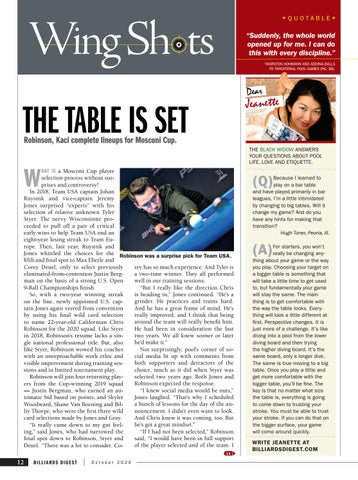
THE TABLE IS SET Robinson, Kaci complete lineups for Mosconi Cup.
THE BLACK WIDOW ANSWERS YOUR QUESTIONS ABOUT POOL LIFE, LOVE AND ETIQUETTE.
W
HAT IS a Mosconi Cup player selection process without surprises and controversy? In 2018, Team USA captain Johan Ruysink and vice-captain Jeremy Jones surprised “experts” with his selection of relative unknown Tyler Styer. The nervy Wisconsinite proceeded to pull off a pair of critical early wins to help Team USA end an eight-year losing streak to Team Europe. Then, last year, Ruysink and Jones whittled the choices for the Robinson was a surprise pick for Team USA. fifth and final spot to Max Eberle and rey has so much experience. And Tyler is Corey Deuel, only to select previously a two-time winner. They all performed eliminated-from-contention Justin Bergwell in our training sessions. man on the basis of a strong U.S. Open “But I really like the direction Chris 9-Ball Championships finish. is heading in,” Jones continued. “He’s a So, with a two-year winning streak grinder. He practices and trains hard. on the line, newly appointed U.S. capAnd he has a great frame of mind. He’s tain Jones again veered from convention really improved, and I think that being by using his final wild card selection around the team will really benefit him. to name 22-year-old Californian Chris He had been in consideration the last Robinson for the 2020 squad. Like Styer two years. We all knew sooner or later in 2018, Robinson’s resume lacks a sinhe’d make it.” gle national professional title. But, also Not surprisingly, pool’s corner of solike Styer, Robinson wowed his coaches cial media lit up with comments from with an unreproachable work ethic and both supporters and detractors of the visible improvement during training seschoice, much as it did when Styer was sions and in limited tournament play. selected two years ago. Both Jones and Robinson will join four returning playRobinson expected the response. ers from the Cup-winning 2019 squad “I knew social media would be nuts,” — Justin Bergman, who earned an auJones laughed. “That’s why I scheduled tomatic bid based on points, and Skyler a bunch of lessons for the day of the anWoodward, Shane Van Boening and Bilnouncement. I didn’t even want to look. liy Thorpe, who were the first three wild And Chris knew it was coming, too. But card selections made by Jones and Gray. he’s got a great mindset.” “It really came down to my gut feel“If I had not been selected,” Robinson ing,” said Jones, who had narrowed the said, “I would have been in full support final spot down to Robinson, Styer and of the player selected and of the team. I Deuel. “There was a lot to consider. Co-
(Q)
Because I learned to play on a bar table and have played primarily in bar leagues, I’m a little intimidated by changing to big tables. Will it change my game? And do you have any hints for making that transition? Hugh Toner, Peoria, Ill.
(A)
For starters, you won’t really be changing anything about your game or the way you play. Choosing your target on a bigger table is something that will take a little time to get used to, but fundamentally your game will stay the same. The main thing is to get comfortable with the way the table looks. Everything will look a little different at first. Perspective changes. It is just more of a challenge. It’s like diving into a pool from the lower diving board and then trying the higher diving board. It’s the same board, only a longer dive. The same is true moving to a big table. Once you play a little and get more comfortable with the bigger table, you’ll be fine. The key is that no matter what size the table is, everything is going to come down to trusting your stroke. You must be able to trust your stroke. If you can do that on the bigger surface, your game will come around quickly.
WRITE JEANETTE AT BILLIARDSDIGEST.COM
14
12
BILLIARDS DIGEST
xOct20WingShots.indd 12
October 2020
9/23/20 9:34 AM
numbers
BD IN BRIEF 2020 INTERNATIONAL OPEN CHAMPIONSHIP STATUS UPDATED TO “CANCELLED.” ACC ALSO CANCELLED AFTER “POSTPONING” the International Open in mid-July, with hopes of rescheduling early in 2021, promoter Pat Fleming announced in mid-September that the 2020 event was officially cancelled. “Considering the risk of contracting COVID-19 that still exists,” Fleming wrote in a release, “it is not known if professional players from around the world, as well as vendors and spectators, will be able to attend and will be safe.” Fleming also pointed to the various restrictions still in place by local governments around the country as reasons for continued uncertainty. On the heels of his cancellation an-
# G A M E #
nouncement, however, Fleming announced that dates for the 2021 International Open are set for Oct. 22-30, at the Norfolk Sheraton Waterside Hotel in Norfolk, Va. According to Fleming, the 2021 event will include a pro one-pocket division and junior 9-ball division, as well as the marquee pro 9-ball division. In other news, the Billiard Congress of American (BCA) and European Pocket Billiard Federation (EPBF) confirmed the cancellation of the 2020 Atlantic Challenge Cup, the juniors equivalent of the Mosconi Cup. “While we are disappointed, it is impossible for it to be held during this worldwide health crisis,” said BCA CEO Rob Johnson. The ACC was launched in 2015, with Team Europe winning all five contests.
108
Minutes required for Ronnie O’Sullivan to win his first-round match in the World Snooker Championship (pg. 52).
210
Days that poolrooms in New York have been prohibited from opening (pg. 32).
45
Balls used by Thorsten Hohmann in a game of 8-ball (pg. 38).
YOU MAKE THE CALL: WINNER LOSES? With Mike Shamos QUESTION: You’re the referee in a pro 9-ball ranking event being played under the World Standardized Rules (WSR) with the Three-Point Break Rule in effect. Player A sinks the 9 on the break, leaving the position shown. The opponent, Player B, says, “Ref, look at the table. Nothing crossed the headstring, so it’s a foul and an illegal break. The 9 ball spots and I get ball in hand.” Player A says, “That’s ridiculous. I sank the 9, so it doesn’t matter what any other balls did. I won the rack.” Who’s right? ANSWER: As so often happens in this column, neither player is right. The break was illegal because the Three-Point Break Rule requires that if one ball is pocketed on the break, at least two object balls must touch the headstring line. This is true even if the pocketed ball is the 9 (and I agree with Player A that this is ridiculous, but it’s the rule). The 9 ball spots, but a violation of the Three-Point Break Rule is not a foul, so Player B shoots, but not with ball in hand, or can pass the shot back to Player A, who would probably push (which is legal in this circumstance). The Three-Point Break Rule is required in all ranking events, and optional in others. October 2020
xOct20WingShots.indd 13
BILLIARDS DIGEST
13
9/23/20 9:34 AM
MOSCONI CUP PICKS
CUE CRITIQUE: SIMPLISTIC ELEGANCE Cantando cues are not complicated, but beautiful nonetheless. BY DENO ANDREWS The late Art Cantando’s body of work in cuemaking is limited but inspired. Cantando is one of the most respected cuemakers by collectors and colleagues alike. His cues exhibit a sophisticated design aesthetic and were built with integrity. This month’s cue is a bold design featuring flamecolored veneered points in a rosewood butt. A subtle but important design element is the slightly lighter wood Cantando chose to inlay inside the points. The lighter color wood helps to draw the eye to the insides of the points, which appear to have a warm glow. Each point hosts a fancy ivory inlay above a simple dot. Ringtail lizard skin is used to wrap the handle area and is flanked by fancy rings. Anchoring the overall design is a battery of striking ivory and pink ivory medallions in the butt sleeve. An ivory butt cap with Cantando’s logo and a stainless steel joint complete the cue. Overall, this design is a perfect reminder that cues do not have to be complicated to be beautifully designed. For more information on this and other high-end cues, visit CueZilla.com, where you can read other cue critiques and join the discussion yourself.
14
BILLIARDS DIGEST
xOct20WingShots.indd 14
- continued from pg. 12 -
kind of expected that I would have to wait another year until the camp. I really played well and felt like I left my best on the table. That wasn’t the case in previous years. “In fact,” Robinson recalled, “when Jeremy texted that he wanted to talk to me, I thought, ‘Well, here comes the call to keep working for next year.’ When he said I’d made the team, I couldn’t believe it. It still hasn’t sunk in.” On the European side, there was little controversy. With 19-year-old reigning World 9-Ball Champion Fedor Gorst of Russia earning Team Europe’s automatic bid, new European captain Alex Lely had the luxury of selecting four players from a titlestacked deck. With Scotland’s Jayson Shaw and German Joshua Filler easy picks, Lely rounded out his squad with Austrian Albin Ouschan, a Mosconi standout left off of the 2019 team, and rising star Klenti Kaci, already playing in his third Cup. “Albin has a great record in the Mosconi Cup,” said Lely. “He was one Skyler Woodward jump shot from being MVP in 2018. In the Matchroom arena, he is a beast — seven out of nine in doubles and two World Cup of Pool titles. Also, his calm demeanor is a good counterbalance to Shaw and Filler.” With the COVID-19 pandemic eliminating tournament play and limiting opportunities to gather as a team, both captains have had to get creative with training. “We’ve done some cool training on Zoom,” said Lely. “I have some creative formats where the players take on interdependent target-oriented challenges.” “We’ll continue to train independently, “Jones added. “But we are planning to have three or four days of serious training as a full team in mid-October. We’ll take advantage of being around each other and to lots of intense sparring.” Both teams are planning to be in London 10 days before the Cup’s scheduled kick-off on Dec. 1.
October 2020
9/23/20 9:35 AM
STROKE OF GENIUS Recounting the greatest shots in pool history V ide o pr ovide d by Ac cu - St at s
PLAYER: Earl Strickland EVENT: Accu-Stats Make-It-Happen 8-Ball Invitational LOCATION: Edison, New Jersey DATE: November 10, 2014
E
ARL STRICKLAND has done just about everything a player can do in his half century in pool – but rarely has he done it by the book. One of pool’s unique characters, the living legend has his own approach to the game. One rack at the 2014 Accu-Stats Make-It-Happen 8-Ball Invitational provided a perfect encapsulation of what makes the Pearl so special. Facing Shane Van Boening in a raceto-10 on a standard 9-foot table, Strickland trailed by a game, 4-3, when he broke the eighth rack. Sinking three solids, he then picked off three more before getting into terrible trouble on the final ball before the potential rackwinning 8. A line of stripes blocked a straight path from the cue ball to the
Watch Strickland get creative at BILLIARDSDIGEST.COM
6, meaning Strickland would have to kick it in the corner pocket. If that weren’t enough, position on the 8 was a tricky proposition. It was near center table, but five stripes were in the area as possible obstacles. The one-rail kick might’ve given him the best chance at sinking the 6, but Strickland opted to go two rails, off the right long rail and then the foot rail, so he could open the cue ball’s angle for position on the 8. This meant the cue ball would need to thinly clip the right side of the 6 instead of the nearly full hit on a onerail kick. With a touch more than pocket speed, Strickland played the shot perfectly – the cue ball sent the 6 directly into the corner pocket before navigating through the difficult stripes for position on the 8 into the side pocket. He took this rack on his way to a 10-8 victory over Van Boening – a win that was impressive and accompanied by a little of Strickland’s unique style.
October 2020
xOct20 StrokeREV.indd 15
BILLIARDS DIGEST
15
9/22/20 9:34 PM
INSTRUCTIONALS
Bite-sized bits of top-notch instruction
BD HOUSE PRO: TONY ROBLES
OpeningShot with Mark Wilson
Q)
When watching many pros shoot stop shots and draw shots, it seems they line up the cue ball much lower than where they actually strike it. Is that intentional? And for what purpose? George Hood; Richmond, Texas
A)
Great observation, George, but a miscalculation on where professionals hit the cue ball. Often, it is thought that a center ball hit produces a stop shot. This is only true when it is struck hard enough to be sliding upon impact with the object ball. Friction from the cloth attempts to put top spin on the cue ball and, depending on the distance, you must either vary the speed of the shot or the amount of initial backspin to arrive at the object ball with zero top or back spin. Softer speeds yield larger margins of error in pocketing accuracy. The softer the speed the more forgiving the pocket opening. Amateurs tend to hit a stop shot with center cue ball and at higher speed. Pros strike below center at lower speed, which makes the pocket “bigger.” When you see pros aiming low for stop shots, that is because they are going to contact the cue ball there.
16
BILLIARDS DIGEST
xOct20QuickHits.indd 16
THE INSIDE DOPE
O
NE THING I’ve discovered in using inside English is that if you use a half stroke and just enough speed to make the ball and still get position, deflection is really minimized because you’re not hitting it with enough force to push the cue ball off its path. I started using that as a weapon. To check the deflection in my shaft, I will sometimes experiment by hitting a shot really hard with inside English and I watch to see how much I missed that ball by. If I can, I’ll have someone put their finger where the object ball hit and I try to duplicate that. First, though, in order to ensure that you know you’re hitting the object ball in the right spot, shoot the shot with no spin until you make it five times in a row. That confirms that your aiming point on the object ball is perfect. Now, when you apply inside spin and you notice that you’re missing the pocket by a half diamond, that’s the amount of deflection your cue has. You need to find ways to learn about your equipment. Different shafts and different cues create different deflection. It’s important that you know what to expect with your cue. While I prefer to cut back the speed when using inside English, I also practice shots using it with a harder
stroke. If you shoot a shot that requires inside spin because you have to go four rails for position on the next ball, you have to be able to compensate for the deflection at a higher speed. More importantly, if you are shooting from a long distance you can’t shoot soft. The cue ball will curve and miss the target completely even if you compensate for deflection. A lot of players get frustrated on the longer shots because they don’t realize they’re actually masseing the ball, and
that really shows up at slower speeds. The farther you are from the ball, the harder you have to hit the shot. That’s especially true if your cue is elevated at all, like shooting near a rail. You don’t have to worry about that with a level cue. Try the shots in the diagram. Start by using a center ball hit and pocket the 3 ball five times in a row from C-1. Now, apply inside (left) spin and adjust your aim to make the shot five more times. Repeat the drill from C-2.
October 2020
9/22/20 9:35 PM
Drill Bits-
KIND OF A DRAG + WHY DO IT +
Perfecting the drag draw shot for longer distance safeties using a nearly full hit, high speed draw. + HOW TO DO IT + Set up shot as shown. Using draw, focus on hitting the 7 ball thick and drawing the cue ball in behind the 9. If you hit the 7 too full, the cue ball will end up near point A. If you hit it too thin, it will end up near point B. Either will leave the shot exposed.
B A
— from Phil Capelle’s “Play Your Best Nine-Ball”
“
A Great Break I used to think, BILLIARD CONGRESS of America Hall of Famer Arthur “Babe” Cranfield was a straight pool legend, winning the National Junior, National Amateur and World Professional titles. In comparing straight pool to other pocket billiard games, Cranfield contended that the break shot in 14.1 was even more critical than the break shot in 8-ball or 9-ball. “There is more pressure on the break shot in straight pool,” he said. “Make the break shot and you control the game. Miss it, and you hand over the table, and likely an open shot, to your opponent. You may never shoot again.”
‘I’ve got to play Efren or Earl.’ Now I think, ‘They have to play me.’
”
— BCA Hall of Famer Rodney Morris on his pre-match mindset.
ThePower
STRAIGHT
FOR MANY years, BCA Hall of Famer Johnny Archer was considered the best breaker on the professional 9-ball tour. His ability to combine power and control made him the envy of his contemporaries. One of the keys, Archer once said, is knowing how to adjust his speed. “I try to hit the rack as hard as possible while still controlling the cue ball,” he said. “The speed can vary from day to day. Some days it may be 60 percent of my total power, and on other days it may be 70 percent or even 80 percent. Each day is different.”
GURU GEORGE FELS HELPS YOU RUN 100
TALK
SOME RACKS offer an opportunity to consecutively pocket cornermost balls. Each ball, at the time it is struck, is cornermost relative to the remainder of the balls. These are good racks. This process is nothing more than an advanced extension of the safety valve principle. That’s why it’s always good policy to look for corner-to-corner possibilities. Avoid the temptation to pocket consecutive balls in the same corner pocket. Going back and forth keeps your safety valves alive.
On the Spot FORMER CHAMPION MARY KENNISTON ON THE GAME + What was formal practice like in the ’70s and ’80s?
I never received formal instruction, so I never really did drills. I learned from watching and asking questions. When I switched from straight pool to rotation, I’d simply start with ball in hand running three balls, then four and so on. + What do you see from today’s players that differentiates them from players of the past?
Most players today don’t stray too far from the center of the cue ball. Cloth today is so much faster and truer. You don’t need a huge stroke like you used to. + What’s the best piece of playing advice you ever got?
Steve Mizerak told me to bear down on the easy shots like you do on the tough ones. Most misses are on the easy shots.
October 2020
xOct20QuickHits.indd 17
BILLIARDS DIGEST
17
9/22/20 9:36 PM
+ S TR ATEG IE S + BY Nick Varner
NOT THINKING STRAIGHT Straight in? Not to worry. There is always a way out.
I
N ROTATION games, you very rarely want to fall perfectly straight on any ball prior to the gamewinning ball. In Diagram One, I was looking for better position on the 8 ball. Anything other than straight in. The solution was to go rail-first into the 8 ball to create a natural angle for the cue ball to go off the long rail and up table. The 8 ball is only an inch or so off the rail, so it is a fairly easy shot. Don’t worry about going a little long on this shot because there is a decent margin for error. As for aiming on this shot, measure the distance from the contact point on the 8 ball to the rail and then measure the same distance beyond the rail. In Diagram Two, that would be point A. Contact the cue ball with a level stroke, a tip above center. Because the cue ball has to travel a good distance, I add right English. The English turns into running English, causing it to gain speed. I have to make an adjustment on my aim, contacting the rail a little further from the 8 ball. When you experiment with this shot, notice how the cue ball speed is affected by how thin or thick it contacts the 8.
Diagram One
You can tell by what part of the corner pocket the 8 ball goes into. If the 8 goes in along line 1, the contact was fuller. The cue ball will not travel as fast as it would if the 8 goes in along line 2. Speed plays a big role. The harder the speed, the closer to the object ball you must aim because the cue ball comes off the rail at a sharper angle at high speeds. The situation is similar in Diagram Three, except I am going from the 4
Diagram Two
ball to the 5 and there are other balls obstructing the path I took in Diagram One. You still attack the 4 ball rail first, but this time draw the cue ball back for position on the 5. This shot requires much more speed because of the below center hit. My aim must change as well. I must aim closer to the 4 ball because of the draw and increased speed. That combination also makes it a lot easier to miss the 4.
Diagram Three
A
Line 2 Line 1
18
BILLIARDS DIGEST
xOct20Varner.indd 18
October 2020
9/22/20 9:37 PM
ImperialKona0920.indd 19
9/22/20 6:18 PM
+ SOLIDS
&
STRIPES
+ BY Larry Schwartz
CAN’T TOUCH THIS Learn to let sleeping balls lie.
M
INIMAL CUE ball movement is B always the goal when setting your runout strategy, but this month I want to cover a method of running balls that I’ve never really addressed before. It is a strategic technique that is not always possible to employ, but it is one that you can utilize more often than you might think. The most basic strategies of 8-ball, of course, still apply. You should still avoid taking your A first shot until you have the entire table mapped out in your head. And minimizing cue ball B movement in devising your path to running out is still advisable. Additionally, if you do have problem balls, such as those with no open pocket or locked up in clusters, you should always try to deal with those trouble spots as early on in your run as possible. And when the layout of the table makes that approach necessary, always look for insurance balls to bail you out after you’ve run A into a cluster. And, as always, don’t be afraid to play safe on your first shot if a runout appears highly unlikely. However, there is a category of layouts after the break in which you can employ what I often refer to as a “touchless runout.” By that, I mean a pattern of running the balls that not only minimizes cue ball movement but allows you to
20
BILLIARDS DIGEST
xOct20Schwartz.indd 20
C
D
F
E
C
D
F
E
Diagram One
Diagram Two
avoid contact with any other balls on the table. (Of course, the final 8 ball is an exception. Bumping an opponent’s balls as the 8 drops is acceptable.) I came across two such layouts in a recent practice session. In both instances, all of my balls had pockets available them, and none were tied up in clusters.
There really was no reason for me to intentionally bump into balls. In Diagram One, using “take what you make” rules, my opponent pocketed a solid on the break but then missed the following shot, leaving me with the layout shown. I began my touchless run-out by pock-
October 2020
9/22/20 9:38 PM
eting the 9 ball in pocket C, rolling forward for the 10 in pocket D. From there, I topped the cue ball for the 11 in pocket F, rolling up slightly to leave a straight in shot on the 12 ball in pocket B. I shortened my bridge on the 12 so that I could draw the cue ball back a few inches for the 13 in pocket C. Again, I cued just below center to stop the cue ball dead in its tracks on the 13 to leave a simple shot on the 15 in pocket B. From there, the remainder of the rack was easy. I simply tapped the 14 into pocket F, leaving an easy shot on the game-winning 8 ball in pocket E. Again, in Diagram Two, my opponent broke and pocketed a stripe but missed his next shot, leaving the layout shown. Take a minute to examine the layout and try to determine the best route to shoot through the solids, utilizing the touchless run-out approach. This table is a little tricky, so be sure to remember that minimizing cue ball movement is something you should strive for. Now, let’s see if your plan matches the one I came up with. You may have been tempted to begin with the easiest shot on the table — the 3 ball into pocket B. If you chose that route, I’d be interested to see how you planned to get through the rack without touching another ball. Taking the 3 out of play so soon will make getting to the 8 ball at the end of the rack without touching another ball problematic. My approach was to start with the 2 ball into pocket E. It’s a longer shot, but it is straight in, so it shouldn’t present a big challenge. And the payoff to starting with this shot will be immediate. A successful stop shot on the 2 will leave you in straight-in position for the 4 in pocket D. Stop again for the 6 in pocket E. Two more stop shots await — the 5 in pocket C and the 1 in pocket F. What you are left with should be three more easy stop shots: the 3 in pocket B, followed by the 7 in pocket A and, finally, the game-winning 8 ball back in pocket B. When you are able to execute a touchless run-out, you have the advantage of capitalizing on the wisdom of the old adage, “leave well enough alone.” Since all of the object balls had available pockets, it was beneficial to respect the layout presented and take advantage of the opportunity to pocket them from where they lay.
xOct20Schwartz.indd 21
9/22/20 9:38 PM
+ PERFECT PRACTICE + BY Darren Appleton
THE FAMILY TREE
A 15-ball rotation drill that will challenge all levels.
I
F YOU want to really gain something from your practice sessions, you have to be willing to challenge yourself. This drill is a favorite because it requires creativity and problem solving, which are the cornerstones of any rotation game. The 15-Ball Rotation Tree Drill will challenge advanced and even pro players, but intermediate and beginners can give it a go as well. The rules are straight forward. Position the balls as shown in Diagram One. Start with cue ball in hand and pocket the balls numerically. Object balls can be made in any pocket, but the cue ball is not allowed to touch another ball. The drill offers several distinct challenges. From the 1 ball through the 8, you need to go up and down the table for proper position. This part of the drill requires good cue ball speed. You’re not always going to be on the right side of the next ball, so you’ll have to figure ways to get the cue ball back down table and into position. The final seven balls are on the rail, so the drill actually gets more difficult the further you advance. Those rail shots take focus. Pocketing the ball and playing position are key. The first four shots are fairly basic. You will immediately start to see the pattern ahead and the importance of leaving angles and getting the cue ball more or less to the center of the table. That’s the beauty of rotation games. The trickiest shot during the first half of this drill is getting from the 7 ball to the 8 ball (Diagram Two). Leaving the cue ball just off straight-in on the 7 will allow you to go to the bottom rail and straight back up table for the 8. The angles really become essential and the hard work really starts at the 10 ball. From the 11 to the 12 you have the option to come underneath the 14 or the top side of the side pocket. You can let your stroke out more on this one. Like most games, the key shot is the penultimate shot, the 14 (Diagram Three). Getting from the 14 to the 15 is a pressure shot and a good test.
22
BILLIARDS DIGEST
xOct20Appleton.indd 22
Diagram One
Diagram Two
Diagram Three
October 2020
9/22/20 9:39 PM
560204md018.indd 23
9/22/20 1:08 PM
+ TECH TALK + BY Bob Jewett
MORE 57 MAGIC
More fun with numbers, pinning down shots numerically.
L
AST MONTH I revealed the amazing fact that one inch of slope in the length of the cue stick is very close to one degree. If the cue stick is pivoted around the tip in an arc, the angle the stick travels through is equal to the the inches the bumper travels. An example is in Diagram One where you have a six-degree cut. If you place the cue stick as shown in the shot with two cue sticks, the separation at the end is six inches. I particularly like to check the exact cut angle for nearly full shots like this if I’m trying to move the cue ball sideways. My tendency is to cut the ball too much to get more movement on the cue ball, and the angle check reminds me that I have only a little angle to work with. Shown with three cue sticks on the other side of the table is a second use of the principle. Suppose you are going to play the shot on the 1 ball with follow and need to know whether you will hit the 3-4 cluster. Begin by placing the cue stick along the line the object ball will travel to the center of the pocket. If possible, put a finger on the cloth under the bumper. Now move the cue stick to the shot line with the cue stick directly over the cue ball. For the 6-degree shot shown, that will be six inches of movement. Now continue moving the cue three times the distance — 18 inches in this case — in the same direction. An easy way to get this triple movement is to first move the cue stick from the cue ball line an equal distance in that direction — six inches — and then
24
BILLIARDS DIGEST
xOct20Jewett.indd 24
18 Inches
Diagram One
6 Inches
5 Inches
Diagram Two
double the total distance so far, which adds another 12 inches for this shot. That gets you to 24 inches from the start and 18 inches from the cue ball line. Try it and I think you will find it more accurate than trying to directly triple a distance. The final cue stick position gives you the direction of the cue ball as it follows forward off the object ball. In the
diagram, since the final stick position points to the two-ball cluster, you will hit them. Exactly where you land on those balls depends on which part of the pocket you put the object ball in. You have at least one degree of error margin on each side of pocketing the 1 ball, and that error will be multiplied by three for the path of the cue ball. If you want to hit on the 3 ball on the left side,
October 2020
9/22/20 9:39 PM
560194md070.indd 25
9/22/20 1:08 PM
+ TECH TALK + you could aim to put the 1 ball into the right side of the pocket. This “three times the angle” follow system works well only for fairly full shots and when the cue ball is rolling smoothly on the cloth. If you want to use it you should work out your own useful range, but I think it will start to predict too large an angle for the cue ball at around a 10 to 12 degree cut. If you are interested in how much margin for error you have in the cut angle, Diagram Two shows how to find that for the 5 ball into the corner pocket. Aim through the 5 to the location farthest to the left that you think will not reject the ball. Note the stick location. Now swing the stick to line up with the extreme pocket location to the right. The cue stick movement at the bumper in inches gives you the angular window to make the shot in degrees. The example distance is 5 inches, so you have a window of 5 degrees or margin of plus or minus 2.5 degrees from the exact center. Of course the farther from the pocket the object ball is, the smaller the margin for error. It is nearly a direct relationship, so if the 5 ball is twice as far from the pocket, the window would be 2.5 degrees and the allowed error to either side would be a degree and a quarter. Diagram Three shows how you can estimate the required accuracy of the ghost ball locations if you know the allowed cut angle error. The two ghost balls represent where the cue ball would have landed for the two maximum allowed errors for the shot in Diagram Two. We again get the magic of 57 showing up because pool balls are 57 millimeters in diameter. The centers of the two cue balls are 5 mm apart, and the distance to the center of the object ball is 57, so that gives an angle of 5 degrees. You could say that the pocket appears to be five degrees wide from the 5 ball. When aiming at an object ball for a fairly full shot, changing your line on
26
BILLIARDS DIGEST
xOct20Jewett.indd 26
per is above the tip, that gives you the elevation angle in degrees. Typically the tip will be an inch above the cloth so you can just subtract that from the bumper height. You often hear players claim that they shoot with a level stroke, but if the cue stick is truly level, the center of the bumper will be the same distance above the bed of the table as the center of the cue tip. The rails almost always prevent that, and frequently Diagram Three the presence of extraneous object balls under your cue the object ball by 1 mm will change the stick causes even more elevation. cut angle by one degree. How large is a There are some rule sets that require millimeter? A nickel coin is close to 2 an elevation of 45 degrees for a few mm thick. shots. By the magic 57 technique, you You could take the analysis one step can figure that the bumper on such a further to estimate the angular accuracy cue will be about 45 inches above the required when sending the cue ball at table. That’s not quite using the magic the object ball. In the diagram, I have because you should be measuring the conveniently placed the cue ball close distance between the two cue bumpers to a cue length (57 inches) from the oband that is not a vertical line. The acject ball. The target is 5mm wide, so if tual vertical distance is about 40 inches we can express that as inches, we know for 45 degrees of elevation. My obserhow accurate the angle of the cue stick vation of players trying to follow the has to be. Since 25.4 mm is exactly an 45-degree rule is that few of them get inch, 5 mm is close to a fifth of an inch that high. so aiming for the shot has to be within Is it good to put numbers on angles a fifth of a degree or plus or minus a and such like this? I think it helps get Diagram Four
tenth of a degree. When you work out the numbers like this, it is amazing that anyone ever makes a ball. Note that the accuracy of the contact point between the balls — or the width of the line of the allowed contact points — is half as wide as the ghost ball center range and is only 2.5 mm for the shot shown. Finally, the magic of 57 lets you estimate quickly how many degrees of elevation of the cue stick someone is using. In Diagram Four is a side view of a shot with some elevation. If you can estimate the number of inches the bum-
a better feeling for the shot. It would be interesting to take a total beginner and tell them the exact angle of every cut they take for the first six months of practice. I bet they would end up knowing the angles without being told and would learn aiming much faster. Of course, if you’re thinking about all of this during play, you’re probably going to drive the ball straight into the cushion. An exception would be where you plan the follow angle as in Diagram One, but you better not be thinking of 6 and 12 and 18 when you pull the trigger.
October 2020
9/22/20 9:40 PM
AccuStats_1020.indd 27
9/22/20 2:04 PM
+ I L L U S T R AT E D P R I N C I P L E S + BY David Alciatore, Ph.D.
ON YOUR LEVEL Competitive practice can improve your game and keep your interest. [Note: Supporting narrated video (NV) demonstrations, high-speed video (HSV) clips, technical proofs (TP) and all of my past “Illustrated Principles” columns can be accessed and viewed online at billiards. colostate.edu. The reference numbers used in the articles help you locate the resources on the website.]
I
N BOB Jewett’s July and August columns, he presented an interesting family of runout drills that cover a wide range of playing ability. Since then, Bob and I worked together on a simplified version of the system that focuses on 8-ball, rotation, and straight pool. I call it the Runout Drill System (RDS). It consists of a set of 16 break-and-run challenges of increasing levels of difficulty. The levels are summarized below along with associated player ratings. Each level is also described and illustrated in detail in the RDS instructions document linked in the online YouTube video descriptions. Images 1 and 2 show example pages from this document. RDS Levels: 1. 6 balls, pocket OBs directly with no CB – lower novice 2. 6 balls, any order, ball-in-hand (BIH) on every shot – mid novice 3. 6 balls, any order, 3 extra BIHs – upper novice 4. 6 balls, any order, 2 extra BIHs – lower beginner (D-) 5. 6 balls, any order, 1 extra BIH – mid beginner (D) 6. 7 balls (3 solids, 3 stripes, 8), 8-ball rules, 1 extra BIH – upper beginner (D+) 7. 9 balls, any order, 1 extra BIH – lower intermediate (C-) 8. 9 balls (4 solids, 4 stripes, 8), 8-ball rules, 1 extra BIH – mid intermediate (C) 9. 15 balls, any order, 2 extra BIHs – upper intermediate (C+) 10. 6 balls, in order – lower advanced (B-) 11. 15 balls, any order – mid advanced (B) 12. 15 balls, 8-ball rules – upper advanced (B+) 13. 9 balls (4 solids, 4 stripes, 8), 8-ball
28
BILLIARDS DIGEST
xOct20Alciatore.indd 28
LEVEL 1: 6 balls, pocket OBs directly with no CB ■ Break a rack of 6 balls. ■ Remove the cue ball. ■ Pocket each object ball directly, in any order. ■ Wipe chalk marks off the balls when done.
LEVEL 5: 6 balls, any order, 1 extra BIHs ■ Break a rack of 6 balls. ■ Take cue ball in hand after the break and once any time during the run ■ Pocket each ball in any order.
LEVEL 2: 6 balls, any order, BIH on every shot ■ Break a rack of 6 balls. ■ Take cue ball in hand for each shot. ■ Pocket each ball in any order.
LEVEL 6: 7 balls (3 solids, 3 stripes, 8), 8-ball rules, 1 extra BIH ■ Break a rack of 6 balls (3 solids, 3 stripes) with the 8 ball added (in the center or back). ■ Play standard 8-ball rules, except take cue ball in hand after the break. ■ Pocket all the stripes or all the solids, and then the 8.
LEVEL 3: 6 balls, any order, 3 extra BIHs ■ Break a rack of 6 balls. ■ Take cue ball in hand after the break and any 3 other times during the run ■ Pocket each ball in any order. LEVEL 4: 6 balls, any order, 2 extra BIHs ■ Break a rack of 6 balls. ■ Take cue ball in hand after the break and any 2 other times during the run ■ Pocket each ball in any order.
LEVEL 7: 9 balls, any order, 1 extra BIH ■ Break a rack of 9 balls. ■ Take cue ball in hand after the break and once any time during the run ■ Pocket each ball in any order.
Image 1
rules, remaining balls in order – lower shortstop (A-) 14. 9 balls, 9-ball rules – upper shortstop (A) 15. 15 balls, 8-ball rules, remaining balls in order – semipro/pro (A+/AA) 16. 15 balls, in order – world class pro (A++/AAA) The balls in each RDS rack vary from six to 15. You start with a break shot and then take BIH, meaning you can place the CB anywhere you want on the table. There is no penalty for a scratch on the break, and balls pocketed on the break remain down. Unlike dedicated skill or setup drills, where you repeat the same or similar shots or patterns over and over, RDS provides endless variations of shots, patterns, and game situations. And no table setup is required — just rack, break and run the balls, just like playing regular pool. RDS challenges all player levels from complete novice to seasoned professional. Plus, you get to pocket lots of balls regardless of your playing level, which can minimize frustration. RDS helps one develop and improve strategy and pattern play in the games of 8-ball, 9-ball, 10-ball and straight pool.
RDS is progressive and adaptive. When you do well, the level gets harder; when you do poorly, the level gets easier. If you run two of three racks at one level, where you make all the required balls without a miss or foul, you go to the next higher level. If you run only one of three, you stay at the current level. And if you do not run any racks, you go down a level. If you are trying RDS for the first time, pick a level at which you are confident to run two of three racks and start there. Otherwise, start where you left off in your previous RDS session. After a practice session, your ending level and associated rating should be a decent indicator of your level of playing ability. And if you record your ending levels over time, you will be able to easily monitor your improvement as your game develops. An alternative RDS format is a scored approach, where you start with 100 points and attempt to run one rack at each level, deducting points left on the table after a miss or foul. I call it RDS 100 and it was adopted by the Billiard University (BU) as one of its PlayingAbility Exams (Exam IV). The BU re-
October 2020
9/23/20 9:31 AM
cently sponsored a challenge offering prizes to those who could score the highest. (If you want to see video entries for the top scores, they are linked in the YouTube video description of NV J.54, where I demonstrate how to shoot and score a complete RDS 100 set.) The Billiard University Rating Comparison table shows how RDS Player Levels (1-16) compare to other commonly used rating and handicapping systems. If you run through the progressive version of RDS, you can get a good estimate for where you fall on the standard ABCD rating system and estimate what your handicap might be in various league systems. You can even estimate your expected Fargo Rate score if you do not already have one. So RDS is not just a fun and useful system for learning, practicing and teaching pool, it can also be used to estimate your level of playing ability. RDS is great practice for runout skills, but it is helpful to also mix up your practice with dedicated skill drills periodically, like those found in BU Playing-Ability Exams I and II (the basis for the “BU Score” in the table). It is important to
LEVEL 8: 9 balls (4 solids, 4 stripes, 8) 8-ball rules, 1 extra BIH ■ Break a rack of 9 balls (4 solids, 4 stripes, with the 8 ball in the center). ■ Play standard 8-ball rules, except take cue ball in hand after the break. ■ Pocket all the stripes or all the solids, and then the 8.
LEVEL 11: 15 balls, any order ■ Break a rack of 15 balls. ■ Take cue ball in hand after the break. ■ Pocket each ball in any order. LEVEL 12: 8-ball rules ■ Break a rack of 15 balls. ■ Play standard 8-ball rules, except take cue ball in hand after the break. ■ Pocket all the stripes or all the solids, and then the 8.
LEVEL 9: 15 balls, any order, 2 extra BIHs ■ Break a rack of 15 balls. ■ Take cue ball in hand after the break and any 2 other times during the run. ■ Pocket each ball in any order.
LEVEL 13: 9 balls (4 solids, 4 stripes, 8), 8-ball rules, remaining balls in order ■ Break a rack of 9 balls (4 solids, 4 stripes, with the 8 ball in the center). ■ Play standard 8-ball rules, except take cue ball in hand after the break. ■ Pocket all the stripes or all the solids, and then the 8. ■ Then pocket the remaining balls in rotation, always hitting the lowest-numbered ball first.
LEVEL 10: 6 balls, in order ■ Break a rack of 6 balls. ■ Take cue ball in hand after the break. ■ Shoot the balls in rotation, always hitting the lowest-numbered first.
Image 2
develop and improve your skills, especially the ones you identify during play and RDS practice as problem areas. You should also work on offensive and defensive skills and techniques you might not use very often during typical play.
David Alciatore is a PBIA Advanced Instructor, dean of the Billiard University, and author of the book, “The Illustrated Principles of Pool and Billiards,” and numerous instructional video series, all available at DrDaveBilliards.com.
October 2020
xOct20Alciatore.indd 29
BILLIARDS DIGEST
29
9/23/20 9:31 AM
CueCaseSpreadOct20.indd 30
9/22/20 1:36 PM
CueCaseSpreadOct20.indd 31
9/22/20 1:36 PM
ROOM AND GLOOM
While other service businesses are allowed to reopen, poolrooms continue to battle an identity crisis.
While other Maryland rooms are open, Seven Billiards in Shady Grove remains closed because of county rules.
I
T’S POSSIBLE that Stephanie Werner could have picked a less ideal time to buy into a poolroom. Kind of like it is possible that 2020 could turn itself around in its remaining months and leave the world healthy and prosperous. Possible, but not likely. At the end of February, Werner closed on the purchase of a 50-percent interest in Diamond Jim’s Billiards in Nanuet, N.Y., making her co-owner of the room with her boyfriend. Three weeks later, she was doing a much less enjoyable closing, shutting the doors to her new, 14-table room as the Covid-19 pandemic spread throughout the United States and New York Governor Andrew Cuomo began the closure of nonessential businesses. “It was a little bit of, ‘Wow,’ but we did what we had to do,” she said. Luckily, the couple had enough in the bank to pay every bill except the rent and, when the third phase of reopening arrived on June 23, they were able to resume kitchen operations and begin selling food. As the date for the fourth phase inched closer in late July, Werner as well as room owners throughout the state expected to receive permission to rent pool table time on a limited basis. What happened instead was that pool was skipped over completely, while gyms, health clubs and bowling centers were eventually given the green light to reopen with capacity restrictions. Meanwhile, Werner’s main draw isn’t her food or bar, it’s the tables. For
32
BILLIARDS DIGEST
xOct20RoomsFeature.indd 32
By Keith Paradise months now, the new owner has been fielding calls from customers inquiring about playing pool. She has said “No” with such frequency that the phone barely rings anymore. “They all know we’re not open,” said Werner, who estimated her tables generate between $3,000 to $5,000 weekly. “I owe my landlord from the day we closed until current, which I don’t know how I will ever be able to pay that if I don’t get my tables open and start making money.” Six months into the gradual reopening of the businesses that were shut down due to the pandemic, poolrooms find themselves in a fuzzy, gray area in many parts of the country. Either municipalities have lumped these facilities in with bars and restaurants or do not have them classified at all. The end result has been unclear guidelines in some states or regulations seemingly being drafted on the fly — especially in New York, where a jazz musician could learn a few things about improvisation from state and local officials. The Cuomo administration recently announced that indoor dining can resume in the state on September 30 at a 25-percent capacity. However, Administration Spokesperson Jack Sterne said on September 18 that pool tables will remain off limit in the state’s bars, restaurants and poolrooms. The decision to leave billiards equipment off-limits has left the business owners with frayed nerves, dwindling savings and looking
for ways to get the government’s attention. “The general consensus is that it’s not a high priority item,” said Doug Rhee, owner of Manhattan’s Society Billiards. “But, for us, it is.” As the pandemic forced the closure of many businesses in mid-March, many of the New York room owners anticipated a shutdown of at around two or three months. After all, the state was one of the hardest hit early on in the U.S., with both positive Covid cases and deaths. Meanwhile, poolrooms in the five boroughs began purchasing thousands of dollars’ worth of equipment and cleaning supplies in anticipation of what health department guidelines might require for reopening. Plastic dividers at the cashier’s stand and at the table, ball cleaners and chemicals to clean the tables, cloth and sticks. Society Billiards in Manhattan and Gotham City Billiards in Brooklyn also invested in high-powered air filtration systems to scrub germs and bacteria. Gotham City went a step further, investing in motion-detecting faucets and toilets in the bathroom as well as every mask and piece of personal protective equipment that they could get their hands on. “You may as well label it a hospital at this point,” said Isabel Buckley, who owns and operates Gotham City with her husband. “It may be a bit overboard but I’m sure the health department would appreciate it.” As the positive case rate began to flat-
October 2020
9/22/20 9:50 PM
Champ Invit_1020.indd 33
9/22/20 2:10 PM
ROOM REOPENINGS
afternoon which stated pool is considten, Cuomo and New York City Mayor ered high risk and that the rooms were Bill DeBlasio’s administrations allowed to remain closed. Mennis, who was off restaurants to offer outdoor dining, that day, rushed to Steinway to deliver while restaurants outside of the methe message and stop any table renttropolis were permitted to open for als. She then contacted Consumer Aftakeout. As indoor dining started to fairs on August 27, asking why bowling open in other parts of the state weeks centers could reopen but not billiards later, some room owners assumed they when both were classified similarly. could be back in business for recreation A day later, the New York City office and indoor dining with either the third of the department issued a statement or fourth reopening phase this summer. Just when things were looking up, DeBlasio removed indoor dining from schedules indefinitely. Then, Cuomo prohibited bowling alleys and pool halls from opening their doors during phase four. After some persistent lobbying by the state’s bowling centers, the administration reversed course and allowed facilities to open at 50-percent capacity with additional social distancing guidelines. As for pool, it’s considered a “higher risk” activity along with darts and cornhole. According to an email from Sterne, these activities could lead to mingling and congregation, as well as shared usage of equipment which can lead to the spread of viruses. “Thanks to our data-driven pubDiamond Jim’s Werner continues to wait for lic health policies and New Yorkers’ New York to reopen rooms. hard work, we have achieved, and so far maintained, one of the lowest stating the office would no longer rates of infection in the country, inlicense pool and billiard rooms and cluding 27 days straight with less than that licenses were no longer required one percent of tests returning posiby the department. tive,” said Sterne. “But with hot spots “Basically, we’re considered a bar popping up across the country, we are with a lot of pool tables because of continuing to monitor how and when this,” Mennis said. higher-risk activities like billiards can All the more frustrating for Lenore safely reopen.” Donovan, owner of The Spot down the Early on in the aftermath of the panroad from Werner in Nanuet, is the demic, Athena Mennis, general manfact that the Cuomo said early on durager at Steinway Billiards in Astoria, ing the shutdown that he intended to reached out to city hall and the 114th work with neighboring states on similar guidelines. He wanted to avoid resiprecinct’s community affairs liaison dents crossing state lines for activities for a timeline on when her room could that weren’t available at home. Meanopen. No one knew, so Steinway and a while, rooms in Connecticut, Pennsylhandful of other facilities decided to revania and New Jersey have gradually open when bowling centers did on Aureopened while her tables remain progust 17. After all, both poolrooms and hibited. bowling centers were under the same “In the beginning, the governor said umbrella with the state’s Department we are going to try to stay on the same of Consumer Affairs, which required page to avoid crossing of borders but both entities to acquire an operating when it comes to our industry, it just license. Eleven days after permission seems like he’s ignoring that statefor bowling was announced, Cuomo’s ment,” she said. “We’ve just been office issued a release late on a Friday
34
BILLIARDS DIGEST
xOct20RoomsFeature.indd 34
ignored the whole time.” Across the state in Buffalo, Mike Shriver didn’t have time to wait any longer. Shriver had purchased Bison Billiards 12 years earlier and built the room into a profitable venture, developing a steady roster of roughly 300 regular customers showing up two or three times a week. His business was popular enough that he was able to sink $100,000 of his savings into a room expansion which was completed before the pandemic struck. He was initially able to get by on his savings and personal loans when the state ordered him to close in March. But as the bank accounts continued to draw down and long-term prospects looked dim, he reopened on June 23. “I couldn’t stay closed any longer without filing bankruptcy,” he said. “We are a true mom and pop. We work at the poolroom; we don’t do anything else. Without that, we’re shot.” He and his wife wipe down the cues and tables and have invested in new balls and a $700 ball cleaner. Additionally, Shriver gets a Covid test every two weeks to ensure that it’s safe to be around his customers. East coast or west, currently open or closed, almost all room owners expressed concern about the long-term prospects of their businesses. All have taken on debt that is well into six figures, either from the acquisition of personal or Paycheck Protection Program loans, renovations or the lack of rent relief from landlords. When the pandemic hit, Mennis said Steinway didn’t have any debt but is now in the red to the tune of about $200,000. Dodd and Kasabian had just reopened their facility after completing a $1.2 million expansion and renovation this winter. As summer transitions into fall in the north, the number of customers interested in outdoor dining will be dropping along with the temperatures. The majority of facility owners said they need to be permitted at least 50 percent capacity for dining and pool table usage in order to barely break even, with most needing 75 percent to be able to pay the bills along with the back rent. As a result of the state and city’s government’s indifference to billiards,
October 2020
9/22/20 9:50 PM
ChampPink_1020.indd 35
9/22/20 2:12 PM
ROOM REOPENINGS
league and recreational play on 12 pool do community outreach and embark Mennis has been working for the last tables, co-owners Craig Judd and his on marketing campaigns to try and month to organize the five borough’s wife, Cochise Kasabian, earn most of lure in new players – similar to bowlexisting billiards rooms into an assotheir revenue from their bar, restauing’s GoBowling.com initiative and the ciation that can act as an intermediary rant, outdoor deck and live music. Not United States Golf Association’s “Play between facility owners and officials. only are bands and dancing still pro9” campaign. Danny Kuykendall, ownNamed the Metropolitan Billiards hibited, but many of his regular pool er of sports bar and pool hall Danny K’s Room Association of New York, the players are getting in and out quickly in Orange County, Calif., added that a neophyte group will be open to room to avoid contact with anyone who national association could have the owners throughout the city as well as might be infected. ability to purchase equipment in bulk the state. At press time, Mennis was A few hours down Interstate 95 in as well as obtain group rates for necesdrafting a letter that is to be signed by Maryland, Governor Larry Hogan all of the member owners and gave the okay for reduced capacisent to Cuomo’s office with 27 ty indoor dining reopening in late racks of balls. June, then permitted pool tables “That’s our goal right now,” to be used a couple of weeks later. she said. “To get attention and to The decision allowed Gary Allen kind of be in their face about it. to resume play with his 24 league To try and see if we can garner teams at Champion Billiards up a conversation with the politiCafe, his 14,000-square-foot dincians.” ing, billiards and concert facility New York room owners have in Frederick. Allen spaces the two also been receiving some supdozen squads out over two days port from the state’s 13 American and only six players are permitPoolplayers Association leagues, ted at a table at a time. Like most which have sent letters to the room owners interviewed for this Governor and drafted a letter story, he is not receiving any refor its approximately 7,500 playlief on his mid-five figures rent ers to print out, sign and send to bill and wonders what the future Cuomo’s office. holds. “All of these businesses have “I’m not going to go down withto be given the opportunity to out swinging,” said Allen, who show they can be responsible operates the last of five Champiand maintain a healthy atmoons originally opened by his fasphere for customers,” said Ryan Bison Billiards’ Shriver refused to wait, reopening ther. “It’s our legacy and it’s my McAleer, operator of the Hudson on his own in June. paycheck. I can’t keep borrowing Valley APA. money without knowing what tomorsities such as cable television packages Strength in numbers is a concept row is going to bring.” and business liability insurance. that is starting to sound appealing to Not everyone was able to open in “Until we come together and unify many room owners, especially after Maryland, which allowed each local junationwide, we will never move forseeing the success bowling centers risdiction to implement more stringent ward,” said Ed Liddawi, owner of Sandachieved. Rooms in New York have rules. Thirty minutes from Champion castle Billiards in Edison, N.J., who sits had a tendency to be cut-throat as they Billiards, Montgomery County officials on the Billiard Congress of America’s battle to grab market share of the city’s determined that three pool halls in its board of directors as a room operator. league and tournament players. But, jurisdiction would remain closed for Meanwhile, guidelines have not with every room closed, there isn’t a the time being, allowing them only to been any less opaque in other states. In market to share. reopen bars and kitchens. While pool fact, Calvin Moore, owner of The Bil“Anything that I do to help the game remains dormant at Seven Billiards in liards Café in Ayer, Mass., looked at the is going to help someone else’s room in Shady Grove, occupations that involve lack of clarity in the state’s regulations the long run and vice versa,” said Donmore human contact — like nail salons and decided to shut down on March 13 ovan, who also is working on an inforand massage parlors — have been perand has remained closed. mational video to present to legislators mitted to reopen, a decision which has “I don’t think I’ve read the words that explains pool etiquette as well as Seven owner Giogio Wu perplexed. ‘poolroom’ out there,” he said. “It’s eihow the rooms can reopen safely. “I just hope that there’s a timeframe ther a restaurant or a bar. I don’t know Poolroom owners beyond the borand I don’t understand why Montgomwhat the regulations are.” ders of the Empire State also expressed ery county is so different from other Forty-five-minutes away in Plaistow, interest in a national room association. counties,” he said. “There are only N.H., the Crow’s Nest Pub and Grill In addition to being able to lobby lawthree pool halls in the county, and I was permitted to reopen at 50 permakers as a whole instead of individuthink we are just not important enough cent capacity roughly a month and a ally, a trade organization would also for the county to care.” half ago. Although the facility houses allow business owners to share ideas,
36
BILLIARDS DIGEST
xOct20RoomsFeature.indd 36
October 2020
9/22/20 9:51 PM
NickVarnerTipsBDoct.indd 37
9/22/20 2:30 PM
THE GAMES
PEOPLE PLAY
With a fertile mind and time on his hands, Thorsten Hohmann creates new challenges. By Mike Panozzo Photos by Jonathan Smith
38
BILLIARDS DIGEST
xOct20Thorsten.indd 38
October 2020
9/22/20 10:33 PM
T
HORSTEN HOHMANN isn’t sure where the crazy ideas come from. Does he dream about outlandish pool challenges in his sleep? Do ideas come to him in the shower? “I don’t know where they come from,” the three-time world champion admitted. “Sometimes people suggest games and sometimes I look at a game and think, ‘How can I make it more interesting?’” One thing is for certain, though. Hohmann enjoys jumping into the deep end of the pool. From scuba diving, to parachuting, to being that daring young man on the flying trapeze, the 40-year-old German native loves a challenge. And the crazier, the better. While many pros are traveling for one-on-one challenge matches, playing in virtual competitions or videotaping matches against the ghost, Hohmann seems to be gunning for his own section in the Guinness Book of World Records. Can he run 150 in straight pool in under 10 minutes? Can he run 100 using a mechanical bridge? What’s the highest run in Scotch doubles? The largest successfully run rack of 8-ball? The longest rotation run? Give Hohmann a drill or an idea and watch him grab his cue, iPhone and GoPro, and hop the F train from his Brooklyn apartment to Jennifer Barretta’s Skyline Billiards. Take, for instance, Hohmann’s recent assault on maximum 8-ball, where he set up a 45-ball rack, which consisted of nine rows of balls — 22 stripes, 22 solids and a single 8 ball. He made three balls on the break, with an astonishing 37 balls sharing real estate below the side pockets. Upon surveying the resultant table layout, Hohmann nodded his head and said, “Yup, I’m out.” Miraculously, Hohmann made good on his prediction, successfully negotiating the colorful maze of balls to pocket 20 solids and the 8 ball, spread-
ing his arms and grinning into the camera upon completion. Even more amazing was the fact that the run-out required two jump shots late in the rack, including on the final solid. “That was a real challenge,” Hohmann recalled. “You have no idea how often I tried that and how long it took. Just racking 45 balls takes a long time. I used multiple Magic Racks to get the balls all touching. “Then you break and scratch on the break,” he added, laughing incredulously. “You want to scream because it
it is possible. There is always a way out somehow. “Rotation is a little different.” Ah, yes. Rotation. Rotation is how Hohmann started his quirky journey through the tedium of quarantine and pandemic restrictions. Staying at the Houston home of his friend Chris Hogan, the naturally curious Hohmann began tinkering with recorded practice sessions that he shared on his Facebook page. “This was in March,” he said. “I went to Chris’ house directly from Vegas before the World 10-Ball got canceled.” With a Diamond table and a wallmounted flat screen TV at his disposal, Hohmann began promoting a new billiard app, Cue Lab, that he had developed with a business partner. The down time allowed Hohmann to immerse himself in the project,
“I’m out!” was Hohmann’s immediate reaction after breaking open a rack of 45 balls in a jumbo game of 8-ball. True to his words, he completed the run.
takes another six minutes to rack them again. Then you break again and make a ball, but the table is all impossible clusters. I did that over and over.” Not surprisingly, Hohmann now has his sights set on a tenth row of balls for a 55-ball rack. “The thing about 8-ball,” he rationalized, “is that no matter how it looks, you can maneuver through it. You look at the table after the break and you think, ‘This is crazy!’ But from the experience of trying so often, I know that
creating Facebook and YouTube pages and studying the subtleties of video editing. “I’ve always find it annoying that you want to do something but you don’t know how,” Hohmann confessed. “You have to rely on other people. I remember taking PhotoShop classes online years ago. And, so, learning about video editing interests me. “Now, if I want to put a sponsor logo in the video, I can. If I want to slow down the video or speed it up, I can. October 2020
xOct20Thorsten.indd 39
BILLIARDS DIGEST
39
9/22/20 10:29 PM
T H E G A M E S P E O P L E P L AY
While the video (which included an inset screen showing a traditional view of the table) may have caused some viewers to scurry for the Dramamine, the run was widely watched. “I started thinking, ‘What else can I do with straight pool,’” said Hohmann, a former world 14.1 champion and four-time World Tournament of 14.1 winner. First, he noticed a bar table in a corner of Skyline and, of course, became curious. Would a 100-ball run be easier or harder on a bar table? “It took me two days to get 100 on video,” he recalled. “It’s easy and it’s not easy. The shots are easy, so you tend to speed up and then you make silly errors.” Continually thinking of new ways to run 100 balls, Hohmann came up with yet another brilliant challenge. “Someday I would really like to try to tackle a really large number, like John’s [Schmidt] 626,” he admitted. “But you need perfect conditions and it takes too long. I usually stop at 100. If I get to 100, I’m happy and I quit. “So, I think about unusual ways to run 100, and I thought, ‘How about Scotch doubles in straight pool?’” With the country’s top woman player doubling as the Hohmann offered a unique, albeit dizzying, perspective, running 100 wearing a GoPro. room’s owner, Hohmann had the perfect partner. perhaps Aramith to continue the run. Among other tests, Hohmann “I asked Jennifer and she said she Hohmann admitted that some drills developed what he called the “Corona would,” he said. took him days to complete, and he has Series,” a set of drills in which balls Despite never having spent much yet to successfully finish the 25-ball roserved as barriers, making the drills time with the discipline, Barretta foltation run, stalling at 21. more difficult. That kicker? You had to lowed Hohmann’s lead and the duo “You hit your head against the table wear a mask while attempting to compunched out a run of 50 on the very trying to complete a drill or challenge plete the drill. first day. before you give up for the day,” he adAfter recording a quick 100-ball “I knew right away we could get to mitted. “I was in Houston for three straight-pool run, Hohmann found a 100,” Hohmann recalled. months, and sometimes I would spend new challenge in the mail. More importantly, Hohmann, who the entire day trying a drill.” “Chris is a billiards freak,” Hohmaspires to coaching, saw an opportuAt the beginning of June, Hohmann ann said. “He buys everything. All of nity to help Barretta improve her own moved to New York, where he rented a sudden, a package arrives, and it is a game. an apartment in Brooklyn. Despite the pool-ball-sized snooker set. I thought, “At first it felt like I was babysitting,” continued shutdown of poolrooms in ‘I wonder if I can do a maximum break Hohmann laughed, “because Jennifer the city, Barretta allowed Hohmann acon a pool table?’” would just stand there and wait for me cess to her nearby poolroom, Skyline Ironically, the posted video of that to tell her what shot to play. I wanted Billiards. feat garnered more than a quarterher to think for herself. I’m very intuiAgain, Hohmann began looking for million views, enabling Hohmann to tive because of experience. I know not unique challenges. For one straightbecome an official “Facebook Creator” to play a certain ball because it will pool run he strapped on a GoPro to and to be able to monetize his page. be useful later on, and so on. So, it show the point of view of the shooter. Hohmann followed that by taping a I try to be somewhat creative and I’m learning more and more.” Tinkering with Facebook, YouTube and Instagram, Hohmann fertile mind began to percolate. “I thought, I can actually give something to the community so everyone can participate,” he said. To promote the app and launch his social media pages, Hohmann reached out to players, coaches and fans, asking them to challenge him with drills. And to engage followers, he began to show table layouts after the break, encouraging others to discuss the best way to play the rack. He would join the conversation, sharing his thoughts. “This is what got me to start recording stuff,” Hohmann said.
40
BILLIARDS DIGEST
xOct20Thorsten.indd 40
rotation run-out. Hogan, watching, commented, “Why don’t you add a few balls to it?” And that is when the lightbulb went off in Hohmann’s head. “Suddenly, the whole world opened up for me,” he gushed. “I can do this with every discipline there is.” Hohmann started with a full rack of one-pocket, depositing all 15 balls in on pocket. Then he added some balls to an 8-ball rack. “Then I got to two magic numbers,” he added. “I wanted to use 45 balls in 8-ball and 25 balls in rotation.” For rotation, Hohmann simply uses different sets of balls from Hogan’s seemingly endless supply — a full set of, say, Dynasphere, with the 1-10 of
October 2020
9/22/20 10:35 PM
Hohmann played partner/coach in working with Barretta to run 141 in Scotch Doubles.
have to have goals. If you actually helped me a lot as want to try to accomplish a teacher.” a drill or want to get someThe two met at the room thing on video, at least it each morning. Barretta makes you want to work. would get the lights on and I’ve learned about video edmake coffee, while Hohmiting, I’ve learned about me ann set up his camera and as a teacher, player, coach.” prepared the table. Even though pool will “It was fun,” Hohmann eventually return to norremembers. “I rememmal competition, however, ber secretly hoping we the past seven months have wouldn’t get to 100 because given Hohmann an idea of then we would have acwhat the future could hold. complished our goal and it “My ultimate dream would would be over.” be to create a studio someHohmann and Barwhere where everything is retta fired away for nearly set up,” he said. “Cameras, two weeks before rolling Straight pool nut Hohmann wants to run 100 with a bridge. etc. A space where I can through nine-plus racks for teach and create cool content. I want to or 80 and, even though he was proba run of 141. take these ideas to the next level. Right ably frustrated, I wanted to keep learn“The best part is that Jennifer said now, it’s fun. But I want to develop it ing. I was actually sad when we ran the she never really cared for straight and hopefully monetize it over time.” 141. But watching Thorsten do all these pool,” Hohmann said. “But now that But, to date, tournaments have not different challenges is inspiring to me.” she understands it more, I see her playreturned, so the never-short-of-ideas But as much as Hohmann enjoys his ing by herself. And recently I saw her Hohmann needs a new challenge. challenges, he longs for the day when playing straight pool Scotch doubles “I want to see if I can run 100 using he can once again face off against longwith Jonathan Smith. I think her game the bridge,” he said. “It won’t be easy time foes in a traditional professional will benefit.” because I’m terrible with the bridge tournament. “[Thorsten] was very patient,” Barand shots on the rail would be impos“I don’t know when next tournaretta acknowledged. “The first few days sible. I’ve only gotten to 26. ment’s going to be,” he said. “This is I asked him to tell me which shots to “We’ll see.” good because it keeps me busy. You shoot. Every day we were running 70 October 2020
xOct20Thorsten.indd 41
BILLIARDS DIGEST
41
9/22/20 10:30 PM
C U E F E AT U R E
WHAT’S TRENDING? The science of cuemaking is a dynamic endeavor, so we spoke to pool’s leading manufacturers to find out where things are and where they may go.
By Nicholas Leider
A
GOOD carpenter doesn’t blame his tools, but average pool players sure can point to their cues when things don’t go according to plan. (Whether that’s right or not is a whole different question.) While cuemaking can seem like a static endeavor, one that hasn’t changed all that much in the last few decades, take a look at the explosion of carbon-fiber shafts. Talk to seasoned pros who prefer one type of taper to another. When the line between winning and losing can be razor thin, cues need to be trusted by those who wield them. To get an idea of where cue manufacturing has been and where it’s going, Billiards Digest sat down with some of the leading names in cuemaking. Here’s what they had to say.
42
BILLIARDS DIGEST
xOct20 BDCuesV2.indd 42
In the past five or ten years, what’s the biggest factor that has allowed you to improve your production standards? Why has this method or tool led to such improved cues? Eric Weber, CueStix: Our brands benefit from our culture of continuous improvement. It isn’t sexy, but it’s effective. Slow, steady, determined efforts in our production techniques minimize cost increases and optimize quality. It’s simply good old-fashioned elbow grease with regards to the processes. Philippe Singer, Predator: The pioneering of carbon fiber shafts has opened the door for Predator to create a whole new standard. Carbon fiber is a much more consistent and durable material than wood. It doesn’t vary in density, weight, warp with humidity
changes, and has a near perfect memory. All these pros make carbon fiber a far superior material. The result is a shaft that allows for tighter production tolerances, stays straight when you travel or bend it, and doesn’t ding as easily. That’s why we named our carbon fiber shaft REVO – it’s simply a revolution in the billiard world. Tony Kalamdaryan, Tiger: When it comes to cuemaking, it’s about having more experience and the willingness to experiment and not to be afraid to try new things. In the last five years, we have made many internal changes helping the way our cues hit, feel and, in general, play. Internal construction is the main factor in how a cue will perform and we’ve patented a core system, the joint construction and connecting
October 2020
9/23/20 10:14 AM
performance and value. Bob Meucci, Meucci Cues: One thing that’s helped a lot is the pro shaft. That’s revolutionized deflection and the power. We’ve developed a second-generation carbon that plays like a standard wood pro shaft. That’s what Loree Jon Hasson and Skyler Woodward play with. Wes Bond, Cue & Case: Well, carbon is crazy right now, with so many people jumping on the bandwagon. But looking ahead, who knows where we will be in five years? There could be a new material that might come out that nobody saw coming.
internal pin. Our cues hit very solid but don’t feel hard. Externally, we always finish it to perfection by hand sanding and polishing. Our slogan says it all, “Where craftsmanship and technology unite!” Kyle Nolan, Imperial: Control. A lot of today’s “production” cues are made in the same factory. Brand X and Brand Z cues and shafts are often made side by side, with little separating them other than marketing. Cuetec cues are actually made by Cuetec, and while there are a few components that we out-source to other proven partners such as tips or grips, Cuetec’s advanced manufacturing affords us the control to create almost every component ourselves — eliminating variables and allowing our team to stay focused on
What area of production could see improvement in the years to come due to increased technology or manufacturing methods, whether that’s quality control, design, precision, etc.? Meucci, Meucci Cues: It won’t be technology, for us. The fact of the matter is, I don’t care what you do, if you make a perfect cue, with all the inlays and everything, then you get to inspect it, you will still see little pinholes sometimes. You have to go back and fill those out and rebuff it all. It’s keeping those standards. We have an inspector who is meticulous. We have about 20 percent of our cues that don’t make it through the first inspection. Kalamdaryan, Tiger: We have had good luck in response from our customers as far as quality and consistency, though we always strive to be perfect. If any area is less than perfect, maybe it’s our marketing — would love to improve on that. Singer, Predator: We are always on the lookout for new technology and innovations that can be brought to our production, both from a quality control perspective, but we also keep that door open for new design innovations. Weber, CueStix: Performance improvements in a pool cue are incremental and difficult to measure. Any real breakthrough in manufacturing will come from process engineering that unlocks reduced costs, not design. Bond, Cue & Case: We’re always looking to improve and I’m sure there will be a light bulb that goes off at some point. But for now, I’m working on something that I consider innovative, but it’s a bit early to divulge anything just yet. We’ve always tried to be a pio-
neer. We’re always trying to be ahead of the competition. Everyone should want to stay ahead of the curve when it comes to technology and performance. Nolan, Imperial: Advanced composites will continue to drive innovation. Cuetec believes that additional composites beyond carbon fiber will be key in replicating and improving on various organic materials used in today’s current cue production. Our engineers are always looking for new ways to improve our customers’ playing experiences. What is your company’s view on player sponsorships? How do they fit into your overall marketing plan? How has your outlook on player sponsorships changed in the last 10+ years? Nolan, Imperial: Every company looks at this differently. Some subscribe to the more-is-better approach. We believe it should mean something when a player wears the Cuetec patch. They are not just representing a brand. They are representing every member of the Cuetec team, so it’s vital that they are not only of the highest character, but they believe in the products they are using and representing. We try to look at Cuetec sponsorship as more of a partnership. We don’t want our players selling pool cues to make money, we want them using them to make money. Singer, Predator: The Predator Pro Team is the largest team of professional players in the world, and it is still growing. Being a high-performance company, Predator has always had a close relationship with professional players. To us, they are much more than just about marketing. We look at our long-term relationship with our team members as a winning partnership. They give us feedback to improve our products, and we in turn improve the design of our products that help them win. Bond, Cue & Case: We’ve done [sponsorships] in the past, but we’ve limited ourselves in the past decade. Outside of having a player on the payroll, for instance, we do cooperate with pros and provide products and tools they need to play as a form of sponsorship. But for larger sponsorship deals, we found it never paid for itself. It never generated the cashflow that we needed. We do have players with our October 2020
xOct20 BDCuesV2.indd 43
BILLIARDS DIGEST
43
9/23/20 10:14 AM
C U E F E AT U R E
equipment, and we’ll promote them and promote their brand. Meucci, Meucci Cues: I used to have somewhere around 20 players. But now, we have a total of maybe 10, with Skyler (Woodward) and Corey (Deuel) as our two primary sponsored players. Weber, CueStix: When televised events disappeared, the exposure for players diminished dramatically. It was already tough to justify sponsorship investments before that; afterward, it became completely impractical unless you had an international brand. Kalamdaryan, Tiger: Player sponsorship is always an important factor. It’s important to commit to a few players and give your best as a company. At the end of the day, it’s about capability first, everything else follows. But over the past 10 years, we’ve seen more visibility through the internet than TV, which may show less overall numbers, but you have more specific followers.
44
BILLIARDS DIGEST
xOct20 BDCuesV2.indd 44
What type of dialogue do you have with players and customers, whether that means pro players or your usual customers? How can that feedback impact your approach to cue production? Nolan, Imperial: Cuetec tests and develops new products with feedback from three key categories: our pro team, brand ambassadors and dealers. It’s important to evaluate products from varying perspectives. For example, engineering a great jump cue for Shane Van Boening and your average league player requires understanding that these are two, very different skill levels, and the product has to deliver for them both. Kalamdaryan, Tiger: We do many shows where we interact with our customers. You get to hear both sides of things and that helps to fix or change anything that might be an area for improvements. Customer service is very important to us, so this is an area we take very seriously.
Meucci, Meucci Cues: I don’t have too much dialogue with our players, but that’s primarily because I’m getting ready to retire. But our general manager, Chris Lawson, he makes it a point to talk to players. He has had a lot of positive conversations with players and customers. Bond, Cue & Case: Really, it’s as simple as texting or talking to pros who I deal with on a constant basis. It’s an easy way to get feedback and hear what a player might think about a certain cue. Also, with social media, our customers are only a click away from us. It’s super simple to communicate. Singer, Predator: We’ve already talked about how involved our pro team is with the R&D process and that they are an important part of it. We also get plenty of improvement suggestions and new ideas from customers that use our products on a daily basis. Our customer service and sales teams relay the information and our product
October 2020
9/23/20 10:14 AM
development team reviews the ideas on a regular basis. As far as aesthetics, do you see any trends in consumer tastes? What styles or designs are selling today that might not have been popular in the past? Bond, Cue & Case: Consumer tastes can be all over the place, which is one reason why we offer so many designs at various price points. Honestly, in my opinion, we have some ugly cues that have gone to be our best sellers. I learned a long time ago it’s not about what I like. The one new issue is designing cues so they will look good with black shafts. We have to keep in mind the popularity of carbon in this case. Weber, CueStix: Carbon fiber shafts continue to drive demand and would not have been popular in past generations without the expertise brought by changes in our industry. What used to be gimmicky or contrived now delivers high level performance. Carbon fiber
doesn’t warp and the weave options available today allow for superior feel. We’re experiencing the evolution of a pool cue. Singer, Predator: With carbon shafts increasing in popularity, customers are looking for matching cue butt designs that look good or contrast with the black shafts. We’ve also seen more metal inlays that used to be only available on collectible custom cues, that are now available on many of our models. Some of the design trends are not only driven by consumer taste, but also by a limited supply of exotic woods that are becoming scarcer and now have import restrictions. Ebony is, for instance, more expensive and comes in lighter shades because its supply has become very limited. This drives the prices up and impacts the design process, as well as the popularity of these exotic woods. Nolan, Imperial: Good design is always good design. At Cuetec, our first rule is to design with purpose. It’s a
mantra that reminds us we have a job to do. Trends come and go, but great design looks good even when it isn’t the latest fad or novelty. As consumers are exposed to more good design in their everyday lives, they will come to expect more good design from cuemakers. Releasing the same cue, in a slightly different stain combination just won’t cut it in the future. Kalamdaryan, Tiger: A lot has changed in the last 10 years. We see more colorful things you would have never dreamed of seeing on cues. Ferrules are getting colorful, tips are getting transparent, leathers are diverse. Today’s players love gadgets. We have been one of the pioneers in producing the shortest ferrules when we first introduced our first laminated shafts about 15 years ago. Today, even the long ferrules are shorter than the standards of a decade ago. If you have a performance shaft and you have a one-inch ferrule, forget it – no one wants it.
October 2020
xOct20 BDCuesV2.indd 45
BILLIARDS DIGEST
45
9/23/20 10:15 AM
FALL CUE SHOWCASE
CUE SHOWCASE New cues for the new season? The options are endless.
McDermott Cue Four new models grace the Star cue line from McDermott, each covered in high-quality, detailed graphic overlays replicating extravagant inlay materials of pearl, abalone, exotic hardwoods and more. Three of the cues m include linen wrap, while one offers a no-wrap look. MSRP: $225 www.mcdermottcue.com
J&J America Thee new e Rhinoo Rosewood ose ood cue from o J&J America A is adorned by eye-catching diamond-tipped points and a big pin joint. A Black Arrow carbon fiber shaft completes the cue, making the Rhino a price. great playing cue at an affordable pric MSRP: $450 www.jjcue.com
Predator Cues
J Pechaue Pechauer er Custom Cu Cues ues
Combine the advanced shaft technology of the P3 3 Revo and Predator’s renowned cue technology and you get the new P3 Revo Melange, a sweet blend of elegance and performance. The Melange features decadent curly maple with a leopard stripe, 30-piece construction, Uni-Loc weight cartridge system and your choice of Revo carbon fiber shafts. MSRP: $1,349-$1,399 www.predatorcues.com
Designed for deadly d accuracy, the th Pechauer innovation Rogue Shaft iss a marvel of inno ovation and engineering. The T Rogue breaks ks the mold of standardd carbon caarbon shafts byy combining carbon fiber technology echnology gy with a high tensile aramid fiber, making it Pechauer’s most precise, powerful erful shaft yet. MSPR: $475 www.pechauer.com er.com
46 6
BILLIARDS DIGEST
xOct20CueShowcase.indd 46
October 2020
9/23/20 9:48 AM
Cue and Case Sales Get ready for the holiday season with a new, special edition Dufferin series from Cue and Case. Only 200 of each model available, featuring contemporary graphic designs with a variety of wrap options, from wrapless to linen and embossed lizard. MSRP: $169.99 www.cueandcase.com
Imperial Football is back and so is Imperial’s lineup of officially licensed cues. This Dallas Cowboys laser-etched cue features authentic Irish linen wrap and a high-quality leather tip. Constructed of solid maple, the cue has an implex joint, decorative silver rings and a laser-etched team logo that puts your spirit and loyalty on display when you play. MSRP: $125 www.imperialusa.com
Poison Cues The vibrant new VX5 Series break cues and break-jump cues have everything you need to break the competition without breaking the bank, includingg a Venom2 shaft featuringg DD technology g and on the go, quick-change mini-radial joints. MSRP: $99-$179 www.poisoncues.com
CueStix International Ready, set, Action! Prepare to shatter the rack with the Action cues sport break series from CueStix. All four models feature a gloss black paint job, accented by either a red, grey, blue or yellow racing stripe and a textured performance grip for a secure stroke and rock-solid break. The 13.5mm hard maple shaft is standard, as is an Inox Quick Release for a guaranteed close fit. MSRP: $145 www.cuestix.com
October 2020
xOct20CueShowcase.indd 47
BILLIARDS DIGEST
47 4
9/23/20 9:48 AM
FALL CUE SHOWCASE
Meucci Cues A pair of classics find new life in the Meucci Cues line. A remake of the legendary Meucci Olympian cue, the Pearl Torch features materials. The composite wrapped maple core and glossy black polyurethane fifinish nish are adorned with mother of pearl updated materials classic columns and brick work. Red Paua shell flames sit on mother of pearl shelves, separated by red mirror lines. Meanwhile, the Mini Diamond features a curly maple body (available in different stains), with six Paua shell diamonds and Paua shell ring work. Both cues come with Meucci Pro shafts. MSRP: Pearl Torch $2,000; Mini Diamond $1,200 www.meuccicues.com
Cue and Case Sales Lucasi Hybrid cues from Cue and Case continue to showcase classic designs, with zero flexpoint lowdeflection, exotic woods and premium leather models in both th gloss and matte finishes. MSRP: Starting at $484 www.cueandcase.com
48
Poison Cues
Tiger Products ducts
Art deco meets avant-garde with the third generation of Arsenic cues from Poison. A perfect synthesis between nostalgia and new technology, the new Arsenic cues are constructed of the premium materials and technology needed to take your game into the future. Featuring the Predator-engineered Venom2 low-deflection shaft, Sarin eight-layer leather tip and precision Uni-Loc Bullet joint, even a small dose of Arsenic will have your opponent begging for mercy. MSRP: $349-$419 www.poisoncues.com
The Light Rosee is the latest addition to the C2 Series from Tiger Products. The stained bird’s eye maple forearm and butt sleeve bookendd a solid black Irish Linen wrap or stainedd solid black handle. For a solid hit, perfect balance and 360-degree radial adial consistency, the Light Rose comes mes with Tiger’s patented 5X shaft haft technology as a core. A new Tiger ger joint pin connects better, faster and tighter, adding more feel and power. MSPR: $775 www.tigerproducts.com ducts.com
BILLIARDS DIGEST
xOct20CueShowcase.indd 48
October 2020
9/23/20 9:49 AM
McDermottStarCue1020.indd 49
9/22/20 2:21 PM
FALL CUE SHOWCASE
Cue and Case Sales Low-deflection technology is the calling card of the PureX line of cues from Cue and Case, elegantly designed mid-priced cues that perform on par with cues costing three times the price. Loaded with technology and high-end finishes, along with Mulit-Zone technology wraps, PureX is the perfect player’s cue. Startingg at $194 MSRP: Start www.cueandcase.com w
Imperial A match made in heaven? Almost. Imperial now offers beautiful twopiece cues that match the company’s entire family of table finishes. The solid maple, rich stained cues feature a seven-layer leather tip and come in 58-inch length. length MSRP: $54.99 www.imperialusa.com
Viking Cue Mfg., Ltd. The Viking Siege represents a new approach to creating a balanced shaft with reduced vibration, utilizing a new vibration dampening system that allows distribution of mass over the length of the shaft. The Siege provides a balanced, natural feel, yet efficiently transfers wicked energy to the cue ball. MSRP: $499 www.vikingcue.com
Cuetec Developed to provide devastating power, the all-new Cynergy Breach break cue shatters the rack. Utilizing a 12.75mm carbon fiber composite break shaft engineered to deliver more energy for your all-important opening salvo, the Breach features a stiffer carbon fiber filament orientation that is paired with a rock-solid phenolic ferrule and Taom 2.0 break/jump tip. Each Breach break cue arrives ready to annihilate the competition. MSRP: $649 www.cuetec.com
50
BILLIARDS DIGEST
xOct20CueShowcase.indd 50
October 2020
9/23/20 9:49 AM
CueCaseLucasiLUX1020.indd 51
9/22/20 1:41 PM
CHRONICLES
RONNIE O’SULLIVAN SIXTH WORLD TITLE
By Mike Shamos
THIS CHAMPION, REGARDED BY HIS FELLOW PROFESSIONALS AS THE GREATEST PLAYER EVER TO PLAY THE GAME, PULLED OFF AN INCREDIBLE RECORD-SETTING WIN AT THE 2020 WORLD SNOOKER CHAMPIONSHIP
T
HE BILLIARD Archive preserves the history of Snooker as well as other cue sports, but I hardly ever write about it because I assume most U.S. readers aren’t really interested. After all, if you wanted to play Snooker, how far would you have to go to find a table? But sometimes something happens that’s so momentous it deserves an article, even in an American magazine that usually concentrates on other games. That event was Ronnie O’Sullivan’s sixth world 1. Ronnie O’Sullivan is thought to be the greatest Snooker player in history. snooker title in August 2020 the player is then on colours, and is not greats of the game. (Fig. 1). Was it a record? No. Some peoallowed to hit a red first. If a colour is A quick review: Snooker is played on ple have won more. It was the way he pocketed (potted, as they say), the playa 12-foot table with maddeningly tight won and the circumstances of his vicer scores from 2 to 7 points, depending pockets (Fig. 2), and those pockets have tory that sets him apart from the other on the colour. The potted colour is resinfuriating curved potted on the spot it had at the beginbumpers that seem ning of the game, and the player is again just as likely to on reds. This red/colour sequence conspit a ball back out tinues until there are no more reds left. than swallow it. The player who pots the last red then There are 15 red can sink any colour (which is respotted) balls, a white cue and then has to play the colours (which ball and six balls of are not respotted) in order of their point other different colvalue. When no balls remain, the playors called, in Briter who has the most points wins the ish spelling, the rack (called a “frame’). A player wins a colours. As long match by racing to the required numas any reds remain ber of frames. The highest possible run on the table, the (called a “break”) is 147, from potting striker is on reds a red and the black 15 times at 8 points at the beginning each, for 120, then taking the colours of each inning. If in order from 2 through 7 for 27 more a red is pocketed points. Doing this results in a “maxi2. The wooden template defines an official Snooker pocket. (worth one point),
52
BILLIARDS DIGEST
xOct20Chronicles.indd 52
October 2020
9/22/20 10:05 PM
mum.” A break of “merely” 100 points is called a “century.” Simple, right? Things become interesting if a player fouls, that is, fails to hit the ball on or commits one of a long list of sins. The inning is lost, and penalty points are awarded to the opponent, not deducted from the offender. And why is it called Snooker? Ah, therein lies a tale, which is not the main subject of this article. In brief, the game was invented somewhere sometime in the 1870s or early 1880s, probably in India but maybe not. Its origin remained mysterious until in 1939 the Scottish author Compton Mackenzie, who had a Snooker table at home on the island of Barra in the Hebrides, interviewed retired British Army colonel Sir Neville Chamberlain (not the one who was Prime Minister 3. Col. Sir Neville at the time). In Chamberlain, the the 1870s, the reputed inventor of word “Snooker” Snooker. meant a firstyear cadet at the Royal Military Academy in Woolwich, England, which Chamberlain attended. It may have derived from “les neux” (pronounced “laynuh”), the “new guys,” as they were called. Chamberlain (Fig. 3) recounted being posted to India in 1875 in Jubbulpore (now spelled Jabalpur). In his telling, players at the officers’ mess combined the features of two older games, Black Pool and Pyramids, to produce a new game. Chamberlain was playing it and, when his opponent missed a shot, he said, “You’re a regular snooker,” meaning a beginner, and the name stuck. It’s a great story – the stuff of legend, and legend it may be because there is nothing to corroborate it other than Chamberlain’s reminiscence 64 years later. The earliest printed reference to the game appeared in The Englishman, a Calcutta newspaper, in 1884, and gave a different account: “A Darjeeling correspondent sends a copy of the rules of a new game called ‘Snookere,’ which he ventures to prophesy will soon sup-
4. Joe Davis (R) and his brother Fred in 1939.
plant both Pool and Pyramids in every club and mess room throughout the northern provinces. Its nomenclature would indicate a transatlantic origin, but it has travelled from Ootacamund to these breezy heights, and has speedily become very popular with cueists of all degrees of strength.” Ootacamund is about 1000 miles from Jabalpur. However it originated, Snooker is now the most popular cue sport in the world by
5. Six-time champion Ray Reardon wore special Snooker glasses.
far in both players and TV viewers. A player who cannot “see” the ball on is said to be “snookered,” and, if he fails to hit it, not only incurs a penalty but, at the opponent’s option, the position
is restored and the player who fouled has to shoot again. Restoring a position with 22 balls on the table can be quite difficult, and often requires communication between the videographer who is recording the match and the referee. Professional competition began in 1927, with Joe Davis (Fig. 4) winning the world championship the first 15 times it was held until 1946, when he retired undefeated. Joe’s brother Fred (also in Fig. 4) won 8 times through 1956 and John Pulman took 7 titles up to 1968. The 1970’s were dominated by Ray Reardon (6 wins, Fig. 5). The Steve Davis era began in 1981 – he won all of his 6 titles in that decade (Fig. 6). Stephen Hendry won 7 times during the 1990s and then Ronnie O’Sullivan blasted on to the scene in 2001, taking 6 championships, including 2020. “Silky” O’Sullivan was born in England in 1975. There was turmoil in his home life – his father was imprisoned for murder (later released) and his mother was jailed for tax evasion. His career in snooker, though, has been long and charmed. He began at age 7 and at 9 won a club tournament. He made his first century break at age 10, turning him into a full-fledged prodigy. His first competitive maximum came at age 15 and he won the world under-21 championship at only 16. Entering this year’s championship, O’Sullivan had won a record 19 events in Snooker’s triple crown (a series of three competitions, similar to caring’s Triple Crown), a record 36 titles in ranking events and total purses exceed-
October 2020
xOct20Chronicles.indd 53
BILLIARDS DIGEST
53
9/22/20 10:06 PM
CHRONICLES record. O’Sullivan took Un-Nooh apart fans to spur them on. ing £11 million ($14.6M), also a record. with surgical precision, 10-1. He made The 128 entrants were weeded down The man was clearly born to play. He two century breaks and in three frames to 16 in a qualifying round. Then sixis the only cueist in history to have didn’t let Un-Nooh make even one ball. teen seeded players were added to make more than 1000 century breaks and also O’Sullivan’s lowest winning score in up a field of 32, who then played off in has the highest number of competitive any frame was 80 and his lowest high single elimination maximums (15). He break (high run) was 65. The whole format. The first doesn’t like long, match took 108 minutes, shortening round was race drawn out frames, by 41 minutes the previous record for to 10 frames, the shoots very quickly fastest race to 10 in a world championsecond round and and holds the reship. O’Sullivan averaged 14 seconds quarter-finals to 13, cord for the fastest per shot, lower than any other player the semis to 17 and maximum in comthis season. the final was a race petition at 5 minA thus-energized O’Sullivan faced to 18. The British utes and 8 seconds, Ding Junhui of China in round 2. Ding don’t use the word an astounding 8.55 is one of the most popular sports figures “race,” but prefer seconds per shot. in the world (Fig. 8). His matches are “best of,” so what He’s right-handed regularly watched in China by more we call a race to 18 but shoots almost as people than tune into the Super Bowl. to them is “best of well left-handed. The tilt against O’Sullivan was a see-saw 35.” I think it’s ilSo what’s the battle. They were tied 4-4 after the first logical because a downside? Outsession (a breather is taken after each “best of 35” match side the arena, 6. Steve Davis (R) with promoter eight frames). O’Sullivan won frame 9, rarely takes 35 O’Sullivan is very Barry Hearn. but then Ding sprinted ahead to 11-9. frames (only if the outspoken. He has They tied again at 8-8 before O’Sullivan players are hill-hill at 17-17). But a race certainly earned bragging rights, but won at 13-10 to reach his 19th world to 18 always takes at least 18 frames unit’s not himself he talks about. He called less there is a disqualification. Hall-of-Famer Barry Hearn, a promoter quarter-final, a record. I watched Sullivan’s entire first-round who made the game what it is today, a Also in the second round, John Higmatch against Thepchaiya Un-Nooh of “dictator.” He complained that the prize gins made a maximum 147 against Kurt for a maximum break Maflin, winning the is not high enough, highest break prize top players aren’t of £40,000 ($53K). seeded high enough This was the first and have to play too time a maximum many matches against had been scored in inferior competithe world champitors and has trashed onship since Stethe game’s governphen Hendry did ing body, the World it in 2012. At 45, Professional Billiards Higgins became the and Snooker Associaoldest player to action (WPBSA). None complish the feat. of this bothers his He took home an fans and he has over additional £15,000 300,000 social media ($20K) for highest followers. break overall and The 2020 World £30,000 ($40K) for Championship, sponfinishing in the top sored by Betfred, a 16, for a total of legal British book£85,000 ($113K), maker, was postalmost as much as a 7. Thepchaiya Un-Nooh lost to O’Sullivan in a record low 108 minutes. poned due to COVID, semifinalist. Thailand (Fig. 7) on YouTube. Okay, finally starting on July 31 in Sheffield, In the quarters, O’Sullivan met Mark you never heard of Un-Nooh, but he’s England. On the first day a small numWilliams, who won the title in 2000, no patsy – he beat O’Sullivan the only ber of spectators were allowed (which 2003 and 2018. O’Sullivan was intertime they met previously, in 2014. UnO’Sullivan complained was too many), viewed before the match, and once Nooh is also a very fast player, averagbut the event was closed to audiences again displayed less control over his ing under 17 seconds per shot in profesafter that. For the first time in a world mouth than his cue. He went on a sional competition, and the match was championship, the players had to shoot rant, declaring that “If you look at predictably short, and in fact broke a with artificial crowd noise, but no live the younger players coming through,
54
BILLIARDS DIGEST
xOct20Chronicles.indd 54
October 2020
9/22/20 10:06 PM
£200,000 ($266K) they’re not that good, reJudd Trump, who won ally … they’re so bad that his first championship in … I’ve probably got to lose 2019, succumbed to the an arm and a leg to fall “Crucible curse” – no playoutside the top 50.” The er who won his first chaminsult echoed around the pionship at the Crucible world and even Williams Theatre, where it has been took offense, even though held since 1977, has ever he and O’Sullivan are the defended it successfully same age and first played the following year. The against each other in 1994. curse has claimed 18 vicTo a newscaster, Williams tims, and this year defenddeclared that “most of the ing champion Trump (no stuff he [O’Sullivan] says relation to Donald) fell in is total nonsense … about the quarter-final to Kyren other players. You never Wilson. get Tiger Woods saying How long will O’Sullivan stuff like that about their continue to win? His six fellow pros. … It’s a bit titles appear to have ruffled disrespectful.” But did reStephen Hendry, as another fer to O’Sullivan as “the O’Sullivan victory would best player ever. He’s a 8. Ding Junhui has hundreds of millions of fans. tie the two players at 7 pinnacle of our sport. He’s each. Hendry, who won his first world points and, after another safety battle, the main headline.” Their quarterfinal title at age 21, still a record, received the O’Sullivan finished it out at 81-34. was bloody. They were tied at 8-8, then MBE from Queen Elizabeth in 1994. He That was only the semi. A victorious Williams advanced to 10-9. O’Sullivan retired in 2012 and began playing on O’Sullivan still had to meet first-time firesponded, including a couple of centhe Snooker Legends Tour and World nalist Kyren Wilson, but the encounter tury breaks to get to 12-10. In the 23rd Seniors Tour. Something got to him, was anti-climactic. When it got to 6-2 frame (out of a possible 25), O’Sullivan missed the blue, and Williams made a clearance (ran out) to tie the score in the frame. With no balls left, the tie is broken by spotting the black ball, and tossing a coin to see who gets to shoot at it from in hand. Williams won, but missed. O’Sullivan then potted it to win the frame and the match. That brought him to face Mark Selby in a semifinal. Selby, world champion in 2014, 2016 and 2017, was a worthy opponent and their faceoff was even more suspenseful than the Williams match. Selby ran the score to 13-9 in the race to 17, and it looked like O’Sullivan was beaten, 9. Stephen Hendry, MBE (L), has come out of retirement to face O’Sullivan (R). but he tied things up at 14-14. though, after O’Sullivan’s recent crown. in O’Sullivan’s favor, BBC commentaSelby jumped ahead again to 16-14, but On September 1 of this year, Hendry tor Stephen Hendry said he thought Silky got it back to 16-16. The decidcame out of retirement and was granted the match was over, and he was right. ing frame was unbelievably tense. After a tour card for two years, with a new The closest Wilson got after that was an 8-minute safety battle, O’Sullivan rivalry in the making (Fig. 9). 8-5. O’Sullivan took it, 18-8, after wingot on the board with a straight-in pot ning seven frames in a row for his first and had a break of 64. He was two pots Mike Shamos is Curator of The Billiard title since 2012 and his sixth overall. away from victory when he missed a Archive, a non-profit foundation set up to O’Sullivan won £500,000 ($664K), long red. At 64-0, Selby needed all the preserve billiard history. while Wilson was consoled with remaining balls, but missed after 34 October 2020
xOct20Chronicles.indd 55
BILLIARDS DIGEST
55
9/22/20 10:08 PM
Tips & Shafts
George Fels
BACHELORS [Reprinted from December 2000]
I
WAS studying the immortal author James Joyce around
the time I first saw Joe Bachelor play pool, and the instant I was told his name, it seemed to me that the latter must surely have been named by the former. How much more perfectly named can a pool player be? He was then the counterman at Bensinger’s, from 4 in the afternoon until midnight, after which he would play alone until the room closed at 2 a.m. And although I learned that he had been married three times and had also been a song-anddance man in vaudeville, it was all too clear that at this point in his life, he had no life except for pool. But oh, that pool life. Though Bensinger’s had many 10-foot pool tables to choose from, Joe Bachelor always selected the same 9-footer. He played not with one of the room’s sets of balls, but his own, highly waxed. Instead of a house cue, he had a top-of-the-line Rambow (cost in that era, with two shafts: just under $30). And instead of a rack, he racked the balls with his hands, capturing the triangulated balls at the end rail, shoving them toward the foot spot and capturing them intact there. In my 40-plus years around pool, I’ve seen exactly two players who could do this, Bachelor and his buddy from New York’s famed McGirr’s, Harry Paul; you can imagine how striking it was seeing it done for the first time. Both men effected racks tight enough to make Sardo weep with evny — but how they even caught all 15 balls as they raced forward remains one of life’s deep mysteries for me. I’ve never even stopped the flight of all the balls, let alone rack them perfectly. It’s like that famous Emmett Kelly clown routine about trying to sweep up all the spotlights; something always gets away. Joe Bachelor bothered with no warmup drills; he just set up a break shot with cue ball in hand after one of his impeccable manual racks and ran balls toward infinity. He was not quite as ostentatious a practice player as New York’s much-heralded Mike Eufemia, whose home room would book all bets that Eufemia would run 200 before the place closed, but neither was he that far behind. Joe was a virtual cinch to run 100; one night he was at 165 when the room announced, “No more racks,” and he simply gathered up all the balls and put them away without so much as a shrug. The only other player I had ever seen knock off a hundred, at that point in my life, was Mosconi. Joe Bachelor, who claimed that Mosconi spotted him only 20 points on 125 for the money at his (Bachelor’s) peak, was far more approachable, not that that’s much of a claim, and besides he was available to watch every single night. He ran racks without the cue ball ever touching a second object ball,
56
BILLIARDS DIGEST
xOct20Fels.indd 56
1938-2013
sometimes without even going to a rail. I cut off dates early, and regularly got to bed late, just to dash downtown and watch him practice. Why didn’t I take lessons from him? Because you can’t tell a teenager anything, and even more important, there were already regulars at Bensinger’s whom I could beat for money. Whatever I won from them could not possibly have been worth what I missed. I played with him a few times — more correctly, I racked for him a few times — and he passed along a few tips. But he was still the first of a great many players I’ve observed who attempt to teach with no real ability to articulate what they know, explaining a certain ball was the right shot because, “It just is!” And that was not the only downside to his magnificent game. Needless to say, I was nowhere near stupid enough to gamble with him, nor would he have indulged me if I was. Joe Bachelor wouldn’t bet a dime; he wouldn’t even play for the table ticket. Split-time was the only competitive format he would accept. His claim about gambling with Mosconi notwithstanding, the unanimous word among men who knew Bachelor well was that he simply didn’t have the heart for competition, money or otherwise. I saw Joe Bachelor lose games of 14.1 to players who had losses to me, for Lord’s sakes. Bensinger’s was still infested with hustlers back then, and every time Bachelor or Harry Paul hand-racked their practice balls, you could hear the growls clear across the room; it sounded like feeding time at the lion house. When Bensigner’s closed its downtown location, Joe Bachelor headed for San Francisco, where he found employment at the famous Palace Billiards and gave a few laconic lessons to eke out a living; he died in the early ’70s. Today, it is I who is left to feebly carry on his tradition. There are games at which I enjoy gambling, but 14.1 isn’t especially one of them; I spend most of my time practicing that. On a good night, I can produce runs anywhere from one-third to one-half of Bachelor’s. My name (much like my game) symbolizes nothing, although it is an anagram of “self,” and the Freudians can knock themselves out over that one. I have never worked in a poolroom; I have been married only once, and neither of those is likely to change. In my view, patterned position play begins at the point where you leave yourself safety valve shots on all your secondary break shots; and when I can make the rest of the universe fall away and slip into that relaxed netherworld where occasionally I can rub elbows with the greats for a span of 14 balls or so, I can see what Joe Bachelor was after. I wonder if there’s a teenager who will begin to watch me someday. I wonder if he’ll be able to write.
October 2020
9/22/20 9:51 PM
CueStixSpartan1020.indd C3
9/22/20 2:07 PM
ImperialCuetec0920.indd C4
9/22/20 6:18 PM