GOLD IN CANADA The technologies reshaping how gold is found, processed and recovered
B2Gold advances Goose and the Back River Gold District The trillion-dollar refractory gold question
> From blasting to ore recovery: Reducing uncertainty > New Found Gold goes from discoveries to mines > Managing water risk for life
SEPTEMBER 2026 | www.canadianminingjournal.com | PM # 44082538
The truck was telling you long before the calendar was. Fixed-interval servicing ignores how your fleet actually runs. Wenco’s Asset Performance Management solutions unify fleet operations and asset health data, applying your FMEA history to forecast component failure before it costs millions. Condition read against how the fleet runs, so you see failures forming.
Parts forecast ahead of failure, so lead time never becomes downtime.
PLAN T TH HE E R RE EP PA AI IR R .. C CO ON NT TR RO OL L T TH HE E C CO OS ST T .. PLAN
SEPTEMBER 2026 VOL. 147, NO.6
FEATURES
GOLD IN CANADA
15 It is not only a frenzy for critical minerals: There is a modern gold rush too. 17 B2Gold enters cash-flow phase as Goose ramps up in Nunavut. 21 From discoveries to mines: Newfoundland’s growing gold industry. 23 Why strategy, people and culture are reshaping gold mining leadership. 31 From freshet to forever: Managing water risk. 50 Gold refining goes electric. 52 The trillion-dollar gold question: Could a new process help unlock gold trapped in refractory ores?
FLEET MANAGEMENT, TECHNOLOGY AND MAINTENANCE
20 Five data points every plant should track. 25 How ventilation on demand uses fleet data to respond in real time. 27 Reducing uncertainty in surface mining:
17
23
From blast execution to ore recovery.
36 Unlocking value in mining through smarter lubrication strategies. 38 Maintenance tips for suspended electromagnets. 43 Beyond the walk-around: Building a rotary drum inspection protocol that prevents downtime.
46 Why fire risk on heavy equipment is different from facility fire risk.
43
MINING IN ONTARIO
40 Time for a mineral-first industrial strategy. WORKFORCE, HEALTH AND SAFETY
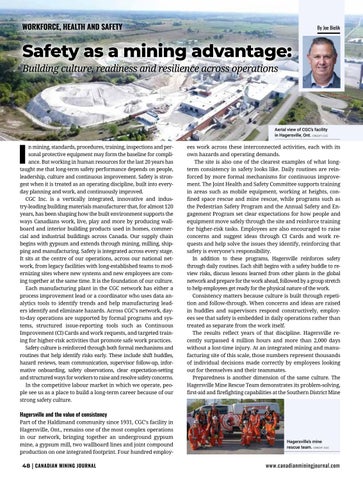
48 Safety as a mining advantage: Building culture, readiness and resilience across operations.
DEPARTMENTS
4 EDITORIAL | Canada’s gold moment is now — execution will define it.
GOLD IN CANADA The technologies reshaping how gold is found, processed and recovered
B2Gold advances Goose and the Back River Gold District The trillion-dollar refractory gold question
6 FAST NEWS | Updates from across the mining ecosystem.
> From blasting to ore recovery: Reducing uncertainty > New Found Gold goes from discoveries to mines
8 MIN(E)D YOUR BUSINESS | The Canada Strong Fund should be built as a resource sovereignty strategy, not just a financing tool. 13 LAW AND REGULATIONS | New policy roadmap may help miners navigate Chinese investment landscape. 34 ESG | What Canadian mining companies need to know to operate in Latin America.
www.canadianminingjournal.com
> Managing water risk for life
SEPTEMBER 2026 | www.canadianminingjournal.com | PM # 44082538
About the cover: B2Gold’s George Project in the Back River Gold District in Nunavut, where the company already has a delineated resource estimate. B2Gold plans further infill drilling and will evaluate how the project could advance through permitting. CREDIT: B2GOLD.
Coming in October 2026 Our annual roundup of mining in Quebec and Eastern Canada — where mining and exploration is booming and investment is on the rise — with featured reports on critical minerals and the use of drones in mining.
For More Information
Please visit www.canadianminingjournal.com for regular updates on what’s happening with Canadian mining companies and their personnel both here and abroad. A digital version of the magazine is also available at https://www.canadianminingjournal.com/digital-edition/
CANADIAN MINING JOURNAL | 3
FROM THE EDITOR
Tamer Elbokl, PhD
Canada’s gold moment is now — execution will define it
R
ecord gold prices and renewed investment have created an extraordinary opportunity for Canada, but capturing its full value will depend on execution. The real test is whether projects can move efficiently from discovery and financing through permitting and construction to reliable production, while managing water, workforce needs, processing, infrastructure and relationships with Indigenous communities. Canada’s ability to build, operate and expand mines will ultimately determine whether today’s gold boom translates into lasting economic value. According to Natural Resources Canada (NRCan), exploration and deposit appraisal spending intentions for 2026 are up 21% to a record $5.3 billion, driven largely by growing interest in gold. Preliminary figures show expenditures rose 4% to $4.4 billion in 2025 from $4.2 billion in 2024. The increase builds on a strong post-pandemic recovery that pushed spending to $4.4 billion in 2022 before tighter financial conditions and economic uncertainty slowed investment in 2023. Gold remains Canada’s leading exploration target, supported by record or near-record prices, geopolitical uncertainty, safe-haven demand and sustained central bank purchases. But gold is not the only story. Longer-term demand tied to the clean energy transition continues to shape exploration strategies, with growing requirements for minerals used in electric vehicles, renewable energy, energy storage and electricity transmission sustaining interest in critical minerals. This September issue puts Gold in Canada at the centre of a broader discussion about investment, production and the challenge of turning favourable markets into lasting value. The ramp-up of B2Gold’s Goose Mine in Nunavut marks an important step in the company’s plans to develop the Back River Gold District as a long-term growth platform in Canada. Newfoundland and Labrador’s gold sector, meanwhile, is moving from exploration toward production, with New Found Gold among the companies advancing the province’s gold potential. Other features examine the surge in gold activity reaching SGS Lakefield, the growing importance of refining capacity and electric induction melting, emerging approaches to refractory gold recovery and the increasingly critical role of integrated water management. Beyond gold, this issue examines the operational, regulatory and technological pressures reshaping mining. Contributors look at maintenance strategies for screens, suspended electromagnets and rotary drums, as well as fleet reliability, lubrication, mobile-equipment fire protection and the role of leadership and continuous improvement in strengthening safety culture. We also explore the evolving rules governing Chinese investment in Canadian mining, the challenges facing Canadian miners operating in Latin America, the case for strengthening grassroots exploration in Ontario and technologies aimed at improving blasting, ore control, safety and productivity. Canada has the geology, expertise and investment interest to capitalize on this gold cycle. What matters now is converting that advantage into mines that can be permitted, financed, built and operated successfully. High gold prices may open the door, but execution will determine how much of the opportunity Canada ultimately captures. Our October issue will feature our annual roundup of mining in Quebec and Eastern Canada, along with reports on critical minerals and the use of drones in mining. Relevant editorial contributions should be sent to the Editor in Chief no later than Sept. 7, 2026.
4 | CANADIAN MINING JOURNAL
SEPTEMBER 2026 Vol. 147 – No. 6 69 Yonge St., Ste. 200, Toronto, ON M5E 1K3 Tel. (416) 510-6789 Fax (416) 510-5138 www.canadianminingjournal.com Editor in Chief Dr. Tamer Elbokl telbokl@canadianminingjournal.com News Editor David Cassels dcassels@canadianminingjournal.com Graphic Design Nicholl Spence Production Manager Jessica Jubb jjubb@northernminer.com Manager of Product Distribution Allison Mein 416-510-6789 ext 3 amein@northernminergroup.com Publisher & Sales Robert Seagraves 416-510-6891 rseagraves@canadianminingjournal.com Sales, Western Canada George Agelopoulos 416-510-5104 gagelopoulos@northernminer.com Toll Free Canada & U.S.A.: 1-888-502-3456 ext 2 or 43734 Circulation Toll Free Canada & U.S.A.: 1-888-502-3456 ext 3 President, The Northern Miner Group Anthony Vaccaro Established 1882
Canadian Mining Journal provides articles and information of practical use to those who work in the technical, administrative
and supervisory aspects of exploration, mining and processing in the Canadian mineral exploration and mining industry. Canadian Mining Journal (ISSN 0008-4492) is published nine times a year by The Northern Miner Group. TNM is located at 69 Yonge St., Ste. 200, Toronto, ON M5E 1K3. Phone (416) 510-6891. Legal deposit: National Library, Ottawa. Printed in Canada. All rights reserved. The contents of this magazine are protected by copyright and may be used only for your personal non-commercial purposes. All other rights are reserved and commercial use is prohibited. To make use of any of this material you must first obtain the permission of the owner of the copyright. For further information please contact Robert Seagraves at 416-510-6891. Subscriptions – Canada: $51.95 per year; $81.50 for two years. USA: US$64.95 per year. Foreign: US$77.95 per year. Single copies: Canada $10; USA and foreign: US$10. Canadian subscribers must add HST and Provincial tax where necessary. HST registration # 809744071RT001. From time to time we make our subscription list available to select companies and organizations whose product or service may interest you. If you do not wish your contact information to be made available, please contact us via one of the following methods: Phone: 1-888-502-3456 ext 3; E-mail: amein@northernminergroup.com Mail to: Allison Mein, 69 Yonge St., Ste. 200, Toronto, ON M5E 1K3 We acknowledge the financial support of the Government of Canada.
www.canadianminingjournal.com
Less time fixing problems.
More time like this.
Maestro Digital Mine’s purpose-built IIoT devices and last-mile networks give you real-time visibility into underground conditions and device health. With issues easier to identify, you can troubleshoot faster and simplify maintenance - so unexpected issues at work are less likely to become missed moments at home.
The underground, understood.
Learn more about us maestrodigitalmine.com
FAST NEWS
Updates from across the mining ecosystem
• Electra backs U.S. black mass ban
• Sprott invests $10M in Max Power
Electra Battery Materials has released a statement supporting the recent U.S. tungsten and recycled battery materials export ban, calling it a matter of national CREDIT: ELECTRA security. Under the ban, Electra and other non-American refiners can no longer receive U.S. black mass materials outside the country. The ban follows President Donald Trump’s order to grant officials authority to industrial waste export restrictions — a move to reduce U.S. dependence on Chinese supply chains. Electra’s statement comes as it continues development of its nickel refinery in the southeastern U.S., which will be the company’s first plant outside of Canada. The company says it has no plans to seek an export exemption.
Canadian billionaire Eric Sprott is investing $10 million in Max Power, advancing its Lawson natural hydrogen project in Saskatchewan. The funding increases his ownership to 19.5% from around 18% and follows a $25-million investment in May. Shares in Max Power gained 5% to $2.50 apiece in Toronto on the Monday the investment was disclosed, valuing the company at about $437 million. About 80 km north of Moose Jaw, Lawson is a multi-well drill program in search of the “world’s first large-scale commercial discovery of natural hydrogen.” Sprott’s backing is unusual after decades of investing in precious metals. The increased stake requires Sprott to file an early warning report to regulators. CREDIT: MAX POWER
• Duncan Wanblad to lead
• FAST Metals raises
Following its merger with Teck Resources, Anglo American’s current CEO Duncan Wanblad, will lead combined Anglo Teck, headquartered in Vancouver. Current Teck CEO Jonathan Price will serve as deputy CEO and chief strategy officer. John Heasley was appointed chief financial officer and Ruben Fernandes as chief operating officer.
FAST Metals has partnered with Metalox Mineral and raised US$4.3 million to advance its red-mud recovery projects. Under the deal, FAST will process one long ton of red mud and other iron-bearing waste feedstock per week at Metalox’s Florida facility. The work is aimed at proving the commercial viability of its technology. FAST says the money will drive the next phase of its commercial growth, by optimizing its process to scaling customer outreach across mining and critical minerals.
Anglo Teck group
US$4.3M
CREDIT: ANGLO AMERICAN
The deal cements Anglo’s access to Teck’s prized copper assets while demand surges. It is expected to receive final regulatory approvals between Sept. 2026 and March 2027.
6 | CANADIAN MINING JOURNAL
CREDIT: ADOBE STOCK/IGOR GROSHEV
• First Phosphate rings
Nasdaq bell
CREDIT: FIRST PHOSPHATE
First Phosphate’s management team and board went to New York City to ring the Nasdaq opening bell, celebrating the company’s listing on the Nasdaq global market. Following its Nasdaq debut, the company’s shares rose 5.32% on Canadian markets. The Quebec-based developer said the moment recognized the company’s journey from its founding to establishing itself as a major part of the North American battery-supply chain. The celebration follows agreements earlier this year that formalized international investment for the development of the First Phosphate’s Bégin-Lamarche mine in northern Quebec.
www.canadianminingjournal.com
IMPROVING THE PROCESS Invest in the Best for Peace of Mind
Whether your goal is higher throughput, reduced downtime, lower power usage — or all three — the Eriez Trunnion Magnet System transforms your grinding circuit and delivers proven results.
Eriez. Always the Right Choice. Stop ball scats before they circulate. The Trunnion Magnet System captures worn or broken grinding media at the mill discharge, protecting downstream assets and improving overall circuit performance.
GLOBAL LEADER IN SEPARATION TECHNOLOGIES
w w w.e riez .c o m
MIN(E)D YOUR BUSINESS
By Carlos da Costa
The Canada Strong Fund should be built as a resource sovereignty strategy, not just a financing tool
C
anada should treat the proposed Canada Strong Fund as a nation-building instrument for resource sovereignty, not merely as another public financing vehicle. That distinction matters most in mining. Canada has long had the mineral endowment, legal institutions, engineering expertise and access to capital needed to lead in critical minerals and resource development. It has been less successful at converting those advantages into durable domestic wealth. Too much value still leaves the country through under-processing, fragmented infrastructure planning, delayed approvals and financing models that do not consistently preserve Canadian control over strategic assets. The Canada Strong Fund can help correct those weaknesses, but only if it is built to do more than co-invest passively with private capital. It should
8 | CANADIAN MINING JOURNAL
strengthen Canadian ownership, accelerate enabling infrastructure, support downstream value creation and embed Indigenous partnership as part of sound project governance. Recent federal announcements reinforce this point. Ottawa now describes the Canada Strong Fund as Canada’s first sovereign wealth fund, capitalized with $25 billion over three years and mandated to invest in projects of national strategic importance. Although the terminology has shifted, the underlying concept remains consistent with the argument advanced here: this is not a conventional sovereign wealth fund designed to preserve fiscal surpluses through diversified global investment. It is a sovereign capital instrument intended to catalyze domestic industrial development while pursuing commercial returns. That framing strengthens the case for treating the fund as a tool of resource sovereignty rather than a generic investment pool. The federal government has also signalled that the fund will operate alongside existing instruments, such as the Canada Growth Fund and the Strategic Innovation Fund, but with a more explicit focus on long-term national capability rather than project-specific incentives. That distinction matters because it positions the Canada Strong Fund as a structural institution rather than a transactional program. Mining makes the case plainly. Critical minerals sit at the
www.canadianminingjournal.com
MIN(E)D YOUR BUSINESS centre of industrial strategy across allied economies because they support battery manufacturing, electricity systems, advanced manufacturing, defence applications and digital infrastructure. Canada has significant deposits of several minerals that are increasingly important to these supply chains. However, mineral abundance alone does not create sovereign advantage. A country that exports raw or minimally processed resources while other jurisdictions capture more of the refining, manufacturing and technology value chain is not fully securing the longterm benefit of its own endowment. Resource sovereignty requires more than extraction. It requires the legal, financial and physical capacity to retain a greater share of value at home. The Canada Strong Fund could serve that objective if its mandate is framed with discipline. Public money is most defensible where markets underprovide essential conditions for commercially sound development. That problem appears repeatedly in Canadian mining. Projects can remain stalled because roads, rail links, port access, transmission lines or regional processing facilities are missing. Private proponents often cannot finance those enabling assets efficiently on their own, especially where the benefits extend beyond a single project. A strategic public fund can be justified in that setting because it addresses structural coordination failures rather than simply rescuing weak ventures. It is meant to reduce barriers that prevent private capital from entering viable projects on reasonable terms. Recent federal-provincial discussions on northern infrastructure corridors, including the Ring of Fire and Nunavut’s Grays Bay Road and Port Project, illustrate how multi-project infrastructure gaps continue to impede otherwise viable mineral development. This logic has become more urgent as federal policy has evolved. Ottawa’s 2026 Critical Minerals Strategy introduced a $2 billion Critical Minerals Sovereign Fund and more than $400 million for processing and refining technologies. The Defence Industrial Strategy, released earlier this year, explicitly identifies certain mines, concentrators and refineries as security infrastructure. These developments confirm that critical minerals are no longer treated as ordinary commodities. They are strategic assets whose domestic development and downstream capture matter for national resilience. The Canada Strong Fund must be designed accordingly. The federal government has also begun coordinating with allies through the Minerals Security Partnership, which aims to reduce reliance on non-aligned suppliers and strengthen shared supply chain resilience. Canada’s ability to contribute meaningfully to that alliance depends on its capacity to advance projects beyond the exploration stage and into processing, refining and component manufacturing. That approach also aligns with Canadian public law. Resource development in Canada is governed not only by economics and regulation but also by constitutional principle. Section 35 of the Constitution Act, 1982, recognizes and affirms existing Aboriginal and treaty rights. The Supreme Court of Canada has made clear that the Crown may owe a duty to consult and, where appropriate, accommodate Indigenous peoples when contemplated Crown conduct may adversely affect
10 | CANADIAN MINING JOURNAL
asserted or established rights. Haida Nation versus British Columbia (Minister of Forests) remains central to that doctrine. Tsilhqot’in Nation versus British Columbia also confirms the significance of Aboriginal title in land and resource decisions. These principles are part of the legal architecture within which major projects must be structured. That constitutional setting strengthens the case for building the Canada Strong Fund around partnership rather than simple project finance. Projects that lack meaningful Indigenous participation often face greater legal uncertainty, weaker social legitimacy and more difficulty securing durable approval conditions. Projects built with genuine Indigenous partnership can reduce those risks while improving long-term governance. This is increasingly a matter of legal prudence and commercial stability. A fund that aims to improve the conditions for major Canadian resource development should recognize that Indigenous participation is often part of what makes a project bankable, lawful and resilient over time. The growing number of Indigenous-owned or co-owned energy and infrastructure assets, including transmission lines in Alberta and hydro facilities in Manitoba, demonstrates that equity participation is no longer exceptional; it is becoming a mainstream governance model. Federal policy has already begun moving in that direction. The Indigenous Loan Guarantee Program, now expanded through the Canada Indigenous Loan Guarantee Corporation, was launched to support Indigenous ownership in Canada’s natural resource and energy projects by lowering financing barriers through loan guarantees of up to $5 billion. That initiative reflects a broader shift toward Indigenous equity participation rather than limiting Indigenous communities to the role of consultees. This matters for mining and infrastructure because equity ownership can better align long-term interests among Indigenous nations, project proponents, governments and lenders. The Canada Strong Fund should make partnership and, where appropriate, Indigenous co-ownership part of its working logic. The same need for precision applies to the legal language surrounding the United Nations Declaration on the Rights of Indigenous Peoples Act. The act affirms the declaration as an international human rights instrument that can help interpret and apply Canadian law and establishes a federal framework for implementation in consultation and cooperation with Indigenous peoples. Yet accuracy matters here. The act does not itself immediately alter Canada’s existing duty to consult. Public commentary sometimes blurs that distinction and creates confusion about the current legal standard. A careful le-
www.canadianminingjournal.com
Reducing Your Footprint? That’s OUR Field!
Reclamation success hinges on your mine waste management plan. NewFields Canada offers practical solutions to mine waste management from exploration to reclamation. Ask us how we can help you safely manage your mine waste. www.newfieldscanada.ca
Practical Mine Waste Solutions
MIN(E)D YOUR BUSINESS gal analysis should avoid overstating the act’s immediate doctrinal effect while still recognizing that it shapes the policy environment in which federal resource decisions are made. Once those legal and institutional realities are kept in view, the core argument for the Canada Strong Fund becomes clearer. The fund should be judged by whether it improves Canada’s capacity to move from raw resource extraction toward integrated industrial development. That means supporting the kinds of assets and relationships that allow mining projects to proceed on stronger domestic terms. Shared infrastructure is part of that picture. Processing and refining capacity are part of it as well. Canada has spent too long tolerating a pattern in which strategic minerals leave the country before more of their value is captured through downstream activity. In a world defined by supply chain competition and industrial policy, that pattern is a strategic weakness. The fund should therefore focus on four linked priorities. It should help finance
Delivering fit-for-purpose solutions across the entire project life cycle
We are a world leader, boasting decades of experience delivering fit-for-purpose solutions across the minerals and mining industry. No matter your commodity, we are positioned to serve as your trusted advisors on the ground reducing your supply chain risk. We invest in the latest equipment, continual training and ensure industry requirements are met at the global, regional, and local level.
enabling infrastructure that unlocks more than one project or region. It should support commercially disciplined investment that attracts private capital rather than replacing it. It should strengthen Canadian participation in downstream value-added segments of the resource economy. It should also treat Indigenous partnership as an ordinary feature of sound investment design in major projects. Governance will determine whether the fund succeeds. Public investment in politically significant sectors always creates a risk of blurred lines between commercial analysis and electoral symbolism. Arm’s-length status is helpful, but it is not enough on its own. A credible institution will need clear statutory objectives, transparent investment criteria, independent governance and regular public reporting on both financial performance and mandate compliance. Without those safeguards, the fund could become vulnerable to the criticism that it socializes risk while privatizing upside selectively. International experience reinforces this point: institutions such as Norway’s Government Pension Fund Global and Singapore’s Temasek demonstrate that sovereign capital vehicles succeed when governance is insulated from short-term political pressure and when investment mandates are explicit, measurable and consistently applied. Critics are right to warn against romanticizing the model. The fund is not a substitute for coherent regulation, disciplined project assessment or sound fiscal judgment. It should not become a vehicle for indiscriminate subsidies or politically expedient investment. Canada faces recurring structural obstacles in nationally significant sectors, especially where long timelines, high capital intensity, infrastructure deficits and fragmented decision-making suppress productive in-
vestment. A public fund can be justified if it is narrowly built to address those obstacles while preserving commercial discipline and legal legitimacy. That is why the most useful description of the Canada Strong Fund is not that it is simply an investment pool. It is a proposed institutional answer to a persistent Canadian problem. Canada has often had the resources, but not the machinery, to convert resource potential into domestic productive strength at the scale the moment requires. Mining, critical minerals and related infrastructure are now testing whether the country can do better. A fund that merely places public capital beside private money will not be enough. A fund that helps lock in infrastructure, downstream capacity, Indigenous partnership and stronger Canadian control over strategic development could make a real difference. Canadian Mining Journal’s readership is well placed to understand what is at stake. The issue is not whether responsible mining should proceed. The issue is whether Canada will finally build the institutions needed to ensure that responsible mining produces broader and more lasting national benefit. The Canada Strong Fund should be built for that purpose. If Ottawa treats resource sovereignty as the governing objective and commercial discipline as the condition of legitimacy, the fund could become one of the more important developments in Canadian resource policy in years. If it is treated as a branding exercise or a diffuse investment program, it will add little to a familiar cycle of ambition without structural change. Carlos da Costa, PhD, is an adjunct finance professor at the University of British Columbia and an experienced financial professional with expertise in valuations and modelling, derivatives, structured finance, commodities, risk management, structured products and financial analytics.
WWW.SGS.COM/NATURALRESOURCES NAM.NATURALRESOURCES@SGS.COM
12 | CANADIAN MINING JOURNAL
www.canadianminingjournal.com
LAW AND REGULATIONS
By Christopher Doucet and Zirjan Derwa
New policy roadmap may help miners navigate Chinese investment landscape
Lithium evaporation ponds in the highlands of northern Argentina. CREDIT: ADOBE STOCK
N
avigating the Canadian regime governing inbound mining investment from China has been challenging in recent years. The Canadian government has sent policy signals that investment in strategically important critical minerals from state-owned enterprises (SOEs) and “foreign-influenced private investors,” notably from China, would generally not be permitted, which has in turn created a deterrent effect on Chinese investment in the Canadian mining sector generally over the last five years. Recent policy clarifications, however, may encourage such investment to return outside of sensitive sectors. On Jan. 16, 2026, the Office of the Prime Minister released the Canada–China Economic and Trade Cooperation Roadmap (the roadmap), signaling renewed commitment to strengthening bilateral trade and investment ties. The roadmap expressly welcomes Chinese investment in energy, agriculture and consumer products. Though mining is not mentioned, recent Investment Canada Act (ICA) developments suggest that the roadmap may also apply to mining investment outside of critical minerals.
stake in Power Metals. 2. Chengze Lithium International divested its stake in Lithium Chile. 3. Zangge Mining Investment (Chengdu) divested its stake in Ultra Lithium.
Stop signs and exit ramps
Table 1. ICA investor transaction prohibitions.
The roadmap is a departure from the policy landscape defined in Oct. 2022, when the federal government released an updated policy on foreign SOE investment in critical minerals (the Critical Mineral Policy). That policy introduced heightened scrutiny for investments by SOEs and “foreign-influenced private investors” in Canada’s critical minerals sector. The government made clear that new acquisitions of control by SOEs in critical minerals would be approved only on an “exceptional basis,” and most would likely be rejected. Shortly after the policy was released, Ottawa also ordered the following three Chinese entities to divest their interest in Canadian critical mineral companies: 1. Sinomine (Hong Kong) Rare Metals Resources divested its
Year
SEPTEMBER 2026
Notably, none of these investments would have required mandatory Investment Canada Act (ICA) filings or otherwise received scrutiny under ordinary foreign investment regulations. The Chengze Lithium investment was striking, given that its minority stake was less than 20% and the mineral assets were in Argentina and Chile, rather than Canada. Nonetheless, the government identified this and the two others as policy stance example-setting cases. The divestiture orders sent an unmistakable message: No investment is too small to warrant scrutiny, non-controlling interests can trigger review and Canadian companies with assets located exclusively abroad remain subject to scrutiny. When taken together, the Critical Mineral Policy, divestiture orders, and ICA transaction prohibitions sent a clear deterrent signal.
Chinese investors
All other investors
2024-2025
5
1
2023-2024
7
1
2022-2023
10
1
SOURCE: GOVERNMENT OF CANADA, INVESTMENT CANADA ACT, ANNUAL REPORTS (2022 – 2025).
While the Critical Minerals Policy largely succeeded in reducing ICA-reportable Chinese investment in Canadian critical minerals, it also contributed to a decline in Chinese investment in Canadian mining generally, including in the less sensitive base CANADIAN MINING JOURNAL | 13
LAW AND REGULATIONS Table 2. Chinese inbound investments. Number of investments from China filed under ICA
Asset value of investments ($ M)
Enterprise value of investments ($ M)
2024-2025
44
$2,231
$1,223
2023-2024
39
$38
$97
2022-2023
43
$1,259
Year
7-29_CanadianMiningJrnl_InsertV1.pdf 1 7/22/26 SOURCE: GOVERNMENT OF CANADA, INVESTMENT CANADA ACT, ANNUAL REPORTS (2022 – 2025).
$381 9:52 AM
and precious metals sectors. Capital still flowed from China in smaller, non-ICA reportable formats, but macro-level transactions with producers and late-stage developers dried up, as exemplified by Zijin Mining’s aborted investment in Solaris Resources in 2024 over ICA regulatory risk.
Healthy traffic in other sectors Despite the policy tone and continued scrutiny, ICA filings by Chinese investors have remained steady outside of mining, with capital being directed into sectors viewed as less strategically sensitive. China continues to rank among the top countries for inbound investment in Canada. These filings reflect sustained Chinese investment and interest into Canada, despite the restrictions surrounding critical minerals and ICA transaction prohibitions. In a more favourable regulatory environment, it is likely that Chinese capital and interest could be directed back into the mining sector in a meaningful way.
New roadmap: Looking ahead
C
M
Y
CM
MY
CY
CMY
K
CleanScrape®
leanScrape,® Martin’s awardwinning belt cleaners, featuring tough tungsten carbide scrapers and low contact pressure, provide up to 4X the service life of standard belt cleaners. Their slim, compact design is perfect for tight or restricted spaces. Once in place and adjusted, CleanScrape requires minimal maintenance over its lifespan — drastically reducing any risk to your workers, operational throughput, and overall expenses.
The new roadmap may signal that the Canadian government is aiming to curtail the Critical Minerals Policy’s deterrent effect across the mining sector and is open to Chinese investment, even from SOEs, in less strategically sensitive mining areas. This shift is already reflected in real transactions. Though ultimately abandoned owing to Chinese regulatory issues, Zijin Gold International’s proposed $5.5-billion acquisition of Allied Gold notably cleared the ICA’s national security review process earlier this year. Questions remain about how broadly the roadmap will be interpreted and whether it will permit investments in sectors previously considered sensitive. The most strategic policy evolution would maintain rigorous investment scrutiny for national security risks while creating a clearer pathway for allied capital. Ultimately, future policy will be driven by the balance of strategic concerns against Canada’s goal to become an attractive destination for mining capital. Christopher Doucet is a partner at Bennett Jones in Toronto. Zirjan (Zee) Derwa is a partner at Bennett Jones in Toronto.
14 | CANADIAN MINING JOURNAL
www.canadianminingjournal.com
GOLD IN CANADA
By Teddy Katz
It is not only a frenzy for critical minerals: There is a modern gold rush too
For 85 years, SGS Lakefield, nestled into cottage country, has quietly helped unlock billions of dollars in gold value by delivering the metallurgical expertise. CREDIT: SGS
An insider’s view of the rush from the Canadian lab that is buzzing with activity
P
eople who have been involved in the mining industry for decades say there is a modern gold rush taking place as the value of one of the world’s most historic commodities has skyrocketed. The price of gold reached record highs in early 2026, driving increased exploration and project activity, helping to flood samples at unseen levels into SGS Lakefield, a globally recognized Metallurgical Centre of Excellence. Tyler Crary, director, operations for metallurgy and consulting (North America), who is based at SGS Lakefield, has never seen anything quite like this in his two decades in the industry. We are seeing a gold rush happening now. As we celebrate our 85th anniversary, our deep roots in gold metallurgy position us to help clients navigate today’s gold rush and advance the next generation of Canadian gold projects,” Crary said.
Jewellery no longer the golden ticket To understand why this is happening, we turned to Chris Fleming, a senior metallurgical consultant at SGS with more than 50 years of experience working with gold. Fleming is one of the world’s leading experts in hydrometallurgy and precious metals processing and has been recognized for his role in pioneering commercialized gold extraction techniques. In 2023, he received the Canadian Mineral Processors (CMP) Lifetime Achievement Award. Fleming explains that in the past up to 70% of the new gold mined every year went into jewellery, with the rest going into investment vehicles or central banks buying up gold bars. “As a result of that, there has always been an upper cap on the price of gold,” Fleming says. “When the price gets too high, people stop buying jewellery and jewelry pawning creates an artificial supply.” SEPTEMBER 2026
Fleming says in the past few years, those ratios have shifted with more than 50% of all new gold now going into investments. He attributes this shift to economic uncertainty and geopolitical tensions around the world that have many turning away from the U.S. dollar back to gold as a safe haven. That has led the price of gold to almost double as anybody who holds gold in their portfolio has seen. There is no longer that upper cap.
Everything gold is new again Tyler Crary says high gold prices are reviving conventional and complex refractory projects, which average 16 years from exploration to operation. Gold projects proved more resilient than other projects during the 2009 financial crisis, although financing later slowed. Despite market cycles, gold accounts for up to 50% of exploration budgets.
Canada continues to be a key player You might be asking what Canada’s role is in all of this. “We are in the top five in gold production and where Canada is uniquely placed is that over 50% of all the mining and exploration companies in the world are based either in Toronto or Vancouver,” Fleming says. He adds, “that means Canada is seen as a place where you can raise finances for mining projects. 50% or more of the projects that we do at our lab in Lakefield are gold projects.” Crary says Canada has other advantages that has led to a lot of new mines being developed here in the past 20 years. He says gold is in abundance in various regions around the world but some of those are not considered as safe as Canada. He says this country has the labour and governments behind the industry as well. CANADIAN MINING JOURNAL | 15
GOLD IN CANADA
SGS Lakefield helped transform mineral discoveries into profitable, operating assets, many of them starting with bench scale leaching programs. CREDIT: SGS
Simpler gold projects have been explored and developed Crary says SGS Lakefield tests increasingly common refractory sulfide projects, while conventional projects go to other labs. Gold associated with sulfur or carbon requires more processing, higher costs and skilled staff, particularly at remote sites. Even high-grade deposits may require significant investment. Thorough feasibility studies help reduce the greater risks of high-pressure, high-temperature pressure oxidation and determine the most suitable metallurgical and economic approach for each project before development proceeds. James Brown is director of consulting within metallurgy and consulting (North America) at SGS. He explains that conventional or existing projects help companies optimize their processes and if they can improve recovery by one or two per cent, at current prices, that is very significant. But he highlights things are much more complicated these days. The simpler gold projects have been explored and developed. Ores are now lower grade and more complex. What makes that challenging Brown says is that the technical knowhow is not easy to find. “With the surge in gold projects, the expertise in the industry is spread thin. There are not a lot of graduates coming out of university getting into the industry. That is where we can help. We have the expertise and, in some cases, have metallurgists that can go on site to help fill in on a short-term basis if operations lack the experience that they need.” Brown adds, “we have people like Chris and Tyler who have worked on thousands of gold projects.”
Future trends for gold Neri Botha says critical minerals associated with gold are making some deposits more financially viable, turning material once considered waste into a potential recovery opportunity. Tyler Crary says Barrick Mining Corporation is expanding beyond gold into copper and critical minerals. He predicts more major gold miners will follow, using their operational experience to advance projects rapidly from exploration to operation.
Our SGS experts look back and to the future of gold projects Detour Lake — the largest gold-producing mine in Canada It is difficult to pick just one milestone moment from the thousands of projects Fleming has been involved with over the years, but the shift in gold mining we are seeing today is on full display at Detour Lake in Northern Ontario. This is a very large, low-grade mine, and to remain profitable, they operate on a very large scale, mining, crushing and milling millions of tonnes of ore every month. Over several phases of project development, SGS Lakefield completed comprehensive metallurgical characterization and process-development test work for the Detour Lake deposit. Programs included comminution, gravity concentration, cyanidation, recovery optimization and ore variability assess-
16 | CANADIAN MINING JOURNAL
ments to support process flowsheet design, feasibility studies, reserve estimation and operational improvements. The results demonstrated strong amenability of Detour Lake mineralization to conventional gold processing methods and provided the technical foundation for Canada’s largest and most successful open-pit gold mining operations.
SGS work on groundbreaking technology to extract difficult deposits A key highlight for James Brown has been his involvement in the groundbreaking Platsol process, first developed by SGS Lakefield in 2000. It is a single-step, high-temperature pressure oxidation leaching technology to simultaneously extract Platinum Group Metals (PGMs), gold and base metals from complex, low-grade polymetallic sulfide ores and bulk concentrates. It serves as a highly efficient, cleaner and more economical hydrometallurgical alternative to conventional smelting. “I really do think at some point we are going to see this technology used on a commercial scale all over the world,” Brown says.
B2Gold’s Goose Project in Nunavut Tyler Crary feels lucky to have been involved in all B2Gold’s projects that have gone from exploration to operation. He highlights B2Gold’s Goose Project. Based in Vancouver, B2Gold has operations around the world including in the Philippines, Western Africa and Namibia. The Goose Project was their first in Canada. “Essentially, we tried to fine tune everything we could to help them with their capital and operating costs. They are in an extreme remote location in Nunavut. They must buy all their equipment and reagents a year in advance so every little dollar counts,” Crary says. He adds, “we were helping them de-risk the project to give them confidence it was economically viable, well before the price of gold surged the way it has today. Small changes we helped them with led to savings of more than $24 million a year.”
Narrow vein mining in Newfoundland Neri Botha highlights work with Anaconda Mining and Novamera’s narrow-vein mining in Newfoundland. SGS provides geology, geometallurgy and testing, while AI-driven modelling and subsurface imaging are making previously variable, uneconomic deposits increasingly viable for extraction. Teddy Katz is a freelance writer.
www.canadianminingjournal.com
GOLD IN CANADA: CEO INTERVIEW
By Tamer Elbokl, PhD
Ice road to the Goose Mine and the Back River Gold District. CREDIT: B2GOLD
B2Gold enters cash-flow phase as Goose ramps up in Nunavut
B2
Gold entered 2026 with a broader operating platform and a major new Canadian base. The company’s Goose Mine in Nunavut achieved first gold production in June 2025 and declared commercial production in October 2025, while the Back River Gold District gives B2Gold a long-term growth platform in Canada. In Colombia, the company is also advancing Gramalote after announcing positive feasibility study results in July 2025. The Canadian Mining Journal spoke with Mike Cinnamond, president, CEO and director of B2Gold, about execution at Goose, exploration across Back River Gold District, GramaMike Cinnamond, president, CEO and lote’s role in the company’s director of B2Gold in the Fekola Mine future and how B2Gold is in Mali. CREDIT: B2GOLD balancing growth with capital discipline. The conversation began with congratulations on his recent appointment as president and CEO. CMJ: GOOSE HAS MOVED FROM CONSTRUCTION TO COMMERCIAL PRODUCTION. WHAT WERE THE BIGGEST EXECUTION LESSONS FROM BRINGING A REMOTE NUNAVUT GOLD MINE INTO PRODUCTION, AND HOW ARE THOSE LESSONS SHAPING THE NEXT PHASE AT BACK RIVER?
SEPTEMBER 2026
Cinnamond: The first lesson is the importance of partnerships. For B2Gold, that starts with its relationship with the Kitikmeot Inuit Association (KIA), which played a critical role over many years as Goose advanced. Respect and collaboration with the KIA are central to the company’s social licence to operate at Goose. The company also works with the government of Nunavut on employment and training, including through an MoU signed in 2025. Local content is another key priority, with numerous Inuit businesses involved as Goose moves forward. B2Gold also works alongside agencies such as the Nunavut Impact Review Board, Nunavut Water Board and Nunavut Planning Commission, which are part of advancing a district-scale project in the North. The second major lesson is logistics. Construction in the Arctic requires long-range planning, with procurement and supply work starting well before materials are needed on site. For Goose and the Back River Gold District, supplies are ordered and moved during the summer from Valleyfield near Montreal through the Arctic Ocean to a marine laydown area in Bathurst Inlet. From there, they must be transported down a 163-km ice road that is constructed on an annual basis. That means the company must plan about 18 months ahead to keep the site supplied. Labour and recruitment in the North are also ongoing challenges. Competition for workers is significant, making retention and recruitment critical. B2Gold benefited from CANADIAN MINING JOURNAL | 17
GOLD IN CANADA: CEO INTERVIEW having in-house construction personnel with experience from previous builds in remote locations, which helped support the transition at Goose. CMJ: THE GOOSE MINE IS EXPECTED TO AVERAGE 300,000 OZ. OF GOLD PRODUCTION OVER ITS FIRST SIX YEARS. WHAT ARE THE KEY OPERATIONAL PRIORITIES NEEDED TO REACH AND SUSTAIN THAT LEVEL? Cinnamond: The Goose Mine produced just over 42,000 oz. in its first quarter, helped partly by high grades and recoveries. A continued focus on mining rates from both the open pit and underground operations will be key to reaching steady-state production of more than 300,000 oz. per year. Our major operational priority is the remediation of the crushing circuit. A fire in April 2026 impacted a small part of the crushing circuit. No one was hurt, but the damage still must be repaired. The company plans to complete that work in the third quarter at a capital cost of about US$7 million, based on initial estimates. A broader crushing-circuit remediation program to increase crushing capacity is planned in two stages. The first stage, also planned for the third quarter of 2026, is expected to cost about US$11 million. It will add surge bin capacity, new apron feeders and an upsized primary jaw crusher. The second stage is planned for the first half of 2027 and will upsize the secondary and tertiary cone crushing system. The goal is to reach 3,200 tonnes per day of crushing capacity by the end of the third quarter of 2026 and steady-state capacity of 4,000 tonnes per day by the end of the first half of 2027 and is expected to cost about US$25 million. Reaching those levels will support production of about 300,000 oz. per year during the first five or six years.
The Back River Gold District: George camp. CREDIT: B2GOLD
18 | CANADIAN MINING JOURNAL
CMJ: B2GOLD HAS BUDGETED US$51 MILLION FOR EXPLORATION AT THE BACK RIVER GOLD DISTRICT IN 2026, INCLUDING US$29 MILLION AT GOOSE AND US$22 MILLION FOR REGIONAL EXPLORATION. WHERE DO YOU SEE THE STRONGEST OPPORTUNITY TO ADD MINE LIFE OR UNLOCK NEW DISCOVERIES? Cinnamond: The opportunity extends across the district. At Back River, B2Gold has 11 mineral claims stretching along an approximately 80-km belt, along with 100% ownership of the Goose Mine. About US$29 million of the 2026 exploration budget is allocated to Goose and near-mine work, covering just over 17,000 metres of drilling. The Goose drilling will target extensions of the Llama deposit, which is the next open pit and underground operation at Goose. The company will also follow up significant results from the Nuvuyak, Mammoth and Hook zones of the Goose deposit, as well as the new Wing discovery. The goal of near-mine work is to bring new material into the mine plan relatively quickly. Regional exploration is also important. The regional budget will cover both brownfield and greenfield work. At the George project, where B2Gold already has a delineated resource estimate, the company plans further infill drilling and will evaluate how the project could advance through permitting. The company will also look at other targets, including Boulder, Del and Needle, following preliminary work completed in 2025. The broader objective is to continue demonstrating that Back River is a district, with the potential to add mine life at Goose while also identifying new deposits. CMJ: GRAMALOTE’S FEASIBILITY STUDY OUTLINES AVERAGE ANNUAL GOLD PRODUCTION OF 177,000 OZ. OVER A 13-YEAR PROJECT LIFE. WHAT ROLE COULD GRAMALOTE PLAY IN B2GOLD’S LONGER-TERM PRODUCTION PROFILE? Cinnamond: Gramalote belongs to the same category as the company’s other brownfield opportunities. B2Gold owns 100% of Gramalote. The feasibility study, released in July 2025, contemplated a six-million-tonne-per-year mill, an 11-year mining life and a 13-year processing life. The study showed competitive all-in sustaining costs and an attractive project profile. The project had an NPV of just under US$1 billion using a gold price of US$2,500 per oz. At a gold price of US$3,300 per oz., the same feasibility study would indicate an NPV of about US$1.7 billion. The project already has a mining permit, but it was issued for a larger operation. B2Gold is applying to modify that permit to reflect the six-million-tonne-peryear mill scenario. The company also submitted mining permit and amended envi-
www.canadianminingjournal.com
Sunrise at the Goose Mine. CREDIT: B2GOLD
ronmental permit applications and expects the process to complete these amendment applications around the first quarter or first half of next year, at the latest. At the same time, B2Gold is advancing resettlement work under its original agreements. The company has more than US$60 million budgeted for Gramalote this year, including US$35 million for resettlement. That work helps advance and derisk the project. The key decision point for the company is expected in the first half of 2027. By then, B2Gold hopes to have the permit modifications in hand and the resettlement program advanced, allowing the company to decide what comes next for Gramalote. CMJ: WITH GOLD PRICES STILL STRONG, HOW ARE YOU BALANCING SHAREHOLDER RETURNS, BALANCE-SHEET STRENGTH, DEVELOPMENT SPENDING, EXPLORATION AND POTENTIAL GROWTH OPPORTUNITIES? Cinnamond: B2Gold has come through a long investment phase, particularly with the construction of Goose and the advancement of other development work. The company is now entering a free cash flow phase, supported by strong first-quarter free cash flow and stronger expected generation in the second half of 2026. Another important change is the end of deliveries into prepaid contracts at the end of June 2026. B2Gold had been delivering about 22,000 oz. per month into those contracts. At a gold price of about US$4,000 per oz., that represents almost US$90 million per month that will be added to free cash flow going forward. The company is also returning capital to shareholders. B2Gold has been buying back shares through its normal course issuer bid because management believes the shares are significantly undervalued. The program began at the end of last year and continues in 2026, with a positive response from investors. The dividend remains part of the capital-return strategy. SEPTEMBER 2026
The company still expects to continue with its annualized dividend of US$0.08 per share and would like to maintain it. On capital spending, B2Gold does not have major capital projects on the immediate horizon. The company must complete the remediation and fire damage repair work at the Goose project, which is not significant in the broader B2Gold context, as well as ongoing Phase 8 stripping activities at the Fekola Mine in line with Fekola’s mine plan. The company has good liquidity, good cash flow and the ability to return capital while considering future opportunities. Looking ahead, B2Gold will continue to maintain a healthy exploration program and evaluate strategic investments that give the company a foothold in countries where it sees attractive long-term exploration opportunities. CMJ: B2GOLD MOVED UP THREE SPOTS IN OUR 2025 TOP 40 RANKING, RISING TO #10 FROM #13 IN LAST YEAR’S RANKING. WHAT DO YOU THINK DROVE THAT SUCCESS? Cinnamond: The move into the top 10 reflects several factors, including strong production performance at the Fekola, Masbate and Otjikoto Mines, and the continued derisking of operations as Goose advances toward steady-state production. Investors can see the company has moved through the heavy capital investment phase at Goose, with the remaining focus on remediating the crushing system and reaching nameplate capacity. Additionally, the end of the prepaid contracts will add immediately to monthly free cash flow. Progress on permitting, strong gold prices and the company’s internal brownfield opportunities have also helped investors see the upside potential inside the existing portfolio. Watch a full two-part video of the interview here: Part 1: https://youtu.be/x0uucmruUFs?si=9glSlLTHhQNZOgON Part 2: https://youtu.be/16S9V-7rFec?si=RPkyoulyLbI94TnI CANADIAN MINING JOURNAL | 19
MAINTENANCE: SCREENS
Five data points every plant should track
P
lant managers cannot get a full look at operational productivity without a holistic view of the entire plant. And, while the screening portion of the facility might seem small, it can have a big impact on overall efficiency and profitability. Keeping track of some main data points can make it easier to conceptualize how the screening process is performing and where efficiencies can be made. Full solutions equipment manufacturers can work with plant managers to evaluate these metrics and apply them toward smart screening decisions. Here are five data points every operation should monitor to get the most out of their screening process: 1. Tonnes per hour (TPH): These are often viewed as a broad plant level metric, but it can also provide valuable insight into screening performance when tracked consistently. A vibrating screen plays a key role in controlling material flow, and small inefficiencies can quietly restrict throughput before they are noticed elsewhere in the plant. Tracking TPH over time helps establish a performance baseline for the screen itself. Once that baseline is established, changes in TPH can be reviewed alongside other screening data points to better understand what is driving performance changes.
2. Blinding or pegging frequency: Most screening operations
experience blinding and pegging with their screen media at some point. As these issues develop, they often show up first as subtle throughput losses before quality problems become obvious. Near- or odd-sized material, as well as moistureladen or sticky material, can clog screen media openings and lead to less throughput per cycle. This can result in incomplete screening, carryover or contamination of the final product. When this occurs, operations often need to shut down the vibrating screen and either wash away stuck material or replace screen media entirely. Some operations must stop up to four times a day to conduct thorough cleaning, which results in upwards of two hours of lost production. Tracking how often these shutdowns occur — and how long they last — helps quantify the true cost of blinding and pegging. With that data, operations can better evaluate whether current screening solutions are helping or hurting performance. In applications where blinding or pegging is persistent, alternative screen media designs can help reduce these issues. Transitioning to a new type of problem-resistant screen media — like high-vibration screen media — can help negate these costs and lead to better throughput, higher production output and better-quality products in the long run.
20 | CANADIAN MINING JOURNAL
By Serge Raymond
Tracking tonnes per hour (TPH) over time helps establish a performance baseline for the screen itself. CREDIT: MAJOR
3. Product gradation/efficiency: Monitoring product gradation and overall screening efficiency provides insight into how accurately material is being separated. Even when throughput appears acceptable, inefficient screening can allow undersized or oversized material to contaminate the final product. High-vibration screen media is one solution. It allows each wire to vibrate independently instead of relying on the vibration of the vibrating screen. The frequency can get up to 10,000 cycles per minute, around 13 times more effective than traditional woven wire cloth, leading to better stratification and a more uniform final product. Because each wire vibrates independently rather than relying solely on the machine’s vibration, material can be presented to openings more consistently. The higher vibration frequency can lead to more uniform separation and a more consistent final product when conditions call for it. 4. Downtime related to screening changeouts: Not all downtime is
caused by blinding and pegging. Screen media changeouts can be a big drain on resources if not completed properly. Plant managers should make sure they are monitoring how often screen media needs to be changed and how long it takes to finish the process once started. Maintenance cycles can take longer if the person changing them out is not properly trained. Have all technicians review the manufacturer instructions and ensure the screen media is properly sized before attempting to install anything. When working with tensioned screen media, technicians should tighten the inner clamp rail bolts first before moving to the outer bolts to keep the panels centered. The screen deck should not flex when pressed down. Properly installing screen media negates premature wear on the screen deck, resulting in screen media lasting longer.
5. Screen media wear life: The frequency of screen media replacement is a major factor influencing operational costs. To optimize wear life, ensure screen media complements the three main phases of screening: the feed end, the middle of the deck and the discharge end. Many operations use a mix of screen media options for optimal results. If the scrap pile is growing rapidly, it might be time to invest in a new type of screen media for a particular phase. Focus on screen media capabilities and benefits before focusing on purchase price. Although understandably important, initial investment costs in screen media might not give an accurate account of how much is being spent on media throughout an operation’s lifespan. Serge Raymond is director of sales, Canada & Northeastern U.S., at MAJOR.
www.canadianminingjournal.com
GOLD IN NEWFOUNDLAND
By Salima Virani
From discoveries to mines: Newfoundland’s growing gold industry
F
or years, Newfoundland’s modern gold story was measured mainly in metres drilled, claims staked and highgrade discoveries. Today that narrative is shifting, gold is now being poured, new projects are moving from exploration toward mining, and the province is establishing itself as a premier Canadian gold jurisdiction. Equinox Gold’s Valentine Mine reached commercial production in Nov. 2025. That same month, New Found Gold’s Hammerdown Mine poured its first gold and is now ramping up toward commercial production in the second half of this year. Riding right behind these milestones is New Found Gold’s flagship Queensway Project, advancing steadily toward development. Amanda McCallum, executive director of Mining Industry NL, calls gold “a significant and compelling part” of the province’s changing mineral sector. She says mineral resources are now the second-largest contributor to Newfoundland’s GDP.
The catalyst for a modern gold rush Newfoundland is not new to mining. The province has a 160-year mining history and established mining districts but much of its land remains underexplored. That combination of mining experience and discovery potential is attracting new investment. The modern exploration surge accelerated after New Found Gold began drilling at Queensway in 2020, uncovering high-grade gold along a 22-kilometre stretch. In 2021, more than 100,000 mineral claims were staked on the island, the second-highest total in provincial history. Much of that activity was concentrated in central Newfoundland’s Gander-Appleton corridor. Exploration spending across Newfoundland and Labrador since 2021, including a record forecast of $283 million in 2026, totals approximately $1.4 billion. That money supports drilling companies, laboratories, equipment providers, transportation businesses and other suppliers, often in rural areas. The island also offers infrastructure that not all remote Canadian projects have. Prospective areas can be reached by road and are close to communities, hydroelectric power and airports. “Newfoundland has highly prospective geology, excellent access and infrastructure, a mining-positive government and a transparent and straightforward permitting regime, all combined with being underexplored,” said Fiona Childe, vice-president of communications and corporate development at New Found Gold. “There are few locations in the world today with all these attributes,” Childe added.
Jared Saunders (vice-president, sustainability), Fiona Childe (vice-president, communications and corporate development), Paul Andre Huet (chair), Eric Sprott (cornerstone investor), Melissa Render (president) and Keith Boyle (CEO) in the Iceberg excavation at the Queensway Gold Project. CREDIT: NEW FOUND GOLD
Valentine proves the model If exploration ignited Newfoundland’s modern gold rush, Valentine shows that a major discovery can become an operating mine. Originally developed by Marathon Gold and later acquired by Calibre Mining, Valentine is now owned by Equinox Gold. It was the first greenfield mine permitted in Atlantic Canada in more than 15 years. Valentine poured its first gold in September 2025 and reached commercial production two months later. The mine is expected to produce between 150,000 and 200,000 oz. of gold this year. Once operating at capacity, it will be the largest gold mine in Atlantic Canada. According to the provincial government, Valentine created the equivalent of 854 full-time jobs in 2025, up 38.6% from 2024. Valentine’s move into production matters beyond its own output. It shows that a large new mine can move through permitting, construction and start-up in Newfoundland while building supplier experience and a skilled workforce for the projects following behind it.
From explorer to producer New Found Gold is one of the companies trying to build on that momentum. The company began 2025 known primarily for its high-grade Queensway discovery. By the end of the year, it had acquired Maritime Resources, adding Hammerdown and the permitted Pine Cove mill and tailings facility.
After years of intense exploration, new mines and shared infrastructure are helping Newfoundland turn promising gold discoveries into production. SEPTEMBER 2026
CANADIAN MINING JOURNAL | 21
GOLD IN NEWFOUNDLAND “This is a fundamental change in the company,” Childe said. “With the new board and management, New Found Gold has rapidly evolved from an early-stage exploration company to an emerging Canadian gold producer,” she added. Hammerdown was acquired just as it poured its first gold. New Found Gold has since been building its operating team, installing the remaining infrastructure and learning how the deposit behaves as mining advances. The mine’s narrow, high-grade veins require careful control of dilution. Dilution occurs when waste rock is mixed with ore, lowering the grade sent to the mill. Childe said learning the deposit and maintaining tight control over dilution have been the largest challenges during the ramp-up. Recruitment, however, has been less difficult than expected. Hammerdown, Pine Cove and Queensway are all close to established communities and operate without camps, allowing many employees to drive home after their shifts.
One mill, two mines The Pine Cove mill is central to New Found Gold’s plan. Gold-bearing material from Hammerdown is transported approximately 95 km by road to Pine Cove for processing. The company plans to convert and expand the mill from 700 to 1,400 t/d, so it can eventually process material from both Hammerdown and Queensway. The approach is known as a hub-and-spoke model. Instead of immediately building a separate processing plant at each mine, several deposits feed one central mill. In simple terms, the mine sites are the spokes and Pine Cove is the hub. For Queensway, this could provide a faster and less costly route into initial production. New Found Gold plans to send the first material from Queensway Phase 1 to Pine Cove in late 2027 and reach commercial production in 2028. It ultimately plans to build a stand-alone mill at Queensway as the project grows.
Why Queensway matters Queensway’s scale makes that growth plan important. Its 2025 preliminary economic assessment, an early study of how a mine could operate, outlined 1.5 million oz. of gold production over a 15-year mine life. The deposit also offers an unusual advantage: parts of its high-grade core are exposed at surface. New Found Gold can see, sample and map the gold-bearing zones before mining them, helping the company better understand the geology and reduce development risk. “We view our flagship Queensway Gold Project as a generational asset which will only continue to grow,” Childe said. Most exploration has focused on less than 4.5 km of New Found Gold’s 110-km exploration trend. The company has also made a high-grade discovery at Dropkick, 11 km north of the main Queensway area. It has intersected gold-bearing structures more than a kilometre below surface. New Found Gold says those results point to further potential both along the trend and at depth.
Benefits beyond the gold The industry’s growth is already being felt through jobs, training and local purchasing. New Found Gold reports that New-
22 | CANADIAN MINING JOURNAL
President Melissa Render examining gold-bearing quartz vein at the Dome Showing, Queensway Gold Project. CREDIT: NEW FOUND GOLD
foundland residents account for 95% of the workforce at Queensway, 92% at Hammerdown and 91% at Pine Cove. The company has also reported nearly $200,000 in direct community investments across the three sites. “Moving from exploration to mining will create new job opportunities and we believe the necessary workforce is located in the province,” said Jared Saunders, New Found Gold’s vice-president of sustainability. The exploration surge is also creating opportunities for students in Memorial University’s earth sciences programs and helping train the next generation of workers. Maintaining that local workforce will become increasingly important if several projects advance at the same time.
Turning momentum into a lasting industry Newfoundland’s gold opportunity is growing but discoveries do not automatically become mines. Projects still need capital, predictable permitting, infrastructure, skilled workers and continued community support. Companies must also show that new operations can meet production and cost targets once construction is complete. McCallum said clear and timely permitting will be particularly important. Reviews need to move efficiently enough to keep advanced projects on schedule while maintaining environmental oversight and meaningful community consultation. Existing infrastructure can also make the difference between a discovery that remains in the ground and one that reaches production. Facilities such as Pine Cove allow companies to consider smaller deposits or phased development plans that may not initially support the cost of a new stand-alone mill. New Found Gold’s five-year vision includes two producing mines and two mills: the expanded Pine Cove mill and a future stand-alone mill at Queensway. Continued exploration would then determine how much larger the district could become. “With robust gold prices and continued exploration, we expect to see the gold discoveries continue and the establishment of central Newfoundland as a prolific and long-lived gold producing district,” Childe said. For Newfoundland, the next chapter will be measured by more than drill results or claims staked. It will be measured by how many discoveries become sustainable mines, how much infrastructure can be shared and how much of the opportunity stays in the communities where the gold is found. Salima Virani is a freelance mining writer.
www.canadianminingjournal.com
GOLD IN CANADA
By Susan Eick and Julie Butcher
Why strategy, people and culture are reshaping gold mining leadership
T
he gold sector is moving fast, but not all companies are growing the same way. Some junior mining companies are scaling faster than expected as market conditions accelerate development. Mid-tier producers are weighing mergers, acquisitions and operating model changes to reach their next phase. Mature companies are expanding internationally and managing increasingly complex portfolios across jurisdictions. From a leadership perspective, the challenge is often the same: how well do you understand your business? That question now goes far beyond geology, engineering or capital. Leaders need a clear view of strategy, people, culture, operations, risk, sustainability, digitalization and execution — and, crucially, how they connect. It is not enough to define a strategy. Leaders must know whether their organization can deliver it.
Growth creates opportunity, but it also creates blind spots Strong gold markets are creating momentum across the sector. Juniors are under pressure to move faster. Mid-tier companies are pursuing deals to build scale. Larger producers are deciding how far to expand globally. Across the industry, organizations of all sizes are focused on improving efficiency by reducing costs and increasing productivity. That momentum can hide weak foundations. At that pace, companies may overlook cultural alignment, leadership readiness or whether their teams are equipped to deliver. Those risks vary by company stage as follows: • Junior mining companies may have strong assets and highly technical talent, but still lack governance, leadership depth or strategic discipline. • Mid-tier companies often face integration challenges, where value can erode quickly if teams are misaligned or culture is overlooked. • Mature producers often face greater challenges when it comes to aligning culture with strategy than mid-tier or junior companies. Over time, they have had more opportunity to embed established operating standards — the familiar “way we do things around here.” As a result, introducing change can be more difficult unless those underlying cultural behaviours are addressed. In every case, the challenge is not deciding what to do next but whether the organization can deliver.
Strategy matters, but execution decides Most gold mining companies underinvest in strategy. Juniors often mistake annual operating plans and KPIs for strategy; mid-tier producers focus too narrowly on production growth; and even mature organizations struggle to develop and execute a holistic strategy. Strategy rarely fails because it is poorly designed. It fails because organizations lack alignment, underestimate the cultural and behavioural shifts required and struggle with execution. Execution gaps often stem from unclear accountability, weak follow-up, poor communication, limited cultural evaluation and inadequate change management. SEPTEMBER 2026
This is why leaders need a broader lens. A strategy is only as strong as the organization behind it. Even the best strategy will stall if leadership is misaligned, priorities are not clearly defined or evaluated through a cross-functional lens, reporting lines are unclear, culture and change are not considered or teams are overstretched. BBA’s strategic advisory focuses on both sides: building practical strategies and helping organizations execute them. This means aligning leadership, clarifying accountability, accounting for human systems and maintaining execution discipline.
Leadership readiness is a growing pressure point Across the gold sector, growth is often outpacing leadership development. Many executives have built their careers in technical roles as engineers, geologists or operations specialists. They bring deep expertise but may not have had the chance to develop broader leadership skills. These are highly capable people. They have earned their roles because of what they know. But leadership requires a different skill set and it is one that frequently has not been developed with the changing context in mind. Leadership today is more complex than it was five to ten years ago. That gap often appears as leadership misalignment, slower decision-making, communication breakdowns, functional tensions and difficulty leading change. This is especially common in fast-growing juniors, but it also affects mid-tier and mature organizations managing larger portfolios and more stakeholders. Culture eats strategy for breakfast (Harvard Business Review, 2011). Time and time again, when culture and strategy are misaligned within an organization, culture tends to prevail because it shapes people’s day-to-day decisions and actions. The bottom line: strategy can define a company’s direction, but ultimately culture determines how effectively people can execute it.
Culture is a business driver As companies grow, merge and expand, culture becomes a business performance factor. They do not just combine assets. Whether integrating acquisitions, managing global operations or scaling a junior company, leaders must ensure that ways of working support business goals. A 360-degree leadership view asks questions such as the following: • Do people understand the behaviours and mindsets required for execution, and have they been supported to adopt them? • Do teams collaborate effectively? • Are leaders balancing accountability with trust? • Are people priorities aligned with business goals? Without that alignment, companies risk losing talent, weakening collaboration and undermining results.
CANADIAN MINING JOURNAL | 23
GOLD IN CANADA Structure shapes performance Organizational structure also plays a bigger role than many leaders expect. Large mining companies often operate with decentralized, country-based models. These can improve responsiveness but may also create silos, making it harder to share knowledge, standardize processes or implement broader initiatives. These structures influence decision-making, information flow and accountability. Leaders must ensure that structure, culture and strategy reinforce one another.
Complexity is the new normal Today’s gold mining environment is defined by complexity: market volatility, technological change, sustainability pressures, remote operations and global expansion. To navigate this, BBA often draws on the Cynefin framework. The idea is simple: not every challenge can be solved the same way. In complex environments, leaders need to test ideas, learn, listen and adapt rather than rely only on experience.
Risk looks different through a wider lens Gold mining companies have always managed technical risk well. But today’s business risks are broader and more interconnected. They include leadership misalignment, talent burnout and turnover, poor integration after mergers, digital capability gaps, supplier and contract weaknesses, sustainability and regulatory pressure, energy market uncertainty and weak execution discipline.
BBA’s advisory model reflects this broader reality by combining expertise in strategy, stakeholder engagement, organizational change, leadership, capital advisory, power markets, decarbonization and digital transformation. This allows clients to make more informed decisions at an earlier stage before problems escalate. This proactive mindset is especially important in a strong market, where the need for speed can drive reactive decisions.
Seeing the whole system The role of advisory in gold mining will continue to evolve, but its core purpose remains the same: helping companies make better decisions in a more complex world. For junior companies, this means building leadership capability, operating discipline and digital readiness early. For mid-tier companies, it means managing mergers, integration, scale and organizational maturity without losing focus or culture. For mature producers, it means expanding internationally and adapting operations without becoming fragmented or weighed down by complexity. No single leader or discipline has all the answers anymore. The companies that succeed will be the ones willing to bring those perspectives together and understand the system they are operating in. That is what a true 360-degree perspective looks like: the difference between growth that merely looks good on paper and growth that delivers real results. Susan Eick is vice-president of advisory services at BBA Consultants. Julie Butcher is a senior consultant at BBA.
ENGINEERED SOLUTIONS FOR GOLD RECOVERY WE SUPPLY Pumpcell Plants
Interstage Screens
Agitators
Carbon Regeneration Kilns Electrowinning Cells Rectifiers
Launder Valves
Specialists in Gold Leaching, Adsorption & Elution Circuits Scoping • Supply • Installation • Commissioning • Aftermarket Support
(+27 11) 466 2490 24 | CANADIAN MINING JOURNAL
marketing@kemix.com
www.kemix.com www.canadianminingjournal.com
FLEET MANAGEMENT AND VENTILATION
By Maestro Staff Writer
When the mine moves, the plan must follow How ventilation on demand uses fleet data to respond in real time
A
t the beginning of every shift, the underground fleet disperses. Loaders travel toward active stopes. Haul trucks begin cycling between production areas and ore passes. Drills, bolters and service vehicles move between headings as priorities change. The ventilation system is expected to support all of them. But while the fleet moves continuously, ventilation is still often managed according to fixed plans, predetermined schedules and expected equipment locations. Air is distributed based on where work was supposed to happen, not necessarily where it is happening now. The discrepancy can remain hidden. Fans continue to run. Regulators remain in position. Air continues to be directed toward the assigned levels and headings. Then production changes. A loader is reassigned to a different stope. Two trucks arrive where one was planned. A service vehicle enters a heading unexpectedly. Equipment remains in an area longer than the schedule allowed. The fleet management system records the change immediately, but the ventilation system may continue operating as though nothing has happened.
The fleet has moved. The demand for air has moved with it. The fleet sets the demand Mobile equipment is one of the most variable influences on underground ventilation demand. Diesel engines generate heat, gases and particulate matter, and the amount of ventilation required in an area is closely connected to the number, type and operating condition SEPTEMBER 2026
of the machines working there. A haul truck travelling under load creates far greater ventilation demand than a light vehicle passing through an intake. A loader working continuously in a production area affects conditions differently from one parked with its engine off. A heading occupied by a drill and a bolter has a different ventilation profile from that same heading during mucking or after blasting. Mine ventilation plans account for these requirements. Equipment inventories, engine ratings, production schedules and regulatory minimums are used to determine how much air must be available throughout the mine. The engineering is sound. The risk lies in assuming that operating conditions will continue to match the plan. Underground production rarely behaves that predictably. Delays, breakdowns, changing ground conditions and shifting priorities alter where equipment is needed throughout a shift. Fleet management systems see those changes because their job is to track equipment location, status and utilization. Connecting that information to ventilation control allows airflow decisions to reflect the same changes. This creates a basic operational mismatch: one system knows where the work is taking place, while the other continues supplying air according to where the work was expected to take place.
A moving target Consider a mine with three active production levels. At the beginning of a shift, two haul trucks are assigned to the upper level, a loader is scheduled CANADIAN MINING JOURNAL | 25
FLEET MANAGEMENT AND VENTILATION on the level below and development equipment is operating farther down the mine. Ventilation has been allocated accordingly. Midway through the shift, the loader is moved to the upper level to recover lost production. A second loader joins it, and a maintenance truck is sent in to address an equipment issue. The original ventilation schedule has not changed, but the concentration of diesel power, heat and people has. The system may still be delivering enough air to the active area. It may be delivering more than necessary to areas with less activity, or the revised fleet activity may now require more air than the active area receives. Real-time data shows operators which condition they are facing. This challenge becomes more complex as fleets change. Battery-electric equipment can reduce diesel emissions and change the mine’s heat load profile, while ventilation remains essential for clearing blast fumes and dust, managing radon and heat from the surrounding rock and maintaining suitable working conditions for personnel. Mixed fleets introduce another layer of variability because the ventilation demand associated with a diesel truck is different from that of a battery-electric machine performing the same task. The question now extends beyond how many vehicles are underground. It includes what kind of equipment is operating, where it is located, what it is doing and how conditions are responding around it. A reliable answer requires real-time data rather than a static schedule.
Beyond equipment presence Fleet information provides essential operational context. Safe ventilation management also requires evidence from the environment. A tracking tag can confirm that a truck has entered a ventilation zone. Environmental instruments must then confirm that the required airflow reached that zone and reveal deviations that may point to a damaged ventilation duct, a regulator that failed to move, a fan performing below its setpoint or a door left open elsewhere in the circuit. They can also reveal when emissions in the area are higher than expected. Fleet data tells the ventilation system where demand is likely to exist. Real-time monitoring of airflow and air quality confirms what that demand is doing to the air. Equipment presence is only part of the picture. A ventilation system that responds to presence alone is still operating on an assumption. It assumes the machine is behaving as expected, the ventilation network is performing as designed and the commanded airflow has reached the working area. Ventilation on demand (VOD) closes that gap when it combines operational context with measured conditions. Equipment location and activity can be used to anticipate the need for air. Within Ventsim CONTROL’s five-level VOD framework, Level 4 (Tracking Integration) brings equipment location data directly into ventilation control. Airflow, gas, particulate and climate measurements then establish whether conditions are being maintained. The control system adjusts fans and regulators, and the same instrumentation verifies the result. VOD operates within engineered mine ventilation plans, statutory air quantities and site-specific safety requirements. Within those constraints, it distributes available air more intelligently, increasing it where activity and conditions require it and reducing unnecessary
26 | CANADIAN MINING JOURNAL
Mine equipment and ventilation in underground mine. CREDIT: MARKETLAN/ADOBE STOCK
delivery where they do not. The objective is precise ventilation: the right amount of air, in the right place, at the right time.
Closing the loop Making ventilation responsive to fleet activity requires a complete operating loop between the fleet, the underground environment and the equipment controlling airflow. The loop begins with demand. Fleet location, equipment type and operating status establish where activity is occurring and what ventilation load it is likely to create, while production schedules provide additional context. Measurement follows. Underground instrumentation provides real-time information on airflow, gas concentrations, particulate matter, temperature and humidity. These measurements show whether conditions match the assumptions built into the ventilation plan. Ventilation software then evaluates operating requirements, mine conditions and network constraints before commanding changes to fan setpoints or automated regulator positions. Sensors complete the loop by verifying that each change produced the intended airflow and environmental conditions. Measure, decide, control and verify. Each stage depends on the one before it. Fleet information supplies the operational trigger. Real-time monitoring of airflow and air quality supplies the evidence. Control infrastructure turns the decision into airflow, and continued measurement confirms the response. Together, these systems allow ventilation to follow current operations rather than remain tied to a static plan.
Air that follows the work Ventilation has always followed production in principle. Engineers design circuits around active levels, equipment requirements and expected mining sequences. What is changing is the speed at which that relationship can now be managed. Fleet management systems show when equipment changes levels, enters a heading or remains idle. Real-time environmental monitoring shows when airflow shifts or atmospheric conditions begin to change. VOD brings those two views together and turns them into an operational response. The result reaches beyond energy savings. Better alignment between fleet activity and ventilation can improve atmospheric control, reduce unnecessary fan operation and give supervisors clearer evidence that working areas are ready and adequately ventilated. It can also make production changes easier to manage because airflow can adapt without waiting for the next scheduled adjustment. Underground activity will always change. A responsive ventilation system can change with it. As mines become deeper, fleets become more varied and production becomes increasingly dynamic, fixed ventilation assumptions will become harder to defend. The information needed to manage demand already exists across fleet, environmental and control systems. The next step is allowing those systems to act on it together. The fleet already moves in real time. The air should follow.
www.canadianminingjournal.com
TECHNOLOGY: BLASTING
By Orica Staff Writer
Reducing uncertainty in surface mining: From blast execution to ore recovery
S
urface mining teams are being asked to deliver more with greater consistency — even as weather, complex ore bodies and production pressure make day-to-day decisions harder. Two areas often create the most uncertainty: getting a blast safely and efficiently executed and understanding where the ore has moved once the blast is complete. When lightning forces crews away from a loaded pattern, production can stop. When blast movement changes ore boundaries, valuable material can be misclassified, lost or diluted. In both cases, the challenge is the same: operations need more confidence in the decisions that shape productivity, safety and value recovery. Orica’s technologies including WebGen wireless initiation and OREPro 3D Predict are helping surface mines reduce this uncertainty — supporting safer execution before the blast and more accurate ore control decisions after it.
Maintaining production confidence during lightning events Lightning events can quickly disrupt surface mining operations, especially when traditional wired initiation systems require exclusion zones around loaded blast patterns. In stormprone regions, this can delay ore access, reduce equipment utilization, compromise planning and make it less predictable. WebGen wireless initiation helps reduce this constraint by removing surface wires from the blast pattern. With no downlines, trunklines or lead wires connecting initiation points, the primary conductive pathway between the surface and in-hole system is eliminated. Once a WebGen pattern has been loaded and unused explosives have been cleared from the bench surface, operations may be able to continue working around the loaded pattern during lightning events without the need for a traditional exclusion zone. This does not apply during active charging or on benches where mixed initiation systems are used. The technical basis is straightforward: without conductive wires, lightning-induced currents cannot transfer directly to initiation points. Magnetic and electrical fields generated during a lightning strike cannot replicate the encoded signal required to initiate a WebGen unit, while pressure and temperature effects dissipate rapidly in the ground and do not impact explosives loaded at depth. Standard blast design, loading practices and site procedures still apply, including appropriate primer placement. But by removing the wired connection between the surface and the in-hole system, WebGen can reduce one of the key constraints that traditionally forces surface operations to stop during lightning events. For mining teams, the outcome is practical: improved blast readiness, fewer lightning-related interruptions and greater confidence to keep production activities moving safely and productively around loaded patterns.
WebGen in action at Sierrita At Freeport-McMoRan’s Sierrita operation in Arizona, lightSEPTEMBER 2026
WebGen wireless initiation reduces lightning-related risk by removing wires from the blast pattern, helping operations continue safely during thunderstorms. CREDIT: ORICA
ning events during the monsoon season regularly forced shutdowns of electric shovels and restricted access to loaded blast areas, delaying the mining of valuable ore. To reduce this disruption, the operation evaluated WebGen wireless initiation across a series of blasts. By removing wires from the blast pattern, the site was able to reduce several common on-bench constraints. The implementation helped • eliminate tie-in time after loading, • enable blasts to be ready to fire immediately after the final hole was stemmed, • reduce risks associated with cut downlines and interaction with mobile equipment and • improve on-bench productivity through more efficient stemming placement. The site successfully executed four fully wireless blasts, marking the first WebGen blasts of this kind in the U.S. “The system’s robust design has proven to be highly durable, even in the harsh conditions of our mining environment. Overall, the wireless detonator system is a potential gamechanger for our operations, providing us with the tools we need to enhance our efficiency and safety,” Said Jason Wilkinson, senior drill and blast supervisor at Sierrita Mine. For Sierrita, WebGen provided a practical way to reduce operational constraints in a storm-prone environment. More broadly, it shows how wireless initiation can help View of Sierrita open pit mine, surface mines improve blast execuArizona. CREDIT: ORICA tion confidence, maintain productivity and support safer, more efficient daily production planning.
Ore and grade control optimization Accurate ore control remains a critical challenge for large surface metal mining operations, particularly in complex ore bodies where blast movement can significantly affect material classification. Traditional approaches often rely on manually delineated dig polygons supported by field observations, which can lead to inconsistencies between planned ore boundaries and plant performance. Orica Digital Solutions’ OREPro 3D Predict is designed to address this gap by modelling blast movement and improving visibility of post-blast conditions. The software uses readily available mine data including blast designs, in-situ block models and postOREPro — Safe, fast and costblast surveys to simulate how mateeffective optimization of blast rial moves during detonation. movement and grade control. CREDIT: ORICA
Continued on page 30 CANADIAN MINING JOURNAL | 27
BUILDING LONG-TERM VALUE THROUGH RESPONSIBLE MINING B2Gold Corp. is a Canadian-based, international gold producer with a proven track record of developing and operating high-quality gold mines around the world. Since its founding in 2007, the Company has grown through disciplined acquisitions, successful project development, and operational excellence to become one of the industry's leading gold producers. B2Gold operates four producing mines: the Fekola Mine in Mali, the Masbate Gold Project in the Philippines, the Otjikoto Mine in Namibia, and the Goose Mine in Nunavut, Canada, which achieved commercial production in 2025. These operations are complemented by a robust pipeline of exploration and development projects focused on extending mine life, discovering new resources, and supporting long-term growth. The Company's strategy is built on maximizing profitable production, disciplined capital allocation, and creating sustainable value for shareholders. Equally important is B2Gold's commitment to responsible mining. Guided by its
core values of Fairness, Respect, Transparency, and Accountability, the Company works collaboratively with governments, Indigenous Peoples, local communities, employees, and business partners to deliver lasting economic and social benefits. Across its global operations, B2Gold invests in renewable energy, environmental stewardship, workforce development, local procurement, education, healthcare, and community infrastructure. These initiatives are designed to create opportunities that extend well beyond the life of its mines while supporting a lower-carbon future through investments in solar power and other decarbonization initiatives. With a diverse portfolio of quality assets, an experienced leadership team, and a strong culture of safety, innovation, and operational excellence, B2Gold is well positioned to continue delivering long-term value for shareholders while making a meaningful and lasting contribution to the communities and countries in which it operates.
GOOSE MINE | Canada
FEKOLA MINE | Mali
Goose Mine, in B2Gold’s Back River Gold District, combines responsible resource development and logistical expertise with a strong partnership with the Kitikmeot Inuit Association.
Fekola Mine, one of B2Gold’s largest operations, creates long-term value for Mali through local employment, workforce training, supplier development, and community investments that support infrastructure, education, healthcare, and economic opportunity.
Community initiatives emphasize Inuit employment, training, education, safety, and long-term economic opportunities for Kitikmeot communities. B2Gold also maintains extensive environmental monitoring and management programs covering wildlife, water quality, fisheries, air quality, waste, marine ecosystems, and socio-economic impacts, supported by Nunavut’s regulatory framework.
Environmentally, the mine promotes responsible resource management through emissions reduction, dust control, waste management, and water stewardship. Its 52-MW solar-facility supplies about 30% of the mine’s demand, helping lower fuel consumption and greenhouse gas emissions.
TSX BTO NYSE AMERICAN BTG NSX B2G www.b2gold.com GOOSE MINE Canada
FEKOLA MINE
MASBATE GOLD PROJECT
Mali
Philippines
OTJIKOTO MINE
Namibia
OTJIKOTO MINE | Namibia
MASBATE GOLD PROJECT | Philippines
Otjikoto Mine is dedicated to delivering benefits beyond mining through employment, skills development, education, healthcare, agriculture, and enterprise development.
The Masbate Gold Project aims to generate lasting community benefits through employment, education, healthcare, infrastructure, clean water, and livelihood programs.
B2Gold supports schools, scholarships, farmer training, and community programs while advancing a sustainable post-mining future through initiatives such as the Erhardtshof Agriculture Project.
Through the Sustainable Development Management Program, B2Gold and its partner Filminera Resources Corporation invest in scholarships, agricultural training, and local infrastructure improvements.
Environmental efforts include land rehabilitation, biodiversity conservation, and emissions reduction, with solar power providing a significant share of the mine’s electricity needs.
The project also advances responsible environmental practices through land rehabilitation, reforestation, and innovative agroforestry initiatives that restore mined areas while creating future economic opportunities and supporting more sustainable mining.
TECHNOLOGY: BLASTING Using advanced algorithms, OREPro replicates blast dynamics across the full blast volume, generating what are known as SmartVectors. These vectors map how rock shifts during the blast, allowing the system to transform in-situ grade control models into accurate, post-blast representations of the muckpile. The result is a more reliable basis for defining dig boundaries and classifying material. This capability is particularly valuable in operations where visual identification of ore and waste is difficult. At Vale’s Salobo mine in Brazil, one of the country’s largest copper operations, this challenge was amplified by the homogeneous appearance of blasted material and the mixing effects of blasting. “Before implementing OREPro 3D Predict, it was extremely challenging to distinguish between different material types at the mining face because of the homogeneous colouration and the mixing of rocks caused by blasting. With the adoption of OREPro 3D Predic, we were able to significantly optimize the release process and consistently add value to each blasted area,” said Carlos Eduardo Costa, master geologist. To improve reconciliation and reduce variability, Orica and Vale implemented OREPro 3D Predict across the operation. The system was deployed alongside existing workflows, enabling direct comparison between traditional methods and the optimised outputs generated by the software. Over approximately 210 blasts, OREPro 3D Predict delivered a direct financial impact exceeding US$45.2 million in additional value, driven by improved ore recovery and more accu-
rate material allocation. In individual blast scenarios, OREPro 3D Predict demonstrated Outcome of the blast simulation • 48% reduction in ore loss, using OREPro 3D Predict. CREDIT: ORICA • 43% reduction in dilution and • 14% decrease in material misclassification. These improvements also supported downstream performance by enabling more consistent feed quality and reducing variability at the plant. “After 14 months, OREPro 3D Predict delivered an additional value of US$45.2 million, surpassing our goal of reducing ore mass variability when reconciled against short-term models,” Costa added. The Salobo case study highlights how a shift in mining from reactive, visually driven decision-making to predictive, data-led optimisation in blast movement modelling into ore control workflows can significantly improve accuracy and deliver measurable value. By improving accuracy at the mine face, digital tools like OREPro 3D Predict are helping operations unlock new levels of efficiency, safety and value from every blast. As surface mining operations strive to improve productivity, safety and value recovery in increasingly complex environments, reducing uncertainty has become a critical focus. From maintaining blast readiness during lightning events with WebGen wireless initiation to improving ore recovery and grade control accuracy through OREPro 3D Predict, Orica’s technologies are helping mines make more informed decisions before and after every blast.
TAKING MINING TO A NEW LEVEL This is the natural habitat for Brokk’s compact giants. With the perfect combination of power, operability and accessibility our demolition robots provide efficient solutions to increase profits. Brokk Inc. | Monroe, WA | 1-360-794-1277 | info@brokkinc.com | www.brokk.com/us
30 | CANADIAN MINING JOURNAL
www.canadianminingjournal.com
GOLD IN CANADA: WATER MANAGEMENT
By Shielan Liu and Tyrel J. Lloyd
From freshet to forever: Managing water risk
Water seepage through rock near site. CREDIT: NEWFIELDS
I
n the global gold sector, water strategies often focus on scarcity and securing supply. In Canada, many operators face the opposite challenge: managing too much water, too often, in landscapes where seasonal extremes can overwhelm static designs. Canadian gold mines operate across some of the world’s most hydrologically demanding settings, from saturated muskeg wetlands and humid boreal forests to steep coastal mountains and permafrost tundra. Their water balances must absorb spring freshet surges, extreme summer rainfall and prolonged sub-zero winter temperatures that can sharply limit conventional treatment processes. Ultimately, these intense environmental demands elevate water management from a basic operational requirement to a critical factor in a mine’s overall stability and success. Layered onto this physical reality is one of the world’s most rigorous regulatory environments. Compliance with the federal Metal and Diamond Mining Effluent Regulations (MDMER), provincial and territorial permitting requirements and formal commitments to Indigenous peoples and local stakeholders leaves little to no margin for error when handling contact water. As a result, water management can no longer be siloed. Hydrology, hydrogeology, geochemistry, geotechnical engineering and treatment design must function as an integrated system. To succeed in Canada’s climate, these disciplines must collaborate to design and build infrastructure that can collect, store, treat and release water across extreme seasonal shifts. In short, we must develop water strategies that accommodate both nature and the mill’s schedules. Where life-of-mine projections extend beyond 2040, integrated water strategy is becoming a defining design constraint for Canadian gold projects. More than any single pond, diversion, treatment plant or tailings facility, arguably water deterSEPTEMBER 2026
mines whether an asset can be permitted, operated and closed with confidence.
The cost of mismanaged water The stakes are most visible in the industry’s defining structural failures. Although water is an essential component of gold mining, when not managed well, it can be the load that breaks crucial structures. Consider the 2014 Mount Polley tailings storage facility failure. The breach released approximately 25 million cubic metres of supernatant water and tailings into Hazeltine Creek and Quesnel Lake. This breach triggered a regulatory and professional reckoning that still shapes Canadian tailings practice today. The subsequent expert-panel investigation helped drive a principle that now sits at the core of modern tailings governance. The Global Industry Standard on Tailings Management (GISTM) now codifies the point: keep water away from tailings wherever possible and minimize the volume stored within containment facilities. Every major tailings project advancing in Canada today is influenced by that lesson. Recent failures involving heap leach facilities illustrate the same principle in a different form. When drainage is inadequate, excessive saturation can increase pore pressures within the ore
Collecting water data on tablet. CREDIT: ISTOCK.COM/NIKOM1234
CANADIAN MINING JOURNAL | 31
GOLD IN CANADA: WATER MANAGEMENT mass until the facility can no longer maintain stability. Once again, water becomes the unseen load that transforms a permitted operating facility into a failure. The lesson is consistent across our industry. Water is not simply an environmental management challenge, but also a force governing whether containment systems remain stable over the long term. These failures are not cautionary tales about isolated design errors. They show what happens when hydrology, geotechnics, operations and closure planning are treated as separate workstreams rather than as one connected risk system.
When water feeds crises A loss of hydrologic control can quickly escalate from an engineering problem into a corporate crisis. Mining companies are now expected to navigate complex environmental, social, regulatory and financial landscapes. Environmental consequences are often immediate and long-lasting. More than a decade after the Mount Polley failure, researchers continue to track tailings-derived sediment in critical sockeye salmon habitat. Efforts are still ongoing to restore local creeks to baseline objectives for heavy metals and cyanide following heap leach failures. These failures erode trust. In Canada, successful permitting, operation and closure depend, in part, on strong relationships with local and Indigenous communities, as well as increasingly formal partnership commitments. Demonstrating strong stewardship of water management is therefore central to a mine’s social license. Mining companies must prove to communities that water management is embedded in mine planning and operation, not treated as an afterthought. The regulatory response is equally significant. High-profile failures have prompted provincial and territorial governments to pause or restrict permitting for similar facilities while independent review recommendations are translated into policy and design requirements. The effects extend well beyond the failed operation, reshaping permitting expectations, engineering standards and timelines for mining projects across the region.
32 | CANADIAN MINING JOURNAL
Mismanaged water risk leads to financial risk. After failure, operators may face insolvency or receivership. Governments can be held responsible for committing millions of dollars in emergency funding to support stabilization and environmental response efforts. Those costs far exceed the investment required to build resilient, climate-adjusted water management infrastructure from the outset. At mine planning and operational stages, provincial regulators increasingly require substantial upfront environmental financial assurance and reclamation bonds to cover post-closure water treatment and long-term maintenance. A robust, predictive water strategy directly reduces that bonding liability, creating an immediate reward for getting water right early.
Engineering for resilience To meet the physical and regulatory demands of the Canadian landscape, modern gold projects can no longer rely on static feasibility designs. Water management has become a primary engineering driver, particularly at sites operating under strict zero-discharge or closedloop requirements. Site-wide water balances are treated as dynamic systems and significant capital is invested to isolate operations from surrounding environments. The ultimate objective is to reduce the volume of water that must be stored, managed and treated throughout the life of the mine. In steep, sub-alpine terrain in Western Canada, the scale of hydrotechnical infrastructure necessary to control water can be immense. Intense precipitation and rapid glacial runoff may require diversion channels and tunnels extending tens of kilometres. This strategy reroutes clean, non-contact water around the mine footprint. Large open-pit operations in low-gradient boreal watersheds of Central Canada manage runoff from vast catchments. In addition to water volume, these operations cope with frozen conditions that limit water treatment for nearly half the year. Winter, in effect, is rarely a full treatment season. Throughout the lake-rich boreal for-
ests of Eastern Canada, it is not uncommon for gold deposits to be obstructed by water. Today’s successful open-pit gold mines can involve the temporary or permanent modification of lakes and natural water courses as part of a broader water management strategy.
Across Canada, the trend is unmistakable: modern mines are no longer simply extracting ore from the landscape. They are redesigning entire hydrologic systems to operate safely within them. Predict, prevent, protect Responding to harsh swings in temperature, advanced sites are deploying extensive automated monitoring networks. Sensors continuously track surface flows, groundwater levels and pore-water pressures, feeding water balance models that help operators anticipate storage needs under changing climate conditions. The result is a shift from reactive crisis management to predictive control. This evolution in water monitoring and modelling provides data that empowers operators. With this knowledge, mines can preserve storage capacity through winter and maximize discharge during the short summer treatment season. Data-enhanced water control also enhances risk reduction. Artificial intelligence is beginning to extend that control even further. Machine-learning models trained on years of site data can forecast pond levels and treatment demand weeks ahead, flag anomalies in piezometer trends before they become emergencies, and optimize reagent dosing in the water treatment plant. Paired with automated pumps and gates, these tools let a site respond to a storm before it arrives, not after.
Closure: The ultimate water management test Long after the last ore is harvested, the water keeps moving. In many ways, the most demanding phase of water management begins when the revenue stops. Once the ore is depleted and the mill is
www.canadianminingjournal.com
decommissioned, a closed gold mine becomes, in effect, a perpetual water treatment facility. Tailings can take decades to fully consolidate. Water covers are sometimes needed to keep acid-generating tailings from oxidizing. Even a successfully capped and contoured tailings storage facility can continue to generate basal seepage. Seepage collection ponds, conveyance channels and treatment systems often remain in operation long after mining activities have ceased. In some cases, those obligations may endure indefinitely. Open pits become permanent pit lakes, while millions are invested in stabilizing and reconfiguring tailings storage facility spillways for long-term performance. The objective is a permanent landform that safely and passively returns water to the environment. Reaching that equilibrium can take years of post-production water management.
Waves of change Across the Canadian gold sector, the pattern is hard to miss: water is the defining risk. Operations are tested by intense storms, cold-climate treatment limits, embankments holding back saturated material and environmental obligations that outlast the ore body itself. History proves that hydrotechnical infrastructure cannot be retrofitted. Operators must develop resilient water management strategies early and revisit them regularly. Robust, climate-adjusted water balances and geochemical characterizations are foundational to project design. Deferring these assessments to the feasibility stage invites more risk throughout the project lifecycle. Leading gold mines demonstrate what this proactive approach looks like in practice. By investing early in hydrotechnical infrastructure and predictive numerical models, water can be isolated. Optimizing water management strategies in this manner allows these sites to divert non-contact water and reduce the risks of contact water. Combining this strategy with AI and automation allows miners to trade reactive crisis management for proactive control. This is the future of gold mining in Canada. For Canadian gold miners, the question is no longer whether water manSEPTEMBER 2026
agement belongs at the centre of mine planning. It is whether water has been treated as a life-of-mine design constraint early enough to withstand freshet, extreme rainfall, winter treatment limits, regulatory scrutiny and closure obligations. The mines that answer that question most convincingly will be better positioned to secure permits, maintain community confidence and avoid the costly consequences of hydrologic control lost too late.
MODEL
The industry’s future leaders will not necessarily be those who discover the richest deposits. They will be the ones who understand, from first freshet to forever, that significant mining decisions involve water management decisions. Shielan Liu, Ph.D., P.Eng., is a senior water resources engineer at NewFields Canada Inc. Tyrel J. Lloyd, M.Eng., P.Eng., is a senior water resources engineer and a partner at NewFields Canada Inc.
TA
BELT ALIGNMENT SWITCH
MODEL
RS
PULL CORD SAFETY STOP SWITCH FOR CONVEYORS
MODEL
DB
DAMAGED BELT DETECTOR
™
MODEL
CMS
COMPACT MOTION SWITCH
INTRODUCING AN EASY WAY TO PROTECT YOUR WORKERS AS WELL AS PROTECT YOUR INVESTMENT INTO YOUR EQUIPMENT. THE CONVEYOR SAFETY SYSTEM™ IS AN EASY, COST EFFICIENT WAY TO GET PEACE OF MIND AND PROTECTION FOR CONVEYOR EQUIPMENT. BY BUNDLING OUR MODEL RS SAFETY STOP SWITCH WITH OUR MODEL TA BELT ALIGNMENT SWITCH, MODEL DB DAMAGED BELT DETECTOR WE HAVE YOUR WORKERS AND EQUIPMENT COVERED. COUPLE THAT WITH ADDING ONE OF OUR MOTION SWITCHES (MAG-NEAT-O™ OR MODEL CMS), YOU CAN FEEL CONFIDENT KNOWING THAT YOUR SYSTEM AND WORKERS ARE PROTECTED FOR A FRACTION OF THE COST OF DOWNTIME, REPAIRS AND REPLACEMENT EQUIPMENT.
www.conveyorcomponents.com
AVAILABLE AT IN
CANADIAN MINING JOURNAL | 33
By Flavia Fonseca
What Canadian mining companies need to know to operate in Latin America
A
s a Brazilian living in Canada and working in the mining sector, I am familiar with several important aspects of Canadian mining operations in Latin America that are sometimes overlooked. Central and South America present distinct challenges and complexities that can be identified and managed throughout a mining project, from exploration to mine closure. Although there are many factors to consider — including regulatory issues, complex systems, corruption and political instability — I will focus on the areas I address daily as a mining consultant: ESG, social licence to operate, Indigenous peoples’ rights and corporate reputation. First, let’s remember that Latin America brings together strategic countries for mining, with abundant reserves, including their potential in minerals critical to the energy transition. Canadian mining companies are obviously aware of these expansion opportunities and are likely to occupy a prominent place in the future scenario, since Canada is already one of the largest global financial and corporate centres of mining. The major Canadian players listed on the exchanges have operations in countries such as Brazil, Mexico, Ecuador, Peru, Guyana, Chile and Argentina, and numerous junior companies raise investments with new projects in these territories and others. However, to operate in Latin America successfully, investments, technical excellence and regulatory compliance are not enough. It is necessary that these companies have a deep knowledge of the social and human aspects linked to the business, understanding historical, cultural, social dynamics and, often, conflicts that afflict a large part of the host communities of mining projects, especially in the Andes and Amazon regions.
Social licence is as important as environmental licence Comparing mining in Canada with Latin American countries, we can highlight some common aspects, such as the relevance of existing projects, because of the large natural reserves, and the experience in dealing with business-sensitive issues, such as Indigenous communities. However, there is a fundamental difference in operations in these countries: Latin America faces important social differences, with unrepaired historical inequalities, tensions related to land issues, intense conflicts related to drug trafficking, illegal logging, and artisanal mining that significantly compromises natural reserves and threatens the lives of Indigenous peoples and local communities. In addition, institutional fragility compromises the execution of projects designed from the point of view of Canadian structures, which are more mature and predictable. It is a fact that, in Canada, the relationship between mining companies and Indigenous peoples considers formal consultation processes, community benefit agreements, hiring of labour and reconciliation policies. All this in a more stable political en-
34 | CANADIAN MINING JOURNAL
vironment than in Latin America, where personal and collective interests are often mixed in political, legal and social representation spheres. In the case of the Andes and the Amazon, for many Indigenous peoples, territory does not only represent land or economic asset: it represents identity, ancestry, spirituality and culture. By disrespecting this connection, companies can face embargoes, international repercussions and stoppages. The scenario is much more challenging. It is necessary, in a short line of reasoning, to map the critical issues of the territory and the stakeholders that are directly related to the area of influence and can compromise the future of the projects; and develop, from the exploratory phase, a strategy for managing and engaging these audiences, with a willingness to engage in a dialogue aimed at the collective construction of solutions. Issues related to the rights of Indigenous peoples, as well as the basic need for development of neighboring communities, should not be treated as a one-off demand, but an integral part of the strategy of a sustainable business, with concrete legacies for society. When there is no such understanding, it is not uncommon to see projects being barred for social issues and not just environmental or regulatory ones. In some situations, those responsible for this embargo are opportunists who take advantage of the fragility of neighboring communities and “talk” to them before the mining companies, reporting a biased history of mineral exploration and wealth extraction of which they, the communities, are not a part. In addition to these discourses, public opinion is also influenced by environmental tragedies linked to mining companies. As a result, we have witnessed protests and lawsuits that affect the viability of the business and the reputation of companies, generating delays and financial losses on the stock exchanges. Having a good image construction in Canada does not guarantee anything when talking about remote territories in Latin America, where no one knows or has heard of foreign companies. How, then, should companies address sensitive social issues that extend beyond legal compliance and the protection of biodiversity? Based on my experience working on complex projects in the Amazon rainforest and addressing the challenges outlined above, engaging host communities and developing a strategy for building relationships with key stakeholders are not enough. Companies must also know how to communicate effectively. In this sense, I have seen that a good dialogue can and should be made by local agents, who deeply understand their specificities and have “free” transit to dialogue with stakeholders, establishing relationships of trust between the company and the affected communities. In this sense, it is necessary to have strong local teams, with professionals specialized in social issues and experience in conflict management. It is necessary, in the company’s strategic plan-
www.canadianminingjournal.com
CREDIT: TARAS VYKHOPEN/ADOBE STOCK
ESG
ning, to include long-term management and stakeholder engagement plans, with continuous participation of community leaders and other agents involved. It is necessary to effectively have operational transparency and adapt to the local reality to move forward in terms of negotiation and social performance.
ESG, social performance and the collective construction strategy When it comes to Latin America, robust ESG standards are basic and non-negotiable requirements to guarantee the operating licence, given the environmental sensitivity and social complexity of mining regions. A solid reputation involves the incorporation of internally recognized frameworks, such as GRI, ISSB/IFRS Sustainability and ICMM. However, it is necessary to adapt these international standards to the demands of the territory, which requires understanding the mined regions. Beautiful marketing campaigns and superficial social programs are not enough, which do not effectively respond to local needs. In some social performance projects of Canadian companies in Brazil, I realized how important it is to have people from the communities acting directly in the relationship strategies with stakeholders, but in a guided way and with systematized and analyzed data collection. Field data is critical for decision-making. Often, based only on socioeconomic data from the region, companies tend to infer: the local community needs renovations in the local school or health center. However, when talking to leaders and key members, we found that the priority demands are different — sometimes much simpler and easier to meet. What makes a social strategy effective is the constant dialogue
Flavia Fonseca is communications and ESG manager, senior consultant at Embellie Advisory.
RICHWOOD BELT CLEANING SYSTEMS
Rely on
with the stakeholders mapped at the beginning of the process and who must be updated throughout the project in order A community in the Amazon Rainforof influence and priority. Zones est around a mining site. CREDIT: AUTHOR of tension and conflict can be avoided when dialogue is open and when listening is active. It is not enough for a manager to sit at his computer and think he knows everything that is happening in the field, even though he has all the data. It is necessary to follow in person, look into the eyes of people in the communities and help build lasting partnership relationships. This proximity is essential for the company to establish pillars of credibility and corporate reputation. It is worth noting that Latin America is not a homogeneous bloc. What applies to one community in Peru is not what makes sense to another in Mexico. It is necessary to understand the specificities and needs of each one, however, keeping in mind international ESG standards, the best practices of socio-environmental responsibility and respect for human rights. Basically, it is necessary to put into practice what every human being wants: presence, transparency, security and opportunity for growth. Development must be inclusive, the construction of solutions must be collective and the distribution of value must be shared. The idea of wealth extraction and evasion increasingly faces social resistance. The future of mining is relational.
©Richwood 2023
Canadian Mining SEPTEMBER 2026Journal 7 4 78 4 23.indd 1
4/13/23 2:07 PM| 35 CANADIAN MINING JOURNAL
FLEET MANAGEMENT AND MAINTENANCE
By Jonathan Leland
Unlocking value in mining through smarter lubrication strategies
I
n modern mining, productivity and cost efficiency are so closely linked that you cannot effectively evaluate one without fully understanding the other. That is why Mobil Lubricants experts have moved beyond supplying lubricants to become strategic allies for the entire operation. By expanding the scope of the support for mining operations to help deliver measurable value through technical expertise, data-driven insights, and advanced lubrication solutions that reduce total operating cost, we have found opportunities to improve reliability, efficiency and confidence.
Investing now to save money over time For Mobil Lubricants experts, this approach typically includes using higher-quality lubricants, such as synthetic oils, to improve equipment performance, along with services and tools to track results. At first glance, upgrading from conventional oils to synthetics or adding services may appear to increase costs, which often creates hesitation for operations focused on short-term budgets. However, the benefits to true cost of ownership extend far beyond the upfront price of the lubricant. When evaluated holistically, synthetic lubricants offer a strong value proposition. Their advanced formulations provide improved thermal stability, oxidation resistance and wear protection. This may lead to more consistent performance under extreme mining conditions. Equipment such as haul trucks, excavators and loaders operate under heavy loads, high temperatures and near-continuous use. In large mining haul trucks, for example, switching to a synthetic engine oil can help provide benefits beyond daily operation — it can also extend oil drain intervals and even component life.
36 | CANADIAN MINING JOURNAL
Helping extend engine rebuild timing Across the mining industry, engine rebuild timing varies widely depending on operating conditions and maintenance practices: Baseline expectations are typically 12,000 to 15,000 operating hours under harsh conditions, while most well-managed operations plan rebuilds in the 18,000-to-22,000-hour range. Finally, strong maintenance practices and condition monitoring can extend performance to 18,000 to over 25,000 hours. In practical terms, anything beyond ~25,000 hours is generally considered high performance. Importantly, rebuild timing is not fixed — it is condition-based. Factors such as payload, haul grade, idle time, oil condition and wear trends can shift overhaul timing by over 10,000 hours between similar trucks within the same fleet. Against this backdrop, Mobil Lubricants experts have demonstrated that switching to a synthetic oil program can help extend engine life beyond typical industry ranges. While many operations rebuild engines around 18,000 to 22,000 hours, synthetic lubrication programs have enabled some engines to reach over 40,000 hours before requiring a rebuild — beyond standard performance levels. When an engine rebuild in mining can cost around $500,000, the financial impact is clear. The best way to determine the cost benefits is by analyzing the cost-per-hour of a given machine. While conventional engine oil costs around $1.30 per operating hour, standard rebuild intervals drive high depreciation costs up to approximately $28 per hour. By comparison, a synthetic oil program’s $3.20 per hour can more than offset the corresponding 25,000-hour engine rebuild interval, which could drop depreciation costs to about $20 per hour — resulting in net savings for synthetic users of roughly
www.canadianminingjournal.com
CREDIT: EXXONMOBIL
hours per year could achieve total savings of up to $3.2 million annually, based on $13.20-per-hour savings. This level of improvement can improve margins and free up capital for other operational priorities.
$6.10 per hour. If the rebuild intervals reach 40,000 hours, the potential savings increase even more and up to approximately $13.50 per operating hour.
Extending oil drain intervals Synthetic lubricants also provide another key benefit: an extended oil drain interval. In many cases, this benefit alone can justify converting a fleet because it delivers immediate and visible savings at the site level. Conventional engine oils typically require replacement every 500 operating hours, while synthetic oils can often extend this interval to 1,000 hours or more. This reduces synthetic oil-related cost from about $3.20 to approximately $1.60 per hour — bringing it close to conventional oil cost, but with improved performance. That is before considering the reduced oil consumption, maintenance frequency, labour, downtime and reduced risk of contamination of other maintenance-related issues. These benefits become even more impactful at the fleet level. For example, a mining operation with 40 haul trucks operating 6,000
Helping improve reliability Beyond cost savings, advanced lubrication solutions improve reliability. Reduced wear and better protection lower the risk of unexpected failures, increasing equipment availability. By reducing interruptions and optimizing maintenance schedules, synthetic lubricants support more predictable and efficient operations. Importantly, achieving these results requires more than simply changing products. It involves a comprehensive approach that combines premium lubricants with technical expertise, field support and data analysis. Mobil’s approach emphasizes working closely with mining operations to understand site conditions, identify opportunities and implement tailored lubrication strategies. This includes monitoring equipment performance, analyzing oil condition and continuously improving maintenance practices based on real-world data.
Overall impact These integrated solutions help mining operations move from reactive maintenance to a more proactive and performance-driven approach. The value of lubrication is not in its purchase price, but in how it impacts the entire operation. With better data and insights, supervisors and managers can make more informed decisions that improve fleet performance and reduce long-term costs. Jonathan Leland is a lubrication engineer at ExxonMobil.
One partner. Complete mine solutions. From system design through installation and lifecycle support, Becker delivers integrated solutions across power, automation, transportation and communications.
Contact us: 705-647-8111 becker-mining.com SEPTEMBER 2026
CANADIAN MINING JOURNAL | 37
MAINTENANCE
By John Klinge
Suspended electromagnet (SE). CREDIT: ERIEZ
Maintenance tips for suspended electromagnets
P
roper care and routine maintenance checks go a long way toward saving money and avoiding headaches that come with downtime, especially when it is preventable. Routine checks are critical for all types of equipment, especially in quarry plants, cement plants, mines and recycling operations. Suspended electromagnets (SE), which are available in both self-cleaning and manual cleaning models, have an average lifespan of 20 years. To reach or even exceed that, it is important for plant operators to schedule preventative maintenance checks to reduce costly downtime. Here are some tips to keep equipment — specifically SE magnets — in operating conditions regardless of the application or environment. Many of these topics can be applied to all SE magnets suspended above conveyor belts. For manual-cleaning suspended electromagnets, maintenance is straightforward. Plant operators should check suspended electromagnets once a shift or daily for tramp metal that may have built up during operation. The timing for removal should be based largely on how much tramp metal is at-
38 | CANADIAN MINING JOURNAL
tracted to the magnet. Do not let too much tramp metal build up on the magnet before turning it off to clean it.
“A cleaner magnet is a stronger magnet.” At a minimum, product buildup and dirt should be cleared from the top of a suspended electromagnet once a month. Limestone dust, for example, can collect on top of the magnet box and act as an insulated blanket, which can weaken the magnet’s strength by heating it beyond its operating temperature.
“A cooler magnet is a stronger magnet.” Maintenance tips for self-cleaning suspended electromagnets 1. Check rubber belt daily Conveyor belts around the suspended electromagnet are available in a variety of widths based on the size of the magnet, but the same maintenance protocol applies, because the core functionality remains the same. The heavy-duty rubber belt and pulley system is set up to discharge tramp metal from the magnet.
www.canadianminingjournal.com
Put safety first when checking the belt on a self-cleaning suspended electromagnet. Stop the belt before troubleshooting or performing checks and maintenance. Routine inspections are required to extend the life of a suspended electromagnet belt. Plant operators can inspect a belt in the morning, only to discover a hole in it that afternoon. On average, a rubber belt can last anywhere from 6 to 12 months, but it really depends on the size and shape of the tramp metal being conveyed and attracted to the magnet. One large piece of tramp metal can destroy the belt on a self-cleaning suspended electromagnet, but the cost of a replacement belt pales in comparison to the damage and downtime that could be caused by this tramp metal destroying a long conveyor belt, crusher or other piece of equipment downstream of the magnet. It is important to keep the belt around a suspended electromagnet running when it is activated. When running, it acts like a fan and helps to cool the magnet. Since you cannot predict tramp metal and belt damage, it is very important to keep a spare belt on hand, as well as a belt repair kit. The kit includes rubber patches and epoxy compounds to repair small holes in the belt.
2. Check belt tension monthly Efficient belt operation can be achieved without applying excessive tension on the pulleys. If the tension is too tight, it can cause premature failure of the rubber belt, pulley shafts or bearings. If the tension is too loose, excessive sag could result in interference between the belt and the conveyor the aggregate is travelling on. The belt should only be tightened enough to prevent slipping when conveying tramp metal off the magnet. For best performance, have 25 to 51 mm of sag at the ends of the magnet’s corner. Seventy-six millimetres at the centre is acceptable unless it interferes with material flow.
3. Grease bearings monthly Lubricate bearings on a schedule consistent with other equipment in the same environment. A NLGI No. 2 lithium-based grease is recommended. A simple pump from a grease gun every month makes a noticeable difference. Limestone and cement dust will destroy bearings in short order if not lubricated on schedule. A destroyed bearing will lead to costlier repair if the pulley shaft gets damaged. After 250 hours of running, check pulley hubs and tighten the screws to 17 lb.-ft. (23 Nm) of torque.
Self-cleaning suspended electromagnet. CREDIT: ERIEZ
tion schedule) can go a long way extending the life of a suspended electromagnet and avoiding costly downtime. Remember, while the lifetime of a suspended electromagnet is predictable, the life of a rubber belt can vary, so it is highly recommended to have a spare belt and belt kit on hand and at the ready. Plant operators should also consider contacting a technician or service centre to help keep production moving. John Klinge is director, EMEA operations and strategy, at Eriez.
WESTQUIP | WWW.WESTQUIP.CA ENGINES - PARTS - GENERATORS - SERVICE
4. Check oil yearly Lastly, make sure to check the oil level on all suspended electromagnets once a year. If low, fill it to the proper level and find the source of the leak. The transformer oil should be changed every five years. In between, filter-press the oil. A suspended electromagnet is strongest with fresh oil having a higher kV value.
5. Contact a technician or service centre for more help Routine checks and scheduled maintenance (procedures many plant operators already have incorporated into their producSEPTEMBER 2026
WESTQUIP DIESEL SALES LTD.
VANCOUVER 778.705.0743 | EDMONTON 780.960.5560 CALGARY 403.261.0601
CANADIAN MINING JOURNAL | 39
MINING IN ONTARIO
By Steve Virtue
Time for a mineral-first industrial strategy
T
he paradox of Ontario’s modern industrial strategy is vividly apparent from the window of an airplane flying north from Toronto. Look down at the grid of Southern Ontario, and you will see the glittering blueprints of a twenty-first-century industrial renaissance: sprawling commercial and industrial investments in electric vehicle (EV) battery gigafactories, clean-energy corridors and advanced manufacturing hubs heavily fortified by billions of dollars in taxpayer subsidies. Such megaprojects are routinely heralded by policymakers cutting ribbons as the new crown jewels of economic sovereignty, national defence and industrial pride. But fly further north, where the asphalt dissolves into the dense, Precambrian rock of the Canadian Shield, and the narrative fractures. Here lies the quiet origin of the entire apparatus. Every battery cell, every advanced semiconductor and every defence system is entirely captive to the raw mineral inputs buried beneath this earth. Yet, in an era defined by deep geopolitical volatility and a structural reset of global trade routes, Western leaders are suffering from a dangerous, systemic blind spot. Canada, and Ontario’s political class have spent decades enthusiastically financing the capital-intensive, glamorous end of the supply chain while systematically starving its origin. For nearly a generation, the critical early-stage mineral exploration ecosystem has struggled to raise capital and faced significant inertia. While Ontario historically rested on its laurels atop regional mining indices, global competitors have radically accelerated. If Ontario is to remain a viable player on a fiercely competitive global stage, its leadership must undergo an immediate conceptual shift. Greenfield exploration, the discovery of entirely new, unmined deposits, can no longer be viewed through
[Grassroots Exploration] (Scientific Frontierism) 40 | CANADIAN MINING JOURNAL
>
[Advanced Exploration] (Resource Delineation)
Australian miner Wyloo owns the Eagle’s Nest nickel-copper project and various chromite deposits in the Ring of Fire area. CREDIT: WYLOO.
the outdated lens of speculative market gambling. It must be treated as the foundational research and development (R&D) that sets up the advanced manufacturing economy for success.
The innovation pipeline To understand how an economy loses its competitive advantage, one must look at how its regulatory structures define risk. In the halls of government, mineral development is too often treated as a single, heavy-industrial monolith to be managed with uniform, slow-moving caution. Mineral development is a highly phased, high-risk innovation pipeline. Advanced mine development — the multi-year process of engineering, building and operating an established deposit — is a massive capital-expenditure undertaking that requires rigorous environmental oversight. But before a mine can be built, a discovery must be made. This is the domain of grassroots exploration: a world occupied by independent prospectors and junior mining issuers. Their work is a form of scientific frontierism: ground mapping, hand sampling and localized geophysics. It is a world of staggering statistical odds, where perhaps only one in 10,000 projects matures into a commercial mine. It is also, by its very nature, an inherently low-impact pursuit, relying on a minimal physical footprint to test unproven geological theories. When policymakers treat non-intrusive geoscientific fieldwork with the same administrative complexity as constructing a full-scale chemical processing facility, the pipeline chokes. If we remain unwilling to invest in the fundamental steps, we will forever be reliant on other foreign powers who will control price and distribution of essential minerals based on in-
>
[Mine Development] (Capital Intensive)
>
[Downstream Manufacturing] (Gigafactories and EVs)
www.canadianminingjournal.com
creasingly fragile geopolitical models. Consider a parallel to the pharmaceutical sector: a biotech startup requires a nimble, flexible regulatory runway to validate a molecule in a petri dish long before it ever faces human clinical trials. Similarly, a prospector needs to rapidly test geological anomalies without years of upfront bureaucratic delay. Early-stage exploration is the pre-commercial innovation engine that generates the options for tomorrow’s economy. Without it, the entire downstream industrial strategy is built on sand.
The erosion of the moat While Ontario possesses some of the most extraordinary geologies on the planet, geology is no longer destiny. Over the past decade, Canada’s share of global mining investment has shrunk dramatically. Capital is notoriously skittish, and global institutional investors are increasingly fleeing jurisdictions burdened by administrative labyrinths. The global race for critical minerals is no longer a future scenario; it is an active theatre of geopolitical warfare. Sophisticated state actors are deploying public capital at the discovery stage to de-risk frontier terrains, which in turn mobilizes massive waves of private equity. Ontario is losing ground to jurisdictions that move at commercial speed, such as the following examples: • Western Australia: For decades, the state has co-funded innovative private drilling campaigns through its Exploration Incentive Scheme (EIS). This targeted injection of early-stage public capital has yielded an extraordinary economic multiplier, generating an average of A$5.50 in direct exploration spending for every single public dollar invested. We know that other jurisdictions equate an even higher multiplier for investment. • Saudi Arabia: Operating with immense fiscal agility, the Kingdom has compressed its exploration licensing timelines to under thirty days, backed by a multi-billion-dollar sovereign investment vehicle explicitly designed to fasttrack frontier discoveries. • Quebec: Within Canada’s borders, Quebec has aggressively outpaced Ontario by deploying targeted research funds, offering superior flow-through tax incentives and building strategic infrastructure to create a seamless, vertically integrated value chain. And while the market has changed for Quebec in the past year, the infrastructure that drives investment in that province remains ready and in place. When exploration capital is delayed by sequential, siloed ministry reviews in Ontario, it does not sit static. It leaves. Financial mechanics demonstrate that a single year of administrative delay on a major discovery destroys hundreds of millions of dollars in net present value (NPV) long before a single shovel hits the ground. Ontario is actively trading its natural competitive moat for institutional paralysis.
The urgency of early-stage capital The capital starvation plaguing early-stage exploration is not merely a localized challenge; it is an economic emergency. Greenfield exploration is uniquely dependent on high-risk venture capital. Unlike downstream manufacturing plants, which can secure debt financing based on predictable cash flows, junior explorers rely entirely on equity markets to fund the iniSEPTEMBER 2026
tial drilling that proves a deposit exists. Today, that capital is dried up, diverted by macro headwinds and a regulatory framework that artificially extends the time-to-discovery. The financial implications of this delay are severe. In mining economics, the time value of money dictates that the value of a future cash-flow stream diminishes exponentially the further into the future it is pushed. When regulatory stagnation adds years to the front end of an exploration timeline, the investment consequence grows, and NPV for a project collapse for investors. Consequently, international capital flows toward jurisdictions like Australia or Latin America, where the path from permit to drill bit is measured in weeks, not years. Distraction we can no longer afford for our own economic and mineral sovereignty. Furthermore, the geological lifecycle of Ontario’s existing mines is reaching a critical inflection point. The tier-one assets that currently sustain the province’s mining GDP were discovered decades ago. As these mature deposits face natural depletion, the grade of extracted ore declines, driving up operating costs and reducing margins. To feed the battery gigafactories currently under construction in the south, Ontario needs a continuous influx of new, high-grade discoveries. Relying on recycled discoveries or expanding legacy footprints will not suffice. The province faces a hard deadline: if new greenfield discoveries are not made within the next 24 to 36 months, the domestic supply chain will remain entirely dependent on foreign mineral imports, invalidating the core objective of economic sovereignty.
A blueprint for restoring velocity Reclaiming Ontario’s premier investment position requires a disciplined, whole-of-government framework integrated directly into economic policy, rather than treating mining as an isolated environmental management problem. To restore operational velocity, the province must execute the following three structural reforms:
1. Scale and bifurcate incentives Programs like the Ontario Junior Exploration Program (OJEP) must be permanently expanded and structurally split. The operational needs of a junior public issuer are vastly different from those of an independent grassroots prospector. Separating these corporate tracks strips away burdens like excessive liability insurance and prohibitive registry outlays from independent prospectors. This structural bifurcation ensures that public funds flow directly into field geology and physical exploration rather than compliance overhead and administrative legal fees. Intensified public investment in early-stage exploration like this is necessary from the federal and provincial governments.
2. Enforce administrative speed The province must transition away from paper-heavy, siloed approvals and adopt coordinated digital dashboards that legally bind ministries to concurrent, rather than sequential, review calendars. Furthermore, operational timelines must align with the reality of Northern Ontario’s climate. Grant intakes must be permanently anchored to winter windows, ensuring that approvals are issued well before the brief summer field season begins. Finally, extending permit validities from three to five years would provide institutional investors with the long-term regulatory stability required to commit to multi-year exploration campaigns. CANADIAN MINING JOURNAL | 41
MINING IN ONTARIO 3. Build progressive partnerships Genuine resource sovereignty requires a proactive, business-oriented partnership with Indigenous communities. The current consultation framework is deeply flawed, often placing an unfair administrative burden on Indigenous and First Nations communities that lack the specialized geoscientific or legal staff to review hundreds of complex permits simultaneously. Even with initiatives like Ontario’s Aboriginal Participation Fund (APF), more must be done to realize the full potential of the potential of the province. By establishing direct-to-community consultation capacity frameworks funded by the province, Ontario can alleviate these technical bottlenecks. This shifts exploration from a source of friction into a predictable, mutually beneficial vehicle for shared, generational economic development.
The institutional imperative: The new vanguard Navigating this hyper-competitive global landscape requires an institutional shift in how the mining industry communicates with centres of political and financial power. For too long, the narrative of mineral exploration has been delivered in the language of a bygone era, framed narrowly around regional employment or historical legacy. In the modern global economy, that language falls flat. Today, the Ontario Prospectors Association (OPA) is fundamentally redefining that narrative. The OPA has emerged as a professional, solution-oriented advocate, translating complex geological and operational realities into the clear, quantifiable economic frameworks that senior political and corporate decision-makers demand.
By presenting data-driven models on capital destruction, global fund flows and regulatory velocity directly to ministerial leadership, the OPA is shifting provincial mining policy from a reactive afterthought to a central pillar of national economic sovereignty. LEGACY FRAMEWORK
MODERN OPA APPROACH
Reactive policy management
Data-driven capital models
Siloed regulatory compliance
Supply-chain integration
Inward-looking regional focus
Geopolitical risk mitigation
But an advocacy organization is only as powerful as the consensus it represents. For independent prospectors, junior issuers and mining service providers across the province, active participation in this collective voice is no longer just a matter of professional networking or passive support. It is a strategic necessity. Ontario stands at a critical crossroads. The province possesses the rocks, the institutional history and the frontline expertise to anchor North America’s advanced industrial future. But tomorrow’s factories cannot be run on yesterday’s depleted discoveries. It is time for Ontario’s policy architecture to match the scale, speed and urgency of the global frontier. Steve Virtue is the interim CEO of the Ontario Prospectors Association (OPA).
EVERY HEAP IS DIFFERENT We’ve designed and built heap leach projects since heap leaching was first developed in the early 1970s. There are still a lot of failures – due to permeability, heap stability, or lack of respect for the topography – KCA can ensure that your heap starts up quickly, and works as designed. We are not just design engineers – we acted as EPCM contractors on the heaps in these photos – if you want experience and innovation on your side, call us for your next project.
kcareno.com Call Carl or Dan (US) 775-972-7575 42 | CANADIAN MINING JOURNAL
www.canadianminingjournal.com
MAINTENANCE
By Craig Peppin
Beyond the walk-around:
Agglomeration drums. CREDIT: FEECO INTERNATIONAL
Building a rotary drum inspection protocol that prevents downtime
F
rom agglomerating ore for heap leaching pads to drying concentrates for shipment, rotary drums are accomplishing a variety of beneficiation and processing objectives throughout the mining industry. Miners producing copper, nickel, potash, gold and rare earth elements across the Canadian Shield, Alberta oil sands and northern Saskatchewan’s uranium district rely on rotary drums for reliable, high-capacity scrubbing, drying, cooling and calcining. The critical role this equipment plays throughout the transition from ore to metal — and the high costs associated with its downtime — makes preventive maintenance a top priority for mine sites alike. And one of the easiest, most cost-effective ways to prevent downtime is to implement a comprehensive inspection program to catch problems before they have a chance to cause an issue.
effective approach to preventing larger issues. Factory Mutual Insurance Company’s Property Loss Prevention Data Sheet 6-17: Rotary Kilns and Dryers (2025 revision) notes that documented dryer and kiln losses almost always originated from a minor issue that was either ignored or remained unidentified. The data is clear: early identification and intervention, of which a solid inspection program is the foundation, prevents small issues from becoming major problems.
The cost of a run-to-failure approach
The first step in any inspection program is to gather baseline data. OEM documentation, work reports and changes to the production line provide a valuable starting point against which to compare new data.
Mines are often working with high tonnages, relentless production schedules and valuable materials, the combination of which makes any amount of downtime incredibly costly. While mining-specific cost studies are scarce in the public domain, a clear theme emerges across heavy industry. The U.S. National Institute of Standards and Technology (NIST) found that reactive maintenance increases downtime by a factor of 3.3. While this does not translate directly to mining industry costs, authors found that for the year studied (2016), the manufacturing industry suffered preventable losses amounting to $119.1 billion. Industry experts recognize regular monitoring as the most SEPTEMBER 2026
Building a strong foundation: Prerequisites While site managers can implement inspection protocols at any time, laying the proper foundation ensures that inspections are as safe and effective as possible. The following elements are the basis for a successful inspection program:
1. Data collection
2. Safety While safety is a top priority in any type of facility, the unique hazards found in the mining industry make safety precautions even more critical. All operators and maintenance personnel interacting with the equipment must be properly trained in relevant safety practices, and equipment and infrastructure should be kept in safe working order. CANADIAN MINING JOURNAL | 43
MAINTENANCE
3. Personnel training In addition to reducing potential safety hazards, proper training also helps personnel to expedite troubleshooting and issue resolution when problems arise. Operators should be trained to distinguish normal operating sounds from early warning signs, such as the chatter of a misaligned gear or the highpitched squeal of a bearing losing lubrication. Maintenance technicians should be capable of using dial indicators and UT thickness gauges for shell and refractory assessment.
4. Tools and infrastructure Successful inspections are backed by the right tools and infrastructure. Calibrated instruments (dial indicators, feeler gauges, etc.), standardized checklists with numerical ratings (not just a pass/fail indicator), safe access in the form of platforms and catwalks and permanent measurement marks ensure inspections are carried out and documented safely and consistently.
Inspection types and frequencies Inspection needs vary widely across operating conditions and rotary drum type. These diverse conditions emphasize the importance of an inspection program designed around the site’s unique equipment and operating environment. Typical inspection programs may include the following:
1. Daily walkthroughs Each drum should receive a daily or shift-change walkthrough, with personnel following an itemized checklist of visual and auditory observations while the drum remains in operation. The objective of a daily walkthrough is to identify the start of subtle changes and maintain familiarity with the drum’s “normal” operating condition. A daily walkthrough confirms the following: • The drum is smoothly rotating without vibration. • Trunnion pits are free from fugitive material and debris. • Drum float (positioning between thrust rollers) is adequate. • All safety guards, labels, signs and precautions are in place. • Tire (riding ring) and trunnion faces are free from wear or damage and achieving proper contact. Operators should record even seemingly minor observations, as these often reveal trends or the onset of an issue when monitored over time.
2. Weekly and/or monthly inspections Depending on operating conditions, inspections may be required on a weekly, monthly or combined basis. These inspections should center around observing the drum in operation, while also gathering the following quantitative measurements indicative of the mechanical health of drum components: • Tire creep. • Bearing temperatures. • Vibration amplitude. • Pinion-gear contact (gear and pinion drive assemblies only — should be even and engaged).
44 | CANADIAN MINING JOURNAL
• Chain tension and lubrication (chain-driven drums only). • Graphite block condition (must be sufficient for maintaining lubrication). The following components should be monitored to confirm proper operation and satisfactory condition: • V-belt. • Coupling alignment. • Reducer. • Trunnion wheel and pinion drive bearings. • Thrust roller assembly. • Thrust roller contact. • Drum shell temperature (hot drums only). The drum shell should also be regularly examined to check for signs of wear or damage. Internals such as spray systems, flights, liners and refractory should also be inspected monthly, or as production schedules allow.
3. Quarterly or semi-annual (may require a shutdown) The following components typically experience minimal wear, requiring only quarterly or semi-annual review, though this may differ depending on the site’s specific operating conditions: • Seals. • Hammers, where applicable. • Trunnion bearing oil. • Backlash and root gap (gear and pinion drive assemblies only). • Tire/wheel surface (should be smooth, with proper contact).
4. Annual inspections The aforementioned inspections can be carried out by on-site personnel and should be part of internal maintenance practices. Annual inspections, however, require the OEM or a qualified service provider equipped with specialized tools and expertise. Annual inspections should be scheduled to coMeasuring drum shell temperature with a incide with a temperature gun. CREDIT: FEECO INTERNATIONAL planned outage to give the inspector lockout/tagout (LOTO) access to the drum. During an annual inspection, the provider will thoroughly evaluate the condition of all mechanical components both internally and externally, both while in operation and while shut down. During this time, the technician will take the following measurements (note that this may vary by provider): • Tire and trunnion hardness. • Tire and trunnion diameters. • Cold gap/creep (floating tires only). • Trunnion alignment.
www.canadianminingjournal.com
• Shell thickness. • Backlash (gear and pinion drive assemblies only). • Shell run-out. • Refractory thickness and condition, where applicable. • Girth gear radial and axial run-out. Known maintenance issues can also be addressed during the shutdown. In settings where operating conditions are especially harsh, this type of analysis may be necessary on a semi-annual basis.
Beyond the inspection: Using your data While inspections are arguably the most effective approach to catching potential issues before they have a chance to escalate, they can also be a gateway to elevate maintenance planning procedures, but only if used strategically. By keeping thorough and accurate inspection documentation (standardized measurements, observations and even photos), reliability engineers and maintenance teams can use the data to analyze trends that inform parts management, maintenance planning and changes to inspection protocols. Linking inspection findings to a computerized maintenance management system (CMMS) can enable automated work-order generation when data exceeds predefined thresholds. Use of a CMMS can also house valuable equipment history for reference and maintenance planning. Personnel should also track rate-of-change data for all measurements as well. The rate of change can reveal the need for further investigation that simply reviewing absolute values might miss. A bearing temperature that slowly creeps from 55°C to 65°C over six months, for example, could indicate a potential underlying issue, despite the absolute reading still falling within the “normal” operating range.
looked, both as a maintenance practice and as a safety precaution. Poor housekeeping may seem like a non-issue compared to maintaining equipment and meeting production timelines, but has the potential to degrade equipment over time, particularly at mine sites, where the material is often corrosive, abrasive or both. Allowing fugitive dust to collect around trunnion pits, for example, can lead to material migrating to the pinch point between tire and trunnion, promoting aggressive abrasion. Similarly, fugitive dust building up in and around motors degrades mechanical components, reducing their lifespan. Insufficient housekeeping also creates the potential for slips, trips and malfunctions that put personnel at risk despite being easily preventable.
3. Poor parts inventory management The lack of a strategic and ongoing approach to spare parts inventory management can also jeopardize even the best maintenance programs. Site managers should work with their OEM to maintain an inventory of wear-critical parts and wear items to prevent the lack of a part from holding up production when an issue occurs.
4. Lack of standardized data While any amount of data is better than none, standardized data is significantly more usable and scalable. Consistent documentation, fixed measurement points and calibrated instruments ensure data is collected as thoroughly and accurately as possible, allowing it to be translated into trends and reports.
5. Overlooking internal inspections
A comprehensive inspection program can offer gains in production, lower maintenance costs, reduced downtime and a longer equipment service life. The following common mistakes, however, can put those gains at risk, negating the program’s value:
External mechanical components tend to receive the bulk of attention when it comes to inspection, simply because they are more accessible. Internal components, while less accessible, are often more vulnerable to issues owing to regular contact with the material and the addition of heat in hot drums. Internals should be inspected at every available opportunity.
1. Treating symptoms without identifying the cause
Concluding remarks
Whether knowingly or unknowingly, continuously treating the symptoms of an issue without addressing the root cause quickly leads to inefficiencies in resource utilization, accelerated component wear and escalating maintenance costs. This is frequently seen with repeated tire and trunnion grinding when misalignment is the underlying cause. Instead of having the drum realigned, the site manager repeatedly hires a grinder to resurface tires and trunnions, after which wear immediately resumes. This not only neglects the alignment issue, which puts additional strain on mechanical components, but also leads to a shorter service life for tires and trunnions, as each grind reduces diameter. This underscores the importance of working with a provider that can evaluate and address the root cause of an issue.
Rotary drums reliably carry out the fundamental tasks of mineral beneficiation, from calcinaInspection of rotary dryer flights. tion to agglomeration, but only CREDIT: FEECO INTERNATIONAL when they are properly maintained. A strategic inspection program is the most cost-effective way to catch and curtail more serious issues at their onset. The most effective inspection program is the one that is consistently executed, thoroughly documented and continuously improved. By establishing the right prerequisites, implementing an inspection cadence based on site-specific conditions, working with a qualified partner and avoiding common pitfalls, mining operations can transition from the problematic run-to-failure approach to one that prioritizes catching issues early, minimizing unnecessary downtime and maintenance costs.
Common pitfalls
2. Ignoring housekeeping The importance of adequate housekeeping is frequently overSEPTEMBER 2026
Craig Peppin is customer service manager at FEECO International. CANADIAN MINING JOURNAL | 45
FLEET MANAGEMENT AND FIRE SAFETY
By Jeannette Miller
Why fire risk on heavy equipment is different from facility fire risk
I
n most industrial settings, fire protection starts with the building. Engineers look at the structure, process, materials, water supply, alarms, exits and emergency response plans. The strategy is built around a fixed space where the walls, equipment and hazards can be mapped and protected. Heavy equipment does not work that way. A haul truck, loader, shovel, drill, dozer or service vehicle is not a small building on wheels. It is a moving work platform that carries its own fire hazards into harsh and changing environments: dust, mud, vibration, weather, heat, debris and long duty cycles. It may work in a pit, near a highwall, in an underground tunnel or close to other machines. The basic science of fire is the same, but on heavy equipment, heat, fuel and oxygen come together in different ways. The space is tighter, the surfaces are hotter and the machine is moving. By the time smoke or flames are visible, the situation may already be serious. That is why fire protection strategies used in buildings or fixed facilities do not always translate directly to heavy mobile equipment. Heavy equipment needs a purpose-built approach, including automatic fire suppression systems designed around the machine, the environment and the people working around it.
The hazard moves with the machine In a fixed facility, a fire risk assessment usually starts with the area being protected. Where are the ignition sources? Where are combustible materials stored? How will people evacuate? What detection or suppression system is in place? With mobile equipment, the protected area changes throughout the day. The machine may start near a maintenance shop, move to a fueling area, travel along a haul road, work in the pit and end the shift elsewhere. The fire risk is not limited to one building or one room. It travels with the equipment. The machine also has several fire-prone areas, including engine compartments, turbochargers, exhaust manifolds, hydraulic pumps, fuel lines, brakes, batteries, wiring and debris collection points. Protection must reflect the equipment layout, heat sources, fuel sources, airflow, access points and operator location.
46 | CANADIAN MINING JOURNAL
Heat, fuel and pressure are closer together On heavy equipment, many common industrial hazards — hydraulic systems, electrical components, fuel storage and hot surfaces — are often packed into a much smaller space. Diesel engines and exhaust components can reach high temperatures. Hydraulic lines and fuel lines may run near those hot surfaces. Electrical wiring is exposed to vibration, heat, moisture, dirt and abrasion. Dust, oil, grease, rubber and other debris can collect in areas that are hard to clean. A failed hose or fitting can spray fluid onto a hot surface. Once fuel or hydraulic oil becomes a fine spray, it can ignite quickly. This is why equipment fire protection should not focus only on extinguishing the fire after it starts. Good protection also includes prevention: inspecting hoses, repairing leaks, keeping debris away from hot surfaces and training crews to notice early warning signs. Still, prevention alone is not enough. Because mobile equipment combines heat, fuel, pressure, debris and limited visibility, high-risk machines need fire suppression systems that are designed to detect and respond quickly when a fire starts. The operating environment is part of the fire risk Facility fire protection systems are designed for their environment, but that environment is usually more stable than the one found on mobile equipment. Heavy equipment shakes, vibrates, absorbs impact and may be pressure-washed. It may work in freezing temperatures, extreme heat, corrosive conditions, heavy dust or wet ground. The fire suppression system must survive in the same world as the machine. A smoke detector in a clean mechanical room does not face the same conditions as the detection components mounted near the engine compartment of a haul truck. A nozzle in a building is not exposed to the same vibration, debris, washdown or physical contact as a nozzle on a loader, drill or shovel. Every component, from detection and actuation to agent delivery, must stay secure and ready while the equipment works. For mobile equipment, the question is not simply whether a system can suppress fire in theory. The question is whether
www.canadianminingjournal.com
the detection, actuation, agent delivery, wiring, brackets, nozzles and controls can continue to perform after being exposed to the same conditions as the machine.
Operator safety comes first When a fire starts in a building, people may have alarms, lighting, marked exits and protected routes. On heavy equipment, the operator may be the first person exposed, and a fire can start behind the cab, under the machine or in another area the operator cannot clearly see. That is one reason automatic fire suppression is so important on heavy mobile equipment. In a high-pressure event, the system should not depend only on the operator recognizing the hazard, finding a manual actuator and taking the right action before the fire grows. Automatic detection and actuation can help reduce the delay between fire development and system discharge, especially when the fire starts outside the operator’s direct line of sight. A fire suppression system is only one part of the response. Operators and maintenance teams also need ongoing training from qualified personnel who understand the installed system. Training should cover alarms, automatic and manual actuation, discharge, evacuation and post-event response.
Handheld fire extinguishers have limits Portable fire extinguishers are important. They are part of many site safety programs and can help with small fires when conditions are safe. But a handheld extinguisher should not be the only fire protection plan for high-risk mobile equipment. The fire may be behind guards, inside an engine compartment, under the machine or near a hot fluid spray. Wind, smoke, radiant heat, machine height, rough ground and nearby traffic can all make manual firefighting difficult. In many cases, the safest action is to activate the fire suppression system, shut down the machine, exit safely and follow the site’s emergency response plan.
Standards recognize the difference The standards landscape confirms that mobile equipment fire risk is different from facility fire risk. NFPA 122 focuses on fire prevention and control in metal and nonmetal mining facilities, addressing diesel-powered equipment and mobile or self-propelled surface mining equipment in certain applications. Mobile equipment is not treated simply as another room in a building. Diesel equipment, hydraulic systems, automatic suppression and operator response are all recognized as part of the fire protection strategy. One example is large hydraulic systems. In certain mining equipment applications, NFPA mining standards include requirements for dual-agent protection when hydraulic systems exceed 150 gallons in the lines, addressing complex fire scenarios where fast flame knockdown and cooling may both be needed.
What FM 5970 adds Testing and approval are another area where heavy equipment differs from fixed facilities. SEPTEMBER 2026
FM 5970 is the FM Approvals standard developed specifically for fire protection systems on heavy-duty mobile equipment. A system that works in a clean, controlled test space still must prove it can perform on equipment exposed to vibration, temperature changes, dust, moisture, impact and machine-specific fire hazards. FM Property Loss Prevention Data Sheet 7-40 describes this equipment as mobile, self-propelled, non-highway-use equipment often used in mining, forestry, heavy industry, road building and logging. It recommends using extinguishing systems FM Approved to the FM 5970 examination standard when available and appropriate and recognizes agent types including dry chemical, liquid chemical, dual agent and compressed air foam systems. The value of FM 5970 is that it gives the industry a mobile-equipment-focused benchmark. It shifts the question from “Does this technology suppress fire?” to “Has this system been tested for heavy-duty mobile equipment?” For mine operators and equipment owners, that distinction matters. A fire suppression system for heavy equipment should not be evaluated only by the agent it uses. It should also be evaluated by whether the full system has been designed and tested for the environment where it will be installed.
Fire protection is a system, not one component Agent selection matters, but it is only one part of the fire suppression system. A complete mobile equipment approach includes hazard analysis, system design, detection method, cylinder and nozzle placement, distribution routing, manual and automatic actuation, alarms, shutdown interlocks, service access, inspection, maintenance, recharge capability, operator training and documentation. The right design depends on the machine and the work it performs. A compact loader does not have the same risk profile as an ultra-class haul truck, underground loader, hydraulic shovel or drill. Underground equipment presents different emergency response concerns from equipment working in an open yard. This is where facility-based thinking can fall short. In a building, the protected space is the starting point. On heavy equipment, the machine application is the starting point. That level of design requires more than selecting an agent or mounting a cylinder. It requires people who understand heavy equipment layouts, fire hazards, service access, operator egress and the way machines are used in the field.
Inspection and training keep the system ready Fire protection requires ongoing inspection and service. Caps, lines, brackets, wiring and nozzles can be damaged, loosened or blocked. Mining needs practical, documented inspections embedded in maintenance. Operators must understand alarms, actuators, discharge and emergency procedures before an emergency.
A different risk requires a different mindset Buildings are fixed; equipment moves through harsh environments with fuel, hydraulic fluid, electrical components, debris and hot surfaces. Operators may have limited visibility and one escape route. Purpose-built suppression must protect hazard zones, discharge quickly, support evacuation and remain serviceable — moving protection beyond compliance toward readiness. Jeannette Miller is president of sales at AFEX Fire Suppression Systems. CANADIAN MINING JOURNAL | 47
WORKFORCE, HEALTH AND SAFETY
By Joe Bielik
Safety as a mining advantage: Building culture, readiness and resilience across operations
I
n mining, standards, procedures, training, inspections and personal protective equipment may form the baseline for compliance. But working in human resources for the last 20 years has taught me that long-term safety performance depends on people, leadership, culture and continuous improvement. Safety is strongest when it is treated as an operating discipline, built into everyday planning and work, and continuously improved. CGC Inc. is a vertically integrated, innovative and industry-leading building materials manufacturer that, for almost 120 years, has been shaping how the built environment supports the ways Canadians work, live, play and more by producing wallboard and interior building products used in homes, commercial and industrial buildings across Canada. Our supply chain begins with gypsum and extends through mining, milling, shipping and manufacturing. Safety is integrated across every stage. It sits at the centre of our operations, across our national network, from legacy facilities with long-established teams to modernizing sites where new systems and new employees are coming together at the same time. It is the foundation of our culture. Each manufacturing plant in the CGC network has either a process improvement lead or a coordinator who uses data analytics tools to identify trends and help manufacturing leaders identify and eliminate hazards. Across CGC’s network, dayto-day operations are supported by formal programs and systems, structured issue-reporting tools such as Continuous Improvement (CI) Cards and work requests, and targeted training for higher-risk activities that promote safe work practices. Safety culture is reinforced through both formal mechanisms and routines that help identify risks early. These include shift huddles, hazard reviews, team communication, supervisor follow-up, informative onboarding, safety observations, clear expectation-setting and structured ways for workers to raise and resolve safety concerns. In the competitive labour market in which we operate, people see us as a place to build a long-term career because of our strong safety culture.
Aerial view of CGC’s facility in Hagersville, Ont. CREDIT: CGC
ees work across these interconnected activities, each with its own hazards and operating demands. The site is also one of the clearest examples of what longterm consistency in safety looks like. Daily routines are reinforced by more formal mechanisms for continuous improvement. The Joint Health and Safety Committee supports training in areas such as mobile equipment, working at heights, confined space rescue and mine rescue, while programs such as the Pedestrian Safety Program and the Annual Safety and Engagement Program set clear expectations for how people and equipment move safely through the site and reinforce training for higher-risk tasks. Employees are also encouraged to raise concerns and suggest ideas through CI Cards and work requests and help solve the issues they identify, reinforcing that safety is everyone’s responsibility. In addition to these programs, Hagersville reinforces safety through daily routines. Each shift begins with a safety huddle to review risks, discuss lessons learned from other plants in the global network and prepare for the work ahead, followed by a group stretch to help employees get ready for the physical nature of the work. Consistency matters because culture is built through repetition and follow-through. When concerns and ideas are raised in huddles and supervisors respond constructively, employees see that safety is embedded in daily operations rather than treated as separate from the work itself. The results reflect years of that discipline. Hagersville recently surpassed 4 million hours and more than 2,000 days without a lost-time injury. At an integrated mining and manufacturing site of this scale, those numbers represent thousands of individual decisions made correctly by employees looking out for themselves and their teammates. Preparedness is another dimension of the same culture. The Hagersville Mine Rescue Team demonstrates its problem-solving, first-aid and firefighting capabilities at the Southern District Mine
Hagersville and the value of consistency Part of the Haldimand community since 1931, CGC’s facility in Hagersville, Ont., remains one of the most complex operations in our network, bringing together an underground gypsum mine, a gypsum mill, two wallboard lines and joint compound production on one integrated footprint. Four hundred employ-
48 | CANADIAN MINING JOURNAL
Hagersville’s mine rescue team. CREDIT: CGC
www.canadianminingjournal.com
Aerial shot of Little Narrows facility. CREDIT: CGC
Rescue Competition. The team’s years of training, commitment and pride in the work were recognized over the past two years in categories such as best team score, briefing officer, firefighting and first aid, alongside long-service awards for veteran members. The results point to a site culture that values readiness, discipline and shared responsibility long before an emergency occurs.
Little Narrows and the opportunity to build culture early If Hagersville reflects a safety culture built over generations, Little Narrows, N.S., highlights the potential of revitalization. CGC is investing $104 million to modernize the historic gypsum quarry at Little Narrows. The project will secure longterm gypsum supply for our operations and customers across Canada and along the Eastern Seaboard. New employee and testing facilities are nearing completion, and the site is transitioning from heavy construction toward an expanded, modern workplace in advance of full operations. At Little Narrows, modernization includes major infrastructure and equipment upgrades such as real-time quality sensors, an automated ship loader designed to move up to 2 million tonnes of gypsum annually and simulator training tools that help employees build technical familiarity in low-risk conditions. These tools support safety and operational readiness by giving employees deeper knowledge of processes and roles before they are fully in motion. The site has also introduced the first Komatsu WA700 wheel loader in North America. As with any new piece of equipment, the priority is to implement the right safety protocols from the outset, including measures such as proper fire suppression, so operations are safe and efficient from day one. But the wider lesson is not just about technology. Restart and expansion projects create a narrow window to shape culture before habits take hold, which makes early decisions about hiring, onboarding, supervisor training, reporting expectations and site routines especially important. Once fully operational, the quarry is expected to support more than 100 long-term mining jobs. As the workforce grows, new employees will quickly judge whether the safety culture is supported, supervisors are visible and expectations are reflected in daily practice. A smart approach, based on principles such as clear expectations, strong onboarding, accountable leadership and practical routines, guides CGC’s network, including our recently opened Wheatland wallboard facility in Alberta. Here, structured onboarding, training and visible leadership are helping establish safe work habits early. The lesson is clear. New mines, revitalized sites and major expansions should be viewed not only as capital projects but as culture-building opportunities.
work is treated as a shared responsibility. This helps build trust, strengthen engagement and support long-term retention. Safety culture also supports resilience in practical ways. We use connected employee platforms, such as Poka, designed for the manufacturing industry, to give employees easier access to work instructions, training, equipment information and issue tracking. These tools help standardize processes, strengthen communication and support faster follow-through. For CGC, that means fewer disruptions, stronger operational performance and a more reliable supply chain for customers.
A shared responsibility for the industry Mining will always involve inherent risk, and managing that risk is a shared responsibility across the industry. At CGC, formal programs such as our Pedestrian Safety Program, Annual Safety and Engagement Program and Joint Health and Safety Committees help turn safety expectations into day-to-day operating practice. Combined with simple daily routines, these programs create structured ways for employees and leaders to identify risks early, solve problems and improve performance over time. The same approach applies across long-established operations like Hagersville and newer or revitalized sites like Little Narrows. For an industry that supplies the materials used to build Canada, safety is not separate from operational excellence. The takeaway is straightforward: a strong safety culture is not an added benefit of a well-run operation. It is one of the conditions that make operational excellence possible. Joe Bielik is director of human resources at CGC.
Proven, rugged, and reliable design Single, dual, and four idler configurations
WY25 HDS Belt Scale
WY-15 Conveyor Belt Scale
WP50 Belt Scale Processor
Safety culture supports retention, resilience and supply reliability At CGC, safety culture shapes how employees experience the workplace every day. It also has direct business implications. Employees know they are joining a company where concerns can be raised without stigma, leaders follow through and safe SEPTEMBER 2026
E: sales@tecweigh.com | W: tecweigh.com CANADIAN MINING JOURNAL | 49
GOLD IN CANADA: REFINING
By Charlie Parsana
Gold refining goes electric Western processors seek cleaner and more controlled melting processes
Electric induction furnace systems are gaining attention among precious metal processors seeking cleaner point-of-use melting, tighter process control and improved operating data. CREDIT: ELECTROHEAT INDUCTION
G
old producers and precious metal processors are increasingly focused on downstream refining as capacity, energy costs, environmental expectations and supply-chain risks affect project economics. Fully booked domestic refineries have delayed some North American projects, forcing reliance on overseas processing with higher transport and insurance costs. Regional electricity-price fluctuations have also affected facility profitability and melting technology decisions. Beyond exploration, permitting, production and capital markets, operators handling doré, bullion, precipitate, recycled metals and high-value concentrates recognize that melting performance affects costs, recovery, turnaround times and third-party reliance. Consequently, electric induction furnaces offer Western processors a cleaner, more precise alternative to combustion-based systems.
Refining capacity becomes part of the supply-chain discussion The discussion about electric refining is not only a matter of equipment, but also a broader supply-chain consideration. Western producers now view refining capacity as a key aspect of operational resilience. Factors such as treatment charges, transport distance, geopolitical risks, energy pricing and reliance on overseas processing all impact margins. While induction furnaces do not replace the full refining chain, they support controlled melting, remelting, sampling, alloying, bullion handling and other processing stages where consistency and discipline are essential.
Why electric induction is gaining attention An induction furnace uses electricity to generate an electromagnetic field through a copper coil, heating metal by induced current rather than direct flame or combustion. Operators can rapidly adjust power to suit charge conditions, batch size, crucible behaviour, target temperature and tapping schedules.
50 | CANADIAN MINING JOURNAL
Eliminating direct flame reduces flame impingement, soot, fuel handling and some heat-stress sources, creating a cleaner, more controlled environment, although ventilation, refractory maintenance, training and safe handling remain essential. Modern platforms also integrate controls, alarms, interlocks, energy monitoring, water-cooling diagnostics and heat-history records, helping supervisors assess each melt without relying solely on memory or manual notes.
Electroheat’s role in the shift Electroheat Induction’s furnaces range from 10 kW to 5,000 kW and from 10 kg to 10 tonnes. Applications identified include melting gold and silver precipitate, alongside other metals and uses spanning foundries, ingots, castings and laboratory testing. In gold refining, the key advantage is the ability to tailor electric melting equipment to charge size, crucible selection, melt rate, available power, cooling needs and production workflow.
Control is now as important as heat in gold refining In gold refining, consistency can be harder than generating heat. Uneven melting, excessive holding, delayed tapping, temperature drift, poor charge preparation and inadequate monitoring affect cycle time, flow, rework and batch consistency, particularly with high-value materials and tight margins. Many refiners underestimate how much stability influences daily production. Stable power delivery, process feedback and protection systems support consistent production, pouring and heat documentation. A manufacturer’s technical materials highlight HMI-based operation, graphical displays, data logging, interlock and trip navigation, production and heat reports and long-term storage, supporting troubleshooting, maintenance planning, accountability and process improvement.
Where induction fits in gold and precious metals Electric induction melting is most applicable when processors
www.canadianminingjournal.com
EVALUATION AREA
ELECTRIC INDUCTION MELTING
COMBUSTION-BASED MELTING
Electromagnetic heating within the metal charge
Heat transferred from flame or combustion gases
Fast power adjustment and digital feedback
Slower thermal response in many older systems
No direct flame at the point of use
Flame, fuel train, combustion by-products
Process visibility
Can integrate HMI, alarms, interlocks, and heat records
Depends heavily on system age and instrumentation
Maintenance focus
Coil, cooling circuit, refractory, capacitor bank, power electronics
Burners, fuel system, refractory, exhaust path
Controlled batch melting, precious metals, repeatability and cleaner point-of-use operation
Applications where fuel infrastructure, scale or cost structure favours combustion
Heat source Control response Melt-zone environment
Best-fit use
require clean, repeatable and electrically controlled melting rather than uncontrolled heat input. In gold and precious metals, this includes the following: • Bullion producers preparing controlled melts for casting or onward refining. • Processors working with doré, gold precipitate, silver precipitate or selected concentrates. • Precious metal recyclers who handle variable but high-value feedstock. • Refineries upgrading from older fuel-fired melting lines. • Jewelry and specialty refiners working with purity-sensitive batches. • Mining-linked facilities looking to improve downstream handling discipline. Bullion producers, precious metal recyclers and specialized craft or jewelry refiners are users who benefit from steadier melting, predictable melt times and improved temperature control. These advantages contribute to operational resilience rather than just equipment preference.
Electric versus combustion-based melting The shift from fuel-fired to induction melting depends on site economics and operating requirements, including the following: • Current and projected energy costs. • Throughput and batch flexibility. • Product consistency, purity and documentation. • Plant layout and integration. • Operator expertise and maintenance support. • Environmental, safety and regulatory requirements. • Downtime, reliability and process monitoring. • The operating differences are clear (Table 1). Induction is not always the lowest-cost option. Electricity tariffs, grid reliability, site capacity, charge preparation, crucible practices, lining condition and operator skill affect its competitiveness. Suitability therefore varies among small refiners, mine-linked doré facilities and industrial processors. Where conditions support it, induction can reduce combustion and improve melt repeatability and control over high-value batches.
Operating data adds another layer of value A less visible advantage of modern induction systems is their ability to record and review furnace operations. Induction furnace features include energy monitoring, heat reports, daily reports, alarm reports, water temperature monitoring and fault diagnosis data that can be exported for review. Technical material describes monitoring of input voltage, power, capacitor voltage, coil frequency, cooling water temperaSEPTEMBER 2026
tures, heat numbers, energy consumption and alarm history. In a gold-processing environment, those records can help answer the following practical questions: • Was a delay caused by power fluctuation, charge condition or operator practice? • Did a cooling issue appear before a trip occurred? • Did one shift consume more energy per heat than another? • Was the furnace held longer than necessary before tapping? • Are recurring alarms pointing to a maintenance issue? These questions are important because downtime and variation are costly in high-value metal processing. While better data does not eliminate operational issues, it provides managers with a clearer basis for corrective action.
Western refining resilience remains the bigger issue The broader industry discussion extends beyond melt speed. It focuses on how Western producers and processors can develop more resilient, transparent and controllable refining processes. Downstream processing is now a strategic consideration for mining companies. When refining capacity is limited, costly, distant or subject to geopolitical risk, producers face challenges beyond the mine site. As a result, processing infrastructure, energy systems and refinery modernization are increasingly important to investors and operators. Gold refining is not only about heat, but it is also about control, repeatability, safety systems and the ability to understand what happened during each melt. That is where modern induction platforms are becoming more relevant for serious processors.
A practical shift, not a comprehensive solution Electric induction cannot solve every downstream challenge. Refining capacity, commercial terms, permitting, transport, metallurgical complexity, labour skills and infrastructure remain important. Fuel-fired systems may better suit very large batches or continuous processing, while complex concentrates and materials requiring chemical pretreatment or specialized atmospheres may need other technologies. High electricity costs, limited power availability, contaminated materials and challenging slags can also affect economics, equipment requirements and flux compatibility. These limitations must be evaluated against each operation’s needs. However, induction can provide greater control, reduced combustion and improved operating data when melting high-value metals. As Western processors reassess refining resilience, the focus of gold producers and precious metal processors is shifting toward more consistent, cleaner and transparent melting processes. Charlie Parsana is chief engineer at Electroheat Induction. CANADIAN MINING JOURNAL | 51
GOLD IN CANADA: PROCESSING AND RECOVERY
By Duane Nelson
The trillion-dollar gold question: Could a new process help unlock gold trapped in refractory ores?
A proposed low-pH, non-cyanide processing platform combines electrochemical sulfide oxidation, copper removal, RZOLV gold complexation and activated-carbon recovery.
S
ome of the world’s largest untapped gold inventories are not hidden in unexplored mountains. They are already known, drilled and, in some cases, sitting above ground in tailings and spent heaps. The problem is that much of this gold is trapped inside minerals such as pyrite and arsenopyrite, beyond the practical reach of conventional leaching. According to an analysis by McKinsey & Company, refractory deposits account for approximately 24% of current global gold reserves and 22% of gold resources. Much of this inventory is located in established mining regions with long histories of gold exploration and production, including North America, Oceania and the Commonwealth of Independent States. The 230-page RZOLV/SEGR technical study (Sequential Electrochemical Gold Recovery) draws on the McKinsey analysis and cites an estimated 580 million ounces of refractory gold reserves and resources. At an illustrative gold price of approximately US$4,100 per ounce, that inventory would have a notional gross contained-metal value of about US$2.38 trillion. That figure is not a project valuation and should not be interpreted as economically recoverable value. It does not account for ore grade, metallurgical recovery, capital and operating costs, dilution, taxes, royalties, financing, permitting, environmental obligations or the time value of money. Nor should the entire 580-million-ounce inventory be considered economically stranded or technically recoverable. Nevertheless, the scale places the opportunity in perspective. At the same illustrative gold price, 0.1% of the cited inventory — approximately 580,000 ounces — would have a gross contained-metal
Conceptual RZOLV/SEGR process sequence. The integrated sequence remains subject to feed-specific bench, column, pilot and field validation. CREDIT: RZOLV
52 | CANADIAN MINING JOURNAL
value of roughly US$2.38 billion, while 1%, or approximately 5.8 million ounces, would represent about US$23.8 billion. That explains why the gold industry continues to search for better ways to process refractory ores — and why the emerging RZOLV/SEGR concept deserves serious attention. It also calls for disciplined skepticism. The underlying technical study was prepared by RZOLV Technologies and is explicitly classified as a hypothesis-level technical framework. It is not a feasibility study, engineering design or commercial guarantee.
Gold is present; the problem is access The central scientific proposition behind RZOLV/SEGR is deceptively simple: refractory gold is often an access problem before it is a leaching problem. A gold particle may be chemically soluble in cyanide, thiourea, thiocyanate or another complexing system. But no reagent can dissolve gold if it cannot reach the metal’s surface. In refractory ores, microscopic and submicroscopic gold may be enclosed within pyrite, arsenopyrite, chalcopyrite or other sulfide minerals. Associated sulfides can also consume oxygen and reagents, generate passivating compounds or interfere with the downstream capture of dissolved gold. A 2025 review in the journal Minerals noted that the depletion of high-grade deposits is increasing the importance of refractory gold. The review identified pyrite and arsenopyrite encapsulation as a central challenge, observed that conventional grinding may not adequately expose the gold, and described how sulfides and base metals can consume oxygen, alkali and cyanide during conventional processing. The mining industry already knows how to overcome this problem. Pressure oxidation uses oxygen, high temperature and high pressure to destroy or alter the sulfide host before gold leaching. Bio-oxidation uses microorganisms and ferric-iron cycling to perform a similar task under milder conditions. Roasting oxidizes sulfides thermally. More recent heap-based approaches use prolonged atmospheric oxidation before conventional cyanide recovery. These technologies demonstrate that oxidative pretreatment can work. In one example summarized in the 2025 review, acidic pressure oxidation increased gold extraction from 21.22% without pretreatment to 86.21% after pretreatment. Another study increased exposed gold from 4.23% to 80.4%, followed by approximately 90.2% leaching efficiency. These results do not prove that RZOLV/SEGR will succeed, but they support its most
www.canadianminingjournal.com
Proposed single-pad RZOLV/SEGR heap architecture integrating low-pH oxidation, optional copper recovery, RZOLV addition, activated-carbon recovery, solution regeneration and a final rinse-for-closure step. CREDIT: RZOLV
important scientific premise: alter the sulfide host, and previously inaccessible gold can become recoverable. The limitations of established methods are equally well-understood. Autoclaves are capital-intensive and technically complex. Roasting requires rigorous control of sulfur and arsenic emissions. Biological systems can require long residence times and careful management. Acidic pretreatment followed by alkaline cyanidation also creates an awkward chemical reversal: the material must be neutralized, conditioned and shifted from an acidic oxidation environment into a strongly alkaline leach environment. That transition can consume caustic reagents and form precipitates that complicate processing.
Why the low-pH sequence matters The study proposes different architecture. Its process is built around low-pH oxidative pretreatment, sequential non-cyanide complexation, activated-carbon recovery and closed-loop solution recycling. The most compelling aspect of the concept is not simply the substitution of one gold-leaching reagent for another. It is the decision to avoid undoing the chemistry created during pretreatment. Instead of oxidizing sulfides in an acidic environment, neutralizing the material and then returning to alkaline SEPTEMBER 2026
cyanidation, RZOLV/SEGR proposes to keep the process within a broadly compatible low-pH operating window. First, an oxidized solution — potentially generated and controlled using boron-doped diamond (BDD) electrodes — would attack the sulfide matrix. The objective is to create porosity and microfractures, expose gold-bearing surfaces and establish a controlled ferric-to-ferrous iron cycle. Second, copper and other interfering base metals could be removed where the mineralogy supports it. This could generate a copper by-product while reducing ligand consumption, oxidant demand, carbon co-loading and contamination of the recycled solution. Third, RZOLV would be introduced only after the pretreatment stage had reached measurable mineralogical and chemical endpoints. The proprietary sulfur-based ligand system would complex the newly exposed gold within a bounded pH and oxidation-reduction potential (ORP) window. Excessive oxidizing power is as undesirable as insufficient oxidation: too little leaves the gold inaccessible, while too much can degrade the ligand, mobilize unnecessary impurities and create passivation. Finally, the dissolved gold would be adsorbed using activated carbon, followed by elution, electrowinning and refining, as ap-
plicable. The barren solution would be chemically reconditioned and returned to the process rather than routinely discharged. This sequencing matters. Adding RZOLV directly to unoxidized refractory ore would risk consuming valuable reagent on sulfides, copper, iron and other side reactions. The ore must first be transformed from a chemically chaotic refractory feed into a conditioned material containing solution-accessible gold. The study therefore defines RZOLV as part of a staged redox-management platform — not a “magic” reagent capable of dissolving gold that remains sealed inside intact sulfide grains. Diamond electrodes are real; the mining application is not yet proven The proposed use of BDD electrochemistry gives the platform both its technical appeal and its greatest scale-up risk. Boron-doped diamond is not a fictional or purely laboratory material. Element Six, part of the De Beers Group, launched its DIAMOX advanced-oxidation cell in 2016 using free-standing BDD electrodes for difficult industrial wastewater. The system drew on more than 20 years of electrochemical oxidation research and was designed to generate powerful oxidizing conditions in a robust, modular reactor. In 2024, Element Six and Lummus Technology announced a partnership to apply diamond-enabled electrochemical oxidation to the destruction of persistent PFAS compounds in water — additional evidence that BDD is developing an industrial track record outside mining. At heap scale, performance will depend on solution distribution, current density, electrical conductivity, permeability, mass transfer, temperature, electrode durability, mineral variability and the ability to deliver oxidizing chemistry uniformly through the ore body. Individual elements of the proposed architecture have laboratory or industrial precedent, and RZOLV has generated bench-scale metallurgical results on selected materials. However, the complete integrated RZOLV/SEGR sequence has not been demonstrated in a representative heap-scale operation. That qualification is not a minor footnote; it is the central commercial question. BDD technology may be capable of generating the required oxidizing species. The unresolved issue is whether those species CANADIAN MINING JOURNAL | 53
GOLD IN CANADA: PROCESSING AND RECOVERY can be produced and delivered through a heap rapidly, evenly and economically enough to liberate meaningful quantities of gold.
Why even partial success could be worth billions RZOLV/SEGR’s case rests on stacked value. An integrated, single-pad system could reduce handling, eliminate separate oxidation and cyanide pads, limit pH conversion and simplify solution management, pending engineering and metallurgical demonstration. In suitable polymetallic feeds, acid-soluble copper removal could generate by-product revenue, reduce RZOLV ligand competition and protect carbon and recycling circuits. Commercial success requires recovered gold, silver and copper to outweigh processing, energy, reagent, water, residue, environmental and compliance costs. Early targets may include partially oxidized tailings, spent heaps, copper-bearing residues and accessible sulfide-boundary gold. Even limited success could unlock billions; the trillion-dollar figure describes inventory scale, not projected value capture.
Non-cyanide does not mean no risk RZOLV/SEGR could recover precious metals without new cyanide, reducing procurement, transport, storage, safety and detoxification requirements and easing permitting or community concerns. However, cyanide has a century of operating experience and governance: more than 200 International Cyanide Management Code signatories undergo independent three-year audits covering its life cycle. Low-pH processing is not benign; it may mobilize arsenic, metals and sulfate, requiring recovery, treatment, stabilization and closure testing. The study rejects “non-toxic,” “benign” and “discharge-free” claims. The tailings standard contains six topic areas, 15 principles and 77 requirements. The environmental case for RZOLV/SEGR will depend on before-and-after evidence showing that metal mobility, toxicity, water quality and residue stability have improved — or at minimum have not deteriorated.
The validation program that will decide the platform’s future The next step is not another market size estimate. It is an independently managed, stage-gated metallurgical program. The study proposes a partner-sponsored 24- to 36-month validation effort estimated at US$3 million to US$4.5 million. The program would move from bench testing on several representative feed composites to heap-relevant column tests and then to a field demonstration of roughly 5,000 to 10,000 tonnes. That work must prove five connected propositions. Low-pH pretreatment must measurably increase the quantity of solution-accessible gold. RZOLV must then dissolve that exposed gold at an acceptable reagent and energy cost. Activated carbon — or another recovery medium — must capture the dissolved precious metals without unacceptable fouling or losses. The barren solution must remain recyclable without runaway accumulation of iron, copper, sulfate, chloride, salinity or ligand-degradation products. Finally, the treated residues and process waters must meet clearly defined environmental and closure endpoints. A credible program should compare the same feed through direct cyanidation, direct RZOLV leaching, low-pH oxidation followed by RZOLV, alkaline heap oxidation followed by cyanide and, where appropriate, pressure oxidation or bio-oxida-
54 | CANADIAN MINING JOURNAL
tion. It should reconcile gold, silver, copper, arsenic, iron, sulfur, water and reagent mass balances. Results should be independently assayed and reported with confidence intervals, not selected from the best-performing bottle roll. The biggest risks are identifiable: insufficient sulfide oxidation, excessive energy consumption, high acid demand in carbonate-rich ores, passivation by sulfur or iron compounds, arsenic mobilization, carbon fouling, unstable ligand chemistry and excessive bleed volumes from the recycle circuit. None is automatically fatal. But each must be converted into a measurable go/no-go criterion rather than deferred to future engineering.
The path to commercial validation RZOLV/SEGR should neither be dismissed as another speculative cyanide alternative nor promoted prematurely as a proven trillion-dollar breakthrough. Its scientific foundation is credible. Oxidative pretreatment can expose gold locked inside sulfides. Acidic non-cyanide complexation is an active field of research. Activated carbon offers a practical connection to existing gold-recovery infrastructure. Copper removal and closed-loop recycling could create valuable operational synergies. BDD electrodes are already being developed for difficult industrial oxidation applications. The innovation lies in combining those elements into one disciplined sequence: open the refractory matrix, remove chemical interference, dissolve the exposed gold, capture it using familiar downstream equipment and recycle the solution. But integration is not evidence. Until the process operates successfully in a representative field heap-leach test, its recovery, energy, reagent, environmental and cost claims remain projections. That is precisely why the opportunity is interesting. The validation budget is small relative to the value of the mineral inventory being targeted, and failure can be identified before full commercial capital is committed. If the technology proves useful only for selected spent heaps, partially refractory tailings and copper-bearing residues, it could still unlock billions of dollars in gross metal value. If it ultimately demonstrates broad, economical heap-scale treatment of sulfide-hosted gold, its significance could be far greater.
Author disclosure Duane Nelson is president and CEO of RZOLV Technologies Inc., developer of the RZOLV technology and proposed SEGR process discussed in this article. RZOLV/SEGR is a development-stage concept that has not been demonstrated at representative heap or commercial scale. This article is for technical and industry information only and does not constitute a feasibility study, engineering design, permit application or guarantee of performance. Results will depend on site-specific mineralogy, metallurgy, operating requirements, environmental performance and permitting, and require independent validation. Contained-metal values are illustrative gross figures, not estimates of recoverable value, project value, revenue or value attributable to RZOLV. “Non-cyanide” applies only to the proposed precious-metal leaching stage and does not mean non-toxic, benign, risk-free or discharge-free. Low-pH processing may mobilize regulated constituents requiring containment, treatment, stabilization and closure testing.
www.canadianminingjournal.com
HEAR WHAT MINING LEADERS ARE REALLY THINKING Exclusive conversations with the executives shaping the future of the industry.
Industry insiders
Major projects & Deals
Market trends & outlook
ADVERTISERS INDEX B2Gold...................................................28/29............................................................ www.b2gold.com Balsam Promotions................................Insert...........................................www.balsampromotions.com Becker Mining.............................................37................................................. www.becker-mining.com Brokk...........................................................30...............................................................www.brokk.com Conveyor Components................................33...................................... www.conveyorcomponents.com Eriez ............................................................ 7................................................................ www.eriez.com Hitachi Construction..................................... 2......................................................www.wencomine.com Kappes Casiday & Assoc.............................42........................................................... www.kcareno.com Kemix..........................................................24.............................................................. www.kemix.com Maestro Digital Mine..................................... 5.......................................... www.maestrodigitalmine.com Martin Engineering.......................................14...................................................... www.martin-eng.com NewFields Canada.......................................11.........................................................www.newfields.com Richwood....................................................35......................................................... www.richwood.com Sandvik Minnig............................................56...........................................www.rocktechnology.sandvik SGS.............................................................12..................................................................www.sgs.com Skyline Assayers.......................................... 9...................................................... www.skylinelabs.com Tecweigh.....................................................49......................................................... www.tecweigh.com Westquip.....................................................39............................................................ www.westquip.ca SEPTEMBER 2026
CANADIAN MINING JOURNAL | 55
One tool, multiple benefits. Tundo™ RH700 cluster hammer makes all the difference Equip your ITH long hole drill rig with Tundo™ RH700 cluster hammer and manage easy changeovers between production drilling and slot hole drilling in any direction, using the same rig and the same tools. Designed to work seamlessly together, this durable, efficient and versatile combination maximizes rig utilization, increases productivity and enhances safety. Drill more meters while keeping your operators out of harm’s way.