The
Equine Veterinary Practitioner
The Official Publication of the New Zealand Equine Veterinary Association
JUNE 2021 Vol. 46 No. 2
RANDLAB PRESCRIPTION ANIMAL REMEDY KEEP OUT OF REACH OF CHILDREN READ SAFETY DIRECTIONS FOR ANIMAL TREATMENT ONLY
Ulcershield
®
Paste for Horses
ACTIVE CONSTITUENT: OMEPRAZOLE 370 mg/mL For the treatment and prevention of gastric ulcers in horses and foals Omeprazole is a proton-pump inhibitor. Omeprazole suppresses gastric acid by specific inhibition of the H+/K+ ATPase enzyme system at the secretory surface of the parietal cell. Omeprazole will block gastric acid secretion irrespective of the stimulus. Maximum acid suppression occurs after 3-5 days of treatment.
For more products, specifications and information visit our website www.randlab.com.au RANDLAB AUSTRALIA PTY LTD ACN 114 948 837
7/85 Alfred Road, Chipping Norton NSW 2170 Australia Phone: (61-2) 9728 3505 • Fax: (61-2) 9728 4352 • Email: info@randlab.com.au
RANDLAB NEW ZEALAND LIMITED
19 Victoria Street, Cambridge, New Zealand Chris Barris 0211 572 249 • Email: chris@randlab.co.nz
CONTENTS
JUNE 2021 Page No.
Equine Research Foundation Scholarships and Grants NZEVA President’s Report NZEVA SUBCOMMITTEE & LIASON REPORTS – 2021 Continuing Education Dentistry Endoscopy EVP Editorial Group Insurance Medication Equine Health Association Racing NZEVA Financial Results News Item – Equine Services E-Learning Resources Vaccinating Horses for Export – NZEHA EVP Educational Fund Editorial Clinical Companion of Donkey Dentistry – Free Book Considerations for Wolf Tooth Extraction Katie Kindleysides How to Apply a Bandage Cast Barbara Hunter Intravenous Regional Limb Perfusion – Part 2: Pharmacology Gal Kelmer Two Cases of Epilepsy Rose Stocker CPD Conferences, Seminars & Workshops Equine parvovirus-hepatitis [EqPV-H] – AAEP Guidelines Interview with Colleague – Andrew Grierson Second-Guessing in Veterinary Medicine - JAVMA Charles Cummings Useful Links When is a ‘Vet-Check’ not a Vet-Check Clinical Poser Erica Gee Drug Poser Barbara Hunter VetLogic Puzzle Massey Home Page Surveillance Reports – MPI Local Anesthetics Jim Schumacher & Lyndsay Boone EVE Podcasts Grayson – Jockey Club Research Projects Interactive Equine eBooks - University of Georgia Poetry and Song Feature Our Advertisers
2 3-4 5 7 8 9 11 12 13-14 15 16-18 19 20 21 22 24-25 25 27-30 32 33-37 39-41 42 43 45 46 47 49-50 50, 60 50, 60 51, 61 52-53 54-56 57 58 62 67 68 69
Eq Vet Pract 2021 June; 46 (2) iii
Treatment and prevention of gastric ulcers in horses and foals Fast, effective healing of gastric ulcers Once daily treatment (1 full syringe for a 600kg horse) Each 30mL syringe contains 900mg enteric-coated omeprazole at 30mg/mL Lower concentration makes dosing foals and smaller horses easier and more accurate Recommended dose rate 1.5mg/kg daily Supplied in packs of 15 or buckets of 50 syringes
ACVM Registration No: A10625
For more information please contact your Dechra Veterinary Account Manager
Visit our website
www.dechra.co.nz
Call us on
0800 479 838
THE EQUINE VETERINARY PRACTITIONER
The Official Publication of the New Zealand Equine Veterinary Association EQUINE VETERINARY PRACTITIONER EDITORIAL GROUP Joe Mayhew (Editor)
2 Owen Road, Gisborne 4010 evp.editor@gmail.com
Erica Gee (Convenor)
e.k.gee@massey.ac.nz
Mobile: 027 437 3651 Home: 06 927 7263
Lucy Russell (Secretary) Lotte Cantley (Chair EVA Edu Comm)
Gareth Fitch
Emma Gordon
Angela Hawker
Barbara Hunter
Rabecca McKenzie
Katie McKinlay
Luca Panizzi
Tim Pearce
Trish Pearce
Andrea Ritmeester (NZEVA Executive Rep)
Lucy Holdaway
HOW TO SUBMIT PAPERS FOR PUBLICATION Papers for publication in The Equine Veterinary Practitioner (EVP) should be sent to the Editor in electronic form. Authors are requested to follow the usual EVP format for the front page of a paper including name(s) and address and email for contact author. The Editor must be made aware of any copyright matters and any appropriate acknowledgments.
HOW TO ADVERTISE Please direct all advertising inquiries to Tony Leggett (NZ Farm Life Media) on 027 4746 093 or tony.leggett@nzfarmlife.co.nz. A full media kit for the publication is available on request. DISCLAIMER The “Equine Veterinary Practitioner” is published by the NZ Equine Veterinary Association (NZEVA) a branch of the NZ Veterinary Association Incorporated (NZVA). The views expressed in the articles and letters do not necessarily represent those of the editorial committee of the NZEVA, the NZEVA executive or the NZVA, and neither NZEVA nor the editor endorses any products or services advertised. NZEVA is not the source of the information reproduced in this publication and has not independently verified the veracity of the information. It does not accept legal responsibility for the truth or accuracy of the information contained herein. Neither NZEVA nor the editor accepts any responsibility whatsoever for the contents of this publication or for any consequences that may result from the use of any information contained herein or advice given herein. The provision is intended to exclude the NZEVA, the NZVA, the editor and the staff from all liability whatsoever, including liability for negligence in the publication or reproduction of the materials set out herein.
COVER PICTURE – Half-brothers, ASTRO and RED The 2yo chestnut, RED [CIVIL UNREST], survived a ‘red-bag’ delivery, needed 3L plasma, wouldn’t feed, needed a week of intensive care for a high meconium impaction, and is now a reasonably handy sprinter but does every annoying and dumb thing possible! The bay yearling in the photo is by BURGUNDY and called ASTRO. He was born at Cambridge Stud because of the mare’s iffy colostrum – and Angela was sick of losing sleep. They must be nearly the only racehorses who go home to spell with their mummy. Photo by Angela Hawker, Cambridge Equine Hospital. The EVP Editorial Group would like to invite NZEVA members contribute to the photographic art we display on the front covers, so please feel free to send any potential photos to evp.editor@gmail.com. These may be of an artistic, clinical, industry, social or humorous theme as long as they relate to Equidae. We may even spring for a prize for best contribution each year! So get your cameras out, scrutinise your hard disks and contribute.
Eq Vet Pract 2021 June; 46 (2) v
CONFERENCE WORKSHOP
Sport horse medicine, orthopaedics & rehabilitation A custom course for NZ equine practitioners EQUINE VETERINARIANS
Equine practitioners working with sports horses are under considerable pressure to keep the horses under their care competing at the highest level at all times. Furthermore, evaluating poorly performing competition horses can be a daunting task because the clinical signs caused by different conditions may be very similar. The lectures at the NZVA conference will provide an overview on the most important topics in sports horse internal and orthopaedic medicine and introduce sport horse rehabilitation foundations. Practical tips and tricks will be shared with attendees in an intimate and interactive setting.
The workshop will provide 6-7 hours of practical sessions allowing participants to further their practical skills on live horses in small groups. The groups will rotate through the practical sessions supervised by specialists.
TUTORS Emmanuelle van Erck DVM PhD Dipl. ECEIM European Specialist in Equine Internal Medicine Kylie Huxford BVSc MANZCVSc Dipl. ACVSMR Registered Specialist Veterinary Sports Medicine and Rehabilitation Alec Jorgensen BVSc CertEp DiplABVP(Eq) Kirsten Gollan MSc MNZSP (Veterinary Physiotherapist) Gareth Fitch BVetMed MS DACVS (American) Specialist in Equine Surgery
DATE Lectures: 25 June 2021 Workshop: 26 June 2021 VENUE Lectures: Air Force Museum, Wigram, Christchurch Workshop: Canterbury Equine Clinic, Prebbleton, Christchurch PRICING See conference pricing online. Workshop is additional to the lectures. CPD POINTS Up to 15 CPD activity hours. SPONSORS
Register at nzva.org.nz/2021conference/june-conference/workshop For more educational resources and courses visit www.nzva.org.nz/professionals/edhub
NZ EQUINE VETERINARY ASSOCIATION EXECUTIVE COMMITTEE Andrea Ritmeester (President)
nzevapresident@gmail.com
027 575 4272
Alex Leander (Secretary)
nzevasecretary@gmail.com
021 179 1126
Roisin McQuillan (Treasurer)
Lucy Holdaway
Katie Kindleysides
Brendon Bell (President-Elect)
Alanna Zantingh
Mike Fitzgerald
Leigh de Clifford
YOUR NZEVA CONTACT PEOPLE Continuing Education
Charlotte Cantley charlotte.cantley@vets.org.nz
Dentistry
Katie Kindleysides katiekindleysides@gmail.com Glenn Beeman mountainviewequinenz@gmail.com
Endoscopy
Ivan Bridge ivan@vetassociates.co.nz
EVP Journal
Erica Gee e.k.gee@massey.ac.nz
Farriers
Tim Montgomery temonties@xtra.co.nz
Grooms Scheme
Ivan Bridge ivan@vetassociates.co.nz
Insurance
Brendon Bell brendon@southernvets.co.nz
Medication
Andrew Grierson andrew@aucklandvets.co.nz
Radiography
Alec Jorgenson ajorgi@yahoo.co.uk
Website
Tim Montgomery temonties@xtra.co.nz
Young Members
Lauren Kubala lauren@vetassociates.co.nz
LIAISON WITH NZ Equine Health Association
Ivan Bridge ivan@vetassociates.co.nz
NZ Equine Research Foundation
Noel Power noel.a.power@gmail.com
Racing Authorities
Andrew Grierson andrew@aucklandvetcentre.com
Sport Horse
Celia Grant vet@helpmyhorse.co.nz
Eq Vet Pract 2021 June; 46 (2) vii
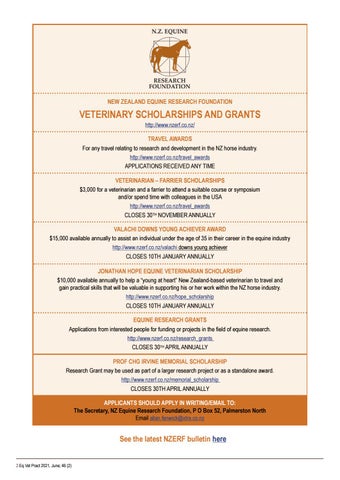
NEW ZEALAND EQUINE RESEARCH FOUNDATION
VETERINARY SCHOLARSHIPS AND GRANTS http://www.nzerf.co.nz/
TRAVEL AWARDS For any travel relating to research and development in the NZ horse industry. http://www.nzerf.co.nz/travel_awards APPLICATIONS RECEIVED ANY TIME VETERINARIAN – FARRIER SCHOLARSHIPS $3,000 for a veterinarian and a farrier to attend a suitable course or symposium and/or spend time with colleagues in the USA http://www.nzerf.co.nz/travel_awards CLOSES 30TH NOVEMBER ANNUALLY VALACHI DOWNS YOUNG ACHIEVER AWARD $15,000 available annually to assist an individual under the age of 35 in their career in the equine industry http://www.nzerf.co.nz/valachi downs young achiever CLOSES 10TH JANUARY ANNUALLY JONATHAN HOPE EQUINE VETERINARIAN SCHOLARSHIP $10,000 available annually to help a “young at heart” New Zealand-based veterinarian to travel and gain practical skills that will be valuable in supporting his or her work within the NZ horse industry. http://www.nzerf.co.nz/hope_scholarship CLOSES 10TH JANUARY ANNUALLY EQUINE RESEARCH GRANTS Applications from interested people for funding or projects in the field of equine research. http://www.nzerf.co.nz/research_grants CLOSES 30TH APRIL ANNUALLY PROF CHG IRVINE MEMORIAL SCHOLARSHIP Research Grant may be used as part of a larger research project or as a standalone award. http://www.nzerf.co.nz/memorial_scholarship CLOSES 30TH APRIL ANNUALLY APPLICANTS SHOULD APPLY IN WRITING/EMAIL TO: The Secretary, NZ Equine Research Foundation, P O Box 52, Palmerston North Email allan.fenwick@xtra.co.nz
See the latest NZERF bulletin here 2 Eq Vet Pract 2021, June; 46 (2)
NZEVA PRESIDENT’S REPORT - JUNE 2021 Andrea Ritmeester, NZEVA President nzevapresident@gmail.com
MY FINAL PRESIDENT’S REPORT! When I agreed to take on the role of NZEVA president after Neil Houston he told me that as long as we didn’t have an Equine Influenza incursion during my time as President it should be smooth sailing. Well, we didn’t have an outbreak of EI but I feel we’ve had pretty much everything else! Much of my first year was spent in consultation with MPI regarding the new Animal Welfare Act regulations, which have just come into force. After that COVID-19 arrived on the scene and much work was done alongside NZVA to establish vets as an essential service and to draft guidelines allowing us to continue to practice while preventing the spread of COVID-19 in the community. Just as we were coming out of lock-down the Theileria equi-positive result threw our equine export market into a tailspin, and throughout all this the NZVA has undergone a major restructure profoundly affecting they way the SIBs are funded and run. So much for smooth sailing! I certainly couldn’t have done it without the support of my fellow executive committee members, especially Secretary Alex Leander, Treasurer Roisin McQuillan and CE Liaison Alanna Zantingh. I also want to thank Ivan Bridge and the Equine Health Association which did a huge amount of work to successfully resolve the Theileria equi issue. As I prepare to step down, I am confident that the NZEVA is in good hands with President-elect Brendon Bell taking the reins at the AGM on June 24th. It has been a pleasure and a privilege to serve the Association, and I have very much enjoyed the challenges and new perspectives on our profession that this opportunity has provided me with.
LACK OF EQUINE VETS IN RURAL NZ It has become of increasing concern that there are parts of New Zealand where there are few or no dedicated equine veterinarians and some local mixed practices are refusing to treat horses. This is putting significant pressure on the few veterinarians who are willing to see horses and also creates a big issue for horse owners when they need a vet in an emergency situation. In order to make horse owners more aware of this predicament the NZ Equine Veterinary Association has written a short article to be published in ShowCircuit and the NZ Horse and Pony magazines outlining a checklist of things horse owners should consider before they have an equine emergency. It encourages them to develop
a professional-client relationship with a local veterinary clinic for routine work even if they use an out-of-area equine referral clinic for their higher end problems. In the case of an emergency in areas of the country where there are no local veterinarians confident in equine work available, horse owners are advised to contact a local non-equine veterinarian for assistance. If a veterinarian who is not familiar with horses is asked to attend an equine emergency they are being encouraged to consult with an equine referral clinic by phone so that the equine veterinarian on duty can walk them through assessment and treatment options. The NZ Equine Veterinary Association strongly encourages all rural mixedanimal veterinarians that service equine clients to develop a working relationship with one of the equine referral clinics.
2021 CONFERENCE NZ is probably the only country in the world able to hold an actual face-to-face conference right now, and I hope you are all planning to attend the 2021 NZEVA Conference at the Wigram Air Force Museum in Christchurch from Wednesday 23rd to Friday 25th June. Our primary presenter, Katharyn Mitchell, is an excellent speaker with a real focus on the practical aspects of her topics. Her lectures include fever of unknown origin, equine cardiology, fluid therapy in the field for foals and adults, and assessment of colic. After graduating from Massey University in 2003, Katharyn completed internships in equine medicine and surgery at the University of Sydney in 2003 and at the University of Melbourne in 2004-2005. She spent several years in private practice before completing a residency in large animal internal medicine at Cornell University, USA, and becoming a Diplomate of the American College of Veterinary Internal Medicine (Large Animals) in 2010. In April 2013, Katharyn started a PhD in equine cardiovascular medicine at the University of Zurich in Switzerland, which she successfully defended in 2018. Kathryn is currently in New Zealand, working as a locum and as a consultant specialist in large animal internal medicine and cardiology. Now that the travel bubble with Australia is in place, we can also confirm our second speaker, Ben Sykes from the University of Queensland, and Massey Equine. Ben graduated from Murdoch University in 1997 and completed an internship at Randwick Equine Centre in 1998, followed by
Eq Vet Pract 2021 June; 46 (2) 3
a residency in Equine Internal Medicine in Virginia, USA, and gaining his Diplomate Registration in Equine Internal Medicine in 2004. He then spent seven years in Finland as Head of the Veterinary Department of Equine Medicine and Surgery. Ben has a special interest in equine gastric ulcers and will be speaking on gastric ulcers in horses and foals, gut health, and parasitology. Thursday 24th June will also see the return of the ever-popular short How-to Sessions in a separate stream alongside the main room. This will include a diverse range of topics from “How to perform a thoracic ultrasound with a rectal probe” to “How to diagnose pregnancy in a mini”. Friday 25th June will feature the VetPD Lectures on equine sports medicine and rehabilitation, with speakers Kylie Huxford and Alex Jorgenson, followed by the VetPD Workshop at Canterbury Equine Clinic on Saturday 26th June, 2021.
Sam Hazeldine, Young Entrepreneur of the Year and founder/managing director of Australasia’s largest medical recruitment company MedRecruit, will be the plenary speaker. Sam is a world leader and advocate for doctor wellbeing and has created the wellbeing organisation MedWorld to assist doctors to live better lives. Sam is known to be an excellent speaker who weaves education with entertainment to engage audiences and drive positive change. The NZEVA Awards Dinner will be held on Thursday 24th June, at The George, 50 Park Terrace, Christchurch. We are very grateful to Randlab for their continuing sponsorship of this event. We will be announcing the winners of the Massey University Best Young Practitioner Presentation, the Jonathan Hope Prize for Best Publication, and, of course, the Brian Goulden Award for outstanding NZ equine veterinarian. As always this should be an excellent night, with great food and live music, and we hope to see you all there!
AGM The NZEVA AGM will be held on Thursday 24th June at the congress in Christchurch. Copies of the 2020 NZEVA financials and subcommittee reports are included in this issue of EVP, and an agenda was sent out at the end of May. With the now much more familiar modality of ZOOM we have successfully restructured the NZEVA executive away from the historic rotating region-based executive to a more standard national executive with regional representatives ranging from South Auckland to Invercargill. In order to complete this restructuring process the committee needs to replace another four committee members at this year’s AGM. Anyone interested in being on the NZEVA executive committee can contact me directly or contact the secretary at nzevasecretary@gmail.com.
EQUINE CPD WORKSHOPS The NZEVA dentistry subcommittee is re-running the Entrylevel Equine Dentistry Course featuring online notes/lecture material and a two-day practical workshop in Burnham in July/ August 2021. The Equine Wound Management Course is also being re-run, with online notes/lecture material and a 1-day practical workshop at Ruakura in June/July 2021. Please keep an eye on the NZVA website and VetLearn publication for further details on these two courses. I look forward to seeing you all at the NZEVA conference and the AGM in June. Please feel free to contact me regarding any matters pertaining to the NZEVA or its members. Kind regards, Andrea Ritmeester nzevapresident@gmail.com
Delarocque J et al. Metabolic profile distinguishes laminitis-susceptible and -resistant ponies before and after feeding a high sugar diet. BMC Vet Res. 2021; 17: 56. https://doi.org/10.1186/s12917-021-02763-7 Samples from 10 pre-laminitic (PL; subsequently developed laminitis) and 10 non-laminitic (NL; did not develop laminitis) ponies were used. Significant changes in the concentration of six glycerophospholipids (p ≤ 0.024) and a global enrichment of the glucose-alanine cycle (p ≤ 0.048) were found to characterise the response of PL ponies to the high-sugar diet. In contrast, the metabolites showed no significant association with the presence or absence of pituitary pars intermedia dysfunction in all ponies. The results suggest that ID and laminitis risk are associated with alterations in the glycerophospholipid and glucose metabolism, which may help explain some molecular processes associated with these conditions.
4 Eq Vet Pract 2021, June; 46 (2)
NZEVA CONTINUING EDUCATION SUBCOMMITTEE REPORT – 2021 Lotte Cantley – Convenor
All face-to-face continuing education ground to a rapid halt in 2020 due to COVID-19 but things are looking positive for equine CPD in 2021. I feel great optimism and enthusiasm as we approach the NZEVA conference in June, along with other face-to-face equine CPD later in the year.
The 2021 NZEVA conference (23-25 June) is combining with the Equine Nurses, Sheep and Beef and Veterinary Business streams at a stylish modern venue, the Wigram Airforce Museum, in Christchurch. The program includes equine medicine specialist Kath Mitchell, who is heading to a new position as Assistant Professor at Cornell University. Kath, who has a PhD in equine cardiology, will be sharing pearls of wisdom on cardiology, medical emergencies, and critical care. Ben Sykes, equine medicine specialist and Associate Professor at Massey, will be presenting on gastric ulceration, gut health, and parasitology. There will of course be the popular practitioner presentations and the fun, informative Gouldie Hour hosted by Joe Mayhew. The second day features an interesting plenary session by medical doctor, Sam Hazledine, who will be looking at comparing retention and resilience of staff within the medical profession to those issues in the veterinary profession. And the popular “How to” sessions for recent grads and mixed practitioners will also feature. The second day concludes with the convivial NZEVA dinner. The Vet PD equine sports medicine lectures from specialists Emmanuelle Van Erk , Kylie Huxford and Alec Jorgenson are on the last day of conference and precede the hands on VetPD workshop at Canterbury Equine Clinic on Saturday 26th June. It will be great to be back together again after so much time apart. I look forward to seeing you in Christchurch for a boogie on the dance floor!
Other upcoming equine CPD includes the Equine Wound Course that is a combination of online lectures and a oneday hands on workshop (29th July) at Ag Research, Ruakura (Hamilton) tutored by several NZ equine surgery specialists. This course is aimed at any vet who wants to improve their equine wound management skills and knowledge. The equine dentistry subcommittee is working hard to offer an updated Level-1 Equine Dentistry Course with online presentations and to include a new-style, 2-day workshop at Selwyn equestrian center, Christchurch (13th-14th August). Day one is a cadaver-based training day and day two will enable the delegates to put their new examination and floating skills into practice on live horses with the guidance and supervision of the experienced tutors. The aim is to upskill and enthuse veterinarians to embrace equine dentistry to a higher level, adding value and high welfare standards for their clients, patients, and vet practices. The regional branches have been and are busy with some excellent equine focused evenings. Kath Mitchel gave an excellent presentation on equine Cardiology and ECGs at the Waikato and Wairarapa regional branches at the end of 2020. Jason Lowe gave an excellent, engaging presentation on equine osteoarthritis with evidence-based research on Arthramid® as a treatment option, at the Waikato regional branch and Auckland equine vets in mid-April. Southland regional branch has a great line up of four equine speakers: Brendon Bell, Grace Reed, Michelle Logan, and Heather Busby for an equine evening on 6th August. Otago regional Branch has an equine emergencies evening with Brendon Bell on 12th August and Auckland regional branch is planning Physiotherapy talk that will focus on both Equine and CA. So, 2021 is buzzing with a variety excellent face-to-face and online equine continuing education which a great positive step for the NZ equine profession.
FREE BEVA MICROSITE As NZEVA members you have free access to the new BEVA microsite. Through this site you can LISTEN, WATCH, VIEW and READ all accessible videos, infographics, podcasts, and EVJ Virtual Issues and Highlighted Papers. The site is refreshed monthly. Your NZEVA Executive may be able to arrange for reduced rates for International Full BEVA membership – keep watching.
Eq Vet Pract 2021 June; 46 (2) 5
Espinosa‐Mur P et al. Radiological prevalence of osteoarthritis of the cervical region in 104 performing Warmblood jumpers. Equine Vet J. 2020; 00: 1– 7. https://doi.org/10.1111/evj.13383 The presence of radiographic osteoarthritis of the cervical articular process joints was evaluated and graded as absent, mild or moderate to severe by three board‐certified radiologists in 104 Warmblood jumpers free of lameness or neurological disorders [median age, 10 years; range 6‐18 years]. Agreement between radiologists varied from fair to substantial (Kappa‐weighted 0.37‐0.61). The C6‐C7 joint was most affected by osteoarthritis with only 33% joints considered free of radiographic abnormalities at this location versus 61% at C5‐C6, 82% at C4‐C5 and 85% at C3‐C4. Horses competing in higher level classes had significantly higher osteoarthritis grades at C6‐C7 (p = 0.013). There was no association between current age, age when started jumping, neck pain and neck range of motion with the presence of OA on radiographs. This study showed that osteoarthritis of the caudal cervical region is not rare in performing sound Warmblood jumpers. This suggests that OA in the caudal cervical region may be of low clinical significance.
Nankervis K et al. Consensus for the General Use of Equine Water Treadmills for Healthy Horses. Animals 2021, 11, 305. https://www.mdpi.com/2076-2615/11/2/305/htm In 2019, a group of researchers and experienced water treadmill users met in the UK to establish what was commonly considered to be best practice in the use of the modality. The result of these discussions was the production of Water treadmill guidelines-a guide for users, released in 2020 via various equestrian websites. This article describes the development of these guidelines and proposes them as a starting point for further collaboration between researchers and practitioners in the pursuit of ‘best practice’ in water treadmill exercise for horses.
Story MR et al. Equine Cervical Pain and Dysfunction: Pathology, Diagnosis and Treatment. Animals 2021, 11(2), 422; https://doi.org/10.3390/ani11020422 ED NOTE: This topical online review covers many clinically important aspects of neck pain in horses for equine vets. Unfortunately, even with clever advanced imaging we still have considerable trouble being certain that the clinical syndrome under investigation is due to any particular abnormality detected ; viz. Espinosa–Mur P et al. Radiological prevalence of osteoarthritis of the cervical region in 104 performing Warmblood jumpers. Equine Vet J. 2020; 00: 1– 7. https://doi.org/10.1111/evj.13383.
YOUR CHANCE TO WIN $150.00! All you must do is write a clinical report that is published in the EVP, and your contribution may be eligible for one of several prizes of $150.00 that the EVP has available each year. The EVP Editorial Group wish to promote the sharing of your interesting cases and practice tips with the wider equine veterinary community, so please contribute. Every case, technique, test and interpretation are different, no matter how experienced we are or how routine the case is, so there is always something for us to learn from each other.
6 Eq Vet Pract 2021, June; 46 (2)
Take photos, dig out your diaries, get keyboard tapping and share your views with colleagues. You could be $150.00 richer for it!
Please send your clinical reports to the EVP Editor for consideration. Joe is happy chat with you about any articles or ideas you might have. Please contact Joe at
evp.editor@gmail.com or on 027 437 3651.
NZEVA DENTISTRY SUBCOMMITTEE REPORT – 2021 Katie Kindleysides & Glenn Beeman – Co-convenors
In a fast changing world with many struggles over the past year it has, in contrast, been a steadier year for the dental sub-committee as we await the introduction of the significant surgical procedures (SSP) definition into the Animal Welfare Act and accompanying regulations which classify equine dental extractions as SSP, but by regulation allow for a competent non-vet to extract wolf teeth under veterinary-administered analgesia. To support veterinarians with requests to assist non-veterinarians, NZVA recently initiated a consultation process on their new Standard and Member Technical Notes (MTN) on working with competent non-veterinarians. The dental sub-committee will be working alongside NZVA on the upcoming Equine Dentistry MTN for specific guidance in this area, where we anticipate many requests from lay equine dental technicians will come [see NZVA Equine Dental Technician supervision position statement].
this with the NZVA VetLearn team opting to re-run the online portion of the Equine Dentistry Level-1 Course at a hugely discounted price which attracted many delegates. There was ample active engagement by participants who we thank for your enthusiasm and contributions. In addition although the WAVC could not be held in Auckland, the Webinar Vet did a fantastic job of providing an online conference that still gave NZ vets access to Dr Chris Pearce’s interesting and informative presentations on Equine Dentistry. Looking forward, we will be repeating the Equine Dentistry Level-1 Course in July and are pleased to announce an accompanying Two-day Practical Dental Workshop accompanying this in mid August in Canterbury. This is a more extensive course than has been offered over the last several years with separate cadaver and live horse days where delegates will get the opportunity to hone their examination and floating skills in real life situations.
During late 2020 the dental sub-committee was asked to work alongside NZVA in providing feedback on the Primary Industry Training Organisation [ITO] Equine Dental Technician Level-6 Diploma Course scope as part of the ongoing process through the Allied Veterinary Professional Regulatory Council of New Zealand [AVPRC] to provide a regulated equine dentistry industry in New Zealand. Opinions were sought from the wider equine veterinary industry as part of this process and we thank all who contributed. The scope has been approved with an understanding veterinarians with post-graduate equine dental training must remain a key part of any education programme.
Finally, we wish to thank Ray Lenaghan for his many years of serving on the Equine Dentistry Sub-committee during which he committed many hours to drive improvements in equine dental knowledge across the veterinary community and initiate changes to improve equine dental welfare. Despite stepping away from the sub-committee he remains active in equine dental education and clinical support. With decreasing numbers on the sub-committee and increasing numbers of equine veterinarians holding interests in dentistry, the sub welcomes feedback from NZVA members how we can best support and engage with this growing community and work together to improve equine veterinary dental service provision in New Zealand. We will be asking for direct feedback on our Veterinary Equine Dental Group Facebook Forum later this year or can be contacted direct via the co-convenors above.
A passion of the dentistry sub-committee remains to continue our efforts to educate the equine veterinary profession in New Zealand. Lockdown provided some great opportunities for
FREE WEBINARS & BULLETINS The Beaufort Cottage Educational Trust is a small charity that aims to support educational projects and events for all those involved in the care of horses and disseminate knowledge of the best veterinary and management practices and thereby enhance horse welfare. The BCET makes available many educational resources on a wide selection of topics including the following:
• Gastrointestinal Disease in Foals • Herpes Virus • Foal Injuries and Diseases
• Imaging the Neck and Back
• Radiography at the Sales
• Fractured Ribs
• Juvenile Orthopaedic Disease
• Pelvic Ultrasonography
• Proximal Suspensory Desmitis
• Wobbler Surgery
• Suspensory Branch Injury
• Recurrent Laryngeal Neuropathy
• Third Phalangeal Cysts
• URT Function in the Young TB For Sale
Eq Vet Pract 2021 June; 46 (2) 7
NZEVA ENDOSCOPY SUBCOMMITTEE REPORT – 2021 Ivan Bridge – Convenor
COVID-19 did not significantly impact the success of either the November Ready to Run nor the February National Yearling Sales. However one bonus was that in the fourth year of videoendoscopes being available in the repository it did mean that their submission to the repository was now essential to enable the normally-present Australian veterinarians (representing significant purchasers), to view and review the resulting videos. We have come a long way over the last four years in breaking down the strong reluctance of vendor participation to this initiative.
accepted this recommendation positively, but unfortunately the initiative became a victim of Covid-19 with resources being required elsewhere for setting up on-line sales platforms etc. The November RTR sale represented the first time that horses had been on the sale grounds since the summer sales and, as mentioned earlier, this also was no sure thing and its occurrence went right to the line. At the summer sales NZB Director and Operations Manager James Jennings gave an undertaking that the initiative would be progressed. Long serving former NZ veterinarian but now Victoria based endoscopy panelist Dr Ian Douglas was a notable absentee from the summer sales. Covid-19 was of course responsible as Ian was surprisingly reluctant to spend two weeks in solitary confinement so that he could enjoy the company of his NZ colleagues! On a more serious note Ian’s sound experience and his ability to provide second opinion to any vendor without prejudicing client conflict was certainly missed.
Perhaps more by good luck than good management Auckland narrowly missed being thrust back into Level 3 lockdown after community cases were discovered in the week leading up to the RTR sale. This of course would have been devastating for all concerned. I reported last year that there had been agreement by the endoscopy panel for an approach to be made to NZ Bloodstock for the provision of a series of endoscopy rooms to be provided across the sales grounds. The recommendation was these would have appropriate restraining crushes and would be available for pre- and post-sale endoscopy. The sales company Video-endoscopy
Sale
READY TO RUN Nov 2020 BOOK 1
YEARLINGS Jan 2021
One RTR horse and three yearlings failed to meet the conditions of sale as per clause 3.6 in the Sale Catalogue, [see Table below].
Examined
Failed
3
1
27
3
Notes
• One left-sided arytenoid chondritis • One left-sided arytenoid chondritis· • One enlargement of both arytenoid cartilages and ulcer on tip of epiglottis with exposed cartilage • One Grade-4 left laryngeal hemiplegia
BOOK 2
8
0
FULL PROCEEDINGS AVAILABLE ONLINE British Equine Veterinary Association – Annual Congress Birmingham, Sept 11, 2019 Register through IVIS at https://www.ivis.org/ Or go direct to proceedings HERE
8 Eq Vet Pract 2021, June; 46 (2)
NZEVA EQUINE VETERINARY PRACTITIONER EDITORIAL GROUP REPORT – 2021 Erica Gee – Convenor
The Equine Veterinary Practitioner (EVP) expertly led by our editor, Joe Mayhew continues to go from strength to strength as the official publication of the New Zealand Equine Veterinary Association. Each of the four annual issues brings a broad range of articles and commentaries that should appeal across the breadth of our membership. Commissioned articles, made possible by most generous funding received from our colleague Jonathan Hope, are well appreciated by readers. We also publish a broad range of articles including case reports, laboratory accession diagnoses and practice tips that are of topical interest to readers, and we encourage more submissions and ideas from practitioners. The EVP Editorial Group is an enthusiastic mixture of veterinarians from around New Zealand, who meet via ZOOM at least four times yearly. The Editorial Group help support the editor, especially in ideas and contributions for articles in future issues. Editorial Group members give their time freely, and their engagement and generation of ideas is massively appreciated. We thank our Secretary Lucy Russell for her
excellent minute taking - not always an easy task in ZOOM meetings. And Rabecca McKenzie has set up an excellent private EVP Facebook Group to discuss cases and to promote specific EVP issues. The EVP is available online [March issue HERE] through the NZVA (and via SciQuest), and currently no members have chosen to pay extra for a hard copy. Readers can click many hyperlinks in the EVP and be taken directly to resources referred to in the EVP articles. Tony Leggett of NZ Farm Life Media has taken over the advertising role from Lucy Holdaway, and we are so very appreciative of her superb efforts in securing and keeping our advertisers happy over the years. We are grateful that Lucy will continue to contribute to the EVP through her role in the Editorial Group. We look forward to delivering more relevant, topical, and thought-provoking articles and commentaries for our members in 2022. Remember, we highly value contributions and ideas for the EVP from our readers, so please keep in contact.
BRIAN GOULDEN AWARD NZ EQUINE VETERINARY ASSOCIATION
The Brian Goulden Perpetual Trophy will be awarded annually and presented at the Annual Dinner of the NZEVA conference. This annual prestigious prize is awarded to members or past members of the NZEVA who have shown leadership, enterprise, contribution to knowledge or education, and have made significant contributions to the equine veterinary profession in New Zealand. Please send your nominations including name, address and qualifications, together with any supporting information for the nominee, whom the nominator considers merits the award. This can include curriculum vitae, letters of support and documentation of achievements etc. Send all details AT ANY TIME to: nzevasecretary@gmail.com Andrea Ritmeester, NZEVA President Elect, nzevapresident@gmail.com
Eq Vet Pract 2021 June; 46 (2) 9
ONLINE & WORKSHOP
Managing equine wounds in practice Minimise complications and maximise outcomes when treating equine wounds ALL VETERINARIANS Horses are masters of injuring themselves and managing their wounds can be difficult even for the most experienced practitioner. This course will bring you up to date with current best practice and give you the confidence to use the correct techniques and materials in everyday situations to significantly improve wound outcomes in your patients. Suited to recent graduates as well as experienced mixed and equine practitioners, this online course and hands-on practical workshop will increase your confidence in practical wound management and the use of simple surgical techniques to improve healing. You’ll learn when to use different dressings, topical wound care techniques and become familiar with the use of splints and casts. Additionally, you will increase your confidence in recognising and dealing with complications and hard to heal wounds. Be prepared next time you see an equine wound with this comprehensive course!
DATES Online: 28 June - 25 July 2021 Workshop: 29 July 2021, Ruakura Research Centre, Hamilton
TUTORS Greg Quinn BVSc Cert ES Dip ECVS Registered Specialist in Equine Surgery Lacy Kamm DVM MS Diplomate ACVS Registered Specialist in Equine Surgery Alanna Zantingh DVM DACVS Registered Specialist in Equine Surgery Barbara Hunter DVM MS MANZCVS DACVS-LA Registered Specialist in Equine Surgery
PRICE Full course: Member - $1100 | Non-member - $2200 Online only: Member - $500 | Non-member - $1000 Prices are in NZD and include 15% GST.
CPD POINTS Up to 17 CPD activity hours.
Register at nzva.org.nz/professionals/edhub/equine For more educational resources and courses visit www.nzva.org.nz/professionals/edhub
NZEVA INSURANCE SUBCOMMITTEE REPORT – 2021 Brendon Bell – Convenor
The VPIS faces a challenge in the form of legislation on how insurers work. The reserve bank through new legislation governs how all insurance companies must operate. Currently the VPIS falls into the ‘small insurer category’. Unfortunately, as NZ veterinary practices grow their insurance liability requirements grow as well. This growth will soon force the VPIS into the ‘large insurer’ category and with this comes significantly more compliance that must be satisfied. VPIS is currently working through how to operate in this new environment. The VPIS has seen a lower number of equine claims in the 2020/2021 insurance year with so far just six. However, equine claims continue to make up most of the costs incurred both for legal help and settlement costs. While equine claims are small in number, they are large in value. A concerning trend has been for unsatisfied owners to make VCNZ claims but to date none have gone this far for 2021. It has been pleasing that
the VCNZ have had fruitful discussions with VPIS to manage such cases. The VPIS has a slot at the upcoming NZEVA June Conference to discuss cases of note in the last two years. With Covid-19 causing cancellation of WEVAC conference last year we were prevented from presentation of this material at NZEVA Conference 2020. Last year the VPIS trialled a renewal system for Pre-Purchase Examination [PPE] certification with VPIS cover that was online instead of via a roadshow as done previously. This was well received with overwhelming positive feedback, so this online PPE renewal will be used again. Each year topical cases will be discussed in a forum online. PPE-certified vets up for renewal can use this tutorial discussion to answer a tutorial questionnaire online. However, vets newly applying for PPE cover for the first time must continue to attend a roadshow.
The HORSE - Podcasts Click on The HORSE – Podcast website HERE and listen to many 20-60 minute audio talks from The Horse. You may need to LOGIN/SIGNUP. You can go to a selection of these topics directly by Ctrl+Clicking on the following:
• Older Horses. Amanda Adams • Racetrack Surfaces. Mick Peterson • Bits, Bridles, and Equine Welfare. Hilary M. Clayton • Mare Reproductive Cycles and Anxiety. Jenny Beard Biehunko • Calming Horses: Education and Options. Camie Heleski • The Best Forage for Insulin Resistant Horses. Stephen Duren • African Horse Sickness. Peter Timoney
• Vitamin E: Carrie Finno • What Does Vitamin Deficiency in Horses Look Like? • Why Do Horses Need Vitamin • Vitamin E and Selenium: What’s the Relationship? • Which is Better: Skin or Blood Test for Equine Allergies? Susan White & Ann Rashmir • Mowing Horse Pastures to Keep Them Healthy. Krishona Martinson • Old Gray Horses and Melanomas. Bryan Waldridge • Basic Anatomy of the Equine Neck and Back. Kevin Haussler
Eq Vet Pract 2021 June; 46 (2) 11
NZEVA MEDICATION SUBCOMMITTEE REPORT – 2021 Andrew Grierson – Convenor
The 2021 racing calendar year ends 31st July 2021 and with the disruption to racing with COVID-19 the number of recorded positives medication breeches in both codes is down from the average of eighteen positives each year. The usual VAC meeting of analysts and veterinarians, held in either Melbourne or Sydney each year and which I normally attend, was restricted to a ZOOM meeting. Welfare along with managing the injury rate in racehorses are topics on the agenda each year. This time the risks and merits of intraarticular corticosteroid injections was tabled. A longitudinal study conducted by Smith et al. (2018)1 in Newmarket looked at 1488 horses over a five year period from 2006 to 2011. They reported a 3% serious injury rate within 56 days of intraarticular injection and an overall 1.2% fatality rate. Those horses having three or more injections had significantly higher injuries compared to those with less than three drug injections. What was disappointing was only 7.3% of those seriously injured had targeted imaging of the subsequent injury site. The authors concluded the serious injury rate could have been altered by more diagnostic imaging prior to medication. The take home message is - complete the diagnosis and make a true assessment of risk before any intra-articular injections are given.
The NZEVA Prohibited Substance Recommended Withholding Times List may not cover all medications which could be used on race horses. A lot of herbal treatments are not on our list because of the lack of information on the pharmacokinetics of the ingredients in horses. In some cases, human preparations may have detection times established in horses but not all these are on our list. If you require assistance then email me on agcaledonian@gmail.com and I’ll endeavour to answer your query. Don’t assume that another country’s WHT list or the FEI List will be the same as testing for medications in NZ racehorses. Lastly, a friendly reminder that if you get caught knowingly treating a race horse in contravention of the NZEVA Prohibited Substance Recommended Withholding Times List potential penalties include both forfeiting VPIS insurance cover and being taken to task by the NZ Vet Council. It is simply not worth the risk. Smith LCR, Wylie CE, Palmer L, Ramzan PHL. A longitudinal study of fractures in 1488 Thoroughbred racehorses receiving intrasynovial medication: 2006-2011. Eq Vet J. 2018; 50(6): 774-780. https://pubmed.ncbi.nlm.nih.gov/29575177/ 1
Full service primary care, referral and emergency facility Providing outstanding field and hospital care for your horse A dedicated team, including two board-certified surgeons and a board-certified medicine internist. We aim to provide you and your clients with the best possible care and advice for their horses. Offering routine and emergency surgical procedures and internal medicine, including:
12 Sim Road, Karaka PO Box 135 Drury, Auckland Ph: 09 294 7307 Email: vets@vetassociates.co.nz
VA820
• Surgery: Orthopaedics, Soft tissue, Colic, Dystocia, Arthroscopy, Laparoscopy, Laser • Critical care and internal medicine: Intensive care, In house laboratory, Digital US, Echocardiography • Regenerative therapies: Stem cell, IRAP, PRP • Performance: Lameness examinations, Video and dynamic airway endoscopy • Reproductive services: Dystocia, AI, Problem mares, Embryo Transfer and Vitrification • Dentistry: Routine, Extractions, Surgery • Veterinary acupuncture • Prepurchase examinations: Sporthorse, Racehorse, Hong Kong
www.vetassociates.co.nz VA820.indd 1
12 Eq Vet Pract 2021, June; 46 (2)
29/07/20 2:48 PM
NZEVA EQUINE HEALTH ASSOCIATION REPRESENTATIVE REPORT – 2021 Ivan Bridge – Chairman EHA
The past year began with a rush almost immediately after concluding my 2020 report. The confirmation of Theileria equi (T. equi) in the country was our first experience of a disease response in partnership with MPI under the Government Industry Agreement (GIA) we signed in 2015. To recap, when a group of mares were booked to travel to Australia to be bred, the Australian Quarantine and Inspection Service (AQIS) noticed that one of the group, although resident in NZ for over a year after importation from France via England, had not fulfilled the requirements of the Australian Import Health Standard (IHS) for Piroplasmosis (negative Elisa & IFAT on the same blood) although she had satisfied NZ’s IHS (negative Elisa). The consequence was that the required testing to satisfy AQIS produced a positive ELISA & IFAT showing the mare had been infected with T. equi. A positive PCR test confirmed the presence of the organism in the mare. The relatively open travel to Australia for horses was immediately closed. At the first joint Governance meeting it was established that a response was required which immediately had industry (EHA) responsible for not only 50% of the decision-making but also 50% of the associated costs minus a 20% transitional discount as a result of our early signing of the GIA deed. The immediate response activity was to ascertain if the disease had spread, while MPI market access worked to regain a means of access for horses to travel to Australia and other countries. This was an urgent priority as there were several mares to be flown to Australia before foaling and subsequent service. Pregnant mares can, for welfare reasons, only travel up to 300 days in foal and for early-bred mares the final travel date was fast approaching. Adding to the perfect storm Covid-19 meant access to aircraft space was very difficult. The DHL 767 was now the only aircraft available as other airlines normally used would not allow grooms to travel. The DHL daily service would now only take horses on a Friday charter with very limited space also unreliably available on Saturday and Sunday. After much negotiation with Australia, transport was able to recommence with the requirement for all exported horses to have negative ELISA & IFAT blood test results on the same sample. This increased testing came at significant financial and time cost. The cost per test adds approximately $1,000.00 to the travel cost and as the IFAT is only available in Perth or Japan this adds three weeks to the usual export process.
We are grateful to Cambridge Stud whose impeccable records allowed MPI lead Veterinary Disease Investigator Andrew McFadden to quickly establish the risk profile of all horses on the stud’s properties. It was with some relief that we relatively quickly established after testing that none of the in contact “high risk” group showed any evidence of exposure to the disease. In the ensuing months all horses from the stud’s properties and those that had been on the properties for even a short time were traced and tested. Although it was always considered unlikely any of these would show exposure to the disease, this was however considered a necessary requirement for NZ to present to the OIE (World Animal Health Organisation) and more importantly our major trading partner and neighbour, Australia, of our re-established T. equi disease free status. Tracing all the contact horses was a major logistic exercise and I would like to express thanks to NZTR and the many equine practitioners who willingly assisted. I also must acknowledge the transport company (IRT) who, in very difficult circumstances, pulled the proverbial rabbit out of the hat in managing to devise an intricate transport arrangement that saw the mare at the centre of the incursion successfully relocated back to France before she reached 300 days of pregnancy. It was with much relief that I watched from across the Manukau Harbour as the aircraft ascended into the air and then distance itself from the country! The pleasing sequel is that the mare has since foaled successfully, and the foal has tested negative to T. equi. We were very fortunate that the two major transport companies had as an internal policy carried out testing to satisfy the Australian IHS on every other horse that entered the country over the last two years and made those records available. This saved the tracing of many horses and many thousands of in-contacts. The self-declaration of freedom from T. equi disease was presented to the OIE late last year and has been accepted. Frustratingly Australia is not rushing to accept our declaration and OIE acceptance of country freedom and therefore relax testing requirements. Negotiations between the two Government agencies continue. The equine industries’ direct costs of the incursion and the response have been well contained due to the considerable input from industry and the previously noted contribution
Eq Vet Pract 2021 June; 46 (2) 13
model. However, the indirect increased costs of travel has seen the industry absorb up to NZ$1M, and this continues until the free border is re-opened.
GHJ in this EVP describing the vaccine use and obligations and I refer potential users of the vaccine to that reference for more information.
I have previously noted that the establishment of an efficient levy collection system had become a priority initiative for the EHA. The underwrite provided by the NZ Racing Board to satisfy the funding requirement and allow the signing of the GIA in 2015 is no longer appropriate with the restructure and passing of the Racing Act. I have also mentioned that a levy would provide a buffer and a means to pay the share of readiness activities and repay the share of any Government loans required arising from exotic disease responses. Little did we know that only a few months later this was to become not a potential risk but a reality. The levy has been based around the import and export of horses and equine germplasm. This was considered equitable as obviously imports create the risk and ease of export is created by the efficiency of our biosecurity.
The NZEHA is both the registrant and the distributor of the vaccine. The vaccine is stored in Andrew Grierson’s Takanini Biovax facility and the EHA have invested in a special computer-monitored, medical refrigerator to store it.
The application for a levy order was submitted to the MPI after the required consultation with our industry partners. This was approved since my last report, but cooperation with the relevant section of MPI for collection of the border data information was proving to be an issue. This had the effect of turning a very simple system into a complex bureaucratic nightmare. Early in the piroplasmosis incursion our discussions with the biosecurity response arm of MPI noted the restriction on industry to provide their share of funding to the response. The desired, but until then reluctant, cooperation from the animal imports/exports arm of MPI suddenly was not an issue. We are very grateful to Dr Tony Parsons (Equestrian Sport NZ representative to EHA) who volunteered to oversee and administrate the levy collection.
The registration change allowing the use of the genetically modified Equine Influenza (EI) vaccine Proteq-Flu™ as the vaccine of choice on horses being exported from NZ, where EI vaccination is required, has been a long protracted process taking a number of years to reach fruition. This process involved seeking Environmental Protection Agency (EPA) approval followed by a change to the ACVM regulatory usage and Operating Plan. I am delighted to report that we have finally not only fulfilled all these obligations but have also negotiated successfully with Boehringer-Ingelheim for the supply of the vaccine. A condition of the ACVM Operating Plan is that veterinarians using the vaccine must be conversant with their obligations under the plan. This includes ordering, storage, transport, disposal and accurate and auditable record keeping. See page
14 Eq Vet Pract 2021, June; 46 (2)
The EHA have put much effort into this initiative to allow supplies of the vaccine to be held in New Zealand so that the supply chain will be established and a reserve will be on hand if an EI incursion were ever to occur. The effectiveness of the vaccine in assisting in the control of an incursion, from epidemiologic studies the EHA have commissioned, is directly related to the speed in which vaccination can be implemented. This vaccine is the one of preference for several reasons including speed of onset of immunity and being able to differentiate infected from vaccinated horses (DIVA). This initiative has the full support of James Gilkerson, an internationally respected virologist, is Professor of Veterinary Microbiology and Director of the Centre for Equine Infectious Disease at Melbourne University, was a Past President of Australian Equine Veterinarians, and was very involved in an advisory capacity during the Australian EI incursion. I have noted previously that a database for the identification and traceability of our equine population is an essential biosecurity readiness project; our recent experience with T. equi certainly endorses this. Progress has been slow - mainly due to workload - but with this has now become a priority project and much energy is presently being directed towards implementing such a database. Requests for consultation over various equine related matters with MPI Welfare, Biosecurity, Imports, Exports and the National Animal Welfare Advisory Committee (NAWAC) are regularly received and actively responded to. The EHA has a very professional relationship with all these bodies. As I mentioned in my introduction this has been an active but fulfilling year for the EHA with a number projects gaining momentum or coming to fruition. The T. equi incursion did for a period become all-consuming and I am again very grateful to the support of our Executive Adviser Trish Pearce and the EHA members who joined Trish and I on GIA Governance.
Considerable input from the whole Committee led to the successful year and I believe industry partners are very fortunate to have such focused and dedicated individuals representing them.
NZEVA RACING LIAISON REPORT – 2021 Ivan Bridge
The 2020 versions of the biannual meetings between representatives of the Racing Integrity Unit (RIU), the three racing codes, the Racing Laboratory, Thoroughbred Trainers Association and the Equine Veterinary Association became victims of the disruptions created by the Covid 19 pandemic. The scheduled May meeting was to occur whilst we were all locked in prison, and later in the year as we yo-yoed in and out on parole, the impetus was lost. However, RIU Manager Michael Godber has recently called for and since confirmed a meeting date of all parties for early May 2021. As I have previously noted these are useful occasions for free and frank discussion between all parties. Martin Burns, NZ Thoroughbred Racing (NZTR) Manager for Welfare & Sustainability, convened a meeting in December 2020 that he referred to as the Thoroughbred Welfare Forum - December 2020. Representatives from all aspects of racing, equine interest and welfare were invited. These included EVA, EHA, ERF, NZTR Racing Integrity Unit, Jockeys’, Trainers’ and Breeders’ Associations, Harness Racing NZ, Equestrian Sports NZ, Racing Australia, Beyond The Barriers, and the welfare groups SPCA, MPI and National Animal Welfare Advisory Committee (NAWAC). This was a positive, worthwhile, and well-chaired forum with all groups with a common interest contributing to the general
theme. A second, virtual meeting to continue the momentum is scheduled to be held shortly. Thoroughbred racing has led the way in formally addressing issues raised by animal rights groups who keep pushing their ‘meatless and petless society’ agendas, and I commend them for this. There is no doubt that we are all concerned about the welfare of the animals we interact with and more specifically as a profession we must applaud these efforts in attending to the lifetime welfare of the horses involved in racing. I reported last year that the NZ Horse Ambulance Trust had commissioned five ambulances and towing vehicles across the country. This is an active Trust and has been very successful with fund raising for this worthy cause. They now have eight equine ambulances deployed across the country and are actively raising funds for two more units that will enable all race meetings and many equestrian events to be serviced with this specialised equipment. The 9th ambulance will likely be commissioned by August 2021 and the 10th prior to Christmas 2021. It has not all been plain sailing for the Trust. In November the Awapuni-based Central Districts ambulance was stolen and found abandoned a week later. Insurance funded the repairs and consequently all ambulances are now fitted with GPS location devices.
News From NEW ZEALAND EQUINE RESEARCH FOUNDATION – NZER The NZERF Spring 2020 Bulletin is now available: also via NZERF website at https://www.nzerf.co.nz/ Due to Covid-19 NZERF did not run their usual Rodmor Trust Lecture Series in 2020. Partly in response to this, NZERF are developing brief educational videos on equine topics of interest. Secretary NZREF, PO Box 52, Palmerston North allan.fenwick@xtra.co.nz
The first of these videos, presented by Paul Fraser, are on Strangles [available HERE] and on Laminitis [available HERE]
Eq Vet Pract 2021 June; 46 (2) 15
NEW ZEALAND EQUINE VETERINARY ASSOCIATION FINANCIAL RESULTS YEAR ENDING 31ST DECEMBER 2020 New Zealand Equine Veterinary Association Financial Results for the Financial Year ending 31st December
Statement of Financial Performance
STATEMENT OF FINANCIAL PERFORMANCE
2020
2019
Income Newsletter - Advertising Newsletter - Donations Newsletter - interest Sponsorship/Grants
26,653 650 632 8,659
37,959 0 1,926 12,383
Total Income
36,595
52,268
Less Cost of Sales Newsletter - Advertising Commissions Newsletter Editor Salary Newsletter General Expenses Newsletter Production Expenses - Printing, Postage etc
30,000 2,369 6,557
7,019 30,000 5,581 19,370
Total Cost of Sales
38,926
61,971
Gross Profit
(2,331)
(9,703)
Plus Other Income Conference Income Interest Income NZEVA Subscriptions
3,408 6,311 27,537
29,535 8,255 25,424
Total Other Income
37,257
63,215
Less Operating Expenses Accounting Fee - Administration Advertising and promotions Attendance Fees Bank Fees and charges Committee Expenses Computer Expenses Conference Expenses Continuing Education Donation Expense General Expenses Grants/Sponsorship/Projects Newsletter - Honorarium Prizes & Scholarship Special Topics Expenses Travel - Committee Travel Other
580 11,678 0 95 191 0 7,159 0 6,825 0 15,745 0 1,217 1,500 435 1,909
540 0 133 53 4,765 69 15,722 0 27,000 0 8,125 0 2,600 2,908 4,306 1,469
Total Operating Expenses
47,332
67,690
(12,406)
(14,178)
5,000 (650)
5,000 (741)
(8,056)
(9,919)
Operating Surplus / (Deficit) for the Year Non Operating Transactions Donations to JJ Hope Specific Reserves Expenses from, JJ Hope specific reserves Total Surplus (Deficit) for the year
16 Eq Vet Pract 2021, June; 46 (2)
New Zealand Equine Veterinary Association Financial Results for the Financial Year ending 31st December
STATEMENT OF MOVEMENTS IN EQUITY Statement of Movements in Equity
2020
2019
Accumulated Surpluses or Deficits Opening Balance Total Surplus (Deficit) for the year Transfer of Donations to, JJ HopeSpecific Reserve Less Transfers of expense to JJ Hope Specific Reserve
425,733 (8,056) (5,000) 650
439,911 (9,919) (5,000) 741
Closing Retained Earnings
413,327
425,733
Don McLaren Specific Reserve Opening Balance Transfer of Donations from Retained Earnings Transfer of net revenue / (expense) from Retained Earnings
9,130 0 0
9,130 0 0
Closing Balance
9,130
9,130
JJ Hope Specific Reserve Opening Balance Transfer of Donations from Retained Earnings Transfer of net revenue / (expense) from Retained Earnings
4,259 5,000 (650)
0 5,000 (741)
Closing Balance
8,609
4,259
Specific Reserve Funds
New Zealand Equine Veterinary Association Financial Results for the Year Ending 31st December
STATEMENT OF FINANCIAL POSITION
Statement of Financial Position
2020
2019
EVP Continuing Education Fund EVP Newsletter Westpac Bank Westpac Online Saver Account Westpac Term Deposit 25 Westpac Term deposit 26 Newsletter BNZ Term Deposits
19,588 64,206 29,531 65,290 114,930 143,417 0
18,086 27,481 5,009 104,751 111,758 140,516 38,111
Total Bank
436,961
445,713
Accounts Receivable Accrued Interest Prepayments Sundry Debtors
1,000 1,391 0 0
3,700 1,735 783 583
Total Current Assets
2,391
6,801
439,352
452,514
Accounts Payable GST Sundry Creditors NZVA Current Account
7,745 528 0 13
8,166 293 4,933 0
Total Current Liabilities
8,286
13,392
Total Liabilities
8,286
13,392
Net Assets
431,066
439,123
Don McLaren Jonathan Hope Retained Earnings
9,130 8,609 413,327
9,130 4,259 425,733
Total Equity
431,066
439,123
Total Assets
Eq Vet Pract 2021 June; 46 (2) 17
New Zealand Equine Veterinary Association Financial Results for the year ending 31 December 2019
Commentary COMMENTARY
Commentary on Financial Report Commentary on Annual Result 1)
The production costs of the Equine newsletter have been reduced by 15k (2020:- $39k, 2019:$62k). This is a reduction of 59.2%.
2)
Revenue has also reduced, by $16k (2020:- $37k, 2019:- $52k. This is a reduction of 16%. This has brought the Magazine close to a break even position after accounting for the Donations made for the Magazine
3)
The greater reduction in advertising revenue meant the cost of the newsletter is being subsidsed by Other Income by $2k. ($10k in 2019)
4)
Apart from the general SIB running expenses the major expenses were The Cost of promotion at the Karaka Sales in January - $11k Sponsorship of the "Equine Laminitis" book -$5k Sponsorship of "The Foal" book - $5k Sponsorship of the Introduction to Race Day" course - $5k Donation to "The New Zealand Horse Ambualnce Trust"- $7k Sponsorship of the Chris Pearce Article in the NZVJ - $1.5k
5)
The cash position has reduced. The detail and contributing factors are below. Current Year Balance
Prior Year Balance
Cash Balance Increase (Reduction)
Move ment $000 (8.8)
437.0
445.7
Factors decreasing the bank balance Reduction in equity (loss) Reduction in Current Liabilities
(12.4) (5.1)
413.3 8.3
425.7 13.4
4.4 4.3
2.4 17.7
6.8 13.4
Factors increasing the bank balance Reduction in Current Assets Increase in Specified Reserves Net Movement
(8.8)
Walsh M et al. Evaluation of the ocular surface mycobiota in clinically normal horses. PLOS ONE. 2021: 0246537. https://doi.org/10.1371/journal.pone.0246537 Conjunctival swabs of both eyes were obtained from 7 adult stallions stabled in an open-air pavilion and 5 adult mares living on pasture, all in Texas. Genomic DNA was extracted from ocular surface swabs and sequenced using primers. The most abundant genera identified were Leptosphaerulina (22.7%), unclassified Pleosporaceae (17.3%), Cladosporium (16.2%), Alternaria (9.8%), unclassified Pleosporales (4.4%), unclassified Montagnulaceae (2.9%), Fusarium (2.5%), and Pestalotiopsis (1.4%). The ocular surface of pastured mares had significantly increased fungal species richness and diversity compared to stabled stallions. Relative abundances of Aspergillus (p = 0.005) and Alternaria spp. (p = 0.002) were significantly increased in the mycobiota of pastured mares. This is the first report to describe the mycobiota of the equine ocular surface. Environmental factors such as housing influence the composition, structure, and richness of the equine ocular surface mycobiota. ED NOTE: This reminds us that the microbiota of body surfaces and organs is not simply bacterial but includes a wide range of organisms including fungi. The paper is interesting from perspective of our conventional evaluation using agar swabs and culture. Clearly, we are missing many fungal organisms.
18 Eq Vet Pract 2021, June; 46 (2)
NZEVA EXECUTIVE NEWS ITEM EQUINE SERVICES
It has become of increasing concern that there are parts of New Zealand where there are few or no dedicated equine veterinarians and the local mixed practices are refusing to treat horses. The main reason for this is that veterinarians are becoming increasingly species-specific and most production and companion animal veterinarians are just not comfortable working with horses. As well as there being a significant health and safety concern for those that are unfamiliar with equids, veterinarians are becoming increasingly concerned about potential for litigation when practising outside of their regular area. This is putting significant pressure on the few veterinarians who are willing to see horses and creates a big issue for horse owners when they need a vet when faced with an emergency. The issue is compounded by the fact that many horse owners in areas without dedicated equine veterinarians will travel their horses to equine referral clinics outside of the district for their routine veterinary work and don’t actually have a client relationship with any of the local mixed animal practices. So, when they suddenly require a veterinarian after hours in an emergency, they find there is no local veterinarian willing to attend. In order to make horse owners more aware of this predicament the NZ Equine Veterinary Association has written a short article to be published in ShowCircuit and NZ Horse and Pony magazines outlining a checklist of things horse owners should consider before they have an equine emergency. It encourages them to develop a client relationship with a local veterinary clinic for routine work even if they use an outof-area equine referral clinic for their higher end problems.
That way the local veterinary clinic will know who and where they are when they need a veterinarian urgently. Conversely, equine veterinarians who provide routine care to clients who are travelling in from outside the veterinarian’s district must make it clear to these clients that the clinic will not provide an on-farm, after-hours emergency service, and should encourage those clients to develop a client relationship with one of their local veterinarians. This can be facilitated by the out-of-area equine veterinarian asking the client who their usual local veterinarian is, and providing that veterinarian with information regarding any health issues and on-going treatments for the horses they see for that client. In the case of an emergency in areas of the country where there are no local veterinarians available that are confident in equine work, horse owners are advised to transport their horse to the closest equine referral clinic if the horse can be travelled safely. However, if the horse cannot be travelled horse owners are advised to contact a local non-equine veterinarian for assistance. If a veterinarian who is not familiar with horses is asked to attend an equine emergency, they are being encouraged to consult with an equine referral clinic by phone so that the distant equine veterinarian on duty can walk them through assessment and treatment options. The NZ Equine Veterinary Association strongly encourages all rural mixed-animal veterinarians that service equine clients to develop a working relationship with one of the equine referral clinics. Horse owners are also urged to have patience and be more tolerant of veterinarians who may not be very familiar with horses in an emergency situation.
Zambruno T et al. Association between the administration of phenylbutazone prior to racing and musculoskeletal and fatal injuries in Thoroughbred racehorses in Argentina. J Am Vet Med Assoc, 2020; 257(6): 642-647. https://doi.org/10.2460/javma.257.6.642 Data from racetrack databases and veterinary reports on 283,193 race starts were analysed for the association between prerace administration of phenylbutazone and the risk of musculoskeletal injury (MSI) and fatal injury from 2006 to 2015 at two of the four official racetracks in Argentina. Horses with declared prerace phenylbutazone administration had greater odds of MSI (OR, 1.45; 95% CI, 1.03 to 2.04) and fatal injury (OR, 1.59; 95% CI, 1.1 to 2.27) than did horses racing without prerace phenylbutazone administration. These associations remained significant when other risk factors were accounted for in both multivariable models. These results cannot imply a
Eq Vet Pract 2021 June; 46 (2) 19
A FEW E-LEARNING RESOURCES
NOTE: some resources may require free or paid registration. Image by Tumisu from Pixabay
1.
BEVA Microsite. Available free to all NZEVA members at BEVA microsite. To access videos, infographics, podcasts, and EVJ Virtual Issues and Highlighted Papers.
2.
AAEP CONVENTION RECORDINGS. American Association of Equine Practitioners. Membership required.
3.
International Veterinary Information Service [IVIS] IVIS: Home Page. Free registration required
4.
Merck Manual https://www.merckvetmanual.com/. Encyclopaedic resource.
5.
Boeringher Academy https://www.boehringer-academy.co.uk/webinars/animal-specie/40. Many webinars. Free registration required.
6.
Veterinary Information Network – membership required. VIN has many equine procedure videos.
7.
International Society of Equine Locomotor Pathology [ISELP] – Free Webinar: Biologics in Equine Medicine, Sponsord by OWL MANOR
8.
International Society of Equine Locomotor Pathology [ISELP] – On Demand For a limited time ISELP are offering a selection of Free Lectures including. Improving Radiology of the Hock – Kurt Selberg Radiology of the Stifle – Sarah Puchalski “Shoeing” – Stephen O’Grady Equine Rehabilitation: Can We Make A Difference? – Melissa King Tendon and Ligament Injury with an Eye on Rehabilitation – Duncan Peters Biologics in Equine Medicine - OWL MANOR Laser Therapy, Regenerative Medicine & Shock Wave Therapy - Sponsored
9.
AVMA and AAHA have compiled several resources on TeleMedicine that are worth a view:
Veterinary Telehealth: The Basics
Virtual Care and Telehealth
As NZEVA members you have free access to the new resources. Through this site you can LISTEN, WATCH, VIEW and READ all accessible videos, infographics, podcasts, and EVJ Virtual Issues and Highlighted Papers
20 Eq Vet Pract 2021, June; 46 (2)
NEW ZEALAND EQUINE HEALTH ASSOCIATION NEWS RELEASE ON VACCINATING HORSES FOR EXPORT The New Zealand Equine Health Association has recently released the following statement on Vaccinating Horses for Equine influenza [EI] prior to export from New Zealand.
Unlike other standard killed vaccine in use for equines
ProteqFlu® (Boehringer Ingelheim Vetmedica GmbH)
is a live, genetically-modified, recombinant vaccine that contains RNA sequences of two equine influenza viral strains which have been inserted into two canarypox vector viruses that are nonpathogenic to horses. The canary pox virus must be alive to stimulate immunity to EI, and it undergoes two cycles in the horse then dies.
After the Australian EI incursion joint NZRB/NZEHA applications were made to ERMA, then ACVM to register the vaccine that was used in the Australian response, ProteqFlu®. ERMA granted registration but only for use in the event of an incursion or where required by an importing country. In 2017 NZEHA reapplied successfully to EPA who then amended the vaccine controls to allow for more wider export use of ProteqFlu®. The registration and import of ProteqFlu® has been funded by NZEHA to enable the New Zealand equine sector to have timely access to a stock of vaccine in NZ for use in the event of an EI incursion. This vaccine has a number of advantages including consistency with circulating virus strains and ease of update.
ProteqFlu® vaccine has now arrived, and Fluvac® supplies have run out and is no longer imported. There have been a number of obstacles along the way that NZEHA have worked through. The final one is taking those vet practices who will be handling the vaccine through the MPI/ACVM accepted Operating Plan. NZEHA as the Registrants of the vaccine are also the distributors. ProteqFlu® is being held by Biovax Limited in an Auckland facility using a new computer monitored refrigeration system purchased by the NZEHA. The vaccine will be distributed from Biovax Limited in 1ml bottles in cold pack containers.
Auditable records are mandatory in covering vaccine reconciliation. ACVM/EPA are likely to periodically check these records as this is the only GE vaccine in use in NZ. Non-compliance could lead to inability to be supplied. Precise identification of the horse to be exported/vaccinated is required. The issued Vaccination Record requires either an accurate microchip number or silhouette and brand details if the microchip is not recorded. Those practices connected to VetIntel will only need to enter the vaccination details in the case history record field against the horse and add the EI vaccination code in their operating systems. VetIntel can extract the record and collate all records each month for audit. For those not entering this data in VetIntel there is likely to be a fee for manual recording and reconciliation of this data. Storage is recommended at 2-8oC. Temperatures over 21oC, such as unprotected in a vehicle, will kill the vaccine virus rapidly. Practically the vaccine can be transported on the day of use in a car under 21oC, however our recommendation is that it be carried in a car fridge or in a chilly bin with appropriate ice packs. Vaccine is obviously required to be stored in a secure lockable facility. There is an obligation to wear protective clothing such as a specific set of overalls, and hands should be washed after vaccine handling. Any vaccine spills must be doused with an appropriate disinfectant. All equipment used to include syringes, needles and vaccine bottles must be disposed of as hazardous waste
If any practice wishes to use the vaccine they must first be sent the Operating Procedure, then taken through the obligations, before the vaccine can be provided. Such a process can be initiated by contacting Ivan Bridge [ivan@vetassociates. co.nz] or Andrew Grierson [andrew@aucklandvetcentre. com]. It is also important that vaccinators become familiar with the obligations of the Operating Plan and that any adverse reactions are reported to Trish Pearce (pearce.patricia@ gmail.com) by email using the form supplied with the vaccine.
Eq Vet Pract 2021 June; 46 (2) 21
EVDS Dental Instruments
www.evds.vet Ph:+61 2 66 424 700
From oral exam, to odontoplasty, extracting teeth and treating periodontal disease, we have you covered!
PowerFloat
EVP EDUCATIONAL FUND Dear Colleagues; Did you know that you are eligible to apply for EVP funds to assist you in obtaining equine veterinary experience, training, travel, CPD etc? This is an annual sum of money is set aside each year by the NZEVA EVP Editorial Group to establish a Continuing Education (CE) fund With travel restrictions, don’t forget that these funds can be for use within Aotearoa. Possible uses of funds include attending the NZVA/NZEVA conference or short courses, spending time at specialist equine clinics and learning new skills from other (nonclinical) sources e.g. veterinary pathology labs.. The two main purposes of this fund are:
TeraFloat Powerlite IV Brighter than ever and rechargeable!
Shop safely online, or phone/email with enquiries:
www.evds.vet
Email: instruments@evds.net.au Ph: +61 2 66 424 700
22 Eq Vet Pract 2021, June; 46 (2)
• facilitating continuing education and/or specialist training for all paid up NZVA members including EVP Editorial Group members • disseminating information resulting from such funding that is of benefit to New Zealand equine practitioners through publication in the Equine Veterinary Practitioner journal. Applicants seeking assistance from the CE fund must adhere to the following guidelines: 1. Present a complete budget for the proposed CE project and identify all sources of funds being sought and the planned use of any funds awarded from this fund. 2. Demonstrate that funds awarded under this scheme were used for the stated purpose. 3. Normally present a verbal report to the NZEVA EVP Editorial Group at a convenient EVP meeting held after completion of the CE project, or at the next NZEVA Annual Conference. 4. Within 60 days of the applicant completing, and/or returning to NZ from, the CE project, submit to the Editor of the EVP a concise report of the project, identifying key new practical items of interest and value to NZ equine practitioners. 5. Applications can be made in writing to, and will be assessed by two members of the EVP Editorial Group [currently JM and BH] – who are NOT eligible for funding. 6. The application must include a signed statement “I have read and understand my obligations to the EVP Editorial Committee.” 7. Approved applications can access up to 75% of awarded funds prior to undertaking the proposed travel. The remaining 25% will be paid upon receipt of an acceptable written report. 8. Except in exceptional cases, the amount awarded to any individual applicant will not exceed 50% of the available funds.
www.nzva.org.nz/2021conference NZVA and NZVNA conference
Air Force Museum, Wigram, Christchurch
23–25 June 2021
NZVA and NZVNA conference TePae Convention Centre Christchurch
17 November 2021 Industry Branch sessions: 1–5pm Branch dinner: 6pm
REGIS
TRATI O OPEN NS 2 AUG UST 2 021
18–20 November 2021
EDITORIAL – JUNE 2021
We were reminded by our Massey colleagues several years ago (Coleman HJ, Rogers CW & Gee EK. Proc NZ Soc Anim Prod. 2006; 66: 279-283) that the application of complementary and alternative equine therapies in NZ is rife. This study indicated that 19 of 23 (83%) trainers surveyed used alternative therapy during the racing season, and that 296 horses (33%) had at least one exposure to alternative therapy. On average, trainers spent ~NZ$25,000 per year on veterinary treatments and ~NZ$43,000 [$18,000 more] on alternative therapies in 2005. As an update, Keller and colleagues in Belgium (Vet Rec. 2021: e303) found that use of alternative medicine, predominantly manual therapies and herbal supplements, was reported by 73% of 1,532 horse owners surveyed. About 70% of owners sought help from vets who also offered alternative therapies, but just as important in deciding on an alternative approach was their personal use of such remedies along with the anecdotal experiences of other horse owners, and the presence of vet and non-vet alternative therapists in their area also was important.
NZVA Policy [1f, Sept 2017]: The use of complementary and alternative treatments by veterinarians. “The New Zealand Veterinary Association believes that complementary and alternative treatments should be subject to the same science-based assessment of efficacy as conventional veterinary therapies. If such evidence is not available, those promoting such treatments should refrain from making unproven claims about their efficacy.” So here in NZ, are we not only following our NZVA professional guidelines [see box] in promoting only those therapies that are scientifically proven to demonstrate safety and efficacy, but also do we condemn use of alternatives that don’t come up to that standard? Certainly not racehorses and high level performance horses, but for most other class of horses, equine obesity is likely one of the biggest threats to equine welfare, and I don’t believe veterinary medicine or alternative therapies have a proven cure, apart from reducing caloric intake. Getting that message over to owners of said fat equids is not easy and can take 24 Eq Vet Pract 2021, June; 46 (2)
considerable tact, especially if said owner of said equid also is a tad replete. Our British colleagues in BEVA are tackling this social aspect of client management by offering advice and techniques to successfully get the message across that the said horse/pony runs a high risk of anything from performing poorly to succumbing to fatal laminitis. At a minimum, we must put thought into how we communicate with clients to get across best advice, on what can be such delicate matters, but in an understandable and helpful manner. A blog on How to Address the Topic of Obesity in Horses by Tamzin Furtado, University of Liverpool, is a good start to achieving this. And on a similar subject, comments about benefits that one gender may have over another on influencing horse behaviour can become socially difficult too. However, although conclusions may be moot, one study out of Paul McGreevy’s group in Sydney [ANIMALS 2021; 11(1): 130] can help those of us who can be PiC [politically incorrect]. Their study involving demographic data on riders and handlers (n = 1420) revealed that horses ridden and handled by males were significantly more difficult to catch (p = 0.002) and were significantly more defensive when approached (p = 0.035), than horses ridden and handled by females. However, horses handled and ridden predominantly by males were significantly less likely to pull on the reins, to brace their neck or to toss their head (p = 0.048) than horses ridden more frequently by females. There can be no certainty in concluding cause and effect, but how these differences may be gender-related requires further research. An excellent review paper from Austria on the soup of equine regenerative medicine is available that concludes that although there are many promising results for improving outcomes for orthopaedic diseases of horses, the therapeutic approaches and treatment results remain very diverse. To exploit the full potential of this burgeoning field of medicine, further research is required and is ongoing. A tricky but simple technique that has implications for drug use in practice was made clear to me by a paper determining the high-, moderate- and low-drug-metabolising abilities of horses. What I learnt was that cytochrome 2D6 (CYP2D6) that belongs to the cytochrome P450 (CYP450) superfamily of enzymes, is involved in the metabolism of many drugs and toxicants, and that human CYP2D6 displays a 1000-fold variation in enzyme activity between individuals. In this equine paper from UC Davis, codeine was used that shares this major metabolic pathway in the liver with many anti-arrhythmic, tranquiliser and other opioid drugs. The technique used is to administer a drug by a standard route
and dose and measure the ratio of parent drug to metabolites to give a proxy measure of enzyme activity [the metabolic ratio, MR] that in this case reflects equine CYP2D6 enzyme polymorphism. Of the 100 horses studied, 11 were classified as high-MR, 72 as moderate-MR, and 17 as low-MR, with <10-fold difference in MR between high and low groups in codeine metabolism. Along with future studies, including CYP2D82 genotyping for high- and low-MR individuals to determine the presence of CYP2D polymorphisms, there will be practical implications WRT modifying dosage schedules for many equine drugs. I know I blather on about evidence-based veterinary medicine and accuracy parameters and realise that we are a long way from having more definitive results of large, well-blinded, randomised control trials [RCT] in equine medicine to guide diagnosis and therapy. But there is ample evidence that such objective approaches are superior in terms of patient care than are practitioner estimates of probability of diagnosis of diseases (Morgan DJ et al. JAMA Int Med, online April 2021. doi:10.1001/jamainternmed.2021.0269). Morgan and colleagues challenged 553 medical clinicians in diagnosing four common, objectively assessed, medical problems from clinical scenarios. Quite astounding that respondents greatly overestimated the probability of the given diagnosis both before and after diagnostic testing. This means that ‘we’ markedly overestimate the probability of our primary differential diagnosis, before and after a positive or negative test result is obtained. Importantly, our preconceived ‘primary diagnosis’ is overemphasised and thus contributes to overdiagnosis and consequent overuse of inappropriate therapies. Much of such misdiagnosis and overinterpretation of treatment effects can be accounted for by Measurement Error = Observed Findings – Truth. My take-home message from this is that when we conclude that a probability of a specific diagnosis is say ~95%, we are best advised to tone that down to say ~65%. Such clinical shortcomings demonstrated by the fallibility of
individual and even expert panels compared to the benefits of RCTs are reinforced by other papers in, for example, oncology and neurology. And at the mention of neurology, I must share with readers the answer to a prickly problem that I know will be so very useful in practice, a report [Berg CC et al. JAVMA 2021; 258: 971] on the neurologic examination of healthy adult Atelerix albiventris - African pygmy hedgehogs, for all of us ignorant equine clinicians! And even more stupefying and totally irrelevant is the fact that hedgehogs have ~ 6,000 quills each: so there. We will be hearing about equine cardiology from Kath Mitchell at Conference, and many of you will not have recently listened to heart sounds in small animals for a while. But, have a go at the cardiology quiz from a paper by RVC folk used to evaluate cardiology skills in students, recent grads and cardiologists. The original quiz is still available at https:// www.surveymonkey.com/r/XDLZQP2 and the answers can be taken from TABLE 1 in the paper - Quite good fun. I must finish on a useful reminder that Unpaywall is a very useful browser extension for acquiring free PDFs of articles. If you need to be convinced click HERE to view a free fast video showing the step-by-step process to install Unpaywall. See you at NZEVA Conference.
Noho ora mai, nä Joe evp.editor@gmail.com
The Illustrated Horse Doctor Ninth Edition. 1876 Edward Mayhew
THE CLINICAL COMPANION OF DONKEY DENTISTRY Register with the Donkey Sanctuary HERE for your free PDF copy of: Lilly, G. & Evans, L. (Eds.). The Clinical Companion of Donkey Dentistry. Sidmouth, Devon. EX10 0NU. UK The Donkey Sanctuary. 2021. Available via:
https://www.thedonkeysanctuary.org.uk/what-we-do/forprofessionals/resources/clinical-companion-dentistry
Eq Vet Pract 2021 June; 46 (2) 25
ONLINE & WORKSHOP
Equine dentistry: Level 1 Feel confident with routine equine dental work EQUINE VETERINARIANS DATES
Horse owners are becoming increasingly aware of the importance of regular high quality equine dental care for both the health and performance of their animals. Regular routine dental examinations build strong relationships with clients and supports equine welfare.
Online: 12 July - 8 August 2021 Workshop: 12-13 August 2021, Selwyn Equestrian Centre, 126 Kivers Road, Burnham
This course will cover the basic theory and practical aspects of a routine equine dental exam. It is suited to any veterinarian who is either new to equine practice or wishing to increase equine dentistry services in their clinic. It will also assist the clinician already providing equine dental services, to brush up on their theory and oral exam technique, whilst learning of the latest avenues for treatment of commonly found pathology.
Marieke van den Enden DVM MANZCVS (Eq Dent) Katie Kindleysides BVSc CertAVP (Eq Dent) Glenn Beeman BS DVM MANZCVSc (Eq Dent) Liz Thompson BA(hons) DVM MANZCVS (Eq Dent) GradDipTeach(Sec) IVAS Cert. Oliver Liyou BVSc Hons1 MANZCVS (Eq Dent) Julian Shorten BVMS MANZCVS
The online section will cover a range of topics from anatomy and ageing to ondontoplasty and radiology and treatment options. The workshop will allow you to put that theory into practice as you work through a dental examination.
PRICE
This comprehensive course will prepare you for the next time you see a horse with dental issues!
TUTORS
Full course: Member - $1990 | Non-member - $3980 Workshop only: Member - $1690 | Non-member - $3380 Online only: Member - $500 | Non-member - $1000 Prices are in NZD and include 15% GST.
CPD POINTS Up to 24 CPD activity hours.
Register at nzva.org.nz/professionals/edhub/equine For more educational resources and courses visit www.nzva.org.nz/professionals/edhub
DENTISTRY UPDATE CONSIDERATIONS FOR WOLF TOOTH EXTRACTION Katie Kindleysides katiekindleysides@gmail.com
Wolf teeth are vestigial premolars of the horse that are commonly extracted to prevent behavioural and performance issues. Veterinarians should be mindful of the clinical indication when embarking on wolf tooth removal considering the risks of painful complications. Analgesia is required in addition to sedation and can be easily achieved by local infusion block. Extraction must be done with care to ensure the full tooth is removed and any complications identified and acknowledged to the owner with an appropriate plan put in place. Veterinarians must be aware of these risks and their responsibilities before initiating an extraction or providing analgesia for a competent non-veterinarian performing the procedure.
BACKGROUND ‘Wolf tooth’ is the colloquial name given to the first premolar in the equine mouth, known as the 05 under the modified Triadan nomenclature. These usually erupt in the maxillary arcades around the age of 6-18mths1 with a prevalence of 13-80% reported across a wide age and breed range without predisposition2. The 05s may be naturally shed during eruption of the permanent second premolar (Triadan
06)1. They are normally extracted around the time a horse is ‘started’ to prevent issues with contact should the wolf tooth interfere with soft tissues of the mouth or be irritated by use of the bit. When checking for the presence of wolf teeth, care must be taken to include palpation of the interdental spaces(‘bars’) for impacted (‘blind’) wolf teeth which are frequently associated with bitting issues (these must also be distinguished from normal erupting canines in the young adult horses). Mandibular 05s can uncommonly occur so should also be checked for (Fig 1).
no correlation with the length or shape of the root3 therefore all extractions must be performed with great care and the tooth examined after removal for evidence of fracture. Significance and management of complications are discussed below.
Figure 1: Care must be taken to examine the rostral region of the mandibular 06s for wolf teeth which are occasionally seen in this location always requiring extraction. Image courtesy of Lucy Holdaway.
Despite being frequently extracted, the anatomy of wolf teeth can cause difficulties due to their variable and often long and slender roots (Fig 2) that can be easily fracture if pressure is applied incorrectly, the tooth can also lie very close to the palatine artery that needs to be navigated around during elevation. The appearance of the clinical crown has
Figure 2: Length, shape, and angulation of wolf teeth are highly variable, even between a 105 & 205 of the same horse. The clinical crown is often the ‘tip of the iceberg’ in terms of the complete tooth as shown at bottom.
Eq Vet Pract 2021 June; 46 (2) 27
DOES THE TOOTH NEED REMOVING?
ENSURING ADEQUATE ANALGESIA
There is a lack of robust clinical evidence on the significance of wolf teeth in regard to oral pain or performance but anecdotally it is widely reported many horses with wolf teeth show signs of discomfort during ridden contact and improve their performance following extraction. However, the author has personally found several aged horses presenting for routine annual dental examination with wolf teeth that are without any signs of clinical discomfort, this has also been acknowledged in the literature4. As a result of these observations, whereas some may advocate all wolf teeth should be removed, the author advises the clinical presentation and risks need some consideration first. For example, in horses under 3yo the periodontal ligament is relatively elastic and more easily stretched to be broken down than in an aged horse; there is also unlikely to be a root cementoma or sclerosis that increase the risk of root fracture during extraction so this early age is the lowest risk time to extract a potentially problematic 05. A wolf tooth in a recentlystarted sport horse sitting flush with/ or immediately adjacent to the rostral edge of the second premolar (Triadan 06) may not be currently causing issue but in time as the work load and intensity increases the inability to profile the rostral edge of that arcade is likely to cause problems so prophylactic removal is justified; However, a wolf tooth tucked in the palatal edge of the 06 may never come into contact with oral soft tissues and the position close to the palatal artery along with difficulties elevating the tooth against the 06 increases fracture risk, so monitoring may be more appropriate such as the case seen in Fig 4 where in addition the horse was not destined to have ridden contact on the mouth.
Sedation is a must for wolf tooth extraction but given the sharp cutting and stretching of the periodontal ligament along with localised trauma to the gingiva and alveolus, it is unlikely to provide sufficient analgesia. A local infusion block is considered the most appropriate form of analgesia performed by placing lidocaine in the rugae of the palate and into the gingival-mucosal junction just caudal to the relevant tooth. (Fig 5) 2-3ml lidocaine is recommended at each site, which will normally cause localised swelling. Sedation and head restraint, along with a speculum and intra-oral lighting is needed to perform the block. The author recommends a 1.5mm 21G needle and 3ml luer lock syringe. Alternatively, a small gauge butterfly catheter introduced using long forceps can be helpful, especially if space in the mouth is an issue. Some clinicians find slightly bending the needle at the hub useful. It is common to perform wolf tooth extractions at the same time as a routine examination and float; to provide sufficient time for the block to numb the appropriate tissues, it is recommended to administer the blocks before floating, although any rostral profiling may require completion after the extraction is completed.
Fig 3 is a case where an awkwardly positioned wolf tooth was always interfering with soft tissues therefore required extraction. ‘Blind’ and mandibular wolf teeth are considered problematic in all cases and should always be extracted.
28 Eq Vet Pract 2021, June; 46 (2)
Figure 3: This adult sports horse was examined soon after purchase, a very large 105 and 205 (black circle) was seen erupting in a slightly rostro-buccal direction some distance rostral to the second premolar. An indentation in the buccal mucosa can be seen associated with the 205 (black arrow). Presence of canines (red circle) prevented any confusion identifying the tooth. Due to obvious interference with soft tissues these teeth were extracted.
Figure 4: This 105 was found in a 3-yearold miniature companion, given the location avoiding contact with soft tissue and the unlikelihood of this horse ever being bitted, no extraction was performed.
CAN IT BE TIMED WITH ANOTHER PROCEDURE? Most wolf tooth extractions are elective procedures. As discussed above, the young horse is a better candidate for wolf tooth extraction than the mature horse and removal before the age of 3 is recommended where prophylaxis is required. For colts, gelding time may provide an opportunity for extraction. By retracting the lip commissures and elevating the tooth whilst the horse remains under general anaesthesia, a second procedure is rendered unnecessary. For fillies with hernias, a similar opportunity may present. The author recommends still placing a local infusion block to reduce the need for topups and reduce the risk of an unplanned, dramatic recovery from surgery.
Figure 5: A local infusion block can be placed in the palatal rugae and gingival mucosal junction caudal to the tooth. Images courtesy of Marieke van den Enden.
Infra-orbital nerve blocks will sufficiently anaesthetise the region of the maxillary 05, however, these are uncomfortable blocks for the horse and there is a high risk of violent reactions, which requires preparation by both the veterinarian and handler. The author therefore does not recommend infra-orbital nerve block for wolf tooth extraction, unless other painful oral procedures in the rostral mouth are being performed at the same visit.
To place these instruments correctly, often the veterinarian will need to navigate a speculum, feeding the elevator through the arms of the speculum (Fig 7).
Some veterinarians will routinely give NSAIDs following the procedure. For a simple extraction, post-operative inflammation should be minimal, but for a prolonged procedure, or where complications such as fracture or alveolar damage have occurred, a short course of anti-inflammatories is useful.
TIPS FOR EXTRACTION As for any extraction, the key to the tooth coming free from the alveolus is breakdown of the periodontal ligaments and gentle deformation of the alveolus. For a wolf tooth, this requires steady, gradual elevation until the tooth is palpably mobile or falls free of the alveolus. Ease of elevation is improved by maintain sharp instruments, by taking care not to damage the tip in transit, and by regular use of a sharpening tool. Care should be taken to ensure elevators are placed along the eruption path of the tooth, and each aspect of the tooth is elevated, which may require more than one style of elevators. Where sclerosis is present, careful use of a mallet may be required to achieve elevation. The author prefers a long handled fine-tipped elevator and curved tip elevators on an angled handle (Fig 6).
Figure 6: Angled forceps can be especially useful for palatally-placed teeth. Image courtesy of EVDS.
Figure 7: Long handled elevators can be fed under the arms of the speculum to allow correct placement of the instrument along the path of eruption.
Use of a suspension halter for head restraint can give more room for this than a dental headstand. With one hand on the handle of the elevator, the second may be used to guide the tip and provide stability during elevation. Where the tooth lies close to the 06 it can be difficult to elevate at the junction of the two teeth. Elevating the other aspects first will give more room to place elevators in this tight space5. Forceps should only be used to gently check which aspects of the tooth require further elevation or to remove a palpably loose tooth. At that point, force should only be placed along the angle of natural eruption to prevent fracture. Blind wolf teeth require incision and retraction of the overlying mucosa to expose prior to elevation. The operculum remains over unerupted teeth and use of a size 15 scalpel to cut down over the exposed tooth is recommended before retracting this fine membrane prior to elevating the tooth. Care must be taken to establish the eruption angle, which is often more rostro-ventral than in erupted wolf teeth. Prior to extraction being commenced, tetanus vaccination status should be sought and adequate prophylaxis provided where relevant.
RISKS The most identified risk of wolf tooth extraction is wolf tooth fracture, which is common and often involves the pulp, causing pain. If the fractured portion is deep within the alveolus, the retained portion may granulate over without long term complications and may be left for regular monitoring with the owner being aware. Any fragment protruding at or beyond the gingiva requires removal as these usually have painful vital pulp exposure as in the case seen in Fig 8.
Figure 8: This filly presented as a head flicker following removal of a wolf tooth without adequate sedation or restraint. A non-healing lesion can be seen within oedematous mucosa rostro-palatal to 106. A fragmented remnant of 105 was present at the gingival margin with vital pulp exposure. Head flicking resolved with debridement and a short course of NSAIDs. It is also worth noting a small focal overgrowth remains on the rostral tip of 106, which may be more likely to contact soft tissues with bit use than a wolf tooth in the position shown by the lesion.
Owners also need to be aware that as the horse ages, a previously insidious fragment may appear at the gingiva due to pressures associated with cheek tooth eruption. Especially in a young horse, this risk may serve as good reason to retrieve even a deep root tip fragment. Whether fragments are retrieved at the same visit as the initial procedure is a choice for the individual clinician, but it is vital that when fractures occur, the owner must be made aware and at minimum, a plan for re-examination with the following several weeks is recommended. The palatine artery can be lacerated during extraction, especially during elevation and luxation of the palatal border of a maxillary wolf tooth. As with most bleeds, it is unlikely to cause blood loss significant enough to Eq Vet Pract 2021 June; 46 (2) 29
result in hypotension or anaemia, but immediate cessation of the procedure and haemostasis management is required, regardless. A roll of cotton or a gamgee can be placed within the bars of the mouth and the speculum closed to provide pressure on the area. Movement of the horse or the slipping of the operator’s hand whilst applying instruments can cause lacerations to localised oral tissue, and at most severe, may puncture structures such as the palate or cheek. Risk of such incidents can be minimised by adequate sedation, local infusion block, always keeping one hand on the side of the elevator near its tip and use of sharp elevators. Should significant lacerations occur, saline lavage of the area is advised, and soft tissues can be partially closed, if deemed appropriate, using monofilament suture with a tension-relieving pattern, NSAIDs and antibiotics should be considered as per general wound management. Referral for surgeon’s opinion should be sought for severe injuries involving structures such as the palate, parotid duct, tongue, or oro-pharynx. Sequestra due to inadvertent alveolar damage or introduced infection can also occur at any extraction site. Using sharp, well-maintained instruments that are cleaned and disinfected after each use and ideally sterilised prior to extraction will help reduce these risks. It goes without saying, the mouth should be flushed clear of feed material prior to nerve blocks being placed and extraction commencing.
30 Eq Vet Pract 2021, June; 46 (2)
WORKING WITH NONVETERINARY DENTAL SERVICE PROVIDERS On May 9th, 2021 wolf tooth extractions fall under the new significant surgical procedures definition within the Animal Welfare Act. From this date, regulations allow a competent non-veterinarian to extract wolf teeth with a veterinarian administering adequate analgesia. NZVA recently released a new Standard, and Member Technical Note (MTN) to advise members on how to safely engage nonveterinarians wanting to undertake significant surgical procedures. The Standard, and the MTN should be referred to as guidance when responding to a request to assist with wolf tooth extraction. Currently in New Zealand there is no consistent education, standard of practise, nor regulation of non-veterinary equine dentistry - ultimately in these situations, the veterinarian remains the guardian of animal welfare and responsible for adverse outcomes, such as pain related to a complex fracture or other oral trauma. Where a veterinarian is satisfied a non-veterinary dental service-provider is competent at wolf tooth extractions, they may provide analgesia to assist the procedure which should include a suitable local block. The veterinarian is advised to remain on site to observe the extraction procedure and ensure either no complications have occurred, or they have been dealt with in a sufficient
manner to minimise pain and distress to the horse. The veterinarian must also be satisfied the procedure is required (which may require examining the mouth for other causes of discomfort) and prepared to educate the owner if not.
Further information is available on the NZEVA Website HERE and HERE (login required).
ACKNOWLEDGEMENTS With thanks to Elizabeth Thompson, Glenn Beeman, and Marieke van den Enden of the NZEVA Dentistry Subcommittee, and Dr Helen Beattie of NZVA for assistance with editing.
REFERENCES 1. Johnson T. (2010). Evaluation and Extraction of Wolf Teeth. Proc BEVA Congress. 2. Hole, S. L. (2016). Wolf teeth and their extraction. Eq Vet Edu, 28(6), 344-351. 3. Hole, S. L., Manfredi, J. M., & Clayton, H. M. (2014). Dimensions of 65 extracted equine first premolar (wolf) teeth. Eq Vet J, 46, 18-8. 4. Dixon, P. M., & Dacre, I. (2005). A review of equine dental disorders. Vet J, 169(2), 165-187 5. Scrutchfield W. (2006). Wolf teeth: how to safely and effectively extract and is it necessary. Proc Ann Meet AAEP.
Wireless Equine DR X-ray Systems Available Now Excellent speed and image quality Fully functioned intuitive equine specific viewing software New Zealand based after sales support and service
Full package consists of: Wireless DR panel with laptop and powerful EXAMVUE software Carry case (2 options) Extendable detector holders Protective aprons Equine tunnel protectors
cre8ive 9130B
Battey powered x-ray machines
How-To Guide SIMPLE APPROACH TO THE BANDAGE CAST Barbara Hunter Barbara@matavet.co.nz
USE
Terrific for immobilizing joints so the nearby wounds can heal faster and with better quality epithelium. Healing time is significantly shorter meaning that bandage casts make treating wounds considerably more cost effective than treating with traditional bandaging.
PRACTICE TIP
Include a strip of embryotomy wire on the medial and lateral side of the limb over the bandage but under the cast material. This allows for fast and easy means of sawing the cast off later.
HOW TO APPLY BANDAGE CAST
A: Apply regular modified Robert Jones bandage. Place embryotomy wire enclosed in old IV tubing on either side of the limb (TIP: hold wire/tubing in place with electrical tape and place tape at the top and bottom of where you want cast material to begin and end - arrows). Paint bandage with petroleum jelly. B: Place cast material over bandage and secure wire ends in place under elastic adhesive bandage. C: When ready to remove cast, attach embryotomy handles and saw off cast.
YOUR CHANCE TO WIN $150.00! All you must do is write a clinical report that is published in the EVP, and your contribution may be eligible for one of several prizes of $150.00 that the EVP has available each year. The EVP Editorial Group wish to promote the sharing of your interesting cases and practice tips with the wider equine veterinary community, so please contribute. Every case, technique, test and interpretation are different, no matter how experienced we are or how routine the case is, so there is always something for us to learn from each other.
32 Eq Vet Pract 2021, June; 46 (2)
Take photos, dig out your diaries, get keyboard tapping and share your views with colleagues. You could be $150.00 richer for it!
Please send your clinical reports to the EVP Editor for consideration. Joe is happy chat with you about any articles or ideas you might have. Please contact Joe at evp.editor@gmail.com or on 027 437 3651.
COMMISSIONED REVIEW ARTICLE* ANTIMICROBIAL INTRAVENOUS REGIONAL LIMB PERFUSION: FROM THEORY TO PRACTICE PART 2: PHARMACOLOGY Gal Kelmer Koret School of Veterinary Medicine The Hebrew University of Jerusalem Rehovot, ISRAEL gal.kelmer@mail.huji.ac.il
What Antimicrobials drugs to use? The most common antimicrobials administrated by regional limb perfusion [RLP] in the clinical setup, and those that have been researched the most, are the aminoglycosides amikacin and gentamicin. Aminoglycosides are concentration-dependent in nature making them most suitable to once daily RLP administration that is most suitable to clinical practice 1. Pharmacodynamic studies have shown that the three indices, namely time above minimal inhibitory concentration [T>MIC], maximal blood concentration [Cmax] and area under the time-concentration curve [AUC], are most important in evaluating antimicrobial efficacy 2. Pharmacokinetic RLP studies in horses support the use of ceftiofur, vancomycin, erythromycin, enrofloxacin, marbofloxacin and chloramphenicol 3–8. Infections caused by MRSA are becoming more common in equine medicine and due to their multidrug resistance [MDR] nature, these infections pose a therapeutic challenge 9. In a recent study, imipenem efficacy against MRSA was far superior compared to the newly developed advanced fifth generation cephalosporins 10 . We recently found that adequate imipenem synovial concentrations can be reached by RLP 11. The concentrations declined rapidly, (t½ ~1h) but considering imipenem’s post antibiotic effect, daily RLP with imipenem may still be effective, especially when MDR are involved. Meropenem use in RLP resulted in highly variable and low synovial concentrations that rapidly declined below the MIC. Thus, the study renders meropenem RLP ineffective at this stage 12. Ceftazidime, is a useful antimicrobial agent against Pseudomonas sp. However, in a study from our laboratory, concentrations of ceftazidime declined rapidly below the MIC, thus it was not recommended for use in RLP 13. Metronidazole was evaluated for RLP because it targets anaerobic bacteria often involved in penetrating foot injuries in horses. High concentrations of metronidazole were reached in the distal interphalangeal joint after cephalic RLP. Nevertheless, the concentrations remained
Part 1 of this article appeared in EVP March 2021; 46(1): 25-30.
above the MIC only briefly 14. Metronidazole, however, has some concentration dependent characteristics and even with traditionally time-dependent antibiotics, the peak concentration is influential and high Cmax (Cmax>10*MIC) can improve their efficacy 2,15. Trimethoprim-Sulfadiazine (TMS) is a common first line antibiotic for treatment of equine wounds. When TMS was evaluated in a pharmacokinetic RLP study, we found it severely irritating to the vasculature as a diluted solution16. Thus, it should not be currently recommended for use in RLP. Polymyxin B is a gram-negative targeted antibiotic that is not used systemically at the bactericidal dose due to neurologic and renal toxicity. In another pharmacokinetic RLP study, therapeutic concentrations of Polymyxin B were measured and no side effects were noted 17. Finally, in a clinical report, RLP with amphotericin-B combined with DMSO successfully resolved severe pythiosis lesions in the distal limb 18. More RLP pharmacokinetic studies in horses evaluating more antimicrobials are indicated in order to expand our infection control capabilities. On the other hand, reserved antibiotic such as the carbapenems imipenem and meropenem, must be used sparingly and judiciously, and only for difficult, critical cases in which culture and sensitivity dictates their specific use. What antibiotic dose should one use in IVRLP? In general, between a third and a full systemic dose have been recommended for performing effective IVRLP 19–21. However, the dose of amikacin for example ranges in different studies from as low as 100 mg to as high as 3 g 22,23 and most recent studies have used 1-2 g 23–30. Although most studies and clinical work is performed with arbitrary doses, some studies have evaluated specific doses for several antimicrobial drugs including enrofloxacin, marbofloxacin, gentamycin and amikacin 3,4,21,31.
* These commissioned articles are made possible by a generous grant made to EVP by Jonathan Hope. Eq Vet Pract 2021 June; 46 (2) 33
What is the recommended volume? The volume of perfusate should be high enough to increase the intravascular pressure that results in sufficient drug diffusing through the surrounding tissues 12. Over the years different volumes were used in RLP varying from 10 ml to 250 ml 13; 14. A study by Hyde et al. found no difference in the synovial gentamycin concentrations when using three different volumes of perfusate during RLP 11. Another, more recent RLP pharmacokinetic study evaluated amikacin in perfusate volumes of 10 to 120 ml and found no effect of perfusate volume on synovial amikacin concentrations 29 . Interestingly though, in that study they concluded that using lower volumes necessitates longer tourniquet duration. In a study we performed, a perfusate volume of 100 ml resulted in significantly higher antimicrobial concentration in the synovial fluid compared to perfusate volumes of 60 and 30 ml (Figure 1) 16. Another study by Godfrey et al. found that high volume lead to higher antibiotic concentration in the joint 27. These recent findings highlight the importance that venous distention during IVRLP has on the antimicrobial concentration in the distal limb, and emphasize the advantage of using relatively high volume of perfusate.
aminoglycoside into the intracellular environment to exert its effect by interference with microbial protein synthesis 35. Due to this synergy, beta-lactam/aminoglycoside combinations are one of the most frequently-used systemic drug combination therapies in horses. This combination has also been used successfully at the local level 38,39. One RLP pharmacokinetic study found that the combination of amikacin with ticarcillin/ clavulanate during RLP resulted in significantly lower amikacin synovial concentration and antimicrobial activity compared with amikacin alone 22. Also, another RLP pharmacokinetic study using an amikacin and penicillin combination resulted in markedly lower amikacin concentrations than most studies evaluating RLP with amikacin, as well as resulting in low and inconsistent concentrations of penicillin 40. In contrast, in a recent study we performed, this combination resulted in consistently high amikacin synovial fluid concentrations and therapeutic (>MIC) penicillin concentrations as well. Actually, concentrations of amikacin in our study, appeared much higher than in previous studies in which amikacin was used solely (1400 Vs. 400µg/mL) (Figure 2) 28. A different combination, evaluated in one RLP pharmacokinetic study, is marbofloxacin and imipenem 41. This combination resulted in adequate concentrations of marbofloxacin without diminishing the concentration of imipenem, compared to a previous study of imipenem as a sole antibiotic 42. Thus, each specific antimicrobial combination should be evaluated in the format of RLP to judge its efficacy. Again, aside from any potential efficacy, attention should be given to limit the use of such reserved antibiotics to cases when there is specific indication for their use and backed up by results of microbial culture and sensitivity.
Figure 1: Effect of different volumes of perfusate, using same total dose of antibiotic, on synovial fluid amikacin concentrations over time. Concurrent systemic use of antibiotics: It has been recommended to combine RLP with systemic antibiotics 32 , but it would seem that this is unreasonable for several reasons. One of the advantages of regional use of antibiotics is the avoidance of potential side effects that may occur with systemic use of antibiotics, mainly antibiotic associated diarrhoea. Thus the clinical dictum is that once vascular access in the affected limb has been established for IVRLP there is no need for systemic use of antibiotics 33; sole use of an effective antimicrobial agent using IVRLP is recommended in cases of limb sepsis 34. Obviously, if the horse suffers from concomitant injuries, not included within the perfused area, addition of systemic antibiotic therapy may be indicated. Can Antimicrobial drugs be combined? Broadening the antimicrobial spectrum can be achieved by antimicrobial drugs combination that can help improve treatment efficacy, help prevent the emergence of resistant strains of bacteria, and treat patients suffering from multidrug resistance (MDR) bacterial limb infections 35–37. Aminoglycosides and beta-lactam antibiotics act synergistically; cell wall destruction mediated by the beta-lactam antibiotic allows increased transport of the 34 Eq Vet Pract 2021, June; 46 (2)
Figure 2: Maximal synovial fluid concentration of equi-doses of amikacin given solely and given with penicillin. Use of anti-inflammatory drugs in RLP? Obviously, horses with traumatic limb injuries are treated by systemic antiinflammatory drugs to reduce swelling and pain 19,34. One study revealed that applying diclofenac over the catheter site decrease swelling and thus may enable extending the period the vein can be used for RLP 43. Clinically, adding glucocorticosteroid drugs to the RLP perfusion has the rational of decreasing regional inflammation caused by the trauma and by the procedure itself. In rabbits, adding intraarticular glucocorticosteroid drugs significantly improved
histopathological status of the articular cartilage and gross appearance of the joint compared with systemic antibiotic therapy alone in treating staphylococcal septic arthritis 44. In children suffering from septic arthritis or osteomyelitis, adding glucocorticosteroid drugs to the antibiotic treatment regimen, significantly decreased hospitalization time. In a recent study we found that adding 10 mg dexamethasone to the IVRLP in horses was safe and did not have a negative effect on concentration of amikacin in the joint 45. The addition of DMSO to RLP with amikacin or amphotericin B seemed to reduce regional edema and improve the clinical results of therapy 18,46 . Additional research in this area is in dire need, since it appears that these drugs have a potential positive impact. Pending more supportive research, there may be an indication for routinely combining anti-inflammatory drugs to antibiotic IVRLP for treatment of distal limb infection. Investigating the relevance of RLP to clinical cases: The most common use of RLP is treatment of wounds involving synovial structures. One concern with treatment of wounds by RLP is that recurring insult on the blood supply by tourniquet application may negatively affect tissue healing. However, one recent study found no ill effect of repeated IVRLP on healing of wounds 47. In a study evaluating the effect of amikacin RLP on iatrogenically infected wounds, it was concluded that RLP did not reduce the bacterial bioburden 48. In that study, however, concentrations of antibiotic were not measured, thus the conclusion does not rely on solid evidence. Another potential problem is that joint lavage that typically goes along with an initial RLP, may reduce intra-synovial antimicrobial concentrations and thus render the initial and critical perfusion ineffective22. In a study evaluating that specific concern, researchers found that RLP with concomitant joint lavage resulted in high amikacin concentration in the joint (>10 x MIC) and only minimal loss of antibiotic through the lavage fluid 49 . It is to be iterated that all experimental studies evaluating RLP pharmacokinetic are performed on healthy horses. There is a concern that with infected and inflamed joints that are encountered clinically, antimicrobial concentrations will be decreased and render treatment ineffective 31. However, one study planned to investigate this issue, actually determined that in the inflamed joints, concentration of amikacin was markedly higher than in the healthy joints 49; perhaps reflecting greater leakage of blood products into the inflamed joints Complications of RLP: Complications with IVRLP using indwelling catheters are common; and include mainly failure due to thrombophlebitis, hematoma, oedema, and cellulitis. Published catheter-related complication rate varies between 12 and 27% 19,33. Some antibiotics are irritating locally, resulting in mild discomfort that abates with proper dilution (e.g. penicillin), to severe tissue necrosis with serum extravasation (e.g. erythromycin) 7,28. The fluoroquinolones also are irritating locally with enrofloxacin causing perivascular edema and mild cellulitis and marbofloxacin causing thickening of the subcutaneous but no obvious signs of inflammation 3,4. Using single-use, small-gage butterfly catheters, helps to avoid these complications 20. Nevertheless, blood extravasation usually associated with horse movement and repeated needle
PRACTICAL BULLET POINTS RECOMMENDATIONS FOR USING IVRLP IN THE HOSPITAL/CLINIC • Use heavy sedation combined with regional nerve block or adding local anaesthetic to the perfusate. • Use the cephalic/saphenous veins. • Use indwelling over the wire catheter if available, over the needle if not (16 gage). • For a single perfusion use butterfly catheter (2327 gage). • Use a wide (8-12cm) rubber/silicon tourniquet (Esmarch bandage). • Leave the tourniquet on for 20 minutes after injection of the entire perfusate. • Use 100ml volume for an adult horse and proportionally less for smaller horses. • Use combination of amikacin (2grams) and penicillin (10 MU), dilute the penicillin to 40-60mL. • Adjust AB according to culture and sensitivity results. • In cases with severe pain consider using opiate (morphine/butorphanol) in the perfusion. • In cases with marked swelling and inflammation consider adding steroids (10mg dexamethasone) or DMSO (10-20 mL of 20% DMSO) to the perfusate.
ADAPTATION FOR USE IN THE FIELD • Use butterfly catheter (23-27 gage) daily. • Use total volume of 40-60 mL in an adult horse. • May use gentamicin (1-2grams) instead of amikacin. insertions, causes local inflammation and swelling that may interfere with further catheterizations for repeating RLP in consecutive days. Tourniquet failure: Both pneumatic and Esmarch bandage type tourniquets may fail and render the procedure useless. Several studies report on failure of both pneumatic and Esmarch tourniquets when used both distal and proximal to the carpus 7,23,30,31,50,51. However, in all studies, most of the perfusions are effective with minimal leakage. Proper technique is essential to minimize tourniquet failure. What else is left to explore in the field of RLP? Though exciting advancement have recently been made in the field of RLP in horses, there are still many aspects of the technique that need further investigation to expand our knowledge and refine this useful therapeutic modality. The most important overall issue is arriving at proof efficacy of the technique in clinical settings, both in preventing infections and particularly in successfully resolving distal limb infection. The ideal studies to address this issue are randomized controlled trials. One
Eq Vet Pract 2021 June; 46 (2) 35
Catch-22 is that according to some articles and expert opinion performing such studies is unnecessary or even unethical since RLP is already purported to be established as the standard of care for prevention and treatment of distal limb infection 52. Other issues remaining that can and should be addressed by studies include exploring use of more antimicrobial drugs, evaluating more effective drug combinations, and evaluating long term use of over-the-wire catheters.
HAVE YOUR SAY EQUINE IVRLP USE IN NEW ZEALAND See page 33 for a synopsis of using IV regional limb perfusion based mainly on studies from the Northern Hemisphere. Data on preferences involving the use of IV regional limb perfusion in the Southern Hemisphere are unknown. We would like to invite all veterinarians that do any amount of equine work to fill out the Equine IVRLP use in New Zealand survey. Our goal is to determine basic trends for how much IVRLP is used in New Zealand, types of medications used more commonly and any associated complications. Results will be reported back to the NZ veterinary community. Mihi koe, Louie Genis (louie.genis@gmail.com) Barbara Hunter (Barbara@matavet.co.nz)
REFERENCES: 1. 2.
3.
4.
5.
6. 7. 8. 9. 10.
11.
Kelmer, G. Regional limb perfusion in horses. Vet. Rec. 178, 581– 584 (2016). McKellar, Q. A., Sanchez Bruni, S. F. & Jones, D. G. Pharmacokinetic/pharmacodynamic relationships of antimicrobial drugs used in veterinary medicine. J. Vet. Pharmacol. Ther. 27, 503–514 (2004). Parra-Sanchez, A. et al. Pharmacokinetics and pharmacodynamics of enrofloxacin and a low dose of amikacin administered via regional intravenous limb perfusion in standing horses. Am. J. Vet. Res. 67, 1687–1695 (2006). Lallemand, E. et al. Pharmacokinetics, Pharmacodynamics and Local Tolerance at Injection Site of Marbofloxacin Administered by Regional Intravenous Limb Perfusion in Standing Horses. Vet. Surg. 42, 649–657 (2013). Cox, K. S., Nelson, B. B., Wittenburg, L. & Gold, J. R. Plasma, subcutaneous tissue and bone concentrations of ceftiofur sodium after regional limb perfusion in horses. Equine Vet. J. 49, 341–344 (2017). Kelmer, G. et al. Evaluation of regional limb perfusion with chloramphenicol using the saphenous or cephalic vein in standing horses. J. Vet. Pharmacol. Ther. 38, 35–40 (2015). Kelmer, G. et al. Evaluation of regional limb perfusion with erythromycin using the saphenous, cephalic, or palmar digital veins in standing horses. J. Vet. Pharmacol. Ther. 36, 434–440 (2013). Rubio-Martínez, L. M. et al. Evaluation of safety and pharmacokinetics of vancomycin after intravenous regional limb perfusion in horses. Am. J. Vet. Res. 66, 2107–2113 (2005). Weese, J. S. et al. Methicillin-resistant Staphylococcus aureus in Horses and Horse Personnel, 2000–2002. Emerg. Infect. Dis. 11, 430–435 (2005). Germel, C., Haag, A. & Söderquist, B. In vitro activity of betalactam antibiotics to community-associated methicillin-resistant Staphylococcus aureus (CA-MRSA). Eur. J. Clin. Microbiol. Infect. Dis. 31, 475–480 (2012). Hyde, R. M., Lynch, T. M., Clark, C. K., Slone, D. E. & Hughes, F. E. The influence of perfusate volume on antimicrobial concentration in synovial fluid following intravenous regional limb perfusion in the standing horse. Can. Vet. J. 54, 363–367 (2013).
36 Eq Vet Pract 2021, June; 46 (2)
12. 13. 14.
15. 16. 17.
18. 19.
20. 21. 22. 23.
24.
25.
26.
27.
28. 29.
30. 31.
32. 33.
Fontenot, R. L. et al. Meropenem synovial fluid concentrations after intravenous regional limb perfusion in standing horses. Vet. Surg. 47, 852–860 (2018). Oreff, G. L. et al. Pharmacokinetics of ceftazidime after regional limb perfusion in standing horses. Vet. Surg. 46, 1120–1125 (2017). Gustafsson, K. et al. The concentration of metronidazole in the distal interphalangeal joint following intravenous regional limb perfusion via the cephalic vein in standing horses. Vet. Comp. Orthop. Traumatol. Accepted for Publication, (2021). Goldberg, J. & Owens, R. C. J. Optimizing antimicrobial dosing in the critically ill patient. Curr. Opin. Crit. Care 8, 435–440 (2002). Gustafsson, K. et al. Synovial Concentration of TrimethoprimSulfadiazine after Regional Limb Perfusion in Standing Horses. Animals. Accepted for Publication. Snowden, R. T. et al. Tarsocrural joint polymyxin B concentrations achieved following intravenous regional limb perfusion of the drug via a saphenous vein to healthy standing horses. Am. J. Vet. Res. 80, 1099–1106 (2019). Dória, R. G. et al. Evaluation of intravenous regional perfusion with amphotericin B and dimethylsulfoxide to treat horses for pythiosis of a limb. BMC Vet. Res. 11, 152 (2015). Rubio-Martínez, L. M., Elmas, C. R., Black, B. & Monteith, G. Clinical use of antimicrobial regional limb perfusion in horses: 174 cases (1999–2009). J. Am. Vet. Med. Assoc. 241, 1650–1658 (2012). Ahern, B. J. & Richardson, D. W. Surgical Site Infection and the Use of Antimicrobials. Ch 7 in Equine Surgery, 4th ed. Auer and Stick, Eds. 2012, Saunders-Elsevier, Philadelphia, PA. 68–84. Grigoletto, R. et al. Intra-articular concentration of gentamicin administered by intravenous regional limb perfusion in healthy horses. Ciênc. Rural 50, 1-8 (2020). Rubio-Martínez, L. M. & Cruz, A. M. Antimicrobial regional limb perfusion in horses. J. Am. Vet. Med. Assoc. 228, 706–712, 655 (2006). Harvey, A., Kilcoyne, I., Byrne, B. A. & Nieto, J. Effect of Dose on Intra-Articular Amikacin Sulfate Concentrations Following Intravenous Regional Limb Perfusion in Horses. Vet. Surg. VS 45, 1077–1082 (2016). Oreff, G. L. et al. The Effect of Perfusate Volume on Amikacin Concentration in the Metacarpophalangeal Joint Following Cephalic Regional Limb Perfusion in Standing Horses. Vet. Surg. 45, 625–630 (2016). Aristizabal, F. A. et al. Comparison of two tourniquet application times for regional intravenous limb perfusions with amikacin in sedated or anesthetized horses. Vet. J. Lond. Engl. 1997 208, 50–54 (2016). Kilcoyne, I., Dechant, J. E. & Nieto, J. E. Evaluation of 10-minute versus 30-minute tourniquet time for intravenous regional limb perfusion with amikacin sulfate in standing sedated horses. Vet. Rec. 178, 585 (2016). Godfrey, J. L., Hardy, J. & Cohen, N. D. Effects of regional limb perfusion volume on concentrations of amikacin sulfate in synovial and interstitial fluid samples from anesthetized horses. Am. J. Vet. Res. 77, 582–588 (2016). Dahan, R. et al. Pharmacokinetics of regional limb perfusion using a combination of amikacin and penicillin in standing horses. Can. Vet. J. 60, 294–299 (2019). Moser, D. K., Schoonover, M. J., Holbrook, T. C. & Payton, M. E. Effect of Regional Intravenous Limb Perfusate Volume on Synovial Fluid Concentration of Amikacin and Local Venous Blood Pressure in the Horse. Vet. Surg. 45, 851–858 (2016). Kelmer, G. et al. Evaluation of regional limb perfusion with amikacin using the saphenous, cephalic, and palmar digital veins in standing horses. J. Vet. Pharmacol. Ther. 36, 236–240 (2013). Beccar-Varela, A. M., Epstein, K. L. & White, C. L. Effect of Experimentally Induced Synovitis on Amikacin Concentrations after Intravenous Regional Limb Perfusion. Vet. Surg. 40, 891–897 (2011). Rubio-Martínez, L. M. & Cruz, A. M. Antimicrobial regional limb perfusion in horses. J. Am. Vet. Med. Assoc. 228, 706–712 (2006). Kelmer, G., Tatz, A. & Bdolah‐Abram, T. Indwelling Cephalic or Saphenous Vein Catheter Use for Regional Limb Perfusion in 44 Horses with Synovial Injury Involving the Distal Aspect of the Limb. Vet. Surg. 41, 938–943 (2012).
34. 35. 36.
37. 38. 39.
40.
41.
42.
43.
44. 45.
46. 47.
48.
49.
50.
51.
52.
Orsini, J. A. Update on Managing Serious Wound Infections in Horses: Wounds Involving Bone. J. Equine Vet. Sci. 55, 123–138 (2017). Prescott, J. F. & Baggot, J. D. Antimicrobial susceptibility testing and antimicrobial drug dosage. J. Am. Vet. Med. Assoc. 187, 363–368 (1985). Drago, L., De Vecchi, E., Nicola, L. & Gismondo, M. R. In vitro evaluation of antibiotics’ combinations for empirical therapy of suspected methicillin resistant Staphylococcus aureus severe respiratory infections. BMC Infect. Dis. 7, 111 (2007). Brooks, B. D. & Brooks, A. E. Therapeutic strategies to combat antibiotic resistance. Adv. Drug Deliv. Rev. 78, 14–27 (2014). Kettner, N.-U., Parker, J. E. & Watrous, B. J. Intraosseous regional perfusion for treatment of septic physitis in a two-week-old foal. J. Am. Vet. Med. Assoc. 222, 346–350, 316 (2003). Stewart, A. A., Goodrich, L. R., Byron, C. R., Evans, R. B. & Stewart, M. C. Antimicrobial delivery by intrasynovial catheterisation with systemic administration for equine synovial trauma and sepsis. Aust. Vet. J. 88, 115–123 (2010). Nieto, J. E., Trela, J., Stanley, S. D., Yamout, S. & Snyder, J. R. Pharmacokinetics of a combination of amikacin sulfate and penicillin G sodium for intravenous regional limb perfusion in adult horses. Can. J. Vet. Res. 80, 230–235 (2016). Dahan, R., Britzi, M., Sutton, G. A., Sorek, S. & Kelmer, G. Evaluation of the Pharmacokinetic Properties of a Combination of Marbofloxacin and Imipenem Administered by Regional Limb Perfusion to Standing Horses. J. Equine Vet. Sci. 53, 1–7 (2017). Kelmer, G., Tatz, A. J., Kdoshim, E., Britzi, M. & Segev, G. Evaluation of the pharmacokinetics of imipenem following regional limb perfusion using the saphenous and the cephalic veins in standing horses. Res. Vet. Sci. 114, 64–68 (2017). Levine, D. G., Epstein, K. L., Neelis, D. A. & Ross, M. W. Effect of topical application of 1% diclofenac sodium liposomal cream on inflammation in healthy horses undergoing intravenous regional limb perfusion with amikacin sulfate. Am. J. Vet. Res. 70, 1323– 1325 (2009). Wysenbeek, A. et al. Treatment of staphylococcal septic arthritis in rabbits by systemic antibiotics and intra-articular corticosteroids. Ann. Rheum. Dis. 57, 687–690 (1998). Gustafsson, K., Britzi, M., Tatz, A. J., Dahan, R. & Kelmer, G. Accumulation of synovial amikacin concentrations when given in combination with Dexamethasone in intra venous regional limb perfusion in standing horses. Proc Ann Meet Europ Col Vet Surg. 2019 Cimetti, L. J., Merriam, J. G. & D’Oench, S. N. How to Perform Intravenous Regional Limb Perfusion Using Amikacin and DMSO. Proc 50th Ann Conv Am Assoc Eq Pract. 50; 2004. Edwards-Milewski, M. L., Morello, S. L., Zhao, Q. & Mattan-Bell, C. The Effect of Intravenous Regional Perfusion of the Distal Limb With Amikacin Sulfate on Wounds Healing by Second Intention in Horses. Vet. Surg. VS 45, 125–132 (2016). Freeland, R. B., Morello, S. L., DeLombaert, M. & Rajamanickam, V. Influence of intravenous regional limb perfusion with amikacin sulfate on Staphylococcus aureus bioburden in distal limb wounds in horses. Vet. Surg. VS 46, 663–674 (2017). Alkabes, S. B., Adams, S. B., Moore, G. E. & Alkabes, K. C. Comparison of two tourniquets and determination of amikacin sulfate concentrations after metacarpophalangeal joint lavage performed simultaneously with intravenous regional limb perfusion in horses. Am. J. Vet. Res. 72, 613–619 (2011). Hunter, B. G., Parker, J. E., Wehrman, R., Stang, B. & Cebra, C. K. Morphine Synovial Fluid Concentrations After Intravenous Regional Limb Perfusion in Standing Horses. Vet. Surg. VS 44, 679–686 (2015). Colbath, A. C., Wittenburg, L. A., Gold, J. R., McIlwraith, C. W. & Moorman, V. J. The Effects of Mepivacaine Hydrochloride on Antimicrobial Activity and Mechanical Nociceptive Threshold During Amikacin Sulfate Regional Limb Perfusion in the Horse. Vet. Surg. 45, 798–803 (2016). Koziy, R. V. et al. Use of standard diagnostic techniques to determine eradication of infection in experimental equine septic arthritis. Can. J. Vet. Res. Rev. Can. Rech. Veterinaire 83, 24–33 (2019).
Liquid supplement containing Glucosamine, Chondroitin & Biotin suspended in Omega Oil for bone & joint health, mobility & hoof condition in horses.
Added nutrients per 30mls of oil (minimum): Crude Fat Vitamin A Vitamin D Vitamin E Vitamin B1 Vitamin B2 Vitamin B6 Vitamin B12 Omega 6
85% 4050 iu 255 iu 45 mg 1.05 mg 1.3 mg 0.55 mg 13 µg 3948 mg
Omega 3 Biotin Niacin Calcium Pantothenate Folic Acid Selenium Glucosamine Sulphate Chondroitin Sulphate
2208 mg 4.9 mg 5.6 mg 6.2 mg 0.12 mg 0.1mg 2010 mg 501 mg
Available through SVS and Provet.
For more info phone 0800 848 276 or visit www.palamountains.info/equine
Eq Vet Pract 2021 June; 46 (2) 37
Wilsher S et al. Successful vitrification of manually punctured equine embryos. Eq Vet J. Online Dec 2020; https://doi.org/10.1111/evj.13400 Twenty Day 7 or 8 embryos were vitrified [cryopreserved] following micromanipulator-assisted puncture and aspiration and held using commercial human vitrification and warming kits containing DMSO and sucrose. After warming, embryos were transferred to recipient mares. Once validated, the commercial kits were used to vitrify and warm a further 39 embryos which were punctured manually using a microneedle. Two embryos (5%) were damaged during puncture and excluded. Twenty more embryos were vitrified without puncture. Vitrified, manually punctured embryos ≤ 560 µm exposed to equilibration solution for 6 min resulted in a pregnancy rate of 82% (14/17). Unpunctured embryos ≤ 300 µm gave an 80% (8/10) pregnancy rate. Larger unpunctured embryos, punctured embryos >560 µm and embryos exposed to equilibration solution for 8min gave significantly reduced pregnancy rates. Thus, high pregnancy rates can be achieved by manually puncturing small equine embryos prior to their vitrification and subsequent warming in commercial media.
Castanheira C et al. Equine synovial fluid small non-coding RNA signatures in early osteoarthritis. BMC Vet Res. 2021; 17: 26. https://doi.org/10.1186/s12917-020-02707-7 Disease-specific small non-coding RNAs (sncRNAs) were examined in synovial fluid from the metacarpophalangeal joints of both control and early osteoarthritic horses. Results revealed 22 differentially expressed sncRNAs including 13 microRNAs. Five sncRNAs were validated; miR-223 was significantly reduced in early osteoarthritis and miR-23b, let-7a-2, snord96A and snord13 were significantly upregulated in early OA synovial fluid. Significant cellular actions deduced by the differentially expressed microRNAs included apoptosis (P < 0.0003), necrosis (P < 0.0009), autophagy (P < 0.0007) and inflammation (P < 0.00001). Thus, synovial fluid sncRNAs may be used as molecular biomarkers for early disease in equine osteoarthritic joints.
WE’RE HERE TO HELP CONTACT US TODAY (07) 888 8193
• 24/7 Emergency Referral Hospital • Full Reproductive Service • Performance and Sports Medicine • Sales and Yearling Consultancy and Radiology
ADVANCING VETERINARY SCIENCE IN THE HEART OF THE WAIKATO Our dedicated team of highly experienced Equine Veterinarians provide the latest diagnostics, treatment and best care available for your horse.
• Pre-purchase Examinations – including Hong Kong • Digital Radiography • Ultrasonography • Scintigraphy (Bone Scan) • Shockwave Therapy Dave Keenan BVSc MANZCVS Andrea Ritmeester BVSc (Hons) MS DipACVS Leigh de Clifford BVSc CertAVP PGDipVPS MVSc Barbara Hunter DVM MS DAVCS-LA
38 Eq Vet Pract 2021, June; 46 (2)
362 Hinuera Road West Matamata (07) 888 8193 matamatavets.co.nz
CASE REPORT TWO CASES OF EPILEPSY Rose Stocker rose@cvsgore.co.nz
The purpose of this short report is to outline the unusual occurrence of acquired idiopathic epilepsy in two paddock mates.
CASE 1
sometimes accompanied by a grimace as in figure 1. Another common sign was a stance where he leant back on the hindlimbs to various degrees (figure 2), with the forelimbs extended, and various degrees of lordosis.
The first horse to show clinical signs was an 8-year-old Standardbred cross gelding, used for pleasure riding and trekking. From birth until the onset of clinical signs the gelding had shown no other neurological issues. At the time of onset of signs, he was in good body condition and outwardly fit and well. The dam of this gelding is well known to me and has shown no neurological abnormalities to date. At the time of onset in September 2016 the gelding was paddocked with one other horse, a mare, on a mixed-species, sandy coastal pasture on the West Coast of the South Island. Other horses were grazed on the same property. At the time of onset, the diet was pasture and hay, supplemented with small quantities of hard feed, and with no access to browsing on trees or shrubs. Water was supplied via a trough which was fed from the shared property water system. Oral anthelmintics had been administered twice to several times yearly. No access to toxins could be established. Initially a short episode of unusual behaviour was observed by another horse owner. No importance was attached to the event at the time, however in hindsight it was likely a seizure. On 5th November 2016 a generalised seizure was observed, again by a casual observer. A brief physical examination approximately 30 minutes after the event detected no abnormalities. Results of a routine haemogram were within normal parameters, as was routine serum biochemistry results. The blood selenium, at 890 nmol/L (reference range 1600-3200 nmol/L) and oral selenium supplementation was initiated. Over the following two years multiple seizure events were observed. Interestingly, almost all were either primary or secondary generalised in type (Lacombe, 2015), with focal signs almost never occurring alone. Seizures commonly began [Figure 1] with asymmetrical head positioning, ataxia, and walking in a small circle. It is not certain if circling was always in the same direction. The circling usually progressed to very rapid spinning in the same direction, like a very rapid, uncoordinated ‘spinning on the haunches’. At this point the gelding often fell onto the ground, with tonic- clonic movement,
Figure 1: Frame-grab of Case 1 at onset of ictus. Asymmetric facial, head, neck and limb posturing is characteristic of a focal onset to the seizure, strongly indicating an acquired, intracranial event is acting as a seizure focus.
Widespread muscle twitching, especially of the facial muscles, ataxia and hypersensitivity to external stimuli were almost always observed, and the ensuing post-ictal period was frequently characterised by obtunded mentation, some paddock-running and apparent exhaustion. The gelding usually appeared to be normal by 30 minutes after the seizure, and often sooner. Insert video link Seizures were observed to slowly increase in frequency over the next two years, and recurred while the gelding was in varying paddocks in three separate regions of the South Island. Most observed seizures during daylight occurred at rest and at times of minimal stimulation, however in two instances the seizures were observed to begin while the gelding was excited during boisterous paddock play. Most seizures occurred while the gelding was undisturbed, overnight, when one was observed at 2 a.m., or were inferred by evidence of becoming tangled in fences or of new abrasions. Mostly he
Eq Vet Pract 2021 June; 46 (2) 39
remained in light to moderate work, with periods of heavy work, trekking in the high country. Interestingly, at no time was seizure activity of any type observed while being handled, ridden, or floated. Phenobarbitone therapy was initiated in November 2017 at an initial dose was 5mg/kg SID (Mayhew, 2008). No clinical effect was seen at this level. Serum biochemistry on 1st March 2018 showed phenobarbitone levels to be too low to detect. The phenobarbitone dose rate was increased by 20% every two weeks over the following months. A seizure was noted on the 12th May (dose rate to 16 mg/kg SID) when the blood phenobarbitone level on 30th May 2018 was 35 µmol/L [= 8.1 µg/mL; suggested therapeutic range being 15-40 µg/mL; Mayhew, 2008].
rapid spinning in one direction. The post-ictal phase [Figure 2] was prolonged and characterised by hypersensitivity to stimuli, a repeat period of slower spinning, circling at walk and trot, with a period of overexcitement, and lack of awareness of the surroundings, including running into two fences. A video was taken as signs were subsiding after the main seizure event. Insert post-ictal Video URL A probable seizure occurred on the 4th January 2020, with possible seizures on the 20th and 27th February 2020. On the 27th of April and the 24th of May 2020 two more seizures probably occurred. In the interictal periods the mare remained fit and well. A serum biochemistry screen taken on 29th June 2020 was non-contributory.
Not long after this the phenobarbitone supply was interrupted for several months. When supply resumed in January 2019, therapy was initiated at 16mg/kg and was increased incrementally at two-week intervals based on suspected seizure activity. Over this period seizures were occurring at a rate of approximately 1-3 per month. A final blood sample was taken on 14th March 2019 when the phenobarbitone dose rate was 18mg/kg BID. The blood phenobarbitone level had reached 109 µmol/L or 25.3 µg/ mL, within the therapeutic range of 15-40 µg/mL. At that time seizures were partially controlled, with approximately one generalised seizure occurring per month. Due to the potentially devastating nature of the episodes, the dose rate continued to be increased by small increments at twoweek intervals. By late March control was still only partially achieved, and the phenobarbitone dose had reached 20mg/ kg BID, a level that was causing mild sedation. The gelding was euthanised in early April 2019 on welfare grounds and due to the management issues involved with preventing him from injuring himself, and potentially his paddock mates. No post-mortem examination was performed.
CASE 2 In June 2019 a simple focal seizure was observed in the paddock mate of the affected gelding, being a 12-year-old Thoroughbred cross mare, used for pleasure riding, trekking and low-level endurance riding. She had been owned by RS for the past five years and was unrelated to the gelding. Before this she had been fit and well, and this episode was not initially recognised as seizure activity. At this point the mare had just been shifted to grazing in Southland and the signs occurred immediately on disembarking from prolonged transport. During the event there was lateral deviation of the muzzle and a few ataxic steps were taken. In hindsight, two more seizure events are now suspected to have occurred between June and December 2019. On the 21st December 2019 a secondary generalised seizure was observed. It occurred immediately as a cover was taken off and began as a focal seizure with deviation of the muzzle, then neck, progressing over one to two minutes to asymmetric ataxia, which progressed to the all-too-familiar
40 Eq Vet Pract 2021, June; 46 (2)
Figure 2: Frame-grab of Case 2 during immediate post-ictal phase. There still is an asymmetric posture and the mare initially continued to turn right as in the ictal phase and she was hypersensitive and tended to walk and trot aimlessly.
On the 22nd October 2020 an eye injury was noted, likely the result of seizure activity. A severe generalised seizure almost certainly occurred on the 24th November 2020, with fence posts found broken, grazes found on the mare’s legs, and the mare appearing exhausted with slightly altered mentation when seen after the supposed seizure. A further seizure likely occurred on the 12th February 2021, with minor to moderate facial injuries found, followed by another possible one a week later, on the 28Th February 2021. On the 11th April 2021 a seizure almost certainly occurred, with mud caked in unusual places on the body, a graze to the periorbital area and graze on the fetlock.
Once epilepsy [i.e. more than one seizure] has been diagnosed, it is advisable that in any written report to a client that the patient is unsafe to ride until seizure-free and not on anticonvulsant medication for 6 months. However, a sensible, mature horse-owner can be advised that seizures usually occur most often at quiet-times, especially while the patient is resting, and thus often at night. Also, a preictus likely occurs, indicating that an epileptic patient is distracted from its environment and may convulse, giving warning to any alert rider [Ed.].
No therapy has been initiated for the mare to date, and she continues in light to moderate riding. At the time of writing her quality of life appears good and she shows every sign of enjoyment of her work and all other interactions. However, when or if her seizures were to become very frequent, euthanasia will be strongly considered. A four-year-old Quarterhorse filly, which has been paddocked with the two affected horses from 10 months of age, remains free of clinical signs.
DISCUSSIOIN No definitive cause has been established for these two cases of epilepsy [i.e. multiple seizures]. An acquired, focal intracranial lesion is suggested by the clinical signs, of asymmetric epilepsy with do definitive inter-ictal signs, but the nature of the lesion is up for debate. To be strictly correct, this syndrome should probably be referred to as cryptogenic rather than idiopathic epilepsy, as it is unlikely to be genetic in origin (Lacombe, 2015). To the author’s mind the time between onset of signs in the two horses, the lack of contributing abnormalities in the blood results, and the lack of any other clinical signs, appear to make linked extracranial causes such as toxic or infectious, unlikely. It is difficult to think of an intracranial cause in New Zealand that could affect two paddock mates; however suggestions are welcomed! In epilepsy cases in New Zealand where treatable causes are rare, a decision to proceed with involved diagnostic procedures should be predicated by a decision as to what would be done differently depending on the results. The exception – very unlikely in these cases – is where EHV-1 is suspected, when CSF analysis [as well as virologic and serologic testing] can be extremely helpful in corroborating a clinical diagnosis of EHV-1 by revealing xanthochromia and elevated CSF protein content with little cellular response [Ed.].
It is extremely important to note the difficulty of obtaining accurate records of seizure episodes. It is suspected that only a small number of the seizures that occurred were detected, as many others likely occurred at night or while the horses were unobserved in the paddock. Other events were inferred from unexplained trauma, especially to the head and legs
and from fences or tapes being pulled down. This innate inaccuracy makes it difficult to draw any but the broadest conclusions regarding the progression of clinical signs or success of treatment. Another point presented by this lack of accuracy is the difficulty in identifying trigger-factors for the seizure episodes. Referral for perhaps more intricate neurologic examinations and further diagnostics such as electroencephalography, cerebrospinal fluid analysis and computed tomography, may have been contributory, but was impractical and unaffordable. Only the one therapeutic option of phenobarbitone was used in this situation. Addition of or changing to other anticonvulsant drugs such as potassium bromide were considered in Case 1 (Mayhew 2008) but the management of such more complicated therapy was considered impractical, particularly as rigid compliance to anticonvulsant protocols is very important. Complementary therapies such as acupuncture were not explored. There are likely several variables which may contribute to the high dose of phenobarbitone required to achieve possible therapeutic levels, including variable absorption and bioavailability of oral administration in horses and losses of drug in dropped feed drug remaining in the feed bucket. Finally, it may be worth briefly discussing the management of these epileptic horses. Due to the risk of injury in wire fences, electric tapes and fencing standards were placed around the perimeter of the paddocks, to keep the horses away from the rigid fence wires. Electricity was only turned on at intermittent intervals, and a low voltage electric fence unit was clipped to the tape in such a way that it unclipped if the tape was tugged. Wire cutters were always kept nearby, and ditches and permanent waterways were taped off. Transporting an epileptic horse in the same float as another horse was avoided. Any people interacting with the horses were advised of possible preictal signs and risks. The distress of observing generalised seizures in a beloved companion, especially such a large animal as a riding horse, must not be underestimated. Generally, if an epileptic patient has multiple seizure per month and requires veterinary attention for injuries sustained during a witnessed convulsion, then euthanasia needs to be considered [Ed.].
REFERENCES Lacombe, V. A. (2015). Seizures in horses: diagnosis and classification. Vet Med (Auckl). 2015; 6: 301-308. 10.2147/ VMRR.S62078 Mayhew, I. G. (2008). Seizures and Epilepsy. Ch 6 in: Large Animal Neurology, 2nd ed. Oxford: Wiley – Blackwell; 2008: 87-89. POST SCRIPT: Unfortunately, due to further seizures and for welfare reasons, the mare in Case 2 was euthanized May 2021 and the brain was harvested for pathologic study. Hopefully we can report on the results of these examinations in a future EVP issue.
Eq Vet Pract 2021 June; 46 (2) 41
Image credit: ACVECC
• • • •
EQUINE CONFERENCES, SEMINARS & WORKSHOPS FROM JUNE 2021 CHECK WEBSITES FOR COVID-UPDATES
Image credit: TheHorse
To access CLICK on hyperlink or insert name and location of event into your search engine. Listed events are delivered in English For additional events see http://www.ivis.org/home.asp Aware of an upcoming equine event? Please inform the editor evp.editor@gmail.com
It looks like most overseas conferences for the foreseeable future will be cancelled or will be virtual. We have thus put only a short collection of details for a few of the major meetings. Keep tabs on the web sites for updated information. Note that many organisers now have reduced registration fees for access to recorded conference presentations, that are available for an extended period after the actual conference, and good value in our opinion. And some of them even keep track of what you have watched, so you can easily and painlessly claim for CPD! 2021 JUNE June 9-12 June 23-25 June 25-26 June-July June-July
American College of Veterinary Internal Medicine. ACVIM Virtual Forum. USA. VIRTUAL NZVA/NZEVA [Equine Vets & Nurses] Conference. Air Force Museum, Wigram, Christchurch NZEVA/VetPD Sport horse medicine, orthopaedics & rehabilitation. Wigram, Christchurch Equine Lameness & GI Disease ONLINE Courses. University of Sydney CVE Managing equine wounds in practice. NZVA. Ruakura. ONLINE & Workshop
JULY July 8-10 July 8-10 July 14-16 July 18-22
July-August SEPTEMBER September 4-7 September 11-15 Sept 27-October 1
ANZCVS Science Week. Gold Coast, AUS. European College of Veterinary Surgeons Annual Scientific Meeting. Antwerp, Belgium. VIRTUAL International Equine Colic Research Symposium. Edinburgh, UK. VIRTUAL 42nd Bain Fallon Memorial Lectures. Sydney, Australia. LIVE Equine Dentistry: Level 1. NZVA. Burnham. ONLINE & Workshop BEVA Annual Congress, Birmingham 2021. UK & ONLINE International Veterinary Emergency & Critical Care Symposium. Nashville, TN, USA International Equine Infectious Diseases Conference. Normandy, France
NOVEMBER November 14-20
SAEVA & VetPD Safari Event. Dinokeng Game Reserve, South Africa
DECEMBER December 4-8
AAEP Annual Convention. Nashville, TN. United States. LIVE & ONLINE
2022 JANUARY January 19-21
42 Eq Vet Pract 2021, June; 46 (2)
AAEP 23rd Annual Resort Symposium. Hawaii
AMERICAN ASSOCIATION OF EQUINE PRACTITIONERS
SYNOPSIS OF AAEP GUIDELINES ON: EQUINE PARVOVIRUS-HEPATITIS (EQPV-H)
Equine serum hepatitis, formerly referred to as Theiler Disease, is caused by infection with equine parvovirus-hepatitis virus (EqPV-H). EqPV-H is a hepatotropic single-stranded DNA virus causing equine hepatitis and occurring with an overall prevalence of 3-17% [Northern Hemisphere]. Asymptomatic infection is common with only a small percentage of infected horses developing clinical signs of liver disease. The recently discovered hepatotropic virus, equine hepacivirus (EqHV), can also infect horses and cause transient mild elevations in liver enzyme activities, however clinical illness has not been reported with EqHV infection. Equine pegivirus (EPgV) and Theiler Disease Associated Virus (TDAV) are also equine hepatotropic viruses, but neither are associated with known clinical disease. Biologic transmission of the principal equine hepatitis virus, EqPV-H, occurs through administration of products containing EqPV-H and so far the virus has been identified in tetanus antitoxin (TAT), botulinum antitoxin, Streptococcus equi antiserum, pregnant mare serum, allogenic stem cell preparations and in equine plasma products, with cases presenting 4-13 weeks after receiving such equine biologic products. Non-biologic transmission of EqPV-H occurs sporadically in horses with no history of receiving biologic products and herd outbreaks have occurred. Such cases may be associated with an insect-borne mode of transmission. Most horses infected with EqPV-H remain asymptomatic. Some may develop subclinical hepatitis with transiently elevated serum liver enzyme activities that return to normal in 1-4 weeks without any long-term health effects. Approximately 2% of infected horses will develop clinical liver disease, ranging from mild illness to acute fulminant liver failure. Clinical signs in affected horses include:
▪ Lethargy ▪ Anorexia ▪ Jaundice ▪ Hyperammonaemic encephalopathy - altered mentation, maniacal behaviour, head pressing, blindness, staggering ▪ Discoloured urine secondary to haemolysis and/or bilirubinuria ▪ Colic ▪ Recumbency ▪ Death usually within 72 hours A definitive diagnosis of EqPV-H is achieved using PCR, and current recommendations are to submit fresh liver, fixed liver and serum to the Animal Health Diagnostic Center (AHDC) at Cornell University. Treatment of clinically affected horses is primarily supportive care and treatment of liver dysfunction. Viremia detectable by PCR generally occurs 1-4 weeks after exposure, and viral loads may continue to increase for an additional 2-4 weeks before decreasing. Some horses will continue to have persistent low-level viremia detectable by PCR for long periods of time, but it is unclear whether this low-level viremia is associated with chronic viral shedding.
FURTHER READING Divers TJ, et al. New Parvovirus Associated with Serum Hepatitis in Horses After Inoculation of Common Biological Products. Emerg Infect Dis 2018:24 (2) 303-310. Tomlinson JE, Van de Walle GR, Divers TJ. What Do We Know About Hepatitis Viruses in Horses? Vet Clin North Am Equine Pract 2019:35(2) 351-362
FREE BEVA MICROSITE As NZEVA members you have free access to the new BEVA microsite. Through this site you can LISTEN, WATCH, VIEW and READ all accessible videos, infographics, podcasts, and EVJ Virtual Issues and Highlighted Papers. The site is refreshed monthly. Your NZEVA Executive may be able to arrange for reduced rates for International Full BEVA membership – keep watching. Eq Vet Pract 2021 June; 46 (2) 43
Tuniyazi M et al. Changes of microbial and metabolome of the equine hindgut during oligofructose-induced laminitis. BMC Vet Res. 021; 17: 11. https://doi.org/10.1186/s12917-020-02686-9 Animals given oligofructose had lower fecal pH but higher lactic acid, histamine, and lipopolysaccharide (LPS) in serum and increasing relative abundance of Lactobacillus and Megasphaera in their hindgut bacterial community. In addition, metabolome analysis revealed that treatment with oligofructose decreased 84 metabolites while 53 metabolites, including dihydrothymine, N3, N4-dimethyl-L-arginine, 10E,12Z-octadecadienoic acid, and asparagine, increased. Pathway analysis revealed that aldosterone synthesis and secretion, regulation of lipolysis in adipocytes, steroid hormone biosynthesis, pyrimidine metabolism, biosynthesis of unsaturated fatty acids, and galactose metabolism were significantly different between healthy and laminitis horses. Also, Lactobacillus and/or Megasphaera were positively associated with the dihydrothymine, N3, N4-dimethyl-L-arginine, 10E,12Zoctadecadienoic acid, and asparagine. These results revealed that disturbance of gut microbiota and changes of metabolites occurred during the development of equine laminitis, and results could provide biomarkers to better understand the mechanism and prevention of laminitis in horses.
Busato EM et al. Correlation of maternal concentrations of plasma testosterone with fetal sex in horses. Cienc Rural [online]. 2021; 51(2): e20200237. https://doi.org/10.1590/0103-8478cr20200237 Blood samples were collected from 21 mares at 30-day intervals of between 150 and 240 days of pregnancy. The levels of maternal testosterone were higher in mares carrying female fetuses at months 5 and 8 (P < 0.05). Cut-off values were determined as 35.5 µg/mL and 40 µg/mL for the 5th and 8th month, respectively. For the mares with plasma testosterone values equal to or above the cut-off values, gestation of female foals was predicted, and for those with plasma testosterone below the threshold values, pregnancy of male foals was predicted. In the 5th month, the predictive values for male and female fetuses were 70% and 89% respectively; the detection rates were 88% and 73%, and the total accuracy of the examination was 79%. In the 8th month, the predictive values for male and female fetuses were 80% and 90%, respectively; the detection rates were 89% and 82%, and the total accuracy of the examination was 85%.
Pirie RS et al. Inhaled ciclesonide is efficacious and well tolerated in the treatment of severe equine asthma in a large prospective European clinical trial. Eq Vet J. Online Jan 2021. https://doi.org/10.1111/evj.13419 Ciclesonide is a glucocorticoid prodrug registered for human asthma use. Two-hundred and twenty-four client-owned horses with severe equine asthma were randomised to receive either ciclesonide inhalation (343 µg/actuation) solution or placebo (0 µg/ actuation). Treatments (placebo or ciclesonide) were administered with a nonpressurised Soft Mist™ inhaler specifically developed for horses (Aservo® EquiHaler®) at doses of 8 actuations twice daily for five days and 12 actuations once daily for five days. The treatment success rate for ciclesonide-treated horses was 73% (80/109) after 10 days of treatment, being significantly higher than in the placebo group with 43% (48/111; p < 0.0001). Few systemic and local adverse events of ciclesonide were observed.
Selena de Wasseige S, Picotte K, Lavoie J-P. Nebulized dexamethasone sodium phosphate in the treatment of horses with severe asthma. J Vet Int Med. 2021 Online: https://doi.org/10.1111/jvim.16113 Twelve horses with severe asthma were divided into 2 groups and received 5 mg of dexamethasone sodium phosphate by nebulization using a Flexineb® mask (NE, n = 6) or PO (OR, n = 6) q24h for 7 days. Lung function and serum cortisol concentrations were evaluated at baseline, after 4 days of treatment (D4) and 1 day after the last treatment (D8). Lung resistance significantly improved at D4 compared to baseline in the OR group only (p = 0.004 and 0.01, respectively). Serum cortisol concentration was significantly decreased at D4 and D8 for both groups (p < 0.001). It appears that oral, but not nebulized dexamethasone is an effective therapy for horses with severe asthma and both treatment modalities inhibit the hypothalamic/pituitary/adrenal axis.
44 Eq Vet Pract 2021, June; 46 (2)
EVP INTERVIEW WITH COLLEAGUE ANDREW GRIERSON Auckland Veterinary Centre andrew@aucklandvetcentre.com
What is your practice area, and how many years have you been doing this? Auckland area for 42 years.
revamp of the regulations of the Vet drug business. The ACVM and big pharma have stifled innovation in NZ.
Where did you obtain your veterinary degree, and did you take on any postgraduate studies? I’m a 1979 Massey graduate. Did a double major in biochemistry and physiology before that. Started work as an equine vet in Nov 1978.
What are your passions outside of work? Deer and thar hunting and trout, kingfish and snapper fishing.
Why did you choose this area of practice? I’m a Jaffa and love Auckland. When I graduated there were 23 stallions in Auckland and almost all were on the partnership Roberts and Douglas books. In 1981-3 I worked at Troytown Equine Hospital, Ireland for Stan Cosgrove as one of four in a referral practice. I shuttled between NZ and Ireland doing eight stud seasons on end and never looked back; Stud Medicine turns my crank.
Sporting event/concert you travel back in time for: Rugby World Cup final at Eden Park All Blacks against France. Electric atmosphere.
Any bumps and hurdles along the way to get to here? Plenty. For instance, doing a Tony Soprano after buying a stallion who was no good and then trying to work out how to pay for him. But overall, I’ve had more than my share of good luck owning horses. Outline the data and knowledge sources that are most useful to staying current in your areas of practice. The usual of conferences and reading. And for me being surrounded by people smarter than me. Paul Thorpe ex surgeon at Hagyards, Bob Douglas and Pat Burns of BET Labs, Stan Cosgrove and Charles Roberts to name a few. What do you like most about your work? The variety, the people and never a dull moment. What advice would you give to someone thinking of following your line of practice? If you love horses become an equine vet; but it is a lifestyle that can take over, so don’t let it. Enjoy other things you like, particularly with friends and family. What pisses you off most about your current veterinary involvement? Nothing at all, and if it did, I could always do a Reggie Perrin. But if I could change anything it would be the complete
Share your best practice tip: Stop talking when you should be listening. A few personal questions:
First ever concert: Jethro Tull, Civic Theatre Auckland in 70’s Favourite ever album/band: Stones followed by The Doors, Lou Reed and Led Zeppelin. Finish the sentence: No man should …. … ever wear socks with Roman sandals. Beer or wine/Stones or Beatles: Scotch and the Stones. What was the last lie you told: Care not to say because I got away with it. Most interesting surgery you have done: A colic surgery where I took the whole caecum, part of the jejunum and right dorsal colon. The 2yo filly went onto win several races, have foals, and live to a ripe age. Best self-defence tip Be well prepared if you are going to a shit fight. Person(s) who influenced you most in your life: Unfortunately, my Dad died when in his 50’s but Stan Cosgrove and Charles Roberts were big influences after that. Final comments: If you are my age and haven’t had fun, then WTF.
Eq Vet Pract 2021 June; 46 (2) 45
ABRIDGED COMMENTARY SECOND-GUESSING IN VETERINARY MEDICINE: PITFALLS AND PROBLEMS https://avmajournals.avma.org/doi/full/10.2460/javma.258.9.946
Second-guessing refers to our tendency to question or criticize someone’s - or one’s own - actions or decisions after the results of those actions or decisions are already known; the benefit of hindsight.
three times more likely to have made the correct diagnosis as did those in the foresight group who were unaware of the outcomes. Succinctly, second-guessing is easier than first guessing.
There are times such as structured morbidity and mortality rounds when retrospective analysis of case-management decisions is appropriate in identifying and correcting deficiencies in clinical care. However, in our profession second-guessing can be very detrimental, shaking the confidence of clinicians, particularly those early in their careers.
Veterinarians should specifically recognize the roles of hindsight and outcome biases when considering how to respond to case management decisions made by other, particularly junior, clinicians. Hindsight and outcome biases make us believe we would have done things differently and better, suggesting that the prospective decisions of others were erroneous when they indeed may have been completely reasonable given the information available at the time. Publicly or privately second-guessing decisions of colleagues so often is inappropriate for factual and sociological reasons. Early-career veterinarians already tend to have low selfconfidence, which may be further eroded by second-guessing by colleagues.
Second-guessing is subject to two main types of bias: hindsight bias and outcome bias. Hindsight bias is the tendency for people who know the outcome of an event to exaggerate the probability that they would have correctly predicted the outcome beforehand. Outcome bias is similar but refers to the influence that knowledge of the outcome has on evaluations of the quality of decisions made. When the outcome is known to be bad, it is natural to think that a different decision would have been more appropriate and better. In one study [Arkes & Wortmann, 1981] physicians in hindsight groups who were aware of final (rare) diagnoses, thought themselves two to
Employing strategies to mitigate hindsight and outcome biases and then having a discussion with colleagues in question can help prevent early-career veterinarians and other staff from experiencing burnout and moral distress, and even leaving the profession.
We provide emergency service 24 hours a day, 7 days a week.
We are a team of highly qualified equine veterinarians, including a registered Specialist in Equine Surgery with extensive experience. We provide the highest quality of first opinion, emergency, and referral services for all horses and ponies, from the paddock pet to the elite athlete. P 07 827 7097 E cambridgeeh@xtra.co.nz 71 Racecourse Rd, Cambridge NZ www.horsehospital.co.nz
46 Eq Vet Pract 2021, June; 46 (2)
Our routine hours of operation are from 8am to 5pm Monday to Friday, with our reception also open on Saturday from 8am to 11am.
USEFUL LINKS
We thought you might appreciate having a listing of useful URL links to allied contact groups in your E-EVP - so here is a start. Please contact us to add or change any address.
AAEP - American Association of Equine Practitioners ANZCVS - Australian & NZ College of Veterinary Scientists
Massey Equine Veterinary Clinic
NZERF - NZ Equine Research Foundation
ARVS - Association of Racecourse Veterinary Surgeons
NZEVA - New Zealand Equine Veterinary Association
BAEDT - British Association of Equine Dental Technicians
NZVA - NZ Veterinary Association
BHS - The British Horse Society
BEVA - British Equine Veterinary Association
ESNZ - Equestrian Sports NZ
EVA - Equine Veterinarians Australia
EVJ - Equine Veterinary Journal
FEI - International Equestrian Federation
SPCA – Society for the Prevention of Cruelty to Animals-NZ Thoroughbred RACEHORSE OWNERS Federation
NZTR - NZ Thoroughbred Racing RCVS - Royal College of Veterinary Surgeons SAEVA - South African Equine Veterinary Association SIVE - Societa Italiana Veterinari per Equini
The Donkey Sanctuary Harness Racing NZ
World Catalogue of Books HBLB - Racehorse Health
Eq Vet Pract 2021 June; 46 (2) 47
High resolution Equine DR Available now WiFi connection between detector and notebook
Optional robust case or soft bag
Compact format for maximum freedom of movement • 23 x 29 cm (9” x 11”) active area • Slim 15mm design • Weighs only 1.9kg
Caesium iodide (Csl) scintillator for excellent image quality Multi-touch operation
76 μm pixel size for highest resolution
Battery with ergonomic quick lock Robust construction with lightweight unibody housing Compact charger for two batteries
Call 0800 737 337 to access over 30 years of knowledge from a trusted company. tel 03 352 0480 fax 03 352 0482 enquiries@radiographicsupplies.co.nz www.radiographicsupplies.co.nz
ENLIGHTENED COMMENTARY WHEN IS A ‘VET CHECK’ NOT A VET CHECK? Celia Grant vet@helpmyhorse.co.nz
QUICK CHECK We are often asked for a ‘quick check’ or a ‘quick look’ and ‘while you’re here, can you just ….’. That’s part of daily practice and whether you charge or not is often determined by practice policy, relationship with the client, amount of work on and one’s current memory! But when it comes to a pony or a horse that someone is thinking of buying, a ‘quick look’ can become a loaded gun. I’ve often been asked to do a ‘quick vet check’ on a horse but, just like a ‘sound horse’, there is no such thing. Most clients are after a Stage-1 and Stage-2 Pre-Purchase Examination (PPE), rather than a full Stage 1 to 5 PPE, and we can start the appropriate paperwork. But a few actually don’t want either, which necessitates a conversation. A recent enquiry from a potential client came through and triggered some questions and discussion, and it mirrored a collegial conversation I had recently had with a mixed-practice veterinarian in another region.
Hi Again Dr ABC; Thanks for your response. I’ve had such checks before with none of the legal responsibility of an official pre purchase check but that’s OK. Thanks for your help. Ms. Brown None of us want to be doing ourselves out of business, but equally we don’t want to be exposed to bad practice and not covered by our insurance policies, so I followed up by contacting our Veterinary Professional Insurance Society (VPIS) representatives Drs Paul Fraser and Brendon Bell for clarification. Equine Pre-Purchase Examinations often come up for discussion within VPIS and to be covered, a veterinarian needs to be named on a VPIS policy and have undertaken pre-purchase examination courses that keep them up to date. Paul Fraser responded that the original request certainly would be defined by VPIS as a PPE and he recommended asking oneself:
Hi Dr ABC;
✔ Does money change hands with the transaction?
I’m interested in purchasing two mini horses in Rotorua but would like to get a general check for lameness, teeth problems etc. with emphasis on potential laminitis concerns and an opinion on the health of the white line/ hoof health in general.
✔ Does my professional opinion influence this purchase?
Is this something you can help with please? I am based in Napier and unable to view the minis myself. I’m not wanting an official pre purchase check, just wanting to rule out obvious current problems. Ms. Brown
Hi Ms Brown; What you are asking for is classed as a pre-purchase examination. Sorry, I am not currently offering this service, but I can refer you to Dr Smith from Springfield @ 027123456 Kind Regards. Dr ABC
If the answers are yes, then the examination is a PPE and as such would fall outside the insurance cover provided by VPIS unless the insured carries the PPE extension. Getting the pre-purchase extension cover is not difficult but does require attendance at a day course, plus regular updates on PPE performance in general and reviews by VPIS of paperwork and technique. There is a prescribed examination protocol and paperwork which must be adhered to which includes supervision and review of work undertaken by inexperienced operators.
ANOTHER SCENARIO A further circumstance I also raised with VPIS also warrants discussion. Hey, Doc! I’m interested in buying this horse, but I heard he has a heart murmur so can you check it out for me? Cheers, Mr Brown
Eq Vet Pract 2021 June; 46 (2) 49
Brendon Bell from VPIS explains that the only exception in vetting a horse is when there is a single issue that the client/ purchaser is concerned about such as swelling of a leg, a specific lump, or as in this scenario, mention of a heart murmur. Other frequent and common examples are being asked to scope a horse prior to sale, and a request for radiographs of the front feet with radiologic report. Owners/purchasers can ask for an examination and a report concerning a specific issue, and this is not considered a complete PPE. Brendon adds: ‘In these instances, I write a report about the issue and state that ‘This was not a pre purchase examination but an examination of XYZ only’. As soon as an owner says, “Check his legs and teeth and, oh yes, listen to his heart”, then this has morphed into a PPE.
Where non-PPE insured vets perform pseudo-PPEs, they are accepting all risks. The VPIS PPE excess for a PPE claim is $2,000. Uninsured vets are taking a gamble with pseudoexaminations on ‘cheapy’ horses and wearing the risk of any claim themselves. NZEVA have produced a load of excellent resources for doing PPEs with support from VPIS so that vets are protected and not exposed to unnecessary risk. Due to recent changes in NZVA membership policy, you can now choose three special interest branch memberships for free. So, if you’re doing any horse work, you will benefit from the NZEVA special interest branch membership.
Q: When is a ‘vet check’ not a Vet Check? A: When you’re not a vet!
CLINICAL POSER Erica Gee e.k.gee@massey.ac.nz
As you examine the fetal membranes of a mare post-foaling you notice the structure shown in Figure 1. The structure is approximately 7cm diameter, roughly spherical and feels firm like bone, with membranes attached to a long thin stalk that continues to the allantoic portion of the umbilicus. Question: What is your diagnosis?
See page 60 for commentary
Figure 1
DRUG POSER
Barbara Hunter equine@matamatavets.co.nz
When using gentamicin: we must be aware of the drugs characteristics. Have a go at answering the following posers concerning gentamicin then see page JKL for responses a) Which class of antimicrobials is gentamicin in? b) What type of action does gentamicin have; time- or dose-dependent? c) Gentamicin has activity against which groups of organisms? d) Generally, gentamicin has good penetration into which target tissue sites? e) What are the reasonable doses and routes of administration for gentamicin?
50 Eq Vet Pract 2021, June; 46 (2)
See page 60 for answers
VETLOGIC PUZZLE - EVP JUNE 2021
5. The Clydesdales enjoy a larger farm than the Kaimanawa horses. Can you work out on the fillable grids the size of each hobby farm and which breed of horse each raises?
FARM AREA (ha)
4. The largest hobby farm is either Brendon’s or is the stud farm breeding Lusitano horses.
Lusitano
Kaimanawa
Clydesdale
20 40 60 80 Clydesdale STUD STOCK
3. The Morgan stud farm is 20ha larger than Alanna’s farm.
STUD STOCK
Brendon Bell
2. Regarding the smallest and the largest farms, one breeds Morgan horses and the other is Mike’s farm.
Mike Fitzgerald
1. Katie breeds Kaimanawa stock.
Katie Kindleysides
Alanna Zantingh
OWNER
Morgan
Four of our NZEVA Executive invest in hobby stud farms to chance their arm at breeding notso-common equidae.
Morgan Paso Fino
Lusitano
OWNER
See page 61 for answers
STUD STOCK
AREA (HA)
Alanna Zantingh Katie Kindleysides Mike Fitzgerald Brendon Bell
FREE WEBINARS & BULLETINS The Beaufort Cottage Educational Trust is a small charity that aims to support educational projects and events for all those involved in the care of horses and disseminate knowledge of the best veterinary and management practices and thereby enhance horse welfare. The BCET makes available many educational resources on a wide selection of topics including the following: • • • • • • •
GASTROINTESTINAL DISEASE IN FOALS HERPES VIRUS FOAL INJURIES AND DISEASES RADIOGRAPHY AT THE SALES JUVENILE ORTHOPAEDIC DISEASE PROXIMAL SUSPENSORY DESMITIS SUSPENSORY BRANCH INJURY
• • • • • • •
THIRD PHALANGEAL CYSTS IMAGING THE NECK AND BACK FRACTURED RIBS PELVIC ULTRASONOGRAPHY WOBBLER SURGERY RECURRENT LARYNGEAL NEUROPATHY URT FUNCTION IN THE YOUNG TB FOR SALE
Eq Vet Pract 2021 June; 46 (2) 51
MASSEY EQUINE HOMEPAGE The QS World University Ranking system is an annual publication of university rankings. In partnership with Elsevier, the QS system comprises the global overall university and subject rankings which name the world’s top universities for the study of 51 different subjects and five composite faculty area. Rankings are base on scientific contributions, teaching and the reputation of our graduates. Our BVSc programme and its graduates were ranked number 19 in the top 50 veterinary programmes, globally.
PEOPLE We recently said goodbye to Roland Shubotz as he returns to his family in Canada after an extended stay with the equine team. Ben Sykes recently returned to the clinic with the opening of the Australia-New Zealand COVID travel bubble. Welcome to Kate Averay, Resident in Equine Surgery.
Kate Averay Te Pou Tokomanawa, Tāwharau Ora ǀ School of Veterinary Science
A TIME FOR REACCREDITATION The Massey University BVSc programme must undergo a reaccreditation every seven years. Normally site visits from the accrediting bodies are held jointly with the Australasian Veterinary Boards Council, Royal College of Veterinary Surgeons and the Candian Veterinary Medical Association. In a first for Massey University’s School of Veterinary Science, the international accreditation team visit this time was run as an online event supported by video and numerous interviews with the accreditation team. An announcement of the outcome is expected in the coming weeks
52 Eq Vet Pract 2021, June; 46 (2)
Kate graduated from the University of Adelaide, starting her career in equine practice in Queensland before completing an internship with the Victorian Equine Group. In 2018, she started her ECVS equine surgery residency at the University of Sydney’s Camden Equine Centre before the emergency surgical and critical care services closure. At the end of 2020, Kate transferred her residency to a dual-site ECVS program between Massey University and Waikato Equine Veterinary Centre (WEVC) and is now enjoying life in New Zealand. Erica Gee was recently recognised as a Fellow of the Higher Education Academy and has accepted a new appointment as Associate Professor in Preclinical and Equine Veterinary Science for undergraduate and postgraduate students in the School.
OUTREACH
RECENT PUBLICATIONS
Chris Riley recently gave an online presentation to the National Alliance of State Animal and Agricultural Emergency Programs on the effects of technical animal rescue and disaster response on responders as part of the 2021 Summit. He was also invited to give a presentation together with Dr Des Leadon of the Irish Equine Centre on first aid and recovery of horses during air and road transport at the 47th Annual Meeting of the Animal Transportation Association in May.
Sykes, BW. A free ride: Is long-term omeprazole therapy safe and effective? Eq Vet Edu 2021; https://doi.org/10.1111/ eve.13458
Warm Regards from the Massey Equine Team
Lizarrraga I, Panizzi L, Gieseg MA, Riley CB, Chambers JP. Heat hypersensitivity at a site proximal to a surgically induced osteochondral fracture in horses. Ve Anaes Analges 2021; 48 (3): 461-469. https://www.sciencedirect.com/science/article/ abs/pii/S1467298721000453 Pezzanite LM, Easley JT, Bayless R, Aldrich E, Nelson BB, Seim HB, Nout-Lomas YS. Outcomes after cervical vertebral interbody fusion using an interbody fusion device and polyaxial pedicle screw and rod construct in 10 horses (2015-2019). Eq Vet J. 2021 https://pubmed.ncbi.nlm.nih.gov/33844334/
PROVIDING THE BEST OF HEALTH AND PERFORMANCE CARE
MASSEY VETS
EQUINE
A multi-speciality group of vets and researchers with a broad range of expertise and knowledge Our specialised services include: • Elective and emergency surgery including but not limited to: – Arthroscopy – Colic surgery – Airway surgery including laser surgery
• Neurology
• Investigation and treatment of: – Lameness – Poor performance – Weight loss – Respiratory disease – Colic
• Advanced imaging including: – Digital radiography – Ultrasonography – Videoendoscopy and Gastroscopy – Dynamic endoscopy – Computed Tomography (CT)
• Ophthalmology • Neonatology • Cardiology • Theriogenology
E equinevets@massey.ac.nz
T 06 350 5328
www.equinehospital.co.nz
Eq Vet Pract 2021 June; 46 (2) 53
SURVEILLANCE REPORTS BIOSECURITY NEW ZEALAND
SUSPECTED EQUINE EXOTIC DISEASES Accessed and edited from Surveillance March 2021; Vol 48, Issue 1.
Exotic causes of equine anaemia excluded A veterinary pathologist in a commercial laboratory called the exotic pest and disease hotline to report an outbreak of anaemia in foals. Five foals from a group of 12 developed haemolytic anaemia within a few days after administration of hyperimmune serum. The commercially sold serum was administered at days 1 and 14, and foals became ill within 2–7 days after the second dose. It was unclear where the serum was sourced but it was considered possible that the source was horses from overseas. Exotic causes of anaemia in horses include equine infectious anaemia (EIA) virus, equine viral arteritis (EVA) virus and equine piroplasmosis. These agents were excluded at the AHL by antibody-based assays. Although serology tests are best placed for more chronic infections, it was considered that the time post-exposure and severity of the reaction would have enabled detection in at least some foals if any of these agents were active. A common cause of anaemia in foals is exposure to anti-erythrocyte antibodies, which may be triggered by treatment with colostrum or serum containing antibodies against the foal’s erythrocytes. In this case, such a reaction was considered the most likely cause of the haemolytic anaemia. The foals responded to supportive treatment. The event was reported by the notifier to the Agricultural Compounds & Veterinary Medicines section of MPI and the investigation was closed.
Equine piroplasmosis excluded An AHL scientist contacted the duty II to report positive test results to both Babesia caballi and Theileria equi in a healthy 3-year-old Thoroughbred mare being prepared for export to Australia. To meet Australian access requirements, horses must return negative B. caballi and T. equi results by both cELISA and IFAT. Competitive ELISA testing of the horses had returned negative results, so the positive IFAT titres were considered most likely attributable to non-specific cross-reactivity. Repeat blood samples were collected from the mare 3 weeks later and submitted for follow-up testing at the OIE Collaborating Centre for Surveillance and Control of Animal Protozoan Diseases at Obihiro University of Agriculture and Veterinary Medicine in Hokkaido, Japan. The mare was confirmed negative to both B. caballi and T. equi by IFAT, competitive ELISA and nested PCR testing methodologies. Equine piroplasmosis was excluded and the investigation was closed.
54 Eq Vet Pract 2021, June; 46 (2)
EQUINE CLINICAL DIAGNOSTIC LABORATORY CASES Accessed and edited from Surveillance March 2021; Vol 48, Issue 1.
Gribbles Veterinary Pathology The majority of a group of Miniature horses in Canterbury had shown clinical signs of respiratory infection with submandibular abscess formation over a short period of time, and the attending veterinarian strongly suspected equine strangles disease. Bacterial culture of a sample of exudate yielded a mixed growth in which the predominant colony type was identified as Streptococcus equi ssp. zooepidemicus. However, PCR testing showed the presence of genes considered specific for the strangles organism (Streptococcus equi ssp. equi) as well as genes common to both species. It was concluded that there was a mixed infection with both species present. Punch biopsies of a mass on the lip of a 13-year-old mare from Canterbury showed changes diagnostic of squamous cell carcinoma. The adjacent superficial dermis had large numbers of elastic fibres, a change typical of skin damage caused by exposure to ultraviolet light. Squamous cell carcinoma and concurrent solar elastosis are commonly seen in the skin and conjunctiva of horses in New Zealand. A 10-year-old Clydesdale cross mare had a 1–2-month history of coughing when being ridden, and intermittent bilateral mucoid nasal discharge. Examination revealed an increased respiratory rate with abdominal effort. On bronchoscopy, grade 2 mucus was evident in the trachea. Cytological examination of samples from a tracheal wash showed marked airway neutrophilia with numerous extracellular small ovoid-to-rod-shaped bacteria. Bacterial culture yielded moderate mixed growth, predominantly Alcaligenes faecalis, an environmental gram-negative rodshaped bacterium known to cause opportunistic infections, but an unusual finding in equine respiratory disease. The horse showed marked clinical improvement after 3 weeks of treatment with systemic antibiotics and inhaled steroids and bronchodilators. A repeat tracheal wash at this time showed significant ongoing airway neutrophilia with rare suspicious rod-shaped bacteria observed. Culture results showed scant mixed growth, predominantly Alcaligenes faecalis. The clinical improvement with associated reduction in the number of bacteria on tracheal wash cytology supported a diagnosis of bacterial bronchopneumonia. However, the positive clinical response could have resulted from any of the three types of
treatment used so underlying inflammatory airway disease or recurrent airway obstruction could not be excluded.
SVS Laboratories Cryptosporidiosis was diagnosed in a 3-week-old filly from Waikato with a history of diarrhoea. The organism was detected by PCR test. Horses are susceptible to a variety of Cryptosporidium species, some of which are zoonotic and some of which represent reverse zoonoses (i.e. infection from people to horses). An adult horse from Waikato presented with a unilateral purulent and haemorrhagic nasal discharge. On surgical exploration, a mass was found in the frontal sinus and it had eroded through the back of the ophthalmic orbit. Firm tan-coloured nodular biopsies were submitted for histology. The biopsies revealed an invasive unencapsulated tumour composed of epithelial cells arranged in acinar patterns, tubules, nests and sheets that surrounded and infiltrated into the nasal turbinates. Neoplastic cells had distinct cell borders, small amounts of eosinophilic cytoplasm and round-to-oval nuclei, chromatin that was finely stippled to clumped, and mostly single prominent basophilic nucleoli. Mitoses were regularly present (up to 3 per 40x field). A diagnosis of an adenocarcinoma of the nasal and paranasal sinuses was made. In the horse, this is a rare tumour that can cause significant morbidity, and more commonly originates in the maxillary sinus rather than the nasal area. (Para)nasal adenocarcinomas are often aggressive, locally invasive neoplasms that have a poor prognosis. These tumours have been reported to extend from the nasal cavity and paranasal sinuses through the cribriform plate into neural tissue, and often tend to metastasise to regional lymph nodes. Distant metastases of nasal adenocarcinomas to the lung, liver, intestines, kidneys and axial and appendicular skeleton have also been described. An elderly (20–25 years) donkey jenny developed anorexia. Full bloodwork revealed a CBC within reference except for a mild lymphopenia (1.6 x 10⁹/L; reference range 2.5– 14.0 x 10⁹), consistent with stress. Biochemistry revealed multiple abnormalities including elevated urea (8.9 mmol/L; reference range 1.8–5.7), suggesting dehydration or reduced renal function, and mildly decreased serum phosphate and magnesium, consistent with anorexia. GLDH and GGT were elevated at 230 U/L (reference range 1–8) and 155 U/L (reference range 8–49) respectively. Triglycerides were markedly increased at 25.35 mmol/L (reference range 0.20– 2.50). Hepatic lipidosis and hyperlipaemia were considered the likely diagnoses. Donkeys have a genetic predisposition to hyperlipaemia as they mobilise excessive quantities of lipid during periods of inappetence. When triglyceride concentrations exceed 5.6 mmol/L the serum becomes milky and hepatic lipidosis and clinical signs develop. Anorexia and lethargy are early clinical signs, and with increasing serum triglycerides signs may progress to muscle fasciculations, ventral oedema, colic, diarrhoea and CNS dysfunction. In late stages recumbency and seizures may occur.
An 8-day-old foal from Waikato had a ruptured urinary bladder. A swab from the site was submitted for culture and sensitivity. In addition to a coagulase-negative Staphylococcus species, Stenotrophomonas maltophilia was also cultured. This latter is an environmental bacterium found in aqueous habitats, including plant rhizospheres, animals, foods and water sources. It is an emerging multi-drug-resistant global opportunistic pathogen. The isolate that was cultured was resistant to gentamicin, penicillin, tetracycline and trimethoprim sulphate. Infections of S. maltophilia can occur in a range of organs and tissues (Brooke 2012).
In late November, a Waikato stud farm had increased mortality in new-born foals. The foals became sick at 2–3 days of age and in-house haematology showed neutropenia. Some of these foals also had diarrhoea. They deteriorated rapidly and died or were euthanased. Two were necropsied by the referring veterinarian, and fixed tissue and faecal samples were sent to the laboratory. Histology of the small intestine from both foals revealed severe necrotising enteritis with numerous large bacilli. Three affected foals were positive for the Clostridium perfringens alpha toxin, enterotoxin (CPE) and beta-2 toxin genes on faecal PCR. Faecal samples from one foal were also positive for Clostridium difficile toxins A and B genes. The samples were PCR-negative for C. perfringens beta, epsilon and iota toxins, equine coronavirus, rotavirus, cryptosporidia and Salmonella spp. A presumptive diagnosis of clostridial enteritis was made, based on histology and PCR results. Although the role of C. perfringens type A in foal diarrhoea has not been fully elucidated, there are reports of severe enterocolitis in foals caused by this organism, and severe disease has been associated with the presence of the beta-2 and CPE toxins (Hazlet et al. 2011, Weese et al. 2001). Gentamicin treatment has been shown to induce production of the toxin in vitro and it has been suggested that treatment of affected horses with gentamicin could result in more severe disease (Vilei et al. 2005). A 12-year-old Thoroughbred horse in Waikato presented with dyspnoea. The veterinarian examined the horse and, on endoscopy, found a large laryngeal mass obstructing most of the rima glottis. The horse was referred for a laryngotomy and mass resection, and the mass was sent to the laboratory for histopathological evaluation. On gross examination the mass was found to measure 7 x 4 x 4 cm and it was ulcerated. Histology revealed that the mass consisted of granulation tissue surrounding a central cartilage core. The cause of intralaryngeal granulation tissue in horses is not known, but trauma to the arytenoid cartilage, caused by either foreign bodies or friction between arytenoid cartilage, is suspected. A 7-year-old gelding from Waikato was examined for dyspnoea. On physical examination, the clinician found pleuropneumonia and drained 300–400 mL of cloudy orange fluid from the right thorax. Cytologically, the fluid had a nucleated cell count of 158 x 109/L (reference range 0–2 x 10⁹) and was composed of 97 percent neutrophils and 4
Eq Vet Pract 2021 June; 46 (2) 55
percent mononuclear cells (lymphocytes and macrophages). Neutrophils were occasionally degenerate. The fluid had an elevated protein level of 52 g/L (reference range 0–12). Intracellular bacteria were seen on cytology but were rare. The fluid was consistent with a septic exudative effusion. On anaerobic culture, Prevotella sp. was isolated. No aerobic organisms were isolated. The horse was on antibiotics at the time the fluid was collected, which may have prevented culture of aerobic organisms. Prevotella has been reported to be a dominant anaerobe in lower respiratory tract infections in horses. These infections are generally susceptible to metronidazole, imipenem and clindamycin (Kinoshita et al. 2014).
IDEXX Laboratories A heavy growth of Streptococcus equi ssp. equi was isolated from a swab of the submandibular lymph node of a yearling Thoroughbred colt in the Auckland region, confirming equine strangles. The colt had a submandibular abscess but was otherwise bright and alert, with no nasal discharge. The colt had been promptly isolated to successfully control spread of this highly infectious disease, and sound biosecurity measures had been applied; no other yearlings were affected. A 9-month-old Standardbred colt in Manawatu presented with severe colic and was promptly referred for specialist surgery, from which it did not recover. Salmonella typhimurium was isolated from cultures of caecal contents. Equine salmonellosis has a wide range of presenting signs, from mild self-limiting diarrhoea to severe acute colitis/ necrotising enterocolitis in which colic is the first clinical sign (as in this case). Factors affecting severity of disease include serotypedependent virulence factors (assisting bacterial invasion of the mucosa and allowing intracellular bacterial replication), and the host-dependent inflammatory response itself. Mucosal epithelial damage causes intestinal permeability with subsequent endotoxaemia, hypercoagulability (thrombosis) and potential secondary complications (including laminitis, osteomyelitis, pyelonephritis and pneumonia) or rapid mortality. Strict biosecurity measures within the hospital prevented spread to other susceptible horses and staff. Prudent use of antibiotics in cases of salmonellosis is required to reduce the development of multi-drug-resistant Salmonella serotypes (Feary et al. 2003). In general, antibiotics are only given in cases with complications, or to particularly susceptible animals such as foals less than 90 days old. A 5-year-old Standardbred gelding in Canterbury presented with atrial fibrillation. The serum cardiac marker, serum troponin I, was increased to 305 ng/L (reference range 0–95), indicating myocardial damage, which in this case supported a diagnosis of cardiomyopathy. Myocardial damage can occur as a result of myocardial inflammation, cardiac arrythmias and toxicities. A 10-year-old Clydesdale cross gelding in Southland presented with a 5-cm plaque-like alopecic lesion on the left nostril, suspected to be equine sarcoid. Histopathology revealed a
56 Eq Vet Pract 2021, June; 46 (2)
granulomatous lesion with non-pigmented fungal elements including short, septate hyphae within multinucleated giant cells. This gave a diagnosis of a mycotic granuloma, further categorised as hyalohyphomycosis (relating to infection by a non-pigmented fungus). This fungal category includes several major genera that are ubiquitous in nature, leading to infection that is often associated with mucocutaneous or inhalational exposure. A further case of hyalohyphomycosis was seen in a 12-yearold Warmblood gelding in Waikato, which presented with multiple variable lesions involving the nose, face and medial fetlock. Histopathology of biopsies from each lesion revealed a sarcoid on the nose, hyalohyphomycosis on the face and a granulation tissue (proud flesh) on the fetlock. A 13-year-old donkey jenny on a Kapiti property, on which another donkey had died a few days earlier, presented with sudden onset of dyspnoea, pale mucous membranes, abdominal pain and ataxia. It was non-responsive to treatment and was euthanased. Necropsy revealed cardiomegaly with marked right-sided cardiac hypertrophy and a cirrhotic liver. Histopathology of the liver revealed marked portal bridging fibrosis, biliary hyperplasia and prominent megalocytosis, consistent with chronic pyrrolizidine (ragwort) toxicity. Progressive liver cirrhosis leads to hepatic encephalopathy, accounting for the neurological signs. Secondary cardiac dysfunction related to the cirrhotic liver is well documented in medical research, and is known as cirrhotic cardiomyopathy, a syndrome of cardiovascular abnormalities related to a hyperdynamic circulatory state as well as effects of reduced liver functions (particularly detoxification).
References Brooke JS (2012). Stenotrophomonas maltophilia: an emerging global opportunistic pathogen. Clinical microbiology reviews 25(1), 2–41. Feary D et al. (2003). Enteritis and Colitis in Horses. Veterinary Clinics of North America: Equine Practice 22(2), 437–479. Hazlett MJ, Kircanski J, Slavic D, Prescott JF (2011). Beta 2 toxigenic Clostridium perfringens type A colitis in a three-dayold foal. Journal of veterinary diagnostic investigation 23(2), 373–376. Kinoshita Y, Niwa H, Katayama Y, Hariu K (2014). Dominant obligate anaerobes revealed in lower respiratory tract infection in horses by 16S rRNA gene sequencing. Journal of Veterinary Medical Science 76(4), 587–591. Vilei EM, Schlatter Y, Perreten V, Straub R, Popoff MR, Gibert M, Gröne A, Frey J (2005). Antibiotic-induced expression of a cryptic cpb2 gene in equine beta2-toxigenic Clostridium perfringens. Molecular Microbiology 57(6), 1570–1581. Weese JS, Staempfli HR, Prescott JF (2001). A prospective study of the roles of Clostridium difficile and enterotoxigenic Clostridium perfringens in equine diarrhoea. Equine Veterinary Journal 33(4), 403–409.
TAKE-HOME MESSAGES FROM: Schumacher, J. and Boone, L. (2021), Local anaesthetics for regional and intra‐articular analgesia in the horse. Equine Vet Educ, 33: 159-168. https://doi.org/10.1111/eve.13235 We use local anaesthetic agents very frequently for regional and intra-articular injections. This excellent review article gives us a wealth of advice for making maximum use of these important drugs.
• Fibres to and from distal structures run centrally in the nerve and fibres innervating proximal structures lie in the periphery. Onset of action of local anaesthetic agents is thus longer for more distal structures. • Most nerves are contained in a circumneural sheath that often contain a neurovascular bundle. • Local anaesthetic agents need to be deposited within the neurovascular sheath to have reliable effect. • Lidocaine is less efficacious than mepivacaine or ropivacaine in ameliorating lameness caused by pain. • Solutions of local anaesthetics used in equine practice are stable for at least 16 months after opening the vial, even infield conditions. • Refrigeration of bottles of local anaesthetic agents is contraindicated as such low temperatures inactivate the preservative [methylparaben]. • Local anaesthetic solutions are ideally deposited within the sheath of the neurovascular bundle to be effective. • One study found 11 and 22% of perineural anaesthetic injections were deposited outside the palmer basisesamoid and low 4-point neurovascular sheaths. • After administering a nerve block, loss of skin sensation may not correlate with loss of pain causing lameness. • The dose of a local anaesthetic, which is a factor of volume and concentration, affects potency and duration of a nerve block. • The lowest volume possible for effective desensitisation should be used when injecting local anaesthetic solution for diagnostic purposes. • When multiple limb lameness is investigated, it is important to use a long-lasting local anaesthetic and to be aware of the limits of reliable desensitisation provided by the local anaesthetic agents. • Intraneural [through the epineurium and around the nerve fascicles] injections frequently occur during regional anaesthesia in people but are often not harmful.
Image from The Horse Magazine
• To reduce the time of onset of analgesia after administering proximal limb nerve blocks, the use of 3% chloroprocaine should be considered. • Local anaesthetics are toxic to chondrocytes and synoviocytes. • Lidocaine and bupivacaine appear to be more toxic than mepivacaine or ropivacaine. • The clinical significance of the toxic effect of a single intra‐articular injection of local anaesthetic is yet to be determined. • Regarding chondrotoxicity, a most reasonable strategy might be to diagnose joint disease using regional anaesthetic nerve blocks and diagnostic imaging; with corroboration of the diagnosis made by a positive response to an intra-articular drug such as a glucocorticosteroid. • Sodium bicarbonate can be added to a local anaesthetic solution to increase its potency and speed of onset. • Bupivacaine and ropivacaine cannot be alkalinised because they precipitate at pH ≥ 6.5 • Epinephrine added to local anaesthetic solution prolongs and intensifies its analgesic effect. • Any addition of epinephrine should be made immediately before use of the local anaesthetic drug. • Mixing quick‐acting, short‐duration and slow‐acting, long‐duration local anaesthetics will not result in a quick‐acting, long‐duration drug combination. • Horses with severe foot pain caused by fracture, subsolar abscess or laminitis often show little response to regional anaesthesia of the foot and severe osteoarthritis cases may show little response to intra-articular local anaesthetic solution. • Subchondral bone receives innervation from nerves within the medullary cavity of bones, thus intraarticular local anaesthetic may have little effect nociceptive innervation of subchondral bone.
Listen to the EVE PodCast No. 29 on this paper, presented by co-author Lyndsay Boone, at: https://beva.onlinelibrary.wiley.com/doi/ abs/10.1111/eve.13235
Eq Vet Pract 2021 June; 46 (2) 57
canterbury equine clinic . ,nn,,nn,.canter buryequ1ne.co.nz
■ ■
Canterbury Equine Clinic is a 100% fully equipped equine facility providing the highest quality veterinary services
E
hour on call service
for the South Island
for clients and referring veterinarians
• Comprehensive surgical facility with monitored gas anaesthesia • Comprehensive medical, lameness and surgical case work-up • Surgeries include Emergency and Routine Abdominal Surgery, AO Fracture Fixation Repair, Arthroscopy, Tenoscopy, Upper Airway Surgery, Soft Tissue Surgery, including Current Tendon Therapies • 6 vets with a range of specialities and interests - including racetrack, sporthorse, pleasure and pony club horses, reproduction, breeding • In-house laboratory processing of over 1300 blood tests per year for general health, performance and sick horse profile's using wet chemistry, by our dedicated lab technician with over 30 years experience. • • • • •
Nuclear Scintigraphy with motion correction Digital radiography and ultrasonography Overground video endoscopy New to the South Island Power and Manual Dentistry Video Gastroscopy Laser Surgery for
Respiratory and Skin Conditions, Laparoscopic Surgery.
Major sponsors of Spirit Eclipse and the Ronald McDonald House SI Polo Fund Raising 2016. Also sponsoring both Racing Codes, NZ Equestrian Sports, Riding Clubs & Junior Drivers of Harness Racing.
499 Springs Road, Prebbleton, Christchurch
Phone : 03 349 4791
Email : staff@canterburyequine.co.nz
Listen on your phone with the Podbean Podcast App & Player
FREE ACCESS TO EQUINE VETERINARY EDUCATION PODCASTS Listen to these audio PodCasts that are discussions with the authors of selected EVE papers on topics including:
Cannabinoids White line disease Hindlimb proximal suspensory desmopathy Stifle radiography Normal radiographical variants Cutaneous squamous cell carcinoma Multimodal strategies for equine analgesia Electroacupuncture Equine odontoclastic tooth resorption Atypical myopathy Equine rhabdomyolysis syndrome Large colonic impactions
NEONATOLOGY How to Conduct a Neuro Assessment on the Neonatal Foal. Marle Rosenthal. Mod Eq Vet. 2021; 3: 4-8 Short paper based on a presentation by Monica Aleman, UC Davis, on Neonatal Foal Neurologic Examination is available HERE.
58 Eq Vet Pract 2021, June; 46 (2)
US THOROUGHBRED RACING ECONOMIC INDICATORS: FIRST HALFQUARTER 2021 VERSES 2020 SARS-CoV-2 caused US TB racing prize money and number of race days to slump in 2020, but wagering has bounced back for first half of 2021. Indicator
YTD 2021
Wagering on U.S. Races
YTD 2020
% Change
$3,869,205,732
$3,147,861,049
+22.92
$304,560,597
$222,728,051
+36.74
U.S. Race Days
1,045
878
+19.02
U.S. Races
9,127
7,362
+23.97
U.S. Starts
70,250
58,783
+19.51
7.70
7.98
-3.60
$3,702,589
$3,585,263
+3.27
$291,446
$253,677
+14.89
U.S. Purses
Average Field Size Average Wagering Per Race Day Average Purses Per Race Day
Summer 2020
LATEST ISSUE OFCorporate EQUIMANAGEMENT NOW AVAILABLE FREE HERE: Ownership of Equine Practice
PREGNANCY
PRACTICE: ISSUE IN HIGHLIGHTS
STAY • What To DoSAFE! About an Aging Immune System? • Gait Abnormalities at a Walk • GnRH Vaccine for Granulosa Cell Tumors • 14 Business Briefs: Essentials for Telemedicine • 20 AAEP Convention Research Presentations COVID-19 CRISIS Veterinarian-Client ALSO FREE ACCESS Communication Tips
PRE-PURCHASE EXAMS
• Process • Communication
FINAL EQM-SMR20-COVER_v6.indd 1
TO EQUIMANAGEMENT UPDATES Business newsletter: https://equimanagement.com/page/newsletter Research Reports: https://equimanagement.com/page/newsletter Disease Du Jour podcast: https://equimanagement.com/disease-du-jour-podcast 5/4/20 9:13 PM
Business of Practice podcast: https://equimanagement.com/the-business-of-practicepodcast
Eq Vet Pract 2021 June; 46 (2) 59
CLINICAL POSER - ANSWER Erica Gee e.k.gee@massey.ac.nz The structure is most likely an ossified yolk sac remnant. In early pregnancy the yolk sac supports the survival of the equine embryo as a primitive placenta, exclusively so for the first 3-4 weeks of pregnancy. As the yolk sac regresses it becomes incorporated into the umbilicus. The yolk sac remnant is present in every fetal membrane, usually hidden in an area of the umbilicus known as the infundibulum, close to the allantochorion. For unknown reasons some yolk sac remnants sometimes become quite large and many of these become ossified. These larger yolk sac remnants may move from the infundibulum into the allantoic portion of the umbilicus or it may become pedunculated from the umbilicus and be suspended in the allantoic cavity, attached by the vitelline stalk. Figure 2 Ossified yolk sac remnants often contain fluid as seen in Figure 2.
Generally, ossified yolk sac remnants are considered incidental findings in the fetal membranes after foaling. Yolk sac remnants have been misidentified as a twin pregnancy. Large yolk sac remnants with a long pedicle could potentially wrap around the umbilical cord during gestation. Vilaregut et al. (2021) recently reported a case of a strangulating yolk sac remnant that resulted in fetal death and abortion. Acknowledgements: Thanks to Erin Simpson for posing the question, and to Swanand Sathe for the figures. Recommended readings (with excellent illustrations) Vilaregut, L., Lores, M., & Wilsher, S. (2021). The yolk sac of the equine placenta. Its remnant and potential problems. J Eq Vet Sci, 96:103322. https://doi. org/10.1016/j.jevs.2020.103322 Pozor, M. (2016). Equine placenta–A clinician’s perspective. Part 1: Normal placenta–Physiology and evaluation. Eq Vet Edu, 28(6), 327-334. DOI:10.1111/eve.12499 See page 50 for poser
DRUG POSER - ANSWER Barbara Hunter equine@matamatavets.co.nz
Gentamicin a) Class: aminoglycoside b) Action: concentration dependent c) Activity: no efficacy against anaerobes, efficacy against some Gram +ve and most Gram -ve bacteria d) Penetration: Does not pass the blood brain barrier; inactivated in heavily purulent environments like abscesses e) Doses and Routes of administration: i. IV or IM Adults: 6.6 mg/kg q24h. NOTE: if an overdose is accidently given, the safest course of action is to extend the time from the overdose to the next dose to 36h or 48h rather than giving a reduced dose of gentamicin at the next 24h time point. Foals <2 weeks old: 11 - 15mg/kg q36h. This increased dose is due to the higher body water content of foals less than 2 weeks old ii. Intra-articular: off label use; 160-200 mg per ‘large’ joint (stifle, tibiotarsal), 80 mg for ‘small’ joint (fetlock). Can be given in addition to systemic treatment in adults.
60 Eq Vet Pract 2021, June; 46 (2)
Make sure to account for intra-articular gentamicin in calculating the total dose if using in foals, particularly if treating multiple joints in a septic foal. iii. Intra-uterine: off label use; 2-4mg/kg q24h, dilute to 200ml total volume with saline. Can also dilute to 30ml with saline if buffered with an addition 30ml of 8.4% sodium bicarbonate iv. Nebulized: off label use; 2 mg/kg via nebulizer q24h v. Ophthalmic: generally available as a 3% solution but may need stronger (13%) solution for therapeutic efficacy. Inactivated if used in combination with penicillin or cephalosporins f) Special notes: Gentamicin does not penetrate poorly vascularized tissue very well. As such, hospitalized horses with damaged tissues may need higher doses of gentamicin for effective treatment. Doses of 7.7 mg/kg to 9.7 mg/kg have been suggested for adults. Given that gentamicin can be nephrotoxic, such increased doses should only be used in a hospital environment where hydration and renal function can be closely monitored. See page 50 for poser
Peterson M et al. Effects of Racing Surface and Turn Radius on Fatal Limb Fractures in Thoroughbred Racehorses. Sustainability. 2021; 13(2): 539; https://doi.org/10.3390/su13020539 This study used the Equine Injury Database Jan 2009 - Dec 2014 to compare catastrophic injuries across participating North American racetracks. Overall injury rates were lower on turf and synthetic surfaces compared to dirt and the pattern of limb injuries in left vs. right and fore vs. hind limbs were different. Regardless of surface, forelimbs were more likely to fracture. Dirt surfaces showed higher rates of forelimb injuries compared to other surfaces, hind limbs were more likely to undergo injuries that proved to be fatal when racing on turf compared to racing on dirt. The left fore and right hind limbs were more likely to experience a fatal fracture but only on dirt surfaces.
Renaud B et al. Grazing Mares on Pasture with Sycamore Maples: A Potential Threat to Suckling Foals and Food Safety through Milk Contamination. Animals. 2021; 11(1): 87 https:// doi.org/10.3390/ani11010087 Equine atypical myopathy (AM) is seasonal intoxication resulting from the ingestion of seeds and seedlings of the sycamore maple Acer pseudoplatanus that contain toxins including hypoglycin A (HGA). Cases of AM among gravid mares and in unweaned foals has occurred. Mare milk from four mare/foal couples were included. Both HGA and its metabolite were detectable in all but one of the milk samples. This could partially explain cases of unweaned foals suffering from AM although transplacental transfer of the toxin cannot be excluded for newborn foals. Besides being a source of contamination for offspring, milk contamination by toxins from fruits of trees of the Sapindaceae family might constitute a potential risk for food safety regarding other species’ raw milk or dairy products.
ELECTRONIC COPIES OF E-EVP
You can enjoy your E-EVP Current Issue and E-EVP Archive at your NZVA login pages. 1. Go to http://www.nzva.org.nz/ and sign in 2. Click on: > FOR VETERINARY PROFESSIONALS > Branches > New Zealand Equine Veterinary Association [on left] > NZEVA Documents [on left] 3. There you have Current and Archive for E-EVP 4. Or you can View the E-EVP catalogue on SciQuest and download individual pages/articles
VETLOGIC PUZZLE - ANSWER
See page 51 for puzzle
OWNER
STUD STOCK
AREA (HA)
Alanna Zantingh
Clydesdale
60
Katie Kindleysides
Kaimanawa
40
Mike Fitzgerald
Lusitano
20
Brendon Bell
Morgan
80
Eq Vet Pract 2021 June; 46 (2) 61
GRAYSON-JOCKEY CLUB RESEARCH FOUNDATION NEW RESEARCH PROJECTS FOR 2021 The 2021 slate of research brings Grayson-Jockey Club Research Foundation’s totals since 1983 to more than $30.6 million to underwrite 396 projects at 45 universities. PDF of new research projects for 2021 is HERE. Full details of all active projects is HERE. Passive Immunization of Foals With RNA-Ab Against R Equi
Optimizing Bone Growth to Reduce Equine Fracture
Jeroen Pollet, Baylor College of Medicine
The aim is to reduce distal limb fractures through exercise in young horses having a significant positive impact on horse welfare as well as, the economics and public perception of the horse industry.
By inhalation therapy, the intent is to deliver the genetic code for a protective antibody against hodococcus equi into the lung cells of newborn foals, to rapidly protect them against infection.
Hyperthermia and Acidosis In Exertional Muscle Damage Michael Davis, Oklahoma State University
This project will identify an underlying cause of exerciseassociated muscle fatigue and soreness and allow trainers to more precisely condition horses with fewer training days lost to muscle soreness.
Developing an Improved Serological Test for Strangles Noah Cohen, Texas A&M University
This project proposes to develop a more accurate blood test to identify horses infected with the bacterium that causes strangles to improve control and prevention of strangles.
Mitigation of Equine Recurrent Uveitis Through SOCS Joseph Larkin, University of Florida
This project seeks to design a topical eye drop, using a natural protein, which helps to prevent pain and blindness associated with equine recurrent uveitis.
Mariana Kersh, University of Illinois Urbana-Champaign
New Generation Equine Influenza Bivalent VIP Vaccine Thomas Chambers, University of Kentucky
The study proposes to create a novel, safe and effective vaccine for equine influenza based on the 21st-century technology of non-infectious virus-like particles produced in plants.
Expanding Knowledge of the Micro-Biome in Mares & Foals University of Kentucky, Gluck Equine Research Center
This project will look to provide sampling and analysis including PCR, genomic and microbiology of the microbiome in mares and foals.
Injury Prediction from Stride Derived Racing Load Chris Whitton, University of Melbourne
By studying patterns in bone fatigue accrual over time in racehorses, better and earlier, the aim is to identify horses at risk of limb injury, facilitating timely evidence based preventative strategies.
Environmental Origins of Equine Antimicrobial Resistance
Predicting Exercising Arrhythmias with Resting Eggs
Brandy Burgess, University of Georgia
Using at rest ECGs to identify horses with irregular heart rhythms at exercise that can cause sudden cardiac death (SCD), to allow increased monitoring and improved understanding of SCD.
This study will elucidate how antimicrobial resistance and virulence determinants are shared among horses and hospital environment, as well as the role antimicrobial exposure plays at this interface.
Treatment of Joint Injury with Mesenchymal Stromal Cells Thomas Koch, University of Guelph
This project will be evaluating of equine umbilical cord blood-derived mesenchymal stromal cells to treat joint injuries in horses.
62 Eq Vet Pract 2021, June; 46 (2)
Molly McCue, University of Minnesota
Understanding and Preventing Supporting Limb Laminitis Andrew Van Eps, University of Pennsylvania
We aim to make supporting limb laminitis preventable through analysis of archived model tissues, a multi-center limb motion study of horses at risk, and development of a prototype therapeutic device.
Ribitsch I, Oreff GL, Jenner F. Regenerative Medicine for Equine Musculoskeletal Diseases. Animals. 2021; 11(1): 234. https://doi.org/10.3390/ani11010234 Regenerative medicine is an emerging, rapidly evolving branch of translational medicine that aims to replace or regenerate cells, tissues, or organs to restore or establish normal function. It includes tissue engineering but also cell-based and cell-free stimulation of endogenous self-repair mechanisms. Some regenerative medicine therapies have made their way into equine clinical practice mainly to treat tendon injures, tendinopathies, cartilage injuries and degenerative joint disorders with promising results. However, the qualitative and quantitative spatiotemporal requirements for specific bioactive factors to trigger tissue regeneration in the injury response are still unknown, and consequently, therapeutic approaches and treatment results are diverse. This online review summarises the current knowledge of commonly used regenerative medicine treatments in equine patients and critically discusses their use.
Anis A et al. A Novel Organic Composite Accelerates Wound Healing: Experimental and Clinical Study in Equine. J Eq Vet Sci. 2021; 99: 103406. https://doi.org/10.1016/j.jevs.2021.103406 For the experimental study 15 donkeys were divided into five equal groups. A skin wound was created bilaterally on the back region. Left-side wounds were treated with saline, right-side wounds were treated once daily until one of the wounds healed completely with either gentamycin, zinc, Kruuse Manuka, Revan Ointment containing honey, calendula, aloe vera, tea tree oil etc., or with a home-made composite ointment of a mixture of rosemary and chamomile oils with honey. Wounds treated with the home-made composite were healed first, while all other wounds were still opened. Histologically, the skin of the composite treated wounds regenerated completely and efficiently, and the other wounds showed incomplete regeneration of epidermis and dermis. Under field condition, the composite ointment accelerated healing of different forms of the 122 equine naturally occurring wounds efficiently and rapidly
Yuen KY et al. Cumulative antibiogram and multidrug-resistant [MDR] organisms in a regional equine referral hospital. J Vet Diag Invest. 2021; 33(1): https://doi.org/10.1177/1040638720977478 Bacterial organisms cultured from hospitalised horses between 2011 and 2018, sample origin, antimicrobial susceptibilities, and multidrug-resistant (MDR) status were tabulated. Of 1,176 samples, 50% were culture positive. Overall, 93 of 374 (25%) were MDR. Of the MDR isolates, 11 (12%) were susceptible to high-importance antimicrobials only (Australian AMR Advisory Group). All beta-hemolytic streptococci were uniformly susceptible to penicillin (76 of 76) and 17 of 20 (85%) non-beta-hemolytic Streptococcus spp. were susceptible to penicillin.
Bazzano M et al. Use of nutraceuticals in the stallion: Effects on semen quality and Preservation. Reprod Dom Anim. 2021; 00: 1–7. https://doi.org/10.1111/rda.13934 This paper reviews the literature available on the use of nutritional supplementation for the improvement of reproductive performance and semen quality in equine species. Different nutraceuticals have been highlighted to improve stallion fertility by providing optimal levels of antioxidants, with the most promising results obtained by the combination of PUFAs and antioxidants that resulted to be essential for the maintenance of normal reproductive functions and the reduction of cryodamage in cooled and frozen equine semen.
64 Eq Vet Pract 2021, June; 46 (2)
Cooke CG, Gibb Z, Harnett JE. The Safety, Tolerability and Efficacy of Probiotic Bacteria for Equine Use. J Eq Vet Sci. 2021; Online April: 103407. https://doi.org/10.1016/j.jevs.2021.103407 From an online search 18 articles were eligible for full review. No clear benefits were identified to support supplementation of equids with probiotic bacteria to improve starch and fiber digestion, nor for the treatment of colic or prevention of salmonellosis. Conflicting results were seen with the management of scouring in neonatal foals. Exacerbation of diarrhea and additional adverse events were reported in response to the administration of high doses of novel probiotic bacterial species. Probiotic bacteria given to exercising horses may improve aerobic fitness and stamina. ED NOTE: Most nutritional supplements are probably harmless as well as useless, but I am reminded here of the dastardly toxic ‘apple-flavoured GI supplement with probiotic organisms’ that became available c.1980. The paste (Primapaste SL, for mares and foals, EthCo, St. Joseph, MO) killed many foals due to the ferrous fumarate it contained when administered to newborn foals as prophylaxis for GI disturbances; see Acland HM et al. (1984). Toxic hepatopathy in neonatal foals. Vet Pathol, 21(1), 3-9; Mullaney TP & Brown CM. (1988). Iron toxicity in neonatal foals. Eq Vet J, 20(2), 119-124.
GagnonNA, Hartley, C, Gilger B. Efficacy and safety of suprachoroidal triamcinolone injection in horses with poorly responsive equine recurrent uveitis. Vet Ophthalmol. March 2021; Early view: https://doi.org/10.1111/vop.12887 Study group was 29 horses (36 total eyes) that received suprachoroidal space injection of triamcinolone acetonide (TA) with equine recurrent uveitis not well controlled with standard uveitis treatment. Sequential standardized ocular inflammation scores revealed a significant decrease in ocular inflammation over time after suprachoroidal space TA administration (p < .004). Adverse effects after injections occurred in <20% of the horses at follow-up, but some of these effects were attributed to chronic inflammation prior to effective treatment, long-term topical corticosteroid use, or complications from hospitalization rather than the TA injections. Most horses (86.7%) in this study remained visual for >3 months after TA injection.
Mann S et al. Investigating the pathogenesis of high-serum gamma-glutamyl transferase activity in Thoroughbred racehorses: A series of case-control studies. Eq Vet J. 2021; 00: 1– 13. https://doi.org/10.1111/evj.13435 High-serum gamma-Glutamyl Transferase (GGT) activity has been associated with and thought to be a marker of maladaptation to training and possibly poor performance in racehorses, but the cause is unknown. Two studies in 2017 and 2018 were performed on a total of 35 case-control pairs of TB racehorses: case horses had serum GGT ≥ 50 IU/L. No differences were found in frequency of detection of viral RNA/DNA or copy numbers for equine hepacivirus (EqHV) and parvovirus‐hepatitis (EqPV‐H) between cases and controls. Mild increases in hepatocellular injury and cholestatic markers in case vs control horses suggested a degree of liver disease in a subset of cases. Metabolomic and individual bile acid testing showed differences in cases compared with controls, including increased abundance of pyroglutamic acid and taurine-conjugated bile acids, and reduced abundance of Vitamin B6. Selenium concentrations, although within or above the reference intervals, were also lower in case horses in both studies. It would appear that high GGT syndrome is likely a complex metabolic disorder and that viral hepatitis was not identified as a cause in this cohort of racehorses.
Eq Vet Pract 2021 June; 46 (2) 65
Laval K et al. The Pathogenesis and Immune Evasive Mechanisms of Equine Herpesvirus Type 1. Front Microbiol. 12: 435. On line March 2021. https://doi.org/10.3389/fmicb.2021.662686 Equine herpesvirus type 1 (EHV-1) is an alphaherpesvirus related to pseudorabies virus and varicella-zoster virus. This virus is one of the major pathogens affecting horses worldwide. EHV-1 is responsible for respiratory disorders, abortion, neonatal foal death and equine herpes myeloencephalopathy (EHM). Over the last decade, EHV-1 has received growing attention due to the frequent outbreaks of abortions and/or EHM causing serious economic losses to the horse industry worldwide. The main objective of this online review is to provide stateof-the-art information on the pathogenesis of EHV-1 and to highlight recent findings on EHV-1 immune evasive strategies at the level of the upper respiratory tract, blood circulation and endothelium of target organs allowing the virus to disseminate undetected in the host. Finally, we discuss novel approaches for drug development based on our current knowledge of the pathogenesis of EHV-1.
Raidal SL et al. Prevalence and performance effects of neonatal disease in Thoroughbred and Standardbred foals in South-Eastern Australia. Aust Vet J. 2021; 99(5): 152-162. https://doi. org/10.1111/avj.13056 This was a prospective cohort study of 1,219 foals on 15 breeding farms in south-eastern Australia. Overall, 27 foals died within 6 weeks of birth in the study population (2.2%), 142 foals (11.6%) were reported as abnormal at birth, and 304 (25.3%) were regarded as abnormal in the first 48 h postpartum. Non-septic orthopaedic disease was the most common abnormality recognised. Premature foals and foals born after dystocia or abnormal parturition were more likely to have clinical abnormalities recognised. The intensity of nursing care did not predict outcome. Prophylactic administration of antimicrobial drugs was associated with increased mortality and septic disease. Maternal periparturient problems, foal gender, abnormality at birth and the presence of septic disease or neonatal maladjustment were associated with decreased performance outcomes, whereas measures to assess and augment passive immune transfer were associated with improved athletic performance. ED NOTE: Some interesting data here. We must recall that association does NOT relate to causation. The phrase: Prophylactic administration of antimicrobial drugs was associated with increased mortality and septic disease, catches the eye, but the data does not allow the assumption that AB use causes sepsis and death – though it may well have a role.
Nath LC et al. Incidence, recurrence, and outcome of postrace atrial fibrillation in Thoroughbred horses. J Vet Intern Med. 2021; 35: 1111– 1120. https://doi.org/10.1111/jvim.16063 Race records for 4,684 Thoroughbred horses (96,135 race starts) racing in Hong Kong from 2007 to 2017 that performed below expectation and were examined by cardiac auscultation and ECG were included in the study. Incidence and recurrence of atrial fibrillation [AF] were compared between horses with and without a history of AF and between horses with paroxysmal and persistent episodes. Atrial fibrillation was identified in 4.9% of horses, with an overall incidence of 2.7 episodes per 1000 starts. The incidence of AF in horses after any previous episode (12.8 per 1000 starts) was higher than for horses with no previous episode (2.4 per 1000 starts; OR = 5.3; 95% CI = 3.8-7.6). Recurrence was seen in 64% of horses previously treated for persistent AF, which was higher than recurrence in horses with paroxysmal AF (23%; OR = 5.9; 95% CI = 1.6-21.2). Median duration between episodes was 343 days (range, 34-1065). These findings indicate that there is a substantial burden of AF among individual Thoroughbred racehorses.
66 Eq Vet Pract 2021, June; 46 (2)
Take your understanding to the next level with
Interactive Equine eBooks 3 free ePubs for Windows 10 CLICK HERE To view, use Adobe Digital Editions epub reader: CLICK HERE 14 free Apple Books for iOS and Macs CLICK HERE
See one in action:
CLICK HERE
Created by Educational Resources at the University of Georgia College of Veterinary Medicine
Diagnostic Imaging
Clinical Procedures
Pathology
Anatomy
Eq Vet Pract 2021 June; 46 (2) 67
POETRY AND SONG FEATURE SUNSHINE ON LEITH dailypost.co.uk
The Proclaimers The power of music to reach into your heart and ‘set you thinking’ was brought home to me today at a funeral. One of the musical tributes was a song by the Proclaimers, a Scottish group led by Charlie and Craig Reid. These twins wrote Sunshine on Leith, a song that became one of the bestknown football terrace anthems in the world.
My heart was broken, my heart was broken Sorrow, sorrow, sorrow, sorrow My heart was broken, my heart was broken You saw it, you claimed it You touched it, you saved it My tears are drying, my tears are drying Thank you thank you thank you thank you My tears are drying, my tears are drying
The lyrics do not seem at first glance seem remarkable and the power of the song when sung as an anthem seems to lie in the beautiful melody and presentation by the Reid twins. It is a song that makes you want to join in and be part of. It is a stirring experience to watch, hear and to sing along with.
Sunshine on Leith
As a more private song, sung quietly it touches different parts of you. I had not thought of this song being played at a funeral, but it was wonderful. The lilt in the brother’s voices is a gorgeous thing to hear as the song transitions from sorrow to thankfulness and the soft mouth organ adds a lovely lament. Hearing this second version seemed like a whole new song to me and emphasised the wonderful power of simple words and simple melodies. It made me reflect on the nature of the gifts of life and the importance of kindness to ourselves and to those around us.
You saw it, you claimed it You touched it, you saved it
The only logical accompaniment for the two versions of this song is a fine Single Malt. I have chosen Kilchoman, a delicate Islay malt aged in bourbon casks that gives a lovely balance of peat smoke and citrusy notes. A lightly coloured whiskey that softly embraces you. Listen to the quieter version first: https://www. youtube.com/watch?v=SwC6F9EKxuc Now you are warmed up pour another and let rip with thousands of others as the Hibs Fans Sing After The 2016 Scottish Cup Final: https:// www.youtube.com/watch?v=lt26StUVHoc Slainte. BB
68 Eq Vet Pract 2021, June; 46 (2)
The Proclaimers
My heart was broken, my heart was broken Sorrow, sorrow, sorrow, sorrow My heart was broken, my heart was broken My tears are drying, my tears are drying Thank you thank you thank you thank you My tears are drying, my tears are drying Your beauty and kindness Made tears clear my blindness
While I’m worth my room on this earth I will be with you While the Chief, puts sunshine on Leith I’ll thank Him for His work And your birth and my birth Yeah, yeah, yeah
My heart was broken, my heart was broken Sorrow, sorrow, sorrow, sorrow My heart was broken, my heart was broken You saw it, you claimed it You touched it, you saved it
While I’m worth my room on this earth I will be with you While the Chief, puts sunshine on Leith I’ll thank Him for His work And your birth and my birth Yeah, yeah, yeah, yeah, yeah, yeah AZLyrics
Veterinary research and education funding available The Don McLaren Fellowship Fund Through the generosity of the McLaren family and in memory of Don McLaren and the huge contribution he made to our profession through his drug company, Bomac, a fund is available to further veterinary research and education. A significant proportion of this money is allocated to the equine sector. A total of $10,000 is available for equine research and education each year, and applications are now invited for 2020.
Priority will be given to veterinary practice-based projects, especially involving young veterinarians. Consideration will also be given to broader-based equine research work or suitable education-related applications. Applications close 31 October 2020 and the successful applicant(s) will be notified by 1 December.
Please apply in writing to: Leanne Fecser New Zealand Veterinary Association, PO Box 11212, Wellington nzva@vets.org.nz Applications must include: (a) Details of the proposal (b) Curriculum vitae
OUR ADVERTISERS Blue Mist Equine Veterinary................................... 30
Massey Equine Hospital......................................... 53
Cambridge Equine Hospital.................................... 46
Matamata Veterinary Services - Equine.................38
Canterbury Equine Clinic........................................ 58
NZVA................................................vi, 10, 23, 26, 66
Dunstan Horse Feeds............................................. 63
palaMountains........................................................ 37
Dechra......................................................................iv
Randlab.....................................................................ii
Equine Veterinary & Dental Services...................... 22
Radiographic Supplies............................................ 48
Flexineb - Bruce Moore Enterprises....................... 22
Veterinary Associates............................................. 12
Imex Medical Technology....................................... 31
We at Equine Veterinary Practitioner are extremely grateful to our supporting advertisers and trust that you, our readers, will support them in return. THANK YOU!
Eq Vet Pract 2021 June; 46 (2) 69