K E E P I T S A F E
June 2023
Welcome to the June 2023 edition of Keep It Safe
We are delighted to announce that we recently won the Best Trade Organisation at the Food Management Today Industry Awards This is great recognition as we continue to work very hard to support our members Recently BFFF volunteered to be part of the IOSH Food and Drink Industries Group committee The group has over 4,300 members working across the food and drink sector and provides a range of support for members and others working in and with the food and drink sector in both large and small organisations Hopefully, our application will be successful and we can contribute to this group and its annual Health and Safety Conference which takes place in October
One of my roles within the federation is to book speakers for future health and safety events The most effective way to do this is to see them in action, and in May I visited the H&S Expo in London

It was interesting to see how Marks and Spencer had reduced their incidents by 80% by using emerging technologies effectively In this case, the use of autonomous event capture which utilises existing CCTV infrastructure to tag any incident events This will be a must for the BFFF Health & Safety Conference next year
Since our last edition, our Health & Safety expert group met at Newark Showground for its second meeting of the year We welcomed new member Leanne Broome from Dalziel Ingredients, and at this meeting, we discussed emerging issues including Lithium-Ion batteries being introduced on Materials Handling Equipment, LPG Fork Truck fires and the UKMHA Safety Alert Other topics included the excellent feedback on our Health & Safety Conference, Mental Health, Lone working and the retained EU (Revocation and Reform) Bill If you are interested in joining the group, please contact feel free to contact me
Read about:
Fire Safety
BFFF Initiatives

Primary Authority
News and Events
Enforcement
Transport Hub
Well-Being
Guidance
SimonBrentnall CMIOSHPIEMAAIFSM HeadofHealth&Safety BFFFO N T E N T S
With emerging technologies being introduced into the Food and Drink industry, especially Electric Materials Handling Equipment we refer our members to the following article from the London Fire Brigade (LFB) LFB give safety tips to delivery drivers using e-bikes following a growing number of fires in the capital
Firefighters across London are meeting delivery drivers to give them safety advice in a bid to reduce the growing number of e-bike fires that are happening in the capital
The delivery driver engagement activity is part of the London Fire Brigade’s #ChargeSafe campaign It aims to highlight the fire risks associated with lithium batteries which are commonly used with e-bikes
The outreach work with delivery drivers follows incidents where fire crews have found delivery bags at the scene of fires
London Fire Brigade (LFB) Deputy Commissioner Dom Ellis said: “We are focussing on reaching out to delivery drivers using e-bikes, and the companies that employ them, to reduce the risk of fires ”
The Brigade is also reaching out to delivery companies such as Just Eat, Deliveroo and Uber Eats, so they can support efforts to provide urgent safety messages to their drivers, in order to prevent ferocious fires associated with e-bikes and lithium batteries when they fail
Deputy Commissioner Dom Ellis continued: “We know that there’s been a surge in people ordering food to be delivered to their door In order for that hot dinner to arrive quickly, it makes sense to employ delivery drivers who can work around the clock, who can hop on an e-bike and get to a pick-up point and doorstep speedily
The benefits for e-bike users are numerous: no fuel costs or emissions Sadly, there are cons too – we ’ re seeing deadly fire risks all too often at the moment
“We want to make sure employees who buy an e-bike for work are aware of how to use their e-bikes safely
We’ve attended over 158 e-bike and e-scooter fires from the start of 2022, to the end of March this year There’s been 78 injuries and some fatalities There’s no time to waste in making sure that e-bike users know how to protect themselves and loved ones ”
In 2023, on average, London Fire Brigade has been called to an e-bike or e-scooter fire once every two days – a 60 per cent increase in the rate of these fires compared to the same period as last year According to data collected by the Brigade, most people injured in fires related to e-bikes and e-scooters are in their 20s, and often the fires are in homes where multiple adults are living together without children The most risky time for e-bike and e-scooter fires to take place are when charging batteries This is the time that batteries are most likely to fail
The demand for cleaning and maintenance of kitchen extract ventilation systems has “increased dramatically” in the past year, according to the industry’s newly rebranded certification scheme: the Building Engineering Services Association’s (BESA) Vent Hygiene Register
There has been a 78% increase in the number of works notified to the Vent Hygiene Register’s digital database since last March, with the annual total passing 21,000 for the first time The dramatic increase has been attributed to more clients, insurers and fire officers recognising the importance of these systems when it comes to the fire integrity of buildings
At least one serious fire occurs in a UK commercial kitchen every day Owners are now becoming increasingly aware that, by improving the maintenance of their grease extraction systems, ventilation and ductwork, they can minimise the risk of a fire spreading
As a result, and according to the Vent Hygiene Register, “thousands more ” systems are now being cleaned in compliance with the industry’s TR19 Grease Specification: Fire Risk Management of Grease Accumulation within Kitchen Extraction Systems
Formerly known as the BESCA Ventilation Hygiene Elite Scheme, the Vent Hygiene Register has been rebranded to reflect the growing profile of the profession and to help it prepare for formal Government regulation
It’s managed by the BESA, which is promoting ventilation hygiene as a key element of the wider building safety agenda
The Vent Hygiene Register is intended to become the ventilation hygiene equivalent of the mandatory Gas Safe Register, which itself served to transform the safety of gas installation work in the UK
It’s recognised by the insurance fire risk body the RISCAuthority and by the London Fire Brigade, which recently updated its guidance for catering premises to include new measures from TR19
Unregulated sector
“Despite its central role in building safety, this remains an unregulated sector,” said BESA’s head of certification Duncan Sibbald “The 150plus members of the Vent Hygiene Register are the professional vanguard pushing the industry towards higher standards and regulatory compliance, which is very much in tune with the culture change being driven by the Building Safety Act 2022 ”
Sibbald added: “These companies recognise the importance of being able to provide third party audited evidence to their clients that their kitchen extract systems have been cleaned in compliance with the industry specification ”
Members’ clients receive a Vent Hygiene Register Post-Clean Completion Certificate, which is a crucial piece of evidence for any potential insurance claim or fire report
The Vent Hygiene Register recently won the Best Use of Technology Award at the prestigious Trade Association Awards 2023 for its success in creating – and then rapidly expanding
its database for notifying compliant cleans

“Digital technology has helped us to make rapid progress in providing a much-needed way for responsible firms to demonstrate to clients, insurers and the general public alike that they are working hard to keep people safe in buildings,” continued Sibbald “However, while we ’ re delighted to have passed the 21,000 compliant cleans milestone, we recognise that we still have a very long way to go because tens of thousands of systems out there are waiting to be brought up to standard Many of them are putting building occupants at considerable risk ”
Wider community
Sibbald observed that being more recognisably “part of the wider BESA community” will help the Vent Hygiene Register to develop a regulated framework linked to the improved transparency, competence and compliance demanded of the building services sector in the wake of the Grenfell Tower disaster of June 2017
“Vent hygiene is about more than just cleaning,” concluded Sibbald “It’s also about fire prevention This message is reaching a much wider audience now, as shown by the surge in the use of our database to register compliant cleans, which is then translating into greater reassurance for clients, insurers and fire officers ”
More information can be found here
FSM Matters
June 2023
Fire within waste containers, collection vehicles, and processing facilities pose a year-round risk for the recycling and waste management sector, but the number of serious fires tends to increase during the summer months when waste material is dry and when people carelessly discard dangerous items that are more commonly used in the summer
The campaign will go live in late June 2023 and will run until the end of September 2023 The whole range of collateral, as well as a user guide are available to download for free
STAR REFRIGERATION HELPS PLANT OWNERS TO WEIGH UP NATURAL REFRIGERANT OPTIONS AS F-GAS REGULATIONS TIGHTEN
Refrigerant plant owners embracing CO2 and ammonia in the wake of the impending EU F-gas Regulation outcome must balance competitiveness, compliance and cooling application to find the solution that best suits their specific needs
As the UK cooling industry awaits the outcome of ongoing F-gas negotiations between the European Commission, Council and Parliament, leading refrigeration experts from Star Refrigeration emphasise the importance of informed decisionmaking with regard to selecting natural refrigerant options The company ’ s guidance aims to strike a balance between compliance, competitiveness, and long-term efficiency, encouraging customers to consider their unique operational and business needs in order to select the optimum long term solution
Star Refrigeration has pioneered innovative ammonia and CO2 refrigeration and heating technology for over five decades It recognises the push towards natural refrigerants is gaining traction and works with operators to select the correct refrigerant solution for the specific application
Dr Rob Lamb, Sales and Marketing Director at Star Refrigeration, said “We’ve seen increased interest in natural refrigerant solutions following the EU’s draft F-gas Regulation proposal which further restricts the production and consumption of synthetic fluids with high global warming potentials
This has predominantly resulted in an increased interest in the use of CO2 and ammonia across a wide range of applications, temperature and capacities There is no silver bullet that suits all these applications and while CO2 is suitable for some applications, ammonia is better suited for others In some cases, a combined approach may be the optimal solution ”
“It is crucial for businesses to carefully assess the technical, safety and costs implications associated with each option and choose the most suitable refrigerant and technology accordingly ”
While the EU’s final decision to the proposed F-gas Regulation is not yet known, it is expected that the lifeexpectancy of hydrofluorocarbons (HFCs) and their blends will be shortened and that regulations to restrict their use through quotas and bans will be accelerated Although the UK is not legally bound to adhere to the proposed update post-Brexit, the government is likely to follow much if not all of what the EU’s decides in order to ensure compliance with the Montreal Protocol and its own net zero emissions law
Refrigeration plant owners are looking for alternatives to HFCs to stay ahead of legislative requirements and avoid possible refrigerant price increases as the result of an accelerated phasedown
STAR REFRIGERATION
Star Refrigeration have released a guide highlighting factors to consider when considering the use of CO2 and ammonia This takes into account cooling capacity, budget constraints, safety protocols, and long-term operational efficiency. The guide offers impartial advice on the opportunities and challenges facing businesses seeking to switch to a more sustainable cooling solution
Dr Lamb, said, “Each refrigerant offers unique benefits for companies looking to reduce energy consumption and work towards net zero goals
“CO2 is a particularly attractive option for small to medium cooling capacities and for low-temperature applications such as blast freezing Its properties allow for smaller component and pipework sizes to be used and it is compatible with copper, making it cheaper to install than ammonia It also offers heat recovery potential for mains water heating when run in transcritical mode. The challenges with CO2 when compared to ammonia are increased electrical consumption and the number of components (e g compressors) required for larger system cooling capacities.”
“The efficiency and longevity of ammonia refrigeration systems is well-established, delivering substantial life cycle savings for industrial applications. Its mildly flammable and toxic nature means there are additional safety considerations when designing ammonia systems and its incompatibility with copper requires the use of steel for heat exchangers and pipework, resulting in higher initial capital costs
Technology innovations such as low charge ammonia systems have reduced refrigerant charges to less than 0 18 kg/kW which has helped address safety concerns and broadened the opportunities for its use in smaller capacity and more diverse applications.”
Star Refrigeration’s collaborates closely with major international manufacturers to handpick and custom-design CO2 and ammonia solutions that align with the specific application requirements Through this expertise in the selection and combination of components, the company manufactures high-spec refrigeration systems designed to deliver optimal energy performance and significantly reduce maintenance costs throughout the lifetime of the systems
To find out more about the characteristics of CO2 and ammonia and their respective advantages for different applications, go to: https://www star-ref co uk/smartthinking/the-future-of-refrigeration-longterm-refrigerants/
BRAKES SWITCHES ON LATEST RENEWABLE ENERGY INITIATIVE

Brakes has taken the next step in its ambitious plans to harness natural energy across its estate with a solar array at the company ’ s Aylesford depot, following a successful installation at its Harlow depot last year.
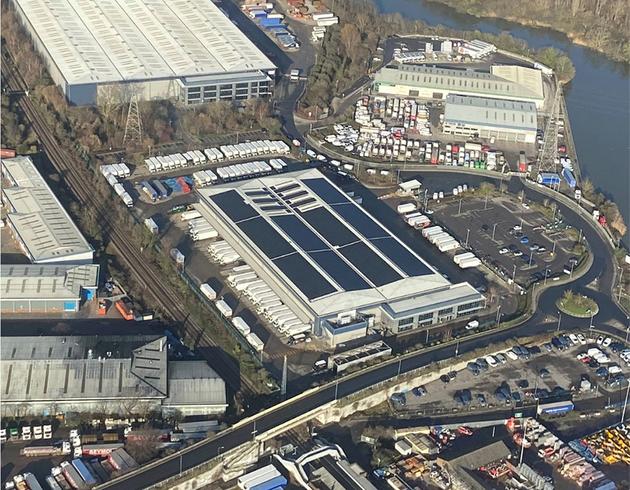
The new, 2,400 solar panel system will provide almost a quarter of the site’s energy requirement and will save the equivalent of approximately 200 tonnes of carbon every year It is the latest step towards the science-based targets set out by Sysco, Brakes’ parent company, to cut carbon emissions by 27 5% between 2019 and 2030, and to move to 100% renewable electricity
The Aylesford project is part of a phased programme of renewable energy projects that will see the company generate renewable energy at sites across Great Britain
Peter Owen, Sysco GB Engineering and Environment Director, said: “We are helping to meet Sysco’s challenging global carbon reduction goals by tackling the energy consumption in our own transport and infrastructure here in Britain. We’ve seen this work well in Harlow with our first 1MW solar array Now, our ambition is to roll this out and install solar wherever possible across our estate – generating our own source of renewable, clean energy This is key to our decarbonisation strategy ”
The new installation supports Sysco’s ambitious, science-based climate goal to reduce emissions across its global operations and the company ’ s entire value chain It will see the company reduce its Scope 1 and 2 emissions by 27 5% by 2030, and ensure that suppliers covering 67% of Sysco’s Scope 3 emissions establish science-based targets by 2026
BFFF were the first trade association to join the original Home Authority Scheme in 2004 We are also members of a Primary Authority user group, led by the Government Department for Business, Energy & Industrial Strategy (BEIS) This is to increase member engagement in the Primary Authority Scheme that is available to all BFFF members
Primary Authority is a means for businesses to receive assured and tailored advice on meeting regulations such as environmental health, trading standards or fire safety through a single point of contact This ensures start-ups get it right at the outset and enables all businesses to invest with confidence in products, practices and procedures, knowing that the resources they devote to compliance are well spent
Primary Authority is based on legal partnerships between businesses and individual local authorities and / or fire and rescue authorities Businesses can set up their own partnership or join through BFFF as part of our existing partnership
What is Primary Authority?
Primary Authority is a government-run scheme that helps protect businesses from unnecessary legal challenges It helps to ensure businesses operating in the food sector are doing so safely and legally
Once you have Primary Authority advice signed off within a registered partnership, if you are following the assured advice issued by the PA, and it covers the issue arising, your operating practices can’t be challenged by any other enforcement authority
Direct partnerships:
A direct partnership with a Primary Authority can look at your specific policies or operating procedures on site and assure themselves that you are operating within the law In effect they endorse your operations and policies Given their legal status as a Primary Authority partner this advice then has legal backing for your business Under a direct partnership you pay an annual fee for 8 hours of support. (Extra hours can of course be purchased)
Co-ordinated partnerships: BFFF operates a co-ordinated Primary Authority scheme, and we have an expanding range of sector-wide advice This partnership operates in the same way as the direct partnership but you don’t need to deal with the Primary Authority directly, BFFF does that for you You can also rely on this advice as it also has the legal backing for your business This partnership is free of charge, however, advice is industry level and not specific to your organisation, however, this does not reduce the validity of the advice issued
Any BFFF member can benefit from advice, whether it is tailored to your business or sectoral advice put in place by BFFF
If you would like more information about joining the scheme, please contact carlabrown@bfff co uk
Our member companies and the wider industry have a duty to identify foreseeable risk within their businesses, this includes identifying risk in light of industry knowledge. As a trade association we provide our members with a plethora of industry level guidance Some of our guidance is assured by Primary Authority, which gives it legal standing which cannot be overturned
To put this into perspective and provide an example of how BFFF assured guidance can help protect your people and your business, we have provided the case study below on materials handling equipment:
Case Study – Materials Handling Equipment Observation Assessments
The question raised was “given we have legislation such as the health & safety at Work Act, Provision and Use of Work Equipment Regulations and Approved Code of Practice for rider operated lift trucks (L117) why do we need any more guidance? “
In the Approved Code of Practice L117 (Paragraph 75) it states that lift truck operators, even those who are trained and experienced, need to be routinely monitored in the workplace and, where necessary, retested or refresher trained to make sure they continue to operate lift trucks safely
In interpreting L117 one of our member companies asked how they could practically monitor and produce this observation assessment and therefore fulfil this code of practice
BFFF set about writing guidance on how to complete MHE observation assessments with specific assessment criteria and observation log template. The document was assured by primary authority giving it a legal stamp, it also appears on the primary authority register
In summary, the guidance produced by BFFF provides further detail on specific topics and compliments existing government guidance If followed this would put your organisation on the right side of the legal fence.
The full list of assured guidance available from BFFF includes
Hot Works Instructions and Checklist - Hot Works Permit
Fire Safety Induction Training – Contractors & Staff
First Aid Training - Defibrillators in the Workplace
Rest Breaks for Cold Store Workers - Overtime Risk Assessments
How to Assess Head Protection for Cold Store Workers
Health Surveillance for Cold Store Workers
Working in a Cold Store – Advice for Employees
Guidance on Raynaud’s Phenomenon
RIDDOR Determination Guidance
Work at Height Equipment Guidance for Cold Stores
MHE Observation Guidance
Materials Handling Equipment Observation Assessments
To access the guidance please go to our website
The British Frozen Food Federation (BFFF) has been crowned as the Best Trade Organisation at the prestigious Food Management Today Awards, beating strong competition from associations including the NFU and the Food & Drink Federation
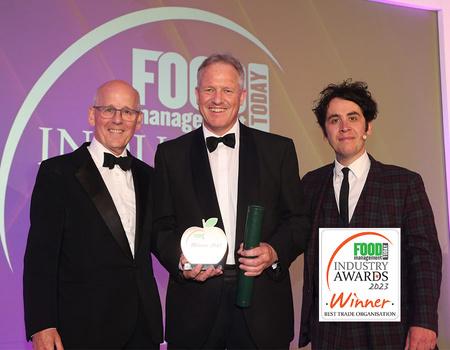
The awards ceremony, which brings food industry professionals together to celebrate the best of the sector, took place on Tuesday 6th June at the Royal Lancaster Hotel in London
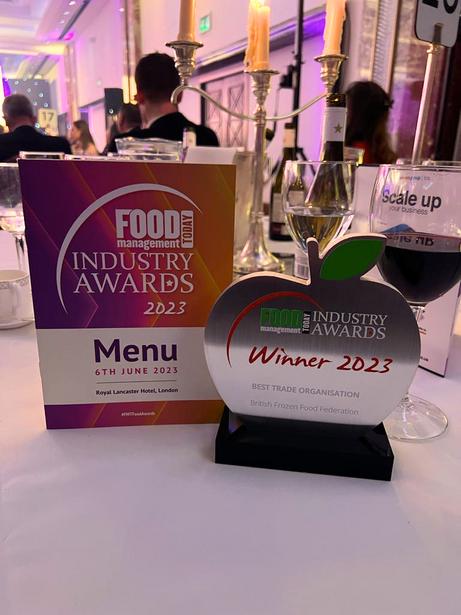
The BFFF was delighted to win the Best Trade Organisation category, which recognised the federation for its work to maintain and promote high product and professional standards in the frozen food industry, engage with and challenge the government when necessary, and actively help its members to face issues as they arise
Rupert Ashby, chief executive of the British Frozen Food Federation commented: “I am incredibly proud of the entire team at the BFFF for their hard work to make us the best trade organisation, which has rightly been recognised with this brilliant award Since stating my role at the BFFF last year, I have been impressed to see the amount of work that is put in to supporting our members
“Each and every one of our staff go above and beyond to ensure that our membership is properly supported with guidance, training, events and detailed information on all policy and information which has a bearing on the frozen food industry ”
In addition to the support offered to members by the federation, the BFFF hosts the annual British Frozen Food Awards as part of its activity to promote the frozen food industry This year ’ s awards ceremony takes place on Thursday 15 June and is set to recognise the best new frozen products across retail and foodservice categories
More information about the services of the BFFF, including information about forthcoming events and the British Frozen Food Awards, can be found here: Txxx
The UK is to host the first major global summit on AI safety, bringing together key countries, leading tech companies and researchers to agree safety measures to evaluate and monitor the most significant risks from AI
The development of AI is extraordinarily fast moving, and this pace of change requires agile leadership, according to the Prime Minister's Office, adding that the UK has a global duty to ensure this technology is developed and adopted safely and responsibly.
Earlier in the month, dozens of leading experts warned about the potential for AI to endanger humanity in similar ways to pandemics or nuclear weapons
In Washington DC last week, the Prime Minister stressed the importance of likeminded allies and companies working to develop an international framework to ensure the safe and reliable development and use of AI
The summit, which will be hosted in the UK this autumn, will consider the risks of AI, including frontier systems, and discuss how they can be mitigated through internationally coordinated action It will also provide a platform for countries to work together on further developing a shared approach to mitigate these risks
In recent weeks the Prime Minister has discussed this issue with a number of businesspeople and world leaders This includes all members of the G7 who were united in their ambition to take a shared approach to this issue at the Hiroshima Summit last month
In May the PM also met the CEOs of the three most advanced frontier AI labs, OpenAI, DeepMind and Anthropic in Downing Street and the Secretary of State for Science, Innovation and Technology also hosted a roundtable with senior AI leaders The work at the AI safety summit will build on recent discussions at the G7, OECD and Global Partnership on AI.
In July the Foreign Secretary will also convene the first ever briefing of the UN Security Council on the opportunities and risks of Artificial Intelligence for international peace and security
The Prime Minister said: “AI has an incredible potential to transform our lives for the better But we need to make sure it is developed and used in a way that is safe and secure
“Time and time again throughout history we have invented paradigmshifting new technologies and we have harnessed them for the good of humanity. That is what we must do again
“No one country can do this alone This is going to take a global effort But with our vast expertise and commitment to an open, democratic international system, the UK will stand together with our allies to lead the way ” Last month, OpenAI and Anthropic opened offices in London, with OpenAI appointing UK firm Faculty as their technical integration partner and announcing the expansion of Google Deepmind under the leadership of Demis Hassabis headquartered in King’s Cross
A plastics manufacturing company in West Bromwich has been fined after it put workers and the public at risk of being infected with potentially deadly bacteria
The HSE launched an investigation into Riaar Plastics Limited after members of the public became infected with Legionnaire’s disease in September 2020
Five people were infected with the potentially deadly lung infection One person was taken to intensive care and put on a ventilator after being infected
Riaar Plastics Limited was fined for failing to manage the risk of Legionella The HSE found the water-cooling towers inherited by Riaar Plastics Limited at its site on Black Lake, West Bromwich, were in an extremely poor condition This allowed Legionella bacteria to grow in the water-cooling towers and pipes, exposing employees and members of the public to risks of significant ill health
People can get Legionnaires’ disease when they breathe in small droplets of water in air that contains the Legionella bacteria
Riaar Plastics Limited, of Black Lake, West Bromwich, West Midlands, pleaded guilty to breaching Section 2(1) and 3(1) of the Health and Safety at Work Act 1974 The company was fined £50,000 and ordered to pay £11,000 in costs
This prosecution was led by HSE principal inspector Jenny Skeldon and HSE senior enforcement lawyer Kiran Cassini
HSE principal inspector Jenny Skeldon said: “The condition of the cooling towers at this site was the worst I had ever seen The Legionella exposure risk to employees, site visitors, neighbouring duty holders and members of the public was extreme in nature
“Exposure to Legionella can cause death or serious illness where water cooling systems are not been managed effectively It is really important that proactive management of the risk from Legionella bacteria is taken seriously There are well publicised and simple precautions for companies to take, and if followed, will ensure that employers manage and control the risk ”
HSE
June 2023