Sustainability Operations
Arizona State University Fiscal Year 2022 Review

As a public enterprise with a design and innovation mindset, we think about sustainability holistically, and that is reflected in our university-wide approach to education, research, operations and collaborative community partnerships.”
Michael M. Crow ASU President
Rated Platinum in AASHE STARS v2.2
Times Higher Education University Impact Rankings
No. 1 in the U.S., No. 2 in the world
The Rob and Melani Walton Center for Planetary Health held grand opening during Earth Month
“
Sun Devils make strides in sustainability
Each year, the Sustainability Operations Review highlights significant milestones ASU has reached in meeting our sustainability goals. That meaningful progress, and the national and international recognition that ASU receives for its sustainability leadership, results from deliberate collaboration.
For nearly two decades, ASU has been at the forefront of sustainability on campus and in the community. We have transformed our facilities and open spaces to keep pace with campus growth. We established the Julie Ann Wrigley Global Futures Laboratory, which underscores our commitment to the behavioral changes that students, faculty and staff have adopted to minimize our environmental impacts. Sustainability is ingrained in all aspects of university business.
Our success is a product of many people and departments academic and operational working together to achieve transformative outcomes. The fiscal year 2022 review summarizes the most visible elements of ASU’s sustainability work. However, it is important to recognize that sustainability also occurs in less visible areas of university operations to improve business efficiencies, reduce costs, support regulatory compliance and keep the community safe.
The comprehensiveness and diversity of our efforts are what sets ASU apart from other institutions when it comes to sustainability On behalf of ASU leadership, thank you for your contributions to our FY 2022 achievements, and we look forward to building on them with you in FY 2023.
Nichol Luoma
Marc Campbell Vice President, University Business Services Executive Director, University Sustainability and University Sustainability Operations Officer Practices and Deputy Sustainability Operations Officer
p: 480-727-9920 f: 480-727-9922 email: cfoweb@asu.edu web: cfo.asu.edu


Office of the Executive Vice President, Treasurer and Chief Financial Officer Business and Finance PO Box 877505, Tempe, AZ 85287-7505
Despite the challenges of COVID-19, Arizona State University remains a national leader in addressing sustainability when it comes to research, outreach, and operations.”
Morgan R. Olsen ASU Executive Vice President, Treasurer and Chief Financial Officer
The ASU community continued to accelerate its commitment to sustainability in 2022 and achieved the following recognitions:
• No. 1 in the U.S. and No. 2 in the world in the University Impact Rankings from Times Higher Education for work supporting the United Nations’ Sustainable Development Goals.
| Among the 17 goals, ASU ranked No. 1 in the world in three SDG categories: sustainable cities and communities, life below water and life on land.

• Platinum rating in the Sustainability Tracking, Assessment and Rating System of the Association for the Advancement of Sustainability in Higher Education.
These recognitions reflect ASU’s comprehensive approach to sustainability across operations, academics, research and community engagement that stems from an ingrained and expanding culture of sustainability and a focus on innovation and solutions to the world’s economic, environmental and social challenges.
This annual review summarizes ASU’s continued efforts in fiscal year 2022, from July 1, 2021 to June 30, 2022, to achieve its operational sustainability goals:
• Circular resource system.
• Climate positive.
• Collaborative action.
• Community success.
• Food reconnection.
• Optimized water.
• Personal action.
• Resilience and regeneration.
“ Sustainability Operations | FY 2022 Review 1
Circular resource system
A circular-resource system achieves zero waste by adapting the goods brought onto campus to maximize their use before returning them to the economy for the most productive use possible.
Overall waste landfill and diverted in FY 2022 is up 31.3% from FY 2021. ASU’s diversion rate was 42.7%, a slight decrease from last fiscal year. ASU’s aversion rate dropped from 35% to 19% over its FY 2008 baseline.
Even though diversion efforts made modest gains in FY 2022, landfill on the Downtown Phoenix campus jumped 13.2%, and green waste fell by 7.1%, reducing the university’s overall diversion rate. However, ASU showed gains from key streams, including mixed recycling, donations, food waste, inert materials, pallets, fats, oils and greases. These gains underscore the crucial role of centralizing operations and building community partnerships to increase overall diversion.

The FY 2022 aversion rate returned to pre-pandemic levels, as in-person activities have returned to typical levels. However, some in-person activities transitioned to a digital format with tools like Zoom and other technology. For example, the New Student Orientation Experience is now entirely online, which eliminates the meals provided for thousands of visitors. With the transition of some in-person activities to digital formats while returning to pre-pandemic waste levels, we believe more engagement is taking place with students, faculty, staff and the community.
Overall landfill and diverted waste in FY 2022 is up
31.3% from FY 2021.
University diversion rate in tons
FY
2022 Diverted 3,895 tons 43% Landfilled 5,231 tons 57%
University diversion rate in tons FY
2022 Sustainability Operations | FY 2022 Review
Tabling event to promote zero waste
2
ASU waste diversion rate and on-campus students (FTE) FY
ASU waste composition
Milestones:
• Expand: The Zero Waste department expanded the office kitchenette compost program in FY 2022 to university-wide deployment. Of the 395 kitchenettes mapped, 257 were identified as program candidates. More than 80 employees completed the Office Compost training and requested 83 bins within the first six months — an initial adoption rate of 3.2%. This has resulted in diverting an average of 75 pounds per week.
• Donate: Residential Hall students donated 29.9 tons back to the community during our annual donation program.
• Efficiency: Front-load container service capacity monitoring improved data accuracy, reduced service level costs and increased landfill service efficiency by 9.8% and recycling service by 19.5%. Students volunteer at


0 10,000 20,000 30,000 40,000 50,000 60,000 70,000 80,000 90,000 0% 5% 10% 15% 20% 25% 30% 35% 40% 45% 50% FY2007 FY2008 FY2009 FY2010 FY2011 FY2012 FY2013 FY2014 FY2015 FY2016 FY2017 FY2018 FY2019 FY2020 FY2021 FY2022 On-campus students Diversion rate
Total diversion rate On-campus students 0 2,000 4,000 6,000 8,000 10,000 12,000 FY2007 FY2008 FY2009 FY2010 FY2011 FY2012 FY2013 FY2014 FY2015 FY2016 FY2017 FY2018 FY2019 FY2020 FY2021 FY2022 Tons
2007 FY 2022
FY 2007 — FY 2022 Diverted Landfilled 3 Sustainability Operations | FY 2022 Review
a Blue Bag sort event
Climate positive
Since FY 2019, ASU has maintained climate neutrality for Scope 1 and 2 emissions1. This was implemented several years before ASU’s 2025 climate-neutral commitment date to recognize the increasing severity of the climate crisis. However, this action does not represent an endpoint. ASU will continue to reduce its gross emissions from all scopes. Compared to FY 2007, ASU has reduced net emissions for Scopes 1, 2 and 32 by 91% per 1,000 square feet of building space and 90% per student.
ASU accomplished climate neutrality through a portfolio approach, including:
• Purchase of renewable energy and renewable-energy certificates from large-scale off-site generation facilities.
• Renewable energy with on-site solar generation.
• Sustainable building design and construction.
• Carbon offsets coupled with local tree plantings in partnership with the cities of Phoenix, Scottsdale and Tempe.
1 Scope 1 emissions result primarily from combusting natural gas to generate heat and electricity for university buildings and from university vehicles. Scope 2 emissions come from external utility providers that supply ASU with electricty and chilled water.
2 Scope 3 emissions primarily occur in third-party commuting and air travel associated with ASU operations.
ASU net greenhouse gas emissions and building space
FY 2007 — FY 2022
ASU has reduced net emissions for Scopes 1, 2 and 3 by 91% per 1,000 square feet of building space.

0 5 10 15 20 25 30 0 5 10 15 20 25 FY2007 FY2008 FY2009 FY2010 FY2011 FY2012 FY2013 FY2014 FY2015 FY2016 FY2017 FY2018 FY2019 FY2020 FY2021 FY2022 Gross square footage (in millions) Net GHG (MTCDE) per 1,000 GSF
Net emissions / 1,000 GSF Total building space GSF
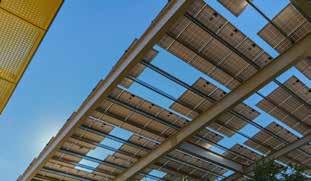
Solar parasol outside the Memorial Union
Sustainability Operations | FY 2022 Review 4
Installed 90 on-site solar arrays
Milestones:
• The Rob and Melani Walton Center for Planetary Health , home to the Julie Ann Wrigley Global Futures Laboratory, opened in April 2022. The facility incorporates several climate-positive features, including:
| The first building in Arizona to use BubbleDeck, a void-form structural deck system that significantly reduces the carbon footprint and embodied energy of concrete structures.
| Exterior panels on the east, south and west sides for shading the building’s windows and minimizing energy consumption by using natural light.
• Realized an estimated $2.3 million in utility savings from campus energy and water-efficiency projects and implemented roughly $3.4 million worth of new efficiency and engagement initiatives through the Sustainability Initiatives Revolving Fund program in FY 2022.

• Received 217,984 MWh of electricity through large-scale solar and wind renewable-energy purchase agreements , enough to power approximately 17,000 Arizona homes for a year.
• Installed 90 on-site solar arrays on ASU campuses since 2004 , with a 24.2 MWdc-equivalent rated power output. This is equivalent to 5,000 residential solar arrays.

-80% -60% -40% -20% 0% 20% 40% 60% 80% Percent change Percent change in total building space, on-campus students and net emissions FY 2007 vs. FY 2022 Total building space GSF On-campus students Total net emissions MTCDE
ASU has 45 LEED-certified projects
Solar parasol on the ASU Tempe campus
on ASU campuses since 2004.
Sustainability Operations | FY 2022 Review 5
Estimated $2.3 million in utility savings from campus energy and water-efficiency projects.
Collaborative action
Collaborative action involves multiple departments’ interdisciplinary efforts to advance ASU’s operational sustainability progress and integrate operational sustainability with its research, education and community missions. ASU embeds sustainability into departments’ daily activities through initiatives, personnel, programs, policies and procedures.
Successful examples of collaborative action include the following activities:
Campus activities
• 23 Sustainable Staff Event planners were trained in FY 2022, representing 18 ASU departments and offices.

• The ASU Fleet Electrification Task Force worked to transition the university’s fleet to zero-emission vehicles by purchasing four plug-in electric vehicles.
• Coca-Cola, Sodexo, Sun Devil Athletics, University Sustainability Practices and the Zero Waste department partnered to host two Green Games for football and volleyball. A total of 44,399 attendees were exposed to messaging about sustainability at ASU and efforts for Zero Waste games, including ticketless entry, the reusable cup program and compost and recycle bins in Sun Devil Stadium.
• Constructed 20 sustainability displays across all four campuses for October’s Campus Sustainability Month.
• Earth Month activities included six sustainability campus walking tours with 147 participants and 14 campus events with 960 participants. Events included a Garden Commons plants sale, Fair Trade tabling in residence halls, office compost rollout and various Green Games.
• Hosted five U.S. Green Building Council workshops to 197 staff and students providing information on Leadership in Energy and Environmental Design certification to the campus community.
• Installed 13 electric vehicle charging ports. There are 110 charging ports available across ASU’s four campuses in metropolitan Phoenix.
• The ASU Starbucks Center, several student groups and departments collaborated to reduce single-use cups on campus, saving over 21,000 cups from use.
Community efforts
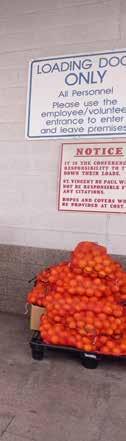
Volunteers donated 5,000 pounds of harvested oranges to local food banks
• ASU partnered with Arizona Public Service, Salt River Project, Tucson Electric Power, Southwest Gas, the University of Arizona and Northern Arizona University to form a new interdisciplinary coalition to attain a carbon-neutral economy in Arizona. The ASU-based Center for an Arizona Carbon-Neutral Economy is housed within the Julie Ann Wrigley Global Futures Laboratory on the Tempe campus.
• The Rio Reimagined Initiative hosted an Earth Day clean-up along the Salt River. Over 100 volunteers removed 10 tons of trash from the riverbed. The event united ASU’s University City Exchange, students and alums, employees from the city of Phoenix’s Tres Rios wetlands and the Arizona Department of Environmental Quality.
ASU paper use in recycled content
Sustainability Operations | FY 2022 Review
6
FY 2022 28% 13% 6% 53% 0% recycled content 10% recycled content 30% recycled content 100% recycled content
Peter Schlosser
Community success
According to the ASU Charter, ASU assumes fundamental responsibility for the economic, social, cultural and overall health of the communities it serves. Community success examples include:
• During FY 2022, ASU’s total spending of $1.73 billion included 15.41% toward federally recognized small businesses. The university also spent 5.02% with diverse businesses.
• The ASU Project Cities program partnered with the city of Peoria to identify residents who often do not receive messages about critical activities and design strategies to reach them. Three classes supported this work: JUS 456 Human Rights and Sustainability, JUS 500 Research Methods and JUS 301 Research Methods.
• ASU welcomed 61 Afghan refugee women to Arizona so they could complete their education. ASU has committed to funding each one in completing their degree, including room and board, textbooks, class materials and required supplies.
• The Advisory Council on African American Affairs at ASU released The LIFT Report: Status of Black and African Americans at Arizona State University. The fall 2021 LIFT Report outlines the progress and developments being made to find solutions to issues of bias, discrimination and underrepresentation at ASU and to further transform the community into a welcoming environment for educators and learners.
• The U.S. Department of Education named ASU a Hispanic-Serving Institution, a significant milestone in its enterprise-wide commitment to increase the diversity of its student body.
• ASU’s in-state student population demographics continue to reflect the economic diversity of Arizona’s population.

“
ASU’s Global Futures Laboratory exists precisely to take on the challenge of creating a future of opportunity. We welcome the establishment of this new center and are eager to work with the brightest minds from Arizona’s leading energy companies and our sister universities to explore the most effective ways to develop a sustainable and thriving carbon-neutral economy.”
Sustainability Operations | FY 2022 Review
Vice President and Vice Provost, Julie Ann Wrigley Global Futures Laboratory
7 Total Undergraduate Enrollment by Race/Ethnicity — Fall 2002 to Fall 2022 ASU serves students from diverse populations. 0 20,00 40,000 60,000 80,000 100,000 120,000 2002 2003 2004 2005 2006 2007 2008 2009 2010 2011 2012 2013 2014 2015 2016 2017 2018 2019 2020 2021 2022 Native Hawaiian / Pacific Islander American Indian / Alaskan Native Asian Hispanic White Two or More Unspecified International Black / African American
Students celebrate graduation
Food reconnection
ASU seeks to ensure the community has food equity, access, and sustainable food choices, such as plant-forward, organic and Fair Trade-certified options. The university offers many programs and tools to achieve food-system sustainability across the enterprise, starting with Sun Devil Hospitality.

ASU Arboretum Harvest
• Student volunteers from the ASU Interfaith Date Palm Project, Changemaker and Mary Lou Fulton Teachers Collge courses pollinated 240 date palms across the Polytechnic and Tempe campuses, including ASU’s iconic Palm Walk.
• 14 Changemaker students helped fertilize the soil under citrus trees and date palms.
• 82 volunteers helped harvest and package 4,000 pounds of dates from 12 varieties of date palms. The dates are sold to the ASU community to support the ASU Arboretum and donated to community groups.
Garden Commons
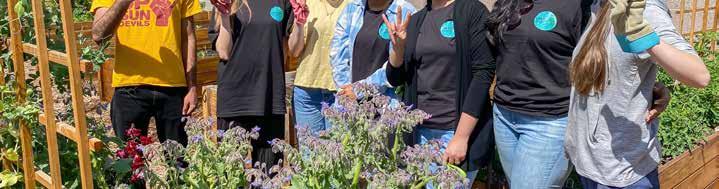
The Garden Commons on the Polytechnic campus is a multifunctional outdoor classroom that embraces sustainable design and focuses on local food systems and community gardening. The garden features 18 raised garden beds, a resource room, a compost area, a citrus orchard and an outdoor pavilion. This space promotes the value of holistic food systems for all students through ultural inclusion, personal connections and shared learning. The garden staff and volunteers made these accomplishments during FY 2022:
• Donated 1,028 pounds of organic produce to local food banks and students.

• Logged 317 volunteer hours with 163 participants.
• Managed 18 events with 335 participants totaling 406 hours of engagement.
• Trained eight student ambassadors who contributed 111 hours of volunteer work.
• Hosted three courses that used the garden as an outdoor classroom for hands-on learning.
Pitchfork Pantry
• Served 4,800 students with weekend pop-up events. Starship robots delivered fresh and non-perishable food items from the Saturday pop-up pantries to 120 students every other week. This new offering helped reduce the stigma associated with attending the pantry in person. Students could choose items on the Starship app with delivery fees waived.
The ASU Arboretum partnered with a local citrus orchard in Mesa to rescue over 2 tons of Valencia oranges. ASU students, faculty and staff volunteers helped pick and bag the oranges to donate to the Pitchfork Pantry, St. Mary’s Food Bank and St. Vincent de Paul food bank.
Sun Devils helped deliver over 2 tons of oranges to food banks
Sustainability Operations | FY 2022 Review
Produce at Engrained Café
8
Served
4,800 Students with weekend pop-up events.
Approximately 3,400 pounds of produce was distributed across the ASU metropolitan Phoenix campuses.
Donated 1,028 pounds of organic produce to local food banks and students.
Sun Devil Hospitality
• Launched the Cool Food Meals pilot in residential dining halls across the Tempe campus. The program highlights dishes with low carbon footprints based on metrics created by the World Resources Institute.
• The Learn Arizona event was collaboratively hosted by Sun Devil Hospitality and the ASU International Students and Scholars Center on the Engrained patio. The event featured in-season food from local farms as a lens to understand Arizona’s cultural heritage. The event's focus was the prickly pear cactus used to make both a nopal salad and a unique prickly pear limeade.
• Nacho Average Cheese Bar and Mindful Chik’n were introduced at station takeovers in residential dining halls. These plant-based alternatives offer lower-carbon options for our students.
• The Decidedly Green catering menu was relaunched to incorporate new sustainable event options.
• Approximately 3,400 pounds of produce was distributed across the ASU metropolitan Phoenix campuses through several produce giveaway events, including Fair Trade options.
• ASU continues its leadership role as the largest Fair Trade-certified university in the country. As part of this certification, Sun Devil Hospitality and University Sustainability Practices hosted several promotional events featuring Fair Trade chocolates and coffee.
 The Garden Commons on the ASU Polytechnic campus
Sustainability Operations | FY 2022 Review 9
Optimized water
Optimizing ASU’s water use involves applying a systems approach to use the correct quantity and quality of water for the proper purpose at the right time. Clean water access is an increasingly critical global and southwest regional issue. ASU conducts education, engagement and research in the water domain and works to optimize water use in its operations.
Milestones:
• The Durham Hall renovation exemplifies the implementation of ASU’s Optimized Water goal. Despite doubling the landscaped area around the building, outdoor water use was reduced by 60% through a transition to native and adaptive plant species and the implementation of high-efficiency irrigation systems. The new landscaping also integrates bioswales to retain rainwater onsite and allow it to filter into the soil. The interior portion of the building demonstrates substantial water-use reductions, with a 33% reduction in water consumption from the integration of high-efficiency fixtures. The long-term water use is monitored through submeters to track indoor and outdoor water use.
• ASU Project Cities supported the city of Peoria with recommendations on the interconnection of sustainable water management and land-use planning.
• The Rob and Melani Walton Center for Planetary Health building represents a comprehensive implementation of ASU’s optimized water commitment. High-efficiency water fixtures minimize indoor water use. Using nonpotable water from the historic irrigation canal for landscape irrigation reduces the energy needed to treat and pump potable water. Condensate water also is directed to the courtyard landscaping instead of being disposed of in the sewer system.

Sustainability Operations | FY 2022 Review
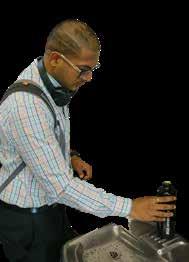
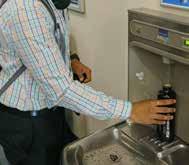
Refill stations help conserve water 10 0 10,000 20,000 30,000 40,000 50,000 60,000 70,000 80,000 90,000 0 200 400 600 800 1,000 1,200 1,400 FY2007 FY2008 FY2009 FY2010 FY2011 FY2012 FY2013 FY2014 FY2015 FY2016 FY2017 FY2018 FY2019 FY2020 FY2021 FY2022 On-campus students Water use (gallons in millions) ASU total water use and on-campus students (FTE) FY 2007 — FY 2022 Total water On-campus students
An existing canal was incorporated into the Rob and Melanie Walton Center for Planetary Health
ASU wastewater and on-campus students (FTE)
FY 2007 — FY 2022
Personal Action
ASU’s success in sustainability requires individual actions by the entire ASU community. The daily decisions of Sun Devils surrounding food, transportation and waste underpin ASU’s success in these areas.
Programs and milestones:
• ASU Educational Outreach and Student Services supported 54 sustainability-aligned student organizations to develop leadership skills and advance campus sustainability projects.
• Sun Devils embraced sustainable commuting more broadly in 2022:
| 640,854 trips were taken by Sun Devils on the intercampus shuttles, an increase from 2021.
| 17,222 uses at bicycle valet stations.
| 2,121 individuals purchased transit passes.
| 1,376 bicycles were registered.
• Over 22,614 responses were logged for Earth Month Trivia via the Sun Devil Rewards program.
• 12,524 students and staff have completed the voluntary Seeds of Sustainability literacy program since 2016 and earned their “Seedling” certification.
• 375 students and staff voted for their favorite design in the annual Earth Month Sticker Design Contest. First-year sustainability student, Alissa Morales, won with her “Miss Earth” drawing. Sun Devil Campus Stores offered T-shirts and water bottles with the winning design.
• 74 campus events were recognized for their sustainability efforts with planning, set-up, food services, waste management and transportation.

2022 Earth Month Sticker Design Contest winner
Sustainability Operations | FY 2022 Review
11 0 10,000 20,000 30,000 40,000 50,000 60,000 70,000 80,000 90,000 0 200 400 600 800 1,000 1,200 FY2007 FY2008 FY2009 FY2010 FY2011 FY2012 FY2013 FY2014 FY2015 FY2016 FY2017 FY2018 FY2019 FY2020 FY2021 FY2022 Wasteater (gallons in millions)
Alissa Morales
Total wastewater gallons On-campus students
On-campus students
Resilience and Regeneration
ASU will adapt, regenerate and sustain its environment and communities in the face of current and future climate change impacts.
Milestones:
• The university partnered with Trees Matter and the city of Tempe to plant 30 trees at Waggoner Park and 50 trees at Hanger Park. Volunteers planted an additional 100 trees at Mesa elementary schools through a collaboration with the Arizona Sustainability Alliance.
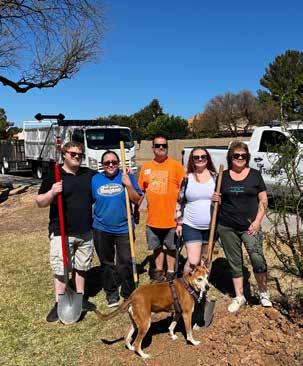
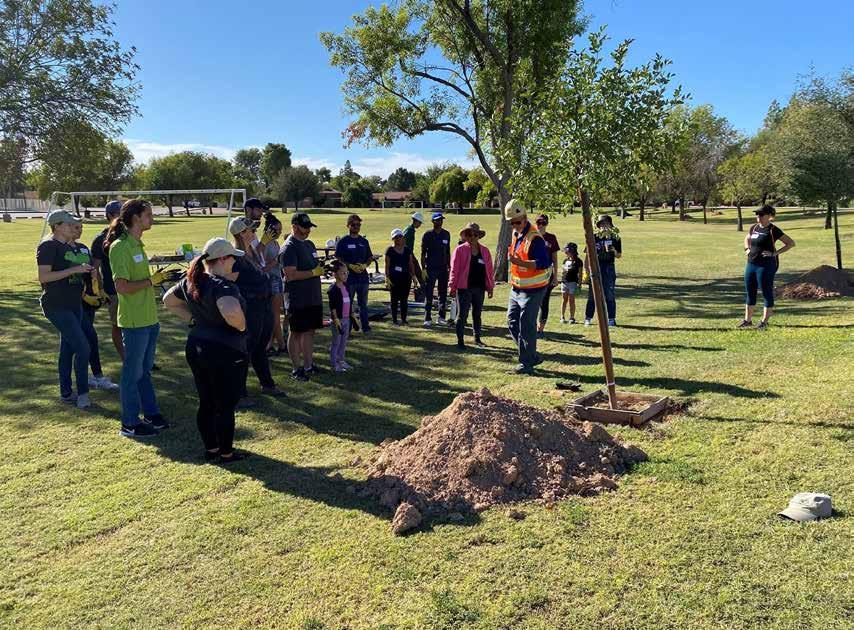
• Planting trees is a simple and impactful strategy to reduce the urban heat island effect in cities while mitigating climate change by sequestering carbon. Since launching the Carbon Project, ASU has helped plant 2,058 trees in Glendale, Mesa, Phoenix, Scottsdale and Tempe to offset carbon emissions and reduce the negative impact of the urban heat island effect across the Phoenix metropolitan area.
Volunteers have planted over 2,000 trees across the Valley since 2018 Visit
Data in this document reflect reporting through June 30, 2022.
Photography by: Business and Finance, Enterprise Brand Strategy and Management and University Sustainability Practices.
Sustainability Operations | FY 2022 Review 14 Arizona State University Sustainability Operations PO Box 877505 Tempe AZ 85287-7505
©2023 Arizona Board of Regents for Arizona State University.
Volunteers from ASU, the city of Tempe and Trees Matter planting trees
cfo.asu.edu/sustainability-goals-and-vision for more information
