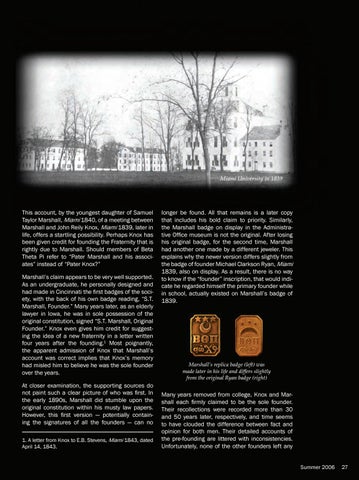
Miami University in 1839
This account, by the youngest daughter of Samuel Taylor Marshall, Miami 1840, of a meeting between Marshall and John Reily Knox, Miami 1839, later in life, offers a startling possibility. Perhaps Knox has been given credit for founding the Fraternity that is rightly due to Marshall. Should members of Beta Theta Pi refer to “Pater Marshall and his associates” instead of “Pater Knox?” Marshall’s claim appears to be very well supported. As an undergraduate, he personally designed and had made in Cincinnati the first badges of the society, with the back of his own badge reading, “S.T. Marshall, Founder.” Many years later, as an elderly lawyer in Iowa, he was in sole possession of the original constitution, signed “S.T. Marshall, Original Founder.” Knox even gives him credit for suggesting the idea of a new fraternity in a letter written four years after the founding.1 Most poignantly, the apparent admission of Knox that Marshall’s account was correct implies that Knox’s memory had misled him to believe he was the sole founder over the years. At closer examination, the supporting sources do not paint such a clear picture of who was first. In the early 1890s, Marshall did stumble upon the original constitution within his musty law papers. However, this first version — potentially containing the signatures of all the founders — can no 1. A letter from Knox to E.B. Stevens, Miami 1843, dated April 14, 1843.
longer be found. All that remains is a later copy that includes his bold claim to priority. Similarly, the Marshall badge on display in the Administrative Office museum is not the original. After losing his original badge, for the second time, Marshall had another one made by a different jeweler. This explains why the newer version differs slightly from the badge of founder Michael Clarkson Ryan, Miami 1839, also on display. As a result, there is no way to know if the “founder” inscription, that would indicate he regarded himself the primary founder while in school, actually existed on Marshall’s badge of 1839.
Marshall’s replica badge (le�) was made later in his life and differs slightly from the original Ryan badge (right)
Many years removed from college, Knox and Marshall each firmly claimed to be the sole founder. Their recollections were recorded more than 30 and 50 years later, respectively, and time seems to have clouded the difference between fact and opinion for both men. Their detailed accounts of the pre-founding are littered with inconsistencies. Unfortunately, none of the other founders left any Summer 2006
27