RESEARCH IN DERMATOLOGY NURSING












































































A Dermatological Nursing Journal Publication THIS SUPPLEMENT HAS BEEN SPONSORED BY ALMIRALL, WHO HAVE HAD NO INPUT OR INFLUENCE OVER THE CONTENT.
Making the most of research
Penzer-Hick
he terms research and evidencebased practice are often spoken of in the same breath – and rightly so, as they are intimately associated with one another. Evidencebased practice has been defined as requiring the “…integration of the best research evidence, with our clinical expertise and patient’s unique values and circumstances.”1 To practice in this way, nurses must be able to understand research and have the competence and confidence to use it in a way that puts the patient at the centre of decision making.
There is no doubt that a researchbased approach to healthcare is critical for patient safety and wellbeing; effective use of interventions; and helping to ensure a cost-effective approach to care. It is also about describing and understanding the world around us
Tand how individuals experience that world. Understanding, appraising, and applying research requires a logical and critical approach. To take this approach, nurses need to understand some of the fundamentals around research design, data collection and analysis. This supplement brings together a series of articles that appeared in Dermatological Nursing throughout 2021 and 2022, and the articles serve to address some of these fundamental issues.
It may be tempting to think that if you are not involved in doing research, then none of this is relevant to you. But I would urge anyone thinking this way to reconsider! Whilst NICE guidance has meant that, for some topics, the research evidence has been analysed and appraised for you in user-friendly guidelines, there will always be instances where the topic you are interested in does not have appropriate guidelines or where it is out of date. Understanding how evidence is collected and analysed, and making judgements about how
Contents
Nurses and dermatology research: A national survey
Fiona Cowdell, Kathy Radley
robust and applicable it is, will help you to support your patient with better decisions.
Research is not an academic exercise, it is an attempt to reveal the truth about therapeutics, basic science and how humans interact with one another. As such, it impacts powerfully on care. Once you understand this, it is only a small step to formulating research questions and developing research projects so that you are not just using evidence, but you are creating evidence of your own.
I am delighted that Dermatological Nursing decided to pull together these brilliant articles and put them all in one place, and I hope that they will serve you well on your research journey – no matter which part of it you are on. DN
References
1. Straus, SE Glasziou, P Richardson, WS Haynes, B. Evidence Based Medicine E Book: How to practice and teach EBM Elsevier 2018.
What are quantitative and qualitative research methods?
A brief introduction
Joanne Chalmers, Fiona Cowdell
How to critically appraise a clinical trial
Hywel C Williams, Alison JG Lowe
Demystifying statistics and interpreting study results
Sonia Gran, Loes Hollestein, Fiona Cowdell
Qualitative research in dermatology nursing 17
Laura Howells, Fiona Cowdell
Research: Where does it fit into dermatology nursing practice? 20 Melanie Westmoreland

Dermatological
Vol 21, No 4 www.bdng.org.uk EDITORIAL 2
Nursing, 2022,
Rebecca
3
6
10
13
Nurses and dermatology research: A national survey
Fiona Cowdell, Kathy Radley
A working group was convened between the British Dermatological Nursing group (BDNG) and the UK Dermatology Clinical Trials Network (UK DCTN) to identify involvement, understanding and training requirements of dermatology nurses. A survey was constructed and electronically distributed to members of the BDNG. This article summarises the results of the survey and identifies first steps in developing resources to address the highlighted needs.
Cowdell F, Radley K. Nurses and dermatology research: A national survey. Dermatological Nursing 2021. 20(1):44-46
Introduction
Dermatology nursing is a wellestablished speciality. Nurses lead the provision of care for many people living with skin conditions. Nursing roles include delivery of education, support for self-management, administration of day treatments and phototherapy, prescribing medications, undertaking surgical procedures and providing holistic care for patients with complex needs.1 Dermatology nursing is both an art and a science. 2 It takes many years to hone the knowledge, skills and confidence to become an expert practitioner and
Fiona Cowdell is Professor of Nursing and Health Research at Birmingham City University, National Institute of Health Research Knowledge Mobilisation Research Fellow and a member of the Dermatological Nursing Editorial Board. Kathy Radley is Senior Lecturer at the School of Life and Medical Sciences, University of Hertfordshire, and Dermatology Specialist Nurse, Dermatology Clinic Community Services, Cambridgeshire. She is also the Chair of the Dermatological Nursing Editorial Board.
recently published role descriptors identify scope of practice and possible development strategies towards expert practice.3 The value of dermatology nurses is summarised in Box 1.
In common with all healthcare practitioners, dermatology nurses are committed to providing evidencebased care. In a seminal paper, Sackett defines evidence-based medicine
BOX 1.
1, 4-9
� Providing expert knowledge � Providing patient education � Increasing understanding of medication regimens
� Supporting greater concordance � Developing patient knowledge, skills and confidence to selfmanage
� Offering quicker access to skilled care
� Taking a holistic approach to care � Offering caring and continuity in consultations � Patients more involved in treatment decisions � Key members of the multidisciplinary team � Leadership of teams and clinical services
as “the conscientious, explicit, and judicious use of current best evidence in making decisions about the care of individual patients”.10 This definition is equally applicable to the work of dermatology nurses. There is a national drive to get nurses involved in research, for example through the National Institute for Health Research (NIHR) Associate Principal Investigator Scheme,11 however, at present, this does not extend to dermatology. The Health Education England (HEE)/ NIHR Integrated Clinical Academic Programme offers an opportunity to develop research skills and experience skills, but again, this is rarely accessed by nurses.12
Nurses lead the provision of care for many people living with skin conditions
Survey
To better understand dermatology nurses’ current roles, their understanding of, and their development needs in relation to research, the British Dermatological Nursing Group (BDNG) and the UK Dermatology Clinical Trials Network (UK DCTN) convened a working group to identify how to best support the research development needs of the dermatology nursing community. Our first action was to
Dermatological Nursing, 2022, Vol 21, No
4 www.bdng.org.uk ReseaRch STUDY 3
The roles and value of dermatology nurses
ReseaRch STUDY
develop, administer and analyse a survey, as reported below.
Aim: To better understand dermatology nurses’ current roles in, understanding of, and development needs in relation to research.
Method: Through a process of consensus, the working group (n = 8) of dermatology specialist nurses and academics developed a survey investigating who is involved in research, current roles and responsibilities in research, barriers to engaging in research, and learning and development needs. The survey was distributed electronically to the membership of the BDNG (n = 2,420).
Results: In total, 99 responses were received (4.1% of total membership, a return rate of 4.1%). As expected, most respondents were registered nurses with the highest percentage being Band 7 specialist nurses (33%). Registered nurse respondents had been qualified for between one and 42 years (mean n = 26 years, median n = 27), indicating that more experienced nurses completed the survey.
Of the 96 who gave their location, the majority were based in England (n = 82). Other responses were from Scotland (n = 9), Norther Ireland (n = 3), Australia (n = 1) and Jersey (n = 1). No responses were received from colleagues in Wales. Most respondents were based in secondary care (n =
Table 1.
Demographic details of respondents
Agenda for change band 13 Number % of total
Clinical assistant Band 2 1 1.01
Clinical assistant Band 3 1 1.01
Clinical assistant Band 4 1 1.01
Registered nurse Band 5 28 28.28
Registered nurse Band 6 26 26.26
Registered nurse Band 7 33 33.33
Registered nurse Band 8 8 8.08
Other 1 1.01
67), with others based in primary care (n = 18), other (n = 7), or tertiary care (n = 4).
Of 94 respondents, 51% reported that their department was research active, but only 23% were involved themselves. Dedicated dermatology nurses were present in 52% of cases and generic research nurses in 57%. Nurse-led research occurred in 26% of departments, but only 10% had nurse principal investigators. Only nine responses were given on request for an outline of this research, with three specifically mentioning data collection for BADBIR, two identified general skin research and one a specific pilot study, with the others indicating they were unsure. Just 16 respondents answered the question, “In which elements of research are you involved?” Nurses are predominantly engaged in recruitment and data collection, both with n = 12.
Of 65 respondents, 82% wanted the opportunity to work in research in their department. The question, “In which elements of research would you like to be involved?” was answered by 45 nurses. In rank order, their preference for activity were: data collection (n = 41), recruitment (n = 32), dissemination (n = 23), data analysis (n = 21), development of research questions (n = 20), completion of feasibility forms (n = 14), ethics applications (n = 10) and funding applications (n = 8). Reported barriers to engagement included for example, lack of time, workload, no encouragement, insufficient staffing and funding, lack of confidence and research being the preserve of medicine.
Research training was somewhat limited, although most (53/69) reported no barriers to access. Of 69 nurses, only 37 had received any training, most commonly identifying Good Clinical Practice training (n = 26), research modules or short courses
(n = 18) and study specific training (n = 12). Confidence in some research essentials was lacking, for example 20/69 respondents had little or no confidence in finding up to date research literature and 15/69 had little or no confidence in understanding research literature. Clinical practice was reasonably or highly informed by research in 52/69 cases, and 35/69 felt quite or highly confident to change practice based on the findings of published research. Most respondents (67/69) agreed that research education would increase confidence applying research findings and improving clinical practice. Preferred modes of delivery included (in rank order), online critical appraisal training, educational articles, online interactive sessions, a wider programme of training (e.g., peertraining via UKDCTN) and face-toface short sessions (e.g., at the BDNG conference).
Discussion
This survey suggests that, whilst some dermatology nurses are engaged in research, there is a group who want to get involved but need the knowledge, skills, confidence, support and opportunities to make this happen. Our survey is limited; it was circulated to members of the BDNG and completed by 4.1% of members. Many respondents are our most experienced colleagues (based on the mean time since qualification being 26 years), and some of these are also the most research active. Respondents are therefore not representative of dermatology nursing as a whole. There is a sense that research is the preserve of medicine and that nurses have limited roles, specifically recruitment and data collection.
As nurses, we need to have the knowledge, skills, and confidence to deliver evidence-based care and to engage with research. Over the coming years, we will lose the knowledge and wisdom of some of our most experienced colleagues and we need to develop the next generation of dermatology nurse researchers. To this end, the working group is now developing resources to enhance colleagues research skills based on identified need.
Dermatological
No 4 www.bdng.org.uk
Nursing, 2022, Vol 21,
4
There is a sense that research is the preserve of medicine and that nurses have limited roles
ReseaRch STUDY
The working group are planning a series of articles based on need highlighted in the survey to help BDNG members gain a greater understanding of types of research and the results, as well as skills in appraising studies and applying research in clinical practice. DN
References
1. Lawton S. The specialist dermatology nurse: providing expert care to patients. British Journal of Nursing 2020. Feb 13;29(3):136-8
2. Maguire S. Lumps and bumps: terminology in dermatology. Dermatological Nursing. 2008. 7:(2 Suppl):S16-18
3. British Dermatological Nursing Group and British Association of Dermatologists. Clinical Dermatology Nursing role descriptors: guidance on scope of practice. Available at: https://www.bad.org.uk/shared/get-file. ashx?id=6846&itemtype=document [last accessed February 2021]
4. Cork MJ, Britton J, Butler L, Young S, Murphy R, Keohane SG. Comparison of parent knowledge, therapy utilization and severity of atopic eczema before and after explanation and demonstration of topical therapies by a specialist dermatology nurse. British Journal of Dermatology 2003. Sep;149(3):582-9
5. Courtenay M, Carey N. Nurse‐led care in dermatology: a review of the literature. British Journal of Dermatology 2006. Jan;154(1):1-6
6. Courtenay M, Carey N, Stenner K. Nurse prescriber-patient consultations: a case study in dermatology. Journal of Advanced Nursing 2009. Jun;65(6):1207-17
7. Courtenay M, Carey N, Stenner K, Lawton S, Peters J. Patients’ views of nurse prescribing: effects on care, concordance and medicine taking. British Journal of Dermatology 2011. Feb;164(2):396-401
8. Gradwell C, Thomas KS, English JS, Williams HC. A randomized controlled trial of nurse follow‐up clinics: do they help patients and do they free up consultants’ time?. British Journal of Dermatology 2002. Sep;147(3):513-7
9. van Os-Medendorp H, Deprez E, Maes N, Ryan S, Jackson K, Winders T, De Raeve L, De Cuyper C, Ersser S. The role of the nurse in the care and management of patients with atopic dermatitis. BMC Nursing 2020. 19(1):1-10
10. Sackett DL, Rosenberg WM, Gray JM, Haynes RB, Richardson WS. Evidence based medicine: what it is and what it isn’t. BMJ 312(13):71-72
11. National Institute for Health Research. Associate Principal Investigator Scheme. Available at: https://www.nihr.ac.uk/documents/associateprincipal-investigator-pi-scheme/25040 [last accessed February 2021]
12. Health Education England/National Institute for Health Research Integrated Clinical Academic Programme. Available at: https://www.nihr.ac.uk/ explore-nihr/academy-programmes/hee-nihrintegrated-clinical-academic-programme.htm [last accessed February 2021]
13. NHS Employers 2020 NHS Terms and Conditions (AfC) pay scales – Annual. Available at: https://www.nhsemployers.org/pay-pensionsand-reward/nhs-terms-and-conditions-of-service--agenda-for-change/pay-scales/annual [last accessed February 2021]
BDNG and UK DCTN dermatology nursing research development working group: Kathy Radley (Senior Lecturer and Dermatology Specialist Nurse, University of Hertfordshire and Chair of the Editorial Board for Dermatological Nursing), Fiona Cowdell (Professor of Nursing and Health Research, City University Birmingham and BDNG representative for UK DCTN), Melanie Westmoreland (Dermatology Research Nurse, Oxford), Alison Lowe (Dermatology Research Nurse, Brighton), Rubeta Matin (Consultant Dermatologist Oxford), Margaret McPhee (UK DCTN Co-ordinator), Joanne Chalmers (UK DCTN Trials Development Manager) and Carron Layfield (UK DCTN Manager)
Dermatological Nursing, 2022, Vol 21,

No 4 www.bdng.org.uk
5
Dermatological Nursing OPTIMISING HIDRADENITIS SUPPURATIVA CARE A multi-professional consensus statement DN September 2022 Supplement 2g.indd 1 02/09/2022 12:32 Scan the QR code to download your copy FREE
ReseaRch STUDY
What are quantitative and qualitative research methods? A brief introduction
Joanne Chalmers, Fiona Cowdell
This paper is the second in a series devoted to dermatological nursing research. In the first paper we reported the findings of a national survey conducted to scope dermatology nurses’ current roles in, understanding of, and development needs in relation to research. In this short article, we first define evidence-based practice and the need for nursing research to contribute to this agenda. We then offer a brief overview of quantitative, qualitative and mixed method approaches to research. Finally, we suggest some key reading.
The foundation of evidence-based practice (EBP) can be traced back to Florence Nightingale in the 1800s.1 EBP is defined as “a problem-solving approach to clinical decision making that incorporates a search for the best and latest evidence, clinical expertise and assessment, and patient preference values within a context of caring.” 2 EBP is grounded in the principle that patient care should be informed by sound evidence and has much in common with evidence-based medicine (EBM). The founding definition of evidencebased medicine is “the conscientious, explicit, and judicious use of current best evidence in making decisions about the care of individual patients”. 3
EBP is not about research dictating what you should do in clinical practice. It is about taking the best research evidence available and using it in the context of the individual patient, in combination with your clinical experience and the patient’s views.
Joanne Chalmers is a Senior Research Fellow, Centre of Evidence Based Dermatology, University of Nottingham. Fiona Cowdell is Professor of Nursing and Health Research, Faculty of Health, Education and Life Sciences, Birmingham City University.
Using EBP means the patient will be getting the best and most appropriate care available. However, it is important that EBP is based on the best quality evidence available, and so being able to identify the difference between good and poor-quality research is crucial. An article later in this series will give you some guidance on how to do this by understanding how to critically appraise research.
Underpinning all EBP is research.4
All good research starts with a relevant and timely question. The question might come from a long-standing frustration that you do not have the information you need to advise a patient. Or perhaps a patient asks you the basis on which you are giving advice and you are aware that it is not based on any evidence.
Once the question is formed, there are two fundamentally different approaches to answering it: quantitative and qualitative research,
or a careful combination of both. Quantitative research is all about numbers and includes, for example, trials and cohort studies. Qualitative research is descriptive and uses words and language in situations such as discussion groups and interviews to explore participants’ perspectives. All good research has a value, what is important is that the right method is used to answer the question. If you want to know how effective drug A is compared to drug B in a particular skin condition, then you need a quantitative study that will give you a numerical answer to how well a sample population responds to each treatment. A qualitative study, on the other hand, will give a deep understanding of people’s experiences and beliefs about, for example, their condition or healthcare. A good way to think about the two broad approaches is that quantitative research provides the “what” and qualitative research gives insight into the “why” and/or the “how”. The two different approaches can be used independently, or they can be used together in mixed methods studies to offer a holistic answer to the question. 5 For example, when conducting a randomised controlled trial (quantitative) it can be valuable to
Dermatological Nursing, 2022, Vol 21, No 4 www.bdng.org.uk
6
Chalmers J, Cowdell F. What are quantitative and qualitative research methods? A brief introduction. Dermatological Nursing 2021. 20(2):45-48
EBP is not about research dictating what you should do in clinical practice
ReseaRch STUDY
to conduct interviews with selected participants to gain a nuanced understanding about specific issues, such as adherence or perceived effectiveness.
In the rest of this article, we will look at what different types of quantitative and qualitative research methods are commonly used in clinical research, and some of the advantages and disadvantages of each.
What is quantitative research?
There are several different study designs that all provide numerical data. These include studies such as clinical trials, cohort studies and systematic reviews. Their objective nature means they are generally well accepted in the clinical and scientific world. However, it is important to remember that different designs provide different levels of certainty of the evidence, known as the evidence pyramid. The evidence pyramid illustrates both quality and volume of evidence available at each level. For example, there are fewer meta-analyses than
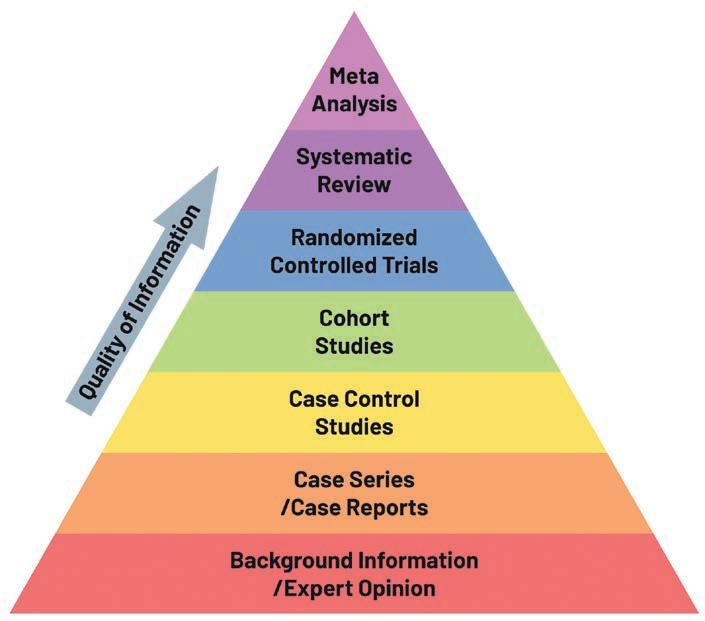
randomised controlled trials (RCTs), and since the former synthesises the latter, this evidence may be more useful. The evidence pyramid is problematic in that the focus is on quantitative research methods and it takes no account of evidence garnered from sources other than research.
Randomised controlled trials
The randomised controlled trial is considered to be the gold standard research design to answer a clinical question. 6 A sample of patients with the disease of interest are randomly allocated to either the intervention or the control group, so they are always interventional studies. Randomly allocating patients to their group removes much of the potential bias and therefore gives a more confident answer. The outcomes in the two groups are then compared to determine which treatment is better. Outcomes can be clinician or patient reported outcomes, but it is important that the patient perspective is considered.
Systematic reviews
Ideally, there will be multiple RCTs looking at a particular question as one trial alone can provide an erroneous finding, and these trials can be brought together in a systematic review. Meta-analysis can then be used if the trials are similar enough in their design. This statistical technique allows the results of several trials to be combined to provide an overall answer, or “effect estimate”. This is the highest level of evidence on the evidence pyramid for EBP, but a systematic review is only as good as the studies that go into it. A commonly used phrase in the reviewing world is “rubbish in = rubbish out”. Good quality clinical guidelines are usually based on systematic reviews that integrate evidence and give a clear picture of quality of the evidence base and knowledge gaps. The Cochrane Collaboration reviews are amongst the best sources of evidence to inform clinical guidelines that are available.
Cohort studies
Clinical trials are notoriously expensive to deliver and tend to be relatively short in duration, with participants often numbering in the hundreds rather than tens of thousands. Consequently, they are not designed to pick up rare side effects, or side effects that take a long time to develop. Therefore, a long-term prospective cohort study of 10,000+ patients is more likely to be a suitable study design for this type of question. A prospective cohort study is one in which patients are recruited into the cohort and then data is collected on the outcomes of interest from that point onwards. A retrospective cohort is usually considered lower quality because it can be subject to significant bias. They rely on the recall of patients to remember events and what treatment they had received, or if using pre-existing records, the records may not be accurate or contain all the relevant information.
Case control study
A case control study is lower on the evidence pyramid because it simply takes people that have the disease and
No 4 www.bdng.org.uk
Dermatological Nursing, 2022, Vol 21,
7
Figure 1. The Evidence Pyramid
ReseaRch STUDY
compares them to people that do not, in order to decide whether something is a risk factor or not. There is huge potential for bias in studies of this design, so, whilst they can be good for hypothesis generating, they are less useful for reaching definitive conclusions.
Even lower down are case series and case reports, in which initial observations on a group of patients, or even just one patient, are reported. Again, these are important in terms of generating research questions but are not good quality evidence for evidence-based decision making.
What is qualitative research?
There are many types of qualitative research, for example, grounded theory, ethnography, case study and phenomenology. Rather than being concerned about specific approaches, it is more useful to understand the underlying principles and core elements of the qualitative approach. The aim in qualitative research is to provide in-depth insights and understanding of real-world issues. In contrast to quantitative research, it does not test treatments, manipulate, or quantify variables.7 A fundamental assumption in qualitative research is that reality is a phenomenon constructed by individuals. 8 The subjective view of reality explored in this type of research is important and has real consequences for understanding and improving patient care.
Core elements of qualitative research are summarised in Box 1 and some are discussed in more detail below.
Interviews and focus groups
Interviews are frequently used to collect qualitative data. These are individual conversations which may be conducted face-to-face or via video or telephone, and generally last between 30-90 minutes. The structure of an interview will vary according to the research question and method. There is a continuum of the degree of structure employed but all use open-
ended questions and give participants the opportunity to speak freely. One of the benefits of an interview study is the in-depth nature of the data collected. It is also important that the person carrying out the interviews understands how to do them to avoid leading questions or overly influencing the participant.9
Focus groups bring people together for a group discussion, rather than talking individually to participants. Each group is usually around eight to 10 participants, lasts one to two hours and will be moderated by a researcher. Typically, focus groups are held in a room face-to-face but the use of online platforms to host the groups is increasing. Focus groups require significant planning and organisation and can be expensive due to travel costs, venue hire and refreshments. There is also a danger that the more confident participants can dominate discussions, but a good facilitator can mitigate against this. A key benefit of focus groups is the production of significant insights from group dynamics and discussions.10
Both interviews and focus groups are, with permission from participant(s), audio or video recorded. Recordings are transcribed
BOX 1.
Core elements of qualitative research
word-for-word and systematically analysed by the research team to organise the data and identify themes using an established technique congruent with the research approach being used. Commonly used techniques include thematic, content11 and framework12 analysis.
More recently, researchers have capitalised on the rich source of data on social media and methods have been developed for analysing this preexisting data. The benefit here is that the data are readily available, making it efficient and relatively low-cost to conduct, but as it was not generated for a specific purpose, there may be limitations in the conclusions that can be drawn.13
The aim in qualitative research is to provide in-depth insights and understanding of real-world issues
Observation
Observation is a core method of data collection in ethnographic research, as it offers the opportunity to view participants’ behaviour in
� The aim is to uncover a deep understanding of individual’s experiences, perceptions, behaviour and processes and the meanings attached to them.
� Participants are recruited because of their experience of, or knowledge about, the phenomenon.
� The researcher is the instrument of data collection and reflexivity is essential.
� The researcher must be transparent about their own preconceived ideas and influence on the study.
� Data are generally collected though one or a combination of: interviews, focus groups, observation, or document/artefact review.
� Interview/focus group questions are generally open-ended and encourage depth and detail of response.
� Data collection and analysis are iterative processes that happen in parallel as the study progresses.
� Data are analysed inductively using specific, rigorous techniques and presented in a way that best addresses the research question.
� Research method must be transparent, rigorous and well reported.
Dermatological
4 www.bdng.org.uk
Nursing, 2022, Vol 21, No
8
the context of the ‘real world’.14 Data is generally collected in the form of written field notes recorded contemporaneously or soon after periods of observation. Observation studies are good for understanding a culture because it is based on what the researcher observes rather than people’s opinion or perspective on that culture. A skilled researcher can become “part of the furniture” that participants no longer notice, with practice continuing as usual. The major advantage of observation is that it reveals day-to-day practice and avoids the potential issue of participants being told what they think you may want to hear – something that can occur in interviews and focus groups. Depending on the nature of the question, observations can range from weeks or months or, in exceptional circumstances, years. Key informants identified during observation are often invited to participate in interviews, which can deepen the researchers understanding of the culture.
of methods in data collection, data analysis, and interpretation of the evidence and most importantly, to provide the added value, there must be integration or “triangulation” of data to produce a rounded analysis.16
Conclusion
In this article, we have explored the meaning of evidence-based practice. We have examined the evidence pyramid and considered its limitations when applied to dermatology nursing. As with other healthcare practitioners, we need to base our practice on a skillful melding of available research evidence applied in the context of the individual patient and their views, in combination with your clinical experience and expertise. We have briefly introduced quantitative, qualitative and mixed methods research and highlighted how each may contribute to generating a robust evidence base for practice. DN
9. Peters K, Halcomb E. Interviews in qualitative research. Nurse Researcher 2015. 22(4):6
10. Jayasekara RS. Focus groups in nursing research: methodological perspectives. Nursing Outlook 2012. 60(6):411-6
11. Vaismoradi M, Turunen H, Bondas T. Content analysis and thematic analysis: Implications for conducting a qualitative descriptive study. Nursing & Health Sciences 2013. 15(3):398-405
12. Ward DJ, Furber C, Tierney S, Swallow V. Using Framework Analysis in nursing research: a worked example. Journal of Advanced Nursing 2013. 69(11):2423-31
13. Golder S, Ahmed S, Norman G, Booth A. Attitudes toward the ethics of research using social media: a systematic review. Journal of Medical Internet Research 2017. 19(6):e195
14. Fetterman DM. Ethnography Step-By-Step Third edition. Sage Publications, Thousand Oaks CA. 2010
15. Kalu FA, Bwalya JC. What makes qualitative research good research? An exploratory analysis of critical elements. International Journal of Social Science Research 2017. 5(2):43-56
Rigour
As with all research, qualitative studies must be rigorous. The researcher must offer a transparent account of the whole research process including: defining the research question, justifying the chosen method, reporting sampling strategy and methods of data collection, explaining the process of data analysis, demonstrating trustworthiness and offering a reflexive account.15
References
1. Mackey A, Bassendowski S. The history of evidence-based practice in nursing education and practice. Journal of Professional Nursing 2017. 33(1):51-5
2. International Council of Nurses. Closing the gap: From evidence to action. Available at http:// www.icn.ch/publications/2012-closing-the-gapfrom-evidence-to-action/
3. Sackett DL, Rosenberg WM, Gray JM, Haynes RB, Richardson WS. Evidence based medicine: what it is and what it isn’t. BMJ 1996. 312: 71-72
4. Saunders H, Gallagher‐Ford L, Kvist T, Vehviläinen‐Julkunen K. Practicing healthcare professionals’ evidence‐based practice competencies: An overview of systematic reviews. Worldviews on Evidence‐Based Nursing 2019. 16(3):176-85
Key points
16. Shorten, A and Smith, J. Mixed methods research: expanding the evidence base. Evidencebased Nursing 2017. 20(3):74-75. As
� Evidence-based practice is essential to enable you to provide the best possible patient care � Two broad types of clinical research can be used for EBP, qualitative and quantitative � Quantitative methods provide the “what” and are numerical studies like clinical trials, whereas qualitative studies give insight into the “how” and “why” and involve methods such as interviews and focus groups.
Mixed methods
In mixed methods studies, researchers collect and analyse both quantitative and qualitative data in the same study. This approach draws on the strengths of both qualitative and quantitative methods and enables researchers to investigate different perspectives and holistically answer complex research questions. Mixed methods research requires deliberate combination
5. Bressan V, Bagnasco A, Aleo G, Timmins F, Barisone M, Bianchi M et al. Mixed‐methods research in nursing–a critical review. Journal of Clinical Nursing 2017. 26(19-20):2878-90
6. Tam W, Lo K, Woo B. Reporting sample size calculations for randomized controlled trials published in nursing journals: A cross-sectional study. International Journal of Nursing Studies 2020. 102:103450
7. Miller WR. Qualitative research findings as evidence: utility in nursing practice. Clinical Nurse Specialist 2010. 24(4):191
8. Creswell J. Research Design: Qualitative & Quantitative Approaches. Thousand Oaks, CA: Sage Publications; 1994
Further reading
� Harvey M, Land L (2016) Research Methods for Nurses and Midwives: Theory and Practice: Theory and Practice. London, Sage.
� Holloway I, Galvin K (2016) Qualitative Research in Nursing and Healthcare. Oxford. Wiley Blackwell.
� Saks M, Allsop J (2019) Researching Health: Qualitative, Quantitative and Mixed Methods. London, Sage.
Dermatological Nursing, 2022, Vol
No 4 www.bdng.org.uk
21,
9
ReseaRch STUDY
with all research, qualitative studies must be rigorous
How to critically appraise a clinical trial
Hywel C Williams, Alison JG Lowe
This is the third article in a series relating to research and dermatology nursing, and describes why critical appraisal skills are necessary for dermatology nurses. It suggests a quick critical appraisal approach that can be used – ‘read, write and reflect’. The approach advises nurses to consider PICO, types of bias, and validity. The importance of utilising critical appraisal in practice is discussed, as well as the need for it to become a necessary skill for dermatology nurses.
Williams H, Lowe A. How to critically appraise a clinical trial. Dermatological Nursing 2021 20(3):26-28
What has critical appraisal of a clinical trial got to do with me?
Dermatology nurses are key professionals with increasing responsibility for initiating and discussing treatment options with patients within a multi-disciplinary team. We now live in an age of evidence-based practice (EBP) where all dermatology professionals are required to integrate the best external evidence with the care of individual patients. Clinical trials usually offer the most reliable form of evidence of the effectiveness of interventions to improve skin conditions (these could be medicines or psychological support or devices such as bandaging techniques), and therefore dermatology nurses are increasingly expected to read trials and to understand them in order to
Hywel Williams is Professor of DermatoEpidemiology and Co-Director, Centre of Evidence-Based Dermatology, Nottingham University Hospitals NHS Trust. Alison Lowe is a Dermatology Clinical Nurse Specialist, University Hospitals Sussex NHS Foundation Trust.
help their patients. The Nursing and Midwifery Council1 (NMC) Code requires nurses to “Always practice in line with the best available evidence”, whilst the British Dermatological Nursing Group (BDNG) nursing role descriptors2 list critical appraisal and the use of evidence to inform practice as a skill for all dermatology nurses. We argue that critical appraisal of a clinical trial is a key skill for all dermatology nurses and is not something that is best left for others to do. There is nothing quite like reading and understanding a clinical trial yourself, but just like any other skill, you might need some guidance on how go about the task simply and efficiently. Here, we provide a brief guide for dermatology nurses to get more confidence in how to tell a good clinical trial from a bad one, and how to apply that knowledge to your patient.
But, I don’t know where to start? Many nurses and doctors may feel paralysed when trying to critically appraise a clinical trial. They may get a sense of what it is all about by reading the bottom line of the abstract and perhaps some of the discussion, but they lose confidence or just don’t understand the methods section or statistics – ironically the most important things to look at to ‘sort the sheep from the goats’.
Try this approach: Read, write, then reflect.
Give yourself 30 minutes with a clinical trial paper in front of you and try the following approach:
Step 1 (5 mins). Read/speed read: Read the title and abstract to orientate yourself and to get an idea of ‘where they are coming from’, and to clarify what the aims and objectives are. In other words, what is it all about and why did the authors do this study? The end of the introduction/ background section is a good place to look as it should end with a clear statement of why the study was done given previous work.
Then consider: Who was behind it? Were they independent investigators funded by government or charity funds, or was it an output from a pharmaceutical company? It is not always obvious, so look closely at the conflicts section at the end of the paper.
The Consolidated Standards of Reporting Trials (CONSORT 3) guidelines are a minimum set of recommendations based on evidence for how clinical trials should be reported, and all good journals will adhere to this. Nurses can use the CONSORT checklist to aid their critical appraisal by providing reminders of what the trial report should include, starting from the title of the paper.
Dermatological
No 4 www.bdng.org.uk
10
Nursing, 2022, Vol 21,
ReseaRch STUDY
ReseaRch STUDY
Step 2 (15 mins). Write/slower focus: Now go to the methods section to confirm that this was a clinical trial. Clinical trials involve people to answer (test) a specific clinical question about treatment(s). The question may be new, or may aim to provide more information where the evidence is unclear, or may be to confirm an unexpected or important previous result. Decide, when you read the paper, if it answers a clinical question.
Next, orientate yourself with some structure and see if you can write down the PICO (i.e., who were the Patients, what was the I ntervention being tested, what was it being Compared with and how were they going to measure whether it did any good or harm i.e. what was the primary O utcome?)
After PICO, try and assess the internal validity of the study – put simply, whether you believe the results are true or ‘internally valid’. Another way to understand internal validity is to imagine it as the extent to which the observations in a trial can be attributed to the intervention and not to bias or statistical error. Here, you could use the simpler version of the Cochrane risk of bias tool.4 For more on bias see Table 1.
To start, search the methods section to see how the randomisation was done, i.e., are you convinced that the allocation of participants to two or more groups was done in a truly random way? For example, by a third party computer randomisation. Randomisation is absolutely key as we need the study groups to be as similar as possible apart from the intervention being tested. If you are satisfied that an effective method was used to generate the randomisation, it is now important to see how the authors have described how that randomisation code was hidden from the people entering patients into the study – also known as concealment of allocation. Hiding the code from those entering study participants is really important, as studies have shown how those with vested interests might end up putting people with more favourable outcomes into one group rather than the other.
Now that you have looked at how randomisation was done and the description of how it was concealed from investigators (you can answer these items as ‘yes’, ‘no’ or ‘unclear’), the next thing is to look for blinding. Phrases such as ‘double blind’ do not help much, as up to five different groups of people can be blinded in a clinical trial. Therefore, you need to see who was blinded to knowing who was given what study medications. Many drug trials are compared against a placebo (either a dummy tablet or saline infusion or just a plain or ‘vehicle’ cream/ointment). Single blinding means the patient is not informed if they are taking a placebo or ‘active’ treatment. Double blinding means that the researcher is also not informed if the patient is receiving active or placebo treatment. Patients who know they are on active treatment are more likely to report positive effects, and if researchers have preconceived ideas about this active treatment, this may prejudice their observations. Are you convinced from the description in the methods section that the control placebo/vehicle had the same look or smell or colour as the active treatment? Don’t take the authors’ word for it. For example, many studies of capsaicin cream are described as ‘double blind’, but patients quickly knew if they were on active treatment as capsaicin (made from chillies) burns the skin! Try and write down who you think was blinded (nowadays more correctly called ‘masked’) and whether you are convinced (yes/no/unclear).
After blinding, look to see if all of those who were initially randomised were included in the main analysis for the primary outcome. The best place to look for this is in a trial flow diagram and see if the numbers randomised at the top of the chart correspond to the numbers analysed at the bottom. It does not matter if some patients drop out after randomisation, but it does matter if they mysteriously disappear and are not included in the analysis. Including all those randomised is usually referred to as ‘intention to treat analysis’. Again, decide if it is a yes/no/ unclear for intention to treat analysis.
Finally, try and see if the outcomes reported and highlighted in the trial are the ones that the authors planned to report – rather than just the outcomes that ‘looked good’. Most good journals now insist that all clinical trial protocols have to be registered in a clinical trial register before recruitment starts. These registers are in the public domain, so you can check them. It only takes a moment, but you need to be in front of a computer. Look for the clinical trials registration number, for example, ISRCTN71423189. Copy this into your web browser and you should find yourself looking at a structured protocol. Scroll down and see what the primary and secondary outcomes were and compare them to those reported in the paper. If they are the same, all well and good. However, if they are different, and without good explanation, then you must conclude that some degree of selective reporting outcome bias might have occurred, i.e., not good.
The above may sound like quite a lot, but with some practice, it should take only 15 minutes as you learn what to look for and where. Just make a note on a checklist of your yes/no/unclear responses. Don’t try and add them into a score, just think about them and decide if you still believe the results.
Step 3 (10mins). Reflection: Reflect on the results in relation to your clinical world by deciding on the external validity of the trial. External validity is the extent to which the results from the trial can be generalised to a population, and especially the population identified in the trial, for example ‘children with atopic eczema’. Therefore, in step 3, you are asked to reflect on whether you think you can apply the results to your patients – if you were totally unconvinced by the internal validity check in step 2, then stop there –no point trying to apply poor evidence to your patient. But if you thought that the study was reasonably valid, then you now need to think about whether the results apply to your patients. See Box 1 for more information.
Utilising your critical appraisal Sharing your critical appraisal of a clinical trial is good practice. It could
No 4 www.bdng.org.uk
Dermatological Nursing, 2022, Vol 21,
11
ReseaRch STUDY
be at a local meeting (such as a clinical governance or journal club) so that other professionals and patients can benefit from the shared knowledge. This can also improve your confidence. Other professionals and patients can also add to their knowledge and their insights too. You can include your activity in your clinical professional development (CPD) portfolio. However, the most important rule of all is to try and apply the results of the study to individual patients –good EBP starts with patients and ends with patients.
Conclusion
This article suggested that utilising evidence in practice is a professional standard, and this requires dermatology nurses to critically appraise the research they use. It also describes a quick way of appraising clinical trials by advising nurses to try the ‘read, write and reflect’ approach which includes the identification of PICO, bias, and validity by using some key questions.
There appears to be a paucity of papers on dermatology nursing and critical appraisal. There is no dermatology nursing competency for critical appraisal, although this is a basic building block for EBP, and utilising evidence in practice is included in the BDNG core quality standards for dermatology nursing interventions and services.6
Dermatology nurses need to develop their confidence and skills in critical appraisal. Stevens, Ricketts and Bruneau7 capture this issue by describing how nurses are taught and supported in practising technical skills, and are encouraged to use EBP, but are not generally supported in practising critical appraisal. This is not a new issue, but one which needs to be addressed if nurses are to be confident in practicing EBP. DN
Correspondence to: Prof. Hywel Williams, Centre of Evidence-Based Dermatology, The University of Nottingham, Applied Health Research Building, University Park, Nottingham, NG7 2RD Hywel.williams@nottingham.ac.uk
Table 1.
Main types of bias in clinical trials (from the Cochrane Handbook5)
Selection bias Systematic differences between the baseline characteristics of the groups compared
Performance bias Systematic differences in the care provided or in the exposure to other factors (other than the intervention) between the groups
Attrition bias Systematic differences between groups in withdrawals from a study
Detection bias Systematic differences in groups in how outcomes are determined
Reporting bias Systematic differences between reported and unexpected findings
BOX 1.
External validity: Question prompts to help reflect on applicability
How similar are the study participants to your patients? They don’t have to be identical, but just be aware that studies often exclude older people with multiple co-morbidities. If the trial was done on adults, are you happy extrapolating those results to children? – children are not small versions of adults after all.
Are the benefits convincing?
If the benefit was statistically significant, was it clinically important in your view? For example, a 10% reduction in inflammatory spots in a trial of a new treatment for acne compared to placebo may be statistically significant, but it is unlikely that a teenager sitting in front of you will be equally impressed with such a result.
How does the treatment fit in with your patient’s beliefs? Did they come for treatment or just for information? Have they had the treatment before and had a bad experience and if so, why?
What are the side effects of the treatment and would they be acceptable to your patient?
Side effects (often reported at the end of the results section) are often not reported very well and are often glossed over in the discussion, so have a look for yourself and come to a judgement on whether they are likely to be an issue for your patient.
References
1. Nursing and midwifery Council, 2015 (updated 2018), The Code: professional standards of practice and behaviour for nurses, midwives and nursing associates. Available at: https://www.nmc.org.uk/ globalassets/sitedocuments/nmc-publications/nmccode.pdf [last accessed August 2021]
2. Griffiths T, Millington G, Penzer-Hick R, Jackson K, Lawton S, Wheeler J., Clinical dermatology role descriptors: guidance on scope of practice. British Dermatological Nursing Group 2019. Available at: https://bdng.org.uk/wp-content/ uploads/2020/08/BAD-BDNG-RCN-NURSINGWORKSTREAM-A4-LANDSCAPE-002.pdf [last accessed August 2021]
3. Schulz KF, Altman DG, Moher D, for the CONSORT Group. CONSORT 2010 statement: updated guidelines for reporting parallel group randomised trials. BMJ 2010. 340;c332
4. Sterne JAC, Savovic ´ J, Page MJ, Elbers RG, Blencowe NS, Boutron I et al. RoB 2: a revised tool for assessing risk of bias in randomised trials. BMJ 2019. 366: l4898
5. Higgins JPT, Altman DG, Sterne JAC (editors). Chapter 8: Assessing risk of bias in included studies. In: Higgins JPT, Churchill R, Chandler J, Cumpston MS (editors), Cochrane Handbook for Systematic Reviews of Interventions version 5.2.0 (updated June 2017), Cochrane, 2017. Available at: www.training.cochrane.org/ handbook [ last accessed August 2021]
6. Buchanan P. Core quality standards for Dermatology nursing interventions and services. Dermatological Nursing 2014. 13(4):s1-s23
7. Stevens LK, Ricketts ED, Bruneau JEE. Critical appraisal through a new lens. Nursing Leadership 2014. 27(2):10-13.
www.bdng.org.uk
Dermatological Nursing, 2022, Vol 21, No 4
12
Demystifying statistics and interpreting study results
In this article, the authors consider some statistical concepts which are important to grasp in the field of dermatology research. The concepts of sampling, systematic errors, confidence intervals, and hypothesis testing are important when critically appraising a study and consolidate the concepts introduced in the previous article on critical appraisal of a trial by Williams et al.1
Gran S, Hollestein LM, Cowdell F. Demystifying statistics and interpreting study results. Dermatological Nursing 2021. 20(4):35-38
Population and sample
In dermatology research, the terms ‘population’ and ‘sample’ are often used, so we will start off by looking at the difference between these important concepts. By population we mean a group of people that we want to find out about, for example, people with a blistering skin disease in the UK or people under the age of 40 with basal cell carcinoma. Often, it is impossible or too expensive to find out about everybody or perform
measurements among the whole population. Therefore, to find out about the population of interest, we take a sample from the population, and generalise from the sample to the population. 2 It is important that the sample is selected so that it is representative of the population of interest. In that way, we can make reliable generalisations. The best way to ensure the sample is representative involves ‘random’ selection so that every individual in the population has an equal chance of being in the sample. Different methods used for random selection are listed in Box 1.
BOX 1.
Random selection approaches
� Simple random selection3
� Systematic random selection4
� Stratified sampling5
Sonia Gran is Assistant Professor of Medical Statistics at the Centre of Evidence Based Dermatology, School of Medicine, University of Nottingham. Loes Hollestein is an epidemiologist at Erasmus MC Cancer Institute, Netherlands Institute for Health Sciences. Fiona Cowdell is Professor of Nursing and Health Research, Faculty of Health, Education and Life Sciences, Birmingham City University.
Potential errors to be aware of Once we have our sample, the next step is to use it to make generalisations about our population. For example, we may want to know the mean number of blisters for adults with bullous pemphigoid, or the prevalence of psoriasis in children. Means and measures of prevalence are examples of different types of statistics. So, we calculate the statistic
of interest for our sample, and then we use this as our best ‘estimate’ of the value for the population.
However, whenever we use data on a sample to find out about the population, we need to think about potential errors. There could be a ‘systematic error’ if the sample is not representative, as mentioned above. When interpreting study results, it is important to check how representative the sample is, a more technical term for this is assessing ‘external validity’. If the external validity of our study is poor, then we cannot make reliable inferences about our population. One way to assess external validity is to investigate how the sample was chosen and check if certain people were left out or not. For example, if we measured how often psoriasis occurred among children in the hospital, the prevalence of psoriasis is likely to be high and not representative for the prevalence of psoriasis in all children.
Unfortunately, even if we take a representative sample, there is likely to be another type of error, as we have not measured everyone in the population. This is called a ‘sampling error’. It is important to consider how much sampling error there is when interpreting results, otherwise the results can be misleading. We
Dermatological Nursing, 2022, Vol 21,
4 www.bdng.org.uk ReseaRch SKILLS 13
No
Sonia Gran, Loes Hollestein, Fiona Cowdell
ReseaRch SKILLS
therefore need confidence intervals when we report an estimate. 2
What is a confidence interval?
A confidence interval is a range of values around an estimate that is used to quantify the imprecision in the estimate due to sampling error. It is an interval which we are reasonably confident includes the true value for the population. 2 Conventionally, 95% confidence intervals are calculated, which means that the interval is calculated such that we are 95% confident that the true value for the population lies within this interval. For example, if the mean number of blisters is 48 with a 95% confidence interval (13 to 75), we would interpret this as: we are 95% certain the true mean number of blisters for this population lies between 13 and 75. Confidence intervals should always be presented alongside the point estimate to indicate how precise (or imprecise) the estimate is. In addition to the level of confidence that we are interested in (e.g., 95%) and the sampling error, the size of the sample also influences the width of the confidence. The larger the sample, the narrower the confidence intervals and therefore the more precise our results. For example, a larger sample of patients with bullous pemphigoid may have led to a mean number of blisters of 51 with a 95% confidence interval between 45 and 57. Figure 1 demonstrates how confidence intervals vary with sample size.
One way to assess external validity is to investigate how the sample was chosen and check if certain people were left out or not
A.
All patients with BP
Small sample
Large sample
B. Mean nr blisters
1A. A study usually includes a sample of patients, which should be representative for the whole population of interest (patients with bullous pemphigoid [BP] in this example)
1B. A 95% confidence interval represents the uncertainty of the estimation (mean number of blisters in this example), because it has been measured in a sample of all patients, rather than the complete population. An increasing sample size results in more precision and thus smaller 95% confidence intervals.
Figure 1. Confidence intervals and sample size
may plan a study because we believe that coffee drinkers have an increased risk of psoriasis. We start by assuming that there is no real difference in psoriasis between coffee drinkers and non-coffee drinkers. This is what we call the ‘null hypothesis’. After defining the null hypothesis, and assuming that the null hypothesis is true, we then collect and analyse the data. 2
Imagine, after we have collected the data, we find the risk of psoriasis in people who drink coffee in this study is 10% and in the non-coffee drinkers it is 1%. Even if there were no difference in the true risk of psoriasis between coffee drinkers and non-coffee drinkers, we could have found this difference (i.e. 10% vs 1%) just by chance.
Allpatients
SmallsampleLargesample
difference between the two groups we are comparing. 2 So, a P value of 0.01 means that there is a probability of 0.01 (or 1%) that the difference between the two groups in our data happened by chance. 2
If the P value is small (conventionally
Confidence intervals should always be presented alongside the point estimate to indicate how precise (or imprecise) the estimate is
Hypothesis testing and P values
Now that we know the importance of identifying a large representative sample, we need to think about the purpose of our study. Sometimes our studies are just descriptive, but usually we have a hypothesis in mind that we would like to test. For example, we
Assuming the null hypothesis is true and there is no difference in the risk of psoriasis between coffee and noncoffee drinkers, we need to determine the chances of getting a difference as big as the one we observed. It is possible to work out what this chance or ‘probability’ is, and this is called the ‘P value’. 2 The approach we use to do this depends on the statistical test used.
The P value always means the same thing whatever test we use. The P value is the probability of getting the difference that we found by chance, when there is really no
<0.05), we conclude that there is evidence to reject the null hypothesis. More meaningfully, we conclude that there is evidence of a difference in the risk of psoriasis between coffee and non-coffee drinkers.
If the P value is large (conventionally >0.05), we conclude that there is no evidence to reject the null hypothesis, and we therefore accept the null hypothesis. More meaningfully, we conclude that there is no difference in the risk of psoriasis between coffee and non-coffee drinkers.
Which statistical test to use
To test our hypothesis and obtain a confidence interval around our estimate and a P value, we need to conduct a statistical test. When deciding which
Dermatological
4 www.bdng.org.uk 14
Nursing, 2022, Vol 21, No
statistical test to use, we need to decide what our outcome and exposure are. In the previous example, psoriasis was the outcome and coffee drinking status the exposure. We then need to ask ourselves three things:
1. What type of data is my outcome (i.e., continuous or binary or categorical)?
2. Are the data observations independent or paired (i.e., more than one observation per person)?
3. How many groups are being compared?
Confounding occurs when we have not considered a third factor which could be masking the association between the exposure and outcome
Table 1 lists the tests for a continuous outcome (e.g., number of blisters) and Table 2 lists the tests for a binary or categorical outcome (e.g., Psoriasis Yes/No). In each table, tests are listed for when the data are independent or paired. An example of paired data is when there is a score on a person every week during the study or when there is a score for an individual before and after an intervention. Statistical tests come with assumptions. For example, when using a t-test for a continuous outcome, the assumption is that the outcome is normally distributed (i.e., looks like a bell curve in a histogram as shown in Figure 2).
For a Chi-square test, which is used for binary/categorical outcomes, the assumption is that there are more than five observations per cell in a crosstabulation. For example, in a 2x2 table, we would expect to see at least five observations in each of the four cells.
Thankfully, if these two assumptions are not met, there are alternative tests. We don’t need to go into much detail, but it is good to be aware there are alternative tests that can be used when
Figure 2.
Bell curve histogram indicating a normal distribution
Table 1.
Tests for a continuous outcome
Normal Distribution
Are the observations independent or paired?
Alternatives if the normality assumption is violated: Independent Paired t-test: compares means between two independent groups
ANOVA: compares means between more than two independent groups
Pearson’s correlation coefficient (linear correlation): shows linear correlation between two continuous variables
Linear regression: multivariate regression technique used when the outcome is continuous; gives slopes
Paired t-test: compares means between two related groups (e.g., the same subjects before and after)
Repeated-measures ANOVA: compares changes over time in the means of two or more groups (repeated measurements)
Mixed models/GEE modeling: multivariate regression techniques to compare changes over time between two or more groups; gives rate of change over time
Non-parametric statistics Wilcoxon sign-rank test: non-parametric alternative to the paired t-test
Wilcoxon sum-rank test (=Mann-Whitney U test): nonparametric alternative to the t-test Kruskal-Wallis test: non-parametric alternative to ANOVA
Spearman rank correlation coefficient: non-parametric alternative to Pearson’s correclation coefficient
Table 2.
Tests for a binary or categorical outcome
Are the observations paired?
Alternatives to the chisquare test if sparse cells: Independent Paired Chi-square test: compares proportions between two or more groups
Relative risks: odd ratios or risk ratios
Logistic regression: multivariate technique used when outcome is binary; gives multivariate-adjusted odds ratios
McNemar’s chi-square test: compares binary outcome between correlated groups (e.g., before and after)
Conditional logistic regression: multivariate regression technique for a binary outcome when groups are correlated (e.g., matched data)
GEE modeling: multivariate regression technique for a binary outcome when groups are correlated (e.g., repeated measures)
Fisher’s exact test: compares proportions between independent groups when there are sparse data (some cells <5).
McNemar’s exact test: compares proportions between correlated groups when there are sparse data (some cells <5).
Dermatological Nursing, 2022, Vol 21, No 4 www.bdng.org.uk 15
SKILLS
ReseaRch
10
10 20 30 40 50 60 70 80 20 30 40 50 60 70 80 90 100 110 120 130 140 “Bell Curve”
ReseaRch SKILLS
the assumptions are not met. These alternative tests are listed in the last column of Tables 1 and 2.
Interpreting results
After we have conducted our statistical test, we need to interpret our results in light of six key things:
Firstly, how representative the sample is; secondly, the size of the effect we are measuring (e.g., mean number of blisters); thirdly, the confidence interval for this effect; and fourthly, the sample size. In the past, there has been too much reliance on P-values. Now the scientific community are moving away from reporting P-values. 2 The reason being that the size of the effect and the level of its precision are more important for clinical practice, whereas P values are largely determined by the sample size available. The final two things we need to consider are bias and confounding. 6
Bias (also known as poor internal validity) occurs when the study estimates are not close to the truth due to a flaw (or flaws) in the study design. Selection bias and information bias can occur in any study and can only be prevented by a good study design before the start of the study. It is not possible to correct for these types of bias afterwards during the data analyses.
Selection bias occurs when there are systematic differences between baseline characteristics of the patients included in the study compared to the total population of interest. For example, by selecting patients from university hospitals, more severe patients may be included in the study and the sample may not be representative for all patients with the disease.
Information bias occurs when the way the exposure, outcome or confounders are measured is influenced by the group the patient belongs to. For example, in a study where a new topical treatment for eczema is compared to a standard treatment, information bias can occur if the assessor is aware of whether the patient received the new topical treatment or the standard
treatment, i.e., an assessor may give a higher disease severity score to a patient on standard treatment compared to a patient taking the new topical treatment. In a proper study design, the assessor would have been blinded to the study medication and information bias would have been prevented.
Confounding occurs when we have not considered a third factor which could be masking the association between the exposure and outcome. Let’s take our example of coffee drinking and psoriasis. We may find that people who drink coffee are more likely to have psoriasis, but this may be because people who drink coffee are more likely to be smokers and smoking is actually a risk factor for psoriasis (not drinking coffee). We can take confounding into account in the analysis by conducting multivariable analysis or stratifying results (i.e., presenting results separately for different groups of people). The latter is illustrated in Table 3.
There is no dermatology nursing competency for medical statistics, but this is a building block for evidence-based practice
Table 3 shows that after controlling for confounding by smoking (either by multivariable analysis or stratification), there is likely no difference in the risk of psoriasis between coffee and noncoffee drinkers. However, when not taking smoking into account, it looks like those who drink coffee are nearly twice as likely to have psoriasis compared to those who don’t drink coffee. Therefore, when planning a study, it is important to consider potential confounders and collect information on them. When interpreting results, it is important to check if the researchers have controlled for confounders in their study.
Conclusion
This article demonstrates the key statistical concepts that dermatology nurses need to be aware of when critically appraising research. The
Table 3. Illustration of confounding
Coffee vs. non-coffee drinkers (not controlling for confounders)
Coffee vs. non-coffee drinkers (multivariable analysis)
Coffee and non-coffee drinkers (by smoking strata)
Risk ratio* for psoriasis
1.98 (95% CI: 1.72-2.19)
1.11 (95% CI: 0.92-1.22)
Non-smokers=1.15 (95% CI: 0.98-1.26)
Smokers=1.05 (95% CI: 0.89-1.17)
*Risk ratio compares the risk of psoriasis in people who drink coffee compared to those who are noncoffee drinkers
concepts also need to be considered when designing or analysing one’s own research. There is no dermatology nursing competency for medical statistics, but this is a building block for evidence-based practice and utilising evidence in practice is included in the BDNG core quality standards for dermatology nursing interventions and services.7 DN
References
1. Williams H, Lowe A. How to critically appraise a clinical trial. Dermatological Nursing 2021 20(3):26-28
2. Altman DG. Practical Statistics for Medical Research. Chapman & Hall. 1995
3. Thomas L. An introduction to simple random sampling. Scribbr 2020 (revised 2021). Available at: https://www.scribbr.com/methodology/simplerandom-sampling/ [last accessed November 2021]
4. Thomas L. How to perform systematic sampling. Scribbr 2020. Available at. https://www. scribbr.com/methodology/systematic-sampling/ [last accessed November 2021]
5. Thomas L. How to use stratified sampling. Scribbr 2020 (revised 2021). Available at: https:// www.scribbr.com/methodology/stratifiedsampling/ [last accessed November 2021]
6. Alan S. Rigby, Getting past the statistical referee: moving away from P-values and towards interval estimation, Health Education Research 1999 14(6):713-715
7. Buchanan P. Core quality standards for Dermatology nursing interventions and services. Dermatological Nursing 2014. 13(4):s1-s23
4 www.bdng.org.uk 16
Dermatological Nursing, 2022, Vol 21, No
Qualitative research in dermatology nursing
Laura Howells, Fiona Cowdell
This paper is the fifth in a series devoted to dermatology nursing research methods. We have already given a brief introduction to both qualitative and quantitative research methods in our second article.1 This short article is designed to explore the value of qualitative research for dermatology nursing, introduce different qualitative methods and approaches, and look at how to assess the rigour or trustworthiness of qualitative research.
Howells L, Cowdell F. Qualitative research in dermatology nursing. Dermatological Nursing 2022. 21(2):34-36.
What is qualitative research?
Qualitative research methods can vary widely, but there are three characteristics of qualitative research that typically distinguish it from quantitative research:2
1. Qualitative research is concerned with text , words, images, and sounds and other types of non-numerical data.
2. Qualitative research tends to be inductive (generating hypotheses and theories from the data) rather than deductive (using data to test out existing hypotheses and theories).
3. Qualitative data collection and analysis tends to take a flexible and iterative approach. Data collection and analysis can be concurrent
Laura Howells is a Researcher at the Centre of Evidence Based Dermatology, School of Medicine, University of Nottingham. Fiona Cowdell is Professor of Nursing and Health Research, Faculty of Health, Education and Life Sciences, Birmingham City University.
processes to allow adjustment or deepening of the interview schedule and revising and refining of findings.
When to use qualitative methods in dermatology nursing research
All good research designs start with asking the right question. The right question in dermatology research may be determined by several factors, such as if it can inform improvements in treatment or healthcare systems, and if it answers a question that is important to patients and healthcare professionals. 3,4
The kinds of questions where qualitative research methods are required tend to focus on the ‘why’ or the ‘how’. 5,6 Qualitative research tends address questions about process and meaning, rather than cause and effect. 2
Imagine a dermatology department has introduced a new service for patients where dermatology nurses deliver group workshops to help people self-manage their skin condition, and you have been asked to evaluate this service. If you wanted to answer the question: ‘Do group workshops improve health outcomes for people with skin conditions?’ you would be focusing on effects, and therefore a quantitative research design might be most appropriate. For example, a clinical trial that randomised patients to one group or the other and compared quantitative outcome measures could help us answer this question.
Comparatively, if you wanted to answer the question ‘What were the individuals' experiences of attending these groups?’ you would be focusing
No 4 www.bdng.org.uk 17 ReseaRch SKILLS
Dermatological Nursing, 2022, Vol 21,
ReseaRch SKILLS
on process, and therefore a qualitative research design could be most suitable. To do this, you could conduct interviews with members attending the groups and ask them open questions about the range of benefits and challenges of attending the group.
How do I know which qualitative approach to use?
There are multiple approaches to qualitative research, each with underpinning theoretical and philosophical positions. It is important that you understand and are true to whichever approach you select. We present below an overview of three studies using different qualitative methods relevant to dermatology nursing to give a flavour of the various approaches that can be used. This is not an exhaustive list, and there are many more approaches that can be used.6
Example 1: An exploratory qualitative study7 Research topic: Andrew Thompson and colleagues wanted to explore in-depth the ways in which British Asian women manage and adjust psychosocially to vitiligo, and the potential role of ethnicity and culture in this process.
Data collection methods: They conducted in-depth interviews using a semi-structured guide. Six were faceto-face and one was done via email. Psychologists conducted the interviews.
Data analysis methods: Interviews were transcribed word for word. Researchers familiarised themselves with the data, and then developed a ‘template’ of findings. Through comparison within and between interviews, they adapted the template. The final template was used to develop an interpretation of the findings. Quality markers included an audit (or ‘check’) of the findings and asking two participants and one patient who was not a participant to comment on the findings.
Findings: The researchers identified five themes exploring the culturally specific impact and individual impact of vitiligo, as well as the coping strategies, social support, and ongoing burden of living with vitiligo.
Some core features of the exploratory approach:8
� Aims to discover something new or understand something in more depth � More ‘data-driven’ than ‘theory-driven’ � The problem or issue being explored is usually not clearly defined at the start of the study.
Example 2: An ethnographic qualitative study9 Research topic: Fiona Cowdell wanted to investigate the way in which mindlines (collectively reinforced, internalised tacit guidelines), are constructed among lay people with eczema in primary care. We all have mindlines, they are our knowledge, understandings and beliefs built on a multifaceted combination of knowledge sources, for example personal tacit knowledge developed over time, advice from practitioners, communication with others and via social media.10
Data collection methods: Observed patients/parents in one large urban general practice in England over approximately six months, as well as conducting 16 interviews with patients/ parents of children with eczema.
Data analysis methods: Field notes from observations and transcripts of interviews were read in full, followed by development of codes, which were combined into categories, and then into themes. Sections of data particularly relevant to the themes were then reviewed to check they were authentic and used participant language.
Findings: Eczema mindlines exist with themes of: doctor knows best, not worth bothering the doctor, I need to manage this myself and how do I know what to do? People broadly fit into four typologies – people content to self-manage, people content to accept practitioner management, self-managing by default or referred to secondary care.
Some core features of the ethnographic approach:6
� Aims to describe or represent cultures, groups or settings � The context of the culture, group or setting is central
� Uses ‘thick descriptions’ developed from observation and/or interviews.
‘Thick descriptions’ go beyond describing, analysing and interpreting to offer insights into contextual and cultural detail and social meaning.6
Example 3: A grounded theory qualitative study11 Research topic: Annica Lagerin and colleagues wanted to understand district nurses’ experiences of caring for leg ulcers in accordance with clinical guidelines.
Data collection methods: They conducted group interviews (also known as focus groups) using a semi-structured guide.
Data analysis methods: Grounded theory analysis methods were used. This was a four staged approach using open coding (line by line reading of transcripts to develop codes and preliminary categories, where categories are a way of combining codes), focused coding (adapting the categories), identifying relationships between categories using theoretical codes, and finally, developing core processes that tie all the categories together.
Findings: The core process was how district nurses try to stay on track and motivated to deliver care in line with clinical guidelines despite obstacles. Three obstacles were identified, and the research team identified strategies district nurses used to try and overcome these obstacles.
Some core features of the grounded theory approach:6
� Aims to generate a theory that is grounded in the data (or modify/ extend an existing theory)
� A systematic approach that involves an iterative approach of creating and testing out new hypotheses therefore
www.bdng.org.uk
Dermatological Nursing, 2022, Vol 21, No 4
18
There are multiple approaches to qualitative research, each with underpinning theoretical and philosophical positions
using both inductive and deductive approaches. Continually compares data using a method called ‘constant comparison’
� Engages with existing literature in the development of the theory.
Comparing these three examples, we can see that qualitative approaches have both similarities and differences.
All three studies collected and analysed data in the form of ‘words’, generated ‘themes’, and used a staged approach to analyse where the findings were iteratively refined and developed. All had different research aims and chose different data collection methods, ranging from one-to-one interviews, observation, and focus groups. As with all research, the most important element is selecting the method that will best answer your research question, understand it, and use it diligently in practice.
How can rigour or trustworthiness of qualitative research be assessed?
As qualitative research has become an essential part of evidence-based healthcare, there is a need to be able to assess the quality.12 There is still considerable debate within the qualitative research community about which markers of rigour are the most important to consider and how they should be assessed. Some are concerned that the development of ‘checklists’ can be too prescriptive, not sensitive to differences in qualitative approaches, and try to enforce quantitative notions of quality onto qualitative research, but without them, it can be hard for readers to critically appraise quality.12 There are four overarching concepts of quality that are broadly applicable to all approaches of qualitative research (see Table 1).
It is also worth noting that some tools focus on assessing the quality of the study, whereas others focus on assessing the reporting of the study 12 The Critical Appraisal Skills Programme (CASP) qualitative checklist is a commonly used tool to assess the quality of a study, whilst the Consolidated criteria for reporting qualitative research (COREQ) and the standards for reporting qualitative research (SRQR) are two
Table 1.
Williams et al.’s overarching concepts of quality for qualitative research12
Concepts of rigour and trustworthiness in qualitative research
Transferability – can the reader make connections with the study findings and wider settings or contexts?
Credibility - is the researcher’s interpretation and account believable and appropriate?
Reflexivity – does the researcher engage in examination of how they have influenced the research (from sampling to data collection, analysis and interpretation)?
Transparency – does the researcher make their decisions and the rationale for their decisions clear and explicit for the whole research process?
commonly used tools to assess the quality of reporting of a study.13-15
Dermatology nurses as qualitative researchers
It is recognised that qualitative research is best when approached from an interdisciplinary perspective, and there is certainly a role for dermatology nurses. 5 Some key skills of a qualitative researcher have a synergy with skills dermatology nurses use every day in their clinical practice. Skills include active listening, reflective practice, attention to detail and sense-making of a large amount of complex data, and ability to understand different viewpoints. 2
Conclusion
Qualitative research is essential to answer important research questions relevant to dermatology nursing. There are a wide variety of qualitative methods and approaches, and the researcher must understand the differences between them to select the best one for their research question. It is important that readers can distinguish between poor and high-quality qualitative studies. DN
References
1. Chalmers J, Cowdell F. What are qualitative and quantitative research methods? A brief introduction. Dermatological Nursing 2021, 20(2):45-48
2. Braun V, Clarke V. Successful qualitative research: A practical guide for beginners: SAGE; 2013
3. Chalmers I, Glasziou P. Avoidable waste in the production and reporting of research evidence. The Lancet 2009. 374(9683):86-9
4. Cowan K, Oliver S. The James Lind Alliance Guidebook. Southampton: National Institute for Health Research Evaluation, Trials and Studies Coordinating Centre. 2013
5. Nelson P, Magin P, Thompson A. Six of the best: how excellent qualitative research can contribute to practice. British Journal of Dermatology 2017. 177(3):603-5
6. Holloway I, Galvin K. Qualitative research in nursing and healthcare: John Wiley & Sons; 2016
7. Thompson A, Clarke S, Newell RJ, Gawkrodger D, Collaboration AR. Vitiligo linked to stigmatization in British South Asian women: a qualitative study of the experiences of living with vitiligo. British Journal of Dermatology 2010. 163(3):481-6
8. Rendle KA, Abramson CM, Garrett SB, Halley MC, Dohan D. Beyond exploratory: a tailored framework for designing and assessing qualitative health research. BMJ Open 2019. 9(8):e030123-e
9. Cowdell F. Knowledge mobilisation: an ethnographic study of the influence of practitioner mindlines on atopic eczema self-management in primary care in the UK. BMJ Open 2019. 9(7):e025220
10. Cowdell F, Ahmed T, Layfield C. Knowledge mobilisation: a UK co-creation study to devise strategies to amend lay and practitioner atopic eczema mindlines to improve consultation experiences and self-management practices in primary care. BMJ Open 2020. 10(9):e036520
11. Lagerin A, Hylander I, Törnkvist L. District nurses’ experiences of caring for leg ulcers in accordance with clinical guidelines: a grounded theory study. International Journal of Qualitative Studies on Health and Well-being 2017. 12(1):1355213
12. Williams V, Boylan A-M, Nunan D. Critical appraisal of qualitative research: necessity, partialities and the issue of bias. BMJ Evidence-based Medicine 2020. 25(1):9-11
13. Tong A, Sainsbury P, Craig J. Consolidated criteria for reporting qualitative research (COREQ): a 32-item checklist for interviews and focus groups. International Journal for Quality in Health Care 2007. 19(6):349-57
14. O’Brien BC, Harris IB, Beckman TJ, Reed DA, Cook DA. Standards for reporting qualitative research: a synthesis of recommendations. Academic Medicine 2014. 89(9):1245-51
15. Critical Appraisal Skills Programme Checklists [Available at: https://casp-uk.net/casp-toolschecklists/ [last accessed May 2022]
Dermatological Nursing, 2022, Vol 21, No
4 www.bdng.org.uk ReseaRch SKILLS 19
Research: Where does it fit into dermatology nursing practice?
In the final article of this series, the author considers where research fits into dermatology nursing roles. It addresses research in context, outlines the evidence for incorporating research into practice, and looks at the patient role in research. The evidence to support nursing involvement, including research training for pre-registration nurses is discussed. It finally examines the four main ways of becoming research active in dermatology with reference to the BDNG/BAD Clinical Dermatology Nursing Role Descriptors: guidance on scope of practice.1
Westmoreland M. Research: Where does it fit into dermatology nursing practice? Dermatological Nursing 2022. 21(3): 19-22
What is research?
Research is a vital component of healthcare as it creates the evidence on which to base choices and make decisions. All medicines, medical devices, treatments, and patient reported outcomes (PROMS) have undergone a rigorous research process to ensure they are safe and effective for patient care. However, research is often seen as something done by others. It has traditionally been carried out by doctors leading drug studies, scientists in laboratories or specialist research nurses working in niche areas. This means it is often thought of as someone else’s job, rather than the reality of it being part of everyone’s role. Research is not just about delivering it but also about its application. Whether using
Melanie Westmoreland is Lead Research Nurse and Clinical Study Coordinator at the Department of Dermatology, Churchill Hospital, Oxford.
research to inform evidence-based clinical practice, holding conversations with patients about the best treatment options, actively engaging patients in databases and trials or conducting their own research, it is a role which sits squarely with nurses. The NMC code, section two2 states: “You must practice in line with the best available evidence”. However, many nurses do not appear to see research as part of their role, often think of it as separate to clinical care, and as something completed by someone else. The 2021 BDNG UKDCTN national survey revealed only 23% of dermatology nurses are actively involved in research. 3
What is the evidence for embedding research in healthcare?
William van’t Hoff, NIHR Clinical Director for NHS Engagement,4 stated in 2019 that: “There’s a growing body of evidence which illustrates that research active hospitals have better patient outcomes.” This is acknowledged by Jonker et al, 5 who further outline that those hospitals who have higher levels of clinical research activity are associated with reduced levels of patient mortality and improvements in the overall quality of care they receive. Many studies have shown that all patients have better
Dermatological Nursing, 2022, Vol 21, No 4
health outcomes in research-active hospitals, even if those individual patients are not part of the research.
The Care Quality Commission’s (CQC) Well Led Framework for NHS Trusts and Foundation Trusts 6 highlights the responsibilities of hospitals. It poses questions to Trusts around the vision and strategy to support clinical research activity in relation to best patient care. It probes into clear internal reporting systems for the amount and quality of research and asks how patients and carers are presented with the opportunity to participate in or become actively involved in clinical research studies.
The CQC are clearly interested in the amount and type of quality research happening in any given hospital and during inspections can and do ask staff, particularly those involved in frontline care, what research opportunities are available for their patients. Additionally, chapter three of the NHS Long Term Plan – ‘Research and Innovation to Drive Future Outcomes Improvement’ 7 – highlights the benefits patients derive from research and innovation, such as the prevention of ill health, earlier diagnoses, and more effective treatments with faster recoveries.
www.bdng.org.uk PRofessional DEVELOPMENT 20
Melanie Westmoreland
It sets out challenging priorities for the next 10 years and is clear that research is fundamental to achieving better outcomes for patients during this period. The government’s ‘Saving and Improving lives: The Future of UK Clinical Research Delivery’ directs “engage[ment] with health and care staff to embed the idea that research is not a burden – but an essential and rewarding part of effective patient care.” 8
Established in 2006, the National Institute of Health and Care Research (NIHR) is funded by and works alongside the NHS, collaborates with healthcare professionals, researchers, patients, the public and partners in industry, and has a central role in the research landscape.9 It supports nurses to find out what research is going on in their clinical area, it helps nurses who want to conduct their own research and it funds NIHR research delivery staff who undertake research in Trusts across England. Promoting nursing research and nurses in research to become outstanding researchers and to work in world class facilities is a core aim of the NIHR Clinical Research Nurse Strategy. Although primarily for England, it works in close collaboration with Scotland, Wales, and Northern Ireland to deliver high-quality research for the benefit of the NHS, public health and social care.
What is the role of the patient in research? We also know that patients want to become involved in research. Thousands of patients are helping to make research happen every day. In 2020/21, the NIHR CRN helped 1,390,483 participants take part in portfolio studies in England. Patients may choose to benefit from being part of a research study. They may have exhausted standard care and wish to try a new treatment or drug not routinely available on the NHS, (such as remibrutinib for chronic spontaneous urticaria or upadacitinib for atopic dermatitis.) They may want their experience to be of benefit to others, perhaps by donating a biological sample or consenting to add their clinical outcomes to national databases such as BADBIR or A-Star, which aim to
understand the long-term effectiveness of biologic treatments in dermatology. Patients want to be involved in developing research studies that matter to them, such as the current James Lind Alliance Priority Setting Partnership on pemphigus and pemphigoid, which bring patients, carers and clinicians together on an equal footing to identify evidence uncertainties relevant to all groups and to develop research questions which are meaningful.10 Through Patient and Public Involvement and Engagement (PPIE), the public help design research studies, or act as a research champion or a reviewer of potential studies. The principles of ICH-GCP (Good Clinical Practice) mean that patients are at the heart of ensuring that research is not something ‘done to people’, but it is ‘done with people.’
What is the policy supporting nursing involvement in research?
The Chief Nursing Officer for England, Ruth May, in the 2021 Strategic Plan for Research, states that: “At its heart is the shared ambition to create a people-centred research environment that empowers nurses to lead, participate in and deliver research, where research is fully embedded in practice and professional decisionmaking, for public benefit.”11 This does not mean just referring the patient to the department research nurse (if there is one), but actually thinking about the evidence that nurses base their decisions on, the conversations they have with patients about treatment options, working with multi-professional teams to deliver research and leading research either for the benefit of patients or the development of their own profession. This results in a nursing workforce who inform practice based on the best available evidence, can engage patients in research studies when appropriate and are striving to improve the healthcare agenda for patients and the workforce by asking important questions. This is supported by Professor Mark Radford, Chief Nurse for Health Education England (HEE) and Deputy Chief Nursing Officer for England, who advocates that nurses lead, undertake, and deliver research and that this is
vital for improving healthcare.12 NHS England details that matrons should understand what research is happening within their clinical areas and should be able to support staff who would like a clinical academic career and work collaboratively with their research and development (R&D) departments to achieve this.13
How are we educating our pre-registration nurses about research?
It is clear there is a plethora of evidence to embed research into healthcare, that patients want to be involved, and that nursing leaders are expecting and facilitating the workforce to do this, so how do we prepare nurses to engage, lead and deliver research? Nursing is a degree level entry vocation, suggesting that delivery of the course in a university setting would ensure research is embedded in nursing education programmes. However, anecdotal evidence suggests research exposure within the curriculum may be limited, with clinical skills often taking precedence. Exposure to research may be available in some placement areas, and nursing leaders and educators should be aware of the research happening in their clinical specialities and departments to create a culture where research is discussed, promoted and part of day-to-day care. However, it seems unclear how much meaningful research experience preregistration students get as part of the undergraduate programme, again, with anecdotal evidence suggesting little research training and few true research placements. Research placements could be occurring with research delivery teams as part of departmental rotations, but it is unlikely that student nurses have significant placements with research teams or spend much time with nurse researchers; however, those that do report a rich, varied and rewarding placement. Therefore it is questionable how prepared pre-registration nurses are for being research active post-registration and this varies from Trust to Trust and with different undergraduate nursing programmes. Clinical academic pathways are common for medical staff and are integrated into career
No 4 www.bdng.org.uk
Dermatological Nursing, 2022, Vol 21,
21
PRofessional DEVELOPMENT
PRofessional DEVELOPMENT
structures, but have been far scarcer for nurses. However, clinical academic pathways are emerging in some Trusts, and although these are widely supported, the availability currently remains patchy.14
How do we integrate research into nursing practice?
There are four main pathways to incorporate research into nursing practice. Firstly, at its most basic, all nurses need to be research aware; nurses should know what studies are ongoing within their clinical areas, they should be offering patients the opportunity to take part in research and able to have conversations about the opportunities available, know where to direct patients for further information and where to go to find out more. They do not necessarily need to hold conversations with patients about particular studies, but should be able to signpost patients where appropriate.
Nurses also need to be using the best available evidence to support their practice, taking part in their departmental journal clubs and reading around their particular area of interest to ensure knowledge is current and the conversations they have with their patients are evidence-based and up-todate. This is broadly supported by the BDNG and BAD role descriptors1 for Band 5 and Band 6, however, the role descriptors omit the research delivery aspect for dermatology nurses, which potentially means their patients may miss out on opportunities to partake in clinical trials relevant to their skin condition which are available in their department.
Secondly, as a research delivery nurse, employed to deliver research within the NHS. These nursing posts are often funded by the NIHR Clinical Research Networks or academic institutions, but also through commercial or grant monies. The research delivery nurse’s role is to identify eligible participants and recruit to research studies. These could be academic studies, designed and developed by research clinicians or
nurses, who are often PhD students and have secured funding from grants for their research, or recruiting to industry studies where a dermatology consultant is the principle investigator (PI) and takes responsibility for running the study on site, contributing to a large, often global, study. Finally, this could involve research delivery nurses recruiting to large cohort database studies, e.g., BADBIR or A-Star, to add to the body of knowledge and understanding about the long-term effects of particular conditions.
Sometimes there is the possibility for experienced research delivery nurses to act as a PI to database or non-CTIMP (Clinical Trial Involving Medicinal Product) studies, an extended role supported by the NIHR, whereby nurses take on the responsibility for a study in their clinical area. Delivery roles involve research nurses managing a trial within a department from beginning to end; they regularly run several studies and combinations of studies, and maintain responsibility for the caseload of patients involved with each study. Patients taking part in these studies are often in the severe category of disease, as by the nature of them being eligible for a clinical trial, their condition may have failed to respond to standard treatment, hence the possibility to try an unlicenced drug as part of a clinical trial. These research delivery nurses are skilled at caring for this complex caseload of patients, often outside the standard care pathway, thus freeing up appointments for other patients and easing the burden on busy clinics.
Thirdly, through the research pillar as an advanced clinical practitioner (ACP). The multi-professional framework for advanced clinical practice in England15 determines that all health professionals working at ACP level should develop their skills and knowledge to the framework standard. The four pillars underpinning this are, clinical practice, leadership, education and research, with the research pillar containing eight competencies including: engaging in research, appraising, and synthesising
outcomes of research, identifying gaps in knowledge, and disseminating best practice in research findings.
Nurses working as ACPs should to be working within the four-pillar framework and incorporating these research competencies into their dayto-day roles. The role descriptors1 for Bands 7 to 8a-c are pertinent for ACPs, and these may form a significant part of these roles, for example contributing to primary research, being a chief investigator on a research project, or a lead author in publications.
Fourthly, to become a clinical academic nurse, either within an academic institution or an NHS Trust, the individual should identify gaps in knowledge and develop research questions to provide answers. In trusts, these roles usually develop alongside a clinical role, with a question arising from practice. They can be at any level of seniority and can start with the NIHR Nursing and Midwifery Incubator, designed to support a skilled academic workforce in nursing. Incubators can set the foundations for a HEE internship and then the possibility of Pre-doctoral Clinical and Practitioner Academic Fellowship (PCAF) Doctoral Clinical and Practitioner Academic Fellowship (DCAF) or Advanced Clinical and Practitioner Academic Fellowship (ACAF) schemes through the Integrated Clinical Practitioner Academic Programme, which supports nurses at different stages of their research career.16 This academic pathway allows for the development of the question into formal research at differing levels. The Clinical Academic Roles Implementation Network (CARIN) was established within the Council of Deans of Health to promote joint clinical academic roles for healthcare professionals and works with lead nurses in Trusts to support these clinical academic pathways for nurses, midwives, and allied health professionals.17
Summary
The evidence for being research active is considerable and the pathways to achieve this are available, however,
www.bdng.org.uk
Dermatological Nursing, 2022, Vol 21, No 4
22
there are a myriad of reasons why nurses do not get involved at all, ranging from the feeling that it is too niche, to the real gap between having an idea and not knowing where to go or what to do with it.
Nurses struggle to secure funding independently unless they are an experienced researcher, often with a PhD, or are applying as a co-applicant with a PhD. There are few nurse researchers around to aspire to and nurses need more role models and leaders in research. Most nurse researchers are senior, often because they do not start to develop their research until they are later in their nursing careers, and then potentially become distant from clinical practice and therefore not seen as role model to others. The nursing culture has not traditionally supported nurses wanting to do research alongside a clinical role and has lacked the structure of academia to overcome this.
Nurses who are engaged in research have also, at times, been pulled back into clinical care whenever there is a staff shortage, with research seen as less important. Clinical academic research roles are rare and there remains a lack of nurses who are embedded in clinical and academic roles.18,19 Avery, Westwood and Richardson 20 discuss the need for clearer pathways, greater integration between clinical and academic departments, and more grant and funding opportunities as enablers to clinical academic careers. However, research is firmly embedded in the NHS and nurses should grasp the opportunities to incorporate it into their practice. Post pandemic, research has had a positive boost with widely publicised vaccine studies, and trials such as PANORAMIC. 21 Many nurses have been instrumental in the successful rollout of these studies and the vast amounts of data currently available.
Now is the time to reach out to research delivery nurses, clinical academic nurses, the NIHR or BRC and get involved in research for the
benefit of your patients and your own development. With Ruth Endecott 22 championing “invest[ment] in career pathways that enable nurses to move between supporting, delivering and leading research,” there is no better time to ensure that research has a place in your clinical career. DN
References
1. BDNG BAD Clinical role descriptors: guidance on scope of practice. Available at https://cdn.bad.org.uk/ uploads/2022/02/29200026/BAD-BDNG-RCNNURSING-WORKSTREAM-A4-LANDSCAPEFINAL.pdf [last accessed August 2022]
2. Nursing and Midwifery Council 2018, The Code. Available at: https://www.nmc.org.uk/ standards/code/ [last accessed August 2022]
3. Cowdell F and Radley K. Nurses and dermatology research: A national survey. Dermatological Nursing 2021. 20(1): 44-46
4. William van’t Hoff. National Institute of Health Research 2019. CQC inspections to give more exposure to clinical research taking place in NHS Trusts. Available at: https://www. nihr.ac.uk/news/cqc-inspections-to-give-moreexposure-to-clinical-research-taking-place-innhs-trusts/20352 [last accessed August 2022]
5. Jonker L, Fisher S, Dagnan D. Patients admitted to more research-active hospitals have more confidence in staff and are better informed about their condition and medication: Results from a retrospective cross-sectional study. Journal Evaluating Clinical Practice 2020. 26(1):203-208
6. Care Quality Commission 2018. Inspection framework: NHS trusts and foundation trusts. Available at: https://www.cqc.org.uk/sites/ default/files/20200115_Trust_wide_well_led_ inspection_framework_V7.pdf [last accessed August 2022]
7. NHS 2019. Long Term Plan. Available at: https://www.longtermplan.nhs.uk/onlineversion/chapter-3-further-progress-on-carequality-and-outcomes/better-care-for-majorhealth-conditions/research-and-innovationto-drive-future-outcomes-improvement/ [last accessed August 2022]
8. Gov.uk 2021. Saving and Improving Lives; The Future of UK Clinical Research Delivery. Available at: https://www.gov.uk/government/ publications/the-future-of-uk-clinical-researchdelivery/saving-and-improving-lives-the-futureof-uk-clinical-research-delivery#our-strategy-andplans-for-delivery [last accessed August 2022]
9. National Institute of Health and Care Research 2022. Available at: https://www.nihr. ac.uk/ [last accessed August 2022]
10. James Lind Alliance 2022. About Priority Setting Partnerships. Available at: https://www. jla.nihr.ac.uk/about-the-james-lind-alliance/ about-psps.htm [last accessed August 2022]
11. May R 2021. cited in, Making Research Matter – Chief Nursing Officer for England’s strategic plan for research (p2) Available at: https://www.england.nhs.uk/publication/ making-research-matter-chief-nursing-officerfor-englands-strategic-plan-for-research/ [last accessed August 2022]
12. Radford, M, 2021, cited in, Making Research Matter – Chief Nursing Officer for England’s strategic plan for research (p3). Available at: https://www.england.nhs.uk/publication/ making-research-matter-chief-nursing-officerfor-englands-strategic-plan-for-research/ [last accessed August 2022]
13. NHS England, Research and Development. Available at: https://www.england.nhs.uk/mattransformation/matrons-handbook/research-anddevelopment/ [last accessed August 2022]
14. Olive et al. Clinical academic research internships: What works for nurses and the wider nursing, midwifery, and allied health professional workforce. Journal of Clinical Nursing 2022. 31:313-328
15. Health Education England 2017. Multi -professional framework for advanced clinical practice in England. Available at: https://www. hee.nhs.uk/sites/default/files/documents/multiprofessionalframeworkforadvancedclinicalpracti ceinengland.pdf [last accessed August 2022]
16. Developing your career in Clinical Research. Available at: https://www.nihr.ac.uk/health-andcare-professionals/career-development/nursesand-midwives.htm [last accessed August 2022]
17. CARIN. Available at: https://www. councilofdeans.org.uk/category/policy/research/ clinical-academic-roles-implementationnetwork/ [last accessed August 2022]
18. Henshall C, Kozlowska O, Walthall H, Heinen A, Smith R, Carding P. Interventions and strategies aimed at clinical academic pathway development for nurses in the United Kingdom: A systematised review of the literature. Journal of Clinical Nursing 2021 30:1502-1518
19. Pattison N et al. Florence Nightingale’s legacy for clinical academics: A framework analysis of a clinical professional network and a model for clinical academia. Journal of Clinical Nursing 2022. 31:353-361
20. Avery M, Westwood G, and Richardson A. Enablers and barriers to progressing a clinical academic career in nursing, midwifery, and allied health professions: A cross sectional survey. Journal of Clinical Nursing 2022. 31:406416.
21. PANORAMIC trial. Available at: https://www. panoramictrial.org/ [last accessed August 2022]
22. Endecott R 2021, cited in, Making Research Matter – Chief Nursing Officer for England’s strategic plan for research (p4). Available at: https://www.england.nhs.uk/publication/ making-research-matter-chief-nursing-officerfor-englands-strategic-plan-for-research/ [last accessed August 2022]
Dermatological Nursing, 2022, Vol 21,
4 www.bdng.org.uk
23
No
PRofessional DEVELOPMENT
Prescribing Information

Name: Wynzora, 50 micrograms/g + 0.5 mg/g cream Active Ingredient: One gram of Wynzora Cream contains 50 micrograms of calcipotriol and betamethasone dipropionate equivalent to 0.5 mg betamethasone. Excipients with known effect: Butylated hydroxyanisole (E 320) 1.0 micrograms/g cream Macrogolglycerol hydroxystearate 3.4 micrograms/g cream Indication: Wynzora is indicated for topical treatment of mild to moderate psoriasis vulgaris, including scalp psoriasis, in adults. Dosage and Administration: Rub a thin layer of Wynzora Cream to affected areas once daily for up to 8 weeks. Discontinue when control is achieved. Treatment should be continued only after medical review and under regular medical supervision. For calcipotriol containing medicinal products, do not exceed the maximum daily dose of 15 g; the body surface area treated should not exceed 30%. Wynzora Cream should not be applied directly to the face or eyes. Allow 8 hours between the application and showering or bathing. Hands must be washed after use. Consult SmPC and package leaflet for full method of administration. Contraindications, Precautions and Warnings: Contraindications: Hypersensitivity to the active substances or to any of the excipients listed in section 6.1 of SmPC. Wynzora Cream is contraindicated in erythrodermic, exfoliative and pustular psoriasis; in patients with known disorders of calcium metabolism; viral (e.g. herpes or varicella) lesions of the skin, fungal or bacterial skin infections, parasitic infections, skin manifestations in relation to tuberculosis, perioral dermatitis, atrophic skin, striae atrophicae, fragility of skin veins, ichthyosis, acne vulgaris, acne rosacea, rosacea, ulcers and wounds. Precautions: Avoid application under occlusive dressings, large areas of damaged skin or on mucous membranes or in skin folds due to increased corticosteroids systemic absorption and potential adrenocortical suppression or impact on the metabolic control of diabetes mellitus. Hypothalamic–pituitary–adrenal axis suppression was evaluated in adult subjects (N=27) with extensive psoriasis (including scalp). Adrenal suppression was seen in 1 out of 27 subjects (3.7%) after 4 weeks of treatment, and in one additional patient after 8 weeks of treatment. Visual disturbance may be reported with systemic and topical corticosteroid use. Patients presenting with blurred vision or other visual disturbances should be considered for a referral to an ophthalmologist. Hypercalcaemia may occur however the risk is minimal if maximum daily dose (15 g) is not exceeded. Serum calcium is normalised upon discontinuation. Avoid concurrent treatment with other steroids on the same treatment area. Do not use on the face and genital areas. Patients should wash hands after each application. Treat secondarily infected lesions with antimicrobiological therapy. Stop treatment with corticosteroids if the infection worsens. Continue medical supervision in the post-treatment period in case of rebound effects or development of generalised pustular psoriasis. Discontinue treatment in case of adverse reactions related to long-term use of corticosteroid. Limit or avoid excessive exposure to either natural or artificial sunlight during treatment. Consider risk/benefits balance of the use of topical calcipotriol with ultra-
violet radiation. Butylhydroxyanisole (E320) contained in Wynzora Cream may cause local skin reactions (e.g. contact dermatitis) or irritation to the eyes and mucous membranes. Macrogolglycerol hydroxystearate contained in Wynzora Cream may cause skin reactions. Do not smoke or go near naked flames due to the risk of severe burns. Fabric (clothing, bedding, dressings etc) that has been in contact with this product burns more easily and is a serious fire hazard. Washing clothing and bedding may reduce product build-up but not totally remove it. Consult SmPC and package leaflet for more information. Fertility, pregnancy and lactation: Fertility: No impairment of male and female fertility (animal studies). Pregnancy: No adequate data available. The potential risk for humans is uncertain. Carefully consider benefit/risk balance during pregnancy. Lactation: Exercise caution in breast-feeding women. Do not use Wynzora Cream on the breast when breast-feeding. Consult SmPC and package leaflet for more information. Adverse Reactions: All reported adverse reactions were seen at a frequency below 1%. Uncommon: Application site reactions including application site irritation, pain, pruritus, eczema, exfoliation, telangiectasia and folliculitis. Rash, urticaria and pruritus. Insomnia. Not known (cannot be estimated from available data):Vision, blurred. Adversereactionsconsideredtoberelatedtothepharmacologicalclassesofcalcipotriol andbetamethasone.Calcipotriol: application site reactions, pruritus, skin irritation, burning and stinging sensation, dry skin, erythema, rash, dermatitis, eczema, psoriasis aggravated, photosensitivity and hypersensitivity reactions including very rare cases of angioedema and facial oedema. Very rarely cases of hypercalcaemia or hypercalciuria. Betamethasone (as dipropionate): Skin atrophy, telangiectasia, striae, folliculitis, hypertrichosis, perioral dermatitis, allergic contact dermatitis, depigmentation and colloid milia. Generalised pustular psoriasis. Systemic reactions are rare in adults, but can be severe. Long-term treatment may cause adrenocortical suppression, cataract, infections, impact on the metabolic control of diabetes mellitus and increase of intraocular pressure. Systemic reaction may occur when applied under occlusion (plastic, skinfolds), on large areas and during longterm treatment. Consult SmPC and package leaflet for further information. Legal Category:
POM Price: NHS Cost: £35.66
VAT). Marketing Authorisation
PL 16973/0044 Further information available from: Almirall Limited, Harman House, 1 George Street, Uxbridge, Middlesex, UB8 1QQ, UK. Date of Revision: September 2021 Item code:
UK-Adverse events should be reported. Reporting forms and information can be found at MHRA https://yellowcard.mhra.gov.uk Adverse events should be also reported to Almirall Ltd. Tel. 0800 0087 399 Please consult the Summary of Product Characteristics (SmPC) before prescribing Validated patient satisfaction3 The first and only CAL/BDP aqueous cream3,4 Proven efficacy and onset of action within a week3 First and only aqueous CAL/BDP cream1 indicated for the topical treatment of mild to moderate psoriasis vulgaris, including scalp psoriasis, in adults2 CHOOSE A NEW VEHICLE BDP, betamethasone dipropionate; CAL, calcipotriol. References: 1. Præstegaard M, et al. SKIN 2020;4(5):s62; 2. WYNZORA® SmPC. Almirall. 3. Pinter A, et al. J Eur Acad Dermatol Venereol. 2022;36(2):228-236. 4. Stein Gold L, et al. J Drugs Dermatol. 2021;20(4):420-425. UK-WYN-2200037 DOP: June 2022 Almirallmed.co.uk
(excluding
Number(s):
UK-CAL/BDT-2100005