
STORAGE & MARKETING ISSUE $22/year | $2/copy | Volume 74 N o. 09 | SEPTEMBER 2022 THE VOICE OF WISCONSIN'S POTATO & VEGETABLE INDUSTRY WorzellaINTERVIEW:STEVEWORZELLA&Sons,Inc. Norm (left) and Marv Worzella check potatoes going into storage at Worzella & Sons, Inc., Plover, Wisconsin, in September 2021. TRAINED DOGS SNIFF Out Potato Virus Y ARTIFICIAL INTELLIGENCE To Size & Grade Potatoes ARE YOU DROWNING In Compliance Data? SMALL WETLANDS Have Big Impacts


JANUARY 4-5, POTATO2023EXPO GAYLORD ROCKIES AURORA, COLORADO Brought to you by





Inventory • Replenishment services • Handle all freight needs • Long-Range planning • Mike Carter CEO | John Hopfensperger COO 8 0 0 - 8 2 6 - 0 2 0 0 715-677-4533 • Fax: 715-677-4076 Rosholt, Wisconsin 8 0 0 - 8 2 6 - 0 2 0 0 Bob Dobbe/Jenna Wenzel • John Eckendorf Nic Bushman • Chris Lockery Jerome Bushman (FL - WI) Mike Gatz, Jim Stefan and Chris Fleming (Milwaukee) Sam Saccullo/Paul Hegewald (All fruits and vegetables) Mike Whyte (Michigan) Transportation: Matt Dobbe • Denise Moze • Nate Sohns Year-round shipping from all areas.


L
take care of deciding what crops will be planted; irrigating; and overseeing employees while they’re planting, spraying, tilling, harvesting, putting spuds up in storage and packaging. Photo courtesy of John Schomburg, Roven Farms Photography NOW NEWS Rantizo drone spraying company awarded for its top sustainability practices 4333 4 BC�T September


work digging white potatoes on
in 2022. As
On the Cover: Multiple generations have been integral to the success of Worzella & Sons, Inc., Plover, Wisconsin, including Norm (left) and Marv Worzella, shown checking potatoes going into storage in September 2021. The son of Norm and this issue’s interviewee, Steve Worzella represents the third generation on the farm and splits vice president duties with his brother, Scott. Deere tractors a Double harvester hard at Worzella & land, Plover, co-vice Steve and Scott Worzella

and
8 BADGER COMMON’TATER INTERVIEW: John

presidents of the company,
FEATURE ARTICLES: ALI’S KITCHEN 61 AUXILIARY NEWS .............. 39 BADGER BEAT 54 MARK YOUR CALENDAR ..... 6 MARKETPLACE .................. 48 NEW PRODUCTS 58 NPC NEWS ........................ 60 PEOPLE 46 PLANTING IDEAS 6 POTATOES USA NEWS ....... 26 SEED PIECE 28 WPIB FOCUS ..................... 59 22 ARTIFICIAL INTELLIGENCE is used to recognize characteristics or qualities of potato 40 DROWNING IN COMPLIANCE DATA? Control costs & keep your head above water 50 SMALL WETLANDS HAVE BIG IMPACT in slowing flow of nutrients into waterways DEPARTMENTS: TRAINED DOGS SNIFF OUT POTATO VIRUS Y “Nose Knows Scouting” employs man’s best friend 17 EYES ON ASSOCIATES Full slate of 42 teams, with 11 on the waiting list, golf in the 2022 Putt-Tato Open
and windrowers are
Sons
ADVERTISING: To advertise your service or product in this magazine, call (715) 630-6213, or email: Joe Kertzman: jkertzman@wisconsinpotatoes.com. The editor welcomes manuscripts and pictures but accepts no responsibility for such material while in our hands.
Mission Statement of the interests of WPVGA sound Statement of WPVGA To work in partnership with WPVGA and providers to promote mutual industry viability by integrating technology resources.
the
Subscription rates: $2/copy, $22/year; $40/2 years. Foreign subscription rates: $35/year; $55/2 years. Telephone: (715) 623-7683 Mailing address: P.O. Box 327, Antigo, Wisconsin 54409 Or, subscribe free online: http://wisconsinpotatoes.com/blog-news/subscribe/
and information
the WPVGA: To advance
as product
Associate Division:
members through education, information, environmentally
Badger Common’Tater is published monthly at 700 Fifth Avenue, Antigo, Wisconsin 54409
research, promotion, governmental action and involvement. Mission
the
service
… it’s the result that counts We can talk all day about our high quality machines for storage and handling but… TOLSMAUSA.COM STORAGE HANDLING 5BC�T September


WPVGA Board of Directors: President: Alex Okray Vice President: Randy Fleishauer Secretary: Bill Guenthner Treasurer: Mike Carter Directors: John Bustamante, Wendy Dykstra, Josh Knights, Charlie Mattek & J.D. Schroeder Wisconsin Potato Industry Board: President: Heidi Alsum-Randall Vice President: Andy Diercks Secretary: Bill Wysocki Treasurer: Keith Wolter Directors: John Bobek, John Fenske, Jim Okray, Eric Schroeder & Tom Wild WPVGA Associate Division Board of Directors: President: Julie Cartwright Vice President: Matt Selenske Secretary: Sally Suprise Treasurer: Paul Salm Directors: Andrew Curran, Morgan Forbush, Ethan Olson & Andy Verhasselt Wisconsin Seed Potato Improvement Association Board of Directors: President: Roy Gallenberg Vice President: Matt Directors:Secretary/Treasurer:MattekAndySchroederCharlieHusnick&JeffSuchon Wisconsin Potato Growers Auxiliary Board of Directors: President: Brittany Bula Vice President: Datonn Hanke Secretary/Treasurer: Heidi Schleicher Directors: Erin Baginski, Misti Ward, Becky Wysocki & Devin Zarda WPVGA Staff Executive Director: Tamas Houlihan Managing Editor: Joe Kertzman Director of Promotions & Consumer Education: Dana Rady Financial Officer: Karen Rasmussen Executive Assistant: Julie Braun Program Assistant: Jane Guillen WPVGA Office (715) 623-7683 • FAX: (715) 623-3176 E-mail: wpvga@wisconsinpotatoes.com Website: www.wisconsinpotatoes.com LIKE US ON www.facebook.com/WPVGAFACEBOOK:

THE GLOBAL PRODUCE AND FLORAL SHOW (formerly
6 BC�T September
6-10SEPTEMBERPOTATO Grand Forks, ND & MN
POTATO
It wasn’t until the day after the 2022 Putt-Tato Open golf outing that I realized Steve Worzella of Worzella & Sons, Inc. was next in line to be the main Interview for this September Storage & Marketing issue of the Badger Common’Tater. Having sent the August issue to the printer on Monday, July 18, I attended the Putt-Tato Open to take pictures of golfers and any notes I might need to cover the event on July 19.
15OCTOBER2022
24-25 RESEARCH MEETING West
WISCONSIN FARM TECHNOLOGY DAYS Badger Steam and Gas Engine Club Grounds Baraboo, WI MARK YOUR Calendar
Please email me with your thoughts and questions. If you wish to be notified when our free online magazine is available monthly, here is the subscriber link: http://wisconsinpotatoes.com/blog-news/subscribe.
7-9
The following morning, when planning the September issue you’re holding in your hands, I checked my files to see what growers I hadn’t interviewed in quite a few years, or whose turn it was next. It was Steve’s.
Joe ManagingKertzmanEditor jkertzman@wisconsinpotatoes.com
4-5
“Potato skins, potato cakes, hash browns and instant flakes; Baked or broiled or French fried, there’s no kind you haven’t tried.
28-30MARCH 61ST WPS FARM SHOW Experimental Aircraft Association grounds Oshkosh,
JANUARY
3RD ANNUAL SPORTING CLAYS SHOOT Wausau
GROWER EDUCATION CONFERENCE & INDUSTRY SHOW Holiday Inn & Convention Center Stevens
Convention Center
APRIL 18-20 UNITED FRESH CONVENTION & EXPO San
Community Stadium
BOWL USA FESTIVITIES Grand Forks – East
The above picture, taken in the clubhouse of The Ridges Golf Course at the Putt-Tato Open, shows, from left to right, Steve, me, Brian Lee of Okray Family Farms, Chris Bella of Worzella & Sons, and Mike Barker of Okray Family Farms. The Worzellas were represented by two teams of four players each in the Putt-Tato Open. See “Eyes on Associates” in this issue for full coverage of the golf outing. And, of course, make sure to read Steve’s interview herein. The Worzellas have a proud history of potato and vegetable farming in the Wisconsin Central Sands (as do the KayOkrays.)Rasmussen, designer of the Badger Common’Tater who works for Spectra Print, in Stevens Point, sent me an email in March saying that the following poem was tucked into a cookbook from her grandmother (though it’s not in Grandma’s handwriting, so she didn’t pen it), but on Wisconsin Potato Growers Auxiliary letterhead: Addicted to Spuds

I understand how you must feel. I can’t deny they’ve got “a peel;” Your greasy hands, your salty lips, looks as if you found the chips. And late at night, you always dream of bacon bits and sour cream; What can I say, what can I do? The potato bug has got me, too.
JULY 18-20
It’s obvious to me, you can’t get enough. You’re gonna have to face it; You’re addicted to spuds.”
SPUD BOWL at Goerke Park, 1 p.m. Stevens Point, WI 20 Skeet and Trap Club Wausau/Brokaw, WI Madison Research Station, 1 p.m. Mon. and 8 a.m. Tues. with Virtual Option Verona, WI 27-29 PMA Fresh Summit) FL 2023 2023 EXPO Gaylord Aurora, CO FEBRUARY 2023 Point, WI WI Diego San Diego, CA 2023
Orlando,
PlantingIdeas
Rockies
Schroeder Bros. Farms, Inc. “ONLY THE BEST” Foundation & Certified Seed Potatoes REDS DarkW8893-RRed Norland Red Norland RUSSETS SilvertonTXCOLGoldrushBurbankPlover8Norkotah296Norkotah WHITES Lady LamokaHodagLiberty Atlantic SnowdenManistee N1435 Cty Rd D Antigo, WI (715) 623-2689 johnt@sbfi.bizfarm@sbfi.biz WISCONSIN CERTIFIED SEED POTATOES


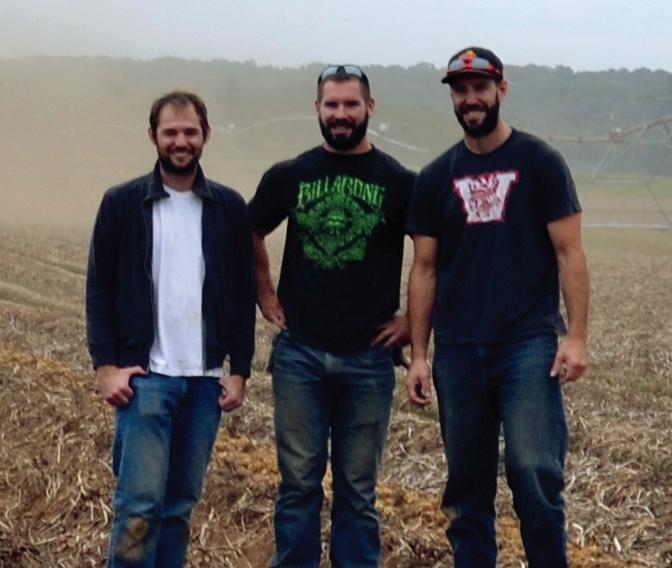

Norm, who has continued as chief executive officer for Worzella & Sons, says he is proud of the business’ growth, which he largely attributes to the dedicated employees the family has had in their 60 years of Marv,farming.who is chief financial officer, adds, “We learned from our dad from a young age on. We started working with Dad in 1955, and we incorporated in 1964. Dad worked side-by-side with us and taught us how to grow vegetables and get started in farming.”
COMMUNITY-MINDED Norm and Marv’s parents, Clarence and Regina, were community-minded people who generously donated to many organizations and causes. They instilled in Marv and Norm, and now Steve, Scott and the entire Worzella family, the importance of
Steve Worzella has the advantage of having seen the family potato and vegetable operation, Worzella & Sons, Inc. of Plover, Wisconsin, through the eyes of a child.


Having grown up on the farm, he is most proud of how technology has advanced and evolved the operation, and how his family has been able to adapt and change with the times. Representing the third generation on the farm, Steve and his brother, Scott, are co-vice presidents of the company, a 5,000 plus-acre potato and vegetable farm in the heart of Wisconsin’s Central Sands. Their father, Norm, and his brother, Marv, were inducted into the Wisconsin Potato & Vegetable Growers Association (WPVGA) Hall of Fame in February 2021. In 1953, WPVGA Hall of Famer Clarence Worzella, Norm and Marv’s father, bought a 40-acre parcel of sandy soil near Plover and started growing potatoes under irrigation.
FAMILY: Wife, Paula; five kids, Amanda, Ashley, Tyler, Hannah, and Sydney; and four grandchildren
By Joe Kertzman, managing editor, Badger Common’Tater
AWARDS/HONORS: Cooking contest winner of the Wisconsin Potato Grower/ Chef Competition on a team with Chef Rob Tuszka of Silver Coach
Interview STEVE WORZELLA , vice president, Worzella & Sons, Inc.
HOBBIES: Hunting, fishing, bowling, traveling, boating, and driving my Corvette Above: Having grown up on the farm, Steve Worzella, vice president of Worzella & Sons, Inc., says he is most proud of how technology has advanced and evolved the multi-generational operation in Plover, Wisconsin.
NAME: Steve Worzella TITLE: Vice president COMPANY: Worzella & Sons, Inc. LOCATION: Plover, WI HOMETOWN: Plover YEARS IN PRESENT POSITION: 15 PREVIOUS EMPLOYMENT: n/a SCHOOLING: Stevens Point Area Senior High ACTIVITIES/ORGANIZATIONS: United of Wisconsin Board, Plover Plan Commission, Board of Directors of the Portage County Wildlife Fund, and past board member of Plover Whiting Youth Athletics for seven years
8 BC�T September
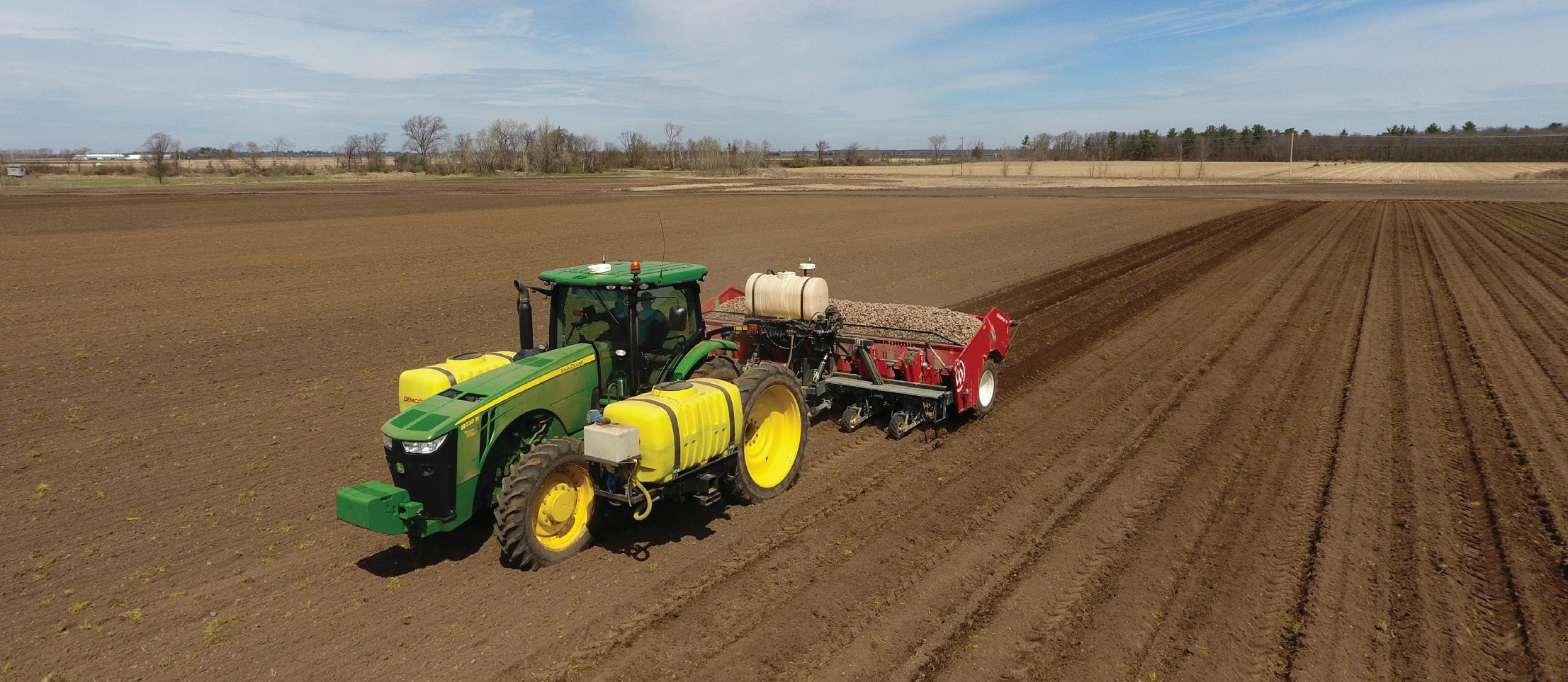
Above: Paul Sankey plants Silverton russet potatoes on Worzella & Sons Inc. land in the town of Buena Vista, Wisconsin, May 2020.

© 2020 MSS Not an advertisement of any investment advisory services, securities or investments. metlife.com/ag Custom continued on pg. 10
9BC�T September
giving back, and Worzella & Sons has been able to make donations that are crucial to the well-being and future of the Wisconsin potato and vegetable growing industry. Working with Louis Wysocki, the WPVGA and Village of Plover, the Worzellas participated in a land exchange, discontinuing to farm a parcel of fertile land to make room for the Little Plover River Watershed Enhancement Project. The goal of the project is to improve the health of the Little Plover River and the quality of life of the surrounding community.
The Worzellas also donated more than 20 acres of land to the Farming for the Future Foundation for a new Discovery Center currently being built along the Highway 39 corridor, in MarvPlover.and Norm have also been instrumental in donating for causes such as improvements at Lake Pacawa Park, in Plover.
AgriculturalStructuredLoans AGRICULTURAL FINANCE

In this interview, Steve distinctly remembers working to improve Pacawa Park as a teenager. What are you most proud of regarding your family’s farming history? How my grandpa, Clarence, started the farm with hard work, and how technology has changed, yet we’ve been able to adapt. From being a kid and now seeing how things have changed, looking back to
• Long term fixed and adjustable rate mortgage financing Troy W. Fischer Rockford, tfischer@metlife.com815.494.4349IL
Left: In this historic picture, from left to right, Grandma Regina Worzella and her and Clarence’s children, Shirley (now Shirley Sankey) and Marv Worzella, pick potatoes on the farm.

10 BC�T September
He would send employees to work at community events like the Golden Sands Festival. The Golden Sands Festival used to be a three-day event at Lake Pacawa Park, with it now being called Celebrate Plover. Employees would help with set up and clean up at the park for the Golden Sands Festival. We planted all the trees at Lake Pacawa, but they’re mostly gone now due to the renovations at Lake Pacawa Park, which include a bandshell, shelter, and all-inclusive ADA (Americans with Disabilities Act)-compliant splash + play area. My grandparents used to rent Lake Pacawa Park to the Lions Club for one dollar a year with the vision that the park would continue to be a place for families to enjoy.
The legacy of the farm is being involved with the community. My grandpa was constantly donating and giving back to the community … always for the community, always.
when I was 15 years old, for example, and then seeing where we are now, it’s amazing. My grandpa would be impressed with how farming has advanced. He would have never thought of a fourwheel-drive tractor back then, and automation has changed the farming landscape. But, then again, maybe this wouldn’t be a surprise to my grandpa with all the changes in farming. He was a visionary and could see that farming and the technology that goes along with it would continue to improve over the years. We need to stay up with technology just to be productive. Otherwise, we would be falling behind.
Interview. . . continued from pg. 9
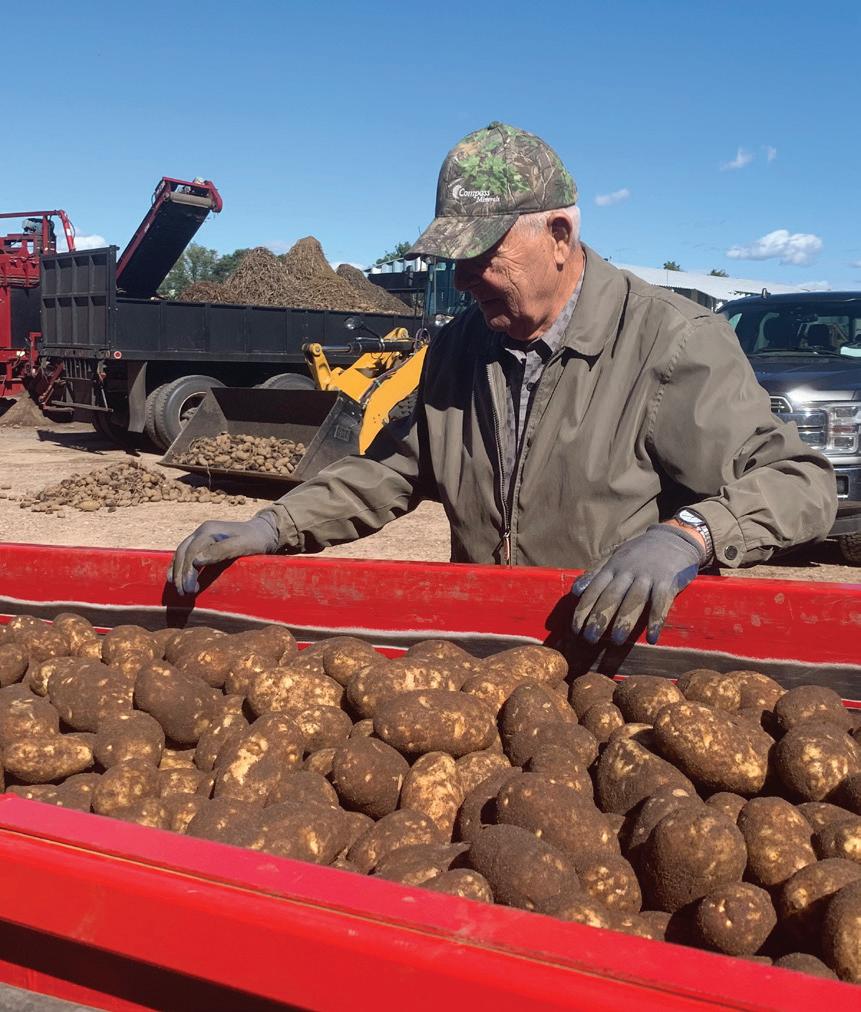
Above: Michelle Worzella (who handles human resources for the company and is married to Perry) and Marv check potatoes going into storage at Worzella & Sons Inc., in September 2021. Photos courtesy of Michelle Worzella

– Steve Worzella

How do you, Scott and your cousin, Trina Sankey, split up duties? Scott and I take care of deciding what crops will be planted; irrigating; and overseeing the employees who do the planting, spraying, tilling, harvesting, storage, and packaging. Trina is the office manager and president of Worzella & Sons. She is responsible for the financial and account functions; team building; and is involved in organizing the Celebrate Plover event at Lake Pacawa. Are there other family members involved in the operation, and if so, who and in what positions? My son, Tyler, and Scott’s son, Brett, represent the fourth generation. Our cousin, Perry, is on the team in a consulting role, not part of the daily operations.

11BC�T September
always.”
“The legacy of the farm is being involved with the community. My grandpa was constantly donating and giving back to the community … always for the community,
continued on pg. 12 2731 Maple Drive • Plover, WI 54467 715-344-3401 • Toll Free: 1-888-696-4019www.bigironequipment.comNew&Used Sales Service • Repair Proud Dealer of: Conveyor Belts ® RockMulchersCrushers Customizing equipment to fit your needs for over 25 years! USED EQUIPMENT SPUDNIK 8046 7-row Potato Bed Planter Includes Fertilizer Tanks and Tubing SPUDNIK 6400 4-Row Harvester/Tub Digger with Roller Table, 36-Inch, Field Ready!


The park was eventually turned over to the Village of Plover, which was able to develop what is there now. It’s a beautiful park that my grandparents would be proud of. How do you try to carry on a tradition of hard work and rewards? One thing about my grandpa, he would always say, “I have a half-hour job for you,” and three hours later, you were still doing it. But he always rewarded you with ice cream and a soda. Just like he would have wanted—you do what has to be done when it has to be done. Grandpa was all about getting the work done so you could play Everylater.year we take the employees on an annual team building event. We’ve enjoyed things like escape rooms, axe throwing, and a Brewers game. It’s nice to spend time with employees outside of the work environment. We probably spend more time with each other at work than we do with our families at home. We are appreciative of the long hours everyone puts in, and we are thankful that their families understand that we “make hay when the sun shines.”

12 BC�T September
Above: In yesteryear, like today, Worzella & Sons Inc. was a hands-on operation, with Marv planting potatoes (left) and Norm stacking them (right). Below: Technology is ever present at Worzella & Sons, Inc., with machines such as the Verbruggen palletizer and wrapper hard at work. Photos courtesy of Michelle Worzella


How many full-time and seasonal employees does Worzella & Sons have? We employ about 20 fulltime employees, and when in full production, close to 40-50 seasonal employees. The last four employees who retired each had between 35 and 50 years with the company. Charlie Sankey retired with 50-plus years. Joe Swiander, Darrell Firkus, and Dennis Kunst all retired with over 35 years apiece under their belts. Nick Kurszewski is going to retire at the end of the year with over 40 years. We try our best to treat our employees good here. You have to if you want to keep them. Are you growing 1,800 acres of potatoes and 3,400 acres of other vegetable crops? It would be 3,300 acres of other veggies, 300 acres of soybeans, and 150 acres of field corn for feed. We used to grow 600-800 acres of potatoes, but we’ve increased it to 1,800. We need alternative acres for rotation, so we’re over 5,500 acres of land now. On what kind of rotation? It’s mostly

Interview. . . continued from pg. 11

a three-year rotation, some four-year with potatoes, so it would be green beans, sweet corn, maybe other sweet corn, and back to potatoes, or throw soybeans in there. We put soybeans in low ground to control weeds for potatoes the next year. We grow some peas, about 300 acres. This is the storage and marketing issue. What kind of storage capacity do you have, and can you offer potatoes year-round? We can store right around 400,000 hundredweight. We grow Norkotah, Line 8, Silverton, Goldrush, and Plover Russet, some Reveilles and Caribous. We have 11 varieties this year total. There are more options with all the new varieties they’re breeding that resist, for instance, hollow heart and scab. It’s working so far. We’ve had good luck with Plover Russet. We don’t store potatoes year-round, but rather we usually start shipping at the end of July and like to be done by February 15 of each year. That’s our goal, but it doesn’t always work out that way. Then it’s maintenance


Photography, who has been taking pictures of the farm for over 20 years continued on pg. 1422-09 Badger Common'Tater (7.25x2.25).v1.pdf 1 2022-08-03 11:16 AM
Above: Potatoes are windrowed and harvested at Worzella & Sons, Inc. Photos courtesy of John Schomburg, Roven Farms
13BC�T September

Above: Potatoes are harvested in 2021 at Worzella & Sons, Inc. time. We’re not equipped to run in cold weather. I imagine it takes a lot of work to keep a clean, functional, disease-free storage. Any comments on that? We disinfect the storages by going through a complete cleaning, which our crew is doing right now, putting a disinfectant right into the wash. They disinfect all culverts, and then spray the building one more time.

How about bagging and packaging— how big is your facility and what upgrades have been made recently? Our packaging shed is about 34,000 square feet. We run over 1,500 acres through the shed. To accommodate that volume, we put in more automation—two automatic graders, a hollow heart detector, automatic stackers, and barrel washers. How do you keep your potatoes disease, bruise, and rot free? You handle them like they’re babies, very carefully. Don’t dig questionable potatoes that should not be put in the bin, especially if you have a disease issue. Dig potatoes when they’re cool, not above a 65-degree pulp temperature. What kind of feedback do you get from customers? We receive indirect feedback from our partner marketing
14 BC�T September
Left: Steve Worzella stands in front of the farming operation’s newest Spudnik 6640 potato harvester.

Interview. . . continued from pg. 13
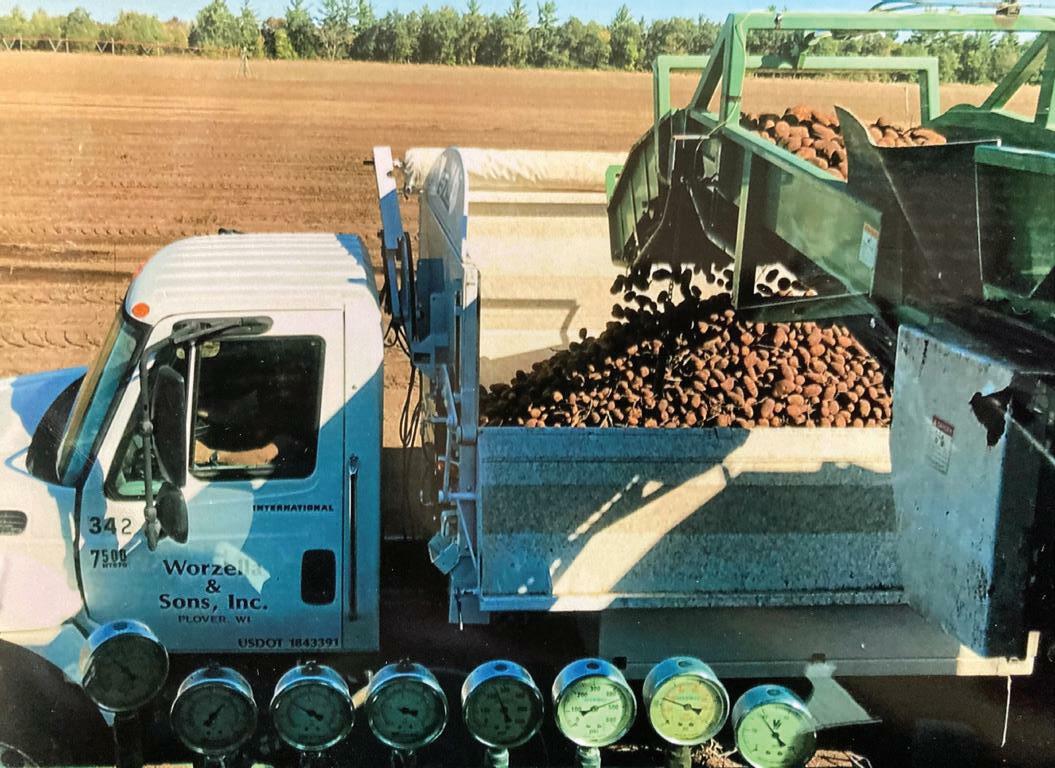
Above: After potatoes were handpicked off the ground back in the day—by Shirley Worzella (left, now Sankey) and Jimmy Turzinski in the first image—they were harvested in crates and then sometimes driven by Clarence Worzella down to Milwaukee and peddled out of the back of his pickup truck.


15BC�T September
company, RPE, Inc., sharing positive feedback and experiences with our potatoes. Why was it important for Worzella & Sons to take land out of production for the Little Plover River Watershed Enhancement Project, and the land you donated for the Farming for the Future Foundation? We gave up 160 acres to the Little Plover River conservancy area, taking it out of production and giving it to the Village of Plover as a land swap. Then we donated 24 acres to the Farming for the Future Foundation. These are things my grandpa would have loved to see—he was all about youth and learning. It’s exactly what he would have wanted. That’s why we donated land to the Farming for the Future project, for the youth, the kids. Education is the goal of the continued on pg. 16 Fresh Worzella & Sons Inc. potatoes are dug, in 2022, along Highway 51 in Plover, Wisconsin. Photos courtesy of John Schomburg, Roven Farms Photography


Left: Jim Turzinski (second from left), and Norm (white T-shirt) and Shirley (Worzella) Sankey sort and grade potatoes in this vintage photo.

Farming for the Future Foundation. What’s your favorite part of being a farmer? Every day is a challenge. There are no two days the same, and every year is different. I like seeing the rewards at the end of the year. That’s why I like digging samples. I can see what the crop is going to be.
Interview. . . continued from pg. 15
Right: Brothers and third-generation farmers, Steve (left) and Scott Worzella split vice president duties at Worzella & Sons, Inc.

16 BC�T September

NDSU staffers brought potato bags out of coolers for the dog to peruse.
North Dakota potato breeder brings in speaker who has trained a dog to detect potato virus diseases
Andrea started a business “Nose Knows Scouting,” which uses trained dogs to find Potato Virus Y and other maladies in spuds.
Good news: The newest high-tech tool for diagnosing crop disease is also man’s best friend—a friendly dog. Specifically, it’s a crew of five dogs trained by Andrea Parish, 46, of Dayton, Wyoming, owner of “Nose Knows Scouting.” Parish is married to a potato crop consultant and a friend of Asunta “Susie” Thompson, an associate professor and potato breeder in the North Dakota State University (NDSU) Department of Plant Sciences.
Parish and Zora considered each one, as a dozen people looked on.
Above: Andrea Parish, 46, of Dayton, Wyoming, is trained as a physical therapist. She is married to North Dakota State University graduate David Parish, who consults worldwide for potato growers.

Left: On May 17, Zora the spud-sniffing dog got a close-up whiff of bags of potato seeds in the North Dakota State University potato breeding program, looking for Potato Virus Y. Photo courtesy of Mikkel Pates, Agweek
Parish and one of her dogs, Zora, flew into Fargo, North Dakota, so that the pooch could sniff her way through the North Dakota State University potato seed development program, looking for a potato disease known as Potato Virus Y, or PVY.
“Nose Knows Scouting” Uses Trained Dogs to Sniff Out Potato Virus Y

The NDSU Potato Breeding Program develops new potato cultivars for grower, industry, and consumer adoption, as well as certified seed potatoes of all materials in its breeding pipeline.
Photo taken May 17, 2022, at Fargo, North Dakota. Photo courtesy of Mikkel Pates/ Agweek
By Mikkel Pates, Agweek Magazine

Reprinted with permission from Mikkel Pates and Agweek continued on pg. 18
17BC�T September
“Thedisease.military has proved over 50 years that it’s the best way to detect small amounts of odor, and [potato] disease gives odor,” she says.

BEST PAW FORWARD Parish started training the dogs for sniffing potato disease in 2019. She is married to David Parish, owner of AIS Consulting LLC, an agricultural consulting business based in Allen, Texas, specializing in potatoes and operating throughout the world. David grew up in the Chamberlain, South Dakota, area, graduated from NDSU in biology, and knew Thompson. Andrea grew up in potato-rich Maine but had no direct connection with agriculture. She pursued a career in physical therapy. In recent years, she’d been doing accounting for David’s business. But she loved dogs and trained them for search and rescue work and later to help hunters track wounded deer and elk. When her dog had a knee injury, she wondered whether the dog could do other tasks. She asked David if dogs were ever used in potato disease detection. David said no, and she saw an opportunity. Dogs’ famous schnozzes can be trained to sniff out cadavers and bombs, and lung cancer and COVID-19 in humans, so she figured they could be used for potato
In a swirling wind (not helpful), Zora considered dozens of bags—the tops, sides and again when the packages were flipped over—and sniffed again. When she found PVY, she’d go into alert behavior—pointing and freezing. She comes off alert when Parish gives her a “click,” or praise. Zora evaluated NDSU’s entire seed program in half a day. Thompson said it is a tremendous savings of people and resources that can be aimed at other tasks.
“Nose Knows Scouting” Uses Trained Dogs to Sniff Out Potato Virus Y. . . continued from pg. 17
“TRAINING ODOR” It takes only about five days to “train odor” for the receptive dog. The best dogs are the longer-nosed, floppyeared breeds. But not all of them are good at it.
Zora, a black Labrador retriever from Nose Knows Scouting of Wyoming, has been trained to detect Potato Virus Y (PVY), a common disease of potatoes across the nation, saving seed from cross contamination without high laboratory costs. Photo courtesy of Mikkel Pates, Agweek

NELSON’SEGETABLEVTORAGESYSTEMS INC.S N7158 6TH DRIVE P.O. BOX 215 PLAINFIELD, WI 54966 OFFICE: (715) 335-6660 FAX: (715) •••SPROUT335-6661INHIBITINGFRUITGUARDAPPLICATIONSSMARTBLOCKAPPLICATIONSCIPC,CLOVEOILAPPLICATIONSKEEP ON TRACK WITH OUR SPROUT INHIBITORS AND DISINFECTANTS STORAGE VENTILATION • COMPUTERIZED CONTROL PANELS • HUMIDIFICATION • REFRIGERATION AGRI-VENTILATION SALES AND SERVICEAGRI-VENTILATION SALES AND SERVICE 24 HR. EMERG. SERVICE 18 BC�T September
Parish had a hound that could track for two miles without stopping, but that did not want to check potatoes for disease. Some dogs don’t like
She obtained PVY virus from Alexander Karasev, a University of Idaho Extension plant virologist, for training.
AUTUMN ROSE We
the environment, walking in front of people or being around farms. Zora is paid by access to a tennis ball. United States from Maine. She has clients in the Upper Midwest but declined to say who, based on 780-963-6708 specialize in European yellow fleshed and specialty potato varieties, as well as red skinned, russet, and white fleshed varieties. Our vigorous seed potatoes are grown in Alberta, Canada. MELODY Melody is a robust, high-yielding table variety with a high pack-out. This mid-season variety has smooth yellow skin and yellow flesh. It is a great storage variety and has good resistance to bruising and common scab. Melody is an excellent tasting all purpose variety. Autumn Rose is a mid-early maturing red skinned white fleshed variety. This high yielding variety has shallow eyes and an attractive smooth skin finish. Autumn Rose has good resistance to common scab. Taste and texture are both excellent!
inquire@solanum-int.com c: 780-991-4302 t:


solanum-int.com 4 Legend Trail, Stony Plain, Alberta SolanumAboutInternational Novel Varieties! Quality Seed! Ask about our specialty varieties! MELODY continued on pg. 20 19BC�T September


“We take trucks that have seed and run it on a belt [conveyor],” Parish details. “The dog walks the belt and identifies the seed. We’re able to pull the PVY seed from large lots while in storage.” She has worked in potato warehouses across the country, from Maine to Washington states. Among the pests and diseases that could be in the future for the company are nematodes, potato wart, and powdery scab.
“We actually work the plenums,” she Theysays.teach the dogs to run through the air ducts beneath the storage bins. Once the general location is found, the grower can pull samples for more specifics.
“They’re
Potato grower clients hire Parish on an annual basis to keep their farms clean. She visits once every couple of months. If they find the virus, the company cleans storages.
Lyla@ColoradoCertiedPotatoGrowers.com (719) ColoradoCerti274-5996edPotatoGrowers.com Colorado Certied Potato Growers Association P. O. Box 267 Monte Vista, CO 81144 Colorado Certified Potato Growers Association “Quality as High as our ColoradoCertifiedPotatoGrowers.comMountains” 20 BC�T September


“Nose Knows Scouting” Uses Trained Dogs to Sniff Out Potato Virus Y. . . continued from pg. 19 don’t have to core it.” The client farms are concerned about biosecurity. They provide collars, kennels, and other paraphernalia. After the visit, the dogs are bathed and disinfected after the farm visit. Parish now lives at Dayton, Wyoming, but she travels and trains among properties in South Dakota, Texas, Maine, and Arizona. Besides potatoes, she said other companies, using U.S. Department of Agriculture grants, are working with dogs to find diseases in citrus. Her enterprise is commercial.
Jennifer Maleitzke, director of communications and external affairs for the R.D. Offutt Company, the top 1% athletes in their fields that want to come out and work all the time.” – Andrea Parish, referring to dogs she trains that can sniff out Potato Virus Y


CLEANING STORAGES

ROGUE THE FIELDS Her crews “rogue” the fields, looking for disease and other problems. They use a laboratory test, called the “ELISA” immunosorbent(enzyme-linkedassay)test to verify PVY. This requires using a melon scoop to remove an eye from every tuber they want to use in their seed field. On top of that, they test the foliage to ensure against PVY. Of course, they can’t check every eye. Thompson said Parish is working with other researchers in Colorado, Michigan and Idaho. No research has been published to verify the accuracy, and Thompson is one of the first to volunteer to share and match up the data.
Parish has applied for grants to find a best process for finding the virus, ultimately to create a standard for seed certification using dogs. Ultimately, she’d like three or four teams of certified trainers across the country where virus and bacteria problems are prevalent and have handlers (possibly retired military trainers) on hand who can use the dogs to clean seed and help farmers succeed. “I’d like to clean lots of potatoes so that people don’t have to throw them away,” she says. “We spend, you know, a million dollars to develop a breed and then it gets PVY, and they throw it out.”
21BC�T September
NDSU’s program has an on-campus warehouse and a seed field about 30 miles away near Baker, Minnesota. There, they grow out single hills for selection, produce maintenance lots for all clones in the breeding program, and generate increase lots of the most promising and advanced selections and “named cultivars” for use in trials conducted by collaborators.

headquartered in Fargo, was on hand to watch Zora’s work at NDSU.
“If the technology with a dog proves to be successful, it’d be something that we may consider in the future at our seed operations,” Maleitzke says, noting the company does that work at Staples, Minnesota, and Atkinson, Nebraska. CHECKING DATA Thompson is optimistic about the process but is still evaluating it. The program paid for Parish and Zora to “Wecome.want to be able to match up what her dog found and do some of these ‘grow-outs’ and see how accurate it was,” Thompson says. Besides sniffing the seed tubers, she’d like the dog to come back to check fields and immediately rogue out plants that are positive, thus eliminating cross-contamination or bringing infected tubers into storage.
“Many of the more modern or common strains that we see in fields today are difficult to detect, visually, with our eyesight,” Thompson says.

Using Artificial Intelligence to Size and Grade Potatoes
like this are often used in reference to artificial intelligence (AI) and the grading of potatoes.
Top of Page: The Smart Vision Works potato grading and sizing system is part of the SiftAI product line. Leveraging artificial intelligence, SiftAI can sort out potato defects and size with industry-leading accuracy. It can also size potatoes to meet and exceed U.S. Department of Agriculture


Above:specifications.SiftAIintegrates into existing ejection systems and is a drop-in replacement for outdated optical sensors.
22 BC�T September
In supervised learning, computers are programmed to recognize characteristics or qualities of potato
While this is close to what happens when using an AI technique called unsupervised learning, it is not an accurate statement when referring to AI techniques that can be used for potato grading. There is a big difference between the two AI approaches, supervised and unsupervised learning. In this article, we explore the difference between them and explain why supervised learning is best suited for the grading of Supervisedpotatoes.learning is a method for training a computer program (model) to recognize specific characteristics or qualities of a potato.
By Beau Tippetts, Ph.D.
It sounds attractive, “A computer system that is continually learning while it grades potatoes. The longer it runs and the more images it processes, the smarter it gets on its Statementsown.”
An AI model is trained by feeding it
Outside the potato industry, supervised learning could teach a model to tell the difference between cats and dogs. To do this, one would select examples of cats and dogs and use them in the training process. More to the point, supervised learning can be used to teach a model the difference between a Number 1 potato and a spud with new bruise (and a long list of other potato diseases and defects).
thousands of images of each type of defect, and images of potatoes without defects for comparison. Each image is labeled something such as “old bruise” or “scurf.”
LABELING ACCURACY
For the model to grade accurately, it needs both quality and quantity of properly labeled images. There are several approaches to labeling the images accurately. The most logical way is to ask an expert to label each image. However, this is often not practical. Instead, an expert is asked to identify a gold standard or prime example of a specific defect. Labelers then evaluate an image of a potato and compare it to the gold standard. To reach the highest level of accuracy, a team of labelers independently judge each potato. Their results are compared through a computer program that ensures consensus before an image is labeled. This process is repeated for each image used to build a model. After the images are labeled, an expert then verifies that the resulting labels are Thiscorrect.istheprocess used at Smart Vision Works with accurately labeled images that artificial intelligence algorithms can identify and classify with a corresponding high degree of accuracy.
RECOGNIZING DEFECTS
The power of AI is not that a potato’s defect is matched to one in the database, but that the computer has learned what a defect is and can
1619 County Road K, Custer WI 54423 • Call: 715-592-4650 • Fax: 715-592-5063 • Email: tip@tipinc.net Redox provides two key solutions for Potato Bulking OXYCOM Calcium & diKaP PARTS & SERVICE: TEROG & AG PARTS AVR/UNDERHAUG • DOUBLE L (LL) NOFFSINGER BROEKEMA AND MORE! • Sustains balanced plant growth in periods of environmental oxidative stress (EOS) • The combination of these two products increases phenolic compound production • Maximizes production of ATP & ADP • Increased daily photosynthate production and utility • Balances carbohydrate and nitrogen compounds for mature potato crop Products • Strategies • Solutions CALL US WE CAN HELP! 1.800.225.9727 • www.tipinc.net VIEW EQUIPMENTUSEDOURLISTONLINE! LABOR SAVING TECHNOLOGY Box CombiFillersUnits FIRST FULLY AUTOMATED PILER IN AMERICA! continued on pg. 24 “Supervised learning can be used to teach a model the difference between a Number 1 potato and a spud with new bruise [and a long list of other potato diseases and defects].” – Beau Tippetts, Ph.D. 23BC�T September




The key at this stage is labeling accuracy. The model can only be as good as the examples used to teach it. The goal of data labeling is to get as close to the ground truth as possible, or, described another way, “how well the labeled features in the data are consistent with real-world conditions.” (Cloudfactory.com)

recognize it when presented, like how a human can recognize a dog even if it has never seen a particular dog or dog breed Computersbefore.arenot perfect, but they are excellent and often can outperform humans at identifying defects in objects. (Medium.com, Pastor). This is especially true if sorters get bored or tired. In contrast, unsupervised learning does not use labeled images. It is not designed to identify individual defects according to a ground truth. There are no experts and no use of consensus. Instead, unsupervised learning is intended to create categories. In unsupervised learning, the algorithm is fed images, and it then separates the potatoes into a specific number of groups, but without any ability
E-mail:


•
•
Servicing
Theirs
makes of equipment Your Dealer In www.sandcountyequipment.com Wisconsin Public Service Farm Show, Oshkosh March 28th, 29th & 30th See Us At Booth #C5510 See Us in Booth SEE THE DIFFERENCE! Theirs Ours Demo’s Available Your www.sandcountyequipment.com In the heart of potato country. Serving all of Agriculture. Shop: (715) 335-6652 • Fax: (715) 335-6653 • Cell: (715) 498-6651 8364 Monica Road, PO Box 228 • Bancroft, WI 54921 E-mail: paul@sandcountyequipment.com • www.sandcountyequipment.com Servicing all makes of equipment Owner: Paul Cieslewicz A foreign material visual inspection system is part of the SiftAI product line. 24 BC�T September


Artificial
Using Intelligence continued from pg. 23 Public Service Farm Show, Oshkosh March 24th-26th. County Equipment, LLC SEE THE DIFFERENCE! Ours Demo’s Cieslewicz Owner Shop: (715) 335-6652 Fax: (715) 335-6653Cell: (715) 498-6651 8364 Monica Road, P.O. Box 228 • Bancroft, WI 54921 paul@sandcountyequuipment.com www.sandcountyequipment.com all


in the Safe-T-Pull Booth #C5510 Wisconsin Public Service Farm Show, Oshkosh Sand County Equipment, LLC DIFFERENCE! Theirs Ours Demo’s Available Paul Cieslewicz Owner Shop: (715) 335-6652 • Fax: (715) 335-6653Cell: (715) 498-6651 8364 Monica Road, P.O. Box 228 • Bancroft, WI 54921 E-mail: paul@sandcountyequuipment .sandcountyequipment.com Wisconsin Public Service Farm Show, Oshkosh See Us At Booth #C5510 Lemken Rubin 12 Lemken: Making Tillage Great Again See Us in the Booth Wisconsin
Sand
Available Paul
to Size and Grade Potatoes. . .
ACCURATE GRADING Additionally, supervised learning is considered more accurate than unsupervised learning. (Guru99.com, ForJohnson)these reasons, unsupervised learning cannot realistically be used for grading, making supervised learning approaches more appropriate. The technology does not exist to continuously feed random images to a computer program and have that program get more and more accurate at grading into user-defined categories. Instead, the algorithm must be taught just like a shed’s potato inspector has to be taught what is acceptable and what is not. The focus of an effective AI grading system then is the quality of the grading model. Smart Vision Works has the resources to develop world-class grading models using advanced AI programming, with many potato models already developed and ready to use. But, just as important, we can provide the support necessary to make those models perform in various production environments.
As a locally based lender, with a long tradition of helping farms and agribusinesses, AbbyBank wants to help you with all your nancing needs. We have a team of knowledgeable bankers and loan o cers that get to know your business operations on a personal level. We Make AboutBankingYou 25BC�T September

to specify characteristics of any of the groups. For example, if a shed had a truckload of potatoes that is normally sorted into Number 1, Number 2, and processed potatoes, an unsupervised learning approach could separate the truckload into three groups, but it would decide what characteristics to use to create each group. An unsupervised learning approach would more likely end up sorting the truckload into three different size groups, or create a misshapen group, a group with large dark areas (mud, old bruise, etc.), and a group with everything else other than the desired categories. There is no ability to change or influence the groupings the unsupervised learning determines. Unsupervised learning, while potentially useful in some data analysis circumstances, would not tell the user the desired classification of individual potatoes. Thus, it is not helpful for grading.
Dr. Tippetts is a co-founder and vice president of systems engineering at Smart Vision Works. He received his Ph.D. in computer engineering from Brigham Young University. Smart Vision Works, located in Utah, can be reached at 801-210-1811 or info@smartvisionworks.com. For more information, visit https://www. smartvisionworks.com.
Above: Charlie Husnick (left) of Baginski Farms, Antigo, Wisconsin, and J.D. Schroeder (right) of Schroeder Bros. Farms in Antigo were each elected to their first three-year terms on the Potatoes USA Board.
For the 2022 election, Wisconsin accepted nominations for two of the six seats, as two representatives completed their third years of their second terms, and therefore, are going off the Board.
As a Wisconsin representative elected to the Potatoes USA Board, individuals are responsible for representing the state’s interests and keeping growers informed of how Potatoes USA is fulfilling their interests and maximizing ROI (return leaders who actively participate in local government, cultural or business affairs. In recent years, Wisconsin has been allotted five seats on the Board. Beginning in 2020, the number of seats increased to six, which was a direct result of production numbers (USDA) sends to Potatoes USA. Those production numbers are based on a three-year average.
TWO OF SIX SEATS
A special thank you to Erin and Keith for all their dedication and time over the last six years. They have shown great leadership and passion throughout their tenures on the Potatoes USA Board as well as to Wisconsin specifically.
Wisconsin Representatives Elected for Potatoes USA Board Seats Potatoes USA News
And congratulations to the following
Elections are complete in Wisconsin for the individuals who will represent the state on the Potatoes USA Board. The elected individuals will begin their terms in March 2023. Each term lasts three years with an opportunity to be re-elected for a second threeyear term. No representative can serve for more than two consecutive three-year terms. During their terms, elected individuals are required to attend the Potatoes USA meeting held annually in March and other meetings/events as indicated/requested.
Erin Baginski of Baginski Farms in Antigo and Keith Wolter of Hyland Lakes Spuds in Antigo will be attending their last Potatoes USA Annual meeting in March 2023.


From Field to Freezer we’ll handle all your transportation needs! Check us out on Facebook and at plainfieldtrucking.com CallFrom800-435-6375FieldtoFreezer we’ll handle all your transportation needs! 26 BC�T September

SNOWDEN PIKE ATLANTIC LAMOKA MEGACHIP HODAG MANISTEE SILVERTON LADY LIBERTY
individuals for being elected and re-elected to their first and second three-year terms, respectively: • Charlie Husnick, Baginski Farms (Antigo) – elected to first three-year term • J.D. Schroeder, Schroeder Bros. Farms (Antigo) – elected to first three-year term • Mike Carter, Bushmans’ Inc. (Rosholt) – re-elected to second three-year term • Kevin Schleicher, RPE (Bancroft) – re-elected to second three-year term • Josh Knights, Heartland Farms (Hancock) – re-elected to second three-year term Wendy Dykstra of Alsum Farms in Friesland is the sixth representative from Wisconsin who serves on the Board and will be up for re-election in 2024. Above: From left to right, Mike Carter of Bushmans’ Inc., Rosholt, Kevin Schleicher, RPE, Inc., Bancroft, and Josh Knights from Heartland Farms, Hancock, were each reelected to their second three-year terms representing Wisconsin on the Potatoes USA Board of Directors.


27BC�T September
•
•
•
•
•
•
“We’re glad to be part of the MSU [Michigan State University] weather system,” Eddy related. “The recording RARS Field Day Features Spud Research and Much More
Above: Rhinelander Agricultural Research Station (RARS) Superintendent Becky Eddy pulled double duty during the RARS Field Day, July 28, 2022. She not only welcomed guests and outlined improvements to the station, but later gave updates on the potato breeding program and presented a new potato variety showcase.
Potato breeding facility hosts presentations on bioenergy, timber management and phytoremediation
The station also purchased a pot filler that fills up to 50,000 pots that RARS uses on an annual basis.
Seed Piece
“There are often concurrent research projects going on, and we’re building our portfolio.” In 2018, potato spindle tuber viroid (PSTVd) reared its ugly head at the facility. Since then, many improvements have been made at RARS with better sanitation, disease mitigation areas, and RNA (ribonucleic acid)-based diagnostics to detect PSTVd.
By Joe Kertzman, managing editor, Badger Common’Tater
September
It was difficult to believe when Rhinelander Agricultural Research Station (RARS) Superintendent Becky Eddy said it had been six years, since 2016, that the facility on Camp Bryn Afon Road hosted a field day on potato variety development. BC�T
And the facility has never been in better shape, according to Eddy, who explained, with support from the WPVGA Associate Division and the College of Agricultural and Life Sciences, there have been upgrades to the irrigation system, as well as in the area of refrigeration to retain storage temperatures of seed priorand post-production.
“It’s not just a potato breeding program,” Eddy reminded during the RARS Field Day, July 28, 2022.

The improvements have worked, and in the last six years, there has been no detection of PSTVd, Eddy said.
Of course, COVID struck in 2020, but with the field day back in full swing in 2022, Eddy and RARS continued a tradition that’s been going on since the 1940’s.
28
CONTROL CONTAMINATION
of temperatures and precipitation, along with weather data past and present, help improve field Theoperations.”fieldday program consisted of Department of Natural Resources Forester Manny Oradei describing a timber management program at RARS, and U.S. Department of Agriculture Plant Geneticist Dr. Ron Zalesny and University of Missouri Master of Science student Ryan Vinhal talking about phytofiltering of disinfectant wastewater at the facility.

“Could we establish trees to control a wastewater contamination problem at RARS?” Zalesny asked Twohypothetically.treeplantings—one for biomass, and the second an agroforestry planting—hold the answer. Poplars and willows were planted, with poplars excelling at phytofiltration because they grow extremely fast and exhibit extensive root systems. As wastewater flows over land, the extensive roots use that water, so poplars have good hydraulic control Zalesnypotential.explained that the six varieties of willows his team planted remediate contaminants. The denser the plantings, he said, the better Dr.phytofiltration.KurtThelen, Michigan State University professor, explained bioenergy crop yields, and Wisconsin Seed Potato Certification Program (WSPCP) Manager Brooke Babler provided a seed certification update, including the fact that her team will be returning to Hawaii again for winter testing in 2022.
Babler noted that there’s been growing interest in dormant tuber inspection for Potato Virus Y. The use of dormant tuber testing will not only
Above: Dr. Amanda Gevens provided a plant pathology update, noting that there are no reports of potato late blight in the United States, and it has been a low year for early blight pressure, in Wisconsin, with the disease arriving later than usual and not progressing.
PROJECT TYPES Potato Storage: -Air -Bin-Arch-StraightEnvelopeWallBuildingsStorage Truck/Maintenance Shops Wash/Grading Facilities Packing Sheds Building RemodelsMaintenance PLAN BETTER BUILD BETTER MAINTAIN BETTER mcgowanrice.com Mark Rice, Owner Cell: mrice@mcgowanrice.com208.863.7242 Committed to Quality SERVICES Master Design/EngineeringPlanning Potato Storage Consulting General Contracting United States and Canada 29BC�T September


continued on pg. 30
get results to growers faster, but the method enables the lab to test for many pathogens.
Then it was off to the fields where University of Wisconsin (UW)Madison Ph.D. students Lin Song and Chelang’at Sitonik showcased diploid Seed Piece . . . continued from pg. 29
University of Wisconsin (UW)-Madison Ph.D. students Lin Song (image at top) and Chelang’at Sitonik (above) showcased diploid potato breeding and the use of aerial imagery, respectively. Their goals are ultimately the same—to increase potato plant vigor, yield, tuber size, appearance, and vine maturity. The use of drones and NDVI (Normalized Difference Vegetation Index) aid in obtaining precise records on such things as plant height, canopy cover, and ultimately, making breeding decisions and selecting the best genotypes for field trials.
“We’re still working to find the perfect test,” Babler said, “where we can detect other viruses and bacteria, from Dickeya to necrotic viruses.”
30 BC�T September
WSPCP Program Director Alex Crockford gave an update on the Lelah Starks Elite Foundation Seed Potato Farm and its programming in Rhinelander and said he’s beginning coordination of the Field Day to be held there in 2023.


Each year, thousands of potato plants in the breeding program are cross-pollinated to generate over 50,000 new genotypes, followed by greenhouse production of the resultant tubers or clones. Of the initial 50,000 clones, only a few typically have sufficient potential to pursue commercial-scale testing. Thanks to its northern location, RARS has reduced disease and insect pressure compared to other potato growing areas, making it an ideal site to do this kind of breeding, selecting and propagation work. Rhinelander has seven greenhouses to support the work, as well as a state-of-the-art storage facility for potato seed. Dr. Amanda Gevens provided a plant pathology update, and Dr. Russ Groves discussed insect management in the modern world.
continued on pg. 32 potato breeding and the use of aerial imagery, respectively.

Dr. Jeff Endelman was unable to attend the field day, so Eddy updated field day attendees on the potato breeding program and presented a new potato variety showcase. Currently Endelman’s program encompasses five trials and 2,258 genetically different lines. “It’s neat to look out at all the different flowers and plants,” Eddy said, “adding that the ultimate goal would be varieties with disease and insect resistance.”

Left: A pollinator plot at RARS was reserved for native species, with 4.3 acres set aside for bees and .7 acres for butterflies, mainly planted in clover and blooming flowers, respectively. Phone:Fax:1-800-782-9632920-748-2601920-748-4829

Commercial • Residential • Agricultural Design and Construction of: Post Frame • Stud Wall & Steel Buildings M.P.B Builders, Inc. From Planning through Completion www.mpbbuilders.com 654 E. OSHKOSH STREET RIPON, WISCONSIN 54971 31BC�T September


INCREASE PLANT VIGOR Their goals are ultimately the same— to increase potato plant vigor, yield, tuber size, appearance, and vine maturity. The use of drones and NDVI (Normalized Difference Vegetation Index) aid in obtaining precise records on such things as plant height, canopy cover, and ultimately, making breeding decisions and selecting the best genotypes for field trials.
Above: Dr. Russ Groves, UW Department of Entomology, discussed insect management in today’s world.
32 BC�T September
On their way back to the research station, the field day tractors and wagons stopped at a pollinator plot where Horticultural Technician Jaden Olski provided information about the development and benefits of a natural area and native species. “A third of our food supply relies on pollinators,” Olski stated. “We have experienced an 80 percent decrease in monarch butterflies in 40 years.”
“This field in front of you was grass,” she continued. “We received a grant through a bee and butterfly habitat fund to plant 4.3 acres of native pollinators for bees and .7 acres for butterflies, mainly clover and blooming flowers, respectively.” After the field visits, Insight FS sponsored lunch for attendees of the RARS Field Day, which highlighted not only the nation’s top potato research facility, home to the University of Wisconsin-Madison potato breeding program, but also natural resource management research. Such includes studies related to soil, fertility, forestry management and the climate impact of various cropping systems.
wausau | eau claire | green bay ruderware.com visit our blogs at blueinklaw.com
“The good news for us,” he said, “is that it’s a way to look forward. In Antigo, for instance, we have a trial looking at Growmark Dymax, basically an amino acid.”

“I’ve been pushing paraffinic oils for 17 years now, but we get a yield drag with that,” Groves noted. “Growmark said, ‘We can solve that problem. Just spray this stuff.’ So, we decided to test it, and you can see some numerical gains.”
Seed Piece. . . continued from pg. 31 Fortunately, Gevens noted, there are no reports of potato late blight in the United States, and it has been a low year for early blight pressure, in Wisconsin, with the disease arriving later than usual and not progressing at all. Foliar moisture has remained low, and with hotter, dryer weather at the beginning of the season, early blight disease didn’t take off. NO NEONICS? Groves discussed management of leaf hoppers and Colorado potato beetle, and said that, considering the Environmental Protection Agency’s process for review and renewal of pesticides, there may come a time when we don’t have neonicotinoids. Or to put it plainly, Groves deduced, “We need to learn to manage crops without neonicotinoids. A large part of this is doing some field-scale trials in large production areas.”
As agriculture has evolved, the nature of the industry has become more complex and regulated. At Ruder Ware our attorneys act as legal counsel for producers and businesses providing products and services for the agriculture industry, and partner with a client’s current trusted advisors, such as accountants and lenders. Contact us today to see how our team approach yields the best results for your farm or business.


WETRUSTEDWITHPARTNERYOURADVISORS

Associate Division golf outing reached its fundraising goals for research, scholarships and more continued on pg. 34
Eyes on Associates
Above: Though the forecast called for sweltering heat and rain, the storms blew by The Ridges Golf Course and the resulting breezes offered a welcome relief during the 2022 Putt-Tato Open in Wisconsin Rapids, Wisconsin.


Players Were Prepped and Ready for 2022 Putt-Tato Open
Though the forecast called for hot and muggy conditions, nearby storms avoided the course, and slight breezes did their best to cool the players so they could enjoy their time hitting the links. The 22nd Annual Putt-Tato Open, sponsored by the Associate Division of the Wisconsin Potato & Vegetable Growers Association (WPVGA), reached its fundraising goals, with proceeds going toward agricultural research, college scholarships and other industry causes to be determined throughout the coming year. Set up as a four-person scramble, the tournament is a perfect mid-season opportunity for the Wisconsin potato and vegetable growing industry to gather before harvest for some welcome face-to-face time and camaraderie. Through sponsorship income, donations and raffle ticket and mulligan sales, the event raised more than $25,000 to go toward worthy causes. The golf outing is a major undertaking and one of the largest fundraisers of the year for the Associate Division, and board members were in the clubhouse, checking groups in and selling mulligans to golfers who proved generous in their support of the industry.
33BC�T September
It was a full slate of 42 teams, with 11 on the waiting list, that signed up for the 2022 Putt-Tato Open golf outing at The Ridges Golf Course, July 19, in Wisconsin Rapids. And all 42 showed up to play!
AgCountry Farm Credit Services, Rural Mutual Insurance—the Zinda Insurance Group of Plover, and Jim Wehinger, Adams—and UPL sponsored lunch hot off the grill in the clubhouse and on the course.

34 BC�T September
Players Were Prepped and Ready for 2022 Putt-Tato Open. . . continued from pg. 33
WPVGA Executive Assistant Julie Braun and Financial Officer Karen Rasmussen once again coordinated the event, setting up a booth at the fourth hole to sell raffle tickets, offer Wisconsin potato chips and engage golfers throughout the day.
Above: Players took the 2022 Putt-Tato Open seriously, taking time to drive a few balls before the golf tournament on July 19.
AND THE WINNERS ARE …
Below: Playing for the Little Potato Company, Chad Weiss smashes one off the tee to start the tournament.


After guests had a chance to enjoy dinner, Associate Division Board President Julie Cartwright revealed the tournament winners and, with the help of WPVGA staff, gave awards to individual hole winners, drew names and handed out raffle and door prizes. The industry support was overwhelming, and though awards were given for best scores and to those drawn for raffle and door prizes, everyone who participated contributed to good causes and walked away winners. All segments of the potato and vegetable growing industry contributed, including growers, potato brokerages, processors,
McCain Foods provided appetizers during the awards banquet, while Syngenta was the Gold Dinner Sponsor, and golden it was, with beef medallions and cranberry-stuffed chicken breasts that included all the fixings.
Above: Dale Nelson (left) of Nelson’s Vegetable Storage Systems is a regular at the annual Putt-Tato Open, as is the tournament’s coordinator, Julie Braun, executive assistant for the WPVGA. Taking first place in the 2022 Putt-Tato Open with a score of 11 under par and representing Mortenson Bros. Farms are, from left to right, Max Mortenson, Scott Young, Curt Hoppe, and Kerry Larson.

Left: Dianne and Nick Somers of Plover River Farms Alliance were all smiles on the course.

Silver sponsors included Big Iron Equipment/Spudnik; Compeer Financial; Nichino America—Torac; Sand County Equipment/Lemken; T.I.P., Inc./AgGrow Solutions/Redox; and Volm Companies. In addition to providing a muchneeded break during the growing season, the Putt-Tato Open generates significant funds that are put right back into the industry. This year’s sold-out tournament is a testament to the Wisconsin potato and vegetable industry and its commitment to high-yielding, profitable agriculture. Look for the Putt-Tato Open to return in 2023 and for years to come. continued on pg. 36


insurance companies, banks and lending offices, real estate agents, fertilizer and chemical plants, implement and equipment dealers, and irrigation, refrigeration, trucking, storage and construction companies.
Above: From left to right, Chad Heath, Eric Greening, Tucker Francis, and Jeff Francis represented Family Insurance Center and took second place at the 2022 Putt-Tato Open in a scorecard playoff at 10 under par.

Below: Playing on one of two Big Iron Equipment teams, Josh Knights of Heartland Farms, Inc., hits a nice chip shot from the fairway.

Hole sponsors offered gifts, games, prizes, and refreshments throughout the course, providing fun at each stop and every hour of the tournament. Each year, in addition to raffle prizes, there are hole awards for longest drives and putts and being closest to the pins, as well as monetary prizes up for grabs for golfers with the best shots.
35BC�T September
Winners of Powered by Wisconsin Potatoes beanbag/cornhole games are Brook Brown (left) of Express Employment Professionals and Colton Bustillos (right) of Jay-Mar, Inc. Casey Kristof of Specialty Potatoes & Produce was the raffle prize winner of an Adventure Outfitters kayak and gift card donated by Sally Suprise of C&D Professional Services.

Cathy Schommer Sr. Focused Lending Specialist (608) Cathy.Schommer@compeer.com370-6792

Compeer Financial can provide assistance with specialty crop financing and operations based on historical data and industry expertise. Compeer Financial does not provide legal advice or certified financial planning. Compeer Financial, ACA is an Equal Credit Opportunity Lender and Equal Opportunity Provider and Employer. © 2022 All rights reserved.
COMPEER.COM Dan Kendall Insurance Officer (608) Dan.Kendall@compeer.com370-6825
36 BC�T September
Landing in third place at the 2022 Putt-Tato Open scramble, with a score of 10 under par, was one of two Hyland Lakes Spuds teams, represented by, from left to right, Adam Stainbrook, Keith Wolter, Tim Worden, and Marc Stalter.

Players Were Prepped and Ready for 2022 Putt-Tato Open. . . continued from pg. 35

Above: Always willing to help a brother out, Andy Verhasselt of T.I.P., Inc./AgGrow Solutions was more than happy to fish a ball out of the water hazard after Dale Sankey of Prevail Bank missed the fairway.

TURN WHAT IF INTO WHAT IS.
LET’S MAKE YOUR PLANS A REALITY, TOGETHER. Our focus on exceptional client experience is at the heart of everything we do. With a unique perspective born from decades of working in agriculture, we provide insights and expertise through partnerships built on trust and respect. And our experienced financial team will help make every step easy and convenient. See why our clients trust us to make their goals possible.

THANK YOU to the 2022 Putt-Tato Open Golf Sponsors DeWitt LLP First State Bank Gowan USA Green Bay Packaging, Inc. ICL IncredibleGroup Bank Istate Truck Center Keller, TheKerberRoseInc.LittlePotato Company MetLife TheOROOasisNutrienNelson’sNachursMid-StateManagementInvestmentTruckServiceVegetableStorageSystemsAgSolutionsIrrigationAGRIPortageCountyBank Prevail Wilbur-EllisViveVistaTriEstServiceRobertsProgressiveBankAgIrrigationCompany,Inc.MotorCompanyAgGroupFinancialStrategiesCropProtection GOLD DINNER SPONSOR Syngenta SILVER SPONSORS Big Iron Equipment, Inc. & Spudnik Compeer Financial Lemken USA & Sand County Equipment Nichino America - Torac T.I.P./AgGrow Solutions/Redox Volm Companies LUNCH CO-SPONSORS AgCountry Farm Credit Services Rural Mutual Insurance: Zinda Insurance Group, Plover, WI & Jim Wehinger, Adams, WI UPL DRINK SPONSOR Jay-Mar, Inc. APPETIZER SPONSOR McCain Foods USA GOLF BALL SPONSOR Sand County Equipment RAFFLE PRIZE SPONSORS • Arctic Cooler with Beverages – BMO Harris Bank • Custom Bean Bag Toss Sets – Istate Truck Center & Compass Insurance • Kayak & Adventure Outfitters Gift Card – C & D Professional Insurance Services, LLC-Dave Loken/Sally Suprise • Toy Pedal Tractor – Swiderski Equipment • Pitt Boss Tabletop Griddle – Allied Cooperative and Pest Pros • Fishing Kayak & Fleet Farm Gift Card – Mid-State Technical College • Toy Tanker Semi with Decals – Jay-Mar, Inc. • Two Gift Baskets Valued at $150 each – Gowan USA • Gift Certificate for Round of Golf – The Ridges • $50 Gift Card for Door Prize – Prevail Bank HOLE SPONSORS Adams-Columbia Electric Cooperative Altmann Construction Company Anderson O’Brien LLP Compeer Financial WPVGA Associate Division





















Alex Okray of Okray Family Farms shows good putting form during the Putt-Tato Open. Playing on the Fencil Urethane Systems team, Jeb McKinney sends one screaming down the fairway.
Daniel Snyder of the Little Potato Company takes a chip shot during the 2022 Putt-Tato Open. Plainfield, WI 715.366.4181


Cathy Schommer of Compeer Financial attempts to chip a ball into a hula hoop at the TriEst Ag Group occupied hole. Anyone who landed a ball in the hoop had their name entered twice into a raffle drawing for a cooler and a gift card for the Wissota Chophouse. Whoever was closest to the hoop of each foursome received a $5 gift certificate for refreshments on the course.

38 BC�T September

This month I’d like to introduce you to Misti Ward, one of our new Wisconsin Potato Growers Auxiliary (WPGA) Board members. Misti has been working with RPE, Inc./Wysocki Family of Companies for 17 1/2 years, with roles ranging from transportation to being a customer service assistant and now in sales. She lives in Hancock, Wisconsin, and has been working from home for the last two-and-a-half years. Misti has two grown children, her daughter, who lives in Green Bay, and her son, who is stationed in Washington with the Army.


Farm Safety Is Our Business
Wisconsin’s #1 farm insurer, Rural Mutual is dedicated to helping the agriculture community stay safe and properly protected. Learn more about farm safety, insurance trends and find a local agent

39BC�T September
A fun fact about Misti is that she loves Saint Bernards and currently has two that weigh in at approximately 150 pounds each. Misti has been a tremendous asset to the Kids Dig Wisconsin Potatoes program, and we can’t wait to have her help us again this year. She also loves to plan and coordinate activities, so we know she’ll be a wonderful addition to our group. Stay tuned to next month’s Auxiliary News as we recap the State Fair, and then I’ll introduce you to our other new board member, Erin Baginski. Until next time, Datonn Vice president, WPGA
Hello, everyone!
By Datonn Hanke, vice president, WPGA
Auxiliary News
A new member of the Wisconsin Potato Growers Auxiliary Board of Directors, Misti Ward of RPE, Inc. has been a tremendous asset to the Kids Dig Wisconsin Potatoes program and will be helping out again this year.
As at www.RuralMutual.com

Wouldn’t it be nice if you could use the valuable data?
1. WASTED TIME ON PAPERWORK
Mike Carter, chief executive officer of Bushmans’ Inc. in Rosholt, Wisconsin, says, “Many businesses are short staffed, so one of the biggest challenges is the amount of time invested in updating documents to meet changing expectations from buyers.”
For example, automatic task reminders ensure that required food safety records are completed.
It’s challenging enough to manage standard regulatory requirements, but that’s compounded by buyer-specific Mostrequirements.majorretailers like Costco, Whole Foods and others have their own addendums and forms. There are typically deadlines and expiration dates associated with those records.
It’s no wonder that we hear some say, “We’re drowning in data.” The challenge of collecting, managing, and using data is real.
Automated systems allow for better organization and easier preparation.
It’s much easier to manage these using digital solutions. Those who have gone paperless say that the time savings is substantial.
1-800-236-0005 WWW.RONSREFRIGERATION.COM 24 EMERGENCYHOURSERVICE YOUR ONE CALL STORAGE SOLUTION Computerized Control Systems Refrigeration • Humidification • Ozone Electrical Design & Installation Potatoes • Onions Sprout Inhibiting: Sprout Nip® • Amplify® • Shield® & Air Conditioning R R on’s efrigeration 40 BC�T September

Many food-safety and quality assurance managers agree that the buyer-specific compliance process is stressful. Why? If it’s not buttoned up, there is a negative impact to the entire business.
Following are four common challenges and then recommended best practices to meet those issues.
Embedded rules in digital forms will automatically flag non-conformances and allow for easy sorting and reporting on the data captured.
The good news is that, by implementing industry best practices, you can reduce time spent and realize cost savings while mitigating risks.
If you are overwhelmed by tasks and record keeping related to regulatory compliance, you are not alone. To say there are many requirements that are constantly changing is an understatement.
It’s time consuming to track down manuals, policies, and other required documents. Disorganized paperwork and missing records seem to be a common theme. You can substantially reduce time spent preparing for internal or thirdparty audits by simply automating manual management systems.
The challenge of collecting, managing, and using data is real, and sharing that information between growers and packers could compound the problem.


Another real challenge is data sharing between growers and packers.
Drowning ComplianceinData? There are specific ways to keep your head above water and control costs
2. REPERCUSSIONS OF NON-COMPLIANCE
By Dana M. Slagle, Provision Analytics Inc.
3. RISK OF INCOMPLETE CORRECTIVE ACTIONS
CA1140 Out there in the field, there is no board of directors to consult, no panel of experts to poll. But that doesn’t mean you’re left to navigate the sometimes-rocky terrain solo. You are always backed by the unwavering support and knowledge of your Valley® Dealer to help resolve problems quickly and efficiently, day in and day out. There This is
continued on pg. 42
Many companies struggle to identify the root cause of an issue because manual systems don’t support this type of analysis. It’s not uncommon for supporting documents and images to be disconnected from the original audit, making it difficult to confirm Whenresolution.follow-up is done through email or text messages, it’s even harder to track. “Say, for example, there’s a corrective action,” proposes Katija Morley, technical scheme lead for NSF International. “Getting pages scanned and sent to the auditor, then sending an image in a way that we can see— all that takes extra time, which then turns into costs for the producer.” Gain peace of mind by completing follow-up and corrective actions using digital tools. These tools eliminate some room for human error by preventing incomplete submissions, and they allow for reporting, analytics, and trending.
You can reduce this stress by utilizing automated notifications and reminders related to expirations, deadlines and completed tasks.

Valley. TRUSTEDYOUR PARTNER DEALER LOGO Address | Phone Number | Website suggested font: Arial valleyirrigation.com The Leader in Precision Irrigation® 4 COLUMN x 5” 7.708” x 5” TOMAINTAINSUSTAIN. valleyirrigation.com DA1271 Ensure your irrigation equipment will be ready for the growing and avoid mid-season breakdowns. Valley® Preventative Maintenance goes beyond Valley machines can maintain all pivot brands provide drive train, electrical, panel and sprinkler upgrades. VALLEY® MAINTENANCEPREVENTATIVE North Central Irrigation Plainfield, WI: 715-335-6368 • 800-755-0268 Beloit, WI: 608-362-0706 • 800-924-0321 www.valleynci.com 41BC�T September

for you every step of the way.
By implementing industry best practices, you can reduce time spent and realize cost savings, all while mitigating risks.
“Provision came to our growers at the right time,” Mott adds. “If you get an unannounced audit, you’re prepared and ready to go. This has been the easiest solution that I’ve seen so far.”
– Mike Carter, CEO, Bushmans’ Inc.
The supplier management process can be complex, especially when using paper or spreadsheets to track documents and supplier status. Lack of visibility can result in overlooking expired and/or high-risk suppliers. “One of the biggest challenges we see is with supplier approval programs,” Morley says. “It can be a huge amount of information and detail to keep track of. In a paper system, it is extremely difficult.” Companies that have made the leap to an automated supplier management program say that it optimizes the entire process.
It is much easier to manage supplier certifications and certificates of analysis (COA’s) in this type of system.
Jody Mott, executive director of the Holland Marsh Growers Association, says, “In this day and age, with all the recalls that are happening, you need the right tools in place to protect yourself and your farm.”
Provision works with leaders in the potato industry, including Mix Farms in Colorado and Brenn-B Farms in Ontario.
Provision Analytics is one option that has been adopted by 300-plus growers and packers this year.
47418 US Hwy 10 Perham,
For more information, contact Provision Analytics, attn: Dana M. Slagle, vice president, U.S. 720-492-5885.dana.slagle@provision.io,partnerships,888-884-8070 MN 56573 www.btuvent.com “Many businesses are short staffed, so one of the biggest challenges is the amount of time invested in updating documents to meet changing expectations from buyers.”

For these reasons and more, many growers and packers are quickly shifting to digital solutions that save time and costs and mitigate risks.
4. INEFFICIENT SUPPLIER MANAGEMENT SYSTEMS
42 BC�T September
Drowning in Compliance Data?. . . continued from pg. 41 Another benefit is that managers can review, approve, and comment on the corrective actions even if they are offsite.
It’s a game changer to have the ability to set rules that automatically grade supplier risk. If digital solutions and automated systems are so beneficial, then why don’t all companies use them?
•
PH: 218-346-3357 • Toll Free:
“In my experience, many companies, especially small-to-medium ones, assume that the cost investment associated with technology will be prohibitive,” says Kay Harmon, owner of AgCheck Consulting in Colorado. “But that’s not necessarily the case. Easy-to-implement, cost-effective options are available.”
PROHIBITIVE COST?
Above: WDATCP Secretary Randy Romanski (left) describes 2021 Wisconsin Act 223, a law passed this spring that requires the establishment of a commercial nitrogen optimization pilot program, authorizes crop insurance premium rebates for cover crops, and requires the creation of a hydrogeologist project position. Romanski spoke at an event held at Feltz Family Farms in Plover on July 25. Also pictured are, left to right, Ken Feltz (a member of the Central Wisconsin Farmers Collaborative Producer Led Watershed Protection Group), John Eron (lead farmer in the Farmers of Mill Creek Producer Led Watershed Protection Group) and Wisconsin State Rep. Katrina Shankland (seated). continued on pg. 44
Now News 43BC�T September

On July 25, Feltz Family Farms of Plover, Wisconsin, hosted local farmers, producer-led watershed groups, Wisconsin Department of Agriculture, Trade and Consumer Protection (DATCP) Secretary Randy Romanski and Rep. Katrina Shankland (D-Stevens Point) to commemorate the signing and implementation of 2021 Wisconsin ACT 223.
The new law supports farmers with water quality efforts by creating a nitrogen optimization pilot program to help them reduce nitrogen loading and leaching. Under the program, an agricultural producer (farmer) can apply for a grant to implement a project, 2021 Wisconsin Act 223 Signed into Law Pilot program created to help farmers reduce nitrogen loading and leaching

“This is the next generation of growth for us,” says Jen Leary, chief executive officer (CEO) for CLA. “We saw an opportunity to collaborate and build a global organization different from any other in our world today.”
CLA Global officially launched on July 1, 2022. Joe Kask from CLA and Sancho Simmonds from Evelyn Partners make up the office of the CEO for CLA Global. Visit https:www.CLAglobal.com for more information. and Evelyn Partners Form Global Organization

“There are many synergies between CLA and Evelyn Partners,” says Andrew Wilkes, incoming chief professional services director of Evelyn Partners. “Both of our firms are energized by working with private clients and their business interests and invest a lot in creating opportunities to grow our clients and our people.”
“We are fundamentally investing in our people,” Leary adds, “giving them opportunities on a grander scale. What we are creating is exciting for our clients and our team.”
Now News. . . continued from pg. 43 CLA
for at least two growing seasons, that optimizes the application of commercial nitrogen.
CLA Global is expected to rank among the top 15 accounting and advisory firms
This size and reach are expected to elevate CLA Global as a top 15 global accounting and advisory organization.
44 BC�T September
“The DATCP team will work with producers and stakeholders to implement the nitrogen optimization pilot program,” he promised.
The grower must collaborate with a University of Wisconsin (UW) system institution, which would monitor the project on-site.

Act 223 also supports a cover crop insurance rebate program of $5 for each acre planted to help farmers utilize cover crops to improve soil health, and funds a new Wisconsin state hydrogeologist position to help local governments find and address local hotspots of contamination.
Together, CLA Global network firms CLA and Evelyn Partners, which was created from the merger of Tilney and Smith & Williamson, provide services to more than 10,000 international clients operating in more than 100 countries.
CLA Global expects to announce additional high-profile counterparts and member firms in 2022.
On June 30, CLA (CliftonLarsonAllen LLP), the eighth largest accounting firm in the United States, and Evelyn Partners, the United Kingdom’s leading integrated wealth management and professional services group, announced the formation of a new multinational organization—CLA Global Limited (CLA Global). CLA Global is significant to the broader industry, filling a gap among top global organizations with its keen focus on fast-growing, innovative, and dynamic middle-market cross-border businesses, while also concentrating on assisting international public interest and listed entities.
“Wisconsin resources set the state apart and allow us to grow so many high-quality products,” Secretary Romanski said at the event. “Farmers across Wisconsin understand that our water and agricultural land are our strength and implement practices to maximize soil and water health.”
•
Rantizo Named to FoodTech 500 List Drone
On Earth Day and every day, Rantizo is committed to efficient and legal drone application services that safely improve sustainability efforts. “We are honored to be included in the FoodTech 500 list,” says Rantizo CEO Matt Beckwith. “At Rantizo, we are committed to deploying fieldready innovations that support the sustainability and profitability of the producers we rely upon for food, fuel and Sincefiber.”Rantizo was founded, the company has been named to the FoodTech 500 list every year while also rising in rank: • #74 in 2021 • #105 in 2020 • #239 in 2019
BINFRONT BARRIERS …a better barrier IDEAL FOR BULK STORAGE Barrier system walls off potatoes in bulk storage.BinFronts can be placed in tight circumferences for corners or circles, eliminating the burden of ordering corner pieces. • Interlocking Design for Stacking • Angled Barrier Ends Allow for 90-Degree Turns Using Three Barriers 45BC�T September


Rantizo, an industry leader in agricultural drone spraying, has made the FoodTech 500 list for the third consecutive year. The FoodTech 500 commemorates the top-tier companies in the AgriFoodTech industry that focus their efforts on sustainable ways to Comingfarm. in at No. 74, the advancement of Rantizo on the list shows year-over-year progress in providing sustainable agricultural services to farmers and ranchers. Elevating precision agriculture since 2018, Rantizo’s drone application systems and services boast many environmental benefits that contribute to sustainable agricultural practices. Agricultural drone spraying improves sustainability by: • Reducing or eliminating soil compaction to encourage healthier soils Promoting water quality through precise spot spraying Advancing precision agriculture with targeted application of inputs Offering an additional method for cover crop seeding

•
•
•
The FoodTech 500 review includes identification of company fulfillment of United Nation SDGs (Sustainable Development Goals). According to the list, Rantizo was recognized as fulfilling three of those goals: Zero Hunger, Clean Water & Sanitation, Industry, Innovation, and InInfrastructure.2021,more than 2,250 list applications were received from more than 85 countries around the world. spraying company awarded for top-tier sustainability practices Contact Pete Schroeder 715-623-2689 Email: farm@sbfi.biz Web: https://binfront.biz/
•
Beginning priority areas of focus will
● Recommending farm practices to reduce particulate and dissolved phosphorus losses to lakes, streams, and wetlands
Chuck Rabitz has more than 14 years of banking and ag lending experience
Chuck Rabitz has accepted a vice president/ agricultural loan officer position with AbbyBank.

“We are confident that Chuck’s wealth of knowledge in the agricultural and banking industry will greatly benefit our farm and agribusiness customers and our team of bankers,” states Adam Rekau, senior vice president/senior loan “Heofficer.will be a great addition to our ag team in Abbotsford,” Rekau adds, “and we look forward to his contributions to growing our agricultural presence in the Gresham and Shawano markets.”
AbbyBank is an independent, community owned bank with assets of $644 million, serving our customers and shareholders with seven locations in central and eastern Wisconsin and online at www.abbybank.com.
Guolong will work closely with the Wisconsin Potato & Vegetable Growers Association (WPVGA) Research Committee and Water Task Force. The primary audiences of his outreach and education will be farmers, AbbyBank welcomes Charles (Chuck) Rabitz, vice president/agricultural loan officer, to its Abbotsford and Shawano, Wisconsin markets.
Liang to work closely with WPVGA Water Task Force and Research Committee
Guolong Liang is a commercial vegetable agriculture water quality outreach specialist with the Division of Extension and is based in Stevens Point. He is excited to contribute to building the network linking stakeholders in the space of agriculture and water quality.
Chuck currently sits on the boards for the Denmark Chapter of Wings over Wisconsin and the Marinette County Farm Bureau, and is a volunteer firefighter for the Tisch Mills Fire Department. In his spare time, he loves to spend time with his family, who together, enjoy hunting, fishing, playing golf, downhill skiing, trap shooting, and riding motorcycles.
University Adds Water Quality Outreach Specialists
The University of Wisconsin (UW)Madison Division of Extension’s Agriculture Water Quality Program is excited to introduce four outreach specialists located throughout Wisconsin. In Wisconsin, there is significant unmet demand for outreach and education regarding the science of agricultural production impacts on water quality. With these outreach specialists, Extension now has increased capacity to communicate lessons learned and share solutions developed from research at Discovery Farms monitoring sites and from other UW researchers and institutions.
●be:Developing and delivering outreach programs in this and other content to the primary audiences of farmers, crop advisors and conservation professionals ● Communicating the dynamics of sediment and phosphorus loss from agricultural landscapes
Chuck joins AbbyBank with over 14 years of banking and ag lending experience. He also comes to AbbyBank with a bachelor’s degree and completion of the Graduate School of Banking from the University of Wisconsin-Madison, as well as training from the Farm Bureau Chuck’sInstitute.broad range of industry knowledge will provide the financial support to help farmers and agribusinesses achieve their goals.
AbbyBank Hires Agricultural Loan Officer
People
● Recommendations to reduce nitrogen losses to groundwater from below the root zone Commercial Vegetable Agriculture Water Quality Outreach Specialist
46 BC�T September
Agriculture Water Quality Outreach Specialists Chelsea Zegler is based in Madison and serves southern Wisconsin’s agriculture water quality outreach needs. She received her bachelor’s degree at UW-Madison and continued there to complete a Master of Agroecology degree, where she focused on forage production and soil health on dairies across the state, partnering with the U.S. Department of Agriculture-Dairy Forage Research Center and industry partners.
Rachel Rushmann is based in Eau Claire and will serve the western part of the state. Rachel worked nearly seven years developing and managing The Wisconsin Department of Agriculture, Trade and Consumer Protection’s (DATCP’s) Producer-Led Watershed Protection Program. Prior to working at DATCP, she was a program manager for the farmerled group, Yahara Pride Farms, near Madison. She holds a bachelor’s degree from UW-Madison in agricultural and applied economics. Reach Rachel at rrushmann@wisc.edu.
Chelsea was previously the Dane County Extension crops and soils educator. Chelsea’s email is zegler@wisc.edu.
RIght: Wisconsin DATCP Secretary Randy Romanski (left) presents Tim Leege with his retirement certificate. BC�T
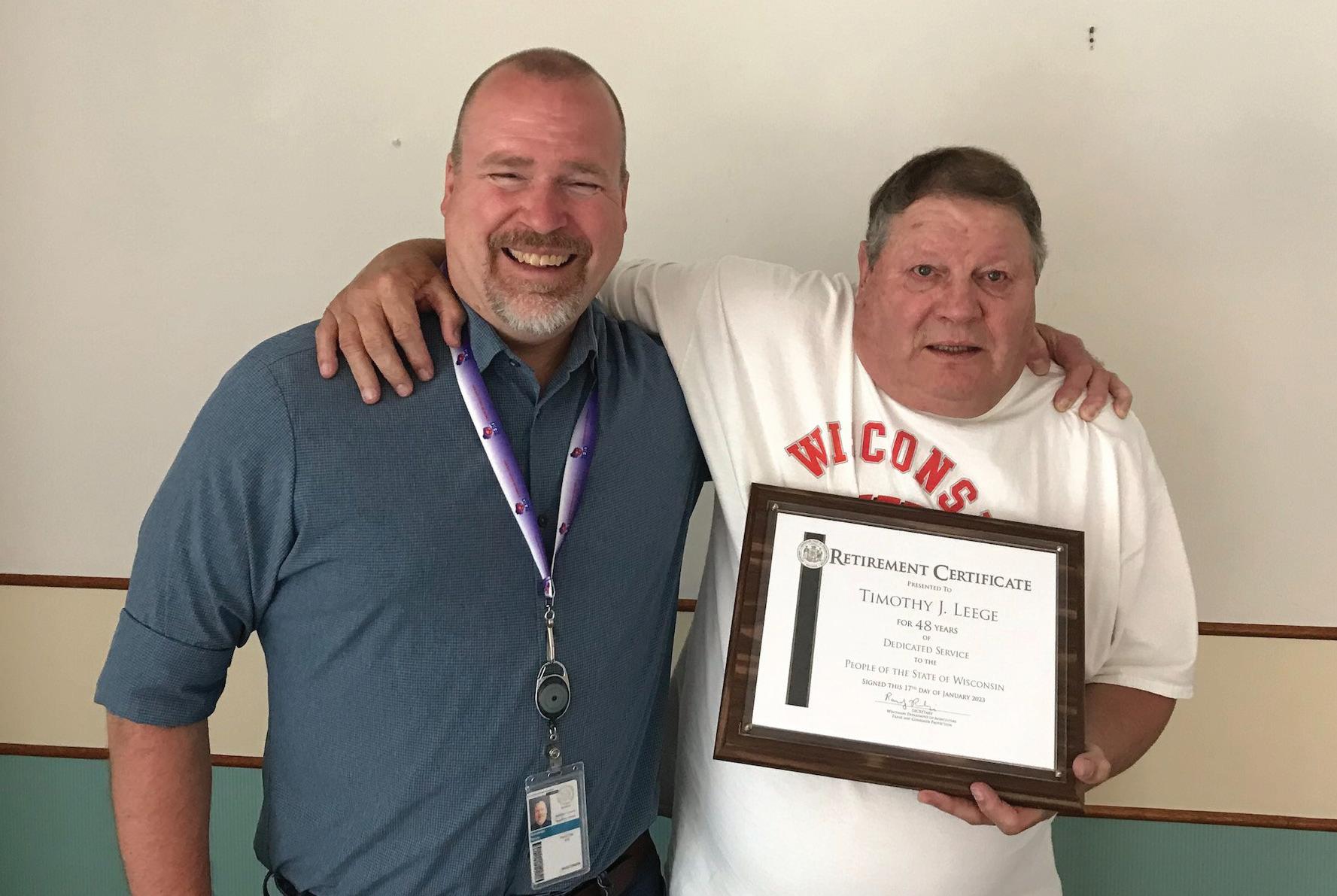
47
September
Guolong Liang will use his background in irrigation and nutrient management of specialty crops to work closely with the WPVGA Research Committee and Water Task Force on water quality. Long-time Wisconsin Department of Agriculture, Trade and Consumer Protection employee, Tim Leege, retired from state service after 48 Manyyears. know Tim as the Fruit and Vegetable Inspection Program manager. Tim’s last day was July 15, and Eric Scheftgen was named his replacement. Eric began his new duties on July 18.
Laura Paletta is based in Green Bay and will serve the eastern part of the state. She completed her Master of Soil Science at UW-Madison in 2017 and then continued to do research for three more years. Her research focused on using best management practices to reduce sediment and phosphorus losses. She spent the past two years working at the Manitowoc County Soil and Water Conservation Department as a resource conservationist. Laura’s email is paletta@wisc.edu.
The Agriculture Water Quality Program is a part of UW-Madison Division of Extension’s Agriculture Institute. The program was formed in 2021 to address the growing demand for water quality outreach and education from science-backed research regarding the impacts of agriculture on water quality and practices to reduce those impacts.
crop advisors and conservation professionals in the Central Sands. He has a background in irrigation and nutrient management of specialty Hecrops.received his bachelor’s and master’s degrees in horticulture at UW-Madison. He is also devoted to advancing diversity, equity, and inclusion missions in agriculture. Reach Guolong at gliang6@wisc.edu.
Tim Leege Retires He spent 48 years as DATCP Fruit and Vegetable Inspection Program manager

It all started in 2013 with one woman’s vision on how to raise money for the Antigo Penguins Swim Club. As an active person herself, what better way to encourage healthy lifestyles and raise money for an organization she held dear than to plan an event that embraced many of the activities she herself would enjoy outside of work?
While Koss is no longer physically present, her memory and legacy live on with the annual MK Splash-N-Dash event that calls Veterans Memorial Park at non-motorized Jake Lake home, a few short miles north of HeldAntigo.on Saturday, August 6, the MK Splash-N-Dash once again showed participants the beauty of Wisconsin’s Northwoods. The 500-meter swim and 5-kilometer run occur in Langlade County, the “County of Trails,” which embodies 126,000 acres of public land that is county, state and federally owned.
Michelle Koss had a dream about bringing the community together while also encouraging others to get out and live active lives doing fun and meaningful activities like skiing, biking, swimming, and kayaking. Thus, a competitive event for all ages, the Splash-N-Dash, was born. It encompassed silent sports like swimming and running and was held near Antigo in Langlade County. Tragically, the “MK” became part of the event’s name in 2016, when Koss was struck and killed by a motorist outside of Antigo while biking.
POWERED BY WISCONSIN POTATOES
Competitive Northwoods event brings community together to live active lives
In 2022, the MK Splash-N-Dash was once again included in the Wisconsin Potato & Vegetable Growers Association’s Powered by Wisconsin Potatoes line-up. Rhinelander Agricultural Research Station (RARS) Superintendent and Program Manager Becky Eddy took advantage of the opportunity to be an ambassador for Wisconsin potatoes and placed 1st overall in the women’s category and 2nd overall for the event.
Right: RARS Superintendent Becky Eddy holds a bag of Wisconsin potato chips while wearing an industry T-shirt at the MK Splash-N-Dash.
48 BC�T September
Left: Rhinelander Agricultural Research Station (RARS) Superintendent and Program Manager Becky Eddy shares her medal, Powered by Wisconsin Potatoes T-shirt, and bib from the MK Splash-N-Dash event, August 6, at Veterans Memorial Park just outside of Antigo.
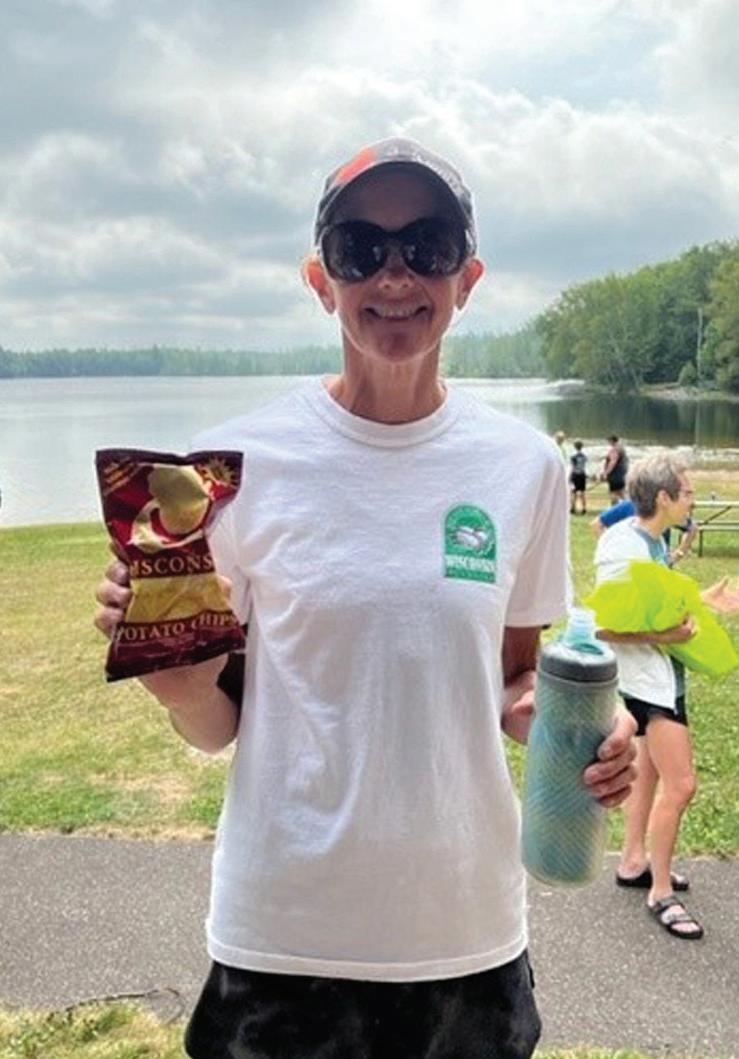

By Dana Rady, WPVGA Director of Promotions and Consumer Education
Marketplace Woman’s Legacy Lives On

Eddy and her family have been active participants in several Powered by Wisconsin Potatoes events as well as other runs and triathlons throughout the area over the years. She shares why she appreciates the MK Splash“IN-Dash.joined the event because I like to show my support by participating in at least a couple of the Powered by Wisconsin Potatoes sponsored activities each year,” she says. “I love the small-town races that support health, wellness, family, and community.” Eddy also says she appreciates the words race creator Michelle Koss lived by. “From an article I read in Silent Sports, she believed in ‘teaching children and adults to have fun while being physically active,’” Eddy relates. “I like the words she lived by: ‘Now get out and do Congratulationssomething.’” to the MK SplashN-Dash for another successful year, and to Becky for her medals and showcasing the positive impact Wisconsin potatoes can have on your nutrition and life.
YOUR PARTNERS ON THE JOB! “Our 8S averaged 4 gallons/hour over 600 hours during potato planting, discing and windrowing.” Adams Farms Inc., Stevens Point, WI $AVE FUEL, $AVE MONEY WITH MASSEYTHE FERGUSON 8S SERIES! Ask us how you can save with the new 8S series! Learn more at swiderskiequipment.com CommonTater_MF_AD_April_2022_V1.indd 1 4/11/22 3:26 PM 49BC�T September

Above: Participants get ready for a dip in Jake Lake during the MK Splash-N-Dash at Veterans Memorial Park, 17 miles north of Antigo. As Jake Lake is spring fed, the water temperature can be quite cool even during the summer months.

Crops need nutrients like nitrogen and phosphorus to grow and thrive. However, excess nutrients from farms can wash into streams and rivers, and even make their way into oceans. The surplus in nutrients can cause major damage to aquatic ecosystems, but small wetlands can be of tremendous help in reducing or preventing this damage.
Small Wetlands Can Have Big Impacts
The study was recently published in the “Journal of Environmental Quality,” a publication of the American Society of Agronomy, Crop Science Society of America, and Soil Science Society of America.
Submitted by sciencesocieties.org
Marshlands and swamps reduce excess nutrients reaching vital waterways per research
50 BC�T September
Photo courtesy of Tim Lindenbaum
“Even very small wetlands can be effective,” says Maria Lemke, lead researcher of the study at The Nature Conservancy.
Above: An aerial image of the Franklin Research and Demonstration Farm in Lexington, Illinois, shows restored floodplain wetlands, forested habitats, agricultural farmland, and experimental constructed wetlands. Wetlands built next to farmlands can dramatically reduce the amount of excess nutrients reaching vital waterways.

In a new study, researchers have shown that wetlands built next to farmlands can dramatically reduce the amount of excess nutrients reaching aquatic environments.
©2022 CliftonLarsonAllen LLP. Investment advisory services are offered through CliftonLarsonAllen Wealth Advisors, LLC, an SEC-registered investment advisor. CPAs | CONSULTANTS | WEALTH ADVISORS Dean Johnson Jim Halvorsen 715-344-4984 CLAconnect.com We’ll get you there. Where is your there? CLA brings balance to get you where you want to go.

Photo courtesy of Krista Kirkham
ADJUSTABLE AUTOMATIC MASTER POTATO BALER Features Include: • OMRON P.L.C. (programmable logic control) • User Friendly Touchscreen • Infeed mechanism & discharge gates • Baler pusher with bag transport grippers • Bag inflation system • Two way adjustable accumulating chamber • Handles 3-20 lbs product bags • Variable speed accelerator conveyor assembly with JMC Space Saver Incline • Product decelerator to eliminate bounce • NEMA 12 electrical “swing-away” control panel with interloc • Motorized Bag Saddle Conveyor (150 fpm) • High speed intermediate take away conveyor with horizontal alignment Two warrantylimitedyear Works with poly and paper masterBagbags!Sense“no bag, no dump” continued on pg. 52 51BC�T September


Nitrogen and phosphorus are vital nutrients for all life on Earth. These elements are part of the essential building blocks of life, including DNA and proteins.
VITAL NUTRIENTS
growth of organisms like algae or cyanobacteria that ultimately reduce much of the oxygen in marine systems. That can force other organisms like fish or shrimp to move away or even die, creating “dead zones.”
The study was conducted over 12 years on a 272-acre farm in McLean County of central Illinois. Many farms in this part of the United States use tile drainage systems, a network of interconnected underground pipes that drain water from the land.
Lemke and colleagues showed that wetlands as small as 3% of the tiled area draining into them can be effective. These wetlands catch excess nutrients draining from surrounding farmlands, meaning less nutrients end up in streams and rivers, and ultimately, the ocean.
Constructed wetlands can be a useful conservation practice that mitigates nutrient export from farms to aquatic Nitrogen runoff that enters wetlands comes in the form of dissolved compounds called nitrates. Microbes Shown is one of three wetland cells connected in a series that were monitored at the inlet and outlet tiles to measure nutrients and water moving into each system from underground agricultural tiles.

“Our findings show that constructed wetlands can be very effective at reducing excess nitrogen losses from agricultural tile systems,” Lemke says. “We also show that these wetlands can capture dissolved phosphorus efficiently.”
But when too much nitrogen and phosphorus make it into aquatic systems, they can fuel massive
Nutrient losses to the environment can come from many different sources. In the agricultural Midwest, excess nutrients drain into the Mississippi River. These nutrients travel through the river system and eventually end up in the Gulf of Mexico, which is the site of the world’s second largest dead zone.
Wisconsin Certified
View
Dr. Walt Stevenson is a member of the Wisconsin Potato & Vegetable Growers Association Hall of Fame. He was named an Honorary Life Member of the Potato Association of America and has received numerous national and state Researcher of the Year Awards.

smartphone. For a
“It’s fun working with an industry where the growers are constantly working to improve their practices and the already high quality of the potatoes they produce.”
“ThePotatoes:stringent standards used by the Wisconsin Seed Potato used throughout most of the industry. And the seed potatoes produced by Wisconsin growers are consistently among the best seed tubers produced in North America.”
Small Wetlands Can Have Big Impacts. . . continued from pg. 51 in wetlands can use these dissolved nitrates as energy sources. These microbes convert the nitrates into harmless nitrogen gas, which is released into the atmosphere. Conversion from dissolved nitrate to nitrogen gas results in less nitrogen exiting the wetlands into aquatic ecosystems. “Wetlands provide the perfect habitats for microbes to perform this process,” Lemke states. Phosphorus removal from farm drainage is a more complex process. Soil chemistry and clay content play important roles in removing dissolved phosphorus.
Mallard ducks are among the many wildlife species that benefit from wetlands constructed along the edges of farmland that reduce nutrient runoff. Wetlands can protect local drinking water supplies and reduce nutrients reaching freshwater and marine systems. Photo courtesy of Tim Lindenbaum

SEEDWISCONSINCERTIFIEDPOTATOES
SOIL ANALYSIS “It’s important to analyze soils at potential wetland sites to
Wisconsin Seed Potato ImprovementInc.Association, P.O. Box 173, Antigo, WI www.potatoseed.org715-623-403954409 a on your directory of Seed Growers or a free video, contact: Box
Potato
173, Antigo, WI 54409 www.potatoseed.org715-623-4039 WISCONSIN CERTIFIED SEED POTATOES The early generation that you want. View a directory of the Wisconsin Certified Seed Potato Growers on your smartphone. BADGER STATE WISCONSINCERTIFIED SEEDWISCONSINPOTATOESCERTIFIED SEEDWISCONSINPOTATOESCERTIFIEDSEED POTATOES 52 BC�T September

What do you expect from the seed potatoes that you buy? The varieties that you need. The quality and yield thatyou have come to expect. Wisconsin has it! Wisconsin Seed Potato Improvement Association, Inc. P.O.
directory of the Wisconsin Certified Seed Potato Growers
A cooperative providing customized financing and financial services for farmers, ranchers, and agribusinesses: Marshfield 800-324-5752 Medford 800-324-5753 Stevens Point 800-324-5754 Thorp 800-324-5758 Wausau 800-324-5751 • Operating, Machinery, and RE Loans • Rural Home & Recreational Land Loans • Insurance (MPCI, Hail, DRP, Life) • Cash Patronage Program • Farm Accounting & Tax Preparation AgCountry.com FOCUSED ON AG. FOCUSED ON YOU. “It is pretty incredible to stand on the edge of a corn field and hear a cacophony of chorus frogs or watch a flock of blue-winged teals take off from a nearby constructed wetland.” – Maria Lemke, lead researcher of the study at The Nature Conservancy 53BC�T September

Lenticels contain the microscopic passageways that allow oxygen to enter a potato
Raised and discolored lenticels are apparent. Diseased areas are present. Not visible is the unmistakable smell of soft rot decay. This potato needed more oxygen. Every potato needs oxygen, and every spud has lenticels to satisfy that need. Lenticels contain the microscopic passageways that allow oxygen to enter a potato. Under favorable conditions, the many small lenticels in each tuber supply the oxygen needed for metabolism. When the lenticel pores are blocked with water, however, oxygen entry is severely restricted and internal oxygen content drops quickly. To alleviate oxygen deficiency, new cells are produced below the lenticel. As these cells proliferate and expand, they enlarge the lenticel pore by pushing the surrounding skin up and outward. Eventually, these new cells will break through the skin and form white bumps that look like miniature popcorn, cauliflower, or snowflakes. If the tuber surface dries subsequently, most of the newly formed cells perish and the enlarged lenticels become suberized.
Figure 1. A Lamoka chipping potato shows discolored and raised lenticels, enlarged lenticels where new white cells have pushed through the skin, and patches of soft rot.

Potatoes Need Oxygen
By Paul Bethke, U.S. Department of Agriculture and University of Wisconsin-Madison Department of Horticulture Badger Beat

54 BC�T September
Lenticels with white bumps are
It is not difficult to ruin quality potatoes. The accompanying photograph illustrates this point. The potato in Figure 1 was healthy and attractive when harvested. Then it was stored wet for three days. In that time, it became unattractive, unhealthy, and unpleasant to handle.
The Red Prairie potato in Figure 2 (top left) has small lenticels that have not enlarged. The lenticels appear as tiny spots scarcely darker than the surrounding skin. The skin on this potato is very attractive. continued on pg. 56
Figure 2: The Red Prairie potato on the top left has small lenticels that have not enlarged while the Red Norland on the top right has elevated lenticels, several of which have ruptured the skin and appear as raised white bumps. Extensive enlargement of lenticels is seen in the Snowden potatoes on the bottom of the figure.

LENTICEL APPEARANCE

often referred to as open lenticels or proliferated lenticels. In this article, I use the term enlarged lenticels to emphasize that they have increased the area for oxygen entry. “Open” conveys a similar idea but suggests that lenticels return to their original condition by closing, which is not true.
55BC�T September
Potato
56 BC�T September
• Grower-owned operation • Operation packs many varieties of potatoes year-round for retailers, wholesalers & foodservice companies • Scoop-up purchasing • Pool participation • Multiple grading options • Temperature & humidity controlled storage available • Direct marketing For more details on how to grow with us,
or mike.hayes@wfc.ag Come Grow With Us! Eagle River Seed Farm Seed Operations Wysocki Produce Farm Farming Operations Paragon Potato Farms Plant Operations
seed multiplication

Hayes
Many of the lenticels in the Red Norland potato (Figure 2, top right) are raised above the tuber surface because of localized cell proliferation just below the skin. Newly formed cells have burst through the skin in several places and appear as white bumps. Lenticel-associated cell proliferation was extensive for the Snowden potatoes on the bottom of Figure 2. The bright white appearance indicates that cells emerging from these lenticels have remained moist and avoided a damaging pathogen Lenticelinfection.enlargement has obvious short-term benefits for the potato, but growers and shippers are likely to focus on the adverse consequences of enlarged lenticels. For one thing, enlarged lenticels are entry points for pathogenic bacteria and fungi. It is common for enlarged lenticels to become infected with localized haloes of decay around the lenticels. In more extreme infections, diseased areas coalesce, and the entire tuber may rot. Tuber rot in the field reduces yield and generates inoculum for further disease. Tuber rot in packages sent to distributers or retailers creates a financial liability. Once dried, enlarged lenticels collapse and form an unattractive brown blemish where a protective layer of suberin is deposited. These lenticel spots diminish tuber quality, especially for fresh market potatoes, even when they do not become infected.
Potatoes should be dried completely prior to packaging or shipping unless they will be utilized quickly.

Potato storage managers carefully regulate temperature, humidity, and airflow to prevent condensation within potato piles. That level of precise control is not possible as Badger Beat. . . continued from pg. 55 contact Mike at 715-572-6366
Speaking to attendees of the Hancock Agricultural Research Station Annual Field Day, July 7, 2022, Paul Bethke describes a diploid trial he and his team are conducting.

Condensation on the potato surface results when moist warm air contacts cool potatoes. Condensation can produce water films that promote lenticel enlargement.
AVOID ENLARGED LENTICELS
Anyone who would like to minimize the detrimental effects of enlarged lenticels should develop an awareness of the conditions that promote enlargement. Management strategies can then be implemented
Lenticel enlargement can occur before or after harvest. It is well known that water-saturated soil promotes lenticel enlargement. Wet conditions after harvest also stimulate lenticel enlargement. Washing and fluming operations are obvious sources of moisture.
57BC�T September
Potato varieties with greater soft rot resistance may minimize the potential consequences of enlarged lenticels. Cells in enlarged lenticels will desiccate and turn brown rapidly when exposed to dry air. Suberization of desiccated lenticels takes much longer. The suberized layer is a protective barrier against pathogen entry. Potatoes that recently had enlarged lenticels are at greater risk of pathogen infection than those that have had time to fully suberize. Conditions that promote lenticel enlargement are conducive to the growth of soft rot bacteria. Both are favored by free water, low oxygen availability and warm temperatures. Lenticels allow potatoes to get the oxygen they need. Careful management of potatoes should avoid conditions that increase oxygen demand or decrease oxygen availability to the extent that lenticels enlarge. High temperatures during and after harvest and rough handling increase oxygen demand. Moisture on the tuber surface and poor ventilation decrease oxygen availability. Minimizing lenticel enlargement makes it easier for everyone to deliver quality potatoes to their customers.
Extra care is needed where temperature and humidity fluctuations in the local environment may cause condensation on the potatoes. To the extent possible, ventilate packaging, shipping containers and coolers to promote evaporation of free water and avoid excess CO2 buildup. Lenticel enlargement takes time. Lenticels do not enlarge rapidly. In our work, freshly harvested potatoes stored at 68 degrees Fahrenheit begin to show white at their lenticels in about two days. The rate of lenticel enlargement depends on temperature. At 55 degrees, the process takes about twice as long as at 68 degrees. Higher temperatures further accelerate the process. Lenticel enlargement is more rapid in young tubers than in mature tubers. Early harvests are more likely to have problems with enlarged lenticels than later Freshlyharvests.harvested potatoes are prone to lenticel enlargement. The likelihood that potatoes in storage will form enlarged lenticels decreases rapidly with time in storage. Even a few days of quiet storage after harvest can make a noticeable difference. No potato variety is immune to lenticel enlargement. Potato varieties differ somewhat in their sensitivity to lenticel enlargement and greatly in their susceptibility to infection by pathogens that promote rot.
Solid protection against pests and pathogens. We have the best applicators and most innovative equipment in the industry. Your Total Agri Supplier potatoes are washed, packaged, and shipped, or when they are held in coolers or warehouses. Care must be taken at each step to avoid introducing moisture and creating persistent water films on the tuber surface.


Jay-Mar.com • 715-341-3445 • 800-236-2436
SOFT ROT RESISTANCE
CONDENSATION ON SPUDS
FUMIGATION BY
A fast-acting, easy-to-use peroxyacetic acid (PAA), Jet-Oxide® 5% Industrial Sanitizer can be used as a pre-treatment to sanitize foodcontact surfaces or as a disinfectant for industrial hard surfaces. It can also be used for post-harvest spray treatments on unprocessed fruit and vegetable surfaces, and on surfaces to control the spread of citrus canker. Uses of Jet-Oxide Industrial Sanitizer: Sanitizing of previously cleaned non-porous food contact surfaces Dairies, wineries, breweries, food and beverage plants, disinfecting poultry premises, poultry hatcheries, animal housing facilities Hard surface disinfection Industrial facilities, office buildings, recreational facilities, retail and wholesale establishments Active Ingredients: Hydrogen peroxide (26.5%) Peroxyacetic acid (4.9%)

•
•
•
New Products Jet-Oxide Sanitizes Food-Contact Surfaces Fast-acting, easy-to-use peroxyacetic acid can also be used for post-harvest spray treatments Quality Growers of Foundation and Certified Seed Potatoes for Over 50 Years! We handle our own line of clean and dependable late model trucks for all of your delivery needs. N3502 Hwy H • Antigo, WI 54409 Office: 715-627-7753 • Fax: 715-623-5412 • mike@baginskifarms.com Yellows: Colomba Whites: Superior Reds: Red ModocNorland Russets: Norkotah #8 Burbank Gold Rush Mercury Silverton Plover Featuring Colomba An early maturing and high yield potential yellow variety. 58 BC�T September

•
•
•
Jet Harvest products are PAA Products that kill fungi and bacteria on contact. If you treat your potatoes going into storage or treat potatoes in wash lines with a PAA product, you should be using Jet Ag. STORAGE Going into storage, you should be using a product that kills pathogens that cause storage rot and loss of profit. Use Jet Harvest products at a couple of ounces per hundredweight and you will be reducing the number of rot organisms severalfold.

Depending on your market, you may be required to use a kill step, and Jet Harvest products give you that step. Regardless of requirements, it is important to use product that will kill potential pathogens and lower microbial counts, which, in turn, will result in longer shelf lives and no weepy eyes.
Wisconsin Potato Assessment Collections: Two-Year Comparison
59BC�T September
Month Jul-21 Aug-21 Sep-21 Oct-21 Nov-21 Dec-21 Jan-22 Feb-22 Mar-22 Apr-22 May-22 Jun-22 Year-to-Date CWT 1,292,191.75 1,292,191.75 Assessment $103,342.07 $103,342.07
Decco U.S. Post-Harvest, Inc. the post-harvest affiliate of UPL Limited, announces the launch of Decco DMN DeccoAerosol.adds the new Environmental Protection Agency (EPA)-registered product to its growing potato storage portfolio available across North America. Decco DMN Aerosol, as part of an overall potato storage program, will greatly reduce potato sprouting and disease issues while also enhancing flesh strength and color, and reducing bruising or soft spots.

Protect Potatoes in Storage
WPIB Focus
The product is available in 5-gallon Jerrycans, which are easier to move and handle, with smaller quantities being less dangerous. For more information, www.curriecompany.com/products.(office).207-768-0681Noel@CurrieCompany.com,contact(cell)or207-762-5771Visitthewebsiteathttps://
The active ingredient in Decco DMN Aerosol, 1,4-Dimethylnaphthalene, is a conventional solution used in potato storage programs throughout the industry. Color and flesh strength are key variables that need to be managed in stored potatoes. French fry and potato chip processors demand uniformity, consistency and highquality potatoes that come out of Deccostorage.DMN Aerosol helps reduce load rejection by working in conjunction with an overall potato storage program. FRESH DEFENSE It is the latest product to be added to the company’s Fresh Defense® portfolio for stored potatoes. “Our Fresh Defense products are known for protecting your potato investment from harvest to the processing plant,” says Shawn Kennedy, U.S. potato manager for Decco. “Now with DMN Aerosol available, Decco can offer a robust Fresh Defense program in conjunction with its CIPC and clove oil products to help protect potatoes in Thestorage.”overall portfolio of Fresh Defense products, including DMN Aerosol, creates many opportunities for Decco and parent company UPL to provide a better customer experience for the potato grower, storage applicator and processor. “The aim for Decco is to collaborate closer with our crop colleagues at UPL,” says Boomer Cardinale, U.S. marketing director for Decco. “Under our OpenAg mission, we can truly offer farm-to-fork solutions across the value chain.”
Decco DMN Aerosol greatly reduces sprouting and disease issues
“The addition of Decco DMN Aerosol and our other Fresh Defense storage products will greatly complement the UPL potato programs offered in preharvest,” Cardinale states. For further information on Decco DMN Aerosol, contact cardinale@upl-ltd.com.informationkennedy@upl-ltd.com.shawn.FormediaatDecco,contacternest.
Month Jul-22 Aug-22 Sep-22 Oct-22 Nov-22 Dec-22 Jan-23 Feb-23 Mar-23 Apr-23 May-23 Jun-23 Year-to-Date CWT 1,672,188.74 1,672,188.74 Assessment $133,812.37 $133,812.37
PACKING LINE
McKalip stated that that conversation served as a reminder for U.S. trade officials “to work double time to make sure that we are not facing barriers to getting their product to those Rankingconsumers.”Member Mike Crapo (R-ID) and Sen. Chuck Grassley (R-IA) also cited the progress made in Mexico as an example of how market access agreements can be used to support U.S. agriculture.
On July 28, the Senate Appropriations Committee released its version of the fiscal year 2023 Agriculture Appropriations Bill that includes $4 million for potato breeding research. This is the highest level in history for this program, administered by the National Institutes of Food and Agriculture and utilized across the U.S. industry.
McKalip says he’ll use all tools to ensure Mexico honors trade obligations

PERSONAL ANECDOTE McKalip also shared a personal story about his uncle who relocated to Mexico and was excited about being able to purchase high-quality U.S. potatoes in his local market. He said his uncle told him, “The potatoes that we have access to here are not the same consistency. They have different starchiness, they cook differently, and when I come back up to the U.S. for Thanksgiving, for holidays, I can’t wait to get an American potato.” His uncle then asked, “How soon am I going to see American potatoes down here in our marketplace?”
“I will use every tool available to maintain that agreement, so that there is no back slippage or loss of access for potatoes,” he responded.
Potatoes were a prominent topic, on July 28, during the Senate Finance Committee’s confirmation hearing for Douglas McKalip to be the chief agricultural negotiator for the Office of the United States Trade InRepresentative.responsetoa question by Sen. Michael Bennet (D-CO) on how he would ensure that U.S. potatoes retain market access to the full Mexican market, McKalip assured members that utilizing full enforcement authority under the United StatesMexico-Canada Agreement and other trade commitments will be a top priority so Mexico lives up to its trade obligations.
“I am proud of the results and believe that we need to double down in our resolve to get similar tangible outcomes for our producers on a wide range of commodities,” he testified.
“The potato industry greatly appreciates the value that the Senate Appropriations Committee has placed on this vital research. We have made this program a priority each appropriations cycle and the strong teamwork is clearly generating results,” says R.J. Andrus, National Potato Council vice president of legislative affairs. The bill also includes language that would prevent the USDA from limiting potato access to the school breakfast program, Agricultural Research Services funding and waiver provisions that make the Specialty Crop Research Initiative more accessible for public institutions.
NPC News Chief Ag Negotiator Assures
U.S. Potato Market Access
Potato Research Funding Hits Highest Level in History
Confirmed as the chief agricultural negotiator for the Office of the U.S. Trade Representative, Douglas McKalip says he will utilize full enforcement to ensure Mexico lives up to its trade obligations.
60 BC�T September
During his opening statement, McKalip highlighted the potato trade agreement achieved this spring with Mexico as one of his successes during his time at the U.S. Department of Agriculture (USDA).
Ali's Kitchen Pizza with a Potato Twist! Layer these Hash Brown Pizza Cups with any combination of your favorite toppings Column and photos by Ali Carter, Wisconsin Potato Growers Auxiliary I hesitate to call this a recipe since I’m not offering you specific measurements. I know that makes some people a little nervous (Hi, Mom!). My hope is that the lack of measurements fills you with more freedom than it does fear. I promise you that you can’t mess these up. Use as much or as little pizza sauce as you like, layer with any combination of your favorite pizza toppings, and then sprinkle some shredded cheese on top of it all. It’s easy-peasy continued on pg. 62 INGREDIENTS: Hashbrown Pizza Cups Measure with your heart! • thawed hash browns • shredded cheese • pizza sauce • your favorite pizza toppings • 1 egg • Italian seasoning • garlic powder 61BC�T September


I topped our pizza cups with pepperoni, onion, and black olives, but I bet the addition of finely diced bell pepper and mushrooms would have been fabulous. Next time!

When you’re a member, YOU’RE AN OWNERCall our local commercial lenders at 800-398-2667 ext. 1125 to discuss possible options in helping your business succeed! Just as you own your business and reap the rewards of your hard work, member-owners benefit from the credit union’s financial growth and success. CoVantage Offers: n Better business loan rates n Lower business fees n Higher deposit rates Providing value to the people and businesses –the owners of the credit union who rely on CoVantage for their financial needs. n Loan rebate program –Returning $19.5 million to account holders in t he past five years 62 BC�T September

Preheat the oven to 450 degrees. In a bowl, combine the thawed hash brown potatoes with 1 egg. Mix well. Add any seasoning you’d like (I went with Italian seasoning and a bit of garlic Distributepower).the potato mixture evenly between the muffin cups. Press the hash browns down and up the sides of each cup to form a well that will hold the sauce and toppings. Bake the potato cups for 15 minutes. Remove from the oven. Spoon a bit of pizza sauce into each of the potato cups, add your toppings, and then sprinkle each one with some cheese. Place them back in the oven and continue baking at 450 degrees for an additional 5 to 10 minutes (you want your veggies warmed through and your cheese melty). Enjoy!
NOW FOR THE NOT-VERYSPECIFIC RECIPE
Advertisers Index AbbyBank .................................... 25 AgCountry Farm Credit Services 53 AltmannCompany,ConstructionInc. 43 Baginski Farms Inc. ...................... 59 Big Iron Equipment 11 Binfront Barriers .......................... 45 BTU Ventilation 42 Bushmans’ Inc. 3 CliftonLarsonAllen ....................... 50 Colorado Certified Potato Growers Association .................. 20 Compeer Financial 36 CoVantage Credit Union .............. 62 Heartland AG Systems 16, 55 Jay-Mar, Inc. 57 John Miller Farms ........................ 63 J.W. Mattek & Sons, Inc. 27 M.P.B. Builders, Inc. ..................... 31 McGowan Rice Construction 29 MetLife Investment Management 9 Mid-State Truck Service 44 Montana Potato Advisory Committee 54 National Potato Council ................. 2 Nelson’s Vegetable Storage Systems Inc. .................. 18 North Central Irrigation 41 Nutrien Ag Solutions 38 Oasis Irrigation ............................ 64 Paragon Potato Farms 56 Plainfield Trucking ....................... 26 Roberts Irrigation 15 Ron’s Refrigeration ...................... 40 Ruder Ware 32 Rural Mutual Insurance 39 Sand County Equipment .............. 24 Schroeder Brothers Farms 7 Solanum International ................. 19 Swiderski Equipment 49 T.I.P., Inc. ...................................... 23 ThorPack, LLC 51 Tolsma USA .................................... 5 Vantage North Central 21 Volm Companies 13 WPVGA Putt-Tato Open Thank You 37 WPVGA Support Our Members ... 58 WSPIA 52 Ali's Kitchen. . . continued from pg. 61 While there are no measurements, I will offer you a guiding glimpse into how I personally concocted our Hash Brown Pizza Cups. My 20-ounce bag of hash browns made 12 Pizza Cups. I used maybe/ about 1 cup of shredded mozzarella and I’d guess about a 1/2 cup of pizza Isauce.made the cups using a silicone muffin mat, but any muffin tin will work. Just be sure to grease the muffin tin well to make it easier to remove the pizza cups once they’re baked.
North Dakota Certified Seed Potatoes • Minto, ND Contact John Miller: (701) 248-3215 Dryland Grown…Northern Vigor! WanetaND7799C-1DakotaVikingRedDarkLadyGoldrushSilvertonLibertyRedNorlandNorlandPearl We are now offering shipments in 2,000 lb. totes and contracting for the current year and beyond if interested. All &PVX,LotsPVYNon-GMOTested www.johnmillerfarms.com Check out our NEW website!


Contact <Dealership name> to learn more about the FieldNET family of remote irrigation management tools – FieldNET® Pivot Watch™, FieldNET Pivot ControlTM and FieldNET Pivot Control LiteTM <Street> <City, ST 00000-0000> <phone><web> Contact Oasis Integrated Irrigation Solutions to learn more about the FieldNET family of remote irrigation management tools – FieldNET® Pivot Watch™, FieldNET Pivot Control™ and FieldNET Pivot Control Lite™. 715-335-8300 N6775 5th Avenue Plainfield, WI 54966© 2022 Lindsay Corporation. All rights reserved. Zimmatic, FieldNET, FieldNET Advisor, FieldNET Pivot Watch, FieldNET Pivot Control and FieldNET Pivot Control Lite are trademarks or registered trademarks of Lindsay Corporation or its subsidiaries.


Contact <Dealership name> to learn more about the FieldNET family of remote irrigation management tools – FieldNET® Pivot Watch™, FieldNET Pivot Control and FieldNET Pivot Control LiteTM Contact <Dealership name> to learn more about the FieldNET family of remote irrigation management tools – FieldNET® Pivot Watch™, FieldNET Pivot ControlTM and FieldNET Pivot Control LiteTM <Dealership Name> <Street> <City, ST 00000-0000> <phone>
Permit
P.O. Box 327 Antigo, WI CHANGE SERVICE REQUESTED54409
Non-Profit Org U.S. Postage Paid Stevens Point, WI 54481 No. 480
