Getting Ready
Messina College moves closer and closer to its official opening day
BY ED HAYWARD STAFF WRITER
Messina College, the new two-year degree program of Boston College, is building up—quite literally and figuratively—to the days in July when it will welcome its inaugural class of first-generation students to the Brookline Campus.
Messina College Dean Erick Berrelleza, S.J., is the one simultaneously guiding upgrades to classrooms, labs, community, and dining spaces, overseeing student recruitment and admission, and faculty hiring, while assembling staff and a leadership team.
After a walk around the campus, the obvious question emerges: Is this at all overwhelming?
“No,” said Fr. Berrelleza on a recent
day, under the watchful eyes of a flock of Canada geese cooling their wings outside the administration building. “I tell people all the time that there are lots of people helping me and helping Messina College. This is a University-wide initiative.”
He cites the close partnerships with the departments and offices of Admission and Financial Aid, Facilities, Auxiliary Services, Institutional Research and Planning, and the Career Center—to name a few—as well as the offices of President William P. Leahy, S.J., and Provost and Dean of Faculties David Quigley.
“Students will be here in July,” Fr. Berrelleza said. “We don’t have time to get overwhelmed. We just keep moving toward the goal.”
Messina College is part of the Universi-

Paredes Grateful to Be on Her ‘Long’ Journey
BY PHIL GLOUDEMANS STAFF WRITER
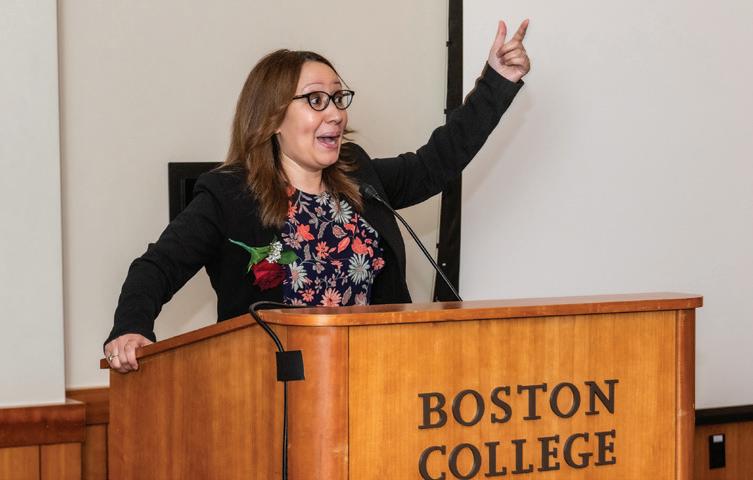
Melanie Paredes ’25, whose long record of service to others in need extends to Boston College’s Pine Manor Institute for Student Success, has been awarded the 2024 Saint Oscar A. Romero Scholarship.
Paredes, a native of Bronx, NY, who is pursuing a bachelor’s degree in communication, and a minor in general business, was presented with the award by University President William P. Leahy, S.J., at the an-
nual Saint Oscar A. Romero Scholarship Banquet on Saturday night in the Yawkey Athletic Center Murray Room.
She will receive approximately 75 percent of her senior year tuition in acknowledgement of her superior academic achievement, extracurricular leadership, community service, and involvement with the Hispanic/Latinx community and issues both on and off campus.
Paredes and the other finalists, juniors Karol Bedoya and Jacob Bojito, were se-
Continued on page 3

32 Faculty Are Promoted
University President William P. Leahy, S.J., announced that 32 Boston College faculty members have been promoted during the 2023-2024 academic year.
Morrissey College of Arts and Sciences faculty members promoted to full professor were Richard Atkins and Jean-Luc Solere (Philosophy), John Christianson and Michael McDannald (Psychology and Neuroscience), Brian Gareau (Sociology), Dubi Kelmer (Mathematics), Theodore Papageorgiou (Economics), and Michael Serazio and Matthew Sienkiewicz (Communication).
Also promoted to full professor were: Carroll School of Management faculty members Susan Shu and Billy Soo (Accounting) and Judith Clair (Management and Organization); Corrine Jurgens of the Connell School of Nursing; Paulo Barrozo, Avlana Eisenberg, and Bijal Shah of BC Law School; Kristen Bottema-Beutel (Teaching, Curriculum, and Society), Rebecca Lowenhaupt and Martin Scanlan (Education Leadership and Higher Education), and Scott Seider (Counseling, Developmental, and Educational Psychology) of the Lynch School of Education and Human Development; and Andrew Davis and Hosffman Ospino of the Clough School of Theology and Ministry.
Morrissey College faculty members promoted to associate professor with tenure were Stefano Anzellotti and Brooke Mag-
nus (Psychology and Neuroscience), Alyssa Goldman (Sociology), and Kristin Peterson (Communication).
Others named associate professor with tenure were Benjamin Yost (Accounting) and Vincent Bogousslavsky (Finance) in the Carroll School, Emily Gates (Measurement, Evaluation, Statistics and Assessment) and Raquel Muñiz Castro (Education Leadership and Higher Education) in the Lynch School, and Cal Halvorsen and María Piñeros-Leaño in the BC School of Social Work.
—University Communications
INSIDE
2 Around Campus
Polar Plunge to benefit Special Olympics; Courageous Conversations event April 4.
4 O’Hare Fellow
Senior is eighth BC student to win prestigious award.
8 BC Arts
Music’s Ralf Gawlick to present his new oratorio on campus.
OFFICE OF UNIVERSITY COMMUNICATIONS MARCH 28, 2024 VOL. 31 NO. 14
PUBLISHED BY THE BOSTON COLLEGE
Messina College Dean Erick Berrelleza, S.J.,right, chatted with incoming students and family members at the college’s Admitted Eagles Day last month. Messina College, the new two-year program of Boston College, will welcome its first class in July.
photo by lee pellegrini
Romero Scholarship winner
Melanie Paredes with her mother, Ana.
photo by lee pellegrini
Continued on page 5
Around Campus
BC Community Getting Ready to Take the Polar Plunge Again on April 6
Members of the Boston College community will have an opportunity to support Massachusetts Special Olympics next week when the Boston College Police Department, in collaboration with the Law Enforcement Torch Run for Special Olympics and BC Special Olympics, holds the second annual BC Polar Plunge.
The event takes place on April 6 at noon in front of the Margot Connell Recreation Center. Participants who have committed to raising funds for Massachusetts Special Olympics athletes will jump into 30-degree water contained in an aboveground mobile swimming pool.
Every year, Special Olympics Massachusetts’ supporters gather together to plunge—whether into oceans, lakes, or pools. Polar Plunge proceeds directly support year-round sports training and competition for Massachusetts athletes with intellectual disabilities.
After having raised nearly $24,000 last year, BC Polar Plunge organizers upped their fundraising goal to $30,000, and they have reason to be optimistic: The number of participants for 2024 is already more than double the 74 who registered last year.
“We had originally started out with a goal of $10,000 last year, met that,
bumped it up to 15, met that, and eventually bumped it up to 25,” said BCPD Detective Kevin Christopher, a delegate for the Special Olympics and a chief organizer for the plunge. “$25,000 for a first-time event is almost unheard of. We were really, really excited, so of course we are looking forward to this year.”
Polar Plunge participants often wear humorous, imaginative costumes, and the event is further enlivened by refreshments, music, prizes, and Polar Plunge mascot PBear the Polar Bear. Christopher noted that this year will feature a brand-new plunge pool, “Bear Force One,” named for P-Bear.
Boston College has had a longtime relationship with Massachusetts Special Olympics, having once served as host for the organization’s Summer Games event, which this year will take place June 7-9. For years, BCPD has hosted the final leg of the Law Enforcement Torch Run Cruiser Convoy that will start on the BC campus and finish up at Boston University’s Agganis Arena. The competitions will take place at the Harvard University Athletic Complex.
The creation of the BC Polar Plunge was part of an effort to reintroduce fundraising activities at the collegiate level, noted Christopher, who hopes that other Boston-area
Courageous Conversations Resumes April 4
Boston College’s Courageous Conversations Toward Racial Justice program will host a discussion on athletics and social justice activism next week with members of BC’s student athlete-led Eagles for Equality committee.
The event will take place on April 4 at 7 p.m. in the McElroy Commons Faculty Dining Room.
American student athletes, such as UCLA basketball star Lew Alcindor (later Kareem Abdul-Jabbar) and Yale rower Chris Ernst, have a history of advocating for social change. Established in 2020 in the wake of national unrest about racerelated matters in the United States, Eagles for Equality seeks to educate the BC athletic community “by creating a culture of awareness and empathy for diversity, by promoting open dialogue, by advocating for student athlete initiatives, and by creating a support system for student athletes.” The group consists of four sub-committees, each with a specific issue of focus: disabilities, race and ethnicity, gender, and LGBTQ+.
At the Courageous Conversations discussion, members of Eagles for Equality will speak about the challenges and rewards of athletes leveraging their influence to drive meaningful social change.
A partnership between the Office of the Provost, Office for Institutional Diversity, Boston College Forum on Racial Justice in America, and Environmental Studies Program, the Courageous Conversations program is based on a protocol for interracial dialogue developed by author, consultant, and strategist Glenn E. Singleton and used as a model in various settings, from educational institutions to businesses to community groups. With a concise format and set of guidelines to follow, each meeting is constructed as a thoughtful exploration of a specific topic or theme.
Dinner will be available at the April 4 event, but space is limited. To register, go to events.bc.edu/event/courageous-conversation-eagles-for-equality-athletics-socialjustice-activism.
—University Communications

colleges and universities will follow suit.
“I would love to have BU, Northeastern, and Harvard do the plunge with us and have one big trophy like the Beanpot, for whichever school raises the most money
that year,” he said.
To join or donate to the BC Polar Plunge, visit www.specialolympicsma.org/ events/annual-events/polar-plunge.
—Audrey Loyack

March 28, 2024
The Boston College Chronicle (USPS 009491), the internal newspaper for faculty and staff, is published biweekly from September to May by Boston College, with editorial offices at the Office of University Communications, 3 Lake Street, Brighton, MA 02135 (617)552-3350. Distributed free to faculty and staff offices and other locations on campus. Periodicals postage paid at Boston, MA and additional mailing offices. POSTMASTER: send address changes to The Boston College Chronicle, Office of University Communications, 3 Lake Street, Brighton, MA 02135. A flipbook edition of Chronicle is available via e-mail. Send requests to chronicle@bc.edu. ASSOCIATE VICE PRESIDENT FOR UNIVERSITY COMMUNICATIONS Jack Dunn SENIOR DIRECTOR FOR UNIVERSITY COMMUNICATIONS Patricia Delaney EDITOR Sean Smith CONTRIBUTING STAFF Phil Gloudemans Ed Hayward Audrey Loyack Rosanne Pellegrini Kathleen Sullivan PHOTOGRAPHERS Caitlin Cunningham Lee Pellegrini www.bc.edu/bcnews chronicle@bc.edu Chronicle
Campus Security Officer Douglas Judge in flight during last year’s BC Polar Plunge.
photo by erin fish/special olympics
Snapshot A Friendly Call
Representatives from the University’s Off-Campus Student Living Office and Boston College Police Department recently visited BC students living off campus to offer safety reminders.
2 Chronicle
photo by lee pellegrini
Romero Scholarship
Continued from page 1
lected from a record-setting 23 applicants for the scholarship.
Information Technology Services Human Resources Assistant Director Marcela V. Norton, co-chair of the Romero Scholarship committee, characterized Paredes as “an outstanding individual whose hard work, passion and dedication demonstrates the commitment of service and values of Saint Oscar Romero.”
“I’m deeply honored and profoundly humbled to stand before you tonight as the recipient of the prestigious Oscar Romero Scholarship,” said Paredes, who was introduced by Rebecca Mitchell, associate director for curriculum and assessment at the Pine Manor Institute. Paredes works at PMI as a success coach, building relationships with and supporting high school students and peers in academic and personal development through the institute’s programming.
“This moment is not just a personal triumph but a testament to the collective efforts of all of those who have supported me throughout my journey,” she said, citing her mother Ana for “her dedication
and sacrifices, and for paving the way for me to access education. Her resilience, perseverance, and selflessness have been a cornerstone in my life. I’m eternally grateful, but I also understand that I’ll never have enough to repay her.”
As a youth, Paredes took an interest in real estate law after witnessing the mistreatment of Latinos in the shelter and public housing system. A forceful advocate for her South Bronx community, she developed a passion for interpreting real estate contracts and documentation for her mother and other Latino families who needed help navigating the New York City housing system.
As the founder of College Ambassadors, Paredes played a crucial role in aiding low-income, first-generation high school students in navigating the complex college application process. She was awarded a Frontier Fellowship Grant designed to uplift the Latinx community, empowering her to delve into Latin American perspectives on textured hair and Black features, a topic closely tied to her identity as a Dominican American student; she plays an active role in BC’s Dominican Association.
Forum on Racial Justice Returns
April 9 with Panel on Catholicism
An upcoming discussion presented by Boston College’s Forum on Racial Justice in America examines the role—and obligation—of Catholics in combatting the many effects of racism.
“Confronting Injustice with the Eyes of Faith: Distinctly Catholic Tools for Building Racial Justice” will be held on April 9 at 4:30 p.m. in Gasson 100. The event’s title, and its focus, draw on a 2023 book, Racism and Structural Sin: Confronting Injustice with the Eyes of Faith, published by Marquette University Associate Professor and Chair of Theology Conor Kelly Ph.D.’15, one of four panelists taking part in the conversation.
Given their belief “that every human person is created in the image and likeness of God, Catholics have a responsibility to be champions for racial justice,” reads the book description. Kelly invites readers “to not only confront racism on a personal level but also to examine the root causes and perpetuated structures of this sin. Grounded in church teaching and pastoral practice, this book is a resource for Catholics—especially white Catholics—looking to wrestle with the challenges of race in the United States today through the eyes of their faith.”
Joining Kelly will be Distinguished University Chair and Professor of History Yohuru Williams, founding director of the Racial Justice Initiative at the University of St. Thomas; Kathleen Cummings, the Rev. John A. O’Brien Collegiate Professor of American Studies and History at the University of Notre Dame; and Rev. Prentice Tipton Jr., a Catholic priest in the Saginaw, Mich., diocese who is a consultant to the U.S. Conference of Catholic Bishops Ad Hoc Committee Against Racism.
She was also a grant recipient from Start: Empowerment, an organization that conducts investigations into the impact of homelessness on the educational achievement of children raised by single mothers. Her initiatives included spearheading a food drive to alleviate the financial burdens faced by single mothers experiencing homelessness.
Also taking part in the discussion will be the Forum co-directors, Morrissey College of Arts and Sciences Dean Gregory Kalscheur, S.J., and Vice President and Executive Director of the Pine Manor Institute for Student Success at Boston College Joy Moore.
A reception will follow in Gasson 112.
“Boston College, precisely because it is a Jesuit, Catholic university, has a unique contribution to make to the national conversation on racism and racial justice,” said Fr. Kalscheur. “The Gospel and the Catholic social thought tradition ground our faith commitment to the solidarity of the human family, reverencing the dignity of all persons, and promoting justice and the common good. I am very happy that we are able to host this important conversation exploring the ways in which our faith and our University mission call us to confront the reality of the sin of racism.”
Moore said, “The Forum on Racial Justice continues to bring together voices from across the country to engage in dialogue about racism in America. The Forum is designed to be a catalyst for sometimes difficult conversations about the role race plays in housing, education, health care, policing, religion, and more. We welcome the BC community to attend the April 9 Forum event and others that will follow.”
A University-wide initiative launched in 2020, the Forum provides a meeting place for listening, dialogue, and greater understanding about race and racism in America.
For more about the Forum on Racial Justice in America, see bc.edu/forum.
Paredes, who is on the pre-law track, spoke about the fight for equal education and affordable housing access in the Latino community, calling it “a battle that transcends generations, a struggle that echoes the voices of those who came before us, and of those who follow. We must stand in solidarity and continue to fight for the rights of the marginalized and voiceless among us.
“The journey may be long, but it is a journey worth undertaking, and one that I’m grateful to have started.”
Migdalia Iris Nalls ’01, J.D. ’04 also was honored Saturday night with the Rev. John A. Dinneen, S.J., Hispanic Alumni Community Service Award, which recognizes a BC alumnus of Latin American descent whose work and service reflects both Archbishop Romero’s ideals, and the late Fr. Dinneen’s commitment, leadership, and service to the Latino community.
“Thanks for being role models for my children,” said Nalls, addressing the Romero Scholarship finalists. “Your stories reso-
nate with me. Please keep your passion for your community.”
Raised in Roxbury and Dorchester, Nalls was the first in her family to graduate from college. She is currently the chief of the Juvenile Unit in the Suffolk County District Attorney’s Office, where she supervises delinquency/criminal, youthful offender, and Superior Court cases involving 12-to-18-year-olds. She was previously a trial attorney for Suffolk County’s Youth Advocacy Division of the Committee for Public Counsel Services, defending young people charged with delinquent and criminal charges. She has also served as an attorney for the South Coastal Counties Legal Services Inc., representing low-income victims of domestic violence with family law cases and child custody and abuse cases.
Among her honors, Nalls has been the recipient of the Brian J. Honan Award for Community Service and Courtroom Excellence in the Suffolk County D.A.’s Office; the District Attorney’s Role Model Award; and the MassHousing Agent of Change Award for her commitment to youth. She is an active board member and former president of the Massachusetts Association of Hispanic Attorneys (MAHA) and an executive board member of the Mass Mentorship Partnership organization. In 2017, she founded and now cochairs the annual Juvenile Justice Youth Symposium to engage and educate young people about the juvenile justice system.
Trustees Set 2024-25 Tuition
The Board of Trustees has set undergraduate tuition for the 2024-2025 academic year at $69,400, as part of a 4.3 percent increase in tuition, fees, room, and board, bringing the overall annual cost of attendance at Boston College to $88,632.
To help offset the increased costs, the trustees voted to enhance need-based undergraduate financial aid by 6 percent, or $10.6 million, to a total of $177 million. Boston College meets 100 percent of demonstrated need for all domestic students, and the average need-based financial aid package is projected to exceed $58,000 in
2024-2025. Overall, more than 66 percent of Boston College undergraduates receive financial aid.
In addition, the Board of Trustees also set tuition for graduate programs for the 2024-2025 academic year, including Boston College Law ($69,600), and the full-time M.B.A. program in the Carroll School of Management ($65,080).
Boston College is ranked 51st in the “Best Value Schools” category among national universities by US News & World Report.
—University Communications
March 28, 2024
Rev. John Dinneen Service Award winner Migdalia Iris Nalls ’01, J.D. ’04 congratulated the Romero Scholarship finalists and thanked them “for being role models for my children.”
photo by lee pellegrini
—University Communications
3 Chronicle
BC Senior Earns O’Hare Media Fellowship
BY SEAN SMITH CHRONICLE EDITOR
Grace Lenahan, a Morrissey College of Arts and Sciences senior from Scranton, Pa., is the latest Boston College undergraduate—and the second person in her family—to be selected for a Joseph A. O’Hare, S.J., Postgraduate Media Fellowship by America Media.
Starting in August, Lenahan will spend 11 months working at the New York City offices of America Media, which publishes the magazine America: The Jesuit Review of Faith and Culture, a leading Catholic journal of opinion in the United States. O’Hare Fellows generate content for America Media’s multiple platforms: print, web, digital, social media, and events, and gain professional experience through ongoing mentoring and other opportunities. Fellows meet regularly with America’s editorial staff to cultivate their skills and professional networks.
“At the conclusion of the program, O’Hare Fellows are uniquely suited to pursue successful careers in the Catholic media or other forms of professional journalism,” according to the program’s website. Among the other institutions represented in this year’s applicant pool are Georgetown University, Seton Hall University, Williams College, the College of the Holy Cross, and Fordham University.
Lenahan is the eighth BC student to earn an O’Hare Fellowship since the program was established in 2016. Among the past winners is her sister, Christine, a 2023 BC graduate and a current O’Hare Fellow.
She is a fourth-year Dean’s Scholar whose experiences attending a Jesuit high school helped lead her—as they did her sister—to BC, where she fulfilled a long-

time aspiration: “I knew I wanted to be an English major when I was in the sixth grade.” At the Heights, Lenahan has added new dimensions to her reading and writing through a minor in Women’s and Gender Studies and a previously unexplored interest in poetry, as well as working as a teaching assistant to Carroll School of Management Associate Professor of the Practice Thomas Wesner. She also is a member of the BC chapter of national Jesuit honor society Alpha Sigma Nu.
Lenahan has been similarly expansive in her extracurricular activities, as copresident of the student club I Am That Feminist and a leader of the Campus Ministry retreat program Kairos, a writer for student publication The Gavel, and a participant in the Ignatian Society and the Women’s Center. In addition, she facili-
Goodwin Named AERA Fellow
A. Lin Goodwin, the Thomas More Brennan Professor in the Lynch School of Education and Human Development, was recently named one of 24 American Educational Research Association fellows for 2024. The AERA Fellows Program honors scholars for their exceptional contributions to, and excellence in, education research.
Nominated by their peers, the 2024 Fellows were selected by the Fellows Committee and approved by the AERA Council, the association’s elected governing body. They will be inducted during a ceremony at the 2024 Annual Meeting in Philadelphia on April 12. With this cohort, there will be a total of 762 AERA Fellows.
“The 2024 AERA Fellows join an exceptional group of scholars, and we are thrilled to welcome them,” said AERA Executive Director Felice J. Levine. “Their meaningful contributions to the education research field demonstrate the highest standards of academic excellence. They are most deserving of this honor.”
The AERA is the largest national inter-

disciplinary research association devoted to the scientific study of education and learning. Founded in 1916, AERA advances knowledge about education, encourages scholarly inquiry related to education, and promotes the use of research to improve education and serve the public good.
—University Communications
year student, and hearing speaker Chanel Miller—whose memoir Know My Name detailed her ordeal as a victim of sexual assault—spurred her interest in discussing feminism and gender theory from a theological standpoint, and to minor in Women’s and Gender Studies. After having enjoyed an introductory class in poetry taught by Associate Professor of English James Najarian, Lenahan found a source of encouragement in Allison Adair, a professor of the practice in English and her advisor.
“I’d avoided poetry like the plague: I think I had a kind of ‘imposter syndrome’ which created a fear of it,” said Lenahan. “But I’ve fallen in love with the logic of poetry, in how you pull words together, and Allison has been foundational in my writing. She will challenge me on word choice, tone, everything. Poetry has become like a bubble bath for my brain.”
tates operations for the Catalyst Summer Management Program for non-management students.
The prospect of being an O’Hare Fellow is exciting for Lenahan, who plans to explore legal justice, coverage of the 2024 election, and the evolution of women in the Catholic Church. “I’m in touch with Christine regularly and I can see how fulfilling this experience is for her: Day in and day out, she covers the Catholic Church in the larger world, and how it intersects with our lives. Her stories relate to contemporary issues in the Church, such as the shifting roles of women— something in which Christine and I, having been altar girls, have had a longstanding interest.”
Lenahan has been continually inspired at BC to seek new avenues. Attending the annual Women’s Summit as a first-
BC Scenes
Graduate Research Symposium
Her work with Wesner, meanwhile, has pointed the way to a potential career path in law. “I hadn’t thought much about law, but after meeting him it’s been on my mind constantly. The reading and writing associated with law is incredibly interesting; I love creating and crafting arguments. I could definitely see a way forward in law, where you can make a living but also perhaps make a person’s life better.”
The ultimate source of inspiration for Lenahan at BC may be Rev. Michael Himes, a beloved professor of theology who died after her sophomore year. “He always told students about the three important questions to reflect on: What brings you joy? What are you good at? And who does the world need you to be? I think that was a compass which has directed me to these important experiences in my formation, and I feel very blessed.”

March 28, 2024
photo by caitlin cunningham
A. Lin Goodwin
photo by caitlin cunningham
Grace Lenahan ’24 will spend 11 months in New York City working at America Media.
More than 40 Boston College master’s and doctoral students presented their work at the Graduate Research Symposium on March 20 in the Heights Room of Corcoran Commons. The event was hosted by the Connell School of Nursing, Lynch School of Education and Human Development, the Morrissey College of Arts and Sciences, and the BC School of Social Work; students from the Carroll School of Management and the Woods College of Advancing Studies also participated. Above, BCSSW student Sophia Eisenberg discussed her project.
4 Chronicle
photo by lee pellegrini
Messina College Preparing for Its First Year
Continued from page 1
ty’s $100 million Pine Manor Institute for Student Success initiative to enhance educational opportunity for underrepresented, first-generation students, who will pursue an associate’s degree—the first time in its history that BC has offered such an academic program. In all, Messina will eventually enroll 200 students, who will live in dormitories on the Brookline Campus.
Messina College is working toward its goal to enroll approximately 100 students in its inaugural class, Berrelleza says. So far 64 students have been admitted. Fr. Berrelleza has hosted one Admitted Eagles Day and more are scheduled to take place. Recruitment efforts are focused on high schools in the areas in and around Boston, Brockton, Bridgewater, Lowell, Lawrence, Springfield, Worcester, and Providence.
“It is a pleasure to meet with these students and tell them about the opportunity to study at Boston College,” Fr. Berrelleza said. “Like them, I was the first in my family to go to college. Like many of them, I spoke Spanish at home. I like to share my academic and personal journey with them so they can see what is possible here at Messina and in their futures. It is an exciting part of this job.”
Aligned with BC’s Undergraduate Core Curriculum, Messina offers the majors of Applied Data Science, Applied Psychology & Human Development, General Business, and Health Sciences. With their
degrees, students can apply to earn bachelor’s degrees at BC or other four-year colleges and universities, or go on to other programs focused on specialized skills, careers, or public service.
Career discernment and preparation are built into the Messina curriculum, Fr. Berrelleza said. In the fall of their second year, students will complete an internship or clinical rotation, take an accompanying course, and work closely with a Boston College Career Center coach throughout the internship process.
“We are preparing them to be citizens of the world,” said Fr. Berrelleza.
First-year students will arrive in July for a six-week program that introduces them to the curriculum, demands, and rhythms of college life, modeled after Options Through Education, a long-standing summer program and a pillar of the Pine Manor Institute for Student Success.
Of all his tasks launching Messina, Fr. Berrelleza prizes the chance to welcome admitted students to Boston College.
“One of the most meaningful steps in the admissions process for me is calling students to let them know they have been accepted,” Fr. Berrelleza said. “It’s really heartwarming to hear their reactions. It’s clear that we are making history here.”
For more about Messina College, see bc.edu/messina

“It is a pleasure to meet with these students and tell them about the opportunity to study at Boston College,” says Fr. Berrelleza. “Like them, I was the first in my family to go to college. Like many of them, I spoke Spanish at home. I like to share my academic and personal journey with them so they can see what is possible here at Messina and in their futures.”
‘Growing God’: The Story of Emma’s Faith Continues
Emma, the young artist whose contagious faith inspired others in the children’s book by Church in the 21st Century Center Director Karen Kiefer, Drawing God, is back. In Kiefer’s new book, Growing God, Emma spends her school vacation at her “favorite place on Earth”—her grandmother’s farm. It is a place where her grandmother, as she tells Emma, “grows God.” Emma is inspired to plant seeds and grow God, too. With illustrations from Kathy DeWit, Growing God follows Emma as she learns that with patience, love, care, and faith, seeds can grow into something amazing. Kiefer recently shared some thoughts on Growing God with Chronicle’s Kathleen Sullivan. (The following has been lightly edited.)
Why did you want to revisit the character of Emma and explore more about her faith journey?
My daughter, Emma, was the muse for Emma’s character in Drawing God. As a child, she never stopped creating and sharing her gifts with the world. I wanted Emma’s real-life energy and creative faith curiosity to animate the character, especially as she tries to draw God and share her masterpieces. Emma’s infectious faith in the Drawing God convinced me there was more to her story. Three years (and a pandemic) passed and I wondered what Emma might be up to as a nine-year-old. How was she sharing her faith now? I prayed about it, and the notion of Emma growing in her faith by caring for God’s creation felt right.

What was the inspiration for setting the story in nature?
When I was Emma’s age, everything about nature excited me, from chasing salamanders and frogs to picking berries and plucking rhubarb stalks in our neighbor’s garden. It all felt so enchanting, and
it was where my imagination lived, in the outdoors. I began to imagine Emma visiting her Nana’s farm, a place where her grandmother tells her she grows God. Emma isn’t initially sure what Nana means by growing God, but soon enough, she learns that every seed holds an opportunity, and she is excited to begin sowing her own growing-God garden.
Are there themes of Ignatian spirituality in Growing God?
Knowing how creative St. Ignatius was, I’m surprised that the children’s Christian book marketplace isn’t flooded with stories infused with Ignatian spirituality, but it isn’t. I’m proud that the C21 Center could respond to that need, and that both Drawing God and Growing God and the characters and storylines embrace the importance of the mind, heart, and imagination working together to find God in all things.
In Growing God, Emma’s faith is on full display as she talks to the dirt and tries to practice patience while nurturing her garden. She soon realizes that growing God is challenging, especially when every kid in the neighborhood thinks she is crazy. There’s a turning point in the story when Emma’s first and only sprout topples over. Her grandmother tells her to sprinkle cornmeal over the dirt to absorb the moisture in the soil. She reminds Emma again that every seed holds an opportunity and that even the seeds that don’t live long have something to teach us. There’s an Easter moment tucked inside those words. After
a long wait, flowers and vegetables were everywhere, even where Emma hadn’t planted seeds. What happens next will surely make St. Ignatius smile, but I won’t give it away.
What do you hope young readers learn from Growing God?
I hope that children can see themselves in Emma and are inspired to be the sowers of God’s love. I want them to know that they, too, have a contagious faith and how fun it is to share it with others.
You’re launching a companion “Be a Sower” program and a Growing God virtual farm. Can you tell us about them?
I wanted to ensure that the Drawing God and Growing God delivered a call to action, a chance to celebrate Catholic faith and share God’s goodness. Drawing God inspired the annual World Drawing God Day in November, and there is a virtual museum at the website drawing-god.com that features hundreds of masterpieces from individuals, classrooms, and parishes worldwide. Growing God’s “Be a Sower” movement encourages readers to plan an activity that shares God’s love for others in the community. We are building a virtual Growing God Farm to highlight the Sower projects so that others might be inspired to create their own. Again, sharing our contagious faith.
Visit www.growing-god.com for links to where to purchase Growing God and to learn more about related projects. Royalties from the sale of the book will benefit the C21 Center.
March 28, 2024
Office of Student Involvement Director Roatha Kong spoke at Messina College’s Admitted Eagles Day last month. The college, a two-year program of Boston College, is preparing for its inaugural academic year.
photo by lee pellegrini
C21 Director Karen Kiefer, who published the children’s book Drawing God in 2019, felt there was another chapter to be told.
5 Chronicle
photo by gary wayne gilbert
Formative Theological Education, Explained
A new book of essays by Clough School faculty members offers a comprehensive look at the hows, whys, and wherefores
BY KATHLEEN SULLIVAN STAFF WRITER
A new book from faculty members in the Gloria L. and Charles I. Clough School of Theology and Ministry (CSTM) offers a guide to the art of theological education from the perspective of formative education sensibilities and commitments.
As described by Formative Theological Education co-editors, Professor of the Practice of Theology Colleen Griffith and Professor of Theology and Education Hosffman Ospino, formative theological education encompasses a spiritual vision that seeks to “encourage spiritual maturity, ethically responsible lives, and leadership in the pursuit of justice.”
“Boston College is a leader in formative education,” said Griffith, faculty director of spirituality studies. “Hosffman and I felt the next step in BC’s efforts to underscore formative education as central to its mission would be for individual disciplines to articulate what this vision means in their respective areas of study. So, we set out to provide an articulation of what formative theological education would look like.
“We knew CSTM had a distinctive contribution to make here. CSTM has a large
“Everything that’s said about formative education points in the direction of a spiritual vision,” says co-editor Colleen Griffith.
“That’s what needs to really be engaged.”
religious education faculty of national and international repute, a group of women and men that thinks creatively about pedagogical strategies and has shown leadership in doing so. CSTM is a place with much to offer in terms of a vision and approach that other theological educators might be able to lean into. Because we’re a school of theology, ministry, and faith-based service we think in practical terms about how very rich theological insights hit the ground, how they get appropriated, and how ministers and faith-based service leaders are able to sustain themselves in mission in changing seasons.”
“This book is a sampler of what formative theological education is,” said Ospino, who chairs CSTM’s Department of Religious Education and Pastoral Ministry. “It

practical relevance of the discipline, advisement, and what you’re going to make more dominant in the teaching/learning dynamic in and outside the classroom.”
Ospino noted that the book comes at a time of transition in the theological education landscape in the United States and across the world: demographic, social, cultural, and technological changes, but also shifts in the role of religion in society, the future of theology in Catholic universities and Catholic high schools, and the struggle of the institutional Church to remain credible and relevant among the younger generation.
doesn’t exhaust the concept; there are many other aspects that could be and should be considered about formative theological education, but whoever is reading this book will be exposed to 10 of the best entry points into formative theological education. And we are privileged to have most of these voices at Boston College.”
Formative Theological Education was celebrated earlier this academic year at a campus event that also marked the Clough School of Theology and Ministry’s 15th anniversary.
At the event, Griffith and Ospino spoke about their vision for the book and introduced their fellow CSTM faculty contributors to Formative Theological Education: John Baldovin, S.J., Andrew Davis, Thomas Groome, Callid Keefe-Perry, Melissa Kelley, Fr. Richard Lennan, and Theresa O’Keefe. Each contributing author shared an insight of how they understand and do formative theological education. (Another contributor, Nancy Pineda-Madrid, now teaches at Loyola Marymount University.)
Formative Theological Education was written to invite primarily theological educators in colleges, seminaries, and high schools as well as religious educators who focus on adult faith formation in parishes to think more intentionally about what they do. “But there are certain things about this book that I think appeal to anybody who’s in a formative role and is interested in moving with people into deeper spiritual realms,” said Griffith.
The book’s three sections begin with “Grounding the Discussion,” in which Davis, Griffith, and Fr. Lennan address how Scripture and spiritual tradition encourage a particular “way of knowing” that undergirds formative theological education. “Foundational Commitments” features essays from Groome, Ospino, and PinedaMadrid on faith formation, the primacy of cultural contextuality, and educating in the way of justice. In “Hopes and Outcomes,”
Fr. Baldovin, Keefe-Perry, Kelley, and O’Keefe address the importance of mentoring and imagination as well as fostering communities and resiliency.
“In a Catholic university, the different fields, schools, and departments need to wrestle with the question of ‘What does it mean to do formative education?’” said Ospino. “I think that this book is a mustread for anyone teaching in a Catholic institution or a faith-based university.”
“Even if another department did not want to engage in a conversation with theology per se,” added Griffith, “everything that’s said about formative education points in the direction of a spiritual vision. That’s what needs to really be engaged.
“We’re stepping forward with theology as our discipline, but we hope every part of our University will do this. It asks us as educators to think about content choices,
“We cannot educate theologically as if we were living in the 16th century, or the 19th century, or even the middle of the 20th century,” he said. “In the 21st century, we need fresher approaches to theological education that are distinctly formative. From a Catholic perspective, to assert that theological education is formative is to envision this important task as an exercise that mediates the richness of the Christian tradition that we received as believers while always remaining ready to respond to the questions and needs of God’s people here and now.”
Ospino identified three priorities for formative theological education: be “deeply ecclesial, prophetic, contextual, imaginative, embodied, collaborative, and expansive in its understanding of the complexity of the human experience”; be inclusive of voices, texts, and experiences of the baptized and others, with particular attention to those who have been marginalized, ignored, or forgotten; and responsive to the needs and questions of humanity as “we make meaning of our historical existence, honoring commonalities and differences.”
From this perspective, Formative Theological Education “breaks open the idea of theological education, improving and strengthening what happens in the classroom, but looking at the much bigger picture.”

March 28, 2024
Clough School of Theology and Ministry faculty members Hosffman Ospino (center) and Colleen Griffith—co-editors of Formative Theological Education—conversed with colleague Thomas Groome (who contributed an essay) during a celebration of the book held earlier this academic year as part of the school’s 15th anniversary event.
photo by ann hermes
A March 20 reception in the Cadigan Alumni Center formally celebrated the naming of the School of Theology and Ministry after Gloria L. and Charles I. Clough. Among those speaking at the event were Provost and Dean of Faculties David Quigley (above). For more about the Cloughs’ gift to the school, see bit.ly/STM-named-for-Cloughs.
6 Chronicle
photo by scott eisen
OBITUARY
Fr. Appleyard, Former VP for University Mission and Ministry
Rev. Joseph A. Appleyard, S.J., who served Boston College for more than 40 years as a faculty member, rector of the Jesuit Community, and inaugural vice president for University Mission and Ministry, died on Monday. He was 92.
A wake for Fr. Appleyard will be held on April 8 at 8:45 a.m. in the Chapel of the Holy Spirit at the Campion Center in Weston; a funeral Mass will start at 10 a.m.
A Boston College alumnus, Fr. Appleyard played key roles in the University during the course of his 43-year tenure as a professor, Honors Program director, Jesuit Community rector, and senior administrator. He left the University in 2010 to assume the post of the assistant to the provincial for the then New England Province of the Society of Jesus. Following his assignment in 2014, he continued to offer spiritual direction through the New England Province, and aided faculty and staff formation efforts at BC.
Fr. Appleyard joined the Boston College faculty as an assistant professor of English in 1967. He was promoted to associate professor in 1969, and to full professor in 1991. He served as the department chair from 1979-1982, and directed the College of Arts and Sciences’ Honors Program from 1987-1997.
From 1991 to 1997, Fr. Appleyard was the rector of BC’s Jesuit Community, responsible for the physical and spiritual well-being of one of the world’s largest communities of Jesuits. He also served as a member of Boston College’s Board of Trustees.
In 1998, he was named BC’s inaugural vice president for University Mission and Ministry. In that role, Fr. Appleyard directed resources and support for programs promoting the University’s mission, particularly its Catholic and Jesuit aspects, and in areas such as academic affairs, student affairs, human resources, and university relations.
During his long career at the Heights, Fr. Appleyard was highly regarded for his valuable contributions to the University’s intellectual framework, approach to student formation, and engagement of faculty and staff. Through a grant from the Lilly Foundation, he founded the Intersections Program in 2001, creating one of the University’s most popular and successful formation initiatives.
He is remembered by former colleagues for his intelligence, kindness, generosity and dedication to his faith and Jesuit vocation.
“Joe Appleyard was a warm and wonderful man who served the Boston College community in so many ways,” said Professor of Economics Joseph Quinn. “He was one of a number of very dedicated colleagues who helped put Boston College on national and international maps.”
“Joe Appleyard was a giant,” said James Erps, S.J., rector of St. Ignatius Parish and former director of Campus Ministry at Boston College. “He was a significant

BC in the Media
United States Senator Bernie Sanders recently introduced bill to establish a four-day workweek without a cut in pay. Prof. Juliet Schor (Sociology), research leader for a global trial of the shortened workweek, testified about the findings at the Senate hearing, which was covered by The New York Times, The Boston Globe, CNBC, and the Associated Press. Schor also was interviewed by NPR’s “All Things Considered.”
Mississippi students’ reading achievement, which is above the national average, offers lessons for Massachusetts, where economically disadvantaged students have been in decline since 2016 and have not bounced back from the pandemic, according to Assoc. Prof. Michael Hartney (Political Science), co-author of an op-ed in The Boston Globe.
A new survey from Public Religion Research Institute shows a third of Americans sympathize with Christian nationalism. Prof. Charles Gallagher, S.J. (History), author of Nazis of Copley Square: The Forgotten History of the Christian Front, spoke with WBUR’s “Radio Boston” on how that message resonates in Massachusetts.
on the abolition of character, and a piece in Hedgehog Review on the character of tragedy.
In a podcast marking the 75th anniversary of the National Institute of Mental Health, NIMH Director Joshua Gordon interviewed Prof. Martin Summers (History) about his award-winning book Madness in the City of Magnificent Intentions: A History of Race and Mental Illness in the Nation’s Capital
Part-time faculty member Brian Bethune (Economics) was quoted by Politico on the balance sought between “too hot” and “too cool” in regulating the economy, and by Reuters on the recent Labor Department employment report.
Donor-advised funds may have cost charities $300 billion from 2014-2019, according to a report from the Boston College Law School Forum on Philanthropy and the Public Good. Prof. Ray Madoff (Law), founding director of the forum, spoke with The Boston Globe on the subject.
figure for many years here at BC, but his influence reached far beyond the Heights. He was a leader in Jesuit higher education around the country and was one of the first Jesuits to develop the theoretical and practical framework for the Mission and Ministry office which is now so common in Jesuit schools.
“Joe was a great thinker, but he was also a doer! BC and Jesuit higher education owe him a great debt of gratitude.”
Fr. Appleyard was the author of several publications, including the books Coleridge’s Philosophy of Literature: The Development of a Concept of Poetry 1791-1819 and Becoming a Reader: The Experience of Fiction from Childhood to Adulthood, as well as articles such as “The Languages We Use: Talking About Religious Experience in the University” and “Beyond the Thin Black Line: Models of Jesuit Presence in Colleges and Universities.”
He served as a trustee of Fairfield University, the University of Scranton, and Loyola Marymount University in Los Angeles.
A native of Malden, Mass., Fr. Appleyard entered the Society of Jesus shortly after he graduated from Boston College with a bachelor’s degree in English in 1953. He also earned a doctorate in English from Harvard University (1964), and degrees in philosophy from Weston College (1958) and theology from the Canisianum in the Netherlands (1967). He was ordained a priest in 1966.
In 2012, he was awarded an honorary Doctor of Humane Letters degree from Boston College. In 2016, he celebrated the golden jubilee of his priesthood.
Fr. Appleyard is survived by his brothers William and Richard, his sister-in-law Elizabeth, and many nieces and nephews.
—University Communications
How to fix Social Security? The key is to adopt a mechanism that automatically adjusts revenues or benefits if shortfalls emerge due to demographic and economic changes, according to Center for Retirement Research Director Alicia Munnell, who co-authored an op-ed on the topic in The Boston Globe.
Morrissey College of Arts and Sciences faculty member Martha Bayles published an essay in the Claremont Review of Books
Jobs
The following are among the recent positions posted by the Department of Human Resources. For more information on employment opportunities at Boston College, see www.bc.edu/jobs or scan the QR code at right.
Director, Formacion Continua
Service Center Representative
Senior Unix Systems Administrator
Information Systems Manager, Sponsored Programs
Temporary Office Pool
Food Service Worker
Fiscal and Events Specialist
Assistant Director, Finance and Operations
Public Safety Dispatcher
Assistant Director, Spiritual Formation
Academic Support Assistant
Concert Manager
Dishwasher
Assistant Director, Engineering Instruc-
Prof. Marilynn Johnson (History), codirector of GlobalBoston, a project that tracks the history of immigration in the region, discussed Irish migration and ancestry with The Boston Globe
BC Ireland Academic Director Mike Cronin provided background to the Associated Press for a story on St. Patrick’s Day.
WYMT-TV News covered a group of BC’s Appalachia Volunteers that helped to rebuild flood-damaged homes in Kentucky during spring break.

tional Labs
Director, Human Neuroscience Facility
Patrol Officer
Manager, Data Warehouse/Architecture
Associate Director, Student Financial Systems
Senior Employee Relations Officer
Consulting Dietician, Pediatrics
Concessions Stand Manager
Research Data Consultant
Senior Business Systems Analyst
Assistant Director, Residential Life
March 28, 2024
Joseph Appleyard, S.J., was a member of the Boston College faculty for more than four decades.
7 Chronicle
photo by gary wayne gilbert
BC Arts
For Gawlick, a Story That Leads Down a Long Road
BY ROSANNE PELLEGRINI STAFF WRITER
The United States weekend premiere of a profoundly personal composition by Professor of Music Ralf Yusuf Gawlick—the oratorio “O Lungo Drom” in Romanes or “The Long Road”—will be presented at Boston College on April 6 at 7 p.m. in Gasson 100.
The oratorio’s title reflects the 15-year odyssey which led to its creation: a labor of love inspired by Gawlick’s adult journey to find his birth mother. Through travels with his wife Basia—a part-time Music faculty member—that spanned from Germany to Turkey, he learned that his mother was not Kurdish as he had always believed, but of Roma descent. A distinct ethnic and cultural group, the Romani people have historically faced prejudice and persecution in Europe; discrimination continues today.
One of three “extraordinary and singular” concerts, according to Gawlick, the “O Lungo Drom” presentation will include a pre-concert guest lecture, an interview with Gawlick, and a reception. [See separate article.]
“For nearly a quarter of a century, I have been fortunate to share my artistic journey with Boston College and the wider community,” said Gawlick, a prolific and internationally acclaimed composer. “Every musical premiere presents a deeply and uniquely felt moment—a personal and intimate, never-yet-heard statement unfolding in time and space between the listener, performer(s), and composer.”
But he acknowledged that this performance of “O Lungo Drom” is of special personal significance, because the oratorio was created “after I discovered that I was ethnically Roma.”
That revelation led Gawlick to refocus

his work and write the oratorio, which traces the history of the Roma and Sinti (a subgroup of the Romani people) through the actual words of Roma poets and writers.
“O Lungo Drom” pays tribute to his Roma heritage, honors the Romani people and culture, and contains many significant “firsts,” he noted: the first oratorio on a Romani subject, the first that sets multiple texts by Romani authors, including three Romanes dialects, and the first composed by a Rom. It also features the cimbalom, a traditional Roma instrument from the dulcimer family.
“The important thing about this oratorio is that it’s the first time the Roma speak from within,” Gawlick explained in a recent Boston College Magazine interview. “Their voices are heard directly. What has generally

happened, from time immemorial to now, is that people have written works about the Roma.”
The oratorio was commissioned, and will be presented on campus, by the Alban Berg Ensemble Wien, an international cast of musicians who are also featured on the world premiere recording of “O Lungo Drom,” recently released by Decca Eloquence to coincide with the concert. At BC, the ensemble will be joined by soprano Clara Meloni, baritone Christoph Filler, and Hungarian cimbalomist László Rácz.
Gawlick hopes “O Lungo Drom” resonates with the audience. “I set the words of 13 different Sinti and Roma poets in 10 languages and Romanes dialects. I hope that listeners will embrace these words and reflect on ‘O Lungo Drom’ of this ethnic minority, their worlds of melancholy, grief, suffering, nostalgia, desire, remorse, and exultation—their long road of remembrance and hope.”
The oratorio is dedicated to Romani Rose, chairman of the Central Council of German Sinti and Roma and Germany’s leading Sinti and Roma human rights activist. Rose attended its October 2022 world premiere in Berlin, held on the 10th anniversary of the inauguration of Germany’s memorial to Roma and Sinti Holocaust victims.
“O Lungo Drom” will continue to be
The United States weekend premiere, on April 6 at Boston College, of Professor of Music Ralf Yusuf Gawlick’s oratorio, “O Lungo Drom (The Long Road)” features prominently next week in a trio of campus concerts, all free and open to the public.
“Works for Violoncello and Harpsichord by Antonio Vivaldi and Johann Sebastian Bach”
April 3, 7 p.m., St. Mary’s Chapel Internationally renowned harpsichordist Peter Watchorn, a part-time Music faculty member, and critically acclaimed cellist Florian Berner will perform seminal works by Bach and Vivaldi. Berner is a member of the Alban Berg Ensemble Wien, which will present the U.S. première of “O Lungo Drom.”
“O Lungo Drom (The Long Road)”: An Oratorio on the Sinti and Roma People
April 6, 7 p.m., Gasson 100
A performance by the Alban Berg Ensemble Wien, with soprano Clara Meloni, baritone Christoph Filler, and the renowned Hungarian cimbalomist László Rácz, who will also perform the following day in the Annual Family Concert.
“In BC’s entire concert history, never before has there been a concert involving a cimbalom, an elaborate string instrument of the dulcimer family used prominently in the music of the Roma,” Gawlick noted.
This event includes a pre-concert lecture, “Past Silence: Understanding the Romani Holocaust Today,” by Siv B. Lie of
showcased internationally, including in the Krakow Philharmonic on August 1, to commemorate the 80th anniversary of the liquidation of the Zigeunerlager, the Romani camp in Auschwitz-Birkenau.
Gawlick’s compositions—which includes solo, chamber, orchestral, electro-acoustic, film, and choral music—have been commissioned and championed by a wide range of artists and organizations, attracting international acclaim from audiences and critics. His work involves multiple styles and often explores aspects of his complex international heritage.
His transformative journey continues to fuel his creative passion. He is currently working on “Die Ursitory,”an opera based on Matéo Maximoff’s novel of the same name, which also focuses on Roma culture. And, like his oratorio, the opera contains many “firsts”: Die Ursitory is the first novel written by a Rom on a Romani theme, and to be set to music by a Romani composer.
“In this way, Maximoff’s seminal story receives a unique realization from within, rather than being viewed through the lens and stereotypes of non-Roma, as in all previous operas with Roma themes,” he explained.
For more on Gawlick’s work, go to ralfyusufgawlick.com. To read the Boston College Magazine interview with Gawlick, see rb.gy/hy3rlk.
the University of Maryland; an interview with Gawlick by Ioanida Costache of Stanford University; an 8 p.m. performance of the oratorio; and a closing reception. In concert with BC, Holy Cross will host a joint U.S. premiere of the oratorio on April 5. [See separate article for more on “O Lungo Drom.”]
Annual Family Concert: Hungarian Rhapsody, Jazz, and More
April 7, 4 p.m., Lyons 423
Directed by Barbara Gawlick, a parttime Music faculty member, this program features Rácz as well as BC faculty and students. The concert includes Rácz’s own arrangement of Liszt’s virtuosic “Hungarian Rhapsody No.2” for cimbalom and strings conducted by Associate Professor of the Practice Anna Wittstruck, BC Symphony Orchestra conductor and Chamber Music Program director, alongside traditional cimbalom music and jazz standards performed by a BC student jazz trio.
“These concerts unite in contributing international diversity of talent and artistic skill in service to the Boston College community,” Gawlick said. “It’s really a minifestival presenting music from the 18th century right though the present.”
The concerts are sponsored by the BC Institute for the Liberal Arts, Center for Human Rights and International Justice, and Music and History departments. For more information contact concerts@bc.edu or see events.bc.edu.
—Rosanne Pellegrini
March 28, 2024
Ralf Gawlick
photo by lee pellegrini
The Robsham Theater Arts Center Bonn Studio was the venue for “Cleveland Circle,” a play by 2023 graduates Aidan O’Neill and Lily Telegdy, from March 21-24.
8 Chronicle
photo by lee pellegrini
