PARTNER SOURCED INGREDIENTS Quality, Transparency, Safety – Verified.
2021 Annual Report
CONTENTS LETTER FROM THE ROTHWELL FAMILY
1
PROGRAM OBJECTIVES & GUIDING PRINCIPLES
2
OUR SUSTAINABILITY PILLARS
6
SASKATOON PURITY PROTOCOL GLUTEN-FREE OATS A Tale of Two Values-Aligned Companies Supply Chain Purity, Every Step of the Way Our Family of Farmers
8 10 12 13
PARTNER PROFILES Saite S.R.L. — Quinoa R&K Farms — Organic Wheat SunWest — Medium Grain Rice
16 18 20 22
OUR VERIFIED METRICS
24
Organic wheat fields at R&K Farms Image credit: Bay State Milling
LETTER FROM THE ROTHWELL FAMILY Dear Friends: From the Rothwell Family to yours, we wish you our very best in these still uncertain times. We offer our deepest gratitude to all the Bay State Milling team members who have committed themselves day in and day out, despite extraordinarily challenging conditions. The safety of the Bay State Milling team and our family of suppliers and growers continues to be our most important priority. Two years in, the pandemic continues to play an outsized role in all facets of our lives and bring about new challenges every day. One challenge closely related to our Partner Sourced Ingredients program has been managing the disruptions to the global supply chain caused by the various ripple effects of the pandemic. Additionally, in North America, a drought has wreaked havoc on some of our most important product lines like oats and chickpeas. But, through it all, our supply partners and team members have risen to the occasion and our time-honored values of investing in relationships and fostering diversified supply chains has enabled us to weather the storm, and in many ways, come out stronger on the other side. During our 123-year history, we’ve continued to grow and evolve, driven by our desire to deliver the highest quality plant-based ingredients in the industry. Through that evolution, we have thoughtfully expanded our portfolio of ingredients in a way that is economically viable, socially responsible and environmentally sustainable. Most recently, that has included our acquisition of MGM Grain and Seed, a state-of-the-art Purity-Protocol Gluten-Free oat producer in Canada. In celebration of this new addition to the Bay State Milling family, we are providing an in-depth feature on the unique Canadian supply chain that the MGM team has cultivated since its founding. We are also very proud of the continued expansion of our ground-breaking varietals, SowNaked™ High Protein Oats and HealthSense® High Fiber Wheat. In this fifth edition of our Partner Sourced Ingredients report, we provide even greater levels of transparency into our supply chains. We feature the people and processes behind some of our fastest growing product lines, and, for the first time, we highlight the supply chain of our foundational product line: wheat. We hope you enjoy this year’s report. Thank you for your continued partnership. All the best,
THE ROTHWELL FAMILY Brian Rothwell, Jillian Wishman, David Miller and Brian Miller
2 02 1 A N N UA L RE P O RT
1
PROGRAM OBJECTIVES To ensure a reliable supply of consistent, high-quality ingredients.
To select, develop and partner with suppliers that operate ethically and honorably — in the treatment of their growers and of Earth’s natural resources.
To develop differentiated supply chains that serve the unique needs of our customers and provide competitive strength to Bay State Milling.
To provide our customers and employees with a clear understanding of what makes our Supply Chain Partnerships distinctive and enduring.
2
PA RTNER SO URCE D INGRE D IE NTS
GUIDING PRINCIPLES Partnering We are not traders. We develop lasting partnerships with our ingredient suppliers. We share in their challenges and benefit from their success. We are actively engaged in providing resources and support to enable them to improve operational processes, enhance product quality and develop new supply chains. Our supply chain partners are an extension of our business. Their business practices must align with our values.
Quality We continue to believe in the Founder’s Statement and seek to position our products as a gilt-edged article of premium quality. Our product quality begins with and relies upon our Supply Chain partners. We take product specifications seriously. We begin customer engagements with a discussion about the product specification and adapt our supply chain capabilities to meet them.
Honesty We try to be objective and use meaningful metrics that demonstrate the distinct value of our Supply Chain Partnerships to all our stakeholders. We are eager to share our metrics in this report with you.
2 02 1 A N N UA L RE P O RT
3
Oats & Flax Canada
SowNaked TM Oats
Chickpea
Montana, USA
Washington, USA
Rice & Sorghum
Millet & Wheat
California, USA
Multiple Regions, USA
Teff Nevada, USA
Quinoa Bolivia
A GLOBAL SUPPLY OF SPECIALTY INGREDIENTS 4
PA RTNER SO URCE D INGRE D IE NTS
Rice & Chia Argentina
Caraway Finland
Buckwheat Netherlands
Sunflower Seed Bulgaria
Poppy
Pumpkin Seed
Spain
China
Amaranth & Sesame India
Cinnamon Indonesia
Bay State Milling partners directly with suppliers and growers across five continents to source the highest quality specialty grains and seeds. 2 02 1 A N N UA L RE P O RT
5
Purity Protocol Gluten-Free oat farm in Weyburn, Saskatchewan Image credit: Bay State Milling
Our Sustainability Pillars Ingredients for a Sustainable Future
Since 1899, we have maintained business practices that are economically viable, socially responsible and environmentally sustainable. We strive to balance the current needs of the environment, our employees and their families, the community, our supply chains, the marketplace and our family owners without compromising the ability of future generations to meet the needs of those same stakeholders. This is critical for our internal operations, as well as for our supplier relationships. When we select partners, we look for suppliers who embody our sustainability values across all three pillars and go above and beyond the industry regulations. For instance, we appreciate supply partners with certifications like B Corp, Green Seal, Energy Star and Fair Trade, and policies like employee tuition reimbursement programs, and corporate and facility giving efforts to help people in need. Throughout this report, we will use the icons on the next page to indicate where our engagement with stakeholders helps strengthen our sustainability pillars.
6
PA RTNER SO URCE D INGRE D IE NTS
ECONOMIC SUSTAINABILITY We commit to creating and sharing value across the entire supply chain in our pursuit to provide access to nutritious, sustainable food choices.
SOCIAL SUSTAINABILITY We invest in the wellbeing of our employees, customers, growers and the communities in which we operate.
ENVIRONMENTAL SUSTAINABILITY We believe exceptional ingredients come from stewardship and sustainable practices from farm to factory.
2 02 1 A N N UA L RE P O RT
7
Purity Protocol Gluten-Free oats in the field Image credit: Bay State Milling
The Humble Oat Taken to New Heights Canadian Prairie Purity Protocol Gluten-Free Oats
Oats are one of the most affordable and nutrient-dense foods available. Today, as customers are increasingly shifting to healthy plant-based and allergen-friendly products, oats are in higher demand than ever before. Gluten-Free and Organic oats are growing fastest, whether they are used in traditional applications like granola, snacks, and bars, or pioneering, new applications like oat milk, yogurt or ice cream. The market for glutenfree foods is expected to grow 7.2% annually to $7.5 billion1 in 2027, while organic oats are projected to grow 3.6% annually to reach $4.8 billion in 2031 2. Since partnering with Saskatoon-based MGM Seed and Grain, Bay State Milling has grown to produce approximately 47 million pounds of Purity Protocol Gluten-Free oats in fiscal year 2021. We are excited to share our gluten-free oat supply chain journey with MGM, and highlight the farmers and leading Purity Protocol Process that make it possible.
8
PA RTNER SO URCE D INGRE D IE NTS
ENVIRONMENTAL SUSTAINABILITY
MEET THE PURE OAT WHAT THEY ARE Oats are a heart healthy, delicious, and versatile whole grain. They are naturally glutenfree, but can be exposed to gluten if they are grown near or intermingled with glutencontaining grains during storage and transport. The FDA standard for a gluten-free product is one that contains less than 20 parts per million (ppm) of gluten. But, Bay State Milling's Purity Protocol oats achieve less than 5 ppm of gluten, an important distinction for people with Celiac disease and severe sensitivity to gluten.
THEIR GROWING CYCLE In North America, oats are grown in Canada and the northern Midwest states of the US, where they are planted in May and harvested in September. Their short growing season is enabled by the long days of sunlight during the summer months.
WHY OUR CUSTOMERS LOVE THEM Oats are unique in that they are higher in protein than most grains, while also a significant source of soluble fiber (beta glucan) and have an established FDA health claim to reduce cholesterol. They also have a neutral flavor profile and have traditionally been enjoyed as a hot or cold breakfast food or snack, but more recently as a dairy substitute for milk, yogurt, and ice cream.
THEIR ENVIRONMENTAL IMPACT The thick root system of oats protects against erosion and run-off. They also produce straw which promotes tilth and soil health, and the dense stand of oat stalks blocks weeds from growing. These features make oat a great crop for farmers to include in healthy rotations to naturally rejuvenate their land.
1 2
2022 Allied Market Research Gluten-Free Products Market Report 2021 Persistence Market Research Organic Oats Market Report
2 02 1 A N N UA L RE P O RT
9
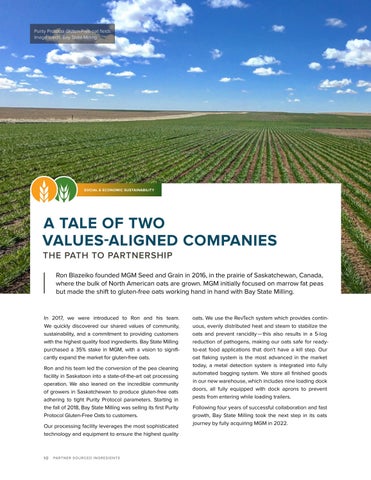
Purity Protocol Gluten-Free oat fields Image credit: Bay State Milling
SOCIAL & ECONOMIC SUSTAINABILITY
A TALE OF TWO VALUES-ALIGNED COMPANIES THE PATH TO PARTNERSHIP Ron Blazeiko founded MGM Seed and Grain in 2016, in the prairie of Saskatchewan, Canada, where the bulk of North American oats are grown. MGM initially focused on marrow fat peas but made the shift to gluten-free oats working hand in hand with Bay State Milling.
In 2017, we were introduced to Ron and his team. We quickly discovered our shared values of community, sustainability, and a commitment to providing customers with the highest quality food ingredients. Bay State Milling purchased a 35% stake in MGM, with a vision to significantly expand the market for gluten-free oats. Ron and his team led the conversion of the pea cleaning facility in Saskatoon into a state-of-the-art oat processing operation. We also leaned on the incredible community of growers in Saskatchewan to produce gluten-free oats adhering to tight Purity Protocol parameters. Starting in the fall of 2018, Bay State Milling was selling its first Purity Protocol Gluten-Free Oats to customers. Our processing facility leverages the most sophisticated technology and equipment to ensure the highest quality
10
PA RTNER SO URCE D INGRE D IE NTS
oats. We use the RevTech system which provides continuous, evenly distributed heat and steam to stabilize the oats and prevent rancidity — this also results in a 5-log reduction of pathogens, making our oats safe for readyto-eat food applications that don't have a kill step. Our oat flaking system is the most advanced in the market today, a metal detection system is integrated into fully automated bagging system. We store all finished goods in our new warehouse, which includes nine loading dock doors, all fully equipped with dock aprons to prevent pests from entering while loading trailers. Following four years of successful collaboration and fast growth, Bay State Milling took the next step in its oats journey by fully acquiring MGM in 2022.
RevTech system which results in a 5-log microbial reduction Image credit: Bay State Milling
“The team in Saskatoon is really exceptional; they have done an extraordinary job in a few short years to scale a new business, pursue BRC certification, and build a network of growers to now produce tens of millions of pounds of Purity Protocol GlutenFree oats a year. And we have added the most prominent gluten-free food and snack brands as customers along the way." WALKER HUMPHRIES VP of Strategy & Specialty Operations, Bay State Milling
“We’re confident that this acquisition will strengthen our ability to scale to the growing market demand for gluten-free oats produced with Purity Protocol standards. We are looking forward to deepening our partnerships with the communities of committed Purity Protocol growers while combining our collective efforts to produce certified gluten-free oats in one of today’s most advanced, dedicated production facilities.” PETE LEVANGIE CEO, Bay State Milling
2 02 1 A N N UA L RE P O RT
11
SUPPLY CHAIN PURITY, EVERY STEP OF THE WAY At Bay State Milling, we are proud to run the premier dedicated Purity Protocol Gluten-Free Oat processing facility in North America. But making a pure oat starts from the seed, with stringent requirements across each step of the supply chain. Here is why our customers trust us to produce the highest standard gluten-free oats.
FIELD In order to qualify for our Purity Protocol program, fields must not have had any gluten-containing crops grown in the last three seasons and have isolation strips of at least 6 feet to separate the oat fields from other crops. Qualified staff inspect fields throughout the growing season to identify potential sources of gluten contamination.
SEEDS All Purity Protocol Gluten-Free Oats must start from verified seed that is free from all gluten containing grains.
TRACEABILITY
EQUIPMENT & STORAGE
Farmers must identify their Purity Protocol Gluten-Free Oats by land location and document all their processes, so that we know exactly where every oat in our bin comes from.
Farmers commit to using dedicated gluten-free equipment or a validated cleaning process for handling the crops and maintain dedicated gluten-free storage.
PROCESSING SAMPLE TESTING We inspect both harvest samples and cleaned samples prior to delivery to ensure there are no gluten-containing grains.
At our processing facility in Saskatoon, we use dedicated receiving systems, storage tanks, cleaning, processing, dust control, aspiration systems, packaging equipment, and transportation to ensure the purity of gluten-free oats all the way to a customer’s hands.
FINAL PRODUCT Our customers use Purity Protocol Gluten-Free Oats to make all sorts of gluten-free products like oatmeal, granola, bars and oat milk.
12
PA RTNER SO URCE D INGRE D IE NTS
Our Family of Farmers
None of this would be possible without our farmers. In 2018, we began with a small, handpicked network of fewer than 20 Purity Protocol certified growers in Saskatchewan and have since expanded to more than 120 growers, even expanding our network to growers in the Alberta Peace River region.
“We believe it is important to establish a grower network with dedicated and trustworthy farmers who can produce quality certified gluten-free oats. We work hand in hand with our grower community to ensure they have the structure and support to be successful.” Procurement manager Marc Valois and oat farmer Shannon Knibbs Image credit: Bay State Milling
MARC VALOIS
Procurement Manager, Bay State Milling Saskatoon
2 02 1 A N N UA L RE P O RT
13
FARMER PROFILES We appreciate the collaborative relationship we have with our growers. Their ingenuity, work ethic and resilience inspires us every day.
SHANNON KNIBBS Farming is in Shannon Knibbs’ bones; she grew up on her family farm and is proud to continue the tradition. She purchased her first quarter of land in 1998 and eventually took over the farm — now at 3,000 acres. Although Shannon began as a conventional farmer, she transitioned to organic in 2017. “I think organic is an important option for anyone’s health and for the environment. There is a growing demand here in Canada and worldwide for healthier food and lifestyle choices. I like being part of something that helps to provide products you can trust is coming from a good source and contributing to positive environmental farming practices,” Shannon explains. She heard about the Purity Protocol Gluten-Free program from other farmers in the area and determined that oats were a good fit with her yellow peas rotation, because they help control weeds, and because of the growing global demand for gluten-free oat-containing products like cookies, granola bars and plant-based milks. Of working with MGM, and now Bay State Milling, Shannon says, “I trust them with my livelihood. They’re just a phone call away, sign contracts early, and are always there to help with any questions or concerns.”
“Farming is a good way of life — you’re in charge of your own destiny. Don’t get me wrong, there’s good times and bad times, but once the grain is in the bin, it is the most satisfying feeling.”
JERROD KROEGER Jerrod Kroeger grew up on his family farm and has been farming all his life. In addition to gluten-free oats, he grows peas, lentils, flax, canola, wheat and durum. Jerrod has been a part of the Saskatoon Purity-Protocol network since the beginning.
“I like dealing with the Saskatoon team because I can put a face to the guy on the other end of the line. It’s a short drive and I can actually meet with them. I have a strong understanding of what they expect from me so there’s just a natural trust and relationship. I also understand when they’ll take my product — it's important that I can market it in a timely matter so that I have the cash flows to sustain my operation.” 14
PA RTNER SO URCE D INGRE D IE NTS
“I chose organic farming over conventional because we have young children, and we wanted to eliminate exposure to chemicals to our family. I’ve also seen the effect of how I eat on my personal health.” WAYNE OMELCHUK
“The most rewarding aspect of organic farming is knowing that I am improving the land and water. The challenges are keeping the weeds and wild oats under control.” ANDREW CHUPIK
“This is my 23rd year farming organic. I’m improving the soil with compost, intercropping, cover crops, and biologicals. I can see a big improvement in soil and plant health.” RALPH PEDERSEN
Shannon Knibbs' farm Image credit: Bay State Milling
“I chose organic farming, and in particular gluten-free farming, because I am interested in not just growing a commodity, but food for my community. Being proud of the food I grow and knowing I’m feeding other families is so rewarding. As my kids grow, I see their interest in farming and I’m excited to share my passion with them.” DAVID KATERYNYNCH
2 02 1 A N N UA L RE P O RT
15
Organic rice fields in Northern California Image credit: Bay State Milling
Partner Profiles A journey through our 2021 supply partner trips 16
PA RTNER SO URCE D INGRE D IE NTS
2 02 1 A N N UA L RE P O RT
17
The Bay State Milling team with Saite Director, Frido Huayllani Image credit: Bay State Milling
ECONOMIC, SOCIAL & ENVIRONMENTAL SUSTAINABILITY
SAITE S.R.L.
ROYAL QUINOA TAKES THE CROWN LOCATION El Alto, Bolivia
PRODUCTS Organic Quinoa, Amaranth and Sesame
CREDENTIALS Partner since 2009 USDA Organic, CERES Certified, Family-owned
Along with beautiful vistas dotted with grazing llamas, the high plateaus of the Altiplano in Bolivia are home to some of the best quinoa in the world. The agro-ecological conditions of the area, standing over 12,000 feet above sea level, mean that grains obtained in this area are larger and more colorful than other quinoa growing regions. We are lucky to have a long-standing and trusted partner in Saite S.R.L to help us bring Bolivian Royal Quinoa to our customers.
“We value the strategic alliance and long-term relationship with Bay State Milling in the marketing of organic Quinoa, Black Sesame and Amaranth Flakes. We look forward to continuing to grow together.” FRIDO HUAYLLANI Managing Director of Saite S.R.L.
18
PA RTNER SO URCE D INGRE D IE NTS
for safe human consumption. Typically, saponin separation for quinoa is very water intensive, but the Saite facility uses a friction separation process that reduces water usages by 82%. Saite's quinoa only contains .01% saponin compared to the industry standard of 0.12%.
LITERS OF WATER USED TO REMOVE SAPONIN IN 1 TON OF QUINOA
2580 LITERS
Registered producer Dionicio Huayllani Marca Image credit: Saite S.R.L
Traditional Process
Saite's Process
460
LITERS
Water usage reduced by 82%
SUPPORTING ANDEAN SMALLHOLDERS Like Bay State Milling, the Saite team values having a personal relationship with their growers. They have a base of hundreds of registered producers in dozens of communities in the Altiplano, some of whom have been working with Saite for over 20 years.
ANCIENT GRAIN, MODERN TECHNOLOGY Quinoa has been grown in the region for thousands of years, and the Huayllani family is proud to continue that tradition. Saite was founded in 1989 by Dionicio Huayllani Marca, a farmer and entrepreneur from the Salar de Uyuni region in the Southern Highlands of Bolivia, who still manages the business with his three sons and daughter. The Saite processing facility is located in western El Alto, a thriving urban center near La Paz, and employs a workforce from the local neighborhood. The Huayllanis have a world-class processing facility, designed and built collaboratively with equipment-manufacturer Buhler, which allows them to produce quinoa of the highest quality and safety standards. Quinoa contains saponins, a naturally occurring compound found in many plants that needs to be removed
“Every year, we invite new producers to training workshops, where we explain the advantages of being part of a group of certified organic quinoa producers where they will receive training and technical support for their production,” Frido explains. Saite provides their registered producer groups with agronomic advice, organic inputs and organic certification services. Agronomic support provided in the 2021 season included training on preparing botanical repellent for preventive pest control, plot rotation, and fertilization techniques. Each year, the Saite Organic Quinoa Production Manager conducts a scheduled and unannounced inspection of each of their producers to verify their organic standards and records of harvest and sales. Last year, the state of Bolivia financed projects for groundwater irrigation and tapping of springs in some communities in the organic quinoa production area. For the 2022 harvest, yields in irrigated plots are expected to show a significant increase compared to rainfed plots.
2 02 1 A N N UA L RE P O RT
19
Harvest at R&K Farms Image credit: Bay State Milling
ECONOMIC, SOCIAL & ENVIRONMENTAL SUSTAINABILITY
R&K FARMS
THE DEEP ROOTS OF ORGANIC WHEAT LOCATION Pine Bluffs, Wyoming
PRODUCTS Organic Wheat
CREDENTIALS Partner since 1998 Family-owned and operated, organic certified
Mutual respect and care are evident in the long-standing partnership between R&K Farms and Bay State Milling. Travis Freeburg, the third generation in the family farm, puts it this way —“In 24 years, we have not sold a single grain of organic wheat to anyone but Bay State Milling. It’s a gold standard relationship that just gets stronger; there are no challenges we haven’t been able to collaboratively overcome. We know they are in our corner, and we are in theirs.”
“The human aspect of our operation is very important to us. It’s all about relationships, and making sure everyone’s around for the long haul.” TRAVIS FREEBURG Owner, R&K Farms
2 0 PA RTNER SO URCE D INGRE D IE NTS
Ray Freeburg and farm manager Chad Bomberger with Bay State Milling customers Image credit: Bay State Milling
COMMUNITY COMES FIRST Like Bay State Milling, R&K Farms is a multigenerational family business with deep community values. Travis’s three young sons are already involved in the farm, from small chores to driving the tractor. In the summers, Travis’s wife and mother bring the harvest crew a warm homecooked dinner each night. The Freeburgs employ about 15 people full-time and have provided many of them with farmsteads around their land. The broader Pine Bluffs economy relies on the R&K farm as well, and the Freeburgs try to keep their money in the area to help the rural community thrive; they’ve become key accounts for local fertilizer and inputs businesses, and equipment and parts dealers.
STRIVING FOR GREENER, CLEANER AND BETTER THE FREEBURG STAMP OF QUALITY The Freeburgs are in a league of their own when it comes to organic wheat farming. Since Travis’s grandfather started with a small farm, the family has grown the operation to thousands of organic and conventional acres. They are by far Bay State Milling’s largest organic wheat supplier, making up over 10% of our total grain usage. R&K has been able to achieve its scale because of a continued commitment to quality. R&K Farms is unique in that they are fully vertically integrated; the grain never leaves their hands until it reaches the Bay State Milling bins in Platteville, Colorado. The Freeburgs have total control through the production timeline, ensuring the highest food safety standards and no room for any third-party contamination. Shawn Hachtel, Bay State Milling’s Special Commodity Buyer who has been working with the Freeburgs for six years describes, “Customers have gotten more selective, and price is secondary to quality — the Freeburgs totally embody that sentiment and provide the highest quality grain that the market can offer.”
Innovation is as fundamental to the Freeburgs' approach as their focus on the community. They pride themselves on being early adopters of technology. The Freeburgs were among the first in the area to use air seeders. They also recently introduced grid sampling and variable rate technology, to precisely apply the right inputs where they are actually needed. Environmental and economic stewardship are closely related at R&K Farms. Practices like using fuel efficient vehicles, one-pass machines that accomplish multiple field steps in one, manure from their ranch for fertilizer and recycling used oil allow the Freeburgs to be more efficient while lowering their carbon footprint. They have also started working with carbon sequestration companies to further reduce their footprint and potentially enter the carbon commodity market. The Freeburgs’ mindset around quality, innovation, and family mirrors that of Bay State Milling — we take pride in our decades-long partnership and look forward to many more generations of collaboration.
2 02 1 A N N UA L RE P O RT
21
Rice fields in California Image credit: Bay State Milling
ECONOMIC & ENVIRONMENTAL SUSTAINABILITY
SUNWEST FOODS
A RICE PARADISE IN CALIFORNIA LOCATION Biggs, California
PRODUCTS Organic Medium Grain and Sweet Rice
CREDENTIALS
Rice has a long history in Northern California’s Sacramento Valley, having been introduced to the area during the Gold Rush. It has since become an integral part of the regional economy, with trusted companies like SunWest Foods bringing the highest quality sweet and medium grain rice to domestic and global markets.
Partner since 2006 Organic and GFSI certified
“I love watching rice grow — it’s very personally rewarding. I hope that in the future my son will be able to take this over, and that I’ll still be riding around the fields and seeing my grandkids on the farm. We truly are a farm family; we love agriculture.” BRUCE ROLEN Director of Field Services, SunWest Foods
2 2 PA RTNER SO URCE D INGRE D IE NTS
Our relationship with SunWest began over 15 years ago. SunWest contracts with over 300 California farmers, who represent approximately 15% of the state’s rice production. Bay State Milling’s customers use Medium Grain Rice flour to produce frozen novelty desserts, rice crackers, gluten-free pasta and pizza, gluten-free bread and many other grain-based foods.
WALKING THE FIELDS WITH BRUCE ROLEN Our supplier visits to SunWest Foods always include field tours with Bruce Rolen, a third-generation organic rice grower and the Director of Field Services at SunWest, and we were fortunate to keep the tradition alive in 2021. Bruce has been working with SunWest since its inception in 1986, partnering with the founder, Jim Errecarte, and his sons in more recent years. “I really enjoy working with them. They’re honestly concerned with the health and longevity of the California rice industry,” Bruce explains.
BRINGING BACK THE WETLANDS Ricelands provide unique environmental benefits to the Sacramento Valley region, where 95% of the historical wetlands have been lost over the past 150 years3. Rice fields are considered man-made wetlands and provide crucial habitats, nourishment and breeding ground for 230 species of wildlife including geese, ducks, and other waterfowl. SunWest and other California rice producers are deeply committed to environmental stewardship.
WORKING FOR WATER California has struggled with drought for decades and water shortage continues to put pressure on rice production. Total rice acreage decreased from 515,000 acres in 2020 to 405,000 acres in 2021, and SunWest saw a reduction in plantings of about 25% among their growers — solely due to water supply. “The biggest challenge today is having reliable, clean water supply for us to produce the rice crop. Our irrigation this year could only supply us with half of the normal amount of water we get,” Bruce describes. However, there have been important innovations like laser leveling technology that has allowed farmers to precisely flatten or slightly slope their fields for the most efficient irrigation. Bruce shared, “We now grow rice in a water depth of only 2–3 inches, where it used to be a foot or more in the past. We also recycle water — and some of it gets used three or more times in production agriculture.” 3
Rice Harvest in California Image credit: Bay State Milling
https://calrice.org/wildlife/
2 02 1 A N N UA L RE P O RT
23
OUR VERIFIED METRICS In our Partner Sourced Ingredients program, we evaluate ourselves on five key metrics to ensure that we are achieving rigorous standards of quality and supply chain partnership. We supply quality assurance files, visitor logs, trip reports and travel receipts to ACET Global, a third-party auditor and food safety consulting firm, that assist companies with gap assessment and the development, implementation and maintenance of global food safety programs.
1. VISIT 8 SUPPLY PARTNERS We visit our supply chain partners to review business operations, understand the conditions of growers and offer resources and expertise.
2. HOST 3 SUPPLY CHAIN PARTNERS We host at least 3 supply chain partner visits per year to our U.S. facilities. This enables us to solidify partnerships, share resources and give insight to the products and needs of customers.
3. THREE NON-PROCUREMENT EMPLOYEES VISIT SUPPLIERS Visits to our supply chain partners enable employees involved in Quality Assurance, Operations, Finance, R&D, Marketing and Sales to see first-hand how critical supply chain partnerships are, and how they can offer support.
4. VENDOR & FACILITY ASSESSMENTS We conduct a comprehensive questionnaire focusing on key food safety and security processes and show the certification status and risk level of our suppliers.
5. 95% OF ALL INGREDIENTS RECEIVED IN SPEC We work closely with supply partners, taking steps like further cleaning, processing or rejection if necessary.
24
PA RTNER SO URCE D INGRE D IE NTS
Metrics 1, 2 & 3 METRIC 1: VISIT 8 SUPPLIERS METRIC 2: HOST 3 SUPPLY CHAIN PARTNERS METRIC 3: THREE NON-PROCUREMENT EMPLOYEES VISIT SUPPLIERS Another year of the pandemic prevented us from traveling to and hosting all of our supply partners. We were happy to get out in the field early in the year and see a few of our partners in person. But, with the onset of the Delta variant we stayed home and conducted our visits virtually in order to ensure everyone's health and safety.
SUPPLIER
COUNTRY
INGREDIENT
SUPPLIER REPRESENTATIVES
PROCUREMENT TEAM
Abunda/Irupe
Paraguay
Chia
Tamara Pfeiffer
Jon Armstrong, Brenden Olson, Laura Sanese
Spokane
USA
Chickpeas
Andrew Fontaine
Jon Armstrong
SunOpta
USA
Sunflower
Matt Bydal
Jon Armstrong, Katie White
Farmer’s Rice Cooperative
USA
Sweet Rice, Medium Grain Rice
Steven Michel, Manuel Martinez
Jon Armstrong, Sandy Lau
SunWest Foods
USA
Sweet Rice, Medium Grain Rice
Bruce Rolen, Jay Errecarte
Jon Armstrong, Sandy Lau
Sun Valley
USA
Sweet Rice, Medium Grain Rice
Ryan Olson, Karye Benton
Jon Armstrong, Sandy Lau
Saite
Bolivia
Quinoa
Fridolino Huayllani
Brenden Olson, Jon Armstrong, Laura Sanese
Colorexa
Peru
Quinoa
Rod Ojeda
Brenden Olson, Jon Armstrong, Laura Sanese
NON-PROCUREMENT MEMBER
Shanna Trausch, Sales
Joel Goldsmith, Business Development
Lucille Russo, Sales, Shanna Trausch, Sales
In-person visit
2 02 1 A N N UA L RE P O RT
25
Organic wheat fields Image credit: Bay State Milling
Metric 4
VENDOR & FACILITY RISK ASSESSMENT METRIC 4A: CERTIFICATION All current and potential supply chain partners complete our comprehensive questionnaire focusing on key food safety and security processes. Data collected is used to assess the risk profile of suppliers for partnership decisions and improvement opportunities. As of 2021, we partnered with 83 suppliers in our Partner Sourced Ingredients program. All our supply partners are certified by third-party accredited audits or covered under our GFSI certification.
13% % SUPPLIERS WITH FOOD SAFETY CERTIFICATIONS GFSI-certified
87%
HACCP, iSO, or Other
2 6 PA RTNER SO URCE D INGRE D IE NTS
75% in 2020 12% more GFSI-certified Suppliers in 2021
METRIC 4B: RISK We ask our supply partners to complete a detailed questionnaire that assesses Vendor Risk and Facility Risk. Supply partners receive a numerical grade for each assessment; lower scores correspond with lower risk. We combine the Vendor Risk score and Facility Risk score and create a Total Risk score. As applicable, we work closely with supply partners to help them lower their risk; for example, by helping them obtain certifications and building measures to improve quality and food safety.
RISK ASSESSMENT CLASSIFICATION
1%
22% TOTAL RISK ASSESSMENT CRITERIA
77%
Vendor Risk Assessment Criteria Familiarity with vendor Number of years in business Number of employees Three-year annual food sales average Estimated purchase dollars/year Certificate of Insurance Continuing Guaranty and Hold Harmless USA or foreign company
Low-Risk Suppliers Required Risk Assessment every 3 years
69% in 2020 8% more Low-Risk Suppliers in 2021
HIGH
Company compliance with FDA regulations Product safety, certification and policies Radiological hazard analysis Receiving, warehousing and shipping practices Product quality and specifications Product control and customer complaint tracking Sanitation practices Inspections and regulatory compliance Food defense measures Food fraud mitigation Food contact packaging Product complexity
MEDIUM
• • • • • • • • • • • •
LOW
Facility Risk Assessment Criteria
VENDOR RISK ASSESSMENT
• • • • • • • •
Medium-Risk Suppliers Required Risk Assessment every 2 years High-Risk Suppliers Required Risk Assessment every year
LOW
MEDIUM
HIGH
FACILITY RISK ASSESSMENT
2 02 1 A N N UA L RE P O RT
27
Chickpea grower visit in Washington Image credit: Bay State Milling
Metric 5
95% OF ALL INGREDIENTS RECEIVED IN SPEC Our commitment to product quality will be verified by product specific quality attributes and related measurements on all ingredients received. If we receive raw materials that are out of specification, we work with our partners, taking steps like further cleaning, processing or rejection if necessary.
% POUNDS PURCHASED FROM INTERNATIONAL VS DOMESTIC SUPPLIERS
99.9% of 1,963 in-bound shipments from our Partner-Sourced Ingredient suppliers met all specification criteria on receipt without further processing necessary.
48% DOMESTIC
52%
INTERNATIONAL
Non-wheat only; 100% of wheat is sourced from the US
2 8 PA RTNER SO URCE D INGRE D IE NTS
ACKNOWLEDGEMENT ABOUT OUR AUDITOR Each year, Bay State Milling’s Partner Sourced Ingredient program is audited by Ron Vail, President of ACET GLOBAL Consulting, LLC. Mr. Vail has over 38 years of experience in the food industry having held positions within Quality, Manufacturing and Procurement in both international food companies and industry organizations. His knowledge has earned him positions in worldwide consulting, education and training for the development and implementation of FSMA, HACCP, Food Safety, and pre-requisite programs and schemes for SQF, BRC and FSSC 22000. ACET GLOBAL Consulting, LLC was chosen for its knowledge and reputation within the food industry and its ability to conduct a customized, objective examination of the Partner Sourced Ingredients Program. Their audit — conducted on January 6, 2022 — verified all our metrics.
BAY STATE MILLING COMPANY 100 Congress Street Quincy, MA 02169 P: 1-800-55-FLOUR E: info@bsm.com W: www.baystatemilling.com
Bay State Milling is a family-owned company with a strategic intent to support the growth of the next generation of foods in North America by providing the leading array of plant-based ingredients. Since 1899, we have proudly provided exceptional quality flour and grain products, and we continue to build on our legacy as we bring new supply chains and technologies into our realm of capabilities.