MPhil/PhD Architectural Design The Bartlett School of Architecture 2015
Mohamad Hafeda Bordering Practices: Negotiating and Narrating Political-Sectarian Conflict in Contemporary Beirut Principal Supervisor: Professor Jane Rendell Subsidiary Supervisor: Dr Yeoryia Manolopoulou Following the shift from borders to bordering practices in the field of borders studies (Parker & Vaughan-Williams, 2009; Diener & Hagen, 2012; Meier, 2013), this thesis proposes bordering practices as specific kinds of spatial practice which occur through processes of narrating and negotiating, and are situated in relation to concepts of everyday life and spatial practices (Lefebvre [1974, 1991] and de Certeau [1984, 1989]) and critical spatial practices (Rendell [2006]). The thesis examines the immateriality, spatiality, and temporality of bordering practices through the negotiation of spaces of politicalsectarian conflict – since their resurfacing in Beirut in 2005, practised by a triad of residents, politicians, and militias. It is a site-specific and practice-led research project that employs art, design and urban research tools to work with residents, located between the two adjacent areas of Tarik al-Jdide and Mazraa – both situated within the Mazraa district, and of different political affiliations divided across Sunni-Shiite lines. Through negotiation and narrative the thesis explores a series of modes of bordering 312
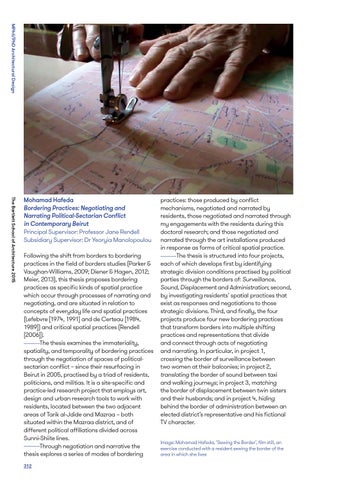
practices: those produced by conflict mechanisms, negotiated and narrated by residents, those negotiated and narrated through my engagements with the residents during this doctoral research; and those negotiated and narrated through the art installations produced in response as forms of critical spatial practice. The thesis is structured into four projects, each of which develops first by identifying strategic division conditions practised by political parties through the borders of: Surveillance, Sound, Displacement and Administration; second, by investigating residents’ spatial practices that exist as responses and negotiations to those strategic divisions. Third, and finally, the four projects produce four new bordering practices that transform borders into multiple shifting practices and representations that divide and connect through acts of negotiating and narrating. In particular, in project 1, crossing the border of surveillance between two women at their balconies; in project 2, translating the border of sound between taxi and walking journeys; in project 3, matching the border of displacement between twin sisters and their husbands; and in project 4, hiding behind the border of administration between an elected district’s representative and his fictional TV character. Image: Mohamad Hafeda, ‘Sewing the Border’, film still, an exercise conducted with a resident sewing the border of the area in which she lives