Rosalind Krauss’s Surrealism in Sensory Actuated Spatial Systems Raisya Hidayat Thesis Tutor: Jordi Vivaldi Piera The implementation of autonomous robotic control systems in experimental architecture is becoming increasingly common in academic environments. Generally speaking, its algorithmic ‘otherness’ is generally approached as a positivistic mode of action based on processes of optimisation, enhancement, maximisation, adaptation or performance, with the aim of serving human beings. The application of sensory actuation systems expands the ability of buildings to act by themselves, offering a feedback analysis process for space-body engagement in order to increase the awareness of an immediate environmental condition. Hybridised physical and cognitive behaviour through robotic actuation implies the presence of algorithmic matter which is vigorously reorganising the way we conceive the real. In light of this scenario, this research circumvents the usual positivistic approach to architecture and artificial intelligence in order to investigate the aesthetic opportunities offered by the latter’s implementation in the architectural design process. The thesis argues that the application of sensory actuation systems in reconfigurable spatialities re-articulates Rosalind Krauss’s three structural principles of Surrealism. Presentation over re-presentation; automatism; and the conjunction of opposites are presented in this research 106
as architectural surrealist principles with a singular novelty: they articulate a form of Surrealism emancipated from the humanfocused characteristics of its conceivers. Surrealism has traditionally based its source of creativity on the idea of an unconscious other. In the 20th century, unconsciousness was understood as an authentic creative force that should be liberated from a rational perspective. Under the dispute between Jacques Lacan and Sigmund Freud, André Breton qualified automatism as the great manifestation method, while Dalí emphasised the paranoiac-critical method as the Surrealist protocol par excellence. However, the recent emergence of an algorithmic otherness and its application to experimental architecture has de-centred the notion of the ‘human’ from most of our cultural debates, offering the possibility of a profound re-evaluation of Surrealism as an aesthetic phenomenon. By re-interpreting Krauss’s principles through a profound aesthetic analysis of an autonomous robotic system applied to architecture, this research concludes that a new Surrealism is emerging, one that is no longer based on an inner and human unconscious otherness, but on an outer, algorithmic otherness, which makes all aspects of the human inner self obsolete.
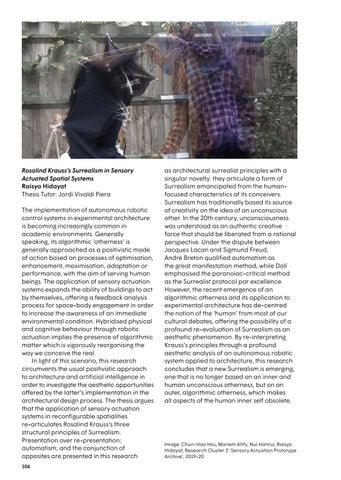
Image: Chun-Hao Hsu, Mariem Afify, Nui Hanrui, Raisya Hidayat, Research Cluster 3 ‘Sensory Actuation Prototype Archive’, 2019-20