aae2016 Research Based Education - Volume One
235
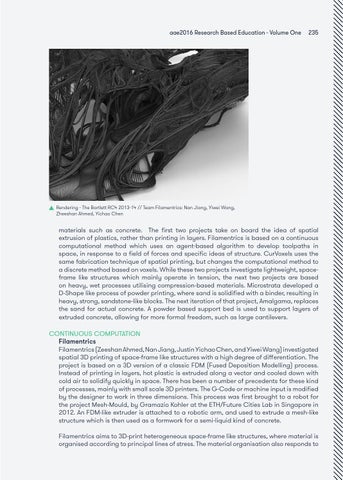
Rendering - The Bartlett RC4 2013-14 // Team Filamentrics: Nan Jiang, Yiwei Wang, Zheeshan Ahmed, Yichao Chen
materials such as concrete. The first two projects take on board the idea of spatial extrusion of plastics, rather than printing in layers. Filamentrics is based on a continuous computational method which uses an agent-based algorithm to develop toolpaths in space, in response to a field of forces and specific ideas of structure. CurVoxels uses the same fabrication technique of spatial printing, but changes the computational method to a discrete method based on voxels. While these two projects investigate lightweight, spaceframe like structures which mainly operate in tension, the next two projects are based on heavy, wet processes utilising compression-based materials. Microstrata developed a D-Shape like process of powder printing, where sand is solidified with a binder, resulting in heavy, strong, sandstone-like blocks. The next iteration of that project, Amalgama, replaces the sand for actual concrete. A powder based support bed is used to support layers of extruded concrete, allowing for more formal freedom, such as large cantilevers.
CONTINUOUS COMPUTATION
Filamentrics Filamentrics (Zeeshan Ahmed, Nan Jiang, Justin Yichao Chen, and Yiwei Wang) investigated spatial 3D printing of space-frame like structures with a high degree of differentiation. The project is based on a 3D version of a classic FDM (Fused Deposition Modelling) process. Instead of printing in layers, hot plastic is extruded along a vector and cooled down with cold air to solidify quickly in space. There has been a number of precedents for these kind of processes, mainly with small scale 3D printers. The G-Code or machine input is modified by the designer to work in three dimensions. This process was first brought to a robot for the project Mesh-Mould, by Gramazio Kohler at the ETH/Future Cities Lab in Singapore in 2012. An FDM-like extruder is attached to a robotic arm, and used to extrude a mesh-like structure which is then used as a formwork for a semi-liquid kind of concrete. Filamentrics aims to 3D-print heterogeneous space-frame like structures, where material is organised according to principal lines of stress. The material organisation also responds to