220
PRODUCTION
AMANDA
AMARYLLIS
CHIN WEN
LOUISE
JIA EN
CLOVER
YI QIAN
EILEEN
MELISSA
MINH CHAU
CHIN YI
ANNA
XIA TIAN
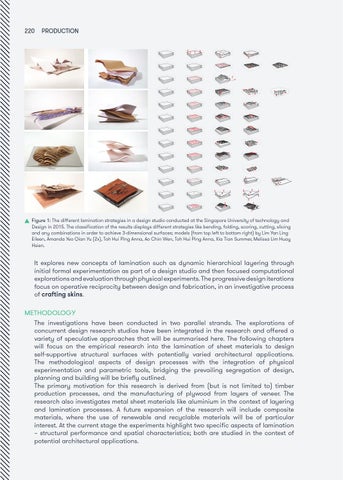
Figure 1: The different lamination strategies in a design studio conducted at the Singapore University of technology and Design in 2015. The classification of the results displays different strategies like bending, folding, scoring, cutting, slicing and any combinations in order to achieve 3-dimensional surfaces; models (from top left to bottom right) by Lim Yan Ling Eileen, Amanda Yeo Qian Yu (2x), Toh Hui Ping Anna, Ao Chin Wen, Toh Hui Ping Anna, Xia Tian Summer, Melissa Lim Huay Hsien.
It explores new concepts of lamination such as dynamic hierarchical layering through initial formal experimentation as part of a design studio and then focused computational explorations and evaluation through physical experiments. The progressive design iterations focus on operative reciprocity between design and fabrication, in an investigative process of crafting skins.
METHODOLOGY The investigations have been conducted in two parallel strands. The explorations of concurrent design research studios have been integrated in the research and offered a variety of speculative approaches that will be summarised here. The following chapters will focus on the empirical research into the lamination of sheet materials to design self-supportive structural surfaces with potentially varied architectural applications. The methodological aspects of design processes with the integration of physical experimentation and parametric tools, bridging the prevailing segregation of design, planning and building will be briefly outlined. The primary motivation for this research is derived from (but is not limited to) timber production processes, and the manufacturing of plywood from layers of veneer. The research also investigates metal sheet materials like aluminium in the context of layering and lamination processes. A future expansion of the research will include composite materials, where the use of renewable and recyclable materials will be of particular interest. At the current stage the experiments highlight two specific aspects of lamination – structural performance and spatial characteristics; both are studied in the context of potential architectural applications.