Arts&Culture
Myth & memory in photographer's toy dioramas An interview with David Levinthal fulness in Levinthal’s photos By Hannah Kasper Levinson masks more complex themes Special To The Observer rooted in adult subject matter. David Levinthal is a phoHere, David Levinthal talks tographer based in New York whose exhibit, American Myth & about his influences and the connections to Judaism in his Memory: David Levinthal Photographs, opens Oct. 15 at the Day- work. ton Art Institute. The exhibit is How did photography become on tour from the Smithsonian your medium? American Art Museum. When I went to college in Levinthal works in series, 1966, my intention was to be inspired by historic events and a poli-sci major and go to law American cultural icons. His school. That lasted pretty much signature style first emerged one class. There was something in graduate school at Yale in at Stanford called The Free the 1970s. He captures familiar miniature toys — dolls and toy University. Anyone could teach soldiers — set up in a diorama, a course on anything. Dwight, a friend who taught there, was with the camera very close the epitome of cool. He had to the subject. This creates a really long hair and narrow depth of Timothy Greenfield-Sanders every time I saw field — like looking him on campus through a peephole there were beautiful — giving the effect women with him of peering into a and I thought, "I realistic environwant to be like that." ment. Dwight was teachTo unravel ing a photography David Levinthal's class and taught work is to question me how to develop our universal fascifilm and make a nation with miniaprint. I just became tures. The miniaso fascinated by ture takes us back it. Stanford at the to the ancient Egyptime did not offer tians, who buried David Levinthal photography, which their dead with clay I feel was a very positive thing representations of everything for me because it meant that if I they may have needed in the wanted to do it, I had to be selfafterlife: tools, furniture, and motivated. servants all small enough to hold in one’s hand. The earliest evidence of the dollhouse, itself What do you hope the viewer a miniature, was one made for a takes away from your work? So much of my imagery Bavarian duke in 1558. The connection between min- draws upon everyone’s own viiature and imagination is based largely in relationship to childhood. To see detail in small things requires such attention that to experience it detaches you from the surrounding world. The make-believe world of a child is much the same. Miniatures and childhood also bring associations of fairy tales. In Hans Christian Andersen's Thumbelina, the protagonist is so miniscule that she experiences her own world within the real one. Like a fairy tale, the play-
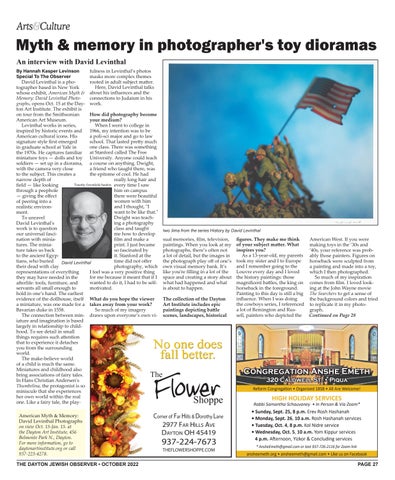
Iwo Jima from the series History by David Levinthal
sual memories, film, television, paintings. When you look at my photographs, there’s often not a lot of detail, but the images in the photograph play off of one’s own visual memory bank. It’s like you’re filling in a lot of the space and creating a story about what had happened and what is about to happen. The collection of the Dayton Art Institute includes epic paintings depicting battle scenes, landscapes, historical
figures. They make me think of your subject matter. What inspires you? As a 13-year-old, my parents took my sister and I to Europe and I remember going to the Louvre every day and I loved the history paintings: those magnificent battles, the king on horseback in the foreground. Painting to this day is still a big influence. When I was doing the cowboys series, I referenced a lot of Remington and Russell, painters who depicted the
American West. If you were making toys in the ‘30s and ‘40s, your reference was probably those painters. Figures on horseback were sculpted from a painting and made into a toy, which I then photographed. So much of my inspiration comes from film. I loved looking at the John Wayne movie The Searchers to get a sense of the background colors and tried to replicate it in my photograph. Continued on Page 28
No one does fall better.
American Myth & Memory: David Levinthal Photographs on view Oct. 15-Jan. 15. at the Dayton Art Institute, 456 Belmonte Park N., Dayton. For more information, go to daytonartinstitute.org or call 937-223-4278.
Congregation Anshe Emeth 320 Caldwell St. • Piqua
Reform Congregation • Organized 1858 • All Are Welcome!
HIGH HOLIDAY SERVICES
Rabbi Samantha Schauvaney • In Person & Via Zoom*
Corner of Far Hills & Dorothy Lane 2977 FAR HILLS AVE DAYTON OH 45419
937-224-7673 THEFLOWERSHOPPE.COM
THE DAYTON JEWISH OBSERVER • OCTOBER 2022
• Sunday, Sept. 25, 8 p.m. Erev Rosh Hashanah • Monday, Sept. 26, 10 a.m. Rosh Hashanah services • Tuesday, Oct. 4, 8 p.m. Kol Nidre service • Wednesday, Oct. 5, 10 a.m. Yom Kippur services 4 p.m. Afternoon, Yizkor & Concluding services * AnsheEmeth@gmail.com or text 937-726-2116 for Zoom link
ansheemeth.org • ansheemeth@gmail.com • Like us on Facebook
PAGE 27