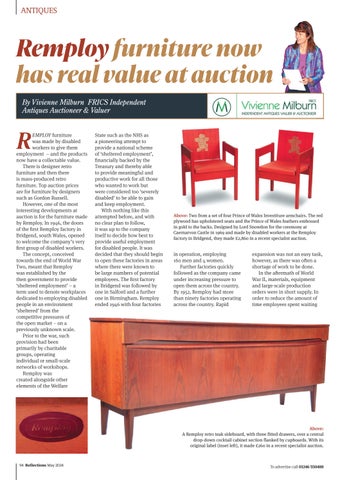
CROSSWORD | WHAT’S ON | ANTIQUES | FASHION | HISTORY Derbyshire’s largest-circulation lifestyle magazine CHESTERFIELD–DRONFIELD–MATLOCK–BAKEWELL AND SURROUNDING AREAS WHEN DERBYSHIRE WAS FULL OF ‘FARMING MONKS’: P30 £1.00 WHERE PURCHASED www.reflections-magazine.com Delights of Derbyshire’s bestdressed insects! Stunning signature dish from a Bakewell chef White’s more than alright for the summer! P16 VOL. 33 ISSUE 384 MAY 2024


2 Reflections May 2024 To advertise call 01246 550488


REFLECTIONS MAGAZINE MAY 2024
Editor: Barrie Farnsworth, E: barrief@bannisterpublications.co.uk
Advertising: Mike Snow, M: 07966 445452 E: mikes@bannisterpublications.co.uk
Advertising: Helen Wragg, M: 07973 672582 E: helen@bannisterpublications.co.uk
Managing Director/Photographer: Robert Bannister, E: robert@bannisterpublications.com
Art Editor: Ben Fletcher-Bates, E: design@reflections-magazine.com
Social Media: Rebecca Bloomfield, E: hello@bannisterpublications.com
Accounts: Helen Holgate, E: admin@bannisterpublications.co.uk
Distribution: E: distribution@bannisterpublications.co.uk
Published by: Bannister Publications Ltd. Tel. 01246 550 488 (3 lines). Bannister Publications Limited, Office 2A Market Hall, Market Pl, Chesterfield, Derbyshire. S40 1AR. Reflections is published monthly and delivered directly to homes which fall into
and the
- 2, 3, 4, 5 / DE45 1 / S18 5 / S30 1 / S40 - 1, 2, 3, 4 / S41 0, S41 7, 8, 9 / S42 - 5, 6, 7 / S43 - 1, 2, 3

16 Georgia reflects on life… and art
Artist Georgia Peskett was known worldwide for her urban paintings before she found new inspiration through the windows of her Chesterfield home. Fiona Stubbs reports
28 Property of the Month
30 When Derbyshire was full of ‘farming monks’…
The Peak District is studded with the names of monks who cleared moorland for farming. Barrie Farnsworth reports
22, 32, 36, 38, 60 Countywide News
All that’s been happening in Derbyshire in words and pictures
42 The delights of Derbyshire’s bestdressed insects
Mica Bale reports on the winged beauties that call our county home – dragonflies and damselflies


48 A truly remarkable book… Barrie Farnsworth reviews a book written by a Chesterfield woman about her family and working life in the final years of the Soviet Union
54 Pitcherwits
55 Crossword
56 Fashion
‘White’s alright’ for the summer, says our style guru Amy Norbury
64 Gardens: Leading the way in sustainable horticulture
Catherine Roth reports on a fascinating co-operative nursery in Derbyshire, plus news of Open Gardens highlights this month
70 When a twitchers’ hide got all watery!
One of the superb pictures in our 2024 ‘Derbyshire’s Lovely Landscapes’ competition
4 Reflections May 2024 To advertise call 01246 550488
DE4
/ S45 0, S45 9. All Rights Reserved: Reproduction in whole or in part without written consent is strictly prohibited. The publishers do not accept responsibility for any views expressed, or statements made, in signed contributions or in those reproduced from any other source. No responsibility is borne for any errors made in any advertisement, or for incorrect claims made by any advertiser. The publishers reserve the right to refuse any advertising deemed unsuitable for any reason. All material submitted for publication is done so at the owner’s risk and no responsibility is accepted for its return. Reflections Magazine, Bannister Publications Ltd.
tax bands D to H
following postcode areas:
/ReflectionsMagazine @ReflectionsMag /reflectionsmag/
16
Cover: Georgia Peskett, by Helen RowanPhotography . You can read all about Georgia on P16.
30 42 56 64


74 Artificial Intelligence: friend or foe?
With every day that passes, artificial intelligence (AI) is radically changing more areas of society, as Rebecca Erskine reports
80 Focus on Food & Drink
Fiona Stubbs hears about Mindful Eating from two local experts
84 Recipe of the Month
A stunner from a local chef
86 Out & About
Photographer Chris Drabble provides pictures of inspiring views from high above Winnats Pass
88 Spotlight on the Arts
Enjoy coffee, cake and creativity… Dawn Anderson explores what’s on offer at this year’s Derbyshire Open Arts


92 They pushed so hard for a national park in the Peak District
The organisation which did more than most to establish a Peak District National Park is 100 years old this month, as Steve Brown reports
94 Antiques
Our expert valuer Vivienne Milburn says that Remploy furniture has real value at auction
96 What’s On
Our comprehensive guide to forthcoming events in Derbyshire and beyond in May and early June

CONTENTS 5 Reflections May 2024 Visit our website at www.reflections-magazine.com
74 92
86
84 88


6 Reflections May 2024 To advertise call 01246 550488




7 Reflections May 2024 Visit our website at www.reflections-magazine.com


9 Reflections May 2024 Visit our website at www.reflections-magazine.com


11 Reflections May 2024 Visit our website at www.reflections-magazine.com

CHATSWORTH GARAGE DOORS: WITHSTANDING THE TEST OF TIME!
The perfect balance of strength and elegance – expertly engineered; easy to operate!
BEARING all the hallmarks of a long-established, family-run business, Chatsworth Garage Doors, headed by Managing Director Jason Edwards, has built an unrivalled reputation for offering the very best in garage doors at competitive prices, delivered with the highest possible standards of personal service.
The unassailable reputation has been further reinforced by attaining Partner Standard recognition with Horman, becoming a respected member of the Derbyshire Trusted Trader scheme, and gaining a whole host of impeccable google reviews.
Quality, security, comfort, attractive designs, and all the latest technological developments are key features behind the

entire range of premium garage doors, including products from market leader Hormann, ThermoSecure. Henderson, AlluGuard, Garador, DHF, Garage Door Systems, Cardale, Novoferm, Select, Truedoor, and Rockdoor.
Whether it’s a sectional (with or without wicket door inset), up-and-over, roller, personnel, or sidesliding garage door, the ideal product for each individual customer can be found. With a five-year guarantee on all garage doors and a two-year guarantee on the whole installation, there’s simply nothing to match the peace of mind gained by using Chatsworth Garage Doors.

All the garage doors are manufactured bespoke to each individual customer’s specifications. The specialist products can provide unrivalled thermal and acoustic insulation and may be manufactured with a foam-filled double aluminium enclosure,
which helps with heat retention and reduction of energy bills.
To match the style of all homes, garage doors can be powder coated to a scratch-resistant finish or laminated in a wide range of colours. They are also manufactured with modern weather seals and high security features. With an appintegrated receiver, garage doors can be opened with the tap of button on an iPhone or Android phone.
Chatsworth Garage Doors also stocks and fits an eclectic range of composite and steel front doors, which can be manufactured and adapted to any home.
Paul Nicholson, who boasts over 18 years’ experience in the industry, serves the local area of Chesterfield, Matlock, Bakewell, and Dronfield, offering a bespoke and personalised service tailor-made to generic local needs.
For more details, contact Chatsworth Garage Doors on 01246 948555 www.chatsworthgaragedoors .co.uk

13 Reflections May 2024 Visit our website at www.reflections-magazine.com
LOCAL BUSINESS


MAKE sure to secure your tickets early for the everpopular ‘Big Music’ weekend, a showcase of regional musicians at the Heights of Abraham from all corners of Derbyshire, and beyond. With a line-up bigger and better than ever, ready to celebrate the attraction’s 50th anniversary year, you can expect to see the crème of the region’s independent music talent including modern folk quartet, Kootch. Other genres include traditional folk, classical, acoustic guitar, choir, rock, blues, jazz and pop appear
on the line-up upon various stages throughout the hilltop estate. During this vibrant weekend, you can be sure to enjoy a colourful, entertaining and immersive day out, whether you are toe tapping, singing or all out dancing along to your favourite tunes or inspired by new melodies, this is one not to miss, as the happy atmosphere is contagious.
Tickets for the ‘regular’ attraction price, i.e. from £25 per adult (£17.50 juniors), the extra talent is included for no extra cost, a fun day out for all ages, and budget friendly to boot! www.heightsofabraham.com

14 Reflections May 2024 To advertise call 01246 550488
LOCAL ATTRACTION
May
Big Music at The Heights
18th and 19th

GEORGIA reflecting on life... and art

Artist Georgia Peskett was known around the globe for her dramatic cityscapes before finding new inspiration –through the window of her Chesterfield home. Fiona Stubbs learns more.
FROM striking cityscapes to quiet reflections of nature, Georgia Peskett’s paintings grace galleries and art collections around the world.
Her work has been exhibited in some of the art world’s most prestigious spaces –including London’s Royal Academy, The Mall Galleries, The Shard and The Worshipful Company of Painter-Stainers.
And, for the last two decades, the creative heart of Georgia’s work has been her peaceful, unassuming studio at home in Chesterfield.
Her story, however, begins in London and New York.
The daughter of renowned pop artist, installationist, muralist, set designer and art director Stan Peskett, she was born near Ladbroke Grove in West London and grew up in Richmond, Surrey.
A teenage trip to visit her father in 1980s New York – then a hotbed of artistic creativity – set Georgia on her own professional path.
She explains: “I hadn’t really known my father until then. He left the family and moved to New York in the 1970s, when I was about nine. Dad had been in the Pop Art movement in the 1960s, along with David Hockney and Derek Boshier. But he made his career in America and became well-known there.
“I first visited him at his loft space in Soho, New York when I was 15 and still at school. It was a really exciting time to be there.”
Back home, she took a Foundation course at Epsom School of Art and Design and,
FEATURE
16 Reflections May 2024 To advertise call 01246 550488
Georgia Peskett at home in Chesterfield. All pictures by Helen Rowan Photography.
deciding to take a break from studying, returned to New York where she learned her craft, working alongside her father as a studio apprentice, learning techniques and skills “from the ground up”.
The art world of the late 1980s witnessed a crossover of conceptual art, contemporary expressionism, pop art and street art; with Andy Warhol, Julian Schnabel and Jean Michel Basquiat the contemporary art stars of the day.
Georgia began experimenting with surrealist painting and figuration. “It was a really good grounding in art and the art world,” she says. “It was an interesting time to be part of and a great opportunity to see firsthand how the art world worked. There was a lot of experimental, conceptual art being made.
“The first time I’d been in New York, I didn’t really go out in the city as I was so young. But the second time I was more independent, going to clubs and meeting people. Having fun!
“I was working with people on various projects, including home interiors and decorating night clubs. I worked quite a lot with special effects, such as the optical illusion style, Trompe l’oeil (which makes flat surfaces appear three-dimensional).
“At the time, people were
having faux marble and faux stone effects painted in their uptown apartments and I became very good at paint effect techniques. I never saw the inhabitants, though. They’d vacate the property and go to their houses in the Hamptons or upstate Connecticut and come back when we’d finished the work.
“It was incredibly hard work. I was running and cycling from place to place as it was the cheapest way to travel. I was also in and around the East Village quite a lot. It was still quite run down then – it had an ‘edge’.
“We moved around, too. As well as the loft in the city, we also had a working studio in Hampton Bays – a more blue collar area of Long Island.”
One of Georgia’s New York paintings was spotted by an art dealer and sold to an investment banker. “That was a big break for me,” she recalls. “I was astounded – I was only about 19 or 20. It was a large cityscape of the Bowery – full of characters.”
She went on to spend a few years alternating between New York and London – earning money through waitressing and working on freelance illustration commissions before committing to becoming a full-time painter.
Her decision, in the early Nineties, to be based entirely
in the UK coincided with the rise of the Young British Artists (YBA) movement – based around graduate artist-led exhibitions in warehouses and factories.
Advertising executive and art collector Charles Saatchi was a leading supporter and sponsor of the movement.
But, says Georgia, “I wanted no part of that. I didn’t want to go to university and take that conceptual path. I was painting and illustrating and doing some commercial work and, for a while, I didn’t really have anywhere to exhibit my art.
“It took around a decade to establish my style of painting. It can take a while to find your ‘look’ as an artist, your genre. It’s not a particularly easy path. It’s not just about the painting – there’s a great deal of admin, planning

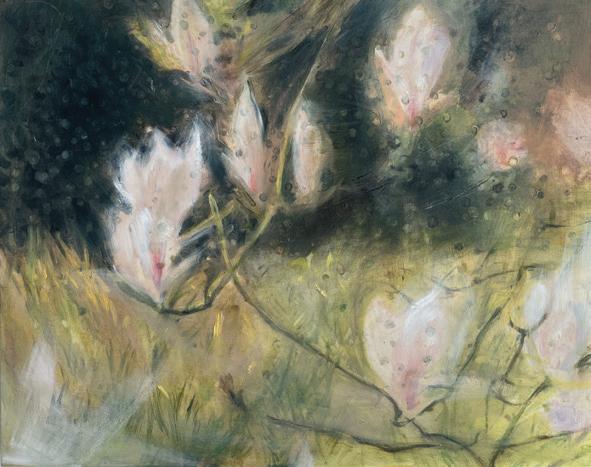
Above: A Georgia ‘lockdown painting’ in spring 2020 –magnolia – a painting done in her Chesterfield home looking at her garden.
Below left: One of Georgia’s ‘urban paintings’ that are in galleries – and homes – across the world.
for exhibitions, transportation of your work. There’s a lot of discipline involved – you have to have disciplined routines.”
Georgia’s urban landscapes, inspired by New York and London, found an appreciative audience in galleries across the capital. Some are now with notable private and public collections around the world, including the BT Telecom Collection in London, Bentley Headquarters in Cheshire and The Earl of Chichester, Verve Properties London.
Georgia is quietly modest, but admits: “There’s a sense of achievement when other people are enjoying my work. It’s an honour that they like them enough to have them in their collections.”
She exhibits nationally and locally – notable spaces include the Royal Academy in London, Wells Cathedral, the Irving Gallery, Oxford and Sheffield’s Fronteer Gallery.
In recent years, Georgia’s style of painting has evolved into a gentler, reflective genre. “I spent around 20 years painting urban landscapes,” she explains. “It was interesting but for me, personally, I felt it had run its course. As an artist, you get curious; things change and other things come in.”
A catalyst for change came
FEATURE
17 Reflections May 2024 Visit our website at www.reflections-magazine.com
with the arrival of Covid-19 and lockdown. She says: “We were in a global pandemic and it made me re-evaluate everything. Where was I? Where did I want to go next with my work?
“I’d previously been making visits to London, New York and various cities but now there was no travel. Everything stopped and my focus changed. My subjects completely altered.
“It felt like a natural change. I joined a few online groups as there was so much isolation and I wanted to connect with peers. I joined the Turps correspondence course – like an online art school – and got regular feedback from mentors and other artists. I found it really helpful and it spurred me on to look at other things right in front of me.”
She adds: “It was quite a traumatic time for all of us and I think that, as an artist, we use these experiences to inform our work. I process the things that happen to me through my art.
“In spring 2020, the magnolia in the garden was starting to come out. The magnolia was blooming

Above: Georgia in her studio at home.
outside but I was inside, looking out; painting things I was seeing through windows. It was a new way of working and a new way of looking at the world… through veils and barriers.”
From those early days of lockdown, Georgia’s new, contemplative style emerged. “There are echoes of (impressionist painter) Monet and (modernist painter) Manet,” she says. “These paintings are about reflecting on life. There’s a memento-mori quality. The pandemic made us all question our fragility, our mortality.
“As a mature artist, this
also comes into your own life, examining the stage you are now at. When you’re painting in an authentic way, it’s an organic progression. We absorb what’s happening in our immediate environment. The beauty of nature is now part of my work, more than it was before.”
Georgia paints on vegan silk stretched over boards and canvasses, creating a smooth, soft – almost translucent – surface to work on. Each painting – in oils, acrylics or, sometimes, both – begins with a photograph, though her work is not photographic in style.
Throughout this year, she is sharing her expertise through a series of seasonal Mindful Painting workshops in the Walled Garden Workshop at Libby’s, Chatsworth Road.
“Art is fantastic for people’s wellbeing,” says Georgia. “Discovering ways of working mindfully is very helpful for conditions including stress, anxiety and menopause. It lowers your heart rate and levels of (stress hormone) cortisol.
Anything that slows you down and gives you the opportunity to switch off, put worries out of your mind and just focus on that activity is very beneficial.”
Chesterfield is now very much home to Georgia, after moving here from London 21 years ago with her partner, Matt.
“Matt was originally from Chesterfield and, when we decided to leave London, it made sense to move here,” she says. “It’s on the edge of the Peak District and such a great central location – convenient for travel to exhibitions in all parts of the country. I feel very much a part of Chesterfield – I’m ‘Derbyshire’ now.”
Georgia will be leading a Mindful Painting workshop on Saturday, May 25 (10am to 1pm) at Libby’s Walled Garden Workshop. Check the Workshop section on Georgia’s website (below) for further dates.
Learn more about Georgia’s work and upcoming exhibitions at https://www. georgiapeskett.com/ or on Instagram @georgiapeskett

18 Reflections May 2024 To advertise call 01246 550488
FEATURE

19 Reflections May 2024 Visit our website at www.reflections-magazine.com


Countywide News

Spireites back in the EFL
AFTER six seasons in the National League, Chesterfield FC return to League Two next season as champions. The Spireites secured the title with a 3-0 win over Boreham Wood on March 23, and completed the season with a win over Maidenhead Utd on April 20 before a sellout crowd at the SMH Group Stadium.
The following day, thousands of supporters turned out to celebrate the club’s return to the English Football League. Around 7,000 fans gathered outside Chesterfield Town Hall to welcome players and coaching staff out on to the balcony, complete with the National League trophy.
The event, organised by Chesterfield Borough Council – in partnership with Chesterfield Football Club – also had live music and entertainment to help get fans into the party spirit.
First team players and coaching staff took part in a short walkabout in front of the Town Hall – giving supporter the chance to get photos and autographs.
Then the club’s players and coaches attended a civic reception with representatives from the council and other local dignitaries. Leader of the council, Coun Tricia Gilby, presented a Silver Salver to the club, to formally acknowledge the achievements of this season.
Coun Gilby said: “A successful football club brings new visitors to the town and is a vital part of Chesterfield’s economy. Sunday was a brilliant occasion and it was great to see so many supporters turn out.”
John Croot, chief executive of Chesterfield
Above & below: Around 7,000 fans turned up on April 21 in front of Chesterfield Town Hall to see the Spireites players after their return to the EFL – and skipper Jamie Grimes held up the champions trophy on the balcony.

FC, said: “It was a wonderful day for everyone associated with the club and fantastic to see so many supporters there.”
Celebrating cable cars’ 40th anniversary
THE Heights of Abraham celebrated the 40th anniversary of its cable cars on April 21. Musicians, actors and dancers gathered at the 60-acre estate in Matlock Bath to celebrate, and cable car engineers old and new gathered at the base station to receive a special commemorative cake from the owners, the Pugh family.
The day began when five-year-old “cable car super-fan” Essie Fletcher, from South Normanton, pushed the big green button to start the cable car on its 40th birthday. Essie had been nominated for the role by her grandfather, Gary Coope, after visiting the Heights more than 20 times in 2023.
Local musicians and dancers performed at the summit, including Wirksworth Morris troupe T’Owd Man Border Morris, four-piece country band Kootch, Matlock music legend John Gill, and violinist Arjay.
Every child who visited the Heights on Sunday, April 21 was offered a special certificate to mark their own ‘flight into history’.
The celebrations continue during May with a Victorian weekend (May 4-6) and the Big Music Weekend on May 18 and 19. Further details are available on the website www.heightsofabraham.com/2024
The return of Killamarsh church’s bells
FOUR years of silence is set to end on Saturday, May 11 in Killamarsh as a new generation of potential bell ringers can see and hear the result of £76,450 restoration project.
The village will once again become the centre of the campanology world with the return of its distinctive Treble Bob – a unique style of bell ringing, originally devised at St Giles Church over 200 years ago and has been adopted around the globe.
The restoration of the bells, coupled with the revitalisation of this unique ringing style, promises to re-establish St. Giles as a pilgrimage site for bell ringers and enthusiasts alike, keen to experience and learn this rare form of ringing.
Central to the celebration – which has been funded by the National Lottery Heritage fund – is the church’s mission to usher in a new generation of bell ringers, capable of mastering the intricate patterns of the Treble Bob.
St Giles Church is extending an invitation to individuals to train to be a bell ringer. John Hall, church warden, said: “No previous experience is required – we will provide full training.”
To learn more about how to get involved, call John Hall on 0114 248 4531 or Sue Hall on 07810 353981.
The National Lottery Fund Heritage grant is also facilitating research into 800 years of the church’s history which stretches right back to the 12th century. It is a Grade II* listed building.
Saturday, May 11, 9am until 10.15am, has also been picked to time with Ashgate Hospice’s Bell-A-Peel campaign which will see bell towers ringing across North East Derbyshire to raise money for the hospice.
22 Reflections May 2024 To advertise call 01246 550488


29 Reflections May 2024 Visit our website at www.reflections-magazine.com
WHEN DERBYSHIRE WAS FULL OF ‘FARMING MONKS’…
PART of the Peak District is studded with the names of monks who cleared moorland for farming, writes Barrie Farnsworth.
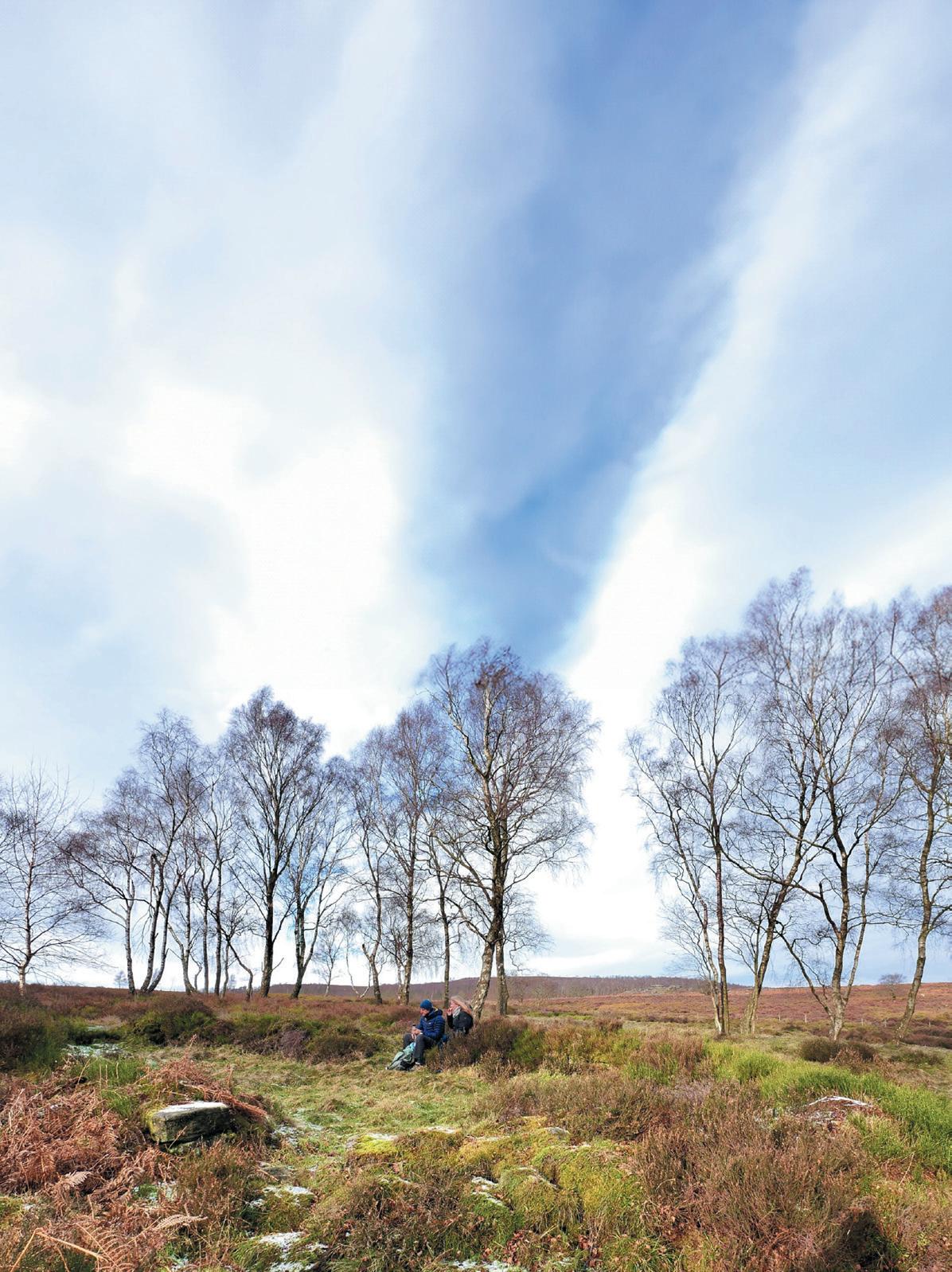
On and around the Longshaw Estate, there is a Lawrence Field, a Mitchell Field, a Timothy Fields and a Gregory Fields. They are believed to all have been based at a long-gone monastic grange – a farmstead – at Strawberry Lee, just over the hill from Longshaw towards Sheffield, which was connected to Beauchief Abbey. So, Brother Lawrence cleared his field between the A6187 Surprise View road and the B6521 to Grindleford – not that the road numbers existed then – on the moorland just north of Burbage Brook. There is a three-acre medieval field system with an enclosure wall and two longhouses on Lawrence Field – dated to around 1100 AD, which may have
been slightly early for Brother Lawrence to have set that up, as Beauchief Abbey was founded as a ‘daughter establishment’ of Welbeck Abbey and opened in 1183, so the farming monks of the Peak District must have cleared their fields a century or so later.
What is not in doubt is that a large, irregular-shaped – and incomplete –enclosure defines the remains of the medieval field system. The very fact that it is incomplete suggests that the wall, at some time, was taken apart to be put back together, but that process was never completed.
Within the enclosure are a series of rough stone banks which define individual fields, whose position and poor soil quality suggests the clearance was undertaken to facilitate grazing. Also, there are also

FEATURE
Above: The remains of the larger of the two medieval longhouses which once stood in Mitchell Field. Could it have been the home of Brother Lawrence? Picture by Brian Smith.
30 Reflections May 2024 To advertise call 01246 550488
Above: Beauchief Abbey.


some large cairns which might even have been barrows (burial mounds) – clearly not the work of Brother Lawrence!
What is clear is that the Premonstratention Monks and their Abbott of Beauchief Abbey, when it was first founded, owned the surrounding areas of Greenhill, Totley and Bradway – and were eventually to own vast parts of Peak District moorlands, all donated by landowners, which enabled the Abbey to become very wealthy.
The Lawrence Field ‘medieval settlement and field system’ is mirrored across the Burbage Brook valley within Sheffield Plantation – the other side of the B6521. There is a similar enclosed field system and longhouse. Experts consider that these enclosures and house remains are evidence of ‘medieval assarting’ – clearing forested land – whereby patches of land were cleared and farmed after the Norman Conquest.
As there is a similar block of ‘assarted land’ in Lawrence Field, which is associated with the two longhouse remains, one of which is believed to be of 12th century

origin – and that could point to Brother Lawrence’s work, as monastic communities were known to “assart” in the Middle Ages.
Interestingly, some of the features at the Sheffield Plantation site relate to an earlier field system which may have had its origins in the Bronze Age. Similar Bronze Age field systems are recorded on the backslopes of many of the gritstone edges in this region – so it looks like Brother Lawrence was following Bronze Age man and Saxons in farming this area.
The Cistercian order of monks were the first to establish a system of farming in the UK, with agricultural units separate from their monasteries. These became known as granges, derived from the French ‘graunge’, itself from the Latin word ‘grana’, meaning a granary. Other orders, like the Premonstratention Monks, followed suit and the practice spread.
These grange farms were to generate profit for the ‘mother-house’ (monastery, abbey or priory), with wool being the major money earner in the Middle Ages.
the site of medieval monastic grange in the foreground.
Above right: Clearly the hand of man has been on Lawrence Field – but is this the work of ‘monk farmer’ Brother Lawrence? Picture by Brian Smith.
In Derbyshire, however, no medieval granges survive – and because many non-monk farmers started to add the word grange to their farm name to give it extra kudos, it is now difficult to know where the monastic granges really were. Among the ‘genuine’ was the scheduled monument of Mouldridge Grange, whose remains are close to Mouldridge Grange Farm, near Pikehall.
In the High Peak, it is known that monastic granges are found within the boundaries of the old Royal Forest of the Peak such as Crookhill and Abbey Bank in the Upper Derwent valley. Others stand alone in the moorlands: Harewood Grange in Beeley parish and, of course, Strawberry Lee above Totley.
FEATURE 31 Reflections May 2024 Visit our website at www.reflections-magazine.com
Above: The remains of the smaller of the longhouses which once stood in Mitchell Field – perhaps the home of livestock. Picture by Brian Smith.
Above left: Mouldridge Grange Farm, with

Town-centre ‘revitalisation’ work this summer
THE next phase of a multi-million pound project to regenerate Chesterfield town centre is set to get underway this summer. Chesterfield Borough Council’s ‘Revitalising the Heart of Chesterfield’ project – which has already seen good progress on work to refurbish the iconic Stephenson Memorial Hall, as well as improvements to Packers Row – will transform the look, feel and flow of key public spaces.
It is expected that work to revamp the town’s historic market place, which includes New Square and Market Square, will start in summer.
Key improvements will include:
Market Square: a new layout to make it easier to walk around, new stalls with modern facilities for traders, and vibrant new canopies. The plans will also ensure the historic Town Pump is made into a unique feature.
New Square: the plans will create an attractive space that will complement the main market, but can also be used to host festivals, events, cultural celebrations, and community gatherings.
Rykneld Square: transformed to create a more welcoming, green space from which to enjoy our much-loved Crooked Spire, and better connect this landmark to the town centre.
Spire Walk: the council will work in partnership with the Church of St Mary and All Saints to create a more attractive space in which to enjoy our iconic Crooked Spire, including imaginative new lighting that will enhance the appearance of the Spire at night.
Street: improved paving and lighting will revamp this gateway to the town centre and provide a welcoming environment for visitors to the refurbished theatre and museum.
The Revitalising the Heart of Chesterfield project is due for completion in 2025. For more information, visit: www.chesterfield.gov.uk/revitalise
Rangers recreate a 70-year-old picture…
PEAK District rangers returned to their roots to mark their 70th anniversary. As part of the celebrations, National Park rangers recreated a photograph taken outside Edale’s Old Nags Head pub, where the original service was launched on Good Friday, April 16, 1954.
The Peak District was the UK’s original national park – designated in 1951 – and led the way with the creation of what would become the country’s first ranger service.
Tom Tomlinson was appointed the Peak District’s first national park warden in January 1954 and a warden service of part-time volunteers was created three months later.
Peak District National Park Authority chair, Ken Smith, said: “In the first year of the service, there were 500 volunteers, coming out at weekends to look after the
countryside, to enforce the byelaws and encourage people to enjoy the National Park in a responsible way.
“In many respects, the role of rangers today is not that different to what it was 70 years ago.”
In the early days of the service, warden briefings took place in the Old Nags Head, Edale, where landlord and access campaigner Fred Heardman had also set up the Peak District’s first information service in the snug.
Over the years, the role of wardens developed to include leading walks, conservation and safety work. The term ‘ranger’ was first used during the 1980s.
Today the Peak District National Park Authority employs 28 rangers –and is grateful for the hard work and commitment of around 230 volunteers.
Below: Peak District rangers and voluntees celebrate the 70th anniversary.
Picture by Tom Marshall.

32 Reflections May 2024 To advertise call 01246 550488
COUNTYWIDE NEWS
Corporation
A computer-generated image of how the new Market Square in Chesterfield will look like.


Sole Sisters hit the 10k!
SOLE Sisters fundraising group – Kelsey, Louise, Kelly, Nicola, Ange, Alyson, Helen, Cath and Angela – smashed their 10k fundraising target for Sheffield Children’s Hospital, Andy’s Man Club and Autistic Children and Carers Together (ACCT) last month.
On April 6, some of the group took on the Edale Skyline Challenge – a 20-mile route, taking in Win Hill, Kinder Scout’s southern edge, Brown Knoll, Rushup Edge, Mam Tor, Back Tor and Lose Hill.
The gale force winds meant it was far more challenging than normal but the group were spurred on by support and generosity of so many people.
The group chose causes that meant a lot to them and had impacted their lives in some way, which made it even more special when they hit their £10,000 fundraising mark.
They’re continuing their fundraising by collecting at the Ridgeway Beer Festival on Saturday, May 18 – or you can donate to them by visiting: https://www. justgiving.com/team/solesisterssheff
Books about Baslow
BASLOW and its near neighbour, Bubnell, have a long and fascinating history. Threeand-a-half thousand years ago, there were ancient stone circles built on the moors above Baslow. These, the seven Barbrook stone circles, were probably constructed for astronomical reasons. More strange relics, stones carved with ‘cup and ring’ symbols, were found above Baslow on Gardom’s Edge, and these could be as old.
Both villages were established by Anglo-Saxon times and were named in the Domesday Book.
The villages have had their share of strange individuals such as the ‘cross dressing thief’, the ‘dodgy dealings’ of a number of local MPs, and the local ‘dissenters’ and those transported to Australia. Two railways were supposed to go through the village but never did but Baslow did house ancient religious guilds and schools. All this and more can be found in two well illustrated books produced by the Baslow History Group: https://baslow-history-group.weebly.com/ These books are £10 each from Baslow Post Office and Church Farm Gallery. There is also a booklet (£2.50) about the large Victorian luxury hotel, the Baslow Hydro, that was demolished in 1936.
u3a Bakewell Open Day
U3A Bakewell is holding an Open Day on Tuesday, May 21 at the Medway Centre to welcome new members and introduce a number of new groups to its already varied programme of activities.
u3a Bakewell has flourished for more than 25 years, enabling those no longer in full time work or no longer raising a family to discover and develop interests while making new friends and, best of all, having fun doing it.
There are ideas of setting up a petrolheads group, a non-competitive sketching group, a Big Issues of the Day group, and one called Chatsworth and its Estate. Or Mines and Quarries? Or Beer Appreciation?
These are just some of the new group ideas, adding to the already well-established groups such as bridge, outdoor summer bowling, philosophy, a range of walking groups to cater for everyone from 4-mile strollers to 15-mile hikers, modern and ancient languages, a book group, craft and embroidery, gardens and houses, theatre visits,
creative writing, poetry and photography – the list goes on – and all for an annual subscription of less than £2 a month.
To find out more, join them at the Medway in Bakewell on May 21 between 2-4pm, have a cuppa and perhaps a cake (home-made cakes are another of u3a Bakewell’s specialities). Its members look forward to meeting you.
More smokers in Derbyshire
THE number of smokers in Derbyshire has actually risen, from 13.9 per cent in 2018 to 14 per cent in 2022.
Online vape retailer Go Smoke Free analysed data from the Office for National Statistics to determine the counties that have seen the largest decrease in current smokers between 2018 and 2022. Neighbouring Leicestershire showed the biggest drop of 29 per cent, with the number of smokers there down to less than 10 per cent in 2022.
Better news is that Derbyshire County Council is set to receive a government grant of over five million pounds in funding over the next five years to help reduce smoking rates across the county.
MPs recently have voted to back the government’s plans to create a “smoke-free generation”, and reduce the number of smoking-related deaths. Under the new law, each year the legal age for cigarette sales – currently 18 – will increase by one year. It means that people born in or after 2009 will never be able to legally buy cigarettes.
Successful year for Matlock WI
2023-24 was another successful year for Matlock WI. During the 12 months, we moved the meeting venue to the larger hall at the Edgefold Club in Matlock due to increasing membership. We have said “hello” to several new members and a sad “farewell” to existing ones.
We sent a beautiful hand-made card on the death of the Queen, which was very well received by the Palace, also sending a card to celebrate the coronation of our new King.
We have enjoyed carriage rides and walks and we have potted, painted, sewn, knitted, made puddings (a pudding club!) and read books. We have had theatre visits, enjoyed games and quizzes, also enjoying a garden party and a Halloween party, at which we entertained other WI clubs in the District.
This coming year marks our 40th birthday, so we are all looking forward to celebrating this event later in the year. We welcome new members of any age at our meetings, which are held on the first Wednesday of the month at the Edgefold Club, Matlock.
36 Reflections May 2024 To advertise call 01246 550488
COUNTYWIDE NEWS
Above: Some of the Sole Sisters before tackling their 20-mile Edale Skyline Challenge.


37 Reflections May 2024 Visit our website at www.reflections-magazine.com

Pommie Pilgrimage is underway!
ALL Saints Church, Youlgrave, dates from 1155 – and was last restored 150 years ago – so it is ready for some updating!
To raise £42,00 for kitchen improvements, and some new toilets, locals decided to tackle a Pommie Pilgrimage to all 42 Anglican cathedrals in the country. They started on March 26, when a group of 27 pilgrims walked from Youlgrave to Derby Cathedral; then Kate Heath, who came up with the pilgrimage idea, walked to Chester Cathedral in April and was admitted through the Pilgrims door, which is usually locked!
Youlgrave residents will walk to the other 40 cathedrals by November 1.
In the meantime, villagers are launching a ‘pilgrimage labyrinth’ on May 4, which has been mown into a field in the centre of Youlgrave, so those less able villagers –and visitors, hopefully – can take part in their own pilgrimage. The labyrinth has 21 turning points, so if you walk in and out you will have visited all 42 cathedrals!
To donate, head to JustGiving and look for Pommie Pilgrimage 2024.
Local charity appeals for help
WORTH is a local charity that desperately needs the community to help it survive.
Chesterfield-based WORTH exists to offer long-term aftercare to women and children who have experienced domestic abuse. They charity also offers several therapeutic groups which provides clients
a safe space to share experiences, give and receive support, reduce isolation and help to give women their voice back that the abuse often steals from them. WORTH was founded in 2015 by chief executive Robyn Riggans, out of her own experience of domestic abuse. They became a registered charity in 2017 and have grown their services during this time to meet the increasing demand.
However, like many charities, WORTH is struggling to secure funding to cover for the core running costs of the charity. They have managed to obtain funding for half of their costs, but need to find at least another £60,000 to be able to continue; so is asking for help:
Could you or your business sponsor the work that we do?
• Could you or your business offer a one-off donation?
• Could you or your business hold a fundraising event for the charity?
• Could you offer support in another way via a gift in kind? (eg equipment/time)
To find out more about the charity, go to www.worth-charity.co.uk
If you would like to talk to someone about a client referral, email contact@worth-charity.co.uk

38 Reflections May 2024 To advertise call 01246 550488 COUNTYWIDE NEWS
Above: Youlgrave resident Kate Heath walked to Chester Cathedral and was let in through the Pilgrims Door, which is usually locked!

HOW TO SAVE MONEY ON YOUR ENERGY BILLS
WITH AN IDEAL NEW BOILER!
Simon Fletcher, Managing Director of FlameCare, explains more…
NOWADAYS, heating up the home takes up a substantial proportion of energy bills, which means that having an efficient boiler is a must. The better the ERP (or Energy Related Products Directive) boiler rating, the cheaper energy bills will be in the long run.
“There has never been a more relevant time to get rid of an old inefficient boiler and replace it with a brand-new super-efficient one,” said Simon Fletcher, Managing Director of familyrun, independent and local
heating engineers, FlameCare.
“It’s important to consider the ERP rating of a boiler before purchasing or installing to ensure you’re doing your bit for the environment and lowering your heating bills. At FlameCare, we use Ideal Heating boilers, all of which achieve band A levels of efficiency. The good news is that all Ideal Heating boilers

“Currently,
we have some exceptional deals on new boilers.”
attain at least 93% ERP rating as standard and have a full range of controls to suit your needs. Boilers start with a 7-year warranty and go up to a 12year warranty.
“Currently, we have some exceptional deals on new boilers; simply contact the office to find out more. We are also offering a free maintenance and service plan for a year for all new boiler installations.”
An added accessory is the Ideal Halo Wi-Fi, which is an internet connected wireless programmable room thermostat, designed to work specifically with the Ideal Boiler.
TO FIND OUT MORE ABOUT FLAME CARE:
FlameCare
67-77 Chatsworth Road, Chesterfield, S40 2AL
T: 0800 0855 518
E: info@flamecare.co.uk www.flamecare.co.uk

LOCAL BUSINESS
40 Reflections May 2024 To advertise call 01246 550488
FlameCare adapts and modifies!


THE difference professionally installed wet rooms, levelaccess showers, walk-in baths, and handrails can make to people living with disabilities is immeasurable. This is why disabled bathroom adaptations
are one of FlameCare’s most popular services. With full design services and friendly, approachable staff, FlameCare works with customers and their families every step of the way to
transform their bathrooms into fully accessible and practical spaces.
With an exceptional knowledge of the specialist products available on the market, the team at FlameCare provides thorough and detailed advice about product selection and bathroom design tailored to the needs of each individual customer.
The range of care showers, wet rooms and adapted bathroom products is chosen with quality, comfort and safety in mind – making it really easy for those with limited mobility or disabilities to modify their bathroom to their needs. Working in conjunction with
all the leading brands and manufacturers, FlameCare ensures that all the products are of the highest quality.
For total peace of mind, FlameCare provides complete project management, experienced installers, fully insured warranties, and service and repairs.
TO FIND OUT MORE ABOUT FLAME CARE:
FlameCare
67-77 Chatsworth Road, Chesterfield, S40 2AL
T: 0800 0855 518
E: info@flamecare.co.uk
www.flamecare.co.uk

Visit our website at www.reflections-magazine.com 41 Reflections May 2024
The delights of Derbyshire’s insects best-dressed
THE UK boasts a grand total of forty different varieties of dragonflies and damselflies that have been recorded in locations across the length and breadth of the country. Landlocked Derbyshire is privileged enough to be home to at least 22 different types of these elegant beauties, writes Mica Bale. Whereas of late, bees have received all the publicity; dragonflies and damselflies play a vital role in the local ecosystems by helping to maintain the natural order. As keen predators, dragonflies in particular help to keep populations of other insects at a natural balance.
remains of a dragonfly was found when miners uncovered the fossilised wing of a dragonfly. Dating back roughly 300 million years, the fossilised dragonfly wing was found in a piece of coal. Remarkably, this special fossil could easily have been overlooked but for the eagle eyes of the miners, sparking debate that evidence of even older fossilised fragments could lay undetected in the region – or, even worse, go up in smoke in someone’s front room!
tend to have chunkier bodies, whereas their more delicate relatives have longer and more slender bodies.

“Reportedly a dragonfly can eat upwards of 30 insects, such as mosquitoes, a day – the ultimate in pest control!”
Although dragonflies and damselflies are not pollinators, their presence in your garden can help to support your area’s balanced ecosystems and keep pesky plant eaters at bay. Reportedly a dragonfly can eat upwards of 30 insects, such as mosquitoes, a day – the ultimate in pest control!
Interestingly, Derbyshire has a longheld history of dragonflies. In Bolsover in the late 1970s, some of the oldest

With their stained glass window wings and vibrant colours, it can be difficult to tell the difference between dragonflies and the remarkably similar damselfly. In reality, whether you are confronted with the pleasing hum from the wings of either a dragonfly or damselfly, you will behold a beautiful sight.
The Dragonfly Society advises that ‘in the UK, dragonflies reach a length of about 85mm and a wingspan of about 120mm. This is the size for the larger “Hawker” dragonflies such as the Emperor and Brown Hawker. Damselflies, which are the smaller and weaker flying relatives of dragonflies, are much smaller.’ Additionally dragonflies
Generally speaking, younger dragonflies and damselflies tend to have more muted colours so chances are the next time you find yourself mesmerised by the elongated bodies of a winged creature, it is likely to be a more mature adult. Contrary to popular belief, dragonflies can live for around six months. However their natural predators, such as birds, can often abruptly shorten that lifespan.
Damselflies tend to live shorter lives and often only survive for a few weeks before they succumb to natural predators or simple accidents. Both damselflies and dragonflies spend a sizeable amount of their life in a larval state when they begin their lives in water and spend time maturing under the surface.
Although dragonflies and damselflies feast on smaller insects such as mosquitoes, it is not always realistic to expect the attraction of these beautiful creatures to your outdoor spaces to have a huge impact on the amount of red and itchy bumps you are likely to experience throughout the summer!
However, if you are still keen to balance the ecological system in your garden or allotment, then you can proactively
FEATURE 42 Reflections May 2024 To advertise call 01246 550488
Left & right: Damselflies.


encourage dragonflies without completing an excessive landscaping project.
As dragonflies and damselflies are so reliant on water, why not introduce a small body of water into your garden? Extra points if there are a variety of depths for young dragonflies in their larval state. Also, don’t fill your pond with lots of plants, as clearer water is preferable – and keep it free from fish, as these are likely to eat young flies before they have a chance to spread their wings. Edging the pond with moss and rocks is also popular as these are good for sunbathing and laying eggs. According to the Dragonfly Society, if your pond is suffering lower water levels


in the warm weather during our summer months, then remember to top up from a garden water butt rather than a tap, as the chemicals and nutrients in our drinking water can introduce toxins to the critters that call the pond home.
Don’t forget to keep a notepad and pen on hand as well as your camera to capture any dragonflies and damselflies that you catch sight of at your pond – you can even take part in reporting your dragonfly spots!
If you can’t actively encourage dragonflies into your outdoor spaces, then why not pay a visit to Derbyshire’s Carr Vale Nature Reserve on the outskirts of Bolsover? This wetland reserve provides the perfect conditions for

thriving communities of both dragonfly and damselfly and you might well spot varieties such as the emperor dragonfly, four-spotted chaser, ruddy darter and black-tailed skimmer. The Azure damselfly is one of the most common of the damselflies and can habitually be seen around bodies of water.
Yes, of all the wildlife that Derbyshire is blessed to enjoy, surely dragonflies and their slightly smaller relatives the damselflies must win the ‘best-dressed flying insect’ award. Next time you hear the unmistakable buzz of some insect winds, then do spare a thought for these beauties and their long heritage in our region before you reach for the newspaper!
FEATURE 43 Reflections May 2024 Visit our website at www.reflections-magazine.com
A Migrant Hawker dragonfly. Credit Ian Lindsay
A Southern Hawker dragonfly. Credit Ian Lindsay


Chatsworth Travel returns to the High Street.
Independent agency Chatsworth Travel are back on Chatsworth Road.
Our friendly team are happy to be back on the high street after a long period working from home, we look forward to welcoming existing and new customers to our new shop –424 Chatsworth Road, Chesterfield, S40 3BD.

CHATSWORTH TRAVEL are proud to be part of Travel Organisers and can offer the service of a local independent travel agency whilst having the support of a larger organisation to ensure you get a wider holiday choice with value for money.
Manager Kathryn Hallam has been with the company since 2018, Kathryn has been in travel since 1980.
Kathryn said: “Our highly experienced team pride themselves on traditional values – good old-fashioned personal customer service, uncompromising integrity, genuine advice, value for money and a forward-thinking ability to move with the times – keeping abreast of new and exciting holiday types and destinations along with the traditional

Mediterranean beach and cruise holidays.
“Our personal service includes help with online check in, boarding passes, excursions, and your travel money. Travel is my passion; I am an expert in cruising and tailor-made itineraries. We are also bringing back our Solo Travel Club, helping individuals travelling alone, making sure they also get the best deals on the high street.
“Visit the branch today to find your dream holiday from our travel organiser experts.
“We are looking forward to welcoming you all to our new branch on the high street.”

45 Reflections May 2024 Visit our website at www.reflections-magazine.com
LOCAL BUSINESS
It’s all about Trust!
When it comes to choosing the right tradesmen and businesses for home improvement projects, it’s all down to trust and reputation.
PLANNING the next home improvement project is always an exciting, yet daunting, challenge. Mulling over the various options and configurations, looking at budgets, and dreaming about the end product raises so many questions, whilst at the same time stimulating the creative juices. That’s why selecting the right company to carry out the work is of paramount importance.
Never has it been more vital to use tradesmen who uphold the traditional virtues of honesty, integrity, reliability, and transparency. Old-fashioned values are very much in the ascendency as the mantra of trust is key.
Endorsing and promoting these values is Derbyshire Trading Standards, who set up the Derbyshire Trusted Trader scheme twelve years ago in November 2008.
The Derbyshire Trusted Trader scheme was established to help local people find traders and businesses who agree to do a first-rate job at a fair price and commit to providing good customer service. Its goal was, and still is, to protect consumers, and, in particular, older and more vulnerable adults, by making it easier for them to use Trusted Traders rather than rogue traders who typically cold-call and use high-pressure sales techniques.
“The bitterness of poor quality remains long after the sweetness of low price is forgotten”
The scheme provides customers with a reputable resource of tradesmen and women, in whom they can have total confidence and peace of mind.
A spokesperson from Derbyshire Trading Standards said, “The scheme helps to put consumers’ minds at ease and allows them to feel much more secure and protected when choosing a trader.
“We all hate the feeling of being taken for a ride - so the fact that traders are vetted beforehand, and you can see feedback from other customers who use the scheme, is priceless.”
One of the first home improvement companies to register for, and become validated as, genuine Trusted Trader members is Heatguard Windows. A


long-established and well-respected company, Heatguard Windows embraces and embodies the principles of the scheme, by offering impeccable service, meticulous attention to detail, and a competitive and fair pricing structure. From initial visit and inception right through to final installation and after-sales service, Heatguard Windows prides itself on having the most exacting of standards.
For every home improvement project, customer satisfaction is everything. And Derbyshire Trading Standards recognises this fact by promoting customer feedback on the Derbyshire Trusted Trader site. All customers of Trusted Traders are encouraged to fill in feedback forms and return them to the scheme. This means that all members are accountable and must maintain good practice to ensure that the highest standards of craftsmanship are kept up.
With literally hundreds of positive and excellent reviews on their profile page on the Derbyshire Trusted Trader site, Heatguard Windows can call on a plethora of verifiable and bona-fide references - enough


to satisfy even the most discerning of customers. That’s why Heatguard Windows has gained, over the years, a portfolio of over 13,500 satisfied customers.
From vital window repairs to whole-house window and door installations and brandnew conservatories, Heatguard has got it covered. Using only top-quality products, such as triple glazing and Warmroof roofing, perfection comes as standard for the highly experienced fitting team.
A spokesperson from Heatguard Windows said, “We are proud to be part of, and promote, the Trusted Trader scheme in conjunction with Derbyshire Trading Standards. Being members of the scheme gives our customers total reassurance and complete peace of mind that they are dealing with a trustworthy and honest company.”
It’s not only Trusted Trader membership that sets Heatguard Windows above the rest. Failsafe warranties, accreditations, adherence to consumer protection legislation, and comprehensive indemnity insurance are also testimony to excellence in workmanship and integrity.


46 Reflections May 2024 LOCAL BUSINESS LOCAL BUSINESS

A TRULY REMARKABLE BOOK…
Barrie Farnsworth reviews a remarkable book about a Chesterfield woman who spent five years living and working in the USSR.

IT is not often that someone leaves Chesterfield and ends up in both Chile and what was then the USSR – and has written books about them – but it happened to Kate Clark.
Kate, a communist, was in Chile when socialist Salvador Allende became President and was in the USSR when Mikhail Gorbachev was leader and the Soviet Union was dismantled and moved from communism to capitalism.
She wrote two books about Chile, where she was from 1969 to 1974, and recently published ‘Twilight of the Soviet Union’ about her work – and family life as a mum-of-three – in the USSR between 1985 and 1990.
The former St Helena School pupil and a languages graduate from the University of Manchester who spoke fluent Russian – thanks to a scholarship year in Moscow in 1967/8, where she met her future husband, Spanishspeaking Ricardo – started her working life with ICI but then, as she put it, “drifted into teaching and lecturing”.
After five years in Chile, Kate and Ricardo returned to London – then hubby got a good job in Moscow.
Kate then got the job as the Morning Star’s USSR correspondent – “I had
written them a few articles about Chile and I did speak Russian” – and in February, 1985, boarded a plane bound for Moscow along with her children, Victor (9) and sixyear-old twins Liza and Marta.
Ricardo met them at Moscow airport and they headed to their new home, a ninth-floor flat with great views over the centre of the capital. The couple sent their children to a Soviet school – “we wanted them to learn Russian and make friends with local children” and also sent the children that summer to a ‘Pioneer Camp’, similar to a scout and guide camp, and Kate was delighted when they returned speaking fluent Russian.
The book is full of detail about the family life of Kate, who was about the only foreign correspondent to speak Russian and live among the Russian people.
But what of her work? Just three weeks after she arrived in Moscow, Mikhail Gorbachev was the Kremlin leader. He was a real reformer – introducing ‘glasnost’ (openness) and ‘perestroika’ (restructuring) and not afraid to attack the Soviet system –and Kate regularly reported on what impact the changes had on ordinary Russians.
The book details a visit by Kate to a coalfield to personally thank the miners who had together donated a large sum to the striking NUM miners in the UK.
A year later, she was in Ukraine to report on the Chernobyl nuclear disaster – and, in the book, tells of a strange meal supplied to foreign correspondents, like her, close to the power station.
Kate, who now lives in Stretton, remains a socialist, despite the demise of the


Soviet Union. She says: “Gorbachev was naive and went too fast with his reforms. Basically, he lost control…” All in all, it is a frank and detailed account of both family life and working life in what
turned out truly to be the ‘Twilight for the Soviet Union’, and I heartily recommend it.
Editor’s Note: ‘Twilight of the Soviet Union’ by Kate Clark, published by Bannister Publications, £14.99.
BOOK REVIEW 48 Reflections May 2024

BANKING ON A PREMIUM DINING DESTINATION
Bakewell entrepreneur, Rob Hattersley, hopes to turn long-shut former bank into a premium dining destination.
PEAK DISTRICT hospitality entrepreneur, Rob Hattersley, has announced his hope to transform the historic Royal Bank of Scotland building, in the heart of Bakewell, into a premium dining experience.
The beautiful sandstone bank, which first opened its doors in 1838, has been closed since 2018.
Rob’s vision is to carefully bring the Grade II* building back to life. The menu would be designed to showcase the local area’s unique people and produce. The interior would celebrate the building’s heritage and location, with emphasis on features like its high ceilings, huge windows, and original cornices.
“I grew up in Bakewell so reviving the bank and turning it into a place that can be enjoyed by locals and visitors alike, would feel like coming home,” explains
Rob. “It also feels right to be rescuing such an iconic building and investing in the local economy. It’s a principle that drives all of my business decisions.”
As with the other venues owned by Rob’s independent hospitality company, Longbow Bars & Restaurants, the menu would be designed by Raymond Blanc trained executive chef, Adrian Gagea.
It would operate seven days per week, serving breakfast, lunch (including Sunday lunch) and a brasserie style dinner menu. Afternoon tea would also be available.
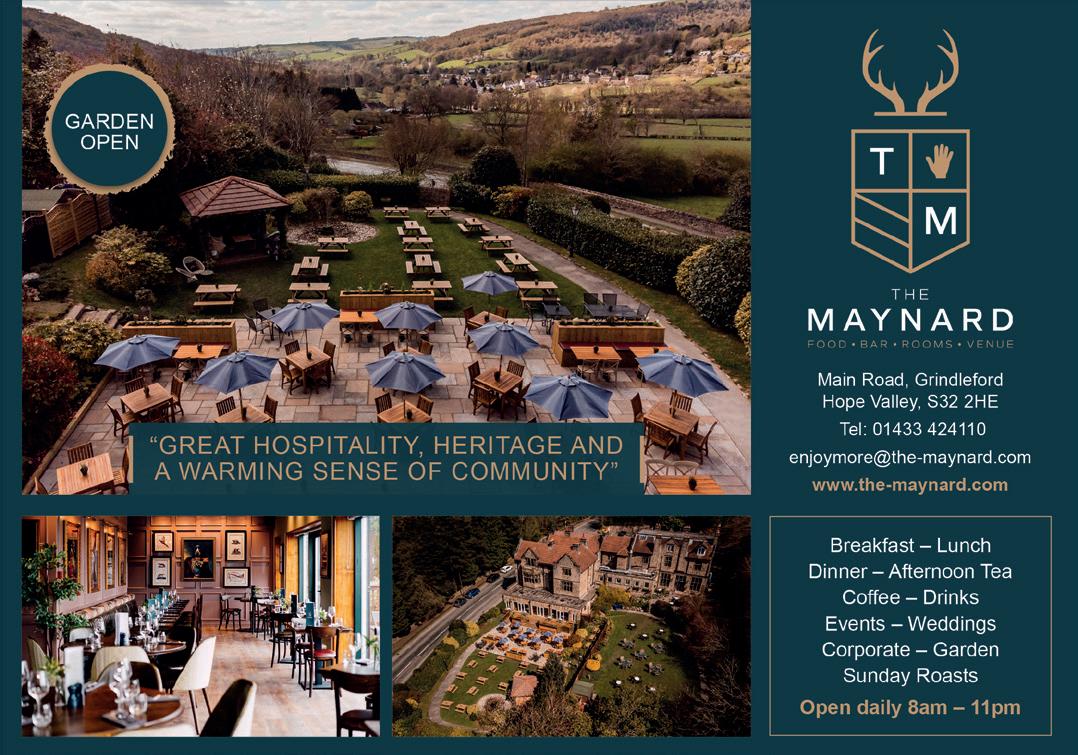
Last month, Rob opened the doors to The Ashford Arms, a historic high-end pub with rooms in nearby Ashford in the Water. It joined The Maynard, which has won numerous awards as a wedding venue, restaurant, and hotel, and The George, an award-winning historic bar, restaurant and hotel in Hathersage.


To be kept up to date on Rob’s plans for the former bank, please visit www.longbowvenues.com or email info@longbowvenues.com to register for email updates.
50 Reflections May 2024 To advertise call 01246 550488


51 Reflections May 2024 Visit our website at www.reflections-magazine.com




54 Reflections May 2024 To advertise call 01246 550488 ACROSS 7 Beginning to be where film’s made? (5) 8 It’s a chain stitch, me ol’ Cockney mate! (5) 14 Slav is right to be in an outer garment (5) 15 Omaha? It is the bits that are like a Caribbean island! (5) DOWN 2 Lease that could stand out (5) 3 Kitchen starting to go down a gear (3) 5 A reason for absence, in central Ibiza (5) 12 A halo that could hail from Hawaii (5) 13 It’s the crafty aide’s turn to bid farewell (5) 15 Bit of a wheel found amongst the rhubarb? (3) Pitcherwits Pitcherwits 1 2 3 4 5 6 7 8 9 10 11 12 13 14 15 16 1 Splinters, but with no slowing devices? (6,4) 9 Society with mixed-up human beings? (5-6) 11 Patient in a mac as a leader (but not in the paper) (4,7) 16 Dry husband out for the smarter horse? (10) 1 Which transport (say) shall it be? (10) 4 How do you clap with one arm, bright one? (3,4) 6 Join to fill in what could be (4,2,4) 10 Egged on in edict that’s been issued (7) ACROSS DOWN For more free puzzles go to www.pitcherwits.co.uk The solutions for the April 2024 Pitcherwits are shown left. The answers to May’s Pitcherwits will be published in the June 2024 issue. To reach over 30,000 potential customers contact Derbyshire’s largestcirculation lifestyle magazine contact Mike Snow on 07966 445452 or Helen Wragg on 07973 672582 Reflections has been established for over 30 years H 1 I G 2 H E R P O W 3 E R 4 E A A E A P 5 O 6 L L 7 T A 8 X A D N A S P T 9 HA W T I 10 OT A E A 11 RE N A P A 12 UN T R T 13 BA R C C A I O H C 14 H A L I C E 15 F E A M I R 16 I B B E D V A U L T
4 Some pretty awful origins for Buxton? (3)
8 Lots of lions parked for Derby footie? (5)
9 Shirt adrift in hostel West of Belper (7)
11 Knight who is back on the right (3)
12 Smug smile at skirmish: his loss, unfortunately (5)
13 Meadowlarks, not some alternative West of Grangemill (7)
14 Hangs on to a mistake in SW Carsington village (9)
17 Antelope found on many a label (5)
18 Locally, mine’s a hoarder! (6)
21 Put a shine to the short work at peak gateway (7)
23 Get ready to stop, like a Derbyshire flower (5)
24 Mysterious pulsar for digging out in Derbyshire! (9)
27 Distant fear? Way out! (3)
28 Hip partner to frost, by the sound of it (3)
30 Standoffish? One of us Loofs? Yup! (5)
32 Pal in trouble? It’s a bit of a mountain (3)
33 Bit of plant said to be the way to rent (7)
34 Is he enchanted in a spot near Hartington? (5)
35 Drink’s green? So they say! (3)
Prize Crossword
1 Chooses the outpost (4)
2 It’s how we managed to get in the lead! (6)
3 Grades kept partly for one to write on (4)
4 Did Jedediah do this with his stuff? (6)
5 Continent, as seen on a back-road (4)
6 Hope to be South of Monroe, who’d got in trouble (6,4)
7 Working light, sampled a kilo of ingredients (8)
10 Local brewers’ kit for having a stab at age estimation (7)
15 Phial administered to troll at height near Wirksworth (6,4)
16 ‘Horsey’ bit of anagram? (3)
19 Lob an arrow thoughtlessly into our stone circle (5,3)
20 Pixie wallowing in self-pity (3)
22 Hope to be near, but it’s in awful bad form! (7)
25 Disquiet to ensue with a problem (6)
26 Cavern oddly, quietly loose (6)
29 Said to be a question of power (4)
30 Stewed peas in the church end (4)
31 Tooth all out of angular proportions (4)
We will give a prize of £25 to a randomly-drawn correctly completed crossword. Cut out the completed puzzle and send by May 20th, 2024, to: Bannister Publications Limited, Office 2A Market Hall, Market Hall, Chesterfield, Derbyshire, S40 1AR. The solutions for the April 2024 crossword can be found on page 98 of this issue.

55 Reflections May 2024 Visit our website at www.reflections-magazine.com
Crossword by Prof Rebus Name: Address: ...................................................................................................................................... Telephone: 1 2 3 4 5 6 7 8 9 10 11 12 13 14 15 16 17 18 19 20 21 22 23 24 25 26 27 28 29 30 31 32 33 34 35 ACROSS
DOWN


IGHT, bright and fresh as a daisy; the hue which dominated across the SS24 catwalks was the least colourful colour of all. That’s right; the runways were awash with a sea of white as far as the eye could, well, see. When it comes to sophisticated, sharp dressing in the summer months, there’s no hue that does it better than white.
Effortlessly chic and endlessly wearable, white is the perfect style palate-cleanser, and a great antidote to the bright, brash hues and bold prints which also proved top of the style pops across the spring runways. From crisp tailoring and summer dresses at Proenza Schouler to collection standout pieces at Gabriela Hearst and Tory Burch, white was the way to go for designers across the board.


Continued on 58 56 Reflections May 2024 FASHION Freshen up your wardrobe with summer’s standout hue as white gets ready to take centre stage, says Amy Norbury. AllWhite On the night 1. Tory Embroidered Tunic, £52, and Sascha black Midi Skirt, £48, FatFace. www.fatface.com 2. Copper & Black Ivy Foil Maxi Dress, £98, FatFace. www.fatface.com 3. Boxy white leather grab bag, £89, John Lewis. www.johnlewis.com 4. Floral laser cut white belt, £35, FatFace. www.fatface.com 1 3 4 2 L

FASHION
Continued from 56
And it’s no secret as to why; white is hands down the most versatile hue around. Forget bridal chic (although there was plenty of that around too in the form of party-ready dresses and heavily detailed gowns), white is the perfect way to make a smart style statement.
So let’s start with the basics; a tailored white shirt in a luxe fabric is a wardrobe must-have, whatever your style. Team with your favourite jeans and white trainers for summer street style smarts, use it to balance a statement print skirt, or embrace the head-to-toe look by pairing with white suitingyou really can’t go wrong.

Add some variety into your denim by opting for bleached versions of your favourites; white jeans are a summer must-have, while a bleached-out denim jacket makes for a perfect cover-up throughout the seasonal transitions.
And as we get into summer proper, pure white dresses will become your fashion go-to – from mini to
maxi, beachy to fancy, it’s time to embrace a veritable feast of wall-to-wall white. Find the right white dress and it promises to be a wardrobe staple for years to come; opt for a floaty maxi for chic holiday style, or reach for a crisp white shirt dress as the ultimate ‘throw on and go’ outfit for occasions aplenty. All that’s left is to step into your fave footwear – trusty white trainers or paler-than-pale leather sandals will cover most bases – and grab your bag (white, of course) and you’re ready for wherever the season takes you.




5. Relaxed cotton shirt and tapered trousers, from a selection at Marks and Spencer. www.marksandspencer.com

6. Casey denim jacket, £59, Monsoon. www.monsoon.co.uk
7. Embroidered sleeve white shirt, £60, and printed midi skirt, £65, Oliver Bonas. www.oliverbonas.com
8. And/Or Mimie off-white leather sandals, £109, John Lewis. www.johnlewis.com

58 Reflections May 2024 To advertise call 01246 550488
5 6 7 8


Take in some local mills…
IT’S National Mills Weekend on May 11/12, and hundreds of windmills and waterpowered mills will open their doors.
Among them will be the 800-yearold Standby Mill, on the banks of the Doe Lea River and part of the Hardwick Estate. Visit for free on May 11 and 12, between 11am-3pm each day.
And the Grade II*-listed Heage Windmill is open for free visits between 11am-4pm that weekend – or you can book a guided tour via its website.
There’s also free entry to the world’s first successful cotton spinning mill, Cromford Mills, on May 11 and 12, between 10am-5pm each day.
Just up the road is Masson Mills, which has a museum, and has free access to its visitor centre on May 11, between 11am4pm. Or you can opt for a guided tour of the mill, costing £11, at 1.30pm that day.
Huge number of fraud reports
NEW research has revealed that Derbyshire Police have received 4,975 individual fraud reports over the past 13 months.
The analysis, carried out by QR Code Generator QRFY, looked at data from Action Fraud and the Office for National Statistics to uncover how many reports each police force had in England and Wales, over the past 13 months.
Over the past 13 months, Action Fraud recorded 395,105 reports of individual fraud across England and Wales –with a reported loss of £2.3 billion.
Derbyshire Police recorded 4,975 individual fraud reports over the past 13
months. The most common category of fraud recorded was ‘Online Shopping and Auction’ fraud, which refers to the nondelivery of products bought by a consumer, or the misrepresentation of a product. The second most common category of fraud was ‘Other Advance Fee Fraud’, with ‘Hacking: Social Media and Email’ is third place.
Cubs enjoy car museum sleepover!
THIRTY-TWO 8-11 year olds from the 5th Dronfield Hilltop Cubs had a sleepover with a difference recently. They had a night at the museum!
Great British Car Journey, the awardwinning classic car museum in Ambergate, hosted the pack for a very special sleepover.
Assistant Cub Scout Leader Chris Smith explained: “Last September I appealed for cub sleepover ideas, and Great British Car Journey came up trumps! The pack had an absolutely brilliant time. It was the perfect venue for a sleepover.”
Ahead of bedding down for the night amongst the museum’s classic cars, the cubs enjoyed a range of activities, including rides in the Rolls-Royce, which once belonged to Lord Baden Powell, the founder of the Scouting Movement.
The cubs arrived once the museum closed its doors to the public for the day and left the site before it reopened the next day.
Following the successful event, Great British Car Journey is hoping to welcome other scout, girlguiding and cubs groups looking for sleepover with a difference. To find out more, call the museum on 01773 317243.
Canal walks
HERE’S an invitation to join some easy canal walks. David Blackburn, the Chesterfield Canal Trust’s Cuckoo Way officer, would be pleased to see you on one (or more) of these short walks, partly on the towpath with some field paths and tracks.
Monday Meanders (2pm start): 13 May – Shireoaks and Lindrick Dale, about 4 miles; 8 July – Tapton Lock and the Peace Garden, uphill in part.
Wednesday Wanders (10am start): 5 June – Staveley and Norbriggs Flash Nature Reserve; 14 August – Kiveton Waters and along the top of Norwood Tunnel, 4 miles.
For more information or to reserve a place, please email David on cuckooway@chesterfield-canal-trust. org.uk or text him on 07848 805282.
New ‘re-use shop’ at recycling centre
CALLING all bargain hunters! A new ‘re-use shop’ has opened at Derbyshire County Council’s household waste recycling centre in Bolsover.
From furniture and homeware to garden equipment, books, CDs and vinyl, there’s a host of pre-loved items ready for a new home – so why not pop along to the centre on Buttermilk Lane and bag yourself a deal.
The shop, which is stocked with items collected at eight of the county council’s nine recycling centres is run by contractors H W Martin who operate these eight recycling centres on the council’s behalf.
Customers can take a look around the shop during opening hours at the recycling centre – 8.30am – 6pm every day, except Christmas Day, Boxing Day and New Year’s Day.
Typical types of goods sold in reuse shops: furniture, kitchen goods, books and records and DVDs – only originals are accepted – ornaments, pictures, artworks, garden furniture, toys and board games, premium clothing and footwear – the latter two donated directly to the shop.
Purchases can be made using cash or electronically. Proceeds from sales will go towards running costs of the shop and any profits will be shared equally between the county council, H W Martin and charitable causes. The county council’s share of any profits will be put back into its waste management budget.
Coun Carolyn Renwick said: “If the reuse shop at Bolsover proves popular, then we will consider opening further stores at other recycling centres across the county.”
Items brought to any of the county council’s recycling centres may be set aside by staff for resale in the shop. Anyone with items they believe might be suitable can hand them to staff on-site who will be happy to take a look.
60 Reflections May 2024 To advertise call 01246 550488 COUNTYWIDE NEWS
Heage Windmill –offering free visits on May 11 and 12.

Exceeding Customer Expectations HOLYWELL CARPETS


Chesterfield-based Holywell Carpets believes that achieving the ultimate in customer satisfaction is the key to longevity in business.
AS can usually be expected from a long-established family business, Holywell Carpets has stood the test of time through displaying the hallmarks of unparalleled customer service, uncompromising integrity, and unswerving reliability. Brothers Reg and Steve Hinde took over Holywell Carpets in 1989. Steve now manages the business in conjunction with long-standing and loyal employee, Martin Howroyd. Together, Steve and Martin have been working together at this highly reputable carpet company for 33 years. Previously, Steve had worked elsewhere in the carpet trade in a fitting capacity for ten years. Martin was at the company three years before Steve’s arrival. It’s fair to say that they know the business inside out. And they have done the hard yards! Both are

trained fitters and have many years fitting experience between them, Steve was ‘on the tools’ for 20 years and Martin 25 years.
Traditional values
Steve is proud of the old-fashioned values which have underpinned the success of Holywell Carpets. “If I wouldn’t have a particular carpet in my home, I won’t put it in yours,” said Steve. “Martin and I always tell customers the truth. Our business is based on a high moral code and honesty and truthfulness are at the very core of this.”
Carpet Foundation Membership
The Carpet Foundation is the UK carpet industry’s lead body. As a member of the

Carpet Foundation, Holywell Carpets is bound by a Code of Practice approved by the Chartered Trading Standards Institute. The Code gives customers peace of mind that they are dealing with people they can trust. Carpet Foundation retailers are audited annually by the TSI to ensure compliance.
These are the benefits of buying from a Carpet Foundation retail member:
• Written quotations
• Deposit safeguards
• Written terms of business
• Impartial professional advice
• Free extended guarantees
• A free installation guarantee
• After-sales procedures
Better Prices through Associated Carpet Group Membership (ACG)
With over 320 members, ACG is a national buying group dedicated to supporting independent flooring retailers. With a massively increased buying power, the ACG can secure the best trading terms with the best selection of flooring suppliers. This means that carpet retailers like Holywell
62 Reflections May 2024 To advertise call 01246 550488
LOCAL BUSINESS


Carpets can pass on the savings to customers, making their prices much more competitive. ACG membership has a good number of benefits for Holywell Carpets, including enabling them to trade on equal or better terms than members of other groups or multiple outlets.
Derbyshire Trusted Trader Membership
Being a Derbyshire Trusted Trader tells customers that they are dealing with a fair and reliable business, which follows a code of practice. The scheme also establishes a vetting procedure and a framework for stringent quality standards. Here is a recent Derbyshire Trusted Trader review:
“Very efficient from purchase to fitting. Very courteous and they did everything they said they would. I highly recommend them and will not look anywhere else when I replace the next carpet. Excellent carpets.”
Customer reviews and feedback speak volumes
A whole host of outstanding reviews from customers are what underpin the continued success of Holywell Carpets:
“We had the good fortune to stumble across Holywell Carpets about 10 years ago when looking to recarpet our sitting room, stairs and landing. In the intervening years Reg and Steve have carpeted our entire house including the extension we built 3 years ago. We trust their judgement completely,


in selling us the right carpet for the right room for the right price, and now they have all the measurements to our rooms we’re definitely not going anywhere else. We wouldn’t hesitate to recommend them as we already have to all our friends.”
Becky & Stefan Jankowski
“As a customer of Holywell Carpets for over 15 years we have received unprecidented service and excellent value for money. With a vast selection of carpets to choose from, Holywell have in depth knowledge and experience that can help you make that choice. Excellent attention to detail has always ensured the quality of fit is second to none.”
Andy & Rachel Bray
“My wife and I have lived in Chesterfield for thirty years and wouldn’t use any other company in town for carpets both in terms of choice, personal service, knowledge of product in the shop, and aftersales. The company even fitted a carpet for us on a Christmas Eve after building work had been finished late in order that that we would be straight for family celebrations. Our first lounge/dining room/hall carpet lasted twenty-five years before we replaced it a couple of years ago(at not much more cost!) and had the growing up and wear and tear of two very active children continually playing on it. Holywell Carpets is a superb local company which we should all support.”
Keith Morgan
“I am a Team Rector in a parish of 5 churches. We have lots of buildings. They need carpets and floor coverings. Holywell carpets were recommended to me. We


have used them for some years since that reccomendation. This is what you get: Clear, honest quotation and advice. Polite. personal, no – pressure service. Good quality carpets and floor covering. They are fitted expertly, on time. I reccomend them wholeheartedly as a company to be trusted.”
Charles Berrisford
If an honest, reliable, and courteous service is what you’re after, look no further than Holywell Carpets.
Holywell Carpets, 40 St Mary’s Gate, Chesterfield, S41 7TH T: 01246 272 835 M: 07733 889430
E: enquiry@holywellcarpets.co.uk www.holywellcarpets.co.uk
63 Reflections May 2024 Visit our website at www.reflections-magazine.com
LOCAL BUSINESS
LEADING THE WAY IN SUSTAINABLE HORTICULTURE
EARTHED UP! is a plant nursery on the edge of Belper that is leading the way in sustainable horticulture, writes Catherine Roth.
Based on holistic land management, Earthed Up! grows all of its plants entirely off grid, without the use of harmful chemicals, and watered only with rainwater. It has been designed according to the permaculture principles of sustainable gardening, and Earthed Up!’s ethos is to tread as lightly as possible, caring for the earth, its people and the future, whilst growing healthy and climate-resilient plants.
Sited in a small rented garden plot, Earthed Up! is run as a workers’ cooperative by a team of three. Ryan SandfordBlackburn, one of the founding members of the nursery in 2021, together with the team, has been developing the small site since then at Belper Lane End.
During this time they had to decide which plants would be allowed to stay. Ryan says: “We have no problem with dandelions and bindweed creeping over the wall, but if it’s growing into any of our plants, it becomes a weed so we take it out.” Squeezed into the small space are two polytunnels, composting bins, a shed and a demonstration garden.
The small plot in Belper is complemented by a larger site in Crich, a paddock which Ryan calls their ‘stock garden’. It is here that Earthed Up! grows its shrubs including fruit bushes and hardy ground cover such as comfrey. Ryan says: “There are badgers and 40 free-range hens, so the planting needs to be resilient!” He also stresses the importance to the wider story around gardening – for Earthed Up!, growing your own is not simply about the variety of plant but who planted it, giving gardening the personal touch.
Despite working on such a


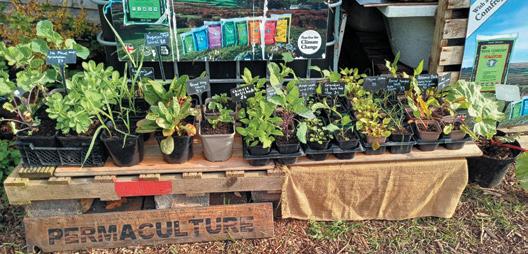
small scale, Earthed Up! offers an impressive selection of over 120 varieties of perennial vegetables, fruit and herbs – all of which are useful and most of which are edible. Some of the many plants available to purchase include Babington’s leek, land cress, mashua, purple plantain, sunchokes and skirret. Earthed Up! are happy to talk about any of the plants, complemented further by details of how to harvest the plants and their benefits on Earthed Up!’s website.
Ryan is particularly enthusiastic about herbs, which he suggests adding to salads, omelettes, stir fries and pestos, particularly during the ‘hungry season’ that occurs between January to April each year when there are fewer crops to harvest.
He says, “‘Herb’ is an older word than ‘vegetable’ and in French means ‘useful plant’. Herbs were typically bred a lot less than vegetables, which
were bred to be a particular colour, uniform in harvest, and mild in flavour. We’ve not messed around with herbs so much and they pack a punch with flavour. You can eat herbs as part of a dish, not just using them as seasoning.”
The choice of herbs gives different flavours to salads. Ryan says: “Pick a flavour palette for one dish. For a lemony salad, add lemon balm and sorrel. For an oniony salad, include chives, leeks and wild garlic, and for a mild salad –dandelions and plantains.”
As for mints, Earthed Up! grows a wide range including lavender, ginger and Moroccan, while Ryan recommends the strawberry mint for cocktails and mocktails.
Other herbs have medicinal uses. Ryan says: “Comfrey is
GARDENS 64 Reflections May 2024 To advertise call 01246 550488
Above: Plants for sale at Earthed Up! in Belper. Left: Ryan Sandford-Blackburn.
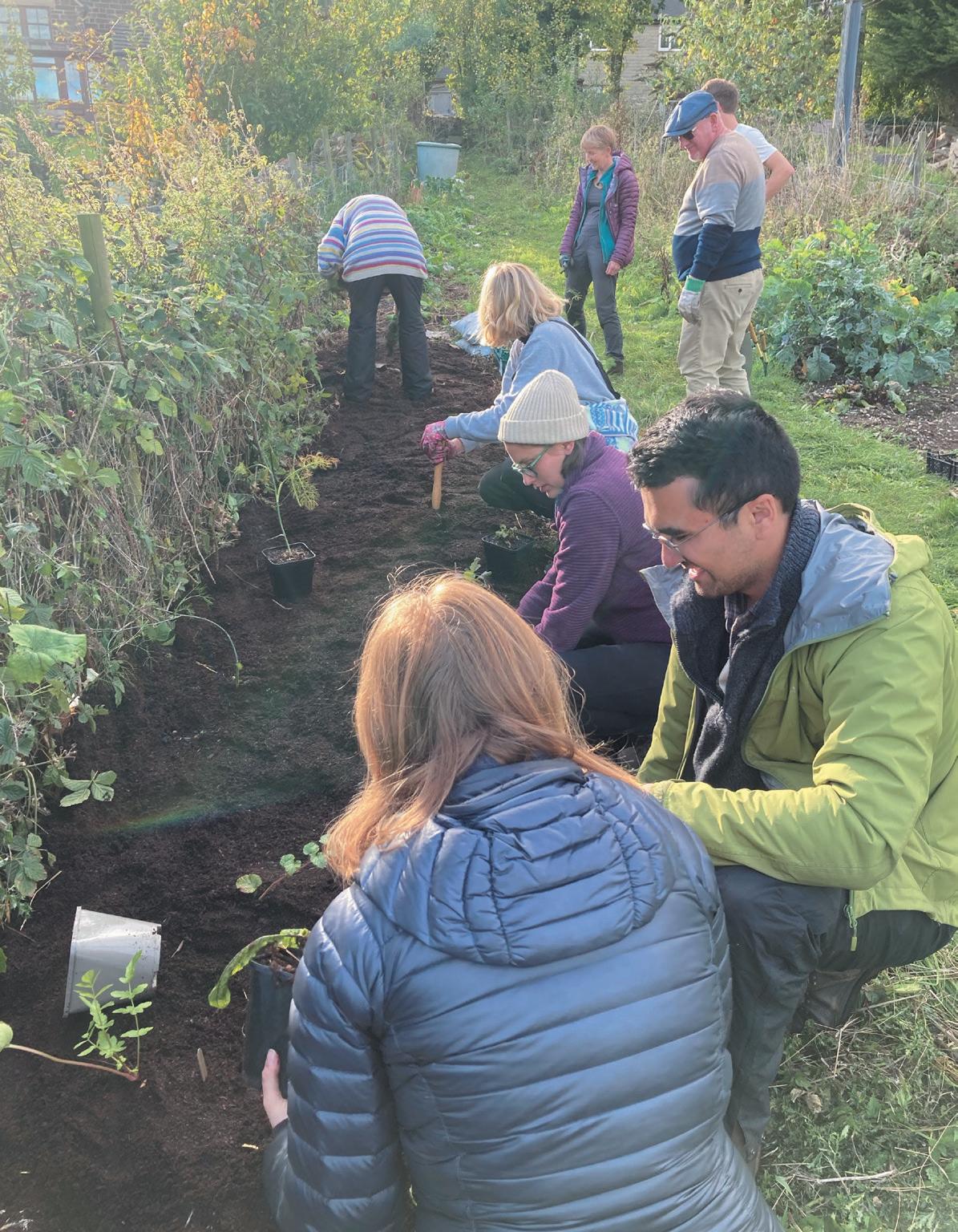
65 Reflections May 2024 Visit our website at www.reflections-magazine.com GARDENS
an organic gardener’s best friend as it can be cut and used to make plant feed. It’s also known as ‘knit bone’ as the chemicals in it help to produce new cells so helps to heal fractures and fissures.”
Another use for plants is that of natural dyes, appealing to local artists. The leaves of the woad plant produce a natural blue dye, the roots of the madder plant make a red dye, whilst chamomile and perennial coreopsis produce yellows.
Earthed Up! sells a range of compost that is peat free, as well
as wood bark and sheep fleece, as the secret to a successful and resilient garden lies in the soil. Ryan says: “We need to feed our soil. With healthy soil, plants are much less likely to suffer from drought, pests – animals and insects – and diseases.”
With its ethos of sustainable, eco-friendly gardening, it is no surprise that Earthed Up! is a strictly peat-free zone using Melcourt peatfree compost, incorporating biochar, mixed with charcoal from a local woodland for all its potting compost.
With great importance given to soil health, Earthed Up! also makes its own bokashi, a more environmentally friendly form of compost. Ryan says: “There is no need to turn or water bokashi. Instead you just chuck stuff in and leave it, then after 12 weeks you have a usable product. Bokashi is fermented in a low oxygen environment with bacteria and yeast, effective micro-organisms that break down the organic matter. It differs to more traditional compost as it doesn’t reduce in volume, it provides great worm
OPEN GARDENS –AND AN NGS SHOW GARDEN AT CHELSEA!
MAY is probably the most beautiful month in the garden, and if you’re interested in gardens you may well follow the coverage of this year’s Chelsea Flower Show (May 21-25), writes Tracy Reid. For the second time only in its history, the National Garden Scheme (NGS) will have a show garden at the prestigious Chelsea Flower Show, sponsored by ‘Project Giving Back’. The garden designer is Tom Stuart-Smith who, as many of you will know, has been developing areas of the garden at Chatsworth House. There will be a second Derbyshire connection in that some of the plants for the Chelsea garden have been provided by Griselda
Kerr of ‘The Dower House’ in Melbourne, who opens her own garden for the NGS. George Plumptre, chief executive of the National Garden Scheme, says: “We very much hope that our presence at RHS Chelsea Flower Show and our show garden will inspire more people to visit our open gardens in 2024.”
If you are inspired to visit some Derbyshire gardens in May, then a perfect example of a beautiful garden which has opened its gates for many years is Moorfields, Temple Normanton, which will be open on Sunday 26th and Monday 27th of May (1-5pm each day). It actually has two adjoining gardens, each planted

food, and its distinctive smell isn’t as attractive to rats.”
He adds: “With traditional compost, the manure, clippings and cuttings are watered, heated and turned. Half of the volume is lost as the air space collapses and nitrates are released into the atmosphere.”
The team at Earthed Up! are keen to share their skills and knowledge with others. They run soil health clubs, composting courses and teach permaculture, forest gardening and plant propagation. Most of the courses take place at its

Above: The garden at Moorfields, Temple Normanton, is open on May 26 and 27.
for seasonal colour, which during the late spring and early summer feature perennials including alliums, lupins, camassia and bearded irises. The larger garden has mature, mixed beds and borders, a gravel garden to the front, a small wildflower area, large wildlife pond, orchard, soft fruit beds and vegetable garden. Admission is £4, children admitted free. There’ll be refreshments and plants for sale too.
Another NGS Open Garden is at 2 Haddon View, Stanton in Peak, on May 18 and 19, from 12.30-4.30pm each day. The garden is at the top of the hill in the village and there are, of course, lovely views.
You will see gorgeous rhododendrons with red, white, pink and yellow blooms, and spring flowers including marsh marigolds and dog’s tooth violets. Newts and frogs will be swimming in the ponds, cacti will be flowering in the greenhouse, and patio pots will be full of all sorts of plants. You’ll even find a palm tree in the front garden!
Entry to the garden is just £4, with children admitted free. You can enjoy delicious homemade cakes, and a drink of tea or coffee.
Details of all the NGS Open Gardens to visit are on the website at www.ngs.org.uk
Left: The garden at 2, Haddon View, Stanton in Peak, is open on May 18 and 19.
66 Reflections May 2024 To advertise call 01246 550488
GARDENS
Belper site but the cooperative has recently been awarded grant funding from Central England Coop, enabling it to take their soil health club on the road to schools, garden groups, U3A and wildlife groups. For those too busy to garden, Earthed Up! also offers a garden maintenance service to individuals.
Earthed Up! began its journey inspired by Cool Temperate nursery near Nottingham. When the nursery was due to close due to retirement, Ryan and three other founding members decided to start their own. They wanted to offer healthy, edible and useful perennial plants – many of which were the more unusual varieties –and gardening according to permaculture principles.
The greatest barrier to starting the cooperative was finding a plot of land, which involved going from door to door asking if there was any land to rent. Earthed Up! then
sought loans from individuals and began by selling its peatfree compost, attending fairs and giving talks, while working hard to establish the nursery. While Earthed Up! works on a small scale, it gardens with a global vision. Ryan says: “People need to grow more of their own climateresilient food plants. There are massive methane risks in the Arctic and there are floods, droughts and wildfires. By 2030 the equatorial belt will be uninhabitable. By growing our own food, it puts less pressure on systems further away. We need to ask how ethical our food from the supermarket will be when it’s not coming from Europe and Asia, but from North and East Africa that is not growing sufficient food for its own populations.”
Ryan graduated with a degree in Film and Television Production before working as Strategic Communications Coordinator for eight years, organising events


and telling the story of the permaculture network. His enthusiasm for gardening stems from his love of food. He says: “I like quality food that you can grow yourself. My mum was not so keen on cooking, so I was happy to help in the kitchen in my teenage years. I’m diabetic, so I have to be conscious of food and when I had chronic fatigue after glandular fever, I went for walks and foraged and then would make something nutritious.”
He then volunteered at York Unifying Multicultural Initiative’s garden every weekend, which he found
Above: The small garden at Belper Lane End last midsummer.
to be a perfect way to learn. Ryan says: “As part of the project, we were growing food plants from around the world to unify multiple countries through food and gardening.” There, Ryan was introduced to edible plants he hadn’t come across before including leaf amaranth and huauzontle. Editor’s note: Earthed Up! is open at Belper Lane End, DE56 2DL on Tuesdays and Fridays 9.30am-12.30pm and Saturdays 10am-12noon.

67 Reflections May 2024 Visit our website at www.reflections-magazine.com GARDENS
PUBLISHING YOUR FIRST BOOK: A STEP-BY-STEP APPROACH FOR 2024
MANY include becoming an author on their bucket lists, but their hopes get squashed by how difficult it seems. Researching, telling a story, and conveying ideas seem like a challenge in its own right. But, once the book is written, how and where do you find a publisher. Self-publishing can be hugely rewarding. The author retains ultimate control of every step of the publishing process in a way that couldn’t be achieved with a traditional publisher. Choosing a trusted and experienced publishing house presents the perfect opportunity to combine autonomy as an author with publisher expertise. North Derbyshire-based, Bannister Publications, is a highly regarded regional publishing institution. There are many reasons why they’ve become the publishing partner of choice for local authors: Local network: 30-year experience of publishing has enabled strong and longstanding local connections to be built Reputation: as the publishers of Derbyshire’s largest circulation
lifestyle magazine Reflections, Bannister Publications offers a well-established platform that can help to promote the book.
Breadth of experience: a comprehensive portfolio of writers, authors, photographers, artists, and others, all with varying levels of experience, have been supported in getting their work published in a professional manner, in a variety of finished book forms.
Personal service: displaying all the hallmarks of a highly reputable familyrun business, Bannister Publications prides itself on offering a friendly and attentive service. From initial discussions to the final printing of the book, Robert Bannister, guides authors along their journey every step of the way.
Quality: the editing and design services are unrivalled locally, and the printers, who are used, serve the UK’s major publishing houses.
Value for money: Runs of small books at comparatively low prices are easily attainable – as are longer run bigger and more intricate publications.

The first step to publishing a book starts here…
Bannister Publications Limited Office 2A Market Hall Market Hall Chesterfield Derbyshire, S40 1AR hello@bannisterpublications.com T: 01246 550488

68 Reflections May 2024 To advertise call 01246 550488
PUBLISHING SERVICES


69 Reflections May 2024 Visit our website at www.reflections-magazine.com
A watery twitchers’ hide!
KEN Parker, of Matlock, says of his picture, taken in March: “This wildlife hide at Carsington Water was obviously sited without considering where the water level could reach! The anglers in the boat carried on fishing regardless!”
Ken’s image was one of many superb entries to our 2024 ‘Derbyshire’s Lovely Landscapes’ photo competition this month – and we have plenty more to show you!
Next, a stunning tor on Baslow Edge captured on a frosty morning in April by Russ Teale, of Newbold.
Looks like a watery Hole 10 at the old Renishaw Park Golf Club, pictured by Ian Moorcroft, of Hollingwood.
A lovely shot of Edensor next, taken by Brian Smith, of Upper Newbold.


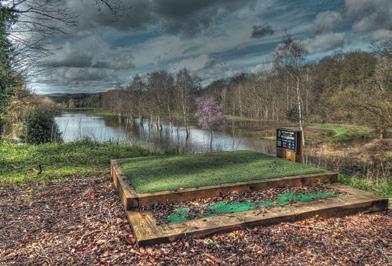

K.P I.M B.S R.T 70 Reflections May 2024 To advertise call 01246 550488
PICTURE COMPETITION


Here’s an image looking towards High Tor over the houses in Starkholmes, taken on April 16 by Becky Hill, of Matlock, who says: “A storm had just passed, the sky cleared just as the sunset created the most spectacular orange glow.”
Next, Ladybower dam overflowing, seen through the artistic ironwork in late March, taken by Les Singleton, of Bakewell.
A picture next of Leawood Pump House, taken by Peter Keeble, of Matlock Bath, who says: “I thought the ‘Reflections’ image was pertinent for your magazine. Indeed it is, Peter!
Pauline Chapman, of Bakewell, who took this picture of a rainbow, says: “There was some relief from the rain in early April!”
Next, a March shot near Castleton, taken by Lisa Hands, of Sheffield, who says: “I was walking along Buxton Road towards Winnats Pass, and these hills are to the left.”
And here’s Baslow Church at sunrise, taken in April by Ian Moorcroft, of Hollingwood.


71 Reflections May 2024 Visit our website at www.reflections-magazine.com
L.S P.C L.H I.M P.K PICTURE COMPETITION
B.H
PICTURE COMPETITION
Lisa Hands, of Sheffield, took this image of Riber Castle, from High Tor.
Next, a very cold and misty Stanton Moor taken by Ian Moorcroft, of Hollingwood.
Here’s beautiful Wolfescote Dale, pictured by Russ Teale, of Newbold.
FInally, it’s a double rainbow over Somersall, taken on Good Friday, March 30, by Kathleen Moore of Chesterfield.
The picture(s) you send in for the ‘Lovely Landscapes’ competition must be taken in 2024 and must be in Derbyshire. You can enter as many times as you like. We want entries from amateur snappers and not commercial photographers; and drone images will not be accepted.
Please email your entries to barrief@ bannisterpublications. co.uk, giving your full name and address, a contact telephone number and a description (including the date it was taken) of the image, which should be attached as a high-res jpeg.
The winner will receive a meal for two at a top local restaurant, plus the chance to have a selection of their images published in Reflections.
The closing deadline for entries is noon on October 16, 2024.


I.M 72 Reflections May 2024 To advertise call 01246 550488
L.H
R.T
K.M

Artificial intelligence: friend or foe?
With every day that passes, artificial intelligence (AI) is radically changing more areas of society, from medicine and business to politics, learning and beyond. Keeping pace with its capabilities and learning how we might safely use it in our everyday lives need careful consideration, as Rebecca Erskine explores.
MOST of us are already using AI to some extent, even if we do not realise it. We no longer rely on well-thumbed road atlases to get us from A to B. Instead, we put our trust in GPS navigation systems, which find the best route based on real-time traffic conditions. We use voice searches like Google Alexa for the latest weather report, cricket score or to play a certain song. We tolerate the initial responses generated on the Live Chat of our bank’s website as we wait for a human agent to become available. For the most part, we understand that these AI shortcuts make our lives easier and can forgive the odd anomaly in results or responses, however infuriating they may be.
One of the earliest definitions of AI can be traced back to 1955. The man considered the father of AI, emeritus Stanford
Applications of Artificial intelligence

Professor John McCarthy, referred to it as ‘the science and engineering of making intelligent machines’. More recently, IBM
defined it as ‘the technology that enables computers and machines to simulate human intelligence and problem-solving’.
Particularly over the last two years, AI progress has taken place at such a rate that the policy and legislation needed to protect us all have struggled to keep pace.


The launch of Open AI’s ChatGPT (Chat Generative Pre-Trained Transformer) in November 2022 signalled a seismic shift in our understanding of what is possible. Within two months of launch, this chatbot technology, designed to process our natural human language and generate an appropriate response, had attracted some 100 million users. Even the free version of ChatGPT now offers results that many would consider adequate. Its uses are pretty universal.
Posing the question, ‘What are the most asked questions on ChatGPT?’ generated a list of varied responses including general enquiries about ChatGPT, help with homework and assignments, and seeking advice on personal issues such as relationships, career decisions and health concerns. An encyclopaedia, Google search, study aid and agony aunt all rolled into one, it would seem!
The ChatGPT technology can produce a response within a matter of seconds. It is able to do so because it has been trained on the most appropriate responses from
FEATURE 74 Reflections May 2024 To advertise call 01246 550488
Above: AI is being used to produce more detailed, higherresolutions maps of the Peak District National Park.

an extensive body of text from a wealth of sources including books, news articles and scientific journals. (It is an approach that has proved controversial, with the New York Times leading the charge that using source material in this way is an infringement of copyright. The outcome of its lawsuit against OpenAI and its main financial backer Microsoft is much awaited.)

Its wide breadth of capabilities makes ChatGPT an attractive tool for businesses forever seeking to increase production and reduce costs.
The report1 ‘Redefining Intelligence: The Growth of AI Among Small Firms’, published by the FSB (Federation of Small Businesses) in March 2024, aimed to gain an understanding of AI by conducting a survey
of its members. Some 55% of those surveyed recognised AI’s benefits, with 20% having already used it and many registering their apprehension, not just in terms of lacking the knowledge to use it appropriately but in how to manage security risks and protect intellectual property. The establishment of the UK’s first research institute to focus on the safety of autonomous systems, the Institute for Safe Autonomy2 at the University of York, seeks to address these fears.
Concerns aside, there is little doubt that the meteoric rise of AI means we are living through very exciting times. Perhaps one of the most welcome developments is in the application of AI in our resourcestrapped national health and care system.
There are countless examples.
AI has the capability to analyse huge amounts of patient data, quickly identifying trends in a fraction of the time it would take a human team. Its accuracy rates are equally as impressive. Research published in The Lancet Oncology in August 2023 found AI-supported mammogram reading3 can detect 20% more cancers than the standard double reading by two radiologists.
AI has also found application in many other diseases. In October, Chesterfield Royal Hospital NHS Foundation Trust was announced as one of 64 NHS hospitals in England to receive a Government investment of £21 million in AI technology to accelerate the diagnosis and treatment of lung cancer.
AI is also being used by The Royal to diagnose strokes through the use of
FEATURE 75 Reflections May 2024 Visit our website at www.reflections-magazine.com
Above: Chesterfield Royal Hospital is currently trialling the “Kheiron Mia” breast screening AI diagnostic service.
a “RapidAI” solution. Colonic polyps are being identified too using CAD (or Commuter Aided diagnosis) technology which combines elements of AI and computer vision with radiological and pathology image processing.
And The Royal is also trialling AI breast screening, along with other hospitals.
The care sector has seen developments, too, with ‘care bots’, designed to help people with everyday activities such as getting dressed and fed, thereby tackling the shortage of care workers.
There is certainly a compelling case for using AI when it comes to replacing highly labour-intensive processes, as the Peak District National Park can testify. Scientists, planners, policy-makers and land managers rely on land cover maps for measuring and monitoring the state of natural landscapes, whether they consist of moorland, grassland or woodland. These maps are typically created from aerial photographs of habitats and species and are a critical tool in informing landscape ecology, climate change mitigation and conservation work. Producing the maps has, historically, been both expensive and pain-staking. The last time a detailed land cover census for National Parks was carried out, in 1991, it involved interpreting aerial
photography from the early 1970s and late 1980s. Mapping all UK National Parks took a research team nearly four years.
Through a partnership between the Peak District National Park, Cranfield University and the Alan Turing Institute4, deep-learning AI is being deployed to expertly label natural photography and create more detailed, higher-resolution maps. The process is truly transformative and can be completed within a day.
The capabilities of AI mean it can achieve great things. It can significantly improve medical diagnoses and therefore outcomes, take on simple tasks that free up humans for other activities, help look after the vulnerable, and analyse data at lightning pace.
It also has a darker side, with social media already awash with deepfake images of world leaders and celebrities, and cases of fake voice messages of loved ones, seemingly in danger, extorting money from family members.
To end on a lighter note, AI is still lacking when it comes to the nuances of human interaction. In an email to a colleague recently, I commented on a momentary lapse in concentration and wryly wrote, ‘Taxi for Rebecca’ (a more modern-alternative perhaps to ‘I may as well pack up and go’). ‘Would
you like to book a flight?’ was AI’s generated response. Perhaps British irony will prove the biggest match yet for machine learning… Editor’s Note: AI is one of many topics that businesses in Chesterfield, North East Derbyshire and the Derbyshire Dales can explore at Accelerator workshops, funded by the UK Government through the UK Shared Prosperity Fund and delivered by East Midlands Chamber bit.ly/AcceleratorEvents
1. Redefining Intelligence: The Growth of AI Among Small Firms: FSB report authored by Chris Russell, Senior Policy Manager and Emelia Quist, Head of Policy Research https://www.fsb.org.uk/ resource-report/redefining-intelligence.html
2. Institute for Safe Autonomy https:// www.york.ac.uk/safe-autonomy
3 Artificial intelligence-supported screen reading versus standard double reading in the Mammography Screening with Artificial Intelligence trial (MASAI): a clinical safety analysis of a randomised, controlled, noninferiority, single-blinded, screening accuracy study https://www.thelancet.com/journals/ lanonc/article/PIIS1470-2045(23)00298-X/abstract
4. https://www.peakdistrict.gov.uk/learningabout/news/current-news/peak-districtnational-park-pioneers-using-artificialintelligence-to-monitor-the-landscape

76 Reflections May 2024 To advertise call 01246 550488
FEATURE


FOOD FOR THOUGHT…
We are what we eat…or is it that simple? Fiona Stubbs discovers that how we eat can be just as important as the food on our plates for our mental and physical health.
EMILY Woodward and Sian Spencer-Bray are chatting over a healthy brunch. It’s a favourite way to catch up for the self-confessed foodies and longterm friends… though now a new line of conversation is being brought to the table.
Emily, a registered nutritional therapist, and Sian, a registered psychotherapist, are combining their expertise to highlight the benefits of mindful eating to a wider audience. They are working together on a mindful eating programme with the aim of running workshops at Derbyshire community venues, in workplaces and online.
It’s a natural symbiosis, as Sian explains: “If you’re not feeling well, you don’t eat well. If you’re not eating well, you don’t feel well.”
Mindful eating is an approach to food that focuses on being fully ‘present’ when you’re eating, without distractions. It
increases awareness of thoughts, senses and feelings during and after you eat – including being aware of hunger and when you’re full.
Studies have suggested it can promote a healthier relationship with food, regulating appetite and emotional eating, aiding digestion and increasing the appreciation and enjoyment of food.
Emily introduces people to mindful eating through her business, Pinnacle Nutrition, and also through her work with Thrive Tribe, delivering the NHS England initiative, Healthier You Diabetes Prevention Programme, across Derbyshire.
their own needs. We often prioritise being a parent, partner or carer – or our career – over our health. Mindfulness is allowing people to take some time to focus on themselves and on what they need to do, whether for their diet, their mental health or physical health.
“A big part of mindfulness is getting people to slow down and recognise their own needs.”
She says: “A big part of mindfulness is getting people to slow down and recognise
“A lot of my clients have long-term gastro-intestinal issues and we work holistically, one-to-one, looking at what’s going on for the individual as a whole. I’m also able to reach people in group settings and help them to think about nutrition. We cover mindful eating in the NHS programme as there is evidence to show how effective it can be.”
She adds: “We all face a lot of pressures. We often eat on the go, when distracted. We still don’t fully understand the role of convenience foods,
80 Reflections May 2024 To advertise call 01246 550488 FOCUS ON FOOD & DRINK
Emily Woodward and Sian SpencerBray ready to enjoy a meal. Picture by Fiona Stubbs.

FOCUS ON FOOD & DRINK
though there are more and more of them and we are more reliant on them. What it means in the long term is still unknown.
“A key element of my work is to encourage clients to eat more slowly and chew properly. We look at the process of enjoying food. How does it smell? What does it look like? What does it taste like? The digestive system starts before you eat the food.
“When we slow down, we are more tuned into our bodies, we become more aware of when we’re full or satisfied, which can be helpful for some people. Nutritional therapy can feel like a privilege but there’s a lot of work to be done in the community to help individuals and families to understand what good nutrition looks like.”
Emily speaks from experience, having overcome her own health problems before training in nutritional therapy. She explains: “In my 20s, I had issues with gut health and irritable bowel syndrome. I muddled through for a while but it was very restrictive – socially and psychologically – and I realised I couldn’t live like that.
“I started doing my own research and became fascinated. I changed my diet and my health improved. I turned my own health around by being more aware of my relationship with food and taking steps to understand it better.
“Through your late teens and 20s, you think you’re invincible – and I think it catches up with us. As you get older, you become more aware of self-preservation.”
Food is very much at the heart of Emily and Sian’s friendship… which began as 11-year-olds when they sat next to each other on their first day of secondary school in Tibshelf.
“We instantly hit it off,” recalls

Sian. “And 26 years later, we’re still friends! We both love food and most of our meet-ups revolve around it.”
Emily adds: “For us, eating a meal together is about enjoying good conversation, making memories. And, through mindful eating, we are helping other people to rekindle their love of food.”
Sian’s interest in psychology began when she studied it in sixth form. “I’m fascinated by human beings – the human brain, why we do what we do, the way we think,” she says.
After graduating in Psychology from the University of Chester, Sian went on to train in Cognitive Behavioural Therapy (CBT) and psycho-sexual therapy. She has been involved in mental health for 16 years and worked in the NHS for 10 years.
Sian launched her own Therapy & Lifestyle Clinic (TLC) – based at Ashgate Manor medical practice in

Chesterfield – two-and-a-half years ago. “I wanted to open up access to credible psychotherapies,” she says. “I offer evidence-based, client-centred therapies with highly qualified psychotherapists.
“There is enormous need just now – we’ve seen over 600 people since we opened. We treat so many different conditions – we see all the stresses and strains of life. We work with young people from the age of eight and have counsellors who work in schools.
“One of the things we’ve noticed is that a lot of young people are struggling more with self-esteem and social anxiety than with the pressures of school life and achievement, which were previously most prevalent. Lockdowns might have had an effect but so could the impact of social media and the comparisons – over appearance and other factors – that come with that.
“We see similar self-esteem and social anxiety issues in adults – and that also infiltrates into relationships. We often work with people with depression, OCD and general anxiety disorders.
“Mindfulness can help us to be present in a very busy world. We’re constantly predicting what we should do and analysing what we’ve done. Thinking, ruminating. Mindfulness brings us into the now. It helps us to be calmer, slowing down the racing thoughts. The impact of mindfulness is huge when it comes to mental health and wellbeing.”
Both Sian and Emily are keen to bring a greater awareness of mental and physical health into workplaces.
Sian says: “Work is one of the places you’re likely to eat at your desk or grab something on the go. Yet this is so unhealthy for the digestion and your mental wellbeing.”
Emily adds: “We need a cultural change. It’s not enough for companies to simply say employees should take 30 minutes for lunch, even though they may not have the time to take a break. Organisations need to take responsibility for their employees’ wellbeing, not least because poor health means lost work days and reduced productivity.”
Meanwhile, Sian and Emily are practising what they preach and savouring the opportunity to combine their talents. “It’s very enjoyable being able to work with a friend,” say Sian. “We share the same goals in terms of wanting to help people and the same ethics in terms of how we work. And, of course, we always have plenty to talk about – usually over food!”
Pinnacle Nutrition –www.pinnaclenutrition.co.uk Therapy & Lifestyle Clinic –www.therapylifestyleclinic.co.uk
For more details about the NHS Diabetes Prevention Programme, visit https://healthieryou.org.uk
82 Reflections May 2024 To advertise call 01246 550488


AA SENSATIONAL dish –
Sea Trout Ceviche, served with pink grapefruit, chilli, herb dressing and Nyetimber jelly – is our Recipe of the Month, kindly sent by Lee Smith, head chef at Lovage Restaurant, Bakewell. Nyetimber Vineyard in West Sussex has been producing great sparkling wine since 1988.
INGREDIENTS
SEA TROUT CEVICHE SERVES 4

400g piece of sea trout fillet, skinned and pin boned
2 x pink grapefruits, segmented
CHILLI DRESSING:
Juice of 1⁄2 an orange
Juice of 1⁄2 lemon
Juice of 1⁄2 lime
Juice of 1⁄2 pink grapefruit
1 chilli, deseeded and finely chopped
2 tablespoons coriander, chopped
75ml of extra virgin olive oil
HERB OIL:
200grams mixed soft green herbs, chopped 200ml vegetable oil
BRINE:
2litres water 200g Salt
NYETIMBER JELLY:
500ml Nyetimber sparkling cuvee (or any sparkling or white wine)
Peel of 1 pink grapefruit (blanched and refreshed three times)
4.5grams Agar Agar
125grams sugar
METHOD:
Brine: Bring water and salt to boil. Chill. Once chilled, place trout into brine and refrigerate for 25 minutes – rinse trout with cold water. Set aside on a clean tea towel.
Chilli Dressing: Mix all ingredients in a bowl and leave to one side.
Nyetimber Jelly: Add pink grapefruit skin to Nyetimber. Leave to marinate for three hours – remove peel from Nyetimber. Add Nyetimber, Agar Agar and sugar in a pan. Bring to a boil – stir continuously for 2 minutes. Pour into Tupperware container that’s one centimetre deep – refrigerate for one hour to set.
Herb Oil: Heat oil in a pan to 60 degrees.
Blend together hot oil and herbs – then strain through a fine sieve and refrigerate until required.
TO SERVE:
Slice trout against the grain (widthways) into 0.5cm thick pieces (each portion per person should be approximately 80 grams).
Place trout in a mixing bowl and stir over 8 tablespoons of chilli dressing; then add one tablespoon of herb oil. Season with salt and pepper. Combine together to coat the trout and marinate for a further five minutes.
Portion onto plate; then spoon over left-over chilli dressing. To each plate, add four pink grapefruit segments and four half-teaspoons of Nyetimber jelly. Enjoy with a chilled glass of Nyetimber.
84 Reflections May 2024 To advertise call 01246 550488 RECIPE OF THE MONTH


INSPIRING VIEWS FROM HIGH ABOVE
Winnats Pass

Chris Drabble (pictured) is a writer and photographer who has found that the southern edge of Winnats Pass provides great opportunities for landscape photography and also possesses inspiring views.
I’VE parked at the National Trust car park at Mam Nick, then pick up the tree-lined footpath that heads north-east towards Mam Tor. Upon clearing the trees, I take the first right turn, heading due south and walk downhill to reach the Chapel-en-le-Frith road and cross through at the gates. I’m now crossing the moorland on a well-laid footpath that takes me past Windy Knoll to reach the intersection at the Sparrowpit road.
On the opposite side of the road is a newly-erected wooden gate that leads out onto fields and I’m now following a diagonal, trace path across a field of sheep that leads to a wide gap between two gate posts in the wall ahead. A short walk from here reveals another new wooden gate in the drystone wall that allows entry onto ‘open access land’. Through the gate, I turn right and I’m now walking along the steep-sided southern edge of Winnats Pass on a rough path that meanders over gently undulating ground. My destination is a limestone
tower that is often referred to as the Devil’s Chimney.
I’ve reached it now and, after scouting for a fine composition, I set up the camera and tripod and take some initial photos.
THE DEVIL’S CHIMNEY:
The light fades momentarily as passing clouds defuse the morning sun and as I wait for the light to return, I find a perch amongst the limestone crags and try to absorb the atmosphere of this wonderful location.
I suddenly notice a kestrel hovering beneath me. It soars on thermals and rises to eye level and, for a brief moment, it seems to be almost within touching distance. It hangs in the air and then, suddenly, it dips only to rise again and reappear a little further along the edge. It’s a moment of wonder as I marvel at this bird’s acrobatic skill.
The sound of distant voices drifting up from two cyclists who are pressing hard to gain momentum on the steep
incline and then the purr of a car engine indicates activity on the road far below.
Having followed the kestrel for a while, I then look up to take in the wider view. And what a superb view it is!
Looking across and up the valley, the best of the views lie to the north, east and west.
To the north/west, the Iron and Bronze Age hill fort of Mam Tor is the most prominent feature with its great landslip and its defensive embankments.
Lords Seat and Rushup Edge run west along the ridge beyond.
Below and on the opposite flank of the gorge are the steep limestone arêtes of Matterhorn Ridge and Elbow Ridge that rise vertically from the roadside to just below the summit ridge.
ELBOW RIDGE:
To the north/east is the Peakland Ridge (also known as the Great Ridge) which extends from Mam Tor until its conclusion at Lose Hill, and in the east the pike of Win Hill can be seen breaking the horizon.
OUT & ABOUT 86 Reflections May 2024 To advertise call 01246 550488
The Devil’s Chimney.

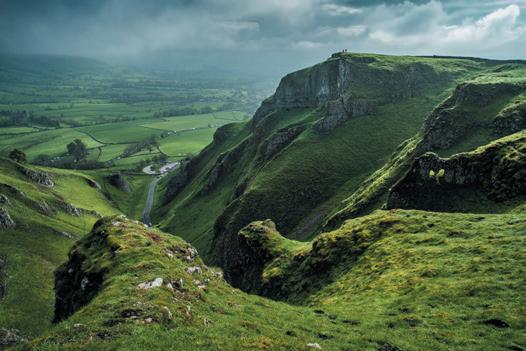
TOWARDS CASTLETON:
It’s time to go, but I’m reluctant to leave this idyllic spot. I have enjoyed the time I’ve had at Winnats Pass and as always, I think that I have enjoyed the solitude as much as the photography.
I’ll definitely come back to this southern edge of Winnats Pass and I wouldn’t hesitate to recommend this wonderful spot with its superb views to anyone.
Top: Elbow Ridge and Matterhorn Ridge in dawn light.
Above: Looking along the edge towards Castleton.
Below: Cloud shadows over Winnats Pass, with Mam Tor top right.
Editor’s Note: More of Chris Drabble’s photography can be found at Photo4me, Alamy and 500PX.


OUT & ABOUT 87 Reflections May 2024 Visit our website at www.reflections-magazine.com
ENJOY COFFEE, CAKE AND LOTS OF CREATIVITY!
Enjoy coffee, cake and creativity… Dawn Anderson explores what is on offer at this year’s Derbyshire Open Arts.

Left: llustrator
William Vaudin is among many artists exhibiting their work at Holymoorside Village Hall from May 25-27.
IF you are struggling for something to do over the second bank holiday in May (Saturday 25th to Monday 27th May) and have an interest in art (or just a yearning for a nice piece of cake in the company of lovely people), then you are in for a treat!
If you haven’t heard of this event before, it involves over 200 artists who either open their studio doors to show you their work, or groups of artists exhibit at a local venue. It is completely free to visit

and usually happens between 10am and 4pm each day. With over 60 venues, there is bound to be one near you!
You can go on the event’s website to plan your own art trail, using the interactive map.
What is so great about the event is that it showcases such a breadth of different art, including sculpture, ceramics, illustration, photography, jewellers and many

Richard Whittlestone, who has a gallery at Pilsley, has just finished work on a painting for the UK Wild Otter Trust. He is donating the painting for the Trust’s funds and it will be part of the charity’s auction later this year. Check out more of Richard’s work at www.richardwhittlestone.co.uk
SPOTLIGHT ON THE ARTS 88 Reflections May 2024 To advertise call 01246 550488
ARTIST

more, with the intention of inspiring budding artists as well as allowing artists to promote their work. You could even purchase your own special piece of art to take home with you.
The annual event began almost 20 years ago, started by an enterprising Derbyshire Arts Development officer and continued by a sturdy committee of volunteers, who take time out from their busy creative lives to focus on bringing something special to the county of Derbyshire.
Sisters Jennie and Karen Merriman, both committee members, met with me recently to share their excitement about the forthcoming festival.
Jennie tells me what she loves about the event: “I have been involved since the beginning and really look forward to it each year. It is great to welcome visitors and talk to them about art and also to meet and talk to other artists. It has such a wide variety of arts, even including a cake decorator one year!” This year, Jennie has nine artists in her house and garden in Darley Dale.
Having visited the event before, I totally understand the excitement as it is such a rich array of talented artists – and amazing to think that there are so many on our doorstep. My
level of respect goes up a notch for the dedicated committee members (many of whom are well into their seventies) when I learn of the massive combined effort that is required to make the event a success.
“It is a massive undertaking,” says Jennie “and we all started as novices, having a lot to learn about marketing and distribution, but somehow it all comes together.”
Together they produce and distribute over 32,000 brochures, maintain a website, regularly provide social media updates and send out press releases; all of this done on goodwill and a tiny budget.
Despite the majority of the committee members being in the autumn of their lives, their enthusiasm is palpable and they welcome new younger members to join them. A love of art is the only pre-requisite. Karen Merriman, a non-artist, is currently the secretary on the committee. “I’d loved coming to the event for ages, and wanted to help out in some way. I was serving coffee and cake at Jennie’s for a couple of years, but then had a ‘promotion’ to secretary.” She laughs: “I really enjoy being more involved.”
One thing I learn is that the proceeds from selling refreshments at many of
Frances Daunt with her painting of a tiger.
ARTS AT THE FOLLY…
ARTS AT THE FOLLY is always a popular local event and 2024 sees it returning stronger than ever. The exhibition takes place at The Folly, Main Road, Lea (DE4 5GJ) on May 17, 18 and 19, with the artists present to chat about their work and techniques.
Light homemade refreshments are available (including gluten-free and vegan cakes) with any donations made for them going direct to Mid Derbyshire Badger Group.
The artists taking part this year are as follows:
Frances Daunt: animal artist who works in a variety of media. She will also have her very popular map art on show. www.francesdaunt.com
Kate Beinder: her pebble pictures make fantastic gifts and she will also be unveiling her new line of work. www.katebeinderart. wordpress.com/
the venues goes to local charities, including Ashgate Hospice, which just adds to its appeal for me. With so many artists involved and so many venues it is easy to see why it goes on for three days… and still not
Silver Silkie: Jane’s jewellery speciality is working with ancient techniques including Keum Boo – the Korean practice of fusing 24K gold to silver – and all of her jewellery is hand-made. www.silversilkie.co.uk/
Jenny Neale: a photography specialist, including intentional movement images and cyanotype prints. www. jennynealeimages.com/ Lynn Hazel: renowned British wildlife sculptor. http://www.lynnhazel.co.uk/
Jeanette Hallam: handcrafted paper flower displays.
Visitors are encouraged to also visit nearby Lea Gardens, which will be in full bloom.
Arts at The Folly, May 17-19, 10am – 4pm each day. Other times by appointment, contact francesdaunt@ btinternet. Also www.facebook. com/artsatthefolly
enough time to get around all of the venues or sample all of the home-made cakes! Pick up brochures from various venues in Derbyshire or check out the website –www.derbyshireopenarts. co.uk – to plan your visit.
89 Reflections May 2024 Visit our website at www.reflections-magazine.com SPOTLIGHT ON THE ARTS


Personalised Holidays TO INCREDIBLE DESTINATIONS
START EXPLORING WITH FIRST CLASS HOLIDAYS AND MARTINS WORLD TRAVEL !
FOR exciting itineraries, look no further than Martins World Travel. The itineraries are based on years of experience of what customers prefer. Every holiday is designed to match what customers want, so they can be used for inspiration. The talented team of holiday designers can craft a perfect holiday tailored to individual needs.
CANADA
There’s so much to see in Canada. From the breath-taking lakes and mountains of the west to the picturesque charm of the east. Holidays to Canada enable visitors to explore the stunning scenery of the world-famous Rockies; the vast prairie interior of Saskatchewan and Manitoba; the rolling hills of Ontario and the dramatic coastlines of Atlantic

Canada. Not forgetting the variety of wildlife that call Canada home! Contrast this with Alaska’s wild and untamed beauty; opportunity is available to discover the national parks, abundant wildlife, soaring glaciers, colourful culture, and historical towns.
SAMPLE HOLIDAY IDEAS… SELF-DRIVE AND INCLUSIVE TOURS:
TREASURES OF NOVA SCOTIA – SELF-DRIVE TOUR 14 DAYS FROM £2415 PP
This tour incorporates the breathtaking beauty of Nova Scotia’s rugged coastlines, picturesque lighthouses, vibrant fishing villages and pristine beaches. Guests can immerse themsleves in rich history, indulge in fresh seafood and experience warm maritime hospitality.
HIGHLIGHTS:
• Maritime Halifax
• Picturesque Peggy’s Cove

• Historic Lunenburg
• Drive the Cabot Trail
• Sherbrooke Village
• Flights from Heathrow.
HALIFAX & THE CELTIC TRAIL – SELF-DRIVE TOUR 8 DAYS FROM £1129 PP
Halifax offers a melting pot of history and culture. Heading north to Cape Breton Island, there’s a piece of Scotland in Canada with the region’s strong Celtic roots.
INCLUDES:
• Hotel accommodation including provincial taxes for 7 nights
• 7 days Car rental with unlimited mileage, zero excess and second driver fee.
• Flights from Heathrow
HIGHLIGHTS:
• Alexander Graham Bell
• Fort Anne
• Grand-Pré
• Halifax Citadel
• Fortress of Louisbourg
• Kejimkujik (Day Use only)
• Port-Royal
SPIRIT OF ONTARIO & GREAT LAKES –SELF-DRIVE TOUR 12 DAYS FROM £2419 PP
LOCAL BUSINESS 90 Reflections May 2024 To advertise call 01246 550488


Visit Canada’s most dynamic province, with its iconic cities and the capital, along with world-class attractions. From the urban energy of Toronto, visitors will travel to the world-famous Niagara Falls. Seeking adventure across rural Ontario, they’ll encounter Kitchener and the inspiring 30,000 Island region. The nation’s capital calls next, and distinct English and French cultures are uncovered. On the way back to Toronto, there’s the Thousand Islands region in all its beauty.Return flights from the UK
INCLUDES:
• 11 nights’ accommodation
• 9 days’ intermediate rental car, CDW, GPS and second driver fee
• Niagara Falls Adventure Pass including: White Water Walk, Journey Behind the Falls, Niagara Fury & WEGO bus transportation
• Toronto 24-hour hop-on / hopoff city tour and boat cruise
• Voyage to the Falls boat tour
with Niagara City Cruises
• Ottawa 24-hour hop-on / hop-off city tour
• 1000 Islands 1-hour boat cruise from Rockport
PASSAGE THROUGH THE ROCKIES – PREMIUM ESCORTED TOUR
12 DAYS FROM £5079 PP
CALGARY | BANFF | LAKE LOUISE
| ATHABASCA GLACIER | JASPER
| BLUE RIVER | VANCOUVER
| WHISTLER | VICTORIA & OPTIONAL ALASKA CRUISE WITH HOLLAND AMERICA
Visitors can discover the natural beauty of the Canadian Rockies and British Columbia; from the country’s first National Park and the delightful town of Banff to the spectacular scenery of the Icefields Parkway, glistening Lake Louise and the sparkling Athabasca Glacier.
HIGHLIGHTS:
• Visit the pretty alpine village of Whistler
• Ride the Banff Gondola for incredible views of the Canadian Rockies
• Visit Yamnuska Wolfdog Sanctuary
• Cruise through stunning scenery
CALL AND DISCUSS YOUR TRAVEL REQUIREMENTS WITH OUR FRIENDLY AND EXPERT TEAM ON: 01246 220020 or 01246 823763
Martins World Travel, 46 Knifesmithgate, Chesterfield, S40 1RQ T: 01246 220020
Martins World Travel, 25 Market Place, Bolsover, S44 6PN T: 01246 823763
martins-world-travel.co.uk www.1st4Cruises.co.uk

LOCAL BUSINESS 91 Reflections May 2024 All Featured holidays ATOL and ABTA Bonded.
Pushing for a national park for THE PEAK DISTRICT
The organisation which did more than most to establish a Peak District National Park is 100 years old this month, as Steve Brown reports.


ON May 7, 1924, a small group of men and women, passionate about preserving their beautiful local countryside from the many threats posed by housing and industrial developments, met for the first time in a leafy suburb of western Sheffield. They were some of Sheffield’s leading citizens, largely from academic and professional backgrounds, but united in their cause.
The meeting had been instigated by Mrs Ethel Gallimore, a young woman of means who was the widowed daughter of T.W.Ward,
the well-known Sheffield industrialist. She became, together with her future second husband Gerald Haythornthwaite, one of the leading lights within what started as The Sheffield Association for the Protection of Local Scenery and is now known as the Peak District and South Yorkshire Branch of The Council for the Protection of Rural England (CPRE).
From the very start, this became a model for local environmental organisations in England which came to have a wide impact on the conservation and preservation of some of
FEATURE 92 Reflections May 2024 To advertise call 01246 550488
Above: Sheffield City Council purchased the Longshaw estate – but it was as a result of public appeals by the Association, and generous donations by some of its members, that the funds were raised to repay the council, and the Longshaw property was handed over to the National Trust in 1931.

Above: Ethel Haythornthwaite was a leading light in the group set up a century ago to lobby for a Peak District National Park and a Sheffield Green Belt.
Left: There was a long debate about whether Dovedale should be in the Peak District National Park.
our best-loved landscapes. The Sheffield group’s lasting legacy will be their part in achieving their two “grand purposes”: namely the designation of a national park in the Peak District and the creation of a permanent Sheffield Green Belt.
Ethel and Gerald Haythorntwaite became a formidable partnership, she with the ability to persuade and influence and he with his grasp of technical detail over a wide range of disciplines. In the 1920s, many of the challenges faced by the countryside would be familiar today: car ownership and day tripping, inappropriate building developments, quarrying and litter – to name but a few – but planning legislation to control any of these was either lacking or rarely enforced.
Ethel and Gerald started a lobbying process to press for adequate protection which, over the years, grew and eventually manifested itself in the two “grand purposes” for which the society was created.
An earlier success, however, was the purchase of Longshaw Lodge and its grounds in September 1927. Sheffield City Council purchased the estate – but it was as a result of public appeals in which the Association took part, and generous donations by some of its members, that the funds were raised to repay the council, and the Longshaw property was

handed over to the National Trust in 1931 as their first countryside property in the Peak District.
Similar lobbying by the Association resulted in the purchase in 1933 of the extensive Blacka Moor near Fox House, which is now managed by the Sheffield and Rotherham Wildlife Trust.
Ethel and Gerald carried out the survey in 1936/7 which, despite very tight timescales for its completion, produced a first-ever map of a Green Belt for Sheffield, together with a list of recommendations which eventually led to their adoption in 1938 by the City Council.
However, this was just the beginning. In 1937, the CPRE began to start lobbying the government to move forward on the 1931 Report on the creation of National Parks. The Sheffield Association went one step further by resolving to map out such a park in the Peak District and to submit it to the government.
Despite the looming likelihood of war, Ethel pressed ahead regardless by inviting other local bodies such as CPRE branches, footpath societies and interested landowners to form a Joint Committee to push forward the idea of a Peak District National Park. Its first meeting was in January 1939 and Ethel was appointed Honorary Secretary.
With Gerald away on military duty, she continued to work tirelessly throughout the war years on the proposals for the

park, particularly the vexed question of whether areas such as Dovedale should or should not be included. In May 1944, the Joint Committee published its proposals, which outlined how significant the Peak District was in respect of its position so close to so many densely-populated areas and that how such vital areas should be protected from adverse development.
The Dower Report followed in April 1945, and such had been the impact of the 1944 Joint Committee report that Ethel was appointed to be a member of the Hobhouse Committee which was charged with taking forward the recommendations from John Dower. The path to the creation of the Peak National Park in 1951 was now clear and Ethel Haythornthwaite and the Sheffield Association had played a major part in this.
Despite successes in repelling such proposals as a steelworks in Edale and a road bypass
Top: Looking over Ladybower Reservoir from Bamford Edge. The CPRE campaigned hard to ensure there was large-scale landscaping around the new reservoir.
Above: Despite protests from the Sheffield Association, the cement works in the Hope Valley has a giant chimney.
for Bakewell, the Association hasn’t always had its own way – as evidenced by the giant chimney at the Hope Cement works and the building of a road up the Winnats Pass. However, their influence is evident in such examples as the large-scale landscaping of the Ladybower reservoir; and the use of local stone to construct the buildings surrounding the Holme Moss television mast near Holmfirth; and re-erection of the Derwent village packhorse bridge at Slippery Stones above Howden reservoir.
Times have changed, Ethel and Gerald have now gone but the Peak District and South Yorkshire Branch of the CPRE still continues. Changes within the Peak Park and the South Yorkshire countryside will continue to be monitored and challenged when needed and its legacy remains as a source of pride to its members, past and present.
FEATURE 93 Reflections May 2024 Visit our website at www.reflections-magazine.com
Remploy furniture now has real value at auction
By Vivienne Milburn FRICS Independent Antiques Auctioneer & Valuer
REMPLOY furniture was made by disabled workers to give them employment – and the products now have a collectable value.
There is designer retro furniture and then there is mass-produced retro furniture. Top auction prices are for furniture by designers such as Gordon Russell.
However, one of the most interesting developments at auction is for the furniture made by Remploy. In 1946, the doors of the first Remploy factory in Bridgend, south Wales, opened to welcome the company’s very first group of disabled workers.
The concept, conceived towards the end of World War Two, meant that Remploy was established by the then government to provide ‘sheltered employment’ – a term used to denote workplaces dedicated to employing disabled people in an environment ‘sheltered’ from the competitive pressures of the open market – on a previously unknown scale.
Prior to the war, such provision had been primarily by charitable groups, operating individual or small-scale networks of workshops.
Remploy was created alongside other elements of the Welfare

State such as the NHS as a pioneering attempt to provide a national scheme of ‘sheltered employment’, financially backed by the Treasury and thereby able to provide meaningful and productive work for all those who wanted to work but were considered too ‘severely disabled’ to be able to gain and keep employment.
With nothing like this attempted before, and with no clear plan to follow, it was up to the company itself to decide how best to provide useful employment for disabled people. It was decided that they should begin to open these factories in areas where there were known to be large numbers of potential employees. The first factory in Bridgend was followed by one in Salford and a further one in Birmingham. Remploy ended 1946 with four factories


Above: Two from a set of four Prince of Wales Investiture armchairs. The red plywood has upholstered seats and the Prince of Wales feathers embossed in gold to the backs. Designed by Lord Snowdon for the ceremony at Caernarvon Castle in 1969 and made by disabled workers at the Remploy factory in Bridgend, they made £2,860 in a recent specialist auction.
in operation, employing 160 men and 4 women. Further factories quickly followed as the company came under increasing pressure to open them across the country. By 1952, Remploy had more than ninety factories operating across the country. Rapid
expansion was not an easy task, however, as there was often a shortage of work to be done. In the aftermath of World War II, materials, equipment and large-scale production orders were in short supply. In order to reduce the amount of time employees spent waiting

ANTIQUES
94 Reflections May 2024 To advertise call 01246 550488
Above:
A Remploy retro teak sideboard, with three fitted drawers, over a central drop-down cocktail cabinet section flanked by cupboards. With its original label (inset left), it made £260 in a recent specialist auction.
for something to do, factory managers would do their best to find work. This could be making furniture, clothes, boxes, wheelchairs, artificial limbs, souvenirs and toys. When orders were available, the main production areas were woodworking, light engineering, bookbinding, cardboard box making, knitwear, surgical footwear and appliances, brush and broom making, leatherwork and printing.
The Bridgend factory became well known for making violins. Employees were taught how to make them by Mr Schlieps, an Estonian prisoner-of-war who had been brought to Britain from a refugee camp in Germany. The violins were made from pine wood taken from equipment used in the D-Day landings in Normandy. Lots of these violins were sold to school orchestras up and down the country.
The designs of the furniture produced tended to be in keeping with the modernist style at the time, what we now call retro furniture. The best-known items produced by Remploy are the chairs used for the Prince of Wales Investiture in 1969, which were designed by Lord Snowdon and appropriately made at Bridgend in Wales. Guests at the investiture were able to take their chairs home with them and therefore they regularly appear at auction. They usually make about £500 to £700 each, depending on condition.
As well as providing work, many factories had a lively social scene with clubs, sports and games. The Sheffield factory, for example, had a thriving archery club whose members were referred to as the ‘Remploy Robin Hoods’. Through such efforts, the factories developed important social and recreational opportunities for their employees. With the inclusion of disabled people in open employment becoming more common, the last Remploy factory was closed in 2013.

A year earlier, Chesterfield’s Remploy factory at Whittington Moor, which produced footwear, was closed down. About 70 employees lost their jobs, although some took on new jobs when the site was taken over by R Healthcare.
Remploy was a truly pioneering attempt to provide a national scheme of ‘sheltered employment’ and continued to shape the approach to disability employment provision in Britain. And it all began 78 years ago, with a handful of disabled workers entering a small factory in Bridgend.
Editor’s Note: If you have antiques and collectables and you would like to place your items in an appropriate specialist auction. It is worth getting the advice of an Independent Antiques Valuer to assess your items. For further information, please contact Vivienne on 01629 640210 or 07870 238788; or go to www.viviennemilburn. co.uk or email vivienne@ viviennemilburn.co.uk

ANTIQUES Have you discovered something valuable? To have your find valued and sold in a suitable auction, contact Vivienne on 01629 640210. 95 Reflections May 2024 Visit our website at www.reflections-magazine.com
Above: Three from a set of seven Remploy stacking chairs, with plywood backs and seats on tubular iron frames. Possessing an “industrial chic” look, the set of chairs made £220 in a recent auction.







MAY/JUNE 2024 ICON KEY Film Music Kids Live Dance Comedy Talk BOX OFFICE: 01246 345 222 www.chesterfieldtheatres.co.uk MAY 3 The Pitmen Poets 4 Discos for Grown-Ups 9 The Importance of Being Earnest 10 A Country Night in Nashville 21-23 Born to Dance 24 The Fleetwood Mac Legacy JUNE 1 Livewire: The AC/DC Show 6 Lost in Music BOX OFFICE: 01298 72190 www.buxtonoperahouse.org.uk MAY 2 Stuart Michael 3 RNCM Songsters (Pavilion Arts Centre) 3 Count Arthur Strong… And it’s Goodnight From Him 3 Buxton Buzz Comedy Club (Pavilion Arts Centre) 4 Julian Clary: Fistful of Clary 5 Titanic: The Musical (PG) (Pavilion Arts Centre) 5 An Audience with Aggers and Tuffers 5-6 Ghostbusters: Frozen Empire (12A) (Pavilion Arts Centre) 6 The Teachers’ Lounge (12A) (Pavilion Arts Centre) 8 John Bishop 9 What’s Love Got To Do With It 10 Looking For Me Friend (Pavilion Arts Centre) 11 Steve Steinman’s Love Hurts 11-12 Mothers’ Instinct (15) (Pavilion Arts Centre) 12 The Simon & Garfunkel Story 14 Frank Skinner 15 Simon Reeve 16-18 Ladies’ Day (Pavilion Arts Centre) 17 Tiny Dancer 18 Kenny Thomas 19 The Pitmen Poets (Pavilion Arts Centre) 21 Newton Faulkner 21 Back to Black (15) (Pavilion Arts Centre) 24 The Zombies 25 The Definitive Burt Bacharach Songbook 27 – June 1 Sister Act 31 Allie Bailey (Pavilion Arts Centre) JUNE 2 Jools Holland 4 Rumours of Fleetwood Mac BOX OFFICE: 0114 249 6000 www.sheffieldtheatres.co.uk MAY 7 Miles Jupp (Lyceum) 8-12 Mr Vegas World Seniors Snooker Championship (Crucible) 10 Frankie Boyle (Lyceum) 14-18 Cluedo 2: The Next Chapter (Lyceum) 17 Peter Hill Plays Bach (Playhouse) 18 Sheffield Jazz 50th Anniversary Concert (Crucible) 22-25 Madagascar The Musical (Lyceum) 30 Ruby Wax 31 Milkshake! Love on Holiday 31 Off Air On Stage with Jane and Fi (Crucible) JUNE 1 Uncanny: I Know What I Saw (Lyceum) BOX OFFICE: 0114 2 789 789 www.sheffieldcityhall.co.uk MAY 3 Jethro Tull 4 Day Fever 4 Killer Queen: A Tribute to Queen 8,9,10,11 Manor Operatic Society presents West Side Story 10,11,17,18,24,25,31 Last Laugh Comedy Club 12 Stranger Sings! 14 London Symphonic Rock Orchestra 15 Jon, Lucy & Friends 2nd Annual Comedy Night 16 Northern Soul Orchestra 17 Strictly The Professionals 18 The Halle 24 Lost in Music 26 Clinton Baptiste: Roller Ghoster! 31 Crossed Wires presents Jon Ronson JUNE 1 Crossed Wires presents Talk Arts with Corbin Shaw 1 Crossed Wires presents Elis James and John Robins 1 Crossed Wires presents Jamie Laing and Sophie Habboo 1 Crossed Wires presents Poppy Jay and Rubina Pabani 96 Reflections May 2024
May 28 Girls Aloud
SHEFFIELD ARENA
May 12 The Simon & Garfunkel Story
BUXTON OPERA HOUSE
May 12 Stranger Sings! To advertise call 01246 550488
SHEFFIELD CITY HALL
1

4 Victorian Weekend Celebrations at The Heights of Abraham. Immerse yourself in the world of yesteryear with living history actors and guides as we celebrate our Victorian heritage along with Benjamin Bryan, the owner of the Heights in 1854. Take underground and overground themed tours, and challenge your family to the delightful Victorian games. For more information, call (01629) 582365
4 Tideswell Food Festival. The festival, open from 10am-4pm, will see the streets of the village lined with food, with live music and street entertainment throughout the day. Arts and crafts in the Makers Market inside the village’s historic church. Entry is free. For more information, visit https://tideswellfoodfestival.co.uk
5-6 Belper Arts Trail. A record number of artists taking part – just over 170 – in 54 venues throughout the centre of Belper, including some exciting new venues to explore. There will be workshops taking place; demonstrations and a huge variety of art and craft to tempt you. For entertainment, there is the usual main stage on the Memorial Gardens courtesy of Ark Entertainment, plus busk stops around the town with the music provided by Sonic Music Services. The brilliant Quite Remarkable theatre company will be in The Ritz on both days with an hour-long show for children (and adults too!). Look out for belly dancing, film and some street entertainment. A fabulous two days out – all for just £5 for your wristband which will get you into all the venues, plus your complementary Arts Trail guide
7 Chesterfield and District Family History Society. Military expert Simon Fowler speaking on ‘Researching Your Military Ancestors’, both online and at St Thomas’ Centre, Brampton, at 7.30pm. Visitors welcome. For further details and to register, contact secretary@cadfhs.org
9-15 Tissington Well Dressing
ENTERTAINMENT
11 Dethick, Lea & Holloway Horticultural Society Spring Plant Sale. At the Florence Nightingale Memorial Hall, Yew Tree Hill, Holloway, DE4 5BD. There will be a good selection of plants for sale: bedding, hardy perennials, tender perennials, salad, herb and vegetable plants, and plants suitable for wildlife. There will also be cakes and preserves for sale. Entry is free, 10am-12noon.
11 North Derbyshire Cottage Garden Society Plant Sale. At Arkwright’s Mill, Cromford, starting at 11am. Pay by cash or card. Bring your own boxes.
11-12 National Mills Weekend. Saturday: 11.30am Hydro Power at Masson Mills. £5 booking required by email to info@massonmills. co.uk or phone 01629 581001
11-19 Chesterfield Area Walking Festival. Explore the highlights of the Chesterfield area on one of our many guided walks and with a vast range available there is something for everyone. There will be family walks so that the children can get involved, all the way up to the challenging Round Walk which boasts an impressive 34-mile route. Walks take place across the whole area including Bolsover and some of the stunning countryside in North East Derbyshire. Most walks will be free or are taking donations for great causes and all are led by a fully trained guide who knows the history, wildlife and the best countryside to walk through (as well as the best pubs to visit). All walks must be booked in advance
11-18 Great Longstone Flower Festival. The theme this year is ‘Children’s TV Programme from a Bygone Era’. Refreshments will be available in the Village Hall, a short distance from the Church. Opening times are 10am-5pm each day, except for Sunday 12: 1pm to 5pm
12-14 Chatsworth International Horse Trials. Join us and enjoy world-class competition, from elegant dressage and exciting show jumping to gripping cross country. The event offers a range of entertainment and activities for the whole family including have-a-go dog agility plus a family fun dog show. Browse our shopping village with over 100 highquality trade stands including a choice of catering outlets. Dogs on leads are welcome, please do not leave dogs in cars. The house, garden, farmyard, and playground are open as usual during the horse trials. To book, visit: www.chatsworth.org
16-18 Barrow Hill Rail Ale Festival. Sample over 350 real ales – many brewed locally –plus craft beers, ciders, gin, prosecco and wine, all in the atmospheric surroundings of Britain’s last surviving operational roundhouse and enjoy live music. Three days of fantastic entertainment. Tickets for Rail Ale 2024 are now on sale. To book, visit: www.seetickets.com/tour/rail-ale-2024
18-24 Etwell Well Dressing
18 Chesterfield and District Family History Society. Annual Fair. ‘Who Do You Think
You Are theme: Everything Arkwright’. Displays, free talks, genealogy, help desk. Arkwright Centre, Hardwick Drive, Arkwright Town. 10am-4pm. Admission £2 20 Anniversary Celebrations at The Heights of Abraham. We’re celebrating that golden anniversary on this very special day. The estate’s restoration began on May 20, 1974 and so this day promises a delightful fusion of history and natural beauty, with fun activities for all. Live music, living history guided tours and new displays in the cable car station and Long View. May 20 marks the actual day that the Pugh family took over stewardship of the Heights 50 years ago
25-31
Middleton-by-Youlgrave Well Dressing 25-27 Brackenfield Well Dressing
25 - June 2 Ashford in the Water Well Dressing 25-27 Chatsworth Family Festival. Unleash creativity and let imaginations run wild at our inaugural family festival in the Chatsworth Garden. Master gravity-defying circus skills or make your own kite; get resourceful learning bushcraft or run for gold in sports day races for all ages; walk in the footsteps of dinosaurs; be transported to faroff lands by story time or learn to illustrate your own tale. Suitable from age 1 to 101. For more information, visit: www.chatsworth.org
30 Talk: ‘A Widow’s Tale: The Life of Margaret Outram (1778-1863)’. Dr Peter Collinge from Keele University will tell the story of Margaret Outram after the sudden death of her husband, canal engineer and iron founder Benjamin Outram in 1805. With five children under five, huge debts, court cases and the loss of her home, lesser people might have crumbled, but not Margaret, whose story reveals the strength of the human spirit in the face of enormous odds. At Gothic Warehouse, Cromford. Doors open 7pm, talk starts at 7.30pm. 31-June 2 Great British Food Festival at Hardwick Hall. Lots of artisan stalls, plenty of street food, bars, great chef demos, a Cake Off and fantastic live music. There will be a children’s cookery competition and lots of activities for children. Friday, May 31 is FREE for under-16s! Find out more at greatbritishfoodfestival.com
JUNE
4
Chesterfield and District Family History Society. Karen Millhouse, Archivist, speaking about the Collections and Recent Acquisitions of the Derbyshire Record Society, Matlock, both online and at St Thomas’ Centre, Brampton at 7.30pm. Visitors welcome. For more details and to register contact secretary@cadfhs.org.
SUBMIT YOUR LISTING OR EVENT
Please email your information including dates to whatson@reflections-magazine.com before May 20th, 2024, to appear in the June 2024 issue.
Crossed Wires presents Tom Davis and Romesh Ranganathan 1 Crossed Wires presents The Adam Buxton Podcast 1 Crossed Wires presents The Katie Price Live Show 2 Crossed Wires presents Katherine Ryan BOX OFFICE: 01142565656 www.sheffieldarena.co.uk MAY 16 BetMGM Premier League Darts 2024 18 Bryan Adams 28 Girls Aloud JUNE 1 Liam Gallagher
MAY
Other Events
97 Reflections May 2024 Visit our website at www.reflections-magazine.com


Crossword
Congratulations to L Bagley of Chesterfield, who won the April 2024 crossword. They won £25

98 Reflections May 2024 To advertise call 01246 550488
Why not have a go at the May 2024 crossword on page 55?
D 1 F 2 T 3 M 4 P 5 A 6 P 7 G 8 E L L I A O 9 W L E R B A R E O D O A C I S 10 P U R D 11 E R B 12 Y S H I R E D A I Y G 13 A R L A N D F E S 14 T I 15 V A L L G O D P 16 E A K 17 T 18 H R U M R 19 I B 20 S I O E I O S 21 U T 22 T O N S C 23 A R S D A L E U L C G S A 24 S 25 P I 26 R E 27 O O E 28 G O S A R A W 29 I T H V A 30 S H O P T O N E 31 N A M E L H N S E S Y R
THE DIRECTORY Prize