
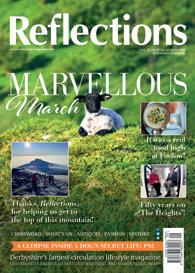
REFLECTIONS MAGAZINE MARCH 2024
Editor: Barrie Farnsworth, E: barrief@bannisterpublications.co.uk
Advertising: Mike Snow, M: 07966 445452 E: mikes@bannisterpublications.co.uk
Advertising: Helen Wragg, M: 07973 672582 E: helen@bannisterpublications.co.uk
Managing Director/Photographer: Robert Bannister, E: robert@bannisterpublications.com
Art Editor: Ben Fletcher-Bates, E: design@reflections-magazine.com
Social Media: Rebecca Bloomfield, E: hello@bannisterpublications.com
Accounts: Helen Holgate, E: admin@bannisterpublications.co.uk
Distribution: E: distribution@bannisterpublications.co.uk
Published by: Bannister Publications Ltd. Tel. 01246 550 488 (3 lines). Bannister Publications Limited, Office 2A Market Hall, Market Pl, Chesterfield, Derbyshire. S40 1AR. Reflections is published monthly and delivered directly to homes which fall into tax bands D to H and the following postcode areas: DE4 - 2, 3, 4, 5 / DE45 1 / S18 5 / S30 1 / S40 - 1, 2, 3, 4 / S41 0, S41 7, 8, 9 / S42 - 5, 6, 7 / S43 - 1, 2, 3 / S45 0, S45

27 16
14, 87,91,95 Countywide News
All that’s been happening across the county in words and pictures
16 A very long 12 months in Derbyshire’s history… It is 40 years this month since the 1984/85 miners’ strike started, as Barrie Farnsworth reports – plus recollections from Chesterfield Alderman Steve Brunt, then a striking miner, and local policewoman Sally Midgley
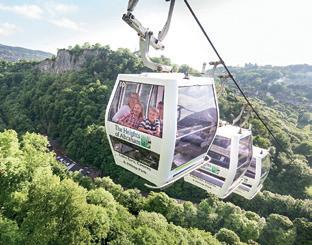
24 Milestone anniversaries at ‘The Heights’
There are two anniversaries coming up at The Heights of Abraham: 50 years since the Pugh family arrived at the rundown hilltop estate and 40 years since the launch of the cable cars
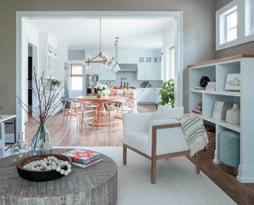
26 House and Home
Over 27 pages on the local property scene and the local businesses supplying everything you need for every room in the home
32 Property of the Month 54 Pitcherwits
55 Crossword
56 Robinson & Sons even had a ‘prep school’ in the Sixties!
In the second feature on one of Chesterfield’s best-known businesses, Godfrey Holmes celebrates Robo’s Angels
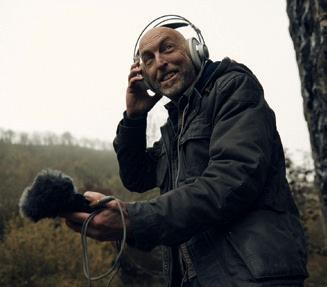
60 Mark’s landscape of Voices and Stories… Barrie Farnsworth meets a local man who is quite the all-rounder… he’s a poet, a performer, a video-maker and a recording artist
64 No, it’s not an alien invasion!
Have the aliens landed in Kniveton? No, it’s an air traffic control beacon that looks like a spaceship – one of the pictures entered into our 2024 ‘Lovely Landscapes’ picture competition
68 How Reflections helped a local couple reach the highest point in Africa Adrian and Caroline Close have thanked us for helping them reach the summit of an 18,651ft mountain!
70 Out & About
Chris Drabble takes a short walk to the summit of Wetton Hill to take photographs of the magnificent Thor’s Cave
73 Artist of the Month
Barrie Farnsworth talks to Ian Daisley, a photographer who eschews digital cameras for film, which he develops himself
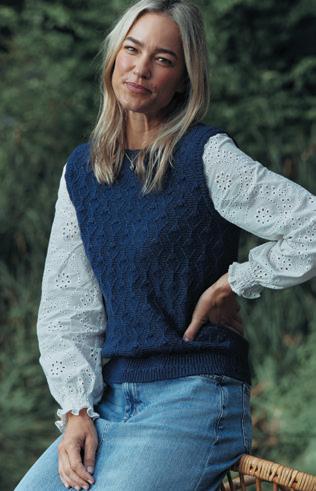
74 Fashion
Our style guru Amy Norbury keeps you ahead in the fashion game
77 Wedding Guide
82 Dining Out
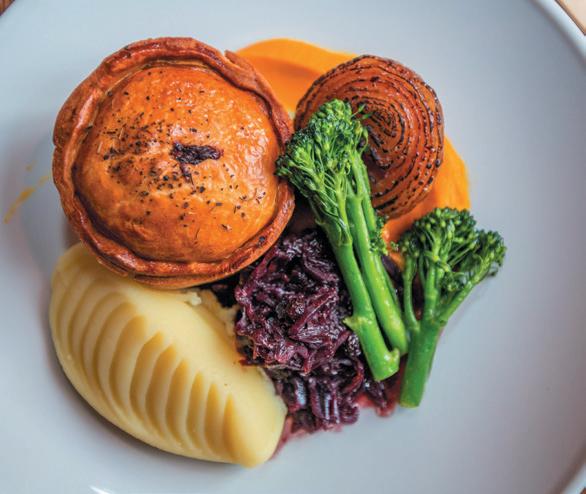
Our review of the Bull’s Head at Foolow
85 Focus on Food & Drink
Chatsworth Farm Shop has had a new look; an iconic pub reopens this month; and we have a delicious pie recipe to mark British Pie Week. Barrie Farnsworth reports

90 Antiques
This month, our antiques expert Vivienne Milburn looks at modest items that can make exceptional prices at auction
92 A glimpse inside the secret life of dogs
A local trainer helps people to understand the psychology behind dog behaviours, as Fiona Stubbs discovers
96 What’s On
Our comprehensive guide to events in March and early April across the county and beyond
















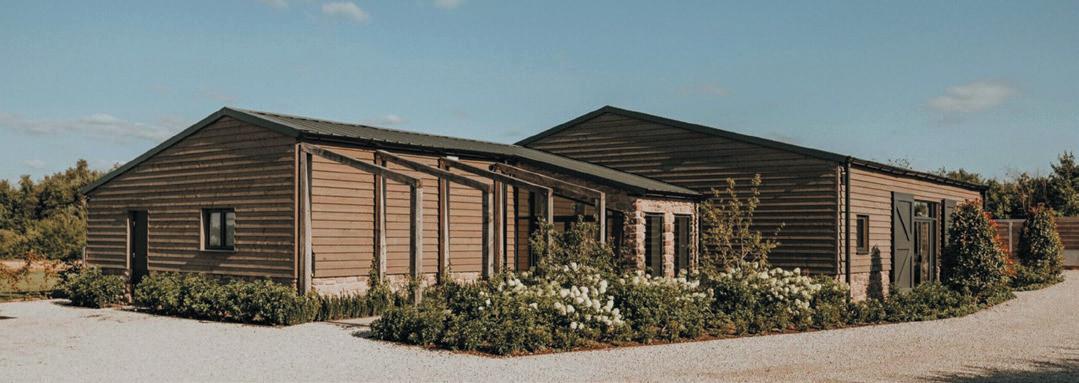
STRETTON Manor Barn is an exclusive wedding venue at Stretton, near Clay Cross, and at the end of last year won the award Best Barn Wedding Venue in the East Midlands from The Wedding Industry Awards.
The Barn and seven other regional winners were entered into the National Awards – and it was chosen as The Best Barn Wedding Venue in the UK in London in late January at The Wedding Industry Awards.
ORGANISATIONS in Chesterfield are invited to hear from the first mayoral candidates in the running for the new East Midlands Combined County Authority (EMCCA).
The EMCCA will bring forward £1.14 billion of investment for Derbyshire, Nottinghamshire, Derby City and Nottingham City over the next 30 years.
Ahead of the mayoral election, set to take place on May 2, businesses will have the chance to pose questions to Conservative candidate Ben Bradley, Labour’s Claire Ward, and Independent Matthew Relf at the Celebrate Chesterfield Business Conference taking place on Wednesday, March 20.
In a conversation chaired by Chris Hobson, Director of Policy at East Midlands Chamber, candidates will outline their plans to boost our region’s economic growth and broaden the pipeline for inward investment. Audience members will also get the chance to pose questions to candidates.
Now in its thirteenth year, Celebrate Chesterfield, which is organised by Destination Chesterfield and in association
with System Q, has become a key date in the town’s events calendar, attracting more than 250 delegates each year.
In 2024, the event will highlight the big impact that small innovations have on the town’s economic growth, focusing on investment, regeneration, and entrepreneurial successes.
Delegates will also hear about the new Destination Chesterfield plan, which outlines partnership activities to further raise the profile of the town.
Peter Swallow, Destination Chesterfield chair, said: “We are very excited to be hosting mayoral candidates at the Celebrate Chesterfield Business Conference. Our town has major plans for regeneration over the coming years, and our businesses are hopeful that the extra funding will provide a welcome boost by attracting further investment.”
This year, the event will also host the Celebrate Chesterfield Business Expo, featuring the East Midlands Chamber Business Support Zone and the Investment Zone (currently open for sponsorship).
Delegates wishing to attend Celebrate Chesterfield can book their free place at the event here: https://www. chesterfield.co.uk/business/celebrate/

THE hit BBC TV series The Antiques Roadshow will grace the historic Cromford Mills on Tuesday, May 28. It offers a unique opportunity for people to explore the extraordinary 1771 mill and, of course, bring along their cherished antiques for evaluation.
Details on how to register will be available in due course: watch for updates on www.cromfordmills.org.uk
IT’S the 50th season of The Derbyshire Singers – and to mark the occasion they are staging a concert entitled ‘Elgar’s The Music Makers and other Works’ at Lady Manners School, Bakewell, DE45 1JA on Saturday, March 23 at 7.30pm.
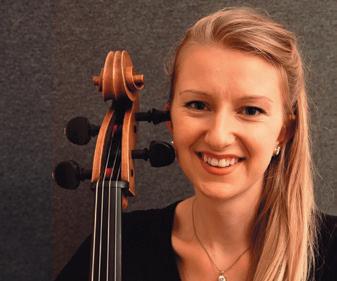
They are delighted to welcome, as soloists, Catherine Wyn-Rogers (mezzo soprano) and Miriam Brown (cello).
Performing with the Singers will also be The Derbyshire Sinfonia Orchestra and the special guest conductor is Neil Ferris, chorus director of BBC Symphony Chorus.
The Music Makers was dedicated to Elgar’s friend Nicholas Kilburn. It was first performed in Birmingham in 1912, conducted by Elgar himself.
Other works by Elgar will also be performed – Catherine will perform the Sea Pictures and Miriam Brown will perform Elgar’s Cello Concerto in E Minor.
Tickets £15 (students in fulltime education admitted free). Book online at derbyshiresingers.org
The Derbyshire Singers welcome new singers, particularly sopranos and tenors. Rehearsals take place at Highfields School, Starkholmes, on Tuesdays at 7.30pm.
For further information, please contact secretaryderbyshiresingers@gmail.com

It is 40 years this month since the 1984/85 miners’ strike started, which many have since described as a ‘civil war’, as Barrie Farnsworth reports – plus recollections from Chesterfield Alderman Steve Brunt, then a striking miner, and local policewoman Sally Midgley.
ON March 6, 1984, the Conservative government announced the closure of 20 coal mines, making 20,000 miners redundant –but National Union of Mineworkers’ president, Arthur Scargill, thought they planned to close a lot more collieries. The strike began in Yorkshire, where miners at Cortonwood colliery struck
following a local vote. Then the NUM president announced a national strike on March 12, 1984, although an official ballot was not held among miners about this.
The strike, which lasted a year, was the catalyst that changed the political, economic and social history of the nation forever – and places like Derbyshire, with many pits back then, suffered
more than most of the country. Mining communities were badly scarred, and some have never fully recovered.
An estimated 20,000 people were injured during the course of the strike; and three men were killed – two on the picket lines and a taxi-driver who was driving a coal miner, who had crossed the picket lines, to work.

And, since then, coal has no longer been King in areas like north Derbyshire. In 1984, there were 170 collieries in Britain, employing more than 190,000 people. But on the 20th anniversary of the strike, in 2004, there were fewer than 20 collieries, employing around 5,000 people. The North Derbyshire Area collieries did not even last that long – the last pit to close was the biggest, Markham, in 1993.
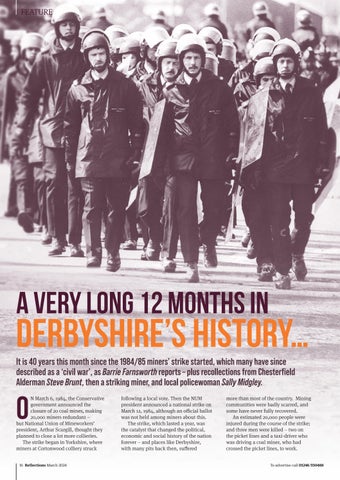
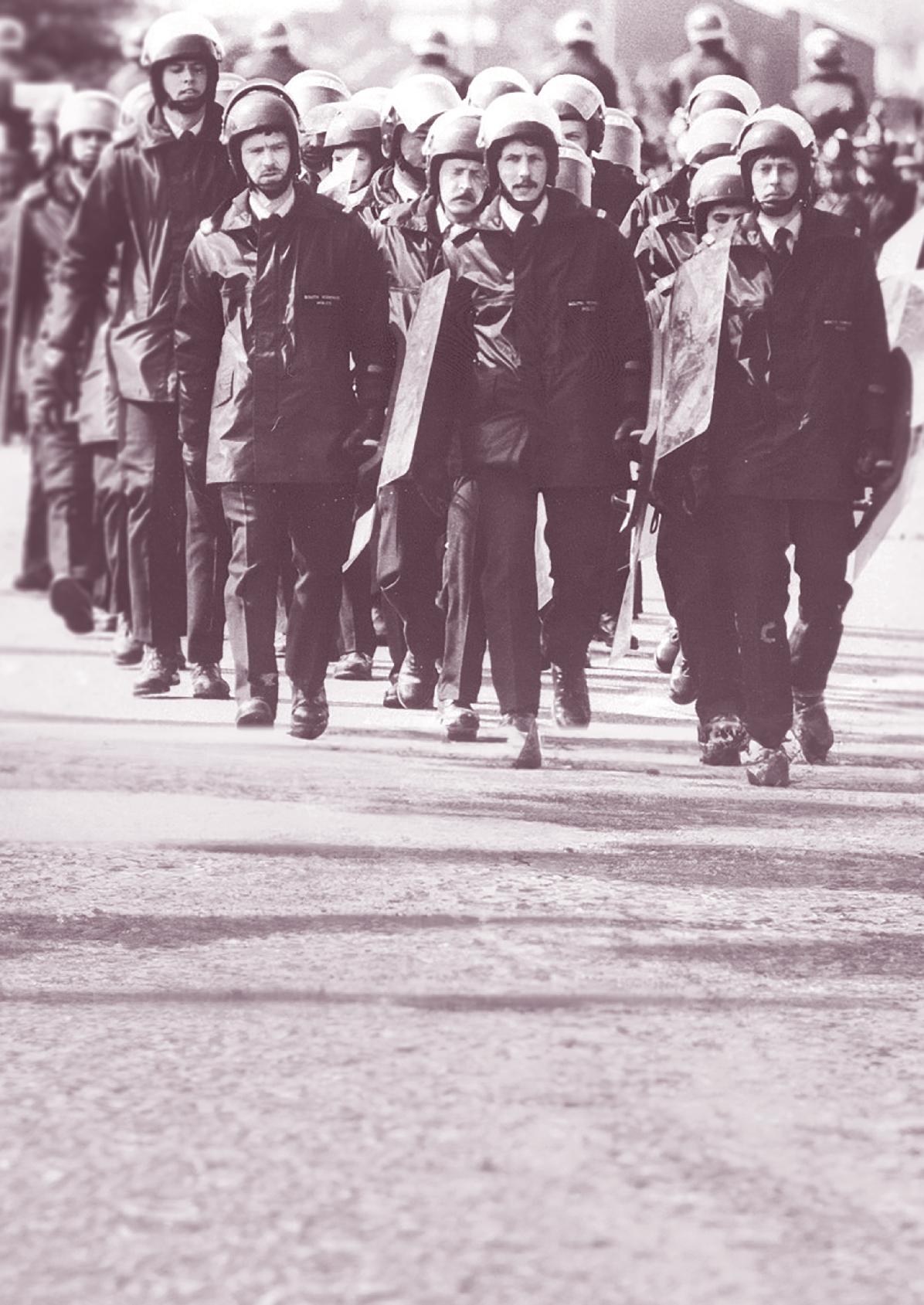
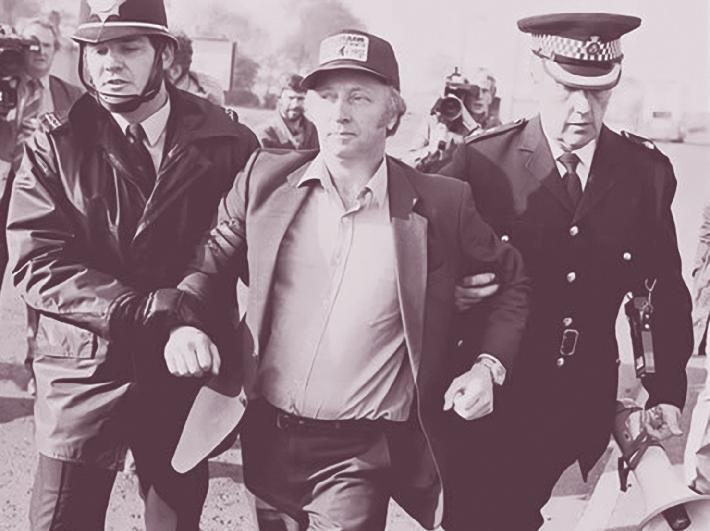
Left opposite: Police officers move towards the picket lines at the Orgreave coking plant near Sheffield in June, 1984, where more than a dozen arrests were made – and where flying picket Steve Brunt said it was ‘like a battlefield’.
Right: The NUM President, Arthur Scargill, was arrested on May 30, 1984 at Orgreave. He was later found guilty of two charges of obstruction and fined £250.
AT the time of the Great Miners’ Strike of 1984/85, I was a 32-yearold married man with two children, aged two and four, and the importance of maintaining a reasonably paid, full-time job in the industry was without doubt an overriding factor in my role in that strike.
Like so many young men at my colliery, I saw a real future in the industry and as a coal-face worker, I was earning good wages. But the announcement of the closure of Cortonwood Colliery in South Yorkshire, which had been given at least five years only months before, shocked us all. Our union, the National Union of Mineworkers (NUM), had warned us that the Coal Board was drawing up an extensive pit closure programme and that no pit was safe.
There were rumours and counter rumours about the future of the mining industry which, if true, would undermine everything we were working for. But we felt relatively safe in the knowledge we belonged to and worked in an industry that was totally unionised, and that we would be able to repel any threats to our future livelihoods.
couple of weeks and we could all get back to work and get on with our futures’. How wrong was I. We picketed our own pit at first (Arkwright). Fortunately in Derbyshire we were solid, every pit was out on strike, at least for the first six months or so.
Problems arose when Nottinghamshire demanded a national ballot which divided the union and eventually led to the breakup of the NUM. Should we have had a ballot? Hindsight is a wonderful thing, but at the time I thought no. This was a just cause we were fighting for, because this wasn’t about wages or working conditions, this was about our future and our children’s future. We were fighting for our very existence, as we saw it.
“We were fighting for our very existence, as we saw
it.”
We soon became flying pickets and in a short space of time, Britain became a police state. We were being stopped constantly by the police and told to turn round and go home. Apart from Orgreave, of course, where the police actually directed us to the picket lines in June 1984. In effect, they set us up for a huge confrontation – which they got –because at times it resembled a battlefield.
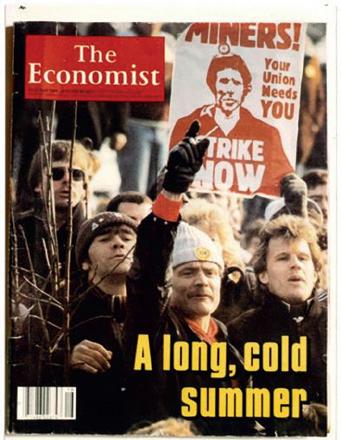
Above: Steve Brunt (centre) made the front cover of The Economist during the strike. Derbyshire miners were picketing the Notts NUM headquarters at Berry Hill. Steve says: “My arm was raised as we saw two buses arrive with miners from Durham, then we burst into song to welcome them.”
And so, when the call came to take action to support our colleagues across the industry, I didn’t hesitate. I was glad actually that our union the NUM was taking on the Thatcher Conservative Government who just a couple of years before had decimated the British steel industry.
I honestly thought: ‘this will be over in a
Lots of lads were arrested on the picket lines and lots jailed, and I was eventually arrested on October 17 in a classroom at Hurst House Education Centre while attending a day-release course, but was later released without charge. I really do believe I must have been the only flying picket to be arrested in a classroom!
The most distressing part of the dispute
as it dragged on for me was seeing our comrades, friends and mates return to work having given their all and, in most cases, they had been on strike for at least 6/7 months. Savings all gone and debts built up. And quite frankly, they’d given their all. For me, it was all but over just after Christmas when the trickle back to work became a torrent. In fact, when we did eventually go back to work on March 3, 1985, only 96 of the 800-plus men who worked at Arkwright Colliery were still officially on strike and we had a plate struck with the 96 names, which is on show at the Chesterfield exhibition from March 4-27.
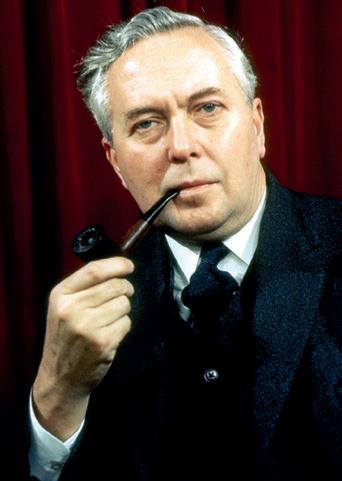
IT IS half-a-century since Britain’s miners won a 35 per cent pay rise –and effectively brought down Edward Heath’s Conservative government.
British coal workers called off a four-week strike following the pay offer from the new Labour government, led by Harold Wilson, in what was seen as a resounding victory for the miners.
“Around
their pay rise to £45 per week – £8.21 more than their present wages.
The 16-week dispute, which saw coal production come to a complete standstill during the February 1974 strike, finally ended just 48 hours after the Conservative party was voted out of power.
260,000 miners accepted weekly pay rises.”
The Labour offer was worth more than double the figure on offer under Edward Heath’s government. Around 260,000 miners accepted weekly pay rises ranging from £6.71 to £16.31. Face workers saw
A few days after the strike came to an end, the Three-Day Week restrictions were lifted on March 7, 1974. From New Year’s Day in 1974, commercial users of electricity were limited to three specified consecutive days’ consumption each week and prohibited from working longer hours on those days. Services deemed essential (ie, hospitals,
supermarkets and newspaper printing presses) were exempt. Television companies were required to cease broadcasting at 10.30pm to conserve electricity.
‘What’s a woman doing here?’
RETIRED police officer Sally Midgley still remembers the onset of the miner’s strike in Derbyshire – they were moved onto 12-hour shifts instead of the normal eight.
She said: “We female officers – and there weren’t many of us in those days – were left back at our usual stations, mine was Ilkeston, to cover for the male officers who went off to police the strike itself. So we were generally ‘on the beat’ between 6am and 6pm, or a 12-hour night shift.
“We patrolled on our own – heaven forbid a supervisory officer saw you with a colleague! I recall that it used to really scare my mum Pauline, thinking that I was patrolling alone.

“I also recall that it was before the age of policewomen in trousers, we still had to wear skirts in those days.”
She recalls officers from the Metropolitan Police Force – the ones that many local miners particularly hated – were put up in what were then three accommodation blocks at the county police headquarters, Butterley Hall.
As it was before the days of sat-navs, the Met officers needed a local ‘pilot’ to take them to collieries and other places where miners were picketing – and Sally remembers being the ‘pilot’ in a police transit van on a night shift, taking around 10 officers to Shirebrook, where she had lived as a young child and where her father Keith had served as a policeman.

‘pilot’ a van again,” Sally said.
“Somebody at Shirebrook police station said ‘what’s a woman doing here?’ – and I was recalled to the ‘safety’ of Ilkeston and have to assume that was why I was never told to
She added: “I come from a mining family – my dad was a colliery electrician before he joined the police – so the effects of the strike were felt beyond my work. I still remember going to a relative’s house in 1984 and my uncle said ‘you are not welcome here’, but my aunty then said ‘she’s your niece first and is always welcome in our house’.”
Sally and her husband John, who was working in a regional crime squad when the strike started and was not involved in policing picket
Above: Retired police officer, Sally Midgley.
lines, are both now retired and living near Crich.
“Mind you, we seem to be even busier these days,” said Sally, as her and John started a ‘True Crime Investigators UK’ podcast nearly four years ago, and also deliver ‘true crime’ talks – based on real crimes from the Seventies and Eighties – to clubs and groups.
Editor’s Note: The link to Sally and John’s podcast is http://www. truecrimeinvestigators.co.uk/

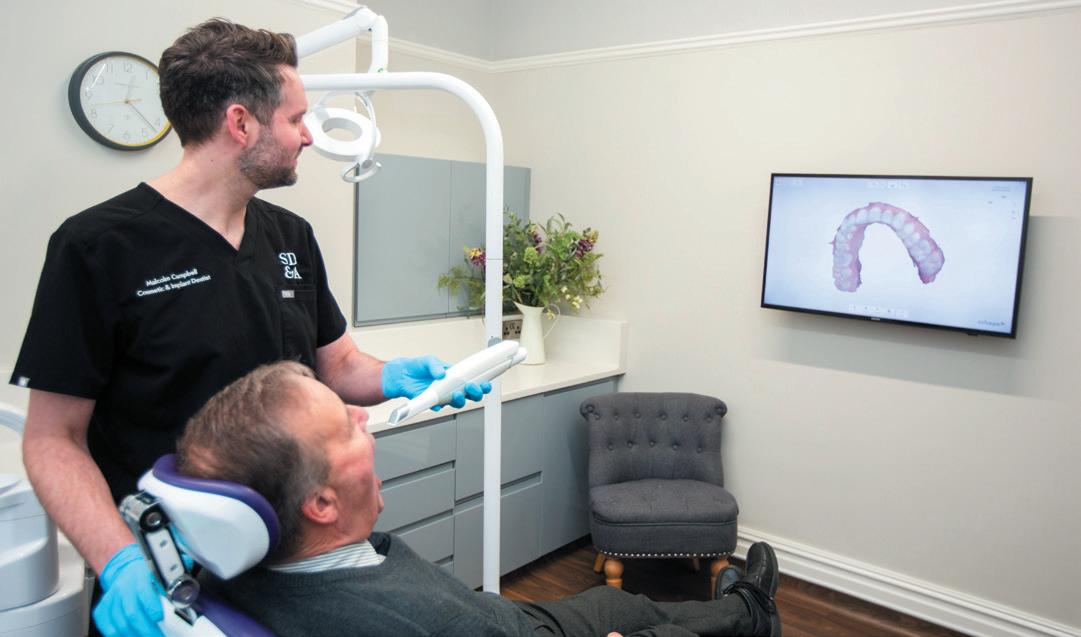
SPRINGMOUNT DENTAL PRACTICES, based in Chesterfield and Matlock, offer the exciting possibility of entering their practice with a full mouth of missing teeth and leaving with a complete set of sparkling new prosthetics in a matter of just a few hours!
When you lose a few teeth or your entire set, it can significantly affect your physical and mental well-being. In addition to presenting challenges with chewing or speaking, it can also give you the look of premature ageing.
All is not lost, however! Same-day dental implants are the pinnacle of modern-day dentistry and can provide you with beautiful, functional teeth within the space of a few hours. This treatment is transformative and can massively boost your overall quality of life, and help you regain that delightful smile.
Having opened in December 2017, Springmount Dental & Aesthetics is at the forefront of complex high-end, innovative dentistry and is experienced in carrying out hundreds of cases of dental implants to the highest professional standards.
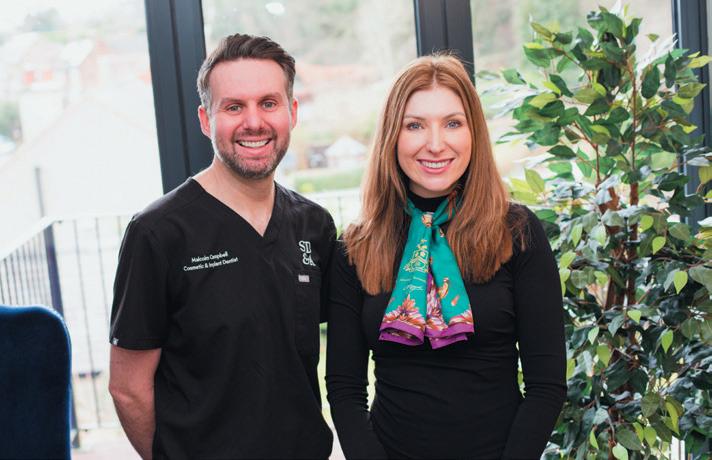
Dr Malcolm Campbell, who is co-owner of Springmount Dental & Aesthetics with his wife, Katie, has a special interest in dental implants and has been awarded a Diploma in Implant Dentistry from the prestigious Royal College of Surgeons in Edinburgh. He has undertaken extensive training in
providing complex techniques to enable the practice to offer the full choice of implant options – from a single tooth, bridges, to ‘All-on-4’ (full mouth). So, clients who wish to find an alternative to dentures, or are in the process of losing a tooth, can rest assured that Dr Campbell and his team will help them every step of the way. For Dr Campbell, the training never stops. A recent advanced, up-to-the-minute, course in intricate and sophisticated full arch dental implants is testimony to his commitment and passion.
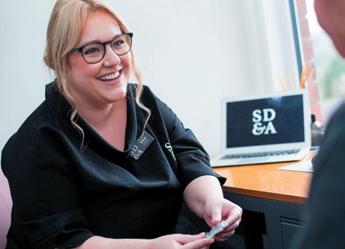
The initial consultation is with a dedicated
treatment coordinator. For the Chesterfield practice, the treatment coordinator is Emily Swallow, whilst at Matlock the role is fulfilled by Sinead Tabor. Available on a business mobile phone, they are an immediate pointof-contact to discuss anything that may be of concern. From scheduling appointments to providing care and on-going support, as well as handling finances, they are there to make sure that patients have everything they need during their time at the practices.
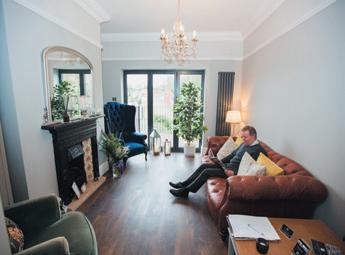
During the initial meeting, which is completely complimentary, patients can discuss their needs and aspirations with either Sinead or Emily in a relaxed, informal, and friendly manner. With an emphasis on making patients feel at ease, there’ll be a review of current medical records, as well as a holistic overview of general health matters. With a view to optimising health prior to surgery, aspects of nutrition, diet, vitamin D levels, and overall wellbeing will be discussed in depth.
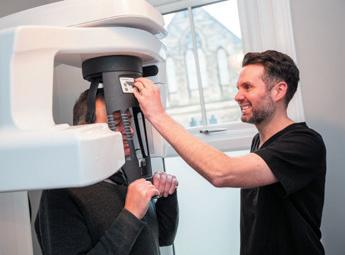
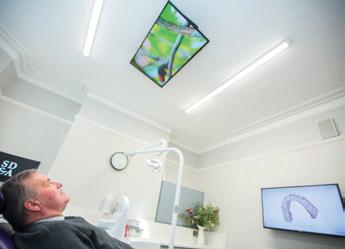
Using a combination of the latest state-ofthe-art CT scanner and 3D printer, detailed photos and scans of the teeth will be taken in readiness for analysis by Dr Campbell.
The next step is an in-depth clinical assessment with Dr Campbell. After analysing the results of the scans in detail, Dr Campbell will present the dental implant options available, and, in conjunction with the patient, formulate a suitable treatment plan.
Each treatment plan is bespoke and tailored to the individual patient’s needs. With Dr Campbell, patient care and aftercare are at the core of everything he does. His ethos is based on exceeding patients’ expectations and going ‘over and beyond’ to achieve the optimum dental solution.
Dr Campbell will present the treatment plan, inform the patient in a relaxed and informative manner as to what they might expect, and what they need to do pre- and post-surgery.
Patients will have opportunity to ask as many questions as they would like. The financial side of the treatment will be
explained, and, once the patient is completely satisfied with everything, the treatment will be signed off, and same-day surgery awaits!
With the help of the CT scanner and 3-D printer, the dental implant surgery – whether it be whole mouth, single arch, all-on-4, or single tooth, is digitally guided to ensure accuracy, optimise safety, improve speed, and achieve best possible outcomes.
THE PROSTHETIC TEETH ARE DESIGNED TO THE MOST EXACTING DETAIL.
On the day, a highly experienced and sympathetic Consultant Anaesthetist sedates the patient in readiness for surgery. During the surgery, Dr Campbell, a highly skilled and talented implant dentist, makes a number of tiny incisions in the gum, where the implants are inserted. Then, a custom-made, temporary bridge is fitted to the implants to support them. This bridge is usually replaced three to four months later with a long-term bridge.
Within half a day, the patient can leave the surgery with a brand-new set of gleaming teeth, as well as a beautiful smile. But the care doesn’t stop here! The patient is given careful instruction on how to look after his new teeth in the days to come.
After-care is arguably the most important part of the process. Advice on teeth cleaning, mouth rinsing, pain relief, and dedicated hygiene treatments is as important as the surgery itself.
After about 3-4 months, the temporary bridge is replaced with a long-term bridge.
AFFORDABLE AND ACCESSIBLE WITH MEMBERSHIP PLANS AND FINANCE OPTIONS
To spread the cost and make private and cosmetic dentistry more affordable and accessible, Springmount Dental Practice offers bespoke and tailor-made membership plans, which also provide members with enticing and regular offers. They also offer 0% finance options.


Springmount Dental & Aesthetics 32 Tennyson Avenue, Chesterfield, Derbyshire, S40 4SP, t: 01246 230 230
e: info@springmountdental.co.uk
Springmount Dental & Aesthetics, 41 Bank Road, Matlock, Derbyshire, DE4 3GL t: 01629 56558
www.springmountdental.co.uk
The cable cars taking visitors to and from The Heights of Abraham are 40 years old this year.
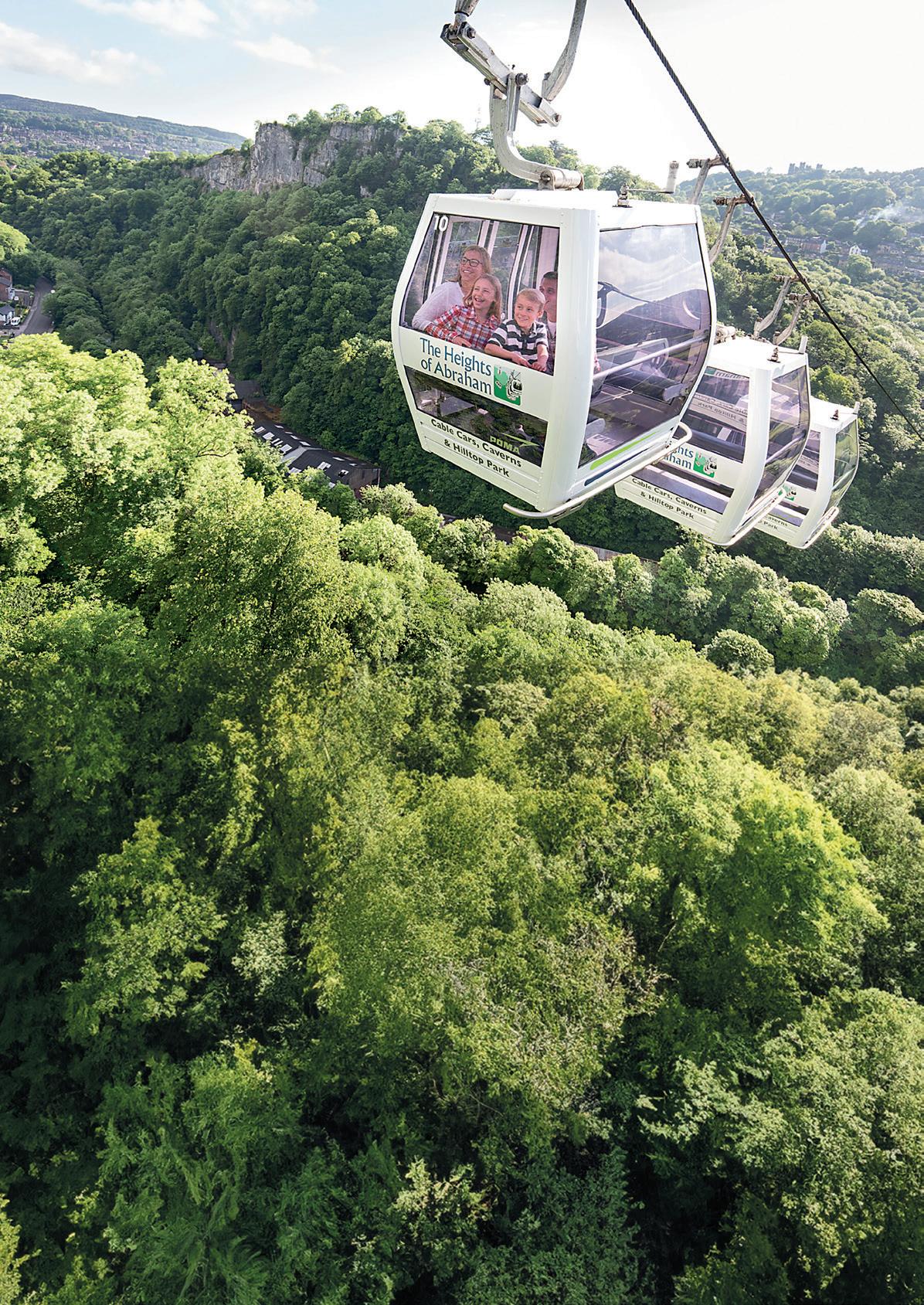
AYEAR of celebration is now underway as Derbyshire’s oldest visitor attraction, The Heights of Abraham, marks two ‘milestone’ anniversaries in its 237-year history.
This May celebrates the ‘Golden Anniversary’: 50 years since the Pugh family arrived at the run-down hilltop estate and started to restore and transform into the unique visitor attraction it is today.
In April, it will be 40 years since the launch of the Alpine-style cable cars, marking their ‘Ruby Anniversary’. A ride in the cable cars forms an integral part of the visitor experience, making the short ascent to the summit of Masson Hill, where a different world of magnificent views and deep magical caverns awaits, which has been enchanting visitors since 1787.
Nowadays, the family-friendly attraction welcomes visitors to enjoy two illuminated show caverns, breathtaking views, living history exhibitions, woodland trails and adventure playgrounds.
It is five decades since the spring of 1974, when Andrew and Vanessa Pugh spotted an intriguing business opportunity advertised for sale. It was described in the classified ads of The Daily Telegraph as ‘the most unusual business – a place with woods, caves and a house’. On their first visit, the hilltop estate captured both their hearts and imaginations, inspiring them to seize the opportunity for not only a new business venture but a completely new lifestyle, as they moved from London up to Derbyshire, a county new to them.
This was the start of a lifetime’s work of revitalising the estate. The journey began with ten years of major restoration, including upgrading the old pathways, renovating neglected buildings, including the Victoria Prospect Tower, and improving access to the ancient caverns.
At the end of this development phase, the visitor attraction was steadily gaining popularity, yet Andrew and Vanessa were seeking something to really set their attraction apart. A stroke of genius led to the installation of its ‘signature’ cable car system in 1984. This mode of transport was pioneering in the UK at that time, attracting much publicity and media attention. The original system had new cabins in 2004, and a continuous programme of engineering updates every year.
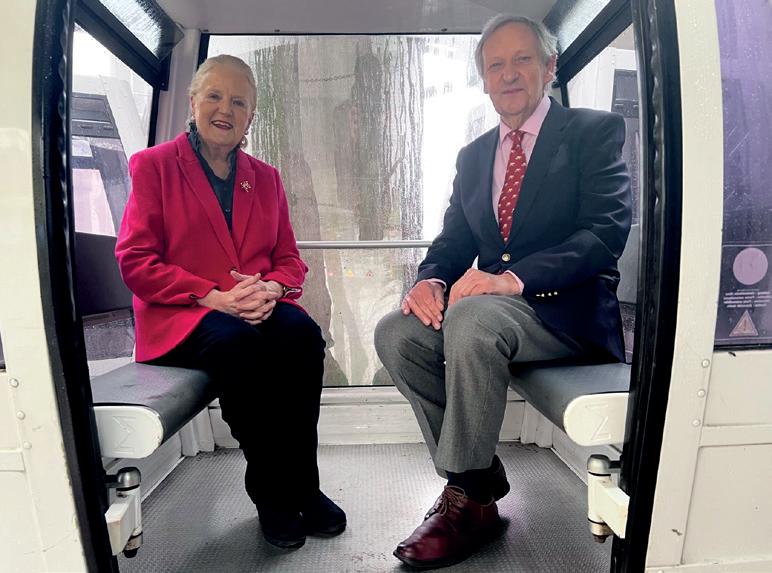
Vanessa and Andrew Pugh, who bought The Heights of Abraham 50 years ago this May.
from the Victorian era of tourism. Added in 2022 was a willow sculpture trail, with installations by the sculptor, Caroline Gregson.
It was during Georgian times, as mining in the caverns came to an end, that owners of the estate diversified and built a pleasure garden to attract visitors who travelled from near and far to take the spa waters of Matlock Bath.
Today’s visitors enjoy a multitude of added attractions alongside the show caverns. A popular spot is the ‘Vista’ restaurant with its balcony area, perched almost 1,000 feet/554 metres above sea level, offering diners a ‘meal with a view’, and the venue can also be hired for private events, such as birthdays and anniversaries.
“A stroke of genius led to the installation of its ‘signature’ cable car system in 1984.”
This year, the Great Masson cavern boasts an enhanced illumination experience, bringing an array of rainbow colour to its dramatic interiors, whereas the Rutland cavern has a tour guide in full period costume, bringing to life tales
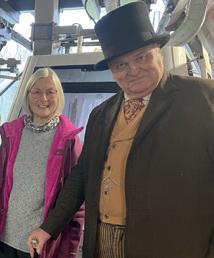
The estate’s two great caverns were a marvel to these curious travellers and the ex-miners became tour guides for the wealthy tourists. Visitors even included Princess Victoria and the great ‘Romantics’: the poet Lord Byron and his friends Percy Bysshe and Mary Shelley. The hillside estate, which had been re-invented with exotic gardens and serpentine paths, had donkeys carrying visitors from the resort town up the steep incline to the summit. Thankfully, the cable cars now offer a much more comfortable ride to the top of Masson Hill, to take in the picturesque views over the Derwent Valley, which Lord Byron referred to fondly as ‘Little Switzerland’. And Joanna Brown, from Devon, pushed the ‘big green button’ to restart the Heights of Abraham cable cars for the 2024 season on February 10. She was joined by her ‘great-great-greatgrandfather’, the Victorian owner of the Heights, Benjamin Bryan, recreated by living history actor, David Oxley.
Above: Joanna Brown opened the cable cars for the season last month, pictured with actor David Oxley, who was recreating her ‘greatgreat-great-grandfather’ Benjamin Bryan, who was the Victorian owner of the Heights.
The Terrace café specialises in locally-made cakes and hot beverages, and The Tavern holds the oldest beer licence in the Matlocks, as in the 18th century, hard-working lead miners socialised here after their shift. Several multi-media exhibitions explore the social and cultural history, geology and the installation of the cable cars. There are adventure playgrounds, woodland walks and pathways to enjoy, along with several garden vistas.
The Heights of Abraham is the second most popular attraction in the area after Chatsworth House and Estate. The Golden and Ruby anniversaries will be marked by stunning lighting effects in the Great Masson Cavern, new displays, themed decorations and a programme of events including concerts and live actors. The attraction welcomes visitors of all ages, and is dog-friendly, with dogs welcome to ride the cable cars (receiving their own free ticket).
For more details of special events, opening times and prices, go to heightsofabraham.com
As we slowly leave behind the shady days and hibernation of winter, it is the perfect time to focus on spring decor ideas, and how you can give your home a joyful refresh for the season.
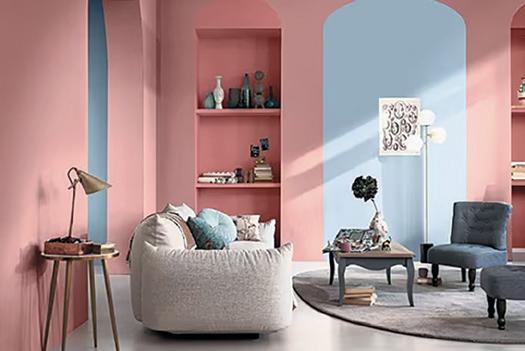
With the changing season comes a multitude of interiors ideas to throw out the old and invest in the new. Freshness and renewal are the hallmarks of spring. The blossoming outdoors will inspire light, airy colours such as pastel blues, greens, and pinks. A luxury sofa or armchair in a soft hue can be the perfect addition to bring this spring vitality indoors.
Spring embodies all things fresh, inspiring, and new, making it the perfect time to make changes to your home interiors and furnishings with the help of new ideas and exciting opportunities. Spring brings a promise of light and bright everything which couldn’t be more needed after a long winter.
In line with the green trend of inviting the outdoors, lighting follows suit. In fact, a sunny ambiance is the ultimate design accessory in 2024. Welcome the benefits of natural light into your home – think large

windows, skylights, and strategically placed mirrors amplify the effect. Natureinspired reigns supreme as designers, homeowners, and businesses gravitate towards bringing the outdoors in. We’re talking lush greenery, earthy
colours, eco-friendly materials, and an oh-so-soothing atmosphere. It’s fitting, too, as sustainability is also cementing its spot in 2024’s interior design trends. Along these, maximalism and personality-rich interiors are also climbing the ranks.
Continued


WHEN it comes to boiler and central heating maintenance plans, FlameCare can justifiably claim to have put together a better plan.
In the unfortunate event that the boiler breaks down or there’s a leak, FlameCare’s service and maintenance plan means that customers are fully taken care of. With a superfast response, FlameCare’s team of highly-experienced engineers always get to customers on the same day that the issue is reported. This includes Christmas Day and all Bank Holidays!
FlameCare stocks a huge range of boiler parts for all appliances, so customers can rest assured that they won’t have to wait for parts to come through the post to get their heating back online. FlameCare’s engineers always
“FlameCare stocks a huge range of boiler parts for all appliances, so customers can rest assured that they won’t have to wait for parts to come through the post to get their heating back online.”

try to be as flexible as possible. FlameCare’s boiler care and maintenance plans are exceptional value for money, and all include the annual service, 24/7 call out, parts and labour guarantee, a free initial service worth £85,
unlimited call outs, no excess, no minimum contract, and a price guarantee for the first 12 months. And if all this wasn’t enough, FlameCare generously donates the first month’s payment of any new plan to Ashgate Hospice!
TO FIND OUT MORE ABOUT FLAME CARE:
FlameCare
67-77 Chatsworth Road, Chesterfield, S40 2AL
T: 0800 0855 518
E: info@flamecare.co.uk www.flamecare.co.uk



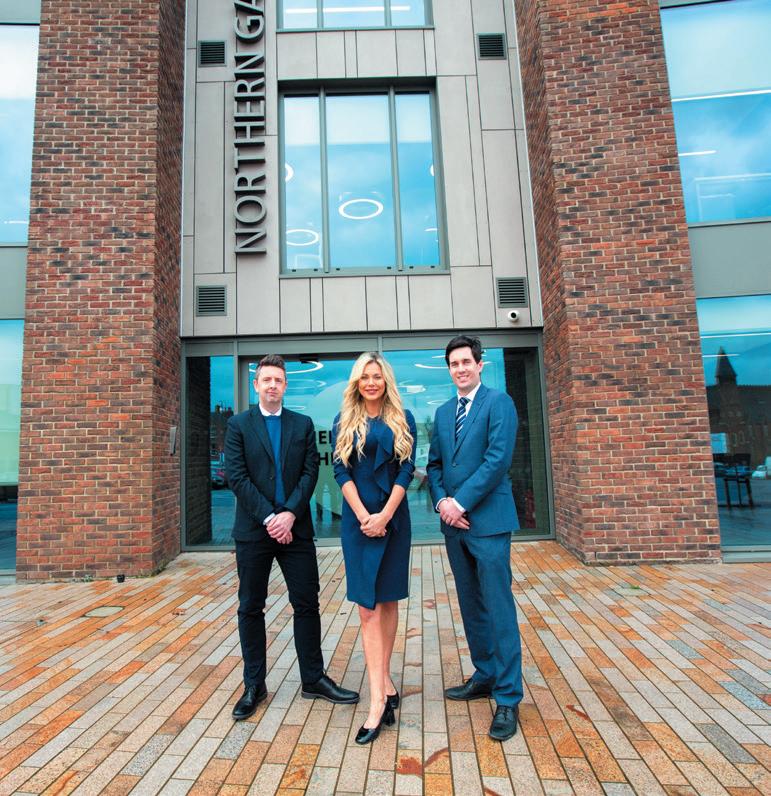
Underpinned with two RICS Chartered Surveyors, PriceLinsey is a dynamic local property agency providing a personalised bespoke service.
Located in a high-quality office suite amidst the hub of innovative professional businesses in the stunning new Northern Gateway Enterprise Centre, is one of Chesterfield’s brightest luminaries in the world of property.
Boasting over 43 years combined experience across all aspects of property, PriceLinsey is a multi-disciplined firm offering expert, impartial and independent advice on all types of property, including residential, commercial, mixed-use, and land.
Local, independent, professionally qualified, and highly experienced
With all three directors living and working locally, the highly-experienced and qualified team at PriceLinsey is rooted in the local community and passionate about it. They offer an in-depth knowledge of the needs of the local market. They have all worked in local and national property agencies previously and have at their fingertips all the expertise you could ever wish for in terms of property sales and management.
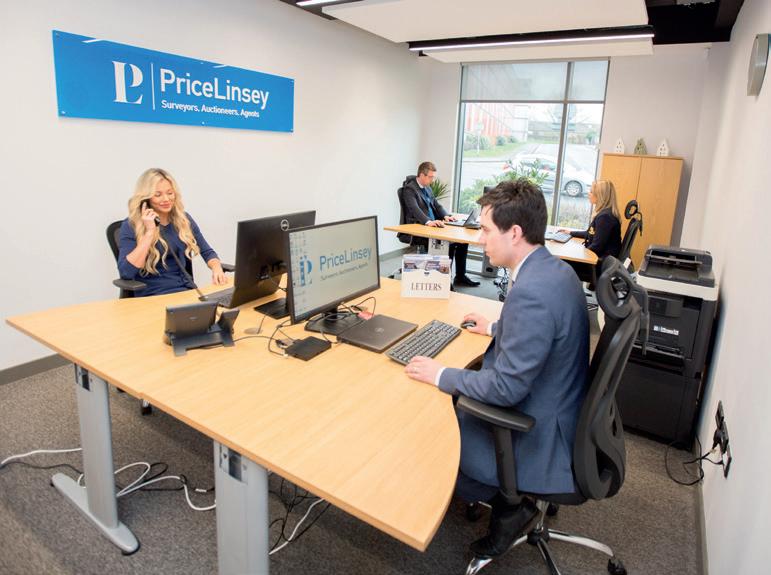
With two of the directors, Marcus and Lara Linsey, brother and sister by the way, being RICS Chartered Surveyors, PriceLinsey can offer RICS Homebuyer and Building Surveys in super quick time. “I pride myself on speed, meticulous attention to detail, fastidious accuracy, and efficiency,” said Lara, who achieved the accolade of being in the top four of the ‘Young Surveyor of the Year’ category in 2020. “I can sometimes complete a survey within 48 hours, but make no mistake, I’m punctilious when it comes to detail, and, refreshingly, all the surveys are written in plain, understandable English. No stone gets unturned. My integrity and the integrity of the business depend on my surveys being completed in a through, unambiguous, and precise manner.”
Marcus and Lara boast a whole host of qualifications on top of years of professional experience. They are both BSc (Hons), MSc (Real Estate), and MRICS & RICS Registered Valuers. With such talent at its disposal, it’s small wonder that PriceLinsey is often called upon by solicitors and estate agents to undertake RICS surveys on their behalf.
“As an independent agent, we have the freedom to offer an entirely bespoke service to each of our clients.”
Experienced, trusted, reputable, and professionally qualified, PriceLinsey prides itself on having longstanding and successful relationships with its clients.
With over 20 years’ experience in residential and commercial sales, director Richard Price knows the housing market locally inside out. Together with Jodie Elliott, a member of the Chartered Institute of Housing (in Property Management), he ensures that vendors are well informed throughout the entire selling process and are afforded the best possible chance of completing a sale at the best price possible in the quickest turnaround time possible.
“We pride ourselves on our impartial advice, an unprecedented high level of client care, and uncompromising integrity,” says Richard. “By harnessing the power of digital marketing, we make sure that every property is featured to the widest possible audience via extensive online internet advertising on all the major property portals such as Rightmove and OnTheMarket. Jodie also showcases these properties on all the favourite social media channels, such as Facebook, Instagram, and TikTok.
Careful attention is paid to the most vital components of property marketing, with a team of professional photographers ensuring that every property is captured in its best light. Backed up with a carefully written accompanying description, the property is given all the vital information that might appeal to potential buyers.
“As an independent agent, we have the freedom to offer an entirely bespoke service to each of our clients,” said Jodie. “We tailor how we work to achieve our client’s goals and ensure they are kept up to date with progress throughout the entire process.”
From a standing start 6 months or so ago, PriceLinsey has, in no time at all, built up a portfolio of over fifty clients for property lettings. Richard’s friendly and approachable manner has helped him build many relationships with landlords, homeowners, and property developers offering them a first-class bespoke service.

Providing personalised lettings’ packages to landlords and tenants alike, PriceLinsey offers everything from ‘letting only’ to ‘rent collection’ and ‘full management’. Every package is tailor made and personalised to each landlord and tenant’s individual needs and circumstances.
With the possibility of completing a house sale within 28 days, property auctions are becoming ever more popular.
Auctions are suitable for all types of property, including vacant residential, commercial, and mixed-use properties, tenanted/investment properties, land/development sites, garage blocks and freehold ground rents. The team at PriceLinsey is vastly experienced in handling unconventional properties, such as pubs, chapels, and nursing homes. Whether it’s a single property to sell, or a portfolio, PriceLinsey has the expertise on hand to give each individual property the best possible chance of sale at its livestream auctions.
Having previously been involved in property auctions, Marcus and Lara use innovative marketing techniques to bring a fresh, transparent approach to the world of auctions. Masters in Commercial Real Estate and Auction Behaviour, they offer the best possible opportunity to any potential sellers wanting to complete in a super quick turnaround time.
When it comes to putting a property up for auction, there are many reasons to look no further than PriceLinsey. Firstly, they create a bespoke marketing campaign for each property in order to generate the maximum interest possible, so as to result in a competitive bidding environment. As well as using the optimum property and social media platforms, they provide regular email updates to registered buyers to showcase every property in an electronic
catalogue. Speed is another factor. At the fall of the hammer, a legally binding contract is entered into with the buyer, giving sellers fixed exchange and completion dates. The whole ‘secure sale’ process can be done in as little as four to eight weeks – and at the best sale price achievable.
The proof of the pudding is in the eating, as they say. And PriceLinsey’s property auction results are impeccable. They have had a 100% maximum success rate in two of their last three auctions!
28th March 2024 at 12:30 pm Livestream
Regardless of whether you’re wanting a property valuation or wanting to sell or rent a property or even explore property management solutions, PriceLinsey have a bespoke, personalised property option available for you.

PriceLinsey Property Agency, Office 4, Northern Gateway Enterprise Centre, Saltergate, Chesterfield, S40 1U T T: 01246 949474 www.pricelinsey.co.uk

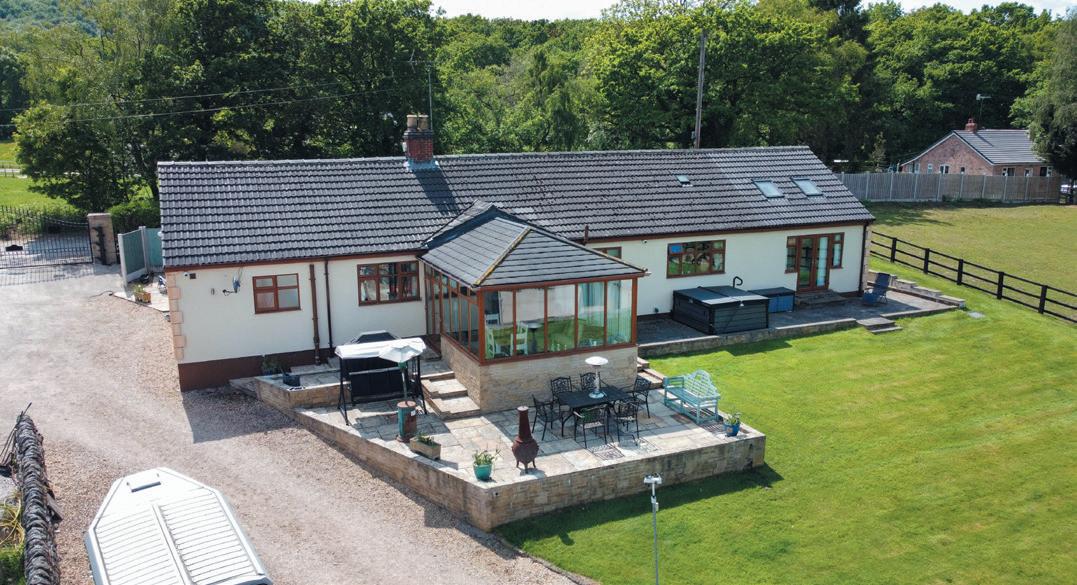
Offers in the region of £950,000
An exciting and rare opportunity to purchase this stunning fourbedroom detached bungalow, having the benefit of outstanding equestrian facilities and set within 3.6 acres of land and grounds. Situated within this highly desirable area of Hardwick Wood Wingerworth and surrounded by open countryside.
The stable barn was constructed in 2016 creating excellent stabling facilities. The barn houses a tack room, feed room and six individual stables which are all fitted to a high standard having Stablesoft bonded flooring and highquality fittings. The Cheval Liberté stables are 6 at 12’ x 12’ & 1 by 14’ x 14’.
The rear section of the barn provides an area for the storage of hay and vehicles having the potential to be converted into further stabling. There is a secure storeroom for additional storage space and a further shed which creates an further stable.
The facilities also include a flood lit ménage with fibre sand and five well-proportioned grazing paddocks and several turn out areas.
The bungalow is accessed via a generously proportioned utility / boot room with a shower room and WC off this. Breakfast kitchen having a range of wall
and base units with wood block worktops and integrated appliances to include a fridge, microwave, and dishwasher, together with a freestanding range cooker.
The kitchen opens to a fabulous spacious conservatory which is currently being used as a formal dining room. The conservatory has a ‘warm roof ‘and offers beautiful views to the rear. Separate lounge which has a feature fireplace with log burner.
Inner hallway has a large cloaks storage room with the added benefit of a wall mounted radiator and gives access to the three double bedrooms and family bathroom. The family bathroom has suite in white with a corner spa bath and separate walk-in shower.
Master double bedroom forms part of the extension added in 2016 has full height ceilings and Velux roof windows. Patio doors opening out to the rear garden. Stunning modern luxury en-suite bathroom.
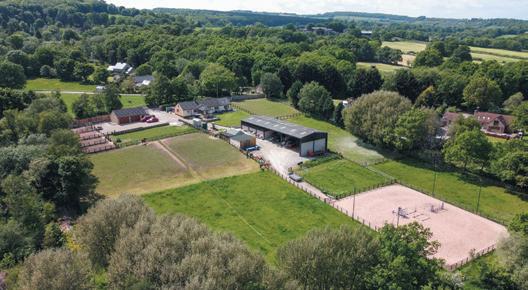
The property is accessed via double gates with ample parking for several vehicles and a quadruple garage with two double doors which could be converted subject to necessary planning and consents. To the rear of the bungalow is a driveway giving access to the equestrian facilities, lawned area and raised patio creating a fantastic place to relax and enjoy the views.
The current owners also lease an additional 10 acres of land which provide additional grazing and paddock space. It is believed that the lease could be transferred to a new owner. The new owners would need to make their own further enquiries regarding this.
Additional Land : the vendors separately own a 5 acre plot of land within close proximity of Yew Tree Bungalow which they would be open to selling aswell. Please speak to the agents for further information regarding this.
• Stunning four bedroom detached bungalow
• Exceptional modern equestrian facilities
• Sought after location within Hardwick Wood Wingerworth
• Fantastic master bedroom suite
• Quadruple garage
• Viewing strongly advised to fully appreciate the property on offer

NATURAL EARTH PRODUCTS lies in the heart of the Peak District, surrounded by stunning countryside, with views of Froggatt and Curbar Edges down to Chatsworth House. Why not pay a visit to our beautiful showroom, a familyowned and run business, established for nearly 20 years. We supply high-quality natural stone and wood flooring; bespoke, handmade Derbyshire stone fire surrounds and wood-burning/ multifuel stoves. Whether you are doing a full-scale home renovation or simply updating a tired room, there is something to suit all tastes.
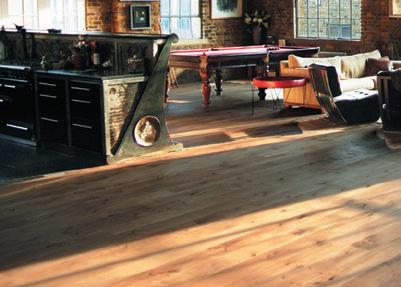
Our natural stone tiles and wood flooring ranges have been carefully selected to add beauty, warmth, and charm to your home. We offer a wide variety of sizes, finishes and colours, so please visit our showroom to see the most up-to-date range, as we are constantly updating our displays.
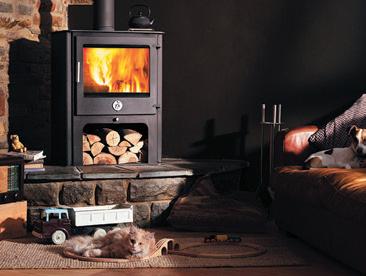
If you would like an alternative means of heating in this time of rising energy prices, come visit our showroom, where we have a wide range of beautiful stoves catering for both traditional and contemporary homes. Our customers are provided with endless possibilities for their projects.
INTRODUCTORY OFFER:
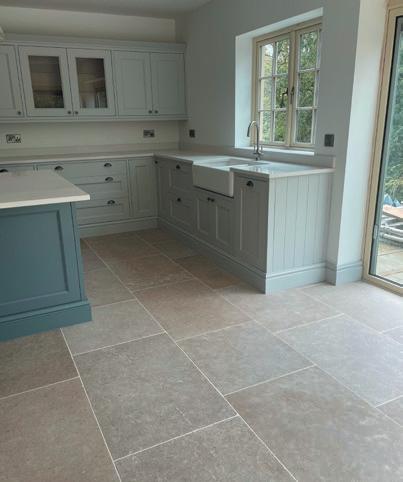
For a limited time only, our Belzoni Vintage (pictured above) has 10% off, making it just £62m², inc. VAT. Nationwide delivery is available. Now on display in our showroom.
Opening hours: Mon to Wed: 09.00 – 17.00, Thurs: 09.00 – 19.00, Fri: 09.00 – 16.00 Sat: 09.00 – 13.00.
Facebook: Natural Earth Products Instagram: @naturalearthproducts www.naturalearthproducts.co.uk T: 01433 631333

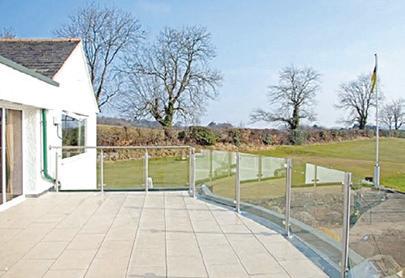
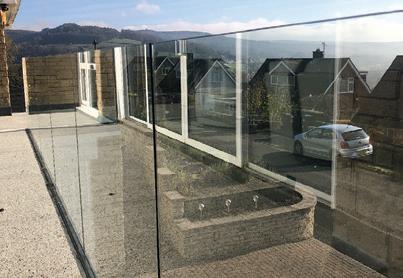
FOR more than 40 years, Holmesfield-based family business Tuff-Roofing and Saxton Balustrades Ltd has been making its mark on homes and business properties across Derbyshire and Yorkshire.
Run by Mike Wragg and his daughter Helen, the company has eliminated longstanding failings associated with old-fashioned felt and bitumen flat roofing by specialising in seamless fibreglass roofing systems.
Tuff-Roofing lays only the Polyroof 185 system, certified by the British Board of Agrément construction industry watchdog. Leaks, and a short lifespan are problems of the past, thanks to the seamless system, which comes with a
30-year durability rating. Thanks to Tuff-Roofing, the seamless system is available to homeowners planning renovations or new building projects throughout the Peak District and Derbyshire Dales.
And to finish the job in style, Mike and Helen also install bespoke balustrades in high-quality stainless steel and toughened glass. This quality product really does open up your house and garden.
To find out more about the range of services Tuff-Roofing and Saxton Balustrades Ltd can provide to transform your home, contact Helen on 07973 672582 or visit www.tuff-roofing.co.uk






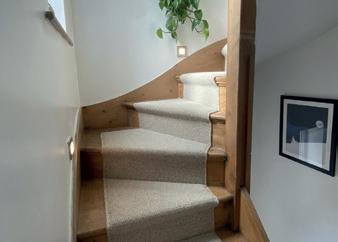
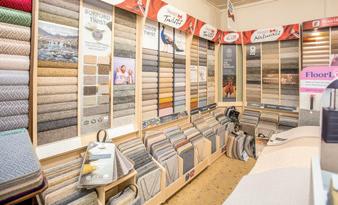
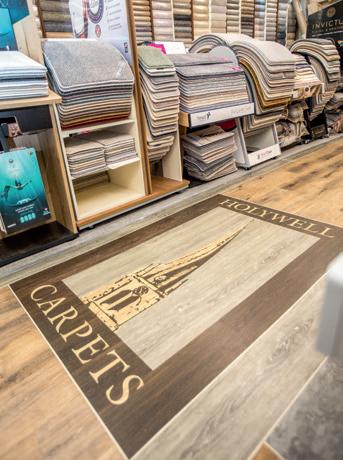
Chesterfield-based Holywell Carpets believe that honesty and trust are integral to meeting and exceeding customers’ expectations.
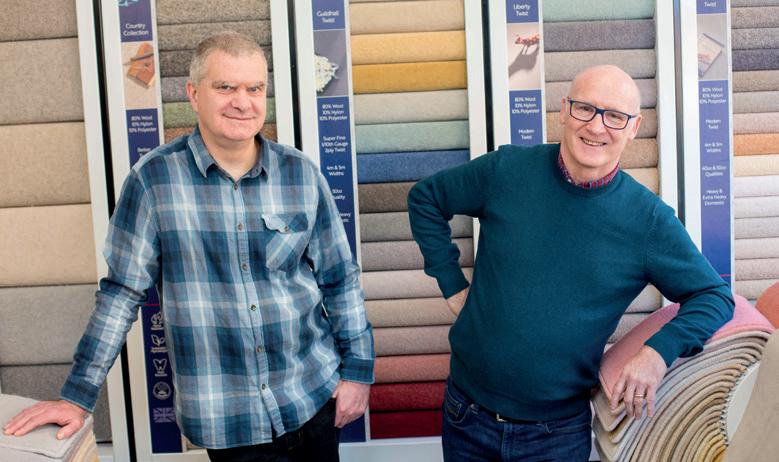
AS can usually be expected from a long-established family business, Holywell Carpets has stood the test of time through displaying the hallmarks of unparalleled customer service, uncompromising integrity, and unswerving reliability. Brothers Reg and Steve Hinde took over Holywell Carpets in 1989. Steve now manages the business in conjunction with long-standing and loyal employee, Martin Howroyd. Together, Steve and Martin have been working together at this highly reputable carpet company for 33 years. Previously, Steve had worked elsewhere in the carpet trade in a fitting capacity for ten years. Martin was at the company three years before Steve’s arrival. It’s fair to say that they know the business inside out. And they have done the hard yards! Both are
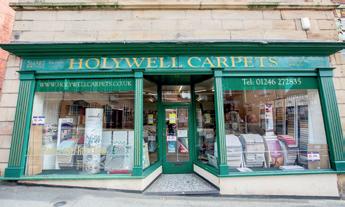
trained fitters and have many years fitting experience between them, Steve was ‘on the tools’ for 20 years and Martin 25 years.
Steve is proud of the old-fashioned values which have underpinned the success of Holywell Carpets. “If I wouldn’t have a particular carpet in my home, I won’t put it in yours,” said Steve. “Martin and I always tell customers the truth. Our business is based on a high moral code and honesty and truthfulness are at the very core of this.”
The Carpet Foundation is the UK carpet industry’s lead body. As a member of the
Carpet Foundation, Holywell Carpets is bound by a Code of Practice approved by the Chartered Trading Standards Institute. The Code gives customers peace of mind that they are dealing with people they can trust. Carpet Foundation retailers are audited annually by the TSI to ensure compliance.
These are the benefits of buying from a Carpet Foundation retail member:
• Written quotations
• Deposit safeguards
• Written terms of business
• Impartial professional advice
• Free extended guarantees
• A free installation guarantee
• After sales procedures
With over 320 members, ACG is a national buying group dedicated to supporting independent flooring retailers. With a massively increased buying power, the ACG can secure the best trading terms with the best selection of flooring suppliers. This means that carpet retailers like Holywell
Carpets can pass on the savings to customers, making their prices much more competitive. ACG membership has a good number of benefits for Holywell Carpets, including enabling them to trade on equal or better terms than members of other groups or multiple outlets.
Being a Derbyshire Trusted Trader tells customers that they are dealing with a fair and reliable business, which follows a code of practice. The scheme also establishes a vetting procedure and a framework for stringent quality standards. Here is a recent Derbyshire Trusted Trader review:
“Very efficient from purchase to fitting. Very courteous and they did everything they said they would. I highly recommend them and will not look anywhere else when I replace the next carpet. Excellent carpets.”
Whilst catering for a wide range of tastes, preferences, and budgets, Holywell Carpets uses most of the highest-quality suppliers of carpets and flooring.
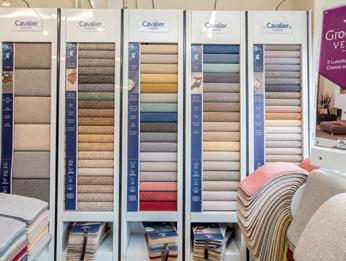
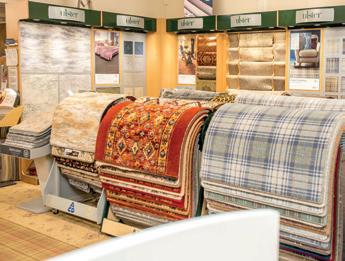
When it comes to carpet displays in the showroom, Cavalier, Adam, Westex, Ulster, Abingdon, Penthouse, Cormar, Whitestone Weavers, Hugh Mackay, and Brockway are all well represented.
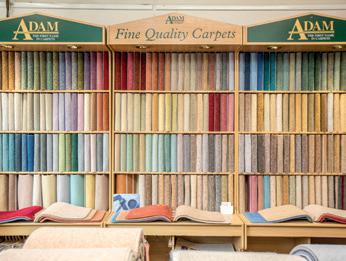
Steve is keen to point out that there are quality ranges for each of these suppliers. “I can show customers the difference in quality even within the Ulster range,” said Steve. “The key measurements they need to know to assess a carpet’s durability are its density, that is how closely knitted together its fibres are, and its pile height. In general, short, dense, heavy carpets are more durable and hard-wearing than those with loose, shaggy fibres.
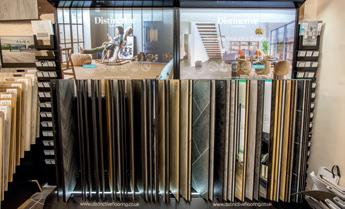
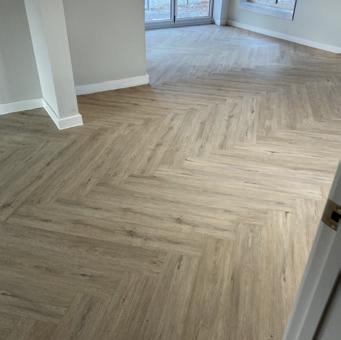
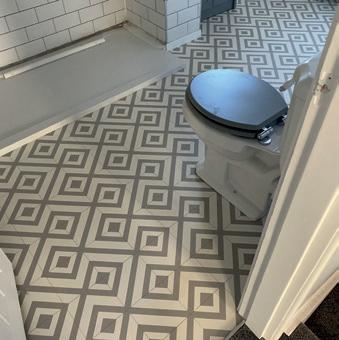
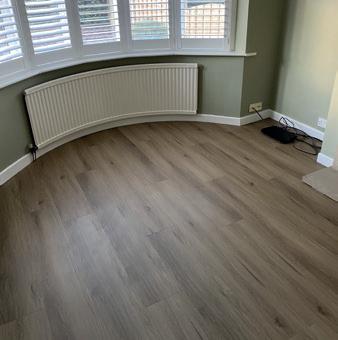
LVT flooring is ever more popular these days and Holywell Carpets has certainly got this covered. With premium brands like Camaro and Distinctive, backed up with vastly experienced and highly knowledgeable fitters, customers can rely on an immaculate finish to their superb new floor.
Holywell Carpets also stocks and fits quality ranges of vinyls, laminates, and carpet tiles.
Measuring floor space and estimating the amount of flooring or carpet needed is a skill. “Customers should never really buy a carpet until a room has been professionally measured,” said Steve. “We can save customers hundreds of pounds by using carpets which come in smaller width sizes. With eleven widths of carpets now available, choosing the most cost-effective width option can make a whole load of difference. Selecting the optimum width of carpet available in a given carpet range can minimise waste and save a small fortune!”
Giving genuine, objective, and honest advice is at the heart of everything
they do at Holywell Carpets. “If we can save our customers some of their hardearned cash, we’ll do it,” said Steve. “With our price quotations, we also include the often-hidden extras. With us, underlay, grippers, doorplates, and fitting is always included in the cost.”
If an honest, reliable, and courteous service is what you’re after, look no further than Holywell Carpets.
Holywell Carpets, 40 St Mary’s Gate, Chesterfield, S41 7TH T: 01246 272 835 M: 07733 889430
E: enquiry@holywellcarpets.co.uk www.holywellcarpets.co.uk
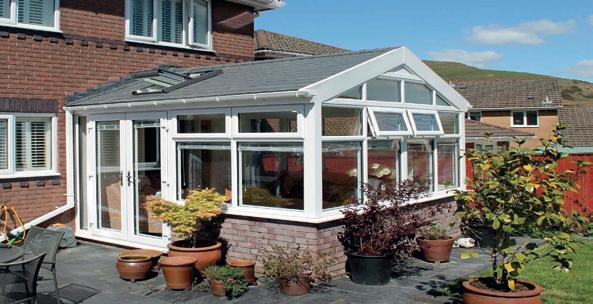
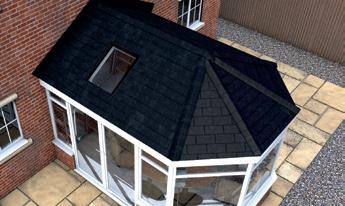
IF you have a glazed or polycarbonate roofing system on your conservatory, you may find the space too hot in the summer and too cold in the winter. The reason for this is poor roof insulation. It is also common for homeowners to find the glare in the winter and summer unbearable. The HeatGuard roofing tiles system solves both these issues with proper insulation set into a solid, tiled conservatory roof. This creates a more usable space year-round.
The lightweight construction of a HeatGuard Warm Roof also gives it its exceptional U value of just 0.15 W/m²K. That means it really does turn a too cold or too hot conservatory into a year-round room. The HeatGuard Warm Roof uses a structural, 100% weatherproof, lightweight insulated boarding system in place of the usual outer plywood.
Perfect for retro-fitting on existing conservatories that suffer from being too hot or too cold, the HeatGuard Warm Roof
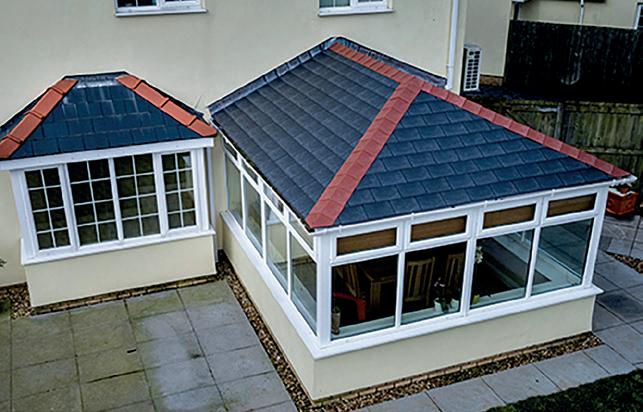
typically weighs within 30-40kg of a traditional glass conservatory roof. This means (in most cases) existing conservatory frames are able to take the weight of the new HeatGuard roofing system without needing additional reinforcement.
Another advantage of the lightweight conservatory HeatGuard roof is that it is MFA approved, which allows building applications to be fast-tracked in most cases.
The innovative construction of the roof means it is also very quick and easy to install – average installation takes just 2-3 days, including removing the old conservatory roof.
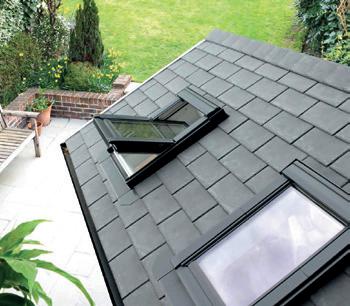
The HeatGuard tiled conservatory roof delivers the performance, efficiency, and longevity of a normal roof, and crucially, a material match. With the conservatory
roof tiles, customers can have a concrete or slate effect tile in a wide range of colours. This makes it appear to be a true extension of the home, rather than an add-on like you would get with a glazed roof.
Customers can have a new, warm roof conservatory in a near unlimited range of styles. Popular styles include Victorian, Edwardian, gable ended, lean-to and combination. The HeatGuard System can match the design of an old roof or replace it with a new design.
Leka, the manufacturer of the Warm Roof system, offers a 40-year warranty on its components to give customers complete peace of mind.
The high quality, state-of-the-art construction and versatility of LEKA roofing systems makes them the perfect partner for HeatGuard, who are renowned for their uncompromising integrity, exceptional levels of craftsmanship, and excellence in customer care. Together, they consistently deliver a roofing solution that delights homeowners both in its elegant design and marketleading levels of insulation performance.
“The benefits are far superior to what we had expected. Good service and excellent workmanship to complement such a fantastic product in the HeatGuard System. We now have a conservatory that is usable year-round and have already recommended this to our friends and family.” Mr and Mrs Jones




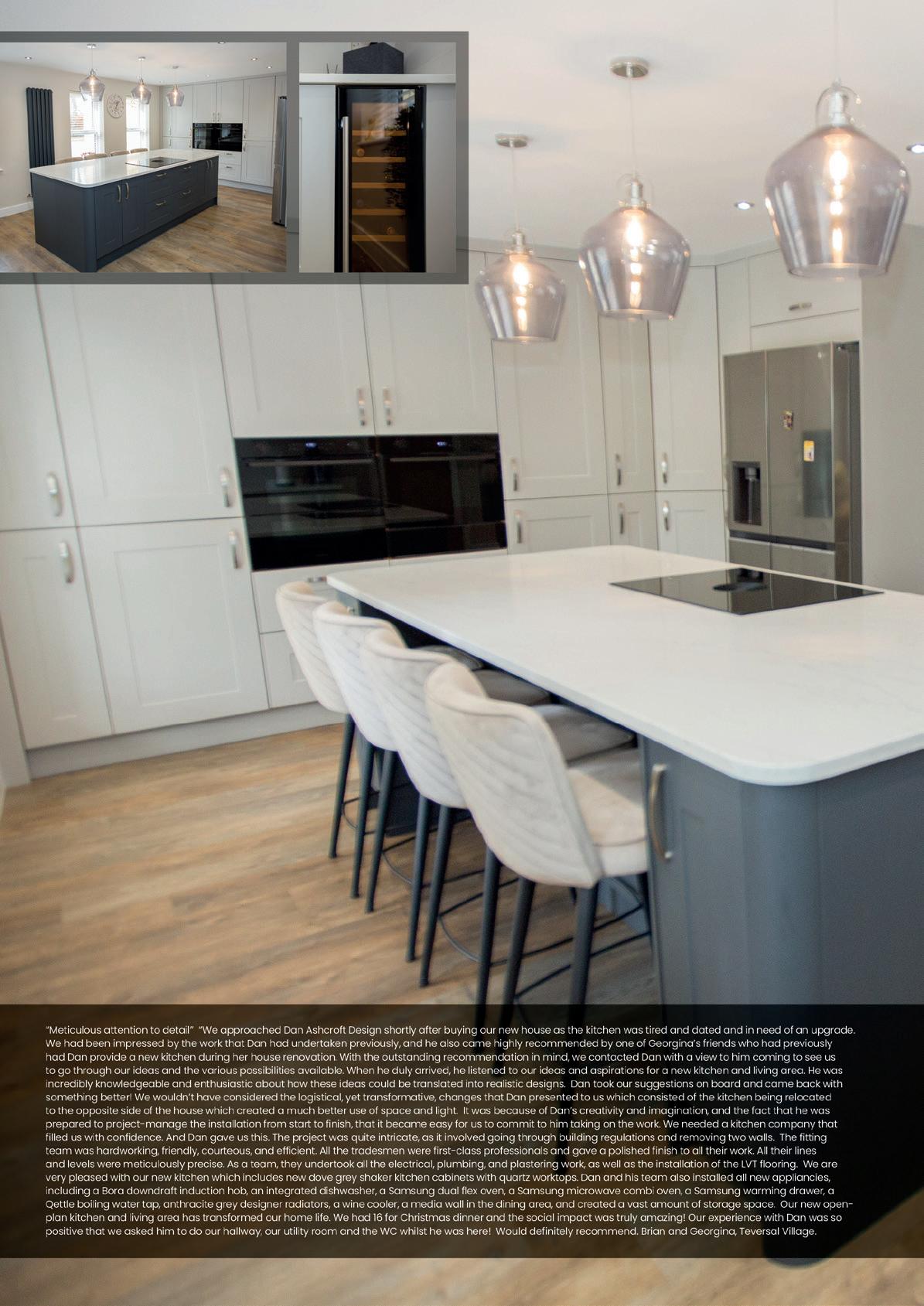
Not only do naturally lit interiors feel inviting and airy, but they also encourage vitamin D production, focus, and well-being. You can maximise natural light with a light colour scheme and reflective surfaces, like mirrors. There’s something soothing and alluring about smooth surfaces and neat interiors. Clutter-free and simplified living spaces never
go out of style; they only get better and better. One of the most balanced interior trends of 2024 is warm minimalism. This serene design style promotes mindfulness and slowing down. It perfectly balances simplicity, functionality, comfort, and style. One of the interior trends of 2024 sure to stick around embraces productivity. The home office isn’t going anywhere – it’s becoming a permanent fixture in homes. With remote work here to stay, people are investing in ergonomic furniture, soundproofing, and stylish design to make their workspaces more functional and inspiring.
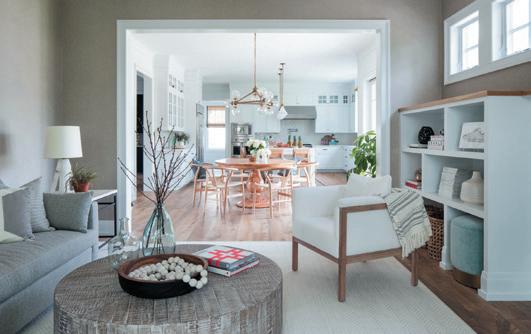
typical of modern interiors. Smart living can also merge the charm of the past with the comforts of the future.
Traditional design gets a fun makeover in 2024. We’re seeing a return of classic elements but with a fresh twist. Now, timeless spaces also embrace contemporary functionality and atmosphere – how? Ornate furniture can complement an eclectic layout but also feel toned down and casual,


Finally, authenticity is becoming a key pillar for interior design – and will stick around beyond the trends of 2024. Character and personality attract, and when it comes to interiors, what’s unique draws you in as every piece tells a story. Vintage finds, artisanal craftsmanship, and personalized decor bring warmth and individuality to homes.


AT House of Granite and Marble, they understand that your home is your sanctuary, a reflection of your style, taste, and personality. That’s why they’re dedicated to providing you with the highest quality granite and quartz worktops, crafted with precision and care to elevate your kitchen or bathroom to new heights of luxury and sophistication, all direct from their Chesterfield factory.
Since 2006, the team of skilled craftsmen have brought their extensive experience and expertise to every project, ensuring that each worktop is meticulously crafted to the client’s design specifications and preferences. Whether you’re looking for the classic beauty of granite or the sleek, aesthetic, or special effects of quartz, their
friendly team will work with you to create a stunning solution that often far exceeds expectations.
Design Possibilities
With an extensive selection of colours, patterns, and finishes to choose from, the design possibilities are endless – and that’s before they start shaping the worktop to fit your design preferences! Whether you prefer the timeless elegance of a polished granite worktop or the contemporary flair of a matte quartz surface, House of Granite has the perfect option to complement your style and enhance your living space.
Granite and quartz are renowned for their durability, making them the perfect choice for modern life in every home whether it’s your kitchen, bathroom or indeed any room! From their state-of-the-art
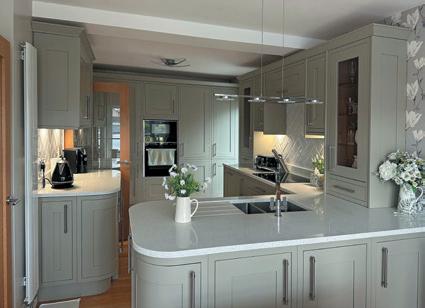
factory in Chesterfield, all worktops are engineered to withstand the demands of daily use but still maintain their beauty and lustre for years to come with occasional care and simple maintenance – expert aftercare advice is available from any of their staff.
Experience the Difference
House of Granite and Marble are proud to be a local familyrun business offering unrivalled levels of customer service. Once you speak to any of the team,
Buy direct from the factory
you’ll discover just how friendly, knowledgeable, and helpful they are, as you are guided through an extensive range of granite and quartz samples and real displays in their impressive showroom. If you are looking for worktops as part of a new kitchen or wanting to transform an existing kitchen or bathroom with their worktop refit service, then look no further than House of Granite & Marble.
House of Granite and Marble, Cobnar Wood Close, Sheepbridge, Chesterfield S41 9RQ.
Tel: 01246 261989 E: sales@houseofgraniteandmarble.co.uk www.houseofgraniteandmarble.co.uk



















1 Ram to shy away from having watery mud (6)
4 Ripley way there’s cash on delivery, and not after! (6)
9 In the notice-board of the ear? (4)
10 Weird tracings on water near Wirksworth (10)
11 Poached salmon to go ahead with, round here? (6)
12 Defendant at Longshaw? (8)
14 Scratch out a living? Sounds alarming! (3)
15 Tricky miss in the West travels through water (5)
16 Disastrous cabernet carelessly made (4)
18 Half of the abbesses making for Hardwick boss (4)
19 Cocoa? Last one to make it near Dronfield! (9)
23 Drink you can find in the dark? (4)
24 Little oldie of a soap-opera (3)
25 Poole’s got a craven mess near Buxton (6)
27 Stinging rash from a hornet NE of Swadlincote (10)
29 To sort out our hills? (4)
31 Linocut of race in village in peak condition (6)
32 Cross-over points? Often stony round here (6)
1 Non-glossy piece of hair said to be in town (7)
2 They’re stoney-black above Cromford (5)
3 Who needs luck, in order to find ‘glider village’? (7)
5 Doe, with six versions of rusts, say? (6)
6 Badger the old horse (3)
7 Eradicate tour too difficultto organise (4,3)
8 Rosa, with a gram of pork chop in Chesterfield greenspace (9,4)
13 Iron the corps? (5)
17 Spot the osprey, maybe? (Or not?) (4)
18 No balls to be played in this village! (7)
20 Elastic embroidery, the most frilly (7)
21 In 60 mins, what can be said of us? (3)
22 Cry about running rings round a hobo (6)
26 Equivalent of queen losing out, could be critical (5)
28 Little drink for the wee one (3)
30 Flower club not on the left? (3)

FIFTY-SEVEN years ago, pioneering packaging company Robinson of Goyt Side, Chesterfield, continued to prosper and continued to produce their popular magazine LINK, which fixed a spotlight on the people behind the machines producing bandages, cardboard boxes, antiseptic dressings, diapers, sanitary towels, cellulose wrapping – almost everything.
And as you might expect of a proud family firm, there were lots of Robinsons to follow in
the footsteps of founder John Bradbury Robinson and his enterprising father, the potter William Robinson in turn married to Ann Bradbury. These are just a few of the Robinsons featuring in LINK: Victor Robinson, D.C.Robinson, Robert B.Robinson, Charles Portland Robinson, Florence Robinson – and frequently, Managing Director Ernest B. Robinson.
But this preponderance of Robinsons guiding every arm and limb of a highly successful Derbyshire company should not blind us to the creditworthy – and today very uncommon –paternalism of this major employer. The Robinsons pioneered many aspects of worker satisfaction, also protection:
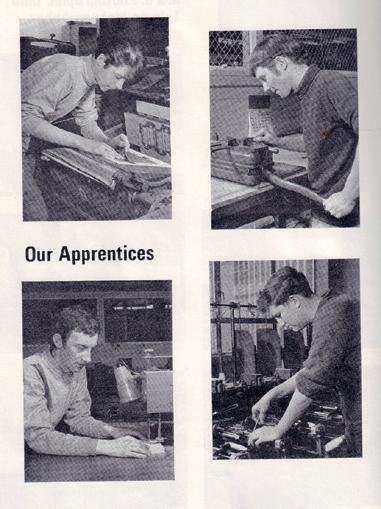
Left: 1) Peter Heath, Box Cutting Trainee, P.W.
2) Roger Walsh, Forme Setting Trainee. 3) Phillip Warmlsey, Forme Setting, P.W.
4) Raymond Houghton, Weaving Trainee, Griffin Mill.
first aid, leisure, exercise, hot meals, entertainment, sickness pay, sanitary pads, work-life balance, whatever.
Not by accident did Robinson’s boast its own Chapter of the Oddfellows Friendly Society; dedicated Angling, Bowls, Swimming and Photographic Clubs; a Motor Club competing for everything from Navigational trophies to awards for all-night Trials; and a works’ Cricket Club with its own ground: exemplary Personnel Relations in the true tradition of Titus Salt in Saltaire, the Levers in Port Sunlight, the Cadburys in Bourneville and the Rowntrees in York. And in
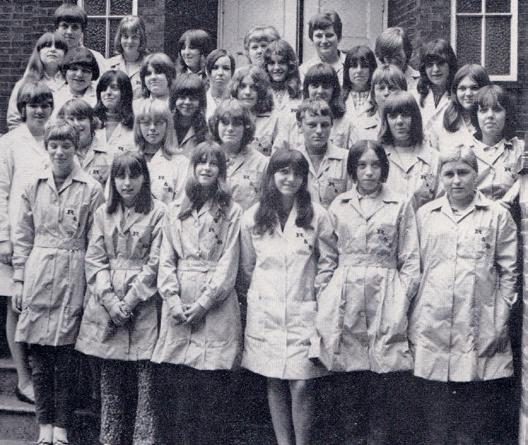
Above: More than 30 girls in the Robinson & Sons Preparatory School in 1967, from local secondary modern or technical schools, learning skills which will help them become full-time employees after their training.
common with all these Titans, Robinsons also arranged subsidised housing for their Lower Brampton employees.
Capping it all, the Robinson & Sons’ Operatic Society put on extravagant productions of Oklahoma and South Pacific at Bradbury Hall, beautifully choreographed and video-taped for LINK and for posterity.
LINK magazines, as you might expect, are full of presentations: gifting graduation, marriage, hula, productivity, retirement, long service, and so much more. On each of these important
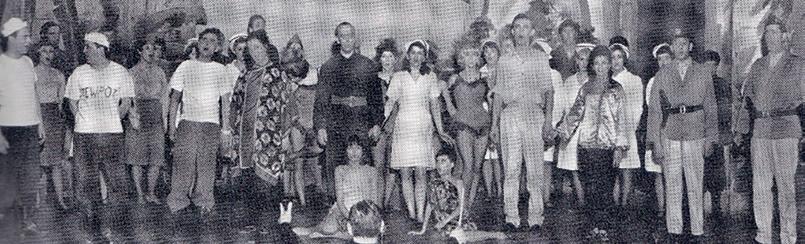
Left: Robinson & Sons Operatic Society staged South Pacific at Bradbury Hall on February 27-March 4, 1967.
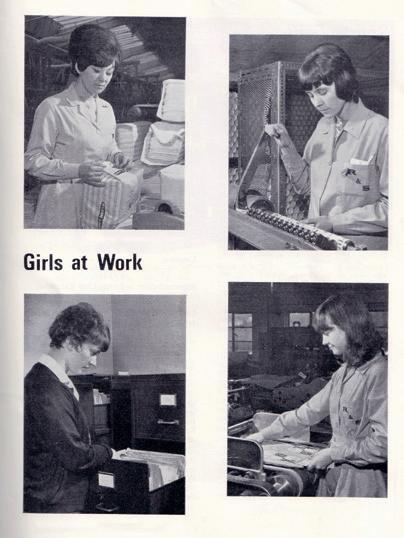
Right:
1) Miss S. Daglish, Paddi Pads. 2) Miss Glennis Allen, Round Box.
3) Miss J. Barrett, Fitting Room, J.J. Blows. 4) Miss P. Nixon. Cumming Dept., P.W.
occasions, one or more managers would come down; when admiring colleagues would crowd round the unwrapping of wine glasses, pearls, a sugar-bowl, a shopping-bag, a tea-cosy, a scarf, a brooch, a cheese dish, chocolates and toiletries: and all that for just one Robo Angel to mark her 47 years’ wafting and weaving.
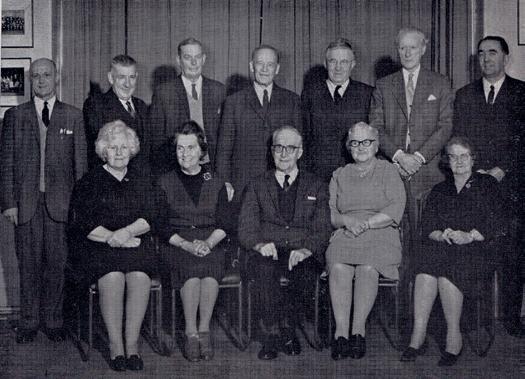
Above (left to right): Holders of Long Service Awards: Standing: Messrs. J. Kendrick, C.A. Ward, G. Dickenson, V.O. Robinson (Vice-President), E.B. Robinson (Joint President), M.D. Hay, A. Cliff. Seated: Mrs. I. Watson, Mrs M. Jensen, Mr. C.F. Cooper, Miss E. Garner and Mrs. M. Cooper.
By its own admission, a
universally appealing LINK magazine could enlighten hospital, barrack-room, care home and school – with “schoolboys eagerly awaiting the chance to read about their parents’ occupation;

enjoying the people, paintings, poems and photographs; and coming to no harm from doing so.”
So it was that Printer could talk to Costumier, Boilerman to “Inspectress,” Mechanic to Antique Collector, Subsidised Weekender to Company Doctor: an unbroken chain of links
till.... 20 years later, the late 80’s, when everything fell apart; or was outsourced; or was boarded-up; or was demolished, or was sold to Sonoco: defenestration under the guise of “progress”?
A tide which no Robinson Angel, however winged, could divert into the River Rother.

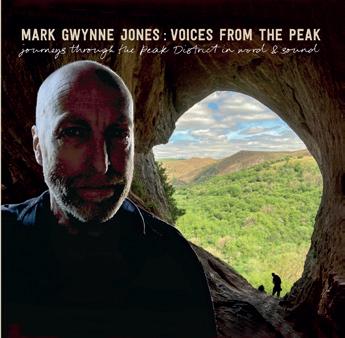
Barrie Farnsworth meets a local man who is quite the all-rounder… he’s a poet, a performer, a video-maker and a recording artist.
FEW people have hitch-hiked from Matlock Bath to Florence in Italy –several times – or lived in a van while touring the nation’s stone circles… but these are just some of the experiences that led Mark Gwynne Jones to write, record, and perform.
Now living in Two Dales, Mark first hitch-hiked to Italy when he was 17 – and enjoyed it so much did it some more. Once doing the whole trip on just £100. “We slept under the stars,” said Mark. “I can’t remember what we ate, but it wasn’t much!”
Later, with a friend, he toured the stones circles of England and Wales and wrote
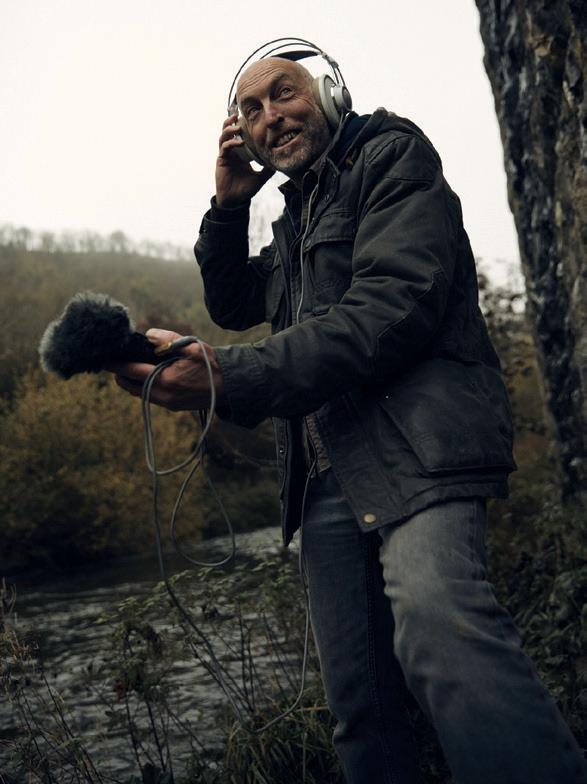
Mark recording the River Wye rushing past for one of the ‘Voices from the Peak’. Picture by Dave Imms.
about his experiences on the road: “I always felt the need to write. I’m fascinated by the sounds of words and the music of language. On first writing, I told my poems to friends and through surreal humour found ways of making them want to listen. I started getting bookings, supporting bands mainly; which led me to perform at festivals and theatres throughout the country and abroad, including residencies in the Netherlands, Germany, Cyprus, and India. For a time, I regularly performed at Ronnie Scott’s and was resident poet for London’s Regents Park.
“My first national press review was in the Daily Mail, following an Edinburgh
Festival Fringe gig. In a back-handed compliment, the journalist wrote: ‘Meanwhile the astonishing poetry of Mark Gwynne Jones makes even the more exotic lyrics of Bob Dylan seem perfectly comprehensible. If you like that sort of thing, you’ll love this show!’ It made me laugh, but I was chuffed to be mentioned in the same breath as Bob Dylan.”
Mark has spent the last four years creating a series of six audio-artworks, ‘Voices from the Peak’. “Each audio follows a different storyline through the Peak District,” says Mark, “drawing on the voices of people who live and work here, and combining that with the atmospheres, wildlife and weather of this strange and beautiful region. I like to think of them as works of magical-realism. Drawing on the poetry of everyday speech and lived experience.”
The first, ‘Burning Drake’, reveals how the landscape shapes us, and tells the story of lead mining, including how ancient miners found lead through plant-lore, dowsing, and sometimes by more mysterious means such as a ‘burning drake’ or shooting star.
In ‘Snow!’, which has been set to a video of spectacular old photographs, we hear people’s memories of big winters in the Peak District, including the spoken recollections of retired hill farmers. Mark says about his interviews: “Shepherds have told me our vintage breed of sheep, the Derbyshire Gritstone, know if a heavy snow-storm is coming three days before it arrives, and will clear off high ground to safety. I think that’s remarkable.”
Mark’s audio ‘Kinder Scout’,
is an evocative re-telling of the history of the Peak District, from the world’s first water-powered cotton mill, through the Kinder Trespass to the creation of the UK’s first national park.
Mark particularly enjoyed creating Audio 4, ‘Nine Ladies’, recalling the legend that the Stanton Moor circle was created when nine ladies were turned to stone for dancing on the Sabbath.
“I have recorded gatherings at the Nine Ladies on the solstices and equinoxes. People feel a strong connection to prehistoric circles. I believe it is something deep within our psyche that draws us to such places. Even though the churches have discouraged it for centuries –people are still drawn to them,” Mark said.
Audio Five is ‘The Blessing of Water’, which brings in the ancient Derbyshire art of well dressing, and Audio Six is ‘Raven Tor’. In the Peak District, ravens inspired numerous place names: Ravensnest, Raven Tor, Raven’s Clough – yet by the 1850s they were hunted to extinction. In this audio we hear first-hand accounts of their return; vivid descriptions from local young poets; thoughts on the wider ecology of the Peak District; and the voice of Fable the Raven.
The new audios are available to hear online (markgwynnejones.com), and Mark is now performing a live show of Voices From The Peak. The show, which won an award at the Buxton Festival Fringe, mixes spoken word, soundscape, and film. It is both funny and thought provoking, and evokes a landscape rich with voices and stories.
Sat 23rd March at Baslow Village Hall – Doors open at 7pm for a 7.30pm show. Tickets £12 (call 07754 176 362 or email bvhticketing@gmail.com)
Voices From The Peak is supported by the Peak District National Park, Derbyshire County Council, Cromford Mills, and Arts Council England. Editor’s Note: Find our more about Mark, and his forthcoming events, at his website: www.markgwynnejones.com
NOTES; Derbyshire lead mining terms: T’owd Man (term for when miners broke into old workings, where the old man or ancient miner had been before them. Also a name for the spirit of the mine, or the spirit of lead.)
Bing (high grade ore), bouse (undressed ore), cackle mackle (inferior ore), foudenheads (small picks), knocking (breaking ore) and woughs (the walls of a vein). Stowce (winch) kibble (basket) boles (hilltop furnace) scrin (vein) corfes (trolleys).
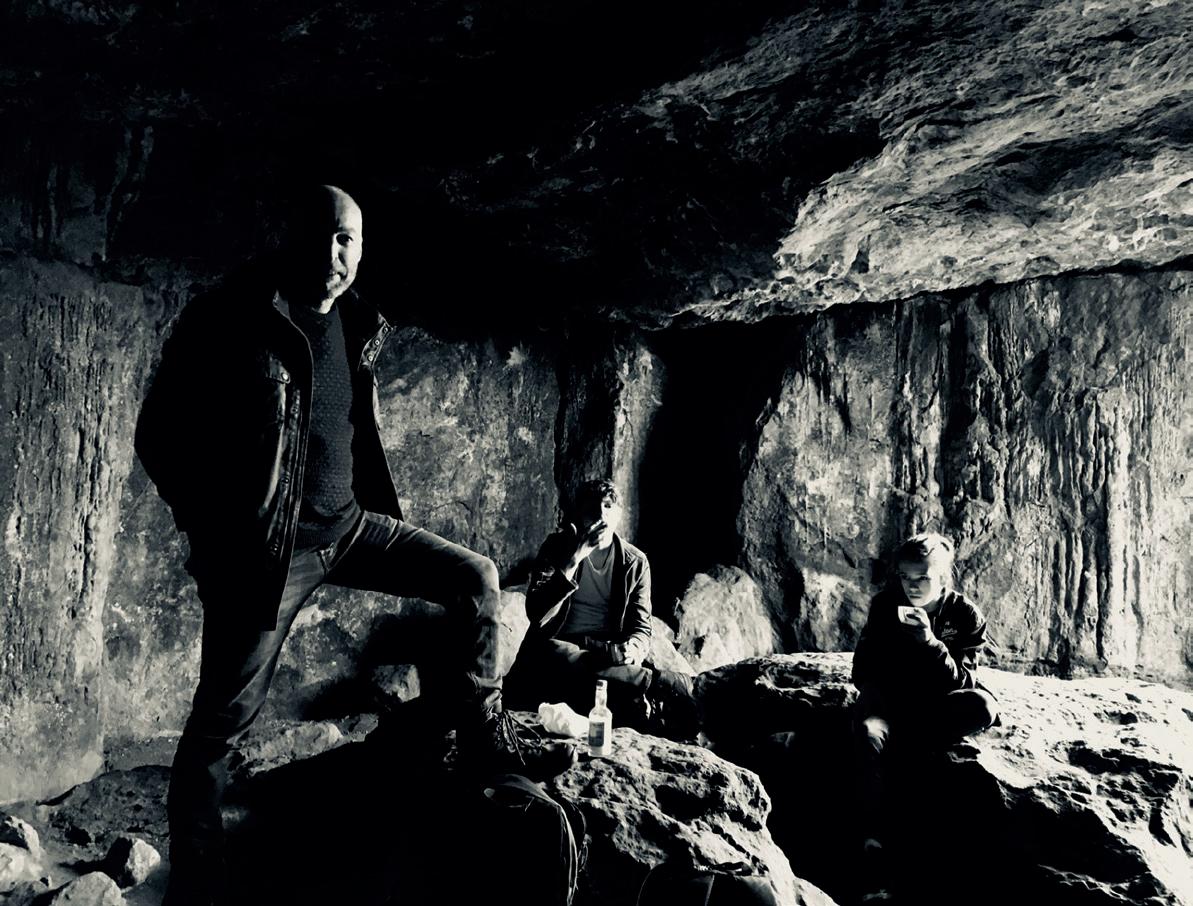
Mark with friends Arthur and Iggy at Harboro’ Rocks. Picture by Louise Swain.
Welcome... says the cool moistness of the cloistered air, the ages of darkness, the hardness of the rock – beneath the rock, the swallowing of light and sound...
Welcome underground... and your flame flinches at the monstrous shadows of its own creation.
What dwells in those deeps? Where feather stars and sea lilies now dance in stone, and the slow veins of the living rock pulse and flow with fluorspar and lead... Shhh!.. Listen... say the living dead.
And, in the silence between the drip... drop... drip... you can hear him: T’owd man, singing:
Bing, bouse, cackle mackle, Foudenheads knocking It’ s dirty work, it’ s thirsty work Its dirty, thirsty work in the dark!
Through the sandstone bridge, she said the river sings all day where the wild garlic grows won’t you come and play?
Let’s play tickled trout, she sighed, whispering like the river. I would said I, but... can’t be late back home for me dinner....
Yet homewards over the mossy wall beneath the weeping beech: Why not stay and rest awhile? her blue eyes did beseech. Her blue eyes did beseech, and she handed me some fruit –a Granny Smith that began to blush... at all her talk of juice!
All her talk of juice was like a potion drunk at bed it made me dream a freckled trout was standing there instead.
A freckled trout, standing there, androgynous, divine, singing of the liquid bliss together we would find: Together we would find, she sang fluttering her gills, the love that breathes in silver streams, a love for which you’d kill.
A love for which you’d kill... I mused it filled me full of doubt, sung beneath the weeping beech by a brown and freckled trout.
A brown and freckled trout she was in a sequin dress that shimmered round her swinging hips in whisperings of bliss...
Whisperings of bliss that told how – on the other side things are more than they seem girl river trout.


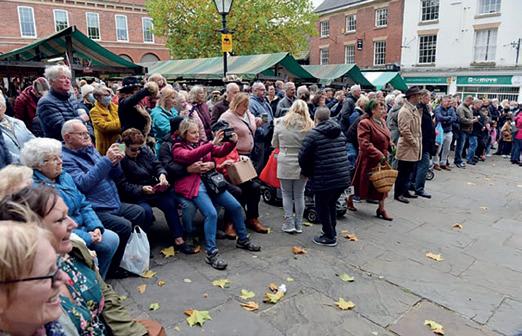
THE popular 1940s Market is set to return to Chesterfield this spring – bringing a range of free entertainment to the town centre for the whole family to enjoy.
The action-packed market will be returning on Thursday 11 April 2024, transporting the town centre back to the 1940s
with a variety of music, street performance and fancy dress.
Visitors can also expect to see the return of the replica Spitfire – a popular attraction at previous events.
Organised by Chesterfield Borough Council, the event will happen alongside the popular weekly Thursday flea market.
The date has been brought

forward from the autumn to allow for the start of town centre regeneration work later in the year, as part of the multimillion pound Regenerating the Heart of Chesterfield project.
More information about the event plans and entertainment will be shared closer to the time. Keep checking the council’s website and social media channels for details.
centres and visitor economy, said: “The 1940s Market is enjoyed by residents and visitors alike. There are not too many places you can go to see a range of free street entertainment like we have on offer here.
“The 1940s Market is enjoyed by residents and visitors alike.”
“Residents and visitors enjoyed the 1940s Market that took place in November last year, so we’re really pleased that we don’t have to wait long for its return.
Councillor Kate Sarvent, cabinet member for town
“We encourage you to put the date in your diary early so you don’t miss out.”

No, it’s not an alien invasion!
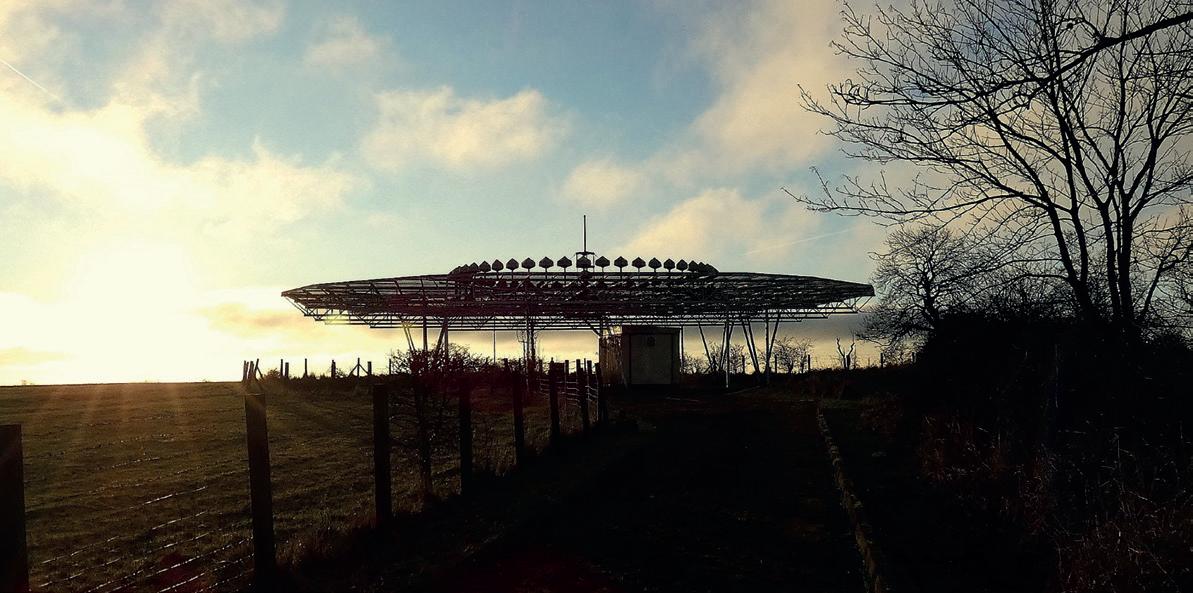
HAVE the aliens landed in January in Kniveton? No, it’s a beacon used for air traffic control – one of the entries into our 2024 ‘Lovely Landscapes’ competition, taken by Ian Moorcroft, of Hollingwood.
Next, a view from Stanton, looking towards Darley Dale over the Derwent Valley with Enthovens in the foreground.
David Thorburn, of Wirksworth, who took the picture, says: “This is the Derbyshire Dales version of the High Peak view over the Hope Valley and its cement works!”
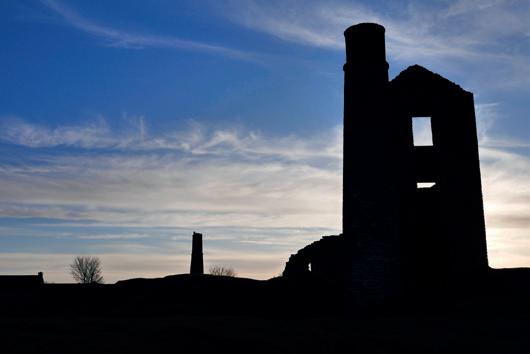
‘Magpie Magic’ was sent in by
Peter Wigglesworth, of Matlock, as the old mine near Sheldon is in silhouette late on January 30.
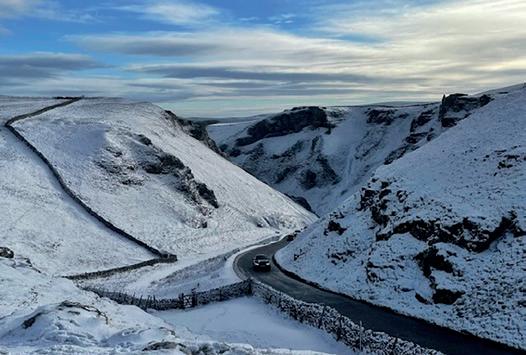
A snowy Winnats Pass, taken on January 16 by Elaine Marsh, of Bakewell.

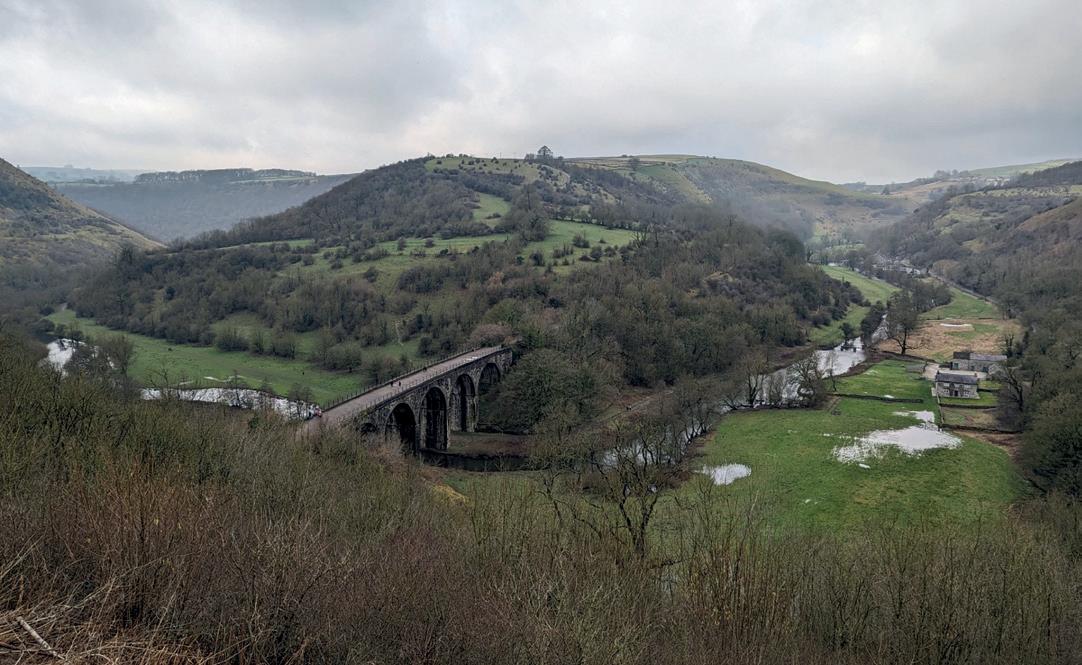
Monsal Dale looking very saturated with all the rain last autumn and this winter. The image was taken by Simon Hampton, of Walton, on February 11.
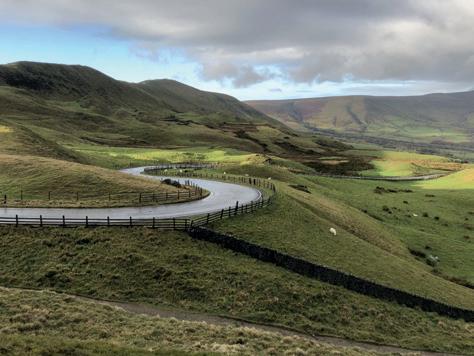
Next, the winding road to Edale, taken from Mam Tor in early January by Andy Hanna, of Great Longstone.
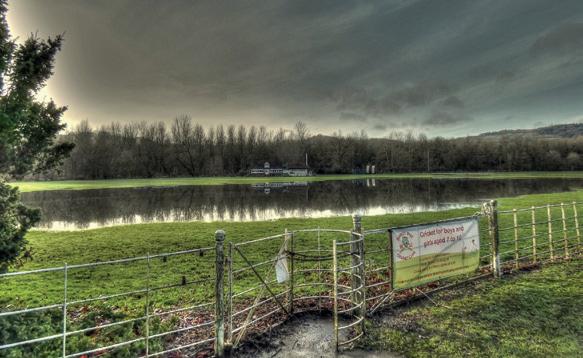
“It’s just not cricket!” says Ian Moorcroft, of Hollingwood,
as the home of Darley Dale CC is flooded once again this winter.
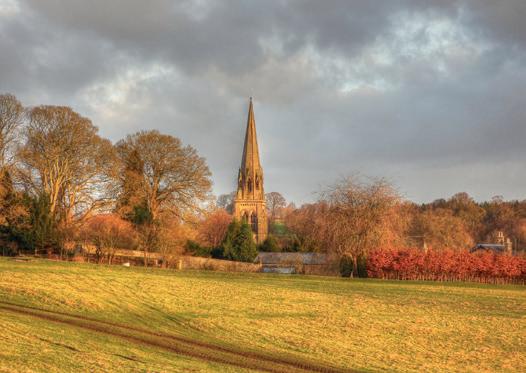
The sky looks more than threatening, too, in this image from Russ Teale, of Newbold, of Edensor church spire taken, he says, “during the golden hour in the morning” on January 24.
Next, an ice-fringed Burbage Brook, taken on January 19 by Brian Smith, of Upper Newbold.
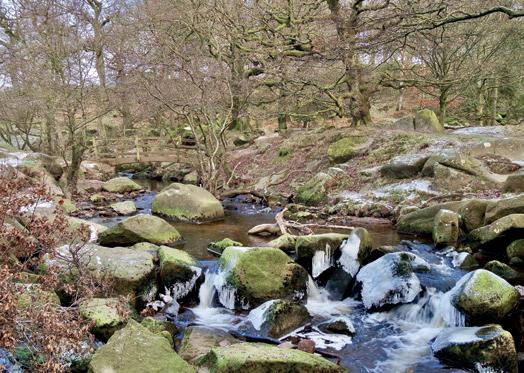

Stunning tree silhouettes on Stanton Moor, near the Nine Ladies Stone Circle, taken on February 11 by Peter Keeble, of Matlock Bath.
Next, Matlock Bridge, showing the new flood protection works which have done the job this winter, taken in January by Peter
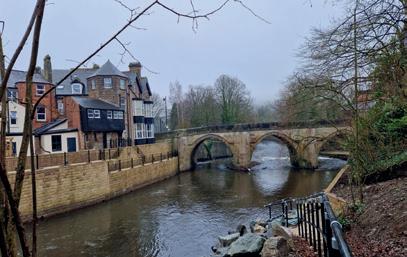
Wigglesworth, of Matlock.
An amazing sunrise now, taken on her phone on February 5 by Kathleen Moore, of Chesterfield.

The picture(s) you send in for the ‘Lovely Landscapes’ competition must be taken in 2024 and must be in Derbyshire. You can enter as many times as you like. We want entries from amateur snappers and not commercial photographers; and drone images will not be accepted. Please email your entries to barrief@bannisterpublications. co.uk, giving your full name and address, a contact
Finally this month, Chesterfield Canal in the depths of winter! Taken on January 17 by Ian Moorcroft, of Hollingwood.
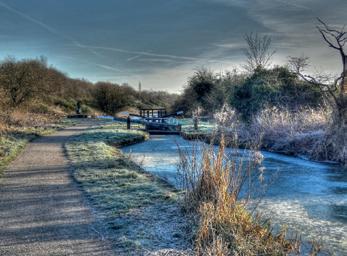
telephone number and a description (including the date it was taken) of the image, which should be attached as a high-res jpeg.
The winner will receive a meal for two at a top local
restaurant, plus the chance to have a selection of their images published in Reflections.
The closing deadline for entries is noon on October 16, 2024.

Local couple Adrian and Caroline Close have thanked us for helping them reach the summit of the highest mountain in Africa.
CHESTERFIELD residents, avid readers of Reflections and outdoor enthusiasts, Adrian and Caroline Close, used the hikes featured in the magazine as part of their training regime to reach the top of Africa.
Walks like ‘Climb the stairway to stunning views’ – an 11-mile hike from Edale – and ‘An iconic walk through history’– a 7-mile trek around the Longshaw Estate – to name a couple.
Adrian and Caroline trekked to the summit of Tanzanian mountain Kilimanjaro – at 5,865metres, (18,651ft), the highest freestanding mountain in Africa – at 6.30am on Adrian’s 55th birthday, just in time to watch the sun rise!
“We took eight days to climb the mountain taking the Lamosho route which, in our opinion, sounded the
most interesting,” Adrian said. “It is the newest and longest route and starts at the Londorossi Gate. On day one, we trekked through the dense rainforest with troops of Colobus Monkeys playing in the treetops, watching us watching them”.
The journey then moved through the vast expanse of heathland across the Shira Plateau, and onto the Lava Tower at 4,630m (to acclimatise) before tackling the Great Barranco Wall and heading to Base Camp.
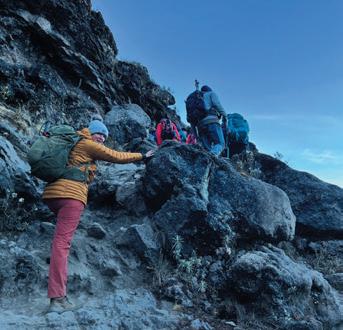
“The Barranco Wall was one of our favourite sections of the hike,” Caroline said. “It was a very steep and rugged part of the hike, taking a narrow path that hugged the side of the mountain with a steep drop to the bottom of the valley to our right. At one point you pass the ‘Kissing Stone’!! It’s called that because you have to hug the rock face so closely that your lips touch the stone – or you fall off.”
When we arrived at Base Camp, we had lunch and then it was off to bed to get some sleep before our mammoth overnight hike. We woke at around 10pm for dinner – mainly pasta and chips – then set off at 11.30pm to head for the summit. It took us seven hours to climb the last
Left: Caroline tackling the Great Barranco Wall – not for the faint hearted!
Below: The Chesterfield couple’s first sight on Mount Kilimanjaro.

stretch and we’ve never seen so many people being carried off a hill before. Altitude sickness was taking its toll!
“Adrian started to show signs of altitude sickness at around 4,500m but it wasn’t as bad as others we saw,” Caroline said. “After a short break, some ginger tea and some deep breaths, we cracked on and thankfully made it to Uhuru Peak, the highest point in Africa.”
As well as the beautiful and rugged scenery, another impressive aspect of the whole experience were the teams that get you to the top, all paid a decent wage, all catered for, all included and respected by the hikers, and all tipped well for their efforts. They even made sure Adrian had a birthday cake the night of his birthday at Mweka Camp (the last camp before you descend to the Mweka Gate and head off back to a great lunch and a much-needed shower).
In fact, when we arrived back at the hotel in Moshi, we were taken to our table for a late lunch which was great. Thankfully there weren’t many sitting near us because we could smell ourselves and it wasn’t good!
One of the biggest lessons we learnt
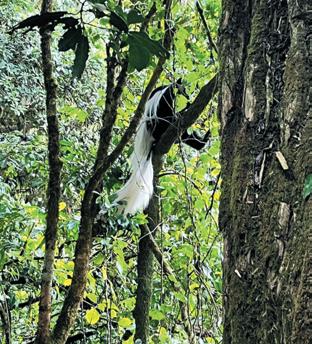
Above: The couple first trekked through a rainforest, with Colobus Monkeys playing in the treetops above them.
was that it’s not just the physical fitness that counts, it’s the mental fitness – the story you tell yourself on your journey. The positive self-talk that feeds your mind and the pictures of friends and family that you carry with you in your mind. That’s what gets you to the top. Would we advise others to do it? Absolutely, as long as you’re prepared! Would we do it again? Definitely!
Editor’s Note: Adrian has now been asked to talk to local groups, businesses and schools about their journey to the top of Africa, which he does voluntarily. Any group, business or school can get in touch with him to arrange a talk at support@adrianclose.com
Right: The couple set off for the summit from Barafu Camp (Base Camp) at 11.30 at night!

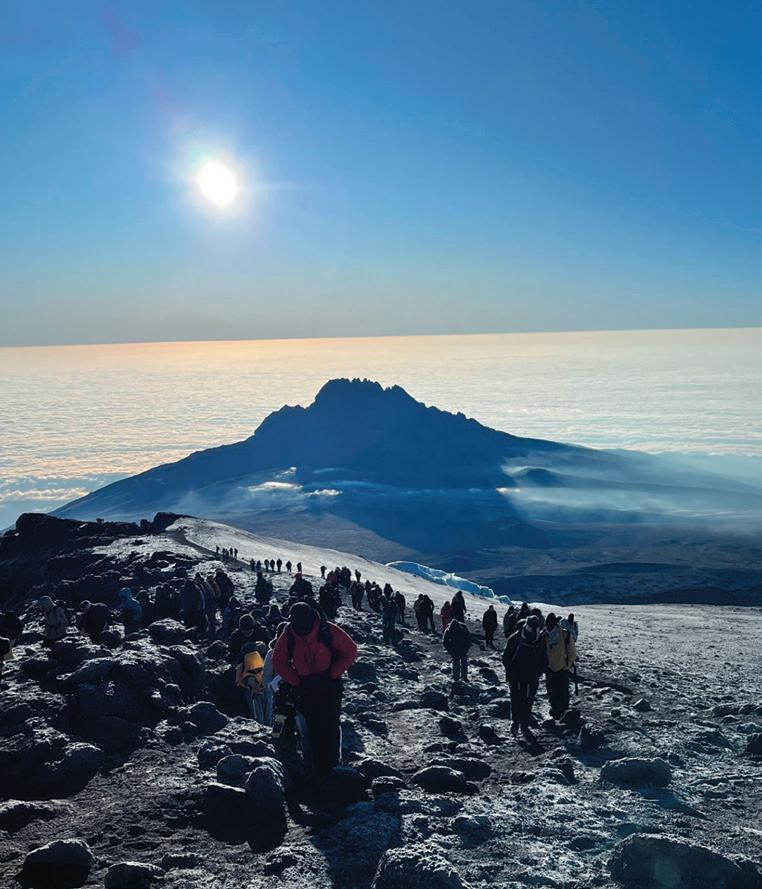
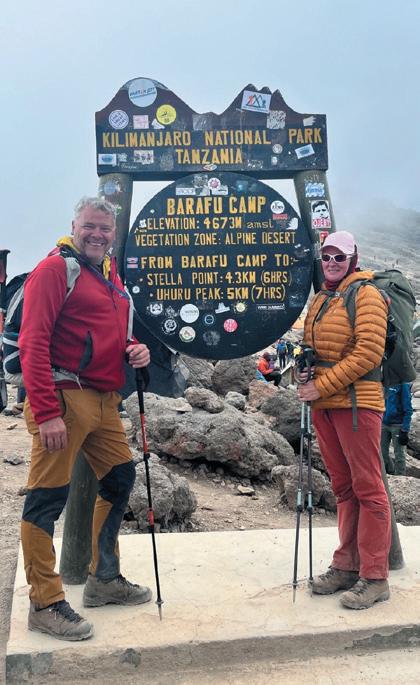
Plenty of people trying to reach the highest point in Africa!
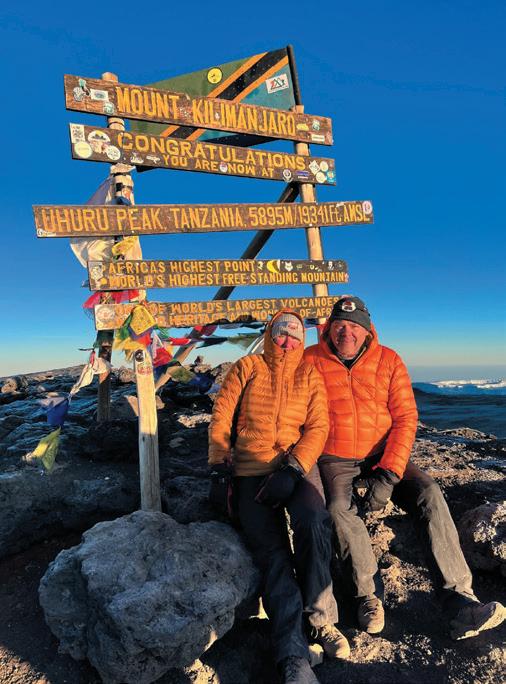
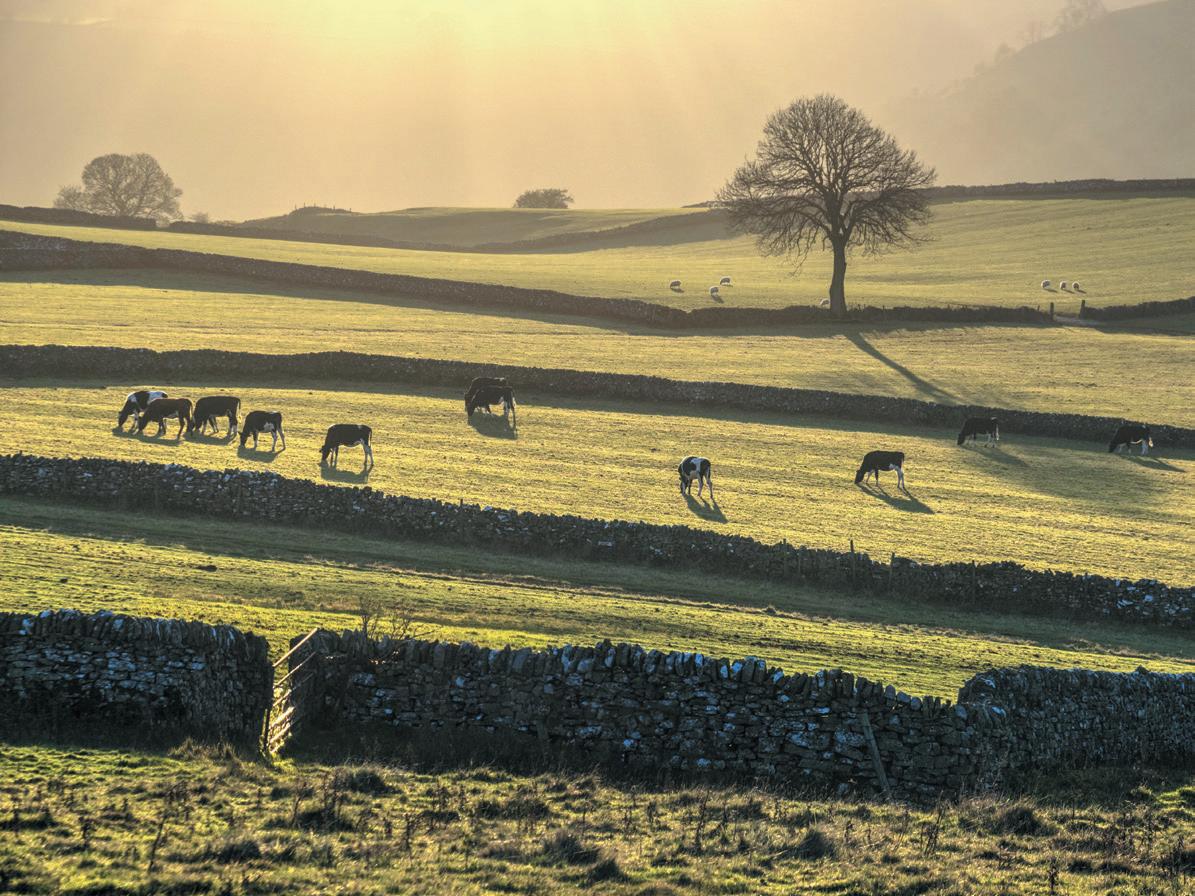
Chris Drabble, a writer and landscape photographer, takes a short walk to the summit of Wetton Hill to take a photograph of the magnificent Thor’s Cave.
THIS morning I’m setting out from the delightful village of Wetton, just over the border in Staffordshire, on a short walk that will take me to a location that, in my humble opinion, affords one of the best views in the Peak District National Park. I’ve parked my car in the car park on Carr Lane and I’m happy to confirm that parking here is free and that there are also toilet facilities that are open from 10am. I’ve arrived early and as I set off on foot, I look back to proudly acknowledge that mine is the first car in the car park.
My route takes me left, out of the car park along Carr Lane towards the heart of the village and then left again along High Withes Lane to proceed on a steady uphill gradient towards St Margaret’s Church. Upon reaching the corner of School Lane, I bare right onto the gravel-surfaced lane that heads north in the direction of Ecton Hill. At the point at which this lane reaches its highest elevation, I cautiously resist the temptation to follow it as it takes a turn to the left and instead, I look straight
ahead to pick out a stile in a drystone wall that crests a low limestone crag.
Beyond this stile, the footpath takes a straight line along a broad, grassy ridge that transforms my cautious progress into a confident stride. From here, there are fabulous views in all directions and I can’t resist the temptation to stop and to take some photographs.
The low morning sun casts long shadows across the landscape and illuminates the trees and fields in shades of emerald.
The fields around Wetton look to have shades of emerald in the morning sunshine.
Unfortunately, this easy progress is soon over as the path abruptly descends a steep bank to take a diagonal line across a field of grass and molehills. Looking up, I reach a rather imposing stile that stands at the intersection of two, high,
drystone walls. An acrobatic, sharp left at this juncture permits entry onto the Open Access Land that bounds Wetton Hill.
For the first twenty yards or so, the perimeter of the Open Access Land is low lying and rather boggy underfoot, but following a sheep rake through the Tussock Grass leads me to the intersection of a trace path which guides me on and climbs steadily and eventually onto the broad-domed summit of Wetton Hill.
Pausing to catch my breath, I contemplate that either old age or a diet of too many puddings has finally taken its toll, but my heart rate and breathing are soon normal again and having regained my composure, I look for a line that will take me westward and along the ridge to my destination. The place I’m heading for is the rounded shoulder of Wetton Hill and although this bump stands 10 metres lower than my current position, it will provide the perfect promontory to set up the camera and tripod and capture the landscape panorama that swirls around Thor’s Cave.
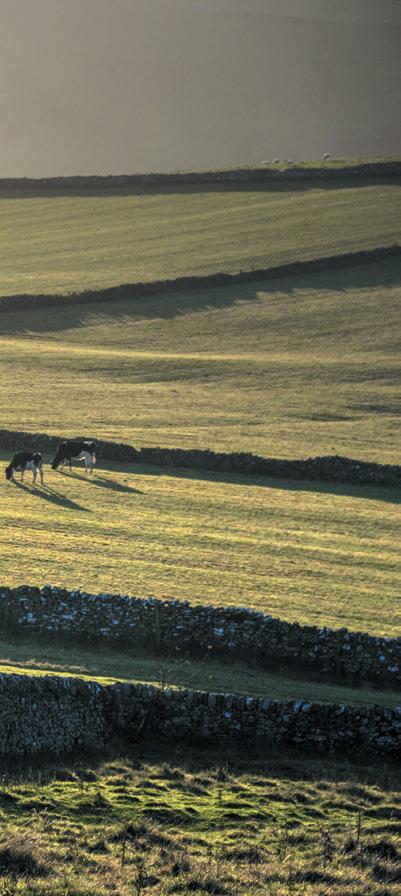
Thor’s Cave illuminated by early light.
Thor’s Cave has the appearance of a huge, yawning entrance to an ancient pyramid. The morning light strikes its face at an oblique angle and lifts the texture of the steep limestone spires into sharp relief. The gable end of a large, barn catches the light and its perfect position in the landscape adds a sense of scale to the dimensions. Beyond, the pointed summit of Soles Hill breaks the horizon, whilst the sweep of the Manifold
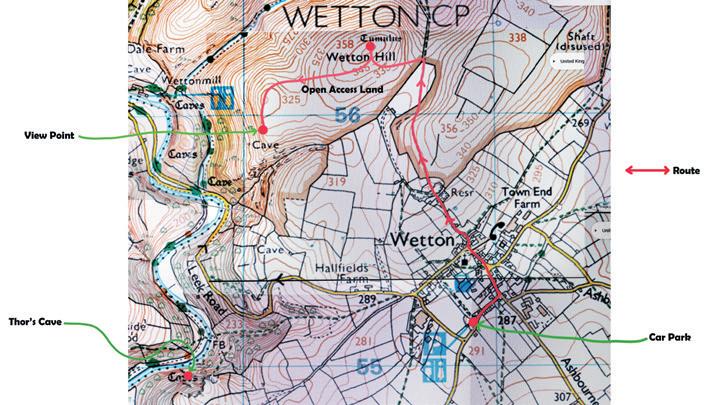
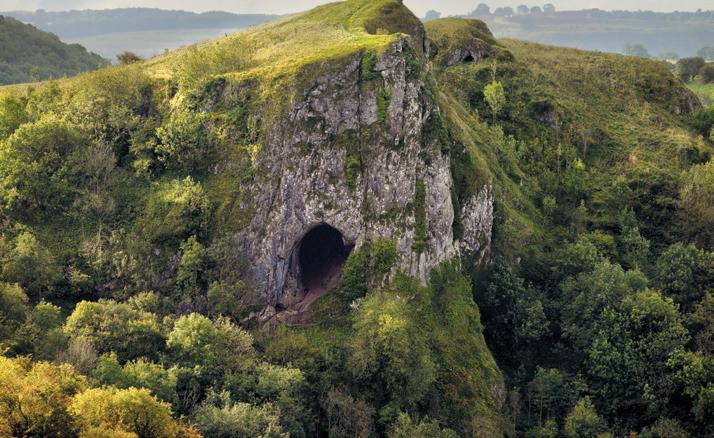
cradling the River Hamps, meanders around Thor’s Cave like a defensive
It is believed that the human occupation of Thor’s Cave began around 11,000 years ago and continued well into the Iron Age and on, into the period of Roman occupation. Past excavations have found pottery, stone tools, amber beads and bronze artefacts, as well as animal and human remains.
Looking at this landscape now, it’s hard to imagine that during the industrial age,
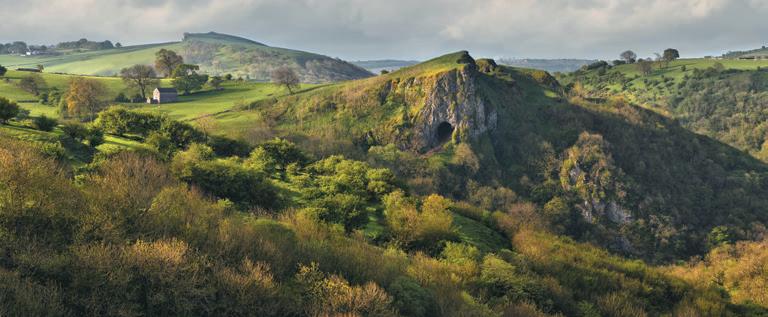
part of north Staffordshire occupied such voracious activity and was once heavily mined for copper and lead and pierced by roads and a steam railway system. The view this morning is simply breathtaking and is more reminiscent of a landscape inspired by Tolkien’s Middle Earth and I feel compelled to simply stop for a moment and contemplate the scene before me.
While there is still good light, I quickly attach a telephoto lens to the camera so that I can zoom in and record the detail around the cave’s entrance. I was rather hoping that some people might walk out onto the summit or around the entrance of the cave to give some human interest and to enhance the impression of scale, but although I waited patiently for ages, no one obliged.
Thor’s Cave in early light.
I suddenly become aware of distant voices and the laughter of children and strain my ears to try to detect their location. I
then catch a glimpse of people far below me at the Wetton Mill and realise that this is where the sounds are coming from. Their chatter wafts in on thermals that are rising from the valley floor and their voices are so clear that I’m almost able to eavesdrop on their conversations.
A young resident of Wetton Hill.
There’s a drop of rain in the air, indicating that it’s time to go and so I carefully pack away my camera and tripod. As I walk away, I glance back to see that someone has emerged onto the summit crest of Thor’s Cave. I’m now cursing the irony of the situation and for a brief moment I consider
whether I should return and take another photograph, but I decide against it and console myself that the light has already gone as clouds are moving in from the west.
On reflection, I have to say that I’ve thoroughly enjoyed this hour or so on Wetton Hill and I value these moments of solitude among this fabulous scenery.
As I walk back through Wetton in the rain, I stop to take one final photograph of an old farm building. Back home and with the aid of Photoshop I’ve rendered it in black and white and then added a sepia tone to try to preserve its character.
An old barn at Wetton.
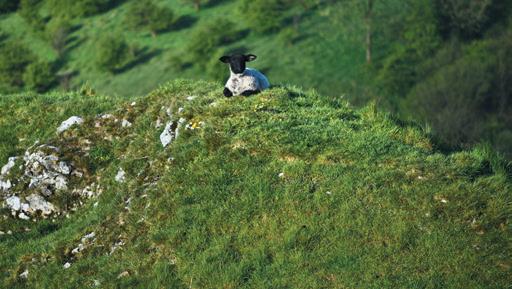
Post Script: I returned to Wetton Hill late last year, but this time on a particularly cold day. Luckily, there was a gentle mist in the valley that created a wonderful atmosphere and as I watched, some people walked out onto the summit above Thor’s Cave. I had high hopes for this photograph, but I can’t say that I’m entirely happy with it, although it nicely demonstrates the contrasts in the seasons.
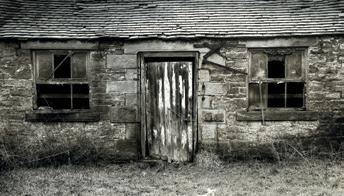
Winter at Thor’s Cave.
Editor’s Note: Chris Drabble is a member of Bassetlaw Hill and Mountain Club and the Over the Hill Photographers Club. More of Chris’ photography can be found at Photo4me, Alamy and 500PX.
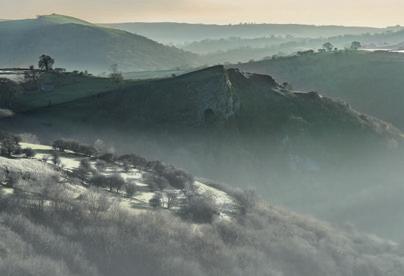

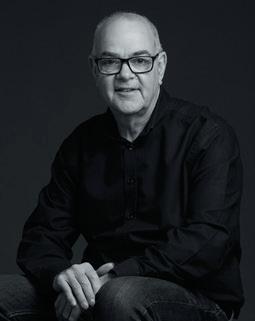
IAN Daisley (pictured above) gave up his day job – in engineering – and decided to be a full-time photographer instead about 15 years ago. Since then, he has done many a wedding, many portraits of children and families, and lots of landscape photography. His interest in photography started in early childhood, helping his father – who was a keen amateur photographer – turn their outside loo into a developing studio!
When Ian left school, he took up an engineering apprenticeship with a local
company. “In those days, they sent us to work for a short time in every department in the company – and there was a photography section. I asked if I could be given a job there, but there were sadly no vacancies.”
That meant a career in engineering – but photography was still a keen hobby: “When I got a property of my own, I used to temporarily turn a spare room into a studio, just like my dad did all those years earlier.”
“Unlike many amateurs, I started out using 35mm film instead of a digital camera, and develop it myself. I have now gone back to using film, and still develop it and then digitise the negative.
“I am simply fascinated now with shapes and patterns in nature and look to get great composition with the right light – I never manipulate an image using Photoshop, it’s either good enough or is discarded.”

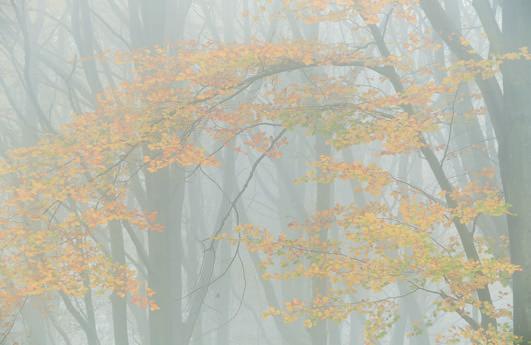

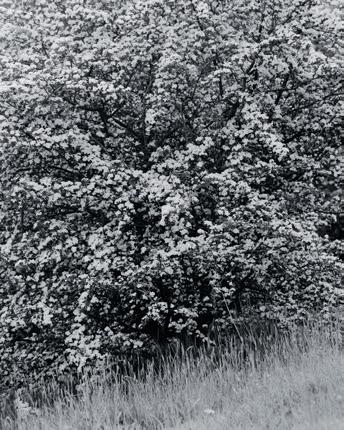

He is quite philosophical about whether people see photography as art: “I was at Chatsworth recently displaying some of my work at a Peak District Artisans exhibition and two people asked me what painting technique I used. When I told them they were looking at a photographic print, they lost interest completely. Some people see photography as an art form, and others don’t.”
Only three photographers are members of Peak District Artisans – an association of some of the finest Derbyshire artists and artisans – which perhaps says something about the quality of Ian’s work. He was accepted into the group in 2018, and by the end of 2019 he was its chairman, and
took it through the pandemic before retiring from the role.
“I have done all the classic landscape photography in the Peak District – all the famous views and the sunrise and sunset images – but now I am concentrating on shapes and patterns in nature through the seasons.”
Ian, who lives at Bonsall, has a gallery at Via Gellia Mill, Bonsall, DE4 2AJ called High Stone Gallery – visits by appointment only – and also does one-to-one or small group tuition as well as talks to camera clubs and other organisations. You can check out his galleries on the website highstonegallery. co.uk and contact him by email at enquiries@ highstonegallery.co.uk
IT was only a matter of time before 2023’s most talked-about film became a fashion inspiration.
Set in the Oxford University days of 2007, Saltburn’s clean-cut, moneyed aesthetic has lent itself to one of this spring’s hottest looks.
That’s right; fans of prim and proper polished style rejoice; preppy style is the talk of the fashion world for SS24.
An enduring classic which has never really been off the fashion radar; the preppy look features Oxford button-downs, blue and white pinstripes, polo shirts and academic blazers – all timelessly appealing for their effortlessly put-together vibe.
Endorsed by none less than the fashion powerhouse that is Miuccia Prada, who sent polo shirts authentically styled atop button-downs and paired with low-rise skirts and trousers down the spring catwalks, this season’s take goes for a full-on Y2K feel which pays homage to that ultimate Noughties preppy icon, Gossip Girl’s Serena Van


1. ANYDAY White Shirt, £32, Wrapover V neck, £32, Black Trousers, £36 & Beige Soft Hobo Tote, £35, all John Lewis. www.johnlewis.com
2. AND/OR Briar oversized shirt, £59, John Lewis.
3. Navy boucle crop trophy jacket, £70, River Island. www.riverisland.com
4. Navy pumps, £65, Crew Clothing. www.crewclothing.co.uk
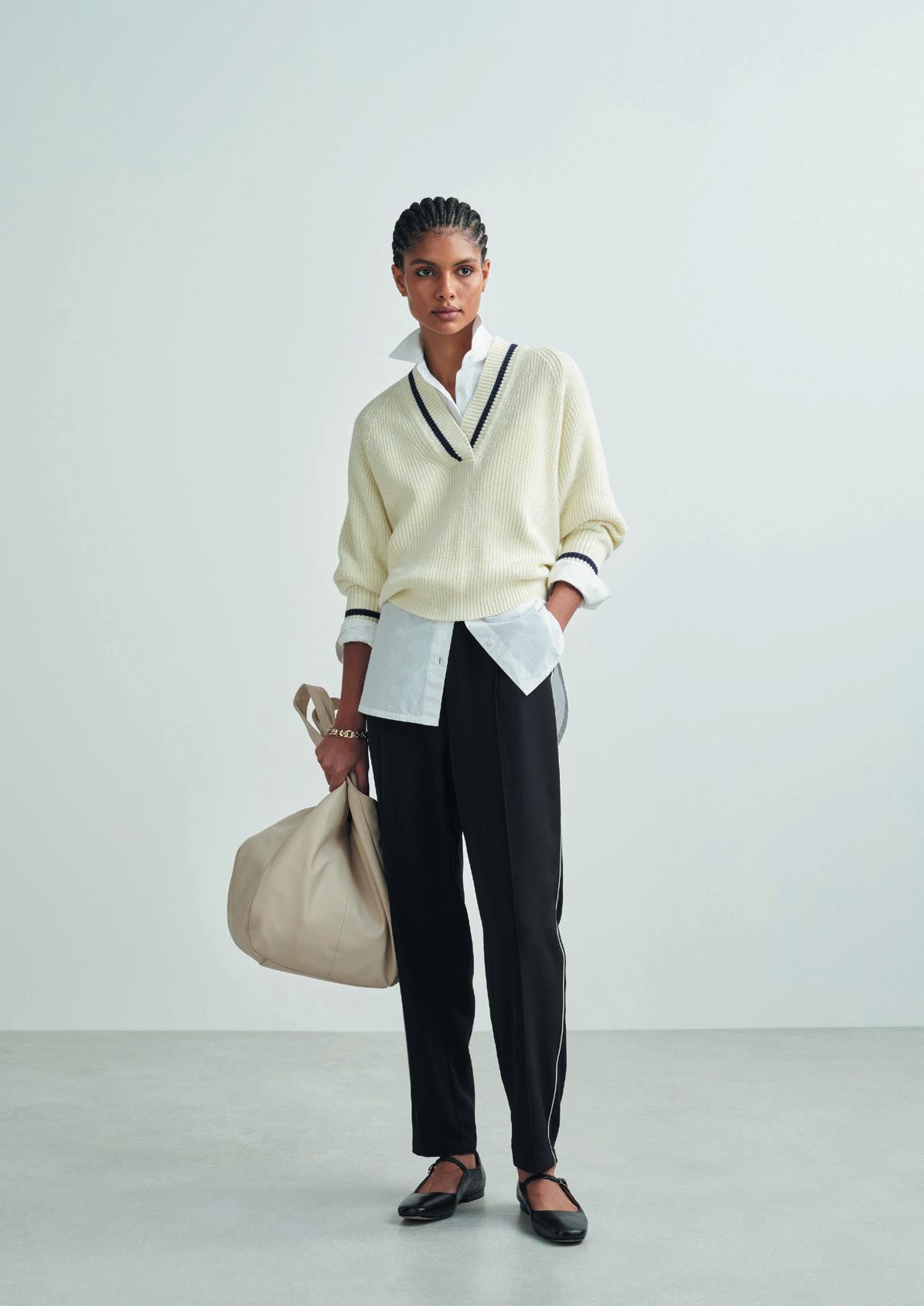
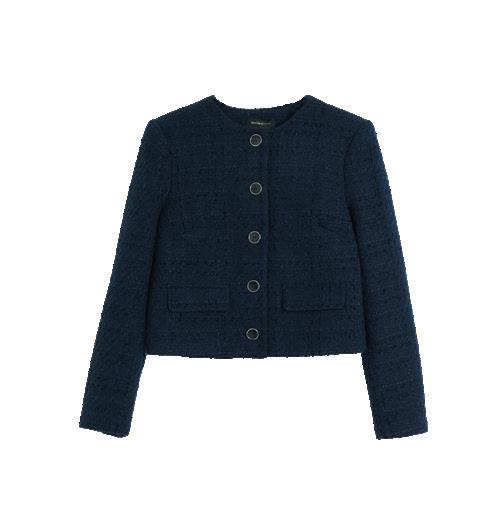





der Woodsen. It’s country club chic, but with a modern twist which still feels fresh and current despite its retro roots.
The trick is to pull off this trend without looking like a college kid, so think blazers with oversized trousers, or a v-neck sweater worn over a flowy collared shirt.
Colour plays a big part in creating that authentic preppy vibe; Ivy League navy is a must, obviously, but throw in some pastels for a vibrant spring-like feel, while khaki trousers are another preppy hallmark.
When it comes to fabrics, crisp cottons marry perfectly with cable knits, boucle jackets with linen – it’s all about the clean, streamlined silhouette.
And accessories must be simple and delicate; a string of pearls here, a gold bangle there – understated elegance is the way to go. Just throw on your neat leather backpack and slip on your ballet pumps – yes, they’re back in a big way for 2024 – and you’re ready to hit the campus in style!
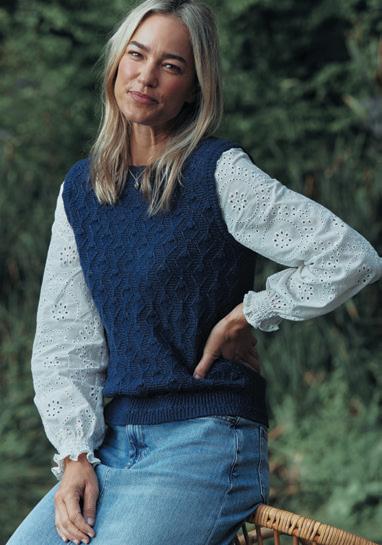
5. Khaki tab detail trousers, £65, Oliver Bonas. www.oliverbonas.com
6. Charlene sleeveless knitted jumper, £84.95, Barbour. www.barbour.com
7. Cotton-rich belted longline trench coat, £79, Marks and Spencer. www.marksandspencer.com
8. Winona 2-in-1 tank, £59, FatFace. www.fatface.com
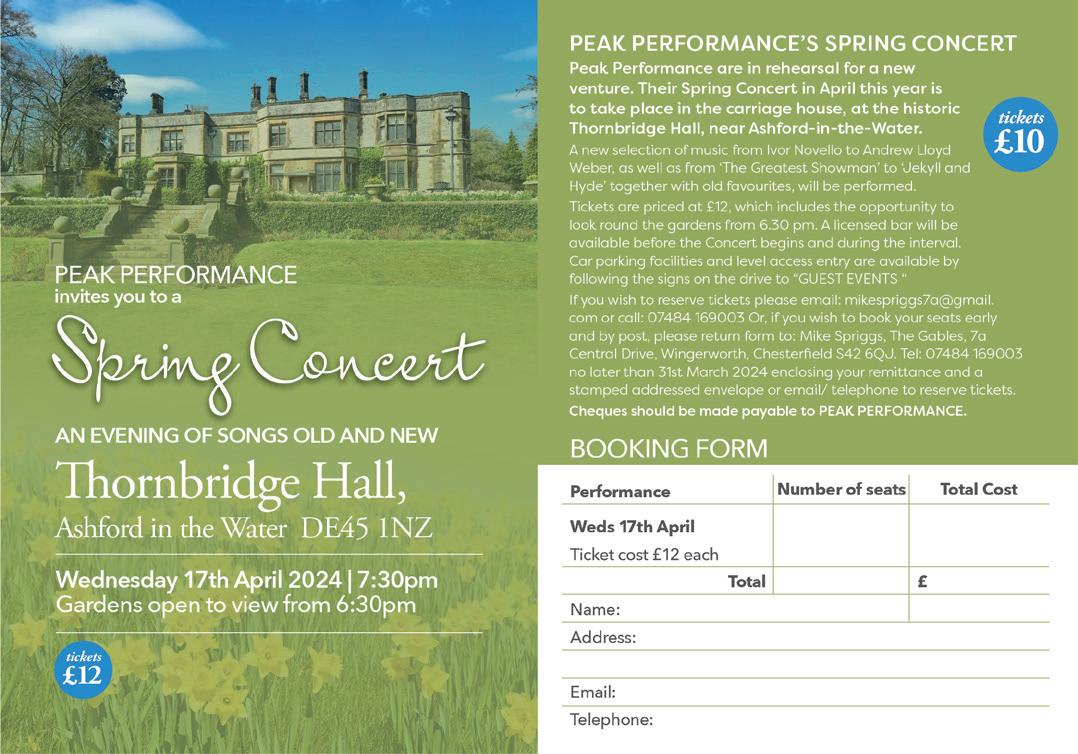
Experts predict the most popular wedding dress styles for the 2024
• Google searches for ‘wedding dresses’ have SKYROCKETED 681% WORLDWIDE over the last 12 months
• Fashion experts reveal their top predictions for the most lusted-after dresses for brides-to-be this year – including trending aesthetic ‘old money’ and ‘mini wedding dresses’ as demand hits an all-time high
• The experts studied social media to find which dress styles and wedding aesthetics are most wanted this wedding season as brides seek the perfect attire for their special day
AA study of Google Trends search data has revealed that searches for ‘wedding dresses’ have soared 681% worldwide compared to the past 12 months as brides-to-be seek inspiration.
As a result of the surge in interest as the wedding season approaches, fashion experts have revealed their predictions for the most sought-after styles for 2024 and which dresses will be seen most walking down the aisle.
The ‘ethereal’ wedding dress aesthetic presents the epitome of exquisitely beautiful, delicate style. The style is often showcased using soft fabrics such as tulle, satin, and silk with intricate detailing of lace or subtle beading.
The experts noted, “The new trend presents silhouettes and fabrics like those of a more established bohemian look. However, ethereal dresses are largely more refined but with a playful air – making them a unique choice for any bride wanting to stand out.”
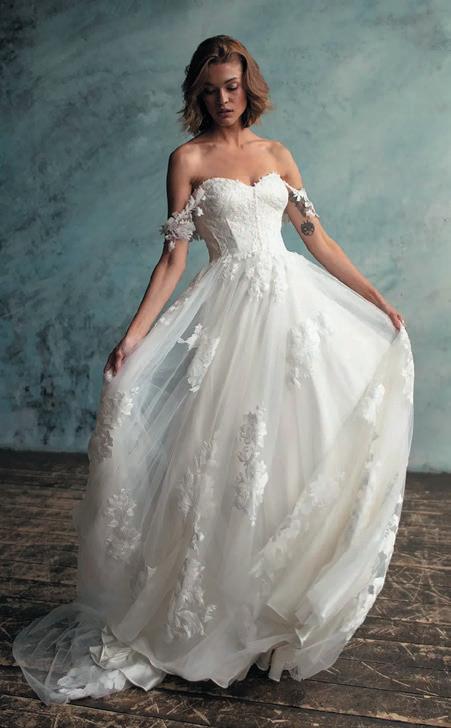
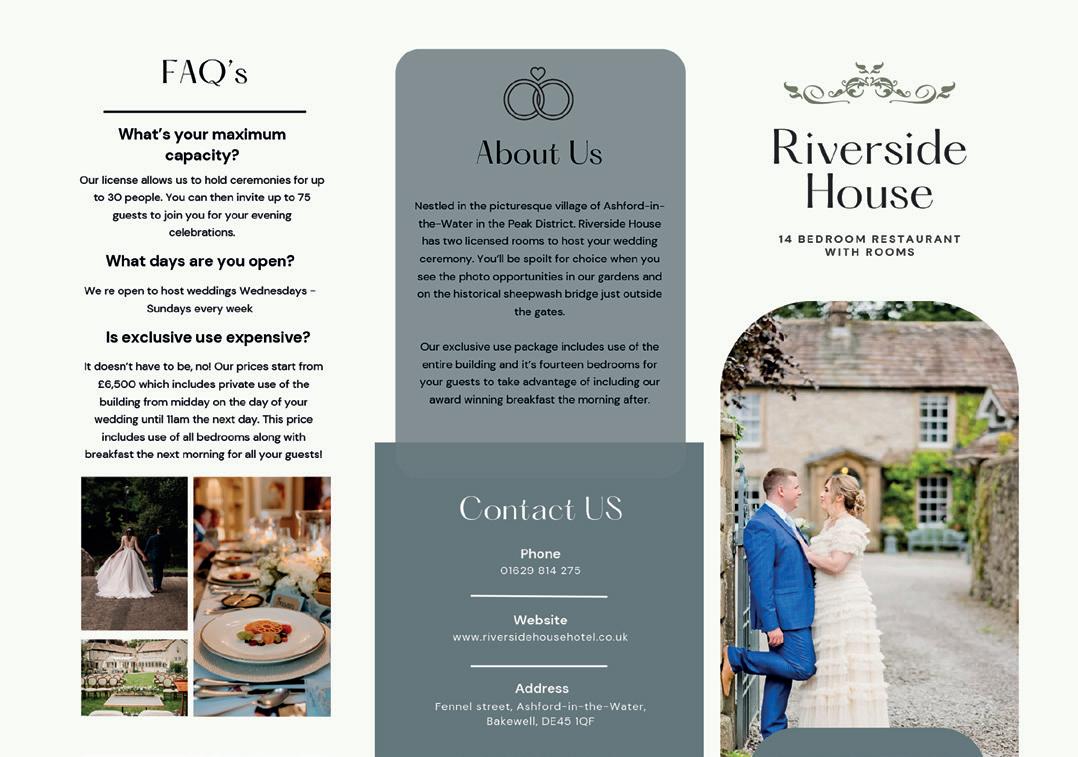

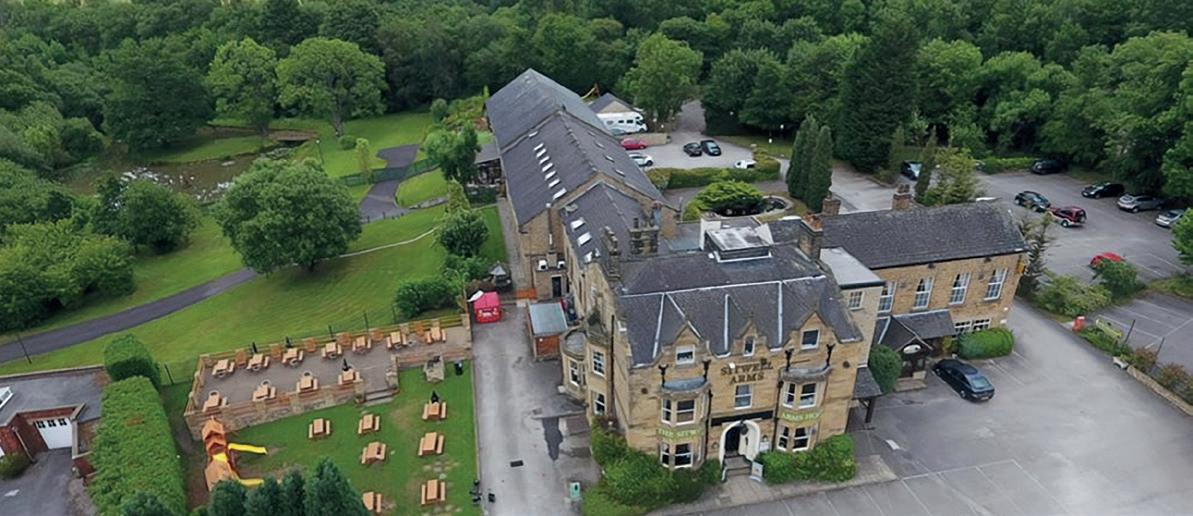
You want your special day to be perfect. This is natural for a bride and groom who want their wedding to reflect all the hope and promise they envisage in their future life – a blissful love story that transcends time. However, this type of wedding can only be elevated to such heights in the right surroundings. There are so many wedding venues available, but it takes something truly unique and beautiful to stand out from the crowd and captivate from the first moment to the last. The Sitwell Arms is one such venue.
Refined, rustic and contemporary, The Sitwell Arms is an idyllic wedding venue set amidst six acres of rolling Derbyshire countryside. With a rural, fairy-tale backdrop, the grounds of this Grade 2 listed building are home to a lake, lily pond, rose and orchard garden. The original part to this attractive stone-built hotel dates back to the 18th century when it was a famous coaching inn. Civil ceremonies can be held inside under stunning oak beams or outside in the fabulous gardens.
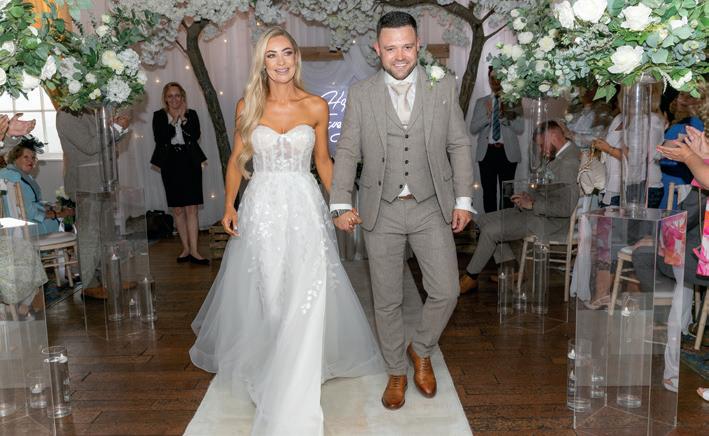
Sunday 3rd March 2024 11am – 5pm
Saturday 15th June 2024 and Sunday 16th June 2024 11am-5pm
Free admission and parking
When you select The Sitwell Arms as your wedding venue, you’ll be immersed in the magnificence and historic ambience of the hotel. Capturing the beautiful elegance of an English wedding, the photo opportunities here are second to none.
The Banqueting Suite, with its period features and stylish decor, is a stunning setting for any wedding and is sure to take your breath away. It can accommodate up to 250 guests and is often used for the ceremony as well as the wedding breakfast
and evening reception. As well as the banqueting suite, there are also two other suites, the Sitwell Suite, accommodating 150 guests, and the Leger Suite, a smaller room, perfect for intimate weddings. Each wedding space can be easily adapted to the size and style of the wedding ensuring the vision of every special day comes to life.
The Sitwell Arms now holds over 200 weddings a year, with a plethora of splendid reviews from happy couples. The team has vast experience of putting on events – not just weddings, but birthdays, anniversaries, retirement parties, black-tie balls, conferences, events, you name it, and they can handle it with professional aplomb.
Managing Director and owner, Jo-Anne Oldfield boasts over 30 years of experience at the hotel, having started there as a waitress when she was just 14. From there, she progressed through various job titles before eventually landing a management role and some years later buying the hotel from her family.
“We love to be part of a couple’s love story.”
At this distinctive wedding venue, virtually all budgets and preferences can be catered for. “We are reluctant to turn any budget away,” says Managing Director, Jo-Anne Oldfield. “We are honoured to be part of so many couple’s love story and can put on a memorable wedding from as little as £3000 upwards. Our packages can include the services of our amazing bank of wedding suppliers, but we can also offer a completely bespoke, tailor-made package just for you.”
Every couple who books their special day with The Sitwell Arms is assigned their very own wedding coordinator to oversee every element of the planning and execution stages until after the day itself and act as a personal point of contact throughout. On the day you can expect stellar service from an experienced team, so you can relax and enjoy your day.
Every couple also has access to the venue stylist, Samui, who is assigned with the vision of enhancing the atmosphere and general vibe of your wedding with carefully curated backdrops. From lush floral arrangements to hand-painted screens, every backdrop is meticulously crafted to match every couple’s unique characteristics and desires.
The hotel offers 30 ensuite bedrooms including suites, four posters, family, doubles, twins, and single rooms. With its accessibility to the M1 motorway, it’s the perfect venue for weddings from far and wide.
All guests can access the onsite hair and make up beauty salon, Salon 21. Brides and members of the wedding party can have the perfect hair ‘do’ and a pre-ceremony facial without even leaving the grounds of the hotel!
With such vast experience of running events, hosting weddings comes as second nature to Jo-Anne now, as she fine-tunes every special occasion with finesse, efficiency, and meticulous attention to detail.
The kitchen is managed masterfully by head chef, Daniel Nutt, who has been leading the culinary experience at the hotel for over 30 years. All the food is cooked fresh to order, using seasonal local produce, where possible.
The Wild Boar Lounge offers the ideal place to unwind on the night before the wedding with its magnificent offering of classic home-cooked food, ales, wines, and spirits.
The Sitwell Arms Hotel, 39 Station Rd, Renishaw, Sheffield S21 3WF. T: 01246 435226 E: info@sitwellarms.com www.sitwellarms.com
Scan
this QR code for a virtual tour of the hotel’s wedding facilities.
AN AMAZING DAY AT AN AMAZING VENUE
“We got married 31/12/23. Everything was done to perfection, and we had an amazing day. Our guests commented on how fantastic the day was. They planned basically everything for us and took all the stress out of it. Fantastic experience.”
Alice D.
ABSOLUTELY MAGICAL!!
“We got married at The Sitwell Arms in the Spring of 2023. The whole experience was absolutely magical from start to finish. The day was more than we could have ever hoped for. The venue is beautiful, with a choice of modern, different size venue rooms to suit everyone’s needs and budget, and the grounds and lake are absolutely gorgeous for photos. The events team were incredible throughout and literally nothing was too much trouble.”
Helen C.


Another trend which has dominated style in general is the ‘old money aesthetic’, which exudes quiet luxury and timeless elegance – and its popularity in bridal style is no different.
The experts revealed how to achieve this appeal: “To adopt the old money aesthetic in your bridal style, stick to simpler silhouettes with clean lines and minimal detailing. The simple elegance of this style will not distract attention from you on your wedding day but instead enhance your natural beauty.”
An interesting trend for the modern bride in 2024, which many will opt for this wedding season, is a mini wedding dress.
These short dresses have been traditionally seen as reception dresses, which brides change into after the ceremony to dance the night away, rather than their showstopping ceremony gown. But not this year –mini dresses will be the only dress of choice for many brides’ big day.


However, for those brides who are seeking a traditional style for their wedding dress, princessstyle ballgowns will be the most popular choice this year.
The experts commented, “Paired with a simple veil or topped off with a tiara to complete the look, a princess-style ballgown is a beautifully striking choice for any bride this year and will be sure to have all eyes on you on your big day.”
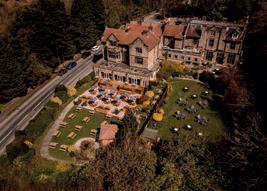
SITUATED in the parish village of Grindleford, surr ounded by the idyllic rolling hills of the Peak District, The Maynard has established itself as a location of choice for couples celebrating their very special day - seeking a unique, intimate, and magical experience that will forever be remembered amongst family and friends.
The Maynard brings together cutting-edge hospitality and service, with fresh food sourced from premium local suppliers. For civil ceremonies and
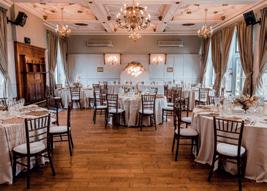
partnerships, our licensed venue flaunts original features and is perfect for hosting a wedding for up to 130- day-guests and 160 evening guests, offering bespoke wedding packages to suit individual budgets, style, and requirements, promising stunning views across the Hope Valley from our fabulous gardens. Your dedicated wedding team will be on hand throughout the entire planning process to ensure your special day is everything that you have always dreamed of.
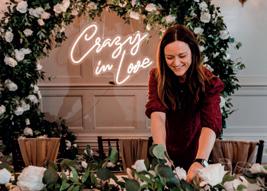
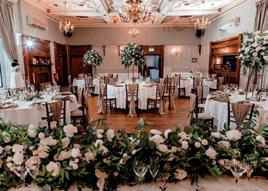
All wedding packages include:
• Exclusive use of The Chatsworth Suite
• Private garden for your drinks reception
• Chiavari chairs
• White tablecloths and napkins
• Glassware, crockery and cutlery
• Cake stand and knife
• The ‘Sir Don Bradman Suite’ for your wedding night (subject to availability)
• In-house DJ
• Dedicated wedding team on the day and throughout your planning process
The Maynard, Main Road, Grindleford, Hope Valley, S32 2HE T: 01433 424110 E: events@the-maynard.com www.the-maynard.com
At Dotique, your wedding outfit inspiration awaits.
BASED at 296-298 Chatsworth Road amidst the hub of retail innovation in Chesterfield, Dotique is the ultimate haven for wedding guests seeking sophisticated and fashionable stand-out pieces to grace any wedding occasion.
Whether it’s a classic and formal wedding outfit you’re after or something modern and edgy, rest assured, Dotique has something to captivate your heart and style.
Housed in their own separate space, the Mother-of-the-Bride/ Groom outfits are simply stunning – offering sophisticated and fashionable stand-out pieces to grace any prestigious ceremony. With impressive labels, such as Veromia, Joseph Ribkoff, and Frank Lyman, and a separate and secluded changing area, this is certainly the place to visit to look elegant and distinguished on the big day! From ultra formal to more relaxed and multi-use, you’re to find something that speaks to your style here. A great range of
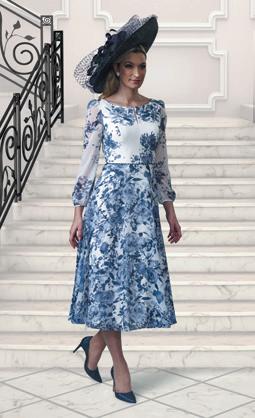
accessories and hats from Max & Ellie, J.Bees, and Nigel Rayment, stylish bags, jewellery from Envy, and shoes from Capollini mean that the entire outfit – from top to toe can be organised at the same time and in the same place.
Owner of the multi-awardwinning boutique, Dorothy Robinson, is rightly proud of the shopping experience offered here to the bridal party. “What sets us apart,” says Dorothy, “is our unwavering commitment to exceptional customer service, meticulous attention to detail, and a heartfelt dedication to ensuring that every visit to our boutique is nothing short of unforgettable. Our boutique exudes a wonderfully relaxed atmosphere, and our mission is to transform the journey of finding your dream wedding outfit into a stress-free and memorable adventure. Every customer is offered the services of a bespoke wedding stylist on a one-to-one basis and is given as much time and attention as needed. We’re genuinely excited for you to visit, explore our
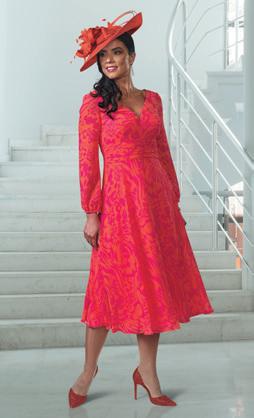

collection, and discover the bridal party attire that suits your distinctive style. A cup of coffee is always on hand.”
Plus-sizes are also well catered for with a stunning array of elegant and chic outfits for sizes 18-24.
The special occasion wear covers all manner of upcoming events – from a day at the races to cocktail parties and everything in between. There is also a beautiful and distinguished collection of prom dresses - offering that standout piece which is sure to create the ‘wow’ factor.
As well as catering for wedding guests, Dotique offers a fabulous collection of beautifully stylish clothing at an affordable price,
The Chatsworth Road based Dotique boutique is now a sea of spring colours and brimming with ranges from brands such as Sahara, Vilagallo, Joseph Ribkoff, Oui, Mos Mosh, Frank Lyman, Robell, Gerry Weber, Monari, Milano, Foil, Just White, Penny Black and Dolcezza. Whether it’s an elegant top, a chic jacket or dress, a stylish pair of trousers, jeans from Brax or Red Button, or breathable shoes from Geox, you’re sure to find something to suit your taste here.
The Peak District Village based Dotique shop which is open 7 days a week has forged its own bespoke and unique offering, which includes kimonos from One Hundred Stars and stylish clothing from Soya Concept, Saint Tropez, Robell, Red Button, Fit Flop, Fransa, Olsen and Marble.
Dotique is about individuality and personality. With

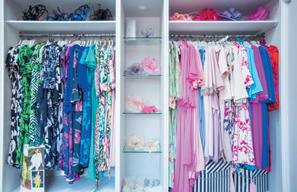
personal, warm, and friendly customer service, this unique and popular ladies fashion boutique provides a destination shopping experience that is unrivalled in the area.
Dotique is located at 296/8 Chatsworth Road, Chesterfield S40 2BY and Peak District Village, Chatsworth Road, Rowsley, DE4 2JE. All information on brands stocked and the latest news can be found on the website, www. dotique.co.uk.
T: 01246 498 536
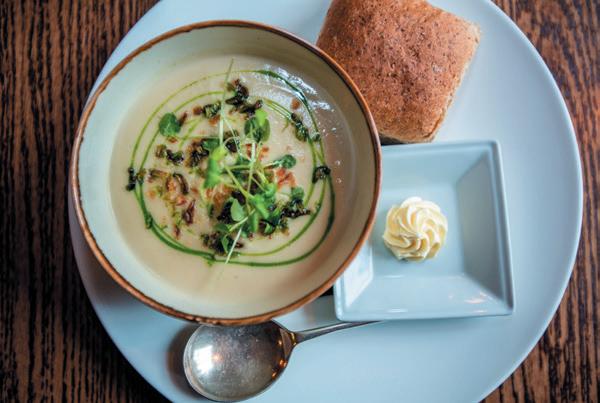
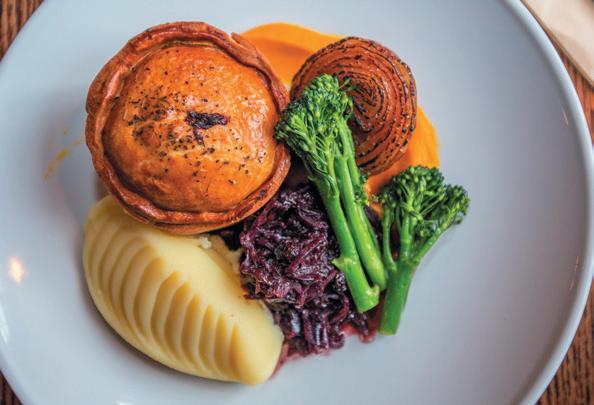
Nestled amidst the rolling hills in the heart of the Peak District lies the picturesque, limestone village of Foolow.
THE fine old buildings grouped around the village green complete with an ancient cross, bullring, and pond make Foolow one of the prettiest villages in the Peak.
The grand Manor House and Old Hall stand away from the humbler, but no less picturesque, cottages. There is a tiny church dedicated to St Hugh and a slightly grander looking Wesleyan Chapel.
Dating back to at least 1753,
the Bull’s Head, located in the heart of Foolow, is a traditional country inn, which boasts all the charm and character of its ancient heritage enhanced with a warm, friendly atmosphere.
Fashioned from the same mellow rock that gives the village its sweet charm, the Bulls Head is one of those almost mythical beasts – a proper, homely country pub which just happens to also be a fabulous restaurant.
You’ll feel at home in this delightful country village inn
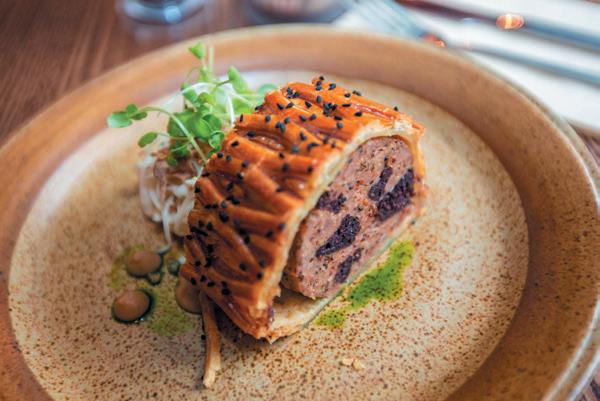
from the moment you walk through the heavy oak door to be greeted by flagstone floors, a crackling open log fire, and a warm, cosy bar and restaurant.
The Bull’s Head has been providing a welcome haven for weary travellers for nearly 300 years, and it’s still a homely refuge for locals and visitors alike. This is the perfect spot for a special celebration, romantic meal, or just a hearty refuel after a country walk.
For cosy comfort, you might be
inclined to choose the bar area; to relax and make the most of the log fire, you might step through to the horse brass decorated Stable; or for more formal dining, or that special occasion, you could well opt for the oak-panelled restaurant to the left of the bar. Muddy boots and muddy paws are always welcome at this pub!
The Bulls Head, formerly run by Max and Sue Fischer, was taken over by Nick and Jemma Beagrie on 24th April 2023. Nick and Jemma also run several other

long established and highly reputable businesses in the local area. Nick is a vastly experienced publican, having run The Scotsman’s Pack, in Hathersage, for over two decades of a pub trade career spanning 35 years in total. Jemma started her career in the retail sector running the Old Original Bakewell Pudding Shop, and the couple also own The Bakewell Bakery. Also in their portfolio are The Prince of Wales and Robin Hood – both in Baslow.
“We are extremely passionate about the Peak District and Derbyshire,” said Nick. “We always use local suppliers and producers wherever possible and want to keep the Peak District at the forefront of tourist destinations in the UK. Our vision for the Bulls Head is to upkeep the traditions of wonderfully cooked local food at the highest of standards.”
The Bulls Head is all about old school wholesome food prepared exceptionally well. The driving passion is fresh, seasonal food using local ingredients in an informal and relaxed atmosphere, complemented with local ales, and internationally awarded wines and spirits.
Entering through the pubby front, visitors are guaranteed a warm welcome and friendly greeting by manager and frontof-the-house impresario, Andrew Ward. Boasting many years of experience in the pub trade, Andrew balances masterminding the operational side with a huge dose of charisma and charm.
The menu is an engaging mix of traditional British classics and imaginative gastronomic creations. It’s honest, wholesome, comfort food cooked with genius. Responsible for this is experienced and talented head chef, Blake Arnold, who boasts an impeccable pedigree in the world of fine cuisine.
All the food here is freshly prepared using produce from local farms and dairies wherever possible, and the menus change seasonally. Blake’s cuisine is based on the delivery of well-balanced flavours of the seasonal ingredients themselves. Balancing flavours is both a science and an art, based on professional training, intuition, and experience. Mastering the balance of the five key flavours
of sweet, sour, bitter, salty, and savoury is the hallmark of a skilful chef. Blake has most definitely perfected this art, as diners will find out soon enough. For those of you with a vegetarian or vegan persuasion, fear not! There’s an enticing selection of delicious meat-free and plant-based dishes to tempt your palates.
On the day of visiting, starters included celeriac and white truffle soup – deliciously smooth and heartwarming – pork and black pudding sausage roll served with celeriac remoulade, watercress and chive oil; and whipped goats’ cheese, served with beetroot, seed granola, and watercress. Indulged with the luxury of sampling all three, it was impossible to pick out a standout ‘winner’ – they were all that scrumptious! Throughout, the flavours were all so well balanced, epitomised by the delicate combination of smokiness, saltiness and sweetness within the pork and black pudding sausage roll. With no single flavour overpowering another, the division of flavours worked perfectly.
When it came to main courses, the gratification continued. Another three journeys into the exploration of tastes. The seabream was clean and perfectly cooked and accompanied by confit potatoes, courgettes, tenderstem broccoli, fennel ragu, red onions, and rocket and pumpkin seed pesto. The tantalising fusion of flavours worked magnificently, and the broccoli was a revelation – refreshing tenderstem with bite and body elevated with spicy, salty, fragrant loveliness. Stunning.
The slow braised Derbyshire pork belly provided the next amazing sampling experience. Served with bubble and squeak, three different textures of leeks, burnt apple purée, and cider sauce, this superb dish offered a symphony of flavours and textures which sang. Soft, smoky, and crispy were harmonised to perfection!
The homemade pie of the day was chicken and smoked ham hock, which was served with creamed potatoes, carrot purée, caramelised red onion, braised red cabbage, and tenderstem
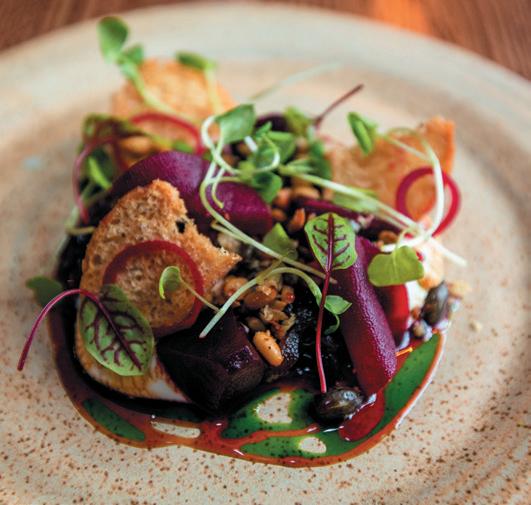
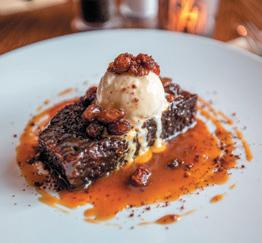
broccoli. The pastry was cooked perfectly with the obvious deft touch of a culinary mastermind. The whole dish was hugely satisfying, and the spice and mincemeat in the red cabbage was a match made in heaven.
Was there room for desserts? Probably not, but it would have been rude not to! The dark chocolate and orange with whisked mascarpone, crystallised hazelnuts, and blood orange sorbet offered a delicately brilliant fusion of flavours. The richness of the chocolate beautifully complemented the warmth of the orange and sharpness of the sorbet – a perfect palate cleanser!
And last, but by no means least – the sticky ginger pudding. They say it’s all about ‘mouth feel’ and this scrumptious dessert certainly hit the mark when it came to that! The crystalised and ground ginger worked so well with the salted toffee sauce, rum soaked raisins, and clotted cream ice cream. Gorgeously indulgent!
The drinks, wines, and spirits menu most definitely
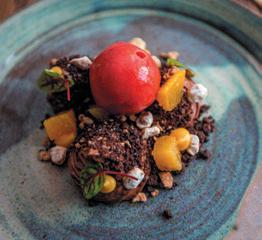
match the food offering. Highly quaffable local real ales, and internationally awarded wines, malt whiskeys, and an eclectic selection of spirits make for the perfect accompaniment to any dining experience. Was the serene Bull’s Head at Foolow all a dream? My heart was beginning to wonder, but my waistline confirmed it had been all too real!
OPENING TIMES: Monday: closed Tuesday to Friday: 9am-late. Food served 12pm2:30pm/5pm - 8:30pm Saturday: 9am - late. Food served 12pm - 9pm Sunday: 9am - 9pm. Food served 12pm – 6:30pm
The Bull’s Head, Follow, Nr Eyam, Hope Valley, Derbyshire, S32 5Q R Tel: 01433 630873 info@thebullsheadfoolow.co.uk www.thebullsheadfoolow.co.uk

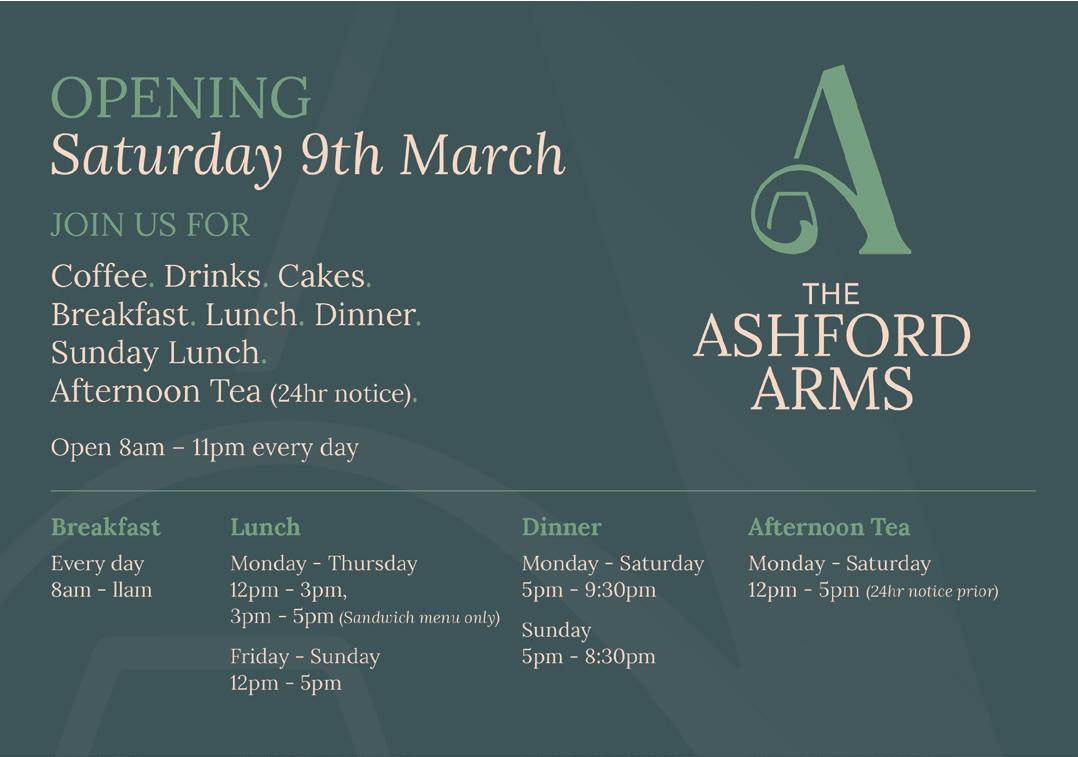
CHATSWORTH Farm Shop welcomed customers back in early February following a refurbishment designed to celebrate local suppliers, estatereared food and locally-farmed produce. The award-winning farm shop, established by the late Duchess Deborah in 1977, has become a muchloved destination for the best regional food and drink, with the majority of its products produced or prepared on the Chatsworth Estate, or sourced from suppliers within a 30-mile radius.
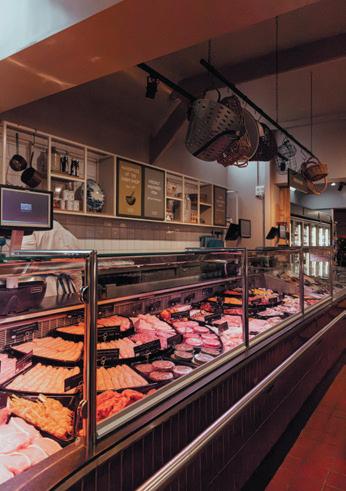
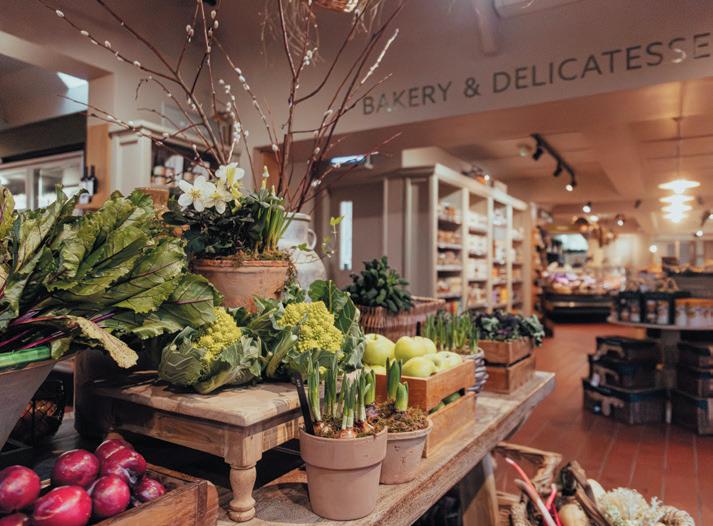
The refurbishment has improved display areas for the farm shop’s renowned fresh produce and butchery (including a new dry ageing fridge for Chatsworth Estate beef), and increased shelf space for local producers. The new direction has been led by Lady Burlington in partnership with Sheffield-based agency 93.
The design honours the traditions of the area by repurposing existing fixtures and making use of functional and heritage items from Chatsworth House and estate farms.
A Farm Shop & Deli Retailer and Farm Shop of the Year award winner, the farm shop will be introducing a refreshed range of Chatsworth branded products, including teas, juices, jams, estate-sourced honey and the much-loved Bakewell Tart, alongside a range of locally crafted giftware.
An extended selection of local cheeses has also been launched, produced
by Derbyshire-based Hartington Creamery which has connections to Chatsworth dating back to 1870.
Robert Gosling, Hartington Creamery part-owner, said: “It is 150 years since the 6th Duke of Devonshire built the first dairy in Hartington, and we are pleased that we are working together again, creating innovative products which reflect our shared heritage.”
Lady Burlington said: “Our focus for the farm shop has always been on supplying the best possible produce. We want to ensure that our products celebrate the wealth of talented producers on our doorstep.”
Elsewhere on the estate, the Stables shop at Chatsworth is also undergoing an exciting redesign to enhance the clothing department. The Cavendish Hotel in Baslow has also been regenerated, and welcomed guests back on February 19.
ROB Hattersley, owner of Longbow Bars & Restaurants, has confirmed that The Ashford Arms, a 17th century country pub in Ashford-in-the-Water, will once again be welcoming guests from March 4.
Despite thriving for around 400 years, The Ashford Arms couldn’t survive the pandemic and was forced to close its doors in 2020. Rob took on the lease in 2023 and has brought it back to life with an extensive £1.6m refurbishment.
The restaurant will cater for 107 diners with Raymond Blanc trained executive chef, Adrian Gagea, designing the menu, and multi-award-winning chef, Chris Parker, as head chef.
Rob said: “It feels incredible to be so close to reopening this special country pub. We’ve had such positive feedback from locals, who are excited to have it on their doorstep again. It will also be ideal for those from further afield, wanting to spend time in this stunning corner of the Peak District.” Rob founded Longbow Bars & Restaurants shortly before the pandemic hit, selling his house to fund his first venue, The Maynard at Grindleford. He had a rocky start, which saw him on the brink of bankruptcy, due to the nationwide lockdowns, but he has quickly established himself as a rising star in the
Peak District hotel, pub and restaurant industry.
The Ashford Arms will join The Maynard, which has won numerous awards as a wedding venue, restaurant and hotel; and The George, an award-winning bar, restaurant and hotel in Hathersage.
The Ashford Arms will be open from 8am to 11pm, all week. Bookings can be made now via the website at theashfordarms.com
IIT is British Pie Week from March 4, so it simply has to be a pie as the Recipe of the Month. And we have chosen a Poacher’s Pie, which is a twist on a classic steak and ale pie, swapping the meat for mixed, diced game –which could include venison, partridge or pheasant.
For the filling
3 tbsp vegetable oil
2 sticks celery, diced
2 large carrots, diced
1 large onion, diced
2 cloves garlic, crushed
1 bay leaf
1 sprig rosemary
2 sprigs thyme
500g mixed, diced game meat
3 tbsp plain flour, well seasoned
500ml stout
350ml chicken stock
100g prunes, destoned and chopped in half
For the pastry
200g self-raising flour, plus extra for dusting
100g shredded suet
1 egg yolk, for glazing
1. Heat the oil in a casserole over a medium heat and fry the vegetables, garlic and herbs until golden, then scoop out onto a plate. Toss the game meat in the seasoned flour and brown in batches, until really golden, then scoop out onto a plate.
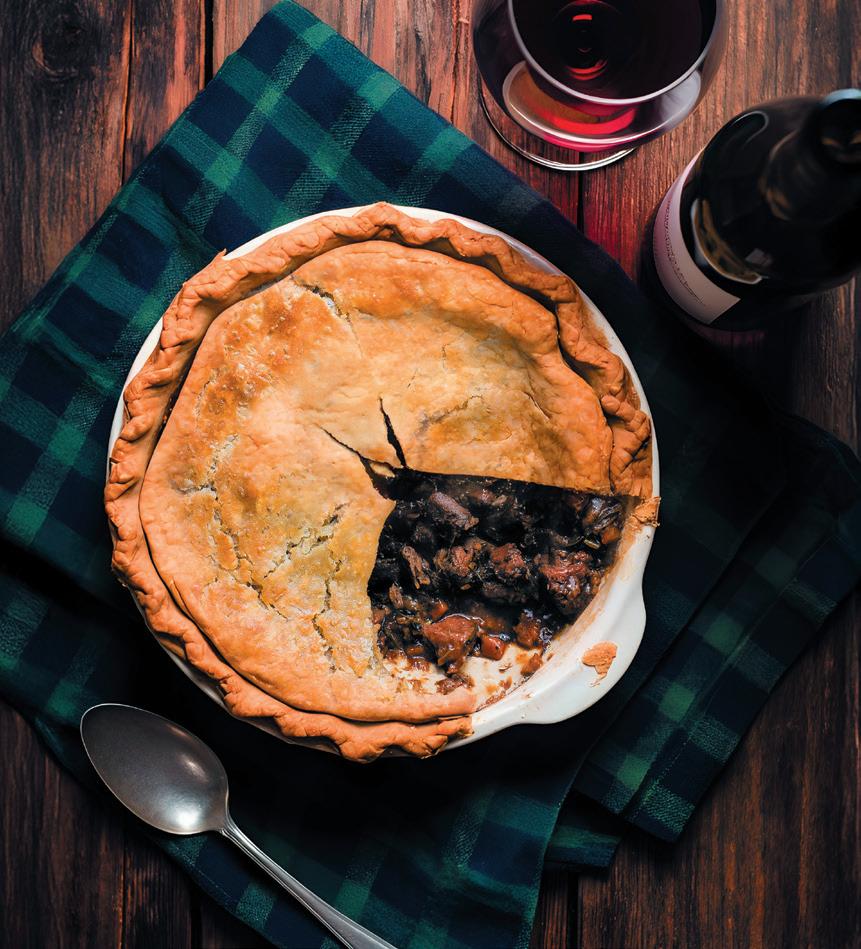
2. Pour in the stout and scrape all the chewy bits off the bottom of the casserole with a wooden spoon. Add the stock and prunes, along with the browned meat and vegetables, lower the heat and cook gently for 2 hours or until the meat is very tender. Tip into a pie dish and cool.
3. For the pastry, mix the flour and suet together in a large bowl. Add 100-120ml of cold water and a good pinch of salt, and work by hand until the dough comes together – don’t overwork it and let it become sticky. Wrap and chill for 30 minutes.
4. Heat the oven to 200C/fan 180C/gas 6. Roll the pastry out on a lightly floured worksurface until a little bigger than the pie dish. Drape over, then crimp to seal. Brush with a little beaten egg then put into the oven for 30 minutes or until golden brown and crispy on top.
A
Ancient Greeks are believed to have invented the pastry for a pie, while the Romans used many different
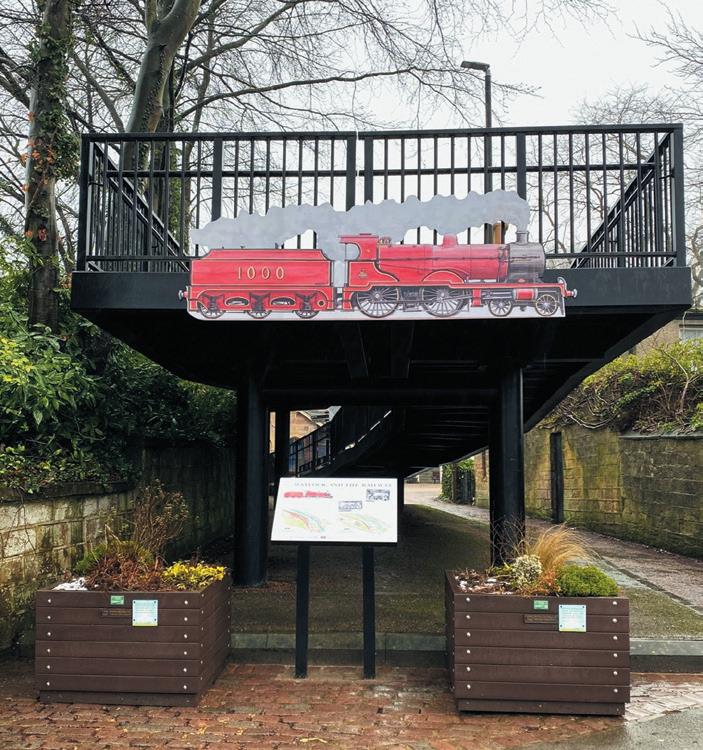

CELEBRATE 40 YEARS OF TRAVEL WITH RIVIERA TRAVEL AND 45 YEARS AT MARTINS WORLD TRAVEL!
UNBEATABLE VALUE WHICH INCLUDES SO MUCH MORE…
If you’re seeking seamless exploration and adventure, Riviera Travel’s guided tours are made for curious wanderers. With hand-picked hotels and expert guides who know the ins and outs of a destination like a local, you couldn’t be in better hands. Highlighted below is just a small selection of amazing options. Canada, North and South America, the Far East and Australasia are well covered by Riviera Travel.
Tour of Japan 16 days from £5799pp
Visitors will have opportunity to get to know an ancient culture of emperors, geishas, beautiful gardens, and Zen Buddhist temples, as well as seeing the country’s most iconic sights. This special tour visits many of
the country’s famous sites and experience an array of its cultural delights, including mouthwatering traditional dishes.
• Discover some of Japan’s most breathtaking vistas with visits to the lakes around Mount Fuji and scenic journeys along the Kurobe Alpine Route and the Kurobe Gorge Railway.
• Explore Japanese cities. Visiting the temples, shrines and shopping districts of Tokyo and enjoy guided tours of Nara and Kyoto.
• Reflect on the horrors of war with visits to Hiroshima Peace Park and museum.
• Experience the Japanese culture with an ancient tea ceremony, a sake tasting in a museum.
• Travel through the Japanese countryside at 189mph in the incomparable highspeed bullet trains.
Australia is a country of icons; Sydney Opera House, the Harbour Bridge, Uluru, the Great Barrier Reef, Steve Irwin, Dame Edna Everage… the list goes on. Not forgetting koalas and kangaroos and all the other wildlife that are endemic to this vast, continent-sized country!
It’s also a destination that has two very distinct sides. While Sydney, Melbourne, Brisbane, and Perth are modern metropolises full of culture, venture just a little out of the cities and you’ll find pockets of people in unique towns, surrounded by huge swathes of untouched and sparsely populated countryside, including vineyards, rainforest, and beaches, as well as, of course, the vast deserts of The Outback. Both of the holidays to Australia take in the highlights of Australia with visits to its major cities of Melbourne, Sydney,
Brisbane and Cairns and trips to the surrounding natural beauty including the Blue Mountains, the Great Ocean Road, the tropical rainforest of the northeast, and the Great Barrier Reef. Choose the Australia tour with Uluru extension and you’ll also get to travel to the Red Centre of the country to see the awe-inspiring Uluru and the surrounding desert landscapes that are rich with Aboriginal culture, art and history.

Grand Tour of Australia
Escorted Tour 20 days from £6299 pp
HIGHLIGHTS OF AUSTRALIA
• Visiting: Sydney, Blue Mountains, Brisbane, Cairns, Kuranda Scenic Railway, Great Barrier Reef, Melbourne, and the Great Ocean Road.
Choose from Hungary, Portugal, France, Austria, Switzerland, and the Mekong Delta.
The Blue Danube River Cruise 7 nights from £1699 pp
Soak up all that Europe’s most cultured river has to offer, with its wealth of grand baroque architecture, medieval cities, picture perfect towns and the sights that inspired Strauss and Mozart.
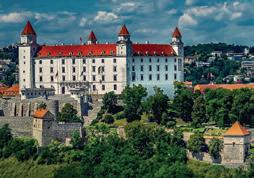
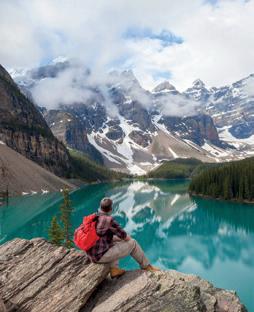
HIGHLIGHTS
• Tour the most historic towns and cities along the Danube, including guided tours of Vienna, Dürnstein, Budapest and Bratislava.
• Visit Esztergom Basilica and Melk Abbey.
• Explore Salzburg or Linz with an expert guide on a tour of the town’s most interesting sights.
• Immerse yourself in the local culture with a Hungarian folklore show on board.
• Enjoy a classical live music performance on board with stunning views of Vienna.
Call in to discuss your chosen Riviera Travel holiday experience and speak to one of the experienced travel professionals.
CALL AND DISCUSS YOUR TRAVEL REQUIREMENTS WITH OUR FRIENDLY AND EXPERT TEAM ON: 01246 220020 or 01246 823763
Martins World Travel, 46 Knifesmithgate, Chesterfield, S40 1RQ T: 01246 220020
Martins World Travel, 25 Market Place, Bolsover, S44 6PN T: 01246 823763
martins-world-travel.co.uk www.1st4Cruises.co.uk

By Vivienne Milburn FRICS Independent Antiques Auctioneer & Valuer
DERBYSHIRE designer
Brian Asquith (1930-2008) was a sculptor and jeweller, who developed an industrial design practice in Sheffield and Youlgreave after studying at the Royal College of Art. He won numerous Design Council awards, as well as being commissioned to design silverware for Downing Street; candlesticks for the high altar of Winchester Cathedral; and some of his work is in the permanent collection of the Victoria & Albert Museum.
Brian Asquith’s silver items sell well at auction for three reasons: 1, The local connection; 2, The fashionable
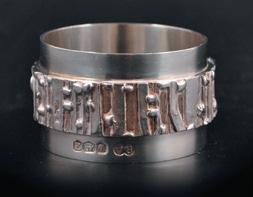
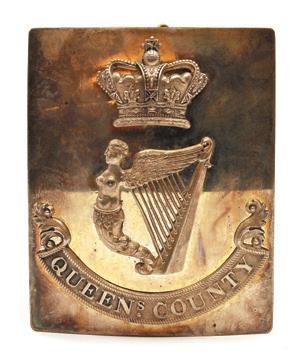
retro look; and 3, the precious metal they are made from; make a winning combination for good auction results.
After doing his National Service, in 1953 he returned to his native Sheffield and completed a monumental sculpture for a new church at South Ruislip. He also taught part-time at Barnsley College of Art. By 1955 he was sharing an office and studio with the well-known David Mellor, also a native of Sheffield. In 1963 he moved from Sheffield and established his design business at Youlgreave in the Peak District, where his three sons also joined the family firm.
Having firmly established his business in Youlgreave, Brian turned his attention to making individual metal objects. About the same time, the Worshipful Company of Goldsmiths and Silversmiths commissioned him to make a three-piece tea service. By the late 1960s he was producing a range of domestic silver with a sculptural texture.
Top: A modest silver napkin ring by Brian Asquith, 1967, which made £220 in a specialist auction. (Illustrating the importance of the designer, valued at £15 to £20 if by an unknown maker).
Left: Discovered in Chesterfield, from the collection of a noble lady, this Irish Officer’s shoulder belt plate, measuring less than 10cms high, made £1,550 in a recent specialist auction. It is advisable not to be dismissive of silver-plated items; as this innocuous belt buckle made ten times its estimate.
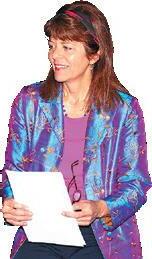

The inspiration for the textured band is his interpretation of the running streams of the Peak District, which became a trademark of his work.
In 2004 there was a major retrospective of his work – Brian Asquith Sculpted by Design – at Sheffield’s Millennium Galleries.
Editor’s Note: Perhaps you have items of value? If so, it
is always worth getting the advice of an Independent Antiques Valuer to assess your works of art and antiques.
For further information, contact Vivienne on 01629 640210 or 07870 238788; alternatively, go to www.viviennemilburn. co.uk or email vivienne@ viviennemilburn.co.uk

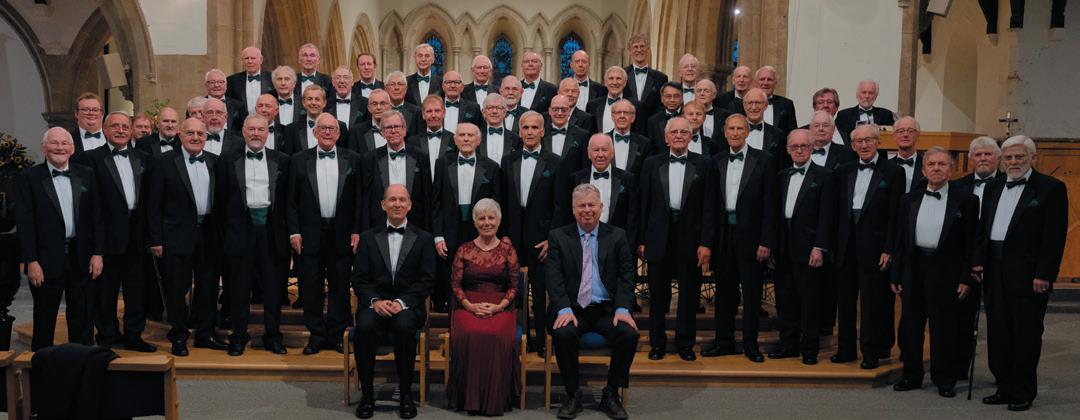
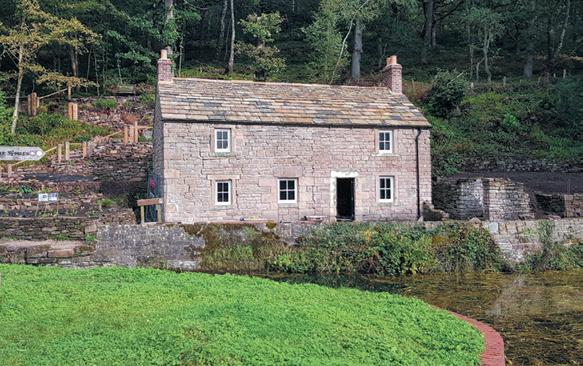
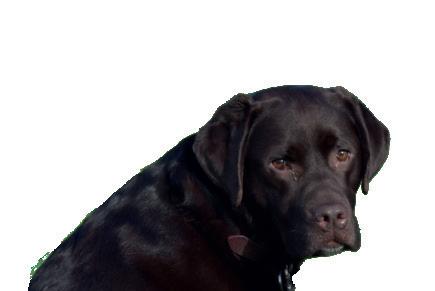
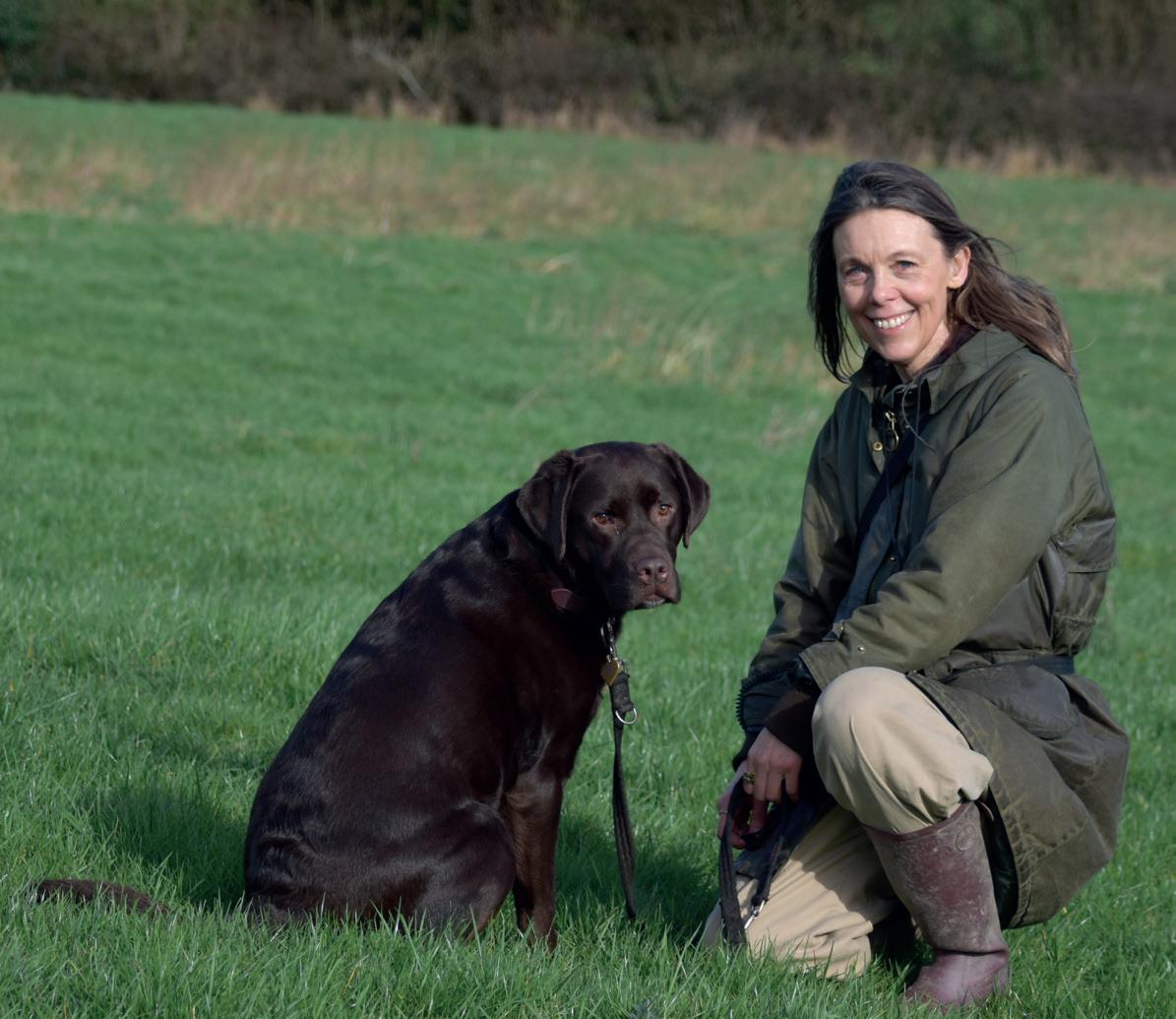
We’re a nation of dog lovers – but how well do we really understand our canine companions?
Trainer Sally Bawden helps owners to understand the psychology behind dog behaviours, as Fiona Stubbs discovers.
IT takes a few minutes to navigate the hallway in Sally Bawden’s home and settle down for a chat. Ralph, a nine-monthold red Labrador puppy is barking insistently and, at first glance, quite angrily.
Yet as I stand still, trying to look casually calm, it’s not difficult to see that the brown eyes looking up at me appear more anxious than aggressive. Ralph is living with Sally temporarily – he’s afraid of people, other dogs and noises. As she speaks to him in a quiet, soothing voice, accompanied by subtle hand gestures, he gradually stops barking.
He’s only been with Sally for four days but she already has his trust. He follows her to the kitchen while she makes coffee
and becomes agitated again when she briefly leaves the room. Then, as we begin to talk, he falls asleep under the dining table, his head next to our feet.
Watching on is four-and-ahalf-year-old chocolate Labrador Ronnie, whose own challenges as a puppy – after she was bitten by another dog – resulted in Sally becoming a dog trainer.
Ronnie’s transformation from happy to becoming fearful of other dogs was a wakeup call. “Even though we’d had family dogs in the past, I realised that having a dog can be quite difficult,” says Sally, from Holymoorside. “We went to a conventional puppy class but that couldn’t help me in the way I needed. I became obsessed with finding out about dogs and understanding
why they do what they do.
“I took courses, which led to me becoming a certified trainer with the Dog Training College and I realised this was only the start – there was still so much to learn. I continued to study and became fascinated by animal emotions and behaviour. Learning about dogs is an ongoing journey.”
Sally launched her business, Feel Good Dog Training, and works in person with dogs and their owners in Chesterfield, Matlock and Bakewell and with others online. She specialises in one-to-one coaching sessions and small group sessions, working on outdoor skills such as lead walking, recall, lunging and barking.
Recently, she began working with small groups – Doggy
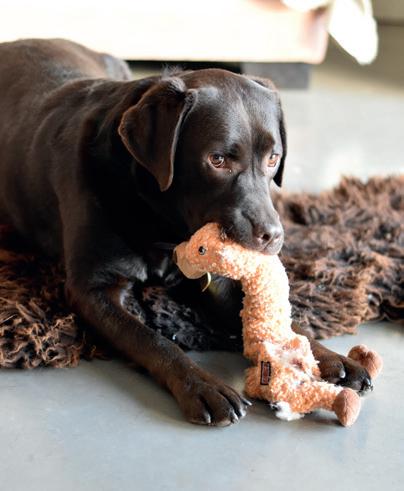
Social Meet Ups – on Sundays at Chesterfield’s Sorbo Lounge café bar. It’s an informal opportunity for owners to ask questions and seek help, to talk about problems or simply to socialise with their dogs in a café environment.
Sally’s one-to-one work tends to involve dogs with complex issues. “Often, when people make that step to one-to-one training, they’re at breaking point, struggling and not knowing what to do,” she explains. “During lockdown, there was an increase in firsttime dog owners and now, for many, their lifestyle is different to how it was then. People are back at work and school and they haven’t the time to focus on the dog. As far as socialisation is concerned, lockdown probably had an impact on dogs who were puppies then because they weren’t able to mix with others.”
Sally adds: “When I got Ronnie, I had no idea about
Left: Favourite toys help dogs to feel calm and safe. Right: Playing with your dog creates a bond and trust. Below: Sally and Ronnie practising ‘stay’.
dog psychology. The way people think about dogs is human-centred and expecting dogs to be able to fit into our human world. It’s about what they can do for us, rather than what we can do for them.”
“You often hear people say, ‘we’ll get a dog and it’ll make us go out for more walks.’ But that’s just a small part of looking after a dog. We focus on walks but sometimes the mental stimulation dogs need is forgotten about. And, even if you’ve had several dogs before, you might still get one that you don’t understand.
“Dogs find it harder to process their emotions than we do. Like us, they’re genetically programmed to keep safe and avoid danger. Dogs are very communicative but we, as humans, often don’t pick up on it. We don’t understand what they are trying to tell us.
“Effective socialisation isn’t just about putting dogs
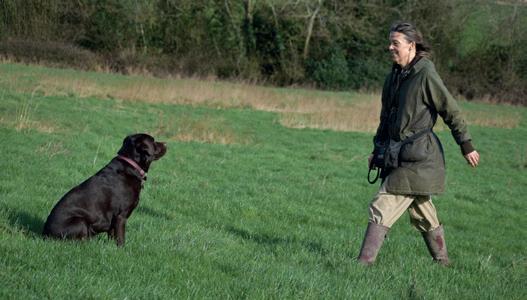
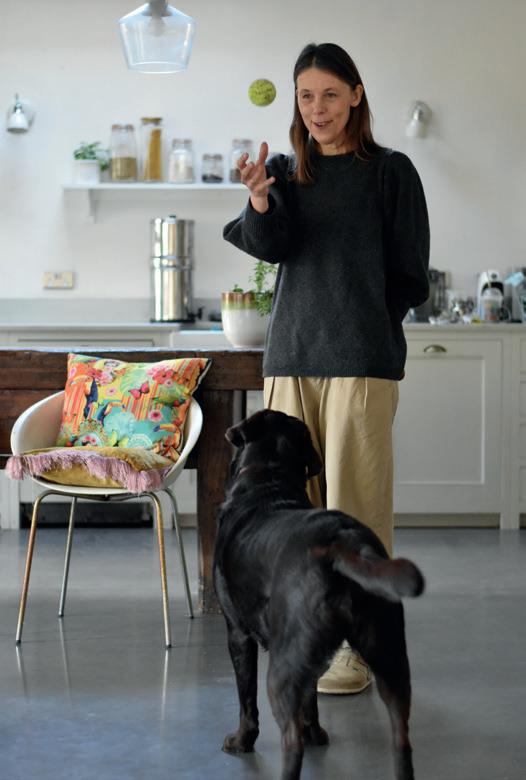
in different environments. It’s being aware of a dog’s body language to make sure all interactions with people and other dogs are happy and relaxed; that the dog feels in control and able to cope.
“It’s important that we can read our dog’s body language. If a dog is very stiff with a rigid tail and can’t hear us then it’s over its head, stressed and can’t process its environment.
dog walks away or turns its head away from us, it means they don’t want to engage and we should respect that.”
“Play creates a bond and trust.”
If the body is soft and relaxed, then it’s happy.”
Sally continues: “If a dog feels it can’t cope, that’s when problems – such as barking, lunging, growling, and, ultimately, biting – can arise. Dogs don’t want to bite – they give us signals to tell us how they’re feeling. It’s really important to try to work out what the dog is trying to say when it is presenting difficult behaviours, so you can come up with a solution. Even small gestures can tell us a lot. If a
There are misunderstandings around training, too, says Sally. “People think of obedience as being the most important thing, but there’s a bigger picture. Training is good because it creates a bond and good communication between you and the dog – and the earlier that begins, the better.
“It gets the dog’s brain used to learning. Things like impulse control – learning to stay, not jump up, wait their turn, be calm – is more dog teaching than training. Dogs learn through consequences –they discover what behaviours produce a successful outcome for them – which is a reward they like, which could be a tasty treat thrown for them to chase or an exciting game with a favourite toy.”
Taking time to play is equally
important. “Play creates a bond and trust,” says Sally. “The dog feels they can rely on you – and that also helps with training. If you have a close bond, they’re more likely to come back to you, which is important when teaching recall.
“Play is any sort of activity the dog likes – such as playing with a tug toy or throwing something to chase. Give them lots of outlets to seek –sniffing, searching, exploring, foraging, finding toys. This creates dopamine, which makes them feel good.”
Care when choosing a particular breed is crucial. A Kennel Club study in 2020 found that, in lockdown, 25 per cent of new owners spent less than two hours on research before buying a dog.
“All domestic dogs were originally bred to do certain jobs and serve a purpose,” explains Sally. “Now we generally just want our pet dogs to fit into our human world and this can cause problems if a dog isn’t given the outlet it needs. For
example, intelligent Border Collies were bred for herding sheep. So they need plenty of exercise and to have an outlet for herding so they don’t feel the need to herd people or cars. It’s really important to find what motivates your dog so that your training is more effective.
“Before getting a dog, we should consider what the breed was originally bred to do. And, of course, what the breeder is like and what the dog’s parents are like. If the mum is stressed, that’s going to go through to her puppies.”
Helping dogs to feel safe and comfortable starts at home, says Sally. “A lot of dogs can’t ‘switch off’ or get enough sleep. Dogs sleep in short bursts and it’s important to provide calm areas and a choice of where they can sleep. Consider having more than one bed in different parts of the house where they can choose to go – and let them relax without interruption.
“If you meet a dog’s needs, your needs are going to be met, too – because you’ll have a

calm, confident, more well behaved dog.”
Sally makes it sound straightforward, yet many people are clearly struggling with the complexities of dog ownership. “I don’t like to see people struggling,” she says. “I want to get across that dogs have feelings and dog training is about both people and animals feeling safe and confident. Training isn’t just about controlling – it’s about engaging with your dog. It can be slow but also very rewarding.”
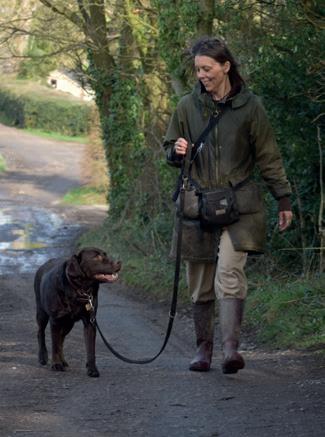
As I prepare to leave, Ralph resumes his barking; something is bothering him in the hallway. Sally’s puzzled but spots a fluffy dog bed is partly turned over. She straightens it out and Ralph inspects it slowly and, at first, suspiciously… and then he’s quiet again.
“He’s such a sensitive soul.” Sally sighs. “I will do my best to increase his confidence
in this world.” He may well be a work in progress, but I suspect Ralph is a lucky one. He’s in good hands.
Editor’s Note: To find out more about Sally’s work, go to https://www. feelgooddogtraining. co.uk/ Here social media links are: Facebook: @ feelgooddogtraining.co.uk Instagram: feel.gooddog You can contact Sally direct on 07828 123051 or email: sally@ feelgooddogtraining.co.uk

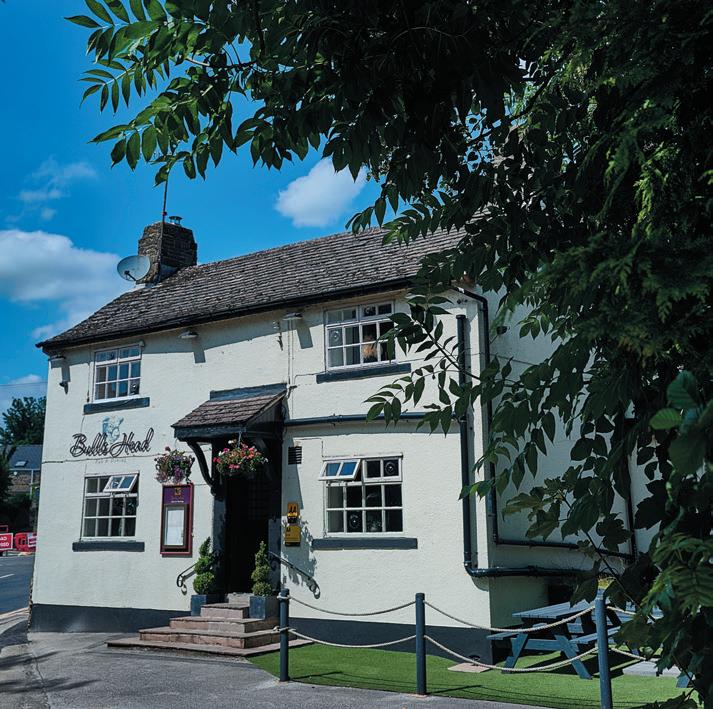
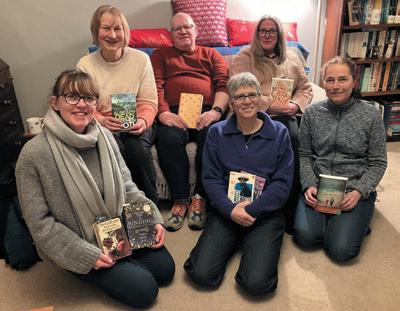


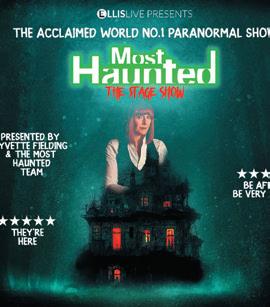
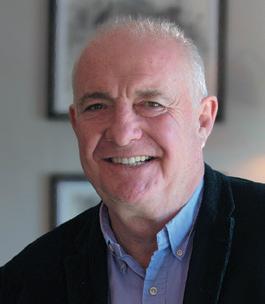



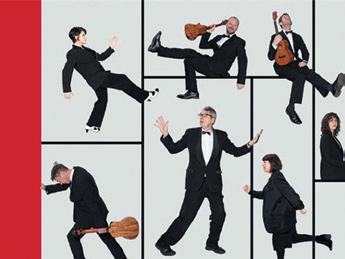





4 Chesterfield and District Family History Society meet at 7.30 pm at Whittington Moor Methodist Church, Scarsdale Road. Linda Jackson will talk on “Trials, Tribulation and Retribution”. All welcome, admission £3 (including refreshments).
8 Gardener’s Question Time. An informal version, sharing tips and advice. At 7.30pm in the Florence Nightingale Memorial Hall, Mill Lane, Holloway DE4 5BD. Non members welcome. More details from Cathryn Frost on 07713 643701 or dlhgardening.com
9-10
Celebrate Mother’s Day at Cromford Mills. 10am-4pm. Join us for a heartwarming Mother’s Day weekend at Cromford Mills. Enjoy a delectable Cream Tea at half price (a scrumptious combination of freshly baked scones, clotted cream, sweet jam and a hot beverage), all for just £3.15! A half price cream tea is available for every mother on March 9 and 10 only. For more information call: (01629) 536831
10 Celebrate Mothers Day at The Heights of Abraham. Our Vista restaurant is always a popular spot for a special Mothers’ Day lunch. To avoid disappointment, make your Vista reservation as soon as possible. Don’t forget you’ll need cable car tickets too. For more information, tel (01629) 582365.
14 Springtime Bouquet Masterclass with Renn Floristry at The Victorian Pump Room Buxton. Join us in the Victorian Pump Room for a springtime spritz cocktail on arrival, before enjoying a hand-tied spring bouquet masterclass! Learn new, easy and practical steps for the perfect bouquet every time! £49pp. Book early, limited ticket availability. For more information visit: www.buxtoncrescentexperience.com
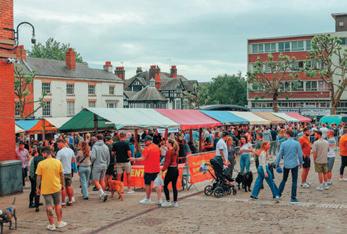
16
Pennine Bridleway PB18km and PB55km Trail Run. You choose the pace: an enjoyable run in the company of friends; or go for speed and try and set a personal best. There are flexible start windows to choose from. We welcome walk-jog participants with generous cut-off times. The course: Pennine Bridleway south from historic Hayfield village, out and back. Self-navigating, but straightforward route finding with official Pennine Bridleway finger posts to help you along the way. For more information visit: www.rangerexped.co.uk
22-24 Peddler Market Chesterfield. Peddler Market is coming back to Chesterfield! The highly popular street food market brings together some of the greatest food and drink vendors in the UK as well as crafters, musicians and artists. Enjoy an afternoon and evening of great music, even better food and all-around good vibes. Free entry.
24 Peak Music Society Concert: The ever-popular James Pearson returns to the Cavendish Hall, Edensor, for an afternoon concert at 4.30pm, followed by complimentary wine and canapes. James and his trio will be performing a tribute to the much-loved comedian and jazz musician Dudley Moore. Tickets, price £30, are available via the Peak Music Society website.
APRIL
1
Chesterfield and District Family History Society meet at 7.30pm at Whittington Moor Methodist Church, Scarsdale Road. Janet Ashley will talk on “Old Colonialists and Territories”. All welcome, admission £3 (including refreshments).
SUBMIT YOUR LISTING OR EVENT
Please email your information including dates to whatson@reflections-magazine.com before March 22nd, 2024, to appear in the April 2024 issue.