PRELUDE
“No spring nor summer's beauty hath such grace As I have seen in one Autumnal face ...” // JOHN DONNE, "ELEGY IX: THE AUTUMNAL"
Cedar Run Baptist Church in Culpeper County, Virginia PHOTO BY JENNIFER LINNEY
FALL 2026 | 3
SOUTHEAST
FA L L
10
14
A bewitched cave, lost village, citrus treasure, and comforting innovation
Frontier culture, a Piedmont homestead, a franciscan church, and a preserved village
secrets
evergreen
18
21
Georgia’s first colonists, a new state, the first state fair, and an early Florida settlement
Travel essentials that create power and warmth for backroad excursions
nostalgia 24
provisions
autumn’s rainbow
Travel the backroads through a fall photo essay with Robert Clark
38
roughing it, comfortably
A long-time subscriber shares how her airstream journey opened the door to more adventure
46
scenic railways
Travel back in time through a bygone era the old-fashioned way
52
harvest tables + mountain roads Loop through East Tennessee and North Georgia in search of authentic Southern holiday tables
4 | BACKR OAD PO RTFO LI O
60
64
conversation
preservation
66
70
Tom Brown has a unique mission: finding and resurrecting lost apples
Walk though a South Carolina colonel’s camellia gardens
creation
philosophy
74
79
Taste ambrosia’s layers of Southern tradition
A Navy veteran reflects on the importance of helping others
landscape
inspiration
82
88
View the splendor of southeastern holiday lightshows
bulletin
Enjoy state fairs, fall harvests, and holiday festivities
Recall early American china pieces that feature enduring designs
contributors Meet this issue’s featured writers and photographers
portfolios Rural Serenity 8-9
Autumn’s Core 58-59
Cotton Snowfall 12-13
Sunset Salute 68-69
Autumn Aerial 16-17
Frosty Greetings 72-73
Rippled Reflections 22-23
Red and Wild 78
Equine Lines 36-37
Grazing Glory 80-81
Jewel-tone Journeys 44-45
Weaving Nature 87
On the cover PHOTO BY ROBERT CLARK Autumn’s rainbow falls across Maggie Valley, North Carolina
FALL 2026 | 5
Volume 12 • Fall 2026 Backroad Portfolio covers Florida, Georgia, South Carolina, North Carolina, Tennessee, Virginia, and West Virginia. Published by EPS Media LLC and Summer House Creative, Inc. © 2026 Backroad Portfolio is published quarterly. Email backroadportfolio@gmail.com for advertising, subscription, and submission info.
Boykin, South Carolina
ROBERT CLARK
Heirloom brooms, recently dyed. .
6 | BACKR OAD PO RTFO LI O
WELCOME
As autumn’s golden light filters through the hardwoods and the air turns crisp, we invite you to slow down and savor the season’s quiet magic. Our Fall 2026 issue celebrates the South’s enduring rhythms—harvest festivals, historic railways, tables laden with tradition, and backroads adorned by fall’s rainbow of colors. Photographer Robert Clark leads us on a visual journey through autumn’s fleeting beauty, capturing misty mornings, fiery ridgelines, and the soft glow of late-afternoon light across the region’s most scenic destinations. Two long-time subscribers open their Airstream doors to share how a rolling home became the key to deeper adventures, and scenic railways take passengers through a bygone era of steam whistles, velvet seats, and rolling landscapes. Loop through East Tennessee and North Georgia in search of authentic Southern holiday tables—where heirloom recipes still hold court and hospitality is measured in second helpings. Along the way, meet Tom Brown, a man with a mission to find and resurrect lost apple varieties once common on Southern farms. Stroll through a South Carolina colonel’s camellia garden as the first blooms open against turning leaves, and read a Navy veteran’s reflections on the quiet power of helping others. Discover how ambrosia—layered with citrus fruit, coconut, and tradition—still delivers the essence of Southern celebration during special meals. As the holidays draw near, view the splendor of southeastern lightshows that transform towns and estates into glowing winter wonderlands, and reminisce about early American china settings, which still grace many Southern tables. As fall settles in across the region, we hope you feel the pull of the backroads, the warmth of shared tables, and the quiet promise that every season holds new wonders waiting to be discovered.
EDITOR + CO-CREATOR
ART DIRECTOR + CO-CREATOR
backroadportfolio.com | backroadportfolio@gmail.com
FALL 2026 | 7
JENNIFER LINNEY Gordonsville, Virginia November settles over Gordonsville in Orange County, Virginia.
8 | BACKROAD PO RTFO LI O
FALL 2026 | 9
SECRETS
Backroad secrets lurk in bewitched caves, lost villages, holiday traditions, and historic innovations.
THE BELL WITCH CAVE Adams, Tennessee One of America's oldest ghost stories, the Bell Witch Cave dates back to the early 1800s. Legend holds that the spirit of Kate Batts tormented the Bell family with physical attacks, strange noises, and prophecies. Part of the family's former property, the cave was said to be used by the witch as a hideout. Visitors report eerie experiences like unexplained sounds and apparitions that lured paranormal enthusiasts and tourists. The true story of the Bell Witch Cave remains obscure, blending folklore with historical tragedy, such as the death of John Bell, who was supposedly poisoned by none other than the Bell Witch. Learn more at hoteis.com/go/usa/ best-hidden-gems-tennessee. LEFT: PHOTO COURTESY OF WIKIMEDIA COMMONS RIGHT: PHOTO COURTESY OF LIBRARY OF CONGRESS
A LOST VILLAGE Brevard, North Carolina The lost Cherokee village of Conestee near modern-day Brevard in Transylvania County, also known as Kanasta or Kana’sta, thrived along the French Broad River and trade routes during the early 18th century. British troops visited the settlement in 1725, but sometime between the 1750s and 1770s, it mysteriously vanished. Cherokee oral tradition suggests supernatural spirit people, known as the Nunnehi, warned the villagers of impending danger. After a seven-day fast, the Conestee villagers followed them into a mountain and were never seen again, escaping the wars and displacement that followed European settlement. Today, a 1958 roadside marker and oral history commemorate the lost settlement. Learn more at migrationmemorials.trinity. duke.edu/items/conestee-lost-settlement-marker.html. LEFT: DEPICTION OF A MEETING BETWEEN PAUL DEMERÉ AND JOHN STUART—OFFICERS AT FORT LOUDOUN—AND CHEROKEE CHIEFS AT CHOTA IN 1759; ILLUSTRATED BY ERNEST PEIXOTTO RIGHT: PHOTO OF THE CONESTEE VILLAGE ROADSIDE MARKER BY T. HOWARD, COURTESY OF HMDG.ORG
10 | B ACKR OAD PO RTFO LI O
SECRETS
CHRISTMAS ORANGES Various Locations The tradition of placing oranges in Christmas stockings stems largely from the legend of St. Nicholas, the fourth-century bishop who inspired Santa Claus and secretly provided gold for the dowries of three poor sisters. In popular versions, the gold landed in stockings drying by the fire. Oranges, round and golden, later became an affordable symbolic substitute. Hanging stockings became popular during the early 19th century after the 1823 poem A Visit from St. Nicholas— credited to Clement Clarke Moore—was published. At that time, fresh citrus was rare and costly in colder regions, arriving via long-distance trade from places like Florida. This elevated the gift of an orange to a luxury. During the Great Depression it was often one of the few gifts children received. Together, the symbolic link to St. Nicholas’ generosity and the fruit’s seasonal scarcity established the enduring practice of tucking an orange into a Christmas stocking’s toe. PHOTO COURTESY OF THE STATE LIBRARY AND ARCHIVES OF FLORIDA
WINTER WARMTH Various locations Before electricity, Americans relied on inventive ways to stay warm. Cherokee winter houses used a small central fire in nearly airtight structures that retained heat like an oven. Appalachian families stuffed walls with newspaper for insulation, heated bricks or flat irons for beds, and piled river stones against walls to store and radiate heat overnight. Root cellars offered stable temperatures on extreme nights, while heavy quilts and shared body heat also provided comfort. Another practical method was the hot potato. In the 19th century, people baked potatoes and carried them in pockets or mittens as hand warmers—vendors in New York sold “Mickeys”—local slang for hot potatoes—for this dual purpose, and the practice appears in accounts like Laura Ingalls Wilder’s stories. Once cooled, the potato provided a warm meal.
LEFT: A WOMAN PREPARES TO PUT A WARMING PAN IN A BED COURTESY OF WIKIMEDIA COMMONS: RIGHT: A HOME NURSE CARRIES A HOT-COAL BED WARMER; COURTESY OF THE LIBRARY OF CONGRESS
FA L L 2 0 2 6 | 11
SHANTI HESSE Somewhere in South Carolina Cotton fields create an unforgettable backroad view in Autumn.
12 | BACKROAD PO RTFO LI O
FA L L 2 0 2 6 | 13
EVERGREEN
No matter what time of year you venture out, Southeastern backroads will transport you to these evergreen destinations.
FRONTIER CULTURE MUSEUM Wander the rolling hills of this expansive open-air museum site and step back into an era that shaped early America. Authentic farmsteads from England, Ireland, Germany, and West Africa stand alongside a Native American village and Virginia homes, many of them original structures carefully relocated and rebuilt. Costumed interpreters farm, cook, and craft just as their counterparts did centuries ago. One lesser-known detail: the Mount Tabor Church here was built by enslaved African Americans around 1850 and later doubled as a school under Jim Crow segregation, a quiet reminder of resilience woven into the landscape. Learn more at frontiermuseum.org.
1290 Richmond Road Staunton, Virginia PHOTOS OF STRUCTURES AT THE FRONTIER CULTURE MUSEUM BY J. MUSGROVE, COURTESY OF WIKIMEDIA COMMONS
HORNE CREEK LIVING HISTORICAL FARM This working farm recreates life on a prosperous Piedmont homestead around 1900, complete with the original Hauser family house, tobacco barn, smokehouse, and fields still under cultivation. Visitors can watch heritage livestock graze, help with seasonal chores, or join events like corn-shucking frolics and ice-cream socials. Tucked into the property is the Southern Heritage Apple Orchard, home to roughly 800 trees of about 400 rare southern apple varieties—many once nearly extinct and found nowhere else in public cultivation. Learn more at historicsites.nc.gov/all-sites/horne-creek-farm.
308 Horne Creek Farm Road Pinnacle, North Carolina
14 | B ACKROAD PO RTFO LI O
PHOTO COURTESY OF VISITNC
EVERGREEN
MISSION SAN LUIS On a high hill overlooking Florida’s capital, this reconstructed 17th-century community brings together Spanish colonists and Apalachee people who lived, worked, and intermarried for nearly fifty years. Walk the plaza, enter the Franciscan church, and stand inside the massive circular council house—once the largest historic Native American building in the Southeast, large enough to hold thousands. Costumed interpreters share stories of daily life, politics, and faith in a place that was both provincial capital and cultural crossroads. Few visitors realize the original council house measured more than 120 feet across. The reconstruction still leaves people in quiet awe. Learn more about the site at missionsanluis.org.
2021 Mission Road Tallahassee, Florida
RECONSTRUCTED FRANCISCAN CHURCH COURTESY OF MISSION SAN LUIS VIA WIKIMEDIA COMMONS
HISTORIC WESTVILLE VILLAGE Step into a carefully assembled mid-19th-century Georgia town where original buildings—homes, a wooden courthouse, shops, and workshops—have been relocated and restored to show daily life before and after the Civil War. Interpreters demonstrate blacksmithing, leatherwork, quilting, and other trades while the village hums with the rhythms of a bygone community. An unusual chapter in its story: the 1970s gathering held here helped launch the Artist-Blacksmiths Association of North America, now the world’s largest organization of its kind. The result is a living portrait of rural Southern craft and culture and how it has evolved over the years. Learn more at westville.org.
3557 South Lumpkin Road Columbus, Georgia
LEFT: A BLACKSMITH AT HISTORIC WESTVILLE VILLAGE, COURTESY OF WIKIMEDIA COMMONS RIGHT: THE COUNTY COURTHOUSE AT HISTORIC WESTVILLE VILLAGE, COURTESY OF WIKIMEDIA COMMONS
FA L L 2 0 2 6 | 15
S E A N PA V O N E Chattanooga, Tennessee An incredible view of the skyline from Lookout Mountain during Fall.
16 | B ACKR OAD PO RTFO LI O
FA L L 2 0 2 6 | 17
N O S TA LG I A
Backroads transport us to the places and events that commemorate our nation’s history. Here are some from falls’ past.
GEORGIA’S FIRST COLONISTS NOVEMBER 17, 1732
James Oglethorpe and about 114 colonists departed Gravesend, England, aboard the ship Anne to establish the new colony of Georgia under a royal charter granted earlier in 1732. The group aimed to create a buffer against Spanish Florida and a settlement emphasizing certain social and religious ideals—initially restricting slavery and certain professions. They arrived in the region in early 1733 and founded Savannah. This voyage marked the practical beginning of permanent British settlement in Georgia, the last of the original Thirteen Colonies.
The Thirteen Colonies LEFT: PORTRAIT OF JAMES OGLETHORPE, COURTESY OF THE EMMET COLLECTION OF MANUSCRIPTS ETC. RELATING TO AMERICAN HISTORY, COURTESY OF WIKIMEDIA COMMONS RIGHT: CHIPPEWA SQUARE MONUMENT OF JAMES OGLETHORPE IN SAVANNAH; PHOTO BY STUART MONK- ADOBE.STOCK.COM
VIRGINIA APPROVES THE NEW STATE ORDINANCE FOR WEST VIRGINIA OCTOBER 24, 1861
In October of 1861, voters in western Virginia counties approved an ordinance to form a new state, initially proposed as “Kanawha,” out of the northwestern portion of Virginia, which had seceded from the Union. The reported tally was heavily in favor—about 18,408 to 781—though turnout was low, at roughly 37% or less of eligible voters in the relevant counties amid wartime conditions, military presence, and divided loyalties. This vote was a critical step in the process that led to a constitutional convention, congressional approval, and West Virginia’s admission to the Union as the 35th state on June 20, 1863.
West Virginia MAP COURTESY OF THE LIBRARY OF CONGRESS
18 | BACKROAD PO RTFO LI O
N O S TA LG I A
THE FIRST SOUTH CAROLINA STATE FAIR NOVEMBER 10, 1869
The State Agricultural and Mechanical Society of South Carolina sponsored the first post-Civil War state fair in Columbia. Earlier local fairs had occurred before the war, but none took place during or immediately after it. The event marked a return to agricultural and industrial exhibition and community gathering in the Reconstruction era. It grew into a major annual tradition that continues today, drawing hundreds of thousands of visitors and serving as an important economic and cultural event for the state.
Columbia, South Carolina
P H OTO OF TH E MOD ER N-DAY S OU TH CAR OLINA STAT E FA I R BY KIMBER LY D ES LAND ES , COU RTESY OF WIKIMED I A C OM M ONS
THE ARCADIA, FLORIDA POST OFFICE IS ESTABLISHED NOVEMBER 19, 1883
In 1883, the settlement previously known as “Tater Hill Bluff” on the Peace River in what is now DeSoto County, Florida, received a U.S. post office and was officially named Arcadia. This marked the formal beginning of the rural community in south-central Florida’s interior, an area focused on agriculture with citrus orchards, cattle farming, and, later, phosphate mining along the Peace River. The post office provided a key link for isolated farmers and settlers. The town incorporated in December 1886, after the arrival of the Florida Southern Railway, and became a regional hub for rural economic activity across the Peace River valley.
DeSoto County, Florida LEFT: AN 1863 MAP OF FLORIDA; COURTESY OF WILLIAM M. BRADLEY & BROS., WIKIMEDIA COMMONS RIGHT: AN 1898 PORTRAIT OF AN INDIAN RIVER, FLORIDA CITRUS GROVE, COURTESY OF THE LIBRARY OF CONGRESS
FA L L 2 0 2 6 | 19
ble now! n is availa io it d e w e The n
tompol@earthlink.net tompoland.net
Tom Poland travels southern backroads seeking evidence of how those before us lived, worked, and survived. Each day their farms, barns, outbuildings, stores, churches, and once-essential structures succumb to time and the elements. He photographs and writes about a forgotten land so that others can know it was there. A writer, author, and photographer, his books cover the backroads, vanishing cultural ways, and natural areas at risk. He and co-author Robert Clark document what is, a land that may well become what was.
Take something you want, something you need, something to wear, and something to read on your next backroad journey.
PROVISIONS
S O M E T H I N G YO U WA N T EcoFlow RIVER 3 Portable Power Station, $199–$249 ecoflow.com This compact 245Wh LiFePO4 power station keeps phones, lights, cameras, and small devices charged on cooler fall drives and campouts. It recharges fully in about an hour from a wall outlet, supports solar input, and weighs under 8 pounds for easy packing. Quiet operation and multiple ports make it a reliable companion when grid power isn’t an option.
S O M E T H I N G YO U N E E D Mr. Heater Portable Buddy Radiant Heater, $89–$110 mrheater.com This trusted propane radiant heater delivers up to 9,000 BTU of warmth for tents, vans, or campsites when autumn nights turn crisp. Safety features include an oxygen-depletion sensor and tip-over switch, while the compact design packs easily. Mr. Heater helps you extend the season by providing steady, odor-free heat so you can enjoy longer evenings outdoors.
SOMETHING TO WEAR Patagonia Better Sweater Fleece Jacket (for men and women), $139–$169 patagonia.com This soft, midweight fleece layers perfectly over a base and under a shell for fall hiking or roadside exploring. Made with recycled polyester, it offers reliable warmth without bulk, a classic full-zip design, and everyday versatility that transitions from trail to town. The durable knit
PHOTOS COURTESY OF THE VENDORS
holds up to repeated packing and cool-weather adventures.
SOMETHING TO READ This is My South: The Essential Travel Guide to the Southern States by Caroline Eubanks, $25–$30 Available via major booksellers and thisismysouth.com This practical yet personal guide explores the Southeast and broader South, covering North Carolina, South Carolina, Georgia, Tennessee, Virginia, and neighboring states. It provides recommendations for scenic drives, historic sites, small towns, outdoor spots, and local culture. It presents itineraries, offbeat finds, and regional insight, making it a natural companion for backroad explorations throughout the region.
FA L L 2 0 2 6 | 21
CRAIG ZERBE Raleigh, North Carolina Kayakers take in a beautiful Autumn scene at Umstead Park State Park.
22 | BACKROAD PO RTFO LI O
FA L L 2 0 2 6 | 23
Greer, South Carolina
Gilreath’s Mill is located outside of Greer, South Carolina. Listed on the National Register of Historic Places, it was built in the 1830s. I picked the perfect day to visit and was amazed at how the fall colors enveloped the mill, giving it a look of timelessness. Lexington County, South Carolina
I passed this farm shed many times in my travels and knew the fall colors would give it an iconic look during the late autumn season. Located in Lexington County, the giant oak tree gives the shed protection while also providing an ample supply of firewood for the cold winter days ahead. Lancaster County, South Carolina
This “retired” cotton gin lives a second life, sheltering hay rolls in late autumn. Located in Lancaster County, I made sure every time I passed by to “stop in” and check on its status. Undiscovered treasures on the backroads lie around the next corner.
24 | BACKR OAD PO RTFO LI O
Autumn's
RAINBOW
Travel the backroads through a visual story of fall colors with photographer Robert Clark
WRIT TEN AND PHOTOGR APHED BY ROBERT CL ARK
The dog days of summer give way to cooler autumn days, inviting backroad travelers to slow down and discover something new. In a world of ever-advancing technology, packed schedules, and highways designed to get us from point A to point B as quickly as possible, the roads less traveled offer a welcome change of pace. Stop at a rustic antique store, explore an abandoned country store, admire a cotton field stretching like snowfall to the horizon, or pull over to photograph an old barn and its weathered pickup surrounded by fall color. Wander through a small-town festival, then settle into a mom-and-pop café for a biscuit or two. As a photographer, I’m often asked what I enjoy most about what I do, and my answer is always the same: experiences—the thrill of viewing something I’ve never seen before, and discovering the history, people, and places that make a landscape unique. Keep an open mind, take the scenic route, and you never know what you’ll find around the next corner— no technology necessary.
FA L L 2 0 2 6 | 25
South Carolina Lowcountry
It took several decades for me to capture a net caster in perfect conditions. I spotted this caster along a dirt road in the South Carolina Lowcountry. What thrilled me about the scene was the setting sun giving the image a metaphor of man casting his fate to the sun, which gives life to our planet.
Upstate South Carolina
The Whitewater River in North and South Carolina is known for its cold, clear waters. The Whitewater feeds Lake Jocassee with cold turquoise waters in Upstate South Carolina. A 30-minute hike took me to this location along the river, where I was amazed at the colors reflected in the tumbling waters of a National Wild and Scenic River.
26 | BACKR OAD PO RTFO LI O
Landrum, South Carolina
Red Horse Inn is known as one of the top leaf-peeping locations in the nation during the fall season. Located outside of Landrum, South Carolina, the rolling terrain of upstate horse country combines with late-afternoon sunlight to create a spectacular autumn scene.
Lake Toxaway, North Carolina
My family vacationed on Lake Toxaway when I was 10 years old. I returned a few years ago and was amazed at the color reflections in the lake’s waters on a beautiful autumn day. The lake’s boathouses are architectural masterpieces and stand out against the reflections on calm waters.
FA L L 2 0 2 6 | 27
Long Creek, South Carolina
I love photographing barns, and this barn in Long Creek, South Carolina, is my all-time favorite. I still remember seeing the battle of nature versus man’s designs. After taking this photo, I visited a local homestead where a family still used an outdoor pump for water. I doubt the barn and home still stand, but looking at this photo always takes me back in time. Caesar's Head State Park, South Carolina
Travelers to Caesar’s Head State Park enjoy the twisting curves of Highway 276 near the state line of North and South Carolina. Pee Dee Region, South Carolina
I have hundreds of hay-roll photos. My wife tells me I don’t need any more… I saw this scene on a farm in the Pee Dee region of South Carolina. The afternoon light and clouds stunned me. While walking out to the field, I looked to my right and saw a red fox 15 feet away from me. The late-afternoon sun lit the fox’s coat with a glow I’d never seen before. The fox ran off before I could raise my camera. Backroads, South Carolina
While visiting a backroads churchyard, I came across this section of fallen ginkgo leaves. A recent shower left water droplets on the leaves, and I enjoyed searching for an area where the leaves and water droplets were in perfect balance. Known also as a “living fossil,” the ginkgo’s surviving lineage dates back 270 million years.
28 | BACKR OAD PO RTFO LI O
FA L L 2 0 2 6 | 29
30 | BACKR OAD PO RTFO LI O
Hunting Island, South Carolina
I love traveling to Hunting Island, South Carolina, which is located at the terminus of U.S. Highway 21. Photographing the island’s battle between land and water enriches my soul. Imagine how I felt when a male cardinal landed on a sea oat a few feet away from me. It was fascinating to see how the cardinal maintained his balance on the swaying seed head. Folly Beach, South Carolina
Folly Beach is known as “The Edge of America.” From atop a third-story beach house, I could see forever—a golden marsh with beautiful skies overhead. I felt like I was at “The Edge of Heaven.” U.S. 1, Florida Keys
U.S. 1 extends from Maine to Florida. Before interstate highways, it was the main travel corridor along the East Coast. Today, U.S. 1 is a backroad for many locations. While traveling the highway in the Florida Keys, I stopped at a roadside stand and marveled at the image of pelicans floating in clear turquoise waters.
FA L L 2 0 2 6 | 31
32 | B ACKROAD PO RTFO LI O
Hunting Island State Park, South Carolina
Three palmettos welcome a new day at Hunting Island State Park. Over a million visitors enjoy the beauty of this barrier island park in South Carolina each year. I arrived at this location 45 minutes before sunrise and admired the stars and planets in the pre-dawn sky. During fall, South Carolina’s state tree faces the greatest threat from hurricanes and tropical storms. Coastal South Carolina
Nature is chewing on this leaning sand fence. Built to protect against storm waters, the fence endures the fate of another day’s weather, which, at sunrise on this day, looked promising.
Fripp River, South Carolina
At the end of a dirt road along the Fripp River, four travelers admire the sunset they traveled hundreds of miles to experience. I love to end each day on my travels with a beautiful sunset. It speaks to me that the day was worth living. Lake Murray, South Carolina
October’s Harvest Moon rises over Lake Murray, 30 miles from Columbia, South Carolina. On a recent trip, I witnessed a baptism of two adults in the lake’s waters. Healing waters come to mind when I view this image, photographed at the end of Macedonia Church Road.
FA L L 2 0 2 6 | 33
Great Smoky Mountains National Park, North Carolina
Elk were reintroduced to Great Smoky Mountains National Park in 2001 after an absence of 150 years. While visiting the park’s welcome center one afternoon, I didn’t expect any success in photographing the herd. Walking along a trail beside the Oconaluftee River, I spotted an alpha male with a massive antler rack standing in the river. We made eye contact and stared at each other for a few seconds. The lighting on the elk was perfect, and so was my luck.
Great Smoky Mountains, North Carolina
It took many decades for me to photograph this image. My schedule, weather conditions, and “being there” all came together on a glorious morning when it felt like I could see forever— mountain ridges that become legends in our world. You never know what you will see, and that’s the best reward from traveling.
Rural South Carolina
Traveling backroads, you might spot old windmills still in existence. It’s rare to see one with all blades intact. This windmill was located on an old dairy farm now covered with a strip mall. The rainbow lent an ethereal touch to the quiet contest between old and new.
34 | BACKROAD PO RTFO LI O
FA L L 2 0 2 6 | 35
BETSY TUCKER Clemmons, North Carolina The mane and coat of a grazing horse glows in waning light.
36 | BACKROAD PO RTFO LI O
FA L L 2 0 2 6 | 37
“The earth is what we all have in common.”
// W E N D E L L BE R RY
Roughing It, Comfortably
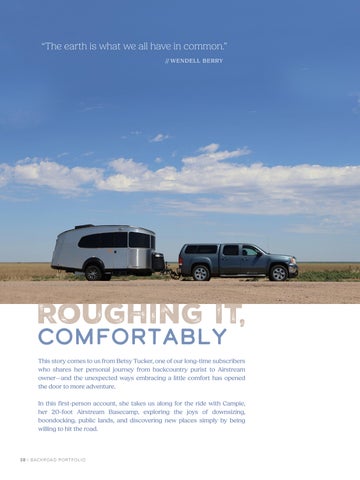
This story comes to us from Betsy Tucker, one of our long-time subscribers who shares her personal journey from backcountry purist to Airstream owner—and the unexpected ways embracing a little comfort has opened the door to more adventure. In this first-person account, she takes us along for the ride with Campie, her 20-foot Airstream Basecamp, exploring the joys of downsizing, boondocking, public lands, and discovering new places simply by being willing to hit the road.
38 | B ACKR OAD PO RTFO LI O
WRIT TEN AND PHOTOGR APHED BY BETSY TUCKER I come from a family of proud outdoor purists. When I was a child, if we wanted to spend the night outside we carried only the essentials deep into the woods. If we didn’t have to hike for an entire day to get to our campsite, that just meant we weren’t out far enough, and if we couldn’t carry it on our backs then we didn’t need it. I was lucky to learn some formative lessons early in life about minimalism and what actually fills a person’s soul. It’s not anything electronic, and has a lot more to do with steaming oatmeal on a frosty morning, misty mountain views, and the surprising sweetness of wild blueberries. Now, however, I’m 52 years old and it hurts my long-suffering skeleton to sleep on the ground. While I still love an early morning outdoor breakfast, I want cold half-and-half with my coffee, and I’m barely ashamed to admit it. I will seek out long and strenuous day hikes as long as I am able to log the miles, but returning to a comfortable bed that stays dry in a downpour feels like the ultimate luxury. Fortunately, my husband agrees, which led us to the purchase of our 2023 Airstream Basecamp 20X, affectionately named Campie. She is 20 perfect feet of aircraft-grade aluminum alloy, and she refrigerates my half-and-half beautifully. Last summer, on a trip from North Carolina to Colorado, we plugged her in just outside Abilene, Kansas, and enjoyed the miracle of air conditioning on a 97-degree night with what felt like 172% humidity. Heaven. How did we decide on a 20-foot Airstream? We are sensible people, but as we creep toward retirement, we find ourselves making choices based on criteria other than pure practicality. We love the quality and aesthetics of Airstreams, not to mention the history and culture of the brand, so we knew we wanted to look at its options first. We quickly zeroed in on the Basecamp model, which, although differently styled from the company’s more recognizable trailers, checks all our specific boxes. Campie allows my 6-foot-tall husband to move around comfortably inside, but is compact enough to tow easily over mountain passes and into smaller campgrounds. With a higher clearance than traditional trailers, she can bump confidently down dirt roads where larger campers and RVs wouldn’t be able to go, which gives us access to more remote and lesspopulated options for campsites.
FA L L 2 0 2 6 | 39
The Basecamp is also built for “boondocking,” which means we can use her solar power and generous water tanks to camp for days off the grid and still stay fed, hydrated, and comfortable. As we often long to slip away from polite society entirely, this was a non-negotiable feature in our choice of camper. The ability to boondock easily (and with a full indoor bathroom) means we can take advantage of the open spaces overseen by the Bureau of Land Management (BLM). Located mostly out west, BLM land offers “dispersed camping,” which allows you to simply drive into the area and find a spot pretty much wherever you want, with the caveat that there won’t be any services like power, water, bathrooms, or trash cans. And, it’s free. BLM land is an incredible resource, and we are all lucky to have access to it. A smaller camper also inherently limits the number of items we can bring with us, which has been both instructive and liberating. I’ve learned that I can exist comfortably and stay smelling sweet for a couple of weeks with not much more than two pairs of pants, three to four T-shirts, a sweatshirt, maybe a puffer depending on the time of year, PJs, two or three pairs of shoes, and some basic toiletries. It’s easy to find a laundromat if you need one, and most outdoor-branded clothes are also hand-washable and quick to dry. I promise, in this era of too much stuff and too little time, it is delightful to have very few things to take care of and keep clean. Am I prepared to attend a blacktie gala at a moment’s notice? No. But it’s fine with me to go out to dinner looking like a slightly feral older lady with a bare face and a farmer’s tan. If that’s not your thing, I support you. Maybe just choose a slightly larger camper to accommodate your evening gown, and only bring one. Before our first couple of overnights with Campie, we made lists, had conversations about what we needed to buy or bring, and went back and forth over what might go wrong and what we would do about it if it did. But as we gain experience, the preparation for each trip gets simpler. We know that our olive oil, spices, soap, cleaning supplies, toilet paper, shampoo, and other staples are already tucked away in one of Campie’s handy storage areas, so all we really need to do is plan our first few meals and look at the weather.
4 0 | BACKROAD PO RTFO LI O
We know what meals are easy and delicious after a good hike (hint: a Blackstone or other propane griddle is really versatile), and what shoes we like to wear for one of our favorite activities—an evening walk around the campground with a well-earned cocktail. And you know what? The nostalgic smell of wood burning is the same as if we had packed everything in on our backs. Currently, our trips are planned based on the amount of time we can be away from home. As a remote worker, I can bring our Starlink, and as long as there is an unobstructed line of sight to the sky, I’ll have an internet connection good enough for video meetings. Within the next year or so, we’ll have an empty nest, and although we do have some animals who can’t come with us or wouldn’t enjoy camping, a good pet sitter will allow us to be gone for longer stretches. We’ll spend more days out west, boondocking and driving into town when we need a grocery store and a laundromat. Most often, though, we take long weekend trips to state and national parks closer to where we live in North Carolina. Great Smoky Mountains National Park is a favorite, but we’ve also visited the lesser-known Congaree National Park in South Carolina and the New River Gorge National Park in West Virginia. As we settle into being Airstream owners, we’ve realized that one of the most significant benefits of Campie is that she motivates us to get out there—to visit new places we never would have considered otherwise. We have a black-and-white poster tacked to the refrigerator with a graphic for each of the national parks, and each time we visit one, we scratch it off to reveal vivid colors underneath. It’s a great visual to remind us where we’ve been, and, of course, where we want to go. A goal to visit all the state parks in your home state, or all the yarn stores in a 500-mile radius, or every quirky museum in the Southeast (there’s a Waffle House museum?), can lead to that most wonderful of exclamations: “I had no idea this was here!” Even if the camper life isn’t your thing, you can still follow your curiosity and experience something unexpected—just be willing to hit the road.
THE BUREAU OF L AND MANAGEMENT The Bureau of Land Management, created in 1946 during the Truman administration, is an agency within the Department of the Interior with a mission “to sustain the health, diversity, and productivity of the public lands for the use and enjoyment of present and future generations.” The BLM currently manages 245 million acres of public lands and 700 million acres of mineral estate. The BLM has at times been controversial in its decisions and methods, but undoubtedly it is a difficult task to balance commercial, recreational, and conservation activities on public lands. It’s important work, and it benefits all Americans to work through differing priorities to ensure our right to access public lands is preserved far into the future. BLM allows hiking, camping, climbing, hunting, fishing, recreational shooting, off-highway vehicle recreation, biking, and rock-hounding. If you’re interested in camping, developed campgrounds are available—some of which take reservations and charge a fee. If you want to try dispersed camping, no stays longer than fourteen days within any twenty-eight-day period are permitted, and vehicles must stay on designated trails and roads. Fire safety is critical, so always check local and current regulations. And, as always when camping, leave no trace. Learn more at blm.gov/visit.
F A L L 2 0 2 6 | 41
While hitting the road with Campie and exploring all that the natural world has to offer, Betsy Tucker has discovered her passion for wildlife photography. We’ve featured other pieces of her work in previous issues and are including this spread of birds she photographed during her Airstream adventures.
A COMMON GRACKLE SHOWS OFF ITS IRIDESCENT FEATHERS WHILE BATHING IN BRACKISH WATER IN HUNTINGTON BEACH STATE PARK, MURRELLS INLET, SOUTH CAROLINA.
4 2 | BACKROAD PO RTFO LI O
ONCE ALMOST EXTINCT IN THE UNITED STATES, THE ROSEATE SPOONBILL IS NOW A MORE COMMON SIGHT IN THE LOWCOUNTRY. THESE WERE PHOTOGRAPHED IN HUNTINGTON BEACH STATE PARK, MURRELLS INLET, SOUTH CAROLINA.
F A L L 2 0 2 6 | 43
4 4 | B ACKR OAD PO RTFO LI O
Near Bryson City, North Carolina The Great Smoky Mountains Railroad offers two classic round trips into some of the most bucolic lands in the southern Appalachians. PHOTO COURTESY OF VISITNC F A L L 2 0 2 6 | 45
A Journey Through Time and Terrain Experience the South’s scenic railways
BY THE BACKROAD PORTFOLIO STAFF
There was a time when the low, resonant whistle of a train carried more than just freight or passengers—it transported the promise of elegance. In the Southeast, silver coaches once glided through pine forests and past moss-draped oaks, dining cars served sophisticated meals on white tablecloths, and travelers watched the landscape unfurl at a civilized pace. The journey itself was the point. Today those same tracks still cross the region, yet most of us rush past them in cars or above them in planes, treating the train as a relic rather than a choice. Few still board for the simple pleasure of looking out the window. The routes remain, the views endure, and the slower way of moving through the South is still available to anyone willing to reclaim it. We invite you to journey down those tracks with us.
ABOVE: COURTESY OF THE BLUE RIDGE SCENIC RAILWAY | LEFT: COURTESY OF THE BLUE RIDGE SCENIC RAILWAY
4 6 | B ACKR OAD PO RTFO LI O
BLUE RIDGE BEAUTY The Blue Ridge Scenic Railway pulls out of downtown Blue Ridge, Georgia’s historic 1905 depot for a 26-mile round trip through the foothills along the Toccoa River. Ride vintage rail cars past rolling hills, dense forests, river bends, and preserved North Georgia homelands. Choose the two-hour Express with no stops or the four-hour Extended Tour that gives you a two-hour layover in the twin border towns of McCaysville, Georgia, and Copperhill, Tennessee. Open-air coaches deliver wide-open views and fresh mountain air. Adults 18 and older can step up to climate-controlled Premier cars with padded seats, refreshments, and extra amenities on select trips. Rail bikes are available for pedaling a stretch of the line at your own pace. During the early 1900s, these tracks hauled copper ore and timber. Conductors share those stories as you roll along. In McCaysville and Copperhill, you can explore downtown shops for crafts and antiques, grab a riverside meal, or stroll across scenic bridges. Fall rides are among the most popular, as the mountains light up in crimson, gold, amber, and orange. Winter trips run in heated coaches with vinyl windows that keep out cold weather while still framing snow-dusted evergreens. Holiday Express trains run for about an hour on select dates from late November through December 24 and again after Christmas, complete with carols, a reading of The Night Before Christmas, hot chocolate, snacks, jingle bells, candy canes, and a visit from Santa.
F A L L 2 0 2 6 | 47
The longer Holiday Pavilion Tour adds the layover so you can enjoy the towns all dressed up for the season. Downtown Blue Ridge joins in with tree lightings, parades, and markets. You can ride on a Trick-or-Treat Train in October, plus choose from private caboose options for groups or special occasions. The railway runs mainly March through December and keeps a wheelchair-accessible coach ready.
KNOW BEFORE YOU GO Blue Ridge Scenic Railway 241 Depot Street, Blue Ridge, Georgia brscenic.com | 877.413.8724 Book online well ahead—fall foliage and holiday train tickets sell out fast. Pick the two-hour Express or four-hour Extended-with-layover option. Coach tickets generally run $38 to $75 depending on season and length. Premier seats are higher, and cost around $80 to $120. Discounts for seniors, military, first responders, and teachers are common. Arrive 45 to 60 minutes early; boarding starts about 30 minutes before departure. Free street parking or a nearby paid lot is available. Wheelchair-accessible coach seating is available, but you should call to reserve it. No pets; only service animals are allowed.
COURTESY OF VISITNC 4 8 | BACKR OAD PO RTFO LI O
SMOKY MONTAIN BLISS From the historic depot right in the heart of Bryson City, North Carolina, the Great Smoky Mountains Railroad offers two classic round trips into some of the most bucolic lands in the southern Appalachians. The Nantahala Gorge Excursion covers 44 miles in about four-and-ahalf hours, rolling beside the Nantahala and Little Tennessee Rivers, across the long Fontana Trestle over Fontana Lake, and into the deep Nantahala Gorge for a layover. The Tuckasegee River Excursion runs 32 miles round trip in about four hours, following the river through quiet countryside, through the 836-foot Cowee Tunnel (some say it’s haunted), and on into the little mountain town of Dillsboro. You can ride vintage coaches and open-air gondolas, or step up to First Class and Crown Class cars with extra comfort and dining options. Steam locomotives pull select trips, but most days diesel trains do the work. These are the old Southern Railway Murphy Branch tracks, and the onboard stories bring that history to life as you ride over rivers, valleys, and trestles, and view scenery you simply can’t see from the highway. At the Nantahala Outdoor Center layover you’ll find shops, food, and the river right at your feet. In Dillsboro, the longer stop gives you time for shops, a brewery, lunch, and a stroll through the historic downtown. Fall color rides are a highlight when the mountains turn every shade of red, yellow, orange, and gold. Special trains keep the calendar full and include the Polar Express, Day Out with Thomas, wine and moonshine experiences, and Raft & Rail packages that pair the train with a whitewater trip. The railroad runs year-round with a schedule that shifts by season and stays family friendly.
KNOW BEFORE YOU GO Great Smoky Mountains Railroad 45 Mitchell Street, Bryson City, North Carolina gsmr.com | 800.872.4681 Book online early because fall, steam, and holiday train tickets go fast. Choose an open-air gondola, standard coach, or upgraded First Class/Crown Class ride. Adult scenic fares typically start around $64 and climb for premium or steam service. Children’s tickets and occasional promotions (including kidsride-free periods) are also available. Arrive 45 to 60 minutes early; boarding begins about 30 minutes before departure. Paid parking is available near the depot and there are wheelchair-accessible options you can confirm when booking your tickets. No pets; only service animals are allowed.
VINTAGE VALLEY VIEWS Out of the Delano, Tennessee, boarding area, the Tennessee Valley Railroad Museum runs two standout trips along the old Hiwassee River corridor through the Cherokee National Forest. The Hiwassee Loop is a continuous 50 miles, roughly four-and-a-half-hour round trip that features the famous spiral loop near Farner—one of only a handful left in North America—where the F A L L 2 0 2 6 | 49
train climbs Bald Mountain and crosses over its own track. The Copperhill Special stretches the journey to about 94 miles and eight to nine hours, continuing through Turtletown and Ducktown all the way to the twin border towns of Copperhill, Tennessee, and McCaysville, Georgia, with a 90-minute layover. You’ll ride climate-controlled vintage cars, with choices from standard coach up to Crown Class, lounge, observation, and dome cars that give you elevated views of the river gorge, forested mountains, rocky bluffs, and historic bridges. Hear a narrator share the story of the line’s days as part of the Louisville & Nashville Railroad’s Atlanta Division, when it hauled copper out of the Copper Basin. The scenery feels remote and untouched—like what our ancestors might have seen from their train window. In Copperhill and McCaysville you can hop off the train to shop, eat, and walk the same state-line bridge Blue Ridge Scenic Railway passengers enjoy. The season generally runs from late March into mid-December, with special holiday trips later in the month. Fall color runs show off the gorge at its best, and holiday trains add festive touches.
KNOW BEFORE YOU GO Tennessee Valley Railroad Museum 4119 Cromwell Road, Chattanooga, Tennessee tvrail.com Hiwassee River Rail 9406 Highway 411, Delano, Tennessee cityofetowahtn.com/2185/hiwassee-river-rail-adventure Book tickets online ahead of your ride, especially for fall foliage and the Copperhill Special. Coach fares for the Hiwassee Loop typically start at $55. Copperhill coach fares start at $80, with higher rates for dome, observation, and premium classes. Arrive early for parking and boarding, and confirm accessibility needs when you make your reservation. No pets; only service animals are allowed.
5 0 | B ACKROAD PO RT FO LI O
BIG SOUTH SCENERY From the historic depot in the National Historic District of Stearns, Kentucky, the Big South Fork Scenic Railway follows the old Kentucky & Tennessee Railway into the Big South Fork National River and Recreation Area and Daniel Boone National Forest. The standard three-hour round trip covers roughly 16 miles, dropping about 600 feet through forested gorges, past mountain streams, through a tunnel, and over bridges before arriving at the restored Blue Heron mining camp for a 90-minute layover. Enclosed coaches and open-air cars both offer good views, and the narration brings the region’s coal-mining and logging past to life. You’ll see deep valleys, thick greenery, and the remnants of an industrial world that once kept these mountains humming. At Blue Heron the National Park Service has set up interpretive exhibits and “ghost structures” that show where the mining buildings once stood. You’ll also find picnic spots and short trails. Fall color runs are a favorite when the gorge turns brilliant. Special trains include the Polar Express, Murder Mystery dinners, and other seasonal offerings. Regular service runs from spring through early November, with holiday trains running into December.
KNOW BEFORE YOU GO Big South Fork Scenic Railway 66 Henderson Street, Stearns, Kentucky bsfsry.com | 606.376.5330 Book online or by phone. Weekends, fall foliage, and Polar Express dates fill quickly. Standard fares are around $28 for adults, $25 for seniors, and $18 for children ages 3–12. Military members with an ID ride free and their family members pay the child rate when the service member is present. Children under age 3 are free. Arrive 45 minutes early. Free parking is available at the depot. Confirm accessibility when you book your tickets. No pets; only service animals are allowed. A “Coal Miner’s Lunch” is available for purchase.
OPPOSITE PAGE: WIKIMEDIA COMMONS | THIS PAGE: WIKIMEDIA COMMONS
F A L L 2 0 2 6 | 51
Backroad Portfolio’s exclusive guide to getting there the long way
5 2 | BACKR OAD PO RTFO LI O
Harvest Tables and Mountain Roads C R E AT E D B Y T H E B AC K ROA D P O R T FO L I O S TA F F
Backroads transport us to the places in between. This recurring feature takes you to and from two destinations via winding rural roads lined with charming small towns, captivating landscapes, and, in this particular journey, a loop through the foothills and mountains of East Tennessee and North Georgia in search of authentic Southern holiday tables. From a Relais & Châteaux farm resort and a family-style country kitchen, to a sustainable farm community and a rustic adventure basecamp, these stops celebrate the holiday season with heritage recipes, hyper-local ingredients, and the kind of unhurried rural hospitality only backroads establishments can deliver. The journey ends with a scenic drive along the unfinished Foothills Parkway, where autumn colors frame the Great Smoky Mountains. Google map links will be included in the online version of this story. Be sure to check websites for updated information or schedule changes at each stop along the way. Let’s get started.
Note: travel times vary depending on day and time of travel. OPPOSITE PAGE: A N AUT UM N TABLE SE T T I N G ; PHOTO BY ARTSYS - ADOBE .STOCK .COM
F A L L 2 0 2 6 | 53
GET THERE...
Walland to Chattahoochee Hills Walland g Pigeon Forge g Chattahoochee Hills BACKROAD ROUTE: 247 miles; 5 hours and 46 minutes • 3 stops FASTEST ROUTE: 301 miles; 5 hours and 13 minutes • 3 stops
COURTESY OF BLACKBERRY FARM FACEBOOK
STARTING POINT Day one begins at Blackberry Farm in Walland, Tennessee, and ends at The Farmhouse at Serenbe in Chattahoochee Hills, Georgia.
Blackberry Farm
blackberryfarm.com Blackberry Farm is a luxurious Relais & Châteaux resort nestled on 4,200 acres in the foothills of the Great Smoky Mountains, offering an upscale rural escape with farm-to-table dining, wellness, and outdoor adventures. Its holiday experiences, include special Thanksgiving and Christmas events with multi-course meals, dubbed Foothills Cuisine®. This elevated Appalachian fare showcases hyper-local ingredients from the on-site farm and surrounding region, such as seasonal game, heirloom produce, and artisanal cheeses, Blackberry emphasizes refined, chef-driven tasting menus in elegant barn or main house settings, paired with exceptional wines, creating a sophisticated yet traditional feast that blends luxury with authentic mountain heritage. 1471 West Millers Cove Road, Walland, Tennessee
5 4 | B ACKROAD PO RTFO LI O
COURTESY OF MAMA’S FARMHOUSE FACEBOOK
Mama's Farmhouse
mamasfarmhouse.com Mama's Farmhouse is a beloved country-style restaurant in the Smoky Mountains, serving all-you-caneat, family-style Southern meals that evoke generational home cooking. It offers traditional holiday dinners with classics like turkey, dressing, country ham, fried chicken, mashed potatoes, endless sides, and comfort desserts. What sets its holiday offerings apart is the no-frills abundance mirroring a large family gathering with communal platters and down-home authenticity, just like a traditional southern meal, with recipes inspired by the owners’ great-grandmother, whom they call “Mama.” 208 Pickel Street, Pigeon Forge, Tennessee
The Farmhouse at Serenbe (located at The Inn at Serenbe)
serenbefarmhouse.com | serenbeinn.com The Farmhouse at Serenbe is a charming farm-to-table restaurant and inn within a historic family farm turned wellness-focused community in the rolling countryside outside Atlanta. It hosts special Thanksgiving dinners featuring multi-course, locally sourced meals with options like turkey, beef tenderloin, or seafood, alongside garden-fresh sides and tarts. Its uniqueness lies in the hyper-local, organic ingredients from Serenbe Farms and on-site gardens, delivered in a serene, nature-immersed setting that emphasizes sustainability and community. This creates a fresh, seasonal twist on traditional Southern holiday fare that is elevated yet approachable, offering guests a peaceful rural retreat with farm views.
COURTESY OF THE INN AT SERENEBE FACEBOOK
10950 Hutcheson Ferry Road, Chattahoochee Hills, Georgia
F A L L 2 0 2 6 | 55
AND BACK AGAIN...
Chattahoochee Hills to Townsend Chattahoochee Hills g Ellijay g Townsend BACKROAD ROUTE: 229 miles; 5 hours and 19 minutes • 2 stops FASTEST ROUTE: 230 miles; 4 hours and 44 minutes • 2 stops
STARTING POINT Day two begins at The Farmhouse at Serenbe and finishes with a scenic drive on the Foothills Parkway near Townsend, Tennessee.
Mulberry Gap Adventure Basecamp
mulberrygap.com Mulberry Gap is a rustic adventure basecamp with cabins and campsites in the North Georgia mountains, ideal for backroad explorers seeking nature and community. It hosts destination Thanksgiving getaways centered around a traditional family-style holiday dinner, with additional activities like family fun nights and outdoor events. Its offerings stand out for blending hearty, home-cooked Southern comfort food with an active, mountain adventure vibe—think gathering in the barn or around campfires post-meal—creating a lively, communal experience rooted in outdoor traditions. 400 Mulberry Gap Road, Ellijay, Georgia
P HOTOG RA PHY C O U RTE SY O F M U L BE RRY GA P W E B S I T E
5 6 | B ACKR OAD PO RTFO LI O
PHOTO BY JOYE ARDYN DURHAM, COURTESY OF WIKIMEDIA COMMONS
Foothills Parkway
nps.gov/places/foothills-parkway.htm End your journey at the Foothills Parkway, a scenic drive offering a quieter experience of the Great Smoky Mountains. Authorized by Congress in 1944, it remains the only unfinished of seven Congressionally mandated parkways. The full 72-mile corridor is managed by Great Smoky Mountains National Park, yet only three segments totaling 22.5 miles are open. Visitors enjoy breathtaking mountain views with far-less crowding than main park roads. Challenging terrain and intermittent funding have delayed completion, making it Tennessee’s oldest unfinished highway project. Check current road conditions before traveling and explore the Cosby-to-I-40, Walland-to-Wears Valley, and Chilhowee-to-Walland sections for memorable overlooks and peaceful drives. Great Smoky Mountains National Park, Townsend, Tennessee
Backroad Portfolio’s There & Back Again Travel Guide Go to backroadportfolio.com and click on “Travel” to access our archive of There and Back Again features. From Florida to Virginia, we offer ten amazing road trip itineries for exploring the Southeast. If you have a road trip we should explore next, let us know by emailing backroadportfolio@gmail.com.
V I S I T B AC K R OA D P O RT F O L I O. C O M F O R R O U T E S W I T H A L L T H E S TO P S . F A L L 2 0 2 6 | 57
5 8 | B ACKROAD PO RTFO LI O
ROBERT CLARK Upstate South Carolina Apple stands along South Carolina’s backroads provide tasty delights for travelers.
F A L L 2 0 2 6 | 59
C O N V E R S AT I O N
How ’Bout Them Heirloom Apples Tom Brown is on a unique mission: finding and resurrecting lost apples INTERVIEW BY KURT DUSTERBERG | PHOTOS COURTESY OF TOM BROWN
Tom Brown has spent more than twenty-five years pursuing apples—more specifically, lost apples. In 1999, while working as a research engineer at R.J. Reynolds Tobacco Company, Brown and his wife made their usual Saturday visit to the local farmers market in Clemmons, North Carolina, outside of Winston-Salem. Brown happened upon a man selling a variety of heirloom apples. “And I was just totally fascinated by all the colors and taste and interesting names of the apples,” Brown says. Ever since, Brown has been on a mission, one that has consumed his retirement. He spends most of his days in search of heirloom (or “heritage”) apples—varieties that were cultivated and grown in the past century. Some are extinct, while others have whereabouts unknown. That might sound like an unnecessary pursuit, but Brown has taken great interest in the historical significance of the varieties. Not only does he enjoy the detective work, but once he finds an existing tree from a long forgotten variety, he takes pride in giving it new life, if only for other enthusiasts and orchardists. At eighty-five, Brown has catalogued more than 1,000 forgotten varieties. “This is a unique love,” he says. “Even if people care about what you’re doing, there’s only so much they can contribute. I’m the one carrying the banner for all of this.” Your first apple encounter with the man selling apples at your local farmers market left quite an impression on you, didn’t it? Well, I also found out that he had discovered a few of those himself. I asked him if there were any that he was looking for from my county (Forsyth), and he was looking for one called Harper Seedling. I had zero credentials and I had never found a heritage apple. But back then, a lot of people subscribed to the newspaper and I got quite a few responses to my ad. I eventually found four or five locations where the Harper Seedling had been grown. What compelled you to keep doing it? In my work, I was a researcher. And success breeds success. And everybody likes apples, so people responded kindly and were helpful. What really spurred me on was everybody kept saying, “You ought to go to Wilkes County and look for old apples.” What they didn’t know was that Wilkes County was the mother lode of old apple varieties. I eventually found 300 varieties related to the one county.
60 | BACKR OAD PO RT FO LI O
C O N V E R S AT I O N
Were you just able to find existing trees? People there really valued the old apple varieties. They had kept the old trees alive. They knew the varieties and could help identify them. Sometimes the people who had the tree knew the names, but in many instances, they didn’t know the name but maybe someone else 7 miles away could. Maybe they used to have the tree and could help identify it. So how did you set out to find all these apples? Half of Wilkes County was only an hour drive from my house, and I was retired and could go up there three days a week. Eventually I found local people who would help me make the contacts. If there was a widow who had an old apple tree, (my contact) could knock on the door and she would invite us into her living room to talk apples.
BOTTOM ROW, FROM LEFT TO RIGHT: PITTSBURG, POLK SEEDLING, AND STRAWBERRY ROME
TOP ROW, FROM LEFT TO RIGHT: COFFELT BEAUTY, MAUSBY’S FINE WINTER, AND NEW YORK BELLFLOWER
Were you just interested in cataloguing them? How could you be sure you were identifying them properly? What I wanted to do was get them back in circulation. When I was finding them most readily, I would collect real apples, and I would mail the apples to about six people who sold heritage apple trees. Any that they liked, I would get cuttings in the fall so they could graft them. So it wasn’t just finding them, it was to get a real tree growing at another location. I got probably 600 varieties to different people. Eventually I started selling apple trees myself. How did you go about making contact with apple people? I would go to festivals. I would have a display where I would have seventy-two apple varieties. I’ve gone to as many as fourteen festivals a year, probably about 180 total … way up into West Virginia and as far as Cadiz, Kentucky. I have a spiral notebook and I write down their comments, whether they tell me to go visit so-and-so. And to the best of my ability, I try to follow up on them.
F A L L 2 0 2 6 | 61
TOM SHOWCASES HIS APPLES AT A FESTIVAL.
I would think it’s difficult to locate these trees just based on a conversation with someone. One attribute is I’m really, really persistent. There was one apple called the Barker’s Liner apple south of Nashville (North Carolina). Somebody south of Nashville remembered the apples. So I contacted these people, and I sent them maybe five different boxes that vaguely resembled the Barker’s Liner. The man actually asked me to stop sending the apples. Do you grow your own trees? I have at least 600 varieties. Some of them are still in containers and I need to get them into the ground. It’s just to try and keep them alive. They’re cross-pollinated. The seeds get genes from the mother tree and also genes from the pollinator insects that have visited a blossom on another apple tree. And so, you’ve got to keep regrafting them because you can’t save the seeds. Do you sell your apples? No. I don’t have the time. I’m a one-person operation. There’s a period in the late winter and early spring, at least two months, where I’m primarily grafting trees. I’m not as fast as some of the people who do that. There’s a learning curve. Do you feel like there is some lasting importance to all of this—just to remind people about the history of growing an important crop? I’ve heard multiple elderly people say their fathers and grandfathers took great pride in having apples different from their neighbors. There would be a house with three apple trees, and they would all be rare and different from each other. Then maybe five houses down the road, there would be a house with four apple trees, and they would all be rare and different from each other and different from the other house. What makes a great eating apple? I like one that’s a little bit tart but not overly so. In some ways, I like an apple that’s not too hard. I’m not fascinated by the super crisp ones. There was one I found near Robbinsville (North Carolina), and that was a wonderful tasting apple that deserved preservation. I found that at somebody’s house. It was real easy to bite. When you would sink your teeth in it, it would shear off. You didn’t have to drive your teeth through it. Another one I like is the Brushy Mountain Limbertwig. It’s a wonderful keeper, for one thing. You can have those apples stored in refrigeration. It’s a late apple variety you pick in November, but it still tastes very good in July. The taste might be a little different, but it’s a good taste. That was really important years ago. You’ve carved out a unique role for this era of your life, preserving part of our history. Do you sort of enjoy having this to yourself? Well, I’ve shared it widely. There’s nothing I’ve tried to exclusively keep to myself. But next year might be the last year that I try to graft so many apple trees. After that, I hope to supply one or two trees to people who need a certain variety to start more preservation orchards. I sell less than 500 each year. There’s only so many minutes in a day. Do the apples take up pretty much all day, every day? Yes, and some things around the house have gotten neglected due to that. So when I go into so-called retirement, I’ll hopefully do apples 50 percent of the time rather than 100 percent of the time.
62 | BACKR OAD PO RTFO LI O
PHOTO BY ROBERT CLARK
F A L L 2 0 2 6 | 63
P R E S E R VAT I O N
The Colonel's Camellias BY TOM POL AND This column can best be appreciated over a glass of iced tea. So take a moment to pour one and read on. The growing season is over and many people who love growing things are resigned to winter’s onset and the cold, early darkness it brings. Not all, however, view winter that way. As I flip through the index cards in my memory under the category of “Gardeners,” I remember growers who chose to be specialists. I remember a friend and business associate of my Dad’s, Holcombe Verdery of Harlem, Georgia, who grew spectacular roses. And Dr. Charles Jeremias and his wife, Lee, from Newberry, South Carolina. These devoted gardeners cultivate roses they find in abandoned cemeteries, of which some species trace their roots to the 1600s. It’s been my privilege to meet many interesting people. Among them walks Parker Connor Jr. who’s close to, if not, already 92 today. He lives in Mt. Pleasant now, but once upon a time he lived on Edisto Island at Oak Island Plantation. I was a guest in his home in 1993, a writer on assignment as usual. My mission was to write about the Colonel’s unusual pastime. The setting for his avocation is classic. Oak Island Plantation, built in 1828, sits at the end of a sandy road overlooking the Edisto marsh. The home was long occupied by Connor’s ancestors except for a stint during the Civil War when Union troops lived there. Connor told me the Union soldiers “liberated” the family’s original furniture. On the National Register of Historic Places, the home faces south across expansive reaches of salt marsh. “All the old Southern homes face south,” said Connor. We walked the grounds that day, the Colonel and I, he ticking off the names of prized camellias ... “Dawn’s Early Light, Boutonniere, Walterboro, and Wildwood.” It’s been some 33 years since I walked the grounds at the Colonel’s home, but I well remember my time there. The calls of clapper rails drifted over 64 | B ACKR OAD PO RTFO LI O
the marsh, and the cries of pileated woodpeckers echoed through pines. The story of Oak Island Plantation, however, was not to be found in the pines, nor in the Colonel’s old mansion, nor out in the marsh. Its story was about camellias, those plants that bloom as few others do: in late fall, winter, and early spring. The growing season goes on for some hardy plants and their lucky growers. With camellia season approaching, now is as good a time as any to tell you about the Colonel’s camellias. I suppose he was tired of the clashing of metal, shouting commands, and war’s brutality, this man who led infantrymen. After retiring in 1978, the Colonel turned to something more peaceful. Growing camellias. It only took him 15 years to go from the infantry to the top of the camellia world. In fact, he reigned as one of the Southeast’s premier camellia growers in the 1980s and ’90s. As we walked that crisp January morning, he told me about his decision to retire, pointing at a nearby bloom and interjecting, “Dixie Night Supreme, gorgeous blooms.” Some of his camellias, such as the Anemone and the Peony, are perfection. He had 400 varieties, and he routinely patrolled his camellia kingdom seeking the perfect bloom. He knew precisely what the judges looked for in a perfect bloom. “Some judges like pink, some like red, some white, but perfection is what they look for,” he said. He then launched into a description of an irreproachable, semi-double blossom. “If it’s a semi-double, all the petals must be perfect, intact, standing up, and fresh. That’ll win,” he pronounced with an air of finality. As we walked, I noticed several plants had swaths of green cheesecloth wrapped around them. “To keep the infernal bees out,” said the Colonel. “They can destroy a flower in two hours.” The morning was cool. There were no bees. As if reading my mind, Colonel Connor continued. “You wait two hours,” he said, “and you’ll see a couple hundred bees on every flower in this yard. They pollinate the flowers, but they destroy the flower rooting around to get the pollen, kicking up their little feet like pigs in a trough. I would gladly get rid of the bees if I knew how. I’m an environmentalist, but not that kind.” No sooner had he said this than he pointed to a delicate blossom. “That’s a Miss Charleston.”
A MISS CHARLESTON CAMELLIA - BY ROSE MAKIN - ADOBE.STOCK.COM
P R E S E R VAT I O N
This plantation, with its ties to Connor’s ancestors, its Civil War legacy, and massive oaks, grows America’s oldest camellia bush. “That big camellia over there under that oak was planted in 1830,” said the Colonel. “It’s probably the biggest one in the United States, 64 inches around its base.” That was almost 33 years ago. How big, I wonder, is it today? The Colonel became interested in growing camellias by studying the history of the family plantation. He used to listen to his grandfather describe Oak Island Plantation as a showplace prior to the devastation of the Civil War. His great-great-great-grandfather, William Seabrook, completed the plantation in 1828. A formal English garden was laid out in 1830. It contained thousands of roses, and later Japanese gardeners built a water garden on the grounds. The old grounds could have rivaled Middleton or Magnolia Gardens, those Lowcountry jewels, Connor told me. But then “The War” came along, and the family’s fortune evaporated, leaving them penniless for some time. “Everything,” said Connor, “went to rack and ruin.” It’s interesting to speculate what might have come of Oak Island Plantation had there been no war. Perhaps it would have taken its place along celebrated Lowcountry gardens where camellias are bright stars masquerading as native plants. They’re not.
All this Southern camellia business came about as an accident of sorts. Truth be told, it comes down to deception. That tea you’re supposed to be sipping: it’s a cousin to camellias. Camellias and tea plants are in the same family. The Colonel told me how camellias came to the colonies. “The British went to China to buy tea plants,” said the Colonel, “and the Chinese fooled the British by selling them camellias instead.” The Colonel went on to say he’d never heard of anyone making tea from the flowering camellia, but he “once heard about someone making some camellia wine.” It doesn’t sound palatable, does it? Certainly not like the tea we prize down South, which comes from Camellia sinensis. After water, tea is the second most widely consumed beverage in the world. So enjoy your tea and be glad the British finally got hold of some real tea plants. Tea, you see, as Southern as it seems, came to us from China, courtesy of Britain. And as for the Colonel and other camellia enthusiasts, this cousin of the tea plant may not be potable, but it brings them joy of another sort: beautiful splashes of color in a season known for cool, dark days. And more than that, it brings something better, a colorful way to compete while forgetting their troubles, except, of course, for those infernal bees.
F A L L 2 0 2 6 | 65
C R E AT I O N
Layers of Tradition How Ambrosia became a Southern holiday classic BY ELIZ ABETH POL AND SHUG G
Growing up in Georgia, I remember my grandparents preparing an assortment of desserts for Christmas dinner. They set aside a special counter for the spread, and we’d load our plates with homemade treats—coconut cake, caramel cake, and pecan pie. But the one I always looked forward to most was my grandmother’s ambrosia. Named for the mythical food of the Greek gods, ambrosia emerged in the mid-19th century as a luxurious yet simple fruit dish. The earliest known recipe appeared in 1867 in Maria Massey Barringer’s Dixie Cookery from Concord, North Carolina. It called for only three ingredients: freshly grated coconut, a light sweetening of sugar, and layers of “pulped” oranges. Some served it in glass bowls or on ice cream plates. My grandmother kept things simple and served it in styrofoam bowls, which also kept it cold. Production of Florida oranges soared after the Civil War. Their abundance, along with the arrival of affordable coconuts via new rail lines, made for an exotic combination of flavors. Florida’s citrus season peaked in late fall, supplying fresh oranges just as families prepared their holiday feasts. During the 1880s, variations of the recipe included pineapple. Some cooks added a splash of sherry or Madeira, or layered in homemade whipped cream. Early 20th-century recipes expanded into broader fruit salads that sometimes included bananas, strawberries, or grapes. The addition of marshmallows in the 1920s and 1930s, jarred “marshmallow whip” and, later, miniature marshmallows, turned ambrosia into the creamy, sticky salad we love today. Midcentury versions incorporated sour cream, mayonnaise, frozen whipped topping, maraschino cherries, and pecans. Today the dish exists in two broad camps: the restrained, historic style of fresh citrus and grated coconut, and the richer modern “salad” laden with marshmallows and creamy binders. Whether presented as a light dessert or sweet side, ambrosia remains a nostalgic addition to any Southern table. If you don’t have a family ambrosia recipe, we’re offering two for you to try: my grandmother’s and a creamier version. Both are delicious, so no matter which one you choose, your holiday guests will thank you for it.
66 | B ACKROAD PO RTFO LI O
C R E AT I O N
M AW M AW ' S A M B R O S I A Ingredients • 10 to 12 large naval oranges (peeled and segmented) • 2 cups of fresh coconut, shredded (with the juice reserved) or 2 packs of frozen shredded coconut • 32 ounces of fresh orange juice, or name brand orange juice with pulp • 1 cup of halved maraschino cherries with juice • 1 cup of pecans, chopped (optional) • 2 cups of miniature marshmallows (optional) • 1-2 teaspoons of white sugar Directions • Prep the oranges. Peel the navel oranges and remove as much of the white pith as possible. Cut the segments away from the membranes or slice them into bite-sized pieces. • In a glass gallon jar, place a layer of orange pieces, then sprinkle a generous layer of coconut over them, then cherries, pecans, and marshmallows. • Mix the reserved coconut juice and orange juice together, then drizzle PHOTO COURTESY OF BISCUITSANDBURLAP.COM
the blended juices evenly over each layer. Add a light dusting of sugar if your oranges need extra sweetness. Repeat the layers until all the fruit and coconut are used. • Stir well, and place the ambrosia in the refrigerator overnight to be served the next day.
CREAMY AMBROSIA Ingredients • 1 20-ounce can of pineapple chunks, well drained • 2 11-ounce cans of mandarin oranges, well drained • 1 cup of sweetened shredded coconut • 2 cups of miniature marshmallows • ½ cup of halved maraschino cherries, rinsed and drained • ½ cup of chopped pecans (optional) • 1 cup of sour cream • 1 cup of heavy whipping cream (whipped) • 1 teaspoon of vanilla extract
PHOTO BY X - ADOBE.STOCK.COM
Directions • Beat the heavy whipping cream in a bowl until stiff peaks form. • Gently stir together the sour cream, whipped cream, and vanilla extract in a large mixing bowl until smooth. • Fold in the mini marshmallows, shredded coconut, and pecans. • Add the thoroughly drained pineapple and maraschino cherries. Fold in the mandarin oranges last, to keep them from breaking apart. • Cover the bowl and place it in the refrigerator for at least two hours (or overnight) so the flavors blend.
F A L L 2 0 2 6 | 67
JA M E S M . DAV I D S O N South Carolina Coast Sea oats prepare for the sunrise at Garden City Beach.
68 | B ACKR OAD PO RTFO LI O
F A L L 2 0 2 6 | 69
PHILOSOPHY
Character, Choice, and the Work of Showing Up How a life shaped by service, loss, and accountability led a Navy veteran to a career in behavioral health BY TOM CORNE JO Introduction by the Backroad Portfolio Staff
Fall brings with it a season of reflection—and a timely reminder of the ways we can show up for one another. September is National Recovery Month and Suicide Prevention Awareness Month, with World Suicide Prevention Day observed on September 10. October brings World Mental Health Day, and November turns our attention to National Veterans and Military Families Month and Veterans Day. For Tom Cornejo, these observances are more than dates on a calendar. They represent issues that have shaped his life, his leadership, and the work he has chosen to do. A first-generation American and graduate of the United States Naval Academy, Tom is a U.S. Navy veteran with twelve-plus years of active duty service. Today, he serves as CEO of CALM Source, a Danville, Virginiabased organization providing substance use and psychotherapy services to individuals and families navigating addiction, trauma, post-traumatic stress disorder, and other behavioral health challenges. His philosophy about this work—and life—has been consistently reinforced by experiences that have taught him lasting lessons about character, responsibility, and the consequences of choosing to show up.
There are moments in life that stay with you because they teach you something you didn't know you needed to learn. One of those moments happened when my daughter was young. My wife and I were at her elementary school graduation ceremony. She won a few different awards that day, but the final award given out was for excellence in character and personal accountability. One male and one female were selected from the student body. The principal, vice principal, five teachers, and one school board member all voted. And the vote had to be unanimous. I remember being incredibly proud when my daughter was picked. More than any academic achievement or accomplishment, I told her that character was one of the most important things she could ever be recognized for. How you treat people. How you behave when no one is watching. The person you choose to be. These are the things that carry us through a fruitful life. Early the very next morning, we were awakened by law enforcement banging on our front door— it was a frightening moment for my young family. I was informed that a business partner had committed serious fraud using my name, and although I hadn’t committed the crime, I was being held accountable for something someone else had done. A lot of debt was created and the judgements against me were very real. I had no choice but to pay off those notes. It took me almost two years to do so.
7 0 | B ACKROAD PO RTFO LI O
PHILOSOPHY
The timing of those two events has never left me. The day before, I had told my daughter that character mattered most. The next morning, life gave me an immediate opportunity to demonstrate whether I actually believed what I had told her. It was a powerful lesson—our philosophy isn’t really defined by what we say, it’s defined by what we do when circumstances become difficult. I will never forget the juxtaposition of the incredible high note the day of her graduation, against the lowest low the following morning. My journey as CEO of a mental health company was just starting out, but I certainly learned first-hand the effects of the roller coaster of life. Another lesson came years later, through a much more painful experience. It had been about ten years since I had spoken to a friend from the military. One day, out of the blue I received a text from him; he basically just wanted to see how life was going for me. Every now and again after that original exchange we would text back and forth. I never had any reason to believe he was dealing with anything significant. But I also never asked. Then one day, as I had just sat down for a meeting, I received a call from him. I didn’t answer the call because I didn’t want to be rude and keep everyone in the meeting waiting on me. I made a mental note to call him back that night. I never got around to it—life just got in the way. A few days later I learned he took his own life. The irony of this situation is that I run a mental health agency—I had many tools at my disposal that could have been used to provide some very meaningful help to him. The even richer—yet bitter— irony in this situation is that the meeting I had just sat down for (when he called) was with community partners and stakeholders to specifically address our outreach efforts for veterans who typically are not great about asking for help. I think about this almost every day—and every day it breaks my heart a little bit more. It turns out that regret can be a difficult thing to live with. I can’t change what happened, but the experience changed the way I think about people, time, and what it means to pay attention. Sometimes showing up means making the call. Sometimes it means listening. Sometimes it means recognizing that the person in front of you may be carrying a weight you cannot see. My path into behavioral health wasn’t something I had planned. My career had been built around leadership, operations, and organizational development, first through my military service and later in the corporate and entrepreneurial worlds. But over time, I had seen how substance use, trauma, mental health challenges, and other struggles could affect good people and entire families. When the opportunity to become involved with CALM Source came along, I recognized that my experience in building teams and organizations could be put to work in a different kind of service.
CALM Source is excited to announce that it will rebrand as Anchor Point Health and Wellness in January 2027, reflecting the organization’s expansion into multiple states and its continued mission to provide stability, support, and life-changing behavioral health services to communities, including veterans and active-duty service members. Learn more at calmsource.net Danville, Virginia
FA L L 2 0 2 6 | 71
A. HEFLIN Eastern Tennessee The sun rises across a frosty field in the Great Smoky Mountains.
7 2 | B ACKR OAD PO RTFO LI O
FA L L 2 0 2 6 | 73
LANDSCAPE
Tour some of the Southeast’s greatest light shows this holiday season.
WAYNE EGGLESTROM/BROOKGREEN GARDENS
N I G H T S O F A T H O U S A N D C A N D L E S AT B R O O K G R E E N G A R D E N S
Set among the gardens, sculptures, and centuries-old live oaks of coastal South Carolina, Brookgreen Gardens glows with holiday magic during Nights of a Thousand Candles. More than 2,700 hand-lit candles and millions of sparkling lights illuminate winding paths, reflecting ponds, and historic landscapes. Holiday music, warm drinks, and the soft glow of candlelight make this an especially enchanting way to experience the gardens after dark. Murrells Inlet, South Carolina 1931 Brookgreen Drive brookgreen.org/events/nights-thousand-candles/ November 27–29, 2026, December 3–6, 10–13, 17–20, 29–31, 2026, and January 1–3, 2027
7 4 | B ACKR OAD PO RTFO LI O
LANDSCAPE
COURTESY OF ROCK CITY GARDENS WEBSITE
View a sparkling valley from high atop a Georgia mountain.
E N C H A N T E D G A R D E N O F L I G H T S AT R O C K C I T Y G A R D E N S
High atop Lookout Mountain in Georgia, Rock City transforms into a glowing woodland wonderland during the Enchanted Garden of Lights. Millions of lights illuminate winding paths, towering rock formations, bridges, and natural gardens, blending colorful holiday displays with the mountain’s dramatic landscape. The result is a magical nighttime experience that feels more like a journey through an enchanted forest than a traditional light show. Lookout Mountain, Georgia 1400 Patten Road seerockcity.com/enchanted-garden-of-lights/ November 13–December 31, 2026
FA L L 2 0 2 6 | 75
LANDSCAPE
Experience the illumination of a Smoky Mountain wonderland.
COURTESY OF THE DOLLYWOOD COMPANY
S M O K Y M O U N TA I N C H R I S T M A S AT D O L LY W O O D
With the Great Smoky Mountains as its backdrop, Dollywood becomes a Christmas wonderland during Smoky Mountain Christmas. More than six million lights illuminate the park, from the colorful displays of Santa’s Village to the wintry glow of Glacier Ridge. Holiday shows, seasonal foods, shopping, rides, and towering Christmas trees round out an immersive celebration beneath the Smoky Mountain sky. Pigeon Forge, Tennessee 2700 Dollywood Parks Boulevard dollywood.com/themepark/festivals/smoky-mountain-christmas November 6, 2026–January 3, 2027
7 6 | BACKROAD PO RTFO LI O
LANDSCAPE
COURTESY OF TANGLEWOOD PARK
Drive through a festival filled with one million lights.
F E S T I V A L O F L I G H T S AT TA N G L E W O O D PA R K
Each winter, Tanglewood Park comes alive with more than one million lights during its beloved Festival of Lights. The drive-through route winds through the park, passing colorful holiday scenes, storybook displays, and festive landscapes. Best enjoyed from the warmth of your vehicle, the experience is a nostalgic holiday tradition for families and friends, with carriage rides and hayrides offering additional ways to see the lights. Clemmons, North Carolina 7714 Idols Road tanglewoodpark.org/parks/tanglewood/fol/ November 13, 2026–January 1, 2027
FA L L 2 0 2 6 | 77
NICK Dolly Sods Wilderness, West Virginia A hiker enjoys the morning sun at Bear Rocks Preserve in the Dolly Sods Wilderness.
7 8 | B ACKR OAD PO RTFO LI O
I N S P I R AT I O N
Early American China
Look in your china cabinet. You may have inherited early American china. These pieces feature enduring designs—intricate pagodas, bridges, birds in flight, and iconic American scenery— that remain highly collectible today. Several stand out for their widespread popularity in the late 18th and early 19th centuries: the Canton pattern of Chinese export porcelain, English Blue Willow, American Historical Views on Staffordshire transferware, and Flow Blue china, which also originated in the Staffordshire potteries of England during the 1820s. Celebrate your holiday meals this year with your favorite foods on heritage pieces. Mid-19th Century Chinese Export Canton Platter, $950 chairish.com This mid-19th-century Chinese export porcelain platter, known as Canton ware, was made circa 1860 for the European market. Measuring 16 inches wide by 12.75 inches deep and 2 inches high, it features a particularly striking sapphire blue design that depicts Chinese scenery. 1970s Bicentennial Declaration of Independence Transferware Platter, $975 etsy.com This 1970s Bicentennial-era blue and white transferware platter features a detailed central scene of the signing of the Declaration of Independence based on John Trumbull’s famous painting, framed by a floral border. Measuring approximately 18⅜ inches wide by 13¾ inches deep, it’s ideal for displaying on a wall or using as part of a table centerpiece.
Vintage Booths Real Old Willow Teacup & Saucer Set, $60 etsy.com This authentic Booths Real Old Willow set, most commonly produced in England from 1912 to the 1940s, features a classic cobalt Blue Willow pattern on white ceramic with delicate hand-applied gold trim. The listing includes one teacup with age-related discoloration and crazing, a second teacup in good condition, and a scalloped-edge saucer with bold imagery and an intact gold rim.
Johnson Brothers Brooklyn Collection, Set of Three Flow Blue Plates, $120 etsy.com These antique flow blue plates designed by British Staffordshire pottery Johnson Brothers—founded in 1883—are part of the Brooklyn Collection produced during the late 1800s to early 1900s. The collection features cobalt floral and scroll motifs with soft flowing glaze and gold accents, and was named for the
Johnson Brothers Historic America Collection, prices vary etsy.com, replacements.com Not every vintage china set is blue. Johnson Brothers’ Historic America Collection comes in pink as well. Introduced in 1938 to appeal to the American market, it remained in production until 1974 and features idealized 19th-century American historical and landscape views—many adapted from Currier & Ives prints. You can find pieces from the collection via Etsy and Replacements, Ltd.
PHOTOS COURTESY OF VENDORS
American city of Brooklyn as part of Johnson Brothers’ U.S. market patterns.
FA L L 2 0 2 6 | 79
MARK J. BARRETT Ocala, Florida A horse grazes in a frost-covered field during an unusually cold Floridian morning. 80 | BACKROAD PO RT FO LI O
FA L L 2 0 2 6 | 81
Enjoy seasonal fairs and festivals across the region.
COURTESY OF PHOTO CAPTION HERE
BULLETIN
National Storytelling Festival | October 2-4, 2026 Jonesborough, Tennessee storytellingcenter.net/festival/main This premier event in what many consider America’s oldest town features master storytellers sharing folklore, personal tales, myths, and Appalachian narratives under tents. Ghost stories and evening performances create an immersive rural cultural experience rooted in oral traditions. Carolina Renaissance Festival | October 3-November 22, 2026 (during weekends) Huntersville, North Carolina carolina.renfestinfo.com This large outdoor village re-creates a 16th-century European marketplace with jousting, comedy, music, artisan crafts, historical demonstrations, food, and interactive entertainment across 25 acres of woodlands. Graves Mountain Apple Harvest Festival | October 3-18, 2026 (during weekends) Syria, Virginia gravesmountain.com/apple-harvest-festival-first-3-weekends-in-october This multi-weekend event takes place on a 1,800-acre farm and offers apple picking, cider, hayrides, petting zoo, bluegrass music, crafts, and farm foods amid the Blue Ridge Mountains. Suffolk Peanut Festival | October 8-11, 2026 Suffolk, Virginia suffolkpeanutfest.com This agricultural festival at Suffolk Executive Airport honors Virginia’s peanut industry with rides, concerts, demolition derby, contests, fireworks, peanut butter sculpting, and family activities. Georgia National Fair | October 8-18, 2026 Perry, Georgia georgianationalfair.com This state-sponsored fair emphasizes agriculture with livestock shows, Georgia Grown exhibits, rides, concerts, food, and youth events on expansive fairgrounds, showcasing rural Georgia’s farming traditions and community spirit.
82 | BACKR OAD PO RTFO LI O
Savor fall produce and learn a new crafting skill. BULLETIN
Apple Butter Festival | October 9-11, 2026 Berkeley Springs, West Virginia berkeleyspringschamber.com/apple-butter-festival The 51st annual event in the historic downtown features apple butter stirred in copper kettles, a parade, over 200 vendors, crafts, beard and hog calling contests, and live music. A Beer Garden Party kicks off the festivities on October 9. Holiday Quilling Class | October 12, 2026 Bushnell, Florida Expert volunteers teach the historic art of quilling during this class from 10 a.m. to noon at Dade Battlefield Historic State Park. The cost is $3 per vehicle (or Floridians can use a Florida State Parks Annual Pass) plus $10 per person. Participants ages 12 and younger can take the class for free. Preregister by calling 352.793.4781 or emailing dadeprograms@floridadep.gov. Shrimp & Grits Festival | October 23-24, 2026 Jekyll Island, Georgia goldenisles.com/jekyll-island-shrimp-grits-festival This coastal event celebrates a Lowcountry staple with chef demos, Gullah-Geechee influences, artisan makers, shrimp-boat tours, and local foods, blending rural coastal heritage with regional culinary experiences.
COURTESY OF PHOTO CAPTION HERE
Apple Harvest Festival at Albemarle CiderWorks | November 7, 2026 North Garden, Virginia albemarleciderworks.com/news/harvest-festival Celebrate apple season with fresh apples, sparkling ciders, Brunswick stew, apple butter, artisan vendors, live music, and hayrides on a working farm in the foothills.
FALL STATE FAIRS Virginia | September 25-October 4, 2026 Doswell, Virginia statefairva.org Georgia | October 2-11, 2026 Hampton, Georgia georgiastatefair.com North Carolina | October 15-25, 2026 Raleigh, North Carolina ncstatefair.org South Carolina | October 15-25, 2026 Columbia, South Carolina scstatefair.org
FA L L 2 0 2 6 | 83
BULLETIN
Experience culinary treasures and holiday traditions.
COURTESY OF EXCHANGEPLACETN.ORG
COURTESY OF DAHLONEGACHRISTMAS.COM
Dahlonega’s Old Fashioned Christmas November 27, 2026-January 7, 2027 Dahlonega, Georgia dahlonegachristmas.com Dahlonega’s historic square fills with lights, horse-drawn carriages, carolers, parades, tree lightings, Santa, and handmade markets, creating a nostalgic holiday celebration in the North Georgia mountains. Christmas in the Country at Exchange Place December 5, 2026 Kingsport, Tennessee exchangeplacetn.org This 1850s living history farm treats visitors to fresh greenery, handcrafted wreaths, folk arts, traditional holiday foods, hearth cooking demonstrations, hands-on activities, and a closing Yule Log Ceremony complete with carols and wassail.
18th Century Candlelight Christmas Tour | December 5-6, 2026 Fairmont, West Virginia prickettsfort.org/events.html Join an interpreter-led candlelight tour of the 18th-century Pricketts Fort and 19th-century Job Prickett House to experience a colonial Christmas celebration with live, period-appropriate music. Christmas at the Farm | December 12, 2026 Near Blacksburg, South Carolina southcarolinaparks.com Join the Living History Farm at Kings Mountain State Park for photos with Santa, hot chocolate, s’mores by the fire, and a holiday market of handcrafted goods from merchants and craftsmen. The event is free with park admission. Old Time Appalachian Christmas Festival December 12, 2026 Galax, Virginia visitgalax.com/event/old-time-appalachian-christmas-festival Shop for handcrafted gifts and homemade goods; enjoy heritage demonstrations, live music, and storytelling; and visit Santa and a petting zoo during this Appalachian Christmas experience. Christmas in the Country at Cracker Country | December 12, 2026 Tampa, Florida floridastatefairgrounds.com/event/christmas-in-the-country-2 Experience a 19th-century Florida rural Christmas at this living history museum at the Florida State Fairgrounds with period decorations, carols, hands-on crafts such as ornament-making and candle dipping, pioneer chores, demonstrations, and traditional holiday interpretations.
84 | BACKROAD PO RTFO LI O
Enjoy a candlelight tour and Appalachian holiday traditions.
BULLETIN
Treasure Coast Renaissance Festival | January 9–February 14, 2027 (during weekends) Vero Beach, Florida treasurecoastrenaissancefestival.com This multi-weekend festival at DragonBridge Farms, a working agricultural site, immerses guests in a 16th-century village with jousting, artisans, live music, feasting, historical performances, and fantasy entertainment against a rustic farm backdrop. Tennessee Fly Fishing & Whiskey Festival | January 15-16, 2027 Lebanon, Tennessee tnflyfishingfestival.com This Farm Expo Center event pairs fly fishing education through classes, casting lessons, and an indoor pond, with whiskey tastings and conservation awareness. Designed for beginners and enthusiasts, it features expert instruction, gear demos, and a women’s symposium. Central Florida Scottish Highland Games | January 16-17, 2027 Winter Springs, Florida victoriaforwintersprings.com/event/central-florida-scottish-highland-games-2027 This heritage event at Central Winds Park features heavy athletics (including a caber toss and hammer throw), Highland dancing, bagpiping, clan gatherings, Border Collie demos, medieval reenactments, artisans, and Scottish foods. Visit Haywood Ice Fest Weekend | January 28-31, 2027 Waynesville, North Carolina visithaywood.com/things-to-do/visit-haywood-ice-fest-weekend This winter festival includes ice sculptures, light gardens, jazz concerts, snowman contests, block parties, shopping, and outdoor activities amid the Blue Ridge Mountains, offering frosty rural mountain entertainment. COURTESY OF HAYWOOD ICE FEST WEBSITE FA L L 2 0 2 6 | 85
Meet the people behind the stories, photography, and art featured in this issue.
CONTRIBUTORS
Elizabeth Poland Shugg
Chapel Hill, North Carolina E D I TO R A N D C O - C R E ATO R Born in Lincolnton, Georgia, Elizabeth grew up in nearby Athens on 200 acres of family land. At 13, she moved to rural Virginia, spending summers in South Carolina. Now in Chatham County, North Carolina, she enjoys traveling backroads and exploring small towns. A professional writer and editor for over 30 years, Elizabeth has worked as editor of seven magazines, four of which she helped launch. She, her husband, and their Brittany, Luna, love hiking and traveling with their three adult children.
Erica de Flamand
Olin, North Carolina A RT D I R ECTO R A N D C O - C R E ATO R A UCONN Fine Arts graduate, Erica has worked over 20 years as a designer, photographer, and creative director in travel, conservation, finance, national security, and events. Featured in over a dozen gallery installations, she’s earned numerous awards and taught as an adjunct professor. Erica runs The Summer House studio and a nonprofit providing nature-based mental health services in rural North Carolina. She lives in the Blue Ridge foothills with her husband, two dogs, and horses.
Tom Poland
Columbia, South Carolina W R I T E R A N D P H OTO G R A P H E R Tom Poland writes about the South’s people, culture, and nature, with interests in music, writing, and photography. His weekly column, in over 65 newspapers and journals, reaches 100,000 readers. His books include Georgialina, Carolina Bays, and his latest with Robert Clark, South Carolina Reflections: A Photographic Journey. Learn more at tompoland.net and on Substack at tompolandwriter.substack.com.
Robert Clark
Columbia, South Carolina W R I T E R A N D P H OTO G R A P H E R A resident of Columbia, South Carolina, and native of Charlotte, North Carolina, Robert Clark’s photography has appeared in National Geographic, Newsweek, and Smithsonian. Specializing in architectural, editorial, and fine art photography, Robert has photographed seven South Carolina books, including Carolina Bays (2019) and his latest with Tom Poland, South Carolina Reflections: A Photographic Journey. View his work on Instagram at instagram.com/robertclarkphotographer.
Kurt Dusterberg
Apex, North Carolina WRITER Kurt is a journalist who lives in Apex, North Carolina. He covers the National Hockey League and the Carolina Hurricanes for NHL.com. In addition, he is a frequent contributor to several magazines and websites, writing on a variety of subjects. He also spent more than a decade as a television sportscaster. Kurt is the author of Journeymen: 24 Bittersweet Tales of Short Major Leagues Sports Careers, which profiles retired professional athletes from baseball, football, basketball, and hockey. He is married with two grown children.
Betsy Tucker
Advance, North Carolina W R I T E R A N D P H OTO G R A P H E R Betsy Tucker lives in Davie County, North Carolina, where she works as a regulatory compliance attorney but is often found daydreaming about her next trip outdoors. Even as a child she sought out and watched wildlife, and over the years she has grown more serious about photography. She loves combining the delight of creativity with the work of figuring out where animals will be and why because it makes every successful photo feel earned.
Jennifer Linney
Prince William County, Virginia P H OTO G R A P H E R Jennifer Linney has always enjoyed taking the long way home. Before she started photographing old barns and farmhouses, she’d make mental notes while driving by would-be photo opportunities, intending to return. One afternoon, after passing an abandoned tavern, she mused her usual, “I need to photograph that one day.” The next weekend, Jennifer began roaming backroads, scouting rusted roofs, and peering up country roads. See her photos on Instagram @alwaystakethebackroads.
86 | B ACKROAD PO RTFO LI O
ROBERT CLARK Walhalla, South Carolina Artist Nancy Basket uses Kudzu and pine needles to create her heirloom baskets.
FA L L 2 0 2 6 | 87
Stanley, Virginia PHOTOGRAPHY BY JASON CAVE
Nestled in the foothills of the Blueridge Mountains in Stanley, Virginia, Shenandoah Woods is a private 200-acre estate spanning from one ridge line to the next and the valley Cori and Jason Cave Voice/Text: 540.999.1LOG jason@shenandoahwoods.com shenandoahwoods.com
between. We offer romantic log cabins perfect for couples, lodges for larger groups, and a wedding venue with fantastic views of Virginia’s iconic Shenandoah Valley.
Columbia, South Carolina
With over 50 years of experience, South Carolina travel photographer Robert Clark explores the Southeast in search of dynamic imagery. Robert’s fine-art collection is available for purchase as custom-printed artwork for your home or business. To see more of Robert’s artistry, follow him on Instagram or send an email if you’re interested in attending Robert’s photography workshops.
rcphoto@yahoo.com @robertclarkphotographer
FINALE
“We want it to stay, but autumn always leaves. Beautifully.” // T E R R I G U I L L E M E T S
Glade Creek Grist Mill in Babcock State Park, West Virginia PHOTO BY RICHARD KOVAC
90 | BACKR OAD PO RT FO LI O