GLOBAL A
I
R
C
A
R
G
O
W
E
E
K
MANAGEMENT
A
I
R
C
A
R
G
O
W
E
E
K
WORLD ACW Digital is sponsored by AIRPORTS.COM FREIGHTERS.COM
FREIGH
FRE
Tabloid page bled.indd 1
05/11/2020 10:35
The weekly newspaper for air cargo professionals No. 1,106
::
9 November 2020
Matthieu Petot is on the airfreight app’s front line
KALITTA AIR TO BE BIG TWIN LAUNCH OPERATOR
Page 8
INSIDE SKYTEAM CARGO PICKS HARIRI
SKYTEAM Cargo, the airline cargo alliance, has made Omar Talal Hariri, CEO of Saudia Cargo and Saudi Arabian Logistics, its new ... PAGE 2
IAG CARGO PARTNERS WITH IATA
THE cargo division of International Airlines Group has today announced that it has partnered with IATA’s air cargo rates distribution ... PAGE 4 SCHIPHOL GROUP TAKES OVER CARGONAUT
G
ECAS Cargo has inked an agreement with Kalitta Air for three 777-300ERSF aircraft. With this agreement, Kalitta will be the first operator of the new passenger-to-freighter type, adding to their already sizeable all-cargo fleet when these aircraft deliver in 2023. Dubbed “The Big Twin,” the 777300ERSF will be the largest ever twin-engine freighter. As announced a year ago, the conversion program is jointly funded by GECAS and Israel Aerospace Industries (IAI), with GECAS delivering the prototype aircraft to undergo conversion in
THE Royal Schiphol Group has acquired additional shares in Cargonaut B.V and now has full ownership. Cargonaut, which was established ... June of this year. Setting a new benchmark for cargo operators, The Big Twin will be powered by GE90 engines; the most powerful in-service engine. With twenty years of providing scheduled and on-demand charter service in the United States and around the world, Kalitta Air currently operates a fleet of more than three dozen cargo planes, including 747-400F, 767-300SF and 777F. “Providing air express delivery all around the globe for virtually any type of freight, the addition of these three 777-300 freighters will help us meet the needs of customers,” said Conrad
Kalitta, owner of Kalitta Air. Rich Greener, SVP and manager Cargo of GECAS, said: “We are delighted to continue our 15-year relationship with Kalitta Air and proud they’ve become the launch customer with the 777-300ERSF freighter for its future air cargo operations,.
Extensive commonality “The 777-300ERSF shares extensive commonality with the smaller production 777F. That’s a benefit to any operator looking to bring a new type into their fleet.”
The Big Twin will offer 25% more capacity than today’s twin-engine longhaul freighters and it is anticipated that The Big Twin will achieve up to 21% lower fuel-burn per tonne than the current 4-engine freighters. The GE90, designed specifically for the longer-range Boeing 777 aircraft, provides up to 115,000 lbs of thrust. In addition to producing the solesource engine for the 777 variants, GE Aviation is prepared to provide Maintenance, Repair, Overhaul (MRO) engine services to ensure continued performance throughout the lifecycle of the converted freighters.
PAGE 4
EYES IN THE BACK OF YOUR HEAD?
THERE’S a number of reasons why you might have CCTV installed on your site, including as a crime deterrent and for crime prevention ... PAGE 6
Follow Us:
aircargoweek.com
NEWS SkyTeam Cargo picks Hariri as chair of its executive board
A
ACA statement on UK lockdown
T
he Air Charter Association has issued a press statement on the lockdown in England: “It was inevitable that Governments around the world would be forced to act to reduce the spread of Covid-19 as the winter arrived. The complete lockdown that we are again seeing in the United Kingdom, where the majority of our members are based, will have a further severe impact on the air charter industry – in a period which has seen the UK slump to the lowest position in the whole of Europe. “When the first lockdown happened our sector provided cargo transport, repatriation, medical and vital business flights to help the world fight this dreadful pandemic and we will do so again, within the regulations, to continue to help vital supplies and businesses to move, safely and efficiently.”
R
C
A
R
G
few weeks after successfully concluding its IATA CEIV certification, FCS Frankfurt Cargo Services has now also officially received EU “good distribution practice” (GDP) certification for medical products for human use. This is an important step in the company’s expansion of pharmaceutical logistics activities. Unlike CEIV certification, which relates exclusively to airfreight, GDP certification is independent of airfreight. It involves
checking the quality of the distribution chain for medical goods and ensuring that they are intact all the way from the producer to the end customer according to EU standards. Claus Wagner, FCS managing director, believes certification is especially significant in light of the growing importance of pharmaceutical logistics. He says: “FCS can offer its customers the very highest, safest and most secure standards for pharmaceutical handling. In our role as a
E
E
AirBridgeCargo expands partnership with Sonoco ThermoSafe to embrace new Pegasus ULD passive container
A
irBridgeCargo Airlines, part of Volga-Dnepr Group, expands its Master Lease Agreement with Sonoco ThermoSafe to enable its customers worldwide to transport life-saving and healthcare products in Pegasus ULD passive containers. These passive ULDs are capable of maintaining internal temperature environment during a certain period of time without charge. The latest Sonoco addition to a sophisticated product family will guarantee secure, trackable, and reliable transportation of temperature-sensitive pharmaceutical shipments of up to 998 kg. The new ULD has been engineered to create an enhanced cargo operation experience for all the stakeholders with the cutting-edge smart capabilities of data capture, recording everything from temperature to tilt. Apart from that, Pegasus ULD loads optimally into the cargo airplane, being easily handled and repositioned, which is time- and labour-saving, especially when one deals with pharmaceutical cargo, and maintains the temperature range from +2C till +8C. Yulia Celetaria, global pharma director for AirBridgeCargo Airlines, comments: “We are delighted to move one step fur-
E
stablished Dutch cargo handling equipment manufacturer joloda hydraroll has carried out an installation of rollerbed floor panels for Bonded Services at Schiphol. This e-commerce handling company has enjoyed a strong growth in cargo flow and needed a solution to safely and efficiently load and unload ULDs from their trucks into the warehouse. When unloaded in the warehouse, the ULDs needed to get moved over to multiple working stations. At these working
ACW 9 NOVEMBER 2020
W
cargo handling company located at the airport, we act as an important interface between air and ground transport with our special warehouses and transshipment processes.” Markus Schneefuss, director of operations at FCS says: “We are very proud to have received our GDP certification after having also achieved the CEIV certification recently. FCS is now able to distinguish itself from other service providers. Despite the challenges of this year, my team has been working diligently to ensure FCS is well prepared for pharma handling now and in the future. “Our airline customers, as well as the manufacturers and distributors of pharmaceutical products, can plan with confidence that the quality and integrity of their shipments will be maintained throughout the whole FCS supply chain process.” A subsidiary of Worldwide Flight Services (WFS), FCS and its GDP certification fit into the “Project Coldstream” initiative recently launched by WFS, which focuses on co-ordinating worldwide transportation of large delivery quantities of vaccines to fight the COVID-19 virus. According to the International Air Transport Association (IATA), the industry expects these deliveries to amount to the largest volume of airfreight involving a single item ever transported.
ther together with Sonoco ThermoSafe and introduce this revolutionary ULD to our customers which creates a number of benefits and simplifies the operations process. Since 2019, we have been working with Sonoco to guarantee safe and reliable healthcare logistics, which has become of paramount importance this year. Sonoco ThermoSafe has been able to quickly adjust to the market demands and engineer the new Pegasus ULD, which will be highly appreciated by the Life Science and Healthcare community, especially for large volumes of pharmaceutical shipments”. Bourji Mourad, director, global logistics and partner management, Sonoco ThermoSafe – Leasing Services adds: “The inclusion of our Pegasus Passive ULD to ABC Pharma will offer our customers peace of mind performance-wise; and a more cost-effective way for transporting life-saving drugs.” With over two-fold surge in healthcare shipments which tipped over 40,000 tonnes for the first eight months of 2020 and the industry prep for COVID-19 vaccines transportation, AirBridgeCargo has been strengthening its relations with container lease providers.
Two clients for the price of one for joloda
2
O
IMPORTANT PHARMA CERTIFICATION FOR FCS
A SKYTEAM Cargo, the airline cargo alliance, has made Omar Talal Hariri, CEO of Saudia Cargo and Saudi Arabian Logistics, its new chairperson of its executive board. The appointment was endorsed at the SkyTeam Cargo executive board, which is composed of the cargo executives of the 12 members and oversees SkyTeam Cargo’s global strategy. Hariri will replace the chairman of the cargo executive board, Shawn Cole, who has held the position for three years. “Chairing the executive board of SkyTeam Cargo, the largest alliance in the air cargo industry, will be an honour,” said Hariri. “I would like to thank SkyTeam Cargo and its members for giving me this opportunity and Shawn Cole for his contributions during the past three years. Moving forward, we will continue to focus on enhancing our technologically-driven operational and network capabilities.” Shawn Cole, vice president of Delta Cargo, commented: “It has been a pleasure serving as chairman of the cargo executive board. During my time as chairman, we focused on building connectivity, sourcing with economies of scale and connecting with our customers. Our true character was revealed in the face of the unprecedented challenges brought upon us by COVID-19. I know that Omar Hariri will serve our alliance well as we continue to navigate through the crisis, rebuild network connectivity and contribute to support the transportation of vaccines.”
I
stations the ULDs get broken down und the cargo is placed on regular pallets for further distribution throughout Europe. Even before this installation was completed, neighbouring company ViaEurope became a second customer. An installation subsequently made at their warehouse at Liegé airport, ViaEurope is using the rollerbed system to unload ULDs and then guide them to a conveyor line where all packages are put on to further clear them in and distribute them.
aircargoweek.com
One of the company’s core products is its portable roller track floor called Trailerloda. With this rollerbed floor panelsystem any standard truck or trailer can be converted into a rollerbed trailer within half a day. The pre-assembled rollerbed floor panels are mounted on top of the original floor structure without the need for any adjustment to the original vehicle. This concept has been supplied for many years, notes the company.
K
Tabloid page bled.indd 1
28/10/2020 14:43
NEWS
IAG CARGO PARTNERS WITH IATA’S NET RATES PLATFORM
T
he cargo division of International Airlines Group has announced that it has partnered with IATA’s air cargo rates distribution platform, IATA Net Rates, to offer an additional platform which customers can use to do business with IAG Cargo. As the industry continues to progress digitally, IAG Cargo has significantly invested in developing its APIs, offering instant access to rates and availability, facilitating real-time bookings to any of IAG Cargo’s hundreds of destinations. This partnership extends that commitment to its customers and through IATA Net Rates, IAG Cargo will be able to grow its reach further. Recently launched for the South Africa market and rolling out globally shortly, IATA Net
Rates’ ‘all-in-one’ platform offers freight forwarders the latest information on rates, tariffs and rules that can be integrated directly into customer systems, accelerating the distribution of rates to market whilst simplifying and reducing the cost of rate handling procedures. For freight forwarders, this streamlined process and on-demand access to the latest data means huge potential gains in accuracy and productivity. John Cheetham, chief commercial officer at IAG Cargo, commented: “We are delighted to announce this partnership. It represents yet another step in our journey to innovate and simplify how logistics works; improving how we deliver for our customers and making it easier for them to do business with us.
A
“The pandemic has accelerated the appetite for digitalisation across the air cargo industry, challenging traditional processes and setting new standards of efficiency. “Signing up to IATA Net Rates is one of many ways in which we are continuing to offer customers a range of options as the industry embraces digitalisation. “Giving choices to customers is part of delivering high levels of customer service, whether they choose to book via IAGCargo.com, their own system, or a third-party platform. “Complementing our own online booking site, this is another step in our commitment to save customers valuable time and effort by eliminating manual, labour-intensive processes.”
I
R
C
A
R
G
O
W
E
E
Frederic Leger, director airport passenger cargo and security products said: “IATA is very pleased to welcome IAG Cargo to the IATA Net Rates platform to support their efficient cargo rates distribution and booking capabilities across the different airlines of the group. “By using IATA Net Rates, IAG Cargo expands their ability to reach their customers and provide effective digital solutions for distribution and booking.” The COVID-19 pandemic has demonstrated the critical role of air cargo. IATA Net Rates supports real time rates distribution, dynamic pricing and booking. This is even more essential in the current crisis to ensure critical medical supplies get where they are needed when they are needed
Royal Schiphol Group takes full ownership of Cargonaut
T
he Royal Schiphol Group has acquired additional shares in Cargonaut B.V and now has full ownership. Cargonaut, which was established in 1986, is responsible for information provision across the airport’s cargo community. Schiphol will renew Cargonaut’s Port Community System (PCS), incorporating suggestions from its users and futureproofing it for the cargo community. The modernisation will take place over the next two years, with all current services and processes remaining as they are until the new IT system is fully operational. “With the new system that Cargonaut and Schiphol Group are building we will be ready for the future and able to further innovate and exchange information,” said Jonas van Stekelenburg, interim chief executive officer, Cargonaut. “We are replacing the current deprecated system, but we are also improving it: the new PCS will make it easier for cargo parties to communicate with one another, as well as with the government. “Moreover, it will enable the sector to handle the expected increase in e-commerce
4
ACW 9 NOVEMBER 2020
Joerd Blűm, chief information officer and director information technology and data at Schiphol added: “Proper data sharing ensures smooth cargo handling, from which efficiency in the chain will increase. “We will be inviting community members to share their vision regarding their future needs and functionalities for the system and we will keep sharing important milestones as the project progresses.”
Digital transport strategy
clearances.” The move will strengthen the airport cargo community’s relationship with Dutch Customs, which under the Dutch Government’s digital transport strategy is seeking to work more closely with companies such as Schiphol who fulfil a public mainport function. “The cargo community will benefit from this
transition, it will make the supply chain more predictable and it will strengthen Schiphol’s competitive advantage,” said Miriam Hoekstra – van der Deen, head of airport operations. “I would like to take this opportunity of thanking Maaike van der Windt, who worked hard to make this happen over the last two years.”
aircargoweek.com
The Dutch Ministry of Infrastructure and Water Management together with Dutch Customs are adopting new requirements for data exchange as part of the Digital Transport Strategy for freight transport. One focus is the creation of a single Basic Data Infrastructure (BDI) for the digitisation of all forms of freight transport in the Netherlands and Cargonaut’s system will be an important building block for this. Logistics companies retain ownership of the data they generate, and they can share this data in a controlled and, where necessary, protected environment.
K
Tabloid page bled.indd 1
03/11/2020 14:30
Tabloid page bled.indd 1
03/11/2020 14:40
A
I
R
C
A
R
G
O
W
E
E
K
NEWS
First global, digital meeting point for the logistics industry launched T
he transport logistic exhibitions, the transport logistic and the air cargo cluster of Messe München, is launching a new purely digital and global platform. On Global Webinar Day 2020, November 12, international industry representatives will have the opportunity to use the global network of the various trade fairs of the transport logistic exhibitions to obtain information on current issues in the respective markets – free of charge and in a time-efficient manner. Because of the worldwide corona pandemic, all foreign events of the transport logistic network had to be cancelled this year. With the Global Webinar Day, industry representatives are now offered a digital alternative to virtually meet and exchange knowledge in one day across all time zones. Various webinars will be held on November 12, 2020 at the six transport logistic/air cargo locations around the world. Here, decision-makers and experts from the logistics industry will share current assessments and provide valuable market insights. In addition, they will be available to participants to answer questions interactively and discuss opportunities and challenges in the market in a broad range of topics with regional focus, Each 90-minute webinar focuses on a specific region. China starts with the topic: “Chinese logistics for a growing e-commerce market”. This is followed by the organisers in India with the question “When will India become a formidable power in the global air cargo market?” Representatives from Turkey will discuss “What are the chances for Turkey to be the logistics hub of the Eurasian Region?” From South Africa, participants will learn interesting facts about “Future forward – what does it take for Africa to create a competitive landscape for air cargo?” In Europe: “A six months outlook – how are economy and supply chains developing?” The USA will conclude the transport logistic exhibitions
Global Webinar Day 2020 with an outlook: “Trends that will shape the growth of air cargo business in the Americas post pandemic.” The event language is English with the exception of the webinar in China. Participation is free of charge. In addition, virtual visitors can register for as many sessions as they wish according to their individual interests. All registered participants will have access to the recordings afterwards. The international co-operation for a global orientation saw Messe München involved MM Shanghai, MM India, EKO MMI and MM South Africa in the planning. Each location chose a specific topic, related content and organised top-class speakers. The session for Europe is organised by Messe München. The session in the USA is the responsibility of STAT Media, an Indian publishing house for logistics publications.
AFKLMP Cargo continues strong performance in Q3
SEPTEMBER was the fifth consecutive month of gradual air cargo market improvements and Air France KLM Martinair’s Cargo activity continued to strongly perform with a unit revenue at constant currency up 107.6% in Q3 2020. The cargo capacity of the group has been down 33.3%, primarily driven by the reduction in belly capacity of passenger aircraft partly offset by the increase of the full freighters’ capacity and so-called ‘mini cargo flights’ where passenger aircraft with only belly capacity commercialised. The load factors were strongly up 13.4 points for the quarter. On the demand side, worldwide airfreight volumes are down due to the COVID-19 crisis but are expected to rebound to 90 to 95% of pre COVID-19 levels in 2021. Since the start of the COVID-19 crisis, Air France KLM Martinair Cargo has made every effort to maintain a global airfreight network, helping to keep vital supply chains in place. Air France KLM Martinair Cargo is preparing itself, together with other directly involved partners, for the future transport of COVID-19 vaccines. This includes expansion of handling facilities, improved monitoring and intervention management, strategic partnerships with pharmaceutical container suppliers and many more activities. The group has created a COVID-19 Task Force. Adriaan den Heijer, executive vice president of Air France-KLM Cargo said: “We continued to demonstrate our commitment to the industry in the third quarter by offering an extensive network of full freighter aircraft and passenger belly capacity, spanning freight routes to more than 95 long-haul destinations. Christophe Boucher, EVP of Air France Cargo said: “We are grateful for the loyalty of our customers in these difficult times.” GertJan Roelands, SVP of sales and distribution at AFKLMP Cargo added: “We have seen our online bookings increasing to in excess of 60%. Meanwhile, our teams have made the difference, finding solutions and providing top-notch service in these challenging times. We are very proud of this achievement!”
ACW 9 NOVEMBER 2020
5
DPS Tabloid page bled.indd 2
04/11/2020 10:38
DPS Tabloid page bled.indd 3
04/11/2020 10:39
SECURITY
EYES IN THE BACK OF YOUR HEAD?
A
C
A
R
G
O
W
E
E
K
By Chris Coughlin, Technical Solutions Specialist, STANLEY Security THERE’S a number of reasons why you might have CCTV installed on your site, including as a crime deterrent and for crime prevention, to provide evidence after an event, for health and safety and to aid in business processes. For some organisations, it is a bit of fit and forget scenario and the CCTV is only used post an event. However, preventing a perpetrator before or in the act of a criminal event is far more effective than handing over evidence to police after the damage has been done. Monitoring a CCTV system makes the best use of it. Employing security guards to perform this function has been the traditional approach, but is expensive; there’s the cost of the guards themselves, then the monitoring equipment and the facilities to house them all. So, what’s the alternative?
CCTV monitoring centres
Weighing up the costs Using a CCTV monitoring centre used to come at a high cost but in recent years has become more accessible and is now certainly a strong alternative to traditional manned guarding, particularly when paired up with a keyholding and alarm response service. Depending on your provider and location,
ACW 9 NOVEMBER 2020
R
CCTV monitoring: Why have it and how much does it cost?
Using a third party, in the form of dedicated professional security monitoring centres, provides you with the technology, experience and resources to monitor your CCTV when you need it, but remotely. Rather than having security guards sat in front of a video wall looking for potential issues on site, modern day CCTV monitoring is driven by schedules and alarms making it efficient and effective. Alarms can be generated through a range of devices, including CCTV, but also from other security systems and even environmental devices to detect temperatures, flooding, carbon monoxide etc. Furthermore, CCTV cameras are now readily available with in-built analytics that really broaden the use of CCTV. These stretch from basic CCTV analytics, such as motion detection and line crossing, through to more advanced analytics that can identify loitering, tailgating, queues, object removal and even unattended baggage. There are also specific types of cameras that drive alarms, such as thermal, people counting and facial recognition. You can also define schedules, where a security operations centre will check single or a series of cameras (providing “remote guard tours”, which is a virtual version of a security guard patrol) at a pre-defined frequency, looking for anything out of the ordinary, such as vandalism, doors left open and equipment/stock left in wrong locations. Overall, this makes CCTV monitoring a very diverse service that can also be used in scenarios outside of security.
6
I
aircargoweek.com
manned guarding can cost anywhere between £11 - £15 an hour, with most companies requiring you to have a minimum of eight hour shifts before committing a member of staff. This would cost you from £88 per day for an eight-hour shift, or £264 for 24 hours. These costs mount up quickly. If you were to have a single security guard on duty overnight, doing eight-hour shifts, seven days a week, then you are looking at £32,032 per year minimum. If you then wanted to extend that coverage to include round the clock cover over the weekend, then the cost jumps to at least £50,336 per year. To get comprehensive, round the clock coverage, seven days a week, you will need to pay a minimum of £96,096 per year. And let’s not forget, these costs don’t cover the extra monitoring equipment you will need to invest in, or the cost of the room, energy bills, refreshments and so on. A visually verified service is the entry level option for CCTV monitoring. All the activity is driven by an external device, such as an intruder alarm, meaning the activation counts are quite low. Depending on the size of your system, this can cost anywhere from £250 - £600 per year. If you opt for a camera activated service, the price range goes up to anywhere from £600 to £3,000 per year. The price is driven by the size of system, type of analytics used and volume of activations, hence the wide difference. In this scenario, the activity is driven by the analytics on each camera.
Delivering a response One of the reasons many companies continue to employ security guards permanently on site is that they can respond swiftly to alarms and events. But does the cost-to-benefit ratio work for you across all your sites? A more cost-effective approach is to combine the ‘audio challenge’ service supplied by remote monitoring stations with a third-party key holding and alarm response specialist service.
Changing times The perception of CCTV monitoring has always been that of a cost-prohibitive service. However, in recent years it has become more accessible and is now certainly a strong alternative to traditional manned guarding. The COVID-19 pandemic and the lockdown early on in 2020 (plus ongoing regional lockdowns) saw a surge of interest in professional remote CCTV monitoring as premises remained empty for weeks, turning into months, with many still remaining empty or with very limited number of staff on site. Organisations have seen the benefits of this approach to monitoring their premises and have not been faced with a hefty bill that many are ill equipped to pay. It looks like the tide has turned in favour of CCTV monitoring.
A
I
R
C
A
R
G
O
W
E
E
SECURITY
K
IATA launches aviation security intelligence portal
T
he International Air Transport Association (IATA) launched the Security Risk Intelligence Portal (SRIP)—an incident reporting tool to help airlines mitigate and manage security risks. The portal also includes the latest state and airport restrictions and requirements imposed as a result of the COVID-19 crisis. SRIP was developed to improve real-time information-sharing among airlines, airports and air navigation service providers (ANSPs). Information shared by airlines will be augmented by open-source data (notices, warnings, bulletins, prohibitions, media reports) to provide a comprehensive view of security, biosafety and operational incidents in the vicinity of airports. This will enable individual airlines to make well-informed, real-time and risk-based operational decisions to manage security threats. “Safety and security are the industry’s main priorities. The Security Risk Intelligence Portal (SRIP) provides up-to-the-minute security incident data that will make aviation even more secure. This includes biosafety and conflict zone information which will be particularly timely as airlines re-start operations amid the COVID19 crisis,” said Matthew Vaughan, IATA’s director of security.
Co- operation
building an even more secure industry. As aviation restarts, we must retain this spirit and extend it to all areas of safety and security,” said Nick Careen, IATA’s senior vice president airport, passenger,
cargo and security. The SRIP platform was developed by IATA’s strategic partner MedAire.
To further improve security risk mitigation, IATA is working with states and the International Civil Aviation Organisation (ICAO) to improve levels of security information-sharing. This is particularly critical in conflict zones as demonstrated with the tragic downing of Ukraine International Airlines flight PS752 earlier this year. “To be sustainable, flying must be secure. The COVID-19 pandemic has seen unprecedented levels of cooperation among all industry stakeholders, including governments. “The Security Risk Intelligence Portal (SRIP) is an important opportunity to continue that co-operation with the common aim of
Stanley Security launches remote guard
STANLEY Security has extended its range of remote services with the introduction of Remote Guard. Remote Guard uses a clever combination of CCTV, access control, intercoms and remote monitoring to take over the duties of security guards, all at a fraction of the cost. At the heart of Remote Guard is STANLEY Security’s Category 2 NSI Gold Standard BS5979 accredited monitoring centre, where highly trained professional operatives use electronic security systems on customers’ sites to remotely conduct security guard tasks such as visitor validation, vehicle access and area lockdowns. CCTV cameras enable operatives to identify and validate incoming vehicles. Intercom and cameras with 2-way audio provide effective communication with drivers and enable any instructions to be clearly delivered. Access control is used to unlock doors, gates and barriers. Wherever possible, existing on-site security equipment is used by Remote Guard to make it highly cost-effective and sustainable, although this will depend on the age and sophistication of that equipment. A STANLEY Security technician is sent to site to assess whether existing equipment is compatible. Where new equipment is required, cameras with Wi-Fi connectivity are used and connection to the remote monitoring centre is via secure IP (Internet) connectivity. Depending on the set-up of the system, configuration and testing can be completed within a week, for a fast turnaround. As well as being fast to set up, Remote Guard is also highly cost effective, starting from as little £2.99 per hour (excluding any additional equipment required) for full professional monitoring 24/7.
aircargoweek.com
ACW 9 NOVEMBER 2020
7
The future of the airfreight app
Matthieu Petot, CEO, CargoAi talks to ACW about how he is taking on old habits and resistance to change in the airfreight industry for a digital future
I
n business, it is vital to know who the competition is. Matthieu Petot, CEO, CargoAi is certain who the Singapore-based firm is up against. He says: “We have two main rivals, ‘old habits’ and ‘resistance to change’. We knew this from the start and everything that we are designing is focused on our users first - forwarders or airline agents. Forget about the traditional airfreight software that takes years of implementation and training – we have taken our inspiration from the many modern apps that have been built recently and the SaaS model where training, support and the user journey is very intuitive and part of our services. “And we do this with a modern look and design – people in airfreight will discover that their work applications can be as easy as the everyday apps they use in their personal lives. This move has been repeated in a lot of other industries over the last 20 years but air cargo has some catching up to do. And that’s our contribution to the digitalisation of air cargo: we offer solutions to suit all types of organisation, whatever their size or level of digitalisation – solutions that are easy to use and quickly increase performance through the best tried-andtested technology on the market.” CargoAi was founded in mid-2019 in Singapore. It now has some 20 staff in the city and around the world and is continuously searching for new talent.
be considered competitors but CargoAi has probably captured less than 3% of the total booking market, “so it is not worth fighting too much and it is not wise to only focus on each other. We are all busy enough coping with the amazing growth of our market,” he says.
Air cargo disruptor Petot says: “We could be described as a ‘disruptor’ in the air cargo industry but most of our services or ways of doing things have existed for some time in other industries and have been successful. We are lucky to have a team of experts who constantly look from different angles and perspectives to the roots of the issues. It is the combination of this airfreight expertise and expertise in other industries that help us to come up with the best solutions.
Capacity reduction Global air cargo capacity has reduced so much with the limited number of passenger flights that it is difficult to find cargo capacity. This will remain the case for at least another year. Vaccines are going to add a lot more demand and create even more constraints. Everyone is focusing on vaccines as they are a top priority. Pharma products are already shipped all over the world and this volume will only increase with vaccines. This is expected to have a huge impact on other goods. There will be a lack of air cargo capacity available to fly and/or rates will be very high. This will dramatically impact the usual flow of goods in 2021 and a lot of companies relying on airfreight for their supply chain. I think shippers are not sufficiently aware of nor sufficiently prepared for this. It will be a lot of stress on the forwarders that will have to explain the new normal to their customers. Forwarders who can instantly find the best quote and rates and secure space with ebooking via CargoAi will have a significant advantage in securing business, notes Petot. Will the distribution of COVID-19 vaccines be any different from any other vaccine? Petot says: “Of course, it will be very different because of the two reasons: firstly we are talking about billions of vaccines in a very short period and we still don’t know how much will be locally produced. Secondly there is far less capacity than usual because of the number of grounded planes. Again, I am not worried for shipments of vaccines as the government will probably pay full fare for vaccine charters. This is what they did for masks last spring and summer, but it will have an impact on the rest of the market. Not all flows of goods will remain viable if airfreight costs five times more than before. Supply chain directors don’t have a lot of alternatives. This will cause a lot of inventory issues as goods will not be replenished on time. Consumers need to expect their new tech products to be out of stock much more often than before.” For some of CargoAi services, webcargo and cargo.one can
Most airlines are working on their connectivity and it does not make sense for them to work exclusively with only one application unless they have some special arrangements. CargoAi will have a lot of work in 2021 as the market is booming and penetration rates are growing exponentially. Even with COVID-19, which is causing a lot of financial difficulties, most airlines have continued their efforts and investments in order to connect to digital applications.
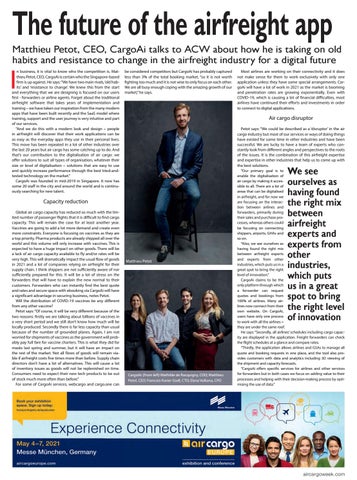
Matthieu Petot
CargoAi: (From left) Mathilde de Rocquigny, COO; Matthieu Petot. CEO; Francois-Xavier Gsell, CTO; Elana Volkana, CPO
We see ourselves as having found the right mix between airfreight experts and experts from other industries, which puts us in a great spot to bring the right level of innovation
“Our primary goal is to enable the digitalisation of air cargo by making it accessible to all. There are a lot of areas that can be digitalised in airfreight, and for now we are focusing on the interaction between airlines and forwarders, primarily during their sales and purchase processes, whereas others could be focusing on connecting shippers, airports, GHAs and so on. “Also, we see ourselves as having found the right mix between airfreight experts and experts from other industries, which puts us in a great spot to bring the right level of innovation.” CargoAi claims to be the only platform through which a forwarder can request quotes and bookings from 100% of airlines. Many airlines now connect from their own website. On CargoAi, users have only one process to work with all the airlines – they are under the same roof. He says: “Secondly, all airlines’ schedules including cargo capacity are displayed in the application. Freight forwarders can check the flight schedules at a glance and compare rates. “Thirdly, the application allows airlines and GSAs to manage all quote and booking requests in one place, and the tool also provides customers with data and analytics including 3D viewing of the shipment and capacity forecasts. “CargoAi offers specific services for airlines and other services for forwarders but in both cases we focus on adding value to their processes and helping with their decision-making process by optimising the use of data.”
aircargoweek.com