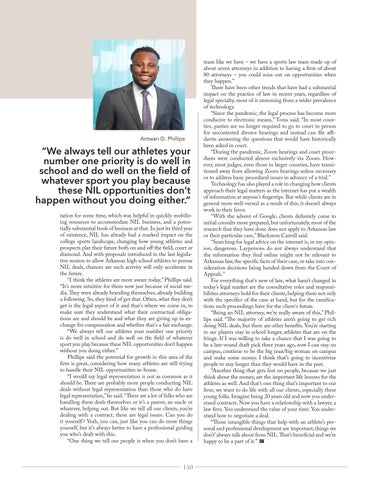
Antwan D. Phillips
“We always tell our athletes your number one priority is do well in school and do well on the field of whatever sport you play because these NIL opportunities don’t happen without you doing either.” tation for some time, which was helpful in quickly mobilizing resources to accommodate NIL business, and a potentially substantial book of business at that. In just its third year of existence, NIL has already had a marked impact on the college sports landscape, changing how young athletes and prospects plat their future both on and off the field, court or diamond. And with proposals introduced in the last legislative session to allow Arkansas high school athletes to pursue NIL deals, chances are such activity will only accelerate in the future. “I think the athletes are more aware today,” Phillips said. “It’s more intuitive for them now just because of social media. They were already branding themselves, already building a following. So, they kind of get that. Often, what they don’t get is the legal aspect of it and that’s where we come in, to make sure they understand what their contractual obligations are and should be and what they are giving up in exchange for compensation and whether that’s a fair exchange. “We always tell our athletes your number one priority is do well in school and do well on the field of whatever sport you play because these NIL opportunities don’t happen without you doing either.” Phillips said the potential for growth in this area of the firm is great, considering how many athletes are still trying to handle their NIL opportunities in-house. “I would say legal representation is not as common as it should be. There are probably more people conducting NIL deals without legal representation than those who do have legal representation,” he said. “There are a lot of folks who are handling these deals themselves or it’s a parent, an uncle or whatever, helping out. But like we tell all our clients, you’re dealing with a contract, these are legal issues. Can you do it yourself ? Yeah, you can, just like you can do most things yourself, but it’s always better to have a professional guiding you who’s dealt with this. “One thing we tell our people is when you don’t have a
140
team like we have – we have a sports law team made up of about seven attorneys in addition to having a firm of about 80 attorneys – you could miss out on opportunities when they happen.” There have been other trends that have had a substantial impact on the practice of law in recent years, regardless of legal specialty, most of it stemming from a wider prevalence of technology. “Since the pandemic, the legal process has become more conducive to electronic means,” Toms said. “In most counties, parties are no longer required to go to court in person for uncontested divorce hearings and instead can file affidavits answering the questions that would have historically been asked in court. “During the pandemic, Zoom hearings and court procedures were conducted almost exclusively via Zoom. However, most judges, even those in larger counties, have transitioned away from allowing Zoom hearings unless necessary or to address basic procedural issues in advance of a trial.” Technology has also played a role in changing how clients approach their legal matters as the internet has put a wealth of information at anyone’s fingertips. But while clients are in general more well-versed as a result of this, it doesn’t always work in their favor. “With the advent of Google, clients definitely come to initial consults more prepared, but unfortunately, most of the research that they have done does not apply to Arkansas law or their particular case,” Blackmon Carroll said. “Searching for legal advice on the internet is, in my opinion, dangerous. Laypersons do not always understand that the information they find online might not be relevant to Arkansas law, the specific facts of their case, or take into consideration decisions being handed down from the Court of Appeals.” For everything that’s new of late, what hasn’t changed in today’s legal market are the consultative roles and responsibilities attorneys hold for their clients, helping them not only with the specifics of the case at hand, but for the ramifications such proceedings have for the client’s future. “Being an NIL attorney, we’re really aware of this,” Phillips said. “The majority of athletes aren’t going to get rich doing NIL deals, but there are other benefits. You’re starting to see players stay in school longer, athletes that are on the fringe. If I was willing to take a chance that I was going to be a late-round draft pick three years ago, now I can stay on campus, continue to be the big man/big woman on campus and make some money. I think that’s going to incentivize people to stay longer than they would have in the past. “Another thing that gets lost on people, because we just think about the money, are the important life lessons for the athletes as well. And that’s one thing that’s important to our firm; we want to do life with all our clients, especially these young folks. Imagine being 20 years old and now you understand contracts. Now you have a relationship with a lawyer, a law firm. You understand the value of your time. You understand how to negotiate a deal. “Those intangible things that help with an athlete’s personal and professional development are important, things we don’t’ always talk about from NIL. That’s beneficial and we’re happy to be a part of it.”