
3 minute read
PLAYING PICKLEBALL: HOW TO NOT GET HURT

With a rapid rise in popularity comes a higher risk for injury, especially when it comes to pickleball in Austin. As the fastest-growing sport in America, pickleball has become a sport for all ages. In 2021, 20% of all pickleball players were aged 55+, with the average age being 38. For those in the 55+ age range, it’s a great activity because it’s easy to modify the energy expenditure requirements. However, as the sport continues to grow in popularity, especially in individuals 55+ who were previously sedentary, there’s also an increase in injuries.
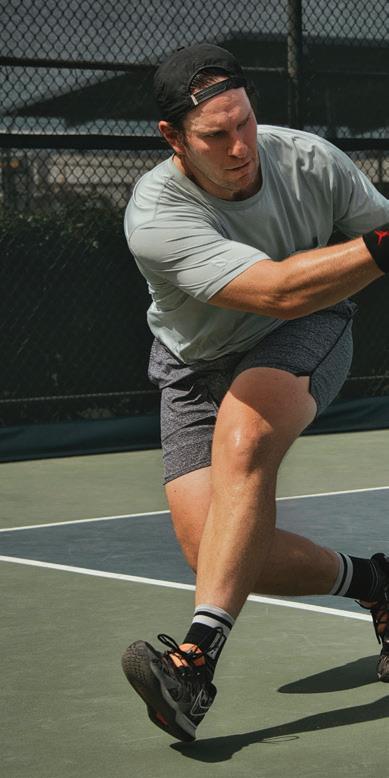
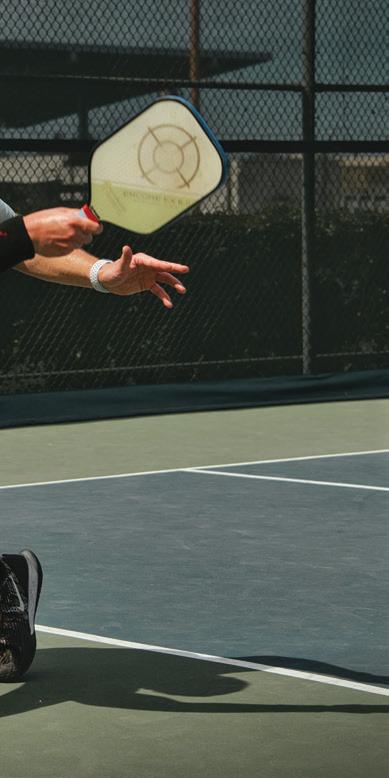
Although pickleball is less demanding than tennis, there are still a lot of similarities such as the footwork. There’s less running than tennis, but pickleball requires cutting left and right, peddling forward and backward, and quick pivots and lunges all while swinging a paddle. The games, especially singles, involve short sprints, which calls for good balance, foot coordination and the ability to start and stop with control. If you’re lacking in one of these, you could be setting yourself up for injury.
Advertisement
Common Pickleball Injuries
Because pickleball is easy to learn, and therefore not perceived as a rigorous activity, new players don’t put emphasis on warmups, cooldowns and physical fitness.
As a physical therapist, I’ve seen a combination of acute and overuse injuries.
In my experience, I’ve seen acute injuries in new-tothe-sport players. Overuse injuries are also in new-tothe-sport players as well as ones who have experience in tennis or ping-pong but have been sedentary. The severity of injuries varies from sprains to patellar fractures, but the three most common are ankle sprains, shin splints and muscle strains in the lower back.
The majority of the injuries I’ve treated in pickleball players are in the lower extremities. Shoulder and elbow injuries occur also but to a lesser extent. This is likely because pickleball is played with a plastic whiffle ball and is therefore lower impact compared to tennis.
Prevention
The number one way to avoid injuries is with prevention. My favorite way of doing so is through strengthening. If your ankles are stronger, the joint will be more resilient to sprains. Of course, mobility is also important and shouldn’t be overlooked. Here are a few easy exercises you can incorporate to keep you injury free:
• Ankle Sprains: One easy preventative measure is to wear appropriate footwear, as 85% of all ankle sprains are lateral sprains. Look for shoes that offer good traction and a wide base for lateral stability. Some exercises that are helpful include 4-way TheraBand resistance, eccentric calf training, cone taps and ankle stability on an unstable surface.
• Shin Splints: Exercises include tibialis anterior raises, gastroc stretch, soleus calf raises and tibialis anterior foam roll.
• Lower Back Pain: Exercises include paloff presses, chops and lifts, trunk rotation stretch and glute bridges.
Warm-Up
The goal of a warmup is to get you physically and mentally prepared for a specific activity. This is done by increasing your heart rate, which increases blood flow to your brain and muscles and increases your core temperature.
Spend 10 to 15 minutes getting ready for action. Although research is still not concrete on whether or not warming up prevents injuries, the weight of evidence is in favor of practicing it. I’d also recommend doing dynamic activities that are specific to your sport. For pickleball, think of karaoke side steps and stepthrough lunges. You should sweat lightly, but don’t fatigue yourself.
Cooldown
Similar to the warm-up, research suggests that cooling down may not be as beneficial as everyone says. According to a 2018 review, the cooldown didn’t significantly reduce muscle soreness or improve recovery. Nevertheless, I’m still a proponent of a short cool down. It feels good, poses no harm and gives your body a chance to return to baseline levels.
Now, what are you waiting for? Join the craze! Find a local pickleball group on Facebook, or look for disgruntled tennis players at the park. But don’t forget to make sure you prep your body; otherwise, I’ll be seeing you soon in the clinic! afm
About the Author
Mark Denesha, PT, DPT is the owner of Forever Forward Physical Therapy — an Austin-based fully equipped mobile PT clinic. FFPT services include manual therapy, strength training and injury recovery, when and where you need it. Denesha’s collegiate sports and military background, combined with his curiosity for movement, have influenced his treatment style, which prioritizes strength and function.
Wellness
AUTHOR Rachel Melegrito
