
SEPTEMBER 2022THE ESSENTIAL MAGAZINE FOR THE AV AND SMART HOME INDUSTRY CONTROLLIGHTING A RAY OF HOPE SCREENS PUTTING YOU IN THE PICTURE AND CABLES FUTURE FACING


NEW NEW PRODUCT
AV
Using
These
HDCP 2.2 HDCP 2.2 HDCP 2.2 HMXL88ARC 8x8 HDBaseT™ CSC ARC Matrix HMXL42ARC-KIT 4x2 HDBaseT™ CSC ARC Matrix including Receivers HMXL66ARC 6x6 HDBaseT™ CSC ARC Matrix J Advanced HDBaseT™ technology offering distribution of video and audio over a single CAT cable J Advanced Colour Space Conversion (CSC) supports HDMI 2.0 18Gbps specification including HDR J 26 x 8 Audio Matrix independently controllable from the video J Advanced HDBaseT™ technology offering distribution of video and audio over a single CAT cable J Advanced Colour Space Conversion (CSC) supports HDMI 2.0 18Gbps specification including HDR J 8 x 2 audio matrix that is independently controllable from video. J Advanced HDBaseT™ technology offering distribution of video and audio over a single CAT cable J Advanced Colour Space Conversion (CSC) supports HDMI 2.0 18Gbps specification including HDR J 20 x 6 Audio Matrix independently controllable from the video NEW NEW HDBaseT™ Matrix with Advanced Audio Integration


We are pleased to announce the launch of three feature rich HDBaseT™ Matrix, the HMXL88ARC, HMXL66ARC and HMXL42ARC-KIT. CSC technology, these powerful HDBaseT™ matrix support 4K 60Hz 4:4:4 resolutions over distances of 40m over a single CAT 6 cable. The new HMXL42ARC-KIT, HMXL66ARC and HMXL88ARC come into their own with advanced audio features specifically designed for maximising the integration of all AV sources in the modern home. Enhanced audio routing is achieved through the integrated independent audio matrix. This enables the audio both from displays (via ARC) and all other sources to be embedded and routed through the system at the users discretion. ARC and audio routing features enable our installation partners the ability to create a truly immersive experience throughout the home.

Web: Tel:Email:www.blustream.co.uksales@blustream.co.uk+44(0)1158247000 Our UK Address: The Service Station, Melton Road, Hickling Pastures, UnitedLE14Nottinghamshire,3QGKingdom. Current Tutorials Available J CAT Cable Certification & Verification J When is 4K, Actually 4K? J Specifying a Custom Pro Matrix with 18Gbps support J Video over IP vs HDBaseT - which should you back? J with 10 more courses to choose from... Register now: www.blustream.co.uk/advanced-learning-portal J Become a Certified Blustream Installation Partner Bookwww.blustream.co.uknowat J latest in HDBaseT™ technology. The HEX18G-KIT supports bi-directional IR, RS-232 and PoC up to lengths of 100m over a single CAT cable. HEX150CS-KIT HDBaseT™ CSC Extender Set - 150m J Supports ARC from display via HDMI and optical digital inputs J Supports 4K 60Hz 4:4:4 UHD video up to 100m HEX100CS-KIT HDBaseT™ CSC Extender Set -100m J Advanced HDBaseT™ technology offering CSC scaling with zero latency J Supports 4K 60Hz 4:4:4 UHD video up to 70m 1080p up to 150m HEX70ARC-KIT HDBaseT™ ARC Extender Set - 70m J Advanced HDBaseT™ technology offering uncompressed video and audio with zero latency J Extends HDMI 1080p up to a distance of 70m over a single CAT cable J Supports 4K UHD video up to 40m (3840 x 2160 @30Hz 4:4:4, 4096 x 2160 @24Hz 4:4:4, and 4K @60Hz 4:2:0) NEW NEW PRODUCT HEX18G-KIT


ww w.avoke.co.uk | a v@ av ok e.co.ukSupporting AllSupporting All 4 FROM THE EDITOR’S CHAIR A spor ting chance! 7 ESSENTIAL NEWS Our events emporium 16 THE FEELGOOD FACTOR Pulse Cinemas will showcase its entire range of installer suppor t services at EI Live! 35 ESSENTIAL CEDIA Audio Over IP is here 36 ESSENTIAL HDA More big news! 42 ESSENTIAL REVIEW Hisense PX1-PRO: Ultra Short Throw Laser Projector 62 ESSENTIAL CASE STUDY: KING ARTHUR! A special home cinema for a special client 71 ESSENTIAL PRODUCTS Pushing tin 14FEATURESCONNECTING EVERYTHING! Habitech Connectivit y Product Manager, Mike Clayton 20 EI LIVE! 2022 More reasons to attend! CONTENTS September 2022 60 4842 24


ww w.avoke.co.u k | a v@ av ok e.co.uk Your AV NeedsYour AV Needs CABLES AND CONNECTIONS 38 SPLIT TIME Dan Winter ton, Sales and Marketing Director for Antiference LIGHTING AND AMBIENT LIGHT CONTROL 24 THREE IS THE MAGIC NUMBER Miguel Aguado, Marketing and Technology Manager at Lutron 29 R AKO JOINS THE PARTY What an atmosphere! 33 HUMAN-CENTRIC James Foster, OCTO National Sales Manager, Ansell Lighting PROJECTORS AND SCREENS 48 THE FUTURE IS FLEXIBLE Whatever you want from Pulse Cinemas 52 A QUESTION OF LIGHT Habitech’s helping hand 58 SNAP ONE AT EI LIVE! 2022 Find out what’s in store! 60 LET’S GO OUTSIDE! How to succeed at exterior audio Proud Media Partners of 62 3652


GETTING IN TOUCH EDITOR-IN-CHIEF Daniel Sait, dan@allthingsmedialtd.com EDITORIAL ASSISTANT Beatrice Lee, beatrice@allthingsmedialtd.com SALES DIRECTOR Ian Kitchener, ian@allthingsmedialtd.com GROUP AD MANAGER Claire Talty, claire@allthingsmedialtd.com PUBLISHER David Kitchener, david@allthingsmedialtd.com STUDIO MANAGER Mark Weller, mark@allthingsmedialtd.com ACCOUNTS Essentialsusan@allthingsmedialtd.comInstallmagazine,Suite 14, 6-8 Revenge Road, Lordswood, Chatham, Kent ME5 8UD T: +44 (0)1634 673163 F: +44 (0)1634 673173 www.essentialinstall.com SOCIALS Whilst/ESSENTIALINSTALL/INSTALL_MAGwemakeeveryeffort that everything printed in Essential Install magazine is factually correct, we cannot be held responsible if factual errors occur. All articles are copyright and remain the property of Essential Install magazine. SEPTEMBER A CHANCE!SPORTING Proud Media Partners of SEPTEMBER 2022THE ESSENTIAL MAGAZINE FOR THE AV AND SMART HOME INDUSTRY CONTROLLIGHTING SCREENS PUTTING YOU IN AND CABLES FUTURE FACING pages 14–15 04 SEPTEMBER 2022


First up, as we have many footie fans here at EI towers and of course in the readership, many congratulations to the Lionesses for winning the FIFA Euro Championships in fine style. With the FIFA World Cup coming up later in the year, and the UK football season now again in full swing, it has already been and will be a busy year for football fans. Sport, of course, is never far away from the headlines, with the Masters Golf already having taken place this year and England’s mixed fortunes in the various forms of cricket, there is always something for sports fans to get their teeth into. This fact led EI this month to muse on if we give sports mad customers enough thought when creating AV systems. Just think of the sheer amount of people out there who love their sports and would jump at the chance to watch and listen in better quality, have their friends round and have the next best thing to being in the ground. Last year’s Euro 2020 final between England and Italy at Wembley, which was broadcast on both the BBC and ITV, peaked at 30.95 million viewers. England’s Euro 2022 final win over Germany was watched by a peak BBC One television audience of 17.4 million. Numbers not to be sniffed at, especially when you consider the number goes even higher for the FIFA World Cup. Franchises such as Formula 1 get more focused numbers of around 1.5 million for events like the British Grand Prix, but what is interesting about F1 fans, is they tend to fall into higher income brackets, so it’s an audience definitely worth appealing to, same goes for golf. We often hear of home cinemas that get used for watching sport and of course we can tune these to deliver great performance, but is a dedicated home cinema really the best place to enjoy a sporting event? Perhaps we should be thinking about a new subcategory of AV sets ups that cater to the sports fan, what would that look like? where would it be in the home? Would it be outside perhaps? (more possible these days). We love talking about movie and music experiences, its where our industry grew from, but is it time we took a step back and thought: what are we doing for those who love their sport? EI LIVE! 2022 Lastly this month, if you haven’t registered for EI Live! 2022 yet, get over to the site and make it happen. There are still a few days to make sure you are on the list, and of course you can register on the day, or at the event, but to ensure a smooth entry into the biggest event we have ever put on, we highly recommend using the website to get registered. www.eiliveshow.com

L-Acoustics leads the professional audio industry in the design and manufacturing of premium sound reinforcement technologies, delivering superlative and predictable performance across stadiums, performing arts venues, and nightclubs. L-Acoustics Creations uses the same scientific approach and proprietary tools in modeling and tuning a home cinema, party space, garden area, or multi-purpose media room. The result is even coverage, high fidelity and high SPL with minimal visual impact for exactly the movie experience the director intended.
Visit creations.l-acoustics.com to book an appointment in London, Paris, or Los Angeles or meet with the L-Acoustics Creations team at EI Live! and CEDIA Expo 2022.
BRING
BLOCKBUSTER CINEMA HOME creations.l-acoustics.com

anatech.co.uk Distributed by Control System Partners Powering the Leading MultiroomAudio Ecosystem for Custom Installation

•
•
UK distributor Pulse Cinemas for the Anthem and Paradigm brands has announced that the Anthem AVM 90 receiver and Paradigm Founder 120H speaker series have both been recognised this year in the EISA awards. As EISA celebrates its 40-year anniversary in 2022, the organisation’s reach has extended to 27 countries and multiple magazines covering the best of consumer electronics. Giving expert guidance to consumers and pointing them in the direction of the very best products released each year, remains the organisations’ primary goal. Anthem points out that not since 2009, when the D2v was launched and subsequently won the Best Product in the Home Theatre High-End category, has another product from the same stable been recognised by the EISA organisation. That is until this year, when both Anthem AVM 90 and Founder 120H started turning heads globally, leading to both products being nominated for EISA category awards.
cedia.netCEDIA
•
•
• Finite Solutions (UK) Homeplay (UK) Intuitive Homes (UK) MACBEE (India) Mosaic Audio & Visual (UK) New Wave AV (UK) NGC Systems (UK) Potters Home Digital (UK) S.K. Lifestyle Technologies (Cyprus) Smart Business SL (Spain) Synergy Technologies (Pakistan) The Big Picture (UK) Pyramid Group (UK) (Belgium)
•
•
A PML spokesperson said, “To win one EISA award is an honour; to win two is simply amazing, and we cannot thank the judges enough for seeing firsthand how unique both products are and the value proposition they represent.
•
•
“The passion and hard work we made bringing these products to market, especially in a challenging time, were not easy but worthwhile. Our distributors also worked extremely hard to ensure the relevant magazines received the products on time and shared our enthusiasm with their local press partners.”
Pulse pulsecinemas.comCinemas
•
• The
ANTHEM AVM 90 AND PARADIGM FOUNDER 120H WIN EISAAWARDSTheCEDIAAwards are returning this October SEPTEMBER 2022 0 NEWS7REGISTER FREE FOR EI LIVE! EILIVESHOW.COM Package one 13–14 Headlands Trading Estate Headlands Grove Swindon, Wilts SN2 7JQ T. 01488 73366 rgbcomms.co.uk Transform spaces with ProjectaSiteLinescreens Available from Projecta’s cablesTensionedDescenderProinnovativeandDescenderProSightLinescreensofferanewalternativetothisstandardblack-dropborderwith3or4thinthatcanbeextend-edupto180cmonsite.Visuallyitgivestheimpressionthatthe screen is floating in the air, and practically it opens up the space above the screen that would previously have been blocked.

• Automated Spaces (UK) • AVTCS (India) • Blackroom (Russia) BNC Technology (South Africa) Cinema Lusso (UK)

•
CEDIA REVEALS FINALISTS FOR THE 2022 CEDIA AWARDS
The Founder 120H picks up the Best Products, 2022-23, Floor-standing Loudspeakers and the Anthem AVM 90 receives, best Products 2022-23, Home Theatre Processor.
NEWSCEDIA has announced the finalists for the project categories of the 2022 CEDIA EMEA Awards, which will be hosted at The Brewery in London on Friday October 14, 2022. Judged by a panel of trusted industry experts, the CEDIA Awards honour the finest residential projects of the year completed by CEDIA members. “We’re excited to reveal the contenders for the 2022 CEDIA EMEA Awards,” said CEDIA EMEA Managing Director, Matt Nimmons. “Our members across the region have again been responsible for a quite exceptional level of workmanship, bringing the benefits of professionally integrated technology to different types of homes. We look forward to recognising the best of the best at what promises to be a very memorable occasion at The Brewery in London on Friday October 14.”
Following a well-received presentation from the PML Sound International team (parent to Anthem Paradigm and Martin Logan brands) in Canada to the EISA Judges, supported by multiple reviews from across the globe, the Paradigm Founder 120H and Anthem AVM 90 have won top awards in the following categories.
The CEDIA awards recognise design and installation excellence: measuring projects against industry best practice and encouraging the highest standards in integrated home, home cinema, and media room project design and installation. Alongside these project winners, awards will also be presented to trade suppliers in recognition of product innovation, service and training support excellence. Monitor Audio is the Headline Sponsor for the 2022 CEDIA EMEA Awards. The Pre-Dinner Drinks Reception Sponsor is Meridian Audio and the After Party Sponsor is Sonos. Additional sponsors of the 2022 CEDIA EMEA Awards include JBL Synthesis, KNX, LG, Sonance, Sony, and Trinnov Audio. Companies who have made the final short-list for project categories are as follows:
•
•
• Woelf
•
EXCEPTIONAL PERFORMANCE WITHOUT COMPROMISE Your turnkey solution to the ultimate private cinema experience and beyond JBL has a legacy of excellence in sound reproduction that goes back 75 years. The leading choice for music and movie industry professionals and connoisseurs alike, JBL loudspeakers and technology are featured in more than 50 percent of all movie theaters and are used in concert venues Becomeworldwide.partofthe performance with sound that envelops you. With perfectly balanced sound and incredible dynamics, a JBL Synthesis system makes each moment of the movie come to life. See us at EI Live! Stand 40. www.jblsynthesis.com

PHASETECH, DARTS, AND SOLIDDRIVE’S EUROPEAN PRESENCE GROWS WITH APEX-TECH INTERNATIONAL
Two years after EI reported on the transformation of main Studio one control room into a PMC equipped Dolby Atmos recording and mixing room, the legendary Dean St. Studios in London is once again at the forefront of technological change – by opening the UK’s first dedicated Dolby Atmos mastering facility incorporating mixing for this increasingly popular music format, once again highlighting PMC’s position at the heart of Dolby Atmos Music creation.

MSE Audio, parent company of seven commercial and residential loudspeaker brands, has announced the extension of its existing distribution with ApexTech. The new territories to be covered by Apex-Tech International are Spain, Portugal, and France with Apex-Tech UK remaining for the UK and Ireland. ApexTech supplies integrators with home cinema and audio solutions that feature MSE Audio’s dARTS, PhaseTech, and SolidDrive invisible speakers. “Having represented the MSE Audio brands in the UK for some years, Apex-Tech is very excited to extend this cooperation into new European territories. The extreme high performance and value are key beliefs shared by both Apex-Tech and MSE Audio and we believe that the real secret is that MSE Audio delivers an extremely repeatable level of performance which is ideally suited to integrators delivering a whole package to their customers,” said Neil Davidson, Managing Director of Apex-Tech UK. “This guarantee of performance frees the integrator to focus on the rest of the client experience in the sure knowledge that the audio system will deliver spine tingling performance each and every time.”

PMC SPEAKERS INSTALLED IN UK’S FIRST DEDICATED DOLBY ATMOS MUSIC MASTERING ROOM. PMC is at the heart of Dolby Music creation NEWS SEPTEMBER 2022 09REGISTER FREE FOR EI LIVE! EILIVESHOW.COM Package one 13–14 Headlands Trading Estate Headlands Grove Swindon, Wilts SN2 7JQ T. 01488 73366 rgbcomms.co.uk Become a fundamentalsSavantdealertoday! Available from Join our exclusive network of dealers by taking part in our one-day accredited training course and benefit from easy-toinstall solutions for a minimal investment. When? Thursday 8th September Thursday 24th November To learn more about Savant or to book your space sales@savanteurope.cocontactorcall0148873366
The expanded European territory will be managed by Oliver Dedek, Sales Manager for Apex-Tech International, with a focus on making it simple for integrators to purchase a complete cinema for their clients.
MSE mseaudio-int.mseaudio.comAudio
“We are delighted to partner with Apex-Tech in Spain, Portugal, and France,” said Ken Hecht, Vice President. “The integrators they work with appreciate the value of the curated audio bundles we offer. Home cinema demand is strong in Europe, and we believe they are the right partner to help integrators easily fulfill their clients’ entertainment dreams with the precision acoustic entertainment delivered by a dARTS digital theater and PhaseTech’s award winning on-wall, in-wall and box solutions.”
Jasmin adds, “The amount of Atmos work we are attracting means we need a second studio that can cope with it, but what really makes our new room unique is that we can master in stereo, 5.1 and Atmos using the same equipment, which ensures accuracy and delivers a much smoother workflow.”
PMC monitoring features in both rooms, with the new suite equipped with a 9.1.4 surround system comprising PMC’s MB3-XBD-A monitors for left and right main channels, MB3S-A for the centre channel and Ci Series Ci65 monitors for surround and height Jasminchannels.Lee, who has owned Dean St. Studios since 2007, said, “We were the first independent music recording facility in the UK to install a Dolby Atmos studio for music mixing and we are now also the first to recognise that this format needs a specialist approach to mastering.
“To that end we have built an acoustically accurate room that can cater specifically for this market, and we have equipped it with monitors that are so detailed and clear that our engineers can hear every nuance of the tracks they are working on, even at very low volumes.”
Kurt Martinez, Dean St. Studios’ Atmos engineer, said, “These are exciting times, and it is very gratifying to see how much demand there is for this format. I believe this will only increase, especially now that car manufacturers are installing Dolby Atmos systems in new vehicles, which will introduce even more consumers to the immersive audio experience.” pmc-speakers.comPMC
GO STRAIGHT TO THE SOURCE The ci series incorporates cutting edge technologies and audio quality from the world-renowned PMC studio monitors that have been responsible for countless hit records and movies, in the ultimate slimline, high-performance on-wall and in-wall loudspeakers. • SLICK, EFFORTLESS INSTALLATION • STUDIO SOUND QUALITY & RELIABILITY • BEAUTIFUL BEZEL-LESS DESIGN • NO DISTURBANCE TO ADJOINING ROOMS • VAST, EVEN SOUND COVERAGE • DEEP, PRECISE BASS AT ALL LEVELS The ci140 and ci140sub are on-wall designs. The other models are in or on-wall, thanks to the Qikfire™ fittings, bezel-less grille and stylish cabinet sleeve. ci140subci140 ci90 ci65 ci45 ci30 Find out more T 01767 www.pmc-speakers.com686300 ci140 & ci140sub on-wall L,C,R See us at


GIRA TWO-TIME FINALIST AT LONDON CONSTRUCTION AWARDS 2022

Gira has announced that after a preliminary round of voting, it has been shortlisted for the finals of this year’s London Construction Awards in two categories:
gira.comGira
In April 2022, KNX Association started the search for the world’s best smart home and smart building KNX projects. The KNX Awards, which are awarded every two years, have established themselves as an institution in the industry. The KNX community again showed innovation, ingenuity and know-how in the implementation of ambitious KNX projects that were handed in. The jury of experts has deliberated and presents five nominees in each of the 11 categories. The winners will be revealed at the online KNX Awards celebration on September 27. The former ‘International’ category has now been split into the Smart Home Award and the Smart Building Award. Another newcomer is the Innovation Award. For this edition, the focus of the Innovation Award was on KNX projects where KNX Secure solutions and IoT was implemented. As it was in the previous editions of the KNX Awards, all nominated projects also have the chance to win a second KNX Award: the People’s Choice Award. The KNX community will have the chance to select their favourite KNX project on a special voting platform. But for the first time, everyone will have the chance to be part of the jury for a brand-new category: the KNX Product Award. A selection of recent KNX products will be presented and visitors of the special voting platform can show their appreciation for the KNX product of their choice. The KNX Association is keen to enable as many people as possible to ‘attend’ the awards, so continues with its online approach. For all those interested to join the online event, it can be followed online via https:// awards.knx.org. KNX knx.orgAssociation

2. Smart Technology of the Year – Gira KNX RF System: A new KNX system that can now be installed with a wireless network using modern RF technology with Gira KNX RF top units. Customers can then use this to control lighting, blinds, room temperature and scenes. Compatibility with the Gira System 3000 ensures the greatest possible range of functions.
1. Architectural Design of the Year – Essoldo House London project: A new building in Chelsea, London with space for eleven residential units, with a spectacular tower and roof terrace. Behind the scenes, a user-friendly Gira KNX system works in tandem with the Gira X1 mini server and the Gira S1, remote access module to ensure equally smooth and secure networking and control wherever the homeowner is.
Winners of the London Construction Awards will be announced at the highly anticipated Awards Gala Dinner & Ceremony on Friday September 23 at the Leonardo Royal London Tower Bridge Hotel.
KNX AWARDS 2022: DIGITAL CELEBRATION WITH FOCUS ON NEW CATEGORIES For more updates on the nominated projects, visit https://awards.knx.org or KNX social media SEPTEMBER 2022NEWS11REGISTER FREE FOR EI LIVE! EILIVESHOW.COM Package one 13–14 Headlands Trading Estate Headlands Grove Swindon, Wilts SN2 7JQ T. 01488 73366 rgbcomms.co.uk Fiber HDMI Cables withHeadshellDetachable Available from These installer-friendly HDMI cables with Ethernet from MetraAV have a removable headshell with a small connector cover and hook that makes pulling the cable conduitthrougheasy! Full 24Gbps support (4K/60, 4:4:4, Deep Colour & HDR) Audio Return Ethernet(ARC/eARC)ChanneloverHDMICL3

Gira said it is proud to offer new design freedom for the modern home with the launch of its KNX RF top units, shortlisted in the ‘Smart Technology of the Year’ category. Gira underlines how KNX RF technology offers flexibility for new builds and existing building stock too. The London Construction Awards is co-hosted with the leading exhibition, London Build, is free to enter and impartially judged by a panel of industry experts.

Robert said, “I have followed Key Digital for many years, and I am honoured to work with Mike Tsinberg, Father of the DVD and holder of over 40 high-definition video patents. And Key Digital’s sales force is highly effective, as DeWayne Rains has built up a solid dealer base in the U.S. I am looking forward to expanding our relationships in the U.S. and abroad, and I am excited to be on the leading edge of video technology.”
To celebrate the launch of its Charity Committee, Exertis has launched ‘Ride to Exertis Almo’ – an initiative where staff will amass distance by peddling on bikes to reach a goal of 1,750 miles, which is the equivalent of halfway between Exertis UK and Exertis Almo’s Philadelphia headquarters. Simultaneously, staff at Exertis Almo in America will also be accumulating 1,750 miles by riding on bikes and will be raising money for the American Foundation for Suicide Prevention to raise awareness of the importance of mental health in their own community.
Paul Bryan, Managing Director of Exertis UK, said, “The statistics surrounding mental health in the UK show that many of us will struggle with our mental health at some point in our lives. Sadly, not everyone seeks help and this can lead to terrible consequences. We want to support our people’s mental health and be committed to helping where we can in society.”
Jae O Choi Park, New European Sales Director, PPDS.

PPDS, the exclusive global provider of Philips digital signage, interactive displays, direct view LED and professional TV products and solutions, has an ambitious five-year growth strategy, and an ongoing global expansion and recruitment drive. Jae is one of the AV industry’s leading international talents, achieving extensive financial, sales and account management experience within the world’s leading professional displays specialists during a 10-year career. Based in PPDS’ Amsterdam head office, Jae – who describes the new role as a ‘peak moment’ in his career – will work with, and report directly to Franck Racape, who has recently been promoted as Head of Global Commercial, to devise and execute an ambitious fiveyear growth strategy, in which Jae will play a pivotal role.
Jae commented, “I’m thrilled to have joined PPDS and to be entrusted with continuing the incredible work and successes that have been achieved under Franck’s leadership. Using my own knowledge and experience, and working with the incredible sales teams around Europe, I have no doubt that PPDS will be able to meet its ambitions and become an even greater force in the market, further disrupting the status quo and bringing new levels of quality and excellent to the channel and to end customers. The opportunity to join PPDS and further my career was one I simply could not turn down.” Key Digital, developer and manufacturer of digital video processing, video signal distribution, collaboration and communications solutions, announced the appointment of AV industry sales veteran Robert Taylor to the position Director of Distribution Channel Sales.
ESSENTIAL PEOPLE Hayley Gunn-Bruce, Head of Partnerships, Mental Health UK.

12NEWSSEPTEMER 2022 REGISTER FREE FOR EI LIVE! EILIVESHOW.COM
Distributor Exertis has unveiled the Exertis Charity Committee and its official partnership with Mental Health UK. It has set a target of £125,000 to raise in the Charity Committee’s inaugural year, of which Mental Health UK will be the beneficiary. Mental Health UK brings together the heritage and experience of four charities from across the country who’ve been supporting people with their mental health for nearly 50 years. People around the country have been impacted by mental health issues, and the Exertis Charity Committee feels that partnering with Mental Health UK allows it to make a significant impact in supporting those affected.
PPDS appoints distinguished AV leader Jae O Choi Park as new European Sales Director to drive ambitious growth strategy. Adding over 10-years of top-level AV sales and management experience to PPDS, Jae will play an instrumental role in driving the company’s ambitious growth strategy in EMEA.
“We won’t stop until everyone has the tools they need to live their best possible life and we know this partnership, through the amazing fundraising efforts of Exertis colleagues, will help that happen. We cannot wait to begin.”

The Committee is split into two broad categories – fundraising and volunteering – each with subcommittees to support them in achieving their strategic goals. Hayley Gunn-Bruce, Head of Partnerships at Mental Health UK, said, “We’re so delighted to announce our partnership with Exertis. People are in need of support for their mental health now more than ever. At Mental Health UK, we are so excited to work with businesses like Exertis who are passionate about supporting our vital work and who want to be part of creating real lasting change.
Robert will be responsible for leading and growing Key Digital’s distribution business, both domestically and abroad. Previously, Robert held sales positions with manufacturers BIAMP Systems and TOA Electronics; served as regional manager for manufacturer’s rep firm South-eastern Communications (SECOM); and ran his own design/installation firm, Audio Concepts.
The Exertis Charity Committee strives to inspirit the goodwill of its people across the organisation to be charitable, giving purpose to the community spirit of the company. The committee has key principles for each of its actions: to create formal channels to be charitable; to foster a deeper sense of belonging for Exertis’ people; to have a positive impact in communities; and to make a difference.
Visit habitech.co.uk to view the new ProNET range and join us at Basingstoke for the industry’s most accomplished network training. www.habitech.co.uk | 01256 638500 | sales@habitech.co.uk Building Better Networks! When your customers insist on fast, reliable Internet access, boost your skills where they matter most with ProNET, leading in network design and support since 2012. New Brands | All Budgets | Secure Supply


In other words, the complete CI pallete on a pallet; joined-up, end-to-end and universal, in the best value-added tradition of Habitech.
Listen to Apple and Google and you’d believe the future is wire-free, but let’s get real: there’s more chance of me being knighted for services to cable. In fact, it’s impossible to imagine a world in which WiFi would ever be as fast and as bullet-proof as wired connections, and even though Sky has turned all its set-top boxes into smart access points with Sky Q, it’s not the precursor of a completely wireless future. Sure, smart home design will always need WiFi to reach its full potential, but it will continue to evolve and prosper with the support of a hardwired backbone. Truth is, only hybrid networks are able to deliver convenience, mobility and bandwidth in the smart homes you’re creating, and since customer happiness is the golden ticket for every business, your ability to engineer this blissful combination is made so much easier with Habitech at your side.
FURTHER AND FASTER
Habitech will recommend the ideal mix of hardware and cable infrastructure for every project

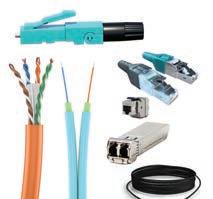

It used to be that most integrators, including me, treated cable as a homogenous commodity - almost as an afterthought. When I started designing and installing conferencing systems for IBM in the 1990s, 15pin VGA and composite video cable could be run over reasonable lengths without issues. Today, far higher bandwidth requirements need more thought about cable type, its path to the ‘endpoint’, cable quality and reliability. We can help you with all of that. Of course, you could go to a cable-only supplier, as many still do, for a bewildering choice of every cable and connector under the sun, but its responsibility to your success starts and ends right there. The big difference is that Habitech doesn’t see cable as an end in itself. Instead, we supply cable as a complementary and vital component of a complete Habitech
14 SEPTEMBER 2022 ESSENTIAL HABITECH /Essentialinstall @Install_mag essentialinstall.com
system solution, devised in partnership to realise your design vision. Naturally you’re free to look elsewhere for a better deal on price, but when you’re working at the premium end of the market, where high performance and durability are the fundamental goals, it seems paradoxical to join a race to the bottom just to save a few quid - that would be as self-defeating as a motorist driving for 50 miles to save a penny on a litre. And even though we always monitor market pricing to ensure the most competitive outcome, we can also add big value to your project by saving you the precious commodity of time.
This is because we have the bandwidth in products and expertise to support all your network designs. Whether you’re integrating HDBT, HDMI, IP, or WiFi; CAT, fibre, speaker By uniting the best technologies and know-how, Habitech will help you to deliver future network performance today says Connectivity Product Manager, Mike Clayton. or control cable, we’ll recommend the ideal mix of high performance hardware and the easiest, most reliable cable infrastructure for the project.
THE ONE-STOP PROJECT PROVIDER
EVERYTHING!CONNECTING
SEPTEMBER 2022 15 ESSENTIAL HABITECH essentialinstall.com @Install_mag /Essentialinstall Not only
Bottom line is that if you’re designing hybrid networks for today’s demanding customers, Habitech has the products and the specialists on hand to help you achieve reliable results in every application. Our complete network design toolkit comprises not just the high performance switches, controllers, APs and firewalls, but everything in between: CPR compliant bulk fibre, network, speaker, control, and coaxial cable; the best available HDMI cables and AOCs supporting 4K and 8K at lengths from 0.5m to 100m; patch panels, cords and keystone jacks, and premium connectors for network, fibre and AV, along with the labour-saving tools that make the job much easier. For instance, Go Simply Connect’s range of Simply45 pass-through RJ45 modular plugs allow the conductors to pass completely through the front of the plug, so you can verify the wire alignment before crimping. What’s more, you can crimp plug and boot in a single step, saving you hours of tedium on site. And if you’re using Planet Waves AV connectors, you can terminate tool-less in three simple steps. In these little ways, and in the big ones too, we’ll go the extra mile to help you deliver the most reliable data speed and integrity from the best hybrid network designs for happy customers today and tomorrow, because whatever happens in the distant tech future, the most accomplished smart homes will always need wire in the walls! Habitech habitech.co.uk high performance controllers, APs and firewalls, but everything
switches,
NOT FUTURE-PROOF BUT FUTURE-PRESENT
A little smaller than your average portable hard drive, media converters are plug-and-play devices, which integrate copper infrastructure with a fibre backbone in both directions. Run fibre to the room and Catx IG or 10G ethernet to the in-room devices. Easy. Our new Cleerline range coverts fibre to Copper/Catx, fibre to two IG Catx with PoE, and multimode to single mode fibre, with the addition of suitable SFPs.
There’s also a chassis that holds and provides power for up to twelve converters in 1U of rack space. This means that with Habitech’s enabling tech you can design a conventional device ecosystem using a fibre backbone today, and leave it there for the next 20 years, saving your customers the agony of the inevitable upgrades to come. Bank the time saved and charge them more. They’ll may even love you for it.
in between Save time on site with Simply45 passthrough RJ45s The first aid to beautiful and durable rack devicesCATspeedyouconvertersCleerlinedesignmediaallowtousetheoffibreforconnectedtoday


GOING THE DISTANCE
TAKE IT TO THE BANK For a start, there are practical efficiencies to consider. Backed by our technical and design support, Habitech’s one-stop ‘project superstore’ offering means you can order everything in one place, saving days of planning, and rely on extra conveniences like our spooling service, recently enhanced to include armoured cable, custom cut for the gate house or garden studio.But it’s our cutting edge tech that’s the real clincher for saving time on site. Now that gigabit Fibre-to-the-Premises (FTTP) broadband is a reality for over seven million UK properties, it’s inevitable that a joined-up fibre backbone will be doing the heavy data lifting in future homes sooner than you think. Quite apart from its lightening speed over any domestic distance, it’s untroubled by EMI, as tough as old boots and easier to pull, and if you’re using Cleerline’s SSF fibre from Habitech, it’s extremely pliable and much easier to terminate - in as little as sixty seconds. And if you think this is a hypothetical time saving, because nothing much uses fibre, we can show you how to benefit from its power today, while you wait for the hardware to catch up.
On the stand, you will be able to make plans and appointments to come to Pulse HQ and witness it all for yourself - as well as experience our recently opened world-class demonstration facilities. One-off appointments are available (with or without clients), and you can also sign up to attend one of our Open Days that have been proving a huge hit right across the industry.
THE DREAM ENGINE Our new VR demonstration services have been opening minds to the possibilities of next level techniques for several months now. The concept is simple, our exclusive technology allows customers to see ‘inside’ home cinema technology, understand how it all works and why we take the approaches that we do. Users can experience in real-time different screen sizes, system configurations, perceive how distance from the screen affects performance and even ‘see’ and hear how sound behaves in
the space with mind-blowing software that shows how audio travels through a given space and how we can tame and control that sound. Users can also watch content inside the Dream Engine, gaining further insight. Our system can also be programmed to give customers and installers a tour around what their finished project will look like in a virtual fully-3D world. If you have been waiting for VR tech to come of age in terms of being a sales driver for home cinema, wait no more. Visitors to the Pulse Cinemas Stand will be able to access a full, live demo of the system. Pulse Cinemas will showcase the company’s entire range of installer support services at EI Live! 2022 including new initiatives to ensure customers can cope with the stresses and strains of business life. Company CEO, Mike Beatty, explains.

Our beautiful high-concept show presence located on Stand 46 will offer a haven of calm and considered support during your visit to EI Live! 2022. The aim of our return to the show is to offer a showcase of our entire range of support services, which on both days of the show and moving forward will include initiatives not just aimed at keeping your systems in tip-top condition, but to ensure our dealers have the support they need to cope with anything that life and the industry throws at them. At EI Live! 2022 we will have specialists in physical NIP (NeuroImpulse Protocol) techniques and mental health focused cognitive therapies, experts at helping busy professionals cope with modern life. Ensuring your mental health, physical well-being and stress management is fine-tuned, means your business is more likely to succeed. Achieving a strong work/life balance makes the whole industry stronger and Pulse Cinemas has taken on the task of making sure our dealers have the support they need on tap. The stand will also have on offer high-quality refreshments throughout the show, so come sit, relax and at the same time find out about all the amazing support services we have to make each project you take on reach its full potential.
THE FEEL-GOOD FACTOR Wittiness the Dream Engine at EI Live! 2022 16 SEPTEMBER 2022 ESSENTIAL PULSE CINEMAS REGISTER FREE FOR EI LIVE! EILIVESHOW.COM

Found on the popular Vicoustic website, Pulse Cinemas dealers have an exclusive lead-generating ‘Where To Buy’ locator. The path is a simple one with just four criteria to be followed before inclusion. Installers need to be a Pulse Cinemas dealer with an account, have a VicCinema VMT Kit available for demonstration, must hold in stock one VicCinema VMT Kit at all times and need to show support for the brand via their social media output or other avenues.
INTERIOR DESIGN SUPPORT
VICOUSTIC PLANNINGGENERATIONLEADANDSUPPORT
PHOTO RENDERSREALISTICANDVIDEOS
Naturally you get all the fantastic support the brand and Pulse Cinemas offers when planning your acoustic treatment, with the added advantage of recognition directly from the manufacturers’ own website. Pulse dealers can also tap into the ‘Acoustic Project Request’ service from Vicoustic. Offered in three different levels, (Basic, Premium and Premium with Acoustic Simulation) Vicoustic’s team of senior acoustic engineers and designers can create for your project complete acoustic plans to treat the space and achieve superb performance no matter what the type of system.
Installers can also learn about our imaging services where we offer the chance to create photo-realistic renders of any project. Working with design professionals (or accessing our own in-house interior design services – more about those shortly) we can create beautiful renders and videos of any project, no matter how aesthetically ambitious. This is a fantastic way to present and sell the concept to clients who gain valuable insight into what their project will actually look like, and create the desire to sign on the dotted line. Everything about the purchase of a high-performance home cinema should feel special, we are all in the business of special, this should absolutely include the planning process. The renders and videos that we can create do not just inspire in terms of how the room will look, but also show exactly how the system works, providing confidence in not just the aesthetics, but the performance of the system as well. Several different levels of this service are available, come and learn more on the stand.
Discover how to access interior design services

Find out about ‘Acoustic Project Request’ from Vicoustic
Many installers, of course, these days work closely with interior designers to achieve what the customer wants. However, Pulse Cinemas dealers can also access in-house interior design services. Anyone who has been to Pulse HQ will see just how good these services are; using systems such as Vicoustic which not only treat a room, but offer a versatile pallet on-which to place stunning designs and visual cues. Today’s best cinemas offer beautiful surroundings as well as high-performance and through our interior design services you can deliver it all.
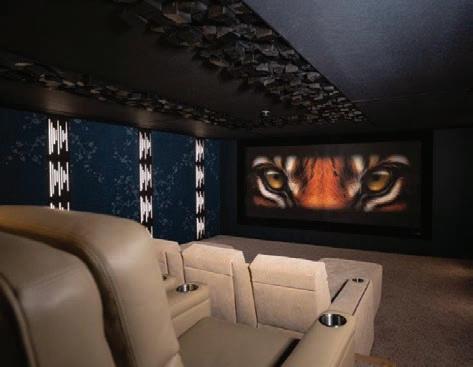
If you are still or have ever used fabric wrap to hide speakers and ‘finish off’ your home cinema rooms, then you need to come and see how our Reference Cinema demonstration space has been created. Truly integrated, truly stunning as acoustic design, interior design and home cinema performance meet in harmony.

SEPTEMBER 2022 17 ESSENTIAL PULSE CINEMAS REGISTER FREE FOR EI LIVE! EILIVESHOW.COM

Pulse Cinemas, since our move to Stansted in 2011, has always looked to provide the best home cinema, media room and automation demonstration facilities in the UK. Now we have gone a step further and created something we feel compares favourably with anything in the whole of Europe. With our Reference and Apartment Cinemas, the Media Room, Reception area, Training room and Kitchen space, we can showcase the very best our industry can offer. Our facility provides the venue for all our Open Day events, one-off visits and also provides a space for other related trades to hold launches and events, inspiring theirOff-sitecustomers.wehave our demonstration space at the wonderful Minotti London showroom, home to this exclusive Italian interiors and furniture brand. This site offers the chance to see just how well modern home cinema equipment can merge with the very best in interior design and high-end furnishings. Ask on the stand about access to any of these experiences. The new Reference Cinema at Pulse HQ has been impressing visitors

18 SEPTEMBER 2022 ESSENTIAL PULSE CINEMAS REGISTER FREE FOR EI LIVE! EILIVESHOW.COM
Helping dealers promote their work via our editorial and marketing support is another key area. Using our in-house editorial support, and photography services, we can create case studies and stories to help you promote your achievements and services to the wider world. The case studies we help our dealers create are featured in a dedicated section of the Pulse Cinemas website as well as regularly shared across our social media channels. Many of them are featured in trade publications such as this one and in the pages of consumer facing titles such as Home Cinema Choice. If you have a project with five or more Pulse Cinemas ingredients, speak to us about creating some engaging editorial to raise your level of awareness to consumers and across the industry.
PULSE CINEMAS ONLINE STORE Up and running for several months now, our ecommerce service (trade.pulsecinemas.com) stands ready to keep you fully informed on what products we have, enabling you to order them right then and there and also check other parts of your Pulse Cinemas account status, all in real time, updated every day. This front engine feeds into our fully digital stock control and delivery system which has its roots in the first COVID lockdown, where we began modernising every aspect of dealing with Pulse Cinemas. We have always argued we have the best brands, the best support, now we can argue we have the best sales engine as well. If you haven’t signed up yet, come to the stand and we will get you up and running.
CASE STUDY, EDITORIAL AND MARKETING SUPPORT
DEMONSTRATION FACILITIES

Also on our stand, dealers will be able to learn all about the many new product additions and upgrades to the Pulse Cinemas family. Tyba is a new offering which delivers a beautiful control product in the form of the Turn 2 and a powerful music delivery platform in the Muse multi-room music platform based on Dante technology. Anthem has launched a new Public Release Network Module Version 1.109.164 and Host Firmware Version 00.68 for the MRX x40 and AVM 70 and 1.111.182 and HD.73 for the AVM 90 to support the launch of ARC Genesis Version 1.6.10. This latest version includes the newly developed Anthem Auto Phase, Distance, and Time Alignment for up to four independent subwoofers on the MRX x40 and AVM 70/90 (model dependent). Learn more on the stand about how the powerful Arc Genesis room correction technology can refine all types of projects. Our close relationship with Fortress Seating has allowed us to create an exclusive offer just for our customers that delivers Fortress Seating levels of luxury at a very competitive price. We have worked directly with Fortress Seating to create an exclusive range for our dealers based around the popular Bijou model. Using vegan leather, the seats still offer all the quality, style and comfort that Fortress Seating is known for, but at a highly competitive retail price of £2K per seat, inc VAT. The latest addition to the range of affordable and performance- oriented Custom Installation products from Paradigm, the DCS-208IW3, is an all-new design, improving and expanding on the innovations already delivered by this brand. The Paradigm DCS-208IW3 is the perfect blend of performance and practicality. Delivering powerful bass from zero-footprint, you get the best of both worlds, allowing you to add bass to any room without taking up valuable floor space. D-Tools recently chose to introduce the new D-Tools Cloud service to the UK market in partnership with Pulse Cinemas as the system was made available to all Pulse Cinemas customers. D-Tools Cloud is an easy-toimplement cloud-based platform that offers an alternative to system integrators seeking ways to close more business faster and drive increased productivity from any web-enabled device. Find out more by talking to the team at EI Live!Other brand updates to familiarise yourself with if you have not already, include the incredible Comprehensive Upgrade Program from Kaleidescape. Formerly restricted to the Premiere line, this comprehensive new approach offers dealers and end users the opportunity to upgrade any working products to a new unit from the entire range with discounts of up to 25%! This programme includes new products such as the Terra 72 delivering 4K Ultra HD, HDR and lossless audio and with a massive 50% increase on capacity from previous models, and the Compact Terra, the more compact cousin to the Terra 72, designed for customers eager to invest in the Kaleidescape experience but not ready to commit to a larger movie server. So there you have it, a myriad of support services and cutting edge products to make you feel good about every project you take on. Come and see us at EI Live! 2022 and lets build a positive future together.
TRAINING SERVICES Our dedicated training room provides the perfect venue to learn more about all of the brands Pulse Cinemas has on offer. We can create a bespoke programme just for you if you want to come in and learn more about any of our brands and the technology that drives them. More formal training, of course, regularly takes place, spotlighting brands such as Lutron and RTI as functionality and programming advances are introduced. Ask about what course you could attend to increase your knowledge and reach within the industry. Recently, attendees have been getting to grips with the RTI Integration Designer 11 combining powerful new control and automation programming tools. Let us help you expand your knowledge.
BRAND AND PRODUCT UPDATES


SEPTEMBER 2022 19 ESSENTIAL PULSE CINEMAS REGISTER FREE FOR EI LIVE! EILIVESHOW.COM

The Tribe is a family of speakers that mixes on-wall, sound-bar, floor-standing and a sub model to deliver a pleasing mix of performance and aesthetics. Using cutting-edge patented
With a comprehensive line up, distributor, Redline is gearing up for yet another major presence, showcasing the company’s AV and control offerings.
20 SEPTEMBER 2022 REGISTER FREE FOR EI LIVE! EILIVESHOW.COM EI LIVE! 2022
A major focus will be placed on the Totem Acoustic brand, offering an insight into the company’s comprehensive and characterful approach to high-performance audio. Created at the company’s Canadian HQ, all the speakers offer the chance to tap into the brand’s considerable experience of creating high-quality audio from all sorts of enclosures to suit a huge range of projects and people.
There is still time to register and attend EI Live! 2022. Visit eiliveshow.com, learn more and register today! Our official preview was last month, but here are a few more highlights not available at the time of going to press in August.
technology, the Tribe family is luxuriously detailed and well proportioned. Tribe III, for example, offers rich harmonics with impressive on and off-axis dispersion and frequency range, all from one of the slimmest wall speakers available. The Tribe family uses Totem’s inhouse produced and hand-assembled Torrent woofer, designed to offer nuance, inflection, detail, power and flexibility.

Another Totem Acoustic favourite, the Kin family, again offers variety, but consistency too in terms of performance. A series of soundbars in the Kin Force; Kin Solo, and Kin Playbar can partner the Kin 10 sub. The Kin soundbars mix good looks with strong sound providing an excellent partner for today’s large, thin TVs. Technologies such as MHEX woofers, composed of multiple layers of phenolic honeycomb and woven synthetics, develop powerful bass that defies the ranges slim enclosures.Thepopular bookshelf members of this family will also be at the show, Kin Play and Kin Play Mini, offering old school Hi-Fi styling combined with totally up-to-date connectivity. The Kin Play Towers will be on demonstration showing the sonic capability of this part of the Totem family. Visitors to the stand will also be able to more information on Totem integrated speakers.New products from Velodyne will also look to make impact at the show. The Impact X 10/12 subwoofers deliver strong bang for buck, offering a combination of efficient Call for volunteers Martin Logan will be just one of the audio brands on show
STILL TIME TO REGISTER FOR EI LIVE! 2022


Connected Distribution can be found on stand 63.SANUS looks to set the standard for TV mount technology. Using innovative design and outstanding safety features, the company’s TV mounts allow users to have the best TV viewing experience no matter where they are sitting. SANUS designs products to enhance experiences with today’s technology and improve product performance all while making installation easy. A premium brand, the company is determined to create reliable products with high-quality heavy-duty materials that will stand the test of time and are simple to install. Check it all out on Stand 21.
Also on show, the Artison Studio soundbar family, which boasts an impressive array of proprietary components, including carbon fibre woofers and midranges, Vifa tweeters, and side-firing stage tweeters, all precision engineered to bring out the fine audio details that can get lost. The custom grille for each one of these soundbars is tailor-made to individual specifications for a perfect fit every time, even on displays with uneven bezels. The viveroo brand delivers comprehensive, attractive and practical solutions for mounting every type of iPad. The company’s latest innovation, the viveroo Level will be on display, created to offer a home to the new iPad Pro 12.9in using a precision engineered solid aluminium body that holds the tablet securely and fits perfectly into various settings. See it all on Stands 3 and 4.
The six model PMC ci series brings all the magic of the movies to the home. Incorporating technologies from the multi-award-winning audiophile speakers and studio monitors, they are the ultimate in slimline, high-performance on-wall and in-wall ci loudspeakers and are used as the reference in Dolby Atmos Music mixing studios across the world, says the maker.Since 1991, the brand has been used to create the biggest movie soundtracks and have been awarded an Emmy for contribution to recording excellence. To recreate the aweinspiring realism and stunning dynamics of a blockbuster in the home, there is no better choice of loudspeaker than those used to make the movies themselves says PMC.
DISTRIBUTIONCONNECTED
The full range of ci series models will be on display and powering the ci30 in-wall model will be the compact, German built, AVM CS2.3 all-in-one streamer CD receiver, delivering the audiophile sound quality that AVM is renowned for, in a simple to use, compact form. With 2 x 140 watts, the advanced AVM X-STREAM Engine; Apple AirPlay 2; Spotify Connect; TIDAL; QOBUZ; UPnP and web radio, it is the ‘Roon Ready’ perfect solution for high-end streaming in a multi-room system. Martin Logan is one of the ‘greats’ of loudspeaker design, best known for its electrostatic panel designs, but it also has an enviable reputation for its custom installation products, of which there are five distinct ranges. Show visitors will be able to see models from the company’s Masterpiece CI flagship models, Motion XT CI, Motion CI and the Motion On-wall designs. The Martin Logan subwoofers feature wireless setup, control, wireless connectivity, and benefit from the powerful Anthem Room Correction (ARC). On display will be the flagship from the Dynamo series, the 1600X, with its 15in driver, 1,800W amp and configurable front or downward firing design.

Dolby Atmos presents a fantastic opportunity for installers and customers alike. Connected Distribution will be demonstrating this exciting, immersive format and explaining the benefits in terms of installer revenue increase and customer satisfaction.
SonosSONOS is making its very first appearance with its own stand at the event. As well as being the main sponsor for the Smart Building Awards, held on the evening of the first day of the show, and the much anticipated industry T-Shirt competition we have been trailing in the last few weeks on social media, on Stand 59a, there will be Sonos prizes and all the Sonos products including Vinyl, dual Sub, RAY and possibly something else on display. Sonos will have RAKO, NIKO, Meridian and many other WWS partners at the show.
Connected Distribution will showcase many top
of the line brands REGISTER FREE FOR EI LIVE! EILIVESHOW.COM SEPTEMBER 2022 23 EI LIVE! 2022
Martin Logan is available in the UK exclusively from PMC Distribution UK. Visit PMC on Stand 59.
The custom built Atmos rig being installed at the show will feature products from Connected’s portfolio, including the Parasound JC5 5-channel THX certified power amplifier, and A23 2-channel amplifier, Yamaha Aventage receiver and a new brand of cinema speakers being introduced into the UK for the first time at EI Live! The entire system will be cabled with Kordz cables. Also on display will be the very latest product innovations from Russound, PulseEight, Earthquake Sound, RTI, Atlantic Technology, Kordz, Parasound, Sanus.
PMC DISTRIBUTION DIGS PMCDEEPDistribution
front firing drivers working in harmony with a down firing bass reflex port, delivering an efficient, tight, punchy performance. The maker says both models offer impressive lowend extension and snappy delivery, not always characteristics associated with a bass reflex subwoofer.Velodyne created brand new drivers just for this range and these components work in concert with an efficient Class D amplifier. The Class D amp delivers a meaty 600W of peak power, delivering all the grunt that is needed. Velodyne has also mixed in many of the company’s in-house created technologies (such as an anti-clipping circuit) to ensure both subs experience minimal distortion and deliver a satisfying performance no matter what they are asked to do. Adjusting to different performance requirements is also enabled by using the four distinct signal processing pre-sets that are adjustable via the supplied remoteAlsocontrol.fromVelodyne, the popular and highly compact MicroVee will make an appearance. In its MicroVee MKII version, the brand underlined that it was entirely possible to deliver impressive bass performance from a compact and attractive enclosure (22.9 x 22.9 x 24.4cm). Adding the MicroVee X Velodyne kept many of the features from MK 11 including the strong aesthetics, but provided additions such as Carbon Kevlar drive units and its own dedicated remote-control functionality, providing direct access to volume, phase and crossover adjustments.
UK will be presenting PMC’s ci series, the Martin Logan CI speakers subwoofers and distribution amplifiers, plus AVM electronics at the show.
Miguel Aguado, Marketing and Technology Manager at Lutron, examines three technologies all installers need to meet energy saving demands.


The energy-saving potential of window treatments is often underestimated. But with 30% of heating energy being lost through windows, leaving windows untouched is an energy-saving open goal. According to the US Energy Department, in colder periods about 30% of heating energy is lost through windows, while in hotter times three-quarters of sunlight enters double-glazed windows to become heat. Using heating or air conditioning systems to counter these fluctuations is a huge energyHowever,drain. the use of blinds has been proven to have a huge impact, which can be magnified when using smart systems to control where and when blinds are raised and lowered. Whether your customers want to harvest the energysaving benefits of daylight sensing or reduce heat gain and glare with automated blinds, there are flexible solutions to maximise the efficient control of daylight. For example, ‘Winter warm’ automation opens the blinds, taking advantage of sunlight warming a southern façade. ‘Summer cool’ does the opposite by lowering blinds and blocking solar heat gain, thereby reducing cooling costs. Such smart, automated blind systems can automatically adjust window blinds based on the sun’s position throughout the day, leading to a 10-30% reduction in solar heat gain, translating into direct savings and greater user comfort.
Soaring energy costs have crystalised the urgent need for businesses and homes to put energy efficiency and sustainability at the top of their agendas, with analysts predicting that energy costs for businesses could rise by as much as 310%, with the average SME set to see a rise of 250%. When businesses are facing a myriad of challenges, these surging costs may not be a storm all can weather. At the same time, the overarching need for all organisations to pull together to tackle the climate change emergency means that investing in energyefficient strategies signals a win-win - improving green credentials while saving on energy costs. For businesses and homes seeking to implement cost-saving strategies, lighting is a smart place to start. According to The Climate Group, lighting accounts for almost 5% of global co2 emissions - startling when we consider the many simple ways in which creating the perfect light can easily encompass energy savings alongside an improved user experience. Indeed, saving energy does not mean we need to sacrifice benefits such as productivity and comfort. Hybrid work is now the norm; however most businesses are not yet ready to offer a great experience for those working in an office collaborating with those that are remote. Creating the right environment for video conferencing, both audio and video is now more important than ever. Here we explore three smart technologies that installers must understand to unlock tangible savings for their customers, but also how to provide additional value.
ROLL UP TO ENERGY WINTER WARM, SUMMER COOL SAVINGS
THREE IS THE MAGIC NUMBER 24 SEPTEMBER 2022 REGISTER FREE FOR EI LIVE! EILIVESHOW.COM ESSENTIAL LIGHTING AND AMBIENT LIGHT CONTROL
Lyngdorf FR-1
Designed for wall mounting, the FR-1 is extremely compact and solid, emphasizing our focus on dynamic music reproduction without sacrificing natural timbre. The depth of the cabinet is reduced to a minimum to ensure discreet placement and to keep the drivers as close to the wall as possible for optimal coupling to the room. Read more at www.steinwaylyngdorf.com

SMART SOLUTIONS FOR BUILDINGS NEW AND OLD

THE NEW ERA OF ENERGY
EFFICIENCY
Make the building work harder for your customers by adding intelligent, energy-efficient lighting control. Incorporating lighting, shading, and sensors, today’s smart, flexible, scalable systems for lighting can deliver maximum energy savings alongside comfort and control. Combining data from lighting systems with that from additional sources, such as weather, temperature, and seasonal changes, customers can unlock energy-saving benefits and provide a better setting for all. These solutions can be easily designed, installed and reconfigured to meet the changing needs of a building.
INTEROPERABILITY; ONLY INVEST IN SMART SYSTEMS THAT WORK TOGETHER As the Crown Commercial Service recently wrote, “Introducing IoT solutions based on sensors and data is a cost-effective way to tackle energy inefficiencies from heating to lighting. Designing and installing automation into systems, building management, operations, and ecosystems at scale can deliver enhanced capacity.” When considering how to harness automation technology to help deliver energy efficiency and savings, it is vital to select solutions that are designed with interoperability in mind. Systems must be able to speak to each other, integrated to ensure complementary outcomes and open up further opportunities for carbon reduction by working together.
Smart devices to support energy efficiency should be able to be interlinked and securely communicate with each other. Users must therefore look for technology that integrates across vendors and verticals. In a recent report by the UK’s Energy Digitalisation Taskforce, it was clear that interoperability will be key to realising a low carbon future. As it summarises, “Digitalisation of the energy system is not just a ‘nice to have’ but a core requirement in ensuring that we can accelerate the journey to net zero,” and installers must consider this fact. Interoperability between systems can truly unlock all the benefits that great lighting control has to offer beyond energy savings. Avoiding glare on the screens thanks to smart lighting and automated shading deliver immediate benefits when it comes to comfort, that quickly translate into productivity gains. Equally, thanks to integration, transforming a meeting room or a board room into a video conferencing ready space can be realised by simply connecting a smart device to the A/V equipment.
The 2021 edition of Part L Building Regulations went into effect in England on June 15, 2022, impacting all engineers, electrical contractors, consultants, and lighting designers. It’s imperative to understand their implications to ensure compliance whether you operate with universities, schools, offices, or any other type of non-domestic development. In earlier editions, there were no defined specifications for lighting controls, with compliance only satisfied by using high-efficiency lighting. This was a missed opportunity. Energy savings will always be increased by using lighting controls. Intelligent lighting control can overlay numerous energy-saving techniques, including presence detection or daylight harvesting, and must be central to energy efficiency in modern buildings.
Designing new buildings that incorporate these smart lighting principles should be a given, but that does not mean existing building stock should be ignored. According to the UK Green Building Council, the UK’s building stock is set to be the oldest in the developed world, with 80% of the buildings that we will be using in 2050 already standing today. Digitally retrofitting buildings to incorporate automated lighting creates smarter and healthier buildings, where both financial and carbon savings can be made, whilst avoiding intrusive building work. This makes lighting the most important and least inconvenient place to start with carbon-reducing retrofits.
26 SEPTEMBER 2022 REGISTER FREE FOR EI LIVE! EILIVESHOW.COM ESSENTIAL LIGHTING AND AMBIENT LIGHT CONTROL
CREATING THE PERFECT LIGHT FOR ANY SITUATION WITH AUTOMATION

Meet Us at


Sivoia QS Triathlon Shades Sivoia QS Triathlon is the most fashionable, flexible, and reliable automated shading system available today. This battery powered solution features in dustry-leading battery life and is easy to install and maintain, making it perfect for retrofit Availableapplications.inroller,insulating, honeycomb and wood blind styles, as well as a variety of beautiful fabrics and colours and textures, these shades meet the functional and aesthetic needs of any space. RGB Communications is Lutron’s premier UK distributor, offering training support and a full range of products in stock. Why go anywhere else? CONNECT TECHNOLOGY // CONNECT PEOPLE Triathlon Wire-free Blinds Certification Training Date: Thursday 6th October, 2022 Location: NSBRC, Swindon Hosted by RGB Communications, join the Lutron team as they cover everything you need to know about selling and installing Lutron Triathlon blinds. Don’t miss out on this opportunity to dramatically increase your profit on your next project. Contact RGB Communications for more information and to book your place. W: rgbcomms.co.uk T: 01488 73366 E: sales@rgbcomms.co.uk


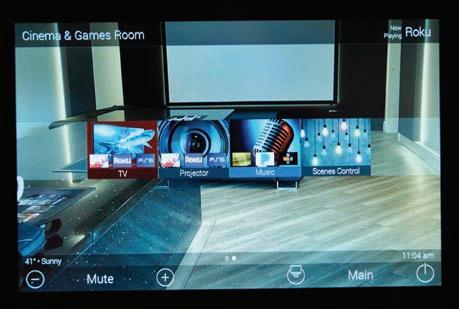
The project began with two unused rooms, which the homeowners wanted to convert into one large entertainment space suitable for friends and family to visit and enjoy. Designed and installed by London-based smart home installer, DPP Smart Home (thanks to the install team for the images), the two rooms have been skillfully combined to create a cinema room, bar and games area, with the entertainment controlled by a URC system integrating LED lighting control from Rako. The purpose of the lighting scheme was to create various scenes to work with the space, to complement the cinema room, but also to transform the open plan area into the perfect party space when needed. Another factor to consider was the clients themselves, who were not immediately comfortable with the technology and wanted a solution that would be easy to understand and most importantly, easy to use. To create the desired result, DPP Smart Home selected a Rako wireless solution that allowed for flexibility when it came to positioning the lighting.
Dominic Parete, Directo at DPP Smart Home and Electrical, talks through the planning for the lighting control, “For cinema viewing, we wanted to keep the lighting as dim and dramatic as possible to create an effect that draws you into the film. However, when the space is being used for a party or similar occasion, we wanted to have some really funky lighting effects that would give us the right atmosphere for music and dancing.”
Rako, manufacturer and supplier of wired and wireless smart lighting controls and systems, has added its own stylish touch to a cinema and games room in Maidstone to help the party-loving homeowners make the most of the space.

JOINS THE PARTY REGISTER FREE FOR EI LIVE! EILIVESHOW.COM SEPTEMBER 2022 29 ESSENTIAL LIGHTING AND AMBIENT LIGHT CONTROL
RAKO
In the cinema area, coloured LED strip lighting and Rako RLED dimmers have been installed behind the columns and around the ceiling to create the specific scenes and set the moods. DPP Smart Homes also installed the RK-HUB to allow the homeowners to have mobile app control. In fact, the homeowners have a choice when it comes to controlling the lighting and AV equipment. They can use the URC in-wall touchscreen controller, the touchscreen LCD remote control with voice control, or a smartphone, fulfilling the requirements for an easy-to-use system.


30 SEPTEMBER 2022 REGISTER FREE FOR EI LIVE! EILIVESHOW.COM ESSENTIAL LIGHTING AND AMBIENT LIGHT CONTROL
DPP Smart Home programmed four different lighting scenes for the room using a Rako 10-button scene keypad. Each setting is unique with an individual colour range that appears at different speeds on each setting to provide the homeowners with a different ambience for the various functions of the room. For instance, the ‘Party Time’ setting initiates the LED strip lighting, which runs the length of the bar, the wall columns and ceiling, to go into a colour changing rotation. It will also activate the sound system, the automated QMotion blinds will close, and the main lights will dim to enhance the party atmosphere. While the ’Movie Time’ scene setting will dim the lights and activate the backlit projector screen to ensure the best viewing. Dominic concludes, “We love the customisability of Rako controls and how well it integrated with our chosen automation system, URC. We are extremely proud of the finished product, we feel that it’s a great showcase of what Rako can do and how well it works for various applications.”
We invented subwoofers Now we’ve just reinvented them Once again, M&K Sound® has defined the meaning of deep bass. The new THX® Certified X+ Series subwoofers, including the 15-inch THX® Certified Dominus X15+, deliver even more of the legendary reference bass performance for which M&K Sound is widely acclaimed. M&K Sound’s speakers and subwoofers can be found in all major film studios and many top recording venues around the world. That surely speaks for itself. For more information, call the UK’s exclusive M&K Sound distributor Gecko Home Cinema on 01635 268114

Zennio UK Spaces, 100 Avebury Boulevard. Milton Keynes. MK9 1FH. United Kingdom Follow us on • Capacitive touch switch with 4, 6, 8 or 10 buttons • Printed on glass • Customisable faceplate colours through the online design tool Touch MyDesign • Customisable icons through the online design tool Touch MyDesign • Backlit icons • Built-in temperature probe • Built-in thermostat functionality • Luminosity and proximity sensor • Portrait or landscape installation Get in touch and we will assist in creating tailored solutions for any of your projects Flat XL Elegance, design, and functionality


HCL IN THE WORKPLACE
The advance of smart lighting control systems in recent years has transformed the way in which these two priorities can be achieved. Controlled via Bluetooth and Wi-Fi, and hosted in the cloud, smart lighting systems offer limitless possibilities on how to illuminate spaces as well as gifting ultimate user control. They can be integrated into systems like Alexa, Hey Google and Siri, all on one interface, can be programmed to respond to voice or motion and can be operated remotely.
HCL can be of particular value for the three million-plus people the Trades Union Congress (TUC) estimates are currently working night shifts.
The option of installing intuitive motion sensors or presence and absence detection lighting also means lights need only be used when a space is occupied, making smart lighting a more cost-effective and sustainable solution.
The flexibility of smart lighting systems can be of particular value in nursing and care settings, allowing for a seamless transition between dimmed rooms for patients, and well-lit corridors and communal areas for staff.
Here, smart lighting can be programmed to concentrate lighting in cooler hues over desk spaces, while still targeting warmer hues in areas of relaxation, to ensure that the ‘office’ does not encroach too significantly on the home environment.Theultimate control it offers also means that the days of going ‘to and from work in the dark’ can be offset by maintaining mood-enhancing warmer illuminance levels beyond sundown.
The most common example of this is seasonal affective disorder (SAD) which causes poor sleeping and eating patterns, an inability to focus on tasks and, in the worst cases, depression.
Human centric lighting can help create a more productive, as well as healthier, working environment.Forexample, people exposed to cooler lights are shown to feel more alert and productive, and perform better on tests or when collaborating on intensive projects, while warm lighting can promote creativity and problem solving.
However, perhaps the least well-known benefit they offer the end user is that they can also deliver ‘human centric lighting’ (HCL), which can bring very real benefits for our health and wellbeing.
HCL IN THE HOME
For example, night staff would benefit from working in a more intense light in cooler colours, towards the blue end of the electromagnetic spectrum, at around 480 nanometres. This cooler/colder correlated colour temperature, with a light source at around 6000K and above, can help supress the production of melatonin (the hormone that encourages sleep) and promote a feeling of alertness.
Indoor luminaires can then be set to emit specific combinations of brightness, intensity and colour settings to recreate the natural lighting patterns which our bodies and minds depend on for good mental health and wellbeing.
Human centric lighting is designed to combat this impact. Put simply, HCL mimics natural light, helping to keep the circadian rhythm in balance and the ‘winter blues’ at bay. An automated lighting control solution, such as OCTO, used with RGB and tunable white LED lights which offer millions of different colour settings, can be programmed to track the changes in natural colour temperature over the course of the day.
Humans have a 24-hour internal body clock - the circadian rhythm - which provides a time schedule for when it is time to wake, sleep and feelThishungry.internal clock is influenced by environmental conditions, including the amount of sunlight available. If we don’t get enough natural light, whether that’s due to short winter days or spending long working hours under artificial indoor lights, it can disrupt the circadian rhythm, and this can have a negative impact on our mood and physical health.
James Foster, OCTO National Sales Manager at Ansell Lighting, explains how smart lighting systems can create living and work spaces which give wellbeing benefits throughout the course of every day.

In these post-pandemic lockdown days, the line between home and work has been blurred for many people, who have continued to work from the domestic environment for at least part of the week.
HUMAN-CENTRIC
Human centric lighting is by no means a magic bullet for good mental and physical health. However, by supporting the all-important circadian rhythm it can contribute to making workspaces more supportive and homes more of a haven, at any time of the year.
Every installer knows the important role lighting plays in creating spaces that are not only functional, but also enjoyable to live, work and relax in.
It is important to add that smart lighting systems require no hub or wiring, and the majority of units are simply installed like a normal light lamp or switch – a major benefit for installer and customer alike.
SEPTEMBER 2022 33REGISTER FREE FOR EI LIVE! EILIVESHOW.COM ESSENTIAL LIGHTING AND AMBIENT LIGHT CONTROL

PROVIDINGSOLUTIONSFORCIPROFESSIONALSSINCE 2000


• Decentralisation and the ability to have a more flexible and configurable system.
There are a few major benefits to AoIP in the integrated home:


• Nearly infinite scalability of audio sources and destinations in distributed audio systems. • Lossless and high bit rate audio between equipment in home cinema and media room applications.


The areas we’re currently seeing movement of AoIP are in home theatre processors and amplifiers. A few manufacturers have introduced distributed audio products that have some local analogue inputs but allow for decentralised audio sources to be selected on the network and distributed throughout the home as well as built-in streaming options.
Over the past year we’ve started to see the residential integration space slowly implementing AoIP products. It’s come with some reluctance and hesitation but will inevitably be the future.
Additionally, manufacturers of Video over IP distribution products currently have encoding chipsets built into some products to pull the audio from a HDMI signal and encode it into an AoIP feed that can be directed elsewhere on the network. As the larger market starts to implement these protocol standards, we should start to see TVs that allow you to grab the audio return channel (ARC) over the network. Highly efficient distributed audio in-ceiling/wall speakers that can operate with PoE power can utilise the standards to allow for no speaker wire to be pulled in a home. The residential integration industry has been at the forefront of the evergrowing home network for well over a decade. In fact, it’s becoming more and more common for larger integrated homes to have enterprise grade networks with multiple VLANs, QoS, VPN and many WAPs (all the acronyms). Nearly every device installed in a home these days will be connected to the network. Because AoIP is such a fast-growing technology trend in the residential space, CEDIA will be hosting a round table ‘shoot out’ discussion over the current technology options at CEDIA Expo. There will also be a unique Dante audio/ video networking bootcamp session available. Register now for Expo training sessions that will help your business continue to grow and thrive.
AUDIO OVER IP (AoIP) IS HERE Ian Bryant, Technical Consultant and CEDIA veteran looks at this key sector. www.doorbird.com 3D CONFIGURATORONLINE Create your own customized IP video intercom with our planning tool! Specify dimensions, style and features and choose from more than 50 materials and colors. Get your delivery time, price and a technical drawing doorIPdesignDoorBirdwww.doorbird.com/configuratorinstantly.combinesexclusivewiththeinnovativetechnologyinthefieldofcommunication. AUGUST 2022 35 ESSENTIAL CEDIA REGISTER FREE FOR EI LIVE! EILIVESHOW.COM
AoIP has become the standard in the commercial space over the past five10 years. Microphones, audio processors (DSPs), amplifiers, speakers, and more have all gone IP to allow for scalability, quality, performance, and ease of infrastructure build-out. The battle for the overall standard is still ongoing, but those at the top have their own pros, cons, and preferred environments. The contenders for the top spot are AES67, Dante, AVB, and Ravenna.
Video over IP technologies have changed the landscape of the residential and commercial integration channel, allowing for nearly endless scalability and limitless options. It’s become the standard for nearly all large distributed systems and eventually we expect it to be the baseline across the board. Long gone are the days of giant matrix chassis, complex switching configurations, and full system rebuilds when new cable formats are released.
SO, WHAT’S GOING ON WITH AUDIO?


Currently in the residential space, AVB (developed by the IEEE standards group in 2009) and Dante (by the Audinate group and launched in 2006) are the most used. Each serves a purpose, and manufacturers choose one based on product needs and how it will support the system.
• Ease and simplicity of infrastructure design and installation. No more balanced, unbalanced, baluns, and patch cables, just ethernet.


LEARN HOW TO DISTRIBUTE AV WITHOUT A CONTROL SYSTEM
It is true that the smart automated/home industry is relatively buoyant but it’s also true that the ‘traditional’ methodologies mean the cost of entry is high and much of the hardware is often overspecified for the needs of everyday people.HDANYWHERE (HDA), is already wellknown for breaking the mould with MHUB and uControl and we see a gap in the daily usage and control experience for many consumers. When comparing a control system from any of the leading brands, it is reasonable to expect the cost per room for a smart home experience to reach £700 - or even more. While there are many homes where that level (and cost) of control is necessary, we know from our cloud data that there are many consumers whose daily control requirements are really just centred around video, audio and some element of mood control: lighting scenes, blinds perhaps and smart PDU’s for example. Using our kit and control abilities, integrators can bring that control cost per room down significantly by providing a simpler system architecture that caters for up to 80% of everyday control applications at a considerably more accessible price. To help Pros get the most value from HDA’s new products and approach, we have built a multi-purpose space at our Malvern HQ, designed to demonstrate our control capabilities and to provide integrators a chance to get hands-on with our kit. We are offering a variety of courses on how to transition from the ‘old way’ of delivering smart home solutions to the HDA (our) way of building systems that meet the needs of a silent majority. The facilities are tailored for small classes and practical training sessions of not just how to set up HDA products but how to use them to increase earning potential on every project and how to use HDA to target a broader customer base. Training spans two days. Day one gets attendees familiar with our products, uControl and money-making methodologies for integrators. Day two shows pros how to take on bigger projects and integrate IP control of third party systems. After successfully completing the main course, HDA pros can choose to gain an even deeper understanding of HDA systems and integration by choosing from the menu of Advanced and Custom courses, which are focused half-day or one-day sessions covering integration types most suited to the integrator’s business. Want to do bigger AV projects with custom interfaces? We will teach you. Want to win more high-end luxury homes and cinema business. We will show you how. Want to learn how our advanced control system drivers can save you money? We got it. We should note that our training doesn’t cover the basics. Supplementary to in-person training at HDA HQ, we have an e-learning portal where integrators can sign up to get fundamental product and technical training on key HDA products in an interactive learning environment that they can progress through at their own pace. The world is changing and the keys to success in these new conditions will include adaptation and agility. We’re not just investing in new products and technologies, but also in educating and inspiring industry professionals on how to benefit from and grow their businesses and make more money by partnering with us.
Brand Director, Justin Fothergill, gives some insight into the HDANYWHERE training program.

HDANYWHERE.COM/TRAINING
Day 1 Day 2 (AM)On Demand Basic Competence Advanced Custom Training - About HDANYWHERE - Product focus - HDA Cloud - First Boot - MHUB-OS and uOS -introSetting up uControl - Alexa & Apple Watch - Using our controllers - Deep dive into uOS - API basics - Stacking systems together - Advanced stacking - Advanced Buttons -trainingControl interfaces: Rako, Violet, Elgato - Control Systems - Building custom control interfaces
With uncertainty in the economy and a recession looming on the horizon, it is important to make sure your business is profitable and that you’re able to make money.
36 SEPTEMBER 2022 REGISTER FREE FOR EI LIVE! EILIVESHOW.COM ESSENTIAL HDANYWHERE
Display Control (CEC) Lighting Scenes (WiFi) Source Control (IR) AV Control (Keypad)


Streaming services premiering major titles from franchises such as Predator and Star Wars have shifted the AV market

The Antiference V3 CAT6 splitters also support a ‘must have’ autoscaling feature, enabling a combination of 1080p screens and 4K screens to be connected to a single 4K source. The RX units in the system read the EDID in the display and where required, will scale the 4K video to 1080p if a standard HD screen is detected. This is ideal if a combination of screens are installed in the home (which is almost always the case).

SPLIT TIME! 38 SEPTEMBER 2022 REGISTER FREE FOR EI LIVE! EILIVESHOW.COM ESSENTIAL CABLES AND CONNECTIONS
The new Sky platform has certainly proved itself over time, but at what cost to the distribution installation market? The combination of the Sky Q Silver box and a series of Sky Q mini boxes is a versatile solution to the multi-room subscription service - but brings less need for distribution of Sky services. The rise of smart-TV-installed, app-based streaming services such as Netflix, Disney+ and Prime etc have almost made DVD & Blu Ray players obsolete, so the need for a multi-input HDMI distribution solution in many installations becomes less and less. A large number of consumers do still maintain some kind of pay TV services perhaps for sport or other specific channels, so there is still a demand for a distribution system of some kind.
The V3 CAT6 splitters were launched in 2020 and originally only featured a four output version. This autumn we are launching the two output and eight output models to offer a wider range of products to this growing market. At the heart of all V3 CAT6 splitters is ipcolor technology which delivers uncompressed, zero latency audio/video distribution.
The HDMI distribution market has seen a remarkable shift in recent years in domestic installations, from the power and popularity of the video matrix to a simple splitter over CAT6Antiferencecable. has been manufacturing CAT6 splitters cable for many years but only now has the importance and relevance of these devices become more prominent. There are several very good reasons for this change and many will not be surprised to hear Sky Q as a major factor.
The Antiference CAT6 splitters for 1080p systems have been very popular, but with limited features such as resolution and cable distance. So we have been working on a future solution, ideal for almost every installation.
Ipcolor supports resolutions up to 4K@60 18Gbps to 4:4:4 colour space up to 70m over a single CAT6. It supports HDR, PoC & ARC (RX local ARC only) plus IR control. Also fitted to the V3 CAT6 splitters is an HDMI loop out, EDID management system & RS232 control.
Enter the Antiference CAT6 HDMI splitters for a single source device to multi-points.
Dan Winterton, Sales and Marketing Director for Antiference offers some insight into one practical, simple solution to a perennial problem.

Webro is renowned for WF100 coax cables, but we o er a wide range of ethernet cables too... • HDBaseT recommended Cat 5e & Cat 6 305m pull boxes in 8 colours • Cat 6, Cat 6A, Cat 7, & Cat 7A in bulk reels and cut to length • Unscreened U/UTP & screened F/UTP, U/FTP, F/FTP, & S/FTP all from stock • External weatherproof, duct grade, and SWA armoured versions • Always pure copper conductors • In stock and available for next day delivery Talk to our Specialist Cable Team to nd out more: AV@webro.com | 07553 279079 | www.webro.com They’ve LANded!! Coax experts Webro do Ethernet cables too!



01727 www.fscables.comsales@fscables.com840841 SPEAKER CABLE TO CPR CLASS CCA


The local ARC feature on the V3 CAT6 splitters allow the use of ARC from the display back to the RX and routes the audio to an S/ PDIF port, fitted to the RX. This allows the local audio return of any device connected to the display in that location (including the main source) to an audio device such as a soundbar or AVR. This ARC does not link back to the main source location but is a neat feature for a local audio return function. These splitters are supplied as a complete kit with all the receivers, IR accessories and powerAntiferencesupply. also manufactures a wide range of other HDMI products with various features for the splitting and extending of a HDMI source. Check out the Antiference website to browse the range. Contact Antiference or your usual supplier for more information on these products or come and talk to us at EI Live! on Stand 116


REGISTER FREE FOR EI LIVE! EILIVESHOW.COM SEPTEMBER 2022 41 ESSENTIAL CABLES AND CONNECTIONS

Connectivity includes a pair of HDMI 2.1 ports, one with eARC, optical digital output, twin USBs, analogue output and an RF antenna connection. Wi-Fi and Bluetooth cover the wireless bases and the Ethernet port offers Serial/IP control and dedicated Control4 integration.
42 SEPTEMBER 2022 REGISTER FREE FOR EI LIVE! EILIVESHOW.COM ESSENTIAL REVIEW
HISENSE PX1-PRO:
The Android TV platform offers voice control and apps like Amazon Prime, YouTube, ESPN and Disney+, but thanks to a GoogleNetflix disagreement, there is no native Netflix app. That can be fixed with an inexpensive USB dongle such as an Amazon Firestick.

For an add-on games room, kids bedroom or sports shed, they offer the sort of bang per buck that make for an easy add-on sale.
The Hisense PX1-Pro is a thoroughly modern laser-based UST projector with a 4K native resolution DLP chipset, great connectivity and built-in speakers for a onebox AV solution. It uses a true triple laser RGB projection engine capable of 107% of BT.2020 Colour spectrum and strong 2200 Lumens peak brightness. Being a laser, that brightness is instant as soon as the unit is powered up, and laser life is quoted as 25,000 hours.This is one of the few WISA enabled video products on the market that alongside TVs from Hisense and LG, runs Android TV OS with all the Google Play store features, and offers Dolby Atmos sound processing – albeit output to its relatively basic soundbar-like on-board speaker array. Other video features include a DTV tuner, Filmmaker Mode and HDR10.
UST or UItra Short Throw projectors might not be the obvious video solution for a dedicated cinema room install, but improving technology means they certainly have a place in a wholehome project. Capable of throwing images up to around 130in diagonally from a desktop position just in front of the screen, means a very simple install that (in a lot of situations) can replace a traditional TV screen. Modern laser-light models like the Hisense PX1-Pro work well in ‘dimmed’ rooms with a standard projector screen or even a white wall. For lit rooms or those with a lot of light spill, ambient light rejecting screens, specifically designed for UST projectors, are also available.
The only let-down in the otherwise stellar spec list is the remote control. For a device you are almost certainly going to be using in a darkened room, its lack of backlight is a big omission.Setup should be simple, as long as you have a solid platform at the right height and correct distance from the screen - given its chosen projection size. There isn’t a ‘zoom’ per se, but a convoluted eight-point geometric adjustment in the menus that gives some scope for altering projected image size, squaring up the image and correcting keystone. In an ideal world, you would slide the PX1-Pro back and forth to achieve correct screen size, and lock it into place with the pair of semi-circular stickdown foot cups supplied. Hisense also provides an Automatic Geometric Correction feature. Using an Android smart phone, you scan an on-screen QR code, enter a four-digit code to link to the projector and take a photograph, the preadjusted matrix projected onto the screen or wall. The theory is that the PX1 then automatically sorts out the geometry and Richard Stevenson assesses the merits of one new generation short-throw home cinema projector. ULTRA SHORT THROW LASER PROJECTOR
HDMI CAT6 SPLITTERS Split a single 4K source to 2, 4 or 8 displays www.antiference.co.uk 2 HDMI0102SCATV3Output 4 HDMI0104SCATV3Output 8 HDMI0108SCATV3Output The range of HDMI CAT6 splitters from Antiference takes a single 4K HDMI source and splits to 2, 4 or 8 displays over a single CAT6 cable using ipcolor technology. Features include a 70m range with PoE receivers, HDMI loop out, RS232 control, EDID management, ARC (RX local only), IR control and an intelligent auto scaling function allowing a combination of 4K & 1080p screens to be connected to receive the audio & video. These products are supplied as complete kits with all the receivers & accessoriesEICOMEincluded.ANDSEEUSATLIVE!2022STAND116


Shop: PennElcomOnline.com Catalogue: Penn-Elcom.com On-demand 360° access is here! Effortlessly slide and rotate loaded racks Makes even tight and hard-to-reach racks a breeze to access Would your life be easier if you could just slide your rack out or spin an enclosure to work on the sides or back anytime? This is the newly-updated R8010 Slide & Rotate Rack system - an enclosure with more freedom than ever before. It makes it simple to slide a fully-loaded rack safely out and spin it in either direction offering full 360° access. ● Slides out to 550mm / 22” and rotates 360° in either direction ● Secure in position with Slide Catch and Spin Catch ● Folding cable management tray ● Security faceplate protects catches from use ● Full hole double rack rails with square holes for clip nuts ● Quick assembly: under 30 minutes AVAILABLE IN SIZES 6U-24U | M6 OR 10/32 RAIL OPTIONS Slides out 550mm / 22” 360° Rotating Plate Rear ManagementCableBar Instant 360° access built from high grade steel for minimal flex under a heavy or full load SCAN TO WATCH FULL VIDEO:


REGISTER FREE FOR EI LIVE! EILIVESHOW.COM SEPTEMBER 2022 45 ESSENTIAL REVIEW
How does this affordable option stack up?

gives you a perfectly rectangular grid image on the screen. I tried this several times with the projector in slightly different positions, and every one threw up an error that the auto geometry correction could not be completed. Back to that manual eight-point adjustment then.The PX1’s menu system is comprehensive but lacks any explanation text as to what features do, and the manual is no better. So quite what the difference between ‘Noise Reduction’ and ‘Digital Noise Reduction’ is on an all-digital projector is a mystery, as is the setting labelled ‘Small Scene’ and several other modes that require a bit of trial and error.
The top line video settings include three screen type options, including two ALR versions but no ‘white wall’ mode, plus eight pre-set picture settings including standard, eco and theatre night/day. Core calibration settings are available for gamma, white balance, game calibration and RGB, and you get a very fine adjustment digital focus. Sound options include lip sync and basic five-band EQ. Slightly frustratingly, the PX1’s setting menus is locked out from the Android home screen, so you have to select an input before going into settings. Given the frustrating set-up, a remote control that you can’t see in the dark and several unfathomable menu options, first-time set-up is likely to present a challenge. I’ve set up standard 4K projectors, including ceiling mounting them in half the time. Once installers know the Hisense’s quirks and idiosyncrasies, it’s going to be a whole lot easier.
In a come-back that would put The Who to shame, the PX1-Pro’s picture is a real stunner. This UST projector produces a vividly sharp, highly detailed and richly coloured 4K image that competes well above its (relatively affordable) price point. In standard mode, the image packs a real visual punch, with a brightness that delivers a near TV-Like experience (in a darkened room) at 126in diagonal in our set-up. The theatre settings do a solid job of giving scenes a film-like texture, and the more overt setting punches up the fun and entertainment factor on sport and animated movies to the max. DLP colour banding is minimal to invisible. Edge-to-edge sharpness and the lack of distortion is extremely impressive given the acute projection angle, and the on-board sound, while a long way from full-blown home cinema audio, can easily put a few dedicated soundbars to shame. While I didn’t get a chance to run a full video calibration on our set-up with a Screen Excellence AT screen, there are enough menu options to get a good picture balance on a range of screens or even a white wall. The latter might be the obvious choice for those secondary rooms to keep the costs low and fun-factor high. While the likes of JVC and Sony’s latest laser projectors deliver smoother looks and more detail in both bright areas and shadows, the Hisense is a fraction of the price and delivers a big, eye-popping image with decent sound. This is a device that begs to find a home in any rumpus room or man cave and could make for a very easy value-add sale to main install projects.

At SANUS, we set the standard for mount technology. Using innovative design and outstanding safety features, our mounts allow you to find the perfect position for all of your AV needs. These mounts are fast and simple to install, and they offer a clean and stylish finish to any AV set up - all while boasting unparalleled performance.
SANUS PREMIUM MOUNTING


•
WWW.SANUS.COM
At SANUS, we set the standard for mount technology. Using innovative design and outstanding safety features, our mounts allow you to find the perfect position for all of your AV needs. These mounts are fast and simple to install, and they offer a clean and stylish finish to any AV set up - all while boasting unparalleled performance.
PREASSEMBLED COMPONENT RACKS: strong and sturdily constructed with heavy-gauge welded steel. Available in 4 size options: 15U, 27U, 36U and 44U. STACKABLE SKELETON RACKS: can be placed on the floor or wallmounted for maximum versatility. Available in 10U, 15U and 20U and combinable to create the ideal size rack.
SANUS PREMIUM MOUNTING SOLUTIONS AND AV ACCESSORIES
At SANUS, we set the standard for mount technology. Using innovative design and outstanding safety features, our mounts allow you to find the perfect position for all of your AV needs. These mounts are fast and simple to install, and they offer a clean and stylish finish to any AV set up - all while boasting unparalleled performance.
Sonos® Accessories Get the perfect sound from your Sonos® speakers. These products have been designed to be compatible with your favourite Sonos products. The sleek, subtle design of our products beautifully complements their range. SANUS’ range of accessories includes new products designed for the Sonos Arc™ and Move™ , plus speaker stands, mounts and even a PLAYBASE compatible TV stand.
Specialties SANUS has everything needed to complete an AV set up - from soundbar mounts and cable management tunnels to AV component shelves and projector mounts, we’ve thought of every detail to ensure every set up is finished to perfection.
STACKABLEAvailablesturdilywall-15Uand

Premium TV Mounts
WWW.SANUS.COM
PICTURE LIFE SAFER • SMARTER • CLASSIER
Premium TV Mounts
SANUS PREMIUM MOUNTING SOLUTIONS AND AV ACCESSORIES
Premium Racks
SANUS PREMIUM MOUNTING SOLUTIONS AND AV ACCESSORIES
Premium Racks
PICTURE
Premium TV Mounts
PICTURE LIFE SAFER • SMARTER • CLASSIER
Premium Racks
PICTURE LIFE SAFER • SMARTER • CLASSIER
WWW.SANUS.COM -newGet@SANUS_UKhaveproducts.complementsstands,


PREASSEMBLED COMPONENT RACKS: strong and sturdily constructed with heavy-gauge welded steel. Available in 4 size options: 15U, 27U, 36U and 44U. STACKABLE SKELETON RACKS: can be placed on the floor or wallmounted for maximum versatility. Available in 10U, 15U and 20U and combinable to create the ideal size rack.
WWW.SANUS.COM - @SANUS_UK
PREASSEMBLED COMPONENT RACKS: strong and sturdily constructed with heavy-gauge welded steel. Available in 4 size options: 15U, 27U, 36U and 44U. STACKABLE SKELETON RACKS: can be placed on the floor or wallmounted for maximum versatility. Available in 10U, 15U and 20U and combinable to create the ideal size rack. SOLUTIONS AND AV ACCESSORIES
Premium TV Mounts


SIGN UP FOR OUR NEWSLETTER:
At SANUS, we set the standard for mount technology. Using innovative design and outstanding safety features, our mounts allow you to find the perfect position for all of your AV needs. These mounts are fast and simple to install, and they offer a clean and stylish finish to any AV set up - all while boasting unparalleled performance.
PREASSEMBLED COMPONENT RACKS: strong and sturdily constructed with heavy-gauge welded steel. Available in 4 size options: 15U, 27U, 36U and 44U. STACKABLE SKELETON RACKS: can be placed on the floor or wallmounted for maximum versatility. Available in 10U, 15U and 20U and combinable to create the ideal size rack.


Premium Racks
WWW.SANUS.COMLIFE SAFER • SMARTER CLASSIER
Premium TV Mounts we set the standard for mount technology. innovative design and outstanding safety features, allow you to find the perfect position for all needs. These mounts are fast and simple to they offer a clean and stylish finish to any AV while boasting unparalleled performance.

Sonos® Accessories
Specialties
Sonos® Accessories
Get the perfect sound from your Sonos® speakers. These products have been designed to be compatible with your favourite Sonos products. The sleek, subtle design of our products beautifully complements their range. SANUS’ range of accessories includes new products designed for the Sonos Arc and Move , plus speaker stands, mounts and even a PLAYBASE ™ compatible TV stand.
NEWSLETTER:WWW.SANUS.COM - @SANUS_UK Sonos Get the perfect sound from have been designed to be products. The sleek, subtle complements their range. new products designed for stands, mounts and even
Premium Racks
SANUS has everything needed to complete an AV set up - from soundbar mounts and cable management tunnels to AV component shelves and projector mounts, we’ve thought of every detail to ensure every set up is finished to perfection.
PREASSEMBLED COMPONENT RACKS: strong and sturdily constructed with heavy-gauge welded steel. Available in 4 size options: 15U, 27U, 36U and 44U. STACKABLE SKELETON RACKS: can be placed on the floor or wallmounted for maximum versatility. Available in 10U, 15U and 20U and combinable to create the ideal size rack.
SIGN UP FOR OUR NEWSLETTER:
SIGN UP FOR OUR NEWSLETTER:
PICTURE LIFE SAFER • SMARTER • CLASSIER
WWW.SANUS.COM - @SANUS_UK
SANUS PREMIUM MOUNTING SOLUTIONS AND AV ACCESSORIES

SANUS has everything needed to complete an AV set up - from soundbar mounts and cable management tunnels to AV component shelves and projector mounts, we’ve thought of every detail to ensure every set up is finished to perfection.

Get the perfect sound from your Sonos® speakers. These products have been designed to be compatible with your favourite Sonos products. The sleek, subtle design of our products beautifully complements their range. SANUS’ range of accessories includes new products designed for the Sonos Arc and Move , plus speaker stands, mounts and even a PLAYBASE compatible TV stand.
WWW.SANUS.COM - @SANUS_UK
Specialties

Recently, some manufacturers have introduced various takes on ‘super-sized’ TVs, offering 100in screens and promising to deliver media room and home cinema solutions. These have their place in the market, but we feel strongly that, pound-for-pound, a short throw projector, offering placement flexibility either below or above the screen, partnered with the wide range of screens available from Screens Research, offers the best combination and value. When you see the Domino DTV S partnered with say a FDM-110-1.78UWB Screen Research unit with Décor Mask technology, using UWB ClearPix Ultimate White material, presented in 1.78 Widescreen
THE FUTURE IS FLEXIBLE The Minotti London showroom showcases integrated cinema 48 SEPTEMBER 2022 REGISTER FREE FOR EI LIVE! EILIVESHOW.COM ESSENTIAL PROJECTORS AND SCREENS

Pulse Cinemas argues that the technology available in the projectors and projector screens sector means that installers now have the widest range of possibilities ever to wow their customers and deliver exactly what is required and desired.
The most obvious deployment that comes to mind when speaking of projectors and screens is often the dedicated home cinema. These projects now deliver a degree of performance never before seen and Pulse Cinemas stands ready to help our installation partners create cinemas that will deliver everything the customer expects and more. These days we also have to add the type of cinema that is woven into the fabric of a room. Most often referred to within our industry as a ‘media room’, this type of installation has been growing for some time, offering something that most consumers won’t have seen before, a high-performance cinema that melts into the background of a multi-use living space. Within these two types of installation, new technologies have come into use such as HDR for projection and better materials in the screens sector, able to cope with a wider range of use case
Anotherscenarios.majoradvance
TV (16:9) native aspect, you will understand what we mean, a true cinema image presented in a flexible proposition that can fit into the space available. We have created chances for installers to do just that at Pulse Cinemas HQ in our reception area and also at the wonderful Minotti London furniture showroom, which shows all these elements combined in their natural environment partnered with top end furnishings. In a little more detail, the Sim2 Domino DTV S offers a short-throw projector at an impressive end-user price point of £6,995 inc VAT. The system is easy to fit and has the advantages of being powered by a pure laser system (RGB lasers not hybrid), delivering high brightness, vivid colours and a huge colour space that exceeds REC 2020. For installation adaptability, the DTV S delivers a motorised focus adjustment, variable screen size up to 120in. Digital keystone adjustment and eight-point warping processing to adjust the projected image in case of a non-regular surface are also included.
in recent times has been the flexibility delivered by short throw projectors. This technology has been around for a long time - of course mainly in the commercial sector for presentation purposes. The performance achieved was never really good enough for a true home cinema result until companies such as Sim2 began innovating and delivering products like the Domino DTV S that could not just expand where the project could be placed but could deliver the standard of imagine required.
Courtesy of FreyaConsexto
Our new Freya & Freya+ projectors are now available in a special Architectural Edition. Contact us to find out more about the features that make Freya and Freya+ unique in the residential market, offering breathtaking DCI compliant performance as well as an unprecedented level of architectural integration features and flexibility to create the world’s most exquisite private theatres.


www.barcoresidential.com

Freya & Freya+ Architectural Edition


Projector screens can also be places to hing the clients favourite images and art

Using Screen Research means you don’t have to compromise, if you want the best, you can have it at a price that might surprise. The market wants screens that can function in multi-use living spaces as well as working in the dedicated spaces the industry has been more used to. Screen Research has kept pace with that and has driven evolution with new technologies and abilities that cover all the bases.
If you are not totally across Décor Mask technology by Screen Research as yet, this approach offers an opportunity for the customer to have any artwork of their choice on a cover that slides into place over the screen when not in use. The quality of the printing available here is phenomenal, so the product can add genuine aesthetic value to the room. The design community love these types of technologies as obviously it gives them the chance to add their input either reflecting an aesthetic carried by the rest of the home or a chance to make a real statement in terms of design. Also worth noting is the black flock finish for the frame itself and a Screen Research Décor Mask screen delivers a genuine luxury item. Ultimately the key here is flexibility combined with performance, one without the other, might be acceptable in some product categories, but not compromising on either is obviously the best way forward.
When new technologies come into the market it usually takes time for them to be truly harnessed and delivered to their true potential. There is often a gap between a format and the existent product line up’s ability to deliver it.
This brand has always been regarded as one of the best available, but some installers are still not aware of how flexible the brand is and how wide the choice of price points are. The range is very large and we have many items in stock all year round. From the more entry-level systems right up to the top end, there is a Screen Research product for each project.
The Domino DTV S operates at a very low acoustic noise (as low as 27dB) and also looks great, so if it needs to be on show, it can be and not adversely impact the space. It can of course be concealed in cabinetry if that is the approach required. This is also true of the Domino’s cousin, the SIM2 XTV, which offers the same approach, but with a step-up in terms of performance with its 4K-UHD, laser light source.
ADAPTABLE SCREEN RESEARCH
Manufacturers of course eventually catch up and we believe strongly the Sim2 HDR DUAL NERO 4S projection system is the state of the art of HDR technology. HDR in its various guises was created to remove the limitations presented by older video signals and deliver brightness and colour across a much wider range. As well as the wider range, HDR video contains more data to describe more steps in between any extremes in the image. The result is that very bright and very dark objects can exist on screen at the same time. And that is the key here, they can do this only in theory until a product comes along with the power and the flexibility (there is that word again) to deliver a true realisation of the intended result.
REGISTER FREE FOR EI LIVE! EILIVESHOW.COM SEPTEMBER 2022 51 ESSENTIAL PROJECTORS AND SCREENS
Sim2 has come up with a projector combination that can truly deliver HDR
Just one example of this innovation is the expansion of the popular SolidPix screen technology as the SolidPix 2 White (S2W) and new SolidPix 3 Grey (S3G) surfaces are now available on all models from the Screen Research range. Screen Research underlines that pricing remains unchanged compared to the older fabrics that have now been replaced and the Screen Research configurator has already been updated accordingly. Remember the Screen Research screen configurator service is the best and easiest way to establish exactly what screen you need for each project.
SIM2 Dual NERO 4S UHD HDR is based on the latest, most-performing 4K 0.67in UHD DLP chipset from Texas Instruments - designed to provide maximum dynamics for a real HDR image.
Talking about great performance will of course only get you so far, Pulse Cinemas dealers and their customers can witness all of the above at Pulse Cinemas HQ and Minotti London, just get in touch to arrange a visit.
GET THE PICTURE

A QUESTION OF LIGHT
Sometime between now and some far-flung VR-driven metaverse, TV displays will begin to rival cinema’s projector/screen dream team for scale and price. But not today. Even though Samsung’s extraordinary ‘The Wall’ display and 110in micro-LED models are harbingers of things to come, they’ll blow a six-figure hole in your budget. Give it time. You don’t need the foresight of Nostradamus to appreciate that processing power and price move in opposite directions, and since TV is driving display tech, the tipping point from reflected to direct light for cinema screens may be closer than you think. In the world of display innovation, projection is always playing catchup. Take HDR for instance. High Dynamic Range offers enhanced light output capability so that displayed images have characteristics that are more like the natural light conditions we experience in the ‘real world’. It also requires a wider, more realistic colour space, mirroring BT.2020 specifications (although there are no products currently available that can actually reproduce all BT.2020 colours). In reality, innate power over light and colour gives TV displays all the advantages when it comes to implementing life-like video fidelity. This is because a TV display is a source of direct light, with output measured in nits. For 4K Ultra HD LED/LCD TVs, the official HDR reference standard is 1,000 nits, for an OLED TV, it’s 540 Nits. Certain high-end displays, such as ‘The Wall’ can approach 2,000 Nits, and even though the human eye is capable of processing light beyond 20,000 Nits, this is spectacular when even the brightest home Your choice of home cinema display will revolve around the battle between lumens and nits argues Habitech’s Craig Wheeler.
Projector screen verses
and
large format TV is a never ending conversation 52 SEPTEMBER 2022 REGISTER FREE FOR EI LIVE! EILIVESHOW.COM ESSENTIAL PROJECTORS AND SCREENS


Bring large entertainmentscreenhome With the worlds most compact native 4K laser Home Cinema projectors Experience the ultimate big-screen viewing experience with the VPL-XW5000ES and VPL-XW7000ES. Immerse yourself in vibrant, punchy images with up to 3,200 lumens of brightness. You’ll enjoy crisp pictures full of lifelike colours, even in brightly lit living rooms, home cinemas or media rooms. Discover more pro.sony/XW-Series inDistributedtheUKby: www.awe-europe.com www.invisionuk.com


Our pledge to the custom install industry Innovative, class-leading products Managed marketplace Minimum three-year warranty For more information, please contact your Invision account manager. 01359 270280 | sales@invisionuk.comwww.committedtocustom.com Premium SupportedDedicatedsupporttrainingdemoprogramme *Lithe Audio - Wi-Fi Pro Product Range Only | *Sony-Home Cinema Range Only



THE GLORY IMMERSIONOF
PROVIDINGSOLUTIONS FORCIPROFESSIONALSSINCE 2000 REGISTER FREE FOR EI LIVE! EILIVESHOW.COM SEPTEMBER 2022 55 ESSENTIAL PROJECTORS AND SCREENS


There is no official HDR light output standard for residential video projectors. Why? Because in a dark room, light output is not a priority. Home theatre projection creates the immersion adventure with tools available since the dawn of cinema: larger than life scale with no distractions. It has nothing to do with the real world, it’s about escaping from it. When most movies are mastered (with HDR) to 1000, 4000, or even 10,000 nits maximum), no projector gets close. But home theatre isn’t Hi-Fi: it isn’t existentially dedicated to the bit-for-bit reproduction of reality. Rather, home theatre’s mission is to deliver dramatic impact as the director intended. Not necessarily true to life, but certainly true to drama. That’s not to say that projector makers are blind to the advantages of HDR. For instance, the JVC NZ7 has an Auto Tone Mapping feature, which uses embedded HDR Metadata to maintain highlight detail frame by frame or scene by scene, optimising HDR performance based on 1000, 4000 and 10,000 Nit content. And further down the price range, BenQ’s HDR-PRO projectors, like the W5700, use Tone Mapping to similar effect. Whether HDR is fully realised or not, the fact remains that projection can deliver the magic of immersion at a scale beyond most TVs (save Samsung’s The Wall) and within a much wider range of budgets. What’s more, the environment needn’t be completely dark. Ambient Light-Rejecting (ALR) screens are designed for brighter rooms. Marry them with a high output projector such as BenQ’s 6000 Series short throw 4K designs, and you’ll generate a 100in image just centimetres from the screen: enough scale perhaps for the willing suspension of disbelief! Truth is, there’s always a balance to be struck in achieving a perfect outcome for every client, and any good distributor, including Habitech, will offer you an AV line-up - with TV options - that provides all the answers according to budget and environment. And even though home theatre projection will continue to bow to the technical superiority of TV displays, it remains the one true source of cinema immersion. One day, perhaps, TV will find a way to deliver its unchallenged video fidelity at a scale and a price that rivals cinema’s projector/screen dream team. This is a distinct possibility. But not today.
theatre projectors can manage between 150 and 200 Nits on the screen. Another truer-to-life advantage is the ability of HDR TVs to dynamically process light with greater point-to-point accuracy to reveal specular highlights unavailable in the projected image. So, when your customers return from John Lewis in love with Nit values, where does this leave your pitch for a projector and screen? On paper at least, there’s no contest. When 1 Nit is equivalent to 3.426 ANSI Lumens, you’d need a projector to output 3,426 ANSI Lumens to match a 1000 Nit TV in the same light conditions, and this is beyond the range of most home cinema projectors. But numbers are only part of the story.


The Powernode and LS50 Meta is the perfect hi-res bookshelf sound system for modern music lovers. CI should mean Hi-Res X

Visitors to the show will see how Control4 Smart Home OS 3 and OvrC Remote Management provide a strong base for Snap One Partners to build high quality, end-toend smart home projects. Control4 Smart Home OS 3 is the operating system that unifies hundreds of connected devices within the home into one intuitive, user-friendly experience. Snap One will demonstrate how recent platform improvements can deliver more personalised experiences for customers with features and functions that define the next generation of control.
Daily technical and sales training take place in the EI Live! Technical Theatre sponsored by Snap One. Each 20-minute session will provide best practice guidance and actionable advice to drive business success. Visitors can pre-register for a place on either session at www.eilive.com.
The latest innovations from two core audio brands, Triad and Episode, will also be on display. New Triad PDX Architectural speakers will make their UK debut, providing incredible audio performance and simple, efficient installation using PushLock technology. This series includes eight in-ceiling speakers and three in-wall speakers in three different performance levels, designed to satisfy the listening needs of any customer. Adopted from its successful use on the Episode loudspeakers brand, PushLock technology allows partners to install and remove these new Triad loudspeakers quickly and easily, and even change the motor unit without removing the cradle from the ceiling. Visitors will be able to try PushLock out for themselves using the special demonstration module on Stand 111. New to the Episode range will be a new Mini 5.1 Amplifier, 2.1 Active Soundbar/Sub and the Mega sub-woofer range. These new products enhance both the wider Episode and Triad audio category, reinforcing Snap One’s focus on home cinema audio and supported by already established Triad system design services.Another Snap One attraction will be the first showing of the Wattbox brand in the EMEA market with an adapted version of the Wattbox 250 Wi-Fi solution and 800 Series for power conditioning applications. Visitors to Stand 111 will see how Wattbox adds further value to the Snap One brand offering and increases the functionality of OvrC remote monitoring.Tofind out more about these and other new products from within the Snap One portfolio, pay a visit to Stand 111 at EI Live! in Farnborough on September 14-15, 2022.
Anchored on its two award-winning business platforms, Control4 Smart Home OS 3 and OvrC Remote Management, the raft of new products encompasses leading brands in Lighting, Speakers, Amplifiers, MultiRoom Audio, Surveillance, Power and Surge Management, Film Screens, Racks, Mounts, Cables, Connectors and Wiring.

Networking for the Modern-Day Smart Home This session presents an insight into networking best practices, with advice on overcoming common issues and an overview on working with standard networking tools and applications.
OvrC is the company’s free cloud-based remote management platform designed exclusively for professionals to install, monitor, and troubleshoot connected devices remotely, helping to solve problems quickly and keep customers’ systems up and running. Fully supporting Snap One’s networking brands, Araknis and Pakedge, OvrC’s recently enriched feature-set makes the ecosystem better, faster, and more reliable. Now, every Control4 OS3 system can be remotely managed using OvrC, without the need for any additional hardware.
LIVE TRAINING SESSIONS
This session will explore how an automated home can be good for the planet and for people by exploring existing ideas, technologies and solutions as well as future innovations. There will be plenty to see from Snap One at EI Live! See you there!
How Smart Technology Can Drive Healthy and Green Living

Snap One will unveil a host of innovations across its brand and product ecosystem on Stand 111 at EI Live 2022.
At the show, visitors will also discover how they can create colour pre-sets that customers can personalise and include lighting colour as a key element of lighting scenes and programming. In Control4 OS 3 new capabilities include a native lighting colour wheel UI for fast and intuitive control of tuneable white and colour lighting.
SNAP ONE INNOVATIONS MAKE THEIR MARK AT EI LIVE! 58 SEPTEMBER 2022 REGISTER FREE FOR EI LIVE! EILIVESHOW.COM EI LIVE! 2022 COMPANY FOCUS

It’s official, entertaining in the garden is no longer a summertime luxury. Integrated technology is transforming patios into outdoor cinemas, gazebos into game areas, poolsides into a year-round party hub and flower gardens into immersive encounters with music and mood lighting – without impacting the scenery or design.The‘smart garden’ is here, and it’s a huge opportunity for integrators. According to the recent Integrated Home Market Analysis 2021 report by CEDIA, over two-thirds of integrators participating in the study said they now install outdoor entertainment. By keeping the outdoors top-of-mind, integrators can enjoy an increase in both revenue and projects, and build deeper, stronger relationships with their clients.
THE BUSINESS OF OUTDOOR AUDIO

At Snap One in EMEA, we offer a comprehensive selection of outdoor audio products across two speaker brands – Episode and Triad – with everything you need for a highperformance installation.
An established brand in the US, Episode was introduced to the UK market last year. Constructed with all-weather components, Episode outdoor speakers deliver remarkable sound in every climate from -7 to 85 degrees Celsius. With a broad selection of landscape, mounted and rock speakers, all-weather soundbars and burial or hardscape subwoofers, the Episode range meets the needs of a variety of projects - while providing great performance and great value. Size is often the biggest challenge of an outdoor audio project, especially for integrators who prefer to work with 8Ohm systems. Providing audio coverage with an 8Ohm two channel system in a large garden can become expensive and makes finding the ideal positioning for stereo tricky. The answer can be a 70V system, which takes the left and right channel and mixes them into one. This also allows you to daisy chain the wiring over large areas, making installation quicker and


As Britain basks in a warm summer, with BBQ’s, alfresco dining and summer parties the order of the day, it seems like the obvious time for integrators to turn their attention to the outdoors. But, Matt Kamp, Sr. Director of Product Management for Audio at Snap One, is here to explain why the opportunity for outdoor audio goes way beyond the summer months…
There is great potential for incremental sales by adding outdoor services to an existing project or incentivising larger purchases across more categories. In fact, next to kitchen and bathroom renovations, outdoor improvements have the greatest return on investment for homeowners looking to increase the value of their property – so it’s a win-win all round.
GETTING IT RIGHT
PRESS PLAY ON OUTDOOR AUDIO 60 SEPTEMBER 2022 REGISTER FREE FOR EI LIVE! EILIVESHOW.COM ESSENTIAL SMART THINKING Replace any TV with an Ultra-ShortIdealprojectionimmersiveimageforbrightrooms,theV-6000Seriesproduces100”imagesjustcentimetresawayfromawallorscreenTrue4KUHDHDRProAvailableinblackorwhiteThrowDLPLaserProjectors
REGISTER FREE FOR EI LIVE! EILIVESHOW.COM SEPTEMBER 2022 61 ESSENTIAL SMART THINKING Outstanding quality priced for entrylevel home cinema True 4K DLPCinematicColor™BenQUHDHDR-PRO™AvailableinblackorwhiteW5700Projector

Episode also offers the option of 8Ohm, 70V, or a hybrid combination of both, which gives great flexibility on loudspeaker layout, audio performance and wiring. One of the most enduring products in the Episode outdoor range is a 360˚ OmniDirectional Speaker. The careful design of this loudspeaker allows you to set up any audio configuration imaginable and the 360˚ of coverage delivers perfect performance without hot Meanwhile,spots.
The Triad GA4 Satellite speaker is built around a unique, Ultra-Broad Dispersion (UBD) driver that provides superior sound coverage using fewer speakers. GA4 Satellites deliver a 150˚ listening area that is over 50% wider than traditional landscape speakers, allowing for broader speaker placement without compromising sound quality. Everyone gets consistent volume levels and tonal balance. Outdoor sound is not just for the summer months or areas without the beaming or hot spotting of conventional designs. The GA10 Subwoofer is designed for both above and below-ground installations so the bass can be located exactly where you want it — on the patio or deck, or buried near a pool, gazebo, or pergola. We also offer Surface Mount Speakers as part of the range, which provide greater flexibility of install where structures exist on the Integratorsproperty.canenhance the experience further with voice control, scheduled automation, trigger-based illumination, tuneable coloured LED bulbs and fixtures, and direct integration with security systems as part of their clients’ Control4 systems. Episode and Triad outdoor ranges are also available as all-in-one kits for different types of integration, with everything you need in one box, and additional useful equipment is there in the Snap One range to make installation even easier, such as burial cable from Wirepath and networking solutions from Araknis.
easier than with an 8Ohm system. There may be a small reduction in audio quality with a 70V system, but you can add up to three subs for a rich bass sound with a 70V Episode Garden Landscape system.

Triad, our premium audio brand, is a market-leading name for audio in the residential integration industry and was recently recognised as category leader for the ‘most specified and installed brand of speakers’ in CEDIA’s Integrated Home Market Analysis 2021. For outdoor projects, the Triad Garden Array is a family of premium, all-weather landscape speakers that are the perfect combination of elegance, sound, and durability. This family includes the unique GA4 Satellite and powerful GA10 Subwoofer speakers, designed to be placed throughout flowerbeds or around the garden, blanketing outdoor spaces with rich, beautiful audio. What’s more, Triad Garden Array speakers are completely scalable, making the range suitable for residential courtyards and patios to largescale commercial applications.
THE POSSIBILITIES ARE ENDLESS Outdoor integration provides a wealth of possibilities, not least because for the most part these customers are likely to have some element of existing home integration. Depending on the size of the garden, you can introduce the concept of audio zones, providing the opportunity to expand the installation in the future. While home equity is high and home renovations are on the rise, now is the perfect time to grow your outdoor business. Not to mention the World Cup coming up this autumn, which is likely to drive further demand for outdoor entertainment options. At Snap One, we offer everything under the sun for making a customer’s outdoor space an entertainment oasis. And thanks to our Partner Rewards program, there’s never been a better time to grow your business with Snap One.
MISSION
IMPOSSIBLE
Melanie Malcolm, Director at Bespoke Home Cinemas, guides EI though this special home cinema project for a very special customer.


Melanie explains, “The enquiry came through our website, from UK singer and songwriter, James Arthur’s personal assistant. They initially found us from searching cinema rooms on social media. We had no challenges in the client commissioning us for the project, the client really bought into our passion, our knowledge and our extensive home cinema portfolio and industry experience. From day one we formed a good relationship, and we are under the understanding that the client didn’t audition any other companies once they made contact with us.”
62 SEPTEMBER 2022 ESSENTIAL CASE STUDY REGISTER FREE FOR EI LIVE! EILIVESHOW.COM
Melanie adds, “Our usual process is a Zoom consultation if a client isn’t local, then a demonstration at the showroom, a further design presentation on zoom, site visit, then installation through to final handover. Initially, we arranged a zoom call where we discussed what the room was going to be used for, film, sport, music or gaming are always the primary options. “We obviously knew the client had a good ear for music and he was also having a purposebuilt recording studio installed, the cinema room was primarily for watching films.


Cineak.com | Antwerp, Belgium | info@cineak.eu | +32 (3) 354 03 66 A triple-motorized incline mechanism allows the user to operate the footrest, backrest and headrest INDEPENDENTLY from one-another. This allows the user to ensure maximum comfort by fine-tuning their preferred seating position. the benchmark for luxury theater seating


THE BRIEF James’ original brief, was, “I want it to be a fun room, with all the lighting effects you can create and have a nod to film themes in the room. I’d like to seat as many people as possible into a very small room, but feel comfortable and experience exceptional image quality with amazing audio and have a screen to fill the whole space wall-to-wall. I never get chance to go to a commercial cinema anymore, so I want to feel the full cinema experience at home.” The room was a challenging space to design given it’s size of only 4.3 x 3.8 m, with viewing only possible across its shortest axis, yet the client wanted a ‘huge’ cinematic 2.35:1 screen, (as he described, all the TVs round the house are already massive 86in models, so this cinema had to feel like a real destination). Having such a short throw and it having to be a 3200mm / 2.35:1 image a UST projector couldn’t be used, so to achieve such a screen size the team opted for a Barco Bragi CS (Cinemascope) projector with custom short throw lens option. Melanie says, “Given the size of the room we had to maximise every inch of the room to accommodate a single row of five seats. Our design team created a couple of designs initially, we produced realistic CAD renders from the themes and design brief we had previously discussed over zoom, the client was suitably impressed with the full tech specification and was seriously excited over the interior design, he signed off the project immediately so we could get the ball rolling. The client was confident in his choice and there were no further design changes throughout the project, we literally handed over the room that the client chose from the original design.”
We showed the client various portfolio projects and noted design features that caught his eye. The client was then invited to our showroom for a private consultation and demonstration of various projection-based systems. We went through all the elements of the project from design, construction, tech spec, acoustics and interior furnishings – the client was impressed that we managed the whole project without him having to deal with additional subcontractors.”

The main challenge for the project was the timescaleMelanieinvolved.continues, “The client approached us in October last year to complete the room for Christmas when he was due to relocate and move into his new house, giving us only an eight-week window at our busiest period. We traditionally close our books for the year in September as we don’t schedule in projects until the new year. However, we could see the excitement and enthusiasm the client had for our work, so we knew we had to make this project happen! Another challenge was if we could physically receive the equipment in time for the installation as we were constantly dealing with shipping delays from suppliers, but everyone pulled the stops out to make it happen.”
ESSENTIAL CASE STUDY SEPTEMBER 2022 65REGISTER FREE FOR EI LIVE! EILIVESHOW.COM


MAKING PROGRESS
Melanie enthuses, “Our favourite element is without a doubt the Barco projector, the way it can jump between 2.35:1 content and 16:9 without using a lens memory is a true marvel to watch. The client can’t believe how big the room now feels, considering how small it actually is, it’s the true ‘destination’ he was after.”
66 SEPTEMBER 2022 ESSENTIAL CASE STUDY REGISTER FREE FOR EI LIVE! EILIVESHOW.COM
Bespoke Home bespokehomecinemas.co.ukCinemas projector star show

The side window was sealed up and a fixed blind installed so that it was aesthetically correct from outside, this was then over-boarded to then be covered by the stretched fabric wall. Numerous lighting details were installed within the room, including fibre stars, parabolic pin spots, dimmable movie posters, stage step lights and the wow factor of inset Neopixel lighting within the rear fabric wall that was custom programmed with numerous animated effects including rainbow, fire and stars!
The
The only technical challenge on the project was bringing all the construction equipment and components through an exquisitely decorated house to a first floor ‘bedroom’.

is the
of the
Melanie explains, “The room was too small to actually build within, so we worked outside under a pop up marquee in the driveway and brought each component into the house piece by piece, thus keeping dust down and giving us enough room to work.” The team had to work long hours to ensure all elements of the build were completed on time and that the scheduled fabric wall installation went in on time, including a pre scheduled calibration from Barco that was pre-booked in for the day before we handed over to the client, just in time for Christmas as promised.
The room was quickly stripped back and a rapid first fix schedule was implemented, including installing the framework for a coffered ceiling and Starscape subframe, a huge custom brace was installed so the weight of the Barco projector was suspended directly from the ceiling joists to reduce any vibration.

EXPERIENCEEND-USERHIGH-QUALITYCONTROL FOR HDBASET & AVOIP SOLUTIONS A full spectrum AV control platform using Apple & Android Seamlesslydevicesmanages signal distribution, media sources, displays & audio devices Set-up & control established in minutes using Netvio 360 For more information netvio.co.uk SIMPLIFYING COMPLEXITY


Distributorsofthefinest high-fidelityaudiocomponents FineSoundsUKisaMcIntoshGroupCompany t.01592744710 www.finesounds.uk info@finesounds.uk


Essential Kit List • B arco Bragi CS 5K Projector • Cinema Build Systems Screen • Anthem MRX1140 • Artcoustic SL Speakers in a 7.2.4 config • Control4 Automation • Starscape ceiling • Front Row cinema seating • Acoustic fabric walls with Neopixel lighting SEPTEMBER 2022 69 ESSENTIAL CASE STUDY REGISTER FREE FOR EI LIVE! EILIVESHOW.COM 01908contact@LILIN.uk443660 FCC NDAA Non-Chinese Cyber-Secure Specified


All brand names, product names, and trademarks are the property of their respective owners. Certain trademarks, registered trademarks, and trade names may be used in this document to refer to either the entities claiming the marks and names or their products. Crestron disclaims any proprietary interest in the marks and names of others. Crestron is not responsible for errors in typography or photography. ©2022 Crestron Electronics, Inc. IN-WALL • IN-CEILING • SUBWOOFERS • LANDSCAPE • AND MORE AUDIOPHILE QUALITY, ACROSS THE LINE Our new complete line of high-performance residential speakers, made by Origin Acoustics, is designed with your most discerning clients in mind. All made with premium materials. All extraordinarily easy to install. All built to work in perfect harmony with the Crestron Home® platform, and soon with DM NAX™ Audio-over-IP products, so they’ll be perfectly tuned the moment you power up. Learn more at crestron.com/ResidentialAudio

A new audio partnership between Meridian and LG Electronics SEPTEMBER 2022 PRODUCTS71REGISTER FREE FOR EI LIVE! EILIVESHOW.COM Think Quality FIT GOOD‘FAST’ 10G TO 100m HNC 6A CAT 6A 600 MHZ SCP-Cable_strip_ad-270x60-GOOD_AUG22.indd 1 19/08/2022 08:19

Knightsbridge introduced the SpektroLED Tilt to the configurable, Knightsbridge SpektroLED SpektroLEDseries. offers so many combinations of wattage, colour temperature and bezel choice that the product provides a genuine 40-in-one firerated downlighting solution, now in both fixed and tilt versions.Withthe introduction of SpektroLED, Knightsbridge says it has removed the limitations of traditional downlights, offering versatility, performance and style in one unique package, allowing for customisation and personalisation of design without resorting to multiple lamp types.
The wattages and CCTs are switch-selected on the rear of the downlight body. At 5W, SpektroLED delivers up to 465 lumens and up to 795 lumens at 8W. The four CCTs available are 2700K, 3000K, 4000K and 6000K, representing warm white through to daylight. The choice of five bezels then allows further customisation to complement or contrast with any interior décor or colourway. Both units feature simple first fix power connectors with loop in/loop out terminals that can be terminated and hidden away while other works are finished. The downlight can then be plugged in to complete the installation after decoration and lend themselves easily for maintenance and access to the innovative CCT and power properties. The downlights are fire rated for solid timber, web joist and I-joist installation for up to 90 minutes depending on materials and, in addition, are IC rated for retention of efficiency of mineral wool insulation in the ceiling void. SpektroLED Fixed has an IP65 rating from below, making it suitable for use in bathrooms and wet rooms, while SpektroLED Tilt is rated at IP20. A five-year warranty is also in place. mlaccessories.co.ukKnightsbridge
The system is desinged to improve the soundstage of the whole performance, increasing the ‘sweet-spot’ area and stability of the centre image and delivers an overall sense of immersion for every listener. For the S95QR, S90QY and S80QY, Meridian Horizon has been expanded further to utilise the world-first centre up-firing speaker, created to offer a more believable centre Byimage.challenging convention, pushing boundaries with its programme of continuous research, the British Audio Technology Pioneer, Meridian, says it has developed proprietary technologies and delivered products that have both disrupted and shaped the audio industry.

GOES FULL TILT

A NEW HORIZON FOR MERIDIAN AUDIO

Meridian meridian-audio.comAudio

The SpektroLED Tilt variant increases the options again. Like the fixed model, SpektroLED Tilt offers a choice of two wattages – 5W and 8W – five colour temperatures (CCTs) and five bezel finishes, from white and matt black to chrome, polished chrome and brass; resulting in 40 different style and performance permutations.
KNIGHTSBRIDGE
Meridian Audio’s unique and high-performance technologies have been implemented into the 2022 line up of LG Electronics’ soundbars to provide users with an enveloping and immersive listeningCombiningexperience.Meridian’s sound quality and pioneering approach to audio with LG’s reputation for producing award-winning, innovative consumer electronics, this partnership has delivered an impressive new range of soundbars, says the company.Allmodels within the new LG range – the flagship S95QR, S90QY, S80QY, S75Q and S65Q –feature Meridian Horizon when Music Mode is engaged. Meridian Horizon is an up-mixing technology that provides immersive multichannel audio from two-channel stereo content, regardless of listening position or location in the room.
Get your Vogel’s Products from Exclusive UK Importer Turnstone AV with next day delivery Email: Telephone:sales@turnstoneav.co.uk03302020980 Experience more packagingrecyclablewithIntroducing Vogel’s ELITE SERIES TVM5855whichTHINtheReplacinghugelysuccessfulseriessoldover2millionunits • 55-100” • Max weight 75kg • 5cm distance from the wall • 69cm max extension Products available in white Interface blends with back of the TV 2D post levellinginstallation Elegant cable inlay onCablesystemholderinterface all new lines Quick, Comfort and Elite in stock and available for next day delivery Style & Substance




lindy.co.ukLindy
LUMIN T3 HITS HIGH PERFORMANCE SWEET SPOT

LINDY RELEASES 12-SLOT MODULAR MATRIX
Sound Design Distribution is delighted to welcome LUMIN’s T3 music player to the UK. The T3 is the first LUMIN with a DAC to feature the brand’s all-new processing system, offering heightened processing power and storage capacity for greater resampling flexibility and futureproofing. Working with the company’s established dual-mono ES9028Pro SABRE DAC platform, LUMIN’s new processing technology provides for the versatile up-sampling and down-sampling of every supported digital music format, including MQA, DSD, FLAC and WAV, up to DSD256/PCM384. The T3’s digital output stage offers USB with native DSD512 support, PCM 44.1–384kHz, 16–32-bit, stereo, and BNC SPDIF handling PCM 44.1kHz–192kHz and 16–24-bit DSD (DoP, DSD over PCM) 2.8MHz, 1-bit. For analogue, the dual-mono signal path extends through a precision output stage featuring technology from LUMIN’s flagship X1 streamer to deliver ultra-low-noise and high dynamic range to XLR balanced and RCA unbalanced outputs. Matching the quality of its audio performance, the T3’s CNC panelled construction, which provides for upgraded structural rigidity and shielding, is milled to the silky luxury finish of LUMIN’s high-end models. Other user-friendly features include access to tens of millions of songs via native support for TIDAL, TIDAL Connect, Qobuz, Spotify, Spotify Connect and AirPlay-compatibility, as well as the powerfully intuitive LUMIN App – described as ‘the most convenient interface in existence’ – and a LEEDH lossless volume control (now included on all LUMIN players), which employs an innovative adjustment algorithm that eliminates rounding errors. Sound Design fromBetter,sounddesigndistribution.co.ukDistributionfaster,moreLuminT3

Professional EDID management via the Web-Gui or the dipswitch also ensures full compatibility with connected displays. If desired, Lindy can pre-install the required modular boards that have been purchased, providing a quick and simple installation for the user once the matrix has been received. UK technical support is available and the unit has a two year warranty.
SEPTEMBER 2022 PRODUCTS73REGISTER FREE FOR EI LIVE! EILIVESHOW.COM BETTER 48G TO 40m 8K HDMI AOC Full 8K Ultra HD signal transfer 4-core SSF™ Fibre Optic Technology 5m - 40m lengths Think Quality FIT ‘FAST’
The Lindy 12 Slot Seamless Modular Matrix is a powerful AV device that creates flexible, centralised installations in a variety of environments. With fully customisable configurations of HDMI and HDBaseT boards possible, from 1x11, 6x6, 8x4 and more, this solution can be tailored to meet the requirements of any installation within education, hospitality, corporate or government sectors.Supporting resolutions up to 4K@60Hz 4:4:4 8bit over HDMI for high- picture quality and clarity, Lindy says the matrix is perfect for creating visually stunning digital signage in retail or transport hubs, or for multi-display installations in sports bars and clubs. Each board also features audio embedding or de-embedding connections, depending on the board used, for connecting external audio source devices, or separate speakers and amplifiers. HDBaseT boards can be installed as an input for control and de-centralising source devices, or as an output for extending the matrixes’ 4K@60Hz 4:2:0 signals up to 100m over Cat.X cable when combined with other Lindy HDBaseT devices. The matrix also provides professional, easyto-use control options for seamless switching between connections in under 0.1ms, ideal in mission critical setups where uninterrupted content delivery and switching is crucial, or in hospitality where sports fans are watching multiple games at once and don’t want to miss a second of the action. IR and RS-232 provide bi-directional control at the location of the matrix, or remotely over HDBaseT for smooth integration into pre-installed control systems. The built-in Web-Gui allows for simple control over matrix switching, as well as resolution scaling, audio settings or the matrixes’ EDID function. Push buttons and an LCD display on the front panel also provide simple manual control.

Introducing MartinLogan’s latest generation of DynamoTM subwoofers. Five models engineered to deliver an intensely tactile bass experience. They feature new technology, bold construction and the power to reveal the ‘Truth in Sound’: fast response, accurate detail and realistic impact. Smartphone App control and ARC® Room Correction give you the ultimate control and optimal bass in any listening space. For music or cinema, Dynamo brings the performance home. Powerfully Elegant. www.pmc-speakers.com Speak to us about MartinLogan:••www.martin-logan.co.ukAppcontrolviasmartphoneAnthemRoomCorrection(ARC®)forPC,iOSandAndroid Flexible front-firing or down-firing design Applicable to the Dynamo 800X, 1100X, and 1600X models only See us at


PSB SPEAKERS SYNCHRONY SERIES AVAILABLE WORLDWIDE

Russ russandrews.comAndrews
PSB psbspeakers.comSpeakers
The new family of speakers is available worldwide SEPTEMBER 2022 PRODUCTS75REGISTER FREE FOR EI LIVE! EILIVESHOW.COM BEST 100G TO 20km Cleerline Fibre Duplex 50 / 125 Single / Multimode OM3 Think Quality FIT ‘FAST’ SCP-Cable_strip_ad-270x60-BEST_Aug22.indd 1 19/08/2022 08:17

PSB Speakers has launched a new generation of the flagship series, Synchrony, to global markets. The latest edition series consists of the B600 bookshelf speakers, as well as the T600 and T800 towers. PSB says this is its most advanced speaker line to date, delivering outstanding performance, excellent value and carrying the finest application of the brand’s ‘True to Nature’ acoustics. The T800 Premium Towers, T600 Towers and B600 Bookshelf Speakers are available for purchase worldwide and come in satin walnut veneer and high gloss black finishes. The Synchrony T800 Towers are the largest speakers of the series, with a wider frequency bandwidth and the largest power handling capacity amongst Synchrony speakers. Equipped with an all-new five-way transitional array, employing three 8in woofers, a 5.25in midrange driver, all featuring cast baskets and woven carbon-fibre cones, and a 1in titanium dome tweeter in a heavily braced MDF cabinet, the T800s are capable of filling large rooms with detailed bass. The driver platform of the T600 consists of three 6.5in woofers and a 5.25in midrange driver, all with cast aluminium baskets, woven carbon fibre cones and rubber surrounds, and a 1in titanium dome tweeter with Ferrofluid and Neodymium magnet. As a result, a reduction of non-linear distortion allows for higher sound pressure levels without compression or increased THD and IM distortion.Using the same driver platform as the Synchrony towers, the B600 Bookshelf Speakers can be an easy complement to the towers, or a standalone stand-out compact listening option. The two-way bass reflex design features a 6.5in woofer with cast aluminium basket and woven carbon fibre cone, and a 1in titanium dome tweeter with Ferrofluid and Neodymium magnet. The PWM centre speakers is designed to support the Synchrony series as centre channels and effect channels in multi-channel applications.
PLAY A RUSS ANDREWS POWERKORD Russ Andrews Accessories is introducing its latest and most advanced PowerKord, the EVO-S, which incorporates a cable grounding system to enhance the removal of unwanted RFI from mains cables for betterTheperformance.companyespouses the use of a star grounding configuration, whereby the pre-amp or integrated amp is designated as the hub. The casework of each source component is then connected to the case of the hub and it, in turn, is connected to a Russ Andrews RF Router or SuperRouter, both of which direct the RFI to ground via a dedicated earth rod or via the mains earth.The recently introduced SuperRouter has been designed to accept multiple grounding wires, which is where the EVO-S PowerKord comes in. This new cable enhances the RFI grounding of the equipment casework by grounding the mains cable itself, as opposed to earthing it, which is for electrical safety. The Russ Andrews PowerKords are constructed using the familiar Kimber Kable woven geometry, a well-known way to naturally reject RFI in cables. The cable’s earth is helically wound around the braided 24 live and neutral conductors, which additionally helps to reduce noise induced in the earth. In creating the EVO-S as a grounded mains cable, to enhance this already substantial natural rejection, the company investigated the use of external screens. This is something it has traditionally avoided, as regular metal screens can act as an aerial attracting RFI, making the situation worse.Russ Andrews explains, “The solution was to create a floating Ground Screen, unconnected to the mains cable and made from 24 braided Kimber TCSS conductors of the same quality as the PowerKord. This Ground Screen is terminated inside a custom-designed interface on the cable, which is fitted with a 4mm banana socket and connected to the SuperRouter using a Russ Andrews Technical Ground Weave cable.” Each component in the system can then be powered using an EVO-S PowerKord, in addition to the casework grounding, to provide the maximum reduction in unwanted RFI.
Structurally, the X2 B is supported by its large, CNC machined MDF chassis, sat upon three vibration absorbing feet, reducing unwanted resonances to almost imperceptible levels, claims its maker. Inside, it houses a AC/ DC generator board which, combined with the speed control board (for automatic switching between 33 and 45RPM as well as additional 78RPM support), delivers clean and stable power to the silent motor system. The motor is carefully balanced and suspended on a precision tuned TPE belt; effectively decoupling the motor from the main plinth. In the X2 B, the motor drives a heavy, nonresonant Acryl platter via a sub-platter drive system and a premium grade main bearing for smooth rotation. The X2 B also benefits from a one-piece Carbon/Alu tonearm with integrated head shell. This 9in tonearm design is light and stiff, with improved resistance to external interference and better internal damping. The tonearm can also be adjusted for accurate azimuth and VTA settings, allowing users to fine-tune their sound. The tonearm is then supplied with a TPE-damped counterweight, further reducing cartridge/tonearm resonances. Supplied with an Ortofon Quintet Red moving coil cartridge pre-installed, the X2 B is capable of benefiting from Pro-Ject’s True Balanced Connections concept. By connecting to a balanced-capable phono stage (Pro-Ject Phono Box S3 B) using the mini-XLR output on the back of the turntable, users benefit from increased dynamics, less noise and improved signal-to-noise ratios.

Going true balanced is like hearing parts of your music that were not there before, says Pro-Ject
Established in 1925, Luxman is among the world’s most enduring high-end audio marques. With its centenary just three years away, the Japanese sonic specialist has readied a trio of new launches for release this summer. The Luxman M-10X stereo power amplifier is the new flagship amplifier representing another milestone in the company’s history, incorporating LIFES – the new amplifier feedback engine which replaces Luxman’s ODNF circuitry. Rated at 150W per channel into eight ohms, the M-10X can generate two times 1200W of instantaneous power with linearity and delivers Class A operation up to 12W. The result, says its creator, is a captivating combination of exhilarating power, pure tonality and exquisite sonic detail.
76PRODUCTSSEPTEMBER 2022 REGISTER FREE FOR EI LIVE! EILIVESHOW.COM
project-audio.comPro-Ject
The L-507Z is the first of Luxman’s new ‘Z’ generation of integrated stereo amplifiers. It features Luxman’s LIFES amplifier feedback engine, as used in the new flagship M-10X power amp, with a rated output of 110W per channel into eight ohms, a useful range of impeccably engineered facilities, and Luxman’s customary build quality and signature VU meters. Anyone seeking a high-end integrated amplifier priced at up to £10,000 should place this at the top of their audition Introducedlist.in2018, the PD-151 is the most accessible of Luxman’s two existing turntable designs, widely praised for its elegantly robust engineering, fuss-free simplicity, and engaging, beautifully balanced sound. Four years on and the MkII model is ready to launch, sporting a 4kg aluminium platter, newly designed brushless DC motor and new S-shaped tonearm with ‘knife edge’ bearing technology.
FIND BALANCE WITH PRO-JECT AUDIO

luxman.comLuxman
AWESOME ANALOGUE FROM LUXMAN’S LATEST
Pro-Ject Audio Systems is set to expand its True Balanced Connection concept with the introduction of what is described as a groundbreaking turntable. The X2 B (SRP £1,399.00) is a premium record player, finished for the first time with a fully balanced mini-XLR output, which offers users a symmetrical connection to the recently announced Phono Box S3 B or Phono Box DS3 B phono stages. The X2 B is a luxury high-end turntable that features a high-quality, moving coil cartridge and a balanced output option for convenience and sonic superiority.
Visit habitech.co.uk for further information or meet us at Basingstoke for the full Neo QLED experience. www.habitech.co.uk | 01256 638500 | sales@habitech.co.uk QUANTUM LEAP! New Quantum Mini LED light source technology delivers sensational brightness, dynamic detail, and ultra-thin luxury to the residential display market.


DELIVERING EXPERIENCES THAT GO BEYOND THE ORDINARY AND SUSPEND REALITY distributedbym.co.uk Book your experience at sales@distributedbym.co.uk Proud Distributor of • High Performance Brands • Innovative Solutions • Design and Commissioning Services


