THE FUTURE OF INSTALL
BUILDING THE CONNECTED HOME OF TOMORROW Why Fibre, AV over IP and smarter automation are reshaping the future of residential AV. Cody Crossland, Vice President of Sales & Customer Service, Blackwire Designs. Designing a modern residential AV system is no longer just about meeting today’s performance expectations – it’s about laying a foundation that can evolve alongside rapidly changing technologies as well as the next generation of homeowners who will depend on them. Each installation should deliver both immediate value and long-term adaptability, allowing systems to scale and modernise without major overhauls. Here’s how integrators can stay ahead in a rapidly evolving industry.
FIBRE AS THE FOUNDATION
As connected devices multiply and the demand for high-bandwidth entertainment grows, copper’s limitations are becoming clear. Fibre, with its superior speed, distance capability and signal integrity, has emerged as the backbone for future-ready home networks. In high-end residences, where reliable UHD video streaming, immersive audio and responsive automation are expected, fibre offers the performance headroom needed to keep up. It’s also a practical choice for integrators as it is easier to upgrade, resistant to interference and capable of supporting new standards without disruptive rewiring. Beyond its immediate benefits, fibre future-proofs the home, effectively laying the groundwork for both the present and any future developments.
VIDEO WALLS IN THE HOME
Once reserved for commercial venues, dvLED video walls are starting to make inroads in luxury residential projects. Displays like Samsung’s The Wall or Sony’s Crystal LED offer homeowners a cinematic experience that surpasses even highend projection systems. With their modular construction, incredible brightness and seamless visuals, dvLED walls are a striking addition to any home theatre or multipurpose media space. Maintenance is also more straightforward, as individual panels can be replaced without disturbing the overall installation. The only caveat? These systems demand serious bandwidth, often requiring at least a 10GbE network to handle the data load efficiently.
AI AND THE EVOLUTION OF SMART HOME DESIGN
Artificial intelligence is adding another layer to this evolution. For integrators, AI-driven design tools could soon streamline the entire planning
process by automatically generating proposals, layouts and wiring diagrams based on project parameters and best practices. AI is transforming usability for homeowners. voice-controlled platforms currently facilitate natural, context-driven commands, simplifying smart home interaction. With further AI development, these systems will learn routines and preferences, automatically adjusting lighting, temperature and AV settings without the need for user input.
LOOKING AHEAD
There’s no single technology that defines the future of luxury residential AV. Together, the convergence of fibre networking, AV-over-IP distribution and intelligent automation are creating the infrastructure needed for richer, more reliable, and more adaptable experiences. For integrators, preparing for this future means designing with flexibility in mind, ensuring that every system installed today can seamlessly accommodate the innovations of tomorrow.
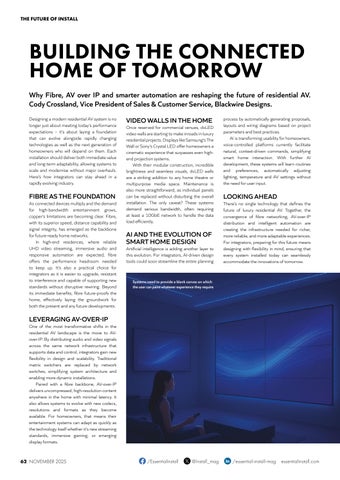
Systems need to provide a blank canvas on which the user can paint whatever experience they require
LEVERAGING AV-OVER-IP
One of the most transformative shifts in the residential AV landscape is the move to AVover-IP. By distributing audio and video signals across the same network infrastructure that supports data and control, integrators gain new flexibility in design and scalability. Traditional matrix switchers are replaced by network switches, simplifying system architecture and enabling more dynamic installations. Paired with a fibre backbone, AV-over-IP delivers uncompressed, high-resolution content anywhere in the home with minimal latency. It also allows systems to evolve with new codecs, resolutions and formats as they become available. For homeowners, that means their entertainment systems can adapt as quickly as the technology itself whether it’s new streaming standards, immersive gaming, or emerging display formats.
62 NOVEMBER 2025
/Essentialinstall
@Install_mag
/essential-install-mag
essentialinstall.com